
_-_B6019~11.jpg/250px-Explosion_following_the_plane_impact_into_the_South_Tower_(WTC_2)_-_B6019~11.jpg)


_-_B6019~11.jpg/2000px-Explosion_following_the_plane_impact_into_the_South_Tower_(WTC_2)_-_B6019~11.jpg)
Community hub
Recent from talks
Contribute something
Nothing was collected or created yet.
Terrorism
View on Wikipedia

| Part of a series on |
| Terrorism |
|---|
Terrorism, in its broadest sense, is the use of violence against non-combatants to achieve political or ideological aims.[1] The term is used in this regard primarily to refer to intentional violence during peacetime or in the context of war against non-combatants.[2] There are various different definitions of terrorism, with no universal agreement about it.[3][4][5] Different definitions of terrorism emphasize its randomness, its aim to instill fear, and its broader impact beyond its immediate victims.[1]
Modern terrorism, evolving from earlier iterations, employs various tactics to pursue political goals, often leveraging fear as a strategic tool to influence decision makers. By targeting densely populated public areas such as transportation hubs, airports, shopping centers, tourist attractions, and nightlife venues, terrorists aim to instill widespread insecurity, prompting policy changes through psychological manipulation and undermining confidence in security measures.[6]
The terms "terrorist" and "terrorism" originated during the French Revolution of the late 18th century,[7] but became widely used internationally and gained worldwide attention in the 1970s during the Troubles in Northern Ireland, the Basque conflict and the Israeli–Palestinian conflict. The increased use of suicide attacks from the 1980s onwards was typified by the September 11 attacks in the United States in 2001. The Global Terrorism Database, maintained by the University of Maryland, College Park, has recorded more than 61,000 incidents of non-state terrorism, resulting in at least 140,000 deaths between 2000 and 2014.[8]
Various organizations and countries have used terrorism to achieve their objectives. These include left-wing and right-wing political organizations, nationalist groups, religious groups, revolutionaries, and ruling governments.[9] In recent decades, hybrid terrorist organizations have emerged, incorporating both military and political arms.[1] State terrorism, with its institutionalized instrumentation of terror tactics through massacres, genocides, forced disappearances, carpet bombings and torture, is a deadlier form of terrorism than non-state terrorism.[10][11][12][13]
Etymology and definition
[edit]Etymology
[edit]
The term "terrorism" itself was originally used to describe the actions of the Jacobin Club during the "Reign of Terror" in the French Revolution. "Terror is nothing other than justice, prompt, severe, inflexible", said Jacobin leader Maximilien Robespierre.[14] In 1795, Edmund Burke denounced the Jacobins for letting "thousands of those hell-hounds called Terrorists ... loose on the people" of France.[15] John Calvin's rule over Geneva in the 16th century has also been described as a reign of terror.[16][17][18]
The terms "terrorism" and "terrorist" gained renewed currency in the 1970s as a result of the Palestine Liberation Organization (PLO),[19] the Irish Republican Army (IRA),[20] the Basque separatist group, ETA,[21] and the operations of groups such as the Red Army Faction.[22] Leila Khaled was described as a terrorist in a 1970 issue of Life magazine.[23] A number of books on terrorism were published in the 1970s.[24] The topic came further to the fore after the 1983 Beirut barracks bombings[25] and again after the 2001 September 11 attacks[25][26][27] and the 2002 Bali bombings.[25]
Definition
[edit]
No definition of terrorism has gained universal agreement.[28][29] Challenges emerge due to the politically and emotionally charged nature of the term, the double standards used in applying it,[30] and disagreement over the nature of terrorist acts and limits of the right to self-determination.[31][32] Harvard law professor Richard Baxter, a leading expert on the law of war, was a skeptic: "We have cause to regret that a legal concept of 'terrorism' was ever inflicted upon us. The term is imprecise; it is ambiguous; and above all, it serves no operative legal purpose."[33][32]
Different legal systems and government agencies employ diverse definitions of terrorism, with governments showing hesitation in establishing a universally accepted, legally binding definition. Title 18 of the United States Code §2231, part of Chapter 113B, defines terrorism as acts that are intended to (1) intimidate or coerce civilians, (2) influence government policy by coercion, or (3) to affect the conduct of a government by mass destruction, assassination, or kidnapping.[34] The international community has been slow to formulate a universally agreed, legally binding definition of this crime, and has been unable to conclude a Comprehensive Convention on International Terrorism that incorporates a single, all-encompassing, legally binding, criminal law definition of terrorism.[35] These difficulties arise from the fact that the term "terrorism" is politically and emotionally charged.[36][37] The international community has instead adopted a series of sectoral conventions, which do not have terrorism as a single cohesive criminal offense of terrorism. Rather sectoral conventions criminalizes various types of criminal activities involved in the commission of terrorism (for example homicide).[38]
Counterterrorism analyst Bruce Hoffman has noted that it is not only individual agencies within the same governmental apparatus that cannot agree on a single definition of terrorism; experts and other long-established scholars in the field are equally incapable of reaching a consensus.[39] In 1992, terrorism studies scholar Alex P. Schmid proposed a simple definition to the United Nations Commission on Crime Prevention and Criminal Justice (CCPCJ) as "peacetime equivalents of war crimes", but it was not accepted.[40][41] In 2006, it was estimated that there were over 109 different definitions of terrorism.[42]
History
[edit]Pre-modern terrorism
[edit]Early published studies like Paul Wilkinson considered terrorism a product of 19th-century revolutionary politics. Technological developments like the pistol and dynamite made possible the relentless onslaught of successful attacks and assassinations that shook the 19th-century.[43][44] For the most part, scholars considered terrorism a modern phenomenon until David C. Rapoport published his seminal article Fear and Trembling: Terrorism in Three Religious Traditions in 1984.[43]
Rapoport proposed three case studies to demonstrate "ancient lineage" of religious terrorism, which he called "sacred terror": the "Thugs", the Assassins and the Jewish Sicarii Zealots. Rapoport argued religious terrorism has been ongoing since ancient times and that "there are signs that it is reviving in new and unusual forms". He is the first to propose that religious doctrines were more important than political rationales for some terrorist groups.[45][46] Rapoport's work has since become the basis of the model of "New Terrorism" proposed by Bruce Hoffman and developed by other scholars. "New Terrorism" has had an unparalleled impact on policymaking. Critics have pointed out that the model is politically charged and over-simplified. The underlying historical assertions have received less critical attention.[47] According to The Oxford Handbook on the History of Terrorism:[43]
Since the publication of Rapoport's article, it has become seemingly pre-requisite for standard works on terrorism to cite the three case studies and to reproduce uncritically its findings. In lieu of empirical research, authors tend to crudely paraphrase Rapoport and the assumed relevance of "Thuggee" to the study of modern terrorism is taken for granted. Yet the significance of the article is not simply a matter of citations―it has also provided the foundation for what has become known as the "New Terrorism" paradigm. While Rapoport did not suggest which late 20th century groups might exemplify the implied recurrence of "holy terror", Bruce Hoffman, recognized today as one of the world's leading terrorism experts, did not hesitate to do so. A decade after Rapoport's article. Hoffman picked up the mantle and taking the three case studies as inspiration, he formulated a model of contemporary "holy terror" or, as he defined it, "terrorism motivated by a religious imperative". Completely distinct from "secular terrorists", Hoffman argued that "religious terrorists" carry out indiscriminate acts of violence as a divine duty with no consideration for political efficacy―their aim is transcendental and "holy terror" constitutes an end in itself. Hoffman's concept has since been taken up and developed by a number of other writers, including Walter Laquer, Steven Simon and Daniel Benjamen, and rebranded as the "New Terrorism".
Birth of modern terrorism (1850–1890s)
[edit]Arguably, the first organization to use modern terrorist techniques was the Irish Republican Brotherhood,[48] founded in 1858 as a revolutionary Irish nationalist group[49] that carried out attacks in England.[50] The group initiated the Fenian dynamite campaign in 1881, one of the first modern terror campaigns.[51] Instead of earlier forms of terrorism based on political assassination, this campaign used timed explosives with the express aim of sowing fear in the very heart of metropolitan Britain, in order to achieve political gains.[52]
.png)
Another early terrorist-type group was Narodnaya Volya, founded in Russia in 1878 as a revolutionary anarchist group inspired by Sergei Nechayev and "propaganda by the deed" theorist Carlo Pisacane.[54][55] The group developed ideas—such as targeted killing of the 'leaders of oppression', which were to become the hallmark of subsequent violence by small non-state groups, and they were convinced that the developing technologies of the age—such as the invention of dynamite, which they were the first anarchist group to make widespread use of[56]—enabled them to strike directly and with discrimination.[57]
In the Western world, and more specifically in France, the repression faced by anarchists from the state led, in the early 1890s, to France's entry into the Ère des attentats (1892–1894). This period, characterized by a surge in terrorist acts following Ravachol's bombings, saw several shifts that pushed terrorism toward modern terrorism.[58][59] As with the Fenian campaign, terrorism shifted from being person-based to location-based, starting with the first attack of that period, the Saint-Germain bombing.[58]
However, other major evolutions emerged during this period: the apparition of lone wolves[60] and the birth of mass or indiscriminate terrorism.[59] Indeed, in the second half of the Ère des attentats, three incidents laid the foundation for mass terrorism within a few months of each other. These were the Liceu bombing, the 13 November 1893 stabbing, and the Café Terminus attack.[59] In each of these attacks, the perpetrators targeted not a specific individual but a collective enemy.[59] Émile Henry, in particular, responsible for the Café Terminus bombing, explicitly claimed the birth of this new form of terrorism, stating that he wanted to 'strike at random'.[59]
Modern terrorism (1900–present)
[edit]In 1920 Leon Trotsky wrote Terrorism and Communism to justify the Red Terror and defend the moral superiority of revolutionary terrorism.[61]
The assassination of the Empress of Austria Elisabeth in 1898 resulted in the International Conference of Rome for the Social Defense Against Anarchists, the first international conference against terrorism.[62]
According to Bruce Hoffman of the RAND Corporation, in 1980, 2 out of 64 terrorist groups were categorized as having religious motivation while in 1995, almost half (26 out of 56) were religiously motivated with the majority having Islam as their guiding force.[63][64]
Types of terrorism
[edit] | This section needs additional citations for verification. (March 2017) |
Depending on the country, the political system, and the time in history, the types of terrorism are varying.


In early 1975, the Law Enforcement Assistant Administration in the United States formed the National Advisory Committee on Criminal Justice Standards and Goals. One of the five volumes that the committee wrote was titled Disorders and Terrorism, produced by the Task Force on Disorders and Terrorism under the direction of H. H. A. Cooper, Director of the Task Force staff.
The Task Force defines terrorism as "a tactic or technique by means of which a violent act or the threat thereof is used for the prime purpose of creating overwhelming fear for coercive purposes". It classified disorders and terrorism into seven categories:[68]
- Civil disorder – A form of collective violence interfering with the peace, security, and normal functioning of the community.
- Political terrorism – Violent criminal behaviour designed primarily to generate fear in the community, or substantial segment of it, for political purposes.
- Non-Political terrorism – Terrorism that is not aimed at political purposes, but which exhibits "conscious design to create and maintain a high degree of fear for coercive purposes, but the end is individual or collective gain rather than the achievement of a political objective".
- Anonymous terrorism – In the two decades prior to 2016–19, "fewer than half" of all terrorist attacks were either "claimed by their perpetrators or convincingly attributed by governments to specific terrorist groups". A number of theories have been advanced as to why this has happened.[69]
- Quasi-terrorism – The activities incidental to the commission of crimes of violence that are similar in form and method to genuine terrorism, but which nevertheless lack its essential ingredient. It is not the main purpose of the quasi-terrorists to induce terror in the immediate victim as in the case of genuine terrorism, but the quasi-terrorist uses the modalities and techniques of the genuine terrorist and produces similar consequences and reaction.[70] For example, the fleeing felon who takes hostages is a quasi-terrorist, whose methods are similar to those of the genuine terrorist but whose purposes are quite different.
- Limited political terrorism – Genuine political terrorism is characterized by a revolutionary approach; limited political terrorism refers to "acts of terrorism which are committed for ideological or political motives but which are not part of a concerted campaign to capture control of the state".
- Official or state terrorism – "referring to nations whose rule is based upon fear and oppression that reach similar to terrorism or such proportions". It may be referred to as Structural Terrorism defined broadly as terrorist acts carried out by governments in pursuit of political objectives, often as part of their foreign policy.
Other sources have defined the typology of terrorism in different ways, for example, broadly classifying it into domestic terrorism and international terrorism, or using categories such as vigilante terrorism or insurgent terrorism.[71] Some ways the typology of terrorism may be defined are:[72][73]
- Political terrorism
- Sub-state terrorism
- Social revolutionary terrorism
- Nationalist-separatist terrorism
- Religious extremist terrorism
- Religious fundamentalist Terrorism
- New religions terrorism
- Right-wing terrorism
- Left-wing terrorism
- State-sponsored terrorism
- State terrorism
- Sub-state terrorism
- Criminal terrorism
- Pathological terrorism
Religious terrorism
[edit]According to the Global Terrorism Index by the University of Maryland, College Park, religious extremism has overtaken national separatism and become the main driver of terrorist attacks around the world. Since 9/11 there has been a five-fold increase in deaths from terrorist attacks. The majority of incidents over the past several years can be tied to groups with a religious agenda. Before 2000, it was nationalist separatist terrorist organizations such as the IRA and Chechen rebels who were behind the most attacks. The number of incidents from nationalist separatist groups has remained relatively stable in the years since while religious extremism has grown. The prevalence of Islamist groups in Iraq, Afghanistan, Pakistan, Nigeria and Syria is the main driver behind these trends.[74]

- Islamic State
- Syrian government
- Lebanese government
- Iraqi Kurdistan forces
- Syrian opposition forces
- Note: Iraq and Syria contain large desert areas with sparse populations. These areas are mapped as under the control of forces holding roads and towns within them.
Hamas, the main Islamist movement in the Palestinian territories, was formed by Palestinian imam Ahmed Yassin in 1987. Some scholars, including constitutional law professor Alexander Tsesis, have voiced concerns over the Hamas Charter's apparent advocacy of genocidal aspirations.[75][76][77] In the periods of 1994–1996 and 2001–2007, Hamas orchestrated a series of suicide bombings, primarily directed at civilian targets in Israel, killing over 1,000 Israeli civilians.[78]
Five of the terrorist groups that have been most active since 2001 are Hamas, Boko Haram, al-Qaeda, the Taliban and ISIL. These groups have been most active in Iraq, Afghanistan, Pakistan, Nigeria and Syria. Eighty percent of all deaths from terrorism occurred in these five countries.[74] In 2015 four Islamic extremist groups were responsible for 74% of all deaths from Islamic terrorism: ISIS, Boko Haram, the Taliban, and al-Qaeda, according to the Global Terrorism Index 2016.[79] Since approximately 2000, these incidents have occurred on a global scale, affecting not only Muslim-majority states in Africa and Asia, but also states with non-Muslim majority such as United States, United Kingdom, France, Germany, Spain, Belgium, Sweden, Russia, Australia, Canada, Sri Lanka, Israel, China, India and Philippines. Such attacks have targeted both Muslims and non-Muslims, however the majority affect Muslims themselves.[80]

Terrorism in Pakistan has become a great problem. From the summer of 2007 until late 2009, more than 1,500 people were killed in suicide and other attacks on civilians[82] for reasons attributed to a number of causes—sectarian violence between Sunni and Shia Muslims; easy availability of guns and explosives; the existence of a "Kalashnikov culture"; an influx of ideologically driven Muslims based in or near Pakistan, who originated from various nations around the world and the subsequent war against the pro-Soviet Afghans in the 1980s which blew back into Pakistan; the presence of Islamist insurgent groups and forces such as the Taliban and Lashkar-e-Taiba. On July 2, 2013, in Lahore, 50 Muslim scholars of the Sunni Ittehad Council (SIC) issued a collective fatwa against suicide bombings, the killing of innocent people, bomb attacks, and targeted killings declaring them as Haraam or forbidden.[83]
In 2015, the Southern Poverty Law Center released a report on domestic terrorism in the United States. The report (titled The Age of the Wolf) analyzed 62 incidents and found that, between 2009 and 2015, "more people have been killed in America by non-Islamic domestic terrorists than jihadists."[84] The "virulent racist and antisemitic" ideology of the ultra-right wing Christian Identity movement is usually accompanied by anti-government sentiments.[85] Adherents of Christian Identity are not connected with specific Christian denominations,[86] and they believe that whites of European descent can be traced back to the "Lost Tribes of Israel". Adherents have committed hate crimes, bombings and other acts of terrorism, including the Centennial Olympic Park bombing.[87][88] Its influence ranges from the Ku Klux Klan and neo-Nazi groups to the anti-government militia and sovereign citizen movements.[85]
Causes and motivations
[edit]Terrorist acts frequently have a political purpose based on self-determination claims, ethnonationalist frustrations, single issue causes (like abortion or the environment), or other ideological or religious causes that terrorists claim are a moral justification for their violent acts.[89]
Choice of terrorism as a tactic
[edit]Individuals and groups choose terrorism as a tactic because it can:
- Act as a form of asymmetric warfare in order to directly force a government to agree to demands
- Intimidate a group of people into capitulating to the demands in order to avoid future injury
- Get attention and thus political support for a cause
- Directly inspire more people to the cause (such as revolutionary acts) – propaganda of the deed
- Indirectly inspire more people to the cause by provoking a hostile response or over-reaction from enemies to the cause[90]
Attacks on "collaborators" are used to intimidate people from cooperating with the state in order to undermine state control. This strategy was used in Ireland, in Kenya, in Algeria and in Cyprus during their independence struggles.[91]
Stated motives for the September 11 attacks included inspiring more fighters to join the cause of repelling the United States from Muslim countries with a successful high-profile attack. The attacks prompted some criticism from domestic and international observers regarding perceived injustices in U.S. foreign policy that provoked the attacks, but the larger practical effect was that the United States government declared a War on Terror that resulted in substantial military engagements in several Muslim-majority countries. Various commentators have inferred that al-Qaeda expected a military response and welcomed it as a provocation that would result in more Muslims fighting the United States. Some commentators believe that the resulting anger and suspicion directed toward innocent Muslims living in Western countries and the indignities inflicted upon them by security forces and the general public also contributes to radicalization of new recruits.[90] Despite criticism that the Iraqi government had no involvement with the September 11 attacks, Bush declared the 2003 invasion of Iraq to be part of the War on Terror. The resulting backlash and instability enabled the rise of Islamic State of Iraq and the Levant and the temporary creation of an Islamic caliphate holding territory in Iraq and Syria, until ISIL lost its territory through military defeats.
Attacks used to draw international attention to struggles that are otherwise unreported have included the Palestinian airplane hijackings in 1970 and the 1975 Dutch train hostage crisis.
Causes motivating terrorism
[edit]Specific political or social causes have included:
- Independence or separatist movements
- Irredentist movements
- Adoption of a particular political philosophy, such as socialism (left-wing terrorism), anarchism, or fascism (possibly through a coup or as an ideology of an independence or separatist movement)
- Environmental protection (eco-terrorism)
- Supremacism of a particular group
- Preventing a rival group from sharing or occupying a particular territory (such as by discouraging immigration or encouraging flight)
- Subjugation of a particular population (such as lynching of African Americans)
- Spread or dominance of a particular religion – religious terrorism
- Ending perceived government oppression
- Responding to a violent act (for example, tit-for-tat attacks in the Israeli–Palestinian conflict, in The Troubles in Northern Ireland, or Timothy McVeigh's revenge for the Waco siege and Ruby Ridge incident)
Causes for right-wing terrorism have included white nationalism, ethnonationalism, fascism, anti-socialism, the anti-abortion movement, and tax resistance.
Sometimes terrorists on the same side fight for different reasons. For example, in the Chechen–Russian conflict secular Chechens using terrorist tactics fighting for national independence are allied with radical Islamist terrorists who have arrived from other countries.[92]
Personal and social factors
[edit]Various personal and social factors may influence the personal choice of whether to join a terrorist group or attempt an act of terror, including:
- Identity, including affiliation with a particular culture, ethnicity, or religion
- Previous exposure to violence
- Financial reward (for example, the Palestinian Authority Martyrs Fund)
- Mental illness
- Social isolation
- Perception that the cause responds to a profound injustice or indignity
A report conducted by Paul Gill, John Horgan and Paige Deckert [dubious – discuss] found that for "lone wolf" terrorists:[93]
- 43% were motivated by religious beliefs
- 32% had pre-existing mental health disorders, while many more are found to have mental health problems upon arrest
- At least 37% lived alone at the time of their event planning or execution, a further 26% lived with others, and no data were available for the remaining cases
- 40% were unemployed at the time of their arrest or terrorist event
- 19% subjectively experienced being disrespected by others
- 14% percent experienced being the victim of verbal or physical assault
Ariel Merari, a psychologist who has studied the psychological profiles of suicide terrorists since 1983 through media reports that contained biographical details, interviews with the suicides' families, and interviews with jailed would-be suicide attackers, concluded that they were unlikely to be psychologically abnormal.[94] In comparison to economic theories of criminal behaviour, Scott Atran found that suicide terrorists exhibit none of the socially dysfunctional attributes—such as fatherless, friendless, jobless situations—or suicidal symptoms. By which he means, they do not kill themselves simply out of hopelessness or a sense of 'having nothing to lose'.[95]
Abrahm suggests that terrorist organizations do not select terrorism for its political effectiveness.[96] Individual terrorists tend to be motivated more by a desire for social solidarity with other members of their organization than by political platforms or strategic objectives, which are often murky and undefined.[96]
Michael Mousseau shows possible relationships between the type of economy within a country and ideology associated with terrorism.[example needed][97] Many terrorists have a history of domestic violence.[98]
Democracy and domestic terrorism
[edit]Terrorism is most common in nations with intermediate political freedom, and it is least common in the most democratic nations.[99][100][101][102]
Some examples of terrorism in non-democratic nations include ETA in Spain under Francisco Franco (although the group's activities increased sharply after Franco's death),[103] the Organization of Ukrainian Nationalists in pre-war Poland,[104] the Shining Path in Peru under Alberto Fujimori,[105] the Kurdistan Workers Party when Turkey was ruled by military leaders, and the ANC in South Africa.[106]
According to Boaz Ganor, "Modern terrorism sees the liberal democratic state, in all its variations, as the perfect launching pad and a target for its attacks. Moreover, some terrorist organizations—particularly Islamist-jihadist organizations—have chosen to cynically exploit democratic values and institutions to gain power and status, promote their interests, and achieve internal and international legitimacy".[1] Jihadist militants have shown an ambivalent view towards democracy, as they both exploit it for their ends and oppose it in their ideology. Various quotes from jihadist leaders note their disdain for democracy and their efforts to undermine it in favor of Islamic rule.[1] Democracies, such as Japan, the United Kingdom, the United States, Israel, Indonesia, India, Spain, Germany, Italy and the Philippines, have all experienced domestic terrorism.
While a democratic nation espousing civil liberties may claim a sense of higher moral ground than other regimes, an act of terrorism within such a state may cause a dilemma: whether to maintain its civil liberties and thus risk being perceived as ineffective in dealing with the problem; or alternatively to restrict its civil liberties and thus risk delegitimizing its claim of supporting civil liberties.[107] For this reason, homegrown terrorism has started to be seen as a greater threat, as stated by former CIA Director Michael Hayden.[108] This dilemma, some social theorists would conclude, may very well play into the initial plans of the acting terrorist(s); namely, to delegitimize the state and cause a systematic shift towards anarchy via the accumulation of negative sentiments towards the state system.[109]
Perpetrators
[edit]
The perpetrators of acts of terrorism can be individuals, groups, or states. According to some definitions, clandestine or semi-clandestine state actors may carry out terrorist acts outside the framework of a state of war. The most common image of terrorism is that it is carried out by small and secretive cells, highly motivated to serve a particular cause and many of the most deadly operations in recent times, such as the September 11 attacks, the London underground bombing, 2008 Mumbai attacks and the 2002 Bali bombings were planned and carried out by a close clique, composed of close friends, family members and other strong social networks. These groups benefited from the free flow of information and efficient telecommunications to succeed where others had failed.[110]
Over the years, much research has been conducted to distill a terrorist profile to explain these individuals' actions through their psychology and socio-economic circumstances.[111] Some specialists highlight the lack of evidence supporting the idea that terrorists are typically psychologically disturbed. The careful planning and detailed execution seen in many terrorist acts are not characteristics generally associated with mentally unstable individuals.[112] Others, like Roderick Hindery, have sought to discern profiles in the propaganda tactics used by terrorists. Some security organizations designate these groups as violent non-state actors.[citation needed] A 2007 study by economist Alan B. Krueger found that terrorists were less likely to come from an impoverished background (28 percent versus 33 percent) and more likely to have at least a high-school education (47 percent versus 38 percent). Another analysis found only 16 percent of terrorists came from impoverished families, versus 30 percent of male Palestinians, and over 60 percent had gone beyond high school, versus 15 percent of the populace.[42][113]
To avoid detection, a terrorist will look, dress, and behave normally until executing the assigned mission. Some claim that attempts to profile terrorists based on personality, physical, or sociological traits are not useful.[114] The physical and behavioral description of the terrorist could describe almost any normal person.[115] The majority of terrorist attacks are carried out by military age men, aged 16 to 40.[115]
Non-state groups
[edit]
Groups not part of the state apparatus of in opposition to the state are most commonly referred to as a "terrorist" in the media.
According to the Global Terrorism Database, the most active terrorist group in the period 1970 to 2010 was Shining Path (with 4,517 attacks), followed by Farabundo Marti National Liberation Front (FMLN), Irish Republican Army (IRA), Basque Fatherland and Freedom (ETA), Revolutionary Armed Forces of Colombia (FARC), Taliban, Liberation Tigers of Tamil Eelam, New People's Army, National Liberation Army of Colombia (ELN), and Kurdistan Workers Party (PKK).[116]
Israel has had problems with religious terrorism even before independence in 1948. During British mandate over Palestine, the secular Irgun were among the Zionist groups labelled as terrorist organisations by the British authorities and United Nations,[117] for violent terror attacks against Britons and Arabs.[118][119] Another extremist group, the Lehi, openly declared its members as "terrorists".[120][121] Historian William Cleveland stated many Jews justified any action, even terrorism, taken in the cause of the creation of a Jewish state.[122] In 1995, Yigal Amir assassinated Israeli Prime Minister Yitzhak Rabin. For Amir, killing Rabin was an exemplary act that symbolized the fight against an illegitimate government that was prepared to cede Jewish Holy Land to the Palestinians.[123] Members of Kach, a Jewish ultranationalist party, employed terrorist tactics in pursuit of what they viewed as religious imperatives. Israel and a few other countries have designated the party as a terrorist group.[124]
Funding
[edit]State sponsors have constituted a major form of funding; for example, Palestine Liberation Organization, Democratic Front for the Liberation of Palestine and other groups sometimes considered to be terrorist organizations, were funded by the Soviet Union.[125][126] Iran has provided funds, training, and weapons to organizations such as Lebanese Shi’ite group Hezbollah, the Yemenite Houthi movement, and Palestinian factions such as Hamas and Islamic Jihad.[127][128][129] Iranian funding for Hamas is estimated to reach several hundred million dollars annually.[130][131] These groups and others have played significant roles in Iran's foreign policy and served as proxies in conflicts.[127] The Stern Gang received funding from Italian Fascist officers in Beirut to undermine the British authorities in Palestine.[132]
"Revolutionary tax" is another major form of funding, and essentially a euphemism for "protection money".[125] Revolutionary taxes "play a secondary role as one other means of intimidating the target population".[125]
Other major sources of funding include kidnapping for ransoms, smuggling (including wildlife smuggling),[133] fraud, and robbery.[125] The Islamic State in Iraq and the Levant has reportedly received funding "via private donations from the Gulf states".[134] Irish Republican militants, primarily the Provisional Irish Republican Army and the Irish National Liberation Army, and Loyalist paramilitaries, primarily the Ulster Volunteer Force and Ulster Defence Association, received far more financing from criminal and legitimate activities within the British Isles than overseas donations, including Libyan dictator Muammar Gaddafi and NORAID (see Paramilitary finances in the Troubles for more information).[135][136][137][138]
The Financial Action Task Force is an inter-governmental body whose mandate, since October 2001, has included combating terrorist financing.[139]
Tactics
[edit]
Terrorist attacks are often targeted to maximize fear and publicity, most frequently using explosives.[141] Terrorist groups usually methodically plan attacks in advance, and may train participants, plant undercover agents, and raise money from supporters or through organized crime. Communications occur through modern telecommunications, or through old-fashioned methods such as couriers. There is concern about terrorist attacks employing weapons of mass destruction. Some academics have argued that while it is often assumed terrorism is intended to spread fear, this is not necessarily true, with fear instead being a by-product of the terrorist's actions, while their intentions may be to avenge fallen comrades or destroy their perceived enemies.[142]
Terrorism is a form of asymmetric warfare and is more common when direct conventional warfare will not be effective because opposing forces vary greatly in power.[143] Yuval Harari argues that the peacefulness of modern states makes them paradoxically more vulnerable to terrorism than pre-modern states. Harari argues that because modern states have committed themselves to reducing political violence to almost zero, terrorists can, by creating political violence, threaten the very foundations of the legitimacy of the modern state. This is in contrast to pre-modern states, where violence was a routine and recognised aspect of politics at all levels, making political violence unremarkable. Terrorism thus shocks the population of a modern state far more than a pre-modern one and consequently the state is forced to overreact in an excessive, costly and spectacular manner, which is often what the terrorists desire.[144]
The type of people terrorists will target is dependent upon the ideology of the terrorists. A terrorist's ideology will create a class of "legitimate targets" who are deemed as its enemies and who are permitted to be targeted. This ideology will also allow the terrorists to place the blame on the victim, who is viewed as being responsible for the violence in the first place.[145][146]
Attack types
[edit]Stabbing attacks, a historical tactic, have reemerged as a prevalent form of terrorism in the 21st century, notably during the 2010s and 2020s.[147] This resurgence originated with the GIA in the 1990s and later expanded among Palestinian terrorists and Islamic State militants.[148] The trend gained momentum with a wave of "lone wolf" terrorist stabbing attacks by Palestinians targeting Israelis beginning in 2015.[149] Subsequently, this pattern extended to Europe during the surge of Islamic terrorism in the 2010s, witnessing "at least" 10 stabbing attacks allegedly motivated by Islamic extremism by the spring of 2017, with France experiencing a notable concentration of such incidents.[150][151]
Media spectacle
[edit]Terrorists may attempt to use the media to spread their message or manipulate their target audience. Shamil Basayev used this tactic during the Budyonnovsk hospital hostage crisis and again in the Moscow theater hostage crisis.[152] Terrorists may also target national symbols for attention.[153] Walter Lacquer wrote that "terrorism was always, to a large extent, about public relations and propaganda ('Propaganda by Deed' had been the slogan in the nineteenth century)".[154]
The El Al Flight 426 hijacking is considered a turning point for modern terrorism studies. The Popular Front for the Liberation of Palestine (PFLP) realized they could combine the tactics of targeting national symbols and civilians (in this case as hostages) to generate a mass media spectacle. Zehdi Labib Terzi made a public statement about this in 1976: "The first several hijackings aroused the consciousness of the world and awakened the media and world opinion much more ― and more effectively ― than 20 years of pleading at the United Nations".[155]
Mass media
[edit]

Mass media exposure may be a primary goal of those carrying out terrorism, to expose issues that would otherwise be ignored by the media. Some consider this to be manipulation and exploitation of the media.[156]
The Internet has created a new way for groups to spread their messages.[157] This has created a cycle of measures and counter measures by groups in support of and in opposition to terrorist movements. The United Nations has created its own online counterterrorism resource.[158]
The mass media will, on occasion, censor organizations involved in terrorism (through self-restraint or regulation) to discourage further terrorism. This may encourage organizations to perform more extreme acts of terrorism to be shown in the mass media. Conversely James F. Pastor explains the significant relationship between terrorism and the media, and the underlying benefit each receives from the other:[159]
There is always a point at which the terrorist ceases to manipulate the media gestalt. A point at which the violence may well escalate, but beyond which the terrorist has become symptomatic of the media gestalt itself. Terrorism as we ordinarily understand it is innately media-related.
— Novelist William Gibson, 2004[160]
Former British Prime Minister Margaret Thatcher famously spoke of the close connection between terrorism and the media, calling publicity 'the oxygen of terrorism'.[161]
Terrorism and tourism
[edit]The connection between terrorism and tourism has been widely studied since the 1997 Luxor massacre, during which 62 people, including 58 foreign nationals, were killed by Islamist group al-Jama'a al-Islamiyya in an archaeological site in Egypt.[162][163] In the 1970s, the targets of terrorists were politicians and chiefs of police while now, international tourists and visitors are selected as the main targets of attacks.[citation needed] The attacks on the World Trade Center and the Pentagon on September 11, 2001, were the symbolic center, which marked a new epoch in the use of civil transport against the main power of the planet.[164] From this event onwards, the spaces of leisure that characterized the pride of West were conceived as dangerous and frightful.[165][166]
Counterterrorism strategies
[edit]
Responses to terrorism are broad in scope. They can include re-alignments of the political spectrum and reassessments of fundamental values.
Specific types of responses include:
- Targeted laws, criminal procedures, deportations, and enhanced police powers
- Target hardening, such as locking doors or adding traffic barriers
- Preemptive or reactive military action
- Increased intelligence and surveillance activities
- Preemptive humanitarian activities
- More permissive interrogation and detention policies
Terrorism research
[edit]Terrorism research, also called terrorism studies, or terrorism and counter-terrorism research, is an academic field which seeks to understand the causes of terrorism, how to prevent it, as well as its impact in the broadest sense. Terrorism research can be carried out in both military and civilian contexts, for example by research centres such as the British Centre for the Study of Terrorism and Political Violence, the Norwegian Centre for Violence and Traumatic Stress Studies, and the International Centre for Counter-Terrorism (ICCT). There are several academic journals devoted to the field, including Perspectives on Terrorism.[167][168]
International agreements
[edit]One of the agreements that promote the international legal counterterrorist framework is the Code of Conduct Towards Achieving a World Free of Terrorism that was adopted at the 73rd session of the United Nations General Assembly in 2018. The Code of Conduct was initiated by Kazakhstan President Nursultan Nazarbayev. Its main goal is to implement a wide range of international commitments to counterterrorism and establish a broad global coalition towards achieving a world free of terrorism by 2045. The Code was signed by more than 70 countries.[169]
Response in the United States
[edit]
According to a report by Dana Priest and William M. Arkin in The Washington Post, "Some 1,271 government organizations and 1,931 private companies work on programs related to counterterrorism, homeland security and intelligence in about 10,000 locations across the United States."[170]
America's thinking on how to defeat radical Islamists is split along two very different schools of thought. Republicans, typically follow what is known as the Bush Doctrine, advocate the military model of taking the fight to the enemy and seeking to democratize the Middle East. Democrats, by contrast, generally propose the law enforcement model of better cooperation with nations and more security at home.[171] In the introduction of the U.S. Army / Marine Corps Counterinsurgency Field Manual, Sarah Sewall states the need for "U.S. forces to make securing the civilian, rather than destroying the enemy, their top priority. The civilian population is the center of gravity—the deciding factor in the struggle.... Civilian deaths create an extended family of enemies—new insurgent recruits or informants—and erode support of the host nation." Sewall sums up the book's key points on how to win this battle: "Sometimes, the more you protect your force, the less secure you may be.... Sometimes, the more force is used, the less effective it is.... The more successful the counterinsurgency is, the less force can be used and the more risk must be accepted.... Sometimes, doing nothing is the best reaction."[172] This strategy, often termed "courageous restraint", has certainly led to some success on the Middle East battlefield. However, it does not address the fact that terrorists are mostly homegrown.[171]
Ending terrorist groups
[edit]
Jones and Libicki (2008) created a list of all the terrorist groups they could find that were active between 1968 and 2006. They found 648. Of those, 136 splintered and 244 were still active in 2006.[174] Of the ones that ended, 43% converted to nonviolent political actions, like the Irish Republican Army in Northern Ireland; 40% were defeated by law enforcement; 7% (20 groups) were defeated by military force; and 10% succeeded.
42 groups became large enough to be labeled an insurgency; 38 of those had ended by 2006. Of those, 47% converted to nonviolent political actors. Only 5% were ended by law enforcement, and 21% were defeated by military force. 26% won.[175] Jones and Libicki concluded that military force may be necessary to deal with large insurgencies but are only occasionally decisive, because the military is too often seen as a bigger threat to civilians than the terrorists. To avoid that, the rules of engagement must be conscious of collateral damage and work to minimize it. When militant groups face violent competition from other groups, they often shift from high-profile attacks on civilians to more restrained tactics, a strategy of terrorist restraint that arises due to resource constraints and fear of civilian backlash.[176]
Another researcher, Audrey Cronin, lists six primary ways that terrorist groups end:[177]
- Capture or killing of a group's leader (Decapitation)
- Entry of the group into a legitimate political process (Negotiation)
- Achievement of group aims (Success)
- Group implosion or loss of public support (Failure)
- Defeat and elimination through brute force (Repression)
- Transition from terrorism into other forms of violence (Reorientation)
State and state sponsored-terrorism
[edit]State terrorism
[edit]Civilization is based on a clearly defined and widely accepted yet often unarticulated hierarchy. Violence done by those higher on the hierarchy to those lower is nearly always invisible, that is, unnoticed. When it is noticed, it is fully rationalized. Violence done by those lower on the hierarchy to those higher is unthinkable, and when it does occur it is regarded with shock, horror, and the fetishization of the victims.

As with "terrorism" the concept of "state terrorism" is controversial.[179] The Chairman of the United Nations Counter-Terrorism Committee has stated that the committee was conscious of 12 international conventions on the subject, and none of them referred to state terrorism, which was not an international legal concept. If states abused their power, they should be judged against international conventions dealing with war crimes, international human rights law, and international humanitarian law.[180] Former United Nations Secretary-General Kofi Annan has said that it is "time to set aside debates on so-called 'state terrorism'. The use of force by states is already thoroughly regulated under international law".[181] He made clear that, "regardless of the differences between governments on the question of the definition of terrorism, what is clear and what we can all agree on is that any deliberate attack on innocent civilians [or non-combatants], regardless of one's cause, is unacceptable and fits into the definition of terrorism."[182]
_burning_after_the_Japanese_attack_on_Pearl_Harbor_-_NARA_195617_-_Edit.jpg)
State terrorism has been used to refer to terrorist acts committed by governmental agents or forces. This involves the use of state resources employed by a state's foreign policies, such as using its military to directly perform acts of terrorism. Professor of Political Science Michael Stohl cites the examples that include the German bombing of London, the Japanese surprise attack on Pearl Harbor, the Allied firebombing of Dresden, and the U.S. atomic bombings of Hiroshima and Nagasaki during World War II. He argues that "the use of terror tactics is common in international relations and the state has been and remains a more likely employer of terrorism within the international system than insurgents." He cites the first strike option as an example of the "terror of coercive diplomacy" as a form of this, which holds the world hostage with the implied threat of using nuclear weapons in "crisis management" and he argues that the institutionalized form of terrorism has occurred as a result of changes that took place following World War II. In this analysis, state terrorism exhibited as a form of foreign policy was shaped by the presence and use of weapons of mass destruction, and the legitimizing of such violent behavior led to an increasingly accepted form of this behavior by the state.[183][184][185]
Charles Stewart Parnell described William Ewart Gladstone's Irish Coercion Act as terrorism in his "no-Rent manifesto" in 1881, during the Irish Land War.[186] The concept is used to describe political repressions by governments against their own civilian populations with the purpose of inciting fear. For example, taking and executing civilian hostages or extrajudicial elimination campaigns are commonly considered "terror" or terrorism, for example during the Red Terror or the Great Terror.[187] Such actions are often described as democide or genocide, which have been argued to be equivalent to state terrorism.[188] Empirical studies on this have found that democracies have little democide.[189][190] Western democracies, including the United States, have supported state terrorism[191] and mass killings,[192][193] with some examples being the Indonesian mass killings of 1965–66 and Operation Condor.[194][195][196]
State-sponsored terrorism
[edit]
A state can sponsor terrorism by funding or harboring a terrorist group. Opinions as to which acts of violence by states consist of state-sponsored terrorism vary widely. When states provide funding for groups considered by some to be terrorist, they rarely acknowledge them as such.[198]
Impact and debate
[edit]Terrorism is a charged term. It is often used with the connotation of something that is morally wrong. Governments and non-state groups use the term to abuse or denounce opposing groups.[5][199][200][25][201] While legislation defining terrorism as a crime has been adopted in many states, the distinction between activism and terrorism remains a complex and debated matter.[202][203] There is no consensus as to whether terrorism should be regarded as a war crime.[202][204] State terrorism is that perpetrated by nation states, but is not considered such by the state conducting it, making legality a grey area.[205] Countries sometimes opt to ignore terrorist activities committed by allies.[206][207]
The use of the term in the Israel–Palestine conflict has given rise to controversies concerning the vagueness of how terrorists are defined and identified.[208]
Media outlets who wish to convey impartiality may limit their usage of "terrorist" and "terrorism" because they are loosely defined, potentially controversial in nature, and subjective terms.[209][210]
Pejorative use
[edit]The term "terrorism" is often used to abuse or denounce opposite parties, either governments or non-state groups.[5][199][200][25][201] An example of this is the terruqueo political attack used by right-wing groups in Peru to target leftist groups or those opposed to the neoliberal status quo, likening opponents to guerrilla organizations[211] from the internal conflict in Peru.[212][213][214]

Those labeled "terrorists" by their opponents rarely identify themselves as such, but it was not always so. While a multitude of terms like separatist, freedom fighter, liberator, revolutionary, vigilante, militant, paramilitary, guerrilla, rebel, patriot, have come into use, (including some culturally specific terms borrowed from other languages like Jihadi, mujahideen, and fedayeen), the unwillingness to self-identify as terrorists began when parties in a conflict started to describe each other as terrorists pejoratively.[215] As an example, when Vera Zasulich attacked a Russian official known for abusing prisoners she told the court "I am not a criminal, I am a terrorist!". The stunned court acquitted Zazulich when they realized that she was trying to become a martyr. She was carried out of the courtroom on the shoulders of the crowd.[216]
Some groups and individuals have openly admitted to using "terrorist tactics" even while maintaining distance from the pejorative term in their self-descriptions. The Zionist militant group Lohamei Herut Yisrael admitted that they used terrorist tactics but used the euphemism "Freedom Fighters" to describe themselves (Lohamei Herut Yisrael means "Freedom Fighters for Israel".)[217]
In his book Inside Terrorism Bruce Hoffman offered an explanation of why the term terrorism becomes distorted:
On one point, at least, everyone agrees: terrorism is a pejorative term. It is a word with intrinsically negative connotations that is generally applied to one's enemies and opponents, or to those with whom one disagrees and would otherwise prefer to ignore. 'What is called terrorism,' Brian Jenkins has written, 'thus seems to depend on one's point of view. Use of the term implies a moral judgment; and if one party can successfully attach the label terrorist to its opponent, then it has indirectly persuaded others to adopt its moral viewpoint.' Hence the decision to call someone or label some organization terrorist becomes almost unavoidably subjective, depending largely on whether one sympathizes with or opposes the person/group/cause concerned. If one identifies with the victim of the violence, for example, then the act is terrorism. If, however, one identifies with the perpetrator, the violent act is regarded in a more sympathetic, if not positive (or, at the worst, an ambivalent) light; and it is not terrorism.[218][219]
The pejorative connotations of the word can be summed up in the aphorism, "One man's terrorist is another man's freedom fighter".[215] This is exemplified when a group using irregular military methods is an ally of a state against a mutual enemy, but later falls out with the state and starts to use those methods against its former ally.
Groups accused of terrorism understandably prefer terms reflecting legitimate military or ideological action.[220][221][222] Leading terrorism researcher Professor Martin Rudner, director of the Canadian Centre of Intelligence and Security Studies at Ottawa's Carleton University, defines "terrorist acts" as unlawful attacks for political or other ideological goals, and said:
There is the famous statement: 'One man's terrorist is another man's freedom fighter.' But that is grossly misleading. It assesses the validity of the cause when terrorism is an act. One can have a perfectly beautiful cause and yet if one commits terrorist acts, it is terrorism regardless.[223]
Labelling opponents as "terrorists" has been used as a tactic to evade the usual laws of war against things such as assassinations and other extrajudicial killing, particularly by Israel and the United States.[224][better source needed][attribution needed] Some international legal opinions suggest that terrorist activities by their very nature "deny" the civilian nature of an ostensibly civilian participant.[225][226]

Some groups, when involved in a "liberation" struggle, have been called "terrorists" by the Western governments or media. Later, these same persons, as leaders of the liberated nations, are called "statesmen" by similar organizations. Two examples of this phenomenon are the Nobel Peace Prize laureates Menachem Begin and Nelson Mandela.[227][228][229][230] WikiLeaks editor Julian Assange has been called a "terrorist" by Sarah Palin and Joe Biden.[231][232]
Inversely, some groups like the Afghan Mujahideen that were labelled as "freedom fighters" later became "terrorists" as alliances shifted.[233] During the Second World War, the Malayan People's Anti-Japanese Army were allied with the British, but during the Malayan Emergency, members of its successor organisation (the Malayan National Liberation Army) started campaigns against them, and were branded "terrorists" as a result.[234][235]
Databases
[edit]The following terrorism databases are or were made publicly available for research purposes, and track specific acts of terrorism:
- Global Terrorism Database, an open-source database by the University of Maryland, College Park on terrorist events around the world from 1970 through 2017 with more than 150,000 cases.
- MIPT Terrorism Knowledge Base
- Worldwide Incidents Tracking System
- Tocsearch (dynamic database)
The following public report and index provides a summary of key global trends and patterns in terrorism around the world:
- Global Terrorism Index, produced annually by the Institute for Economics and Peace
The following publicly available resources index electronic and bibliographic resources on the subject of terrorism:
The following terrorism databases are maintained in secrecy by the United States Government for intelligence and counterterrorism purposes:
Jones and Libicki (2008) includes a table of 268 terrorist groups active between 1968 and 2006 with their status as of 2006: still active, splintered, converted to nonviolence, removed by law enforcement or military, or won. (These data are not in a convenient machine-readable format but are available.)
Infographics
[edit]-
 Terrorist incidents, 1970–2015. A total of 157,520 incidents are plotted. Orange: 1970–1999, Red: 2000–2015
 -
 Top 10 Countries (2000–2014)
 -
 Worldwide non-state terrorist incidents 1970–2017
 -
 Share who are worried about vs. share of deaths from terrorism

.png)


See also
[edit]- Agro-terrorism
- Communist terrorism
- Crimes against humanity
- Cyberterrorism
- Definitions of terrorism
- Economic terrorism
- Economics of terrorism
- Environmental terrorism
- Fearmongering
- Government negotiation with terrorists
- Left-wing terrorism
- Right-wing terrorism
- List of designated terrorist groups
- List of terrorist incidents
- Narcoterrorism
- Nationalist terrorism
- Nuclear terrorism
- Religious terrorism
- Stochastic terrorism
- Terrorism and social media
- Violent extremism
Notes and references
[edit]- ^ a b c d e Ganor, Boaz (2015). "Introduction to Multidimensional Warfare". Global Alert: The Rationality of Modern Islamist Terrorism and the Challenge to the Liberal Democratic World. Columbia University Press. pp. 2–3, 5–6, 14–16. doi:10.7312/gano17212. ISBN 978-0-231-53891-6. JSTOR 10.7312/gano17212.
- ^ Wisnewski, J. Jeremy, ed. (2008). Torture, Terrorism, and the Use of Violence (also available as Review Journal of Political Philosophy Volume 6, Issue Number 1). Cambridge Scholars Publishing. p. 175. ISBN 978-1-4438-0291-8. Archived from the original on January 10, 2023. Retrieved September 15, 2017.
- ^ "The ordinary current use of the word terrorism is much too wide. That is to say, if we list all the different phenomena which are at one time or another described as terrorism in ordinary conversation, or in ordinary newspapers, or by ordinary politicians, we will end up with a huge rag-bag of not very similar items . . The disadvantages of trying to construct an ordinary-language definition based on current usage can be seen, too, in the plethora of conflicting definitions occurring in philosophical and political literature. Thus philosophers for instance disagree about whether or not terrorism is wrong by definition or wrong just as a matter of fact; they disagree about whether terrorism should be defined in terms of its aims, or its methods, or both, or neither; they disagree about whether or not states can perpetrate terrorism; they even disagree about the importance or otherwise of terror for a definition of terrorism." Jenny Teichman, "How to Define Terrorism", Philosophy, October 1989, Vol. 64, No. 250, pp. 505–517.
- ^ Halibozek, Edward P.; Jones, Andy; Kovacich, Gerald L. (2008). The corporate security professional's handbook on terrorism (illustrated ed.). Elsevier (Butterworth-Heinemann). pp. 4–5. ISBN 978-0-7506-8257-2. Retrieved December 17, 2016.
- ^ a b c Mackey, Robert (November 20, 2009). "Can Soldiers Be Victims of Terrorism?". The New York Times. Archived from the original on June 12, 2011. Retrieved January 11, 2010.
Terrorism is the deliberate killing of innocent people, at random, in order to spread fear through a whole population and force the hand of its political leaders.
- ^ Ganor, Boaz (2015). "The Challenges and Dilemmas Faced by Liberal Democracies coping with Modern Islamist Terrorism". Global Alert: The Rationality of Modern Islamist Terrorism and the Challenge to the Liberal Democratic World. Columbia University Press. pp. 21–23. doi:10.7312/gano17212. ISBN 978-0-231-53891-6. JSTOR 10.7312/gano17212.
- ^ Stevenson, Angus, ed. (2010). Oxford dictionary of English (3rd ed.). New York: Oxford University Press. ISBN 978-0-19-957112-3.
- ^ "Global Terrorism Index 2015" (PDF). Institute for Economics and Peace. p. 33. Archived from the original (PDF) on February 7, 2019. Retrieved July 19, 2016.
- ^ "Terrorism". Encyclopædia Britannica. p. 3. Archived from the original on August 18, 2021. Retrieved September 8, 2020.
- ^ Martin, Gus (2010). Understanding Terrorism (third ed.). SAGE Publications. pp. 98–139. ISBN 978-1-4129-7059-4.
- ^ Blakeley, R. (2009). State Terrorism and Neoliberalism: The North in the South. Routledge. ISBN 978-0-415-68617-4.
- ^ Eck, K.; Hultman, L. (2007). "One-Sided Violence Against Civilians in War". Journal of Peace Research. 44 (2): 233–246. doi:10.1177/0022343307075124.
- ^ White, M. (2013). Atrocities: The 100 Deadliest Episodes in Human History. W. W. Norton & Company. ISBN 9780393345230.
- ^ Bienvenu, Richard (January 1, 1968). THE NINTH OF THERMIDOR | THE FALL OF ROBESPIERRE. Oxford University Press. pp. 30–50. ISBN 9780196806198.
- ^ Edmund Burke – To The Earl Fitzwilliam (Christmas, 1795.) In: Edmund Burke, Select Works of Edmund Burke, vol. 3 (Letters on a Regicide Peace) (1795).
This Internet version contains two, mingled, indications of page numbers: one with single brackets like [260], one with double brackets like [ [309] ]. Burke lengthily introduces his view on 'this present Directory government', and then writes on page [359]: "Those who arbitrarily erected the new building out of the old materials of their own Convention, were obliged to send for an Army to support their work. (...) At length, after a terrible struggle, the Troops prevailed over the Citizens. (...) This power is to last as long as the Parisians think proper. (...) [315] To secure them further, they have a strong corps of irregulars, ready armed. Thousands of those Hell-hounds called Terrorists, whom they had shut up in Prison on their last Revolution, as the Satellites of Tyranny, are let loose on the people. (...)" - ^ de Niet, J.; Paul, H. (2009). Sober, Strict, and Scriptural: Collective Memories of John Calvin, 1800–2000. Brill's Series in Church History. Brill. p. 275. ISBN 978-90-474-2770-4. Archived from the original on October 21, 2022. Retrieved October 21, 2022.
- ^ Oechsli, W.; Paul, E.; Paul, C. (1922). History of Switzerland, 1499–1914. Cambridge historical series. The University Press. p. 166. Archived from the original on October 21, 2022. Retrieved October 21, 2022.
- ^ Association of American Law Schools (1916). The Continental Legal History Series. Little, Brown, & Company. p. 297. Archived from the original on October 21, 2022. Retrieved October 21, 2022.
- ^ Peleg, Ilan (1988). "Terrorism in the Middle East: The Case of the Arab-Israeli Conflict". In Stohl, Michael (ed.). The Politics of Terrorism (third ed.). CRC Press. p. 531. ISBN 978-0-8247-7814-9. Retrieved February 14, 2019.
- ^ Crenshaw, Martha (2010). Terrorism in Context. Penn State Press. p. xiii. ISBN 978-0-271-04442-2. Retrieved February 14, 2019.
- ^ Shabad, Goldie; Llera Ramo, Francisco Jose (2010). "Political Violence in a Democratic State: Basque Terrorism in Spain". In Crenshaw, Martha (ed.). Terrorism in Context. Penn State Press. ISBN 9780271044422. Archived from the original on March 29, 2024. Retrieved February 14, 2019.
- ^ Corrado, Raymond R.; Evans, Rebecca (January 29, 1988). "Ethnic and Ideological Terrorism in Western Europe". In Stohl, Michael (ed.). The Politics of Terrorism (Third ed.). CRC Press. p. 373. ISBN 9780824778149. Archived from the original on March 29, 2024. Retrieved February 14, 2019.
- ^ Khaled, Leila (September 18, 1970). "This is Your New Captain Speaking". Life. p. 34. Archived from the original on March 29, 2024. Retrieved February 14, 2019.
- ^ Committee on the Judiciary, Terroristic Activity: International terrorism Archived March 29, 2024, at the Wayback Machine; Lester A. Sobel, Political Terrorism Archived March 29, 2024, at the Wayback Machine; Lauran Paine, The Terrorists Archived March 29, 2024, at the Wayback Machine (1975); Walter Laqueur, Guerrilla Warfare: A Historical and Critical Study; Paul Wilkinson, Terrorism versus liberal democracy: the problems of response Archived March 29, 2024, at the Wayback Machine; Albert Parry, Terrorism: from Robespierre to Arafat (1976); Ovid Demaris, Brothers in Blood: The International Terrorist Network (1977); Yonah Alexander, David Carlton and Paul Wilkinson, Terrorism: Theory and Practice; Christopher Dobson and Ronald Payne, The Weapons of Terror: International Terrorism at Work; Brian Michael Jenkins, The Terrorist Mindset and Terrorist Decisionmaking Archived March 29, 2024, at the Wayback Machine (1979)
- ^ a b c d e Heryanto, Ariel (April 7, 2006). State Terrorism and Political Identity in Indonesia: Fatally Belonging. Routledge. p. 161. ISBN 978-1-134-19569-5.
- ^ Faimau, Gabriel (July 26, 2013). Socio-Cultural Construction of Recognition: The Discursive Representation of Islam and Muslims in the British Christian News Media. Cambridge Scholars Publishing. p. 27. ISBN 978-1-4438-5104-6.
- ^ Campo, Juan Eduardo (January 1, 2009). Encyclopedia of Islam. Infobase Publishing. p. xxii. ISBN 978-1-4381-2696-8.
- ^ Schmid, Alex P. (2011). "The Definition of Terrorism". The Routledge Handbook of Terrorism Research. Routledge. p. 39. ISBN 978-0-203-82873-1. Archived from the original on March 29, 2024. Retrieved December 18, 2023.
- ^ Frampton, Martyn (2021), English, Richard (ed.), "History and the Definition of Terrorism", The Cambridge History of Terrorism, Cambridge: Cambridge University Press, pp. 31–57, ISBN 978-1-108-66262-8, archived from the original on May 11, 2021, retrieved May 11, 2021
- ^ "Scholars have similarly noticed a double standard, in which the media is more likely to adopt an Islamic terror frame when the perpetrator is Muslim, and more likely to explore the attacker's personal life and mental health if the perpetrator is not." Connor Huff, Joshua D. Kertzer, How the Public Defines Terrorism American Journal of Political Science, January 2018, Vol. 62, No. 1, pp. 55–71 p.56.
- ^ Hoffman (1998), p. 23, See the 1 Nov 1998 review by Raymond Bonner Archived April 17, 2017, at the Wayback Machine in The New York Times of Inside Terrorism
- ^ a b "Battling Aerial Terrorism and Compensating the Victims". Naval Law Review. 39: 242–243. 1990.
- ^ International and Transnational Criminal Law. Aspen Publishing. 2010. p. 617.
- ^ 18 U.S.C. § 2331
- ^ Diaz-Paniagua (2008), Negotiating terrorism: The negotiation dynamics of four UN counter-terrorism treaties, 1997–2005[permanent dead link], p. 47.
- ^ Hoffman 1998, p. 32.
- ^ "Radicalisation, De-Radicalisation, Counter-Radicalisation: A Conceptual Discussion and Literature Review". The International Centre for Counter-Terrorism – The Hague (ICCT). March 27, 2013. Archived from the original on December 7, 2019. Retrieved September 6, 2016.
- ^ KKIENERM. "Counter-Terrorism Module 4 Key Issues: Defining Terrorism". www.unodc.org. Retrieved July 18, 2025.
- ^ Hoffman 2006, p. 34.
- ^ Siegel, Larry (January 2, 2008). Criminology. Cengage Learning. ISBN 9780495391029. Retrieved November 27, 2015.
- ^ Schmid, Alex P. (October 7, 2020). Brunton, Gillian; Wilson, Tim (eds.). "Discussion 1 – Revisiting the wicked problem of defining terrorism". Contemporary Voices: St Andrews Journal of International Relations. 1 (1). Issue title: Terrorism: Its Past, Present & Future Study – A Special Issue to Commemorate CSTPV at 25. doi:10.15664/jtr.1601. ISSN 2516-3159.
 Text may have been copied from this source, which is available under a Attribution 4.0 International (CC BY 4.0) licence. (Per this page Archived October 4, 2023, at the Wayback Machine.
- ^ a b Arie W. Kruglanski and Shira Fishman Current Directions in Psychological Science Vol. 15, No. 1 (February 2006), pp. 45–48
- ^ a b c Dietze & Verhoeven 2022, p. 128.
- ^ Clark, David S. (2007). Encyclopedia of Law and Society. United Kingdom: Sage. p. 1474.
Before the advent of dynamite and automatic weapons, groups had to kill on a one-to-one basis. It took one terrorist (or soldier) to kill one enemy or perhaps a handful of enemies, except in unusual cases, such as the failed 1605 Gunpowder Plot of Guy Fawkes in England. The weapons of choice for the earlier terrorists were the dagger, the noose, the sword and the poison elixir. This changed with the hand-thrown bomb and the pistol, introduced in the nineteenth century, and the machine gun and plastic explosives, common in the twentieth century.
- ^ Rapoport, D. (1984) "Fear and Trembling" in Mahan, S., Griset, P. L. (2012). Terrorism in Perspective. United Kingdom: Sage Publications:"Furthermore, the three cases illustrate a kind of terror nowhere adequately analyzed in our theoretical literature, terror designated here as holy or sacred. Before the nineteenth century, religion provided the only acceptable justifications for terror, and the differences between sacred and modern expressions (differences of nature, not scale) raise questions about the appropriateness of contemporary definitions. The holy terrorist believes that only a transcendental purpose which fulfills the meaning of the universe can justify terror, and that the deity reveals at some early moment in both time and end the means and may even participate in the process as well. We see terrorists as free to seek different political ends in this world by whatever means of terror they consider most appropriate."
- ^ Laqueur 2001: "The misunderstandings about the nature of terrorism in the 1970s were founded, in part, on political reasons. At the time, terrorism was predominantly left wing in inspiration and it did not come as a surprise that commentators belonging to the same political persuasion would produce theoretical explanations which were, at the very least, not unsympathetic as far as terrorists were concerned. It was argued in these circles that terrorism always occurred where there was oppression, social or national, that the terrorists had genuine, legitimate grievances—hence the conclusion that once the grievances were eradicated, terrorism would also disappear. Terrorism, in brief, was seen as a revolutionary phenomenon; it was carried out by poor and desperate human beings and had, therefore, to be confronted with sympathetic understanding."
- ^ Dietze & Verhoeven 2022, p. 129.
- ^ "Terrorism: From the Fenians to Al Qaeda". Archived from the original on December 3, 2012. Retrieved December 17, 2012.
- ^ Irish Freedom, by Richard English Publisher: Pan Books (2007), ISBN 0-330-42759-8 p. 179
- ^ Irish Freedom, by Richard English Publisher: Pan Books (November 2, 2007), ISBN 0-330-42759-8 p. 180
- ^ Whelehan, Niall (2012). The Dynamiters: Irish Nationalism and Political Violence in the Wider World 1867–1900. Cambridge: Cambridge University Press.
- ^ "'One skilled scientist is worth an army' – The Fenian Dynamite campaign 1881–85". The Irish Story. February 13, 2012. Archived from the original on January 10, 2013. Retrieved December 17, 2012.
- ^ "L'Illustration : Journal universel". 1892.
- ^ Burgess, Mark (July 2, 2003). "A Brief History of Terrorism". Center for Defense Information. Archived from the original on May 11, 2012.
- ^ Hoffman 1998, p. 5.
- ^ A History of Terrorism, by Walter Laqueur, Transaction Publishers, 2000, ISBN 0-7658-0799-8, p. 92 [1]
- ^ Adam Roberts (September 18, 2014). "The Changing Faces of Terrorism". BBC – History. Archived from the original on December 8, 2017. Retrieved December 1, 2017.
- ^ a b Salomé 2011, p. 31.
- ^ a b c d e Ferragu 2019, p. 21-31.
- ^ Bouhey 2009, p. 190-225.
- ^ Primoratz 2004, p. xv.
- ^ "The first international conference on terrorism: Rome 1898". The Battle against Anarchist Terrorism. Cambridge University Press. December 5, 2013. pp. 131–184. doi:10.1017/cbo9781139524124.008. ISBN 978-1-139-52412-4.
- ^ Hoffman, Bruce (1999). "Two: Terrorism Trends and Prospects". Countering the New Terrorism (PDF). Rand Corporation. p. V. Retrieved August 12, 2019.
- ^ John Moore. "The Evolution of Islamic Terrorism: an Overview". PBS Frontline.
- ^ "TE-SAT 2011 EU Terrorism Situation and Trend Report" (PDF). Europol. 2011. Archived (PDF) from the original on March 4, 2016. Retrieved December 1, 2017.
- ^ "TE-SAT 2010 Terrorism Situation and Trend Report" (PDF). Europol. 2010. Archived (PDF) from the original on March 25, 2015. Retrieved December 1, 2017.
- ^ "TE-SAT 2009 Terrorism Situation and Trend Report" (PDF). Europol. 2009. Archived (PDF) from the original on April 5, 2016. Retrieved December 1, 2017.
- ^ "Disorders and Terrorism" (PDF). National Advisory Committee on Criminal Justice Standards and Goals. 1976. pp. 3–6. Archived (PDF) from the original on April 23, 2016. Retrieved April 20, 2016.
- ^ "Why do terrorists claim credit for some attacks but not others?". The Economist. February 1, 2019. Archived from the original on May 9, 2021. Retrieved May 9, 2021.
- ^ "TERRORISM". Earth Dashboard. Archived from the original on October 21, 2016. Retrieved July 13, 2016.
- ^ Purpura, Philip P. (2007). Terrorism and homeland security: an introduction with applications. Butterworth-Heinemann. pp. 16–19. ISBN 978-0-7506-7843-8.
- ^ Hudson, Rex A. Who Becomes a Terrorist and Why: The 1999 Government Report on Profiling Terrorists, Federal Research Division, The Lyons Press, 2002.
- ^ Barry Scheider, Jim Davis, Avoiding the abyss: progress, shortfalls and the way ahead in combatting the WMD threat, Greenwood Publishing Group, 2009 p. 60.
- ^ a b Arnett, George (November 19, 2014). "Religious extremism main cause of terrorism, according to report". The Guardian. Archived from the original on March 23, 2017. Retrieved March 22, 2017.
- ^ Bayefsky, Anne F.; Blank, Laurie R. (March 22, 2018). Incitement to Terrorism. BRILL. ISBN 978-90-04-35982-6. Archived from the original on October 15, 2023. Retrieved January 26, 2024.
The governing charter of Hamas, "The Covenant of the Islamic Resistance Movement," openly dedicates Hamas to genocide against the Jewish people.
- ^ Tsesis, Alexander (2014–2015). "Antisemitism and Hate Speech Studies". Rutgers Journal of Law and Religion. 16: 352. Archived from the original on October 15, 2023. Retrieved January 26, 2024.
For Jews, the Holocaust remains a real concern in an age when Hamas, a Palestinian terrorist organization, continues to advocate genocide in its core Charter.
- ^ Hoffman, Bruce (October 10, 2023). "Understanding Hamas's Genocidal Ideology". The Atlantic. Retrieved November 27, 2024.
- ^ Litvak, Meir (July 15, 2010). ""Martyrdom is Life": Jihad and Martyrdom in the Ideology of Hamas". Studies in Conflict & Terrorism. 33 (8): 716–734. doi:10.1080/1057610X.2010.494170. ISSN 1057-610X. Archived from the original on December 12, 2023. Retrieved January 26, 2024.
- ^ Global Terrorism Index 2016 (PDF). Institute for Economics and Peace. 2016. p. 4. Archived from the original (PDF) on November 17, 2019. Retrieved December 14, 2016.
- ^ Siddiqui, Mona (August 23, 2014). "Isis: a contrived ideology justifying barbarism and sexual control". The Guardian. Archived from the original on August 24, 2014. Retrieved January 7, 2015.
- ^ "Pakistan: A failed state or a clever gambler? Archived September 15, 2018, at the Wayback Machine". BBC News. May 7, 2011.
- ^ Agence France Press "Two bomb blasts kill 27 in northwest Pakistan". Archived from the original on March 4, 2014. Retrieved February 20, 2020.
- ^ "Fatwa issued against suicide bombings, targeted killings and terrorism". Lahore. July 2, 2013. Archived from the original on November 12, 2018. Retrieved November 16, 2018.
- ^ Lenz, Ryan (February 2015). Age of the Wolf (PDF) (Report). Southern Poverty Law Center. p. 4. Archived (PDF) from the original on October 10, 2017. Retrieved March 22, 2017.
A large number of independent studies have agreed that since the 9/11 mass murder, more people have been killed in America by non-Islamic domestic terrorists than jihadists.
- ^ a b "[2] Archived March 28, 2017, at the Wayback Machine". Anti-Defamation League 2017.
- ^ "Bigotry Behind Bars: Racist Groups In U.S. Prisons". Archived from the original on July 29, 2015.
- ^ "Full Text of Eric Rudolph's Confession". NPR. April 14, 2005. Retrieved November 27, 2024.
- ^ Ahrens, Frank (June 1, 2003). "Steered to Extremism at an Early Age". Washington Post. ISSN 0190-8286. Retrieved November 27, 2024.
- ^ Chalk 2013, Introduction.
- ^ a b The Psychology Of Terrorism Archived June 10, 2023, at the Wayback Machine, audio interview summarizing Special Report: The Psychology of Terrorism Archived June 10, 2023, at the Wayback Machine
- ^ Madigan, Michael L. (December 6, 2017). Handbook of Emergency Management Concepts: A Step-by-Step Approach. CRC Press. ISBN 9781351337472. Archived from the original on March 29, 2024. Retrieved October 29, 2020.
- ^ Janeczko, Matthew (June 19, 2014). "'Faced with death, even a mouse bites': Social and religious motivations behind terrorism in Chechnya". Small Wars & Insurgencies. 25 (2): 428–456. doi:10.1080/09592318.2014.903975.
- ^ Gill, Paul; Horgan, John; Deckert, Paige (March 1, 2014). "Bombing Alone: Tracing the Motivations and Antecedent Behaviors of Lone-Actor Terrorists". Journal of Forensic Sciences. 59 (2): 425–435. doi:10.1111/1556-4029.12312. PMC 4217375. PMID 24313297.
- ^ Merari, Ariel (2006). "Psychological Aspects of Suicide Terrorism," in Bruce Bongar et al., Psychology of Terrorism. New York: Oxford University Press.
- ^ Atran, Scott (2004). "Mishandling Suicide Terrorism". The Washington Quarterly. 27 (3): 67–90. doi:10.1162/016366004323090269. S2CID 155714216.
- ^ a b Abrahms, Max (March 2008). "What Terrorists Really Want: Terrorist Motives and Counterterrorism Strategy" (PDF 1933 KB). International Security. 32 (4): 86–89. doi:10.1162/isec.2008.32.4.78. ISSN 0162-2889. S2CID 57561190. Archived from the original on February 17, 2015. Retrieved November 4, 2008.
- ^ Mousseau, Michael (2002). "Market Civilization and its Clash with Terror". International Security. 27 (3): 5–29. doi:10.1162/01622880260553615. S2CID 26190384. Archived from the original on March 29, 2024. Retrieved December 11, 2019.
- ^ "Many terrorists' first victims are their wives – but we're not allowed to talk about that". June 7, 2017. Archived from the original on June 8, 2017. Retrieved June 8, 2017. New Statesman
- ^ "Freedom squelches terrorist violence: Harvard Gazette Archives". Archived from the original on September 19, 2015.
- ^ "Freedom squelches terrorist violence: Harvard Gazette Archives" (PDF). Archived from the original (PDF) on December 21, 2008. Retrieved December 28, 2008.
- ^ "Poverty, Political Freedom, and the Roots of Terrorism" (PDF). 2004. Archived from the original (PDF) on December 21, 2008. Retrieved December 28, 2008.
- ^ "Unemployment, Inequality and Terrorism: Another Look at the Relationship between Economics and Terrorism" (PDF). 2005. Archived from the original (PDF) on June 14, 2007. Retrieved December 28, 2008.
- ^ "Basque Terrorist Group Marks 50th Anniversary with New Attacks". Time. July 31, 2009. Archived from the original on August 4, 2009. Retrieved January 11, 2010.
Europe's longest-enduring terrorist group. This week, ETA (the initials stand for Basque Homeland and Freedom in Euskera, the Basque language)
- ^ Timothy Snyder. A fascist hero in democratic Kiev Archived October 29, 2015, at the Wayback Machine. New York Review of Books. February 24, 2010
- ^ Romero, Simon (March 18, 2009). "Shining Path". The New York Times. Archived from the original on January 28, 2012. Retrieved January 11, 2010.
The Shining Path, a faction of Peruvian militants, has resurfaced in the remote corners of the Andes. The war against the group, which took nearly 70,000 lives, supposedly ended in 2000. ... In the 1980s, the rebels were infamous for atrocities like planting bombs on donkeys in crowded markets, assassinations and other terrorist tactics.
- ^ "1983: Car bomb in South Africa kills 16". BBC. May 20, 2005. Archived from the original on October 11, 2017. Retrieved January 11, 2010.
The outlawed anti-apartheid group the African National Congress has been blamed for the attack ... He said the explosion was the "biggest and ugliest" terrorist incident since anti-government violence began in South Africa 20 years ago.
- ^ Young, Rick (May 16, 2007). "PBS Frontline: 'Spying on the Home Front'". PBS: Frontline. Archived from the original on March 24, 2010. Retrieved January 11, 2010.
... we and Frontline felt that it was important to look more comprehensively at the post-9/11 shift to prevention and the dilemma we all now face in balancing security and privacy.
- ^ Yager, Jordy (July 25, 2010). "Former intel chief: Homegrown terrorism is a devil of a problem". thehill.com. Archived from the original on September 26, 2010. Retrieved April 28, 2011.
- ^ shabad, goldie and francisco jose llera ramo. "Political Violence in a Democratic State", Terrorism in Context. Ed. Martha Crenshaw. University Park: Pennsylvania State University, 1995. p. 467.
- ^ Sageman, Mark (2004). "Understanding Terror Networks". International Journal of Emergency Mental Health. 7 (1). Philadelphia: U. of Pennsylvania Press: 166–167. ISBN 978-0-8122-3808-2. PMID 15869076.
- ^ Edwin Bakker; Jeanine de Roy van Zuijdewijn (February 29, 2016). "Personal Characteristics of Lone-Actor Terrorists". Archived from the original on September 15, 2016. Retrieved September 6, 2016.
- ^ German, Mike (2007). Thinking Like a Terrorist. Potomac Books. p. 49. ISBN 978-1597970259.
- ^ Levitt, Steven D.; Dubner, Stephen J. (2009). Superfreakonomics: global cooling, patriotic prostitutes, and why suicide bombers should buy life insurance. William Morrow. pp. 62, 231. ISBN 978-0-06-088957-9. citing Alan B. Krueger, What Makes a Terrorist (Princeton University Press 2007); Claude Berrebi, "Evidence About the Link Between Education, Poverty, and Terrorism among Palestinians", Princeton University Industrial Relations Section Working paper, 2003 and Krueger and Jita Maleckova, "Education, Poverty and Terrorism: Is There a Causal Connection?" Journal of Economic Perspectives 17 no. 4 Fall 2003 / 63.
- ^ Coughlan, Sean (August 21, 2006). "Fear of the unknown". BBC News. Archived from the original on January 12, 2009. Retrieved January 11, 2010.
A passenger on the flight, Heath Schofield, explained the suspicions: "It was a return holiday flight, full of people in flip-flops and shorts. There were just two people in the whole crowd who looked like they didn't belong there."
- ^ a b Library of Congress Archived December 8, 2017, at the Wayback Machine – Federal Research Division The Sociology and Psychology of Terrorism.
- ^ "Background Report: ETA Ceasefires by the Numbers" (PDF). The National Consortium for the Study of Terrorism and Responses to Terrorism (START). Archived (PDF) from the original on November 4, 2021. Retrieved November 12, 2021.
- ^ Martin Gilbert. Churchill and the Jew Quotings. p. 270.
- ^ Pope Brewer, Sam. Irgun Bomb Kills 11 Arabs, 2 Britons Archived November 24, 2018, at the Wayback Machine. New York Times. December 30, 1947.
- ^ Parker, Ned; Farrell, Stephen (July 20, 2006). "British anger at terror celebration". The Times. London. Archived from the original on August 5, 2010. Retrieved May 5, 2010.
- ^ Calder Walton (2008). "British Intelligence and the Mandate of Palestine: Threats to British national security immediately after the Second World War". Intelligence and National Security. 23 (4): 435–462. doi:10.1080/02684520802293049. ISSN 0268-4527. S2CID 154775965.
- ^ Heller, J. (1995). The Stern Gang. Frank Cass. ISBN 0-7146-4558-3
- ^ Cleveland, William L. A History of the Modern Middle East. Boulder, CO: Westview, 2004. Print. p. 243
- ^ Spaaij 2012, p. 68.
- ^ Shah, S. A. A. (2005). Religious terrorism in other faiths. Strategic Studies, 25(2), 126–141.
- ^ a b c d Detection of Terrorist Financing Archived August 14, 2009, at the Wayback Machine, U.S. National Credit Union Administration (NCUA), 2002.
- ^ Lott, Jeremy (October 6, 2004). "Tripped Up". Reason Magazine. Archived from the original on March 29, 2024. Retrieved January 11, 2010.
and before the Soviet Union fell, terrorist organizations were funding themselves through subsidies from Communist governments
- ^ a b "Iran's proxies in the Middle East remain a powerful force". The Economist. ISSN 0013-0613. Archived from the original on December 19, 2023. Retrieved December 19, 2023.
- ^ "What to know about Iran's role in the Israel–Hamas war". Axios. October 20, 2023. Archived from the original on March 29, 2024. Retrieved December 19, 2023.
- ^ "Explainer: What you need to know about Hezbollah, the group backing Hamas against Israel". Reuters. October 17, 2023. Archived from the original on December 3, 2023. Retrieved December 19, 2023.
- ^ "What Is Hamas?". Council on Foreign Relations. Archived from the original on October 12, 2022. Retrieved December 19, 2023.
- ^ Warrick, Joby; Nakashima, Ellen; Harris, Shane; Mekhennet, Souad (October 10, 2023). "Hamas received weapons and training from Iran, officials say". Washington Post. ISSN 0190-8286. Archived from the original on October 12, 2023. Retrieved December 19, 2023.
- ^ "Aims and activities of the Stern Group in Palestine". Research and Analysis Branch. 2717 (R & N). December 1, 1944.
- ^ Gerben Jan Gerbrandy claiming that terrorist networks hunt wildlife for funding themselves Archived February 22, 2014, at the Wayback Machine
- ^ "Syria's top Islamist and jihadist groups Archived May 27, 2014, at the Wayback Machine". France 24.
- ^ Laura K. Donohue (2006). "Anti-Terrorist Finance in the United Kingdom and United States". Michigan Journal of International Law. 27 (2). Stanford University Center for International Security and Cooperation: 8. Archived from the original on May 5, 2023. Retrieved July 10, 2023.
- ^ Select Committee on Northern Ireland Affairs – Part One: The continuing threat from paramilitary organisations. UK Parliament (Report). June 26, 2002. Archived from the original on September 27, 2023. Retrieved July 10, 2023.
- ^ Republic of Ireland played integral role in supporting IRA, says historian, News Letter, April 5, 2019, archived from the original on March 6, 2023, retrieved July 10, 2023
- ^ John Manley (April 6, 2019). "Support in Republic during Troubles 'key for IRA', book claims". The Irish News. Archived from the original on August 11, 2023. Retrieved July 10, 2023.
- ^ "Terrorist Financing". The Financial Action Task Force. Archived from the original on June 30, 2017. Retrieved January 7, 2011.
- ^ Gage, Beverly (2009). The Day Wall Street Exploded: A Story of America in its First Age of Terror. New York: Oxford University Press. p. 1. ISBN 978-0-19-975928-6.
- ^ Suicide bombings are the most effective terrorist act in this regard. See the following works:
- Hoffman, Bruce (June 2003). "The Logic of Suicide Terrorism". Atlantic Monthly. Vol. 291, no. 5. pp. 40–47. Archived from the original on June 21, 2022. Retrieved March 11, 2017.
- Pape, Robert A. (2003). "The Strategic Logic of Suicide Terrorism" (reprint). American Political Science Review. 97 (3): 343–361. doi:10.1017/s000305540300073x. hdl:1811/31746. S2CID 1019730. Archived (PDF) from the original on December 26, 2010. Retrieved April 18, 2009.
- Ricolfi, Luca (2005). "Palestinians 1981–2003". In Gambetta, Diego (ed.). Making Sense of Suicide Missions (1st ed.). Oxford: Oxford University Press. pp. 76–130. ISBN 978-0-19-927699-8.
- ^ Kurtulus, Ersun N. "Terrorism and fear: do terrorists really want to scare?." Critical Studies on Terrorism 10, no. 3 (2017): 501–522.
- ^ "Hackers warn high street chains". BBC News. April 25, 2008. Archived from the original on March 27, 2012. Retrieved January 11, 2010.
That's the beauty of asymmetric warfare. You don't need a lot of money, or an army of people.
- ^ Harari, Yuval Noah. Homo Deus: A brief history of tomorrow. Random House, 2016, pp.103–106
- ^ Drake, Charles JM. "The role of ideology in terrorists' target selection." Terrorism and Political Violence 10, no. 2 (1998): 53–85.
- ^ Hoffman, Bruce. "The contrasting ethical foundations of terrorism in the 1980s." Terrorism and Political Violence 1, no. 3 (1989): 361–377, p.8
- ^ Bergema, Reinier; Kearney, Olivia. "Rise O Muwahhid, Wherever You May Be: An Analysis of the Democratization of the Terrorist Threat in the West".[permanent dead link]
- ^ Romero, Juan (2022). "A comparative evolution of terrorism". Terrorism: the Power and Weakness of Fear. Routledge Studies in Modern History. Abingdon, UK / New York City: Routledge. p. 246. ISBN 978-1-032-19806-4.
- ^ Wedeman, Ben (October 15, 2015). "Israeli–Palestinian violence: What you need to know". CNN. Retrieved April 4, 2017.
- ^ Jenkins, Nash (December 19, 2016). "A Timeline of Recent Terrorist Attacks in Europe". Time. Retrieved April 4, 2017.
- ^ Rubin, Alissa (October 5, 2016). "2 Brussels Police Officers Are Stabbed in 'Potential Terrorist Attack'". The New York Times. Retrieved April 4, 2017.
- ^ de Waal, Thomas. "Bin Laden and the Theater of Terrorism". Carnegie Europe. Archived from the original on May 16, 2023. Retrieved October 30, 2023.
- ^ Juergensmeyer, Mark (2000). Terror in the Mind of God. University of California Press. pp. 125–135. ISBN 9780520223011.
- ^ Laqueur 2001, p. xi.
- ^ Hoffman 2006, p. 64.
- ^ The Media and Terrorism: A Reassessment Paul Wilkinson. Terrorism and Political Violence, Vol. 9, No. 2 (Summer 1997), pp. 51–64 Published by Frank Cass, London.
- ^ Bibi van Ginkel (March 31, 2015). "Responding to Cyber Jihad: Towards an Effective Counter Narrative". The International Centre for Counter-Terrorism – The Hague (ICCT). Archived from the original on September 16, 2016. Retrieved September 7, 2016.
- ^ "Security Council Counter-Terrorism Committee". Archived from the original on June 11, 2010. Retrieved June 17, 2009.
- ^ Pastor, James F. (2009). Terrorism & Public Safety Policing: Implications of the Obama Presidency. New York: Taylor & Francis. ISBN 978-1-4398-1580-9.
- ^ William Gibson's blog Archived November 18, 2009, at the Wayback Machine, October 31, 2004. Retrieved April 26, 2007.
- ^ "Speech to American Bar Association | Margaret Thatcher Foundation". www.margaretthatcher.org. Archived from the original on October 9, 2015. Retrieved October 5, 2015.
- ^ Sönmez, S.F.; Apostolopoulos, Y.; Tarlow, P. (1999). "Tourism in crisis: Managing the effects of terrorism" (PDF). Journal of Travel Research. 38 (1): 13–18. CiteSeerX 10.1.1.465.286. doi:10.1177/004728759903800104. S2CID 154984322. Archived (PDF) from the original on August 28, 2017. Retrieved October 25, 2017.
- ^ Tarlow, P.E. (2006). "Tourism and Terrorism". In Wilks J, Pendergast D & Leggat P. (Eds) Tourism in turbulent times: Towards safe experiences for visitors (Advances in Tourism Research), Elsevier, Oxford, pp. 80–82.
- ^ Bianchi, R (2006). "Tourism and the globalisation of fear: Analysing the politics of risk and (in) security in global travel". Tourism and Hospitality Research. 7 (1): 64–74. doi:10.1057/palgrave.thr.6050028. S2CID 154888544.
- ^ Floyd, M. et al. (2003). "The Effects of Risk Perception on Intention to Travel in the Aftermath of September 11, 2001". In Safety and Security in Tourism: relationships, Management and Marketing, (Eds) Hall, M. Timothy, D. y Duval, T. New York: Haworth Hospitality Press
- ^ Brun, W.; Wolff, K.; Larsen, S. (2011). "Tourist worries after terrorist attacks: Report from a field experiment". Scandinavian Journal of Hospitality and Tourism. 11 (3): 387–394. doi:10.1080/15022250.2011.593365. S2CID 143842574.
- ^ Tinnes, J (2013). "100 Core and Periphery Journals for Terrorism Research". Perspectives on Terrorism. 7 (2). Archived from the original on November 27, 2015. Retrieved December 29, 2015.
- ^ Freedman, Benjamin (November 2010). "Terrorism Research Centres: 100 Institutes, Programs and Organisations in the Field of Terrorism, Counter-Terrorism, Radicalisation and Asymmetric Warfare Studies" (PDF). Perspectives on Terrorism. 4 (5): 48–56. JSTOR 26298483. Archived (PDF) from the original on March 9, 2023. Retrieved April 11, 2021.
- ^ "70 countries sign Counter-Terrorism Code initiated by Kazakhstan". inform.kz. November 8, 2018. Archived from the original on November 10, 2018. Retrieved November 9, 2018.
- ^ Priest, Dana; Arkin, William (July 19, 2010). "A hidden world, growing beyond control". The Washington Post. Archived from the original on September 5, 2018. Retrieved July 19, 2010.
- ^ a b Ankony, Robert C., "A New Strategy for America's War on Terrorism", Patrolling magazine, 75th Ranger Regiment Association, Winter 2011, 56–57.
- ^ Sewall, Sarah, introduction to The U.S. Army / Marine Corps Counterinsurgency Field Manual, Chicago: University of Chicago Press, (2007).
- ^ The researchers found 648 terrorist groups active between 1968 and 2006. Of those, 136 splintered and 244 were still active in 2006 (Jones and Libicki, 2008, p. 19)
- ^ Jones and Libicki (2008, p. 19)
- ^ Jones and Libicki (2008, p. 101, Table 5.4)
- ^ Polo, Sara M. T.; Welsh, Blair (March 2024). "Violent Competition and Terrorist Restraint". International Organization. 78 (3): 397–426. doi:10.1017/S0020818324000110. ISSN 0020-8183.
- ^ Cronin, Audrey Kurth (2009). How Terrorism Ends: Understanding the Decline and Demise of Terrorist Campaigns. Princeton U. Press. ISBN 978-0-691-13948-7.
- ^ Endgame: Resistance, by Derrick Jensen, Seven Stories Press, 2006, ISBN 1-58322-730-X, p. ix.
- ^ "Pds Sso" (PDF). Eprints.unimelb.edu.au. Archived from the original (PDF) on May 12, 2008. Retrieved August 10, 2009.
- ^ "Addressing Security Council, Secretary-General Calls on Counter-Terrorism Committee To Develop Long-Term Strategy To Defeat Terror". United Nations. Archived from the original on March 5, 2009. Retrieved August 10, 2009.
- ^ Lind, Michael (May 2, 2005). "The Legal Debate is Over: Terrorism is a War Crime | The New America Foundation". Newamerica.net. Archived from the original on February 21, 2009. Retrieved August 10, 2009.
- ^ "Press conference with Kofi Annan & FM Kamal Kharrazi". United Nations. January 26, 2002. Archived from the original on March 21, 2009. Retrieved August 10, 2009.
- ^ Stohl, Michael (April 1, 1984). "The Superpowers and International Terror". International Studies Association, Atlanta.
- ^ Stohl, Michael (1988). "Terrible beyond Endurance? The Foreign Policy of State Terrorism". International Studies Association, Atlanta.
- ^ Stohl, Michael (1984). "The State as Terrorist: The Dynamics of Governmental Violence and Repression". International Studies Association, Atlanta. p. 49.
- ^ "The 'No Rent' Manifesto.; Text of the Document Issued by the Land League". The New York Times. August 2, 2009. Archived from the original on March 4, 2012. Retrieved August 10, 2009.
- ^ Nicolas Werth, Karel Bartošek, Jean-Louis Panné, Jean-Louis Margolin, Andrzej Paczkowski, Stéphane Courtois, The Black Book of Communism: Crimes, Terror, Repression, Harvard University Press, 1999, hardcover, 858 pp., ISBN 0-674-07608-7
- ^ Kisangani, E.; Nafziger, E. Wayne (2007). "The Political Economy of State Terror". Defence and Peace Economics. 18 (5): 405–414. CiteSeerX 10.1.1.579.1472. doi:10.1080/10242690701455433. S2CID 155020309.
- ^ Death by Government by R.J. Rummel New Brunswick, NJ: Transaction Publishers, 1994. Online links: [3] Archived January 18, 2019, at the Wayback Machine [4] Archived March 1, 2009, at the Wayback Machine [5] Archived March 1, 2009, at the Wayback Machine
- ^ No Lessons Learned from the Holocaust?, Barbara Harff, 2003. Archived October 30, 2007, at the Wayback Machine
- ^ Blakeley, Ruth (2009). State Terrorism and Neoliberalism: The North in the South. Routledge. pp. 4, 20–23, 88. ISBN 978-0-415-68617-4. Archived from the original on June 14, 2015. Retrieved July 22, 2017.
- ^ Valentino, Benjamin A. (2005). Final Solutions: Mass Killing and Genocide in the 20th Century. Cornell University Press. p. 27. ISBN 978-0-8014-7273-2. Archived from the original on March 29, 2024. Retrieved October 29, 2020.
- ^ Bevins, Vincent (2020). The Jakarta Method: Washington's Anticommunist Crusade and the Mass Murder Program that Shaped Our World. PublicAffairs. p. 238. ISBN 978-1541742406.
- ^ Simpson, Bradley (2010). Economists with Guns: Authoritarian Development and U.S.–Indonesian Relations, 1960–1968. Stanford University Press. p. 193. ISBN 978-0-8047-7182-5. Archived from the original on June 25, 2018. Retrieved July 7, 2018.
Washington did everything in its power to encourage and facilitate the army-led massacre of alleged PKI members, and U.S. officials worried only that the killing of the party's unarmed supporters might not go far enough, permitting Sukarno to return to power and frustrate the [Johnson] Administration's emerging plans for a post-Sukarno Indonesia. This was efficacious terror, an essential building block of the neoliberal policies that the West would attempt to impose on Indonesia after Sukarno's ouster
- ^ Mark Aarons (2007). "Justice Betrayed: Post-1945 Responses to Genocide Archived January 5, 2024, at the Wayback Machine." In David A. Blumenthal and Timothy L.H. McCormack (eds). The Legacy of Nuremberg: Civilising Influence or Institutionalised Vengeance? (International Humanitarian Law). Archived January 5, 2016, at the Wayback Machine Martinus Nijhoff Publishers. ISBN 90-04-15691-7 pp. 71 Archived March 26, 2023, at the Wayback Machine & 80–81 Archived March 29, 2024, at the Wayback Machine
- ^ McSherry, J. Patrice (2011). "Chapter 5: "Industrial repression" and Operation Condor in Latin America". In Esparza, Marcia; Huttenbach, Henry R.; Feierstein, Daniel (eds.). State Violence and Genocide in Latin America: The Cold War Years (Critical Terrorism Studies). Routledge. p. 107. ISBN 978-0-415-66457-8. Archived from the original on July 19, 2018. Retrieved January 30, 2017.
- ^ Bardach, Ann Louis; Rohter, Larry (July 13, 1998). "A Bomber's Tale: Decades of Intrigue". The New York Times.
- ^ "State Sponsored Terrorism". Trac. trackingterrorism.org. Archived from the original on August 23, 2017. Retrieved May 28, 2017.
- ^ a b Sinclair, Samuel Justin; Antonius, Daniel (2012). The Psychology of Terrorism Fears. Oxford University Press, US. p. 14. ISBN 978-0-19-538811-4.
- ^ a b White, Jonathan R. (January 1, 2016). Terrorism and Homeland Security. Cengage Learning. p. 3. ISBN 978-1-305-63377-3.
- ^ a b Ruthven, Malise; Nanji, Azim (April 24, 2017). Historical Atlas of Islam. Harvard University Press. ISBN 978-0-674-01385-8.
- ^ a b Majoran, Andrew (August 1, 2014). "The Illusion of War: Is Terrorism a Criminal Act or an Act of War?". Mackenzie Institute. Archived from the original on December 31, 2020. Retrieved April 24, 2020.
- ^ Bohmer, Carol (2010). Rejecting refugees: political asylum in the 21st century. Routledge. p. 258. ISBN 978-0-415-77375-1. OCLC 743396687.
- ^ Eviatar, Daphne (June 13, 2013). "Is 'Terrorism' a War Crime Triable by Military Commission? Who Knows?". HuffPost. Archived from the original on October 11, 2017. Retrieved April 29, 2017.
- ^ Jenny Teichman (1989). "How to Define Terrorism". Philosophy. 64 (250): 505–517. doi:10.1017/S0031819100044260. JSTOR 3751606. S2CID 144723359.
- ^ "On Terrorists and Freedom Fighters". Harvard Law Review. Retrieved November 27, 2024.
- ^ Harb, Ali. "Do Lebanon explosions violate the laws of war?". Al Jazeera. Retrieved November 27, 2024.
- ^ "For the Israeli commander on the ground, the meaning of terrorism has become increasingly vague and contradictory. This problem is both generic and, because of the Oslo Accords, Israel-specific . . the term is increasingly losing all operational precision. . . Significantly, despite the growing volume of academic publications dealing with terrorism, little, if any, serious progress has been made in suitably clarifying that concept, in distinguishing it clearly from various other uses of force in world politics and from other related crimes under international law. Indeed, judging from the standard definitions of terrorism now in "professional" use, definitions that offer little or no operational benefit for scholars or for tactical commanders, the term has become so comprehensive and vague that it embraces even the most discrepant and unintended activities.", Louis René Beres, "Law and Politics in Israel: What Terrorism Means for the IDF Commander", Brown Journal of World Affairs , Summer/Fall 1997, Vol. 4, No. 2, pp. 257–276.
- ^ "Guardian and Observer style guide: T". The Guardian. London. December 19, 2008. Archived from the original on July 9, 2017. Retrieved April 9, 2014.
- ^ "BBC Editorial Guidelines on Language when Reporting Terrorism". BBC. Archived from the original on December 30, 2011. Retrieved January 9, 2011.
- ^ Washington Post: "Abimael Guzman, leader of Peru's Shining Path terrorist group, dies at 86" Archived September 4, 2022, at the Wayback Machine Whashington Post website: "Abimael Guzmán, the mastermind of the Shining Path terrorist organization in Peru, a brutal Maoist movement that nearly toppled the country's government in the 1980s and early 1990s, leaving thousands of people dead, died Sept. 11 in a hospital at a military prison outside Lima. He was 86."
- ^ Feline Freier, Luisa; Castillo Jara, Soledad (January 13, 2021). ""Terruqueo" and Peru's Fear of the Left". Americas Quarterly. Archived from the original on February 12, 2021. Retrieved November 18, 2021.
- ^ "Qué es el "terruqueo" en Perú y cómo influye en la disputa presidencial entre Fujimori y Castillo". BBC News (in Spanish). Archived from the original on November 18, 2021. Retrieved November 18, 2021.
- ^ Asensio, Raúl; Camacho, Gabriela; González, Natalia; Grompone, Romeo; Pajuelo Teves, Ramón; Peña Jimenez, Omayra; Moscoso, Macarena; Vásquez, Yerel; Sosa Villagarcia, Paolo (August 2021). El Profe: Cómo Pedro Castillo se convirtió en presidente del Perú y qué pasará a continuación (in Spanish) (1 ed.). Lima, Peru: Institute of Peruvian Studies. pp. 13–24. ISBN 978-612-326-084-2. Archived from the original on November 5, 2022. Retrieved November 17, 2021.
- ^ a b Reynolds, Paul; quoting David Hannay; Former UK ambassador (September 14, 2005). "UN staggers on road to reform". BBC News. Archived from the original on November 3, 2019. Retrieved January 11, 2010.
This would end the argument that one man's terrorist is another man's freedom fighter ...
- ^ Pedahzur, Ami (2006). Root Causes of Suicide Terrorism: The Globalization of Martyrdom. United Kingdom: Routledge.
- ^ Hoffman 1998, p. 21.
- ^ Hoffman 1998, p. 31.
- ^ Bonner, Raymond (November 1, 1998). "Getting Attention: A scholar's historical and political survey of terrorism finds that it works". Books. The New York Times. Archived from the original on April 24, 2009. Retrieved January 11, 2010.
Inside Terrorism falls into the category of 'must read,' at least for anyone who wants to understand how we can respond to international acts of terror.
- ^ Sudha Ramachandran Death behind the wheel in Iraq Asian Times, November 12, 2004, "Insurgent groups that use suicide attacks therefore do not like their attacks to be described as suicide terrorism. They prefer to use terms like "martyrdom ..."
- ^ Alex Perry How Much to Tip the Terrorist? Time, September 26, 2005. "The Tamil Tigers would dispute that tag, of course. Like other guerrillas and suicide bombers, they prefer the term "freedom fighters".
- ^ Terrorism: concepts, causes, and conflict resolution Archived March 1, 2009, at the Wayback Machine George Mason University Institute for Conflict Analysis and Resolution, Printed by the Defense Threat Reduction Agency, Fort Belvoir, Virginia, January 2003.
- ^ Quinney, Nigel; Coyne, A. Heather (2011). Peacemaker's Toolkit Talking to Groups that Use Terrorism (PDF). United States Institute of Peace. ISBN 978-1-60127-072-6. Archived from the original (PDF) on May 6, 2017. Retrieved December 11, 2016.
- ^ Archambault, Emil; Trenta, Luca; Duroy, Sophie (October 3, 2024). "The killing of Hassan Nasrallah and how the west legitimised its use of assassination". The Conversation. Retrieved November 27, 2024.
- ^ "Practice relating to Norma 6. Civilians' Loss of Protection from Attack". ihl-databases.icrc.org. Retrieved November 27, 2024.
- ^ Hoffman, Michael H. (2002). "Terrorists Are Unlawful Belligerents, Not Unlawful Combatants: A Distinction with Implications for the Future of International Humanitarian Law" (PDF). Case Western Reserve Journal of International Law. 34 (2).
- ^ Theodore P. Seto The Morality of Terrorism Archived March 1, 2009, at the Wayback Machine Includes a list in The Times published on July 23, 1946, which were described as Jewish terrorist actions, including those launched by Irgun, of which Begin was a leading member.
- ^ BBC News: Profiles: Menachem Begin Archived January 15, 2009, at the Wayback Machine BBC website "Under Begin's command, the underground terrorist group Irgun carried out numerous acts of violence."
- ^ Lord Desai Hansard, House of Lords Archived March 11, 2007, at the Wayback Machine September 3, 1998 : Column 72, "However, Jomo Kenyatta, Nelson Mandela and Menachem Begin – to give just three examples – were all denounced as terrorists but all proved to be successful political leaders of their countries and good friends of the United Kingdom."
- ^ BBC NEWS:World: Americas: UN reforms receive mixed response Archived January 15, 2009, at the Wayback Machine BBC website "Of all groups active in recent times, the ANC perhaps represents best the traditional dichotomous view of armed struggle. Once regarded by western governments as a terrorist group, it now forms the legitimate, elected government of South Africa, with Nelson Mandela one of the world's genuinely iconic figures."
- ^ Beckford, Martin (November 30, 2010). "Hunt WikiLeaks founder like al-Qaeda and Taliban Leaders". The Daily Telegraph. London. Archived from the original on January 11, 2022. Retrieved January 7, 2011.
- ^ MacAskill, Ewen (December 19, 2010). "Julian Assange like a hi-tech terrorist". The Guardian. London. Archived from the original on September 10, 2013. Retrieved January 7, 2011.
- ^ "An unbiased look at terrorism in Afghanistan [in 2009] reveals that many of these 'terrorists' individuals or groups were once 'freedom fighters' struggling against the Soviets during the 1980s." (Chouvy, Pierre-Arnaud (2009). Opium: Uncovering the Politics of the Poppy (illustrated, reprint ed.). Harvard University Press. p. 119. ISBN 978-0-674-05134-8.)
- ^ Malayan People's Anti-Japanese Army Archived March 24, 2007, at the Wayback Machine Britannica Concise.
- ^ Chris Clark "Malayan Emergency, 16 June 1948". Archived from the original on June 8, 2007., June 16, 2003.

Bibliography
[edit]- Bouhey, Vivien (2009), Les Anarchistes contre la République [The Anarchists against the Republic], Rennes: Presses universitaires de Rennes (PUR)
- Chalk, Peter (2013). Encyclopedia of Terrorism. ABC-CLIO.
- Dietze, Carola; Verhoeven, Claudia (2022). The Oxford Handbook of the History of Terrorism. Oxford University Press.
- Ferragu, Gilles (2019), "L'écho des bombes : l'invention du terrorisme « à l'aveugle » (1893–1895)" [The echo of bombs: The invention of indiscriminate terrorism (1893–1895)], Ethnologie française, 49 (1): 21–31, doi:10.3917/ethn.191.0021
- Hoffman, Bruce (1988). Inside Terrorism. New York: Columbia University Press.[verification needed]
- Hoffman, Bruce (1998). "Inside Terrorism". Columbia University Press. p. 32. ISBN 0-231-11468-0. Retrieved January 11, 2010.
- Hoffman, Bruce (1998a). "Chapter One". Inside Terrorism. Retrieved January 11, 2010 – via The New York Times.
- Hoffman, Bruce (2006). Inside Terrorism (2nd ed.). Columbia University Press.
- Laqueur, Walter (2001). A History of Terrorism. Taylor & Francis.
- Perspectives on Terrorism's Bibliography: Root Causes of Terrorism. 2017.
- Primoratz, Igor (2004). Terrorism: The Philosophical Issues. Palgrave Macmillan.
- Salomé, Karine (2011), L'Ouragan homicide : L'attentat politique en France au XIXe siècle [The homicidal Hurricane: political assassination in 19th century France], Paris: Champ Vallon / Epoque, ISBN 978-2-87673-538-5
- Spaaij, Ramon (2012). Understanding Lone Wolf Terrorism: Global Patterns, Motivations and Prevention.
- Wilkinson, Paul (1977). Terrorism and the Liberal State. Macmillan.
Further reading
[edit]- Bakker, Edwin. Forecasting the Unpredictable: A Review of Forecasts on Terrorism 2000–2012 (International Centre for Counter-Terrorism – The Hague, 2014)
- Bowie, Neil G. (April 2021). "40 Terrorism Databases and Data Sets: A New Inventory" (PDF). Perspectives on Terrorism. XV (2). Leiden University. ISSN 2334-3745. Archived from the original (PDF) on May 3, 2021. Retrieved May 1, 2021.
- Burleigh, Michael. Blood and rage: a cultural history of terrorism. Harper, 2009.
- Chaliand, Gérard and Arnaud Blin, eds. The history of terrorism: from antiquity to al Qaeda. University of California Press, 2007.
- Coates, Susan W., Rosenthal, Jane, and Schechter, Daniel S. September 11: Trauma and Human Bonds (Taylor and Francis, 2003).
- Crenshaw, Martha, ed. Terrorism in context. Pennsylvania State University Press, 1995.
- Jones, Seth G.; Libicki, Martin C. (2008), How Terrorist Groups End: Lessons for Countering al Qa'ida (PDF), RAND Corporation, ISBN 978-0-8330-4465-5
- Hennigfeld, Ursula/ Packard, Stephan, ed., Abschied von 9/11? Distanznahme zur Katastrophe. Berlin: Frank & Timme, 2013.
- Hennigfeld, Ursula, ed., Poetiken des Terrors. Narrative des 11. September 2001 im interkulturellen Vergleich. Heidelberg: Winter, 2014.
- Hewitt, Christopher. Understanding terrorism in America (Routledge, 2003).
- Hewitt, Christopher. "Terrorism and public opinion: A five country comparison." Terrorism and Political Violence 2.2 (1990): 145–170.
- Jones, Sidney. Terrorism: myths and facts. Jakarta: International Crisis Group, 2013.
- Land, Isaac, ed., Enemies of humanity: the nineteenth-century war on terrorism. Palgrave Macmillan, 2008.
- Lee, Newton. Counterterrorism and Cybersecurity: Total Information Awareness (2nd Edition). New York: Springer, 2015. ISBN 978-3-319-17243-9
- Lutz, James and Brenda Lutz. Terrorism : origins and evolution (Palgrave Macmillan, 2005)
- Margolin, Devorah; Cook, Joana (2024). "Five Decades of Research on Women and Terrorism". Studies in Conflict & Terrorism.
- Miller, Martin A. The foundations of modern terrorism: state, society and the dynamics of political violence. Cambridge University Press, 2013.
- Nairn, Tom; James, Paul (2005). Global Matrix: Nationalism, Globalism and State-Terrorism. London / New York: Pluto Press.
- Neria, Yuval, Gross, Raz, Marshall, Randall D., and Susser, Ezra. September 11, 2001: Treatment, Research and Public Mental Health in the Wake of a Terrorist Attack (Cambridge University Press, 2006).
- Schmid, Alex P. (November 2020). Schmid, Alex (ed.). Handbook of Terrorism Prevention and Preparedness. International Centre for Counter-Terrorism. doi:10.19165/2020.6.01. ISBN 9789090339771. ISSN 2468-0486. Archived from the original on April 16, 2021. Retrieved April 10, 2021. An open-access publication, issued since November 2020 on the International Centre for Counter-Terrorism (ICCT) website, with a chapter published each week.
- Stern, Jessica. The Ultimate Terrorists. (Harvard University Press 2000 reprint; 1995). 214 p. ISBN 0-674-00394-2
- Tausch, Arno, Estimates on the Global Threat of Islamic State Terrorism in the Face of the 2015 Paris and Copenhagen Attacks (December 11, 2015). Middle East Review of International Affairs, Rubin Center, Research in International Affairs, Idc Herzliya, Israel, Vol. 19, No. 1 (Spring 2015).
- Terrorism, Law & Democracy: 10 years after 9/11, Canadian Institute for the Administration of Justice. ISBN 978-2-9809728-7-4.
United Kingdom
[edit]- Blackbourn, Jessie. "Counter-Terrorism and Civil Liberties: The United Kingdom Experience, 1968–2008." Journal of the Institute of Justice and International Studies 8 (2008): 63+
- Bonner, David. "United Kingdom: the United Kingdom response to terrorism." Terrorism and Political Violence 4.4 (1992): 171–205. online
- Chin, Warren. Britain and the war on terror: Policy, strategy and operations (Routledge, 2016).
- Clutterbuck, Lindsay. "Countering Irish Republican terrorism in Britain: Its origin as a police function." Terrorism and Political Violence 18.1 (2006) pp: 95–118.
- Greer, Steven. "Terrorism and Counter-Terrorism in the UK: From Northern Irish Troubles to Global Islamist Jihad." in Counter-Terrorism, Constitutionalism and Miscarriages of Justice (Hart Publishing, 2018) pp. 45–62.
- Hamilton, Claire. "Counter-Terrorism in the UK." in Contagion, Counter-Terrorism and Criminology (Palgrave Pivot, Cham, 2019) pp. 15–47.
- Hewitt, Steve. "Great Britain: Terrorism and counter-terrorism since 1968." in Routledge Handbook of Terrorism and Counterterrorism (Routledge, 2018) pp. 540–551.
- Martínez-Peñas, Leandro, and Manuela Fernández-Rodríguez. "Evolution of British Law on Terrorism: From Ulster to Global Terrorism (1970–2010)." in Post 9/11 and the State of Permanent Legal Emergency (Springer, 2012) pp. 201–222.
- O'Day, Alan. "Northern Ireland, Terrorism, and the British State." in Terrorism: Theory and Practice (Routledge, 2019) pp. 121–135.
- Sacopulos, Peter J. "Terrorism in Britain: Threat, reality, response." Studies in Conflict & Terrorism 12.3 (1989): 153–165.
- Staniforth, Andrew, and Fraser Sampson, eds. The Routledge companion to UK counter-terrorism (Routledge, 2012).
- Sinclair, Georgina. "Confronting terrorism: British Experiences past and present." Crime, Histoire & Sociétés/Crime, History & Societies 18.2 (2014): 117–122. online
- Tinnes, Judith, ed. "Bibliography: Northern Ireland conflict (the troubles)." Perspectives on Terrorism 10.1 (2016): 83–110. online
- Wilkinson, Paul, ed. Terrorism: British Perspectives (Dartmouth, 1993).
External links
[edit]


- United Nations: Conventions on Terrorism
- United Nations Office on Drugs and Crime: "Conventions against terrorism". Archived from the original on August 5, 2007.
- UNODC – United Nations Office on Drugs and Crime – Terrorism Prevention
- Terrorism and international humanitarian law, International Committee of the Red Cross
- UK Counter Terrorism Policing


![[4]](http://www.hawaii.edu/powerkills/SOD.FIG23.4.GIF)
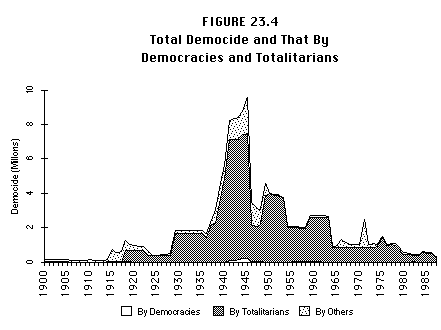
![[5]](http://www.hawaii.edu/powerkills/POWER.FIG2.GIF)

Terrorism
View on GrokipediaTerrorism is the threatened or actual use of illegal force and violence by non-state actors (though some scholars advocate including state or state-sponsored terrorism) to attain a political, economic, religious, or social goal through fear, coercion, or intimidation directed at a larger audience than the immediate victims. This distinguishes it from routine criminality or conventional warfare, emphasizing psychological impact to compel policy changes or societal disruption.[1] The phenomenon traces to ancient assassinations and revolts but emerged as a modern strategy in the French Revolution's Reign of Terror (September 1793–July 1794, France) and 19th-century anarchist campaigns. It evolved via nationalist insurgencies, mid-20th-century Marxist-Leninist groups, and religious-motivated networks since the 1980s.[2] The Global Terrorism Database records over 200,000 incidents from 1970 to 2020, peaking in the 2010s due to groups like the Islamic State and Boko Haram in Middle East, sub-Saharan Africa, and South Asia conflict zones.[3] These caused most of the roughly 500,000 fatalities, though annual deaths fell from 45,000 in 2014 to under 20,000 recently, with 95 percent of victims in fewer than 10 countries.[1] Terrorism accounts for less than 0.5 percent of global violent deaths—fewer than homicide, traffic accidents, or disease—yet differs by pursuing political aims to destabilize governments and force policy shifts, as in the 9/11 attacks' effects on aviation security and geopolitics.[4] Media amplification and psychological effects, such as the availability heuristic and induced fear, amplify its influence on counterterrorism policies, surveillance regimes, and interventions.[1] Definitional ambiguities fuel controversies, potentially excluding state-sponsored violence or allowing selective use, while root-cause debates prioritize ideological extremism over socioeconomic factors, given jihadist persistence despite development aid.[5][6]
Etymology and Definition
Etymology
The term "terrorism" derives from the Latin verb terrere, meaning "to frighten" or "to cause dread," rooting in terror—intense fear—and emphasizing psychological intimidation through violence.[7] The modern English word emerged in 1795 from French terrorisme, coined during the French Revolution's Reign of Terror (September 1793–July 1794). There, the government under Maximilien Robespierre executed about 16,594 by guillotine, plus mass drownings and shootings, to enforce ideological conformity via fear.[8][9] Initially denoting state coercion, the term—as used by Edmund Burke in 1795 to decry the Jacobins' "reign of terror"—contrasted with private actions.[9] By mid-century, it shifted to non-state actors, especially anarchists and Russian nihilists. From the 1860s, they framed assassinations and bombings—targeting tsarist officials—as "propaganda of the deed" to demoralize societies and ignite revolution. Sergey Nechayev's 1869 Catechism of a Revolutionary urged terror against all societal pillars.[10] This evolution sustained focus on strategic fear, distinct from guerrilla tactics or vendettas, as early writings stressed civilian-targeted intimidation for leverage.[11]Core Definitions
Terrorism is defined as premeditated, politically motivated violence perpetrated against noncombatant targets by subnational groups or clandestine agents.[12] This formulation, codified in U.S. law, underscores the intentional nature of such acts, distinguishing them from incidental civilian casualties in conventional warfare or state-directed military operations.[13] Core to this definition is the asymmetry of actors—non-state entities employing violence outside lawful frameworks—and the aim to influence broader audiences through psychological impact rather than direct military conquest. Empirical databases operationalize terrorism similarly, emphasizing the use or threat of illegal violence by non-state perpetrators to pursue political, economic, religious, or social objectives via coercion, fear, or intimidation directed at civilian or symbolic targets. The Global Terrorism Database (GTD), maintained by the University of Maryland's START consortium, applies these criteria to catalog over 200,000 incidents since 1970, requiring evidence of intentionality and exclusion of state-sponsored actions unless executed by subnational proxies.[14] Such definitions prioritize verifiable intent over subjective interpretations, such as labeling actors as "freedom fighters," to maintain causal consistency in analysis; for instance, the GTD excludes incidents lacking demonstrated perpetrator goals tied to coercion.[15] Philosopher Igor Primoratz offers a narrow definition: "The deliberate use of violence, or threat of its use, against innocent people, with the aim of intimidating some other people into a course of action they otherwise would not take."[16] This emphasizes the concept of innocence, drawing from just war theory's principle of non-combatant immunity, and contrasts with broader definitions that omit restrictions on victims to provide greater moral clarity in distinguishing terrorism from other forms of violence. Distinguishing features include the deliberate instillation of widespread fear disproportionate to physical harm, often amplifying impact through media or symbolic selection of targets, as opposed to routine criminality or guerrilla warfare focused on combatants.[17] This fear-coercion mechanism serves strategic ends like policy alteration or societal destabilization, with databases like the GTD enabling quantification: between 1970 and 2020, qualifying acts resulted in targeted civilian deaths exceeding 100,000 globally, verifiable through cross-sourced incident data.[3] Academic frameworks align by requiring political motivation and civilian orientation, rejecting expansive inclusions that dilute analytical precision, such as equating all asymmetric violence with terrorism.[15]Distinctions from Related Concepts
Terrorism is distinguished from conventional warfare and insurgency by its emphasis on non-combatant targets to generate psychological coercion rather than direct military confrontation or territorial seizure. Warfare adheres to frameworks like the Geneva Conventions, involving declared hostilities between states or organized forces with distinguishable combatants, whereas insurgency seeks governance control through sustained guerrilla operations against state military assets. In contrast, terrorism employs indiscriminate violence against civilians by sub-state actors lacking uniforms or formal declarations, prioritizing fear inducement over battlefield victory, as non-state groups exploit asymmetry to amplify impact beyond their limited capabilities.[18][19][20] Unlike organized crime, which centers on economic profit through illicit enterprises such as trafficking or extortion, terrorism prioritizes ideological, political, or religious aims over personal gain, even when criminal methods like extortion fund operations. The Global Terrorism Database (GTD) operationalizes this by excluding incidents motivated solely by financial benefit, such as mafia-style killings without political subtext, requiring evidence of intent to influence policy or audiences via violence against non-combatants.[21][22] This criterion avoids conflating profit-driven syndicates with groups pursuing systemic change, though overlaps occur where terrorists opportunistically adopt criminal tactics without supplanting core motivations. The label of terrorism is conventionally applied to non-state perpetrators, differentiating it from state-directed violence, which may employ terror tactics for repression but operates under sovereign authority and legal monopolies on force; extensions to "state terrorism" arise only when regimes mirror sub-state methods by systematically targeting civilians for intimidation absent legitimate military rationale.[23][19] This reservation preserves analytical clarity, as state actions often invoke national security pretexts, unlike the clandestine, asymmetric nature of non-state terrorism. Genocide, by contrast, entails deliberate, organized efforts to eradicate protected groups based on identity, as codified in the 1948 UN Convention, focusing on total destruction rather than terrorism's sporadic acts designed to provoke policy shifts through public dread.[19] While both may victimize civilians, genocide pursues demographic elimination via mass killing or deprivation, not the communicative terror of limited, symbolic attacks.[24]Historical Overview
Ancient and Pre-Modern Instances
The Sicarii, a radical Jewish faction active in Judea during the mid-1st century AD, employed targeted assassinations to intimidate Roman authorities and Jewish collaborators, aiming to incite rebellion against Roman rule. Modern scholars regard the Sicarii as precursors to terrorism, retrospectively applying the concept to their targeted intimidation tactics designed to instill widespread fear for political objectives. Concealing short curved daggers known as sicae under their cloaks, members blended into crowds at festivals or public gatherings to stab high-profile targets, such as the high priest Jonathan in 57 AD, before fleeing amid the chaos.[25] [26] These stealth killings, numbering in the dozens against elites and officials, created widespread fear and eroded administrative control, contributing to the escalation toward the First Jewish-Roman War in 66 AD.[27] In the medieval Islamic world, the Nizari Ismaili sect, led by Hasan-i Sabbah from their fortress at Alamut starting in 1090, conducted selective assassinations against political and military leaders to defend their autonomous enclaves and advance Shia doctrinal aims amid Sunni dominance and Crusader incursions, though primary accounts of their methods and motivations derive largely from contemporary hostile sources such as Sunni chroniclers and Crusaders, as well as later legends.[28] Modern scholars regard the Nizari Ismailis as precursors to terrorism, emphasizing the retrospective application of the concept to their targeted intimidation tactics. Fedayeen operatives, often disguised as merchants or soldiers, infiltrated enemy courts to kill targets in public or private settings, such as the vizier Nizam al-Mulk in 1092, using daggers for close-quarters strikes that emphasized symbolic defiance over mass violence.[29] [30] Over two centuries until the Mongol destruction of Alamut in 1256, these operations—estimated at over 50 high-profile successes—deterred larger assaults by instilling paranoia among rulers, though they failed to prevent the sect's eventual subjugation.[31] Pre-modern states occasionally harnessed systematic terror as a coercive tool distinct from non-state insurgencies, exemplified by the Mongol Empire's campaigns under Genghis Khan from 1206 onward, where deliberate atrocities like mass executions, city razings (e.g., Nishapur in 1221 with chroniclers reporting fatalities as high as 1.7 million, though modern historians suggest these figures were likely exaggerated or symbolic given the era's population constraints), and corpse mutilations amplified psychological dread to compel surrenders without prolonged sieges.[32] [33] This state-orchestrated intimidation, propagated via scouts and exaggerated survivor accounts, subdued vast territories from China to Eastern Europe, followed by the Pax Mongolica, a period of relative stability, governance, and facilitated trade across Eurasia that contextualized the terror as a tool to establish long-term imperial control rather than an end in itself, but relied on organized armies rather than clandestine networks, marking it as a precursor to rather than equivalent of irregular terror tactics.[34][35]19th-Century Origins
The emergence of modern terrorism in the 19th century marked a transition from sporadic regicides and insurrections to systematic, ideologically motivated campaigns by small groups seeking to undermine state authority through targeted violence, often justified as necessary to provoke mass uprisings against perceived oppression. This period saw the rise of revolutionary organizations in Russia and Europe that viewed assassination and bombings as asymmetric tools for the weak against centralized power structures, enabled by technological advances like Alfred Nobel's invention of dynamite in 1867, which democratized high-explosive capabilities for non-state actors.[36] These acts were rooted in radical ideologies—socialist in Russia, anarchist in Western Europe—aiming not merely to kill but to symbolize the vulnerability of rulers and inspire broader revolt, though empirical outcomes often strengthened state repression rather than catalyzing revolution.[37] In Russia, the group Narodnaya Volya (People's Will), formed in 1879 from disillusioned populist radicals, pioneered this approach by conducting multiple assassination attempts on Tsar Alexander II and officials to dismantle autocracy and hasten socialist transformation. After failed plots using mines and earlier explosives, members succeeded on March 1, 1881 (Julian calendar; March 13 Gregorian), when Ignacy Hryniewiecki threw a bomb at the tsar's carriage in St. Petersburg, killing Alexander and himself; the group had numbered around 500 members, with dozens active in dynamite production and operations.[38] [39] Narodnaya Volya explicitly framed terrorism as "propaganda by action," believing targeted eliminations would expose regime fragility and mobilize peasants, though the assassination led to Alexander III's reactionary policies and the group's dismantlement by 1881, executing leaders like Andrey Zhelyabov and Sofya Perovskaya.[40] Western Europe's anarchist movement adopted and internationalized this tactic under the banner of "propaganda of the deed," a concept articulated by figures like Paul Brousse in 1877, positing that exemplary violent acts against symbols of authority would ignite spontaneous worker revolts without need for organized parties. In France, this manifested in 1892–1894 bombings by individuals like Ravachol (who targeted magistrates' homes), Auguste Vaillant (who lobbed a nail bomb into the Chamber of Deputies, killing one), and Émile Henry (whose Café Terminus explosion killed a bystander), all using dynamite to protest bourgeois society and state repression following strikes.[41] In Spain, anarchists bombed the Liceu opera house in Barcelona on November 7, 1893, killing 20 and injuring dozens, amid tensions over labor unrest and church influence, highlighting how such deeds aimed to terrorize elites but often alienated potential sympathizers.[42] These attacks, peaking in the 1890s "age of dynamite," numbered over 100 globally by century's end, primarily by anarchists, yet failed to achieve ideological goals, instead prompting international anti-anarchist laws, such as those discussed at the International Conference of Rome for the Social Defense Against Anarchists in 1898, and police innovations.[43][44]20th-Century Expansion
The interwar period witnessed the expansion of organized terrorist campaigns by nationalist and ideological groups seeking to destabilize established orders. In Ireland, the Irish Republican Army (IRA) executed the S-Plan in 1939, a sabotage campaign involving the planting of 290 bombs across England between January and December, aimed at economic disruption and pressuring British withdrawal from Northern Ireland. This campaign prompted the British government's enactment of the Prevention of Violence Act 1939, which facilitated the deportation of Irish citizens suspected of involvement, exemplifying the action-reaction dynamics in such campaigns.[45][46] In Italy, fascist squadristi squads intensified paramilitary violence after 1920, often with tacit approval from local police in a legal vacuum, employing terrorist tactics such as beatings, arson, and assassinations against socialists and trade unionists, resulting in approximately 2,000 political opponents killed between 1920 and 1922 to dismantle opposition and facilitate Benito Mussolini's rise.[47][48] Following World War II, decolonization struggles amplified terrorism's role in asymmetric conflicts, particularly in nationalist insurgencies. Palestinian fedayeen, often operating from Gaza and Jordanian bases, conducted cross-border raids and sabotage attacks into Israel starting in the late 1940s, with activities peaking in the 1950s through fedayeen units backed by Egypt, targeting civilian and military sites to reclaim territory lost in the 1948 war.[49][50] In Algeria, the Front de Libération Nationale (FLN) launched its independence war on November 1, 1954, with 30 coordinated attacks, escalating to urban bombings and targeted killings during the 1956–1957 Battle of Algiers, where terror tactics against both French forces and Algerian civilians contributed to an estimated 42,000 recorded incidents and around 3,000 fatalities from such violence by war's end in 1962.[51][52] The Cold War era saw further ideological proliferation, with Marxist-Leninist groups adopting terrorism to challenge capitalist states and advance revolutionary aims. In Italy, the Red Brigades, founded in 1970, perpetrated dozens of attacks in the 1970s, including assassinations of industrialists and politicians, culminating in the 1978 kidnapping and murder of former Prime Minister Aldo Moro after 55 days in captivity.[53][54] In Colombia, the Revolutionary Armed Forces of Colombia (FARC), formed in 1964 as a communist insurgency, integrated terrorist methods like bombings, kidnappings, and rural ambushes into its guerrilla strategy from the mid-1960s, sustaining operations amid U.S.-backed counterinsurgency efforts.[55] This expansion reflected terrorism's adaptation to global ideological divides and weakening empires, with datasets like the Global Terrorism Database documenting tens of thousands of incidents from 1970 to 1999 alone, underscoring a shift toward higher frequency and diverse motivations including left-wing revolutionism alongside persistent nationalism.Post-2000 Developments and Recent Trends
The September 11, 2001, attacks orchestrated by al-Qaeda represented a watershed in post-2000 terrorism, with hijacked planes striking the World Trade Center, Pentagon, and a field in Pennsylvania, killing 2,977 people.[56] This coordinated assault, involving 19 hijackers, not only inflicted massive casualties but also demonstrated the potential for large-scale, high-impact operations by decentralized jihadist networks, inspiring a global proliferation of similar ideologies and tactics.[57] The event shifted terrorism's scale, emphasizing aviation-based mass casualty attacks and prompting empirical patterns of emulation among Islamist extremists, as evidenced by subsequent plots worldwide. Following al-Qaeda's model, the Islamic State (ISIS) emerged as the dominant force in the 2010s, declaring a caliphate across Iraq and Syria in June 2014 and peaking territorial control by 2015.[58] ISIS's operations drove global terrorism deaths to a record 44,056 in 2014, with the group responsible for over 20,000 fatalities in peak years through territorial conquests involving mass executions and suicide bombings.[59] The caliphate's collapse by 2019, following military interventions, fragmented ISIS into affiliates and insurgent cells, yet sustained high lethality via decentralized attacks; data from the Global Terrorism Database indicate ISIS-linked incidents accounted for a disproportionate share of jihadist violence, underscoring causal links between state fragility, sectarian conflicts, and rapid territorial gains enabling mass mobilization.[60] Into the 2020s, jihadist resurgence manifested in regional expansions and lone-actor trends, with ISIS affiliates intensifying operations in the Sahel, where groups like Islamic State in the Greater Sahara exploited governance vacuums to claim thousands of square kilometers and conduct frequent ambushes.[61] The October 7, 2023, assault by Hamas on Israel, killing over 1,200 civilians and soldiers through a combined-arms assault involving paragliders, maritime incursions, rocket barrages, and atrocities, which analysts have characterized as a shift toward hybrid warfare by non-state actors, reigniting cycles of escalation.[62] The Global Terrorism Index 2025 documents an 11% rise in terrorism fatalities in 2024, primarily from intensified actions by the four deadliest groups—largely jihadist—with deaths concentrated in specific conflict zones such as the Sahel, while declining in regions like the West and Afghanistan, while lone-wolf attacks, often inspired online, dominated Western incidents, many of which were later found to involve digital contact with handlers abroad, blurring the line between self-radicalized individuals and remotely directed operatives, reflecting a shift toward self-radicalized individuals amid 66,000+ recorded events since 2007 across dozens of countries.[63][64] The Global Terrorism Index attributes these patterns' persistence to ideological appeal in ungoverned spaces, technological facilitation of propaganda, and adaptive structures evading centralized defeat, with sub-Saharan Africa now hosting over half of global terrorism deaths.[65]Causes and Motivations
Ideological and Doctrinal Drivers
Islamist ideologies constitute the predominant doctrinal driver of terrorism in the 21st century, with jihadist groups responsible for the majority of global fatalities. The Global Terrorism Index 2025 reports that Islamic State (IS) and its affiliates perpetrated 1,805 deaths across 22 countries in 2024, while the Sahel region—dominated by jihadist actors such as IS-Sahel and Jama'at Nusrat al-Islam wal-Muslimin—accounted for over 50% of worldwide terrorism deaths that year.[63][66] This empirical dominance contrasts with secular or other religious motivations, which have declined in lethality since the post-9/11 era, underscoring jihadism's causal role in sustaining high death tolls through doctrines mandating expansionist violence.[6] Jihadist doctrine derives legitimacy from interpretations of Quranic injunctions and prophetic traditions that frame offensive jihad as a religious duty to subjugate non-Muslims and purify the ummah. Verses such as Quran 9:5 ("kill the polytheists wherever you find them") and 9:29 ("fight those who do not believe in Allah... until they give the jizyah willingly while they are humbled") are invoked by groups like al-Qaeda and ISIS to justify indiscriminate attacks on civilians as acts of divine warfare against dar al-harb (house of war). ISIS fatwas, such as those disseminated in Dabiq magazine, explicitly doctrinalize terrorism as fard ayn (individual obligation) for establishing a caliphate, rejecting contextual historical limits on violence in favor of perpetual enmity toward infidels and apostate regimes.[67] These interpretations prioritize causal theological imperatives over pragmatic restraint, enabling sustained campaigns in regions like sub-Saharan Africa and the Middle East.[68] Marxist-Leninist doctrines have driven historical waves of terrorism by positing violence as the vanguard mechanism for proletarian revolution against capitalist imperialism. Organizations like the Weather Underground articulated this in their 1974 Prairie Fire manifesto, which framed bombings and sabotage as essential retaliation for "savage criminal attacks" on the working class, Third World peoples, and racial minorities, aiming to dismantle U.S. hegemony through clandestine armed struggle.[69] Similarly, groups such as Peru's Shining Path invoked Maoist principles of protracted people's war, doctrinally elevating terror against perceived class enemies as a catalyst for societal collapse and communist rebirth.[70] These ideologies emphasize dialectical materialism, where terrorism accelerates historical inevitability by targeting symbols of bourgeois power, though their global impact has waned since the Cold War's end.[71] While ethno-nationalist and far-right doctrines—often rooted in irredentist grievances or racial supremacism—motivate sporadic attacks, they lack the scriptural absolutism and organizational scale of jihadism, resulting in far fewer deaths empirically. Perpetrator statements across ideologies consistently prioritize doctrinal purity as the causal spark, with socioeconomic factors serving as secondary rationalizations rather than primary drivers.[72][73]Tactical and Strategic Choices
Terrorist organizations frequently opt for terrorism over conventional warfare due to inherent asymmetries in power, enabling weaker non-state actors to challenge militarily superior opponents through low-cost operations that impose high psychological, economic, and political burdens.[74] This strategic choice leverages the interconnectedness of modern societies, where targeted violence disrupts normalcy and exploits media dissemination to magnify impact far beyond immediate casualties, creating a force multiplier effect absent in symmetric conflicts.[75] Empirical assessments of asymmetric conflicts highlight how such tactics coerce behavioral changes in stronger parties by raising the perceived costs of inaction, as seen in insurgent campaigns where resource disparities preclude direct military engagement.[76] From a rational choice perspective, groups evaluate terrorism's viability by weighing anticipated gains—such as territorial concessions, policy reversals, or recruitment boosts—against operational risks and reprisals, persisting only when the calculus favors net utility.[77] [78] Game-theoretic models frame this as a repeated interaction where terrorism signals resolve and imposes asymmetric costs, potentially shifting equilibria toward compromise if the target prioritizes stability over escalation.[79] Historical data on terrorist campaigns reveal mixed efficacy: while outright military victory is rare, partial successes occur in approximately 20-30% of cases involving separatist goals, often when combined with guerrilla operations and external diplomatic pressure, as opposed to ideological pursuits that seldom yield concessions.[80] The Irish Republican Army's campaign exemplifies media-leveraged coercion, with bombings from 1969 to 1997 generating extensive coverage that amplified public pressure on British authorities, contributing to the 1998 Good Friday Agreement's power-sharing framework despite failing to achieve immediate unification.[81] Such outcomes underscore terrorism's role in altering strategic environments through fear diffusion, where studies quantify psychological ripple effects extending to non-victims via vicarious exposure, sustaining group momentum when initial attacks erode opponent will without necessitating battlefield dominance.[82] Persistence hinges on adaptive reassessment, with groups desisting or escalating based on empirical feedback loops of retaliation intensity and concession signals.[83]Individual and Socio-Psychological Factors
Empirical analyses of terrorist perpetrators reveal that they are frequently not drawn from the margins of society characterized by extreme poverty or low education, challenging narratives that attribute terrorism primarily to socioeconomic deprivation. Studies examining datasets such as the Global Terrorism Database and profiles of suicide bombers indicate that individuals involved in terrorism often possess above-average education levels and come from middle-class backgrounds, with poverty showing only a weak, indirect correlation at best.[84][85] For instance, among Hezbollah bombers in Lebanon during the 1980s and 1990s, operatives were disproportionately educated and employed compared to the general population.[84] The September 11, 2001, hijackers exemplify this pattern, with 15 of the 19 originating from middle-class Saudi families and holding postsecondary education; leader Mohamed Atta earned an architecture degree in Germany, while others pursued engineering or attended university.[86] This demographic skew toward educated males in their 20s and 30s recurs across jihadist, leftist, and other terrorist cohorts, suggesting that opportunity costs—such as forgoing stable careers—do not deter participation, underscoring personal agency over structural determinism.[85][84] Psychological factors in terrorism lack a singular profile but highlight traits like narcissism and thrill-seeking over psychopathology. Forensic and biographical reviews posit "narcissistic rage" as a precipitant, where perceived slights fuel grandiose quests for significance through violent spectacle, as observed in cases from Anders Breivik to jihadi operatives.[85][87] Empirical assessments, including those of imprisoned extremists, find no elevated rates of mental illness but elevated narcissism and authoritarian tendencies, with thrill-seeking manifesting in risk-prone behaviors rather than universal trauma.[82][88] Radicalization pathways emphasize individual self-selection amid grievances, often amplified by online echo chambers yet driven by volitional pursuit of ideological validation. Research on Western jihadists traces trajectories from personal dissatisfaction—such as identity crises or unmet aspirations—to selective engagement with extremist content, where users actively seek confirming narratives rather than passive indoctrination.[89] This process involves cognitive biases like confirmation-seeking, enabling agency in escalating from grievance to action, as self-radicalized "lone actors" bypass networks through deliberate online immersion.[90] Such dynamics reveal terrorism as a chosen response to perceived injustices, not inevitable determinism from social conditions.[91]Categories of Terrorism
Religious Terrorism
Religious terrorism encompasses violent acts motivated by interpretations of religious texts that sanction aggression against perceived infidels or apostates, often promising spiritual rewards like martyrdom. Empirical data indicate that Islamist variants dominate, accounting for the bulk of global terrorism fatalities in recent decades; for instance, religious ideologies drove over 50% of attacks in the Global Terrorism Database from 1970-2017, with jihadist groups responsible for the majority post-2000.[3] The Global Terrorism Index 2024 highlights Islamic State (IS) and affiliates as the deadliest, contributing to over half of terrorism deaths in the Sahel region alone, where jihadist operations intensified.[6] This prevalence stems from doctrinal emphases on offensive jihad, enabling indiscriminate civilian targeting absent in many secular terrorist codes.[68] Prominent Islamist actors include al-Qaeda, founded in 1988, which orchestrated the September 11, 2001 attacks on the U.S., killing 2,977 people to expel Western influence and establish global caliphate rule.[92] ISIS, emerging from al-Qaeda in Iraq, declared a caliphate in June 2014 across Iraq and Syria, conducting thousands of attacks that killed tens of thousands through beheadings, bombings, and territorial conquests before territorial defeat in 2019, yet persisting via affiliates.[93] Hamas, formed in 1987 as an offshoot of the Muslim Brotherhood, launched the October 7, 2023 assault on Israel, murdering 1,200 civilians in a single day to advance its charter's aim of destroying the Jewish state through jihad.[6] Boko Haram, active since 2009 in Nigeria, has caused over 35,000 deaths by 2024, including intensified 2023-2024 assaults like a September 2024 attack killing 81, rejecting Western education as un-Islamic and imposing sharia via massacres.[94][95] Non-Islamist examples, though far less lethal overall, include Sikh militants seeking Khalistan who detonated a bomb aboard Air India Flight 182 on June 23, 1985, killing all 329 aboard to protest Indian policies and revive perceived religious purity. Japan's Aum Shinrikyo cult, blending Buddhism, Hinduism, and apocalyptic Christianity, released sarin gas on Tokyo subways on March 20, 1995, killing 13 and injuring over 5,500 to trigger Armageddon and elevate leader Shoko Asahara as savior.[92] These cases illustrate how fringe scriptural literalism—whether invoking Sikh martial traditions or prophetic end-times—facilitates extreme violence, but Islamist groups' scale dwarfs others due to transnational networks and explicit theological endorsements of perpetual holy war.[96] Causally, religious terrorism thrives on literalist readings that absolve perpetrators of moral constraints, such as Quranic verses enjoining fighting non-believers (e.g., Surah 9:5) interpreted by jihadists as mandates for offensive violence, including against civilians, with paradise assured for martyrs—contrasting secular groups' occasional taboo on non-combatants.[68] Mainstream media and academic analyses often underemphasize this doctrinal core, framing attacks as mere reactions to foreign policy or socioeconomic grievances, despite jihadist manifestos and recruitment citing religious imperatives as primary drivers.[97] This apologetic tendency, prevalent in left-leaning institutions, obscures causal realism by prioritizing non-theological explanations unsubstantiated by perpetrators' own justifications.[85]Nationalist and Separatist Terrorism
Nationalist and separatist terrorism encompasses violent actions by ethnic, tribal, or national groups pursuing independence, greater autonomy, or control over specific territories, often rooted in perceived historical injustices, cultural assimilation policies, or denial of self-determination rather than broader ideological agendas like class revolution or religious supremacy. These campaigns typically target state symbols, security forces, and civilians associated with the central government to coerce territorial concessions, with operations concentrated in regions of ethnic concentration to build local support and demonstrate resolve. Unlike ideological terrorism, the primary end-state here is geopolitical reconfiguration, such as secession or federal restructuring, which can lead to empirical declines in violence when states offer political accommodations addressing core grievances.[98][99] The Euskadi Ta Askatasuna (ETA), seeking Basque independence from Spain, exemplifies prolonged ethno-nationalist violence through assassinations, kidnappings, and bombings against politicians, police, and infrastructure from its founding in 1959 until its permanent ceasefire in 2011 and formal dissolution in 2018. ETA's tactics inflicted significant casualties, with operations peaking in the 1980s and 1990s amid Spain's transition to democracy, but support eroded as Basque autonomous institutions gained powers over education, language, and taxation, contributing to the group's abandonment of armed struggle.[100][101] In Sri Lanka, the Liberation Tigers of Tamil Eelam (LTTE) pursued a separate Tamil homeland through innovative asymmetric tactics, including the pioneering of suicide bombings via the Black Tigers unit, which developed explosive vests and employed female attackers to breach defenses, conducting over 200 such operations from 1987 onward against military and economic targets. The LTTE's hybrid approach—combining guerrilla warfare, naval assaults, and child recruitment—sustained a 26-year civil war until its leadership was eliminated in a 2009 government offensive, highlighting how military superiority can decisively counter territorially focused insurgencies without ideological diffusion.[102][103][104] The Kurdistan Workers' Party (PKK), advocating Kurdish self-rule in southeastern Turkey, has employed bombings, ambushes, and urban attacks since 1984, causing thousands of deaths in a conflict driven by demands for cultural rights and territorial autonomy rather than Marxist-Leninist purity after ideological shifts. Violence has empirically declined during state concessions, such as the 2009-2015 "solution process" granting Kurdish language broadcasting and elective courses, reducing incidents until renewed clashes; recent ceasefires, including announcements in 2025, suggest negotiations addressing decentralization can suppress operations by undermining recruitment and legitimacy.[105][106] Analyses of the Global Terrorism Database reveal that nationalist and separatist incidents represent approximately 20% of recorded attacks in various periods, often with lower per-incident lethality than religious terrorism due to targeted rather than mass-casualty orientations and geographic containment.[58] This pattern underscores causal links between territorial concessions—enhancing local governance without full secession—and reduced violence, as seen in cases like ETA's demise amid devolved powers, contrasting with persistent ideological drivers elsewhere.[107]Left-Wing and Revolutionary Terrorism
Left-wing and revolutionary terrorism encompasses violent campaigns by non-state actors driven by Marxist-Leninist, Maoist, or anarchist ideologies, which posit that armed struggle against capitalist states and bourgeois institutions is essential to catalyze proletarian revolution and achieve egalitarian utopias.[108][109] These groups typically targeted symbols of authority, such as politicians, bankers, and police, viewing such attacks as vanguard actions to expose systemic oppression and provoke mass uprising, though empirical outcomes often revealed limited popular support and reliance on coercion within their operational areas.[110] The ideology's causal logic rests on a deterministic view of history, where violence serves as the midwife of societal transformation, justifying civilian casualties as collateral in class warfare.[111] Activity surged in the 1960s through 1980s amid Cold War proxy dynamics, with groups in Europe and Latin America conducting thousands of bombings, assassinations, and kidnappings. In West Germany, the Red Army Faction (RAF), founded in 1970, executed high-profile operations including the 1977 murder of industrialist Hanns Martin Schleyer and the hijacking of Lufthansa Flight 181, resulting in at least 34 deaths over its campaigns.[112] Italy's Red Brigades, active from 1970 to the mid-1980s, claimed responsibility for over 14,000 incidents during the "Years of Lead," including the 1978 kidnapping and murder of former Prime Minister Aldo Moro, contributing to a national toll of around 400 fatalities from left-wing violence.[113] In Peru, the Shining Path (Sendero Luminoso), a Maoist insurgency launched in 1980, orchestrated rural massacres, urban bombings, and forced recruitment, accounting for approximately 30,000 deaths in a conflict that engulfed 75% of the country's provinces by 1992.[114] Post-Cold War, these movements experienced sharp decline due to the Soviet Union's collapse, which eroded ideological patronage, funding, and recruitment pipelines; by the 1990s, Western European incidents plummeted from peaks of over 1,000 annually to near zero.[110] In Latin America, state counterinsurgency successes—such as Peru's capture of Shining Path leader Abimael Guzmán in 1992—decimated core structures, reducing active combatants from tens of thousands to hundreds.[114] Global databases reflect this trajectory, with left-wing attacks comprising less than 5% of incidents after 2000, contrasted against rising other forms, underscoring the ideology's failure to sustain momentum without external state support.[115] Contemporary remnants persist in isolated pockets but exert minimal international influence. In Colombia, FARC dissident factions, rejecting the 2016 peace accord, conducted 24 coordinated bombings and ambushes on June 10, 2025, primarily in rural southwest regions, killing security personnel and civilians while funding operations through narcotics and extortion.[116] These groups number around 2,000-3,000 fighters, a fraction of the original 7,000, and their actions remain confined domestically without the revolutionary contagion seen in prior decades.[117] Overall, left-wing terrorism's post-1990 lethality and frequency have contracted by over 90% in affected regions, debunking narratives of resurgence amid data showing ideological exhaustion and effective law enforcement disruption.[115]Right-Wing and Supremacist Terrorism
Right-wing and supremacist terrorism encompasses violent acts motivated by ideologies of racial, ethnic, or national supremacy, often targeting perceived threats to white or Western dominance, such as immigrants, minorities, or government institutions viewed as enabling demographic change. These attacks frequently draw on anti-Semitic, xenophobic, or anti-government narratives, with perpetrators seeking to provoke societal conflict or accelerate civilizational collapse. The deadliest such incident in the United States occurred on April 19, 1995, when Timothy McVeigh detonated a truck bomb at the Alfred P. Murrah Federal Building in Oklahoma City, killing 168 people and injuring over 680; McVeigh, influenced by anti-federalist grievances stemming from events like the Waco siege, aimed to strike against government overreach. In the post-2000 era, right-wing attacks have included high-profile mass shootings, such as the 2018 Pittsburgh synagogue shooting, where Robert Bowers killed 11 worshippers amid anti-Semitic rhetoric, and the 2019 El Paso Walmart shooting, where Patrick Crusius murdered 23 people targeting Latinos in line with a manifesto decrying Hispanic immigration. Internationally, the March 15, 2019, Christchurch mosque shootings in New Zealand, perpetrated by Brenton Tarrant, resulted in 51 deaths across two mosques, with Tarrant live-streaming the attack and citing "great replacement" theory in his manifesto to inspire copycats. These incidents, while lethal, represent a fraction of global terrorism; according to the Global Terrorism Index, right-wing extremism accounted for fewer than 5% of worldwide terrorism deaths in recent years, dwarfed by religiously motivated (predominantly Islamist) violence that claims over 90% of fatalities.[118][119][120] In the 2020s, U.S. Department of Homeland Security assessments have highlighted racially or ethnically motivated violent extremists—often aligned with right-wing ideologies—as a persistent domestic threat, including plots against critical infrastructure like power grids and transportation hubs, though fatalities remain low relative to international benchmarks. Data from sources tracking U.S. incidents indicate right-wing attacks comprise the majority of domestic terrorism plots and deaths since 2010, yet absolute numbers are modest, with fewer than 100 fatalities from such extremism in the decade following 2013. This rise correlates with online ecosystems promoting accelerationism, an ideology advocating deliberate societal destabilization to hasten racial or civilizational conflict; empirical evidence shows increased lone-actor plots inspired by figures like James Mason's Siege, with attackers self-radicalizing via forums and manifestos calling for autonomous violence over organized groups.[121][122][123]Tactics and Methods
Primary Attack Modalities
Bombings and explosions represent the predominant modality in terrorist attacks, accounting for over 50% of incidents documented in the Global Terrorism Database (GTD) since 1970. These methods, often utilizing improvised explosive devices (IEDs), vehicle-borne IEDs (VBIEDs), or suicide vests, enable attackers to inflict mass casualties and structural damage from a distance, with high lethality in urban settings; for instance, the 2008 Mumbai attacks involved coordinated bombings alongside shootings, resulting in 166 deaths and over 300 injuries across multiple sites. In regions like the Sahel and South Asia, such tactics remain staples for groups like Islamic State affiliates and Tehrik-i-Taliban Pakistan, where bombings tripled in frequency for the latter in 2024.[63] Armed assaults, primarily shootings, constitute the second most common modality, comprising about 25% of GTD-recorded events and showing increased prevalence in recent conflicts. These direct confrontations, involving firearms against soft targets like civilians or security forces, yield high fatalities per incident, as evidenced by the March 2024 Crocus City Hall attack in Moscow, where gunmen killed 144 people in a coordinated assault claimed by Islamic State Khorasan Province.[63] In sub-Saharan Africa, armed attacks drove 51% of global terrorism deaths in 2024, with examples including Jama’at Nusrat al-Islam wal-Muslimin ambushes in Burkina Faso claiming over 200 lives in a single August operation.[63] In Western countries, lone-actor attacks have shifted toward accessible, low-tech methods such as vehicle rammings and knife assaults, reflecting decentralized networks and online radicalization; the Global Terrorism Index 2025 notes a rise from 32 to 52 such incidents in 2024, with 65% unattributed to formal groups.[63] Vehicle attacks, like the January 2025 New Orleans incident killing 14, exploit everyday mobility for impact, while knife attacks, such as the April 2024 Sydney church stabbing, prioritize simplicity amid heightened security against explosives.[63] Though less frequent globally, these tactics underscore an evolution toward opportunistic strikes evading traditional defenses. Emerging modalities like drone strikes and chemical, biological, radiological, or nuclear (CBRN) attacks remain rare, representing under 1% of GTD incidents, but carry elevated lethality potential due to technological amplification and psychological terror. Drone usage, observed in Syrian operations by groups like Hayat Tahrir al-Sham, inflicted 89 fatalities in a single 2023 incident, signaling scalability for non-state actors.[6] CBRN efforts, historically limited by expertise barriers, have caused sporadic high-profile casualties, such as the 1995 Tokyo sarin attack killing 13, though sustained deployment lags behind conventional means.Propaganda and Psychological Operations
Terrorist organizations employ propaganda and psychological operations to amplify the perceived impact of their actions, recruit sympathizers, demoralize adversaries, and shape narratives around their cause. These efforts leverage media to create spectacles that evoke fear, outrage, and fascination, thereby extending the tactical effects of attacks beyond immediate physical damage. By design, such operations target public perception, exploiting the psychological vulnerabilities of audiences to foster compliance, division, or support.[124] A core strategy involves orchestrating "spectacular" attacks timed and structured for maximal media coverage, as exemplified by al-Qaeda's September 11, 2001, hijackings, which were calibrated to produce visually dramatic imagery broadcast live on television worldwide. The choice of commercial airliners striking symbolic targets like the World Trade Center ensured immediate, unfiltered dissemination, magnifying the psychological shock and prompting extensive replay of footage that reinforced the group's message of defiance against perceived enemies. This approach aligns with the principle that terrorism functions as theater, where media amplification serves as the primary mechanism for achieving strategic goals such as policy influence and ideological propagation.[125][126] In the digital era, social media platforms have become central to terrorist propaganda, enabling rapid, global dissemination of content tailored for radicalization and recruitment. The Islamic State (ISIS) exemplified this in 2014, maintaining a network of approximately 46,000 to 70,000 Twitter accounts that shared propaganda, including execution videos, battle footage, and calls to jihad, often in multiple languages to target Western audiences. This high-volume output—facilitated by decentralized supporters—bypassed traditional media gatekeepers, allowing ISIS to control its narrative and portray itself as a victorious caliphate. Empirical analyses indicate that such online exposure significantly heightens radicalization risks, with social media penetration correlating to increased domestic terrorism incidents by enhancing extremists' recruitment capabilities.[127][128][129] Psychological operations complement propaganda by systematically inducing terror, glorifying martyrdom, and eroding societal cohesion. Groups like ISIS produced polished videos depicting beheadings and conquests to instill fear in enemies while inspiring followers through narratives of divine reward and communal belonging, effectively weaponizing emotional responses for operational ends. Early platform policies, such as Twitter's permissive stance on content moderation until late 2014, inadvertently amplified these efforts by permitting unchecked proliferation before systematic suspensions. This delay underscores how algorithmic recommendations and lax enforcement can extend terrorists' reach, though subsequent deplatforming reduced but did not eliminate the threat.[130][131][132]Operational Support and Financing
Terrorist groups procure operational support through clandestine logistics networks that facilitate the acquisition of weapons, explosives, vehicles, and safe houses, often via smuggling routes intertwined with illicit trade corridors. These networks rely on cross-border smuggling syndicates, which transport materiel from conflict zones or black markets in regions like the Sahel, Southeast Asia, and the Middle East, evading customs through corruption or hidden compartments in commercial shipments.[133] Financing for such logistics stems predominantly from self-generated illicit revenues rather than overt state sponsorship, enabling autonomy and deniability.[134] Primary funding sources include criminal activities like drug trafficking, kidnapping for ransom, and extortion, which generate reliable cash flows for procurement and sustainment. Jihadist factions, such as Islamic State West Africa Province, impose zakat—framed as religious almsgiving—on controlled populations and traders, extracting up to 10% of agricultural yields or commerce values as compulsory tribute, which funds arms purchases and operational cells.[135] In Afghanistan, the Taliban derived an estimated $400-500 million annually from taxing opium cultivation and trade prior to their 2022 prohibition, channeling proceeds into vehicle modifications for bombings and fighter stipends.[136] Kidnapping operations by groups like Al-Qaeda in the Islamic Maghreb have yielded multimillion-dollar ransoms, laundered through informal hawala systems to procure small arms from regional arms bazaars.[137] Donations from diaspora sympathizers and misdirected charitable funds supplement crime-derived income, transferred via cash couriers or non-profit facades to obscure origins. Post-2020, cryptocurrencies have emerged as a key evasion tool, allowing groups like Hamas and ISIS-Khorasan to solicit and move funds rapidly; for instance, Hamas raised over $500,000 in Bitcoin equivalents shortly after the October 7, 2023, attacks, using privacy-enhanced coins and mixers to bypass sanctions and acquire dual-use technologies like drones.[138] [139] Stablecoins facilitate cross-border payments for logistical needs, such as encrypted communications gear, with transactions often under $10,000 to evade reporting thresholds.[134] These methods underscore terrorists' adaptation to regulatory pressures, prioritizing decentralized, low-volume flows over large infusions.[133]Key Actors
Organized Non-State Groups
Organized non-state terrorist groups are hierarchical entities that maintain command structures, specialized units, and logistical networks to orchestrate prolonged campaigns of violence aimed at political, ideological, or territorial objectives. Unlike decentralized networks or lone actors, these organizations feature centralized leadership directing subordinate cells, enabling coordinated attacks, resource allocation, and ideological propagation. Prominent examples include al-Qaeda, the Islamic State (ISIS), and Hezbollah, which have demonstrated resilience through adaptive structures despite military setbacks.[140] Empirical data from the Global Terrorism Database (GTD), which records over 200,000 incidents since 1970, show that attacks by organized groups vastly outnumber those by unaffiliated lone actors globally, comprising the majority of events, though lone-actor incidents have risen in Western countries as a proportion of total attacks.[141] This organizational advantage allows groups to sustain operations, as seen in the GTD's documentation of repeated attacks by entities like the Revolutionary Armed Forces of Colombia (FARC), which executed thousands of incidents through hierarchical commands before its 2016 disarmament. Al-Qaeda pioneered a franchise model, establishing semi-autonomous regional affiliates under a core ideological authority, such as al-Qaeda in the Arabian Peninsula (AQAP) and al-Qaeda in the Islamic Maghreb (AQIM). This structure, formalized after the 2001 U.S. invasion of Afghanistan, decentralizes tactical execution while enforcing global jihadist goals, enabling sustained plots like the 2009 Christmas Day airline bombing attempt by AQAP.[140][142] Despite the 2011 killing of Osama bin Laden, the model persists, with affiliates conducting attacks in Yemen, Somalia, and Syria as of 2023.[143] Hezbollah exemplifies hybrid warfare within organized terrorism, integrating suicide bombings, rocket barrages, and guerrilla tactics with political and social functions under a clerical-military hierarchy led by figures like Hassan Nasrallah. Formed in 1982 amid Lebanon's civil war, it carried out high-profile operations, including the October 23, 1983, Beirut barracks bombing that killed 241 U.S. personnel and 58 French troops.[144] Its structure supports diversified threats, blending terrorism with conventional capabilities, as demonstrated in the 2006 Israel-Hezbollah War, where it fired over 4,000 rockets.[145] ISIS, evolving from al-Qaeda in Iraq, briefly established a territorial caliphate spanning 88,000 square kilometers across Iraq and Syria by 2015, governed through bureaucratic hierarchies with provinces (wilayats) and specialized brigades for execution, finance, and media.[146] It conducted over 3,000 attacks in 2015 alone, per GTD data, leveraging oil revenues estimated at $1-3 million daily to fund operations. Following territorial losses culminating in the March 2019 defeat of its last stronghold in Baghouz, Syria, ISIS reverted to insurgent cells, with persistent activity in Iraq (over 100 attacks in 2023) and affiliates like ISIS-Khorasan Province claiming responsibility for the March 2024 Moscow concert hall attack killing 144.[147][148] These groups' hierarchies facilitate scalability, from the Irish Republican Army's (IRA) structured Provisional wing, which executed over 1,800 bombings during The Troubles (1969-1998) via command councils and active service units, to Boko Haram's Nigerian cells coordinating abductions like the 2014 Chibok kidnapping of 276 girls. However, internal fractures, such as ISIS's 2014 split from al-Qaeda over strategic disputes, highlight vulnerabilities to ideological rifts and external pressures.[149] Persistent cells underscore that territorial defeat does not equate to organizational dissolution, as remnants adapt to asymmetric warfare.[150]Lone Actors and Decentralized Networks
Lone actor terrorism encompasses attacks executed by individuals who operate without material assistance or direct operational direction from established terrorist groups, often drawing ideological motivation from online propaganda or manifestos rather than formal membership.[141] These perpetrators typically self-radicalize through digital platforms, enabling rapid ideological shifts and minimal logistical footprints that evade traditional intelligence detection.[151] In Western democracies, this model has surged, with lone actors responsible for 93 percent of fatal terrorist incidents over the preceding five years ending in 2024, reflecting a pivot from disrupted hierarchical structures to autonomous threats fueled by social discontent and accessible extremist content.[141] Decentralized networks extend this paradigm through loosely affiliated online communities employing "leaderless resistance" strategies, where participants share tactics and encouragement via encrypted forums or social media without centralized command, as seen in jihadist-inspired virtual caliphates or supremacist echo chambers.[152] Such networks lower barriers to entry for would-be attackers, particularly youth, who constitute a growing demographic in lone wolf cases due to prolonged online exposure during formative years, accelerating radicalization cycles from weeks to months.[153] The U.S. Department of Homeland Security's 2025 assessment highlights persistent domestic violent extremist calls for lone-style infrastructure attacks, underscoring how these dynamics sustain elevated threat levels amid foreign influences.[154] Empirical data indicate lone actor and decentralized attacks occur with greater frequency in open societies—outpacing group efforts in the West since enhanced surveillance fragmented organized plots—but yield lower average lethality per incident, as individuals lack the coordinated resources, training, and scale of formal groups, resulting in fewer casualties despite high-profile exceptions like vehicle-ramming operations.[155] For instance, the July 14, 2016, truck attack in Nice, France, by a self-radicalized perpetrator inspired by Islamic State propaganda killed 86 people, exemplifying how improvised tactics can achieve outsized impact despite operational isolation.[120] This pattern aligns with Global Terrorism Index findings of rising solo incidents in stable democracies, where permissive environments facilitate execution but also enable proactive disruptions, though the volume strains preventive capacities.[141]State-Sponsored and Proxy Operations
State-sponsored proxy operations involve governments providing covert financial, logistical, material, or training support to non-state terrorist groups, enabling attacks that advance state interests while preserving plausible deniability to avoid direct international repercussions.[156][157] This approach allows sponsoring states to project power asymmetrically, often targeting adversaries without risking full-scale war, as attribution remains contested despite evidence of ties.[158] Such operations differ from overt state terrorism by relying on proxies' autonomy, which complicates countermeasures and extends operational reach beyond a state's borders.[159] Iran exemplifies this model, designated by the U.S. State Department as a state sponsor of terrorism since 1984 for its sustained backing of groups like Hezbollah and Hamas.[160] Hezbollah, formed in 1982 with Iranian Revolutionary Guard Corps assistance, received training, weapons, and funding estimated at hundreds of millions annually, facilitating attacks such as the 1983 Beirut U.S. Embassy bombing that killed 63, including 17 Americans.[160][161] Iran similarly funneled over $100 million yearly to Hamas by 2021, supporting rocket attacks on Israel and the group's military buildup, including ideological alignment despite sectarian differences.[162] These proxies enable Iran to challenge regional rivals like Israel and Saudi Arabia indirectly, with deniability reinforced by groups' independent claims of responsibility.[163] Pakistan has provided shelter, funding, and intelligence to Lashkar-e-Taiba (LeT), a Sunni militant group focused on Kashmir, designated a foreign terrorist organization by the U.S. in 2001.[164] LeT, with ties to Pakistan's Inter-Services Intelligence, orchestrated the 2008 Mumbai attacks killing 166, using operatives trained in Pakistani camps.[165] This support sustains proxy warfare against India, allowing Pakistan to pursue territorial claims without direct military engagement, though it has drawn international sanctions and accusations of state complicity.[166] U.S. assessments identify such linkages in a notable share of global incidents, underscoring proxies' role in amplifying state influence amid counterterrorism pressures.[167]Counterterrorism and State Responses
Military and Intelligence Approaches
Military approaches to counterterrorism emphasize kinetic operations, including airstrikes, special forces raids, and targeted killings, aimed at disrupting terrorist networks through decapitation of leadership and destruction of operational capabilities. These tactics have demonstrated efficacy in degrading high-value targets and reducing organizational capacity in specific cases. For instance, the U.S. drone campaign in Pakistan and Yemen from 2008 onward exerted relentless pressure on al-Qaeda's core, complicating attack planning and leadership functions, as evidenced by declassified documents seized during the 2011 raid on Osama bin Laden's compound.[168] Studies on leadership decapitation indicate that such strikes can significantly elevate terrorist groups' mortality rates by removing experienced commanders and sowing internal disarray, particularly against less resilient organizations.[169] Special operations raids and ground offensives have similarly proven effective in eliminating territorial control. The 2011 Navy SEAL raid that killed bin Laden dismantled al-Qaeda's symbolic leadership and yielded intelligence on global plots.[168] Against the Islamic State (ISIS), the U.S.-led Operation Inherent Resolve, combining airstrikes, advisory support, and partner ground forces, liberated all major Iraqi and Syrian territories held by ISIS by March 2019, including the final defeat at Baghouz.[170] A subsequent raid in October 2019 killed ISIS leader Abu Bakr al-Baghdadi, further eroding command structures.[171] Intelligence approaches underpin these military efforts through signals intelligence (SIGINT), human intelligence (HUMINT), and data fusion to identify targets. The National Counterterrorism Center integrates multi-agency intelligence to enable precise operations, contributing to the disruption of plots and networks.[172] However, data shows limitations in long-term eradication; despite ongoing strikes, ISIS has resurged in Syria and Iraq by 2024-2025, exploiting governance vacuums post-Assad regime collapse and conducting ambushes, bombings, and assassinations.[61][173] Affiliates like ISIS-Khorasan have adapted, launching attacks such as the March 2024 Moscow concert hall assault, underscoring that decapitation alone does not prevent ideological persistence or decentralized reconstitution.[61]Legal and Preventive Measures
The USA PATRIOT Act, enacted on October 26, 2001, expanded federal surveillance authorities, including roving wiretaps, access to business records, and enhanced information sharing between intelligence and law enforcement agencies, to disrupt domestic terrorist activities.[174] These provisions have been credited with contributing to the prevention of over 50 terrorist plots targeting the United States since 2001, through tools like National Security Letters and Foreign Intelligence Surveillance Act warrants that enabled early detection of suspect communications and networks.[175] Complementary domestic mechanisms, such as the No Fly List—a subset of the broader Terrorist Screening Database—have restricted travel by thousands of known or suspected terrorists, integrating biometric and behavioral screening at airports to preempt operational movements, though exact plot preventions attributable solely to the list remain classified.[176] In the European Union, preventive legal measures emphasize proactive arrests and intelligence-led disruptions under frameworks like the EU Directive on Combating Terrorism (2017), which harmonizes definitions and penalties for preparatory acts. According to Europol's 2025 Terrorism Situation and Trend Report covering 2024 data, authorities across 14 member states foiled 19 out of 58 reported terrorist attacks, with the remainder comprising 34 completed incidents and 5 failed attempts, demonstrating the efficacy of surveillance and financial tracking in intercepting jihadist and ethno-nationalist plots at early stages.[177] National implementations, such as the United Kingdom's Prevent strategy, incorporate risk assessments and channel referrals to divert individuals from radicalization pathways, yielding measurable outcomes in threat neutralization without reliance on post-incident responses. De-radicalization initiatives represent a preventive complement to surveillance, focusing on ideological rehabilitation to reduce recidivism among captured or self-reporting extremists. Saudi Arabia's Mohammed bin Nayef Counseling and Care Center, operational since 2004, has processed over 3,000 participants through counseling, vocational training, and family reintegration, with official evaluations reporting recidivism rates below 10% for early cohorts— a marked decline from pre-program estimates exceeding 80% for released militants—though subsequent high-profile attacks by graduates, such as the 2016 bombing targeting Prince Mohammed bin Nayef, underscore limitations in long-term ideological shifts.[178] Similar programs in Denmark and Singapore have achieved variable success, with completion rates correlating to lower reoffense probabilities, but overall evidence indicates that such efforts succeed primarily when paired with strict monitoring and address root motivational factors like grievance narratives rather than coercion alone.[179] These measures collectively prioritize preemptive disruption over reaction, as evidenced by sustained declines in successful domestic attacks in implementing jurisdictions.International Cooperation and Challenges
Following the September 11, 2001, attacks, the United Nations Security Council adopted Resolution 1373 on September 28, 2001, imposing binding obligations on all member states to criminalize terrorism financing, freeze assets of terrorists, prevent recruitment and movement of operatives, and enhance border controls and information sharing.[180] This resolution established the Counter-Terrorism Committee (CTC) to monitor compliance and later, via Resolution 1535 in 2004, the Counter-Terrorism Committee Executive Directorate (CTED) to provide technical assistance and assess implementation, fostering multilateral frameworks that pressured states to align domestic laws with global standards.[180] Intelligence-sharing alliances, such as the Five Eyes partnership among the United States, United Kingdom, Canada, Australia, and New Zealand, have been pivotal in preempting attacks through real-time data exchange on threats, including signals intelligence and human sources, enabling operations like the disruption of al-Qaeda networks in the early 2000s.[181] These efforts extended to joint task forces addressing online extremism and border threats, with Five Eyes leaders issuing coordinated calls in December 2024 for societal-level actions against child radicalization via digital platforms.[182] Enhanced global cooperation post-9/11 initially curtailed the operational reach of transnational terrorist groups, contributing to a decline in large-scale international attacks as networks faced disrupted financing and logistics, though overall incident counts later fluctuated due to regional conflicts.[2] Metrics from open-source databases indicate that while domestic and insurgency-linked terrorism rose in areas like Iraq and Afghanistan, successful cross-border plots by groups like al-Qaeda diminished through shared warnings and sanctions regimes.[183] Sovereignty concerns persistently hinder full cooperation, as states prioritize national autonomy over extraditions, surveillance data releases, or military overflights, often invoking domestic laws to withhold information amid fears of reciprocal demands or political fallout.[184] Divergent threat perceptions—such as Western focus on jihadist groups versus others' emphasis on separatists—exacerbate coordination gaps, with bilateral pacts sometimes bypassing multilateral forums for efficiency but risking exclusion of key actors. Rogue states like Iran, designated a state sponsor of terrorism by the U.S. since 1984 for providing material support to groups including Hezbollah and Hamas, actively undermine international efforts by harboring operatives and supplying weapons, evading sanctions through proxy networks and diplomatic cover.[167] Iran's external operations, including plots against dissidents in Europe and North America documented as recently as July 2025, illustrate how state-backed terrorism exploits sovereignty to shield sponsors from accountability.[185] By mid-2025, the global response to the Islamic State has weakened amid Western retrenchment and counterterrorism fatigue, allowing the group to adapt through decentralized affiliates and online propaganda despite territorial losses, as analyzed by the International Centre for Counter-Terrorism (ICCT).[186] This erosion reflects reduced multilateral commitments, with IS exploiting gaps in sustained intelligence fusion and sanctions enforcement to sustain low-level attacks in Africa and Asia.[187]Societal Impacts
Casualty and Human Costs
The Global Terrorism Database (GTD), maintained by the University of Maryland's START consortium, records over 125,000 terrorist incidents worldwide from 1970 to 2013 alone, with subsequent updates indicating cumulative fatalities exceeding 200,000 by the early 2020s, predominantly from bombings, armed assaults, and assassinations. These figures encompass both confirmed deaths and estimates where exact counts are unavailable, reflecting a pattern of escalating lethality in the post-2000 era, peaking at over 45,000 deaths in 2014 amid conflicts involving groups like the Islamic State.[188] Injuries, often numbering twice the fatalities, compound the toll, with GTD data showing around 360,000 non-fatal casualties in documented attacks.09835-9) Recent trends underscore regional spikes, particularly in the Sahel region of West Africa, where terrorism-related deaths reached 11,200 in 2024—a tripling from 2021 levels—driven by jihadist groups like Jama'at Nasr al-Islam wal Muslimin targeting rural villages and convoys.[189] This surge accounted for a substantial portion of global terrorism fatalities, highlighting the Sahel's emergence as the epicenter of such violence, with attacks often involving mass executions and village burnings that maximize civilian exposure.[190] Patterns in these incidents reveal a deliberate focus on non-combatants, with GTD analyses indicating that over 90% of victims in many high-fatality attacks are civilians, including women and children, as perpetrators prioritize soft targets like markets and schools to instill widespread fear.[1] Beyond physical harm, terrorism inflicts profound psychological costs, with studies of exposed populations reporting post-traumatic stress disorder (PTSD) rates of 10-30%, depending on proximity and attack severity; for instance, residents near the September 11, 2001, attacks in Manhattan exhibited acute PTSD in about 11% of cases within weeks, rising higher among direct witnesses.[191] Longitudinal research in conflict zones like Israel during periods of frequent attacks shows sustained PTSD prevalence around 20-30% two years post-exposure, linked to recurrent threats and loss of security, often persisting without intervention.[192] These effects humanize the abstract tallies, as survivors and communities grapple with chronic anxiety, disrupted daily life, and intergenerational trauma from witnessing executions or bombings that erase entire families.[193]Economic and Infrastructural Consequences
Terrorist attacks generate direct economic losses from property destruction and business interruptions, alongside indirect costs from heightened security measures and reduced economic activity. Globally, terrorism's economic toll from 2000 to 2018 reached $855 billion, equating to an average annual cost exceeding $47 billion, encompassing fatalities, injuries, property damage, and lost productivity.[194] The September 11, 2001, attacks on the United States inflicted immediate damages estimated at $100 billion, including $16 billion in physical destruction to the World Trade Center complex, lost earnings for victims, and cleanup expenses, while broader macroeconomic effects reduced GDP growth by 0.5% in 2001 and elevated unemployment.[195][196] Subsequent U.S. budgetary outlays for post-9/11 wars and homeland security surpassed $6 trillion through 2021, amplifying the long-term fiscal burden attributable to the initial terrorist provocation.[197] Sector-specific disruptions compound these impacts; the 2008 Mumbai attacks, which targeted hotels and transport hubs, led to a measurable decline in international tourist arrivals to India, undermining a key revenue stream and illustrating terrorism's capacity to erode confidence in urban infrastructure.[198] Similar effects have manifested in aviation and finance, where attacks prompt operational halts and regulatory overhauls, as seen in the U.S. airline industry's post-9/11 losses exceeding $20 billion in the ensuing year.[199] Critical infrastructure remains a prime target, with potential attacks on power grids posing risks of cascading failures. The U.S. Department of Homeland Security's 2025 Homeland Threat Assessment identifies domestic violent extremists and foreign terrorist organizations as persistent threats to the electrical transmission grid, where successful strikes could trigger widespread outages, disrupting supply chains and costing billions in daily economic output.[154][200] Such vulnerabilities underscore the need for resilient designs, as historical precedents like the 1993 World Trade Center bombing demonstrated limited long-term infrastructural deterrence without systemic fortifications.[201]Political and Cultural Ramifications
The terrorist attacks of September 11, 2001, prompted significant expansions in domestic surveillance and intelligence-sharing frameworks in the United States, including the USA PATRIOT Act of 2001, which enhanced law enforcement's ability to monitor communications and financial transactions linked to suspected terrorists.[202] These measures, coupled with Department of Homeland Security initiatives, contributed to the disruption of multiple plots by enabling early detection through data analysis and inter-agency coordination.[203] Empirical assessments indicate that such policy hardening correlated with a decline in successful large-scale attacks on U.S. soil post-2001, as formalized counterterrorism structures reduced operational vulnerabilities without eroding core democratic functions.[204] In Europe, the 2015 Paris attacks, which killed 130 people, accelerated migration restrictions and border securitization, with countries like Germany and Sweden curtailing asylum inflows and reinstating internal Schengen controls to mitigate risks from unvetted entrants.[205] EU-wide responses included enhanced screening for foreign terrorist fighters and amendments to counterterrorism directives, empirically associated with fewer jihadist-inspired incidents in subsequent years as illicit networks faced heightened scrutiny.[206] These adaptations reflected a causal shift from open-border policies toward risk-based vetting, yielding security gains by limiting the influx of individuals from high-threat regions, as evidenced by reduced attack frequencies in tightened jurisdictions.[204] Culturally, repeated Islamist attacks from 2015 onward, including the Bataclan massacre and Charlie Hebdo killings, fostered widespread rejection of perceived appeasement strategies, such as unchecked multiculturalism and reluctance to confront radical ideologies.[207] Public opinion surveys post-attacks showed surging support for assertive national identity policies, contributing to electoral gains for parties prioritizing cultural assimilation and security over accommodationist approaches.[208] This backlash manifested in debates over integration failures, with data linking lax enforcement of cultural norms to heightened radicalization risks in diaspora communities.[209] Studies on democratic resilience affirm that open societies, while initial targets, adapt through institutional hardening and societal vigilance, maintaining stability amid terrorism without succumbing to authoritarian overreach.[210] High-quality democracies exhibit lower terrorism incidence rates and faster recovery trajectories compared to autocracies, as robust legal frameworks and public legitimacy enable sustained counterterrorism without systemic erosion.[204] This endurance is empirically tied to policy evolutions that balance security enhancements with civil liberties, underscoring causal realism in linking proactive measures to diminished threats over time.[211]Debates and Controversies
Definitional Relativism and Objectivity
Definitional relativism in the context of terrorism posits that acts of violence are classified as terrorism or legitimate resistance based on the observer's political perspective, encapsulated in the phrase "one man's terrorist is another man's freedom fighter."[212] This view holds that moral and legal judgments depend on sympathy for the perpetrator's cause, such as national liberation or ideological goals, rather than the act's characteristics.[213] Critics argue this relativism obscures accountability by prioritizing subjective narratives over empirical assessment of harm, allowing perpetrators to reframe deliberate civilian targeting as collateral in pursuit of justice.[214] A prominent example is the reframing of the Palestine Liberation Organization (PLO), which orchestrated the 1972 Munich Olympics attack through its Black September faction, resulting in the deaths of 11 Israeli athletes and coaches taken hostage.[215] Despite the deliberate seizure and execution of non-combatants to coerce political demands, PLO actions were later recast by some as "freedom fighting" in Western discourse, particularly following diplomatic recognitions like the 1993 Oslo Accords, illustrating how ideological alignment can sanitize tactics involving civilian victims.[216] This trope overlooks the intent to instill fear through indiscriminate violence, as evidenced by the attackers' demands for prisoner releases and their execution of hostages during a botched rescue.[217] Labeling biases exacerbate relativism, with studies indicating Western media disproportionately hesitates to classify jihadist attacks as terrorism compared to non-jihadist incidents, often attributing the former to mental health or grievances while reserving the term for others.[218] For instance, coverage of Palestinian attacks against Israeli civilians has been critiqued for underemphasizing perpetrator intent and overemphasizing context, contributing to inconsistent application that aligns with institutional sympathies rather than uniform criteria.[218] Such patterns reflect systemic influences in media and academia, where left-leaning orientations may downplay threats from certain ideologies, undermining source credibility in definitional debates.[218] Objectivity demands empirical criteria centered on verifiable tactics, such as premeditated violence against non-combatant civilians to coerce political change, irrespective of proclaimed motives.[15] This approach privileges victim status—focusing on intentional harm to innocents—as the causal determinant, allowing classification based on forensic evidence like attack methods and targets, rather than ex-post justifications.[23] Unlike relativist views, which falter under scrutiny by excusing equivalent acts based on goals, tactical definitions yield consistent outcomes, as seen in databases tracking incidents by civilian casualties and subnational perpetrator status.[15] Adopting this framework counters justification narratives, ensuring designations reflect reality over rhetoric.[213]State vs. Non-State Terrorism
State terrorism refers to the deliberate use of violence or threats of violence by governments or state agents against non-combatant civilian populations to achieve political, ideological, or repressive objectives, often through systematic repression, mass executions, or indiscriminate attacks.[219] This contrasts with non-state terrorism, which involves similar tactics employed by subnational groups or individuals lacking governmental authority.[3] Despite definitional distinctions rooted in the actor's institutional status, the intentional targeting of civilians undermines claims of state exceptionalism, as both forms violate foundational principles of civilian immunity under international humanitarian law and produce equivalent moral culpability when non-combatants bear the brunt of fear-inducing violence.[220] Historically, state terrorism has inflicted casualties on a vastly larger scale than non-state variants, with empirical data indicating that government-directed terror campaigns in the 20th century alone accounted for tens of millions of deaths through purges, engineered famines, and extrajudicial killings. For instance, during Joseph Stalin's Great Purge from 1936 to 1938, Soviet state security forces executed approximately 681,692 individuals accused of counter-revolutionary activities, many civilians, as part of a broader repressive apparatus that terrorized the population to consolidate power.[221] Similarly, in the Syrian civil war, the Assad regime's chemical attack on Ghouta suburbs near Damascus on August 21, 2013, using sarin gas, killed at least 281 civilians according to conservative estimates, with United Nations investigators confirming the state's responsibility through forensic evidence of nerve agent delivery systems consistent with military stockpiles.[222] [223] These state actions eclipse non-state terrorism's toll; the Global Terrorism Database, which tracks primarily non-state incidents from 1970 to 2020, records around 200,000 total deaths globally, a fraction of state-perpetrated democide totals exceeding 100 million in the same era.[3] [224] State sponsorship of non-state actors further erodes clear boundaries, enabling governments to outsource terror while maintaining plausible deniability. Syria, designated a state sponsor of terrorism by the U.S. since 1979, has backed proxies like Hezbollah and Palestinian factions such as Hamas through funding, training, and safe haven, allowing indirect projection of violence beyond its borders.[167] This hybrid model amplifies non-state capabilities but originates in state calculus, as seen in Syria's support for attacks against Israeli and Western targets, complicating attributions of agency. Such blurring underscores causal realism: state resources enable sustained terror, yet accountability disproportionately targets non-state perpetrators. The debate over moral equivalence highlights an accountability gap favoring states, where sovereignty shields rulers from the international scrutiny imposed on non-state groups via sanctions, drone strikes, or designations.[225] Non-state actors like al-Qaeda face global manhunts post-9/11, whereas state leaders implicated in civilian-targeted atrocities, such as Assad despite UN evidence, often evade prosecution due to veto powers in bodies like the Security Council.[92] This disparity fosters perceptions of relativism, yet first-principles analysis rejects actor-based exemptions: the causal intent to terrorize civilians—irrespective of whether executed by a bureaucrat or militant—renders both forms equally illegitimate, as measured by outcomes in human suffering rather than the perpetrator's formal legitimacy. Critics of state exceptionalism argue this focus on non-state threats distorts policy, underemphasizing domestic tyrannies responsible for disproportionate empirical harm.[226]Effectiveness of Responses and Root Causes Fallacy
Empirical studies refute socioeconomic deprivation, such as poverty or lack of education, as a primary cause of terrorism. Terrorists are often not disproportionately poor or uneducated but hail from middle-class or affluent backgrounds with above-average education. For instance, econometric research on Hezbollah militants and Palestinian suicide bombers found no correlation between low income or schooling and participation, with attackers from prosperous, educated segments.[227] Analyses of global jihadists, including the wealthy Osama bin Laden and educated 9/11 hijackers, confirm material hardship does not drive recruitment. Psychological profiles show the indigent favor riots, while terrorism draws ideologically committed individuals over the economically desperate.[85] The "root causes" narrative, promoting poverty alleviation or development aid, overlooks ideology's dominant role in terrorism. The Global Terrorism Index (GTI) indicates over 90% of recent attacks and 98% of deaths occur in conflict zones, where ideological groups—mainly Islamist extremists like ISIS, the Taliban, Al-Shabaab, and Boko Haram—cause most fatalities via religious and political doctrines, not socioeconomic grievances.[228] These groups pursue theocratic enforcement or anti-Western jihad, with models identifying ideology as the chief predictor over GDP per capita or inequality.[120] Attributing terrorism mainly to poverty commits a causal fallacy, confusing correlation in unstable areas with causation while ignoring ideologically driven attacks in prosperous societies and aid's failure to deter ideologues.[229] Counterterrorism efforts prioritizing security and ideological network disruption over socioeconomic interventions have measurably reduced terrorism's scale. Global deaths peaked at 44,000 in 2014 during ISIS's territorial height but fell over 50% to 20,000 by 2019, due to coordinated military campaigns, intelligence sharing, and targeted operations degrading major groups' capacities.[1] Despite upticks like the 2023 Israel-Hamas conflict, the long-term trend shows declines in incidents and lethality outside hotspots, per the GTI, affirming kinetic and preventive measures' success.[6] Critiques of response efficacy, often from progressive commentators alleging surveillance or military "overreach" fosters radicalization, ignore underreaction's asymmetric costs. Pre-9/11 intelligence lapses—such as dismissed al-Qaeda aviation warnings and siloed agencies—enabled attacks killing 2,977, demonstrating how civil liberties prioritization over proactive security invites catastrophe.[230] Amplified in academia, these views overlook empirical evidence that robust responses prevent greater harms than they cause, as post-2014 trends confirm.[231]See Also
- Crimes against humanity
- Cyberterrorism
- Definition of terrorism
- Economic terrorism
- Economics of terrorism
- Environmental terrorism
- Fearmongering
- Government negotiation with terrorists
- Left-wing terrorism
- Right-wing terrorism
- List of designated terrorist groups
- List of terrorist incidents
- Religious terrorism
- Stochastic terrorism
- Terrorism and social media
Further Reading
- Combatting Cyber Terrorism (2024) by Richard Bingley
- Eco-Terrorism: Radical Environmental and Animal Liberation Movements (2006)
- Global Jihad: A Brief History (2020) by Glenn E. Robinson
- How Terrorism Ends: Understanding the Decline and Demise of Terrorist Campaigns (2011) by Audrey Kurth Cronin
- The Looming Tower: Al-Qaeda and the Road to 9/11 (2006) by Lawrence Wright
- The Psychology of Terrorism (2005) by John Horgan
- Routledge Handbook of Terrorism and Counterterrorism (2018) by Andrew Silke
- Terrorism and the Liberal State (1977) by Paul Wilkinson
- Terrorism: A History (2009) by Randall D. Law
- Understanding Lone Wolf Terrorism: Global Patterns, Motivations and Prevention (2012) by Ramon Spaaij
- Women Suicide Bombers: Narratives of Violence (2011) by V. G. Julie Rajan