


Community hub
Recent from talks
Contribute something
Nothing was collected or created yet.
Suzuki Carry
View on Wikipedia
| Suzuki Carry | |
|---|---|
 Suzuki Carry KC 4WD truck (DA16T) | |
| Overview | |
| Manufacturer | Suzuki |
| Production | 1961–present |
| Body and chassis | |
| Class | Kei truck/Microvan (Japan) Light commercial vehicle (outside Japan) |
| Chronology | |
| Predecessor | Suzulight SP |
The Suzuki Carry (Japanese: スズキ・キャリイ, Hepburn: Suzuki Kyarī) is a kei truck produced by the Japanese automaker Suzuki. The microvan version was originally called the Carry van until 1982 when the passenger van versions were renamed as the Suzuki Every (Japanese: スズキ・エブリイ, Hepburn: Suzuki Eburī). In Japan, the Carry and Every are kei cars but the Suzuki Every Plus, the bigger version of Every, had a longer bonnet for safety purposes and a larger engine; export market versions and derivatives have been fitted with engines of up to 1.6 liters displacement. They have been sold under myriad different names in several countries, and is the only car to have been offered with Chevrolet as well as Ford badges.[1]
Introduction
[edit]In their home market, the Carry truck and van (and Every van) have traditionally competed with a number of similarly sized vehicles, such as the Kurogane Baby, Honda Acty, Subaru Sambar, Mitsubishi Minicab, and Daihatsu Hijet. Some of these are also competitors in export markets, mainly the Carry and the Hijet.
The first two generations of Carrys were sold with the Suzulight badge rather than the company name Suzuki, emphasizing the company's focus on "Light Cars" (also known as kei jidosha).
First generation (FB/FBD; 1961)
[edit]| First generation (FB/FBD) | |
|---|---|
 1964–1965 Suzulight Carry van (FBD) | |
| Overview | |
| Also called | Suzulight Carry Suzuki FB |
| Production | 1961–1965 |
| Assembly | Toyokawa, Aichi, Japan |
| Body and chassis | |
| Body style | 2-door pickup 3-/4-door van |
| Layout | FMR layout |
| Powertrain | |
| Engine | 359 cc FB two-stroke I2 |
The Carry series was born in October 1961 with the FB Suzulight Carry, a pickup truck with the engine underneath the front seat, but with a short bonnet. The layout has been referred to as a "semicabover".[2] The FB Carry underwent some light modifications in October 1963, for the 1964 model year. A glassed FBD Carry Van was added in September 1964. The engine was called the FB, a 359 cc (21.9 cu in) air-cooled, two-stroke two-cylinder with 21 PS (15 kW). This engine remained in use, in three-cylinder form, until late 1987 in the Suzuki Jimny (as the LJ50). Top speed was no more than 76 km/h (47 mph). FB suspension was rigid with leaf springs, front and rear.[1] A panel van (FBC) was also available from July 1962.

Second generation (L20; 1965)
[edit]| Second generation (L20) | |
|---|---|
 1965–1969 Suzulight Carry truck (L20) | |
| Overview | |
| Also called | Suzulight Carry |
| Production | 1965–1969 |
| Assembly |
|
| Body and chassis | |
| Body style | 2-door pickup 4-door van |
| Layout | FMR layout |
| Powertrain | |
| Engine | 359 cc FB two-stroke I2 |
In June 1965, the rebodied L20 Suzulight Carry replaced the FB. The ladder-frame chassis was modified, now with independently sprung front wheels (by torsion bars). While output remained 21 hp, the engine benefitted from Suzuki's patented Cylinder Crank Injection lubrication system. The Carry Van was replaced by the new L20V in January 1966,[3] and there was also a dropside pickup (L21). Finally, the L20H, a pickup with a canvas canopy and a rear-facing seat placed in the bed, providing seating for four, was offered. Top speed for the second generation was down to 75 km/h.[4] The Carry Van had a horizontally divided, two-piece tailgate, and sliding rear windows.
Production of this more traditional version continued in parallel with the cabover L30 Carry, ending only with the 1969 introduction of the L40. Output shifted from Toyokawa to Iwata with the opening of the new plant in August 1967.[citation needed]
Third generation (L30/L31; 1966)
[edit]| Third generation (L30/L31) | |
|---|---|
 1966–1969 Suzuki Carry truck (L30) | |
| Overview | |
| Production | 1966–1969 |
| Assembly |
|
| Body and chassis | |
| Body style | 4-door van 2-door pickup |
| Layout | FMR layout |
| Powertrain | |
| Engine | 359 cc FB two-stroke I2 |
The new L30 Suzuki Carry (the "Suzulight" label was being retired) is a full cabover design, with the same FB engine mounted horizontally underneath the load area. The starter and generator were combined and mounted directly on the front of the crankshaft. Introduced in February 1966, the L30 was built alongside its more traditional predecessor until they were both replaced by the L40. A canopied L30H, similar to the L20H, but with the seats in the bed facing each other, was available from the start. Also, an L31, with a drop-side bed, was available. Performance and mechanics were very similar to its bonneted sister, but the load area was considerably larger. Maximum load capacity was still 350 kg (770 lb).[6]
A short-lived Carry Van version of the L30 ("L30V") was not introduced until March 1968, but offered four doors and a two-piece tailgate (top and bottom). Bodywork was the same ahead of the B-pillar.[7] Output shifted from Toyokawa to Iwata with the opening of the new plant in August 1967.[citation needed]
Fourth generation (L40/L41; 1969)
[edit]| Fourth generation (L40/L41) | |
|---|---|
 1969–1972 Suzuki Carry truck (L40) | |
| Overview | |
| Production | 1969–1972 |
| Assembly | Iwata, Shizuoka, Japan |
| Designer | Giorgetto Giugiaro at Italdesign |
| Body and chassis | |
| Body style | 5-door van 2-door pickup |
| Layout | FMR layout |
| Powertrain | |
| Engine | 359 cc FB two-stroke I2 |
| Dimensions | |
| Wheelbase | 1,745 mm (68.7 in)[8] |


In July 1969, the Giugiaro-designed L40 Carry was introduced. In November of the same year, a van version with two opening side doors and a top-hinged rear gate was added. Giugiaro's design was more obvious in the Carry Van iteration, very symmetrical with similar looks to the front and rear. The L40's design was not overly utilitarian, limiting interior space and being a bit too modern for the usually very orthodox Japanese commercial customer base. The L40 did benefit, though, from an updated, 25 PS (18 kW) reed valve version of the now venerable FB engine.[9] It was marketed as "Fast Carry" (韋駄天キャリイ, Idaten Kyarī) in Japan, because of its rakish design and less workmanlike nature.[10] Dimensions, dictated by kei jidosha regulations, remained 2,990 mm × 1,295 mm (117.7 in × 51.0 in) and 359 cc (21.9 cu in). Maximum load was 350 kg (772 lb) for the truck and 300 kg (661 lb) for the van versions. Top speed increased considerably to 95 km/h (59 mph).[6]
As part of a minor facelift in April 1971, the Carry received a 27 PS (20 kW) – still at 6,000 rpm – version of the well-known FB engine, featuring Suzuki's Cylinder Crank Injection and Selmix lubrication system. This engine also found its way into the recently introduced LJ10 Jimny. Torque was 3.7 kg⋅m (36 N⋅m; 27 lb⋅ft) at 5,000 rpm. The Panel Van version has a boxy unit mounted on the rear of a Carry truck chassis. In 1971, a V40FC Camper version of the Van was also added. The Camper could accommodate two adults and two children and included canvas beds, curtains in the rear windows, and a table for the rear seat.[11]
While the truck versions were replaced in May 1972, the L40V continued for another three months before an L50 Van took its place.[12] In all, about 233,000 examples were built in the very short, not quite three-year production run. The Carry truck outsold the van by a factor of around 8 to 1.[10]
Fifth generation (L50/L60; 1972)
[edit]| Fifth generation (L50/L60) | |
|---|---|
 1975–1976 Suzuki Carry truck (L50, facelift) | |
| Overview | |
| Production | 1972–1976 |
| Assembly | Iwata, Shizuoka, Japan |
| Body and chassis | |
| Body style | 5-door van 2-door pickup |
| Layout | FMR layout |
| Powertrain | |
| Engine | 359 cc L50 two-stroke I2 596 cc L60 two-stroke I2 |
The fifth-generation L50 Carry truck debuted in May 1972, followed by a new Carry van in August. The new model echoes Giugiaro's design, but without ventilation windows in the front doors and with a more traditional appearance. Headlights are now round, while the van version receives a more square rear body and with a sliding rear side door. The engine is a water-cooled design (L50), otherwise similar to the previous engine, but now with 28 hp (21 kW). Maximum load was back up to 350 kg (770 lb).[6]


In December 1972, a five-door van (L50VF, with sliding side doors) was added. Three months later, the dropside L51 went on sale. In November 1973, the Carry underwent a minor facelift, receiving a new grille and modified front bumper. The interior was also updated, with a new dashboard and finally hanging gas and clutch pedals. The fifth-generation Carry led Suzuki to great market success, with Suzuki selling more kei trucks than all others during 1973 and 1974.[13]
In September 1975, a special export version was introduced, aimed at customers who wanted more loading ability. The new L60 series received a larger, 446-cc (also L60) version of the L50 two-cylinder, 29 PS (as opposed to 26 for export market 360-cc models), a stronger differential "to transmit the generous torque"[14] and sturdier springs meant load capacity increased to 550 kg (1,210 lb). For 1975, the Carry received minor changes allowing for the fitment of new larger license plates. In December 1975, the domestic market L50s' engine lost two horsepower (down to 26) in the effort of fulfilling new, stricter emissions standards.[12]
Sixth generation (ST10/ST20/ST80; 1976)
[edit]| Sixth generation (ST10/ST20/ST80) | |
|---|---|
 Suzuki Carry truck (ST20) | |
| Overview | |
| Also called | Jilin JL 110C/E (China) |
| Production | 1976–1979 1977–1983 (Indonesia) |
| Assembly |
|
| Body and chassis | |
| Body style | 4-door van 2-door pickup |
| Layout | FMR layout |
| Powertrain | |
| Engine | 539 cc LJ50 two-stroke I3 797 cc F8A I4 |
| Dimensions | |
| Wheelbase |
|
| Length |
|
| Width |
|
In May 1976, responding to changed standards for the kei class, Suzuki released the Carry 55, chassis code ST10/ST10V. It had the larger, water-cooled but still two-stroke three-cylinder LJ50 engine of 539 cc but was otherwise hard to distinguish from the preceding L50 series. The only two differences in appearance were bigger (albeit slimmer) bumpers, which no longer enveloped the bottom of the front, as well as slightly altered doors with a slight bump in the swage line to accommodate the door handle.[15][16] There was also an ST11 version with a drop-side bed. The ST10 (along with the LC20 Fronte) was the first Suzuki to enter CKD production in Indonesia, in 1976.[17] In 1977, it was replaced by the larger ST20 in Indonesian production.

Soon thereafter, in September 1976, the interim ST10 (only built for four months) was gradually replaced by the widened and lengthened ST20 pickup version, which also has a longer wheelbase.[16] Marketed as the Suzuki Carry Wide 550, it now reached the maximum dimensions set for the class. In November, the ST20 Van arrived - this version was 4 cm (1.6 in) shorter than the truck as it reused the shorter rear side bodypanels of the L50 and ST10 versions. Some special variants of the ST10 (such as refrigerated versions, panel vans, etcetera) remained on sale alongside the ST20 for a little while longer until new versions could be developed and old stock be sold out. There was also an ST20K model available: the "K" refers to the "trucklike" nature of the vehicle in that it had three drop-sides as opposed to the utility version which had only a tailgate and formed sides. The ST20 range retained the three-cylinder 539-cc two-stroke engine of the ST10 and has a carrying capacity of 350 kg (772 lb). Maximum power remained 26 PS (19 kW) at 4500 rpm.[18] In October 1977, after about 187,000 had been built, the ST20 underwent a light facelift, with increased equipment and all versions (excepting the base truck) now featuring a front grille.[15]
Equipment levels were base, Standard, and Super Deluxe. The base version has no front grille, the Standard has a black grille, while the Super Deluxe features chrome trim on the grille and chromed hubcaps. By October 1977, the Custom Van was available in the Japanese market. Well equipped, with metallic paint, reclining fabric-covered seats, and chrome bumpers, this was aimed squarely at use as a private car.[15] This heralded the development of the future "Every" range of passenger microvans.
By 1977, the export-only ST80 appeared - this version was the first Carry to be equipped with a four-stroke engine, the inline-four 797-cc F8A as recently introduced in the LJ80 Jimny. In the Carry, however, the engine only developed 37 hp (28 kW; 38 PS) at 5500 rpm. The ST20 Carry was also produced in Indonesia until at least 1983, where it was nicknamed "Turungtung" (or Truntung).[19] This is an onomatopoetic word for the sound made by the Carry's two-stroke engine. The Carry was the first Suzuki product to be built in Indonesia, where it saw extensive use as an Angkot.[20] The ST20 was only offered as a truck in Indonesia, but local body builders such as Adi Putro and Liling Putra came up with multi-seat taxi bodies and other variations. The Indonesian ST20 has a claimed 33 PS (24 kW) at 4500 rpm and 52 N⋅m (38 lb⋅ft) of torque at 3000 rpm, being unaffected by emissions regulations.[21]
.jpg)
Seventh generation (ST30/ST40/ST90/ST100; 1979)
[edit]| Seventh generation (ST30/ST40/ST90/ST100) | |
|---|---|
 1979–1985 Suzuki Carry truck (ST40) | |
| Overview | |
| Also called |
|
| Production | 1979–1985 1979–2024 (Pakistan)[22][23] 1982–2000 (China; Changhe) 1983–2009 (Indonesia) 1984–2019 (India) 1990–1999 (Chang'an) 1993–2003 (China; Hanjiang) |
| Assembly |
|
| Body and chassis | |
| Body style | 5-door van 2-door pickup |
| Layout | Front mid-engine, rear-wheel-drive or four-wheel-drive |
| Powertrain | |
| Engine | 539 cc LJ50 two-stroke I3 543 cc F5A I3 796 cc F8B I3 797 cc F8A I4 970 cc F10A I4 China: These engine are based on F10A engine 797 cc DA462Q/462D I4 (Hanjiang SFJ1012A) 797 cc HH462QE I4 (Hanjiang SFJ1012B) 797 cc YH462QE1 I4 (Hanjiang SFJ1012C) 970 cc I3 (Chang'an SC6320G)[31] 970 cc DA465Q/465D I4 (Hanjiang SFJ1011A) 1050 cc HH465Q-1E I4 (Hanjiang SFJ1011B) |
| Transmission | 4/5 speed manual |
| Dimensions | |
| Wheelbase | 1,840 mm (72 in) 1,940 mm (76 in) (Indonesia) 1,990 mm (78 in) (Hanjiang 1012 models) |
| Length | 3,195 mm (125.8 in) 3,530 mm (139 in) (Indonesia) 3,555–3,655 mm (140.0–143.9 in) (Hanjiang models) |
| Width | 1,395 mm (54.9 in) 1,465 mm (57.7 in) (Indonesia) |
| Height | 1,625–1,900 mm (64.0–74.8 in) 1,720 mm (68 in) (Indonesia) 1,735–1,835 mm (68.3–72.2 in) (Hanjiang models) |
| Curb weight | 585–785 kg (1,290–1,731 lb) |
In March 1979, the new ST30 series arrived. The dimensions remained the same as before, as did the two-stroke engine, although it was moved forward and now resided underneath the front seat. At the time of the ST30's introduction, the Carry had been the bestselling Kei truck in the Japanese domestic market for eight straight years.[32] For export markets, the ST90 version was equipped with the larger four-stroke F8A engine of 797 cc, entering production in August 1979. In October 1980, the domestic market Carry became available with the new 543 cc four-stroke F5A engine (ST40), although the torquey two-stroke engine remained popular.[33] Later, export models were also fitted with the 970 cc four-cylinder engine; they received the ST100 chassis codes.
In December 1982, the Van portion of the Carry range became separated in the Japanese domestic market and was now sold as the Suzuki Every.[33] The Every was only available with the four-stroke engine, as the two-stroke could not pass the tighter emissions standards for passenger cars. New for May 1981 was a four-wheel drive version, originally only available as a pickup. This received the ST31/41 chassis code. A four-wheel drive van version was added in November 1982.[33]
-
 1980 Suzuki Carry van (ST90)
 -
 1982–1985 Suzuki Carry van (ST41)
 -
 1982–1985 Suzuki Carry van (ST41)
 -
 1982–1985 Suzuki Every 4WD (ST41)
 -
 1982–2000 Changhe CH6320
(uses Suzuki's ST90 chassis) -
 Chang'an SC1011


_van_(2015-06-03)_02.jpg)

.JPG)

Export models
[edit]China
[edit]Changhe was the first manufacturer to produce minivans and pick-up trucks in China; they assembled 151,629 units of the Carry.
Pakistan
[edit]In Pakistan, Pak Suzuki Motors, an affiliate of the Suzuki Motor Corporation, assembled and distributed the ST90V-based Suzuki Bolan till 2024.[34] It kept the three-cylinder F8B 796 cc engine, with outputs of 27–29 kW (36–39 hp; 37–39 PS) depending on if they were carburetted or fuel injected, and around 62 N⋅m (46 lb⋅ft) of torque. As of February 2024, it is available in three versions: The Euro II, VX and VXR. The better-equipped VXR and Euro II have factory-fitted air conditioning.[35][36][37] The four-speed manual transmission allows for a top speed of 120 km/h (75 mph). There is also a pickup version, called the Suzuki Ravi.
The Suzuki Bolan sold 220,790 units from 2007 until 2018, broken down as follows:[38]
- Sales by year
| Year | Units Sold |
|---|---|
| 1 June 2007 | 10,451 |
| 1 June 2008 |  15,566 15,566
|
| 1 June 2009 | 17,209
|
| 1 June 2010 |  8,664 8,664
|
| 1 June 2011 | 11,439
|
| 1 June 2012 | 13,311
|
| 1 June 2013 | 22,540
|
| 1 June 2014 | 12,941
|
| 1 June 2015 | 14,088
|
| 1 June 2016 | 23,582
|
| 1 June 2017 | 19,245
|
| 1 June 2018 | 21,738
|
Taiwan
[edit]The original Ford Pronto was a rebadged Carry ST80, a nameplate which was offered between 1985 and 2007[39] by Ford Lio Ho, a joint venture between Ford and Lio Ho in Taiwan. The Pronto was only available in the Taiwanese market, where it was introduced specifically to compete with China Motor Corporation's Mitsubishi Minicab and Sanfu's Subaru Sambar in the local minivan market. The original revised front end was designed in Australia by an independent design firm. The first generation Pronto had the same, 797-cc four-cylinder engine as export market Suzuki Carrys received.
Indonesia
[edit]
In Indonesia, the seventh generation Carry and Super Carry were assembled by Suzuki Indomobil Motor beginning in 1983, fitted with the well-known 970 cc F10A engine with 50 PS (37 kW). This carried the ST100 model code, and was also available as a minivan.[40] Thanks to a locally developed rear body with a longer overhang and a wheelbase extended by 10 cm (3.9 in), it was about 20 cm (7.9 in) longer than the Carrys sold elsewhere, which allowed a third row of seats to be fitted. Unlike other markets, the minivan version did not equipped with sliding doors and lift up tailgate.
In 1986, it was updated with a new half-trapezium front headlight, but only lasted for less than six months[41] and was replaced again with square headlights by the end of 1986 (until the end of production in 2009) with new front and larger bumpers; this model was originally sold as the "Super Carry Extra". This model, available as a van or truck, reached 3,530 mm (139.0 in) in overall length and is 1,465 mm (57.7 in) wide. These dimensions remained true until the end of Carry 1.0 production in Indonesia. Unlike most markets, Indonesian Carry trucks could legally seat three people.[42] In 1989 the Super Carry received a five-speed transmission, as well as a tachometer. In April 1995, Suzuki equipped the Carry Extra with power steering, as well as the redesigned steering wheel with Suzuki S logo. The Suzuki Carry Extra shares the same steering wheel as the Suzuki Katana GX and the Suzuki Futura.
Late in the model's life, the engine was updated to meet the Euro 2 emissions standards, which took effect in Indonesia in 2007. This meant that the old F10A engine was updated with multi-point fuel injection in 2005 and a catalytic converter, increasing power to 60 PS (44 kW).[42] Although removed from the regular price lists in 2006, this version of the Carry was still built to special order until 2009, alongside the larger Carry Futura (based on the eighth generation Carry). Until 1987, when surpassed by the Daihatsu Zebra and Toyota Kijang, the Carry was Indonesia's best selling vehicle.[40]
The seventh generation Carrys in Indonesia, alongside the eighth generation Carry Futura, are widely used as transportation minibuses known locally as "angkot".
India
[edit]| Maruti Suzuki Omni | |
|---|---|
 The first generation Maruti Suzuki Omni | |
| Overview | |
| Manufacturer | Maruti Suzuki |
| Also called | Maruti Van |
| Production | 1984–2019[43] |
| Assembly | Gurgaon, India |
| Body and chassis | |
| Class | Microvan |
| Body style | 4-door van |
| Layout | FMR layout |
| Powertrain | |
| Engine | 797 cc F8B I3 |
| Transmission | 4-speed manual |
| Dimensions | |
| Wheelbase | 1,840 mm (72.4 in) |
| Length | 3,370 mm (132.7 in) |
| Width | 1,410 mm (55.5 in) |
| Height | 1,640 mm (64.6 in) |
| Curb weight | 785 kg (1,731 lb) |
| Chronology | |
| Successor | Maruti Suzuki Versa/Eeco |
The Maruti Suzuki Omni is a microvan manufactured by Suzuki's Indian subsidiary Maruti Suzuki. The first version of Maruti Suzuki Omni had a 796 cc (49 cu in) inline-three engine, same as the Maruti 800 city car. Sold simply as the Maruti Suzuki Van, this was the second vehicle to be launched by Maruti Suzuki. It arrived one year after the 800, in 1984. The name was changed to "Omni" in 1988. It received a facelift in 1998,[44] and further minor revisions in 2005, when improvements were made to the exterior and the interior, and new colours became available.[45] Later version of the Omni includes the:
- Omni (E), released in 1996, an 8-seater microbus version of the Omni
- Omni XL - 1999, as the Omni E but with a higher roof.
- Omni Cargo LPG - 2004, created to answer the growing popularity of this car being used as an inter-city cargo vehicle.[46]
- Omni LPG - 2003, same 796 cc engine, added with a factory fitted LPG Kit, authorised by the Indian RTOs (Regional Transport Offices). This makes it the most economic four-wheeler in India, as far as driving costs are concerned.
- Omni Ambulance - A Omni E, designed for ambulance usage. This is the most common type of ambulances found in Indian cities.
-
 Rear of a first generation Maruti Suzuki Omni
 -
 1st Facelift in 1998 (India)


The Omni could be divided into two categories: the family version and the cargo version. The newer family version has two extra seats directly behind the front seating and facing away towards the rear of the van making it an eight seater. Older versions are modified by individual owners to add additional capacity this way. The cargo version is completely devoid of back seats. Both versions have sliding back doors and a top-hinged tailgate.[47]
The Omni (E) has the following official specifications (2010):[48]
| Name | Vehicle specifications |
|---|---|
| Max. speed: | 100 km/h (62 mph) |
| Initial acceleration: | 0-60 km/h (37 mph) in 10 seconds |
| Fuel: | Petrol |
| Fuel consumption in city: | 13–14 km/L (7.7–7.1 L/100 km) |
| Fuel consumption on highways: | 16–17 km/L (6.3–5.9 L/100 km) |
| Power: | 37 bhp (28 kW) at 5,000 rpm |
| Construction: | Cast iron |
| Displacement: | 796 cc |
| Ignition: | Multipoint fuel injection |
| Layout: | 3-cylinder in-line |
| Max. torque: | 62 N⋅m (46 ft⋅lbf) at 3,000 rpm |
| Valve train: | 2 valves per cylinder |
| Transmission: | Manual- 4-speed |
| Front suspension: | MacPherson strut with gas filled shock absorbers |
| Rear suspension: | Leaf spring with shock absorbers |
| Front brakes: | Disc |
| Rear brakes: | Drum |
| Tyres: | 145 R-12 LT 6PR (radial) |
The initial versions were so basic that the interior dashboard even lacked a fan blower opening as a standard.
In April 2019, Maruti Suzuki announced they would discontinue the Omni after 35 years of production. The Omni was not able to meet India's updated safety and emission standards implemented the same month, which requires new vehicles to have a driver's airbag, antilock brakes, seatbelt reminders, speed warning beeps and rear parking sensors. The flat front of the Omni also prevented the addition of crumple zones. Its replacement is the Eeco.
South Africa
[edit]For this market, the Carry was available as truck, van and high roof van, all powered by 797cc F8A four cylinder engine. The car is popularly called "half loafs", referring to "half a loaf of bread" (still a staple of many South Africans). In Cape Town and Durban, many of these little vans are seen painted in bright yellow with green artwork and a chopped-off open rear end. These are part of large fleets of privately owned public transport vehicles which fit between normal taxis and city buses. Customers literally hop on the back, and pass the driver a rand or two, and simply jump off at their destination.
Eighth generation (DA71/DB71/DA81/DA41/DB41/DA51/DB51; 1985)
[edit]| Eighth generation (DA71/DB71/DA81/DA41/DB41/DA51/DB51) | |
|---|---|
 1985–1989 Suzuki Carry truck (DA71T) | |
| Overview | |
| Also called |
|
| Production | 1985–1991 (Japan) 1986–1993 (England) 1995–1999 (China) 1991–2021 (South Korea) 2000–Present (Vietnam) |
| Assembly | Iwata, Shizuoka, Japan (Iwata Plant) Changwon, South Korea (GM Korea) Bien Hoa, Dong Nai, Vietnam (Vietnam Suzuki Corp) Luton, United Kingdom (IBC Vehicles) |
| Body and chassis | |
| Body style | 2-door pickup 5-door van/microbus |
| Layout | Front mid-engine, rear-wheel-drive or four-wheel-drive |
| Powertrain | |
| Engine | 539 cc LJ50 two-stroke I3 543 cc F5A I3 547 cc F5B I3 657 cc F6A I3 797 cc F8A I4 970 cc F10A I4 |
| Transmission | 4/5-speed manual 3-speed automatic |
| Dimensions | |
| Wheelbase | 1,840 mm (72 in) |
| Length |
|
| Width | 1,395–1,475 mm (55–58 in) |
| Height | 1,675–1,800 mm (66–71 in) |
| Curb weight | 600–780 kg (1,323–1,720 lb) |
The eighth generation Carry (and second generation Every) appeared in March 1985.[49] It was modernized and the range again expanded, with a more powerful fuel injected engine available on top. The chassis codes became quite confusing, with DA/DB71 used for the F5A engined model (DB signifying four-wheel drive) and DA81 for the two-stroke truck which remained available until the Carry underwent a facelift in July 1986. T, B, and V suffixes were used to denote trucks, trucks with tip decks, and vans. Beginning in late 1987, a 52 PS (38 kW) turbocharged engine was available in the Every, while the Carry truck received a three-valve, supercharged version of the F5A engine with 48 PS (35 kW). There was also a short-lived nine-valve version with 32 PS (24 kW) available for better equipped versions of the Every; the regular six-valve version had to make do with 30 PS (22 kW).[50] In May 1989 the more modern multi-valve F5B engine entered the lineup; it received the DA/DB41 chassis code and replaced most of the F5A engines.[49] This new engine also became available in the badge-engineered Autozam Scrum, sold by Mazda (DG/DH41).
-
 Pre-facelift Suzuki Every PA van (DA71V)
 -
 Suzuki Every interior


Facelift
[edit]With the rules regarding the size and engines of kei-cars being altered for March 1990, Suzuki had to update the Carry/Every which now carried the DA/DB51 chassis code.[49] The larger 657 cc F6A engine provided somewhat more power, ranging from 38 to 58 PS (28 to 43 kW), and new more rounded bodywork provided a more modern look.[51] The least powerful engine received an upgrade in the passenger-oriented Every models in September 1990, increasing output to 42 PS (31 kW) at 5500 rpm while torque went up from 5.3 to 5.8 kg⋅m (52 to 57 N⋅m; 38 to 42 lb⋅ft) at 4000 rpm.[52] This engine became standard fitment for the lower end Carrys as well in March 1991, but only six months later the DA/DB51 was replaced by the reshelled ninth generation Carry and Every.[51]
-
 1990–1991 facelifted Suzuki Carry truck (DB51T)
 -
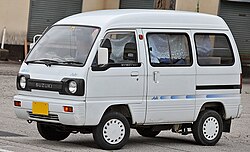 1990–1991 facelifted Suzuki Every van (DA51V)
 -
 1990–1991 facelifted Suzuki Every van (DA51V)
 -
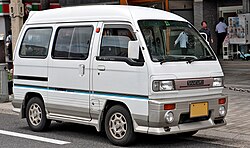 1990 Suzuki Every 660 PS Turbo Aero-tune (DA51V)
 -
 1990 Suzuki Every 660 PS Turbo Aero-tune (DA51V)
 -
 1990–1991 Autozam Scrum van (first generation)
 -
 1990–1991 Autozam Scrum van (first generation)
 -
 1990–1991 Autozam Scrum Turbo van (first generation)


Export models
[edit]Post-1985 European market Carrys still used the 797 cc four-cylinder F8A familiar from the ST90 Carry, while Super Carrys were equipped with the F10A 970 cc four. Chassis codes are SK408 and SK410, while power outputs are 37 and 45 PS respectively (27.5 and 33 kW), top speeds 110 and 115 km/h. Heftier bumpers meant overall length was up 10 cm, for a total of 3295 mm.[53] Production of export models began in July 1985. The SK408 (sometimes called the DA11) was discontinued in October 1989. The SK410 Super Carrys (DA21) received the same F10a 970cc inline-four as fitted to the SJ410 Samurai. In much of Europe, this generation of the Carry was also sold as the Bedford, Vauxhall, or GME Rascal. These were built at the GM plant in Luton, to circumvent JAMA's voluntary export restrictions.[54]
In Australia, this model was sold as both the Super Carry (in ute, van, or wagon form) and as the Holden Scurry, which was not available as a "ute".[55] In Australia, the Scurry was designated as the NB series.
In Taiwan, the Carry continued to be available as the Ford Pronto, originally with the F8A engine although later this was changed to the F10A, corresponding to the SK408 and SK410 models. It remained in production until 1999, when it was replaced by a rebadged version of the tenth generation Carry.
In Central America, this model was available as the Chevrolet CMV (van) and CMP (pickup) and was produced until 2013.[56]
The Super Carry continues in production in Vietnam for local markets, as a truck or panel van, with a Euro 2 emissions compliant engine.[57] The 970 cc engine has electronic fuel injection and develops 31 kW (42 PS) at 5500 rpm. The 3,240 mm (128 in) long truck is the best selling truck in Vietnam and the engine was updated to meet the Euro 4 emissions standards in 2017.[58]
-
 Suzuki Carry van (SK410)
 -
 1987 Suzuki Carry van (Netherlands)
 -
 1988–1990 Suzuki Super Carry TX van (SK410, Australia)
 -
 1988–1990 Suzuki Super Carry TX van (SK410, Australia)
 -
 1992 Suzuki Super Carry Commercial TX van (SK410, Netherlands)
 -
 1992 Suzuki Super Carry Commercial TX van (SK410, Netherlands)
 -
 1992 Suzuki Super Carry Commercial van (SK410, Netherlands)
 -
 1997 Suzuki Super Carry TX van (SK410, United Kingdom)
 -
 1997 Suzuki Super Carry TX van (SK410, United Kingdom)
 -
 Holden Scurry (NB, Australia)
 -
 Ford Pronto van (Taiwan)
 -
 1999 Ford Pronto truck (Taiwan)
 -
 1999 Ford Pronto van (Taiwan)
 -
 1999 Ford Pronto van (Taiwan)
 -
 Changhe Changlingwang CH6353A (China)
 -
 1995–1999 Hafei Songhuajiang HFJ6350 (China)

.jpg)
_TX_van_(2015-06-03)_01_(cropped).jpg)
_TX_van_(2015-06-03)_02_(cropped).jpg)

.jpg)


.jpg)


.jpg)
.jpg)

_HFJ6350.jpg)
Bedford Rascal
[edit]| Bedford Rascal | |
|---|---|
 | |
| Overview | |
| Manufacturer | Bedford/Vauxhall (General Motors) |
| Also called | Vauxhall Rascal GME Rascal Holden Scurry |
| Production | 1986–1993 (England) 1993–1999 (Japan) |
| Assembly | Luton, England |
| Body and chassis | |
| Body style | 5-door van 2-door pickup Campervan |
| Layout | Front mid-engine, rear-wheel-drive |
| Powertrain | |
| Engine | 970 cc (1.0 L) F10A I4[59] |
| Transmission | 4/5-speed manual[60] |
| Dimensions | |
| Length | 3,295 mm (129.7 in)[59] |
| Width | 1,395 mm (54.9 in)[59] |
| Height | 1,780 mm (70.1 in)[59] |
| Curb weight | 755 kg (1,664 lb)[59] |
| Chronology | |
| Successor | Opel/Vauxhall Combo |
The Bedford Rascal (later Vauxhall Rascal), also built as the Suzuki Super Carry, is a kei truck and microvan that was developed as a joint venture between the American car company General Motors (GM) and the Japanese automaker Suzuki.[60] It was sold under GM's British-based Bedford marque as well as in Suzuki form. Other names were used in a few international markets, such as GME (General Motors Europe) for those continental European markets where Suzukis were generally not marketed and where the "Bedford" and "Vauxhall" brands were largely unknown.
The van was produced at the IBC Vehicles plant in Luton, England, adjacent to the main Vauxhall factory (GM's British-based passenger car marque). Alongside the Bedford, the Suzuki-branded twin was manufactured for the European market (where Bedford is a less established brand).
Sold from 1986 to 1994, the Rascal, like the Super Carry, is a small and economical van intended for many purposes. The vehicle's strengths were its diminutive size and maximum payload weight; 550 kg for the van and 575 kg for the pickup.[60] The principal visible difference between Bedford and Suzuki versions is the front trim: the Super Carry has two separate plastic headlamp surrounds and the Rascal has a single full-width one with "Bedford" moulded in the middle.
Timeline:
- 1986: launched
- 1990: rebadged as the Vauxhall Rascal, as the Bedford marque was being retired
- 1993: production moved to Japan, where the vehicle continued to be made until 1999.
Rascals were mainly sold as vans; pickup and camper versions were also made.
-
 GME Rascal, for continental European markets
 -
 Rear view of Rascal pickup
 -
 Vauxhall Rascal


Daewoo Damas
[edit]| Daewoo Damas and Daewoo Labo | |
|---|---|
 Chevrolet Damas (Uzbek-built) | |
| Overview | |
| Manufacturer |
|
| Also called |
|
| Production | 1991–2021 |
| Assembly |
|
| Body and chassis | |
| Body style | 4-door van 2-door pickup |
| Layout | FMR layout |
| Powertrain | |
| Engine | 796 cc (0.8 L) I3 |
The Daewoo Damas is a badge-engineered version of the Suzuki Carry/Every produced by the South Korean automaker Daewoo since 1991.[62] It is currently in its second generation and is available in van and pickup body styles, the latter of which was marketed as the Daewoo Labo.[63] Since 2011, the Damas and Labo are sold in South Korea without branding, essentially making "Damas" and "Labo" the brands.[64]
In some export markets, the Daewoo Damas was known as the Daewoo Attivo and since General Motors' takeover of Daewoo, it has been known in some markets, such as Central America and Tunisia, as Chevrolet CMV for the passenger van (Damas) and Chevrolet CMP for the pickup truck (Labo).
The Damas and Labo both come with the three-cylinder SOHC 796-cc F8C engine rather than the smaller 660-cc units originally used in Japan, to provide more power and comfort. Both the Damas and Labos are only available with a manual transmission. Air conditioning is optional. The engine was originally made for petrol, but is recently only available in South Korea as an LPG-powered unit.[62]
The Damas microvan is available as a seven-seat coach, five-seat coach, or two-seat cargo van styles and comes with various options based on DLX (deluxe) and SUPER models. The Labo is also available in STD (standard), DLX (deluxe), and SUPER models. Two main choices of the Labo body type are the cube van and the drop-side pickup truck. The pickup has an optional electric tailgate lift.
The Damas (but not the Labo) received a facelift in July 2003, stretching the nose by 245 mm (9.6 in) to meet stricter safety regulations for passenger vehicles. This was marketed as the Daewoo Damas II in South Korea. Over the years, the Labo has been equipped with a number of the various grille and headlight combinations originating with the Japanese Carry and Every variations. In January 2007, Labo and Damas production was halted as they could not be made to meet emissions regulations. Production resumed (as the New Damas) in April 2008, although now only with LPG engines for the home market. In March 2011, the "Daewoo" badging was dropped, leaving the cars without a "family name" in the South Korean market.[65]
In December 2013, production was again halted, as the Damas and Labo would not meet requirements for all motor vehicles produced after 2014 to have oxygen sensors installed.[66] The Damas and Labo also do not fulfill South Korean requirements for on-board diagnostics to be installed, although they have been exempted from such regulations. A campaign by small business owners, stoking fear of a flood of Chinese imports replacing the domestic-made trucklets, pushed the government to create an exemption for the Damas and Labo, and production recommenced in August 2014.[67] South Korean production was extended to 2020, when the government's moratorium on meeting the emissions requirement was to run out.[68] In 2019, however, the Korean government further extended this exemption, allowing the little trucks to remain in production for another year at least.[66]
VIDAMCO of Vietnam produced the Damas in complete knock-down kit until 2018.
- Uzbekistan
The Damas is the predominant form of public transport in Uzbekistan. In Damas marshrutkas, generally far more than seven passengers are crammed. Local production at the newly established UzDaewoo Auto began in 1996.[69] The Damas and the Labo, alongside the Tico, were the company's first products. Local parts content has gradually increased over the years. In 2004, the Daewoo Labo truck was discontinued, but it was returned to production as the "Chevrolet Labo" in 2015. The Labo is only built in UzAuto's Khorezm Plant, in the town of Pitnak.[70] The longer-nosed Daewoo Damas II replaced the original design in 2006.[69] Subsequent to General Motors' takeover of the UzDaewoo plant in 2008, the name of the Damas II was changed to "Chevrolet Damas." Since about that time, the Chevrolet Damas has been offered in a basic Van trim or as the 7-seater Deluxe, with a colorful graphic along the flank.
-
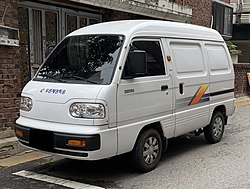 Daewoo Damas
 -
 Daewoo Damas, engine compartment
 -
 Chevrolet CMP (a rebadged Labo)
 -
 2010 Daewoo Damas interior


Ninth generation (DC51T/DD51T/DE51V/DF51V; 1991)
[edit]| Ninth generation (DC51T/DD51T/DE51V/DF51V) | |
|---|---|
 1991–1999 Suzuki Carry truck | |
| Overview | |
| Also called | Autozam Scrum Suzuki Every (van variant) |
| Production | 1991–1999 |
| Assembly | Japan: Iwata, Shizuoka |
| Body and chassis | |
| Body style | 2-door pickup 5-door van/microbus |
| Layout | FMR layout, rear-wheel drive / four-wheel drive (Carry) mid-engine, rear-wheel drive / four-wheel drive (Every/Carry Van) |
| Powertrain | |
| Engine | 657 cc F6A I3 |
| Transmission | 4/5-speed manual 3-speed automatic |
| Dimensions | |
| Wheelbase | 1,855 mm (73.0 in) (Carry) 2,000 mm (78.7 in) (Every/Carry Van) |
| Length | 3,295 mm (129.7 in) |
| Width | 1,395 mm (54.9 in) |
| Height | 1,715–1,865 mm (67.5–73.4 in) |
| Curb weight | 650–720 kg (1,433–1,587 lb) |
The ninth generation Carry (and third generation Every) appeared in September 1991.[51] The 657 cc F6A engine remained from the previous generation, but an all-new bodywork was much smoother, originally with slim, small rectangular headlights. The chassis was largely unchanged for the truck (albeit with a somewhat longer wheelbase), but the vans had a considerably longer wheelbase and an engine mounted midships, just ahead of the rear axle. Chassis codes changed accordingly, and were now different for the Carry and the Every. The trucks are DC/DD51T and the vans are DE/DF51V ("DD" and "DF" for four-wheel drive versions).[51] Two different front treatments were available, one with small rectangular aerodynamic headlights and one with large, round units (used on lower-spec models).
The ninth-generation Carry received a very gentle facelift in September 1993, including a switch from front drum brakes to discs on all models. Two months later, the Carry Van line switched to the Every nameplate and the division between trucks and vans was made clearer. Another light change occurred in July 1995, when the front turn signals were changed from clear to amber and the wheel bolt pattern was changed from 4x114.3mm to 4x100mm. The ninth generation continued to be built until 1999. Most export markets continued to receive the previous generation Carry with bigger engines and most commonly with van bodywork. The older Super Carry is generally more rugged than the DE/DF51, which was fitted with a coil sprung De Dion rear axle not as suitable for carrying heavy loads. In those rather few foreign markets where the ninth generation Carry was available, it was sold as the SK306 and with a version of the 657 cc engine used in the Japanese domestic market. In late 1997, the retro-styled Suzuki Every C arrived.[1]
-
 Suzuki Carry van (DE51V, 1991–1993)
 -
 Suzuki Every 660 Turbo RZ Super Multi Roof (DE51V)
 -
 Suzuki Every 660 Turbo RZ Super Multi Roof (DE51V)
 -
 Autozam Scrum van (second generation)
 -
 Autozam Scrum truck (second generation)


Tenth generation (1999)
[edit]Tenth generation Carry and fourth generation Every (DA52/DB52/DA62/DA63; 1999)
[edit]| Tenth generation (DA52/DB52/DA62/DA63/DA65) | |
|---|---|
 1999 Suzuki Carry truck | |
| Overview | |
| Also called | Mazda Scrum Ford Pronto PR-Z (Taiwan) Chana-Kuayue Xinbao Chana Shenqi T20/T20L Dongfeng DFAC Xiaobawang Wanxiang K01 EV |
| Production | 1999–2013 (Carry) 1999–2005 (Every) 2009–present (China) |
| Assembly |
|
| Body and chassis | |
| Body style | 2-door pickup 5-door van/microbus |
| Layout | FMR layout, rear-wheel drive / four-wheel drive (Carry) mid-engine, rear-wheel drive / four-wheel drive (Every) |
| Powertrain | |
| Engine | |
| Transmission | 5-speed manual 3-speed automatic |
| Dimensions | |
| Wheelbase | 1,905 mm (75 in) (Carry) 2,350 mm (93 in) (Every) |
| Length | 3,395 mm (134 in) |
| Width | 1,475 mm (58 in) |
| Height | 1,755–1,800 mm (69–71 in) |
| Curb weight | 650–780 kg (1,433–1,720 lb) |
The tenth generation Carry was introduced in January 1999, with its van version dropped the Carry name in favour of Every in Japan. It retained the F6A engine (albeit modernized) and was sold as the DA/DB52 T and V (Carry truck or Every van, "DB" signifying four-wheel drive). This marked the end of using "Carry" badging on vans in the Japanese domestic market. A version with a fuel injected, six-valve F6A turbo engine with 60 PS (44 kW) was available in all models at the time of introduction.[71] The Turbo was discontinued in May 2000 but was then reintroduced after the Carry/Every switched to the new, cleaner K6A engine in September 2001.
In June 1999, the DA52W (Every Wagon, only with two-wheel drive) appeared, along with the bigger Every Plus. In 2001, a version with the more powerful timing chain equipped K6A (still of 657 cc displacement) appeared, as the DA62T/V/W. This model has also been built by Chang'an (Chana) in China, as the "Star" (Zhixing) bus and truck (originally SC6350, SC1015).[1] in which they have gone through many revisions since 2009.
The Carry truck was completely rebodied in May 2002 and received a door redesign in April 2009, but the existing Every Van and Wagon continued to be produced until replaced in August 2005, as the two lines continued a process of divergence begun with the introduction of the Every in 1982. In November 2005, the Carry FC was introduced.[72] This version, targeted to farmers, has a much shorter wheelbase (and correspondingly longer front overhang) to make it more maneuverable in tight places such as the narrow roads along rice fields. Another benefit was improved leg room as the wheel wells were now beneath the seats. The FC was only available with a five-speed manual transmission, with available four-wheel drive as well as an optional locking differential called "Agricultural Specification".[72] The Carry FC had a class-leading turn circle with a radius of 3.6 metres (11 ft 10 in).[73]
-
 1999 Suzuki Carry truck
 -
 1999–2002 Suzuki Carry truck
 -
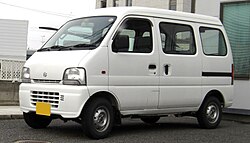 1999–2005 Suzuki Every van
 -
 1999–2005 Suzuki Every van
 -
 1999–2005 Suzuki Every Join 4WD
 -
 1999–2005 Suzuki Every Wagon
 -
 1999–2005 Suzuki Every Wagon
 -
 2002–2013 Suzuki Carry truck
 -
 2002–2009 Suzuki Carry truck
 -
 2005–2013 Suzuki Carry FC truck (short wheelbase)
 -
 2002–2012 Mazda Scrum truck (third generation)
 -
 Ford Pronto PR-Z (Taiwan)


.JPG)
Ford Pronto (PR-Z)
[edit]This generation Carry was also built in Taiwan, as the Ford Pronto, starting in late November 1999.[74] Available as a truck or a van, it was fitted with a Japanese-made 1-liter, 16-valve G10B engine producing 66 hp (49 kW).[74] The more lifestyle-oriented van model was sold as the Pronto PR-Z. At the end of 2007, Ford Lio Ho ceased to produce the Pronto because the engine couldn't be made to meet revised local environmental regulations.[75]
Fifth generation Every (DA64; 2005)
[edit]| Fifth generation Every (DA64) | |
|---|---|
 Suzuki Every PA van (DA64V) | |
| Overview | |
| Also called | Mazda Scrum Mitsubishi Minicab Mitsubishi Town Box Nissan NV100 Clipper |
| Production | 2005–2015 |
| Assembly | Japan: Iwata, Shizuoka |
| Body and chassis | |
| Body style | 5-door van/microbus |
| Layout | mid-engine, rear-wheel drive / four-wheel drive |
| Powertrain | |
| Engine |
|
| Transmission | 5-speed manual 3-speed automatic 4-speed automatic |
| Dimensions | |
| Wheelbase | 2,400 mm (94 in) |
| Length | 3,395 mm (134 in) |
| Width | 1,475 mm (58 in) |
| Height | 1,795–1,880 mm (71–74 in) |
| Curb weight | 650–780 kg (1,433–1,720 lb) |
The fifth generation Every was introduced in Japan in August 2005. Unlike its predecessors, it was primarily designed as a passenger vehicle, with the commercial models derived from the passenger variant.[76] The rear seat of the Every could be moved 150 mm (5.9 in) front-to-rear, allowing for flexibility. The top-of-the-line PZ Turbo and PZ Turbo Special models were the first kei vans to have fully automated climate control (including vent settings and directions).[77] Those two models also had powered sliding doors at the rear, with the PZ Turbo Special being thus equipped on both sides and also including a power step for ease of access.[77] The Every Wagon received a facelift on May 20, 2010.
From 2013 until 2015, the fifth generation Every was rebadged and sold by Mitsubishi Motors as the Minicab and Town Box, and by Nissan as the NV100 Clipper.
-
 Suzuki Every PA van (DA64V)
 -
 Suzuki Every GA van (DA64V)
 -
 Suzuki Every GA van (DA64V)
 -
 2005 Suzuki Every Wagon (pre-facelift)
 -
 Suzuki Every Wagon PZ Turbo Special Hi-Roof 4WD (pre-facelift)
 -
 Suzuki Every Wagon PZ Turbo Special Hi-Roof 4WD (pre-facelift)
 -
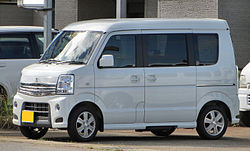 Suzuki Every Wagon PZ Turbo Special Hi-Roof 4WD (facelift)
 -
 Suzuki Every Wagon PZ Turbo Special Hi-Roof 4WD (facelift)
 -
 2010 Suzuki Every PA interior with manual transmission
 -
 2010 Suzuki Every Wagon JP Turbo interior with automatic transmission


Eleventh generation (2013)
[edit]Eleventh generation Carry (2013)
[edit]| Eleventh generation (DA16T) | |
|---|---|
 Suzuki Carry KX 4WD truck (DA16T) | |
| Overview | |
| Also called | Mazda Scrum Mitsubishi Minicab Nissan NT100 Clipper |
| Production | 2013–present |
| Assembly | Japan: Iwata, Shizuoka |
| Body and chassis | |
| Body style | 2-door pickup |
| Layout | FMR layout, rear-wheel drive / four-wheel drive |
| Powertrain | |
| Engine | 658 cc R06A I3 |
| Transmission | 5-speed manual 3/4-speed automatic |
| Dimensions | |
| Wheelbase | 1,905 mm (75 in) |
| Length | 3,395 mm (134 in) |
| Width | 1,475 mm (58 in) |
| Height | 1,765–1,885 mm (69–74 in) |
| Curb weight | 680–850 kg (1,499–1,874 lb) |
The eleventh generation Carry was introduced in Japan in August 2013. It is also sold as the Mazda Scrum, Mitsubishi Minicab, and Nissan Clipper.
-
 Suzuki Carry rear (DA16T)
 -
 Suzuki Super Carry
 -
 Suzuki Super Carry rear
 -
 The Nissan NT100 Clipper; identical aside from the grille and badging
_rear.JPG)
_front.jpg)
_rear.jpg)
_in_White,_front_left.jpg)
Sixth generation Every (DA17; 2015)
[edit]| Sixth generation Every (DA17V/DA17W) | |
|---|---|
 Suzuki Every PA Limited van (DA17V) | |
| Overview | |
| Also called | Mazda Scrum Mitsubishi Minicab Mitsubishi Town Box Nissan NV100 Clipper |
| Production | 2015–present (Japan) 2024–present (Pakistan) |
| Assembly |
|
| Body and chassis | |
| Body style | 5-door van/microbus |
| Layout | Mid-engine, rear-wheel drive / four-wheel drive |
| Powertrain | |
| Engine | |
| Transmission | 5-speed manual 4-speed automatic 5-speed AMT CVT |
| Dimensions | |
| Wheelbase | 2,430 mm (96 in) |
| Length | 3,395 mm (134 in) |
| Width | 1,475 mm (58 in) |
| Height | 1,815–1,910 mm (71–75 in) |
| Curb weight | 870–1,030 kg (1,918–2,271 lb) |
| Chronology | |
| Predecessor | Suzuki Bolan (Pakistan)[78] |
The sixth generation Every was introduced in Japan in February 2015, using the new R06A engine as per its Carry truck sibling.
In October 2024, the sixth generation Every entered production in Pakistan as the replacement to the Suzuki Bolan.[79]
-
 Suzuki Every PA Limited van (DA17V)
 -
 Suzuki Every Wagon PZ Turbo (DA17W)
 -
 Suzuki Every Wagon JP Turbo (DA17W)

_front.JPG)
.jpg)
Separate models
[edit]Suzuki also developed several non-kei car version of Carrys for different markets around the world.
Suzuki Carry Futura/Suzuki Futura/Super Carry
[edit]| Suzuki Carry Futura/Suzuki Futura/Super Carry | |
|---|---|
.jpg) Suzuki Carry Futura 1.3 van (SL413; pre-facelift) | |
| Overview | |
| Also called |
|
| Production |
|
| Assembly |
|
| Body and chassis | |
| Body style |
|
| Layout | Front mid-engine, rear-wheel-drive |
| Powertrain | |
| Engine | |
| Transmission | 5-speed manual |
| Dimensions | |
| Wheelbase |
|
| Length |
|
| Width |
|
| Height |
|
| Curb weight | 790–1,050 kg (1,742–2,315 lb) |
| Chronology | |
| Predecessor | Mitsubishi Jetstar (Colt T120SS) |
| Successor |
|
In April 1989, Suzuki reaches an agreement with Mitsubishi for joint development of light commercial vehicle in Indonesia.[80] Those light commercial vehicles were later introduced as Suzuki Carry Futura (later just Suzuki Futura when the 'Carry' nameplate was dropped in 1994 to distinguish with the ST100 Suzuki Carry 1.0) and Mitsubishi Colt T120SS, the former debuted first in mid-February 1991.[81] Instead of positioned as the successor of the older Carry ST100, the Futura was sold together as the bigger alternative of Carry in Indonesia and also available as 4-door van, wide deck truck with three-way opening and bare chassis. The bare chassis version is usually converted into a microbus by local bodybuilders, for use as an angkot, or share taxi like the older Carry ST100. Initially it has a 1,360 cc G13C engine with ST130/SL413 internal model codename. The engine was based on G13A engine but with bigger bore and developed exclusively for Futura. The engine's power was rated at 73 PS (54 kW) at 6000 rpm. The truck was also sold in Malaysia as Suzuki Futura, again without the Carry nameplate.[1] As of April 1995, along with the ST100 Suzuki Carry 1.0, the Futura received update on the redesigned steering wheel with Suzuki S logo, as well as the usage of power steering on the Futura.
A minor facelift occurred in August 1997 along with the introduction of the 1,590 cc G16A engine option (ST160/SL416); this puts out 80 PS (59 kW). In 2000, the 1,493 cc G15A engine (ST150/SL415) replaced both the 1.3 and 1.6 engines, as the Indonesian government imposed higher tax for engine above 1500 cc in 2000 and also as an efficiency strategy after the 1997 Asian financial crisis. The original, carburetted engine produces 77 PS (57 kW) at 6000 rpm. In March 2005, the 1.5 engine was upgraded to fuel injection rather than the earlier carburettor due the implementation of the Euro 2 emission standard, the cylinder head was also updated from 8 to 16-valve. This engine initially produced 87 PS (64 kW), but later detuned to 79 PS (58 kW). Two more facelifts occurred, in April 2010 and again in January 2017. The Futura (and the bigger APV-based Mega Carry truck) was discontinued in February 2019 due the implementation of Euro 4 emission standard and replaced by newer Carry (DC/DN61T) few months later.[82]
-
 Suzuki Carry Futura 1.6 van (SL416; 1999 facelift)
 -
 Suzuki Carry Futura 1.5 flat deck truck (SL415; 2005 facelift)
 -
 Suzuki Carry Futura 1.5 GX van (SL415; 2010 facelift)
 -
 Suzuki Carry Futura 1.5 flat deck truck (SL415; 2010 facelift)
 -
 Suzuki Carry Futura 1.5 flat deck truck (SL415; 2017 facelift)
 -
 Wide deck truck version
 -
 Rear view of the truck
 -
 Rear view of the van
_Van_01.jpg)

.jpg)
.jpg)
.jpg)
_wide_deck_truck_front.jpg)
.jpg)
.jpg)
Mitsubishi Colt T120SS
[edit]The name of Colt T120SS is a continuation of the first generation Mitsubishi Delica, which was marketed as the "Colt T120" in many countries including Indonesia. When production began in 1991, it replaced the Minicab-based "Jetstar" mini truck. The T120SS is based on the locally developed Futura, with which it shares everything aside from the engines, grille, taillights and slightly bigger bed.[1] Overall length is 3,720 mm (3,940 mm for the "3-way wide deck" version).[83]
Just like the Futura, the Colt T120SS is available as either a bare chassis, a regular pickup truck, or three-way wide deck, with the exception of 4-door van. Initially the truck was powered by Mitsubishi's carburetted 1343 cc 4G17 engine and puts out 78 PS (57 kW; 77 hp) at 6000 rpm.[83] This engine had the same specs from its time of introduction in 1991 until in 1996 when it was redesigned and no longer an interference engine.[84] In March 2005, the engine was replaced by a bigger and fuel injected 1468 cc 4G15 engine, The larger unit, which meets Euro 2 emission standards, produces 86 PS (63 kW) at 5750 rpm.[85] Both engines feature three valves per cylinder or 12-valve in total. The truck was lightly facelifted, with a new grille featuring a triangular central portion.[84] From 1991 to 2019, Mitsubishi Motors built 324,960 units of the T120SS.[86] The last T120SS rolled off the production line at PT Krama Yudha Ratu Motor plant in Pulo Gadung, East Jakarta on 22 January 2019 without replacement like the Futura.
-
 Mitsubishi Colt T120SS (pre-facelift)
 -
 Mitsubishi Colt T120SS (2005 facelift)
_01.jpg)

Maruti Suzuki Super Carry
[edit]
Starting in 2016, Maruti Suzuki has launched a small commercial truck called Super Carry in India, based on the Futura. This model receives 140 mm longer wheelbase and different interior than the original model. In India, the truck is powered by either 1196 cc G12B four-cylinder CNG or 793 cc two-cylinder turbodiesel engines and both mated to a 5-speed manual transmission. The latter was first diesel engine developed by Suzuki and also the first for Carry's family. The minuscule engine is not able to power an air-conditioning system.[87] The diesel engine was discontinued in India in March 2020 as the engine is not compliant with the Bharat Stage 6 emissions standard.[88]
The Super Carry was also exported to Africa from April 2016, powered by the 1.2-liter petrol engine. In the Philippines, the truck was introduced in October 2016 and only powered with the same 793 cc diesel engine as for the Indian version.[89] It is available with more variety of bodywork such as flat-bed truck, utility van, cargo van or prepared to be fitted with jeepney bodywork. After the all-new model Carry arrived in the Philippines in 2019, the Super Carry continued to be sold alongside it until it was discontinued few months later.
In April 2023, the 1.2 L petrol/CNG engine was replaced by the more modern dual VVT K12N Dualjet engine.[90]
Suzuki Every Plus/Carry 1.3
[edit]| Suzuki Every Plus/Carry 1.3 (DA32W) | |
|---|---|
 Suzuki Every Plus (Japan) | |
| Overview | |
| Manufacturer | Suzuki Maruti Suzuki Ford Lio Ho Changhe Karry Dongfeng Automobile Company |
| Also called | Suzuki Every Landy Suzuki E-RV (Malaysia) Suzuki Mastervan (Chile) SYM T880/T1000/V5/V9/V11 Maruti Suzuki Versa/Eeco Chang'an SC6350/SC6371A/SC6390 LWB (Chana Star) Changhe Suzuki Landy/Coolcar Karry Youjin Dongfeng (DFAC) Xiaobawang W Dongfeng (DFAC) Xiaobawang W08 |
| Production | 1999–present (China) 1999–2005 (Japan) 2001–2010 (India, Versa) 2010–present (India, Eeco) |
| Assembly | Iwata, Shizuoka, Japan Gurgaon, India Chongqing, China |
| Body and chassis | |
| Class | Microvan/truck |
| Body style | 5-door minivan 5-door panel van 2-door pickup truck |
| Layout | Front mid-engine, rear-wheel-drive or all-wheel drive |
| Powertrain | |
| Engine | 1298 cc G13BB SOHC I4 |
| Transmission | 5-speed manual 4-speed automatic |
| Dimensions | |
| Wheelbase | 2,350–2,365 mm (92.5–93.1 in) |
| Length | 3,675–3,705 mm (144.7–145.9 in) |
| Width | 1,475–1,505 mm (58.1–59.3 in) |
| Height | 1,780–1,900 mm (70.1–74.8 in) |
| Curb weight | 785–1,080 kg (1,731–2,381 lb) |
| Chronology | |
| Successor | Suzuki APV (International) Suzuki Landy (Japan) |
The Every Plus, was an enlarged seven-seat MPV version of the Every (passenger version of the Carry). With chassis code DA32W It was fitted with the considerably larger 1.3 liter G13 engine. The image to the right is of the Every Plus, introduced in June 1999. The name was changed in May 2001 to Every Landy, accompanied by a facelift introducing a large chromed grille.
With Carry 1.3 badging (chassis DA32) Truck and Van versions of the Every Plus were sold in various right hand drive export markets, including the United Kingdom and Australia. The truck version was available with constant four-wheel drive.[91] The Wagon model was also sold as the Suzuki E-RV in Malaysia. It was also sold in certain other markets, such as Chile, as the Carry SK413 (truck) or as the Mastervan (van).
- Weight:
- 2WD: 785–1,040 kg (1,731–2,293 lb)
- 4WD: 1,050–1,080 kg (2,310–2,380 lb)
- Maximum power: 78–86 PS (57–63 kW) at 5,700 to 6,000 rpm
- Maximum torque: 101–115 N⋅m (74–85 lbf⋅ft) at 3,000 rpm
-
 Suzuki Every Plus (Japan)
 -
 Suzuki Every Landy (Japan)
 -
 Suzuki Every Landy (Japan)
 -
 2003 Suzuki Carry 1.3 panel van (UK)
 -
 Suzuki Carry 1.3 truck (Taiwan)

_front.jpg)


- Maruti Suzuki Versa/Eeco
The Maruti Suzuki Versa is a licensed variation of the Every Plus for the Indian market and was built by Maruti Suzuki from October 2001. It is the second van released by Maruti Suzuki since the Maruti Suzuki Omni was released in 1984. About seventy percent of the vehicle components are made within India.[92] The Versa was discontinued in late 2009, after only having been built to order in small numbers for some time.[93]
There were two basic versions of this car produced; the two 8-seater DX/DX2 versions and the 5-seater STD version. The DX2 version of the Versa was equipped with twin air conditioners for front and rear. The Versa was fitted with the same 16-valve, 1.3-liter four-cylinder engine generating 82 hp (61 kW) at 6000 rpm as the Every Plus. It is controlled by a 16-bit engine management system.
The initial target audience for this vehicle were customers who planned to buy a sedan like the Maruti Esteem or a utility vehicle like Tata Sumo. The 82 bhp (61 kW) engine is located under the front seat.[94] The Versa can reach from 0–60 mph in 13.5 seconds.[94]
Maruti Suzuki Eeco was introduced in India by Maruti Suzuki in January 2010. This car is a refresh of the Versa, but equipped with a new 1196 cc four-cylinder in-line engine. The Eeco makes 55 kW (73 bhp) at 6000 rpm, 101 Nm (74 ft lb) at 3000 rpm. It is delivered in either 5-seater or 7-seater versions.[95]
Changan group variants
[edit]Chang'an/Chana Star (SC6320G) is a licensed variation of the Suzuki Every Plus for the Chinese market. Changan has the license due to the Changan Suzuki joint venture. The front DRG of the Star was completely redesigned, but from the rest of the body panels, the relationship with the Suzuki Every Plus was still clearly visible. Newer models of the Chana Star are still available for production as of 2020. Examples include the Chana Star 5 truck and Chana Star 3 minivan.
The Changhe Suzuki Landy was a passenger minivan based on the fifth-generation Every, sold in China between 2007 and 2012.[96]
Further re-badged versions were sold under the Tiger Truck brand in North America.
-
 Chana Star (pre-facelift, China)
 -
 Chana Star (pre-facelift, China)
 -
 Chana Star (facelift, China)
 -
 Chana Xingguang (China)
 -
 Chana Xingyun (China)
 -
 Chana-Kuayue Xinbao mini (pre-facelift)
 -
 Chana-Kuayue Xinbao mini double cab (pre-facelift)
 -
 Chana-Kuayue Xinbao double cab (facelift) with dual rear wheels
 -
 Chana-Kuayue Xunlong
 -
 Chana Shenqi T20 (pre-facelift)
 -
 Chana Shenqi T20L double cab (facelift) with dual rear wheels
 -
 Chana Star 2 double cab (facelift)
,_front_8.8.18.jpg)

_Star_(Zhixing,_facelift),_front_8.2.18.jpg)
_Xingguang,_front_8.11.18.jpg)
_Xingyun,_front_8.8.18.jpg)
,_front_8.12.18.jpg)
_double_cab,_front_8.5.18.jpg)
,_front_8.7.18.jpg)

,_front_8.16.18.jpg)
,_front_8.8.18.jpg)

Dongfeng DFAC Xiaobawang
[edit]-
 Dongfeng DFAC Xiaobawang with dual rear wheels
 -
 Dongfeng DFAC DF-2900
 -
 Dongfeng DFAC Xiaobawang W08

.jpg)

Karry T-Series (Youjin)
[edit]-
 Karry Youjin crew cab with dual rear wheels.

Suzuki Landy (2007)
[edit]| Suzuki Landy | |
|---|---|
.jpg) 2010 Suzuki Landy by Changhe-Suzuki | |
| Overview | |
| Production | 2007–2012 |
| Body and chassis | |
| Body style | 5-door passenger van |
| Layout | Front mid-engine, rear-wheel-drive |
| Powertrain | |
| Engine | 1.5L K14B I4 (petrol) |
| Transmission | 5-speed manual |
| Dimensions | |
| Wheelbase | 2,430 mm (95.7 in) |
| Length | 3,850 mm (151.6 in) |
| Width | 1,510 mm (59.4 in) |
| Height | 1,910 mm (75.2 in) |
| Curb weight | 1,065–1,100 kg (2,347.9–2,425.1 lb) |
| Chronology | |
| Predecessor | Suzuki Carry (Fourth generation) |
.jpg)
The Suzuki Landy (铃木浪迪) sold in China from 2007 to 2012 was produced by Changhe-Suzuki (昌河铃木) and was based on the Japanese market fifth-generation Suzuki Every, featuring a restyled front end and an extended and restyled rear overhang. The Changhe Suzuki Landy Sunshine trim is powered by the K14B engine developing a maximum power output of 70KW and 115N·m mated to a 5-speed manual transmission.[97]
Suzuki Carry (2019)
[edit]| Suzuki Carry (DC61T/DN61T) | |
|---|---|
_01.jpg) 2019 Suzuki Carry Flat Deck (DC61T) | |
| Overview | |
| Also called | Suzuki Super Carry Pro (Vietnam) |
| Production | February 2019 – present |
| Assembly | Indonesia: Bekasi, West Java (Suzuki Indomobil Motor Tambun Plant) |
| Designer | Yoshitake Ishii |
| Body and chassis | |
| Body style | 2-door pickup truck 2-door cargo van (Philippines) 4-door utility van (Philippines) |
| Layout | Front mid-engine, rear-wheel-drive |
| Powertrain | |
| Engine | 1462 cc K15B-C I4 (petrol) |
| Transmission | 5-speed manual |
| Dimensions | |
| Wheelbase | 2,205 mm (86.8 in) |
| Length | 4,195 mm (165.2 in) (pickup truck) 4,237–4,344 mm (166.8–171.0 in) (cargo/utility van) |
| Width | 1,675–1,765 mm (65.9–69.5 in) |
| Height | 1,870–1,910 mm (73.6–75.2 in) (pickup truck) 2,030–2,167 mm (79.9–85.3 in) (cargo/utility van) |
| Curb weight | 1,065–1,100 kg (2,347.9–2,425.1 lb) |
| Chronology | |
| Predecessor | Suzuki Carry (SL415) Suzuki Mega Carry/Super Carry Pro/APV pickup |
Newer version of international Carry has been produced in Indonesia by Suzuki Indomobil Motor since 2019. Replacing the Carry Futura series as well as the Mega Carry, it uses the 1.5 L (1,462 cc) K15B-C engine, producing 71 kW (97 PS). It was launched at the 27th Indonesia International Motor Show on 25 April 2019[98] and is exported to nearly 100 countries.[99] It was also launched in Thailand on 16 August 2019[100] and in the Philippines on 26 September 2019.[101]
The Carry received a facelift on 21 January 2021 and currently only available for Indonesian market.[102][103]
The Carry was launched in the Middle East in February 2024.
-
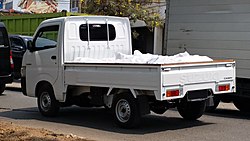 2019 Suzuki Carry Flat Deck (Indonesia)
 -
 2021 Suzuki Carry Utility Van (pre-facelift, Philippines)
 -
 2021 Suzuki Carry Flat Deck (facelift, Indonesia)
 -
 2021 Suzuki Carry minibus used as share taxis under the Jak Lingko program (facelift, Indonesia)
 -
 Interior
 -
 K15B-C engine
_02.jpg)
.jpg)
.jpg)
.jpg)
_04.jpg)
.jpg)
Nameplate use with other vehicles
[edit]Suzuki Mega Carry
[edit]The pickup truck version of the Suzuki APV was sold as the Suzuki Carry in export markets, Suzuki Mega Carry in Indonesia and Pakistan, and also as Super Carry Pro in Vietnam. It was sold in export markets from 2005, in Indonesia from 2011, and was discontinued in February 2019.[104]
-
 Suzuki Carry (Thailand)
.jpg)
References
[edit]- Ozeki, Kazuo (2007). Suzuki Story: Small Cars, Big Ambitions. Tokyo: Miki Press. pp. 94–95. ISBN 978-4-89522-503-8.
- ^ a b c d e f Schaefers, Martin. "Japanese Kei Minivans". Far East Auto Literature.
- ^ Ozeki, pp. 94-95
- ^ 360cc: Light Commercial Truck 1950-1975 (360cc 軽商用貨物自動車 1950-1975). Tokyo: Yaesu Publishing. 2009. pp. 42–44. ISBN 978-4-86144-139-4.
- ^ 1965 Suzuki Suzulight Full Lineup catalog, available at Product Design Database
- ^ "History:1909- - Global Suzuki". www.globalsuzuki.com. Retrieved 27 March 2018.
- ^ a b c Light Commercial Truck 1950-1975, p. 44-45.
- ^ Ozeki, p. 72d
- ^ Suzuki Service Manual: Carry L40/L41/L40V (Manual), Hamamatsu, Japan: Suzuki Motor Co. Ltd., p. 8
- ^ Ozeki, p. 97
- ^ a b "1969年スズキ 韋駄天キャリイ ジウジアーロ・エロスの時代" [1969 Suzuki Idaten Carry: The Era of Giugiaro and Eros]. ポルシェ356Aカレラ (in Japanese). 4 May 2013. Archived from the original on 9 March 2025.
- ^ "ミニカーさすらい派 若者は山を走る...ノダ" [Minicar Wanderers: Young people drive through the mountains]. Motor Magazine (in Japanese). Vol. 17, no. 7. July 1971. p. 215.
- ^ a b Ozeki, p. 98
- ^ Suzuki L60/L61 (catalog), Suzuki Motor Company, 1975, p. 1
- ^ New Model Technical Bulletin: Suzuki L60/L61/L61V Truck and Van. Suzuki Motor Company. September 1975. NT7110.
- ^ a b c MX41. スズキキャリイの軌跡(の一部) [Trajectory of the Suzuki Carry (part)]. ボール紙の車庫(仮)[Cardboard Box Garage] (in Japanese). Archived from the original on 13 April 2015.
{{cite web}}: CS1 maint: numeric names: authors list (link) - ^ a b 自動車ガイドブック [Automobile Guide Book 1976/1977] (in Japanese), vol. 23, Japan: Japan Automobile Manufacturers Association, 20 October 1976, p. 184, 0053-760023-3400
- ^ "Suzuki Fronte LC20 SS20". Mobil Motor Lama (in Indonesian). August 2016. Archived from the original on 29 July 2017.
- ^ スズキ キャリー Wide 550 [Suzuki New Carry Wide 550] (brochure) (in Japanese), Suzuki Motor Co, September 1977, p. 8, (52.J) 99999 - 30101 - 000
- ^ Hudaya, Didih (19 November 2010). "Klasik, "Fancy", dan Cantik" [Classic, Fancy, and Pretty]. Pikiran Rakyat: Otokir Plus (in Indonesian). Bandung, Indonesia: 29. Archived from the original on 13 December 2023.
- ^ Trisulo, Bambang; Samudra, M.; Firmansyah, Arif (2003). Arsip mobil kita: Tamasya sejarah seabad perjalanan mobil di Indonesia [Our cars archive: Sightseeing through a century of the car in Indonesia] (in Indonesian). Jakarta: PT Temprint. p. 109. ISBN 9789799768506.
- ^ Alfan, Charis (15 September 2016). "Suzuki Carry Truntung ST20". Mobil Motor Lama.
- ^ a b "Suzuki Bolan". paksuzuki. Pak Suzuki Motors. 27 January 2021. Archived from the original on 27 January 2021. Retrieved 27 January 2021.
- ^ a b "Suzuki Ravi". paksuzuki. Pak Suzuki Motors. 22 January 2021. Archived from the original on 22 January 2021. Retrieved 22 January 2021.
- ^ Piff, Ben. "China Trip Bonus: 1991 Chang'an Van aka Suzuki Carry".
- ^ "二手长安SC6320G详细图片". www.cn2che.com.
- ^ "Other Chang'an minivan models".
- ^ "The cars we chased together in those years: the classics of the 80s".
- ^ "Hanjiang SFJ1011A Cargo truck (#92) Made In China". auto-che.com.
- ^ "Suzuki story on verge of rise in New Zealand". The Press. Christchurch, New Zealand. 17 November 1980. p. 28 – via National Library of New Zealand.
- ^ "Facilities | Ford Motor Company Newsroom". Media.ford.com. Retrieved 27 July 2010.
- ^ "Chang'an SC6320G 1999". 30 May 2013.
- ^ 実績が示す— スズキ・キャリィの優秀性 (stockholders' report) [Results indicate: the superiority of the Suzuki Carry!] (in Japanese), Suzuki Motor Co, 1979, pp. 1–2
- ^ a b c Ozeki, p. 99
- ^ Ali, Sulman (19 September 2024). "Farewell – Pak Suzuki Officially Ends Production of Suzuki Bolan". PakWheels.
- ^ "Suzuki Bolan (Pak Wheels)". Pak Wheels.
- ^ "Suzuki Bolan (Suzuki Pakistan)" (PDF). Suzuki Pakistan. 20 April 2022. Retrieved 7 November 2023.
- ^ "Suzuki Ravi (Suzuki Pakistan)" (PDF). Suzuki Pakistan. 20 April 2022. Retrieved 7 November 2023.
- ^ "Pakistan Motor Vehicle Sales: Suzuki Bolan". www.ceicdata.com.
- ^ "福特好幫手一代報紙廣告數則(Ford Pronto) - 小七的車觀點:管他汽車、機車、腳踏車;只要是車,無所不談!". Tw.myblog.yahoo.com. 15 September 2008. Retrieved 16 July 2010.
- ^ a b Aminulla, Erman; Adnan, Richardi S. (June 2011), Sunami, A.; Intarakumnerd, P. (eds.), "Resources of Innovation in Indonesian Automotive Industry the Role of University and Public Research Institute (PRI)" (PDF), A Comparative Study on the Role of University and PRI as External Resources for Firms’ Innovation, Jakarta, Indonesia: ERIA Research Project Report, p. 130
- ^ "Sejarah Perjalanan Suzuki Carry di Indonesia". 30 April 2019.
- ^ a b Carry 1.0i Pick-Up (brochure) (in Indonesian), P.T. Indomobil Suzuki International, 2005, p. 2
- ^ "Maruti Omni Discontinued After 35 Years Of Production". MotorBeam. 5 April 2019. Retrieved 29 October 2019.
- ^ "Maruti Suzuki Omni". CarWale. Retrieved 19 January 2014.
The last major facelift was in 1997 – that's more than a decade ago!
- ^ "Maruti upgrades Omni". The Times of India. 10 April 2005. Archived from the original on 1 February 2014. Retrieved 19 January 2014.
Maruti's most popular multi-utility vehicle Omni flaunted a new exterior and a more functional interior when the domestic carmaker launched its upgraded Bharat-III norm version. [...] The new Omni has a different front grille, clear lens headlamps, graphics on the side of the body and a new rear view mirror. There is a choice of several new colours like crystal gold, icy blue, bright red and Caribbean blue now being offered alongside the earlier silky silver and superior white.
- ^ "About Maruti: Milestones". Maruti Suzuki India Limited. Archived from the original on 12 October 2007.
- ^ "Std. equipment: Omni (8-seater) BS-III". IndiaCar.net. Archived from the original on 6 August 2007.
- ^ "Omni (5-seater) BS-II Tech Spec Sheet from". IndiaCar.com. Archived from the original on 17 June 2011. Retrieved 25 November 2010.
- ^ a b c Ozeki, p. 100
- ^ 自動車ガイドブック [Japanese Motor Vehicles Guide Book 1987~'88] (in Japanese), vol. 34, Japan: Japan Automobile Manufacturers Association, 28 October 1987, pp. 242–243, 0053-870034-3400
- ^ a b c d Ozeki, p. 101
- ^ Kumakura, Shigeharu, ed. (February 1990). "New Model Digest". Car Graphic (in Japanese). Vol. 30, no. 359. Tokyo: Nigensha. p. 66.
- ^ Mastrostefano, Raffaele, ed. (1990). Quattroruote: Tutte le Auto del Mondo 1990 (in Italian). Milano: Editoriale Domus S.p.A. pp. 992–994.
- ^ Wren, Tim (June 1986). "Light Match". TRUCK. London, UK: FF Publishing Ltd: 76.
- ^ Lever, R. (5 February 1986). "Little cars are big on economy". The Daily Telegraph. Sydney, Australia: Nationwide News Pty.
- ^ Torchinsky, Jason (4 April 2022). "This is the Only Car That Was Both a Ford and a Chevy". The Autopian.
- ^ "Suzuki Super Carry". Siêu Thị Ô Tô [Car Supermarket] (in Vietnamese). 14. Hanoi: Công ty Sông Thanh Ô Tô: 97. March 2011.
- ^ "Xe tải nhẹ 5 tạ hàng đầu việt nam" [Leading 500kg light truck in Vietnam] (in Vietnamese). Suzuki Cầu Giấy. Retrieved 24 July 2017.
- ^ a b c d e "Car Specifications - 1990 SUZUKI SUPER CARRY". Carbuddy.com.au. Archived from the original on 6 July 2011. Retrieved 25 November 2010.
- ^ a b c Haynes Manual Bedford/Vauxhall Rascal and Suzuki Supercarry 1986–1994
- ^ "Azerbaijani automotive industry motoring ahead". www.intellinews.com. 20 February 2024.
- ^ a b Limb, Jae-un (14 June 2010). "Blast From the Past #24:Tall, slim mini-trucks for narrow roads". Korea JoongAng Daily. Retrieved 2 July 2011.
- ^ "Damas / Labo gate page" (in Korean). GM Korea. Archived from the original on 11 October 2011. Retrieved 29 September 2011.
- ^ "한국지엠 다마스, 라보 안내" [GM Korea Damas, Labo Guide] (in Korean). GM Korea. Archived from the original on 7 January 2014.
- ^ "엠블럼 없는 유일한 車?…한국GM '다마스·라보'" [The only cars without emblems? GM Korea 'Damas Labo'] (in Korean). Naver Corp. 6 July 2011. Archived from the original on 10 November 2013.
- ^ a b Kim, Jung-Hoon (25 February 2019). "[인터뷰]이용태 한국GM 마케팅본부장 "'다마스·라보' 생산 2년 연장···끝까지 소상공인 발 될 것 "" [Interview: Lee Yong Tae, General Manager of GM Korea Marketing, Damas Labo production is extended for two years ... staying with small businesses until the end] (in Korean). Newsway. Archived from the original on 6 April 2019.
- ^ Lee, Ji-yoon (27 August 2014). "GM Korea restarts Damas, Labo production". The Korea Herald. Herald Corporation. Archived from the original on 11 September 2014.
- ^ "자영업자들의 기특한 녀석, 다마스와 라보… 2년후엔 굿바이" (in Korean). biz.chosun.com. 17 July 2018.
- ^ a b "Цены (Прайс) на автомобиль Chevrolet Damas II (+детализация) 2018" [Prices (+ details) for the 2018 Chevrolet Damas II] (in Russian). Auto-Uzbekistan.com. 22 November 2015. Archived from the original on 15 January 2021.
- ^ Karimova, Aynur (31 July 2015). "GM Uzbekistan starts production of Chevrolet Labo". AzerNews. Archived from the original on 6 August 2018.
- ^ "新型軽トラック「キャリイ」・軽キャブバン「エブリイ」を発売" [Launch of new light truck "Carry" and light cab van "Every"] (Press release). Suzuki Motor Corporation. 6 January 1999. Archived from the original on 13 December 2019.
- ^ a b "スズキ、軽トラック「キャリイ」にショートホイールベース車を追加発売" [Suzuki releases new short wheelbase model of its "Carry" light truck] (Press release) (in Japanese). Suzuki Motor Corporation. 24 November 2005. Archived from the original on 30 December 2006.
- ^ "スズキ、キャリイにショートホイールベース車を設定" [Suzuki introduces short wheelbase version of Carry]. Response (in Japanese). IID, Inc. 24 November 2005. Archived from the original on 4 December 2022.
- ^ a b Orson (23 November 1999). "福特新世代輕型商旅車好幫手P-RZ上市" [Ford's next-generation light commercial vehicle, Pronto P-RZ, is launched]. Auto-Online (in Chinese). Archived from the original on 13 December 2019.
- ^ "三期車死刑定讞1231執行" [Third phase death sentences for cars, taking effect 31 December]. Taiwan Motor (in Chinese). Beyond Culture Publishing Co., Ltd. 22 December 2007. Archived from the original on 7 November 2016.
- ^ Okajima, Yuji (20 November 2005). "【スズキ エブリィワゴン詳報】その1 新型は乗用車メインで開発" [[Suzuki Every Wagon detailed report] Part 1: The new model is developed mainly as a passenger car]. Response (in Japanese). IRI Commerce and Technology Inc. Archived from the original on 27 April 2009.
- ^ a b Okajima, Yuji (21 November 2005). "【スズキ エブリィワゴン詳報】その2 軽自動車とは思えぬ充実した装備" [[Suzuki Every Wagon detailed report] Part 2: Fully equipped, unlike a light car]. Response (in Japanese). IRI Commerce and Technology Inc. Archived from the original on 12 December 2005.
- ^ "Pak Suzuki discontinues iconic Bolan 'Cary Daba', announces Suzuki Every as successor". The Nation. 20 September 2024. Retrieved 12 October 2024.
- ^ Faruq, Omar (2 October 2024). "Locally Assembled Suzuki Every Launch Date Announced". PakWheels Blog. Retrieved 12 October 2024.
- ^ "History 1980s". Global Suzuki. Suzuki Motor Corporation.
- ^ Marohan, Ardhi (21 January 1991). "Catatan Redaksi" [Editor's Note]. Mobil & Motor (in Indonesian). No. 21. PT Informedia Indonesia. p. 6. ISSN 0047-7591.
- ^ Maulana, Aditya (February 2019). Kurniawan, Agung (ed.). "Suzuki Carry Stop Produksi, Mau Diganti Model Baru" (in Indonesian). Kompas.
- ^ a b Mitsubishi Colt T120SS (PDF) (in Indonesian), PT Krama Yudha Tiga Berlian Motors, p. 2, archived from the original (PDF) on 20 March 2012, retrieved 21 June 2011
- ^ a b Alfan, Charis (29 October 2015). "Mitsubishi Colt T120ss". Mobil Motor Lama. Archived from the original on 8 June 2017.
- ^ Mitsubishi Colt T120SS 1.5L MPI, PT Krama Yudha Tiga Berlian Motors, retrieved 21 July 2011
- ^ Widiutomo, Aditya (24 January 2019). "Mitsubishi Indonesia Hentikan Produksi Salah Satu Produk Legendarisnya!" [Mitsubishi Indonesia cancels one of its legendary products!] (in Indonesian). OtoDriver. Archived from the original on 24 January 2019.
- ^ "Maruti Suzuki will stop making the Super Carry diesel - Auto News". AutoIndustriya.com. 26 April 2019. Retrieved 6 July 2020.
- ^ "Maruti Super Carry diesel to be discontinued by April 2020 - Report". indianautosblog.com. 26 April 2019. Retrieved 6 July 2020.
- ^ "Suzuki's Super Carry is a Must for Cost-Conscious Businesses". CarGuide.ph. Ulysses Ang. 30 October 2016.
- ^ "Maruti Suzuki introduces new, more powerful Super Carry" (Press release). Maruti Suzuki. 17 April 2023.
- ^ "Suzuki Carry 4x4". 4WDOnline.com. Retrieved 27 August 2013.
- ^ "Article in Business Line Magazine". 25 October 2001. Archived from the original on 22 December 2006. Retrieved 15 September 2006.
- ^ "Maruti to replace Versa with new multi-purpose van". Domain-b.com. 23 November 2009. Retrieved 16 September 2013.
- ^ a b "Review and stats on Maruti Versa by domain-b.com". Retrieved 15 September 2006.
- ^ "Maruti Suzuki Eeco : Eeco Van Features, Specification, Colours and Interior". Marutisuzuki.com. 1 September 2020. Retrieved 7 August 2022.
- ^ "Web Car Story: Changhe Suzuki Landy". www.webcarstory.com. Retrieved 28 July 2022.
- ^ "经济实用!试驾昌河铃木浪迪"阳光版"".
- ^ Kosasih, Dian Tami (25 April 2019). "Suzuki Carry Pick Up Lakukan World Premiere di IIMS 2019, Ini Daftar Harganya". Liputan6.com (in Indonesian). Jakarta, Indonesia. Retrieved 25 April 2019.
- ^ "Global News News.2019 | Global Suzuki".
- ^ Katana, Satria (19 August 2019). "Suzuki Carry Produksi Indonesia Rilis di Thailand, Pakai ABS Tembus 177 Jutaan!". AutonetMagz.com. Retrieved 3 February 2020.
- ^ Grecia, Leandre (26 September 2019). "Suzuki PH launches its Carry workhorse with a P509k price tag". Top Gear Philippines. Retrieved 3 February 2020.
- ^ "Suzuki New Carry Dapatkan Facelift, Dilengkapi Dengan APAR". 21 January 2021.
- ^ "Buka 2021, Suzuki New Carry Punya Tampilan Makin Berotot | Bus and Truck Indonesia". 21 January 2021.
- ^ BeritaSatu.com. "SIS Hentikan Produksi Suzuki Mega Carry dan Carry Futura" [SIS Stops Production of Suzuki Mega Carry and Carry Futura]. beritasatu.com (in Indonesian). Retrieved 31 May 2021.
External links
[edit]- Official website (Japan)
- Official website (Indonesia)
 Media related to Suzuki Carry at Wikimedia Commons
Media related to Suzuki Every at Wikimedia Commons
Media related to Maruti Omni at Wikimedia Commons
| ||||||||||||||||||||||||||||||||||||||||||||||||||||||||||||||||||||||||||||||||||||||||||||||||||||||||||||||||||||||||||||||||||||||||||||||||||||||||||||||||||||||||


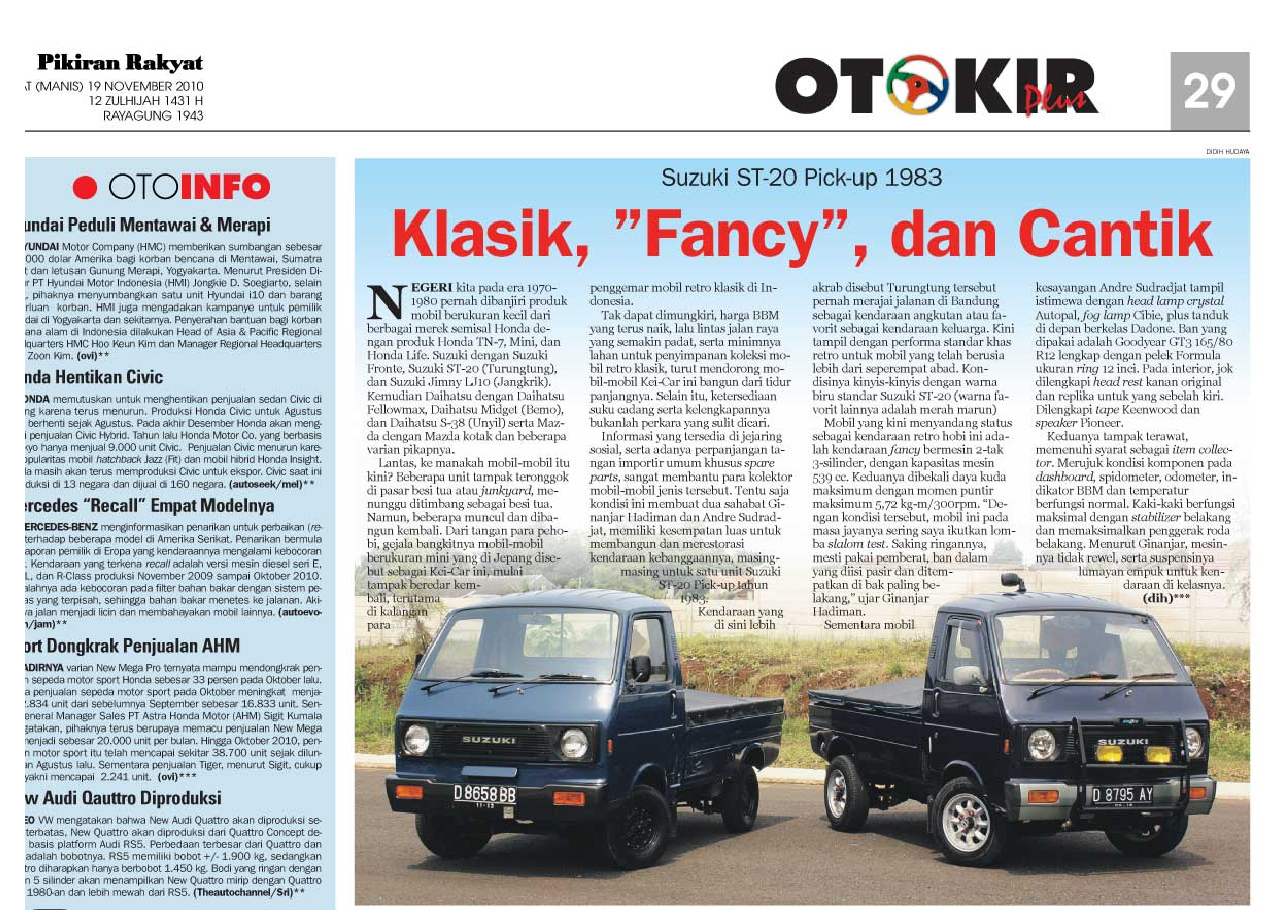
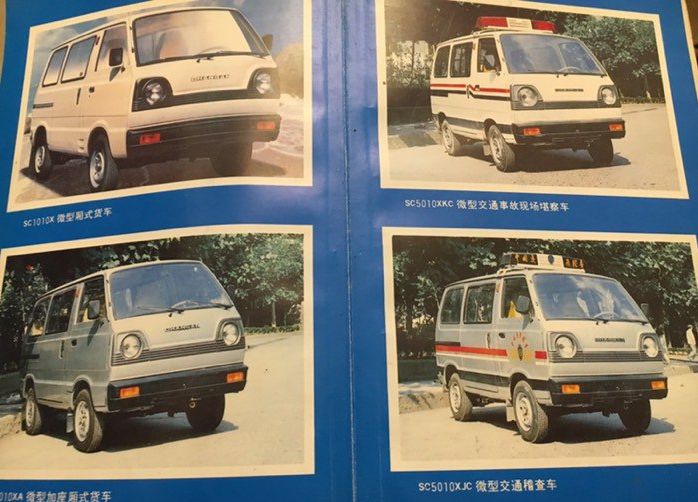
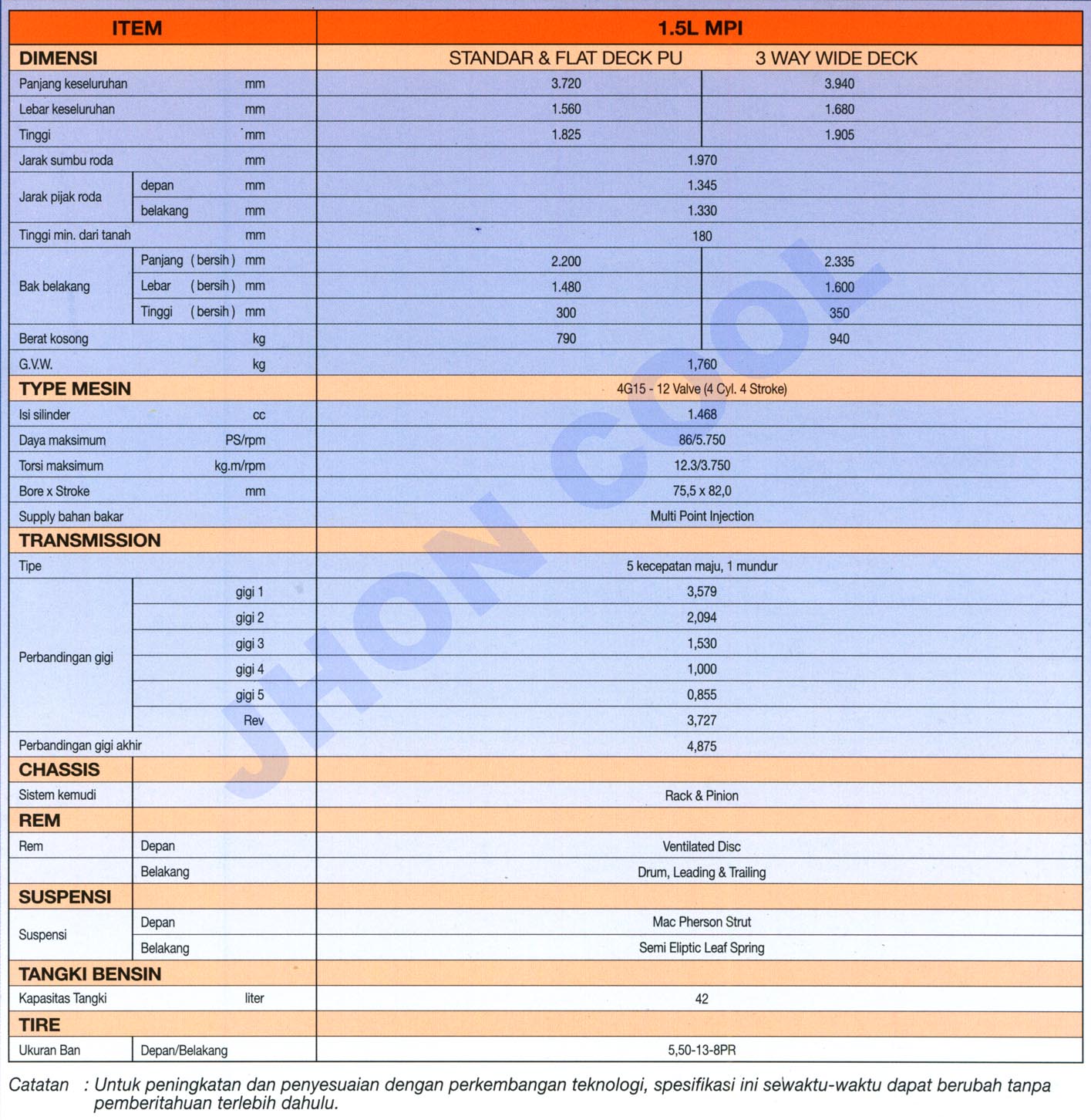
Suzuki Carry
View on GrokipediaIntroduction and overview
Historical background
The Suzuki Carry originated as a response to Japan's post-war economic needs, with the company launching its first kei truck in October 1961 under the name Suzulight Carry FB. This model represented Suzuki's strategic expansion into commercial vehicles, building on its prior success in motorcycles and the 1955 introduction of the passenger-oriented Suzulight kei car. The Carry was designed specifically to enter the burgeoning kei truck segment, providing affordable and efficient transport for small-scale operations in a recovering economy.[1][7] Production of the initial FB model commenced in September 1961 at Suzuki's newly constructed lightweight truck plant in Toyokawa, Aichi Prefecture, Japan, marking a pivotal shift for the company from motorcycle manufacturing to full-scale automobile production. The FB featured a distinctive rear-engine layout, positioning the powertrain under the cargo area to maximize cab space and payload capacity within the constraints of kei vehicle regulations. These regulations, established in 1955 and applicable in 1961, capped engine displacement at 360 cc and limited overall dimensions to 3.0 meters in length and 1.3 meters in width, enabling tax incentives and easier licensing for lightweight commercial vehicles.[1][8] The Carry quickly gained traction among small businesses, farmers, and urban delivery services, demonstrating rapid commercial adoption in its early years from 1961 to 1965. This success was driven by its practicality, low operating costs, and compliance with kei standards that favored compact, fuel-efficient trucks for Japan's narrow roads and limited parking. By facilitating exports starting in 1962, the model also helped Suzuki establish an international presence in the lightweight commercial vehicle market.[9][10]Significance in kei vehicle market
The Suzuki Carry played a pioneering role in the kei vehicle market by establishing the compact kei truck as an essential tool for urban delivery and agricultural tasks in post-war Japan, where limited space and resources demanded efficient, versatile transport solutions. Launched in 1961 as the Suzulight Carry, it quickly became a benchmark for mini commercial vehicles, enabling small businesses, farmers, and delivery services to navigate narrow streets and rural paths while carrying substantial loads relative to its size. By 1996, cumulative sales in Japan alone reached 3 million units, underscoring its dominance and the model's evolution through multiple generations to meet changing kei regulations, such as the shift to 660cc engines in 1990. Globally, the Carry has exceeded 2 million export units by 2019, further amplifying its influence in light commercial sectors worldwide.[11][12] Key innovations in the Carry, including its adaptable ladder-frame chassis and modular body configurations, set standards for durability and customization that influenced subsequent kei truck designs from competitors like the Daihatsu Hijet and Honda Acty. These features allowed seamless compliance with evolving Japanese kei standards—such as dimension and engine displacement limits—over six decades, ensuring the model's longevity while prioritizing payload capacity and off-road capability for practical applications. The Carry's emphasis on "smaller, fewer, lighter, shorter, and beautiful" engineering principles not only optimized fuel efficiency and maneuverability but also encouraged industry-wide adoption of similar compact, robust platforms tailored to urban and rural logistics.[11][13] Economically, the Carry was instrumental in Suzuki's transformation from a motorcycle manufacturer—having begun with the Suzulight passenger car in 1955—to a full-fledged automaker, bolstering revenue through high-volume kei production and exports that began in the 1960s to markets in Asia, Africa, and beyond. This success helped Suzuki achieve broader automotive milestones, including 10 million car exports from Japan by 1997, and solidified its position as a leader in affordable mobility solutions. In contemporary contexts, the Carry maintains relevance in e-commerce logistics, with its 350 kg payload, low bed height, and advanced safety features like dual airbags making it ideal for last-mile deliveries in congested urban areas. Its iconic status in Japan as a reliable workhorse continues to support small-scale operations, reflecting enduring cultural appreciation for practical, no-frills vehicles.[11][4]Design and technical specifications
Body styles and configurations
The Suzuki Carry has been primarily configured as a compact rear-engine pickup truck designed for urban and rural utility tasks, with standard offerings including a panel van for enclosed cargo and a drop-side bed for open loading and unloading. These body styles evolved from basic two-door cabs in the early models to wider, more spacious cabs starting in the 1970s, accommodating two passengers while maintaining kei vehicle compactness for maneuverability in tight spaces.[14][15] Adhering to Japan's kei vehicle regulations, the Carry's dimensions began at 2,990 mm in length and 1,295 mm in width upon its 1961 debut, ensuring compliance with the era's strict size limits for light commercial vehicles. Subsequent regulatory revisions allowed gradual expansion, reaching 3,395 mm in length and 1,475 mm in width by 2013, which enabled larger cargo beds without sacrificing the model's agile footprint.[14][16] Optional features have included a removable canvas top for weather protection on the pickup bed, fixed-side panels for semi-enclosed transport, and a flatbed variant for versatile loading; these adaptations catered to diverse commercial needs like farming and delivery. Load capacities have consistently been 350 kg across generations for kei-compliant versions, achieved through reinforced frames and optimized weight distribution.[17][18] The Carry employs a ladder frame chassis across all generations for durability under load, with independent front suspension—using torsion bars—introduced in the second generation (1965) to improve ride quality and handling over the initial leaf-spring setup. This structural consistency, paired with rear-wheel drive in base models, underscores the vehicle's focus on reliability in demanding work environments.[14][18]Engines and drivetrains
The Suzuki Carry lineup began with two-stroke engines designed for simplicity and lightweight construction suitable for kei vehicle regulations. The inaugural 1961 model utilized the 359 cc FB air-cooled two-cylinder two-stroke engine, delivering 21 hp at 5,500 rpm to meet the demands of urban delivery and light hauling.[19] This engine, positioned under the front seats in a front-mid layout, emphasized torque for low-speed operations while complying with Japan's strict displacement limits for kei trucks.[15] Subsequent refinements to the FB series in the mid-1960s increased output to approximately 25 hp through improved carburetion and reed valve induction, enhancing performance without exceeding kei class boundaries.[20] A significant shift occurred in the late 1970s as environmental regulations and market demands prompted a transition to four-stroke engines, starting with export models in 1977 using the 797 cc F8A inline-four. Domestic Carry variants followed in 1980 with the introduction of the 543 cc F5A three-cylinder four-stroke engine, producing 27 hp at 5,500 rpm and offering smoother operation and reduced emissions compared to its two-stroke predecessors.[20] This water-cooled unit marked Suzuki's commitment to cleaner powerplants while maintaining the Carry's compact footprint.[14] By the 1990s, the Carry adopted modern kei-compliant engines, prominently featuring the 657 cc K6A three-cylinder unit with double overhead camshaft (DOHC) architecture for improved efficiency and power delivery. Naturally aspirated variants of the K6A deliver 38–54 hp depending on tuning and fuel injection systems, while turbocharged versions reach up to 64 hp for heavier-duty applications, all while adhering to updated kei displacement caps post-1990 regulations. In the eleventh generation (2013–present), the Carry uses the R06A 660 cc three-cylinder engine, delivering 64 PS in turbo variants while maintaining kei compliance.[2] For export markets outside Japan's kei constraints, larger options like the 970 cc F10A inline-four provided 50 hp, enabling greater payload and speed in regions such as Southeast Asia and Europe.[21] Drivetrain configurations have evolved to balance utility and terrain adaptability, with rear-wheel drive (RWD) as the standard setup across all generations for cost-effective power distribution to the load-bearing rear axle. Four-wheel drive (4WD) options emerged in the 1970s, initially as part-time systems with high/low range for off-road capability in agricultural models, becoming more widespread by the late 1970s.[22] Transmission choices started with 4-speed manuals, progressing to 5-speed units for better highway efficiency; automatic 3-speed and continuously variable transmissions (CVT) were introduced in the 1990s to cater to urban drivers seeking ease of use.[17] Fuel efficiency advanced notably in the 2010s through lean-burn technology integrated into the K6A engine family, enabling models to achieve up to 20 km/L under the Japanese 10-15 mode test cycle by optimizing air-fuel mixtures for partial loads.[23] This innovation, combined with electronic fuel injection and lightweight materials, reduced consumption by approximately 20% over prior generations without sacrificing torque.[24]Generations
First generation (FB/FBD; 1961)
The first generation Suzuki Carry, introduced in October 1961 under the Suzulight brand as the FB model, represented Suzuki's initial foray into kei trucks with a focus on compact urban delivery. The standard truck variant carried the FB code, while the deluxe version was designated FBD, both sharing an air-cooled 359 cc two-stroke twin-cylinder engine that delivered 21 hp at 4,500 rpm.[19] This powerplant, also named the FB, used a mixture of gasoline and oil for lubrication, typical of two-stroke designs of the era.[15] The rear-mounted engine placement facilitated a cab-over configuration, allowing for a low floor and efficient use of the limited kei vehicle footprint while providing a 350 kg payload capacity for the pickup.[15] A 4-speed manual transmission with synchromesh on all forward gears handled power delivery to the rear wheels, supporting a top speed of around 76 km/h.[19] The overall design emphasized simplicity and affordability, with a ladder-frame chassis, leaf-spring suspension, and drum brakes on all wheels.[7] Minor updates arrived in October 1963 for the 1964 model year, including refined styling with a more angular front grille and improved hydraulic brakes for better stopping power.[20] In September 1964, Suzuki added a three-door FBD Carry Van variant with enclosed glazing and seating for up to four passengers, expanding utility options.[15] That same year marked the model's first exports to Southeast Asian markets, where its compact size suited local infrastructure needs.[14] Despite its innovations, the first-generation Carry faced limitations inherent to its two-stroke engine, which produced noticeable noise and vibration during operation, and a basic suspension system that offered limited ride comfort over rough surfaces.[15] These drawbacks were mitigated in subsequent generations through refined engineering. Production of the FB and FBD models concluded in 1965 after a successful run that solidified Suzuki's position in the kei segment.Second generation (L20; 1965)
The second generation of the Suzuki Carry, designated as the L20 model, was launched in June 1965 as a transitional update to the original FB series, serving primarily as a bridge to the more substantial redesigns prompted by impending changes in Japan's kei vehicle regulations.[25][26] This brief iteration retained the core kei truck format, including the compact pick-up and van body styles, while incorporating minor refinements to maintain competitiveness in the domestic market ahead of the 1966 regulatory expansion of engine displacement limits from 360 cc to 550 cc.[15] The L20 featured an updated version of the 359 cc air-cooled two-stroke inline-two engine (code FB type LC10), now equipped with Suzuki's patented Cylinder Crank Injection lubrication system for improved reliability and reduced oil consumption, delivering 21 PS (15.4 kW) at 4,500 rpm.[25][27] Power was transmitted through a four-speed manual gearbox to the rear wheels, enabling a top speed of approximately 80 km/h while adhering to kei class payload and dimension constraints. Exterior styling received a facelift with a revised front grille for a more modern appearance, complemented by interior updates including enhanced seating comfort and additional cabin features.[15] The ladder-frame chassis underwent revisions, including independent front suspension with torsion bars, which improved handling and ride quality over rough surfaces compared to the rigid setup of the predecessor.[14] Production of the L20 ran for a short period of about one year (June 1965 to mid-1966), yielding around 20,000 units before the shift to the L30 series; this limited output reflected its role as an interim model amid evolving kei standards.[14] Market reception was positive for its incremental enhancements in durability and usability, with better rust resistance achieved through improved body coatings and sealing. Minor exports occurred to select international markets, including Australia, where the L20's compact utility appealed to small-scale farming and delivery needs.[28][29] Overall, the L20 solidified the Carry's reputation as a reliable workhorse, paving the way for the more expansive third generation.Third generation (L30/L31; 1966)
The third generation of the Suzuki Carry, spanning 1966 to 1969, marked a shift to a full cab-over design under the L30 code for the standard truck and L31 for the dropside truck variant, retiring the earlier "Suzulight" branding. This generation retained the proven FB-type 359 cc air-cooled two-stroke two-cylinder engine, delivering 21 hp at 4,500 rpm for reliable performance in kei-class duties. A key expansion was the introduction of the forward-control L30V van variant in March 1968, featuring four doors and a two-piece tailgate to enhance cargo versatility while maintaining the compact footprint suited to urban and rural Japanese operations.[30][31][15] Mechanical refinements included a 4-speed manual transmission option alongside the standard 3-speed unit, providing better gear spacing for varied loads up to 350 kg. The chassis incorporated a wider track width of 1,290 mm compared to prior models, contributing to improved stability during transport, complemented by a load area measuring 1,770 mm in length. Production emphasized domestic assembly at facilities in Iwata and Toyokawa, with approximately 100,000 units built over the run, underscoring Suzuki's growing foothold in the light commercial segment.[32][31][15] A mid-cycle update in 1968 brought a facelift with rectangular headlights on higher-trim models for a more modern aesthetic, contrasting round units on base versions, alongside the van debut. This generation was among the early adopters of hydraulic drum brakes, replacing mechanical systems for superior stopping power under load. Amid intensifying rivalry from Daihatsu's Hijet in the kei truck market, Suzuki prioritized domestic sales, tailoring the Carry for Japan's stringent regulations and commercial needs without significant export push.[14][28][33]Fourth generation (L40/L41; 1969)
The fourth generation of the Suzuki Carry marked a significant aesthetic evolution for the kei truck lineup, introducing a modern design penned by renowned Italian stylist Giorgetto Giugiaro at Italdesign. Launched in July 1969 as the L40 truck model, it featured a forward-control cab with sharp, angular lines and a symmetrical appearance that blurred the distinction between front and rear, setting it apart from the more utilitarian predecessors. The van variant, designated L40V (with some references to L41 for certain truck configurations), followed in November 1969, offering two opening side doors and a top-hinged rear gate for enhanced accessibility. This design, while innovative and forward-looking, was considered somewhat too sophisticated for traditional Japanese commercial users, potentially limiting interior cargo space in favor of stylistic flair.[34] Powering the L40 and L40V was the familiar air-cooled 359 cc FB two-stroke inline-two-cylinder engine, delivering 25 PS (18.4 kW) at 5,500 rpm and 3.4 kg⋅m (25 lb⋅ft) of torque at 3,800 rpm, paired with a four-speed manual transmission and rear-wheel drive. The truck variants (L40 for single tailgate, L41 for triple tailgates) maintained kei-class dimensions of approximately 2,995 mm in length, 1,295 mm in width, and 1,575 mm in height, with a payload capacity of 350 kg for trucks and 300 kg for the van. Key features included optional amenities like a cigarette lighter, radio, wood-grain interior trim, and a rear passenger table in higher trims such as the Super Deluxe, which added black exterior accents and upgraded cabin materials. A dedicated camping edition and panel van configurations expanded its versatility beyond basic utility.[15][35] In April 1971, the lineup received a minor facelift that boosted engine output to 27 PS through refined tuning, aligning with emerging Japanese emissions regulations while preserving the model's compact efficiency, achieving around 15 km/L in typical use. This generation emphasized improved ride quality with its updated chassis, though it retained conventional leaf-spring suspension rather than independent front setup. Production spanned until 1972, with the L40 series contributing to Suzuki's growing dominance in the kei vehicle segment through its blend of Italian-inspired styling and practical Japanese engineering. Exports remained limited during this period, primarily focused on domestic markets, though the model's design influence foreshadowed broader international appeal for later Carry iterations.[36]Fifth generation (L50/L60; 1972)
The fifth generation of the Suzuki Carry, known by the L50 chassis code for its two-wheel-drive models, debuted as a kei truck in May 1972, with the accompanying van version arriving in August of the same year. This iteration retained the front-mid-engine, rear-wheel-drive layout while adopting a more rounded aesthetic inspired by earlier designs from Giorgetto Giugiaro, featuring circular headlights and improved ventilation for the cab. The model complied with Japan's prevailing kei vehicle regulations, which capped overall length at 3,000 mm, resulting in dimensions of 2,995 mm in length, 1,295 mm in width, and 1,600 mm in height for the standard truck.[37][15] Power came from the water-cooled, two-stroke L50 inline-two engine displacing 359 cc, delivering 28 PS (21 kW) at 5,500 rpm and enabling a maximum payload of 350 kg. Transmission options included a four-speed manual as standard, with a five-speed variant available for enhanced highway usability. In December 1972, Suzuki introduced the L50VF five-door van variant, notable for its sliding side doors that improved cargo access and versatility for urban delivery tasks. A dropside truck version, the L51, followed in early 1973 with minor styling updates like a revised grille and bumper, maintaining the same mechanical specifications.[37][14] Responding to Japan's tightening emissions standards in 1974, Suzuki revised the L50 engine for compliance, which slightly reduced output to 26 PS while preserving fuel efficiency suitable for kei-class operation. This update helped sustain the model's popularity amid growing environmental regulations. The generation also saw the introduction of the L60 export-oriented variant in September 1975, equipped with an enlarged 446 cc two-stroke engine producing 29 PS to meet overseas demands for greater torque and load capacity, often up to 544 kg, without altering the core chassis dimensions.[15][14] The fifth-generation Carry achieved significant market success in Japan, topping kei truck sales in 1973 and 1974 due to its refined practicality and reliability for agricultural and small-business use. Exports to Asian markets expanded during this period, with adaptations emphasizing durability for rural applications, laying groundwork for the subsequent ST-series transition in 1976 to accommodate forthcoming kei regulation expansions. Overall production for the L50/L60 lineup exceeded 200,000 units through 1976, underscoring Suzuki's dominance in the compact commercial vehicle segment.[15][11]Sixth generation (ST10/ST20/ST80; 1976)
The sixth generation of the Suzuki Carry debuted in May 1976 as the Carry 55, utilizing the new ST platform to comply with revised Japanese kei vehicle regulations that permitted increased dimensions and displacement up to 550 cc.[36] This generation introduced chassis codes ST10 for the standard-width truck and panel van, emphasizing enhanced structural integrity through a modified ladder-frame design with torsion bar front suspension for improved handling and load stability.[38] The ST10 models were produced for only four months before being succeeded by the wider ST20 variants in September 1976, which maximized the new 1.4-meter width limit for better cargo capacity while retaining a 350 kg payload rating. Powertrains centered on the water-cooled, three-cylinder LJ50 two-stroke engine of 539 cc, delivering 26 PS (19 kW) at 5,000 rpm, paired with a four-speed manual transmission and rear-wheel drive.[39] In 1977, the export-only ST80 four-wheel-drive model was added, featuring the larger inline-four F8A four-stroke engine of 797 cc producing 37 PS (27 kW) at 5,500 rpm, along with refinements to the cooling system for better performance in hot climates.[20] Drivetrain options included standard rear-wheel drive for ST10 and ST20, with part-time four-wheel drive available on the ST80. The van versions incorporated a slanted rear window design for improved visibility and aerodynamics.[14] Approximately 300,000 units of the sixth-generation Carry were produced between 1976 and 1979, reflecting strong demand in the kei truck segment. Export activities began with CKD assembly of the ST10 in Indonesia in 1976, while shipments to the Philippines under early Super Carry branding supported local market adaptations for utility needs.[38] These models enhanced the Carry's reputation for reliability and versatility, bridging the transition to larger kei standards with robust performance upgrades.Seventh generation (ST30/ST40/ST90/ST100; 1979)
The seventh generation of the Suzuki Carry, launched in March 1979, marked a significant expansion in engine options and export focus for the kei truck lineup. The standard Japanese-market model was designated the ST30, featuring a compact design suited to urban delivery needs, while the ST40 variant offered a wider body for increased cargo versatility. Export-oriented versions included the ST90 series, introduced in August 1979, which utilized a larger 797 cc F8A four-cylinder petrol engine producing 37 hp for better suitability in international markets.[14][40] Engine choices diversified further with the introduction of the 970 cc F10A inline-four petrol engine in the ST100 model, delivering approximately 50 hp and targeted at Asian export markets where higher displacement was preferred over strict kei regulations. A 4WD option became available in select ST90 and ST100 configurations, enhancing traction for off-road or rural applications, while a 543 cc four-stroke diesel engine was added in October 1980 for domestic models, improving fuel efficiency for commercial use. These powertrains were paired with 4- or 5-speed manual transmissions and rear-wheel drive as standard, with payload capacities around 550 kg for vans and 575 kg for pickups in Japan, though export variants like the ST90 were adapted for higher loads up to 750 kg in non-regulated markets.[41][14][42] Key design updates included a more spacious cab for improved driver comfort and rectangular headlights for a modernized front fascia, distinguishing it from prior generations while maintaining the overall kei dimensions of approximately 3.2 m length and 1.4 m width. In December 1982, the passenger-oriented van body style was rebranded as the Suzuki Every to differentiate it from the truck-focused Carry, reflecting Suzuki's growing emphasis on multi-purpose variants. A 1983 facelift introduced optional power steering on higher trims, aiding maneuverability in tight urban environments.[20] Exports of the seventh-generation Carry emphasized adaptability for emerging markets, with the ST90 serving as the base for numerous regional adaptations. In Pakistan, production began in 1985 under the Suzuki Bolan name through Pak Suzuki Motor Company, retaining the 797 cc F8A engine in carbureted form for local assembly; the model became a staple for small businesses, with over a million units produced locally until its discontinuation in 2024. In Indonesia, assembly started at Suzuki Indomobil Motor's facility in 1978, continuing with the seventh-generation Carry and Super Carry variants through 1985, featuring the F8A engine and tailored for tropical conditions with enhanced rust protection.[43][12] In India, the Carry influenced the 1984 launch of the Maruti Omni by Maruti Suzuki, a licensed version of the ST90 with minor updates like a simplified dashboard, powered by the 797 cc engine and achieving massive popularity with production of approximately 2 million units until 2019 due to its affordability for urban transport. South African imports of early Carry models, including seventh-generation examples, earned the nickname "Half Loafs" for their compact, bread-like shape, often used in informal trading sectors with the 970 cc F10A for better performance on varied terrain. While specific seventh-generation models in Taiwan and China were limited, exports to these regions included ST90 variants adapted with local emissions compliance, supporting small-scale logistics in the late 1970s and early 1980s.[44][45]Eighth generation (DA71/DB71/DA81/DA41/DB41/DA51/DB51; 1985)
The eighth generation of the Suzuki Carry, launched in March 1985, introduced a major redesign centered on a mid-engine configuration that improved weight distribution over the front axle, enhancing stability and load-carrying capability for both truck and van variants. Model codes encompassed the DA/DB series, including DA71 and DB71 for standard trucks and vans, with suffixes like DA81, DA41, DB41, DA51, and DB51 indicating specific body styles, drivetrain options, and emissions compliance. This layout positioned the engine behind the front seats, facilitating better payload balance in the kei truck category while maintaining compact dimensions suitable for urban delivery and light commercial use.[14][36] Powering the lineup was the F6A inline-three engine, a 657 cc water-cooled unit delivering 38 hp at 6,000 rpm and 50 Nm of torque at 3,500 rpm, carried over from the prior generation but optimized for the new chassis. Transmission choices included four- or five-speed manuals, with optional three-speed automatics on select vans; rear-wheel drive was standard, but four-wheel-drive models featured a high/low range transfer case for improved traction in varied terrains. A notable 1986 facelift refined the front end with an aerodynamic nose cone and rectangular headlights on premium trims, alongside rounded units on base models, contributing to slightly better fuel efficiency and a more contemporary aesthetic without altering core mechanicals.[36][46] By 1989, updates aligned the Suzuki Every passenger van more closely with the Carry's platform, sharing the F6A engine, suspension components, and body panels for streamlined production and parts commonality. Export-oriented versions adopted a larger 970 cc G10 engine producing 45 hp to meet non-kei regulations abroad. Among rebadged variants, the Bedford Rascal served the UK market from 1986 to 1994 as a direct adaptation with right-hand drive and minor badging changes, while the Daewoo Damas debuted in South Korea in 1991 using an 796 cc F8C engine rated at 38 hp, tailored for local assembly and emissions standards.[14][47][48]Ninth generation (DC51T/DD51T/DE51V/DF51V; 1991)
The ninth generation of the Suzuki Carry, introduced in September 1991 and produced through 1999, represented a refinement of the kei truck and van lineup under the updated 660 cc regulations, emphasizing improved efficiency and compliance with evolving safety standards. Model designations included the DC51T for the two-wheel-drive truck, DD51T for the four-wheel-drive truck variant, DE51V for the two-wheel-drive van (badged as Every), and DF51V for the four-wheel-drive van. These configurations maintained the rear-engine, rear-wheel-drive layout with optional part-time four-wheel drive for enhanced traction in diverse conditions.[15][49] Central to this generation was the F6A 657 cc three-cylinder DOHC engine, delivering 41 horsepower at 5,500 rpm and equipped with electronic fuel injection for better fuel economy and emissions control compared to prior carbureted setups. The engine's lightweight aluminum construction contributed to a roughly 40 kg weight reduction over the previous generation, aiding maneuverability in urban and rural settings. Overall dimensions expanded slightly to accommodate the new kei vehicle limits, with a body width of 1,475 mm, length of 3,395 mm, and height ranging from 1,755 to 1,800 mm, providing increased cargo capacity up to 350 kg while remaining nimble.[14][15][28] A minor facelift in September 1993 introduced front disc brakes across all models, replacing the prior drum setup for improved stopping performance, along with subtle styling tweaks to the grille and bumpers. In April 1995, an anti-lock braking system (ABS) became available as an option on higher-trim Every van models, enhancing safety on slippery surfaces. The Every van also offered a turbocharged version of the F6A engine, boosting output to around 64 PS for demanding applications. These updates aligned with Japan's strengthening emissions and diagnostic requirements, incorporating early on-board diagnostics (OBD) for better maintenance traceability.[24][15][50] This generation achieved peak domestic sales in Japan, with the Carry series dominating the kei truck segment and contributing to Suzuki's overall market leadership in light commercial vehicles during the 1990s. Approximately 600,000 units were produced over its run, reflecting strong demand from commercial users and underscoring its role as a bridge to stricter 660 cc kei standards and future integrations.[36]Tenth generation (DA52/DB52/DA62/DA63; 1999)
The tenth generation of the Suzuki Carry, launched in September 1999, was designed to meet Japan's revised kei vehicle standards, which capped engine displacement at 660 cc and emphasized fuel efficiency and compact dimensions. This generation marked a convergence with the Suzuki Every lineup, sharing the same platform for both truck and van bodies to streamline production and parts commonality. The truck models carried the DA52T (rear-wheel drive) and DB52T (part-time four-wheel drive) designations, while the corresponding Every van variants were DA62T and DA63T, allowing for unified engineering under the kei class constraints.[14] Central to this generation was the F6A engine, a 658 cc inline-three with DOHC, 12 valves, electronic fuel injection, and lean-burn technology for reduced emissions and better economy. It delivered 54 PS (40 kW) at 6,200 rpm and 60 N⋅m of torque at 3,800 rpm in its naturally aspirated form, with a turbocharged option boosting output to 64 PS in select configurations. The engine's lightweight aluminum block and timing chain contributed to reliable performance in urban and light-duty applications. Transmission choices included a five-speed manual as standard, alongside a three-speed torque-converter automatic and an optional CVT for smoother operation in van models. With a curb weight around 800–850 kg, the Carry achieved fuel economy of approximately 18–20 km/L under Japanese testing cycles, supporting its role as an efficient commercial vehicle. The payload remained at 350 kg for the truck bed, measuring 1,860 mm long by 1,390 mm wide, while overall dimensions stayed within kei limits at 3,395 mm length, 1,475 mm width, and 1,800 mm height.[51][17][15] A mid-cycle refresh in August 2002 introduced cosmetic updates, including rectangular vertical headlights, a revised grille, and improved interior trim for better ergonomics, alongside minor suspension tweaks for enhanced ride comfort without altering the core mechanicals. In February 2005, the van lineup transitioned to the fifth-generation Every (DA64T/DA65T), incorporating power sliding doors on higher trims for easier passenger access, while the truck retained its original design until the end of production. Safety features were basic but compliant with kei norms, featuring ABS on later models and reinforced cabins for occupant protection.[15][14] Internationally, the platform saw adaptation as the Ford Pronto (PR-Z series) in Uruguay, a rebadged version assembled locally for South American markets with minor modifications for regional fuel standards. The Japanese truck production concluded in 2013, yielding over 500,000 units across the generation and solidifying the Carry's reputation for durability in commercial fleets.[50]Eleventh generation (DA16T; 2013)
The eleventh generation of the Suzuki Carry, introduced in 2013 under the DA16T model code for its truck variant, represents a modern kei truck platform designed for urban and rural utility in Japan. This generation unified the design around a single short wheelbase while retaining high maneuverability, with a turning radius of 3.6 meters. Powered by the R06A 658 cc three-cylinder engine delivering 50 hp (37 kW) and 63 Nm of torque, it emphasizes fuel efficiency, achieving up to 18.7 km/L under WLTC testing conditions in rear-wheel-drive configurations with a five-speed manual transmission. A turbocharged variant offers 64 PS (47 kW).[52][53][4] Key features include selectable four-wheel drive for enhanced traction on rough terrain, paired with options like power steering and air conditioning across trims. Safety enhancements became prominent from 2019 onward, with dual airbags standard on higher trims and electronic stability control (ESC) integrated into the lineup for improved handling. The vehicle's curb weight ranges from 730 to 770 kg depending on configuration, supporting a payload of 350 kg and a gross vehicle weight rating of approximately 1,200 kg for two-wheel-drive models. Production of the DA16T continues in Japan as of 2025, with galvanized steel body panels providing full rust protection for durability in demanding work environments. A 2022 update improved fuel efficiency to up to 20.6 km/L (JC08 mode) in some variants and added optional adaptive cruise control on premium trims.[54][55][4] Updates to the platform have focused on safety and styling while maintaining core kei specifications. In 2019, a refresh in Japan introduced LED headlights and advanced driver aids such as dual camera brake support with pedestrian detection and lane departure warning. The 2021 facelift for the Indonesian market, branded as the New Carry, featured revised front grille and bumper styling for better aesthetics and aerodynamics. For the Super Carry extended-cab variant, a 2023 upgrade in markets like India adopted a 1.2-liter K-series engine producing 80.7 PS (59.4 kW) and 104.4 Nm, improving gradeability with an upgraded five-speed manual transmission. In 2024, the related Every van variant launched in Pakistan, offering local assembly for commercial use. By 2025, international Carry models transitioned to a 1.5-liter K15B engine with 95 hp (71 kW) and 135 Nm, standard dual airbags, and a 940 kg payload capacity.[4][56][57][58][59] The DA16T has sustained strong market performance, contributing to Suzuki's leadership in Japan's minivehicle segment, where the brand held the top position in 2024 with models like the Carry driving commercial demand. In Asia, exports and local adaptations bolster ongoing sales dominance for light commercial vehicles. Suzuki is exploring hybrid powertrains for lightweight platforms like the Carry, with the "Super Ene-Charge" mild-hybrid system under development to enhance efficiency without compromising utility.[60][61]International variants and exports
Rebadged models in Europe and Americas
The Bedford Rascal represented a rebadged adaptation of the Suzuki Carry's seventh and eighth generations (ST/DA series) for the UK and Irish markets, produced from 1986 to 1994 as a right-hand drive van. Assembled by IBC Vehicles in Luton, England, it utilized the 970 cc F10A four-cylinder engine delivering 50 hp, with a payload capacity of 550 kg for the van variant and options for four- or five-speed manual transmissions. 12,766 units were manufactured before production ended due to increasingly stringent emissions regulations that the model could not meet without significant redesign.[62][63] In Colombia, the eighth-generation Suzuki Carry underwent local assembly in the 1990s and was marketed under Chevrolet branding as the CMV passenger van and CMP pickup truck, tailored for Central and South American commercial use. These variants retained the base model's 1.0L F10A engine for reliable performance in urban delivery and light hauling applications. Production continued until 2013, supporting regional demand for affordable, compact work vehicles.[64]Asian market adaptations
In South Korea, the Daewoo Damas (passenger van) and Labo (pickup truck) represented key adaptations of the eighth and ninth-generation Suzuki Carry, produced locally from 1991 to 2021 to meet domestic kei vehicle regulations and urban delivery demands. These models utilized a 796 cc F8A inline-three petrol engine delivering 42 PS (approximately 41 hp), an enlargement from the standard 660 cc Japanese specification to provide adequate power for loaded operations on varied terrain. The design emphasized compact dimensions and rear-wheel drive for maneuverability in narrow streets, with the Damas offering configurations for up to seven passengers and the Labo focusing on cargo with a 350 kg payload capacity. Over the production run, these vehicles became ubiquitous in commercial fleets, with local assembly at Daewoo (later GM Korea) facilities enabling widespread adoption.[65][66][67] In Pakistan, the Suzuki Bolan, introduced in the 1980s (initially as the Carry model) by Pak Suzuki Motor Corporation and later renamed Bolan, adapted the seventh-generation (ST90 series) and later tenth-generation Carry platforms into a versatile microvan known locally as the "Carry Dabba" for its boxy shape and affordability. Powered by an 800 cc F8B inline-three engine producing around 37 hp, the Bolan prioritized low operating costs and ease of maintenance, with a 500 kg payload and seating for up to 10 in its standard configuration. A pickup variant called the Ravi shared the same mechanicals but featured an open bed for agricultural and small business use. Production continued until September 2024, when it was discontinued due to outdated emissions compliance and safety standards, with over 1.5 million units assembled locally; it was succeeded by the more modern Suzuki Every.[68][69] Maruti Suzuki's Super Carry, launched in India in 2016 and continuing production as of 2025, draws from the tenth and eleventh-generation Carry designs to serve the small commercial vehicle segment with a focus on last-mile logistics. It employs a 1.2-liter K12M inline-four petrol engine (with CNG option), initially rated at 77 hp and 98 Nm of torque, updated in 2023 to 80.7 hp and 104.4 Nm for improved drivability under load via a refined Dual Jet, Dual VVT system and five-speed manual transmission. The model supports a 750 kg payload in its deck variant, with a compact footprint (3.8 meters long) and rear-wheel drive enabling tight turning radii for urban navigation. Safety enhancements in the 2023 refresh included front disc brakes and reverse sensors, while 2025 models added electronic stability program (ESP) as standard.[57][70][71] In Indonesia and the Philippines, the Suzuki Carry received a 2021 facelift emphasizing aesthetic and minor safety updates, including a redesigned front bumper with integrated garnishes, updated grille, and a standard fire extinguisher, while retaining engine options from 1.0-liter (64 hp) to 1.5-liter (95 hp) inline-fours for broader market appeal. The 2025 model in these markets standardizes the 1.5-liter K15B engine producing 95 hp and 135 Nm, paired with a five-speed manual and rear-wheel drive, achieving a top speed of 120 km/h suitable for inter-city hauls. Payload capacity reaches 940 kg in utility van guise, with adaptations like reinforced chassis for tropical climates and local fuel quality. These versions prioritize affordability and parts availability, supporting small enterprises in archipelago logistics.[72][73][74]Other global versions
In Taiwan, the Suzuki Carry was locally assembled and marketed through joint ventures starting in the 1980s, with Ford Lio Ho producing a rebadged version known as the Ford Pronto starting with the seventh-generation ST series from 1985 but updated through subsequent generations until 2007. This model featured a localized 1.0-liter engine adaptation for compliance with regional standards and was popular for urban delivery and light commercial use. Later, from the 1990s, Prince Motors Co., another Suzuki partner, imported and distributed the Carry alongside the related Every van series to meet growing demand for compact utility vehicles in the Taiwanese market.[64][75] In South Africa, Suzuki imported the Carry during the 1980s, primarily the eighth-generation models (DA/DB series from 1985) tailored for agricultural applications due to their compact size and durability on rural roads. These imports, often referred to as the Carry Van or "half-loaf" in local parlance, were limited in volume to support small-scale farming and logistics, with sales focused on niche commercial sectors rather than mass consumer markets.[76] China saw significant local production of Carry variants through joint ventures in the 1990s and 2000s, with Changan Automobile manufacturing Carry-based models such as the Changan Minivan equipped with a 1.0-liter engine for enhanced suitability in urban and rural transport. These Changan Suzuki collaborations emphasized affordability and parts localization to penetrate the domestic light truck segment. Additionally, Dongfeng Automobile Company (DFAC) developed the Xiaobawang series, such as the Xiaobawang W, as a Carry-based micro-truck with Suzuki-derived chassis and body designs for cargo hauling in competitive Chinese markets.[75] Other notable global exports included shipments to Thailand in the 1980s, where the Super Carry (an extended version of the ST90 series) was adapted for local assembly and sales under names like Futura for small business and export-oriented uses. In 2019, Suzuki introduced a dedicated global Carry model for select emerging markets, featuring updated safety enhancements such as advanced driver-assistance systems and reinforced structures to meet international standards while maintaining the vehicle's core utility focus.[77][78]Related and derived models
Suzuki Every series
The Suzuki Every series comprises microvan passenger variants derived from the Carry platform, originating in 1982 when the passenger-oriented Carry van was renamed the Every for the Japanese market. This rebranding separated the family-focused models from the commercial Carry truck while maintaining parallel generational development.[50][14][79] Every models feature a 5-door configuration accommodating 4 to 7 seats, emphasizing versatility for urban family use within kei vehicle regulations. Engine options evolved with the K6A inline-three, including a supercharged variant in the 1990s that produced 64 hp for enhanced performance. The fourth-generation Every (DA64), launched in 1999, utilized a 658 cc K6A engine delivering 54 hp in standard form. Sliding doors became standard equipment starting in the 2000s, improving accessibility, with power-operated versions available on higher trims. The sixth-generation DA17V, introduced in 2015, incorporated a continuously variable transmission (CVT) to optimize fuel efficiency and drivability. The Every shares its platform with the Carry truck, with ongoing structural commonality and passenger-specific refinements.[80][81][82] Recent updates include the 2024 launch in Pakistan, where the Every replaced the long-produced Bolan van, adapting the model for local market needs with retained kei-inspired compact design.[83][79][84]Super Carry and Futura
The Suzuki Super Carry represents a line of export-oriented commercial vehicles derived from the Carry series, tailored for non-Japanese markets with relaxed kei vehicle regulations since the 1970s. These models, introduced from the seventh generation onward, feature larger displacements ranging from 970 cc to 1.5 L to accommodate higher payloads and broader road use in regions like Asia, Africa, and Europe.[14][45] In India, the Maruti Suzuki Super Carry was launched in 2016 as a compact pickup truck, initially powered by a 1.2 L G12B petrol engine, with a CNG variant introduced in 2020 to meet demand for cost-effective fuel options in commercial applications.[85][86] The model includes an extended wheelbase of approximately 2,110 mm compared to domestic kei variants, enabling a payload capacity of up to 740 kg for petrol versions and 625 kg for CNG, making it suitable for urban logistics.[87][88] The Carry Futura, an Indonesian adaptation launched in the 1980s based on the eighth generation (DA71 series), utilized a 1.0 L G10A engine and became a staple for local transport, often configured as an angkot minibus.[89] This variant was rebadged by Mitsubishi as the Colt T120SS from 1991 to 2019, initially with the same 1.0 L powertrain but later upgraded to a 1.3 L G13B engine during 2004–2010 for improved performance in Southeast Asian markets.[90] Production of Super Carry derivatives continues today, with the Maruti Super Carry assembled in India featuring a 2023 engine upgrade to a more efficient 1.2 L K12N Dual Jet unit producing 80.7 PS and 104.4 Nm for better fuel economy and power delivery.[57] In Indonesia, Suzuki Indomobil Motor produces the Carry since 2019 with a 1.5 L K15B engine outputting 97 PS, supporting a near 1-ton payload and exports to over 100 countries. In November 2025, Suzuki introduced a facelift for the Super Carry with redesigned LED headlights and grille, enhancing its appeal in international markets.[89][59][91]Other Carry-based vehicles
The Suzuki Every Plus, introduced in 2000 and produced until around 2005, was a multi-purpose vehicle (MPV) derived from the tenth-generation Carry platform, featuring a taller body and seating for up to seven passengers. It utilized a 1.3-liter G13B inline-four engine producing 85 PS (63 kW) at 6,000 rpm and 111 Nm of torque at 3,000 rpm, paired with either front-wheel drive or all-wheel drive configurations and a four-speed automatic transmission.[92] This model extended the Carry's utilitarian design into a more family-oriented format, with dimensions of approximately 3,675 mm in length, 1,505 mm in width, and 1,915 mm in height, and a curb weight starting at 990 kg.[93] In China, derivatives of the Carry platform appeared under local manufacturers, including the Dongfeng DFAC Xiaobawang, a light logistics truck produced in the 2000s based on ninth- and tenth-generation Carry designs adapted for the domestic market. Equipped with a 1.0-liter engine suitable for urban delivery, the Xiaobawang featured a reinforced chassis for heavier payloads and dual rear wheels in some variants, emphasizing durability for commercial use in logistics.[94] The Changan Karry T-Series, another Chinese adaptation from the early 2000s, drew from Carry underpinnings, particularly older YH5-based elements, to create a compact workhorse van with leaf-spring suspension and a focus on affordability for small businesses. These models incorporated a 1.0-liter engine and solid axle setups to handle rough roads, positioning them as budget-friendly alternatives in China's growing light commercial vehicle sector.[94] Suzuki also explored niche extensions with the Landy nameplate, where the Changhe Suzuki Landy (2007–2012) was a minivan derivative built on the Carry/Every chassis for the Chinese market, featuring kei-compliant 660 cc engines in base trims alongside larger options for broader appeal. Limited production emphasized passenger comfort with eight-seat configurations, though it remained a regional offering without significant export.[95] A distinct refresh of the Carry lineup arrived in 2019 for select international markets, including the Philippines and Indonesia, with an enlarged 1.5-liter K15B engine delivering 95 hp (70 kW) and 135 Nm of torque, enabling a 940 kg payload capacity and improved highway performance over kei norms. This model bridged generational updates toward 2025 specifications, incorporating modern safety features like dual airbags while retaining the ladder-frame chassis for ruggedness. In November 2025, a further facelift was introduced with updated styling.[96][91] Nameplate extensions further diversified the Carry into non-truck applications, such as the Suzuki Mega Carry in the Philippines, a utility van variant emphasizing enclosed cargo space for urban delivery with the same 1.5-liter powertrain and manual transmission options. This adaptation prioritized versatility for small enterprises, with a focus on fuel efficiency and a 43-liter fuel tank supporting extended routes.[97]References
- https://handwiki.org/wiki/Engineering:Suzuki_FB_series_engine