


Community hub
Recent from talks
Contribute something
Nothing was collected or created yet.
Commandos Marine
View on Wikipedia | This article needs additional citations for verification. (February 2013) |
| Commandos Marine | |
|---|---|
 Commando beret badge | |
| Active | 1942 – present |
| Country |  France France |
| Branch |  French Navy French Navy |
| Type | Special forces |
| Size | 721 authorized personnel (2017) |
| Garrison/HQ | Lorient Saint-Mandrier-sur-Mer |
| Nickname | bérets verts (green berets) |
| Motto | Unis nous conquérons (United we conquer) |
| Commanders | |
| Current commander | Counter admiral Pierre-Marie Josserand de Briançon |
| Notable commanders | CDR. Philippe Kieffer LCDR. Victor Servent |
| Insignia | |
| Flag |  |
| French Navy |
|---|
 |
| Command |
| Components |
| Equipment |
| Personnel |
| History |
| Awards |
The Commandos Marine, nicknamed Bérets Verts (Green Berets), are the special operation forces (SOF) of the French Navy, headquartered in Lorient, Brittany in western France. They operate under the Special Operations Command (COS), FORFUSCO, one of the four main forces of the French Navy or any operational command designated by the French Army staff. They specialize in offshore operations; operations from sea to land and special operations on land. One of the major characteristics of marine commando units is to be perfectly interoperable with all the resources and units of the navy (vessels, aircraft, submarines).[1]
Comprising seven operational units of around 90 men and around 160 in specialized support, their missions include: hostage rescue, evacuation operations, intelligence within enemy lines, (assault on high-value targets), Navy missions (assault at sea, remote support and destruction, reconnaissance, underwater action) as well as certain missions in support of naval airforce: amphibious operations, guidance and fire support, reinforcement teams, embargo control and State actions at sea against illegal fishing, immigration and trafficking.
History
[edit]The Commandos Marine were formed in 1942 during World War II in the United Kingdom and were modelled on the British Commandos (who were founded in 1940). They were formed from Free French volunteers from different services, mainly from Navy Fusiliers Marins (protection forces), other navy specialities and even from the army. They were trained at the Commando Training Centre in Achnacarry, Scotland and joined No. 10 (Inter-Allied) Commando as the 1st and the 8th Troops. To commemorate this, the beret of the French naval commandos is worn pulled to the right with the badge worn over the left eye or temple, the opposite of all other French military units.

The 1st BFMC (Bataillon de Fusiliers Marins Commandos, Commando Sailor Riflemen Battalion) took part in the Normandy Landing on D-Day under the command of Lieutenant Commander Philippe Kieffer, on Sword, and were for the occasion integrated in No. 4 Commando. They further participated in the Netherlands campaign, still associated with No. 4 Commando. When the British Commando Units were disbanded at the conclusion of World War II, the two French Troops (forming the 1st BFMC) were repatriated to France to relieve in position the 1st RFM (1st Sailor Riflemen Regiment) departing for Indochina. Most of them demobilised or returned to their services (army or other navy specialities) but Commander Philippe Kieffer made the case to the French Ministry of the Navy that a Commando Corps was a capacity required to counter the guerrilla warfare in Indochina. The surviving members of the 1st BFMC formed the core leadership and the cadres for the Commando Training School to be created in Algeria in 1946 (Siroco Center, Matifou Cape).
Another branch comes from a Naval Reconnaissance Unit created in December 1944, Company NYO, formed from volunteers from different parts of the Navy, mainly Sailor Riflemen (Fusiliers Marins) and Naval Artillery. This unit later renamed as Company Merlet (the name of its founder and commanding officer, Lieutenant (Navy) Jean Merlet), fought in Italy before embarking for Indochina in September 1945. It was renamed Company Jaubert, then naturally became Commando Jaubert, the first unit to be constituted as Commando when the French Navy decided to create a Commando Corps in 1946.
Commander Pierre Ponchardier and his Special Air Service Battalion aka SAS-B (also nicknamed Tigers Commandos), created in early 1945, fought in Indochina until 1946 before the battalion was disbanded. Ponchardier was a visionary of modern SOF. Although he was not subordinated to a Sailor Rifleman chain of command, he ran large-scale operations in conjunction and with the support of Compagnie Merlet/Jaubert and the 1st RFM. His audacity, the innovation of the TTPs and the course of actions he applied in guerrilla warfare and COIN set the spirit and were disseminated to the overall Commandos Marine organisation.
By a 19 May 1947 decision, the Ministry of the Navy decision created five "Commando Marine" units, organised and designed as the former British Commandos. The French Navy transformed several Fusiliers Marins companies (Sailor Riflemen) already combatting in Indochina (including Company Jaubert) or based aboard French Navy destroyers (to become Commando Trepel and Commando de Penfentenyo) and gradually renewed their personnel with commando-qualified recruits after the Siroco Center (commando course) was commissioned. Commando François and Commando Hubert were formed from scratch. Although Commando Jaubert was already trained for parachute and airborne operations, Commando Hubert became the official paratrooper commando unit for the French Navy. For this reason, they integrated by preference and priority former Ponchardier SAS-B members, who were already jump qualified.
Each Commando Marine bears the name of an officer killed in action during World War II or during the Indochina campaign:
Captain Charles Trepel was an Army officer (artillery), Free French Forces; commanding officer of the 8th Troop (French), No. 10 Commando (Inter-allied). MIA/KIA 28 February 1944 during a night reconnaissance raid in Wassenaar, the Netherlands.
Lieutenant Augustin Hubert was an Army officer (infantry), Free French Forces; platoon leader in the K-Gun Troop (French) operating in support of Troop 1 and 8 (French) integrated for D-Day to the No. 4 Commando. He was killed 6 June 1944, in the first hour of combat, when the French Troops were maneuvering to seize the Casino of Ouistreham near Sword.
Commander François Jaubert was a Navy officer, commanding the Riverine Flotilla in Indochina, severely wounded during a joint operation with Compagnie Merlet, Ponchardier SAS-B and the 1st RFM and his Flotilla. He died of his wounds 25 January 1946.
Lieutenant (junior grade) Alain de Penfentenyo was a Navy officer, commanding officer of an LCVP platoon, killed in action during a riverine raid on the Donai river, 14 February 1946 (Indochina).
Lieutenant (junior grade) Louis de Montfort was a Company Merlet platoon commander. After his commander was wounded and evacuated de Montfort took command and was killed leading the company in Haiphong, 26 November 1946 (Indochina).
Lieutenant Jacques François was a Navy officer, commanding the 1st Amphibious Flotilla North. He was killed leading his unit, 6 January 1947 on the Nam-Dinh-Giang river (Indochina).
Commando François suffered dramatic losses on 29 May 1951 when it faced the attack of the 308th Vietminh division in Ninh Bình (Indochina). Only 29 survived, five were taken prisoner for months, 40 were killed and nine were declared missing in action. Their sacrifice disrupted the surprise effect and unveiled General Giap's plans for the battle of Day. It gave French General de Lattre time to organise his counterattack. This commando unit was disbanded in May 1953.
Commando Hubert officially became a combat swimmer unit on 30 March 1953. It was a joint unit composed of Navy and Army (SDEC, secret service) combat swimmers. The army branch later separated to establish their base in Aspretto, Corsica (France) and today in Quélern, Brittany (France).
Commando Kieffer was created 6 June 2008 in Ouistreham during the D-Day commemoration ceremony.
In May 2019, four hostages were freed from terrorists during an operation in Burkina Faso. French commandos took down the location in Burkina Faso which was considered a terrorist camp. Two operatives from "Hubert" Underwater Operations Commando were killed in the operation which took place in the early morning hours of Friday morning.[2]
Recruitment and training
[edit]
Most of the recruits must have completed the Fusiliers-Marins Basic Training and served at least nine months of service. They have to enter a special forces basic training course, called Stage Commando (commando training) and reputed to be one of the toughest among the NATO Special Operation Forces. In 2016, the Stage Commando had an attrition rate of 82%.[3] The SOF Basic Training is open to sailors or enlisted from other Navy specialties. Commando Kieffer recruits specialists and experts from other specialties in the Navy or other services. They must go through the same training pipeline to earn the green beret and be deployed overseas.
Commando training is the gateway to the Special Operations Forces for the Sailor Riflemen. Conducted at the Fusilier Marins school at Lorient on the Atlantic coast, it provides upon successful completion entry to the commandos and the right to wear the green beret. Lasting 20 weeks, it includes one week of commando testing, six weeks of screening and preparatory training, four weeks of evaluation, the actual SOF course for seven weeks, and two weeks of parachute training. During this period, any mistake can instantly disqualify the candidate. The ultimate goal of this training is to detect individuals with the physical, intellectual and psychological potential needed to serve in the Commandos Marine. The historical roots of commando training date back to the Second World War, when Fusilier-Marins volunteers from the Free French Navy went to the Commando training center in Achnacarry, Scotland. Since then, the Commandos Marine have kept by tradition the green beret pulled right with the bronze shield badge on the left, the only such exception in the French armed forces. They have retained the principle of exceptional training without compromise, based on immersion in a highly stressful environment, close to the conditions of combat operations.
The prospective Commandos in training are constantly under stress and pressure from instructors leaving them no respite. All activities are timed and scored: marching tens of kilometers with equipment and weapon in all weathers, obstacle courses and night navigation exercises. The training is punctuated by firearms training and assault tactics, climbing and rappelling, boat handling, explosives instruction and hand-to-hand combat. The instructors are experienced operatives assigned to the Commando School who monitor and punish failure with extra-hard physical activity.
Some of the firearms utilized are: Heckler & Koch USP, Glock 17, PAMAS G1 (French licensed copy of the Beretta 92), Heckler & Koch MP5, HK416 and the FAMAS rifle (but only for training). From 1996 to 2015 they used ETRACO inflatable boats, which were then replaced by a new system called ECUME.[4]
Composition
[edit]Their personnel are distributed between seven commandos of around 90 men, with the exception of commando Ponchardier which comprises around 160 personnel, named after former commando officers killed in action, and are dedicated maritime counter-terrorist units:
| Insignia | Team | Deployment | Number of Platoons | HQ | Notes |
|---|---|---|---|---|---|
 |
Commando Jaubert | Worldwide | 5 | Lorient, France | Direct action, assault at sea and on land, hot extraction, close quarters battle at sea and on land. Equal capabilities in the land and maritime Counter Terrorism (CT) roles. |
 |
Commando de Montfort | Worldwide | 5 | Lorient, France | Reconnaissance, Intelligence Operations, Long Range Neutralisation (SKIT), JTACs. Comprises a platoon named ESNO. |
 |
Commando de Penfentenyo | Worldwide | 5 | Lorient, France | Reconnaissance, Intelligence Operations, Long Range Neutralisation (SKIT), JTACs. Comprises a platoon named ESNO. |
 |
Commando Trépel | Worldwide | 5 | Lorient, France | Direct Action, assault at sea and land, hot extraction, close quarters battle at sea and on land. Equal capabilities in the land and maritime CT roles. |
 |
Commando Hubert | Worldwide | Classified | Toulon, France | (also named Commando d'Action Sous-Marine Hubert, CASM, "Underwater Operations Commando"): Underwater action (combat divers) and Counter Terrorism |
 |
Commando Kieffer | Worldwide | Classified | Lorient, France | C3I, Combat dogs K9, CP CBRN, UAVs, Intel, TTPs and Procedures Development. |
 |
Commando Ponchardier | Worldwide | Classified | Lorient, France | Support and supply for all Commandos Marine. |
-
 Commando Hubert personnel transition over a beach.
 -
 Commando Jaubert personnel storm the Alcyon in a mock assault.
 -
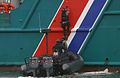 Members of the Commando Jaubert covering each other.
 -
 U.S. Army Soldiers from the 3rd Infantry Division and French Commandos Marine conduct a reconnaissance patrol during a joint-combined exercise in Djibouti.
 -
 A member of the Commandos Marine during a ceremony.
 -
 Beret and badge of the Commandos Marine.


Commando Hubert
[edit]Since the 1950s, the combat swimmer unit of the French Navy have been formed as Commando Hubert, also known as French commando frogmen, the only Commandos Marine unit having combat swimmers. The tip of the spear of the overall Commandos Marine organization, their military capacities are broader than combat swimming operations. They are publicly known to be a Special Mission Unit supporting counter terrorism along with GIGN (see Ouvea cave, MS Pascal Paoli). Jacques-Yves Cousteau was a naval officer in World War II and helped to set up France's commando frogmen. France further developed the role of commando frogmen in the First Indochina War.
The French intelligence service DGSE also has combat-swimmers brought together in the Centre Parachutiste d'Entraînement aux Opérations Maritimes (CPEOM, "maritime operations training parachutist center") at Roscanvel.
While these are the only French combat-diver units, other French units have divers, including:
- the military engineer units of the French Army have two types of divers:
- the spécialistes d'aide au franchissement (SAF, "specialists for help in clearing"): swimmers trained to recon and clear banks and bridges to permit their use by military vehicles.
- the nageurs d'intervention offensive (NIO, swimmers "for offensive actions"): they accomplish missions similar to combat swimmers but in rivers and estuaries, to destroy bridges inside enemy territory for example and belong to an engineer-regiment.
- some commando units like the commando group of the 2nd foreign parachutist regiment and the special unit forces of the Army and the Air Force have offensive divers.
- the GIGN and RAID counter-terrorist groups have divers trained to assault a hijacked ship in support of Commando Hubert.
List of operations
[edit]- 1982-1984: Lebanon
- 1987: Actions in the Persian Gulf.
- 1988 May 5: a hostage rescue in New Caledonia: see Ouvéa cave hostage taking.
- 1991: Embargo in the Persian Gulf.
- 1992 December - 1993: Somalia: Operation Restore Hope.
- 1994: Rwanda: evacuating foreign nationals caught up in a civil war.
- 1997 March - 2000: Mission Alba in Albania.
- 1999: Operation Allied Force in FR Yugoslavia.
- 2001 July: Security at the G8 meeting in Genoa in Italy.
- 2001 October: Afghanistan and/or Philippines: Operation Enduring Freedom.
- 2008 September: French naval commandos freed two hostages (Jean-Yves and Bernadette Delanne) held by Somali pirates aboard their yacht off the coast of Somalia, killing one gunman and capturing six.
- Since January 2013 : Multiple counter-terrorist operations during the Mali war, part of Operation Serval and Operation Barkhane
- May 2019: Burkina Faso hostage rescue by Commando Hubert
In popular culture
[edit]The Commandos Marine are featured in the movie Forces spéciales.
See also
[edit]- Fusiliers Marins
- FORFUSCO
- List of French paratrooper units – List of French airborne units from the Interwar period to the present
- Special Boat Service – Special forces unit of the Royal Navy. Formed originally from the RMBPD
- British Commandos - unit that provided the template for the Commandos Marine
References
[edit]- ^ "La Force Maritime des fusiliers marins et commandos". 28 October 2021.
- ^ "French Commandos Free Four Hostages from Terrorist, Two Soldiers Killed". 13 May 2019.
- ^ (in French) Le Mammouth:14 nouveaux commandos marine
- ^ "L'ECUME bientôt dans la Marine". Ministry of Armed Forces (France). Archived from the original on 15 December 2013. Retrieved 27 January 2025.
External links
[edit]- Commando Hubert (in French)
- Equipment (in French)
- Former site (in French)


| Current |
|
|---|---|
| Defunct | |


Commandos Marine
View on GrokipediaHistorical Development
Formation and World War II Role
The Commandos Marine trace their origins to the Free French Forces in 1942, when Lieutenant de vaisseau Philippe Kieffer assembled an initial group of approximately 20 naval volunteers in the United Kingdom to form the Compagnie de Fusiliers Marins Commandos, modeled on British Commando units for raiding and amphibious operations. These early recruits, drawn from Free French sailors resisting Vichy collaboration and Nazi occupation, underwent intensive training at the Commando Basic Training Centre at Achnacarry Castle in Scotland, focusing on physical endurance, close-quarters combat, and seaborne infiltration tactics.[3][4] The unit's combat debut came during Operation Jubilee, the Dieppe Raid of August 19, 1942, where 15 members reinforced elements of British No. 4 Commando, conducting assaults on coastal defenses despite heavy German resistance and the raid's ultimate tactical failure, which resulted in over 60% Allied casualties overall. This engagement provided critical empirical validation of their training efficacy, as the French contingent executed targeted strikes on enemy positions, sustaining losses but acquiring operational insights that informed subsequent Allied planning for large-scale invasions.[5][6] By early 1944, the formation had expanded into the 1er Bataillon de Fusiliers Marins Commandos, comprising 177 personnel integrated as Troops 1 and 8 within No. 4 Commando of the 1st Special Service Brigade. On June 6, 1944, during the Normandy landings, Kieffer's battalion disembarked from Landing Craft Infantry at Sword Beach near Ouistreham, advancing inland to neutralize fortified positions including the "Riva Bella" casino strongpoint manned by German artillery and machine guns. Over the course of the day, they cleared multiple bunkers and villa defenses, linking up with British forces by afternoon and securing the eastern flank, albeit at the cost of 21 killed and 37 wounded—demonstrating proven amphibious assault capabilities in breaching entrenched defenses under fire.[5][7]Postwar Reconstitution and Decolonization Conflicts
Following the end of World War II, the French Navy reconstituted its commando units in 1946, drawing on veterans of the wartime efforts to form specialized naval assault groups for colonial engagements. By July 1946, training commenced for these units, with six commandos established between then and December 1947, named after officers killed in early Indochina operations: François, Jaubert, Trépel, de Penfentenyo, de Montfort, and Kieffer. These formations emphasized amphibious infiltration, riverine patrols, and raids, adapting prewar and wartime tactics to counter insurgent threats in overseas territories.[8][9] In the First Indochina War (1946–1954), the commandos conducted extensive fluvial and coastal operations against Viet Minh forces, including deep reconnaissance, sabotage of supply lines, and assaults on fortified positions along rivers like the Day River. Commando François, deployed in 1947, exemplified their role by executing high-risk missions in Cochinchina, though it suffered near annihilation in a 1951 encirclement by superior Viet Minh numbers during Operation Ouragan. These units, often numbering 70–100 men each, integrated with dinassaut river flotillas for combined arms actions, contributing to temporary tactical gains but facing attrition from guerrilla ambushes and harsh terrain. Their efforts highlighted the limits of amphibious specialization against a land-based insurgency, with casualties exceeding 50% in some detachments by war's end.[10][11][8] Transitioning to the Algerian War (1954–1962), surviving Indochina commandos like Trépel and de Penfentenyo redeployed to North Africa by 1955, forming the core of Groupe des Commandos Marine (Grouco) for counter-insurgency tasks. They specialized in rapid raids, urban clearances, and heliborne insertions to disrupt Front de Libération Nationale (FLN) networks, such as the May 1960 rescue of the encircled 2nd Foreign Infantry Regiment using Sikorsky HSS helicopters for extraction under fire. Verifiable successes included interdicting arms caches and neutralizing FLN cells in the Djebel regions, with operations like the Mzi raid yielding captured insurgents and intelligence. However, French military records and postwar analyses note criticisms of disproportionate force in populated areas, including allegations of civilian casualties during clearances, though commando after-action reports emphasize targeted precision amid FLN embedding tactics; these reflected broader French doctrinal shifts toward quadrillage but were constrained by political pressures for restraint.[12][13][14] The failures of decolonization, culminating in Algerian independence in 1962, prompted the dissolution of these ad hoc commando structures by the mid-1960s, as colonial-era units proved ill-suited to a post-imperial navy focused on NATO deterrence and blue-water projection. Veterans and assets merged into reorganized formations, including the Combat Swimmer Commando (Hubert) in 1953 and eventual consolidation under the Forces Spéciales Marine in Lorient by 1967, prioritizing versatile special operations over territorial defense. This evolution was causally tied to resource reallocation amid budget cuts and the Evian Accords' end to mass conscription-based counterinsurgency.[11][12]Cold War Engagements and Restructuring
In the late Cold War period, Commandos Marine units participated in multinational coalition efforts during the 1990-1991 Gulf War under Opération Daguet, focusing on maritime interdiction, coastal reconnaissance, and support for amphibious operations against Iraqi forces. Specialized elements, including deep reconnaissance teams akin to the Commando de Recherche et d'Action en Profondeur (CRAP), conducted surveillance along Kuwaiti and Iraqi shorelines to gather intelligence on enemy naval assets and potential infiltration routes, integrating with allied NATO forces for joint targeting and seizure missions. This deployment, commencing after Iraq's August 2, 1990, invasion of Kuwait, underscored adaptations in stealth tactics derived from prior amphibious doctrines, enabling low-profile insertions via small boats and submarines while minimizing exposure to Iraqi coastal defenses.[15][16] Commandos Marine maintained minor involvement in Balkan interventions throughout the 1990s, contributing to NATO and UN maritime enforcement operations amid the Yugoslav conflicts. Units supported enforcement of the Adriatic arms embargo imposed by UN Security Council Resolution 713 in September 1991, performing boarding actions, intelligence patrols, and reconnaissance from French naval platforms to interdict smuggling networks fueling Bosnian Serb and Croat factions. These roles, often in coordination with Allied forces during operations like Sharp Guard (1993-1996), emphasized precision interdiction over large-scale assaults, reflecting doctrinal refinements that prioritized survivability through dispersed, covert maneuvers; French special operations in the region recorded negligible casualties, attributable to rigorous pre-mission planning and evasion protocols honed from earlier expeditionary experiences.[17] Post-Gulf War assessments prompted significant restructuring of French naval special forces in the early 1990s, culminating in the establishment of the Commandement des Opérations Spéciales (COS) on June 24, 1992, to centralize coordination across services including Commandos Marine. This reorganization incorporated empirical lessons from colonial-era operations—where massed assaults against asymmetric insurgents yielded high attrition—and Gulf theater feedback, shifting emphasis toward stealth, precision strikes, and integrated joint operations over conventional amphibious landings. Under the nascent Forces Spéciales Marine framework, training protocols were updated to enhance underwater demolition, long-range reconnaissance, and interoperability with air and army assets, aligning with broader French military reforms amid post-Cold War fiscal constraints and evolving threats like non-state actors. These changes improved operational efficiency, as evidenced by subsequent deployments demonstrating reduced logistical footprints and higher mission success rates in littoral environments.[18]Post-Cold War and 21st-Century Operations
![U.S. Army Soldiers from the 3rd Infantry Division and French Commandos Marine conduct a reconnaissance patrol during a joint-combined exercise in Djibouti.]float-right Commandos Marine participated extensively in Operation Barkhane (2014–2022), a French-led counterinsurgency effort in the Sahel targeting jihadist groups such as al-Qaeda in the Islamic Maghreb affiliates and Islamic State in the Greater Sahara. These units conducted direct action raids, intelligence-driven operations, and hostage rescues amid asymmetric threats from mobile insurgent networks. Their involvement included integration into multinational task forces, enhancing local partner capacities through joint patrols and training.[19][20] A notable example occurred on May 9, 2019, when Commandos Marine from Commando Hubert executed a nighttime raid in Gorom-Gorom, northern Burkina Faso, to rescue four hostages (two French, one American, and one South Korean) kidnapped by JNIM militants. The team advanced 200 meters across open terrain to assault the camp, neutralizing the captors and securing the hostages without injury to them, though commandos Cédric de Pierrepont and Alain Bertoncello were killed in the exchange of fire. This operation exemplified the commandos' proficiency in high-risk extractions, contributing to the degradation of terrorist operational tempo in the region.[21][22] In Task Force Takuba, launched in 2020 as part of Barkhane, French Marine Commandos led multinational special operations groups, supervising Malian and partner forces in raids that neutralized dozens of insurgents, such as over 30 Islamic State in the Greater Sahara fighters in early 2022 alone. These actions provided measurable impacts, including disruption of supply lines and leadership decapitation, though broader insurgent resilience highlighted limits in asymmetric warfare reliant on persistent local governance support. Post-2022 Sahel withdrawal, Commandos Marine shifted emphasis to maritime interdiction and rapid response capabilities, adapting to hybrid threats while prioritizing French overseas territories' defense against escalating great-power frictions.[20][23][19]Organizational Framework
Command Structure and Headquarters
The Commandos Marine operate under the overarching authority of the French Commandement des Opérations Spéciales (COS), the national special operations command that coordinates joint forces across the Army, Navy, Air and Space Force, and other components, ensuring synchronized high-risk missions. Within the Navy, they form the core special forces element of the Forces Spéciales de la Marine (FORFUSCO, or Force maritime des fusiliers marins et commandos), which handles both protection duties and specialized interventions, granting the Commandos Marine dedicated naval operational autonomy while aligning with COS directives or ad hoc taskings from the Joint Staff (état-major interarmées).[24][24] FORFUSCO, and thus the Commandos Marine, maintains its primary headquarters at the Base des fusiliers marins et commandos in Lorient, Brittany, serving as the central hub for planning, logistics, and administration; Commando Hubert, focused on underwater and sabotage operations, is uniquely based in Toulon to leverage Mediterranean naval infrastructure.[24][24] This distributed basing supports proximity to Atlantic and Mediterranean fleets for expeditionary readiness. FORFUSCO is commanded by a contre-amiral (rear admiral), who oversees the integration of special forces with naval fusiliers, as exemplified by the 2024 appointment of a new admiral with prior COS experience to enhance cross-service coordination.[25] Approximately 700 personnel staff the Commandos Marine, enabling scalable task forces for maritime insertion via ships, submarines, or aircraft, with FORFUSCO's broader structure of around 2,400 facilitating sustainment in prolonged operations.[24] The centralized command under COS has proven causally effective for joint interoperability, as evidenced by routine inter-service exercises that validate combined arms tactics, such as amphibious assaults with Army special forces or air-dropped insertions, minimizing doctrinal frictions in multinational theaters.[24][25]Unit Composition and Specializations
The Commandos Marine operational structure centers on six primary combat commando units, each comprising approximately 80-100 personnel specialized for distinct tactical roles essential to maritime and amphibious special operations. These units—Hubert, Jaubert, Kieffer, Montfort, Penfentenyo, and Trépel—enable modular task force assembly tailored to mission requirements, drawing from empirical operational demands such as underwater sabotage, vessel seizure, and fire support integration. A seventh unit provides complementary capabilities, while dedicated support elements handle intelligence, signals, and logistics to maintain expeditionary self-sufficiency in austere environments. Overall, the force totals around 700 personnel across these components.[24][26] Commando Hubert specializes in underwater actions, including combat diving for sabotage, reconnaissance, and mine countermeasures, a focus refined from post-World War II needs for clandestine sub-surface operations.[2][19] Commando Jaubert emphasizes ship boarding and close-quarters assault at sea, employing fast-rope insertions and exfiltration techniques to neutralize threats on vessels or offshore platforms.[2][27] Commando Kieffer handles protection missions and land-based assaults, providing force protection, site security, and maneuver elements in combined arms scenarios.[26] Commando Montfort delivers fire support, integrating heavy weapons, mortars, and precision strikes to suppress enemy positions during amphibious or inland advances.[28] Commando de Penfentenyo focuses on amphibious transport and sustainment, operating small craft for troop insertion, resupply, and evacuation in littoral zones.[2] Commando Trépel excels in infiltration and exfiltration, utilizing stealthy seaborne approaches for reconnaissance and covert entry into denied areas.[2][27] Support components, including intelligence cells and logistics detachments, ensure operational autonomy by managing reconnaissance data fusion, communications relays, and materiel sustainment without reliance on external naval assets.[24]Personnel Acquisition and Preparation
Recruitment and Selection Process
The recruitment for Commandos Marine draws exclusively from serving French Navy personnel, with the primary pool consisting of fusiliers marins who have completed their initial four-month training and accrued at least several months of operational service, ensuring candidates possess foundational naval discipline and physical conditioning. Applicants must hold French citizenship, be aged 19 to 29, and volunteer explicitly for the demands of amphibious special operations, which prioritize innate resilience, combat aptitude, and capacity for sustained high-stress environments over extraneous considerations.[29][30] Initial vetting commences at the Commando Training Center in Lorient with a two-week evaluation phase encompassing exhaustive physical tests—such as endurance runs, apnea swims exceeding 50 meters, and strength circuits—alongside medical screenings and psychological assessments to gauge mental toughness, situational awareness, and team compatibility. These stages filter for raw capabilities essential to roles like assaulters and combat swimmers, employing objective metrics that eliminate approximately 70-80% of entrants before advancement to the full Stage Technique d'Application Commando (STAC).[29][30] Overall attrition exceeds 80%, with roughly 170-200 fusiliers marins applying annually across two sessions, yet only 25-30 earning the green beret brevet, reflecting a deliberate meritocratic rigor that sustains unit lethality without concessions to non-performance-based inclusions. This high failure rate, documented consistently across evaluation cohorts, validates the process's efficacy in selecting personnel capable of executing clandestine maritime raids and direct-action missions under extreme duress.[30][29]Training Regimen and Qualification Stages
The training pipeline for Commandos Marine extends from 6 to 12 months following initial selection, encompassing foundational commando skills and unit-specific specializations to forge operators capable of maritime, amphibious, and land-based special operations.[19] The regimen emphasizes physical endurance, mental resilience, tactical proficiency, and adaptability, with empirical data indicating high attrition: the core Stage Commando (STAC) sees approximately 170 candidates annually, of whom only about 30 succeed, yielding a success rate of roughly 18%.[29] Conducted primarily at the École des Fusiliers Marins in Lorient, the Stage Commando spans around 20 weeks, divided into phases of preparatory conditioning, intensive evaluation, and skill integration.[19] Initial weeks focus on mental and physical testing, including marches, obstacle courses, and basic survival drills, followed by 6 weeks of preparatory training in navigation, weapons handling, and team cohesion. The core 7-week segment intensifies with close-quarters battle (CQB), amphibious insertions, and survival exercises under simulated deprivation, incorporating elements like extended patrols and waterborne assaults to build resistance to fatigue and isolation.[19] These draw from historical precedents, such as World War II collaborations with British commandos, but incorporate modern adaptations like improvised explosive device (IED) awareness and urban stress inoculation through scenario-based drills.[30] Post-STAC, candidates undergo 4-6 months of specialization tailored to units like Commando Hubert (combat diving and underwater demolition) or Commando de Montfort (parachuting, including HALO/HAHO jumps), involving live-fire validations and operational simulations.[31] Qualification culminates in evaluated missions assessing individual and team performance under duress, such as night amphibious raids or reconnaissance patrols, with success hinging on demonstrated mastery rather than mere completion. Ongoing recurrency training, mandated annually, includes requalification in core skills and joint exercises, where Commandos Marine exhibit low washout rates—often under 5% in multinational settings—evidencing sustained operational edge.[32]Operational Roles and Doctrine
Core Missions and Tactical Capabilities
The Commandos Marine execute core doctrinal missions encompassing special reconnaissance, direct action raids, sabotage of enemy infrastructure, hostage rescue operations, and support to naval blockades through target designation and fire support integration. These roles emphasize precision in contested maritime and littoral zones, where operators infiltrate via stealth methods such as swimmer delivery vehicles, semi-submersible craft, or rigid-hulled inflatable boats (RHIBs) launched from submarines or surface vessels. Naval integration provides causal advantages in maritime-denied environments by enabling covert sea-to-land transitions that bypass conventional defenses, allowing sustained presence ashore without reliance on fixed airfields or ports vulnerable to interdiction.[24][33] Tactical capabilities include advanced hydrographic surveying for amphibious landings, underwater demolition to clear obstacles, and real-time intelligence fusion for designating targets to naval gunfire or precision airstrikes, enhancing operational tempo in fluid battlespaces. Operators maintain proficiency in small-unit maneuvers under fire, employing suppressed weaponry and low-signature tactics to minimize detection signatures during exfiltration. This maritime-oriented doctrine contrasts with French Army special forces, which prioritize overland mobility and lack inherent sea-based insertion expertise, positioning the Commandos Marine as the primary force for littoral denial and coastal penetration where hydrodynamic factors dictate mission feasibility.[24] In asymmetric warfare against non-state actors, these units deliver calibrated precision strikes to disrupt command nodes or logistics without escalating to broader engagements, leveraging post-mission analyses to refine insertion tactics for environments with hybrid threats like improvised coastal defenses. Capabilities extend to countering irregular forces through selective raids that exploit naval overwatch for rapid reinforcement or extraction, ensuring disproportionate effects relative to force size in scenarios where enemy numerical superiority prevails on land.[24]Integration with Broader French Military Objectives
Commandos Marine integrate into France's strategic defense framework by bolstering the protection of overseas territories and exclusive economic zones spanning over 9 million square kilometers in the Indo-Pacific, where permanent joint commands ensure sovereignty and security against potential encroachments.[34] Their maritime and coastal expertise supports rapid power projection, enabling deterrence through presence and responsiveness in regions vital to French interests, such as the Indian and Pacific Oceans.[19] Under the coordination of the Chef d'État-Major des Armées (CEMA), Commandos Marine form part of inter-service task forces like those under FORFUSCO, contributing to "win the war before the war" objectives by conducting gray-zone operations and allied partnerships that amplify France's influence without large-scale commitments.[35] This alignment emphasizes empirical deterrence, where special operations forces impose asymmetric costs on adversaries, preserving strategic autonomy amid high-intensity preparation needs.[35] In countering jihadist expansion, Commandos Marine have executed missions in Operations Serval and Barkhane (2013–2022) across the Sahel, disrupting terrorist networks through direct action and intelligence, thereby causally limiting threats to French territories and metropolitan stability.[19] Such engagements underscore their value in preventing jihadist safe havens from enabling attacks on Europe, countering underestimations of persistent insurgencies in analyses from security institutions.[36] Political oversight has imposed constraints, as evidenced by the 2022 withdrawal from Barkhane despite unresolved jihadist activities, reflecting decisions prioritizing short-term diplomatic shifts over sustained deterrence, which risks renewed expansion of these networks.[36] This highlights a realist tension: while Commandos Marine provide verifiable operational efficacy, broader objectives depend on consistent strategic resolve beyond electoral cycles.[35]Notable Operations and Outcomes
Historical Combat Engagements
The Commandos Marine trace their combat legacy to World War II, where the 1er Bataillon de Fusiliers Marins Commandos, led by Commander Philippe Kieffer, participated in the Normandy landings on June 6, 1944, as part of the British 1st Special Service Brigade at Sword Beach. Of the 177 French naval commandos who landed, 41 were killed or wounded on D-Day alone, representing approximately 23% casualties amid intense German resistance from fortified positions.[37] Despite these losses, the unit contributed to securing the eastern flank of the beachhead, enabling the linkage of British forces with Canadian troops at Juno Beach and facilitating the advance inland, which marked a pivotal breach in the Atlantic Wall defenses.[5] This amphibious assault underscored the doctrinal emphasis on combined arms integration with Allied forces, evolving from raiding tactics to sustained beachhead operations, though high attrition rates—reducing the battalion to about 40 effectives by late August 1944—highlighted vulnerabilities in small-unit exposure to defensive fire.[4] In the First Indochina War (1946–1954), Commandos Marine units, including precursors like Commando François, Jaubert, and de Montfort, conducted riverine operations as part of the Division Navale d'Assaut (Dinassaut) to interdict Viet Minh supply lines along the Mekong Delta and Red River systems. These missions involved amphibious raids from armored river craft, such as LCVPs and LCMs, targeting logistics depots and barge convoys, with operations like those in 1952 based in Ha Long Bay disrupting enemy movements and supporting larger French offensives.[10] Successes included the destruction of multiple supply caches and temporary control of key waterways, forcing Viet Minh reliance on overland routes; however, ambushes resulted in significant personnel losses, with units like Commando François logging over 2,500 km of patrols in harsh terrain across five months in 1947, often yielding disproportionate casualties due to guerrilla hit-and-run tactics.[38] This period refined riverine assault doctrines, emphasizing mobility and fire support from naval assets, but exposed limitations in sustained counter-guerrilla persistence against an adaptive adversary. During the Algerian War (1954–1962), Commandos Marine executed specialized raids, including a notable relief operation in May 1960 to extract the encircled 2e Régiment Étranger d'Infanterie from a mountain stronghold in the Djebel, involving helicopter insertions and close-quarters combat against FLN forces.[13] These actions achieved tactical disruptions of insurgent networks, such as neutralizing ambush positions and securing perimeters, but faced mixed outcomes in urban-adjacent counter-insurgency, where rapid strikes occasionally led to civilian collateral amid dense population centers, drawing postwar critiques for insufficient discrimination in fire amid FLN embedding tactics.[39] Doctrinal adaptations here shifted toward heliborne insertions and joint infantry support, balancing offensive gains against the ethical and operational costs of asymmetry, which informed later restraint in special operations amid political scrutiny. In the 1991 Gulf War, three Commando Marine teams supported coalition maritime operations under Opération Artimon, conducting reconnaissance and sabotage preparations along Iraqi coastal facilities to neutralize threats to naval dominance.[40] Their efforts, integrated with French naval assets like frigates and minehunters, facilitated unchallenged sea control and air campaign enablers by identifying minelayers and shore batteries, with minimal reported losses due to standoff capabilities.[41] This engagement validated post-Cold War evolution toward precision maritime interdiction, leveraging technology for low-risk disruption, contrasting earlier high-casualty amphibious doctrines and affirming the unit's role in multinational coalitions.[19]Contemporary Counter-Terrorism and Expeditionary Actions
Commandos Marine units have played a pivotal role in France's post-9/11 counter-terrorism efforts, particularly through deployments in the Sahel region under Operation Barkhane (2014–2022), where they executed intelligence-driven raids against jihadist groups in Mali and neighboring countries. These specialized operations, often involving combat divers from units like Commando Hubert and Commando Jaubert, focused on disrupting terrorist networks, neutralizing high-value targets, and gathering actionable intelligence in austere environments, contributing to broader French efforts that resulted in the elimination or capture of hundreds of jihadists across the region while incurring relatively low French casualties—approximately 58 military deaths over eight years, many from non-combat causes.[19][42] A hallmark of their expeditionary adaptability was demonstrated in the May 9–10, 2019, hostage rescue operation in northern Burkina Faso, where Commando Hubert personnel conducted a nighttime assault to free four captives—two French tourists, one American, and one Irish citizen—held by an al-Qaeda-linked jihadist group following their abduction in Benin. The mission succeeded in extracting the hostages unharmed, but resulted in the deaths of two commandos, Chief Petty Officer Cédric de Pierrepont and Petty Officer Alain Bertoncello, killed during close-quarters combat with the captors.[43][21][44] In support of enduring counter-terrorism objectives, Commandos Marine have maintained a forward presence in Djibouti, conducting joint reconnaissance patrols and training with U.S. forces as part of multinational efforts to secure strategic chokepoints and monitor jihadist movements in the Horn of Africa. These actions underscore their role in expeditionary operations beyond direct combat, including maritime interdiction and rapid response to threats against French assets in unstable regions.[19]Equipment, Technology, and Support
Armament and Specialized Gear
The Commandos Marine employ a selection of modern small arms optimized for versatility in maritime special operations, emphasizing modularity, corrosion resistance, and precision in dynamic environments. Primary assault rifles include the Heckler & Koch HK416 and HK417, which offer reliable performance in wet and austere conditions through their gas-piston operating systems and customizable configurations.[19] Sidearms consist of the Glock 17 and SIG Sauer P226 pistols, valued for their durability and accuracy in close engagements.[45][46] For specialized roles, sniper systems such as the Sako TRG-42 and Barrett M82 provide long-range precision and anti-materiel capabilities, while support weapons like the FN Minimi light machine gun and MAG 58 general-purpose machine gun deliver sustained firepower.[19] Close-quarters battle weapons, including variants of the Heckler & Koch MP5 submachine gun, facilitate shipboard and urban assaults. Grenade launchers, such as the FN Envolys, enhance tactical flexibility against fortified positions.[19]| Category | Examples | Purpose |
|---|---|---|
| Assault Rifles | HK416, HK417 | Primary infantry weapon, modular for suppressors and optics |
| Sniper Rifles | Sako TRG-42, Barrett M82 | Long-range engagements, anti-materiel |
| Machine Guns | FN Minimi, MAG 58 | Suppressive fire, squad support |
| Pistols | Glock 17, SIG P226 | Secondary armament, concealed carry |