Hubbry Logo
Ambrose BurnsideAmbrose BurnsideMain
Open search
Ambrose Burnside
Community hub
Ambrose Burnside
logo
32 pages, 0 posts
0 subscribers
Be the first to start a discussion here.
Ambrose Burnside
Ambrose Burnside
from Wikipedia

Ambrose Everts Burnside (May 23, 1824 – September 13, 1881) was an American army officer and politician who became a senior Union general in the American Civil War and a three-time governor of Rhode Island, as well as being a successful inventor and industrialist.

Key Information

He achieved some of the earliest victories in the Eastern theater of the Civil War, but was then promoted above his abilities, and is mainly remembered for two disastrous defeats, at Fredericksburg (December 1862) and the Battle of the Crater (July 1864, during the Siege of Petersburg). Although an inquiry cleared him of blame in the latter case, he never regained credibility as an army commander.

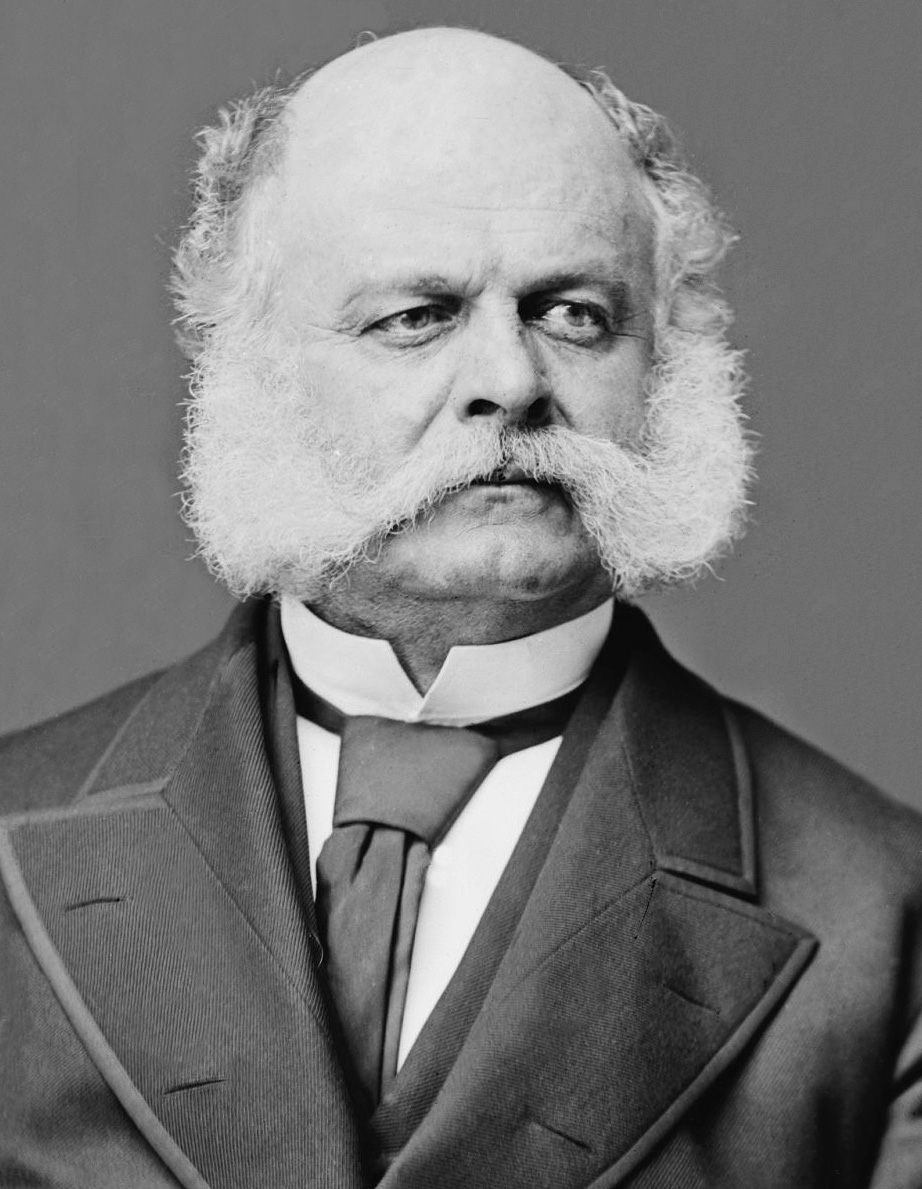
Burnside was a modest and unassuming individual, mindful of his limitations, who had been propelled to high command against his will. He could be described as a genuinely unlucky man, both in battle and in commerce (he was cheated of the profits of a successful cavalry firearm that had been his own invention). His style of thick facial hair became known as "sideburns", deriving from the two syllables of his surname.

Early life

[edit]

Burnside was born in Liberty, Indiana, and was the fourth of nine children[1] of Edghill and Pamela (or Pamilia) Brown Burnside, a family of Scottish, Scotch-Irish and English origins.[2] His great-great-grandfather Robert Burnside (1725–1775) was born in Scotland and settled in the Province of South Carolina.[3] His father was a native of South Carolina; he was a slave owner who freed his slaves when he relocated to Indiana. Ambrose attended Liberty Seminary as a young boy, but his education was interrupted when his mother died in 1841; he was apprenticed to a local tailor, eventually becoming a partner in the business.[4]

As a young officer before the Civil War, Burnside was engaged to Charlotte "Lottie" Moon, who left him at the altar. When the minister asked if she took him as her husband, Moon is said to have shouted "No siree Bob!" before running out of the church. Moon is best known for her espionage for the Confederacy during the Civil War. Later, Burnside arrested Moon, her younger sister Virginia "Ginnie" Moon, and their mother. He kept them under house arrest for months but never charged them with espionage.[5]

Early military career

[edit]

He obtained an appointment to the United States Military Academy in 1843 through his father's political connections and his own interest in military affairs. During his early tenure at the academy, a clerical error was made listing his middle name as Everett, rather than Everts. He graduated in 1847, ranking 18th in a class of 47, and was commissioned a brevet second lieutenant in the 2nd U.S. Artillery. He traveled to Veracruz for the Mexican–American War, but he arrived after hostilities had ceased and performed mostly garrison duty around Mexico City.[6]

At the close of the war, Lt. Burnside served two years on the western frontier under Captain Braxton Bragg in the 3rd U.S. Artillery, a light artillery unit that had been converted to cavalry duty, protecting the Western mail routes through Nevada to California. In August 1849, he was wounded by an arrow in his neck during a skirmish against Apaches in Las Vegas, New Mexico. He was promoted to 1st lieutenant on December 12, 1851.

Mrs. Burnside, Mary Richmond Bishop

In 1852, he was assigned to Fort Adams, Newport, Rhode Island, and he married Mary Richmond Bishop of Providence, Rhode Island, on April 27 of that year. The marriage lasted until Mary's death in 1876, but was childless.[7]

In October 1853, Burnside resigned his commission in the United States Army and was appointed commander of the Rhode Island state militia with the rank of major general. He held this position for two years.

After leaving the Regular Army, Burnside devoted his time and energy to the manufacture of a firearm that bears his name: the Burnside carbine. President Buchanan's Secretary of War John B. Floyd contracted the Burnside Arms Company to equip a large portion of the Army with his carbine, mostly cavalry and induced him to establish extensive factories for its manufacture. The Bristol Rifle Works were no sooner complete than another gunmaker allegedly bribed Floyd to break his $100,000 contract with Burnside.[citation needed]

Burnside ran as a Democrat for one of the Congressional seats in Rhode Island in 1858 and was defeated in a landslide. The burdens of the campaign and the destruction by fire of his factory contributed to his financial ruin, and he was forced to assign his firearm patents to others. He then went west in search of employment and became treasurer of the Illinois Central Railroad, where he worked for and became friendly with George B. McClellan, who later became one of his commanding officers.[8] Burnside became familiar with corporate attorney Abraham Lincoln, future president of the United States, during this time period.[9]

Civil War

[edit]
General Ambrose Burnside

First Bull Run

[edit]

At the outbreak of the Civil War, Burnside was a colonel in the Rhode Island Militia. He raised the 1st Rhode Island Volunteer Infantry Regiment, and was appointed its colonel on May 2, 1861.[10] Two companies of this regiment were then armed with Burnside carbines.

Within a month, he ascended to brigade command in the Department of northeast Virginia. He commanded the brigade without distinction at the First Battle of Bull Run in July and took over division command temporarily for wounded Brig. Gen. David Hunter. His 90-day regiment was mustered out of service on August 2; he was promoted to brigadier-general of volunteers on August 6 and was assigned to train provisional brigades in the Army of the Potomac.[6]

Burnside (seated, center) and officers of the 1st Rhode Island at Camp Sprague, Rhode Island, 1861

North Carolina

[edit]

Burnside commanded the Coast Division or North Carolina Expeditionary Force from September 1861 until July 1862, three brigades assembled in Annapolis, Maryland, which formed the nucleus for his future IX Corps. He conducted a successful amphibious campaign that closed more than 80% of the North Carolina sea coast to Confederate shipping for the remainder of the war. This included the Battle of Elizabeth City, fought on February 10, 1862, on the Pasquotank River near Elizabeth City, North Carolina.[citation needed]

The participants were vessels of the United States Navy's North Atlantic Blockading Squadron opposed by vessels of the Confederate Navy's Mosquito Fleet; the latter were supported by a shore-based battery of four guns at Cobb's Point (now called Cobb Point) near the southeastern border of the town. The battle was a part of the campaign in North Carolina that was led by Burnside and known as the Burnside Expedition. The result was a Union victory, with Elizabeth City and its nearby waters in their possession and the Confederate fleet captured, sunk, or dispersed.[11]

Burnside was promoted to major general of volunteers on March 18, 1862, in recognition of his successes at the battles of Roanoke Island and New Bern, the first significant Union victories in the Eastern Theater. In July, his forces were transported north to Newport News, Virginia, and became the IX Corps of the Army of the Potomac.[6]

Burnside was offered command of the Army of the Potomac following Maj. Gen. George B. McClellan's failure in the Peninsula Campaign.[12] He refused this opportunity because of his loyalty to McClellan and the fact that he understood his own lack of military experience, and detached part of his corps in support of Maj. Gen. John Pope's Army of Virginia in the Northern Virginia Campaign. He received telegrams at this time from Maj. Gen. Fitz John Porter which were extremely critical of Pope's abilities as a commander, and he forwarded on to his superiors in concurrence. This episode later played a significant role in Porter's court-martial, in which Burnside appeared as a witness.[13]

Burnside again declined command following Pope's debacle at Second Bull Run.[14]

Antietam

[edit]
Burnside's Bridge at Antietam in 2023

Burnside was given command of the Right Wing of the Army of the Potomac (the I Corps and his own IX Corps) at the start of the Maryland Campaign for the Battle of South Mountain, but McClellan separated the two corps at the Battle of Antietam, placing them on opposite ends of the Union battle line and returning Burnside to command of just the IX Corps. Burnside implicitly refused to give up his authority and acted as though the corps commander was first Maj. Gen. Jesse L. Reno (killed at South Mountain) and then Brig. Gen. Jacob D. Cox, funneling orders through them to the corps. This cumbersome arrangement contributed to his slowness in attacking and crossing what is now called Burnside's Bridge on the southern flank of the Union line.[15]

Burnside did not perform an adequate reconnaissance of the area, and he did not take advantage of several easy fording sites out of range of the enemy; his troops were forced into repeated assaults across the narrow bridge, which was dominated by Confederate sharpshooters on the high ground. By noon, McClellan was losing patience. He sent a succession of couriers to motivate Burnside to move forward, ordering one aide, "Tell him if it costs 10,000 men he must go now." He further increased the pressure by sending his inspector general to confront Burnside, who reacted indignantly: "McClellan appears to think I am not trying my best to carry this bridge; you are the third or fourth one who has been to me this morning with similar orders."[16] The IX Corps eventually broke through, but the delay allowed Maj. Gen. A. P. Hill's Confederate division to come up from Harpers Ferry and repulse the Union breakthrough. McClellan refused Burnside's requests for reinforcements, and the battle ended in a tactical stalemate.[17]

Fredericksburg

[edit]
Union General Ambrose Burnside, 1862

After McClellan failed to pursue General Robert E. Lee's retreat from Antietam, Lincoln ordered McClellan's removal on November 5, 1862, and selected Burnside to replace him on November 7, 1862. Burnside reluctantly obeyed this order, the third such in his brief career, in part because the courier told him that, if he refused it, the command would go instead to Maj. Gen. Joseph Hooker, whom Burnside disliked. Burnside assumed charge of the Army of the Potomac in a change of command ceremony at the farm of Julia Claggett in New Baltimore, Virginia.[18][19][20] McClellan visited troops to bid them farewell. Columbia Claggett, Julia Claggett's daughter-in-law, testified after the war that a "parade and transfer of the Army to Gen. Burnside took place on our farm in front of our house in a change of command ceremony at New Baltimore, Virginia on November 9, 1862."[21][18]

President Abraham Lincoln pressured Burnside to take aggressive action and approved his plan on November 14 to capture the Confederate capital at Richmond, Virginia. This plan led to a humiliating and costly Union defeat at the Battle of Fredericksburg on December 13. His advance upon Fredericksburg was rapid, but the attack was delayed when the engineers were slow to marshal pontoon bridges for crossing the Rappahannock River, as well as his own reluctance to deploy portions of his army across fording points. This allowed Gen. Lee to concentrate along Marye's Heights just west of town and easily repulse the Union attacks.

Assaults south of town were also mismanaged, which were supposed to be the main avenue of attack, and initial Union breakthroughs went unsupported. Burnside was upset by the failure of his plan and by the enormous casualties of his repeated, futile frontal assaults, and declared that he would personally lead an assault by the IX corps. His corps commanders talked him out of it, but relations were strained between the general and his subordinates. Accepting full blame, he offered to retire from the U.S. Army, but this was refused. Burnside's detractors labeled him the "Butcher of Fredericksburg".[22]

In January 1863, Burnside launched a second offensive against Lee, but it bogged down in winter rains before anything was accomplished, and has derisively been called the Mud March. In its wake, he asked that several openly insubordinate officers be relieved of duty and court-martialed; he also offered to resign. Lincoln quickly accepted the latter option, and on January 26 replaced Burnside with Maj. Gen. Joseph Hooker, one of the officers who had conspired against him.[23]

East Tennessee

[edit]
Engraving of General Burnside in full dress uniform

Burnside offered to resign his commission altogether but Lincoln declined, stating that there could still be a place for him in the army. Thus, he was placed back at the head of the IX Corps and sent to command the Department of the Ohio, encompassing the states of Ohio, Indiana, Kentucky, and Illinois. This was a quiet area with little activity, and the President reasoned that Burnside could not get himself into too much trouble there. However, antiwar sentiment was riding high in the Western states as they had traditionally carried on a great deal of commerce with the South, and there was little in the way of abolitionist sentiment there or a desire to fight for the purpose of ending slavery. Burnside was thoroughly disturbed by this trend and issued a series of orders forbidding "the expression of public sentiments against the war or the Administration" in his department; this finally climaxed with General Order No. 38, which declared that "any person found guilty of treason will be tried by a military tribunal and either imprisoned or banished to enemy lines".

On May 1, 1863, Ohio Congressman Clement L. Vallandigham, a prominent opponent of the war, held a large public rally in Mount Vernon, Ohio in which he denounced President Lincoln as a "tyrant" who sought to abolish the Constitution and set up a dictatorship. Burnside had dispatched several agents to the rally who took down notes and brought back their "evidence" to the general, who then declared that it was sufficient grounds to arrest Vallandigham for treason. A military court tried him and found him guilty of violating General Order No. 38, despite his protests that he was expressing his opinions publicly. Vallandigham was sentenced to imprisonment for the duration of the war and was turned into a martyr by antiwar Democrats. Burnside next turned his attention to Illinois, where the Chicago Times newspaper had been printing antiwar editorials for months. The general dispatched a squadron of troops to the paper's offices and ordered them to cease printing.

Lincoln had not been asked or informed about either Vallandigham's arrest or the closure of the Chicago Times. He remembered the section of General Order No. 38 which declared that offenders would be banished to enemy lines and finally decided that it was a good idea so Vallandigham was freed from jail and sent to Confederate hands. Meanwhile, Lincoln ordered the Chicago Times to be reopened and announced that Burnside had exceeded his authority in both cases. The President then issued a warning that generals were not to arrest civilians or close down newspapers again without the White House's permission.[24]

Burnside also dealt with Confederate raiders such as John Hunt Morgan.

In the Knoxville Campaign, Burnside advanced to Knoxville, Tennessee, first bypassing the Confederate-held Cumberland Gap and ultimately occupying Knoxville unopposed; he then sent troops back to the Cumberland Gap. Confederate commander Brig. Gen. John W. Frazer refused to surrender in the face of two Union brigades but Burnside arrived with a third, forcing the surrender of Frazer and 2,300 Confederates.[25]

Union Maj. Gen. William S. Rosecrans was defeated at the Battle of Chickamauga, and Burnside was pursued by Lt. Gen. James Longstreet, against whose troops he had battled at Marye's Heights. Burnside skillfully outmaneuvered Longstreet at the Battle of Campbell's Station and was able to reach his entrenchments and safety in Knoxville, where he was briefly besieged until the Confederate defeat at the Battle of Fort Sanders outside the city. Tying down Longstreet's corps at Knoxville contributed to Gen. Braxton Bragg's defeat by Maj. Gen. Ulysses S. Grant at Chattanooga. Troops under Maj. Gen. William T. Sherman marched to Burnside's aid, but the siege had already been lifted; Longstreet withdrew, eventually returning to Virginia.[23]

Overland Campaign

[edit]

Burnside was ordered to take the IX Corps back to the Eastern Theater, where he built it up to a strength of over 21,000 in Annapolis, Maryland.[26] The IX Corps fought in the Overland Campaign of May 1864 as an independent command, reporting initially to Grant; his corps was not assigned to the Army of the Potomac because Burnside outranked its commander Maj. Gen. George G. Meade, who had been a division commander under Burnside at Fredericksburg. This cumbersome arrangement was rectified on May 24 just before the Battle of North Anna, when Burnside agreed to waive his precedence of rank and was placed under Meade's direct command.[27]

Burnside fought at the battles of Wilderness and Spotsylvania Court House, where he did not perform in a distinguished manner,[28] attacking piecemeal and appearing reluctant to commit his troops to the costly frontal assaults that characterized these battles. After North Anna and Cold Harbor, he took his place in the siege lines at Petersburg.[29]

The Crater

[edit]
Petersburg Crater, 1865

As the two armies faced the stalemate of trench warfare at Petersburg in July 1864, Burnside agreed to a plan suggested by a regiment of former coal miners in his corps, the 48th Pennsylvania: to dig a mine under a fort named Elliot's Salient in the Confederate entrenchments and ignite explosives there to achieve a surprise breakthrough. The fort was destroyed on July 30 in what is known as the Battle of the Crater.

Because of interference from Meade, Burnside was ordered, only hours before the infantry attack, not to use his division of black troops, which had been specially trained for the assault: instead, he was forced to use untrained white troops. He could not decide which division to choose as a replacement, so he had his three subordinate commanders draw lots.[30]

The division chosen by chance was that commanded by Brig. Gen. James H. Ledlie, who had failed to brief the men on what was expected of them, and was observed to be drinking liquor with Brig. Gen Edward Ferrero in a bombproof shelter well behind the lines during the battle, providing no leadership at all.

As a result, Ledlie's men entered the huge crater instead of going around it, became trapped, and were subjected to heavy fire from Confederates around the rim, resulting in high casualties. in the end his forces suffered 3,800 casualties [31][32]

As a result of the Crater fiasco, Burnside was relieved of command on August 14 and sent on "extended leave" by Grant. He was never recalled to duty for the remainder of the war. A court of inquiry later placed the blame for the defeat on Burnside, Ledlie and Ferrero. In December, Burnside met with President Lincoln and General Grant about his future. He was contemplating resignation, but Lincoln and Grant requested that he remain in the Army. At the end of the interview, Burnside wrote, "I was not informed of any duty upon which I am to be placed." He finally resigned his commission on April 15, 1865, after Lee's surrender at Appomattox.[33]

The United States Congress Joint Committee on the Conduct of the War later exonerated Burnside and placed the blame for the Union defeat at the Crater on General Meade for requiring the specially trained USCT (United States Colored Troops) men to be withdrawn.

Postbellum career

[edit]

After his resignation, Burnside was employed in numerous railroad and industrial directorships, including the presidencies of the Cincinnati and Martinsville Railroad, the Indianapolis and Vincennes Railroad, the Cairo and Vincennes Railroad, and the Rhode Island Locomotive Works.[citation needed]

He was elected to three one-year terms as Governor of Rhode Island, serving from May 29, 1866, to May 25, 1869. He was nominated by the Republican Party to be their candidate for governor in March 1866, and Burnside was elected governor in a landslide on April 4, 1866. This began Burnside's political career as a Republican, as he had been a Democrat before the war.[34]

Burnside was a Companion of the Massachusetts Commandery of the Military Order of the Loyal Legion of the United States, a military society of Union officers and their descendants, and served as the Junior Vice Commander of the Massachusetts Commandery in 1869. He was commander-in-chief of the Grand Army of the Republic (GAR) veterans' association from 1871 to 1872, and also served as the Commander of the Department of Rhode Island of the GAR.[35] At its inception in 1871, the National Rifle Association of America chose him as its first president.[36]

During a visit to Europe in 1870, Burnside attempted to mediate between the French and the Germans in the Franco-Prussian War. He was registered at the offices of Drexel, Harjes & Co., Geneva, week ending November 5, 1870.[37] Drexel Harjes was a major lender to the new French government after the war, helping it to repay its massive war reparations.

In 1876 Burnside was elected as commander of the New England Battalion of the Centennial Legion, the title of a collection of 13 militia units from the original 13 states, which participated in the parade in Philadelphia on July 4, 1876, to mark the centennial of the signing of the Declaration of Independence.[38]

In 1874 Burnside was elected by the Rhode Island Senate as a U.S. Senator from Rhode Island, was re-elected in 1880, and served until his death in 1881. Burnside continued his association with the Republican Party, playing a prominent role in military affairs as well as serving as chairman of the Foreign Relations Committee in 1881.[39]

Death and burial

[edit]
Burnside's grave at Swan Point Cemetery

Burnside died suddenly of "neuralgia of the heart" (angina pectoris) on the morning of September 13, 1881, at his home in Bristol, Rhode Island, accompanied only by his doctor and family servants.[40]

Burnside's body lay in state at City Hall until his funeral on September 16.[41] A procession took his casket, in a hearse drawn by four black horses, to the First Congregational Church for services which were attended by many local dignitaries.[41] Following the services, the procession made its way to Swan Point Cemetery for burial.[41][42][39] Businesses and mills were closed for much of the day, and "thousands" of mourners from "all towns of the state and many places in Massachusetts and Connecticut" crowded the streets of Providence for the occasion.[41]

Assessment and legacy

[edit]

Personally, Burnside was always very popular, both in the army and in politics. He made friends easily, smiled a lot, and remembered everyone's name. His professional military reputation, however, was less positive, and he was known for being obstinate, unimaginative, and unsuited both intellectually and emotionally for high command.[43] Grant stated that he was "unfitted" for the command of an army and that no one knew this better than Burnside himself. Knowing his capabilities, he twice refused command of the Army of the Potomac, accepting only the third time when the courier told him that otherwise the command would go to Joseph Hooker. Jeffry D. Wert described Burnside's relief after Fredericksburg in a passage that sums up his military career:[44]

He had been the most unfortunate commander of the Army, a general who had been cursed by succeeding its most popular leader and a man who believed he was unfit for the post. His tenure had been marked by bitter animosity among his subordinates and a fearful, if not needless, sacrifice of life. A firm patriot, he lacked the power of personality and will to direct recalcitrant generals. He had been willing to fight the enemy, but the terrible slope before Marye's Heights stands as his legacy.

— Jeffry D. Wert, The Sword of Lincoln

Bruce Catton summarized Burnside:[45]

... Burnside had repeatedly demonstrated that it had been a military tragedy to give him a rank higher than colonel. One reason might have been that, with all his deficiencies, Burnside never had any angles of his own to play; he was a simple, honest, loyal soldier, doing his best even if that best was not very good, never scheming or conniving or backbiting. Also, he was modest; in an army many of whose generals were insufferable prima donnas, Burnside never mistook himself for Napoleon. Physically he was impressive: tall, just a little stout, wearing what was probably the most artistic and awe-inspiring set of whiskers in all that bewhiskered Army. He customarily wore a high, bell-crowned felt hat with the brim turned down and a double-breasted, knee-length frock coat, belted at the waist—a costume which, unfortunately, is apt to strike the modern eye as being very much like that of a beefy city cop of the 1880s.

— Bruce Catton, Mr. Lincoln's Army

Sideburns

[edit]
Studio photograph of Gen. Ambrose Burnside taken sometime between 1860 and 1862. Photograph shows his unusual sideburns.

Burnside was noted for his unusual beard, joining strips of hair in front of his ears to his mustache but with the chin clean-shaven; the word burnsides was coined to describe this style. The syllables were later reversed to give sideburns.[43]

Equestrian monument in Burnside Park, Providence, Rhode Island.

Honors

[edit]

Portrayals

[edit]

See also

[edit]

Citations

[edit]
  1. ^ Marvel, p. 3.
  2. ^ Mierka, np. The original spelling of his middle name was Everts, for Dr. Sylvanus Everts, the physician who delivered him. Ambrose Everts was also the name of Edghill's and Pamela's first child, who died a few months before the future general was born. The name was misspelled as "Everett" during his enrollment at West Point, and he did not correct the record.
  3. ^ "Free Family History and Genealogy Records — FamilySearch.org". www.familysearch.org. Archived from the original on December 12, 2008.
  4. ^ Mierka, np., describes the relationship with the tailor as indentured servitude.
  5. ^ Eggleston, Larry G. (2003). Women in the Civil War : extraordinary stories of soldiers, spies, nurses, doctors, crusaders, and others. Jefferson, N.C.: McFarland. ISBN 0786414936. OCLC 51580671.
  6. ^ a b c Eicher, pp. 155–56; Sauers, pp. 327–28; Warner, pp. 57–58; Wilson, np.
  7. ^ Eicher, pp. 155–56; Mierka, np.; Warner, pp. 57–58.
  8. ^ Eicher, pp. 155–56; Mierka, np.; Sauers, pp. 327–28; Warner, pp. 57–58.
  9. ^ A. Lincoln, a Corporate Attorney and the Illinois Central Railroad. Sandra K. Lueckenhoff, Missouri Law Review, Volume 61, Issue 2 Spring 1996. Accessed March 2021.
  10. ^ Combined Military Service Record
  11. ^ Mierka, np.
  12. ^ Marvel, pp. 99–100.
  13. ^ Marvel, pp. 209–10.
  14. ^ Sauers, pp. 327–28; Wilson, np.
  15. ^ Bailey, pp. 120–21.
  16. ^ Sears, pp. 264–65.
  17. ^ Bailey, pp. 126–39.
  18. ^ a b Department of the Treasury. Office of the First Comptroller (September 5, 1876). "Approved Claim Files from Prince William County, Virginia: Claggett, Julia F, Claim No. 41668". Library of Congress. Southern Claims Commission. p. 35. Archived from the original on April 15, 2021. Retrieved March 9, 2021.
  19. ^ Sears, Young Napoleon, pp. 238–41
  20. ^ "George McClellan - Biography, Civil War & Importance". History.com. June 10, 2019. Retrieved April 25, 2023.
  21. ^ Department of the Treasury. Office of the First Comptroller (September 5, 1876). "Approved Claim Files from Prince William County, Virginia: Claggett, Julia F, Claim No. 41668". Library of Congress. Southern Claims Commission. p. 35. Archived from the original on April 15, 2021. Retrieved March 9, 2021.
  22. ^ William Palmer Hopkins, The Seventh Regiment Rhode Island Volunteers in the Civil War 1862–1865. Providence, RI: The Providence Press, 1903, p. 56.
  23. ^ a b Wilson, np.; Warner, p. 58; Sauers, p. 328.
  24. ^ McPherson, pp. 596–97. McPherson remarked that Burnside's "political judgment proved no more subtle than his military judgment at Fredericksburg."
  25. ^ Korn, p. 104.
  26. ^ Grimsley, p. 245, n. 43.
  27. ^ Esposito, text for map 120.
  28. ^ Grimsley, p. 230, describes Burnside's conduct as "inept". Rhea, p. 317: "[Burnside's] failings were so flagrant that the Army talked about them openly. He stumbled badly in the Wilderness and worse still at Spotsylvania."
  29. ^ Wilson, np.
  30. ^ Chernow, 2017, pp. 426-428
  31. ^ Chernow, 2017, pp. 426-429
  32. ^ Slotkin, 2009, pp. 70, 166, 322
  33. ^ Wert, pp. 385–86; Mierka, np.; Eicher, pp. 155–56.
  34. ^ "Rhode Island Republicans nominate Union General Ambrose Burnside for governor". House Divided. Archived from the original on June 14, 2020. Retrieved December 13, 2020.
  35. ^ Eicher, pp. 155–56.
  36. ^ "Timeline of the NRA". The Washington Post. January 12, 2013. Archived from the original on January 13, 2013. Retrieved May 23, 2023. 1871: The NRA is created to improve the marksmanship of soldiers. The first president, Civil War general Ambrose Burnside, had seen too many Union soldiers who couldn't shoot straight.
  37. ^ "Americans in London". New York Times, December 14, 1870, p. 6c, last line.
  38. ^ New York Times March 16, 1876.
  39. ^ a b Wilson, np.; Eicher, p. 156.
  40. ^ "General Burnside Dead". The Boston Globe. September 14, 1881. p. 1. Retrieved August 12, 2022.
  41. ^ a b c d "The Lamented Burnside". Fall River Daily Herald. Fall River, Massachusetts. September 17, 1881. Retrieved August 12, 2022.
  42. ^ "Civil War Veterans interred at Swan Point Cemetery". Swan Point Cemetery. Archived from the original on August 12, 2022. Retrieved August 12, 2022.
  43. ^ a b Goolrick, p. 29.
  44. ^ Wert, p. 217.
  45. ^ Catton, pp. 256–57.
  46. ^ Romig, Walter (1986) [1973]. Michigan Place Names. Detroit, Michigan: Wayne State University Press. ISBN 0-8143-1838-X.
  47. ^ Raub, Patricia (February 21, 2012). "Burnside: Our Statue But Not Our Hero". The Occupied Providence Journal. Retrieved June 14, 2014. The monument stood for nearly twenty years in Exchange Place, facing City Hall, with horses, wagons, and carriages moving in all directions around it.
  48. ^ "Major General Ambrose E. Burnside, (sculpture)". Smithsonian Art Inventories Catalog. The Smithsonian Institution. Retrieved August 12, 2022.
  49. ^ Marshall, Philip C. "Hope Street Survey Descriptions". Philip C. Marshall. Archived from the original on March 4, 2016. Retrieved September 6, 2015. President Chester A. Arthur and Governor Augustus O. Bourn of Bristol dedicated the hall to the memory of General Ambrose E. Burnside (1824–1881), whose statue was intended to be the focus of the porch.
  50. ^ "URI History and Timeline". University of Rhode Island. Archived from the original on November 14, 2012. Retrieved June 14, 2014. 1966. Aldrich, Burnside, Coddington, Dorr, Ellery, and Hopkins Residence Halls were opened
  51. ^ Robert E. Gard (2015). The Romance of Wisconsin Place Names. Wisconsin Historical Society Press. ISBN 978-0-87020-708-2.

Bibliography

[edit]
[edit]
Revisions and contributorsEdit on WikipediaRead on Wikipedia
from Grokipedia

Ambrose Everett Burnside (May 23, 1824 – September 13, 1881) was an American military officer, inventor, industrialist, and politician who rose to the rank of major general in the Union Army during the American Civil War, later serving as governor of Rhode Island and as a United States senator.
Born in Liberty, Indiana, Burnside graduated from the United States Military Academy at West Point in 1847, ranking 18th in a class of 47, and saw service in the Mexican-American War and on the frontier before resigning his commission in 1853 to manufacture his patented breech-loading Burnside carbine, a venture that ended in financial ruin due to the loss of a government contract amid reported corruption.
At the outset of the Civil War, he reentered federal service, organizing Rhode Island troops and achieving early victories in the North Carolina coast campaign, including the capture of Roanoke Island in 1862, which earned him promotion to major general.
As commander of the Army of the Potomac from November 1862 to January 1863, however, he suffered a catastrophic defeat at the Battle of Fredericksburg, marked by repeated frontal assaults against entrenched Confederate positions that resulted in over 12,000 Union casualties with minimal gains.
Relieved of that command, Burnside later directed the Department of the Ohio, where he successfully defended Knoxville against Confederate siege in late 1863, but his tenure ended with the failed Battle of the Crater at Petersburg in 1864, where innovative mining tactics devolved into disorganized infantry assaults leading to heavy Union losses.
After the war, Burnside recovered professionally as president of the Indianapolis and Vincennes Railroad, was elected to three consecutive one-year terms as Rhode Island's governor from 1866 to 1869, focusing on militia reforms and war claims settlements, and served in the U.S. Senate from 1875 until his death, also becoming the first president of the National Rifle Association.
His distinctive muttonchop whiskers popularized the term "sideburns," derived from his name, reflecting a personal style that contrasted with his mixed record of tactical innovation and command shortcomings.

Early Life and Education

Upbringing and Family Influences

Ambrose Everett Burnside was born on May 23, 1824, in , Union County, , to Edghill Burnside and Pamela Brown Burnside. As the fourth of nine children in a family of Scottish descent, Burnside grew up in a household marked by modest means, with his father working as both a and a in the community. Edghill Burnside, originally from , had owned slaves prior to relocating to the free state of around 1815, after which he emancipated them, reflecting a shift toward abolitionist principles aligned with the region's Whig politics. This background in a Quaker-influenced area of east-central , where anti-slavery sentiments were prevalent, likely contributed to the family's emphasis on personal responsibility and industry amid ongoing financial hardships. Pamela Burnside, who died in 1841 when Ambrose was 17, left the family in economic distress, prompting him to apprentice as a to help support his siblings and father. Burnside's early education was limited but practical; he attended the local Liberty Seminary for basic instruction before prioritizing work over further schooling. These family circumstances instilled a strong and , evident in his later decision to seek a congressional appointment to West Point in 1843, secured through the influence of Indiana Whig congressman Thomas L. Edwards, rather than familial connections. The loss of his mother and the burden of familial support during adolescence shaped Burnside's resilience, though the family's abolitionist leanings and frontier Protestant values provided a moral framework that later informed his unconditional loyalty to the Union cause.

West Point Cadet Years

Burnside received an appointment to the at West Point from the congressional representative of Indiana's 5th district and entered as a cadet on July 1, 1843. Over the subsequent four-year course, which emphasized , , ordnance, and amid the rigors of academy discipline, Burnside demonstrated competent but middling proficiency, accumulating no notable distinctions or disciplinary infractions recorded in official registers. He graduated on July 1, 1847, placing 18th out of 38 cadets in his class, and was commissioned as a brevet in the 2nd U.S. Artillery. Among his classmates were future Union officers such as Orlando B. Willcox and James B. Fry, several of whom later rose to prominence in the Civil War.

Pre-Civil War Career

Mexican-American War Participation

Burnside graduated from the at West Point on July 1, 1847, and was commissioned as a brevet in the Third Artillery. Due to the timing of his commissioning amid the ongoing Mexican-American War, he was ordered to but did not arrive at the primary theater of operations until after the American capture of on September 13-14, 1847. Consequently, he participated in no major combat engagements during the war's active phase, which concluded with the signed on February 2, 1848. Instead, Burnside's service consisted primarily of garrison duty in occupied , where his artillery unit helped maintain order and secure American interests following Winfield Scott's victory. He remained in this capacity through the war's formal end and into the occupation period, performing routine military policing and logistical tasks without notable incidents or promotions for valor in battle. This limited role reflected the standard assignment for many junior officers graduating late in the conflict, prioritizing post-hostilities stabilization over frontline action. By mid-1848, Burnside received orders transferring him to , marking the transition from his Mexican War duties to frontier service.

Invention of the Burnside Carbine and Business Failure

Burnside, while stationed at Fort Purven in the as a in the U.S. Army's 2nd , conceived the design for a breech-loading to address the limitations of muzzle-loading firearms for mounted troops. The weapon utilized a hinged breech block that pivoted downward to load a self-contained metallic cartridge, which Burnside also invented, consisting of a or tube filled with powder and a , ignited by a . On March 25, 1856, Burnside secured U.S. No. 14,491 for the , granting him exclusive rights to the pivoting chamber mechanism. To commercialize the invention, he resigned his army commission on March 11, 1853, and relocated to , where he founded the to manufacture the weapon. The company initially produced a limited run of carbines, with the U.S. Army purchasing about 200 units for testing in , but competitive bidding and procurement delays prevented a substantial . Without ongoing orders, the firm exhausted its capital by mid-1857, resulting in ; Burnside surrendered the to creditors to discharge his debts, effectively ending his control over the design.

Resignation from the Army

Burnside, having served as a in the U.S. 's 3rd after the Mexican-American War, was stationed in garrison duty along the southwestern frontier before requesting transfer to . By 1853, he had developed a prototype for a breech-loading percussion during his , prompting him to seek opportunities for its commercial production. On November 1, 1853, Burnside formally resigned his commission as a to establish the Bristol Rifle Works in , dedicated to manufacturing and marketing the weapon he had patented. The allowed Burnside to focus on entrepreneurial ventures, as army regulations prohibited active officers from engaging in private that could conflict with duties. Despite initial promise—the featured a novel metallic cartridge and breech mechanism—the Bristol firm struggled to secure large-scale U.S. contracts, partly due to Burnside's refusal to pay bribes demanded by officials. This principled stance contributed to financial distress, culminating in the company's by 1857, after which creditors seized the patents and Burnside sold personal assets to settle debts. Approximately 55,000 Burnside carbines were eventually produced under new ownership and adopted by Union forces during the Civil War, validating the design's viability despite the early failure. Following the resignation and business collapse, Burnside transitioned to civilian roles, including as treasurer of the Illinois Central Railroad from 1858 to 1860, where he worked under and honed administrative skills later applied in military logistics. His military experience remained a key asset, facilitating his rapid recommissioning as a of volunteers at the Civil War's outset in 1861.

Civil War Service

First Battle of Bull Run

Burnside entered the on July 21, 1861, as colonel commanding a in David Hunter's division of Irvin McDowell's Army of Northeastern . His comprised approximately 2,000 men from the 1st and 2nd Detached Militia regiments, supported by a section of artillery under William Reynolds. Positioned on the Union army's right flank, Burnside's unit was among the first to ford Bull Run near Poplar Ford around 10:00 a.m., advancing under fire from Confederate skirmishers of Nathan Evans's command. The brigade pushed forward through woods and fields toward the Henry House Hill, engaging Confederate forces including elements of the 33rd Virginia Infantry and artillery from the Washington Artillery. Burnside's infantry briefly overran and captured several Confederate guns after intense fighting that killed the 2nd Rhode Island's commander, Colonel John Slocum, but sustained heavy losses from musketry and canister fire as Confederate reinforcements under Brigadier General P.G.T. Beauregard arrived via rail from Joseph E. Johnston's army. Unable to hold against the counterattack, the brigade withdrew across Bull Run by early afternoon, with Burnside organizing a rearguard to cover the disorganized Union retreat toward Centreville; his units disbanded temporarily upon reaching Washington, D.C. Burnside's brigade reported 363 casualties out of its engaged strength, including 58 killed, 171 wounded, and 134 missing or captured, representing one of the higher losses among Union brigades in the engagement. For his leadership in leading the initial assault and maintaining cohesion amid the rout—which inflicted about 2,900 total Union casualties against 1,900 Confederate—Burnside received a commission as of volunteers on August 6, 1861. This performance marked his emergence as a capable field officer early in the , though the battle's overall Union defeat underscored the inexperience of both armies.

North Carolina Coastal Operations

In late 1861, Brigadier General Ambrose E. Burnside organized the Coast Division, comprising approximately 12,000 Union troops, for amphibious operations along the North Carolina coast, departing from Annapolis, Maryland, on January 9, 1862, under the overall naval command of Flag Officer Louis M. Goldsborough. The expedition aimed to secure key coastal inlets and sounds to disrupt Confederate supply lines and establish Union bases in the region. The first major engagement occurred at on February 7–8, 1862, where Burnside's force of about 7,500 infantry landed against Confederate defenses numbering around 3,000 troops under Brigadier General . Union naval gunfire supported the assault, overcoming Confederate batteries and swampy terrain; after fierce fighting, including bayonet charges by the 9th New York Infantry, the Confederates surrendered, yielding the island with Union casualties of 264 (37 killed, 214 wounded, 13 missing) and Confederate losses exceeding 2,600, including over 2,000 captured. This victory opened Albemarle and Pamlico Sounds to Union control and prompted the destruction of the Confederate at Elizabeth City on February 10. Advancing inland, Burnside targeted New Bern, a vital rail and hub, embarking his command from on March 11, 1862, and engaging Confederate forces of about 4,000 under Brigadier General Lawrence O'B. Branch on March 14. Union troops, supported by gunboats, outflanked entrenched positions along the , routing the defenders despite heavy artillery fire and leading to the capture of New Bern after Branch's retreat; casualties totaled 476 Union (90 killed, 380 wounded, 6 missing) and 609 Confederate (64 killed, 101 wounded, 444 captured or missing). Subsequent operations included the occupation of Beaufort on April 26, 1862, securing additional coastal access, and advances up the to , by mid-April, establishing a Union foothold that divided Confederate attention and facilitated enforcement. These successes demonstrated effective joint army-navy coordination in , contrasting with larger Eastern Theater failures, though limited by shallow waters and Confederate guerrilla resistance. Burnside's expedition concluded in July 1862 upon his recall to , having captured significant artillery, supplies, and territory without major strategic overreach.

Antietam and the Bridge Assault

At the on September 17, 1862, Major General Ambrose Burnside commanded the Union IX Corps, tasked with assaulting the Confederate right flank across via a narrow stone bridge defended by high bluffs and enfilading fire from Robert Toombs's Georgia brigade of about 500 men. commander Major General repeatedly urged Burnside to advance promptly, issuing orders around 8:30 a.m. to carry the bridge "at all hazards and at whatever cost" to threaten Robert E. Lee's line of retreat. Burnside's corps, numbering around 12,000, faced challenging terrain including steep, wooded banks that funneled troops into a deadly approach, delaying the initial push until after 10 a.m. despite reconnaissance efforts identifying potential upstream fords. The assault began around 11 a.m. with the first wave led by Paul Oliver's , including the 2nd Maryland and 51st New York Infantry, which advanced down the exposed road toward the 12-foot-wide bridge spanning 100 yards of swift water but was repulsed by concentrated Confederate and fire from the opposite heights, suffering heavy losses. A second attempt shortly followed with the 11th and 10th under Henry W. , again faltering in the confined defile under withering fire that pinned attackers against the creek's banks. The third and successful frontal assault around 12:30 p.m. involved the 51st New York and 51st Pennsylvania Infantry charging across under covering from Edward Cross's , while simultaneously Ambrose E. Burnside's division under Edward V. Sumner—wait, correction: under Samuel D. Rodman—located and forded the creek about 500 yards upstream, turning the Confederate flank and forcing Toombs's men to withdraw. By approximately 1 p.m., after four hours of combat, Union forces secured the bridge, having incurred around 500 casualties—primarily from the repeated direct assaults—while the defenders suffered about 120 killed, wounded, or missing before retreating to higher ground. IX Corps then pushed forward roughly one mile to the outskirts of Sharpsburg, capturing key heights and threatening Lee's headquarters, but the advance stalled amid disorganized pursuit and lack of reinforcements from McClellan. The timely counterattack by Major General Ambrose Powell Hill's division, arriving from Harpers Ferry around 2:30 p.m. with 2,500 fresh troops, repulsed Burnside's exhausted men back toward the creek, inflicting additional heavy losses totaling over 2,500 for the corps that day. The bridge assault has drawn historical scrutiny for Burnside's repeated frontal attacks rather than prioritizing the upstream ford discovered by Rodman's scouts, a delay attributed partly to McClellan's insistent telegrams for immediate action and the obscured terrain that initially concealed viable crossing points, though some analyses argue Burnside's caution and failure to mass effectively exacerbated Union vulnerabilities. Despite the crossing's ultimate success in diverting Confederate attention and contributing to Lee's withdrawal , the prolonged engagement prevented a potential , allowing the to escape intact across the Potomac and shaping Antietam's outcome as a tactical with strategic Union gains.

Fredericksburg Command and Defeat

Following the Battle of Antietam on September 17, 1862, President Abraham Lincoln relieved General George B. McClellan of command of the Army of the Potomac on November 5, 1862, due to his perceived reluctance to pursue Robert E. Lee's retreating Confederate forces. Lincoln directed General-in-Chief Henry W. Halleck to offer the position to Ambrose Burnside, who had commanded the IX Corps effectively earlier but twice declined, deeming himself unfit for overall army command owing to his limited experience leading large formations. Burnside received the orders on November 7 amid a snowstorm and accepted reluctantly on November 9, 1862, after warnings that refusal might lead to the appointment of Joseph Hooker, whom he distrusted. Burnside reorganized the army into three grand divisions under Edwin V. Sumner, Joseph Hooker, and William B. Franklin, totaling approximately 122,000 men, and devised an aggressive plan to advance rapidly southeast from , beginning November 15, 1862, to cross the below Fredericksburg and position the Union forces between and Richmond before the Confederates could react. The reached the Rappahannock opposite Fredericksburg by November 19, but the campaign's element of surprise was lost when pontoon bridges, essential for crossing the rain-swollen river after local bridges had been destroyed, failed to arrive on schedule due to miscommunications between Burnside and Halleck, compounded by logistical delays in Washington; the bridges did not reach the front until December 10 or 11. This two-week delay enabled , with about 78,000 troops, to occupy Fredericksburg by November 23 and entrench strongly on the heights south of the town, including Marye's Heights under James Longstreet's corps, featuring a sunken road behind a four-foot defended by roughly 2,000 in multiple ranks, supported by . On December 11, 1862, Union engineers attempting to lay pontoon bridges faced Confederate sniper fire from the town, prompting Burnside to authorize artillery bombardment and infantry assaults to clear the opposite bank; crossings began that evening via fords and partial bridges. The army fully occupied Fredericksburg on December 12, but Burnside delayed the main assault until December 13, ordering Sumner's Right Grand Division to launch repeated frontal attacks on Marye's Heights starting at noon, while Franklin's Left Grand Division probed Stonewall Jackson's lines to the south and Hooker's Center Grand Division provided support. At Marye's Heights, Union divisions under Darius N. Couch, Orlando B. Willcox, Samuel D. Sturgis, and later Hooker's and William H. French's forces advanced in waves across open fields and a canal ditch, exposed to withering rifle and cannon fire from the stone wall; no Union troops reached the wall, with the closest approaching within 25 yards, resulting in approximately 8,000 casualties in assaults that continued until darkness. Franklin's sector saw George G. Meade's division briefly penetrate Jackson's line before being counterattacked and repelled, as Burnside withheld reinforcements despite requests, citing concerns over Sumner's sector. The battle concluded on December 15, 1862, with the Union army recrossing the Rappahannock under cover of fog, abandoning the field after sustaining 12,653 (1,284 killed, 9,600 wounded, 1,769 missing), compared to Confederate losses of about 5,377 (608 killed, 4,116 wounded, 653 missing). The defeat stemmed from the forfeited surprise allowing Lee's fortifications, Burnside's commitment to direct assaults on entrenched positions despite subordinates' advocacy for maneuvers, and disjointed execution across grand divisions, leading to criticism of his tactical judgment. Burnside's subsequent attempt to renew the offensive, the "Mud March" from January 20-22, 1863, stalled in heavy rains, prompting his relief of command on January 26, 1863, and replacement by Hooker.

East Tennessee Campaign

In the spring of , following his relief from command of the , Ambrose E. Burnside was appointed to lead the Department of the Ohio and its primary field force, the , with instructions to secure Union control over —a region with strong pro-Union sentiment among civilians and strategic value due to its railroads and position threatening Confederate supply lines. Burnside's forces, comprising , , and totaling approximately 20,000 to 25,000 men, launched their main advance in late August from bases in , including Camp Nelson, aiming to capture Knoxville and disrupt Confederate operations without direct engagement at Chattanooga. The rapid march covered over 200 miles through rugged terrain, exploiting weak Confederate garrisons under Brigadier General Simon B. Buckner, who lacked sufficient troops to contest the Union incursion effectively. Burnside's troops entered Knoxville unopposed on September 3, 1863, after Confederate forces evacuated the city, allowing the Union to occupy key points including Kingston and the surrounding rail junctions with minimal fighting. To consolidate gains and eliminate a Confederate stronghold blocking further advances, Burnside dispatched a under Samuel P. Carter, which marched 60 miles in 52 hours from Knoxville to besiege from September 7 to 9; the Confederate commander, John W. Frazer, surrendered approximately 2,000 troops, 14 artillery pieces, and substantial supplies without a major battle, as his position became untenable due to isolation and encirclement. This capitulation, one of the largest in the theater, secured Union dominance over the mountain passes and freed resources for subsequent operations. Throughout September and into October, Burnside conducted clearing operations against scattered Confederate remnants, culminating in the Battle of Blue Springs on October 10, 1863, near Greeneville. Union cavalry under Brigadier General Jacob D. Cox and , supported by infantry, engaged about 1,500 Confederates led by Colonel John S. Williams; after initial skirmishing, a coordinated broke the enemy lines, forcing a retreat with Union casualties around 100 and Confederate losses exceeding 100 killed or wounded plus prisoners, effectively pacifying upper . By mid-October, Burnside's campaign had achieved its objectives, liberating the region from Confederate control, enabling recruitment of local Unionists, and protecting vital supply routes, though subsequent threats from Lieutenant General James Longstreet's detached corps tested these gains in November. The operation demonstrated Burnside's effective use of maneuver over direct , contrasting his earlier Eastern Theater experiences, with total Union losses under 500 across engagements.

Overland Campaign Role

In early 1864, Lieutenant General appointed Major General to command the IX Corps, an independent force of approximately 21,000 men that would join the under Grant's direct supervision, a arrangement stemming from Burnside's seniority over commander George G. Meade. The corps included three white infantry divisions under Brigadier Generals Thomas G. Stevenson, Robert B. Potter, and Orlando B. Willcox, plus a fourth division of under , often assigned to guard duties. On May 24, 1864, amid ongoing operations, the IX Corps was formally subordinated to Meade's army. During the Battle of the Wilderness (May 4–7, 1864), the IX Corps crossed the Rapidan River at Germanna Ford on May 5, with Ferrero's division securing bridges against potential Confederate threats. On May 6, Stevenson's, Potter's, and Willcox's divisions advanced toward the Orange Plank Road and Tapp Farm to support II Corps assaults on the Confederate center but arrived late, became disoriented in thick underbrush, and conducted limited, repulsed attacks before stabilizing a line after a surprise flank assault by Confederate Brigadier General John B. Gordon. These engagements yielded no breakthroughs, with the corps' effectiveness hampered by terrain and delays, contributing to the Union's overall 17,666 casualties in the battle. At Spotsylvania Court House (May 8–21, 1864), the IX Corps initially held reserve positions before shifting east on May 9 to outflank Confederate lines, as Willcox's division drove off pickets to reach Gayle's house by 7:00 a.m., though erroneous maps labeling it as "" caused reporting confusion and missed opportunities. Divisions crossed the rain-swollen Ni River on amid exhaustion and repositioning, then on launched coordinated 4:00 a.m. assaults: Potter's ~5,700-man division struck the Mule Shoe's eastern salient, capturing two cannons before repulse by ~6,500 Confederates under Brigadier Generals James H. Lane, Alfred M. Scales, and L. ; Crittenden's (after Stevenson's death on ) and Willcox's divisions targeted Heth's Salient but faltered against entrenched foes, with units like the 17th reduced to 48 men. The corps incurred ~1,500 casualties over and ensuing days, yet diverted Confederate reserves, achieving what Grant termed a "great deal negatively" by pinning forces that might have reinforced the Bloody Angle. In the North Anna River phase (May 23–26, 1864), Burnside's corps maneuvered between V and II Corps, attempting to seize Ox Ford on but canceling the initial attack; a subsequent order led G. Ledlie's to charge entrenched Confederates at Quarles Mill, suffering ~400 (150 killed, 150 wounded, 100 captured) in a failed marked by poor execution. At Cold Harbor (June 1–12, 1864), the corps formed part of the southern flanking column, holding refused flanks south of Old Church Road, repelling a Confederate probe on June 2 with V Corps aid, and joining the repulsed June 3 offensive without vigor, incurring ~1,701 in early June actions. Across the campaign, the IX Corps' operations reflected coordination challenges, tentative initiative, and leadership lapses under Burnside, aligning with Grant's attritional pressure on Lee but yielding no decisive gains amid the Union's ~71,000 total losses.

Petersburg Siege and the Crater Disaster

During the Petersburg Campaign, which began with Union assaults on June 9, 1864, Ambrose Burnside commanded the IX Corps of the , arriving to reinforce Lieutenant General Ulysses S. Grant's lines by mid-June. The corps engaged in the initial futile attacks on Confederate entrenchments from June 15 to 18, suffering heavy losses amid the shift to a prolonged siege that extended until April 1865. Burnside's forces held sectors east of the city, contributing to the entrenchment warfare that mirrored the static fronts of the Eastern Theater's later phases. The Battle of the Crater originated from an idea by soldiers of the 48th Pennsylvania Infantry, many experienced coal miners, who proposed tunneling under Confederate Elliott's Salient opposite their position in Burnside's sector. Digging commenced in late June 1864, resulting in a 510-foot gallery packed with 8,000 pounds of gunpowder in 320 kegs at the terminus. Burnside, drawing on his prewar expertise with explosives from the Burnside Arms Company, oversaw the operation and requested additional powder, though higher command approved only the initial amount. The mine detonated at 4:44 a.m. on July 30, 1864, creating a crater approximately 170 feet long, 60 to 80 feet wide, and 30 feet deep, instantly killing around 300 Confederate defenders and breaching their lines. Burnside planned for an immediate assault by his IX Corps, totaling about 16,500 men, with Edward Ferrero's division of (USCT) initially designated to lead due to their rigorous training for the operation. However, on July 29, Grant and Major General George G. Meade overruled this, fearing political repercussions from heavy USCT casualties or captures, substituting an untrained white division under James H. Ledlie. Ledlie's troops, advancing without clear flanking instructions, funneled into the rather than exploiting the breach, becoming trapped amid difficult terrain of loose clay and debris. Confederate forces, led by William Mahone, quickly rallied and counterattacked, turning the engagement into a slaughter by midday. The assault's failure stemmed from multiple leadership deficiencies: Burnside's inability to enforce disciplined tactics or adapt after the division swap, Ledlie's absence from the front (reportedly drinking in a bombproof ), and inadequate coordination with supporting units. Union casualties reached approximately 3,800 to 4,400, including over 500 captured, while Confederates lost about 1,500. A subsequent court of inquiry in August 1864 blamed Burnside for the debacle, leading to his relief from command on August 15; he held no field command for the remainder of the war. The reinforced the siege's attritional nature, prolonging Confederate resistance without decisive breakthrough.

Post-Civil War Pursuits

Railroad Executive Positions

Following his resignation from the U.S. Army on , 1865, Ambrose Burnside resumed involvement in the railroad sector, where he had previously served as of the Illinois Central Railroad before the Civil War. He took on directorial and presidential roles with multiple Midwestern railroads during this brief interlude before entering politics. Burnside held the presidency of the and Vincennes , as evidenced by his signing of company stock certificates in that capacity as early as , though his primary executive service in the immediate years aligned with the company's development phase. He also served in leadership positions with the and Martinsville Railroad, contributing to operational and expansion efforts amid the postwar boom in rail infrastructure. These appointments capitalized on his background and military logistics experience, facilitating connectivity in and surrounding states. Burnside's railroad tenures ended with his election as governor of Rhode Island in 1866, after which he maintained some industrial directorships alongside political duties, though railroading receded as a focus.

Entry into Rhode Island Politics

Following his resignation from the United States Army on April 15, 1865, Ambrose Burnside returned to , where his Civil War service—particularly organizing and leading state regiments such as the 1st Rhode Island Infantry—had earned him widespread popularity among Union supporters. In early 1866, Republicans convened in Providence and nominated Burnside by acclamation for , viewing his military record as a strong asset in the post-war political climate dominated by Reconstruction-era loyalties and veteran influence. This marked his formal entry into elective politics, with no prior office-holding; his selection reflected the era's tendency to elevate prominent generals into civilian leadership roles to leverage their name recognition and symbolize national reconciliation through Union victory. Burnside secured victory in the April 4, 1866, gubernatorial election as the Republican nominee, defeating Democrat Isaac by a margin of approximately 6,000 votes out of over 20,000 cast, amid high turnout driven by partisan divisions over federal Reconstruction policies. He was inaugurated on May 29, 1866, beginning a tenure focused initially on settling state war debts and advocating for veterans' interests, which further solidified his political base.

Governorship and Senatorial Service

Terms as Governor

Burnside was elected in April 1866 as the Republican candidate, defeating Democrat Isaac by a wide margin, and inaugurated on May 29, 1866, for a one-year term. He was reelected in 1867 and 1868, serving consecutively until May 26, 1869, amid a period of post-Civil War recovery and Reconstruction alignment. His administrations benefited from his popularity as a Union veteran, which helped consolidate Republican control in the state legislature and executive. A primary focus of Burnside's governorship was securing reimbursement for Rhode Island's substantial Civil War expenditures, including troop mobilization and supply costs; he successfully obtained prompt federal payment of these war claims, alleviating state fiscal pressures. Drawing on his extensive background, Burnside emphasized reforms to the state's volunteer , advocating for improved organization, training, and readiness to maintain public order and honor veteran contributions in the postwar era. These efforts reflected broader Republican priorities of strengthening state defenses while supporting national reconstruction policies, though no major legislative overhauls were enacted under his direct influence. Burnside's terms were marked by administrative stability rather than sweeping innovations, with his leadership praised for efficiency in veteran affairs and economic stabilization, though critics noted limited progress on industrial regulation amid Rhode Island's growing textile sector. By the end of his tenure, he had elevated the governor's office's prestige, paving the way for his subsequent U.S. bid, while maintaining a pro-Union stance against lingering Democratic opposition in the state.

U.S. Senate Tenure and Key Votes

Ambrose Burnside was elected to the by the on May 23, 1874, as a Republican, and he assumed office on March 4, 1875, for the 44th Congress. His service extended through the 45th, 46th, and 47th Congresses until his death on September 13, 1881, from heart disease, just months after reelection in June 1880. During this period, Burnside's legislative role emphasized committee leadership over independent bill sponsorship, reflecting his status as a Civil War prioritizing veterans' issues and foreign policy oversight. In the 45th Congress (1877–1879), Burnside chaired the Senate Committee on Education and Labor, where he addressed postwar labor concerns and educational reforms. He shifted to chair the Committee on Foreign Relations in the 47th (1881), holding the position until May 1881, amid ongoing debates over international treaties and diplomatic appointments. His committee work supported Republican priorities, including protectionist tariffs and naval expansion, though specific diplomatic initiatives under his brief chairmanship remain undocumented in primary records. Burnside advocated for retroactive equal pay for black Union soldiers, pushing legislation to rectify pay disparities from the Civil War era, aligning with his leadership. As a loyal Republican, he generally supported party-line votes on Reconstruction's aftermath, such as opposing Democratic efforts to repeal , though detailed roll-call records highlight no pivotal solo interventions. His tenure ended abruptly when he collapsed from a heart attack at his Washington residence, having prepared for duties that day.

Assessment and Controversies

Military Achievements and Criticisms

Burnside demonstrated early competence in amphibious operations during the Expeditionary Force campaign. On February 8, 1862, his forces captured , securing a vital Union foothold on the Confederate coast, followed by the capture of New Bern on March 14, 1862, and Elizabeth City, which established bases for blockading Southern ports. These victories earned him promotion to of volunteers and national recognition for effective planning and execution against numerically superior Confederate defenders. At the on September 17, 1862, Burnside commanded the IX Corps and eventually crossed the stone bridge over —later named —after multiple assaults, contributing to the Union's tactical draw by threatening the Confederate right flank. However, his performance drew criticism for excessive delays stemming from overly precise orders that caused confusion among subordinates, preventing timely reinforcement of the Union left and allowing Confederate forces to counterattack effectively. As commander of the , Burnside's tenure culminated in disaster at the on December 13, 1862. Delayed pontoon bridges forced a shift from flanking maneuvers to repeated frontal assaults on the fortified Marye's Heights, resulting in approximately 12,653 Union casualties compared to fewer than 5,300 Confederate losses, marking one of the war's most lopsided defeats. Critics, including contemporary observers and historians, faulted Burnside's rigid adherence to the assault plan despite evident futility, compounded by subordinate coordination failures, leading to his relief from command in January 1863. While some accounts attribute partial blame to engineering delays and staff incompetence, Burnside's strategic judgment remains a focal point of condemnation for prioritizing direct confrontation over alternatives. Burnside achieved notable success in the East Tennessee Campaign of 1863, commanding the . He occupied Knoxville on September 3, 1863, outmaneuvering Confederate forces under and securing the strategically vital region, which provided rail links and Unionist support in . During the subsequent starting November 17, 1863, Burnside's fortifications and delaying tactics repelled Longstreet's assaults, holding the city until relieved by William T. Sherman on December 3, 1863, thereby preventing Confederate reconquest and bolstering Union control in the theater. In the Petersburg Campaign, Burnside's IX Corps participated in the on July 30, 1864, where a Union-mined under Confederate lines created a massive breach, but the assault faltered due to disorganized advances into the crater and lack of exploitation, incurring about 3,800 Union casualties in a failed offensive. Burnside faced severe for inadequate preparation and , including disputes over troop assignments—his preferred Black division was overruled by higher command—exacerbating the debacle and contributing to his on April 15, 1865. Assessments often portray these episodes as emblematic of Burnside's limitations in large-scale command, contrasting his bravery and loyalty with recurring issues in tactical adaptability and decisiveness under pressure.

Political Legacy and Debates

Ambrose Burnside's political legacy centers on his effective governance of following the Civil War and his subsequent U.S. tenure, where he advanced Republican priorities amid Reconstruction and [Gilded Age](/page/Gilded Age) challenges. As from May 29, 1866, to May 26, 1869, he secured federal reimbursement for the state's war expenditures, expediting fiscal recovery for 's contributions to Union efforts, which totaled over $4 million in claims. He also reorganized and strengthened the volunteer , establishing a more professional state guard that emphasized discipline and readiness, reflecting his military background in promoting veteran welfare without partisan overreach. These initiatives earned him three consecutive one-year terms, underscoring voter appreciation for pragmatic administration over ideological fervor. Burnside's U.S. service from March 4, 1875, to his death on September 13, 1881, positioned him as a reliable Republican voice, chairing the Committee on and Labor in the 45th and the Committee on Foreign Relations in the 47th. In these roles, he advocated for policies supporting public education expansion and labor protections, aligning with party efforts to integrate freedmen into the while maintaining protective tariffs for industrial growth. His prior founding of the in 1871 influenced his emphasis on military preparedness, extending to Senate debates on national defense appropriations. Reelected in 1880, his death in office marked the end of a career blending executive efficiency with legislative oversight, though without landmark bills attributed directly to him. Debates on Burnside's political impact often contrast his uncontroversial record with the scrutiny of his Civil War command, where tactical errors like Fredericksburg fueled perceptions of incompetence that some historians argue unfairly eclipsed his postwar competence. Critics, including contemporary rivals, portrayed him as a relic unsuited for nuanced policy, yet evidence from state records shows no governance scandals, with his conservative —favoring limited federal intervention post-Reconstruction—earning praise for stability in Rhode Island's textile-driven economy. Modern assessments debate whether his party shift from prewar Democrat to staunch Union Republican represented opportunistic loyalty or principled evolution, but primary accounts affirm his consistent support for veterans and without radical excesses. Overall, his legacy endures as a bridge between heroism and civic duty, prioritizing empirical state needs over divisive .

Re-evaluations in Modern Scholarship

In the late 20th and early 21st centuries, historians have increasingly challenged the caricature of Ambrose Burnside as a bumbling Union general, attributing his tarnished reputation more to postwar narratives and scapegoating than to inherent incompetence. William Marvel's 1991 biography Burnside presents extensive archival evidence to argue that Burnside's early successes, such as the coastal campaign—which captured on February 8 and New Bern on March 14, securing vital supply lines—demonstrate organizational skill and adaptability often overlooked in favor of later defeats. Marvel contends that at Fredericksburg in December , Burnside's frontal assaults across the , while costly (with over 12,000 Union casualties), stemmed from incomplete reconnaissance and subordinate delays rather than personal folly, and that his performance at South Mountain on , , where his seized key heights despite heavy resistance, warrants credit for contributing to the Antietam campaign's tactical gains. Marvel further defends Burnside's tenure in the Department of the Ohio, emphasizing the successful defense of Knoxville against James Longstreet's Confederate siege from November 14 to December 5, 1863, where Burnside's fortifications and timely reinforcements under George H. Thomas repelled attacks with minimal losses, preserving Union control of . This re-evaluation posits Burnside's caution as a rational response to logistical constraints and unreliable subordinates, contrasting with 19th-century accounts that amplified his errors for political purposes, such as Lincoln administration efforts to deflect blame amid . Critics of this revisionism, including reviewers in academic journals, acknowledge Marvel's depth but maintain that Burnside's persistent hesitancy—evident in the Petersburg incident on July 30, 1864, where his failure to select a capable leader after three days of led to the explosion of 8,000 pounds of yielding only disorganized advances and 3,800 Union casualties—reveals limitations in high command unsuitable for field armies. Such assessments suggest modern scholarship tempers outright condemnation with contextual nuance, recognizing Burnside's loyalty and administrative competence while affirming that his strategic misjudgments, rooted in overreliance on subordinates and aversion to risk, contributed causally to avoidable setbacks. Broader historiographical trends, influenced by operational analyses of Civil War logistics and command structures, portray Burnside as emblematic of mid-level generals thrust into outsized roles, with his prewar experience in and informing a pragmatic but uninspired approach. Recent works, such as those examining the Army of the Potomac's institutional flaws, credit him with fostering unit cohesion amid frequent reorganizations, though without elevating him to the ranks of Grant or Sheridan. This balanced reevaluation underscores that while Burnside's flaws were real, they were neither unique nor the sole drivers of Union frustrations, urging reliance on primary dispatches over anecdotal memoirs for causal attribution.

Legacy and Honors

Inventions' Long-Term Impact

Burnside's most significant invention was the breech-loading , patented on March 25, 1856 (U.S. No. 14,491), featuring a pivoting breech chamber and a metallic cartridge that sealed against gas escape, allowing for rapid reloading of up to five or six rounds per minute—far exceeding the capabilities of contemporary muzzle-loading rifles. This design addressed persistent issues in early breech-loaders, such as leakage and , by integrating the primer, powder, and projectile into a single, rimfire-style unit made of . The carbine's adoption by the U.S. Army marked the first widespread military use of metallic cartridges in an American firearm, with approximately 55,000 units produced during the Civil War for Union cavalry forces, where it ranked as the third most common after the Sharps and Spencer models. Its reliability in field conditions, despite reliance on percussion ignition, demonstrated the practical superiority of self-contained over paper or linen cartridges, influencing procurement standards and the shift away from cap-and-ball systems. Long-term, the Burnside's cartridge innovation accelerated the global transition to metallic in repeating firearms, paving the way for designs like the Henry and rifles by proving scalable production and logistical advantages, such as reduced sensitivity to moisture and simpler supply chains. By the late , these principles informed the U.S. Army's adoption of centerfire cartridges in models like the Springfield , contributing to the obsolescence of percussion arms and the of breech-loading mechanisms in modern infantry weapons. While Burnside secured further patents refining the cartridge, such as improvements in metallic shell casings, the original design's emphasis on breech sealing endured as a foundational element in cartridge evolution, though it was eventually superseded by more robust rimfire and centerfire variants.

Memorials and Recognition

An equestrian bronze statue of Ambrose Burnside, designed by sculptor Launt Thompson, was erected in downtown , and dedicated on July 4, 1887, during a ceremony attended by Union Army veterans and dignitaries including General . The monument, depicting Burnside in military uniform mounted on horseback, originally stood near the site of the present U.S. District Court before being relocated to its current position in the eastern section of Burnside Park, commemorating his service as a Civil War general, governor, and U.S. senator. Burnside Park in Providence, a public green space hosting events and featuring the Bajnotti Fountain alongside the Burnside statue, bears his name in recognition of his contributions to the state. Burnside is interred at in , alongside his wife Bishop Burnside, with his gravesite marked by a ledger stone and often adorned with American flags in tribute to his military and political legacy.

Cultural Depictions and Sideburns Etymology

Burnside's distinctive facial hair—thick extending from the temples along the cheeks and connected to a mustache, with the left bare—became emblematic of his public image during the Civil War and afterward. This style, initially termed "burnsides," gained widespread recognition due to Burnside's prominence as a Union general, leading to its popularization among soldiers and civilians. By the late , the term evolved into "" through phonetic corruption, as documented in dictionaries like , which explicitly attributed the style to Burnside's surname. In American popular culture, Burnside is chiefly remembered not for his military or political roles but as the eponymous originator of , a association that has endured in discussions of 19th-century grooming trends and Civil War iconography. His image appears in historical portraits and illustrations emphasizing the , reinforcing this legacy in visual media and fashion histories, though he features sparingly in narrative depictions such as novels or films focused on broader Civil War events. This singular cultural footprint underscores how personal traits can overshadow professional achievements in .

References

Add your contribution
Related Hubs
User Avatar
No comments yet.