


Community hub
Recent from talks
Contribute something
Nothing was collected or created yet.
Names of God in Judaism
View on Wikipedia

| Part of a series on |
| Judaism |
|---|
 |

Judaism has different names given to God, which are considered sacred: יהוה (YHWH), אֲדֹנָי (Adonai transl. my Lord[s]), אֵל (El transl. God), אֱלֹהִים (Elohim transl. Gods/Godhead),[n 1] שַׁדַּי (Shaddai transl. Almighty), and צְבָאוֹת (Tzevaoth transl. [Lord of] Hosts); some also include I Am that I Am.[1] Early authorities considered other Hebrew names mere epithets or descriptions of God, and wrote that they and names in other languages may be written and erased freely.[2] Some moderns advise special care even in these cases,[3] and many Orthodox Jews have adopted the chumras of writing "G-d" instead of "God" in English or saying Ṭēt-Vav (טו, lit. '9-6') instead of Yōd-Hē (יה, '10-5', but also 'Jah') for the number fifteen or Ṭēt-Zayin (טז, '9-7') instead of Yōd-Vav (יו, '10-6') for the Hebrew number sixteen.[4]
Seven names of God
[edit]The names of God that, once written, cannot be erased because of their holiness[5] are the Tetragrammaton (YHWH), Adonai, El, Elohim,[n 1] Shaddai, Tzevaot; some also include I Am that I Am, from which "YHWH" is believed to be derived.[1] In addition, the name Jah—because it forms part of the Tetragrammaton—is similarly protected.[6] The tanna Jose ben Halafta considered "Tzevaot" a common name in the second century[7] and Rabbi Ishmael considered "Elohim" to be one.[8] All other names, such as "Merciful", "Gracious" and "Faithful", merely represent attributes that are also common to human beings.[9]
Tetragrammaton
[edit]

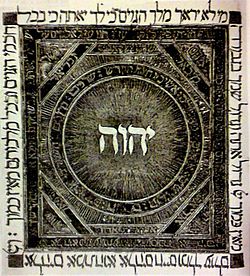
Also abbreviated Jah, the most common name of God in the Hebrew Bible is the Tetragrammaton, יהוה. The Hebrew script is an abjad, and thus vowels are often omitted in writing. The Tetragrammaton is sometimes rendered with vowels, though it is not known which vowels were used originally. Direct transliteration is avoided in Jewish custom.[11]
Modern Rabbinical Jewish culture forbids pronunciation of this name. In prayers it is replaced by saying the word אֲדֹנָי (Adonai, Hebrew pronunciation: [adoˈnaj] 'My Lords', Pluralis majestatis taken as singular), and in discussion by HaShem 'The Name'. Nothing in the Torah explicitly prohibits speaking the name[12] and the Book of Ruth shows that it continued to be pronounced as late as the 5th century BCE.[13][n 2] Mark Sameth argues that only a pseudo name was pronounced, the four letters יהוה (YHVH, YHWH) being a cryptogram which the priests of ancient Israel read in reverse as huhi, 'he–she', signifying a dual-gendered deity, as earlier theorized by Guillaume Postel (16th century) and Michelangelo Lanci [it] (19th century).[15][16][17][18] It had ceased to be spoken aloud by at least the 3rd century BCE, during Second Temple Judaism.[19] The Talmud relates, perhaps anecdotally, that this began with the death of Simeon the Just.[20] Vowel points began to be added to the Hebrew text only in the early medieval period. The Masoretic Text adds to the Tetragrammaton the vowel points of Adonai or Elohim (depending on the context), indicating that these are the words to be pronounced in place of the Tetragrammaton (see Qere and Ketiv),[21][22] as shown also by the pronunciation changes when combined with a preposition or a conjunction. This is in contrast to Karaite Jews, who traditionally viewed pronouncing the Tetragrammaton as a mitzvah because the name appears some 6800 times throughout the Tanakh; however, most modern Karaites, under pressure and seeking acceptance from mainstream Rabbinical Jews, now also use the term Adonai instead.[23] The Beta Israel pronounce the Tetragrammaton as Yahu, but also use the Geʽez term Igziabeher.[24]
The Tetragrammaton appears in Genesis[25] and occurs 6,828 times in total in the Biblia Hebraica Stuttgartensia edition of the Masoretic Text. It is thought to be an archaic third-person singular of the imperfective aspect[n 3] of the verb "to be" (i.e., "[He] is/was/will be"). This agrees with the passage in Exodus where God names himself as "I Will Be What I Will Be"[26] using the first-person singular imperfective aspect, open to interpretation as present tense ("I am what I am"), future ("I shall be what I shall be"), or imperfect ("I used to be what I used to be").[27]
Rabbinic Judaism teaches that the name is forbidden to all except the High Priest of Israel, who should only speak it in the Holy of Holies of the Temple in Jerusalem on Yom Kippur. He then pronounces the name "just as it is written."[28] As each blessing was made, the people in the courtyard were to prostrate themselves completely as they heard it spoken aloud. As the Temple has not been rebuilt since its destruction in 70 CE, most modern Jews never pronounce YHWH but instead read אֲדֹנָי (Adonai, Hebrew pronunciation: [adoˈnaj], 'My Lords', Pluralis majestatis taken as singular) during prayer and while reading the Torah and as HaShem 'The Name' at other times.[29][30] Most English translations of the Bible write "the LORD" for YHWH, and "the LORD God" or "the Lord GOD" for Adonai YHWH instead of transcribing the name. The Septuagint may have originally used the Hebrew letters themselves amid its Greek text,[31][32] but there is no scholarly consensus on this point.
Adonai
[edit]

אֲדֹנָי (ăḏonāy, Biblical Hebrew pronunciation: [aðoˈnɔːj], lit. transl. My Lords, pluralis majestatis taken as singular) is the possessive form of adon ('Lord'), along with the first-person singular pronoun enclitic.[n 4] As with Elohim, Adonai's grammatical form is usually explained as a form akin to the "royal we". In the Hebrew Bible, the word is nearly always used to refer to God (approximately 450 occurrences). As the pronunciation of the Tetragrammaton came to be avoided in the Hellenistic period, Jews may have begun to drop the Tetragrammaton when presented alongside Adonai and subsequently to expand it to cover for the Tetragrammaton in the forms of spoken prayer and written scripture. Owing to the expansion of chumra, the idea of 'building a fence around the Torah', the word Adonai itself has come to be too holy to say for Orthodox Jews outside of prayer, leading to its replacement by HaShem ('The Name').
The singular forms adon and adoni ('my lord') are used in the Hebrew Bible as royal titles,[33][34] as in the First Book of Samuel,[35] and for distinguished persons. The Phoenicians used it as a title of Tammuz (the origin of the Greek god's name Adonis). It is also used very occasionally in Hebrew texts to refer to God (e.g. Psalm 136:3).[36] Deuteronomy 10:17 has the Tetragrammaton alongside the superlative constructions "God of gods" (elōhê ha-elōhîm, literally, "the gods of gods") and "Lord of lords" (adōnê ha-adōnîm, "the lords of lords": כִּי יְהוָה אֱלֹהֵיכֶם הוּא אֱלֹהֵי הָאֱלֹהִים וַאֲדֹנֵי הָאֲדֹנִים; JPS 2006: "For your God יהוה is God supreme and Lord supreme").[37]
The final syllable of Adonai uses the vowel kamatz rather than patach, which would be expected from the Hebrew for 'my lord(s)'. Professor Yoel Elitzur explains this as a normal transformation when a Hebrew word becomes a name, citing other examples such as Nathan, Yitzhak, and Yigal.[38] As Adonai became the most common reverent substitute for the Tetragrammaton, it too became considered un-erasable due to its holiness. As such, most prayer books avoid spelling out the word Adonai, and instead write two yodhs (יְיָ) in its place.[39]
The forms Adaunoi, Adoinoi, and Adonoi[40] represent Ashkenazi Hebrew variant pronunciations of the word Adonai.
El
[edit]El appears in Ugaritic, Phoenician and other late Bronze and Iron Age Levant texts both as generic "god" and as the head of the divine pantheon.[41] In the Hebrew Bible, El (אל, ʾel) appears very occasionally alone (e.g. Genesis 33:20, el elohei yisrael, 'Mighty God of Israel',[42] and Genesis 46:3, ha'el elohei abika, 'El the God of thy father'),[43] but usually with some epithet or attribute attached (e.g. El Elyon, 'Most High El', El Shaddai, El Shaddai, El ʿOlām 'Everlasting El', El Hai, 'Living El', El Ro'i 'El my Shepherd', and El Gibbor 'El of Strength'). In these cases, it can be understood as the generic "god". In theophoric names such as Gabriel ("Strength of God"), Michael ("Who is like God?"), Raphael ("God healed"), Ariel ("My lion is God"), Daniel ("My judgment is God"), Ezekiel ("God shall strengthen"), Israel ("one who has struggled with God"), Immanuel ("God is with us"), and Ishmael ("God hears/ will hear / listens/ will listen") it is usually interpreted and translated as "God".
El also appears in the form אֱלוֹהַּ (Eloah).
Elohim
[edit]A common name of God in the Hebrew Bible is Elohim (אלהים, ʾĕlōhīm), the plural of אֱלוֹהַּ (Eloha). When Elohim refers to God in the Hebrew Bible, singular verbs are used. The word is identical to elohim meaning gods and is cognate to the 'lhm found in Ugaritic, where it is used for the pantheon of Canaanite gods, the children of El and conventionally vocalized as "Elohim" although the original Ugaritic vowels are unknown. When the Hebrew Bible uses elohim not in reference to God, it is plural (for example, Exodus 20:2). There are a few other such uses in Hebrew, for example Behemoth. In Modern Hebrew, the singular word ba'alim ('owner') looks plural, but likewise takes a singular verb.
A number of scholars have traced the etymology to the Semitic root *yl, 'to be first, powerful', despite some difficulties with this view.[44] Elohim is thus the plural construct 'powers'. Hebrew grammar allows for this form to mean "He is the Power (singular) over powers (plural)", just as the word Ba'alim means 'owner' (see above). "He is lord (singular) even over any of those things that he owns that are lordly (plural)".
Theologians who dispute this claim cite the hypothesis that plurals of majesty came about in more modern times. Richard Toporoski, a classics scholar, asserts that plurals of majesty first appeared in the reign of Diocletian (CE 284–305).[45] Indeed, Gesenius states in his book Hebrew Grammar the following:[46]
The Jewish grammarians call such plurals ... plur. virium or virtutum; later grammarians call them plur. excellentiae, magnitudinis, or plur. maiestaticus. This last name may have been suggested by the we used by kings when speaking of themselves (compare 1 Maccabees 10:19 and 11:31); and the plural used by God in Genesis 1:26 and 11:7; Isaiah 6:8 has been incorrectly explained in this way. It is, however, either communicative (including the attendant angels: so at all events in Isaiah 6:8 and Genesis 3:22), or according to others, an indication of the fullness of power and might implied. It is best explained as a plural of self-deliberation. The use of the plural as a form of respectful address is quite foreign to Hebrew.
Mark S. Smith has cited the use of plural as possible evidence to suggest an evolution in the formation of early Jewish conceptions of monotheism, wherein references to "the gods" (plural) in earlier accounts of verbal tradition became either interpreted as multiple aspects of a single monotheistic God at the time of writing, or subsumed under a form of monolatry, wherein the god(s) of a certain city would be accepted after the fact as a reference to the God of Israel and the plural deliberately dropped.[47]
The plural form ending in -im can also be understood as denoting abstraction, as in the Hebrew words chayyim (חיים, 'life') or betulim (בתולים, 'virginity'). If understood this way, Elohim means 'divinity' or 'deity'. The word chayyim is similarly syntactically singular when used as a name but syntactically plural otherwise. In many of the passages in which elohim occurs in the Bible, it refers to non-Israelite deities, or in some instances to powerful men or judges, and even angels (Exodus 21:6, Psalms 8:5) as a simple plural in those instances.
Shaddai
[edit]El Shaddai (אל שדי, ʾel šadday, pronounced [ʃaˈdaj]) is one of the names of God in Judaism, with its etymology coming from the influence of the Ugaritic religion on modern Judaism. El Shaddai is conventionally translated as "God Almighty". While the translation of El as 'god' in Ugaritic/Canaanite languages is straightforward, the literal meaning of Shaddai is the subject of debate.
Tzevaot
[edit]Tzevaot, Tzevaoth, Tsebaoth or Sabaoth (צבאות, ṣəḇāʾōṯ, pronounced [tsvaot] ⓘ, lit. "Armies"), usually translated "Hosts", appears in reference to armies or armed hosts of men but is not used as a divine epithet in the Torah, Joshua, or Judges. Starting in the Books of Samuel, the term "Lord of Hosts" appears hundreds of times throughout the Prophetic books, in Psalms, and in Chronicles.
The Hebrew word Sabaoth was also absorbed in Ancient Greek (σαβαωθ, sabaōth) and Latin (Sabaoth, with no declension). Tertullian and other Fathers of the Church used it with the meaning of "Army of angels of God".[48]
Ehyeh
[edit]Ehyeh asher ehyeh (אֶהְיֶה אֲשֶׁר אֶהְיֶה) is the first of three responses given to Moses when he asks for God's name in the Book of Exodus.[26] The King James Version of the Bible translates the Hebrew as "I Am that I Am" and uses it as a way to describe God.
The word ehyeh is the first-person singular imperfect form of hayah, 'to be'. Biblical Hebrew does not distinguish between grammatical tenses. It has instead an aspectual system in which the imperfect denotes any actions that are not yet completed,[49][50][51] Accordingly, Ehyeh asher ehyeh can be rendered in English not only as "I am that I am" but also as "I will be what I will be" or "I will be who I will be", or "I shall prove to be whatsoever I shall prove to be" or even "I will be because I will be". Other renderings include: Leeser, "I Will Be that I Will Be"; Rotherham, "I Will Become whatsoever I please", Greek, Ego eimi ho on (ἐγώ εἰμι ὁ ὤν), "I am Being/the Existing One" in the Septuagint,[52] and Philo,[53][54] and Revelation;[55] Latin, ego sum qui sum, "I am Who I am."
The word asher is a relative pronoun whose meaning depends on the immediate context, so that "that", "who", "which", or "where" are all possible translations of that word.[56]
Other names and titles
[edit]Baal
[edit]Baal meant 'owner' and, by extension, 'lord',[57] 'master', and 'husband' in Hebrew and the other Northwest Semitic languages.[58][59] In some early contexts and theophoric names, it and Baali (/ˈbeɪəlaɪ/; "My Lord") were treated as synonyms of Adon and Adonai.[60] After the time of Solomon[61] and particularly after Jezebel's attempt to promote the worship of the Lord of Tyre Melqart,[60] however, the name became particularly associated with the Canaanite storm god Baʿal Haddu and was gradually avoided as a title for Yahweh.[61] Several names that included it were rewritten as bosheth ("shame").[62] The prophet Hosea in particular reproached the Israelites for continuing to use the term:[63]
"It will come about in that day," declares the Lord, "That you will call Me Ishi[n 5] And will no longer call Me Baali."[65]
Elah
[edit]Elah (Hebrew: אֱלָה, romanized: ʾelāh, pl. Elim or Elohim; Imperial Aramaic: אלהא) is the Aramaic word for God and the absolute singular form of אלהא, ʾilāhā. The origin of the word is from Proto-Semitic *ʔil and is thus cognate to the Hebrew, Arabic, Akkadian, and other Semitic languages' words for god. Elah is found in the Tanakh in the books of Ezra, Jeremiah (Jeremiah 10:11,[66] the only verse in the entire book written in Aramaic),[67] and Daniel. Elah is used to describe both pagan gods and the Abrahamic God.
- Elah Yisrael, God of Israel (Ezra 5:1)
- Elah Yerushelem, God of Jerusalem (Ezra 7:19)
- Elah Shemaya, God of Heaven (Ezra 7:23)
- Elah-avahati, God of my fathers, (Daniel 2:23)
- Elah Elahin, God of gods (Daniel 2:47)
El Roi
[edit]In the Book of Genesis, Hagar uses this name for the God who spoke to her through his angel. In Hebrew, her phrase El Roi, literally, 'God of Seeing Me',[68] is translated in the King James Version as "Thou God seest me."[69][70]
Elyon
[edit]The name Elyon (עליון) occurs in combination with El, YHWH, Elohim and alone. It appears chiefly in poetic and later Biblical passages. The modern Hebrew adjective 'Elyon means 'supreme' (as in "Supreme Court": Hebrew: בית המשפט העליון) or 'Most High'. El Elyon has been traditionally translated into English as 'God Most High'. The Phoenicians used what appears to be a similar name for God, one that the Greeks wrote as Έλιονα.
Eternal One
[edit]The Eternal One or The Eternal is increasingly used, particularly in Reform and Reconstructionist communities seeking to use gender-neutral language.[71] In the Torah, YHWH El Olam ("the Everlasting God") is used at Genesis 21:33 to refer to God.[72]
HaShem
[edit]

It is common Jewish practice to restrict the use of the names of God to a liturgical context. In casual conversation some Jews, even when not speaking Hebrew, will call God HaShem (השם), which is Hebrew for 'the Name' (compare Leviticus 24:11 and Deuteronomy 28:58). When written, it is often abbreviated to ה׳. Likewise, when quoting from the Tanakh or prayers, some pious Jews will replace Adonai with HaShem. For example, when making audio recordings of prayer services, HaShem[73] will generally be substituted for Adonai.
A popular expression containing this phrase is Baruch HaShem, meaning "Thank God" (literally, 'Blessed be the Name').[74]
Samaritans use the Aramaic equivalent Shema (ࠔࠌࠀ, 'the name') in much the same situations as Jews use HaShem.
Shalom
[edit]Talmudic authors,[75] ruling on the basis of Gideon's name for an altar (YHVH-Shalom, according to Judges 6:24), write that "the name of God is 'Peace'" (Pereq ha-Shalom, Shabbat 10b); consequently, a Talmudic opinion (Shabbat, 10b) asserts that one would greet another with the word shalom in order for the word not to be forgotten in the exile. But one is not permitted to greet another with the word Shalom in unholy places such as a bathroom, because of the holiness of the name.
Shekhinah
[edit]Shekhinah (שכינה) is the presence or manifestation of God which has descended to "dwell" among humanity. The term never appears in the Hebrew Bible; later rabbis used the word when speaking of God dwelling either in the Tabernacle or amongst the people of Israel. The root of the word means "dwelling". Of the principal names of God, it is the only one that is of the feminine gender in Hebrew grammar. Some believe that this was the name of a female counterpart of God, but this is unlikely as the name is always mentioned in conjunction with an article (e.g.: "the Shekhina descended and dwelt among them" or "He removed Himself and His Shekhina from their midst"). This kind of usage does not occur in Semitic languages in conjunction with proper names.[citation needed] The term, however, may not be a name, as it may merely describe the presence of God, and not God Himself.
Uncommon or esoteric names
[edit]- Abir – 'Strong One'[76]
- Adir – 'Great One'[77]
- Adon Olam – 'Master of the World'
- Aleim – sometimes seen as an alternative transliteration of Elohim
- Ani Sh'ani - 'I am that I am': another modern Hebrew form of "Ehyeh asher Ehyeh"
- Aravat (or Avarat) – 'Father of Creation'; mentioned once in 2 Enoch, "On the tenth heaven is God, in the Hebrew tongue he is called Aravat".
- Av Harachamim – 'Father of Mercy'
- ⓘ – 'Our Father, Our King'
- ⓘ – 'The Creator'
- Bore Olam – 'Creator of the World'
- Dibbura or Dibbera – 'The Word (The Law)' – used primarily in the Palestinian Targums of the Pentateuch (Aramaic); e.g. Num 7:89, The Word spoke to Moses from between the cherubim in the holy of holies.
- Ehiyeh sh'Ehiyeh – 'I Am That I Am': a modern Hebrew version of "Ehyeh asher Ehyeh"
- Eibishter/Aybishter – 'The One Above' (Yiddish: אײבערשטער)
- Ein Sof – 'Endless, Infinite', Kabbalistic name of God
- El ha-Gibbor – 'God the Hero', 'God the Strong' and 'God the Warrior'
- Emet – 'Truth' (the "Seal of God".[78][79][80] [Cf.[81]] The word is composed of the first, middle, and last letters of the Hebrew alphabet. See also Alpha and Omega#Judaism)
- HaKadosh, Barukh Hu (Hebrew); Kudsha, Brikh Hu (Aramaic) – 'The Holy One, Blessed Be He'
- Hayah, Hoveh, v'Yihye – 'Was, Is, and Will be'
- Kadosh Israel – 'Holy One of Israel'
- Magen Avraham – 'Shield of Abraham'
- Makom or HaMakom – literally 'The Place', perhaps meaning 'The Omnipresent' (see Tzimtzum)
- Malbish Arumim – 'Clother of the Naked'
- Matir Asurim – 'Freer of the Captives'
- Mechayeh HaKol – 'Life giver to All' (Reform version of Mechayeh Metim)
- Mechayeh Metim – 'Life giver to the Dead'
- Melech HaMelachim – 'The King of Kings' or Melech Malchei HaMelachim 'The King, King of Kings', to express superiority to the earthly ruler's title
- Melech HaOlam – 'The King of the World'
- Memra d'Adonai – 'The Word of the LORD' (plus variations such as 'My Word') – restricted to the Aramaic Targums (the written Tetragrammaton is represented in various ways such as YYY, YWY, YY, but pronounced as the Hebrew Adonai)
- Mi She'amar V'haya Ha`olam – 'He who spoke, and the world came into being'.
- Netzakh Yisrael – 'The Glory of Israel' (1 Samuel 15:29)
- Oseh Shalom – 'Maker of Peace'
- Pokeach Ivrim – 'Opener of Blind Eyes'
- HaRachaman – 'The Merciful One'
- Rachmana – 'The Merciful One' (Aramaic)
- Ribon Kol HaOlamim – 'Master of all Worlds'
- Ribono shel'Olam – 'Master of the World'
- Ro'eh Yisra'el – 'Shepherd of Israel'
- Rofeh Cholim – 'Healer of the Sick'
- Shomer Yisrael – 'Guardian of Israel'[82]
- Somech Noflim – 'Supporter of the Fallen'
- Tzur Israel – 'Rock of Israel'
- YHWH-Yireh (Adonai-jireh) – 'The LORD Will Provide'[83]
- YHWH-Rapha – 'The LORD that Healeth'[84]
- YHWH-Niss'i (Adonai-Nissi) – 'The LORD Our Banner'[85]
- YHWH-Shalom – 'The LORD Our Peace'[86]
- YHWH-Tzevaot – 'The LORD of Hosts'[87]
- YHWH-Ro'i – 'The LORD My Shepherd'[88]
- YHWH-Tsidkenu – 'The LORD Our Righteousness'[89][90]
- YHWH-Shammah (Adonai-shammah) – 'The LORD Is Present'[91]
- Yotsehr 'Or – 'Fashioner of Light'
- Zokef kefufim – 'Straightener of the Bent'
Writing divine names
[edit]
In Jewish tradition the sacredness of the divine name or titles must be recognized by the professional sofer (scribe) who writes Torah scrolls, or tefillin and mezuzah. Before transcribing any of the divine titles or name, they prepare mentally to sanctify them. Once they begin a name, they do not stop until it is finished, and they must not be interrupted while writing it, even to greet a king. If an error is made in writing it may not be erased, but a line must be drawn round it to show that it is canceled, and the whole page must be put in a genizah (burial place for scripture) and a new page begun.
Kabbalistic use
[edit]One of the most important names is that of the Ein Sof (אין סוף 'Endless'), which first came into use after 1300 CE.[92] Another name is derived from the names אהיה יהוה אדוני הויה. By spelling these four names out with the names of the Hebrew letters (אלף, הא, וו, יוד, דלת and נון)[clarification needed] this new forty-five letter long name is produced. Spelling the letters in יהוה (YHWH) by itself gives יוד הא ואו הא. Each letter in Hebrew is given a value, according to gematria, and the value of יוד הא ואו הא is also 45.[citation needed]
The 72-fold name is derived from three verses in Exodus 14:19–21. Each of the verses contains 72 letters. When the verses are read boustrophedonically 72 names, three letters each, are produced (the niqqud of the source verses is disregarded in respect to pronunciation). Some regard this name as the Shem HaMephorash.[93]
Erasing the name of God
[edit]3 And ye shall break down their altars, and dash in pieces their pillars, and burn their Asherim with fire; and ye shall hew down the graven images of their gods; and ye shall destroy their name out of that place. 4 Ye shall not do so unto the LORD your God.
— Deuteronomy 12:3–4[94]
From this it is understood by the rabbis that one should not erase or blot out the name of God. The general halachic opinion is that this only applies to the sacred Hebrew names of God, not to other euphemistic references; there is a dispute as to whether the word "God" in English or other languages may be erased or whether Jewish law and/or Jewish custom forbids doing so, directly or as a precautionary "fence" about the law.[95]
The words God and Lord are written by some Jews as G-d and L-rd as a way of avoiding writing any name of God out in full. The hyphenated version of the English name (G-d) can be destroyed, so by writing that form, religious Jews prevent documents in their possession with the unhyphenated form from being destroyed later. Alternatively, a euphemistic reference such as Hashem (literally, 'the Name') may be substituted, or an abbreviation thereof, such as in B''H (בְּעֶזרַת הַשֵׁם B'ezrat Hashem 'with the help of the Name').[96]
See also
[edit]
Explanatory notes
[edit]- ^ a b Including variations such as אֱלוֹהַּ (Eloah, the singular), אֱלהֵי (Elohei, the construct plural), אֱלֹהֶיךָ (Elohekha), אֱלֹהֵיכֶם (eloheikhem), etc.
- ^ The World English Bible translation: "Behold, Boaz came from Bethlehem, and said to the reapers, 'Yahweh be with you.' They answered him, "Yahweh bless you.'"[14] The book is traditionally ascribed to the prophet Samuel, who lived in the 11th and 10th centuries BCE; but a date of the 6th or 5th century BCE for the passage is more common among subscribers to the Documentary Hypothesis regarding the development of the Hebrew Bible canon.
- ^ Biblical Hebrew did not have strictly defined past, present, or future tenses, but merely perfective and imperfective aspects, with past, present, or future connotation depending on context: see Modern Hebrew verb conjugation#Present tense.
- ^ Gesenius, Hebrew Grammar, §124i (on pluralis majestatis): "Further, אֲדֹנִים, as well as the singular אָדוֹן, (lordship) lord, e.g. אֲדֹנִים קָשֶׁה a cruel lord, Is 19:4; אֲדֹנֵי הָאָרֶץ the lord of the land, Gn 42:30, cf. Gn 32:19; so especially with the suffixes of the 2nd and 3rd persons אֲדֹנֶיךָ, אֲדֹנַיִךְ ψ 45:12, אֲדֹנָיו, &c., also אֲדֹנֵינוּ (except 1 S 16:16); but in 1st sing. always אֲדֹנִי. So also בְּעָלִים (with suffixes) lord, master (of slaves, cattle, or inanimate things; but in the sense of maritus, always in the singular), e.g. בְּעָלָיו Ex 21:29, Is 1:3, &c."
- ^ Literally, "my husband".[64]
References
[edit]Citations
[edit]- ^ a b This is the formulation of Joseph Karo (SA YD 276:9). Maimonides (MT Yesodei haTorah 6:2), Jacob ben Asher (AT YD 276), and Isaac Alfasi (HK Menachot 3b) also included I Am that I Am, as do many later authorities, including Moses Isserles (SA YD 276:9). The original lists are found in y. Megillah 1:9 and b. Shavuot 35a, with some MSs agreeing with each authority. Maimonides and followers give the number of names as seven; however, manuscript inconsistency makes it difficult to judge which are included. Authorities including Asher ben Jehiel (Responsa 3:15), the Tosafists (b. Sotah 10a), Yechiel of Paris (cited Birkei Yosef, Oraḥ Hayyim 85:8), Simeon ben Zemah Duran, Yaakov ben Moshe Levi Moelin, and Moses Isserles (SA YD 276:13), include the term Shalom as well.
- ^ e.g. Akiva Eiger (Hagahot to SA YD 276:9) and Shabbatai HaKohen (SK YD 179:11). Yechiel Michel Epstein (AH HM 27) was the first major authority to explicitly disagree. See also J. David Bleich, Contemporary Halakhic Problems Vol. I ch. IX.
- ^ Epstein, Jonathan Eybeschutz, Urim veTumim 27:2, Yaakov Lorberbaum, Netivot ha-Mishpat 27:2, etc.
- ^ Rich, Tracey R. (1996), "The Name of G-d", Judaism 101, archived from the original on 3 June 2019, retrieved 31 Aug 2015
- ^ "If an error is made in writing it, it may not be erased, but a line must be drawn round it to show that it is canceled..." Archived 2011-11-14 at the Wayback Machine, "Names of God", 1906 Jewish Encyclopedia
- ^ Maimonides, "Yesodei ha-Torah - Chapter 6", Mishneh Torah - Sefer Madda, translated by Touger, Eliyahu, Chabad.org, archived from the original on 2017-08-11, retrieved 2017-08-10
- ^ Jose ben Halafta, Soferim, 4:1, Yer. R. H., 1:1; Ab. R. N., 34.[clarification needed]
- ^ Rabbi Ishmael, Sanhedrin, 66a.
- ^ Sheb. 35a.[clarification needed]
- ^ Num. 6:23–27.
- ^ Alter, Robert (2018), The Hebrew Bible: A Translation with Commentary, vol. 3, W. W. Norton, p. intro, ISBN 978-0-393-29250-3, retrieved 2023-03-31
- ^ Byrne, Máire (2011), The Names of God in Judaism, Christianity, and Islam: A Basis for Interfaith Dialogue, A&C Black, p. 24
- ^ Ruth 2:4
- ^ Ruth 2:4 Archived 2015-10-11 at the Wayback Machine (WEB).
- ^ Sameth, Mark (2020), The Name: A History of the Dual-Gendered Hebrew Name for God, Wipf & Stock, p. 25, ISBN 978-1-5326-9384-7, retrieved 2023-03-19
- ^ "At one point he [Guillaume Postel] observes that the Tetragrammaton יהוה yhwh contains both feminine and masculine pro-nouns — וה wh, and יה yh. He then finds this discovery is corroborated in 1 Kings 17:15, when the Prophet Elijah sits down with the Widow of Zarephath and the Hebrew says "she ate, she and he" וַתֹּאכַל הוא-והיא הִיא-וָהוּא. What is striking here in Kings is that the vowels of the pronouns are swapped around: הוא hw' (he) is vocalized as היא hy' (she), and vice versa. This was exactly the sort of divine gender-bending he was after." — Wilkinson, Robert (2015), Tetragrammaton: Western Christians and the Hebrew Name of God, Boston: Brill, p. 337, ISBN 978-90-04-28817-1, retrieved 2023-03-19
- ^ Postel, Guillaume (1969), Secret, François (ed.), Le thrésor des prophéties de l'univers (in French), Springer, p. 211, ISBN 978-90-247-0203-9, retrieved 2023-03-19
- ^ Lanci, Michelangelo (1845), Paralipomeni alla illustrazione della sagra Scrittura (in Italian) (Facsmile of the 1st ed.), Dondey-Dupre, pp. 100–113, ISBN 978-1-274-01691-1, retrieved 2023-03-19
{{citation}}: ISBN / Date incompatibility (help) - ^ Harris, Stephen L. (1985), Understanding the Bible: A Reader's Introduction (2nd ed.), Palo Alto, CA: Mayfield, p. 21, ISBN 978-1-55934-083-0
- ^ Yoma; Tosefta Sotah 13
- ^ Johannes Botterweck, G.; Ringgren, Helmer; Fabry, Heinz-Josef (6 December 1974), "אדון ādhōn", Theological Dictionary of the Old Testament, vol. I, Eerdmans, p. 71, ISBN 978-0-8028-2325-0
- ^ Bovon, François (2009), New Testament and Christian Apocrypha: Collected Studies II, Mohr Siebeck, p. 20, ISBN 978-3-16-149050-7
- ^ "Pseudo-Qumisian Sermon to the Karaites", American Academy for Jewish Research, XLIII: 49–105, 1976
- ^ Kaplan, Steven (1992), The Beta Israel (Falasha) in Ethiopia, NYU Press, p. 29, ISBN 0-8147-4848-1
- ^ Gen. 2:4
- ^ a b Exod. 3:14
- ^ "Biblical Hebrew Grammar for Beginners" Archived 2015-03-19 at the Wayback Machine, University of Texas at Austin
- ^ "The Tetragrammaton—The Unpronounceable Four-Letter Name of God", My Jewish Learning, archived from the original on 18 September 2014, retrieved 17 September 2014
- ^ "Hebrew Name for God—Adonai", Hebrew for Christians, archived from the original on 17 May 2014, retrieved 21 May 2014
- ^ "Adonai", Theopedia, archived from the original on 2015-03-29, retrieved 2015-03-25
- ^ Origen, Commentary on Psalms 2:2.
- ^ Jerome, Prologus Galeatus.
- ^ "Lord", International Standard Bible Encyclopedia, p. 157
- ^ "Adonai and Adoni (Psalm 110:1)", Focus on the Kingdom, Restoration Fellowship, archived from the original on 9 June 2015, retrieved 5 June 2015
- ^ 1 Samuel 29:8
- ^ Psalm 136:3
- ^ Deuteronomy 10:17
- ^ Yoel Elitzur, Shemot HaEl VeTaarichei Ketivat Sifrei HaMiqra, published in Be'einei Elohim VaAdam, Beit Morasha Jerusalem: 2017, p. 407 footnote 24; see also link Archived 2019-08-26 at the Wayback Machine.
- ^ Robert James Victor Hiebert; Claude E. Cox; Peter John Gentry (2001), The Old Greek Psalter: Studies in Honour of Albert Pietersma, Sheffield: Sheffield Acad. Press, p. 129, ISBN 1-84127-209-4
- ^ Salomon Ibn Gebirol (1888), "Excerpts from the Zohar", in Myer, Isaac (ed.), Qabbalah: The Philosophical Writings of Solomon Ben Yehudah Ibn Gebirol or Avicebron and their connection with the Hebrew Qabbalah and Sepher ha-Zohar, with remarks upon the antiquity and content of the latter, and translations of selected passages from the same [...], translated by Myer, Isaac, Philadelphia: Isaac Myer, p. 341, archived from the original on 8 September 2023, retrieved 8 September 2023,
[...] the Perfect Name Adonoi or Adonai.
- ^ Toorn, Karel van der; Becking, Bob (1999), K. van der Toorn, Bob Becking, Pieter Willem van der Horst, Dictionary of deities and demons in the Bible, pp. 274-277, Wm. B. Eerdmans, ISBN 978-0-8028-2491-2, retrieved 2011-12-05
- ^ KJV margin at Gen. 33:20
- ^ Genesis 46:3
- ^ Mark S. Smith (2008), God in Translation: Deities in Cross-Cultural Discourse in the Biblical World, Coronet Books Incorporated, p. 15, ISBN 978-3-16-149543-4, retrieved 2011-12-05
- ^ R. Toporoski, "What was the origin of the royal 'we' and why is it no longer used?", The Times, May 29, 2002. Ed. F1, p. 32
- ^ Gesenius' Hebrew Grammar (A. E. Cowley, ed., Oxford, 1976, p.398)
- ^ Mark S. Smith, God in Translation: Deities in Cross-Cultural Discourse in the Biblical World, vol. 57 of Forschungen zum Alten Testament, Mohr Siebeck, 2008 Archived 2023-06-05 at the Wayback Machine, ISBN 978-3-16-149543-4, p. 19.; Smith, Mark S. (2002), "The Early History of God: Yahweh and the Other Deities in Ancient Israel" (Biblical Resource Series)
- ^ Georges, O. Badellini, F. Calonghi, Dizionario latino–italiano [Latin-to-Italian Dictionary], Rosenberg & Sellier, Turin, 17th edition, 1989, page 2431 of 2959
- ^ "Biblical Hebrew", archived from the original on 2020-08-12, retrieved 2020-11-05
- ^ "Hebrew Tenses", 31 January 2022, archived from the original on 8 March 2021, retrieved 5 November 2020
- ^ "Biblical Hebrew Grammar do Beginners" (PDF), archived (PDF) from the original on 2021-02-27, retrieved 2020-11-05
- ^ "Exodus 3:14 LXX", Bibledatabase.net, archived from the original on 2011-08-10, retrieved 2014-05-21
- ^ Yonge. Philo Life Of Moses Vol.1 :75
- ^ Life of Moses I 75, Life of Moses II 67,99,132,161 in F.H. Colson Philo Works Vol. VI, Loeb Classics, Harvard 1941
- ^ Rev.1:4,1:8.4:8 UBS Greek Text Ed.4
- ^ Seidner, 4.
- ^ Herrmann (1999), p. 132.
- ^ Pope (2006).
- ^ DULAT (2015), "bʕl (II)".
- ^ a b BEWR (2006), "Baal".
- ^ a b Encyclopaedia Judaica, 2nd ed., vol. VII, p. 675
- ^ ZPBD (1963).
- ^ Hos. 2:16.
- ^ Uittenbogaard, Arie, Ishi | The amazing name Ishi: meaning and etymology, Abarim Publications, archived from the original on 8 May 2014, retrieved 21 May 2014
- ^ Hos. 2:16 (NASB).
- ^ Jeremiah 10:11
- ^ Torrey 1945, 64; Metzger 1957, 96; Moore 1992, 704,
- ^ Gen. 16:13
- ^ Gen. 16:13 KJV.
- ^ "Genesis 16:13 So Hagar gave this name to the LORD who had spoken to her: "You are the God who sees me," for she said, "Here I have seen the One who sees me!"", archived from the original on 2020-09-23, retrieved 2020-09-20
- ^ Matthew Berke, GOD AND GENDER IN JUDAISM Archived 2015-12-22 at the Wayback Machine, First Things, June 1995; Mel Scult, The Radical American Judaism of Mordecai M. Kaplan, Indiana University Press, 2013. p. 195.
- ^ Gen 21:33.
- ^ "What is HaShem?", archived from the original on 2019-04-17, retrieved 2019-04-20
- ^ Greenbaum, Elisha, "Thank G-d!", Chabad.org, archived from the original on 15 February 2015, retrieved 15 February 2015
- ^ Rabbi Adah ben Ahabah and Rabbi Haninuna (possibly citing "'Ulla")
- ^ "H46 – 'abiyr – Strong's Hebrew Lexicon (KJV)", Blue Letter Bible, archived from the original on 6 December 2017, retrieved 20 November 2017
- ^ "H117 – 'addiyr – Strong's Hebrew Lexicon (KJV)", Blue Letter Bible, archived from the original on 1 December 2017, retrieved 21 November 2017
- ^ "Yoma 69b:7-8", Sefaria, archived from the original on 2021-03-01, retrieved 2020-11-26
- ^ "Shabbat 55a:12", Sefaria, archived from the original on 2020-12-03, retrieved 2020-11-26
- ^ "Bereishit Rabbah 81:2", Sefaria, archived from the original on 2020-12-03, retrieved 2020-11-26
- ^ "Isaiah 44:6", Sefaria, archived from the original on 2020-12-06, retrieved 2020-11-26
- ^ Psalms 121:4
- ^ Genesis 22:13–14
- ^ Exodus 15:26
- ^ Exodus 17:8–15
- ^ "Judges 6 / Hebrew - English Bible / Mechon-Mamre", mechon-mamre.org, retrieved 2024-08-25
- ^ 1 Samuel 1:11
- ^ Psalms 23:1
- ^ Names of God Archived 2011-04-13 at the Wayback Machine
- ^ Jeremiah 23:6
- ^ Ezekiel 48:35
- ^ Encyclopaedia Judaica, 2nd ed., vol. VI, Keter Publishing House, p. 232
- ^ Trachtenberg (1939), pp. 90–98, 288ff.
- ^ Deuteronomy 12:3–4
- ^ "Shaimos guidelines", Shaimos.org, archived from the original on 2011-12-27, retrieved 2011-12-05
- ^ Davidson, Baruch (2011-02-23), "Why Don't Jews Say G‑d's Name? - On the use of the word "Hashem" - Chabad.org", Chabad.org, archived from the original on 2023-04-15, retrieved 2023-04-15
Works cited
[edit]- Britannica Encyclopedia of World Religions, New York: Encyclopædia Britannica, 2006, ISBN 978-1-59339-491-2.
- Diccionario de la Lengua Ugarítica (3rd ed.), Leiden: E.J. Brill, 2015, ISBN 978-90-04-28864-5. Translated from the Spanish as A Dictionary of the Ugaritic Language in the Alphabetic Tradition (Ser. Handbuch der Orientalistik [Handbook of Oriental Studies], Vol. 112).
- Herrmann, Wolfgang (1999), "Baal", Dictionary of Deities and Demons in the Bible, 2nd ed., Grand Rapids: Wm. B. Eerdmans Publishing, pp. 132–139.
- Pope, Marvin H. (2006), "Baal Worship", Encyclopaedia Judaica, 2nd ed., vol. III, New York: Thomas Gale, ISBN 978-0-02-865928-2.
- Trachtenberg, Joshua (1939), Jewish Magic and Superstition, Behrman's Jewish Book House – via The Internet Sacred Text Archive.
- The Zondervan Pictorial Bible Dictionary, Grand Rapids: Zondervan Publishing House, 1999 [1963], ISBN 978-0-310-23560-6.
Further reading
[edit]- Sameth, Mark (2020), The Name: A History of the Dual-gendered Hebrew Name for God, Eugene, Oregon: Wipf & Stock, ISBN 978-1-5326-9385-4, OCLC 1191710825.
External links
[edit] | This section's use of external links may not follow Wikipedia's policies or guidelines. (April 2025) |
- God's names in Jewish thought and in the light of Kabbalah
- The Name of God as Revealed in Exodus 3:14—an explanation of its meaning.
- Bibliography on Divine Names in the Dead Sea Scrolls
- Names of God—The Jewish Encyclopedia
- "Ehyeh Asher Ehyeh" – Song and Video of Ancient Yemenite Prayer from the Diwan
- R. Clover, "The Sacred Name Yahweh" (PDF), Qadesh La Yahweh Press, archived from the original on June 15, 2007

| |||||||||||||||||||||||||||||||
| |||||||||||||||||||||||||||||||


Names of God in Judaism
View on GrokipediaIntroduction and Significance
Historical Development
The names of God in Judaism trace their roots to the religious traditions of the ancient Near East, particularly the Canaanite and Ugaritic pantheons discovered in texts from the Late Bronze Age (c. 1500–1200 BCE). In Ugaritic mythology, El served as the high god and head of the divine council, a concept paralleled in early Hebrew depictions where El appears as a patriarchal deity associated with creation and authority.[4] Scholars identify these influences through linguistic and thematic similarities, such as the shared epithets and motifs in Ugaritic epics like the Baal Cycle, which reflect a polytheistic framework that early Israelite religion adapted.[5] The Tetragrammaton (YHWH), recognized as the most ancient personal name for the Israelite deity, may have origins in southern contexts, possibly Midianite or Edomite regions, based on references in biblical narratives to YHWH's association with southern locales like Sinai and Seir.[6] Archaeological evidence confirms the early use of these names outside the Bible. The Mesha Stele, erected around 840 BCE by the Moabite king Mesha, contains the first extra-biblical reference to YHWH, describing victories over Israelite forces and invoking the deity in a Moabite context. Inscriptions from Kuntillet Ajrud, dating to the 8th century BCE in the northern Negev, mention YHWH alongside a consort figure, indicating regional variations in worship during the monarchic period (c. 1000–586 BCE).[7] Within the Hebrew Bible, divine names evolve from a henotheistic framework—where Elohim's plural form suggests an assembly of gods, with YHWH as Israel's primary patron—to a stricter monotheism following the Babylonian Exile (586–539 BCE).[8] This shift is evident in post-exilic texts like Second Isaiah (Isaiah 40–55), which emphasize YHWH's uniqueness and sovereignty over other nations' deities, reflecting theological consolidation amid Persian rule.[9] In the post-biblical era, linguistic and cultural influences shaped the transmission of divine names. During the Second Temple period (516 BCE–70 CE), Aramaic became prevalent, introducing terms like Elah (אֱלָה), the Aramaic equivalent of El or Elohim, as seen in biblical books like Daniel and Ezra, where it denotes the God of Israel in imperial contexts.[10] The Septuagint, the Greek translation of the Hebrew Bible begun in the 3rd century BCE in Alexandria, rendered YHWH consistently as Kyrios (Lord), a practice that avoided direct pronunciation and aligned with emerging reverential customs.[11] Rabbinic traditions, developing from the 2nd century BCE onward, further promoted avoidance of uttering YHWH aloud, substituting Adonai or other epithets during readings to preserve sanctity, a reticence that intensified after the Temple's destruction in 70 CE.[12] This codification culminated in the Masoretic Text, standardized by Jewish scribes (Masoretes) between the 7th and 10th centuries CE, which added vowel points and accents to the consonantal Hebrew, ensuring precise vocalization of names like YHWH (pointed as Adonai) while maintaining orthographic integrity.[13]Theological Importance
In Jewish theology, the names of God serve as profound manifestations of divine essence, each revealing distinct attributes while collectively underscoring God's transcendent unity. For instance, Elohim conveys God's power and role as creator and judge, emphasizing sovereignty over the natural order, as seen in Genesis 1 where it describes the act of creation. YHWH, the Tetragrammaton, signifies God's covenantal faithfulness and eternal presence, particularly in relation to Israel, as revealed to Moses in Exodus 3:14-15. Adonai, meaning "Lord" or "Master," highlights God's mercy and relational intimacy, often invoked to express dependence and compassion in human-divine encounters. These names are not arbitrary labels but descriptors that illuminate aspects of the divine character without delimiting the infinite God.[14][15][10] The multiplicity of names symbolizes the inadequacy of human language to fully capture God's essence, a concept articulated by medieval philosopher Maimonides, who viewed most names as attributes or actions rather than the core identity, with YHWH alone as the proper name denoting pure existence beyond attributes. This plurality fosters a dynamic theological understanding, allowing Jews to approach the divine through varied lenses—such as justice (Elohim), peace (Shalom), or nurturing (El Shaddai)—reflecting the belief that God engages humanity in multifaceted ways. The biblical commandment against taking God's name in vain (Exodus 20:7) underscores this, prohibiting casual or manipulative use while affirming the names' sacred potency.[16][17][18] In prayer and liturgy, divine names play a central role in invoking God's presence and fostering spiritual connection, with substitutions like Adonai for YHWH ensuring reverence during recitation, a practice rooted in Second Temple Judaism to avoid profanation. The Shema prayer, for example, combines Adonai and Eloheinu to affirm monotheism and relational devotion. Contemporary theological debates, particularly in feminist critiques, challenge the predominantly masculine imagery in traditional names, arguing it reinforces patriarchal structures and limits inclusive understandings of the divine. Progressive and Reform Judaism respond with gender-neutral alternatives like "Eternal One" or "Source of Life," promoting a more egalitarian theology while preserving the names' invocatory power in worship.[10][2][19]Primary Biblical Names
Tetragrammaton (YHWH)
The Tetragrammaton, denoted by the four Hebrew consonants יהוה (YHWH), represents the most sacred personal name of God in Judaism, appearing 6,828 times in the Masoretic Text of the Hebrew Bible.[20] Its etymology is traditionally derived from the Hebrew root ה.י.ה (h-y-h), meaning "to be," interpreted as "He Who Is" or "He Causes to Be," emphasizing God's eternal and self-existent nature.[21] This understanding stems from the divine self-revelation in Exodus 3:14, where God declares "Ehyeh asher ehyeh" ("I am who I am"), linking the name to the verb of being, though scholars note this may be a folk etymology as the precise form would grammatically differ.[22] In biblical contexts, the name functions as the covenantal identifier of God, first explicitly revealed to Moses in Exodus 3:15 as an everlasting memorial for the Israelites: "YHWH, the God of your fathers... this is My name forever."[21] It appears throughout the patriarchal narratives in Genesis, such as in Genesis 2:4, where it is combined with Elohim to denote the Creator, and recurs extensively in the Torah and Prophets to signify God's relational and redemptive role with Israel. The name briefly relates to "Ehyeh" as a first-person form of self-revelation in Exodus, and it forms the basis for compound names like YHWH Tseva'ot ("Lord of Hosts").[21] Due to its profound holiness, the pronunciation of YHWH became taboo among Jews during the Second Temple period (c. 516 BCE–70 CE), with the name no longer vocalized aloud to avoid misuse, as reflected in contemporary texts prohibiting its utterance.[23] Scholars reconstruct the likely ancient pronunciation as "Yahweh" based on Greek transcriptions (e.g., iaō in magical papyri) and theophoric elements in personal names like Elijah (Eliyahu).[23] In Jewish reading traditions, it is substituted with Adonai ("Lord") during liturgy or HaShem ("The Name") in everyday speech to honor the prohibition. The name's gematria value—yod (10) + he (5) + vav (6) + he (5) = 26—holds symbolic significance in Jewish numerology, representing divine unity and mercy.[24] Archaeological evidence attests to the name's antiquity and usage in ancient Israel. The Samaria ostraca, administrative potsherds from the 8th century BCE discovered at the northern kingdom's capital, include theophoric names incorporating YHWH elements, such as Shemaryau ("YHWH has guarded"), indicating widespread invocation of the deity in daily life.[25] Similarly, inscriptions from Kuntillet Ajrud, a site in the Sinai dated to the late 9th–early 8th century BCE, feature blessings like "I bless you by YHWH of Samaria and his Asherah," confirming the name's prominence in Israelite religious practice and regional cultic contexts.[26]Elohim
Elohim (אֱלֹהִים) is the plural form of the Hebrew root el or eloah, denoting "power," "might," or "deity," and serves as a title emphasizing God's supreme authority and strength.[27][28] When referring to the God of Israel, Elohim is grammatically plural but paired with singular verbs and adjectives, such as in Genesis 1:1 ("In the beginning Elohim created"), underscoring monotheistic unity rather than multiplicity.[27] This form appears approximately 2,600 times in the Hebrew Bible, making it one of the most frequent designations for the divine.[29] In the Torah, Elohim predominates in the early chapters, particularly the creation narrative of Genesis 1, where it appears over 30 times to depict God as the transcendent architect of the cosmos, speaking order into existence through divine command.[30] This usage shifts in Genesis 2–3 to the combined form YHWH Elohim, appearing around 20 times in that section alone, to bridge the universal creator with the personal deity involved in human formation and narrative events.[30] The combination YHWH Elohim occurs about 38 times overall in the Bible, highlighting the integration of God's might with His covenantal identity, as seen in contexts like Exodus 9:30.[10] Theologically, Elohim conveys God's transcendence over creation and His role in judgment, as in the midrashic tradition where it represents the divine attribute of strict justice (din), distinct from the mercy associated with YHWH.[31] It can also denote foreign deities, as in references to Philistine gods like Dagon (Judges 16:23–24), or human authorities exercising judicial power, such as in Psalm 82, where "elohim" describes corrupt human judges in the divine assembly whom God condemns for failing to uphold justice.[27][32] This multifaceted application underscores Elohim's emphasis on divine sovereignty and accountability, without implying polytheism. Rabbinic interpreters, such as Rashi, view the plural form as an expression of majesty or intensity, reflecting God's encompassing power over all natural forces and attributes, rather than multiple entities—a concept equated numerically with "ha-teva" (nature) in the commentary of Baal HaTurim.[27][33] This interpretation aligns with the singular eloah used interchangeably (e.g., Isaiah 44:6), affirming God's oneness while highlighting His humility in adopting a form that accommodates human perceptions of might.[28] In contrast to the personal, immanent YHWH, Elohim stresses generic divine authority rooted in the singular el.[34]El
El (אֵל), derived from a Northwest Semitic root meaning "god" or "deity," serves as an ancient generic term for the divine in the Hebrew Bible.[35] This root connotes power or might, reflecting the deity's strength and authority. The term appears approximately 238 times, predominantly in poetic contexts such as the Psalms and the Book of Job, where it functions as a standalone epithet for God.[36] In the biblical narrative, El originally draws from Canaanite traditions where it denoted the high god, later adapted to identify Yahweh as the singular Israelite deity. This adaptation is evident in epithets like El Olam ("Everlasting God"), used in Genesis 21:33 to describe God's eternal nature. Such usages portray El as the supreme, compassionate ruler, merging Canaanite motifs with Israelite theology while emphasizing Yahweh's uniqueness. The singular form of El also forms the basis for the plural majestic Elohim, though El retains its archaic, poetic resonance. Extrabiblical parallels appear in Ugaritic texts from ancient Canaan, where El is depicted as the creator god and benevolent father of the divine assembly, ruling over other deities with wisdom and procreative power.[37] These texts, dating to the second millennium BCE, illustrate El's role as patriarch of the pantheon, a concept echoed but transformed in the Bible to affirm monotheism. The theological evolution of El reflects a shift from potential polytheistic associations in early Israelite religion to a strictly monotheistic singular usage following the Babylonian Exile (6th century BCE). Post-exilic Judaism fully equated El with Yahweh, purging any remnants of divine plurality to underscore God's exclusive sovereignty.[38]Adonai
Adonai, meaning "my Lord" or "my Master," derives from the Hebrew root adon, signifying lordship or mastery, and is formed as a plural of majesty with the first-person possessive suffix "-i."[2] The term appears approximately 439 times in the Masoretic Text, as represented in the Leningrad Codex (the basis for the St. Petersburg Codex), with about 305 of these occurrences in the compound phrase Adonai YHWH, underscoring its frequent association with the Tetragrammaton.[39] In biblical contexts, Adonai emphasizes God's sovereignty and authority over creation and humanity. For instance, Psalm 110:1 depicts a divine declaration where YHWH addresses the psalmist's "Adonai," portraying God as the exalted ruler enthroned at the divine right hand, a motif of supreme dominion.[40] The name also features prominently in prophetic literature, such as Isaiah 6:8, where the prophet hears the "voice of Adonai" issuing a call to mission, highlighting God's directive power in commissioning human agents.[41] A key variation is Adonai Tseva'ot ("Lord of Hosts"), which appears multiple times in the Book of Isaiah, combining Adonai's lordship with the imagery of God commanding heavenly armies, as in Isaiah 6:3 during the prophet's visionary temple encounter.[42] Due to the longstanding taboo against pronouncing the Tetragrammaton YHWH, Adonai serves as the standard vocal substitute in Jewish liturgy, a practice dating back to at least the Second Temple period following the time of Simeon the Just (circa 3rd century BCE).[1][43] In synagogue Torah readings and prayers, whenever the written YHWH appears, it is vocalized as Adonai to maintain reverence.[1] This liturgical role extends to post-biblical compositions, such as the medieval hymn Adon Olam, which invokes Adonai to affirm God's eternal sovereignty.El Shaddai
El Shaddai, often translated as "God Almighty," is a prominent name for God in the Hebrew Bible, particularly within the patriarchal narratives of Genesis. The term "Shaddai" appears 48 times in the Hebrew Bible, with the compound "El Shaddai" occurring seven times, six of which are in Genesis and one in Exodus 6:3. This name underscores God's role as the powerful provider of blessings and protection, especially in contexts of covenant-making and fertility promises to the patriarchs. The etymology of "Shaddai" remains uncertain and debated among scholars. One prevalent interpretation derives it from the Hebrew root shadad, meaning "to overpower" or "destroy," rendering El Shaddai as "God the Almighty" or "God the All-Sufficient One" who wields absolute power. Alternative theories propose a connection to the Akkadian šadû, meaning "mountain," suggesting "God of the Mountain" and evoking imagery of divine majesty and stability. Another view links it to the Hebrew shad ("breast"), implying a nurturing deity associated with fertility and provision, though this interpretation is phonetically plausible but contextually less dominant in scholarly consensus.[44] In biblical contexts, El Shaddai is closely tied to divine appearances and blessings for Abraham, Isaac, and Jacob. For instance, in Genesis 17:1, God reveals himself to Abram (later Abraham) at age ninety-nine, declaring, "I am El Shaddai; walk before me, and be blameless," before establishing the covenant of circumcision and promising innumerable descendants despite Sarah's barrenness. Similarly, Isaac invokes El Shaddai in blessing Jacob (Genesis 28:3), praying for fruitfulness and nations, while God reaffirms the name to Jacob in Genesis 35:11, commanding multiplication and granting the land. These instances associate El Shaddai with themes of fertility, protection from harm, and the fulfillment of promises, portraying God as the enabler of life and legacy in a nomadic, vulnerable setting.[45][46] Theologically, El Shaddai functions as the primary name by which God was known to the patriarchs in early Israelite traditions, prior to the fuller revelation of YHWH at Sinai, emphasizing divine power and initiative in establishing covenants without yet disclosing the personal name. This prefigures later names while highlighting God's sovereignty in patriarchal history. Rabbinic interpreters, such as in Genesis Rabbah 46:3, further elucidate Shaddai as derived from mi sh-dai ("who is sufficient"), portraying God as the self-sufficient provider whose resources are ample for all creation's needs, linking the name to themes of divine adequacy and care.[47][48] El Shaddai thus builds on the foundational term El for God, adding an attribute of overwhelming might, in contrast to subsequent covenant names that stress relational presence.YHWH Tseva'ot
YHWH Tseva'ot, often translated as "YHWH of Hosts" or "Lord of Armies," derives its etymology from the Hebrew term tzva'ot, which signifies "hosts" or "armies," referring to vast multitudes, including military forces or celestial assemblies.[1] This compound name appears over two hundred times in the Hebrew Bible, with its first occurrence in 1 Samuel 1:3 and a notable concentration in the prophetic books, such as Isaiah, where it underscores divine authority in contexts of judgment and deliverance.[49][50] In biblical usage, YHWH Tseva'ot denotes God's command over both the heavenly court of angels and the earthly armies of Israel, often appearing in prophetic oracles to assure victory against adversaries.[51] For instance, it evokes assurances of divine intervention in battles, as seen in prophetic formulas linking God's sovereignty to Israel's protection.[50] This epithet extends the Tetragrammaton by emphasizing YHWH's martial and cosmic dominion, paralleling the liturgical form Adonai Tseva'ot. Theologically, YHWH Tseva'ot highlights God's universal sovereignty, extending over the created order—including stars, angels, and human nations—portraying the deity as the supreme commander who marshals all forces for justice and redemption.[52] This name affirms YHWH's active rule amid chaos, distinguishing it from other epithets by focusing on dominion rather than inherent power alone. In Jewish liturgy, YHWH Tseva'ot persists through its integration into Psalms recited in daily and festival services, such as Psalm 24:10 and Psalm 46:11, which invoke divine protection.[51] It also echoes in the Kedusha section of the Amidah, where the phrase from Isaiah 6:3—"Holy, holy, holy is the Lord of hosts"—is proclaimed, reinforcing communal awe of God's heavenly entourage during prayer.[53]Ehyeh Asher Ehyeh
Ehyeh Asher Ehyeh (אֶהְיֶה אֲשֶׁר אֶהְיֶה), meaning "I Am Who I Am" or "I Will Be What I Will Be," derives from the first-person singular imperfect form of the Hebrew verb hayah (הָיָה), "to be," emphasizing God's self-existence and eternality.[54][55] This phrase appears in Exodus 3:14, where God responds to Moses' inquiry about His name during the burning bush encounter, revealing a personal, revelatory identity distinct from other divine titles.[54] The expression links etymologically to the Tetragrammaton (YHWH) as its third-person equivalent, both rooted in the concept of being.[56] In the biblical narrative, God instructs Moses to inform the Israelites of this name, assuring divine presence and intervention in their liberation from Egypt, as stated in Exodus 3:14–16: "Ehyeh-Asher-Ehyeh has sent me to you."[54] This self-revelation underscores God's active role in history and covenantal relationship, contrasting with the impersonal power implied in names like Elohim. Theologically, Ehyeh Asher Ehyeh signifies God's eternal existence independent of creation, portraying Him as the necessary being whose essence is pure actuality without potentiality or change.[57] Medieval philosopher Maimonides, in his Guide for the Perplexed, interprets it as denoting God's necessary existence, the ultimate cause underlying all contingent beings, aligning with Aristotelian metaphysics while affirming monotheistic transcendence.[58] The name's usage is rare in the Hebrew Bible, appearing explicitly only in Exodus 3:14 and alluded to in verses 15–16, where God ties it to remembrance across generations.[54] It echoes inversely in Hosea 1:9, where God declares "Lo ehyeh lachem le'lohim" ("I will not be your God") to signify broken covenant amid Israel's infidelity, highlighting the relational implications of divine being.Additional Biblical and Compound Names
El Roi
El Roi, meaning "God who sees me" or "God of seeing," is a compound name derived from the Hebrew root r-'-h (to see) combined with El, the generic term for God.[59] This name appears uniquely in Genesis 16:13, where Hagar, an Egyptian slave fleeing mistreatment by Sarah in the wilderness, encounters a divine messenger who assures her of protection and future prosperity for her son Ishmael.[60] According to classical commentators like Rashi, the name reflects Hagar's acknowledgment of God's attentive gaze upon her affliction, while Ramban interprets it as "God of my vision," emphasizing the personal revelation she experiences.[61] Ibn Ezra similarly views it as denoting divine sight that Hagar perceives in return.[62] In its biblical context, El Roi underscores God's compassion for the marginalized, as Hagar—a foreign woman, a slave, and an outcast—receives direct divine intervention and a promise of blessing. The rarity of the name, used only once and outside patriarchal lineages, highlights its role in illustrating divine attentiveness to individual suffering rather than collective covenantal themes.[63] Theologically, El Roi signifies personal oversight and the pursuit of justice, revealing God as intimately aware of human distress and responsive to it, particularly for those on society's fringes.[60] This non-patriarchal usage distinguishes it within the biblical corpus, building on the foundational El while paralleling other names that evoke divine mercy.[59]El Elyon
El Elyon, meaning "God Most High," is a compound name derived from the Hebrew terms ʾēl (God) and ʿelyôn (most high), where ʿelyôn functions as a superlative adjective stemming from the root ʿālâ, signifying "to ascend" or "height."[64][10] This name first appears prominently in Genesis 14:18–22, where Melchizedek, king of Salem and priest of El Elyon, blesses Abram after his victory in battle, attributing the triumph to the "possessor of heaven and earth." In this context, Abram identifies El Elyon with YHWH, swearing by "the LORD, God Most High," which underscores the name's integration into early Israelite worship.[65] The biblical usage of El Elyon emphasizes a universal kingship, portraying God as sovereign over all creation and nations, transcending local or tribal deities. Scholars note that this name likely incorporates elements from Canaanite traditions, where El Elyon represented a high god, which were merged into the worship of YHWH as Israelite religion developed, equating the two as aspects of the same divine entity.[66][67] This merger highlights YHWH's ascendancy as the supreme deity, absorbing broader Levantine connotations of supremacy without diluting monotheistic identity.[66] Theologically, El Elyon signifies God's absolute sovereignty and role as redeemer for Israel amid distress, as seen in Psalm 78:35, where the people "remembered that God (ʾēl) was their Rock, and the Most High God (ʾēl ʿelyôn) their Redeemer." This usage reinforces the name's emphasis on divine elevation and protective authority over all peoples, positioning God as the ultimate arbiter of history and nations in Jewish tradition.[65] El Elyon relates to the broader name El by amplifying its connotation of power to denote unparalleled supremacy.[66]Other Compound Names (e.g., YHWH-Jireh, YHWH-Rapha)
In Judaism, compound names incorporating the Tetragrammaton (YHWH) serve as situational revelations of divine attributes, often proclaimed in moments of crisis or divine intervention to highlight specific aspects of God's interaction with Israel. These names, drawn from the Hebrew Bible (Tanakh), combine YHWH with descriptive Hebrew terms, emphasizing God's active role in provision, healing, protection, and justice. Unlike standalone names, these compounds function as theophanies—manifestations of God's presence—revealing His multifaceted nature progressively through biblical narratives. There are approximately seven major such names, each tied to a pivotal event that underscores God's faithfulness and relational character.[15][68] The following table summarizes key examples, including their meanings, biblical references, and narrative contexts:| Name | Meaning | Biblical Reference | Narrative Context |
|---|---|---|---|
| YHWH-Jireh | The Lord Will Provide | Genesis 22:14 | During the binding of Isaac, Abraham names the site after God provides a ram as a substitute sacrifice, affirming divine foresight and mercy in a test of faith.[15][68] |
| YHWH-Rapha | The Lord Who Heals | Exodus 15:26 | At the waters of Marah, after Israel complains of bitterness, God reveals His healing power by sweetening the water and promising health for obedience.[15][68] |
| YHWH-Nissi | The Lord Is My Banner | Exodus 17:15 | Following victory over the Amalekites through Moses' raised hands, he builds an altar to commemorate God as the rallying standard in battle.[68] |
| YHWH-Shalom | The Lord Is Peace | Judges 6:24 | Gideon, fearing death after an angelic visitation, erects an altar upon realizing God's assurance of peace despite his doubts.[68] |
| YHWH-Tsidkenu | The Lord Our Righteousness | Jeremiah 23:6 | In a prophetic oracle, this name describes a future Davidic king (the "righteous Branch") who will execute justice, pointing to God's ultimate vindication of Israel.[68] |
| YHWH-Rohi | The Lord My Shepherd | Psalm 23:1 | David poetically declares God's pastoral guidance, evoking protection and restoration amid life's valleys.[68] |
| YHWH-Sabaot | The Lord of Hosts | 1 Samuel 1:3 | Hannah uses this in prayer at Shiloh, invoking God's command over celestial armies during personal distress and national turmoil.[68] |