


Community hub
Recent from talks
Contribute something
Nothing was collected or created yet.
Nazi salute
View on Wikipedia


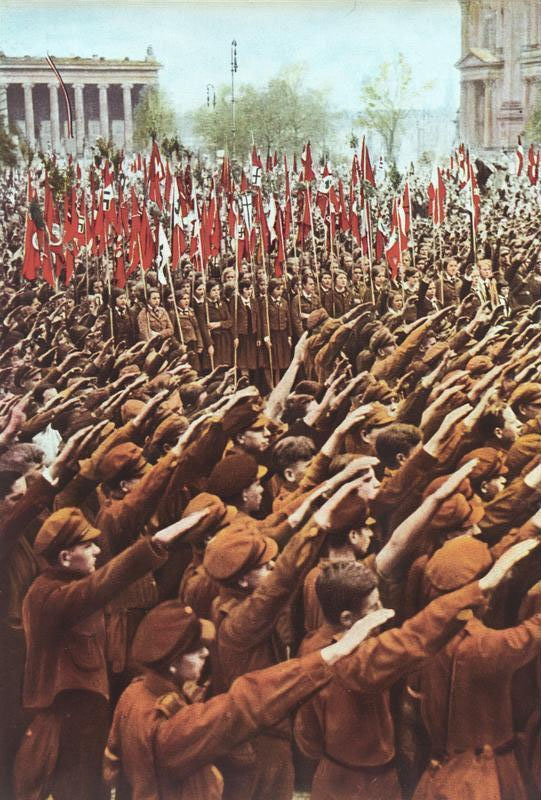
The Nazi salute, also known as the Hitler salute,[a] or the Sieg Heil salute, is a gesture that was used as a greeting in Nazi Germany. The salute is performed by raising and extending the right arm forward at an upward angle with a straightened hand, fingers together, and palm facing downward. The salute is usually accompanied by a cry of "Heil Hitler!" ('Hail Hitler!'),[b] "Heil, mein Führer!" ('Hail, my leader!'), or "Sieg Heil!" ('Hail victory!').[c]
Inspired by the Fascist salute used by members of the Italian National Fascist Party, the Nazi salute was officially adopted by the Nazi Party in 1926, although it had been used within the party as early as 1921[4] to signal obedience to the party's leader, Adolf Hitler, and to glorify the German nation (and later the German war effort). The salute was mandatory for civilians[5] but mostly optional for military personnel, who retained a traditional military salute until the failed assassination attempt on Hitler[6] on 20 July 1944.
Use of this salute is illegal in modern-day Germany (Strafgesetzbuch section 86a), Austria, and Slovakia.[7] The use of any Nazi phrases associated with the salute is also forbidden.[8] In Italy, it is a criminal offence only if used with the intent to "reinstate the defunct National Fascist Party", or to exalt or promote its ideology or members.[9] In Canada and most of Europe (including the Czech Republic,[10] France, the Netherlands, Sweden,[7] Switzerland, the United Kingdom, Ukraine, and Russia), displaying the salute is not in itself a criminal offence, but constitutes hate speech if used for propagating the Nazi ideology.[11][12][7] In Australia, publicly performing the salute is illegal unless for a religious, academic, educational, artistic, literary, or scientific purpose.[13]
Description
[edit]The salute was executed by extending the right arm stiff to an upward 45° angle and then straightening the hand so that it is parallel to the arm.[14] Usually, an utterance of "Sieg Heil", "Heil Hitler!", or "Heil!" accompanied the gesture. If one saw an acquaintance at a distance, it was enough to simply raise the right hand.[14] If one encountered a superior, one would also say "Heil Hitler".[14] If physical disability prevented raising the right arm, it was acceptable to raise the left.[15]
Hitler's use
[edit]Hitler gave a right-armed salute with variations. He used the typical stiff-armed salute when reviewing his troops or when facing crowds, but sometimes held at more of a right angle.[16] To return a salute, he raised his arm with the elbow bent back and his palm facing up.[17]
Origins and adoption
[edit]The spoken greeting "Heil" became popular in the pan-German movement around 1900.[18] It was used by the followers of Georg Ritter von Schönerer, head of the Austrian Alldeutsche Partei ('Pan-German Party') who considered himself leader of the Austrian Germans, and who was described by Carl E. Schorske as "The strongest and most thoroughly consistent anti-Semite that Austria produced" before the coming of Hitler. Hitler took both the "Heil" greeting – which was popularly used in his "hometown" of Linz when he was a boy[19] – and the title of "Führer" for the head of the Nazi Party from Schönerer,[18][20] whom he admired.[21]
The extended arm saluting gesture was alleged to be based on an ancient Roman custom, but no known Roman work of art depicts it, nor does any extant Roman text describe it.[22] Historians have instead determined that the gesture originated from Jacques-Louis David's 1784 painting Oath of the Horatii, which displayed a raised arm salutatory gesture in an ancient Roman setting.[23][24][25] The gesture and its identification with ancient Rome was advanced in other French neoclassic art.[26]

In 1892, Francis Bellamy introduced the United States Pledge of Allegiance to the country and its national flag, which was to be accompanied by a visually similar salute. Following the introduction of the Nazi salute, the salute was replaced in 1942 by a hand-over-the-heart gesture to be used by civilians during the Pledge of Allegiance and the national anthem.[27] A raised arm gesture was then used in the 1899 American stage production of Ben-Hur,[28] and its 1907 film adaptation.[29] The gesture was further elaborated upon in several early Italian films.[30] Of special note was the 1914 silent film Cabiria, whose screenplay had contributions from the Italian ultra-nationalist Gabriele d'Annunzio,[31] arguably a forerunner of Italian Fascism.[32] In 1919, when he led the occupation of Fiume, d'Annunzio used the style of salute depicted in the film as a neo-Imperialist ritual and the Italian Fascist Party quickly adopted it.[33]
By autumn 1923, or perhaps as early as 1921, some members of the Nazi Party were using the rigid, outstretched right arm salute to greet Hitler, who responded by raising his own right hand crooked back at the elbow, palm opened upwards, in a gesture of acceptance.[34] In 1926, the Nazi salute was made compulsory for all party members.[35] It functioned as a display of commitment to the Party and a declaration of principle to the outside world.[36] Gregor Strasser wrote in 1927 that the greeting in and of itself was a pledge of loyalty to Hitler, as well as a symbol of personal dependence on the Führer.[37] Even so, the drive to gain acceptance did not go unchallenged.[36]
Some party members questioned the legitimacy of the so-called Roman salute, employed by Fascist Italy, as un-Germanic.[36] In response, efforts were made to establish its pedigree by inventing a tradition after the fact.[36] In June 1928, Rudolf Hess published an article titled "The Fascist Greeting", which claimed that the gesture was used in Germany as early as 1921, before the Nazis had heard about the Italian Fascists.[38] He admits in the article: "The NSDAP's introduction of the raised-arm greeting approximately two years ago still gets some people's blood boiling. Its opponents suspect the greeting of being un-Germanic. They accuse it of merely aping the [Italian] Fascists",[39] but goes on to ask, "even if the decree from two years ago [Hess' order that all party members use it] is seen as an adaption of the Fascist gesture, is that really so terrible?".[39] Ian Kershaw points out that Hess did not deny the likely influence from Fascist Italy, even if indeed the salute had been used sporadically in 1921 as Hess claimed.[40]

On the night of 3 January 1942, Hitler said of the origins of the salute:[41]
I made it the salute of the Party long after the Duce had adopted it. I'd read the description of the sitting of the Diet of Worms, in the course of which Luther was greeted with the German salute. It was to show him that he was not being confronted with arms, but with peaceful intentions. In the days of Frederick the Great, people still saluted with their hats, with pompous gestures. In the Middle Ages the serfs humbly doffed their bonnets, whilst the noblemen gave the German salute. It was in the Ratskeller at Bremen, about the year 1921, that I first saw this style of salute. It must be regarded as a survival of an ancient custom, which originally signified: "See, I have no weapon in my hand!" I introduced the salute into the Party at our first meeting in Weimar. The SS at once gave it a soldierly style. It's from that moment that our opponents honored us with the epithet "dogs of Fascists".
— Adolf Hitler, Hitler's Table Talk
Nazi chants
[edit]
Nazi chants like "Heil Hitler!" and "Sieg Heil!" were prevalent across Nazi Germany, sprouting in mass rallies and even regular greetings alike.
In Nazi Germany, the Nazi chants "Heil Hitler!" and "Sieg Heil!" were the formulas used by the regime: when meeting someone it was customary to greet with the words "Heil Hitler!", while "Sieg Heil!" was a verbal salute used at mass rallies. Specifically to the cry of an officer of the word Sieg ('victory'), the crowd responded with Heil ('hail').[42] For example, at the 1934 Nuremberg Rally, Rudolf Hess ended his climactic speech with the words "The Party is Hitler. But Hitler is Germany, just as Germany is Hitler. Hitler! Sieg Heil!"[43] At his total war speech delivered in 1943, audiences shouted "Sieg Heil!", as Joseph Goebbels solicited from them "a kind of plebiscitary 'Ja'" to total war[44] (ja meaning 'yes' in German).
On 11 March 1945, less than two months before the capitulation of Nazi Germany, a memorial for the dead of the war was held in Marktschellenberg, a small town near Hitler's Berghof residence.[45] The British historian Ian Kershaw remarks that the power of the Führer cult and the "Hitler Myth" had vanished, which is evident from this report:
When the leader of the Wehrmacht unit at the end of his speech called for a Sieg Heil for the Führer, it was returned neither by the Wehrmacht present, nor by the Volkssturm, nor by the spectators of the civilian population who had turned up. This silence of the masses ... probably reflects better than anything else, the attitudes of the population.[45]
The Swing Youth (German: Swingjugend) were a group of middle-class teenagers who consciously separated themselves from Nazism and its culture, greeting each other with "Swing-Heil!" and addressing one another as "old-hot-boy".[46] This playful behaviour was dangerous for participants in the subculture; on 2 January 1942, Heinrich Himmler suggested that the leaders be sent to concentration camps.[46]
The form "Heil, mein Führer!" ('Hail, my Leader!') was for direct address to Hitler,[47] while "Sieg Heil" was repeated as a chant on public occasions.[47] Written communications would be concluded with either "mit deutschem Gruß" ("with German regards"), or with "Heil Hitler".[48] In correspondence with high-ranking Nazi officials, letters were usually signed with "Heil Hitler".[49]
From 1933 to 1945
[edit]

Under a decree issued by Reich Minister of the Interior Wilhelm Frick on 13 July 1933 (one day before the ban on all non-Nazi parties), all German public employees were required to use the salute.[5] The decree also required the salute during the singing of the national anthem and the "Horst-Wessel-Lied".[5] It stipulated that "anyone not wishing to come under suspicion of behaving in a consciously negative fashion will therefore render the Hitler Greeting,"[5] and its use quickly spread as people attempted to avoid being labelled as a dissident.[50] A rider to the decree, added two weeks later, stipulated that if physical disability prevented raising of the right arm, "then it is correct to carry out the Greeting with the left arm."[15] On 27 September, prison inmates were forbidden to use the salute,[51] as were Jews by 1937.[52]
By the end of 1934, special courts were established to punish those who refused to salute.[53] Offenders, such as Protestant preacher Paul Schneider, faced the possibility of being sent to a concentration camp.[53] Foreigners were not exempt from intimidation if they refused to salute. For example, the Portuguese Consul General was beaten by members of the Sturmabteilung for remaining seated in a car and not saluting a procession in Hamburg.[54] Reactions to inappropriate use were not merely violent but sometimes bizarre.[55] For example, a memo dated 23 July 1934 sent to local police stations stated: "There have been reports of traveling vaudeville performers training their monkeys to give the German Greeting. ... see to it that said animals are destroyed."[55]

The salute soon became part of everyday life, a historically unique phenomenon that politicised all communication in Germany for twelve years, superseding all prior forms of greeting, such as "Grüß Gott" ("Hello"), "Guten Tag" ("Good day"), and "Auf Wiederseh(e)n" ("Goodbye").[56] Postmen used the greeting when they knocked on people's doors to deliver packages or letters.[56] Small metal signs that reminded people to use the Hitler salute were displayed in public squares and on telephone poles and street lights throughout Germany.[57] Department store clerks greeted customers with "Heil Hitler, how may I help you?"[56] Dinner guests brought glasses etched with the words "Heil Hitler" as house gifts.[56] The salute was required of all persons passing the Feldherrnhalle in Munich, site of the climax of the 1923 Beer Hall Putsch, which the government had made into a shrine to the Nazi dead; so many pedestrians avoided this mandate by detouring through the small Viscardigasse behind that the passage acquired the nickname "Dodgers' Alley" (Drückebergergasse).[58] The daughter of the American Ambassador to Germany, Martha Dodd, describes the first time she saw the salute:
The first time I met von Ribbentrop was at a luncheon we gave at the Embassy. He was tall and slender, with a vague blond handsomeness. Outstanding among all the guests, Ribbentrop arrived in Nazi uniform. Most Nazis came to diplomatic functions in ordinary suits unless the affair was extremely formal. His manner of shaking hands was an elaborate ceremony in itself. He held out his hand, then retreated and held your hand at arm’s length, lowered his arm stiffly by his side, then raised the arm swiftly in a Nazi salute, just barely missing your nose. All the time he was staring at you with such intensity you were wondering what new sort of mesmerism he thought he was effecting. The whole ritual was performed with such self-conscious dignity and in such silence that hardly a word was whispered while Ribbentrop made his exhibitionistic acquaintance with the guests present. To me the procedure was so ridiculous I could scarcely keep a straight face.[59]
Children were indoctrinated at an early age.[60] Kindergarten children were taught to raise their hand to the proper height by hanging their lunch bags across the raised arm of their teacher.[60] At the beginning of first grade primers was a lesson on how to use the greeting.[60] The greeting found its way into fairy tales, including classics like Sleeping Beauty.[60] Students and teachers would salute each other at the beginning and end of the school day, between classes, or whenever an adult entered the classroom.[61]
In 1935, Hans Spemann gave a Nazi salute at the end of his Nobel Prize acceptance speech.[62]
Some athletes used the Nazi salute in the opening ceremony of the 1936 Berlin Olympics as they passed by Hitler in the reviewing stand.[63] This was done by delegates from Afghanistan, Bermuda, Bulgaria, Bolivia, France, Greece, Iceland, Italy and Turkey.[63] The Bulgarian athletes performed the Nazi salute and broke into a goose step;[63] Turkish athletes maintained the salute all around the track.[64] There is some confusion over the use of the salute, since the stiff-arm Nazi salute could have been mistaken for an Olympic salute, with the right arm held out at a slight angle to the right from the shoulder.[63] According to the American sports writer Jeremy Schaap, only half of the athletes from Austria performed a Nazi salute, while the other half gave an Olympic salute. According to the historian Richard Mandell, there are conflicting reports on whether athletes from France performed a Nazi salute or an Olympic Salute.[64] In football, the England football team bowed to pressure from the British Foreign Office and performed the salute during a friendly match on 14 May 1938.[65]
Jehovah's Witnesses came into conflict with the Nazi regime because they refused to salute Hitler, believing that it conflicted with their worship of God. Because such refusal was considered a crime, Jehovah's Witnesses were arrested and their children attending school were expelled, detained and separated from their families.[66]
Military use
[edit]
The Wehrmacht refused to adopt the Hitler salute officially and was able for a time to maintain its customs.[67] A compromise edict from the Reich Defense Ministry, issued on 19 September 1933, required the Hitler salute of soldiers and uniformed civil servants while singing the "Horst-Wessel-Lied" and national anthem, and in non-military encounters both within and outside the Wehrmacht (for example, when greeting members of the civilian government). At all other times they were permitted to use their traditional salutes.[67] However, according to (pre-Nazi) Reichswehr and Wehrmacht protocol, the traditional military salute was prohibited when the saluting soldier was not wearing a uniform headgear (helmet or cap). Because of this, all bareheaded salutes used the Nazi salute, making it de facto mandatory in most situations.[68]
Full adoption of the Hitler salute by the military was discussed in January 1944 at a conference regarding traditions in the military at Hitler's headquarters. Field Marshal Wilhelm Keitel, head of the Armed Forces, had expressed a desire to standardize the salute across all organizations in Germany.[69] On 23 July 1944, several days after the failed assassination attempt, Goebbels suggested to Hitler that the military be ordered to fully adopt the Hitler salute as a show of loyalty, since Army officers had been responsible for the assassination attempt.[70][71] Hitler approved the suggestion without emotion, and the order went into effect on 24 July 1944.[70][71]
On the night of 3 January 1942, Hitler stated the following about the compromise edict of 1933:[41]
I imposed the German salute for the following reason. I'd given orders, at the beginning, that in the Army I should not be greeted with the German salute. But many people forgot. Fritsch drew his conclusions, and punished all who forgot to give me the military salute, with fourteen days' confinement to barracks. I, in turn, drew my conclusions and introduced the German salute likewise into the Army.
— Adolf Hitler, Hitler's Table Talk
After Hitler's death, a group of Nazis saluted the dictator one last time after disposing of his remains just outside the Führerbunker emergency exit.[72][73]
Satiric responses
[edit]Despite indoctrination and punishment, the salute was ridiculed by some people. Since heil is also the imperative of the German verb heilen ('to heal'), a common joke in Nazi Germany was to reply with, "Is he sick?" "Am I a doctor?" or "You heal him!"[74] Jokes were also made by distorting the phrase. For example, "Heil Hitler" might become "Ein Liter" ('One liter')[74] or "Drei Liter" ('Three Liter').[75] Cabaret performer Karl Valentin would quip, "It's lucky that Hitler's name wasn't 'Kräuter'. Otherwise, we'd have to go around yelling Heilkräuter ('medicinal herbs')".[74] Similar puns were made involving "-bronn" (rendering "Heilbronn", the name of a German city), and "-butt" (rendering "Heilbutt", the German word for 'halibut').[citation needed]

Satirical use of the salute dates back to anti-Nazi propaganda in Germany before 1933. In 1932, photomontage artist John Heartfield used Hitler's modified version, with the hand bent over the shoulder, in a poster that linked Hitler to Big Business. A giant figure representing right-wing capitalists stands behind Hitler, placing money in his hand, suggesting "backhand" donations. The caption is, "the meaning of the Hitler salute" and "Millions stand behind me".[76] Heartfield was forced to flee in 1933 after the Nazi seizure of power in Germany.[citation needed]
Another example is a cartoon by New Zealand political cartoonist David Low, mocking the Night of the Long Knives. Run in the Evening Standard on 3 July 1934, it shows Hitler with a smoking gun grimacing at terrified SA (Sturmabteilung) men with their hands up. The caption reads: "They salute with both hands now".[77] When Achille Starace proposed that Italians should write Evviva Il Duce in letters, Mussolini wrote an editorial in Il Popolo d'Italia ridiculing the idea.[78]
Particularly after the Battle of Berlin, some American soldiers performed the salute to mock Hitler, often also parodying his hair and moustache style.[79][80]
Post-1945
[edit]
Today in Germany, Nazi salutes in written form, vocally, and even straight-extending the right arm as a saluting gesture (with or without the phrase), are illegal.[81][82] The offence is punishable by up to three years in prison.[82][83] Usage for art, teaching and science is allowed unless "the existence of an insult results from the form of the utterance or the circumstances under which it occurred".[83] Use of the salute, or any phrases associated with the salute, has also been illegal in Austria since the end of World War II.[84] Its use went unregulated in South America, as evidenced by an FBI-Chilean investigation and the claim of a man who was purportedly photographed with Hitler in 1954.[85]
In Germany, usage that is "ironic and clearly critical of the Hitler Greeting" is exempt, which has led to legal debates as to what constitutes ironic use.[86] One case involved Prince Ernst August of Hanover who was brought to court after using the gesture as a commentary on the behavior of an unduly zealous airport baggage inspector.[86] On 23 November 2007, the Amtsgericht Cottbus sentenced Horst Mahler to six months of imprisonment without parole for having, according to his own claims, ironically performed the Hitler salute when reporting to prison for a nine-month term a year earlier.[87] The following month, a pensioner, Roland T, was given a prison term of five months for, amongst other things, training his dog Adolf to raise his right paw in a Nazi salute every time the command "Heil Hitler!" was uttered.[88]
The Supreme Court of Switzerland ruled in 2014 that Nazi salutes do not breach hate crime laws if expressed as one's personal opinion, but only if they are used in attempt to propagate Nazi ideology.[11][12]
Modified versions of the salute are sometimes used by neo-Nazis. One such version is the so-called "Kühnen salute" with extended thumb, index and middle finger, which is also a criminal offence in Germany.[89] In written correspondence, the number 88 is sometimes used by some neo-Nazis as a substitute for "Heil Hitler" ("H" as the eighth letter of the alphabet).[90] Swiss neo-Nazis were reported to use a variant of the Kühnengruss, though extending one's right arm over their head and extending said three fingers has a different historical source for Switzerland, as the first three Eidgenossen or confederates are often depicted with this motion. Hezbollah supporters in Lebanon often raise their arms in a Nazi-style salute.[91]
The Afrikaner Weerstandsbeweging, a South African neo-Nazi organization known for its militant advocacy of white separatism,[92][93] has espoused brown uniforms as well as Nazi German-esque flags, insignia, and salutes at meetings and public rallies.[94] Hundreds of supporters in 2010 delivered straight-arm salutes outside the funeral for AWB leader Eugène Terre'Blanche, who was murdered by two black farm workers over an alleged wage dispute.[95][96]
On 28 May 2012, BBC current affairs programme Panorama examined the issues of racism, antisemitism and football hooliganism, which it claimed were prevalent among Polish and Ukrainian football supporters. The two countries hosted the international football competition UEFA Euro 2012.[97]
On 16 March 2013, Greek footballer Georgios Katidis of AEK Athens F.C. was handed a life ban from the Greek national team for performing the salute after scoring a goal against Veria F.C. in Athens' Olympic Stadium.[98]
On 18 July 2015, The Sun published an image of the British Royal Family from private film shot in 1933 or 1934, showing Princess Elizabeth (the future Queen, then a young girl) and the Queen Mother both performing a Nazi salute, accompanied by Edward VIII, taken from 17 seconds of home footage (also released by The Sun).[99] The footage ignited controversy in the UK,[100] and there have been questions as to whether the release of this footage was appropriate.[101] Buckingham Palace described the release of this footage as "disappointing",[102] and considered pursuing legal action against The Sun,[103] whereas Stig Abell (managing director of The Sun) said that the footage was "a matter of national historical significance to explore what was going on in the [1930s] ahead of the Second World War". Abell responded to criticism by assuring that The Sun was not suggesting "anything improper on the part of the Queen or indeed the Queen Mum".[104]
.png)
American white supremacist Richard B. Spencer drew considerable media attention in the weeks following the 2016 U.S. presidential election, where, at a National Policy Institute conference, he quoted from Nazi propaganda and denounced Jews.[105] In response to his cry "Hail Trump, hail our people, hail victory!", a number of his supporters gave the Nazi salute and chanted in a similar fashion to the Sieg Heil chant.[106][107]
CNN fired political commentator Jeffrey Lord on 10 August 2017, after he tweeted "Sieg Heil!" to Angelo Carusone, president of Media Matters for America, suggesting Carusone was a fascist.[108][109][110]
In August 2021, a Michigan man, Paul Marcum, gave the Nazi salute during a dispute over mask mandates and was fired from his job as a tennis instructor after Birmingham Public Schools announced that it would not tolerate any acts of racism, disrespect, violence, or inequitable treatment of any person.[111]
Incidents involving North American students
[edit]On 31 January 2017, multiple students at Cypress Ranch High School in Cypress, Texas, performed both the raised fist salute and the Nazi salute in its "Class Of 2017" photo. The photo was then sent from one of the students to six other students by message and claiming that "some females held the fist while some white males raised the Nazi salute." The incident was reported to the Cypress-Fairbanks Independent School District saying that "they are extremely disappointed with the actions," and later made a statement on the district "understanding the serious nature of the incident and appropriate action has been taken at one of its campuses."[112]
In May 2018, students at Baraboo High School, in Baraboo, Wisconsin, appeared to perform a Nazi salute in a photograph taken before their junior prom. The image went viral on social media six months later, sparking outrage. The school decided the students could not be punished because of their First Amendment rights.[113][114]
In November 2018, a group of students of Pacifica High School of Garden Grove Unified School District in California was shown in a video giving the Nazi salute and singing Erika. The incident took place at an after-hours off-campus student athletics banquet. The school administration did not learn about the incident until March 2019, at which time the students were disciplined. The school did not release details of what the discipline entailed, but released a statement saying that they would continue to deal with the incident "in collaboration with agencies dedicated to anti-bias education."[115] On 20 August 2019, the school district announced that it was reopening the investigation into the incident because new photographs and another video has surfaced of the event, along with "new allegations" and "new claims". Parents and teachers criticised the school's administration for their initial secrecy about the incident, for which the school's principal apologised.[116]
In March 2019, students from Newport Beach, California, attending a private party made a swastika from red-and-white plastic party cups and gave Nazi salutes over it. Some of the students may have been from Newport Harbor High School of Newport-Mesa Unified School District, a very large district that encompasses 58 square miles and includes the cities of Newport Beach and Costa Mesa. Officials from the district condemned the students' behavior and said they were working with law enforcement to collect information on the incident.[117]
On 1 February 2022, one of the pupils from Charles H. Best Middle School in North York, a district in Toronto, Ontario, Canada, performed a Nazi salute to a Jewish student while another who allegedly built a swastika, which led the Toronto District School Board to launch an investigation, and condemnation by the Simon Wiesenthal Center.[118]
Ku Klux Klan
[edit]Among other gestures used by the Ku Klux Klan, the "Klan salute" is similar to the Nazi salute, the difference being that it is performed using the left arm and not the right, and that often the fingers of the hand are splayed and not held tightly together. The four fingers represent the four Ks in "Knights of the Ku Klux Klan". According to the Anti-Defamation League, the Klan salute dates to 1915.[119]
Russia
[edit]In 2012, the Financial Times reported that Nazi salutes have become common among neo-nationalists in Russia.[120] Nazi salutes were made at nationalist protests in 2008[121] and 2010.[122]
A "from the heart to the sun" form of the Nazi salute is used by neo-Nazis and neo-pagans in Russia.[123][124][125] This salute has been used by members of the Rusich Group, a neo-Nazi paramilitary which has fought in Syria and Ukraine under the Wagner Group, including by its co-founder Alexey Milchakov,[126] and Yan Petrovsky, a commander in the group.[124] Alexei Petrov, a Russian government aide involved in the deportation of Ukrainian children to Russia, was found to have links to the neo-Nazi movement, and had posted a "from the heart to the sun" message on social media.[123] The phrase "from the heart to the sun" can serve as a stand-in for actually performing the salute.[127]
In April 2022, 15 year old Russian karting champion Artem Severiukhin made an apparent Nazi salute on the podium after a race in Portugal,[128] in which he tapped his chest before raising his right arm in a salute and beginning to laugh.[128][129] His contract was subsequently terminated and he apologised for his action.[129]
The Z military symbol used in the Russian invasion of Ukraine can also be referred to as ziga or Zieg, in reference to Sieg Heil.[135] To make the Nazi salute can be referred to as zeeg in Russian,[136] and zigging in English.[137]
See also
[edit]- Ave – Latin greeting, meaning "hail" or "be well"
- Elon Musk salute controversy
- "Heil Hitler" – 2025 single by Kanye West
- Heil og sæl – Icelandic greeting
- Obscene gesture
- Quenelle (gesture)
- Wolf salute – Turkish nationalist and Pan-Turkic hand symbol
- Zogist salute – Albanian nationalist salute
References
[edit]Informational notes
- ^ German: Hitlergruß, lit. 'Hitler greeting', IPA: [ˈhɪtlɐˌɡʁuːs] ⓘ,[1] also called by the Nazi Party deutscher Gruß, 'German greeting', IPA: [ˈdɔʏtʃɐ ˈɡʁuːs] ⓘ[2]
- ^ IPA: [ˌhaɪl ˈhɪtlɐ] ⓘ[3]
- ^ IPA: [ziːk haɪ̯l] ⓘ
Citations
- ^ Determinative compound Hitlergruß: Hitler see Krech/Stock/Hirschfeld, Deutsches Aussprachewörterbuch, Walter de Gruyter, 2009, p. 587, IPA: [ˈhɪtlɐ]; Gruß: hear Duden: Gruß Archived 12 April 2023 at the Wayback Machine and see Krech/Stock/Hirschfeld, Deutsches Aussprachewörterbuch, Walter de Gruyter, 2009, p. 557: IPA: [ɡʁuːs].
- ^ Pronunciation wordcombination Deutscher Gruß: deutscher see Duden: Deutscher Archived 31 May 2023 at the Wayback Machine (noun and adjective have same pronunciation): IPA: [ˈdɔʏtʃɐ]; Gruß: hear Duden: Gruß Archived 12 April 2023 at the Wayback Machine and see Krech/Stock/Hirschfeld, Deutsches Aussprachewörterbuch, Walter de Gruyter, 2009, p. 557: IPA: [ɡʁuːs]; emphasis: compare Duden: Englische Gruß Archived 12 April 2023 at the Wayback Machine -> secondary stress on first syllable, main stress on second word, same with Deutscher Gruß.
- ^ Pronunciation word combination Heil Hitler!: heil, hear Duden: heil Archived 12 April 2023 at the Wayback Machine and see Krech/Stock/Hirschfeld, Deutsches Aussprachewörterbuch, Walter de Gruyter, 2009, p. 574: IPA: [haɪl] (remark: Krech/Stock/Hirschfeld are always using 'aə̯'-Transcription for 'ei'- and 'ai'-sounds, standard transcription: [haɪl]); Hitler see Krech/Stock/Hirschfeld, Deutsches Aussprachewörterbuch, Walter de Gruyter, 2009, p. 587: IPA: [ˈhɪtlɐ]; emphasis: compare Heil Hitler! Archived 12 April 2023 at the Wayback Machine (two speakers) -> secondary stress on first syllable, main stress on first syllable of second word
- ^ Albrecht Tyrell (Hrsg.): Führer befiehl … Selbstzeugnisse aus der „Kampfzeit“ der NSDAP. Grondrom Verlag, Bindlach 1991, S. 129 f.
- ^ a b c d Kershaw (2001), p. 60
- ^ Büchner, Alex (1991). German Infantry Handbook, 1939–1945: Organization, Uniforms, Weapons, Equipment, Operations. Schipper Publishing. ISBN 978-0-88740-284-5.
- ^ a b c Sehmer, Alexander (20 July 2015). "Countries where Nazi salute is illegal". The Times of India. Archived from the original on 23 July 2015. Retrieved 14 June 2018.
- ^ "German gig shut down by police after crowd chants Nazi slogan 'sieg heil'". Sky News. Archived from the original on 12 April 2023. Retrieved 8 July 2023.
- ^ "Saluto fascista, la Cassazione: "Non è reato se commemorativo" e conferma due assoluzioni a Milano" [Fascist salute, Supreme Court of Cassation: "Not a crime if memorial" and confirms two acquittals in Milan]. La Repubblica (in Italian). Milan. 20 February 2018. Archived from the original on 9 November 2020. Retrieved 3 January 2020.
- ^ "Hajloval. Hrozí mu tři roky vězení". Deník (in Czech). Archived from the original on 20 October 2016. Retrieved 19 October 2016.
- ^ a b O'Dea, Claire (21 May 2014). "Hitler salute ruled not always illegal". Swissinfo.ch. Archived from the original on 24 May 2014. Retrieved 27 May 2014.
- ^ a b "Swiss court rules that Nazi salute may be 'personal statement', not racism". The Guardian. Geneva. Associated Press. 21 May 2014. Archived from the original on 28 October 2020. Retrieved 27 May 2014.
- ^ Jackson, Lewis (8 January 2024). "Australia bans Nazi salute and public display of terror group symbols". Reuters. Retrieved 11 January 2024.
- ^ a b c Grunberger, Richard (1995). The 12-year Reich: a social history of Nazi Germany, 1933–1945. Da Capo Press. ISBN 9780306806605.
- ^ a b Kershaw (2001)
- ^ a b "The Failed Coup That Led To Hitler's 'Mein Kampf'". Connecticut Public. 14 January 2016. Retrieved 21 March 2025.
- ^ a b Knickerbocker, H. R. (2008). Is Tomorrow Hitler's?: 200 Questions on the Battle of Mankind (reprint ed.). Kessinger Publishing. p. 5. ISBN 9781417992775.
- ^ a b Mommsen, Hans (2003). The Third Reich Between Vision and Reality: New Perspectives on German History 1918–1945. German Historical Perspectives. Vol. 12. Berg Publishers. p. 28. ISBN 9781859736272.
- ^ Fest, Joachim C. (1973) Hitler. Translated by Richard and Clara Winston. New York: Vintage. p. 36. ISBN 0-394-72023-7
- ^ Kershaw (1999), pp. 34–35
- ^ Ullrich, Volker (2016) Hitler: Ascent 1889-1939. Translated by Jefferson Chase. New York: Vintage. p.35. ISBN 978-1-101-87205-5
- ^ Winkler (2009), p. 2
- ^ Winkler (2009), p. 55 The raised arm, first stretched out as a symbol of righteous fervor-as the Horatii evince it-and later as a symbol of political allegiance and religious-political unity between a people and its leader, becomes an important part of the iconography of new societies. In addition to its specific contemporary use the gesture comes to express, in a fashion that appears timeless and even mystical, an appeal to a higher being and to a heroic ancient past that had served as a model for most of Western civilization for centuries, although often in ways not supported by historical fact. David’s Oath of the Horatii provided the starting point for an arresting gesture that progressed from oath-taking to what will become known as the Roman salute.
- ^ Winkler (2009) pp. 42–44
- ^ Boime, Albert (1987). Art in an age of revolution, 1750–1800. Social history of modern art. Vol. 1. University of Chicago Press. pp. 400–401. ISBN 9780226063348. Boime states: "The brothers stretch out their arms in a salute that has since become associated with tyranny. The 'Hail Caesar' of antiquity (although at the time of the Horatti a Caesar had yet to be born) was transformed into the 'Heil Hitler' of the modern period. The fraternal intimacy brought about by the Horatii's dedication to absolute principles of victory or death ... is closely related to the establishment of the fraternal order ... In the total commitment or blind obedience of a single, exclusive group lies the potentiality of the authoritarian state."
- ^ Winkler (2009), pp. 40, 50–51
- ^ a b Multiple sources:
- Winkler (2009), p. 57.
- Bishop, Ronald (2007). "A Case of First Impression". Taking on the Pledge of Allegiance: The News Media and Michael Newdow's Constitutional Challenge. Albany, New York: SUNY Press. p. 27. ISBN 9780791471814.
- Ellis, Richard (2005). To the Flag: The Unlikely History of the Pledge of Allegiance. Lawrence, Kansas: University Press of Kansas. pp. 116–118. ISBN 9780700613724.
- ^ Winkler (2009), pp. 70, 72, 74
- ^ Winkler (2009), p. 83
- ^ Winkler (2009), pp. 85–90
- ^ Winkler (2009), p. 94
- ^ Ledeen, Michael A. (2001) "Preface" to D'Annunzio: the First Duce. New York: Routledge. ISBN 978-0765807427
- ^ Falasca-Zamponi, Simonetta (2000). Fascist spectacle: the aesthetics of power in Mussolini's Italy. Studies on the history of society and culture. Vol. 28. University of California Press. pp. 110–113. ISBN 9780520226777.
- ^ Evans, Richard J. (2005). "The Rize of Nazism". The Coming of the Third Reich. Penguin Group. pp. 184–185. ISBN 9780143034698.
- ^ Kershaw, Ian (2001). The "Hitler Myth": Image and Reality in the Third Reich. Oxford University Press. p. 26. ISBN 978-0192802064.
- ^ a b c d Allert (2009), p. 55
- ^ Kershaw (1998), p. 294
- ^ Allert (2009), pp. 55–56
- ^ a b Allert (2009), p. 56
- ^ Kershaw (1999), pp. 294, 689
- ^ a b Hitler, Adolf (2000). Bormann, Martin (ed.). Hitler's Table Talk 1941–1944. trans. Cameron, Norman; Stevens, R.H. Preface and Introduction: The Mind of Adolf Hitler by H.R. Trevor-Roper (3rd ed.). London: Enigma Books. pp. 172–173. ISBN 1-929631-05-7.
- ^ Allert (2009), p. 32
- ^ Kershaw (2001), p. 69
- ^ Kershaw (2000), pp. 561–562.
- ^ a b Kershaw (2000), p. 766
- ^ a b Willett, Ralph (May 1989). "Hot Swing and the Dissolute Life: Youth, Style and Popular Music in Europe 1939–49". Popular Music. 8 (2). Cambridge University Press: 161. doi:10.1017/s0261143000003342. JSTOR 853465. S2CID 162509772.
- ^ a b Lepage, Jean-Denis G.G. (2008). Hitler Youth, 1922–1945: An Illustrated History. McFarland. p. 70. ISBN 9780786439355.
- ^ Allert (2009), p. 15.
- ^ Klee, Kulturlexikon, S. 227.
- ^ Evans, Richard J. (2005) The Third Reich in Power. New York: Penguin. p. 45. ISBN 0-14-303790-0
- ^ "Nazi Salute Banned in Prisons". The New York Times. 27 September 1933. p. 12. Retrieved 26 February 2010.
- ^ Allert (2009), p. 51
- ^ a b Allert (2009), p. 61
- ^ Shore, Zachary (2003). What Hitler knew: the battle for information in Nazi foreign policy. Oxford University Press US. p. 33. ISBN 9780195154597.
- ^ a b Allert (2009), p. 60
- ^ a b c d Allert (2009), p. 33
- ^ Allert (2009), p. 34
- ^ "Feldherrnhalle (Field Marshal's Hall) – Odeonsplatz". 2007. Archived from the original on 6 December 2010.
- ^ Allert (2009).
- ^ a b c d Allert (2009), p. 35
- ^ Allert (2009), p. 38
- ^ Emling, Shelley (2012). Marie Curie and Her Daughters: The Private Lives of Science's First Family. United Kingdom: St. Martin's Publishing Group, p. 146. Archived 12 April 2023 at the Wayback Machine.
- ^ a b c d Schaap, Jeremy (2007). Triumph: the untold story of Jesse Owens and Hitler's Olympics. Houghton Mifflin Harcourt. pp. 163–166. ISBN 9780618688227.
- ^ a b Mandell, Richard D. (1987). The Nazi Olympics. Sports and Society. Champaign, Illinois: University of Illinois Press. p. 149. ISBN 9780252013256.
- ^ Football, fascism and England's Nazi salute , BBC Magazine, 22 September 2003
- ^ King, Christine. "Leadership Lessons from History: Jehovah's Witnesses". The International Journal of Leadership in Public Services 7, no. 2 (2011): 178–185. doi:10.1108/17479881111160168
- ^ a b Allert (2009) pp. 80–82
- ^ Reibert redivivus, in: Der Spiegel 5/1960, pp. 35–36, (27 January 1960), available online Archived 13 December 2014 at the Wayback Machine in the Spiegel Online archives (retrieved: 25 March 2013).
- ^ Heiber, Helmut (2004). Hitler and his Generals: Military Conferences 1942–1945. Enigma Books. p. 398. ISBN 1-929631-28-6.
- ^ a b Allert (2009), p. 82
- ^ a b Ullrich, Volker (2020). Hitler: Downfall: 1939-1945. Translated by Jefferson Chase. New York: Knopf. p. 476. ISBN 978-1-101-87400-4.
- ^ Linge, Heinz (2009) [1980]. With Hitler to the End. Frontline Books–Skyhorse Publishing. p. 200. ISBN 978-1-60239-804-7.
- ^ Joachimsthaler, Anton (1999) [1995]. The Last Days of Hitler: The Legends, The Evidence, The Truth. Translated by Helmut Bölger. London: Brockhampton Press. pp. 197, 198. ISBN 978-1-86019-902-8.
- ^ a b c Allert (2009), p. 44
- ^ "Monthly interview March: Hazy Osterwald". Xecutives.net. 12 February 2010. Archived from the original on 16 May 2016. Retrieved 28 December 2022.
- ^ Jay, Martin (2001). "From Modernism to Post-Modernism". In T. C. W. Blanning (ed.). The Oxford Illustrated History of Modern Europe. Oxford Illustrated Histories. Oxford University Press. p. 261. ISBN 9780192854261.
- ^ Reynoldson, Fiona (1996). "The Nazi Regime 1933–1945". In Rosemary Rees (ed.). Weimar and Nazi Germany. Oxford Illustrated Histories. Heinemann. p. 42. ISBN 9780435308605.
- ^ Gunther, John (1940). Inside Europe. New York: Harper & Brothers. p. 259.
- ^ "WW2 humourous moment with an American soldier posing for a photograph mimicing the Nazi Reichsfuhrer of the Third Reich Adolf Hitler. 1945. An unknown American..." Alamy. Retrieved 18 August 2025.
- ^ "Corporal Russell M. Ochwad, of Chicago, playing the part of Adolf..." Getty Images. 31 October 2019. Retrieved 18 August 2025.
- ^ "Rechtsextremismus – Straftaten". hagalil.com. Archived from the original on 2 January 2010. Retrieved 24 February 2010.
- ^ a b Allert (2009), pp. 94–95
- ^ a b "Criminal Code (Strafgesetzbuch, StGB)". Federal Law Gazette I. 13 November 1998. pp. 945, 3322. Archived from the original on 8 October 2011. Retrieved 14 February 2010.
- ^ "Austrian soldiers filmed giving Nazi salutes, shouting 'Heil Hitler'". World Jewish Congress. 5 September 2007. Retrieved 12 August 2025.
- ^ Lapin, Tamar (31 October 2017). "JFK files show informant told CIA Hitler was living in Colombia". New York Post. Retrieved 12 August 2025.
- ^ a b Allert (2009), p. 95
- ^ "Sechs Monate für Hitlergruß" (in German). Die Zeit/dpa. 23 November 2007. Archived from the original on 26 February 2009. Retrieved 26 February 2010.
- ^ Paterson, Tony (21 December 2007). "Dog's Nazi salute lands owner in jail for five months". The Independent. UK. Archived from the original on 18 June 2022. Retrieved 1 March 2010.
- ^ "Kühnengruß oder sechs Bier bei FPÖ-Parteitag?". Kleine Zeitung (in German). 27 May 2009. Archived from the original on 14 September 2009. Retrieved 27 August 2009. Second paragraph: "The Kühnengruß is regarded as a variation of the Hitler salute. In it the right arm is extended with three fingers spread. In Austria, unlike Germany, the salute is not prohibited."
- ^ Allert (2009), p. 94
- ^ "Hezbollah's Nazi roots". National Post. Archived from the original on 8 August 2013.
- ^ "Separation, even after apartheid; Many whites fear for life after Mandela", (21 June 2013) National Post, Ontario
- ^ "Extremists Steal Guns for S. Africa War" (30 May 1990), Elyria Chronicle Telegram
- ^ ""Eugene Terre'Blanche's Afrikaner Resistance Movement – Rally", YouTube. See 0:40 for salutes". YouTube. 28 March 2011. Archived from the original on 31 October 2021.
- ^ "AWB leader Eugene Terreblanche's funeral in Ventersdorp, South Africa, in pictures". The Telegraph. 9 April 2010. Archived from the original on 20 January 2018. Retrieved 19 January 2018.
- ^ "South African white supremacist Eugene Terreblanche laid to rest". The Telegraph. 9 April 2010. Archived from the original on 11 January 2022. Retrieved 19 January 2018.
- ^ "Asian fans racially abused in Euro 2012 stadium". BBC. 29 May 2012. Archived from the original on 29 May 2012. Retrieved 29 May 2012.
- ^ "Greek footballer Giorgos Katidis banned for Nazi salute". BBC News. 17 March 2013. Archived from the original on 6 December 2017. Retrieved 8 July 2023.
- ^ Ruz, Camilla; Low, Harry (20 July 2015). "What is the context of the royal 'Nazi salute' film?". BBC News Magazine. Archived from the original on 22 July 2015. Retrieved 22 July 2015.
- ^ Hastings, Max (22 July 2015). "Should the Queen be judged on her decades-old Nazi salute?". The New York Post. Archived from the original on 24 July 2015. Retrieved 22 July 2015.
{{cite news}}: CS1 maint: bot: original URL status unknown (link) - ^ Foster, Max (21 July 2015). "Should footage of young Elizabeth's 'Nazi salute' have been released?". CNN. Archived from the original on 24 July 2015. Retrieved 22 July 2015.
- ^ "Queen Nazi salute film: Palace 'disappointed' at use". BBC News. 18 July 2015. Archived from the original on 21 July 2015. Retrieved 22 July 2015.
- ^ "Palace considers legal action over leaked Queen Nazi salute film". BT.com. 18 July 2015. Archived from the original on 22 July 2015. Retrieved 22 July 2015.
- ^ "Queen's Nazi salute footage is matter of historical significance, says the Sun". The Guardian. 18 July 2015. Archived from the original on 22 July 2015. Retrieved 22 July 2015.
- ^ Goldstein, Joseph (20 November 2016). "Alt-Right Exults in Donald Trump's Election With a Salute: 'Heil Victory'". The New York Times. Archived from the original on 30 April 2019. Retrieved 2 January 2018.
- ^ Bradner, Eric (22 November 2016). "Alt-right leader: 'Hail Trump! Hail our people! Hail victory!'". CNN. Archived from the original on 18 March 2020. Retrieved 20 October 2017.
- ^ Goldstein, Joseph (20 November 2016). "Alt-Right Gathering Exults in Trump Election With Nazi-Era Salute". The New York Times. ISSN 0362-4331. Archived from the original on 30 April 2019. Retrieved 20 October 2017.
- ^ Stelter, Brian (10 August 2017). "CNN severs ties with Jeffrey Lord". CNNMoney. Archived from the original on 1 June 2023. Retrieved 8 July 2023.
- ^ Stelter, Brian. "CNN severs ties with Jeffrey Lord". CNNMoney. Archived from the original on 1 June 2023. Retrieved 17 November 2018.
- ^ Raasch, Chuck. "Missouri Republican Ed Martin jumps into the Lord still-hot seat on CNN". stltoday.com. Archived from the original on 6 June 2023. Retrieved 17 November 2018.
- ^ Ellington, Andre (24 August 2021). "Man Seen in Video Saying 'Heil Hitler' at Mask Mandate School Board Meeting Loses Job". Newsweek. Michigan, U.S. Archived from the original on 12 April 2023. Retrieved 18 April 2022.
- ^ "Texas high school students hold up Nazi salute in a class photo". USA Today. 3 February 2017. Archived from the original on 22 April 2023. Retrieved 3 February 2017.
- ^ "Parents address school board as Nazi salutes in Baraboo High School prom photo spark outrage online". Baraboo News Republic. 13 November 2018. Archived from the original on 15 June 2021. Retrieved 13 November 2018.
- ^ "School district: Free-speech protects those in viral photo". AP NEWS. 23 November 2018. Archived from the original on 12 April 2023. Retrieved 23 November 2018.
- ^ Vera, Amir (20 August 2019) "California high school students seen in video giving Nazi salute and singing Nazi marching song " Archived 12 April 2023 at the Wayback Machine CNN
- ^ Hanna, Jason;Meeks, Alexandra; and Vera, Amir (21 August 2019) "California school reopens an investigation of a Nazi salute video, saying other images have emerged" Archived 12 April 2023 at the Wayback Machine CNN
- ^ Chiu, Allyson (5 March 2019). "Nazi salutes and a swastika made of red cups: Newport Beach students condemned for 'abhorrent anti-Semitic activity'". The Washington Post. Archived from the original on 13 May 2023. Retrieved 8 July 2023.
- ^ "CityNews". 8 February 2022. Archived from the original on 12 April 2023. Retrieved 8 July 2023.
- ^ Staff (ndg "Ku Klux Klan (hand sign) Archived 15 May 2022 at the Wayback Machine Anti-Defamation League
- ^ Clover, Charles; Weaver, Courtney (4 November 2012). "No 'siegs', Russian far-right march told". Financial Times. Retrieved 29 April 2025.
- ^ "Riots in Russia after nationalist protesters give Nazi salutes". The Telegraph. 4 November 2008. Retrieved 29 April 2025.
- ^ Saradzhyan, Simon (21 December 2010). "Working Toward a Russia for All". The Moscow Times. Retrieved 29 April 2025.
- ^ a b Zverev, Anton (8 August 2023). "Kremlin aide who brings Ukrainian children to Russia associated online with neo-Nazism". Reuters. Retrieved 29 April 2025.
- ^ a b Brylov, Denis (May 2023). "From Pagans to Templars: the everyday religious life in the Wagner PMC". L’Observatoire international du religieux, French National Centre for Scientific Research. Retrieved 29 April 2025.
- ^ Makhacheva, Alexandra (27 April 2024). "In Satan we trust: A closer look at Russia's modern-day Satanists". The Insider. Retrieved 29 April 2025.
- ^ Shcherba, Dzvenslava (12 May 2023). "The Role of Russian Neo-Nazi Groups in the War Against Ukraine". UkraineWorld. Retrieved 29 April 2025.
- ^ Kassam, Ashifa (21 January 2025). "Did Elon Musk give a Nazi or Roman salute, and what's the difference?". The Guardian. ISSN 1756-3224. OCLC 60623878. Archived from the original on 28 January 2025. Retrieved 24 January 2025.
- ^ a b "Russian karting champion apologises after appearing to make Nazi salute on podium – video". The Guardian. 12 April 2022. ISSN 0261-3077. Retrieved 29 April 2025.
- ^ a b Megan, Harwood-Baynes (11 April 2022). "Artem Severiukhin: Russian karting driver, 15, sacked and under FIA investigation after appearing to make Nazi salute on podium". Sky News. Retrieved 29 April 2025.
- ^ "Ocado to redesign Zoom logo after it draws 'Zwastika' comparisons". The Guardian. 24 March 2022. Retrieved 1 April 2022.
- ^ Motley, Theodora (29 March 2022). "Rusijos dėka blogas metas pradėti verslą su raide "Z"". kriptovaliutos (in Lithuanian). Retrieved 1 April 2022.
- ^ "Litera Z pe morminte ale soldaților ruși din Iași". Cotidianul RO (in Romanian). 21 March 2022. Retrieved 1 April 2022.
- ^ "Войната на Путин е трагедия и за руския народ". Investor.bg (in Bulgarian). Retrieved 1 April 2022.
- ^ Boboltz, Sara (10 March 2022). "Why Is The Letter 'Z' On All Those Russian Tanks?". HuffPost. Archived from the original on 11 March 2022. Retrieved 11 March 2022.
- ^ [130][131][132][133][134]
- ^ Clover, Charles; Weaver, Courtney (4 November 2012). "No 'siegs', Russian far-right march told". Financial Times. Retrieved 29 April 2025.
- ^ "Boris Johnson "did Z" in Lviv at the presentation of an academic degree". disinfo.detector.media. 13 September 2023. Retrieved 29 April 2025.
Bibliography
- Allert, Tilman (2009). The Hitler Salute: On the Meaning of a Gesture. Translated by Jefferson Chase. Picador. ISBN 9780312428303.
- Kershaw, Ian (1999). Hitler, 1889–1936: Hubris. New York: W. W. Norton & Company. ISBN 0-393-04671-0.
- Kershaw, Ian (2000). Hitler, 1936–45: Nemesis. New York: W. W. Norton & Company. ISBN 9780393049947.
- Kershaw, Ian (2001). The "Hitler Myth": Image and Reality in the Third Reich (2, reissue ed.). London: Oxford University Press. ISBN 9780192802064.
- Winkler, Martin M. (2009). The Roman Salute: Cinema, History, Ideology. Columbus: Ohio State University Press. ISBN 9780814208649.
External links
[edit] Media related to Nazi salutes at Wikimedia Commons


| Politics | |||||
|---|---|---|---|---|---|
| Events | |||||
| Places of residence |
| ||||
| Personal life | |||||
| Personal belongings | |||||
| Perceptions | |||||
| Family |
| ||||
| Other | |||||

