


Community hub
Recent from talks
Contribute something
Nothing was collected or created yet.
Hong Yi
View on WikipediaKey Information


| Part of a series on |
| Chinese Buddhism |
|---|
 |
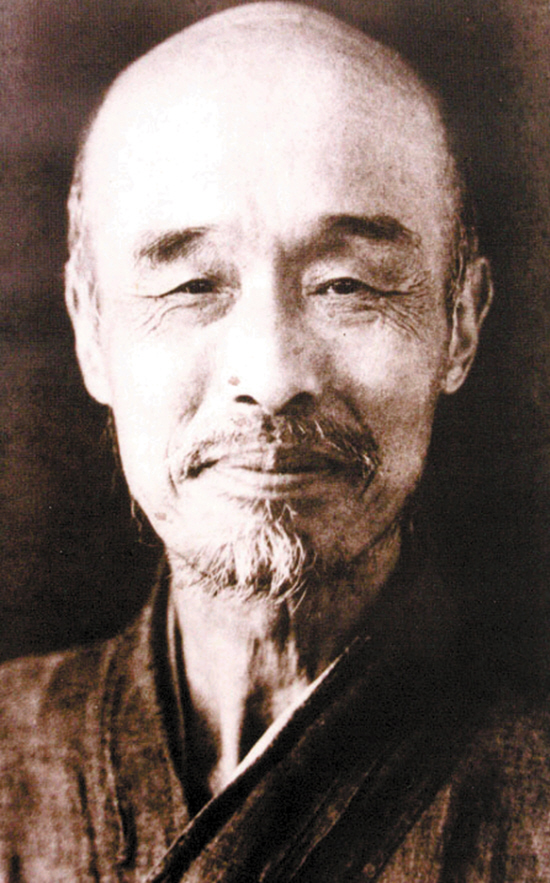
Hong Yi (23 October 1880 – 13 October 1942; Chinese: 弘一; pinyin: Hóngyī; Pe̍h-ōe-jī: Hông-it, also romanized Hong-it[1]), or Yan Yin (Chinese: 演音; pinyin: Yǎnyīn; Pe̍h-ōe-jī: Ián-im) was a Chinese Buddhist monk of the Nanshan Vinaya school. He was also an artist, and a musician. Born Li Shutong (李叔同 and 李漱筒), he was known by the names Wen Tao, Guang Hou, and Shu Tong, but was most commonly known by his Buddhist name, Hong Yi (Hokkien Hong-it).
Master Hongyi was a highly influential figure in both the modern Chinese cultural movement and the Buddhist revival during the Republic of China period. Initially renowned for his diverse artistic talents in poetry, music, painting, and calligraphy, he underwent a significant transformation, ordaining as a Buddhist monk in 1918 at Hupao Temple in Hangzhou. From that point until his death in 1942, he dedicated his life to the study and dissemination of Chinese Buddhism. He is widely recognized as one of the four eminent monks of the Republic of China, alongside Masters Taixu, Yinguang, and Xuyun. Within the Chinese Buddhist tradition, Master Hongyi is primarily known and respected as the eleventh patriarch of the Nanshan Vinaya school, a title reflecting his critical role in revitalizing the Vinaya tradition in modern China.[2]
Life
[edit]
Lay life
[edit]He was born as Li Shutong in Tianjin to a banking family originating in Hongtong County, Shanxi, that migrated to Tianjin in the Ming Dynasty, though his mother was from Pinghu, Zhejiang province.[3]
In 1898 Li moved to Shanghai and joined the "Shanghai Painting and Calligraphy Association", and the "Shanghai Scholarly Society" while he was attending the Nanyang Public School (later became Jiaotong University). In 1905 Li went to Japan to study at Tokyo School of Fine Art in Ueno Park where he specialized in Western painting and music, and met a lover by the name of Yukiko who was to become his concubine.[4][5]
In 1910 Li returned to China and was appointed to Tianjin's Beiyang Advanced Industry School. The next year he was appointed as a music teacher in a girls' school in Shanghai. He went to Hangzhou in 1912 and became a lecturer in the Zhejiang Secondary Normal College (now Hangzhou Normal University). He taught not only Western painting and music but also art history. By 1915 Jiang Qian hired him as a teacher at Nanjing Higher Normal School (renamed in 1949 to Nanjing University), where he taught painting and music. He also taught at Zhejiang Secondary Normal School (浙江兩級師範學堂), the predecessor of the famous Hangzhou High School.
During these later years, Li's reputation grew, as he became the first Chinese educator to use nude models in his painting classes, not to mention as the first teacher of Western music in China. Some of the students, like Singapore artist Chen Wen Hsi (陳文希) whom he personally groomed, went on to become accomplished masters of the arts in their later days. Li Shutong himself was also an accomplished composer and lyricist. Many of his compositions are still remembered and performed today.
In 1916 Li became a Buddhist. After spending another year in spiritual retreat, Li chose to be ordained as a monk, and thus began a holistic life dedicated to propagating Buddhism and its code of conduct.[2] After becoming a monk the only visual art he practised was calligraphy, developing a simple and unadorned, yet unique style, which was treasured by everyone who received a sample. He became known to all as Master Hong Yi. In 1942, Master Hong Yi died peacefully at the age of 61 in Quanzhou, Fujian Province. Li is one of the three great poetic monks in the late Qing Dynasty (others for Su Manshu, Shi Jingan).
Monastic life
[edit]In 1918, Li Shutong received ordination to become a Buddhist monk at Hupao Temple in Hangzhou. From this point, his life entered the second stage, that of Master Hongyi. He is known as the eleventh patriarch of the Vinaya school of Chinese Buddhism. This title was first publicly used by Feng Zikai in 1947, although initially, there was some controversy within the Buddhist community regarding his inclusion in the lineage. His recognition as the eleventh patriarch came through a long process and reflects his great contributions to the study of Vinaya.[2]
He initially considered focusing on the Sarvāstivādin Vinaya, even using its explanations to correct Nanshan viewpoints in early drafts of his work. However, he made a vow in 1931 to abandon the Sarvāstivādin and specialize solely in Nanshan Vinaya, pledging to promote it and establish the Nanshan Vinaya Academy. He chose Nanshan Vinaya because the Four-division Vinaya had been the foundation of Chinese Buddhist Vinaya since the Tang dynasty and was well-suited for being explained based on Mahayana teachings. He dedicated himself to this mission by studying, teaching, and compiling works on Nanshan Vinaya. His contributions included compiling, editing, annotating, and revising key Vinaya scriptures and commentaries. He tirelessly lectured on Vinaya throughout China and established Vinaya-focused educational centers like the Yangzheng Institute. Master Hongyi strongly believed that keeping precepts was the correct path for Buddhists and emphasized disciplining oneself. He practiced the Vinaya strictly and served as an exemplary model for others. He also promoted precepts for lay Buddhists, compiling works like Nanshanlü zaijia beilan.[2]
Master Hongyi was also committed to monastic education. He believed that Buddhist precepts were the lifeline for the Sangha and made cultivating discipline the primary purpose of his educational efforts, including establishing Vinaya schools and institutes. He emphasized both the study of theory and the practice of precepts. He also integrated art with Buddhist teachings, believing that artistic excellence was rooted in Buddhist study. He also engaged with social issues, such as caring for lives and protecting the country. He was a patriot from a young age and expressed a willingness to become a martyr during the war. He also actively countered movements to "exterminate Buddhism," arguing for the rectification of the Sangha but opposing its abolition.[2]
Master Hongyi died in Wenling Nursing Home in Quanzhou, Fujian Province, on October 13, 1942. At the time of his death, he was already regarded as a Vinaya patriarch.[2]
Teachings
[edit]
Master Hongyi's Buddhist legacy is characterized by his deep engagement with three major schools of Chinese Buddhism: Vinaya, Pure Land, and Huayan. While he is most associated with the revival of the Vinaya school, his integration and advocacy of Pure Land and Huayan practices were also central to his teachings. Master Hongyi's approach to Buddhist thought and practice is often summarized by the principle: "to uphold Huayan for the state of mind, to uphold the Four-Division Vinaya for practice, and to see Pure Land as the result".[2]
Vinaya
[edit]Master Hongyi devoted the most time and effort to the study and promotion of the Nanshan Vinaya school. He viewed the revival of Nanshan Vinaya as his primary mission. His efforts included the collation, editing, annotation, and revision of key Vinaya scriptures and commentaries, providing essential textual resources for future generations of practitioners and scholars. Initially, Master Hongyi had an interest in the Sarvāstivādin Vinaya, even quoting its explanations to correct Nanshan viewpoints in early drafts of his work. However, influenced partly by the lay Buddhist Xu Weiru and recognizing the historical foundation and suitability of the Four-Division Vinaya within Chinese Mahayana Buddhism, he made a vow in 1931 to specialize solely in the Nanshan Vinaya and promote it. He saw the Four-Division Vinaya as well-suited to the capabilities of Chinese monastics and capable of being explained based on Mahayana teachings.[2]
He tirelessly lectured on Vinaya doctrines across various monasteries and educational institutions throughout China, from Qingdao in the north to Xiamen in the south. He also played a crucial role in establishing Vinaya-focused educational centers, such as the Nanshan Vinaya Academy and the Buddhist Yangzheng Institute, to cultivate future monastics in Vinaya studies. Master Hongyi strongly insisted that keeping precepts was the correct path for Buddhists. He not only taught Vinaya but also embodied its principles through his strict and exemplary personal practice, earning deep respect from his contemporaries and later generations. He believed that practitioners should focus on disciplining themselves, not others. His contributions extended to the promotion of precepts for lay Buddhists through works like Nanshan Vinaya for the Laity. His significant efforts and scholarly achievements in the Vinaya tradition led to his recognition as the eleventh patriarch of the Nanshan Vinaya sect, a title that solidified his prominent status despite some initial controversies regarding the lineage transmission.[2]
Pure Land
[edit]Master Hongyi viewed the Pure Land practice of reciting the Buddha's name as the "result" or "fruit" of one's spiritual cultivation. He strongly advocated for the Pure Land method, considering it the most suitable and accessible path for sentient beings in the Degenerate Age of Dharma and for the needs of the time. He gave Pure Land teachings a high doctrinal standing, classifying them as a "One Vehicle Perfect Teaching" (the highest class of teaching in Huayan and Tiantai hermeneutics). Master Hongyi's promotion of Pure Land was extensive, including writing prefaces and postscripts for Pure Land texts, giving lectures, and using calligraphy to propagate the name of Amitabha Buddha. His teachings emphasized the importance of deep belief in the law of cause and effect, generating Bodhicitta (the aspiration for enlightenment for the benefit of all beings), and concentrating on Buddha recitation. He also recommended supplementing Pure Land practice with texts such as the Sutra of Kṣitigarbha's Fundamental Vows and the Chapter on Practices and Vows of the Bodhisattva Samantabhadra. He held Master Yinguang, a prominent Pure Land master, in high esteem. A notable contribution to Pure Land practice was his focus on hospice care centered around Buddha recitation, aiming to provide support and alleviate fear for those nearing the end of life.[2]
Although predominantly recognized as a Vinaya master and the eleventh patriarch of the Nanshan school, Master Hongyi held significant importance for Pure Land Buddhism in modern China. His advocacy lent considerable weight and popularity to the practice, especially among the educated class, due to his own esteemed background. His approach of integrating Pure Land practice with the theoretical framework of Huayan and supplementary readings like the Kṣitigarbha Sutra broadened the scope and understanding of Pure Land cultivation. Furthermore, his practical emphasis on Buddha recitation during hospice care provided a concrete application of Pure Land principles to address the fears surrounding death. His personal example of diligent practice and widespread promotion contributed significantly to the enduring prevalence and influence of Pure Land Buddhism in contemporary China.[2]
Huayan
[edit]Master Hongyi considered Huayan as the theoretical foundation or "realm" for his Buddhist thought and practice. He studied the Huayan Sutra extensively and viewed it highly, classifying it as a "Perfect Teaching" within Mahayana Buddhism and referring to it as the "Ocean of Doctrines". He was familiar with the works of previous Huayan patriarchs and recommended them to others. However, his approach to promoting Huayan differed from traditional Huayan masters. Instead of focusing heavily on its complex philosophical doctrines, he emphasized its integration with Pure Land practice, particularly through the recitation of the Chapter on Practices and Vows of the Bodhisattva Samantabhadra (Puxian Xingyuan Pin). He saw this chapter, included in the broader Huayan Sutra, as a means to accumulate merit and facilitate rebirth in the Pure Land. He promoted Huayan through compilation, transcription, lectures, and gifting copies of related texts.[2]
Commemorations and exhibitions
[edit]Beijing-based progressive-metal rock band the Tang Dynasty recorded a rock-version of Master Hong Yi's famous romantic ballad, the Farewell song in their second album Epic.[6][7]
A special 130th anniversary celebration of Master Hong Yi showcasing his calligraphy and painting works took place in 2010 in Shanghai, partly sponsored by the Pinghu Municipal Government, and attended by a granddaughter of Hong Yi.[8]
Important works
[edit]- Publications
- The Chart of the Dharmaguptaka Vinaya Bhikkhu Precepts
- The Guide to the Nanshan Vinaya for Lay Buddhists (Chinese: 南山律在家備覽)
- Collections
- Happy Stones
- Li Shutong's Seals
- Articles
- Lyrics
- Song: Song Bie Ge (Farewell Song) (Chinese: 送别歌)
- Music
See also
[edit]


.svg)
References
[edit]- ^ "Buddhist Schools: The Chinese Buddhist Schools". www.buddhanet.net. Retrieved 2024-08-03.
- ^ a b c d e f g h i j k l Dong, Zijia. "A Study on the Buddhist Thought of Ven. Master Hongyi." PhD diss., University of the West, 2023.
- ^ "平湖市李叔同紀念館——李叔同簡介". Phlst.cn. 2008-08-18. Archived from the original on 2011-11-25. Retrieved 2011-12-18.
- ^ C.C. Liu (2010) A Critical History of New Music in China. The Chinese University Press, 2010 ISBN 962-996-360-4
- ^ Peter Micic (2009-02-15). "Li Shutong and Writing Life's Stories". Animperfectpen.blogspot.com. Retrieved 2011-12-18.
- ^ "唐朝乐队 送别 现场版". YouTube. 2007-11-01. Archived from the original on 2021-12-14. Retrieved 2011-12-18.
- ^ "Kaiser Kuo Interview at the Dark Legions Archive black metal and death metal interviews". Anus.com. Archived from the original on 2012-06-23. Retrieved 2011-12-18.
- ^ "Exhibition of Painting & Calligraphy Works of Li Shutong, Lu Weizhao and Wu Yifeng in Shanghai". English.pinghu.gov.cn. 2010-06-23. Archived from the original on 2012-04-26. Retrieved 2011-12-18.
| International | |
|---|---|
| National | |
| Academics | |
| Artists | |
| People | |
| Other | |

Hong Yi
View on GrokipediaHong Yi (洪一; 1880–1942), born Li Shutong (李叔同), was a Chinese Buddhist monk of the Nanshan Vinaya school celebrated for his mastery in calligraphy, painting, music, and drama, as well as his rigorous adherence to monastic precepts that exemplified ascetic discipline in modern Chinese Buddhism.[1][2] Born into a prosperous banking family in Tianjin on October 23, 1880, Li Shutong pursued advanced studies in Japan starting in 1905, where he acquired expertise in Western oil painting, violin performance, and theatrical production, becoming one of the first Chinese artists to blend Eastern and Western techniques.[3] Upon returning to China, he taught at prominent institutions such as Zhejiang Superior School, composed the nation's inaugural Western-style opera The Black Slave Cries Out to Heaven, and introduced Gregorian chant adapted for Buddhist liturgy, thereby influencing early 20th-century cultural modernization.[4] In 1918, at age 39, amid personal reflections on impermanence following family losses, he ordained at Hupao Temple in Hangzhou under Master Liaowu, renouncing worldly attachments—including burning his artworks and distributing possessions—to focus exclusively on Vinaya study, scriptural exegesis, and ethical reform within the sangha.[5] As Master Hong Yi, he itinerantly propagated Pure Land and Vinaya teachings across Fujian and other provinces, authored key texts on monastic conduct, and refined a distinctive calligraphic style derived from Wang Xizhi's Lanting Xu, which emphasized simplicity and spiritual depth over ornamental flourish, solidifying his legacy as a bridge between artistic innovation and devout religious practice until his death by starvation during wartime privations on October 13, 1942.[6][7]
Early Life
Family and Childhood
Li Shutong, later known as Hong Yi, was born on October 23, 1880, in Tianjin into a prosperous banking family originating from Hongtong County, Shanxi Province, which had migrated to Tianjin during the Ming Dynasty.[8] His father, a wealthy merchant, maintained a traditional extended household with multiple concubines, including Shutong's mother, Wang, who had risen from maidservant status and endured ongoing mistreatment from the principal wife and her faction.[9] This hierarchical dynamic fostered intra-family discord, with favoritism toward children of the main wife exacerbating tensions; Shutong, as the son of a secondary consort, experienced relative marginalization despite the family's affluence.[10] At age five in 1885, Shutong's father died, stripping away protective authority and intensifying the precarious position of his mother and himself within the household, where step-relations dominated resource allocation and daily life.[5] His mother, who provided primary care and emotional support, introduced early exposure to Buddhist elements through the father's prior faith, though formal instruction emphasized Confucian discipline under the guidance of elder half-brothers.[9] Home tutoring in Confucian classics instilled rigorous study habits, while familial disruptions cultivated an acute awareness of instability, prompting Shutong by age 15 to compose poetry reflecting on transience, such as lines likening life to a setting sun and worldly honors to fleeting frost.[11][12] These early losses, culminating in his mother's sudden death in April 1905 at age 26 for Shutong, underscored patterns of impermanence—father's passing, household rivalries, and maternal bereavement—that honed personal resilience amid privilege, without idealizing family cohesion.[13] Shutong's initial forays into poetry and seal-carving during adolescence emerged from this context, channeling disciplined home learning into creative outlets amid unresolved grief.Formal Education and Influences
Li Shutong, born in 1880 in Tianjin, received his early formal education in traditional Chinese scholarship, focusing on the Confucian classics under the tutelage of his two half-brothers, who provided rigorous instruction in these foundational texts.[5] This classical grounding, supplemented by studies in poetry and traditional painting, emphasized ethical principles and literary arts rooted in imperial examination traditions, forming the basis of his intellectual discipline before exposure to modern Western methods.[5] In 1905, at age 25, Li traveled to Japan, enrolling in the Department of Western Painting at the Tokyo School of Fine Arts (Tokyo Bijutsu Gakkō), where he studied under the influential painter Kuroda Seiki, a proponent of yōga (Western-style painting) techniques emphasizing realism and oil mediums.[14] Over the subsequent five years, he systematically engaged with imported European artistic practices, including perspective, shading, and anatomical accuracy in oil painting, which contrasted sharply with ink-based Chinese traditions and introduced empirical observation as a core method.[15] Concurrently, Li pursued supplementary training in Western music theory and choral composition, adapting harmonic structures and ensemble singing absent in classical Chinese forms, and participated in theater activities that exposed him to realistic staging and scripted drama.[11] These Japanese studies profoundly shaped Li's technical repertoire through interactions with educators like Kuroda and fellow Chinese expatriate students, fostering early experiments in hybrid adaptations—such as his involvement in the Spring Willow Society (Chunliu She), founded in 1907, which staged Western-influenced plays and marked initial efforts to localize modern theater techniques for Chinese audiences.[11] Peers and institutional resources in Tokyo facilitated his pioneering application of realism to visual arts and the composition of works blending Eastern motifs with Western choral formats, positioning him as one of the first Chinese practitioners to systematically import and modify these methods without subordinating them to overt political agendas.[5] He graduated from the Tokyo School of Fine Arts in March 1910, returning to China amid rising revolutionary tensions, equipped with skills that preserved ethical underpinnings from his classical roots while incorporating verifiable Western innovations.[5]Lay Career
Artistic and Musical Innovations
Li Shutong composed the song Farewell (Songbie, 送别) in 1910, setting Chinese lyrics to the melody of the 1851 American tune "Dreaming of Home and Mother" by John Pond Ordway, resulting in one of the earliest modern Chinese choral works incorporating Western harmonic structures and part-writing techniques.[16][17] This adaptation demonstrated technical innovation by applying staff notation principles to vernacular Chinese melody, enabling ensemble performance in educational settings.[16] While studying in Japan from 1905 to around 1910, Li introduced jianpu (numbered musical notation) to Chinese music practice, a system derived from Japanese adaptations of Western staff notation, which simplified score reading and composition for non-specialists compared to traditional gongche notation.[18] This facilitated the transcription and teaching of Western pieces, such as Beethoven symphonies, to Chinese audiences, with Li producing early instructional materials that trained initial cohorts of music educators in harmonic analysis and counterpoint.[19] In visual arts, Li blended Chinese ink wash techniques with Western linear perspective and shading during the 1910s, as seen in surviving oil paintings like portraits and landscapes that employed chiaroscuro effects alongside traditional brushwork, marking verifiable advancements in hybrid media application.[12][20] His calligraphy from this period integrated European typographic regularity with seal script flourishes, evident in pieces published in periodicals like Music Magazine, where he advocated precise stroke control influenced by Japanese shodo rigor.[20] Li's theater work included co-founding the Spring Willow Society in Tokyo in 1906, where he directed hybrid productions such as adaptations of Western plays like Uncle Tom's Cabin, utilizing spoken dialogue, realistic staging, and minimal music to prioritize narrative causality over operatic convention, thus establishing foundational techniques for huaju (spoken drama) in China.[21][22] These efforts transmitted directorial methods like blocking and ensemble coordination from shinpa theater, verifiable through contemporary accounts of performances blending Chinese themes with imported realism.[23]Educational and Reform Efforts
From 1912 to around 1919, Li Shutong served as a lecturer in music and fine arts at Zhejiang Provincial First Normal School (later known as Zhejiang First Teachers' College) in Hangzhou, where he trained future educators in Western techniques alongside traditional Chinese methods.[8][5] His curriculum integrated practical skills such as piano playing, choral singing, and oil painting with an emphasis on discipline and moral development, viewing music as a means to instill harmony and ethical order in students amid the Republican era's push for educational modernization.[19][24] Notable students included Feng Zikai, who later recalled Li's instruction as fostering a disciplined approach to creativity through rigorous practice in arts and music, crediting it with shaping his early artistic and philosophical outlook.[25][26] Li advocated for incorporating Western music education into China's school system to cultivate character, composing early school songs and introducing choral forms that aligned with Republican reforms aimed at building national cohesion without discarding Confucian ethical foundations.[27][28] Li's methods demonstrated tangible impact, as nearly all members of China's first generation of professional music educators emerged from his classes, propagating his blend of technical proficiency and moral emphasis nationwide and establishing a causal chain of transmission in modern Chinese music pedagogy.[5][24] This legacy underscores the efficacy of his targeted reforms in normal schools, where focused instruction on verifiable skills yielded widespread institutional adoption during the early Republican period.[19]Path to Monasticism
Personal Crises and Renunciation
In the mid-1910s, Li Shutong grappled with mounting personal disillusionments, including strained family ties and his own health deteriorations, set against the backdrop of China's fracturing Republican polity marked by warlord conflicts and institutional fragility following the 1911 revolution. These pressures underscored the precariousness of attachments, as evidenced by his later reflections on impermanence derived from direct encounters with loss and bodily frailty, which eroded confidence in secular pursuits.[13][9] This led to a phased disengagement from lay life, beginning with rigorous self-study of Buddhist sutras such as the Diamond Sutra and Heart Sutra, where empirical scrutiny of pervasive human afflictions—observed in personal circles and societal upheavals—reinforced causal insights into suffering's origins in clinging. By early 1918, at age 38, Li privately shaved his head on July 28 as a preliminary act of detachment, signaling withdrawal without immediate public disclosure, while continuing teaching duties in Hangzhou.[13][9] Culminating in formal renunciation, Li ordained as a novice on August 19, 1918, at Hupao Temple in Hangzhou, adopting the dharma name Hongyi; he systematically dispersed his assets, including artworks and savings, to kin and associates via documented correspondences that contemporaries interpreted as a calculated severance from prior acclaim in arts and education. This pivot, devoid of abrupt mysticism, stemmed from sustained analysis of worldly causality's unreliability, prioritizing vinaya discipline over residual domestic or professional bonds.[9][6]Ordination and Initial Monastic Practices
In July 1918, Li Shutong underwent tonsure at Hupao Temple in Hangzhou under the guidance of Master Liaowu, marking his initial entry into monastic life and adoption of the dharma name Hong Yi.[13] This step aligned with traditional novice precepts, emphasizing renunciation of lay attachments.[9] In September 1918, Hong Yi received full bhikṣu ordination at nearby Lingyin Temple, accepting the 250 precepts of the monastic code and committing to the Nanshan Vinaya school's emphasis on precise disciplinary observance as a causal foundation for enlightenment.[9][29] These precepts inherently required celibacy through complete abstinence from sexual activity, poverty via relinquishment of personal wealth and reliance on communal alms, and vegetarianism by prohibiting consumption of meat or intoxicants.[9] Following ordination, Hong Yi's routines centered on foundational practices in Hangzhou-area monasteries, including daily recitation of sūtras such as the Śūraṃgama, prolonged seated meditation to foster concentration, and rigorous self-examination against Vinaya infractions.[4] He adopted additional personal standards, such as voluntary silence to minimize idle speech and enhance introspective discipline, grounded in scriptural interpretations of karma and impermanence.[29] During this establishment phase into the early 1920s, Hong Yi produced initial writings on precept-keeping, such as annotations stressing causality in ethical lapses, which served to solidify his standards before broader engagements.[6] These efforts underscored his view of Vinaya as the uncompromised basis for monastic purity, distinct from interpretive leniency in contemporary Chinese Buddhism.[29]Monastic Life
Adherence to Vinaya Precepts
Hongyi demonstrated lifelong commitment to the Vinaya, the disciplinary code governing monastic conduct, by meticulously observing its 250 precepts for bhikshus as outlined in Chinese Buddhist tradition. Following his full ordination on July 24, 1918, at Jiaxing's Yuetong Temple, he enforced rules prohibiting food intake after noon, limiting himself to two daily meals of simple vegetarian fare obtained through begging, regardless of invitations or offers from lay supporters.[9] This practice persisted even during travels and teachings, where he rejected post-noon sustenance to uphold bodily regulation as foundational to ethical purity.[13] For minor precept violations, such as unintentional lapses in decorum or handling restricted items, Hongyi imposed self-directed penances, including extended fasting or intensified confession rituals, to cultivate immediate accountability and prevent habitual erosion of discipline. These measures reflected his empirical approach, prioritizing verifiable self-correction over interpretive leniency, as evidenced by his documented refusal of comforts like padded robes or monetary aid, which he viewed as direct infractions warranting renunciation.[8] Such rigor contrasted with prevalent monastic laxity in Republican-era China, where economic pressures and secular influences had diluted adherence; Hongyi countered this by modeling uncompromised observance, arguing that causal chains from physical restraint to mental stabilization demanded personal demonstration amid institutional decline.[30] His austere existence—residing in unheated cells, mending worn robes by hand, and avoiding fame-derived privileges—illustrated discipline's role as a prerequisite for cognitive clarity, enabling sustained focus on Dharma study despite external acclaim from his pre-monastic artistic career. Hongyi's writings and lectures emphasized this linkage, positing that precept violations disrupt attentional causality, while strict enforcement empirically yields unclouded insight, a principle he validated through decades of unaltered practice until his death on October 13, 1942.[31][9]Travels, Teaching, and Austerity
Following his ordination in 1918, Master Hongyi undertook travels primarily within eastern China, emphasizing vinaya study and propagation amid the Republic era's social upheavals. In the 1930s, he journeyed to southern Fujian (Minnan), arriving in 1934 at the invitation of academy director Changxing to reorganize monastic education at the Minnan Buddhist Academy, where he prioritized disciplinary training over broader curricula.[9] By May 1937, he had relocated to Wanshou Rock in Xiamen for dharma activities, including lectures on precepts during a period of escalating Sino-Japanese tensions.[32] In September 1937, as wartime disruptions intensified in the region, he refused urgings to evacuate, viewing endurance as alignment with vinaya resolve.[13] Hongyi's instructional efforts centered on lay and monastic adherence to ethical precepts, conducting lectures and transmissions to foster discipline amid perceived societal moral erosion from conflict and modernization. He interacted with disciples through precept conferrals and vinaya guidance, restoring elements of the Nanshan Lü tradition to strengthen sangha integrity.[29] In Fujian temples such as those in Quanzhou, where he resided until his death, he compiled and disseminated materials on戒律 observance, ordaining select followers while emphasizing practical ethics over speculative doctrine.[33] His practice embodied vinaya austerity, including daily alms begging (pindapata), possession of only essential robes and requisites, and fasting regimens that tested physical limits. During the Japanese incursions affecting Fujian from 1938 onward, including occupations and bombings near Xiamen and Quanzhou, Hongyi persisted in itinerant teaching and minimalism, interpreting such deprivations—hunger, displacement, and isolation—as causal proofs of impermanence rather than mere adversity.[13] These measures, sustained into 1942, contributed to his declining health but exemplified his commitment to precepts as countermeasures to ethical laxity in wartime China.[12]Buddhist Teachings and Philosophy
Core Emphasis on Disciplinary Realism
Master Hong Yi regarded the Vinaya precepts as a foundational framework derived from scriptural exegesis, particularly the Four-Division Vinaya integrated with Mahayana sutras such as the Flower Adornment Sutra, which delineates ethical conduct as the basis for dispelling heinous karma and attaining enlightenment.[9] He analyzed precepts through causal sequences outlined in texts like the Huayan Sutra and Buddha’s Bequeathed Teaching Sutra, positing that violations generate specific retributive outcomes—such as killing precipitating short lifespan and ill health, while abstinence fosters longevity—thus functioning as verifiable mechanisms to interrupt cycles of suffering rooted in unwholesome mental states.[9] This approach prioritized observable behavioral cessation and cultivation over speculative mysticism, with precepts serving as antecedents to concentration and wisdom, as articulated in his collation of Nanshan Vinaya texts.[9][30] In critiquing antinomian tendencies prevalent in early 20th-century Chinese Buddhism, Hong Yi condemned abbreviated ordination rites and superficial precept transmission, which he deemed equivalent to mistaking "bricks for jewels," arguing that failure to intensively study root Vinaya texts inexorably erodes orthodox Dharma.[9][30] He insisted that rigorous, unyielding discipline yields empirically discernible inner equanimity, as mental purification through precept observance—examined via daily conduct review—precludes afflictions and cultivates clarity, a process he detailed in works like Sifen lü biqiujie xiangbiao ji.[9] Such adherence, he maintained, counters the causal proliferation of karmic hindrances from unchecked intentions, rendering ethical restraint a precondition for verifiable psychological stability rather than mere ritual compliance.[9] Hong Yi extended this disciplinary paradigm to lay practice, compiling texts like Nanshan lü zaijia beilan to equip householders with structured routines—such as pre-meal recitations and minimalism in possessions—as bulwarks against modern distractions like secular pursuits and sensory indulgence.[9][34] By elucidating violation conditions (e.g., six factors for theft, emphasizing intent), he underscored precepts' role in fostering right mindfulness and preempting guilt-induced suffering, thereby integrating causal ethical realism into everyday contingencies without concession to expediency.[34] This uncompromised rigor, drawn from sutra-derived causal analysis, positioned precepts as indispensable for mitigating the retributive consequences of ethical lapses in any context.[9][30]Syncretic Views: Vinaya, Pure Land, and Huayan
Hong Yi's syncretic approach positioned Vinaya precepts as the foundational practice for ethical discipline, augmented by Pure Land recitation of Amitabha's name to facilitate rebirth in the Western Pure Land as an accessible path to salvation for practitioners of varying capacities. He articulated this integration by upholding Huayan philosophy for metaphysical insight into the interpenetration of phenomena, viewing it as the doctrinal basis that contextualizes Vinaya's universality across realms and Pure Land's salvific efficacy as the ultimate fruition.[9][35] In his framework, strict adherence to the Four-Division Vinaya—encompassing 250 precepts for monks—purifies karmic obstacles, creating causal conditions conducive to successful nianfo practice and rebirth, thereby reconciling disciplinary rigor with devotional faith without subordinating one to the other.[36] This doctrinal synthesis drew on Huayan's ontology of shih shi wu ai (mutual non-obstruction of phenomena), which Hong Yi interpreted as validating Vinaya's precepts as expressions of the dharmadhatu's inherent harmony, applicable universally rather than confined to monastic elites. He argued that Huayan's vision of reality's interpermeability supports Pure Land's emphasis on other-power (taoli), as the reciter's focused devotion mirrors the realm's non-dual causality, while Vinaya ensures the practitioner's moral groundwork prevents rebirth hindrances like doubt or laxity.[9] Through this lens, precepts function not as mere rules but as causal mechanisms enabling the metaphysical depth of Huayan contemplation and the eschatological promise of Pure Land, fostering a pragmatic revival of Buddhism amid early 20th-century Chinese monastic decline.[37] While this approach achieved notable success in revitalizing Vinaya observance—Hong Yi personally ordained over 200 monks between 1918 and 1942, emphasizing integrated practices—critics among Vinaya traditionalists contended that syncretism risked diluting disciplinary purity by accommodating Pure Land's reliance on faith over exhaustive precept mastery.[37] Such tensions highlight a prioritization of causal realism in practice, where Vinaya's empirical ethical framework tempers Pure Land's aspirational elements and Huayan's abstract ontology, yet potentially underemphasizes faith-alone paths critiqued as insufficient for karmic rectification in Hong Yi's writings.[9]Perspectives on Impermanence and Causality
Hong Yi's comprehension of impermanence (anicca in Pali, wuchang in Chinese) derived from direct personal encounters with loss, beginning with the death of his mother in 1886 at age six, which instilled an early awareness of life's fragility.[13] Subsequent bereavements, including close friends during his secular career, reinforced this empirical insight, evolving into a profound ontological recognition that all phenomena lack inherent permanence, as echoed in his preface to a sutra commentary analyzing impermanence through aging, illness, and death.[13] These experiences grounded his teachings in observable reality rather than abstract doctrine, positing impermanence not as pessimistic fatalism but as a verifiable condition prompting detachment for causal liberation. On causality, Hong Yi viewed it as an inexorable karmic process manifesting in everyday disparities, stating that "those who disbelieve in cause and effect need only observe the rich and poor, the beautiful and ugly as its proof," alongside impermanence evident in "birth, aging, sickness, and death" and reincarnation in the cycle of seasons.[38] He emphasized ethical conduct as the mechanism to interrupt karmic chains, drawing from scriptural sources like the sutras while integrating first-hand validation from his own trajectory: worldly achievements in art and education yielded transient satisfaction, whereas renunciation in 1918 and adherence to precepts yielded sustained equanimity until his death in 1942.[13] This causal realism countered materialist pursuits by highlighting how attachment perpetuates suffering through illusory stability, breakable only via disciplined non-clinging. In poetry and correspondence, Hong Yi advocated non-attachment as realistic praxis, urging disciples to transcend hedonistic or possessive norms by recognizing phenomena's conditioned arising and cessation, thereby fostering truth-seeking detachment aligned with Buddhist ontology.[9] Traditional Buddhist frameworks, which he upheld, affirm these principles as consensus derived from enlightened insight and textual analysis, contrasting modern secular dismissals that attribute outcomes to randomness or socioeconomic factors alone; yet his life's verifiable shift from acclaim to monastic austerity serves as empirical counter-evidence, demonstrating causality's ethical interruptibility without reliance on unverifiable metaphysics.[13] Such perspectives prioritize causal chains observable in personal and historical data over ideologically biased reinterpretations.Major Works and Contributions
Calligraphy and Painting
Following his ordination in 1918, Hong Yi restricted his artistic practice to calligraphy, producing thousands of pieces monthly in early monastic years, primarily for transcribing Buddhist sutras and inscribing doctrinal texts in emulation of ancient Han, Wei, and Tang styles such as the Zhang Menglong stele.[39][40] This output served vinaya adherence by fostering disciplined focus through repetitive copying and enabled dharma propagation via donations to monastics and laity.[39] By the 1920s, under Master Yinguang's influence in 1923, his style evolved toward "Hongti" simplicity—slender strokes, balanced proportions, and unembellished serenity—prioritizing textual clarity over flourish for sutra works like Huayan couplets and Heart Sutra transcriptions.[41][9] Hong Yi's paintings post-ordination centered on ink renderings of Buddhist icons, such as Buddhas and Guanyin protectors, executed during his Fujian sojourns in the 1930s, including a large-scale 362 × 241 cm Guanyin dated around that era.[42] These works, produced sparingly compared to calligraphy, facilitated meditative contemplation and temple dedications, aligning art with precepts by visualizing impermanence and causality rather than aesthetic exhibition.[42][43] Such pieces, often inscribed with dates and seals, underscored functional utility in monastic life, reinforcing vinaya through devotional tools gifted to institutions like Quanzhou temples.[44]