Hubbry Logo
Islamic ornamentIslamic ornamentMain
Open search
Islamic ornament
Community hub
Islamic ornament
logo
8 pages, 0 posts
0 subscribers
Be the first to start a discussion here.
Islamic ornament
Islamic ornament
from Wikipedia
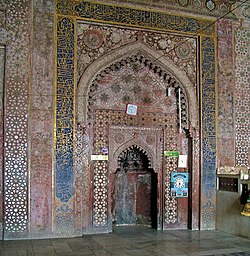
Geometric, arabesque, and calligraphic patterns ornamenting the Mihrab at the Jama Masjid, Fatehpur Sikri

Islamic ornament is the use of decorative forms and patterns in Islamic art and Islamic architecture. Its elements can be broadly divided into the arabesque, using curving plant-based elements, geometric patterns with straight lines or regular curves, and calligraphy, consisting of religious texts with stylized appearance, used both decoratively and to convey meaning. All three often involve elaborate interlacing in various mediums.

Islamic ornament has had a significant influence on European decorative art forms, especially as seen in the Western arabesque.

Overview

[edit]
Geometric Zellij tilework, stucco decoration with Arabic calligraphy and arabesques at Bou Inania Madrasa, Fes

Islamic art mostly avoids figurative images to avoid becoming objects of worship.[1][2] This aniconism in Islamic culture encouraged artists to explore non-figural art, creating a general aesthetic shift toward mathematically-based decoration.[3] Even before the preaching of Islam, the regions associated with the Islamic world today showed a preference for geometric and stylized vegetal decoration. As early as the fourth century, Byzantine architecture showcased influential forms of abstract ornament in stonework. Sasanian artists were influential in part through their experimentation with stucco as a decorative medium.

The Islamic geometric patterns derived from designs used in earlier cultures: Greek, Roman, and Sasanian. They are one of three forms of Islamic decoration, the others being the arabesque based on curving and branching plant forms, and Islamic calligraphy; all three are frequently used together, in mediums such as mosaic, stucco, brickwork, and ceramics, to decorate religious buildings and objects.[4][5][6][7]

Authors such as Keith Critchlow[a] argue that Islamic patterns are created to lead the viewer to an understanding of the underlying reality, rather than being mere decoration, as writers interested only in pattern sometimes imply.[8][9] In Islamic culture, the patterns are believed to be the bridge to the spiritual realm, the instrument to purify the mind and the soul.[10] David Wade[b] states that "Much of the art of Islam, whether in architecture, ceramics, textiles or books, is the art of decoration – which is to say, of transformation."[11] Wade argues that the aim is to transfigure, turning mosques "into lightness and pattern", while "the decorated pages of a Qur’an can become windows onto the infinite."[11] Against this, Doris Behrens-Abouseif[c] states in her book Beauty in Arabic Culture that a "major difference" between the philosophical thinking of medieval Europe and the Islamic world is exactly that the concepts of the good and the beautiful are separated in Arabic culture. She argues that beauty, whether in poetry or in the visual arts, was enjoyed "for its own sake, without commitment to religious or moral criteria".[12]

Arabesque

[edit]
Stone relief with arabesques of tendrils, palmettes and half-palmettes in the Umayyad Mosque at Damascus

The Islamic arabesque is a form of artistic decoration consisting of "rhythmic linear patterns of scrolling and interlacing foliage, tendrils" or plain lines,[13] often combined with other elements. It usually consists of a single design which can be 'tiled' or seamlessly repeated as many times as desired.[14] This technique, which emerged thanks to artistic interest in older geometric compositions in Late Antique art, made it possible for the viewer to imagine what the pattern would look like if it continued beyond its actual limits. This is a characteristic which made it distinctive to Islamic art.[15]

The fully "geometricized" arabesques appeared in the 10th century.[15] The vegetal forms commonly used within the patterns, such as acanthus leaves, grapes, and more abstract palmettes, were initially derived from Late Antique and Sasanian art. The Sasanians characteristic use of the scrolling vine as a decorative element derived from the Romans through Byzantine art. In the Islamic period, this vine scroll evolved into the arabesque.[16] The vine ornament which is popular in Islamic ornament is believed to come out of Hellenistic and early Christian art.[17][18] However, the vine scroll has experienced stylistic changes which has transformed the vine pattern into a more abstract ornament with only remnants of the Hellenistic model. Additional motifs, such as flowers, began to be added towards the 14th century.[15]

From the 14th century onward, the geometrically-configured arabesque began to be displaced by freer vegetal motifs inspired by Chinese art and by the Saz style that became popular in Ottoman art during the 16th century.[15]

Geometric patterns

[edit]
Girih geometric pattern at the Darb-e Imam, Isfahan

The historic world of Islamic art is widely known to be the most proficient in its use of geometric patterns for artistic expression.[16] Islamic geometric patterns developed in two different regions. Those locations being in the eastern regions of Persia, Transoxiana, and Khurasan, and in the western regions of Morocco and Andalusia.[19] The geometric designs in Islamic art are often built on combinations of repeated squares and circles, which may be overlapped and interlaced, as can arabesques, with which they are often combined, to form intricate and complex patterns, including a wide variety of tessellations. These may constitute the entire decoration, may form a framework for floral or calligraphic embellishments, or may retreat into the background around other motifs. The complexity and variety of patterns used evolved from simple stars and lozenges in the ninth century, through a variety of 6- to 13-point patterns by the 13th century, and finally to include also 14- and 16-point stars in the sixteenth century.[4][20][5][21] Geometric forms such as circles, squares, rhombs, dodecagons, and stars vary in their representation and configuration across the world of Islam.

Geometric patterns occur in a variety of forms in Islamic art and architecture including kilim carpets,[22] Persian girih[23] and western zellij tilework,[24][25] muqarnas decorative vaulting,[26] jali pierced stone screens,[27] ceramics,[28] leather,[29] stained glass,[30][31] woodwork,[32] and metalwork.[33][34]

Calligraphy

[edit]
Bowl decorated with Kufic calligraphy, 10th century

Calligraphy is a central element of Islamic art, combining aesthetic appeal and religious message. Sometimes it is the dominant form of ornament; at other times it is combined with arabesque.[35] The importance of the written word in Islam ensured that epigraphic or calligraphic decoration played a prominent role in architecture.[36] Calligraphy is used to ornament buildings such as mosques, madrasas, and mausoleums; wooden objects such as caskets; and ceramics such as tiles and bowls.[37][38]

Epigraphic decoration can also indicate further political or religious messages through the selection of a textual program of inscriptions.[39] For example, the calligraphic inscriptions adorning the Dome of the Rock include quotations from the Qur'an that reference the miracle of Jesus and his human nature (e.g. Quran 19:33–35), the oneness of God (e.g. Qur'an 112), and the role of Muhammad as the "Seal of the Prophets", which have been interpreted as an attempt to announce the rejection of the Christian concept of the Holy Trinity and to proclaim the triumph of Islam over Christianity and Judaism.[40][41][42] Additionally, foundation inscriptions on buildings commonly indicate its founder or patron, the date of its construction, the name of the reigning sovereign, and other information.[36]

The earliest examples of epigraphic inscriptions in Islamic art demonstrate a more unplanned approach in which calligraphy is not integrated with other decoration.[43] In the 10th century, a new approach to writing emerged. Ibn Muqla is known as the originator of the khatt al-mansub, or proportioned script style.[44] "Khatt," meaning the "marking out," emphasized calligraphic writing's physical demarcation of space. This concept of rationalizing space is inherent in Islamic ornament.[43] By the 9th and 10th centuries inscriptions were fully integrated into the rest of an object or building's decorative program, and by the 14th century they became the dominant decorative feature on many objects.[43] The most common style of script during the early period was Kufic, in which straight angular lines dominated. In monumental inscriptions, certain flourishes were added over time to create variations such as "floriated" Kufic (in which flower or tendril forms spring from the letters) or "knotted" Kufic (in which some letters form interlacing knots).[45] However, the elaboration of Kufic scripts also made them less legible, which led to the adoption of rounder "cursive" scripts in architectural decoration, such as Naskh, Thuluth, and others. These scripts first appeared on monuments in the 11th century, initially for religious inscriptions but then for other inscriptions as well. Cursive scripts underwent further elaborations over the following centuries while Kufic was relegated to a secondary role. Inscriptions became longer and more crowded as more information was included and more titles were added to the names of patrons.[45]

Influence on Western ornament

[edit]
Seven Western arabesque panels, Farnsborough, England. Drawings by Jules Lachaise and Eugène-Pierre Gourdet, 1880–1886

A Western style of ornament based on Islamic arabesque developed in Europe, starting in late 15th century Venice; it has been called either moresque or western arabesque. It has been used in a great variety of the decorative arts, especially in book design and bookbinding.[46] More recently, William Morris of the Arts and Crafts movement was influenced by all three types of Islamic ornament.[47]

Theories of Islamic ornament

[edit]

The representation of pattern is one of the earliest forms of artistic expression; however, scientific and theoretical studies on pattern are a relatively recent development. The systematic study of their properties and significance emerged in the late 19th century. Theories on ornament can be located in the writings of Alois Reigl, William Morris, John Ruskin, Carl Semper, and Viollet-le-Duc.

Oleg Grabar is one of the theorists to engage with ornament's capacity to evoke thought and interpretation. He argues that ornament is used not merely as embellishment but an intermediary for making and seeing. Furthermore, its decorative qualities seem to complete an object by providing it with quality. This "quality" is the feeling transmitted through ornament's visual messages.

Owen Jones, in his book The Grammar of Ornament (1856), proposes theories on color, geometry, and abstraction. One of his guiding principles states that all ornament is based on a geometric construction.[48]

Granada, Alhambra, Hall of the Two Sisters, muqarnas ceiling.

Ernst Gombrich emphasizes the practical effects of ornament as framing, filling, and linking.[49] He deems the most meaningful aspects of art to be non-ornamental, which stems from a preference to Western representational art. Geometric pattern in Islamic ornament involves this filling of space, technically described as "'tessellation through isometry.'"[50] The primary objective for geometric patterns "filling" of space is to enhance it. In his book,The Meditation on Ornament, Oleg Grabar departs from Gombrich's European-influenced position to show how ornament can be the subject of a design. He differentiates between filling a space with design, and transforming a space through design.

Iran, Kharraqan, mausoleum, 1087, back.

Grabar calls attention to the "iconophoric quality" of ornament. His use of the word "iconophoric" connotes "indicative" or "expressive." Regarding ornament for its own sake undermines its subjectivity. Geometric forms can be fashioned as subjects through their ability to communicate or enhance iconographic, semiotic, or symbolic meaning. Ornament in the Islamic work is used to convey the essence of an identifiable message or specific messages themselves. The richly textured geometric forms in the Alhambra function as a passageway, an essence, for viewers to meditate on life and afterlife.[50] One example of the use of geometry to indicate a specific message is visible over the entrance of one of the Kharraqan towers, where star-shaped polygons frame the word "Allah" (God).

The development of vegetal ornament from Egypt, the ancient Near East, and the Hellenistic world culminated in the Islamic arabesque.[3] Vegetal ornament is the suggestion of evocation of life as opposed to the representation of it. Its organic, rhythmic lines create an essence of growth and movement.

A common misconception in understanding the arabesque is resigning it to purely religious messages. This implies that the Islamic use of ornament emerged as a stylistic response to a rejection of idol or icon worship. Although ornament is used as a vehicle towards sacred contemplation and union with God, it is not confined to this function.

Notes

[edit]

References

[edit]

Sources

[edit]
  • Baer, Eva (1998). Islamic Ornament. New York University Press. ISBN 0-8147-1329-7.
  • Bloom, Jonathan M.; Blair, Sheila S., eds. (2009). The Grove Encyclopedia of Islamic Art and Architecture. Oxford University Press. ISBN 9780195309911.
  • Clevenot, Dominique (2017). Ornament and Decoration in Islamic Architecture. Thames & Hudson. ISBN 978-0-500-34332-6. OCLC 961005036.
Revisions and contributorsEdit on WikipediaRead on Wikipedia
from Grokipedia
Islamic ornament refers to the distinctive decorative motifs and patterns that characterize and , primarily consisting of geometric designs, arabesque (vegetal) motifs, and , which together form abstract, rhythmic compositions avoiding figural representations in religious and public contexts to emphasize spiritual symbolism and mathematical . These elements emerged in the 7th and 8th centuries as spread across the , drawing from pre-Islamic Byzantine and Sasanian traditions while adapting them into abstracted forms aligned with Islamic principles, such as the prohibition of in sacred spaces. Geometric patterns, constructed using a and to generate circles, polygons, and star shapes, represent the foundational aspect of Islamic ornament, evolving from simple six- and eight-point motifs in the Abbasid era (750–1258 CE) to complex sixteen-point designs in (1250–1517 CE), symbolizing cosmic order and the unity of . Arabesques, featuring interlaced floral and vegetal elements like palmettes and vines, complement geometric patterns by evoking the paradisiacal imagery described in the Qur'an, often organized on underlying grids of equilateral triangles or hexagons to achieve rhythmic flow and self-replicating harmony. , revered as the noblest art form due to its role in rendering the Qur'anic text, integrates seamlessly into ornamental programs through angular or cursive scripts, serving both aesthetic and talismanic purposes by conveying sacred messages across , manuscripts, and objects. Throughout history, Islamic ornament has adorned mosques, palaces, ceramics, textiles, and metalwork across regions from to , adapting to local influences under dynasties like the Umayyads, Seljuks, Ottomans, Safavids, and Mughals, while maintaining a focus on , repetition, and balance to inspire contemplation of the divine. Its enduring significance lies in blending artistic expression with religious devotion and scientific precision, influencing global design traditions and continuing to evolve in contemporary contexts.

Introduction

Definition and characteristics

Islamic ornament refers to the non-figural decorative motifs that characterize Islamic art and architecture, primarily consisting of arabesques, geometric patterns, and calligraphy, developed to adorn surfaces without depicting living beings. This approach is rooted in aniconism, the deliberate avoidance of figural representation in religious contexts to prevent idolatry and emphasize the uniqueness of God, as articulated in Islamic theology. Ornament thus serves as a unifying aesthetic across diverse media, from architecture to manuscripts, spanning Muslim lands from the 7th century onward. Key characteristics of Islamic ornament include intricate repetition and infinite motifs that suggest endless extension, creating a sense of harmony and rhythmic unity through symmetrical, abstract designs. These elements prioritize stylization over naturalistic depiction, employing layering, forms, and balanced proportions to evoke order and divine , often generated from basic shapes like circles and squares. In religious settings, this avoidance of realism extends to vegetal motifs, such as the arabesque—a spiraling, plant-based pattern symbolizing growth and eternity—integrated seamlessly with other non-figural components. Unlike traditions that rely on representational imagery, Islamic ornament emphasizes and stylization, exemplified by infinite knotting in geometric patterns where lines interlace without beginning or end, reinforcing themes of interconnectedness and transcendence. This distinction allows for cerebral, timeless decoration that transcends cultural boundaries while adhering to aniconic principles, permitting limited figural elements only in secular contexts. The historical scope of Islamic ornament emerged in the post-7th century with the rise of , drawing from pre-Islamic influences such as and Sasanian textiles, which were adapted into a cohesive style by the Umayyad and Abbasid periods. By the , it had evolved into a distinct form under Abbasid in , emphasizing non-figural abstraction as a response to religious imperatives.

Cultural and religious significance

Islamic ornament derives its religious foundation from Islamic prohibitions against idolatry, which discouraged figurative representations of living beings—particularly through hadith traditions that explicitly caution against creating images of sentient beings—and instead encouraged non-representational forms of decoration to express divine beauty and avoid shirk (associating partners with God). Complementing this, hadith traditions emphasize the appreciation of beauty as a reflection of divine perfection, with the Prophet Muhammad stating that "Allah is beautiful and He loves beauty," thereby promoting ornamentation as a means to honor God's aesthetic order in the world. In , Islamic ornament serves to elevate the spirit within sacred and domestic spaces, transforming environments like mosques, madrasas, and homes into realms conducive to and . These decorative elements, through their rhythmic and harmonious designs, foster a sense of serenity and connection to the divine, aiding devotees in achieving —worshipping God with full presence as if seeing Him. Moreover, such ornamentation transcends regional variations, acting as a visual that unifies diverse Muslim communities across cultures by embodying shared theological principles and aesthetic ideals. Socially, ornament was patronized by caliphs and sultans as a demonstration of and , funding elaborate decorations in public and religious structures to inspire communal devotion. It integrates seamlessly into , adorning mihrabs—the niches indicating the direction in mosques—and prayer rugs, where intricate patterns guide the worshipper's focus toward and symbolize entry into paradise during salat (prayer). , as a key ornamental form, often inscribes sacred texts from the onto these objects, reinforcing their ritual sanctity. Twentieth-century scholars, such as Oleg Grabar, interpreted Islamic ornament as a form of visual theology that manifests , the doctrine of God's absolute unity, through infinite, non-hierarchical patterns that evoke the boundless unity of creation without depicting the divine directly. This perspective highlights how ornament functions not merely as decoration but as a meditative tool for internalizing monotheistic principles, influencing modern understandings of Islamic aesthetics as inherently spiritual.

Historical Development

Origins in early Islam (7th-9th centuries)

The origins of Islamic ornament in the 7th to 9th centuries reflect a synthesis of pre-Islamic artistic traditions adapted to the emerging Muslim context. Early Islamic artisans drew heavily from Roman mosaics, which provided techniques for intricate work and geometric compositions; Byzantine motifs, including jeweled and floral elements seen in church decorations; and Sassanian textiles, known for their rich vegetal patterns and methods that influenced ornamental motifs in newly conquered territories. This adaptation occurred rapidly in the 7th century as expanded across the , , and Persia, where local craftsmen incorporated these elements into religious and secular structures while adhering to aniconic principles that discouraged figural representation in sacred spaces. During the Umayyad period (661–750 CE), this synthesis manifested in monumental architecture, with the in (completed 691 CE) serving as the earliest major example of distinctly Islamic ornament. Commissioned by Caliph Abd al-Malik, its interior mosaics feature elaborate arabesques and vegetal scrolls depicting acanthus leaves, palm trees, and jewel-like motifs, blending Byzantine stylistic precision with Sassanian-inspired abundance, all without human or animal figures to emphasize divine unity. Concurrently, Umayyad coinage reforms under Abd al-Malik around 697 CE introduced purely epigraphic designs, replacing Byzantine and Sassanian figural imagery with ornamental Arabic scripts such as reformed dinars and dirhams inscribed with Qur'anic verses and the , standardizing an abstract across the empire. In the early Abbasid era (750–9th century), ornamentation evolved further with Baghdad's establishment as a cultural hub in 762 CE, where caliphal patronage under figures like spurred innovations in , including the illumination of manuscripts with gilded motifs. This period witnessed a transition from occasional figural elements in Syrian and Iraqi palaces—such as frescoes in Umayyad desert sites—to more abstract vegetal and geometric patterns, as seen in the beveled-style of 's palaces (836–892 CE), reflecting a broader shift toward non-representational forms aligned with theological preferences. Key artifacts include Basra's ceramics (ca. 800–975 CE), which applied metallic glazes over white slips to create shimmering vegetal and calligraphic designs, and marble carvings in Abbasid palaces like the Dar al-Khilafa at , featuring incised panels with scrolling vines and geometric interlaces. The emergence of during this time provided an angular, monumental script that integrated seamlessly into ornamental schemes on architecture and objects.

Medieval evolution (10th-15th centuries)

The medieval period from the 10th to 15th centuries marked a phase of refinement and expansion in Islamic ornament, building on earlier foundations during the Abbasid caliphate's later years, the Fatimid dynasty's rule in and , and the Seljuk empire's dominance in Persia and . Ornamental styles proliferated through patronage of mosques, mausolea, and trade infrastructure, incorporating advanced techniques in , wood, , and vaulting that emphasized intricate vegetal, geometric, and interlace motifs. This evolution reflected cultural exchanges along expanding trade networks, fostering a more standardized aesthetic that balanced with emerging influences from distant regions. Under the Fatimids (909–1171 CE), Cairene exemplified sophisticated ornamentation through intricate and woodwork, introducing complex interlace patterns that enclosed figural and vegetal elements. The of al-Azhar (founded 970 CE), the first major Fatimid monument in , employed extensive carving in a novel style distinct from prior Abbasid or Tulunid precedents, featuring dense geometric grids and inscriptions with guideline traces. Woodwork in structures like the of al-Aqmar integrated Byzantine and Sassanian influences, with precise interlacing borders framing motifs derived from Coptic techniques, showcasing mathematical precision in geometric arrangements. These elements highlighted the Fatimids' synthesis of local Egyptian traditions with imported ideas, enhancing the ornamental depth of mihrabs and arches. The Seljuks (1037–1194 CE) advanced ornamental architecture in Anatolian and Persian caravanserais, where —honeycomb-like vaulting—emerged as a key decorative innovation, creating sculptural transitions between flat surfaces and domes. Structures such as Robāṭ-e Šaraf in northeastern combined functional spaces with elaborate brick patterns, terracotta reliefs, arabesques, and star motifs, often accented by early glazed tiles in , white, and dark blue hues from the 12th–13th centuries. Early examples of in transitional zones appeared during the Seljuk period, as seen in the Friday Mosque of Golpāyagān (1114–15 CE) and the niche of the Friday Mosque of Barsiyān (1134 CE), where it added intricate, three-dimensional ornamentation to enhance spatial drama, building on earlier 10th-century developments. This period's caravanserais, vital for trade, thus integrated practical form with representational decoration, promoting as a widespread ornamental motif. The 13th-century Mongol interlude under the Ilkhanids (1256–1353 CE) prompted a revival in manuscript ornament, blending Chinese motifs with Islamic to create a hybrid Perso-Islamic style. Following Il-Khan Mahmud Ghazan's conversion to Islam in 1295 CE, artists incorporated East Asian elements like lotuses, peonies, cloud bands, dragons, and phoenixes into illustrations, altering pictorial space while maintaining abstract vegetal and geometric frameworks. Key examples include folios from the Great Mongol Shahnama (ca. 1300–30 CE), where these motifs enhanced narrative scenes, and Qur'an manuscripts like that by Ahmad ibn al-Suhrawardi al-Bakri (1307–8 CE), demonstrating the integration's influence on book arts from to . A pivotal development was the standardization of tilework in , centered in Kāšān during the Saljuq and Ilkhanid eras, where luster-painted, relief-molded, and monochrome glazed tiles formed interlocking geometric patterns for architectural revetments like wall dados and mihrabs. Approximately 80 dated objects from the 12th to mid-13th centuries, including signed pieces by artisans like Ḥasan b. ʿArabšāh (1266 CE), illustrate consistent production scales and techniques for monumental applications in mosques and tombs. This innovation spread via trade routes to , influencing and through shared motifs and methods like zilij interlocking tiles, which adapted Iranian geometric designs for regional architecture.

Later imperial styles (16th-19th centuries)

During the 16th to 19th centuries, Islamic ornament reached new heights of opulence under the major imperial powers, synthesizing earlier traditions with imperial patronage and technical innovations. In the (1299–1922 CE), Iznik ceramics exemplified this grandeur, featuring intricate floral arabesques in vibrant blues, greens, and reds that adorned architectural surfaces. These tiles, produced in the town of Iznik, often incorporated stylized motifs symbolizing renewal and imperial favor, particularly prominent in the under sultans like . At Topkapi Palace in , vast panels of such tiles decorated imperial chambers and pavilions, blending vegetal patterns with subtle geometric underlays to create dynamic, light-reflecting surfaces that enhanced the palace's splendor. The Safavid Empire (1501–1736 CE) elevated ornamental tilework to a pinnacle of polychromatic refinement, particularly in , the capital under Shah Abbas I. The Shah Mosque (Masjed-e Emam), constructed between 1611 and 1630, showcases haft-rangi or "seven-color" tile mosaics covering its domes, portals, and minarets in shades of , lapis blue, white, green, yellow, black, and red, allowing for complex floral and arabesque designs that shimmer under sunlight. This technique, involving and overglaze methods, permitted seamless integration of motifs across large surfaces, symbolizing divine harmony. Complementing architectural ornament, Safavid velvet textiles from workshops in and featured lush pile weaves with rose-and-nightingale patterns, often exported to and incorporating metallic threads for luxurious sheen. Under the (1526–1857 CE), ornament fused Persianate elegance with indigenous Indian elements, most iconically in the (1632–1653 CE) commissioned by Emperor in . Its white facade and interiors are adorned with inlays—semi-precious stones such as , , and cut and fitted into floral arabesques, vases, and scrolling vines—drawing from Timurid Persian prototypes while adapting local motifs like lotus blooms for a symmetrical, ethereal effect. This technique, known locally as parchin kari, extended to screens and cenotaphs, creating a luminous interplay of light and color that evoked paradise gardens. Calligraphic inscriptions in script further integrated Quranic verses as ornamental bands around the structure. By the , these imperial styles waned amid political fragmentation and external pressures, with European influences introducing neoclassical and elements into Ottoman and Mughal ornament, diluting traditional arabesques in favor of hybrid forms. Colonial disruptions in and the further eroded patronage for lavish tilework and textiles, as economic shifts prioritized export-oriented production over imperial commissions.

Modern and contemporary adaptations

During the colonial era of the 19th and early 20th centuries, European orientalism profoundly influenced Islamic ornament, leading to the emergence of hybrid styles that blended traditional motifs with Western decorative techniques. In regions under European control, such as the Ottoman Empire and North Africa, architects and engineers incorporated elements like Art Nouveau into Islamic structures, as exemplified by the steel-roofed Sūq al-Ḥamīdiyyah bazaar in Damascus, which featured Eastern interpretations of Art Nouveau ornamentation. Similarly, in India and Morocco, colonial administrations revived decorative arts using new materials and methods driven by European market demands, often prioritizing exotic aesthetics over authentic local practices. These hybrid forms reflected a cultural exchange, though frequently imposed through colonial patronage, resulting in ornament that served both imperial and local identities. Secular reforms in the early 20th century further disrupted traditional Islamic ornament, particularly in under Mustafa Kemal Atatürk's modernization efforts in the 1920s. The establishment of a secular republic led to the suppression of religious symbols and ornate Islamic decoration in public architecture and urban spaces, as part of a broader cultural shift away from Ottoman influences toward Western models. Institutions like the École des Beaux-Arts-inspired academies promoted European artistic training, creating tensions between preserving artisanal traditions and adopting revolutionary modern forms, which marginalized intricate geometric and calligraphic elements in official designs. In the post-colonial period from the to the , a revival of Islamic ornament occurred within Arab , where architects integrated geometric patterns into to assert amid rapid . Influenced by Western modernists like , whose emphasis on functionality and simplicity shaped projects such as the Shams Building in (1957), designers synthesized international styles with local motifs, using and glass to evoke traditional proportions. Examples include the Kuwait Water Towers (1965), featuring mosaic-like geometric domes inspired by heritage, and the Hajj Terminal at (1982), which employed modular patterns for scalable, identity-affirming structures. This era's oil-funded developments balanced with regionalism, as seen in approaches that revived arabesques and stars for contextual harmony. Contemporary adaptations in the have embraced digital technologies to innovate Islamic ornament, with computational and 3D printing enabling precise replication and enhancement of traditional patterns. For instance, parametric modeling allows for the creation of ceramic bricks featuring motifs like the eight-pointed star or arabesque, optimized for structural integrity, acoustic performance, and visual permeability in indoor applications, outperforming conventional materials in efficiency. Artists such as Hassan Massoudy have blended with abstraction, drawing on lyrical influences to produce works that merge Oriental tradition with Occidental expression, exploring themes of harmony and universality. These digital methods also facilitate collaborations between mathematicians and artists, applying geometric principles from Islamic patterns to generate novel, algorithmically derived designs. In the 2010s and beyond, 21st-century trends emphasize sustainability in Islamic ornament, particularly in the UAE's skyscrapers, where traditional elements are reimagined with eco-friendly materials. The Al Bahar Towers in Abu Dhabi (2010) exemplify this by incorporating a dynamic mashrabiya facade with over 2,000 computerized honeycomb panels that mimic historic lattice screens, reducing solar heat gain by more than 50% and cutting annual CO2 emissions by 1,750 tonnes. This neo-Islamic approach integrates geometric shading for energy efficiency, earning LEED Gold certification (as of 2024) while honoring cultural heritage. UNESCO's recognition of related practices, such as the inscription of Arabic calligraphy as an Intangible Cultural Heritage in 2021, underscores the global effort to preserve and adapt these ornamental traditions amid globalization.

Core Elements

Arabesque and vegetal motifs

The arabesque, often referred to as islimi or khatayi, comprises flowing, intertwining vegetal motifs including vines, leaves, tendrils, and stylized floral elements such as palmettes and acanthus-derived scrolls, symbolizing eternal growth, renewal, and the infinite nature of divine creation in Islamic ornamentation. These biomorphic forms abstract natural flora into rhythmic, non-figural patterns that evoke paradise gardens, avoiding direct representation of living beings while emphasizing organic vitality and unity. In its evolution, arabesque motifs transitioned from semi-naturalistic depictions inherited from Sasanian and Byzantine traditions in the early Islamic period (7th–9th centuries), featuring recognizable plants like lotuses and pomegranates, to increasingly stylized abstractions during the medieval era (10th–15th centuries), where forms dissolved into endless loops and tendrils to convey spiritual infinity. The Mongol invasions of the 13th–14th centuries introduced East Asian influences, such as peony-like blooms and denser layering, further refining the motifs into complex, asymmetrical compositions by the imperial periods (16th–19th centuries), blending abstraction with occasional naturalistic details for heightened expressiveness. Prominent historical examples illustrate this progression: in the 8th century, Umayyad mosaics at the (691 CE) display golden acanthus vines and fruit-laden branches against a paradise backdrop, drawing on Byzantine techniques for lush, semi-realistic scrolls. By the 9th century, Abbasid at sites like the features abstracted tendril patterns in beveled , marking a shift to infinite, geometric-inflected flows. Later, 16th–17th-century Safavid textiles, exemplified by the Ardabil Carpet (c. 1539–40), incorporate intricate khatayi arabesques with interlocking palmettes, lotuses, and spiraling vines in and , achieving vibrant, symmetrical depth through knotting techniques. Technically, arabesque compositions adhere to principles of rhythmic , where primary spirals generate secondary tendrils and closed loops (kapali), ensuring without resolution and fostering visual through balanced repetition. These motifs are deployed in friezes, borders, and infills across media, employing methods like mosaic inlay for early examples or for textiles, with precise to symbolize unending divine continuity.

Geometric patterns

Geometric patterns form a cornerstone of Islamic ornament, characterized by their mathematical precision and repetitive structures derived from polygons and stars. These designs typically feature regular polygons such as squares, hexagons, and decagons, combined with multi-pointed stars like 5-, 7-, 10-, and 12-pointed forms, creating interlocking motifs that emphasize symmetry and harmony. A key innovation in these patterns is the use of girih tiles, a set of five shapes—decagon, pentagon, rhombus, hexagon, and bow tie—that enable the construction of complex strapwork (girih) decorations. These tiles, first systematically employed around 1200 CE, allow for the tessellation of surfaces with continuous, interlaced lines, as evidenced in medieval architectural examples. The principles underlying these patterns rely on classical geometric methods using a and to draw circles, arcs, and lines, ensuring proportional accuracy and scalability. is central, where shapes fit together without gaps or overlaps to cover planar or curved surfaces seamlessly, often building from a basic grid of polygons. adds depth, as larger motifs are subdivided into smaller, repeating units that mirror the overall design, producing hierarchical complexity without randomness. For instance, in decagonal systems, a primary star can be refined by overlaying smaller polygons and stars, enhancing the pattern's intricacy while maintaining uniformity. Notable examples illustrate the evolution and application of these elements. The spiral of the (9th century, ) showcases early helical bands of recessed brickwork forming interlocking geometric motifs, marking an initial exploration of repetitive polygonal forms in architecture. In the 14th century, the in , , features —honeycomb-like vaulting composed of stacked niches and polyhedral units—that transition two-dimensional patterns into three-dimensional illusions through geometric subdivision. Timurid art (15th century, ) advanced this with sophisticated 14-pointed stars derived from 7-fold and tetradecagons. These patterns serve to evoke optical illusions of , as their endless repetition and interlocking lines suggest boundless extension beyond the physical frame, a visual for the infinite of the divine. While primarily crystalline and angular, geometric designs occasionally overlay with fluid arabesques to blend rigidity and organic flow in composite ornaments.

as ornament

In , functions not merely as a medium for text but as a profound ornamental element, embodying rhythm, harmony, and spiritual expression through stylized scripts that integrate seamlessly with architectural and portable decorations. The script, originating in the , exemplifies this with its angular, bold letterforms featuring horizontal extensions and thick strokes, initially developed for Qur'anic transcription and monumental inscriptions. Its ornamental evolution produced variants like floriated Kufic, where letters intertwine with vegetal motifs, and knotted Kufic, mimicking interwoven braids, transforming script into a dynamic decorative motif suitable for ceramics, metalwork, and . Subsequent scripts further elevated calligraphy's decorative role. The Naskh script, a cursive style codified in the 10th century, prioritized clarity and proportion through rhombic dots guiding letter shapes, making it versatile for manuscript illumination while allowing ornamental flourishes in tiles and textiles. Similarly, the Thuluth script, also from the 10th century, emerged as a monumental cursive form with tall vertical shafts and balanced curves, rarely used for full Qur'ans but prized for its elegance in headings, titles, and architectural panels. These scripts' integration into tiles—via carved or painted techniques—and textiles, such as woven tiraz bands, created rhythmic linear patterns that enhanced surfaces without dominating functionality. Notable examples illustrate calligraphy's ornamental prowess. In 9th-century Abbasid Qur'ans, mature scripts appear in ink on , with angular letters forming geometric-like verses that prioritize aesthetic impact alongside readability. By the 16th century, Ottoman tughras exemplified imperial ornamental ; these elaborate ciphers, like that of Süleyman the Magnificent (r. 1520–66), combined the ruler's name, titles, and flourishes in ink and , adorning official documents as symbols of authority. Regarded as the highest form of , held preeminent status among scholars, with 10th-century bibliographer cataloging over two dozen scripts in his Fihrist, underscoring its foundational role in cultural and artistic expression. This elevation stemmed from aniconic principles, positioning script as a sacred, rhythmic counterpart to geometric and vegetal designs, occasionally merging with them in mihrabs for layered visual depth.

Techniques and Materials

Architectural decoration

Architectural decoration in Islamic buildings integrates ornament with structure to create unified spaces, employing techniques that enhance both aesthetic and practical aspects of mosques, madrasas, and palaces. Key methods include mosaic tiling, where small pieces of glazed ceramic are arranged to form intricate patterns; stucco carving, involving molded or incised plaster for relief work; and frescoes, which apply pigmented wall paintings for vibrant surface treatments. These approaches often overlap, as seen in the use of muqarnas—honeycomb-like vaulting elements crafted from brick, stone, or plaster—to facilitate smooth transitions between planar walls and curved domes, distributing structural loads while adding decorative depth. Mosaic tiling, prominent from the early Islamic period, utilizes cut and fitted glazed tiles to cover large surfaces, creating geometric and vegetal designs that reflect light and unify architectural elements. Stucco carving, derived from pre-Islamic traditions, allows for delicate, three-dimensional motifs on arches, niches, and friezes, often layered to simulate more durable materials. Frescoes, though less common due to Islamic preferences for non-figural art, appear in select contexts like Persian palaces, employing mineral-based paints for durable, illusionistic effects on interior walls. Muqarnas, evolving in the 9th–10th centuries in Iraq or Iran, serves as a transitional form in pendentives and squinches, with additive constructions in lightweight plaster enabling complex, stalactite-like projections. Materials such as glazed tiles known as zellige, hand-chiseled from clay and fired with metallic glazes, provide durable, waterproof surfaces for floors, walls, and fountains, originating in North African and Andalusian traditions from the 12th century onward. Marble intarsia, involving inlaid colored marbles to form patterns, offers a luxurious, polished finish for pavements and revetments, as exemplified in Cairene complexes like the mausoleum of Sultan Barsbay. These materials emphasize durability and reflectivity, integrating seamlessly with structural stone or brick frameworks. Representative examples illustrate these techniques' application. In the Great Mosque of Córdoba (8th–10th centuries), horseshoe arches in the prayer hall are adorned with two-tiered brick and stone voussoirs, framed by gold mosaics in blues and golds depicting vegetal scrolls, culminating in the richly tessellated added under (961–976). The 17th-century Blue Mosque in features its central dome and semi-domes covered in over 20,000 Iznik glazed tiles in blue, turquoise, and green, forming floral motifs that cascade across the interior, supported by pendentives. Arabesques occasionally frame portals, as in the Alhambra's , enhancing entry thresholds. Ornamentation fulfills functional roles by directing visual focus toward the —the prayer direction toward —through concentrated decoration on the wall, as in Córdoba's radial dome that draws the eye axially. Additionally, elements like aid acoustics by diffusing sound waves across vaulted spaces, promoting even distribution for communal prayer and recitation.

Manuscript illumination and book arts

Manuscript illumination in Islamic book arts represents a pinnacle of ornamental expression, transforming sacred and secular texts into visually resplendent objects through intricate designs that enhance and aesthetic appeal. This portable form flourished across Islamic regions, particularly from the onward, as scribes and illuminators collaborated to adorn codices with non-figural motifs that adhered to aniconic principles while celebrating geometric and vegetal patterns. Illumination served not only decorative purposes but also functional ones, such as marking textual divisions and guiding the reader's eye, making revered artifacts in courts, mosques, and scholarly circles. Central to these techniques was the lavish use of , applied to create shimmering highlights and borders that evoked , often burnished to a high sheen for reflective brilliance. Lapis lazuli, ground into vivid pigment, provided deep blues that contrasted dramatically with gold, symbolizing the heavens and adding opulence to illuminated pages. Marginal arabesques—flowing, vine-like vegetal motifs—frequently framed the text, intertwining with geometric interlaces to form cohesive ornamental fields that surrounded verses or illustrations without overwhelming the content. These elements were meticulously layered using fine brushes and ruling tools to ensure precision and harmony. The evolution of Islamic book arts began with ornate frontispieces in Quranic manuscripts, where illuminators focused on and arabesque designs to honor the sacred text, as seen in early Abbasid examples from the 9th-10th centuries. By the medieval period, this practice expanded to secular works, incorporating elaborate ornamental borders around and epics, reflecting a broadening that included literary and historical narratives. This shift allowed for greater experimentation in layout, with illuminated panels evolving from simple geometric frames to complex, multi-layered compositions that integrated seamlessly. Exemplifying the 13th-century school, manuscripts produced under Ilkhanid patronage featured sophisticated illuminations with gold-embellished arabesques and lapis accents, as in Qurans copied by Yaqut al-Musta'simi, where marginal designs framed script in harmonious patterns. In 15th-century Persian traditions, the of Firdausi showcased ornamental borders with intricate floral and geometric motifs encircling narrative scenes, enhancing the epic's poetic grandeur through subtle, non-intrusive embellishments that highlighted key passages. These examples underscore illumination's role in elevating both religious and literary texts to artistic treasures. Essential tools included reed pens (qalam), cut from or marsh reeds to varying widths for precise lines in both writing and outlining designs, allowing illuminators to achieve fluid curves in arabesques. Vellum preparation involved stretching and smoothing animal skins—typically calf or sheep—followed by polishing with to create a durable, ivory-toned surface ideal for fine detailing, though largely supplanted it by the in most Islamic workshops. Calligraphic headings often anchored these illuminations, providing a rhythmic foundation for the surrounding ornaments.

Applied arts in ceramics, textiles, and metalwork

Islamic ornamentation in extended to functional yet luxurious objects like ceramics, textiles, and metalwork, where patterns emphasized durability for daily use and portability for , often adapting vegetal, geometric, and calligraphic motifs to curved surfaces and woven structures. These crafts flourished under that valued technical innovation alongside aesthetic harmony, producing items that served both practical and decorative purposes in households, mosques, and courts across the Islamic world. In ceramics, lusterware emerged as a groundbreaking technique in 9th-century , where potters achieved a metallic sheen by applying metallic oxides to glazed surfaces and firing in a , creating iridescent effects reminiscent of gold or silver. This innovation, first and later monochrome, decorated tiles, vessels, and bowls with abstract vegetal scrolls and geometric interlaces, enhancing the reflective quality to evoke divine light. By the 16th century, in Ottoman refined underglaze techniques with , , and red slips, producing dishes and tiles featuring rhythmic floral patterns like tulips, carnations, and hyacinths in symmetrical compositions that balanced naturalism with stylized repetition. Textiles incorporated ornament through intricate weaving methods, such as , a resist-dyeing where yarns are tied and dyed before to form blurred, feathery motifs of arabesques and stars on or fabrics. Carpet production relied on knotted-pile techniques, employing symmetrical Turkish knots for bold geometric repeats or asymmetrical Persian knots for denser floral fields, allowing durable rugs to display interlocking patterns that unified space in nomadic and sedentary settings. In the , Safavid textiles reached unparalleled sophistication, with lampas weaves featuring figural motifs of youths in landscapes or paired animals amid scrolling vines, often in vibrant reds and golds to symbolize paradise gardens. Metalwork showcased and , where artisans etched designs into or and inlaid them with or silver wires hammered into incisions, creating intricate scenes of hunters, animals, and inscriptions on basins, ewers, and s. objects from the exemplified this with repoussé and inlaid decoration, as seen in bases adorned with silver lotus blossoms and Arabic blessings in radiating bands, blending utility with opulent surface enrichment. These played a pivotal role in trade along the , where ceramics, textiles, and metalwork were exported from centers like , Iznik, and , disseminating Islamic ornamental motifs—such as interlocking geometrics and stylized flora—to influence designs in , , and from the medieval period onward.

Regional Variations

Arabian and Levantine traditions

The Arabian and Levantine traditions of Islamic ornament emphasize austerity, linear simplicity, and the dominance of , rooted in the region's early Islamic foundations and nomadic influences that favored functional, unadorned expressions over exuberant naturalism. This approach prioritizes bold scriptural elements as the primary decorative form, often integrated with subtle geometric frameworks to evoke spiritual focus without figurative distraction. The style reflects a where ornament serves as a medium for divine text, minimizing excess to align with theological principles of (unity of ). A hallmark style is the bold script, an angular and geometric that emerged in the and remains prominent in Saudi Arabian mosques, where it adorns walls and mihrabs with stark, monumental inscriptions. In the in , lettering by calligrapher Abdullah Zuhdi integrates seamlessly with architectural surfaces, creating a rhythmic ornamental field that underscores scriptural primacy without additional motifs. Complementing this in the Levantine sphere are 12th-century Syrian arabesques, featuring delicate, scrolling vegetal forms reminiscent of vine motifs stylized into abstract, leaf-like patterns that evoke organic growth while adhering to aniconic restraint. These elements appear in architectural panels and metalwork, blending local Byzantine legacies with emerging Islamic abstraction. Key sites illustrate this tradition's evolution, beginning with the 8th-century in , where ornamentation combines veined marble revetments in delicate geometric patterns with upper-wall mosaics of dense vegetal scrolls emerging from cornices on golden grounds. These mosaics, rendered in gold, greens, and blues, depict paradisiacal landscapes and acanthus-derived foliage, symbolizing heavenly abundance while maintaining symmetrical abstraction influenced by regional late-antique styles. A monumental inscription in gold on blue encircles the , proclaiming the mosque's construction under Caliph and Quranic verses on piety. In , 20th-century tile revivals have sustained this legacy, with ceramic productions in restoring glazed panels featuring interlocking geometrics and calligraphic bands, as evidenced in restorations of the from the 19th century onward. Influences from nomadic life further shape these traditions, particularly in tent-based ornaments where woven textiles incorporate simple geometric motifs like interlocking stars and zigzags, symbolizing protection and mobility. Al Sadu weaving by women in the uses and hair to create these patterns, which echo broader Islamic geometrics while prioritizing durability and portability over complexity. In the , Gulf modernism adapted this minimalism into , as seen in Saudi projects where simplified arabesques and script integrate with clean lines and forms, balancing heritage with urban development. The unique trait of minimalism stems from the nomadic heritage, where ornamentation in portable artifacts like saddles and rugs favored sparse, repetitive motifs to withstand desert rigors, fostering a design ethos of restraint that permeates settled Levantine architecture. Geometric minbars, such as those carved in mosques like the Umayyad, exemplify this with precise star-and-polygon inlays that enhance scriptural surroundings without overwhelming them. This austerity distinguishes the tradition, promoting contemplation through disciplined form.

Persian and Central Asian styles

Persian and Central Asian Islamic ornament is renowned for its lush, nature-inspired designs that emphasize floral motifs, intricate interlace, and a sense of paradisiacal abundance, often executed with and prominent medallion centers to evoke harmony and centrality. These styles, flourishing under dynasties like the Timurids (14th-15th centuries) and Safavids (16th-18th centuries), integrated vegetal elements drawn from idealized gardens, contrasting with more restrained regional traditions through their opulent complexity and curved forms. A key influence stems from pre-Islamic Zoroastrian concepts of paradise gardens, or pairidaeza, which symbolized an enclosed earthly heaven with flowing water and lush vegetation; these ideas persisted into , where gardens represented the Quranic , inspiring motifs of blooming lotuses, pomegranates, and winding vines in architectural and textile decorations. Additionally, Mongol Ilkhanid legacies introduced vibrant blues, derived from glazes, which became a hallmark of Central Asian tilework, enhancing the luminous quality of domes and portals to mimic celestial skies. In the Timurid era, girdle patterns—known as girih—featured interlocking geometric straps forming star-and-polygon networks, often filled with floral infills to create dynamic, strapwork borders that framed larger compositions, as seen in the expansive tile revetments of Samarkand's complex. By the 17th century in Safavid , chinoiserie blends emerged through the emulation of Chinese porcelain motifs, such as cloud scrolls and phoenixes adapted into cobalt-blue underglaze ceramics and , reflecting trade routes' cultural exchanges while maintaining Islamic . Exemplifying these traits, the 16th-century Carpet showcases a vast central medallion of bilateral symmetry enclosing a sunburst of arabesques and palmettes, surrounded by infinite-knot borders that symbolize eternity, woven in and for the Safavid shrine at . Central Asian examples include the 17th-century tiles of Bukhara's madrasas, such as Divan-Begi, where turquoise-glazed panels combine girih girdles with vegetal arabesques in pavilions, depicting stylized tulips and hyacinths in bilateral arrangements that radiate from medallion foci to adorn iwan facades. These designs underscore a shared Persianate aesthetic across and regions like , prioritizing medallion-centered compositions for visual balance and symbolic depth.

Ottoman and Anatolian developments

The Ottoman and Anatolian developments in Islamic ornament represent a synthesis of modular tiling techniques and vibrant color palettes, particularly evident in the 16th-century productions of workshops. These ornaments emphasized eclectic floral and scrolling motifs, adapting earlier Islamic traditions to the empire's expansive architectural needs. tiles, fired in kilns near , introduced a distinctive palette including , , and later shades of green and red, which adorned mosques and palaces with intricate wall revetments. This period marked a peak in innovation, where underglaze painting on stonepaste bodies allowed for durable, luminous surfaces that covered vast interior spaces. Central to Ottoman ornament were rumi motifs, characterized by swirling, acanthus-derived scrolls that evoked dynamic movement and derived from Byzantine ("Rum") influences. These motifs, combined with hatayi floral elements, created layered compositions on tiles and textiles, promoting a sense of rhythmic continuity across surfaces. In ceramics, rumi patterns frequently intertwined with geometric frames, enhancing the ornamental depth in architectural settings. The Suleymaniye Mosque complex in , constructed between 1550 and 1557 under the architect , exemplifies these advancements through its extensive use of Iznik tiles. Over 20,000 tiles clad the mosque's interiors, featuring rumi scrolls, tulip motifs, and verse inscriptions in white against cobalt and turquoise grounds, with the innovative addition of tomato-red accents marking a technical breakthrough in glaze firing. This decoration not only unified the prayer hall's vast walls but also symbolized imperial patronage during Suleyman the Magnificent's reign. In textiles, emerged as a hub for production and , integrating Ottoman ornamental motifs into luxurious fabrics from the 15th and 16th centuries. Embroiderers employed gold and silver threads to render and floral patterns on velvets and satins, often for imperial garments and coverings, reflecting the city's role in the empire's trade routes. These pieces, with their dense vegetal designs, extended ornamental principles from to . Byzantine influences permeated Ottoman ornament through the adaptation of mosaic techniques and arched framing in tile layouts, seen in the reuse and emulation of Hagia Sophia's decorative elements in early imperial mosques. Similarly, integrations of Balkan folk traditions enriched Ottoman textiles and ceramics with regional motifs, such as simplified floral weaves from Anatolian and Balkan weaving communities, fostering a hybrid aesthetic in provincial workshops. A hallmark of Ottoman tilework was the use of hexagonal modules, which facilitated modular assembly for covering irregular surfaces like niches and dome pendentives. Produced in from the early , these star-shaped or plain hexagons interlocked seamlessly, allowing for scalable patterns that combined borders with central floral reserves, as evident in tiles from the 1530s onward. This modularity optimized production and installation, distinguishing Ottoman ornament from less standardized regional styles. Calligraphic tughras, the ornate imperial monograms of sultans, occasionally appeared on Iznik ceramics as decorative seals, blending administrative symbolism with ornamental flourish.

Mughal and South Asian expressions

Mughal ornament in exemplifies a profound , fusing Islamic geometric and calligraphic traditions with indigenous Hindu floral and figural elements, particularly in the and from the 16th to 19th centuries. This blend emerged under emperors like (r. 1556–1605), who patronized artisans from diverse backgrounds to create a unified imperial aesthetic that symbolized cultural harmony. Architectural complexes and textiles became canvases for this fusion, where Persian-inspired arabesques intertwined with local motifs like the lotus, representing purity in both Islamic and Hindu contexts. A defining style in Mughal ornament is the jali screen, featuring perforated lattices with star geometrics that filter light into patterned shadows, enhancing both ventilation and visual intricacy. These screens, rooted in pre-Mughal Hindu and Jain traditions, were elevated in for their symbolic role in veiling sacred spaces while adhering to Islamic aniconism. At , constructed in the 1570s, over 100 such panels adorn palaces like the Panch Mahal and the , showcasing octagonal stars and interlocking polygons that blend Timurid geometric precision with Indian craftsmanship. Floral motifs, often drawn from chintz textiles—vibrant, hand-painted cottons with naturalistic blooms—permeate architectural ornament in sites like , where they appear in tilework and frescoes as scrolling vines and lotuses. Under (r. 1605–1627), renovations to the fort incorporated these lush patterns, echoing the emperor's fascination with botanical realism and integrating them into Islamic vegetal designs for a sense of imperial abundance. Key examples of this include Fatehpur Sikri's Diwan-i-Khas, where a central pillar bears Hindu brackets supporting Islamic geometric jalis alongside lotus carvings, illustrating Akbar's policy of through ornament. In textiles, Kashmiri shawls from the Mughal era feature paisley (boteh) patterns—teardrop-shaped motifs derived from Persian cypress trees, symbolizing eternity, and woven with fine pashmina wool after Akbar's 1586 conquest of . These shawls, produced in imperial workshops, exported intricate floral arabesques that merged Islamic restraint with South Asian vibrancy. Influences from miniatures enriched Mughal ornament, introducing bold colors, detailed landscapes, and figural naturalism into and designs during Akbar's reign. Artists from Rajput courts, recruited to Mughal ateliers, infused works like the illustrations with ornamental borders of peacocks and florals, bridging Hindu narrative traditions with Islamic abstraction. Unique traits include (parchin kari), a technique of inlaying semi-precious stones like and into white to form floral vignettes, mastered under (r. 1628–1658) with Italian influences. The (1632–1653) exemplifies this, with over 40 gem varieties depicting poppies and tulips on its cenotaphs, symbolizing love and sorrow in Persian-Islamic terms. Mirror work (shisha or jaali in embroidered form), embedding reflective glass pieces for shimmering effects, appeared in Mughal and later architecture, adding dynamism to floral patterns in South Asian contexts. In the , British colonial rule spurred hybrid expressions, as European patrons in commissioned Mughal-inspired for furniture and screens, blending semi-precious inlays with Victorian motifs to evoke . This appropriation sustained artisan workshops while adapting Islamic ornament for imperial tastes.

Symbolism and Theories

Religious and philosophical underpinnings

The foundational religious principles of Islamic ornament stem from the Quran's emphasis on the beauty of divine creation as a reflection of God's mercy and wisdom, while strictly prohibiting to preserve . (55), often called the "ornament of the Quran," vividly describes the harmonious wonders of creation—such as the heavens, earth, fruits, and seas—as signs (ayat) of the Merciful One, inspiring believers to create aesthetic expressions that echo this cosmic beauty without mimicking the Creator's exclusive act of forming life. This encouragement of beauty is further supported in Al-A'raf (7:32), which states that God has adorned life with ornaments for humanity to enjoy, provided they avoid excess, thus framing ornamentation as a permissible and spiritually enriching pursuit. Conversely, the prohibition of shirk (associating partners with God) underpins the avoidance of figurative representations in religious contexts, as any image risking veneration could lead to , a core sin repeatedly condemned in the (e.g., 4:48). This aniconic stance directs ornament toward abstract forms like and arabesques, which symbolize (divine oneness) without anthropomorphic distraction. Philosophical interpretations, particularly from Al-Ghazali (d. 1111), elevate ornament as a spiritual aid that guides the soul toward divine contemplation. In works like , Al-Ghazali posits the soul as a perceptive faculty attuned to spiritual beauty beyond mere physical forms, arguing that aesthetic harmony in art fosters (excellence in worship) by reminding viewers of God's perfection and evoking love for the divine. He views beauty not as superficial but as a bridge to metaphysical truth, where ornamental designs in architecture and objects purify the heart from worldly attachments, aligning human creativity with the Creator's attributes. This perspective integrates and , ensuring that ornament serves as a tool for moral and spiritual refinement rather than mere decoration. Sufi mysticism deepens these underpinnings by interpreting ornament as a metaphor for divine unity and the unseen realms, transcending sensory limits through symbolic abstraction. Thinkers like (d. 1240) describe the imagination (khayal) as a —an intermediary realm—where geometric patterns and calligraphy in render the invisible divine manifest, mirroring the Quran's signs in creation (Surah Fussilat 41:53). In Rumi's 13th-century poetry, such as the , ornamental motifs evoke the soul's journey toward unity with the Beloved, using rhythmic and symmetrical forms to symbolize the dissolution of multiplicity into oneness, much like the whirling dervish's dance. These interpretations position ornament as a contemplative practice that unveils the unseen divine presence. In terms of and , Islamic ornament often manifests differently in domestic versus religious settings, reflecting sociocultural norms that assign women prominent roles in private adornment while maintaining minimalism in communal worship areas. Women have historically contributed to vibrant, intricate domestic decorations—such as patterns, textiles, and geometric motifs in home interiors—creating spaces of intimacy and community that express personal piety and . In contrast, religious architecture, like mosques, favors austere abstraction to prioritize spiritual focus and avoid , limiting elaborate ornament to symbolic elements that reinforce collective , thereby aligning with gendered expectations of in sacred domains.

Mathematical and geometric interpretations

Islamic geometric ornament draws deeply from , which provided the foundational principles for pattern generation through the logical construction of shapes using and . Translated into Arabic during the early Islamic period, Euclid's Elements emphasized rigorous proofs and practical applications, influencing the systematic division of the plane into repeating motifs such as polygons, stars, and interlaces. This approach allowed artisans to create intricate designs based on groups and tessellations, evolving from simple grids to complex arrangements without direct collaboration between mathematicians and craftsmen. A key advancement in pattern generation involved the use of girih tiles—a set of five equilateral polygons (, , , , and )—which medieval Islamic architects employed to produce both periodic and aperiodic tilings. Documented in a 15th-century scroll from the , these tiles, marked with diagnostic lines at 36° intervals, facilitated the creation of decagonal quasicrystalline structures as early as the , predating the 1970s discovery of Penrose tilings by over 500 years. For instance, the 1453 Darb-i Imam shrine in features a near-perfect quasi-periodic that maps directly onto Penrose rhombs and , achieving fivefold symmetry through self-similar subdivisions. Theories interpreting these patterns as quasi-crystalline emerged in the late , building on earlier cataloging efforts. Bourgoin's 1879 (reprinted 1973) Arabic Geometrical Pattern and Design compiled nearly 200 examples of interlocking polygons and stars, highlighting their repetitive yet non-periodic qualities, while Gülru Necipoğlu's 1995 analysis of the Topkapı Scroll revealed how 10th- to 15th-century treatises, such as al-Būzjānī's A‘mal al-handasa, encoded construction methods for such structures using radial grids and proportional divisions. These insights demonstrated that Islamic designers intuitively grasped concepts like and vertex figures, enabling patterns that approximate quasicrystals without violating Euclidean constraints. In terms of symbolism, polygons in Islamic ornament often represent cosmic order, with regular shapes like hexagons and octagons evoking the harmonious structure of the and divine unity. Star polygons, particularly multi-pointed forms, served as abstracted celestial maps; for example, complex stars such as 10- and 12-pointed forms, as seen in Timurid tilework, symbolize stellar configurations and the infinite expanse of creation, reinforcing metaphysical ideas of balance and . Modern analysis has employed computer modeling to reconstruct 10th-century algorithms, revealing the efficiency of historical methods like compass-and-ruler constructions for generating aperiodic sets. Software such as Najm uses motif-based approaches to simulate girih tilings from al-Būzjānī's era, confirming that these techniques could produce infinite variations through symmetry operations and subdivision rules, with applications in today.

Global Influence and Legacy

Impact on Western decorative arts

The influence of Islamic ornament on Western decorative arts began prominently during the medieval period through cultural exchanges in the , particularly via , where Muslim artisans introduced intricate geometric and arabesque patterns that shaped emerging European styles. Following the Christian , these elements persisted in the style, a hybrid of Islamic and Christian aesthetics that flourished from the 12th to 16th centuries in Spain. Mudéjar architecture and decoration featured horseshoe arches, vaulting, and ornate tilework (azulejos) with interlocking geometric motifs, which directly informed the development of Gothic in cathedrals and palaces. For instance, the pointed arches and floral interlacing seen in structures like the Synagogue of Santa María la Blanca in Toledo (built around 1180) bridged Islamic sophistication with Gothic elaboration, influencing designs in northern European Gothic buildings by the 13th century. During the and eras, Islamic ornamental motifs continued to permeate Western design through trade routes, notably Ottoman patterns in Venetian textiles of the . , as a major Mediterranean trading hub, imported luxurious Ottoman silks and velvets featuring and carnation arabesques, which Venetian workshops adapted into their own brocades and damasks for and secular use. These motifs, characterized by swirling vegetal forms and rhythmic repetition, blended with local symmetry, appearing in works like the textiles produced for the . Additionally, hybrids emerged in the broader context of , where Islamic arabesques intertwined with elements in European decorative objects, such as and wallpapers, creating layered patterns that evoked distant Eastern opulence. In the , amid the rise of , Islamic ornament profoundly impacted the Arts and Crafts movement, with designers drawing on arabesque and geometric forms to revive handcrafted against industrialization. , a leading figure, incorporated fluid arabesques inspired by Persian and Syrian textiles into his wallpaper and fabric designs, such as the "Acanthus" pattern (1876), which echoed the interlocking foliage of Islamic carpets while emphasizing natural motifs. Liberty & Co., founded in 1875, further popularized these influences through imported and reproduced prints featuring stylized Ottoman and Persian geometrics, sold as "Eastern" textiles that shaped Aesthetic Movement interiors and fashion. These adaptations emphasized flat, repetitive patterns that prioritized beauty and utility, marking a deliberate rejection of Victorian excess. Key figures in the early 20th century extended this legacy into modernist painting and design, with deriving geometric inspirations from , including a 1911 and his 1912–1913 visits to . Matisse's works, such as (1911), adopted the non-hierarchical, pattern-filled spaces and bold arabesques inspired by the exhibition and earlier exposures to Islamic rugs and tiles, while his Morocco trips influenced later pieces like Moroccan landscapes, flattening forms to create rhythmic compositions that impacted and beyond. Geometric tiles from Islamic traditions also briefly surfaced in , where sinuous lines met precise tessellations in ceramic works by designers like .

Cross-cultural exchanges and modern revivals

Islamic ornament has engaged in significant cross-cultural exchanges throughout history, notably through trade routes that facilitated the adaptation of motifs across regions. In the 14th century, Chinese blue-and-white porcelain (Yuan dynasty) profoundly influenced later Islamic ceramics in Persian and Ottoman traditions, where potters imitated the white paste, cobalt-blue underglaze techniques, and floral motifs imported via the Silk Road, leading to wares in 15th-16th century Iran and Turkey. This exchange produced Islamic blue-and-white ceramics blending Chinese and local arabesques, as seen in export porcelain that became collector's items among Islamic elites. Similarly, along the Swahili coast, African indigenous motifs intertwined with Islamic ornament, evident in the integration of local zoomorphic and vegetal patterns into mosque plasterwork and carved wooden doors, creating hybrid styles that reflected Bantu and coastal trade influences. These fusions in East African architecture, such as at Kilwa Kisiwani, combined geometric Islamic panels with African symbolic carvings, illustrating mutual adaptation in ornamentation. In the 20th century, revivals of Islamic ornament emerged in modernist movements, drawing parallels and inspirations from diverse traditions. During the , designers like and Selman Selmanagić incorporated Islamic geometric principles into their work, viewing the mathematical precision of arabesques and tessellations as a model for abstract, non-figurative design that aligned with the school's emphasis on functionality and universality. Selmanagić, influenced by his Bosnian heritage, explored Arabic rosettes and interlacing patterns in furniture and textiles, bridging Ottoman ornament with European . Concurrently, stylistic parallels appeared between Islamic aniconic ornament and Japanese prints, both favoring flattened, decorative compositions with repeating motifs that emphasized pattern over narrative depth, as noted in comparative art studies of non-Western aesthetics. Contemporary global applications continue this legacy, adapting Islamic ornament to and amid widespread . The in , completed in 2010, integrates Islamic geometric motifs inspired by patterns and traditional arabesques into its Y-shaped plan and cladding, evoking the spiraling minarets of regional mosques while employing modern engineering. In , Dior's 2010s collections, particularly under , drew on Islamic-inspired motifs like intricate arabesques and geometric prints in lines, reflecting a broader trend of Orientalist revival in luxury design. These revivals extend to , where appear in video games like Engare (2017), a puzzle title that simulates tessellations to create ornamental designs. As of 2025, Islamic motifs continue to influence global design, including sustainable jewelry by brands like Cartier using geometric patterns and minimalist abstract geometry in and trends. However, such global integrations have sparked debates on cultural appropriation, particularly in and where Western brands commodify Islamic motifs without acknowledging their sacred or communal origins. Critics argue that the fetishization of geometric patterns and in runway collections risks stripping them of context, perpetuating stereotypes and marginalizing Muslim creators. For instance, trends in headscarves and arabesque prints by non-Muslim designers have been accused of exoticizing Islamic elements for profit, prompting calls for ethical sourcing and collaboration with source communities.

References

Add your contribution
Related Hubs
User Avatar
No comments yet.