


Community hub
Recent from talks
Contribute something
Nothing was collected or created yet.
SoftBank Group
View on Wikipedia
SoftBank Group Corp. (ソフトバンクグループ株式会社, SofutoBanku Gurūpu Kabushiki gaisha) is a Japanese multinational investment holding company headquartered in Minato, Tokyo, that focuses on investment management.[3] The group primarily invests in companies operating in technology that offer goods and services to customers in a multitude of markets and industries ranging from the internet to automation.[4] With over $100 billion in capital at its onset, SoftBank's Vision Fund is the world's largest technology-focused venture capital fund. Fund investors included sovereign wealth funds from countries in the Middle East.[5][6][7]
Key Information


The company is known for the leadership of its controversial[8][9][10][11] founder and largest shareholder Masayoshi Son.[12][13][14] Its investee companies, subsidiaries and divisions, including several unprofitable unicorns,[15][16] operate in robotics, artificial intelligence, software, logistics, transportation, biotechnology, robotic process automation, proptech, real estate, hospitality, broadband, fixed-line telecommunications, e-commerce, information technology, finance, media and marketing, and other areas.[17] Among its most internationally recognizable current stockholdings are stakes in Arm[18] (semiconductors), Alibaba[19] (e-commerce), OYO Rooms[20] (hospitality), WeWork[21] (coworking) and Deutsche Telekom[22] (telecommunications). SoftBank Corporation, its spun-out affiliate and former flagship business, is the third-largest wireless carrier in Japan, with 45.621 million subscribers as of March 2021.[23]
SoftBank was ranked in the 2025 Forbes Global 2000 list as the 130th largest public company in the world.[24]
The logo of SoftBank is based on the flag of the Kaientai, a naval trading company founded in 1865, near the end of the Tokugawa shogunate, by Sakamoto Ryōma.[25]
Although SoftBank does not affiliate itself to any traditional keiretsu, it has close ties with Mizuho Financial Group, its primary lender.[26]
On January 21, 2025, it was announced that Softbank, along with OpenAI, MGX, and Oracle, would launch what was announced to be an artificial intelligence infrastructure system in conjunction with the U.S. government, titled Stargate. The project is estimated to cost $500 billion. U.S. president Donald Trump stated that the infrastructure was developed to have American-made AI in the United States. The project will be funded over the course of the next four years.[27]
History
[edit]Founding and early years
[edit]SoftBank was founded in September 1981 as SOFTBANK Corp by then-24-year-old Masayoshi Son, initially as a software distributor. The company entered the publishing business in May 1982 with the launches of the Oh! PC and Oh! MZ magazines, about NEC and Sharp computers respectively.[28] Oh!PC had a circulation of 140,000 copies by 1989.[29] It would go on to become Japan's largest publisher of computer and technology magazines and trade shows.
In 1994, the company went public, valued at $3 billion.[29] In September 1995, SoftBank agreed to purchase US-based Ziff Davis publishing for $2.1 billion.[30]
1995–2009 expansion
[edit]In the 1990s, Son made large investments in Internet services and the so-called new economy in general. SoftBank bought COMDEX from The Interface Group on 1 April 1995 for $800 million and ZDI on 29 February 1996.[31][32] SoftBank sold COMDEX to Key3Media, a spin-off of Ziff Davis, in 2001.[33] In 1996, SoftBank formed a joint venture with American internet company Yahoo!, creating Yahoo! Japan (now LY Corporation), which would become a dominant site in the country.[34]
In another highly publicized investment, SoftBank bought 80% of memory manufacturers Kingston Technology in 1996. When the owners-founders (John Tu and David Sun) announced plans to distribute $100,000,000 of the $1.5B windfall to Kingston employees, it created a very high-profile media stir that lasted well through the 1996 Christmas season; it was on all US networks, as well as international media. A few years later, in 1999, after the market for memory softened substantially, SoftBank sold the company back at a loss to the original owners for about a third of the original price.[35]
In October 1999, SoftBank became a holding company.[36] In 2000, SoftBank made its most successful investment – $20 million to a then-fledgling Chinese Internet venture called Alibaba.[37] This investment turned into $60 billion when Alibaba went public in September 2014.[38][39]
In February 2000, SoftBank Ventures Asia was founded under the leadership of Masayoshi Son to focus on investment in Korean-based Internet companies.[40]

On 28 January 2005, SoftBank became the owner of the Fukuoka SoftBank Hawks, a Nippon Professional Baseball team. On 17 March 2006, SoftBank announced its agreement to buy Vodafone Japan, giving it a stake in Japan's $78 billion mobile markets. In April 2006, SoftBank purchased a 23% stake in Betfair, an Internet betting exchange. In August 2006, SoftBank sold all its shares of SBI Group to a subsidiary of SBI's holding company, making SBI independent. On 1 October 2006, Vodafone Japan changed its corporate name and service brand name to "SoftBank Mobile" and "SoftBank" respectively.[41]
On 28 January 2008, it was announced that SoftBank and Tiffany & Co. collaborated in making a limited 10 model-only phone. This phone contains more than 400 platinum diamonds, totaling more than 20 carats. The cost is said to be more than 100,000,000 yen.[42]
2010–2016 acquisitions
[edit]On 3 February 2010, SoftBank acquired 13.7% in Ustream.[43] On 1 October 2010, Ayumi Hamasaki became the commercial spokesperson.[44]
On 3 October 2012, the takeover of competitor eAccess was announced.[45] On 1 July 2013, SoftBank announced that Willcom was a wholly owned subsidiary, after the termination of rehabilitation proceedings. eAccess was merged with Willcom, which resulted in a new subsidiary and brand from Yahoo! Japan, Ymobile Corporation.[46]
On 15 October 2012, SoftBank announced plans to take control of American Sprint Nextel by purchasing a 70% stake for $20 billion.[47] On 6 July 2013, the United States Federal Communications Commission approved SoftBank's acquisition for $22.2 billion for a 78% ownership interest in Sprint.[48] On 6 August 2013, SoftBank bought 2% more shares of Sprint Corporation, increasing its ownership stake to 80%.

In October 2013, SoftBank acquired a 51% stake in Supercell for a reported $2.1 billion. Later on 25 October 2014, they invested $210 million in OlaCabs,[49] $627 million in Snapdeal with a 30% stake in the company on 28 October 2014, and a $100 million investment in Housing.com for a 30% stake in November 2014.[50]
In 2013, the company bought a controlling stake in French company Aldebaran Robotics, which was rebranded SoftBank Robotics. In 2014, teams from both companies co-designed Pepper, a humanoid robot. In 2015, SoftBank increased its stake to 95%.[51][52]
In 2015, SoftBank acquired DramaFever.[53] In May 2015, Masayoshi Son said he would appoint Nikesh Arora, a former Google executive, as Representative Director and President of SoftBank. Arora had been heading SoftBank's investment arm.[54] On 1 June 2015, SoftBank acquired an additional 22.7% stake in Supercell, increasing its total stake to 73.2% and becoming the sole external shareholder of the company.[55] In June 2015, SoftBank announced it would invest US$1 billion in the Korean e-commerce website Coupang as part of its overseas expansion plans.[56]
In July 2015, SoftBank announced the renaming of the company from SoftBank Corp to SoftBank Group Corp. Meanwhile, SoftBank Mobile was renamed to SoftBank Corp, the now-former name of the company as a whole.[57] On 16 February 2016, SoftBank announced they would repurchase a record 14.2% of shares, valued at $4.4bn, to boost investor confidence.[58] On 31 March 2016, they announced they would sell shares worth $7.9 billion of their stake in Alibaba Group. On 21 June 2016, SoftBank sold its 84% stake in Supercell for a reported US$7.3 billion to Tencent.[59] On 3 June 2016, Softbank agreed to sell most of its stake in GungHo Online Entertainment (approximately 23.47%) for about $685 million, ending Softbank's majority ownership.[60][61][62] The offer was completed by 22 June.[63][64]
In June 2016, Nikesh Arora stepped down amidst pressure from investors. Board member Ron Fisher and Baer Capital Partners founder Alok Sama undertook Arora's overseas investment duties.[65] One month later,[66] Son announced the company's largest deal ever to buy British chip designer Arm Holdings for more than US$32 billion.[67][68] This acquisition was completed on 5 September 2016.[69]
On 6 December 2016, after meeting with the then United States President-elect Donald Trump, chief executive Masayoshi Son announced SoftBank would be investing US$50 billion in the United States toward businesses creating 50,000 new jobs.[70][71][72]
2017–2018
[edit]On 30 January 2017, the Wall Street Journal wrote that SoftBank Group was "weighing an investment of well over $1 billion in shared-office space company WeWork, in what could be among the first deals from its new $100 billion technology fund."[73] On 20 March, SoftBank bought a $300m stake in WeWork.[74] On 14 February 2017, SoftBank Group agreed to buy Fortress Investment Group LLC for $3.3 billion.[66] In February 2017, it was announced that Social Finance Inc. was close to raising $500 million from an investor group led by Silver Lake, including Softbank.[75] On 28 March 2017, the Wall Street Journal reported that SoftBank Group Corporation had approached Didi Chuxing Technology Co. about investing $6 billion to help the ride-hailing firm expand in self-driving car technologies, with the bulk of the money to come from SoftBank's planned $100 billion Vision Fund.[76]
On 18 May 2017, it was reported that Softbank had completed its single largest investment in India to date, investing $1.4 billion in Paytm. At the time, Softbank was also working on a takeover of Snapdeal by Flipkart.[77] On 10 August 2017, Softbank invested $2.5 billion in Flipkart.[78]
On 27 May 2017, Softbank and the Public Investment Fund of Saudi Arabia (PIF), the kingdom's main sovereign wealth fund, partnered to create the Softbank Vision Fund, the world's largest private equity fund with a capital of $93 billion.[79] Softbank Group contributed $28 billion to the investment fund, of which $8.2 billion came from the sale of approximately 25% of British multinational Arm Holdings shares.[80] Saudi Arabia is the principal investor in the fund, its Public Investment Fund (PIF) agreed to inject $45 billion into the Vision Fund over 5 years, becoming its largest investor.[81] Other investors include Apple, Qualcomm, Arm, Foxconn, Sharp, Larry Ellison and Mubadala.[82] The latter agreed to invest $15 billion dollars in the fund, targeting artificial intelligence, communications infrastructure, financial technology, consumer internet, mobile computing and robotics.[83] Through Softbank Vision Fund, CEO Masayoshi Son explained his intent to invest in all companies developing technologies emphasizing global artificial intelligence, including sectors such as finance or transportation.[84] In July 2019, SoftBank announced creating of a "Vision Fund 2", excluding participation from the Saudi Arabia government and including investors Apple, Foxconn, Microsoft and others. The fund is reported to focus on AI-based technology and invest approximately $108 billion, including $38 billion of its own funds.[85] In February 2020, however, a report from Wall Street Journal stated the fund would only up with less than half of that capital.[86]
On 8 June 2017, Alphabet Inc. announced the sale of Boston Dynamics (robotics companies whose products include BigDog) to SoftBank Group for an undisclosed sum.[87] On 25 August 2017, SoftBank finalized a $4.4 billion investment in WeWork.[88] On 24 October 2017, Son announced the group would collaborate with Saudi Arabia to develop Neom, the new high-tech business and industrial city of the Saudi Kingdom.[89] On 14 November 2017, Softbank agreed to invest $10 billion into Uber.[90] On 29 December 2017, it was reported that a SoftBank-led consortium had invested $9 billion into Uber. The deal, to close in January 2018, would leave SoftBank as Uber's biggest shareholder, with a 15 percent stake.[91] The deal was secured after Uber shareholders voted to "sell their shares to the Japanese conglomerate at a discounted price." Beyond SoftBank, consortium members included Dragoneer, Tencent, TPG and Sequoia.[92]
On 14 January 2018, Softbank's Vision Fund announced to invest $560 million in the German used-car sales portal Auto1.[93] On 1 March 2018, Softbank's Vision Fund led a $535 million investment in DoorDash.[94] In May 2018, CEO Masayoshi Son revealed during an earnings presentation that Walmart had reached a deal to buy Flipkart.[95] On 27 September 2018, Softbank announced the investment of $400 Million in Home-Selling Startup Opendoor.[96]
In September 2018, Saudi government officials announced that a planned $200 billion project with SoftBank Group to build the world's biggest solar-power-generation project would be put on hold.[97] In November 2018, SoftBank announced it would make an IPO of SoftBank Corp., the telecommunications operator, with the cost of share of $13.22 (which is 1,500 yen). The offer of the shares was going to last for a month. Regarding the number of shares, the total value of SoftBank Corp. will reach $21.15 billion, which would be the second-largest IPO ever made.[98]
In December 2018, SoftBank invested in ParkJockey. The startup attempts to monetize parking lots. After the investment round, general valuation of the ParkJockey reached $1 billion.[99]
In December 2018, SoftBank announced its intention to invest $1 billion on ride-hailing startup Grab. Some sources said that the total amount of investment could reach $1.5 billion.[100]
2019–2021
[edit]On 25 September 2019, Softbank Robotics launched Whiz robotic vacuum cleaner in Singapore.[101]
In September 2019, WeWork's IPO was canceled.[102]
In December 2019, Softbank sold its interest in dog-walking startup Wag at a loss.[103] Tadashi Yanai, Fast Retailing's CEO and Japan's richest man at the time, left the board after 18 years.[104]
In January 2020, multiple Softbank-funded startups started cutting their staff, including Getaround, Oyo, Rappi, Katerra and Zume.[105] In February 2020, Elliott Management, an activist hedge fund, bought a $2.5 billion stake in Softbank and pushed for restructuring and more transparency, especially regarding its Vision Fund.[106] Consequently, plans for a second Vision Fund were pushed back.[107]
In November 2019, it was announced that Line Corp. and Z Holdings were going to be a new subsidiary under Naver Corporation and SoftBank Group, their respective owners.[108] The closing was delayed until March 2021 due to COVID-19.[109]
In March 2020, SoftBank announced that it was launching an emergency ¥4.5tn ($41bn) asset sale to fund a share buyback and debt reduction. The effort was initiated by Son in order to stem a collapse in the company’s share price due to the pandemic, "This programme will be the largest share buyback and will result in the largest increase in cash balance in the history of SBG [SoftBank Group], reflecting the firm and unwavering confidence we have in our business.". After the programme was unveiled, Softbank share price rose almost 19%. The program included a plan to repurchase ¥2tn of its shares in addition to the ¥500bn buyback it promised 10 days prior. Combined, SoftBank would be repurchasing 45% of its stock.[110]
On 1 April 2020, Sprint completed its merger of Sprint Corporation and T-Mobile US,, which was majority-owned by Deutsche Telekom, leaving T-Mobile the parent company. The merger also led to Softbank holding 24% of the new T-Mobile's shares, while 43% of shares are held by Deutsche Telekom. The remaining 33% will be held by others. In May 2020, Alibaba's co-founder and former CEO Jack Ma resigned from the board.[111]
In July 2020, SoftBank announced that it was considering selling or IPOing British chip designer Arm Holdings, which has been in a feud with the Chinese over control of its local subsidiary, but it did not have the majority ownership due to a decision made by Softbank to sell off the stake to the local partner.[112][113] For Q2 of 2020, the company's revenues were $12 billion. The firm announced that it would be arranging a new fund worth $555 million. The fund will be used to invest in various companies, including Amazon, Apple and Facebook.[114]
In September 2020, SoftBank Vision Fund 2 led a $100 million Series C round in Biofourmis.[115] Also in September 2020, Softbank was identified as the Nasdaq whale, where it bought stock options valued in the billions, betting on higher prices for the biggest technology companies.[116][117][118][119] That month, SoftBank sold Brightstar Corporation to Brightstar Capital Partners for an undisclosed amount.[120][121]
American chip design company Nvidia announced plans on 13 September 2020, to acquire ARM from SoftBank, pending regulatory approval, for a value of US $40 billion in stock and cash. This would become the largest semiconductor acquisition to date. SoftBank Group would retain a 10% share in the company, while ARM would maintain its headquarters in Cambridge.[122][123][124] But this deal collapsed due to regulatory hurdles.[125]
In December 2020, Hyundai Motor Group acquired an 80% stake of Boston Dynamics from SoftBank for approximately $880 million. SoftBank retains about 20% through an affiliate.[126]
In January 2021, SoftBank sold $2 billion in Uber Technologies shares through affiliate firm SB Cayman.[127]
In March 2021, SoftBank made a record $36.99 billion profit from its Vision Fund unit and investment gains via the public market debut of Coupang.[128] SoftBank Group's net profit was $45.88 billion (¥4.99 trillion).[128] It was the largest recorded annual profit by a Japanese company in history.[128] The same month, Softbank's Vision Fund 2 announced investment in the eToro SPAC merger PIPE of $650 million.[129]
In April 2021, Softbank announced plans to acquire a 40% stake in AutoStore for $2.8 billion and in July 2021, it announced it would invest $870 million in the Korean hotel booking platform Yanolja.[130]
In May 2021, Softbank stated it would sell SB Energy India to Adani Green Energy, valuing the unit at $3.5 billion. The sale is speculated to mark a shift in the company's trajectory, moving away from investments in solar energy towards companies dealing with artificial intelligence.[131][132][133] Later that month, Bloomberg reported that Vision Fund could go public via a $300 million SPAC in 2021, listing in Amsterdam.[134]
In July 2021, Softbank announced that it would acquire the Yahoo Japan brand from Verizon Communications for $1.6 billion.[135][136] Also in July, SoftBank invested $100 million in insurance tech company Ethos Technologies.[137]
In August 2021, Son said he would begin to make personal investments alongside Softbank Group's Vision Fund 2.[138]
2022–present
[edit]In August 2022, Softbank said that it sold its entire Uber holdings in April–July 2022.[139] It was also reported that Softbank exited Opendoor in that quarter.[140] Five years after Masayoshi Son’s $100 billion fund entered the financial world to much fanfare, Softbank’s venture firm was crumbling and on the verge of collapse. Its large venture vehicles struggled badly, performing in the bottom of the asset class, and many of Son’s closest associates in the effort had departed from the company.[141]
In February 2023, Toyota Tsusho announced that it had bought the controlling interest in SB Energy, which would become a subsidiary, alongside Toyota Tsusho subsidiary Eurus Energy.[142]
In April 2023, SoftBank Group Corp. announced it was selling to a Singapore-based company run by Masayoshi Son’s youngest brother its Korea-based early-stage venture capital arm SoftBank Ventures Asia Corp. after suffering billions of dollars in losses from failed startup bets.[143]
In May 2023, the SoftBank Group announced that losses from the SoftBank Vision Fund had widened 70 percent to a record $32 billion from a year ago.[144] In another divestiture of assets, SoftBank Group also sold the stake in Fortress Investment Group to Mubadala and Fortress' management.[145]
SoftBank Group's Arm filed for an IPO on 21 August 2023 on the Nasdaq.[146][147] A few days earlier, SoftBank bought back the 25% stake from Vision Fund for around $16 billion, valuing Arm at over $64 billion.[148] Arm went public on 14 September 2023 raising $4.87 billion at a $54.5 billion valuation, with SoftBank continuing to own 90.6% of the company following the offering.[149][150][151]
In December 2023, telecommunication and networking company SoftBank Corp, a subsidiary of SoftBank Group Corp, paid $513 million for a controlling stake in Irish technology company Cubic Telecom, in a deal that will net the company’s founders and its private backers a multimillion-euro payout.[152][153]
In May 2024, Softbank launched a joint venture with healthcare technology company Tempus AI. The aim of the venture was to provide precision medical services in Japan by utilising AI.[154]
On 27 June 2024, Bloomberg reported that SoftBank has invested in the AI search startup Perplexity AI, valuing the company at $3 billion. Perplexity AI, known for its advanced artificial intelligence technology, aims to revolutionize online search experiences. This investment aligns with SoftBank's ongoing strategy to support innovative AI companies, highlighting Perplexity AI's potential in the tech industry. The funding is expected to accelerate the startup's growth and development, further enhancing its AI capabilities and market reach.[155]
In December 2024, it was reported by CNBC that Softbank plans to invest $100 billion in the US over the next 4 years, with funding coming from various sources controlled by Softbank, including the Vision Fund, capital projects or chipmaker Arm Holdings.[156] The investment is said to create 100,000 jobs focused on artificial intelligence and related infrastructure.[157]
In January 2025, SoftBank Group, Oracle Corporation, MGX, OpenAI, and other partners established The Stargate Project as a cooperative venture aimed at building AI infrastructure in the US. With an estimated $500 billion in investment, the program seeks to generate 100,000 new jobs in the US by 2029.[158]
In February 2025, SoftBank announced a joint venture with OpenAI called SB OpenAI Japan which would develop "Advanced Enterprise AI" called "Cristal intelligence." SoftBank would spend $3 billion annually to deploy OpenAI solutions across SoftBank companies. OpenAI and SoftBank also agreed to establish a joint venture with 50:50 ownership called SB OpenAI Japan which would "serve as a springboard for introducing AI agents tailored to the unique needs of Japanese enterprises."[159]
In March 2025, SoftBank entered into an agreement to acquire Ampere Computing, a company that produces energy-efficient and high-performance processors meant to enable next-generation cloud computing and artificial intelligence (AI). This was a $6.5 billion transaction meant to be closed in the latter half of 2025.[160]
On April 23, 2025, Cantor Equity Partners, a SPAC announced a merger with Twenty One (XXI), a bitcoin acquisition company. SoftBank will own a 25% stake in the business led by stablecoin issuer Tether and bitcoin exchange Bitfinex. XXI's stated mission is "to accumulate Bitcoin and grow ownership per share."[161] The newly formed company is targeting to go public with 42,000 bitcoin on its balance sheet contributed by its investors.
In October 2025, SoftBank Group announced an agreement to acquire the ABB Robotics division from the Swiss industrial technology company ABB for an enterprise value of US$5.375 billion, replacing ABB’s earlier plan to spin off the unit.[162][163] The transaction is expected to close in mid-to-late 2026, subject to regulatory approvals and customary closing conditions.[162] ABB stated it expects a non-operational pre-tax book gain of approximately US$2.4 billion and net cash proceeds of around US$5.3 billion, after transaction costs, with separation expenses estimated at about US$200 million.[162] Upon completion, ABB will treat the Robotics division as discontinued operations and reorganize certain automation business segments.[162] SoftBank chairman and CEO Masayoshi Son described the acquisition as part of the company’s strategy to expand into "Physical AI," combining ABB’s robotics capabilities with SoftBank’s expertise in artificial intelligence and next-generation computing.[162]
Institutional ownership
[edit]2020
[edit]As of 30 September 2020, SoftBank ownership is as follows:[164][165]
- Masayoshi Son (21.25%)
- The Master Trust Bank of Japan investment trusts (10.25%)
- Japan Trustee Services Bank main investment trusts (5.87%)
- JPMorgan Chase (7.45%)
- Citibank (1.4%)
- The Vanguard Group (2.19%)
- Capital Group Companies (2.4%)
- Baillie Gifford (1.36%)
2022
[edit]By December 2022, Masayoshi Son’s stake in the company he founded had risen to 34.2% from 32.2% as of the end of September.[166]
2025
[edit]As of March 31, 2025 Softbank's top shareholders were:[167]
- Masayoshi Son (29.68%)
- The Master Trust Bank of Japan (17.15%)
- Custody Bank of Japan (7.18%)
- JP Morgan Chase Bank (2.02%)
- HSBC (1.80%)
- SON CORPORATION LLC (1.33%)
- State Street Bank West Client (1.31%)
- Son Assets Management, LLC (1.29%)
- State Street Bank and Trust Company (1.23%)
- Government of Norway (1.12%)
Business units
[edit] | This section needs to be updated. (September 2021) |
SoftBank's corporate profile includes various other companies such as Japanese broadband company SoftBank BB, data center company IDC Frontier and the publishing company SB Creative. SBI Group is a Japanese financial services company that began in 1999 as a branch of SoftBank.[168] Ymobile Corporation is another telecommunications subsidiary of SoftBank, established in 2014. In 2010, SoftBank founded Wireless City Planning (WCP), a subsidiary that planned the development of TD-LTE networks throughout Japan.[169] SoftBank also operates SoftBank Capital, a US-based venture capital company. SoftBank owns the Fukuoka SoftBank Hawks professional baseball team. SoftBank also operated in the eco-power industry through subsidiary SB Energy until its sale.
It has various partnerships in Japanese subsidiaries of foreign companies such as Yahoo! (which has resulted in Yahoo! Japan), E-Trade, Ustream.tv, EF Education First and Morningstar. It also has stakes in Alibaba Group and Sprint Corporation.[74]
Other holdings include Softbank Corp., Softbank Vision Fund, Arm Holdings (90.6%), Fortress Investment Group, Boston Dynamics, T-Mobile US (3.3%), Alibaba (29.5%), Yahoo Japan (48.17%), Brightstar (87.1%), Uber (15%), Didi Chuxing (c. 20%), Ola (c. 30%), Renren (42.9%), InMobi (45%), Hike (25.8%), Snapdeal (c. 30%), Fanatics (c. 22%), Improbable Worlds (c. 50%), Paytm (c. 20%), OYO (42%), Ping An Insurance (7.41%),[170] Slack Technologies (c. 5%), WeWork (c. 46%),[171] ZhongAn Online P&C Insurance (5%), Compass, Inc. (c. 30.1%), AUTO1 Group (c. 20%), Wag (45%), Katerra (c. 28%), Cruise Automation (c. 19.6%), ParkJockey,[172] Tokopedia (Indonesia).[173] There are many more companies which SoftBank has invested in.
SoftBank Corp.
[edit]SoftBank Corp. (ソフトバンク株式会社, SofutoBanku Kabushikigaisha) is SoftBank's telecommunications subsidiary, providing both mobile and fixed-line services. It was called SoftBank Mobile until July 2015, when the Group merged SoftBank BB Corp., SoftBank Telecom Corp. and Ymobile Corporation to reflect its fixed-line and ISP operations.[174]
J-PHONE
[edit]_1_(2759751822).jpg)

SoftBank's mobile communications arm began with the formation of Japan Telecom in 1984. The Digital Phone Group (デジタルホン, DPG, three local companies) mobile phone division was formed in 1994, and J-PHONE Co., Ltd. (J-フォン) was formed in 1999 by the DGP/ Digital TU-KA Group merger (DTG, six local companies, not to be confused with TU-KA). Japan Telecom owned a stake of 45.1%.
J-PHONE grew steadily for a decade by introducing new services and enhancements such as SkyWalker for PDC, SkyMelody ringtone download, the Sha-Mail picture mail introduced following camera phones developed by SHARP, the mobile multimedia data service J-Sky modeled after NTT DoCoMo's i-mode, and advanced Java services based on JSCL, modeled after NTT DoCoMo's DoJa based i-appli.
Vodafone
[edit]In October 2001, the British mobile phone group Vodafone increased its share to 66.7% of Japan Telecom and 69.7% of J-Phone. On 1 October 2003, the company's name and the service brand changed to Vodafone, while the division was called Vodafone K.K. or Vodafone Japan.[175]
However, in January 2005, Vodafone Japan lost 58,700 customers and in February 2005 lost 53,200 customers, while competitors NTT DoCoMo gained 184,400 customers, while Au by KDDI gained 163,700, and Willcom gained 35,000. While as of February 2005, DoCoMo's FOMA 3G service had attracted 10 million subscribers and KDDI's 3G service had attracted over 17 million subscribers, Vodafone's 3G service only attracted 527,300 subscribers. Vodafone 3G failed to attract subscribers because Vodafone reduced investments in 3G services in Japan in 2002/3; handsets did not fully match the needs and preferences of Japanese customers. At the end of February 2005, Vodafone Japan had 15.1 million customers. By the end of October 2005, the number of subscribers had fallen below 15M. During the same period, NTT DoCoMo gained 1.65 million customers, and KDDI/AU gained 1.82 million customers. Vodafone-Japan had only 4.8% of Japan's 3G market.
Vodafone changed the name of its multimedia data services from J-Sky to Vodafone live! and used J-Sky's principles, technologies, and business models to introduce the WAP-based Vodafone live! in Vodafone's other markets. At the end of February 2005, Vodafone live! had 12.907 million subscribers in Japan. By the end of October 2005, the number of Vodafone live! subscribers had fallen by 138,000.
In March 2006, Vodafone began discussing the sale of the Vodafone Japan unit to SoftBank. Vodafone was unable to satisfy customers. Handsets had user interfaces that differed too much from the Japanese interface and lacked competitive features.
SoftBank Mobile
[edit]_TV_on_Mobile_(397712891).jpg)
On 17 March 2006, Vodafone Group announced it had agreed to sell Vodafone Japan to SoftBank for about US$15.1 billion. On 18 May 2006, the unit was renamed "SoftBank Mobile Corp.", effective 1 October 2006.
On 4 June 2008, SoftBank Mobile announced a partnership with Apple and brought the iPhone (3G) to Japan later in 2008.[176] SoftBank Mobile was the only official carrier of the iPhone in Japan until the release of iPhone 4S in 2011, when au by KDDI began to offer it.[177]
Technology
[edit]SoftBank Corp.'s mobile network operates W-CDMA (UMTS 3G) network ("SoftBank 3G"). SoftBank's 3G network is compatible with UMTS and supports transparent global roaming for UMTS subscribers from other countries.
Timeline
[edit]

- 1981: SoftBank Corp. (currently SoftBank Group Corp.) Japan (Yombancho, Chiyoda-ku, Tokyo) established. Commenced operations as a distributor of packaged software
- 1984: Japan Telecom was founded.
- 1986: Japan Telecom launches leased circuit services.
- 1986: Railway Telecommunication established.
- 1989: Railway Telecommunication merges with Japan Telecom.
- 1991: Tokyo Digital Phone established.
- 1994: J-Phone starts PDC cellular service in the 1.5 GHz band, 10 MHz bandwidth.
- 1997: J-Phone launches SkyWalker SMS service designed by Aldiscon and Ericsson for PDC
- 1998: J-Phone launches SkyMelody ringtone download service
- 1999: J-Phone launches J-Sky wireless Internet service ten months after NTT DoCoMo's i-mode, which was launched in February 1999.
- 2000: J-Phone launches Sha-Mail (写メール) picture messaging service using the world's first camera phones developed by SHARP
- 2001: J-Phone launches Java service with JSCL library
- 2002: J-Phone launches W-CDMA 3G service for the first time
- 2002: Company name was changed to Japan Telecom Holdings. The fixed-line telecommunications business was also separated to found a new Japan Telecom.
- 2003: J-Phone company name is changed to Vodafone K.K., and J-Sky name is changed to Vodafone live!. Vodafone launches a Japan-nationwide Beckham campaign
- 2003: Company name was changed to Vodafone Holdings K.K.
- 2004: Vodafone K.K. merges with Vodafone Holdings K.K. and the company name is changed to Vodafone K.K.
- 2004: Vodafone relaunches the 3G services in Japan a second time offering mobile phone handsets designed primarily for the European markets
- 2005: Vodafone changes management and relaunches 3G services in Japan a third time
- 2006: Vodafone officially announced it had agreed to sell Vodafone Japan (Vodafone K.K.) to SoftBank for a total of 1.75 trillion Japanese yen (approx US$15.1 billion) in one of the largest M&A transactions in Japan to date
- 2006: SoftBank and Vodafone K.K. jointly announced, that the name of the company will be changed to a "new, easy-to-understand and familiar" company name and brand. Masayoshi Son became CEO and Representative Director of Vodafone K.K.
- 2006: Headquarters moved from Atago Hills to Shiodome to integrate operations with other SoftBank group companies.
- 2006: SoftBank announced that the name of the company will be changed to "SoftBank Mobile Corp." effective 1 October 2006
- 2006: SoftBank started rebranding "Vodafone" to "SoftBank."
- 2006: Vodafone Japan company name is changed to "SoftBank Mobile Corp."
- 2008: SoftBank Mobile releases iPhone in Japan beating NTT DoCoMo
- 2008: SoftBank Mobile joins Open Handset Alliance[178]
- 2010: Softbank purchased 100% of the PHS mobile operator Willcom.
- 2012: SoftBank Mobile unveils the Pantone 5 107SH, a mobile phone with a built-in geiger counter.[179]
- 2015: Investment in US-based Social Finance, Inc (SoFi) announced
- 2015: SoftBank Mobile was merged with SoftBank BB Corp., SoftBank Telecom Corp., and Ymobile Corporation to form a new subsidiary, SoftBank Corp., to reflect its new status of providing fixed-line and ISP operations.[174]
- 2018: SoftBank Corp. (TSE: 9434) listed on the First Section of the Tokyo Stock Exchange On 19 December 2018.
Gallery
[edit]-
 SoftBank 821SH PG
 -
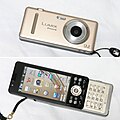 SoftBank 001P by Panasonic
 -
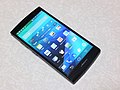 SoftBank A202F by Fujitsu
 -
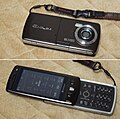 SoftBank 930CA by Casio
 -
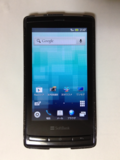 SoftBank 003SH
 -
 Vodafone 803T by Toshiba
 -
 J-PHONE J-SH07 by Sharp (2001)
 -
 An evolution of J-PHONE and Vodafone cell phones, 1997–2004
 -
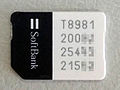 A SoftBank USIM card
 -
 View of Taitō, Tokyo, with a large Vodafone sign in the background (2004)
 -
 Mobile Blazer (2008)


.jpg)


.jpg)
Marketing
[edit]Since May 2006, SoftBank's telecommunications marketing and commercials have principally revolved around "Otosan", the canine patriarch of the otherwise human "Shirato" family.[180] "Otosan" translates to father, and the character, a Hokkaido dog, indeed acts as the father of the family, along with the son "Kojiro" (starred by Dante Carver), mom "Masako" (Kanako Higuchi), and daughter "Aya" (Aya Ueto).[181] The advertising series proved to be popular: CM Research Center ranked the Otousan adverts as the most popular in Japan between 2007 and 2012, based on monthly surveys of 3,000 randomly selected adults.[182][183]
SoftBank partnered with the Ingress augmented reality game, supporting the branded "SoftBank Ultra Link" in-game item.[184]
Sponsorship
[edit]SoftBank bought a "team" for the America's Cup. The team was named SoftBank Team Japan, and Yanmar came on board. SoftBank Team Japan raced in the 2017 races held in Bermuda. The team members come from various backgrounds, most of whom were not Japanese.[185]
The company was the official jersey sponsor of the Japanese national basketball team at the official 2017 Asian Basketball Championship in Lebanon[186] as well as the 2019 FIBA World Cup.
SoftBank has also owned the Fukuoka SoftBank Hawks, a Japanese professional baseball team based in Fukuoka, since 2005. The SoftBank logo appears on the jersey, and the team has won seven Japan Series championships under SoftBank, all of which came between 2011 and 2020.
Baby bonus
[edit]In 2015, SoftBank, along with some other companies in Japan,[187] offered a baby bonus for employees who have children. The payments range from 50,000 yen for the first child to 5 million yen for the fifth child.[188][189][190]
Vision fund investments
[edit]SoftBank Investment Advisers oversees SoftBank's Vision Fund, created in 2017, which invests in emerging technologies like artificial intelligence, robotics and the internet of things.[191] It intended to develop a portfolio of 125 AI companies.[192] According to the fund and Son, it also invested in companies to revolutionize real estate, transportation, and retail. Son claimed he would make personal connections with the CEOs of all companies funded by Vision Fund in order to boost synergies among them.[193] Son’s original plans were to raise $100 billion for a new fund every few years, investing about $50 billion a year in startups.[194] By 2023, after the launch of Vision Fund 1 and 2, the dismal performance[195] of SoftBank’s funds had cast a shadow over the initial exuberance of both Masayoshi Son and his company regarding its huge, largely unprofitable intercorporate investments[196] that had become the main mission, vision and purpose of the entire SoftBank Group.[197][198][199]
SoftBank Ventures Asia
[edit]SoftBank Ventures Asia (SBVA) was the global early-stage venture capital arm of the SoftBank Group[200] The firm focused on early-stage ICT investments – including Artificial Intelligence (AI), the internet of things (IoT), and smart robotics.[201] By October 2021, SBVA had backed more than 250 companies in 10 countries with US$1.3 billion fund under management.[202]
SoftBank Ventures Asia (SBVA) was founded in 2000 as SoftBank Ventures Korea[201] and began its focus on South Korean market[201] and its early-stage ventures.[200] SBVA’s one of the early investments in South Korea included Nexon Co, now a Korean-Japanese gaming publisher that was the largest IPO in Japan for 2011.[200]
SoftBank Ventures Asia (SBVA) expanded its focus beyond South Korea since 2011 and made several notable investments in Southeast Asia,[203] such as Tokopedia,[204] an Indonesian e-commerce platform, and Carro, Singapore's used-car platform.[205] In 2018, SBVA launched a $300m venture fund ‘China Venture Fund I’,[201] targeting Chinese start-ups,[206] then immediately trailed by ‘SoftBank Acceleration Fund’ with $300M the following year.[200] With continuous investment across Asia and beyond, the company renamed itself as SoftBank Ventures Asia to reflect its broadened focus on startups in the Asia-Pacific region beyond South Korea, and opened offices in Seoul,[207] Singapore, and Beijing.
With the company’s extended expertise in ICT investment, SBVA is aiming towards two investment themes, which were ‘technology innovation’ in AI,[201] Robotics, Semiconductor, Mobility, and AR/VR, and ‘market innovation’ in consumer, enterprise, shared economy, healthcare, etc.[202] SBVA created $160M ‘future innovation fund’ in March 2021, focusing on AI start-ups[208] and made investment in AI sector including VoyagerX, AI software developer,[209] Upstage AI, AI solution provider,[209] and MarqVision, AI-powered intellectual property (IP) protection platform.[210]
In April 2023, it was known that Masayoshi Son's SoftBank Group would sell its early-stage venture capital arm SoftBank Ventures Asia to Singapore-based The Edgeof, a newly formed investment firm led by Son's youngest brother, Taizo Son, as SoftBank Group grappled with steep losses in a myriad of investments made around the world.[211] The operation raised governance concerns.[212]
See also
[edit]
References
[edit]- ^ a b c d e "Consolidated financial report for the fiscal year ended March 31, 2024" (PDF). SoftBank Group. Retrieved 10 September 2024.
- ^ a b "SoftBank Group Report 2024" (PDF). SoftBank Group. Retrieved 10 September 2024.
- ^ Culpan, Tim (11 August 2020). "SoftBank Gives Up Pretending It Isn't a Fund". Bloomberg. Retrieved 26 May 2023.
- ^ "SoftBank Group Corp". Nikkei Asia. Retrieved 13 March 2023.
- ^ Crane, John (21 May 2019). "Exposing SoftBank's Hunger for Saudi Blood Money". The Startup.
- ^ Wong, Jacky (9 May 2018). "How Much Is the World's Largest Tech Fund Worth to SoftBank?". The Wall Street Journal.
- ^ "SoftBank's Son defends Vision Fund at Saudi conference". Nikkei Asia. Retrieved 11 June 2021.
- ^ "First Bitcoin, Now WeWork: Is Masayoshi Son the Worst Investor Ever?". CCN.com. 26 September 2019. Retrieved 11 October 2022.
- ^ Elstrom, Peter (2 December 2019). "SoftBank's startup bookkeeping draws scrutiny after WeWork fiasco". The Japan Times. Retrieved 11 October 2022.
- ^ "Masayoshi Son: Inside the eccentric world of the controversial Japanese billionaire investor". The Independent. 15 January 2018. Retrieved 11 October 2022.
- ^ "Some suggested slides for SoftBank". Financial Times. 10 November 2022. Archived from the original on 10 December 2022. Retrieved 11 November 2022.
- ^ Einhorn, Bruce (8 May 2014). "Masayoshi Son's $58 Billion Payday on Alibaba". Bloomberg.com. Retrieved 12 November 2017.
- ^ "SoftBank's Woes: A Deep Dive". ARPU!. 24 May 2022. Retrieved 21 February 2023.
- ^ Pollack, Andrew (19 February 1995). "A Japanese Gambler Hits the Jackpot With Softbank". The New York Times. ISSN 0362-4331. Retrieved 21 February 2023.
- ^ Singh, Manish (8 August 2022). "SoftBank cautions longer startup winter if unicorn founders unwilling to cut valuations". TechCrunch. Retrieved 10 March 2023.
- ^ Pressman, Aaron (11 April 2023). "Some Boston startups backed by Japanese giant SoftBank are floundering". The Boston Globe. Retrieved 13 April 2023.
- ^ "SoftBank Vision Fund: Portfolio returns, investments and strategy". pitchbook.com. Retrieved 23 February 2023.
- ^ "Arm Sales Rise as SoftBank Targets 2023 IPO for Chip Firm". Bloomberg.com. 7 February 2023. Retrieved 21 February 2023.
- ^ "SoftBank moves to sell down most of its Alibaba stake". Financial Times. 13 April 2023. Retrieved 13 April 2023.
- ^ Singh, Manish (22 September 2022). "SoftBank cuts internal valuation of $10 billion Oyo to $2.7 billion". TechCrunch. Retrieved 23 February 2023.
- ^ "Fidelity, After Becoming WeWork's Second-Largest Shareholder, Adds to Stake Once Again". CoStar. 11 July 2022. Retrieved 23 February 2023.
- ^ "Deutsche Telekom raises stake in T-Mobile US, swaps shares with Softbank". Fierce Wireless. 7 September 2021. Retrieved 21 February 2023.
- ^ "Number of subscribers by Carriers|TCA". Tca.or.jp.
- ^ SCHIFRIN", "ANDREA MURPHY"," MATT. "Forbes' 2025 Global 2000 List - The World's Largest Companies Ranked". Forbes. Retrieved 23 September 2025.
{{cite web}}: CS1 maint: multiple names: authors list (link) - ^ "Origin of Brand Name and Logo". SoftBank Group. SoftBank Group Corp. Retrieved 26 September 2018.
- ^ "SoftBank in talks with Mizuho and Japan banks for $2.8bn loan". Nikkei Asian Review. Retrieved 23 November 2019.
- ^ Jacobs, Jennifer (22 January 2025). "Trump announces up to $500 billion in private sector AI infrastructure investment". CBS News. Retrieved 22 January 2025.
- ^ Webber, Alan M. (1 January 1992). "Japanese-Style Entrepreneurship: An Interview with Softbank'S CEO, Masayoshi Son". Harvard Business Review.
- ^ a b "Japan's Big Three Carriers Explained - SoftBank". 27 October 2013.
- ^ "Softbank Agrees to Buy Ziff-Davis PC Magazine Group". The New York Times. Bloomberg Business News. 10 November 1995.
- ^ Pollack, Andrew (19 February 1995). "A Japanese Gambler Hits the Jackpot With Softbank". The New York Times. ISSN 0362-4331. Retrieved 10 December 2017.
- ^ Caulfield, Brian (1 September 2003). "Worst in Show How Key3Media, the company behind the big tech trade show Comdex, went bankrupt". CNN Money. Retrieved 10 December 2017.
- ^ "Business News – Latest Headlines on CNN Business - CNN". CNN.
- ^ "Mr. Japan.com How Son Captured Japan's Internet Economy". money.cnn.com. 16 August 1999.
- ^ Huffstutter, P.J.; Gaw, Jonathan (15 July 1999). "2 Founders to Buy Back Kingston Stake From Softbank". Los Angeles Times. Retrieved 11 September 2022.
- ^ "ソフトバンクグループの歩み". ソフトバンクグループ株式会社.
- ^ Sender, Henny; Ling, Connie (18 January 2000). "Softbank to Invest $20 Million In Hong Kong's Alibaba.com". The Wall Street Journal. ISSN 0099-9660. Retrieved 11 December 2017.
- ^ Galani, Una (22 September 2014). "Valuing SoftBank in Alibaba's Aftermath". DealBook. Retrieved 20 October 2017.
- ^ Pfanner, Eric (19 September 2014). "SoftBank's Alibaba Alchemy: How to Turn $20 Million Into $50 Billion". The Wall Street Journal. Retrieved 11 December 2017.
- ^ Ji-young, Sohn (28 January 2019). "[Herald Interview] Rebranded SoftBank Ventures Asia to form new fund for AI startups in Asia". The Korea Herald. Retrieved 25 August 2021.
- ^ ボーダフォン、メールのドメイン名も「ソフトバンク」へ──10月1日から (in Japanese). ITmedia Mobile. 13 July 2006. Retrieved 2 July 2013.
- ^ 上戸彩:超高価ケータイ「ないしょにしてね」. Sports Nippon (in Japanese). Archived from the original on 30 January 2008. Retrieved 29 January 2008.
- ^ "Softbank profit soars; buys stake in Ustream", Japan Today, 3 February 2010
- ^ Softbank-Group-Wikipedia-accessed. Fbcoverup
- ^ Santos, Alexis (3 October 2012). "Softbank to acquire competitor eAccess, expand LTE network by 50 percent". Engadget. Retrieved 2 July 2013.
- ^ "Yahoo Japan drops $3.2 billion plan to buy eAccess from SoftBank". Reuters. 19 May 2014. Retrieved 10 November 2020.
- ^ "Softbank to Buy 70 Percent Stake in Sprint: Sources". CNBC. Retrieved 15 October 2012.
- ^ Soni, Phalguni (21 April 2014). "The latest word in telecom". Market Realist. Market Realist, Inc. Retrieved 21 April 2014.
- ^ "Olacabs raises $210 million from Japan's SoftBank Corp; enters b Club". The Times Of India. 25 October 2014. Archived from the original on 26 October 2014.
- ^ "Startup Housing.com valued at Rs 1,500 crore after SoftBank acquires 30% stake for $70 million". The Times Of India. 19 November 2014.
- ^ "Aldebaran Robotics Founder and CEO Steps Down, SoftBank Appoints New Leader". IEEE Spectrum: Technology, Engineering, and Science News. 23 February 2015.
- ^ Olson, Parmy. "Softbank's Robotics Business Prepares To Scale Up". Forbes.
- ^ Quigley, J.T. (22 May 2015). "Post-acquistion [sic], DramaFever has more muscle to spread Asian entertainment to the West". Tech In Asia. Retrieved 22 May 2015.
- ^ Martin, Alexander (11 May 2015). "SoftBank CEO Taps a Future Successor in Nikesh Arora". The Wall Street Journal. The Wall Street Journal. Retrieved 11 May 2015.
- ^ "Japan's Softbank increases controlling stake in Finnish 'Clash of Clans' maker". Reuters. June 2015. Retrieved 14 September 2020.
- ^ Ando, Ritsuko (3 June 2015). "SoftBank to invest $1 billion in Korean e-commerce site Coupang". Reuters. Retrieved 3 June 2015.
- ^ "Changes of Corporate Names of SoftBank Corp. and Subsidiary - Press Releases - News - About Us - SoftBank Group". SoftBank Group. 11 May 2015. Retrieved 7 December 2016.
- ^ "Softbank reveals record $4.4bn share buyback". BBC News. 16 February 2016. Retrieved 7 December 2016.
- ^ "Softbank sells stake in game developer Supercell to Tencent". Yahoo! News. 21 June 2016. Archived from the original on 22 June 2016. Retrieved 19 July 2016.
- ^ "Puzzle & Dragons studio GungHo to regain majority stake from SoftBank for $685m". develop-online.net. 7 June 2016.
- ^ "SoftBank to sell most of its stake in 'Puzzle & Dragons' maker GungHo". cnet.com. 6 June 2016.
- ^ "関連会社株式に係る公開買付けへの応募に関する契約の締結に関するお知らせ". ソフトバンクグループ株式会社. 6 June 2016.
- ^ "Tender in Tender Offer for Shares of an Associate - Press Releases - News - SoftBank Group Corp. - SoftBank Group". softbank.jp. 21 June 2016.
- ^ "Results of Tender in Tender Offer for Shares of an Associate - Press Releases - News - SoftBank Group Corp. - SoftBank Group". softbank.jp. 22 July 2016.
- ^ Martin, Alexander (21 June 2016). "SoftBank President Nikesh Arora to Step Down". The Wall Street Journal. The Wall Street Journal. Retrieved 21 June 2016.
- ^ a b Hoffman, Liz; Jenny, Strasburg; Sarah, Krouse (14 February 2017), SoftBank to Buy Fortress Investment Group for $3.3 Billion, The Wall Street Journal
- ^ Wong, Jacky (18 July 2016). "SoftBank-ARM: These Chips Don't Come Cheap". The Wall Street Journal. The Wall Street Journal. Retrieved 18 July 2016.
- ^ Jack, Simon (18 July 2016). "ARM Holdings in £24bn Japanese takeover deal". BBC News. Retrieved 7 December 2016.
- ^ Warren, Tom (5 September 2016). "SoftBank acquires ARM". The Verge. Retrieved 5 September 2016.
- ^ Knutson, Ryan (6 December 2016). "When Billionaires Meet: $50 Billion Pledge From SoftBank to Trump". The Wall Street Journal.
- ^ "Trump: SoftBank to add $50B, 50K jobs in U.S." USA Today.
- ^ "Amazon to add 100,000 full-time jobs in U.S. by '19". USA Today: B1/B2. 13 January 2017.
- ^ Farrell, Maureen; Winkler, Rolfe; Brown, Eliot (31 January 2017), "SoftBank Mulls Investment of Over $1 Billion in WeWork", Wall Street Journal, New York City, retrieved 31 January 2017
- ^ a b "Masayoshi Son goes on a $100bn shopping spree". The Economist. Retrieved 11 December 2017.
- ^ Rudegeair, Peter (16 February 2017), Silver Lake, Softbank to Join New $500 Million Investment in Lender SoFi, New York City: The Wall Street Journal, retrieved 17 February 2017
- ^ Wu, Kane; Negishi, Mayumi (28 March 2017). "SoftBank Considers $6 Billion Investment in China Ride-Hailing Firm Didi". Wall Street Journal. New York. Retrieved 30 March 2017.
- ^ Mundy, Simon (18 May 2017). "India's Paytm wins $1.4bn Softbank investment". Financial Times. London. Archived from the original on 10 December 2022. Retrieved 18 May 2017.
- ^ Rai, Saritha (10 August 2017). "SoftBank Fund Is Said to Invest $2.5 Billion in Flipkart". Bloomberg.com. Retrieved 12 July 2018.
- ^ Alkhalisi, Zahraa (6 October 2017). "Where the huge SoftBank-Saudi tech fund is investing". CNN. Retrieved 4 November 2018.
- ^ "SoftBank Vision Fund announces first major close" (PDF). Softbank.jp. 20 May 2017. Archived from the original (PDF) on 9 August 2017. Retrieved 9 November 2018.
- ^ "Masayoshi Son and Saudi Arabia launch a monster technology fund". The Economist. 25 May 2017. Retrieved 9 November 2018.
- ^ Dolan, Kerry A. (5 April 2017). "Japanese Billionaire Masayoshi Son, Larry Ellison, Apple, Saudi Arabia All Bet On Vision Fund". Forbes. Retrieved 9 November 2018.
- ^ Torchia, Andrew (20 May 2017). "Softbank-Saudi tech fund becomes world's biggest with $93 billion of capital". Reuters.com. Retrieved 9 November 2018.
- ^ Benner, Katie (10 October 2017). "Masayoshi Son's Grand Plan for SoftBank's $100 Billion Vision Fund". The New York Times. Retrieved 9 November 2018.
- ^ Shu, Catherine (26 July 2019). "SoftBank announces AI-focused second $108 billion Vision Fund with LPs including Microsoft, Apple and Foxconn". Tech Crunch. Retrieved 3 August 2019.
- ^ Winkler, Rolfe; Hoffman, Liz; Hope, Bradley (7 February 2020). "New SoftBank Tech Fund Falls Far Short of $108 Billion Fundraising Goal". The Wall Street Journal. ISSN 0099-9660. Retrieved 10 February 2020.
- ^ Lunden, Ingrid (9 June 2017). "SoftBank is buying robotics firms Boston Dynamics and Schaft from Alphabet".
- ^ Brown, Eliot (25 August 2017). "SoftBank Finalizes $4.4 Billion WeWork Investment". The Wall Street Journal.
- ^ "SoftBank to work with Saudi Arabia on new city". Reuters.com. 24 October 2017. Retrieved 4 November 2018.
- ^ "Tech in Asia - Connecting Asia's startup ecosystem". www.techinasia.com. Retrieved 21 November 2017.
- ^ Hook, Leslie (29 December 2017). "SoftBank deal helps clear path towards Uber IPO". Financial Times. London. Archived from the original on 10 December 2022. Retrieved 29 December 2017.
- ^ Hook, Leslie (28 December 2017). "SoftBank-led group to acquire $9bn stake in Uber". Financial Times. London. Archived from the original on 10 December 2022. Retrieved 29 December 2017.
- ^ "SoftBank's Vision Fund Invests $560 Million in Auto1 Group". Bloomberg.com. 14 January 2018. Retrieved 1 February 2018.
- ^ "DoorDash is raising $535 million from SoftBank and others at a $1.4 billion valuation". Recode. Retrieved 2 March 2018.
- ^ "Whoops: SoftBank CEO reveals Walmart has acquired Flipkart – TechCrunch". techcrunch.com. 9 May 2018. Retrieved 9 May 2018.
- ^ Brown, Eliot; Kusisto, Laura (27 September 2018). "SoftBank Invests $400 Million in Home-Selling Startup Opendoor". The Wall Street Journal. ISSN 0099-9660. Retrieved 27 September 2018.
- ^ Jones, Rory; Said, Summer (30 September 2018). "Saudi Arabia Shelves Work on SoftBank's $200 Billion Solar Project". The Wall Street Journal. ISSN 0099-9660. Retrieved 1 October 2018.
- ^ "SoftBank sets indicative share price of 1,500 yen for next month's IPO". TechCrunch. Retrieved 30 November 2018.
- ^ "SoftBank invests in parking startup ParkJockey pushing valuation to $1 billion". TechCrunch. 10 December 2018. Retrieved 11 December 2018.
- ^ "SoftBank's Vision Fund is preparing to invest $1 billion in Grab". TechCrunch. 21 December 2018. Retrieved 21 December 2018.
- ^ "SoftBank Robotics Singapore Launches AI Commercial Vacuum Cleaner 'Whiz'". SoftBank Robotics - Group | Global Site. 25 September 2019.
- ^ Eavis, Peter; de la Merced, Michael J. (30 September 2019). "WeWork I.P.O. Is Withdrawn as Investors Grow Wary". The New York Times.
- ^ Griffith, Erin (10 December 2019). "SoftBank Takes Loss in Sale of Wag, Dog-Walking Start-Up". The New York Times.
- ^ "SoftBank loses one of the few board members who could challenge Masayoshi Son". Los Angeles Times. 27 December 2019.
- ^ Goel, Vindu; Singh, Karan Deep; Griffith, Erin (13 January 2020). "Oyo Scales Back as SoftBank-Funded Companies Retreat". The New York Times.
- ^ de la Merced, Michael J. (6 February 2020). "Elliott Management Is Said to Push for Change at SoftBank". The New York Times.
- ^ Hu, Joshua Franklin (3 March 2020). "SoftBank CEO tells U.S. investors he'll be more careful". Reuters.
- ^ Shu, Catherine (18 November 2019). "Yahoo Japan and Line Corp. confirm merger agreement". TechCrunch. Retrieved 7 April 2020.
- ^ "Coronavirus delays Yahoo Japan's merger with Line". Nikkei Asia. Retrieved 11 June 2021.
- ^ Kana Inagaki; et al. (22 March 2020). "SoftBank plans $41bn asset sale to cut debt amid coronavirus tumult". Financial Times. Archived from the original on 10 December 2022. Retrieved 23 March 2020.
- ^ "Alibaba's Jack Ma quits SoftBank board after $18B Vision Fund loss". NYPost. 18 May 2020.
- ^ Cimilluca, Dana; Lombardo, Cara (13 July 2020). "SoftBank considers sale or IPO of British chip designer Arm Holdings". MarketWatch. Retrieved 30 September 2021.
- ^ "How SoftBank's sale of Arm China sowed the seeds of discord". Nikkei Asia. Retrieved 11 June 2021.
- ^ Inagaki, Kana (11 August 2020). "SoftBank rebounds from historic loss with $12bn quarterly profit". Financial Times. Archived from the original on 10 December 2022. Retrieved 11 August 2020.
- ^ Shu, Catherine (2 September 2020). "SoftBank Vision Fund 2 leads $100 million Series C in digital therapeutics company Biofourmis". TechCrunch. Retrieved 3 September 2020.
- ^ "Softbank was identified as being the 'Nasdaq whale'". CNBC. 4 September 2020.
- ^ "SoftBank option purchases raise eyebrows as Wall Street backtracks". mint. 5 September 2020.
- ^ Lachapelle, Tara (5 September 2020). "Nasdaq Whale: Softbank's huge tech options bet answers stock rally riddle". Business Standard India.
- ^ "Nasdaq Whale and how SoftBank's derivative bets may have powered the US tech rally". 5 September 2020.
- ^ Nussey, Sam; Gallagher, Chris (18 September 2020). "SoftBank exits cellphone distributor Brightstar in telecoms sell-down". Reuters. Retrieved 26 January 2021.
- ^ Narioka, Kosaku; Dvorak, Phred (18 September 2020). "SoftBank Sells Brightstar, Carrying On Its Divestiture Spree". The Wall Street Journal. ISSN 0099-9660. Retrieved 13 October 2020.
- ^ Rosoff, Matt (13 September 2020). "Nvidia to buy Arm Holdings from SoftBank for $40 billion". CNBC. Retrieved 13 September 2020.
- ^ Moorhead, Patrick. "It's Official: NVIDIA Acquires Arm For $40B To Create What Could Be A Computing Juggernaut". Forbes. Retrieved 14 September 2020.
- ^ Massoudi, Arash; Smith, Robert; Fontanella-Khan, James (12 September 2020). "SoftBank set to sell UK's Arm Holdings to Nvidia for $40bn". Financial Times. Archived from the original on 10 December 2022. Retrieved 12 September 2020.
- ^ Lee, Jane Lanhee; Horwitz, Josh (8 February 2022). "SoftBank dumps sale of Arm over regulatory hurdles, to IPO instead". Reuters. Retrieved 12 February 2023.
- ^ "Hyundai Motor Buys 80% of Robotics Firm Boston Dynamics". Bloomberg.com. 11 December 2020. Retrieved 21 January 2021.
- ^ "SoftBank Sells $2 Billion in Uber Stock as Rides Recover". Bloomberg.com. 11 January 2021. Retrieved 21 January 2021.
- ^ a b c "Softbank just shocked its critics by landing the biggest profit in the history of a Japanese company". CNBC. 12 May 2021. Archived from the original on 15 May 2021.
- ^ "Israel's eToro to go public through $10.4 billion SPAC deal backed by SoftBank, others". Financial Post. 16 March 2021. Retrieved 2 September 2021.
- ^ "SoftBank Group to acquire 40% stake in AutoStore for $2.8 billion". The Japan Times. 6 April 2021. Retrieved 2 September 2021.
- ^ "India's Adani Green to buy SoftBank-backed SB Energy in $3.5 billion deal". Reuters. 19 May 2021. Retrieved 19 May 2021.
- ^ Dvorak, Phred (19 May 2021). "SoftBank Sells Renewable-Energy Unit in India". The Wall Street Journal. ISSN 0099-9660. Retrieved 19 May 2021.
- ^ Burgos, Jonathan. "Adani Green To Buy SB Energy India For $3.5 Billion From SoftBank, Bharti". Forbes. Retrieved 19 May 2021.
- ^ "Softbank's Vision Fund could go public in a $300 million SPAC deal, report says". markets.businessinsider.com. Retrieved 2 September 2021.
- ^ "Softbank buys Yahoo Japan brand from Verizon for $1.6 billion". RCR Wireless News. 7 July 2021. Retrieved 2 September 2021.
- ^ "SoftBank buys perpetual Yahoo trademark license for $1.6 billion". TechCrunch. 5 July 2021. Retrieved 2 September 2021.
- ^ Bastone, Nick. "Ethos wants to make signing up for life insurance a pain-free process. Here's the pitch deck that convinced Alphabet's GV investing arm that it's worth $500 million". Business Insider.
- ^ Savitz, Eric J. "SoftBank CEO to Take Stake in Vision Fund 2". www.barrons.com. Retrieved 26 May 2023.
- ^ Kharpal, Arjun (8 August 2022). "Japanese giant SoftBank dumps its entire stake in Uber as losses mount at its investment unit". CNBC.
- ^ Nussey, Sam (8 August 2022). "SoftBank posts record net loss on $23.1 bln Vision Fund hit". Reuters.
- ^ "Softbank: Twilight of an Empire | The Generalist". www.generalist.com. Retrieved 10 March 2023.
- ^ Lee, Andrew (9 February 2023). "Toyota Tsusho swoops for SB Energy set up by billionaire to green Japan post-Fukushima". Recharge. NHST Media Group. Retrieved 22 February 2023.
- ^ "SoftBank to Sell Korean Venture Arm to Firm Run by CEO's Brother". The Wall Street Journal. Retrieved 14 May 2023.
- ^ "SoftBank Vision Fund Posts Record Loss Despite Masayoshi Son Foreseeing Disaster". Observer. 11 May 2023. Retrieved 13 May 2023.
- ^ "SoftBank sells Fortress stake to Mubadala and management". Nikkei Asia. Retrieved 22 May 2023.
- ^ Nerkar, Santul; Clark, Don (21 August 2023). "Arm, the Chip Designer, Files for an I.P.O. Expected to Be Among the Largest". The New York Times.
- ^ Meredith, Sam (3 March 2023). "British chip giant Arm chooses New York listing in a blow to London". CNBC.
- ^ King, Ian; Hytha, Michael (21 August 2023). "SoftBank's Arm Files for IPO That Is Set to Be 2023's Biggest". Bloomberg News.
- ^ Wang, Echo; Sen, Anirban (14 September 2023). "How SoftBank played it safe in pricing Arm's IPO". Reuters.
- ^ Hansen, Sarah (13 September 2023). "Arm IPO: A Dominant Chip Designer but at a 'Very, Very' Lofty Price". Morningstar.
- ^ Giang, Vivian (13 September 2023). "Arm, the Chip Designer, Raises $4.87 Billion in the Year's Largest I.P.O." The New York Times.
- ^ Nick, Carey (5 December 2023). "SoftBank Corp buys $514 mln majority stake in car software firm Cubic Telecom". Reuters. Retrieved 5 December 2023.
- ^ "EY Ireland advises Cubic Telecom on Investment from Softbank". www.ey.com. Retrieved 6 December 2023.
- ^ "SoftBank Group Establishes Joint Venture "SB TEMPUS" with Tempus for Further Advancements of Japan's Healthcare Through the Utilization of Medical Data and AI". SoftBank Group. 26 June 2024. Retrieved 15 February 2025.
- ^ "SoftBank Invests in Perplexity AI at $3 Billion Valuation". Reuters. 27 June 2024. Retrieved 27 June 2024.
- ^ Melloy, John (16 December 2024). "Softbank CEO and Trump to announce $100 billion investment in U.S. by firm". CNBC. Retrieved 16 December 2024.
- ^ "Trump, SoftBank CEO announce $100 billion US investment, in echo of 2016 event". 17 December 2024.
- ^ Seetharaman, Deepa. "Tech Leaders Pledge Up to $500 Billion in AI Investment in U.S." The Wall Street Journal. Retrieved 21 January 2025.
- ^ "OpenAI and SoftBank Group Partner to Develop and Market Advanced Enterprise AI". SoftBank Group Corp. 3 February 2025. Retrieved 10 February 2025.
- ^ "Acquisition of Ampere Computing Holdings LLC". 19 March 2025.
- ^ "Tether, SoftBank Group, and Jack Mallers Launch Twenty One, a Bitcoin-native Company, Through a Business Combination With Cantor Equity Partners" (Press release). 23 April 2025.
- ^ a b c d e "ABB to divest Robotics division to SoftBank Group". ABB. 7 October 2025. Retrieved 8 October 2025.
- ^ https://group.softbank/media/Project/sbg/sbg/news/press/2025/20251008/pdf/20251008_en.pdf
- ^ "Ownership".
- ^ "SOFTBANK GROUP CORP. : Shareholders Board Members Managers and Company Profile | JP3436100006 | MarketScreener".
- ^ Lee, Ming Jeong; Hyuga, Takahiko; Mak, Pei Yi (8 December 2022). "SoftBank's Masayoshi Son quietly lifts stake to 34%, edging toward buyout". The Japan Times. Retrieved 21 February 2023.
- ^ "SoftBank Group Report 2025". SoftBank Group Corp. Retrieved 10 October 2025.
- ^ Corporate history, JP: SBI.
- ^ "SoftBank aims at 97% coverage for TD-LTE network, says CTO Yoshioki Chika - Global Telecoms Business". Archived from the original on 17 March 2017. Retrieved 7 December 2016.
- ^ "Chinese online medical platform Ping An Healthcare and Technology to raise US$1b from Hong Kong IPO". scmp.com. 12 April 2018. Retrieved 13 December 2019.
- ^ C, Priyamvada; Deka, Kannaki (17 March 2023). "WeWork reaches deals to cut debt, extend maturities". Reuters.
- ^ "Softbank Invests in a New-Age Cloud Company". Fortune. Retrieved 11 May 2018.
- ^ "Tokopedia raises $1.1b from SoftBank, Alibaba to evolve into infrastructure-as-a-service". TechinAsia. Retrieved 29 July 2019.
- ^ a b "Changes of Corporate Names - SoftBank Corp. - Group Companies - About Us - SoftBank Group". Retrieved 7 December 2016.
- ^ "Bill Morrow, Vodafone's turnaround guru, Walks Away". Cellular-news.com. 24 June 2006. Retrieved 9 November 2007.
- ^ "念願のiPhoneを獲得した舞台裏 ソフトバンク、トラウマ乗り越える" (in Japanese). 6 June 2008. Archived from the original on 13 June 2008. Retrieved 7 June 2008.
- ^ "SoftBank reaches deal with Apple to sell iPhone handsets in Japan this year", International Herald Tribune, 4 June 2008, archived from the original on 8 June 2008
- ^ "announces 14 new members". Open Handset Alliance. 9 December 2008. Retrieved 15 October 2013.
- ^ Chang, Alexandra (29 May 2012). "SoftBank Unveils World's First Phone With Radiation Detection". Wired. Retrieved 29 May 2012.
- ^ "Veteran actor Kai-kun retires from SoftBank Otousan role". www.japanator.com. Retrieved 26 March 2015.
- ^ Griner, David (12 August 2012). "Meet Japan's Most Popular Ad Family". Adweek. Retrieved 21 June 2018.
- ^ Corkill, Edan (29 April 2012). "Otosan, Japan's top dog". Japan Times. Retrieved 26 March 2015.
- ^ Corkill, Edan (29 April 2012). "Otosan, Japan's top dog". Japan Times Online. Retrieved 7 December 2016.
- ^ Shannon, Jonathan (9 July 2015). "Axa reaches millions of people through augmented reality game Ingress". Campaign.
- ^ "Dean Barker: Looking Back At 35th America's Cup". Archived from the original on 19 October 2017.
- ^ "Japan at the FIBA Asia Cup 2017". FIBA.basketball. Retrieved 30 September 2021.
- ^ Turner, David (21 March 2007). "Japan offers baby bonus to workers". Financial Times. Archived from the original on 10 December 2022. Retrieved 29 September 2015.
- ^ "Cash for Kids: Japan's Employers Offer "Baby Bonuses"". ABC News. Archived from the original on 30 September 2015. Retrieved 29 September 2015.
- ^ "Cash for Kids: Japan's Employers Offer 'Baby Bonuses' - ABC News". ABC News. 30 September 2015. Archived from the original on 30 September 2015. Retrieved 11 February 2019.
- ^ "A shrinking work force solution: Baby bonuses". businessrecord.com. Retrieved 30 September 2021.
- ^ "SoftBank's $100 Billion Vision Fund Is Run by These 10 Men". Bloomberg.com. 27 September 2018. Retrieved 16 January 2019.
- ^ Brooker, Katrina (14 January 2019). "The most powerful person in Silicon Valley". Fast Company. Retrieved 16 January 2019.
- ^ Sherman, Alex (1 August 2018). "Masayoshi Son building Vision Fund into family, say founders". CNBC. Retrieved 16 January 2019.
- ^ Ghurye, Shruti (7 February 2019). "Masayoshi Son: Betting big and winning". The Japan Times. Retrieved 7 February 2019.
- ^ Linares, Maria Gracia Santillana. "SoftBank Puts Blockchain Investments On Ice As Part Of Startup Pullback". Forbes. Retrieved 25 February 2023.
- ^ "Accounting for Intercorporate Investments: What You Need to Know". Investopedia. Retrieved 23 February 2023.[unreliable source?]
- ^ "Breakingviews - SoftBank is paying for Son's past exuberance". Reuters. 7 February 2023. Retrieved 12 February 2023.
- ^ "SoftBank CEO to Skip Earnings Call for First Time as Tech Slumps". Bloomberg.com. 5 February 2023. Retrieved 12 February 2023.
- ^ "SoftBank's future rests on Arm". Financial Times. 15 February 2023. Retrieved 15 February 2023.
- ^ a b c d "SoftBank's Son finds more love for early-stage investing, new fund planned". Reuters. 10 March 2019. Retrieved 28 October 2021.
- ^ a b c d e Ji-young, Sohn (28 January 2019). "[Herald Interview] Rebranded SoftBank Ventures Asia to form new fund for AI startups in Asia". The Korea Herald. Retrieved 28 October 2021.
- ^ a b "Funding, talent & decision-making are the biggest challenges for innovators, says SoftBank Ventures Asia's JP Lee [Q&A]". TechNode Global. 14 September 2021. Retrieved 28 October 2021.
- ^ "SoftBank Ventures Asia hits $341m second close for early-stage fund". Nikkei Asia. Retrieved 28 October 2021.
- ^ Horwitz, Josh (12 June 2013). "Tokopedia Lands Funding To Help It Become Indonesia's Alibaba". TNW | Asia. Retrieved 28 October 2021.
- ^ "Asia Solutions". www.businesstimes.com.sg. 14 May 2018. Retrieved 28 October 2021.
- ^ Sender, Henny (25 September 2018). "TPG partners with SoftBank Ventures Korea for $300m China fund". Financial Times. Archived from the original on 10 December 2022. Retrieved 28 October 2021.
- ^ Min-kyung, Jung (3 January 2019). "Softbank Ventures Korea rebrands as Softbank Ventures Asia". The Korea Herald. Retrieved 28 October 2021.
- ^ "소프트뱅크벤처스, AI 스타트업 투자 1천800억 펀드 조성". hankyung.com (in Korean). 24 March 2021. Retrieved 28 October 2021.
- ^ a b Byung-wook, Kim (23 June 2021). "Local AI startup VoyagerX raises $27m from SoftBank, others". The Korea Herald. Retrieved 28 October 2021.
- ^ "Tech in Asia - Connecting Asia's startup ecosystem". www.techinasia.com. Retrieved 28 October 2021.
- ^ Park, Kate (13 April 2023). "As tech slumps, SoftBank sells VC unit to Singapore-based firm led by Masayoshi Son's brother". TechCrunch. Retrieved 18 April 2023.
- ^ "SoftBank unit's sale to founder's brother raises governance concerns". Financial Times. 13 April 2023. Retrieved 18 April 2023.
Additional sources
[edit]- Annual Report (PDF), JP: SoftBank, 2008, archived from the original (PDF) on 19 April 2009.
External links
[edit]
- Official website (SoftBank Group)
- Official website (SoftBank)
- The first photo sent from a phone, BBC Witness History


| International | |
|---|---|
| National | |
| Other | |

SoftBank Group
View on GrokipediaHistory
Founding and Early Software Distribution (1981–1994)
Masayoshi Son founded Nihon SoftBank in September 1981 at age 24, establishing the company as a wholesaler and distributor of packaged personal computer software in Japan. Inspired by the potential of microchips observed during his studies at the University of California, Berkeley, Son aimed to capitalize on the nascent PC market dominated by systems like NEC's PC-98 series. Starting with minimal operations and two part-time employees, the firm secured exclusive distribution contracts with key partners such as Joshin Denki Co. and Hudson Soft, enabling rapid initial growth from monthly sales of $10,000 to $2.3 million by the end of its first year.[2][12] By 1983, Nihon SoftBank had expanded its network to over 200 dealer outlets across Japan, solidifying its position as a leading software distributor amid rising demand for PC peripherals and applications. The company's focus on efficient supply chain logistics and partnerships with U.S. software developers allowed it to import and distribute titles that were scarce in the domestic market, contributing to its dominance in a sector previously underserved by traditional electronics wholesalers. This period marked the foundation of SoftBank's reputation for aggressive market penetration, with annual revenues climbing steadily through the mid-1980s as personal computing adoption accelerated in corporate and hobbyist segments.[12] In May 1982, the company diversified into publishing by launching Oh! PC, a monthly magazine dedicated to NEC computers, and Oh! MZ for Sharp systems, targeting engineers and manufacturers with technical content. These publications quickly gained traction, with Oh! PC achieving a circulation of 140,000 copies per issue by 1989, supplemented by revamped editions and additional titles that collectively made SoftBank Japan's largest publisher of computer periodicals. By the late 1980s, the firm had expanded its portfolio to include over 20 magazines and more than 300 computing books, generating synergistic revenue streams that reinforced its software distribution core while building brand authority in the tech ecosystem. In 1989, it further bolstered this segment by introducing the Japanese edition of PC Magazine.[2][12] In July 1990, Nihon SoftBank rebranded to SoftBank Corp. to signal ambitions for broader, international operations. This transition preceded its public listing, with shares beginning over-the-counter trading in Japan in July 1994, raising approximately 20 billion yen (about $200 million) to fund future acquisitions and expansions. By this point, SoftBank had established itself as Japan's preeminent player in PC software distribution and tech publishing, with a valuation reaching $3 billion upon going public, setting the stage for ventures beyond domestic software channels.[2][12]Entry into Broadband and Telecom (1995–2000)
In the mid-1990s, SoftBank shifted strategic emphasis toward internet infrastructure and services, initiating its foray into sectors enabling broadband delivery. This transition built on the company's software distribution expertise, leveraging investments in digital content and access technologies amid Japan's nascent online economy. By 1995, SoftBank had acquired significant stakes in U.S. tech assets, including a 5% share in Yahoo! Inc., signaling intent to import and adapt high-growth internet models domestically.[13] A pivotal development occurred on April 1, 1996, when SoftBank formed Yahoo! Japan Corporation through a joint venture with Yahoo! Inc., investing approximately ¥1.06 billion (about $10 million at the time) for a 34% stake. This portal provided search, email, and community features over dial-up connections, capturing early web traffic and establishing SoftBank as Japan's leading internet service aggregator, handling up to 85% of domestic online access by the late 1990s. The venture's success, with user growth exceeding 10 million by 2000, underscored SoftBank's role in popularizing internet adoption, which relied on improving telecom bandwidth.[2][14] SoftBank's internet pivot extended to e-commerce and media, with launches like the Ziff-Davis subsidiary in 1999 for tech publishing and online content, further integrating software distribution with network-dependent services. These efforts positioned the company to capitalize on bandwidth constraints in Japan's telecom market, dominated by NTT's slower dial-up infrastructure. By fostering demand for faster access, SoftBank indirectly pressured telecom evolution, though direct fixed-line operations remained absent until later acquisitions.[12] In May 2000, SoftBank established BB Technologies Corporation as a dedicated unit for broadband development, investing in ADSL technology to deliver speeds up to 12 Mbps—far surpassing dial-up's 56 kbps limits. This subsidiary targeted mass-market rollout, pricing services aggressively to disrupt incumbents like NTT, with preparations including partnerships for nationwide line provisioning. The initiative reflected Masayoshi Son's foresight on broadband's transformative potential, drawing from U.S. trends like cable modem trials, though Japan's regulatory hurdles delayed full deployment until 2001. By year-end 2000, SoftBank's market capitalization had swelled to over ¥20 trillion, fueled by dot-com optimism and telecom-adjacent bets.[15][16]Dot-Com Investments and Global Expansion (2001–2009)
The dot-com bust severely impacted SoftBank, with its market capitalization plummeting approximately 99% from its peak, reducing from around $180 billion to under $2 billion by early 2001, amid widespread write-offs of investments in failed ventures such as Webvan and Kozmo.com.[17][18] The company reported a $6.5 billion loss in the third quarter of fiscal year 2001 alone, pushing it to the brink of bankruptcy as Masayoshi Son personally lost an estimated $70 billion in net worth.[18][19] To avert collapse, Son pledged personal assets and shifted strategy toward operational businesses with immediate revenue potential, while preserving select high-conviction holdings from the bubble era. A pivotal recovery came through the expansion of broadband services, with SoftBank launching Yahoo! BB in September 2001 via subsidiary BB Technologies Corporation, offering ADSL access at aggressively low prices of ¥1,580 per month for the first three months.[2] This initiative rapidly scaled, achieving over 2 million subscribers by mid-2002 and becoming Japan's largest broadband provider within two years, with 4.426 million users by August 2004, generating essential cash flows that offset investment losses and stabilized finances.[20][21] Complementing this, SoftBank retained its $20 million stake in Alibaba Group from 2000, which appreciated as the Chinese e-commerce firm expanded domestically and internationally during the mid-2000s, culminating in Yahoo's $1 billion investment for a 40% stake in Alibaba in August 2005, indirectly validating SoftBank's position as a major shareholder.[22][23] Global expansion accelerated through strategic acquisitions and identity rebranding, including the full acquisition of Japan Telecom Co., Ltd. in July 2004 for approximately ¥1.1 trillion, which bolstered fixed-line infrastructure supporting internet growth and provided data services with some international connectivity.[2] In December 2004, SoftBank introduced a new corporate identity featuring a double-line logo and silver branding to signal broader ambitions beyond Japan.[2] These moves, alongside the Alibaba bet's maturation into a cornerstone asset—valued at billions by decade's end—repositioned SoftBank as a hybrid investment and operating entity, though many post-bust venture bets via SoftBank Capital continued to yield mixed results amid a cautious global tech environment.[24][25]Mobile Acquisitions and Consolidation (2010–2016)
In October 2010, SoftBank agreed to acquire a 100% stake in Willcom Inc., a Japanese provider of Personal Handy-phone System (PHS) services that had entered civil rehabilitation proceedings due to financial distress, primarily to gain access to its underutilized 2.5 GHz spectrum holdings valuable for next-generation mobile broadband deployment.[26] The transaction completed on December 21, 2010, through a company split and capital restructuring under Willcom's rehabilitation plan, with SoftBank canceling existing Willcom shares and issuing new ones to itself, effectively absorbing the distressed assets without significant upfront cash outlay beyond prior investments.[27] This move bolstered SoftBank's spectrum portfolio amid intensifying competition in Japan's mobile market, where it trailed leader NTT Docomo in subscriber base, enabling future LTE expansions using the acquired frequencies. By July 1, 2013, SoftBank formalized Willcom's integration as a wholly owned subsidiary, aligning its operations with SoftBank Mobile to rationalize overlapping services and accelerate 4G network rollout.[28] Willcom's rebranded wireless division, launched as Y!mobile in 2014, targeted budget-conscious users with low-cost plans leveraging the 2.5 GHz band, helping SoftBank capture additional market share from rivals. This domestic consolidation reflected SoftBank's strategy to consolidate fragmented assets for cost efficiencies and spectrum optimization, as Japan's telecom sector faced pressure from data-intensive usage growth post-smartphone adoption. Parallel to Japanese efforts, SoftBank expanded internationally by announcing on October 15, 2012, a $20.1 billion investment for approximately 70% ownership of Sprint Nextel Corp., the third-largest U.S. wireless carrier, aiming to leverage Sprint's 4G infrastructure and subscriber base of over 50 million for global synergies in device procurement and technology sharing.[29] The deal, revised to $21.6 billion amid regulatory scrutiny, closed on July 11, 2013, following U.S. Federal Communications Commission approval on July 6, granting SoftBank about 78% economic interest while retaining Sprint's operational independence under CEO Dan Hesse.[30] This acquisition marked SoftBank's bold entry into the U.S. market, driven by Masayoshi Son's vision of cross-border scale to challenge dominant carriers like Verizon and AT&T, though it introduced integration challenges including cultural differences and regulatory hurdles. To further streamline domestic operations, SoftBank executed a merger on April 1, 2015, absorbing SoftBank BB Corp. (broadband), SoftBank Telecom Corp. (enterprise services), and Y!mobile Corporation into SoftBank Mobile Corp., creating a unified entity under the SoftBank brand to reduce redundancies and enhance competitiveness against NTT Docomo and KDDI.[31] The consolidation, which included migrating Y!mobile's ~5 million subscribers to SoftBank's network, supported aggressive pricing and network investments, contributing to SoftBank's subscriber growth to over 40 million in Japan by 2016 while positioning the group for 5G preparations. These moves exemplified SoftBank's aggressive consolidation tactics to fortify its telecom core amid maturing markets and rising capital demands for infrastructure.Launch of Vision Funds and Mega-Deals (2017–2018)
In 2016, SoftBank Group Corp. announced plans to establish the SoftBank Vision Fund, a $100 billion technology investment vehicle aimed at accelerating innovation in artificial intelligence, robotics, and related fields, with initial commitments including $45 billion from Saudi Arabia's Public Investment Fund (PIF) to be disbursed over five years, $25 billion from SoftBank itself, and additional pledges from investors such as the UAE's Mubadala Investment Company.[32] Masayoshi Son, SoftBank's founder and CEO, positioned the fund as a means to support the "information revolution," drawing on his prior successes in semiconductor and mobile investments while targeting late-stage private companies with potential for massive scale.[33] The fund was managed by SoftBank Investment Advisers, a subsidiary based in London, with a structure allowing for majority or minority stakes in global tech firms, diverging from traditional venture capital by emphasizing outsized bets rather than diversified small positions.[34] The Vision Fund's first major close occurred on May 20, 2017, securing over $93 billion in committed capital from limited partners including Apple ($1 billion), Qualcomm ($1 billion), Foxconn, Sharp, and others, surpassing initial targets and enabling immediate deployment.[35] [36] By early 2018, the fund had deployed more than $35 billion across dozens of deals, focusing on high-growth sectors like ride-hailing, co-working, and e-commerce, often leading funding rounds with checks in the hundreds of millions to billions.[37] This aggressive pace reflected Son's thesis that concentrated capital could compress development timelines for transformative technologies, though it also introduced risks of overvaluation in frothy markets.[38] Key mega-deals in this period included an August 2017 investment of $4.4 billion in WeWork, valuing the co-working startup at $20 billion post-money and granting SoftBank a significant ownership stake to fuel global expansion.[39] In January 2018, the Vision Fund participated in a $1.25 billion tender offer for Uber Technologies shares, acquiring an approximately 17% stake amid the company's governance turmoil, as part of a broader $9 billion commitment that bolstered SoftBank's influence over the ride-hailing leader.[39] Other notable 2018 outlays encompassed $2 billion in South Korean e-commerce firm Coupang to support logistics buildup and $800 million in Indian hotel aggregator Oyo Rooms, pushing its valuation above $3 billion and exemplifying the fund's appetite for emerging-market disruptors.[40] These transactions, often syndicated with other investors, marked a shift toward "mega-VC" where single funds could dictate terms and valuations, reshaping startup financing dynamics.[34]Pandemic Challenges and Portfolio Restructuring (2019–2021)
In late 2019, SoftBank Group's Vision Fund faced severe setbacks from its heavy investment in WeWork, which peaked at a $47 billion private valuation earlier that year but collapsed during a failed initial public offering in October due to revelations of unsustainable losses and governance issues.[41][42] SoftBank, having committed over $10 billion to WeWork, provided a $9.5 billion bailout package that granted it majority control, while CEO Masayoshi Son publicly described the investment as a "lapse in judgment" and a "harsh lesson."[43][44] This contributed to a $6.5 billion quarterly loss for SoftBank in November 2019, primarily from write-downs on WeWork and Uber stakes, exposing vulnerabilities in the Vision Fund's aggressive valuation practices amid a cooling market for unprofitable startups.[42] The COVID-19 pandemic intensified these pressures in 2020, triggering a sharp decline in startup valuations and operational disruptions for portfolio companies reliant on physical spaces and consumer spending.[45] The Vision Fund recorded $17 billion in losses for the fiscal year ended March 31, 2020, followed by a record $13 billion operating loss in the subsequent quarter from further markdowns on holdings like WeWork and Uber.[46][45] SoftBank also warned of over $9.6 billion in additional write-downs on non-Vision Fund investments directly attributable to pandemic effects.[47] By May 2020, SoftBank revalued WeWork at just $2.9 billion—down over 90% from its peak—with Son labeling the original bet "foolish" and acknowledging failures in due diligence.[48] To address mounting debt exceeding $200 billion and eroding investor confidence, SoftBank launched a comprehensive restructuring in March 2020, authorizing up to ¥4.5 trillion ($41 billion) in asset sales or monetizations to fund share buybacks and reduce leverage.[49][50] This included a $14 billion sale of over one million shares in its domestic telecom subsidiary SoftBank Corp. in August 2020, alongside plans to divest stakes in mature holdings like Alibaba.[51][52] These moves temporarily boosted reported profits to a record $12 billion in the June 2020 quarter, primarily from gains on sales rather than underlying portfolio performance, signaling a pivot from expansion to defensive capital preservation.[52] Into 2021, the strategy continued with selective exits, though Vision Fund losses persisted amid broader market volatility, underscoring the causal link between over-leveraged bets on high-growth tech and vulnerability to economic shocks.[45]AI Pivot and Recovery (2022–Present)
In the wake of record losses at the SoftBank Vision Fund totaling 3.5 trillion yen in fiscal year 2022, primarily from underperforming portfolio companies amid a tech market downturn, SoftBank Group adopted a defensive investment stance under CEO Masayoshi Son, sharply reducing new commitments and prioritizing capital preservation.[53] This period marked a strategic inflection, with Son publicly articulating a pivot to artificial intelligence as the core driver of future growth, framing it as an impending "AI industrial revolution" and committing SoftBank to leadership in artificial superintelligence (ASI) through infrastructure, chips, and foundational models.[54] The shift emphasized leveraging SoftBank's ownership of Arm Holdings, whose architecture underpins efficient computing essential for AI training and inference, over diversified venture bets.[55] A pivotal catalyst emerged with Arm Holdings' initial public offering on September 14, 2023, which valued the chip designer at $54 billion at debut and saw shares more than double within months, fueled by surging demand for Arm-based processors in AI servers, edge devices, and data centers from clients like Nvidia and hyperscalers.[56] SoftBank, retaining about 90% ownership post-IPO, benefited from valuation gains exceeding $50 billion, bolstering its balance sheet and restoring investor confidence.[57] Complementing this, SoftBank ramped up direct AI investments, including a March 31, 2025, agreement for up to $40 billion in follow-on funding to OpenAI to scale generative AI models and projects like the $500 billion Stargate supercomputer initiative aimed at exascale computing.[58] The Vision Fund, meanwhile, streamlined operations by cutting nearly 20% of its global staff—over 50 roles—in September 2025, reallocating resources to high-conviction AI deployments rather than broad startup funding.[59] This AI-centric realignment drove financial recovery, with SoftBank posting a net profit of 429 billion yen ($2.87 billion) in the first quarter of fiscal 2025 ended June 30, reversing prior deficits through unrealized gains on AI-linked holdings like Nvidia and Arm, alongside disciplined cost controls.[60] Shares reached a 24-year high in July 2024 and continued ascending, propelling Son's net worth above peers and reclaiming his position as Japan's wealthiest individual by August 2025.[61] Further bolstering the portfolio, SoftBank acquired ABB's robotics division on October 8, 2025, for 725 billion yen ($5.4 billion), targeting embodied AI applications in automation and logistics to integrate with its semiconductor and cloud assets.[62] By fiscal year-end March 2025, these moves had positioned SoftBank to advance as a provider of ASI-enabling infrastructure, with Vision Fund cumulative gains turning positive since inception.[63]Leadership and Governance
Masayoshi Son's Vision and Decision-Making
Masayoshi Son, founder and chairman of SoftBank Group, has articulated a long-term vision centered on leveraging the "Information Revolution" to enhance human happiness by reducing sorrow—such as loneliness and mortality—and amplifying joy through technological advancement. Introduced at SoftBank's 2010 annual general meeting on the company's 30th anniversary, this framework encompasses a 300-year plan aimed at establishing SoftBank as the corporate group most essential to global society by digitally sharing wisdom and knowledge to foster fulfilling lives. The plan draws from consultations with approximately 20,000 employees and over 2,500 social media users identifying core human needs, emphasizing services that address emotional voids rather than mere products or profits.[64] In recent iterations, Son has pivoted the vision toward achieving Artificial Super Intelligence (ASI)—defined as intelligence 10,000 times superior to the human brain—within roughly 10 years to propel humanity's evolution, enabling applications like intelligent robots for manufacturing and transportation. This builds on SoftBank's foundational philosophy of "Happiness for everyone" through iterative means, from early broadband to contemporary AI, while maximizing net asset value via unique business evolution and value multiplication. Son positions SoftBank not as a solitary actor but as a collaborator, leveraging assets like Arm Holdings' semiconductor technology to realize ASI's potential for transcending current artificial general intelligence limits.[65] Son's decision-making reflects a high-conviction, trend-oriented philosophy prioritizing long-term disruptive potential over short-term profitability, often manifesting in concentrated "bold bets" on visionary founders and technologies. Notable examples include a $20 million investment in Alibaba in 2000, which yielded tens of billions in returns, and the 2016 acquisition of Arm Holdings for $32 billion to anchor semiconductor capabilities amid IoT growth. He launched the $100 billion SoftBank Vision Fund in 2017 to scale such wagers on AI and autonomy, focusing on founders with outsized ambition rather than established companies, though this approach has incurred losses, such as heavy stakes in WeWork and Uber that prompted Son to express embarrassment over the track record in 2019. Despite mediocre Vision Fund returns as of 2025, Son persists with aggressive AI allocations, including pledges exceeding $100 billion, embodying a strategy of flooding winners with capital while accepting probabilistic risks in pursuit of exponential societal impact.[66][67][68][69][70]Key Executives and Board Composition
Masayoshi Son serves as Chairman and Chief Executive Officer of SoftBank Group Corp., a position he has held since founding the company in 1981, overseeing strategic investments and corporate direction.[71] Yoshimitsu Goto acts as Senior Vice President, Chief Financial Officer, Chief Information Security Officer, and Global Compliance Officer, managing finance, administration, and legal functions.[72] Other key corporate officers include Kazuko Kimiwada as Senior Vice President, Chief Accounting Officer, and Chief Sustainability Officer, responsible for accounting oversight; Seiichi Morooka as Head of the CFO Office and Finance Unit; and Yoshimasa Magata as Head of the CEO Office, appointed effective June 27, 2025.[72] The Board of Directors comprises nine members as of June 27, 2025, including four internal directors and five external directors, with four of the external directors designated as independent to enhance oversight.[73] Internal directors include Representative Director Masayoshi Son, Board Directors Yoshimitsu Goto, Ken Miyauchi (former President and CEO of SoftBank Corp.), and Rene Haas (CEO of Arm Holdings plc, a SoftBank-controlled subsidiary).[72] External directors consist of Masami Iijima, Yutaka Matsuo, Keiko Erikawa (all independent), Kenneth A. Siegel, and David Chao, who provide specialized expertise in areas such as finance, technology, and venture capital.[73] Board attendance records indicate full participation (9/9 meetings) across external directors for the fiscal year ending March 2025, reflecting active engagement.[73]| Role | Name | Type |
|---|---|---|
| Representative Director | Masayoshi Son | Internal |
| Board Director | Yoshimitsu Goto | Internal |
| Board Director | Ken Miyauchi | Internal |
| Board Director | Rene Haas | Internal |
| External Director (Independent) | Masami Iijima | External |
| External Director (Independent) | Yutaka Matsuo | External |
| External Director (Independent) | Keiko Erikawa | External |
| External Director | Kenneth A. Siegel | External |
| External Director | David Chao | External |
Ownership Structure and Shareholder Influence
SoftBank Group Corp. is a publicly traded holding company listed on the Tokyo Stock Exchange (ticker: 9984), with its ownership dispersed among individual, institutional, and trust account holders. As of March 31, 2025, founder and Chairman Masayoshi Son held the largest stake, comprising 426,661 thousand shares or 29.68% of total issued shares.[74] This position underscores Son's pivotal role, though it falls short of a majority, allowing institutional investors to exert collective pressure through voting at annual general meetings, such as the 45th held on June 27, 2025.[75] The next largest shareholders include Japanese trust accounts representing domestic institutions: The Master Trust Bank of Japan, Ltd. (Trust Account) with 246,540 thousand shares (17.15%) and Custody Bank of Japan, Ltd. (Trust Account) with 103,192 thousand shares (7.18%).[76] Foreign institutional ownership is substantial but fragmented, with entities like JPMorgan Securities Japan Co., Ltd. holding 385,418 thousand shares (0.81%) and Goldman Sachs Japan Co., Ltd. (via BNYM) at similar minor levels.[77] Overall, insiders including Son account for under 35% of economic ownership, while public and institutional float dominates the remainder, enabling market-driven accountability but limiting any single non-Son shareholder's veto power.[78] Shareholder influence manifests primarily through governance mechanisms rather than concentrated control. Son's stake, combined with his executive authority, has historically driven high-risk strategies like the Vision Funds, often prioritizing long-term disruption over short-term returns—a approach ratified by shareholders despite volatility, as evidenced by approvals in annual meetings.[79] Institutional holders, including major Japanese banks and global funds like Norges Bank (1.15% as of mid-2025), monitor performance via proxy voting but have rarely challenged Son's vision publicly, reflecting deference to his track record in bets like Alibaba.[80] This dynamic highlights a structure where economic ownership dilutes formal control, yet Son's aligned incentives and board influence sustain strategic continuity, with governance rated moderately negative by agencies due to concentrated decision-making risks.[79]Core Business Operations
Telecommunications via SoftBank Corp.
SoftBank Corp., the primary telecommunications arm of SoftBank Group Corp., delivers mobile voice, data, and internet services to approximately 50 million subscribers in Japan, securing a market share of about 25% as of March 2025.[81][82] The company's consumer segment, dominated by mobile communications, generated the bulk of its revenue, with mobile service revenue rising 7.3% year-over-year to ¥397.5 billion in the fiscal quarter reported in May 2025, fueled by reduced customer acquisition costs and a 4% subscriber increase.[83] Overall, SoftBank Corp. reported consolidated revenue of ¥6,544.3 billion for the fiscal year ended March 31, 2025, up 7.6% from the prior year, driven largely by telecommunications growth across fixed and mobile lines.[84] The foundation of SoftBank's mobile operations traces to the 2006 acquisition of Vodafone K.K. for ¥1.75 trillion (approximately $15 billion), which propelled SoftBank into Japan's competitive mobile market as the third major operator behind NTT Docomo and KDDI.[85][86] This deal, completed in April 2006 through subsidiary BB Mobile Corp., integrated Vodafone's network with SoftBank's broadband expertise, enabling bundled offerings that boosted subscriber growth from Vodafone's stagnant base.[87] Rebranded as SoftBank Mobile, the unit expanded aggressively, investing in infrastructure to challenge incumbents on pricing and service innovation. Technological advancements have defined SoftBank Corp.'s telecom strategy, including the March 2020 launch of 5G services in select urban areas, backed by over $1.9 billion in planned investments through 2025 for nationwide expansion.[88] Partnerships, such as with Ericsson for 4G/5G equipment upgrades announced in July 2025, aim to enhance network capacity and support emerging applications like AI-integrated services.[89] Looking ahead, SoftBank is pioneering high-altitude platform stations (HAPS) for stratospheric broadband, with pre-commercial trials slated for 2026 using Sceye's platforms to extend coverage to remote regions.[90] These efforts position the company for 6G transitions, with research emphasizing non-terrestrial networks and edge computing to sustain competitiveness amid Japan's dense urban demand and rural connectivity gaps.[91]Semiconductor Design through Arm Holdings
Arm Holdings plc, a Cambridge, UK-based company, specializes in the design and licensing of intellectual property for energy-efficient microprocessors, graphics processing units, and related software tools used in semiconductors for applications ranging from smartphones to data centers.[92] Under SoftBank Group's majority ownership since 2016, Arm has become a cornerstone of the conglomerate's exposure to the semiconductor industry, providing royalty-based revenue from licensing its architecture, which powers over 250 billion chips shipped cumulatively as of 2023.[92] The company's business model emphasizes IP licensing rather than fabrication, enabling partners like Apple, Qualcomm, and Samsung to integrate Arm's designs into their custom chips, which has driven consistent revenue growth amid rising demand for power-efficient computing.[92] SoftBank announced its acquisition of Arm on July 18, 2016, agreeing to purchase the company for £24.3 billion (approximately $32 billion) at £17 per share, representing a 43% premium over Arm's closing price prior to the deal.[93] The transaction, driven by SoftBank founder Masayoshi Son's vision to position the group at the forefront of Internet of Things (IoT) and mobile computing ecosystems, closed on September 5, 2016, after regulatory approvals and shareholder consent.[94] This all-cash deal marked one of SoftBank's largest acquisitions, integrating Arm's technology stack to complement its telecommunications and investment arms, with expectations of synergies in embedded systems and low-power processors.[94] Post-acquisition, Arm's strategic value intensified amid geopolitical tensions and market shifts. In September 2020, SoftBank agreed to sell Arm to Nvidia for $40 billion, aiming to accelerate AI and data center innovations through combined expertise, but the deal collapsed in February 2022 due to antitrust scrutiny from regulators in the UK, US, China, and EU over concerns of reduced competition in chip design.[95] SoftBank retained full control, opting instead for an initial public offering (IPO) on September 14, 2023, on the Nasdaq, where shares priced at $51 debuted at $56.10 and closed at $63.59, valuing the company at approximately $65 billion and raising $4.87 billion primarily for SoftBank, which retained about 90% ownership.[96][97] By 2025, Arm's designs have gained prominence in AI semiconductors, with architecture adaptations for neural processing units (NPUs) and edge AI devices, contributing to SoftBank's pivot toward artificial intelligence infrastructure.[98] The company reported expanded partnerships for AI-optimized CPUs and software frameworks, supporting deployments from cloud servers to consumer electronics, while Arm shares rose over 124% in 2024 alone, bolstering SoftBank's portfolio valuation.[56][98] SoftBank views Arm as foundational to its semiconductor strategy, licensing IP that underpins efficient AI chips and positioning the group to capitalize on the sector's projected growth, though challenges persist in navigating US-China trade restrictions affecting Arm China operations.[99][100]Other Domestic Ventures (Yahoo Japan, PayPay)
SoftBank Group Corp. established Yahoo Japan Corporation on January 31, 1996, as a 60:40 joint venture with Yahoo! Inc. of the United States to develop internet services tailored for the Japanese market.[101][2] Yahoo Japan rapidly expanded into a leading domestic portal, offering search, email, news, auctions, and advertising platforms, capitalizing on Japan's early internet adoption.[2] In June 2017, SoftBank Group transferred its direct 36.4% stake in Yahoo Japan to SoftBank Corp., its telecommunications subsidiary, to consolidate domestic operations.[102] By November 2019, Yahoo Japan restructured as Z Holdings Corp., a holding company, which merged with Line Corp. in March 2021 to combine search, e-commerce, and messaging capabilities under joint oversight from SoftBank and Naver Corp.[103][104] This entity evolved into LY Corporation in October 2023, with A Holdings—a 50:50 joint venture between SoftBank Corp. and Naver—holding 64.5% ownership, ensuring SoftBank's substantial influence over Yahoo Japan's operations as a core subsidiary.[105][106] PayPay Corp., launched on October 29, 2018, operates as a QR code-based mobile payment platform formed by SoftBank Corp. and Yahoo Japan (subsequently LY Corp.), integrating SoftBank's distribution channels with Yahoo's software expertise and initial technical input from Paytm of India.[107][108] The service targeted Japan's cash-dominant economy, offering incentives like cashback to drive adoption, resulting in over 68 million active smartphone users by March 2025 and 70 million registered users by July 2025.[107][109] PayPay holds approximately 70% of Japan's QR code payment market and 35% of the broader mobile payments sector as of recent estimates, processing over 380 million remittances in 2024 alone.[110][111] Ownership is shared, with SoftBank Corp. and LY Corp. each directly holding 5.9% of shares and 50% stakes in B Holdings Corp., which controls 57.9% of PayPay's voting rights.[106] In fiscal year 2025, SoftBank's financial segment—including PayPay—saw operating profit more than double to 18.1 billion yen, reflecting robust transaction growth.[112] As of October 2025, PayPay is pursuing a U.S. initial public offering by year-end, targeting a valuation over $20 billion to fund expansion, including entry into South Korean merchant networks via Alipay+ partnerships starting September 2025.[112][113]Investment Arms
SoftBank Vision Fund 1: Formation and Early Bets
The SoftBank Vision Fund 1 (SVF 1) was established on October 14, 2016, as a technology-focused venture capital fund managed by SoftBank Investment Advisers, a subsidiary of SoftBank Group Corp., with an initial target of $100 billion in commitments.[114] The fund held its first major close on May 20, 2017, securing over $93 billion from anchor investors including Saudi Arabia's Public Investment Fund (PIF) with $45 billion, Abu Dhabi's Mubadala Investment Company with $15 billion, and SoftBank itself committing approximately $25 billion at that stage, later increasing its total contribution to around $33 billion through equity and obligations.[36] [35] By its final close in 2018, SVF 1 had raised $98.6 billion, marking it as the largest private equity fund ever at the time, structured to enable large-scale, late-stage investments in disruptive technologies rather than traditional early-stage venture rounds.[115] [46] SVF 1's formation was driven by SoftBank Group founder Masayoshi Son's vision to accelerate the "information revolution" through concentrated bets on artificial intelligence, robotics, and shared economy platforms, departing from conventional VC models by deploying checks averaging $300–400 million per deal to fuel rapid scaling.[116] The fund's structure emphasized freedom-level capital for portfolio companies, often involving board seats and strategic guidance from SoftBank, with a focus on global tech unicorns capable of achieving trillion-dollar valuations.[117] Unlike typical limited partnerships, SVF 1 incorporated unique elements such as SoftBank's leveraged commitments and secondary market participation to amplify deployment speed.[46] Early investments beginning in 2017 targeted high-growth sectors like mobility and co-working, with notable deals including a $1.2 billion direct stake in Uber Technologies in August 2017, supplemented by over $8 billion in secondary purchases, valuing the ride-hailing firm at $69 billion post-investment.[46] [38] Other initial bets encompassed WeWork (real estate co-working), SoFi (fintech lending), Fanatics (e-commerce sports merchandise), and 99 (Brazilian ride-hailing), reflecting a strategy of backing asset-light, network-effect businesses amid a frothy late-2010s startup environment.[38] By mid-2018, SVF 1 had deployed billions into these and similar ventures, prioritizing velocity over exhaustive due diligence to capture market dominance in emerging tech paradigms.[116]SoftBank Vision Fund 2: Shift to AI and Autonomy
SoftBank Vision Fund 2 was announced on July 25, 2019, with an initial target of $108 billion in capital, primarily backed by SoftBank Group's $30 billion commitment and limited partners including Microsoft, Apple, and Foxconn, though actual commitments fell short at approximately $56 billion by early 2025.[118][115] Unlike the broader technology investments of Vision Fund 1, Fund 2 emphasized artificial intelligence (AI) technologies from inception, reflecting Masayoshi Son's conviction that AI would drive the next industrial revolution surpassing the internet and mobile eras.[118][53] The pivot to AI and autonomy stemmed from Vision Fund 1's substantial losses, including over $18 billion in write-downs on deals like WeWork in 2019-2020, prompting SoftBank to adopt a more disciplined, high-conviction approach favoring capital-intensive AI infrastructure over speculative consumer tech bets.[53][59] Son articulated this shift as returning to aggressive, transformative investments in AI systems capable of autonomy—such as self-operating robotics and decision-making algorithms—after a defensive phase of capital preservation post-2022 losses exceeding $30 billion across both funds.[53][119] This strategy prioritized scalability in AI hardware, software, and enabling technologies like semiconductors, aiming to capture compounding returns from foundational AI advancements rather than incremental apps.[120] Key investments underscore the AI-centric thesis, with $9.7 billion committed to OpenAI by May 31, 2025, positioning it as one of Fund 2's largest holdings and fueling projects like the $500 billion Stargate AI data center initiative in partnership with OpenAI and Oracle.[121][122] Other notable AI-focused stakes include IonQ in quantum computing for AI acceleration, AI Medical Service for diagnostic tools, and broader portfolio exposure to Nvidia's AI chips, reflecting bets on compute-intensive autonomy enablers like machine learning models for robotics and self-driving systems.[7][120] In September 2025, Fund 2 executed a 20% staff reduction—eliminating over 50 roles—to streamline operations for fewer, bolder AI deployments, aligning with Son's vision of AI achieving artificial general intelligence (AGI) within a decade.[59][123] This concentrated focus has yielded early gains, with Fund 2 contributing to SoftBank's Vision Funds posting a ¥1.1 trillion profit in fiscal year 2025, driven by AI holdings amid surging demand for generative models and infrastructure.[124] However, the high-risk profile—evident in massive OpenAI allocations without immediate liquidity—exposes SoftBank to volatility in unproven AGI timelines, contrasting Fund 1's diversified but loss-prone spread.[53][125]Performance Metrics and Return Profiles
The SoftBank Vision Fund 1 (SVF1), launched in 2017 with approximately $100 billion in commitments, has delivered a net internal rate of return (IRR) of 7% and a total value to paid-in capital (TVPI) multiple of 1.4x as of mid-2025, reflecting a recovery from earlier losses driven by write-downs in investments like WeWork and Oyo.[126] [127] Cumulative performance on $90 billion deployed shows $113 billion in total value, including unrealized gains from AI-related holdings, though realized distributions to limited partners remain modest at a distributions to paid-in (DPI) ratio below 0.5x due to the long-tail nature of private investments.[128] These metrics lag Masayoshi Son's historical personal IRR benchmark of around 44% from prior ventures, underscoring challenges in scaling aggressive tech bets amid market corrections in 2019-2022.[46]| Metric | Vision Fund 1 (as of 2025) | Notes |
|---|---|---|
| IRR | 7% | Net of fees; improved from negative territory post-2022[126] |
| TVPI | 1.4x | Includes unrealized valuations boosted by AI sector gains[127] |
| DPI | <0.5x | Limited exits; heavy reliance on secondary sales and IPOs[128] |
| Cumulative Return | $113B on $90B invested | Per SoftBank earnings call; subject to future realizations[128] |
Major Investments and Portfolio
Landmark Successes (Alibaba, Arm IPO)
SoftBank's investment in Alibaba represents one of the most profitable venture capital bets in history. In October 2000, Masayoshi Son, founder and CEO of SoftBank, committed $20 million for approximately a 34% stake in the nascent e-commerce startup founded by Jack Ma, despite initial rejections from other investors and Alibaba's lack of a formal business plan at the time.[131][132] This early funding enabled Alibaba's expansion into China's burgeoning online marketplace, culminating in the company's New York Stock Exchange IPO on September 19, 2014, which raised $25 billion and valued Alibaba at $168 billion—making it the world's largest IPO at that point.[133] SoftBank's stake, adjusted through subsequent investments, was valued at around $60 billion immediately post-IPO, reflecting a return exceeding 3,000 times the initial outlay.[134] Over the ensuing years, the Alibaba holding underpinned SoftBank's financial strategy, funding further acquisitions and the Vision Fund. By 2018, SoftBank's approximately 27% stake in Alibaba was worth $132 billion, providing collateral for debt financing and amplifying SoftBank's influence in global tech. Cumulative gains from the investment, including sales of portions of the stake, reached approximately $72 billion by 2023 relative to the original equivalent of $54 million in yen terms, though SoftBank gradually reduced its ownership to under 15% by early 2024 amid Alibaba's regulatory challenges in China.[134] The success stemmed from Son's conviction in Ma's vision for digital commerce in China, validated by Alibaba's dominance in retail, cloud computing, and payments, though it also exposed SoftBank to geopolitical risks as U.S.-China tensions mounted. The initial public offering of Arm Holdings marked another pivotal win for SoftBank, capitalizing on surging demand for its semiconductor intellectual property amid the AI boom. SoftBank had acquired the British chip designer in September 2016 for £24 billion (approximately $32 billion), positioning it as a cornerstone of its strategy to control mobile and data-center architectures.[135] Arm's Nasdaq debut on September 14, 2023, priced 95.5 million shares at $51 each, raising $4.87 billion primarily for SoftBank, which retained about 90% ownership post-IPO, and implied an initial valuation of $54.5 billion.[136][96] Shares surged 25% on the first trading day, pushing Arm's market capitalization to nearly $60 billion and affirming SoftBank's timing after delaying the IPO from 2021 amid market volatility.[96] By mid-2024, Arm's valuation exceeded $170 billion, elevating SoftBank's stake to roughly $158 billion and driving SoftBank's stock to a 24-year high, as Arm's energy-efficient designs powered over 99% of smartphones and gained traction in AI servers from clients like Nvidia and Apple.[56] This IPO unlocked liquidity while preserving SoftBank's control, contrasting with prior private valuations and highlighting Arm's royalty-based model, which generated £1.4 billion in fiscal 2023 revenue with high margins.[135] The event bolstered SoftBank's balance sheet, aiding recovery from Vision Fund losses, though it faced scrutiny over Arm's growth dependence on licensing rather than fabrication.High-Profile Underperformers (WeWork, OYO Rooms)
SoftBank Group's Vision Fund invested approximately $16 billion in WeWork between 2017 and 2019, elevating the coworking company's valuation to a peak of $47 billion by January 2019 through a series of funding rounds that included $4.4 billion in initial commitments.[43][137] This aggressive backing, led by SoftBank CEO Masayoshi Son, supported WeWork's rapid expansion but masked underlying operational weaknesses, including chronic unprofitability with losses exceeding $2 billion in 2018 alone.[41] The company's failed initial public offering attempt in September 2019 exposed governance lapses under founder Adam Neumann, such as self-dealing and inflated projections, causing the valuation to plummet to around $8 billion as SoftBank provided an additional $8 billion bailout to stabilize operations.[138][139] Subsequent write-downs compounded SoftBank's losses: a $4.6 billion impairment in November 2019 and a further $6.6 billion in April 2020, reflecting WeWork's deteriorating fundamentals amid the COVID-19 pandemic, which shuttered spaces and widened net losses to $3.2 billion in 2020.[140][141] By 2023, WeWork accumulated $11.4 billion in net losses from 2020 through mid-year and filed for Chapter 11 bankruptcy on November 6, 2023, reducing its market valuation to $44.5 million.[142][41] SoftBank's total exposure resulted in billions in unrealized losses, highlighting risks of overvaluation in high-growth bets without sustainable unit economics. OYO Rooms, an Indian budget hospitality aggregator, received substantial SoftBank funding starting in 2015, culminating in a peak valuation of $10 billion by 2019 as the Vision Fund contributed over $1.4 billion to fuel international expansion into markets like the U.S. and Europe.[143][144] However, aggressive growth led to operational strains, including hotel partner disputes, regulatory hurdles in India, and persistent losses peaking at over ₹13,000 crore ($1.6 billion) in fiscal year 2020, prompting SoftBank to slash OYO's internal valuation to $2.7 billion by June 2022—a 73% drop from the 2019 high—due to contracted total addressable market and overinflated prior assessments.[145][146][147] Further markdowns followed, with OYO's valuation falling to $2.4 billion in an August 2024 funding round of $175 million, despite SoftBank retaining a 47% stake as the dominant investor.[143][144] The company's multiple delayed IPO attempts—initially targeting $10-12 billion in 2021 but postponed amid market volatility and SoftBank's valuation concerns—reflected ongoing profitability challenges, with net losses of ₹1,287 crore ($154 million) in fiscal year 2023 before a modest turnaround to ₹230 crore ($27.5 million) profit in fiscal year 2024.[148][149] These underperformances underscore SoftBank's exposure to execution risks in emerging-market disruptors, where rapid scaling outpaced demand recovery post-pandemic.[146]Strategic Exits and Write-Downs
SoftBank Group has undertaken numerous write-downs on its Vision Fund investments, particularly following the 2019 market correction that exposed overvaluations in high-growth startups. In fiscal year 2020, the company recorded an operating loss of approximately $13 billion, largely attributable to valuation reductions in portfolio companies such as WeWork and Uber Technologies.[45] These actions reflected a strategic recalibration amid deteriorating fundamentals, where inflated private valuations failed to hold post-IPO or during liquidity events. A prominent case involved WeWork, where SoftBank and its Vision Fund had committed nearly $18.5 billion by late 2019, representing about 80% ownership after a bailout package that included $9.5 billion in new capital and facilitated founder Adam Neumann's exit.[139] However, in April 2020, SoftBank terminated a planned $3 billion tender offer to repurchase additional shares, citing unmet conditions amid WeWork's ongoing cash burn and governance issues, which prompted lawsuits from WeWork's board.[150] This led to substantial write-downs; WeWork's implied valuation plummeted from $47 billion pre-IPO attempt to $2.9 billion at its 2021 SPAC merger, resulting in SoftBank realizing losses exceeding $10 billion on the position as it divested holdings over subsequent years. The exit underscored SoftBank's shift from aggressive expansion to damage control, prioritizing balance sheet preservation over indefinite support for unprofitable models. Similar patterns emerged with Oyo Rooms, where SoftBank's investments valued the Indian hotel aggregator at $10 billion in 2019 but pressured restructuring amid slowing growth and regulatory hurdles, leading to valuation cuts of over 70% by 2020 and partial write-downs.[151] In fiscal 2022, the Vision Fund incurred $7.2 billion in losses from writedowns on assets including SenseTime, DoorDash, and GoTo, as public market scrutiny revealed unsustainable economics in ride-hailing, delivery, and facial recognition sectors.[152] These moves were strategic, enabling capital reallocation; across Vision Fund I, 47 investments—64% of the portfolio—were marked down, contributing to a $9 billion net loss at the group level.[46] By 2023, cumulative Vision Fund losses reached $32 billion for the fiscal year, driven by broader tech downturns.[153] In a pivot toward AI and semiconductors, SoftBank sold or wrote down $29 billion in U.S. Vision Fund assets as of May 2024, liquidating underperforming holdings to fund bets like OpenAI and Arm Holdings expansions.[154] This included abandoning commitments such as a $300 million infusion into Wag! in 2019, signaling intolerance for persistent losses in consumer services.[155] Overall, while Vision Fund achieved 89 exits between 2020 and 2025—many via IPOs—the strategic emphasis on write-downs mitigated further erosion, with 129 unicorns retained but selectively pruned for viability.[156]Financial Performance
Revenue Streams and Profitability Trends
SoftBank Group's consolidated revenue is predominantly generated from its SoftBank segment, which encompasses telecommunications services including mobile communications, fixed-line broadband, and enterprise ICT solutions primarily through its majority-owned subsidiary SoftBank Corp.[157] In the fiscal year ended March 31, 2024 (FY2023), total consolidated revenue reached ¥6,544.3 billion, up 7.6% year-over-year, with the SoftBank segment contributing the vast majority via service revenues from consumer mobile subscriptions (¥2,239.0 billion) and equipment sales, alongside enterprise operations yielding additional billions in ICT products and recurring revenue streams.[84] [158] Secondary contributions come from the financial segment, including leasing and other finance-related activities (¥277.3 billion in related revenue growth), and minor corporate services, while investment activities primarily impact net income through gains rather than recurring revenue.[84] Profitability trends at SoftBank Group exhibit extreme volatility, driven less by stable operating revenues from telecommunications—which yielded operating income of ¥989.0 billion in FY2023, up 12.9%—and more by fair-value changes and realized gains/losses in its vast investment portfolio, including the Vision Funds and stakes like Alibaba and Arm Holdings.[84] [157] The company posted net losses peaking at ¥1.91 trillion in FY2020 amid write-downs on underperforming investments such as WeWork, following a ¥931.5 billion loss in FY2019; this contrasted with a record net profit of ¥4.99 trillion in FY2021 fueled by public listings like Coupang.[159] Subsequent years saw swings, including a ¥1.7 trillion loss in FY2022 from portfolio impairments, rebounding to a ¥1 trillion profit in FY2023 and ¥280 billion in FY2024, bolstered by the Arm IPO in September 2023 and partial recoveries in AI-related holdings, though offset by ongoing Vision Fund pressures.[159] [160] For the ongoing fiscal year 2025 (April 2025 to March 2026), SoftBank Group released its Q3 earnings results on February 12, 2026, covering the nine-month period ended December 31, 2025.[161] This pattern underscores a reliance on non-operating investment outcomes for bottom-line results, with return on equity turning positive at 10.2% in FY2024 after years of negatives, reflecting strategic shifts toward high-growth tech but exposing the group to market cycles and valuation risks.[160]Debt Management and Leverage Strategy
SoftBank Group Corp. has historically pursued a high-leverage strategy as a strategic investment holding company, utilizing debt to amplify returns on its equity base and fund large-scale investments in technology ventures, particularly through the Vision Funds. This approach involves issuing bonds, securing loans, and employing non-recourse financing backed by specific assets, which the company excludes from its core leverage calculations to reflect operational flexibility. By March 31, 2025, SoftBank's equity ratio stood at 25.7%, an improvement from 23.9% the prior year, signaling efforts to bolster balance sheet resilience amid volatile portfolio performance.[162][16] The company's debt management emphasizes optimizing capital structure through diversified issuances, including yen-denominated retail bonds, dollar- and euro-denominated senior notes, and hybrid instruments that provide partial equity credit from rating agencies. In fiscal year 2025, SoftBank raised approximately $4.1 billion via retail bonds in April, $4.2 billion in secured notes in July, and launched a $2.9 billion sale of dollar and euro notes in October, alongside $17.5 billion in share-backed financing—its third jumbo loan of the year—to support AI-focused commitments such as follow-on investments in OpenAI. Hybrid notes, issued in August and October 2025 with features like optional interest deferral and long maturities up to 2061, allow SoftBank to extend debt durations at relatively low coupons (e.g., 4.556% on a ¥200 billion hybrid in August) while managing refinancing risks.[163][164][165] Leverage supports the Vision Funds, with SoftBank funding much of Vision Fund 2's $65.8 billion corpus from its balance sheet, supplemented by net asset value (NAV) loans such as Apollo Global Management's expanded $5.4 billion facility in August 2025 and an $8.5 billion bridge loan in April for OpenAI equity. This debt-heavy model, rooted in founder Masayoshi Son's vision of exponential growth through concentrated bets, has drawn scrutiny for amplifying losses during downturns, as evidenced by writedowns exceeding $20 billion in 2019–2020 from underperformers like WeWork. However, recent deleveraging—via asset sales, buybacks, and selective refinancing—contributed to Moody's upgrading SoftBank's senior unsecured rating to Ba2 from Ba3 on September 17, 2025, citing strengthened credit fundamentals and reduced net debt relative to assets.[166][162][167] Critics argue the strategy's reliance on low-interest debt environments and optimistic valuations exposes SoftBank to interest rate hikes and market corrections, with loan-to-value (LTV) ratios monitored closely by agencies like S&P, which adjusted downgrade triggers to 35% in June 2025. SoftBank counters by adhering to internal financial policies prioritizing liquidity and asset quality, using project financing techniques for AI initiatives and non-recourse structures to isolate risks. As of October 2025, this persistent leverage—projected to fund a $500 billion AI push—underscores a calculated tolerance for volatility in pursuit of outsized returns, though sustained execution hinges on portfolio recoveries and external capital inflows.[79][168][169]Stock Performance and Market Valuation
SoftBank Group's shares, traded on the Tokyo Stock Exchange under ticker 9984, have displayed pronounced volatility driven by the outcomes of its aggressive investment strategy, particularly through the Vision Funds and key holdings like Alibaba and Arm Holdings. The stock surged during the late 1990s dot-com era but collapsed in its aftermath, reaching a historic low of 140 JPY on November 17, 2002. Subsequent recovery was bolstered by the 2014 Alibaba IPO, which at one point represented a substantial portion of SoftBank's net asset value, though the company later trimmed its stake from 23.7% to 14.6% amid market pressures and cash needs, booking a $34 billion gain in fiscal 2022.[170][171] More recently, performance has hinged on the Vision Funds' returns and Arm's trajectory, with early Vision Fund 1 missteps—such as heavy losses from WeWork—contributing to a $24 billion net loss in fiscal 2022 and depressed share prices. However, Arm's 2023 IPO and rising valuation amid AI demand propelled recovery, with SoftBank's stake in Arm valued at $149.2 billion as of mid-2025 based on its share price. The Vision Fund posted its strongest quarterly gain in four years at $4.8 billion in Q1 fiscal 2025, fueled by public portfolio holdings like Grab, further supporting stock appreciation. Over the past 12 months to October 2025, shares gained amid broader AI optimism, though earlier geopolitical risks tied to Chinese exposures weighed on sentiment.[11][172][173][8][174] As of February 9, 2026, SoftBank Group Corp. (9984.T) trades at approximately 4,251 JPY, with a market capitalization of 24.224 trillion JPY. Key valuation metrics include a trailing P/E ratio of 7.94 (below the Japanese market average of 15x) and a forward P/E of 120.48, reflecting expected earnings decline of about 43.6% annually over the next three years. Analysts' average one-year price target is 5,524 JPY (range: 2,600–7,000 JPY), implying potential upside. Independent analysis estimates fair value at 5,360 JPY, suggesting the stock is undervalued by around 20.5%. This valuation is supported by AI investments (e.g., Arm Holdings) but offset by risks including high leverage, earnings volatility, and interest coverage concerns.[175][176] Key valuation metrics as of early February 2026 reflect a discounted trailing valuation amid recent performance but anticipate significant future earnings contraction:| Metric | Value | Notes |
|---|---|---|
| Trailing P/E Ratio | 7.94 | Below Japanese market average of 15x; based on TTM earnings.[177] |
| Forward P/E | 120.48 | Signals expected earnings contraction.[177] |
| EV/EBITDA | 6.62 | Indicates adjusted pricing relative to operational cash flows.[177] |
| Price/Book | 1.59 | Reflects asset-heavy balance sheet dominated by unrealized holdings.[177] |