Hubbry Logo
Landing Craft InfantryLanding Craft InfantryMain
Open search
Landing Craft Infantry
Community hub
Landing Craft Infantry
logo
8 pages, 0 posts
0 subscribers
Be the first to start a discussion here.
Landing Craft Infantry
from Wikipedia
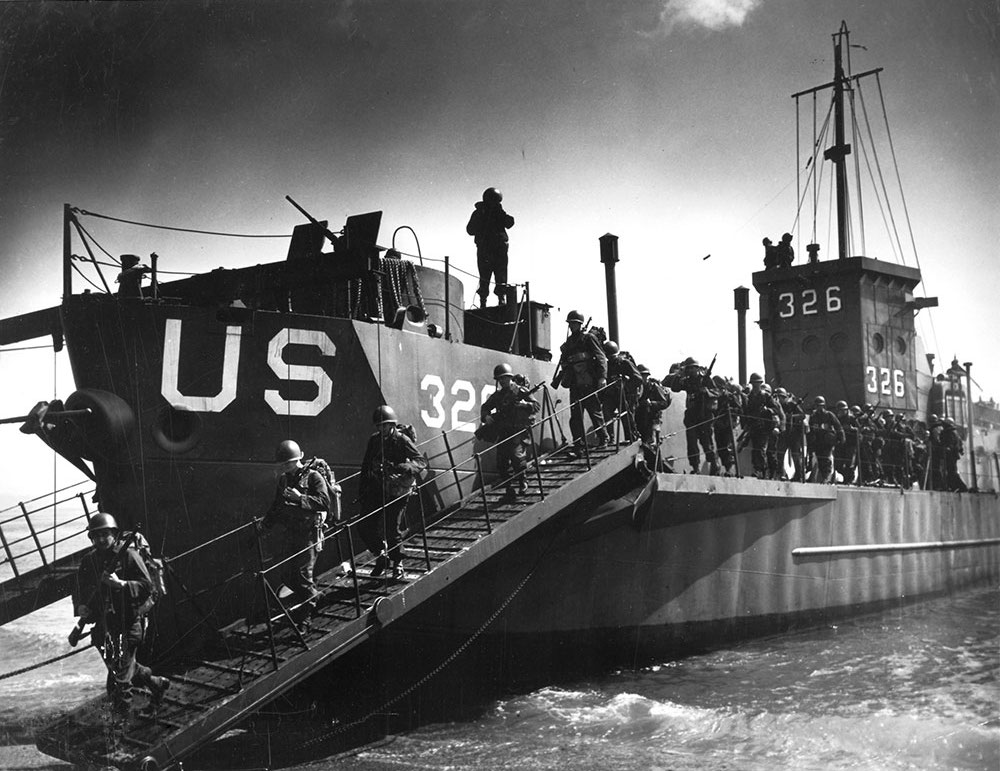
LCI-326 during training for D-Day
USS LCI(L)-326 during training for D-Day
Class overview
Builders
Operators
In commission1943–1946
Completed923
PreservedLCI(L)-713 and LCI(L)-1091
General characteristics – LCI(L)
TypeLanding craft
Displacement
  • 234 long tons (238 t) standard
  • 389 long tons (395 t) full
Length158 ft 6 in (48.31 m)
Beam23 ft 3 in (7.09 m)
Draft
  • 5 ft 4 in (1.63 m)
  • 5 ft 11 in (1.80 m) aft
Propulsion2 banks Detroit diesel 6051 quad-71, 2 shafts (4 engines per shaft), 1,600 bhp (1,193 kW)
Speed16 knots (30 km/h; 18 mph)
Range500 nmi (900 km) at 15 knots. 4,000 nmi (7,400 km) at 12 kn (22 km/h) carrying extra fuel in place of troops and cargo.
Troops180, later 210
Complement3 officers and 21 enlisted men
Armament4 × Oerlikon 20 mm cannon (one forward, one amidships, two aft)
Armor2 in Plastic armour splinter protection for gunners, pilot house

The Landing Craft Infantry (LCI) were several classes of landing craft used by the Allies to land large numbers of infantry directly onto beaches during World War II. They were developed in response to a British request for seagoing amphibious assault ships capable of carrying and landing substantially more troops than their smaller assault landing craft (LCA). The result was a small steel ship that could land 200 men, traveling from rear bases on its own bottom at a speed of up to 15 knots.

Some 923 were built starting in 1943, serving in both the Pacific and European theaters, including a number that were converted into heavily armed beach assault support ships. The LCI(L) supplemented the small LCAs/LCVPs as a way to get many troops ashore before a dock could be captured or built. As such, they were the largest dedicated beachable infantry landing craft (the larger infantry landing ship (LSI) was a transporter for men and small craft such as the British LCA) in the Allied inventory.

Development

[edit]

The LCI(L) was designed to carry 200 men at up to 15 knots and be as capable at landing as the LCA. Since a steel hull would be needed and steel was already earmarked for building destroyers at home, the US was approached. There, the plans were developed into the LCI(L), landing craft, infantry (large).

The original British design was envisioned as being a "one time use" vessel which would simply ferry the troops across the English Channel, and were considered an expendable vessel. As such, no sleeping accommodations were placed in the original design. The infantry were provided benches (similar to those on a ferry) upon which to sit while they were transported across the channel. This was changed shortly after initial use of these ships, when it was discovered that many missions would require overnight accommodations.

The U.S. was able to come up with an easily-built and mass-produced design by using non-traditional shipbuilding facilities and equipment. The U.S. established LCI building yards at ten different locations.

Construction

[edit]

There were 3 major types of LCI(L) which differed mostly by the location of the ramps and by the shape of the conning tower. All of these ships had similar hulls. The hull of all LCI(L) were 158 ft (48 m) long with a 23-foot beam, making them relatively long and narrow.

The 3 major LCI(L) types are normally referred to as: a) Square Conning tower, Side Ramp (the original style); b) Round Conn, Side Ramp; and c) Round Conn, Bow Ramp.

On LCI(L)1-349 class, (Square Conn, Side Ramps) the deck was wider than the prow and two gangways on either side of the bow led onto a pair of ramps that were lowered, and down which troops would disembark. The LCI 350 class had a single enclosed bow ramp with two bow doors that swung open. The reason for moving the ramp to the inside was to provide some protection for the troops as they disembarked to the beach, if only by concealing them from enemy sight. Also, the low, squared-off conning tower was upgraded on later models (LCI(L)350 and higher) with a taller, round conning tower which afforded slightly more visibility from the bridge.

The steepness and narrowness of either type of bow ramps made the LCI impractical for landing troops as part of an initial assault against a defended beach, and they were sometimes reserved for the follow-up waves, after the LCA or LCPL boats had landed. However, they were included in the first waves at numerous invasions such as Anzio, Normandy, Southern France, Elba, Saipan, the Philippines, Iwo Jima, Guam, and Okinawa.

Propulsion

[edit]

All LCI(L) were twin shaft propelled by two banks of Detroit Diesel 6-71 "Quad" Diesel engines that produced a total of 1600 bhp.[1] These engines were a wartime expedient design that utilized existing and readily available engines. Four 2-stroke Detroit Diesel 6-71 (inline 6 cylinder with 71 cubic inch displacement per cylinder) with Roots blower were coupled to create a bank for each of the two propeller shafts. The four engines per bank were joined using individual drive clutches hence the name "Quad Diesel". If a single engine were to fail, the broken engine could be disconnected from the unit via its clutch and repaired while the other three engines were still operating. General Motors Corporation Electro-Motive Division supplied the reduction gears, propellers, drive shafts and control units. Each of the two propellers was a reversible pitch propeller, which allowed the propeller shaft to spin only in one direction for either ahead or astern operation. This, coupled with the use of a stern anchor which was dropped as the ship approached the beach, was used to pull the ship off the beach after the infantry had disembarked. Two auxiliary Detroit Diesel 2-71s drove the two 30 kW 120 V D.C. Ship's Service Generators.[2][3][4]

Armament

[edit]

LCI(L) were armed originally with four or five Oerlikon 20 mm cannons. Each gun was mounted inside of a round gun tub with an integral splinter shield. As the war progressed, several LCI(L) had three of their forward mounted 20mm Oerlikon cannons removed and replaced with heavier single barrel Bofors 40 mm guns and were designated LCI(G) (LCI Gunboats). Several LCI(L) had various types of Rocket Launcher racks added in place of their side ramps and inside their well decks and were sometimes designated LCI(R). LCI(L) modified to carry three M2 4.2-inch mortars were designated LCI(M).[5]

Service history

[edit]
Troops embarking on USS LCI(L)-196 from a DUKW, near Scoglitti, Sicily, on 11 July 1943.
The U.S. Navy large infantry landing craft USS LCI(L)-551 in May 1945, flying her colors at half-mast in honor of the recently deceased President Franklin D. Roosevelt. Transferred to the Soviet Navy on 29 July 1945 during Project Hula, she became DS-48 and took part in the Soviet invasion of the Kuril Islands. The Soviet Union returned her to the United States in 1955.
The LCIs USS LCI(L)-585 and USS LCI(L)-591 at Cold Bay, Territory of Alaska, in the spring of 1945, awaiting transfer during Project Hula to the Soviet Navy, in which they became DS-45 and DS-35, respectively. The Soviets returned LCI(L)-585 to the United States in 1955; DS-35 was scrapped in the Soviet Union.

The first LCI(L)s entered service in 1943 chiefly with the Royal Navy (RN) and United States Navy. Early models were capable of carrying 180 troops, this was increased to 210 later. Craft in service with the two navies had some variation according to national preferences. Some 923 LCI were built in ten American shipyards and 211 provided under lend-lease to the Royal Navy. In Royal Navy service they were known as "HM LCI(L)-(pennant number)". During Project Hula, the United States in June and July 1945 secretly transferred 30 LCI(L)s to the Soviet Navy, which designated the type as desantiye suda ("landing ship") or DS; they saw action against the Japanese after the Soviet Union entered the war against Japan in August 1945, and five – DS-1 (ex-USS LCI(L)-672), DS-5 (ex-USS LCI(L)-525), DS-9 (ex-USS LCI(L)-554), DS-43 (ex-USS LCI(L)-943), and DS-47 (ex-USS LCI(L)-671) – out of 16 involved were lost on 18 August 1945 during the landings on Shumshu. The Soviet Union eventually returned 15 of the surviving LCI(L)s to the United States, all in 1955.[6]

In use, the LCI fleet was used for numerous missions. One important use was for smoke laying to obscure the invading fleet from enemy artillery or aircraft. Still others were used to provide close-in gunfire support to the troops who had just landed on the beach. In one such episode, eight LCI(G) were used two days prior to the invasion of Iwo Jima to protect Underwater Demolition Team insertion and beach mapping teams. They were mistaken by the Japanese defenders as the main invasion, and were fired upon by numerous previously hidden large caliber coastal defense artillery, (up to 8 inch). Three of these LCI(G) were sunk and all were damaged. Lt.(j.g) Rufus G. Herring (CO LCI Force) received the Medal of Honor for this action.

In another instance, Lt. Alec Guinness RNVR made numerous trips as the Commanding Officer of HMS LCI(L)-124 delivering troops to the beach near Cape Passero lighthouse on 9 July 1943 during the Allied invasion of Sicily. He missed the call from his commander to delay the landing and went on to land 25 minutes ahead of the rest of the LCI Flotilla. As he was returning from the beach empty, he was rebuked by his Flotilla Commander, who thought he was deserting from the fight, when he informed the Commander he was on his way back to get more troops after having already landed once.[7]

Most LCI(L)s were struck from service by both the Royal Navy and the U.S. Navy in 1946, and were put into reserve, sold, scrapped, or used as target ships. In addition to the 30 LCI(L)s, transferred to the Soviet Union in Project Hula, the United States also transferred LCI(L)s to Argentina (15), the Republic of China (13), France (14), Indonesia (7), Chile (6), the Dominican Republic (3), the Philippines (3), Israel (2), Thailand (2), and the Republic of Korea (1).

In February 1949, the U.S. reclassified the remaining LCIs as "Landing Ship Infantry" (LSI). Landing Ship Infantry was a term that had been used during the war since around 1941 by the British for various vessels such as converted ferries and passenger ships that could carry 800–1,800 troops close to shore, the final transfer being by smaller boats.

Variants

[edit]

As with the Landing craft tank, the LCI(L) was used as the basis of a number of conversions into specialist vessels.

LC(FF) – flotilla flagship

[edit]

Equipped to carry a flotilla commander and his staff. Forty-nine were converted, but after their combat debut at Okinawa they were judged to be too cramped and slow for this role. Landing Ship Mediums were then recommended for conversion, but this never happened.[8]

LCI(G) – gunboat

[edit]

Two or sometimes three 40 mm guns, six .50-caliber (12.7mm) machine guns and ten Mk.7 rocket launchers were added to the existing armament to provide close-in fire support for landings. This variant was used for the basis of the LCS(L) class of Landing Craft Support ships. The same hull was used and more armament was added, but the troop carrying capability was removed.

LCI(M) – mortar

[edit]

Equipped with three M2 4.2 inch mortars for naval surface fire support.

LCI(R) – rocket

[edit]

A platform for six 5-inch rocket launchers. This platform was rather unsophisticated as the rocket launchers were fixed to the deck, and so the ship had to be maneuvered to aim them. When fired the crew had to take shelter below decks to escape the blast of the rocket engines.

Other

[edit]

At least four LCIs were used to support underwater demolition teams, and were unofficially termed LCI(D)s. Others were equipped with searchlights for spotting Japanese night attacks.[9]

Thirty-two LCIs were converted to ACMU-7 class coastal minesweepers.[10]

One LCI(L), LCI-346, was used as a press boat (PGY) during the Battle of Iwo Jima, collecting reporters' copy from several ships for delivery to a communications ship for transmission.[11] Admiral William Halsey Jr. reported that the LCI(L) was ideally suited to move large numbers of sailors from ships in fleet anchorages to liberty ashore and back. BuShips studied conversions for these roles but none were performed.[12]

Fairmile Type H landing craft

[edit]

LCI(S)

[edit]
LCI(S)s moored at Southampton in the final preparations for D-Day

At the same time as the LCI(L) was handed over for US development and production, the British reworked their need for a raiding vessel into something that could be produced natively without making demands on limited resources. Fairmile Marine had already designed a number of small military vessels that were built in wood and they produced the Fairmile Type H which was another prefabricated wooden design. This was taken on as the Landing Craft Infantry (Small) or LCI(S).[13]

The overall length of these craft was 105 feet 1 inch (32.03 m) with a beam of 21 feet 5 inches (6.53 m). They were one of the faster landing craft, with a maximum speed of 12.5 knots (14.4 mph). They had a crew of 2 officers and 15 other ranks and could carry 102 troops for landing. Their petrol engines and the decision not to use self-sealing fuel tanks, together with the use of armour only in limited places made them less safe under fire than diesel fuelled vessels with more armour protection. Consequently, they were more suited to commando raids rather than large opposed landings. For instance, only 39 were used in the initial assault on D-Day. In action, the troops were disembarked over ramps which were extended either side of the bow. These were susceptible to damage.[14]: 34–35 

One Fairmile "H", a veteran of D-Day and the assault on Walcheren, survives as a houseboat on the River Adur, Shoreham-b-Sea, West Sussex, England.[citation needed]

LCS(L)

[edit]

The Landing Craft Support (Large) ("LCS(L) Mark 1" or "LCS(L) Mark 2") was based on the LCI(S) hull, and were built by the United Kingdom, intended for use as a support vessel providing additional firepower. The Mk.1 carried a tank turret complete with its QF 2 pounder gun (40 mm), but for the Mk.2 this was replaced with a turret mounting the QF 6 pounder gun (57 mm). To this was added two Oerlikon 20 mm cannon and two 0.5 inch Vickers machine guns. Ten were built in all.

LCS(L) Mk.3/LSSL

[edit]

The Landing Craft Support (Large) or "LCS(L) Mark 3" was built by the United States. These ships were built on a standard LCI hull, but were modified to add gunfire support equipment and accommodation. They were typically armed with a single 3"/50 caliber gun, two twin 40 mm cannon, and several 20 mm cannon. These ships were prevalent in most major Pacific Theater invasions beginning in late 1944. The type was reclassified as Landing Ship Support, Large (LSSL) in 1949. One hundred and thirty of this type were built.

Surviving LCIs

[edit]
The partially restored USS LCI(L)-713 in Portland, Oregon, 2012

Several LCIs survive and are available to be seen by the public.

The LCI(L)-713, (a round conn, bow ramp) is located in Portland, Oregon near the I-5 Bridge over the Columbia River. It is currently owned and being restored by a non-profit 501c3 group, the "Amphibious Forces Memorial Museum".[15] Built in 1944 in Neponset, Massachusetts, the ship was transferred to the Pacific Theater where it saw action in making two assault landings: Zamboanga, Philippines in March 1945 and Brunei Bay, Borneo in June 1945 (as part of the Battle of North Borneo). Purchased as war surplus initially for use as a log hauling tugboat, the engines were removed and it was relegated to a floating storage hulk in Stevenson WA until the late 1950s when it was abandoned and sank into the river mud on the shore of the Columbia river. In the late 1970s the ship was refloated and restoration began on the ship. LCI(L)713 has changed ownership until finally sold to the AFMM in 2003. The LCI(L) 713 has been continually restored with the goal of becoming a historically correct operating museum vessel.

LCI(L)-1091 (also a round conn, bow ramp) is moored in Eureka, California, and is owned and operated by the Humboldt Bay Air & Sea Museum.[16] The ship was used in the Korean War in 1951–1953 as an "Infectious Disease Control Ship". Her interior was modified to accommodate a larger crew that included ten medical doctors and lab technicians. In the late 1950s the ship was sold as surplus for use as an Alaskan fishing vessel. 30 years later, the 1091 was purchased and brought to Eureka, California, in the 1990s by Ralph Davis for use as a private fishing vessel. Davis sold the ship to the museum, headed by Leroy Marsh, and they are working together to restore the LCI-1091 to an operating museum vessel.

LCS-102 docked in Vallejo, California, 2007

Several former LCI hulls were obtained and modified for use as sightseeing vessels after World War II by the New York City "Circle Line".[17] The Circle Line 7 (ex-LCI-191), Circle Line 8 (ex-LCI 179) are all now retired. Circle Line X is currently on active duty with Circle Line 42nd Street on New York City's Pier 83.

Several other LCI hulls have been located around the world. The Argentine Navy has at least three, which were still being used in 1998. LCI(L)-653, renamed Husky II, was used as a pilot boat and then a fisheries tender in Alaska before being broken up at Homer, Alaska in 2010. Three derelict LCI hulls remain at Staten Island, New York, in the Witte Marine salvage yard.

Only one LCS(L) Mk.3, the former LCS-102, still survives in original configuration. She is moored at Mare Island, California, where she is being restored to her World War II appearance by volunteers.[18][19]

See also

[edit]

References

[edit]
[edit]
Revisions and contributorsEdit on WikipediaRead on Wikipedia
from Grokipedia
The Landing Craft Infantry (LCI), particularly the prominent LCI(L) or "Large" variant, was a class of steel-hulled, seagoing amphibious assault craft developed by the during specifically to transport and disembark large numbers of troops directly onto hostile beaches without requiring a or dock. These vessels featured bow and stern doors or ramps for rapid troop deployment, a shallow draft for beaching, and sufficient seaworthiness for ocean voyages, distinguishing them from smaller, less capable like the LCVP. 923 LCI(L)s were constructed between 1942 and 1945, primarily by American shipyards, with 211 transferred to the Royal Navy via , making them a cornerstone of Allied amphibious operations. The LCI's development stemmed from British requirements for a versatile infantry carrier in 1941, which the U.S. adapted into a standardized by early , with the first units entering service that November for in . Measuring approximately 158 feet in length, 23 feet in beam, and with a draft of about 5 feet, the LCI(L) displaced 234 tons standard and 389 tons fully loaded, powered by eight diesel engines delivering 1,600 horsepower for a top speed of 15 knots and a range of 4,000 nautical miles at 12 knots. It accommodated a of 24 (including 3 officers) and could carry 180 to 210 troops or up to 75 tons of cargo, though in overload conditions it transported as many as 388 soldiers; armament typically included four 20 mm Oerlikon anti-aircraft guns, with some variants fitted for additional roles like fire support using 40 mm guns or rocket launchers. In service, LCIs played pivotal roles in major WWII amphibious campaigns across both theaters, including the invasions of Sicily, Salerno, Normandy (where over 250 participated, with U.S. Coast Guard-manned units supporting Omaha and Utah beaches), Iwo Jima, Okinawa, and the Philippines, often performing auxiliary tasks such as minesweeping, smoke screening, and casualty evacuation. Under a 1943 agreement, the U.S. Coast Guard manned 28 LCI(L)s, contributing to their operational flexibility in high-risk assaults, though the class suffered losses like the four vessels destroyed at Normandy's Omaha Beach. Postwar, many LCIs were decommissioned by 1946, transferred to allied navies (such as Britain, France, and Argentina), or repurposed for Korean and Vietnam War duties until the mid-1960s, earning nicknames like "Elsie Item" for their rugged, multi-role utility.

Design and Development

Historical Context and Requirements

Prior to , amphibious warfare capabilities were severely limited by the reliance on smaller such as the (LCM) and (LCVP), which were intended for short-haul operations from nearby transport ships and could only accommodate limited numbers of troops or equipment, making it impractical to deliver large units directly onto defended beaches in a single wave. These craft, including the iconic Higgins boat (LCVP), typically carried no more than a 36-man or 60 troops at most, necessitating multiple shuttles that increased exposure to enemy fire and logistical complexity during assaults. The fall of in 1940 underscored these deficiencies, as Allied planners recognized the need for more robust vessels to conduct cross-Channel operations without dependence on secured harbors, prompting the British Royal Navy to formally request U.S. assistance in developing a specialized transport. In response to this urgency, the British Admiralty sought a seagoing craft capable of ferrying approximately 200 fully equipped troops across the for potential invasions or counterattacks against German-held territory. Influenced by the British initiative, the U.S. Navy's outlined specifications for the Landing Craft Infantry (LCI) in , calling for a vessel displacing around 250 tons (light), featuring a shallow draft for effective beaching, and providing capacity for 200 soldiers plus a crew of about 24. These requirements aimed to bridge the gap between smaller coastal craft and larger amphibious ships, enabling direct delivery in support of major operations. Central to the LCI's design prerequisites were its self-propelled nature for autonomous movement, ocean-going endurance sufficient for 48-hour passages to accompany crossings, and the incorporation of bow ramps for rapid troop disembarkation without cranes or facilities. This configuration allowed the LCI to evolve from earlier prototypes like the Higgins boat, scaling up to handle company-sized forces while maintaining versatility for contested landings.

Development Process and Prototypes

The development of the Landing Craft Infantry (LCI) began in late 1941 through close collaboration between the U.S. Navy's Bureau of Ships and British advisors, who sought a seagoing vessel capable of transporting and landing larger numbers of troops than existing designs like the Landing Craft Assault (LCA). This effort was spurred by the wartime urgency of early Pacific and Atlantic campaigns, necessitating rapid advancements in amphibious capabilities. The resulting design modified the British concept for greater range and seaworthiness, adapting it for U.S. production while retaining the core idea of direct beach debarkation for infantry. Testing revealed several limitations in the original configuration, prompting key engineering modifications to enhance operational viability. Twin-screw was adopted for better maneuverability during beaching and retraction. Additionally, bow doors with an enclosed ramp replaced earlier side gangways, enabling safer and more efficient direct troop debarkation onto beaches. Following successful evaluations, the U.S. Navy approved the refined LCI design for in early 1942, with initial contracts awarded in June to multiple shipyards, including in . The first LCI(L)s were laid down in mid-1942, with launches beginning in December 1942 and commissions in early 1943. Production ramped up across at least ten U.S. facilities, culminating in the completion of 923 units by the end of .

Construction and Specifications

Hull Design and Dimensions

The Landing Craft Infantry (LCI) utilized a riveted hull optimized for amphibious assaults, with side plating measuring 1/4 inch thick to provide durability during beaching operations. The structure incorporated multiple watertight compartments, enhancing survivability against battle damage by limiting flooding. This design emphasized seaworthiness for ocean transit while enabling shallow-draft beach landings. Key dimensions of the standard LCI hull included a length overall of 158 feet 3 inches, a beam of 23 feet 3 inches, and a forward draft of 5 feet 10 inches when fully loaded. Displacement was 246 tons light and 387 tons at full load, reflecting the vessel's capacity for troops and supplies without compromising maneuverability in coastal waters. At the bow, a hydraulically operated and ramp facilitated direct beaching, allowing troops to disembark at a shallow 10-degree angle for rapid deployment. The internal arrangement focused on transport, featuring two decks with bunk spaces accommodating up to 200 troops, separate quarters for a of 24, and dedicated storage for and . Unlike larger , the LCI lacked vehicle-carrying capacity to prioritize personnel delivery efficiency. Some variants incorporated minor superstructure additions, but the core hull remained consistent across production models.

Propulsion and Performance

The Landing Craft Infantry (LCI) utilized a robust propulsion system consisting of eight General Motors 6-71 series two-stroke diesel engines, configured in two banks of four engines each driving twin propeller shafts through reduction gears. This arrangement produced a total output of 1,600 brake horsepower, enabling reliable operation in amphibious environments. Performance characteristics emphasized endurance over high speed, with a maximum of 16 knots achieved in light condition and approximately 12 knots when fully loaded with troops and equipment; cruising speeds typically ranged from 8 to 10 knots to optimize . The craft's range extended to 4,000 nautical miles at 12 knots without embarked troops or 500 nautical miles at 15 knots, supported by a fuel capacity of 110 to 130 tons of diesel oil stored across four tanks. was managed via a hydraulic system operating twin rudders, which improved control during beaching and extraction maneuvers. Seakeeping qualities were adequate for moderate conditions up to , where the vessel maintained stability for offshore transits, but the shallow draft of about 3 feet forward led to pronounced pitching and discomfort in heavier seas, often causing seasickness among crew and troops due to the flat-bottomed hull's tendency to pound through waves.

Armament and Equipment

The standard armament of the US Navy's Landing Craft Infantry (LCI) during was designed for self-defense against aircraft and small surface threats, consisting of four single-mount 20 mm Oerlikon anti-aircraft guns—one forward, one amidships, and two aft—along with two .50-caliber machine guns. These weapons were mounted in gun tubs with integral splinter shields and protected by 2-inch plastic splinter armor on the shields, , and pilothouse. Some LCIs received an optional single 40 mm Bofors gun amidships to bolster anti-aircraft defense. The equipment suite supported , communication, and basic operational needs, including for surface search and , an echo sounder for depth measurement, and radio sets for coordination within convoys and flotillas. Limited medical facilities were provided for casualty care during amphibious operations, enabling the evacuation of wounded personnel alongside troop transport. Defensive features emphasized protection during beach assaults and transit. Smoke generators allowed LCIs to lay protective screens for larger ships and formations, as demonstrated during operations like the landings. cables were fitted to neutralize the vessel's magnetic signature, reducing vulnerability to magnetic mines. measures, such as netting and spotted hull paint schemes, helped conceal the craft against sea and coastal backgrounds. Due to their shallow draft and focus on delivery, LCIs lacked dedicated equipment. Crew operations centered on the amidships bridge within the armored pilothouse, which housed steering controls, communication gear, and command functions while offering protection from small-arms fire and shrapnel. Troop and supply loading occurred through side ports and hatches, while unloading onto beaches was achieved via deployable bow or side ramps, often supported by anchors to hold position in surf; this setup enabled rapid debarkation of up to 200 troops or equivalent cargo. While baseline LCIs prioritized utility and defense, variants incorporated enhanced weaponry for shore bombardment.

Operational History

World War II Service

The Landing Craft Infantry (LCI) played a pivotal role in amphibious operations during World War II, serving primarily as troop transports capable of delivering up to 200 infantrymen directly onto beaches from offshore positions. These vessels, with a standard crew of 24 to 60 personnel, were organized into flotillas typically comprising 36 craft divided into groups of 12, allowing coordinated assaults across multiple sectors. A total of 923 LCIs were constructed between 1942 and 1945, with significant numbers deployed to both the Pacific and European theaters to support major invasions. The class's first combat use was during in in November 1942, primarily with British crews, before U.S.-manned vessels entered service. In the Pacific Theater, LCIs saw their initial combat deployment during the June 1943 landings on in the , where they transported follow-on waves of troops after initial Higgins boat assaults. They subsequently supported key operations, including the invasions of Saipan in June 1944, where flotillas delivered elements of the U.S. Army's 27th Division to the beaches amid intense Japanese resistance; in February 1945, facilitating Marine landings under heavy artillery fire; and Okinawa in April 1945, where they shuttled reinforcements and evacuated casualties during the prolonged battle. LCIs operated in flotillas that emphasized mutual protection, often forming waves of 4 to 6 craft to maximize firepower and reduce vulnerability during beach runs. Across the European Theater, LCIs were instrumental in the Mediterranean and campaigns. In July 1943, during Operation Husky, the invasion of , U.S. and British LCIs landed troops at beaches near and Scoglitti, supporting the U.S. 7th Army's advance against Axis forces. They followed with landings at in September 1943 and in January 1944, where LCI-20 was struck by a German bomb shortly after troops disembarked, highlighting the vessels' exposure to shore batteries. The pinnacle came during Operation Neptune on D-Day, June 6, 1944, when over 250 LCIs, many manned by U.S. crews, ferried American and British forces to and Omaha Beaches; at Omaha, heavy seas and enemy fire led to the loss of several craft, including LCI-92, which exploded after a direct hit, resulting in 41 fatalities. Beyond direct assaults, LCIs fulfilled critical roles in casualty evacuation and , often making multiple runs to resupply forward positions with and medical teams while retrieving wounded under fire. In later Pacific campaigns, some were adapted into gunboats (LCI(G)) by adding 20mm and 40mm antiaircraft guns, 37mm cannons, and rocket launchers to provide close during landings at and Okinawa, where they neutralized beach defenses and screened against attacks. Overall, the fleet suffered heavy attrition, with dozens lost, including 21 sunk by enemy action, across both theaters, underscoring their vital yet hazardous contribution to Allied amphibious doctrine.

Post-War Operations

Following , several Landing Craft Infantry (LCI) vessels were recommissioned by the U.S. Navy for service in the (1950–1953), where they supported amphibious operations including the pivotal Inchon landing in September 1950 and subsequent patrol duties along coastal areas. For instance, USS LCI(L)-1091, redesignated LSIL-1091, participated in Korean War operations and earned four battle stars for her contributions. These vessels proved valuable for troop transport and logistics in littoral environments, drawing on World War II experience to adapt to the conflict's demands. In the Vietnam War era, the U.S. transferred numerous LCI(L) vessels to the (RVNN), where they were redesignated in the HQ series and employed for riverine operations, coastal interdiction, and troop shuttles until the fall of Saigon in 1975. Examples include LCI(L)-872, transferred in 1956 and commissioned as RVNS Thien Kich (HQ-329), and LCI-351, which became RVNS My Tho (HQ-800) before further transfer. These craft were integral to efforts, navigating inland waterways to support South Vietnamese forces against activities. Beyond major conflicts, LCIs saw international transfers under mutual defense programs, enhancing allied amphibious capabilities. The U.S. provided at least 14 LCIs to France in 1951 for use in the , where they served as troop transports and gunboats on rivers like the ; examples include LCI(L)-1092, redesignated L9032. Additional vessels went to the and ; LCI-351 was acquired by the as BRP Marinduque (LF-36) after 1975, while LCI(L)-670 and LCI(L)-739 remained in Thai service into the late . By the , some surplus LCIs were converted for civilian roles, such as tugs and survey vessels, due to their robust, low-maintenance designs. The U.S. Navy gradually decommissioned its LCI fleet post-World War II, with most struck from the by 1946, though some remained in reserve or active duty longer. Vessels like USS LCI(L)-1091 were decommissioned in 1955 after service, and the class was fully phased out of active and reserve roles by the mid-1960s as newer amphibious designs emerged. Their extended service life, often spanning two decades, stemmed from simple construction and adaptability to non-combat tasks.

Variants and Modifications

Command and Support Variants

The Landing Craft, Infantry (Large), or LCI(L), served as the baseline for several command-oriented conversions known as LC(FF), or Landing Craft, Flagships, designed to accommodate commanders and their staffs during amphibious operations. A total of 43 LCI(L) vessels were converted to this configuration between late 1944 and 1945, featuring an enlarged wheelhouse to house additional communication equipment, including extra radios for coordinating multiple craft, and dedicated flag quarters capable of berthing up to 10 officers. These modifications focused on enhancements, such as added decks for antennas, while keeping hull alterations minimal to preserve the vessel's seaworthiness and ability to retain standard troop capacity of approximately 200 personnel when operating in a non-command role. In operational use, LC(FF) vessels primarily supported Pacific theater assaults by directing flotillas of up to 36 LCIs, enhancing communication and command efficiency during complex beach landings. For instance, conversions like LC(FF)-367, reclassified on December 31, 1944, participated in Asiatic-Pacific campaigns, while others, such as those derived from LCI-627, served as flagships for at in February 1945, where they facilitated synchronized troop deployments amid intense combat. Although most LC(FF) deployments occurred after the Normandy invasion, earlier LCI flotillas in relied on similar command arrangements, and the design's improved radio setup proved vital for operations like Okinawa in April 1945, where cramped quarters were noted as a limitation despite effective flotilla coordination. Beyond flagship roles, some LCI(L) units were adapted for utility support, including and minor repairs, though dedicated conversions were limited. These involved expanding internal spaces for temporary medical bays or equipping holds with gear and spare parts storage to service damaged in forward areas, retaining the core LCI(L) design for versatility in amphibious fleets. Such adaptations underscored the LCI's adaptability for non-combat , with examples including vessels assigned to protection and resupply in the Pacific, where they maintained operational tempo by addressing immediate hull and equipment issues without requiring larger repair ships.

Fire Support Variants

The fire support variants of the Landing Craft Infantry (LCI) were specialized conversions designed to deliver close-range indirect and during amphibious landings, enhancing for advancing troops. These modifications typically included reinforced decks to absorb weapon recoil, expanded ammunition storage accommodating up to 500 rounds per major , and the reconfiguration of interior spaces by removing portions of the troop bunks to house additional members and fire control equipment. Such adaptations allowed the vessels to transition from troop transport to combat platforms while maintaining their shallow-draft beaching capabilities essential for near-shore operations. The LCI(G) gunboat variant represented a primary direct-fire configuration, with 169 units converted between 1944 and 1945. Equipped with four 20 mm Oerlikon antiaircraft guns for close defense, two 40 mm antiaircraft guns for medium-range suppression, and racks for antisubmarine protection, these craft provided sustained shore bombardment to neutralize beach defenses. They proved critical in Pacific Theater assaults, including the February 1945 invasion of , where groups of LCI(G)s delivered despite heavy enemy counterbattery, and the April 1945 Okinawa campaign, where they supported initial waves amid threats. Complementing the gunboats, the LCI(M) mortar variant focused on high-angle , with 54 units outfitted using a design from the U.S. Army's Chemical Warfare Service. Each carried three 4.2-inch M2 mortars mounted on the well deck, enabling a combined firing rate of approximately 45 rounds per minute to targets beyond line-of-sight, such as entrenched positions or reverse-slope defenses. These vessels supported key landings, including the September 1944 assault on , where they provided pre-invasion barrages to soften Japanese fortifications, and the January 1945 Luzon operation, aiding the advance from by targeting inland strongpoints. The LCI(R) rocket variant emphasized area saturation for initial beach clearance, comprising 47 units armed with six 5-inch rocket launchers featuring 504 tubes, similar in concept to but distinct from the Army's multiple rocket system mounted on Sherman tanks. Capable of unleashing salvos of up to 504 rounds in rapid succession to blanket enemy positions with high-explosive fragmentation, these craft delivered devastating pre-landing volleys. They were instrumental at , where LCI(R)s fired massive rocket barrages on February 19, 1945, to suppress pillboxes and wire obstacles during the first assault waves, enabling Marine landings despite intense response.

Other Adaptations

In addition to the primary transport role, a small number of Landing Craft Infantry (LCI) were slated for conversion into s under the designation LCI(D), with plans for eight units equipped with a 3-inch and for anti-submarine duties; however, the project was canceled in 1944 due to redundancy with the established (DE) class. Several LCIs served in utility roles during , including as carriers designated LCI(A); for instance, four such vessels supported in the action by transporting mortar before their subsequent conversion to types. Post-Normandy operations saw some LCIs repurposed for logistical supply runs, leveraging their capacity of up to 75 tons to ferry and other across contested beaches in support of advancing Allied forces. The also adapted LCIs for mine countermeasures, with at least 32 units converted postwar into coastal minesweepers (AMCU-7 class) equipped for underwater locator duties, though wartime use included support for teams clearing obstacles. British adaptations of the LCI concept diverged from the standard U.S. LCI(L), incorporating the wooden-hulled LCI(S) built by Fairmile Marine Company as Type H vessels, which featured different propulsion systems suited to shallow-water operations and were employed in assaults like in 1944. Postwar, surviving U.S. LCIs underwent various conversions, including transfers to foreign navies—such as 14 , where they were modified into gunboats with 75 mm and 40 mm armaments for use in Indochina—and domestic reclassifications for training and support roles, with some serving into the era after refurbishment. Experimental modifications included early trials integrating anti-aircraft on select LCIs for enhanced detection during protection, though these were limited and not widely adopted due to the vessels' primary amphibious focus.

British Fairmile Type H

The British Fairmile Type H landing craft was developed in 1941 by the Fairmile Marine Company as a prefabricated, wooden-hulled to address urgent requirements for coastal assault operations, resulting in the production of over 40 units designated as Landing Craft (Small), or LCI(S), numbered 501 to 540 from 1942 onward. This construction approach enabled rapid assembly in multiple yards, leveraging the company's expertise in modular wooden boatbuilding to overcome steel shortages and production bottlenecks during wartime. The drew brief influence from U.S. LCI requirements for infantry transport but was scaled down for shorter-range British needs. Key specifications included a length of 105 feet 1 inch, a beam of 21 feet 4 inches, and a draught of 2 feet 10 inches forward, with a light displacement of 63 tons increasing to 100 tons when loaded. Propulsion came from two Hall-Scott petrol engines providing 1,120 horsepower total (or 1,500 horsepower in supercharged variants), delivering a maximum speed of 15 knots and a continuous speed of 13.25 knots, supported by a fuel capacity of 4,000 gallons for a range of 330 nautical miles at full speed or 700 nautical miles at 12.5 knots. Each LCI(S) accommodated a crew of 2 officers and 15 ratings, plus up to 96 troops plus 6 officers, and featured a bow ramp for direct beach unloading, with defensive armament limited to two 20 mm Oerlikon anti-aircraft guns and two .303 Lewis machine guns. A specialized variant, the Landing Craft Support (Large) or LCS(L), adapted the Type H hull for fire support roles, with 10 units produced incorporating a turreted QF 6-pounder gun (or earlier 2-pounder in Mark I models) and rocket projectors, alongside additional 20 mm guns and machine guns for close-in suppression during landings. These vessels provided essential naval gunfire in operations such as the Normandy invasion and the assault in 1944. Operationally, the Fairmile Type H focused on the Mediterranean and theaters, supporting commando raids and amphibious assaults in shorter coastal hops rather than extended ocean voyages like those undertaken by the more robust U.S. LCI. The wooden build offered significant cost and time savings in production—facilitating quicker deployment amid resource constraints—but resulted in a shorter operational lifespan due to vulnerability to rot, battle damage, and environmental wear compared to counterparts.

LCS(L) Mk.3 and LSSL

The LCS(L) Mk.3, also known as the Landing Craft Support (Large) Mark 3, represented a post-World War II evolution of U.S. landing craft concepts, shifting focus from troop transport to dedicated fire support for amphibious operations. Produced between 1944 and 1945, a total of 130 units were built across three shipyards: George Lawley & Sons in Neponset, Massachusetts (47 vessels), Albina Engine & Machine Works in Portland, Oregon (31 vessels), and Commercial Iron Works in Portland, Oregon (52 vessels). These craft utilized a 158-foot steel hull derived from the earlier LCI design but optimized for combat, eliminating troop-carrying capacity in favor of enhanced armament including one 3-inch/50-caliber gun forward, two twin 40 mm Bofors mounts, four single 20 mm Oerlikon mounts, and four .50-caliber machine guns, supplemented by a Mark 7 rocket launcher for close-in support. Design upgrades emphasized speed and firepower integration, with eight Gray Marine 6-71 diesel engines providing 1,600 horsepower to achieve a top speed of 16.5 knots, an improvement over prior for better positioning during assaults. Radar-directed fire control systems enabled precise gunnery, allowing the LCS(L) Mk.3 to serve as a mobile gun platform for suppressing shore defenses without the vulnerability of troop exposure. Complementing the , the vessels included equipment such as two depth charge tracks and four depth charge projectors (K-guns), which could launch projectiles for and escort duties. With a displacement of 250 tons light and 387 tons full load, a beam of 23 feet 8 inches, and a draft of 5 feet 8 inches forward and 6 feet 6 inches aft when loaded, these craft balanced maneuverability in shallow waters with robust combat capability. In 1949, the surviving LCS(L) Mk.3 vessels were redesignated as Landing Ship Support, Large (LSSL) to reflect their expanded roles beyond pure landing support. Many were recommissioned for the Korean War, providing fire support during operations such as the Inchon landings and general coastal patrols, where their guns and radar proved effective against shore targets. During the Vietnam War, LSSLs contributed to riverine warfare efforts, operating in shallow inland waterways to support U.S. and allied forces against insurgent positions, often in coordination with the Mobile Riverine Force. Most were decommissioned by the mid-1970s, with their versatile littoral design influencing subsequent U.S. Navy developments in amphibious and coastal combat vessels.

Preservation and Legacy

Surviving Examples

Several Landing Craft Infantry (LCI) vessels from have survived into the , though their numbers are extremely limited worldwide, with only two confirmed examples remaining as of 2025. These rare artifacts serve primarily as museum ships dedicated to educating the public about amphibious operations during the war. The USS LCI(L)-713, a veteran of Pacific Theater landings including Mindanao and Borneo, is preserved at the Amphibious Forces Memorial Museum in , moored in the Swan Island Lagoon. Commissioned in 1944, it underwent significant restoration efforts starting in the early , including hull repairs and interior refits to replicate its wartime configuration, with ongoing work documented as recently as August 2025 through narrated video tours highlighting its operational readiness for static displays. Managed by a , the vessel hosts educational tours and events but remains non-operational for active due to its age and maintenance needs. The USS LCI(L)-1091, which served in both and the before postwar commercial use as a cannery tender, is preserved ashore near , in Humboldt County since 2016. Owned by a local heritage group, it faced challenges including structural deterioration but continues to be the focus of volunteer-led restoration to maintain it as an educational exhibit on history. Like LCI-713, it is non-operational and used solely for static museum purposes. The USS LCI National Association, a veterans' nonprofit, coordinates broader preservation efforts for these vessels, including for hull and historical . While no active use persists, both ships occasionally participate in commemorative events, such as D-Day anniversaries, through land-based displays rather than sea voyages, emphasizing their role in public education over functionality. Estimates suggest 5-7 LCI hulls or significant remnants may exist globally in various states of disrepair, but verifiable intact examples beyond the U.S. pair are scarce.

Historical Significance and Modern Relevance

The Landing Craft Infantry (LCI) played a pivotal role in reshaping amphibious doctrine during by enabling the direct delivery of up to 200 troops onto beaches via side ramps, thereby minimizing the need for intermediate larger transports and accelerating assaults. This capability addressed key limitations in earlier , allowing for more efficient troop surges in contested littorals and transforming the scale and speed of establishment. The LCI's design proved essential to strategic operations, including , where it supported the rapid reinforcement of beaches, and the Pacific island-hopping campaigns, where it facilitated successive assaults across vast oceanic distances by integrating seamlessly with convoy-based logistics. In terms of production, the constructed 923 LCIs between 1942 and 1945, leveraging modular techniques that enabled rapid assembly in shipyards across the country and kept unit costs low relative to larger warships. This approach exemplified wartime industrial innovation, producing seaworthy vessels capable of up to 16 knots and armed with anti-aircraft guns in quantities that outpaced initial projections, thereby sustaining Allied amphibious momentum. The LCI's success in scalable manufacturing influenced post-war amphibious standards, promoting standardized, adaptable designs for multinational operations that prioritized interoperability and cost efficiency in joint exercises. The LCI's legacy endures in modern naval architecture and doctrine, with its focus on over-the-horizon troop insertion echoing in platforms like the Landing Craft Air Cushion (LCAC), which uses hovercraft technology for speeds exceeding 40 knots to deliver forces rapidly over beaches, and the Expeditionary Fighting Vehicle (EFV), designed for high-speed transit from amphibious ships to inland objectives. Lessons from LCI shallow-water operations—such as beaching in surf zones and vulnerability to small-arms fire—have shaped littoral combat ship (LCS) concepts, informing modular mission packages for mine countermeasures and surface warfare in near-shore environments. Culturally, the LCI symbolizes the grit of , featured in depictions of landings that capture the chaos of direct beach assaults, as seen in films like . The USS Landing Craft Infantry National Association organizes annual veteran reunions to honor crews and share oral histories, fostering ongoing commemoration of the vessel's contributions. Surviving examples, such as restored LCIs at museums, provide tangible connections to this era, underscoring the LCI's lasting impact on naval heritage.

References

Add your contribution
Related Hubs
User Avatar
No comments yet.