



Community hub
Recent from talks
Contribute something
Nothing was collected or created yet.
Ranjana script
View on Wikipedia| Rañjanā | |
|---|---|
 'Ranjana Lipi' in Ranjana script | |
| Script type | |
Period | c. 1100–present |
| Direction | Left-to-right |
| Region | Nepal and India |
| Languages | Newar (Nepal Bhasa) Sanskrit Tibetan |
| Related scripts | |
Parent systems | |
Child systems | Soyombo |
Sister systems | Prachalit Bhujimol |
| ISO 15924 | |
| ISO 15924 | Ranj (303), Ranjana |
| Brahmic scripts |
|---|
| The Brahmi script and its descendants |
The Rañjanā script (Lantsa[2]) is an abugida writing system which developed in the 11th century[3] and until the mid-20th century was used in an area from Nepal to Tibet by the Newar people, the historic inhabitants of the Kathmandu Valley, to write Sanskrit and Newar (Nepal Bhasa). Nowadays it is also used in Buddhist monasteries in China, especially in the Tibetan Buddhist areas within the Tibet Autonomous Region, Sichuan, Yunnan, Qinghai and Gansu; Mongolia, and Japan.[3] It is normally written from left to right but the Kutakshar form is written from top to bottom.[3] It is also considered to be the standard Nepali calligraphic script.
History
[edit]Rañjanā is a Brahmic script which developed around 1100 CE. It was used in Nepal and is still used in Nepal by the Newar people to write the Newar language.[2] The script is also used in most of the Mahayana and Vajrayana monasteries.[4] Along with the Prachalit Nepal alphabet, it is considered one of the scripts of Nepal.[5] It is the formal script of Nepal duly registered in the United Nation while applying for the free Nation.[citation needed] The Aṣṭasāhasrikā Prajñāpāramitā Sūtra lettered in gold ink by Bhiksu Ananda of Kapitanagar and dating back to the Nepal Sambat year 345 (1215 CE) is an early example of the script.[6]
After falling into disuse in the mid-20th century, the script has recently seen an increased use. It is used by many local governments such as those of Kathmandu Metropolitan City, Lalitpur Sub-Metropolitan City, Bhaktapur Municipality, Thimi Municipality, Kirtipur Municipality, Banepa Municipality, in signboards, letter pads, and such. Regular programs are held in the Kathmandu Valley to promote the script and training classes are held to preserve the language. The script is being endorsed by the Nepal Bhasa movement and is used for headings in newspapers and websites.[citation needed] A Nepalese-German project is trying to conserve the manuscripts of Rañjanā script.[7]
Alphabet
[edit]Vowels
[edit] a अ a अ |
 aḥ अः aḥ अः |
 ā आ ā आ |
 āḥ आः āḥ आः |
 i इ i इ |
 ī ई ī ई |
 u उ u उ |
 ū ऊ ū ऊ |
 ṛ ऋ ṛ ऋ |
 ṝ ॠ ṝ ॠ
| |
 ḷ ऌ ḷ ऌ |
 ḹ ॡ ḹ ॡ |
 e ए e ए |
 ai ऐ ai ऐ |
 o ओ o ओ |
 au औ au औ |
 ã अँ ã अँ |
 aṃ अं aṃ अं |
 ay अय् ay अय् |
 āy आय् āy आय् |
 ey एय् ey एय्
|
Consonants
[edit] k क k क |
 kh ख kh ख |
 g ग g ग |
 gh घ gh घ |
 ṅ ङ ṅ ङ
|
 c च c च |
 ch छ ch छ |
 j ज j ज |
 jh झ jh झ |
 ñ ञ ñ ञ
|
 ṭ ट ṭ ट |
 ṭh ठ ṭh ठ |
 ḍ ड ḍ ड |
 ḍh ढ ḍh ढ |
 ṇ ण ṇ ण
|
 t त t त |
 th थ th थ |
 d द d द |
 dh ध dh ध |
 n न n न
|
 p प p प |
 ph फ ph फ |
 b ब b ब |
 bh भ bh भ |
 m म m म
|
 y य y य |
 r र r र |
 l ल l ल |
 v व v व |
|
 ś श ś श |
 ṣ ष ṣ ष |
 s स s स |
 h ह h ह |
 kṣ क्ष kṣ क्ष |
 tr त्र tr त्र |
 jñ ज्ञ jñ ज्ञ
|
Vowel diacritics
[edit]-
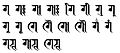 Vowel diacritic of Ranjana letter 'ग'.
 -
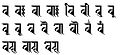 Vowel diacritic of Ranjana letter 'ब'.
 -
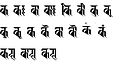 Vowel diacritic of Ranjana letter 'क'.


The shape of the combining marks indicating the vowels आ ā, ए e, ऐ ai/ē,ओ o, and औ au/ō in Ranjana script take a different form when combined with the eight consonants ख kha, ग ga, n ञ nya, ठ ṭha ण ṇa, थ tha, ध dha or श sha(or where one of these is the first consonant in a combination)[8] (In addition the vertical marks indicating आ ā or ī may take a shorter form when combined with the consonants क ka, ज्ञ ja, or ठ ṭha.)
Numerals
[edit] 0 ० 0 ० |
 1 १ 1 १ |
 2 २ 2 २ |
 3 ३ 3 ३ |
 4 ४ 4 ४ |
 5 ५ 5 ५ |
 6 ६ 6 ६ |
 7 ७ 7 ७ |
 8 ८ 8 ८ |
 9 ९ 9 ९
|
Use
[edit]-
 'Om' in Ranjana script
 -
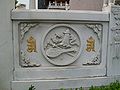 Rañjanā "Oṃ" syllables flanking the implements of the Four Heavenly Kings. Jing'an Temple, Shanghai, China.
 -
 Sanskrit manuscript in the Rañjanā script. Aṣṭasāhasrikā Prajñāpāramitā Sūtra, India, 12th century.
 -
 Street sign in Kathmandu in Ranjana, Devanagari and English.
 -


Use in Nepal
[edit]Rañjana is mostly used for printing Hindu and Buddhist scriptures and literature in Sanskrit and Buddhist Hybrid Sanskrit by the Newar community in Kathmandu Valley. Rañjana is also in current use for printing "high status" documents (wedding invitations, certificates, etc) in Nepal in the Newar language and for Newar language book titles.[9][10] In Mahayana and Vajrayana Buddhist traditions, it is famously used to write various mantras including the "Om mani padme hum" mantra of Avalokiteśvara, the mantra of Tara: "Om tare tuttare ture svaha", and the mantra of Manjusri: "Om a ra pa ca na dhi."[11][12][13] The script is also used in Hindu scriptures.[14]
Use in East Asia
[edit]In Chinese Buddhism and other East Asian Buddhism, the standard Sanskrit script for mantras and dhāraṇīs was not the Rañjanā script, but rather the earlier Siddhaṃ script that was widely propagated in China during the Tang dynasty.[15] However, in late Imperial China, the influence of Tibetan Buddhism popularized the Rañjanā script as well, and so this script is also found throughout East Asia, but is not as common as Siddhaṃ.[16] In Vietnam, Rañjanā script is often used during Buddhist rituals especially by monks in the central region such as Huế. Talismans are often made using Rañjanā mantras read "Om mani padme hum" or "Om cale cule cundi svaha" the mantra of Cundi Bodhisattva. The script has also been adopted by Vietnamese folk shamans in their use of amulets such as Lỗ Ban phái, a Taoist folk sect that arrived from China named after Lu Ban, patron god of carpenters.[17]
Use in Tibet
[edit]When Rañjanā was introduced to Tibet, it was referred to as Lantsa (Tibetan: ལཉྫ་), which is simply a Tibetan transcription of the Sanskrit word Sanskrit: लञ्ज or Lañja (which means 'tail' or 'foot').[18] Lantsa varies somewhat from the standard Rañjanā as written in Nepal today. In particular the glyph shapes of some consonants and ligatures differs and vowel diacritics do not usually change with the consonants ख kha, ग ga, n ञ nya, ठ ṭha ण ṇa, ध dha श sha as described above~ with the sole exception of the letter ठ ṭha. The shape of the numerals or digits also differs.
In Tibet, the Lantsa variant is used to write Buddhist texts in Sanskrit.[19] Examples of such texts include the Mañjuśrīnāmasamgīti, the Diamond Sutra and the Aṣṭasāhasrikā Prajñāpāramitā Sūtra. The Lantsa script is also found in manuscripts and printed editions of some Sanskrit-Tibetan lexicons such as the Mahāvyutpatti. and it is frequently used on the title pages of Tibetan texts, where the Sanskrit title is often written in Lantsa, followed by a transliteration and translation in the Tibetan script. The script is also used to prepare Mantra and Dharani inserted into Buddhist images and Stupa for consecration, as well as in the drawing of certain mandalas ( similar to the Japanese use of the Siddhaṃ script).
Lantsa is frequently seen on the outside of prayer wheels, and decoratively on the gateways, walls. beams and pillars of Tibetan temples and monasteries.
Numerous alternative spellings of the term Lantsa exist, including the following:
- Lanja
- Landzha
- Lantsha
- Lentsa
- Lendza
Monogram (Kutākshar)
[edit]
Kutākshar is a monogram of the Ranjana script. It is only one of the Nepalese scripts that can be written in monogram.
Unicode
[edit]A Unicode block for the script has first been proposed in 2009 by Michael Everson[9] and updated in December 2013,[20] and last revized with additional details in January 2023 by Anshuman Pandey.[21]
Gallery
[edit]-
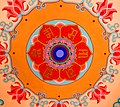
 Nyingma Tibetan Buddhist temple with decorative use of the Lantsa variant of Rañjanā .
 -
 The Vajra Guru Mantra in the Lantsa variant of Rañjanā and in the Tibetan script.
 -
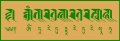 The Mantra of Tara in the Lantsa variant of Rañjanā and Tibetan script.
 -
 Invitation card.
 -
 Sandhya Times daily.
 -
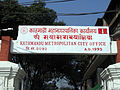 Signboard of Kathmandu Metropolitan City Office in Ranjana script (second row).


References
[edit]- ^ Masica, Colin (1993). The Indo-Aryan languages. p. 143.
- ^ a b Omniglot [self-published source?]
- ^ a b c Jwajalapa [self-published source?] Archived 2007-03-10 at the Wayback Machine
- ^ Folk tales from the Himalayan kingdom of Nepal: Black rice and other stories, p.47, Kesar Lall, Ratna Pustak Bhandar
- ^ Nepalese Inscriptions in the Rubin Collection
- ^ Nagarjuna Institute: Buddhist Sites of Nepal – Hiraynavarna Mahavihara
- ^ Ranjana Script [self-published source?]
- ^ Shakya, Robison (2002). Alphabet of the Nepalese Script:Nepāla lipi varṇamālā. Nakabahila Lalitpur: Motirāj Śhākya, Thayakalaya. p. 23. ISBN 9993334367.
- ^ a b Michael Everson (May 4, 2009). "Preliminary proposal for encoding the Rañjana script in the SMP of the UCS" (PDF). n3649.
- ^ Min Bahadur Shakya. "Preservation of Sanskrit Buddhist Manuscripts in the Kathmandu Valley: Its importance and future" (PDF).
- ^ "Teachings of the Buddha". [self-published source?]
- ^ "Dharma Haven". [self-published source?]
- ^ "Ranjana font". Archived from the original on 2009-02-23. Retrieved 2019-07-10.
{{cite web}}: CS1 maint: bot: original URL status unknown (link) [self-published source?] - ^ "Asian art".
- ^ Chattopadhayaya, Alaka (1999). Atisa and Tibet: Life and Works of Dipamkara Srijnana: p. 201
- ^ Jiang, Wu (2008). Enlightenment in Dispute: The Reinvention of Chan Buddhism in Seventeenth-Century China: p. 146
- ^ "Ma Phương :: Tinh Hoa Đông Phương". maphuong.com. Retrieved 2021-08-24.
- ^ "lany+dza". Dharma Dictionary. Tsadra Foundation. Retrieved 2022-03-19.
- ^ Ranjana script and Nepal Bhasa (Newari) language
- ^ Dev Dass Manandhar, Samir Karmacharya and Bishnu Chitrakar (December 31, 2013). "Preliminary proposal to Encode Ranjana Script in ISO/IEC 10646" (PDF).
- ^ Anshuman Pandey (January 5, 2023). "Preliminary proposal to encode Ranjana in Unicode" (PDF).
External links
[edit]- Download Ranjana Newari Regular Font
- Everson, Michael (2009). "Preliminary proposal for encoding the Rañjana script in the SMP of the UCS" (PDF). n3649. Archived from the original (PDF) on 2023-03-06. Retrieved 2021-02-11.
- Everson, Michael (2009). "Roadmapping the scripts of Nepal" (PDF). n3692. Archived from the original (PDF) on 2023-01-17. Retrieved 2021-02-11.
- Fynn, Christopher John. Ranjana (Lantsa) script
- Pandey, Anshuman (2016). "Towards an encoding for the Ranjana and Lantsa scripts" (PDF). L2/L2016/16015.
- Ranjana script on Omniglot
- Ranjana script
- Saerji. (2009). Rañjanā script: Akṣara List of the Manuscript of Aṣṭasāhasrikāprajñāpāramitā (ca. the 11–12th Centuries). Research Institute of Sanskrit Manuscripts & Buddhist Literature, Peking University.
| Music | |
|---|---|
| Cuisine | |
| Festival | |
| Rituals | |
| Architecture | |
| Language | |
| Deities | |
| Castes | |
| Misc | |
| Religion | |

Ranjana script
View on GrokipediaHistory
Origins
The Ranjana script emerged as an abugida within the Brahmic family of scripts, developing primarily in the Kathmandu Valley of Nepal between the 8th and 11th centuries CE. It evolved from earlier writing systems as local adaptations for rendering Nepal Bhasa (Newar) and Sanskrit. This development occurred in the context of the region's rich cultural and religious milieu, where the script took shape as a distinct system suited to the phonetic needs of these languages.[5] The script developed to better accommodate liturgical and literary purposes. These innovations drew upon the artistic traditions of the Kathmandu Valley, transforming functional writing into an expressive medium. Earliest traces appear in inscriptions and manuscripts from the Licchavi period (circa 400–750 CE), where proto-forms derived from Licchavi alphabets laid the groundwork, with more defined Ranjana features evident by the early Malla era (12th century onward). The earliest known attestation is in a 908 CE manuscript of the Laṅkāvatāra Sūtra. These artifacts, often found on stone edicts and palm-leaf texts, demonstrate the script's initial use in administrative and devotional contexts.[6][5][3] Vajrayana Buddhism profoundly influenced the Ranjana script's ornate, calligraphic style, emphasizing its role in sacred texts and mantras. The script's elaborate curves, horizontal bars, and geometric harmony made it ideal for religious manuscripts, enhancing the visual and spiritual impact of tantric writings and hymns. This aesthetic choice reflected the tantric emphasis on form as a meditative aid, with Newar artisans in the valley perfecting its decorative potential for temple inscriptions and illuminated works. As an ornately elaborate Newari script, it became revered in Vajrayana traditions, underscoring its origins in Nepal's Buddhist scholarly centers. The script also flourished under the Pala dynasty in Bengal during the 10th to 12th centuries for inscribing Buddhist texts.[7][8][2]Development and spread
The Ranjana script underwent significant refinement during the Malla dynasty, spanning the 12th to 18th centuries, when it became a prominent medium for inscriptions, manuscripts, and religious texts due to its elegant and intricate design.[9] This period saw its widespread application in royal inscriptions, temple carvings, and Buddhist sutras, reflecting the dynasty's patronage of Newar culture and Mahayana Buddhism in the Kathmandu Valley.[10] The script's ornate style made it ideal for artistic expressions in temple art, such as decorative motifs on stupas and manuscripts like the Usnisa Vijaya Dharani.[10] Transmission of the Ranjana script to Tibet occurred through trade routes and Buddhist missionary activities between the 11th and 13th centuries, facilitated by cultural exchanges along the Silk Road and the spread of Vajrayana Buddhism.[11] In Tibet, it was known as Lantsa and adapted primarily for writing Sanskrit mantras, dharanis, and book titles in translated Tibetan texts, rather than for the Tibetan language itself, often used decoratively in temples and mandalas.[12][13] This adaptation preserved its abugida structure while emphasizing its calligraphic and symbolic role in religious contexts.[12] The script further spread to East Asia, including China, Japan, and Korea, during the 13th to 15th centuries via the Mongol Empire's expansions and ongoing Buddhist exchanges, where it was employed for inscribing mantras on temple pillars, shrines, and prayer wheels.[10][11] Nepali artisan Arniko, invited to the Yuan court in the 13th century, contributed to its dissemination in China, as seen in carvings on structures like the White Dagoba in Beijing.[10] In these regions, Ranjana served a ceremonial function in Mahayana and Vajrayana monasteries, enhancing its ornamental appeal for sacred writings.[11] Secular use of the Ranjana script declined after the 19th century following Nepal's unification under the Shah dynasty in the late 18th century and the subsequent Rana regime's (1846–1951) enforcement of a "one nation, one language" policy, which promoted Devanagari for administration and education.[9][14] Bans on Nepal Bhasa scripts, including fines and property seizures, suppressed its teaching and publication, leading to its replacement by Devanagari by the early 20th century.[14] However, it persisted in religious contexts, such as temple inscriptions and sutras, until the mid-20th century, when post-Rana revival efforts began to sustain its cultural legacy.[14][12]Writing system
Overall characteristics
The Ranjana script is an abugida writing system, in which each consonant glyph inherently represents a syllable ending in the vowel /a/, with diacritics or dependent forms used to indicate other vowels or their absence.[2][15] This structure aligns with its descent from the Brahmi family of scripts, facilitating the representation of Sanskrit and Newar phonologies in religious and literary texts.[2] It is written horizontally from left to right, though a variant known as Kutakshar employs vertical top-to-bottom arrangement for compact inscriptions.[16] The script comprises 33 basic consonants and 14 vowels, alongside conjunct forms that combine consonants for clusters without intervening vowels, enabling efficient encoding of complex syllabic structures.[17] Its cursive and highly decorative strokes, characterized by rounded and flowing lines that broaden horizontally from fine points and taper in downstrokes, make it particularly suited for calligraphy, engraving on stone or metal, and illuminated manuscripts.[2][18] Visually, Ranjana emphasizes harmonious balance and ornamental elegance, with curved forms influenced by Buddhist artistic and religious aesthetics, setting it apart from the more angular geometries of many other Brahmic scripts like Devanagari.[2] This aesthetic integration reflects its primary use in sacred contexts, such as mantras and dhāraṇīs, where the script's fluidity enhances symbolic and devotional expression.[2]Vowels
The Ranjana script, an abugida derived from the Brahmi family, includes 14 independent vowel letters that represent standalone vowel sounds, primarily for Sanskrit, Newar, and Buddhist liturgical texts. These letters are used at the beginning of words or in isolation, such as in mantras or sacred syllables, where no preceding consonant is present. Unlike dependent vowel signs that attach to consonants, independent forms maintain their full glyph structure to denote pure vowel phonemes, reflecting the script's phonetic inventory aligned with Indo-Aryan vowel systems.[17] The independent vowels encompass short and long variants for several phonemes, along with vocalic consonants and diphthongs. Their phonetic values are approximated in the International Phonetic Alphabet (IPA) based on classical Sanskrit pronunciation, though actual realization may vary in modern usages like Newar. The following table lists the independent vowels, their Unicode code points, names, IPA transcriptions, and Devanagari equivalents for comparison. These code points are from a proposal and not yet encoded in the Unicode Standard as of 2025.[17]| Code Point | Glyph | Name | IPA | Devanagari |
|---|---|---|---|---|
| U+11500 | | RANJANA LETTER A | /ə/ | अ |
| U+11501 | | RANJANA LETTER AA | /aː/ | आ |
| U+11502 | | RANJANA LETTER I | /i/ | इ |
| U+11503 | | RANJANA LETTER II | /iː/ | ई |
| U+11504 | | RANJANA LETTER U | /u/ | उ |
| U+11505 | | RANJANA LETTER UU | /uː/ | ऊ |
| U+11506 | | RANJANA LETTER VOCALIC R | /ɽ̩/ | ऋ |
| U+11507 | | RANJANA LETTER VOCALIC RR | /ɽ̩ː/ | ॠ |
| U+11508 | | RANJANA LETTER VOCALIC L | /l̩/ | ऌ |
| U+11509 | | RANJANA LETTER VOCALIC LL | /l̩ː/ | ॡ |
| U+1150A | | RANJANA LETTER E | /e/ | ए |
| U+1150B | | RANJANA LETTER AI | /ai/ | ऐ |
| U+1150C | | RANJANA LETTER O | /o/ | ओ |
| U+1150D | | RANJANA LETTER AU | /au/ | औ |
Consonants
The Ranjana script employs a consonantal inventory rooted in the ancient Brahmi tradition, adapted for rendering Sanskrit and Nepal Bhasa in religious manuscripts. Each of the 33 core consonants inherently includes the vowel sound /a/, forming syllabic units such as /ka/ for the basic form of the velar stop, unless modified by diacritics. This abugida structure facilitates the phonetic representation of Indo-Aryan languages, with glyphs designed for calligraphic elegance in Buddhist liturgy.[17][19] The consonants are systematically organized by place of articulation, mirroring the phonological categories of Sanskrit while accommodating additional sounds in Nepal Bhasa. The five main series—velar, palatal, retroflex, dental, and labial—each comprise an unaspirated voiceless stop, its aspirated counterpart, the voiced stop, its breathy-voiced aspirate, and a nasal. These are followed by semivowels, sibilants, and the glottal fricative. The following table presents representative consonants from each group, with Sanskrit transliterations and International Phonetic Alphabet (IPA) notations for their base pronunciations (with inherent /a/ implied). These are based on a Unicode proposal and not yet encoded as of 2025.[17]| Place of Articulation | Transliteration | IPA (base sound) |
|---|---|---|
| Velar | ka | /k/ |
| Velar | kha | /kʰ/ |
| Velar | ga | /ɡ/ |
| Velar | gha | /ɡɦ/ |
| Velar | ṅa | /ŋ/ |
| Palatal | ca | /c/ |
| Palatal | cha | /cʰ/ |
| Palatal | ja | /dʒ/ |
| Palatal | jha | /dʒɦ/ |
| Palatal | ña | /ɲ/ |
| Retroflex | ṭa | /ʈ/ |
| Retroflex | ṭha | /ʈʰ/ |
| Retroflex | ḍa | /ɖ/ |
| Retroflex | ḍha | /ɖɦ/ |
| Retroflex | ṇa | /ɳ/ |
| Dental | ta | /t̪/ |
| Dental | tha | /t̪ʰ/ |
| Dental | da | /d̪/ |
| Dental | dha | /d̪ɦ/ |
| Dental | na | /n̪/ |
| Labial | pa | /p/ |
| Labial | pha | /pʰ/ |
| Labial | ba | /b/ |
| Labial | bha | /bɦ/ |
| Labial | ma | /m/ |
| Semivowel | ya | /j/ |
| Semivowel | ra | /ɾ/ |
| Semivowel | la | /l/ |
| Semivowel | va | /ʋ/ |
| Sibilant | śa | /ʃ/ |
| Sibilant | ṣa | /ʂ/ |
| Sibilant | sa | /s/ |
| Glottal | ha | /ɦ/ |