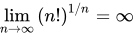
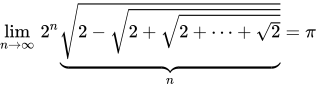
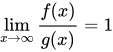
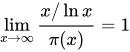
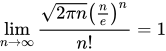
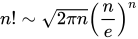
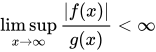
if and only if
  . This is the (ε, δ)-definition of limit.
The limit superior and limit inferior of a sequence are defined as 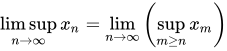 and
and 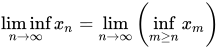 .
.
A function,  , is said to be continuous at a point, c, if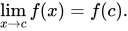
Operations on a single known limit
[edit]If then:
![{\displaystyle \lim _{x\to c}\,[f(x)\pm a]=L\pm a}](https://wikimedia.org/api/rest_v1/media/math/render/svg/7e1d3ef86a2d1c54fd7e6cfe84ecc0c4a8809cd8)
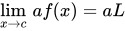 [1][2][3]
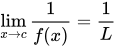 [4] if L is not equal to 0.
 if n is a positive integer[1][2][3]
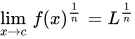 if n is a positive integer, and if n is even, then L > 0.[1][3]
In general, if g(x) is continuous at L and then
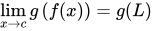 [1][2]
Operations on two known limits
[edit]If 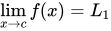 and
and 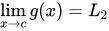 then:
then:
![{\displaystyle \lim _{x\to c}\,[f(x)\pm g(x)]=L_{1}\pm L_{2}}](https://wikimedia.org/api/rest_v1/media/math/render/svg/2cb00a9174f995bae626da947886d0229d14b275) [1][2][3]
[1][2][3]![{\displaystyle \lim _{x\to c}\,[f(x)g(x)]=L_{1}\cdot L_{2}}](https://wikimedia.org/api/rest_v1/media/math/render/svg/3d647c43494eb14a2ce635004699c5202efb03fe) [1][2][3]
[1][2][3]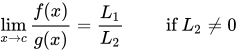 [1][2][3]
Limits involving derivatives or infinitesimal changes
[edit]In these limits, the infinitesimal change  is often denoted
  or
or  . If is differentiable at
  ,
,
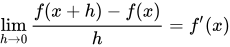 . This is the definition of the derivative. All differentiation rules can also be reframed as rules involving limits. For example, if g(x) is differentiable at x,
![{\displaystyle \lim _{h\to 0}{f\circ g(x+h)-f\circ g(x) \over h}=f'[g(x)]g'(x)}](https://wikimedia.org/api/rest_v1/media/math/render/svg/944fd47861a57a16f9c7b8156471af391e361a2d) . This is the chain rule.
. This is the chain rule. . This is the product rule.


If and  are differentiable on an open interval containing c, except possibly c itself, and
  , L'Hôpital's rule can be used:
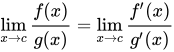 [2]
[2]
If  for all x in an interval that contains c, except possibly c itself, and the limit of and both exist at c, then[5]
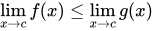
If  and
and  for all x in an open interval that contains c, except possibly c itself,
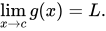 This is known as the squeeze theorem.[1][2] This applies even in the cases that f(x) and g(x) take on different values at c, or are discontinuous at c.
 [1][2][3]
 [1][2][3]
 if n is a positive integer[5]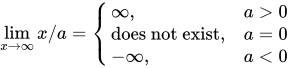
In general, if  is a polynomial then, by the continuity of polynomials,[5]
 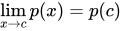 This is also true for rational functions, as they are continuous on their domains.[5]
 [5] In particular,
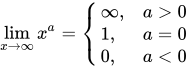
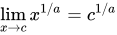 .[5] In particular,
![{\displaystyle \lim _{x\to \infty }x^{1/a}=\lim _{x\to \infty }{\sqrt[{a}]{x}}=\infty {\text{ for any }}a>0}](https://wikimedia.org/api/rest_v1/media/math/render/svg/e27677c268640e9d57d259ea3b52b566edc03b38) [6]
[6]
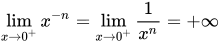


If is expressed in radians:
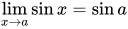

These limits both follow from the continuity of sin and cos.
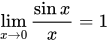 .[7][8] Or, in general,
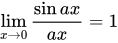 , for a not equal to 0.
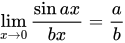 , for b not equal to 0.
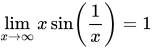
 [4][8][9]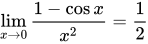
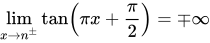 , for integer n.
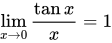 . Or, in general,
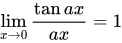 , for a not equal to 0.
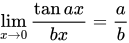 , for b not equal to 0.
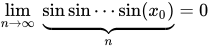 , where x0 is an arbitrary real number.
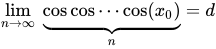 , where d is the Dottie number. x0 can be any arbitrary real number.
In general, any infinite series is the limit of its partial sums. For example, an analytic function is the limit of its Taylor series, within its radius of convergence.
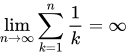 . This is known as the harmonic series.[6]
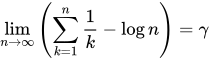 . This is the Euler Mascheroni constant.


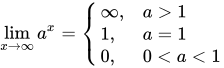
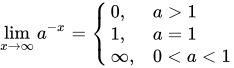
![{\displaystyle \lim _{x\to \infty }{\sqrt[{x}]{a}}=\lim _{x\to \infty }{a}^{1/x}={\begin{cases}1,&a>0\\0,&a=0\\{\text{does not exist}},&a<0\end{cases}}}](https://wikimedia.org/api/rest_v1/media/math/render/svg/257587de98c10b53ea0f58512ac1955779cf57d1)
![{\displaystyle \lim _{x\to \infty }{\sqrt[{x}]{x}}=\lim _{x\to \infty }{x}^{1/x}=1}](https://wikimedia.org/api/rest_v1/media/math/render/svg/aa1a821ef69483eecca48841d2b536f92682b8d6)
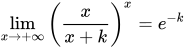
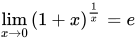
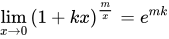
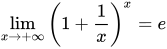
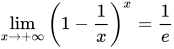
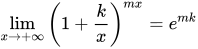

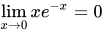

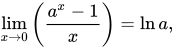
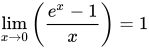
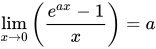
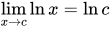

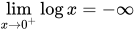
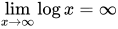
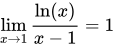
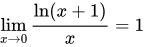

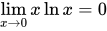

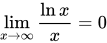
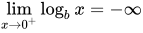

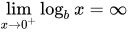
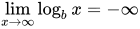




![{\displaystyle \lim _{n\to \infty }{\frac {n}{\sqrt[{n}]{n!}}}=e}](https://wikimedia.org/api/rest_v1/media/math/render/svg/9e67d9f7e2588c9b3d418f1107e9ea27b8f330ed)