


Community hub
Recent from talks
Contribute something
Nothing was collected or created yet.
Lockheed JetStar
View on WikipediaThe Lockheed JetStar (company designations L-329 and L-1329; designated C-140 in US military service) is a business jet produced from the early 1960s to the 1970s. The JetStar was the first dedicated private jet to enter service, as well as the only such airplane built by Lockheed. It was also one of the largest aircraft in the class for many years, seating ten plus two crew. It is distinguishable from other small jets by its four engines, mounted on the rear of the fuselage, and the "slipper"-style fuel tanks fixed to the wings.
Key Information


Development
[edit]
The JetStar originated as a private project within Lockheed, with an eye to winning a United States Air Force (USAF) requirement that was later dropped due to budget cuts. Lockheed decided to continue the project on its own for the business market.[2]
The first two prototypes were equipped with two Bristol Siddeley Orpheus engines, the first of these flying on 4 September 1957. The second of these was also equipped with the wing-mounted "slipper tanks", which was originally to be an option. Lockheed attempted to arrange a contract to produce the Orpheus in the US, but when these negotiations failed it re-engined the second prototype with four Pratt & Whitney JT12s in 1959. The outer engines were mounted beside the inner ones, an arrangement that was later used on the Vickers VC10 and Ilyushin Il-62 airliners. The slipper tanks were removed and placed on the first prototype. The JT12 fit proved successful and was selected for the production versions, the first of which flew in mid 1960.[citation needed] These versions entered commercial service in 1961.
Noise regulations in the United States and high fuel consumption led to the development of the 731 JetStar, a modification program which added new Garrett TFE731 turbofan engines with a number of detail changes. It has redesigned larger external fuel tanks that sit with their upper surfaces flush with the wing, rather than being centered on it. The cockpit area has a somewhat more "modern" looking nose and window arrangement. The 731 JetStar modification program was so successful that Lockheed produced 40 new JetStars, designated the JetStar II, from 1976 to 1979. The JetStar IIs were factory-new aircraft with the turbofan engines and revised external fuel tanks. Both 731 JetStars and JetStar IIs have greatly increased range, reduced noise, and better runway performance compared to the original JetStars.
JetStar production totaled 204 aircraft by final delivery in 1978.[3] Most original JetStars have been retired, but many 731 JetStars and JetStar IIs are still flying in various roles, mainly as corporate and private jets.
Design
[edit],_USA_-_Air_Force_AN1443803.jpg)

_Cockpit.jpg)
The JetStar has a fairly typical business jet design layout, with a swept wing and a cruciform tail. The wing has a 30° sweepback and features large fuel tanks at about half-span, extending some distance in front and behind the wing. The wings hold 10,000 pounds (4,500 kg) of fuel, and each slipper tank holds 4,000 pounds (1,800 kg) of fuel for a total fuel load of 18,000 pounds (8,200 kg). The wing also includes leading edge flaps (not slats) along the front of the wing outboard of the tanks (these leading edge flaps reduce the stalling speed by an additional three knots), while double-slotted trailing edge flaps span the entire rear surface inboard of the ailerons. The wing incorporates inflatable rubber deicing boots for the removal of ice accumulated in flight. The horizontal stabilizer is mounted nearly halfway up the fin to keep it clear of the engines' jet blast. One feature is that the horizontal stabilizer is trimmable by pivoting the entire tail fin and stabilizer assembly, which has a distinctive unpainted area at the base of the fin that is noticeable in most pictures. The JetStar does not have any tail deicing capability, nor was it required for certification. A speed brake is located on the underside of the fuselage to aid deceleration for landing. The original prototypes used a tricycle landing gear with one wheel per leg, but after an accident in 1962 the nose gear was modified with two tires.[3]
The JetStar is a relatively heavy aircraft for its class, at 44,500 pounds (20,200 kg). Maximum cruising speed is Mach 0.8, or 567 miles per hour (912 km/h) at 21,000 feet (6,400 m). Range is typically quoted as 2,500 miles (4,000 km) with a 3,500-pound (1,600 kg) payload. Typically, interiors feature seating for eight with a full-sized lavatory, or a slightly denser arrangement for ten. The JetStar is one of the few aircraft of its class which allow a person to walk upright in the cabin, although to do this the aisle is sunk slightly so that the seats are raised on either side.[4] The windows are relatively large.
Operational history
[edit]The first prototype served as the personal transport of Lockheed's Vice President of Advanced Development Projects Kelly Johnson for some time. Elvis Presley owned two JetStars at different times; the second was named Hound Dog II and is on display at Graceland. Frank Sinatra also owned one.[citation needed] Additionally, one JetStar belonged to U.S. President Richard Nixon, then to the Shah of Iran and finally, to Puerto Rican boy band Menudo.
Sixteen JetStars were produced for the USAF; five C-140As were flight inspection aircraft for the Air Force Communications Service and were used to perform airborne testing of airport navigational aids (navaids) from 1962 onwards. They began service during the Vietnam War and remained in service until the early 1990s. The "Flight Check" C-140As were combat-coded aircraft that could be distinguished from the VIP transport version by their distinctive paint scheme. The C-140As were deployed to southeast Asia during the Vietnam War, where, in addition to their more usual navaid testing, they would loiter off the coast and act as communications relays between the Pentagon and the battlefield.[5] The last C-140A to be retired was placed on static display at Scott AFB, Illinois.[citation needed]
An additional eleven airframes were designated C-140B, although the first of these predated the C-140As when it was delivered in 1961. The C-140Bs were used to transport personnel by the Military Airlift Command. Six of the aircraft (tail numbers 61-2488, 61-2489, 61-2490, 61-2491, 61-2492 and 61-2493) were operated as VIP transports by the 89th Military Airlift Wing at Andrews Air Force Base. These VIP aircraft were designated as VC-140Bs. During the presidency of Jimmy Carter, he used a dedicated VC-140B extensively for short trips and it was known within the Special Air Missions Wing as "Peanut One." Upon retirement, one airframe (#89001) was placed on a static pedestal in front of the Joint Base Andrews air terminal. Members of the VIP transport fleet occasionally served as Air Force One during the 1970s and 1980s. Several other countries, such as Germany and Canada, have used military JetStars as transports for their heads of state, heads of government, and other VIPs.
The last operational JetStar (N313JS) was retired in December 2019, and is now preserved at the Aviation History & Technology Center in Marietta, GA.[6] However, in November 2020, a Jetstar II (N700RM) was flown from Texas to Oregon.[7] That particular aircraft will be disassembled in Klamath Falls.[citation needed] In December 2020, another Jetstar II (N710RM) was also ferried from Conroe, Texas to Klamath Falls, Oregon.[8]
Variants
[edit]- JetStar I
- Business, executive transport aircraft, with accommodation for a crew of two and ten passengers, powered by four 3,300 pounds-force (15 kN) thrust Pratt & Whitney JT12A-8 turbojet engines.
- JetStar II
- New production version, powered by four 3,700 pounds-force (16 kN) thrust Garrett TFE731-3 turbofan engines, and fitted with revised external fuel tanks, 40 built.
- JetStar 731
- Modified version, fitted with four Garrett TFE731-1 turbofan engines, and equipped with redesigned external fuel tanks.
- C-140A
- Flight inspection aircraft for the US Air Force, similar to the JetStar I, five built.
- C-140B
- Passenger, cargo transport aircraft for the US Air Force, similar to the C-140A, five built.
- VC-140B
- VIP transport aircraft for the US Air Force, similar to the C-140B, six built.
- C-140C
- Two JetStar 6s were ordered by the United States Navy, originally designated UV-1, but not delivered.
- T-40
- US military designation for a proposed trainer version of the C-140 for evaluation, not built.
- AAI FanStar
- Conversion by American Aviation Industries with two General Electric CF34 engines in place of the four JT12 turbojets or TFE731 turbofans which first flew on 5 September 1986.[9] Only one aircraft was converted. The work on the interior of the demonstrator was the subject of litigation in federal court in the late 1980s and early 1990s.[10]
Operators
[edit]Civil operators
[edit]
- Algeria
- Iraq
- Mexico
- Puerto Rico
- United States
- Eastern Airlines[15][16][17]
- Great Northern Railway[citation needed] registration N968GN, re-registered as N968BN and N7954S.
- Elvis Presley[citation needed] (this JetStar is currently on static display in Graceland in Memphis, TN)[needs update]
- Southern Air Transport.[citation needed]
- Trans World Airlines (TWA).[citation needed]
Military and government operators
[edit],_USA_-_Air_Force_AN1537946.jpg)
- Canada
- Transport Canada[citation needed] former operator
- West Germany
- German Air Force[18] former operator
- Indonesia
- Indonesian Air Force[18] former operator
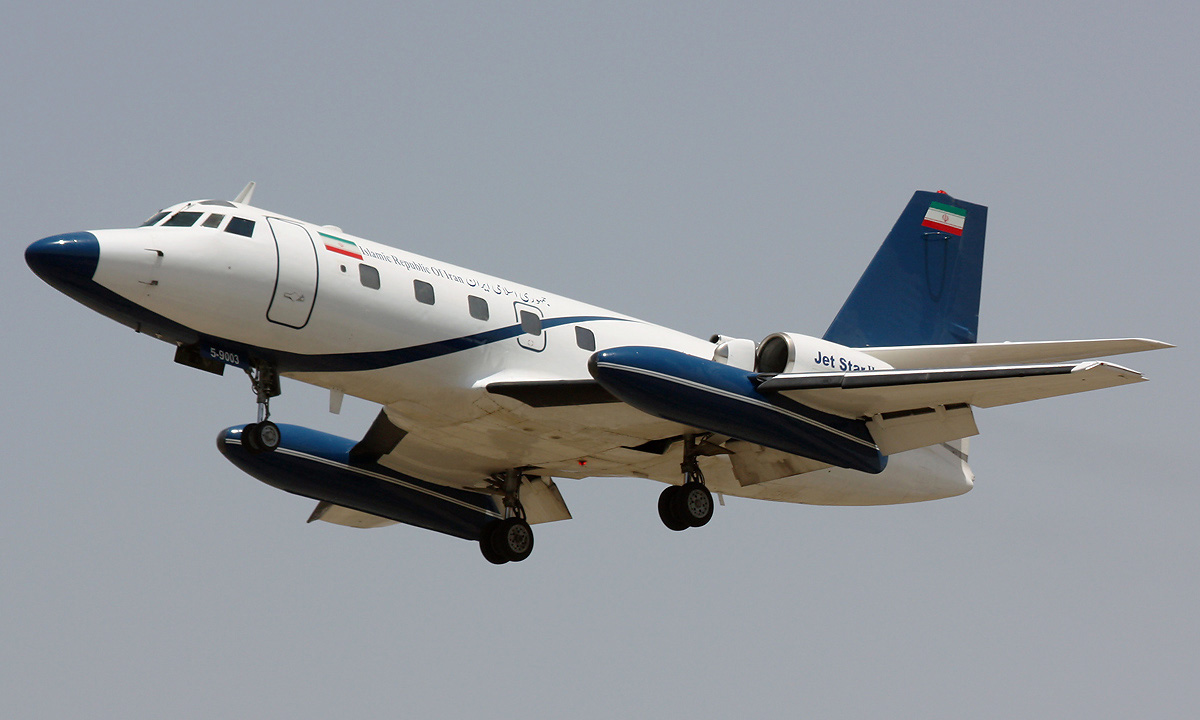
- Iran
- Iraq
- Iraqi Government[18]
- Kuwait
- Kuwait Government[18]
- Libya
- Lithuania
- Lithuanian government (operated by Lithuanian Airways) in early 1990's
- Mexico
- Saudi Arabia
- United States
Accidents and incidents
[edit]- On 25 March 1976, a Jetstar taking off from Chicago Midway Airport overran runway 13R and crashed killing all four occupants on board.[19]
- On 29 March 1981, a Lockheed JetStar inbound from Nigeria overran runway 08 at London Luton Airport. The co-pilot suffered severe spinal injuries but the commanding pilot and seven passengers escaped with only minor injuries.[20]
- On January 5, 1995, an Islamic Republic of Iran Air Force (IRIAF) JetStar crashed during an emergency landing, killing all 12 on board including General Mansour Sattari, commander of the IRIAF.[21]
Aircraft on display
[edit] |
- Canada
- C-FDTX (c/n 5018) L-1329 Jetstar 6 – The Canada Aviation and Space Museum in Ottawa, has an L-1329 Jetstar 6 that the Department of Transport used to carry government officials and foreign dignitaries.[22]
- C-FDTF (c/n 5088) L-1329 Jetstar 6 – The Atlantic Canada Aviation Museum has a Jetstar that was used by the Canadian Prime Minister and other government officials.[23]
- Indonesia

- A-9446 (c/n 5046) L-1329 Jetstar 6 – Used as VIP aircraft of Indonesian government, nicknamed "Sapta Marga". On display at Garuda Indonesia Training Centre (GITC) in Duri Kosambi, Cengkareng[24]
- A-1645 (c/n 5059) L-1329 Jetstar 6 – Used as VIP aircraft of the Indonesian government, nicknamed "Pancasila". On display at Dirgantara Mandala Museum in Yogyakarta.[25] This aircraft was used by Indonesia's first president, Sukarno.
- Mexico
- 3908 (c/n 5144) L-1329 Jetstar 8 - On display at the Museo Militar de Aviación at Santa Lucía Air Force Base.[citation needed]
- United Kingdom
- N25AG (c/n 5202) L-1329-25 JetStar II - fuselage preserved for guest accommodations at Apple Camping in Redberth, Pembrokeshire, Wales.[41]
_(3).jpg)


- United States
- N329J (c/n 1001) L-1329 JetStar – The prototype JetStar is undergoing restoration at the Museum of Flight's Restoration Center in Everett, Washington.[26] This aircraft is one of only two JetStars with only two engines.
- N711Z (c/n 1002) L-1329 JetStar - On pylon display in false USAF marking as 89-001 near Base Operations and the AMC Air Terminal at Andrews AFB, Maryland.[citation needed]
- N814NA (c/n 5003) L-1329 JetStar 6 - Former NASA JetStar is on display at the Joe Davies Heritage Park, Palmdale, California.[citation needed]
- N777EP (c/n 5004) L-1329 JetStar 6 - Owned by Elvis Presley in his later years and named Hound Dog II, on display at Graceland, Memphis Tennessee.[27] This is one of two Jetstars owned by Elvis Presley and/or his family.
- 59-5958 (c/n 5010) C-140A - Displayed at the Travis Air Force Base Heritage Center in Fairfield, California.[28]
- 61-2488 (c/n 5017) VC-140B – The Museum of Aviation next to Robins Air Force Base has a VC-140B on display.[29]
- 61-2489 (c/n 5022) VC-140B – Pima Air and Space Museum, adjacent to Davis-Monthan AFB in Tucson, Arizona.[30]
- 61-2490 (c/n 5024) VC-140B - President Lyndon Johnson's JetStar is on display at the Lyndon B. Johnson National Historical Park.[31]
- 59-5959 (c/n 5026) C-140A - In the Scott Field Heritage Air Park at Scott AFB, Illinois.[32]
- 61-2492 (c/n 5031) VC-140B - In the Presidential Aircraft collection of the National Museum of the United States Air Force, Wright-Patterson AFB, Ohio.[33]
- 59-5962 (c/n 5032) C-140A - Preserved at Edwards Air Force Base in Edwards, California.[citation needed]
- 62-4197 (c/n 5041) C-140B - Pima Air and Space Museum, adjacent to Davis-Monthan AFB in Tucson, Arizona. Aircraft has been given an artistic paintjob, named "Spy Tiger" by artist Andrew Schoultz.[citation needed]
- 62-4200 (c/n 5044) C-140B - Pima Air and Space Museum, adjacent to Davis-Monthan AFB in Tucson, Arizona. Aircraft has been given an artistic paintjob, named "Back to Supersonica" by artist Kenny Scharf.[citation needed]
- 62-4201 (c/n 5045) C-140B - Hill Aerospace Museum, Hill Air Force Base, Ogden, Utah, this was confirmed by former members of the 89th SAM from Andrews Air Force Base to have carried President Johnson and his wife.[34]
- N428DA (c/n 5058) L-1329 JetStar 8 - On display at the Aviation History and Technology Center adjacent to Dobbins Air Reserve Base in Marietta, Georgia.[citation needed]
- N313JS (c/n 5086) L-1329 JetStar 731 - Preserved for display at the Aviation History and Technology Center adjacent to Dobbins Air Reserve Base in Marietta, Georgia.[35]
- N33SJ (c/n 5087) L-1329 JetStar 731 - Forward fuselage preserved at the Planes of Fame Museum in Chino, California. Painted in false US Air Force colors.[citation needed]
- N511TD (c/n 5145) L-1329 JetStar 8 - On display at the Greater Saint Louis Air & Space Museum, Cahokia, Illinois.[citation needed]
- XB-DUH (c/n 5157) L-1329 JetStar 8 - At the entrance to Dodson International Parts in Rantoul, Kansas with false registration N001DI.[citation needed]
- N175MD (c/n 5215) L-1329-25 JetStar II – The Miami Auto Museum in North Miami, Florida has a complete JetStar on display inside the museum.[36][37]
- N377SA (c/n 5229) L-1329-25 JetStar II - On display at the Pacific Coast Air Museum in Santa Rosa, California.[38]
- N77C (c/n 5232) L-1329-25 JetStar II - On display at the TWA Museum at Charles B. Wheeler Downtown Airport, Kansas City, Missouri.[citation needed]
Specifications (JetStar II)
[edit]
Data from Lockheed Aircraft since 1913[39]
General characteristics
- Crew: two pilots and typically one flight attendant
- Capacity: 8–10 passengers
- Length: 60 ft 5 in (18.41 m)
- Wingspan: 54 ft 5 in (16.59 m)
- Height: 20 ft 5 in (6.22 m)
- Wing area: 542.5 sq ft (50.4 m2)
- Empty weight: 24,750 lb (11,226 kg)
- Gross weight: 41,535 lb (18,840 kg)
- Max takeoff weight: 44,500 lb (20,185 kg)
- Powerplant: 4 × Garrett TFE731-3[40] turbofan, 3,700 lbf (16 kN) thrust each
Performance
- Maximum speed: 547 mph (883 km/h, 476 kn) at 30,000 ft (9,145 m)
- Cruise speed: 504 mph (811 km/h, 438 kn)
- Range: 2,995 mi (4,820 km, 2,604 nmi)
- Service ceiling: 43,000 ft (13,105 m)
- Rate of climb: 4,150 ft/min (21.1 m/s)
Notable appearances in media
[edit]Auric Goldfinger's private aircraft in the 1964 James Bond film Goldfinger is a Lockheed JetStar with "Auric Enterprises" on the nose.
Aircraft used in John Wayne movie, "Hellfighters"
Aircraft used in Nicolas Cage movie, "Face/Off."
See also
[edit]Aircraft of comparable role, configuration, and era
References
[edit]Notes
[edit]- ^ a b Murdo Morrison (12 Oct 2018). "NBAA: Business jet designs that changed the industry". FlightGlobal.
- ^ "JetStar 6". Archived from the original on 2008-04-03. Retrieved 2007-06-14.
- ^ a b Bogash, Robert A. "Jetstar History". Welcome to Trains, Planes, and...... Robert A. Bogash. Retrieved 16 January 2016.
- ^ Loftin, Laurence K. "Representative Aircraft Types". NASA. Archived from the original on 29 October 2014. Retrieved 16 January 2016.
- ^ Harvey 1966, p. 69
- ^ Air-Britain Aviation World, March 2020, p. 64.
- ^ "N700RM Flight Tracking and History".
- ^ "N710RM Flight Tracking and History".
- ^ Taylor 1989, p. 339
- ^ Midcoast Aviation, Inc. v. General Electric Credit Corp., 907 F.2d 732 (7th Cir. 1990).
- ^ "Iraqi Airways Lockheed L-1329 JetStar II YI-AKD / MUC". aircraftslides.blogspot.com. 26 March 2015. Retrieved 28 May 2017.
- ^ "Iraqi Airways Lockheed Jetstar YI-AKB (1981)". aviationphotocompany.com. 1981. Retrieved 28 May 2017.
- ^ "Accident description". aviation-safety.net. 27 May 2017. Retrieved 28 May 2017.
- ^ "Avión de Menudo: ¿Chatarra o pedazo de historia? -VÍDEO". 6 September 2013.
- ^ "Eastern Airlines Lockheed L-1329 JetStar 8 N12241 (msn 5141) LBG (Jacques Guillem Collection). Image: 907634". airlinersgallery.smugmug.com. Retrieved 28 May 2017.
- ^ "Eastern Lockheed Whisperstar Emergency Information". pinimg.com. Retrieved 28 May 2017.
- ^ "1971 – Eastern Airlines Aero Commander 500B N6291X and Lockheed JetStar 6 N12241 "WhisperStar" at Miami". pbase.com. 1971. Retrieved 28 May 2017.
- ^ a b c d e f g h Francillon 1982, pp 518–521
- ^ "Crash of a Lockheed L-1329 Jetstar in Chicago: 4 killed".
- ^ "ASN Aircraft accident Lockheed L-1329 JetStar 6 N267L London–Luton Airport (LTN)". Aviation-safety.net. Archived from the original on 6 June 2011. Retrieved 21 April 2011.
- ^ "Iranian Air Force Leader, Military Chiefs Die in Crash". Los Angeles Times. January 7, 1995.
- ^ "Lockheed L-1329 Jetstar 6". Canada Aviation and Space Museum. Canada Science and Technology Museums Corporation. Retrieved 16 January 2016.
- ^ "Lockheed Jetstar". Atlantic Canada Aviation Museum. Retrieved 22 January 2016.
- ^ "Twitter @DudiSudibyo". twitter.com/dudisudibyo (in Indonesian). 21 September 2015. Retrieved 13 January 2021.
- ^ "C-140 Jet Star Pancasila — Museum Pusat TNI AU Dirgantara Mandala". dirgantara.museumjogja.org (in Indonesian). Archived from the original on 17 February 2017. Retrieved 13 January 2021.
- ^ "Lockheed Jetstar CL-329 Prototype". The Museum of Flight. Retrieved 21 January 2016.
- ^ "Elvis Presley's private jet up for sale". CNN. 21 June 2018. Retrieved 25 June 2018.
- ^ Veronico, Nick. "Outdoor Exhibits - VC-140 "Jetstar"". Travis Air Force Base Heritage Center. Archived from the original on 16 June 2016. Retrieved 16 September 2019.
- ^ "Lockheed C-140B "Jetstar"". Museum of Aviation. Archived from the original on 18 December 2015. Retrieved 16 January 2016.
- ^ "Jetstar". Pima Air & Space Museum. PimaAir.org. Retrieved 16 January 2016.
- ^ Gamino, Denise (Aug 19, 2010). "Piece of flying history lands on LBJ ranch". Statesman. Archived from the original on 2 February 2016. Retrieved 16 January 2016.
- ^ "C-140 Jetstar". Scott Field Heritage Air Park. Archived from the original on 10 June 2016. Retrieved 22 January 2016.
- ^ "Lockheed VC-140B JetStar". National Museum of the US Air Force. October 1, 2015. Retrieved 16 January 2016.
- ^ "C-140B "Jetstar"". Hill Air Force Base. September 27, 2007. Archived from the original on 27 January 2016. Retrieved 16 January 2016.
- ^ "Last JetStar Retires". AVweb. 31 December 2019. Retrieved 2 March 2021.
- ^ Perry, Kev. "USA April 2013 'The Airshows That Never Were' Tour Part 1". DTVMovements. Retrieved 22 January 2016.
- ^ "The Jetstar Thread". FlightAware. Archived from the original on 26 January 2016. Retrieved 22 January 2016.
- ^ "Lockheed Jetstar". Pacific Coast Air Museum. Retrieved 2 March 2021.
- ^ Francillon 1982, p. 396.
- ^ Francillon 1982, p. 394.
Bibliography
[edit]
- Francillon, René J. Lockheed Aircraft since 1913. London:Putnam, 1982. ISBN 0-370-30329-6.
- Harvey, Frank (November 1966). "The Air War in Vietnam". Flying. New York: Ziff-Davis Publishing Company. pp. 38–95.
- "Pentagon Over the Islands: The Thirty-Year History of Indonesian Military Aviation". Air Enthusiast Quarterly (2): 154–162. n.d. ISSN 0143-5450.
- Taylor, John W.R. (ed) Jane's All the World's Aircraft 1989–90. London:Jane's Yearbooks, 1989. ISBN 0-7106-0896-9


Lockheed JetStar
View on GrokipediaDevelopment
Origins and Design Goals
In the mid-1950s, the burgeoning demand for efficient transcontinental business travel prompted Lockheed Corporation to explore dedicated executive jets, leading to the initiation of the JetStar project in 1956. This effort was spearheaded by Clarence "Kelly" Johnson, the renowned engineer leading Lockheed's secretive Skunk Works division, which had previously revolutionized military aviation with rapid-development programs. The project responded to emerging market needs for a reliable, high-performance aircraft that could transport corporate executives across the United States without reliance on slower propeller-driven planes or commercial airliners.[9] Key design objectives centered on safety, performance, and versatility, with a four-engine configuration selected to enhance reliability and improve low-speed handling, particularly during critical climb phases following engine-out scenarios. This redundancy was deemed essential for a business jet operating from shorter runways, drawing from military transport requirements while prioritizing civil applications. The aircraft targeted a range exceeding 2,500 miles to enable nonstop coast-to-coast flights, a cruising speed of Mach 0.8 for efficiency at high altitudes, and accommodations emphasizing passenger comfort in a pressurized cabin. Influences from early jet transports, such as the de Havilland Comet's pioneering swept-wing and fuselage designs, informed the JetStar's aerodynamic approach, while military programs under the L-1329 designation shaped its initial utility-focused goals.[2][10][9] Initial specifications outlined a fuselage length of approximately 60 feet and a wingspan of 54 feet 5 inches, providing space for 10 to 12 passengers in a luxurious layout with standing headroom, berths, and refreshment facilities. This sizing balanced the need for a spacious interior against operational efficiency, positioning the JetStar as a competitor to nascent business aviation options and military utility transports like the McDonnell Model 119 in the UCX competition.[11][9]Prototyping and Testing
The construction of the first Lockheed JetStar prototype, registered as N329J (c/n 1001), began in early 1957 at the company's Burbank facility in California, following the initiation of the project in 1956 to meet a U.S. Air Force requirement for a utility transport jet.[4][12] This prototype featured an initial configuration with two pod-mounted Bristol Siddeley Orpheus turbojet engines, reflecting the experimental nature of the design phase. A second prototype, N329K, was also constructed at Burbank to support parallel testing efforts.[13] The maiden flight of N329J occurred on September 4, 1957, departing from Edwards Air Force Base in the high desert of southern California at 8:58 a.m., with Lockheed test pilots Ray J. Goudey and Robert T. Schumacher at the controls.[11] The 39-minute flight demonstrated stable handling and basic performance, validating the low-wing, swept-tail configuration, but highlighted limitations in engine power for the intended mission profile. The second prototype followed with its first flight on April 2, 1958, further expanding the evaluation of airframe dynamics.[14][9] Early testing revealed significant issues with engine integration, as the Orpheus engines delivered insufficient thrust for optimal climb and cruise performance, prompting a major redesign to incorporate four Pratt & Whitney JT12 (later designated J60) turbojets mounted in underwing pods.[9] This transition, initiated in 1958, resolved the power deficiencies through extensive ground and flight validations, with the first four-engine configuration achieving flight in July 1960; the modifications ensured better reliability and met the original design goals for versatility in utility and executive roles.[9][5] The prototypes underwent a rigorous flight test program at Edwards and nearby Palmdale facilities, encompassing high-altitude envelope expansion to assess pressurization and stability above 40,000 feet, stall recovery maneuvers to refine low-speed handling, and hot-weather operations in the desert environment to evaluate cooling systems and takeoff performance under high-temperature conditions.[11][9] Key refinements during this phase included enhancements to the tricycle landing gear for improved retraction dynamics and load distribution, as well as adjustments to the high-lift flap system to boost short-field capabilities, enabling shorter takeoff and landing distances critical for operational flexibility. These iterative changes, informed by empirical data from the test flights, paved the way for the production model's certification without entering full-scale manufacturing.[9]Production and Certification
The Lockheed JetStar received its FAA Type Certificate on July 12, 1960, paving the way for commercial production to commence the following year.[15] Initial production rates reached 2-3 aircraft per month at Lockheed's Marietta, Georgia plant, where the majority of the assembly occurred.[4] A total of 204 units were built between 1961 and 1978 across the program's variants.[16] Early efforts focused on the business aviation market, positioning the JetStar as the pioneering dedicated private jet for corporate and executive transport. As demand evolved, production shifted emphasis toward military contracts, including utility and VIP variants like the C-140A and C-140B for the U.S. Air Force. The cost per unit hovered around $2.5 million in 1960s dollars, reflecting the advanced technology and four-engine configuration at the time.[17][16][18] Discontinuation came in 1978 amid intensifying competition from more efficient twin-engine business jets, such as the Learjet series, compounded by escalating fuel costs during the 1970s energy crisis.[19]Design
Airframe and Structure
The Lockheed JetStar features a semi-monocoque fuselage constructed primarily from aluminum alloys, providing a lightweight yet robust structure capable of withstanding the stresses of flight. The fuselage adopts a circular cross-section, which optimizes internal pressurization by evenly distributing loads across the skin, achieving a maximum differential of 8.9 psi to maintain a comfortable cabin environment at high altitudes. This design choice enhances structural integrity while minimizing weight, allowing for efficient operation in the business jet category.[20][21] The airframe employs a low-wing configuration, with the wings swept at 30 degrees at the quarter-chord line to improve high-speed performance and reduce drag. These wings incorporate a dihedral angle of 2 degrees for lateral stability and have a total area of 542.5 square feet, enabling effective lift generation for short-field operations. High-lift devices, including Fowler flaps on the trailing edge, extend to augment low-speed lift during takeoff and landing, contributing to the aircraft's versatility on runways as short as 5,000 feet. The overall empty weight of the JetStar is approximately 24,750 pounds, reflecting the balance between structural strength and payload capacity.[22][11][9] Structural innovations in the JetStar emphasize fail-safe principles, with redundant load paths in the wing spars and fuselage frames to ensure continued integrity following localized damage. This approach, common in 1960s-era transport designs, allows the airframe to redistribute stresses without catastrophic failure, enhancing safety for commercial and executive operations. The tricycle landing gear is fully retractable, featuring dual wheels on each main gear leg for improved ground handling and load distribution, with the mains retracting inward into the wings and the nose gear folding forward into the fuselage.[23][9]Propulsion System
The Lockheed JetStar was equipped with four Pratt & Whitney JT12 turbojet engines, designated J60 in military applications, mounted in two pods on the sides of the rear fuselage, with two engines per pod, to optimize airflow and structural integration.[9] Early production variants utilized J60-P3 (JT12A-6) engines, each delivering 3,000 lbf (13.3 kN) of thrust. Later upgrades incorporated JT12A-8 variants, rated at 3,300 lbf (14.7 kN) per engine, providing improved performance for the aircraft's business jet requirements.[24][25] These single-spool turbojets featured a nine-stage axial compressor, cannular combustor, and two-stage axial turbine, contributing to the JetStar's efficient thrust-to-weight ratio for its era.[26] The fuel system consisted of integral tanks in the wings and fuselage, with a total usable capacity of 2,660 US gallons (10,070 liters) distributed across inboard, outboard, and auxiliary cells.[9] This configuration, supplemented by optional slipper tanks on the wings, enabled a maximum range of approximately 2,200 miles (3,540 km), sufficient for non-stop transcontinental operations such as New York to Los Angeles under favorable conditions with minimal payload.[1] Fuel was managed through interconnected cells with electric boost pumps, ensuring balanced distribution to the engines during flight. During prototyping, engine integration testing validated the fuel delivery system's compatibility with the turbojets under various flight regimes.[9] Subsequent models introduced thrust reversers on the JT12/J60 engines, deploying clamshell doors to redirect exhaust forward and shorten landing rollout by up to 20%, enhancing safety on shorter runways.[27] However, the turbojet design led to operational challenges, including high fuel consumption averaging 400-500 gallons per hour in cruise and climb, which limited economic efficiency compared to later turbofans.[19] Additionally, the engines' noise output, peaking above 100 dB during takeoff, exceeded modern regulatory standards, necessitating frequent maintenance for acoustic liners and contributing to higher operational costs in noise-sensitive environments.[19]Cockpit and Avionics
The Lockheed JetStar's flight deck accommodates two pilots in side-by-side seating, with a jump seat positioned behind for additional crew or observers.[28] The analog instrument panel features gyroscopic attitude indicators, engine performance gauges tailored to the four Pratt & Whitney JT12 turbojets, and standard flight instruments such as airspeed indicators and altimeters, reflecting the aircraft's design emphasis on reliable mechanical systems for the era.[9] Visibility from the cockpit is enhanced by a large, curved windshield that provides an expansive field of view, aiding in low-altitude and short-field operations.[9] Early avionics suites in the JetStar included dual VHF communication radios for air traffic control interactions, an automatic direction finder (ADF) for non-precision navigation, and a basic autopilot system certified for coupled approaches.[29] These systems were supplemented by VOR/ILS receivers for instrument landings, prioritizing simplicity and redundancy in a multi-engine platform.[9] Subsequent production models incorporated weather radar for adverse condition avoidance and high-frequency (HF) radios to support transoceanic flights, improving operational flexibility without overcomplicating the pilot interface.[27] Operation of the JetStar mandates a type rating for pilots, stemming from the complexities of managing four engines and the associated high-performance characteristics.[30] This certification ensures proficiency in handling the aircraft's unique throttle quadrant and engine synchronization procedures. Avionics evolution in the 1970s introduced solid-state components in select upgrades, such as improved navigation displays and more reliable transponders, though these enhancements remained constrained by the prevailing vacuum-tube and electromechanical technologies of the time.[9]Variants
Early Models
The initial production variant of the Lockheed JetStar, designated Model 1329, entered service in 1961 following FAA certification in July 1960, featuring four Pratt & Whitney J60-P3 turbojet engines each producing 3,000 pounds of thrust.[9] This baseline model was designed for executive transport, accommodating up to 10 passengers in a pressurized cabin with a maximum takeoff weight of 42,000 pounds, enabling a range of approximately 1,700 nautical miles at a cruise speed of around 450 knots.[31] Compared to the prototypes, which utilized two Bristol Siddeley Orpheus engines and focused on utility testing, the production versions incorporated refined interiors optimized for corporate comfort, including customizable seating and amenities, along with an optional gas turbine auxiliary power unit (APU) for independent engine starting and ground electrical power.[9] In 1965, Lockheed introduced an enhanced variant, the Model 1329-6 (sometimes referred to as the JetStar 600), which featured uprated J60-P7 engines delivering 3,000 pounds of thrust each for improved performance, achieving a high-speed cruise of up to 600 miles per hour.[32] This update addressed early operational feedback on climb rates and hot/high performance while maintaining the core airframe design, with the certification process confirming its airworthiness for civilian operations shortly after introduction.[22] A total of approximately 150 standard JetStar aircraft in these early configurations were produced through the mid-1960s, predominantly for corporate and private operators seeking reliable transcontinental executive transport.[9] These models established the JetStar as a pioneer in dedicated business aviation, emphasizing quiet rear-mounted engines and wingtip fuel tanks that minimized noise in the cabin without compromising the aircraft's swept-wing aerodynamics.Military Designations
The Lockheed JetStar received the U.S. military designation C-140, with variants adapted primarily for the Air Force's transport and testing needs. The U.S. Air Force procured 16 aircraft beginning in late 1961, marking the service's entry into dedicated executive jet operations.[33][34] Five C-140A models were dedicated to flight inspection duties under the Air Force Communications Service, entering service in 1962 to conduct airborne calibration and testing of airport navigational aids and instrument landing systems. These aircraft supported electronic mission requirements, including radar and communication evaluations, and remained operational into the 1980s.[35][36] Eleven C-140B variants were assigned to the Military Airlift Command for operational support airlifts, including personnel transport and dignitary missions, with some later repurposed for instrument landing system checks; six of these were designated VC-140B and operated by the 89th Military Airlift Wing at Andrews Air Force Base as VIP transports for the President of the United States—using the "Air Force One" call sign during presidential flights—and other high-ranking officials, supporting administrations from Lyndon B. Johnson through Ronald Reagan until retirement in 1987.[37][1] The U.S. Navy initially ordered two JetStar 6 examples as UV-1 utility transports in the early 1960s, later redesignated C-140C, but cancelled the contract before delivery. No other U.S. military reconnaissance or training designations, such as TC-140B or QU-140B, entered production. Overall, U.S. military acquisition totaled 16 aircraft, with all variants phased out by the early 1990s in favor of more modern platforms.[38][17]JetStar II Upgrades
The JetStar II upgrades represented a significant modernization effort for the aging JetStar platform, primarily aimed at improving fuel efficiency, reducing noise to comply with emerging U.S. Federal Aviation Administration regulations, and extending operational range amid rising fuel costs in the early 1970s. Introduced through a retrofit program initiated by Garrett AiResearch in 1972, the upgrades replaced the original four Pratt & Whitney JT12A turbojets with Garrett TFE731 turbofan engines, marking one of the engine's first major applications in business aviation.[39][40] These changes addressed the original model's high fuel consumption and excessive noise, which had become liabilities as environmental and economic pressures intensified.[19] The core of the upgrades centered on the TFE731 turbofans, which delivered approximately 3,700 pounds of thrust per engine while achieving a 30-40% reduction in fuel burn compared to the JT12s, alongside substantial noise attenuation that met Stage 2 certification standards.[40][9] The Model 731 variant specifically applied these engines to existing JetStar airframes via a conversion program, with Garrett completing around 61 such retrofits to enhance performance without requiring full aircraft replacement.[15] This retrofit not only extended the service life of older models but also improved short-field capabilities and overall dispatch reliability for corporate operators.[41] Building on the retrofit's success, Lockheed introduced the production JetStar II in 1976 as a fully new-build variant incorporating the TFE731-3 engines from the outset, with the first example taking to the air on August 18 of that year and FAA certification following in December.[42] Key structural enhancements included redesigned external fuel tanks, providing additional cabin volume for up to ten passengers in greater comfort while increasing the maximum takeoff weight to 44,500 pounds.[9] These modifications, combined with redesigned external fuel tanks, boosted the aircraft's range to approximately 2,800 nautical miles under typical business configurations, enabling transcontinental flights without refueling.[43][44] Lockheed manufactured 40 JetStar II aircraft between 1976 and 1979 before ceasing production in 1980, as competition intensified from more advanced swept-wing business jets like the Gulfstream II and III, which offered superior speed, range, and cabin amenities at comparable operating costs.[42][9] Despite the program's end, the upgrades ensured the JetStar fleet remained viable in executive service for decades, with many retrofitted and new-build examples continuing operations into the 2000s.[19]Operational History
Commercial Service
The Lockheed JetStar entered commercial service in 1961 as the world's first dedicated business jet, with initial deliveries to private corporate customers marking the beginning of a new era in executive aviation.[15] Designed for high-speed, long-range travel accommodating up to 10 passengers, it quickly gained popularity among U.S. corporations for its reliability and spacious cabin, symbolizing prestige in business travel during the 1960s economic boom.[2] By the late 1960s, the JetStar's production ramped up, contributing to a growing fleet that represented a significant portion of early business jet operations, with deliveries supporting ad-hoc charter services and private fleet expansions.[9] Throughout the 1970s, the JetStar solidified its role in commercial aviation, powering corporate fleets for major companies and high-profile individuals, including entertainers like Elvis Presley, who owned a 1962 model for personal use. Its four-engine configuration provided the range and performance needed for transcontinental flights, making it a preferred choice for executive transport despite higher fuel consumption compared to emerging twin-engine designs.[19] Total production reached 204 aircraft by 1978, with the majority entering civil service.[45] As the 1980s progressed, many JetStars were phased out of primary commercial service due to the rise of more fuel-efficient twin-engine jets like the Gulfstream II, which offered lower operating costs and better performance.[46] A number of airframes underwent upgrades to the quieter JetStar II variant with turbofan engines, extending their utility in charter operations, while others were repurposed or retired, though some conversions to freighter configurations emerged for specialized cargo roles.[9] While original models were largely retired by the 1990s, upgraded JetStar 731 conversions remain in limited service as of 2025. The JetStar's legacy in commercial service endures as a pioneer that democratized private air travel for executives, influencing the development of modern business aviation with its emphasis on luxury and versatility.[42]Military and Government Roles
The Lockheed JetStar served in various military and government capacities, primarily as a VIP transport and utility aircraft. The U.S. Air Force acquired 16 examples, designated as C-140A and C-140B, entering service in 1961 for diverse roles including personnel transport and navigational aid calibration. Five C-140A variants were dedicated to the Air Force Communications Service for flight inspection duties, testing and calibrating airport navigation aids and radar systems worldwide to ensure operational accuracy for military and civilian aviation. These aircraft simulated high-altitude flight paths and approaches of fighters and bombers, supporting radar and instrument landing system validation in challenging conditions. Eleven C-140B models handled general transport tasks, of which six VC-140B variants were assigned to the 89th Military Airlift Wing at Andrews Air Force Base, Maryland, for special air missions supporting the White House, transporting the President—under the call sign Air Force One when aboard—and other high-ranking officials such as those attending international summits. These aircraft provided rapid, economical travel, accumulating thousands of flight hours through the 1960s and 1970s, including operations in Southeast Asia during the Vietnam War where some wore camouflage schemes.[1][34] The fleet remained active into the late 1980s, with individual aircraft retiring between 1984 and 1987 after accruing over 11,000 to 17,000 flight hours each.[9][34] Internationally, the JetStar saw government and military use for VIP and liaison missions. The German Air Force operated three JetStar 6 variants from 1965 to 1986, primarily for transporting senior officials. Other nations, including Indonesia, Iran, Iraq, Kuwait, Libya, Mexico, and Saudi Arabia, employed the type in utility and executive roles through the 1970s and 1980s.[9][47] Special missions highlighted the JetStar's versatility beyond standard transport. NASA's Dryden Flight Research Center operated a C-140 from 1964 to 1989 for aeronautical research, including tests of laminar flow control, experimental engines, and airborne radar systems applicable to civilian and military advancements. The U.S. military also leveraged the platform for electronic warfare evaluations and flight testing, though specific programs like drone control were limited.[48][9] Post-Cold War budget constraints led to the JetStar's drawdown in the U.S., with the fleet phased out by the early 1990s due to high maintenance costs, aging airframes, and parts scarcity following production's end in 1973. The C-21A Learjet, a more efficient twin-engine replacement, was introduced in 1984 to assume VIP and utility duties, enabling significant cost savings in operations and sustainment.[34]Operators
Civil Operators
The Lockheed JetStar found widespread adoption among civil operators following its entry into service in 1961, serving primarily as a business and executive transport aircraft for private individuals, corporations, and charter services. Over 150 civil registrations were issued globally during its production run, which totaled 204 aircraft by 1978, with the majority entering non-military roles in the United States and select international markets. Notable private users included American celebrities such as Elvis Presley, who owned two JetStars (including the 1960 model N777EP configured for 10 passengers and the 1976-acquired N440RM (built 1962) with custom pink velvet interiors for tour travel), Frank Sinatra (who operated one alongside his Learjet and Gulfstream fleet for global performances), Bob Hope (with a 1967 JetStar 731, N18BH, fitted for 10 passengers), and former President Richard Nixon (who acquired one post-presidency for personal use, inspired by the USAF's VC-140B variant). Other notable civil operators included Trans World Airlines (TWA) for executive transport and the Puerto Rican boy band Menudo for tour support in the 1980s.[49] These high-profile owners highlighted the JetStar's appeal as a reliable, long-range executive jet capable of seating up to 10 passengers plus crew. Commercial and charter operators also utilized the type, particularly in the 1960s and 1970s. In the United States, Eastern Airlines incorporated JetStars into its fleet for short-haul executive services, while Southern Air Transport employed them for cargo and passenger charters. Internationally, Air Algérie operated the aircraft in North Africa for regional executive transport, and TAESA (Transportes Aéreos Ejecutivos SA) in Mexico used JetStars for charter operations across Latin America, leveraging the type's ability to handle diverse airfields in the region. Other civil users included Iraqi Airways for Middle Eastern routes, though operations there shifted toward government roles over time.[50] As of November 2025, the JetStar's civil fleet has significantly declined due to age, maintenance costs, and the availability of more efficient modern business jets, with only a handful remaining airworthy worldwide—primarily in private ownership. These survivors are concentrated in the United States and South America, where operators maintain them through specialized upgrades like the JetStar II conversion (featuring Honeywell TFE731 turbofans for improved performance). Examples include U.S.-registered private aircraft such as N700RM (a JetStar II owned by Flying Piggs LLC, last flight activity pre-2024) and N800GD (photographed in 2024 but with limited operations), both holding valid FAA certificates. In Latin America, occasional private and charter use persists in Mexico, supported by regional maintenance facilities, but no large fleets remain. Preservation efforts and static displays have absorbed many retired airframes, reflecting a broader trend toward specialized support by firms focusing on legacy business jets to sustain the remaining operational examples.[45][46][51][52]Military and Government Operators
The United States Air Force acquired 16 Lockheed JetStar aircraft designated as C-140 variants between 1961 and 1963 for transport and VIP duties. These included five C-140A models assigned to the Air Force Communications Command for flight inspection and navigation aid evaluation, and eleven C-140B models operated by Military Airlift Command for cargo and passenger transport (including six VC-140B models dedicated to VIP transport, several of which served as Air Force One for Presidents Lyndon B. Johnson, Richard Nixon, Gerald Ford, and Jimmy Carter). All USAF JetStars were retired by 1987 following a replacement program with newer aircraft.[53][37][1][14] The United States Navy ordered two JetStar 6 aircraft designated UV-1 (later redesignated C-140C) in 1961 for staff transport, but the order was canceled before delivery, with the airframes redirected to civilian buyers.[38] NASA operated at least one C-140 JetStar from 1964 to 1989 at the Dryden Flight Research Center (now Armstrong Flight Research Center) for aeronautical research projects, including wake vortex studies and propulsion testing; the aircraft was retired in 1989 after supporting civilian aviation technology development.[48] Several foreign militaries and governments employed the JetStar primarily for VIP and staff transport roles. The German Air Force (Luftwaffe) acquired three JetStar 6 aircraft (serials 11+01, 11+02, and 11+03) in 1965 for executive transport, which remained in service until retirement in 1986.[49][54] The Mexican Air Force operated at least two JetStar 8 variants (serials 3907 and 3908) from the late 1970s for government transport; one remains preserved at the Military Aviation Museum in Santa Lucía as of 2024.[45][55] The Islamic Republic of Iran Air Force acquired four JetStar aircraft in the 1970s for VIP duties, with several involved in accidents but at least one (serial 5-9001) remaining in long-term storage at Mehrabad Airport as of 2023.[49][56] The Kuwait Government operated an unspecified number of JetStars for official transport starting in the 1970s, with service continuing into the 1990s before eventual phase-out.[49] Canada's Department of Transport (a civilian government agency) acquired three JetStars in the 1960s for high-level official transport, which were retired in the 1980s; none entered direct military service with the Royal Canadian Air Force.[57] In total, military and government operators worldwide utilized approximately 40 JetStar airframes, many of which have since been converted to private civilian use following decommissioning.[2]Incidents and Accidents
Major Events
The Lockheed JetStar experienced its first fatal accident on November 7, 1962, when U.S. Air Force C-140A serial 59-5961 crashed short of the runway during a final approach to Robins Air Force Base in Georgia. The aircraft lost control and burst into flames upon impact, killing all five crew members on board; the cause was attributed to pilot error in handling a high sink rate during landing.[58] This incident prompted Lockheed to modify the JetStar's nose landing gear design, changing from a single tire to dual tires for improved stability and load distribution on subsequent production models.[12] A significant mid-air collision occurred on January 16, 1968, involving German Air Force JetStar CA+102 near Bremen Airport in Germany. The JetStar, on a training flight, collided head-on with a Piaggio P.149D trainer aircraft that had just taken off; the Piaggio crashed, killing both occupants, while the JetStar sustained substantial damage to its underside but managed an emergency landing at Bremen with no injuries to its crew. The accident was attributed to visibility issues and inadequate separation by air traffic control.[59] One of the deadliest incidents for the JetStar took place on February 11, 1981, when corporate JetStar 731 N520S, operated by Texasgulf Aviation, crashed into wooded terrain 6,000 feet short of runway 16 during an instrument landing system approach to Westchester County Airport in New York. All eight occupants, including the company's chairman and several executives, were killed; the National Transportation Safety Board determined the cause was crew distraction from a major electrical system failure, leading to a loss of altitude awareness.[60] A notable survival event occurred during the 1968 Bremen collision, where the JetStar's robust structure allowed for a safe emergency landing despite severe damage, demonstrating the aircraft's durability in collision scenarios. Overall, the JetStar fleet recorded 14 hull-loss accidents between 1961 and 2025, according to data from the Aviation Safety Network.[61]Safety Analysis
The Lockheed JetStar exhibited an overall safety record consistent with early-generation business jets, recording 14 hull-loss accidents according to the Aviation Safety Network database spanning its operational history from 1961 onward.[61] With 204 aircraft produced, the design's safety was influenced by the operational complexity of its four-engine aft-mounted configuration.[62] No systemic design flaws, such as the metal fatigue issues that plagued the de Havilland Comet in the 1950s, were identified in National Transportation Safety Board (NTSB) investigations of JetStar incidents.[60] Analysis of accident reports reveals common causal factors including engine malfunctions and pilot error, with engine-related issues implicated in a significant portion of cases—often linked to the Pratt & Whitney JT12 turbojets' reliability challenges in early models.[60] The Federal Aviation Administration (FAA) responded with targeted Airworthiness Directives (ADs) in the 1970s, such as AD 72-19-4 for electrical battery system enhancements, which mitigated these risks by mandating inspections and upgrades.[63] Later conversions to Garrett TFE731 engines in JetStar 731 variants further improved reliability, reducing engine failure rates in subsequent operations.[63] Comparatively, the JetStar's safety profile surpassed that of the early Comet, which experienced multiple catastrophic failures leading to a rate exceeding 5 hull-losses per 100,000 hours in its initial service, but lagged behind 1980s standards set by simpler twin-engine jets like the Cessna Citation, where accident rates dropped below 0.5 per 100,000 hours due to advancements in avionics and redundancy.[62] Investigations consistently affirmed the absence of inherent structural or aerodynamic defects in the JetStar design.[60] In response to specific incidents, such as the 1981 Texasgulf Aviation crash near White Plains, the NTSB recommended enhanced pilot training protocols for handling electrical distractions and adverse weather, which the FAA incorporated into certification requirements for business jet operations.[60] Additional measures included AD-mandated redundancies in critical systems like landing gear and electrical components, contributing to a decline in accident rates for remaining active airframes into the 1990s.Preservation
Static Displays
Several Lockheed JetStar aircraft have been preserved as static displays in aviation museums worldwide, with approximately 10 examples known, predominantly military variants such as the C-140A and VC-140B used by the U.S. Air Force for VIP transport and utility roles.[46] These exhibits highlight the JetStar's pioneering role as the first dedicated business jet, showcasing its four-engine design and historical significance in executive and government aviation. In the United States, notable examples include a C-140B (serial number 62-4201) at the Hill Aerospace Museum in Ogden, Utah, acquired in January 1992 after storage at Davis-Monthan Air Force Base; the aircraft underwent a restoration involving about 2,000 man-hours and was repainted in 2024 to reflect its service carrying U.S. presidents, including Richard Nixon, Gerald Ford, Jimmy Carter, and Ronald Reagan.[37][64] Another U.S. display is a VC-140B (serial number 61-2488) at the Museum of Aviation in Warner Robins, Georgia, which arrived by flight in 1985 and represents one of the earliest military variants delivered in October 1961.[53] The Pima Air & Space Museum in Tucson, Arizona, preserves multiple JetStars, including a VC-140B (serial number 61-2489) loaned in September 1987, emphasizing the type's adaptability for civil and military applications.[65] Additionally, a C-140A (serial number 59-5958) is exhibited at the Travis Air Force Base Aviation Museum in Fairfield, California, illustrating the JetStar's early utility transport configuration.[66] The original CL-329 prototype, first flown on September 4, 1957, from Edwards Air Force Base, is preserved at The Museum of Flight's Restoration Center & Reserve Collection in Everett, Washington, where ongoing restoration efforts aim to return it to display condition as a testament to Lockheed's initial design iterations, which originally featured twin engines before adopting four.[4] Internationally, a civil L-1329 JetStar is on static display at the Atlantic Canada Aviation Museum in Halifax, Nova Scotia, representing the type's global use by businesses and governments since its production from 1961 to 1978.[67] Similarly, an L-1329 JetStar 6 variant is preserved at the Canada Aviation and Space Museum in Ottawa, Ontario, underscoring the aircraft's luxury features like seating for up to 14 passengers and a range suitable for transcontinental flights.[57] These preservation initiatives ensure the JetStar's legacy endures, with museums focusing on military examples to connect visitors to its operational history in government service.Airworthy Survivors
As of November 2025, approximately three Lockheed JetStar II aircraft remain airworthy worldwide, all owned by the private collector entity Flying Piggs LLC and based at Klamath Falls Airport (LMT) in Oregon, United States. These examples, built between 1976 and 1978, are equipped with four Garrett AiResearch TFE731-3 turbofan engines and hold active U.S. FAA registrations N700RM (serial 5224, expiration January 31, 2028), N710RM (serial 5213, expiration January 31, 2028), and N72GW (serial 5205, expiration September 30, 2028), each certified under standard airworthiness.[51][68][69] The fleet is maintained through the Lockheed-approved maintenance and inspection program, with oversight from CAMP systems for airframe tracking and JSSI programs for the engines, ensuring compliance with FAA requirements. Aftermarket parts for the TFE731 engines continue to be supplied by Honeywell, the successor to Garrett AiResearch, supporting ongoing operational viability despite the type's age. Annual inspections, including phase checks and engine overhauls, typically exceed $100,000 in costs, reflecting the specialized labor and component sourcing needed for these vintage business jets.[70] Flying Piggs LLC operates these aircraft primarily for preservation and limited private use, with no reported commercial charter activity. Flight records indicate infrequent operations, such as a 2020 repositioning of N700RM from Texas to Oregon, underscoring their status as a rare, low-utilization collection rather than active transport assets. No airworthy JetStars are documented outside the United States, including in regions like Australia or other parts of the Americas.[71]Technical Specifications
Original JetStar
The original Lockheed JetStar was a four-engine business jet designed for executive transport, accommodating a standard crew of two pilots and up to 10 passengers in its baseline civilian configuration.[1] Its airframe measured 60 ft 5 in in length, with a wingspan of 54 ft 5 in, height of 20 ft 5 in, and wing area of 542.5 sq ft.[15] The aircraft had an empty weight of 18,450 lb and a maximum takeoff weight of 42,000 lb.[15] It was powered by four Pratt & Whitney J60-P-3A turbojets, each providing 3,300 lbf of thrust.[1] Performance capabilities included a maximum speed of 573 mph, a cruise speed of 526 mph, a range of 1,930 mi, a service ceiling of 36,000 ft, and a rate of climb of 3,700 ft/min.[64]| Category | Specification |
|---|---|
| General Characteristics | |
| Crew | 2 |
| Capacity | 10 passengers |
| Length | 60 ft 5 in |
| Wingspan | 54 ft 5 in |
| Height | 20 ft 5 in |
| Wing area | 542.5 sq ft |
| Empty weight | 18,450 lb |
| Max takeoff weight | 42,000 lb |
| Powerplant | 4 × Pratt & Whitney J60-P-3A turbojets, 3,300 lbf thrust each |
| Performance | |
| Maximum speed | 573 mph |
| Cruise speed | 526 mph |
| Range | 1,930 mi |
| Service ceiling | 36,000 ft |
| Rate of climb | 3,700 ft/min |
JetStar II
The JetStar II represented a significant evolution of the original JetStar, featuring modern turbofan engines that delivered enhanced performance, range, and fuel economy. Introduced in 1976, it incorporated the Garrett TFE731 turbofans, which provided quieter operation and approximately 35% better fuel efficiency compared to the JT12 turbojets of the baseline model, enabling longer missions with reduced operating costs.[72] These upgrades also shortened the required takeoff run to around 4,500 feet under standard conditions, improving versatility for shorter runways.[27] Key technical specifications for the JetStar II are summarized below, based on manufacturer and aviation data.| Category | Specification |
|---|---|
| General Characteristics | Crew: 2 Capacity: up to 10 passengers Length: 60 ft 5 in (18.41 m) Wingspan: 54 ft 5 in (16.59 m) Height: 20 ft 5 in (6.22 m) Wing area: 542.5 sq ft (50.4 m²) Empty weight: 24,750 lb (11,226 kg) Maximum takeoff weight: 44,500 lb (20,185 kg) |
| Powerplant | 4 × Garrett TFE731-3 turbofans, 3,700 lbf (16.5 kN) thrust each |
| Performance | Maximum speed: 547 mph (475 kn, 880 km/h) Cruise speed: 535 mph (465 kn, 862 km/h) Range: 2,800 mi (2,435 nmi, 4,506 km) Service ceiling: 45,000 ft (13,716 m) Rate of climb: 4,000 ft/min (20.3 m/s) |