


Community hub
Recent from talks
Contribute something
Nothing was collected or created yet.
Samarkand
View on WikipediaKey Information


.JPG)
.jpg)

.JPG)
_(6009956484).jpg)


Samarkand[a] is a city in southeastern Uzbekistan and among the oldest continuously inhabited cities in Central Asia. Samarkand is the capital of the Samarkand Region and a district-level city, that includes the urban-type settlements Kimyogarlar, Farhod and Khishrav.[2] With 551,700 inhabitants (2021),[3] it is the third-largest city in Uzbekistan.
There is evidence of human activity in the area of the city dating from the late Paleolithic Era. Though there is no direct evidence of when Samarkand was founded, several theories propose that it was founded between the 8th and 7th centuries BC. Prospering from its location on the Silk Road between China, Persia and Europe, at times Samarkand was one of the largest[4] cities in Central Asia,[5] and was an important city of the empires of Greater Iran.[6] By the time of the Persian Achaemenid Empire, it was the capital of the Sogdian satrapy. The city was conquered by Alexander the Great in 329 BC, when it was known as Markanda, which was rendered in Greek as Μαράκανδα.[7] The city was ruled by a succession of Iranian and Turkic rulers until it was conquered by the Mongols under Genghis Khan in 1220.
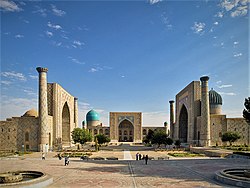
The city is noted as a centre of Islamic scholarly study and the birthplace of the Timurid Renaissance. In the 14th century, Timur made it the capital of his empire and the site of his mausoleum, the Gur-e Amir. The Bibi-Khanym Mosque, rebuilt during the Soviet era, remains one of the city's most notable landmarks. Samarkand's Registan square was the city's ancient centre and is bounded by three monumental religious buildings. The city has carefully preserved the traditions of ancient crafts: embroidery, goldwork, silk weaving, copper engraving, ceramics, wood carving, and wood painting.[8] In 2001, UNESCO added the city to its World Heritage List as Samarkand – Crossroads of Cultures.
Modern Samarkand is divided into two parts: the old city, which includes historical monuments, shops, and old private houses; and the new city, which was developed during the days of the Russian Empire and Soviet Union and includes administrative buildings along with cultural centres and educational institutions.[9] On 15 and 16 September 2022, the city hosted the 2022 SCO summit.
Samarkand has a multicultural and plurilingual history that was significantly modified by the process of national delimitation in Central Asia. Many inhabitants of the city are native or bilingual speakers of the Tajik language,[10][11] whereas Uzbek is the official language and Russian is also widely used in the public sphere, as per Uzbekistan's language policy.
Etymology
[edit]The name comes from the Iranian languages Persian and Sogdian samar "stone, rock" and kand "fort, town."[12] In this respect, Samarkand shares the same meaning as the name of the Uzbek capital Tashkent, with tash- being the Turkic term for "stone" and -kent the Turkic analogue of kand borrowed from Iranian languages.[13]
According to 11th-century scholar Mahmud al-Kashghari, the city was known in Karakhanid as Sämizkänd (سَمِزْکَنْدْ), meaning "fat city."[14] 16th-century Mughal emperor Babur also mentioned the city under this name, and 15th-century Castillian traveler Ruy González de Clavijo stated that Samarkand was simply a distorted form of it.[15]
History
[edit] | This section needs additional citations for verification. (November 2022) |
Early history
[edit]Along with Bukhara,[16] Samarkand is one of the oldest inhabited cities in Central Asia, prospering from its location on the trade route between China and Europe. There is no direct evidence of when it was founded. Researchers at the Institute of Archaeology of Samarkand date the city's founding around 700 BC.[17]
Archaeological excavations conducted within the city limits (Syob and midtown) as well as suburban areas (Hojamazgil, Sazag'on) unearthed 40,000-year-old evidence of human activity, dating back to the Upper Paleolithic. A group of Mesolithic (12th–7th millennia BC) archaeological sites were discovered in the suburbs of Sazag'on-1, Zamichatosh, and Okhalik. The Syob and Darg'om canals, supplying the city and its suburbs with water, appeared around the 7th–5th centuries BC (early Iron Age).
From its earliest days, Samarkand was one of the main centres of Sogdian civilization. By the time of the Achaemenid dynasty of Persia, the city had become the capital of the Sogdian satrapy.
Hellenistic period
[edit]

Ferens Art Gallery, Hull.
Alexander the Great conquered Samarkand in 329 BC. The city was known as Maracanda (Μαράκανδα) by the Greeks.[18] Written sources offer small clues as to the subsequent system of government.[19] They mention one Orepius who became ruler "not from ancestors, but as a gift of Alexander."[20]
While Samarkand suffered significant damage during Alexander's initial conquest, the city recovered rapidly and flourished under the new Hellenic influence. There were also major new construction techniques. Oblong bricks were replaced with square ones and superior methods of masonry and plastering were introduced.[21]
Alexander's conquests introduced classical Greek culture into Central Asia and for a time, Greek aesthetics heavily influenced local artisans. This Hellenistic legacy continued as the city became part of various successor states in the centuries following Alexander's death, the Greek Seleucid Empire, Greco-Bactrian Kingdom, and Kushan Empire (even though the Kushana themselves originated in Central Asia). After the Kushan state lost control of Sogdia during the 3rd century AD, Samarkand went into decline as a centre of economic, cultural, and political power. It did not significantly revive until the 5th century.
Sasanian era
[edit]Samarkand was conquered by the Persian Sasanians c. 260 AD. Under Sasanian rule, the region became an essential site for Manichaeism and facilitated the dissemination of the religion throughout Central Asia.[22]
Hephthalites and Turkic Khaganate era
[edit]Between AD 350 and 375, Samarkand was conquered by the nomadic tribes of Xionites, the origin of which remains controversial.[23] The resettlement of nomadic groups to Samarkand confirms archaeological material from the 4th century. The culture of nomads from the Middle Syrdarya basin is spreading in the region.[24] Between 457 and 509, Samarkand was part of the Kidarite state.[25]

After the Hephthalites ("White Huns") conquered Samarkand, they controlled it until the Göktürks, in an alliance with the Sassanid Persians, won it at the Battle of Bukhara, c. 560 AD.[28]
In the middle of the 6th century, a Turkic state was formed in Altai, founded by the Ashina dynasty. The new state formation was named the Turkic Khaganate after the people of the Turks, which were headed by the ruler – the Khagan. From 557 to 561, the Hephthalites empire was defeated by the joint actions of the Turks and Sassanids, which led to the establishment of a common border between the two empires.[29]
In the early Middle Ages, Samarkand was surrounded by four rows of defensive walls and had four gates.[30]
An ancient Turkic burial with a horse was investigated on the territory of Samarkand. It dates back to the 6th century.[31]
During the period of the ruler of the Western Turkic Khaganate, Tong Yabghu Qaghan (618–630), family relations were established with the ruler of Samarkand – Tong Yabghu Qaghan gave him his daughter.[32]
Some parts of Samarkand have been Christian since the 4th century. In the 5th century, a Nestorian chair was established in Samarkand. At the beginning of the 8th century, it was transformed into a Nestorian metropolitanate.[33] Discussions and polemics arose between the Sogdian followers of Christianity and Manichaeism, reflected in the documents.[34]
Early Islamic era
[edit],_Tajikistan_National_Museum_of_Antiquities_(319).jpg)
The armies of the Umayyad Caliphate under Qutayba ibn Muslim captured the city from the Tang dynasty c. 710 CE.[22] During this period, Samarkand was a diverse religious community and was home to a number of religions, including Zoroastrianism, Buddhism, Hinduism, Manichaeism, Judaism, and Nestorian Christianity, with most of the population following Zoroastrianism.[36]
Qutayba generally did not settle Arabs in Central Asia; he forced the local rulers to pay him tribute but largely left them to their own devices. Samarkand was the major exception to this policy: Qutayba established an Arab garrison and Arab governmental administration in the city, its Zoroastrian fire temples were razed, and a mosque was built.[37] Much of the city's population converted to Islam.[38]
As a long-term result, Samarkand developed into a center of Islamic and Arabic learning.[37] At the end of the 740s, a movement of those dissatisfied with the power of the Umayyads emerged in the Arab Caliphate, led by the Abbasid commander Abu Muslim, who, after the victory of the uprising, became the governor of Khorasan and Maverannahr (750–755). He chose Samarkand as his residence. His name is associated with the construction of a multi-kilometer defensive wall around the city and the palace.[39]
Legend has it that during Abbasid rule,[40] the secret of papermaking was obtained from two Chinese prisoners from the Battle of Talas in 751, which led to the foundation of the first paper mill in the Islamic world at Samarkand. The invention then spread to the rest of the Islamic world and thence to Europe.[citation needed]

Abbasid control of Samarkand soon dissipated and was replaced with that of the Samanids (875–999), though the Samanids were still nominal vassals of the Caliph during their control of Samarkand. Under Samanid rule the city became a capital of the Samanid dynasty and an even more important node of numerous trade routes. The Samanids were overthrown by the Karakhanids around 999. Over the next 200 years, Samarkand would be ruled by a succession of Turkic tribes, including the Seljuqs and the Khwarazmshahs.[41]
The 10th-century Persian author Istakhri, who travelled in Transoxiana, provides a vivid description of the natural riches of the region he calls "Smarkandian Sogd":
I know no place in it or in Samarkand itself where if one ascends some elevated ground one does not see greenery and a pleasant place, and nowhere near it are mountains lacking in trees or a dusty steppe... Samakandian Sogd... [extends] eight days travel through unbroken greenery and gardens... . The greenery of the trees and sown land extends along both sides of the river [Sogd]... and beyond these fields is pasture for flocks. Every town and settlement has a fortress... It is the most fruitful of all the countries of Allah; in it are the best trees and fruits, in every home are gardens, cisterns and flowing water.
Karakhanid (Ilek-Khanid) period (11th–12th centuries)
[edit]
After the fall of the Samanids state in 999, it was replaced by the Qarakhanid State, where the Turkic Qarakhanid dynasty ruled.[42] After the state of the Qarakhanids split into two parts, Samarkand became a part of the West Karakhanid Khaganate and from 1040 to 1212 was its capital.[42] The founder of the Western Qarakhanid Khaganate was Ibrahim Tamgach Khan (1040–1068).[42] For the first time, he built a madrasah in Samarkand with state funds and supported the development of culture in the region. During his reign, a public hospital (bemoristan) and a madrasah were established in Samarkand, where medicine was also taught.
The memorial complex Shah-i-Zinda was founded by the rulers of the Karakhanid dynasty in the 11th century.[43]
The most striking monument of the Qarakhanid era in Samarkand was the palace of Ibrahim ibn Hussein (1178–1202), which was built in the citadel in the 12th century. During the excavations, fragments of monumental painting were discovered. On the eastern wall, a Turkic warrior was depicted, dressed in a yellow caftan and holding a bow. Horses, hunting dogs, birds and periodlike women were also depicted here.[44]
Mongol period
[edit].jpg)
The Mongols conquered Samarkand in 1220. Juvayni writes that Genghis killed all who took refuge in the citadel and the mosque, pillaged the city completely, and conscripted 30,000 young men along with 30,000 craftsmen. Samarkand suffered at least one other Mongol sack by Khan Baraq to get treasure he needed to pay an army. It remained part of the Chagatai Khanate (one of four Mongol successor realms) until 1370.
The Travels of Marco Polo, where Polo records his journey along the Silk Road in the late 13th century, describes Samarkand as "a very large and splendid city..."[45]
The Yenisei area had a community of weavers of Chinese origin, and Samarkand and Outer Mongolia both had artisans of Chinese origin, as reported by Changchun.[46] After Genghis Khan conquered Central Asia, foreigners were chosen as governmental administrators; Chinese and Qara-Khitays (Khitans) were appointed as co-managers of gardens and fields in Samarkand, which Muslims were not permitted to manage on their own.[47][48] The khanate allowed the establishment of Christian bishoprics (see below).
Timur's rule (1370–1405)
[edit].jpg)
Ibn Battuta, who visited in 1333, called Samarkand "one of the greatest and finest of cities, and most perfect of them in beauty." He also noted that the orchards were supplied water via norias.[49]
In 1365, a revolt against Chagatai Mongol control occurred in Samarkand.[50] In 1370, the conqueror Timur (Tamerlane), the founder and ruler of the Timurid Empire, made Samarkand his capital. Timur used various tools for legitimisation, including urban planning in his capital, Samarkand.[51] Over the next 35 years, he rebuilt most of the city and populated it with great artisans and craftsmen from across the empire. Timur gained a reputation as a patron of the arts, and Samarkand grew to become the centre of the region of Transoxiana. Timur's commitment to the arts is evident in how, in contrast with the ruthlessness he showed his enemies, he demonstrated mercy toward those with special artistic abilities. The lives of artists, craftsmen, and architects were spared so that they could improve and beautify Timur's capital.[citation needed]
Timur was also directly involved in construction projects, and his visions often exceeded the technical abilities of his workers. The city was in a state of constant construction, and Timur would often order buildings to be done and redone quickly if he was unsatisfied with the results.[52] By his orders, Samarkand could be reached only by roads; deep ditches were dug, and walls 8 km (5 mi) in circumference separated the city from its surrounding neighbors.[53] At this time, the city had a population of about 150,000.[54]
Henry III of Castile's ambassador Ruy Gonzalez de Clavijo, who visited Samarkand between 8 September and 20 November 1404, attested to the never-ending construction that went on in the city. "The Mosque which Timur had built seemed to us the noblest of all those we visited in the city of Samarkand."[55]
Ulugh Beg's period (1409–1449)
[edit]
Between 1417 and 1420, Timur's grandson Ulugh Beg built a madrasah in Samarkand, which became the first building in the architectural ensemble of Registan. Ulugh Beg invited a large number of astronomers and mathematicians of the Islamic world to this madrasah. Under Ulugh Beg, Samarkand became one of the world centers of medieval science. In the first half of the 15th century, a whole scientific school arose around Ulugh Beg, uniting prominent astronomers and mathematicians including Jamshid al-Kashi, Qāḍī Zāda al-Rūmī, and Ali Qushji. Ulugh Beg's main interest in science was astronomy, and he constructed an observatory in 1428. Its main instrument was the wall quadrant, which was unique in the world.[56] It was known as the "Fakhri Sextant" and had a radius of 40 meters.[57] Seen in the image on the left, the arc was finely constructed with a staircase on either side to provide access for the assistants who performed the measurements.
16th–18th centuries
[edit]In 1500, nomadic Uzbek warriors took control of Samarkand.[54] The Shaybanids emerged as the city's leaders at or about this time. In 1501, Samarkand was finally taken by Muhammad Shaybani from the Uzbek dynasty of Shaybanids, and the city became part of the newly formed “Bukhara Khanate”. Samarkand was chosen as the capital of this state, in which Muhammad Shaybani Khan was crowned. In Samarkand, Muhammad Shaybani Khan ordered to build a large madrasah, where he later took part in scientific and religious disputes. The first dated news about the Shaybani Khan madrasah dates back to 1504 (it was completely destroyed during the years of Soviet power). Muhammad Salikh wrote that Sheibani Khan built a madrasah in Samarkand to perpetuate the memory of his brother Mahmud Sultan.[58]
Fazlallah ibn Ruzbihan [who?] in "Mikhmon-namei Bukhara" expresses his admiration for the majestic building of the madrasah, its gilded roof, high hujras, spacious courtyard and quotes a verse praising the madrasah.[59] Zayn ad-din Vasifi, who visited the Sheibani-khan madrasah several years later, wrote in his memoirs that the veranda, hall and courtyard of the madrassah are spacious and magnificent.[58]
Abdulatif Khan, the son of Mirzo Ulugbek's grandson Kuchkunji Khan, who ruled in Samarkand from 1540 to 1551, was considered an expert in the history of Maverannahr and the Shibanid dynasty. He patronized poets and scientists. Abdulatif Khan himself wrote poetry under the literary pseudonym Khush.[60]
During the reign of the Ashtarkhanid Imam Quli Khan (1611–1642) famous architectural masterpieces were built in Samarkand. In 1612–1656, the governor of Samarkand, Yalangtush Bahadur, built a cathedral mosque, Tillya-Kari madrasah and Sherdor madrasah.[citation needed]
Zarafshan Water Bridge is a brick bridge built on the left bank of the Zarafshan River, 7–8 km northeast of the center of Samarkand, built by Shaibani Khan at the beginning of the 16th century.[61][62]
After an assault by the Afshar Shahanshah Nader Shah, the city was abandoned in the early 1720s.[63] From 1599 to 1756, Samarkand was ruled by the Ashtrakhanid branch of the Khanate of Bukhara.
-
 Ulugh Beg Madrasah
 -
 Sher-Dor Madrasah
 -
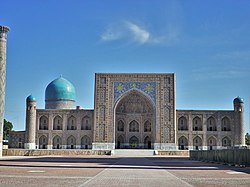 Tilya Kori Madrasah
 -
 Ulugh Beg Madrasah courtyard
 -
 Tiger on the Sher-Dor Madrasah iwan


_on_the_Sher-dor_madrassa.JPG)
Second half of the 18th–19th centuries
[edit].JPG)
From 1756 to 1868, it was ruled by the Manghud Emirs of Bukhara.[64] The revival of the city began during the reign of the founder of the Uzbek dynasty, the Mangyts, Muhammad Rakhim (1756–1758), who became famous for his strong-willed qualities and military art. Muhammad Rakhimbiy made some attempts to revive Samarkand.[65]
Russian Empire period
[edit]
The city came under imperial Russian rule after the citadel had been taken by a force under Colonel Konstantin Petrovich von Kaufman in 1868. Shortly thereafter the small Russian garrison of 500 men were themselves besieged. The assault, which was led by Abdul Malik Tura, the rebellious elder son of the Bukharan Emir, as well as Baba Beg of Shahrisabz and Jura Beg of Kitab, was repelled with heavy losses. General Alexander Konstantinovich Abramov became the first Governor of the Military Okrug, which the Russians established along the course of the Zeravshan River with Samarkand as the administrative centre. The Russian section of the city was built after this point, largely west of the old city.
In 1886, the city became the capital of the newly formed Samarkand Oblast of Russian Turkestan and regained even more importance when the Trans-Caspian railway reached it in 1888.
Soviet period
[edit]
Samarkand was the capital of the Uzbek SSR from 1925 to 1930, before being replaced by Tashkent. During World War II, after Nazi Germany invaded the Soviet Union, a number of Samarkand's citizens were sent to Smolensk to fight the enemy. Many were taken captive or killed by the Nazis.[66][67] Additionally, thousands of refugees from the occupied western regions of the USSR fled to the city, and it served as one of the main hubs for the fleeing civilians in the Uzbek Soviet Socialist Republic and the Soviet Union as a whole.[citation needed]

European study of the history of Samarkand began after the conquest of Samarkand by the Russian Empire in 1868. The first studies of the history of Samarkand belong to N. Veselovsky, V. Bartold and V. Vyatkin. In the Soviet period, the generalization of materials on the history of Samarkand was reflected in the two-volume History of Samarkand edited by the academician of Uzbekistan Ibrohim Moʻminov.[68]
On the initiative of Academician of the Academy of Sciences of the Uzbek SSR I. Muminov and with the support of Sharaf Rashidov, the 2500th anniversary of Samarkand was widely celebrated in 1970. In this regard, a monument to Ulugh Beg was opened, the Museum of the History of Samarkand was founded, and a two-volume history of Samarkand was prepared and published.[69][70]
After Uzbekistan gained independence, several monographs were published on the ancient and medieval history of Samarkand.[71][72]
Geography
[edit]
Samarkand is located in southeastern Uzbekistan, in the Zarefshan River valley, 135 km from Qarshi. Road M37 connects Samarkand to Bukhara, 240 km away. Road M39 connects it to Tashkent, 270 km away. The Tajikistan border is about 35 km from Samarkand; the Tajik capital Dushanbe is 210 km away from Samarkand. Road M39 connects Samarkand to Mazar-i-Sharif in Afghanistan, which is 340 km away.
Climate
[edit]Samarkand has a cold semi-arid climate (Köppen climate classification: BSk) with hot, dry summers and relatively wet, variable winters that alternate periods of warm weather with periods of cold weather. July and August are the hottest months of the year, with temperatures reaching and exceeding 40 °C (104 °F). Precipitation is sparse from June through October, but increases to a maximum from February to April. January 2008 was particularly cold; the temperature dropped to −22 °C (−8 °F).[74]
| Climate data for Samarkand (1991–2020, extremes 1891–present) | |||||||||||||
|---|---|---|---|---|---|---|---|---|---|---|---|---|---|
| Month | Jan | Feb | Mar | Apr | May | Jun | Jul | Aug | Sep | Oct | Nov | Dec | Year |
| Record high °C (°F) | 23.2 (73.8) |
26.7 (80.1) |
32.2 (90.0) |
36.2 (97.2) |
39.5 (103.1) |
41.6 (106.9) |
42.4 (108.3) |
41.0 (105.8) |
38.6 (101.5) |
35.2 (95.4) |
31.5 (88.7) |
27.5 (81.5) |
42.4 (108.3) |
| Mean daily maximum °C (°F) | 7.3 (45.1) |
9.5 (49.1) |
15.2 (59.4) |
21.4 (70.5) |
27.0 (80.6) |
32.4 (90.3) |
34.5 (94.1) |
33.3 (91.9) |
28.6 (83.5) |
22.0 (71.6) |
14.4 (57.9) |
9.1 (48.4) |
21.2 (70.2) |
| Daily mean °C (°F) | 2.3 (36.1) |
4.0 (39.2) |
9.3 (48.7) |
15.2 (59.4) |
20.4 (68.7) |
25.4 (77.7) |
27.2 (81.0) |
25.6 (78.1) |
20.6 (69.1) |
14.1 (57.4) |
8.0 (46.4) |
3.7 (38.7) |
14.7 (58.4) |
| Mean daily minimum °C (°F) | −1.3 (29.7) |
−0.2 (31.6) |
4.6 (40.3) |
9.7 (49.5) |
14.1 (57.4) |
18.0 (64.4) |
19.5 (67.1) |
17.9 (64.2) |
13.5 (56.3) |
7.8 (46.0) |
3.2 (37.8) |
−0.2 (31.6) |
8.9 (48.0) |
| Record low °C (°F) | −25.4 (−13.7) |
−22 (−8) |
−14.9 (5.2) |
−6.8 (19.8) |
−1.3 (29.7) |
4.8 (40.6) |
8.6 (47.5) |
7.8 (46.0) |
0.0 (32.0) |
−6.4 (20.5) |
−18.1 (−0.6) |
−22.8 (−9.0) |
−25.4 (−13.7) |
| Average precipitation mm (inches) | 41.1 (1.62) |
52.2 (2.06) |
73.2 (2.88) |
62.9 (2.48) |
40.0 (1.57) |
6.8 (0.27) |
1.6 (0.06) |
1.6 (0.06) |
2.7 (0.11) |
16.0 (0.63) |
40.3 (1.59) |
39.2 (1.54) |
377.6 (14.87) |
| Average rainy days | 8 | 10 | 13 | 11 | 9 | 3 | 2 | 1 | 2 | 6 | 8 | 9 | 82 |
| Average snowy days | 9 | 7 | 3 | 0.3 | 0.1 | 0 | 0 | 0 | 0 | 0.3 | 2 | 6 | 28 |
| Average relative humidity (%) | 76 | 74 | 70 | 63 | 54 | 42 | 42 | 43 | 47 | 59 | 68 | 74 | 59 |
| Average dew point °C (°F) | −2 (28) |
−1 (30) |
2 (36) |
6 (43) |
9 (48) |
9 (48) |
10 (50) |
9 (48) |
6 (43) |
4 (39) |
2 (36) |
−1 (30) |
4 (40) |
| Mean monthly sunshine hours | 119.2 | 130.9 | 172.2 | 228.8 | 297.7 | 345.5 | 373.1 | 358.9 | 305.9 | 242.6 | 150.7 | 120.2 | 2,845.7 |
| Average ultraviolet index | 2 | 3 | 3 | 4 | 5 | 6 | 6 | 6 | 4 | 3 | 2 | 2 | 4 |
| Source 1: Pogoda.ru.net [75] | |||||||||||||
| Source 2: Weather Atlas (UV),[76] Time and Date (dewpoints, 1985–2015),[77] NOAA[78] | |||||||||||||
People
[edit]According to official reports, a majority of Samarkand's inhabitants are Uzbeks, while many sources refer to the city as majority Tajik,[79][80][81][82] up to 70 percent of the city's population.[83] Tajiks are especially concentrated in the eastern part of the city, where the main architectural landmarks are.
According to various independent sources, Tajiks are Samarkand's majority ethnic group. Ethnic Uzbeks are the second-largest group[84] and are most concentrated in the west of Samarkand. Exact demographic figures are difficult to obtain since some people in Uzbekistan identify as "Uzbek" even though they speak Tajiki as their first language, often because they are registered as Uzbeks by the central government despite their Tajiki language and identity. As explained by Paul Bergne:
During the census of 1926 a significant part of the Tajik population was registered as Uzbek. Thus, for example, in the 1920 census in Samarkand city the Tajiks were recorded as numbering 44,758 and the Uzbeks only 3301. According to the 1926 census, the number of Uzbeks was recorded as 43,364 and the Tajiks as only 10,716. In a series of kishlaks [villages] in the Khojand Okrug, whose population was registered as Tajik in 1920 e.g. in Asht, Kalacha, Akjar i Tajik and others, in the 1926 census they were registered as Uzbeks. Similar facts can be adduced also with regard to Ferghana, Samarkand, and especially the Bukhara oblasts.[84]
Samarkand is also home to large ethnic communities of "Iranis" (the old, Persian-speaking, Shia population of Merv city and oasis, deported en masse to this area in the late 18th century), Russians, Ukrainians, Belarusians, Armenians, Azeris, Tatars, Koreans, Poles, and Germans, all of whom live primarily in the centre and western neighborhoods of the city. These peoples have emigrated to Samarkand since the end of the 19th century, especially during the Soviet Era; by and large, they speak the Russian language.
In the extreme west and southwest of Samarkand is a population of Central Asian Arabs, who mostly speak Uzbek; only a small portion of the older generation speaks Central Asian Arabic. In eastern Samarkand there was once a large mahallah of Bukharian (Central Asian) Jews, but starting in the 1970s, hundreds of thousands of Jews left Uzbekistan for Israel, United States, Canada, Australia, and Europe. Only a few Jewish families are left in Samarkand today.
Also in the eastern part of Samarkand there are several quarters where Central Asian "Gypsies"[85] (Lyuli, Djugi, Parya, and other groups) live. These peoples began to arrive in Samarkand several centuries ago from what are now India and Pakistan. They mainly speak a dialect of the Tajik language, as well as their own languages, most notably Parya.
Language
[edit]
The state and official language in Samarkand, as in all Uzbekistan, is the Uzbek language. Uzbek is one of the Turkic languages and the mother tongue of Uzbeks, Turkmens, Samarkandian Iranians, and most Samarkandian Arabs living in Samarkand.
As in the rest of Uzbekistan, the Russian language is the de facto second official language in Samarkand, and about 5% of signs and inscriptions in Samarkand are in this language. Russians, Belarusians, Poles, Germans, Koreans, the majority of Ukrainians, the majority of Armenians, Greeks, some Tatars, and some Azerbaijanis in Samarkand speak Russian. Several Russian-language newspapers are published in Samarkand, the most popular of which is Samarkandskiy vestnik (Russian: Самаркандский вестник, lit. the Samarkand Herald). The Samarkandian TV channel STV conducts some broadcasts in Russian.
De facto, the most common native language in Samarkand is Tajik, which is a dialect or variant of the Persian language. Samarkand was one of the cities in which the Persian language developed. Many classical Persian poets and writers lived in or visited Samarkand over the millennia, the most famous being Abulqasem Ferdowsi, Omar Khayyam, Abdurahman Jami, Abu Abdullah Rudaki, Suzani Samarqandi, and Kamal Khujandi.
While the official stance is that Uzbek is the most common language in Samarkand, some data indicate that only about 30% of residents speak it as a native tongue. For the other 70%, Tajik is the native tongue, with Uzbek the second language and Russian the third. However, as no population census has been taken in Uzbekistan since 1989, there are no accurate data on this matter. Despite Tajik being the second most common language in Samarkand, it does not enjoy the status of an official or regional language.[86][80][81][87][82][88] Nevertheless, at Samarkand State University ten faculties offer courses in Tajiki, and the Tajik Language and Literature Department has an enrolment of over 170 students.[89] Only one newspaper in Samarkand is published in Tajiki, in the Cyrillic Tajik alphabet: Ovozi Samarqand (Tajik: Овози Самарқанд —Voice of Samarkand). Local Samarkandian STV and "Samarkand" TV channels offer some broadcasts in Tajik, as does one regional radio station. In 2022 a quarterly literary magazine in Tajiki, Durdonai Sharq, was launched in Samarkand.[89]
In addition to Uzbek, Tajik, and Russian, native languages spoken in Samarkand include Ukrainian, Armenian, Azerbaijani, Tatar, Crimean Tatar, Arabic (for a very small percentage of Samarkandian Arabs), and others.
Modern Samarkand is a vibrant city, and in 2019 the city hosted the first Samarkand Half Marathon.[90] In 2022 this also included a full marathon for the first time.
Religion
[edit]Islam
[edit]Islam entered Samarkand in the 8th century, during the invasion of the Arabs in Central Asia (Umayyad Caliphate). Before that, almost all inhabitants of Samarkand were Zoroastrians, and many Nestorians and Buddhists also lived in the city. From that point forward, throughout the reigns of many Muslim governing powers, numerous mosques, madrasahs, minarets, shrines, and mausoleums were built in the city. Many have been preserved. For example, there is the Shrine of Imam Bukhari, an Islamic scholar who authored the hadith collection known as Sahih al-Bukhari, which Sunni Muslims regard as one of the most authentic (sahih) hadith collections. His other books included Al-Adab al-Mufrad. Samarkand is also home to the Shrine of Imam Maturidi, the founder of Maturidism and the Mausoleum of the Prophet Daniel, who is revered in Islam, Judaism, and Christianity.
Most inhabitants of Samarkand are Muslim, primarily Sunni (mostly Hanafi) and Sufi. Approximately 80–85% of Muslims in the city are Sunni, comprising almost all Tajiks, Uzbeks, and Samarkandian Arabs living therein. Samarkand's best-known Islamic sacred lineages are the descendants of Sufi leaders such as Khodja Akhror Wali (1404–1490) and Makhdumi A’zam (1461–1542), the descendants of Sayyid Ata (first half of 14th c.) and Mirakoni Khojas (Sayyids from Mirakon, a village in Iran).[91] The liberal policy of President Shavkat Mirziyoyev opened up new opportunities for the expression of the religious identity. In Samarkand, since 2018, there has been an increase in the number of women wearing the hijab.[92]


Shia Muslims
[edit]The Samarqand Vilayat is one of the two regions of Uzbekistan (along with Bukhara Vilayat) that are home to a large number of Shiites. The total population of the Samarkand Vilayat is more than 3,720,000 people (2019).
There are no exact data on the number of Shiites in the city of Samarkand, but the city has several Shiite mosques and madrasas. The largest of these are the Punjabi Mosque, the Punjabi Madrassah, and the Mausoleum of Mourad Avliya. Every year, the Shiites of Samarkand celebrate Ashura, as well as other memorable Shiite dates and holidays.
Shiites in Samarkand are mostly Samarkandian Iranians, who call themselves Irani. Their ancestors began to arrive in Samarkand in the 18th century. Some migrated there in search of a better life, others were sold as slaves there by Turkmen captors, and others were soldiers who were posted to Samarkand. Mostly they came from Khorasan, Mashhad, Sabzevar, Nishapur, and Merv; and secondarily from Iranian Azerbaijan, Zanjan, Tabriz, and Ardabil. Samarkandian Shiites also include Azerbaijanis, as well as small numbers of Tajiks and Uzbeks.
While there are no official data on the total number of Shiites in Uzbekistan, they are estimated to be "several hundred thousand." According to leaked diplomatic cables, in 2007–2008, the US Ambassador for International Religious Freedom held a series of meetings with Sunni mullahs and Shiite imams in Uzbekistan. During one of the talks, the imam of the Shiite mosque in Bukhara said that about 300,000 Shiites live in the Bukhara Vilayat and 1 million in the Samarkand Vilayat. The Ambassador slightly doubted the authenticity of these figures, emphasizing in his report that data on the numbers of religious and ethnic minorities provided by the government of Uzbekistan were considered a very "delicate topic" due to their potential to provoke interethnic and interreligious conflicts. All the ambassadors of the ambassador tried to emphasize that traditional Islam, especially Sufism and Sunnism, in the regions of Bukhara and Samarkand is characterized by great religious tolerance toward other religions and sects, including Shiism.[93][94][95]


Christianity
[edit] | This section needs additional citations for verification. (March 2024) |

Christianity was introduced to Samarkand when it was part of Sogdiana, long before the penetration of Islam into Central Asia. The city then became one of the centers of Nestorianism in Central Asia.[96] The majority of the population were then Zoroastrians, but since Samarkand was the crossroads of trade routes among China, Persia, and Europe, it was religiously tolerant. Under the Umayyad Caliphate, Zoroastrians and Nestorians were persecuted by the Arab conquerors;[citation needed] the survivors fled to other places or converted to Islam. Several Nestorian temples were built in Samarkand, but they have not survived. Their remains were found by archeologists at the ancient site of Afrasiyab and on the outskirts of Samarkand.
In the three decades of 1329–1359, the Samarkand eparchy of the Roman Catholic Church served several thousand Catholics who lived in the city. According to Marco Polo and Johann Elemosina, a descendant of Chaghatai Khan, the founder of the Chaghatai dynasty, Eljigidey, converted to Christianity and was baptized. With the assistance of Eljigidey, the Catholic Church of St. John the Baptist was built in Samarkand. After a while, however, Islam completely supplanted Catholicism.
Christianity reappeared in Samarkand several centuries later, from the mid-19th century onward, after the city was seized by the Russian Empire. Russian Orthodoxy was introduced to Samarkand in 1868, and several churches and temples were built. In the early 20th century several more Orthodox cathedrals, churches, and temples were built, most of which were demolished while Samarkand was part of the USSR.
In present time, Christianity is the second-largest religious group in Samarkand with the predominant form is the Russian Orthodox Church (Moscow Patriarchate). More than 5% of Samarkand residents are Orthodox, mostly Russians, Ukrainians, and Belarusians, and also some Koreans and Greeks. Samarkand is the center of the Samarkand branch (which includes the Samarkand, Qashqadarya, and Surkhandarya provinces of Uzbekistan) of the Uzbekistan and Tashkent eparchy of the Central Asian Metropolitan District of the Russian Orthodox Church of the Moscow Patriarchate. The city has several active Orthodox churches: Cathedral of St. Alexiy Moscowskiy, Church of the Intercession of the Holy Virgin, and Church of St. George the Victorious. There are also a number of inactive Orthodox churches and temples, for example that of Church of St. George Pobedonosets.[97][98]
There are also a few tens of thousands of Catholics in Samarkand, mostly Poles, Germans, and some Ukrainians. In the center of Samarkand is St. John the Baptist Catholic Church, which was built at the beginning of the 20th century. Samarkand is part of the Apostolic Administration of Uzbekistan.[99]
The third largest Christian sect in Samarkand is the Armenian Apostolic Church, followed by a few tens of thousands of Armenian Samarkandians. Armenian Christians began emigrating to Samarkand at the end of the 19th century, this flow increasing especially in the Soviet era.[100] In the west of Samarkand is the Armenian Church Surb Astvatsatsin.[101]


Samarkand also has several thousand Protestants, including Lutherans, Baptists, Mormons, Jehovah's Witnesses, Adventists, and members of the Korean Presbyterian church. These Christian movements appeared in Samarkand mainly after the independence of Uzbekistan in 1991.[102]
Landmarks
[edit]Silk Road Samarkand (Eternal city)
[edit]Silk Road Samarkand is a modern multiplex which opened in early 2022 in eastern Samarkand. The complex covers 260 hectares and includes world-class business and medical hotels, eateries, recreational facilities, park grounds, an ethnographic corner and a large congress hall for hosting international events.[103]
Eternal city situated in Silk Road Samarkand complex. This site which occupies 17 hectares accurately recreates the spirit of the ancient city backed up by the history and traditions of Uzbek lands and Uzbek people for the guests of the Silk Road Samarkand. The narrow streets here house multiple shops of artists, artisans, and craftsmen. The pavilions of the Eternal City were inspired by real houses and picturesque squares described in ancient books. This is where you can plunge into a beautiful oriental fairy tale: with turquoise domes, mosaics on palaces, and high minarets that pierce the sky.
Visitors to the Eternal City can taste national dishes from different eras and regions of the country and also see authentic street performances. The Eternal City showcases a unique mix of Parthian, Hellenistic, and Islamic cultures so that the guests could imagine the versatile heritage of bygone centuries in full splendor. The project was inspired and designed by Bobur Ismoilov, a famous modern artist.[104]
Architecture
[edit]
Timur initiated the building of Bibi-Khanym after his 1398–1399 campaign in India. The Bibi-Khanym originally had about 450 marble columns, which were hauled there and set up with the help of 95 elephants that Timur had brought back from Hindustan. Artisans and stonemasons from India designed the mosque's dome, giving it its distinctive appearance amongst the other buildings. An 1897 earthquake destroyed the columns, which were not entirely restored in the subsequent reconstruction.[52]
The best-known landmark of Samarkand is the mausoleum known as Gur-i Amir. It exhibits the influences of many cultures, past civilizations, neighboring peoples, and religions, especially those of Islam. Despite the devastation wrought by Mongols to Samarkand's pre-Timurid Islamic architecture, under Timur these architectural styles were revived, recreated, and restored. The blueprint and layout of the mosque itself, with their precise measurements, demonstrate the Islamic passion for geometry. The entrance to the Gur-i Amir is decorated with Arabic calligraphy and inscriptions, the latter a common feature in Islamic architecture. Timur's meticulous attention to detail is especially obvious inside the mausoleum: the tiled walls are a marvelous example of mosaic faience, an Iranian technique in which each tile is cut, colored, and fit into place individually.[52] The tiles of the Gur-i Amir were also arranged so that they spell out religious words such as "Muhammad" and "Allah."[52]
The ornamentation of the Gur-i Amir's walls includes floral and vegetal motifs, which signify gardens; the floor tiles feature uninterrupted floral patterns. In Islam, gardens are symbols of paradise, and as such, they were depicted on the walls of tombs and grown in Samarkand itself.[52] Samarkand boasted two major gardens, the New Garden and the Garden of Heart's Delight, which became the central areas of entertainment for ambassadors and important guests. In 1218, a friend of Genghis Khan named Yelü Chucai reported that Samarkand was the most beautiful city of all, as "it was surrounded by numerous gardens. Every household had a garden, and all the gardens were well designed, with canals and water fountains that supplied water to round or square-shaped ponds. The landscape included rows of willows and cypress trees, and peach and plum orchards were shoulder to shoulder."[105] Persian carpets with floral patterns have also been found in some Timurid buildings.[106]
The elements of traditional Islamic architecture can be seen in traditional mud-brick Uzbek houses that are built around central courtyards with gardens.[107] Most of these houses have painted wooden ceilings and walls. By contrast, houses in the west of the city are chiefly European-style homes built in the 19th and 20th centuries.[107]
Turko-Mongol influence is also apparent in Samarkand's architecture. It is believed that the melon-shaped domes of the mausoleums were designed to echo yurts or gers, traditional Mongol tents in which the bodies of the dead were displayed before burial or other disposition. Timur built his tents from more-durable materials, such as bricks and wood, but their purposes remained largely unchanged.[52] The chamber in which Timur's own body was laid included "tugs", poles whose tops were hung with a circular arrangement of horse or yak tail hairs. These banners symbolized an ancient Turkic tradition of sacrificing horses, which were valuable commodities, to honor the dead.[52] Tugs were also a type of cavalry standard used by many nomads, up to the time of the Ottoman Turks.
Colors of buildings in Samarkand also have significant meanings. The dominant architectural color is blue, which Timur used to convey a broad range of concepts. For example, the shades of blue in the Gur-i Amir are colors of mourning; in that era, blue was the color of mourning in Central Asia, as it still is in various cultures today. Blue was also considered the color that could ward off "the evil eye" in Central Asia; this notion is evidenced by in the number of blue-painted doors in and around the city. Furthermore, blue represented water, a particularly rare resource in the Middle East and Central Asia; walls painted blue symbolized the wealth of the city.
Gold also has a strong presence in the city. Timur's fascination with vaulting explains the excessive use of gold in the Gur-i Amir, as well as the use of embroidered gold fabric in both the city and his buildings. The Mongols had great interests in Chinese- and Persian-style golden silk textiles, as well as nasij[108] woven in Iran and Transoxiana. Mongol leaders like Ögedei Khan built textile workshops in their cities to be able to produce gold fabrics themselves.
Suburbs
[edit]Suburbs of the city include: Gulyakandoz, Superfosfatnyy, Bukharishlak, Ulugbek, Ravanak, Kattakishlak, Registan, Zebiniso, Kaftarkhona, Uzbankinty.[109]
Transport
[edit]Local
[edit]Samarkand has a strong public-transport system. From Soviet times up through today, municipal buses and taxis (GAZ-21, GAZ-24, GAZ-3102, VAZ-2101, VAZ-2106 and VAZ-2107) have operated in Samarkand. Buses, mostly SamAuto and Isuzu buses, are the most common and popular mode of transport in the city. Taxis, which are mostly Chevrolets and Daewoo sedans, are usually yellow in color. Since 2017, there have also been several Samarkandian tram lines, mostly Vario LF.S Czech trams. From the Soviet Era up until 2005, Samarkandians also got around via trolleybus. Finally, Samarkand has the so-called "Marshrutka," which are Daewoo Damas and GAZelle minibuses.
-
 Many yellow taxis on the streets of Samarkand
 -
 Taxi and tram on Rudaki Street in Samarkand
 -
 Tram in Samarkand


Until 1950, the main forms of transport in Samarkand were carriages and "arabas" with horses and donkeys. However, the city had a steam tram from 1924 to 1930, and there were more modern trams from 1947 to 1973.
Air transport
[edit]In the north of the city is Samarkand International Airport, which was opened in the 1930s, under the Soviets. As of spring 2019, Samarkand International Airport has flights to Tashkent, Nukus, Moscow, Saint Petersburg, Yekaterinburg, Kazan, Istanbul, and Dushanbe; charter flights to other cities are also available.
Railway
[edit]Modern Samarkand is an important rail junction of Uzbekistan, and all national east–west railway routes pass through the city. The most important and longest of these is Tashkent–Kungrad. High-speed Tashkent–Samarkand high-speed rail line trains run between Tashkent, Samarkand, and Bukhara. Samarkand also has international railway connections: Saratov–Samarkand, Moscow–Samarkand, and Astana–Samarkand.
-
 Samarkand railway station
 -
 Afrasiyab (Talgo 250) high-speed train in Samarkand railway station

_(3).jpg)
Between 1879 and 1891, the Russian Empire built the Trans-Caspian Railway to facilitate its expansion into Central Asia. The railway originated in Krasnovodsk (now Turkmenbashi) on the Caspian Sea coast. Its terminus was originally Samarkand, whose station first opened in May 1888. However, a decade later, the railway was extended eastward to Tashkent and Andijan, and its name was changed to Central Asian Railways. Nonetheless, Samarkand remained one of the largest and most important stations of the Uzbek SSR and Soviet Central Asia.
International relations
[edit]Samarkand is twinned with:[110]
 Agra, India
 Balkh, Afghanistan
 Banda Aceh, Indonesia
 Cusco, Peru
 Jūrmala, Latvia
 Kairouan, Tunisia
 Khujand, Tajikistan
 Krasnoyarsk, Russia
 Lahore, Pakistan
 Liège, Belgium
 Mary, Turkmenistan
- Merv, Turkmenistan
 Mexico City, Mexico
- New Delhi, India
 Nishapur, Iran
 Plovdiv, Bulgaria
 Rio de Janeiro, Brazil
- Samara, Russia
 Xi'an, China
 Nara, Japan[111]


In literature
[edit]The frame story of One Thousand and One Nights involves a Sasanian king who assigns his brother, Shah Zaman, to rule over Samarkand.[113]
The poet James Elroy Flecker published the poem The Golden Journey to Samarkand in 1913. It was included in his play, Hassan. Hassan (The Story of Hassan of Bagdad and How He Came to Make the Golden Journey to Samarkand) is a five-act drama in prose with verse passages. It tells the story of Hassan, a young man from Baghdad who embarks on a journey to Samarkand. Along the way, he encounters various challenges and obstacles, including bandits, treacherous terrain, and political turmoil.
In 2002, Nobel Laureate Wole Soyinka titled his collection of poetry Samarkand and Other Markets I Have Known.[114]
English author Jonathan Stroud published his book The Amulet of Samarkand in 2003. The book contains no allusions to Samarkand other than namesake.[citation needed]
The city of Samarkand is famous for being the subject of an Uzbek tale called "The Rendezvous at Samarkand." It was recounted by a 12th-century Persian storyteller and mystic, Farid Al-Din Attar. In a legendary Baghdad, ruled by a powerful caliph, lived a young, healthy vizier. He seemed to have his whole life ahead of him. One day, he went to the city market, incognito, as he often did. Amidst the stalls of the spice merchants, he encountered a skeletal woman, who turned around as he passed and reached out to him. The vizier, a wise man, immediately recognized death. Terrified by what he saw, he begged his caliph to let him flee Baghdad, explaining that death was here and wanted to take him. His only hope was to immediately saddle his fastest horse and gallop off far from the city. The caliph therefore granted him permission to leave and asked him where he would be going. The vizier replies that to escape death, he is going to Samarkand, the desert city, on the edge of the kingdom, on the borders of Asia and the Middle East, thinking he will be safe there, far from the death that lurks in Baghdad! However, the caliph also decides to go to the market to check for the presence of death. He recognizes her very quickly and addresses her without fear, asking her the meaning of the gesture she made towards the vizier. "It was only a gesture of surprise..." replies death "Because I saw him in Baghdad while I must take him tonight in Samarkand..." This tale illustrates the inevitability of human destiny in the face of death. [citation needed]
This tale also inspired Agatha Christie to title her novel "Appointment with Death."[citation needed]
Notable people
[edit]- Bakhtiyor Fazilov
- Takhmina Ikromova, Uzbek rhythmic gymnast
- Igor Sarukhanov, Russian pop musician, composer and artist of Armenian descent
See also
[edit]Notes
[edit]- ^ /ˈsæmərkænd/ SAM-ər-kand; Uzbek and Tajik: Самарқанд, romanized: Samarqand, IPA: [sæmærˈqænd, -ænt].
Citations
[edit]- ^ "The State Committee of the Republic of Uzbekistan on Statistics". Archived from the original on 2020-04-29. Retrieved 2020-04-26.
- ^ "Classification system of territorial units of the Republic of Uzbekistan" (in Uzbek and Russian). The State Committee of the Republic of Uzbekistan on statistics. July 2020.
- ^ "Urban and rural population by district" (in Uzbek). Samarkand regional department of statistics. Archived from the original (PDF) on 2022-02-13.
- ^ Varadarajan, Tunku (24 October 2009). "Metropolitan Glory". The Wall Street Journal.
- ^ Guidebook of history of Samarkand", ISBN 978-9943-01-139-7
- ^ NikTalab, Poopak (2019). From the Alleyways of Samarkand to the Mediterranean Coast (The Evolution of the World of Child and Adolescent Literature). Tehran, Iran: Faradid publishing. pp. 18–27. ISBN 9786226606622.
- ^ "History of Samarkand". Sezamtravel. Archived from the original on 3 November 2013. Retrieved 1 November 2013.
- ^ Энциклопедия туризма Кирилла и Мефодия. 2008.
- ^ "History of Samarkand". Advantour. Archived from the original on 2018-05-16. Retrieved 2018-05-15.
- ^ "The Persian-speaking cities of Bukhara and Samarkand, rightly considered by today’s Tajiks as the constituting the historical centres of Tajik civilization" Foltz, Richard. A History of the Tajiks: Iranians of the East. I.B. Tauris, 2019. p.9
- ^ D.I. Kertzer/D. Arel, Census and identity Archived 2022-11-17 at the Wayback Machine, Cambridge University Press, 2001, pp. 186–188.
- ^ Room, Adrian (2006). Placenames of the World: Origins and Meanings of the Names for 6,600 Countries, Cities, Territories, Natural Features and Historic Sites (2nd ed.). London: McFarland. p. 330. ISBN 978-0-7864-2248-7.
Samarkand City, southeastern Uzbekistan. The city here was already named Marakanda, when captured by Alexander the Great in 329 BCE. Its own name derives from the Sogdian words samar, "stone, rock", and kand, "fort, town".
- ^ Sachau, Edward C. Alberuni’s India: an Account of the Religion. Philosophy, Literature, Geography, Chronology, Astronomy, Customs, Laws and Astrology of India about AD 1030, vol. 1 London: KEGAN PAUL, TRENCH, TRtJBNBR & CO. 1910. p.298.
- ^ al-Kashghari, Mahmud (1074). Compendium of The Turkic Dialects. Part 1. Translated by Dankoff, Robert; Kelly, James Michael. Harvard University Printing Office (published 1982). p. 270 – via Archive.org.
sämiz känd meaning "Fat city (balda samina)" is called thus because of its great size; it is, in Persian, Samarqand.
- ^ Ragagnin, Elisabetta (2020). "About Marco Polo Samarkand". Uzbekistan: Language and Culture. 3 (3). Alisher Navo’i Tashkent State University of Uzbek Language and Literature: 79–87. ISSN 2181-922X. Archived from the original on 2024-01-23. Retrieved 2024-01-23.
- ^ Vladimir Babak, Demian Vaisman, Aryeh Wasserman, Political organization in Central Asia and Azerbaijan: sources and documents, p. 374
- ^ Hanks, Reuel R. (19 February 2024). Historical Dictionary of Uzbekistan. Bloomsbury Publishing PLC. ISBN 978-1-5381-0229-9.
- ^ Columbia-Lippincott Gazetteer (New York: Columbia University Press, 1972 reprint) p. 1657
- ^ Wood, Frances (2002). The Silk Road: Two Thousand Years in the Heart of Asia. Berkeley and Los Angeles: University of California Press. ISBN Berkeley and Los Angeles.
{{cite book}}: Check|isbn=value: invalid character (help) - ^ Shichkina, G.V. (1994). "Ancient Samarkand: Capital of Soghd". Bulletin of the Asia Institute. 8: 83.
- ^ Shichkina, G.V. (1994). "Ancient Samarkand: capital of Soghd". Bulletin of the Asia Institute. 8: 86.
- ^ a b Dumper, Stanley (2007). Cities of the Middle East and North Africa: A Historical Encyclopedia. California: ABC-CLIO. pp. 319–320.
- ^ Grenet Frantz, Regional interaction in Central Asia and northwest India in the Kidarite and Hephthalites periods in Indo-Iranian languages and peoples. Edited by Nicholas Sims-Williams. Oxford university press, 2003. Р.219–220
- ^ Buryakov Y.F. Iz istorii arkheologicheskikh rabot v zonakh oroshayemogo zemledeliya Uzbekistana // Arkheologicheskiye raboty na novostroykakh Uzbekistana. Tashkent, 1990. pp. 9–10.
- ^ Etienne de la Vaissiere, Sogdian traders. A history. Translated by James Ward. Brill. Leiden. Boston, 2005, pp. 108–111.
- ^ Baumer, Christoph (18 April 2018). History of Central Asia, The: 4-volume set. Bloomsbury Publishing. p. 243. ISBN 978-1-83860-868-2.
- ^ Grenet, Frantz (2004). "Maracanda/Samarkand, une métropole pré-mongole". Annales. Histoire, Sciences Sociales. 5/6: Fig. B.
- ^ Bivar, A.D.H. Encyclopedia Iranica, Vol. XII, Fasc. 2. London et al. pp. 198–201.
- ^ History of Civilizations of Central Asia: The crossroads of civilizations, AD 250 to 750. Vol. 3. Unesco, 1996. p. 332
- ^ Belenitskiy A.M., Bentovich I.B., Bolshakov O.G. Srednevekovyy gorod Sredney Azii. L., 1973.
- ^ Sprishevskiy V.I. Pogrebeniye s konem serediny I tysyacheletiya n.e., obnaruzhennoye okolo observatorii Ulugbeka. // Tr. Muzeya istorii narodov Uzbekistana. T.1.- Tashkent, 1951.
- ^ Klyashtornyy S. G., Savinov D. G., Stepnyye imperii drevney Yevrazii. Sankt-Peterburg: Filologicheskiy fakul'tet SPbGU, 2005 god, s. 97
- ^ Masson M.Ye., Proiskhozhdeniye dvukh nestorianskikh namogilnykh galek Sredney Azii // Obshchestvennyye nauki v Uzbekistane, 1978, №10, p. 53.
- ^ Sims-Williams Nicholas, A Christian sogdian polemic against the manichaens // Religious themes and texts of pre-Islamic Iran and Central Asia. Edited by Carlo G. Cereti, Mauro Maggi and Elio Provasi. Wiesbaden: Dr. Ludwig Reichert Verlag, 2003, pp. 399–407
- ^ Tadjikistan : au pays des fleuves d'or. Paris: Musée Guimet. 2021. p. 152. ISBN 978-9461616272.
- ^ Dumper, Stanley (2007). Cities of the Middle East and North Africa: A Historical Encyclopedia. California.
{{cite book}}: CS1 maint: location missing publisher (link) - ^ a b Wellhausen, J. (1927). Weir, Margaret Graham (ed.). The Arab Kingdom and its Fall. University of Calcutta. pp. 437–438. ISBN 9780415209045. Archived from the original on 2019-04-21. Retrieved 2019-05-04.
{{cite book}}: ISBN / Date incompatibility (help) - ^ Whitfield, Susan (1999). Life Along the Silk Road. California: University of California Press. p. 33.
- ^ Bartold V. V., Abu Muslim//Akademik V. V. Bartol'd. Sochineniya. Tom VII. Moskva: Nauka, 1971
- ^ Quraishi, Silim "A survey of the development of papermaking in Islamic Countries", Bookbinder, 1989 (3): 29–36.
- ^ Dumper, Stanley (2007). Cities of the Middle East and North Africa: A Historical Encyclopedia. California. p. 320.
{{cite book}}: CS1 maint: location missing publisher (link) - ^ a b c Kochnev B. D., Numizmaticheskaya istoriya Karakhanidskogo kaganata (991—1209 gg.). Moskva «Sofiya», 2006
- ^ Nemtseva, N.B., Shvab, IU. Ansambl Shah-i Zinda: istoriko-arkhitektymyi ocherk. Tashent: 1979.
- ^ Karev, Yury. Qarakhanid wall paintings in the citadel of Samarqand: First report and preliminary observations in Muqarnas 22 (2005): 45–84.
- ^ "Samarkand Travel Guide". Caravanistan. Retrieved 2021-03-20.
- ^ Jacques Gernet (31 May 1996). A History of Chinese Civilization. Cambridge University Press. pp. 377–. ISBN 978-0-521-49781-7. Archived from the original on 15 June 2016. Retrieved 25 January 2020.
- ^ E.J.W. Gibb memorial series. 1928. p. 451.
- ^ E. Bretschneider (1888). "The Travels of Ch'ang Ch'un to the West, 1220–1223 recorded by his disciple Li Chi Ch'ang". Mediæval Researches from Eastern Asiatic Sources. Barnes & Noble. pp. 37–108. Archived from the original on 2018-04-30. Retrieved 2018-04-26.
- ^ Battutah, Ibn (2002). The Travels of Ibn Battutah. London: Picador. p. 143. ISBN 9780330418799.
- ^ Encyclopædia Britannica, 15th Ed, p. 204
- ^ Malikov Azim, The cultural traditions of urban planning in Samarkand during the epoch of Timur. In: Baumer, C., Novák, M. and Rutishauser, S., Cultures in Contact. Central Asia as Focus of Trade, Cultural Exchange and Knowledge Transmission. Harrassowitz. 2022, p.343
- ^ a b c d e f g Marefat, Roya (Summer 1992). "The Heavenly City of Samarkand". The Wilson Quarterly. 16 (3): 33–38. JSTOR 40258334.
- ^ Wood, Frances (2002). The Silk Road: Two Thousand Years in the Heart of Asia. Berkeley and Los Angeles: University of California Press. pp. 136–137. ISBN Berkeley and Los Angeles.
{{cite book}}: Check|isbn=value: invalid character (help) - ^ a b Columbia-Lippincott Gazetteer, p. 1657
- ^ Le Strange, Guy (trans) (1928). Clavijo: Embassy to Tamburlaine 1403–1406. London. p. 280.
{{cite book}}: CS1 maint: location missing publisher (link) - ^ "Ulugh Beg – Biography". Maths History.
- ^ Ulugh Beg. Dictionary of Scientific Biography.
- ^ a b Mukminova R. G., K istorii agrarnykh otnosheniy v Uzbekistane XVI veke. Po materialam «Vakf-name». Tashkent. Nauka. 1966
- ^ Fazlallakh ibn Ruzbikhan Isfakhani. Mikhman-name-yi Bukhara (Zapiski bukharskogo gostya). M. Vostochnaya literatura. 1976, p. 3
- ^ B.V. Norik. Rol' shibanidskikh praviteley v literaturnoy zhizni Maverannakhra XVI veka. Sankt-Peterburg: Rakhmat-name, 2008. p. 233.
- ^ "ZARAFSHON SUVAYIRGʻICH KOʻPRIGI". uzsmart.uz. Retrieved 2023-11-14.
- ^ "МОСТ ШЕЙБАНИ-ХАНА". www.centralasia-travel.com. Retrieved 2023-11-14.
- ^ Britannica. 15th Ed, p. 204
- ^ Columbia-Lippincott Gazetteer. p. 1657
- ^ Materialy po istorii Sredney i Tsentral'noy Azii X—XIX veka. Tashkent: Fan, 1988, рр. 270—271
- ^ "Советское Поле Славы". www.soldat.ru. Archived from the original on April 13, 2020.
- ^ Rustam Qobil (2017-05-09). "Why were 101 Uzbeks killed in the Netherlands in 1942?". BBC. Archived from the original on 2020-03-30. Retrieved 2017-05-09.
- ^ Montgomery David. Samarkand taarikhi (History of Samarkand) by I.M.Muminov, The American historical review, volume 81, no.8 (October 1976), pp. 914–915
- ^ Istoriya Samarkanda v dvukh tomakh. Pod redaktsiyey I. Muminova. Tashkent, 1970
- ^ Montgomery David, Review of Samarkand taarikhi by I. M. Muminov et al. // The American historical review, volume 81, no. 4 (October 1976)
- ^ Shirinov T.SH., Isamiddinov M.KH. Arkheologiya drevnego Samarkanda. Tashkent, 2007
- ^ Malikov A.M. Istoriya Samarkanda (s drevnikh vremen do serediny XIV veka). Tom. 1. Tashkent: Paradigma, 2017.
- ^ "Samarkand, Uzbekistan". Earthobservatory.nasa.gov. 23 September 2013. Archived from the original on 2015-09-17. Retrieved 2014-08-23.
- ^ Samarkand.info. "Weather in Samarkand". Archived from the original on 2009-06-04. Retrieved 2009-06-11.
- ^ "Weather and Climate-The Climate of Samarkand" (in Russian). Weather and Climate. Retrieved 18 January 2021.
- ^ "Samarkand, Uzbekistan – Detailed climate information and monthly weather forecast". Weather Atlas. Retrieved 1 August 2022.
- ^ "Climate & Weather Averages in Samarkand". Time and Date. Retrieved 24 July 2022.
- ^ "Samarkand Climate Normals 1991–2020". National Oceanic and Atmospheric Administration. Retrieved November 1, 2023.
- ^ Akiner, Shirin; Djalili, Mohammad-Reza; Grare, Frederic (2013). Tajikistan: The Trials of Independence. Routledge. ISBN 978-1-136-10490-9 p. 78, "Bukhara and Samarkand, inhabited by a marked Tajik majority (...)"
- ^ a b Lena Jonson (1976) "Tajikistan in the New Central Asia", I.B.Tauris, p. 108: "According to official Uzbek statistics there are slightly over 1 million Tajiks in Uzbekistan or about 3% of the population. The unofficial figure is over 6 million Tajiks. They are concentrated in the Sukhandarya, Samarqand and Bukhara regions."
- ^ a b "Узбекистан: Таджикский язык подавляется". catoday.org — ИА "Озодагон". Archived from the original on 22 March 2019. Retrieved 22 March 2019.
- ^ a b "Таджики – иранцы Востока? Рецензия книги от Камолиддина Абдуллаева". «ASIA-Plus» Media Group / Tajikistan — news.tj. Archived from the original on 27 March 2019. Retrieved 22 March 2019.
- ^ Richard Foltz (1996). "The Tajiks of Uzbekistan". Central Asian Survey. 15 (2): 213–216. doi:10.1080/02634939608400946.
- ^ a b Paul Bergne: The Birth of Tajikistan. National Identity and the Origins of the Republic. International Library of Central Asia Studies. I.B. Tauris. 2007. Pg. 106
- ^ Marushiakova; Popov, Vesselin (January 2014). Migrations and Identities of Central Asian 'Gypsies'. Asia Pacific Sociological Association (APSA) Conference "Transforming Societies: Conestations and Convergences in Asia and the Pacific". doi:10.1057/ces.2008.3. S2CID 154689140. Retrieved 2022-02-28.
- ^ Karl Cordell, "Ethnicity and Democratisation in the New Europe", Routledge, 1998. p. 201: "Consequently, the number of citizens who regard themselves as Tajiks is difficult to determine. Tajikis within and outside of the republic, Samarkand State University (SamGU) academic and international commentators suggest that there may be between six and seven million Tajiks in Uzbekistan, constituting 30% of the republic's 22 million population, rather than the official figure of 4.7% (Foltz 1996: 213; Carlisle 1995: 88).
- ^ "Статус таджикского языка в Узбекистане". Лингвомания.info — lingvomania.info. Archived from the original on 29 October 2016. Retrieved 22 March 2019.
- ^ "Есть ли шансы на выживание таджикского языка в Узбекистане — эксперты". "Биржевой лидер" — pfori-forex.org. Archived from the original on 22 March 2019. Retrieved 22 March 2019.
- ^ a b Foltz, Richard (2023). A History of the Tajiks: Iranians of the East, 2nd edition. Bloomsbury Publishing. p. 186. ISBN 978-0-7556-4964-8.
- ^ Samarkand Marathon.
- ^ Malikov Azim, Sacred lineages of Samarqand: history and identity in Anthropology of the Middle East, Volume 15, Issue 1, Summer 2020, р.36
- ^ https://www.ajol.info/index.php/ijma/article/view/218533 Malikov A. and Djuraeva D. 2021. Women, Islam, and politics in Samarkand (1991–2021), International Journal of Modern Anthropology. 2 (16): 561
- ^ "Шииты в Узбекистане". www.islamsng.com. Archived from the original on October 3, 2017. Retrieved April 3, 2019.
- ^ "Ташкент озабочен делами шиитов". www.dn.kz. Archived from the original on 2019-04-03. Retrieved April 3, 2019.
- ^ "Узбекистан: Иранцы-шииты сталкиваются c проблемами с правоохранительными органами". catoday.org. Archived from the original on September 5, 2017. Retrieved April 3, 2019.
- ^ Dickens, Mark "Nestorian Christianity in Central Asia. p. 17
- ^ В. А. Нильсен. У истоков современного градостроительства Узбекистана (ΧΙΧ — начало ΧΧ веков). —Ташкент: Издательство литературы и искусства имени Гафура Гуляма, 1988. 208 с.
- ^ Голенберг В. А. «Старинные храмы туркестанского края». Ташкент 2011 год
- ^ Католичество в Узбекистане. Ташкент, 1990.
- ^ Armenians. Ethnic atlas of Uzbekistan, 2000.
- ^ Назарьян Р.Г. Армяне Самарканда. Москва. 2007
- ^ Бабина Ю. Ё. Новые христианские течения и страны мира. Фолкв, 1995.
- ^ "Silk Road Samarkand Tourist Complex". Advantour. Retrieved 2023-01-20.
- ^ "Eternal City". www.silkroad-samarkand.com. Retrieved 2023-01-20.
- ^ Liu, Xinru (2010). The Silk Road in world history. New York: Oxford University Press. ISBN 978-0-19-516174-8.
- ^ Cohn-Wiener, Ernst (June 1935). "An Unknown Timurid Building". The Burlington Magazine for Connoisseurs. 66 (387): 272–273+277. JSTOR 866154.
- ^ a b "Samarkand – Crossroad of Cultures". UNESCO World Heritage Centre. Archived from the original on 2018-05-16. Retrieved 2018-05-15.
- ^ "Textiles in "The world of Kubilai Khan" @ Metropolitan Museum, New York". Alain.R.Truong. 25 December 2010. Archived from the original on 2019-11-18. Retrieved 2020-05-23.
- ^ "Superfosfatnyy · Uzbekistan". Superfosfatnyy · Uzbekistan.
- ^ a b "Самарканд и Валенсия станут городами-побратимами". podrobno.uz (in Russian). 2018-01-27. Retrieved 2020-11-15.
- ^ "A brotherhood agreement has been signed between the cities of Nara and Samarkand".
- ^ "Внешнеэкономическое сотрудничество". bobruisk.by (in Russian). Babruysk. Archived from the original on 2020-10-28. Retrieved 2020-11-15.
- ^ Burton, Richard (2011). Mondschein, Ken (ed.). The Arabian Nights. Canterbury Classics. p. 1. ISBN 978-1-60710-309-7.
- ^ "Samarkand and Other Markets I Have Known | poetry by Soyinka | Britannica". Encyclopædia Britannica. Retrieved 2023-09-17.
General and cited references
[edit]- Azim Malikov, "Cult of saints and shrines in the Samarqand province of Uzbekistan". International Journal of Modern Anthropology. No. 4. 2010, pp. 116–123.
- Azim Malikov, "The politics of memory in Samarkand in post-Soviet period". International Journal of Modern Anthropology. (2018) Vol. 2. Issue No. 11. pp. 127–145.
- Azim Malikov, "Sacred lineages of Samarqand: history and identity". Anthropology of the Middle East, Volume 15, Issue 1, Summer 2020, рp. 34–49.
- Alexander Morrison, Russian Rule in Samarkand 1868–1910: A Comparison with British India (Oxford, OUP, 2008) (Oxford Historical Monographs).
External links
[edit]

- Forbes, Andrew, & Henley, David: Timur's Legacy: The Architecture of Bukhara and Samarkand (CPA Media).
- Samarkand – Silk Road Seattle Project, University of Washington
- The history of Samarkand, according to Columbia University's Encyclopædia Iranica (archived 11 March 2007)
- Samarkand – Crossroad of Cultures. UNESCO World Heritage Committee documentation on Samarkand.
- Kropotkin, Peter Alexeivitch; Bealby, John Thomas (1911). . Encyclopædia Britannica. Vol. 24 (11th ed.). pp. 112–113.
- GCatholic – former Latin Catholic bishopric
- Samarkand: Photos, History, Sights, Useful information for travelers
- About Samarkand in Uzbekistan Latest (archived 18 August 2018)
- Tilla-Kori Madrasa was included in the UNESCO World Heritage List Archived 2019-07-02 at the Wayback Machine
Capital: Samarkand | ||
| Districts |  | |
| Cities | ||
| Towns | ||
.jpg)
| Periods |
|  | ||||
|---|---|---|---|---|---|---|
| Types | ||||||
| Elements | ||||||
| Traditional cities | ||||||
| Theory and analysis | ||||||
| Lists | ||||||

Samarkand
View on GrokipediaEtymology
Origins and Interpretations
The name Samarkand originates from the Sogdian language, an Eastern Iranian tongue spoken by the ancient inhabitants of the region, where it combines samar, denoting "stone" or "rock," with kand, signifying "fort" or "town," yielding the meaning "stone fort."[6][7] This designation likely alluded to the city's defensive structures built from local stone materials in the Zeravshan River valley, a key oasis amid arid surroundings that supported early settlement.[8] Archaeological evidence from the Afrosiyab hill, the site's ancient core, corroborates fortified enclosures dating back to at least the 8th century BCE, aligning with the etymological emphasis on fortification.[9] Under Achaemenid Persian rule in the 6th century BCE, the city was recorded as Marakanda in administrative texts, serving as the principal center of Sogdiana satrapy.[8][10] This form, phonetically akin to the Sogdian precursor, appears in Greek accounts following Alexander the Great's campaigns, preserving the core consonants while adapting to Old Persian phonology.[11] Subsequent linguistic shifts occurred with Arab conquest in the 8th century CE, rendering the name Samarqand in Arabic script, which emphasized the initial "s" sound and integrated it into Islamic historiography.[12] Turkic influences from the 11th century onward standardized it as Samarkand, reflecting phonetic assimilation in Chagatai Turkish while maintaining the original Sogdian structure. Alternative interpretations, such as derivations from Turkish "simiz kent" meaning "rich settlement," lack robust philological support and appear as later folk etymologies tied to the city's prosperity rather than primary linguistic roots.[13]History
Ancient Foundations and Achaemenid Rule
Archaeological evidence from the Afrasiab hill, the ancient core of Samarkand, indicates initial settlement activity dating to the 8th-7th centuries BCE, with layers revealing early urban planning and pottery shards consistent with local Central Asian cultures.[14] Excavations conducted since the late 19th century, including those by Russian archaeologist Nikolay Veselovsky, have uncovered structural remains suggesting organized habitation on this elevated site overlooking the Siab River, which provided natural defenses on the north.[15] By the mid-6th century BCE, the region of Sogdiana, including the settlement at Marakanda (the ancient name for Samarkand), fell under Achaemenid Persian control following Cyrus the Great's conquests, becoming the capital of the Sogdian satrapy.[16] This integration facilitated Samarkand's role as a strategic trade outpost linking Persian territories with Central Asian nomadic routes, as evidenced by the empire's administrative records and the site's position on emerging overland paths.[17] Achaemenid influence is apparent in enhanced fortifications, including massive walls encircling the city with internal hallways, towers, and reliance on river cliffs for defense, adaptations likely implemented to secure the satrapy against incursions. Artifacts from this period, such as ceramics and tools, reflect Zoroastrian cultural elements prevalent among the Iranian-speaking Sogdians, including ossuaries indicative of exposure burial practices aligned with the faith's tenets, though direct fire altar remains are scarce in early strata.[9] These findings underscore the site's evolution from a local stronghold to an imperial administrative center under Persian rule.[18]Alexander's Conquest and Hellenistic Influence
In 329 BCE, Alexander the Great advanced into Sogdia following the defeat of Bessus, the satrap who had usurped the Persian throne, and targeted Marakanda as the region's primary stronghold.[8] Macedonian forces first subdued resistant towns along the Jaxartes River, including Cyropolis, where Arrian records significant combat resulting in the deaths of numerous defenders during assaults on fortified positions.[19] Marakanda's inhabitants, facing the destruction of these outposts, surrendered without a prolonged siege, allowing Alexander to occupy the city and incorporate it into his empire.[8] This event effectively dismantled the independent Sogdian political framework under local dynasts, replacing it with direct Macedonian oversight.[20] The imposition of Hellenistic elements began with the establishment of garrisons comprising Greek and Macedonian settlers, who enforced tax collection and military recruitment in ways that clashed with prior decentralized Sogdian tribal systems reliant on fortified refuges and nomadic alliances.[16] Administrative changes included the appointment of satraps loyal to Alexander, such as those drawn from his entourage, which prioritized imperial supply lines over local customs and provoked revolts like the one orchestrated by Spitamenes, who exploited the overextended Macedonian positions.[21] These uprisings demonstrated the causal limits of conquest through superior infantry tactics alone, as guerrilla warfare in the rugged terrain undermined sustained control and necessitated constant reinforcement from Bactria.[20] Cultural impositions were modest during Alexander's brief oversight, featuring the introduction of Attic-standard coinage alongside overstuck Persian darics to facilitate trade and payments, though archaeological evidence from Marakanda shows continuity in local pottery and urban layouts rather than wholesale Greek redesign.[16] Strategic marriages, including Alexander's union with Roxana, daughter of the Sogdian lord Oxyartes near the Rock of Sogdiana, aimed to forge alliances but primarily served to secure hostages and intelligence amid ongoing resistance.[8] The era's tensions culminated in incidents like the slaying of Cleitus the Black during a drunken banquet in Marakanda, underscoring internal Macedonian strains from prolonged campaigns in alien territories.[19] Overall, the Hellenistic overlay disrupted Sogdian autonomy without establishing enduring institutions, paving the way for successor states to contend with the same integration challenges.[16]Sasanian and Hephthalite Dominance
The Sasanian Empire asserted control over Sogdiana, encompassing Samarkand, in the 3rd century CE, following campaigns against Kushan remnants, with Shapur I's Res Gestae Divi Saporis inscription from around 260 CE claiming the subjugation of Sogdian territories as a satrapy.[22] This period saw the reinforcement of Zoroastrian institutions, as Sasanian administrators promoted fire temples and priestly hierarchies amid local Iranian traditions, evidenced by archaeological discoveries of Sasanian-style seals and ceramics in eastern outposts like Paykand, suggesting cultural oversight rather than unbroken direct rule.[23] Samarkand's strategic location facilitated persistent Silk Road commerce, with Sogdian merchants navigating tributary obligations to maintain exchange networks despite intermittent Sasanian military expeditions. From the mid-5th century, the Hephthalites—nomadic warriors known as White Huns—overran Sogdiana, conquering Samarkand and adjacent areas by circa 440–479 CE after displacing Kidarite predecessors and extending into Bactria.[24] Their dominance featured fortified suburbs and administrative hubs, such as the nearby Piandjikent complex, which served as a regional capital with murals depicting Hephthalite-influenced elite interactions.[25] Local Sogdian rulers operated under a tribute system, remitting goods and levies to Hephthalite overlords, while records of sporadic revolts and alliances highlight resistance, including appeals to Sasanian aid against nomadic incursions. Hephthalite control, lasting until the 560s CE, imposed nomadic fiscal demands that strained urban economies but preserved trade flux, as Sogdian caravaneers adapted to exactions while channeling goods from China to Persia.[26] This era underscored causal tensions between steppe mobility and settled commerce, with empirical coin hoards and fortification expansions at Afrasiyab attesting to defensive adaptations without romanticized harmony.[22] The joint Sasanian-Turkic campaigns culminating in Hephthalite defeat around 567 CE briefly restored Iranian influence, yet underscored the fragility of dominance in the region.[27]Arab Conquest and Early Islamic Integration
The Arab conquest of Samarkand occurred in 712 CE under Qutayba ibn Muslim, the Umayyad governor of Khorasan, as part of the broader Muslim campaigns into Transoxiana.[28] Following the subjugation of Bukhara and other Sogdian strongholds, Qutayba's forces besieged the fortified city, overcoming resistance from local rulers allied with Turkic tribes.[29] The siege culminated in the city's capitulation, with terms imposed including heavy tribute payments and the installation of Arab garrisons to secure control.[30] Initial integration involved coercive measures, such as mass conversions among the population to avoid jizya taxes, though Zoroastrianism persisted among elites for decades.[31] Qutayba ordered the construction of the first mosque in Samarkand shortly after the conquest, symbolizing the imposition of Islamic authority over Sogdian administrative structures.[32] Local dihqans, the hereditary landowners, faced displacement as Arab administrators supplanted them, disrupting traditional power dynamics and accelerating the erosion of Sogdian autonomy.[33] This shift prioritized fiscal extraction, with the city's wealth redirected to Umayyad coffers via systematic taxation.[34] Under the subsequent Abbasid Caliphate from 750 CE, Samarkand experienced renewed prosperity as a key Silk Road entrepôt, facilitating trade between China and the Mediterranean.[35] The caliphs' policies fostered economic stability, evidenced by increased caravan traffic and artisanal output, though non-Muslim communities remained subject to orthodox Islamic governance that curtailed prior religious pluralism.[12] Rebellions, such as those by Sogdian princes in the 740s, underscored tensions from imposed orthodoxy, yet military reprisals ensured gradual Islamization through incentives and demographic changes.[36] By the late 8th century, the city hosted diwans for tax collection, integrating it into the caliphal bureaucracy while local elites adapted by converting to maintain influence.[31]Karakhanid and Seljuk Flourishing
The Karakhanid dynasty, the first predominantly Turkic state to adopt Sunni Islam as its official religion, consolidated control over Samarkand after overthrowing the Samanids in 999 CE, marking a shift toward Turkic dominance in Transoxiana. By the early 11th century, persistent internal conflicts among appanage princes fragmented the khanate into eastern and western branches, with the western Ilek Khanids establishing Samarkand as their primary capital under Ibrahim Tamghach Khan (r. 1040–1068). Ibrahim's reign emphasized administrative stability, limiting the autonomy of regional holders and integrating Persian bureaucratic traditions with Turkic tribal structures to foster governance legitimacy.[37][38][39] This era exemplified a nascent Turkic-Islamic synthesis, as Karakhanid rulers patronized Hanafi jurisprudence and educational institutions, including the establishment of one of Central Asia's earliest madrasas in Samarkand around 1066 CE by Ibrahim, which advanced scriptural studies and legal scholarship amid the dynasty's promotion of Sunni orthodoxy against Shi'i and Ismaili influences. Literary output reflected this cultural fusion, with works like Yusuf Balasaguni's Kutadgu Bilig (completed 1070 CE), a Turkic ethical treatise on princely rule dedicated to a Karakhanid sovereign, circulating within the khanate's intellectual networks and underscoring ideals of justice and statecraft tailored to Muslim Turkic elites.[40][41][42] Seljuk expansion after their 1040 CE victory at Dandanqan introduced further Persianate influences, as the western Karakhanids became de facto vassals, with sultans like Malik Shah (r. 1072–1092) intervening to install compliant rulers in Samarkand, including deposing and replacing khans to align regional policies with Seljuk interests. This suzerainty encouraged the proliferation of madrasas and scholarly exchanges, blending Oghuz Turkic military ethos with established Iranian administrative and cultural norms, though underlying factionalism—exemplified by rivalries over succession and appanages—persistently undermined cohesion, inviting such external manipulations.[39][37]Mongol Devastation and Recovery
In March 1220, during the Mongol invasion of the Khwarazmian Empire, Genghis Khan's forces besieged Samarkand for five days before the city surrendered, leading to its systematic sack and devastation.[43] The garrison, estimated at 30,000 to 60,000 soldiers by contemporary Persian chronicler Ata-Malik Juvayni, was executed en masse, while much of the civilian population faced slaughter, enslavement, or deportation, with total deaths likely exceeding 100,000 based on aggregated medieval accounts, though such figures from sources like Juvayni and Rashid al-Din are prone to exaggeration for rhetorical effect.[44] The Mongols demolished fortifications, palaces, and mosques, diverted or ruined irrigation canals critical to the oasis agriculture, and depopulated the region, causing long-term famine and economic collapse that persisted for generations.[45] This destruction exemplified the causal impact of nomadic conquest strategies, which prioritized psychological terror and infrastructural sabotage to dismantle sedentary urban networks reliant on precise water management, thereby halting the continuity of Transoxianan trade and craftsmanship hubs. Recovery began under the Chagatai Khanate, established circa 1227 when Genghis Khan's second son, Chagatai, was apportioned Central Asia, with Samarkand serving as one of his primary residences.[46] Administrative reforms under Mongol-appointed viziers like Mahmud Yalavach, directed by Great Khan Ögedei, focused on reconstructing qanats and canals to revive irrigated farming of grains, fruits, and cotton, alongside repopulating the city with artisans and farmers from other regions.[46] By the mid-13th century, these efforts had partially restored agricultural output and urban functions, though Samarkand's scale remained diminished compared to its pre-1220 prosperity, as nomadic fiscal policies emphasizing tribute over investment perpetuated intermittent disruptions.[47] Archaeological evidence from the period confirms layered destruction followed by modest rebuilding, underscoring the khanate's pragmatic adaptation of local hydraulic expertise to sustain steppe-sedentary hybrid governance.[48]Timurid Zenith under Timur and Successors
Timur, a Turco-Mongol warlord born around 1336, seized power in Transoxiana by 1370, establishing Samarkand as the capital of his burgeoning empire and using it as a strategic base for relentless expansion. From this hub, he orchestrated campaigns that subjugated Persia by 1387, sacked Baghdad in 1401 with an estimated 90,000 to 200,000 deaths, and invaded India in 1398, where his forces executed 100,000 captives before razing Delhi.[49] These expeditions, driven by claims of restoring Mongol legitimacy under Chagatai Khan descendants, relied on mobile cavalry tactics and terror, including mass impalements and skull pyramids to deter resistance.[50] Historical chroniclers like Ibn Khaldun, who met Timur, documented his deliberate cultivation of fear as a governance tool, contrasting with the relative stability his rule imposed on core territories like Samarkand through centralized taxation and infrastructure projects.[51] The human cost of Timur's conquests, spanning 1370 to his death in 1405, is estimated at around 17 million lives—roughly 5% of the global population—through direct killings, famines, and displacements, figures derived from aggregating eyewitness reports of specific sieges and extrapolating regional depopulation.[50] While Samarkand benefited from imported artisans and wealth that funded palaces and mosques, elevating its status as an imperial center, Timur's tyranny—marked by purges of rivals and preemptive massacres—undermined long-term prosperity, as succession wars fragmented the empire post-1405.[49] Contemporary Persian and Arab sources, such as those by Nizām al-Mulk, portray him as a ruthless autocrat whose Islamic pretensions masked pagan Mongol brutality, a view echoed in European accounts labeling him the "Scourge of God."[51] Among Timur's successors, his grandson Ulugh Beg (1394–1449) governed Samarkand from 1409, transforming it into a patronage center for astronomy amid the empire's decline.[52] He founded a madrasa in 1417 as a hub for Islamic scholarship, attracting scholars like al-Kashi, and initiated construction of a monumental observatory around 1420, completed by 1428, featuring a 40-meter meridian arc for precise stellar observations.[53] Ulugh Beg's team produced the Zij-i Sultani (1437), a catalog of 1,018 stars with coordinates surpassing Ptolemy's accuracy by up to 0.5 degrees, grounded in empirical sightings rather than prior models, influencing later Islamic and European astronomy.[54] Despite these verifiable advances, preserved in surviving manuscripts, Ulugh Beg's rule ended in assassination by his son in 1449, reflecting internal Timurid instability.[55] The Timurid era's architectural and scientific legacies in Samarkand coexist with its foundations in coercive empire-building, a duality often sanitized in modern Uzbek historiography that elevates Timur as a unifying hero while downplaying documented atrocities.[56] State-sponsored narratives emphasize cultural patronage over the causal link between conquest violence and resource extraction that enabled it, critiqued by historians for overlooking primary sources' emphasis on Timur's terror as essential to control, not incidental.[49] This selective framing prioritizes national identity over empirical assessment of tyrannical methods that prioritized short-term grandeur over sustainable rule.[51]Shaybanid and Later Khanates
In 1500, Muhammad Shaybani Khan led the Shaybanid Uzbeks in conquering Samarkand from the remnants of the Timurid dynasty, incorporating the city into the nascent Khanate of Bukhara.[57] [12] The Shaybanids, nomadic warriors of Turkic-Mongol origin, prioritized Bukhara as their primary capital, sidelining Samarkand and initiating its relative political and economic marginalization within the khanate.[57] This relocation reflected internal Shaybanid dynamics, including succession struggles and the preference for a more defensible base amid rivalries with Safavid Persia, which fragmented centralized authority and reduced investment in Samarkand's infrastructure.[58] By the mid-16th century, the Shaybanid realm had devolved into decentralization, with powerful appanage princes challenging the khan's supremacy, further eroding Samarkand's status as a former imperial hub.[58] Economic stagnation ensued as overland Silk Road caravan traffic waned due to the rise of maritime routes bypassing Central Asia, diminishing Samarkand's role as a transcontinental entrepôt and leading to population outflows and urban decay.[59] Historical accounts record a contraction in taxable commerce and artisanal output, with the city's bazaars and aqueducts falling into disrepair by the 17th century under the succeeding Janid (Ashtarkhanid) branch of Shaybanids.[57] In the 18th century, amid khanate-wide instability exacerbated by invasions from Persian ruler Nader Shah in the 1740s, Samarkand experienced an interlude of local autonomy under successive Uzbek strongmen who governed semi-independently from Bukhara's weakening oversight.[57] From the 1720s to 1770s, these de facto rulers maintained order through tribal levies but prioritized survival over revival, allowing further economic contraction as trade routes consolidated around Bukhara and alternative paths.[57] The Manghit dynasty, rising as atabegs (military regents) in Bukhara by the late 18th century, nominally extended influence over Samarkand but perpetuated decentralization, with the city remaining a peripheral outpost until Manghit consolidation in 1785 under Shah Murad, who formalized emirate rule without restoring Samarkand's preeminence.[60] By century's end, Samarkand was largely depopulated, its monumental legacy overshadowed by political fragmentation and rerouted commerce.[12]Russian Imperial Incorporation
In June 1868, Russian forces under General Konstantin Petrovich von Kaufmann captured Samarkand following a brief siege against Emir Muzaffar of Bukhara, marking the effective end of Bukharan control over the Zeravshan Valley.[61] This conquest integrated the city into the newly formed Turkestan Governorate, with Kaufmann serving as its first Governor-General from 1867, administering the Zeravshan Okrug directly as a Russian military district while allowing nominal Bukharan suzerainty in surrounding areas to minimize resistance.[62] The administration emphasized centralized control through Russian officials, who prioritized security and resource extraction over local governance structures, leading to the stationing of garrisons and the imposition of Russian legal codes on non-Muslim settlers.[63] The extension of the Trans-Caspian Railway to Samarkand by 1888 facilitated a surge in cotton production and exports, transforming the region's economy from subsistence agriculture to export-oriented monoculture tied to Russian markets.[64] Cotton shipments from Turkestan increased from approximately 873,000 poods in 1888 to over 3.5 million poods by 1893, driven by rail access that reduced transport costs and enabled irrigation expansions under Russian engineering.[65] This infrastructure stabilized trade routes previously vulnerable to nomadic raids and local khanate disruptions, fostering economic predictability but channeling revenues primarily to imperial coffers through monopolies on key commodities. Russian policies promoted demographic Russification via incentives for Slavic settlers, including land grants and tax exemptions, resulting in a growing Russian presence in Samarkand's urban core by the late 19th century, where they comprised administrative elites and military personnel.[66] This influx, numbering several thousand by 1900, altered local demographics and introduced Orthodox institutions, such as churches and schools, which competed with indigenous madrasas.[67] Concurrently, imperial authorities suppressed manifestations of Islam perceived as politically mobilizing, including restrictions on pilgrimage funding and oversight of clerical appointments to prevent anti-Russian agitation, thereby curbing the ulema's autonomy while tolerating ritual practices under surveillance.[68] Such measures maintained order by subordinating religious networks to state authority but eroded traditional Islamic legal and educational systems, prioritizing fiscal stability over cultural preservation.[69]Soviet Transformation and Repression
Samarkand was integrated into the Uzbek Soviet Socialist Republic upon its formation on October 27, 1924, initially serving as the republic's capital until the transfer to Tashkent in 1930, as part of broader Soviet efforts to delineate Central Asian ethnic territories while consolidating Bolshevik control over former Russian imperial holdings.[70][66] This incorporation followed the suppression of local resistance movements, such as the Basmachi uprising, which opposed Soviet rule on Islamic and pan-Turkic grounds, leading to widespread repression of traditional elites and clergy. Soviet policies prioritized rapid secularization and Russification, eroding Samarkand's historical role as an Islamic scholarly center by subordinating local governance to Moscow-directed quotas and purges. Atheistic campaigns intensified from the late 1920s, with the Communist Party of Uzbekistan issuing decrees in February 1928 to bolster anti-religious propaganda, resulting in the closure or demolition of thousands of mosques across the Soviet Union, including many in Uzbekistan where Islam was targeted as a counterrevolutionary force.[71] In Central Asia, these drives banned Arabic-script texts, executed or imprisoned mullahs refusing cooperation, and repurposed or razed religious sites, effectively dismantling Samarkand's Timurid-era mosque complexes and madrasas as symbols of pre-Soviet heritage; by 1941, nearly all mosques in regions like Tatarstan—mirroring patterns in Uzbekistan—had been shuttered, fostering underground religiosity amid official narratives of enlightenment.[72][73] Such measures prioritized ideological conformity over cultural preservation, with empirical records showing mass confiscations of religious endowments (waqfs) that once sustained Samarkand's institutions. Forced collectivization and industrialization from 1929 onward imposed cotton monoculture and factory relocations on Samarkand, sparking peasant revolts rooted in opposition to cultural disruption, which Soviet authorities quelled through executions and exiles, exacerbating localized food shortages akin to broader Uzbek famines from disrupted agriculture.[74] During World War II, the region absorbed over 72,000 evacuated children by November 1943 alongside industrial assets and adult refugees—part of Uzbekistan's intake of 1.5 million evacuees—causing acute resource strains, housing crises, and demographic influxes that diluted local Uzbek majorities with Slavic and other groups.[75][76] Stalin's ethnic deportations further reshaped Samarkand's vicinity, as Uzbekistan received 171,781 Koreans in 1937-1938 on suspicions of espionage, alongside later waves of Crimean Tatars, Chechens, and others totaling millions USSR-wide, imposing labor quotas that heightened inter-ethnic tensions and mortality from transit hardships and camps.[77] These policies, justified as preventive security, inflicted disproportionate suffering on deportees— with death rates exceeding 20% in some groups—while official progress claims overlooked causal links to famine, disease, and cultural suppression, as archival data reveal underreported casualties from engineered shortages and purges.[67] In Samarkand, such transformations prioritized state control over empirical human costs, entrenching repression through surveillance of residual Islamic networks.Post-Independence Revival and Challenges
Uzbekistan's declaration of independence on August 31, 1991, ushered in an era of cautious revival for Samarkand under President Islam Karimov, whose policies emphasized national self-reliance and cultural preservation amid broader isolationism that curtailed foreign ties and investment. Restoration projects targeted iconic sites like the Registan ensemble, aiming to maintain Timurid heritage as a symbol of Uzbek identity, though economic stagnation limited broader infrastructure development and tourism potential.[78] [79] Karimov's administration prioritized state control over historical narratives, including in Samarkand's museums, which adapted Soviet-era collections to post-independence ideologies while suppressing alternative ethnic interpretations of the city's past.[80] The transition to President Shavkat Mirziyoyev following Karimov's death on September 2, 2016, initiated liberalization measures, including visa-free travel for many nationalities, currency convertibility, and privatization drives, fostering economic openness that boosted national GDP growth to an average of 5.7% annually from 2017 to 2023.[81] In Samarkand, these reforms spurred tourism recovery, with visitor numbers rising due to enhanced accessibility and marketing of Silk Road sites, contributing to regional service sector expansion amid ongoing authoritarian structures.[82] Uzbekistan's GDP reached $115 billion in 2024, reflecting 6.5% growth driven partly by such integrations, though Samarkand's benefits remain uneven due to centralized resource allocation.[83] Persistent challenges include ethnic frictions over Samarkand's Tajik heritage, where independent estimates suggest Tajik-speakers comprise a city majority—contrasting official national figures of 4.8% for ethnic Tajiks—prompting disputes on linguistic rights and historical claims amid policies favoring Uzbek as the state language.[84] [85] Tajik-language usage faces pressure in education and media, exacerbating identity tensions without overt conflict.[86] Water scarcity compounds these issues, rooted in the Soviet-inherited cotton monoculture that diverted Zeravshan River flows for irrigation, depleting groundwater and causing soil salinization across Samarkand province; annual agricultural water use remains inefficient at 6-10 cubic meters per 100 kg of cotton.[87] Recent droughts have intensified vulnerabilities for local crops like grapes, with only 23% of farmland adopting water-saving technologies despite reform efforts.[88]Geography
Physical Setting and Topography
Samarkand occupies a position in southeastern Uzbekistan within the Zeravshan River valley, at coordinates approximately 39°39′N 66°58′E and an elevation of roughly 722 meters above sea level.[89] The Zeravshan River, originating in the eastern Turkistan Range and extending westward for 877 kilometers through Tajikistan and Uzbekistan, forms the valley's backbone, creating a fertile corridor amid surrounding arid landscapes.[90] The topography features a broad, relatively flat alluvial plain in the middle Zeravshan Valley, stretching about 60 kilometers north-south and 200 kilometers east-west, flanked by the Zeravshan Range to the east and the Turkestan Range to the north.[91] This valley setting supports oasis-like conditions, where sediment deposition from the river enables irrigated agriculture via ancient and modern canal systems, such as the Dargom and Bulungur canals branching from upstream dams.[92] The region experiences elevated seismic risks owing to its location near the tectonically active Pamir-Hindu Kush zone, characterized by frequent intermediate-depth earthquakes extending to 300 kilometers, with monitoring indicating potential for strong events influencing western and central Uzbekistan.[93][94] Geological assessments highlight the area's vulnerability, necessitating considerations for structural stability in construction.[95]Climate Patterns
Samarkand features a cold semi-arid climate (Köppen BSk), characterized by low precipitation and significant seasonal temperature variations.[96] The annual mean temperature averages 13.6 °C, with hot, dry summers and cold winters. Total annual precipitation measures approximately 355 mm, predominantly falling between October and April, while summers remain largely rainless.[96] [97] Summer months from June to August see average high temperatures around 33–35 °C, with extremes occasionally surpassing 40 °C, as recorded in historical data reaching 42.4 °C in July 1983.[98] [97] Winters from December to February bring average lows near -2 °C, with extremes dipping to -10 °C or lower; January nights average -4.8 °C.[98] [99] Strong winds, often from the southwest, contribute to periodic dust storms, peaking from March to August during the dry season when reduced soil moisture exacerbates airborne particle transport.[100] [101] Long-term meteorological records from 1940 onward show a gradual warming trend in the region, with 2019 annual temperatures 1.6–2.3 °C above historical norms across Uzbekistan, including areas near Samarkand; however, these increases align with broader Central Asian patterns without deviating sharply from multi-decadal variability observed in steppe climates.[102] [103] Such trends reflect empirical rises in average highs and lows but remain within ranges consistent with historical extremes, as evidenced by station data indicating no unprecedented shifts beyond periodic fluctuations.[104][105]Demographics
Population Dynamics and Ethnic Composition
As of 2023, Samarkand's urban population is estimated at approximately 614,000 residents, reflecting steady growth driven primarily by internal rural-to-urban migration within Uzbekistan and natural increase.[106] This expansion traces back to Soviet-era industrialization policies from the 1920s onward, which drew migrants from surrounding agricultural areas—predominantly ethnic Uzbeks—to support factories, infrastructure projects, and administrative centers, elevating the city's size from under 100,000 in the early 20th century to over 300,000 by the 1970s.[67] Post-independence, net population growth has moderated due to emigration of non-Uzbek groups amid economic uncertainty, though internal inflows for employment in trade and services have sustained urban density at around 570 inhabitants per square kilometer. The Samarkand region records one of Uzbekistan's highest crude birth rates, at 12.0 per 1,000 population in recent data, contributing to a natural increase that outpaces national averages and offsets limited net migration gains.[107] This fertility pattern aligns with broader Central Asian trends of elevated rates in rural-adjacent urban hubs, where family sizes average 2.5-3 children per woman, though urban youth out-migration for work—often to Russia or Kazakhstan—exerts downward pressure on long-term demographics.[108] Official statistics attribute much of this growth to ethnic Uzbek families, but independent analyses highlight undercounting of transient populations in informal settlements on the city's periphery.[109] Ethnically, official Uzbek census data classify over 80% of Samarkand's residents as Uzbeks, with Russians comprising about 5% and other groups like Tatars and Kazakhs filling smaller shares.[110] However, this figure is contested by observers noting a significant Tajik minority—estimated at 10-20% or higher in urban cores—many of whom speak Tajik (a Persian dialect) as their primary language but were reclassified as Uzbeks under Soviet nationalities policy to consolidate a unified "Uzbek" identity.[85] [111] This Uzbekification, implemented from the 1920s through border delimitation and census engineering, incorporated Persian-speaking historical centers like Samarkand into the Uzbek SSR while marginalizing Tajik cultural markers, leading to persistent underreporting in state statistics that prioritize linguistic assimilation over self-identification.[67] Post-1991 independence has seen a sharp decline in the Russian population, from over 10% in the late Soviet period to under 5% today, as ethnic Slavs repatriated amid privatization and ethnic tensions, further entrenching Central Asian majorities.[110] Independent ethnographic studies suggest actual Tajik proportions could approach majority status in older districts, based on linguistic surveys, though official reluctance to conduct ethnicity-specific censuses since 1989 obscures verification.[86]Linguistic Landscape
Uzbek, a Turkic language, functions as the official language in Samarkand, mandated for government, education, and public administration throughout Uzbekistan.[112] Despite this, Tajik—a variety of Persian—remains prevalent in everyday speech among a substantial portion of the population, serving as the primary vernacular for many residents and reflecting the city's deep Persianate linguistic heritage from pre-modern eras.[86][113] Tajik's dominance in historical contexts is evident in the composition of classical literature and administrative records from the Samanid and Timurid periods, when Persian functioned as the scholarly and cultural medium across Transoxiana, including Samarkand.[114] This continuity persists in oral traditions and local expressions, where Persian-derived vocabulary and syntax underpin much of the spoken idiom, even as Cyrillic-script Tajik lacks formal recognition in Uzbekistan.[115] Russian, inherited as a Soviet-era lingua franca, continues to facilitate interethnic communication and commerce, particularly among older generations and in technical domains, though its usage has waned since independence in 1991 amid promotion of Uzbek.[112] Multilingual proficiency is routine in Samarkand's markets and bazaars, where speakers fluidly alternate between Uzbek, Tajik, and Russian to navigate trade interactions, a pattern observed in broader Central Asian urban settings.[116] This code-switching supports economic exchanges without implying unified ethnic identities, grounded instead in pragmatic adaptation to diverse interlocutors.[86]Religious Affiliations
The population of Samarkand adheres predominantly to Sunni Islam of the Hanafi school, comprising over 95 percent of residents according to government estimates aligned with national demographics.[117] Small pockets of Shia Muslims, primarily of the Jaafari school, exist in the region, estimated at around 1 percent nationally but concentrated in areas like Samarkand province.[118] These affiliations reflect the broader Uzbek cultural context, where Islam serves as the primary identity marker despite varying degrees of observance. Sufi traditions, particularly the Naqshbandi order with historical roots in the region, have shown resilience following the Soviet era's aggressive secularization campaigns, which banned religious practices and closed institutions from the 1920s onward but failed to eliminate underlying beliefs sustained through clandestine networks.[119] Post-independence in 1991, a marked revival occurred in the 1990s, with increased public expressions of faith including Sufi-inspired rituals and pilgrimages, as suppressed practices reemerged amid weakened state controls.[120] Non-Muslim groups constitute a negligible share, with Eastern Orthodox Christians—largely ethnic Russians—making up less than 3 percent, alongside trace numbers of other denominations.[121] Jewish communities, once present as Bukharan Jews, have dwindled to insignificant levels due to emigration since the 1990s, while remnants of pre-Islamic Zoroastrian or Buddhist influences persist only archaeologically, with no organized adherents today.[122]Economy
Historical Silk Road Commerce
Samarkand, known anciently as Marakanda and later Afrasiab, served as a pivotal hub for Sogdian merchants who dominated overland trade along the Silk Road from the 4th to 8th centuries CE.[123] [124] These Iranian-speaking traders facilitated the exchange of Chinese silk, paper, and porcelain eastward for Western goods such as glassware, textiles, and spices, establishing a monopoly on key segments of the route.[125] Caravanserais dotted the approaches to the city, offering fortified rest stops, secure storage, and markets for caravans traversing the Zeravshan Valley.[126] [127] During the Timurid Empire in the late 14th and early 15th centuries, under Timur (Tamerlane), Samarkand regained prominence as the empire's capital, where converging caravan routes from China, India, and the Mediterranean amplified its role as Asia's commercial crossroads.[128] The city's bazaars and infrastructure supported bustling trade in luxury goods, including silks, spices, and precious metals, fueling economic prosperity evidenced by monumental constructions funded through commerce-derived wealth.[129] This era marked a peak in overland exchange before disruptions, with Timur's policies directing tribute and trade flows to bolster the city's markets.[128] The overland Silk Road's decline accelerated after Timur's death in 1405, amid post-Mongol instability and the Mongol Empire's fragmentation, further hastened by European maritime discoveries such as Vasco da Gama's sea route to India in 1498, which shifted high-value trade to oceanic paths and diminished caravan volumes through Central Asia.[130] [131] By the 16th century, reduced traffic in cities like Samarkand reflected this pivot, as sea routes offered faster, safer alternatives for silk and spices, though sporadic land trade persisted into the 19th century at lowered scales.[132]Contemporary Sectors and Industries
Agriculture in Samarkand relies heavily on irrigation from the Zeravshan River, supporting cotton as the dominant crop alongside wheat and other grains, which together occupy much of the arable land in the region.[133][134] The Zeravshan basin enables intensive farming, with cotton production historically prioritized under state quotas, though wheat cultivation has increased post-2010s reforms to diversify food security.[135] This sector contributes significantly to regional output, but water scarcity and inefficient state-managed irrigation systems limit yields and exacerbate environmental degradation.[135] Light manufacturing, particularly textiles, forms a core industrial pillar, leveraging local cotton for garment and fabric production, with additional focus on metallurgy, electrical engineering, and building materials.[136] Industrial output in the Samarkand region expanded 1.7-fold over the eight years to 2025, reaching over 45 trillion soums (approximately $3.5 billion), driven by small and medium enterprises that account for a growing share of production.[137] However, state monopolies in raw material processing and supply chains foster inefficiencies, such as resource misallocation and suppressed competition, hindering private sector dynamism despite ongoing liberalization efforts.[138][139] Diversification initiatives include special industrial zones and technoparks, exemplified by the 2025 establishment of the Nurabad Technopark on 115 hectares in the Samarkand region, projected to attract $1.1 billion in investments and create 5,100 jobs in high-tech manufacturing by 2030.[140][141] These zones aim to shift from agrarian dependence, with the region's industries contributing to Uzbekistan's overall GDP growth of 6-7% annually, though Samarkand's share remains around 7% amid critiques of persistent state dominance stifling innovation.[142][138] Reforms to dismantle 17 state monopolies in sectors like energy and transport signal intent to address these bottlenecks, yet implementation lags reveal causal links between overregulation and suboptimal resource use.[143]Tourism and Economic Impacts
Tourism in Samarkand has experienced a significant surge in the 2020s, driven by Uzbekistan's visa policy reforms that introduced visa-free entry or visa-on-arrival for citizens of over 80 countries since 2019, facilitating easier access for international visitors.[144][145] In 2024, Uzbekistan as a whole welcomed 10.2 million foreign tourists, generating $3.5 billion in revenue, with Samarkand serving as a primary destination due to its central role in Silk Road itineraries.[146] While exact visitor figures for Samarkand alone are not comprehensively tracked, the region accounts for approximately 37.7% of Uzbekistan's overall tourism potential, indicating it receives a substantial portion—likely several million annually—of the national influx.[147] This growth has contributed to economic expansion, with tourism directly accounting for about 4.2% of Uzbekistan's GDP as of 2019, a figure that has risen alongside revenues reaching $3.5 billion by 2024 amid post-pandemic recovery.[148][149] In Samarkand specifically, the sector supports over 30% of the local workforce through hospitality, transportation, and related services, fostering job creation and income growth for residents.[150] Infrastructure developments, including new hotels and improved facilities, have been prioritized to accommodate the influx, with investments aimed at sustaining high visitor volumes.[151] However, the rapid expansion raises concerns about resource strain and authenticity erosion, as increased foot traffic during peak seasons—typically spring and autumn—places pressure on local utilities and housing without proportional evidence of overtourism crises.[152] Local reports highlight potential gentrification effects, where rising commercial pressures may dilute traditional community practices, though empirical data on severe overcrowding remains limited compared to global hotspots.[153] Balancing these revenues with sustainable management is essential to mitigate long-term drawbacks, such as uneven benefits distribution favoring urban cores over peripheral areas.[154]Cultural Heritage
UNESCO Recognition and Significance
Samarkand was inscribed on the UNESCO World Heritage List in 2001 under the title "Samarkand – Crossroad of Cultures," recognizing its 1,123-hectare property and associated buffer zone as a site of outstanding universal value.[18] The inscription highlights the city's role as a historical nexus for cultural exchanges along the Silk Road, evidenced by archaeological findings from the Afrasiab site and later periods that demonstrate influences from Persian, Chinese, Indian, and Central Asian civilizations through artifacts such as murals, coins, and architectural motifs.[18] These elements underscore Samarkand's function as a melting pot where diverse traditions converged, fostering innovations in art, science, and urban planning over millennia.[155] The site satisfies UNESCO criteria (i), (ii), and (iv): criterion (i) for representing masterpieces of human creative genius in architecture and town planning; criterion (ii) as a testimony to sustained cultural interactions that exerted significant influence; and criterion (iv) as an outstanding example of ensembles illustrating significant stages in human history, particularly the Timurid era's synthesis of architectural styles.[156] This recognition emphasizes empirical evidence of cross-cultural transmission, such as the adaptation of foreign techniques in local crafts and structures, rather than abstract ideals, with the Timurid ensembles serving as tangible proof of integrated global influences without reliance on modern interpretive frameworks.[156] UNESCO continues to monitor the site for pressures from urban expansion, including ground transport infrastructure development and housing encroachment, which threaten the integrity of the historic fabric.[157] State Party reports and periodic evaluations focus on management systems to mitigate these factors, prioritizing preservation of the site's authenticity amid contemporary demographic and infrastructural demands.[157] This oversight ensures that the cultural crossroads legacy, rooted in verifiable historical layers, is maintained against verifiable risks posed by unchecked modernization.[157]Iconic Landmarks and Monuments
The Registan Square serves as the historic heart of Samarkand, featuring three prominent madrasas constructed as centers for Islamic education and scholarship. The Ulugh Beg Madrasa, built between 1417 and 1420 under the patronage of astronomer and ruler Ulugh Beg, functioned primarily as an institution for advanced studies in astronomy, mathematics, and theology, verifiable through contemporary Timurid records and inscriptions on the structure.[158] The Sher-Dor Madrasa, erected from 1619 to 1636 during the reign of Yalangtush Bahadur, continued this educational role while incorporating elements of religious instruction, as evidenced by its foundational documents and architectural epigraphy.[158] Completing the ensemble, the Tilya-Kori Madrasa, constructed between 1646 and 1660, operated as both a madrasa and mosque, hosting theological debates and prayers, with its historical use confirmed by 17th-century chronicles and on-site dedicatory tiles.[159] Gur-e-Amir, the mausoleum complex initiated in 1403 for Muhammad Sultan, Timur's favored grandson and intended heir, evolved into the primary burial site for Timur himself following his death in 1405, alongside other Timurid rulers and descendants.[160] Its function as a dynastic tomb is substantiated by Timurid biographical accounts, such as those by Nizam al-Mulk, and archaeological excavations revealing aligned sarcophagi beneath the central chamber.[161] The Bibi-Khanym Mosque, commissioned by Timur between 1399 and 1404 to honor his principal wife Saray Mulk Khanum, was designed as a grand congregational mosque capable of accommodating thousands for Friday prayers, drawing on resources from his Indian campaigns including labor from 95 elephants.[162] Historical verifiability stems from Timur's own directives recorded in court histories like the Zafarnama and structural analysis confirming the scale of its original portals and minarets.[163] Shah-i-Zinda necropolis comprises a linear avenue of mausoleums dating primarily from the 14th to 15th centuries, centered around the 11th-century tomb of Kusam ibn Abbas, a reputed cousin of the Prophet Muhammad, serving as a sacred pilgrimage site for veneration of Timurid nobility and saints.[164] Key structures include the Shad-i Mulk Aqa Mausoleum (1371–1383) and Amir Zadeh Mausoleum (1386), used for commemorating royal kin, with dates and patronage verified through epigraphic inscriptions and Karakhanid-Timurid genealogies.[165] Preservation assessments by UNESCO indicate structural integrity maintained through ongoing state inspections, allowing continued accessibility as of recent surveys.[18]Preservation Efforts and Controversies
Since Uzbekistan's independence in 1991, the government has pursued extensive restoration projects in Samarkand aimed at reviving Timurid-era monuments, often involving the replacement of damaged tiles and surfaces with newly produced replicas to restore visual splendor.[166] These efforts, accelerated in the post-Soviet period, have frequently resulted in structures appearing overly pristine, stripping away centuries-old patina and weathering that contribute to their historical authenticity.[167] Critics, including heritage experts and photographers, argue that such reconstructions prioritize aesthetic uniformity over conservative preservation techniques, effectively creating facsimiles that obscure the sites' layered histories of decay and adaptation.[168][169] UNESCO, which designated Samarkand's historic core a World Heritage Site in 2001, has repeatedly cautioned against these practices, emphasizing in monitoring reports that excessive reconstruction threatens the site's integrity by favoring modern interpretations over evidence-based restoration.[18] Official Uzbek narratives frame these initiatives as essential for cultural revival and national identity, countering Soviet-era neglect and enabling sustainable tourism.[167] In contrast, independent observers contend that the drive for tourism revenue incentivizes superficial "Disneyfication," where monuments are sanitized to appeal to mass visitors at the expense of scholarly accuracy and tangible historical evidence.[170][171] In the 2020s, Uzbekistan's strategy to attract 15 million foreign tourists annually by 2030 has intensified these tensions, with large-scale infrastructure upgrades in Samarkand accompanying preservation work but prompting expert concerns over accelerated development eroding site authenticity.[172] A nationwide audit launched in September 2025 evaluates hygiene standards in public and tourist facilities to support this influx, reflecting governmental focus on operational readiness amid preservation debates.[173] While some projects incorporate international consultations to mitigate risks, ongoing clashes between tourism imperatives and heritage protocols highlight unresolved challenges in maintaining causal fidelity to original construction methods versus modern adaptive reuse.[170][171]Architecture
Timurid Masterpieces
The Registan's Ulugh Beg Madrasa, constructed between 1417 and 1420, showcases Timurid innovations in tilework and vaulting, with intricate geometric patterns executed in turquoise-glazed bricks that cover the facade and minarets.[174] These glazed tiles, fired to withstand extreme temperature fluctuations and precipitation, formed a protective revetment over the baked brick core, enhancing durability in Samarkand's seismic-prone region.[175] The structure's monumental pishtaq (portal) and iwan employ sophisticated muqarnas squinches to transition from square bases to octagonal drums supporting bulbous double domes, distributing weight evenly to improve resistance against earthquakes.[176] Bibi-Khanym Mosque, erected from 1399 to 1404 under Timur's direct commission, represents a pinnacle of scale with its 167-by-109-meter courtyard and pioneering use of double-shell domes on high cylindrical drums, allowing for larger spans without internal supports.[177] Constructed primarily from baked bricks faced with blue-glazed ceramics in Kufic inscriptions and floral motifs, the mosque's proportions emphasized verticality, with the central dome rising dramatically to symbolize imperial ambition, though its rushed completion led to partial collapses by the 15th century due to inadequate curing of materials.[178] This vast project mobilized thousands of artisans deported from conquered Persian and Indian cities, reflecting Timur's practice of exploiting war captives for labor-intensive builds that prioritized grandeur over worker welfare.[179] Ulugh Beg's Observatory, initiated around 1420 and completed by 1428, integrated architectural engineering with astronomical precision, featuring a massive 11-meter-diameter underground meridian instrument housed in a circular brick tower reinforced for stability.[180] The remnants reveal thick walls of unglazed bricks, externally clad in glazed mosaics akin to other Timurid works, designed to minimize vibrations during observations in a region prone to tremors.[181] Gur-e-Amir Mausoleum, begun in 1403, advanced dome aesthetics with a ribbed, fluted onion shape in light blue tiles over an octagonal drum, employing interlocking brick patterns for seismic flexibility while enclosing Timur's tomb in a chamber adorned with onyx and marble.[161] These masterpieces, achieved through coerced mass labor from across the empire, underscore Timurid engineering feats in scale and ornamentation, tempered by the human cost of rapid, exploitative construction methods.[182]Later Developments and Suburbs
Following the Russian conquest of Samarkand in 1868, urban expansion began with the establishment of a new section in 1871, featuring European-style architecture primarily to the west of the historic core.[183] This development positioned the city as a provincial capital of the Russian Empire by 1887, incorporating utilitarian infrastructure such as railways from 1888 to facilitate trade in commodities like cotton and silk.[183] In the Soviet period, Samarkand experienced substantial population and territorial growth, serving as the capital of the Uzbek Soviet Socialist Republic from 1924 to 1936, with additions of public buildings, parks, theaters, and housing estates.[183] The mass housing campaign initiated under Nikita Khrushchev in the late 1950s reached the city by 1961, emphasizing micro-districts of 5,000–20,000 residents with state-built prefabricated concrete apartments on the western outskirts, such as along Dehqon Street covering 15,000 m² by the 1960s.[184] However, private self-help construction dominated, with over 6,000 plots of 350–600 m² distributed between 1957 and 1967, often resulting in unauthorized adobe-brick courtyard houses (hovli) of standardized 2–4 rooms measuring 8x10 m or 10x10 m, which preserved traditional mahalla neighborhood layouts with extended family compounds rather than fully homogenizing Soviet designs.[184] [185] Suburban peripheries expanded through this private building, blending utilitarian Soviet elements with local adobe vernaculars and resisting planned demolitions of the old city proposed in 1963.[184] Districts such as Siyob Bazaar integrate historic market areas—known for produce and handicrafts—with adjacent low-rise residential zones featuring courtyard houses and modern apartments, reflecting ongoing hybrid development where traditional bazaar functions coexist with post-Soviet housing.[186] These expansions contributed to uneven urban sprawl, as evidenced by GIS analyses of historical land-use changes showing peripheral growth patterns that prioritize self-built suburbs over centralized high-rises.[187]Transportation
Local and Urban Mobility
Public transportation in Samarkand primarily consists of buses operated by Samarqand Avtobusa, which maintains 65 routes serving 1,025 stops across the city.[188] Marshrutkas, or fixed-route minibuses, supplement the bus system and are widely used for shorter intra-city trips due to their flexibility and frequency.[189] These modes collectively handle an estimated 65 million rides annually for the city's approximately 530,000 residents.[190] Pedestrian zones are prominent in heritage areas to accommodate tourists and preserve historic sites. Tashkent Street, linking Bibi Khanum Mosque to Registan Square, has been converted into a pedestrian mall with low-rise commercial developments aligned to enhance walkability.[191] Recent 2020s initiatives have introduced shaded pathways, sustainable landscaping, and barrier-free access at cultural sites to support tourism growth while improving local mobility.[192][193] Urban congestion has intensified with population expansion and rising vehicle ownership, as infrastructure lags behind demand. Daily road users total around 925,000, including residents and visitors, exacerbating traffic jams in central districts.[194][195] Efforts to mitigate this include plans for expanded public transport capacity to avoid patterns seen in larger cities like Tashkent, alongside eco-friendly upgrades such as greener bus fleets.[196][197]Rail and Air Infrastructure
Samarkand functions as a pivotal hub on the Trans-Caspian Railway, which forms part of the Middle Corridor linking Europe to Asia via the Caspian Sea, facilitating increased freight transport amid growing regional trade volumes.[198] The city's rail connectivity supports logistics under China's Belt and Road Initiative, with Uzbekistan's integration enhancing cross-border cargo flows, though specific freight data for Samarkand remains tied to national upgrades rather than isolated metrics.[199] A high-speed rail line connects Samarkand to Tashkent, operational via the Afrosiyob trains since 2011, spanning approximately 344 kilometers at speeds up to 250 km/h and reducing travel time to about two hours.[200] Recent strategic upgrades include ongoing feasibility studies for further electrification and capacity enhancements on the Tashkent-Samarkand segment, aimed at supporting speeds up to 300 km/h to bolster economic corridors.[201] Plans extend to a new high-speed extension toward Bukhara, reinforcing Samarkand's role in national rail modernization.[202] Samarkand International Airport underwent significant redevelopment in the late 2010s and early 2020s to accommodate rising passenger demand, with a new terminal opening on March 18, 2022, increasing capacity to handle up to 1,000 passengers per peak hour one-way.[203] [204] The upgrades, driven partly by public-private partnerships, have positioned the airport as one of the fastest-growing in Europe and Central Asia, expanding routes to 23 international and three domestic destinations by 2025.[205] This infrastructure supports tourism and trade logistics, aligning with broader connectivity goals without overshadowing rail dominance in freight.[206]Governance and Modern Developments
Administrative Framework
Samarkand functions as the administrative center of Samarkand Region (viloyat) in Uzbekistan, a status established on January 15, 1938, encompassing an area of 16,800 km² across 14 districts and the city itself.[207] The region represents approximately 3.7% of Uzbekistan's territory, with the city designated as a district-level administrative unit that incorporates urban-type settlements such as Kimyogarlar, Farhod, and Khishrav.[208] Local governance in Samarkand operates under a mayor-council structure, where the mayor (hokim) is appointed through sessions of the city council of people's deputies, subject to presidential oversight in Uzbekistan's centralized executive system.[209][210] For instance, Fazliddin Umarov was appointed Samarkand's mayor on February 18, 2022, reflecting the executive branch's dominance in personnel decisions despite formal legislative involvement.[209] The regional governor, currently Boboev Adiz Muzafarovich, oversees broader viloyat administration from Samarkand, aligning with Uzbekistan's presidential republic framework where local authorities implement national policies.[211][212] Since 2017, Uzbekistan has initiated decentralization reforms under President Shavkat Mirziyoyev, aiming to devolve certain public administration functions to local levels, including enhanced fiscal autonomy and community participation in decision-making.[213][214] However, centralized control persists, with key appointments and policy directives emanating from Tashkent, limiting substantive local autonomy as evidenced by ongoing presidential influence over hokims and regional budgets.[210] Empirical assessments, such as the Bertelsmann Transformation Index, highlight persistent challenges in state management and power concentration despite these efforts.[210] Corruption remains a systemic issue in Uzbekistan's governance, including at regional and local levels like Samarkand, with the country scoring 32 out of 100 on the 2024 Corruption Perceptions Index, ranking 121st out of 180 nations.[215][216] In 2024, corruption convictions rose 12.5% to 7,354 cases nationwide, with damages doubling to 2.8 trillion soums, underscoring enforcement gaps in policy implementation at administrative hubs.[217] Local transparency metrics for Samarkand Regional Administration score 74.45 out of 100 on openness indices, indicating moderate public access to information but persistent risks of abuse in a context of weak institutional checks.[218][210]