


Community hub
Recent from talks
Contribute something
Nothing was collected or created yet.
Nürburgring
View on Wikipedia
 | This article's tone or style may not reflect the encyclopedic tone used on Wikipedia. (November 2019) |

Key Information


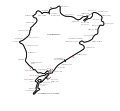
The Nürburgring (German pronunciation: [ˈnyːɐ̯bʊʁkˌʁɪŋ] ⓘ) is a 150,000-person capacity motorsports complex located in the town of Nürburg, Rhineland-Palatinate, Germany. It features a Grand Prix race track built in 1984, and a long Nordschleife configuration,[a] built in the 1920s, around the village and medieval castle of Nürburg in the Eifel mountains. The north loop is 20.830 km (12.943 mi) long and contains more than 300 metres (1,000 feet) of elevation change from its lowest to highest points. Scottish racing driver Jackie Stewart nicknamed the track "the Green Hell".[2]
Originally, the track featured four configurations, namely the 28.265 km-long (17.563 mi) Gesamtstrecke,[b] which in turn consisted of the then-22.835 km (14.189 mi) Nordschleife,[a] and the 7.747 km (4.814 mi) Südschleife.[c] There was also a 2.281 km (1.417 mi) warm-up loop called Zielschleife,[d] or Betonschleife,[e] around the pit area.[3] Between 1982 and 1983, the start–finish area was demolished to create a new GP-Strecke,[f] which is now used for all major and international racing events. However, the shortened Nordschleife is still in use for racing, testing and public access.[4]
Prior to World War II, the Nürburgring hosted 13 editions of the German Grand Prix from 1927 to 1939. In Formula One (F1), it has hosted 42 Grands Prix, including the German, European, Luxembourg, and – most recently – 2020 Eifel Grand Prix; Michael Schumacher achieved the most victories at the Nürburgring, winning on five occasions between 1995 and 2006.[5] The 1976 German Grand Prix, held on the Nordschleife, was the last F1 race ever contested on a circuit of 10 or more kilometres (6.2 or more miles).[g] As of 2025[update], the venue hosts several national GT events, including the Deutsche Tourenwagen Masters.
History
[edit]1925–1939: The beginning of the "Nürburg-Ring"
[edit]In 1904, the Gordon Bennett Trophy was held on the twice-run Taunus circuit, a circuit made up of public roads starting between the towns of Wehrheim, Limburg and Saalburg, just north of Frankfurt that was 126 km (78 mi) long. In 1907, the Taunus circuit was re-routed and shortened to 117 km (73 mi), and it was used one more time for the first Eifelrennen race, which was won by Italian racer Felice Nazzaro. In the early 1920s, ADAC Eifelrennen races were held on the twisty 33.2 km (20.6 mi) Nideggen public road circuit near Cologne and Bonn. Around 1925, the construction of a dedicated race track was proposed just south of the Nideggen circuit around the ancient castle of the town of Nürburg, following the examples of Italy's Monza and Targa Florio courses, and Berlin's AVUS, yet with a different character. The layout of the circuit in the mountains was similar to the Targa Florio event, one of the most important motor races at that time. The original Nürburgring was to be a showcase for German automotive engineering and racing talent. Construction of the track, designed by the Eichler Architekturbüro from Ravensburg (led by architect Gustav Eichler), began in September 1925.[citation needed]
The track was completed in the spring of 1927, and the ADAC Eifelrennen races were continued there. The first races to take place on 18 June 1927 showed motorcycles and sidecars, and were won by Toni Ulmen on an English 350cc Velocette. The cars followed a day later, and Rudolf Caracciola was the winner of the over–5000cc class in a supercharged Mercedes-Benz "K". In addition, the track was opened to the public in the evenings and on weekends, as a one-way toll road.[7] The entire track consisted of 174 bends (prior to 1971 changes), and averaged 8 to 9 metres (8.7 to 9.8 yd) in width. The fastest time ever around the full Gesamtstrecke was by Louis Chiron, at an average speed of 112.31 km/h (69.79 mph) in his Bugatti.[citation needed]
In 1929 the full Nürburgring was used for the last time in major racing events, as future Grands Prix would be held only on the Nordschleife. Motorcycles and minor races primarily used the shorter and safer Südschleife. Memorable pre-war races at the circuit featured the talents of early Ringmeister (Ringmasters) such as Rudolf Caracciola, Tazio Nuvolari, and Bernd Rosemeyer.[citation needed]
1947–1970: "The Green Hell"
[edit]


After World War II, racing resumed in 1947, and in 1951, the Nordschleife of the Nürburgring again became the main venue for the German Grand Prix as part of the Formula One World Championship (with the exception of 1959, when it was held on the AVUS in Berlin). A new group of Ringmeister arose to dominate the race – Alberto Ascari, Juan Manuel Fangio, Stirling Moss, Jim Clark, John Surtees, Jackie Stewart and Jacky Ickx.
On 5 August 1961, during practice for the 1961 German Grand Prix, Phil Hill became the first person to complete a lap of the Nordschleife in under 9 minutes, with a lap of 8 minutes 55.2 seconds (153.4 km/h or 95.3 mph) in the Ferrari 156 "Sharknose" Formula One car. Over half a century later, even the highest performing road cars still have difficulty breaking 8 minutes without a professional race driver or one very familiar with the track. Also, several rounds of the German motorcycle Grand Prix were held, mostly on the 7.747 km (4.814 mi) Südschleife, but the Hockenheimring and the Solitudering were the main sites for Grand Prix motorcycle racing.
In 1953, the ADAC 1000 km Nürburgring race was introduced, an Endurance race and Sports car racing event that counted towards the World Sportscar Championship for decades. The 24 Hours Nürburgring for touring car racing was added in 1970.
By the late 1960s, the Nordschleife and many other tracks were becoming increasingly dangerous for the latest generation of F1 cars. In 1967, a chicane was added before the start/finish straight, called Hohenrain, in order to reduce speeds at the pit lane entry. This made the track 25 m (27 yd) longer. Even this change, however, was not enough to keep Stewart from nicknaming it "The Green Hell" (German: Die Grüne Hölle) following his victory in the 1968 German Grand Prix amid a driving rainstorm and thick fog. In 1970, after the fatal crash of Piers Courage at Zandvoort, the F1 drivers decided at the French Grand Prix to boycott the Nürburgring unless major changes were made, as they had done at Spa the year before. The changes were not possible on short notice, and the German GP was moved to the Hockenheimring, which had already been modified.
1971–1983: Changes
[edit]
In accordance with the demands of the F1 drivers, the Nordschleife was reconstructed by taking out some bumps, smoothing out some sudden jumps (particularly at Brünnchen), and installing Armco safety barriers. The track was made straighter, following the race line, which reduced the number of corners. The German GP could be hosted at the Nürburgring again, and was for another six years from 1971 to 1976.
In 1973 the entrance into the dangerous and bumpy Kallenhard corner was made slower by adding another left-hand corner after the fast Metzgesfeld sweeping corner. Safety was improved again later on by removing the jumps on the long main straight and widening it. They also took away the bushes right next to the track at the main straight, which had made that section of the Nürburgring dangerously narrow. A second series of three more F1 races was held until 1976. However, primarily due to its length of over 22 km (14 mi), and the lack of space due to its situation on the sides of the mountains, increasing demands by the F1 drivers and the FIA's CSI commission were too expensive or impossible to meet. For instance, by the 1970s the German Grand Prix required five times the marshals and medical staff as a typical F1 race, something the German organizers were unwilling to provide. Additionally, even with the 1971 modifications it was still possible for cars to become airborne off the track. The Nürburgring was also unsuitable for the burgeoning television market; its vast expanse made it almost impossible to effectively cover a race there. As a result, early in the season it was decided that the 1976 race would be the last to be held on the old circuit.
Niki Lauda, the reigning world champion and only person ever to lap the full 22.835 km (14.189 mi) Nordschleife in under seven minutes (6:58.6, 1975), proposed to the other drivers that they boycott the circuit in 1976. Lauda was not only concerned about the safety arrangements and the lack of marshals around the circuit, he also did not like the prospect of running the race in another rainstorm. Usually when that happened, some parts of the circuit were wet and other parts were dry, which is what the conditions of the circuit were for that race. The other drivers voted against the idea and the race went ahead. Lauda crashed in his Ferrari coming out of the left-hand kink before Bergwerk after a new magnesium component (lighter but more fragile than aluminum used until then) on his Ferrari's rear suspension failed. He was badly burned as his car was still loaded with fuel in lap 2. Lauda was saved by the combined actions of fellow drivers Arturo Merzario, Guy Edwards, Brett Lunger, Emerson Fittipaldi and Harald Ertl.
The crash also showed that the track's distances were too long for regular fire engines and ambulances, even though the "ONS-Staffel" was equipped with a Porsche 911 rescue car, marked (R). The old Nürburgring never hosted another F1 race again, as the German Grand Prix was moved to the Hockenheimring for 1977. The German motorcycle Grand Prix was held for the last time on the old Nürburgring in 1980, also permanently moving to Hockenheim.
By its very nature, the Nordschleife was impossible to make safe in its old configuration. It soon became apparent that it would have to be completely overhauled if there was any prospect of Formula One returning there - the Nürburgring's administration and race organizers were not willing to provide the enormous expense of providing the number of marshals needed for a Grand Prix - up to six times the amount that most other circuits needed. With this in mind, in 1981 work began on a 4.556 km-long (2.831 mi) new circuit, which was built on and around the old pit area.
At the same time, a bypass shortened the Nordschleife to 20.832 km (12.944 mi), and with an additional small pit lane, this version was used for races in 1983, e.g. the 1000km Nürburgring endurance race, while construction work was going on nearby. During qualifying for that race, Stefan Bellof set a lap of 6:11.13 for the 20.832 km (12.944 mi) Nordschleife in his Porsche 956, or 199.8 km/h (124.1 mph) on average. This lap held the all-time record for 35 years (partially because no major racing has taken place there since 1984) until it was surpassed by Timo Bernhard in the Porsche 919 Hybrid Evo, which ran the slightly longer version of the circuit in 5:19.546- averaging 233.8 km/h (145.3 mph) on 29 June 2018.
Meanwhile, more run-off areas were added at corners like Aremberg and Brünnchen, where originally there were just embankments protected by Armco barriers. The track surface was made safer in some spots where there had been bumps and jumps. Racing line markers were added to the corners all around the track as well. Also, bushes and hedges at the edges of corners were replaced with Armco and grass.
The former Südschleife had not been modified in 1970–1971 and was abandoned a few years later in favour of the improved Nordschleife. It is now mostly gone (in part due to the construction of the new circuit) or converted to a normal public road, but since 2005 a vintage car event has been hosted on the old track layout, including part of the parking area.[8]
1984: New Grand Prix track
[edit]


The new track was completed in 1984 and named GP-Strecke (German: Großer Preis-Strecke: literally, "Grand Prix Course"). It was built to meet the highest safety standards. However, it was considered in character a mere shadow of its older sibling. Some fans, who had to sit much farther away from the track, called it Eifelring, Ersatzring, Grünering or similar nicknames, believing it did not deserve to be called Nürburgring. Like many circuits of the time, it offered few overtaking opportunities.
Prior to the 2013 German Grand Prix both Mark Webber and Lewis Hamilton said they liked the track. Webber described the layout as "an old school track" before adding, "It's a beautiful little circuit for us to still drive on so I think all the guys enjoy driving here." While Hamilton said "It's a fantastic circuit, one of the classics and it hasn't lost that feel of an old classic circuit."[9]
To celebrate its opening, an exhibition race was held on 12 May. The 1984 Nürburgring Race of Champions featured an array of notable drivers driving identical Mercedes 190E 2.3–16's: the line-up was Elio de Angelis, Jack Brabham (Formula 1 World Champion 1959, 1960, 1966), Phil Hill (1961), Denis Hulme (1967), James Hunt (1976), Alan Jones (1980), Jacques Laffite, Niki Lauda (1975, 1977)*, Stirling Moss, Alain Prost*, Carlos Reutemann, Keke Rosberg (1982), Jody Scheckter (1979), Ayrton Senna*, John Surtees (1964) and John Watson. [Drivers marked with * won the Formula 1 World Championship subsequent to the race]. Senna won ahead of Lauda, Reutemann, Rosberg, Watson, Hulme and Jody Scheckter, being the only one to resist Lauda's performance who – having missed the qualifying – had to start from the last row and overtook all the others except Senna.[10][11] There were nine former and two future Formula 1 World Champions competing, in a field of 20 cars with 17 Formula 1 drivers including then 56 year old Hans Herrmann plus three drivers known for racing Porsche: Klaus Ludwig, Manfred Schurti and Udo Schütz.
Besides other major international events, the Nürburgring has seen the brief return of Formula One racing, as the 1984 European Grand Prix was held at the track, followed by the 1985 German Grand Prix. As F1 did not stay, other events are now the highlights at the new Nürburgring, including the 1000km Nürburgring, DTM, motorcycles, and newer types of events, like truck racing, vintage car racing at the AvD "Oldtimer Grand Prix", and even the "Rock am Ring" concerts.
Following the success and first world championship of Michael Schumacher, a second German F1 race was held at the Nürburgring between 1995 and 2006, called the European Grand Prix, or in 1997 and 1998, the Luxembourg Grand Prix.
For 2002, the track was changed, by replacing the former "Castrol-chicane" at the end of the start/finish straight with a sharp right-hander (nicknamed "Haug-Hook"), in order to create an overtaking opportunity. Also, a slow Omega-shaped section was inserted, on the site of the former kart track. This extended the GP track from 4.556 to 5.148 km (2.831 to 3.199 mi), while at the same time, the Hockenheimring was shortened from 6.823 to 4.574 km (4.240 to 2.842 mi).
Both the Nürburgring and the Hockenheimring events lost money due to high and rising Formula One licence fees charged by Bernie Ecclestone and low attendance due to high ticket prices;[12][13][citation needed] starting with the 2007 Formula One season, Hockenheim and Nürburgring alternated in hosting the German GP.

In Formula One, Ralf Schumacher collided with his teammate Giancarlo Fisichella and his brother at the start of the 1997 race which was won by Jacques Villeneuve. In 1999, in changing conditions, Johnny Herbert managed to score the only win for the team of former Ringmeister Jackie Stewart. One of the highlights of the 2005 season was Kimi Räikkönen's spectacular exit while in the last lap of the race, when his suspension gave way after being rattled lap after lap by a flat-spotted tyre that was not changed due to the short-lived 'one set of tyres' rule.
Prior to the 2007 European Grand Prix, the Audi S (turns 8 and 9) was renamed Michael Schumacher S after Michael Schumacher. Schumacher had retired from Formula One the year before, but returned in 2010, and in 2011 became the second Formula One driver to drive through a turn named after them (after Ayrton Senna driving his "S for Senna" at Autódromo José Carlos Pace).
Alternation with Hockenheim
[edit]In 2007, the FIA announced that Hockenheimring and Nürburgring would alternate with the German Grand Prix with Nürburgring hosting in 2007. Due to name-licensing problems, it was held as the European Grand Prix that year. In 2014, the new owners of the Nürburgring were unable to secure a deal to continue hosting the German Grand Prix in the odd-numbered years, so the 2015 and 2017 German Grands Prix were cancelled.

Return of Formula One
[edit]In July 2020, it was announced that after seven years, the race track would be an official Formula One Grand Prix with the event taking place from 9 to 11 October 2020. This race was called the Eifel Grand Prix in honour of the nearby mountain range, meaning the venue held a Grand Prix under a fourth different name having hosted races under the German, European and Luxembourg Grands Prix titles previously.[14] That race was won by Lewis Hamilton, who equalled Michael Schumacher's record of wins.
Fatal accidents
[edit]While it is unusual for deaths to occur during sanctioned races, there are many accidents and several deaths each year during public sessions. It is common for the track to be closed several times a day for cleanup, repair, and medical intervention. While track management does not publish any official figures, several regular visitors to the track have used police reports to estimate the number of fatalities as between 3 and 12 in a full year.[15] Jeremy Clarkson noted in Top Gear in 2004 that "over the years this track has claimed over 200 lives".[16]
Racing
[edit] | This article is missing information about the GP-Strecke. (May 2023) |
Nordschleife racing today
[edit]Several touring car series still compete on the Nordschleife, using either only the simple 20.830 km (12.943 mi) version with its separate small pit lane, or a combined 25.378 km-long (15.769 mi) track that uses a part of the original modern F1 track (without the Mercedes Arena section, which is often used for support pits) plus its huge pit facilities. Entry-level competition requires a regularity test (GLP) for street-legal cars. Two racing series (RCN/CHC and VLN) compete on 15 Saturdays each year, for several hours.
The annual highlight is the 24 Hours Nürburgring weekend, held usually in mid-May, featuring 220 cars – from small 100 hp (75 kW) cars to 700 hp (520 kW) Turbo Porsche cars or 500 hp (370 kW) factory race cars built by BMW, Opel, Audi, and Mercedes-Benz, over 700 drivers (amateurs and professionals), and up to 290,000 spectators.

As of 2015 the World Touring Car Championship holds the FIA WTCC Race of Germany at the Nordschleife as a support category to the 24 Hours.
BMW Sauber's Nick Heidfeld made history on 28 April 2007 as the first driver in over thirty years to tackle the Nürburgring Nordschleife track in a contemporary Formula One car.[17] Heidfeld's three laps in an F1.06 were part of festivities celebrating BMW's contribution to motorsport. About 45,000 spectators showed up for the main event, the third four-hour VLN race of the season. Conceived largely as a photo opportunity, the lap times were not as fast as the car was capable of, BMW instead needing to run the chassis at a particularly high ride height to allow for the Nordschleife's abrupt gradient changes and to limit maximum speeds accordingly. Former F1 driver Hans-Joachim Stuck was injured during the race when he crashed his BMW Z4.
As part of the festivities before the 2013 24 Hours Nürburgring race, Michael Schumacher and other Mercedes-Benz drivers took part in a promotional event which saw Schumacher complete a demonstration lap of the Nordschleife at the wheel of a 2011 Mercedes W02.[18] As with Heidfeld's lap, and also partly due to Formula One's strict in-season testing bans, the lap left many motorsport fans underwhelmed.[19]
Public access
[edit]Nordschleife
[edit]Since its opening in 1927, the track has been used by the public for the so-called Touristenfahrten: anyone with a road-legal car or motorcycle, as well as tour buses, motor homes, or cars with trailers, are able to access the Nordschleife. It is open every day from mid-March through mid-November, except when racing takes place. The track is not open to the public during the winter, when construction work is ongoing or in the event of bad weather. Passing on the right is prohibited, and some sections have speed limits; the normal traffic rules (StVO in German) apply also here.


The Nürburgring is a popular attraction for many driving enthusiasts and riders from all over the world, partly because of its history and the challenge it provides. The lack of oncoming traffic and intersections sets it apart from regular roads, and the absence of a blanket speed limit is a further attraction.
Normal ticket buyers on tourist days cannot quite complete a full lap of the 20.832 km (12.944 mi) Nordschleife, which bypasses the modern GP-Strecke, as they are required to slow down and pass through a 200-metre (220 yd) "pit lane" section where toll gates are installed. On busier days, a mobile ticket barrier is installed on the main straight in order to reduce the length of queues at the fixed barriers. This is open to all ticket holders. On rare occasions, it is possible to drive both the Nordschleife and the Grand Prix circuit combined.
Drivers interested in lap times often time themselves from the first bridge after the barriers to the last gantry (aka Bridge-to-Gantry or BTG time) before the exit.[20] However, the track's general conditions state that any form of racing, including speed record attempts, is forbidden.[21] The driver's insurance coverage may consequently be voided, leaving the driver fully liable for damage. Normal, non-racing, non-timed driving accidents might be covered by driver's insurance, but it is increasingly common for insurers to insert exclusion clauses that mean drivers and riders on the Nürburgring only have third-party coverage[22] or are not covered at all.[23]
Drivers who have crashed into the barriers, suffered mechanical failure or been otherwise required to be towed off track during Touristenfahrten sessions are referred to as having joined the "Bongard Club". This nickname is derived from the name of the company which operates the large yellow recovery flatbed trucks which ferry those unfortunate drivers and their vehicles to the nearest exit.[24] Due to the high volume of traffic, there is an emphasis on quickly clearing and repairing any compromised safety measures so the track can be immediately re-opened for use.
Additionally, those found responsible for damage to the track or safety barriers are required to pay for repairs, along with the time and cost associated with personnel, equipment and track closure to address those damages, making any accident or breakdown a potentially expensive incident. Because it is technically operated as a public toll road, failing to report an accident or instance where track surfaces are affected is considered to be an instance of unlawfully leaving the scene of an accident.[25] This is all part of the rules and regulations which aim to ensure a safe experience for all visitors to the track.
On 20 February 2025, the administration of the circuit decided to forbid motorcycles during public Touristenfahrten tourist laps starting from the opening of the 2025 season.[26][27]
Südschleife
[edit]The entire Nürburgring Gesamtstrecke was open to the public from its initial opening. At several points around the circuit there were access roads and toll points from which drivers and riders could begin or end a drive. The Südschleife had one of these at the bottom of the uphill stretch near Müllenbach.
Commercial aspects
[edit]Production car testing
[edit]
For decades, automotive media outlets and manufacturers have used lap times on the Nordschleife as a standard to measure the performance of production vehicles. A car's time on the circuit is commonly used as a benchmark for its overall performance, and cars from disparate marques or time periods may be directly compared via their lap times. Since 2019, two times have been recorded: one for the whole length of the track, and another for a traditional, slightly truncated layout. Nordschleife test cars are piloted by experienced test drivers with intricate knowledge of the circuit, and are often variants specially prepared for circuit racing, as is the case with the Lexus LFA's "Nürburgring package".[28][29][30]
For sixteen weeks per year, the "industry pool" (Industrie-Pool) rents exclusive daytime use of the track for automotive development and endurance testing.[31] As of 2017[update] the industry pool consisted of approximately 30 car manufacturers, associations, and component suppliers.[31] By 2019, the track was being rented by the industry pool for 18 weeks per year.[32]
Some journalists have opined that Nordschleife testing is deleterious to a car's normal driving experience, producing cars that have sacrificed comfort and driveability in favor of better lap times.[28] Former Top Gear host James May, who is known for his open dislike of testing run on the track,[33][34] has claimed that the Nürburgring prompts designers to focus on a car's grip at the expense of pleasant-feeling handling, and creates cars that are ill-suited for real-world driving conditions.[35] Others have expressed concern over the relevance of these test laps, which lack independent verification and may be conducted using cars significantly different from stock. Porsche is reported as having tried—and failed—to replicate the Nissan GT-R Nismo's record-breaking lap, preparing its own GT-R test car for the task, and the Lamborghini Huracán Performante's time was met with incredulity even after Lamborghini provided video documentation.[30][36]
Television and games
[edit]The TV series Top Gear sometimes used the Nordschleife for its challenges, often involving Sabine Schmitz. The first corner of the Nordschleife loop was renamed as the "Sabine-Schmitz-Kurve" in Schmitz's honor after she died of cancer in 2021.[37] In addition, during series 17 (summer 2011) of Top Gear, James May was very critical of the ride quality of cars whose development processes included testing on the Nordschleife, saying that cars which were tested at Nordschleife got ruined.[citation needed][further explanation needed]
Multiple layouts of the Nürburgring have been featured in video games, such as the Gran Turismo series, the Forza Motorsport series, the Need for Speed: Shift series, Project CARS 2, iRacing and Assetto Corsa. Grand Prix Legends, a historic racing simulator also included the Nürburgring on its roster of default Grand Prix tracks.
Leisure development
[edit]Other pastimes are hosted at the Nürburgring, such as the Rock am Ring, Germany's biggest rock music festival, attracting close to 100,000 rock fans each year since 1985. Since 1978, the Nordschleife is also the venue of a major running event (Nürburgring-Lauf/Run am Ring). In 2003, a major bicycling event (Rad am Ring) was added and it became the multi-sports event Rad & Run am Ring.
In 2009, new commercial areas opened, including a hotel and shopping mall. In the summer of 2009, ETF Ride Systems opened a new interactive dark ride application called "Motor Mania" at the racetrack, in collaboration with Lagotronics B.V.[38] The roller coaster "ring°racer" was scheduled to open in 2011, but was delayed significantly due to technical issues. It eventually opened on 31 October 2013 and was closed after just four days of operation on 3 November 2013.[39]
Ownership
[edit]In 2012, the track was preparing to file for bankruptcy as a result of nearly $500 million in debts and the inability to secure financing.[40] On 1 August 2012, the government of Rheinland-Pfalz guaranteed $312 million to allow the track to meet its debt obligations.[41]
In 2013, the Nürburgring was for sale for US$165 million (€127.3 million).[42] The sale process was by sealed-bid auction with an expected completion date of "Late Summer". This meant there was to be a new owner in 2013, unencumbered by the debts of the previous operation, with the circuit expected to return to profitability.[43]
On 11 March 2014, it was reported that the Nürburgring was sold for 77 million euros ($106.8 million). Düsseldorf-based Capricorn Development was the buyer. The company was to take full ownership of the Nürburgring on 1 January 2015.[44] But in October 2014, Russian billionaire, the chairman of Moscow-based Pharmstandard, Viktor Kharitonin, bought a majority stake in the Nürburgring.[45]
In May 2015, the Nürburgring was set to hold the first Grüne Hölle Rock festival as a replacement for the Rock am Ring festival,[46] but the project did not take place. Grüne Hölle Rock changed their name to Rock im Revier and the event was held in the Schalke area.[47]
Layout
[edit]Nordschleife layout
[edit] | |
| Location | Nürburg, Germany |
|---|---|
| Coordinates | 50°20′08″N 6°56′51″E / 50.33556°N 6.94750°E |
| Website | https://nuerburgring.de |
The Nordschleife operates in a clockwise direction, and was formerly known for its abundance of sharp crests, causing fast-moving, firmly-sprung racing cars to jump clear off the track surface at many locations.
Flugplatz ("air field", a small airport)
[edit]

Although by no means the most fearsome, Flugplatz is perhaps the most aptly (although coincidentally) named and widely remembered section. The name of this part of the track comes from a small airfield, which in the early years was located close to the track in this area. The track features a very short straight that climbs sharply uphill for a short time, then suddenly drops slightly downhill, and this is immediately followed by two very fast right-hand kinks. Chris Irwin's career was ended following a massive accident at Flugplatz, in a Ford 3L GT sports car in 1968. Manfred Winkelhock flipped his March Formula Two car at the same corner in 1980. This section of the track was renovated in 2016[48] after an accident in which Jann Mardenborough's Nissan GT-R flew over the fence and killed a spectator.[49] The Flugplatz is one of the most important parts of the Nürburgring because after the two very fast right-handers comes what is possibly the fastest part of the track: a downhill straight called Kottenborn, into a very fast curve called Schwedenkreuz (Swedish Cross). Drivers are flat out (full-speed) for some time here.
Right before Flugplatz is Quiddelbacher-Höhe (peak, as in "mountain summit"), where the track crosses a bridge over the Bundesstraße 257.
Fuchsröhre ("Fox Hole")
[edit]

The Fuchsröhre is soon after the very fast downhill section succeeding the Flugplatz. After negotiating a long right-hand corner called Aremberg (which is after Schwedenkreuz) the road goes under a bridge Postbrucke as it plunges downhill, and the road switches back left and right and finding a point of reference for the racing line is difficult. This whole sequence is flat out and then, the road climbs sharply uphill. The road then turns left and levels out at the same time; this is one of the many jumps of the Nürburgring where the car goes airborne. This leads to the Adenauer Forst (forest) turns. The Fuchsröhre is one of the fastest and most dangerous parts of the Nürburgring because of the extremely high speeds in such a tight and confined place; this part of the Nürburgring goes right through a forest and there is only about 2–3 metres (6.6–9.8 ft) of grass separating the track from Armco barrier, and beyond the barriers is a wall of trees.
Bergwerk ("Mine")
[edit]Perhaps the most notorious corner on the long circuit, Bergwerk has been responsible for some serious and sometimes fatal accidents.[50][51] A tight right-hand corner, coming just after a long, fast section and a left-hand kink on a small crest, was where Carel Godin de Beaufort fatally crashed. The fast kink was also the scene of Niki Lauda's infamous fiery accident during the 1976 German Grand Prix. This left kink is often referred to as the Lauda-Links (Lauda left). The Bergwerk, along with the Breidscheid/Adenauer Bridge corners before it, are one of the series of corners that make or break one's lap time around the Nürburgring because of the fast, lengthy uphill section called Kesselchen (Little Valley) that comes after the Bergwerk.
Caracciola Karussell ("Carousel")
[edit]


Although being one of the slower corners on the Nordschleife, the Karussell is perhaps its most famous and one of its most iconic- it is one of two berm-style, banked corners on the track. Soon after the driver has negotiated the long uphill section after Bergwerk and gone through a section called Klostertal (Monastery Valley), the driver turns right through a long hairpin, past an abandoned section called Steilstrecke (Steep Route) and then goes up another hill towards the Karrusell. The entrance to the corner is blind, although Juan Manuel Fangio is reputed to have advised a young driver to "aim for the tallest tree," a feature that was also built into the rendering of the circuit in the Gran Turismo 4 and Grand Prix Legends video games. Once the driver has reached the top of the hill, the road then becomes sharply banked on one side and level on the other- this banking drops off, rather than climbing up like most bankings on circuits. The sharply banked side has a concrete surface, and there is a foot-wide tarmac surface on the bottom of the banking for cars to get extra grip through the very rough concrete banking. Cars drop into the concrete banking, and keep the car in the corner (which is 210 degrees, much like a hairpin bend) until the road levels out and the concrete surface becomes tarmac again. This corner is very hard on the driver's wrists and hands because of the prolonged bumpy cornering the driver must do while in the Karrusell. Usually, cars come out of the top of the end of the banking to hit the apex that comes right after the end of the Karrusell.
The combination of a recognisable corner, slow-moving cars, and the variation in viewing angle as cars rotate around the banking, means that this is one of the circuit's most popular locations for photographers. It is named after German pre-WWII racing driver Rudolf Caracciola, who reportedly made the corner his own by hooking the inside tires into a drainage ditch to help his car "hug" the curve. As more concrete was uncovered and more competitors copied him, the trend took hold. At a later reconstruction, the corner was remade with real concrete banking, as it remains to this day.
Shortly after the Karussell is a steep section, with gradients in excess of 16%, leading to a right-hander called Hohe Acht, which is some 300 m (980 ft) higher in altitude than Breidscheid.[52]
Brünnchen ("Small Well")
[edit]

A favourite spectator vantage point, the Brünnchen section is composed of two right-hand corners and a very short straight. The first corner goes sharply downhill and the next, after the very short downhill straight, goes uphill slightly. This is a section of the track where on public days, accidents happen particularly at the blind uphill right-hand corner. Like almost every corner at the Nürburgring, both right-handers are blind. The short straight used to have a steep and sudden drop-off that caused cars to take off and a bridge that went over a pathway; these were taken out and smoothed over when the circuit was rebuilt in 1970 and 1971. The uphill right-hand corner is often referred to as "Youtube corner", because of the large number of videos featuring a perspective of that corner.
Pflanzgarten ("Planting Garden") and Stefan Bellof S ("Stefan Bellof Esses")
[edit]
The Pflanzgarten, which is soon after the Brünnchen, is one of the fastest, trickiest and most difficult sections of the Nürburgring. It is full of jumps, including two huge ones, one of which is called Sprunghügel (Jump Hill). This very complex section is unique in that it is made up of two different sections; getting the entire Pflanzgarten right is crucial to a good lap time around the Nürburgring. This section was the scene of Briton Peter Collins's fatal accident during the 1958 German Grand Prix, and the scene of a number of career-ending accidents in Formula One in the 1970s —Britons Mike Hailwood and Ian Ashley were two victims of the Pflanzgarten.
Pflanzgarten 1 is made up of a slightly banked, downhill left-hander which then suddenly switches back left, then right. Then immediately, giving the driver nearly no time to react (knowledge of this section is key) the road drops away twice: the first jump is only slight, then right after (somewhat like a staircase) the road drops away very sharply which usually causes almost all cars to go airborne at this jump; the drop is so sudden. Then, immediately after the road levels out very shortly after the jump and the car touches the ground again, the road immediately and suddenly goes right very quickly and then right again; this is what makes up the end of the first Pflanzgarten- a very fast multiple apex sequence of right-hand corners.


The road then goes slightly uphill and then through another jump; the road suddenly drops away and levels out and at the same time, the road turns through a flat-out left-hander. Then, the road drops away again very suddenly, which is the second huge jump of the Pflanzgarten known as the Sprunghügel. The road then goes downhill then quickly levels out, then it goes through a flat-out right-hander and this starts the Stefan Bellof S (named as such because Bellof crashed a Porsche 956 there during the 1983 Nurburgring 1000 km), which was known as Pflanzgarten 2 prior to 2013. The Stefan Bellof S is very tricky because the road quickly switches back left and right—a car is going so fast through here that it is like walking on a tightrope. It is very difficult to find the racing line here because the curves come up so quickly, so it is hard to find any point of reference. Then, after a jump at the end of the switchback section, it goes through a flat-out, top gear right-hander and into a short straight that leads into two very fast curves called the Schwalbenschwanz (Swallow's Tail).
The room for error on every part of the consistently high-speed Pflanzgarten and the Stefan Bellof S is virtually non-existent (much like the entire track itself). The road and the surface of the Pflanzgarten and the Stefan Bellof S moves around unpredictably; knowledge of this section is key to getting through cleanly.
Schwalbenschwanz/Kleines Karussell ("Swallow's Tail"/"Little Carousel")
[edit]The Schwalbenschwanz is a sequence of very fast sweepers located after the Stefan Bellof S. After a short straight, there is a very fast right-hand sweeper that progressively goes uphill, and this leads into a blind left-hander that is a bit slower. The apex is completely blind, and the corner then changes gradient a bit; it goes up then down, which leads into a short straight that ends at the Kleines Karussell. Originally, this part had a bridge that went over a stream and was very bumpy; this bridge was taken out and replaced with a culvert (large industrial pipe) so that the road could be smoothed over.
The Kleines Karussell is similar to its bigger brother, except that it is a 90-degree corner instead of 210 degrees, and is faster and slightly less banked. Once this part of the track is dealt with, the drivers are near the end of the lap; with two more corners Galgenkopf to negotiate before the 2.135 km (1.327 mi) long Döttinger Höhe straight.
Südschleife layout
[edit] The Nürburgring Südschleife | |
| Location | Nürburg,  Germany Germany |
|---|---|
| Opened | 1927 |
| Closed | 1982 |
| Website | https://nuerburgring.de |
The Nürburgring Südschleife (south loop) was a motor racing circuit which was built in 1927 at the same time as the Nordschleife.
The Südschleife and Nordschleife layouts were joined together by the Start und Ziel (start/finish) area, and could therefore be driven as one track that was over 28.265 km (17.563 mi) long. Races were held at the combined layout only until 1931. The Südschleife was used for the ADAC Eifelrennen from 1928 until 1931 and from 1958 until 1968, as well as for the Eifelpokal and other minor races.
The Südschleife was rarely used after the Nordschleife was rebuilt and updated in 1970 and 1971, and was finally destroyed by the building of the current Nürburgring Grand Prix circuit in the early 1980s. Today only small sections of the original track remain.
Track description
[edit]The shared start/finish area of the Nürburgring complex consisted of two back-to-back straights joined together at the southern end by a tight loop. The entrance to the 7.747 km (4.814 mi) Südschleife lay on the outside edge of this hairpin and was signposted as the road to Bonn. It immediately dropped sharply downhill and under a public road before winding through a heavily-wooded section.
Tight corners soon gave way to fast downhill sections with flowing bends until, at the outskirts of the nearby town of Müllenbach, the track turned sharply right northwards and began a long climb up the hill.
At the end of this run came a right hairpin turn which led to a long left curve around the bottom of a hill. This led onto the back straight of the start/finish area. At this point it was possible to continue onto the Nordschleife or take two sharp right-hand turns in order to enter the starting straight once again.
Photographs of the track in use show that trees and hedges were not cut back in many areas, being allowed to grow right up to the trackside. Although the Nordschleife had very little in the way of run-off areas, the Südschleife seems to have had none at all, which was likely to have been a factor in the choice of circuit for major events.
Sections of routes
[edit]| km | Section |
|---|---|
| 0 | Start and finish |
| Connection south sweep | |
| 1 | |
| Bränkekopf | |
| 2 | Aschenschlag |
| Seifgen | |
| 3 | |
| Bocksberg | |
| 4 | Müllenbach |
| Rassrück | |
| 5 | |
| Scharfer Kopf | |
| 6 | |
| Gegengerade | |
| 7 | |
| Nordkehre | |
| 7,747 | Start and finish |
The route sections bore the following names, among others Bränkekopf, Aschenschlag, Seifgen, Bocksberg, Müllenbach und Scharfer Kopf.
Stichstraße shortcut
[edit]In 1938 a small section of new track (the Stichstraße) was laid which allowed drivers nearing the end of the Südschleife to bypass the start/finish straights and take a right turn which led back to the start of the downhill twists. This shortened a lap to around 5.7 km (3.5 mi). This layout was used for tourist rides and for testing.
Remaining sections
[edit]The current Grand Prix circuit required the complete destruction of the start/finish area but at a point around 1 km (0.62 mi) into the Südschleife, a modern public road now follows the route, although the bends have been eased and the vegetation does not come as close to the road as it did when the track was open.
This public road continues into the town of Müllenbach but leaves the route of the old track on the outskirts. Nothing remains of the famous corners there.
The road up the hill still exists and is sometimes used to allow access to parking areas for the Grand Prix track. The lower sections are no longer maintained.
Surviving sections, and the parking lots, are still used in competition. The Cologne-Ahrweiler Rally often uses the Südschleife in competition.[53]
Layout history
[edit]Current circuit configurations
[edit]-
 Grand Prix Strecke (2002–present)
 -
 Grand Prix Strecke without F1 Chicane (2002–present)
 -
 Sprint Circuit (2002–present)
 -
 Müllenbach Circuit (2002–present)
 -
 Combined Grand Prix Strecke with Mercedes-Arena (2002–present)
 -
 24 Hours Circuit (Combined Grand Prix Strecke without Mercedes-Arena) (2002–present)
 -
 Combined Sprint Circuit with Mercedes-Arena (2002–present)
 -
 Nordschleife (1983–present)
 -
 Rallycross Circuit (2021–present)


Previous configurations
[edit]-
 Nordschleife (1927–1966)
 -
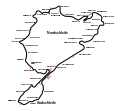 Gesamtstrecke (1927–1966)
 -
 Südschleife (1927–1973)
 -
 Nordschleife (1967–1982)
 -
 Gesamtstrecke (1967–1973)
 -
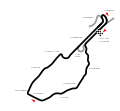 Südschleife (1973–1982)
 -
 Betonschleife/Zielschleife (1927–1982)


-
 Grand Prix Circuit (1984–1994)
 -
 Comparison between Nordschleife and Grand Prix Circuit (1984–1994)
 -
 Grand Prix Strecke with F1 Chicane (1995–2001)
 -
 Comparison between Nordschleife and Grand Prix Strecke (1995–2001)
 -
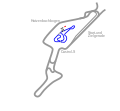 Karting Circuit (1995–2001)
 -
 24 Hours Circuit (1984–2001)
 -
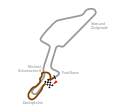 Rallycross Circuit (1991–1997)


Lap records
[edit]Nürburgring Nordschleife
[edit]As of May 2023, the fastest official race lap records at the Nürburgring Nordschleife are listed as:
Nürburgring Südschleife
[edit]The fastest official race lap records on the Südschleife are listed as:
Modern Nürburgring
[edit]As of September 2025, the fastest official lap records at the modern Nürburgring circuit layouts are listed as:
Lap times recorded on the Nürburgring Nordschleife are published by several manufacturers. They are published and discussed in print media, and online.
- For lap times from various sources, see Nürburgring lap times.
- For lap times in official racing events, on several track variants from 20.830 km (12.943 mi) up to 25.947 km (16.123 mi) see List of Nordschleife lap times (racing).
The lap record on the Südschleife is held by Helmut Kelleners with 2:38.6 minutes = 175.85 km/h (109.27 mph), driven with a March 707 in the CanAm run of the 3rd International AvD SCM circuit race on 18 October 1970.[233] Previous record holder was Brian Redman, who achieved 2:47.0 minutes = 161.03 km/h (100.06 mph) in the Formula 2 race on 21 April 1968 with a Ferrari.[234]
Competitions
[edit]- Formula racing
- Acceleration 2014 (2014)
- ADAC Formel Masters (2008–2014)
- ADAC Formula 4 (2015–2022)
- ATS Formel 3 Cup (1971–1974, 1976–1977, 1979–2010, 2012–2014)
- Auto GP (2001–2004, 2007, 2013–2014)
- BOSS GP (2007–2008, 2010, 2012, 2024–present)
- British Formula 3 International Series (2005, 2011, 2013)
- European Formula Two Championship (1967–1973, 1975–1983)
- FIA Formula 3 European Championship (2012–2018)
- FIA Formula Two Championship (2011–2012)
- Formula 3 Euro Series (2003–2012)
- Formula BMW ADAC (2000–2007)
- Formula BMW Europe (2009)
- Formula Chrysler Euroseries (2001)
- Formula One
- Formula Palmer Audi (2000, 2004)
- Formula Renault 2.0 Germany (1991–1999, 2001–2005)
- Formula Renault Eurocup (1993–1994, 1996, 1999–2001, 2006–2009, 2011–2012, 2014–2015, 2017–2020)
- Formula Renault Northern European Cup (2006–2007, 2009–2018)
- Formula Volkswagen Germany (2001–2003)
- French F4 Championship (2024)
- French Formula Three Championship (1978)
- French Formula Renault Championship (1981)
- International Formula 3000 (1992–1993, 1996–2004)
- GP2 Series (2005–2007, 2009, 2011, 2013)
- GP3 Series (2011, 2013)
- Superleague Formula
- Superleague Formula round Germany (2008, 2010)
- World Series Formula V8 3.5 (2006–2009, 2011–2012, 2014–2015, 2017)
- Sports car racing
- 6 Hours of Nürburgring / 1000 km Nürburgring (1953, 1956–1991, 2000, 2004–2017)
- 24H Series (2026)
- 24 Hours Nürburgring (1970–present)
- ADAC GT Masters (2007–present)
- ADAC GT4 Germany (2019–present)
- Alpine Elf Europa Cup (2018)
- BPR Global GT Series (1995–1996)
- Deutsche Rennsport Meisterschaft (1972–1982, 1984–1985)
- DTM Trophy (2020–2022)
- European Le Mans Series (2004–2009)
- Ferrari Challenge Europe (1996–1999, 2002, 2004, 2006, 2019, 2021, 2024)
- FIA GT Championship (1997, 2001)
- FIA GT1 World Championship (2010, 2012)
- FIA GT3 European Championship (2012)
- FIA Sportscar Championship (1998–2001)
- FIA World Endurance Championship (2015–2017)
- GT World Challenge Europe (2013–2016, 2019–2021, 2023–present)
- GT2 European Series (2026)
- GT4 European Series (2010, 2014–2015, 2017–2021, 2025)
- Intercontinental GT Challenge (2024–present)
- International GT Open (2010, 2012–2014)
- Lamborghini Super Trofeo Europe (2012–2021, 2023–present)
- Porsche Carrera Cup Benelux (2019–2020)
- Porsche Carrera Cup France (1999, 2011)
- Porsche Carrera Cup Germany (1986–2019, 2022–present)
- Porsche Carrera Cup Great Britain (2011)
- Porsche Carrera Cup Italia (2011)
- Porsche Carrera Cup Scandinavia (2011, 2018)
- Porsche Supercup (1995–2007, 2009, 2011, 2013)
- Prototype Cup Germany (2022–present)
- Renault Sport Trophy (2015)
- Trofeo Maserati (2003, 2005)
- Veranstaltergemeinschaft Langstreckenpokal Nürburgring (1977–present)
- World Sportscar Championship (1953, 1956–1984, 1986–1991)
- Touring car racing
- ADAC TCR Germany Touring Car Championship (2016–2022)
- Deutsche Tourenwagen Masters (2000–present)
- Deutsche Tourenwagen Meisterschaft (1984–1996)
- Eurocup Clio (2011–2012, 2014)
- Eurocup Mégane Trophy (2006–2009, 2011–2012)
- European Touring Car Championship (1963–1980, 1982–1986, 1988, 2001)
- European Touring Car Cup (2016–2017)
- NASCAR Whelen Euro Series (2014)
- NXT Gen Cup (2023–present)
- Race of Champions (1989)
- SEAT León Eurocup (2014–2016)
- Super Tourenwagen Cup (1994–1999)
- Superstars Series (2007)
- TCR Europe Touring Car Series (2016, 2021–2022)
- V8Star Series (2001–2003)
- World Touring Car Championship
- FIA WTCC Race of Germany (1987, 2015–2017)
- World Touring Car Cup
- FIA WTCR Race of Germany (2018–2022)
- Truck racing
- European Truck Racing Championship
- ADAC Truck-Grand-Prix (1986–2019, 2022–present)
- Motorcycle racing
- FIM Endurance World Championship (1977–1985, 2001)
- Grand Prix motorcycle racing
- German motorcycle Grand Prix (1955, 1958, 1965, 1968, 1970, 1972, 1974, 1976, 1978, 1980, 1984, 1986, 1988, 1990, 1995–1997)
- IDM Superbike Championship (1990–2012, 2014–2017, 2019, 2024–present)
- Northern Talent Cup (2024–present)
- Sidecar World Championship (1955, 1958, 1965, 1968, 1970, 1972, 1974, 1976, 1978, 1980, 1984, 1986, 1988, 1990, 1995–1997, 1999, 2005)
- Superbike World Championship (1998–1999, 2008–2013)
- Supersport World Championship (1998–1999, 2008–2013)
- Rallycross racing
- FIA European Rallycross Championship (2022)
- FIA World Rallycross Championship
- World RX of Germany (2021–2022)
- Cycling
- UCI Road World Championships (1927, 1966, 1978)
- Rad am Ring (2003–present)
Current events
[edit]- 21–22 March: Nürburgring Langstrecken-Serie 70. ADAC Westfalenfahrt
- 25–26 April: Nürburgring Langstrecken-Serie NLS2
- 9–10 May: Nürburgring Langstrecken-Serie 56. Adenauer ADAC Rundstrecken-Trophy
- 23–25 May: Nürburgring Langstrecken-Serie ADAC Ravenol 24h Nürburgring Qualifying
- 30 May—1 June: DMV Goodyear Racing Days
- 6–8 June: Rock am Ring
- 13–15 June: BOSS GP Nürburgring Classic
- 19–22 June: Intercontinental GT Challenge Nürburgring 24 Hours
- 27–29 June: Porsche Sports Cup Deutschland ADAC Racing Weekend Nürburgring
- 4–5 July: Nürburgring Langstrecken-Serie NLS-Light
- 28–30 June: ADAC Racing Weekend Nürburgring
- 10–13 July: FIA European Truck Racing Championship International ADAC Truck-Grand-Prix, ADAC GT Masters
- 18–20 July: Rad am Ring
- 26–27 July: Kölner Kurs
- 1–3 August: Oldtimer Grand Prix
- 8–10 August: Deutsche Tourenwagen Masters, Prototype Cup Germany, ADAC GT4 Germany, Porsche Carrera Cup Germany, NXT Gen Cup
- 15–16 August: Nürburgring Langstrecken-Serie KW 6h ADAC Ruhr-Pokal-Rennen
- 24 August: ADAC/DMC Race Weekend
- 29–31 August: GT World Challenge Europe, GT4 European Series, Lamborghini Super Trofeo Europe, McLaren Trophy Europe
- 5–7 September: IDM Superbike Championship 41. ADAC-Siegerlandpreis, Northern Talent Cup
- 12–14 September: Nürburgring Langstrecken-Serie 65. ADAC ACAS Cup & 64. ADAC Reinoldus-Langstreckenrennen
- 19–21 September: ADAC 1000 km Revival
- 26–27 September: Nürburgring Langstrecken-Serie 57. ADAC Barbarossapreis
- 3–5 October: RGB Saisonfinale
- 10–11 October: Nürburgring Langstrecken-Serie NLS10
- 16–19 October: ADAC Westfalen Trophy
- 25 October: Schwedenkreuz Rennen
Climate
[edit]The Nürburgring is known for its frequently changing weather. The near-fatal accident of Niki Lauda in 1976 was accompanied by poor weather conditions and also the 2007 Grand Prix race saw an early deluge take several cars out through aquaplaning, with Vitantonio Liuzzi making a lucky escape, hitting a retrieving truck with the rear wing first, rather than the fatal accident that befell Jules Bianchi seven years later at Suzuka. In spite of this reputation, the Nürburg weather station only recorded an average of 679.3 mm (26.74 in) between 1981 and 2010.[235] Contrasting this, the relatively nearby Ardennes racetrack of Spa-Francorchamps in Wallonia, Belgium has a much rainier climate, as can be implied by data from the village hosting the track called Stavelot and the village of Malmedy, through which the circuit passes.
Nürburg has a semi-continental climate with both oceanic and continental tendencies. It does however land in the former category (Köppen Cfb). Due to the Nordschleife's varied terrain and elevation, weather may be completely different on either end of the track. The elevation shift also makes thermal differences a strong possibility. The modern Grand Prix circuit also has sizeable elevation changes between the start-finish straight and the lowest point on the opposite end of the track, but the geographical distance and actual elevation gain between the two are lower. Annual sunshine is in the 1500s, which is low by European standards, but only slightly gloomier than the nearest large city of Cologne located on a plain. Contrasting that, Nürburg has cooler weather year-round due to the higher elevation of the Eifel Mountains than the Rhine Valley.
| Climate data for Nürburg, 485 m asl (1981–2010 normals) | |||||||||||||
|---|---|---|---|---|---|---|---|---|---|---|---|---|---|
| Month | Jan | Feb | Mar | Apr | May | Jun | Jul | Aug | Sep | Oct | Nov | Dec | Year |
| Record high °C (°F) | 13.5 (56.3) |
15.6 (60.1) |
20.7 (69.3) |
25.8 (78.4) |
30.4 (86.7) |
33.3 (91.9) |
34.9 (94.8) |
36.0 (96.8) |
30.2 (86.4) |
25.2 (77.4) |
18.8 (65.8) |
12.6 (54.7) |
36.0 (96.8) |
| Mean daily maximum °C (°F) | 2.6 (36.7) |
4.3 (39.7) |
7.7 (45.9) |
12.3 (54.1) |
16.4 (61.5) |
19.7 (67.5) |
21.6 (70.9) |
21.4 (70.5) |
17.0 (62.6) |
12.5 (54.5) |
6.6 (43.9) |
2.8 (37.0) |
12.2 (54.0) |
| Daily mean °C (°F) | 0.3 (32.5) |
1.6 (34.9) |
4.2 (39.6) |
8.0 (46.4) |
11.9 (53.4) |
15.0 (59.0) |
16.9 (62.4) |
16.6 (61.9) |
13.0 (55.4) |
9.2 (48.6) |
4.3 (39.7) |
0.6 (33.1) |
8.6 (47.5) |
| Mean daily minimum °C (°F) | −2.1 (28.2) |
−1.2 (29.8) |
0.7 (33.3) |
3.6 (38.5) |
7.5 (45.5) |
10.1 (50.2) |
12.2 (54.0) |
11.9 (53.4) |
9.0 (48.2) |
5.9 (42.6) |
2.0 (35.6) |
−1.6 (29.1) |
4.9 (40.8) |
| Record low °C (°F) | −18.6 (−1.5) |
−17.4 (0.7) |
−12.4 (9.7) |
−6.4 (20.5) |
−1.0 (30.2) |
2.1 (35.8) |
5.0 (41.0) |
3.6 (38.5) |
1.1 (34.0) |
−5.3 (22.5) |
−10.8 (12.6) |
−18.1 (−0.6) |
−18.6 (−1.5) |
| Average precipitation mm (inches) | 48.0 (1.89) |
51.2 (2.02) |
50.6 (1.99) |
47.4 (1.87) |
60.6 (2.39) |
53.8 (2.12) |
68.9 (2.71) |
77.7 (3.06) |
57.0 (2.24) |
54.1 (2.13) |
57.5 (2.26) |
51.5 (2.03) |
678.3 (26.71) |
| Average precipitation days | 9.5 | 10.6 | 10.9 | 9.4 | 9.9 | 9.8 | 11.4 | 9.5 | 9.6 | 10.5 | 12.0 | 10.8 | 123.9 |
| Mean monthly sunshine hours | 56.7 | 72.1 | 116.6 | 166.9 | 187.0 | 205.3 | 204.4 | 193.3 | 147.1 | 105.7 | 46.5 | 43.0 | 1,544.6 |
| Source: Météo Climat[235][236] | |||||||||||||
See also
[edit]References
[edit]- ^ "LIST OF FIA LICENSED CIRCUITS UPDATED ON : 2025-11-03" (PDF). Fédération Internationale de l'Automobile. 3 November 2025. Retrieved 3 November 2025.
- ^ "McLaren Formula 1 – Heritage – Welcome to the Green Hell". McLaren. Archived from the original on 22 March 2023. Retrieved 17 September 2024.
- ^ "Maps of Nürburgring configurations". The Fast Lane. 30 August 2005. Retrieved 7 July 2013.
- ^ "Tourist Drives". www.nuerburgring.de. Retrieved 6 September 2024.
- ^ Braybrook, Rebecca (17 July 2024). "Formula 1 drivers with the most wins at a single circuit". Autosport. Retrieved 23 May 2025.
- ^ Haldenby, Nicky (9 January 2025). "The Longest and Shortest F1 Circuits". lightsoutblog.com. Archived from the original on 27 April 2025. Retrieved 26 June 2025.
- ^ Eveleigh, Ian (27 July 2009). "Birth of an icon: 1927: The Nürburgring". evo: The Thrill of Driving. Retrieved 19 July 2019.
- ^ Vintage Nürburgring vintage-nuerburgring.de. Retrieved 18 October 2007.
- ^ "Some love for the Grand Prix circuit". AUSringers.com. 7 July 2013. Retrieved 7 July 2013.
- ^ "Result list of the Nürburgring Mercedes 190 exhibition race of 12 May 1984". PistonHeads.com. Archived from the original on 16 June 2013. Retrieved 11 December 2011.
- ^ Rallye Racing June 1984. Rallye Racing.
- ^ "German Grand Prix fate 'in the hands of promoter'". Deutsche Welle. 6 March 2015. Retrieved 19 July 2019.
- ^ Schrader, Stef (25 February 2015). "Nürburgring Willing To Lose Money To Host The F1 German Grand Prix". Jalopnik. Retrieved 19 July 2019.
- ^ "Formula 1 Aramco Eifel Grand Prix Starts At The Nürburgring". Nuerburgring. 24 July 2020. Archived from the original on 24 July 2020. Retrieved 9 August 2025.
- ^ "Nürburgring Warning". Ben Lovejoy. Retrieved 9 July 2008.
- ^ Top Gear series 5, episode 5
- ^ "Nick Heidfeld drives the Nordschleife – part 1". AUSringers.com. Retrieved 7 July 2013.
- ^ "VIDEO: Mercedes F1 W02 around the Nordschleife". AUSringers.com. Retrieved 7 July 2013.
- ^ "VIDEO: Mercedes-Benz F1 W02 on the Nordschleife". AUSringers.com. Retrieved 7 July 2013.
- ^ "Bridge-to-Gantry". Bridgetogantry.com. 15 April 2013. Retrieved 7 July 2013.
- ^ "General conditions for driving on the Nordschlei fe" (PDF).
- ^ Andrew Thompson and Co. Archived 14 November 2013 at the Wayback Machine on Nordschleife insurance
- ^ Admiral insurance policy, page 20: "We will not cover you or be liable for [...] Any accident, injury, loss, theft, or damage which takes place while your car is: [...] used on the Nurburgring Nordschleife [...]"
- ^ "The Bongard Club". www.facebook.com.
- ^ "Driving regulations" (PDF). www.nuerburgring.de. 2015.
- ^ "A focus on safety – revamped program for motorcyclists". www.nuerburgring.de. Nürburgring. 20 February 2025. Archived from the original on 20 February 2025. Retrieved 22 February 2025.
- ^ White, Emmet (20 February 2025). "The Nürburgring Has Banned Motorcycles from Nordschleife Tourist Laps". Road & Track. Hearst Magazines. ISSN 0035-7189.
- ^ a b Braun, Peter (3 November 2013). "The Nurburgring – Bad for the performance and bad for the car industry". Digital Trends. Retrieved 31 May 2023.
- ^ Stumpf, Rob (19 February 2021). "Here's Why Automakers Are Publishing Two Different Nurburgring Times". The Drive. Retrieved 31 May 2023.
- ^ a b Fallah, Alborz (23 March 2017). "Nurburgring lap times are now meaningless". Drive. Retrieved 31 May 2023.
- ^ a b "Nürburgring is the be-all end-all for auto-manufacturer testing". Autoweek. 17 September 2015.
loose partnership called the Industry Pool, comprising 30 OEMs, nine tire manufacturers, five parts suppliers, and four associations. … rent the 'Ring four days a week, 16 weeks a year (normally two weeks a month between April and October). On those days, the track belongs exclusively to pool members from 9 a.m. to 6 p.m. … pool members use Top Line Development, a service that provides drivers for durability testing
- ^ Haupt, Andreas (26 August 2019). "Marketing-Turbo für den Porsche Taycan" [Marketing Turbo for the Porsche Taycan]. Auto motor und sport (in German).
Zusammen im Industrie-Pool für 18 Wochen im Jahr.
- ^ Perkins, Chris (24 August 2016). "Why Cars Developed at the Nurburgring Are Good On the Road". Road & Track. Retrieved 31 May 2023.
- ^ Enright, Andy (21 May 2019). "Does the Nürburgring really ruin road cars?". WhichCar. Retrieved 31 May 2023.
- ^ May, James (11 June 2009). "Why the 'Ring?". Top Gear Blog. Archived from the original on 14 June 2009.
- ^ Resnicj, Jim (20 October 2017). "Fast and Loose: There's No Oversight for Nurburgring Lap-Time Claims". Car and Driver. Retrieved 31 May 2023.
- ^ Cleeren, Filip (18 June 2021). "Nordschleife corner named after late Nurburgring ace Schmitz". Autosport. Archived from the original on 18 June 2021. Retrieved 27 June 2021.
- ^ "Nürburgring – Formula I racetrack". ETF Group. Archived from the original on 8 February 2013. Retrieved 28 December 2012.
- ^ "ring°racer at RCDB".
- ^ Kable, Greg (6 August 2012). "'Ring Wreck". Autoweek. 62 (16): 6.
- ^ "German state guarantees loan for Nürburgring". Autoweek. 1 August 2012. Archived from the original on 4 August 2012. Retrieved 8 August 2012 – via Associated Press.
- ^ Bowman, Zach (18 March 2013). "Race track up for sale". autoblog.com. Retrieved 18 March 2013.
- ^ "Nürburgring for Sale". ShareTheNurburgring.com. Archived from the original on 7 April 2013. Retrieved 26 March 2013.
- ^ Bruce, Chris (11 March 2014). "Nürburgring officially sold for 100M euros". Retrieved 9 August 2025.
- ^ DeGroot, Nick (30 October 2014). "Nurburgring sold to Russian billionaire". Motorsport.com. Archived from the original on 1 November 2014. Retrieved 9 August 2025.
- ^ "Die "Grüne Hölle" ersetzt Rock am Ring". www.t-online.de (in German). 3 June 2014. Retrieved 8 April 2015.
- ^ "Wenn der Vorverkauf zum Festival zweimal startet". www.ksta.de (in German). 8 April 2015. Retrieved 8 April 2015.
- ^ nuerburgring.de. ""Grünes Licht" der FIA für Sicherheits-Maßnahmen an der Nordschleife". www.nuerburgring.de (in German). Retrieved 18 June 2019.
- ^ "VLN-Auftaktrennen unfallbedingt abgebrochen". VLN.de (in German). 28 March 2015. Retrieved 18 June 2019.
- ^ "Race Cancelled After Fatal Accident". Ausringers.com. Retrieved 7 July 2013.
- ^ "Nicka Lauda's crash in 1976". Ausringers.com. Retrieved 7 July 2013.
- ^ "Streckenprofil Nuerburgring Nordschleife". Archived from the original on 13 May 2013. Retrieved 17 February 2013.
- ^ Official video - Old Nürburgring Südschleife in a rally Porsche - from the 2019 Cologne-Arhweiler Rally
- ^ "Black day for motorsport". 24 June 2013. Retrieved 10 December 2022.
- ^ "June 24, 2013: Dear reader!". 24 June 2013. Retrieved 10 December 2022.
- ^ "The champions were crowned in golden autumn weather". Nürburgring Langstrecken-Serie. ADAC. 5 November 2022. Retrieved 21 October 2024.
- ^ "32nd Int. ADAC Zurich 24-hour race - 24-hour race at the Nürburgring". 5 December 2012. Retrieved 10 December 2022.
- ^ "Sieg und neuer Rundenrekord für Alzen-Motorsport". 24 September 2005. Archived from the original on 22 December 2010. Retrieved 10 December 2022.
- ^ "24 Hours of Nürburgring 2003" (PDF). 3 July 2003. Archived from the original (PDF) on 16 January 2011. Retrieved 9 December 2022.
- ^ "51. ADAC TotalEnergies 24h Nürburgring Lap by Lap Race" (PDF). 21 May 2023. Retrieved 22 May 2023.
- ^ "We attacked, set fastest lap and distance record — "Winner of the 24h Nürburgring/ Nordschleife 2009"". 25 May 2009. Retrieved 10 December 2022.
- ^ "37. ADAC Zurich 24h-Rennen 2009". 23 May 2009. Retrieved 10 December 2022.
- ^ "WTCR 2021 » Nürburgring Round 2 Results". 5 June 2021. Retrieved 9 December 2022.
- ^ "ETC Cup 2016 » Nürburgring Round 5 Results". 28 May 2016. Retrieved 17 December 2022.
- ^ "Porsche Supercup 2011 >> Rennergebnis Porsche Supercup Nürburgring Nordschleife". Archived from the original on 1 April 2016. Retrieved 29 December 2022.
- ^ "ETC Cup 2016 » Nürburgring Round 6 Results". 28 May 2016. Retrieved 17 December 2022.
- ^ "VLN: Strycek: New touring car record, but overall victory missed". 11 November 2000. Archived from the original on 19 July 2011. Retrieved 8 December 2022.
- ^ "ADAC 24 Stunden Rennen Nürburgring support race". 18 June 1992. Retrieved 8 December 2022.
- ^ "ADAC Grosser Preis der Tourenwagen, ADAC 24 Stunden Rennen Nürburgring support race". 10 June 1993. Retrieved 8 December 2022.
- ^ "29. Int. ADAC Zürich Agrippina 24h Rennen". 27 May 2001. Retrieved 10 December 2022.
- ^ a b c d e "Nurburgring". Motor Sport Magazine. Retrieved 8 December 2022.
- ^ "1983 Nurburgring 1000Kms". Motor Sport Magazine. 29 May 1983. Retrieved 9 December 2022.
- ^ "1983 Eifelrennen". Motor Sport Magazine. 24 April 1983. Retrieved 9 December 2022.
- ^ "1983 Nurburgring German F3". Motor Sport Magazine. 28 May 1983. Retrieved 9 December 2022.
- ^ "THAT WAS WILHELM KERN'S SECOND COUP. WITH MARCEL TIEMANN, WINNER OF THE 2ND RUN OF THE LONG-DISTANCE CHAMPIONSHIP". 6 April 2002. Retrieved 8 December 2022.
- ^ "1983 Nurburgring ETCC". Motor Sport Magazine. 10 July 1983. Retrieved 9 December 2022.
- ^ "1982 Eifelrennen". Motor Sport Magazine. 25 April 1982. Retrieved 9 December 2022.
- ^ "Nürburgring 1000 Kilometres 1974". 19 May 1974. Retrieved 9 December 2022.
- ^ "DRM Nürburgring Eifelrennen 1981". 26 April 1981. Retrieved 9 December 2022.
- ^ "Nürburgring 1000 Kilometres 1982". 30 May 1982. Retrieved 9 December 2022.
- ^ "Interserie Nürburgring 1973". 1 April 1973. Retrieved 9 December 2022.
- ^ "Nürburgring 1000 Kilometres 1981". 24 May 1981. Retrieved 9 December 2022.
- ^ "DRM Nürburgring Eifelrennen 1982". 25 April 1982. Retrieved 9 December 2022.
- ^ "Nürburgring 6 Hours 1974". 14 July 1974. Retrieved 9 December 2022.
- ^ "1982 Nurburgring ETCC". Motor Sport Magazine. 11 July 1982. Retrieved 19 May 2024.
- ^ "Nürburgring 1000 Kilometres 1970". 31 May 1970. Retrieved 8 December 2022.
- ^ "1969 Eifelrennen". Motor Sport Magazine. 27 April 1969. Retrieved 9 December 2022.
- ^ "Nürburgring 6 Hours 1970". 12 July 1970. Retrieved 8 December 2022.
- ^ "Nürburgring 1000 Kilometres 1966". 5 June 1966. Retrieved 8 December 2022.
- ^ "Nürburgring 1000 Kilometres 1964". 31 May 1964. Retrieved 9 December 2022.
- ^ "XXVIII Grosser Preis von Deutschland 1966 - (Formula 1 World Championship for Drivers - Formula 2 Class)". 7 August 1966. Retrieved 23 April 2025.
- ^ "1939 Eifelrennen". Motor Sport Magazine. 21 May 1939. Retrieved 9 December 2022.
- ^ "Nürburgring 500 Kilometres 1966". 4 September 1966. Retrieved 9 December 2022.
- ^ "Nürburgring - Sports, Prototypes and Can-Am 1970". 18 October 1970. Retrieved 3 December 2022.
- ^ "1971 VI Internationales 300 Km Rennen". 12 April 1971. Retrieved 26 October 2022.
- ^ "1968 Eifelrennen". Motor Sport Magazine). 21 April 1968. Retrieved 26 October 2022.
- ^ "Eifelpokal Nürburgring 1968". 22 September 1968. Retrieved 8 December 2022.
- ^ "III ADAC-Eifelpokal-Rennen 1962 - I Graf von Trips Gedächtnis-Rennen - Deutsche Meisterschaft, Rd 8". 30 September 1962. Retrieved 23 April 2025.
- ^ "DARM Nürburgring Hansapokal 1967". 7 May 1967. Retrieved 8 December 2022.
- ^ "2016 FIA WEC - 6 Hours of Nürburgring - Race - Final Classification by Class" (PDF). fiawec.alkamelsystems.com. Fédération Internationale de l'Automobile (FIA). 24 July 2016. Retrieved 3 May 2022.
- ^ "2009 Nürburgring GP2". Motor Sport Magazine. 11 July 2009. Retrieved 26 February 2023.
- ^ "2015 Nürburgring - Formula Renault 3.5 - Race 2 (40' +1 lap) - Final Classification" (PDF). 13 September 2015. Retrieved 28 July 2022.
- ^ "2013 Nürburgring GP3 - Round 7". Motor Sport Magazine. 6 July 2013. Retrieved 26 February 2023.
- ^ a b "2017 FIA WEC - 6 Hours of Nürburgring - Race - Final Classification by Class" (PDF). fiawec.alkamelsystems.com. Fédération Internationale de l'Automobile (FIA). 16 July 2017. Retrieved 3 May 2022.
- ^ "2002 Nürburgring F3000". Motor Sport Magazine. 22 June 2002. Retrieved 26 February 2023.
- ^ "2012 F2 Round 6". 27 May 2012. Retrieved 23 May 2021.
- ^ "DTM 2020 » Nürburgring Grand Prix Round 9 Results". 12 September 2020. Retrieved 26 February 2023.
- ^ "Formula Le Mans Nürburgring 2009". 23 August 2009. Retrieved 7 April 2023.
- ^ "Formula Le Mans 2009 standings". Archived from the original on 8 January 2023. Retrieved 1 August 2023.
- ^ "2015 Nürburgring - Renault Sport Trophy - Prestige - Race (25' +1 lap) - Final Classification" (PDF). 13 September 2015. Retrieved 1 August 2023.
- ^ "2020 Formula Renault Eurocup Nürburgring Race 2 Statistics". 6 September 2020. Retrieved 26 February 2023.
- ^ "2021 Nurburgring GT Endurance". Motor Sport Magazine. 5 September 2021. Retrieved 3 May 2021.
- ^ "2017 Eurocup Formula Renault - 6 Hours of Nürburgring - Race 1 (25' +1 lap) - Final Classification" (PDF). 15 July 2017. Retrieved 19 May 2024.
- ^ "FIA GT1 World Championship Nürburgring 2010". 29 August 2010. Retrieved 2 May 2022.
- ^ "2024 Trofeo Pirelli - Nürburgring - Race 1 (30 Minutes +1 Lap) - Final Classification" (PDF). 7 September 2024. Retrieved 8 September 2024.
- ^ "5th/6th Round Formula Volkswagen July 20/21 - Result 5th round Nürburgring, July 20, 2002 (14 laps)". 20 July 2002. Archived from the original on 3 September 2014. Retrieved 30 May 2024.
- ^ "2023 Lamborghini Super Trofeo Nürburgring Race 2 Provisional Results" (PDF). 30 July 2023. Retrieved 30 July 2023.
- ^ "ADAC Westfalen Trophy - Finale ADAC Racing Weekend 2022 ADAC Formel 4 Provisional Result Rennen 3" (PDF). 16 October 2022. Retrieved 16 October 2022.
- ^ "2017 Porsche Cup Deutschland Nürburgring (Race 1)". 15 July 2017. Retrieved 30 October 2022.
- ^ "2005 Formula BMW ADAC Nürburgring (Race 2)". 29 May 2005. Retrieved 10 July 2022.
- ^ "2012 Nürburgring - Eurocup Mégane Trophy - Race 1 (40' +1 lap) - Final Classification" (PDF). 30 June 2012. Retrieved 25 June 2022.
- ^ "FIA GT1 Championship Nürburgring Nürburgring GP-Strecke, Länge: 5148 m. 26. - 29. August 2010 ADAC Formel Masters Ergebnis Rennen 3" (PDF). 29 August 2010. Retrieved 27 July 2022.
- ^ "2002 V8 STAR Nürburgring (Race 2)". 1 June 2002. Retrieved 27 May 2024.
- ^ "2021 TCR Europe Race 2 Nürburgring" (PDF). 5 September 2021. Retrieved 5 September 2021.
- ^ "2014 Nürburgring - Formula Renault 1.6 NEC Junior - Race 1 (20') - Final Classification" (PDF). 12 July 2014. Retrieved 19 May 2024.
- ^ "2014 Nürburgring - SEAT León Eurocup - Race 1 - Classification". 3 May 2014. Retrieved 19 May 2024.
- ^ "2014 Nürburgring - Eurocup Clio - Race 2 (25' +1 lap) - Final Classification" (PDF). 13 July 2014. Retrieved 19 May 2024.
- ^ a b c d e f g h "Nurburgring - RacingCircuits.info". Retrieved 1 May 2022.
- ^ a b c d "Nurburgring map, history and latest races - Motorsport Database - Motorsport Magazine". Motor Sport Magazine. Retrieved 1 May 2022.
- ^ a b "2015 FIA WEC - 6 Hours of Nürburgring - Race - Final Classification by Class" (PDF). fiawec.alkamelsystems.com. Fédération Internationale de l'Automobile (FIA). 30 August 2015. Retrieved 2 March 2021.
- ^ a b "2008 Le Mans Series Nürburgring". 17 August 2008. Retrieved 19 May 2024.
- ^ "ADAC Westfalen Trophy - Finale ADAC Racing Weekend - Prototype Cup Germany - Final Result Rennen 2" (PDF). 16 July 2022. Retrieved 15 October 2023.
- ^ "World SBK - Nürburgring, 30-31 August 01 September 2013 - Results Race 1" (PDF). World Superbike. Dorna. 1 September 2013. Retrieved 20 May 2022.
- ^ "2023 Fanatec GT World Challenge Europe Nürburgring Race Final Classification" (PDF). 30 July 2023. Retrieved 30 July 2023.
- ^ "World SSP - Nürburgring, 30-31 August 01 September 2013 - Results Race" (PDF). World Superbike. Dorna. 1 September 2013. Retrieved 20 May 2022.
- ^ "2004 Formula Palmer Audi Nürburgring (Race 1)". 4 July 2004. Retrieved 23 February 2025.
- ^ "AvD-Oldtimer-Grand-Prix 2020" (PDF). 9 August 2020. Retrieved 2 May 2022.
- ^ "2023 Lamborghini Super Trofeo Nürburgring Race 1 Provisional Results" (PDF). 29 July 2023. Retrieved 30 July 2023.
- ^ "2012 Nürburgring ADAC Formel Masters Result List Race 2" (PDF). 16 September 2012. Retrieved 27 July 2022.
- ^ "Nürburgring 1000 Kilometres 2004". 4 July 2004. Retrieved 3 December 2022.
- ^ "Blancpain GT World Challenge Europe Round 8 GT4 European Series Race 2 Nürburgring" (PDF). 1 September 2019. Retrieved 25 July 2021.
- ^ "AvD-Oldtimer-Grand-Prix 2020" (PDF). 8 August 2020. Retrieved 2 May 2022.
- ^ "AvD-Oldtimer-Grand-Prix 2020" (PDF). 8 August 2020. Retrieved 2 May 2022.
- ^ "Acceleration 2014 - Event 3 - Germany - FA1 - Race 1" (PDF). 24 May 2014. Retrieved 8 June 2024.
- ^ "Acceleration 2014 - Event 3 - Germany - MW-V6 Pickup - Race 1" (PDF). 25 May 2014. Retrieved 8 June 2024.
- ^ "AvD-Oldtimer-Grand-Prix 2018" (PDF). 11 August 2018. Retrieved 2 May 2022.
- ^ a b "AvD-Oldtimer-Grand-Prix 2019" (PDF). 11 August 2019. Retrieved 2 May 2022.
- ^ a b "AvD-Oldtimer-Grand-Prix 2019" (PDF). 11 August 2019. Retrieved 3 May 2022.
- ^ "AvD-Oldtimer-Grand-Prix 2019" (PDF). 11 August 2019. Retrieved 2 May 2022.
- ^ a b "British GT Championship Nürburgring 2012". 19 May 2012. Retrieved 2 May 2022.
- ^ "2020 48. ADAC TOTAL 24h-Rennen ADAC Formel 4 Provisional Result Race 1" (PDF). 25 September 2020. Retrieved 3 May 2022.
- ^ "AvD-Oldtimer-Grand-Prix 2019 R12" (PDF). 11 August 2019. Retrieved 2 May 2022.
- ^ "AvD-Oldtimer-Grand-Prix 2019 R3" (PDF). 11 August 2019. Retrieved 2 May 2022.
- ^ "AvD-Oldtimer-Grand-Prix 2018 Race 10" (PDF). 12 August 2018. Retrieved 2 May 2022.
- ^ "36. ADAC- Zurich 24h-Rennen ADAC Formel Masters Ergebnis Rennen 1" (PDF). 24 May 2008. Retrieved 27 July 2022.
- ^ "AvD-Oldtimer-Grand-Prix 2018 Race 3" (PDF). 12 August 2018. Retrieved 2 May 2022.
- ^ "AvD-Oldtimer-Grand-Prix 2018 Race 8" (PDF). 12 August 2018. Retrieved 2 May 2022.
- ^ "Nurburgring Classic 2017" (PDF). 18 June 2017. Retrieved 2 May 2022.
- ^ "AvD-Oldtimer-Grand-Prix 2019 R6" (PDF). 11 August 2019. Retrieved 2 May 2022.
- ^ "AvD-Oldtimer-Grand-Prix 2019 R2" (PDF). 11 August 2019. Retrieved 2 May 2022.
- ^ "AvD-Oldtimer-Grand-Prix 2019 R5" (PDF). 10 August 2019. Retrieved 2 May 2022.
- ^ "AvD-Oldtimer-Grand-Prix 2016 R7" (PDF). 14 August 2016. Retrieved 2 May 2022.
- ^ "Nürburgring Information - ETRC". Archived from the original on 20 January 2022. Retrieved 1 May 2022.
- ^ "2014 Nurburgring Auto GP". Motor Sport Magazine. 17 August 2014. Retrieved 30 April 2022.
- ^ "2015 Nurburgring European F3 - Round 29". Motor Sport Magazine. 26 September 2015. Retrieved 28 July 2022.
- ^ "2004 Nürburgring Euro F3000". Motor Sport Magazine. 31 October 2004. Retrieved 26 February 2023.
- ^ "DTM 2019 » Nürburgring Short Round 15 Results". 14 September 2019. Retrieved 26 February 2023.
- ^ "DTM 2017 » Nürburgring Short Round 14 Results". 10 September 2017. Retrieved 26 February 2023.
- ^ "2024 DTM Nürburgring - Prototype Cup Germany - Race 2 - Result List" (PDF). 18 August 2024. Retrieved 18 August 2024.
- ^ "34. Int. ADAC Truck Grand Prix - Nürburgring Sprint, length 3629 m - 19. - 21. July 2019 - IDM Superbike 1000 - Result Race 1" (PDF). 20 July 2019. Retrieved 30 December 2022.
- ^ "2025 DTM Nürburgring - DTM - Race 2 - Result List" (PDF). 10 August 2025. Retrieved 10 August 2025.
- ^ "2018 Nürburgring - ADAC Formel 4 - Result List Race 1" (PDF). 4 August 2018. Retrieved 28 July 2022.
- ^ "Belcar Nürburgring 2002". 26 May 2002. Retrieved 9 December 2022.
- ^ "DTM Nürburgring - Porsche Carrera Cup Deutschland - 05 August 2023 - Race 1 Nürburgring" (PDF). 5 August 2023. Retrieved 6 August 2023.
- ^ "11th/12th Round Forumula Volkswagen 21/09/02 - Result 12th round, Nürburgring, September 22, 2002 (18 laps)". 21 September 2002. Archived from the original on 3 September 2014. Retrieved 30 May 2024.
- ^ "26. Int. ADAC TRUCK-GRAND-PRIX 08. - 10. Juli 2011 Nürburgring GP - Sprintstrecke, Länge 3629 m - ADAC Formel Masters - Ergebnis Rennen 1" (PDF). 9 July 2011. Retrieved 27 July 2022.
- ^ "2002 Formula Renault 2000 Germany Nürburgring 2 (Race 1)". 21 September 2002. Retrieved 19 May 2024.
- ^ "2003 V8 STAR Nürburgring (Race 2)". 20 April 2003. Retrieved 27 May 2024.
- ^ "2004 Formula BMW ADAC Nürburgring (Race 2)". 1 August 2004. Retrieved 10 July 2022.
- ^ "2022 ADAC GT4 Germany Race 1 Nürburgring" (PDF). 6 August 2022. Retrieved 6 August 2022.
- ^ "2014 Nürburgring 200 Race 1". 19 July 2014. Retrieved 30 April 2022.
- ^ "TCR DE 2022 » Nürburgring Short Round 8 Results". 7 August 2022. Retrieved 7 August 2022.
- ^ "2025 DTM Nürburgring - NXT Gen Cup - Race 3 - Result List" (PDF). 10 August 2025. Retrieved 10 August 2025.
- ^ "38. INT. ADAC TRUCK-GRAND-PRIX - Nürburgring, length 3629 m - 11–13 July 2025 - Goodyear FIA European Truck Racing Championship - Final Result Overall Race 1" (PDF). 12 July 2025. Retrieved 15 July 2025.
- ^ "35. INT. ADAC TRUCK-GRAND-PRIX - Nürburgring, length 3618 m - 14.-17. July 2022 - Prototype Cup Germany - Lap Analysis race 1, 16.07.2022" (PDF). 16 July 2022. Retrieved 31 August 2024.
- ^ "41. ADAC Siegerlandpreis - IDM Nürburgring - IDM Superbike - Race 1" (PDF). 7 September 2025. Retrieved 7 September 2025.
- ^ "2013 Nürburgring ADAC GT Masters Results Race 2" (PDF). 4 August 2013. Retrieved 28 April 2021.
- ^ "2005 Formula Renault 2000 Germany Nürburgring (Race 1)". 30 July 2005. Retrieved 19 May 2024.
- ^ "41. ADAC Siegerlandpreis - IDM Nürburgring - IDM Supersport - Race 1" (PDF). 6 September 2025. Retrieved 6 September 2025.
- ^ "2013 Nürburgring ADAC Formel Masters Result List Race 2" (PDF). 4 August 2013. Retrieved 27 July 2022.
- ^ "41. ADAC Siegerlandpreis - IDM Nürburgring - IDM Sportbike - Race 1" (PDF). 6 September 2025. Retrieved 6 September 2025.
- ^ "2018 Alpine Elf Europa Cup Nürburgring (Race 2)". 23 June 2018. Retrieved 20 June 2024.
- ^ "41. ADAC Siegerlandpreis - IDM Nürburgring - Northern Talent Cup - Race 1" (PDF). 6 September 2025. Retrieved 6 September 2025.
- ^ "2024 IDM Nürburgring - IDM Supersport 300 - Race 2" (PDF). 1 September 2024. Retrieved 1 September 2024.
- ^ a b c "2000 1000 km of Nürburgring Race Results" (PDF). 9 July 2000. Archived from the original (PDF) on 16 October 2005. Retrieved 22 May 2022.
- ^ "2001 Nürburgring F3000". Motor Sport Magazine. 23 June 2001. Retrieved 26 February 2023.
- ^ "SportsRacing World Cup Nürburgring 1999". 5 September 1999. Retrieved 20 May 2022.
- ^ a b "FIA GT Championship Nürburgring 1997". 29 June 1997. Retrieved 3 May 2022.
- ^ "FIA Sportscar Championship Nürburgring 2001". 16 September 2001. Retrieved 20 May 2022.
- ^ "DTM 2001 » Nürburgring Grand Prix Round 2 Results". 6 May 2001. Retrieved 26 February 2023.
- ^ "Nürburgring 4 Hours 1996". 30 June 1996. Retrieved 20 October 2022.
- ^ "2001 Formula Renault Germany Nürburgring". 22 July 2001. Retrieved 19 May 2024.
- ^ "FIA GT Championship Nürburgring 2001". 9 September 2001. Retrieved 23 May 2022.
- ^ "2001 FC Euro Series Nürburgring - 9th September, Round 3". 9 September 2001. Retrieved 19 July 2022.
- ^ "2001 V8 STAR Nürburgring (Race 1)". 27 May 2001. Retrieved 27 May 2024.
- ^ "2000 German Porsche Carrera Cup - Oct 8 - Nürburgring". 8 October 2000. Retrieved 26 May 2024.
- ^ "2001 BMW Formula ADAC Championship - Nurburgring - 5-6 May - Race 2". 6 May 2001. Retrieved 27 May 2024.
- ^ "1992 F3000 Nürburgring Race Statistics". 23 August 1992. Retrieved 7 December 2022.
- ^ "Interserie Nürburgring 1994". 12 June 1994. Retrieved 20 July 2022.
- ^ "Nürburgring 1000 Kilometres 1988". 4 September 1988. Retrieved 9 December 2022.
- ^ "Deutsche Tourenwagen Meisterschaft 1994 » Nürburgring Grand Prix Round 14 Results". 21 August 1994. Retrieved 7 December 2022.
- ^ "2001 German Formula Volkswagen - Round 2: Nurburgring, 22nd July". 22 July 2001. Retrieved 30 May 2024.
- ^ "4 h Nürburgring 1998". 19 July 1998. Retrieved 9 December 2022.
- ^ "STW Cup 1999 » Nürburgring Grand Prix Round 12 Results". 22 August 1999. Retrieved 30 April 2022.
- ^ "2001 Porsche Cup Deutschland Nürburgring". 6 May 2001. Retrieved 30 March 2024.
- ^ "Nürburgring 500 Kilometres 1988". 10 July 1988. Retrieved 9 December 2022.
- ^ "ADAC GT Cup Nürburgring 1993". 11 July 1993. Retrieved 9 December 2022.
- ^ "Interserie Nürburgring 1991". 12 May 1991. Retrieved 20 July 2022.
- ^ "Interserie Nürburgring 2001". 15 July 2001. Retrieved 20 July 2022.
- ^ "DTM 2001 » Nürburgring Short Round 7 Results". 26 August 2001. Retrieved 7 December 2022.
- ^ "8th Round Formula Volkswagen: Nurburgring 30.9.01 - Result 8th round, Nürburgring, September 30, 2001 (23 laps)". 30 September 2001. Archived from the original on 3 September 2014. Retrieved 30 May 2024.
- ^ "2001 Porsche Cup Deutschland Nürburgring 2". 26 August 2001. Retrieved 30 March 2024.
- ^ "ADAC GT Cup Nürburgring Supersprint 1993". 26 September 1993. Retrieved 9 December 2022.
- ^ "2001 V8 STAR Nürburgring 3". 29 September 2001. Retrieved 27 May 2024.
- ^ "Interserie Nürburgring Supersprint 1974". 8 September 1974. Retrieved 20 July 2022.
- ^ "Interserie Nürburgring Supersprint 1975". 7 September 1975. Retrieved 20 July 2022.
- ^ "Interserie Nürburgring 1982". 24 July 1982. Retrieved 20 July 2022.
- ^ "DRM Nürburgring Supersprint 1981". 20 September 1981. Retrieved 20 July 2022.
- ^ "DRM Nürburgring Supersprint 1982". 26 September 1982. Retrieved 9 December 2022.
- ^ "Rennsport Trophäe Nürburgring Supersprint 1982". 26 September 1982. Retrieved 20 July 2022.
- ^ "DRM Nürburgring Supersprint 1976". 12 September 1976. Retrieved 20 July 2022.
- ^ "DRM Nürburgring Supersprint 1977". 2 October 1977. Retrieved 20 July 2022.
- ^ "3. Int. SCM Rundstreckenrennen 1970". 10 February 2005. Archived from the original on 10 February 2005. Retrieved 7 May 2020.
- ^ Behrndt, Michael; Födisch, Jörg-Thomas; Behrndt, Matthias (2009). ADAC-Eifelrennen [die Geschichte der traditionsreichsten Motorsportveranstaltung Deutschlands seit 1922]. Königswinter: Heel. ISBN 978-3-86852-070-5. OCLC 458746509.
- ^ a b "German climate normals 1981-2010" (in French). Météo Climat. Retrieved 15 January 2019.
- ^ "Nürburg Weather Extremes" (in French). Météo Climat. Retrieved 15 January 2019.
Notes
[edit]- ^ a b lit. 'North loop'
- ^ lit. 'Whole course'
- ^ lit. 'South loop'
- ^ lit. 'Finish loop'
- ^ lit. 'Concrete loop'
- ^ lit. 'Grand Prix course'
- ^ The 22.835 km (14.189 mi) configuration was used for Formula One (F1) nine times between 1967 and 1976 (the exception was 1970). The only F1 race to ever exceed this was the 1957 Pescara Grand Prix, held on a 25.579 km (15.894 mi) circuit.[6]
- ^ a b c d e f Both riders took the same lap time independently on different years.
Works cited
[edit]- Behrndt, Michael, Födisch, Jörg-Thomas: 75 Jahre Nürburgring. Eine Rennstrecke im Rückspiegel. Heel Verlag, Königswinter 2002, ISBN 3-89880-083-0.
- Födisch, Jörg-Thomas; Ostrovsky, Robert (2000), Der Nürburgring : Die legendäre Rennstrecke von 1927 bis heute (in German), Königswinter: Heel, ISBN 3-89365-841-6
- Förster, Wolfgang "Faszination Nürburgring – Gestern und Heute" Heel-Verlag, Königswinter, 2011, ISBN 978-3-86852-496-3.
- Kräling, Ferdi, Messer, Gregor: Grüne Hölle Nürburgring – Faszination Nordschleife. 1. Auflage, Delius Klasing, Bielefeld 2011 ISBN 978-3-7688-3274-8.
- Nixon, Chris (2005). Kings of the Nürburgring: Der Nürburgring: A History 1925-1983. Isleworth, Middlesex, UK: Transport Bookman Publications. ISBN 0851840701.
External links
[edit] Media related to Nürburgring at Wikimedia Commons
- Official website
- Map and circuit history at RacingCircuits.info
- The Nürburgring on Google Maps (Current Formula 1 Tracks)
- One lap GP track with on-board camera
- List of Nurburgring Nordschleife lap times
- RacingCircuits.info history of circuit
- Interactive map of Nürburgring Nordschleife
| International | |
|---|---|
| National | |
| Geographic | |


Nürburgring
View on GrokipediaHistory
Origins and Construction (1925–1939)
In the mid-1920s, during the Weimar Republic's economic struggles following World War I, high unemployment in Germany's Eifel region prompted the initiation of large-scale public works projects to alleviate joblessness and stimulate local economies. The Nürburgring circuit emerged as one such initiative, envisioned as a grand motorsport venue to boost the burgeoning automotive industry while providing employment opportunities. Approved on August 13, 1925, as a "major emergency project" by Prussian authorities, construction served primarily as unemployment relief, employing up to 2,300 workers—many previously idle—in the rural area around Nürburg.[8][9][10] The project was spearheaded by architect Gustav Eichler of the Eichler Architekturbüro in Ravensburg, who oversaw the design and execution to create a challenging road-racing course. Financing came from a combination of local and regional sources, totaling around 15 million Reichsmarks, with 6 million provided by the national government and significant contributions from the city of Cologne and the Adenau district council, which unanimously endorsed the plan in May 1925. Groundbreaking occurred in September 1925, involving extensive earthworks across the hilly terrain; the circuit was completed in under two years, reflecting the urgency of the employment drive.[2][1][11] The original layout combined the 22.8-kilometer Nordschleife (North Loop) and the 7.7-kilometer Südschleife (South Loop) into a formidable 28.5-kilometer full circuit, featuring 174 bends and over 300 meters of elevation change from its lowest to highest points. Drawing inspiration from Italy's demanding Targa Florio mountain race, Eichler's design emphasized natural undulations, narrow widths averaging 8-9 meters, and a mix of high-speed straights and tight corners to test both drivers and vehicles in a public-road-like environment. This configuration aimed to position the Nürburgring as Germany's premier racing facility, surpassing earlier temporary circuits.[12][13][14] The circuit officially opened on June 19, 1927, during the Eifelrennen event, with Rudolf Caracciola securing victory in the inaugural sports car race aboard a Mercedes-Benz S, averaging 95.39 km/h over 339 kilometers. Just a month later, on July 17, the first German Grand Prix was held on the new track, won by Otto Merz in another Mercedes-Benz S after 18 laps covering 508.77 kilometers. These early events established the Nürburgring's reputation for grueling challenges, drawing international attention to German motorsport prowess.[15][16][17]Post-War Revival and "Green Hell" Era (1947–1970)
Following World War II, the Nürburgring sustained considerable damage from military use, including tank traffic that scarred the track surface, and the surrounding area was occupied by Allied forces, with the grandstand repurposed as storage for the U.S. Army and housing for evacuees.[18][2] French occupation authorities in 1946 directed initial repairs to restore the facility for public use, leading to a partial reopening of the Südschleife in August 1947 with the Eifel Cup motorcycle race, which drew 80,000 spectators and marked the circuit's return to motorsport.[18][2] The Nürburgring quickly reestablished itself as a cornerstone of European racing, hosting the first post-war German Grand Prix in 1951 as a Formula One World Championship event, won by Alberto Ascari in a Ferrari ahead of Juan Manuel Fangio. From 1951 to 1969, the circuit hosted the German Grand Prix 17 times, solidifying its status as a premier venue with victories by legendary drivers, including Fangio's masterful 1957 win where he set a lap record of 9:17.4 in his Maserati 250F after starting from 4th on the grid, and Stirling Moss's 1961 triumph in a Lotus, navigating the demanding 22.8 km Nordschleife layout. These events showcased the track's blend of high-speed straights, elevation changes, and technical corners, attracting international fields and cementing its role in Formula One's early golden age. The nickname "Green Hell" originated from Scottish driver Jackie Stewart, who coined the term in 1968 after winning the rain-soaked German Grand Prix amid thick fog, describing the circuit's perilous narrow roads enveloped by dense Eifel forest as a "green hell" due to poor visibility, lack of run-off areas, and the constant threat of crashes.[19] This epithet captured the track's intimidating reputation, where drivers faced over 150 corners and unpredictable weather without modern safety features like guardrails or tire barriers. Safety concerns were acute from the outset, exemplified by the fatal accident of British driver Peter Collins during practice for the 1958 German Grand Prix, when his Ferrari veered off at Pflanzgarten, resulting in his death at age 26; such incidents, including multiple fatalities in endurance races, highlighted the absence of significant upgrades until the 1970s. In the context of divided post-war Germany, the Nürburgring played a vital economic role by revitalizing the Eifel region's tourism through large-scale events that drew tens of thousands of visitors annually, while serving as a testing ground for the burgeoning West German automotive industry, including marques like Mercedes-Benz and Porsche that used the circuit to refine high-performance vehicles during the Wirtschaftswunder era.[20][21] This influx supported local employment in hospitality and maintenance, contributing to the area's recovery and positioning the track as a symbol of national resurgence in motorsport.[20]Track Modifications and Challenges (1971–1984)
Following the safety concerns that prompted the 1970 German Grand Prix to be relocated to Hockenheimring, extensive modifications were undertaken at the Nürburgring Nordschleife during 1970 and 1971 to address the track's notorious hazards. These improvements included the installation of Armco safety barriers, emergency lanes, and fencing along previously unprotected edges lined only by hedges, as well as smoothing out bumps and jumps to reduce the circuit's extreme undulations. The track was also slightly reconfigured, resulting in a length of approximately 22.8 kilometers. Despite these changes, costing around DM 17 million, the modifications were deemed insufficient by Formula 1 drivers for fully mitigating risks.[20] The upgraded Nordschleife hosted the German Grand Prix from 1971 to 1976, alternating with Hockenheimring in a rotation policy driven by ongoing safety debates within the Grand Prix Drivers' Association. This alternation, which began in 1970, reflected broader concerns over the Nordschleife's length, narrow layout, and lack of runoff areas, limiting high-speed events to one German venue per year. The 1976 race, however, became a turning point when Ferrari driver Niki Lauda suffered a catastrophic crash on August 1 at the Bergwerk section, where his car impacted a barrier, burst into flames, and trapped him for nearly a minute, resulting in severe burns and life-threatening injuries. Lauda's accident, which he survived only due to rapid intervention by fellow drivers and marshals, underscored the track's dangers and prompted an immediate F1 boycott for the 1977 German Grand Prix, which was subsequently held exclusively at Hockenheimring.[22][23] In response to the 1976 incident, additional safety enhancements were implemented at the Nordschleife, including further barrier reinforcements and limited runoff expansions, though these proved inadequate to restore Formula 1 confidence. The 1977 season saw multiple fatal accidents during non-F1 events, such as the April 23 VLN-Langstreckenmeisterschaft where a marshal died in the Pflanzgarten section, highlighting persistent vulnerabilities despite prior upgrades. These tragedies, combined with the F1 boycott, delayed major racing activities and intensified calls for comprehensive overhaul, effectively sidelining the Nordschleife for international grand prix events through 1983.[20][24] Amid these challenges, the Nürburgring faced escalating financial pressures in the early 1980s due to high maintenance costs for the aging Nordschleife and declining event revenues following the F1 departure. State ownership exacerbated budgetary strains, culminating in near-bankruptcy by 1983, which spurred urgent searches for private investors to fund infrastructure renewal. As part of preparatory work for a modernized circuit, engineering alterations began in 1982, including the demolition of the start-finish area to integrate a new grand prix layout. By 1983, construction led to a partial closure of the Nordschleife, with a bypass introduced to shorten the loop to 20.8 kilometers and incorporate additional runoff areas for improved safety during remaining endurance events. These changes marked a transitional phase, prioritizing hazard mitigation amid political and economic imperatives.[20][23]Grand Prix Circuit Development (1984–2000)
The development of the Nürburgring's Grand Prix circuit, known as the GP-Strecke, marked a pivotal shift toward modern, safety-oriented racing infrastructure in the mid-1980s. Completed in 1984 after construction that began in the late 1970s, the 4.542-kilometer track was engineered to meet Formula One standards, incorporating significant elevation changes of up to 26 meters, high-speed straights, and safety features such as wide run-off areas and chicanes to mitigate risks associated with the site's hilly terrain.[25] This design allowed seamless integration with the existing Nordschleife, enabling combined configurations for endurance events while providing a standalone venue for grand prix racing. The circuit's layout emphasized driver safety and spectator accessibility, with facilities including a new press center and team garages, addressing longstanding concerns from the pre-1984 era without relying on the perilous full Nordschleife for major international competitions.[1] The GP-Strecke debuted on May 12, 1984, hosting a non-championship Race of Champions featuring Formula One stars like Ayrton Senna, Niki Lauda, and Alain Prost in modified Mercedes-Benz 190E 2.3-16 touring cars, with Senna securing victory in rainy conditions. This event celebrated the track's opening and symbolized the Nürburgring's revival for elite motorsport after an 18-year absence of Formula One on the full circuit layout. Formula One returned officially later that year for the 1984 European Grand Prix on October 7, won by Prost in a McLaren-TAG Porsche, marking the series' first race on the new GP-Strecke and drawing over 100,000 spectators. The 1985 German Grand Prix followed on August 4, with Prost again triumphant, though the event highlighted ongoing debates over the circuit's overtaking opportunities compared to the old Nordschleife. These races validated the GP-Strecke's viability for high-speed grand prix events, hosting turbocharged Formula One machinery with average lap speeds exceeding 200 km/h.[26][25] Post-1985, the circuit underwent targeted expansions to enhance versatility for diverse racing formats, particularly endurance events. Between 1986 and 1987, modifications included improved connections to the Nordschleife, forming the Ring-Rennstrecke—a 25.4-kilometer combined loop optimized for long-distance races like the 1000 km Nürburgring, which debuted in its modern form in 1986 under World Sportscar Championship regulations. These changes incorporated bypass sections and safety barriers, allowing the GP-Strecke to serve as a high-speed prelude to the Nordschleife's twists, while supporting series such as the European Touring Car Championship. By the early 1990s, further extensions added the Mullenbachschleife link in 1990, a 1.2-kilometer spur south of the main straight for testing and club racing, expanding configuration options without altering the core GP layout. In 1995, a new Veedol chicane was installed at the final corner to improve braking zones for Formula One's return as the European Grand Prix, accommodating Michael Schumacher's maiden home victory that year.[2][1] Parallel to infrastructural growth, the 1990s saw early commercial initiatives to broaden the Nürburgring's appeal beyond professional racing. The introduction of structured tourist laps on the Nordschleife in the mid-1990s allowed public access during non-event periods, transforming the "Green Hell" into a driver training and leisure destination with guided sessions and vehicle rentals, generating revenue through fees and attracting amateur enthusiasts. This venture capitalized on the track's legendary status, with sessions limited to safer daylight hours and weather-dependent operations. By 1998, upgrades to the Nordschleife included the Grüne Hölle visitors' complex along the Döttinger Höhe straight, featuring observation platforms and amenities to support growing tourism. The decade culminated in 2000 with a comprehensive pit complex overhaul, adding 42 garages and enhanced medical facilities tailored for endurance racing like the 24 Hours of Nürburgring, solidifying the site's role as a multifaceted motorsport hub.[27][2]Modern Developments and Formula One Return (2001–Present)
In the early 2000s, the Nürburgring underwent significant upgrades to the Grand Prix circuit to facilitate the return of Formula One racing, including a revamped pit complex and enhanced safety barriers to meet FIA standards.[28] These improvements enabled the European Grand Prix to resume at the venue in 2007, marking the first F1 event there since 2006, with Fernando Alonso securing victory in a rain-affected race.[29] The circuit hosted alternating German and European Grands Prix annually from 2007 to 2013, alternating with Hockenheimring, before financial challenges led to the loss of F1 events.[30] Formula One returned in 2020 as the Eifel Grand Prix, a one-off revival prompted by the COVID-19 pandemic's disruption to the calendar, where Lewis Hamilton equaled Michael Schumacher's record of 91 wins.[31] Ownership of the Nürburgring complex has seen turbulent changes amid financial strains. The Rhineland-Palatinate state, holding a 90% stake in Nürburgring GmbH, faced mounting debts from an ill-fated amusement park project, leading to insolvency proceedings in 2012 and a proposed bailout package.[32] By 2013, severe liquidity issues exacerbated by EU scrutiny over state aid culminated in a court-ordered restructuring, with the state injecting funds despite later rulings deeming portions illegal.[33] The ADAC (German Automobile Club) has since exerted significant influence over operations, supporting events and management through partnerships, while ownership stabilized under Russian billionaire Viktor Kharitonin, who acquired a 99% stake in 2016.[34][35] The COVID-19 pandemic profoundly impacted operations in 2020, prompting the Nürburgring Endurance Series to launch virtual races using real cars on simulators to maintain fan engagement amid cancellations.[36] Physical events proceeded under strict protocols, including the behind-closed-doors Eifel GP and a delayed 24 Hours race, but tourism halted abruptly. Post-pandemic recovery spurred a tourism surge from 2021 onward, with visitor numbers rebounding to record levels by 2025, driven by pent-up demand and the circuit's appeal to international enthusiasts; the UK alone accounted for 10% of Nordschleife tourist laps in recent years.[37] Germany's broader travel sector, including motorsport destinations like the Nürburgring, projected €57 billion in international spending for 2025, surpassing pre-2019 peaks.[38] Recent years have highlighted the venue's role in automotive innovation and high-profile testing. Chinese brand YANGWANG conducted extensive evaluations of its U9 Xtreme electric hypercar on the Nordschleife from July 2024 through 2025, culminating in a production EV lap record of 6:59.157 minutes in August 2025.[39] At the 2025 ADAC 24 Hours of Nürburgring, BMW M Motorsport with ROWE Racing claimed overall victory using the M4 GT3 EVO, securing the manufacturer's 21st win in the endurance classic.[40] Infrastructure enhancements continued with the completion of a new exit at the Döttinger Höhe section of the Nordschleife in early 2025, designed to improve traffic flow for tourist drivers by allowing direct access to the L93 road after laps and reducing congestion on peak days.[41] Sustainability has emerged as a key focus in ADAC-organized series at the Nürburgring, serving as a testing ground for alternative fuels and technologies. The Nürburgring Langstrecken-Serie (NLS) integrates eFuels and hybrid systems, with events like the 2025 Truck Grand Prix emphasizing CO2-neutral innovations alongside racing.[42] The 24 Hours race further advances synthetic fuels, aligning with broader ADAC efforts to reduce emissions in GT and touring car competitions.[43]Circuit Layout
Nordschleife Features
The Nordschleife, or North Loop, of the Nürburgring measures 20.832 kilometers in length and features 73 turns, making it one of the longest and most demanding circuits in motorsport.[44] It incorporates a total elevation change of 300 meters, with gradients reaching up to 18 percent, testing drivers through steep climbs and descents.[45] Embedded within the forested Eifel mountains, the track's wooded surroundings contribute to its challenging conditions, including variable light and weather that can reduce visibility.[46] Several sections highlight the Nordschleife's technical demands. Flugplatz involves a high-speed crest where vehicles can briefly become airborne, requiring precise throttle control to maintain stability on landing.[47] Fuchsröhre, a narrow downhill tunnel-like passage, demands focused braking and steering amid limited runoff areas and compression effects.[47] Bergwerk features a sharp descending left turn followed by a quick right, where elevation loss amplifies cornering speeds and risks off-track excursions.[47] The Caracciola-Karussell is a steeply banked, concrete-lined right-hander that allows drivers to carry momentum but punishes poor entry lines with significant grip loss.[47] Brünnchen consists of a tight, uphill double-apex right turn, where the incline compresses the suspension and limits visibility into the second apex.[47] Pflanzgarten encompasses a series of flowing S-bends with a small jump, emphasizing rhythm and car balance through undulating terrain.[47] Schwalbenschwanz, a high-speed sweeping left carousel, tests commitment with its tightening radius and proximity to barriers.[47] The circuit's design integrates the natural contours of the Eifel landscape, minimizing artificial modifications to create a flowing, high-speed challenge that exploits hills, valleys, and forests for varied cornering dynamics.[48] This approach, established during its 1927 opening, prioritizes terrain-driven elevation shifts over flat layouts to simulate real-world driving stresses.[12] Maintenance efforts focus on preserving the track's integrity, including annual winter resurfacing of select sections to address wear from heavy use while maintaining grip levels. Vegetation along the circuit is managed under sustainable forestry practices to ensure clear sightlines and safety, with certified systems like PEFC guiding tree care to balance environmental preservation and operational needs.[49]Südschleife Features
The Südschleife, or South Loop, measures 7.7 kilometers in length and was constructed as part of the original Nürburgring circuit, opening to racing on July 18-19, 1927, alongside the Nordschleife and Start-und-Ziel-Schleife.[4][50] Unlike its northern counterpart, it presents a milder profile with a total elevation difference of 153 meters, featuring gradients up to 16% uphill and 11% downhill, which contribute to a less demanding topography overall. The layout includes approximately 25 turns, emphasizing smoother, flowing corners without the dramatic jumps, banked carousels, or extreme crests found elsewhere on the Nürburgring. Notable sections encompass the uphill climb to Scharfer Kopf with its Laubkurve, the fast Gegengerade straight, the tight Betonkurve, and the descending run through Rassrück toward Müllenbach, providing a mix of technical bends and straights that test driver precision in a more accessible manner. These elements highlight the Südschleife's role in the early combined 28-kilometer circuit, where it connected south of the venue to form a complete lap.[4] Racing activity on the Südschleife has been limited since the 1970s, with its last major use in 1971 for smaller events, after which safety concerns and track developments shifted focus elsewhere.[51] Today, it serves occasional club-level competitions, such as a 1.1-kilometer portion incorporated into the Rallye Köln-Ahrweiler, while much of the route functions as a public access road (Kreisstraße K78) for pedestrian walking paths and event parking entrances.[52] Segments of the Südschleife remain integrated into the historical full-circuit layout, though the complete original configuration is no longer raced.[4] Preservation efforts prioritize the track's historical integrity with minimal modifications, allowing overgrown and abandoned sections—such as those beyond the preserved public road—to retain their original asphalt and banking as forest paths, while key historical markers like the Aschenschlag post are maintained.[53] This approach ensures the Südschleife endures as a relic of early motorsport, accessible for informal exploration but largely shielded from modern racing demands.[54]Grand Prix Circuit Features
The Nürburgring Grand Prix Circuit, often referred to as the GP-Strecke, is a 5.148 km (3.199 miles) long track designed specifically for high-speed international motorsport events, featuring 15 turns and an elevation change of approximately 60 meters.[55][56] This layout emphasizes a mix of technical corners and overtaking opportunities, with two prominent long straights serving as Drag Reduction System (DRS) zones: the start-finish straight and the back straight following the Tiergarten curve. These straights allow cars to reach speeds exceeding 300 km/h, facilitating close racing in series like Formula 1 and DTM.[57][58] Key design elements include the Schumacher-S, a high-speed left-right chicane (turns 9 and 10) named after Michael Schumacher in 2007, which demands precise line selection and kerb usage to maintain momentum through its uphill incline.[59][56] Another notable feature is the Dunlop Kehre (turn 7), a sharp downhill right-hand hairpin that tests braking stability before accelerating onto the back straight. Safety enhancements, particularly after the 2002 redesign by Hermann Tilke, incorporated extensive tire barriers and expanded runoff areas to mitigate high-impact crashes at corners like the Mercedes Arena complex (turns 2-4).[55][59] The circuit integrates seamlessly with the larger Nürburgring complex, connecting to the Nordschleife via elevated bridges that cross public roads, enabling combined configurations for endurance events while keeping the GP loop independent for grand prix racing.[60] It has hosted Formula 1 races, including the German Grand Prix from 1985 to 2013, and continues to support DTM and other series. Modern upgrades include floodlight installations for night racing, allowing events under artificial illumination, and ongoing resurfacing efforts to improve grip and drainage (e.g., 2.5 km in 2021).[61][62]Configurations and Shortcuts
The Nürburgring originally opened in 1927 with a full Gesamtstrecke configuration measuring approximately 28 km, consisting of the original Nordschleife (22.8 km) and Südschleife (7.7 km) loops.[2] During the construction of the modern Grand Prix circuit in the early 1980s, the Nordschleife underwent significant modification, including a bypass at the Antoniusbuche section that shortened it to its current 20.832 km length, allowing continued use alongside the new facilities.[1] The Stichstraße, constructed in 1938 as a connecting road between the end of the Südschleife and the Nordschleife near the T13 bridge, functions as a bypass primarily for testing purposes and occasional unofficial events, enabling drivers to avoid the final portion of the southern loop.[53] In contemporary usage, the standalone Grand Prix circuit spans 5.148 km and hosts Formula One races, while endurance competitions like the 24 Hours of Nürburgring employ a modular 25.378 km layout that integrates the full Nordschleife with sections of the Grand Prix circuit, excluding the Mercedes Arena for safety and flow.[2][63] Prior to 1984, configurations emphasized complete loops of the Nordschleife or the full Gesamtstrecke for major events, contrasting with the post-1984 era's flexible, combinable setups that adapt the track's components to diverse racing formats and safety standards.[1]Racing and Events
Current Competitions
The 24 Hours of Nürburgring stands as the premier annual endurance event at the circuit, contested nonstop over the combined Nordschleife and Grand Prix layout since its inception in 1970. The 2025 edition, held June 21–22, featured 141 entries across various GT and touring car classes, underscoring the race's scale as one of the world's largest single events. ROWE Racing's BMW M4 GT3 EVO, driven by Augusto Farfus, Jesse Krohn, Raffaele Marciello, and Kelvin van der Linde, claimed overall victory—BMW's 21st in the event's history—following a post-race penalty to the leading Manthey EMA Porsche 911 GT3 R after a late-race incident.[64][65][40] Within the 2025 24 Hours, Subaru Tecnica International fielded the WRX NBR CHALLENGE 2025 in the SP4T class for turbocharged production-derived cars up to 2.6 liters, powered by a 2.4-liter direct-injection turbo engine; the entry built on prior qualifier successes to compete among a diverse field of modified sedans and coupes. Hyundai N teams extended their dominance in the TCR class, securing a fifth consecutive victory with a 1-2 finish using the Elantra N TCR, marking the model's 10th straight race appearance and highlighting advancements in touring car reliability over the demanding 25.3-kilometer lap. The event attracted approximately 280,000 spectators and received comprehensive live coverage on RTL Nitro, including a marathon broadcast exceeding 26 hours to capture the full race drama.[66][67] Complementing the 24 Hours, the ADAC Nürburgring Langstrecken-Serie (NLS) operates as a multi-round endurance championship, typically hosting eight to ten events per season on configurations blending the Nordschleife and Grand Prix circuits, with grids often surpassing 100 cars to foster GT and prototype development. In 2025, the series emphasized sustainable technologies, serving as a testing ground for innovations like re-refined oils, biofuels, and hybrid systems among entrants from manufacturers including Porsche, BMW, and Mercedes-AMG; it introduced the "NLS Light" format—a four-hour race excluding top-tier SP9 and SPX classes—to broaden accessibility for emerging tech. The season concluded with drivers Nick Wüstenhagen and Ranko Mijatovic claiming the overall championship after the final round on October 11–12.[42][68] Additional ongoing events include the annual Nürburgring 24 Hours motorcycle race, which runs concurrently with car support races during the June weekend to showcase endurance two-wheelers on the full layout, and the BELMOT Oldtimer Grand Prix in early August, a festival of historic racing with over 30 races featuring pre-war grand prix cars, 1960s–1990s touring cars, and Formula 1 machinery from eras like the 2.5-liter V8 period, drawing enthusiasts for its blend of competition and heritage displays. These competitions collectively highlight the Nürburgring's role as a year-round hub for professional and amateur motorsport, with logistics supporting large-scale crowds through dedicated viewing areas and broadcast partnerships.[69][70]Lap Records
The Nürburgring's lap records highlight the pinnacle of speed and engineering across its configurations, with times set under controlled conditions or during official races, often verified by the circuit's timing systems and notaries. These records are categorized by vehicle type, such as overall prototypes, production cars, Formula 1, and GT classes, reflecting the track's role as a global benchmark for performance. The Nordschleife, at 20.832 km, holds the most prestigious marks due to its complexity, while the GP circuit's 5.148 km layout favors high-downforce racing cars.[71] For the Nordschleife, the overall lap record stands at 5:19.546, achieved by Timo Bernhard in the Porsche 919 Hybrid Evo during a manufacturer record attempt on June 29, 2018. This time surpassed previous benchmarks by over 50 seconds, showcasing the potential of unrestricted prototype technology on the 20.832 km layout. In production car categories, the Mercedes-AMG One set the current mark at 6:29.090, driven by Maro Engel on October 2, 2024, making it the first street-legal hypercar to break the 6:30 barrier under official conditions. GT class records include the Porsche 911 GT2 RS Manthey Performance Kit at 6:38.835 by Lars Kern in 2021, emphasizing tuned road cars' capabilities in controlled sessions. In contrast, GT3 race cars at the Nordschleife, limited by Balance of Performance (BoP) rules in series such as the Nürburgring Langstrecken-Serie, typically achieve lap times in the 7-8 minute range, less extreme than optimized production street cars.[72]| Category | Time | Driver | Vehicle | Date | Source |
|---|---|---|---|---|---|
| Overall (Prototype) | 5:19.546 | Timo Bernhard | Porsche 919 Hybrid Evo | June 29, 2018 | Porsche Newsroom |
| Production Car | 6:29.090 | Maro Engel | Mercedes-AMG One | October 2, 2024 | Mercedes-AMG F1 |
| GT (Tuned Production) | 6:38.835 | Lars Kern | Porsche 911 GT2 RS MR | September 28, 2021 | Porsche Newsroom |
| Category | Time | Driver | Vehicle | Date | Source |
|---|---|---|---|---|---|
| F1 Race Lap | 1:28.139 | Max Verstappen | Red Bull RB16 | October 11, 2020 | Formula 1 Official |
| F1 Qualifying | 1:30.416 | Sebastian Vettel | Red Bull RB9 | July 6, 2013 | Formula 1 Official |