


Community hub
Recent from talks
Contribute something
Nothing was collected or created yet.
Odrysian kingdom
View on WikipediaThe Odrysian kingdom (/oʊˈdrɪʒən/; Ancient Greek: Βασίλειον Ὀδρυσῶν), also known as Odrysia, was an ancient Thracian state that thrived between the early 5th century BC and the early 3rd / late 1st century BC. Located in present-day Bulgaria, southeastern Romania (Northern Dobruja), northern Greece and European Turkey, it was a tribal amalgam dominated by the Odrysians that was the first large political entity to develop in the eastern Balkans.
Key Information


The Odrysian kingdom was founded by king Teres I, who was exploiting the collapse of the Persian presence in Europe due to the failed invasion of Greece in 480–79.[3] Teres and his son Sitalces pursued a policy of expansion, making the kingdom one of the most powerful of its time. Throughout much of its early history it remained an ally of Athens and even joined the Peloponnesian War on its side. By 400 BC the state showed first signs of fatigue, although the skilled Cotys I initiated a brief renaissance that lasted until his murder in 360 BC.
Afterwards the kingdom disintegrated: southern and central Thrace were divided among three Odrysian kings, while the northeast came under the dominion of the kingdom of the Getae. The three Odrysian kingdoms were eventually conquered by the rising kingdom of Macedon under Philip II in 340 BC. A much smaller Odrysian state was revived in around 330 BC by Seuthes III, who founded a new capital named Seuthopolis that functioned until the second quarter of the 3rd century BC. After that there is little conclusive evidence for the persistence of an Odrysian state, with the exception of a dubious Odrysian king fighting in the Third Macedonian War named Cotys. The Odrysian kingdom was attacked by the Roman Republic in the late 1st century BC, when the Odrysian heartlands eventually became known as the Sapaean kingdom, a client state of the Roman Republic, which was finally abolished and converted into a Roman province of Thracia in 45-46 AD.
History
[edit]Background
[edit]Thrace and its early history
[edit]Since the ancient Thracians lacked an indigenous writing tradition, the most important sources for the reconstruction of their history are archaeological remains, coins as well as accounts of ancient Greek historians.[4] Said historians considered the Thracians to be a numerous people and their country, Thrace, to be of barely comprehensible size, so large that Andron of Halicarnassus (4th century BC) thought of it as a continent of its own. While the boundaries of Thrace fluctuated throughout history, Thrace can be divided in a northern and a southern half,[5] which were also culturally different.[6] The border between the two halves has been identified as the Haemus Mountains[6] or the Danube slightly further north.[7] Southern Thrace covered the fertile valley between the Haemus and the Rhodopes, the Strandzha and the shores of the Propontis and the Aegean and Black Seas. The western boundary was marked by the Strymon and the upper Morava. Northern Thrace was defined by the Danube, the Carpathians and the adjacent western tip of the Pontic–Caspian steppe, thus enclosing parts of the territory now comprising modern Romania, Moldova, Serbia and Ukraine. Thrace also extended into what is now northwestern Turkey both west and east (Bithynia, Mysia) of the Propontis.[7]
.jpg)
Thracians had already settled in the 2nd millennium BCE, and were featured in the epics of Homer. Occasional references to them appear in the following centuries, although it was not until the 5th century when Greek literature developed an interest in discussing non-Greeks more extensively.[8] In the 7th and 6th centuries, much of the Thracian coast was settled by Greek colonists who founded numerous towns, like Thasos, Byzantion or Odessos.[9] The political history of the Thracian tribes of this age is virtually unknown,[10] although it is recorded that in the late 6th century, Athenian settlers interacted with a "king of Thrace" (and possible predecessor of the Odrysian kings?) residing north of the Chersonese peninsula.[11] The absence of imported artefacts confirms that inland Thrace north of the Rhodopes remained largely isolated from the Aegean trade until the late 6th century.[12]
Persian Thrace
[edit]

In around 513 BC, an army of the mighty Persian dynasty of the Achaemenids crossed the Bosphorus, after already having subdued the Thracians of Bithynia thirty years earlier. King Darius I's goal was a punitive expedition against the Scythians at the northern shores of the Black Sea. Most eastern Thracian tribes submitted peacefully, except of the Getae, who were defeated. More expeditions under the generals Megabazus and Mardonius as well as king Xerxes I followed, even though they only managed to secure the Aegean coast.[14]
It seems most likely that the Achaemenids did not establish a satrapy (provincial administration) in Thrace,[13][15] even though the historian Herodotus claimed that the subdued regions had to pay taxes. As a matter of fact, there is no evidence for important administrative centers. Instead, Persian authority was merely exercised through a couple of garrisoned forts, most importantly those of Doriskos and Eion.[13] Hence, the vast majority of Thrace remained unaffected by the Persian presence.[15] After the failed invasion of Greece in 480-79, the Persian foothold in Europe collapsed. By around 450, Persian authority in Europe, including Thrace, had vanished entirely.[16]
Foundation and early years (c. 480–431 BC)
[edit]Early tribal kingdom
[edit]Although the Persian presence in Thrace was short-lived, it probably stimulated trade and first state formations among the Thracians. Mintings of Thracian coins started around 500 and may be an indicator for a variety of early tribal kingdoms. It has been suggested that the Odrysian kingdom might have had its origins in this period, even though the name of the Odrysians is notably absent from the numismatic evidence.[17] The Odrysians eventually stepped into the light of history in the aftermath of the Persian failure in Greece, when they were mentioned by Herodotus, but without any further details.[15] The Odrysians had their core territory in the valleys of the Hebros river and its tributaries Tonzos and Arda.[18] Like other Thracian polities, the Odrysian tribal kingdom attempted to fill the vacuum left by the Persian retreat.[19]
Expansion under Teres I
[edit]The first known Odrysian king was the expansionist Teres I, who is claimed by Thucydides to have been the first Odrysian king altogether.[15] Writing in the late 5th century BC, he wrote that Teres "was the first powerful king of the Odrysae" and that he "was the first founder of the great Odrysian kingdom, which he extended over a large part of Thrace, although many of the Thracian tribes are still independent."[20] Said independent tribes consisted of Thracians living along parts of the Aegean coast[21] and in parts of the Rhodope mountains and as well as the powerful[22] Triballi around the Haemus.[23]
Teres most likely came to dominate central Thrace soon after 480 BC. Building his realm on a privileged warrior aristocracy, he and his son Sitalces expanded the realm from the Danube in the north to the outskirts of Abdera at the Aegean Sea. He also expanded to eastern Thrace, although he suffered a setback at the hands of the Thynoi. In the north-east, he cemented the position of his realm by allying himself with the kingdom of Scythia under king Ariapeithes, who married Teres' daughter.[24] In conclusion, the Odrysians were the first to supersede the Thracian tribal system and establish a large state in the eastern Balkans.[25]

Around the middle of the 5th century, when Sitalces had not yet succeeded his father,[26] the Odrysians intervened in a Scythian civil war, seemingly on the side of the dethroned king Scylas against Octamasadas, who was a son of Ariapeithes and Teres' sister. When the two armies met at the Danube, however, Sitalces simply agreed to hand over Scylas (who was killed on the spot) for an unnamed brother of his who resided among the Scythians.[27] Another important event may have happened further east, in the Bosporan Kingdom, when a Thracian named Spartokos seized power in around 438. It is not unlikely that he was of Odrysian descent and that his takeover was instigated by the Odrysian royal house, although this must remain speculation.[28]
The early Odrysian elite in archaeology
[edit]_(cropped).jpg)
Archaeological evidence confirms that by the middle of the 5th century BC, a new and powerful elite had emerged that accumulated a wealth of precious artifacts of both local and regional origin.[24] Burial practices were changing after the Persian withdrawal and a new type of elite burial emerged in central Thrace[29] in the form of tombs with ashlar masonry, sometimes with stone sarcophagi.[30] The tomb of Rouets from the late 5th century even contained traces of wall paintings.[31] The earliest of these new elite tombs can be found in the necropolis of Duvanli, with the oldest tombs dating to the mid-5th century.[32] Their inventory is exceptional not only by contemporary Thracian, but even Mediterranean standards.[33] According to the archaeologist Tonkova they contained "splendid sets of head and body ornaments, consisting of numerous hoop or boat-shaped earrings, pendants for earrings, a necklace, a torque, bracelets, finger-rings, chains with pendants and fibulae, and pectorals."[32] Most Thracian elite tombs have been identified as warrior burials as they contained weapons and gold pectorals. Two burials from Svetitsa (second half of the 5th century BC) and Dalakova (early 4th century BC) also contained finely crafted and rather impressive gold funeral masks.[32]
The Odrysians and the Peloponnesian War (431–404 BC)
[edit]Sitalces and his alliance with Athens
[edit]
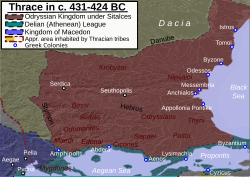
Teres, who is claimed to have lived 92 years, had died by the outbreak of the Peloponnesian War in 431. His successor was his son Sitalces, whose reign is mostly known thanks to the account of Thucydides.[18] Before the war he is known to have campaigned against the Paeonians in the west, subjugating some of the tribes living along the upper reaches of the Strymon.[35] Now, his influence extended over much of Bulgaria, Greek and Turkish Thrace and also parts of southeastern Romania: from the Strymon and Iskar rivers in the west to the Black Sea and the Propontis in the east as well as the Haemus and the mouth of the Danube (which was ruled by the tributary Getae) in the north.[36][37] According to Thucydides, the Odrysian state was "very powerful, and in revenue and general prosperity exceeded all the nations of Europe which lie between the Ionian Sea and the Euxine [Black Sea]."[38]
In the south, much of coastal Thrace had passed under the rule of Athens, making them direct neighbours of the Odrysians.[39] The Athenians had already taken some interest in the Thracian interior before 431, but it was in said year when they concluded an alliance with Sitalces against Perdiccas II of Macedon in the west.[40] This pact was cemented by a dynastic marriage, as Sitalces would marry the sister of the Athenian ambassador, Nymphodoros of Abdera. Sitalces' son Sadokos was sent to Athens and was granted the Athenian citizenship.[37] Sitalces, apparently an experienced leader with political acumen,[41] would prove his commitment to the alliance in the next year, when he arrested a Peloponnesian embassy that tried to persuade him to join the Spartan side and handed it over to Athens.[37]
_(cropped).jpg)
At the turn of the year 428, Sitalces raised a massive, multi-ethnic army to march against Macedon and insurgents on the Chalcidice peninsula. His army consisted of a variety of Thracians (some, like those of the Rhodopes, were independent, but joined nonetheless), Getae and some Paeonians.[37] While Sitalces managed to subjugate some of the Thracian tribes of the lower Strymon, his invasion of eastern Macedon and the Chalkidiki was less successful, as his opponents avoided open combat and simply hid behind their walls. The Odrysian army had not the means to storm them, plus winter was approaching and food supplies were running out. Furthermore, the Athenian force that was promised to them never arrived, perhaps because Athens feared the might of the unleashed Thracian kingdom. After failed negotiations with Perdiccas II, Sitalces retreated back home.[42] Thus, after only 30 days the Odrysian invasion had come to an end.[37]
Seuthes I
[edit]
Sitalces was succeeded in 424 by his nephew Seuthes I after the former was killed while campaigning against the Triballi,[43] who resided north of the western Haemus.[44] Throughout his reign, the Odrysians did not intervene in coastal Thrace, which had now become a contested battlefield between Athens and Sparta.[45] Athens for its part began to make heavy use of Thracian mercenaries acting as light skirmishers, the peltasts. Due to their success the Greeks soon began to raise peltast units of their own. Still, the Athenians eventually lost the Peleponnesian war and, for a few years at least, much of their influence in the northern Aegean.[46] Seuthes I was eventually succeeded by Amadocus I, also known as Medokos, in around 410[47] or 405 BC.[45]
First signs of decay and brief revival under Cotys I (404–360 BC)
[edit]The civil wars between Amadocus I and Seuthes II
[edit]
By the turn of the 4th century the Odrysian kingdom showed its tendency towards fragmentation. Two rulers are known by 405: Amadocus I and Seuthes II.[48] The historian Diodorus Siculus even called both of them "kings of the Thracians", although this is most likely a misunderstanding: by 405 Seuthes II still considered Amadocus I as his suzerein.[49] Amadocus was the son of a previous king Sitalces, while Seuthes II was the son of a Thracian chieftain named Maisades. Maisades was a descendant of king Teres, making Seuthes II and Amadocus I distant relatives. There was also an autonomous Odrysian prince in the western hinterlands of Byzantium named Teres.[47]
Initially raised at the court of Amadocus, Seuthes was sent to eastern Thrace several years before 405. By 405 he had managed to consolidate his position[50] over a realm stretching from Apollonia Pontica over the Strandzha to parts of the northern Propontis coast. In 400 BC he hired Greek mercenaries under Xenophon to expand his dominion at the cost of Teres and other rebels, forcing them to reacknowledge the authority of Amadocus.[51] Due to lacking funds they left his service already after two months. Seuthes II eventually rose against Amadocus, although little is known about this insurrection. In 389 the Athenian general Thrasybulus mediated between the two parties, resulting in Seuthes II, whom Xenophon called "ruler of the coast region", recognizing Amadocus' authority again.[52]
Amadocus, who had defied Seuthes' insurrection probably due to his own popularity, died soon after 389.[53] His successor was Hebryzelmis, about whom very little is known, but who, like Amadocus, sought the good will of Athens. Seuthes II on the other hand allied with Sparta.[54] An Athenian inscription from the year 386/5[54] confirms that Hebryzelmis sent a delegation to Athens to legitimize his rule and/or gain an ally against Seuthes. However, the Athenians had little interest in another war in the region and thus limited themselves to kind words.[55] Meanwhile, Seuthes had risen yet again against the crown. This second war went badly, as he seemingly lost all of his domains before reconquering them thanks to a mercenary army led by Iphicrates. Iphicrates subsequently married the daughter of Seuthes' son, Cotys I.[54]
Renaissance under Cotys I
[edit]
Cotys I succeeded Seuthes II in 383. The historian Michael Zahrnt described Cotys as "the right man to strengthen the run-down Odrysian realm, vigorous, and an artful diplomat [...]."[54] Indeed, it was under him that the kingdom reached its greatest might and became a considerable political factor in the nascent Hellenistic world. He was also the only Odrysian king whose character was excessively discussed by ancient scholars, although primarily in a rather unfavourable way.[56] While virtually nothing is known about the early years of his rule it is clear that he, together with his son-in-law Iphicrates, managed to conquer the domains of the deceased Hebryzelmis, thus uniting the Odrysian realm under his rule.[54] In 375 he faced an invasion of the Triballi, who devastated the western parts of the realm while marching towards Abdera at the coast.[57]
Cotys eventually set his eyes on the strategic Chersonese and the Hellespont, challenging the Athenian hegemony in the region.[58] The Athenians were more than ready to fight for the control of the Hellespont, as it was vital for Athens' grain supply from the northern Black Sea region.[59] An early invasion in 367 failed, but in 363/2 Cotys was more successful and repeatedly defeated several Athenian generals.[60] Thus, the Chersonese and the Hellespont had come under direct Odrysian rule. This achievement, however, proved short-lived:[58] much to Athens relief, Cotys I was eventually murdered in 360/59.[60]
Disintegration and conquest by Macedon (360–340 BC)
[edit]The three kingdoms
[edit]_126,_Athens.png)
The death of Cotys, almost contemporary to the coronation of the talented Philip II of Macedon, marked the beginning of the kingdom's downfall. The Odrysian state was divided among three competing kings: Cersebleptes, the son of Cotys, ruled the eastern parts beyond the lower Hebros and Tonzos; Amadocus II, perhaps a son of Amadocus I,[61] ruled central Thrace between Maroneia and the Meritsa; Berisades controlled the western part from Maroneia in the east to the Styrmon in the west.[62][b]
Cersebleptes was the most ambitious of the three. He continued his father's war against Athens for the Chersonese, while also striving to reunite the Odrysian kingdom. His attempts proved futile, for Amadocus II and Berisades, who received support from Athens, resisted his attacks. In 357 he was forced to accept a peace treaty that sealed the division of the Odrysian state.[63] An inscription from Athens describes said treaty. First, Cersebleptes had to cease his hostilities in the Cheresonese. Second, all three kings and Athens agreed to share their tributes received from the Greek colonies along the Aegean and the Hellespont. Third, the kings promised to enter an alliance with Athens and both sides had to provide each other with military support if tributary Greek colonies revolted. Cersebleptes, however, soon quit that treaty and continued his war in the Chersonese.[64]
Conquest by Philip II
[edit]
As early as 359, the year of his coronation, Philip II of Macedon I contacted a "Thracian king" to persuade him to not harbour a Macedonian pretender to the throne. This king is probably to be identified with the western Odrysian king Berisades.[64] A year later he unified Macedon and subjugated the Paeonians to the northeast.[65] In these early years he did not bother much with Thrace yet, as he regarded the infighting Odrysian kingdoms as no threat for his rule.[62] A first push into the kingdom of Berisades and his successor Cetriporis occurred in 357/6, when he conquered Amphipolis and Crenides.[63] The latter was made into a garrison town called Philippi that was to serve as a launch pad for future invasions into the interior.[66] Cetriporis allied himself with the kings of Paeonia and Illyria, but Philip II defeated them one by one.[63] Cetriporis was allowed to keep his kingdom, at least for a few more years.[64]
Cersebleptes continued his attempts to unite the Odrysian kingdoms:[67] in 353/4 he and Philip discussed the invasion of the kingdom of Amadocus II and the Athenian domains in Thrace,[63] while around a year later he marched against the kingdom of Cetriporis.[68] Meanwhile, Athens feared a possible alliance between Philip and Cersebleptes and decided to make an example by conquering the town of Sestos and eradicating its population. Intimidated, Cersebleptes renounced his claims on much of the Chersonese and allied with Athens. This was unacceptable for Philip, who allied with Amadocus II and marched against Cersebleptes.[69] After besieging him in his residence in Heraion Teichos in 351, he forced the Thracian king to surrender and took his son as a hostage.[59] Around this time, Philip also abolished Cetriporis' kingdom[70] and deposed Amadocus II in favour of Teres II.[71]

After these events, the Thracian front remained peaceful until 347 or early 346, when the Athenians again attempted to strengthen their presence in Thrace, which they probably did at the request of Cersebleptes. Macedon expelled the Athenian garrisons and defeated the Odrysians, preventing yet again a Thraco-Athenian alliance against him.[72] As a result of this campaign[73] Philip also put the Aeagean coast as far east as Acontisma (not the banks of the Nestos river as often assumed) under direct Macedonian administration.[66]
A few years later Cersebleptes allied with Teres II and invaded the Chersonese, which was now under Macedon's protection.[74] After asking the Persian king Artaxerxes III to cut the support of the Ionian towns for Cersebleptes,[75] Philip finally felt confident enough to begin his most ambitious project so far: the conquest of inland Thrace in the form of a large campaign that would last from 342 to 340.[72][76] Few details are known about this campaign.[72] It seems to have started in May or June, when Philip's army penetrated the interior by marching upstream the Martisa river. The Odrysians resisted valiantly and confronted the Macedonians in many battles.[75] Philip faced several setbacks and even seems to have lost at least one battle. By the spring of 341, fighting was still raging and Philip was forced to call in reinforcements. Although detailed evidence is lacking he finally managed to improve his situation and defeated Cersebleptes and Teres at some point between the second half of 341 and the first half of 340.[72]
Rise of the Getic kingdom
[edit].JPG)
The Getae, a northern Thracian people[77][78][79] located between the northeastern foothills of the Haemus range and the lower Danube and the Black Sea, had been part of the Odrysian realm since Teres I, even though it is not clear how tightly they were actually incorporated into the state. When and how the Getae became independent is not discussed in the available sources.[80] Perhaps they became independent during the rule of Cotys I[81] or after his death in 360.[21] Rich funeral treasures from the second half of the 4th century, like those of Agighiol, Peretu or Borovo, attest to the increasing wealth of the Getic elite.[21] Several artefacts seem to have originated in the Odrysian kingdom and may well have been prestige gifts.[81]
By the middle of the 4th century, there existed a Getic kingdom that was to thrive for a century.[82] The Getic capital was Helis, which has been identified with the archaeological site of Sboryanovo, which was founded in the 330s[83] or early 320s[21] and housed around 10.000 inhabitants.[84] It seems that the Getae also became active in Muntenia north of the Danube,[85][86] a region that would come to constitute a part of the "Dacia" of imperial Roman historiography.[87] The first Getic king to appear in the sources was Cothelas, who married his daughter Meda to Philip II,[21] thus concluding an alliance between the two states.[88] This probably happened during[89] or shortly after Philip's conquest of the Odrysians.[90] The kingdom survived two wars with Lysimachus[91] and the Celtic invasion in around 280, but eventually disintegrated a few decades later.[92] Helis/Sboryanovo was completely destroyed by an earthquake in the middle of the 3rd century.[84]
The rebellion of Seuthes and the kingdom of Seuthopolis (c. 330 – second quarter of the 3rd century BC)
[edit]Macedonian Thrace
[edit]
The conquest of the Odrysian kingdoms doubled the size of the domains ruled by Philip II,[90] even though inland Thrace was not transformed into a Macedonian province, but was put under the loose control of a Strategos. Local Thracian rulers who seemed trustworthy were allowed to rule on Macedonian behalf, granted that they would pay a tithe and provide troops.[93] Such troops, generally called "Thracians" or "Odrysians", participated in the Macedonian conquest of Persia under Philip's successor Alexander the Great[94] and were probably commanded by Odrysian noblemen.[95] Philip founded several towns in Thrace to ease Macedonian rule, most prominently Cabyle and Philippopolis.[96] The situation south of the Haemus remained largely stable for the next few years,[97] albeit even here, Macedon never managed to impose its rule over all Thracian tribes.[94] Macedon's rule was precarious and a potential Odrysian upstarter could count on the support of much of the disgruntled population.[98]
Seuthes III and the Odrysian revival
[edit]


With Alexander's absence in Asia, the Strategoi of Thrace engaged in rebellions and failed expeditions against the Getae, greatly unsettling the country in the process.[99] At the end of the 330s or in the mid-320s (the dating is not entirely clear), a certain Seuthes, later known as Seuthes III, instigated a Thracian rebellion.[100] He seems to have been an Odrysian[101] and may have been associated with the royal house of Cersebleptes, although his social background must remain speculation.[102][103]
After Alexander's death in 323, one of his bodyguards named Lysimachus was appointed as the satrap of Thrace. Soon after his arrival he faced off with Seuthes, who had rallied much of Thrace around his banner.[104] Seuthes' goal seems to have been the revival of an independent Odrysian state.[105] A battle ensued between him and Lysimachus, which Lysimachus barely and by no means decisively won. Both sides prepared for a second conflict, but the primary source for this event, Diodorus Siculus, provides no details on its outcome.[106]
In any case, both parties eventually reached a settlement, restricting Seuthes to the interior and Lysimachus to the coastal regions of the Aegean and Black Sea.[104] There is no evidence for Lysimachus vassalizing Seuthes.[107] Thrace north of the Rhodopes probably remained outside of Lysimachus' reach,[108] as he may have regarded its pacification not worth the money and manpower.[107] In 313 Seuthes allied with revolting Greek towns on the western shore of the Black Sea, but Lysimachus defeated this alliance. It is possible that to guarantee the peace between the two opponents, Seuthes married a daughter of Lysimachus named Berenice. Afterwards, there is no evidence for another confrontation between the two.[109]

Seuthes was keen to establish a Hellenistic kingdom,[110] although he avoided to label himself as king on his coins.[111] Probably after the death of Alexander in 323,[112] Seuthes founded a town at the Tonzos river, near modern Kazanlak. He named it after himself: Seuthopolis.[104] The town was primarily based on contemporary Macedonian foundations and showed heavy Greek influences.[110][113] Seuthopolis probably acted as the capital of Seuthes' kingdom.[104] The size and power of this kingdom should not be overestimated, as its influence was most likely limited to the hinterland of Seuthopolis,[114][115] in particular the valley between the Rhodopes in the south to the Haemus in the north and the Syrmus in the west to the upper Tonzos in the east.[116] Thus, his realm only covered the northwestern fringes of the former Odrysian empire.[101] Seuthes also only issued bronze coins, which were insufficient to challenge the Macedonian economic hegemony and its royal mintings in more precious metals.[117]
Fall of Seuthopolis
[edit]

It is unknown when Seuthes III died, with estimations ranging from the end of the 4th century to the 280s.[118] Coins minted in his name include overstruck coins of Cassander (died 297) and Lysimachus (died 281), implying that his coins were produced until the early years of the 3rd century BC.[115] Seuthes was symbolically buried in the tumulus of Golyama Kosmatka, without his actual corpse.[119] It may well be that he had been killed in battle, perhaps fighting against Lysimachus[120] or with him as an ally.[121]
A long inscription from Seuthopolis attests to the decline of the fortunes of the town[122] and the trouble in Seuthes' household.[123] It mentions the wife of Seuthes, Berenice, and their four (probably underage) sons Hebryzelmis, Teres, Satocos and Satalas.[122] The document was issued in the name of Berenice and includes the phrase "when Seuthes was in good health", which implies that by the time of writing, he was either dead or dying[118] and that Berenice had taken the rule.[122] The inscription describes negotiations between Berenice and Spartokos, the ruler of Cabyle, a town once founded by Philip II.[114] Indeed, Cabyle had not remained a Macedonian fort for long, but began to mint coins[108] and developed into a city-state with considerable influence. Spartokos is known from several coins minted after 281 where he is addressed as king (basileus).[122]
Although not mentioned in the Seuthopolis inscription and known only from a few coins and an inscription in a grave from Kazanlak, Seuthes seemed to have another son named Roigos, who eventually became king.[124][c] The fate of Seuthes' dynasty remains enigmatic.[111] Other Thracian monarchs recorded in sources from the 3rd century, like Cotys or Scostocus, can not be proved to have been Odrysian, even if they are often labelled as such by modern authors.[101]
The end of Seuthopolis is a matter of debate, but it is clear that the town was destroyed still in the first half of the 3rd century. According to some scholars it was conquered by the Celts in the 270s.[122] The Celts were ravaging much of the Balkan Peninsula since the early 270s and also led numerous incursions into Thrace.[126] In c. 278 and led by Comontorius, they eventually founded a kingdom in eastern Thrace centered around Tylis.[127] A newer theory proposes the destruction of the town in the 250s, based on a revamped dating of pottery, numismatic evidence and the presence of several Celtic artefacts. The archaeological evidence also shows the employment of siege artillery, which is unlikely to have been utilized by Celts. It may therefore be that Seuthopolis was not destroyed by the Celts, but by the Seleucid king Antiochus II, who campaigned in the Thracian interior in around 252.[128]
The Odrysians after 250 BC
[edit]Most modern historians believe that the Odrysian kingdom continued to exist throughout the Hellenistic and the early Imperial period, when it became a Roman vassal state. However, the evidence for this assumption is in fact very slim.[129] Throughout the remainder of the 3rd century, Thrace remained fragmented into various political entities. In the interior ruled various badly known Thracian dynasts.[130] In the east was the kingdom of Tylis, a Celtic-dominated predator state which existence was based on blackmailing tribute and that was eventually destroyed by a Thracian revolt or attack[131] soon after 220.[132] In the southeast and based at the town of Lysimachia, the Seleucids established themselves under Antiochus II (r. 261–246), who relied on allied Thracian dynasts to expand his influence deep into the interior. After his death in 246 the Seleucid presence was replaced by that of the Ptolemies, who established a satrapy in coastal Thrace.[133][134] An Odrysian kingdom, however, is not described in the sources.[101]
In the last years of the 3rd century, Macedonia under king Philip V began a renewed expansion to the east, exploiting the weakness of the Ptolemies after the death of Ptolemy IV. While Philip's initial focus was on coastal Thrace, he also led a campaign into the interior. Temporarily losing his Thracian holdings after the end of the Second Macedonian War in 197,[135] he reconquered most of them a decade later, while again campaigning in the Thracian interior.[136] In 184 or 183 he pushed into the plains of the upper Hebros, defeated the Odrysians and other local tribes and conquered Philipopolis, although the Odrysians reconquered the town soon afterwards. It may be noteworthy that no Odrysian king is mentioned.[137] While in 181, Philip was still climbing the Haemus in northern Thrace,[136] his Thracian empire collapsed with his death two years later.[138]
Between 171 and 168, Philip's heir Perseus engaged the Roman Republic in the Third Macedonian War. Perseus' most trusted ally in this war was the Thracian king Cotys,[136] whom the historian Polybius calls an Odrysian.[139] He fought in the battles of Callinicus and Pydna, but eventually became a Roman ally after the war.[136] Perhaps he is identical with the Cotys mentioned by the historian Strabo.[d] However, his Odrysian background has been doubted, as the account of Polybius, the only remaining source (minus Livy, who relied on Polybius), called him an Odrysian only once, while also calling the Getic king Dromichaetes an Odrysian. It may thus be likely that Polybius used "Odrysian" as a synonym for "Thracian". Furthermore, after the war Cotys was described as being active in the hinterland of Abdera at the Aegean coast, implying that he was rather a Sapaean king, who are known to have resided in the Rhodopes. His identity must remain uncertain. It is a fact, however, that Cotys was the last king in the sources to be explicitly labelled an "Odrysian".[139] There is also no evidence that Odrysians had any affiliations with the royal houses of the Sapaeans and Asti of the 1st century BC.[141]
By the middle of the 1st century BC, the Romans dominated coastal Thrace,[142] while the most important Thracian tribes were the Sapaeans and the Asti.[143] The Romans decided not to implement an administration in the Thracian interior, but instead relied on indirect influence via a large, Hellenized client kingdom resembling the Odrysian kingdom of old.[144] Probably soon after the Battle of Actium in 31 BC, the Romans abolished the Asti dynasty and established the Sapaeans in Bizye, the capital of the former.[145] The Sapaeans of Bizye created a large kingdom loyal to Rome[146] and even expanded into the interior. Little is known about how the Sapaeans administered this region, although they made Philippopolis a royal residence. In 21 AD king Rhoemetalces II took refuge in Philippopolis when he was confronted with a rebellion, among them Odrysians.[147] While the historian Tacitus described them as powerful, their uprising failed due to their bad coordination.[148] The Romans eventually dissolved the Sapaean kingdom in 45/6 and turned it into the province of Thracia.[149]
Kingship and the nature of Odrysian rule
[edit]
Although covering almost a third of the entire Balkan peninsula at its peak,[151] the Odrysian kingdom is unlikely to have had state-like institutions before the reign of Seuthes III.[152] In general, the Odrysian kingship was heavily influenced by the Persian court,[153] while also bearing many similarities to the one practiced in Macedon.[154] Unlike in the contemporary Greek city-states, the Odrysian kings needed to legitimize their rule by military prowess, religion and gifts.[155] The royal gift exchange, a practice originally adopted from the Persian court,[156] was especially important for legitimation.[157] Thucydides noted that the total tribute of 400 talents of gold and silver generated under king Seuthes I was distributed among Seuthes as well as the "chief men and nobles of the Odrysae".[158] Several inscribed silver vessels mention king Cotys I and Cersebleptes and were most likely gifts or tribute.[159] While the king received valuable gifts like gold, silver, textiles or horses,[160] he was also expected to distribute gifts like artefacts, women or land[161] to earn the loyalty and achieve the expansion of his military retinue.[157] Such systems are inevitably unstable,[162] royal authority would always remain rather fluid.[25]
Due to the fragmentary nature of the remaining sources, the royal court and the administration of the kingdom must remain largely obscure.[163] It can be assumed that, as in early Macedon, the Odrysian kings formed the heart of the realm and controlled the policy and the minting of coins, appointed loyal deputies and commanded the troops on the battlefield.[164] The realm was essentially the king's estate.[165] Below the king was an elite of horse warriors and administrators deriving not only from the royal court, but also from rival tribes. Thucydides called said local rulers paradynasteuontes, meaning "those who share power".[163] A similar elite class loyal only to the king, the hetairoi, could also be found in Macedon.[164] The Odrysian kingdom appears to have been rather decentralized, consisting of many different regional elites vying for power. Their rule over their subjects, who lived in scattered hamlets, was very loose and exercised mainly through raiding and demanding tribute.[166]


There is no evidence that the early Odrysian kings had a fixed capital. Instead, they probably maintained a mobile court, moving throughout the kingdom and residing in fortified residences.[167] These small fortified places, which the Greeks called thyrseis, were the backbones of the Thracian aristocracy in a society that did not build towns or cities.[168] This changed somewhat in the late 4th century, when Seuthes III founded Seuthopolis, marking the establishment of early state-like institutions[152] which were probably inspired by those of Hellenistic Macedon.[169] Seuthopolis' size always remained quite small, housing not more than 1.000 inhabitants. It is very likely that it was the home of the kingdom's aristocracy, while the common population continued to live outside the city walls,[170] still practicing the agro-pastoral subsistence economy of old.[152]
Army
[edit]
When Sitalces' army invaded Macedon he supposedly fielded an army numbering 150.000 men, which is likely an inflated number.[172] Around 100 years later, when Seuthes III confronted Lysimachus, the numbers had shrunk to 28.000 men.[173] A considerable part of these armies were horsemen. Of Sitalces' army, every third warrior was a horseman, who were provided by the Odrysians and the Getae,[174] while the army of Seuthes III had 8.000 riders, probably all Odrysians.[173] The majority of Sitalces' infantry was described as being of rather low quality[175] and was certainly composed of ill-organized levies.[172] It therefore appears that warfare remained a heroic pursuit worthy only of the aristocracy, while military training for the commoners was considered unfitting.[175] Despite this, the Thracian infantry made a great impression on the Greeks, who hired them as mercenaries.[176] Meanwhile, the Odrysian kings made use of Greek mercenary commanders like Xenophon or Iphicrates, while Greek towns inside Thrace were defended by the colonists themselves.[177]
Initially, the Odrysian army was divided into light infantry and light cavalry. The infantry used bows, slings, spears, swords, axes and light crescent-shaped shields called pelte, giving these warriors their name: "peltasts". Round and oval shields were, however, also utilized.[178] A weapon primarily found in the western and central Rhodoes was the Rhomphaia.[179] Except of slings, the cavalry used the same weapons as the infantry.[180] In the later 5th century the Thracian cavalry began to adopt armour.[181] The employed helmets were of the Chalcidian, Phrygian / Thracian and Corinthian types,[179] of which the Chalcidian type seems to have been the most popular.[182] The earliest torso armour was a type of primitive muscle cuirass of cylindrical form that had long fallen out of use elsewhere.[183] Leather and linen armour was also worn.[184] In the 4th century scale armour became popular,[179] while greaves were also adopted at that time.[179] Finally, there is also evidence that the Thracians employed siege artillery, in particular catapults.[185]
Culture
[edit]
Odrysian crafts and metalworking were largely a product of Persian influence.[186][187] Thracians as Dacians and Illyrians all decorated themselves with status-enhancing tattoos.[188] Thracian warfare was affected also by Celts and the Triballi had adopted Celtic equipment. Thracian clothing is regarded for its quality and texture and was made up of hemp, flax or wool. Their clothing resembled that of the Scythians including jackets with coloured edges, pointed shoes and the Getai tribe were so similar to the Scythians that they were often confused with them. The nobility and some soldiers wore caps. There was a mutual influence between the Greeks and the Thracians.[189] Greek customs and fashions contributed to the recasting of east Balkan society. Among the nobility Greek fashions in dress, ornament and military equipment were popular.[190] Unlike the Greeks, the Thracians often wore trousers. Thracian kings were influenced by Hellenization.[191] Greek as a lingua franca had been spoken at least by some members of the royal household in the fifth century BC and became the language of administrators; the Greek alphabet was adopted as the new Thracian script.[192]
Archaeology
[edit]Residences and temples of the Odrysian kingdom have been found, particularly around Starosel in the Sredna Gora mountains.[193] Archaeologists have uncovered the northeastern wall of the Thracian kings' residence, 13 m in length and preserved up to 2 m in height.[194] They also found the names of Cleobulus and Anaxandros, Philip II of Macedon's generals who led the assault on the Odrysian kingdom.[194]
List of Odrysian kings
[edit]| History of Bulgaria |
|---|
 |
|
Main category Bulgaria portal Bulgaria portal |
The list below includes the known Odrysian kings of Thrace, but much of it is conjectural, based on incomplete sources, and the varying interpretation of ongoing numismatic and archaeological discoveries. Various other Thracian kings (some of them possibly non-Odrysian) are included as well.[195] Odrysian kings, though called Kings of Thrace, never exercised sovereignty over all of Thrace.[196] Control varied according to tribal relationships.[197] Odrysian kings (names are presented in Greek or Latin forms):
- Teres I, son of ? Odryses, (480[195]/450–430 BC[198])
- Sparatocus, son of Teres I (c. 465?-by 431 BC)
- Sitalces, son of Teres I (by 431–424 BC)
- Seuthes I, son of Sparatocus (424–396 BC)
- Maesades, father of Seuthes II, local ruler in eastern Thrace
- Teres II, local ruler in eastern Thrace
- Metocus (= ? Amadocus I), son of ? Sitalces
- Amadocus I, son of ? Metocus (unless identical to him[199]) or of Sitalces (410–390 BC)[200]
- Seuthes II, son of Maesades, descendant of Teres I, king in southern districts (405–391 BC)
- Hebryzelmis, son or brother of ? Seuthes I (390–384 BC)
- Cotys I, son of ? Seuthes I[201] or Seuthes II[202] (384–359 BC)
- Cersobleptes, son of Cotys I, king in eastern Thrace (359-341 BC)
- Berisades, rival of Cersobleptes, king in western Thrace in Strimos (359–352 BC)
- Amadocus II, rival of Cersobleptes, king in central Thrace in Chersonese & Maroneia (359–351 BC)
- Cetriporis, son of Berisades, king in western Thrace in Strimos (358–347 BC)
- Teres III, son of ? Amadocus II, king in central Thrace in Chersonese & Maroneia (351–342 BC)
- Seuthes III, rebel against Macedonian rule (by 324–after 312)
- Roigos, son of Seuthes (III?) (early 3rd century BC ?)
- The survival of a specifically "Odrysian" state beyond the early 3rd century BC is considered debatable.
- Cotys IV, son of Seuthes V (by 171-after 166 BC), last king described explicitly as Odrysian in the sources.
Odrysian Kings: a possible family tree
[edit]| Odryses KINGS OF ODRYSIANS | |||||||||||||||||||||||||||||||||||||||||||||
| Teres I | |||||||||||||||||||||||||||||||||||||||||||||
| Sitalces | Sparatocos | Maisades | |||||||||||||||||||||||||||||||||||||||||||
| Amadocus I/Metocus | Teres II | Seuthes I ∞ Stratonice of Macedon | Seuthes II | ||||||||||||||||||||||||||||||||||||||||||
| Amadocus II | Hebryzelmis | Cotys I (Odrysian) | (daughter) ∞ Xenophon general | (daughter) ∞ Thrasybulus general | |||||||||||||||||||||||||||||||||||||||||
| Teres III | Cersobleptes | (daughter) ∞ Iphicrates general | Seuthes III ∞ Gonimase ∞ Berenice | (daughter) ∞ Charidemus mercenary leader | Berisades | ||||||||||||||||||||||||||||||||||||||||
| Iolaus; Poseidonius; Medistas; Teres | Cotys II (Odrysian) in eastern Thrace | Teres IV in inner Thrace | Roigos; Reboulas; Teres; Hebryzelmis; Satocus; Sadalas | Cetriporis | |||||||||||||||||||||||||||||||||||||||||
| Raizdos in eastern Thrace | Seuthes IV in inner Thrace | ||||||||||||||||||||||||||||||||||||||||||||
| Cotys III (Odrysian) in eastern Thrace | Roigos in inner Thrace | Teres V in inner Thrace | |||||||||||||||||||||||||||||||||||||||||||
| Rhescuporis I (Odrysian) in eastern Thrace | Seuthes V in inner Thrace | ||||||||||||||||||||||||||||||||||||||||||||
| Amatokos III in inner Thrace | Cotys IV in inner Thrace ∞ Semestra | ||||||||||||||||||||||||||||||||||||||||||||
| Teres VI in inner Thrace | Dyegilos king of Caeni ∞ Apama of Bithynia | Bithys in inner Thrace BRANCH OF ASTAEAN KINGS | |||||||||||||||||||||||||||||||||||||||||||
| Sotimos king of Maedi ∞ Athenais of Pergamum | Cotys V of Astaean | ||||||||||||||||||||||||||||||||||||||||||||
- Seuthes II maybe father of Cotys I
- Teres II/ΙΙΙ maybe father of Seuthes III
- Cersoblepres maybe father of Seuthes III
- Roigos, son of Seuthes III, maybe king Roigos, son of Seuthes IV
- Raizdos maybe identical to Roigos
Odrysian treasures
[edit]-

-

-
 Sinemorets Gold figurines
 -
 Vazovo Thracian Pegasus
 -
 Letnitsa treasure
 -

-
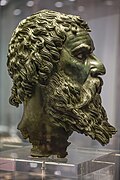 Bronze Head probably of Seuthes III found in Golyamata Kosmatka
 -
 King Cotys I's Borovo Treasure


See also
[edit]Notes
[edit]- ^ "In Hellenistic Thrace, the double axe was an attribute of Zalmoxis, the god of thunder. It is also depicted on coins of Thrace as the symbol of the kings of the Odrysae, who considered Zalmoxis the ancestor and protector of the royal house."[1]
- ^ The historian Peter Delev is less explicit while describing the realms of Amadocus II and Berisades: "Amadocus, probably a son of Medocus the Odrysian king in Xenophon's Anabasis, took the mountainous hinterland of Maroneia; while one Berisades established himself in the area around the lower Nestos. It remains unknown who of the three new kings took the rich inland plain of the Upper Hebros."[63]
- ^ An Athenian decree from 330 BC mentions a certain "Rebulas, the son of Seuthes and brother of Cotys", who is often assumed to have been a son of Seuthes III. However, he could also very well have been a son of Seuthes II.[102][125]
- ^ Strabo briefly stated that the Odrysians were ruled by the kings Amadocus, Cersobleptes, Berisades, Seuthes, and Cotys. The identification of the first three names with the kings who split the Odrysian king in three parts is obvious, while Seuthes has been identified with Seuthes III.[140] Curiously enough, Polybius noted that the father of Cotys was a man named Seuthes.[139]
- ^ Located in the corridor of the Kazanlak tomb, the painting is divided into two friezes, each showing two groups of warriors respectively interacting with each other. It has been proposed that the one group represents Thracians and the other Macedonians, although their similar clothing and equipment make it more likely that all of them are Thracians, although of different tribes. The two warriors in this scene may be negotiating or duelling.[171]
References
[edit]- ^ Kouremenos 2016, p. 46.
- ^ Popov, Dimitar (2014). Тракийска религия(in Bulgarian), p. 80. Iztok - Zapad. ISBN 978-619-152-349-8.
- ^ Rehm, Ellen (2010). "The Impact of the Achaemenids on Thrace: A Historical Review". In Nieling, Jens; Rehm, Ellen (eds.). Achaemenid Impact in the Black Sea: Communication of Powers. Black Sea Studies. Vol. 11. Aarhus University Press. p. 143. ISBN 978-8779344310.
In 470/469 BC, the strategist Kimon, mentioned above, defeated the Persian fleet at the mouth of the Eurymedon river. Subsequently, it seems that the royal house of the Odrysians in Thrace gained power and in about 465/464 BC emerged from the Persian shadow. The Odrysians became aware of the power vacuum resulting from the withdrawal of the Persians and claimed back supremacy over the region inhabited by several tribes. From this period onwards an indigenous ruling dynasty is comprehensible.
- ^ Zahrnt 2015, p. 35.
- ^ Bouzek & Graninger 2015, pp. 12–15.
- ^ a b Archibald 1998, pp. 9–10.
- ^ a b Bouzek & Graninger 2015, pp. 13–15.
- ^ Archibald 1998, pp. 94–96.
- ^ Zahrnt 2015, pp. 35–37.
- ^ Zahrnt 2015, p. 37.
- ^ Porozhanov 2009, pp. 129–134.
- ^ Archibald 1998, pp. 93–94.
- ^ a b c Vassileva 2015, pp. 322–323.
- ^ Vassileva 2015, pp. 320–322.
- ^ a b c d Archibald 1998, p. 102.
- ^ Vassileva 2015, p. 324.
- ^ Vassileva 2015, pp. 324–325.
- ^ a b Zahrnt 2015, p. 40.
- ^ Vassileva 2015, p. 325.
- ^ Thucydides 1881, 2.29.
- ^ a b c d e Stoyanov 2015a, p. 254.
- ^ Strobel 2019, p. 135.
- ^ Archibald 1998, p. 105, note 51.
- ^ a b Archibald 1998, pp. 102–103.
- ^ a b Archibald 1998, p. 3.
- ^ Archibald 1998, p. 103.
- ^ Braund 2015, p. 361.
- ^ Meyer 2013, p. 138.
- ^ Archibald 1998, p. 154.
- ^ Archibald 1998, p. 169.
- ^ Archibald 1998, p. 166.
- ^ a b c Tonkova 2015, p. 213.
- ^ Archibald 1998, p. 158.
- ^ Sears 2013, pp. 196–199.
- ^ Archibald 1998, p. 107.
- ^ Archibald 1998, pp. 107–112.
- ^ a b c d e Zahrnt 2015, p. 41.
- ^ Thucydides 1881, 2:97.
- ^ Zahrnt 2015, pp. 39–40.
- ^ Archibald 1998, pp. 117–118.
- ^ Archibald 1998, p. 118.
- ^ Archibald 1998, pp. 119–120.
- ^ Archibald 1998, p. 120.
- ^ Archibald 1998, Fig. 4.2..
- ^ a b Zahrnt 2015, p. 42.
- ^ Sears 2015, pp. 312–314.
- ^ a b Archibald 1998, p. 122.
- ^ Zahrnt 2015, pp. 42–43.
- ^ Archibald 1998, p. 123.
- ^ Zahrnt 2015, p. 43.
- ^ Archibald 1998, pp. 122, 123.
- ^ Zahrnt 2015, pp. 43–44.
- ^ Archibald 1998, p. 218.
- ^ a b c d e Zahrnt 2015, p. 44.
- ^ Kellogg 2007, pp. 60–62.
- ^ Kotova 2014, pp. 39–40.
- ^ Archibald 1998, p. 220.
- ^ a b Kotova 2014, p. 39.
- ^ a b Worthington 2014, p. 57.
- ^ a b Zahrnt 2015, p. 45.
- ^ Delev 2015a, pp. 48–49.
- ^ a b Worthington 2014, p. 40.
- ^ a b c d e Delev 2015a, p. 49.
- ^ a b c Archibald 1998, p. 232.
- ^ Worthington 2014, pp. 38–39.
- ^ a b Archibald 2010, p. 333.
- ^ Worthington 2014, p. 56.
- ^ Jordanov 1995, p. 153.
- ^ Worthington 2014, pp. 56–57.
- ^ Jordanov 1995, p. 155.
- ^ Delev 2015a, pp. 49–50.
- ^ a b c d e Delev 2015a, p. 50.
- ^ Archibald 1998, p. 234.
- ^ Jordanov 1995, p. 168.
- ^ a b Jordanov 1995, p. 169.
- ^ Archibald 1998, p. 235.
- ^ Strobel 2019, p. 132, note 6.
- ^ Delev 2000, p. 399.
- ^ Archibald 1998, p. 6.
- ^ Delev 2000, pp. 393–394.
- ^ a b Archibald 1998, p. 225.
- ^ Stoyanov 2015b, p. 430.
- ^ Delev 2000, p. 396.
- ^ a b Stoyanov 2015a, p. 255.
- ^ Delev 2000, pp. 395–396, 399.
- ^ Strobel 2019, pp. 149–150.
- ^ Strobel 2019, pp. 136–143.
- ^ Archibald 1998, p. 237.
- ^ Delev 2000, p. 395.
- ^ a b Worthington 2014, p. 76.
- ^ Delev 2000, pp. 386–392.
- ^ Delev 2015b, p. 63.
- ^ Loukopoulou 2011, p. 469.
- ^ a b Delev 2015a, p. 52.
- ^ Archibald 2010, p. 339.
- ^ Delev 2015a, p. 51.
- ^ Lund 1992, pp. 19–20.
- ^ Archibald 1998, p. 306.
- ^ Lund 1992, p. 20.
- ^ Delev 2015a, pp. 53–54.
- ^ a b c d Delev 2018, p. 192.
- ^ a b Delev 2015a, p. 53.
- ^ Lund 1992, p. 22.
- ^ a b c d Delev 2015a, p. 54.
- ^ Lund 1992, pp. 23–24.
- ^ Lund 1992, p. 25.
- ^ a b Lund 1992, p. 27.
- ^ a b Archibald 1998, p. 316.
- ^ Lund 1992, pp. 27–30.
- ^ a b Loukopoulou 2011, p. 472.
- ^ a b Lund 1992, p. 32.
- ^ Sobotkova 2013, pp. 136–137.
- ^ Lund 1992, pp. 26–27.
- ^ a b Lund 1992, p. 31.
- ^ a b Lehmann 2016, p. 43.
- ^ Lehmann 2016, p. 41.
- ^ Lund 1992, pp. 31–32.
- ^ a b Tzochev 2016, p. 783.
- ^ Strobel 2019, pp. 147–148.
- ^ Lehmann 2016, p. 37.
- ^ Strobel 2019, p. 148.
- ^ a b c d e Delev 2015b, p. 62.
- ^ Lund 1992, p. 30.
- ^ Dana 2015, p. 250.
- ^ Strobel 2019, p. 145, note 53.
- ^ Delev 2015b, p. 60.
- ^ Strobel 2019, p. 166.
- ^ Stoyanov 2015b, p. 434.
- ^ Delev 2018, p. 191.
- ^ Delev 2015b, pp. 61–63.
- ^ Grainger 2020, pp. 73, 75–76.
- ^ Strobel 2019, p. 167.
- ^ Dumitru 2015, p. 297.
- ^ Delev 2015b, p. 61.
- ^ Delev 2015b, pp. 64–65.
- ^ a b c d Delev 2015b, p. 66.
- ^ Delev 2018, pp. 192–193.
- ^ Loukopoulou 2011, p. 475.
- ^ a b c Delev 2018, p. 193.
- ^ Delev 2018, pp. 191–192.
- ^ Delev 2018, p. 194.
- ^ Terziev 2017, p. 131.
- ^ Delev 2016a, p. 49.
- ^ Lozanov 2015, pp. 78–80.
- ^ Delev 2016b, p. 125.
- ^ Kolev 2017, p. 127.
- ^ Terziev 2017, pp. 138–140.
- ^ Tacitus 1876, 3:38.
- ^ Lozanov 2015, p. 80.
- ^ Zournatzi 2000, p. 691.
- ^ Archibald 1998, p. 11.
- ^ a b c Sobotkova 2013, p. 142.
- ^ Brosius 2011, p. 140.
- ^ Greenwalt 2015, pp. 337, 338.
- ^ Greenwalt 2015, p. 337.
- ^ Brosius 2011, p. 145.
- ^ a b Sobotkova 2013, p. 135.
- ^ Zournatzi 2000, p. 692.
- ^ Zournatzi 2000, pp. 688–692.
- ^ Vassileva 2015, p. 327.
- ^ Greenwalt 2015, pp. 338–339.
- ^ Sobotkova 2013, pp. 135–136.
- ^ a b Archibald 2015, p. 55.
- ^ a b Greenwalt 2015, p. 338.
- ^ Greenwalt 2015, p. 340.
- ^ Sobotkova 2013, pp. 138–143.
- ^ Borza 1990, pp. 145–146.
- ^ Popov 2015, p. 117.
- ^ Xydopoulos 2010, pp. 219–220.
- ^ Sobotkova 2013, pp. 137–138.
- ^ Avramova 2015, pp. 72–73.
- ^ a b Archibald 1998, p. 119.
- ^ a b Lund 1992, p. 24.
- ^ Archibald 1998, pp. 204–205.
- ^ a b Greenwalt 2015, p. 339.
- ^ Sears 2015, pp. 313–314.
- ^ Stoyanov 2015b, p. 437.
- ^ Stoyanov 2015b, pp. 426–430.
- ^ a b c d Stoyanov 2015b, p. 431.
- ^ Stoyanov 2015b, p. 426.
- ^ Stoyanov 2015b, p. 432.
- ^ Archibald 1998, p. 201.
- ^ Archibald 1998, pp. 197–198.
- ^ Archibald 1998, pp. 199, 291.
- ^ Stoyanov 2015b, pp. 433–435.
- ^ Olivier Henry. Walter de Gruyter GmbH & Co KG, 11 April 2016, p. 2006
- ^ Entangled Histories of the Balkans – Volume Three: Shared Pasts, Disputed Legacies by Daskalov, BRILL, p. 92
- ^ The World of Tattoo: An Illustrated History by Maarten Hesselt van Dinter, 2007, page 25
- ^ The Thracians 700 BC-AD 46 (Men-at-Arms) by Christopher Webber and Angus McBride, 2001, ISBN 1-84176-329-2, page 18, 4
- ^ The Odrysian Kingdom of Thrace: Orpheus Unmasked (Oxford Monographs on Classical Archaeology) by Z. H. Archibald, 1998, ISBN 0-19-815047-4, page 5
- ^ The Peloponnesian War: A Military Study (Warfare and History) by J. F. Lazenby, 2003, page 224, "... number of strongholds, and he made himself useful fighting 'the Thracians without a king' on behalf of the more Hellenized Thracian kings and their Greek neighbours (Nepos, Alc. ...
- ^ The Odrysian Kingdom of Thrace: Orpheus Unmasked (Oxford Monographs on Classical Archaeology) by Z. H. Archibald, 1998, ISBN 0-19-815047-4 page 3
- ^ "Bulgarian Archaeologists Make Breakthrough in Ancient Thrace Tomb". Novinite. 11 March 2010. Retrieved 3 April 2010.
- ^ a b "Bulgarian Archaeologists Uncover Story of Ancient Thracians' War with Philip II of Macedon". Novinite.com (Sofia News Agency). 21 June 2011. Retrieved 24 June 2011.
- ^ a b Mladjov, Rulers of Thrace, University of Michigan
- ^ The Odrysian Kingdom of Thrace: Orpheus Unmasked (Oxford Monographs on Classical Archaeology) by Z. H. Archibald,1998, ISBN 0-19-815047-4, page 105
- ^ The Odrysian Kingdom of Thrace: Orpheus Unmasked (Oxford Monographs on Classical Archaeology) by Z. H. Archibald,1998, ISBN 0-19-815047-4, page 107
- ^ Thrace. The History Files.
- ^ The distinction between Metocus and Amadocus I is primarily argued by Tacheva 2006: 88-96, 106-113.
- ^ Smith, William (1867). "Amadocus (I)". In William Smith. Dictionary of Greek and Roman Biography and Mythology 1
- ^ Topalov 1994.
- ^ Archibald 1998.
Sources
[edit]- Archibald, Z. H. (1998). The Odrysian Kingdom of Thrace. Orpheus Unmasked. Clarendon. ISBN 978-0198150473.
- Archibald, Zosia (2010). "Macedonia and Thrace". In Roisman, Joseph; Worthington, Ian (eds.). A Companion to Ancient Macedonia. Wiley-Blackwell. pp. 326–341. ISBN 978-1405179362.
- Archibald, Zosia H. (2015). "L'émergence de l'aristocratie odryse". In Jean-Luc Martinez (ed.). L'épopée des rois thraces des guerres médiques aux invasions celtes 479–278 av. j. c. Découvertes archéologiques en bulgarie. Somogy. pp. 54–57. ISBN 978-2757209325.
- Avramova, Mariya (2015). "Images of Horsemen in Battle on Works of Thracian Art". Chronika. 5: 66–77. ISSN 2159-9912.
- Borza, Eugene N. (1990). In the Shadow of Olympus. The Emergence of Macedon. Princeton University. ISBN 0691055491.
- Bouzek, Jan; Graninger, Denver (2015). "Geography". In Valeva, Julia; Nankov, Emil; Graninger, Danver (eds.). A Companion to Ancient Thrace. Wiley-Blackwell. pp. 12–21. ISBN 978-1444351040.
- Braund, David (2015). "Thracians and Scythians. Tensions, Interactions and Osmosis". In Valeva, Julia; Nankov, Emil; Graninger, Danver (eds.). A Companion to Ancient Thrace. Wiley-Blackwell. pp. 352–365. ISBN 978-1444351040.
- Brosius, Maria (2011). "Keeping up with the Persians. Between Cultural Identity and Persianization in the Achaemenid Period". In Erich S. Gruen (ed.). Cultural Identity in the Ancient Mediterranean. Getty Trust Publications. pp. 135–149. ISBN 978-0892369690.
- Dana, Dan (2015). "Inscriptions". In Valeva, Julia; Nankov, Emil; Graninger, Danver (eds.). A Companion to Ancient Thrace. Wiley-Blackwell. pp. 243–264. ISBN 978-1444351040.
- Delev, P. (2000). "Lysimachus, the Getae, and Archaeology". The Classical Quarterly. 50 (2). Cambridge University: 384–401. doi:10.1093/cq/50.2.384. ISSN 1471-6844. JSTOR 1558897.
- Delev, Peter (2015a). "Thrace from the Assassination of Kotys I to Koroupedion (360–281 BC)". In Valeva, Julia; Nankov, Emil; Graninger, Danver (eds.). A Companion to Ancient Thrace. Wiley-Blackwell. pp. 48–58. ISBN 978-1444351040.
- Delev, Peter (2015b). "From Koroupedion to the Beginning of the Third Mithridatic War (281–73 BCE)". In Valeva, Julia; Nankov, Emil; Graninger, Danver (eds.). A Companion to Ancient Thrace. Wiley-Blackwell. pp. 59–74. ISBN 978-1444351040.
- Delev, Peter (2016a). "Between Pharsalus and Philippi. Thrace in the Forties BC". Thracia. 21: 49–59. ISSN 0204-9872.
- Delev, Peter (2016b). "Cotys Son of Rhascuporis". Monuments and Texts in Antiquity and Beyond. Essays for the Centenary of Georgi Mihailov (1915–1991). St. Kliment Ohridski University. pp. 119–129. ISBN 978-954-07-4103-1.
- Delev, Peter (2018). "Did a "Late" Odrysian Kingdom ever exist?". Atephanos Archaeological ad 80 annum professoris Ludmili Getov. St. Kliment Ohridski University. pp. 191–196.
- Dumitru, Adrian George (2015). "Some thoughts about Seleucid Thrace in the 3rd century BC". The Danubian Lands between the Black, Aegean and Adriatic Seas: (7th Century BC-10th Century AD). Archaeopress. pp. 293–299. ISBN 978-1784911928.
- Grainger, John D. (2020). The Galatians. Celtic Invaders of Greece and Asia Minor. Pen & Sword History. ISBN 978-1526770684.
- Greenwalt, William S. (2015). "Thracian and Macedonian Kingship". In Valeva, Julia; Nankov, Emil; Graninger, Danver (eds.). A Companion to Ancient Thrace. Wiley-Blackwell. pp. 337–351. ISBN 978-1444351040.
- Jordanov, Kiril (1995). "The Wars of the Odrysian Kingdom against Philip II 352–339 BC" (PDF). Balcanica (XXVI). Institute for Balkan Studies: 153–173. ISSN 2406-0801.
- Kellogg, Danielle (2007). Brennan, T. Corey (ed.). "The Athenian Decree Honoring Hebryzelmis of Thrace Reconsidered". American Journal of Ancient History. New Series. 3–4: 58. doi:10.31826/9781463213930-004. ISBN 9781463213930.
- Kolev, Philip (2017). "Bizye. From Tribal Residence to Roman City". Cities in Southeastern Thrace. Continuity and Transformation. St. Kliment Ohridski University. pp. 125–130. ISBN 978-954-07-4275-5.
- Kotova, Dobriela (2014). "The Personality of Kotys in the Ancient Literary Tradition". Orpheus. Journal of Indo-European and Thracian Studies. 21: 37–62. ISSN 0861-9387.
- Kouremenos, Anna (2016). "The double axe (λάβρυς) in Roman Crete and beyond: the iconography of a multi-faceted symbol". Roman Crete. New Perspectives. Oxbow Books. pp. 43–58. ISBN 978-1-78570-096-5.
- Lehmann, Stephan (2016). "Seuthopolis. Der hellenisierte Herrscher Seuthes III. (ca. 330–295 v. Chr.) und seine Residenzstadt im bulgarischen Rosental". In Fikentscher, Rüdiger (ed.). Wohnkulturen in Europa. Mitteldeutscher Verlag. pp. 36–48. ISBN 978-3-95462-713-4.
- Loukopoulou, L.D. (2011). "Macedonia in Thrace". In Fox, Robin J. Lane (ed.). Brill's Companion to Ancient Macedon. Brill. pp. 467–476. ISBN 978-90-04-20923-7.
- Lozanov, Ivaylo (2015). "Roman Thrace". In Valeva, Julia; Nankov, Emil; Graninger, Danver (eds.). A Companion to Ancient Thrace. Wiley-Blackwell. pp. 75–90. ISBN 978-1444351040.
- Lund, Helene S. (1992). Lysimachus. A Study in Early Hellenistic Kingship. Taylor & Francis Ltd. ISBN 978-0415070614.
- Meyer, Casper (2013). Greco-Scythian Art and the Birth of Eurasia. From Classical Antiquity to Russian Modernity. Oxford University. ISBN 978-0199682331.
- Popov, Hristo (2015). "Settlements". In Valeva, Julia; Nankov, Emil; Graninger, Danver (eds.). A Companion to Ancient Thrace. Wiley-Blackwell. pp. 109–125. ISBN 978-1444351040.
- Porozhanov, Kalin (2009). "King of the Thracian. Olorus in south-eastern Thrace. A Predecessor of the Odrysian King Teres I (between 516/514 BC and the end of the 6th/the beginning of the 5th centuries BC)". In Zanoci, Aurel; Arnăut, Tudor; Băț, Mihail (eds.). Studia Archeologiae et Historiae Antiquae. Moldova State University. pp. 129–134. ISBN 978-9975-80-239-0.
- Sears, Matthew A. (2013). Athens, Thrace, and the Shaping of Athenian Leadership. Cambridge University. ISBN 9781139612920.
- Sears, Matthew A. (2015). "Athens". In Valeva, Julia; Nankov, Emil; Graninger, Danver (eds.). A Companion to Ancient Thrace. Wiley-Blackwell. pp. 308–319. ISBN 978-1444351040.
- Sobotkova, Adela (2013). "Resisting Rule in Ancient Thrace". In Manolis Manoledakis (ed.). Exploring the Hospitable Sea Proceedings of the International Workshop on the Black Sea in Antiquity held in Thessaloniki, 21–23 September 2012. Archaeopress. pp. 133–146. ISBN 978-1-4073-1114-2.
- Stoyanov, Totko (2015a). "Un centre de pouvoir gète: Hélis-Sboryanovo". In Jean-Luc Martinez (ed.). L'épopée des rois thraces des guerres médiques aux invasions celtes 479–278 av. j. c. Découvertes archéologiques en bulgarie. Somogy. pp. 254–255. ISBN 978-2757209325.
- Stoyanov, Totko (2015b). "Warfare". In Valeva, Julia; Nankov, Emil; Graninger, Danver (eds.). A Companion to Ancient Thrace. Wiley-Blackwell. pp. 426–442. ISBN 978-1444351040.
- Strobel, Karl (2019). "Südosteuropa in der Zeit von Republik und Principat. Vorgeschichte, Etablierung und Konsolidierung römischer Herrschaft". In Mitthof, Fritz; Schreiner, Peter; Schmitt, Oliver Jens (eds.). Handbuch zur Geschichte Südosteuropas. Vol. Band 1. Herrschaft und Politik in Südosteuropa von der römischen Antike bis 1300. De Gruyter. pp. 131–266. ISBN 978-3-11-064342-8.
- M. Tacheva, The Kings of Ancient Thrace. Book One, Sofia, 2006.
- Tacitus (1876). The Annals. Book 3.
- Terziev, Stoyan (2017). "The cities in Southeastern Thrace and the central government under the last Thracian Kings (27 BC—AD 45)". In Daniela Stoyаnova; Grigor Boykov; Ivaylo Lozanov (eds.). Cities in southeastern Thrace. Continuity and Transformation. St. Kliment Ohridski University. pp. 131–140. ISBN 978-954-07-4275-5.
- Thucydides (1881). History of the Peloponnesian War. Book 2. Clarendon.
- Tonkova, Milena (2015). "Adornments". In Valeva, Julia; Nankov, Emil; Graninger, Danver (eds.). A Companion to Ancient Thrace. Wiley-Blackwell. pp. 212–228. ISBN 978-1444351040.
- S. Topalov, The Odrysian Kingdom from the Late 5th to the Mid-4th C. B.C., Sofia, 1994.
- Tzochev, Chavdar (2016). "Accounts from the Treasury of Seuthes III. Inscribed Silver Plate Found in the Tomb of the Golyama Kosmatka Mound". Hesperia: The Journal of the American School of Classical Studies at Athens. 85 (4). The American School of Classical Studies at Athens: 779–794. doi:10.2972/hesperia.85.4.0779. ISSN 1553-5622. S2CID 132960873.
- Worthington, Ian (2014). By the Spear. Philip II, Alexander the Great, and the Rise and Fall of the Macedonian Empire. Oxford University. ISBN 978-0199929863.
- Vassileva, Maya (2015). "Persia". In Valeva, Julia; Nankov, Emil; Graninger, Danver (eds.). A Companion to Ancient Thrace. Wiley-Blackwell. pp. 320–336. ISBN 978-1444351040.
- Xydopoulos, Ioannis K. (2010). "The Odrysian Kingdom after Philip II. Greek- and Self-perception". Eirene. Studia Graeca et Latina. XLVI: 213–222.
- Zahrnt, Michael (2015). "Early History of Thrace to the Murder of Kotys I (360 BCE)". In Valeva, Julia; Nankov, Emil; Graninger, Danver (eds.). A Companion to Ancient Thrace. Wiley-Blackwell. pp. 35–47. ISBN 978-1444351040.
- Zournatzi, Antigoni (2000). "Inscribed Silver Vessels of the Odrysian Kings. Gifts, Tribute, and the Diffusion of the Forms of "Achaemenid" Metalware in Thrace". American Journal of Archaeology. 104 (4): 683–706. doi:10.2307/507153. JSTOR 507153. S2CID 191470434.
Further reading
[edit]- Miron, Isabela (2013). "Roman Rule in The Odrysian Kingdom". Danubius. XXXI. Muzeului di Istori Galati: 7–14. ISSN 1220-5052.
- Tsiafakis, Despoina (2015). "Thracian Tattoos". In Bamberger, Günter; Shapiro, Alan; Wascheck, Frank (eds.). Bodies in Transition. Dissolving the Boundaries of Embodied Knowledge. Wilhelm Fink. pp. 89–118. ISBN 9783770558087.
| Authority control databases: National |
|---|

Odrysian kingdom
View on GrokipediaGeography and Territory
Extent and Core Regions
The core territory of the Odrysian kingdom encompassed the lands primarily inhabited by the Odrysian tribe, situated in the interior of Thrace along the valley of the Hebros River (modern Maritsa) and its tributaries, including the Tonzos (modern Tundzha) and Arda rivers. This region, corresponding to central and southeastern present-day Bulgaria, featured fertile plains and mountainous terrain that supported agricultural production and pastoralism, forming the economic and political heartland of the kingdom.[7][8] At its zenith under King Sitalces (c. 431–424 BC), the kingdom's extent expanded through hegemony over numerous Thracian tribes, stretching from the Aegean seaboard near Abdera in the south to the mouths of the Danube (Ister) River in the north, and eastward along the Black Sea coast while incorporating inland areas up to the approximate line of the Nestus River. Thucydides describes this domain as yielding substantial tribute—estimated at around 680 talents annually from subject tribes—highlighting its vast influence, though direct control was often nominal over peripheral groups.[9] The kingdom thus covered territories in modern southern Bulgaria, northern Greece, southeastern Romania's Dobruja region, and eastern Thrace in Turkey, though borders fluctuated due to tribal revolts and external pressures.[10] Key settlements within the core included the later capital Seuthopolis, established in the Tundzha Valley, reflecting the kingdom's centralized authority in this strategic riverine zone conducive to trade and defense. Archaeological evidence from sites like the Kazanlak Valley tombs underscores the region's role as an elite necropolis and cultural center.[11]Borders and Neighboring Powers
The Odrysian kingdom's territorial extent fluctuated across its history, but its core encompassed much of inland Thrace, bounded by the Danube River to the north, the Black Sea coast to the east, the Aegean Sea to the south, and the Strymon River valley to the west.[12] Under King Teres I's unification around 480 BC and subsequent expansions, the kingdom incorporated numerous Thracian tribes between the Haemus (Balkan) Mountains and the Rhodope range, though effective control diminished toward the peripheries.[13] During the peak under Sitalces (c. 431–424 BC), as described by Thucydides, the realm nominally stretched from Abdera on the Aegean coast opposite the island of Thasos to the Danube's mouths, encompassing over fifty tributary tribes and reputedly fielding an army of 120,000 infantry and 3,000 cavalry, though logistical realities limited centralized authority.[14] The western frontier along the Strymon or Nestos rivers marked a contested zone with Macedonian incursions, while northern limits at the Danube separated it from independent Thracian groups.[15] Key neighboring powers included the expanding Macedonian kingdom under rulers like Perdiccas II, which vied for control of the Strymon valley and mounted campaigns against Odrysian forces, such as Sitalces' failed 429 BC invasion supporting Athens.[16] To the northwest lay Paeonian territories, buffering against Illyrian influences, while north of the Haemus or Danube dwelt the Triballi and Getae, nomadic or semi-nomadic tribes that raided Odrysian borders and later resisted Macedonian advances under Philip II.[17] Greek poleis like Abdera and Byzantium along the southern and eastern coasts maintained semi-autonomous status amid Odrysian overlordship, fostering trade but sparking conflicts over tribute and piracy. Prior to Odrysian consolidation, the region fell under Achaemenid Persian sway as the satrapy of Skudra following Darius I's 513 BC Scythian expedition, with tribute obligations persisting into the 5th century BC until Greek city-state alliances eroded Persian influence.[18]Pre-Odrysian Context
Early Thracian Tribes and Settlements
The Thracians, an Indo-European people, established presence in the Balkan Peninsula during the Late Bronze Age, around 1600 BC, as evidenced by archaeological continuity in ceramics, metalwork, and settlement patterns across modern Bulgaria, Greece, and Turkey. Prior to the emergence of unified polities, Thracian society consisted of loosely organized tribes without overarching state structures, characterized by tribal confederations focused on kinship, warfare, and local chieftainships. Ancient sources, including Herodotus, enumerate numerous such tribes, estimating their numbers as exceeding twenty in the 5th century BC, with the Thracians described as potentially dominant in the region if unified but perpetually fragmented by internal divisions and rivalries.[19][20] In the central Thracian lowlands destined to form the Odrysian core, key pre-unification tribes included the Odrysians, who occupied the fertile Hebros (Maritsa) River valley, alongside adjacent groups such as the Satrae in the Rhodope Mountains, the Sapaei near the Aegean coast, and the Cicones further west. These tribes subsisted through mixed economies of grain cultivation, pastoralism, and extraction of precious metals from riverine deposits, fostering warrior elites evident in early bronze and iron artifacts depicting armed figures and horse gear. Herodotus highlights the Odrysians' relative prominence among neighbors, yet notes their subjugation as separate entities during Persian campaigns around 513–512 BC, underscoring the absence of coordinated resistance. Strabo later corroborates the multiplicity of tribes, listing over twenty, reflecting a persistent decentralized structure that persisted until the 5th-century BC consolidations.[19][21] Archaeological evidence from Early Iron Age sites (ca. 1100–700 BC) reveals settlements transitioning from Bronze Age tells to defensible hilltop enclosures and open villages, with fortifications indicating inter-tribal conflicts and resource defense. Notable examples include proto-Thracian complexes in the Strandzha Mountains and early hill settlements like those near Lion's Head in Bulgaria, featuring hand-built pottery, iron tools, and ritual deposits that align with tribal material cultures. By the 8th–7th centuries BC, emerging elite burials with imported Greek wares signal growing hierarchization within tribes, setting the stage for unification without implying prior state formation. These patterns, corroborated by stratified excavations, demonstrate causal links between environmental advantages—such as alluvial plains and mineral wealth—and the viability of independent tribal polities, though disunity limited scalability until external pressures catalyzed change.[22][23][20]Persian Domination and Skudra
In 513 BC, during his Scythian campaign, Darius I of the Achaemenid Empire advanced into Thrace, subduing numerous tribes east of the Strymon River up to the Danube, including the Getae and other groups in regions later associated with the Odrysians.[24] This conquest integrated Thrace into the empire as the satrapy of Skudra, named after the indigenous term for the region, encompassing much of European Thrace and possibly adjacent areas like the Chalcidice or Paeonia.[25] Persian control was achieved through alliances with local chieftains and the installation of garrisons, rather than wholesale administrative overhaul, allowing tribal structures to persist under nominal overlordship.[26] Skudra contributed troops to Persian forces, as evidenced by depictions of Thracian-style soldiers on Xerxes I's tomb reliefs from Naqsh-e Rustam, wearing characteristic attire including fox-skin caps and patterned tunics. During Xerxes' invasion of Greece in 480 BC, Thracian contingents from Skudra participated, bridging rivers and providing auxiliary infantry, though their effectiveness was limited by unfamiliar terrain and equipment.[27] Tribute from Skudra included 360 white mares and 160 uncastrated asses annually, per Herodotus, reflecting the region's pastoral economy and strategic value for securing the northern flank against nomadic threats.[26] Inland tribes, precursors to the Odrysians, submitted sporadically but maintained autonomy, with Persian influence fostering trade in goods like silverwork and wine amphorae, evident in archaeological finds from coastal emporia.[28] Persian domination waned after the Greek victories at Salamis and Plataea in 479 BC, prompting a retreat from most of Thrace, though coastal enclaves like Sestos persisted until their capture by the Athenians in 478 BC.[24] This power vacuum enabled the unification of Thracian tribes under leaders like Teres I around 480–460 BC, forming the Odrysian kingdom in the core Odrysian territories previously under loose Skudra oversight.[26] The brief Achaemenid interlude thus catalyzed political consolidation among Thracians by disrupting prior tribal fragmentation without eradicating indigenous hierarchies.Formation and Expansion (c. 480–431 BC)
Unification under Teres I
Teres I, father of Sitalces, is recognized by the ancient historian Thucydides as the inaugural ruler who forged the Odrysian kingdom into a dominant power in Thrace during the mid-fifth century BC.[29] He achieved this by subjugating a substantial portion of Thracian territory, incorporating numerous tribes under Odrysian hegemony while leaving the Satrae and Ski largely independent, though some elements of these groups became tributary.[29] Prior to Teres, Thracian polities consisted of loosely organized tribal confederations lacking centralized authority, rendering the region vulnerable to external domination such as the Achaemenid Persian satrapy of Skudra established around 516 BC.[30] The unification process capitalized on the retreat of Persian forces from Europe after their defeats at Salamis, Plataea, and Mycale in 480–479 BC, which dismantled the imperial administrative structure in Thrace and eliminated tribute collection mechanisms that had previously constrained local ambitions.[31] Teres, emerging from the Odrysian tribe centered in the Hebros River valley, likely employed a combination of military campaigns, kinship ties, and tribute systems to consolidate control over disparate groups including the Dii, Melanditae, and others in the Thracian plain, transforming fragmented chiefdoms into a proto-state capable of fielding large forces and extracting resources.[32] Herodotus, writing contemporaneously, acknowledges Teres as king of the Odrysians, indicating his rule predated the Peloponnesian War and aligned with the power vacuum's exploitation.[33] Under Teres, the kingdom's foundations emphasized tribute-based revenue, with Thucydides noting that Odrysian rulers amassed annual incomes exceeding 1,000 talents from subject tribes, far surpassing contemporary European states north of Greece—a figure that underscores the scale of unification through economic coercion rather than mere alliance.[34] This centralization marked a departure from the decentralized tribal warfare endemic to pre-unified Thrace, enabling sustained military projection toward the Propontis and Black Sea coasts, though specific campaigns attributable solely to Teres remain sparsely documented beyond Thucydides' overview.[35] Archaeological evidence from early fifth-century tumuli in the Kazanlak and Shipka regions, such as fortified hilltop settlements and elite burials with imported Greek wares, corroborates the emergence of a hierarchical Odrysian elite during this period, aligning with Teres' consolidation efforts.[36]Early Conquests and Elite Emergence
Teres I established the Odrysian kingdom around 480 BC, capitalizing on the retreat of Persian forces from Thrace after their failed invasion of Greece in 479 BC, which created a regional power vacuum.[37] As the first ruler to unify the Odrysians and neighboring Thracian tribes into a centralized state, he extended control over central Thrace through military campaigns, including advances toward the Propontis (modern Sea of Marmara) to secure coastal access and trade routes.[31] Thucydides records that Teres laid the foundations for a kingdom encompassing much of Thrace, setting the stage for further territorial gains under his successors Sparadocos and Sitalces, who incorporated additional tribes east to the Black Sea and north toward the Danube by the 430s BC.[38] These early conquests relied on the mobility of Thracian cavalry and peltast infantry, enabling rapid subjugation of fragmented tribal polities without the need for prolonged sieges.[32] The emergence of an Odrysian elite paralleled these expansions, manifesting as a warrior aristocracy that formed the core of royal authority. Thucydides emphasizes that Odrysian kings like Teres and Sitalces derived their power from a loyal cadre of noble retainers, who served as military leaders, tribute enforcers, and administrators, fostering a hierarchical structure distinct from looser tribal confederations.[38] This elite class benefited from control over resources like grain, timber, and precious metals, which funded ostentatious displays of wealth and solidified loyalty through gift-giving and patronage. Archaeological finds corroborate this development: the Svetitsa tumulus near Shipka, dated to the mid-5th century BC, yielded a gold funeral mask possibly belonging to Teres or a contemporary noble, accompanied by weapons and vessels signifying martial prowess and ritual status.[39] Such tumuli burials, concentrated in core Odrysian territories, indicate the crystallization of inherited elite lineages, influenced by prior Persian administrative models encountered during the satrapy of Skudra, which promoted centralized kingship and elite acculturation.[5] By the reign of Sitalces, this stratum supported armies numbering up to 150,000, underscoring the causal link between conquest-driven wealth accumulation and elite consolidation.[32]Archaeological Correlates of Foundation
Archaeological evidence for the foundation of the Odrysian kingdom under Teres I around the mid-5th century BC manifests in the proliferation of elite tumulus burials across Thrace, signaling the rise of powerful chieftains with centralized authority over resources and labor. These monumental earthen mounds, often exceeding 10-20 meters in height and covering stone chamber tombs, contain assemblages of gold ornaments, bronze weapons, pottery, and occasional Greek imports, indicative of a warrior aristocracy that could mobilize tribal alliances for conquest and trade. Such burials, increasing in scale and wealth from the late 6th to mid-5th century BC, correlate with the political consolidation described in ancient sources, as the labor required for mound construction and access to prestige goods suggest hierarchical structures transcending local clans.[40] A key example is the Svetitsata tumulus near the village of Kran in the Stara Zagora region of Bulgaria, excavated in 2004 by archaeologist Georgi Kitov, dating to the second half of the 5th century BC. The central grave held the cremated remains of a male aged about 40, accompanied by a gold funerary mask, vessels, jewelry, and bronze items, exemplifying high-status Thracian practices potentially linked to emerging royal ideology. Some researchers associate this burial with Teres I due to its timing and opulence, viewing the mask as emblematic of the foundational ruler's era, though definitive identification remains speculative absent inscriptions.[41][42] Further correlates include contemporaneous burials at sites like Dalokova and other inland Thracian necropoleis, where similar rich grave goods—such as silver rhyta and iron weapons—point to an Odrysian elite fostering cultural unity through shared funerary symbolism and exchange networks with Ionian Greeks. The absence of urban centers or fortifications in early contexts underscores a nomadic-pastoral base, with power evidenced more through portable wealth in tombs than permanent infrastructure, aligning with the kingdom's initial tribal confederation phase before later monumental building under successors.[43][44]Engagements with Greek World (431–360 BC)
Sitalces' Alliance with Athens
In 431 BC, as the Peloponnesian War commenced, Athens pursued alliances in the northern Aegean to secure tribute revenues and counter Spartan influence among the Chalcidian cities, which had begun to revolt. The Athenians turned to Sitalces, son of Teres I and ruler of the expansive Odrysian kingdom, whose domain stretched from the Danube to the Aegean. Negotiations were mediated by Nymphodorus of Abdera, a prominent figure with ties to both Sitalces—through marriage to his sister—and Perdiccas II of Macedon, whom Nymphodorus had previously served as brother-in-law. Appointed Athens' proxenos, Nymphodorus traveled to the city and brokered the alliance, granting Athenian citizenship to Sitalces' son Sadocus and securing pledges for mutual military support.[45][38] The terms obligated Sitalces to subdue the Chalcidian poleis in Thrace that resisted Athenian hegemony and to campaign against Perdiccas, whose fluctuating loyalties threatened Athenian interests in Macedonia. In exchange, Athens committed to aiding Sitalces against Thracian rebels and provided diplomatic leverage, including an initial reconciliation with Perdiccas: Athens restored the city of Thermae to him, prompting Perdiccas to ally temporarily with Athens and join operations against the Chalcidians alongside the Athenian general Phormio. This arrangement aimed to stabilize the region, with Sitalces promising forces including Thracian cavalry and peltasts to bolster Athenian efforts. However, Perdiccas soon reneged, allying with Sparta and the Chalcidian rebels, which undermined the pact and exposed the fragility of such barbarian-Greek diplomacy rooted in personal ties rather than enduring institutions.[45][46] By the winter of 429–428 BC, escalating Chalcidian defections and Perdiccas' open hostility—manifest in his support for Spartan envoys—prompted Sitalces to fulfill his alliance obligations through a massive invasion of Macedonia. Thucydides records that Sitalces mobilized an army claimed by Odrysian sources to number 120,000 infantry and several thousand cavalry, augmented by contingents from allied tribes like the Getae, though the historian implies exaggeration and notes many were non-combatants or unreliable levies. Accompanied by Athenian envoys Learchus and Ameiniades, the force ravaged Macedonian lowlands, compelling inhabitants to flee to fortified strongholds without decisive engagements.[47][48] The campaign faltered due to unmet Athenian promises of naval reinforcement, severe winter conditions, supply shortages, and mass desertions, limiting operations to roughly 30 days. No major cities fell, and territorial gains evaporated as Sitalces withdrew amid logistical collapse. Peace was negotiated diplomatically: Perdiccas wed his daughter Stratonice to Seuthes, Sitalces' son, restoring a fragile kinship tie without concessions to Athens' broader aims. This outcome highlighted the limits of Odrysian military projection—impressive in scale but hampered by poor cohesion and dependence on seasonal campaigning—while underscoring Athens' strategic overreach in relying on Thracian auxiliaries amid their own naval commitments elsewhere. The alliance persisted nominally until Sitalces' death around 424 BC, but yielded minimal long-term benefits for Athens in Thrace.[48][49]Peloponnesian War Campaigns
In the winter of 429–428 BC, during the second year of the Peloponnesian War, Odrysian king Sitalces launched a large-scale invasion of Macedonia to fulfill his alliance obligations to Athens against Perdiccas II, who had defected to the Spartan side.[16] The expedition aimed to install the pretender Amyntas, son of Philip, on the Macedonian throne and subdue Perdiccas and his Chalcidian allies, but it prioritized political maneuvering over decisive conquest.[50] Sitalces' army, mustered from Odrysian core territories and tributary tribes including the Getae, Agrianes, and Laiai, totaled roughly 120,000 infantry—predominantly light-armed peltasts and skirmishers—and 3,000 cavalry, though effective combat strength was diluted by non-professional levies and logistical strains.[50] [48] The Odrysian forces advanced from the Strymon River valley northward through the Cercine mountains, ravaging Macedonian border regions and Sintic lands while avoiding fortified cities like those in Chalcidice.[51] Perdiccas concentrated his troops in strongholds, supported by Spartan-aligned forces, and countered with scorched-earth tactics and diplomacy, offering concessions to Sitalces' envoys.[52] Athenian naval support, promised as 50 ships to blockade the Thermaic Gulf, failed to materialize due to plague and domestic priorities, leaving the Thracians isolated and exacerbating supply shortages amid winter conditions.[50] [48] After approximately 30 days in Macedonian territory, marked by plundering but no sieges or pitched battles, Sitalces withdrew as spring floods threatened routes and desertions mounted among the tribal contingents.[53] The campaign yielded limited strategic gains: Perdiccas ceded no territory but sealed a peace by betrothing his sister to Sitalces' brother Teres and committing Macedonian cavalry to future Athenian service, while Sitalces secured nominal tribute flows from coastal Thrace without altering Macedonian control.[53] This expedition highlighted Odrysian logistical vulnerabilities in extended operations beyond Thrace, despite numerical superiority, and underscored the kingdom's reliance on Athenian maritime aid that proved unreliable.[48] Subsequent Odrysian involvement in the war remained peripheral, focused on maintaining tribute payments to Athens from Thracian mines and ports rather than further offensives, as Sitalces prioritized internal consolidation until his death in 424 BC against the Triballi.[54] Under successor Seuthes I, sporadic raids harassed Macedonian fringes but avoided commitment to Athenian campaigns, reflecting wariness of overextension amid ongoing Peloponnesian stalemates.[48]Seuthes I and Transitional Rule
Seuthes I ascended to the Odrysian throne in 424 BC following the death of his uncle Sitalces, who perished during a military campaign against the Triballi tribe north of the Odrysian territories.[55] As the son of Sparadokos and grandson of the kingdom's founder Teres I, Seuthes inherited a realm that had reached significant territorial extent under Sitalces but faced internal challenges from rival tribes and the strains of prior expeditions.[56] During Seuthes' reign, which extended at least until 411 BC, the Odrysian kingdom generated an annual tribute of over 400 talents of gold and silver from its barbarian districts and Greek coastal cities, a figure substantially higher than the 360 talents reported under Sitalces.[9] However, Thucydides records that Seuthes distributed this revenue not solely to himself but among the chief men and subordinate kings, reflecting a more decentralized power structure where loyalty from regional elites relied on shares of tribute rather than strict central control.[9] This arrangement, while maintaining fiscal prosperity, foreshadowed the fragmentation that would intensify in the early fourth century, as local potentates gained greater autonomy. Seuthes I's rule marked a relative withdrawal from the aggressive external engagements of Sitalces, such as alliances with Athens during the Peloponnesian War, with fewer documented interventions in Greek affairs. Around 400 BC, amid apparent rivalries with other Thracian leaders, Seuthes recruited the surviving Greek mercenary force known as the Ten Thousand, led by Xenophon, promising them pay, provisions, and land grants in exchange for aiding his conquests in the Thracian interior.[57] The campaign succeeded in securing villages and resources, but Seuthes' failure to fully compensate the mercenaries led to disputes and arbitration, underscoring the kingdom's dependence on external military aid and the fragility of royal authority in enforcing agreements.[58] This era of transitional rule under Seuthes I bridged the expansive phase of the mid-fifth century with the internal divisions that preceded Cotys I's later consolidation, as the sharing of tribute and reliance on mercenaries highlighted evolving dynamics of power distribution within the Odrysian elite. Archaeological evidence, including silver coins bearing equestrian motifs possibly minted under Seuthes, attests to continued economic activity and royal symbolism amid these shifts.[59]Cotys I's Renaissance and Wars
Cotys I ascended the Odrysian throne around 383 BC, following the brief rule of Hebryzelmis, and proceeded to stabilize the kingdom after a period of internal strife and territorial losses.[60] During the 380s and 370s BC, he focused on consolidating control over core Thracian territories, securing the northern frontiers against incursions by the Triballi, Krobyzoi, and Getae through military campaigns and diplomatic arrangements.[60] This internal fortification enabled a revival of Odrysian influence, marked by expanded tribute extraction from subject tribes—estimated to have reached highs comparable to or exceeding the 1,000 talents annually under Sitalces—and the issuance of royal coinage to facilitate trade and military logistics.[61] Cotys's expansionist policies targeted the Aegean coast, particularly the Thracian Chersonese, a vital grain-producing and strategic peninsula controlling Hellespontine shipping routes.[60] His foreign policy toward Athens exhibited calculated duplicity: while nominally cooperative—evidenced by Athenian support via the Second Naval League in the early 370s BC and the employment of mercenaries like Charidemus—Cotys undermined Athenian interests by seizing coastal poleis such as Sestos and Cardia around 361 BC.[6] Demosthenes later condemned Cotys's aggressive maneuvers, including the extortion of funds from Athens under pretext of alliances, which fueled escalating tensions.[62] The conflict culminated in open war over the Chersonese in the mid-360s BC, precipitated by power vacuums from Persian satrap revolts in Asia Minor and Athenian attempts to install cleruchies under generals like Timotheus and Chabrias.[60] Cotys's forces, bolstered by Thracian cavalry and peltasts, overran Athenian positions, capturing key fortifications and compelling Athens to divert resources amid the Social War.[6] Xenophon's Hellenica references Cotys's military engagements in this theater, portraying him as a formidable regional power capable of challenging Greek city-states.[63] These successes temporarily restored Odrysian hegemony, extending influence toward the Propontis and countering Macedonian encroachments under Amyntas III, though no major battles with Macedon are recorded during his reign. Cotys's assassination in 360 BC—allegedly orchestrated by the philosophers Python and Heraclides of Aenus, possibly at Athenian instigation—abruptly ended this resurgence, fragmenting the kingdom among his sons Kersobleptes, Amadocus II, and Berisades.[64] Demosthenes notes the immediate succession crisis, with three rival kings emerging, which eroded the centralized power Cotys had rebuilt.[62] His rule exemplified Thracian kingship's reliance on personal charisma and opportunistic warfare, yielding short-term gains but exposing vulnerabilities to internal betrayal and external exploitation.[63]Fragmentation and Macedonian Overlordship (360–323 BC)
Civil Strife and the Three Kingdoms
Upon the assassination of King Cotys I in 360 BC, the Odrysian kingdom rapidly disintegrated amid succession disputes among his three sons, leading to the emergence of three rival realms in southern and central Thrace.[65] Cersobleptes, the nominal primary heir, controlled the eastern territories, including coastal areas and strategic positions near the Hellespont; Amadocus II held sway in the west, adjacent to Macedonian borders; and Berisades dominated the interior regions.[64] This tripartite division, lacking a unified central authority, fostered immediate hostilities as each ruler vied for dominance, exacerbating the kingdom's vulnerability to external powers.[65] Civil conflicts erupted prominently under Cersobleptes, who launched aggressive campaigns to consolidate power, besieging rivals and disrupting their alliances. Amadocus II and Berisades, facing these incursions, secured Athenian support through mercenaries and diplomatic overtures; in 357 BC, Athens formalized a defensive alliance with all three kings to counterbalance Macedonian encroachments while exploiting Odrysian disunity for influence over Thracian resources. Athenian generals like Chares and Athenodorus intervened directly, aiding Amadocus and Berisades against Cersobleptes, who was compelled to negotiate truces after failed offensives, including a notable setback involving mercenary defections tied to familial and marital connections among the opposing factions.[66] These internecine wars, characterized by shifting mercenary loyalties and opportunistic foreign meddling, depleted Odrysian military capacity and treasury, rendering the fragmented kingdoms unable to mount cohesive resistance against Philip II of Macedon's subsequent interventions.[64]Philip II's Conquests and Odrysian Resistance
Following the death of Cotys I in 360 BC, the Odrysian kingdom fragmented into rival domains under his sons Amadocus II, Berisades, and Kersobleptes, with the latter asserting dominance over eastern Thrace. Philip II of Macedon exploited this instability to expand influence northward, initiating military interventions in Thrace during the 350s BC to secure borders against Thracian incursions and control strategic routes. By 352 BC, Philip invaded Kersobleptes' territory, acting in alliance with cities like Perinthus and Byzantium threatened by Odrysian expansionism. These early clashes weakened Odrysian cohesion, as Kersobleptes faced internal rivals and external pressures, including Athenian alliances aimed at countering Macedonian advances.[67] In 347 BC, Philip advanced into the Hebros River districts, compelling Kersobleptes to submit and extracting tribute, thereby establishing initial Macedonian leverage over Odrysian lands. Resistance persisted, however, as Kersobleptes sought Athenian support and maneuvered against Philip's proxies among the fragmented Thracian rulers. Philip's decisive campaign unfolded in 342–339 BC, during which he subdued multiple Thracian tribes, including Odrysians, through a series of battles that imposed a tithe on conquered barbarians and facilitated the founding of fortified cities to enforce compliance. Kersobleptes' forces offered prolonged opposition, leveraging terrain and alliances, but Macedonian phalanx tactics and siege expertise overwhelmed Odrysian cavalry and irregulars, leading to the effective subjugation of the kingdom's core territories by 340 BC.[68] Odrysian resistance manifested in guerrilla tactics and diplomatic maneuvers, such as Kersobleptes' overtures to Athens documented in oratorical sources, yet failed to halt Philip's consolidation. By 339 BC, with Thrace under nominal Macedonian overlordship, Philip redirected efforts toward Perinthus and Byzantium, leaving garrisons and client rulers to manage residual unrest. This conquest integrated Odrysian resources, including manpower and tribute, into Macedonian strategy, though full pacification eluded Philip, presaging further campaigns under Alexander. Archaeological evidence from fortified sites and coinage reflects this transition, underscoring the causal role of Odrysian disunity in enabling Macedonian dominance.[67][68]Post-Alexander Dynamics in Thrace
Following Alexander the Great's death in 323 BC, the Partition of Babylon assigned Thrace to Lysimachus, a Macedonian general and former bodyguard of Alexander, as his satrapy.[69] This region, previously subdued by Philip II but restive under Macedonian oversight, presented immediate challenges due to entrenched local powers, including remnants of the Odrysian dynasty. Lysimachus prioritized consolidating control over the coastal and strategic areas, particularly the Chersonese peninsula and Black Sea littoral, which were vital for Macedonian communications and trade.[70][69] Lysimachus swiftly encountered opposition from Seuthes, an Odrysian ruler dominating the Thracian interior with substantial forces. In late 323 BC or early 322 BC, Lysimachus launched an invasion into Odrysian territory supported by 6,000 mercenaries, clashing against Seuthes' army of approximately 8,000 cavalry and 20,000 infantry. The ensuing battles proved inconclusive: Lysimachus achieved a costly initial success, but Seuthes countered effectively in a second engagement, leading to mutual exhaustion and a pragmatic settlement. Under this agreement, Lysimachus secured Macedonian Thrace and expanded northward along the Black Sea coast, while Seuthes retained effective autonomy over core Odrysian lands.[70][71][69] This modus vivendi endured for about a decade, allowing relative stability amid the broader Wars of the Diadochi. Lysimachus suppressed uprisings in Black Sea cities by 313 BC and founded Lysimacheia in 309 BC on the Chersonese isthmus as a fortified bulwark against Odrysian resurgence and to safeguard Hellespontine crossings.[69] By 306/5 BC, he adopted royal title, leveraging Thrace as his primary base for interventions in Asia Minor and Macedonia. The Odrysians, though checked, maintained tribal cohesion and independence in inland areas, highlighting Thrace's hybrid dynamics of Macedonian hegemony over peripheries and persistent local dynastic authority.[70][69] Throughout Lysimachus' tenure until his death in 281 BC, Thrace functioned as a recruiting ground for mercenaries and a buffer against northern tribes like the Getae, though recurrent Thracian raids and semi-autonomous Odrysian polities underscored incomplete integration. This period marked a transition from Odrysian centrality to fragmented vassalage under Hellenistic oversight, with Macedonian garrisons and Hellenized settlements eroding traditional tribal structures without fully extinguishing them.[72][69]
Revival Attempts and Dissolution (c. 330–200 BC)
Seuthes III and Seuthopolis
Seuthes III reigned as king of the Odrysian kingdom from approximately 331 BC to 300 BC, emerging as a key figure in attempts to restore Thracian autonomy after Macedonian dominance under Philip II and Alexander the Great.[73] He capitalized on the annihilation of Macedonian governor Zopyrion's 30,000-man expedition against the Getae to launch a revolt around 324 BC, exploiting depleted Macedonian garrisons in Thrace.[70] Following Alexander's death in 323 BC, Seuthes secured independent control over Odrysian territories, clashing with Lysimachus, who commanded 6,000 Macedonian troops against Seuthes' 28,000 warriors in two grueling battles.[70] The conflicts ended in a pragmatic co-existence pact, granting Seuthes de facto sovereignty for roughly a decade while Lysimachus consolidated coastal holdings, stabilizing trade routes and curtailing Athenian intrigue.[70] To bolster his realm, Seuthes III initiated a Hellenization drive, founding Seuthopolis circa 325–315 BC as the kingdom's capital near modern Kazanlak, Bulgaria, incorporating Greek-style urbanism to enhance wealth and cultural prestige.[73] The city spanned 50 decares within a pentagonal fortress boasting an 890-meter perimeter wall, orthogonal street grids, public edifices, suburbs, a palace-shrine to the Cabeiri gods, and a Dionysus temple, evidencing Thracian adoption of Hellenistic architecture for administrative and ritual purposes.[73] As the first Thracian monarch to issue coinage, Seuthes minted currency that facilitated commerce and asserted royal authority, with over 800 examples recovered from the site.[73] Seuthopolis thrived as an Early Hellenistic hub until Celtic incursions sacked it in 281 BC, leading to its eclipse by 270 BC amid regional upheavals.[73] The presumed tomb of Seuthes III at the Golyama Kosmatka mound yielded late-4th-century BC artifacts, including a bronze helmet, silver vessels inscribed with treasury accounts, and references to his wife Berenice and four sons, underscoring elite Thracian burial practices.[74] Rescue excavations from 1948 to 1953, prompted by the impending Koprinka Reservoir, uncovered the urban core, a necropolis with raided mounds, and 2,000+ coins, illuminating the Odrysian revival's brief but ambitious scope before Macedonian clientage resumed.[73]Macedonian Client Status
Following the fragmentation of Lysimachus' kingdom after his death at the Battle of Corupedium in 281 BC, revived Odrysian rulers in inland Thrace maintained a subordinate relationship with the Antigonid Macedonian dynasty, providing military contingents such as peltast infantry and cavalry auxiliaries in exchange for recognition of their local authority. This client arrangement allowed Odrysian kings to govern tribal territories autonomously while aligning with Macedonian strategic interests against rival Hellenistic powers like the Seleucids and Ptolemies. Evidence from military rosters indicates Thracian forces, including Odrysian elements, served distinctly in Macedonian armies during campaigns in Greece, underscoring the tributary and auxiliary obligations inherent to this status.[75] King Philip V of Macedon (r. 221–179 BC) intensified enforcement of Odrysian clientage through expeditions into Thrace starting around 220 BC amid the Social War against the Aetolian League. These incursions targeted inland regions to extract resources, including timber and manpower, compelling Odrysian leaders like Cotys, son of Seuthes, to affirm loyalty and contribute to Macedonian efforts; Cotys' recognized influence among Thracian tribes facilitated this integration without full annexation. By securing such alliances, Philip V doubled down on the pre-existing overlordship, using Odrysian troops—estimated in thousands for light-armed roles—to bolster his forces against Greek coalitions, while avoiding the administrative costs of direct provincialization in the rugged interior.[76][75] This status persisted into the early 2nd century BC, with Odrysian kings balancing internal consolidation against Macedonian demands for tribute and levies, though intermittent raids and autonomy assertions tested the arrangement. Prior to the First Macedonian War (214–205 BC), the Odrysians' alignment provided Macedon strategic depth along its northeastern frontier, but the system's fragility was evident in fluctuating allegiances during Philip V's broader conflicts, where client obligations often hinged on immediate military pressures rather than enduring treaties.[75]Debates on Late Odrysian Continuity
Scholars debate the persistence of the Odrysian kingdom as a unified entity after its subjugation by Philip II of Macedon around 339/8 BC, with particular focus on the late 4th and 3rd centuries BC. Proponents of continuity highlight the resistance mounted by Seuthes III, who established the fortified settlement of Seuthopolis circa 300 BC as a center of Odrysian revival amid the fragmentation following the Diadochi wars. This period saw localized assertions of royal authority, including by Cotys II, possibly the son of Seuthes III and attested as a prince around 330 BC, suggesting dynastic survival in the core Odrysian territories of the Asti tribe.[77][78] However, Peter Delev contends that no stable "late" Odrysian kingdom materialized post-340 BC, arguing that Seuthes III's efforts represented an ephemeral tribal insurgency rather than institutional continuity from the classical Odrysian state under rulers like Cotys I (r. 383–359 BC). He cites the scarcity of reliable archaeological, epigraphic, and numismatic evidence for centralized governance in the 3rd century BC, noting that ancient literary references, such as those in Justin's summaries of Pompeius Trogus, often conflate Odrysian claims with emerging polities like the Sapaeans. Delev further questions later attributions, such as a Cotys referenced after the Battle of Pydna in 168 BC, proposing this figure more likely belonged to the Sapaean dynasty than any Odrysian lineage.[77] Critics of strong continuity emphasize the kingdom's effective dissolution amid civil strife post-Cotys I and Macedonian overlordship, with subsequent Thracian entities—such as those under Lysimachus (d. 281 BC) or Roman client kings like Rhoemetalces I (r. ca. 12/11 BC–AD 12/13)—operating as distinct Hellenistic or Roman-aligned structures without verifiable Odrysian institutional inheritance. While some ancient sources imply elite persistence and cultural continuity in Thrace until Roman conquests in the mid-1st century BC, modern analyses prioritize the absence of unified territorial control or regnal legitimacy tracing directly to Odrysian forebears, framing later developments as tribal recombinations rather than linear evolution.[77][79]Government and Administration
Kingship Legitimation and Power Structures
The Odrysian kingship originated with Teres I, who unified Thracian tribes into a kingdom circa 480 BC following the Persian withdrawal from Europe, establishing a dynastic line that provided primary legitimation through hereditary succession.[80] Successors such as Sparadokos and Sitalces, son of Teres, inherited the throne, though disputes occasionally arose, as evidenced by fraternal rivalries and partitions after Sitalces' death around 424 BC.[81] This dynastic continuity contrasted with more elective tribal leaderships elsewhere in Thrace, underscoring the Odrysians' relative centralization.[82] Royal authority required reinforcement beyond bloodline, primarily through demonstrated military prowess, which enabled territorial expansion and subjugation of over 40 tribes under Sitalces, whose realm stretched from the Danube to the Aegean.[9] Weak successors faced challenges, leading to fragmentation into three rival kingdoms by 360 BC, illustrating that legitimacy hinged on conquest and defense capabilities rather than divine right alone. Religious roles further bolstered kingship, with Odrysian rulers embodying the Thracian king-priest archetype, directing cults tied to deities like Dionysus and integrating sacral authority to sanctify rule.[82] Power structures formed a hierarchical yet reciprocal system, with the king at the apex overseeing subordinate tribal chieftains who commanded local warriors. Thucydides details how Odrysian kings amassed annual tribute—exceeding 1,000 talents in silver equivalents, plus gold staters, embroidered fabrics, and luxury goods—from subject peoples, which was redistributed as gifts to chieftains and peltasts to secure military service and loyalty.[9] This gift economy, rather than coercive taxation, underpinned mobilization: chieftains, bound by kinship and marriage alliances, influenced royal decisions, preventing unilateral action without their concurrence. Elite burials, such as those yielding silver rhyta inscribed with royal names like Spartokos, reflect this wealth circulation as a mechanism for elite cohesion.Tributary System and Local Governance
The Odrysian kings derived their wealth and military power primarily through a tributary system that emphasized irregular gifts, precious metals, and levies from subordinate Thracian tribes and Greek coastal cities, rather than fixed taxation or centralized revenue collection. Thucydides notes that under Sitalkes (r. c. 431–424 BC), this approach enabled the accumulation of vast resources from territories extending from the Danube to the Aegean, supporting armies of up to 120,000 infantry and 16,000 cavalry, though the lack of compulsory payments made revenues unpredictable and dependent on the king's personal influence.[9] The system resembled Persian satrapal practices in its reliance on tribute from semi-autonomous subjects, but adapted to Thracian tribal norms where subjects offered voluntary contributions—often in silver, gold, or kind—to avoid coercion, which Thracians resisted. This generated significant liquidity for diplomacy and warfare, including alliances with Athens, but fostered dependency on elite intermediaries who could withhold support during succession disputes.[32] Local governance remained highly decentralized, with the central king overseeing a network of regional chieftains known as paradynasteuontes ("those who share power"), who administered tribal territories, enforced tribute collection, and mobilized forces on the king's behalf. These subordinates, often drawn from allied elites, held de facto autonomy in daily affairs, maintaining loyalty through shared spoils and marriage ties rather than formal bureaucracy, as evidenced by Thucydides' description of their role in sustaining Odrysian dominance over diverse groups like the Getae and independent sword-bearers.[9] Archaeological evidence from Thracian tumuli, such as rich burials with imported Greek goods, indicates these local rulers amassed personal wealth from tribute shares, reinforcing a stratified hierarchy where the king's authority was hegemonic but contingent on reciprocal obligations. This structure facilitated expansion under rulers like Teres I (c. 470–450 BC) by incorporating 40 tribes through alliances, yet it inherently promoted fragmentation, as rival paradynasteuontes frequently challenged royal succession, contributing to the kingdom's instability by the mid-4th century BC.[48]Social Stratification and Elite Roles
The Odrysian kingdom's social structure was hierarchical and decentralized, dominated by a warrior aristocracy that underpinned royal authority amid a tribal confederation rather than a fully centralized state. At the apex stood the king, who derived power from military prowess and alliances with regional elites, as seen in the reigns of Teres I (late 6th to mid-5th century BC) and his son Sitalces (c. 431–424 BC), who expanded the realm through cavalry-led conquests while extracting tribute from subordinate tribes.[83] Below the king, a noble elite of horse-riding warriors and regional governors—termed paradynastai by Greek sources—managed fortified residences known as thyrseis, serving as administrative and military centers in a society lacking true urban development.[84] These elites, evidenced by lavish 5th-century BC burials containing gold ornaments, weapons, and imported luxuries like rhyta, wielded significant autonomy, often vying for influence and resembling Achaemenid satraps in their oversight of territories.[83][85] Free commoners, comprising the agricultural majority, sustained the economy through farming and herding while furnishing light infantry such as peltasts for royal campaigns, though their political role remained subordinate to noble patronage.[86] Slaves, primarily war captives, occupied the lowest stratum, laboring in households, mines, or fields without legal protections, a practice amplified by the kingdom's expansionist wars.[86] Archaeological evidence from tumuli reveals stark wealth disparities, with elite tombs featuring intricate metalwork and horse gear symbolizing martial status, while common burials were sparse, underscoring increasing stratification from the 5th century BC onward as royal courts centralized power.[84][85] Elite roles emphasized martial and diplomatic functions, with nobles hosting symposia using silver-gilt vessels to forge alliances, as in the Borovo treasure (4th century BC), and leading cavalry charges that defined Odrysian military identity.[83] This aristocracy's reliance on personal loyalty to the king, rather than bureaucratic institutions, fostered fragility, evident in civil strife following Sitalces' death, where rival dynasts fragmented the realm.[84] Greek influences, via trade and mercenaries, gradually Hellenized coastal elites, introducing administrative refinements, yet core structures retained Thracian tribalism, with no distinct priestly class separating from noble warriors who mediated religious rites.[83][86]Military Organization
Core Forces: Cavalry and Peltasts
![Athenian horseman in Thracian dress, Parthenon][float-right] The Odrysian kingdom's military relied heavily on cavalry drawn from the noble elite, who provided mobile striking power suited to the rugged terrain of Thrace. These horsemen were typically equipped with javelins for skirmishing, short spears, and small round or crescent shields, often lacking substantial armor to maintain speed and agility.[87] During peak mobilizations, cavalry contingents could reach up to 15,000, as evidenced by the kingdom's capacity to field large forces against Macedonian incursions.[87] Ancient sources like Xenophon describe Thracian cavalry, including Odrysians, engaging in rapid assaults and pursuits, leveraging their horsemanship to outmaneuver slower infantry-heavy armies.[87] Peltasts formed the backbone of Odrysian light infantry, specializing in missile harassment with multiple javelins and protected by lightweight wicker shields known as peltē. These troops, often unarmored and armed with a short sword or dagger for close combat, excelled in ambushes and disrupting enemy formations before withdrawing.[87] Thucydides highlights the bloodthirsty reputation of Thracian peltasts, who served effectively as mercenaries and tribal levies in Odrysian campaigns, contributing to armies that could muster up to 200,000 infantry overall.[88] In King Sitalces' 429 BC expedition against Macedonia, peltasts and irregular foot soldiers predominated, enabling rapid advances but struggling against disciplined phalanxes due to their lack of heavy equipment.[89] [87] Together, cavalry and peltasts emphasized tactical flexibility over direct confrontation, with cavalry screening advances and peltasts providing ranged support in the kingdom's tributary-based levies. This composition allowed Odrysians to dominate local rivals but exposed vulnerabilities to Hellenistic heavy infantry and cataphracts in later conflicts.[87] Archaeological evidence from Thracian tombs corroborates light armament, with depictions of javelin-wielding horsemen and shield-bearing skirmishers aligning with literary accounts.[87]Adaptations from Greek Influences
The Odrysian kingdom's military evolved through interactions with Greek city-states and Hellenistic powers, incorporating select tactical and material elements to complement its native emphasis on mobile light infantry and cavalry. Kings frequently hired Greek mercenary commanders, whose expertise in combined arms and disciplined formations influenced Odrysian operations; for instance, Seuthes I employed Xenophon and remnants of the Ten Thousand in 400 BC to suppress internal rivals, integrating hoplite-style infantry that brought phalanx-derived cohesion to augment Thracian skirmishers.[87] Similarly, Cotys I (r. c. 383–360 BC) allied with Iphicrates, the Athenian general renowned for peltast reforms, who commanded forces in Thrace during the 370s BC, likely refining Odrysian javelin tactics with Greek innovations in lighter, faster infantry maneuvers.[6] Archaeological finds indicate material adaptations, including a shift toward Hellenistic equipment by the late 4th to 3rd centuries BC, such as reinforced metal armor, greaves for elite cavalry, and shields with curved, aspis-like profiles.[87] Decorative elements on Thracian gear, like silver-gilt appliqués depicting gorgons or lions' heads from sites such as Golyamata Mogila, reflect Greek mythological iconography, suggesting elite warriors adopted prestige items akin to those in Macedonian armies.[87] These changes enhanced protective capabilities without fully supplanting traditional light armament, as Odrysian forces prioritized skirmishing over rigid heavy infantry lines. However, adaptations remained partial; the army lacked substantial heavy phalangites, relying instead on up to 15,000 javelin-armed cavalry and masses of peltasts, which proved vulnerable to Macedonian sarissa formations during Philip II's campaigns in the 340s BC.[87] This selective hellenization, driven by alliances and conquests rather than wholesale reform, allowed Odrysians to field hybrid forces capable of rapid raids but less suited to pitched battles against Greek-style heavy troops.[90]Campaigns and Tactical Realities
The Odrysian kingdom's military engagements highlighted a reliance on expansive but ephemeral mobilizations, often comprising tribal levies for intimidation and plunder rather than prolonged operations. King Sitalces' 429 BC expedition against Macedon exemplifies this: allied with Athens amid the Peloponnesian War, he assembled a force Thucydides described as 150,000 infantry and substantial cavalry to support a claimant to the Macedonian throne against Perdiccas II, while also targeting Chalcidian rebels.[91] The campaign advanced through Macedon, ravaging territories and inducing defections, but winter storms, logistical strains, and up to two-thirds desertion rates—exacerbated by the army's dependence on short-term tribal contingents—halted progress short of key strongholds like Pydna and Amphipolis.[91] Without pitched battles, Sitalces secured nominal submissions via oaths but withdrew unfulfilled after 30 days, underscoring the limits of Odrysian cohesion in foreign soil.[48] Tactical doctrine favored mobility over confrontation, with peltasts—light skirmishers hurling javelins—and noble cavalry executing guerrilla raids, ambushes, and pursuits in Thrace's rugged highlands and forests.[90] This skirmish-heavy style, augmented by tribal auxiliaries for scouting and harassment, excelled in inter-tribal skirmishes or against less armored foes like Scythians or Getae, but exposed vulnerabilities: minimal armor, absence of heavy infantry formations, and proneness to fragmentation under pressure.[87] Against hoplite phalanxes or later Macedonian pike blocks, Odrysian lines dissolved in open fields, as evidenced by their inability to hold terrain during Athenian punitive raids in the 5th century BC or internal revolts.[90] Confrontations with Macedon under Philip II from 352 to 339 BC revealed these realities starkly. Initial Odrysian resistance under Kersobleptes involved scorched-earth retreats and coastal raids to disrupt Philip's supply lines, temporarily stalling advances via alliances with Athens and tribal hit-and-run tactics.[92] Yet Macedonian adaptability—combining phalangites for breakthroughs with Thessalian cavalry to counter Odrysian horsemen—exploited the kingdom's disunity; Philip captured over 20 strongholds, including Philippopolis (founded 341 BC), by 339 BC, reducing Odrysian power to clientage without total annihilation.[92] Such outcomes stemmed from tactical mismatches: Odrysian forces, optimized for extraction and evasion in decentralized warfare, crumbled when denied maneuver space, prompting later rulers like Seuthes III to favor diplomacy over open defiance.[87]Economy and Resources
Tribute Extraction and Wealth Generation
The Odrysian kingdom's primary mechanism for wealth generation was the extraction of tribute from subjugated Thracian tribes and Greek coastal colonies, enforced through royal military authority. Thucydides describes how Teres I initially unified disparate tribes into a centralized structure capable of imposing regular payments, which Sitalces expanded by conquering additional territories from Abdera in the south to the Danube estuary in the north, thereby broadening the tributary base.[38] This system yielded precious metals, livestock, and luxury goods, converting the kingdom's territorial dominance into portable wealth that sustained elite consumption and military campaigns.[32] Under Seuthes I (c. 410–407 BC), the annual tribute peaked at approximately 400 talents of gold and silver, drawn from both barbarian inland districts and Hellenic cities like those in the Thracian Chersonese.[93] This monetary haul was augmented by non-tax gifts of equivalent or superior value, including additional gold and silver objects alongside textiles—plain and embroidered—and other valuables not formally tallied as phoros (tribute) due to their status as voluntary presents to curry royal favor.[93] Such inflows, totaling the equivalent of roughly 800 talents when valued uniformly, underscored the kingdom's prosperity, which Thucydides ranks as surpassing all other European polities between the Adriatic and Black Seas in revenue and general opulence.[94] Tribute distribution reflected the kingdom's semi-feudal character, with the king retaining only a fraction—Thucydides notes Seuthes I allocated shares to subordinate phylarchs (tribal leaders) and other elites, diluting centralized accumulation but ensuring loyalty through wealth-sharing.[93] Enforcement depended on the Odrysian cavalry's mobility for punitive raids and the peltast infantry's skirmishing prowess to deter defection, as non-payment invited swift reprisals. Greek emporia, integrated via alliances or coercion, contributed strategically vital silver alongside occasional bullion equivalents to avoid destruction, blending economic extraction with diplomatic leverage.[83] This tributary model facilitated wealth hoarding, evident in the circulation of silver and gold that fueled royal workshops and imports, though over-reliance on extortion rather than productive investment contributed to fiscal instability during succession disputes. Archaeological evidence, such as silver rhyta and phiales from 4th-century BC contexts, correlates with tribute-derived metal stocks, linking extraction to tangible elite artifacts without implying autonomous minting or trade surpluses as dominant factors.[95]Trade Networks and Greek Exports
The Odrysian kingdom's trade networks connected its inland territories to Greek coastal settlements via river systems like the Hebros, Nestos, and Strymon, as well as overland routes to emporia such as Pistiros, enabling systematic exchange of Thracian resources—gold, silver, timber, grain, and slaves—for imported Greek commodities.[96] [97] These networks intensified from the mid-5th century BCE under kings like Sitalces, who leveraged alliances with Athens during the Peloponnesian War to access Black Sea and Aegean ports, though actual deliveries of promised Thracian grain fell short of expectations.[98] Greek colonies such as Abdera and Thasos served as intermediaries, channeling goods upstream while Odrysian elites adopted Greek trading practices, including the issuance of silver and bronze coinage modeled on Athenian standards by the 4th century BCE under rulers like Seuthes II.[98] [99] Greek exports to the Odrysians primarily consisted of luxury and utilitarian items, with Attic red-figured and black-gloss pottery prominent in archaeological assemblages from Thracian tombs and settlements, indicating demand among elites for painted vessels used in symposia and funerary rites.[100] [101] Amphorae from Thasos and other Aegean producers carried wine and olive oil, staples absent in Thrace's local agriculture but valued for their cultural prestige and preservative qualities in long-distance transport.[101] Metalwork, including silver phialai and rhyta influenced by Greek or Achaemenid-Greek styles, appeared in royal burials, reflecting elite acquisition of finely crafted drinking vessels for ceremonial use, often alongside native Thracian adaptations.[83] Evidence from sites like Pistiros underscores the volume of these imports, with stratified deposits yielding hundreds of Greek ceramic fragments dated to the 5th–4th centuries BCE, suggesting organized emporia where Odrysian intermediaries controlled access and imposed tolls on foreign merchants.[97] [101] This commerce not only enriched Odrysian treasuries through tribute-like levies but also spurred local monetization, as Thracian coins facilitated transactions in border zones, blending barter with proto-market exchanges amid persistent tribal raiding risks.[98] By the late 4th century BCE, Macedonian conquest under Philip II disrupted these networks, redirecting Thracian exports southward while sustaining Greek luxury inflows under Hellenistic rule.[102]Agricultural Base and Resource Exploitation
The Odrysian kingdom's agricultural foundation relied on the fertile alluvial plains of major rivers such as the Hebros (modern Maritsa) and Strymon, which facilitated intensive cereal cultivation including wheat, barley, rye, and millet, alongside viticulture, fruit growing, and legume production. These river valleys provided irrigation and rich soils suitable for mixed farming, with the agricultural cycle spanning autumn grape harvests to summer grain reaping, supporting a population engaged in both arable and pastoral activities. Livestock rearing, encompassing cattle for plowing and dairy, sheep and goats for wool and meat, and pigs in forested areas, formed a critical component, yielding products integral to Thracian diet and economy.[86][103][104][105] Beyond agriculture, resource exploitation harnessed Thrace's mineral wealth, with gold and silver mines in the Rhodope Mountains and riverine alluvial deposits actively worked under Odrysian royal control from the 5th century BC, yielding metals for coinage, artifacts, and trade. Copper and iron ores supplemented these, enabling local smithing traditions, while extensive forests across the kingdom supplied timber for building, fuel, and potentially naval construction, enhancing economic output. This combination of agrarian productivity and raw material extraction underpinned the kingdom's capacity to amass wealth, as evidenced by Thucydides' accounts of concentrated resources enabling large-scale tribute systems and military endeavors.[106][107][108]Culture and Religion
Thracian Customs and Royal Ideology
The Thracian customs upheld in the Odrysian kingdom emphasized a martial ethos, with warfare and horsemanship central to social identity; kings like Sitalces mobilized vast cavalry forces, reflecting the cultural premium placed on mounted warriors as symbols of elite status and power.[32] Polygyny was a widespread practice among the nobility, enabling rulers to forge political alliances and display wealth through multiple wives and concubines, as noted in ancient accounts of Thracian marital structures that persisted into the Odrysian period.[109] Tattooing served as a marker of noble or free status, distinguishing elites from slaves and underscoring the hierarchical, tribal nature of society where physical adornment signified rank and endurance.[90] Religious practices intertwined with daily life, featuring veneration of deities such as Ares for war, Dionysus for ecstasy and wine, and a belief in soul immortality that influenced rituals like elaborate burials to ensure the deceased's provision in the afterlife.[110] Odrysian elites participated in mystery cults and Orphic-influenced doctrines, which reinforced aristocratic exclusivity through esoteric knowledge and rituals tied to royal patronage. Odrysian royal ideology centered on the king's role as a semi-sacral unifier of fractious tribes, legitimized by military conquest, tribute extraction, and emulation of Achaemenid Persian models following interactions during the Persian Wars, including satrapal administration and courtly opulence.[111] Succession often favored lateral inheritance—brothers or nephews over sons—to maintain capable leadership amid constant warfare, as evidenced in dynastic patterns where competence trumped primogeniture.[112] Archaeological artifacts, such as gold rings depicting lone horsemen and wreaths from elite tombs, symbolize the monarch's heroic, quasi-mythic persona as a divine-favored protector, blending Thracian mythology with emerging centralized authority.[113] This ideology projected the king not as a distant god but as an exalted warrior whose prowess ensured tribal cohesion and prosperity, with Thucydides portraying Sitalces' realm as Europe's richest through enforced loyalty and annual tributes exceeding 400 talents.[32][114]Hellenization and Cultural Exchanges
The establishment of Greek colonies along the western Black Sea coast, such as Odessos and Messambria in the 6th and 5th centuries BC, under Odrysian overlordship, initiated sustained cultural contacts that introduced Greek trade goods, artisans, and ideas into Thracian society.[115] These emporia facilitated the influx of Attic pottery, wine amphorae, and metalwork, evident in archaeological assemblages from Odrysian elite contexts, reflecting elite demand for Hellenic luxuries.[83] Alliances with Athens, notably Sitalces' pact in 431 BC yielding 400 talents in subsidies, further embedded Greek economic and military practices, as Odrysian forces campaigned alongside Athenian hoplites and incorporated Greek-style fortifications.[116] By the 4th century BC, Odrysian rulers demonstrated deepening Hellenization through administrative and symbolic adoption of Greek elements. Kings like Sparadokos (c. 445–435 BC) initiated coinage, evolving into issues under Seuthes III (c. 330–300 BC) featuring Greek legends such as "ΣΕΥΘΟΥ" and iconography mimicking Macedonian types, signaling integration of Greek monetary standards for tribute and trade.[117] The royal administration employed Greek as a language of governance, as attested in inscriptions and diplomatic correspondence, while elite nomenclature occasionally incorporated Hellenic forms.[116] Silver vessels inscribed in Greek, dedicated to Odrysian kings, underscore the prestige of Hellenic script and craftsmanship among the nobility.[118] Artistic production blended Thracian motifs with Greek techniques, as seen in gold wreaths and rhyta from 5th–4th century tombs exhibiting Corinthianizing foliage and figural styles derived from Attic vase painting.[83] This selective acculturation, concentrated among the aristocracy, enhanced Odrysian prestige without supplanting core Thracian identity, as evidenced by persistent indigenous burial rites amid imported grave goods. Such exchanges peaked prior to Macedonian conquest in 339 BC, laying foundations for broader Hellenistic integration in Thrace.[116]Funerary Practices and Symbolism
Odrysian funerary practices centered on monumental tumuli burials for the elite, a tradition widespread in Thrace from the early first millennium BCE, emphasizing status display and provision for the afterlife.[40] These earthen mounds often concealed stone-built chamber tombs accessed via dromoi (corridors), furnished with stone funerary beds and rich grave goods including weapons, jewelry, and imported vessels from Greek colonies, indicating trade networks and warrior ideology.[119][44] Cremation or inhumation occurred, with ashes or bodies placed in gold or silver containers symbolizing immortality and divine favor.[120] Symbolism in Odrysian burials drew from Thracian beliefs in continuity beyond death, where gold artifacts evoked eternal life and solar associations, as seen in masks and wreaths mimicking heroic or divine attributes.[121] The Svetitsata tumulus, excavated in 2004 near Krăn, yielded a gold funeral mask possibly belonging to King Teres (c. 470–450 BCE), alongside bronze vessels and horse trappings, underscoring royal equestrian prowess and afterlife journey motifs.[122] Similarly, the Golyamata Mogila wreath, a gold laurel piece from an Odrysian context, represented victory and athletic excellence, often linked to heroic ideals in Thracian lore.[123] Later Odrysian tombs, such as Golyamata Kosmatka associated with Seuthes III (c. 330–300 BCE), featured silver vessels, bronze helmets, and symbolic rhyta depicting griffins—mythical guardians signifying power and otherworldly protection.[124] Frescoes in some chambers portrayed processions or hunts, reinforcing communal feasting and renewal rituals post-burial, where sacrifices ensured the deceased's favor among the gods.[125] These practices evolved under Hellenistic influences but retained core Thracian elements of mound elevation for visibility and eternal vigilance.[126]Archaeology and Material Evidence
Major Sites: Tombs and Fortifications
The Golyama Kosmatka mound, situated south of Shipka in the Tundzha Valley near Kazanlak, Bulgaria, contains one of the most significant Odrysian royal tombs, attributed to King Seuthes III (r. c. 331–300 BC).[124] This funerary monument, originally a temple built in the second half of the 5th century BC and later adapted for burial, features a 13-meter-long dromos, two antechambers, and a main burial chamber where the king's intact skeleton was found alongside grave goods such as a gold-sheathed helmet, bronze armor, iron sword, and silver kylix.[127] Excavations from 2004 onward revealed the site's role in a larger necropolis linked to the nearby Odrysian capital of Seuthopolis, underscoring its use for elite Thracian burials from the 5th to 3rd centuries BC.[74] The Duvanlii necropolis, located in central Thrace, represents an early cluster of Odrysian elite tombs dating to the mid-5th century BC, coinciding with the kingdom's consolidation under kings like Teres I and Sitalces.[128] These mound-covered chamber tombs, among the earliest monumental burials in the region, contained weapons, jewelry, and imported Greek pottery, reflecting the rising power and Hellenic influences on Odrysian aristocracy during the kingdom's expansion.[39] Seuthopolis, founded c. 330 BC by Seuthes III as the Odrysian royal capital, exemplifies fortified urban planning with stone walls, gates, and a citadel overlooking the Tundzha River, now partially submerged under the Koprinka Reservoir.[74] Archaeological surveys prior to flooding in the 1950s uncovered a palace complex, temple, and defensive perimeter walls up to 3 meters thick, indicating a strategic stronghold designed to protect against invasions from Macedon and neighboring tribes.[128] Kabyle, an Odrysian stronghold near Yambol, features extensive fortifications including cyclopean walls and towers from the 5th century BC onward, controlling key passes along the Tundzha Valley.[129] Excavations since the 19th century have revealed a fortified acropolis with Hellenistic-era reinforcements, barracks, and storage facilities, highlighting its military role in tribute collection and border defense during the kingdom's peak.[129] The site's rock-cut fortifications and water systems further attest to advanced engineering adapted to the rugged terrain.[130]Key Treasures and Artifacts
The golden funerary mask from the Svetitsata tumulus, unearthed in 2004 near the village of Krann in central Bulgaria, represents one of the most significant Odrysian artifacts. Made of 23.5-carat gold and weighing 673 grams, the mask portrays an adult male with distinct facial features, including a prominent nose and beard, and dates to the mid-5th century BC.[122] [131] Attributed by some archaeologists to Teres I, the kingdom's founding ruler active around 470–450 BC, it exemplifies Thracian goldworking techniques involving casting and chasing.[132] Excavations at the Golyama Kosmatka mound near Kazanlak, beginning in 2004, yielded treasures from the tomb of Seuthes III, an Odrysian king who ruled circa 331–300 BC. The burial included a life-sized bronze portrait head of the king, depicting a mature man with a thick beard and authoritative gaze; a helmet adorned with gold leaf; iron armor; a sword; and bronze spears.[133] [39] These items highlight the fusion of Thracian traditions with Hellenistic artistry, as Seuthes III's reign overlapped with Macedonian influence post-Alexander the Great.[134] Gold coins minted under Seuthes I (circa 407–384 BC) and Seuthes II (circa 384–360 BC) feature the rulers' portraits on the obverse and symbols like a horseman or bow on the reverse, evidencing early Odrysian monetary production influenced by Persian and Greek models.[135] The Pletena helmet, a 4th-century BC bronze piece with silver appliqués and griffin motifs, discovered in 1997 in the western Rhodope Mountains, reflects Thracian martial culture potentially linked to Odrysian elites through regional alliances.[136] The gold wreath from the Golyama Mogila tumulus, associated with an Odrysian aristocratic burial from the 4th century BC, consists of oak leaves and acorns crafted in repoussé technique, symbolizing fertility and divine favor in Thracian royal ideology.[137] These artifacts, preserved in institutions like the National Archaeological Museum in Sofia, underscore the Odrysian kingdom's wealth derived from tribute extraction and demonstrate advanced metallurgical skills.[132]Recent Discoveries and Interpretations
In 2023, archaeologists from the Haskovo Regional Museum of History, in collaboration with the National Archaeological Institute and Museum at the Bulgarian Academy of Sciences, excavated a Thracian tomb near the village of Teketo in southern Bulgaria, dated to the late 4th to early 3rd century BCE during the Odrysian Kingdom's later phase. The tomb, damaged by ancient treasure hunters, contains murals featuring deep red-orange colors and decorative elements such as a kymation frieze similar to those in the Kazanlak and Alexandrovo tombs, along with fragments of a protective chasuble composed of small metal plates affixed to leather or cloth. These artifacts suggest elite burial practices influenced by Odrysian artistic traditions, though the exact purpose of the chasuble remains under analysis.[138][139] Excavations from 2022 to 2024 beneath the "Large Mound" (Golyamata Mogila) in Plovdiv's Southern District revealed a previously unknown 3rd-century BCE Thracian temple, measuring 10 meters in length with two rooms: an eastern chamber (4m x 4m) likely used for rituals and a western one (6m x 3m). Constructed with clay-sand mortar, a stone pediment, gabled roof, and reused materials, the structure exhibits construction techniques associated with Odrysian, Bessi, and Sapaean Thracian groups, predating the Macedonian renaming of the site as Philippopolis. This temple's unique non-Hellenic design indicates continuity in indigenous sacred architecture amid Hellenistic influences, potentially linked to suburban settlements of Thracian aristocrats.[140] Ongoing excavations at the Pistiros emporion site along the Maritsa River, conducted through 2025 by the Balkan Heritage Field School, have uncovered two building phases from the late 5th to early 3rd century BCE, including half-dug houses, wooden-beam structures with wattle-and-daub walls, and clay escharae hearths. Artifacts such as Attic pottery, Thasian amphorae, Greek and Thracian coins, cult figurines, and weapons highlight the site's role as a fortified Greek trade enclave protected by Odrysian kings like Kotys I, as evidenced by the Vetren inscription. These findings underscore the kingdom's facilitation of economic exchanges, with coin hoards reflecting intensified commerce during periods of political stability.[101] Recent interpretations from these discoveries emphasize the Odrysian Kingdom's cultural resilience and adaptability, integrating Thracian motifs with imported Greek elements in funerary and religious contexts, while trade evidence challenges views of Thrace as peripheral by demonstrating centralized royal oversight of commerce. Such analyses, drawn from stratigraphic and artifactual data, refine chronologies of Odrysian decline post-Philip II's conquests, revealing persistent local elites rather than abrupt collapse.[139][140]Rulers and Dynasties
Chronological List of Kings
The sequence of Odrysian kings is reconstructed from ancient Greek literary sources, including Thucydides and Xenophon, supplemented by numismatic evidence and inscriptions, though exact reigns remain approximate due to fragmentary records and disputed successions.[141] Thracian royal names often recur across generations, complicating attributions, and Greek accounts, while primary, reflect Athenian or Macedonian perspectives that may emphasize conflicts over internal dynamics.[60]- Teres I (c. 480–450 BC): Founder of the Odrysian kingdom, credited with uniting numerous Thracian tribes into a centralized state, expanding from the Strymon to the Black Sea coast.[31]
- Sitalces (c. 431–424 BC): Son of Teres I; allied with Athens during the Peloponnesian War, commanding an army of 120,000 infantry and 3,000 cavalry in a failed invasion of Macedonia in 429 BC, as detailed by Thucydides.[142] No coins attributed.[141]
- Sparadokos (late 5th century BC): Brother of Sitalces; brief rule or co-regency, known from silver coinage including distaters minted possibly in Olynthos style.[141]
- Seuthes I (c. 424–407 BC): Nephew of Sitalces, son of Sparadokos; hosted Xenophon's Ten Thousand mercenaries and clashed with Athenian interests in the Thracian Chersonese.[48] Attributed silver and bronze coins, though some authenticity debated.[141]
- Medocus (or Amadocus I) (c. 410–390 BC): Ruled western territories; coexisted with rivals like Seuthes II, involved in regional power struggles.[143]
- Hebryzelmis (c. 390–384 BC): Controlled eastern regions; bronze coinage from Kypsela indicates economic ties to Greek cities.[141]
- Cotys I (383–359 BC): Expanded influence through diplomacy and force, including alliances with Athens before conflicts over the Chersonese; minted extensive silver and bronze in Kypsela, amassing 2,000 talents in tribute.[60][141]
- Kersobleptes (c. 359–341 BC): Son of Cotys I; ruled fragmented kingdom amid civil wars with brothers Amadocus II and Teres III; defeated by Philip II of Macedon in 339 BC, ending independent Odrysian power.[144]
Familial Connections and Succession Disputes
The founding of the Odrysian royal line under Teres I around 480 BC established a dynasty reliant on lateral kinship ties, with succession favoring capable male relatives rather than strict primogeniture. Teres fathered Sitalces, the kingdom's expansive ruler from circa 431 to 424 BC, and Sparadokos, whose son Seuthes I acceded following Sitalces' death in combat against the Triballi.[145] Thucydides records Seuthes I as nephew to Sitalces, indicating fraternal inheritance patterns that prioritized continuity amid tribal confederations.[146] Seuthes I's reign (424–circa 410 BC) involved consolidating power against potential rivals within the extended family, including unconfirmed accounts of his role in the disappearance of a cousin—possibly Sitalces' heir—amid rumors of intrigue that underscored early vulnerabilities in dynastic transitions. The line persisted through Seuthes' descendants, culminating in Cotys I's unified rule from 383 to 360 BC, during which he expanded influence via alliances and conquests, marrying into Macedonian royalty to bolster legitimacy.[12] Cotys' assassination in 360 BC triggered the dynasty's most destabilizing succession crisis, as his three sons partitioned the realm: Cersobleptes inherited the eastern territories beyond the Hebrus River; Amadocus II the southwestern coastal areas; and Berisades the northwestern inland zones.[12] This tripartite division, documented in Athenian oratory, ignited protracted fraternal conflicts, with each brother seeking dominance through mercenary armies and external pacts—Amadocus II allying with Athens, while Cersobleptes faced Macedonian encroachments. The infighting eroded central authority, enabling Philip II of Macedon to exploit divisions and subdue the Odrysian remnants by 340 BC.[6]References
- https://commons.wikimedia.org/wiki/File:National_Archaeological_Museum_Sofia_-_Golden_Funeral_Mask_from_the_Svetitsata_Tumulus_%28King_Teres%253F%29.jpg