


Community hub
Recent from talks
Contribute something
Nothing was collected or created yet.
Slave ship
View on Wikipedia

| Part of a series on |
| Forced labour and slavery |
|---|
Slave ships were large cargo ships specially built or converted from the 17th to the 19th century for transporting slaves. Such ships were also known as "Guineamen" because the trade involved human trafficking to and from the Guinea coast in West Africa.[2]
Atlantic slave trade
[edit]In the early 17th century, more than a century after the arrival of Europeans to the Americas,[3] demand for unpaid labor to work plantations made slave-trading a profitable business. The Atlantic slave trade peaked in the last two decades of the 18th century, during and following the Kongo Civil War.[4]
To ensure profitability, the owners of the ships divided their hulls into holds with little headroom, so they could transport as many slaves as possible. Unhygienic conditions, dehydration, dysentery, and scurvy led to a high mortality rate, on average 15%[5] and up to a third of captives. Often, the ships carried hundreds of slaves, who were chained tightly to plank beds. For example, the slave ship Henrietta Marie carried about 200 slaves on the long Middle Passage. They were confined to cargo holds, with each slave chained with little room to move.[6]
The most significant routes of the slave ships led from the north-western and western coasts of Africa to South America and the south-east coast of what is today the United States, and the Caribbean. As many as 20 million Africans were transported by ship.[7] The transportation of slaves from Africa to the Americas was known as the Middle Passage of the triangular trade.
Conditions on slave ships
[edit]Slaves
[edit]
The owners of slave ships embarked as many slaves as possible to make the voyage more profitable. They did so by cramming, chaining, and selectively grouping slaves to maximize the use of space. Slaves began to die of lack of oxygen due to these cramped conditions. Portuguese lawmakers passed the Tonnage Act of 1684 in order to slightly improve conditions.[8] Slaves on board were underfed and brutally treated, causing many to die before even arriving at their destination; dead or dying slaves were dumped overboard. An average of one to two months was needed to complete the journey. The slaves were naked and shackled together with several different types of chains, stored on the floor beneath bunks with little to no room to move. Some captains assigned slave guardians to watch over and keep the other slaves in check. They spent a large portion of time pinned to floorboards, which would wear skin on their elbows down to the bone. Diseases such as dysentery, diarrhea, ophthalmoparesis, malaria, smallpox, yellow fever, scurvy, measles, typhoid fever, hookworm, tapeworm, sleeping sickness, trypanosomiasis, yaws, syphilis, leprosy, elephantiasis, and melancholia resulted in the deaths of slaves on board slave ships.[9] Firsthand accounts from former slaves, such as Olaudah Equiano, describe the horrific conditions that slaves were forced to endure.[10]
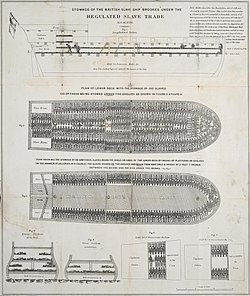
The Slave Trade Act 1788, also known as Dolben's Act, regulated conditions on board British slave ships for the first time since the slave trade started. It was introduced to the United Kingdom Parliament by Sir William Dolben, an advocate for the abolition of slavery. For the first time, limits were placed on the number of slaves that could be carried. Under the terms of the act, ships could transport 1.67 slaves per ton up to a maximum of 207 tons burthen, after which only one slave per ton could be carried.[11] The well-known slave ship Brookes was limited to carrying 454 people; it had previously transported as many as 609 enslaved.[1] Olaudah Equiano was among the supporters of the act, but it was opposed by some abolitionists, such as William Wilberforce, who feared it would establish the idea that the slave trade simply needed reform and regulation, rather than complete abolition.[12] Slave counts can also be estimated by deck area rather than registered tonnage, which results in a lower number of errors and only 6% deviation from reported figures.[13]
This limited reduction in the overcrowding on slave ships may have reduced the on-board death rate, but this is disputed by some historians.[14]
Sailors and crew
[edit].jpg)

In the 18th and early 19th centuries, the sailors on slave ships were often poorly paid and subject to brutal discipline and treatment.[15] Furthermore, a crew mortality rate of around 20% was expected during a voyage, with sailors dying as a result of disease, flogging, or slave uprisings.[16][17] While conditions for the crew were far better than those of the slaves, they remained harsh and contributed to a high death rate. Sailors often had to live and sleep without shelter on the open deck for the entirety of the Atlantic voyage, as the space below deck was occupied by slaves.[15]
Disease, specifically malaria and yellow fever, was the most common cause of death among sailors. A high crew mortality rate on the return voyage was in the captain's interests, as it reduced the number of sailors who had to be paid on reaching the home port.[17] Crew members who survived were frequently cheated out of their wages on their return.[15]
These aspects of the slave trade were widely known; the notoriety of slave ships amongst sailors meant those joining slave ship crews did so through coercion or because they could find no other employment. This was often the case for sailors who had spent time in prison.[18]
Black sailors are known to have been among the crews of British slave ships. These men came from Africa or the Caribbean, or were British-born. Dozens of individuals have been identified by researchers from surviving records. Knowledge of this is incomplete, though, as many captains did not record the ethnicity of crew members in their ship's muster roll.[19] African men (and occasionally African women) also served as translators.[20]
Abolition of the slave trade
[edit].jpg)
The African slave trade was outlawed by the United States and the United Kingdom in 1807. The 1807 Abolition of the Slave Trade Act outlawed the slave trade throughout the British Empire. The U.S. law took effect on 1 January 1808.[21] After that date, all U.S. and British slave ships leaving Africa were seen by the law as pirate vessels subject to capture by the U.S. Navy or Royal Navy.[22] In 1815,[23] at the Council of Vienna, Spain, Portugal, France, and the Netherlands also agreed to abolish their slave trade. The trade did not end on legal abolition; between 1807 and 1860 British vessels captured 1,600 slave ships and freed 160,000 slaves.[24]
After abolition, slave ships adopted quicker, more maneuverable forms to evade capture by naval warships, one favorite form being the Baltimore Clipper. Some had hulls fitted with copper sheathing, which significantly increased speed by preventing the growth of marine weed on the hull, which would otherwise cause drag.[25] This was very expensive, and at the time was only commonly fitted to Royal Navy vessels. The speed of slave ships made them attractive ships to repurpose for piracy,[26] and also made them attractive for naval use after capture; USS Nightingale and HMS Black Joke were examples of such vessels. HMS Black Joke had a notable career in Royal Navy service and was responsible for capturing a number of slave ships and freeing many hundreds of slaves.
Attempts have been made by descendants of African slaves to sue Lloyd's of London for playing a key role in underwriting insurance policies taken out on slave ships bringing slaves from Africa to the Americas.[27]
See also
[edit]References
[edit]- ^ a b Walvin 2011, p. 27.
- ^ "Guineaman" at Oxford English Dictionary; retrieved 24 October 2017
- ^ Native Americans Prior to 1492. Historycentral.com. Retrieved on 3 December 2015.
- ^ Thornton, John (1998). Africa and Africans in the Making of the Atlantic World, 1400–1800 (2nd ed.). New York: Cambridge University Press. pp. 304–5. ISBN 978-0-521-62217-2.
- ^ Mancke, Elizabeth and Shammas, Carole. The Creation of the British Atlantic World. 2005, pages 30–1
- ^ "History: The Middle Passages". The Middle Passage – A Slave Ship Speaks: The Wreck of the Henrietta Marie. Mel Fisher Maritime Heritage Society, Inc. Archived from the original on 9 November 2007. Retrieved 16 January 2018.
- ^ Shillington, Kevin (2007). "Abolition and the Africa Trade". History Today. 57 (3): 20–27.
- ^ More, Anna (December 2022). "The Early Portuguese Slave Ship and the Infrastructure of Racial Capitalism". Social Text. 40 (4). Duke University Press: 23, 24. doi:10.1215/01642472-10013290. S2CID 257010396.
- ^ Sheridan, Richard B. (29 November 1981). "The Guinea Surgeons on the Middle Passage: The Provision of Medical Services in the British Slave Trade". The International Journal of African Historical Studies. 14 (4): 601–625. doi:10.2307/218228. JSTOR 218228. PMID 11632197.
- ^ White, Deborah (2013). Freedom on My Mind. Boston: Bedford/St. Martin's. pp. 20, 21.
- ^ Cohn, Raymond (1985). "Deaths of Slaves in the Middle Passage". The Journal of Economic History. 45 (3): 685–692. doi:10.1017/s0022050700034604. JSTOR 2121762. PMID 11617312. S2CID 21327693.
- ^ Hochschild 2005, p. 140.
- ^ Garland, Charles; Klein, Herbert S. (April 1985). "The Allotment of Space for Slaves aboard Eighteenth-Century British Slave Ships". The William and Mary Quarterly. 42 (2): 238. doi:10.2307/1920430. ISSN 0043-5597. JSTOR 1920430.
- ^ Haines and Shlomowitz 2000, p. 58.
- ^ a b c Hochschild 2005, p. 114
- ^ Bernard Edwards; Bernard Edwards (Captain.) (2007). Royal Navy Versus the Slave Traders: Enforcing Abolition at Sea 1808–1898. Pen & Sword Books. pp. 26–27. ISBN 978-1-84415-633-7.
- ^ a b Hochschild 2005, p. 94
- ^ Rediker 2007, p.138
- ^ Costello (2012), pp.71-72
- ^ Costello (2012), p. 101
- ^ "1807 U.S. Law on Slave Trade". 7 February 2006. Archived from the original on 7 February 2006. Retrieved 10 August 2019.
- ^ "Slave Ships – The Last Slave Ships". Melfisher.org. Archived from the original on 13 November 2007.
- ^ Timeline: The Atlantic Slave Trade. Exploring Amistad at Mystic Seaport
- ^ Sadler, Nigel (March 2008). "The Trouvadore Project: The Search for a Slave Ship and its Cultural Importance". International Journal of Historical Archaeology. 12 (1): 53–70. doi:10.1007/s10761-008-0056-8. ISSN 1092-7697. S2CID 162019007.
- ^ McCarthy, Mike (2005). Ships' Fastenings: From Sewn Boat to Steamship. Texas A&M University Press. p. 108. ISBN 978-1585444519.
- ^ "Real Pirates: The Untold Story of the Whydah from Slave Ship to Pirate Ship – National Geographic". Events.nationalgeographic.com. 14 December 2012. Archived from the original on 21 October 2012. Retrieved 30 December 2012.
- ^ "Slave descendants to sue Lloyd's". BBC News. 29 March 2004. Retrieved 8 September 2018.
Further reading
[edit]- Baroja, Pio (2002). Los pilotos de altura. Madrid: Anaya. ISBN 978-84-667-1681-9.
- Costello, R. (2012). Black salt : seafarers of African descent on British ships. Liverpool: Liverpool University Press. ISBN 978-1-84631-767-5. OCLC 801365216.
- Gregg, Amanda; Ruderman, Anne (2025). "Cross-Cultural Trade and the Slave Ship the Bonne Société: Baskets of Goods, Diverse Sellers, and Time Pressure on the African Coast". The Journal of Economic History.
- Hochschild, Adam (2006). Bury the chains : the British struggle to abolish slavery. London: Pan. ISBN 0-330-48581-4. OCLC 62225209.
- Rediker, Marcus (2007). The Slave Ship: A Human History. New York: Viking. ISBN 978-0-670-01823-9. Archived from the original on 31 March 2012.
- Walvin, James (2011). The Zong : a massacre, the law and the end of slavery. New Haven: Yale University Press. ISBN 978-0-300-18075-6. OCLC 758389538.
External links
[edit]
- Paper on German Transatlantic trade, including list of slave ships (in German)
- Report of the Brown University Steering Committee on Slavery and Justice
- UNESCO — The Slave Route
- Voyages — The Trans-Atlantic Slave Trade Database
- Slave Ships and the Middle Passage
- The Slave Trade
- Bristol UK Slave Ship Muster Roles
| National | |
|---|---|
| Artists | |
| Other | |

Slave ship
View on GrokipediaHistorical Context
Origins and Scale of Transatlantic Slave Trade
The transatlantic slave trade emerged in the early 16th century amid European colonial expansion into the Americas, where labor demands for sugar plantations, tobacco cultivation, and silver mining outstripped available indigenous workers following catastrophic population declines from introduced diseases such as smallpox and measles.[8] Indigenous numbers in regions like Hispaniola and Mexico plummeted by up to 90% within decades of contact, with estimates placing pre-Columbian populations at 50-100 million across the hemisphere reduced to under 10 million by 1600, rendering systems like the Spanish encomienda insufficient for sustained extraction economies.[9] European powers, drawing on Portuguese precedents of coastal slave trading in West Africa since the 1440s, shifted to importing Africans who exhibited greater resistance to Eurasian pathogens and were procured through existing African warfare and commerce networks.[10] The Portuguese initiated systematic shipments to Brazil around 1532 for sugar production, while Spain authorized the asientos system in 1518, enabling the first documented transatlantic voyage carrying 4,000 Africans to the Caribbean by 1528 under Portuguese contractors.[11] Over its duration from approximately 1501 to 1866, the trade involved an estimated 12.5 million Africans embarked from West and Central African coasts, with roughly 10.7 million surviving to disembark in the Americas, based on compilations of shipping records, port logs, and contemporary accounts.[12] The volume peaked in the 18th century, accounting for over 70% of total embarkations—around 6 million individuals—driven by expanded plantation complexes in the Caribbean and Brazil under flags primarily of Portugal/Brazil (5.85 million embarked), Britain (3.26 million), France (1.38 million), and the Netherlands (0.55 million).[12] This escalation reflected surging demand for labor in commodity booms, with annual averages reaching 78,000 enslaved departures in the 1780s, facilitated by purpose-built vessels integrating into mercantile routes.[8] Primary embarkation regions concentrated along Africa's Atlantic seaboard, with West Central Africa (modern Angola and Congo) supplying 44% (about 5.5 million), the Bight of Benin 17% (2.1 million), the Gold Coast 13% (1.6 million), and the Bight of Biafra 12% (1.5 million), often via fortified European trading posts exchanging goods like firearms and textiles for captives from inland conflicts.[12] Disembarkations favored equatorial zones suited to tropical agriculture: Brazil received 38% (4.9 million), the British Caribbean 17% (2.3 million), the French Caribbean 9% (1.2 million), Spanish Americas 8% (1.1 million), and mainland North America under British flags just 3% (0.39 million), underscoring the trade's orientation toward high-yield plantation economies rather than temperate settlements.[12] These patterns, derived from over 36,000 documented voyages, highlight the trade's scale as a response to colonial imperatives for coerced labor in export-oriented production.[3]African and European Involvement
African rulers in kingdoms such as Dahomey and the Ashanti Empire captured individuals through intertribal warfare, judicial punishments, and raids, supplying them as slaves to European traders at coastal forts in exchange for goods that bolstered their power.[13] These practices built on indigenous systems of servitude but intensified under transatlantic demand, as rulers waged expansionist wars explicitly to generate captives for export, with primary accounts from European observers and African oral traditions confirming the economic calculus of conquest for trade revenue.[14] The Ashanti, for instance, integrated slave exports into their gold-based economy, using proceeds to fund military campaigns that yielded further prisoners.[15] European involvement centered on purchasing these captives at established coastal entrepôts like Elmina and Ouidah, without systematic inland penetration, as high mortality from endemic diseases like malaria rendered large-scale raids logistically unfeasible for non-acclimated traders.[16] From the 16th century, Portuguese, Dutch, British, and French merchants fortified trading posts to facilitate exchanges, providing textiles, iron, and especially firearms—over 1 million guns imported annually by the late 18th century—which armed African forces and amplified the gun-slave cycle, whereby weapons enabled more captures to secure additional arms.[10] [17] Trade records from shipping manifests and fort logs, compiled in databases like the Trans-Atlantic Slave Trade Database, quantify this dynamic: the Bight of Benin region, dominated by Dahomey, supplied about 2 million of the roughly 12.5 million Africans embarked between 1501 and 1867, while the Gold Coast under Ashanti influence contributed over 1 million.[3] [18] This commerce reflected aligned incentives, with African polities resisting European abolitionist interventions to preserve fiscal benefits; Dahomey, for example, defied British diplomatic and naval pressures, maintaining exports until blockades in 1851–1852 disrupted Ouidah's trade, while Ashanti rulers prioritized slave revenues over treaties curtailing the practice.[19] [15] Empirical evidence from correspondence and export tallies underscores that cessation required coercion, as endogenous demand for European imports sustained supply despite shifting overseas markets.[20]Integration into Triangular Trade
Slave ships constituted the critical transatlantic leg of the triangular trade, a mercantile system operational from the 16th to 19th centuries that linked European manufacturing, African labor extraction, and American commodity production for sequential profit realization. Vessels departed European ports, notably Liverpool, Bristol, and Nantes, freighted with industrial outputs such as textiles, ironware, brass pans, firearms, gunpowder, and distilled spirits like rum, destined for barter at West African coastal entrepôts including those controlled by entities such as the Royal African Company.[21][22] These goods, valued for their utility in African warfare and trade networks, were exchanged for enslaved Africans captured inland by local polities and delivered to forts like Elmina or Cape Coast Castle.[21] Upon acquiring human cargoes, the ships navigated the middle passage to American destinations—primarily the Caribbean sugar islands, Brazilian plantations, and southern North American colonies—where captives fetched high prices amid labor shortages for staple crop cultivation. Profits from slave sales enabled loading of return cargoes comprising raw materials such as sugar, molasses (a rum precursor), tobacco, cotton, indigo, and timber, which were shipped back to Europe for domestic consumption, refining, or re-export to continental markets.[21][23] This circuit avoided ballast-only returns, with each leg yielding margins: outbound goods markup via African demand, slave sales amplified by plantation economics, and inbound commodities benefiting from monopolistic colonial supplies.[21] British operators dominated quantitative scale, embarking roughly 3.26 million enslaved Africans across over 10,000 voyages from 1662 to 1807, per records in the Trans-Atlantic Slave Trade Database, with peak activity in the late 18th century coinciding with expanded Caribbean holdings post-Seven Years' War.[3] The system's causality in capital formation manifested through re-export trades; for instance, sugar imports to Britain reached 200,000 tons annually by 1800, fueling distilleries, refineries, and shipping demands that generated reinvestable surpluses.[24] Localized impacts were pronounced: econometric analyses of parish-level data reveal slave trade exposure correlated with 40% elevated incomes and accelerated manufacturing adoption in affected regions, underscoring demand-pull effects over mere profit transfers.[25][26] Historiographic assessments, originating with Eric Williams' 1944 contention that triangular trade surpluses directly financed industrialization via entities like Barclays and Lloyds banking houses, have been refined by quantitative critiques showing direct slave voyage profits averaged under 1% of gross fixed capital formation in peak decades.[27] Nonetheless, causal chains via commodity flows—molasses to rum distillation, cotton to Lancashire mills—evidenced sustained contributions to proto-industrial expansion, with broader Atlantic commerce amplifying GDP effects beyond isolated trade ledgers.[25][28]Design and Technical Features
Ship Types and Modifications
Slave ships in the transatlantic trade were predominantly converted merchant vessels, including brigs, schooners, and full-rigged ships, adapted to carry human cargo by reinforcing lower decks and installing temporary wooden platforms to create multiple layers for stowage.[29][30] These modifications allowed for dense packing, with platforms typically spaced 16 to 18 inches apart vertically to accommodate chained individuals in supine positions.[31] A notable example is the British ship Brookes, launched in Liverpool in 1781, whose 1788 diagram illustrated post-regulation stowage capacity for 454 enslaved Africans on a vessel of about 300 tons burthen, featuring shelf-like platforms across the hold.[32][33] The diagram, based on surveys of Liverpool ships, depicted rows of bodies chained in bilboes, highlighting the engineering focus on maximizing vertical and horizontal space within the hull.[34] British regulations, such as Dolben's Act of 1788, directly influenced these designs by limiting enslaved persons to 1.67 per ton for ships up to 207 tons burthen, and one per ton thereafter, prompting builders to adjust platform configurations for compliance while optimizing for volume.[35][36] Most transatlantic slave ships measured between 150 and 250 tons, though sizes varied from 100 to over 300 tons depending on the operator and route.[37] Regional differences emerged in vessel preferences; British operators favored faster schooners and brigs for agility against patrols, while Portuguese ships servicing Brazil routes often employed larger full-rigged vessels to handle extended voyages and higher volumes, reflecting the trade's peak transport of over 5 million captives to Brazil.[29][38] These adaptations prioritized structural integrity under overcrowding, with hull reinforcements to support added decking weight without compromising seaworthiness.[31]Capacity, Ventilation, and Packing Systems
Slave ship operators optimized capacity through packing strategies designed to balance profit against survival rates, with "tight-packing" involving higher densities of 1.5 to 2 enslaved Africans per ton of ship displacement to maximize returns despite elevated mortality, contrasted by "loose-packing" which prioritized fewer individuals per ton for better health outcomes.[39] Following the British Dolben Act of 1788, regulations capped loading at approximately 1.67 enslaved per ton for vessels under 207 tons, aiming to curb overcrowding while still enabling commercial viability.[40] Across documented transatlantic voyages, the average number of enslaved Africans embarked per ship ranged from 300 to 500, varying by vessel size, route, and era, with comprehensive records indicating about 350 on average over roughly 36,000 voyages transporting 12.5 million individuals.[12][8] These metrics derived from archival logs and manifests underscore the scale of load optimization, where captains weighed cargo volume against anticipated losses from disease and resistance. Ventilation systems relied on deck gratings over hatchways to allow airflow into lower holds and, on some vessels, canvas windsails to direct air downward, supplemented by manual pumps for bilge water removal that indirectly aided air circulation.[41][42] However, these provisions proved insufficient against equatorial humidity and heat, fostering conditions conducive to epidemics of dysentery and ophthalmia, as stagnant air and poor drainage exacerbated pathogen spread in densely packed spaces.[43] To mitigate scurvy, a vitamin C deficiency prevalent on long sea voyages, later 18th-century practices included citrus rations on select ships, informed by James Lind's 1747 clinical trial demonstrating oranges and lemons' efficacy, though widespread adoption lagged until the British Navy's 1795 mandate influenced merchant practices.[44][45] Such measures, when implemented, reduced incidence but were inconsistently applied amid priorities for cheap, storable provisions like yams and beans, highlighting causal trade-offs between cost efficiency and health preservation.[44]Navigation and Armament
Slave ships navigated the Atlantic using a combination of dead reckoning—estimating position from course, speed, and time—and celestial observations for latitude, with longitude determination improving after the widespread adoption of marine chronometers in the late 18th century.[46] These methods were essential for the Middle Passage, the transatlantic leg typically lasting 6 to 10 weeks, during which vessels followed trade winds and currents such as the North Equatorial Current to cross from Africa to the Americas efficiently.[46] Navigational challenges included unpredictable storms, which could scatter fleets or cause wrecks, and the need to avoid hurricane-prone regions in the Caribbean during certain seasons, compounded by the coastal maneuvers along West Africa prone to currents and fog.[47] To counter these oceanic hazards and external threats, captains plotted routes conservatively, often hugging latitudes where winds were reliable, while relying on logs, quadrants, and later sextants for course corrections; however, errors in dead reckoning could lead to prolonged voyages increasing risks of spoilage and mutiny.[48] Piracy posed a persistent danger, particularly in the Caribbean and off African coasts, where privateers from rival European powers or independent pirates targeted laden vessels for their human cargo and goods, prompting slave ships to travel in convoys when possible or alter courses to evade known hotspots.[31] Armament on slave ships emphasized defense against multiple threats, including over 465 documented insurrections during transatlantic voyages where enslaved Africans attempted to seize control, often requiring crews to repel boarders with muskets and blunderbusses.[49] Vessels typically mounted 10 to 20 cannons or swivel guns on decks, supplemented by small arms like pistols and cutlasses distributed among the crew, to deter attacks not only from revolts but also from pirates, privateers, and occasionally African coastal forces resisting trade.[50] [31] These weapons doubled as tools for bombarding African forts to secure captives during loading, reflecting the dual offensive-defensive role in high-risk operations.[30] Insurance premiums at markets like Lloyd's of London incorporated assessments of such risks, with slave voyage policies—comprising 5-10% of marine insurance—factoring in voyage specifics, including armament levels, to gauge vulnerability to loss from piracy, storms, or uprisings, though underwriters often excluded "perils of the sea" claims unless proven exceptional.[51] [52] Adequate arming could lower perceived hazards, enabling captains to negotiate better rates, as insufficient defenses heightened the likelihood of total loss payouts.[51]Operational Realities of the Middle Passage
Voyage Routes and Durations
The middle passage, the transatlantic leg transporting enslaved Africans from the West African coast to the Americas, followed primary routes shaped by prevailing winds and currents. Ships typically departed from embarkation points along a 3,000-mile stretch of coastline from Senegambia and the Gold Coast southward to the Bight of Benin, Bight of Biafra, and West Central Africa (primarily Angola), crossing to destinations dominated by the Caribbean (such as Jamaica, Barbados, and Saint-Domingue), Brazil (especially Bahia and Rio de Janeiro), and to a lesser extent North American ports like Virginia.[3] These paths leveraged the northeast trade winds for westward travel, often arcing northward to catch the North Equatorial Current before veering south toward Brazil or the Gulf Stream for Caribbean arrivals, with detours to islands like Cape Verde or the Canaries for fresh water and provisions that could add weeks to the journey.[53][54] Durations varied empirically based on logbook records compiled in the Trans-Atlantic Slave Trade Database, averaging around 70 days (10 weeks) across 36,000 documented voyages from 1514 to 1866, though shorter routes from Upper Guinea occasionally completed in as few as 21 days under favorable winds, while longer hauls from Angola extended to 90 days or more due to calms in the doldrums, adverse weather, or evasion of patrols.[53][55] National variations reflected route proximities: Dutch voyages to Suriname, sourcing slaves from the Gold Coast or Loango and benefiting from a more direct northern South American trajectory, averaged 50-60 days, shorter than many British Caribbean crossings that spanned greater distances.[56] European outfitting hubs like Liverpool (British), Nantes (French), and Middelburg (Dutch) dispatched vessels seasonally to align with these logistics, with pursuits by anti-slave-trade squadrons after 1807 further prolonging some later voyages by 10-20 days.[3][57] Seasonal factors dictated timing to minimize risks, with departures peaking during Africa's dry seasons (December to May in many regions) when slave raids yielded higher captures tied to post-harvest agricultural cycles, and arrivals timed to precede the Caribbean hurricane season (June-November) for safer unloading.[58][59] Wind patterns reinforced this, as reliable trade winds prevailed in northern hemisphere winters, reducing calms; conversely, El Niño events correlated with drier African conditions that temporarily depressed slave exports by disrupting supply chains.[60][54]Daily Routines and Disease Management
Enslaved Africans endured regimented daily routines on slave ships aimed at sustaining their physical condition as marketable commodities. Feeding schedules typically involved two meals per day, around 8 a.m. and 4 p.m., consisting of boiled staples such as yams, rice, or horse beans, often supplemented with small amounts of palm oil or meat scraps when available.[61] Water rations were rationed at approximately one pint per person daily, ladled from buckets into individual pannikins to curb hoarding or spillage, with distribution tied to mealtimes.[62] [63] In calm weather, captives were herded onto the upper deck midmorning for compulsory exercise, commonly enforced through chained "dancing" or shuffling movements to promote blood flow and avert muscular deterioration, with crew oversight via whips for compliance.[64] [65] Lower "slave decks" served for segregated confinement during voyages, where individuals were chained in tiers to maximize space, though ventilation remained inadequate.[66] Hygiene protocols included stripping captives of clothing at embarkation for disease inspection and basic sanitation, alongside sporadic attempts to clear lice through fumigation or manual removal, but persistent overcrowding fostered unchecked filth.[67] [68] Disease management focused on pragmatic containment to protect cargo viability, drawing from captains' logs documenting responses to prevalent threats like dysentery (the "flux"), ophthalmia, and fevers.[64] [69] At African embarkation points, rudimentary quarantine held suspects in isolation for 10 to 40 days to screen for infections, though enforcement varied.[70] Shipboard, afflicted individuals were segregated to lower decks or holds, treated with minimal interventions such as herbal purges or bleeding—approaches paralleling livestock husbandry—while emphasizing separation to limit contagion spread among the healthy majority.[29] [71]Mortality Rates and Causal Factors
Mortality during the Middle Passage averaged 10-15% of embarked Africans, equating to approximately 1.8 million deaths across roughly 36,000 voyages from the sixteenth to nineteenth centuries, with rates declining from over 20% in early periods (pre-1750) to around 10% after 1800 due to improved shipboard practices and shorter voyages.[3][39] Crew mortality exceeded enslaved rates at 15-20%, primarily from fevers acquired in African ports.[72] Regional variations were significant, with lower rates (under 10%) from Upper Guinea ports like Senegambia, attributed to healthier embarkation conditions and less virulent local pathogens, compared to higher losses (15-20%) from Central African regions such as Angola.[39][73] Infectious diseases dominated as causes, with dysentery (flux) and fevers accounting for most slave deaths, exacerbated by overcrowding, contaminated water, and pre-existing infections from African coastal holds; surgeons' logs from the 1790s indicate gastrointestinal ailments claimed up to 50% of losses, while smallpox outbreaks occasionally spiked mortality.[72][29] Evidence from ship journals and post-mortem examinations underscores that deaths stemmed more from epidemic spread in confined spaces than deliberate starvation, as provisions were typically calculated to sustain captives, though delays in sailing amplified dehydration and dysentery risks.[74] Crew losses followed similar patterns, with malaria and yellow fever predominant, reflecting shared exposure rather than targeted neglect.[72] Empirical analyses debate the relative weight of onboard neglect versus inevitable tropical disease burdens; traditional accounts emphasize overcrowding and poor ventilation as causal, yet quantitative studies from voyage databases reveal that African port mortality (pre-departure) often exceeded sea losses, suggesting imported pathologies as primary drivers, with nutritional inputs deemed adequate by caloric standards of the era despite qualitative deficiencies in diet variety.[74][39] Revisionist interpretations, drawing on provisioning records, argue that captains prioritized slave survival for profit motives, minimizing intentional privation, though crowding remained a non-negotiable efficiency trade-off that amplified disease transmission irrespective of feeding regimes.[74] These findings, derived from aggregated logs rather than anecdotal reports, highlight causal realism in attributing outcomes to epidemiological realities over singular human malice.[72]Crew Dynamics and Broader Human Costs
Composition and Recruitment of Crews
Slave ship crews typically consisted of 30 to 40 men on vessels between 100 and 200 tons, encompassing specialized roles such as the captain for command and navigation, mates for oversight of operations, a surgeon for medical duties, and the majority as ordinary seamen handling sails, rigging, and maintenance.[29] These crews required general maritime skills rather than expertise unique to slaving, drawing from the broader pool of European sailors accustomed to long-haul voyages.[31] Demographically, crews were predominantly young European men in their late teens to early twenties, often from Britain, Portugal, or other maritime nations aligned with the ship's flag nation, reflecting the dominant carriers in the transatlantic trade.[75] A small minority included free Black sailors from Africa, the Caribbean, or Europe, who served in various capacities despite the trade's racial dynamics.[76] Recruitment occurred primarily through volunteering in ports, enticed by contracts offering fixed wages supplemented by head-money premiums—a payment per enslaved African successfully delivered alive, which incentivized crew retention and performance, particularly for surgeons tasked with minimizing mortality.[64] Intermediaries known as crimps facilitated hiring by advancing wages or provisions, though this often trapped recruits in debt bondage; forced recruitment via press-ganging was rarer on merchant slave ships compared to naval vessels. High turnover plagued crews, with frequent desertions during layovers or upon reaching ports, driven by the voyage's grueling conditions and opportunities to abscond.[77][78]Crew Mortality and Hardships
Crew mortality rates on transatlantic slave ships frequently surpassed those of enslaved Africans, with annual death rates estimated at 230 per 1,000 for crew members during the loading and voyage phases, compared to 83 per 1,000 for slaves.[79] [80] Overall voyage mortality for crews averaged around 23% in the late seventeenth century, with early British voyages from 1601–1700 recording rates of 22–24%.[77] [81] These figures reflect the perilous conditions of the trade, including extended exposure to tropical diseases along the African coast, where crews lacked immunity to local pathogens.[29] Primary causes of crew deaths included fevers—likely malaria and yellow fever—accounting for the majority of fatalities, particularly during the initial weeks at sea following coastal loading.[82] [72] Scurvy emerged as a significant killer on longer passages due to inadequate fresh provisions, contributing to widespread debilitation and secondary infections among sailors.[44] [83] Violence also played a role, with crew members dying in clashes during enslaved resistance or shipboard conflicts, though fevers dominated as the leading causal factor.[79] In comparison to general merchant marine voyages, slave ship crews faced elevated risks primarily from African coastal fevers, which were absent in non-tropical trades, resulting in mortality patterns that diverged sharply from European or intra-Atlantic shipping.[39] [84] Beyond physical perils, crews endured severe hardships rooted in the trade's demanding operational demands. Ship logs document routine floggings and other corporal punishments to enforce discipline amid grueling routines, high desertion risks, and occasional crew mutinies driven by privation or disputes with officers.[85] The psychological toll was profound, stemming from prolonged isolation on voyages lasting months, constant vigilance against uprisings, and the moral strain of participating in a violent enterprise, which historical accounts describe as fostering torment and desensitization among survivors.[86] These factors compounded the empirical mortality data, underscoring the trade's human costs extending to free participants, though differentiated by agency and context from enslaved conditions.[29]Enslaved Resistance and Shipboard Conflicts
Enslaved Africans mounted resistance against their captors on approximately one in ten transatlantic slave voyages, with documented incidents numbering over 465 across the trade's history from the 16th to 19th centuries.[49] These uprisings, drawn primarily from captains' logs, crew testimonies, and trade records compiled in databases like Slave Voyages, occurred most frequently during the initial coastal phase near Africa or early in the Middle Passage, where captives outnumbered crew but lacked navigational knowledge or arms.[53] Tactics included coordinated melee attacks using improvised weapons such as chains, benches, or smuggled blades to overpower guards, as well as sabotage like arson to ignite holds or provisions, though the latter risked self-endangerment in confined wooden vessels.[6] Suppression relied on physical restraints like iron shackles and thumb screws to immobilize leaders, combined with superior firepower from muskets, pistols, and occasionally cannons, enabling crews to quell most revolts swiftly despite occasional fatalities among slavers.[5] Success for the enslaved—defined as seizure of the ship and escape—was rare, succeeding in roughly 1 percent of cases overall, as victors typically lacked sailing expertise and faced recapture by patrols or starvation.[49] One notable exception was the 1839 revolt on the Spanish schooner La Amistad, where 53 Mende captives, led by Sengbe Pieh, killed the captain and most crew in a nighttime melee using sugar cane knives on July 2 off Cuba's coast; the survivors navigated erratically before U.S. seizure, ultimately gaining freedom via Supreme Court ruling after proving illegal enslavement post-African embarkation.[87] These conflicts imposed direct costs on voyages, including crew deaths (estimated at hundreds across incidents) and heightened insurance premiums, yet logs indicate captains adapted by increasing armaments and segregating ethnic groups to hinder alliances, drawing from empirically observed patterns in prior failures.[53] While shipboard records, often self-reported by interested parties, may undercount minor sabotage or aborted plots due to suppression or omission, the aggregated data from primary sources underscores resistance as a persistent but largely futile hazard in the trade's logistics.[6]Economic Underpinnings
Profit Mechanisms and Investor Returns
Slave ships generated revenue primarily through the purchase of enslaved Africans at low cost along the African coast—typically £5 to £10 per person in the 18th century—and their resale at markups of two to three times that value in American ports, yielding net profits of approximately £10 to £20 per surviving slave after accounting for purchase, transport, and mortality costs.[88] This was supplemented by ancillary trade in return cargoes such as sugar, rum, and indigo, which were exchanged for European manufactured goods on the final leg back to ports like Bristol or Liverpool, contributing an additional 20-30% to overall voyage earnings in successful triangular trades.[89] Account books from British voyages, such as those analyzed from Bristol and Liverpool syndicates, reveal that these mechanisms sustained operations despite partial losses from disease or rebellion, with gross revenues often exceeding £20,000 per voyage for ships carrying 200-400 slaves.[90] Investor returns averaged 10-17% per voyage for British operators in the late 18th century, equating to annualized yields of around 10% given typical 12-18 month durations, which compared favorably to alternative merchant investments like Baltic trade or domestic commerce.[90] In port syndicates, such as those in Bristol where merchants pooled capital for multiple expeditions, aggregate net profits reached £60,000 across sampled fleets, demonstrating scalability and risk diversification through shared ownership of vessels and cargoes.[90] These figures, derived from surviving ledgers rather than estimates, refute claims of inherent unprofitability by showing consistent positive margins even after deducting outfitting expenses of £5,000-£10,000 per ship and crew wages.[91] For French slave trade ventures between 1710 and 1789, empirical analysis of 238 expeditions indicates internal rates of return (IRRs) exceeding those of contemporaneous long-distance alternatives like East India Company shipments, often surpassing secure state bonds yielding 5-6% amid the superior efficiency of French Caribbean plantations.[89] Specific portfolios, such as that of merchant Bertrand de Cœuvre, achieved IRRs comparable to low-risk government debt while incorporating slave sales as the core driver, with liquidity from rapid commodity resale enabling reinvestment cycles.[92] Such data from archival venture records underscore the trade's economic viability, as investors prioritized high-volume slave throughput to offset variability in per-head margins.[89]Risk Factors and Insurance Practices
Slave ship operators confronted substantial risks during transatlantic voyages, including shipwrecks, enslaved revolts, and elevated mortality among captives, which could erode profitability despite insurance mechanisms. Shipwrecks accounted for the loss of an estimated 500 to 1,000 vessels out of approximately 35,000 transatlantic slave-trading voyages, representing roughly 1.4 to 2.8 percent of total departures, often due to storms, navigational errors, or structural failures exacerbated by overloading.[93] Enslaved revolts occurred on about 10 percent of voyages, posing threats of ship capture or destruction that heightened operational hazards.[53] Mortality rates averaged 10 to 15 percent of embarked captives, primarily from diseases like dysentery spread by overcrowding and poor sanitation, leading to deductions from insured values as "perishables."[94] Marine insurance, predominantly underwritten at Lloyd's of London, mitigated these perils by covering hull damage, lost cargo, and enslaved captives against "perils of the sea" such as storms or piracy, with slave voyages comprising 5 to 10 percent of total marine premia in the 18th century.[51] Enslaved individuals were classified as perishable goods, entitling owners to partial compensation for deaths from insurable events but excluding ordinary attrition or deliberate crew negligence unless specified in the policy.[95] Jettisoned slaves, however, typically fell outside coverage unless justified under general average principles—sacrificing cargo for the vessel's common safety—as illustrated by the 1781 Zong case, where 132 captives were thrown overboard amid a water shortage dispute, prompting insurers to contest the claim as non-maritime peril rather than outright murder.[96] Such disputes frequently centered on distinguishing insurable losses from mismanagement, with courts like King's Bench adjudicating based on policy terms rather than ethical considerations.[97] To hedge against these uncertainties, shipowners and underwriters diversified across multiple voyages; for instance, Bristol merchant James Rogers insured all 55 of his slaving expeditions between 1784 and 1793, spreading exposure through syndicates that pooled risks.[98] Premiums reflected peril levels, often 5 to 30 percent of insured value, incentivizing design trade-offs like prioritizing speed to shorten the Middle Passage and curb mortality, though refitted merchant hulls optimized for capacity sometimes compromised stability in heavy seas.[99] These practices underscored market adaptations to empirical loss patterns, with insurers like those at Lloyd's leveraging actuarial data from repeated claims to refine underwriting without addressing underlying causal drivers such as voyage overcrowding.[51]Comparative Efficiency to Other Labor Transports
Slave ships demonstrated comparable or higher mortality risks relative to other forms of coerced or distressed labor transport, yet achieved efficiency through high-volume delivery of labor suited to tropical environments. Empirical data from transatlantic voyages indicate an average mortality rate of approximately 12% during the Middle Passage, with variations from 10% in later periods to over 20% in earlier or French-operated ships due to factors like overcrowding and disease.[100][39] In contrast, British convict transports to Australia post-1790s averaged 1-2% mortality, benefiting from medical reforms and shorter relative distances, though early fleets like the Second Fleet saw 28% losses from neglect.[101] Irish famine emigrant "coffin ships" in the 1840s exhibited rates commonly reaching 20%, with anecdotal reports of up to 50% on poorly provisioned vessels plagued by typhus, underscoring that high death tolls were not unique to slave trades but common in unregulated mass migrations under duress.[102] Economically, slave ships proved efficient for plantation owners by minimizing per-head transport costs compared to alternatives like European indentured labor, which incurred higher recruitment and acclimatization expenses in tropical climates where white workers suffered elevated mortality from diseases like yellow fever. Studies of labor acquisition costs reveal that enslaved Africans, once delivered, provided lower long-term expenses than hiring free wage laborers or indentured servants for cash-crop operations, as the upfront purchase price amortized over lifetimes of coerced work without wages or repatriation.[103] This calculus prioritized volume over individual survival, with slave vessels packing 1.5-2 slaves per ton of capacity—denser than typical merchant ships—to maximize returns despite losses, a density rivaled only in post-abolition coolie trades.[39] Following legal bans on the Atlantic slave trade, the 19th-century coolie trade to destinations like Cuba and Peru replicated slave ship practices, with mortality rates around 16% from similar overcrowding and poor sanitation, transporting over 250,000 Chinese laborers in conditions that blurred into de facto slavery.[104] These parallels highlight slave ships' operational model as a scalable, if brutal, benchmark for bulk coerced migration, where economic imperatives drove tolerance for risks exceeding those of voluntary free migrations but aligning with other unfree systems.[39]| Transport Type | Average Mortality Rate | Key Period | Notes |
|---|---|---|---|
| Transatlantic Slave Ships | 10-15% | 17th-19th centuries | Middle Passage focus; higher in early voyages.[5][100] |
| Convict Ships to Australia | 1-2% (post-1790s) | 1788-1868 | Improved with regulations; early spikes to 28%.[101] |
| Irish Famine Emigrant Ships | Up to 20% | 1840s | Disease-driven; "coffin ship" moniker from typhus outbreaks.[102] |
| Coolie Trade Ships | ~16% | Mid-19th century | To Cuba/Peru; akin to slave packing densities.[104] |