

Spanish Filipinos
View on WikipediaKey Information


 Flag of the Hispanic people | |
| Regions with significant populations | |
|---|---|
| Metro Manila, Bais City, Dumaguete City, Zamboanga City, Cebu City, Vigan, Iloilo City, Bauang | |
| Languages | |
| Spanish (Philippine), Filipino, other Philippine languages, English and Chavacano | |
| Religion | |
| Roman Catholic |
| Part of a series on the |
| Spanish people |
|---|
_alternate_colours.svg) Rojigualda (historical Spanish flag) |
| Regional groups |
Other groups
|
| Significant Spanish diaspora |
 Category • Category •  Spain portal Spain portal |
Spanish Filipino or Hispanic Filipino (Spanish: Español Filipino, Hispano Filipino, Tagalog: Kastílang Pilipino, Cebuano: Katsílà) are people of Spanish and Filipino heritage. The term includes all individuals of Spanish descent in the Philippines, including criollos and mestizos who identify with Spanish culture, history and language.[20]
According to the 2020 Philippine census, 4,952 individual citizens self-identified as ethnically Spanish[21] in the Philippines.
Forming a small part of the Spanish diaspora,[20] the heritage of Spanish Filipinos may come recently from Spain, from descendants of the earlier Spanish settlers during the Spanish colonial period in the Philippines, or from Spain's viceroyalties in Hispanic America, such as Mexico, whose capital Mexico City held administrative power over the captaincy general of the Philippines in the colonial era.
Many of their communities in Spain, the Americas, Australia, and the Philippines trace their origin to the early settlers from Europe and Mexico during the Spanish colonial period as well as native populations of Southeast Asia, and in recent overseas migration in the 1900s.
In the Philippines depending on the specific provinces, in the late 1700s to early 1800s they formed as much as 19% in the capital city of Manila at formerly named Tondo province,[1]: 539 and about 1.38% of the Ilocos region,[2]: 31 2.17% of Cebu[2]: 113 or 16.72% of Bataan[1]: 539 and other parts of the country.
The Spanish population that settled in the Philippines during the colonial period were originally referred to as "Filipinos".[22][23] Spaniards, Latin Americans and Spanish-speaking Filipinos are referred to by native Filipinos as "Kastila", a word for "Castilian" which means the region and language of Castile, or an individual of Spanish heritage. Native Filipinos in historical terms are referred to by the Spaniards as "Indio" (a word for "Indian" or Indigenous people).
Filipinos of Spanish backgrounds numbered at about 4,952 people, while Mestizo Filipinos of mixed native Filipino and European ancestry made up about 5% of the Philippines' population during the 1700s.[1][2]
The abrupt decline of Spanish Filipinos as a percentage of the population is due to the events of the Philippine Revolution during the Philippine Republic in the late 1800s, as Filipinos of Spanish heritage choose to identify themselves as pure native Filipino, as part of establishing a united national identity in the country,[24] or some have relocated back to Spain, or have migrated to other countries during that period.[25]
During and after the Philippine Revolution, the term "Filipino" included people of all nationalities and race, born in the Philippines.[26][27][28]
Today, Hispanic Filipinos are found in all social classes worldwide, from upper wealthy to lower poor disadvantage backgrounds, and from high profiled individuals to ordinary unknown people. They have long integrated into the native communities living their lives as ordinary citizens. However most of the successful individuals are present in economics and business sectors in the Philippines and a few sources estimate companies which comprise a significant portion of the Philippine economy like International Container Terminal Services Inc., Manila Water, Integrated Micro-Electronics, Inc., Ayala Land, Ynchausti y Compañia, Ayala Corporation, Aboitiz & Company, Union Bank of the Philippines, ANSCOR, Bank of the Philippine Islands, Globe Telecom, Solaire Resort & Casino, and Central Azucarera de La Carlota, to name but a few are owned by Hispanic Filipinos.[29][30][31][32][33]
History
[edit]
The history of the Spanish Philippines covers the period from 1521 to 1898, beginning with the arrival in 1521 of the Portuguese explorer Ferdinand Magellan sailing for Spain, which heralded the period when the Philippines was an overseas province of Spain, and ends with the outbreak of the Spanish–American War in 1898.
The Spanish discovery of the American continent by the Italian explorer Christopher Columbus in 1492, an expedition sponsored by Queen Isabella I of Castille and King Ferdinand II of Aragon,[34] laid the foundation of settlements and explorations in the New World.[35] Spain became the first European country to permanently colonized the American continent in 1492.[36]
In 1541, Spanish explorer Ruy López de Villalobos was commissioned by Antonio de Mendoza, the viceroy of New Spain and first colonial administrator in the New World, to send an expedition to the Philippines to establish a larger Spanish presence there as a base for trade with the Spice Islands and China and to extend Spanish control over the Moluccas in the Portuguese East Indies.[37] The expedition ultimately failed, with Villalobos dying in a Portuguese prison on Ambon Island in 1546.
In 1564, conquistadors led by Miguel López de Legazpi, prompted the colonization of the Philippine Islands that lasted for 333 years. The Philippines was a former territory of New Spain until the grant of independence to Mexico in 1821 necessitated the direct government from Spain of the Philippines from that year. Early Spanish settlers to the Philippines were mostly explorers, soldiers, government officials, religious missionaries, and among others, who were born in Spain or in Mexico called "Peninsulares" (Spanish migrants living in the colony). Their succeeding generation known as "Criollos" (Spaniards of pure White blood, born and raised in the colony) contributed to the population's development.[38]

For centuries several hundreds of White Spaniards settled in the islands along with their families to start a new beginning in the New World, to take advantage of the rich and exotic resources the colony had to offer. Some of these individuals married or inter-bred with the indigenous Filipino population while most married only other Spaniards. Their descendance that consisted of "Criollos" or "Insulares" and "Mestizos" (those of mixed-blood individuals) became part of the island's indigenous society; some became town officers and farmers, and others became ordinary citizens.
Government officials and those of high ranks were granted with haciendas (plantation estates) by the Spanish government. In some provinces like, Vigan, Iloilo, Cebu, Pampanga, and Zamboanga, The Spanish government encouraged foreign merchants from Southeast Asia and the Asian continent to trade in the colony, along with the European and indigenous population, but they were not given certain privileges such as ownership of land.
Contacts with White Europeans, social intercourse between foreign merchants, and indigenous people resulted in a new ethnic group. These group were called Mestizos (mixed-race individuals), who were born from intermarriages from White European Spaniards and indigenous Austronesian-speaking Filipino natives. Some of their descendants emerged later as an influential part of the ruling class called the "Principalía" (Nobility) class.
The Spanish implemented incentives to deliberately entangle the various races together in order to stop rebellions.[39][40][41] According to a historical colonial conversation that was published, stated by a government official explains: "It is needful to encourage public instruction in all ways possible, permit newspapers subject to a liberal censure, to establish in Manila a college of medicine, surgery, and pharmacy: in order to break down the barriers that divide the races, and amalgamate them all into one. For that purpose, the Spaniards of the country, the Chinese mestizos, and the Filipinos shall be admitted with perfect equality as cadets of the military corps; the personal-service tax shall be abolished, or an equal and general tax shall be imposed, to which all the Spaniards shall be subject. This last plan appears to me more advisable, as the poll-tax is already established, and it is not opportune to make a trial of new taxes when it is a question of allowing the country to be governed by itself. Since the annual tribute is unequal, the average shall be taken and shall be fixed, consequently, at fifteen or sixteen reals per whole tribute, or perhaps one peso fuerte annually from each adult tributary person. This regulation will produce an increase in the revenue of 200,000 or 300,000 pesos fuertes, and this sum shall be set aside to give the impulse for the amalgamation of the races, favoring crossed marriages by means of dowries granted to the single women in the following manner. To a Chinese mestizo woman who marries a Filipino shall be given 100 pesos; to a Filipino woman who marries a Chinese mestizo, 100 pesos; to a Chinese mestizo woman who marries a Spaniard, 1,000 pesos; to a Spanish woman who marries a Chinese mestizo, 2,000 pesos; to a Filipino woman who marries a Spaniard, 2,000 pesos; to a Spanish woman who marries a Filipino chief, 3,000 or 4,000 pesos. Some mestizo and Filipino alcaldes-mayor of the provinces shall be appointed. It shall be ordered that when a Filipino chief goes to the house of a Spaniard, he shall seat himself as the latter's equal. In a word, by these and other means, the idea that they and the Castilians are two kinds of distinct races shall be erased from the minds of the natives, and the families shall become related by marriage in such manner that when free of the Castilian dominion should any exalted Filipinos try to expel or enslave our race, they would find it so interlaced with their own that their plan would be practically impossible".[42]
Filipinos and other Asians were brought to Mexico as slaves and servants, while some Africans were brought to the Philippines by the Portuguese traders, to work on plantation settlements as slave workers or settlers working in the colony.[43][44] Between 1565 and 1815, both Filipinos and people from Latin America and Spain sailed to, and from the Philippines in the Manila galleon trade to Acapulco, assisting Spain in its trade on the colony.
Population
[edit]
Colonial statistics
[edit]In the late 1700s to early 1800s, Joaquín Martínez de Zúñiga, an Agustinian Friar from Spain, in his Two Volume Book: "Estadismo de las islas Filipinas"[1][2] compiled a census of the Spanish-Philippines based on the tribute counts (Which represented an average family of seven to ten children[45] and two parents, per tribute)[46] and came upon the following statistics:
| Province | Native Tributes | Spanish Mestizo Tributes | All Tributes[a] |
|---|---|---|---|
| Tondo[1]: 539 | 14,537-1/2 | 3,528 | 27,897-7 |
| Cavite[1]: 539 | 5,724-1/2 | 859 | 9,132-4 |
| Laguna[1]: 539 | 14,392-1/2 | 336 | 19,448-6 |
| Batangas[1]: 539 | 15,014 | 451 | 21,579-7 |
| Mindoro[1]: 539 | 3,165 | 3-1/2 | 4,000-8 |
| Bulacan[1]: 539 | 16,586-1/2 | 2,007 | 25,760-5 |
| Pampanga[1]: 539 | 16,604-1/2 | 2,641 | 27,358-1 |
| Bataan[1]: 539 | 3,082 | 619 | 5,433 |
| Zambales[1]: 539 | 1,136 | 73 | 4,389 |
| Ilocos[2]: 31 | 44,852-1/2 | 631 | 68,856 |
| Pangasinan[2]: 31 | 19,836 | 719-1/2 | 25,366 |
| Cagayan[2]: 31 | 9,888 | 0 | 11,244-6 |
| Camarines[2]: 54 | 19,686-1/2 | 154-1/2 | 24,994 |
| Albay[2]: 54 | 12,339 | 146 | 16,093 |
| Tayabas[2]: 54 | 7,396 | 12 | 9,228 |
| Cebu[2]: 113 | 28,112-1/2 | 625 | 28,863 |
| Samar[2]: 113 | 3,042 | 103 | 4,060 |
| Leyte[2]: 113 | 7,678 | 37-1/2 | 10,011 |
| Caraga[2]: 113 | 3,497 | 0 | 4,977 |
| Misamis[2]: 113 | 1,278 | 0 | 1,674 |
| Negros Island[2]: 113 | 5,741 | 0 | 7,176 |
| Iloilo[2]: 113 | 29,723 | 166 | 37,760 |
| Capiz[2]: 113 | 11,459 | 89 | 14,867 |
| Antique[2]: 113 | 9,228 | 0 | 11,620 |
| Calamianes[2]: 113 | 2,289 | 0 | 3,161 |
| TOTAL | 299,049 | 13,201 | 424,992-16 |
The Spanish-Filipino population as a proportion of the provinces widely varied; with as high as 19% of the population of Tondo province[1]: 539 (The most populous province and former name of Manila), to Pampanga 13.7%,[1]: 539 Cavite at 13%,[1]: 539 Laguna 2.28%,[1]: 539 Batangas 3%,[1]: 539 Bulacan 10.79%,[1]: 539 Bataan 16.72%,[1]: 539 Ilocos 1.38%,[2]: 31 Pangasinan 3.49%,[2]: 31 Albay 1.16%,[2]: 54 Cebu 2.17%,[2]: 113 Samar 3.27%,[2]: 113 Iloilo 1%,[2]: 113 Capiz 1%,[2]: 113 Bicol 20%,[47] and Zamboanga 40%.[47] According to the 1893 data in the Archdiocese of Manila which administers much of Luzon under it, about 10% of the population was then Spanish-Filipino.[1]: 539 Overall the whole Philippines, even including the provinces with no Spanish settlement, as summed up, the average percentage of Spanish Filipino tributes amount to 5% of the total population.[1][2]
Anthropology
[edit].png)
A 2018-2020 Census research data shows that it may be incomplete as there was a large span of time ever since racial statistics were recorded in Spanish censuses and the new Philippine censuses does not account for racial differences, thereby ignoring foreign ancestry that has been compounding in time. To address this, scientists have undergone Anthropology studies of Filipinos to measure ethnic ratios in the population. Scientist, Matthew C. Go, in a Trihybrid Ancestry Variation Analysis approach to Admixture in Filipinos, published a study wherein it was discovered that upon exhuming the remains around the public cemetery of the "Manila North Cemetery" as well as other public cemeteries across the Philippines, and practicing forensic anthropology on them, Matthew C. Go estimated that 71% of the mean amount, among the samples exhumed, have attribution to Asian descent while 7% is attributable to European descent.[48] Filipinos have significantly less Asian ancestry compared to other Asian nationalities like the Koreans who are 90% Asian, Japanese at 96%, Thai at 93%, and Vietnamese at 84%.[48]
Nevertheless, a 2019 Anthropology Study by Beatrix Dudzik, while using skeletons collated by the University of the Philippines and sampled from all across the Philippines, thus published in the Journal of Human Biology, using physical anthropology, estimated that, 72.7% of Filipinos are Asian, 12.7% of Filipinos can be classified as Hispanic, 7.3% as Indigenous American, African at 4.5% and European at 2.7%.[49] However, this is only according to an interpretation of the data wherein the reference groups, which were attributed to the Filipino samples; for the Hispanic category, were Mexican-Americans, and the reference groups for the European, African, and Indigenous American, categories, were: White Americans, Black Americans, and Native Americans from the USA, while the Asian reference groups were sourced from Chinese, Japanese, and Vietnamese origins.[49]
In contrast, a different anthropology study using Morphoscopic ancestry estimates in Filipino crania using multivariate probit regression models by J. T. Hefner, published on year 2020, while analyzing Historic and Modern samples of skeletons in the Philippines, paint a different picture,[50] in that, when the reference group for "Asian" was Thailand (Southeast Asians) rather than Chinese, Japanese, and Vietnamese; and the reference group for "Hispanic" were Colombians (South Americans) rather than Mexicans,[50] the combined historical and modern sample results for Filipinos, yielded the following ratios: Asian at 48.6%, African at 32.9%, and only a small portion classifying as either European at 12.9%, and finally for Hispanic at 5.7%.[50]
Historical terms
[edit]-
 Gaspar de la Torre y Ayala, the Governor-General of the Philippines was a "Peninsulares" Filipino.
 -
 Marcelo Azcárraga, former Prime Minister of Spain was a "Criollo (Insulares)" Filipino.
 -
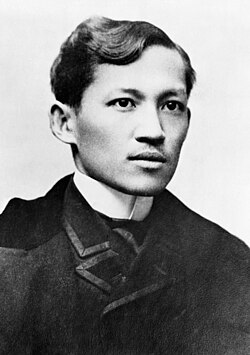 Prominent Philippine political figure, José Rizal was a Filipino "Torna atrás" of mixed indigenous, Spanish and East Asian ancestry.
 -
 Former Philippine President Manuel L. Quezon, was a "Mestizo" of mixed Indigenous and Spanish ancestry.


.jpg)
These are historical Spanish terms[51]used to identify the different types of names given to the people living in the colony.
- "Español" - A pure White European person from Spain.
- "Peninsulares" - A pure White Spaniard born in Spain but is also a settler and a citizen, living on the islands.
- "Criollo"/"Insulares"[54][55] - A White Filipino of pure European Spanish ancestry, born and raised as citizens of the islands, or a person of pure White ancestry native to the island, who were descendants from White European settlers.
- "Mestizo"/"Mulatto" - A native Filipino or an Indigenous American Indian person of mixed Spanish ancestry, and an African person of mixed Spanish descent.
- "Indio" - A native Filipino or an Indigenous American Indian person, or an individual belonging to a tribal group, native to the islands.
- "Negrito"/"Negro" - A indigenous Black Filipino person, and an African person brought to the colony as slaves to work on plantation.
- "Sangley"[56] - A word invented and used in the Philippines to denote an individual of Chinese or other East Asian background.
- "Islas Filipinas" - The name of the islands.
- "Felipinas" - The name given to the islands in 1543 by explorer Ruy López de Villalobos in honor of Prince Felipe II, who later became King of Spain in 1556. This name initially referred to just the islands of Leyte and Samar. It was later on expanded to include the entire archipelago.[57]
- "Hispano América" - The Spanish colonies in the Americas.
Present-day 21st century Filipinos
[edit]This category is about a term used to identify the different types of Filipino ethnic groups living on the islands.
They are:[58]
- "Native Filipino" - People of un-mixed or a Filipino person of pure ancestry from the islands.
- "Polynesian Filipino" - People of Polynesian backgrounds living on the islands, or a Filipino person of mixed Polynesian ancestry.
- "Oriental Filipino" - People from another Asian background living on the islands, or a Filipino mixed with other oriental backgrounds, or a person of South Asian descent living in the islands.
- "Mestizo Filipino" - A Filipino person of mixed ancestry.
- "Hispanic Filipino" - People of mixed native Filipino and Spanish or Latin American ancestry, or a Spanish-speaking Filipino, Hispanicized Filipino, Peninsular, Criollo, or a person of Hispanic South American descent living on the islands.
- "White Filipino" - People of White European, White American, White Latin American, White Middle Eastern and other White ethnic backgrounds living on the islands.
- "US/Native American Filipino" - A person of White American-native descent, living on the islands.
- "Black Filipino" - People of Black African, African American and Black Latin American backgrounds, living on the islands, or a Filipino person of mixed Black ancestry.
Religion
[edit]The majority of Spaniards, Latin Americans and Hispanic Filipinos are Christians, with most adhering to Roman Catholicism.[59]
Language
[edit]Spanish,[60] Spanish creole (Chavacano), English, Tagalog and other Indigenous Filipino languages are spoken in their community.
Philippine Spanish
[edit]Philippine Spanish (Spanish: Español Filipino, Castellano Filipino) is a Spanish dialect and variant of the Spanish language spoken in the Philippines. Philippine Spanish is very similar to Mexican Spanish due to the contribution of grammar and vocabulary spoken by Mexican settlers in the country, during the Galleon trade. A constitution ratified in 1987 designated Filipino and English as official languages.[61] Also, under this Constitution, Spanish, together with Arabic, was designated an optional and voluntary language.[62]
Spanish is now spoken mostly by Hispanic Filipinos, educated Filipinos and Filipinos who chose to speak the language. Most Spanish Filipinos speak Spanish as their first, second or third language as they have shifted to communicating in English and Tagalog and/or other Indigenous Filipino languages in the public sphere.
Economy
[edit].jpg)
.jpg)
.jpg)

Prominent Philippine billionaire businessmen[63] are descendants of White Europeans (Spanish) "Peninsulares" and "Criollo" (Insulares)[64][65] settlers.
Support from wealthy Hispanic, Chinese, and Indian[66]communities in the country has played an important part of helping shape both the economy and traditional identity of the people.[67]
The most successful Hispanic individuals are found in the upper-class society, most of whom are highly educated and are involved in business and economic sectors.[68]
They support and contribute to some of the Philippines's most important investments in infrastructures such as telecommunication, technology, electricity, water, transport, banking, land economy, tourism, sport and entertainment, shipping trade and marketing.[69]
Legacy and political controversy
[edit]Public communication in the Philippines
[edit]In 1899, the First Philippine Republic promulgated a constitution that designated Spanish as the nation's official language.[70] The Philippines was the only Spanish speaking country in Asia, from the beginning of colonial rule in the 1500s until the first half of the 20th century.
It held official status for over four centuries and was redesignated as an optional language in 1987. The Philippine government under the leadership of Corazon Aquino,[71]deliberately suspended the use of Spanish language for some unknown political[72] reasons, likely influenced and a victim of the American Black Legend.[73][74] Discourteous and hypocritical Filipino politicians influenced by third world Southeast Asian[75] corruption, political agendas, a failed government and economic system, extreme poverty and years of bleak uncertain future that still surrounds the Philippines[75] to this day, led to the People Power Revolution in 1986. The government Constitution of the Philippines without conducting a proper western-style election protocol, was controversially changed in 1987.
This disrupted the development of the language, which led the Philippines to be an incomplete Spanish-speaking country.
Tagalog and English remained as the official languages of the country as they have been in previous constitution. In 1987, the Tagalog language which was called Filipino was promoted as the main language, a language that was chosen by the former Philippine president Manuel L. Quezon in 1935, who himself was of mixed Spanish ancestry.
Spanish still remains and continues to be spoken by educated Filipinos, Spanish Filipinos and native Filipinos who chose to speak the language in public. However, it is mostly spoken and used in universities and in Hispanic communities. The Philippines is a member of the Latin Union where the language is used for education in the Instituto Cervantes, in the capital city of Manila.[76]
In 2010, the former Philippine president Gloria Arroyo, a fluent Spanish speaker,[77] re-instated the language as a compulsory subject to be taught in schools and universities.[78] One of the reasons of change was that she wanted to the Philippines to return to traditional ways of life, be bilingual, competitive, wealthy and respected, and able to compete in the world economy. The other was for global employment demands such as in the call center and business process outsourcing industries.
Most Spanish-speaking Filipinos also use English in the public sphere and may also speak Tagalog and other Philippine languages. In addition, Chavacano (a creole language based largely in the Spanish vocabulary) is spoken in the southern Philippines and forms the majority of Zamboanga Peninsula and Basilan region.
Culture
[edit]
Hispanic Filipinos share some similarities to cultural practices from people in Latin America and Spain, including a shared history, tradition, names, arts and literature, music, food, religion and language.[79]
They have also taken some influences from the United States,[80] as evidenced by their admiration for Anglo-American Popular culture.
The National Hispanic Heritage Month is celebrated in the United States by individuals of Spanish Heritage.[81] While in Spain, the Running of the Bulls is a traditional celebration.[82]
Literature
[edit]

"Literatura Filipina en Español"
[edit]Philippine literature in Spanish ("Literatura Filipina en Español") is a body of original Hispanic literature made by Filipino writers in the Spanish language which was first published in 1593 by Spanish Roman Catholic priest.[83]
Today, this corpus is the third largest in the whole corpus of Philippine literature (Philippine literature in Filipino being the first, followed by Philippine literature in English). It is slightly larger than Philippine literature in vernacular languages. However, because of the very few additions to it in the past 30 years, it is expected that the latter will soon overtake its rank.
The most popular written Hispanic literature in the Philippines is "Noli Me Tángere," a novel written by José Rizal.[84]
Art
[edit]Hispanic art explores the rich history and story of the ancient world, combined with colonialism, religion[85] and contemporary way of life.[86]
Music and cinema
[edit]Hispanic music is a blend of traditional European folk music mixed with Indigenous American-Indian, Indigenous Filipino and African sounds, together with contemporary European, Latin and Anglo-American genre.[87] Films, hip-hop, pop, dance, rock and heavy metal are also popular.[88]
Cuisine
[edit]Spanish cuisine is traditionally of European origin. Filipino cuisine is a blend of European and Asian influences.[89]
Sport
[edit]Football is the most watched and played sport in Spain and in Latin America.[90][91] In the Philippines football is also popular particularly among the Hispanic communities and fans of the sport.
Tennis, basketball, beach volleyball, volleyball, baseball, boxing, UFC, cycling, motor sports and water sports are also widely appreciated in the Spanish community.[92][93]
The game of basketball is one of Spain's most popular sports and is second only to football, played at a professional level, while in the Philippines it is considered its national sport.
Traditional and cultural sports such as bullfighting were popular among Spaniards and in Latin America in the early 1900s, but have recently declined in popularity in the 2000s due to the violent nature of the sport.[94]
Notable people
[edit].png)
![Juan Álvarez[95] Mexican President of Mexico](https://en.wikipedia.org/wiki/File:General_Juan_%C3%81lvarez.jpg)


_(cropped).jpg)
![Marian Rivera[96] Filipina Philippine actress](https://en.wikipedia.org/wiki/File:Marian_Rivera_and_Dingdong_Dantes_LA_Press_Conference,_December_2008.jpg)
.JPG)
.jpg)
A list of famous Hispanics from around the world who are part Filipino heritage, known for their status and achievements.[97][98][99]
International
[edit]Sport
- Paulino Alcántara - Football
- Eduardo Teus - Football
- Juan Torena - Football
- Manuel Amechazurra - Football
- Gregorio Querejeta - Football
- Nick Rimando - Football
- Saúl Berjón - Football
- Leylah Fernandez[100] - Tennis
Music
- Joe Bataan - Singer
- Asia Nitollano - Singer
- Cassie Ventura - Singer
- Jasmine V - Singer
Films
- Neile Adams[101] - Actress
- Steven R. McQueen[102] - Actor
Fashion
- Arianny Celeste - Model
Literature
- Juan Johnny Rico[103] - Novel and film character
- George Santayana - Writer and philosopher
Journalism
- Isabel Preysler - Journalist, socialite and television presenter
Politics
- Marcelo Azcárraga - Prime minister
- Juan Álvarez[104] - President
- Isidoro Montes de Oca - Revolutionary leader
- Alejandro Gómez Maganda - Governor
- Jorge Moragas[105] - Chief of Staff of the Spanish Prime Minister
Philippines
[edit]Economics
- Jaime Augusto Zóbel de Ayala - Businessman
- Zóbel de Ayala family - Business family
- Enrique K. Razon - Businessman
- Andrés Soriano[106] - Businessman
- Ramón Aboitiz - Businessman
Sport
- Carlos Loyzaga - Basketballer
- Santiago Rublico - Footballer
- Jessica Miclat - Footballer
- Kiara Fontanilla - Footballer
- Quinley Quezada - Footballer
- Reina Bonta - Footballer
Films
- Gloria Romero - Actress
- Delia Razon - Actress
- Amalia Fuentes - Actress
- Marian Rivera - Actress
- Fernando Poe Jr. - Actor
- Eddie Garcia - Actor
- Jaime Fabregas - Actor
- Janine Gutiérrez - Actress and model
Music
- Chanty - Singer and actress
- Pilita Corrales - Singer
Art
- Juan Luna - Artist
Fashion
- Celeste Cortesi - Beauty pageant
- Ahtisa Manalo[107] - Beauty pageant
- Katarina Rodríguez - Beauty pageant
- Stella Araneta - Beauty pageant
- Gloria Díaz - Beauty pageant
Literature
- Fernando María Guerrero - Writer
- Lourdes Castrillo Brillantes - Writer
Journalism
- Dyan Castillejo - Journalist
Religion
- José María of Manila - Roman Catholic Saint
- Juan de Plasencia - Priest
- Manuel Rojo del Río y Vieyra - Priest
Politics
- José Rizal - Nationalist, writer and polymath
- Emilio Aguinaldo - President and revolutionary leader
- Felipe Calderón - Revolutionary leader
- Antonio Luna - Revolutionary leader
- Ilustrados - Educated class
- Chito Gascon - Commission on Human Rights
- Gloria Arroyo - President
- Manuel L. Quezon - President
- Marcelo Fernán - Chief Justice and President of the Senate
See also
[edit].svg)
Notes
[edit]- ^ Including others such as Latin-Americans and Chinese-Mestizos, pure Chinese paid tribute but were not Philippine citizens as they were transients who returned to China, and Spaniards were exempt
References
[edit]- ^ a b c d e f g h i j k l m n o p q r s t u v w x "ESTADISMO DE LAS ISLAS FILIPINAS TOMO PRIMERO By Joaquín Martínez de Zúñiga (Original Spanish)" (PDF). 1893. Archived (PDF) from the original on March 9, 2016. Retrieved February 3, 2024.
- ^ a b c d e f g h i j k l m n o p q r s t u v w x y z aa ab ac ad ESTADISMO DE LAS ISLAS FILIPINAS TOMO SEGUNDO By Joaquín Martínez de Zúñiga (Original Spanish)
- ^ "Estadística del Padrón de Españoles Residentes en el Extranjero (PERE)". INE Instituto Nacional de Estadística. January 1, 2024.
- ^ "ASIA & Pacific - Remittances from Filipinos abroad reach 2.9 bln USD in August 2019". www.xinhuanews.com. October 15, 2019. Archived from the original on 2019-10-15.
- ^ "Economic diplomacy is as important as QFW diplomacy". BusinessWorld. June 24, 2018.
- ^ "People in Australia who were born in Philippines". Australian Breau of Statistics (2021 Census). 2021.
- ^ "2021 Selected Population Profile in the United States". United States Census Breau.
- ^ "Distribution of Filipinos Overseas (Statistics on Filipino Overseas)". The Republic of the Philippines (Department of Foreign Affairs). 2014. Archived from the original on 2015-11-26.
- ^ a b "Filipinos in Mexican History". The Manila Bulletin Online. October 15, 2007. Archived from the original on 2007-10-15.
- ^ "Insights on the Hispanic/Spanish speaking or Descent Population in Canada - based on 2021 Census" (PDF). Statistics Canada. October 25, 2023.
- ^ "An Admixture Approach to Trihybrid Ancestry Variation in the Philippines with Implications for Forensic Anthropology". August 2018.
- ^ "Economic diplomacy is as important as OFW diplomacy". BusinessWorld. June 24, 2018.
- ^ "People in Australia who were born in Philippines". Australian Breau of Statistics 2021 Census. 2021.
- ^ "2021 Selected Population Profile in the United States". United States Census Breau. 2021.
- ^ "Distribution of Filipinos Overseas (Statistics on Filipinos Overseas)". The Republic of the Philippines (Department of Foreign Affairs). 2014. Archived from the original on 2015-11-26.
- ^ "Insights on the Hispanic/Spanish speaking or Descent Population in Canada - based on 2021 Census" (PDF). Statistics Canada. October 25, 2023.
- ^ "Statistics: Commission on Overseas Filipinos". Office of the President of the Philippines. November 1, 2024.
- ^ "Asian Diasporas to Latin America and the Caribbean" (PDF). lasaweb.org. November 1, 2024.
- ^ "Ethnicity in the Philippines (2020 census of Population and Housing)". psa.gov.ph. Table 5. Archived from the original on July 20, 2023. Retrieved December 25, 2023.
- ^ a b "Spanish Influenced on Language, Culture, and Philippine History". Lycos.com. 2024.
- ^ "Top Ten Foreign Ethnicities in the Philippines: 2020". psa.gov.ph. Retrieved 24 April 2025.
- ^ "The origin of Filipino". Munting Nayon: News and Views of the Filipino Community Worldwide. December 13, 2013.
- ^ "The First Filipinos were Spaniards?". www.pinoywit.com. October 7, 2013.
- ^ Doeppers, Daniel F. (1994). "Tracing the Decline of the Mestizo Categories in Philippine Life in the Late 19th Century". Philippine Quarterly of Culture and Society. 22 (2): 82. JSTOR 29792149.
- ^ "MIGRATION FROM THE SPANISH AND THE PHILIPPINES PERSPECTIVE - La migración desde la perspectiva de España y Filipinas". revista-studios.es. April 12, 2018.
- ^ Hedman, Eva-Lotta; Sidel, John (2005). Philippine Politics and Society in the Twentieth Century: Colonial Legacies, Post-Colonial Trajectories. Routledge. p. 71. ISBN 978-1-134-75421-2. Retrieved July 30, 2020.
- ^ Steinberg, David Joel (2018). "Chapter – 3 A SINGULAR AND A PLURAL FOLK". THE PHILIPPINES A Singular and a Plural Place. Routledge. p. 47. doi:10.4324/9780429494383. ISBN 978-0-8133-3755-5.
The cultural identity of the mestizos was challenged as they became increasingly aware that they were true members of neither the Indio nor the Chinese community. Increasingly powerful but adrift, they linked with the Spanish mestizos, who were also being challenged because after the Latin American revolutions broke the Spanish Empire, many of the settlers from the New World, Caucasian Creoles born in Mexico or Peru, became suspect in the eyes of the Iberian Spanish. The Spanish Empire had lost its universality.
- ^ Doeppers, Daniel F. (1994). "Tracing the Decline of the Mestizo Categories in Philippine Life in the Late 19th Century". Philippine Quarterly of Culture and Society. 22 (2): 80–89. ISSN 0115-0243. JSTOR 29792149.
- ^ "The Basques's contribution to the Philippines". Archived from the original on January 22, 2018. Retrieved May 12, 2016.
- ^ "Ayala Group". Archived from the original on July 28, 2011. Retrieved May 12, 2016.
- ^ "Aboitiz and Company - About Us". Archived from the original on August 12, 2022. Retrieved May 12, 2016.
- ^ "ICTSI - BOD - Enrique K. Razon Jr". Archived from the original on September 26, 2018. Retrieved May 12, 2016.
- ^ "ANSCOR - History". Archived from the original on August 17, 2022. Retrieved May 12, 2016.
- ^ "The Impact of Ferdinand and Isabella: From Christopher Columbus to Charles III". Smithsonian Associates. September 13, 2023.
- ^ "Christopher Columbus and the Age of Discovery". History. November 9, 2009.
- ^ "Colonization of the Americas". Britannica Kids. 2024.
- ^ Spate, O.H.K. (1979). The Spanish Lake. Canberra, Australia: ANU E Press. p. 97.
- ^ "The Filipino Criollos". sinaunangpanahon.com. September 29, 2023.
- ^ Historical Conservation Society. The Society. 1963. p. 191.
- ^ Sinibaldo De Mas (1963). Informe secreto de Sinibaldo de Más. Historical Conservation Society. p. 191.
- ^ Shubert S. C. Liao (1964). Chinese participation in Philippine culture and economy. Bookman. p. 30.
- ^ Emma Helen Blair (1915). The Philippine Islands, 1493-1898: Relating to China and the Chinese. A.H. Clark Company. pp. 85–87.
- ^ "The Portuguese Slave Trade to Spanish Manila: 1580-1640". 2008.
- ^ Seijas, Tatiana (2014). Asian Slaves in Colonial Mexico: From Chinos to Indians. Cambridge University Press. pp. 36–37. ISBN 9781107477841.
- ^ "How big were families in the 1700s?" By Keri Rutherford
- ^ Newson, Linda A. (April 16, 2009). Conquest and Pestilence in the Early Spanish Philippines. Honolulu, Hawaii: University of Hawaiʻi Press. ISBN 978-0-8248-6197-1. Archived from the original on March 8, 2023. Retrieved February 3, 2024.
- ^ a b Maximilian Larena (January 21, 2021). "Supplementary Information for Multiple migrations to the Philippines during the last 50,000 years (Appendix, Page 35)" (PDF). Proceedings of the National Academy of Sciences of the United States of America. 118 (13): 35. Bibcode:2021PNAS..11826132L. doi:10.1073/pnas.2026132118. PMC 8020671. PMID 33753512. Retrieved March 23, 2021.
- ^ a b Go, Matthew C. (January 15, 2018). "An Admixture Approach to Trihybrid Ancestry Variation in the Philippines with Implications for Forensic Anthropology". Human Biology. 232 (3): 178. doi:10.13110/humanbiology.90.3.01. PMID 33947174. Retrieved September 11, 2020.
Filipinos appear considerably admixed with respect to the other Asian population samples, carrying on average less Asian ancestry (71%) than our Korean (99%), Japanese (96%), Thai (93%), and Vietnamese (84%) reference samples. We also revealed substructure in our Filipino sample, showing that the patterns of ancestry vary within the Philippines—that is, between the four differently sourced Filipino samples. Mean estimates of Asian (76%) and European (7%) ancestry are greatest for the cemetery sample of forensic significance from Manila.
- ^ a b An Inter-University Study published in the Journal of Forensic Anthropology concluded that the bodies curated by the University of the Philippines, representing the country, showed the percentage of the population that's phenotypically classified as Hispanic is 12.7%, while that of Indigenous American is 7.3%. Thus totaling to 20% of the sample representative of the Philippines, are Latino in physical appearance.
Dudzik, Beatrix; Go, Matthew C. (2019-01-01). "Classification Trends Among Modern Filipino Crania Using Fordisc 3.1". Human Biology. 2 (4). University of Florida Press: 1–11. doi:10.5744/fa.2019.1005. Archived from the original on January 7, 2021. Retrieved September 13, 2020.
[Page 1] ABSTRACT: Filipinos represent a significant contemporary demographic group globally, yet they are underrepresented in the forensic anthropological literature. Given the complex population history of the Philippines, it is important to ensure that traditional methods for assessing the biological profile are appropriate when applied to these peoples. Here we analyze the classification trends of a modern Filipino sample (n = 110) when using the Fordisc 3.1 (FD3) software. We hypothesize that Filipinos represent an admixed population drawn largely from Asian and marginally from European parental gene pools, such that FD3 will classify these individuals morphometrically into reference samples that reflect a range of European admixture, in quantities from small to large. Our results show the greatest classification into Asian reference groups (72.7%), followed by Hispanic (12.7%), Indigenous American (7.3%), African (4.5%), and European (2.7%) groups included in FD3. This general pattern did not change between males and females. Moreover, replacing the raw craniometric values with their shape variables did not significantly alter the trends already observed. These classification trends for Filipino crania provide useful information for casework interpretation in forensic laboratory practice. Our findings can help biological anthropologists to better understand the evolutionary, population historical, and statistical reasons for FD3-generated classifications. The results of our studyindicate that ancestry estimation in forensic anthropology would benefit from population-focused research that gives consideration to histories of colonialism and periods of admixture.
- ^ a b c Go, Matthew C.; Hefner, Joseph T. (14 January 2020). "Morphoscopic ancestry estimates in Filipino crania using multivariate probit regression models". American Journal of Biological Anthropology. 172 (3): 386–401. doi:10.1002/ajpa.24008.
- ^ "Primerang Bituin: Philippines - Mexico Relations at the Dawn of the Pacific Rim Century" (PDF). USF University of San Francisco: Asia-Pacific: Perspectives an electronic journal. May 15, 2006.
- ^ "Indigenous Mexico: Understanding the Mexican Casting System: A Historical and Cultural Perspective". Retrieved 2024-10-08.
- ^ "Study.com - Spanish Casta System / Overview & Tiers". Retrieved 2023-11-21.
- ^ "SANGRE Y TEMPERAMENTO - PUREZA Y MESTIZAJES EN LAS SOCIEDADES DE CASTAS AMERICANAS" (PDF). www.filosoficas.unam.mx. 2002.
- ^ "The Contemporary History of Latin America". INTERNET ARCHIVE. 1993.
- ^ "The Invention of the "Sangley" in the Early Modern Spanish Philippines". www.ouvroir.fr. December 30, 2024.
- ^ Sagmit, E. (1998). "14. The Republic of the Philippines". Geography in the Changing World. Rex Book Store. ISBN 978-971-23-2451-2.
- ^ "Share of household population in the Philippines in 2020, by foreign ethnicity". Statista. February 22, 2020.
- ^ "Catholicism in the Philippines during the Spanish Colonial Period Period 1521-1898". Library Of Congress BLOGS. July 10, 2018.
- ^ "Nordictrans.com - What Languages Are Spoken in the Philippines?". 29 October 2020. Retrieved 2020-10-29.
- ^ Article XIV, Section 3 of the 1935 Philippine Constitution Archived June 15, 2013, at the Wayback Machine provided, "[...] Until otherwise provided by law, English and Spanish shall continue as official languages." The 1943 Philippine Constitution Archived June 14, 2013, at the Wayback Machine (in effect during occupation by Japanese forces, and later repudiated) did not specify official languages. Article XV, Section 3(3) of the 1973 Philippine constitution Archived June 15, 2013, at the Wayback Machine ratified on January 17, 1973 specified, "Until otherwise provided by law, English and Pilipino shall be the official languages. Presidential Decree No. 155 Archived October 3, 2013, at the Wayback Machine dated March 15, 1973 ordered, "[...] that the Spanish language shall continue to be recognized as an official language in the Philippines while important documents in government files are in the Spanish language and not translated into either English or Pilipino language." Article XIV Section 7 of the 1987 Philippine Constitution Archived January 26, 2022, at the Wayback Machine specified, "For purposes of communication and instruction, the official languages of the Philippines are Filipino and, until otherwise provided by law, English."
- ^ Article XIV, Sec 7: For purposes of communication and instruction, the official languages of the Philippines are Filipino and, until otherwise provided by law, English. The regional languages are the auxiliary official languages in the regions and shall serve as auxiliary media of instruction therein. Spanish and Arabic shall be promoted on a voluntary and optional basis.
- ^ "The World's Real-Time Billionaires". Forbes. 2024.
- ^ "Enrique Zobel Family History & Historical Records". www.myheritage.com. April 14, 2025.
- ^ "The Story of Andres Soriano: Co-founder of Philippine Airlines". PeoPlaid. August 13, 2020.
- ^ "Indian investors describes PH as best investment destination". Manila Standard. August 10, 2025.
- ^ "Spain Remains the major influence in the Philippines". Manila Standards. June 3, 2021.
- ^ "Influence of Spanish owned Business on the Philippines". filipinokastilatripod.com. 2024.
- ^ "Philippine Spanish business chambers aim for more manufacturing investments". BusinessWorld. February 25, 2024.
- ^ "The Malolos Constitution". Official Gazette of the Republic of the Philippines. January 20, 1899. Article 93.
- ^ "Spanish: Our lost official language". INQUIRER.NET. April 19, 2023.
- ^ Beyond the Black Legend: Catholicism and U.S. Empire-Building in the Philippines and Puerto Rico, 1898-1914, SEMANTIC SCHOLAR, December 24, 2015, doi:10.1353/CHT.2015.0028, S2CID 162660054
- ^ "Black legend: The cultural war against the Hispanic World". Asociación Cultural Héroes de Cavite. March 13, 2024.
- ^ "The Black Legend in 1898: Spain, United States' most hated country". WEBHISPANIA.INFO. April 18, 2018.
- ^ a b "Corruption perception index in Southeast Asia in 2022, by country". www.statista.com. September 18, 2024.
- ^ The National Archives (archived from the original on September 27, 2007) Houses the Spanish Collection, which consist of around 13 million manuscripts the colonial period.
- ^ "New Prospects For The Spanish Language in the Philippines (ARI)". Real Instituto Elcano Royal Institute. February 26, 2009.
- ^ "Spanish is once again a compulsory subject in the Philippines". Archived from the original on July 16, 2011. Retrieved July 19, 2010.
- ^ "The Spanish Influence on Filipino culture and language". vamospanish.com. October 19, 2023.
- ^ Hunt, Chester L. (1956). "Americanization Process in the Philippines". India Quarterly. 12 (2). JSTOR: 117–130. doi:10.1177/097492845601200204. JSTOR 45071116.
- ^ "National Hispanic Heritage Month". National Hispanic Heritage Month. 2024.
- ^ "Quick guide: What is the Running of the Bulls". Sanfermin.com. 2024.
- ^ "Literatura filipina en español". www.cervantesvirtual.com. 2024.
- ^ "The Best Books in Philippine Literature". Culture Trip. October 19, 2024.
- ^ "Hispanic Traditions". Harwood Museum of Art. 2024.
- ^ "Spain and the Hispanic World Treasures from the Hispanic Society Museum & Library". www.royalacademy.org.uk. 2023.
- ^ "Latin Music and its influence". IOWA Scope Productions. October 12, 2022.
- ^ "The Influence of Hispanic Music in American Culture". The Plaid Press. September 28, 2021.
- ^ "The Spanish Influence on Filipino Cuisine". The Spruce Eats. May 18, 2021.
- ^ Ashton, Timothy Joseph (January 1, 2009). The Phenomenon of Fútbol in Spain: A study of Fútbol in Spanish Politics, Literature and Film (Thesis). OhioLink.
- ^ "The Politics of Football in Latin America". Soccer Politics. 2015.
- ^ "Popular Sports in South America". PWInsider.com. January 21, 2021.
- ^ "The Most Popular Sports in Spain". TheSporting.blog. 2023.
- ^ "What Are the Most Popular Sport in Spain?". Spain Speaks. 2024.
- ^ "Filipinos in Mexican History". The Manila Bulletin. October 15, 2007. Archived from the original on 2007-10-15.
- ^ "Watch: Meet Marian Rivera's Spanish brother". GMA Entertainment. February 10, 2017.
- ^ "8 Spanish Celebrities With Filipino Heritage". ESQUIRE PHILIPPINES. July 5, 2023.
- ^ "Famous people you didn't know were Hispanic". CNN. January 21, 2014.
- ^ "2 Filipinos: A Football Legend & A Spanish Prime Minister". Correct Movement. September 16, 2011.
- ^ "Family: Leyla Annie Fernandez mother, father and her Filipino Ecuadorian origins". Tennis Tonic. September 4, 2021.
- ^ "Steve McQueen and Neile Adams papers". OAC Online Archive of California. 2025.
- ^ "Steven R. McQueen Movies, TV Shows, and Online Popularity". Television Stats. May 24, 2025.
- ^ "Heinlein Reread: Starship Troopers". SFFWorld : The Best in SCI-FI, FANTASY AND HORROR. November 18, 2017.
- ^ "Filipinos in Mexican History". The Manila Bulletin Online. October 15, 2007. Archived from the original on 2007-10-15.
- ^ "Spanish Ambassador to the Philippines natuwa sa magandang ugali ng mga Filipino". OnlineBalita news. July 9, 2022.
- ^ "The Story of Andrés Soriano: Co-founder of the Philippine Airlines". PeoPlaid. August 13, 2020.
- ^ "Ahtisa Manalo: Dutiful & beautiful". Philstar.com. Retrieved June 24, 2018.
Sources
[edit]- The Conquest of Paradise: Christopher Columbus and the Columbian Legacy, Kirkpatrick Sale (1990–1991)
- Conquistadors: The Rise and Fall (Documentary Series, 2023)
- Antonio García, Spanish Settlers in the Philippines 1571–1599, Universidad de Córdoba España, www.uco.es
- Francisco de Sande, Juan de Ovando, "Spanish Settlers in the Philippines (1571-1599)," President of the Council to the Indies New Spain, 1574
External links
[edit]- Ethnicity in the Philippines (2020) Census of Population and Housing Republic of the Philippines - Philippine Statistic Authority, www.psa.gov.ph
- Filipino Migration in Spain (Province of Origin) Office of the President of the Philippines, www.cfo.gov.ph
- Filipino Migration in Spain (Overview) Office of the President of the Philippines, www.cfo.gov.ph
- Spanish Settlers in the Philippines (1571-1599) Universidad de Córdoba España, www.uco.es
- The genetic legacy of the Manila Galleon Trade in Mexico The Royal Society Publishing, www.royalsocietypublishing.org
- Ethnohistory - Philippine Indios in the Service of the Empire: Indigenous Soldiers and Contingent Loyalty, 1600-1700 University of Cambridge United Kingdom, www.api.repository.cam.ac.uk

| By country |
| ||||||||||||
|---|---|---|---|---|---|---|---|---|---|---|---|---|---|
| See also | |||||||||||||
Spanish Filipinos
View on GrokipediaHistory
Spanish Arrival and Initial Settlement (1565–1700)
In 1565, Miguel López de Legazpi led a Spanish expedition from New Spain, departing Navidad on November 21, 1564, with four ships carrying approximately 380 men, including 200 soldiers, 150 seamen, and six Augustinian friars such as Andrés de Urdaneta.[5] The fleet arrived in the Philippines on February 13, 1565, and established the first permanent Spanish settlement in Cebu on April 27, 1565, which was fortified as San Miguel by May 8.[5] This marked the inception of Spanish colonial presence, following earlier failed attempts like Ferdinand Magellan's 1521 circumnavigation, with Legazpi's force securing alliances, such as the Treaty of Cebu signed on June 4, 1565, with local ruler Rajah Tupas.[5] Settlement expanded northward, with Cebu serving as a temporary base until challenges prompted a shift to Panay in 1569; Cebu was later renamed Ciudad del Santísimo Nombre de Jesús in 1571.[5] In 1570, Juan de Salcedo and Martín de Goiti conquered Manila, which Legazpi formalized as the colonial capital on June 24, 1571, imposing a grid layout modeled on Spanish-American towns.[5] Reinforcements bolstered the initial contingent of around 380–500 men, including the San Pedro and San Lucas ships arriving in 1567 with 200 additional personnel and 100 soldiers reaching Panay in 1571 from New Spain.[5] The total Spanish force never exceeded 600 soldiers in the early phase, reflecting the archipelago's peripheral status in Spanish imperial priorities compared to the Americas.[5] The Manila-Acapulco galleon trade, initiated shortly after settlement with the first voyage in 1565 and regularized by the 1570s, drew limited but strategic Spanish migration, primarily soldiers, friars, and administrators seeking opportunities in the transpacific exchange of Asian goods for Mexican silver.[6] This trade sustained the colony economically but prioritized elite functionaries over mass settlement, with Manila concentrating most arrivals; by 1571, about 230 Spaniards resided there, growing to roughly 1,200 by the 1580s amid periodic reinforcements and missionary influxes that reached 267 friars by 1594.[5] Overall Spanish population estimates for the late 16th century hovered between 1,000 and 2,000, forming a small elite amid an indigenous majority exceeding 500,000, as indicated by early tribute-based assessments like the 1591 census tallying 667,612 total inhabitants under Spanish influence.[5][7] Early intermarriages between Spanish men and indigenous women occurred, often encouraged by the crown for forging alliances with local elites, though constrained by the scarcity of Spanish women and informal racial hierarchies that privileged endogamy among peninsulares to preserve status.[8] These unions laid the groundwork for the initial Spanish Filipino community, comprising criollos born in the islands and early mestizos, but remained limited in scale due to the settlers' military and clerical focus rather than familial relocation.[9] The 1591 census and subsequent records underscore this disparity, showing Spaniards as a minuscule, urbanized minority overseeing pacification and conversion efforts that baptized around 286,000 natives by 1594.[5]Expansion of Mestizaje and Colonial Society (1700–1898)
During the 18th century, the expansion of mestizaje in the Spanish Philippines arose primarily from unions between Spanish men and indigenous women, driven by the chronic scarcity of Spanish women in the colony. Spanish colonial policy formally discouraged such intermarriages to preserve peninsular purity, yet enforcement was lax due to demographic imbalances, with only thousands of Spaniards present amid a much larger indigenous population.[10] This resulted in the formation of a growing mestizo class, often termed mestizos de español, who inherited partial European status and integrated into colonial administration and trade.[11] Social stratification positioned mestizos above indios in the colonial hierarchy, granting them exemptions from tribute payments and forced labor (polo y servicios), which indios were required to perform for 40 days annually.[11] These privileges incentivized the recognition of mixed offspring, fostering a hybrid elite that mediated between Spanish officials and native communities, particularly in urban centers like Manila's Intramuros. By the late 18th century, this group contributed to economic activities, filling labor gaps in governance and commerce as Spanish immigration remained limited.[5] The 1762 British occupation of Manila temporarily disrupted this structure, sparking indigenous revolts against Spanish rule and exposing vulnerabilities in colonial control. Upon the Spanish restoration in 1764, authorities reinforced alliances with mestizo and principalía elites to reassert dominance, further embedding mixed populations in the colonial framework. Terms like tornatrás emerged for those with reverted Spanish affiliations through multiple generations of intermixture, underscoring the fluid yet privileged role of mestizos in sustaining Spanish societal order until the late 19th century.[2]Decline During Revolution and American Era (1898–1946)
The Philippine Revolution (1896–1898) and subsequent Spanish-American War prompted a mass exodus of Spanish residents, as revolutionary forces targeted colonial administrators, clergy, and merchants amid widespread anti-Spanish sentiment. With an estimated 16,000 Spaniards in the archipelago by 1898, many peninsulares (Spain-born) and criollos faced violence, imprisonment, or economic ruin, leading to repatriation to Spain or relocation to Latin America; following the U.S. capture of Manila in August 1898, approximately 13,000 Spanish prisoners of war were held, exacerbating the outflow as Spain's colonial defeat under the Treaty of Paris (December 10, 1898) eliminated incentives to remain.[12][13] This rapid departure reduced the identifiable Spanish-born population significantly, reflecting a causal shift where loss of political and economic privileges—tied to imperial status—undermined community viability. Under American colonization (1898–1946), surviving Spanish communities experienced further demographic contraction through assimilation policies and intermarriage. The 1903 U.S. census recorded only 3,888 Spanish-born residents (3,187 males, 701 females), concentrated in Manila (2,065), a sharp decline from pre-war estimates, with total "whites" (including incoming Americans) at about 14,271 but Spanish numbers dwarfed by new U.S. arrivals.[14] English-language education via the Thomasites and public school system (established 1901) marginalized Spanish cultural markers, while land reforms and secularization expelled many Spanish friars (e.g., 470 white clergymen noted in 1903, mostly friars), eroding elite networks; mestizos of partial Spanish ancestry, lacking prior colonial advantages, increasingly intermarried with indigenous Filipinos, diluting distinct identities as economic marginalization favored integration over segregation.[14] World War II accelerated the erosion, with Japanese occupation (1941–1945) and the 1945 Battle of Manila devastating urban enclaves like Intramuros, where Spanish-descended families resided. Approximately 255 individuals of Spanish birth perished during the conflict, amid internment in camps like Santo Tomas (primarily for Allies but affecting neutrals) and indiscriminate urban warfare that killed over 100,000 civilians; fleeing to rural areas or abroad further fragmented remnants, as neutral Spain offered limited repatriation aid.[15] By 1946, these pressures had reduced identifiable Spanish Filipino communities to negligible cohesive numbers, setting the stage for post-war blending.[14]Post-Independence Integration and Diaspora (1946–Present)
After Philippine independence on July 4, 1946, Spanish Filipinos, including descendants of colonial-era settlers and mestizos, integrated into the national fabric via citizenship laws that extended rights to long-resident Europeans and their offspring, enabling continued economic participation amid post-World War II reconstruction.[16] Families of Spanish descent, such as the Aboitiz, leveraged pre-war foundations to rebuild and diversify operations; originating from Basque Spaniard Paulino Aboitiz who arrived in Leyte around 1870 and established abaca trading, the family expanded into shipping, banking, and power by the 1950s, reflecting broader resurgence among integrated elite groups.[17] [18] Similarly, the Zóbel de Ayala clan, with Spanish roots tracing to 19th-century settlers, sustained real estate and commercial enterprises, solidifying their role in urban development and contributing to the assimilation of Spanish heritage into mainstream Philippine capitalism without formal repatriation.[19] Parallel to domestic integration, a notable diaspora emerged, driven by economic opportunities and familial ties to Spain. Migration to Spain intensified from the 1970s onward, facilitated by shared language, Catholic traditions, and Spain's post-Franco economic liberalization, with descendants claiming ancestry for residency or citizenship under historical repatriation provisions. Estimates place the number of Spaniards with partial Filipino descent at around 200,000, including mixed-heritage individuals from colonial lineages, though precise figures remain elusive due to underreporting and intermarriage. In the United States, Spanish Filipinos merged into the larger Filipino immigrant wave post-1965 Immigration Act, contributing to communities in California and Hawaii, but distinct demographic tracking is limited, with their influence evident in professional networks rather than isolated enclaves. In the 2020s, commercial DNA testing via platforms like Ancestry and 23andMe has spurred heritage rediscovery among Filipinos, particularly in Luzon, where self-reported results often reveal 5–15% Iberian admixture correlating with oral histories of mestizo forebears, though population-wide genetic studies estimate European contributions at 2–4% on average, concentrated in urban and elite strata.[20] This reflects a small core of direct descendants—likely fewer than 100,000 with predominant Spanish lineage—whose broader genetic and socioeconomic imprint endures, underscoring causal persistence of colonial-era endogamy despite assimilation pressures. Peer-reviewed analyses confirm minimal large-scale Spanish paternal lineages (around 3.6% European haplogroups), prioritizing empirical admixture over anecdotal claims of widespread "pure" descent.Demographics and Ancestry
Historical Population Data and Colonial Censuses
The first colonial-era population count in the Philippines occurred in 1591, based on tribute collections organized by Spanish authorities, estimating the total population at approximately 667,000 individuals, primarily indigenous inhabitants, with a small immigrant component including around 16,000 persons of Latin American and Spanish descent who had arrived via the Manila galleon trade.[21][5] These early settlers, mostly men from Spain and its American colonies, formed a nascent elite concentrated in Manila and other nascent urban centers, but their numbers remained limited due to the archipelago's remoteness from Spain and high mortality from tropical diseases and conflicts.[22] Subsequent population tracking relied on irregular tribute lists (padrones) and parish soul registers (planes de almas), which categorized residents by ethnic-legal status: peninsulares (Spain-born whites), insulares or criollos (Philippine-born whites), mestizos de español (Spanish-indigenous mixes), and others like mestizos de sangley (Chinese-indigenous mixes) and indios (unmixed indigenous). These records, compiled for taxation and evangelization, consistently showed Spaniards and Spanish mestizos as a tiny fraction of the total, often under 1% island-wide, though higher in urban enclaves like Intramuros in Manila where they comprised up to 5% by the mid-19th century amid a growing total population exceeding 5 million.[23] Historian Edgar Wickberg estimated the Spanish mestizo population never surpassed 35,000 throughout the 19th century, dwarfed by indigenous majorities and reflecting restricted immigration policies that prioritized administrative and clerical roles over mass settlement.[23]| Period | Total Population Estimate | Estimated Spaniards & Mestizos | Notes |
|---|---|---|---|
| 1591 | ~667,000 | ~16,000 (immigrants) | Tribute-based; focused on taxable adults, excluding children and elites partially.[21] |
| Mid-19th C. | ~5-7 million | <35,000 (mestizos) + few thousand peninsulares/insulares | Parish and tribute data; urban concentration in Manila.[23] |
Genetic Studies and Anthropological Evidence
Genomic studies from the 2010s onward, including admixture analyses of Philippine populations, estimate the average Iberian autosomal ancestry at 1-5% across the nation, reflecting limited gene flow during over three centuries of Spanish rule. This proportion rises to 10-20% in select elite Luzon families with documented colonial ties, as inferred from targeted sequencing of historical lineages.[25][26] Admixture modeling consistently identifies Filipinos as predominantly Austronesian in origin, with Spanish contributions skewed toward male-mediated admixture. Y-chromosome analyses reveal European haplogroups, such as R1b prevalent in Iberia, in approximately 3-13% of samples, indicating patrilineal descent from Spanish settlers, though overall paternal European input remains minor compared to East and Southeast Asian lineages.[27][28] Anthropological examinations, including craniometric assessments, affirm that Filipino skeletal morphology aligns closely with Southeast Asian norms, with subtle Caucasian admixtures evident only in subpopulations exhibiting historical intermarriage. Phenotypic variations, such as lighter skin or epicanthic folds combined with straighter hair in mixed descendants, occur sporadically but do not characterize the broader population, underscoring the diluted nature of Spanish genetic signals over generations.[25] These findings counter unsubstantiated assertions of pervasive "Spanish blood" among Filipinos, as empirical DNA data demonstrate that significant admixture is confined to traceable elite or regional clusters rather than diffusely widespread.[29][30]Modern Population Estimates and Self-Identification
According to reports from the 2020 Census of Population and Housing conducted by the Philippine Statistics Authority, approximately 4,952 individuals self-identified as ethnically Spanish, representing a minuscule fraction of the national population exceeding 109 million. This figure reflects limited self-reporting in ethnicity categories, which primarily emphasize major linguistic groups like Tagalog (26%) and Bisaya (14.3%), with smaller or mixed ancestries often subsumed under "other" without granular breakdown.[31] Population estimates for Filipinos with significant Spanish descent—defined as substantial genetic or documented lineage rather than trace admixture—remain contentious and sparse, with credible analyses placing it at around 2% or less of the total populace, equating to roughly 2 million individuals carrying some European Iberian markers, though verifiable concentrations of unmixed or predominantly Spanish heritage are far lower, potentially in the tens of thousands. These groups exhibit urban clustering in economic hubs such as Metro Manila and Cebu City, where historical colonial enclaves facilitated preservation of lineage among merchant and administrative families. Such descendants are disproportionately represented in socioeconomic elites, comprising a notable portion of leadership in conglomerates like those founded by families tracing to Galician or Basque settlers, though exact proportions elude precise census capture due to assimilation and lack of mandatory ancestry disclosure.[32] Self-identification trends amplified by social media, including 2024 TikTok discussions, frequently inflate claims of Spanish heritage, portraying widespread mestizaje that contrasts with empirical genetic data showing average Iberian admixture below 5% and often under 2% across the general population. This discrepancy arises from cultural romanticization of colonial surnames—imposed via the 1849 Claveria Decree—and anecdotal family lore, rather than documented genealogy or DNA verification, leading to overestimation in informal surveys while official self-reports stay subdued amid national identification as broadly "Filipino."[32][33]Impact of the Claveria Decree on Perceived Ancestry
The Claveria Decree of November 21, 1849, issued by Governor-General Narciso Clavería y Zaldúa, required all inhabitants of the Philippines to adopt fixed family surnames to impose administrative order on a population previously identified by single names, nicknames, or fluctuating patronymics.[34] The primary objectives were practical governance: facilitating accurate census enumeration, tribute collection, military recruitment, and civil registration amid a fragmented colonial bureaucracy where overlapping or indistinguishable names hindered record-keeping.[34] Clavería compiled the Catálogo Alfabético de Apellidos, a list of approximately 60,000 surnames drawn from Spanish municipalities, virtues, flora, and other categories, which provincial officials used to assign names systematically by barangay or family group, irrespective of ethnic origin or social status. This mass assignment disseminated Spanish-derived surnames—such as García, Santos, and Reyes—across indigenous, Chinese mestizo, and other communities, with over 80% of modern Filipino surnames tracing to the catalogue's Spanish sections by the late colonial period.[35] Exemptions were rare, limited to pre-existing noble lineages like Lacandala or Rajah Matanda, but enforcement was inconsistent in remote areas, yet broadly transformative in urban and central regions.[36] The decree's design emphasized uniformity over heritage reflection, as assignments prioritized geographic clustering to avoid familial disputes rather than denoting descent. In contemporary perceptions, the decree fosters widespread misconceptions equating Spanish surnames with Iberian ancestry, prompting illusory claims of elite "pure-blooded" descent among families lacking genetic ties to Spain.[37] Causally, surnames functioned as fiscal identifiers, not lineage markers, leading some to overstate colonial intermarriage despite administrative records showing limited Spanish settlement and endogamy among settlers.[34] This disconnect debunks narratives of surname-based "Spanish elite" status, as the decree's egalitarian application diluted any prior ethnic signaling, with modern self-identification often detached from verifiable descent.[37]Language
Philippine Spanish: Dialect Features and Usage
Philippine Spanish, or español filipino, represents a conservative variety historically spoken by educated elites and Spanish-descended communities, marked by phonological traits linking it to 16th–18th-century Peninsular norms while incorporating limited local adaptations. It retains lleísmo, distinguishing the palatal lateral /ʎ/ (as in llama) from the approximant /ʝ/ (as in yema), a feature uncommon in yeísta Latin American dialects but evident in traditional Castilian speech. Seseo prevails, merging /s/ and /θ/ into /s/, reflecting Mexican influences via the Manila galleon trade (1565–1815). Austronesian substrate impacts are subtle, including clearer consonant enunciation and avoidance of heavy aspiration, akin to Tagalog's simpler inventory, though the dialect's prestige status minimized deeper restructuring.[38] Lexically, it preserves archaisms like coche (pig, archaic in modern Peninsular) and integrates indigenisms for endemic referents, drawing from Tagalog and Visayan for flora and fauna absent in Europe—e.g., sampaguita (Jasminum sambac, national flower), abacá (Musa textilis fiber plant), and dalandán (Citrus reticulata variant). These borrowings, numbering over 200 documented in colonial texts, adapted via phonetic Hispanization while retaining semantic precision for colonial administration and trade. Syntactic traits show minor calques, such as Tagalog-inspired focus marking in relative clauses, but adhere closely to standard Spanish norms.[39][40] As an elite lingua franca in Manila and provincial capitals through the 19th century, it facilitated governance and commerce among peninsulares, criollos, and mestizos until English dominance post-1898. Linguistic surveys, including the 1990 Philippine census, record 2,660 native speakers, with contemporary estimates of fluent users among heritage communities ranging 2,000–5,000, concentrated in urban enclaves.[41]Spanish Lexical Influence on Filipino Languages
Spanish lexical borrowing into Philippine languages occurred primarily through sustained contact during the colonial era (1565–1898), facilitated by governance structures, Catholic missionary activities, and the Manila galleon trade, which introduced European goods, concepts, and terminology without wholesale grammatical imposition.[42] Corpora analyses of Tagalog texts reveal that loanwords integrated as lexical items, adopting native phonological patterns—such as the shift of intervocalic /f/ to /p/ (e.g., café to kape for 'coffee')—and morphological affixes, while retaining core Tagalog syntax and verb-focus grammar.[43] Estimates from dictionary comparisons and frequency counts place Spanish-derived words at approximately 20% of Tagalog/Filipino's basic vocabulary, with higher proportions in specialized registers like religion and administration; Cebuano shows a comparable 20.5% in conversational usage.[44][45] Loanwords cluster in domains reflecting colonial priorities:| Domain | Examples of Spanish Origin and Filipino Adaptation | Notes on Usage |
|---|---|---|
| Religion | santo ('saint') → santo; iglesia ('church') → iglesia (often denoting Catholic structures); orasyón ('prayer') → oras yon | Essential for evangelization terms, integrated into rituals like Santo Niño veneration.[44] |
| Administration | gobernador ('governor') → gobernador; alcalde ('mayor') → alkalde; gobierno ('government') → gobyerno | Reflected bureaucratic hierarchy; tribunal became tribunal for courts.[42] |
| Daily Life/Household | mesa ('table') → mesa; jabón ('soap') → sabón; cuchara ('spoon') → kutsara | Introduced via trade goods; ventana ('window') → bintana.[44] |
| Commerce/Objects | carro ('cart') → karro (later kotse via English); botella ('bottle') → bote; plato ('plate') → plato | Tied to galleon imports; semantic narrowing in some cases.[42] |