


Community hub
Recent from talks
Contribute something
Nothing was collected or created yet.
Special nuclear material
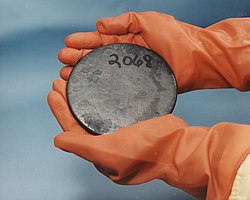
View on WikipediaSpecial nuclear material (SNM) is a term used by the United States Nuclear Regulatory Commission to classify fissile materials. The NRC divides special nuclear material into three main categories, according to the risk and potential for its direct use in a clandestine nuclear weapon or for its use in the production of nuclear material for use in a nuclear weapon.[1]

History
[edit]The Atomic Energy Act of 1946 gave the newly-formed Atomic Energy Commission ownership over all 'Fissionable Materials', explicitly including uranium-235 and plutonium.[2] The AEC was given authority to classify materials as fissionable, as well as to control access to such material, along with access to Restricted Data. Under the amended version of the Atomic Energy Act of 1954, such materials were redefined as Special Nuclear Material, as well as updated to include uranium-233.[3]
After the creation of the Nuclear Regulatory Commission by the Energy Reorganization Act, it took over the responsibility of classifying and controlling access to SNM.
Materials
[edit]Special Nuclear Material refers only to uranium-235, uranium-233, and plutonium.[1]
The term Strategic Special Nuclear Material (SSNM) refers to uranium-235 contained in uranium enriched above 20 percent (highly-enriched uranium), as well as any concentration of uranium-233 or plutonium.[1]
The distinction between SNM and SSNM is due to the fact that uranium-235 is typically found mixed with other isotopes such as uranium-238. Plutonium-239 is made in a nuclear reactor by irradiating uranium-238 with neutrons, and uranium-233 is made the same way using thorium-232. Since they are different elements than the source material, they can be separated relatively easily through chemical processes. However, uranium-235 is produced from uranium ore, which contains 0.7% uranium-235 with most of the rest consisting of uranium-238. Since they are the same element, they behave in similar ways and must be separated by their slightly different atomic masses. This process is far more difficult than chemical separation. Since highly-enriched uranium is required for nuclear weapons, but low-enriched uranium is commonly used in nuclear power plants, it is classified both by its quantity and enrichment percentage.
Categories
[edit]The NRC defines the three categories of SNM.[1]
Category I
[edit]Category I (Strategic SNM) is defined as SSNM in any combination in a quantity of
- 2 kilograms (4.4 pounds) or more of Pu-239; or
- 5 kilograms or more of U-235 (11 pounds; contained in uranium enriched to 20 percent or more in the U-235 isotope); or
- 2 kilograms (4.4 pounds) or more of U-233; or
- 5 kilograms (11 pounds) or more in any combination computed by the equation grams = (grams contained U-235) + 2.5 (grams U-233 + grams Pu-239).
These combinations are referred to as a formula quantity.[4]
| 235U | 5 kg |
| 233U | 2 kg |
| 239Pu | 2 kg |
| 0.4×235U + 233U + 239Pu | 2 kg |
Category II
[edit]Category II (Special nuclear material of moderate strategic significance) is defined as
- Less than a formula quantity of strategic special nuclear material but more than 1,000 grams of uranium-235 (contained in uranium enriched to 20 percent or more in the U-235 isotope) or more than 500 grams of uranium-233 or plutonium-239, or in a combined quantity of more than 1,000 grams (2.2 pounds) when computed by the equation grams = (grams contained U-235) + 2 (grams U-233 + grams Pu-239); or
- 10,000 grams (22 pounds) or more of uranium-235 (contained in uranium enriched to 10 percent or more but less than 20 percent in the U-235 isotope).
Category III
[edit]Category III (Special nuclear material of low strategic significance) is:
- Less than an amount of special nuclear material of moderate strategic significance (see category II above) but more than 15 grams (0.5 oz) of uranium-235 (contained in uranium enriched to 20 percent or more in U-235 isotope) or 15 grams of uranium-233 or 15 grams of plutonium-239 or the combination of 15 grams when computed by the equation grams = (grams contained U-235) + (grams Pu-239) + (grams U-233); or
- Less than 10,000 grams but more than 1,000 grams of uranium-235 (contained in uranium enriched to 10 percent or more but less than 20 percent in the U-235 isotope); or
- 10,000 grams or more of uranium-235 (contained in uranium enriched above natural but less than 10 percent in the U-235 isotope).
Access
[edit]Individuals with access to special nuclear material require an access authorization (security clearance) from the NRC or DOE.
The NRC defines two levels of Special Nuclear Material Access Authorization, NRC-U and NRC-R, in addition to the standard Department of Energy Access Authorizations L and Q.[5]

Individuals with Q access authorization are permitted access to all three categories of SNM, while L access authorization only allows access to categories II and III.
The NRC SNM access authorization levels (U and R) are given to individuals who are employed by an NRC contractor, licensee, or contractor of a licensee and who requires access to SNM,[6] while NRC employees are given either Q or L depending on their position sensitivity.[7] NRC-R requires the same Tier 3 background investigation as L, and permits access to protected areas in nuclear facilities. NRC-U requires a Tier 5 investigation, similar to Q, and allows access to all three categories of nuclear material. All individuals responsible for the transport of SNM are required to possess NRC-U.[6]
References
[edit]- ^ a b c d "Safeguard Categories of SNM". NRC.gov. 2020-03-11. Retrieved 2022-12-08.
- ^ Atomic Energy Act of 1946 (PDF). August 1, 1946. Retrieved 2024-02-28.
- ^ Atomic Energy Act of 1954 (PDF). August 30, 1954. Retrieved 2024-02-28.
- ^ "Formula quantity". NRC.gov. 2021-03-09. Retrieved 2024-02-28.
- ^ "DOE O 472.2A, Personnel Security". United States Department of Energy. 2022-06-10. Retrieved 2024-02-28.
- ^ a b "PART 11—CRITERIA AND PROCEDURES FOR DETERMINING ELIGIBILITY FOR ACCESS TO OR CONTROL OVER SPECIAL NUCLEAR MATERIAL". NRC.gov. 2022-10-03. Retrieved 2024-02-28.
- ^ Keith G. Fultz (1989-03-15). "Weaknesses in NRC's Security Clearance Program" (PDF). Retrieved 2024-02-28.
| |||||||||||||||||||||||||||||||||||||||||||||||||||||||
| |||||||||||||||||||||||||||||||||||||||||||||||||||||||


Special nuclear material
View on GrokipediaSpecial nuclear material (SNM) refers to plutonium, uranium-233, uranium enriched above 0.711 percent by weight in the isotope uranium-235, and any other material designated as such under section 51 of the Atomic Energy Act of 1954.[1][2] These fissile isotopes possess the property of sustaining controlled nuclear fission chain reactions, enabling their use as fuel in nuclear reactors for electricity production and as fissile cores in nuclear weapons.[3][4] Strict regulation of SNM stems from its dual-use potential, necessitating rigorous material control, accounting, and physical protection measures to mitigate risks of theft, sabotage, or proliferation to non-state actors or rogue states.[5] The U.S. Nuclear Regulatory Commission (NRC) categorizes SNM into safeguard levels based on enrichment, isotopic content, and quantity, with Category I strategic SNM—such as plutonium, uranium-233, or uranium enriched to 20 percent or more in uranium-235—requiring the highest security standards due to its direct usability in improvised nuclear devices.[4][5] Under the Atomic Energy Act, production, possession, and transfer of SNM are licensed exclusively by federal authorities to ensure national security and nonproliferation objectives.[6]
Definition and Legal Framework
United States Definition
In the United States, special nuclear material (SNM) is defined under Section 11(aa) of the Atomic Energy Act of 1954, as amended, codified at 42 U.S.C. § 2014(aa), as plutonium; uranium enriched in the isotope uranium-233 or uranium-235; or any other material that the Nuclear Regulatory Commission (NRC) determines to be special nuclear material after considering factors such as its use in nuclear reactors or weapons, proliferation risks, and safeguards needs, excluding source material like natural or depleted uranium.[7] This definition emphasizes materials capable of sustaining a chain reaction due to their fissile isotopes, distinguishing them from less concentrated nuclear fuels.[3] Regulations implementing this definition, such as in 10 CFR § 110.2, specify that SNM includes plutonium, uranium-233, or uranium enriched to more than 0.711 percent by weight in uranium-235, reflecting the threshold slightly above natural uranium's isotopic abundance of approximately 0.72 percent U-235, which enables potential use in reactors or, at higher enrichments, weapons.[1] The U.S. Department of Energy (DOE) aligns with this in directives, defining SNM similarly as plutonium, uranium-233, or uranium enriched above 0.711 percent U-235 by weight, underscoring its application to both civilian and defense programs.[2] The NRC retains authority to classify additional materials as SNM based on empirical assessments of fissionability and safeguards requirements, ensuring the definition adapts to technological advancements without broadening to non-fissile substances.[7] This framework, established by the Atomic Energy Act signed into law on August 30, 1954, prioritizes control over fissile materials to prevent diversion for weapons, with the NRC and DOE enforcing licensing, accounting, and physical protection under Title 10 of the Code of Federal Regulations.[6] Unlike international definitions that may vary by treaty thresholds, the U.S. approach integrates first-principles considerations of nuclear physics—such as critical mass and neutron economy—into legal criteria, avoiding over-reliance on enrichment percentages alone for proliferation risk.[3]International Definitions and Equivalents
The term "special fissionable material," as defined in Article XX of the IAEA Statute effective July 29, 1957, serves as the primary international equivalent to special nuclear material, encompassing plutonium-239, uranium-233, uranium enriched in uranium-235 or uranium-233 beyond natural isotopic abundances (exceeding approximately 0.72% uranium-235), any substance containing one or more of these isotopes, and other fissile materials. This definition underpins IAEA safeguards, which verify that such materials in peaceful nuclear activities are not diverted for weapons purposes, applying to all nuclear material in non-nuclear-weapon states under comprehensive safeguards agreements.[8] The Treaty on the Non-Proliferation of Nuclear Weapons (NPT), effective March 5, 1970, incorporates these IAEA definitions for source material and special fissionable material, requiring non-nuclear-weapon states to accept safeguards on all such items within their territories to prevent proliferation. IAEA protocols, such as those in INFCIRC/540 (1997 model additional protocol), extend verification to nuclear material declarations, including special fissionable forms, with measures like material accountancy and containment/surveillance to detect anomalies as small as 1% significant quantity diversion.[9] Unlike U.S. law, which explicitly thresholds uranium enrichment at over 0.711% uranium-235 by weight, the IAEA formulation ties to natural isotopic ratios but yields equivalent practical thresholds, though safeguards apply regardless of enrichment level for declared facilities.[1] In export control regimes like the Nuclear Suppliers Group (NSG), established April 1974 following India's 1974 nuclear test, special fissionable material triggers licensing requirements for transfers, aligning with IAEA definitions to restrict proliferation risks; for instance, plutonium exports are prohibited except for verified non-weapons uses, and enriched uranium above 20% often receives heightened scrutiny as "direct-use" material suitable for weapons without further processing. Regional frameworks, such as EURATOM Treaty (1957), mirror IAEA terms by designating special fissionable material for strict accounting and safeguards, with quantities like 8 kg plutonium or 25 kg uranium-235 defining "significant quantities" for potential bomb cores, though actual weapon feasibility depends on isotopic purity and design. These international standards emphasize empirical verification over self-reporting, addressing credibility gaps in state declarations through independent inspections, as evidenced by IAEA's detection of undeclared activities in cases like Iraq (1991) and Iran (2000s).[8]Materials and Properties
Enriched Uranium (U-235)
Enriched uranium consists of uranium isotopes separated to increase the concentration of the fissile isotope uranium-235 (U-235) beyond its natural abundance of 0.711 weight percent. This process exploits the 1.27% mass difference between U-235 and the more abundant U-238 isotope. Low-enriched uranium (LEU) contains less than 20% U-235 by weight and is primarily used as fuel in commercial nuclear power reactors, typically at 3-5% enrichment for light-water reactors.[10][11] Highly enriched uranium (HEU), defined as uranium enriched to 20% or greater U-235, qualifies as special nuclear material under U.S. Department of Energy regulations due to its suitability for nuclear weapons and compact reactors. Weapon-grade HEU is typically enriched to over 90% U-235, enabling efficient fission chain reactions with minimal critical mass. The International Atomic Energy Agency aligns with this threshold, classifying enrichments above 20% as HEU, primarily utilized in military propulsion systems like naval reactors and research facilities.[12][13][14] U-235's nuclear properties make it fissile, as it readily undergoes fission upon absorbing thermal neutrons, releasing approximately 200 MeV of energy per fission event and sustaining chain reactions in sufficient quantities. The bare-sphere critical mass for pure U-235 metal is about 50 kilograms, forming a sphere roughly 17 cm in diameter, though reflectors and tampers can reduce this to as low as 15 kilograms in optimized designs. Impurities such as U-234 and U-236, present in enriched uranium from production processes, can affect neutron economy and reactivity but are minimized in high-purity HEU.[15][16]Plutonium Isotopes
Plutonium-239 (Pu-239) is the primary fissile isotope classified as special nuclear material, capable of sustaining a fast fission chain reaction with a low critical mass of approximately 10 kilograms for a bare metallic sphere in its alpha phase.[17] It has a half-life of 24,110 years and primarily decays via alpha emission to uranium-235, with a spontaneous fission rate that contributes neutrons for initiating reactions but is low enough to permit efficient weapon designs when purified.[18] Pu-239 is produced in nuclear reactors through neutron capture by uranium-238 followed by beta decays, and its isotopic purity determines the material's suitability for applications; weapons-grade plutonium requires at least 93% Pu-239 content to minimize predetonation risks from impurities.[19] Plutonium-241 (Pu-241), another fissile isotope, has a shorter half-life of 14.35 years and decays primarily by beta emission to americium-241, while also undergoing spontaneous fission at a rate about 15 times higher than Pu-239 per atom.[20] In plutonium mixtures extracted from spent reactor fuel, Pu-241 constitutes 10-15% in typical compositions, enhancing overall fissility but requiring safeguards due to its decay heat and neutron emissions; quantities exceeding 350 grams are regulated as significant for proliferation risks under international standards.[21] Its presence increases the effective neutron multiplication factor in assemblies, making even reactor-grade plutonium potentially usable in improvised devices despite higher impurities. Non-fissile isotopes like plutonium-240 (Pu-240) and plutonium-242 (Pu-242) arise as byproducts during production and degrade fissile performance; Pu-240, with a half-life of 6,561 years, emits neutrons via spontaneous fission at a rate roughly 400 times that of Pu-239, necessitating isotopic separation or short irradiation times (under 100 MWd/t burnup) for weapons-grade material to keep Pu-240 below 7%.[20][19] Pu-242, half-life 373,300 years, absorbs neutrons without fissioning, acting as a parasitic "poison" in high-burnup reactor plutonium where it can exceed 20%, reducing the material's reactivity and complicating weaponization.[20] Plutonium-238 (Pu-238), though not fissile, is designated special nuclear material in concentrated forms (over 80% isotopic purity) due to its intense alpha decay heat output—about 0.57 watts per gram—used in radioisotope thermoelectric generators for space missions, with a half-life of 87.7 years.[22][20] Its production involves sequential neutron irradiations of neptunium-237, yielding high specific power but requiring stringent handling for radiation protection.| Isotope | Half-Life (years) | Primary Decay Mode | Fissile | Key Role in SNM |
|---|---|---|---|---|
| Pu-238 | 87.7 | Alpha | No | Heat source; regulated if concentrated[22] |
| Pu-239 | 24,110 | Alpha | Yes | Primary fissile for weapons/reactors[18] |
| Pu-240 | 6,561 | Alpha | No | Neutron emitter; limits weapons purity[20] |
| Pu-241 | 14.35 | Beta | Yes | Secondary fissile; decay heat source[20] |
| Pu-242 | 373,300 | Alpha | No | Neutron absorber in reactor-grade Pu[20] |
Uranium-233
Uranium-233 (²³³U) is a fissile isotope of uranium with an atomic mass of 233 atomic mass units and a half-life of approximately 159,200 years, primarily decaying via alpha emission.[25] It exhibits a high thermal neutron fission cross-section of about 531 barns, enabling it to sustain a nuclear chain reaction with low-energy neutrons, though it also has a capture cross-section of around 45 barns that competes with fission.[26] This isotope is produced exclusively through artificial means, as it does not occur naturally in significant quantities, and its fission characteristics make it suitable for both nuclear reactors and, in purified form, nuclear explosives.[27] Production of ²³³U occurs via neutron irradiation of thorium-232 (²³²Th), the most abundant thorium isotope, in a nuclear reactor or accelerator: ²³²Th captures a neutron to form ²³³Th, which beta-decays to protactinium-233 (²³³Pa) with a 27-day half-life, and ²³³Pa then beta-decays to ²³³U.[28] This process is central to the thorium-uranium fuel cycle, which leverages thorium's greater natural abundance—about three times that of uranium—for potential energy production. In the United States, significant quantities were generated during the mid-20th century at facilities like the Savannah River Site, with subsequent processing and storage at Oak Ridge National Laboratory (ORNL), yielding a stockpile estimated between 359 kg and 450 kg as of historical assessments.[29] The presence of ²³²U contaminant (from side reactions in ²³²Th) introduces proliferation challenges, as its decay chain produces high-energy gamma emitters like thallium-208 (2.6 MeV), complicating material handling and detection but not eliminating weapons utility if separated.[30] As a fissile material capable of supporting explosive yields in nuclear devices, ²³³U is classified as special nuclear material (SNM) under U.S. regulations, alongside plutonium isotopes and uranium-235 enriched beyond 20% U-235, subjecting it to strict controls under the Atomic Energy Act.[3] The U.S. Department of Energy has managed surplus ²³³U stocks primarily for downblending with depleted uranium to render it non-weapons-usable (below 12 wt% ²³³U to prevent criticality), addressing both proliferation risks and storage safety in aging facilities like ORNL's Building 3019.[31] While experimental reactors have demonstrated its fuel efficacy, such as in breeder concepts, no commercial-scale thorium cycle has been deployed, limiting ²³³U's role to research and legacy inventories rather than routine SNM applications.[32]Classification and Quantities
Category I (Strategic SNM)
Category I quantities of special nuclear material consist of formula quantities of strategic special nuclear material (SSNM), defined as amounts posing the greatest risk of theft or diversion for use in nuclear weapons due to minimal need for additional processing.[4] Strategic SNM includes plutonium of any isotopic composition, uranium-233, and uranium enriched to 20 percent or more in the uranium-235 isotope.[33] These thresholds trigger the most stringent regulatory controls under U.S. Nuclear Regulatory Commission (NRC) and Department of Energy (DOE) oversight.[5] The specific quantity thresholds for Category I are established in 10 CFR § 74.4 as a formula quantity of 5,000 grams or more of SSNM, calculated by the summation: (grams of contained uranium-235 / 5,000) + (grams of plutonium + grams of uranium-233 / 2,000) ≥ 1. This equates to individual material limits of 5 kilograms of uranium-235 or 2 kilograms of plutonium or uranium-233, with proportional combinations permitted under the formula.[4]| Material | Threshold Quantity |
|---|---|
| Uranium-235 (contained in uranium enriched ≥20% U-235) | 5 kg |
| Plutonium (any isotope) | 2 kg |
| Uranium-233 | 2 kg |
Category II Quantities
Category II quantities of special nuclear material (SNM) are defined under U.S. regulations as amounts of strategic SNM possessing moderate strategic significance, falling below the thresholds for Category I (formula quantities) but exceeding those for Category III (low strategic significance).[4] These quantities are considered attractive to potential adversaries for theft or diversion due to their potential usability in nuclear devices with feasible processing, though requiring more effort than Category I materials.[34] The classification drives specific physical protection requirements, such as those in 10 CFR 73.45, which mandate detection, delay, and response capabilities against threats including external adversaries with explosives and insider assistance. Strategic SNM for Category II includes plutonium (Pu), uranium-233 (U-233), and uranium-235 (U-235) contained in highly enriched uranium (HEU, enriched to 20% or more U-235). Category II applies to possessions of less than a formula quantity—defined as 5,000 grams or more computed by the aggregation formula: total grams = (grams of contained U-235 in HEU) + 2.5 × (grams of Pu + grams of U-233)—but exceeding 1,000 grams of contained U-235 in HEU, or 500 grams of U-233, or 500 grams of Pu, or equivalent combinations per the formula.[34] For example, 2,000 grams of Pu-239 alone constitutes a Category II quantity, as it falls below 5,000 / 2.5 = 2,000 grams equivalent for formula but exceeds 500 grams.| Material Type | Lower Threshold for Category II |
|---|---|
| U-235 in HEU (≥20% enrichment) | >1,000 grams contained U-235 |
| U-233 | >500 grams |
| Plutonium (any isotope except as adjusted in formula) | >500 grams |
| Combinations | > Category III per aggregation formula; <5,000 grams formula equivalent[34] |
Category III Quantities
Category III quantities encompass special nuclear material (SNM) of low strategic significance, defined under U.S. Nuclear Regulatory Commission (NRC) regulations as amounts below Category II thresholds that present a diminished risk for unauthorized use in nuclear weapons due to insufficient mass for rapid weaponization without significant additional processing.[36] These quantities trigger reduced physical protection and material control requirements compared to higher categories, reflecting their lower attractiveness to adversaries seeking proliferation material.[4] The specific thresholds for Category III SNM, as outlined in 10 CFR § 74.4, vary by isotope and enrichment level:| Material Type | Threshold Quantity |
|---|---|
| Uranium enriched above natural but less than 10% U-235 by weight | Less than 10,000 grams of contained U-235[36] |
| Uranium enriched at 10% or more but less than 20% U-235 by weight | Less than 1,000 grams of contained U-235[36] |
| Uranium enriched above 20% but less than 99.5% U-235 by weight | Less than 500 grams of contained U-235[36] |
| Plutonium or uranium-233 | Less than 1,000 grams total[36] |