


Community hub
Recent from talks
Contribute something
Nothing was collected or created yet.
Basil of Caesarea
View on Wikipedia
Key Information


| Part of a series on the |
| Eastern Orthodox Church |
|---|
 |
| Overview |
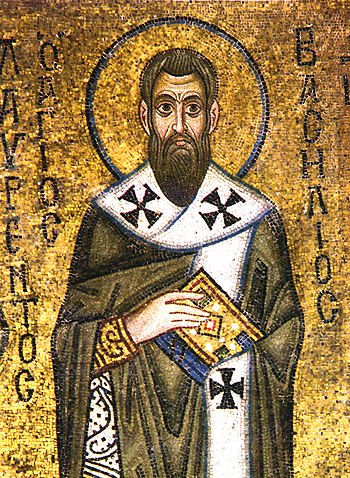
Basil of Caesarea, also called Saint Basil the Great[a] (330 – 1 or 2 January 379)[8] was an early Roman Christian prelate who served as Bishop of Caesarea in Cappadocia from 370 until his death in 379. He was an influential theologian who supported the Nicene Creed and opposed heresies within the early Christian church such as Arianism and Apollinarianism.
In addition to his work as a theologian, Basil was known for his care of the poor and underprivileged. Basil established guidelines for monastic life which focus on community life, liturgical prayer, and manual labor. Together with Pachomius, he is remembered as a father of communal monasticism in Eastern Christianity. He is considered a saint by the traditions of both Eastern and Western Christianity.
Basil, together with his brother Gregory of Nyssa and his friend Gregory of Nazianzus, are collectively referred to as the Cappadocian Fathers. The Eastern Orthodox Church and Eastern Catholic Churches have given him, together with Gregory of Nazianzus and John Chrysostom, the title of Great Hierarch. He is recognized as a Doctor of the Church in the Roman Catholic Church. He is sometimes referred to by the epithet Ouranophantor (Greek: Οὐρανοφάντωρ), "revealer of heavenly mysteries".[9]
Life
[edit]Early life and education
[edit]Basil was born into the wealthy Cappadocian Greek[10] family of Basil the Elder,[11] and Emmelia of Caesarea, in Cappadocia, around 330. He was one of ten children, and his parents were known for their piety.[12] His maternal grandfather was a Christian martyr, executed in the years prior to Constantine I's conversion.[13][14] His pious paternal grandmother, Macrina, a follower of Gregory Thaumaturgus (who had founded the nearby church of Neocaesarea),[15] raised Basil and four of his siblings who also are now venerated as saints: Macrina the Younger, Naucratius, Peter of Sebaste, and Gregory of Nyssa.
Basil received more formal education in Caesarea Mazaca in Cappadocia (modern Kayseri) around 350–51.[16] There he met Gregory of Nazianzus.[17] Gregory went to Alexandria, while Basil went to Constantinople for further studies, including the lectures of Libanius. The two later met again in Athens and became fast friends. There they met a fellow student who would become the emperor Julian the Apostate.[18][19] Basil left Athens in 356, and after travels in Egypt and Syria, he returned to Caesarea. For around a year he practiced law and taught rhetoric.[20]
Basil's life changed radically after he encountered Eustathius of Sebaste, a charismatic bishop and ascetic.[21] Abandoning his legal and teaching career, Basil devoted his life to God. In a letter, he described his spiritual awakening:
I had wasted much time on follies and spent nearly all of my youth in vain labours, and devotion to the teachings of a wisdom that God had made foolish. Suddenly, I awoke as out of a deep sleep. I beheld the wonderful light of the Gospel truth, and I recognized the nothingness of the wisdom of the princes of this world.[22]
Annesi
[edit]
After his baptism, Basil travelled in 357 to Palestine, Egypt, Syria and Mesopotamia to study ascetics and monasticism.[23][24] Eustathius of Sebaste, a prominent anchorite near Pontus, mentored Basil.[25] Basil distributed his fortunes among the poor and went briefly into solitude near Neocaesarea of Pontus (modern Niksar), on the Iris River.[23] He eventually realized that, while he respected the ascetics' piety and prayerfulness, the solitary life did not call him.[26] He and Eustathius also eventually differed over dogma.[25]
Basil instead felt drawn toward communal religious life, and by 358 he was gathering around him a group of like-minded disciples, including his brother Peter. Together they founded a monastic settlement on his family's estate near Annesi[24] (modern Sonusa or Uluköy, near the confluence of the Iris and Lycos rivers[27]). His widowed mother Emmelia, sister Macrina, and several other women, joined Basil and devoted themselves to pious lives of prayer and charitable works (some claim Macrina founded this community).[28]
Here Basil wrote about monastic communal life. His writings became pivotal in developing monastic traditions of the Eastern Church.[29] In 358, Basil invited his friend Gregory of Nazianzus to join him in Annesi.[30] When Gregory eventually arrived, they collaborated on Origen's Philocalia, a collection of Origen's works.[31] Gregory decided to return to his family in Nazianzus.
Basil attended the Council of Constantinople (360). He at first sided with Eustathius and the Homoiousians, a semi-Arian faction who taught that the Son was of like substance with the Father, neither the same (one substance) nor different from him.[32] The Homoiousians opposed the Arianism of Eunomius but refused to join with the supporters of the Nicene Creed, who professed that the members of the Trinity were of one substance ("homoousios"). However, Basil's bishop, Dianius of Caesarea, had subscribed only to the earlier Nicene form of agreement. Basil eventually abandoned the Homoiousians, and emerged instead as a strong supporter of the Nicene Creed.[32] His ability to balance his theological convictions with his political connections made Basil a powerful advocate for the Nicene position.
Caesarea
[edit]
In 362, Bishop Meletius of Antioch ordained Basil as a deacon. Eusebius then summoned Basil to Caesarea and ordained him as presbyter of the Church there in 365. Eusebius needed him as an assistant because of his intellectual gifts. Ecclesiastical entreaties rather than Basil's desires thus altered his career path.[23]
Basil and Gregory Nazianzus spent the next few years combatting the Arian heresy, which threatened to divide Cappadocia's Christians. In close fraternal cooperation, they agreed to a great rhetorical contest with accomplished Arian theologians and rhetors.[33] In the subsequent public debates, presided over by agents of Valens, Gregory and Basil emerged triumphant. This success confirmed for both Gregory and Basil that their futures lay in the administration of the Church.[33] Basil next took on functional administration of the city of Caesarea.[29] Eusebius is reported to have been jealous of Basil's quickly developed reputation and influence. He allowed Basil to return to his earlier solitude. Later, however, Gregory persuaded him to return, and Basil became the administrator for the Diocese of Caesarea.[34]
In 370, Eusebius died. Basil was chosen to succeed him and was consecrated as a bishop on 14 June 370.[35] His new post as Bishop of Caesarea also gave him the powers of exarch of Pontus and metropolitan of five suffragan bishops, many of whom had opposed him in the election for Eusebius's successor. It was then that his great powers were called into action. Hot-blooded and somewhat imperious, Basil was also generous and sympathetic. He personally organized a soup kitchen and distributed food to the poor during a famine following a drought.[25]
His letters show that he actively worked to reform thieves and prostitutes. They also show him encouraging his clergy not to be tempted by wealth or the comparatively easy life of a priest and taking care in selecting worthy candidates for holy orders. He also had the courage to criticize public officials who failed in their duty of administering justice. At the same time, he preached every morning and evening in his own church to large congregations. In addition to all the above, he built a large complex just outside Caesarea, called the Basiliad,[36] which included a poorhouse, hospice, and hospital. It was compared by Gregory of Nazianzus to the wonders of the world.[37]
His zeal for orthodoxy did not blind him to what was good in an opponent; and for the sake of peace and charity, he was content to waive the use of orthodox terminology when it could be surrendered without a sacrifice of truth. The Emperor Valens, who was an adherent of the Arian philosophy, sent his prefect Modestus to at least agree to a compromise with the Arian faction. Basil's adamant negative response prompted Modestus to say that no one had ever spoken to him in that way before. Basil replied, "Perhaps you have never yet had to deal with a bishop." Modestus reported back to Valens that he believed nothing short of violence would avail against Basil. Valens was apparently unwilling to engage in violence. He did however issue orders banishing Basil repeatedly, none of which succeeded. Valens came himself to attend when Basil celebrated the Divine Liturgy on the Feast of the Theophany (Epiphany), and at that time was so impressed by Basil that he donated to him some land for the building of the Basiliad. This interaction helped to define the limits of governmental power over the church.[38]
Basil then had to face the growing spread of Arianism. This belief system, which denied that Christ was consubstantial with the Father, was quickly gaining adherents and was seen by many, particularly those in Alexandria most familiar with it, as posing a threat to the unity of the church.[39] Basil entered into connections with the West, and with the help of Athanasius, he tried to overcome its distrustful attitude toward the Homoiousians. The difficulties had been enhanced by bringing in the question as to the essence of the Holy Spirit. Although Basil advocated objectively the consubstantiality of the Holy Spirit with the Father and the Son, he belonged to those, who, faithful to Eastern tradition, would not allow the predicate homoousios to the former; for this he was reproached as early as 371 by the Orthodox zealots among the monks, and Athanasius defended him.
Basil corresponded with Pope Damasus in the hope of having his aid and encouragement against triumphant Arianism; the pope, however, cherished some degree of suspicion against the Cappadocian Doctor.[40]
Death and legacy
[edit]_San_Basilio_-_Jacobello_di_Bonomo_-_Museo_Correr.jpg)
Basil died before the factional disturbances ended. He suffered from liver disease; excessive ascetic practices also contributed to his early demise. Historians disagree about the exact date Basil died.[41] The great institute before the gates of Caesarea, the Ptochoptopheion, or "Basileiad", which was used as poorhouse, hospital, and hospice became a lasting monument of Basil's episcopal care for the poor.[25] Many of St. Basil's writings and sermons, specifically on the topics of money and possessions, continue to influence modern Christianity.[42]
Writings
[edit]
The principal theological writings of Basil are his On the Holy Spirit, an appeal to Scripture and early Christian tradition to prove the divinity of the Holy Spirit, and his Refutation of the Apology of the Impious Eunomius, which was written about in 364 and comprised three books against Eunomius of Cyzicus, the chief exponent of Anomoian Arianism. The first three books of the Refutation are his work; his authorship of the fourth and fifth books is generally considered doubtful.[43]

He was a famous preacher, and many of his homilies, including a series of Lenten lectures on the Hexaemeron (also Hexaëmeros, "Six Days of Creation"; Latin: Hexameron), and an exposition of the psalter, have been preserved. Some, like that against usury and that on the famine in 368, are valuable for the history of morals; others illustrate the honour paid to martyrs and relics; the address to young men on the study of classical literature shows that Basil was influenced by his own education, which taught him to appreciate the propaedeutic importance of the classics.[44] In one of his Homilies, he describes, in one of the earliest descriptions of desalination, how sailors in his time obtain fresh water by hanging sponges over a vessel with boiling seawater and collecting and condensing the water vapour.[45]
In his exegesis Basil was an admirer of Origen and the need for the spiritual interpretation of Scripture. In his work on the Holy Spirit, he asserts that "to take the literal sense and stop there, is to have the heart covered by the veil of Jewish literalism. Lamps are useless when the sun is shining." He frequently stresses the need for Reserve in doctrinal and sacramental matters. At the same time, he expressed reservations against the use of overly speculative allegorations of some contemporaries.[46] Concerning this, he wrote:
"I know the laws of allegory, though less by myself than from the works of others. There are those, truly, who do not admit the common sense of the Scriptures, for whom water is not water, but some other nature, who see in a plant, in a fish, what their fancy wishes, who change the nature of reptiles and of wild beasts to suit their allegories, like the interpreters of dreams who explain visions in sleep to make them serve their own end."[47]
His ascetic tendencies are exhibited in the Moralia and Asketika (sometimes mistranslated as Rules of St. Basil), ethical manuals for use in the world and the cloister, respectively. There has been a good deal of discussion concerning the authenticity of the two works known as the Greater Asketikon and the Lesser Asketikon.[25]
According to Orosius, Basil taught apocatastasis entailing the restoration of all sinners to Christ after purification. This doctrine is most evident in his Commentary on Isaiah, although there is some scholarly dispute whether this commentary should truly be attributed to him. On the other hand, Basil vehemently opposed the view that hell has an end in his short Regulae, even claiming that the many people who hold it are deceived by the devil. However, the notion of a finite hell was also espoused by his siblings Macrina and Gregory of Nyssa and potentially by his dear friend Gregory of Nazianzus, which is one of the reasons to think that the relevant passage in Regulae was interpolated. The passage also seems to include ideas that could be considered in opposition to ideas in Basil's undisputed writings, for example the notion of physical punishments in hell and of hell itself as a physical place with different locations. It is potentially in contradiction to most of Basil's linguistic use as well.[48]
In his book De Spiritu Sancto, Basil lists some who for him are illustrious men of the church and quotes them; these are Irenaeus of Lyon, Clement of Rome, Dionysius of Rome, Dionysius of Alexandria, Eusebius, Julius Africanus, Gregory Thaumaturgus, Firmilian and Origen.[49]
Basil also stresses the complete equality of both genders, deriving from the same human 'lump' (φύραμα), both in the image of God, endowed with the same honour and dignity (ὁμοτίμως), in perfect equality (ἐξ ἴσου). Men even risk being inferior in piety (Homily on Julitta 241B). Likewise, in Homilies on Psalms 1, PG 29.216–17, he insists that man and woman have 'one and the same virtue' and 'one and the same nature' (φύσις). Their common creation was of equal honour and dignity (ὁμότιμος); they have the same capacity and activity (ἐνέργεια), and will be given the same reward. Similarly, in Letter to Amphilochius 188, Basil again uses ἐξ ἴσου in reference to the equality of women and men.[50]
Basil faced the slavery issue in De Spiritu Sancto 20 in the context of a Trinitarian debate. Basil recognizes that no human is "a slave by nature". This principle countered Aristotle's conviction and was consistent with Gregory of Nyssa's view and with that of many other patristic thinkers; even Augustine and Theodoret conceded this. Basil, indeed, viewed slavery as a result of the Fall, a principle that was shared by Augustine, Theodoret, and many other Fathers.[51][52] Sometimes slavery is a boon to the enslaved person, Basil maintained (in Moral Rules 75 he recommended, that Christian slaves work harder than non-Christian slaves). This view is opposed to Gregory of Nyssa, and is reminiscent of Aristotle's argument and of Theodoret's.[50]
It is in the ethical manuals and moral sermons that the practical aspects of his theoretical theology are illustrated. So, for example, it is in his Sermon to the Lazicans that we find Basil explaining how it is our common nature that obliges us to treat our neighbour's natural needs (e.g., hunger, thirst) as our own, even though he is a separate individual.[citation needed]
Basil's three hundred letters reveal his character. They show his observant nature, which, despite the troubles of ill-health and ecclesiastical unrest, remained optimistic, tender and even playful. Basil is honoured as the chief architect of monastic life in the Greek Church.[53]
Most of his extant works, and a few spuriously attributed to him, are available in the Patrologia Graeca, which includes Latin translations of varying quality. Several of Basil's works appeared in the late twentieth century in the Sources Chrétiennes collection.[54]
A famous quote of Basil is the below:[55]
The bread you store belongs to the hungry. The clothes you accumulate belong to the naked. The shoes that you have in your closet are for the barefoot. The money you bury deep into the ground to keep it safe, belongs to the poor. You were unfair to as many people as you could have helped and you did not.

Liturgical contributions
[edit]Basil of Caesarea holds a very important place in the history of Christian liturgy. Basil is known to have composed a liturgy by refining an existing liturgy; in addition to the constant tradition of the Byzantine Church there are many testimonies in ancient writings to establish the fact. Basil's liturgical influence is well-attested in early sources.[56]
Most of the liturgies bearing the name of Basil are not entirely his work in their present form, but they nevertheless preserve a recollection of Basil's activity in this field in formularizing liturgical prayers and promoting church songs. Patristic scholars conclude that the Liturgy of Saint Basil "bears, unmistakably, the personal hand, pen, mind and heart of St. Basil the Great".[57]
One liturgy that can be attributed to him is The Divine Liturgy of Saint Basil the Great, a liturgy that is somewhat longer than the more commonly used Divine Liturgy of St. John Chrysostom. The difference between the two is primarily in the silent prayers said by the priest, and in the use of the hymn to the Theotokos, All of Creation, instead of the Axion Estin of John Chrysostom's Liturgy.[56]
The Eastern Churches preserve numerous other prayers attributed to Basil, including three prayers of exorcism, several morning and evening prayers, and the "Prayer of the Hours" which is read at each service of the Daily Office.[citation needed] One of the earliest eucharistic prayers still in use in the Coptic Orthodox Church bears the name of St Basil and may have been brought to Egypt by Basil himself who spent some time in Alexandria in 357.[58]
Influence on monasticism
[edit]Through his examples and teachings, Basil effected a noteworthy moderation in the austere practices which were previously characteristic of monastic life.[59] He is also credited with coordinating the duties of work and prayer to ensure a proper balance between the two.[60]
Basil is remembered as one of the most influential figures in the development of Christian monasticism. The Sayings of the Desert Fathers include one saying of Basil and both Barsanuphius and Dorotheus of Gaza refer to his rule.[61] Not only is Basil recognized as the father of Eastern monasticism; historians recognize that his legacy extends also to the Western church, largely due to his influence on Saint Benedict.[62] Patristic scholars such as Meredith assert that Benedict himself recognized this when he wrote in the epilogue to his Rule that his monks, in addition to the Bible, should read "the confessions of the Fathers and their institutes and their lives and the Rule of our Holy Father, Basil.[63] Basil's teachings on monasticism, as encoded in works such as his Small Asketikon, were transmitted to the West via Rufinus during the late 4th century.[64]
As a result of Basil's influence, numerous religious orders in Eastern Christianity bear his name. In the Roman Catholic Church, the Basilian Fathers, also known as the Congregation of St. Basil, an international order of priests and students studying for the priesthood, is named after him.[65]
Commemorations
[edit]Basil was given the title Doctor of the Church in the Western Church for his contributions to the debate initiated by the Arian controversy regarding the nature of the Trinity, and especially the question of the divinity of the Holy Spirit. Basil was responsible for defining the terms "ousia" (essence/substance) and "hypostasis" (person/reality), and for defining the classic formulation of three Persons in one Nature. His single greatest contribution was his insistence on the divinity and consubstantiality of the Holy Spirit with the Father and the Son.[66]
In Greek tradition, Basil brings gifts to children every 1 January (St Basil's Day). It is traditional on St Basil's Day to serve vasilopita, a rich bread baked with a coin inside. The tradition is attributed to St. Basil, who when a bishop, wanted to distribute money to the poor and commissioned some women to bake sweetened bread, in which he arranged to place gold coins. Thus the families in cutting the bread were pleasantly surprised to find the coins.[67]
It is customary on his feast day to visit the homes of friends and relatives, to sing New Year's carols, and to set an extra place at the table for Saint Basil. Basil, being born into a wealthy family, gave away all his possessions to the poor, the underprivileged, those in need, and children.[68]
According to some sources, Basil died on 1 January, and the Eastern Orthodox Church celebrates his feast day together with that of the Feast of the Circumcision on that day.[69] This was also the day on which the General Roman Calendar celebrated it at first; but in the 13th-century it was moved to 14 June, a date believed to be that of his ordination as bishop, and it remained on that date until the 1969 revision of the calendar, which moved it to 2 January, rather than 1 January, because the latter date is occupied by the Solemnity of Mary, Mother of God. On 2 January Saint Basil is celebrated together with Saint Gregory Nazianzen.[70] Novus Ordo services use the revised calendar while traditionalist Catholic communities continue to observe pre-1970 calendars.[71][72]
The Lutheran Church–Missouri Synod commemorates Basil, along with Gregory of Nazianzus and Gregory of Nyssa on 10 January.[73]
The Church of England celebrates Saint Basil's feast (Lesser Festival) on 2 January, but the Episcopal Church and the Anglican Church of Canada celebrate it on 14 June.[74][75]
In the Byzantine Rite, 30 January is the Synaxis of the Three Holy Hierarchs, in honor of Saint Basil, Saint Gregory the Theologian and Saint John Chrysostom.[76] There is also a commemoration on 19 January for the miracle performed by Saint Basil in the city of Nicaea.[77]
The Coptic Orthodox Church of Alexandria celebrates the feast day of Saint Basil on the 6th of Tobi[78] (6th of Terr on the Ethiopian calendar of the Ethiopian Orthodox Tewahedo Church). At present, this corresponds to 14 January (15 January during leap year.)[79]
There are numerous relics of Basil throughout the world. One of the most important is his head, which is preserved to this day at the monastery of the Great Lavra on Mount Athos in Greece. The mythical sword Durandal is said to contain some of Basil's blood.[80]
See also
[edit]Notes
[edit]- ^ Koine Greek: Ἅγιος Βασίλειος ὁ Μέγας, romanized: Hágios Basíleios ho Mégas; Coptic: Ⲡⲓⲁⲅⲓⲟⲥ Ⲃⲁⲥⲓⲗⲓⲟⲥ, romanized: Piagios Basílios
References
[edit]Citations
[edit]- ^ Great Synaxaristes: (in Greek) Ὁ Ἅγιος Βασίλειος ὁ Μέγας ὁ Καππαδόκης. 1 Ιανουαρίου. ΜΕΓΑΣ ΣΥΝΑΞΑΡΙΣΤΗΣ.
- ^ St Basil the Great the Archbishop of Caesarea, in Cappadocia. OCA – Feasts and Saints.
- ^ Great Synaxaristes: (in Greek) Οἱ Ἅγιοι Τρεῖς Ἱεράρχες. 30 Ιανουαρίου. ΜΕΓΑΣ ΣΥΝΑΞΑΡΙΣΤΗΣ.
- ^ Synaxis of the Ecumenical Teachers and Hierarchs: Basil the Great, Gregory the Theologian, and John Chrysostom. OCA – Feasts and Saints.
- ^ "نياحة القديس باسيليوس الكبير رئيس اساقفة قيصرية الكبادوك - عيد سنكسار يوم 6 طوبة، شهر طوبة، الشهر القبطي - St-Takla.org". st-takla.org.
- ^ Lutheranism 101, CPH, St. Louis, 2010, p.277
- ^ "عيد تذكار الأعجوبة التي صنعها القديس باسيليوس الكبير أسقف قيصرية - سنكسار يوم 13 توت، شهر توت، الشهر القبطي - St-Takla.org". st-takla.org.
- ^ Fedwick (1981), p. 5, 19.
- ^ "St Basil the Great the Archbishop of Caesarea, in Cappadocia". Orthodox Church in America. Retrieved 15 December 2007.
- ^ Perry, Marvin; Chase, Myrna; Jacob, James R.; Jacob, Margaret C.; Von Laue, Theodore H. (2013). Western Civilization: Ideas, Politics, and Society, Volume I: To 1789 (10th ed.). Wadsworth Cengage Learning. p. 184. ISBN 978-1-111-83170-7.
Saint Basil (c. 329 – c. 379), a Greek who was bishop of Caesarea in Cappadocia (eastern Asia Minor), established the rules that became the standard for monasteries in the East.
- ^ Quasten (1986), p. 204.
- ^ Oratio 43.4, PG 36. 500B, tr. p.30, as presented in Rousseau (1994), p.4
- ^ Davies (1991), p. 12.
- ^ Rousseau (1994), p. 4.
- ^ Rousseau (1994), p. 12 & p. 4, respectively
- ^ Hildebrand (2007), p. 19.
- ^ Norris, Frederick (1997). "Basil of Caesarea". In Ferguson, Everett (ed.). The Encyclopedia of Early Christianity (second ed.). New York: Garland Press.
- ^ Ruether (1969), pp. 19, 25.
- ^ Rousseau (1994), pp. 32–40.
- ^ Rousseau (1994), p. 1.
- ^ Hildebrand (2007), pp. 19–20.
- ^ Basil, Ep. 223, 2, as quoted in Quasten (1986), p. 205.
- ^ a b c Quasten (1986), p. 205.
- ^ a b Encyclopædia Britannica (15th ed.) vol. 1, p. 938.
- ^ a b c d e McSorley, Joseph (1907). . In Herbermann, Charles (ed.). Catholic Encyclopedia. Vol. 2. New York: Robert Appleton Company.
- ^ Merredith (1995), p. 21.
- ^ mod. Yeşilırmak and Kelkit Çayi rivers, see Rousseau (1994), p. 62.
- ^ The New Westminster Dictionary of Church History: The Early, Medieval, and Reformation Eras, vol.1, Westminster John Knox Press, 2008, ISBN 0-664-22416-4, p. 75.
- ^ a b Attwater, Donald and Catherine Rachel John. The Penguin Dictionary of Saints. 3rd edition. New York: Penguin Books, 1993. ISBN 0-14-051312-4.
- ^ Rousseau (1994), p. 66.
- ^ Merredith (1995), pp. 21–22.
- ^ a b Meredith (1995), p. 22.
- ^ a b McGuckin (2001), p. 143.
- ^ "Saint Basil the Great", Newman Connection
- ^ Meredith (1995), p. 23
- ^ The Living Age. Vol. 48. Littell, Son and Company. 1856. p. 326.
- ^ Gregory of Nazianzus. Oration 43: Funeral Oration on the Great S. Basil, Bishop of Cæsarea in Cappadocia. p. 63. Retrieved 20 February 2016.
- ^ Alban Butler; Paul Burns (1995). Butler's Lives of the Saints. Vol. 1. A&C Black. p. 14. ISBN 9780860122500.
- ^ Foley, O.F.M., Leonard (2003). "St. Basil the Great (329–379)". In McCloskey, O.F.M., Pat (rev.) (ed.). Saint of the Day: Lives, Lessons and Feasts (5th Revised ed.). Cincinnati, Ohio: St. Anthony Messenger Press. ISBN 978-0-86716-535-7. Archived from the original on 23 December 2007. Retrieved 15 December 2007.
- ^ Shahan, Thomas. "Pope St. Damasus I." The Catholic Encyclopedia Vol. 4. New York: Robert Appleton Company, 1908. 23 September 2021
 This article incorporates text from this source, which is in the public domain.
- ^ Rousseau (1994), pp. 360–363, Appendix III: The Date of Basil's Death and of the Hexaemeron
- ^ No. 48: St. Basil Wants You To Be Charitable, retrieved 29 November 2017
- ^ Jackson, Blomfield. "Basil: Letters and Select Works", Nicene and Post-Nicene Fathers, (Philip Schaff and Henry Wace, eds.) .T&T Clark, Edinburgh
- ^ Deferrari, Roy J. "The Classics and the Greek Writers of the Early Church: Saint Basil." The Classical Journal Vol. 13, No. 8 (May 1918). 579–91.
- ^ Nebbia, Giorgio; Menozzi, Gabriella Nebbia (April 1966). "A Short History of Desalination". Acqua Dolce Dal Mare. Inchiesta Internazionale, Milano. Federazione delle Associazioni Scientifiche e Tecniche: 129–172. Retrieved 21 January 2021.
- ^ Parry 2019, p. 362.
- ^ Basil. "Hexameron, 9.1". In Schaff, Philip (ed.). Nicene and Post-Nicene Fathers (2nd Series). Vol. 8 Basil: Letters and Select Works. Edinburgh: T&T Clark (1895). p. 102. Retrieved 15 December 2007.. Cf. Hexameron, 3.9 (Ibid., pp. 70–71).
- ^ Ramelli, Ilaria L.E. (2014). "Basil and Apokatastasis: New Findings". Journal of Early Christian History. 4 (2): 116–136. doi:10.1080/2222582X.2014.11877307.
- ^ Basil the Great. . Translated by John Henry MacMahon – via Wikisource.
- ^ a b Ilaria L.E. Ramelli. (2016). Social Justice and the Legitimacy of Slavery: The Role of Philosophical Asceticism from Ancient Judaism to Late Antiquity.
- ^ Ilaria, 2016
- ^ Kontoulis, Problem, 132–53, 186–91; De Wet, 'Sin as Slavery'.
- ^ Rousseau, Philip. "Basil of Caesarea", Oxford Classical Dictionary, OUP, 2015
- ^ "SOURCES CHRÉTIENNES, LISTE DES PUBLICATIONS" (PDF). Sources Chrétiennes (in French). November 2018. Archived (PDF) from the original on 26 October 2007. Retrieved 16 February 2019.
- ^ Περὶ τῆς πλεονεξίας, καὶ τοῦ ρητοῦ τοῦ κατὰ Λουκᾶν Εὐαγγελίου «Καθελῶ μου τὰς ἀποθήκας, καὶ μείζονας οἰκοδομήσω», 7 (
Patrologia Graeca 31, 277A 3-8):
τοῦ πεινῶντός ἐστιν ὁ ἄρτος, ὃν σὺ κατέχεις· τοῦ γυμνητεύοντος τὸ ἱμάτιον, ὃ σὺ φυλάσσεις ἐν ἀποθήκαις· τοῦ ἀνυποδέτου τὸ ὑπόδημα, ὃ παρὰ σοὶ κατασήπεται· τοῦ χρῄζοντος τὸ ἀργύριον, ὃ κατορύξας ἔχεις. ὥστε τοσούτους ἀδικεῖς, ὅσοις παρέχειν ἐδύνασο.
- ^ a b Goggin, John (1913). . In Herbermann, Charles (ed.). Catholic Encyclopedia. New York: Robert Appleton Company.
- ^ Bebis (1997), p. 283
- ^ Parry 2019, p. 387.
- ^ Murphy (1930), p. 94.
- ^ Murphy (1930), p. 95.
- ^ Parry 2019, p. 331.
- ^ K. E. Kirk, The Vision of God: The Christian Document of the summum bonum (London, 1931), 9.118, (as quoted in Meredith)
- ^ Meredith (1995), p.24
- ^ Silvas (2002), pp. 247–259, in Vigliae Christanae
- ^ Hanrahan, James (1973). The Basilian Fathers (1822–1972). Toronto: The Basilian Press. pp. 1–8.
- ^ Tan 2013.
- ^ ""The Vasilopita (Saint Basil's Bread)", St. Basil's Academy, Garrison, New York". Archived from the original on 24 September 2021. Retrieved 24 September 2021.
- ^ "Santa Claus". Eastern-Orthodoxy.com. Archived from the original on 18 January 2008. Retrieved 2 January 2008.
- ^ "Lives of the Saints: Monday, January 1, 2024". OCA. Archived from the original on 3 November 2024. Retrieved 3 November 2024.
- ^ Calendarium Romanum, Libreria Editrice Vaticana 1969, p. 84
- ^ "Motu Proprio Summorum Pontificum on the "Roman liturgy prior to the reform of 1970" (7 July 2007) | BENEDICT XVI". www.vatican.va.
- ^ "Letter to the Bishops that accompanies the Apostolic Letter "Motu Proprio data" Summorum Pontificum on the Roman liturgy prior to the reform of 1970 (7 July 2007) | BENEDICT XVI". www.vatican.va.
- ^ "Commemorations – Church Year – The Lutheran Church—Missouri Synod". www.lcms.org. Lutheran Church-Missouri Synod. Retrieved 24 December 2021.
- ^ "The Calendar [page ix]". Archived from the original on 4 November 2013. Retrieved 3 November 2013.
- ^ Lesser Feasts and Fasts 2018. Church Publishing, Inc. 17 December 2019. ISBN 978-1-64065-235-4.
- ^ "Synaxis of the Ecumenical Teachers and Hierarchs: Basil the Great, Gregory the Theologian, and John Chrysostom". www.oca.org. Orthodox Church in America. Retrieved 24 December 2021.
- ^ "Commemoration of the miracle of Saint Basil the Great at Nicaea". OCA. Archived from the original on 3 November 2024. Retrieved 3 November 2024.
- ^ "- 6 Tubah – Topa Month – Coptic Synaxarium | St-Takla.org". st-takla.org. St. Takla Haymanout Coptic Orthodox. Retrieved 24 December 2021.
- ^ Gabra, Gawdat (2008), "Coptic Calendar", The A to Z of the Coptic Church, A to Z Guide Series, No. 107, Plymouth: The Scarecrow Press, pp. 70–1, ISBN 9780810870574.
- ^ Keary, Charles Francis (1882). Outlines of Primitive Belief Among the Indo-European Races. C. Scribner's Sons. p. 512 – via Internet Archive.
durendal basil.

Sources
[edit]- Basil of Caesarea, Hexaemeron, London, 2013. limovia.net ISBN 9781783362110 (digital version – ebook)
- Basil the Great, On the Holy Spirit, trans. David Anderson (Crestwood, NY: St Vladimir's Seminary Press, 1980)
- Basil the Great, On Social Justice, trans. C. Paul Schroeder (Crestwood, NY: St Vladimir's Seminary Press, 2009)
- Basil the Great, Address to Young Men On Greek Literature, trans. Edward R. Maloney (New York: American Book Company, 1901)
- Bebis, George (Fall–Winter 1997). "Introduction to the Liturgical Theology of St Basil the Great". Greek Orthodox Theological Review. 42 (3–4): 273–285. ISSN 0017-3894.
- Paul Jonathan Fedwick, ed. (1981). Basil of Caesarea, christian, humanist, ascetic: a sixteen-hundredth anniversary symposium, Part 1. Pontifical Institute of Mediaeval Studies. ISBN 978-0-88844-412-7.
- Bowersock, Glen Warren; Brown, Peter; Grabar, Oleg, eds. (1999). Late Antiquity: A Guide to the Postclassical World. Harvard University Press. ISBN 978-0-67451-173-6.
- Parry, Ken, ed. (4 January 2019). The Wiley Blackwell Companion to Patristics. John Wiley & Sons. ISBN 978-1-119-51773-3. Retrieved 30 May 2025.
- The New Encyclopædia Britannica, 15th edition, v. 1. London: Encyclopædia Britannica.
- Hildebrand, Stephen M. (2007). The Trinitarian Theology of Basil of Caesarea. Washington, D.C.: Catholic University of America Press. ISBN 978-0-8132-1473-3.
- Hildebrand, Stephen M. (2014). Basil of Caesarea. Grand Rapids: Baker Academic. ISBN 978-0-8010-4907-1.
- Keary, Charles Francis (1882). Outline of Primitive Belief Among the Indo-European Races. New York: C. Scribner's Sons.
- Meredith, Anthony (1995). The Cappadocians. Crestwood, NY: St. Vladimir's Seminar Press. ISBN 978-0-88141-112-6.
- Migne, Jacques Paul (1857–1866). Cursus Completus Patrologiae Graecae. Paris: Imprimerie Catholique.
- Murphy, Margaret Gertrude (1930). St. Basil and Monasticism: Catholic University of America Series on Patristic Studies, Vol. XXV. New York: AMS Press. ISBN 978-0-404-04543-2.
{{cite book}}: ISBN / Date incompatibility (help)
- Rousseau, Phillip (1994). Basil of Caesarea. Berkeley: University of California Press. ISBN 978-0-520-08238-0.
- Quasten, Johannes (1986). Patrology, v.3. Christian Classics. ISBN 978-0-87061-086-8.
- Ruether, Rosemary Radford (1969). Gregory of Nazianzus. Oxford: Oxford University Press.
- Silvas, Anna M. (September 2002). "Edessa to Cassino: The Passage of Basil's Asketikon to the West" (PDF). Vigiliae Christianae. 56 (3): 247–259. doi:10.1163/157007202760235382. ISSN 0042-6032.
- Corona, Gabriella, ed. (2006). Aelfric's Life of Saint Basil the Great: Background and Content. Cambridge: D.S. Brewer. ISBN 978-1-84384-095-4.
- This article incorporates text from a publication in the public domain: Jackson, Samuel Macauley, ed. (1914). "Basil, Saint, The Great". New Schaff–Herzog Encyclopedia of Religious Knowledge (third ed.). London and New York: Funk and Wagnalls.
- Costache, Doru (2010). "Christian Worldview: Understandings from St Basil the Great". Phronema. 20: 21–56.
- James, John L.W. (2012). "An Examination of Homotimia in St Basil the Great's on the Holy Spirit, and Contemporary Implications". Westminster Theological Journal. 74 (2): 257–276.
- LeMasters, Philip (2015). "Philanthropia in Liturgy and Life: The Anaphora of Basil the Great and Eastern Orthodox Social Ethics". St Vladmir's Theological Quarterly. 59 (2): 187–211.
- Ruscu, Dan (2011). "St. Basil the Great and the Church of Gothia". Studi Sull'Oriente Cristiano. 15 (1): 75–80.
- Bebis, George S (1997). "Introduction to the Liturgical Theology of St Basil the Great". Greek Orthodox Review. 42 (3–4): 273–285.
- Rusch, William (1996). "Basil the Great's Views on the Unity of the Church: A Possible Contribution from His Correspondence". Mid-Stream. 35 (3): 283–289.
- Holder, Arthur G (1992). "Saint Basil the Great on Secular Education and Christian Virtue". Religious Education. 87 (3): 395–415. doi:10.1080/0034408920870307.
- Leb, Ioan-Vasile (2009). "Saint Basil the Great (329–379) and Pope Damasus of Rome (366–384): A Moment of the Relations between the Eastern and the Western Christianity". Orthodoxes Forum. 23 (2): 155–162.
- Salapatas, Anastasios (2009). "'Ὅροι κατά πλάτος' and 'Ὅροι κατ' ἐπιτομήν': The contribution of St. Basil the Great to the founding of Early Christian Monasticism". Orthodoxes Forum. 23 (2): 133–145.
- Constantelos, Demetrios J (1981). "Basil the Great's Social Thought and Involvement". Greek Orthodox Theological Review. 26 (1–2): 81–86.
- Aghiorghoussis, Meximos Metr (1976). "Applications of the Theme 'Eikon Theou' (Image of God) according to Saint Basil the Great". Greek Orthodox Theological Review. 21 (3): 265–288.
- Tan, Loe-Joo (2013). "Ousia, Hypostasis and Epinoia: St Basil's Contribution to the Development of Trinitarian Doctrine". Trinity Theological Journal. 21 (1): 1–15.
- Gillooly, David W. (1978). "The Divinity of the Holy Spirit in the Theory of Basil the Great". Journal of Theta Alpha Kappa. 1 (1): 13–16.
Further reading
[edit]- Adam Rasmussen, Genesis and Cosmos: Basil and Origen on Genesis 1 and Cosmology, Brill 2019.
- Dumitrascu, Nicu (2016). The Ecumenical Legacy of the Cappadocians. Springer. ISBN 978-1-137-50269-8.
- St. Basil the Great, On the Holy Spirit, London, 2012. limovia.net ISBN 978-1-78336-002-4.
- Karahan, Anne. "Beauty in the Eyes of God. Byzantine Aesthetics and Basil of Caesarea", in: Byzantion. Revue Internationale des Études Byzantines 82 (2012): 165–212.
External links
[edit]

- Christian Classics Ethereal Library, Early Church Fathers, Series II, Vol. VIII contains the treatise On the Holy Spirit, the Hexaemeron, some of the homilies and the letters
- St. Basil the Great in English and Greek, Select Resources
- The Heritage of the Holy Fathers Archived 1 January 2006 at the Wayback Machine has a more complete collection of his homilies (and some other works, but only a few of his letters)—in Russian
- Franciscan Media: St. Basil the Great
- St. Basil the Great the Archbishop of Caesarea, in Cappadocia Orthodox icon and synaxarion
- St. Basil's Sermons About Fasting, translated by Kent Berghuis
- St. Basil at the Christian Iconography web site.
- Works by or about Basil of Caesarea at the Internet Archive
- Lewis E 25 De forma honestae vitae; De institutione monachorum at OPenn
- Lewis E 237 Ad adolescentes de legendis libris gentilium (Address to young men on the right use of greek literature) at OPenn
- Lewis E 251 Enarratio in prophetam Isaiam at OPenn
- Works by Basil of Caesarea at LibriVox (public domain audiobooks)

- Literature by and about Basil of Caesarea in the German National Library catalogue
- Works by and about Basil of Caesarea in the Deutsche Digitale Bibliothek (German Digital Library)
- "Basil of Caesarea" in the Ecumenical Lexicon of Saints


| International | |
|---|---|
| National | |
| Academics | |
| People | |
| Other | |
