

Almond
View on Wikipedia
| Almond | |
|---|---|

| |
| Clockwise from top left: almonds with shell cracked open, unshelled, shelled, and blanched seed | |

| |
| Almond tree with ripening fruit | |
Scientific classification 
| |
| Kingdom: | Plantae |
| Clade: | Tracheophytes |
| Clade: | Angiosperms |
| Clade: | Eudicots |
| Clade: | Rosids |
| Order: | Rosales |
| Family: | Rosaceae |
| Genus: | Prunus |
| Subgenus: | Prunus subg. Amygdalus |
| Species: | P. amygdalus
|
| Binomial name | |
| Prunus amygdalus Batsch, 1801
| |
| Synonyms[1][2] | |
|
Replaced syn.
Homotypic
Heterotypic
| |
The almond (Prunus amygdalus, syn. Prunus dulcis (Mill.) D.A.Webb, nom. illeg. non Prunus dulcis Rouchy) is a species of tree from the genus Prunus. Along with the peach, it is classified in the subgenus Amygdalus, distinguished from the other subgenera by corrugations on the shell (endocarp) surrounding the seed.
The fruit of the almond is a drupe, consisting of an outer hull and a hard shell with the seed, which is not a true nut.[3] Shelling almonds refers to removing the shell to reveal the seed. Almonds are sold shelled or unshelled. Blanched almonds are shelled almonds that have been treated with hot water to soften the seedcoat, which is then removed to reveal the white embryo. Once almonds are cleaned and processed, they can be stored for around a year if kept refrigerated; at higher temperatures they will become rancid more quickly.[4] Almonds are used in many cuisines, often featuring prominently in desserts, such as marzipan.[3]
The almond tree prospers in a moderate Mediterranean climate with cool winter weather.[3] It is rarely found wild in its original setting.[5] Almonds were one of the earliest domesticated fruit trees, due to the ability to produce quality offspring entirely from seed, without using suckers and cuttings. Evidence of domesticated almonds in the Early Bronze Age has been found in the archeological sites of the Middle East, and subsequently across the Mediterranean region and similar arid climates with cool winters.
California produces about 80% of the world's almond supply.[3] Due to high acreage and water demand for almond cultivation, and need for pesticides, California almond production may be unsustainable, especially during the persistent drought and heat from climate change in the 21st century.[6] Droughts in California have caused some producers to leave the industry, leading to lower supply and increased prices.[6]
Description
[edit]The almond is a deciduous tree growing to 3–4.5 metres (10–15 feet) in height,[3][7] with a trunk of up to 30 centimetres (12 inches) in diameter. The young twigs are green at first, becoming purplish where exposed to sunlight, then grey in their second year. The leaves are 8–13 cm (3–5 in) long,[8] with a serrated margin and a 2.5 cm (1 in) petiole.
The fragrant flowers are white to pale pink, 3–5 cm (1–2 in) diameter with five petals, produced singly or in pairs and appearing before the leaves in early spring.[3][9][10] Almond trees thrive in Mediterranean climates with warm, dry summers and mild, wet winters.[3] The optimal temperature for their growth is between 15 and 30 °C (59 and 86 °F) and the tree buds have a chilling requirement of 200 to 700 hours below 7.2 °C (45.0 °F) to break dormancy.[11]
Almonds begin bearing an economic crop in the third year after planting. Trees reach full bearing five to six years after planting. The fruit matures in the autumn, 7–8 months after flowering.[10][12]
The almond fruit is 3.5–6 cm (1+3⁄8–2+3⁄8 in) long. It is not a nut but a drupe. The outer covering, consisting of an outer exocarp, or skin, and mesocarp, or flesh, fleshy in other members of Prunus such as the plum and cherry, is instead a thick, leathery, grey-green coat (with a downy exterior), called the hull. Inside the hull is a woody endocarp which forms a reticulated, hard shell (like the outside of a peach pit) called the pyrena. Inside the shell is the edible seed, commonly called a nut.[3] Generally, one seed is present, but occasionally two occur. After the fruit matures, the hull splits and separates from the shell, and an abscission layer forms between the stem and the fruit so that the fruit can fall from the tree.[13] During harvest, mechanised tree shakers are used to expedite fruits falling to the ground for collection.[3]
-
 Almond blossoms
 -
 Young almond fruit
 -
 Green almonds
 -
 Mature almond nut
 -
 Almond shell
 -
 A rare double-seeded shell
 -
 Harvested almonds
 -
 Blanched almonds


_(cropped).jpg)


Taxonomy
[edit]Scientific name
[edit]The almond was named Amygdalus communis by Carl Linnaeus in his Species plantarum in 1753.[14] For the name 'Amygdalus' he referred to Gaspard Bauhin's Pinax (1623). In 1801 the species was for the first time placed in the genus Prunus by August Batsch.[15] In that genus, the name Prunus communis was no longer available because in 1778 William Hudson had already assigned it to a taxon in which he also included the plum (Prunus domestica).[16] Batsch thereupon named the species Prunus amygdalus, where 'amygdalus' is the old generic name and should therefore be treated as a noun in apposition. Meanwhile, in 1768, Philip Miller had published the name of what he believed to be a second species of almond: Amygdalus dulcis.[17] He mentioned Linnaeus' Amygdalus communis as the first species. It was not until 1967 that the combination Prunus dulcis was published for the almond by David Allardice Webb, on the assumption that Amygdalus dulcis was nothing more than a synonym of Amygdalus communis, and thus an available name for that species. The epithet dulcis (1768) is older than amygdalus (1801) and would therefore have priority. Webb noted that it was unfortunate that a species known for 165 years as Prunus amygdalus now had to be renamed under the rules of nomenclature. However, it later turned out that in 1967 the name Prunus dulcis was no longer available for the almond because it had already been used for a cherry in an 1878 publication by L'Abbé Rouchy.[18] The oldest valid combination in Prunus is therefore Prunus amygdalus.[19]
Sweet and bitter almonds
[edit]

The seeds of Prunus amygdalus var. dulcis are predominantly sweet[20][21] but some individual trees produce seeds that are somewhat more bitter.[3] The genetic basis for bitterness involves a single gene, the bitter flavour furthermore being recessive,[22][23] both aspects making this trait easier to domesticate. The fruits from Prunus amygdalus var. amara are always bitter, as are the kernels from other species of genus Prunus, such as apricot, peach and cherry (although to a lesser extent).
The bitter almond is slightly broader and shorter than the sweet almond and contains about 50% of the fixed oil that occurs in sweet almonds. It also contains the enzyme emulsin which, in the presence of water, acts on the two soluble glucosides amygdalin and prunasin[24] yielding glucose, cyanide and the essential oil of bitter almonds, which is nearly pure benzaldehyde, the chemical causing the bitter flavour. Bitter almonds may yield 4–9 milligrams of hydrogen cyanide per almond[25] and contain 42 times higher amounts of cyanide than the trace levels found in sweet almonds.[26] The origin of cyanide content in bitter almonds is via the enzymatic hydrolysis of amygdalin.[26] P450 monooxygenases are involved in the amygdalin biosynthetic pathway. A point mutation in a bHLH transcription factor prevents transcription of the two cytochrome P450 genes, resulting in the sweet kernel trait.[27]
Etymology
[edit]The word almond is a loanword from Old French almande or alemande,[28] descended from Late Latin amandula, amindula, modified from Classical Latin amygdala, which is in turn borrowed from Ancient Greek amygdálē (ἀμυγδάλη)[28][29] (cf. amygdala, an almond-shaped portion of the brain).[30] Late Old English had amygdales 'almonds'.[29]
The adjective amygdaloid (literally 'like an almond, almond-like') is used to describe objects which are roughly almond-shaped, particularly a shape which is part way between a triangle and an ellipse. For example, the amygdala of the brain uses a direct borrowing of the Greek term amygdalē.[31]
Origin and distribution
[edit]The precise origin of the almond is controversial due to estimates for its emergence across wide geographic regions.[32] Sources indicate that its origins were in an area stretching across Central Asia, Iran, Turkmenistan, Tajikistan, Kurdistan, Afghanistan, and Iraq,[32][33] or in an eastern Asian subregion between Mongolia and Uzbekistan.[32][34] In other assessments, both botanical and archaeological evidence indicates that almonds originated and were first cultivated in West Asia, particularly in countries of the Levant.[5][33] Other estimates specified Iran and Anatolia (present day Turkey) as origin locations of the almond, with botanical evidence for Iran as the main origin centre.[35][32][36]
The wild form of domesticated almond also grew in parts of the Levant.[33][36][37] Almond cultivation was spread by humans centuries ago along the shores of the Mediterranean Sea into northern Africa and southern Europe,[33][34] and more recently to other world regions, notably California.[3][38]
Selection of the sweet type from the many bitter types in the wild marked the beginning of almond domestication.[5][39] The wild ancestor of the almond used to breed the domesticated species is unknown.[5][39] The species Prunus fenzliana may be the most likely wild ancestor of the almond, in part because it is native to Armenia and western Azerbaijan, where it was apparently domesticated.[5][33] Wild almond species were grown by early farmers, "at first unintentionally in the garbage heaps, and later intentionally in their orchards".[40]
Cultivation
[edit]


Almonds were one of the earliest domesticated fruit trees owing to their ability to be grown from seed,[5] allowing their cultivation to have perhaps predated the advent of grafting.[37]
Domesticated almonds appear in the Early Bronze Age (3000–2000 BCE), such as the archaeological sites of Numeira (Jordan),[5] or possibly earlier. Another well-known archaeological example of the almond is the fruit found in Tutankhamun's tomb in Egypt (c. 1325 BCE), probably imported from the Levant.[37]
Ibn al-'Awwam's 12th-century Book on Agriculture includes an article on almond tree cultivation in Spain.[42]
Of the European countries that the Royal Botanic Garden Edinburgh reported as cultivating almonds, Germany[43] is the northernmost, though the domesticated form can be found as far north as Iceland.[44]
Varieties
[edit]Almond trees are small to medium-sized but commercial cultivars can be grafted onto a different root-stock to produce smaller trees. Varieties include:
- Nonpareil – originates in the 1800s. A large tree that produces large, smooth, thin-shelled almonds with 60–65% edible kernel per nut. Requires pollination from other almond varieties for good nut production.[45]
- Tuono – originates in Italy. Has thicker, hairier shells with only 32% of edible kernel per nut. The thicker shell gives some protection from pests such as the navel orangeworm. Does not require pollination by other almond varieties.[45]
- Mariana – used as a rootstock to result in smaller trees
Breeding
[edit]Breeding programmes have found the high shell-seal trait.[46]
Pollination
[edit]The most widely planted varieties of almond are self-incompatible; hence these trees require pollen from a tree with different genetic characters to produce seeds. Almond orchards therefore must grow mixtures of almond varieties. In addition, the pollen is transferred from flower to flower by insects; therefore commercial growers must ensure there are enough insects to perform this task.[47] The large scale of almond production in the U.S. creates a significant problem of providing enough pollinating insects. Additional pollinating insects are therefore brought to the trees. The pollination of California's almonds is the largest annual managed pollination event in the world, with over 1 million hives (nearly half of all beehives in the U.S.) being brought to the almond orchards each February.[3][48]
Much of the supply of bees is managed by pollination brokers, who contract with migratory beekeepers from at least 49 states for the event. This business was heavily affected by colony collapse disorder at the turn of the 21st century, causing a nationwide shortage of honey bees and increasing the price of insect pollination. To partially protect almond growers from these costs, researchers at the Agricultural Research Service, part of the United States Department of Agriculture (USDA), developed self-pollinating almond trees that combine this character with quality characters such as a flavour and yield.[45] Self-pollinating almond varieties exist, but they lack some commercial characters. However, through natural hybridisation between different almond varieties, a new variety that was self-pollinating with a high yield of commercial quality nuts was produced.
Diseases
[edit]Almond trees can be attacked by an array of damaging microbes, fungal pathogens, plant viruses, and bacteria.[49]
Pests
[edit]Pavement ants (Tetramorium caespitum), southern fire ants (Solenopsis xyloni), and thief ants (Solenopsis molesta) are seed predators.[49] Bryobia rubrioculus mites are most known for their damage to this crop.[50]
Sustainability
[edit]Almond production in California is concentrated mainly in the Central Valley,[51] where the mild climate, rich soil, abundant sunshine and water supply make for ideal growing conditions. Due to the persistent droughts in California in the early 21st century, it became more difficult to raise almonds in a sustainable manner.[52][48] The issue is complex because of the high amount of water needed to produce almonds: a single almond requires roughly 1.1 US gallons (0.92 imperial gallons; 4.2 litres) of water to grow properly.[51][52][53] Regulations related to water supplies are changing so some growers have destroyed their current almond orchards to replace with either younger trees or a different crop such as pistachio that needs less water.[54]
.jpg)
Sustainability strategies implemented by the Almond Board of California and almond farmers include:[48][55][56]
- tree and soil health, and other farming practices
- minimizing dust production during the harvest
- bee health
- irrigation guidelines for farmers
- food safety
- use of waste biomass as coproducts with a goal to achieve zero waste
- use of solar energy during processing
- job development
- support of scientific research to investigate potential health benefits of consuming almonds
- international education about sustainability practices
Production
[edit] United States United States |
1,791,690 |
 Spain Spain |
297,660 |
 Australia Australia |
260,000 |
 Turkey Turkey |
170,000 |
 Morocco Morocco |
146,059 |
| World | 3,513,970 |
| Source: FAOSTAT, UN[57] | |
In 2023, world production of almonds was 3.5 million tonnes, led by the United States with 51% of the total, followed by Spain and Australia as secondary producers (table).
United States
[edit]In the U.S., production is concentrated in California where 400,000 ha (1,000,000 acres) and six different almond varieties were under cultivation in 2017, with a yield of 2.25 billion pounds (1.02 billion kilograms) of shelled almonds.[58] California production is marked by a period of intense pollination during late winter by rented commercial bees transported by truck across the U.S. to almond groves, requiring more than half of the total U.S. commercial honeybee population.[59] The value of total U.S. exports of shelled almonds in 2016 was $3.2 billion.[60]
All commercially grown almonds sold as food in the U.S. are sweet cultivars. The U.S. Food and Drug Administration reported in 2010 that some fractions of imported sweet almonds were contaminated with bitter almonds, which contain cyanide.[61]
Australia
[edit]Australia is the largest almond production region in the Southern Hemisphere. Most of the almond orchards are located along the Murray River corridor in New South Wales, Victoria, and South Australia.[62][63]
Spain
[edit]Spain has diverse commercial cultivars of almonds grown in Catalonia, Valencia, Murcia, Andalusia, and Aragón regions, and the Balearic Islands.[64] The almond cultivar 'Marcona' is unique, having a kernel that is short, round, relatively sweet, and delicate in texture; it is marketed by name.[65] Its origin is unknown, but has been grown in Spain over centuries.[65]
Toxicity
[edit]Bitter almonds contain some 40 times the trace levels of cyanide found in sweet almonds.[26] Extract of bitter almond was once used medicinally, but even in small doses, its effects are severe or lethal, especially in children; the cyanide must be removed before consumption.[26] The acute oral lethal dose of cyanide for adult humans is reported to be 0.5–3.5 mg/kg (0.2–1.6 mg/lb) of body weight (approximately 50 bitter almonds), so that for children consuming 5–10 bitter almonds may be fatal.[26] Symptoms of eating such almonds include vertigo and other typical cyanide poisoning effects.[61]
Almonds may cause allergy or intolerance. Cross-reactivity is common with peach allergens (lipid transfer proteins) and tree nut allergens. Symptoms range from local signs and symptoms (e.g., oral allergy syndrome, contact urticaria) to systemic signs and symptoms including anaphylaxis (e.g., urticaria, angioedema, gastrointestinal and respiratory symptoms).[66]
Almonds are susceptible to aflatoxin-producing moulds.[67] Aflatoxins are potent carcinogenic chemicals produced by moulds such as Aspergillus flavus and Aspergillus parasiticus.[68] The mould contamination may occur from soil, previously infested almonds, and almond pests such as navel-orange worm. High levels of mould growth typically appear as grey to black filament-like growth. It is unsafe to eat mould-infected tree nuts.
Some countries have strict limits on allowable levels of aflatoxin contamination of almonds and require adequate testing before the nuts can be marketed to their citizens. The European Union, for example, introduced a requirement since 2007 that all almond shipments to the EU be tested for aflatoxin. If aflatoxin does not meet the strict safety regulations, either the entire consignment must be reprocessed to eliminate the aflatoxin or it must be destroyed.[69][70]
Breeding programs have found a trait known as high shell-seal.[46] High shell-seal provides resistance against these Aspergillus species and so against the development of their toxins.[46]
Mandatory pasteurization in California
[edit]After tracing cases of salmonellosis to almonds, the USDA approved a proposal by the Almond Board of California to pasteurize almonds sold to the public. After publishing the rule in March 2007, the almond pasteurization program became mandatory for California companies effective 1 September 2007.[71] Raw, untreated California almonds have not been commercially available in the U.S. since then.
California almonds labeled "raw" must be steam-pasteurized or chemically treated with propylene oxide (PPO). This does not apply to imported almonds[72] or almonds sold from the grower directly to the consumer in small quantities.[73] The treatment also is not required for raw almonds sold for export outside of North America.
The Almond Board of California states: "PPO residue dissipates after treatment". The U.S. Environmental Protection Agency has reported: "Propylene oxide has been detected in fumigated food products; consumption of contaminated food is another possible route of exposure". PPO is classified as Group 2B ("possibly carcinogenic to humans").[74]
The USDA-approved marketing order was challenged in court by organic farmers organized by the Cornucopia Institute, a Wisconsin-based farm policy research group which filed a lawsuit in September 2008. According to the institute, this almond marketing order has imposed significant financial burdens on small-scale and organic growers and damaged domestic almond markets. A federal judge dismissed the lawsuit in early 2009 on procedural grounds. In August 2010, a federal appeals court ruled that the farmers have a right to appeal the USDA regulation. In March 2013, the court vacated the suit on the basis that the objections should have been raised in 2007 when the regulation was first proposed.[75]
Uses
[edit]Nutrition
[edit] | |||||||||||||||||||||||||||||||||||||||||||||||||||||||||||
| Nutritional value per 100 g (3.5 oz) | |||||||||||||||||||||||||||||||||||||||||||||||||||||||||||
|---|---|---|---|---|---|---|---|---|---|---|---|---|---|---|---|---|---|---|---|---|---|---|---|---|---|---|---|---|---|---|---|---|---|---|---|---|---|---|---|---|---|---|---|---|---|---|---|---|---|---|---|---|---|---|---|---|---|---|---|
| Energy | 2,423 kJ (579 kcal) | ||||||||||||||||||||||||||||||||||||||||||||||||||||||||||
21.6 g | |||||||||||||||||||||||||||||||||||||||||||||||||||||||||||
| Starch | 0.7 g | ||||||||||||||||||||||||||||||||||||||||||||||||||||||||||
| Sugars | 4.4 g 0.00 g | ||||||||||||||||||||||||||||||||||||||||||||||||||||||||||
| Dietary fibre | 12.5 g | ||||||||||||||||||||||||||||||||||||||||||||||||||||||||||
49.9 g | |||||||||||||||||||||||||||||||||||||||||||||||||||||||||||
| Saturated | 3.8 g | ||||||||||||||||||||||||||||||||||||||||||||||||||||||||||
| Monounsaturated | 31.6 g | ||||||||||||||||||||||||||||||||||||||||||||||||||||||||||
| Polyunsaturated | 12.3 g | ||||||||||||||||||||||||||||||||||||||||||||||||||||||||||
21.2 g | |||||||||||||||||||||||||||||||||||||||||||||||||||||||||||
| |||||||||||||||||||||||||||||||||||||||||||||||||||||||||||
| |||||||||||||||||||||||||||||||||||||||||||||||||||||||||||
| Other constituents | Quantity | ||||||||||||||||||||||||||||||||||||||||||||||||||||||||||
| Water | 4.4 g | ||||||||||||||||||||||||||||||||||||||||||||||||||||||||||
| †Percentages estimated using US recommendations for adults,[76] except for potassium, which is estimated based on expert recommendation from the National Academies.[77] | |||||||||||||||||||||||||||||||||||||||||||||||||||||||||||

Almonds are 4% water, 22% carbohydrates, 21% protein, and 50% fat. In a 100-gram (3+1⁄2-ounce) reference amount, almonds supply 2,420 kilojoules (579 kilocalories) of food energy. The almond is a nutritionally dense food, providing a rich source (20% or more of the Daily Value, DV) of the B vitamins riboflavin and niacin, vitamin E, and the essential minerals calcium, copper, iron, magnesium, manganese, phosphorus, and zinc. Almonds are a moderate source (10–19% DV) of the B vitamins thiamine, vitamin B6, and folate, choline, and the essential mineral potassium. They also contain substantial dietary fibre, the monounsaturated fat, oleic acid, and the polyunsaturated fat, linoleic acid. Typical of nuts and seeds, almonds are a source of phytosterols such as beta-sitosterol, stigmasterol, campesterol, sitostanol, and campestanol.[78]
Health
[edit]Almonds are included as a good source of protein among recommended healthy foods by the USDA.[79] A 2016 review of clinical research indicated that regular consumption of almonds may reduce the risk of heart disease by lowering blood levels of LDL cholesterol.[80][81]
Culinary
[edit]
While the almond is often eaten on its own, raw or toasted, it is also a component of various dishes. Almonds are available in many forms, such as whole, slivered, and ground into flour. Almond pieces around 2–3 millimetres (1⁄16–1⁄8 in) in size, called "nibs", are used for special purposes such as decoration.[82]
Almonds are a common addition to breakfast muesli or oatmeal. Colomba di Pasqua is the Easter counterpart of the two well-known Italian Christmas desserts panettone and pandoro.
-
 Italian Easter bread, the Colomba di Pasqua. It is the Easter counterpart of the two well-known Italian Christmas desserts, panettone and pandoro
 -
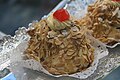 Almond cream cake covered in slivered almonds
 -
 Danish cream cake covered with marzipan
.jpg)


Desserts
[edit]A wide range of classic sweets feature almonds as a central ingredient. Marzipan was developed in the Middle Ages. Since the 19th century almonds have been used to make bread, almond butter, cakes and puddings, candied confections, almond cream-filled pastries, nougat, cookies (macaroons, biscotti and qurabiya), and cakes (financiers, Esterházy torte), and other sweets and desserts.[83]
The young, developing fruit of the almond tree can be eaten whole (green almonds) when they are still green and fleshy on the outside and the inner shell has not yet hardened. The fruit is somewhat sour, but is a popular snack in parts of the Middle East, eaten dipped in salt to balance the sour taste. Also in the Middle East they are often eaten with dates. They are available only from mid-April to mid-June in the Northern Hemisphere; pickling or brining extends the fruit's shelf life.
Marzipan
[edit]Marzipan, a smooth, sweetened almond paste, is used in a number of elegant cakes and desserts. Princess cake is covered by marzipan (similar to fondant), as is Battenberg cake. In Sicily, sponge cake is covered with marzipan to make cassatella di sant'Agata and cassata siciliana, and marzipan is dyed and crafted into realistic fruit shapes to make frutta martorana. The Andalusian Christmas pastry pan de Cádiz is filled with marzipan and candied fruit.
World cuisines
[edit]- In French cuisine, alternating layers of almond and hazelnut meringue are used to make the dessert dacquoise. Pithivier is one of many almond cream-filled pastries.
- In Germany, Easter bread called Deutsches Osterbrot is baked with raisins and almonds.
- In Greece almond flour is used to make amygdalopita, a glyka tapsiou dessert cake baking in a tray. Almonds are used for kourabiedes, a Greek version of the traditional quarabiya almond biscuits. A soft drink known as soumada is made from almonds in various regions.
- In Saudi Arabia, almonds are a typical embellishment for the rice dish kabsa.[84][85]
- In Iran, green almonds are dipped in sea salt and eaten as snacks on street markets; they are called chaqale bâdam. Candied almonds called noghl are served alongside tea and coffee. Also, sweet almonds are used to prepare special food for babies, named harire badam. Almonds are added to some foods, cookies, and desserts, or are used to decorate foods. People in Iran consume roasted nuts for special events, for example, during New Year (Nowruz) parties.
- In Italy, colomba di Pasqua is a traditional Easter cake made with almonds. Bitter almonds are the base for amaretti cookies, a common dessert. Almonds are also a common choice as the nuts to include in torrone.
- In Morocco, almonds in the form of sweet almond paste are the main ingredient in pastry fillings and several other desserts. Fried blanched whole almonds are also used to decorate sweet tajines such as lamb with prunes. Southwestern Berber regions of Essaouira and Souss are also known for amlou, a spread made of almond paste, argan oil, and honey. Almond paste is also mixed with toasted flour and among others, honey, olive oil or butter, anise, fennel, sesame seeds, and cinnamon to make sellou (also called zamita in Meknes or slilou in Marrakech), a sweet snack known for its long shelf life and high nutritive value.
- In Indian cuisine, almonds are the base ingredients of pasanda-style and Mughlai curries. Badam halva is a sweet made from almonds with added colouring. Almond flakes are added to many sweets (such as sohan barfi), and are usually visible sticking to the outer surface. Almonds form the base of various drinks which are supposed to have cooling properties. Almond sherbet or sherbet-e-badaam, is a common summer drink. Almonds are also sold as a snack with added salt.
- In Israel almonds are used as a topping for tahini cookies or eaten as a snack.
- In Spain Marcona almonds are usually toasted in oil and lightly salted. They are used by Spanish confectioners to prepare a sweet called turrón.
- In Arabian cuisine, almonds are commonly used as garnishing for Mansaf.
- In British cuisine, almonds are used for dessert items such as Bakewell tart and Battenberg cake.
Milk
[edit]Almonds can be processed into a milk substitute called almond milk; the nut's soft texture, mild flavour, and light colouring (when skinned) make for an efficient analog to dairy, and a soy-free choice for lactose intolerant people and vegans. Raw, blanched, and lightly toasted almonds work well for different production techniques, some of which are similar to that of soy milk and some of which use no heat, resulting in raw milk.
Almond milk, along with almond butter and almond oil, are versatile products used in both sweet and savoury dishes.
In Moroccan cuisine, sharbat billooz, a common beverage, is made by blending blanched almonds with milk, sugar and other flavourings.[86]
Flour and skins
[edit]Almond flour or ground almond meal combined with sugar or honey as marzipan is often used as a gluten-free alternative to wheat flour in cooking and baking.[87]
Almonds contain polyphenols in their skins consisting of flavonols, flavan-3-ols, hydroxybenzoic acids and flavanones[88] analogous to those of certain fruits and vegetables. These phenolic compounds and almond skin prebiotic dietary fibre have commercial interest as food additives or dietary supplements.[88][89]
Syrup
[edit]Historically, almond syrup was an emulsion of sweet and bitter almonds, usually made with barley syrup (orgeat syrup) or in a syrup of orange flower water and sugar, often flavoured with a synthetic aroma of almonds.[26] Orgeat syrup is an important ingredient in the Mai Tai and many other Tiki drinks.[90][91][92]
Due to the cyanide found in bitter almonds, modern syrups generally are produced only from sweet almonds. Such syrup products do not contain significant levels of hydrocyanic acid, so are generally considered safe for human consumption.[26]
Oils
[edit]
| Nutritional value per 100 g | |||||||||||||||||||
|---|---|---|---|---|---|---|---|---|---|---|---|---|---|---|---|---|---|---|---|
| Energy | 3,699 kJ (884 kcal) | ||||||||||||||||||
100 g | |||||||||||||||||||
| Saturated | 8.2 g | ||||||||||||||||||
| Monounsaturated | 69.9 g | ||||||||||||||||||
| Polyunsaturated | 17.4 g 0 17.4 g | ||||||||||||||||||
| |||||||||||||||||||
| †Percentages estimated using US recommendations for adults.[76] | |||||||||||||||||||
Almonds are a rich source of oil, with 50% of kernel dry mass as fat (whole almond nutrition table). In relation to total dry mass of the kernel, almond oil contains 32% monounsaturated oleic acid (an omega-9 fatty acid), 13% linoleic acid (a polyunsaturated omega-6 essential fatty acid), and 10% saturated fatty acid (mainly as palmitic acid). Linolenic acid, a polyunsaturated omega-3 fat, is not present (table). Almond oil is a rich source of vitamin E, providing 261% of the Daily Value per 100 millilitres.
When almond oil is analyzed separately and expressed per 100 grams as a reference mass, the oil provides 3,700 kJ (884 kcal) of food energy, 8 grams of saturated fat (81% of which is palmitic acid), 70 grams of oleic acid, and 17 grams of linoleic acid (oil table).
Oleum amygdalae, the fixed oil, is prepared from either sweet or bitter almonds, and is a glyceryl oleate with a slight odour and a nutty taste. It is almost insoluble in alcohol but readily soluble in chloroform or ether. Almond oil is obtained from the dried kernel of almonds.[93] Sweet almond oil is used as a carrier oil in aromatherapy and cosmetics while bitter almond oil, containing benzaldehyde, is used as a food flavouring and in perfume.[47]
In culture
[edit]
The almond is highly revered in some cultures. The tree originated in the Middle East. In the Bible, the almond is mentioned ten times, beginning with Genesis 43:11,[95] where it is described as "among the best of fruits". In Numbers 17, Levi is chosen from the other tribes of Israel by Aaron's rod, which brought forth almond flowers.[95] The almond blossom supplied a model for the menorah which stood in the Holy Temple,[95] "Three cups, shaped like almond blossoms, were on one branch, with a knob and a flower; and three cups, shaped like almond blossoms, were on the other … on the candlestick itself were four cups, shaped like almond blossoms, with its knobs and flowers" (Exodus 25:33–34; 37:19–20). In Jeremiah 1:11–12, the vision of an almond branch conveys a wordplay in Hebrew between shaqed (almond) and shoqed (watching), symbolizing God's vigilant commitment to fulfill His word.[95] Many Sephardic Jews give five almonds to each guest before special occasions like weddings.[96]
Similarly, Christian symbolism often uses almond branches as a symbol of the virgin birth of Jesus; paintings and icons often include almond-shaped haloes encircling the Christ Child and as a symbol of Mary. The word "luz", which appears in Genesis 30:37, sometimes translated as "hazel", may actually be derived from the Aramaic name for almond (Luz), and is translated as such in the New International Version and other versions of the Bible.[97] The Arabic name for almond is لوز "lauz" or "lūz". In some parts of the Levant and North Africa, it is pronounced "loz", which is very close to its Aramaic origin.
The Entrance of the flower (La entrada de la flor) is an event celebrated on 1 February in Torrent, Spain, in which the clavarios and members of the Confrerie of the Mother of God deliver a branch of the first-blooming almond-tree to the Virgin.[98]
See also
[edit]References
[edit]- ^ "Prunus amygdalus Batsch". Plants of the World Online. Kew Science. Retrieved 8 August 2021.
- ^ "The Plant List, Prunus dulcis (Mill.) D.A.Webb". Archived from the original on 13 July 2015. Retrieved 3 February 2016.
- ^ a b c d e f g h i j k l Petruzzello M (11 April 2024). "Almond – tree and nut". Encyclopedia Britannica. Retrieved 25 April 2024.
- ^ "Do Almonds Go Bad? 3 Ways to Tell Almonds Are Spoiled". Alice's Kitchen. 14 December 2023. Retrieved 9 November 2024.
- ^ a b c d e f g G. Ladizinsky (1999). "On the origin of almond". Genetic Resources and Crop Evolution. 46 (2): 143–147. Bibcode:1999GRCEv..46..143L. doi:10.1023/A:1008690409554. S2CID 25141013.
- ^ a b "Climate Change In California Is Threatening The World's Top Almond Producer". NPR. Associated Press. 17 August 2021. Retrieved 21 May 2022.
- ^ U.S. Department of the Army (2019). The Official U.S. Army Illustrated Guide to Edible Wild Plants. Guilford, CT: Lyons Press. p. 10. ISBN 978-1-4930-4039-1. OCLC 1043567121.
- ^ Bailey, L.H.; Bailey, E.Z.; the staff of the Liberty Hyde Bailey Hortorium. 1976. Hortus third: A concise dictionary of plants cultivated in the United States and Canada. Macmillan, New York.
- ^ Rushforth K (1999). Collins wildlife trust guide trees: a photographic guide to the trees of Britain and Europe. London: Harper Collins. ISBN 0-00-220013-9.
- ^ a b Griffiths MD, Huxley AJ (1992). The New Royal Horticultural Society Dictionary of Gardening. London: Macmillan Press. ISBN 0-333-47494-5.
- ^ "Fruit Cultural Data — P – California Rare Fruit Growers, Inc". Archived from the original on 19 March 2022. Retrieved 12 June 2020.
- ^ "University of California Sample Cost Study to Produce Almonds" (PDF). Archived from the original (PDF) on 26 March 2012. Retrieved 17 March 2012.
- ^ Doll D (22 June 2009). "The Seasonal Patterns of Almond Production". The Almond Doctor. University of California Cooperative Extension. Archived from the original on 14 August 2018. Retrieved 14 August 2018.
- ^ Linnaeus, C. (1753). Species plantarum. p. 473.
- ^ Batsch, A.J.G.C. (1801). Beyträge und Entwürfe zur pragmatischen Geschichte der drey Natur-Reiche nach ihren Verwandtschaften. Vol. Gewächsreich 1. p. 30.
- ^ Hudson, W. (1778). Flora anglica, editio altera. Vol. 1. p. 212.
- ^ Miller, Ph. (1768). The Gardener's Dictionary (8 ed.). p. AMY.
- ^ L'Abbé Rouchy (1878). "Sur quelques espèces dites Jordaniques". Compte rendu de l'Association Française pour l'Avancement des Sciences. 6: 592.
- ^ "Prunus amygdalus Batsch". Tropicos.org: Flora of Pakistan. Missouri Botanical Garden. Retrieved 23 July 2025.
- ^ Karl-Franzens-Universität (Graz). "Almond (Prunus dulcis [Mill.] D. A. Webb.)". Archived from the original on 14 May 2011. Retrieved 10 April 2011.
- ^ "Almond and bitter almond". from Quirk Books: www.quirkbooks.com. Archived from the original on 11 May 2011. Retrieved 8 April 2011.
- ^ Heppner MJ (7 April 1923). "The factor for bitterness in the sweet almond". Genetics. 8 (4): 390–392. doi:10.1093/genetics/8.4.390. PMC 1200758. PMID 17246020.
- ^ Dicenta F, Ortega E, Martinez-Gomez P (January 2007). "Use of recessive homozygous genotypes to assess genetic control of kernel bitterness in almond". Euphytica. 153 (1–2). Springer: 221–225. Bibcode:2007Euphy.153..221D. doi:10.1007/s10681-006-9257-6. S2CID 9893400.
- ^ Sánchez-Pérez R, Belmonte FS, Borch J, et al. (April 2012). "Prunasin hydrolases during fruit development in sweet and bitter almonds". Plant Physiology. 158 (4): 1916–32. doi:10.1104/pp.111.192021. PMC 3320195. PMID 22353576.
- ^ Shragg TA, Albertson TE, Fisher CJ (January 1982). "Cyanide poisoning after bitter almond ingestion". West. J. Med. 136 (1): 65–9. PMC 1273391. PMID 7072244.
- ^ a b c d e f g Chaouali N, Gana I, Dorra A, et al. (2013). "Potential Toxic Levels of Cyanide in Almonds (Prunus amygdalus), Apricot Kernels (Prunus armeniaca), and Almond Syrup". ISRN Toxicol. 2013 (19 September) 610648. doi:10.1155/2013/610648. PMC 3793392. PMID 24171123.
- ^ Sánchez-Pérez R, Pavan S, Mazzeo R, et al. (14 June 2019). "Mutation of a bHLH transcription factor allowed almond domestication". Science. 364 (6445): 1095–1098. Bibcode:2019Sci...364.1095S. doi:10.1126/science.aav8197. hdl:11586/236719. ISSN 0036-8075. PMID 31197015. S2CID 189818379.
- ^ a b Chisholm H, ed. (1911). . Encyclopædia Britannica. Vol. 1 (11th ed.). Cambridge University Press. p. 716.
- ^ a b "Almond". Online Etymology Dictionary, Douglas Harper. 2023. Retrieved 18 May 2023.
- ^ "Almond". Dictionary.com. Archived from the original on 27 April 2012. Retrieved 16 May 2012.
- ^ Sah P, Faber ES, Lopez De Armentia M, et al. (1 July 2003). "The Amygdaloid Complex: Anatomy and Physiology". Physiological Reviews. 83 (3): 803–834. doi:10.1152/physrev.00002.2003. PMID 12843409. S2CID 16456971.
- ^ a b c d Imani A (2022). "Almond production experience in Iran compared to other countries in the world" (PDF). Jahad, Iran: Horticultural Sciences Research Institute, Agricultural Research, Education and Extension Organization, Iran Ministry of Agriculture. p. 12.
- ^ a b c d e Martínez-Gómez P, Sánchez-Pérez R, Dicenta F, et al. (2007). "Almond (Chapter 11)". In Kole C (ed.). Fruits and Nuts. Genome Mapping and Molecular Breeding in Plants, vol 4. Berlin: Springer. doi:10.1007/978-3-540-34533-6_11. ISBN 978-3-540-34533-6.
- ^ a b Chin SW, Shaw J, Haberle R, et al. (July 2014). "Diversification of almonds, peaches, plums and cherries – Molecular systematics and biogeographic history of Prunus (Rosaceae)". Molecular Phylogenetics and Evolution. 76: 34–48. Bibcode:2014MolPE..76...34C. doi:10.1016/j.ympev.2014.02.024. PMID 24631854.
- ^ Rahemi A (23 May 2024). "Diversity and Distribution of Almonds in their Center of Origin". Biodiversity Online J. 4 (4): 1–4.
Iran is the world's most important gene pool for wild almonds. So far, 23 species and 7 of their interspecies hybrids have been reported in Iran. These species are distributed in different habitats of Iran, some of which are endemic. Therefore, without any doubt, almonds originated and were probably domesticated in this area and then spread to other areas.
- ^ a b "Badam (almond)". Encyclopaedia Iranica. 19 August 2011. Retrieved 2 July 2024.
Iran and Anatolia were the center in which its various species evolved and from which they were diffused
- ^ a b c Zohary D, Hopf M (2000). Domestication of plants in the old world: the origin and spread of cultivated plants in West Asia, Europe, and the Nile Valley. Oxford University Press. p. 186. ISBN 0-19-850356-3.
- ^ "Almond". Division of Agriculture and Natural Resources, University of California. 2024. Retrieved 2 July 2024.
- ^ a b Sánchez-Pérez R (2023). "Origin and Domestication of Wild Bitter Almond. Recent Advancements on Almond Bitterness". In Sánchez-Pérez R, i Marti AF, Martinez-Gomez P (eds.). The Almond Tree Genome. Compendium of Plant Genomes. Berlin: Springer Nature. pp. 15–24. doi:10.1007/978-3-030-30302-0_2. ISBN 978-3-030-30302-0.
- ^ Diamond JM (1997). Guns, germs, and steel: the fates of human societies. New York: W.W. Norton. p. 118. ISBN 0-393-03891-2.
- ^ Bhawani (1590s). "Harvesting of the almond crop at Qand-i Badam". Baburnama.
- ^ Ibn al-'Awwam Y (1864). Le livre de l'agriculture d'Ibn-al-Awam (kitab-al-felahah) (in French). Translated by J.-J. Clement-Mullet. Paris: A. Franck. pp. 260–263 (ch. 7 – Article 20). OCLC 780050566. (pp. 260–263 (Article XX)
- ^ "Flora Europaea Search Results". Royal Botanic Garden Edinburgh. Archived from the original on 11 May 2011. Retrieved 17 July 2008.
- ^ "Prunus dulcis". Plants for a Future. Archived from the original on 19 August 2007. Retrieved 17 July 2008.
- ^ a b c Alfredo Flores (6 April 2010). "ARS Scientists Develop Self-pollinating Almond Trees". USDA Agricultural Research Service. Archived from the original on 17 October 2010.
- ^ a b c Robens J, Cary JW, Campbell BC (25–27 October 2000). Introduction. Aflatoxin/Fumonisin Workshop 2000. Yosemite, California, USA. p. 17.
- ^ a b van Wyk BE (2019). Food plants of the world (2nd ed.). CABI. p. 342. ISBN 978-1-78924-130-3.
- ^ a b c Bjerga A, Cohen D, Hoffman C. "California Almonds Are Back After Four Years of Brutal Drought". Bloomberg.com. Bloomberg. Retrieved 16 April 2019.
- ^ a b "Almond – Diseases and Pests, Description, Uses, Propagation". PlantVillage. Retrieved 11 December 2019.
- ^ "Brown Mite / Almond / Agriculture: Pest Management Guidelines / UC Statewide IPM Program (UC IPM)". UC Agriculture and Natural Resources (UC ANR).
- ^ a b Brodwin E, Lee S (8 April 2015). "Chart shows how some of your favorite foods could be making California's drought worse". Business Insider. Retrieved 17 April 2017.
- ^ a b Gonzalez R (16 April 2015). "How Almonds Became A Scapegoat For California's Drought". US National Public Radio. Retrieved 16 April 2019.
- ^ Mekonnen MM, Hoekstra AY. "The green, blue and grey water footprint of crops and derived crop products" (PDF). Copernicus. Enschede, The Netherlands: Twente Water Centre, University of Twente. Archived (PDF) from the original on 23 January 2021. Retrieved 19 June 2021.
- ^ "Why Are Almond Growers Uprooting Their Orchards?". Atlas Obscura. 2 July 2021. Retrieved 3 July 2021.
- ^ "Annual report: Growing Good – Almond Sustainability 2018" (PDF). Almond Board of California. 2018. Archived (PDF) from the original on 9 October 2022. Retrieved 16 April 2019.
- ^ "Almond industry forerunner of future farm practices, sustainability program internationally recognized". Western FarmPress. 6 March 2018. Retrieved 16 April 2019.
- ^ "Almonds (in shells) production in 2023, Crops/Regions/World list/Production Quantity (pick lists)". UN Food and Agriculture Organization, Corporate Statistical Database (FAOSTAT). 2025. Retrieved 14 October 2025.
- ^ Averill T (6 July 2017). "2017 Almond Forecast" (PDF). National Agricultural Statistics Service, US Department of Agriculture. Archived (PDF) from the original on 9 October 2022. Retrieved 12 November 2017.
- ^ Zee G, Miller D, Harold K, et al. (16 January 2018). "Growing California almonds takes more than half of US honeybees". ABC News. Retrieved 1 September 2018.
- ^ Workman D (25 July 2017). "Top Almonds Exporters by Country in 2016". World's Top Exports. Archived from the original on 13 November 2017. Retrieved 12 November 2017.
- ^ a b Toomey VM, Nickum EA, Flurer CL (September 2012). "Cyanide and amygdalin as indicators of the presence of bitter almonds in imported raw almonds". Journal of Forensic Sciences. 57 (5): 1313–7. doi:10.1111/j.1556-4029.2012.02138.x. PMID 22564183. S2CID 20002210. Archived from the original on 25 July 2020.
- ^ "Where are Australian Almonds grown?". Almond Board of Australia. Archived from the original on 22 December 2015. Retrieved 22 December 2015.
- ^ Gibson C (5 February 2014). "Agri-comeback kids of 2014". Sydney Morning Herald. Archived from the original on 22 December 2015. Retrieved 22 December 2015.
- ^ "Tree nuts annual; Almonds, shelled basis; Report number SP1619" (PDF). GAIN Report, US Department of Agriculture. 15 September 2016. Archived (PDF) from the original on 9 October 2022. Retrieved 18 January 2018.
- ^ a b Gradziel, T.M. (2011). "Origin and Dissemination of Almonds". In J. Janick (ed.). Horticultural Reviews. Vol. 38. Wiley-Blackwell. p. 55. doi:10.1002/9780470872376.ch2. ISBN 978-0-470-87237-6. Retrieved 10 April 2018.
- ^ "Almond allergy". Food-info.net. 26 July 2001. Retrieved 17 March 2012.
- ^ "The high cost of aflatoxins" (PDF). Almond Board of California. 2009. Archived from the original (PDF) on 7 June 2013. Retrieved 23 August 2012.
- ^ Rushing BR, Selim MI (2019). "Aflatoxin B1: A review on metabolism, toxicity, occurrence in food, occupational exposure, and detoxification methods". Food and Chemical Toxicology. 124: 81–100. doi:10.1016/j.fct.2018.11.047. ISSN 0278-6915. PMID 30468841. S2CID 53720187.
- ^ "Aflatoxins in food". European Food Safety Authority. 2010.
- ^ "New EU Aflatoxin Levels and Sampling Plan" (PDF). USDA Foreign Agricultural Service. 2010. Archived (PDF) from the original on 25 November 2011. Retrieved 23 August 2012.
- ^ "The Food Safety Program & Almond Pasteurization" (Press release). Almond Board of California. 17 September 2010. Archived from the original on 25 January 2010. Retrieved 17 September 2010.
- ^ Agricultural Marketing Service (8 November 2006) "Almonds Grown in California: Changes to Incoming Quality Control Requirements" (71 FR -FR-65373 65373, 71 FR -FR-65374 65374, 71 FR -FR-65375 65375 and 71 FR -FR-65376 65376)
- ^ Burke G (29 June 2007). "Almond pasteurization rubs some feelings raw". Associated Press. Archived from the original on 23 December 2014. Retrieved 8 November 2014.
- ^ Harris LJ, ed. (2013). Improving the Safety and Quality of Nuts. Elsevier, Woodhead Publishing Series in Food Science, Technology and Nutrition. pp. 36–37. ISBN 978-0-85709-748-4.
- ^ "The Authentic Almond Project". The Cornucopia Institute. Archived from the original on 8 January 2010.
- ^ a b United States Food and Drug Administration (2024). "Daily Value on the Nutrition and Supplement Facts Labels". FDA. Archived from the original on 27 March 2024. Retrieved 28 March 2024.
- ^ "TABLE 4-7 Comparison of Potassium Adequate Intakes Established in This Report to Potassium Adequate Intakes Established in the 2005 DRI Report". p. 120. In: Stallings VA, Harrison M, Oria M, eds. (2019). "Potassium: Dietary Reference Intakes for Adequacy". Dietary Reference Intakes for Sodium and Potassium. pp. 101–124. doi:10.17226/25353. ISBN 978-0-309-48834-1. PMID 30844154. NCBI NBK545428.
- ^ Berryman CE, Preston AG, Karmally W, et al. (April 2011). "Effects of almond consumption on the reduction of LDL-cholesterol: a discussion of potential mechanisms and future research directions". Nutrition Reviews. 69 (4): 171–85. doi:10.1111/j.1753-4887.2011.00383.x. PMID 21457263.
- ^ "Protein foods: nutrients and health benefits". ChooseMyPlate.gov, USDA. 4 October 2018. Archived from the original on 16 April 2019. Retrieved 16 April 2019.
- ^ Musa-Veloso K, Paulionis L, Poon T, et al. (16 August 2016). "The effects of almond consumption on fasting blood lipid levels: a systematic review and meta-analysis of randomised controlled trials". Journal of Nutritional Science. 5 e34. doi:10.1017/jns.2016.19. ISSN 2048-6790. PMC 5048189. PMID 27752301.
- ^ "Almonds". TH Chan School of Public Health, Harvard University. 2019. Retrieved 16 April 2019.
- ^ Sinclair C (1 January 2009). Dictionary of Food: International Food and Cooking Terms from A to Z. A&C Black. p. 45. ISBN 978-1-4081-0218-3.
- ^ Dolby R (1830). The Cook's Dictionary: A New Family Manual of Cookery and Confectionery.
- ^ El Masri A (27 September 2011). Tea with Arwa: A Memoir of Family, Faith and Finding a Home in Australia. Hachette Australia. ISBN 978-0-7336-2852-8.
- ^ Salloum H (28 February 2012). The Arabian Nights Cookbook: From Lamb Kebabs to Baba Ghanouj, Delicious Homestyle Arabian Cooking. Tuttle Publishing. ISBN 978-1-4629-0524-9.
- ^ Sinclair C (January 2009). Dictionary of Food: International Food and Cooking Terms from A to Z. A&C Black. ISBN 978-1-4081-0218-3.
- ^ Amsterdam E (2009). The Gluten-Free Almond Flour Cookbook: Breakfasts, Entrees, and More. Random House of Canada. ISBN 978-1-58761-345-6.
- ^ a b Mandalari G, Tomaino A, Arcoraci T, et al. (2010). "Characterization of polyphenols, lipids and dietary fibre from almond skins (Amygdalus communis L.)". Journal of Food Composition and Analysis. 23 (2): 166–174. doi:10.1016/j.jfca.2009.08.015.
- ^ Liu Z, Lin X, Huang G, et al. (2014). "Prebiotic effects of almonds and almond skins on intestinal microbiota in healthy adult humans". Anaerobe. 26 (4): 1–6. doi:10.1016/j.anaerobe.2013.11.007. PMID 24315808.
- ^ "In honor of orgeat". alcoholprofessor.com. 18 October 2017. Retrieved 11 March 2019.
- ^ "Upgrade your orgeat". nationalpost.com. Retrieved 25 August 2015.
- ^ "Tiki cocktail history basics". drinks.seriouseats.com. Retrieved 11 March 2019.
- ^ Soler L, Canellas J, Saura-Calixto F (1988). "Oil content and fatty acid composition of developing almond seeds". J Agric Food Chem. 36 (4): 695–697. Bibcode:1988JAFC...36..695S. doi:10.1021/jf00082a007. hdl:10261/90477.
- ^ Illustration from Franz Eugen Köhler, Köhler's Medizinal-Pflanzen, 1897
- ^ a b c d Shafer-Elliott C (2022), Fu J, Shafer-Elliott C, Meyers C (eds.), "Fruits, Nuts, Vegetables, and Legumes", T&T Clark Handbook of Food in the Hebrew Bible and Ancient Israel, T&T Clark Handbooks (1 ed.), London: T&T Clark, pp. 146–147, ISBN 978-0-567-67982-6, retrieved 27 July 2025
- ^ "Jewish Sephardi Wedding Recipes and Traditions". My Jewish Learning. 13 July 2017. Retrieved 6 March 2021.
- ^ Fred Hageneder (September 2005). The meaning of trees: botany, history, healing, lore. Chronicle Books. p. 37. ISBN 978-0-8118-4898-5.
- ^ Sena L (2 February 2016). "Fuego y flor de almendro en l'Entrà de Torrent". levante-emv.com. Levante. Archived from the original on 25 May 2017. Retrieved 11 May 2017.
External links
[edit]
 Data related to Prunus amygdalus at Wikispecies
- "Prunus dulcis". Plants for a Future.
- University of California Fruit and Nut Research and Information Center Archived 6 December 2012 at the Wayback Machine

| Authority control databases: National |
|---|

Almond
View on GrokipediaBotany and Taxonomy
Botanical Description
The almond tree (Prunus dulcis) is a deciduous species belonging to the Rosaceae family, characterized by a vase-shaped growth habit with a spreading, open canopy. It typically attains heights of 4 to 10 meters and a similar spread, featuring a trunk diameter up to 30 centimeters in mature specimens. The bark is grayish and fissured, while young twigs are green, transitioning to gray with age.[7][8][9] Leaves are lanceolate to oblanceolate, measuring 5 to 10 centimeters in length, with serrulate margins and a bright green coloration; they emerge after flowering and turn yellow in autumn before abscission. Flowers bloom in early spring prior to leaf-out, appearing singly or in pairs on short stalks; they measure 3 to 5 centimeters in diameter, with five white to pale pink petals surrounding a cluster of prominent stamens.[10][11][12] The fruit is a drupe, oval to oblong, with an outer green, fleshy hull that dries and splits at maturity to expose a hard, woody endocarp shell enclosing the single seed—the edible almond kernel. The hull is velvety when young and leathery upon ripening, typically 3 to 6 centimeters long, with maturation occurring 7 to 8 months after flowering.[13]Taxonomy and Classification
The almond (Prunus dulcis (Mill.) D.A. Webb) belongs to the genus Prunus L. in the family Rosaceae, order Rosales, class Magnoliopsida, phylum Tracheophyta, and kingdom Plantae.[14][15] It is placed in the subgenus Amygdalus (L.) Focke, which distinguishes it from other Prunus subgenera like Prunus (plums and cherries) and Lithocerasina (cherries), based on morphological traits such as drupe structure and inflorescence type.[16][17]| Taxonomic Rank | Name |
|---|---|
| Kingdom | Plantae |
| Phylum | Tracheophyta |
| Class | Magnoliopsida |
| Order | Rosales |
| Family | Rosaceae |
| Subfamily | Amygdaloideae |
| Tribe | Amygdaleae |
| Genus | Prunus L. |
| Subgenus | Amygdalus (L.) Focke |
| Species | P. dulcis (Mill.) D.A. Webb |
Etymology
The English word almond entered the language around 1300, derived from Middle English almond or almaund, which traces to Old French almande or amande.[25] This Old French form stems from Vulgar Latin amendla or amandula, a modification of Classical Latin amygdala, itself borrowed from Ancient Greek amygdálē (ἀμυγδάλη), denoting the almond tree or its fruit.[26] [27] The Greek amygdálē is of uncertain pre-Greek origin, with some linguists proposing a possible Semitic root, though this remains speculative and unconfirmed in primary etymological sources.[25] The term's adoption into Latin and subsequent European languages reflects the almond's early Mediterranean cultivation and trade, where the nut's shape also inspired anatomical nomenclature, such as the brain's amygdala region, likened to an almond kernel.[25] In English, the initial a- was often dropped in pronunciation by the 18th century, leading to the modern /ˈɑːmənd/ form, while the written l persists but is typically silent.[25]Varieties and Genetics
Sweet versus Bitter Almonds
Almonds are classified into two primary varieties: sweet almonds (Prunus dulcis var. dulcis), which are safe for direct consumption, and bitter almonds (Prunus dulcis var. amara), which contain high concentrations of the cyanogenic glycoside amygdalin and are toxic when raw.[28][7] The distinction arises from a genetic mutation in sweet varieties that disrupts amygdalin biosynthesis, rendering the kernels non-toxic; bitterness is a dominant trait linked to the Sk (sweet kernel) gene, where homozygous recessive (sk/sk) individuals produce sweet almonds.[29][30] Chemically, amygdalin in bitter almonds hydrolyzes via enzymatic action (primarily β-glucosidase) into hydrogen cyanide (HCN), glucose, and benzaldehyde, with concentrations ranging from 15,000 to 50,000 mg/kg in bitter kernels compared to 0.7 to 350 mg/kg in sweet ones.[31][32] This results in bitter almonds yielding 4–9 mg of HCN per kernel—up to 42 times the trace levels in sweet almonds—potentially causing acute cyanide poisoning, including symptoms like nausea, dizziness, and respiratory failure; ingestion of as few as 10 raw bitter almonds can be lethal for children, while adults may tolerate 50 before severe effects.[33][34] Sweet almonds, by contrast, pose no such risk due to negligible HCN release, even in large quantities, as confirmed by regulatory limits (e.g., <20 ppm cyanide in processed products).[35]| Aspect | Sweet Almonds | Bitter Almonds |
|---|---|---|
| Amygdalin Content | <0.05% (trace levels)[32] | 3–5% (high levels)[32] |
| Toxicity | Safe for raw consumption[33] | Toxic raw; 4–9 mg HCN/kernel[33] |
| Primary Uses | Direct eating, snacks, baking[36] | Processed extracts for flavoring (e.g., almond essence after detoxification)[34][37] |
Commercial Varieties
The Nonpareil cultivar dominates commercial almond production, comprising approximately 39% of California's output in 2024, due to its thin-shelled nuts with smooth, blanchable kernels that set the industry standard for quality and market value.[6][39] It exhibits mid-season bloom and the earliest harvest timing, facilitating efficient processing, though its self-incompatibility necessitates cross-pollination from compatible varieties such as Aldrich, Peerless, Winters, or Sonora.[40][41] Varieties in the California classification, including Carmel, Monterey, and Aldrich, account for a significant portion of the remaining production alongside Nonpareil and Mission types, which together represent about 90% of California's almonds grouped by kernel size, shape, and shell traits.[42] Carmel features mid-to-late bloom, high nut quality with strong shell seal, and serves as a reliable pollinator for Nonpareil, though its trees are prone to bud failure and diseases; it harvests near the end of the season.[40][41] Monterey, with late bloom and solid yields, extends harvest 5-6 weeks after Nonpareil but risks quality loss in wet conditions due to disease susceptibility and delayed maturity.[40] Mission-type varieties such as Butte and Fritz provide later-season options with semi-hard shells and plump, darker kernels less suited to blanching, offering resistance to pests like the navel orangeworm; Butte blooms late and harvests before Carmel, while Fritz yields heavily but matures 45 days after Nonpareil, increasing exposure to weather risks.[40] These cultivars are selected for orchard compatibility in bloom overlap, yield potential, and resistance traits, with ongoing breeding emphasizing earlier maturity and disease tolerance to mitigate climate and pest pressures in major growing regions like California.[40]| Variety | Bloom Timing | Harvest Relative to Nonpareil | Key Characteristics |
|---|---|---|---|
| Nonpareil | Mid-season | Earliest | Thin shell, smooth blanchable kernel, high market value; self-incompatible.[40] |
| Carmel | Mid-to-late | Late (end of season) | Good shell seal, disease-prone; pollinates Nonpareil.[40] |
| Monterey | Late | 5-6 weeks later | Good yields, disease-susceptible, wet-season risk.[40] |
| Butte | Late | Before Carmel | Semi-hard shell, pest-resistant, lower price.[40] |
| Fritz | With/after Nonpareil | 45 days later | High yield, hard shell, weather exposure risk.[40] |
Breeding and Genetic Improvements
Almond breeding programs primarily aim to enhance traits such as yield potential, kernel quality, disease resistance, self-compatibility, and adaptation to environmental stresses like drought and changing climates. Traditional breeding has relied on controlled hybridizations and phenotypic selection, targeting improvements in shell hardness for mechanical harvesting, bloom timing for pollination synchrony, and nut uniformity.[43] These efforts address the crop's inherent challenges, including high heterozygosity, a long juvenile period of 5-7 years, and dependence on cross-pollination, which necessitates diverse pollinator varieties.[44] Modern genetic improvements incorporate genomic tools, including marker-assisted selection (MAS), quantitative trait loci (QTL) mapping, and genome-wide association studies (GWAS), to accelerate progress beyond empirical selection. For instance, QTL mapping has identified genomic regions controlling kernel quality traits like size, shape, and double kernels in progeny from crosses such as 'Nonpareil' × 'Monterey'.[45] Similarly, GWAS on diverse accessions has revealed additive and non-additive effects influencing agronomic traits, enabling targeted introgression of favorable alleles.[46] The almond genome, characterized by significant heterozygosity and transposable element activity, informs these strategies by highlighting structural variants that contribute to phenotypic diversity.[47] Key programs, such as the University of California Davis almond breeding initiative, focus on developing self-fruitful pollinators with resistance to pathogens like Verticillium dahliae and nematodes, while maintaining productivity and quality comparable to standards like 'Nonpareil'.[43] This program has released partially self-compatible varieties and advanced selections integrating wild germplasm from species like Prunus arabica to broaden the narrow genetic base resulting from domestication bottlenecks.[48] Pedigree analyses of over 200 genotypes trace two primary breeding lineages from the past 50 years, underscoring the need for increased variability to sustain gains amid intensive selection for elite cultivars.[49] Ongoing research emphasizes rootstock breeding for tolerance to soilborne diseases and salinity, often hybridizing almond with peach or plum to produce compatible, vigorous stocks.[50] Genetic parameters for complex traits like flowering and maturity timing have been estimated using classical and molecular methods, aiding predictions in breeding populations.[51] These advancements, supported by projects like those funded by the National Institute of Food and Agriculture, integrate MAS with traditional crosses to reduce pesticide reliance and enhance nutritional profiles, such as higher oleic acid content.[52] Despite progress, the predominance of a few cultivars like 'Nonpareil'—introduced in 1879—highlights ongoing risks of genetic uniformity, prompting diversification through novel hybrids.[53]History and Domestication
Evolutionary Origins
The genus Prunus, encompassing the almond (Prunus dulcis), originated in eastern Asia approximately 61 million years ago during the early Paleogene, based on molecular phylogenetic reconstructions incorporating expanded sampling of tropical and temperate species.[17] This divergence aligns with the broader radiation of Rosaceae fruits, where ancestral Prunus lineages adapted to temperate climates through traits like drupe fruits and self-incompatibility systems in many species.[54] Within Prunus, the almond belongs to subgenus Amygdalus (peach group), which phylogenetically separated from East Asian clades like the cherry group (Cerasus) millions of years ago, with P. dulcis and peach (P. persica) diverging independently on opposite sides of Asia.[54] Fossil pollen and fruit remains from Eurasia indicate Prunus-like species existed by the Eocene, but specific Amygdalus fossils are sparse, with divergence predating the Miocene aridification that favored almond-like adaptations such as hard shells and drought tolerance in western Asian habitats.[55] The wild almond progenitor, characterized by bitter, cyanogenic seeds containing amygdalin for herbivore defense, arose in arid mountainous regions of Central and Southwest Asia, including modern-day Iran, Afghanistan, and adjacent areas, where related wild taxa like Prunus fenzliana, P. scoparia, and P. elaegnifolia exhibit genetic continuity with P. dulcis.[56] [57] Genomic analyses of wild accessions across Eurasia reveal high nucleotide diversity in these populations, reflecting adaptation to xeric environments via traits like delayed leaf senescence and efficient water use, contrasting with the reduced variation in domesticated lines.[2] [54] These wild forms represent the pre-domestication evolutionary endpoint, with no evidence of multiple independent origins but rather gradual divergence from Amygdalus ancestors under selective pressures from herbivory and climate variability.[58]Domestication Process
The domestication of the almond tree (Prunus dulcis) began in the Near East, likely within the Fertile Crescent region spanning modern-day Israel, Jordan, Syria, and Turkey, where wild bitter almonds (Prunus dulcis var. amara) grew abundantly. Archaeological evidence indicates that selective cultivation of almond trees occurred as early as 6300–5300 years ago (approximately 4300–3300 BCE), with domesticated forms appearing consistently by the Early Bronze Age around 3000–2000 BCE at sites such as Numeira in Jordan.[59][11] This timeline aligns with the broader Neolithic agricultural revolution, during which humans transitioned from foraging wild almonds—evidenced in remains dating back 19,000 years—to intentional propagation of trees yielding edible seeds.[60] The core of the domestication process involved artificial selection against the wild phenotype of bitter, cyanogenic kernels, which contain amygdalin—a compound that hydrolyzes into hydrogen cyanide upon damage, rendering them toxic and unpalatable. Early cultivators preferentially gathered and replanted seeds from rare trees producing non-bitter (sweet) kernels, a recessive trait that emerged sporadically in wild populations due to spontaneous mutations. This selection pressure reduced kernel bitterness over generations, as bitter seeds were discarded while sweet ones were consumed and propagated, leading to a fixation of the sweet allele in cultivated lineages. Genetic analyses confirm that domesticated sweet almonds diverged from wild bitter progenitors through diminished amygdalin biosynthesis, with evidence of ongoing gene flow between wild and cultivated populations facilitating adaptation.[29][61] At the molecular level, the key genetic shift traces to a loss-of-function mutation in the bHLH2 transcription factor gene, which in wild almonds activates downstream genes (Pdc1 and Pdc2) responsible for amygdalin production. In sweet varieties, this mutation prevents bHLH2 from binding to promoter regions, halting amygdalin synthesis and yielding harmless, flavorful kernels—a single-point change sufficient for edibility but requiring sustained selection to overcome the dominant bitter trait in wild hybrids. Studies of Mediterranean almond populations reveal a complex history, potentially involving multiple independent domestication events or introgression from wild relatives, rather than a single origin, as genetic diversity patterns show reduced variation in cultivated lines consistent with bottleneck effects from human-mediated propagation.[30][62] This process transformed almonds from a sporadically foraged wild resource into a staple tree crop, with early evidence of orchard-like cultivation by 3000 BCE.[63]Historical Spread and Cultivation
Almond cultivation originated in the arid regions of Central and Southwest Asia, including areas from the Tien Shan Mountains in western China to Turkestan and Kurdistan, before disseminating westward to the Middle East and Mediterranean during the Early Bronze Age, with archaeological evidence of domesticated forms appearing around 3000–2000 BCE in the Levant, such as Jordan and Israel.[64][65] By the second millennium BCE, cultivated almonds had reached the eastern Mediterranean through trade and migration routes, supported by archeological and textual records indicating integration into local agriculture.[66] Persian advancements under Cyrus the Great around 500 BCE marked a significant expansion, with state-managed nurseries producing up to 100,000 grafted almond trees annually, facilitating organized dissemination across the empire and influencing subsequent Hellenistic cultivation practices.[67] From Greece, almond growing spread around 450 BCE to other Mediterranean regions, including Italy, Spain, Morocco, Tunisia, Turkey, France, and Portugal, as documented in classical agronomic texts and bolstered by the crop's adaptability to similar climates.[19] Roman expansion further entrenched almonds in Europe, with Pliny the Elder noting their prevalence in Italian orchards by the 1st century CE, while eastern trade via the Silk Road carried varieties to China, sustaining explorers and merchants.[68] During the Islamic Golden Age, Arab scholars and traders disseminated improved sweet almond varieties across North Africa and the Iberian Peninsula, enhancing yields through grafting techniques referenced in medieval treatises like those of Ibn al-Awwam in 12th-century Spain.[68] This knowledge transferred to the New World following Spanish colonization, with Franciscan missionaries planting the first almond trees in California missions as early as 1769, though commercial viability emerged only in the 19th century after selections like the Nonpareil variety proved resilient in the Central Valley's climate.[69] Genetic analyses confirm this historical diffusion, revealing distinct clusters such as Turkish, Caucasian-Central Asian, and Southern Spanish lineages that trace dissemination patterns from primary domestication foci.[2]Cultivation Practices
Environmental Requirements
Almond trees (Prunus dulcis) require a Mediterranean climate featuring mild, wet winters and hot, dry summers to thrive. This climate supports the tree's dormancy period during winter, followed by active growth in spring and fruit development in summer. Optimal conditions include average winter temperatures providing sufficient chill hours—defined as cumulative hours between 0°C and 7°C (32°F and 45°F)—ranging from 300 to 1,000 hours depending on the variety, with many commercial cultivars needing 400 to 600 hours to break dormancy and ensure uniform flowering.[70][7][71] Summers must be warm to hot, with daytime temperatures often exceeding 30°C (86°F) to promote kernel filling, while avoiding excessive humidity that fosters fungal diseases. Almond blossoms, which appear in late winter or early spring, are highly susceptible to frost damage below -2°C (28°F), necessitating a frost-free growing period of approximately 200 to 300 days from bloom to harvest. The tree tolerates brief droughts once established but performs best with consistent environmental stability, including full sun exposure of at least 6 to 8 hours daily.[72][70][73] Soil requirements emphasize deep, well-drained profiles to prevent root rot, with preferences for loamy or sandy loam textures that facilitate aeration and nutrient uptake. Almonds adapt to a range of soil types but yield highest in moderately fertile soils with a pH of 6.0 to 7.5; acidic soils below pH 6.0 or alkaline ones above 8.0 reduce productivity due to nutrient lockup. Heavy clay soils are unsuitable owing to poor drainage and waterlogging risks, while saline conditions above 2 dS/m electrical conductivity impair growth.[70][72][74]Pollination Dependencies
Almond trees (Prunus dulcis) exhibit gametophytic self-incompatibility, a genetic mechanism that prevents successful fertilization by pollen from the same tree or genetically identical sources, necessitating cross-pollination from compatible varieties for nut set.[75][76] This dependency ensures genetic diversity but requires orchard designs incorporating pollinizer trees, typically planted in alternating rows or blocks at ratios of 1:4 to 1:9 pollinizer to main variety, such as 'Nonpareil' paired with 'Monterey' or 'Wood Colony' for bloom synchrony and pollen compatibility.[77][40] Incompatibility groups, determined by S-allele matching, further dictate viable pairings; for instance, cultivars sharing the same S-locus haplotype fail to pollinate each other effectively.[78] Insect vectors, primarily honey bees (Apis mellifera), mediate this cross-pollination by transferring pollen during nectar foraging on almond blossoms, which bloom synchronously for 2-3 weeks in late winter (February-March in California).[79][80] Adequate bee activity—requiring at least one to two bee visits per flower—can achieve 90-100% flower-to-nut conversion, but shortfalls reduce yields by up to 50% or more due to incomplete pollination.[79][81] California's almond industry, spanning approximately 1.4 million acres, imports over 2.5 million commercial honey bee colonies annually—the largest managed pollination event globally—to meet demands, with stocking rates of two hives (each with 6-8 frames) per acre recommended for optimal coverage.[82][83] These colonies, sourced from across the U.S., arrive via truck from as early as July preceding bloom, exposing bees to stressors like long-haul transport, varroa mites, and nutritional deficits that elevate colony mortality rates to 30-50% post-pollination.[84] Emerging self-compatible varieties, such as 'Independence', bypass traditional cross-pollination needs by allowing self-fertilization, potentially halving bee requirements and improving yields under bee-limited conditions through enhanced nut set from intentional honey bee activity.[85][86] However, these represent a minority of plantings as of 2024, with most commercial orchards retaining self-incompatible cultivars due to established yield performance and market preferences; widespread adoption hinges on long-term field trials confirming stability against environmental variables like chill hours and heat during bloom.[87][40] Factors such as weather-induced bloom asynchrony, pesticide exposure, and alternative pollinators (e.g., bumble bees or mason bees) influence efficacy, but honey bees remain dominant, underscoring almonds' vulnerability to pollinator declines amid expanding acreage.[88][89]Irrigation and Resource Management
Almond trees, primarily cultivated in semi-arid regions such as California's Central Valley, necessitate precise irrigation to sustain yields, as natural rainfall often falls short of requirements. Mature orchards typically require 3 to 4 acre-feet (approximately 978,000 to 1,304,000 gallons) of applied water per acre annually, varying by climate, soil type, and tree age.[90] [91] This equates to 36 to 48 inches of water over the growing season, with peak demands during kernel fill from May to August, when evapotranspiration rates can exceed 0.25 inches per day.[92] Irrigation scheduling relies on crop evapotranspiration (ETc) models, incorporating reference ET data from local weather stations and crop coefficients adjusted for canopy cover, to avoid both over- and under-watering.[93] Microirrigation systems, such as drip or micro-sprinklers, dominate modern almond production, with nearly 80% of California orchards adopting them by the early 2020s for their ability to target water delivery to the root zone, reducing losses from evaporation, deep percolation, and runoff.[94] These systems enable fertigation, integrating nutrient applications like nitrogen and potassium directly into irrigation water, which optimizes resource use by matching supply to tree uptake phases—almond trees do not significantly take up nitrogen from the soil during bloom, relying instead on remobilized stored nitrogen, so nitrogen fertilizer should not be applied during bloom itself but begin at the end of bloom, coinciding with the start of soil uptake during leaf and fruit expansion through full leaf-out (typically March-April), with approximately 20% of the total annual nitrogen demand (typically 100-150 pounds per acre) recommended during this spring flush period.[95] [96] Regulated deficit irrigation (RDI) strategies further enhance efficiency, applying 20-30% less water during non-critical periods such as post-harvest or pre-hullsplit, while maintaining yields through physiological stress thresholds measured via stem water potential (e.g., -15 bars).[97] [98] Studies confirm RDI can cut total water use by up to 25% without yield penalties in mature trees, though young orchards (under 4 years) demand proportional scaling based on shaded ground area to prevent stress-induced stunting.[99] [100] Water quality management addresses salinity risks, as almond roots tolerate electrical conductivity (ECw) up to 1.5-2.0 dS/m before yield declines of 10-20%; excess salts from recycled or brackish sources necessitate leaching fractions of 10-15% beyond crop needs.[96] Industry commitments, driven by California's Sustainable Groundwater Management Act (SGMA) and drought cycles, target a 20% reduction in water per pound of almonds by 2025 relative to 2010 baselines, achieved via sensor-based precision tools like soil moisture probes and satellite imagery for variable-rate application.[101] [102] Despite these advances, almond irrigation accounts for about 10% of California's agricultural water diversions, prompting scrutiny amid groundwater overdraft, though empirical data show per-pound efficiency gains outpacing acreage expansion since 2010.[103]Pest and Disease Management
Integrated pest management (IPM) forms the cornerstone of pest and disease control in almond orchards, emphasizing prevention through cultural practices, regular monitoring of pest populations against economic thresholds, and selective use of biological and chemical interventions to sustain yields while reducing resistance risks and off-target effects.[104] [105] Key PestsThe navel orangeworm (Amyelois transitella) ranks as the primary insect pest, infesting hulls and kernels with larvae that produce webbing, frass, and galleries, potentially elevating aflatoxin levels and necessitating early harvest if unchecked. Control relies on winter sanitation to remove over 90% of nut mummies, pheromone traps for degree-day timed treatments, mating disruption dispensers, and targeted insecticides like methoxyfenozide when trap catches exceed thresholds of 2-6 moths per trap. [106]
Almond borers (Euzophera semifuneralis and others) tunnel into trunks and branches, causing gummy sap exudates, branch dieback, and structural weakening; management includes systemic insecticides such as carbaryl applied to trunks and prompt pruning of infested wood followed by destruction.[106] [107]
Webspinning spider mites (Tetranychus pacificus) induce leaf bronzing and stippling under hot, dusty conditions, suppressed via conserved predators like Phytoseiulus persimilis and selective miticides, avoiding broad-spectrum sprays that disrupt beneficials.
Ants protect aphids and NOW from predators, prompting bait stations with hydramethylnon or cultural disruption of trails rather than broadcast applications. Key Diseases
Shot hole disease, induced by the fungus Wilsonomyces carpophilus, manifests as purple-to-tan leaf spots that drop out, creating holes, alongside fruit lesions that reduce marketable yield; dormant copper fungicide sprays, coupled with pruning for canopy airflow and avoiding overhead irrigation, limit spread, with efficacy enhanced by fall applications before leaf drop. [106]
Verticillium wilt (Verticillium dahliae), a soilborne vascular pathogen, clogs xylem leading to unilateral wilting, yellowing, and branch dieback, persisting in soil for years without chemical cures; mitigation involves site selection avoiding prior susceptible crops like tomatoes, resistant rootstocks such as Nemaguard, and pre-plant fumigation in high-risk areas.[108] [106]
Bacterial canker (Pseudomonas syringae pv. syringae) enters via pruning wounds or frost cracks, causing gummosis and limb blight; prevention centers on delayed dormant copper bactericide sprays, sanitized tools, and avoiding wounds during wet periods.
Alternaria leaf blight and hull rot emerge in humid conditions, controlled through resistant varieties, balanced nitrogen fertilization to avoid excessive foliage, and postharvest fungicides like iprodione for hull infections.
Sustainability and Environmental Impact
Water Usage Efficiency and Challenges
Almond orchards, predominantly in California's Central Valley, rely heavily on irrigation to support yields in a region characterized by winter rains and prolonged dry summers. The crop's total water footprint averages 10,240 liters per kilogram of kernels, equivalent to approximately 12 liters per almond kernel, with the blue water component (from irrigation) comprising a significant portion influenced by evapotranspiration demands during the growing season.[109][110] This footprint exceeds that of many annual crops but reflects the perennial nature of almond trees, which maintain root systems and canopies year-round to maximize nut production, necessitating consistent moisture to avoid stress-induced yield losses.[103] Efficiency gains have been achieved through widespread adoption of precision irrigation technologies. Micro-sprinkler and drip systems, including subsurface variants, deliver water directly to root zones, achieving application efficiencies of 80-95% compared to 60-70% for traditional flood methods, thereby minimizing evaporation and runoff.[111][112] California growers have reduced per-almond water use by 33% from the 1990s to the 2010s via these methods, soil moisture monitoring, and deficit irrigation strategies that withhold water during less sensitive growth stages without compromising kernel quality.[103] Variable rate irrigation further optimizes delivery based on tree-specific needs, potentially saving 20-30% more water in heterogeneous orchards.[113] Despite these advancements, water management faces substantial challenges. Almonds consume 4.7 to 5.5 million acre-feet annually in California, representing up to 10% of the state's developed water supply, exacerbating groundwater overdraft in basins like the San Joaquin Valley where pumping exceeds recharge.[114][115] Droughts, as in 2012-2016 and recurring since, force reliance on diminishing surface allocations from sources like the Sacramento-San Joaquin Delta, prompting fallowing of acreage and tree removal.[116] Salinity buildup from recycled or brackish water sources poses risks to tree health, requiring leaching practices that increase overall demand, while regulatory frameworks under the Sustainable Groundwater Management Act impose pumping limits, potentially constraining expansion.[117][118] These pressures highlight the tension between the crop's economic value—yielding high returns per water unit—and sustainability imperatives in a water-stressed ecosystem.[109]Effects on Pollinators and Biodiversity
Almond cultivation, particularly in California which accounts for over 80% of global production, relies almost exclusively on managed honey bee (Apis mellifera) colonies for pollination, with approximately 2.5 million hives deployed annually across 1.4 million acres, equating to about two colonies per acre to achieve adequate cross-pollination and nut set.[82][119] This intensive demand, concentrated during the February bloom period, provides bees with an early-season pollen and nectar source that can strengthen colonies post-pollination, as hives often depart orchards with higher bee populations and brood levels compared to arrival.[120] However, the process imposes significant stressors, including long-distance trucking of hives—which can cause vibration-induced damage, desiccation, and queen injury—early arousal from winter dormancy before natural forage availability, and exposure to orchard pesticides and fungicides applied during bloom.[121] Surveys indicate that up to 19% of beekeepers report lethal effects and 56% sublethal effects, such as reduced foraging or brood development, from spray adjuvants and tank mixes used in almond orchards.[122] Colony collapse disorder losses during the pollination season have reached as high as 230,000 hives in some years, exacerbating broader declines in commercial bee populations driven by these cumulative pressures.[123] While managed honey bees dominate almond pollination, native and wild pollinators—including bumble bees, mason bees, and other solitary species—contribute supplementary services, particularly in orchards adjacent to semi-natural habitats like uncultivated fields or hedgerows, where they can enhance overall pollination efficiency by up to 20-30% in some studies.[124] However, the expansion of almond acreage, which has tripled since 2000 to over 1.4 million acres in California's Central Valley, has fragmented native habitats, reducing floral diversity and alternative forage for these species outside the brief bloom window, leading to localized declines in native bee abundance and diversity.[125] Intensive monoculture practices, including tillage and herbicide use, further limit ground-nesting habitats for solitary bees and suppress weed flora that could serve as interim resources.[126] On biodiversity more broadly, almond orchards function as semi-perennial agroecosystems that can support avian and insect diversity when managed regeneratively, such as through inter-row cover crops (e.g., mustard mixes or wildflower strips), which have been shown to increase wild insect pollinator visitation by hosting more diverse floral resources year-round and improving bee colony strength post-bloom.[88][127] These practices also boost soil microbial activity and bird populations along migratory flyways, with studies in Central Valley orchards recording hundreds of bird species utilizing orchard edges for foraging and nesting.[128] Conversely, conventional bare-ground management correlates with lower overall biodiversity metrics, including reduced arthropod and plant species richness, due to soil compaction, erosion, and reliance on synthetic inputs that indirectly affect non-target species.[129] Empirical evidence from regenerative trials demonstrates that integrating hedgerows, reduced tillage, and cover cropping can elevate biodiversity indices—such as Shannon diversity for insects—while maintaining yields, suggesting that orchard design choices causally influence ecological outcomes beyond mere crop dependency.[130]Soil Health and Land Use Practices
Almond trees thrive in deep, well-drained soils such as loam or sandy loam with a pH range of 6.0 to 7.5, allowing for optimal root penetration and aeration while minimizing waterlogging risks that can lead to phytophthora root rot.[131][132][133] Poorly drained clay-heavy soils are unsuitable, as they promote anaerobic conditions and nutrient imbalances, reducing tree vigor and yield potential.[134][8] Prior to planting, orchards undergo deep soil ripping to depths of 3-4 feet during mid-summer or early fall to alleviate compaction from prior land uses like row crops, enhancing water infiltration and root establishment.[134] Trees are typically spaced 24-30 feet apart to accommodate mature canopies and machinery, with land preparation including uniform grading to prevent erosion on slopes common in California's Central Valley growing regions.[132] Nutrient management relies on soil sampling from the root zone (up to 5-7 feet deep) to guide fertilization, particularly for nitrogen and phosphorus, avoiding excesses that could leach into groundwater.[135] Intensive almond monoculture can degrade soil organic matter over time through repeated tillage and harvest traffic, leading to compaction and reduced microbial activity, though regenerative practices like multispecies cover crops—seeded post-weed control—counter this by boosting soil structure, organic matter by 0.5-1% annually, and nematode suppression.[129][136] Compost applications and whole-orchard recycling of biomass further enhance carbon sequestration, with studies showing mature orchards storing significant soil carbon while improving water-holding capacity amid California's semi-arid conditions.[137][138] Land conversion for almond expansion, which reached over 1.6 million acres in California by 2020, has shifted marginal or fallow rangeland to irrigated orchards, raising concerns over long-term soil salinity from micro-irrigation and dust generation, yet integrated practices like no-till cover cropping and low-input mulching mitigate erosion and support biodiversity without yield penalties.[139][140][118] Stacking these methods—cover crops plus organic amendments—has demonstrated yield gains of $46-968 per acre in trials, underscoring causal links between soil ecosystem multifunctionality and orchard resilience.[141][142]Technological Innovations for Sustainability
Drip irrigation systems have become standard in almond orchards, delivering water directly to tree roots and achieving application efficiencies that reduce overall consumption by up to 50% compared to flood irrigation, particularly in saline groundwater conditions prevalent in regions like California's Central Valley.[143] Variable rate irrigation further enhances this by adjusting application based on site-specific soil moisture and tree needs, enabling precise scheduling that optimizes limited water supplies in young and mature orchards.[113] These technologies promote uniform crop development while minimizing evaporation and runoff, with studies showing yield increases of 3-7% under fertigated conditions when paired with nutrient monitoring.[96] Remote sensing and drone-based precision agriculture tools monitor almond orchards for nitrogen levels, water stress, and bloom density, allowing targeted fertilizer application that cuts excess nitrogen runoff by enabling data-driven decisions rather than uniform field treatments.[144] Aerial RGB imagery from drones facilitates early yield forecasting by mapping bloom intensity at the tree level, which informs irrigation and input planning to avoid overproduction and resource waste.[145] AI-integrated satellite platforms, such as those providing real-time soil and crop analytics, further support sustainable management by predicting abiotic stresses and automating recommendations for input reductions, as demonstrated in California operations aiming to transform orchard efficiency.[146][147] Farm management software platforms digitize almond production data, integrating sensor inputs for predictive analytics on water, soil, and pest dynamics, which has enabled growers to adopt regenerative practices like optimized cover cropping and reduced chemical inputs in regions such as Georgia.[148] Solar-powered well pumps address energy sustainability in irrigation, powering orchards and supporting small farms while decreasing reliance on grid electricity in water-scarce areas.[149] In harvesting, modified equipment with dust-suppression features, such as adjusted sweepers and shakers, mitigates particulate emissions, improving air quality during the high-volume nut collection phase that previously contributed to regional pollution.[150] Collaborative efforts, including the 2025 University of California-Almond Board memorandum, accelerate these technologies through on-farm trials focused on advanced water and soil sensors.[151]Global Production and Economics
Major Producing Countries and Regions
The United States dominates global almond production, accounting for 77% of the world's supply in the 2024/2025 marketing year with 1.27 million metric tons of shelled kernels. Nearly all U.S. production occurs in California, where the Central Valley's Mediterranean climate, including counties such as Kern, Fresno, Stanislaus, Merced, and Madera, supports over 1.6 million bearing acres optimized for high yields through irrigation and mechanized farming.[152][5][153] Australia ranks second, producing 160,000 metric tons (10% of global output) in 2024/2025, with cultivation concentrated in the Riverland and Sunraysia regions of South Australia and Victoria, where expanding orchards and efficient water management have driven growth despite variable rainfall. Spain leads European production within the EU's total of 150,000 metric tons, focusing on the eastern Mediterranean coastal areas of Valencia, Murcia, Alicante, and Catalonia, where traditional dryland farming supplemented by irrigation yields varieties suited for both domestic consumption and export.[152][5][154] Turkey and Morocco follow as significant producers, with outputs of approximately 190,000 and 175,000 metric tons respectively in recent years, though exact 2024/2025 figures align with broader trends showing smaller shares amid global totals of 1.6 million metric tons shelled. Turkish production centers in the Aegean and Mediterranean regions, benefiting from suitable soils and climate for hard-shell varieties, while Morocco's almonds are primarily grown in the northern and central areas like Meknès, Fès, and Marrakesh, often under rain-fed conditions that limit yields compared to irrigated counterparts elsewhere. Other notable regions include Iran's central provinces and Italy's Sicily, contributing to diversified global supply but remaining secondary to the top producers.[155][156][157]| Country/Region | 2024/2025 Production (Shelled MT) | Global Share |
|---|---|---|
| United States | 1,270,000 | 77% |
| Australia | 160,000 | 10% |
| European Union | 150,000 | 9% |
| Others | ~20,000 | 4% |
Production Statistics and Recent Trends
Global almond production, measured in shelled kernel weight, is forecasted to reach 1.6 million metric tons for the 2024/25 marketing year, representing a 13 percent increase from the previous year primarily due to improved yields in major producing regions following adverse weather impacts.[5] The United States dominates global output, accounting for approximately 80 percent of worldwide supply, with California orchards producing the vast majority.[155] In the 2023/24 crop year, U.S. production exceeded 1 million metric tons, underscoring its leading position ahead of secondary producers like the European Union (mainly Spain), Australia, and Iran.[158] Recent U.S. production trends reflect variability influenced by climatic factors and resource constraints. The 2024 California almond crop totaled around 2.7 billion meat pounds, lower than initial projections due to underestimation of carryover stocks and overestimation of yields, which temporarily tightened supply and elevated prices.[159] For 2025, the USDA National Agricultural Statistics Service forecasts a record 3.0 billion meat pounds from California, up 10 percent from 2024, driven by expanded bearing acreage of approximately 1.4 million acres and an average yield of 2,030 pounds per acre.[160] [161] This rebound follows multi-year challenges from droughts and heat stress, yet sustained irrigation from groundwater and infrastructure investments have supported acreage growth from under 1 million acres in the early 2000s.[162] Internationally, production in Australia and Spain has shown steady increases, with Australia outputting 153,000 metric tons in 2024 amid favorable conditions, while European yields remain constrained by water regulations and smaller orchard scales.[163] Overall trends indicate a shift toward higher global volumes, projecting top producers (U.S., Australia, Spain) to supply over 80 percent by 2025, up from 75 percent in 2020, fueled by demand for plant-based products despite environmental pressures on water-intensive cultivation.[164] However, price volatility persists, as evidenced by a nearly 20 percent drop in almond prices post-2025 forecast release, reflecting market adjustments to anticipated oversupply.[162]Economic Contributions and Trade Dynamics
The almond industry generates substantial economic value, particularly in California, where it ranks as the second-largest agricultural commodity by value in 2024, behind only dairy, with over 1.38 million bearing acres contributing to statewide agricultural leadership.[165][166] In the United States, almond exports totaled $4.5 billion in 2022, positioning the crop as the leading agricultural export by value and supporting jobs across cultivation, harvesting, processing, and distribution chains.[167] Globally, the almond market reached a value of $9.92 billion in 2024, driven by rising demand for nuts in food products and snacks, with projections for a 4.5% compound annual growth rate through the decade.[168] Trade dynamics are dominated by the United States, which exported almonds in shell valued at $1.23 billion in 2023, accounting for the majority of global supply flows.[169] Key import markets include India, which imported $938 million in almonds in shell in 2023 (259.7 million kg), followed by China at $221 million (66.7 million kg), reflecting strong demand in Asia for both in-shell and processed varieties.[170] The European Union absorbed 29% of global tree nut imports in 2023/24, including significant almond volumes, while emerging markets like Morocco saw imports exceed 35,000 tons in the first 11 months of 2024, fueled by domestic processing needs.[171][172]| Major U.S. Almond Export Destinations (Shipments in 1,000 lbs, 2023/24) | Volume |
|---|---|
| India | 400,187 |
| Spain (intra-EU trade hub) | Varies; key re-export point |
| European Union (aggregate) | Substantial; 29% of global tree nuts |
Processing and Safety
Harvesting and Post-Harvest Handling
Almond harvesting primarily occurs in late summer to early fall, with the season in California spanning from August to mid-October, varying by region and variety as hulls naturally split open when nuts reach maturity.[178][179] Trees are harvested using mechanical trunk shakers that clamp onto the base and apply vibrational force, dislodging 90-95% of the nuts onto the orchard floor in seconds per tree to minimize damage and labor costs.[180][181] Following shaking, nuts dry on the ground for 4-14 days to reduce hull moisture, preventing mold and facilitating separation, with earlier harvests requiring longer drying periods.[179] Sweepers then arrange the dried nuts into windrows, after which specialized harvesters collect them, separating debris like leaves and twigs through sieves and blowers for initial cleaning.[182] Collected almonds are transported to stockpiles or processing facilities, where moisture content is monitored—ideally hull moisture below 12% and kernel moisture below 6%—to avoid spoilage during storage.[183] Post-harvest handling begins with pre-cleaning to remove remaining foreign material, followed by hulling machines that strip the outer fleshy hull from the hard shell.[184] Shelling cracks the shell to free the kernel, often using rollers or impact methods calibrated to minimize kernel breakage, which can exceed 5-10% in industrial processes depending on variety and moisture.[185][186] Drying may occur before or after hulling and shelling to achieve kernel moisture of 5-6% for safe storage and transport, with forced-air systems reducing drying time by up to 75% when applied to in-shell nuts compared to in-hull.[187][188] Sorted kernels undergo optical and laser inspection for defects, size grading, and pasteurization—often via propylene oxide or steam—to meet food safety standards, ensuring removal of aflatoxin risks from potential mold contamination during field drying.[189] Facilities process either in-shell almonds for hullers or kernels for shellers, with the entire post-harvest chain designed to preserve kernel integrity and achieve yields of shelled product typically 40-50% of in-hull weight.[185][190]Processing Methods and Quality Standards
After hulling to remove the outer fleshy hull and shelling to extract the kernel from its hard shell, almonds are dried to a moisture content of 5-6 percent to inhibit microbial growth and ensure shelf stability.[191] This drying typically occurs in the field or controlled facilities post-harvest, reducing moisture from initial levels around 20 percent.[192] Subsequent sorting employs mechanical vibratory screens, air classifiers, and optical systems using near-infrared spectroscopy and cameras to separate kernels by size, detect defects such as discoloration or insect damage, and eliminate foreign matter like stones or debris.[193] Precision optical sorting achieves rejection rates exceeding 99 percent for substandard kernels, enhancing uniformity for markets demanding high visual appeal.[192] Further processing varies by application: blanching involves hot water or steam to loosen and remove the thin brown skin, yielding skinless kernels for confectionery; roasting applies dry heat at 130-180°C for flavor development and partial pasteurization; while slicing, dicing, or grinding prepares ingredients for baking or pastes.[194] [195] Since 2007, all California-grown almonds—accounting for over 80 percent of global supply—must undergo validated pasteurization to achieve a 5-log reduction in pathogens like Salmonella, via methods including propylene oxide fumigation, moist heat blanching/steam, or oil roasting, as mandated by the Almond Board of California to address prior outbreak risks without compromising kernel integrity.[195] [196] Quality standards for shelled almonds follow voluntary U.S. Department of Agriculture (USDA) grades, with U.S. No. 1 specifying tolerances of no more than 5 percent by count for chipped or broken kernels, 0.50 percent for serious damage (e.g., decay or rancidity), 1 percent for bitter almonds, 0.20 percent for foreign material, and 0.10 percent for insect fragments.[197] These criteria ensure minimum wholesomeness, with higher grades like Supreme allowing under 3 percent damage for premium export markets; aflatoxin levels are capped at 10-20 parts per billion under FDA guidelines, verified through sampling.[198] Handlers often exceed USDA minima via Almond Board protocols, incorporating HACCP-based controls for contaminants, as empirical data links untreated almonds to sporadic Salmonella incidents prior to mandatory treatments.[196] In the United States, following Salmonella outbreaks linked to raw almonds in 2001 (affecting over 160 cases, primarily in Canada) and 2003–2004 (33 confirmed cases in the US and Canada), the USDA implemented a mandatory pasteurization rule in 2007. This requires all almonds grown in California—which produces over 80% of the global supply—to undergo validated treatment achieving at least a 5-log reduction in Salmonella, using methods such as steam pasteurization, moist heat, or propylene oxide fumigation. The rule was mandated by the Almond Board of California and USDA to prevent foodborne illness, and even almonds labeled "raw" in the US are typically pasteurized. Imported raw almonds, including those from Spain (Europe's largest producer), are exempt from this US pasteurization requirement and can be sold unpasteurized. In the European Union, including Spain, there is no equivalent mandatory pasteurization for almonds; instead, strict limits on contaminants like aflatoxins (maximum 10 µg/kg total for direct consumption) and microbiological criteria apply under EU regulations. Spanish almonds are often marketed as truly raw and unpasteurized, with low documented risk of Salmonella outbreaks compared to historical US cases. However, raw almonds carry inherent low risks of microbial contamination or aflatoxins if not properly handled, and a 2014 recall involved mislabeled bitter almonds (higher cyanide precursors) sold as raw sweet almonds from Spain/Italy. These differences allow consumers seeking unpasteurized almonds to source them from imports, though proper sourcing from reputable suppliers and adherence to food safety practices are recommended.Regulatory Measures for Toxicity Prevention
Regulatory measures addressing almond toxicity primarily target cyanogenic compounds in bitter almonds and mycotoxins such as aflatoxins produced by Aspergillus fungi during improper storage or handling. Bitter almonds (Prunus dulcis var. amara) contain amygdalin, a cyanogenic glycoside that hydrolyzes to release hydrogen cyanide (HCN) upon ingestion, with toxicity levels estimated at 4-9 mg HCN per almond, sufficient to cause severe poisoning from as few as 6-10 nuts in adults.[199] [200] In the United States, the Food and Drug Administration (FDA) prohibits the sale of raw bitter almonds for human consumption, classifying them as adulterated under the Federal Food, Drug, and Cosmetic Act due to unsafe cyanide levels, while permitting processed extracts (e.g., for flavoring) only after cyanide removal.[37] Similar restrictions apply in Canada, where Health Canada has banned bitter almond use in foods to prevent acute cyanide exposure.[199] These prohibitions ensure commercial markets rely exclusively on low-cyanide sweet almonds (Prunus dulcis var. dulcis), which contain negligible amygdalin (<0.1 mg HCN per almond), thereby preventing toxicity without routine testing.[200] Aflatoxins, potent hepatocarcinogens produced post-harvest, pose a chronic toxicity risk in almonds if moisture exceeds 6-7% during storage, fostering fungal growth. In the European Union, Commission Regulation (EC) No 1881/2006 sets maximum limits for ready-to-eat tree nuts, including almonds, at 8 μg/kg for aflatoxin B1 and 10 μg/kg for total aflatoxins (B1 + B2 + G1 + G2), with importers required to verify compliance via sampling and analysis.[201] [202] These levels, updated in Regulation (EU) 2023/915, apply to processed products containing at least 80% almonds and drive export testing from major producers like the US, where non-compliance has led to rejections (e.g., 29.3 μg/kg detections in 2025 shipments).[203] [204] The United States lacks enforceable aflatoxin limits but applies a 20 ppb action level under FDA guidance, advising reduction to the lowest practicable levels through current good manufacturing practices (cGMP) and the Food Safety Modernization Act (FSMA), which mandates hazard analysis and preventive controls for aflatoxin risks in processing facilities.[205] Global standards, harmonized via Codex Alimentarius, recommend 10-15 μg/kg total aflatoxins for tree nuts, influencing countries like Australia (10-15 ppb depending on product) and Japan, which lifted mandatory US almond testing in April 2025 after verified low-risk practices. [206] Industry-led measures, such as California's Almond Board protocols for rapid drying, hulling, and storage below 6% moisture, align with these regulations to preempt aflatoxin formation, achieving compliance rates exceeding 99% in exports.[207] Enforcement involves routine surveillance, with the FDA and EU Rapid Alert System for Food and Feed (RASFF) enabling recalls or border detentions for exceedances, underscoring causal links between post-harvest conditions and contamination risks.[204]Nutrition and Health Implications
Macronutrient and Micronutrient Profile
Almond kernels provide approximately 579 kilocalories per 100 grams, with macronutrients dominated by fats at 49.9 grams, of which 3.8 grams are saturated, 31.3 grams monounsaturated (primarily oleic acid), and 12.2 grams polyunsaturated. Protein content averages 21.2 grams per 100 grams, offering a complete amino acid profile suitable for plant-based diets, while carbohydrates total 21.6 grams, including 12.5 grams of dietary fiber (mostly insoluble) and 4.4 grams of sugars. Raw almonds are naturally very low in sodium, containing approximately 1 mg per 100 grams. [208] Moisture is low at 4.4 grams per 100 grams, contributing to their stability and nutrient density. For common serving sizes, a small portion of 10 almonds (approximately 12 grams) provides about 70 kcal, 2.5 g protein, 6 g fat, 3 g carbohydrates, and 1.5 g fiber. Monash University rates almonds with skin as low FODMAP in servings up to 10 nuts (12 g), with no separate rating for blanched almonds, indicating no significant FODMAP difference from skin removal. A standard serving of 1 ounce (28 grams, approximately 23 almonds) supplies approximately 162 kcal, 6 g protein, 14 g total fat, 6 g carbohydrates, 3.5 g dietary fiber, and only trace amounts of sodium (approximately 0.3 mg). A larger serving of approximately 30 almonds (about 37 grams) provides roughly 214 kcal, 8 g protein, 18 g fat, 8 g carbohydrates, and 4.6 g dietary fiber, with trace sodium (approximately 0.4 mg). Unsalted or raw almonds remain naturally low in sodium, while salted varieties contain added amounts that may reach 40-50 mg per 1 ounce in some commercial products. [208]| Macronutrient | Amount per 100 g | % Daily Value* |
|---|---|---|
| Total Fat | 49.9 g | 64% |
| - Saturated | 3.8 g | 19% |
| - Monounsaturated | 31.3 g | - |
| - Polyunsaturated | 12.2 g (primarily linoleic acid ~12-13 g) | - |
| Protein | 21.2 g | 42% |
| Carbohydrates | 21.6 g | 8% |
| - Dietary Fiber | 12.5 g | 45% |
| - Sugars | 4.4 g | - |
| Energy | 579 kcal | 29% |
| Micronutrient | Amount per 100 g | % Daily Value* |
|---|---|---|
| Vitamin E | 25.6 mg | 171% |
| Magnesium | 270 mg | 64% |
| Phosphorus | 481 mg | 38% |
| Manganese | 2.2 mg | 95% |
| Riboflavin | 1.1 mg | 85% |
| Calcium | 269 mg | 21% |
| Iron | 3.7 mg | 21% |
| Zinc | 3.1 mg | 28% |