


Community hub
Recent from talks
Contribute something
Nothing was collected or created yet.
Blue Ridge Mountains
View on Wikipedia
The Blue Ridge Mountains are a physiographic province of the larger Appalachian Highlands range. The mountain range is located in the Eastern United States and extends 550 miles (885 km) southwest from southern Pennsylvania through Maryland, West Virginia, Virginia, North Carolina, South Carolina, Tennessee, and Georgia.[1] The province consists of northern and southern physiographic regions, which divide near the Roanoke River gap.[2] To the west of the Blue Ridge, between it and the bulk of the Appalachians, lies the Great Appalachian Valley, bordered on the west by the Ridge and Valley province of the Appalachian range.
Key Information


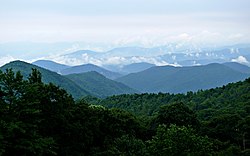
The Blue Ridge Mountains are known for having a bluish color when seen from a distance. Trees put the "blue" in Blue Ridge, from the isoprene released into the atmosphere.[3] This contributes to the characteristic haze on the mountains and their perceived color.[4]
Within the Blue Ridge province are two major national parks: Shenandoah National Park in the northern section and Great Smoky Mountains National Park in the southern section. The Blue Ridge Parkway, a 469-mile (755 km) long scenic highway, connects the two parks and runs along the ridge crest-lines, as does the Appalachian Trail.[5] Eight national forests include George Washington and Jefferson, Cherokee, Pisgah, Nantahala and Chattahoochee.
Geography
[edit]
Although the term "Blue Ridge" is sometimes applied exclusively to the eastern edge or front range of the Appalachian Mountains, the geological definition of the Blue Ridge province extends westward to the Ridge and Valley area, encompassing the Great Smoky Mountains, the Great Balsams, the Roans, the Blacks, and other mountain ranges. In North Carolina, two lower elevation ranges to the east, referred to as foothills, are also often included as "spurs" of the Blue Ridge: the Brushy Mountains and the South Mountains. In Virginia, the Southwest Mountains are an anticlinal range that similarly parallels the Blue Ridge.


The Blue Ridge extends as far south as Mount Oglethorpe in Georgia and as far north into Pennsylvania as South Mountain. While South Mountain dwindles to hills between Gettysburg and Harrisburg, the band of ancient rocks that form the core of the Blue Ridge continues northeast through the New Jersey and Hudson River highlands, eventually reaching the Berkshires of Massachusetts and the Green Mountains of Vermont.
The Blue Ridge contains the highest mountains in eastern North America south of Baffin Island. About 125 peaks exceed 5,000 feet (1,500 m) in elevation.[6] The highest peak in the Blue Ridge (and in the entire Appalachian chain) is Mount Mitchell in North Carolina at 6,684 feet (2,037 m). There are 39 peaks in North Carolina and Tennessee higher than 6,000 feet (1,800 m); by comparison, in the northern portion of the Appalachian chain only New Hampshire's Mount Washington rises above 6,000 feet (1,800 m). Southern Sixers is a term used by peak baggers for this group of mountains.[7]
The Blue Ridge Parkway runs 469 miles (755 km) along crests of the southern Appalachians and links two national parks: Shenandoah and Great Smoky Mountains. In many places along the parkway, there are metamorphic rocks (gneiss) with folded bands of light-and dark-colored minerals, which sometimes look like the folds and swirls in a marble cake.
Geology
[edit]
Most of the rocks that form the Blue Ridge Mountains are ancient granitic charnockites, metamorphosed volcanic formations, and sedimentary limestone. Recent studies completed by Richard Tollo, a professor and geologist at George Washington University, provide greater insight into the petrologic and geochronologic history of the Blue Ridge basement suites. Modern studies have found that the basement geology of the Blue Ridge is made of compositionally unique gneisses and granitoids, including orthopyroxene-bearing charnockites. Analysis of zircon minerals in the granite completed by John Aleinikoff at the U.S. Geological Survey has provided more detailed emplacement ages.

Many of the features found in the Blue Ridge and documented by Tollo and others have confirmed that the rocks exhibit many similar features in other North American Grenville-age terranes. The lack of a calc-alkaline affinity and zircon ages less than 1.2 billion years old suggest that the Blue Ridge is distinct from the Adirondacks, Green Mountains, and possibly the New York–New Jersey Highlands. The petrologic and geochronologic data suggest that the Blue Ridge basement is a composite orogenic crust that was emplaced during several episodes from a crustal magma source. Field relationships further illustrate that rocks emplaced prior to 1.078–1.064 billion years ago preserve deformational features. Those emplaced post-1.064 billion years ago generally have a massive texture and missed the main episode of Mesoproterozoic compression.[8]
At the time of their emergence, the Blue Ridge were among the highest mountains in the world and reached heights comparable to the much younger Alps. Weathering, erosion, and mass wasting over hundreds of millions of years has resulted in much shorter peaks.[9]
History
[edit]
 |
At the foot of the Blue Ridge, various tribes including the Siouan Manahoacs, the Iroquois, and the Shawnee hunted and fished. A German physician-explorer, John Lederer, first reached the crest of the Blue Ridge in 1669 and again the following year; he also recorded the Virginia Siouan name for the Blue Ridge (Ahkonshuck).
At the Treaty of Albany negotiated by Virginia Lieutenant Governor Alexander Spotswood with the Iroquois between 1718 and 1722, the Iroquois ceded lands they had conquered south of the Potomac River and east of the Blue Ridge to the Virginia Colony. This treaty made the Blue Ridge the new demarcation point between the areas and tribes subject to the Six Nations, and those tributaries to the colony. When colonists began to disregard this by crossing the Blue Ridge and settling in the Shenandoah Valley in the 1730s, the Iroquois began to object, finally selling their rights to the valley, on the west side of the Blue Ridge, at the Treaty of Lancaster in 1744.
Flora and fauna
[edit]
Flora
[edit]The Blue Ridge Mountains have stunted oak and oak-hickory forest habitats, which comprise most of the Appalachian slope forests. Flora also includes grass, shrubs, hemlock and mixed-oak pine forests.[10]
While the Blue Ridge range includes the highest summits in the eastern United States, the climate is nevertheless too warm to support an alpine zone, and thus the range lacks the tree line found at lower elevations in the northern half of the Appalachian range. Statistical modelling predicts that the alpine tree line would exist at above 7,985 feet (2434 m) in the climate zone and latitude of the southern Appalachians.[11] The highest parts of the Blue Ridge are generally vegetated in dense Southern Appalachian spruce-fir forests.[citation needed]
Fauna
[edit]The area is host to many animals, including:
- Many species of amphibians and reptiles
- Ocoee salamander
- A large diversity of fish species, many of which are endemic
- American black bear
- Songbirds and other bird species
- Bobcat
- Coyote
- Red fox
- Gray fox
- Grouse
- North American river otter
- Whitetail deer
- Wild boar
- Wild turkey
- Raccoon
Population centers
[edit]The largest city located in the Blue Ridge Mountains is Roanoke, located in Southwest Virginia, while the largest Metropolitan Statistical Area is the Greenville metropolitan area in Upstate, South Carolina.[12] Other notable cities in the Blue Ridge Mountains include Charlottesville, Frederick, Hagerstown, Chambersburg, Asheville, Johnson City, and Lynchburg.
See also
[edit]- Appalachian balds
- Appalachian bogs
- Appalachian temperate rainforest
- Appalachian-Blue Ridge forests
- Cove (Appalachian Mountains)
- Blue Ridge National Heritage Area
- List of subranges of the Appalachian Mountains
- Tennessee Frontiers: Three Regions in Transition by John R. Finger
- Take Me Home, Country Roads by John Denver
References
[edit]- ^ "Blue Ridge". U.S. Geological Survey. Archived from the original on December 24, 2019. Retrieved December 19, 2018.
- ^ "Physiographic divisions of the conterminous U. S." U.S. Geological Survey. Archived from the original on December 5, 2007. Retrieved December 6, 2007.
- ^ Johnson, A. W. (1998). Invitation To Organic Chemistry. Jones & Bartlett Learning. p. 261. ISBN 978-0-7637-0432-2.
blue mountains chemical terpene.
- ^ "Blue Ridge Parkway, Frequently Asked Questions". National Park Service. 2007. Archived from the original on December 28, 2007. Retrieved December 29, 2007.
- ^ Leighty, Dr. Robert D. (2001). "Blue Ridge Physiographic Province". Contract Report. Defense Advanced Research Projects Agency (DOD) Information Sciences Office. Archived from the original on May 21, 2008. Retrieved December 29, 2007.
- ^ Medina, M.A.; J.C. Reid; R.H. Carpenter (2004). "Physiography of North Carolina" (PDF). North Carolina Geological Survey, Division of Land Resources. Archived (PDF) from the original on December 16, 2007. Retrieved December 29, 2007.
- ^ "South Beyond 6000". Archived from the original on March 3, 2016. Retrieved September 19, 2016.
- ^ Tollo, Richard P.; Aleinkoff, John N.; Borduas, Elizabeth A. (2004). "Petrology and Geochronology of Grenville-Age Magmatism, Blue Ridge Province, Northern Virginia". Northeastern Section (39th Annual) and Southeastern Section (53rd Annual) Joint Meeting. Geological Society of America. Archived from the original on October 22, 2007. Retrieved November 9, 2006.
- ^ Davis, Donald E.; Colten, Craig E.; Nelson, Megan Kate; Saikku, Mikko; Allen, Barbara L. (2006). Southern United States: An Environmental History. ABC-CLIO. p. 261. ISBN 9781851097807. Archived from the original on November 25, 2020. Retrieved April 22, 2019.
- ^ "Blue Ridge Mountains". The New Georgia Encyclopedia. Archived from the original on June 17, 2010. Retrieved September 4, 2016.
- ^ Cogbill, Charles V.; White, Peter S.; Wiser, Susan K. (1997). "Predicting Treeline Elevation in the Southern Appalachians". Castanea. 62 (3): 137–146. JSTOR 4033963.
- ^ "2020 State-based Metropolitan and Micropolitan Statistical Areas Maps".
Further reading
[edit]- Olson, Ted (1998). Blue Ridge Folklife, University Press of Mississippi. ISBN 1-57806-023-0.
External links
[edit] Media related to Blue Ridge Mountains at Wikimedia Commons
 Blue Ridge Mountains travel guide from Wikivoyage


| International | |
|---|---|
| National | |
| Other | |

Blue Ridge Mountains
View on GrokipediaPhysical Geography
Location and Extent
The Blue Ridge Mountains constitute a major physiographic province within the Appalachian Highlands of the eastern United States, characterized by rugged terrain and forming a distinct segment of the ancient Appalachian mountain system. This province extends approximately 855 miles (1,375 km) southwestward from its northern terminus in southern Pennsylvania near Carlisle to its southern end in northern Georgia near Mount Oglethorpe.[2][6] The overall shape is elongate and irregular, with widths varying from as little as 13 miles (20 km) in the north to up to 70 miles (113 km) in the south, reflecting differential erosion and structural features.[2] The Blue Ridge spans portions of eight states: Pennsylvania, Maryland, West Virginia, Virginia, North Carolina, South Carolina, Tennessee, and Georgia, with the broadest coverage occurring in Virginia and North Carolina.[2][6] It is conventionally divided into northern and southern sections, separated near the Roanoke River in Virginia; the northern section stretches from Pennsylvania through Maryland and into Virginia, featuring narrower ridges and lower relief, while the southern section extends from central Virginia to Georgia, encompassing broader highlands and prominent sub-ranges such as the Great Smoky Mountains along the Tennessee-North Carolina border.[6] This division highlights variations in width, elevation, and landscape character across the province.[7] The province's boundaries are sharply defined by geological and topographic transitions. To the east, it is delimited from the adjacent Piedmont province by the Brevard Fault Zone, a prominent 370-mile (600 km) linear feature that marks a steep escarpment rising from the lower-relief Piedmont terrain, often aligned with the Fall Line in the northern areas.[8][6] To the west, the Blue Ridge is separated from the Ridge-and-Valley province by the Great Appalachian Valley, a broad lowland trough flanked by thrust faults that create a clear drainage and structural divide.[2][8] These boundaries enclose an area of approximately 34,000 square miles, though exact figures vary due to irregular margins and overlapping ecoregions.[9] The Blue Ridge Parkway, a 469-mile scenic road, traverses much of the province's length, connecting Shenandoah National Park in Virginia to Great Smoky Mountains National Park on the Tennessee-North Carolina line.[10]Topography and Hydrology
The Blue Ridge Mountains feature a rugged topography characterized by steep, parallel ridges, rounded summits, and deeply incised valleys shaped primarily by long-term erosion processes. This landscape includes over 125 peaks exceeding 5,000 feet in elevation, with more than 40 surpassing 6,000 feet, creating a dissected highland that rises abruptly from surrounding lowlands. The highest point is Mount Mitchell at 6,684 feet, the tallest peak east of the Mississippi River, located in the Black Mountains subsection of the range.[11] These features, including prominent ridges like those bordering the adjacent Shenandoah Valley to the west, result from differential erosion of resistant rock layers, producing narrow, trending valleys and intermontane basins that enhance the region's scenic and ecological diversity.[4][12] Ancient geological uplift has contributed to these current elevations, though the present form is largely erosional.[6] Hydrologically, the Blue Ridge serves as a critical divide for several major river systems that originate within or traverse its slopes, feeding into Atlantic Ocean watersheds. Key examples include the James River, which flows eastward through gaps in the range after sourcing nearby highlands; the Roanoke River, formed by the junction of forks in the Virginia Blue Ridge; the Yadkin River (upper Pee Dee), rising on the eastern slopes near Blowing Rock, North Carolina; and the Chattahoochee River, emerging from springs in the Georgia Blue Ridge near Chattahoochee Gap.[13][14][15][16] These rivers exhibit dendritic drainage patterns, with headwaters collecting precipitation from high-elevation slopes and channeling through steep V-shaped valleys before broadening in the Piedmont. The range's watersheds, spanning multiple sub-basins, support extensive networks of tributaries and contribute significantly to regional water resources, with annual flows influenced by the orographic precipitation trapped by the ridges.[17] The topography profoundly influences local microclimates and fosters biodiversity hotspots by creating sharp environmental gradients. Elevations ranging from about 600 feet in river gaps to over 6,000 feet on peaks generate varied temperature and moisture regimes, with cooler, wetter conditions on windward slopes and drier pockets in sheltered valleys, promoting habitat heterogeneity.[18] This topographic complexity supports diverse aquatic and terrestrial ecosystems, as steeper gradients accelerate runoff and nutrient cycling while protected coves act as refugia for specialized species.[12]Geology and Climate
Geological Formation
The Blue Ridge Mountains originated primarily during the Grenville orogeny, a major mountain-building event that occurred between approximately 1.3 and 0.98 billion years ago in the Mesoproterozoic era. This orogeny resulted from the collision of ancient continental masses, including the proto-North American continent Laurentia with other landmasses, leading to the assembly of the supercontinent Rodinia. Evidence from U-Pb zircon dating of basement rocks confirms this tectonic assembly, with exposures in the Blue Ridge representing deeply eroded remnants of the Grenville mountain belt, which once rivaled the scale of modern orogenic systems.[19][20][21] The core of the Blue Ridge consists of Precambrian metamorphic and igneous rocks formed or intensely deformed during this period, including granitic gneiss, charnockite, and schist. These lithologies arose from the metamorphism of sedimentary and volcanic precursors under high-pressure and high-temperature conditions, with granitic gneiss dominating as foliated, banded rocks derived from intruded magmas, charnockite appearing as orthopyroxene-bearing granulites in areas like Spy Rock, and schist forming through regional foliation in pelitic units. Plate tectonic reconstructions and geochemical analyses indicate that these rocks formed the resistant crystalline basement of Rodinia's margin, preserved today due to their durability against erosion.[22][23][24] Subsequent tectonic activity during the Alleghenian orogeny, around 325 to 250 million years ago in the late Paleozoic, involved the collision of Laurentia with Gondwana, causing renewed uplift and thrusting of the Blue Ridge basement westward over younger sedimentary sequences. This event folded and faulted the range, with structures like the Brevard Fault Zone—a major mylonitic shear zone up to several kilometers wide—facilitating the transport of high-grade metamorphic rocks and marking the boundary between the Blue Ridge and Piedmont provinces. Intense metamorphism during both orogenies created the range's durable core through processes such as recrystallization and deformation under greenschist to amphibolite facies conditions.[25][26][27] Prolonged erosion over hundreds of millions of years has reduced the ancient heights of these mountains, which were comparable to the modern Himalayas at over 25,000 feet, to their current elevations of 2,000 to 6,700 feet, exposing the Precambrian core while shaping the subdued topography observed today. Rock dating via radiometric methods, including Rb-Sr and Sm-Nd isotopes, alongside structural mapping, supports this history of multiple uplift phases and denudation, highlighting the Blue Ridge as a key archive of supercontinent cycles.[28][22]Climate Patterns
The Blue Ridge Mountains predominantly feature a humid subtropical climate classified as Köppen Cfa at lower elevations, characterized by mild winters and hot, humid summers, with conditions transitioning to cooler and moister oceanic climates (Cfb) at higher altitudes above approximately 3,000 feet.[29][30] This classification reflects the influence of the region's latitude and proximity to the Atlantic, where average summer highs reach the mid-80s°F (29°C) and winter lows rarely drop below 25°F (-4°C) in valleys, though frost occurs frequently.[31] Annual precipitation across the range averages 50 to 80 inches (127 to 203 cm), with higher amounts on windward slopes due to orographic lift from prevailing westerly winds that force moist air upward, cooling it and promoting condensation.[31][32] This process contributes to frequent fog, especially at elevations above 4,000 feet, and the characteristic "blue" haze formed by the scattering of sunlight through aerosols of volatile organic compounds (VOCs) emitted by dense forest vegetation, such as isoprene from trees. The wettest periods occur in late winter and summer, driven by frontal systems and afternoon thunderstorms, while autumn is relatively drier. Occasional ice storms in winter and rare incursions from tropical storms, like Hurricane Helene in 2024, can deliver intense rainfall exceeding 20 inches in a single event, exacerbating flooding on steep terrain. Temperature gradients are pronounced with elevation, averaging 50 to 60°F (10 to 16°C) annually at base levels around 1,000 to 2,000 feet, but dropping to about 40 to 45°F (4 to 7°C) at peaks exceeding 5,000 feet, such as Mount Mitchell's summit.[31] Seasonal variations include hot, humid summers prone to convective storms and cold winters with potential for snow accumulation up to several feet at high elevations, though the range lacks true alpine zones due to insufficient height for permafrost or tundra conditions. Microclimate variations arise from slope aspect and elevation bands: north- and east-facing slopes remain cooler and wetter owing to reduced solar exposure and enhanced moisture retention, while south- and west-facing slopes are warmer and drier, fostering localized differences in humidity and frost frequency.[31][33] In recent years, climate change has intensified patterns in the Blue Ridge, with 2024 marking one of the hottest years on record in western North Carolina, accompanied by more frequent extreme weather events including heavy rainfall, droughts, and storms like Hurricane Helene. These changes are projected to lead to warmer temperatures, altered precipitation regimes, and increased risks of flooding and ecosystem shifts, such as impacts on fall foliage and forest vulnerability.[34][35][36]Ecology
Flora
The flora of the Blue Ridge Mountains is exceptionally diverse, encompassing over 2,000 species of vascular plants adapted to a range of microclimates influenced by elevation and topography.[37] This botanical richness stems from the region's geological isolation and varied habitats, supporting deciduous forests, wildflowers, shrubs, and high-elevation conifers. Notable among these are endemic species restricted to the southern Appalachian highlands, such as the Fraser fir (Abies fraseri), which thrives only in the cool, moist summits but has been severely impacted by the invasive balsam woolly adelgid (Adelges piceae), leading to widespread mortality since the mid-20th century,[38] and several rhododendron species like the rosebay rhododendron (Rhododendron maximum), which form dense thickets in shaded understories.[4] Red spruce (Picea rubens) also characterizes these upper elevations, though its populations have been stressed by environmental factors including acid deposition, climate change, and balsam woolly adelgid.[37] Vegetation in the Blue Ridge exhibits distinct elevation-based zonation, reflecting gradients in temperature and precipitation. At lower elevations near the Piedmont bases, oak-pine forests dominate, featuring species like shortleaf pine (Pinus echinata) and various oaks such as white oak (Quercus alba).[4] In sheltered valleys and coves, rich mesophytic hardwood forests prevail, with diverse trees including tulip poplar (Liriodendron tulipifera), basswood (Tilia americana), and eastern hemlock (Tsuga canadensis), the latter heavily threatened by the hemlock woolly adelgid (Adelges tsugae), an invasive insect that has caused extensive die-off since its detection in the region in the 1980s.[39] Above approximately 5,000 feet (1,500 meters), mixed northern hardwoods transition to spruce-fir forests, incorporating boreal elements like yellow birch (Betula alleghaniensis) and Fraser fir, which create montane ecosystems reminiscent of more northern latitudes.[37][4] Deciduous oak-hickory forests are particularly prominent at mid-elevations, with chestnut oak (Quercus montana) stands maintained historically by fire regimes.[40] Fire ecology plays a crucial role in sustaining oak-dominated communities, where low- to moderate-intensity surface fires, occurring every 4–13 years pre-settlement, promoted regeneration of fire-adapted species like oaks and suppressed shade-tolerant competitors.[40] These fires, ignited by lightning or Native American practices, helped maintain open woodlands and biodiversity in oak-hickory and pine-oak habitats across the Blue Ridge. However, intensive logging from the late 19th to early 20th centuries drastically altered this landscape, clearing vast tracts of old-growth forests—replacing up to 90% of mature stands by 1920—and leading to erosion, increased fire risk, and a shift toward brushy second-growth vegetation.[41] Today, remnants of old-growth oak-hickory and cove hardwoods persist in protected areas, highlighting the lasting impact of these historical disturbances on forest composition.[41]Fauna
The Blue Ridge Mountains support a rich diversity of wildlife, shaped by the region's varied elevations, forests, and waterways, which provide critical habitats for numerous species. Over 70 mammal species inhabit the area, alongside more than 225 bird species and approximately 50 amphibians plus 31 reptiles, many of which rely on the dense forest cover for shelter and foraging.[18] This fauna assemblage reflects the mountains' role as a transitional zone between northern and southern ecosystems, fostering unique interactions and seasonal dynamics. Mammals in the Blue Ridge include prominent species such as the American black bear (Ursus americanus), which thrives in heavily forested areas and has seen population increases in Virginia and North Carolina.[42] White-tailed deer (Odocoileus virginianus) are common across forests and open spaces, while bobcats (Lynx rufus) prefer woodlands near rocky ledges and agricultural edges, often remaining elusive due to their shy nature.[42] Eastern chipmunks (Tamias striatus) are widespread in deciduous forests with rocky outcrops and logs, contributing to seed dispersal.[42] Overall, these over 70 species—ranging from opossums and raccoons to elk and shrews—exhibit seasonal movements tied to food availability and breeding, with some like deer shifting elevations in response to changing forage during fall and spring.[43][44] Avifauna is particularly abundant, with over 155 nesting species in the southern Blue Ridge alone, many serving as neotropical migrants that use the range as a vital corridor between breeding grounds in North America and wintering sites in Latin America.[45] The cerulean warbler (Setophaga cerulea), a priority forest-dependent migrant, breeds in mature cove hardwoods, requiring large continuous tracts for nesting.[45] Peregrine falcons (Falco peregrinus) nest on cliffs and have been successfully reintroduced, preying on other birds along the ridges.[45] Approximately 44% of breeding birds are neotropical migrants, highlighting the area's importance for spring and fall passages, where dozens of species rest and refuel in riparian and woodland habitats.[45] Reptiles and amphibians thrive in the moist, temperate conditions of the Blue Ridge, with over 50 amphibian species—including 43 salamanders—and 31 reptiles adapted to specific microhabitats.[46] The timber rattlesnake (Crotalus horridus), a venomous reptile, inhabits rocky hillsides and forested slopes, often basking in daylight.[46] Hellbenders (Cryptobranchus alleganiensis), the largest North American salamanders, dwell in cool, high-gradient streams, relying on rocky substrates for cover and oxygenation through their skin.[46] Spotted salamanders (Ambystoma maculatum) breed in riparian zones and temporary woodland pools, completing their lifecycle in moist forest floors.[46] Aquatic species like these are most active during warm, rainy periods, while reptiles favor sunnier exposures in the understory.[46] The southern Appalachians, encompassing the Blue Ridge, represent a global biodiversity hotspot due to their history as glacial refugia during the Pleistocene, where species survived ice ages in protected coves and slopes, leading to high endemism.[47] This legacy is evident in species like the endangered Carolina northern flying squirrel (Glaucomys sabrinus coloratus), restricted to high-elevation spruce-fir forests above 4,000 feet in North Carolina, Tennessee, and Virginia.[48] Such endemics underscore the region's unparalleled temperate diversity, with thousands of species concentrated in its elevational gradients and stream networks.[49] However, this biodiversity faces ongoing threats from invasive species, climate change, and natural disturbances, including Hurricane Helene in September 2024, which caused extensive tree damage and landslides across North Carolina portions of the range, further stressing vulnerable habitats as of 2025.[50][51]Human History
Indigenous Peoples and Early Exploration
The Blue Ridge Mountains have been inhabited by indigenous peoples for millennia, with evidence of human presence dating back to the Paleo-Indian period around 10,000 B.C., as indicated by archaeological sites such as a complex in Clarke County, Virginia, featuring hunting camps, rock crushing areas, and projectile points.[52] These early inhabitants utilized the rugged terrain primarily for seasonal hunting, fishing, and gathering activities, establishing temporary camps rather than permanent settlements due to the challenging topography.[53] In the northern sections of the Blue Ridge, Siouan-speaking groups like the Monacan, Saponi, and Tutelo maintained villages and seasonal grounds in the Piedmont and mountain foothills, relying on the landscape for resources such as copper mining for jewelry and agriculture in river valleys.[54][55] Further south, the Cherokee, an Iroquoian-speaking people, occupied the region from North Carolina into Georgia, using the mountains for hunting deer, bears, and small game, as well as gathering wild plants, with their settlements concentrated in fertile valleys adjacent to the ridges.[56] By the Mississippian period (ca. A.D. 1000–1600), indigenous communities in the Blue Ridge participated in mound-building cultures, constructing earthen platforms and burial mounds in river valleys like those of the South Appalachian tradition, which supported agricultural economies and complex social structures.[57][58] Early European exploration of the Blue Ridge began in the 16th century, with Spanish conquistador Hernando de Soto leading an expedition that traversed the southern Appalachians and crossed the Blue Ridge Mountains in 1540 while seeking gold and silver, interacting with local chiefdoms such as those at Joara in present-day North Carolina.[59] De Soto's party, numbering around 620 men, horses, and supplies, navigated the steep ridges and valleys but established no permanent outposts, deterred by the dense forests, swift rivers, and hostile terrain that complicated overland travel.[60] Over a century later, in 1669, German explorer John Lederer conducted the first documented English-sponsored expeditions into the Virginia Blue Ridge, commissioned by Governor William Berkeley to map potential trade routes and western lands; his journeys crested the mountains and reached the Shenandoah Valley, noting the "high and spreading trees" on eastern promontories but highlighting the barriers to settlement posed by the impassable ridges.[61][62] Lederer's accounts, published in Latin, described encounters with indigenous guides and the strategic use of mountain passes, yet the expeditions underscored the limited feasibility of immediate colonization due to logistical challenges.[63] Indigenous cultural practices in the Blue Ridge were deeply intertwined with the landscape, including the use of controlled burns by groups like the Cherokee to manage habitats, clear underbrush for hunting, and promote fire-adapted species such as table mountain pine on ridge tops, a tradition supported by paleoenvironmental evidence spanning over 4,000 years in the southern Appalachians.[64] The Monacan similarly employed fire for agricultural fields and maintained burial mound traditions, interring their dead in earthen structures that reflected cosmological ties to the earth, distinguishing them from neighboring Algonquian groups.[65] Oral traditions among the Cherokee emphasized the spiritual essence of the mountains, referring to the Blue Ridge as Sagonige Tsalegi ("blue place") and weaving stories of ancestral hunts, mystical mists embodying spirits, and the landscape's role in creation narratives passed down through generations.[66][67] These practices fostered a sustainable relationship with the environment, viewing the ridges not only as resource providers but as sacred entities integral to identity and worldview.[68]European Settlement and Development
European settlement in the Blue Ridge Mountains accelerated in the 18th century following key treaties that ceded indigenous lands to colonial authorities. The 1722 Treaty of Albany, negotiated by Virginia Governor Alexander Spotswood with the Iroquois Confederacy, established boundaries pushing Iroquois hunting grounds west of the Blue Ridge, thereby reducing conflicts and opening eastern slopes for colonial expansion.[69] The 1744 Treaty of Lancaster built on this by having the Iroquois relinquish claims to the Shenandoah Valley, allowing Virginia and Maryland to grant large tracts to settlers and enabling over 1,000 European immigrants to establish homesteads in the region.[69] These agreements spurred migration along the Great Wagon Road, a 400-mile trail from Philadelphia through the Shenandoah Valley into the Carolinas, where Scotch-Irish Presbyterians and German Palatines arrived in waves starting in the 1720s, surging after 1744; by 1780, the southern backcountry population reached approximately 380,000, with settlers like Jost Hite founding communities such as Winchester, Virginia, in 1732.[70] The 19th century marked a period of infrastructural and economic intensification in the Blue Ridge, driven by resource exploitation and transportation advancements. Logging boomed from the 1880s onward, as industrial demand depleted northern forests and turned attention to the Southern Appalachians' vast hardwoods, with operations continuing until the 1920s and fundamentally reshaping the landscape through clear-cutting.[71] Railroad development complemented this, exemplified by the Blue Ridge Railroad, chartered in 1849 to cross the mountains, and the engineering of the Blue Ridge Tunnel (also known as the Crozet Tunnel) between 1850 and 1857, which facilitated timber export and regional connectivity from Charlottesville westward.[72] The Civil War further impacted the area, with the Shenandoah Valley—flanked by the Blue Ridge—serving as a strategic corridor for Confederate movements; armies used the mountains as a natural screen for maneuvers, leading to over 300 armed conflicts, including skirmishes that disrupted local economies and infrastructure.[73] In the 20th century, federal initiatives under the Tennessee Valley Authority (TVA), created by Congress in 1933, profoundly altered rural Blue Ridge economies through dam construction and electrification. The Blue Ridge Dam, completed in 1930 on the Toccoa River in Georgia, was integrated into the TVA system, alongside projects like Fontana Dam (1944), generating hydroelectric power that addressed the pre-1933 reality where 96% of Valley farms lacked electricity; by 1956, over 80% of farms were electrified, with TVA serving 668,000 households via 1,500 miles of lines.[74] This infrastructure created 15,000 jobs by 1935 and diversified the economy, as manufacturing income surged 502% from 1929 to 1953—outpacing national growth—while agricultural reliance fell from 23% to 11% of total income, enabling industries like aluminum production during World War II.[74] Early 20th-century demographic shifts reflected a transition from subsistence farming to emerging tourism, as declining agricultural viability prompted communities to capitalize on the mountains' scenic allure; post-Civil War resorts like the Greenbrier and Homestead expanded in the late 1800s, while New Deal efforts in the 1930s, including the Blue Ridge Parkway, fostered outdoor recreation that drew urban visitors and diversified rural livelihoods.[75] These European-led developments contributed to the displacement of indigenous peoples from ancestral lands in the region.[69]Conservation and Recreation
Protected Areas and Conservation Efforts
The Blue Ridge Mountains encompass several major protected areas managed by federal agencies to preserve their natural resources. Shenandoah National Park, located in Virginia, was established on December 26, 1935, and covers 197,439 acres along the crest of the Blue Ridge.[76] Great Smoky Mountains National Park, spanning the North Carolina-Tennessee border at the southern end of the range, was established on June 15, 1934, encompassing 522,427 acres of diverse forested terrain.[77] The George Washington and Jefferson National Forests, administered by the U.S. Forest Service, protect over 1.8 million acres (specifically 1,799,607 acres) across Virginia, West Virginia, and Kentucky, including significant portions of the Blue Ridge escarpment and adjacent highlands.[78] These sites form a network of federally designated lands that safeguard the region's geological features, watersheds, and habitats from widespread exploitation. Conservation efforts in the Blue Ridge intensified in the early 20th century in response to extensive deforestation driven by logging booms from the 1880s through the 1920s, which stripped vast tracts of old-growth forests and led to soil erosion and habitat loss.[71] Key initiatives included the establishment of the Appalachian Trail, conceived in 1921 by Benton MacKaye and completed in 1937 as a approximately 2,197-mile footpath weaving through the mountains, promoting public awareness and protection of the landscape.[79][80] The Blue Ridge Parkway, a 469-mile scenic road linking Shenandoah and Great Smoky Mountains national parks, began construction in 1935 under the National Park Service to connect and highlight conserved areas while facilitating restoration projects, with full completion in 1987.[81] By the mid-20th century, acid rain—resulting from industrial emissions of sulfur dioxide and nitrogen oxides—emerged as a critical threat, acidifying soils and streams across the range and impairing forest health, prompting federal regulations under the 1990 Clean Air Act Amendments to reduce emissions.[82] Contemporary conservation strategies focus on targeted interventions to maintain ecosystem integrity. Invasive species control efforts, particularly against the hemlock woolly adelgid (Adelges tsugae), an exotic insect that has devastated eastern hemlock stands since its introduction in the 1950s, involve systemic insecticide treatments and biological controls in parks like the Blue Ridge Parkway and Great Smoky Mountains National Park, where programs have protected hundreds of thousands of trees.[39][83] Reforestation programs, led by the U.S. Forest Service, emphasize planting native species such as longleaf pine in degraded areas to restore canopy cover and soil stability, with initiatives like the Plant-A-Tree program supporting reforestation across national forests since 1983.[84][85] Biodiversity monitoring is coordinated through the Southern Appalachian Biosphere Reserve, designated by UNESCO in 1988 as part of the Man and the Biosphere Programme, which facilitates collaborative research on species distributions and ecosystem health across multiple protected sites, including the All Taxa Biodiversity Inventory in Great Smoky Mountains National Park that has documented over 22,000 species as of 2023.[86][87] Ongoing challenges include climate change, which is shifting the ranges of high-elevation species such as red spruce and Fraser fir, with warming temperatures causing upslope migration and increased vulnerability to pests and drought in spruce-fir forests above 4,000 feet. Natural disasters, such as Hurricane Helene in September 2024, have caused significant landslides, erosion, and habitat disruption along the Blue Ridge Parkway and surrounding areas, prompting extensive recovery efforts including road repairs and ecological restoration, with some sections not fully reopened until 2026 as of November 2025.[88] Urban sprawl from population growth in adjacent valleys exacerbates fragmentation, as residential and commercial development encroaches on forest boundaries, increasing edge effects like invasive species spread and water pollution in areas bordering the Blue Ridge Parkway.[89] These pressures underscore the need for adaptive management to sustain the ecological diversity preserved in these protected areas.Recreational Opportunities
The Blue Ridge Mountains offer a wealth of recreational opportunities centered on outdoor pursuits, supported by extensive trail networks and scenic byways. The Blue Ridge Parkway, a 469-mile scenic road connecting Shenandoah National Park in Virginia to Great Smoky Mountains National Park in North Carolina, provides numerous overlooks and access points for driving enthusiasts, with construction beginning in 1935 and full completion in 1987; however, sections have experienced closures due to Hurricane Helene damage in 2024, with ongoing repairs as of November 2025.[90][91] Segments of the Appalachian Trail, totaling approximately 2,197 miles from Georgia to Maine, traverse the Blue Ridge crest for hundreds of miles, particularly the 550-mile stretch through Virginia where it parallels the Parkway, offering long-distance hiking amid ridgeline views.[90][80] Hiking is a primary activity, with trails ranging from moderate paths to strenuous ascents like the 5.6-mile Mount Mitchell Trail, which climbs to the highest peak east of the Mississippi at 6,684 feet in Mount Mitchell State Park.[92] Anglers frequent the region's trout streams, where species such as brown, rainbow, and brook trout thrive in clear waters like those along the Parkway, requiring state fishing licenses but no additional trout stamps on federal lands.[93] Rock climbing draws adventurers to Linville Gorge Wilderness, a steep quartzite-walled area known for multi-pitch routes from moderate classics to challenging ascents on formations like Table Rock. Winter sports include skiing and snowboarding at resorts such as Beech Mountain, the highest ski area east of the Rockies at 5,506 feet elevation, featuring 17 trails across 95 skiable acres and eight lifts.[94][95] Fall leaf-peeping attracts over 16 million visitors annually to the Parkway, where vibrant displays of red maples, yellow birches, and orange hickories peak from mid-October to early November, often along drives and short hikes.[96] Supporting these activities is robust infrastructure, including eight NPS-managed campgrounds open from May to October with facilities for tents and RVs, and multiple visitor centers like the Blue Ridge Parkway Visitor Center at Milepost 384, offering exhibits, maps, and restrooms year-round except major holidays; access may be affected by ongoing post-hurricane repairs.[97][98] Eco-tourism initiatives promote sustainable practices, such as low-impact hiking guidelines and green travel routes that minimize environmental disturbance while highlighting biodiversity.[99] The protected status of much of the region ensures public access to these pursuits without compromising natural habitats.Population and Culture
Major Population Centers
The Blue Ridge Mountains host several key population centers that blend urban development with proximity to natural landscapes, serving as economic and recreational hubs for the region. These include metropolitan areas with significant industrial and cultural roles, as well as smaller towns anchored by educational institutions or park access points. Among the largest urban areas is the Roanoke metropolitan statistical area in Virginia, which had a population of 315,749 as of July 1, 2024 and functions as an industrial hub focused on manufacturing, transportation equipment, and advanced logistics.[100][101] Further south, the Asheville metropolitan statistical area in North Carolina, with 422,333 residents as of July 1, 2024, stands out as a vibrant arts and culture center, bolstered by its renowned River Arts District and numerous galleries.[102][103] The Greenville-Anderson-Greer metropolitan statistical area in South Carolina, adjacent to the Blue Ridge foothills, supports a population of 996,680 as of July 1, 2024 and operates as a major manufacturing base, particularly in automotive and advanced materials sectors.[104][105] Smaller population centers include Boone, North Carolina, a town of 20,080 people as of July 1, 2024 that revolves around Appalachian State University and attracts students and outdoor enthusiasts alike.[106] In the northern reaches, Front Royal, Virginia, with 15,628 residents as of July 1, 2024, serves as a primary gateway to Shenandoah National Park and the northern Blue Ridge.[107] Demographic trends across the Blue Ridge reflect rural-to-urban migration patterns, with the broader Appalachian region—including Blue Ridge counties—experiencing net population growth of over 1 million residents from 2010 to 2020, driven by inflows to tourism-oriented towns and metropolitan edges as captured in U.S. Census data.[108] Recent estimates indicate continued expansion in nonmetropolitan areas tied to recreation and remote work opportunities.[109] Connectivity among these centers is facilitated by robust infrastructure, including regional airports such as Roanoke–Blacksburg Regional Airport (ROA), Asheville Regional Airport (AVL), and Greenville-Spartanburg International Airport (GSP); key highways like Interstate 81 paralleling the Virginia section and Interstate 40 crossing North Carolina; and rail networks, including Norfolk Southern freight lines and limited Amtrak passenger service via the Crescent route.[110][111]| Metropolitan Area | 2024 Population | Key Role |
|---|---|---|
| Roanoke, VA MSA | 315,749 | Industrial hub |
| Asheville, NC MSA | 422,333 | Arts center |
| Greenville-Anderson-Greer, SC MSA | 996,680 | Manufacturing base |