Respect all members: no insults, harassment, or hate speech.
Be tolerant of different viewpoints, cultures, and beliefs. If you do not agree with others, just create separate note, article or collection.
Clearly distinguish between personal opinion and fact.
Verify facts before posting, especially when writing about history, science, or statistics.
Promotional content must be published on the “Related Services and Products” page—no more than one paragraph per service. You can also create subpages under the “Related Services and Products” page and publish longer promotional text there.
Do not post materials that infringe on copyright without permission.
Always credit sources when sharing information, quotes, or media.
Be respectful of the work of others when making changes.
Discuss major edits instead of removing others' contributions without reason.
If you notice rule-breaking, notify community about it in talks.
Do not share personal data of others without their consent.
There are many brassiere designs suitable for a wide variety of business and social settings and to wear with a variety of outer clothing. The bra's shape, coverage, functionality, fit, fashion, fabric, and color can vary widely. Some bras are designed to offer basic, practical support and coverage while others are purposefully sexual, sensual, or revealing.[1]
Manufacturers' bra designs and styles constantly change. There is no standardized system for categorizing bras, and they are made in a wide variety of designs, including those listed here and others like bridal bra, plus size bra, vintage bra, leather bra, and belly dance bra.[2][3] Many bras fulfil more than one purpose, like a balconette bra made of sheer material.
Backless: Suitable for bare-shoulder outer garments like a backless evening gown that exposes the back.
Balconette: The cup cut is horizontal which creates a lift upward, like a balcony, but not inward. Sometimes known as a shelf bra. One source equates them to a balcony bra. Lifts the breasts to enhance their appearance, shape, and cleavage. The name means "little balcony" which refers to the horizontal cut; it is also claimed, less plausibly, that the name comes from the notion that the bra is not visible from above, as when looking down from a balcony.[4] First designed in the United States in about 1938, and came into mainstream fashion in the 1950s.[5]
Balcony: Similar to a balconette or demi-cup bra, but the sides are higher and the front is lower exposing more cleavage.
Bandeau: A simple band of material, usually stretchy, that is worn across the breasts. Suitable for small busts, they sometimes have built-in cups, but provide little support or shaping. A band of cloth can sometimes be used to bind the breasts in place.
Bralette (bralet) topBralette: A lightweight, simple design, usually an unlined, soft-cup pullover style bra. The breasts are covered but the bra offers little, if any, real support and is suitable for small busts. Sometimes sold built into a camisole.[6] This style is often used by preadolescent girls as a training bra to conceal the developing nipples and breasts.[7] Similar to bandeau.
Patti Page wearing a bullet bra (1955)Bullet: A full-support bra with cups in the shape of a paraboloid with its axis perpendicular to the breast. The bullet bra usually features concentric circles or spirals of decorative stitching centered on the nipples, exaggerating the breasts. Invented in the 1940s,[8] they were fashionable in the 1940s, 1950s, and early 1960s, before softer, more natural-looking bras became fashionable again. They were associated with "sweater girl" pin-ups. In 1990, Madonna revivified interest in the bullet bra when she wore one in a costume designed by Jean Paul Gaultier.[9] Vintage lingerie company What Katie Did was the first company to put the bullet bra back into production in 1999.
Contour: Sometimes referred to as a molded or molded-cup bra, except the contour bra will generally have an underwire not always seen in the molded bra. Contour bras have seamless, pre-formed cups containing a foam or other lining that helps define and hold the cup's shape, even when not being worn. May be available as full-cup, demi-cup, push-up, or in other styles.[10] Can be useful when a women's breasts are asymmetrical (which is common – up to 25% of women's breasts are asymmetric[11] – or with enlarged or differently shaped nipples who want to create a symmetrical silhouette.)[4] Also see T-shirt bra.
Convertible: The bra straps can be detached and rearranged in different ways depending on the outer garment. Alternative strap arrangements include traditional over-the-shoulder, criss-cross, halter, strapless and one-shoulder.
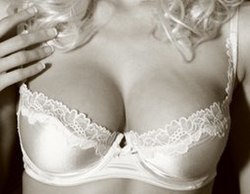
Demi-cup braDemi-cup: Sometimes referred to as a half- or shelf bra. A partial-cup bra style that covers from half to three-quarters of the breast and creates cleavage and uplift. Most demi-cup bras are designed with a slight tilt that pushes the breasts toward the center to display more cleavage.[4] The straps usually attach at the outer edge of the cup. The lingerie industry generally defines a demi-cup bra as covering about 1 inch (25 mm) above the nipple.[4] The underwire used is shorter and forms a shallower "U" shape under the cup. Suitable for low-cut outer garments. Compare to full-cup and balconette bra.
Half-: See Demi-cup above.
Half-cup: See Demi-cup above.
Halter: The straps lead up the front of the chest and connect up around the back of the neck making them perfect for backless or halter-type dresses. Some halter bras are also convertible bras.
Long-line: Extends from the bosom to the waist, offering additional abdominal control and smoothing of the woman's torso. Distributes support over the entire lower torso instead of at bust level as with narrow-band bras.
Minimizer: Designed to de-emphasize the bosom, it compresses and flattens the breasts.
Molded: Often compared to a contour bra. The cups are pre-shaped without seams providing a natural, smooth, rounded look under tight fitting clothing. Some are unpadded and may not include an underwire.
Multiway: see convertible bra.
Nude: When defining a style, see Adhesive bra below. When defining a color, it uses material that matched the skin-tone of the woman.[12]
Peek-a-boo: Intended for romantic occasions, this bra type has cups that can be opened. The cups are made of two parts held together by tied ribbons.
Plunge: Sometimes known as U-plunge bra if they are particularly plunging with a distinct u-shaped opening between the breasts. Allows for lower cleavage. Designed with angled cups and an open and lowered center gore. The shoulder straps are usually set widely apart. Suitable for dresses or outfits with a deep décolleté or plunging neckline, like a blouse or dress. Also suitable for swimwear, even for women with fuller breasts.[10] Unlike push-up bras, plunge bras are not generally as heavily padded, as many women with larger breasts wear them.
Push-up: A fashion bra that creates the appearance of increased cleavage. Uses angled cups containing padding that pushes the breasts inward and upward, toward the center of the chest. A push-up bra is usually a demi-cup bra. The first push-up bra was patented by Marie Tucek in 1893 in response to a fashion for the Empire silhouette.[13] The design was later popularized by the introduction of a push-up Wonderbra in the 1960s.[14]
Racerback: Designed with shoulder straps that form a "V" or "T" pattern between the shoulder blades. Suitable for outerwear like tank tops that would expose traditional over-the-shoulder straps. Provides extra support and can be used when traditional straps tend to fall off the woman. Many sports bras use a racerback design to improve support and reduce bounce.
Shelf: Sometimes referred to as a cupless, open-cup, half-, or even quarter-cup bra. An underwire fashion design that offers minimal breast coverage, supporting only a portion of the underside of the breast, pushing the breast upward, and leaving the nipple and areola uncovered. Suitable for erotic purposes or when a woman would otherwise want to go braless. The exposed nipple may be detectable beneath an outer garment. Built-in bras (see below) are sometimes referred to as shelf bras, or integrate a shelf bra into the material.
Shutter braShutter: dating to c. 1950, with cups that had flaps or lace cuffs at the top. The bra was designed to be partially visible above the neckline of a gown[15] and could be adjusted to vary the amount of cleavage exposed. These bras were often front-fastening.
Spacer: Similar to a T-shirt bra, but it includes a breathable foam fabric in the cup reducing sweat inside the cups.[16]
Stick-on: See Adhesive bra below.
Strapless: A fashion bra that relies on an extra-wide band for breast support. Achieve their strength through a longer underwire that encompasses more of the breast, and cups with added padding, boning, and shaping panels. Suitable for bare-shoulder outer garments like a strapless evening gown that exposes the shoulders and chest, as low as the tops of the areola. Some convertible bras (see above) allow straps to be removed, making a strapless bra. It may have rubberized or silicone beading inside the top edge of the cup to help keep the bra attached to the breast. alternative when an outfit would otherwise prevent a bra being worn.
T-shirt: Designed without raised seams, hooks, or other construction that can be seen under an outer garment. A contoured style that fits the breasts smoothly under tightly fitting T-shirts, sweaters, light-weight knitted fabric, or clingy tops with minimal visibility. The cups may be lined with foam or lightly padded with polyfill to help conceal the nipples. Also see Contour bra, above.
Training: Designed to help conceal adolescent emerging breasts. As a girl's breasts grow larger, usually around Tanner stage III, this style includes regular bras in smaller styles, from 30AAA to 32B. Most styles are a soft-cup, lightweight, unlined design. Some styles are padded to hide the girl's developing breast buds or to increase the perceived size of the girl's breasts. For standard sized bras, see Bralette, above. For athletic-type bras, see sports bra.
Whirlpool Bra: A predecessor to the later bullet bras, the "Whirlpool stitching" technique—which used concentric rings of stitches in order to encourage a rounded shape—was patented in 1933 by Joseph R Bowen for Hollywood-Maxwell.[17][18]
Adhesive: Sometimes described as backless/strapless or a stick-on bra. Usually made of silicone, polyurethane, or similar material, they are attached to the underside of the breasts using medical-grade adhesive. Some versions provide one piece for each breast. May be reused for a limited number of times and provides little support. Suitable for backless and strapless outerwear where a strapless bra is not possible or preferred, or as an alternative to going completely braless.[19]
Air: See Water bras below.
Big cup: Contrary to common belief, big cup and plus size are not synonymous. Plus size bras refer to the band size that is related to the body weight to body height ratio. Big cup refers only to a large breast size on a body that may be slim. Equating big cup with plus size is therefore misleading.
Full slip with built-inpadded bra that may be also worn as a dressBuilt-in: Sometimes referred to as a "shelf bra", although completely unlike the Shelf bra described above. Contained within or as an integral part of an outer garment like a chemise, swimsuit or tank top. Some built-in bras are detachable. Built-in bras vary in their construction and support ability. Some are bandeau like which offer limited support. The more advanced built-in bras are effectively real bras with padding and underwire with a full-fledged support ability, these are mainly intended for larger bust that require sturdier support.
Front-closure: Bras with a single, non-adjustable clasp positioned in the center front gore between the breasts. Full-coverage cups usually have hook-and-eye instead of clasps. This is especially popular for big cup front-closure bras.
Full-coverage: See Full-support bra below.
Full-cup: Sometimes called full-support bras. Designed to offer maximum support and coverage for the entire breast. A practical design for large-busted women. Compare to balconette and demi-cup bra.
Full-figure: See Full-support bra below.
Full-support: Sometimes known as a full-coverage, full-figure or plus-size bra, although these terms are not actually interchangeable. A practical design that offers maximum coverage and support for larger busts. They generally include a sturdier underwire and more supportive, stretchy materials. They typically feature wider shoulder straps, and hook-and-eye fasteners with more hook rows.
Gel: See Water bra below.
Liquid: See Water bra below.
Padded: Designed to enhance perceived bust size and cleavage. The lining of the cups is thickened and enhanced with shape-enhancing inserts or foam padding inside the entire lining of cup. Padded bras support the breasts but, unlike push-up bras (see below), are not intended to significantly increase cleavage.[4] Also see water bra below.
Plus-size: See Full-support bra above.
Seamless: The cups are smooth and without any visible seams, making them nearly invisible under tight fitting clothing.
Sheer: A fashion bra made of translucent material that reveals the nipples.
Soft cup braSoft cup: A practical design that does not use underwire for support. Traditionally regarded as offering less support than underwire models, soft-cup bras now offer competitive support. This is accomplished by using crisscross frames, inner under-cup slings that rise no more than half the height of the cup itself,[4] and padding or lining the bra cup with 2-ply, molded, lined, or seamed material.
Underwire: Many bra designs feature a thin, semi-circular strip of rigid material that helps support the breast. The wire may be made of either metal, plastic or resin. It is sewn into the bra fabric[4] and under each cup, from the center gore to under the wearer's armpit.
Water: Sometimes known as a liquid or gel bra. Contains water- or silicone gel-filled cups that enhance the size of the breasts. Air bras were a similar concept.[19]
Belly dance: Most people consider this type of bra as similar to the normal bra. This type of bra is intended to cover up well e.g., a 32C size can fit up with a 34B belly dance bra.[20]
Bridal: Designed to be worn under a wedding dress and are generally strapless or adhesive with a longline or integrated corset design. May include lace or embroidery.
Fashion: Defines a category of bras that focus on the look and stylishness of the bra. Highly decorative and colorful bras are typically considered fashion bras and they are available in most of the various styles listed here.
Hard-cup: Designed for safety. Used in the Saf-t-Bra.
Maternity: A full-cup design with wider shoulder straps for maximum support and to reduce bounce. Intended to be worn during pregnancy. A practical design that uses comfortable fabrics that minimize irritation. May be adjustable to allow the cup size to expand as pregnancy progresses. Sometimes referred to as a nursing bra which is typically worn after a baby is delivered, but unlike a true nursing bra, does not utilize removable panels or cups that facilitate nursing an infant.
Medical: Designed to accommodate women who have undergone surgery like mastectomy or breast reduction.
Novelty: A fashion bra designed for appearance and sensuality. May include unusual materials, like leather or feathers. Includes unusual designs like the open-tip, peekaboo, or peephole bra that feature holes or slits in the fabric that reveal the areolas and nipples. Usually made of sensuous material like Lycra, nylon (nylon tricot), polyester, satin, lace or silk. Suitable for erotic situations.
Nursing braNursing: Like the maternity bra, this is a practical bra designed with full cups, comfortable fabrics, and wider shoulder straps for increased comfort. Designed to support increased breast size during lactation. Aids breastfeeding by providing flaps or panels that can be unclipped and folded down or to the side, exposing the nipple. Underwires have traditionally been not recommended for nursing bras due to claims they can restrict the flow of milk and cause mastitis, though these claims have no real basis, as underwires by themselves do not cause problems. The wrong bra size, however, can cause problems, with or without underwire. Some designs utilize stretchable fabric allowing the bra to be pulled to one side to facilitate nursing.
Sleep: Sometimes referred to as a leisure bra. These are very soft, stretchy, comfortable easy-to-wear bras that do not provide much support. They may also be suitable as everyday wear for women with a small bust. They are an alternative to going braless and intended for wear at home when relaxing or asleep. With a large bust, bra support may increase comfort during sleep.
Sports braSports: Designed for athletic activities to provide firm support and minimize breast movement during exercise. Various designs are suitable for a range of exercise, ranging from yoga to running. Usually made of stretchable, absorbent fabric like Lycra, and designed to wick perspiration from the skin to reduce irritation. (For bras worn by girls during puberty, see training bra.)
^"Bra Types". Cupmysize.com. Retrieved December 29, 2021.
^"Apparel – B". Clothingdictionary.com. Archived from the original on March 27, 2019. Retrieved August 20, 2010.
^F., José Blanco; Hunt-Hurst, Patricia Kay; Lee, Heather Vaughan; Doering, Mary (2016). Clothing and fashion : American fashion from head to toe. Santa Barbara, California: ABC-CLIO. pp. 12–15. ISBN978-1610693097.
^Whiteman, Hilary (16 August 2019). "Remember when Madonna's cone bra made its debut?". CNN. Retrieved 22 February 2021. Madonna's pink satin cone bra made its first appearance through strategically placed slits in a black Jean Paul Gaultier suit as she emerged on stage during her Blond Ambition Tour in 1990.
A brassiere, commonly known as a bra, is an undergarment worn by women to provide support, shape, and coverage for the breasts, with designs evolving over millennia to address varying needs for comfort, functionality, and aesthetics. This list catalogs the wide variety of bra designs, from ancient precursors like the Roman strophium—a bandeau-style band used for support during activities—to modern innovations such as the sports bra, which emerged in 1977 to reduce movement during exercise.[1]The evolution of bra designs reflects technological, cultural, and social changes, beginning with rudimentary breast bands in ancient Minoan, Greek, and Roman societies made from linen or wool to flatten or lift the bust.[1] By the Renaissance and Victorian eras, designs like stiffened corsets and short stays with baleen or metal reinforcements emphasized waist cinching and breast elevation, often prioritizing silhouette over comfort.[1] The modern brassiere traces its origins to the early 20th century, with key patents including Mary Phelps Jacob's 1914 backless design using silk handkerchiefs and ribbons for flexibility under evening gowns, and Herminie Cadolle's 1889 soutien-gorge, a two-piece upper corset with shoulder straps.[1]Post-World War I innovations introduced standardization and specialization, such as S.H. Camp & Company's 1932 lettered cup sizes (A through D) for better fitting, padded bras in 1947 by Frederick Mellinger for enhancement, and the 1950s bullet bra with its conical shape for a pointed silhouette popular in fashion. Materials advanced with nylon in the 1940s for lightweight durability and spandex in 1958 for stretch, while niche types like the training bra for adolescents and the Wonderbra in 1964 for cleavage amplification addressed specific demographics. Contemporary designs emphasize inclusivity and sustainability, including wireless options, encapsulation sports bras that individually secure each breast, and eco-friendly versions using recycled nylon or organic cotton.[1][2] These variations ensure bras serve everyday wear, athletic support, medical needs, and stylistic preferences across body sizes.[3]
By Shape and Coverage
Full-coverage bras
Full-coverage bras are undergarments designed with cups that fully enclose the breast tissue from the underwire or band to the top edge, ensuring complete coverage and preventing spillage for enhanced modesty and security.[4] This style provides maximum support by containing the entire bust, minimizing movement and bounce during daily activities.[5]Key features of full-coverage bras include high-cut sides that extend upward along the torso for added containment, wider straps to distribute weight evenly and reduce shoulder strain, and often seamless or molded construction that creates a smooth profile invisible under clothing.[6] These elements make them ideal for everyday wear, particularly under form-fitting or lightweight tops where discretion is essential.[7] They may incorporate underwire for structured lift or be offered in wireless alternatives for a softer feel.[8]The origins of full-coverage bras trace back to early 20th-century innovations that shifted from restrictive corsets to more practical undergarments focused on natural support and comfort for active lifestyles.[9] By the 1910s and 1920s, designs emphasizing full breast enclosure gained popularity as women sought functional alternatives to earlier bandeau styles, laying the foundation for modern supportive bras.[1]Full-coverage bras are especially suitable for women with larger busts, such as D+ cup sizes, where their comprehensive cup design and reinforced elements provide the necessary lift and stability to accommodate fuller figures.[10] Constructed from breathable fabrics like cotton or microfiber, they promote all-day comfort by wicking moisture and allowing airflow during prolonged wear.[11] A common variation is the full-coverage T-shirt bra, which features molded cups that shape the bust into a rounded silhouette while maintaining seamless invisibility under casual attire.[12]
Demi-cup bras
A demi-cup bra is characterized by cups that provide partial coverage, typically encompassing about 50-75% of the breast and ending approximately midway up the breast for a natural, lifted silhouette.[13][14][15] This design exposes the upper portion of the breast, enhancing subtle cleavage while maintaining support through structured elements.[16][17]Key features of demi-cup bras include angled or curved cup construction that promotes uplift by directing the breast tissue upward and inward, often reinforced with underwire for added stability.[18][16][19] Aesthetic enhancements, such as delicate lace overlays on the cups and straps, contribute to their elegant appeal, making them suitable for both everyday and special-occasion wear.[20][21]Demi-cup bras are particularly ideal for individuals with smaller to medium bust sizes, such as A to C cups, where they offer balanced support without overwhelming the frame.[22][20] Their low-cut neckline makes them versatile for pairing with low-cut or scoop-neck tops and dresses, providing a seamless look under revealing outerwear.[23][17][24] A common variation is the demi-cup balconette, which incorporates horizontal seaming across the upper cup for a shelf-like lift similar to traditional balconettes.[25][26] Some demi-cup designs may include light padding for added volume, akin to push-up styles, though they prioritize natural enhancement over dramatic augmentation.[27]
Balconette bras
A balconette bra is characterized by its short, horizontal cups that provide coverage primarily to the lower portion of the breast while exposing the upper area, creating a supportive "balcony" or ledge effect that lifts and rounds the bust.[28][29] This design typically features a sweetheart neckline with a lower center gore compared to the sides, enhancing projection and separation for a natural yet enhanced silhouette.[29]The style originated in France during the 1930s, drawing its name from the architectural term "balconette," which refers to a small balcony, evoking the image of breasts perched on a supportive platform.[28][30] It gained widespread popularity in the 1950s, particularly through its association with icons like Marilyn Monroe, who was photographed in balconette styles that complemented the era's pin-up aesthetic.[28][31] An alternative etymology links the name to theater balconies, where the bra's low-cut design was intended to appear discreet when viewed from above.[32]Key construction elements include a three- or four-part cup with horizontal seaming to contour and separate the breasts, often reinforced by underwire for added lift and support.[29] Wide-set straps and lightly padded options further contribute to the uplift from below rather than central cleavage, distinguishing it from demi-cup bras, which emphasize vertical seaming for a more teardrop shape.[28][29] Decorative elements, such as lace tops, enhance its lingerie appeal without compromising the balcony's structured support.[31]Balconette bras are particularly suited for medium bust sizes, offering lift and visible upper breast exposure ideal for low-cut or fitted outfits that require subtle enhancement over full coverage.[28] Variations include lace-trimmed versions for romantic or everyday wear, maintaining the core balconette lift while adding aesthetic versatility.[31]
Plunge bras
A plunge bra is characterized by a deep V-shaped neckline formed by a low or minimal center gore, which connects the cups closely together to allow the breasts to sit nearer to one another, enhancing cleavage while remaining concealed under low-cut garments.[33] This design typically features angled cups that converge toward the bottom, providing a flattering, rounded shape with less overall coverage than full-cup styles but maintaining strong support through wider-set straps and often a flexible underwire.[34]Padding is commonly incorporated for subtle lift, and the shorter wires help prevent discomfort from poking into the chest.[35]The plunge bra gained prominence in the 1990s, largely due to the marketing of the Wonderbra, a push-up variant originally developed in Canada in the 1960s but relaunched with aggressive advertising campaigns.[36] In 1994, Sara Lee Corporation promoted the Wonderbra as "the original push-up plunge bra" through provocative billboards featuring model Eva Herzigová, using slogans like "Hello Boys" that sparked controversy and generated over $50 million in free publicity for the $25 million product line.[37] This surge aligned with fashion trends favoring plunging necklines and "underwear as outerwear," boosting Wonderbra sales by 370% in early 1994 and popularizing the style for dramatic cleavage enhancement.[36]Plunge bras are particularly suited to individuals with smaller busts seeking natural or enhanced projection, making them ideal for V-neck tops, wrap dresses, and other low-neckline attire.[35] Variations include the plunge push-up, which integrates thicker padding for greater lift similar to dedicated push-up designs, as well as unlined or wire-free options for everyday comfort and sheer lace styles for aesthetic appeal.[33]
By Support and Construction
Underwire bras
Underwire bras are brassieres featuring a thin, semi-circular strip of semi-rigid material, usually metal or molded plastic, encased along the lower portion of each cup to provide structured support that mimics the natural ligament structure beneath the breasts.[38] This underwire distributes weight evenly, offering lift and separation while maintaining the breast's shape throughout the day.[39]A key feature of underwire construction is the fabric casing that fully encases the wire, preventing it from shifting or poking into the skin for enhanced comfort and durability.[40] Wires are available in multiple sizes and curvatures to allow adjustable fitting, ensuring compatibility with diverse cup styles such as balconette or full-coverage designs.[41] The first commercially available underwire bra appeared in the United States in 1931, patented by designer Helene Pons as a targeted alternative to the extensive boning used in corsets for breast support.[42][43]These bras are particularly vital for wearers with larger busts, generally C cup and above, where the underwire helps prevent sagging by providing firm uplift and reducing strain on the shoulders and back.[44][45] Variations include flexible underwires made from pliable materials that bend slightly for added comfort without sacrificing support, often integrated into plunge or full-coverage styles for versatile wear.[46] Unlike wireless bras, which prioritize soft, unstructured alternatives, underwire designs deliver precise shaping essential for defined silhouettes.[45]
Wireless bras
Wireless bras, also known as wire-free or soft bras, are designed without metal or plastic underwire, instead providing support through layered fabrics, strategic seaming, molded cups, and reinforced bands that distribute weight evenly across the chest and back. This construction allows for a natural bust shape while minimizing pressure points that can cause discomfort. Unlike underwire bras, which offer rigid lift through structured framing, wireless designs emphasize flexibility and breathability for extended wear, making them suitable for daily comfortable use due to reduced pressure and enhanced airflow.[47][48][49]Key features of wireless bras include compressive or engineered fabrics that hug the body for gentle hold, wide underbands that anchor support without digging into the skin, and encased elastic elements in straps and hems for adjustability and recovery over time. These elements work together to create a seamless silhouette under clothing, with seamless variants providing a smooth fit under tight garments, often incorporating moisture-wicking materials for all-day freshness. Variations such as wireless full-coverage styles feature higher cups and broader coverage to ensure modesty and smoothing for everyday outfits, making them suitable for professional or casual settings.[47][48][50]Wireless bras gained popularity in the 2000s as part of a broader shift toward comfortable lingerie that transitioned seamlessly from lounge and sleepwear to daily use, driven by advancements in fabric technology and a cultural emphasis on natural body contours. This trend accelerated in the 2010s with the rise of wellness-focused lifestyles, appealing particularly to those with smaller busts or sensitivities to underwire, who benefit from the all-day comfort without sacrificing subtle shaping. Similar in soft aesthetics to bralettes, wireless bras provide versatile support for low- to medium-impact activities while prioritizing ease over high structure.[51][52][53]
Push-up bras
Push-up bras are undergarments designed to elevate and project the breasts forward, creating enhanced cleavage and a fuller silhouette by lifting tissue upward and inward through specialized padding.[36] These bras typically incorporate removable or fixed padding concentrated at the lower portion of the cups, often in a sloped or angled configuration that mimics natural breast shape while providing directional support.[54] Key structural elements include side wings or panels that center the breasts toward the midline and a low center gore to facilitate closer positioning, with many designs featuring an underwire frame for added stability.[36] This construction distinguishes push-up bras by their emphasis on projection rather than mere volume addition.[55]The modern push-up bra gained global prominence with the 1994 relaunch of the Wonderbra brand, originally patented in 1963 by Canadian manufacturer Canadelle as the "Dream Lift" style, which introduced the concept of a padded plunge for significant lift.[36] In the UK, the campaign featuring model Eva Herzigova and the slogan "Hello Boys" across 1,000 billboards generated widespread media attention and a 370% sales increase in February 1994 alone, priced at £14.99 as the "original push-up plunge bra."[36] The US launch followed in May 1994 under Sara Lee's Playtex division, capitalizing on the style's appeal for visual enhancement under form-fitting tops.[37] This marketing effort solidified the push-up bra's status as a cultural icon of 1990slingerie trends.[36] As of 2025, sales of push-up bras have declined amid a broader trend toward wireless and minimally structured designs emphasizing natural contours.[56]Primarily targeted at individuals with smaller bust sizes, such as A or B cups, push-up bras offer subtle to dramatic enhancement for a rounded, projected profile without overwhelming natural proportions.[57] Light to medium padding levels are favored for this demographic to achieve natural-looking lift and contouring under everyday or low-cut attire.[58] Variations include those with silicone inserts, which provide a soft, skin-like texture and reusable push for added realism and comfort during extended wear.[59] These inserts, often crescent-shaped, can be placed in any compatible bra to customize the lift effect.[59]
Padded bras
Padded bras are brassieres designed with foam, gel, or molded inserts within the cups to provide additional thickness, shape, and coverage, helping to create a smooth and rounded silhouette that evens out natural breast contours. These inserts, often made from lightweight materials like polyurethane foam, add volume without altering the overall bust size dramatically, making them suitable for everyday wear under fitted clothing. The padding serves to distribute breast tissue more uniformly, reducing visible irregularities and offering modest enhancement for wearers seeking a balanced appearance.[60][61][62]A key feature of padded bras is their molded construction, which ensures seamlessness and prevents show-through, particularly under thin fabrics; padding levels vary from light (typically 2-3 mm thick for subtle shaping) to heavier options (up to 5-6 mm) for greater fullness and support. This versatility allows padded bras to accommodate different bust sizes and preferences, with the inserts acting as a cushion to enhance comfort during prolonged wear. They evolved from the contour bras popularized in the 1950s, which used padding to achieve a uniform, projected shape beneath form-fitting sweaters and dresses, marking a shift toward bras that prioritize aesthetic enhancement alongside functionality.[63][64][9][65] As of 2025, sales of padded bras have declined amid a broader trend toward wireless and minimally structured designs emphasizing natural contours.[56]Padded bras are particularly useful for correcting breast asymmetry by allowing removable or adjustable inserts to balance cup differences of up to one or two sizes, providing a natural look across all bust types from A to DD+. They offer modest enhancement without the pronounced lift associated with push-up styles, focusing instead on smoothing and symmetry. A common variation is the lightly padded T-shirt bra, which features minimal foam lining and molded cups for an invisible, seamless fit under casual tops, ensuring no lines or protrusions are visible. Padded designs can also integrate with wireless constructions for softer, all-day support without rigid framing.[66][67][68][69][70]
By Strap and Back Styles
Strapless bras
Strapless bras are brassieres designed without fixed shoulder straps, consisting primarily of supportive cups and a horizontal band that encircles the torso to provide lift and containment for the breasts. These bras prioritize invisibility under off-the-shoulder, halter, or strapless garments, often incorporating removable straps for versatility, which aligns them closely with convertible styles.[71][72]Key features include silicone or rubberized grips lining the upper and lower edges of the cups and band, which adhere to the skin to prevent slippage during movement. Many models employ underwire construction, typically with a thicker, cushioned wire that arches beneath the breasts to distribute weight evenly and maintain shape without shoulder support. Additional elements like side boning or elasticized bands enhance stability, ensuring the bra remains secure throughout wear.[72][71]The strapless bra emerged in the late 1940s as a response to the rising popularity of bare-shouldered fashions, such as daytime dresses and sportswear that demanded freedom of arm movement. By the 1950s, they gained widespread adoption, particularly for elegant off-shoulder evening gowns and summer attire, as manufacturers refined designs with wiring and adjustable fittings to suit modern silhouettes.[73][9]Strapless bras perform best for individuals with average bust sizes, offering reliable support without excessive bulk, making them ideal for formal events or lightweight seasonal clothing. For those seeking enhanced security, variations like strapless push-up bras incorporate molded padding or inserts to create fuller cleavage and additional lift. Adhesive bras serve as stick-on alternatives for minimal band visibility.[71][71]
Racerback bras
Racerback bras are defined as undergarments featuring shoulder straps that converge and cross or form a Y-shape at the upper back, typically between the shoulder blades, to create a secure fit that minimizes slippage. This design distributes support across the shoulders and back more evenly than traditional straight straps, reducing strain during movement. The style is particularly suited for wearing under sleeveless tops, tank tops, or athletic wear where visible shoulder straps would otherwise be an issue.[74]The racerback configuration emerged in the 1970s alongside the growing popularity of activewear and increased female participation in sports, with early adoption among competitive swimmers who needed streamlined support without interfering with arm mobility. This period coincided with broader innovations in women's athletic apparel, including the invention of the first sports bra in 1977 by Lisa Lindahl, Hinda Miller, and Polly Smith, which laid the groundwork for specialized designs like racerbacks. By the 1990s, major brands such as Nike further popularized the style, introducing their first sports bra in 1990 and the first compression sports bra in 1999, often featuring racerback designs to enhance performance in jogging and other high-impact activities.[75][76]Key features of racerback bras include a reinforced center back hook or J-hook closure, which allows for adjustability and conversion between standard and crossed strap positions, providing versatility without compromising stability. They are often constructed from sports-oriented fabrics such as moisture-wicking synthetics or breathable meshes to manage sweat and enhance comfort during physical activity. These elements make racerback bras effective for preventing strap visibility and offering reliable support in dynamic scenarios.[77][78]Racerback bras are ideal for exercise routines, such as running or yoga, where secure hold is essential, as well as for everyday layered clothing that requires a discreet silhouette. Variations include convertible racerbacks, which incorporate removable or multi-position straps for adapting to different outfits, such as halter or crisscross styles, expanding their utility beyond fixed athletic use.[79]
Convertible bras
Convertible bras, also known as multiway bras, are designed with detachable and adjustable straps that allow wearers to configure the bra in multiple styles, such as traditional over-the-shoulder, halter, crisscross, one-shoulder, or strapless, to accommodate various necklines and outfits.[80] These bras typically feature removable straps attached via clips or hooks at the shoulder and back, enabling easy reconfiguration without compromising support.[81] Often built on a strapless base for added flexibility, they incorporate multiple hook attachments along the cups and band to secure straps in diverse positions.[82]Key features of convertible bras include clear or thin straps for invisibility under clothing, ensuring a seamless look, and reinforced bands with silicone grips to maintain stability in strapless modes.[80] The design emphasizes adaptability, with straps that can be extended or shortened using included accessories like connectors or extensions, making them suitable for fashion-forward ensembles where traditional straps would show.[83] This multi-functional construction reduces the need for multiple specialized bras, promoting efficiency in wardrobes.[84]Convertible bras offer versatility for evening wear, such as off-the-shoulder gowns or low-back dresses, where they can be styled strapless or halter to match formal attire without visible hardware.[80] For travel with limited wardrobe space, their ability to adapt to different outfits in one piece minimizes packing requirements while providing consistent support.[80] One common conversion option is a racerback style, achieved by crossing the straps at the back.[82]Variations include multiway plunge convertibles, which feature a deep V-neckline for low-cut tops, combining push-up padding with detachable straps for enhanced cleavage and multiple styling options like crisscross or one-shoulder.[85] These designs often use molded cups and underwire for lift, ensuring they remain secure across configurations.[86]
Longline bras
A longline bra is defined as a brassiere featuring cups attached to an extended underbust band that reaches down to the waist or hips, providing coverage beyond the standard bra length.[87] This design originated from the evolution of corsets, with early precursors traceable to the 15th-century linen garments found at Lengberg Castle in Austria, which resembled rudimentary longline supports.[88] The modern longline bra emerged in the 1930s as a lighter alternative to rigid corsetry, with innovations like overwired structures appearing during that decade; it gained widespread popularity in the 1950s following the end of wartime fabric restrictions, exemplified by Bali's "Bow" longline bra.[88]Key features of longline bras include boning—often plastic or metal inserts—or elastic panels integrated into the extended band to offer shaping and prevent rolling or buckling.[87] They typically secure with a multi-hook-and-eye closure at the back, providing adjustable fit and enhanced stability compared to standard bras.[89] These elements combine to deliver torso smoothing, particularly for the back and tummy, making longline bras suitable for wearing under fitted dresses where a seamless silhouette is desired.[90]Variations such as longline bustiers extend the concept into fashion-forward layering pieces, functioning as both supportive undergarments and visible tops with lace or satin finishes for aesthetic appeal.[87] This style maintains the core smoothing and support while allowing for creative styling in contemporary outfits.[90]
By Purpose and Function
Sports bras
Sports bras are specialized undergarments designed to minimize breast bounce during physical activity through two primary support techniques: encapsulation, which individually surrounds and separates each breast using molded cups, and compression, which flattens the breasts against the torso to reduce movement.[91][92] These anti-shock mechanisms provide essential stability, preventing discomfort and potential injury from excessive motion, particularly in high-intensity exercises.[93]The modern sports bra was developed in 1977 by Lisa Lindahl, Hinda Miller, and Polly Smith, who created the original Jogbra to address the lack of support for female runners, sewing together two men's jockstraps as an early prototype.[94][95] Key features include high-performance fabrics for durability and moisture-wicking, wide underbands for secure anchorage and even weight distribution, racerback strap configurations to prevent slippage during arm movements, and breathable mesh panels, often in the back, for ventilation to manage sweat during sports and exercise occasions.[91][96][97]Sports bras are typically rated by impact levels to match activity demands: low-impact for gentle movements like yoga, providing light compression without restriction; medium-impact for versatile workouts such as cycling; and high-impact for intense sessions like HIIT or running, offering maximum encapsulation or hybrid support with advanced anti-shock features to significantly limit bounce during rigorous conditions.[98][99] Low-impact versions often incorporate wireless designs for added comfort during less demanding exercises. Recent innovations as of 2025 include the use of sustainable, recycled materials and designs focused on inclusivity for diverse body types.[100][101]Variations include pullover styles without clasps or hooks, which slip over the head for a seamless fit and are popular for medium-support activities, eliminating adjustment hardware while maintaining compressive hold through elastic fabrics.[102][103]
Nursing bras
Nursing bras are specialized undergarments designed to provide support and easy access for breastfeeding mothers, typically featuring drop-down cups or front-opening clips that allow one-handed operation to expose the breast without fully removing the bra.[104] These designs prioritize convenience during lactation, enabling discreet nursing in public or private settings.[9]Key features include soft underwires or wireless construction to avoid pressure on milk ducts, stretchy fabrics such as jerseycotton knits for breathability and flexibility, and adjustable straps with clips positioned at the apex of the cups for quick release.[104] Many incorporate removable or built-in padding in pockets to absorb leaks and provide modesty, while wider bands and elastic elements ensure secure fit without constriction.[104] These elements distinguish nursing bras from standard supportive garments, focusing on functionality for postpartum needs rather than aesthetic enhancement.Nursing bras evolved from early 20th-century maternity designs, with precursors like the 1800s maternal corsets that offered postpartum support, leading to dedicated nursing versions advertised to new mothers by the 1920s and 1930s.[9] By 1943, modern iterations emerged with integrated flaps, building on 1872 concepts like the nursingchemise for improved access and comfort during breastfeeding.[104] This progression addressed the limitations of general maternity bras, which overlap in pre-birth support but lack specialized postpartum access mechanisms.[104]The designs accommodate fluctuating bust sizes during lactation—often changing daily due to milk production—through expandable stretch materials and multiple hook adjustments that allow for up to two cup size variations without discomfort.[104]Variations include seamless nursing bras, which use molded cups and smooth fabrics to minimize visible lines under clothing for discretion, often in neutral or lace-trimmed styles to blend functionality with everyday wear.[104] Other options feature cross-over front panels or side-sling supports for enhanced lift, maintaining the core emphasis on one-handed access and soft, non-irritating construction.[105]
Maternity bras
Maternity bras are specialized undergarments designed to support the breasts as they expand and become more sensitive during pregnancy, incorporating elastic panels and adjustable bands to accommodate fluctuations in bust size due to hormonal changes, weight gain, and the development of milk glands.[106] These bras provide essential comfort and stability for the heavier, tender breasts, helping to alleviate strain on the shoulders and back.[106]Key features of maternity bras include wide, padded straps that distribute weight evenly to reduce discomfort, soft non-irritating cups or linings often made from breathable cotton blends, and seamless construction to prevent chafing against sensitive skin.[106] Additional hooks and eyes on the band allow for easy expansion, typically offering multiple rows for a customizable fit as the body changes.[106] These elements ensure the bra remains supportive without restricting movement or causing pressure points.Maternity bras emerged in the 1930s with adjustable sizing features, becoming more common in the mid-20th century to replace restrictive maternal corsets with flexible support garments that promoted comfort and health.[107][108] This shift was driven by advancements in textile technology and a growing emphasis on hygiene and comfort for pregnant women.[108]Women typically wear maternity bras from early pregnancy onward, continuing through the postpartum period as a transitional option before switching to dedicated nursing styles if needed.[106] Variations such as wire-free designs are particularly favored for heightened breast sensitivity, providing gentle encapsulation without rigid framing.[106]
Minimizer bras
Minimizer bras are full-coverage undergarments designed to compress and redistribute breast tissue, reducing the forward projection of the bust by up to one inch or a full cup size while maintaining a natural shape.[109][110] This design creates a streamlined silhouette that minimizes the appearance of the chest without flattening or distorting the breasts, distinguishing it from more compressive sports bras.[109]Key features include non-stretch, compressive cups—often unlined or lightly padded—that separate and contain the breasts, paired with full underwire for structured support and wide side panels or smoothing bands to prevent spillage and enhance torso definition.[111][112] Supportive, padded straps distribute weight evenly, reducing shoulder strain, particularly for fuller figures.[113] These elements work together by shifting tissue toward the chest wall and underarms, allowing fitted clothing like button-up shirts or jackets to lie smoothly without gaping.[110][114]Originally emerging in the 1960s as part of evolving bra designs to achieve a flatter profile amid shifting fashion trends, minimizer bras gained prominence in the 1980s for professional attire, catering to women with larger busts (typically D cup and above) seeking a more proportionate look under tailored garments.[115] They are ideal for individuals with fuller or pendulous breasts who prioritize discretion and support in everyday or formal wear.[109][116]Variations include longline minimizer bras, which extend downward for additional torso compression and smoothing, similar to extended full-coverage styles but focused on bust reduction.[117] Other options feature seamless construction for invisibility under thin fabrics or lace detailing for aesthetic appeal, ensuring versatility across body types while preserving the core minimizing function.[110]
Minimalist and Alternative Designs
Bralettes
A bralette is a lightweight, wireless bra characterized by unpadded cups made from soft lace or fabric, offering minimal structure and support while prioritizing comfort over shaping.[118] Unlike traditional bras, it typically lacks underwire and padding, allowing for a natural silhouette that resembles a cropped top.[119]Key features of bralettes include a pullover style for easy wear, stretchy elastic bands that hug the underbust without digging in, and decorative elements such as embroidery or intricate lace detailing for aesthetic appeal.[119] These elements make bralettes versatile for both lingerie and light outerwear use, often in casual or layered outfits.[118]Bralettes experienced a significant revival in the 2010s, emerging around 2011 as a comfortable alternative to structured bras, driven by trends toward athleisure and body positivity.[120] Their popularity further increased during the COVID-19 pandemic (2020–2022), with sales of wireless bras rising by up to 32% due to a focus on comfort during remote work.[121] This resurgence positioned them as a mainstream option for everyday wear, appealing to younger consumers seeking freedom from restrictive undergarments.[120]They are particularly suited for individuals with small busts, such as A or B cup sizes, providing gentle coverage without the need for heavy support, and are ideal for layering beneath sheer or low-cut tops.[119] Variations include longline bralettes, which feature an extended band that provides midriff coverage, resembling a short bustier for added smoothing and style.[122]
A bandeau bra is defined as a strapless, tube-like garment made from elastic fabric that encircles the torso to provide minimal coverage and light support for the breasts, typically without defined cups or underwire.[123] These bras are constructed from stretchy materials such as nylon, spandex, or elastane, allowing them to be slipped over the head or hips for a seamless, uniform height around the bust.[123] Key features include a grippy inner silicone lining to prevent slippage, especially under straplessclothing, and a foldable design that enables users to adjust the height or coverage by rolling the top edge.[123] Many modern versions are seamless to ensure invisibility under tight or sheer garments, prioritizing comfort and versatility over structured support.[123]The bandeau style gained prominence during the 1920s flapper era, when it was designed to flatten and minimize the bust to achieve the era's desired boyish, slender silhouette known as "La Garçonne."[124] Made from lightweight materials like silk or rayon, these early bandeaus focused on containment rather than lift, often relying on fabric tension for hold and sold affordably via mail order to align with the decade's liberated fashion trends.[124] The design resurfaced in popularity during the 2000s as a staple in beachwear, particularly in bandeau bikini tops that emphasized minimalism and sun exposure.[125]Bandeau bras are particularly suited for individuals with smaller bust sizes, offering discreet coverage under strapless dresses, off-the-shoulder tops, or as standalone swimwear alternatives.[123] Variations include the shirred bandeau, which incorporates gathered or ruched fabric along the front for added texture and subtle shaping without compromising the minimalist profile.[126] This elastic tension-based hold distinguishes bandeaus from more adhesive strapless options, making them ideal for casual, low-support scenarios.[123]
Adhesive bras
Adhesive bras, also known as stick-on or sticky bras, are a type of strapless and backless undergarment that adheres directly to the skin using medical-grade or hypoallergenicadhesive on the inner surface of the cups or tape.[127] They provide lift and shaping without visible straps or bands, making them ideal for low-back, plunging neckline, or sheer clothing where traditional bras would show.[128] Unlike conventional bras that rely on hooks, wires, or shoulder straps for support, adhesive designs use skinadhesion to secure the breasts in place, often incorporating lightweight padding for enhancement.[129]The concept originated in 1949 when Detroit industrialist Charles L. Langs, in collaboration with chemist Charles Watson, invented the Posĕs adhesive bra after four years of development.[130] Marketed as a solution for even suntans without strap lines, these early versions consisted of simple cloth or foam cups affixed directly to the breasts with a removable adhesive that left no residue.[130] Featured in LIFE magazine in May 1949, the Posĕs were promoted for active pursuits like diving and tennis, offering a "startling look" from the rear due to their invisibility under swimsuits or tops.[130] Despite initial media buzz, the design faded from mainstream popularity by the mid-20th century, though it laid the groundwork for modern iterations.[130]Contemporary adhesive bras have evolved into diverse forms, including silicone cups for reusability, fabric-based options with adhesive wings, and boob tape strips for customizable lift.[127] Materials such as silicone, cotton-spandex blends, and waterproof adhesives ensure durability, with many reusable up to 50 times and suitable for sweat-prone activities.[127] Representative examples include the NuBra Seamless Adhesive Bra, which uses strong silicone adhesion for sizes A to E cups, providing seamless support under evening wear, and Fashion Forms Boob Tape, a waterproof variant offering up to eight hours of hold for backless dresses.[127] These designs prioritize discreet enhancement, adjustable cleavage via drawstrings or clasps, and compatibility with various bust sizes, though they are best suited for those with firmer breast tissue due to reliance on skin grip rather than structural framing.[127]Key benefits include freedom from visible hardware, enabling versatile styling for formal or summer attire, and a natural silhouette that avoids bulk.[128] However, proper application on clean, dry skin is essential for secure hold, and they may not provide the full support of wired bras for larger busts.[127] Advances in hypoallergenic formulas have minimized skin irritation, broadening accessibility.[129]