


Community hub
Recent from talks
Contribute something
Nothing was collected or created yet.
Crochet
View on Wikipedia | This article needs additional citations for verification. (March 2023) |

Crochet (English: /kroʊˈʃeɪ/;[1] French: [kʁɔʃɛ][2]) is a process of creating textiles by using a crochet hook to interlock loops of yarn, thread, or strands of other materials.[3] The name is derived from the French term crochet, which means 'hook'.[4] Hooks can be made from different materials (aluminum, steel, metal, wood, bamboo, bone, etc.), sizes, and types (in-line, tapered, ergonomic, etc.). The key difference between crochet and knitting, beyond the implements used for their production, is that each stitch in crochet is completed before the next one, while knitting keeps many stitches open at a time. Some variant forms of crochet however, such as Tunisian crochet and Broomstick lace, do keep multiple crochet stitches open at a time.
Etymology
[edit]The word crochet is derived from the French word crochet, a diminutive of croche, in turn from the Germanic croc, both meaning "hook".[3] It was used in 17th-century French lace-making, where the term crochetage designated a stitch used to join separate pieces of lace. The word crochet subsequently came to describe both the specific type of textile and the hooked needle used to produce it.[5]
In 1567, the tailor of Mary, Queen of Scots, Jehan de Compiegne, supplied her with silk thread for sewing and crochet, "soye à coudre et crochetz".[6]
Origins
[edit]
Knitted textiles survive from as early as the 11th century CE, but the first substantive evidence of crocheted fabric emerges in Europe during the 19th century.[7] Earlier work identified as crochet was commonly made by nålebinding, a different looped yarn technique. There are three main theories for the origin of crochet.[8] Some believe that its beginnings can be traced to the Arab trade route, originating in Arabia and spreading to Tibet and then Spain as well as other Mediterranean countries.[8] The second theory places crochet in South America where it was used as adornment in a tribe's puberty ritual.[8] The third notes the use of crochet in China where early examples of dolls were worked entirely in crochet.[8]

The first known published instructions for crochet explicitly using that term to describe the craft in its present sense appeared in the Dutch magazine Penélopé in 1823. This includes a color plate showing five styles of purse, of which three were intended to be crocheted with silk thread.[9] The first is "simple open crochet" (crochet simple ajour), a mesh of chain-stitch arches. The second (illustrated here) starts in a semi-open form (demi jour), where chain-stitch arches alternate with equally long segments of slip-stitch crochet, and closes with a star made with "double-crochet stitches" (dubbelde hekelsteek: double-crochet in British terminology; single-crochet in US).[10] The third purse is made entirely in double-crochet. The instructions prescribe the use of a tambour needle (as illustrated below) and introduce a number of decorative techniques.
The earliest dated reference in English to garments made of cloth produced by looping yarn with a hook—shepherd's knitting—is in The Memoirs of a Highland Lady by Elizabeth Grant (1797–1830). The journal entry, itself, is dated 1812 but was not recorded in its subsequently published form until some time between 1845 and 1867, and the actual date of publication was first in 1898.[11] Nonetheless, the 1833 volume of Penélopé describes and illustrates a shepherd's hook, and recommends its use for crochet with coarser yarn.[12]
In 1844, one of the numerous books discussing crochet that began to appear in the 1840s states:
Crochet needles, sometimes called Shepherds' hooks, are made of steel, ivory, or box-wood. They have a hook at one end similar in shape to a fish-hook, by which the wool or silk is caught and drawn through the work. These instruments are to be procured of various sizes...[13]
Two years later, the same author writes:
Crochet, — a species of knitting originally practised by the peasants in Scotland, with a small hooked needle called a shepherd's hook, — has, within the last seven years, aided by taste and fashion, obtained the preference over all other ornamental works of a similar nature. It derives its present name from the French; the instrument with which it is worked being by them, from its crooked shape, termed 'crochet.' This art has attained its highest degree of perfection in England, whence it has been transplanted to France and Germany, and both countries, although unjustifiably, have claimed the invention.[14]
An instruction book from 1846 describes Shepherd or single crochet as what in current international terminology is either called single crochet or slip-stitch crochet, with U.S. terminology always using the latter (reserving single crochet for use as noted above).[15] It similarly equates "Double" and "French crochet".[16]

Notwithstanding the categorical assertion of a purely British origin, there is solid evidence of a connection between French tambour embroidery, french passementerie and crochet. A form of hook known as crochet was used to create 'chains in the air' as part of passementerie back in the 17th century. This is confirmed by a patent issued to the passementiers by Louis XIV in 1653, and there are earlier decorative examples of this technique. The patent lists various items, including "thread for embroidery, enhanced and embellished as done with a needle, on thimbles, on the fingers, on a crochet, and on a bobbin." Similarly, chain stitch appears in Queen Elizabeth I's wardrobe accounts, starting in 1558, with further references to garments bordered with 'cheyne lace' in other inventories. One example from 1588 describes "a long cloak of murry velvet, with a border of small cheyne lace of Venice silver." While the exact design of the 1653 crochet is unclear, a 1723 French dictionary by Jacques Savary des Brûlons describes a crochet as a small iron instrument, three or four inches long, with a pointed, curved end and a wooden handle, used by passementiers for tasks like creating hat seams and attaching flowers to mesh. It is most likely that the hook used in crochet came from the ones used by the French pessamenterie industry.[17] French tambour embroidery and the crochet needle used for it was illustrated in detail in 1763 in Diderot's Encyclopedia. The tip of the needle shown there is indistinguishable from that of a present-day inline crochet hook and the chain stitch separated from a cloth support is a fundamental element of the latter technique. The 1823 Penélopé instructions unequivocally state that the tambour tool was used for crochet and the first of the 1840s instruction books uses the terms tambour and crochet as synonyms.[18] This equivalence is retained in the 4th edition of that work, 1847.[19]

The strong taper of the shepherd's hook eases the production of slip-stitch crochet but is less amenable to stitches that require multiple loops on the hook at the same time. Early yarn hooks were also continuously tapered but gradually enough to accommodate multiple loops. The design with a cylindrical shaft that is commonplace today was largely reserved for tambour-style steel needles. Both types gradually merged into the modern form that appeared toward the end of the 19th century, including both tapered and cylindrical segments, and the continuously tapered bone hook remained in industrial production until World War II.[citation needed]
The early instruction books make frequent reference to the alternative use of 'ivory, bone, or wooden hooks' and 'steel needles in a handle', as appropriate to the stitch being made. [citation needed] Taken with the synonymous labeling of shepherd's- and single crochet, and the similar equivalence of French- and double crochet, there is a strong suggestion that crochet is rooted both in tambour embroidery and shepherd's knitting, leading to thread and yarn crochet respectively; a distinction that is still made. The locus of the fusion of all these elements—the "invention" noted above—has yet to be determined, as does the origin of shepherd's knitting.
Shepherd's hooks are still being made for local slip-stitch crochet traditions.[citation needed] The form in the accompanying photograph is typical for contemporary production. A longer continuously tapering design intermediate between it and the 19th-century tapered hook was also in earlier production, commonly being made from the handles of forks and spoons.[citation needed]
Irish crochet
[edit]
In the 19th century, as Ireland was facing the Great Irish Famine (1845–1849), crochet lace work was introduced as a form of famine relief[20] (the production of crocheted lace being an alternative way of making money for impoverished Irish workers).[21] Men, women, children joined a co-operative in order to crochet and produce products to help with famine relief during the Great Irish Famine. Schools to teach crocheting were started. Teachers were trained and sent across Ireland to teach this craft. When the Irish immigrated to the Americas, they were able to take with them crocheting.[22] Mademoiselle Riego de la Branchardiere is generally credited with the invention of Irish Crochet, publishing the first book of patterns in 1846. Irish lace became popular in Europe and America, and was made in quantity until the first World War.[23]
Modern practice and culture
[edit]Fashions in crochet changed with the end of the Victorian era in the 1890s. Crocheted laces in the new Edwardian era, peaking between 1910 and 1920, became even more elaborate in texture and complicated stitching.[citation needed]

The strong Victorian colors disappeared, though, and new publications called for white or pale threads, except for fancy purses, which were often crocheted of brightly colored silk and elaborately beaded. After World War I, far fewer crochet patterns were published, and most of them were simplified versions of the early 20th-century patterns.[citation needed] After World War II, from the late 1940s until the early 1960s, there was a resurgence in interest in home crafts, particularly in the United States, with many new and imaginative crochet designs published for colorful doilies, potholders, and other home items, along with updates of earlier publications. These patterns called for thicker threads and yarns than in earlier patterns and included variegated colors. The craft remained primarily a homemaker's art until the late 1960s and early 1970s, when the new generation picked up on crochet and popularized granny squares, a motif worked in the round and incorporating bright colors.


Although crochet underwent a subsequent decline in popularity, the early 21st century has seen a revival of interest in handcrafts and DIY, as well as improvement of the quality and varieties of yarn. As well as books and classes, there are YouTube tutorials and TikTok videos to help people who may need a clearer explanation to learn how to crochet.[24] Crochet has been used as a medium to explore identity and self-expression in educational programs, bridging the gap between art and technology.
The COVID-19 pandemic has contributed to the rise of crocheting, since people were staying inside more and wanted to pick up new hobbies/activities. Crochet garments have also been popular recently, as it was worn by numerous pop culture icons like Harry Styles, Dua Lipa, and featured on the Netflix show Wednesday. Crochet has experienced a revival on the catwalk as well. Christopher Kane's Fall 2011 Ready-to-Wear collection.[25] Additionally, it was featured in luxury brands such as Moschino, who has crocheted skirts in their Ready-to-Wear Spring 2024 collection, and Miumiu, who have designed and sold several crocheted items from their brand such as a crocheted scrunchie. Online searches for crochet items have rose drastically with the trend skyrocketing, with a 32% rise in searches for the keyword 'crochet' on online clothing site Depop.[26] With the trend of crochet being on the rise in social media, fast fashion brands like Shein have been trying to create products that resemble crochet items.
Today, many popular crochet projects amongst youth include creating stuffed animals, hats, and even flowers. Websites such as Etsy and Ravelry have made it easier for individual hobbyists to sell and distribute their patterns or projects across the internet. Microentrepreneurs have used social media to share their designs and grow their business. They use social media accounts as a tool to measure their products popularity, stay relevant, and develop relationships with customers. A passive behavior such as liking or sharing will show up on a person’s social media page which will encourage watchers to follow, view videos, and use hashtags related to that content for easier access in the future.[27]
Micro crochet, Filet crochet, Tunisian crochet, tapestry crochet, broomstick lace, hairpin lace, cro-hooking, and Irish crochet are all variants of the basic crochet method.
Mental health benefits of crocheting
[edit]Crochet has been shown to improve emotional well-being and foster a sense of community among participants. Based on a study done by the Royal Society for Public Health in 2020 on 8,391 crocheters from 87 different countries over 6 weeks, 89.5% of crocheters felt calmer, 82% felt happier, and 74.7% felt more useful which can signify an improvement in mental health from participating in crochet. The benefits appear to stem from the low cost, portability, and easily learned aspects of crochet.[28]
Sustainability and crochet in fashion
[edit]Sustainability can be a key pillar of crochet, as it may use upcycled and environmentally friendly materials in yarn to create sustainable fabrics such as bamboo, hemp, cotton, linen, and wool. Since crochet is typically made by hand, crochet contributes to ethical production by adhering to the slow production of garments and accessories rather than the fast-paced and mechanized garments that are produced on a mass scale by the fast fashion industry.
Crochet is typically made by hand, although there are crochet machines[29] in the process of being developed. Crochet contributes to ethical production by adhering to the slow production of garments and accessories rather than the fast-paced and mechanized garments that are produced on a mass scale by the fast fashion industry.
Slow fashion is part of the "slow movement". The slow movement’s objective in clothing and garment manufacturing is to promote respect for people, animals and the environment. Slow fashion supports local artists, the use of eco-friendly materials, and preserves craftsmanship.[30] Since slow fashion promotes the skill of being able to crochet, it’s able to provide jobs with a fair income for unemployed youths in Nigeria. Money created from selling the crochet products is a method to improve their standard of living and meet sustainable development goal 8 (SDG).[31]
Slow fashion emphasizes the importance of providing high quality products over quantity, resulting in consumers being more aware of the ethics and process of material production and labor.[30] A project called ‘Mini Fashion Statement’ was created in order to outline the condition of the factories/provide their opinions on the ‘true cost’ of fashion. Then these scrolls were placed in garments of fast fashion brands. The goal of this project was to raise awareness of ethical implications in the supply chain, which encourages consumers, who often purchase fast fashion, to rethink what they buy. (Corbett, 2019). Additionally, some people choose to crochet their own luxury items that are inspired by luxury fashion. The counterfeit crochet project was founded in 2006. Its goal was to bring to light that luxury can only be accessed by certain people. This project’s goal was to encourage people to use their crochet skills to replicate luxury fashion like Chanel and Louis Vuitton rather than buying from those companies.[32] Additionally, according to Kate Fletcher, slow fashion encourages using eco-friendly materials to minimize harm on the planet and to focus more on creating higher quality goods which in turn allows people to recognize the quality of different sustainable yarn such as natural fibers as well as recycled yarns. Additionally places like Milan offer markets where vendors from other regions come to sell yarn. Since the material comes locally the need to transport raw materials a long distance is reduced therefore reducing carbon emissions. Regional manufacturers also produce items closer to the point of consumption as it increases personal connection between consumer and producer, reduces carbon emission, and provides jobs.[30]
In addition, crochet fabric can be loosened and undone easily to be reused in a new way. Crochet can be added to worn or torn garments and to add a stylistic enhancement, such as a collar or sleeves, which may contribute to upcycling of clothing. Crochet highlights the sustainability factor of quality versus quantity because of the customization aspect which can make crochet items more personalized. Another aspect of the sustainability of crochet is that crochet is versatile and can be used to create many different products eliminating the need to constantly buy new products. [33]
Synthetic fibers and mixed fibers such as acrylic, polyester and nylon are quite commonly used. Synthetic fibers are not biodegradable and aren't recyclable. Today, numerous garments, especially fast fashion, are made from synthetic fibers or mixed fibers. The amount of synthetic fibers used has increased significantly over the years. In 1990 natural fibers made up 60% of fiber consumption and in 2000 the number declined to 45%, with the number declining to 40% 8 years later. In 2009, 35.8 million tons of synthetic fibers were used and 23.3 million tons of cotton were used.[34] In 2023, the amount of total fibers produced and used was 125 million fibers, and it increased to 132 million tons in 2024. The most commonly produced global synthetic fiber is polyester, making up 59%, with 88% of it being fossil based. If this trend continues, then the expected amount produced in 2030 is 169 million tons.[35] This has more than doubled in the amount produced in 2009.
Many crochet and knit yarn brands have taken a stance on sustainability by aiming to increase the production of natural fibers such as organic cotton, hemp, wool and recycled yarns.
Creating crocheted items has become a way to make sustainable fashion.[36] Fast fashion brands like Shein[37] have created products that resemble crocheted items. Additionally, The Crochet-Style Button-Through Sweater Polo, by Abercrombie and Fitch resemble designs popular in the 1960s and '70s. Although the pattern resembles crochet in reality it’s made from a knit machine. These shirts are made from a combination of cotton, acrylic or viscose, which are a typical fabrication for fast-fashion pieces. Although Abercrombie may not consider itself fast fashion, there is little to suggest that its materials and design practices differ from Shein or Zara, other than the quantity of products made.


Materials
[edit]The basic materials required for crocheting are a hook, scissors (to cut yarn), and some type of material that will be crocheted, the most commonly used are yarn or thread. Alternatively, some people choose to crochet with their hands, especially for large yarns. Yarn, one of the most commonly used materials for crocheting, has varying weights which need to be taken into consideration when following patterns. The weight of the yarn can affect not only the look of the product but also the feeling. Acrylic can also be used when crocheting, as it is synthetic and an alternative to wool. Additional tools are convenient for making related accessories. Examples of such tools include cardboard cutouts, which can be used to make tassels, fringe, and many other items; a pom-pom circle, used to make pom-poms; a tape measure and a gauge measure, both used for measuring crocheted work and counting stitches; a row counter; and occasionally plastic rings, which are used for special projects. In recent years, yarn selections have moved beyond synthetic and plant and animal-based fibers to include bamboo, qiviut, hemp, and banana stalks, to name a few. Many advanced crocheters have also incorporated recycled materials into their work in an effort to "go green" and experiment with new textures by using items such as plastic bags, old T-shirts or sheets, VCR or cassette tape, and ribbon.[38]
Crochet hook types
[edit]
The crochet hook comes in many sizes and materials. Because sizing is categorized by the diameter of the hook's shaft, a crafter aims to create stitches of a certain size in order to reach a particular gauge specified in a given pattern. If gauge is not reached with one hook, another is used until the stitches made are the needed size. Crafters may have a preference for one type of hook material over another due to aesthetic appeal, yarn glide, or hand disorders such as arthritis, where bamboo or wood hooks are favored over metal for the perceived warmth and flexibility during use. Hook grips and ergonomic hook handles are also available to assist crafters.
Aluminum, bamboo, and plastic crochet hooks are available from 2.25 to 30 millimeters in size, or from B-1 to T/X in American sizing.[39] Artisan-made hooks are often made of hand-turned woods, sometimes decorated with semi-precious stones or beads.
Steel crochet hooks are sized in a reverse manner – the higher the number, the smaller the hook. They range in size from 0.9 to 2.7 millimeters, or from 14 to 00 in American sizing.[39] These hooks are used for fine crochet work such as doilies and lace.
Crochet hooks used for Tunisian crochet are elongated and have a stopper at the end of the handle, while double-ended crochet hooks have a hook on both ends of the handle. Tunisian crochet hooks are shaped without a fat thumb grip and thus can hold many loops on the hook at a time without stretching some to different heights than others (Solovan). There is also a double hooked tool called a Cro-hook. While this is not in itself a hook, it is a device used in conjunction with a crochet hook to produce stitches.
Yarn types
[edit]
Yarn for crochet is usually sold as balls, or skeins (hanks), although it may also be wound on spools or cones. Skeins and balls are generally sold with a yarn band, a label that describes the yarn's weight, length, dye lot, fiber content, washing instructions, suggested needle size, likely gauge, etc. It is a common practice to save the yarn band for future reference, especially if additional skeins must be purchased. Crocheters generally ensure that the yarn for a project comes from a single dye lot. The dye lot specifies a group of skeins that were dyed together and thus have precisely the same color; skeins from different dye lots, even if very similar in color, are usually slightly different and may produce a visible stripe when added onto existing work. If insufficient yarn of a single dye lot is bought to complete a project, additional skeins of the same dye lot can sometimes be obtained from other yarn stores or online.
The thickness or weight of the yarn is a significant factor in determining how many stitches and rows are required to cover a given area for a given stitch pattern. This is also termed the gauge. Thicker yarns generally require large-diameter crochet hooks, whereas thinner yarns may be crocheted with thick or thin hooks. Hence, thicker yarns generally require fewer stitches, and therefore less time, to work up a given project. The recommended gauge for a given ball of yarn can be found on the label that surrounds the skein when buying in stores. Patterns and motifs are coarser with thicker yarns and produce bold visual effects, whereas thinner yarns are best for refined or delicate pattern-work. Yarns are standardly grouped by thickness into six categories: superfine, fine, light, medium, bulky and superbulky. Quantitatively, thickness is measured by the number of wraps per inch (WPI). The related weight per unit length is usually measured in tex or denier.

Before use, hanks are wound into balls in which the yarn emerges from the center, making crocheting easier by preventing the yarn from becoming easily tangled. The winding process may be performed by hand or done with a ball winder and swift.[40]
A yarn's usefulness is judged by several factors, such as its loft (its ability to trap air), its resilience (elasticity under tension), its washability and colorfastness, its hand (its feel, particularly softness vs. scratchiness), its durability against abrasion, its resistance to pilling, its hairiness (fuzziness), its tendency to twist or untwist, its overall weight and drape, its blocking and felting qualities, its comfort (breathability, moisture absorption, wicking properties) and its appearance, which includes its color, sheen, smoothness and ornamental features. Other factors include allergenicity, speed of drying, resistance to chemicals, moths, and mildew, melting point and flammability, retention of static electricity, and the propensity to accept dyes. Desirable properties may vary for different projects, so there is no one "best" yarn.

Although crochet may be done with ribbons, metal wire, or more exotic filaments, most yarns are made by spinning fibers. In spinning, the fibers are twisted so that the yarn resists breaking under tension; the twisting may be done in either direction, resulting in a Z-twist or S-twist yarn. If the fibers are first aligned by combing them and the spinner uses a worsted type drafting method such as the short forward draw, the yarn is smoother and called a worsted; by contrast, if the fibers are carded but not combed and the spinner uses a woolen drafting method such as the long backward draw, the yarn is fuzzier and called woolen-spun. The fibers making up a yarn may be continuous filament fibers such as silk and many synthetics, or they may be staples (fibers of an average length, typically a few inches); naturally filament fibers are sometimes cut up into staples before spinning. The strength of the spun yarn against breaking is determined by the amount of twist, the length of the fibers, and the thickness of the yarn. In general, yarns become stronger with more twists (also called worst), longer fibers, and thicker yarns (more fibers); for example, thinner yarns require more twists than thicker yarns to resist breaking under tension. The thickness of the yarn may vary along its length; a slub is a much thicker section in which a mass of fibers is incorporated into the yarn.[41]
The spun fibers are generally divided into animal fibers, plant, and synthetic fibers. These fiber types are chemically different, corresponding to proteins, carbohydrates, and synthetic polymers, respectively. Animal fibers include silk, but generally are long hairs of animals such as sheep (wool), goat (angora, or cashmere goat), rabbit (angora), llama, alpaca, dog, cat, camel, yak, and muskox (qiviut). Plants used for fibers include cotton, flax (for linen), bamboo, ramie, hemp, jute, nettle, raffia, yucca, coconut husk, banana trees, soy and corn. Rayon and acetate fibers are also produced from cellulose mainly derived from trees. Common synthetic fibers include acrylics,[42] polyesters such as dacron and ingeo, nylon and other polyamides, and olefins such as polypropylene. Of these types, wool is generally favored for crochet, chiefly owing to its superior elasticity, warmth and (sometimes) felting; however, wool is generally less convenient to clean and some people are allergic to it. It is also common to blend different fibers in the yarn, e.g., 85% alpaca and 15% silk. Even within a type of fiber, there can be great variety in the length and thickness of the fibers; for example, Merino wool and Egyptian cotton are favored because they produce exceptionally long, thin (fine) fibers for their type.[citation needed]
A single spun yarn may be crochet as is, or braided or plied with another. In plying, two or more yarns are spun together, almost always in the opposite sense from which they were spun individually; for example, two Z-twist yarns are usually plied with an S-twist. The opposing twist relieves some of the yarn's tendency to curl up and produces a thicker, balanced yarn. Plied yarns may themselves be plied together, producing cabled yarns or multi-stranded yarns. Sometimes, the yarns being plied are fed at different rates, so that one yarn loops around the other, as in bouclé. The single yarns may be dyed separately before plying, or afterward to give the yarn a uniform look.[citation needed]
The dyeing of yarns is a complex art. Yarns need not be dyed, or they may be dyed one color or a great variety of colors. Dyeing may be done industrially, by hand, or even hand-painted onto the yarn. A great variety of synthetic dyes have been developed since the synthesis of indigo dye in the mid-19th century; however, natural dyes are also possible, although they are generally less brilliant. The color scheme of a yarn is sometimes called its colorway. Variegated yarns can produce interesting visual effects, such as diagonal stripes. [citation needed]
Process
[edit]

Crocheted fabric is begun by placing a slip-knot loop on the hook (though other methods, such as a magic ring or simple folding over of the yarn, may be used), pulling another loop through the first loop, and repeating this process to create a chain of a suitable length. The chain is either turned and worked in rows, or joined to the beginning of the row with a slip stitch and worked in rounds. Rounds can also be created by working many stitches into a single loop. Stitches are made by pulling one or more loops through each loop of the chain. At any one time at the end of a stitch, there is only one loop left on the hook. Tunisian crochet, however, draws all of the loops for an entire row onto a long hook before working them off one at a time. Like knitting, crochet can be worked either flat (back and forth in rows) or in the round (in spirals, such as when making tubular pieces). [citation needed]
Types of stitches
[edit]
There are six main types of basic stitches (the following description uses international crochet terminology with US variants noted in brackets).
- Chain stitch (ch) – the most basic of all stitches and used to begin most projects. Yarn round hook (yrh) and draw through.
- Slip stitch (sl st or ss) – used to join chain stitch to form a ring. Insert hook in work, yrh, draw through.
- Double crochet (dc) (US = single crochet) – Insert hook, draw loop through, (2 loops on hook, hence double), yrh, draw through.
- Half treble (htr) (US = half double) – yrh, insert hook, draw loop through, (3 loops on hook, hence treble), yrh, draw through all loops.
- Treble (tr) (US = double) – yrh, insert hook, draw loop through (3 loops on hook, hence treble), yrh, draw through 2 loops, yrh, draw through 2 loops.
- Double treble (US = treble or triple) – as treble but 2 yrh at start (hence double treble). Also triple treble (ttr), as treble but with 3 yrh at start, and so on.
While the horizontal distance covered by these basic stitches is the same, they differ in height and can be replaced with a length of ch when required, e.g. 1 tr = 3 ch.[43]
The more advanced stitches are often combinations of these basic stitches, or are made by inserting the hook into the work in unusual locations. More advanced stitches include the shell stitch, V stitch, spike stitch, Afghan stitch, butterfly stitch, popcorn stitch, cluster stitch, and crocodile stitch.
International crochet terms and notations
[edit]
There are two main notations of basic stitches, one used across Europe, Australia, India and other crocheting nations, the other in the US and Canada. (In America, international terminology is often erroneously called British or UK terminology.) Crochet is traditionally worked from a written pattern using standard abbreviations or from a diagram, thus enabling non-English speakers to use English-based patterns.[44] To help counter confusion when reading patterns, a diagramming system using a standard international notation has come into use (illustration, left). In the United States, crochet terminology and sizing guidelines, as well as standards for yarn and hook labeling, are primarily regulated by the Craft Yarn Council.[45]
| International term | US term |
|---|---|
| Double crochet (dc) | Single crochet (sc) |
| Half treble (htr) | Half double crochet (hdc) |
| Treble (tr) | Double crochet (dc) |
| Double treble (dtr) | Triple crochet (tr) |
| Double crochet 2 together (dc2tog) | Single 2 together (sc2tog) |
| Treble 2 together (tr2tog) | Double 2 together (dc2tog) |
Another terminological difference is known as tension (international) and gauge (US). Individual crocheters work yarn with a loose or a tight hold and, if unmeasured, these differences can lead to significant size changes in finished garments that have the same number of stitches. In order to control for this inconsistency, printed crochet instructions include a standard for the number of stitches across a standard swatch of fabric. An individual crocheter begins work by producing a test swatch and compensating for any discrepancy by changing to a smaller or larger hook.[47][48]
Differences and similarities to knitting
[edit]One of the more obvious differences is that crochet uses one hook while most knitting uses two needles. In most crochet, the artisan usually has only one live stitch on the hook (except Tunisian crochet), while a knitter keeps an entire row of stitches active simultaneously. Dropped stitches, which can unravel a knitted fabric, rarely interfere with crochet work, due to a second structural difference between knitting and crochet. In knitting, each stitch is supported by the corresponding stitch in the row above and it supports the corresponding stitch in the row below. In contrast, crochet stitches are only supported by and support the stitches on either side of it. If a stitch in a finished crocheted item breaks, the stitches above and below remain intact, and because of the complex looping of each stitch, the stitches on either side are unlikely to come loose unless heavily stressed[49] Round or cylindrical patterns are simple to produce with a regular crochet hook, but cylindrical knitting requires either a set of circular needles or three to five special double-ended needles. Many crocheted items are composed of individual motifs which are then joined, either by sewing or crocheting, whereas knitting is usually composed of one fabric, such as entrelac.[citation needed]
Freeform crochet is a technique that can create interesting shapes in three dimensions because new stitches can be made independently of previous stitches almost anywhere in the crocheted piece. It is generally accomplished by building shapes or structural elements onto existing crocheted fabric at any place the crafter desires.
Knitting can be accomplished by machine, while many crochet stitches can only be crafted by hand. The height of knitted and crocheted stitches is also different: a single crochet stitch is twice the height of a knit stitch in the same yarn size and comparable diameter tools, and a double crochet stitch is about four times the height of a knit stitch.[50]
While most crochet is made with a hook, there is also a method of crocheting with a knitting loom. This is called loomchet.[51] Slip stitch crochet is very similar to knitting. Each stitch in slip stitch crochet is formed the same way as a knit or purl stitch which is then bound off. A person working in slip stitch crochet can follow a knitted pattern with knits, purls, and cables, and get a similar result.[52]
It is a common perception that crochet produces a thicker fabric than knitting, tends to have less "give" than knitted fabric, and uses approximately a third more yarn for a comparable project than knitted items. Although this is true when comparing a single crochet swatch with a stockinette swatch, both made with the same size yarn and needle/hook, it is not necessarily true for crochet in general. Most crochet uses far less than 1/3 more yarn than knitting for comparable pieces, and a crocheter can get similar feel and drape to knitting by using a larger hook or thinner yarn. Tunisian crochet and slip stitch crochet can in some cases use less yarn than knitting for comparable pieces. According to sources[53] claiming to have tested the 1/3 more yarn assertion, a single crochet stitch (sc) uses approximately the same amount of yarn as knit garter stitch, but more yarn than stockinette stitch. Any stitch using yarnovers uses less yarn than single crochet to produce the same amount of fabric. Stitches which are in fact multiple stitches worked together, such as cluster stitches, bobble stitches, and puff stitches, will use the most length.[54]
Standard crochet stitches like sc and dc also produce a thicker fabric, more like knit garter stitch. This is part of why they use more yarn. Slip stitch can produce a fabric much like stockinette that is thinner and therefore uses less yarn.
Any yarn can be either knitted or crocheted, provided needles or hooks of the correct size are used, but the cord's properties should be taken into account. For example, lofty, thick woolen yarns tend to function better when knitted, which does not crush their airy structure, while thin and tightly spun yarn helps to achieve the firm texture required for Amigurumi crochet.[55]
- Differences between crochet and knitting
-
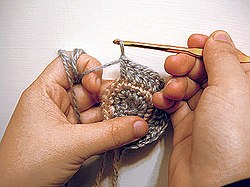 Most crochet uses one hook and works upon one stitch at a time. Crochet may be worked in circular rounds without any specialized tools, as shown here.
 -
 Knitting uses two or more straight needles that carry multiple stitches.
 -
 Unlike crochet, knitting requires specialized needles to create circular rounds.
 -
 For amigurumi, crocheting creates a knobbier and more structured texture compared with knitting.


Craftivism
[edit]It has been very common for people and groups to crochet clothing and other garments and then donate them to soldiers during war. People have also crocheted clothing and then donated it to hospitals, for sick patients and also for newborn babies. Sometimes groups will crochet for a specific charity purpose, such as crocheting for homeless shelters, nursing homes, etc.
It is becoming increasingly popular to crochet hats (commonly referred to as "chemo caps") and donate them to cancer treatment centers, for those undergoing chemotherapy and therefore losing hair. During October pink hats and scarves are made and proceeds are donated to breast cancer funds. Organizations dedicated to using crochet as a way to help others include Knots of Love, Crochet for Cancer,[56] and Soldiers' Angels.[57] These organizations offer warm useful items for people in need.
In 2020, people around the world banded together to help save the wildlife affected by the Australian bushfires by crocheting kangaroo pouches, koala mittens, and wildlife nests.[58] This was an international effort to help during the particularly bad bushfire season which devastated local ecological systems.
A group started in 2005 to create crochet versions of coral reefs grew by 2022 to over 20,000 contributors in what became the Crochet Coral Reef Project.[59] To promote awareness of the effects of global warming, their creations have been displayed in galleries and museums by an estimated 2 million people.[59] Many creations apply hyperbolic (curved) geometric shapes—distinguished from Euclidean (flat) geometry—to emulate natural structures.[59] Extending hyperbolic crochet for activism and education with color, a group of South African crafters created The Abundance Crochet Coral Reef, an eco-art installation in Cape Town's Two Oceans Aquarium, to juxtapose hyperbolic shapes crocheted in variations of white on one side of a display with fiber coral shapes crocheted in various colors to illustrate coral bleaching due to oceanic warming and climate change.[60]
Feminist scholar-activists have argued for crochet as an embodied method of inquiry aimed at uncovering entangled, relational, and situated ways being and knowing inclusive of the more-than-human co-creation of worlds.[61] In Staying with the Trouble, Donna Haraway argues for the methodological use of crochet to model ecological and mathematical phenomena as "a kind of lure to an affective cognitive ecology stitched in fiber arts" that works "not by mimicry, but by open-ended, exploratory process."[38]
Yarn bombing
[edit]In recent years, a practice called yarn bombing, or the use of knitted or crocheted cloth to modify and beautify one's (usually outdoor) surroundings, emerged in the US and spread worldwide.[62] Yarn bombers sometimes target existing pieces of graffiti for beautification. In 2010, an entity dubbed "the Midnight Knitter" hit West Cape May. Residents awoke to find knit cozies hugging tree branches and sign poles.[63] In September 2015, Grace Brett was named "The World's Oldest Yarn Bomber". She is part of a group of yarn graffiti-artists called the Souter Stormers, who beautify their local town in Scotland.[64]
Mathematics and hyperbolic crochet
[edit]Crochet has been used to illustrate shapes in hyperbolic space that are difficult to reproduce using other media or are difficult to understand when viewed two-dimensionally.[65] Mathematician Daina Taimiņa first used crochet in 1997 to create strong, durable models of hyperbolic space after finding paper models were delicate and hard to create. These models enable one to turn, fold, and otherwise manipulate space to more fully grasp ideas such as how a line can appear curved in hyperbolic space yet actually be straight. Her work received an exhibition by the Institute For Figuring.[65]

Examples in nature of organisms that show hyperbolic structures include lettuces, sea slugs, flatworms and coral. Margaret Wertheim and Christine Wertheim of the Institute For Figuring created a traveling art installation of a coral reef using Taimina's method. Local artists are encouraged to create their own "satellite reefs" to be included alongside the original display.[66] As hyperbolic and mathematics-based crochet has become more popular, there have been several events highlighting work from various fiber artists. Two shows were Sant Ocean Hall at the Smithsonian in Washington, D.C., and Sticks, Hooks, and the Mobius: Knit and Crochet Go Cerebral at Lafayette College in Pennsylvania.[67]
Architecture
[edit]In Style in the technical arts, Gottfried Semper looks at the textile with great promise and historical precedent.[clarification needed] In Section 53, he writes of the "loop stitch, or Noeud Coulant: a knot that, if untied, causes the whole system to unravel." In the same section, Semper confesses his ignorance of the subject of crochet but believes strongly that it is a technique of great value as a textile technique and possibly something more
There are a small number of architects currently interested in the subject of crochet as it relates to architecture. The following publications, explorations and thesis projects can be used as a resource to see how crochet is being used within the capacity of architecture.
- Emergent Explorations: Analog and Digital Scripting – Alexander Worden
- Research and Design: The Architecture of Variation – Lars Spuybroek
- YurtAlert – Kate Pokorny
Styles in crochet
[edit]- Mosaic crochet
- Granny square
- Freeform crochet
- Motifs
- Crocheted lace
- Tunisian crochet
- Tapestry crochet
- Amigurumi
- Filet crochet
- Corner to Corner (C2C) Crochet
- Irish crochet lace
- Bead crochet
- Doily
See also
[edit]References
[edit]- ^ "crochet". Dictionary.reference.com. Retrieved 2012-04-28.
- ^ "crochet". Wordreference.com. Retrieved 2012-04-28.
- ^ a b "Crochet". The Free Dictionary By Farlex. Retrieved 2012-05-23.
- ^ Earnshaw, Pat (1999-01-01). A Dictionary of Lace. Courier Corporation. ISBN 978-0-486-40482-0.
- ^ Santina M. Levey, Lace: a History, Victoria & Albert Museum, London, 1983, ISBN 090128615X, p. 92
- ^ Teulet, 'Maison de Marie-Stuart', Relations Politiques, vol. 2 (Paris, 1862), p. 273.
- ^ Lis Paludan, Crochet: History & Technique, Interweave Press, Loveland CO, ISBN 1883010098, p. 76
- ^ a b c d Myers, Cathy (July–August 2011). "Hooked on crochet". Countryside & Small Stock Journal. 95 (4): 77+ – via Gale Onefile.
- ^ [1] A. B. Van Meerten, Penélopé, of, Maandwerk aan het vrouwelijk geslacht toegewijd, Amsterdam, 1824, pp. 90–94
- ^ Sarah Hazell, 200 Crochet Stitches, Search Press, Kent, 2013, ISBN 978-1-84448-963-3
- ^ Elizabeth Grant, The Memoirs of a Highland Lady, John Murray, London, 1898 p. 182.
- ^ A. B. Van Meerten, Penélopé, of, Maandwerk aan het vrouwelijk geslacht toegewijd, Amsterdam, 1833, pp. 152
- ^ [2] Miss Lambert, Hand-book of Needlework, New York City, 1842, p.92
- ^ Miss Lambert, My Crochet Sampler, London, 1844, pp. 9–10
- ^ Nancy Nehring, Learn Slip Stitch Crochet, Annie's Attic, Berne, IN, 2008, ISBN 1596352159, p. 2
- ^ Mlle. Riego de la Branchardiere, Knitting, Crochet, and Netting, London, 1846, p. 57
- ^ Karp, Cary (2018). "Defining Crochet". Textile History. 49 (2): 208–223. doi:10.1080/00404969.2018.1491689.
- ^ [3] Mrs. Gaugain, The Lady's Assistant for Executing Useful and Fancy Designs in Knitting, Netting and Crotchet Work, Edinburgh, 1840
- ^ [4] Jane Gaugain, The Lady's Assistant for Executing Useful and Fancy Designs in Knitting, Netting and Crochet Work, 4th ed., 1847
- ^ "Crochet | craft". Encyclopedia Britannica.
- ^ Irish Crochet Lace Exhibit Catalog Archived 2010-06-01 at the Wayback Machine Lacis Museum of Lace and Textiles. 2005.
- ^ "Crochet History - Crochet Guild of America (CGOA)". www.crochet.org. Archived from the original on 2017-02-02. Retrieved 2017-01-22.
- ^ Art That Saved the Irish From Starvation by Zelda Bronstein. Berkeley Daily Planet, April 19, 2005.
- ^ McFadden, Debbie (31 January 2022). "Bettendorf crochet expert is a You Tube star". www.kwqc.com. Retrieved 2022-03-10.
- ^ "Sac en toile de jute et cabas courses à personnaliser en sérigraphie". artipack.fr.
- ^ Donnell, Chloe Mac (2024-06-29). "Hooked: How crochet became fashion's hottest trend". The Guardian. ISSN 0261-3077. Retrieved 2025-10-30.
- ^ "Libraries Database Access". du.idm.oclc.org. Retrieved 2025-10-20.
- ^ Burns, P; Van Der Meer, R (May 2021). "Happy Hookers: findings from an international study exploring the effects of crochet on wellbeing". Perspectives in Public Health. 141 (3): 149–157. doi:10.1177/1757913920911961. ISSN 1757-9139. PMID 32245337 – via SAGE Publications.
- ^ Storck, Jan Lukas; Feldmann, Bjarte Alexander; Kyosev, Yordan (2023-09-03). "Design tool for automated crocheting of fabrics". Communications in Development and Assembling of Textile Products. 4 (2): 254–272. doi:10.25367/cdatp.2023.4.p254-272. ISSN 2701-939X.
- ^ a b c Peng, Jie (2024-04-09). "The Slow Fashion Renaissance: an in-depth exploration of crochet and knitting as sustainable technologies for contemporary fashion". Politecnico Milano 1863.
- ^ Okeke, Ngozi Kesiah (2024-12-20). "Sustainable Fabric Manufacturing: The Crochet Experience". Journal of Design Studio. 6 (2): 397–408. doi:10.46474/jds.1534064. ISSN 2687-2838.
- ^ "Research Handbook on Ethical Consumption". www.elgaronline.com. Retrieved 2025-10-17.
- ^ Okeke, Ngozi (December 2024). "Sustainable Fabric Manufacturing: The Crochet Experience". Journal of Design Studio. 6 (2). doi:10.46474/jds.1534064 – via Research Gate.
- ^ "World summary", Demographic Yearbook (Ser. R), UN, pp. 48–96, 2008-10-29, ISBN 978-92-1-156193-7, retrieved 2025-10-17
{{citation}}: CS1 maint: work parameter with ISBN (link) - ^ "Materials Market Report 2025". Textile Exchange. Retrieved 2025-10-17.
- ^ "Crocheting: The Sustainable Fashion Trend You Won't Want to Miss".
- ^ "Why you really, really, shouldn't buy crochet in fast fashion". 27 December 2022.
- ^ a b Haraway, Donna (2016). Staying with the trouble: Making kin in the Chthulucene. Duke University Press. pp. 78–79.
- ^ a b "Hooks & Needles | Welcome to the Craft Yarn Council". www.craftyarncouncil.com. Retrieved 2024-09-30.
- ^ White, Sarah. "Here's What to Know About How to Unwind a Hank of Yarn". The Spruce Crafts. Retrieved 2023-10-12.
- ^ "What does "slub" or "slubbiness" mean for fabrics or textiles?". FibreGuard. Retrieved 2025-10-06.
- ^ Masson, James (1995). Acrylic Fiber Technology and Applications. New York: Marcel Dekker, Inc. p. 172. ISBN 0-8247-8977-6.
- ^ "Your complete library of crochet stitches". www.gathered.how. 20 February 2024. Retrieved 2024-03-04.
- ^ "Crochet Abbreviations Master List". Craft Yarn Council. Retrieved 16 October 2018.
- ^ "Standards and Guidelines for Crochet and Knitting". Craft Yarn Council. Archived from the original on 2018-04-07. Retrieved 22 October 2021.
- ^ Crochet, It's all in a Nutshell (2016-02-12). "Crochet abbreviations & difference between US and UK crochet terms". It's all in a Nutshell Crochet. Retrieved 2023-12-24.
- ^ Buckley, Amanda (2023-02-02). "Spot The Difference: US vs UK Crochet Terms". School of SweetGeorgia. Retrieved 2023-12-24.
- ^ Rowe, Lynne (2016-05-04). "Crochet tension (gauge) explained". knitcrochetcreate. Retrieved 2023-12-24.
- ^ Peng, Jie (2023–2024). "The Slow Fashion Renaissance: An In-Depth Exploration of Crochet and Knitting as Sustainable Technologies for Contemporary Fashion". Politecnico: 24. hdl:10589/217904. Retrieved 21 February 2025.
- ^ Hubert, Margaret (2009). Knit Or Crochet - Have It Your Way. Minneapolis, MN: Creative Publishing International, Inc. p. 6. ISBN 978-1-58923-431-4.
- ^ Brenda GA, Dome-Dweller. "Loom Lore: March 2010". Loomlady.blogspot.com. Retrieved 2012-04-28.
- ^ "Slip Stitch Crochet « A Yarnified Life". Ayarnifiedlife.wordpress.com. 29 March 2011. Retrieved 2012-04-28.
- ^ "Crochet does not use 1/3 more yarn than knitting". Crochetliberationfront.com. 2012-02-20. Archived from the original on 2012-02-24. Retrieved 2012-04-28.
- ^ "Crochet Stitches That Save the Most Yarn: Top Picks!". Secret Yarnery. Retrieved 2025-10-06.
- ^ "Southern Belle Lulu pattern by S. Pendleton". Ravelry.
- ^ "Crochet for Cancer". Crochet for Cancer. Retrieved 9 February 2018.
- ^ "Soldiers' Angels-Sewing and Crafting Team". Soldiers' Angels. Retrieved 9 February 2018.
- ^ "Calling all crafters! Here's how you can help wildlife affected by the Australian wildfires". wbir.com. 8 January 2020. Retrieved 2020-10-07.
- ^ a b c Burack, Cristina (30 January 2022). "Crocheted ocean art to fight global warming". Deutsche Welt. Archived from the original on 31 January 2022.
- ^ du Toit, Laura (June 24, 2023). "Coral in crochet: Our new installation". Two Oceans Aquarium. Retrieved December 20, 2024.
- ^ Hoel, Nina (2023). "Crochet Methodology: Thinking Creatively about and with the Study of Religion in the Anthropocene". African Journal of Gender and Religion. 29 (2): 76–103. doi:10.36615/ajgr.v29i2.2800. hdl:10852/107917.
- ^ Anonymous (2009-01-21). "Knitters turn to graffiti artists with 'yarnbombing'". The Telegraph. Retrieved 2009-05-25.
- ^ "'Midnight Knitter' covers West Cape May trees, lamp poles with yarn". NJ.com. 10 March 2010. Retrieved 5 February 2014.
- ^ Shah, Yagana (September 25, 2015). "104-Year-Old 'Yarn Bomber' Spreads Her 'Graffiti' All Over Town". HuffPost.
- ^ a b "Hyperbolic Space". The Institute for Figuring. December 21, 2006. Retrieved January 15, 2007.
- ^ "About the Project | Crochet Coral Reef". www.crochetcoralreef.org. Retrieved 2017-10-30.
- ^ "Sticks, Hooks, and the Mobius: Knit and Crochet Go Cerebral. Math- and science-inspired knit and crochet. · Galleries · Lafayette College". galleries.lafayette.edu. Archived from the original on 11 September 2013. Retrieved 26 October 2022.
57. York, Portia et al. “Crochet: Engaging Secondary School Girls in Art for STEAM’s Sake.” Science Education International 33.4 (2022): 392–399. Science Education International. Web.
Further reading
[edit]- Hadley, Sara. "Irish Crochet Lace", The Lace Maker, Vol. 4 3, New York: D.S. Bennet, 1911.
- Kooler, Donna Donna Kooler's Encyclopedia of Crochet, Leisure Arts, Inc., Little Rock, Arkansas
- Lambert, Miss [Frances]. My Crochet Sampler, London: John Murray, Albemarle Street, 1844.
- Karen Manthey; Susan Brittain; Julie Armstrong Holetz (2010). Crocheting for Dummies (paperback) (2nd ed.). Hoboken, NJ: Wiley. ISBN 978-0-470-53645-2.
- Potter, Annie Louise. A Living Mystery: The International Art & History of Crochet.
- Riego de la Branchardiere, Eléanor. Crochet Book 4th Series, London: Simpkin, Marshall, and Co., 1848.
- Riego de la Branchardiere, Eléanor. Crochet Book 6th Series, containing D'Oyleys and Anti-Macassars, London: Simpkin, Marshall, and Co., 1877. This is the 20th printing of this book; the original publishing date is probably about 1850.
- Riego de la Branchardiere, Eléanor. Crochet Book, 9th Series or Third Winter Book, London: Simpkin, Marshall and Co., 1850.
- Stephens, Ann S. The ladies' complete guide to crochet, fancy knitting, and needlework by Stephens
- Warren, The Court Crochet Doyley Book, London: Ackermann & Co., 1847.
- Wildman, Emily. Step-By-Step Crochet, 1972
External links
[edit]
| Tools |  | |
|---|---|---|
| Techniques and motifs | ||
| Items | ||
| Crocheted lace | ||
| Companies | ||
| Related | ||
| Fundamentals |  | |
|---|---|---|
| History of ... | ||
| Regional and ethnic | ||
| Related | ||
| Glossaries | ||

| International | |
|---|---|
| National | |
| Other | |

Crochet
View on GrokipediaHistory
Etymology
The word crochet originates from the French crochet, a diminutive of croche meaning "hook," which traces back to the Old Norse krōkr, denoting a hook or bent object.[7] [8] This etymological root directly alludes to the hooked needle central to the craft, distinguishing it from needle-based techniques like knitting. The term's adoption for the yarn-working method reflects the tool's defining role in forming loops and chains from thread or yarn.[8] In the context of crafting, crochet first appeared in print describing fabric-making patterns in the Dutch periodical Penélopé in 1823, marking its transition from a general descriptor of hooked implements to a specific designation for the technique.[9] Prior linguistic uses of related forms, such as Old French croc for hooked staffs or tools, predate this application but underscore the consistent association with curvature and hooking mechanisms across Germanic and Romance languages.[7]Origins and Early Development
The precise origins of crochet are obscure, as no surviving artifacts or texts provide unambiguous evidence of its invention, and early forms likely evolved from related looping techniques without distinct nomenclature. A leading hypothesis posits development from tambour embroidery, an Asian-derived chain-stitch method employing a hooked needle to work loops into taut fabric, which reached Europe via Chinese influence in the late 1700s and gained popularity in France for decorative passementerie.[10] [3] This technique's adaptation involved detaching stitches from the fabric base, enabling freestanding chain-based fabrics with a single hook, marking a causal shift from surface embellishment to volumetric construction using yarn or thread.[4] Parallel early variants emerged in rural Europe, particularly Ireland and Scotland, where "shepherd's knitting"—a dense slip-stitch process mimicking single crochet—was executed with bent wires, hairpins, or even fingers on coarse wool to repair nets or create utilitarian items, reflecting practical adaptations to available materials rather than ornamental intent.[4] These coarse methods, documented anecdotally in the 18th century but without dated specimens, prioritized durability over intricacy, contrasting with the finer, lace-like chains derived from tambour. Hooks remained rudimentary, often carved from bone, wood, or early metal until improved steel variants in the early 1800s enhanced precision and stitch variety.[3] By the 1820s, crochet's early development accelerated with printed illustrations of patterns, such as a purse depicted in the Dutch periodical Penélope in 1824, signaling transition from folk craft to documented technique amid rising interest in domestic needlework.[3] This period laid groundwork for broader adoption, though claims of pre-18th-century origins in Arabia, China, or South America rely on speculative analogies to loop manipulation without verified hook-based evidence, underscoring the craft's likely emergence from incremental European innovations in hooking and chaining.[4]19th-Century Popularization
The popularization of crochet in the 19th century began with the publication of the first known patterns in the Dutch magazine Penelope in 1824, which featured instructions for three purses crafted from gold and silver silk thread.[11][12] These early designs represented an initial formalization of crochet techniques, transitioning the craft from undocumented folk practices to accessible, replicable handicrafts disseminated through print media.[13] By the 1840s, English instruction manuals emerged, introducing lace-like crochet methods that built upon continental precedents and appealed to middle-class women seeking affordable alternatives to imported bobbin or needle laces.[13] This period coincided with European immigration to the United States, where crochet spread as a practical skill for producing decorative items such as collars, cuffs, and edgings.[10] A pivotal advancement occurred through the efforts of Mlle. Riego de la Blanchardiere, who from the 1840s onward published extensive pattern books that standardized and promoted intricate crochet laces, including the style that evolved into Irish crochet.[14][15] Irish crochet, characterized by its motifs of flowers, leaves, and vines worked separately and joined on a mesh background, developed in Ireland during the mid-19th century, particularly as a cottage industry during the Great Famine of 1845–1852, enabling impoverished women to replicate the appearance of costly Venetian point lace for export markets.[16][17] The craft's appeal grew with simplified patterns in England and France by mid-century, facilitating home production of household linens, garments, and accessories.[18] Publications like Weldon's Practical Needlework, starting in 1886, further accelerated adoption by providing affordable, monthly pattern supplements that emphasized practical and ornamental applications suited to Victorian domesticity.[19] This proliferation established crochet as a staple of women's leisure and economic activity, with techniques refined for durability using cotton threads on steel hooks.[13]20th- and 21st-Century Evolution
In the early 20th century, industrialization and mass-produced textiles reduced demand for handmade crochet items, leading to a decline in its prominence as a widespread craft.[10] Despite this, crochet techniques were adapted for high-fashion garments and accessories, with designers integrating it into elegant couture pieces by the 1910s and 1920s.[20] Following World War I, published patterns became scarcer and more simplified, reflecting economic constraints and shifting consumer preferences toward ready-made goods.[3] By mid-century, after World War II, crochet transitioned from primarily decorative applications to practical, utilitarian products such as household items and clothing, aided by the availability of affordable synthetic yarns like acrylic introduced in the 1940s.[21] The 1960s and 1970s marked a notable resurgence, driven by countercultural movements where crochet featured in bohemian fashion—colorful vests, ponchos, and tops produced with bold yarns and freeform patterns.[11] This period saw increased pattern books and kits marketed to hobbyists, capitalizing on the back-to-basics ethos amid social upheaval. Entering the 21st century, crochet experienced a renaissance fueled by digital platforms, with online tutorials and social media enabling global pattern sharing and customization starting around the 2010s.[22] Younger demographics, particularly Generation Z, adopted it for sustainable fashion and personalization, mirroring trends in upcycling and slow fashion; by 2021, crochet items trended on platforms like TikTok and Instagram, boosting sales of yarn and hooks.[22] Innovations included expanded material use—such as recycled plastics and metals—alongside applications in art and mathematics, like hyperbolic crochet models developed in the late 1990s for visualizing non-Euclidean geometry.[23] Commercialization grew via e-commerce sites like Etsy, where handmade crochet goods generated millions in annual revenue by the mid-2020s, reflecting its evolution into a viable side industry.[24]Materials and Tools
Yarns, Fibers, and Selection Criteria
Crochet yarns consist of fibers spun into plies, categorized primarily as natural, synthetic, or blends, each influencing the fabric's texture, durability, and care requirements. Natural fibers derive from animal sources like wool, which provides elasticity and warmth due to its crimp structure allowing air trapping, or plant sources such as cotton, valued for breathability and absorbency in summer garments and household items.[25] Synthetic fibers, including acrylic and polyester, offer uniformity, machine-washability, and affordability, often mimicking natural properties but with reduced breathability and potential for pilling over time.[26] Blends combine these, such as wool-acrylic for enhanced softness and ease of care.[27] Yarn weights, standardized by the Craft Yarn Council since 2007, range from 0 (laceweight) to 7 (jumbo), determining gauge, hook size compatibility, and project scale; for instance, worsted weight (category 4) suits most beginner crochet patterns with hooks sized 5.5–6.5 mm.[28]| Category | Yarn Weight | WPI* | Crochet Hook (mm) | Typical Uses |
|---|---|---|---|---|
| 0 | Lace | 30+ | 1.6–2.25 | Delicate lacework |
| 1 | Super Fine | 21–24 | 2.25–3.5 | Baby items, fingering socks |
| 2 | Fine | 16–20 | 3.5–4.5 | Light garments, accessories |
| 3 | Light | 12–15 | 4–5.5 | Sweaters, hats |
| 4 | Medium | 9–12 | 5.5–6.5 | Afghans, garments |
| 5 | Bulky | 6–9 | 6.5–9 | Quick blankets, scarves |
| 6 | Super Bulky | 4–6 | 9–15 | Heavy rugs, cowls |
| 7 | Jumbo | <4 | 15+ | Oversized decor |
Hooks, Accessories, and Ergonomics
Crochet hooks consist of a shaft with a hook at one end for pulling yarn through loops, available in materials including steel for fine work, aluminum for lightweight durability, plastic for affordability, and wood or bamboo for natural grip. Steel hooks range from 0.6 mm (size 14) to 3 mm (size 00), suitable for delicate threads.[31] Aluminum and plastic hooks typically span 2 mm to 20 mm, corresponding to US sizes B (2.25 mm) through S (19 mm).[32] Hook designs vary between tapered, where the point gradually narrows to the shank for smoother yarn entry, and inline or knife-point styles with a uniform shank diameter after the hook, preferred for certain yarns to prevent splitting. Sizes follow standards from organizations like the Craft Yarn Council, with a 5 mm hook designated as H-8 or I-8, matched to yarn weight for gauge; for instance, worsted yarn pairs with 5-5.5 mm hooks.[33][34] Common accessories include stitch markers to denote rounds or increases, yarn needles for seaming and finishing, sharp scissors for cutting yarn, tape measures for checking gauge, and row counters to track progress. Ergonomic aids such as hook grips or padded handles attach to standard hooks to enhance comfort during extended sessions.[35][36] Ergonomic crochet practices address repetitive strain injuries (RSI), including wrist tendonitis and carpal tunnel symptoms from prolonged gripping and motion. Ergonomic hooks feature soft rubber or foam handles that increase grip surface area, reducing pressure on fingers and allowing extended crocheting without fatigue, particularly beneficial for those with arthritis. Prevention strategies encompass taking frequent breaks every 20-30 minutes, performing hand stretches like wrist flexes and finger spreads, maintaining neutral wrist posture, and using supportive seating with lumbar alignment.[37][38][39]Techniques and Processes
Fundamental Crocheting Mechanics
Crochet fabric is constructed by drawing loops of yarn through existing loops using a hooked needle, resulting in a chain of interconnected stitches that provide tensile strength and elasticity primarily along the horizontal plane. This method relies on the hook's ability to capture and manipulate individual loops sequentially, creating a dense, stable structure without requiring multiple active stitches, as in knitting.[40][41] The process initiates with a slip knot, where the yarn end is looped around the hook shaft and drawn through to form an adjustable starting loop that anchors the work. From this, the foundation chain is created by repeatedly yarn-overing—wrapping the yarn around the hook from back to front—and pulling it through the current loop on the hook, extending a linear series of V-shaped chains that serve as the base for subsequent rows or rounds. Each chain stitch consists of a single loop pulled through the prior one, establishing the basic interlocking mechanism.[42][43] Subsequent stitches build upon this chain by inserting the hook into designated loops or spaces, yarn-overing to capture working yarn, and pulling through to form new loops that close around the previous structure. The core actions—yarn-over and draw-through—repeat variably: for the single crochet, the hook inserts under two strands of a chain or stitch, yarns over to pull up a loop (yielding two loops on the hook), then yarns over again to pull through both loops, completing one stitch with a compact, post-like height. Taller stitches like the double crochet involve additional yarn-overs before insertion (to heighten the stitch) and multiple draw-throughs to reduce loops stepwise: yarn over, insert and pull up (three loops), yarn over and pull through two (two loops), yarn over and pull through remaining two (one loop). These mechanics ensure each stitch secures the prior one, propagating the fabric row by row or in spirals for seamless rounds.[40][44][43] Tension control is integral, as the crocheter's grip on the yarn and hook determines loop size and fabric drape; consistent tension prevents gaps or puckering, with the hook's throat (the recessed area behind the point) facilitating smooth passage of multiple loops during taller stitches. Working into the front loop, back loop, or both alters texture—front loops yield ridges, back loops create subtle waves—by selectively engaging parts of the stitch's anatomy, which comprises a head (top V), body (sides), and legs (base connections). This loop-based assembly yields a reversible fabric with inherent stability, resistant to unraveling beyond the active loop on the hook.[41][42]Stitches, Patterns, and Notation Systems
Crochet stitches form the foundational elements of fabric construction, with basic varieties including the chain stitch, which creates a series of interconnected loops serving as the base for subsequent rows; the slip stitch, used primarily for joining or moving across stitches without adding height; single crochet, producing a dense, tight fabric by inserting the hook into a stitch and drawing up a loop before completing it; half double crochet, which adds moderate height via an extra yarn-over; double crochet, involving two yarn-overs for greater height and openness; and treble crochet, with three yarn-overs for even taller stitches suitable for lacy effects.[44][45] These stitches vary in height and texture, enabling diverse fabric densities, and terminology differs between American and British systems, where, for instance, the American "single crochet" corresponds to the British "double crochet" due to historical divergences in naming conventions established in the 19th century.[46][47] Patterns emerge from sequences of these stitches worked in rows for flat pieces or rounds for seamless shapes, often incorporating repeats, increases, decreases, and motifs such as granny squares—clusters of double crochets separated by chains—to build complex designs like garments or blankets. For rectangular throw blankets, such as a 60 by 48 inch size, it is commonly recommended to chain the shorter dimension (48 inches) for the foundation chain to ease management and counting, then work rows to achieve the longer 60-inch length, though the orientation remains a matter of preference.[48] Construction methods include working from the bottom up for sweaters, using circular yokes for tops, or assembling motifs for afghans, with stitch combinations dictating drape, elasticity, and visual appeal; for example, alternating single and double crochets yields textured patterns like the moss stitch, while post stitches create raised effects for cables.[49][50] Notation systems standardize instructions through abbreviations and symbols, with the Craft Yarn Council establishing a master list of U.S. terms such as "ch" for chain, "sc" for single crochet, and brackets or asterisks to denote repeats, facilitating precise replication across patterns.[51] International symbol charts, also standardized by the Council, use pictograms—like an oval for chain or a cross for slip stitch—to represent stitches visually, allowing language-independent reading and aiding complex motifs in doilies or lace; these symbols, adopted widely since the late 20th century, trace roots to earlier diagrammatic patterns but gained uniformity to bridge regional terminological gaps.[52][53]Advanced Methods and Troubleshooting
Advanced crochet methods extend beyond basic stitches to include specialized techniques that produce textured, lacy, or dense fabrics requiring precise tension and hook manipulation. Tunisian crochet, also known as Afghan crochet, utilizes an elongated hook—typically 10-14 inches long with a stopper at the end—to hold multiple loops simultaneously, mimicking knitted textures through a forward pass that builds vertical stitches and a return pass that closes them without turning the work.[54][55] Hairpin lace employs a dedicated loom and crochet hook to form elongated strips of looped lace, which are subsequently joined using chains or stitches to create openwork garments or accessories.[56] Broomstick lace involves pulling groups of yarn loops over a thick rod, such as a broomstick or large knitting needle (sizes 35 or 50), then working them together in the second pass to yield dramatic, elongated motifs.[57][58] Other notable advanced stitches include the bullion stitch, executed by wrapping yarn multiple times (often 8-10 wraps) before drawing through all loops on the hook with a firm pull to form raised clusters, demanding tightly plied yarn and a slender hook to prevent splitting.[56] The crocodile stitch creates overlapping "scales" by working multiple double crochets around a post stitch foundation, ideal for textured accessories but prone to bulk if tension varies.[56] Filet crochet constructs pictorial designs on a mesh grid by filling selected spaces with double crochets while leaving others empty as chains, originating from fine-thread traditions but adaptable to modern yarns for charts or motifs.[59][60] Linked double crochet interlocks stitches by inserting the hook through the horizontal bar of the previous stitch's shaft, yielding a dense, gap-free fabric faster than standard tall stitches.[56] Troubleshooting in crochet addresses inconsistencies arising from technique, materials, or habits, often resolvable through measurement and adjustment. Inconsistent tension, manifesting as puckered or wavy fabric, stems from varying yarn pull-through force; practitioners mitigate this by consciously relaxing the dominant hand and practicing on swatches to achieve even gauge, typically measured as stitches per 4 inches.[61][62] Unintended widening or narrowing occurs from inadvertently adding or skipping stitches at edges; counting stitches per row with markers or a counter prevents this, ensuring adherence to pattern totals.[61][63] Twisted foundation chains result from incomplete twists during formation, leading to skewed starting rows; unraveling and re-chaining with deliberate flat orientation corrects this, supplemented by blocking the piece post-completion to align fibers.[61] Curling edges, common in stockinette-like stitches due to differential row contraction, abate via steam blocking or adding stabilizing borders like rows of single crochet.[62] Mismatched hook size or yarn weight relative to pattern specifications causes disproportionate gauge; verifying with a 4x4-inch swatch and swapping hooks (e.g., increasing by 0.5mm for looser fabric) restores dimensions.[63][64] For advanced works like colorwork or lace, gaps from loose tall stitches close using linked variants, while yarn splitting, particularly with acrylic yarns, can be reduced by using hooks with blunter or inline tips to scoop the full strand, pulling yarn from the end that counters the skein's twist direction, slightly rotating the hook to catch the strand fully, maintaining even loose tension while working slowly, and using a slightly larger hook size to reduce friction; smoother fibers or adjusted wrap counts also help.[56][62][65]Variations and Applications
Regional and Historical Styles
![Irish crochet lace featuring floral motifs]float-right Crochet styles diversified in the 19th century as the craft spread across Europe, with techniques adapting to local lace-making traditions and economic needs. In Ireland, Irish crochet lace emerged during the Great Famine of the 1840s, taught by nuns in convents to provide women with income through intricate motif-based work mimicking needlepoint lace.[15][66] This style features separate floral, shamrock, or leaf motifs crocheted individually and joined by filigree mesh or crocheted bars, often finished with characteristic edgings.[15][67] Filet crochet, another historical European variant, developed in the mid-19th century to replicate filet lace by forming a mesh grid of chains and double crochet stitches, allowing filled and open spaces to create pictorial designs.[68][69] The technique, initially called square crochet, gained the name "filet crochet" around 1912 and was widely used for decorative items like curtains and tablecloths with thin cotton thread.[70] In Croatia, heklanje represents a longstanding tradition of crochet lace passed down through generations for at least two centuries, producing detailed decorative pieces for tableware and clothing.[71] This style emphasizes intricate patterns akin to other Eastern European crochet forms, reflecting regional textile heritage.[72] ![Guatemalan tapestry crochet bag with traditional motifs]center Central American variations include Guatemalan tapestry crochet, which gained prominence in the 1970s among Mayan artisans for crafting flat shoulder bags and other items incorporating colorful, geometric patterns inspired by local weaving traditions.[73] These designs blend crochet with indigenous motifs, supporting fair trade practices and cultural continuity.[74] In Japan, amigurumi emerged in the 1960s amid post-World War II cultural shifts, evolving into stuffed animal toys worked in continuous rounds with tight stitches for a firm, three-dimensional structure, aligning with the rise of kawaii aesthetics.[75] This style prioritizes seamless construction and embellishments to create whimsical figures, distinct from earlier global doll-making but rooted in adapted crochet techniques.[76]Contemporary Design Trends
In recent years, crochet design has shifted toward sustainability, with designers increasingly incorporating recycled materials, upcycled fabrics, and low-waste techniques such as stash-busting to minimize environmental impact. This trend aligns with broader fashion cycles emphasizing eco-conscious production, as evidenced by the resurgence in DIY crochet items made from repurposed yarns, which gained traction amid post-2020 supply chain disruptions and rising awareness of textile waste.[77][78] For instance, patterns utilizing remnant yarns for patchwork blankets or accessories have proliferated on platforms like Etsy, reflecting a practical response to yarn surplus rather than aesthetic novelty alone.[79] Fashion-oriented crochet has embraced chunky yarns and oversized silhouettes, continuing a trajectory from 2023 onward, where bulky items like sweaters and scarves dominate due to their quick fabrication and visual impact in layered styling. Athleisure integrations, such as crocheted crop tops, slouchy hats, and water bottle holders, have merged with sporty aesthetics, appealing to active lifestyles while leveraging crochet's structural durability over knitting.[80][81] Refined neutral palettes and intricate textures, including bobbles, puffs, and layered stitches, appear in runway pieces from spring/summer 2025 collections, prioritizing wearable versatility over ornate excess.[82][83] Amigurumi and toy designs have evolved with minimalist and retro influences, incorporating modern motifs like geometric animals or modular sets, driven by demand for customizable, heirloom-quality playthings amid a 2024-2025 market uptick in handmade goods.[78] Boho elements, such as fringe detailing and bead embellishments, persist in accessories like bags and shawls, blending 1970s nostalgia with contemporary minimalism for broader appeal in casual wardrobes.[84] Freeform techniques, mixing crochet with embroidery or other crafts, allow for personalized, non-traditional garments, fostering innovation in small-scale production.[85] Home decor trends favor updated granny squares and textured wall hangings in earthy tones, capitalizing on crochet's ability to produce rigid, sculptural forms without additional framing.[86] Mohair and fluffy fibers enhance tactile luxury in scarves and throws, with patterns emphasizing drape and volume for interior applications.[80] These developments underscore crochet's adaptability, supported by online communities where pattern downloads surged in 2024, indicating sustained practitioner engagement.[77]Mathematical and Structural Uses
Crochet has been employed in mathematics primarily to construct tactile physical models of non-Euclidean geometries that are challenging to represent accurately with rigid materials like paper or metal, which tend to distort under stress. In hyperbolic geometry, where the sum of angles in a triangle is less than 180 degrees due to constant negative curvature, traditional models fail to maintain uniform expansion without buckling; crochet, by contrast, allows stitches to interlock flexibly, enabling exponential increases in stitch count per row to replicate the geometry's intrinsic properties empirically. This approach demonstrates causal realism in modeling: the fabric's local stitch rules—such as adding multiple increases per round—naturally produce ruffles approximating ideal hyperbolic surfaces, verifiable through measurement of edge lengths and angles against theoretical predictions.[87][88] Mathematician Daina Taimina pioneered this method in 1997 at Cornell University, crocheting the first stable, scalable model of a hyperbolic plane during a geometry teaching workshop, as prior attempts with folding paper resulted in irreversible creases and inaccuracies. Her technique involves starting with a central chain, followed by rounds where each stitch receives, for example, seven increases (creating six new stitches per existing one), yielding a surface that grows radially at a rate matching the hyperbolic metric , where is the radial distance. This model has facilitated hands-on exploration of concepts like tessellations by regular polygons with interior angles less than those in Euclidean space, such as heptagons meeting seven at a vertex, and has been replicated in educational settings to verify properties empirically rather than abstractly. Taimina documented the process in her 2009 book Crocheting Adventures with Hyperbolic Planes, emphasizing how the craft's discrete, incremental nature aligns with discrete approximations of continuous manifolds.[89][90][91] Beyond hyperbolic planes, crochet models other topological structures, such as Möbius strips and Klein bottles, by manipulating stitch orientations to embed twists without seams, allowing verification of one-sided surfaces through physical traversal. Increases and decreases in stitch counts also enable construction of spherical (positive curvature, e.g., constant decreases for domes) and Euclidean (balanced counts for flat fabrics) forms, providing empirical tests of curvature effects: for instance, fewer than six increases per round in a circle yields a cone, while exactly six maintains flatness, as measured by gauge swatches. These applications underscore crochet's utility in discrete mathematics, where stitch graphs represent lattices or networks, though claims of broader computational modeling remain exploratory without large-scale empirical validation.[92][93] In structural engineering, crocheted fabrics exhibit high tensile strength and ductility due to interlocking loops distributing loads anisotropically, making them candidates for composite reinforcements. A 2023 study tested crocheted polypropylene meshes under uniaxial tension, revealing ultimate strengths up to 150 MPa and elongations exceeding 50%, outperforming woven equivalents in energy absorption, attributable to the chain-like topology resisting propagation of failures. Topological modeling of crochet stitches—using spline-interpolated keypoints for chains and single crochets—enables finite element simulations of fabric behavior under deformation, confirming predictive accuracy against physical tests. Emerging applications include robotic crochet for temporary architecture, where computational designs generate patterns for lightweight, deployable tensile structures, as prototyped in a 2025 CAADRIA paper using parametric algorithms to optimize chain densities for load-bearing canopies. These uses prioritize empirical tensile data over unverified scalability claims.[94][95][96]Comparisons to Related Crafts
Key Differences from Knitting
Crochet and knitting differ fundamentally in their tools and mechanics. Crochet utilizes a single hook to manipulate yarn, forming stitches one at a time by pulling a loop through an existing loop, resulting in each stitch resembling a small knot or chain.[97][98] In contrast, knitting employs two or more needles to hold multiple active stitches simultaneously, interlinking loops horizontally across rows.[97][99] These mechanics yield distinct fabric properties. Crocheted fabric is typically denser, thicker, and less elastic due to the knot-like structure, providing greater durability but reduced drape.[100][101] Knitted fabric, formed by interlocking loops, offers more stretch and a smoother, lighter texture suitable for garments requiring flexibility.[102][103] Empirical comparisons confirm crochet consumes approximately 20-30% more yarn than knitting for equivalent areas, as verified through controlled swatch tests using identical yarns and stitch gauges.[101][104] Practical implications include ease of error correction and project suitability. In crochet, mistakes affect only the current stitch, allowing simple unraveling without widespread disruption, whereas knitting's live stitches can ladder if dropped, complicating repairs.[105] Crochet also facilitates seamless circular work without additional tools, ideal for items like hats or amigurumi, while knitting often requires double-pointed or circular needles for rounds.[106]| Aspect | Crochet | Knitting |
|---|---|---|
| Active Stitches | One at a time | Multiple held on needles |
| Fabric Texture | Textured, structured, less stretchy | Smooth, elastic, drapey |
| Yarn Efficiency | Higher consumption (e.g., 25% more in tests) | Lower consumption for same coverage |
| Speed | Generally faster for beginners and motifs | Slower but efficient for large flat pieces |