

Galicians
View on Wikipedia
Key Information


| Part of a series on the |
| Spanish people |
|---|
_alternate_colours.svg) Rojigualda (historical Spanish flag) |
| Regional groups |
Other groups
|
| Significant Spanish diaspora |
 Category • Category •  Spain portal Spain portal |
Galicians (Galician: galegos [ɡaˈleɣʊs] or pobo galego; Spanish: gallegos [ɡaˈʎeɣos]) are an ethnic group[7][8] primarily residing in Galicia, northwest Iberian Peninsula. Historical emigration resulted in populations in other parts of Spain, Europe, and the Americas. Galicians possess distinct customs, culture, language, music, dance, sports, art, cuisine, and mythology. Galician, a Romance language derived from the Latin of ancient Roman Gallaecia, is their native language and a primary cultural expression. It shares a common origin with Portuguese, exhibiting 85% intelligibility, and similarities with other Iberian Romance languages like Asturian and Spanish. They are closely related to the Portuguese people.[9][10] Two Romance languages are widely spoken and official in Galicia: the native Galician and Spanish.[11]
Etymology
[edit]
The ethnonym of the Galicians (galegos) derives directly from the Latin Gallaeci or Callaeci, itself an adaptation of the name of a local Celtic tribe[12][13][14] known to the Greeks as Καλλαϊκoί (Kallaikoí). They lived in what is now Galicia and northern Portugal and were defeated by the Roman General Decimus Junius Brutus Callaicus in the 2nd century BCE and later conquered by Augustus.[15] The Romans later applied that name to all the people who shared the same culture and language in the north-west, from the Douro River valley in the south to the Cantabrian Sea in the north and west to the Navia River. That encompassed such tribes as the Celtici, the Artabri, the Lemavi and the Albiones.
The oldest known inscription referring to the Gallaeci (reading Ἔθνο[υς] Καλλαικῶ[ν], "people of the Gallaeci") was found in 1981 in the Sebasteion of Aphrodisias, Turkey; a triumphal monument to Roman Emperor Augustus mentions them among other 15 nations that he conquered.[16]
The etymology of the name has been studied since the 7th century by authors such as Isidore of Seville, who wrote, "Galicians are called so because of their fair skin, as the Gauls" and related the name to the Greek word for "milk," γάλα (gála). However, modern scholars like J.J. Moralejo[15] and Carlos Búa[17] have derived the name of the ancient Callaeci either from Proto-Indo-European *kl̥(H)‑n‑ 'hill', through a local relational suffix -aik-, also attested in Celtiberian language and so meaning 'the highlanders'; or either from Proto-Celtic *kallī- 'forest' and so means 'the forest (people)'.[18]
Another recent proposal comes from the linguist Francesco Benozzo, who is not specialized in Celtic languages and identified the root gall- / kall- in a number of Celtic words with the meaning "stone" or "rock", as follows: gall (old Irish), gal (Middle Welsh), gailleichan (Scottish Gaelic), galagh (Manx) and gall (Gaulish). Hence, Benozzo explains the name Callaecia and its ethnonym Callaeci as being "the stone people" or "the people of the stone" ("those who work with stones"), in reference to the ancient megaliths and stone formations that are so common in Galicia and Portugal.[19] Specialists of the Celtic languages do not consider there is a hypothetical Gaulish root *gall meaning "stone" or "rock", but *galiā "strength" (> French gaill-ard "strong"), related to Old Irish gal "berserk rage, war fury", Welsh gallu and Breton galloud "power".[20] It is distinct from Gaulish *cal(l)io- "hoof" or "testicle",[21][22] related to Welsh caill, Breton kell "testicle" (> Gaulish *caliavo > Old French chaillou, French caillou),[21][23] all from the Proto-Indo-European root *kal- "hard hardness" (perhaps via suffixed zero-grade *kl̥H-no-(m)). For instance, in Latin callum "hard or thick substance" is also found and so both E. Rivas and Juan J. Moralejo relate the toponym Gallaecia / Callaecia with the Latin word callus.[24]
Languages
[edit]Galician
[edit].png)

Galician is a Romance language belonging to the Western Ibero-Romance branch, deriving from Latin, and holds official status in Galicia. It is also spoken in bordering areas of Asturias and Castile and León.[25]
Medieval or Old Galician, known linguistically as Galician-Portuguese, evolved in the Northwest Iberian Peninsula from Vulgar Latin, becoming the written and spoken language of the medieval Galicia and Portugal. This language developed a notable literary tradition from the late 12th century and gradually replaced Latin in public and private documents in Galicia, Portugal, and neighboring regions.[26]
From the 15th century, Galician-Portuguese diverged into Galician and Portuguese. Galician evolved primarily as a regional spoken language influenced by Castilian Spanish, while Portuguese became an international language. Despite this divergence, the two languages remain closely related, particularly northern Portuguese dialects and Galician.[26] The Royal Galician Academy, the official regulatory institution for the Galician language, considers modern Galician an independent Ibero-Romance language closely related to Portuguese, particularly its northern dialects.
While Galician has official recognition, its socio-linguistic development faces the increasing influence of Spanish and a persistent linguistic erosion due to media and the legal imposition of Spanish in education.[citation needed]
Galicia also maintains a significant literary and oral tradition of songs, tales, and sayings, contributing to the spread and development of the Galician language, sharing commonalities with that of Portugal.[citation needed]
Surnames
[edit]Galician surnames,[27][28] as is the case in most European cultures, can be divided into patronymic (originally based on one's father's name), occupational, toponymic or cognominal. The first group, patronymic includes many of the most frequent surnames and became fixed during the Low Middle Ages; it includes surnames derived from etyma formed with or without the additions of the patronymical suffixes -az, -ez, -iz: Alberte (Albert); Afonso (Alfons); Anes, Oanes, Yanes (Iohannes); Arias; Bernárdez (Bernard); Bermúdez (Medieval Galician Uermues, cf. Wermuth); Cristobo (Christopher); Diz (from Didaci); Estévez (Stephan); Fernández; Fiz (from Felici); Froiz, Frois (From Froilaci, from the Gothic personal name Froila, "lord"); Giance (Latin Iulianici); González; Henríquez (Henry); Martís (Martin); Méndez (Menendici); Miguéns, Miguez (from Michaelici, equivalent to Michaels); Páez, Pais, Paz (from Pelagici, Pelagio); Ramírez; Reimúndez (Raymond); Rodríguez; Sánchez; Sueiro (from Suarius); Tomé (from Thomas); Viéitez, Vieites (Benedictici, Benedict), among many others.
Because of the settlement of Galician colonists in southern Spain during the Reconquista, some of the more frequent and distinctively Galician surnames also became popular in Spanish (which had its own related forms) and were taken later into the Americas, as a consequence of the expansion of the Spanish empire:
| English name | Old Galician (13-15th c.) | Modern Galician | Spanish |
|---|---|---|---|
| John | Eanes | Anes, Oanes, Yanes | Yáñez, Ibáñez |
| Stephen | Esteuaes, Esteuaez, Esteueez | Estévez | Estévanez |
| - | Froes, Froez | Fróiz, Frois | Flores, Flórez |
| Julian | Giançe, Gianz, Gians | Giance | Juliánez |
| Ermengild | Meendez, Meendes | Méndez | Menéndez, Meléndez |
| Martin | Martiiz | Martíns, Martís | Martínez |
| Michael | Migueez | Miguéns, Míguez | Miguélez |
| Pelagius | Paaez, Paaz | Páes, Paiz, Paz | Peláez |
| - | Veasques, Vaasquez | Vázquez | Velázquez, Blázquez |
| Benedict | Beeytez, Beeytes | Viéitez, Vieites | Benítez |

The largest surname group is the one derived from toponyms, which usually referred to the place of origin or residence of the bearer. These places can be European countries (as is the case in the surnames Bretaña, Franza, España, Portugal) or nations (Franco, "Frenchman"); Galician regions (Bergantiños, Carnota, Cavarcos, Sanlés); or cities, towns or villages, which gave origin to a few thousand surnames. Another related group is formed with the preposition de, usually contracted with the definite article as da or do, and a common appellative: Dacosta (or Da Costa), "of the slope", Dopazo or Do Pazo ("of the palace/manor house"); Doval, "of the valley" (cfr. French Duval), Daponte ("of the bridge"), Davila ("of the town", not to be confused with Spanish Dávila), Daporta ("of the gate"); Dasilva ("of the forest"), Dorrío ("of the river"), Datorre ("of the Tower"). Through rebracketing, some of these surnames gave origin to others such as Acosta or Acuña.

A few of these toponymic surnames can be considered nobiliary, as they first appear as the name of some Galician noble houses,[29] later expanding when these nobles began to serve as officials of the Spanish Empire, in Spain or elsewhere, as a way of maintaining them both far from Galicia and useful to the Empire: Andrade (from the house of Andrade, itself from the name of a village), Mejía or Mexía (from the house of Mesía), Saavedra, Soutomaior (Hispanicized Sotomayor), Ulloa, Moscoso, Mariñas, Figueroa among others. Some of these families also served in Portugal, as the Andrade, Soutomaior or Lemos (who originated in Monforte de Lemos). As a result, these surnames are by now distributed all around the world.


The third group of surnames are the occupational ones, derived from the job or legal status of the bearer: Ferreiro ("Smith"), Carpinteiro ("Carpenter"), Besteiro ("Crossbow bearer"), Crego ("Priest"), Freire ("Friar"), Faraldo ("Herald"), Pintor ("Painter"), Pedreiro ("Stonemason"), Gaiteiro ("Bagpiper"); and also Cabaleiro ("Knight"), Escudeiro ("Esquire"), Fidalgo ("Nobleman"), Juiz ("Judge").
The fourth group includes the surnames derived from nicknames, which can have very diverse motivations:
a) External appearance, as eye colour (Ruso, from Latin roscidus, grey-eyed; Garzo, blue-eyed), hair colour (Dourado, "Blonde"; Bermello, "Red"; Cerviño, literally "deer-like", "Tawny, Auburn"; Cao, "white"), complexion (Branco, "White"; Pardo, "Swarth"; Delgado, "Slender") or other characteristics: Formoso ("Handsome"), Tato ("Stutterer"), Forte ("Strong"), Calviño ("Bald"), Esquerdeiro ("Left-handed").
b) Temperament and personality: Bonome, Bonhome ("Goodman"), Fiúza ("Who can be trusted"), Guerreiro ("Warlike"), Cordo ("Judicious").
c) Tree names: Carballo ("Oak"); Amieiro, Ameneiro ("Alder"); Freijo ("Ash tree").
d) Animal names: Gerpe (from Serpe, "Serpent"); Falcón ("Falcon"); Baleato ("Young Whale"); Gato ("Cat"); Coello ("Rabbit"); Aguia ("Eagle")
e) Deeds: Romeu (a person who pilgrimaged to Rome or the Holy Land)
Many Galician surnames have become Castilianized over the centuries, most notably after the forced submission of the Galician nobility obtained by the Catholic Monarchs in the last years of the 15th century.[30] This reflected the gradual spread of the Spanish language through the cities, in Santiago de Compostela, Lugo, A Coruña, Vigo and Ferrol, in the last case due to the establishment of an important base of the Spanish navy there in the 18th century.[31] For example, surnames like Orxás, Veiga, Outeiro, became Orjales, Vega, Otero. Toponyms like Ourense, A Coruña, Fisterra became Orense, La Coruña, Finisterre. In many cases this linguistic assimilation created confusion, for example Niño da Aguia (Galician: Eagle's Nest) was translated into Spanish as Niño de la Guía (Spanish: the Guide's child) and Mesón do Bento (Galician: Benedict's house) was translated as Mesón del Viento (Spanish: House of Wind).
History
[edit]Prehistory
[edit]
The oldest human occupation of Galicia dates to the Palaeolithic, when Galicia was covered by a dense oak temperate rain forest. The oldest human remains found, at Chan do Lindeiro, are from a woman who lived some 9,300 years ago and died because of a landslide, apparently while leading a pack of three aurochs; the genetic study of her remains revealed a woman that was an admixture of Western Hunter-Gatherer and Magdalenian people.[32] This type of admixture has been observed in France, also.[33]
Later on, some 6,500 years ago, a new population arrived from the Mediterranean, bringing agriculture and husbandry with them. Half of the woodland was razed to pasture and farmland, almost replacing all of the woodland some 5,000 years ago.[34] This new population also changed the landscape with the first permanent human structures, megaliths such as menhirs, barrows and cromlechs. During the Neolithic Galicia was one of the foci of Atlantic European Megalithic Culture,[35] putting in contact the Mediterranean and south Iberia with the rest of Atlantic Europe.[36]
Some 4,500 years ago a new culture and population arrived and presumingly admixed with the local farmers, the Bell beaker people, coming ultimately from the Pontic steppe, who introduced copper metallurgy and weaponry, and probably also new cultivars and breeds. Some scholars consider that they were the first people to bring Indo-European languages into Western Europe.[37] They lived in open villages, only protected by fences or ditches; local archaeologists consider that they caused a very large culture impact, replacing collectivism with individualism, as exemplified by their burial in individual cists, along with the reuse of old Neolithic tombs.[38] From this period and later dates a rich tradition of petroglyphs, which find close similarities in the British Isles, Scandinavia or northern Italy.[39] Motives include cup and ring marks, labyrinths, Bronze Age weaponry, deer and deer hunting, warriors, riders and ships.
- Early Bronze Age
-
 Outeiro do cribo ('sieve's hill') labyrinth
 -
 Castriño de Conxo, Bronze Age weaponry
 -
 Laxe dos Carballos, deer hunting with leaf-shaped spears and cup and ring marks
 -
 Casota de Freáns, Vimianzo, a Bronze Age megalith with no corridor or tumulus
 -
 Caldas de Reis hoard, one of the largest in Western Europe, circa 1,800 BCE
 -
 Interior of a Bronze Age cabin (recreation), Campo Lameiro


.jpg)
.jpg)

During the Late Bronze Age and until 800-600 BCE the contacts with both southern Spain to the south, and Armorica and the Atlantic Isles to the north, intensified, probably fuelled by the abundance of local gold and metals such as tin,[40] which allowed the production of high quality bronze. It is at this moment that began the deposition or hoarding of prestige items, frequently in aquatic context. Also, during the Late Bronze Age a new type of ceremonial henge-like ring structures, of some 50 metres in diameter, are built all along Galicia.[41]
This period and interchange network, usually known as Atlantic Bronze Age, which appears to have had its centre in modern-day Brittany, was proposed by John T. Koch and Sir Barry Cunliffe as the one that originated Celtic languages —as a product of pre-existing and closely related Indo-European languages— which could have expanded along with the elite ideology associated with this cultural complex (Celtic from the west theory). Alleged difficulties with this theory and with pre-existing theories ("Celtic from the east") have led Patrick Simms-Williams to propose an intermediate "Celtic from the centre" theory, with an expansion of Celtic languages from the Alps during the Bronze Age.[42] A recent study shows the large scale admixture of an earlier population from Britain with people arriving probably from France during the late Bronze Age. These people, in the opinion of the authors, constitute a plausible vector for the expansion of Celtic languages into Britain, as no further Iron Age people movement of relevant scale is shown in their data.[43]
- Late Bronze Age
-
 Late Bronze Age hoard of Samieira, unearthed in 1948 at some 50 metres from the seashore, and initially consisting of 152 palstaves
 -
 Bronze Age Galician swords, Museo de Pontevedra
 -

-
 Pedra Alta warrior stelle, Castrelo do Val
 -
 1. sword and girdle. 3. v-notch shield. 4. cart with horses
 -
 Horned-helmet figures
 -
 A rider


.jpg)
.jpg)


The Bronze Age - Iron Age transition (locally 1000-600 BCE) coincides with the hoarding of large quantity of bronze axes, unused, both in Galicia, Brittany, and southern Britain.[44] During this same transitional period, some communities began to protect their villages, settling in very protected areas where they built hill-forts. Among the oldest of these are Chandebrito in Nigrán,[45] Penas do Castelo in A Pobra do Brollón[46] and O Cociñadoiro in Arteixo, on a sea cliff and protected by a 3-metre-tall wall, it was also a metal factory, perhaps[47] dedicated to the Atlantic commerce,[48] all of them founded some 2,900-2,700 years ago. These earlier fortified settlements seem to be placed to control metallurgical resources and commerce. This transitional period is also characterized by the apparition of longhouses of ultimately north European tradition[49][50][51] which were replaced later in much of Galicia by roundhouses. By the 4th century BCE hill-forts have expanded all along Galicia, also on lowlands, soon becoming the only type of settlements.
These hill-forts were delimited usually by one or more walls; the defences also include ditches, ramparts and towers, and could define several habitable spaces. The gates were also heavily fortified. Inside, houses were originally built with perishable materials, with or without a stone footing; later on they were entirely made with stone walls, having up to two storeys. Specially in the south, houses or public spaces were adorned with carved stones and warrior sculptures. Stone heads, mimicking severed heads, are found at several locations and were perhaps placed near the gates of the forts. A number of public installations are known, for example saunas of probable ritual use.[52] Of ritual use and great value were also items such as bronze cauldrons, richly figured sacrificial hatchets[53] and gold torcs, of which more than a hundred exemplars are known.[54]
This culture is now known as Castro Culture; another characteristic of this culture is the absence of known burials: just exceptionally urns with ashes have been found buried at foundational sites, acting probably as protectors.
- Iron Age
-
 Castromaior, Portomarín, Lugo
 -
 Castromaior's relief
 -
 Sauna of Punta dos Prados, Ortigueira
 -

-
 Sacrificial hatchet showing an ox, cauldron and torc
 -
 Short swords
 -
 Local ear pendants of ultimate Mediterranean origin


Occasional contacts with Mediterranean navigators, since the last half of the second millennium BCE,[55] became common after the 6th century BCE[56] and the voyage of Himilco. Punic importations from southern Spain became frequent along the coast of southern Galicia, although they didn't penetrate very far to the north or to the interior; also, new decorative motives, as the six-petal rosettes, are popularized, together with new metallurgical techniques and pieces (ear pendants) and some other innovations as the round hand mill. In exchange, Punics obtained tin, abundant in the islands and peninsulas of western Galicia (probable origin of the Cassiterides island myth)[57] and probably also gold. Incidentally, Avienus' Ora Maritima says after Himilco that the Oestrymni (inhabitants of western Iberia) used hide boats to navigate, an assertion confirmed by Pliny the Elder for the Galicians.[58]
Roman conquest
[edit]
First recorded contact with Rome happened during the Second Punic War, when Gallaecians and Astures, together with Lusitanians, Cantabrians and Celtiberians —that is, the major Indo-European nations of Iberia— figured among the mercenary armies hired by Hannibal to go with him into Italy. According to Silus Italicus's Punica III:[59]
Fibrarum, et pennæ, divinarumque sagacem
Flammarum misit dives Callæcia pubem,
Barbara nunc patriis ululantem carmina linguis,
Nunc, pedis alterno percussa verbere terra,
Ad numerum resonas gaudentem plaudere cætras.
Hæc requies ludusque viris, ea sacra voluptas.
Cetera femineus peragit labor: addere sulco
Semina, et inpresso tellurem vertere aratro
Segne viris: quidquid duro sine Marte gerendum,
Callaici conjux obit inrequieta mariti.

"Opulent Galicia sent her youth, expert in divination through the entrails of beasts, the flight of birds and the divine lightnings; sometimes they delight to chant rude songs in their fatherland's tongues, other times they make the ground tremble with alternative foot while happily clashing their caetra at the same time. This leisure and diversion is a sacred delight for the men, the feminine laboriosity do the rest: adding the seed to the furrow and working the ground with the plough while the men idle. Everything which must be done, with the exception of the hard war, is made restlessly by the wife of the Galician." He later also mentions the Grovii of southern Galicia and northwestern Portugal, with their capital Tui, apart from the other Galicians; other authors also marked the distinctness of the Grovii: Pomponius Mela by addressing that they were non Celtic, unlike the rest of the inhabitants of the coasts of Galicia; Pliny by signalling their Greek origin.[59]
After ending victoriously the Lusitanian war with the assassination of Viriathus, consul Caepio tried to wage war, unsuccessfully, on Gallaecians and Vettones, for the help they lent to the Lusitanians. In 138 BCE, another consul, Decimus Junius Brutus, in command of two legions, passed de Douro river and later the Lethes or Oblivio (Limia, which frightened his troops because of its other name), in a successful campaign, managing to conquer many places of the Galicians. After reaching the Minho river, and in his way back, he attacked (again successfully) the Bracari, who had been harassing his supply chain: Appian describe the Bracari women fighting bravely side by side with their men; of the women who were taken prisoners, some killed themselves, and others killed their children, preferring death to servitude.[59] The spoils of war allowed Decimus Junius Brutus to celebrate a triumph back in Rome, receiving the name Callaicus. Recently a very large marching Roman camp was discovered at high altitude, in Lomba do Mouro, at the very frontier of Galicia with Portugal. In 2021 a C-14 dating showed that it was built during the 2nd century BCE; since it is north of the Limia, it probably belonged to this campaign.[60]
The Roman contact had a very large impact on the Castro Culture: an increase in commerce with the south and the Mediterranean; adoption or development of sculpture and stone carving; the warrior ethos appear to increase in social importance;[61] some hill-forts are built new or rebuilt as true urban centres, oppida, with streets and definite public spaces, as San Cibrao de Las (10 ha) or Santa Trega (20 ha).[62]
- Oppida and Roman conquest
-
 Gates of the oppidum of Saint Cibrao de Las
 -
 Aerial photo of San Cibrao de Las
 -
 Santa Tregra, A Guarda
 -
 Santa Trega with the Minho in the background
 -
 As minted circa 20 BCE during the conquest of Galicia, Asturia and Cantabria
 -

-
 Equitation scene, Formigueiro, Amoeiro


In 61 BCE Julius Caesar, commanding thirty cohorts, launched from Cádiz a maritime campaign along the Atlantic shores which ended in Brigantium. According to Cassius Dio, the locals, who had never seen a Roman fleet, surrendered in awe. Recent excavations at the Castro de Elviña hillfort, near A Coruña, have found both evidences of siege and partial destruction of the walls of the site, and also of a temple, dated to the middle of the first century BCE.[63]
Finally, in 29 BCE, Augustus launched a campaign of conquest against Gallaecians, Asturians and Cantabrians. The most memorable episode of this war was the siege on the Mons Medullius, who Paulus Orosius placed near the Minho river: it was surrounded by a 15 mille trench before a simultaneous Roman advance; according to Anneus Florus the besieged decided to kill themselves, by fire, sword, or by the venon of the yew tree.[64] Tens of Roman camps have been found related to this war, most of them corresponding to the later stages of the war, against Asturians and Cantabrians, some twenty of them in Galicia.[65] Augustus' victory over the Gallaecians is celebrated in the Sebasteion of Aphrodisias, Turkey, where a triumphal monument to Augustus mentions them[66] among other fifteen nations conquered by him. Also, the triumphal arch of Capentras probably represents a Gallaecian among other nations defeated by Augustus.[67]
Languages and ethnicity
[edit]
Pomponius Mela (a geographer from Tingentera, modern day Algeciras in Andalusia) described, circa 43 CE, the coasts of northwestern Iberia:[68]
Frons illa aliquamdiu rectam ripam habet, dein modico flexu accepto mox paululum eminet, tum reducta iterum iterumque recto margine iacens ad promunturium quod Celticum vocamus extenditur.
Totam Celtici colunt, sed a Durio ad flexum Grovi, fluuntque per eos Avo, Celadus, Nebis, Minius et cui oblivionis cognomen est Limia. Flexus ipse Lambriacam urbem amplexus recipit fluvios Laeron et Ullam. Partem quae prominet Praesamarchi habitant, perque eos Tamaris et Sars flumina non longe orta decurrunt, Tamaris secundum Ebora portum, Sars iuxta turrem Augusti titulo memorabilem. Cetera super Tamarici Nerique incolunt in eo tractu ultimi. Hactenus enim ad occidentem versa litora pertinent.
Deinde ad septentriones toto latere terra convertitur a Celtico promunturio ad Pyrenaeum usque. Perpetua eius ora, nisi ubi modici recessus ac parva promunturia sunt, ad Cantabros paene recta est.
In ea primum Artabri sunt etiamnum Celticae gentis, deinde Astyres. In Artabris sinus ore angusto admissum mare non angusto ambitu excipiens Adrobricam urbem et quattuor amnium ostia incingit: duo etiam inter accolentis ignobilia sunt, per alia Ducanaris exit et Libyca

"That ocean front for some distance has a straight bank, then, having taken a slight bend, soon protrudes a little bit and then it is drawn back, and again and again; then, lying on a straight line, the coast extends to the promontory which we call Celtic. All of it is inhabited by Celtics, except from the Durio until the bend, where the Grovi dwelt —and through them flow the rivers Avo, Celadus, Nebis, Minius and Limia, also called Oblivio—. On the bend there is the city of Lambriaca and the receding part receives the rivers Laeros and Ulia. The prominent part is inhabited by the Praestamarci, and through them flow the rivers Tamaris and Sars —which are born not afar— Tamaris by harbour Ebora, Sars by the tower of Augustus, of memorable title. For the rest, the Supertamarici and Neri inhabit in the last tract. Up to here what belongs to the western coast. From there all the coast is turned to the north, from the Celtic promontory to the Pyrenees. Its regular coast, except where there are small retreats and small headlands, is almost straight by the Cantabrians. On it first of all are the Artabri, still a Celtic people, then the Astures. Among the Artabri there is a bay which lets the sea through a narrow mouth, and encircles, not in a narrow circuit, the city of Adrobrica and the mouth of four rivers." The Atlantic and northern coast of today's Galicia was inhabited by Celtic peoples, with the exception of the southern extreme. Others geographers and authors (Pliny, Strabo), as well as the local Latin epigraphy, confirm the presence of Celtic peoples.
As for the language or languages spoken by the Galicians previously to their romanization, most scholars usually perceive a primitive Indo-European layer, another later one hardly distinguishable from Celtic and identifiable with Lusitanian, most notable in the south, the Gallaecia Bracarense (as a result, Lusitanian is sometimes called Lusitanian-Gallaecian) and finally Celtic proper; as stated by Alberto J. Lorrio:[69] "the presence of Celtic elements in the Northwest is indisputable, but there is no unanimity in considering whether there was an only Indo-European language in the West of Iberia, of Celtic kind, or either a number of languages derived from the arrival of non-Celtic Indo-Europeans first, and Celts later on". Some academic positions on this issue:
- Francesco Benozzo, proponent of the Palaeolithic continuity theory, considers that Celtic language is autochthonous in Galicia.[70] Since recent genetic studios show that European and Iberian Palaeolithic population was assimilated by larger migrant populations proceeding first from the Balkans and Anatolia, and later from Central Europe and ultimately from the Pontic steppe, this theory is probably flawed.
- For John T. Koch and Barry Cunliffe, proponent of the Celtic from the West theory, the Celtic language would have expanded during the late Bronze Age from the European Atlantic fringe, including Galicia, to the east.[71][72][73] For Patrick Simms-Williams, Celtic expanded from modern day France during the late Bronze Age.[42]
- Joan Coromines, lexicographer and author of the Diccionario crítico etimológico castellano e hispánico, considered that Galician language had a very important substrate attributable to at least two different Indo-European languages, an older non Celtic one who he derived from the Urnfield people and thought was present in most of northern Iberia, and another one he named Artabrian, the Celtic language of the Celts of Galicia.
- Blanca M. Prósper[74] and Francisco Villar defend that Lusitanian is a non Celtic Indo-European language related to Italic languages[75] because, in their opinion, the Indo-European aspirated stops have evolved into /f/ and /h/. At the same time, all along the area of this language, and specially in modern-day Galicia, a Celtic language was spoken; this language, a q-Celtic language similar to Celtiberian, is the Western Hispano-Celtic.[76][77]
- Joaquín Gorrochategui, José M. Vallejo,[78] Alberto J. Lorrio, García Alonso,[79] E. Luján[80] and others, consider that Lusitanian is not a Celtic language, but they don't consider it closer to Italic, neither, but part of a group of IE dialects which later evolved into Celtic, Italic and Lusitanian. On the other hand, Celtic speakers lived in close proximity to the Lusitanian. In this context, Gallaecia Bracarensis was clearly in communion with the Lusitania,[81] while Gallaecia Lucensis had its own Celtic profile.[82][83][84][85][86]
- Jürgen Untermann, continued by his disciple Carlos Búa,[87] defended that along the westernmost part of Iberia there was essentially just one language or group of languages, Gallaecian-Lusitanian or Lusitanian and Gallaecian, which in their opinion was definitely Celtic and not Italoid, as shown by the ending of dative plural (-bo, -bor < PIE -*bhos) and the evolution of the syllabic consonants, in particular -r̥- > -ri-.
- Local scholars and researchers of toponymy and lexicon of pre-Latin origin (J. J. Moralejo, Edelmiro Bascuas) saw at least two layers of Indo-Europeans: one early layer of a very primitive IE language which preserved p, most notable in river names, and a later Celtic layer.[88][89]
Roman period
[edit]
After the Roman conquest, the lands and people of northwestern Iberia were divided in three conventi (Gallaecia Lucensis, Gallaecia Bracarensis and Asturia) and annexed to the province of Hispania Tarraconensis.[90] Pliny wrote that the Lucenses comprised 16 populi and 166,000 free heads, and mentions the Lemavi, Albiones, Cibarci, Egivarri Namarini, Adovi, Arroni, Arrotrebae, Celtici Neri, Celtici Supertamarci, Copori, Celtici Praestamarci, Cileni among them (other authors mention also the Baedui, Artabri and Seurri); the Astures comprised 22 populi and 240,000, of whom the Lougei, Gigurri and Tiburi dwelt lands now in Galicia; finally the Bracarenses 24 civitates and 285,000, of whom the Grovi, Helleni, Querquerni, Coelerni, Bibali, Limici, Tamacani and Interamici dwelt, at least partially, in modern-day Galicia. The names of some of these peoples have been preserved as the names of regions, parishes and villages: Lemos < Lemavos, Cabarcos, Soneira < *Sub Nerii, Céltigos < Celticos, Valdeorras < Valle de Gigurris, Trives < Tiburis, Támagos < Tamacanos. Some other Galician regions derive from some populi or subdivision not listed by the classic authors, among them: Bergantiños < Brigantinos, from Briganti, Nendo < Nemetos, from Nemeton, Entíns < Gentinis ('the chieftains').[91]
A common characteristic of both Gallaecians and western Astures were their onomastic formula and social structure: while most of the other Indo-European peoples of Hispania used a formula such as:
- Name + Patronimic (gen. s.) + Gens / Family (gen. pl.), as, for example,
- Turaesius Letondicum Marsi f(ilius) : 'Turaesius son of Marsi, of the Letondi clan'

Gallaecians and western Astures used, until the 2nd century of our era, the formula:[92]
- Name + Patronimic (gen. s.) + [Populi/Civitas] (nom. s.) + [⊃] (abreviature of castellum) Origo (abl. s.) as:
- Nicer Clvtosi ⊃ Cavriaca Principis Albionum : Nicer, son of Clutosios, from castle Cauria, prince of the Albion
- Caeleo Cadroiolonis f(ilius) Cilenus ⊃ Berisamo : Cailio, son of Cadroilo, Cilenus from castle Berisamo
- Fabia Eburi f(ilia) Lemava ⊃ Eritaeco : Fabia, daughter of Eburios, Lemava from castle Eritaico
- Eburia Calueni f(ilia) Celtica Sup(ertamarca) ⊃ Lubri : Eburia, daughter of Calugenos, Celtica Supertamarca from castle Lubris
- Anceitus Vacc[e]i f(ilius) limicus ⊃ Talabrig(a) : Anceitos, son of Vacceos, Limicus from castle Talabriga
The known personal names used by locals in northern Gallaecia were largely Celtic:[93] Aio, Alluquius, Ambatus, Ambollus, Andamus, Angetus, Arius, Artius, Atius, Atia, Boutius, Cadroiolo, Caeleo, Caluenus, Camalus, Cambauius, Celtiatus, Cloutaius, Cloutius, Clutamus, Clutosius, Coedus, Coemia, Coroturetis, Eburus, Eburia, Louesus, Medamus, Nantia, Nantius, Reburrus, Secoilia, Seguia, Talauius, Tridia, Vecius, Veroblius, Verotus, Vesuclotus, among others.
Three legions were stationed near the Cantabrian mountains after the war, later reduced to the Legio VII Gemina in León, with three auxiliary cohorts in Galicia (the Cohors I Celtiberorum in Ciadella, Sobrado dos Monxes, near Brigantium; other unity at Aquis Querquennis, and another one near Lucus Augusti) and others elsewhere. Soon Roma began to recruit auxiliary troops locally: five cohorts of Gallaecians from the conventus Lucenses, other five of bracarenses, two mixed ones of Galicians and Asturians, and an ala and cohort of Lemavi.[94][95]
Also, Gallaecia and Asturia became the most important producers of gold on the Empire: according to Pliny Lusitania, Gallaecia and, especially, Asturia, produced the equivalent to 6,700 kg per year. It has been estimated that the eight hundred Roman gold mines known in Galicia produced in total in between 190,000 and 2,000,000 kg.[96]
-
 Reenactors at Lugo's Arde Lucus
 -
 Roman camp of Aquis Querquennis
 -
 Nicer Clutosi's stelle
 -
 Apana Amboli's stele
 -
 Tabula hospitalis from Carbedo
 -
 Romanized hill-fort of Viladonga, Castro de Rei


During the Diocletian reforms, late third century, Gallaecia was upgraded to province.
Germanic era: 5th – 8th centuries
[edit]In 409 the Vandals, Suebi and Alans, who had entered in the Roman Empire in 405 or 406 crossing the Rhin, passed into the Iberian Peninsula. After a year of war and plundering, they were pacified by the offering of lands where to settle. The Roman province of Gallaecia (including Gallaecia proper and the regions of Asturia and Cantabria) were assigned to the Suebi and the Hasding Vandals. Both groups clashed soon, in 419, and so the Vandals left to southern Iberia, where they incorporated the last remnants of Alans and Silingi Vandals, who had been crushed by Rome in previous years. In 429 the Vandals left for Africa.[97][98]
In 430 a long term conflict broke in between the Suebi and locals who chronicler Hydatius called gallaecos (i.e. galegos, the endonym of modern-day Galicians) and, initially, plebs ("folk, common people"), in contrast with whom he called romani: the rural landowners in Lusitania and the inhabitants of the cities. Soon, among those Galicians, appear also local noblemen and churchmen. As the Britons in southern Great Britain, the Galician were forced to act autonomously from Rome, exercising home rule.[99] They reoccupied old Iron Age hill-forts and built new strongholds and fortification all along Galicia;[100] the largest known today are at Mt. Pindo,[101] Mt. Aloia[102] and at Castro Valente.[103] These fortresses were later used by locals against Visigoths, Arabs and Norsemen. In this conflict in between Galicians and Suebi, Rome and local bishops acted frequently rather as intermediaries than as a part, and peace our truce was obtained or warranted with the interchange of prisoners and hostages.[97][104]
In 438 both people attained a peace that would last for twenty years; by then old king Hermeric, who had led their people at least since their arrival from Central Europe, ceded the crown to his son Rechila, who would expand the kingdom to the south and east, conquering Emerita Augusta, Mértola and Seville, and moving his troops into eastern Hispania, defeating both Roman and Visigoth armies along the way. His successor and son, Rechiar, converted from paganism to Catholicism upon being crowned, and married a Visigoth princess. He negotiated with Rome a new status for his kingdom and became the first post-Roman Germanic king to mint coins in his name.[105] Soon, he tried to expand into the last Roman province in Hispania, Tarraconense; eventually this led to open conflict with Rome and the Visigoths. In 456 a large army of foederati commanded by the kings of the Visigoths and the Burgundians entered Hispania and defeated the Suebi army near the city of León. Rechiar fled to Porto, but he was captured and later executed. Notwithstanding, the Visigoths left in a hurry the theatre of operation, returning to France. That allowed the Suebi to regroup. After a period of petty-kings rivalry, accompanied by devastation and pillage on Galicians, Remismund was recognized as only and legitimate king by the Suebi, and accepted by the Visigoths; he also promoted the Arianism among the Suebi. As result, the Suebi kingdom came to its limits, encompassing modern day Galicia, northern Portugal until Coimbra, and large parts of Asturias, León and Zamora.[105]
The chronicle of Hydatius also records naval raids of both Vandals and Heruli on the Galician coasts during the 5th century.[97]
Medieval era
[edit]In 718 the area briefly came under the control of the Moors after their conquest and dismantling of the Visigothic Empire, but the Galicians successfully rebelled against Moorish rule in 739, establishing a renewed Kingdom of Galicia which would become totally stable after 813 with the medieval popularization of the "Way of St James".
Geography and demographics
[edit]
Political and administrative divisions
[edit]The autonomous community, a concept established in the Spanish constitution of 1978, that is known as (a) Comunidade Autónoma Galega in Galician, and as (la) Comunidad Autónoma Gallega in Spanish (in English: Galician Autonomous Community), is composed of the four Spanish provinces of A Coruña, Lugo, Ourense, and Pontevedra.
Population, main cities and languages
[edit]The official statistical body of Galicia is the Instituto Galego de Estatística (IGE). According to the IGE, Galicia's total population in 2008 was 2,783,100 (1,138,474 in A Coruña,[106] 355.406 in Lugo,[107] 336.002 in Ourense,[108] and 953.218 in Pontevedra[109]). The most important cities in this region, which serve as the provinces' administrative centres, are Vigo (in Pontevedra), Pontevedra, Santiago de Compostela, A Coruña, Ferrol (in A Coruña), Lugo (in Lugo), and Ourense (in Ourense). The official languages are Galician and Spanish. Knowledge of Spanish is compulsory according to the Spanish constitution and virtually universal. Knowledge of Galician, after declining for many years owing to the pressure of Spanish and official persecution, is again on the rise due to favorable official language policies and popular support.[citation needed] Currently about 82% of Galicia's population can speak Galician[110] and about 61% have it as a mother tongue.[11]
Culture
[edit]
Celtic revival and Celtic identity
[edit]
In the 19th century a group of Romantic and Nationalist writers and scholars, among them Eduardo Pondal and Manuel Murguía,[111] led a Celtic revival initially based on the historical testimonies of ancient Roman and Greek authors (Pomponius Mela, Pliny the Elder, Strabo and Ptolemy), who wrote about the Celtic peoples who inhabited Galicia;[112] but they also based this revival in linguistic and onomastic data,[113][114] and in the similarity of some aspects of the culture and the geography of Galicia with that of the Celtic countries as Ireland, Brittany and Britain, as well as in the Bronze and Iron Age archaeological cultures.[115][116] These similarities included legends and traditions,[117] and decorative and popular arts and music.[118] It also included the green hilly landscape and the ubiquity of Iron Age hill-forts, Neolithic megaliths and Bronze Age cup and ring marks, which were and are popularly seen as "Celtic", also among foreigners who travelled to Galicia.[119][120][121]
As a Celtic region of Spain, Galicia has a tartan called Galicia National.[122]
During the late 19th and early 20th century this revival permeated Galician society: in 1916 Os Pinos, a poem by Eduardo Pondal, was chosen as the lyrics for the new Galician hymn. One of the strophes of the poem says: Galicians, be strong / ready to great deeds / align your breast / for a glorious end / sons of the noble Celts / strong and traveller / fight for the fate / of the homeland of Breogán.[123] The Celtic past became an integral part of the self-perceived Galician identity:[124] as a result an important number of cultural association and sport clubs received names related to the Celts, among them Celta de Vigo, Céltiga FC, CB Breogán, etc.

From the 1970s on a series of Celtic music and cultural festivals were also popularized, the most notable being the Festival Internacional do Mundo Celta de Ortigueira, at the same time that Galician folk musical bands and interpreters became usual participants in Celtic festivals elsewhere, as in the Interceltic festival of Lorient, where Galicia sent its first delegation in 1976.[125]
- Celtic and non Celtic elements common along the western Atlantic coast of Europe which are popularly perceived as Celtic.
-
 A castro (hill-fort) at Baroña, Porto do Son
 -

-
 Medieval interlaced cross, Santiago de Compostela
 -
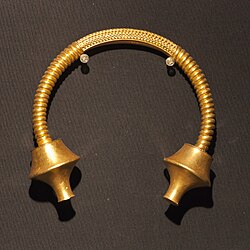
-
 Triskelion from the Museo de Ourense
 -
 View of the hillfort at San Cibrao de Las, Ourense
 -

-
 The rocky and misty coast of Cabo Silleiro, Baiona

.jpg)


Folklore and traditions
[edit]
Myths and legends
[edit]

.jpg)

Galician folklore is similar to that of the rest of western Europe, especially to that or northern Portugal, Asturias and Cantabria. Among its most notable myths are the following:[126]
- Before the world was inhabited by humans, animals could speak: many traditional tales about animals begin with the phrase aló cando os animais falaban, 'back then, when animals used to speak', which has become equivalent to English once upon a time.
- Our world is connected to an underworld dwelt by the mouros ('the dark ones' or perhaps 'the dead ones', mistaken by Andalusian Moors in many tales), an ancient and sombre race who inhabited the upper world before ourselves and who dislike humans. They can still travel to our world to interact with us through the ruins of the places they built or inhabited, such as barrows, dolmens, stone circles, hill-forts, etc., which are still traditionally called with names such as Eira dos Mouros ('Mouros' threshing floor'), Casa dos Mouros ('Mouros' house'), Forno dos Mouros ('Mouros' oven'). This kind of place names are already attested in Latin documents dating to circa 900 CE and later. Humans can also travel to the underworld, either becoming very rich or suffering for their greed as a result. Some mouros or encantos can appear as tall and strong men riding large horses and there are specific spells to ask them for riches.
- Fairies and nymphs (who also belong to the netherworld) receive many names, among them mouras, encantos ('apparition; spell'), damas ('ladies'), madamas ('miladies'), xás (from Latin dianas). They are frequently portrayed as women of incredible beauty and riches and long golden blonde hair that can be found by the aforementioned prehistoric ruins or at fountains and ponds, where they comb their hair. Other times, they are gigantic women of incredible strength, enough to move massive boulders, who can be found with a spinning distaff or a baby.[127] Under this appearance they are the same with the Vella ("the Old Lady"), who is somehow also responsible for the weather: the rainbow is called arco da vella in Galician ("Old Lady's bow"), a myth which is probably related to the Cailleach, 'Old Woman', 'Hag', of Ireland and Scotland.[128]
- Lavandeiras (washerwomen) are eerie fairies that are found at a river of pond washing clothes, under the aspect of women, especially at night. They can ask a passer-by to help twist the clothes: if the passer-by mistakenly twists in the same direction, the clothes turn into blood.[126]
- The trasnos, tardos or trasgos (goblins) are mischievous, household creatures, who like to annoy and confound people. They can cause nightmares by siting on the chest of the people, move things and cause other troubles. In Galician trasnada (~'goblin-ery') means 'trick, mischief'.
- Other sign of the netherworld is the apparition of a golden hen followed by his golden chicks (a galiña dos pitos de ouro), which, no matter how hard one tries, can't be caught. There is a similar myth in Bulgaria.
- Maruxaina was a vicious siren who lived near the town of San Cribrao and who eventually was captured and executed by the locals.
- The barrows are also inhabited by other entities called ouvas ('elfs').
- Other beings with control of the weather are the nubeiros ('cloud-ers'). George Borrow in his book The Bible in Spain narrates how he met a nubeiro while travelling Galicia circa 1835.[129] Other similar beings are the tronantes and escoleres.
- Many lakes are believed to be the result of the drowning of ancient cities (frequently called Lucerna, Valverde, 'Green Valley', or Antiochia in tales and legends) when the inhabitants failed to give shelter to Jesus or a saint, or when a king of the mouros used his magic out of spit. Some nights the city's bells can still be heard.[126] This legend was first recorded in the 12th century Codex Calixtinus and in that version is Charlemagne who prays God and Saint James to drown a Moor city reluctant to commit to him.[130] This myth appear to be related to the Breton myth of Ys.
- Another mythical being associated with drowned cities is the boi bruador, a bellowing ox which can be heard at night near lakes, a legend first recorded circa 1550.[126]
- Olláparos are giants similar to cyclopes who sometimes have also an eye on the back of the head.[126] They are related to the Cantabrian Ojáncanu.
- Bruxas and meigas (witches) can take the form of animals. In particular, the chuchonas ('suckers') can take the form of a blowfly to feed on the blood of babies and children, causing anaemia.
- Lobishomes (werewolves) are humans who sometimes turn into wolves because of a curse.[131] Manuel Blanco Romasanta was a Galician serial killer sentenced to death in 1853 for thirteen assassinations. His legal defence was based in his condition of werewolf as consequence of a curse.[132]
- Anciently, there were giant serpents (serpe, there's a mountain range called Cova da Serpe, 'Sepents' dem', so named since at least the 10th century), some of them winged, and dragons (dragón) which could feed on cattle. On the legend of the transfer of the body of Saint James from the Holy Land to Galicia, recorded in the 12th century Codex Calixtinus, the local queen, Queen Lupa, commanded the disciples of Saint James to go grab a pair of meek oxen she had by the hill known as Pico Sacro ("Sacred Peak"), where a dragon dwelt, with the hope that either the dragon or the oxen (which were actually fierce bulls) would kill them.[130] There were also cocas (cockatrices), which were taken out in procession in certain dates, as attested since 1437.[126] In the town of Redondela this procession is still held each year.

- The compaña ('retinue'), hoste ('army'), estantiga ( < hoste antiga, 'anciente army'), Santa Compaña ('holy retinue') is the local version of the wild hunt. In its modern form is a nocturne procession of the dead, who, porting candles or torches, and frequently a coffin, announce the imminent decease of a neighbour. This procession can "capture" a living person, who is then obliged to precede the Santa Compaña all night long, through forest, streams and brambles, or until another one takes his place. One can protect himself from being taken by the Compaña by tracing a circle and getting inside it, or by throwing oneself to the ground and ignoring the Compaña while it passes over. A solitary phantom related to the Compaña is the estadea. This myth is also related to the fairy host in Ireland, sluagh in Scotland and toili in Wales.[117]
- The urco (güercu in Asturias) is a giant black dog who emerges from the sea or from a river to cause terror to the locals. They are also, per se, a bad omen.[133]
Traditions and beliefs
[edit]While Galicia was traditionally a profoundly Catholic society, in its beliefs there are many remnants of previous religious systems, in particular the belief on a pantheon of gods, now saints; in the reincarnation in form of an animal, when there are unfinished business; the evil eye and the sickness caused by curses; the holiness of crossroads and fountains, etcetera. The first attestation of the beliefs of the Galicians in a Christian context is offered by the Pannonian Martin of Braga who in his letter De Correctione Rusticorum condemns, among others, the belief in the Roman gods or in the lamias, nymphs and dianas, and also in practices as putting candles to trees, springs and crossroads.
- Sanctuaries are socially important places for pilgrimage (romaría) and devotion, each one under the protection of a saint or virgin Mary. There are different beliefs associated with each one: the sanctuary of Santo André de Teixido in Cedeira is associated with reincarnation, as it is said that a Santo André de Teixido vai de morto o que non foi de vivo ('to Saint Andrew at Teixido —yew-tree-copse— goes as dead the ones that didn't went while alive'). It is advised not to kill lizards or any other animal while in the vicinity. The Corpiño sanctuary near Lalín and San Campío near Tomiño are associated with the treatment of mental illness and evil eye or meigallo. Virxe da Barca in Muxía is built by the place where it is said that Mary arrived aboard a stone boat, a recurring myth in Galicia also present in Ireland and Brittany.[134] Many of these places were probably built over pagan cult places.
- High crosses and calvaries, locally named cruceiros or peto de ánimas, are usually placed at crossroads, before sacred places, or marking a pilgrimage road. Placing flowers or lit candles before that monuments are common practices. In 1996 the Galician community in Ushuaia, Argentine, the southernmost city on the world, built a cruceiro with the legent 'Galicia shines in this land's end'.
- Sanctuaries, cruceiros and petos de ánimas
-
 Virxe da Barca, Muxía
 -
 Santo André de Teixido, Cedeira
 -
 Peto de ánimas, crossroad of Moldes, Pobra do Caramiñal
 -

-
 Calvario at Castro Barbudo, Ponte Caldelas
 -
 Cruceiro do Hío, Cangas do Morrazo
 -
 Cruceiro at Muros
.jpg)


- Traditional medicine was administered by menciñeiros and menciñeiras, who used both herbs and spells to treat illness. Also compoñedores and compoñedoras: healers specialized in mending bones and joints.
Popular feasts
[edit]Aside from Catholic feasts and celebrations, there are other annual celebrations of pagan or mixed origin:
- Entroido (Shrovetide, Carnival). The Entroido ('entering; prelude') is usually a period of indulgence and feasts, which contrast with the soberness of the Holy Week and Easter. Parades and festivals (which were prosecuted by the Catholic Church) are held all along Galicia and, specially in Ourense, masks such as the peliqueiros, cigarróns, boteiros, felos, pantallas, who can commit minor mischiefs to other attendants, are central to the celebrations.
- Noite de San Xoán (Saint John's eve). Saint John's eve is celebrated around bonfires which are lit at dusk; young people jump over the fire three, seven or nine times. Other traditions associated to this night is the nine-waves bath in the beach, for having children,[135] and the preparation of the auga de San Xoán (Saint John's water) by letting a bowl with a mixture of selected herbs outdoors all night. This water is used to wash one's face in the morning.
- Rapa das bestas.
- Feasts
-
 Entroido: Peliqueiros of Laza, Ourense
 -
 Boteiros, Viana do Bolo
 -
 Traditional filloas, crepe-like pancakes
 -
 Pantallas from Xinzo de Limia
 -
 Carantoñas, Chantada
 -
 San Xoán
 -
 Aloitadores, Rapa das bestas


.jpeg)


Traditional costume
[edit]Traditional Galician costume, as understood today, got conformed fundamentally during the second half of the 18th century. Notwithstanding, some very characteristic elements, as the monteira (an embroidered felt hat), breeches and jacket are already present in 16th century depictions.[136] Although there are some regional variance, males attire is generally composed of monteira and sometimes pano (headcloth), camisa (shirt), chaleco (vest), chaqueta (jacket), faixa (sash), calzón (breeches), cirolas (underwear), polainas (gaiters, spats) and zocas, zocos (clogs or boots).[136]
- Men's traditional costume
-
 Musicians, c. 1900
 -
 A Galician, 1874
 -
 A bagpiper with monteira (hat)
 -
 An old man in traditional attire
 -
 Zocas
Zocas -
 Polainas

_dansant_la_gallegada%22_(19749113588).jpg)

.jpg)

.jpg)
Female costume was composed of cofia (coif) or, later, pano (headcloth); dengue (short cape worn as a jacket) or corpiño (bodice); camisa (shirt), refaixo (petticoat), saia (skirt), mantelo (apron) and faltriqueira (pouch or bag).[136]
- Women's traditional costume
-
 Old lady with cofia
 -
 Galician woman with embroidered mantelo and saffron faldriqueira
 -
 Galician woman by Serafín Avendaño, 1891. She's wearing a dengue
 -
 Dancing
 -
 Zocos
Zocos -
 At Pontevedra
 -
 Going to the fountain by Alfredo Souto Cuero, 1893.


.jpg)
.jpg)


Traditional music
[edit]The most characteristic instrument in traditional music is probably the gaita (bagpipe). The gaita have a conical double-reed chanter, and usually have one to four drones.[137] The bag is usually inflated through a blowpipe, but in the gaita de barquín it is inflated by the operation of a bellows. In the past the gaita was usually accompanied just by tamboril (snare drum) and bombo or caixa (bass drum), but since the middle of the twentieth century the groups and bands have become very popular. Pieces which are usually interpreted with gaita are the muiñeira, often in 6
8 time and very similar to Irish jigs;[138] the alborada, played during the early mornings of holydays; the marcha (march) which accompanies processions and retinues. Some renowned compositions are the 19th century Muiñeira de Chantada and the traditional Aires de Pontevedra (an alborada) and Marcha do Antigo Reino de Galicia (March of the Old Kingdom of Galicia).
Another very representative instrument is the pandeireta (tambourine), which along or together with other drums as the pandeiro, castanets, etc., usually accompanied the songs and celebrations of the working women and men during the seráns (evenings), foliadas or fiadas.
Other genres include de alalá, which can be sung a cappella, or the cancións de cego (blindman's songs), interpreted with violin of zanfoña.
- Galician musics and dancers
-
 Bagpiper with a gaita de barquín and musicians with a pandeireta and tamboril
 -
 circa 1900: famous piper O Rilo
 -
 Bagpiper, 13th century, Cantigas de Santa Maria
 -
 Dancing a muiñeira
 -
 1927: Os gaiteiros de Soutelo
 -
 Musician Faustino Santalices
 -
 Pandereiteiras de Mens


.png)


Literature
[edit]-
 Rosalia de Castro was one of the most representatives authors of the Rexurdimento (revival of the Galician language).
 -
![Eduardo Pondal, considered himself a "bard of freedom", he imagined a Celtic past of freedom and independence, which he tried to recover for Galicia with his poetry.[139]](//upload.wikimedia.org/wikipedia/commons/thumb/f/fc/Eduardopondal.jpg/120px-Eduardopondal.jpg) Eduardo Pondal, considered himself a "bard of freedom", he imagined a Celtic past of freedom and independence, which he tried to recover for Galicia with his poetry.[139]
Eduardo Pondal, considered himself a "bard of freedom", he imagined a Celtic past of freedom and independence, which he tried to recover for Galicia with his poetry.[139] -
 Manuel Curros Enríquez, a Galician journalist and writer who was famous for his compromise with the Republicanism against the Spanish Monarchy as well.
 -
 Manuel Rivas was born in A Coruña. A famous Galician journalist, writer and poet whose work is the most widely translated in the history of Galician literature.

![Eduardo Pondal, considered himself a "bard of freedom", he imagined a Celtic past of freedom and independence, which he tried to recover for Galicia with his poetry.[139]](https://en.wikipedia.org/wiki/File:Eduardopondal.jpg)

-2.jpg)
Painting, plastic arts and architecture
[edit]-
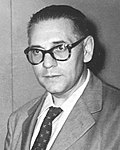 Painter Luís Seoane
 -
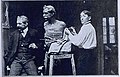 Sculptor Francisco Asorey
 -
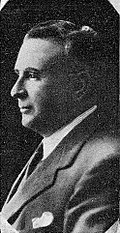 Architect Antonio Palacios


Science
[edit]-
 Benito Jerónimo Feijóo y Montenegro was a monk and scholar who wrote a great collection of essays that cover a range of subjects, from natural history and the then known sciences.
 -
 Martin Sarmiento. He wrote on a wide variety of subjects, including Literature, Medicine, Botany, Ethnography, History, Theology, Linguistics, etc.
.jpg)

Music
[edit]-
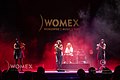 Tanxugueiras are a Galician folk trio formed in 2016. The group aim to bring a modern sound to traditional Galician music by merging folk sounds with pop and world music influences. Their music focuses on themes such as the understanding between peoples, the defence of the Galician language and culture, and women's empowerment.
 -
 Carlos Núñez is currently one of the most famous Galician bagpipers, who has collaborated with Ry Cooder, Sharon Shannon, Sinéad O'Connor, The Chieftains, Altan among others.
 -
 Susana Seivane is a Galician bagpiper. She was born into a family of well-known Galician luthiers and musicians (The Seivane).
 -
 Carlos Jean is a DJ and record producer. He was born in Ferrol, of Haitian and Galician heritage.

_01.JPG)


Sport
[edit]-
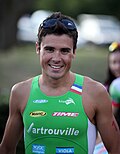 Francisco Javier Gómez Noya (1983-), former triathlete, Silver in 2012 Summer Olympics.
 -
 Óscar Pereiro is a professional road bicycle racer. Pereiro won the 2006 Tour de France.
 -
 David Cal Figueroa is a Galician sprint canoer who has competed since 1999, he became the athlete with the most Olympic medals of all time in Spain.
 -
![Ana Peleteiro is a triple jumper and the current national record holder. She won the gold medal in the 2019 European Athletics Indoor Championships.[140]](//upload.wikimedia.org/wikipedia/commons/thumb/e/e5/Ana_Peleteiro_Glasgow_2019.jpg/120px-Ana_Peleteiro_Glasgow_2019.jpg) Ana Peleteiro is a triple jumper and the current national record holder. She won the gold medal in the 2019 European Athletics Indoor Championships.[140]
Ana Peleteiro is a triple jumper and the current national record holder. She won the gold medal in the 2019 European Athletics Indoor Championships.[140]


![Ana Peleteiro is a triple jumper and the current national record holder. She won the gold medal in the 2019 European Athletics Indoor Championships.[140]](https://en.wikipedia.org/wiki/File:Ana_Peleteiro_Glasgow_2019.jpg)
Cinema and TV
[edit]-
 María Castro (1981-) is a well-known Galician actress who performed in several Spanish TV series and movies.
 -
 Luis Tosar has starred in some successful Spanish movies such as Celda 211 or Te doy mis ojos.
 -
 Oliver Laxe is a French-born Galician director whose third film, Fire Will Come, became the most watched and most successful Galician film in history.
 -
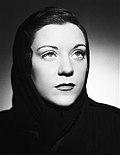 Maria Casarès was one of the most distinguished stars of the French stage and cinema.
 -
 Pedro Alonso is best known for his role of Andrés "Berlin" de Fonollosa in the Spanish series Money Heist (La casa de papel).
_Una_semana_nada_m%C3%A1s._Posados.jpg)


.jpg)
People of Galician origin
[edit]-
 Cuban former leader Fidel Castro
 -
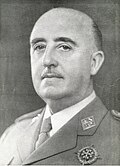 Caudillo and dictator of Spain, Francisco Franco
 -
 Portuguese explorer João da Nova
 -
 American actor Martin Sheen, born Ramón Estévez
 -
 Brazilian writer Nélida Piñon
 -
 Argentinian ex-president Raúl Alfonsín
 -
 José Alonso y Trelles, Uruguayan poet
 -
 Laurentino Cortizo Cohen, president of Panama
 -
 Tabaré Vázquez, ex-president of Uruguay
 -
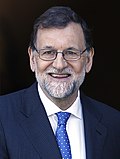 Mariano Rajoy, former Prime Minister of Spain
 -
 Santiago Casares Quiroga, ORGA's founder and former Prime Minister of Spain
 -
 George A. Romero, American cinematographer


.jpg)


_(cropped).jpg)
.jpg)


See also
[edit]References
[edit]- ^ Sum of the inhabitants of Spain born in Galicia (c. 2.8 million), plus Spaniards living abroad and inscribed in the electoral census (CERA) as electors in one of the four Galician constituencies.
- ^ a b c d e f g Not including Galicians born outside Galicia
- ^ a b c d e f g "Instituto Nacional de Estadística". Ine.es. Archived from the original on 3 March 2016. Retrieved 4 February 2016.
- ^ a b c d e f g h i j k l "INE – CensoElectoral". Ine.es. Archived from the original on 8 August 2022. Retrieved 4 February 2016.
- ^ Internacional, La Región (30 July 2015). "Miranda visita Venezuela para conocer las preocupaciones de la diáspora gallega". La Región Internacional. Archived from the original on 3 July 2017. Retrieved 12 December 2017.
- ^ "Interactivo: Creencias y prácticas religiosas en España". Lavanguardia.com. 2 April 2015. Archived from the original on 4 April 2015. Retrieved 12 December 2017.
- ^ Minahan, James (2000). One Europe, Many Nations: A Historical Dictionary of European National Groups. Greenwood Publishing Group. pp. 179, 776. ISBN 0-313-30984-1. Archived from the original on 16 January 2023. Retrieved 3 September 2019.
other Celtic peoples ... Galicians ...; ... Romance (Latin) nations ... Galicians
- ^ Recalde, Montserrat (1997). La vitalidad etnolingüística gallega. València: Centro de Estudios sobre Comunicación Interlingüistíca e Intercultural. ISBN 978-84-370-2895-8.
- ^ Bycroft, C.; Fernandez-Rozadilla, C.; Ruiz-Ponte, C.; Quintela, I.; Donnelly, P.; Myers, S.; Myers, Simon (2019). "Patterns of genetic differentiation and the footprints of historical migrations in the Iberian Peninsula". Nature Communications. 10 (1): 551. Bibcode:2019NatCo..10..551B. doi:10.1038/s41467-018-08272-w. PMC 6358624. PMID 30710075.
- ^ Recalde, Montserrat (1997). La vitalidad etnolingüística gallega. València: Centro de Estudios sobre Comunicación Interlingüistíca e Intercultural. ISBN 978-84-370-2895-8.
- ^ a b "Persoas segundo a lingua na que falan habitualmente. Ano 2003". Ige.eu. Archived from the original on 3 March 2016. Retrieved 4 February 2016.
- ^ Koch, John T. (2006). Celtic Culture: A Historical Encyclopedia. ABC-CLIO. pp. 788–791. ISBN 978-1-85109-440-0.
- ^ Falileyev, Alexander; Gohil, Ashwin E.; Ward, Naomi; Briggs, Keith (31 December 2010). Dictionary of Continental Celtic Place-Names: A Celtic Companion to the Barrington Atlas of the Greek and Roman World. CMCS Publications. ISBN 978-0-9557182-3-6. Archived from the original on 26 March 2023. Retrieved 19 July 2021., s.v. Callaeci.
- ^ Luján, Eugenio (2009). "Pueblos celtas y no celtas de la Galicia antigua: fuentes literarias frente a fuentes epigráficas". Real Académia de Cultura Valenciana: Sección de estudios ibéricos "D. Fletcher Valls". Estudios de lenguas y epigrafía antiguas (9): 219–250. ISSN 1135-5026. Archived from the original on 30 January 2022. Retrieved 18 January 2022.
- ^ a b Moralejo, Juan J. (2008). Callaica nomina: estudios de onomástica gallega (PDF). A Coruña: Fundación Pedro Barrié de la Maza. pp. 113–148. ISBN 978-84-95892-68-3. Archived (PDF) from the original on 22 March 2011. Retrieved 24 April 2013.
- ^ "9.17. Title for image of people of the Callaeci". IAph. Archived from the original on 18 June 2016. Retrieved 14 February 2021.
- ^ Búa, Carlos (2018). Toponimia prelatina de Galicia. Santiago de Compostela: USC. p. 213. ISBN 978-84-17595-07-4. Archived from the original on 16 July 2021. Retrieved 16 July 2021.
- ^ Curchin, Leonard A. (2008) Estudios Gallegos The toponyms of the Roman Galicia: New Study Archived June 25, 2017, at the Wayback Machine. CUADERNOS DE ESTUDIOS GALLEGOS LV (121) p. 111
- ^ Benozzo, F. (2018) Uma paisagem atlântica pré-histórica. Etnogénese e etno-filologia paleo-mesolítica das tradições galega e portuguesa, in proceedings of Jornadas das Letras Galego-Portuguesas 2015–2017, DTS, Università di Bologna and Academia Galega da Língua Portuguesa, pp. 159-170.
- ^ Pierre-Yves Lambert, Histoire de la langue gauloise, éditions Errance, 1994, p. 99 - 194
- ^ a b LAMBERT 191
- ^ Xavier Delamarre, Dictionnaire de la langue gauloise, Errance, 2003, p. 98-99
- ^ DELAMARRE 98 - 99
- ^ Fernando Cabeza Quiles, Toponimia de Galicia, Editorial Galaxia, 2008, p. 301 - 302 - 303 (read online in Galician)[1] Archived 22 November 2023 at the Wayback Machine
- ^ "Galician". Ethnologue. Archived from the original on 28 March 2008. Retrieved 4 February 2016.
- ^ a b de Azevedo Maia, Clarinda (1986). História do Galego-Português. Estado linguistico da Galiza e do Noroeste de Portugal desde o século XIII ao século XVI. Coimbra: Instituto Nacional de Investigação Científica.
- ^ For this section: Boullón Agrelo, Ana Isabel (2007). "Aproximación á configuración lingüística dos apelidos en Galicia". Verba: Anuario Galego de Filoloxia (34): 285–309. ISSN 0210-377X. Archived from the original on 14 February 2022. Retrieved 14 February 2022.
- ^ Cf. Ana Isabel Boullón Agrelo / Xulio Sousa Fernández (dirs.): Cartografía dos apelidos de Galicia. Santiago de Compostela: Instituto da Lingua Galega.
- ^ Daponte, Vasco (1986). Recuento de las casas antiguas del reino de Galicia (in Spanish). Equipo de Investigación "Galicia hasta 1500". Santiago de Compostela: Xunta de Galicia, Consellería da Presidencia, Servicio Central de Publicacións. ISBN 84-505-3389-9. OCLC 21951323.
- ^ Mariño Paz, Ramón (1998). Historia da lingua galega (2 ed.). Santiago de Compostela: Sotelo Blanco. pp. 195–205. ISBN 84-7824-333-X.
- ^ Mariño Paz, Ramón (1998). Historia da lingua galega (2 ed.). Santiago de Compostela: Sotelo Blanco. pp. 225–230. ISBN 84-7824-333-X.
- ^ Villalba-Mouco, Vanessa; van de Loosdrecht, Marieke S.; Posth, Cosimo; Mora, Rafael; Martínez-Moreno, Jorge; Rojo-Guerra, Manuel; Salazar-García, Domingo C.; Royo-Guillén, José I.; Kunst, Michael; Rougier, Hélène; Crevecoeur, Isabelle; Arcusa-Magallón, Héctor; Tejedor-Rodríguez, Cristina; García-Martínez de Lagrán, Iñigo; Garrido-Pena, Rafael; Alt, Kurt W.; Jeong, Choongwon; Schiffels, Stephan; Utrilla, Pilar; Krause, Johannes; Haak, Wolfgang (2019). "Survival of Late Pleistocene Hunter-Gatherer Ancestry in the Iberian Peninsula". Current Biology. 29 (7): 1169–1177.e7. Bibcode:2019CBio...29E1169V. doi:10.1016/j.cub.2019.02.006. hdl:10261/208851. ISSN 0960-9822. PMID 30880015. S2CID 76663708.
- ^ Brunel, Samantha; Bennett, E. Andrew; Cardin, Laurent; Garraud, Damien; Barrand Emam, Hélène; Beylier, Alexandre; Boulestin, Bruno; Chenal, Fanny; Ciesielski, Elsa; Convertini, Fabien; Dedet, Bernard; Desbrosse-Degobertiere, Stéphanie; Desenne, Sophie; Dubouloz, Jerôme; Duday, Henri; Escalon, Gilles; Fabre, Véronique; Gailledrat, Eric; Gandelin, Muriel; Gleize, Yves; Goepfert, Sébastien; Guilaine, Jean; Hachem, Lamys; Ilett, Michael; Lambach, François; Maziere, Florent; Perrin, Bertrand; Plouin, Suzanne; Pinard, Estelle; Praud, Ivan; Richard, Isabelle; Riquier, Vincent; Roure, Réjane; Sendra, Benoit; Thevenet, Corinne; Thiol, Sandrine; Vauquelin, Elisabeth; Vergnaud, Luc; Grange, Thierry; Geigl, Eva-Maria; Pruvost, Melanie (9 June 2020). "Ancient genomes from present-day France unveil 7,000 years of its demographic history". Proceedings of the National Academy of Sciences. 117 (23): 12791–12798. Bibcode:2020PNAS..11712791B. doi:10.1073/pnas.1918034117. eISSN 1091-6490. ISSN 0027-8424. PMC 7293694. PMID 32457149.
- ^ Criado-Boado, Felipe; Parcero-Oubiña, César; Otero Vilariño, Carlos; Aboal-Fernández, Roberto; Ayán Vila, Xurxo; Barreiro, David; Ballesteros-Arias, Paula; Cabrejas, Elena; Costa-Casais, Manuela; Fábrega-Álvarez, Pastor; Fonte, João; Gianotti, Camila; González-García, A. César; Güimil-Fariña, Alejandro; Lima Oliveira, Elena; López Noia, Raquel; Mañana-Borrazás, Patricia; Martínez Cortizas, Antonio; Millán Lence, Matilde; Rodríguez-Paz, Anxo; Santos Estévez, Manuel (2016). Atlas arqueolóxico da paisaxe galega. Xerais. p. 48. hdl:10261/132739. ISBN 978-84-9121-048-1. Archived from the original on 12 February 2022. Retrieved 12 February 2022.
- ^ Benozzo, F. (2018): "Uma paisagem atlântica pré-histórica. Etnogénese e etno-filologia paleo-mesolítica das tradições galega e portuguesa", in proceedings of Jornadas das Letras Galego-Portugesas 2015–2017. Università de Bologna, DTS and Academia Galega da Língua Portuguesa. pp. 159-170
- ^ Cunliffe, Barry W. (2008). Europe between the oceans: themes and variations, 9000 BC - AD 1000. New Haven: Yale University Press. ISBN 978-0-300-11923-7.
- ^ John T. Koch; Barry W. Cunliffe, eds. (2013). Celtic from the West 2: rethinking the Bronze Age and the arrival of Indo-European in Atlantic Europe. Celtic studies publications. Oxford, UK; Oakville, CT: Oxbow Books. ISBN 978-1-84217-529-3.
- ^ de la Peña Santos, Antonio (1 July 2003). Galicia. Prehistoria. Castrexo e primeira romanización. Vigo. pp. 61ss. ISBN 978-84-96203-29-7.
{{cite book}}: CS1 maint: location missing publisher (link) - ^ Bradley, Mr Richard; Bradley, Richard (2002). Rock Art and the Prehistory of Atlantic Europe: Signing the Land. Taylor & Francis. ISBN 978-0-203-44699-7. Retrieved 16 January 2022.
- ^ Cunliffe, Barry (1999). "Atlantic Sea-ways". Revista de Guimarães. especial - Actas do Congresso de Proto-História Europeia: 93–105. Archived from the original on 12 February 2022. Retrieved 12 February 2022.
- ^ Rodríguez, Ana (26 December 2021). "Henges, círculos invisibles de la Edad de Bronce". Faro de Vigo. Archived from the original on 15 February 2022. Retrieved 13 February 2022.
- ^ a b An Alternative to 'Celtic from the East' and 'Celtic from the West', Patrick Sims-Williams, Cambridge University Press, 2020 [2] Archived January 12, 2022, at the Wayback Machine
- ^ Patterson, Nick; et al. (January 2022). "Large-scale migration into Britain during the Middle to Late Bronze Age". Nature. 601 (7894): 588–594. Bibcode:2022Natur.601..588P. doi:10.1038/s41586-021-04287-4. ISSN 1476-4687. PMC 8889665. PMID 34937049.
- ^ Armada, Xosé-Lois (August 2020). Massive metalwork deposition in Atlantic Europe during the Late Bronze Age – Iron Age transition: towards a refined chronology?. hdl:10261/237815. Archived from the original on 13 February 2022. Retrieved 13 February 2022.
- ^ Nigrán (16 February 2019). "El castro de Chandebrito duró mil años". Faro de Vigo. Archived from the original on 12 February 2022. Retrieved 12 February 2022.
- ^ Redacción (23 December 2021). "Penas do Castelo, un dos castros máis antigos de Galicia". GCiencia. Archived from the original on 12 February 2022. Retrieved 12 February 2022.
- ^ Nión-Álvarez, Samuel (2016). "Punta de Muros y su excepcionalidad en el contexto del Hierro I en el Noroeste peninsular". IX Jornadas de Jóvenes en Investigación Arqueológica. Santander. Archived from the original on 11 May 2022. Retrieved 15 February 2022.
- ^ Cano Pan, Juan A. (2010). "El yacimiento de Punta de Muros". Anuario Brigantino. 33: 33–63.
- ^ Parcero-Oubiña, César; Armada, Xosé-Lois; Nión, Samuel; González Insua, Félix (9 September 2019). "All together now (or not). Change, resistance and resilience in the NW Iberian Peninsula in the Bronze Age-Iron Age transition". In Brais X. Currás; Inés Sastre (eds.). Alternative Iron Ages: Social Theory from Archaeological Analysis. Taylor & Francis. doi:10.4324/9781351012119. hdl:10261/208907. ISBN 9781351012119. S2CID 240654014.
- ^ Raso, Iciar Moreno (2014). "Longhouses del Bronce Final-Hierro I en la Península Ibérica". Arqueología y Territorio (11): 25–37. ISSN 1698-5664. Archived from the original on 15 February 2022. Retrieved 15 February 2022.
- ^ Fokkens, H.; Bourgeois, J.; Bourgeois, I.; Charette, B. (2003). "The longhouse as a central element in Bronze Age daily life". S2CID 162779452.
{{cite web}}: Missing or empty|url=(help) - ^ García Quintela, Marco V. (14 July 2016). "Sobre las saunas de la Edad del Hierro en la Península ibérica: novedades, tipologías e interpretaciones". Complutum. 27 (1): 109–130. doi:10.5209/CMPL.53219. ISSN 1988-2327. Archived from the original on 2 March 2022. Retrieved 21 February 2022.
- ^ Armada, Xosé-Lois; García Vuelta, Óscar (2006). "Symbolic Forms from the Iron Age in the North-West of the Iberian Peninsula: Sacrificial Bronzes and their Problems". In Marco Virgilio García Quintela (ed.). Anthropology of the Indo-European world and material culture. Proceedings of the 5th International Colloquium of Anthropology of the Indo-European World and Comparative Mythology. Maior. Budapest: Archaeolingua. pp. 163–178. hdl:10261/34316. ISBN 978-963-8046-72-7. Archived from the original on 2 March 2022. Retrieved 2 March 2022.
- ^ Prieto Molina, Susana (1996). "Los torques castreños del noroeste de la Península Ibérica". Complutum (7): 195–224. ISSN 1131-6993. Archived from the original on 2 March 2022. Retrieved 2 March 2022.
- ^ Mederos Martin, Alfredo (20 December 2019). "Auga dos Cebros (Pontevedra, Galicia): Un barco del Bronce Final II en la fachada atlántica de la Peníncula Ibérica (1325-1050 a. C.)". SAGVNTVM. Papeles del Laboratorio de Arqueología de Valencia. 51: 23. doi:10.7203/SAGVNTVM.51.11476 (inactive 1 July 2025). hdl:10486/691528. S2CID 214517194.
{{cite journal}}: CS1 maint: DOI inactive as of July 2025 (link) - ^ González Ruibal, Alfredo; Rodríguez Martínez, Rafael; Ayán Vila, Xurxo (2010). "Buscando a los púnicos en el noroeste". Mainake. XXXII: 24. ISSN 0212-078X.
- ^ Meunier, Emmanuelle (1 December 2019). "El estaño del Noroeste ibérico desde la Edad del Bronce hasta la época romana. Por una primera síntesis". La ruta de las Estrímnides. Universidad de Alcalá, Servicio de Publicaciones. pp. 279–320. ISBN 978-84-17729-31-8.
- ^ Alonso Romero, Fernando (1995). Las embarcaciones y navegaciones en el mundo celta: de la Edad Antigua a la Alta Edad Media. Guerra, exploraciones y navegación : del mundo antiguo a la edad moderna : curso de verano (U.I.M.P., Universidade de A Coruña) : Ferrol, 18 a 21 de julio de 1994. Servizo de Publicacións. pp. 111–146. ISBN 978-84-88301-13-0. Archived from the original on 17 February 2022. Retrieved 17 February 2022.
- ^ a b c Romero Masiá, Ana María; Pose Mesura, Xosé Manuel (1988). Galicia nos textos clásicos (in Galician). Galiza: Edicións do Padroado do Museu Arqueolóxico Provincial, Concello de A Coruña. pp. 55, 71, 86. ISBN 84-505-7380-7. OCLC 28499276.
- ^ "The dating of the Lomba do Mouro site makes it the largest and oldest Roman camp in Galicia and northern Portugal – The Roman Army in the NW of Hispania". 2 June 2021. Archived from the original on 20 February 2022. Retrieved 20 February 2022.
- ^ Rodríguez Corral, Javier (2009). A Galicia castrexa (in Galician). Santiago de Compostela: Lóstrego. p. 214. ISBN 978-84-936613-3-5. OCLC 758056842.
- ^ Álvarez González, Yolanda; López González, Luis; Fernández-Götz, Manuel; García Quintela, Marco V. (2017). "El oppidum de San Cibrán de Las y el papel de la religión en los procesos de centralización en la Edad del Hierro". Cuadernos de Prehistoria y Arqueología. 43. doi:10.15366/cupauam2017.43.008. hdl:10347/24547. ISSN 0211-1608. Archived from the original on 21 February 2022. Retrieved 21 February 2022.
- ^ culturagalega.org (7 March 2024). "Localizan no castro de Elviña indicios dunha destrución intencional". culturagalega.org. Retrieved 8 June 2024.
- ^ Romero Masiá, Ana; Pose Mesura, Xosé Manuel (1988). Galicia nos textos clásicos (in Galician). Galiza: Edicións do Padroado do Museu Arqueolóxico Provincial, Concello de A Coruña. pp. 95, 146. ISBN 84-505-7380-7. OCLC 28499276.
- ^ Fonte, João; Costa-García, Jose Manuel; Gago, Manuel (20 September 2021). "O Penedo dos Lobos: Roman military activity in the uplands of the Galician Massif (Northwest Iberia)". Journal of Conflict Archaeology. 17: 5–29. doi:10.1080/15740773.2021.1980757. hdl:10366/148231. ISSN 1574-0773. S2CID 240599598.
- ^ Smith, R. R. R. (1988). "Simulacra Gentium: the Ethne from the Sebasteion at Aphrodisias". Journal of Roman Studies. 78: 50–77. doi:10.2307/301450. ISSN 0075-4358. JSTOR 301450. S2CID 162542146. Archived from the original on 22 November 2023. Retrieved 18 January 2022.
- ^ culturagalega.org (11 December 2017). "Un arco de triunfo en Francia pode gardar a primeira representación dun guerreiro galaico vencido". culturagalega.org. Archived from the original on 22 November 2023. Retrieved 20 February 2022.
- ^ De Chorographia, III, cf. Romero Masiá, Ana; Pose Mesura, Xose Manuel (1988). Galicia nos textos clásicos (in Galician). Edicións do Padroado do Museu Arqueolóxico Provincial, Concello de A Coruña. pp. 55–59. ISBN 978-84-505-7380-0. Archived from the original on 28 February 2022.
- ^ Lorrio, Alberto J (2011). "Los celtas en el occidente de Iberia". In Gonzalo Ruiz Zapatero, Jesús R Álvarez-Sanchís (ed.). Castros y verracos: las gentes de la Edad del Hierro en el occidente de Iberia. Ávila: Institución Gran Duque de Alba. p. 70. ISBN 978-84-15038-26-9.
- ^ Galicia and North Portugal are the origin of European celticity Archived August 9, 2018, at the Wayback Machine, interview with Prof. Francesco Benozzo, 13/03/2016
- ^ Cunliffe, Barry W.; Koch, John T. (2012). Celtic from the West: Alternative Perspectives from Archaeology, Genetics, Language and Literature. Oxbow Books. ISBN 978-1-84217-475-3.
- ^ John T. Koch; Barry W. Cunliffe, eds. (2013). Celtic from the West 2: rethinking the Bronze Age and the arrival of Indo-European in Atlantic Europe. Celtic studies publications. Oxford, UK; Oakville, CT: Oxbow Books. ISBN 978-1-84217-529-3.
- ^ John T. Koch; Barry W. Cunliffe, eds. (2016). Celtic from the West 3: Atlantic Europe in the Metal Ages: questions of shared language. Celtic Studies Publications. Oxford: Oxbow Books. ISBN 978-1-78570-227-3.
- ^ Prósper, Blanca María (2008). "Lusitanian. A Non-Celtic Indo-European Language of Western Hispania". Celtic and other languages in ancient Europe, 2008, págs. 53-64. Servicio de Publicaciones. pp. 53–64. ISBN 978-84-7800-335-8. Archived from the original on 13 February 2022. Retrieved 19 January 2022.
- ^ Prósper, Blanca María (2002). Lenguas y religiones prerromanas del occidente de la Península Ibérica. Universidad de Salamanca. ISBN 978-84-7800-818-6.
- ^ Prósper, Blanca María (2002). Lenguas y religiones prerromanas del occidente de la Península Ibérica. Universidad de Salamanca. pp. 357–382. ISBN 978-84-7800-818-6.
- ^ "Anyway, nothing of what I am going to say precludes the existence of Celtic speakers all along the Atlantic coast of Spain and Portugal. As a matter of fact, a great deal of evidence, mostly from place names and personal names, points to their presence there. By means of an increasingly refined scrutiny we are able to come up with much Celtic vocabulary never attested in Celtiberian, as well as archaisms in word formation, like the preservation of the simple superlative suffix in —amo-, as well as phonetic changes that Celtiberian never shared, like for instance the loss of/g/ in contact with front vowels." Prósper, Blanca María (2008). "Lusitanian. A Non-Celtic Indo-European Language of Western Hispania". Celtic and other languages in ancient Europe, 2008, págs. 53-64. Servicio de Publicaciones. pp. 53–64. ISBN 978-84-7800-335-8. Archived from the original on 13 February 2022. Retrieved 19 January 2022.
- ^ Vallejo, José M. ª (2013). "Hacia una definición del lusitano". Palaeohispanica. Revista sobre lenguas y culturas de la Hispania Antigua (13): 273–291. ISSN 1578-5386. Archived from the original on 1 March 2022. Retrieved 21 February 2022.
- ^ García Alonso, Juan Luis (1 January 2011). "Oclusivas aspiradas, celtas y lusitanos". A Greek Man in the Iberian Street, Festschrift Javier de Hoz, Juan Luis García Alonso y Eugenio Luján Martínez eds., Innsbruck, pp. 175-190. Archived from the original on 11 May 2022. Retrieved 25 February 2022.
- ^ Luján, Eugenio (28 February 2019). "Language and writing among the Lusitanians". Palaeohispanic Languages and Epigraphies. Oxford University Press. pp. 304–334. doi:10.1093/oso/9780198790822.003.0011. ISBN 978-0-19-879082-2. Archived from the original on 25 January 2022. Retrieved 23 January 2022.
- ^ "Hesperia: Banco de datos de Lenguas paleohispanicas (read online)". Archived from the original on 28 November 2021. Retrieved 21 January 2022.
- ^ "we cannot ignore the evidence for the Celtic presence in northern Gallaecia, which is confirmed by ancient authors: Celtici cognomine Neri et Supertamarci (Pliny 4.111), ad promunturium quod Celticum vocamus (Mela 3.9); Artabri . . . Celticae gentis (Mela 3.14), and by epigraphy, with mention of certain peoples and individuals who call themselves Celtici, for instance Fusca Coedi f. Celtica Supertamarica.53 For his part, Strabo (3.3.5) mentions, moreover, the close connection of some of these Gallaeci with the Celtici from Baeturia, in the Guadiana area, to the south of Lusitania. This relationship of the Gallaeci to the south-western Celtici, as well as that with Celtiberia (Pliny 3.13), can be demonstrated by some onomastic indicators, such as the special Celtiberian tendency to use duo nomina formulae with a name in -iko on the basis of nomen gentilicium, a fact noted amongst the south-western Celtici (C. Pagusicus Lucianus) and the Gallaeci (Apanicus Capito). Nor should one forget that in northern Gallaecia there are toponyms and ethnonyms which are well justified by Celtic (Nerion, Arotrebae, Albiones, cf. Welsh elfydd 'world', Gaulish Albiorix), as well as dedications to Lugu (Map 12.2), which link it with Celtiberia in particular." Gorrochategui, J.; Vallejo, J. M. (28 February 2019). "The parts of Hispania without epigraphy". Palaeohispanic Languages and Epigraphies. Oxford University Press. pp. 335–364. doi:10.1093/oso/9780198790822.003.0012. ISBN 978-0-19-879082-2. Archived from the original on 14 February 2022. Retrieved 23 January 2022.
- ^ "The analysis of Galician place-names attested epigraphically shows that many of them can be considered Celtic." Luján, Eugenio (2008). "Galician Place-Names Attested Epigraphically". Celtic and other languages in ancient Europe, 2008, págs. 65-82. Servicio de Publicaciones. pp. 65–82. ISBN 978-84-7800-335-8. Archived from the original on 11 February 2022. Retrieved 18 January 2022.
- ^ "People of this area is divided in three groups: the ones called Celts in old sources, others don't considered Celts and they that haven't ethnic ascription. It is examined each people's ethnic names, place names and onomastics. General conclusions are general admission of these people are Celts, separating Seurri and with doubts over the Grovi. In Ancient Galicia would be Celts superposed to another no-celtic Indoeuropeans strata" Luján, Eugenio (2009). "Pueblos celtas y no celtas de la Galicia antigua: fuentes literarias frente a fuentes epigráficas". Real Académia de Cultura Valenciana: Sección de estudios ibéricos "D. Fletcher Valls". Estudios de lenguas y epigrafía antiguas (9): 219–250. ISSN 1135-5026. Archived from the original on 30 January 2022. Retrieved 18 January 2022.
- ^ Alonso, Juan Luis García (2009). "Lenguas indoeuropeas prerromanas en el Noroeste Peninsular". Palaeohispanica. Revista sobre lenguas y culturas de la Hispania Antigua (9): 163–174. ISSN 1578-5386. Archived from the original on 1 March 2022. Retrieved 21 February 2022.
- ^ Luján, Eugenio R. (3 May 2006). "The language(s) of the Callaeci". E-Keltoi: Journal of Interdisciplinary Celtic Studies. 6: 715–748. ISSN 1540-4889.
- ^ Búa Carballo, Juan Carlos (14 January 2019). Toponimia prelatina de Galicia. Universidade de Santiago de Compostela, Servizo de Publicacións e Intercambio Científico. ISBN 978-84-17595-07-4. Archived from the original on 1 March 2022. Retrieved 19 July 2021.
- ^ Bascuas, Edelmiro (2008). "la hidronimia de galicia. Tres estratos: paleoeuropeo, celta y latino" (PDF). Estudios Mindonienses. 24: 521–550. Archived (PDF) from the original on 3 January 2022. Retrieved 18 January 2022.
- ^ Moralejo, Juan José (2008). Callaica nomina: estudios de onomástica gallega. Fundación Pedro Barrié de la Maza. ISBN 978-84-95892-68-3.
- ^ Santos Yanguas, Narciso (2017). "Origen y consolidación de los conventus iuridici en el noroeste peninsular". Gerión. Revista de Historia Antigua. 35 (1): 229–255. doi:10.5209/GERI.56964. eISSN 1988-3080. ISSN 0213-0181. Archived from the original on 2 March 2022. Retrieved 2 March 2022.
- ^ Búa Carballo, Juan Carlos (14 January 2019). Toponimia prelatina de Galicia. Verba. Anexo. Santiago de Compostela: Universidade de Santiago de Compostela, Servizo de Publicacións e Intercambio Científico. ISBN 978-84-17595-07-4. Archived from the original on 1 March 2022. Retrieved 19 July 2021.
- ^ Santos Yanguas, Juan (2009). "De nuevo sobre los Castella: naturaleza, territorio e integración en la Ciuitas". In Kremer, Dieter (ed.). Onomástica galega II : onimia e onomástica prerromana e a situación lingüística do noroeste peninsular: actas do segundo coloquio, Leipzig, 17 3 18 de outubro de 2008. Universidade de Santiago de Compostela. pp. 169–183. ISBN 978-84-9750-794-3.
- ^ Delamarre, Xavier (2007). Nomina celtica antiqua: inscriptionum selecta. Paris: Éd. Errance. pp. passim. ISBN 978-2-87772-350-3.
- ^ Santos Yanguas, Narciso Vicente (2016). Militares galaicos en el ejército romano. Ediciones de la Universidad de Oviedo. ISBN 978-84-16343-39-3.
- ^ Meyer, Alexander (2013). The Creation, Composition, Service and Settlement of Roman Auxiliary Units Raised on the Iberian Peninsula. Ann Arbor, MI: University of Michigan Press. hdl:2027/fulcrum.kk91fn34t. ISBN 978-1-4073-1121-0. Archived from the original on 22 November 2023. Retrieved 24 February 2022.
- ^ "Descubren en un municipio de Pontevedra la mina de oro subterránea romana más grande de Galicia". Público. A Coruña. 3 September 2021. Archived from the original on 24 February 2022. Retrieved 24 February 2022.
- ^ a b c López Silva, José Antonio (2004). A Crónica de Idacio de Limia (in Galician). Ourense: Deputación de Ourense. ISBN 978-84-96011-32-8.
- ^ In tempore sueborum: el tiempo de los suevos en la Gallaecia (411-585): el primer reino medieval de Occidente. Jorge López Quiroga, A. M. Martínez Tejera (eds.). Ourense: Deputación Provincial de Ourense. 2017. ISBN 978-84-16643-11-0.
{{cite book}}: CS1 maint: others (link) - ^ Isla Frez, Amancio (1992). La sociedad gallega en la alta edad media. Madrid: Consejo superior de investigaciones científicas. p. 14. ISBN 84-00-07215-4..
- ^ Fernández Pereiro, Mario (2019). Recintos Fortificados en Altura na costa atlántica galega. Estudo Arqueolóxico (Doctoral thesis) (in Galician). Universidade de Santiago de Compostela. hdl:10347/18729. Archived from the original on 25 July 2023. Retrieved 19 January 2022.
- ^ "No corazón do xigante (e III): a Terceira Fortaleza do Pindo – Capítulo 0" (in Galician). Archived from the original on 25 July 2023. Retrieved 25 July 2023.
- ^ Pereiro, Mario Fernández (23 October 2019). "O recinto fortificado do Monte Aloia. Un xigante altomedieval esquecido". Lucentum (38): 379–395. doi:10.14198/LVCENTVM2019.38.18. hdl:10045/97729. ISSN 1989-9904. S2CID 213442091. Archived from the original on 25 July 2023. Retrieved 17 November 2022.
- ^ Fernández-Pereiro, Mario; Sánchez-Pardo, José-Carlos (13 December 2022). "Buscando un castillo altomedieval entre la vegetación. El caso de Castro Valente (Padrón, Galicia)". Cuadernos de Arqueología de la Universidad de Navarra: 55–72. doi:10.15581/012.30.2.004. ISSN 2387-1814. S2CID 254711145. Archived from the original on 25 July 2023. Retrieved 25 July 2023.
- ^ Arias, Jorge C. (2007). "Identity and interaction: The Suevi and the Hispano-Romans" (Document). University of Virginia.
- ^ a b Díaz Martínez, Pablo de la Cruz (2011). El reino suevo, 411-585. Tres Cantos, Madrid (Espagne): Akal. ISBN 9788446028505.
- ^ "IGE – Principais resultados". Ige.eu. Archived from the original on 24 March 2016. Retrieved 4 February 2016.
- ^ "IGE – Principais resultados". Ige.eu. Archived from the original on 24 March 2016. Retrieved 4 February 2016.
- ^ "IGE – Principais resultados". Ige.eu. Archived from the original on 24 March 2016. Retrieved 4 February 2016.
- ^ "IGE – Principais resultados". Ige.eu. Archived from the original on 24 March 2016. Retrieved 4 February 2016.
- ^ "Persoas segundo o grao de entendemento do galego falado. Distribución segundo o sexo. Ano 2003". Ige.eu. Archived from the original on 3 March 2016. Retrieved 4 February 2016.
- ^ González García, F. J. (coord.) (2007). Los pueblos de la Galicia céltica. Madrid: Ediciones Akal. pp. 19–49. ISBN 978-84-460-2260-2.
- ^ García Quintela, Marco V (2005). "Celtic Elements in Northwestern Spain in Pre-Roman times". E-Keltoi: Journal of Interdisciplinary Celtic Studies. 6: 74.
- ^ Luján, Eugenio (2008). "Galician Place-Names Attested Epigraphically". Celtic and other languages in ancient Europe, 2008, págs. 65-82. Servicio de Publicaciones. pp. 65–82. ISBN 978-84-7800-335-8. Archived from the original on 11 February 2022. Retrieved 18 January 2022.
- ^ Koch, John T. (2006). Celtic culture a historical encyclopedia. Santa Barbara, California: ABC-CLIO. pp. 788–791. ISBN 1-85109-445-8.
- ^ González-Ruibal, Alfredo (20 December 2004). "Artistic Expression and Material Culture in Celtic Gallaecia". E-Keltoi. 6: 113–166.
- ^ García Quintela, Marco V. (10 August 2005). "Celtic Elements in Northwestern Spain in Pre-Roman times" (PDF). E-Keltoi. 6: 497–569. Archived from the original (PDF) on 31 January 2015. Retrieved 10 May 2014.
- ^ a b Alberro, Manuel (2008). "La Santa Compaña en el NO de la Península Ibérica y en otros países célticos como Irlanda, Escocia y Gales". Revista de folklore (336): 183–187. ISSN 0211-1810. Archived from the original on 15 February 2022. Retrieved 19 January 2022.
- ^ Alberro, Manuel (6 January 2008). "Celtic Legacy in Galicia" (PDF). E-Keltoi. 6: 1005–1034. Archived from the original (PDF) on 24 June 2011. Retrieved 10 May 2014.
- ^ Wood, Walter; Mason, Frank H. (Frank Henry) (1910). A corner of Spain. London, E. Nash. Retrieved 16 February 2022.
- ^ Bell, Aubrey F. G. (Aubrey Fitz Gerald) (1922). Spanish Galicia. London, John Lane. Retrieved 16 February 2022.
- ^ Meakin, Annette M. B. (1909). Galicia, The Switzerland of Spain. London : Methuen & Co. Retrieved 16 February 2022.
- ^ "Tartan Details - the Scottish Register of Tartans". Archived from the original on 13 June 2023. Retrieved 12 November 2023.
- ^ "Galegos, sede fortes / prontos a grandes feitos / aparellade os peitos / a glorioso afán / fillos dos nobres celtas / fortes e peregrinos / luitade plos destinos / dos eidos de Breogán" Cf. "Himno Gallego". Archived from the original on 14 March 2015. Retrieved 10 May 2014.
- ^ González García, F. J. (coord.) (2007). Los pueblos de la Galicia céltica. Madrid: Ediciones Akal. p. 9. ISBN 978-84-460-2260-2.
- ^ Cabon, Alain (2010). Le Festival Interceltique de Lorient: quarante ans au coeur du monde celte. Rennes: Éditions Ouest-France. p. 28. ISBN 978-2-7373-5223-2.
- ^ a b c d e f Vaqueiro, Vítor (2010). Mitoloxía de Galiza: lendas, tradicións, maxias, santos e milagres. Vigo: Galaxia. ISBN 978-84-9865-387-8.
- ^ "O PAÍS DA MOURA". YouTube. 6 May 2021. Archived from the original on 19 February 2022. Retrieved 19 February 2022.
- ^ Cuba, Xoán Ramiro [in Galician]; Reigosa, Antonio [in Galician]; Ruíz, Xosé Miranda [in Galician] (1999). Diccionario dos seres míticos galegos. Xerais de Galicia. ISBN 978-84-8302-363-1. Archived from the original on 18 February 2022. Retrieved 18 February 2022.
- ^ "—Ha, ha! I know him. He ran with me to this fountain, where he has just left me. That man, Sir Cavalier, is no thief. If he is any thing at all, he is a Nuveiro,—a fellow who rides upon the clouds, and is occasionally whisked away by a gust of wind. Should you ever travel with that man again, never allow him more than one glass of anise at a time, or he will infallibly mount into the clouds and leave you, and then he will ride and run till he comes to a water brook, or knocks his head against a fountain—then one draught, and he is himself again." George Borrow (1923). The Bible In Spain. John Murray. p. 420. Retrieved 18 February 2022.
- ^ a b Códice Calixtino: o liber Sancti Iacobi en Galego (in Galician). Translated by Xosé López Díaz (2nd ed.). [Galicia]. 2013. pp. 442–443. ISBN 978-84-453-5104-8. OCLC 867868161.
{{cite book}}: CS1 maint: location missing publisher (link) - ^ Alonso Romero, Fernando (2020). El Lobishome o Vakner del "límite de la tierra y el mar". pp. 87–136. ISSN 1130-7625. Archived from the original on 27 February 2022. Retrieved 27 February 2022.
{{cite book}}:|work=ignored (help) - ^ Ferro-Veiga, José Manuel (2020). El Hombre Lobo de Allariz: Manual Operativo de investigación de asesinos en serie. José Manuel Ferro Veiga.
- ^ "Urco, el terrorífico perro de Cortegada". La Voz de Galicia. 15 June 2014. Archived from the original on 18 February 2022. Retrieved 18 February 2022.
- ^ Alonso Romero, Fernando (1992). "Galician legends about miraculous sea-voyages in stone boats: Some Irish and Breton parallels". Études celtiques. 29 (1): 89–95. doi:10.3406/ecelt.1992.1993. Archived from the original on 19 February 2022. Retrieved 19 February 2022.
- ^ Alberro, Manuel (2005). "El paradigma céltico de las nueve olas". Anuario Brigantino (28): 47–64. ISSN 1130-7625. Archived from the original on 20 February 2022. Retrieved 19 January 2022.
- ^ a b c González Pérez, Clodio (2014). O traxe tradicional galego. Baiona: NIGRA TREA. ISBN 978-84-15078-36-4.
- ^ "Os Instrumentos Musicais na Tradición Galega » Gaita de fol "sinxela"". Archived from the original on 17 April 2013. Retrieved 7 March 2022.
- ^ Williams, Sean (2013). Focus: Irish Traditional Music. Routledge. p. 101. ISBN 978-1-135-20414-3.
- ^ Cf. Brenan, Gerald (1976). The literature of the Spanish people: from Roman times to the present day (2nd ed.). Cambridge: Cambridge University Press. pp. 359–361. ISBN 0-521-04313-1.
- ^ "'Kangaroo girl' Peleteiro bounds out to European indoor triple jump title". European Athletics. 3 March 2019. Archived from the original on 31 May 2019. Retrieved 11 March 2021.
External links
[edit]
- Galician Portal
- A collaborative study of the EDNAP group regarding Y-chromosome binary polymorphism analysis
- Galician language portal
- Galician Music, Culture and History
- Galician Government
- Galician History and Language
- Santiago Tourism
- Page about The Way of St James
- Official page about The Way of St James
- Arquivo do Galego Oral – An archive of records of Galician speakers.
- A Nosa Fala – Sound recordings of the different dialects of the Galician language.
| International | |
|---|---|
| National | |

Galicians
View on GrokipediaEtymology
Origins of the term "Galician"
The term "Galician" originates from the Latin Gallaeci, denoting the pre-Roman tribal confederation inhabiting the northwestern Iberian Peninsula, specifically the territory Romans termed Gallaecia or Callaecia. This ethnonym first appears in ancient Greco-Roman accounts, with the Greek geographer Strabo (c. 64 BC–24 AD) referencing the Kallaikoi (Latinized as Gallaeci) as over 200,000 warriors divided into numerous subtribes resistant to Roman conquest, situated between the Douro and Minho rivers extending northward. Pliny the Elder, in his Naturalis Historia (c. 77 AD), further enumerates specific Gallaeci groups including the Hequaesi, Limici, and Querquerni, portraying them as part of Hispania's coastal peoples north of Lusitania.[8][9][10] The etymological root of Gallaeci likely stems from the tribes' own endonym, adapted into Greek Kallaïkoí, with proposed derivations including a Proto-Celtic term for "wood" (kallī) or pre-Indo-European substrate elements denoting forest-dwelling peoples, though the precise origin remains conjectural absent direct epigraphic evidence from the tribes themselves. Roman administrative use solidified Gallaecia as the provincial name by the reign of Augustus (c. 25 BC), encompassing modern Galicia and northern Portugal, thus linking the ancient tribal designation to the geographic toponym that persists.[11] During the early medieval period, Latin forms evolved to Gallecia or Gallicia in ecclesiastical and royal documents, applied to the Suebi Kingdom of Gallaecia (established c. 409–585 AD) and subsequently the medieval Kingdom of Galicia integrated into the realms of Asturias and León by the 9th century. By the 12th century, Old Galician-Portuguese vernacular texts, such as legal and literary records from the County of Portugal and Galicia, employed variants like Galiza for the region and gallegos or gallecos for its inhabitants, reflecting phonetic shifts and the emergence of a distinct regional nomenclature amid feudal fragmentation. This usage, documented in sources like the Foral de Terra de Valdeorras (c. 1150s), marks the transition to modern forms without implying unified ethnic self-identification prior to these philological attestations.[8]Ethnic Origins and Genetic Ancestry
Prehistoric settlements and ancient populations
Archaeological evidence indicates human occupation in Galicia during the Upper Paleolithic, with sites such as the Valverde yacimiento in Monforte de Lemos, Lugo, providing the earliest confirmed settlements in the northwest Iberian Peninsula during the Pleniglaciar period, dated to approximately 26,000–19,000 years before present based on lithic tools and faunal remains.[12] Other caves like Valdavara in Becerreá yield Upper Paleolithic artifacts, including radiocarbon-dated materials confirming intermittent hunter-gatherer presence amid post-glacial environmental shifts.[13] Cova Eirós preserves Paleolithic rock art extending into the Epipaleolithic transition around 9,500–9,000 BP, illustrating continuity in symbolic practices.[14] Mesolithic evidence centers on coastal adaptations, part of the broader Asturian culture characterized by shell middens and microlithic tools from sites along Galicia's rías and Atlantic facade, dating to roughly 10,000–6,000 BP.[15] Inland locations like Sierra del Xistral reveal over 30 test-pit sites with geometric microliths and faunal assemblages indicating seasonal exploitation of forests and rivers, reflecting mobile foraging economies post-Last Glacial Maximum.[16] These settlements underscore persistent low-density habitation tied to maritime resources, with limited monumental structures until later periods.[17] During the Bronze Age (c. 2200–800 BCE), archaeological shifts include tumuli burials and megalithic complexes, alongside emerging fortified enclosures that prefigure castros, linked to metallurgical advancements in bronze production from local copper and tin sources.[18] Recent discoveries of stone circles, such as those dated to the mid-second millennium BCE, represent unique ritual landscapes without direct parallels elsewhere in Iberia, suggesting localized cultural elaboration rather than widespread migration-driven rupture.[19] The Iron Age (c. 800–200 BCE) saw the proliferation of castros—hilltop settlements with dry-stone walls, terraced housing, and central granaries—exemplified by over 2,000 documented sites, indicating population growth and territorial control by tribal groups known from Roman accounts as the Gallaeci.[20] These oppida, strategically positioned for resource management including iron and gold extraction, reflect a Castro culture with Atlantic Bronze Age continuity, evidenced by pottery, fibulae, and torcs but lacking unambiguous pan-Celtic markers like La Tène art motifs prevalent in central Europe.[21] Artifactual analysis prioritizes empirical continuity over interpretive overlays of Indo-European influxes around 1000–500 BCE, as material changes align more with endogenous technological diffusion than discrete migratory imprints.[22]Roman and post-Roman influences
The Roman conquest of Gallaecia, the northwestern Iberian region encompassing modern Galicia, culminated during the Cantabrian Wars (26–19 BCE) under Emperor Augustus, integrating the area into the province of Hispania Tarraconensis by 19 BCE. This military campaign subdued resistant Castro culture tribes, such as the Gallaeci, through systematic pacification and infrastructure development, including roads and mining operations that exploited local tin and gold resources. Urban centers emerged, with Bracara Augusta (modern Braga) founded around 16 BCE as the provincial capital, serving as a hub for administration, trade, and cultural exchange; its forum, aqueducts, and temples facilitated elite acculturation.[23] Latinization primarily affected the indigenous elites, who adopted Latin for governance, commerce, and social status, as evidenced by over 1,000 surviving inscriptions in Latin from the 1st–3rd centuries CE, often commemorating Roman officials or local magnates with hybrid nomenclature blending indigenous and Roman elements.[24] This process, driven by incentives like citizenship grants under the lex data system and economic integration into imperial networks, created a Romano-Hispanic superstructure over the pre-Roman Celtic substrate, with rural populations retaining vernacular languages longer; causal factors included the disproportionate influence of urban settler elites and military veterans, who numbered in the thousands but shaped institutional norms without wholesale population replacement. Following the empire's decline, Suebi Germanic tribes, numbering approximately 20,000–30,000 warriors and families, invaded Hispania in 409 CE alongside Vandals and Alans, establishing a kingdom in Gallaecia by 411 CE centered at Bracara Augusta, which endured until its annexation by the Visigoths in 585 CE under King Leovigild.[25] The Suebi, documented in the Chronicle of Hydatius (a 5th-century local bishop's account), introduced Arian Christianity and Germanic legal customs but intermarried extensively with the Romano-Hispanic majority, limiting their demographic footprint; Visigothic unification afterward imposed Catholic orthodoxy and centralized rule, further diluting distinct Germanic traits.[26] These post-Roman migrations added a thin Germanic layer—estimated at under 5% ancestry contribution in later populations—primarily through elite warrior settlement and cultural diffusion rather than mass replacement, verifiable via sparse archaeological evidence of Suebi burials and the absence of major genetic shifts in ancient DNA samples from the period.[27] The resulting hybrid base combined Roman administrative continuity, indigenous agrarian traditions, and selective Germanic martial influences, fostering resilience against further invasions while preserving a Latinized core that evolved into medieval Hispano-Gothic society.Modern genetic studies and ancestry composition
Modern genetic studies of Galicians, based on Y-chromosome, mitochondrial DNA (mtDNA), and autosomal analyses, reveal a predominantly Western European ancestry profile with regional admixtures reflecting prehistoric migrations and limited later influences. Y-haplogroup distributions show a high frequency of R1b subclades, particularly R1b-DF27, which reaches approximately 57% in Galician samples, aligning with broader Iberian patterns but elevated compared to northern France (6-20%).[28] This R1b dominance, comprising around 60-70% of paternal lineages overall, indicates continuity from Bronze Age steppe-related expansions common across Western Europe, with minor contributions from haplogroup I (around 10-11%, linked to pre-Neolithic European hunter-gatherers) and other groups like J and E.[29][30] Mitochondrial DNA studies position Galicians at the western edge of European variation, with haplogroup H predominant (over 40%) and low frequencies of African (L) or Asian lineages (under 5%), consistent with maternal continuity from Paleolithic and Neolithic expansions rather than recent gene flow.[31] Autosomal admixture models from whole-genome sequencing of 91 Galician individuals quantify ancestry components as primarily Iberian Bronze Age-derived (Western Hunter-Gatherer, Anatolian farmer, and steppe elements), with 13.5-16.5% North African/Middle Eastern input, predominantly male-biased and predating Islamic expansions, suggesting pre-historic or Visigothic-era Berber influences.[32] Alu insertion analyses further indicate subtle substructure and gene flow gradients within Galicia, with homogeneity akin to other Atlantic Iberian populations but distinct from central Spain.[6] Comparisons highlight shared Atlantic facade ancestry with Portuguese and Irish populations, driven by common Indo-European and Neolithic vectors, but without evidence of isolated "Celtic purity"—instead showing clinal variation with higher North African admixture in western Iberia than in Basques (who exhibit elevated R1b-DF27 up to 70% but less North African input).[33] These patterns underscore regional continuity from ancient Iberian substrates, augmented by limited Germanic (post-Roman) and North African elements, rather than discrete ethnic replacements.[34]Identity and Self-Perception
Historical ethnic formation
The ethnogenesis of the Galicians as a distinct group emerged in the early Middle Ages from the fusion of Romanized provincial populations—descendants of pre-Roman Gallaecians—with Germanic elements, including Suebi settlers who established a kingdom in the region from 409 to 585 CE and subsequent Visigothic overlays. This process accelerated in the 8th and 9th centuries amid the consolidation of Christian polities in northwest Iberia, where locals participated in the nascent Reconquista efforts led by the Asturian monarchy following the Battle of Covadonga in 722 CE, sharing in defensive and expansionary campaigns against Muslim forces further south.[35] Such military and religious solidarity, rooted in Latin Christianity, complemented the evolution of a common Vulgar Latin-derived Romance vernacular among the populace, distinct from Latin administrative texts yet evident in phonetic and lexical influences within 8th-century Galician charters.[36] The establishment of the Kingdom of Galicia around 910 CE, following the partition of the Asturian realm after Alfonso III's death, marked a pivotal consolidation of territorial and communal identity within broader Hispanic frameworks, reinforced by shared linguistic practices and agrarian customs.[37] The promotion of the Camino de Santiago pilgrimage, initiated after the purported discovery of Apostle James's tomb in 813 CE under Alfonso II of Asturias, further catalyzed regional cohesion by channeling diverse Christian travelers through Galician routes, stimulating economic ties, ecclesiastical patronage, and cultural standardization from the 9th century onward.[7] By the 12th century, Galicians exhibited progressive differentiation from Asturian and Leonese neighbors, as documented in feudal charters and municipal forais that codified local customary law, land tenure, and judicial norms tailored to the region's topography and social structures, diverging from central Leonese precedents.[38] These legal instruments, granted by monarchs like Alfonso VII, underscored a budding administrative autonomy within the Leonese-Castilian orbit, reflecting causal adaptations to geographic isolation and hydrographic divisions rather than primordial ethnic purity.[39]Debates on Celtic identity and nationalism
![Galician pipers performing traditional music][float-right] During the 19th-century Rexurdimento, a cultural and literary revival in Galicia, intellectuals such as Manuel Murguía promoted connections between Galician traditions—like bagpipes (gaita) and folklore—and the Iron Age Gallaeci culture, positing Galicia as a Celtic nation akin to Ireland and Brittany to foster regional identity against central Spanish dominance.[40] This effort romanticized pre-Roman heritage, linking ancient hill forts (castros) and myths to a broader Celtic narrative, which boosted cultural pride and led to events like modern bagpipe festivals.[41] However, scholarly critiques highlight the selective nature of this construction, noting that while archaeological evidence confirms Celtic-influenced material culture among the Gallaeci—such as La Tène-style artifacts—the Celtic language had become extinct by Roman times, replaced by Latin derivatives, undermining claims of linguistic continuity essential to Pan-Celtic definitions.[42] Historians argue this 19th-century mythologizing served nationalist agendas by emphasizing distant Celtic roots over dominant Roman and later Germanic (Suebi) influences, which shaped much of Galician ethnogenesis.[43] In Pan-Celtic circles, Galicia's inclusion faces skepticism from Irish and Breton advocates due to the absence of a surviving Celtic language, with modern Galician classified as Romance despite substrate influences; proponents counter with shared cultural motifs like labyrinths and festivals, yet archaeological consensus limits "Celtic nation" status to prehistoric contexts rather than contemporary identity.[3][44] Galician nationalists have leveraged Celtic imagery for separatist sentiment, as seen in 20th-century affiliations with the Celtic League and events like the Ortigueira Interceltic Festival (established 1978), which revived traditions and drew international attention, though critics contend this overemphasizes romanticized antiquity at the expense of historical hybridity, including medieval Leonese-Castilian ties, to fuel anti-Spanish narratives.[45][46]Dual Spanish-Galician identity in contemporary views
In contemporary surveys conducted by Spain's Centro de Investigaciones Sociológicas (CIS), approximately 70% of Galicians self-identify as feeling "as Galician as Spanish," reflecting a stable, non-exclusive dual national allegiance that has persisted since the post-Franco democratic transition.[47] Exclusive identifications—such as "only Galician" or "only Spanish"—remain marginal, with the former consistently lower than in regions like Catalonia or the Basque Country, comprising less than 10-15% in recent CIS barometers from the 2020s.[47] This hybrid self-perception underscores a pragmatic integration of regional cultural distinctiveness with broader Spanish civic ties, rather than zero-sum separatism. Galician nationalist parties, such as the Bloque Nacionalista Galego (BNG), have adapted to this reality by moderating rhetoric to accommodate dual loyalty, framing regional advocacy as compatible with Spanish unity rather than oppositional, especially after electoral gains in 2024 where identity issues ranked low among voter priorities (only 3.9% cited autonomy or Galician sentiment as the primary regional concern in CIS preelection data).[47] A 2024 analysis highlights the BNG's failure to "nationalize" identity during periods of influence, such as coalition governance in 2005-2009, where aggressive promotion of singular Galician markers provoked backlash and reinforced hybrid preferences among the populace.[47] Economic interdependence with the Spanish state and European Union structures further bolsters this dual orientation, as Galicia's reliance on national fiscal transfers (averaging 20-25% of regional GDP via interterritorial compensation funds) and EU cohesion funds (e.g., €1.2 billion allocated for 2021-2027) incentivizes cooperation over isolation, diminishing incentives for absolutist independence claims that lack empirical traction in polls showing residual support below 10-15% for secession.[48] Post-1981 Statute of Autonomy implementation, separatist sentiments have verifiably declined, with right-leaning parties like the Partido Popular—securing absolute majorities in 2016, 2020, and 2024 regional elections—explicitly appealing to dual identifiers by rejecting forced choices between regional pride and national unity.[47] This pattern aligns with causal factors like shared institutional frameworks and migration histories, prioritizing functional hybridity amid Spain's decentralized model.Languages
Galician language: Evolution and linguistic features
Galician originated from Vulgar Latin spoken in the Roman province of Gallaecia, evolving through phonetic changes during the Suebi and Visigoth periods into an early form of Ibero-Romance by the 8th-9th centuries.[49] By the 12th century, it had coalesced into Galician-Portuguese, a distinct Western Romance variety used in legal, administrative, and literary texts across the Kingdoms of Galicia and Portugal.[50] This medieval language featured conservative traits from Vulgar Latin, such as the preservation of initial /f-/ from Latin *f- (e.g., *filium > fillo "son"), contrasting with Portuguese's shift to /h-/ or loss.[51] Key phonological features include a seven-vowel system with nasal vowels (e.g., /ɐ̃/, /ẽ/), which arose from nasalization before nasal consonants, setting Galician apart from Castilian Spanish's five-vowel non-nasal system.[52] Grammatically, Galician retains synthetic verb forms like the future tense (e.g., amarei "I will love"), formed by infinitive plus synthetic endings, unlike Castilian's analytic amaré with clitic pronouns.[50] Its lexicon is predominantly Latin-derived (over 80%), with substrates from pre-Roman Celtic languages contributing words like berce "cradle" and Germanic influences from Suebi-Visigoths, such as luns "Monday."[53] Corpus evidence from the medieval period includes the Cantigas de Santa Maria (c. 1270-1280), a collection of over 400 songs in Galician-Portuguese commissioned by Alfonso X, providing the largest extant body of 13th-century prose and verse.[54] Secular lyric poetry, comprising around 1,680 cantigas de amor, amigo, and escarnho/revilhamento, further documents the language's richness in courtly and popular expression until the 14th century.[55] From the 15th century onward, Galician declined under Castilian dominance, as the language of administration and prestige shifted to Castilian following the Catholic Monarchs' centralization, leading to its relegation to rural speech and minimal literary use by the 16th-19th centuries—a period termed the séculos escuros.[56] This suppression intensified with 18th-century Bourbon reforms enforcing Castilian in official domains, reducing Galician to diglossic subordination.[57] The 19th-century Rexurdimento marked revival, with writers like Rosalía de Castro promoting Galician literature and elevating its cultural status against ongoing socioeconomic pressures favoring Castilian.[58] Post-Franco democratization granted co-official status in 1981, followed by orthographic standardization in 1982 by the Real Academia Galega (RAG), adopting norms based on historical Galician-Portuguese roots while adapting to modern usage.[59] Today, approximately 2.4 million people exhibit competence in Galician, primarily in Galicia, though daily usage hovers around 30% always speaking it, with bilingualism alongside Spanish predominant; recent surveys indicate a slight decline in exclusive use amid urbanization and media influences.[60][61]Debates on relation to Portuguese and reintegrationism
Galician and Portuguese originated from a common medieval language known as Galician-Portuguese, spoken across the region encompassing modern Galicia and Portugal from the 12th century onward, with divergence accelerating after Portugal's political independence in 1143 and further in the 14th century due to separate administrative paths and Castilian linguistic pressures in Galicia.[62][63] Lexical overlap between contemporary Galician and Portuguese remains high, with estimates of 80-90% cognate vocabulary, particularly in core lexicon, while mutual intelligibility is substantial—approaching near-complete for written forms and high for spoken varieties, especially with northern Portuguese dialects, based on shared phonological and morphological features.[64][65][66] Reintegrationism, a linguistic and cultural movement emerging in the late 20th century, posits Galician as a variety within a unified Galician-Portuguese language continuum, advocating standardization norms aligned closer to medieval forms and modern Portuguese orthography to foster transborder cultural ties and access to Lusophone resources.[67][68] Proponents argue this approach empirically reflects the languages' shared phylogeny, avoids artificial divergence driven by Spanish influence, and counters Galician's peripheral status by integrating it into a community of over 260 million speakers, citing historical unity and dialectal continuity as evidence against treating them as discrete entities.[69][49] However, reintegrationism remains a minority position, supported by a small fraction of linguists and activists, often critiqued for prioritizing ideological unity over observable post-medieval innovations in Galician phonology and syntax.[70] In contrast, the dominant isolationist or autonomist paradigm, institutionalized in Galician language norms since the 1980s, standardizes Galician as an independent language with orthographic and grammatical conventions adapted to distinguish it from Portuguese, such as closer alignment with Spanish spelling in certain cases to reflect regional speech patterns and reinforce a distinct Galician identity within Spain.[49][70] Advocates of isolationism contend that reintegration risks subordinating Galician to Portuguese dominance, potentially eroding local variants under the weight of Portugal's cultural exports and Brazil's demographic influence, while separate norms better preserve Galician's unique evolution under centuries of Castilian contact and support its institutional role in bilingual Galicia.[69] Empirical linguistic analyses, including phonological studies, highlight divergences like Galician's retention of certain sibilant contrasts absent in standard Portuguese, underscoring the validity of autonomist standardization despite shared roots.[71] These debates intertwine linguistics with politics, where reintegrationists emphasize causal continuity from common origins, while isolationists prioritize contemporary mutual distinctions to safeguard against perceived external assimilation.[72]Surnames, toponymy, and cultural naming practices
Galician surnames largely adhere to the Iberian patronymic system, where names like García and Rodríguez predominate, with García being the most common surname across Spain and highly prevalent in Galicia due to its early medieval fixation.[73] These derive from personal names of Roman and Visigothic origin—García from a pre-Roman or Basque etymon possibly meaning "bear," and Rodríguez as "son of Rodrigo," with Rodrigo tracing to Visigothic Hrodrich ("famous ruler") introduced during the 5th–8th century Germanic settlements.[74] The characteristic -ez suffix, denoting filiation ("son of"), became widespread post-Visigothic integration into Hispano-Roman society, marking a shift from single names to hereditary patronymics by the late 10th century.[75] Toponymic surnames form a major category in Galicia, often referencing rural localities tied to agrarian features and reflecting the region's pre-Roman Celtic substrate in place-name elements. Examples include Seoane, a habitational name from multiple Galician sites possibly linked to landscape terms like seixo (pebble or rocky terrain), common in agrarian contexts.[76] Celtic-derived toponyms persist, such as those with the briga suffix ("hill" or "fort"), evident in ancient sites like Brigantium (modern A Coruña) and numerous castro settlements, indicating fortified agrarian communities.[42] Hydronyms also bear Celtic traces, with river names incorporating roots like dubro- (water), underscoring hydrological features central to prehistoric and medieval farming.[42] Cultural naming practices emphasize lineage preservation through compound surnames, combining paternal and maternal lines, a convention originating in medieval Castilian documentation but standardized across Spain—including Galicia—via 19th-century civil registry laws enacted in 1870, which mandated dual surnames for legal identification amid rising administrative needs in rural, endogamous societies.[75] This system reinforces patrilineal priority while incorporating maternal heritage, aligning with Catholic sacramental records that tracked familial ties in agrarian parishes where intermarriage within localities was normative. Studies of Galician surname distributions reveal spatial clustering tied to historical dialects and borders, with toponymics comprising a key group that maps agrarian settlement patterns.[77]History
Pre-Roman and Roman eras
![Pre-Roman castro carvings from Santa Trega][float-right] The pre-Roman inhabitants of the region corresponding to modern Galicia were the Gallaeci, a confederation of Celtic tribes known for their hillfort settlements called castros, which featured circular stone dwellings and defensive structures. These tribes engaged in agriculture, metallurgy, and warrior traditions, resisting earlier Roman incursions as far back as 137 BCE during conflicts with Lusitanian allies.[78] The Roman conquest of Gallaecia occurred during the Cantabrian Wars from 26 to 19 BCE under Emperor Augustus, marking the final subjugation of the northwest Iberian Peninsula after prolonged resistance involving guerrilla tactics and fortified strongholds. Roman forces, led by generals such as Publius Carisius, crushed Gallaeci opposition, incorporating the territory into the province of Hispania Tarraconensis as two administrative conventus: Bracarensis (centered at Bracara Augusta, modern Braga) and Lucensis (centered at Lucus Augusti, modern Lugo).[78][79] Roman administration emphasized infrastructure development, including the construction of roads like the Via Nova (from Bracara to Lucus) and exploitation of gold and tin mines, which boosted trade and integrated Gallaecia into imperial networks, with output supporting Rome's economy through hydraulic mining techniques. Urbanization advanced with the founding of oppida and municipia, while the villa system introduced large rural estates focused on cereal production, viticulture, and livestock, fostering economic specialization.[80][78] Romanization progressed through deliberate cultural assimilation, with Vulgar Latin gradually supplanting indigenous Celtic languages by the 3rd century CE, as evidenced by epigraphic records shifting from local scripts to Latin inscriptions; this linguistic shift coincided with the adoption of Roman legal, religious, and architectural practices. Archaeological surveys indicate demographic stability in Gallaecia through the 4th century, with rural populations centered on castros and villas maintaining low but consistent density prior to Germanic incursions around 409 CE.[79][24]Germanic kingdoms and early medieval period
Following the collapse of Roman authority in Hispania, the Suebi—a Germanic confederation numbering approximately 30,000—crossed the Pyrenees and invaded the province of Gallaecia in 409, establishing the first independent post-Roman kingdom in the region that encompasses modern Galicia.[81] Centered initially around Bracara Augusta (modern Braga) and later shifting capitals, the Suebic realm controlled much of Gallaecia and parts of northern Lusitania, relying on alliances with local Hispano-Roman elites for administration while maintaining distinct Germanic customs in warfare and law.[82] This entity marked a transition from imperial fragmentation to localized Germanic rule, with the Suebi initially practicing Arian Christianity and extracting tribute from rural populations.[81] By the mid-6th century, under kings like Theodemir (r. circa 559–570), the Suebi underwent conversion to Catholicism, influenced by the missionary efforts of Martin of Braga, who arrived around 550 and composed tracts against pagan survivals and Arianism, facilitating integration with the majority Hispano-Roman Catholic population.[83] This religious shift, completed by the council of Braga in 561, reduced internal divisions and aligned the kingdom with broader Visigothic trends.[84] In 585, following military campaigns by Visigothic King Leovigild, the Suebic kingdom was annexed, transforming Galicia into the southwesternmost province of the Visigothic realm, where Germanic nobility intermarried with locals but Visigothic law and Arian elements persisted until the Third Council of Toledo in 589 mandated Catholic uniformity.[81] Archaeological surveys reveal continuity in rural settlement patterns, with hilltop castros and villas occupied from the late Roman era into the 7th-8th centuries, indicating limited urban disruption and sustained agrarian economies under both Suebic and Visigothic oversight.[85] The Muslim invasion of 711, led by Tariq ibn Ziyad, reached northern Hispania but inflicted only sporadic raids on Galicia, failing to conquer due to its forested mountains, poor roads, and dispersed population centers, thereby shielding the region's Christian-Visigothic institutions as a nucleus for later resistance.[86] This peripheral status preserved a Hispanic-Roman cultural substrate, with minimal Arab-Berber settlement or administrative overlay compared to central and southern Iberia.[85]Medieval Galicia and ties to León-Castile
In the 9th century, the County of Galicia formed part of the Kingdom of Asturias, serving as a frontier region against Muslim incursions from al-Andalus.[87] King Alfonso II of Asturias promoted the discovery of the purported tomb of Saint James (Santiago) near Iria Flavia in 813, establishing Santiago de Compostela as a major pilgrimage site and integrating Galicia into the nascent Reconquista efforts through repopulation and fortified settlements.[88] This pilgrimage route, known as the Camino de Santiago, drew European pilgrims from the 10th century onward, stimulating economic growth via tolls, hostels, and trade in Galicia's ports and inland paths, while fostering architectural developments like Romanesque churches funded by donations.[89] Following the partition of Asturias after Alfonso III's death in 910, Galicia emerged as a distinct kingdom under his son Fruela II, though it remained tied to León through dynastic unions.[87] A brief period of relative independence occurred in the 11th century when Ferdinand I of León and Castile divided his realms among his sons in 1065, granting Galicia to García II, who ruled until his defeat and imprisonment by his brother Sancho II of Castile in 1071.[90] Thereafter, Galicia functioned as a peripheral kingdom within the Leonese realm, contributing nobles and levies to Reconquista campaigns, including the establishment of the County of Portugal in 868 and expansions southward under Ordoño I.[88] The decisive incorporation into the composite monarchy of León-Castile came under Ferdinand III, who inherited León and Galicia in 1230 upon his father Alfonso IX's death, permanently uniting them with Castile by 1231 and sidelining separate Galician claims.[91] Galician participation in the Reconquista persisted, with local forces aiding conquests like those in Extremadura, but the region's focus shifted inward as pilgrimage revenues concentrated wealth in Compostela's archbishopric, which amassed lands equivalent to one-third of Galicia by the 12th century.[87] By the 14th century, feudal fragmentation intensified amid noble rivalries and peasant unrest, documented in fueros—charters granting local privileges such as tax exemptions and judicial autonomy to towns and infanzones (minor nobility)—which preserved customary law but eroded royal oversight.[92] Conflicts like the Trastámara succession wars (1369–1381) saw Galician lords backing rival claimants, including Portuguese interventions, leading to increased crown interventions via royal merinos (officials) to curb baronial power, marking the gradual subordination of Galician institutions within the Castilian-dominated monarchy.[37]Early modern integration and decline of autonomy
During the Habsburg era (1516–1700), Galicia, as part of the Crown of Castile, experienced gradual administrative integration into the centralized Spanish monarchy, diminishing the influence of its traditional provincial institutions like the Juntas del Reino de Galicia. These assemblies, which had convened since the medieval period to represent local estates and negotiate taxes with the crown, saw their authority erode as absolutist policies under Philip II (r. 1556–1598) and successors prioritized royal councils and viceregal oversight, often bypassing provincial input on fiscal matters. By the late 16th century, the Juntas' role in approving levies was frequently overridden, reflecting broader Habsburg efforts to streamline governance amid imperial demands, though formal dissolution occurred later.[93][94] Economic stagnation compounded this loss of autonomy, with Galicia remaining predominantly agrarian and peripheral to Castile's commercial hubs. The 17th-century crisis, marked by plagues, poor harvests, and warfare, led to significant depopulation; Spain's overall population fell from approximately 8.5 million in the late 1500s to around 5.5–6 million by mid-century, with Galicia's rural areas hit hard by land fragmentation among smallholders and noble primogeniture, reducing many to subsistence farming. Trade was limited to coastal exports like timber and fish from ports such as A Coruña, which served the Indies convoys, but inland regions saw little diversification, fostering early emigration to the Americas starting in the 1500s—thousands of Galicians joined the roughly 200,000 Spaniards who migrated there between 1500 and 1600, driven by poverty and opportunities in the colonies.[93][94][95] Under the Bourbons from 1700, reforms accelerated centralization, curtailing remaining provincial privileges through decrees like the Nueva Planta (1716 onward), which imposed uniform Castilian administrative models across former kingdoms, including Galicia's governance via appointed governors and audiencias. Intendants, introduced in the 1750s–1780s as part of fiscal and military rationalization, supplanted local Juntas in tax collection and provincial management, aligning Galicia more tightly with Madrid's policies despite its Castilian affiliation and contributing to economic recovery via better revenue extraction, though agrarian focus persisted amid ongoing rural exodus.[96][97]19th-20th centuries: Emigration, Rexurdimento, and Civil War
The Rexurdimento, or Galician Revival, emerged in the mid-19th century as a literary and cultural movement asserting Galician linguistic and ethnic distinctiveness amid Spain's political instability, including the Carlist Wars (1833–1876), which pitted traditionalist forces against liberal constitutionalists and exacerbated regional tensions.[98] This revival gained momentum with Rosalía de Castro's publication of Cantares gallegos in 1863, a collection of poetry in Galician that romanticized rural life and folk traditions, marking a pivotal shift from the prior suppression of the language following the 18th-century decline.[99] Key figures included Eduardo Pondal, whose epic Os Eoas (1886) evoked Celtic heritage, fostering a sense of historical continuity despite economic stagnation.[99] Rural poverty, driven by subsistence agriculture, land fragmentation from inheritance practices, and crises like the phylloxera epidemic devastating vineyards in the 1880s–1890s, propelled mass emigration as a primary response to limited industrialization and overpopulation.[100] Between 1900 and 1930, over 1.1 million Galicians—predominantly young rural males (over 70%)—departed, accounting for approximately 45% of Spanish migration to Latin America, with principal destinations including Argentina, Brazil, Uruguay, and Cuba, where chain migration and steamship advancements facilitated outflows from ports like A Coruña and Vigo.[100] Emigration peaked in the 1880s–1920s, reducing Galicia's population growth and remittances briefly alleviating local hardships, though returnees often reinvested in agriculture rather than industry. The Spanish Civil War (1936–1939) exposed ideological fractures in Galician society, with initial Republican sympathies among agrarian workers and left-leaning groups clashing against conservative rural landowners and clergy aligned with Nationalists.[101] The Nationalist coup succeeded rapidly in Galicia on July 20, 1936, establishing it as a key base for General Francisco Franco, who assumed leadership of the rebel forces shortly thereafter, enabling swift control over the northwest without widespread "tragic spring" violence seen elsewhere.[102] While some resistance occurred through unions like the CNT and UGT forming defense councils, Nationalist dominance prevailed by late 1936, with Galicia serving as a logistical hub for the insurgency, though at the cost of suppressed regionalist sentiments and executions targeting Republican sympathizers.[103]Franco era suppression and post-1975 autonomy
During Francisco Franco's dictatorship from 1939 to 1975, Galician language and cultural expressions faced severe restrictions as part of a broader policy of linguistic centralization favoring Castilian Spanish in public administration, education, and media.[104] Official decrees, such as the 1945 primary education regulations, mandated exclusive use of Spanish in schools, effectively marginalizing Galician instruction and leading to a decline in literacy rates for the language among younger generations.[105] Despite these measures, Galician persisted underground through oral traditions, family transmission, and clandestine publications by groups like the Galicianist resistance, which produced over 100 illegal texts between 1940 and 1970.[104] Franco, born in Ferrol, Galicia, in 1892, enforced this uniformity to consolidate national unity, viewing regional tongues as threats to state cohesion, though enforcement varied and never amounted to a total ban on private speech.[106] Economically, the regime's developmentalist turn in the 1950s and 1960s brought modernization to Galicia via infrastructure investments, including hydroelectric dams like those on the Miño River (e.g., Foz do Cobre completed in 1951), which boosted electricity production from 200 MW in 1940 to over 1,500 MW by 1970, supporting nascent industries such as shipbuilding in Vigo and Ferrol.[107] This contributed to Galicia's share of Spain's industrial output rising modestly, with sectors like fishing and basic manufacturing absorbing rural labor, though agricultural stagnation persisted due to smallholdings and emigration pressures.[108] Overall Spanish GDP growth averaged 6.5% annually from 1960 to 1975, indirectly benefiting Galicia by curbing earlier mass outflows, as internal migration to industrial centers like Madrid absorbed surplus population.[109] Following Franco's death on November 20, 1975, Spain's democratic transition culminated in the 1978 Constitution, which under Title VIII enabled "historic nationalities" like Galicia to form autonomous communities with devolved powers.[110] The Galician Statute of Autonomy, enacted as Organic Law 1/1981 on April 6, 1981, after parliamentary approval and a regional referendum, established the Xunta de Galicia as the executive body, granting competencies in education, health, culture, and language policy, while reserving core fiscal and defense matters to the central government.[111] This framework formalized bilingualism, co-officializing Galician in public life and mandating its teaching, reversing prior suppressions without severing ties to Spanish sovereignty.[110] Post-autonomy, Galicia experienced sustained economic convergence, with regional GDP per capita climbing from 62% of the Spanish average in 1980 to 75% by 2000, driven by EU structural funds exceeding €10 billion from 1989 onward and diversification into automotive assembly (e.g., PSA Peugeot in Vigo producing 400,000 vehicles annually by the 1990s).[112] Net emigration reversed by the late 1980s, turning into inflows of over 10,000 annually by 1991, as unemployment fell from 20% in 1985 to under 15% by 2000 amid service sector growth.[113] Identity surveys indicate persistent dual allegiance, with over 70% of Galicians identifying primarily or equally as Spanish in 2020s polls, reflecting limited separatist sentiment compared to other regions and integration within the unitary state.[114]Geography and Demographics
Physical geography and regional divisions
Galicia occupies the northwestern extremity of the Iberian Peninsula, bounded by the Atlantic Ocean to the west and north, Portugal to the south, and the autonomous communities of Asturias and Castile and León to the east. Its Atlantic coastline extends approximately 1,498 kilometers and is deeply indented by rías, elongated estuaries resulting from the post-Pleistocene submergence of fluvial valleys, which create sheltered bays conducive to maritime activities and fisheries; these are classified as Rías Altas in the north and Rías Baixas in the south.[115] Inland from the coast, the topography transitions to a rugged, dissected plateau known as the Galician Massif, characterized by rolling hills, deep valleys, and mountain ranges with average elevations of 400–600 meters, though peaks exceed 2,000 meters in the southeast, culminating at Pena Trevinca (2,127 meters). This steep, fractured terrain, shaped by tectonic uplift and fluvial erosion, covers over two-thirds of the region and limits flat, developable land primarily to coastal strips and intermontane basins, historically channeling settlements into dispersed agrarian clusters adapted to slope agriculture.[116] [117] [118] The region experiences an oceanic climate with mild winters (averaging 8–10°C) and cool summers (15–18°C), marked by high humidity and annual precipitation of roughly 1,500 mm, which varies from 1,000 mm on the coast to over 2,000 mm in upland areas, sustaining extensive forest cover (approximately 69% of land) but promoting soil erosion and constraining large-scale urbanization to areas with gentler gradients. Administratively, Galicia divides into four provinces—A Coruña (northwest), Lugo (northeast), Ourense (southeast), and Pontevedra (southwest)—each encompassing multiple comarcas and totaling 313 municipalities, with provincial boundaries largely aligning with historical and physiographic divisions.[119] [118]Population statistics and urban centers
As of 1 January 2024, Galicia's resident population stood at 2,705,833, reflecting a minimal annual increase of 0.24% primarily driven by net positive migration balancing low natural growth.[120] [121] The region's population density remains low at approximately 92 inhabitants per square kilometer, lower than the Spanish national average and indicative of dispersed settlement patterns with significant rural areas.[122] Urban centers concentrate much of the population along the coast and major transport corridors, with Vigo, A Coruña, and Santiago de Compostela serving as primary economic and administrative hubs. Vigo, the largest city, had 293,977 residents in 2024, followed by A Coruña with 249,261 and Santiago de Compostela with around 98,000.[123] Other notable centers include Ourense (104,891) and Lugo, though inland areas exhibit lower densities and ongoing depopulation pressures.[123]| City | Province | Population (2024) |
|---|---|---|
| Vigo | Pontevedra | 293,977[123] |
| A Coruña | A Coruña | 249,261[123] |
| Ourense | Ourense | 104,891[123] |
| Santiago de Compostela | A Coruña | ~98,000[123] |