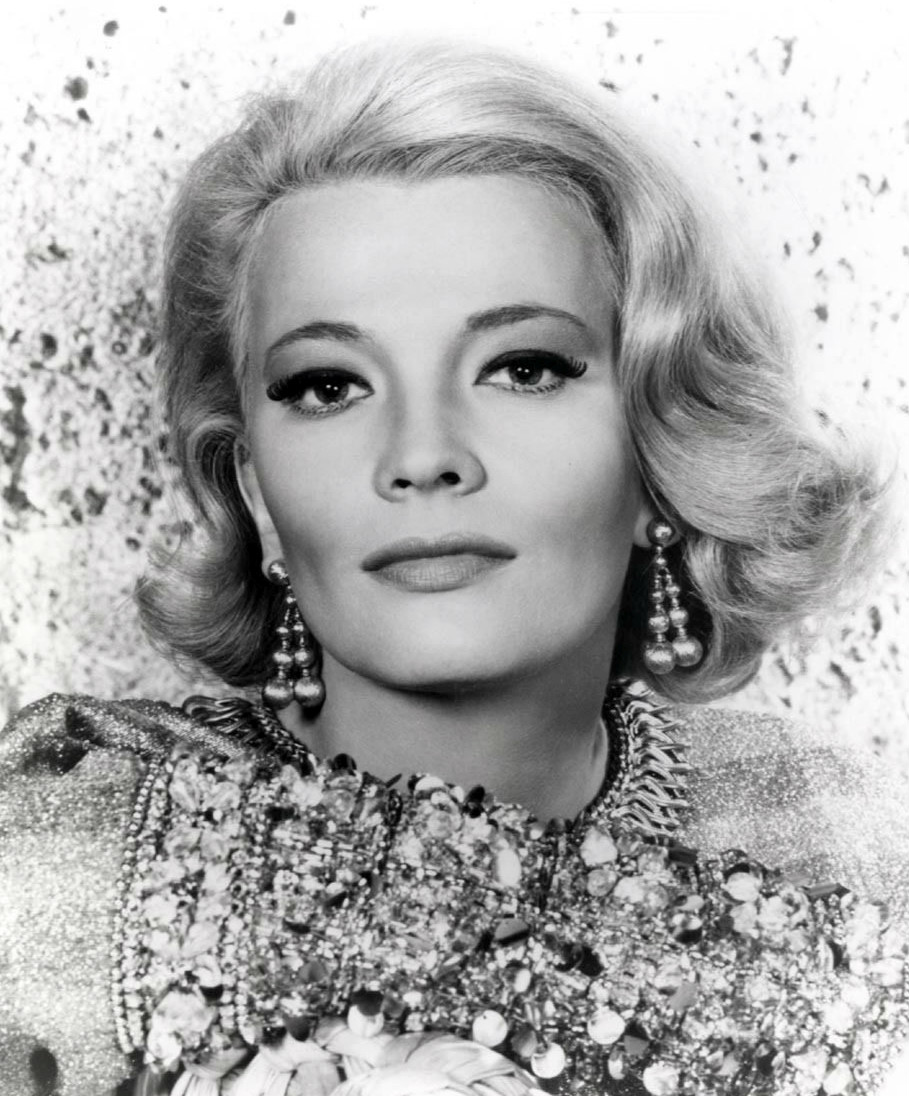

Gena Rowlands
View on Wikipedia
Virginia Cathryn "Gena" Rowlands (/ˈdʒɛnə/;[1] June 19, 1930 – August 14, 2024) was an American actress, whose career in film, stage, and television spanned nearly seven decades. She was a four-time Emmy Award and two-time Golden Globe winner, and she was twice nominated for the Academy Award for Best Actress.
Key Information


She rose to prominence for her collaborations with her actor-director husband John Cassavetes in ten films, including A Woman Under the Influence (1974) and Gloria (1980), both of which earned her Oscar nominations. She also won the Silver Bear for Best Actress for Opening Night (1977). Her other notable roles included William Friedkin's The Brink's Job (1978), Woody Allen's Another Woman (1988), Jim Jarmusch's Night on Earth (1991), Mira Nair's Hysterical Blindness (2002), and her son Nick Cassavetes's The Notebook (2004).
In 2021, Richard Brody of The New Yorker said, "The most important and original movie actor of the past half century-plus is Gena Rowlands."[2] In November 2015, Rowlands received an Honorary Academy Award in recognition of her unique screen performances.[3]
Early years
[edit]Rowlands was born on June 19, 1930, in Madison, Wisconsin.[4][5] Her mother, Mary Allen (née Neal), was a housewife who later worked as an actress under the stage name Lady Rowlands.[6] Her father, Edwin Myrwyn Rowlands, was a banker and state legislator.[7] He was a member of the Wisconsin Progressive Party, and was of Welsh descent.[8] She had an elder brother, David Rowlands.[9][10]
Her family moved to Washington, D.C., in 1939, when Edwin was appointed to a position in the United States Department of Agriculture; moved to Milwaukee, Wisconsin, in 1942, when he was appointed branch manager of the Office of Price Administration;[11] and later moved to Minneapolis, Minnesota. From 1947 to 1950, she attended the University of Wisconsin,[12] where she was a popular student already renowned for her beauty.[13] While in college, she was a member of Kappa Kappa Gamma.[14] She left for New York City to study drama at the American Academy of Dramatic Arts.[15]
Career
[edit]Early roles (1952–1967)
[edit]
In the early 1950s, Rowlands performed with repertory theatre companies and at the Provincetown Playhouse. She made her Broadway debut in The Seven Year Itch and toured in a national production of the play.[16] In 1956, she starred in the Broadway play Middle of the Night opposite Edward G. Robinson.[17]

Rowlands costarred with Paul Stewart in the 26-episode syndicated TV series Top Secret (1954–55). She guest-starred on such anthology television series as Robert Montgomery Presents, Armstrong Circle Theatre, Studio One, Appointment with Adventure, The United States Steel Hour, and Goodyear Television Playhouse, all in 1955. In 1959, Rowlands appeared in the Western series Laramie, alongside her husband John Cassavetes in the detective series Johnny Staccato, and in the Western series Riverboat, starring Darren McGavin. In 1961, she appeared in the adventure series The Islanders, set in the South Pacific, and in Target: The Corruptors!, starring Stephen McNally. She guest-starred in The Lloyd Bridges Show, the detective series 77 Sunset Strip, Kraft Suspense Theatre, the Westerns Bonanza and The Virginian, and Breaking Point, all in 1963. In 1964, she guest-starred in the medical drama Dr. Kildare and in two episodes of Burke's Law. She appeared in four episodes of Alfred Hitchcock Presents, three of which were after the series had been renamed The Alfred Hitchcock Hour. In 1967, she was cast as socialite Adrienne Van Leyden in the prime-time ABC soap opera Peyton Place.[citation needed]

Rowlands made her film debut in The High Cost of Loving in 1958. In 1962, she starred in director David Miller's Lonely Are the Brave, with Kirk Douglas and Walter Matthau. She played the former lover of the Kirk Douglas character, now the wife of the Douglas character's best friend.[citation needed]
Cassavetes era (1963–1984)
[edit]Rowlands and Cassavetes made ten films together: A Child Is Waiting (1963), Faces (1968), Machine Gun McCain (1969), Minnie and Moskowitz (1971), A Woman Under the Influence (1974; nomination for Academy Award for Best Actress), Two-Minute Warning (1976), Opening Night (1977), Gloria (1980; nomination for Academy Award for Best Actress), Tempest (1982), and Love Streams (1984).[18]
According to Boston University film scholar Ray Carney, Rowlands sought to suppress an early version of Cassavetes's first film, Shadows, that Carney says he rediscovered after decades of searching.[19] Rowlands also became involved in the screenings of Husbands and Love Streams, according to Carney. The UCLA Film and Television Archive mounted a restoration of Husbands, as it was pruned down (without Cassavetes's consent, and in violation of his contract) by Columbia Pictures several months after its release, in an attempt to restore as much of the removed content as possible. At Rowlands's request, UCLA created an alternative print with almost ten minutes of content edited out, as Rowlands felt that these scenes were in poor taste. The alternative print is the only one that has been made available for rental.[20]
Late career (1985–2014)
[edit]In 1985, Rowlands played the mother in the critically acclaimed made-for-TV movie An Early Frost.[21] She won an Emmy for her portrayal of former First Lady of the United States Betty Ford in the 1987 made-for-TV movie The Betty Ford Story.[22]
In 1988, Rowlands starred in Woody Allen's dramatic film Another Woman. She played Marion Post, a middle-aged professor who is prompted to a journey of self-discovery when she overhears the therapy sessions of another woman (Mia Farrow). The review in Time Out described the character's trajectory: "Marion gets to thinking, and is appalled to realise that so many assumptions about her own life and marriage are largely unfounded: in her desire for a controlled existence, she has evaded the emotional truth about relationships with her best friend (Sandy Dennis), brother (Harris Yulin) and husband (Ian Holm)." Time Out praised the "marvellous" performances in the film, adding, "Rowlands' perfectly pitched approach to a demanding role is particularly stunning."[23] Film4 called her performance "sublime",[24] while Roger Ebert noted that it marked a considerable change in tone from her work with Cassavetes, thus showing "how good an actress Rowlands has been all along."[25]
In 1995, Rowlands appeared as Julia Roberts's mother in the comedy-drama film Something to Talk About,[26] and in 1998, she played Sandra Bullock's mother in the dramatic film Hope Floats.[27] In 2002, Rowlands appeared in Mira Nair's HBO movie Hysterical Blindness, for which she won her third Emmy.
In 2004, she starred as the older version of Rachel McAdams's character in the romantic drama film The Notebook alongside James Garner as her husband, which was directed by her son Nick Cassavetes.[28] The same year, she won her first Daytime Emmy for her role as Mrs. Evelyn Ritchie in the made-for-TV movie The Incredible Mrs. Ritchie.[29]

In 2005, she appeared opposite Kate Hudson, Peter Sarsgaard, and John Hurt in the gothic thriller The Skeleton Key.[30] The next year she appeared as Mrs. Hellman in an episode from the third season of Numb3rs. She played a Nazi survivor whose whole family was killed. The family owned a painting that the Nazis confiscated. Later on the painting reappeared. The new owner lent the painting to an art gallery in Los Angeles but while on display it was stolen. FBI agent Don Eppes, played by Rob Morrow, tries to figure out what really happened. Rowlands received positive reviews for this role. She has been a spokesperson for people who were persecuted by the Nazis.[citation needed]
In 2007, she played a supporting role opposite Parker Posey and Melvil Poupaud in Broken English, an independent American feature written and directed by her daughter Zoe Cassavetes. In 2009, she appeared on an episode of Monk ("Mr. Monk and the Lady Next Door"). On March 2, 2010, she appeared on an episode of NCIS as lead character Leroy Jethro Gibbs's former mother-in-law, who is embroiled in a murder investigation.[31] In 2014, she starred in the film adaptation of Six Dance Lessons in Six Weeks.[32] In 2015, she described herself as generally retired from acting.[33]
Personal life
[edit]Rowlands was married to John Cassavetes from March 9, 1954,[34][35] until his death on February 3, 1989. They met at the American Academy at Carnegie Hall, where they were both students. They had three children, all actor-directors: Nick, Alexandra, and Zoe.
Rowlands married retired businessman Robert Forrest in 2012.[36]
Rowlands stated that she was a fan of actress Bette Davis while growing up. She played Davis's daughter in the 1979 made-for-TV film Strangers.[37]
Illness and death
[edit]On June 24, 2024, Nick Cassavetes announced that his mother had been living with Alzheimer's disease for the previous five years.[38] Rowlands died from complications of Alzheimer's disease at her home in Indian Wells, California, on August 14, 2024, at the age of 94.[39]
Filmography
[edit]Film
[edit]| Year | Title | Role | Notes |
|---|---|---|---|
| 1958 | The High Cost of Loving | Jenny Fry | |
| 1959 | Shadows | Woman in Nightclub | Uncredited; First film collaboration with John Cassavetes |
| 1962 | Lonely Are the Brave | Jerry Bondi | |
| The Spiral Road | Els | ||
| 1963 | A Child Is Waiting | Sophie Widdicombe | |
| 1967 | Tony Rome | Rita Kosterman | |
| 1968 | Faces | Jeannie Rapp | |
| 1969 | Machine Gun McCain | Rosemary Scott | |
| 1971 | Minnie and Moskowitz | Minnie Moore | |
| 1974 | A Woman Under the Influence | Mabel Longhetti | |
| 1976 | Two-Minute Warning | Janet | |
| 1977 | Opening Night | Myrtle Gordon | |
| 1978 | The Brink's Job | Mary Pino | |
| 1980 | Gloria | Gloria Swenson | |
| 1982 | Tempest | Antonia Dimitrius | |
| 1984 | Love Streams | Sarah Lawson | |
| 1987 | Light of Day | Jeanette Rasnick | |
| 1988 | Another Woman | Marion Post | |
| 1989 | I'm Almost Not Crazy: John Cassavetes, the Man & His Work | Herself | Documentary short |
| 1990 | Hollywood Mavericks | Documentary | |
| 1991 | Once Around | Marilyn Bella | |
| Night on Earth | Victoria Snelling | Segment: "Los Angeles" | |
| Ted & Venus | Mrs. Turner | ||
| 1993 | Silent Cries | Peggy Sutherland | |
| 1995 | Something to Talk About | Georgia King | |
| The Neon Bible | Mae Morgan | ||
| 1996 | Unhook the Stars | Mildred "Millie" Hawks | |
| 1997 | She's So Lovely | Miss Jane Green | |
| 1998 | Paulie | Ivy | |
| Hope Floats | Ramona Calvert | ||
| The Mighty | Gram | ||
| Playing by Heart | Hannah | ||
| 1999 | The Weekend | Laura Ponti | |
| 2000 | Light Keeps Me Company | Herself | Documentary |
| 2003 | Broadway: The Golden Age | Herself | |
| 2004 | Taking Lives | Mrs. Asher | |
| The Notebook | Older Allie Calhoun | ||
| 2005 | The Skeleton Key | Violet Devereaux | |
| 2006 | Paris, je t'aime | Gena | Segment: "Quartier Latin" |
| 2007 | Broken English | Vivien Wilder-Mann | |
| Persepolis | Grandmother (voice) | English-dubbed version | |
| 2011 | Olive | Tess M. Powell | |
| 2012 | Yellow | Mimi | |
| 2013 | Parts Per Billion | Esther | |
| 2014 | Six Dance Lessons in Six Weeks | Lily Harrison | Final film role |
Television
[edit]| Year | Title | Role | Notes |
|---|---|---|---|
| 1954 | Top Secret | Powell | Episode: "This Man Is Death" |
| 1955 | The Way of the World | Paula Graves | |
| Robert Montgomery Presents | Myrtle Wilson | Season 6 Episode 33: "The Great Gatsby" | |
| Ponds Theater | Janet | Season 2 Episode 34: "The Ways of Courage" | |
| Armstrong Circle Theatre | Lugene | Season 5 Episode 40: "Time for Love" | |
| Studio One on Hollywood | Betty | Season 7 Episode 50: "A Chance of Love" | |
| Appointment with Adventure | (1) Lorri (2) Sally Mason |
(1) Season 1 Episode 14: "Caribbean Cruise" (2) Season 1 Episode 23: "The Pirate's House" | |
| The United States Steel Hour | Lily | Season 3 Episode 7: "Ashton Buys a Horse" | |
| Goodyear Television Playhouse | (1) Eve (2) Betty |
(1) Season 4 Episode 15: "Do It Yourself" (2) Season 5 Episode 3: "The Expendable House" | |
| 1958 | General Electric Theater | Dorothy Dickenson | Season 7 Episode 12: "The Girl with the Flaxen Hair" |
| 1959 | Laramie | Laurel DeWalt | Season 1 Episode 9: "The Run to Tumavaca" |
| Johnny Staccato | Nina Van Ness | Season 1 Episode 9: "Fly Baby, Fly" | |
| Markham | Rita Evans | Season 1 Episode 28: "The Altar" | |
| Riverboat | Rose Traynor | Season 1 Episode 14: "Guns for Empire" | |
| 1960 | Adventures in Paradise | Dr. Abigail Brent | Season 1 Episode 28: "The Death-Divers" |
| Alfred Hitchcock Presents | Lucille Jones | Season 6 Episode 2: "The Doubtful Doctor" | |
| The Tab Hunter Show | Barbara / Penelope | Season 1 Episode 8: "Double Trouble" | |
| 1961 | The Islanders | Pepper Mint | Season 1 Episode 20: "Island Witness" |
| Target: The Corruptors! | Marian Praisewater | Season 1 Episode 5: "The Poppy Vendor" | |
| 1961–62 | 87th Precinct | Teddy Carella | (1) Season 1 Episode 1: "The Floater" (1961) (2) Season 1 Episode 2: "Lady in Waiting" (1961) (3) Season 1 Episode 6: "Occupation, Citizen" (1961) (4) Season 1 Episode 25: "Step Forward" (1962) |
| 1962 | The Alfred Hitchcock Hour | Helen Martin | Season 1 Episode 11: "Ride the Nightmare" |
| 1963 | The Dick Powell Theatre | Mrs. Canfield | Season 2 Episode 15: "Project X" |
| The Lloyd Bridges Show | Leslie Kaufman | Season 1 Episode 20: "A Personal Matter" | |
| 77 Sunset Strip | Barbara Adams | Season 5 Episode 25: "Flight 307" | |
| Bonanza | Ragan Miller | Season 5 Episode 1: "She Walks in Beauty" | |
| The Virginian | Savannah | Season 2 Episode 3: "No Tears for Savannah" | |
| Bob Hope Presents the Chrysler Theatre | June | Season 1 Episode 9: "It's Mental Work" | |
| Breaking Point | Shelley Osborne Peters | Season 1 Episode 14: "Heart of Marble, Body of Shame" | |
| The Alfred Hitchcock Hour | Louise Henderson | Season 1 Episode 23: "The Lonely Hours" | |
| Kraft Suspense Theatre | Janet Cord | Season 1 Episode 6: "One Step Down" | |
| 1964 | The Alfred Hitchcock Hour | Diana Justin | Season 2 Episode 19: "Murder Case" |
| Dr. Kildare | Helen Scott | Season 3 Episode 20: "To Walk in Grace" | |
| Burke's Law | (1) Paulette Shane (2) Mitzi Carlisle |
(1) Season 1 Episode 17: "Who Killed What's His Name?" (2) Season 1 Episode 28: "Who Killed Annie Foran?" | |
| 1965 | Kraft Suspense Theatre | Lois Baxter | Season 2 Episode 18: "Won't It Ever Be Morning? |
| 1966 | Run for Your Life | Charlotte Hyde | Season 1 Episode 17: "The Rediscovery of Charlotte Hyde" |
| The Long, Hot Summer | Karen Roberts | Season 1 Episode 20: "From This Day Forward" | |
| 1967 | The Road West | Karen Collier | Season 1 Episode 16: "Beyond the Hill" |
| The Girl from U.N.C.L.E. | Baroness Ingrid | Season 1 Episode 20: "The Fountain of Youth Affair" | |
| Peyton Place | Adrienne Van Leyden | 39 episodes | |
| 1968 | Garrison's Gorillas | Duchess | Season 1 Episode 24: "The Frame-Up" |
| 1971 | Medical Center | Frances Delaney | Season 2 Episode 23: "The Man in Hiding" |
| 1972 | Circle of Fear | Kate Lucas | Season 1 Episode 2: "The Concrete Captain" |
| 1973 | Medical Center | Karen Coberly | Season 5 Episode 8: "Child of Violence" |
| 1974 | Marcus Welby, M.D. | Lorrain Denby | Season 6 Episode 13: "The 266 Days" |
| 1975 | Columbo | Elizabeth Van Wyck | Season 4 Episode 5: "Playback" |
| 1978 | A Question of Love | Linda Ray Guettner | Television movie |
| 1979 | Strangers: The Story of a Mother and Daughter |
Abigail Mason | |
| 1983 | Thursday's Child | Victoria Alden | |
| Faerie Tale Theatre | Witch | Season 2 Episode 1: "Rapunzel" | |
| 1985 | An Early Frost | Katherine Pierson | Television movie |
| 1987 | The Betty Ford Story | Betty Ford | |
| 1990 | Montana | Bess Guthrie | |
| 1991 | Face of a Stranger | Pat Foster | |
| 1992 | Crazy in Love | Honora Swift | |
| 1993 | Anything for John | Herself | Television documentary |
| 1994 | Parallel Lives | Francie Pomerantz | Television movie |
| 1998 | Grace and Glorie | Grace Stiles | |
| Best Friends for Life | Mrs. Harriet Cahill | ||
| 2000 | The Color of Love: Jacey's Story | Georgia Porter | |
| 2001 | Wild Iris | Minnie Brinn | |
| 2002 | Charms for the Easy Life | Ms. Charlie Kate | |
| 2003 | Hysterical Blindness | Virginia Miller | |
| 2004 | The Incredible Mrs. Ritchie | Evelyn Ritchie | |
| 2006 | Numb3rs | Mrs. Hellman | Season 3 Episode 3: "Provenance" |
| 2007 | What If God Were the Sun? | Melissa Eisenbloom | Television movie |
| 2009 | Monk | Marge Johnson | Season 7 Episode 12: "Mr. Monk & the Lady Next Door" |
| 2010 | NCIS | Joann Fielding | Season 7 Episode 16: "Mother's Day" |
Awards and nominations
[edit] | This section needs additional citations for verification. (August 2024) |
| Year | Category | Nominated work | Result | Ref. |
|---|---|---|---|---|
| 1974 | Best Actress | A Woman Under the Influence | Nominated | [40] |
| 1980 | Gloria | Nominated | [41] | |
| 2015 | Honorary Academy Award | — | Won | [42] |
| Year | Category | Nominated work | Result | Ref. |
|---|---|---|---|---|
| Primetime Emmy Awards | ||||
| 1986 | Outstanding Lead Actress in a Miniseries or a Special | An Early Frost | Nominated | [43] |
| 1987 | The Betty Ford Story | Won | ||
| 1992 | Face of a Stranger | Won | ||
| 2000 | Outstanding Lead Actress in a Miniseries or a Movie | The Color of Love: Jacey's Story | Nominated | |
| 2002 | Wild Iris | Nominated | ||
| 2003 | Outstanding Supporting Actress in a Miniseries or a Movie | Hysterical Blindness | Won | |
| 2007 | Outstanding Actress in a Miniseries or Movie | What If God Were the Sun? | Nominated | |
| 2009 | Outstanding Guest Actress in a Comedy Series | Monk | Nominated | |
| Daytime Emmy Awards | ||||
| 2004 | Outstanding Performer in a Children/Youth/Family Special | The Incredible Mrs. Ritchie | Won | |
| Year | Category | Nominated work | Result | Ref. |
|---|---|---|---|---|
| 1974 | Best Actress in a Motion Picture – Drama | A Woman Under the Influence | Won | [44] |
| 1977 | Opening Night | Nominated | ||
| 1980 | Gloria | Nominated | ||
| 1983 | Best Actress in a Miniseries or Motion Picture Made for Television | Thursday's Child | Nominated | |
| 1985 | An Early Frost | Nominated | ||
| 1987 | The Betty Ford Story | Won | ||
| 1992 | Best Supporting Actress – Television | Crazy in Love | Nominated | |
| 2002 | Hysterical Blindness | Nominated |
| Year | Category | Nominated work | Result | Ref. |
|---|---|---|---|---|
| 1996 | Outstanding Performance by a Female Actor in a Leading Role | Unhook the Stars | Nominated | [45] |
| 2007 | Outstanding Performance by a Female Actor in a Miniseries or Television Movie | What If God Were the Sun | Nominated | [46] |
Other Awards
[edit]References
[edit]- ^ "Say How: R". National Library Service for the Blind and Print Disabled. Archived from the original on September 25, 2019. Retrieved October 12, 2023.
- ^ Brody, Richard (March 6, 2021). "The Best Movie Performances of the Century So Far". The New Yorker. Archived from the original on March 6, 2021. Retrieved March 8, 2021.
- ^ Gray, Tim (August 27, 2015). "Gena Rowlands, Spike Lee, Debbie Reynolds to Receive Governors Awards Oscars". Variety. Archived from the original on January 19, 2018. Retrieved December 10, 2017.
- ^ "Gena Rowlands, Actress Who Brought Raw Drama to Her Roles, Dies at 94". The New York Times. August 14, 2024. Archived from the original on August 15, 2024. Retrieved August 15, 2024.
- ^ "Gena Rowlands, Acting Legend and Notebook Star, Dies at 94". Vanity Fair. August 14, 2024. Archived from the original on August 15, 2024. Retrieved August 15, 2024.
- ^ U.S. Census, April 1, 1930, state of Wisconsin, county of Columbia, village of Cambria, enumeration district 3, page 4-B, family 130
- ^ Assembly, 1927–1935; Senate, 1935–1939. Members of the Wisconsin Legislature 1848–1999, Informational Bulletin 99-1, Wisconsin Legislative Reference Bureau, 1999.
- ^ Lane, Lydia (November 21, 1980). "Beauty". Los Angeles Times. ProQuest 162996377. Archived from the original on August 13, 2017. Retrieved July 6, 2017.
- ^ Murphy, J. J. (April 16, 2019). Rewriting Indie Cinema: Improvisation, Psychodrama, and the Screenplay. Columbia University Press. p. 97. ISBN 978-0-231-54959-2.
- ^ Charity, Tom (June 26, 2012). John Cassavetes: Lifeworks. Omnibus Press. ISBN 978-0-85712-841-6.
- ^ "OPA Directed by Merwyn [sic] Rowlands," The Sheboygan Press, Sheboygan, Wisconsin, April 2, 1942, p. 4
- ^ Registrar's Office, University of Wisconsin–Madison.
- ^ "Six U.W. Co-eds 'Badger Beauties'", The Sheboygan Press, Sheboygan, Wisconsin, November 14, 1949, p. 2
- ^ University of Wisconsin Badger, 1950
- ^ Gilpatrick, Kristin (2002). Famous Wisconsin Film Stars. Badger Books Inc. p. 158. ISBN 978-1-878569-86-8.
- ^ Kennedy, Mark (August 15, 2024). "The Notebook Star Gena Rowlands Dies at 94". Irish Examiner. Archived from the original on August 16, 2024. Retrieved August 15, 2024.
- ^ Rochlin, Margy (November 3, 1996). "Now It's a Son Letting Gena Rowlands Shine". The New York Times. Archived from the original on August 15, 2024. Retrieved August 15, 2024.
- ^ "Gena Rowlands, a Miraculous Actress". YouTube. Archived from the original on July 24, 2020.
- ^ Carney, Ray. "Who Owns an Improvised Work?". The John Cassavetes Pages. Archived from the original on October 12, 2017. Retrieved December 17, 2006.
- ^ Carney, Ray. "On Your Relationship with Criterion". The John Cassavetes Pages. Archived from the original on August 12, 2017. Retrieved December 17, 2006.
- ^ O'Connor, John J. (November 11, 1985). "NBC Offers a Drama on AIDS". The New York Times. ISSN 0362-4331. Archived from the original on November 23, 2017. Retrieved August 15, 2024.
- ^ "NBC Is Big Winner at Emmys". The New York Times. September 22, 1987. Archived from the original on November 1, 2017. Retrieved August 15, 2024.
- ^ "Another Woman". Time Out. Archived from the original on August 13, 2017. Retrieved April 1, 2013.
- ^ "Another Woman". Film4. Archived from the original on March 4, 2016. Retrieved April 1, 2013.
- ^ Ebert, Roger (November 18, 1988). "Another Woman". Chicago Sun-Times. Archived from the original on October 20, 2018. Retrieved April 1, 2013.
- ^ Hinson, Hal (August 4, 1995). "'Something to Talk About' (R)". The Washington Post. Retrieved August 10, 2024.
- ^ Berardinelli, James (1998). "Review: Hope Floats". ReelViews. Archived from the original on February 5, 2007.
- ^ Koehler, Robert (May 20, 2004). "The Notebook". Variety. Retrieved July 30, 2024.
- ^ Gates, Anita (August 15, 2024). "Gena Rowlands, Actress Who Brought Raw Drama to Her Roles, Dies at 94". The New York Times. Archived from the original on August 15, 2024. Retrieved August 15, 2024.
- ^ Softley, Iain (September 1, 2005). "The Skeleton Key". Apple TV. Retrieved August 29, 2024.
- ^ Ausiello, Michael (January 16, 2010). "'NCIS' exclusive: Gena Rowlands unlocks Gibbs' past". EW. The Meredith Corporation. Archived from the original on October 13, 2019. Retrieved October 13, 2019.
- ^ Chang, Justin (December 16, 2014). "Film Review: 'Six Dance Lessons in Six Weeks'". Variety. Archived from the original on November 28, 2017. Retrieved September 29, 2016.
- ^ "Gena Rowlands on Pioneering the Indie Film Movement with Late Husband John Cassavetes". The Hollywood Reporter. November 13, 2015. Archived from the original on January 13, 2023. Retrieved January 13, 2023.
- ^ Pierce, Duke Daniel (December 10, 2022). "John Cassavetes: Hollywood Rebel". The Academy Pages. Archived from the original on August 15, 2024. Retrieved August 15, 2024.
- ^ "Marriage of Rowlands / Cassavetes". Wisconsin State Journal. February 9, 1954. p. 13. Archived from the original on August 16, 2024. Retrieved August 15, 2024.
- ^ Pulver, Andrew (August 15, 2024). "Gena Rowlands, Star of A Woman Under the Influence and Gloria, Dies at 94". The Guardian. ISSN 0261-3077. Archived from the original on August 16, 2024. Retrieved August 15, 2024.
- ^ "The Hollywood Reporter Interview with Gena Rowlands". March 29, 2015. Archived from the original on August 13, 2017. Retrieved March 29, 2015.
- ^ Huff, Lauren (June 25, 2024). "'The Notebook' Star Gena Rowlands Has Alzheimer's, According to Her Son Nick Cassavetes". EW.com. Archived from the original on June 25, 2024. Retrieved June 25, 2024.
- ^ Schultz, Rick (August 14, 2024). "Gena Rowlands, The Notebook and A Woman Under the Influence Star, Dies at 94". Variety. Archived from the original on August 16, 2024. Retrieved August 14, 2024.
- ^ "The 47th Academy Awards (1975) Nominees and Winners". Academy of Motion Picture Arts and Sciences. Archived from the original on September 1, 2019. Retrieved October 2, 2011.
- ^ "The 53rd Academy Awards (1981) Nominees and Winners". Academy of Motion Picture Arts and Sciences. Archived from the original on November 10, 2014. Retrieved November 14, 2015.
- ^ "Spike Lee, Debbie Reynolds And Gena Rowlands To Receive Academy's 2015 Governors Awards". Academy of Motion Picture Arts and Sciences. Archived from the original on August 31, 2015. Retrieved November 5, 2015.
- ^ "Gena Rowlands". Academy of Television Arts & Sciences. Retrieved November 5, 2024.
- ^ "Gena Rowlands". Golden Globe Awards. Retrieved November 5, 2024.
- ^ "The 5th Annual Screen Actors Guild Awards". Screen Actors Guild Awards. Retrieved November 5, 2024.
- ^ "The 14th Annual Screen Actors Guild Awards". Screen Actors Guild Awards. Retrieved November 5, 2024.
- ^ "1974 Award Winners". National Board of Review. Retrieved November 5, 2024.
- ^ "KCFCC Award Winners – 1970-79". Kansas City Film Critics Circle. Retrieved November 5, 2024.
- ^ "BSFC Winners: 1980s". Boston Society of Film Critics. Retrieved November 5, 2024.
- ^ "Past Muse Award Honorees". New York Women in Film & Television. Retrieved November 5, 2024.
- ^ "1996 Award Winners". National Board of Review. Retrieved November 5, 2024.
- ^ "International Press Academy website – 2001 5th Annual SATELLITE Awards". International Press Academy. Archived from the original on February 1, 2008.
- ^ "7th Annual TV Awards (2002-03)". Online Film & Television Association. Retrieved November 5, 2024.
- ^ "Archive: Honorees". Hamptons International Film Festival. Retrieved November 5, 2024.
- ^ "Nominees & Winners – Satellite™ Awards 2005 (9th Annual Satellite™ Awards)". International Press Academy. Archived from the original on February 2, 2008. Retrieved April 7, 2019.
- ^ "Mary Pickford Award". International Press Academy. Retrieved November 5, 2024.
- ^ "The 2006 Saturn Awards Nominations – The Movie Blog". www.themovieblog.com. Archived from the original on March 18, 2017. Retrieved December 17, 2018.
- ^ "LAFCA Lifetime Achievement Award". Los Angeles Film Critics Association. March 29, 2015. Archived from the original on December 30, 2014. Retrieved March 29, 2015.
- ^ "Film Hall of Fame: Actors". Online Film & Television Association. Retrieved November 5, 2024.
Further reading
[edit]- Gallagher, John Andrew; Caminer, Sylvia (August 24, 2017). "The Grande Dame of American Indie Cinema: A Lost Interview with Gena Rowlands". MovieMaker.
External links
[edit]
- Gena Rowlands at the Internet Broadway Database
- Gena Rowlands at IMDb
- Gena Rowlands at the TCM Movie Database
- Gena Rowlands discography at Discogs

Gena Rowlands
View on GrokipediaEarly life
Family and childhood
Virginia Cathryn Rowlands, known professionally as Gena Rowlands, was born on June 19, 1930, in Madison, Wisconsin.[5] She was the daughter of Edwin Myrwyn Rowlands, a banker and Wisconsin state legislator of Welsh descent, and Mary Allen Neal, an artist and aspiring actress who later adopted the stage name Lady Rowlands.[1][5] Rowlands had an elder brother, David Rowlands, who was an actor.[6] The Rowlands family relocated frequently during her early years due to Edwin's banking and political positions, which uprooted them from their initial home in Cambria, a suburb of Madison.[1] In 1939, when Rowlands was nine, the family moved to Washington, D.C., after her father was appointed to a role in the U.S. Department of Agriculture.[7] They returned to Wisconsin, exposing young Rowlands to varied environments across the Midwest and East Coast that shaped her adaptable worldview.[7] Rowlands' formative experiences included early immersion in the performing arts, influenced by her mother's amateur theater pursuits and artistic household.[2] As a withdrawn child who enjoyed books and imaginative play, she developed a keen interest in acting through watching classic films and taking part in school productions, with her mother actively encouraging this budding passion.[8][1]Education and initial aspirations
Rowlands attended Washington-Lee High School in Arlington, Virginia, graduating in 1947, where she began nurturing her passion for the performing arts amid a family that had relocated from Wisconsin.[9][10] As a scholarly and ambitious teenager, she stood out in competitive extracurricular activities, including musical ensembles that honed her expressive talents and foreshadowed her dramatic pursuits.[11] Following high school, Rowlands enrolled at the University of Wisconsin in Madison in 1947, drawn by the area's vibrant theatrical scene near her childhood home in Cambria.[12][1] Although her parents initially insisted on a traditional college path despite her growing seriousness about acting, she left after approximately one year, encouraged by an academic advisor to seek more specialized training.[13][14] Her mother's own involvement in local playwriting and acting before marriage, coupled with unfulfilled ambitions to pursue a career in New York, further inspired Rowlands' resolve to forgo conventional education for professional artistry.[12] In 1948, at age 18, Rowlands moved to New York City to enroll at the American Academy of Dramatic Arts, completing her training and graduating in 1950.[1][15] There, she immersed herself in classical acting techniques, emerging prepared for stage work amid the competitive postwar theater landscape. Her early aspirations were profoundly shaped by classic Hollywood icons, particularly Bette Davis, whose bold performances in films like Now, Voyager captivated her and modeled the fearless emotional depth she sought to embody.[12][16]Acting career
Early stage and television roles (1950s–1960s)
Rowlands began her professional acting career in the early 1950s, focusing on stage work in New York after training at the American Academy of Dramatic Arts. She made her Broadway debut as an understudy and eventual replacement for the role of the Girl in George Axelrod's comedy The Seven Year Itch in 1952, a production that ran for over 1,700 performances. Her experience in the show provided early exposure to high-profile theater, though it was a supporting capacity. Rowlands also appeared in the off-Broadway revival of J.B. Priestley's Dangerous Corner in 1953, demonstrating her versatility in ensemble dramas. Throughout the decade, she performed in regional repertory companies, tackling a range of roles in contemporary plays that helped build her reputation as a reliable stage performer. A significant breakthrough came in 1956 with her leading role in Paddy Chayefsky's Middle of the Night on Broadway, where she portrayed Betty Preisser, a young secretary drawn into a romance with her older boss, played by Edward G. Robinson. The production, which explored themes of age-disparate relationships and urban loneliness, earned critical acclaim, with The New York Times critic Brooks Atkinson noting Rowlands's performance as "especially good" for its emotional depth and authenticity. This role solidified her presence in major theater, though opportunities remained limited amid the competitive New York scene. Rowlands's marriage to actor and director John Cassavetes in 1954 increasingly influenced her artistic choices, encouraging a shift toward more experimental and introspective dramatic work as the decade progressed. Transitioning to television, Rowlands debuted onscreen in 1955 with a guest role on the anthology series Robert Montgomery Presents, appearing as Myrtle Wilson in an adaptation of F. Scott Fitzgerald's The Great Gatsby. The live-drama format of 1950s television suited her stage-honed intensity, and she quickly became a frequent presence in anthology programming. Notable appearances included episodes of Goodyear Television Playhouse in 1955, where she starred in "Do It Yourself," showcasing her ability to convey complex emotional layers in short-form narratives. In the early 1960s, she gained further recognition with guest spots on Alfred Hitchcock Presents, beginning with "The Doubtful Doctor" in 1960 opposite Dick York, followed by "Ride the Nightmare" in 1962 and "The Lonely Hours" in 1963 on The Alfred Hitchcock Hour; these roles often cast her as psychologically fraught women, highlighting her skill in suspenseful, character-driven stories. Balancing stage commitments with television's demanding live broadcasts proved challenging due to the era's modest pay for supporting actors and the risk of typecasting in intense dramatic parts, yet it established her as a versatile performer in the medium.Collaborations with John Cassavetes (1960s–1980s)
Gena Rowlands' professional partnership with her husband, director John Cassavetes, began in earnest with the 1968 film Faces, where she portrayed Jeannie Rapp, a call girl entangled in the crumbling marriage of a middle-aged couple, marking a pivotal entry into Cassavetes' raw, improvisational style of independent filmmaking.[1] This collaboration, which spanned over two decades, produced some of the most influential works in American indie cinema, blending personal intimacy with unflinching emotional depth, often drawing from the couple's own marital dynamics.[17] In 1971's Minnie and Moskowitz, Rowlands played Minnie Moore, a reserved museum curator whose unlikely romance with an eccentric parking lot attendant (Seymour Cassel) unfolds through chaotic, heartfelt encounters, showcasing her ability to infuse everyday vulnerability with chaotic energy in Cassavetes' low-budget productions.[1] The film exemplified their collaborative approach, with extensive rehearsals allowing actors to improvise within structured scenarios, often shot in real locations to capture unpolished authenticity.[17] Rowlands' breakthrough came in A Woman Under the Influence (1974), where she starred as Mabel Longhetti, a devoted but unraveling housewife whose mental health deteriorates under familial pressures, opposite Peter Falk as her husband; the role earned her first Academy Award nomination for Best Actress.[1] Produced on a modest $1 million budget, the film relied on improvisational techniques, with Rowlands drawing from psychological depth in long, unrehearsed takes to portray Mabel's frenetic despair, reflecting Cassavetes' commitment to exploring women's inner lives amid financial risks that frequently left their projects underfunded and distribution-challenged.[18][19] The 1977 film Opening Night featured Rowlands as Myrtle Gordon, an aging Broadway actress grappling with a young fan's death and her own fading identity, delving into themes of performance, loss, and self-reinvention through a meta-theatrical lens.[7] Cassavetes and Rowlands co-developed the script iteratively, incorporating her insights from stage work to heighten the improvisational realism, as the couple often blurred lines between their personal relationship and creative output during marathon editing sessions in their home.[17] In Gloria (1980), Rowlands shifted to a more action-oriented role as the titular ex-mobster's girlfriend who fiercely protects a young boy from gangsters, earning her second Oscar nomination for Best Actress and demonstrating her versatility in Cassavetes' most commercially accessible work to date.[1] The film's production maintained their indie ethos, with Rowlands contributing to action sequences through hands-on involvement, underscoring the financial gambles they took—self-financing via personal loans and TV residuals—to prioritize artistic freedom over studio constraints.[7][17] Their final joint effort, Love Streams (1984)—Cassavetes' last directorial feature before his death in 1989—cast Rowlands as Sarah Lawson, a divorced woman seeking solace with her brother (Cassavetes), amid explorations of loneliness and familial bonds, with the script evolving through their shared revisions to capture intimate, unscripted emotional layers.[1] This partnership not only amplified Rowlands' reputation for transformative performances but also pioneered a model of husband-wife collaboration in cinema, influencing generations of filmmakers through its emphasis on emotional truth over commercial viability.[17][20]Later roles in film and television (1980s–2010s)
Following the death of her husband John Cassavetes in 1989, Gena Rowlands continued to demonstrate her range in both film and television, often taking on roles that highlighted complex emotional landscapes in mainstream and independent projects. In 1987, she starred as former First Lady Betty Ford in the television film The Betty Ford Story, portraying the public figure's struggles with breast cancer, prescription drug addiction, and alcoholism recovery in a performance that earned her a Primetime Emmy Award for Outstanding Lead Actress in a Miniseries or a Special. This role marked a significant television milestone for Rowlands, showcasing her ability to infuse historical figures with raw vulnerability and resilience.[21] She earned additional Primetime Emmy Awards for her portrayals of Patricia Sayre, a woman with amnesia searching for her identity, in the 1991 television film Face of a Stranger, and Debbie, a single mother in a codependent friendship, in the 2002 HBO film Hysterical Blindness.[3] Rowlands transitioned into notable film appearances in the late 1980s and early 1990s, collaborating with acclaimed directors outside her usual independent circle. In Woody Allen's 1988 drama Another Woman, she played Marion Post, a philosophy professor grappling with a midlife crisis and reevaluating her life's choices through introspective encounters, delivering a performance praised for its subtle intensity and emotional precision.[22] Three years later, in Jim Jarmusch's 1991 anthology Night on Earth, Rowlands portrayed a casting agent in the Los Angeles segment, engaging in a quirky late-night taxi ride conversation that captured the film's episodic exploration of urban isolation and human connection.[23] These roles underscored her versatility in blending psychological depth with understated humor. By the mid-1990s, Rowlands explored familial dynamics in Unhook the Stars (1996), directed by her son Nick Cassavetes, where she starred as Mildred, a widowed mother forming an unlikely bond with her divorced neighbor (Marisa Tomei) and navigating themes of independence, loss, and surrogate motherhood.[24] The film highlighted Rowlands' skill in portraying maternal figures who evolve through quiet acts of empathy and self-discovery, earning critical acclaim for its heartfelt depiction of intergenerational relationships.[25] Rowlands maintained a strong presence on television into the 2000s, winning another Emmy for her work in the family-oriented special The Incredible Mrs. Ritchie (2003), in which she played the title character, a wise retiree who mentors a troubled teenager (Kevin Zegers) facing personal hardships. This Daytime Emmy for Outstanding Performer in a Children/Youth/Family Special emphasized her affinity for roles involving guidance and redemption.[26] She also made selective guest appearances, including as the enigmatic neighbor Marge Johnson in the 2009 episode "Mr. Monk and the Lady Next Door" of the series Monk, where her portrayal added layers of maternal warmth tinged with mystery to the detective comedy. In the mid-2000s, Rowlands appeared in ensemble projects that reflected her enduring appeal in international cinema. She featured in the "Parc Monceau" segment of the 2006 anthology Paris, je t'aime, co-directed by Gérard Depardieu, playing a mother anxiously awaiting her son's arrival at a train station, a vignette that captured fleeting moments of anticipation and familial tension.[27] The following year, in Broken English (2007), directed by her daughter Zoe Cassavetes, Rowlands portrayed the overbearing mother of the protagonist (Parker Posey), contributing to the film's intimate examination of loneliness and unexpected romance in contemporary New York.[28] Entering the 2010s, Rowlands largely semi-retired from acting, focusing on age-appropriate characters that prioritized emotional nuance over glamorous leads, a natural evolution influenced by her earlier collaborations with Cassavetes. Her final on-screen role came in Six Dance Lessons in Six Weeks (2014), where she starred as Lily Harrison, a feisty retiree in Florida who hires a dance instructor (Cheyenne Jackson) for private lessons, leading to a transformative friendship marked by humor and mutual growth.[29] This performance, lauded for its warmth and wit, encapsulated Rowlands' career-long emphasis on authentic portrayals of later-life vitality.[30]Personal life
Marriages and relationships
Gena Rowlands met John Cassavetes in 1954 while both were students at the American Academy of Dramatic Arts in New York, where he approached her backstage after a performance, leading to an immediate connection.[31] They married later that year and remained together for nearly 35 years until his death in 1989.[1] Their relationship was supportive yet tumultuous, characterized by intense arguments and deep affection, as Cassavetes once described their life as "magnificent, unassembled, emotional, and undisciplined."[32] Bound by shared artistic passions for raw, independent storytelling, Rowlands and Cassavetes positioned themselves as Hollywood outsiders, embracing an unconventional approach that prioritized creative freedom over commercial success.[32] This partnership provided emotional stability during the demands of their careers, helping them navigate the challenges of low-budget filmmaking and personal volatility.[31] As Cassavetes battled cirrhosis in his later years, their bond offered Rowlands a foundation of resilience amid his declining health.[33] Cassavetes' influence extended to encouraging her to take on bold film roles that showcased her emotional depth.[31] Following Cassavetes' death, Rowlands began a companionship with retired businessman Robert Forrest in the early 1990s; he had been a close friend to both her and Cassavetes.[34] The couple lived together for many years before marrying in 2012, maintaining a private yet steady relationship that lasted until her death. Forrest died on September 9, 2024.[4] This partnership brought Rowlands continued emotional support as she stepped back from public life, offering stability in her later decades.[7]Family and children
Gena Rowlands and her husband John Cassavetes had three children together, all of whom pursued careers in the entertainment industry. Their son, Nick Cassavetes, was born on May 21, 1959, and became a prominent director known for films such as The Notebook (2004). Their daughter Alexandra "Xan" Cassavetes was born on September 21, 1965, and works as a writer and director, with credits including the documentary Z Channel: A Magnificent Obsession (2004). Their youngest child, daughter Zoe Cassavetes, was born on June 29, 1970, and has established herself as both an actress and director, notably helming Broken English (2007).[35] The family resided in a longtime home in Laurel Canyon, California, which the couple purchased in 1963 and where they raised their children amid an immersive creative environment. Rowlands balanced her demanding acting career with motherhood by prioritizing family, often integrating her children into the filmmaking process during the Cassavetes era of independent cinema. The children grew up exposed to film sets, with Nick appearing in Husbands (1970), Alexandra in Husbands and A Woman Under the Influence (1974), and Zoe in an uncredited role in Minnie and Moskowitz (1971).[36][35] In later years, Rowlands collaborated professionally with her children, strengthening their familial bonds. She appeared in a supporting role in Nick's directorial effort She's So Lovely (1997), a film based on a screenplay by John Cassavetes, and also starred in Zoe's directorial debut Broken English (2007). Rowlands maintained close ties with her extended family, including grandchildren from her children: Nick has three daughters—Virginia, Sasha, and Barbarella—while Alexandra has two children, Veronica and John. These relationships endured after John Cassavetes's death in 1989, with the family continuing to support one another's creative endeavors.[37][35]Health challenges and death
In the late 2010s, Gena Rowlands was diagnosed with Alzheimer's disease, a condition that progressed to full-blown dementia in the years leading up to her death.[38] Her son, director Nick Cassavetes, publicly disclosed the diagnosis in June 2024 during an interview promoting the 20th anniversary of The Notebook, in which Rowlands had portrayed an older woman with dementia, noting the poignant irony: "She’s in full dementia. And it’s so crazy—we lived it, she acted it, and now it’s on us."[39] The disease's advancement led Rowlands to withdraw from public life around 2015, following her general retirement from acting after a final role in 2014, after which she was cared for by her family at her home in Indian Wells, California.[40] That same year, she received an honorary Academy Award for her lifetime contributions to film, one of her final major public honors before her health decline limited her appearances.[40] Rowlands died on August 14, 2024, at the age of 94, at her home in Indian Wells from complications of Alzheimer's disease, surrounded by family members including her son Nick Cassavetes and daughter Alexandra.[41] Her passing was confirmed by a representative for Cassavetes, with no immediate details on a funeral released, indicating a private family affair; subsequent statements from loved ones highlighted her enduring resilience and passion for acting amid her struggles.[40]Legacy
Impact on independent cinema
Gena Rowlands' collaborations with her husband, director John Cassavetes, pioneered improvisational techniques that emphasized raw emotional authenticity, fundamentally shaping independent cinema's approach to storytelling. In films like Faces (1968) and A Woman Under the Influence (1974), Rowlands delivered performances grounded in scripted improvisation, where actors explored characters' inner lives through extended, unpolished scenes, influencing the New Hollywood movement of the 1970s and the broader indie ethos of the 1980s by prioritizing personal narratives over commercial polish.[42][43] This method, as seen in her portrayal of Jeannie Rapp in Faces, captured intimate human frailties in low-budget settings, demonstrating that innovative cinema could thrive outside studio systems.[44] Rowlands' portrayals of complex female characters further challenged stereotypes, depicting women as multifaceted and resilient amid psychological turmoil. Her role as Mabel Longhetti in A Woman Under the Influence, a neurotic housewife grappling with mental health and domestic constraints, exemplified this by blending vulnerability with fierce agency, subverting traditional passive female archetypes in indie films.[42] Similarly, in Opening Night (1977), she embodied an aging actress confronting personal and professional decay, highlighting themes of artistic reinvention that resonated in subsequent indie works exploring female interiority.[43] Cassavetes founded Faces International after the release of Faces (1968) to enable self-distribution of their independent films, bypassing major studios to reach audiences directly, with Rowlands continuing this advocacy through her oversight of distribution efforts, including later involvement with Faces Distribution. This initiative supported not only their projects but also other emerging filmmakers, reinforcing the viability of artist-driven production in an era dominated by Hollywood blockbusters.[45] Rowlands extended her influence through mentorship of younger filmmakers, particularly her children—Nick Cassavetes, who directed her in Unhook the Stars (1996), and Zoe Cassavetes, with whom she collaborated on Broken English (2007)—instilling a commitment to authentic, character-focused storytelling.[46] Her recognition as a muse for indie directors amplified this legacy; collaborations with Jim Jarmusch in Night on Earth (1991) and Woody Allen in Another Woman (1988) inspired nuanced explorations of women's experiences, cementing her as a pivotal figure in the genre.[47][12]Critical reception and tributes
Gena Rowlands received widespread critical acclaim throughout her career for her emotional authenticity and vulnerability, particularly in independent films where she portrayed complex, multifaceted women. Critics often highlighted her ability to convey raw, unfiltered human experiences, with Roger Ebert describing her as "the most vital actress of her generation" for performances that blended realism with star power, as seen in her roles in A Woman Under the Influence and Gloria.[48] Her work was praised for its depth and intensity, earning her a reputation as a pioneering figure in depicting women's inner turmoil and resilience on screen.[49] Rowlands garnered numerous lifetime accolades recognizing her contributions to cinema, including the Career Achievement Award from the Los Angeles Film Critics Association in 2014 and an Honorary Oscar in 2015 for her extraordinary body of work.[50][51] These honors underscored her enduring influence, with peers like Martin Scorsese paying tribute to her as an "extraordinary" talent whose on-screen presence was unmatched, crediting her and John Cassavetes for inspiring his early career in independent filmmaking.[52] Following her death on August 14, 2024, tributes poured in from the film community, with obituaries in The New York Times and Variety hailing her as an icon of independent cinema whose fearless performances redefined dramatic acting.[1][3] Film festivals and institutions organized retrospectives in her honor, such as the American Cinematheque's series featuring 12 of her films from September 2024, celebrating her legacy through screenings of classics like Faces and Opening Night.[53] Scholarly analysis has further examined Rowlands' portrayals through a feminist lens, noting how her characters in Cassavetes' films, such as Mabel in A Woman Under the Influence, challenged traditional gender norms by embodying revolt and emotional complexity through innovative gestural performances.[54] These studies emphasize her role in advancing representations of women's psychological depth in 1970s cinema, influencing subsequent generations of filmmakers and actors.[55]Filmography
Feature films
Gena Rowlands' feature film career spanned over five decades, encompassing both independent cinema, particularly in collaborations with her husband John Cassavetes, and mainstream Hollywood productions. Her roles ranged from leading parts in intimate, character-driven indie films to supporting appearances in larger ensemble or narrative-driven features. Below is a chronological listing of her feature film appearances, including year, title, role, director, and brief context on the nature of the role and production style (lead/supporting; indie/mainstream).[56][57][58]| Year | Title | Role | Director | Context |
|---|---|---|---|---|
| 1958 | The High Cost of Loving | Jenny Fry | José Ferrer | Supporting role in mainstream romantic comedy |
| 1959 | Shadows | Woman in Nightclub (uncredited) | John Cassavetes | Supporting/uncredited role in independent drama[59] |
| 1962 | Lonely Are the Brave | Jerry Bondi | David Miller | Supporting role in mainstream Western drama |
| 1962 | The Spiral Road | Els | Robert Mulligan | Supporting role in mainstream adventure drama |
| 1963 | A Child Is Waiting | Sophie Widdicombe | John Cassavetes | Lead role in independent drama on social issues |
| 1967 | Tony Rome | Rita Kosterman | Gordon Douglas | Supporting role in mainstream crime thriller |
| 1968 | Faces | Jeannie Rapp | John Cassavetes | Lead role in independent ensemble drama |
| 1970 | Machine Gun McCain | Rosemary Scott | Giuliano Montaldo | Supporting role in mainstream crime action film |
| 1971 | Minnie and Moskowitz | Minnie Moore | John Cassavetes | Lead role in independent romantic drama |
| 1974 | A Woman Under the Influence | Mabel Longhetti | John Cassavetes | Lead role in independent psychological drama |
| 1976 | Two-Minute Warning | Janet | Larry Peerce | Supporting role in mainstream thriller |
| 1977 | Opening Night | Myrtle Gordon | John Cassavetes | Lead role in independent meta-drama |
| 1978 | The Brink's Job | Doris | William Friedkin | Supporting role in mainstream crime comedy |
| 1980 | Gloria | Gloria Swenson | John Cassavetes | Lead role in independent action-drama |
| 1982 | Tempest | Antonia | Paul Mazursky | Supporting role in mainstream fantasy-drama |
| 1984 | Love Streams | Sarah Lawson | John Cassavetes | Lead role in independent family drama |
| 1987 | Light of Day | Jeanette Rasnick | Paul Schrader | Lead role in mainstream rock drama |
| 1988 | Another Woman | Marion Post | Woody Allen | Lead role in independent introspective drama |
| 1991 | Night on Earth | Victoria Snelling | Jim Jarmusch | Lead role in independent anthology comedy-drama |
| 1991 | Once Around | Kate | Lasse Hallström | Supporting role in mainstream romantic drama |
| 1995 | Something to Talk About | Georgie | Lasse Hallström | Supporting role in mainstream family drama |
| 1995 | The Neon Bible | Aunt Mae | Terence Davies | Supporting role in independent coming-of-age drama |
| 1996 | Unhook the Stars | Mildred "Millie" Hawks | Nick Cassavetes | Lead role in independent family drama |
| 1997 | She's So Lovely | Midge | Nick Cassavetes | Supporting role in independent romantic drama |
| 1998 | Hope Floats | Ramona Calvert | Forest Whitaker | Supporting role in mainstream romantic drama |
| 1998 | Playing by Heart | Frances | Willard Carroll | Supporting role in mainstream ensemble drama |
| 2004 | Taking Lives | Mrs. Asher | D.J. Caruso | Supporting role in mainstream thriller |
| 2004 | The Notebook | Older Allie Calhoun | Nick Cassavetes | Supporting role in mainstream romantic drama |
| 2005 | The Skeleton Key | Violet Devereaux | Iain Softley | Supporting role in mainstream horror-thriller |
| 2006 | Paris, je t'aime | Gena | Tom Tykwer (segment) | Lead role in independent anthology film |
| 2007 | Broken English | Vivien Wilder-Mann | Zoe Cassavetes | Lead role in independent romantic drama |
| 2007 | Persepolis | Grandmother (voice) | Marjane Satrapi, Vincent Paronnaud | Supporting role in animated independent drama |
| 2011 | Olive | Tess M. Powell | A. J. Edwards | Lead role in independent drama[60] |
| 2012 | Yellow | Mimi | Nick Cassavetes | Supporting role in independent dramedy[61] |
| 2014 | Parts Per Billion | Esther | Brian Horiuchi | Supporting role in independent drama |
| 2014 | Six Dance Lessons in Six Weeks | Lily Harrison | Arthur Allan Seidelman | Lead role in independent comedy-drama |
Television appearances
Gena Rowlands' television career began in the era of live anthology dramas in the 1950s, where she honed her craft through guest appearances and short series, before transitioning to recurring roles in prime-time soaps and westerns in the 1960s. By the 1970s and 1980s, she shifted to made-for-TV movies that highlighted her dramatic range, often earning critical acclaim and Emmy Awards for portraying complex, emotionally charged women. In later decades, her TV work extended to cable productions and guest spots in prestige series, demonstrating her enduring appeal across broadcast and premium networks. This evolution from live broadcasts to high-profile TV films and specials underscores her adaptability in the medium.[1] Her television appearances are cataloged below in chronological order, focusing on key series, guest roles, and TV movies. Approximately 30 credits span her career, with highlights including her Emmy-winning performances in The Betty Ford Story (1987) and The Oldest Living Confederate Widow Tells All (1994).[1][58]| Year | Title | Role | Format | Network |
|---|---|---|---|---|
| 1954 | Top Secret | Undercover agent | TV series regular | NBC |
| 1955 | Robert Montgomery Presents ("The Great Gatsby") | Myrtle Wilson | TV series episode (guest) | NBC |
| 1960–1963 | The Guiding Light | Various | TV series recurring | CBS |
| 1963 | Bonanza | Fran Dettman | TV series episode (guest) | NBC |
| 1963–1967 | The Edge of Night | Beth Moon Anderson Barnes | TV series regular | CBS |
| 1964–1969 | Peyton Place | Adrienne Van Leyden | TV series recurring (dozens of episodes) | ABC |
| 1965 | 77 Sunset Strip | Joyce Erwin | TV series episode (guest) | ABC |
| 1966 | The Girl from U.N.C.L.E. | Irina Kolos | TV series episode (guest) | NBC |
| 1961–1966 | Dr. Kildare | Various | TV series episodes (guest) | NBC |
| 1978 | A Question of Love | Linda Ray Guettner | TV movie | ABC |
| 1979 | Strangers: The Story of a Mother and Daughter | Abigail Mason | TV movie | CBS |
| 1983 | Thursday's Child | Victoria Alden | TV movie | CBS |
| 1985 | An Early Frost | Katherine Pierson | TV movie (Emmy nomination) | NBC |
| 1985 | The Guiding Light (guest) | Agent Helen Kennedy | TV series episode (guest) | CBS |
| 1986–1987 | The Guiding Light | Dr. Beth Zito | TV series recurring | CBS |
| 1987 | The Betty Ford Story | Betty Ford | TV movie (Emmy winner) | ABC |
| 1991 | Face of a Stranger | Pat Foster | TV movie (Emmy winner) | CBS |
| 1994 | The Oldest Living Confederate Widow Tells All | Lucy Marsden Hatcher | TV miniseries (Emmy winner) | CBS |
| 1994 | Parallel Lives | Winnie Garvey | TV movie | Showtime |
| 1998 | Grace & Glorie | Grace Stiles | TV movie | CBS |
| 2000 | The Color of Love: Jacey's Story | Georgia Porter | TV movie | CBS |
| 2001 | Wild Iris | Minnie Brinn | TV movie | Showtime |
| 2002 | Hysterical Blindness | Virginia Miller | TV movie (Emmy winner) | HBO |
| 2003 | The Incredible Mrs. Ritchie | Mrs. Ritchie | TV movie (Daytime Emmy winner) | Showtime |
| 2007 | What If God Were the Sun? | Melissa Eisenbloom | TV movie | Lifetime |
| 2009 | Monk | Marge Shaughnessy | TV series episode (guest, Emmy nomination) | USA |
Awards and nominations
Academy Awards
Gena Rowlands received two Academy Award nominations for Best Actress during her career, both for leading roles in films directed by her husband, John Cassavetes, highlighting her pivotal contributions to independent cinema. Her first nomination came at the 47th Academy Awards in 1975 for her portrayal of Mabel Longhetti in A Woman Under the Influence (1974), an indie drama that explored mental health struggles within a family.[62] The film, produced on a modest budget outside the Hollywood studio system, earned additional nominations for Best Director and Best Original Screenplay for Cassavetes, underscoring its artistic significance despite limited commercial distribution. Rowlands competed against Ellen Burstyn (Alice Doesn't Live Here Anymore), Faye Dunaway (Chinatown), Diahann Carroll (Claudine), and Valerie Perrine (Lenny), with Burstyn ultimately winning for her grounded performance in a more mainstream production.[62] Her second nomination arrived at the 53rd Academy Awards in 1981 for her role as Gloria Swenson in Gloria (1980), where she depicted a tough New York woman protecting a young boy from the mob. This gritty, independently financed thriller further cemented Rowlands' reputation for raw, emotionally intense characterizations in non-traditional narratives.[63] The film received no other Oscar nods, reflecting the Academy's occasional oversight of indie works, though it garnered praise for its urgency amid urban decay. Rowlands vied with Ellen Burstyn (Resurrection), Goldie Hawn (Private Benjamin), Mary Tyler Moore (Ordinary People), and Sissy Spacek (Coal Miner's Daughter), the latter taking the award for her transformative biopic turn.[63] Rowlands never secured a competitive Oscar win, a point often noted in discussions of overlooked indie performers, yet her nominations elevated the visibility of Cassavetes' boundary-pushing style. In recognition of her enduring legacy, she was honored with an Academy Honorary Award at the 7th Governors Awards on November 14, 2015, cited for illuminating "the human experience through her performances in film."[64] The tribute, presented by her son Nick Cassavetes, celebrated her six-decade career and influence on generations of actors.[65]Primetime Emmy Awards
Gena Rowlands garnered three Primetime Emmy Awards over her career, recognizing her powerful performances in made-for-television films that often delved into themes of personal struggle, family dynamics, and emotional resilience. These accolades, earned primarily after the death of her husband and frequent collaborator John Cassavetes in 1989, underscored her transition to television as a platform for intense dramatic roles, where she brought the raw intensity honed in independent cinema to small-screen narratives. Her wins highlighted her versatility in portraying multifaceted women facing adversity, contributing to the prestige of TV movies during a golden era for the format. In addition to her three wins, she received five other Primetime Emmy nominations. Rowlands' first Primetime Emmy came at the 39th Annual Primetime Emmy Awards in 1987 for Outstanding Lead Actress in a Miniseries or a Special, for her titular role in the ABC telefilm The Betty Ford Story. In this biopic, she portrayed the former First Lady grappling with breast cancer, alcoholism, and her advocacy for addiction recovery, delivering a performance noted for its unflinching honesty and emotional depth. The film aired amid growing public awareness of substance abuse issues, and Rowlands' work not only earned her the Emmy but also a Golden Globe in the same category.[66] Her second win arrived at the 44th Annual Primetime Emmy Awards in 1992, again for Outstanding Lead Actress in a Miniseries or a Special, this time for the CBS drama Face of a Stranger. Rowlands played Pat Foster, a woman emerging from a coma with total amnesia, navigating identity loss and reinvention in a story of psychological intrigue and human connection. Directed by Claudia Weill, the film exemplified Rowlands' skill in subtle, introspective characterizations, marking a key post-Cassavetes milestone in her TV portfolio.[67] Rowlands secured her third Primetime Emmy at the 55th Annual Primetime Emmy Awards in 2003 for Outstanding Supporting Actress in a Miniseries or a Movie, for her role as Virginia Miller in the HBO production Hysterical Blindness. In Mira Nair's adaptation of the play by Richard Greenberg, she portrayed a domineering yet vulnerable mother to Uma Thurman's anxious daughter, set against the backdrop of working-class life in 1980s New Jersey. The ensemble cast, including Juliette Lewis and Ben Gazzara, amplified the film's exploration of stagnation and aspiration, with Rowlands' nuanced portrayal earning praise for bridging generational tensions.[68] In addition to her wins, Rowlands received five other Primetime Emmy nominations that affirmed her stature in television drama. She earned a nomination at the 38th Annual Primetime Emmy Awards in 1986 for Outstanding Lead Actress in a Miniseries or a Special for An Early Frost, NBC's groundbreaking AIDS drama in which she depicted a mother's anguish upon learning her son is gay and HIV-positive—a role that helped destigmatize the disease during the height of the crisis.[69] She was also nominated at the 52nd Annual Primetime Emmy Awards in 2000 for Outstanding Lead Actress in a Miniseries or a Movie for The Color of Love: Jacey's Story. At the 54th Annual Primetime Emmy Awards in 2002, she received a nomination for Outstanding Lead Actress in a Miniseries or a Movie for Wild Iris. In 2007, at the 59th Annual Primetime Emmy Awards, she was nominated for Outstanding Lead Actress in a Miniseries or a Movie for What If God Were the Sun?. Finally, at the 61st Annual Primetime Emmy Awards in 2009, Rowlands earned a nomination for Outstanding Guest Actress in a Comedy Series for her role in Monk.| Year | Category | Project | Outcome |
|---|---|---|---|
| 1986 | Outstanding Lead Actress in a Miniseries or a Special | An Early Frost (NBC) | Nomination |
| 1987 | Outstanding Lead Actress in a Miniseries or a Special | The Betty Ford Story (ABC) | Win |
| 1992 | Outstanding Lead Actress in a Miniseries or a Special | Face of a Stranger (CBS) | Win |
| 2000 | Outstanding Lead Actress in a Miniseries or a Movie | The Color of Love: Jacey's Story (CBS) | Nomination |
| 2002 | Outstanding Lead Actress in a Miniseries or a Movie | Wild Iris (Showtime) | Nomination |
| 2003 | Outstanding Supporting Actress in a Miniseries or a Movie | Hysterical Blindness (HBO) | Win |
| 2007 | Outstanding Lead Actress in a Miniseries or a Movie | What If God Were the Sun? (Lifetime) | Nomination |
| 2009 | Outstanding Guest Actress in a Comedy Series | Monk (USA) | Nomination |
Golden Globe Awards
Gena Rowlands earned eight nominations from the Hollywood Foreign Press Association over the course of her career, securing two wins that highlighted her commanding presence in both dramatic films and television productions.[70] Her Golden Globe recognition spanned decades, reflecting her ability to deliver raw, emotionally charged performances across mediums, with nominations in categories for leading actress in motion pictures and in miniseries or television films, as well as supporting roles. This dual eligibility underscored her seamless transition between cinema and television, where she often portrayed complex women navigating personal crises.[70] Rowlands' first win came in 1975 for Best Actress in a Motion Picture – Drama for her portrayal of the unraveling housewife Mabel Longhetti in A Woman Under the Influence, a role that also earned her an Academy Award nomination and established her as a powerhouse in independent drama.[71] She received subsequent nominations for leading dramatic roles in films like Opening Night (1978), where she played a fading Broadway star grappling with aging and regret, and Gloria (1981), depicting a tough protector in a crime thriller that likewise drew Oscar attention.[70][72] In television, Rowlands was nominated in lead and supporting categories for her work in miniseries and TV movies. Nominations included Thursday's Child (1984), a family drama about a teenager's heart transplant, and An Early Frost (1986), a pioneering AIDS story where she played a supportive yet conflicted mother.[73][74] Her second win arrived in 1988 for The Betty Ford Story, embodying the former First Lady's battle with addiction and recovery with unflinching authenticity, a performance that resonated deeply during a time of heightened awareness about substance abuse.[75] Later television nods included a supporting category nomination for Crazy in Love (1993), an ensemble family saga, and another for Hysterical Blindness (2003), where she portrayed a domineering mother in a working-class New Jersey tale of arrested development.[76][77]| Year | Category | Project | Result |
|---|---|---|---|
| 1975 | Best Actress in a Motion Picture – Drama | A Woman Under the Influence | Winner[71] |
| 1978 | Best Actress in a Motion Picture – Drama | Opening Night | Nominee[70] |
| 1981 | Best Actress in a Motion Picture – Drama | Gloria | Nominee[72] |
| 1984 | Best Actress in a Miniseries or Motion Picture Made for Television | Thursday's Child | Nominee[73] |
| 1986 | Best Actress in a Miniseries or Motion Picture Made for Television | An Early Frost | Nominee[74] |
| 1988 | Best Actress in a Miniseries or Motion Picture Made for Television | The Betty Ford Story | Winner[75] |
| 1993 | Best Supporting Actress in a Series, Miniseries, or Motion Picture Made for Television | Crazy in Love | Nominee[76] |
| 2003 | Best Supporting Actress in a Series, Miniseries, or Motion Picture Made for Television | Hysterical Blindness | Nominee[77] |