


Community hub
Recent from talks
Contribute something
Nothing was collected or created yet.
Haridwar district
View on Wikipedia
 | This article contains weasel words: vague phrasing that often accompanies biased or unverifiable information. (April 2017) |
Haridwar district (Hindi: [ɦəɾɪd̪waːɾ] ⓘ), also spelled Hardwar, is part of Uttarakhand, India that lies in the Doab region, where people traditionally speak Khariboli. It is headquartered at Haridwar which is also its largest city. The district is ringed by the districts Dehradun in the north and east, Pauri Garhwal in the east and the Uttar Pradesh districts of Muzaffarnagar and Bijnor in the south and Saharanpur in the west.
Key Information


.svg)


Haridwar district came into existence on 28 December 1988 as part of Saharanpur Divisional Commissionary,[3] On 24 September 1998 Uttar Pradesh Legislative Assembly passed the 'Uttar Pradesh Reorganisation Bill', 1998',[4] eventually the Parliament also passed the Indian Federal Legislation – 'Uttar Pradesh Reorganisation Act 2000', and thus on 9 November 2000,[5] Haridwar became part of the newly formed Uttarakhand (then Uttaranchal), the 27th state of the Republic of India.
As of 2011 it is the most populous district of Uttarakhand (out of 13).[6] Important towns in the district are Haridwar, BHEL Ranipur, Roorkee, Manglaur, Jhabrera, Laksar, Landhaura, Dhandera, Bhagwanpur, and Bahadrabad.
Geography
[edit]Haridwar district, covering an area of about 12.3 km per square, is in the southwestern part of Uttarakhand state of India. Its latitude and longitude are 29.96-degree north and 78.16-degree east respectively.[7]

The river Ganges flows through it in a series of channels separated from each other called aits, most of which are wooded. Other minor seasonal streams are Ranipur Rao, Pathri Rao, Rawii Rao, Harnaui Rao, and Begam Nadi.[8] A large part of the district is forested.[citation needed]
Climate
[edit]Average temperatures are mostly cooler than that of other parts of the country.
Nature and wildlife
[edit]The wooded Rajaji National Park, a wildlife sanctuary, is within the bounds of the district and is accessible through different gates; Ranipur and Chilla Gates are just about 9 km from Haridwar. Sureshvari Devi Mandir, a temple of Goddess Sureshwari, is situated in Rajaji National Park. Cheela Dam is a picnic spot with a dam and a man-made lake nearby; elephants and other wild animals could be easily spotted here.[citation needed] Neel Dhara Pakshi Vihar is a bird sanctuary, situated on the main Ganges river, or Neel Dhara, at the Bhimgoda Barrage; it is visited by bird watchers and home to migratory birds during the winter season.[9]
History
[edit]
Legends
[edit]A discourse of Bhishma in the Vana Parva (Tirtha-yatra Parva) Section XC of The Mahabharata notes:[10]
- O! Yudhishthira, the spot where Ganga rusheth past, cleaving the foremost of mountains which is frequented by Gandharvas and Yakshas and Rakshasas and Apsaras, and inhabited by hunters, and Kinnaras, is called Gangadwara (Haridwar). O! King, Sanatkumara regardeth that spot visited by Brahmarshis, as also the Tirtha Kanakhala (that is near to it), as sacred.
According to Hindu literature, Daksha Prajapati, father of Dakshayani (Sati), Shiva's first wife, was a ruler here. He performed a yagna, to which he deliberately did not invite Shiva. When he arrived uninvited, he was further insulted by the king, seeing which Sati felt infuriated and self-immolated herself in the yajna-fire. This site is regarded to be at the Sati Kund as it is called now, situated in Kankhal. The heart and navel of Sati are believed to have fallen at the place which is the present site of the Maya Devi Temple, Haridwar, dating back to the 11th century.[11] Daksha was later killed by Virabhadra, born out of Shiva's anger. Subsequently, the king was brought to life and given a goat's head by Shiva.
The Skanda Purana mentions a legend, in which Chanda and Munda, the asuras who fought under Sumbha and Nisumbha were killed by goddess Chandi. This site, according to regional legend, is regarded to be at the location of the Chandi Devi Temple.[12]
Sage Kapila is regarded to have had an ashram here. The legendary King Bhagiratha, the great-grandson of the Suryavamsha King Sagara, (an ancestor of Rama),[13] is said to have brought the river Ganges down from heaven, through years of penance in Satya Yuga, for the salvation of 60,000 of his ancestors from the curse of the saint Kapila.[14][15]
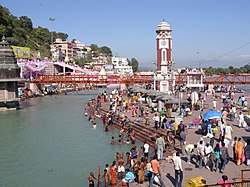
Vishnu is said to have left his footprint on the stone that is set in the upper wall of Har-Ki-Pauri (literally, "footsteps of the Lord"), where the Ganges touches it at all times. Devout Hindus perform ritualistic bathing here on the banks of the river Ganges, an act considered to be the equivalent of washing away one's sins to attain moksha.
Seven sages or Saptarishis, namely Kashyapa, Vashishta, Atri, Vishvamitra, Jamadagni, Bharadvaja and Gautama, are said to have meditated at the site of the Sapt Rishi Ashram and Sapt Rishi Sarovar, a place near Haridwar, where the Ganges split into seven currents, so that the rishis would not be disturbed by the flow.
In the Vana Parva of the Mahabharata, where sage Dhaumya tells Yudhishthira about the tirthas of India, Gangadwara, i.e. Haridwar and Kankhal, have been referred to;[16] the text also mentions that the sage Agastya performed a penance here, with the help of his wife, Lopamudra (the princess of Vidharba).[17]
It is said that while Pandavas were going to Himalayas through Haridwar, prince Bhima drew water from the rocks here, by thrusting his knee (goda) into the ground at the present site of 'Bhimagoda' situated at a distance of about 1 km from Har-ki-Pauri.
Ancient period
[edit]Archaeological findings have proved that terra cotta culture dating between 1700 BCE and 1200 BCE existed in this region.[18]
Haridwar came under the rule of the Maurya Empire (322–185 BCE), and later under the Kushan Empire (c. 1st–3rd centuries).
It is believed that the sacred Ghat Har ki Pauri was constructed by King Vikramaditya (1st century BC) in memory of his brother Bharthari, who had come to Haridwar and meditated on the banks of holy Ganges and died here.
First ancient era written evidence of Haridwar is found in the accounts of a Chinese traveller, Huan Tsang, who visited India in 629 CE,[19] during the reign of King Harshavardhan (590–647). He records Haridwar as 'Mo-yu-lo', the remains of which still exist at Mayapur, a little to the south of the modern Haridwar town; among the ruins are a fort and three temples, decorated with broken stone sculptures.[20][21][22] He also mentions the presence of a temple, north of Mo-yu-lo called 'Gangadwara', Gateway of the Ganges.[21]
It is believed that Adi Shankracharya had visited this region and the existing main statue of Chandi Devi Temple was established by him in 8th century A.D.
Medieval period
[edit]Haridwar region was a part of Delhi Sultanate. The armies of Emperor Timur (1336–1405), a Turkic conqueror, had passed through this region on 13 January 1399 to attack Delhi.[23]
During his visit, first Sikh Guru, Guru Nanak (1469–1539) bathed at Haridwar's 'Kushwan Ghat', wherein the famous, 'watering the crops' episode took place.[24][25] His visit is today commemorated by a gurudwara (Gurudwara Nanakwara); according to two Sikh Janamsakhis, this visit took place on the Baisakhi day in 1504 CE. He later had also visited Kankhal en route to Kotdwara in Garhwal.[26] Besides this, third Sikh Guru, Sri Amar Das also visited Hardwar twenty two times during his lifetime.[27]
The Mughal period: Ain-e-Akbari, written by Abul Fazal in the 16th century during the reign of Mughal Emperor Akbar, refers to Maya (Mayapur), known as Hardwar on the Ganges, as sacred city of Hindus.[28] It also mentions that during his travels, and also while at home, Mughal Emperor Akbar drank water from the Ganges river, which he called 'the water of immortality'. Special people were stationed at Sorun and later Haridwar to dispatch water, in sealed jars, to wherever he was stationed.[29]
It is said that Akbar's famous Commander-in-Chief, Raja Man Singh of Amber, laid the foundation of the present day city of Haridwar and also renovated the ghats at Har-ki-pauri. After his death, his ashes are also said to have been immersed at Brahma Kund by Mughal emperor Akbar himself. Brahma Kund (literally "Brahma's reservoir") at Har ki Pauri, Haridwar is one among the four sites where drops of the elixir of immortality, Amrita, accidentally spilled over from the pitcher, in which it was being carried away by the celestial bird Garuda, after the Samudra manthan by the Devas and the Asuras. The famous Kumbh Melas are held at these four sites in rotation, to commemorate the event. Thomas Coryat, an English traveller, who visited the city in the reign of Emperor Jahangir (1596–1627) mentions it as 'Haridwara', the capital of Shiva.[21]
British Raj
[edit]
The Ganges Canal was opened in 1854 after the work began in April 1842,[30] prompted by the famine of 1837–38.[30] The unique feature of the canal is the half-kilometre-long aqueduct over Solani river at Roorkee, which raises the canal 25 metres above the original river.

Post Independence period
[edit]In 1947, when India achieved independence from the British colonial subjugation, the region of present Haridwar district was a part of the then Saharanpur district, in the United Province of the British Raj; the province was renamed as Uttar Pradesh state of India. The Haridwar district came into existence on 28 December 1988 as part of Saharanpur Divisional Commissionary.[3] On 24 September 1998 Uttar Pradesh Legislative Assembly passed the 'Uttar Pradesh Reorganisation Bill', 1998';[4] eventually the Parliament also passed the Indian Federal Legislation – 'Uttar Pradesh Reorganisation Act, 2000' – and thus on 9 November 2000,[5] Haridwar district became part of the newly formed Uttarakhand (then Uttaranchal), the 27th state in the Republic of India.
Demographics
[edit]| Year | Pop. | ±% p.a. |
|---|---|---|
| 1901 | 329,839 | — |
| 1911 | 311,436 | −0.57% |
| 1921 | 296,103 | −0.50% |
| 1931 | 329,914 | +1.09% |
| 1941 | 373,042 | +1.24% |
| 1951 | 427,574 | +1.37% |
| 1961 | 504,582 | +1.67% |
| 1971 | 670,764 | +2.89% |
| 1981 | 890,260 | +2.87% |
| 1991 | 1,124,488 | +2.36% |
| 2001 | 1,447,187 | +2.56% |
| 2011 | 1,890,422 | +2.71% |
| source:[31] | ||
Social groups
[edit]Haridwar has a multiethnic population spread across two geocultural regions: Khadar, and Bangar. A large portion of the population is Gurjars, Sainis, and Chauhans including Van Gurjars and Khadi Chauhans classified as Other Backward Classes(OBCs).[32][33][34][35] Gurjars have villages in Jhabrera, Manglaur, Laksar, Khanpur, Roorkee, Bhagwanpur.[36] Other the Sainis have villages in Roorkee, Laksar, Bhagwanpur, and Haridwar Rural.[37] While Chauhans have villages in BHEL Ranipur, Haridwar Rural, Jwalapur and Laksar.[38]
rest of the groups are Brahmins, Rajputs, and Garhwalis are Classified as Upper caste. Other the Scheduled Castes also have population in Haridwar.[39] jats, Punjabis, Yadavs, Gadarias are also found here in small population.[40][41]
According to the 2011 census Haridwar district has a population of 1,890,422,[6] roughly equal to the nation of Lesotho[43] or the US state of West Virginia.[44] This gives it a ranking of 244th in India (out of a total of 640).[6] The district has a population density of 817 inhabitants per square kilometre (2,120/sq mi) .[6] Its population growth rate over the decade 2001–2011 was 30.63%.[6] Haridwar has a sex ratio of 880 females for every 1000 males.[6]
The main language of Haridwar is Hindi (87.3%), Urdu at 9.7%. Khariboli and Garhwali are also spoken by small minorities.[45]
| Hardwar district: mother-tongue of population, according to the 2011 Indian Census.[45] | |||
|---|---|---|---|
| Mother tongue code | Mother tongue | People | Percentage |
| 002007 | Bengali | 3,708 | 0.2% |
| 006102 | Bhojpuri | 3,201 | 0.2% |
| 006195 | Garhwali | 14,638 | 0.8% |
| 006207 | Gojri/Gujjari/Gujar | 2,329 | 0.1% |
| 006240 | Hindi | 1,649,529 | 87.3% |
| 006340 | Kumauni | 1,805 | 0.1% |
| 013071 | Marathi | 964 | 0.1% |
| 014011 | Nepali | 1,055 | 0.1% |
| 016038 | Punjabi | 15,570 | 0.8% |
| 019014 | Sindhi | 1,094 | 0.1% |
| 022015 | Urdu | 182,536 | 9.7% |
| 053005 | Gujari | 6,270 | 0.3% |
| – | Others | 7,723 | 0.4% |
| Total | 1,890,422 | 100.0% | |
Administrative background
[edit]The Haridwar district is ringed by Saharanpur in the west, Dehradun in the north west and north, Pauri Garhwal in the east, Muzaffarnagar in south and Bijnor in the south-east. Prior to its inclusion in the newly created state of Uttarakhand in 2000, this district was a part of Saharanpur Divisional Commissionary.
The district is administratively subdivided into four tehsils: Haridwar, Roorkee, Bhagwanpur and Laksar. It is further divided into six development blocks: Bhagwanpur, Roorkee, Narsan, Bahadrabad, Laksar, and Khanpur.[3][46]
The district headquarters is in Roshnabad, at a distance of about 12 km from Haridwar railway station. The office of Chief Development Officer is in Vikas Bhawan, Roshnabad. The Collectorate, Vikas Bhawan, District Judiciary, S.S.P. Office, Police line, District Jail, District sports stadium, Jawahar Navodaya Vidyalaya etc. are the prime establishments of this area. Many other administration offices like Lok Seva Ayog and Sanskrit Academy are established here.
Assembly Constituencies
[edit]- Haridwar
- BHEL Ranipur
- Jwalapur (SC)
- Bhagwanpur (SC)
- Jhabreda (SC)
- Piran Kaliyar
- Roorkee
- Khanpur
- Manglaur
- Laksar
- Haridwar Rural
Public representatives
[edit]The district has a single Parliamentary Constituency, and 11 Uttarakhand Legislative Assembly constituencies including, Haridwar, Haridwar Rural, BHEL Ranipur, Jwalapur, Bhagwanpur, Roorkee, Piran Kaliyar, Khanpur, Manglaur, Jhabrera and Laksar.[3][46][47]
Current Member of Parliament (MP) from Haridwar (Lok Sabha constituency) is Nishank Pokhriyal, and Member of Uttarakhand Legislative Assembly from Haridwar City is 'Madan Kaushik'.[47][48]
Economy
[edit]Agriculture is the mainstay of this well irrigated district. Industrialisation had commenced with the establishment of Central Government owned Public Sector plants (PSUs) of [Indian Drugs and Pharmaceuticals Ltd (IDPL)] and Bharat Heavy Electricals Limited, in pre-Uttarakhand 1960s period. The State Industrial Development Corporation of Uttarakhand (SIDCUL) has now established one new 'industrial development zone' in the district, adjacent to Shivalik Nagar near Haridwar, to encourage industrialisation; with industrial giants like Hindustan Lever, Patanjali Group of companies, Dabur, Mahendra & Mahendra and Havells having moved in, it is making the desired progress. Not insignificant to the district's economy is the contribution of Hindu pilgrims who visit the holy places and attend the religious fairs in large numbers.
Education
[edit]Haridwar district has several academic institutions, covering studies in sciences, engineering, technology and advanced research in the city of Roorkee.
Education in Sanskrit based classics and Hindu religious/cultural disciplines is an age-old tradition in the district, mainly centred in and around Haridwar city. Some of the important institutions of this genre are:
- Gurukul Kangri, situated in Kankhal, on the banks of river Ganges, on Haridwar-Jwalapur bypass road. It is one of the oldest Universities of India. It was founded in 1902, to study the unique Gurukul based education system. Here Ancient Vedic and Sanskrit literature, Ayurveda, Philosophy are part of the curriculum besides modern sciences and journalism. Its 'Archaeological Museum', established in 1945,[49] houses some rare statues, coins, paintings, manuscripts and artefacts, starting from Harappa culture (c.2500–1500 BC).[50] Mahatma Gandhi visited the campus three times,[51] and stayed in its sprawling and serene campus for extended periods of time, most notably during the 1915 Kumbh mela.[52][53]
- Vishwa Sanskrit Mahavidyalaya, Haridwar. A Sanskrit University, set up by Govt. of Uttarakhand,[54] it is the only university in the world dedicated to studies of ancient Sanskrit scriptures and books. Its curriculum also covers ancient Hindu rituals, traditions and culture, and it boasts of a building inspired by ancient Hindu architecture style.
- State Ayuevedic College & Hospital Rishikul, Haridwar, is the oldest Ayurvedic Medical College of India. It is situated near Devpura in Haridwar on the banks of Upper Ganges Canal. It is also providing postgraduate education for Ayurveda. Soon it will be transformed as the first Ayuevedic University of Uttarakhand.
- Govt Ayurvedic College & Hospital, Gurukul Kangri of HNB Garhwal University is also one of the oldest Ayurvedic medical colleges in India. It is situated in Gurukul Kangri University Campus.
- Dev Sanskriti Vishwavidyalaya: established in 2002 by the act of the Uttarnchal Government is a fully residential university. Run by Sri Vedmata Gayatri Trust, Shantikunj Haridwar (headquarters of All World Gayatri Pariwar), it provides various degree, diploma and certificate courses in areas like Yogic Science, Alternative Therapy, Indian Culture, Tourism, Rural Management, Theology (Dharm Vigyan), Spiritual Counseling etc. It also provides distance learning courses.
- Sheel Institute Situated in Shivalik Nagar, 10 km (6.2 mi) from Haridwar city. one of the Best Computer Institute in Haridwar.
Modern Ashrams are also being established in the district for imparting training in yoga and meditation to people coming now from near and far, including foreign countries of the West :
- Shantikunj Ashram provides a 9 days camp and one month / three months courses covering yoga, meditation, art of living, scientific spirituality etc.
Religious festivals and fairs
[edit]
Being a place of intense religious significance, Haridwar also hosts several religious festivals throughout the year; popular among them are the Kavad Mela, Somvati Amavasya Mela, Ganga Dashara, Gughal Mela, in which around 2–2.5 million people take part.[55]
Apart from these, there is the mammoth Kumbh Mela which takes place once in every twelve years, when the planet Jupiter (Brihaspati) comes into the sign Aquarius (Kumbha). First written evidence of the Kumbha Mela can be found in the accounts of Chinese traveller Huan Tsang or Xuanzang (602 – 664 A.D.), who visited India in 629 CE.[19][56] The 1998 Maha Kumbh Mela saw over 80 million pilgrims visiting this city, to take a dip in the holy river Ganges.[57]
Places of pilgrimage
[edit]
Har ki Pauri: One of the holiest spots on earth for the Hindus, this ancient bathing ghat (Steps) is of prime importance. A majority of the present ghats were largely developed in the 1800s.[58]
Sati Kund: It is the well-known mythological Sati immolation heritage situated in Kankhal.
Daksheswara Mahadev Temple: The ancient temple of Daksha Mahadev, also known as Daksheswara Mahadev Temple, is situated in the south of Kankhal town and is a tribute to the legends of Sati's self-immolated and king Daksha's death and later life with a goat's head.
Maya Devi Temple: This temple of the Adhisthatri deity of Haridwar is considered one of the Siddhapeethas and is said to be the place where the heart and navel of Goddess Sati had fallen. It is one of the few ancient temples still standing in Haridwar, along with Narayani Shila Temple and Bhairav Temple.[59]
Sapt Rishi Ashram and Sapt Rishi Sarovar, where the Ganges split herself into seven currents so that seven great sages on its bank would not be disturbed by the flow.
Bhimgoda Tank: This tank, where Bhima is said to have drawn water from the rocks by thrusting his knee into the ground, is situated at a distance of about 1 km from Har-ki-Pauri.
Chandi Devi Temple: The present temple, commemorating the ancient Chandi legend, was constructed in 1929 CE by the Dogra King of Kashmir, Suchat Singh; it can also be reached through a ropeway.
Mansa Devi Temple: The temple dedicated to Mansa Devi, a form of Shakti draws many pilgrims. There are two ways to reach the temple – trekking or it can also be reached through a ropeway.
Piran Kaliyar Sharif: This famous 'Dargah' (Shrine) of Hazrat Alauddin Sabir Kaliyari, a 13th-century Sufi Saint of Chishti Order, was built by Ibrahim Lodhi, a Delhi Sultanate ruler.[60] Also known as Sarkar Sabir Pak, it is located in Kaliyar village, 7 km from Roorkee,[61][62] and is a living example of religious harmony in India; it is visited by devotees from all over the world, during the annual 'Urs' festival, which is celebrated from 1st day (of sighting the new moon) to 16th day of Rabee-ul-awwal month of Islamic calendar.
Rama Mandir: This Rama temple is under construction at Bhupatwala and would be the biggest in size in India.
Shantikunj: Shantikunj is headquarters of spiritual and social organisation All World Gayatri Pariwar (AWGP). Founder of the organisation, Pt. Shriram Sharma Acharya, was a great saint, spiritual leader and freedom fightor. He spent last twenty years of his life here, writing literature and directing activities of the organisation. Shantikunj is considered as a place of pilgrimage by millions of devotees of this global organisation.
Transportation
[edit]National Highway 58, between Delhi and Mana Pass, passes through Haridwar. Indian Railways links Haridwar Railway Station to all parts of India. The nearest airport is Jolly Grant Airport, Dehradun, 45 kilometres from Haridwar, though Indira Gandhi International Airport in New Delhi is preferred.
References
[edit]- ^ "History of Haridwar". haridwar.nic.in. Archived from the original on 10 December 2007.
- ^ "Haridwar District Uttarakhand, Information Updates of Haridwar District Uttarakhand Uttaranchal India". Euttaranchal.com. Archived from the original on 20 September 2012. Retrieved 3 August 2012.
- ^ a b c d Geography of Haridwar Archived 10 December 2007 at the Wayback Machine
- ^ a b Reorganisation Bill passed by UP Govt Archived 7 September 2009 at the Wayback Machine The Indian Express, 24 September 1998.
- ^ a b Uttarakhand Govt. of India, Official website.
- ^ a b c d e f "District Census 2011". Census2011.co.in. 2011. Retrieved 30 September 2011.
- ^ Haridwara weather and coordinates timeanddate.com/worldclock.
- ^ [1][permanent dead link] City Development Plan: Haridwara Urban Development Department, Government of Uttarakhanda. p.20.
- ^ Neel Dhara Bird Sanctuary
- ^ Yudhishthira The Mahabharata, translated by Kisari Mohan Ganguli (1883 – 1896), Book 3: Vana Parva: Tirtha-yatra Parva: Section XC, p 204.
- ^ sites[permanent dead link] Uttarakhand Govt. Official website.
- ^ Legend Archived 8 July 2011 at the Wayback Machine Chandi Devi Temple, Haridwar.
- ^ Story of Bhagirata
- ^ "Uttarakhand Information Centre – Gangotri Information" Archived 16 June 2008 at the Wayback Machine The Complete Uttarakhand Travel Guide
- ^ Mankodi, Kirit (1973) "Ganga Tripathaga" Artibus Asiae 35(1/2): pp. 139–144, p. 140
- ^ Historical, Cultural and Social Perspectives Chapter 3, The Cultural Dimension of Ecology, Baidyanath Saraswati, 1998, Indira Gandhi National Centre for the Arts. ISBN 81-246-0102-X. ignca.nic.in. Vanaparva (The Book of the Forest) is third parva (book) of Mahabharata.
- ^ Lopamudra The Mahabharata, translated by Kisari Mohan Ganguli (1883 -1896), Book 3: Vana Parva: Tirtha-yatra Parva: Section XCVII.
- ^ Haridwar History Archived 10 December 2007 at the Wayback Machine Haridwar Official website.
- ^ a b Kumbh Mela Channel 4.
- ^ Chisholm, Hugh, ed. (1911). . Encyclopædia Britannica. Vol. 12 (11th ed.). Cambridge University Press. p. 944.
- ^ a b c Hardwar The Imperial Gazetteer of India, v. 13, p. 52.
- ^ Digital Library The Imperial Gazetteer of India, Oxford, 1908, Vol.13, p.51.
- ^ History The Imperial Gazetteer of India, v. 2, p. 570.
- ^ Guru Nanak (for Children) – A New Way of Teaching
- ^ Life Of Guru Nanak: Chapter IV The Sikh Religion, Volume 1, by Max Arthur Macauliffe (1842–1913), Oxford University Press (1909). page 50-52.
- ^ Janasakhi Archived 24 March 2012 at the Wayback Machine Janamsakhis of Miharban and Mani Singh, Janamsakhi Tradition, Dr. Kirpal Singh, 2004, Punjabi University, Patiala. ISBN 81-7205-311-8. www.globalsikhstudies.net.
- ^ "Welcome to Punjabkesari.com-Religion". Archived from the original on 12 August 2010. Retrieved 10 August 2009. – Punjabkesari.
- ^ Sacred Places of Pilgrimage Archived 14 July 2018 at the Wayback Machine Ain-e-Akbari, Vol. III, p. 306.
- ^ Hardwar Archived 20 September 2011 at the Wayback Machine Ain-e-Akbari, by Abul Fazl 'Allami, Volume I, A´I´N 22. The A´bda´r Kha´nah. P 55. Translated from the original Persian, by Heinrich Blochmann and Colonel Henry Sullivan Jarrett, Asiatic Society of Bengal. Calcutta, 1873–1907. "His Majesty calls this source of life "the water of immortality", and has committed the care of this department to proper persons.... Both at home and on travels, he drinks Ganges water".
- ^ a b Upper Ganges Canal The Imperial Gazetteer of India, 1909, v. 12, p. 138.
- ^ Decadal Variation In Population Since 1901
- ^ Arya, Shivdev (27 December 2024). "हरिद्वार जनपद के निकाय चुनाव मेंं भी गुर्जर समाज के साथ धोखा". The Arya Times. Retrieved 28 February 2025.
- ^ Kumar, Ashish. A Citygraphy of Panchpuri Haridwar. Clever Fox Publishing.
- ^ "Haridwar News: आप से शिप्रा सैनी होंगी मेयर प्रत्याशी". Amar Ujala (in Hindi). Retrieved 28 February 2025.
- ^ "Uttarakhand: Politics of OBC runs in 21 assembly constituencies BJP Congress all political parties support reservation - उत्तराखंड:21 विधानसभा क्षेत्रों में चलती है OBC की सियासत, भाजपा,कांग्रेस सहित सभी राजनीतिक दल आरक्षण की पैरवी पर उतरे". 28 February 2022. Archived from the original on 28 February 2022. Retrieved 28 February 2025.
- ^ "Roorkee में जारी है जातीय महापंचायतों का दौर, अब गुर्जर समाज ने 5 फरवरी का किया आह्वान - Gurjar Community Calls for Mahapanchayat in roorkee Amid Ongoing MLA Package Controversy". Jagran (in Hindi). Retrieved 28 February 2025.
- ^ "सैनी समाज को विधानसभा में दिलाएंगे जगह: हरीश". Amar Ujala (in Hindi). Retrieved 28 February 2025.
- ^ "हरिद्वार में चौहान बिरादरी की धर्मशाला बनाने को लेकर जोर—शोर से अभियान शुरू -". 28 August 2024. Retrieved 28 February 2025.
- ^ "Indian Districts by Population, Sex Ratio, Literacy 2011 Census". www.census2011.co.in. Retrieved 28 February 2025.
- ^ "उत्तराखंड के लोगो की जाति के नाम – Garh Chetna". 28 May 2017. Retrieved 28 February 2025.
- ^ "Uttarakhand: Politics of OBC runs in 21 assembly constituencies BJP Congress all political parties support reservation - उत्तराखंड:21 विधानसभा क्षेत्रों में चलती है OBC की सियासत, भाजपा,कांग्रेस सहित सभी राजनीतिक दल आरक्षण की पैरवी पर उतरे". 28 February 2022. Archived from the original on 28 February 2022. Retrieved 28 February 2025.
- ^ "Table C-01 Population by Religion: Uttarakhand". censusindia.gov.in. Registrar General and Census Commissioner of India. 2011.
- ^ US Directorate of Intelligence. "Country Comparison:Population". Archived from the original on 13 June 2007. Retrieved 1 October 2011.
Lesotho 1,924,886
- ^ "2010 Resident Population Data". U.S. Census Bureau. Archived from the original on 19 October 2013. Retrieved 30 September 2011.
West Virginia 1,852,994
- ^ a b c "Table C-16 Population by Mother Tongue: Uttarakhand". www.censusindia.gov.in. Registrar General and Census Commissioner of India.
- ^ a b Haridwar district Archived 29 July 2007 at the Wayback Machine
- ^ a b List of Public Representatives from Haridwar Archived 19 February 2008 at the Wayback Machine Official website.
- ^ Uttarakhand: Winners list Rediff News, 27 February 2007.
- ^ Archeological Museum, Haridwar Archived 3 December 2008 at the Wayback Machine indiatourism.com.
- ^ Artefacts in the Museum Gurukul Kangri, Archaeological Museum.
- ^ Gurukul Archived 24 May 2008 at the Wayback Machine Official website of Haridwar.
- ^ Kumbh Mela 1915 The Story of My Experiments with Truth/Part V/Lakshman Jhula.
- ^ Chronology of Mahatma Gandhi's life/India 1916 Wiki Source.
- ^ Sanskrit University Archived 17 October 2007 at the Wayback Machine Govt. of Uttarakhand.
- ^ Fairs in Haridwar Archived 10 April 2009 at the Wayback Machine Haridwar Official website.
- ^ Kumbh Mela Archived 27 July 2009 at the Wayback Machine www.archaeologyonline.net.
- ^ Kumbh Mela, a study Archived 31 March 2009 at the Wayback Machine Missouri State University
- ^ "Haridwar History". Archived from the original on 27 January 2007. Retrieved 10 August 2009.
- ^ Temples in Haridwar Archived 3 October 2011 at the Wayback Machine
- ^ Piran Archived 3 May 2008 at the Wayback Machine Haridwar Official website.
- ^ Piran Kaliyar[permanent dead link] Times of India, 13 March 2003.
- ^ Local Attractions Roorkee Archived 6 April 2008 at the Wayback Machine
External links
[edit]Places adjacent to Haridwar district | ||||||||||||||||
|---|---|---|---|---|---|---|---|---|---|---|---|---|---|---|---|---|
| ||||||||||||||||


Further reading
[edit]
- Chapter XVII: Himalayas, Hardwar. India, Past and Present, by Charles Harcourt Ainslie Forbes-Lindsay. Published by J.C. Winston, 1903.
| International | |
|---|---|
| National | |


Haridwar district
View on GrokipediaGeography and Environment
Physical Features
Haridwar district covers 2,360 square kilometers in the western part of Uttarakhand, with central coordinates of 29.58° N latitude and 78.13° E longitude.[7] Elevations range from 145 meters in the southern alluvial plains to 885 meters in the northern areas.[8] The district's terrain transitions from undulating foothills of the Shivalik Hills in the north to flat, fertile plains in the south, reflecting its position at the edge of the Indo-Gangetic basin and the outer Himalayas.[8] The Shivalik Hills, the southernmost Himalayan range with elevations typically 600–1,200 meters, occupy a small northern sector, contributing to varied topography and seasonal inflows.[8] This foothill zone borders Dehradun district to the north and east, while the plains extend southward toward Uttar Pradesh districts like Muzaffarnagar and Bijnor.[7] Soils in the plains are predominantly alluvial, deposited by river action, supporting intensive agriculture.[7] The Ganges River forms the primary hydrological feature, descending from the Himalayas and entering the plains within the district near Haridwar city at an average elevation of 249.7 meters. This emergence point broadens the river's channel, fostering abundant water resources and influencing local geomorphology through sedimentation and erosion patterns.[7] No major tributaries dominate within the district boundaries beyond the Ganges main stem, though upstream Himalayan drainage sustains its flow.[8]
Climate and Weather Patterns
Haridwar district features a humid subtropical climate (Köppen Cwa), marked by distinct seasonal variations influenced by its position in the Himalayan foothills and proximity to the Ganges River, which moderates temperatures but contributes to humidity and fog. Annual precipitation averages approximately 1,262 mm, with over 80% occurring during the southwest monsoon from July to September, leading to high humidity levels often exceeding 70% and frequent heavy downpours that can cause localized flooding along riverbanks.[9][10] Summer, spanning March to June, is intensely hot and dry, with average highs reaching 38–40°C in May and June, accompanied by hot winds known as loo that exacerbate heat stress; lows remain above 25°C, and pre-monsoon thunderstorms occasionally provide relief. The monsoon season intensifies rainfall, with July and August recording the highest monthly totals (around 300–400 mm each), fostering lush vegetation but increasing risks of landslides in upstream hilly areas and river swelling. Winters from December to February are mild to cool, with daytime highs of 20–25°C and nighttime lows dipping to 5–8°C; dense fog is common due to radiative cooling over the plains and riverine moisture, reducing visibility and affecting transportation.[11][12] Extreme weather events include heatwaves pushing temperatures above 45°C in summer and occasional cold spells with frost in exposed rural areas during winter, though snowfall is absent at district elevations (around 200–300 m). Long-term data indicate stable patterns with minimal shifts, though monsoon variability can lead to deficits or excesses, as seen in Uttarakhand's 2023 rainfall at 103% of normal.[13][11]Biodiversity and Wildlife
Haridwar district's biodiversity is concentrated in the Rajaji National Park, a key protected area spanning 820 square kilometers across Haridwar and adjacent districts, established in 1983 through the amalgamation of Rajaji, Motichur, and Chilla wildlife sanctuaries to conserve habitats in the Shivalik foothills and along the Ganges River.[14] The park's ecosystems support a transition from subtropical forests to riverine grasslands, fostering high species diversity influenced by the Himalayan foothills' elevation (300–1,000 meters) and perennial rivers like the Ganges, Song, and Solani.[15] This region exemplifies the Terai-Bhabar ecological zone, where anthropogenic pressures from pilgrimage and urbanization have historically threatened habitats, though conservation efforts prioritize flagship species like the Asian elephant.[14] The flora comprises eight major forest types, dominated by Shorea robusta (sal) forests, with mixed deciduous stands of teak (Tectona grandis), khair (Acacia catechu), shisham (Dalbergia sissoo), and semal (Bombax ceiba), alongside chir pine (Pinus roxburghii) on slopes, alluvial savannah woodlands, and riverine vegetation including elephant grass and shrubs.[16] Over 30 fruit-bearing tree species, such as jamun (Syzygium cumini), ber (Ziziphus mauritiana), and various figs (Ficus spp.), sustain wildlife, while 36 orchid species and rare endemics like Catamixis baccharoides and Eremostachys superba highlight botanical richness; fungi play a role in nutrient cycling across these moist and dry deciduous formations.[16] Mammalian fauna includes over 50 species, with an estimated 450 Asian elephants (Elephas maximus) forming migratory herds that traverse the park's corridors, alongside tigers (Panthera tigris), leopards (Panthera pardus), sloth bears (Melursus ursinus), Himalayan black bears (Ursus thibetanus), wild boars (Sus scrofa), goral (Naemorhedus goral), and ungulates such as sambar (Rusa unicolor), spotted deer or cheetal (Axis axis), barking deer (Muntiacus vaginalis), and nilgai (Boselaphus tragocamelus).[16] [14] Smaller mammals like langurs, jungle cats (Felis chaus), and yellow-throated martens (Martes flavigula) occupy diverse niches, supported by the park's prey base and anti-poaching measures.[14] Avifauna exceeds 400 species, with 90 migrants such as pochards, gulls, mallards, teals, and shelducks utilizing riverine wetlands, while residents include Indian peafowl (Pavo cristatus), great pied hornbills (Buceros bicornis), kingfishers, 11 woodpecker species, five barbets, and raptors; the park's forest birds reflect Shivalik endemism, though habitat fragmentation poses risks.[16] [15] Reptiles feature the king cobra (Ophiophagus hannah), monitor lizards, turtles, and tortoises in aquatic and terrestrial habitats, with the Ganges supporting fish diversity and amphibians in seasonal wetlands like those near Jhilmil Jheel Sanctuary.[14] [15] Overall, Rajaji's biodiversity underscores Haridwar's role in elephant conservation corridors linking to Corbett National Park, though invasive species and river pollution from upstream sources challenge long-term viability.[15]Environmental Challenges and Conservation
The Ganges River, which flows through Haridwar district, encounters pollution from untreated sewage, industrial discharges, and solid waste, particularly intensified during mass pilgrimages such as the Kanwar Yatra, where spikes in biochemical oxygen demand (BOD), total suspended solids, and fecal coliform levels degrade water quality in the Haridwar-Rishikesh stretch.[17] Despite its upper basin location offering relatively cleaner baseline conditions—with BOD levels often below detectable limits to 0.7 mg/L at Uttarakhand's exit points as of November 2023—persistent local effluents and religious immersions challenge sustained purity. Recurrent flooding exacerbates environmental vulnerability, driven by monsoon deluges, glacial melt, and upstream dam releases, with the district recording significant incidents including a 2023 rainfall event causing Rs 189 crore in damages, seven fatalities, and destruction of 370 houses.[18] In 2024, heavy rains triggered a house collapse in Roorkee tehsil killing four and injuring ten, alongside Sukhi River overflows that swept away vehicles into the Ganges.[19][20] These events erode riverbanks, deposit sediments, and disrupt ecosystems, compounded by deforestation and unplanned urban growth in floodplains. Biodiversity faces threats from habitat fragmentation and human-wildlife conflicts in areas like Rajaji National Park, which spans Haridwar district and reports elephant poaching, highway-related wildlife deaths on NH-72 and NH-74, and increasing human-elephant confrontations leading to 25 elephant fatalities between 1987 and documented periods.[21][22] Urban expansion near Haridwar and Rishikesh further pressures the park's 820 km² of tiger, elephant, and leopard habitats.[23] Conservation measures include the Namami Gange programme, which has augmented Haridwar's sewage treatment capacity to 145 million liters per day through new facilities like the 68 MLD Jagjeetpur plant—India's first under the hybrid annuity model—and the 14 MLD Sarai plant, enabling treated effluent reuse for irrigation and reducing direct Ganges discharges.[24][25] In Rajaji National Park, anti-poaching patrols and habitat management have supported tiger population recovery amid prey availability, though ongoing challenges like roadkills necessitate mitigation such as wildlife corridors.[26][27] Local initiatives, including Jhilmil Jheel Wildlife Sanctuary's integration into broader park efforts, aim to preserve wetland biodiversity for migratory birds.[28]Historical Development
Mythological Foundations and Legends
![Hindu god Shiva murti statue near Ganges in Haridwar][float-right] Haridwar, known anciently as Gangadwar or the "gateway of the Ganges," holds profound mythological importance in Hindu traditions as the point where the sacred river Ganga first descends from the Himalayas to the plains.[29] This descent is central to the region's legends, symbolizing purification and moksha, with scriptures portraying the site as a tirtha where divine intervention manifests on earth.[30] The primary legend recounts King Bhagiratha's penance to bring Ganga to earth to redeem his 60,000 ancestors, sons of King Sagara, who were incinerated by Sage Kapila's gaze for disturbing his meditation.[31] After millennia of austerity, Brahma granted Bhagiratha's boon, directing Ganga—who resided in the heavens as a goddess—to descend, but her forceful flow threatened to devastate the earth. Lord Shiva intervened, catching the river in his matted locks to temper her descent, releasing her gradually at what became Haridwar.[32] This event, detailed in Puranic texts, establishes Haridwar as Kapilsthan (abode of Kapila) and underscores the Ganga's role in absolving sins through ritual baths.[33] Haridwar also features in the Mahabharata, where Sage Dhaumya recommends Gangadwar to Yudhishthira as a prime pilgrimage site for spiritual merit during the Pandavas' exile.[34] The epics and Puranas collectively reference the district under names like Mayapur and Mokshadwar, affirming its status among Hinduism's seven sacred cities, where divine footprints are believed to linger.[29] These narratives, rooted in Vedic and post-Vedic lore, emphasize causal purification through the Ganga's terrestrial arrival, independent of later interpretive biases in scriptural exegesis.[35]Ancient and Vedic Periods
Haridwar, referred to anciently as Gangadwar (Gateway of the Ganges), emerged as a key geographical and ritual site during the Vedic period (c. 1500–500 BCE), marking the transition of the Ganges River from Himalayan foothills to the fertile plains conducive to early Indo-Aryan settlements. This position supported Vedic practices centered on riverine purification and yajnas (sacrificial rituals), as the Ganges is invoked in the Rigveda (e.g., RV 10.75.5) among sacred rivers symbolizing cosmic order and fertility, though direct site-specific mentions are absent in core Vedic Samhitas. Later Vedic texts and associated literature, such as the Mahabharata, describe Gangadwar as a tirtha for pilgrimages and asceticism, reflecting its integration into expanding Vedic cultural networks across the Doab region.[6] Archaeological evidence for Vedic-era occupation in Haridwar remains sparse, consistent with the period's emphasis on mobile pastoralism and perishable wooden structures rather than durable urban remains, unlike contemporaneous Painted Grey Ware sites further east in the Gangetic plain. No major excavations have uncovered Vedic hearths, pottery, or inscriptions at the site, underscoring reliance on textual traditions for historical reconstruction. Traditional associations, including the Sapt Rishi Ashram linked to seven Vedic sages, suggest Haridwar's role in rishi (sage) lineages and knowledge transmission, potentially fostering early brahmanical centers amid the Shivalik hills.[6] The site's antiquity as one of India's continuously inhabited locales is corroborated by its scriptural continuity, with post-Vedic Upanishads and epics portraying it as a locus for moksha (liberation) pursuits, bridging Vedic ritualism to emerging philosophical inquiry. This enduring sanctity likely stemmed from causal factors like reliable water access and strategic location for seasonal migrations, enabling Haridwar's evolution from a Vedic ritual hub to a perennial pilgrimage nexus.[36]Medieval and Mughal Eras
During the medieval period, the Haridwar region fell under the control of the Delhi Sultanate following the establishment of Muslim rule in northern India after Muhammad of Ghor's victory over Prithviraj Chauhan in 1192 CE, with the Sultanate formally consolidating power by 1206 CE. As part of the fertile Doab between the Ganges and Yamuna rivers, the area was incorporated into the administrative framework of successive dynasties, including the Slave, Khilji, Tughlaq, and Sayyid dynasties, though direct governance often involved local intermediaries amid frequent dynastic upheavals and invasions. Pilgrimage activities at the Ganges ghats persisted despite the Islamic overlordship, reflecting the site's enduring religious importance for Hindus, with limited evidence of systematic interference compared to more urban centers like Delhi or Mathura. Timur's invasion of India in 1398 CE, aimed at the weakening Tughlaq Sultanate, saw his armies traverse northern regions including parts of the Doab en route to sacking Delhi in December of that year, potentially affecting local stability in Haridwar's vicinity through plunder and displacement, though primary accounts like Timur's Zafarnama focus primarily on the capital rather than peripheral pilgrimage sites. The post-Timur fragmentation further diminished central control, allowing semi-autonomous local Hindu chieftains in the Himalayan foothills to exert influence over the area until the Lodi dynasty's restoration of Sultanate authority in the early 16th century. The Mughal era began with Babur's defeat of Ibrahim Lodi at Panipat in 1526 CE, integrating Haridwar into the empire's suba of Delhi. Under Akbar (r. 1556–1605), the site—referred to as Mayapur in official records—retained its status as a key Hindu bathing center, with the Ain-i-Akbari detailing the oblong tank at Haridwar visited by pilgrims during lunar eclipses and praising the Ganges waters, which Akbar personally consumed, viewing them as salubrious. A mint operated in Haridwar for producing Akbar's copper dam coins, indicating economic integration without overt religious suppression. Jahangir (r. 1605–1627) continued this policy of relative tolerance, with English traveler Thomas Coryat providing the earliest European attestation of the name "Haridwar" during his 1610s visit, noting the throngs of pilgrims. Later Mughals, particularly Aurangzeb (r. 1658–1707), adopted stricter orthodoxy, leading to sporadic conflicts; reports indicate attempts to disrupt Kumbh Mela gatherings around 1664–1666 CE, met with resistance from warrior ascetics such as Naga Sadhus who defended the site and pilgrims. Despite such tensions, Haridwar's infrastructure for rituals, including ghats and ashrams, endured, underscoring the limits of imperial enforcement in remote pilgrimage hubs amid declining Mughal authority by the early 18th century.Colonial Period under British Rule
The region encompassing Haridwar came under British control in the early 19th century following the Treaty of Surji-Anjangaon in 1803, by which the Maratha Confederacy ceded territories in the Doab, including areas around Saharanpur, to the East India Company. Haridwar, as part of this territory, was incorporated into the North-Western Provinces and administered through the Saharanpur district established in 1819. Throughout the colonial period, the town retained its significance as a Hindu pilgrimage center, with the Ganges and sites like Har Ki Pauri continuing to attract devotees despite administrative oversight by British officials.[37] A major infrastructural development was the construction of the Upper Ganges Canal, initiated in response to the devastating Agra famine of 1837-1838 that claimed over 800,000 lives. Engineering works began in 1842 under Sir Proby Cautley, with the canal headworks located at Haridwar where it diverted water from the Ganges. Completed and inaugurated on April 8, 1854, the 200-mile main canal and its branches irrigated approximately 1.5 million acres of arid land in the upper Doab, transforming agriculture and mitigating future famines through perennial irrigation. The project, involving aqueducts and weirs like the Bhimgoda barrage constructed around the same period, exemplified British engineering priorities in revenue-generating hydraulic works.[38][39][40] British administration formalized management of the Haridwar Kumbh Mela from 1870, imposing organizational controls including sanitation, housing, and crowd management to handle millions of pilgrims, though outbreaks of cholera persisted at events in the 19th century except for 1891. The region transitioned into the United Provinces in 1902, with Haridwar forming part of the Roorkee tehsil in Saharanpur district. Colonial policies emphasized revenue collection from pilgrims and canal-irrigated lands, while railway connectivity via the Saharanpur-Haridwar line in the late 19th century facilitated access, boosting economic activity without fundamentally altering the town's religious character.[41][42]Post-Independence Evolution
Following India's independence on August 15, 1947, the region encompassing present-day Haridwar district remained integrated within Saharanpur district of Uttar Pradesh, retaining its administrative subordination under the state's divisional structure without immediate territorial reconfiguration.[7] [43] The district of Haridwar was formally established on December 28, 1988, carved out from Saharanpur district as part of the Saharanpur Divisional Commissionary to enhance local governance and address growing administrative demands from pilgrimage tourism and nascent industrial activity.[7] [5] This separation facilitated targeted development, including the initiation of housing schemes by the Haridwar Development Authority starting in 1986, which encompassed eight projects covering substantial urban expansion by the early 2000s.[43] On September 24, 1998, the Uttar Pradesh Legislative Assembly passed a resolution affirming Haridwar's distinct district status, underscoring its evolving identity amid regional demands for autonomy.[5] Subsequently, with the creation of Uttarakhand (initially named Uttaranchal) as India's 27th state on November 9, 2000—through the Uttar Pradesh Reorganisation Act, 2000—Haridwar district was incorporated into the new state, transitioning from Uttar Pradesh's plains governance to Uttarakhand's framework, which emphasized balanced hill-plain administration despite Haridwar's lowland topography and demographic contrasts with upland districts.[7] [44] This integration spurred accelerated industrial and infrastructural growth, positioning Haridwar as a key manufacturing hub within Uttarakhand, with post-1988 establishments attracting enterprises in engineering and consumer goods sectors, though pilgrimage-related infrastructure remained central to its economic evolution.[5]Demographics and Society
Population Dynamics and Census Data
According to the 2011 Census of India, Haridwar district had a total population of 1,890,422, comprising 1,005,295 males and 885,127 females.[7][45] The sex ratio stood at 880 females per 1,000 males, lower than the national average of 943, reflecting patterns observed in northern Indian districts with industrial and migratory influences.[46] Literacy rate was 73.43% overall, with male literacy at 82.72% and female at 63.20%; rural areas reported 68.29% literacy (77.36% male, 58.11% female), while urban areas reached 81.9%.[46][47] The district's population grew by 30.64% from 1,447,187 in the 2001 Census to 1,890,422 in 2011, outpacing Uttarakhand's state growth of 18.81% and India's national rate of 17.64%, attributable to industrial expansion in areas like SIDCUL and pilgrimage-related migration.[46][48] Population density was 801 persons per square kilometer across 2,360 km², with higher concentrations in urban centers like Haridwar city (population 228,832 in 2011) and Roorkee.[49] The child sex ratio (0-6 years) was 890, indicating slight improvement from prior decades but persistent gender imbalances linked to socioeconomic factors.| Census Year | Total Population | Decadal Growth Rate (%) | Sex Ratio (F/1000M) | Literacy Rate (%) |
|---|---|---|---|---|
| 2001 | 1,447,187 | - | 865 | 64.44 |
| 2011 | 1,890,422 | 30.64 | 880 | 73.43 |
Religious and Caste Composition
According to the 2011 Census of India, Haridwar district's religious composition features a Hindu majority of 64.27% (1,214,935 individuals out of a total population of 1,890,422), reflecting its status as a major Hindu pilgrimage center.[51] Muslims form the largest minority at 34.28% (648,119 individuals), a share that increased from 17.53% in the 2001 census, attributed in official data to higher growth rates among this group.[51] [52] Sikhs comprise 0.92% (17,364), Christians 0.26% (4,878), and smaller proportions include Buddhists (0.07%), Jains (0.03%), and others (0.17%).[51]| Religion | Percentage | Population (2011) |
|---|---|---|
| Hindu | 64.27% | 1,214,935 |
| Muslim | 34.28% | 648,119 |
| Sikh | 0.92% | 17,364 |
| Christian | 0.26% | 4,878 |
| Other | 0.27% | ~5,126 |
Socioeconomic Indicators
According to the 2011 Census of India, Haridwar district had a population of 1,890,422, with a sex ratio of 880 females per 1,000 males and a literacy rate of 73.43 percent, exceeding the national average of 72.99 percent but marked by gender gaps, including lower female literacy in rural areas at 58.11 percent compared to male rates of 77.36 percent.[46] Population density stood at approximately 801 persons per square kilometer, reflecting urban concentration around pilgrimage and industrial hubs.[47] The district's per capita income reached Rs. 362,688 in 2021-22, the highest among Uttarakhand districts, driven by industrial and tourism sectors, though this masks disparities with 32 percent of households holding Below Poverty Line cards as per NFHS-5 (2019-21).[55] [56] Multidimensional poverty headcount ratio declined to 11.89 percent under NFHS-5, better than the state average in some metrics but higher than urban benchmarks, indicating uneven progress in health, education, and living standards deprivations.[57] Health indicators reveal persistent challenges: infant mortality rate at 40 per 1,000 live births and under-five mortality at 48 per 1,000, with child stunting at 31.1 percent, wasting at 16.4 percent, and anemia affecting 63.1 percent of children aged 6-59 months.[58] [56] Household amenities show improvement, with 94 percent access to toilet facilities, 93 percent to basic drinking water, and 76 percent pucca houses, though anemia prevalence among women remains elevated at around 43.8 percent state-wide, correlating with district trends.[56]| Indicator | Value (Latest Available) | Source |
|---|---|---|
| Literacy Rate (Overall, 2011) | 73.43% | Census 2011[46] |
| Multidimensional Poverty Headcount (2019-21) | 11.89% | NITI Aayog MPI[57] |
| Per Capita Income (2021-22) | Rs. 362,688 | District Economic Data[55] |
| Child Stunting (Under 5, 2019-21) | 31.1% | NFHS-5[56] |
| Households with Toilet Facility (2019-21) | 94% | NFHS-5[56] |