


Community hub
Recent from talks
Contribute something
Nothing was collected or created yet.
Kublai Khan
View on Wikipedia
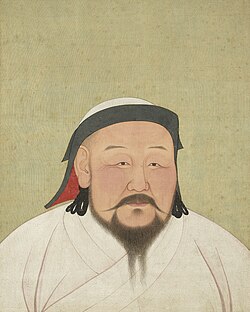
Kublai Khan[b][c] (23 September 1215 – 18 February 1294), also known by his temple name as the Emperor Shizu of Yuan and his regnal name Setsen Khan, was the founder and first emperor of the Mongol-led Yuan dynasty of China. He proclaimed the dynastic name "Great Yuan"[d] in 1271, and ruled Yuan China until his death in 1294.
Key Information


Kublai was the second son of Tolui by his chief wife Sorghaghtani Beki, and a grandson of Genghis Khan. He was almost 12 when Genghis Khan died in 1227. He had succeeded his older brother Möngke as Khagan in 1260, but had to defeat his younger brother Ariq Böke in the Toluid Civil War lasting until 1264. This episode marked the beginning of the division of the Mongol Empire.[4] Kublai's real power was limited to the Yuan Empire, even though as Khagan he still influenced the Ilkhanate and, to a significantly lesser degree, the Golden Horde.[5][6][7]
In 1271, Kublai established the Yuan dynasty and formally claimed orthodox succession from prior Chinese dynasties.[8] The Yuan dynasty came to rule over most of present-day China, Mongolia, Korea, southern Siberia, and other adjacent areas. He also amassed influence in the Middle East and Europe as Khagan. By 1279, the Yuan conquest of the Song dynasty was completed and Kublai became the first non-Han emperor to rule all of China proper. As emperor, he ordered invasions of Japan, Vietnam, Burma and Java.
Early years
[edit]Kublai Khan was the fourth son of Tolui, and his second son with Sorghaghtani Beki. As his grandfather Genghis Khan advised, Sorghaghtani chose a Buddhist Tangut woman as her son's nurse, whom Kublai later honored highly. On his way home after the Mongol conquest of Khwarezmia, Genghis Khan performed a ceremony on his grandsons Möngke and Kublai after their first hunt in 1224 near the Ili River.[9] Kublai was nine years old and with his eldest brother killed a rabbit and an antelope. After his grandfather smeared fat from the killed animals onto Kublai's middle finger per a Mongol tradition, he said "The words of this boy Kublai are full of wisdom, heed them well – heed them all of you." The elderly Genghis Khan would die three years after this event in 1227, when Kublai was 12. Kublai's father Tolui would serve as regent for two years until Genghis' successor, Kublai's third uncle Ogedei, was enthroned as Khagan in 1229.
After the Mongol conquest of the Jin dynasty, in 1236, Ogedei gave Hebei (attached with 80,000 households) to the family of Tolui, who died in 1232. Kublai received an estate of his own, which included 10,000 households. Because he was inexperienced, Kublai allowed local officials free rein. Corruption amongst his officials and aggressive taxation caused large numbers of ethnic Han peasants to flee, which led to a decline in tax revenues. Kublai quickly came to his appanage in Hebei and ordered reforms. Sorghaghtani Beki sent new officials to help him and tax laws were revised. Thanks to those efforts, many of the people who fled returned.
The most prominent, and arguably most influential, component of Kublai Khan's early life was his study and a strong attraction to contemporary Han culture. Kublai invited Haiyun, the leading Buddhist monk in northern China, to his ordo in Mongolia. When he met Haiyun in Karakorum in 1242, Kublai asked him about the philosophy of Buddhism. Haiyun named Kublai's son, who was born in 1243, Zhenjin.[10] Haiyun also introduced Kublai to the formerly Taoist, and at the time Buddhist monk, Liu Bingzhong. Liu was a painter, calligrapher, poet, and mathematician, and he became Kublai's advisor when Haiyun returned to his temple in modern Beijing.[11] Kublai soon added the Shanxi scholar Zhao Bi to his entourage. Kublai employed people of other nationalities as well, for he was keen to balance local and imperial interests, Mongol and Turkic.
Victory in northern China
[edit]
In 1251, Kublai's eldest brother Möngke became Khan of the Mongol Empire, and Khwarezmian Mahmud Yalavach and Kublai were sent to China proper. Kublai received the viceroyalty over northern China and moved his ordo to central Inner Mongolia. During his years as viceroy, Kublai managed his territory well, boosted the agricultural output of Henan, and increased social welfare spending after receiving Xi'an. These acts received great acclaim from ethnic Han warlords and were essential to the founding of the Yuan dynasty. In 1252, Kublai criticized Mahmud Yalavach, who was never highly valued by his ethnic Han associates, over his cavalier execution of suspects during a judicial review, and Zhao Bi attacked him for his presumptuous attitude toward the throne. Möngke dismissed Mahmud Yalavach, which met with resistance from Han Confucian-trained officials.[12]
In 1253, Kublai was ordered to attack Yunnan and he tried to ask the Dali Kingdom to submit. The ruling Gao family resisted and killed Mongol envoys. The Mongols divided their forces into three. One wing rode eastward into the Sichuan basin. The second column under Subutai's son Uriyangkhadai took a difficult route into the mountains of western Sichuan.[13] Kublai went south over the grasslands and met up with the first column. While Uriyangkhadai travelled along the lakeside from the north, Kublai took the capital city of Dali and spared the residents despite the slaying of his ambassadors. The Dali emperor Duan Xingzhi (段興智) himself defected to the Mongols, who used his troops to conquer the rest of Yunnan. Duan Xingzhi, the last king of Dali, was appointed by Möngke Khan as the first tusi or local ruler; Duan accepted the stationing of a pacification commissioner there.[14] After Kublai's departure, unrest broke out among certain factions. In 1255 and 1256, Duan Xingzhi was presented at court, where he offered Möngke Khan maps of Yunnan and counsels about the vanquishing of the tribes who had not yet surrendered. Duan then led a considerable army to serve as guides and vanguards for the Mongol army. By the end of 1256, Uriyangkhadai had completely pacified Yunnan.[15]
Kublai was attracted by the abilities of Tibetan monks as healers. In 1253 he made Drogön Chögyal Phagpa of the Sakya school, a member of his entourage. Phagpa bestowed on Kublai and his wife, Chabi (Chabui), an empowerment (initiation ritual). Kublai appointed Lian Xixian (1231–1280) the head of his pacification commission in 1254. Some officials, who were jealous of Kublai's success, said that he was getting above himself and dreaming of having his own empire by competing with Möngke's capital Karakorum. Möngke Khan sent two tax inspectors, Alamdar (Ariq Böke's close friend and governor in North China) and Liu Taiping, to audit Kublai's officials in 1257. They found fault, listed 142 breaches of regulations, accused Han officials and executed some of them, and Kublai's new pacification commission was abolished.[16] Kublai sent a two-man embassy with his wives and then appealed in person to Möngke, who publicly forgave his younger brother and reconciled with him.[citation needed]
The Daoists had obtained their wealth and status by seizing Buddhist temples. Möngke repeatedly demanded that the Daoists cease their denigration of Buddhism and ordered Kublai to end the clerical strife between the Daoists and Buddhists in his territory.[17] Kublai called a conference of Daoist and Buddhist leaders in early 1258. At the conference, the Daoist claim was officially refuted, and Kublai forcibly converted 237 Daoist temples to Buddhism and destroyed all copies of the Daoist texts.[18][19][20] Kublai Khan and the Yuan dynasty clearly favored Buddhism, while his counterparts in the Chagatai Khanate, the Golden Horde, and the Ilkhanate later converted to Islam at various times in history – Berke of the Golden Horde being the only Muslim during Kublai's era (his successor did not convert to Islam).[citation needed]

In 1258, Möngke put Kublai in command of the Eastern Army and summoned him to assist with an attack on Sichuan. As he was suffering from gout, Kublai was allowed to stay home, but he moved to assist Möngke anyway. Before Kublai arrived in 1259, word reached him that Möngke had died. Kublai decided to keep the death of his brother secret and continued the attack on Wuhan, near the Yangtze. While Kublai's force besieged Wuchang, Uriyangkhadai joined him.[citation needed] The Song minister Jia Sidao secretly approached Kublai to propose terms. He offered an annual tribute of 200,000 taels of silver and 200,000 bolts of silk, in exchange for Mongol agreement to the Yangtze as the frontier between the states.[21] Kublai declined at first but later reached a peace agreement with Jia.
Enthronement and civil war
[edit]Kublai received a message from his wife that his younger brother Ariq Böke had been raising troops, so he returned north to the Mongolian Plateau.[22] Before he arrived, he learned that Ariq Böke had held a kurultai (Mongol great council) at the capital Karakorum, which had named him Great Khan with the support of most of Genghis Khan's descendants. Kublai and the fourth brother, the Il-Khan Hulagu, opposed this. Kublai's ethnic Han staff encouraged Kublai to ascend the throne, and almost all the senior princes in northern China and Manchuria supported his candidacy.[23] Upon returning to his own territories, Kublai summoned his own kurultai. Fewer members of the royal family supported Kublai's claims to the title, though the small number of attendees included representatives of all the Borjigin lines except that of Jochi. This kurultai proclaimed Kublai Great Khan on 15 April 1260, despite Ariq Böke's being elected by the representatives of Genghis Khan's four elder sons and the late emperor Möngke's wife and sons along with his main officials, the descendants of Genghis' two brothers, and the Ilkhan Hülegü's eldest son who stayed in Mongolia.[24]

This led to warfare between Kublai and Ariq Böke, which resulted in the destruction of the Mongol capital at Karakorum. In Shaanxi and Sichuan, Möngke's army supported Ariq Böke. Kublai dispatched Lian Xixian to Shaanxi and Sichuan, where they executed Ariq Böke's civil administrator Liu Taiping, and won over several wavering generals.[25] To secure the southern front, Kublai attempted a diplomatic resolution and sent envoys to Hangzhou, but Jia broke his promise and arrested them.[26] Kublai sent Abishqa as new khan to the Chagatai Khanate. Ariq Böke captured Abishqa, two other princes, and 100 men, and he had his own man, Alghu, crowned khan of Chagatai's territory. In the first armed clash between Ariq Böke and Kublai, Ariq Böke lost and his commander Alamdar was killed at the battle. In revenge, Ariq Böke had Abishqa executed. Kublai cut off supplies of food to Karakorum with the support of his cousin Kadan, son of Ögedei Khan. Karakorum quickly fell to Kublai's large army, but following Kublai's departure it was temporarily re-taken by Ariq Böke in 1261. Yizhou governor Li Tan revolted against Mongol rule in February 1262, and Kublai ordered his Chancellor Shi Tianze and Shi Shu to attack Li Tan. The two armies crushed Li Tan's revolt in just a few months and Li Tan was executed. These armies also executed Wang Wentong, Li Tan's father-in-law, who had been appointed the Chief Administrator of the Central Secretariat (Zhongshu Sheng) early in Kublai's reign and became one of Kublai's most trusted Han Chinese officials. The incident instilled in Kublai a distrust of ethnic Hans. After becoming emperor, Kublai banned granting the titles of and tithes to ethnic Han warlords.[citation needed]
During the civil war, both sides hurriedly conscripted new soldiers, including clergymen and male monks. On 28 January 1264, Kublai imposed land and commercial taxes on all religious establishments, traditionally exempted from Mongol taxation, that tilled soils and conducted trade.[24]
Chagatayid Khan Alghu, who had been appointed by Ariq Böke, declared his allegiance to Kublai and defeated a punitive expedition sent by Ariq Böke in 1262. The Ilkhan Hulagu also sided with Kublai and criticized Ariq Böke. Ariq Böke surrendered to Kublai at Xanadu on 21 August 1264. The rulers of the western khanates acknowledged Kublai's victory and rule in Mongolia.[27] When Kublai summoned them to a new kurultai, Alghu Khan demanded recognition of his illegal position from Kublai in return. Despite tensions between them, both Hulagu and Berke, khan of the Golden Horde, at first accepted Kublai's invitation.[28][29] However, they soon declined to attend the kurultai. Kublai pardoned Ariq Böke, although he executed Ariq Böke's chief supporters.[30]
Reign
[edit]Great Khan of the Mongols
[edit]The mysterious deaths of three Jochid princes in Hulagu's service, the Siege of Baghdad (1258), and unequal distribution of war spoils strained the Ilkhanate's relations with the Golden Horde. In 1262, Hulagu's complete purge of the Jochid troops and support for Kublai in his conflict with Ariq Böke brought open war with the Golden Horde. Kublai reinforced Hulagu with 30,000 young Mongols to stabilize the political crises in the western regions of the Mongol Empire.[31] When Hulagu died on 8 February 1264, Berke marched to cross near Tbilisi to conquer the Ilkhanate but died on the way. Within a few months of these deaths, Alghu Khan of the Chagatai Khanate also died. In the new official version of his family's history, Kublai refused to write Berke's name as the khan of the Golden Horde because of Berke's support for Ariq Böke and wars with Hulagu; however, Jochi's family was fully recognized as legitimate family members.[32]
.jpg)
"The most powerful prince of the Tartars is named Holubeim [Kubilay Khan], which means Great Khan. This emperor is richer than any other emperor in the world. This emperor is protected by twelve thousand horsemen with their four captains that stay at the court three months of the year."[33]
Kublai Khan named Abaqa as the new Ilkhan (obedient khan) and nominated Batu's grandson Mentemu for the throne of Sarai, the capital of the Golden Horde.[34][35] The Kublaids in the east retained suzerainty over the Ilkhans until the end of their regime.[23][36] Kublai also sent his protege Ghiyas-ud-din Baraq to overthrow the court of the Oirat Orghana, the empress of the Chagatai Khanate, who put her young son Mubarak Shah on the throne in 1265, without Kublai's permission after her husband's death.
Prince Kaidu of the House of Ögedei declined to personally attend the court of Kublai. Kublai instigated Baraq to attack Kaidu. Baraq began to expand his realm northward; he seized power in 1266 and fought Kaidu and the Golden Horde. He also pushed out Great Khan's overseer from the Tarim Basin. When Kaidu and Mentemu together defeated Kublai, Baraq joined an alliance with the House of Ögedei and the Golden Horde against Kublai in the east and Abagha in the west. Meanwhile, Mentemu avoided any direct military expedition against Kublai's realm. The Golden Horde promised Kublai their assistance to defeat Kaidu whom Mentemu called the rebel.[37] This was apparently due to the conflict between Kaidu and Mentemu over the agreement they made at the Talas kurultai. The armies of Mongol Persia defeated Baraq's invading forces in 1269. When Baraq died the next year, Kaidu took control of the Chagatai Khanate and recovered his alliance with Mentemu.[citation needed]
Meanwhile, Kublai tried to stabilize his control over the Korean Peninsula by mobilizing another Mongol invasion after he enthroned Wonjong of Goryeo (r. 1260–1274) in 1259 on Ganghwado. Kublai also forced two rulers of the Golden Horde and the Ilkhanate to call a truce with each other in 1270 despite the Golden Horde's interests in the Middle East and the Caucasus.[38]
In 1260, Kublai sent one of his advisors, Hao Ching, to the court of Emperor Lizong of Song to say that if Lizong submitted to Kublai and surrendered his dynasty, he would be granted some autonomy.[39] Emperor Lizong refused to meet Kublai's demands and imprisoned Hao Ching and when Kublai sent a delegation to release Hao Ching, Emperor Lizong sent them back.[39]
Kublai called two Iraqi siege engineers from the Ilkhanate to destroy the fortresses of Song China. After the fall of Xiangyang in 1273, Kublai's commanders, Aju and Liu Zheng, proposed a final campaign against the Song dynasty, and Kublai made Bayan of the Baarin the supreme commander.[40] Kublai ordered Möngke Temür to revise the second census of the Golden Horde to provide resources and men for his conquest of China.[41] The census took place in all parts of the Golden Horde, including Smolensk and Vitebsk in 1274–75. The Khans also sent Nogai Khan to the Balkans to strengthen Mongol influence there.[42]
Kublai renamed the Mongol regime in China Dai Yuan in 1271, and sought to sinicize his image as Emperor of China to win control of millions of Han Chinese people. When he moved his headquarters to Khanbaliq, also called Dadu, in modern-day Beijing, there was an uprising in the old capital Karakorum that he barely contained. Kublai's actions were condemned by traditionalists and his critics still accused him of being too closely tied to Han Chinese culture. They sent a message to him: "The old customs of our Empire are not those of the Han Chinese laws ... What will happen to the old customs?"[43][44] Kaidu attracted the other elites of Mongol Khanates, declaring himself to be a legitimate heir to the throne instead of Kublai, who had turned away from the ways of Genghis Khan.[45][46] Defections from Kublai's dynasty swelled the Ögedeids' forces.

The Song imperial family surrendered to the Yuan in 1276, making the Mongols the first non-Han Chinese people to conquer all of China. Three years later, Yuan marines crushed the last of the Song loyalists. The Song Empress Dowager and her grandson, Emperor Gong of Song, were then settled in Khanbaliq where they were given tax-free property, and Kublai's wife Chabi took a personal interest in their well-being. However, Kublai later had Emperor Gong sent away to become a monk to Zhangye.[citation needed]
Kublai succeeded in building a powerful empire, created an academy, offices, trade ports, and canals, and sponsored science and the arts. The record of the Mongols lists 20,166 public schools created during Kublai's reign.[45] Having achieved real or nominal dominion over much of Eurasia, and having successfully conquered China, Kublai was in a position to look beyond China.[47] However, Kublai's costly invasions of Vietnam (1258), Sakhalin (1264), Burma (1277), Champa (1282), and Vietnam again (1285) secured only the vassal status of those countries. Mongol invasions of Japan (1274 and 1281), the third invasion of Vietnam (1287–88), and the invasion of Java (1293) failed.
At the same time, Kublai's nephew Ilkhan Abaqa tried to form a grand alliance of the Mongols and the Western European powers to defeat the Mamluks in Syria and North Africa that constantly invaded the Mongol dominions. Abaqa and Kublai focused mostly on foreign alliances and opened trade routes. Khagan Kublai dined with a large court every day and met with many ambassadors and foreign merchants.[citation needed]
Kublai's son Nomukhan and his generals occupied Almaliq from 1266 to 1276. In 1277, a group of Genghisid princes under Möngke's son Shiregi rebelled, kidnapped Kublai's two sons and his general Antong and handed them over to Kaidu and Möngke Temür. The latter was still allied with Kaidu who fashioned an alliance with him in 1269, although Möngke Temür had promised Kublai his military support to protect Kublai from the Ögedeids.[45] Kublai's armies suppressed the rebellion and strengthened the Yuan garrisons in Mongolia and the Ili River basin. However, Kaidu took control over Almaliq.

In 1279–80, Kublai decreed death for those who performed slaughtering of cattle according to the legal codes of Islam (dhabihah) or Judaism (kashrut), which offended Mongolian custom.[48] When Tekuder seized the throne of the Ilkhanate in 1282, attempting to make peace with the Mamluks, Abaqa's old Mongols under prince Arghun appealed to Kublai. After the assassination of Ahmad Fanakati and execution of his sons, Kublai confirmed Arghun's coronation and awarded his commander in chief Buqa the title of chancellor.[citation needed]
Kublai's niece, Kelmish, who married a Khongirad general of the Golden Horde, was powerful enough to have Kublai's sons Nomuqan and Kokhchu returned. Three leaders of the Jochids, Tode Mongke, Köchü, and Nogai, agreed to release two princes.[49] The court of the Golden Horde returned the princes as a peace overture to the Yuan dynasty in 1282 and induced Kaidu to release Kublai's general. Konchi, khan of the White Horde, established friendly relations with the Yuan and the Ilkhanate, and as a reward received luxury gifts and grain from Kublai.[50] Despite political disagreement between contending branches of the family over the office of Khagan, the economic and commercial system continued.[51][52][53][54]
Emperor of the Yuan dynasty
[edit]
Kublai Khan considered China his main base, realizing within a decade of his enthronement as Great Khan that he needed to concentrate on governing there.[55] From the beginning of his reign, he adopted Chinese political and cultural models and worked to minimize the influences of regional lords, who had held immense power before and during the Song dynasty. Kublai heavily relied on his Chinese advisers until about 1276. He had many Han Chinese advisers, such as Liu Bingzhong and Xu Heng, and employed many Buddhist Uyghurs, some of whom were resident commissioners running Chinese districts.[56]
Kublai also appointed the Sakya lama Drogön Chögyal Phagpa ("the Phags pa Lama") his Imperial Preceptor, giving him power over all the empire's Buddhist monks. In 1270, after the Phags pa Lama created the 'Phags-pa script, he was promoted to imperial preceptor. Kublai established the Supreme Control Commission under the Phags pa Lama to administer the affairs of Tibetan and Chinese monks. During Phagspa's absence in Tibet, the Tibetan monk Sangha rose to high office and had the office renamed the Commission for Buddhist and Tibetan Affairs.[57][58] In 1286, Sangha became the dynasty's chief fiscal officer. However, their[whose?] corruption later embittered Kublai, and he later relied wholly on younger Mongol aristocrats. Antong of the Jalairs and Bayan of the Baarin served as grand councillors from 1265, and Oz-temur of the Arulad headed the censorate. Borokhula's descendant, Ochicher, headed a kheshig (Mongolian imperial guard) and the palace provision commission.[citation needed]
In the eighth year of Zhiyuan (1271), Kublai officially created the Yuan dynasty and proclaimed the capital as Dadu (Chinese: 大都; Wade–Giles: Ta-tu; lit. 'Grand Capital', known as Khanbaliq or Daidu to the Mongols, modern Beijing) the following year. His summer capital was in Shangdu (Chinese: 上都; lit. 'Upper Capital', also called Xanadu, near what today is Dolon Nor). To unify China,[59] Kublai began a massive offensive against the remnants of the Southern Song in 1274 and finally destroyed the Song in 1279, unifying the country at last at the Battle of Yamen where the last Song Emperor Zhao Bing committed suicide by jumping into the sea and ending the Song dynasty.[60]

Most of the Yuan domains were administered as provinces, also translated as the "Branch Secretariat", each with a governor and vice-governor.[61] This included China proper, Manchuria, Mongolia, and a special Zhendong branch Secretariat that extended into the Korean Peninsula.[62][63] The Central Region (Chinese: 腹裏) was separate from the rest, consisting of much of present-day North China. It was considered the most important region of the dynasty and was directly governed by the Zhongshu Sheng at Dadu. Tibet was governed by another top-level administrative department called the Bureau of Buddhist and Tibetan Affairs.
Kublai promoted economic growth by rebuilding the Grand Canal, repairing public buildings, and extending highways. However, his domestic policy included some aspects of the old Mongol living traditions, and as his reign continued, these traditions would clash increasingly frequently with traditional Chinese economic and social culture. Kublai decreed that partner merchants of the Mongols should be subject to taxes in 1262 and set up the Office of Market Taxes to supervise them in 1268.[64] After the Mongol conquest of the Song, the Muslim, Uighur and Chinese merchants expanded their operations to the South China Sea and the Indian Ocean.[64] In 1286, maritime trade was put under the Office of Market Taxes. The main source of revenue for the government was the monopoly of salt production.[65]
The Mongol administration had issued paper currencies from 1227 on.[66][67] In August 1260, Kublai created the first unified paper currency called Jiaochao; bills were circulated throughout the Yuan domain with no expiration date. To guard against devaluation, the currency was convertible with silver and gold, and the government accepted tax payments in paper currency. In 1273, Kublai issued a new series of state-sponsored bills to finance his conquest of the Song, although eventually, a lack of fiscal discipline and inflation turned this move into an economic disaster. It was required to pay only in the form of paper money. To ensure its use, Kublai's government confiscated gold and silver from private citizens and foreign merchants, but traders received government-issued notes in exchange. Kublai Khan is considered to be the first fiat money maker. The paper bills made collecting taxes and administering the empire much easier and reduced the cost of transporting coins.[68] In 1287, Kublai's minister Sangha created a new currency, Zhiyuan Chao, to deal with a budget shortfall.[69] It was non-convertible and denominated in copper cash. Later Gaykhatu of the Ilkhanate attempted to adopt the system in Iran and the Middle East, which was a complete failure, and shortly afterward he was assassinated.[citation needed]

Kublai encouraged Asian arts and demonstrated religious tolerance. Despite his anti-Daoist edicts, Kublai respected the Daoist master and appointed Zhang Liushan as the patriarch of the Daoist Xuánjiào (玄教, "Mysterious Order").[70] Under Zhang's advice, Daoist temples were put under the Academy of Scholarly Worthies. Several Europeans visited the empire, notably the Italian explorer Marco Polo in the 1270s, who was appointed to serve as Khan's foreign emissary throughout the empire and lived in the emperor's lands for 17 years.[71][72]
During the Southern Song, the descendant of Confucius at Qufu, Duke Yansheng Kong Duanyou fled south with the Song Emperor to Quzhou, while the newly established Jin dynasty (1115–1234) in the north appointed Kong Duanyou's brother Kong Duancao who remained in Qufu as Duke Yansheng. From that time up until the Yuan dynasty, there were two Duke Yanshengs, one in the north in Qufu and the other in the south at Quzhou. An invitation to come back to Qufu was extended to the southern Duke Yansheng Kong Zhu by the Yuan Dynasty Emperor Kublai Khan. The title was taken away from the southern branch after Kong Zhu rejected the invitation, so the northern branch of the family kept the title of Duke Yansheng.[73][74][75][76][77][78][79] The southern branch still remained in Quzhou where they lived to this day. Confucius's descendants in Quzhou alone number 30,000.[80][unreliable source?]
Yuan Emperors like Kublai Khan forbade practices such as butchering according to Jewish (kashrut) or Muslim (dhabihah) legal codes and other restrictive decrees continued. Circumcision was also strictly forbidden.[81][82][83]
Scientific developments and relations with minorities
[edit]
Thirty Muslims served as high officials in the court of Kublai Khan. Eight of the dynasty's twelve administrative districts had Muslim governors appointed by Kublai Khan.[84][better source needed] Among the Muslim governors was Sayyid Ajjal Shams al-Din Omar, who became administrator of Yunnan. He was a well-learned man in the Confucian and Daoist traditions and is believed to have propagated Islam in China. Other administrators were Nasr al-Din (Yunnan) and Mahmud Yalavach (mayor of the Yuan capitol).
Kublai Khan patronized Muslim scholars and scientists, and Muslim astronomers contributed to the construction of the observatory in Shaanxi.[85] Astronomers such as Jamal ad-Din introduced 7 new instruments and concepts that allowed the correction of the Chinese calendar.[citation needed]
Muslim cartographers made accurate maps of all the nations along the Silk Road and greatly influenced the knowledge of Yuan dynasty rulers and merchants.[citation needed]
Muslim physicians organized hospitals and had their institutes of Medicine in Beijing and Shangdu. In Beijing was the renowned Guang Hui Si "Department of extensive mercy", where Hui medicine and surgery were taught. Avicenna's works were also published in China during that period.[86]
Muslim mathematicians introduced Euclidean Geometry, Spherical trigonometry and Arabic numerals in China.[87]
Kublai brought siege engineers Ismail and Al al-Din to China, and together they invented the "Muslim trebuchet" (or Huihui Pao), which was utilized by Kublai Khan during the Battle of Xiangyang.[88]
Warfare and foreign relations
[edit]
Although Kublai restricted the functions of the kheshig, he created a new imperial bodyguard, at first entirely ethnic Han in composition but later strengthened with Kipchak, Alan (Asud), and Russian units.[89][90][91] Once his own kheshig was organized in 1263, Kublai put three of the original kheshigs under the charge of the descendants of Genghis Khan's assistants, Borokhula, Boorchu, and Muqali. Kublai began the practice of having the four great aristocrats in his kheshig sign jarligs (decrees), a practice that spread to all other Mongol khanates.[92] Mongol and Han units were organized using the same decimal organization that Genghis Khan used. The Mongols eagerly adopted new artillery and technologies. Kublai and his generals adopted an elaborate, moderate style of military campaigns in southern China. Effective assimilation of the naval techniques of the Han people allowed the Yuan army to quickly conquer the Song.
Tibet and Xinjiang
[edit]In 1285 the Drikung Kagyu sect revolted, attacking Sakya monasteries. The Chagatayid Khan, Duwa, helped the rebels, laying siege to Gaochang and defeating Kublai's garrisons in the Tarim Basin.[93] Kaidu destroyed an army at Beshbalik and occupied the city the following year. Many Uyghurs abandoned Kashgar for safer bases back in the eastern part of the Yuan dynasty. After Kublai's grandson Buqa-Temür crushed the resistance of the Drikung Kagyu, killing 10,000 Tibetans in 1291, Tibet was fully pacified.
Subjugation of Goryeo
[edit]
Kublai Khan invaded Goryeo on the Korean Peninsula and made it a tributary "son-in-law" state in 1260. After another Mongol intervention in 1273, Goryeo came under even tighter control of the Yuan.[94][95][96][97][98] Goryeo became a Mongol military base, and several myriarchy commands were established there. Members of the Goryeo royal family were taken to Khanbaliq, and typically married to spouses from the Yuan imperial clan, the House of Borjigin. As a result, princes who became monarchs of Goryeo during this period were effectively imperial sons in-law (khuregen). The court of the Goryeo supplied Korean troops and an ocean-going naval force for the Mongol campaigns.[citation needed]
Further naval expansion
[edit]
Despite the opposition of some of his Confucian-trained advisers, Kublai decided to invade Japan, Burma, Vietnam, and Java, following the suggestions of some of his Mongol officials. He also attempted to subjugate peripheral lands such as Sakhalin, where its indigenous people eventually submitted to the Mongols by 1308, after Kublai's death. These costly invasions and conquests and the introduction of paper currency caused inflation. From 1273 to 1276, the war against the Southern Song dynasty and Japan made the issue of paper currency expand from 110,000 ding to 1,420,000 ding.[100]
Invasions of Japan
[edit]
Within Kublai's court, his most trusted governors and advisers appointed by meritocracy with the essence of multiculturalism were Mongol, Semu, Korean, Hui, and Han peoples.[84][101] Because the Wokou extended support to the crumbling Southern Song dynasty, Kublai Khan initiated invasions of Japan.
Kublai Khan twice attempted to invade Japan. It is believed that both attempts were partly thwarted by bad weather or a flaw in the design of ships that were based on river boats without keels, and his fleets were destroyed. The first attempt took place in 1274, with a fleet of 900 ships.[102]
The second invasion occurred in 1281 when Mongols sent two separate forces: 900 ships containing 40,000 Korean, Han, and Mongol troops were sent from Masan, while a force of 100,000 sailed from southern China in 3,500 ships, each close to 240 feet (73 m) long. The fleet was hastily assembled and ill-equipped to cope with maritime conditions. In November, they sailed into the treacherous waters that separated Korea and Japan by 180 kilometres (110 miles). The Mongols easily took over Tsushima Island about halfway across the strait and then Iki Island closer to Kyushu. The Korean fleet reached Hakata Bay on 23 June 1281, and landed its troops and animals, but the ships from China were nowhere to be seen. Mongol landing forces were subsequently defeated at the Battle of Akasaka and the Battle of Torikai-Gata. Takezaki Suenaga's samurai attacked the Mongol army and fought them, as reinforcements led by Shiraishi Michiyasu arrived and defeated the Mongols, who suffered around 3500 dead.[103]
The samurai warriors, following their custom, rode out against the Mongol forces for individual combat but the Mongols held their formation. The Mongols fought as a united force, not as individuals, and bombarded the samurai with exploding missiles and showered them with arrows. Eventually, the remaining Japanese withdrew from the coastal zone inland to a fortress. The Mongol forces did not chase the fleeing Japanese into an area about which they lacked reliable intelligence. In several individual skirmishes, known collectively as the Kōan Campaign (弘安の役) or the "Second Battle of Hakata Bay", the Mongol forces were driven back to their ships by the Samurai. The Japanese army was heavily outnumbered, but had fortified the coastal line with two-meter-high walls, and was easily able to repulse the Mongolian forces that were launched against it.

Maritime archaeologist Kenzo Hayashida led the investigation that discovered the wreckage of the second invasion fleet off the western coast of Takashima District, Shiga. His team's findings strongly indicate that Kublai rushed to invade Japan and attempted to construct his enormous fleet in one year, a task that should have taken up to five years. This forced the Chinese to use any available ships, including riverboats. Most importantly, the Chinese, under Kublai's control, built many ships quickly to contribute to the fleets in both of the invasions. Hayashida theorizes that, had Kublai used standard, well-constructed ocean-going ships with curved keels to prevent capsizing, his navy might have survived the journey to and from Japan and might have conquered it as intended. In October 2011, a wreck, possibly one of Kublai's invasion craft, was found off the coast of Nagasaki.[104] David Nicolle wrote in The Mongol Warlords, "Huge losses had also been suffered in terms of casualties and sheer expense, while the myth of Mongol invincibility had been shattered throughout eastern Asia." He also wrote that Kublai was determined to mount a third invasion, despite the horrendous cost to the economy and his and Mongol prestige of the first two defeats, and only his death and the unanimous agreement of his advisers not to invade prevented a third attempt.[105]
Invasions of Vietnam
[edit]Kublai Khan invaded Đại Việt in a total of five separate incursions between 1257 and 1292, with major campaigns in 1258, 1285, and 1287. These three campaigns are treated by several scholars as a success due to the establishment of tributary relations with Đại Việt despite the Mongols suffering major military defeats.[106][107][108] In contrast, Vietnamese historiography regards the war as a major victory against the foreign invaders whom they called "the Mongol yokes".[109][106]
The first invasion began in 1258 under the united Mongol Empire, as it looked for alternative paths to invade the Song dynasty. The Mongol general Uriyangkhadai was successful in capturing the abandoned Vietnamese capital Thang Long (modern-day Hanoi) before turning north in 1259 to invade the Song dynasty in modern-day Guangxi as part of a coordinated Mongol attack with armies attacking in Sichuan under Möngke Khan and other Mongol armies attacking in modern-day Shandong and Henan.[110] The first invasion also established tributary relations between the Vietnamese dynasty, formerly a Song dynasty tributary state, and the Yuan dynasty.[111]
Intending to demand greater tribute and direct Yuan oversight of local affairs in Đại Việt and Champa, the Yuan launched another invasion in 1285. The second invasion of Đại Việt failed to accomplish its goals, and the Yuan launched a third invasion in 1287 with the intent of replacing the uncooperative Đại Việt ruler Trần Nhân Tông with the defected Trần prince Trần Ích Tắc. By the end of the second and third invasions, which involved both initial successes and eventual major defeats for the Mongols, both Đại Việt and Champa decided to accept the nominal supremacy of the Yuan dynasty and became tributary states to avoid further bloodshed and conflict.[112][113]
Southeast Asia and South Seas
[edit]Three expeditions against Burma, in 1277, 1283, and 1287, brought the Mongol forces to the Irrawaddy Delta, whereupon they captured Bagan, the capital of the Pagan kingdom and established their government.[114] Kublai had to be content with establishing a formal suzerainty, but Pagan finally became a tributary state, sending tributes to the Yuan court until the Yuan dynasty fell to the Ming dynasty in 1368.[115] Mongol interests in these areas were commercial and tributary relationships.
Kublai Khan maintained close relations with Siam, in particular with Prince Mangrai of Chiang Mai and King Ramkhamhaeng of Sukhothai.[116] In fact, Kublai encouraged them to attack the Khmers following the southern retreat of the Siamese from Nanchao.[116][117][118] This happened after King Jayavarman VIII of the Khmer Empire refused to pay tribute to the Mongols.[116][119][120] Jayavarman VIII was so insistent on not having to pay tribute to Kublai that he had Mongol envoys imprisoned.[116][120][118] These attacks from the Siamese eventually weakened the Khmer Empire. The Mongols then decided to venture south into Cambodia in 1283 by land from Champa.[121] They were able to conquer Cambodia by 1284.[122] Cambodia effectively became a vassal state by 1285 when Jayavarman VIII was finally forced to pay tribute to Kublai.[121][123][124]
During the last years of his reign, Kublai launched a naval punitive expedition of 20–30,000 men against Singhasari on Java (1293), but the invading Mongol forces were forced to withdraw by Majapahit after considerable losses of more than 3000 troops. Nevertheless, by 1294, the year that Kublai died, the Thai kingdoms of Sukhothai and Chiang Mai had become vassal states of the Yuan dynasty.[114]
Europe
[edit]
Under Kublai, direct contact between East Asia and Europe was established, made possible by Mongol control of the central Asian trade routes and facilitated by the presence of efficient postal services. At the beginning of the 13th century, Europeans and Central Asians – merchants, travelers, and missionaries of different orders – made their way to China. The presence of Mongol power allowed large numbers of Yuan subjects, intent on warfare or trade, to travel to other parts of the Mongol Empire, all the way to Rus, Persia, and Mesopotamia.[citation needed]

Africa
[edit]In the 13th century, the Sultanate of Mogadishu, through its trade with prior Chinese regimes, had acquired enough of a reputation in Asia to attract the attention of Kublai Khan.[125] According to Marco Polo, Kublai sent an envoy to Mogadishu to spy out the Sultanate but the delegation was captured and imprisoned. Kublai Khan then sent another envoy to treat for the release of the earlier Mongol delegation sent to Africa.[126]
Capital city
[edit]
After Kublai Khan was proclaimed Khagan at his residence in Shangdu on 5 May 1260, he began to organize the country. Zhang Wenqian, a central government official, was sent by Kublai in 1260 to Daming where unrest had been reported in the local population. A friend of Zhang's, Guo Shoujing, accompanied him on this mission. Guo was interested in engineering, was an expert astronomer and skilled instrument maker, and understood that good astronomical observations depended on expertly made instruments. Guo began to construct astronomical instruments, including water clocks for accurate timing and armillary spheres that represented the celestial globe. Turkestani architect Ikhtiyar al-Din, also known as "Igder", designed the buildings of the city of the Khagan, Khanbaliq (Dadu).[127] Kublai also employed foreign artists to build his new capital; one of them, a Newar named Araniko, built the White Stupa that was the largest structure in Khanbaliq/Dadu.[128]
Zhang advised Kublai that Guo was a leading expert in hydraulic engineering. Kublai knew the importance of water management for irrigation, transport of grain, and flood control, and he asked Guo to look at these aspects in the area between Dadu (now Beijing) and the Yellow River. To provide Dadu with a new supply of water, Guo found the Baifu spring in Mount Shen and had a 30 km (19 mi) channel built to move water to Dadu. He proposed connecting the water supply across different river basins, built new canals with sluices to control the water level, and achieved great success with the improvements he made. This pleased Kublai and Guo was asked to undertake similar projects in other parts of the country. In 1264 he was asked to go to Gansu to repair the damage that had been caused to the irrigation systems by the years of war during the Mongol advance through the region. Guo travelled extensively along with his friend Zhang taking notes of the work needed to be done to unblock damaged parts of the system and to make improvements to its efficiency. He sent his report directly to Kublai Khan.[citation needed]
Nayan's rebellion
[edit]During the conquest of the Jin dynasty, Genghis Khan's younger brothers received large appanages in Manchuria.[129] Their descendants strongly supported Kublai's coronation in 1260, but the younger generation desired more independence. Kublai enforced Ögedei Khan's regulations that the Mongol noblemen could appoint overseers and the Great Khan's special officials, in their appanages, but otherwise respected appanage rights. Kublai's son Manggala established direct control over Chang'an and Shanxi in 1272. In 1274, Kublai appointed Lian Xixian to investigate abuses of power by Mongol appanage holders in Manchuria.[130] The region called Lia-tung was immediately brought under the Khagan's control, in 1284, eliminating autonomy of the Mongol nobles there.[131]

Threatened by the advance of Kublai's bureaucratization, Nayan, a fourth-generation descendant of one of Genghis Khan's brothers, either Temüge or Belgutei, instigated a revolt in 1287. (More than one prince named Nayan existed and their identity is confused.[132]) Nayan tried to join forces with Kublai's competitor Kaidu in Central Asia.[133] Manchuria's native Jurchens and Water Tatars, who had suffered a famine, supported Nayan. Virtually all the fraternal lines under Hadaan, a descendant of Hachiun, and Shihtur, a grandson of Qasar, joined Nayan's rebellion,[134] and because Nayan was a popular prince, Ebugen, a grandson of Genghis Khan's son Khulgen, and the family of Khuden, a younger brother of Güyük Khan, contributed troops for this rebellion.[135]
The rebellion was crippled by early detection and timid leadership. Kublai sent Bayan to keep Nayan and Kaidu apart by occupying Karakorum, while Kublai led another army against the rebels in Manchuria. Kublai's commander Oz Temür's Mongol force attacked Nayan's 60,000 inexperienced soldiers on 14 June, while ethnic Han and Alan guards under Li Ting protected Kublai. The army of Chungnyeol of Goryeo assisted Kublai in battle. After a hard fight, Nayan's troops withdrew behind their carts, and Li Ting began bombardment and attacked Nayan's camp that night. Kublai's force pursued Nayan, who was eventually captured and executed without bloodshed, by being smothered under felt carpets, a traditional way of executing princes.[135] Meanwhile, the rebel prince Shikqtur invaded Liaoning but was defeated within a month. Kaidu withdrew westward to avoid a battle. However, Kaidu defeated a major Yuan army in the Khangai Mountains and briefly occupied Karakorum in 1289. Kaidu had ridden away before Kublai could mobilize a larger army.[40]
Widespread but uncoordinated uprisings of Nayan's supporters continued until 1289; these were ruthlessly repressed. The rebel princes' troops were taken from them and redistributed among the imperial family.[136] Kublai harshly punished the darughachi appointed by the rebels in Mongolia and Manchuria.[137] This rebellion forced Kublai to approve the creation of the Liaoyang Branch Secretariat on 4 December 1287, while rewarding loyal fraternal princes.[citation needed]
Later years
[edit] |

Kublai Khan dispatched his grandson Gammala to Burkhan Khaldun in 1291 to ensure his claim to Ikh Khorig, where Genghis was buried, a sacred place strongly protected by the Kublaids. Bayan was in control of Karakorum and was re-establishing control over surrounding areas in 1293, so Kublai's rival Kaidu did not attempt any large-scale military action for the next three years. From 1293 on, Kublai's army cleared Kaidu's forces from the Central Siberian Plateau.[citation needed]
After his wife Chabi died in 1281, Kublai began to withdraw from direct contact with his advisers, and he issued instructions through one of his other queens, Nambui. Only two of Kublai's daughters are known by name; he may have had others. Unlike the formidable women of his grandfather's day, Kublai's wives and daughters were an almost invisible presence. Kublai's original choice of successor was his son Zhenjin, who became the head of the Zhongshu Sheng and actively administered the dynasty according to Confucian fashion. Nomukhan, after returning from captivity in the Golden Horde, expressed resentment that Zhenjin had been made heir apparent, but he was banished to the north. An official proposed that Kublai should abdicate in favor of Zhenjin in 1285, a suggestion that angered Kublai, who refused to see Zhenjin. Zhenjin died soon afterward in 1286, eight years before his father. Kublai regretted this and remained very close to his wife, Bairam (also known as Kokejin).[citation needed]
Kublai became increasingly despondent after the deaths of his favorite wife and his chosen heir Zhenjin. The failure of the military campaigns in Vietnam and Japan also haunted him. Kublai turned to food and drink for comfort, became grossly overweight, and suffered gout and diabetes. The emperor overindulged in alcohol and the traditional meat-rich Mongol diet, which may have contributed to his gout. Kublai sank into depression due to the loss of his family, his poor health, and his advancing age. Kublai tried every medical treatment available, from Korean shamans to Vietnamese doctors, and remedies and medicines, but to no avail. At the end of 1293, the emperor refused to participate in the traditional New Year's ceremony. Before his death, Kublai passed the seal of Crown Prince to Zhenjin's son Temür, who would become the next Khagan of the Mongol Empire and the second ruler of the Yuan dynasty. Seeking an old companion to comfort him in his final illness, the palace staff could choose only Bayan, more than 30 years his junior. Kublai weakened steadily, and on 18 February 1294, he died at the age of 78. Two days later, the funeral cortège took his body to the burial place of the Khans in Mongolia.[citation needed]
Family
[edit]
Kublai first married Tegulen but she died very early. Then he married Chabi of the Khongirad, who was his most beloved empress. After Chabi's death in 1281, Kublai married Chabi's young cousin, Nambui, presumably in accordance with Chabi's wish.[138]
Principal wives (first and second ordos):
- Empress, of the Bosquur clan of Khongirad (皇后弘吉剌氏, d. 1233),[139] personal name Tegülün (帖古伦), daughter of Tuolian[140]
- Dorji (朵儿只, c. 1233 – d. 1263),[141] 1st son
- Empress Zhaorui Shunsheng, of the Bosquur clan of Khongirad (昭睿順聖皇后 弘吉剌氏 1216 – d. 1281),[142] personal name Chabi (察必)
- Yuelie, Grand Princess of Zhao (赵国大長月烈公主), 2nd daughter
- married to Ay Buqa, Prince of Zhao (趙王) and had issue (four sons)
- Princess Ulujin, Grand Princess of Chang State (昌国大长吾魯真公主), 3rd daughter
- married to Buqa from the Ikires clan
- Chalun, Grand Princess of Chang State (茶倫昌国大长公主), 4th daughter
- married to Teliqian from the Ikires clan.
- Zhenjin, Crown Prince Mingxiao (明孝太子 真金 1240–1285), 2nd son
- Manggala, Prince of Anxi (安西王 忙哥剌, c. 1242–1280), 3rd son
- Öljei, Grand Princess of Lu (鲁国长完泽公主), 5th daughter
- married to Ulujin Küregen of the Bosquur clan of Khongirad, Prince of Lu, and had issue (one daughter)
- Nomughan, Prince of Beiping (北平王 那木罕d. 1301), 4th son
- Nangiajin, Grand Princess of Lu (鲁国大长囊家真公主), 6th daughter
- married to Ulujin Küregen from Khongirad clan
- Temür from Khongirad clan
- Manzitai from Khongirad clan
- Kokechi, Prince of Yunnan (雲南王 忽哥赤d.1271), 6th son
- Qutugh Kelmysh, Queen Jangmok of Goryeo (忽都魯揭里迷失 莊穆王后; 1251–1297), 7th daughter
- Married Wang Ko, Chungnyeol of Goryeo and had issue ( 2 sons and 1 daughter)
- Yuelie, Grand Princess of Zhao (赵国大長月烈公主), 2nd daughter
- Empress, of the Bosquur clan of Khongirad (皇后 弘吉剌氏 – went missing 1294),[143] personal name Nambui (南必), daughter of Nachen[144]
- Temuchi (铁蔑赤), 12th son[145]
Wives from third ordo:
- Empress, of the Unknown clan (塔剌海皇后), personal name Talahai (塔剌海)
- Empress, of the Unknown clan (奴罕皇后), personal name Nuhan (奴罕)
Wives from fourth ordo:
- Empress, of the Bayauts clan (皇后) Bayaujin (伯要兀真), daughter of Boraqchin
- Toghon, Prince of Zhennan (脱欢 鎮南王), 9th son
- Empress, of the Unknown clan (皇后), personal name Kökelün (阔阔伦)
Concubines:
- Lady Babahan (八八罕妃子)
- Lady Sabuhu (撒不忽妃子)
- Qoruqchin Khatun — daughter of Qutuqu (brother of Toqto'a Beki) from Merkits.
- Qoridai, Commander of Möngke in Tibet (忽理台), 5th son
- Dörbejin Khatun — from Dörben tribe
- Aqruqchi, Prince of Xiping (西平王 奥鲁赤 d. 1306), 8th son
- Hüshijin Khatun — daughter of Boroqul Noyan
- Ayachi, Commander of Hexi Corridor (爱牙赤, fl. 1324), 7th son
- Kököchü, Prince of Ning (宁王 阔阔出, fl.1313), 9th son
- Asujin Khatun (阿速眞可敦)
- An unknown lady
Poetry
[edit]

Kublai was a prolific writer of Chinese poetry, although most of his works are now lost. Only one Chinese poem written by him is included in the Selection of Yuan Poetry (元詩選), titled 'Inspiration recorded while enjoying the ascent to Spring Mountain'. It was translated into Mongolian by the Inner Mongolian scholar B.Buyan in the same style as classical Mongolian poetry and transcribed into Cyrillic by Ya.Ganbaatar. It is said that once in spring Kublai Khan went to worship at a Buddhist temple at the Summer Palace in western Khanbaliq (Beijing) and on his way back ascended Longevity Hill (Tumen Nast Uul in Mongolian), where he was filled with inspiration and wrote this poem.[147]
| Inspiration recorded while enjoying the ascent to Spring Mountain (陟玩春山記興) | ||
|---|---|---|
時膺韶景陟蘭峰 |
Shí yīng sháo jǐng zhì lán fēng; | |
This is translated:
Havar tsagiin nairamduu uliral dor anhilam uulnaa avirlaa |
I ascended on Fragrant Hill in the friendly season of spring |
Legacy
[edit]
Kublai's seizure of power in 1260 pushed the Mongol Empire into a new direction. Despite the controversy surrounding his accession, which accelerated the disunity of the Mongols, Kublai's willingness to formalize the Mongol-ruled realm's identification as China[8] brought the Mongol Empire to international attention. Kublai and his predecessors' conquests were largely responsible for re-creating a unified, militarily powerful China.[citation needed] Yuan rule of Tibet, Manchuria and Mongolia from a capital at modern-day Beijing set a precedent for the Qing dynasty's expansion into Inner Asia.[148]
See also
[edit]References
[edit]Notes
[edit]- ^ The defeat of the Song dynasty at the Battle of Yamen on 19 March 1279 is considered the start of Kublai Khan's rule over the whole of China proper.
- ^ /ˈkuːblaɪ ˈkɑːn/
- ^ Also known as Qubilai or Kübilai; Mongolian: Хубилай, romanized: Khubilai; Mongolian script: ᠬᠤᠪᠢᠯᠠᠢ, Mongolian pronunciation: [xubiɮæ], Russian Buryat pronunciation: [xubilæ], Oirat: Хүвлә, romanized: Xüvlə, Oirat pronunciation: [xyv(ə)læ]; Chinese: 忽必烈; pinyin: Hūbìliè
- ^ As per modern historiographical norm, the "Yuan dynasty" in this article refers exclusively to the realm based in Dadu (present-day Beijing). However, the Han-style dynastic name "Great Yuan" (大元) as proclaimed by Kublai in 1271, as well as the claim to Chinese political orthodoxy were meant to be applied to the entire Mongol Empire.[1][2][3] In spite of this, "Yuan dynasty" is rarely used in the broad sense of the definition by modern scholars due to the de facto disintegrated nature of the Mongol Empire.
Citations
[edit]- ^ Robinson, David (2019). In the Shadow of the Mongol Empire: Ming China and Eurasia. Cambridge University Press. p. 50. ISBN 9781108482448. Retrieved 18 March 2022.
- ^ Robinson, David (2009). Empire's Twilight: Northeast Asia Under the Mongols. Harvard University Press. p. 293. ISBN 9780674036086. Retrieved 18 March 2022.
- ^ Brook, Timothy; Walt van Praag, Michael van; Boltjes, Miekn (2018). Sacred Mandates: Asian International Relations since Chinggis Khan. University of Chicago Press. p. 45. ISBN 9780226562933. Retrieved 18 March 2022.
- ^ Encyclopædia Britannica. p. 893.[full citation needed]
- ^ Marshall, Robert. Storm from the South: from Genghis Khan to Khubilai Khan. p. 224.
- ^ Borthwick, Mark (2007). Pacific Century. Westview Press. ISBN 978-0-8133-4355-6.
- ^ Howorth, H. H. The History of the Mongols. Vol. II. p. 288.
- ^ a b Kublai (18 December 1271), 《建國號詔》 [Edict to Establish the Name of the State], 《元典章》[Statutes of Yuan] (in Classical Chinese)
- ^ Weatherford, Jack (2010). The Secret History of the Mongol Queens. Crown. p. 135. ISBN 9780307589361.
- ^ Man 2007, p. 37
- ^ Haw, Stephen G. (2006). Marco Polo's China. Routledge. p. 33. ISBN 9781134275427.
- ^ Franke, Herbert; Twitchett, Denis C., eds. (1994). The Cambridge History of China: Volume 6, Alien Regimes and Border States, 907–1368. Cambridge University Press. p. 381. ISBN 978-0-521-24331-5. Archived from the original on 17 June 2016. Retrieved 15 November 2015.
- ^ Man 2007, p. 79
- ^ Atwood 2004, p. 613
- ^ Du Yuting; Chen Lifan (1989). "Did Kublai Khan's Conquest of the Dali Kingdom Give Rise to the Mass Migration of the Thai People to the South?" (free). Journal of the Siam Society. JSS Vol. 77.1c (digital). Siam Heritage Trust: image. Archived (PDF) from the original on 9 September 2020. Retrieved 17 March 2013.
- ^ Weatherford 2005, p. 186
- ^ Gazangjia (2003). Tibetan Religions. China Intercontinental Press. p. 115. ISBN 9787508502328.
- ^ Sun Kokuan. Yu chi and Southern Daoism during the Yuan period, in China under Mongol rule. pp. 212–253.
- ^ Bagchi, Prabodh Chandra (2011). India and China. Anthem Press. p. 118. ISBN 978-93-80601-17-5. Archived from the original on 26 January 2016. Retrieved 15 November 2015.
- ^ Nag, Kalidas (2021). Greater India. Creative Media Partners, LLC. p. 216. ISBN 9781015150232.
- ^ Mah, Adeline Yen (2008). China: Land of Dragons and Emperors. Random House Children's Books. p. 129. ISBN 978-0-375-89099-4. Archived from the original on 26 January 2016. Retrieved 15 November 2015.
- ^ Man 2007, p. 102
- ^ a b Atwood 2004, p. 458
- ^ a b Enkhbold, Enerelt (2024). "Religious Services and Rational Choices: Two Cases of Limited Tax Exemption in the Mongol Empire". Central Asiatic Journal. 67 (1–2): 195–219. doi:10.13173/CAJ.67.1-2.195.
- ^ Whiting, Marvin C. Imperial Chinese Military History: 8000 BC – 1912 AD. p. 394.
- ^ Man 2007, p. 109
- ^ Weatherford 2005, p. 120
- ^ Закиров, Салих (2013). Дипломатические отношения Золотой орды с Египтом (in Russian). Рипол Классик. ISBN 978-5-458-39601-1.
- ^ al-Din, Rashid. Universal History.
- ^ De Graaf, W. J. (2018). The Silk Road in the Mongol Era (Thesis). Tilburg: Tilburg University research.
- ^ Rashid al-Din, ibid
- ^ Howorth, H. H. History of the Mongols section: "Berke khan"
- ^ "The Cresques Project – Panel VI". cresquesproject.net.
- ^ H. H. Howorth History of the Mongols from the 9th to the 19th Century: Part 2. The So-Called Tartars of Russia and Central Asia. Division 1
- ^ Otsahi Matsuwo Khubilai Kan[full citation needed]
- ^ Prawdin, Michael. Mongol Empire and its legacy. p. 302.
- ^ Biran, Michael. Qaidu and the Rise of the Independent Mongol State In Central Asia, p. 63
- ^ Saunders 2001, pp. 130–132
- ^ a b Craughwell, Thomas J. (2010). The Rise and Fall of the Second Largest Empire in History: How Genghis Khan's Mongols Almost Conquered the World. Fair Winds Press. p. 238. ISBN 978-1616738518. Archived from the original on 27 September 2021. Retrieved 18 October 2020.
- ^ a b Grousset 1970, p. 294
- ^ Vernadsky, G. V. The Mongols and Russia. p. 155.
- ^ Q. Pachymeres, Bk 5, ch.4 (Bonn ed. 1,344)
- ^ Rashid al-Din
- ^ Man 2007, p. 74
- ^ a b c The History of the Yuan Dynasty
- ^ Sh.Tseyen-Oidov – Ibid, p. 64
- ^ Man 2007, p. 207
- ^ Grousset 1970, p. 297
- ^ Allsen, Thomas T. The Princes of the Left Hand: An Introduction to the History of the Rulus of Orda in the Thirteenth and Early Fourteenth Centuries. p. 21.
- ^ Eurasia Archivum Eurasiae medii aevi, p. 21
- ^ Weatherford 2005, p. 195
- ^ Vernadsky, G. V. The Mongols and Russia. pp. 344–366.
- ^ Fedorowicz, J. K.; Samsonowicz, Henryk; Bogucka, Maria, eds. (1982). A Republic of Nobles. CUP Archive. p. 179. ISBN 9780521240932.
- ^ Vernadsky, G. V. A History of Russia (New, Revised ed.).
- ^ Rossabi 1988, p. 115
- ^ Man 2007, p. 231
- ^ Phillips, J. R. S. The Medieval Expansion of Europe. p. 122.
- ^ Grousset 1970, p. 304
- ^ Rossabi 1988, p. 76
- ^ Grant, R. G. (2017). 1001 Battles That Changed the Course of History. Book Sales. ISBN 978-0785835530. Archived from the original on 27 September 2021. Retrieved 18 October 2020.
- ^ "The Mongols and Tibet – A historical assessment of relations between the Mongol Empire and Tibet". Archived from the original on 29 April 2009.
- ^ Rossabi 1988, p. 247
- ^ Theobald, Ulrich. "Yuan Empire Geography (www.chinaknowledge.de)". www.chinaknowledge.de. Archived from the original on 5 June 2008. Retrieved 24 May 2008.
- ^ a b Enkhbold, Enerelt (2019). "The role of the ortoq in the Mongol Empire in forming business partnerships". Central Asian Survey. 38 (4): 531–547. doi:10.1080/02634937.2019.1652799. S2CID 203044817.
- ^ Cecilia Lee-fang Chien Salt and state, p. 25
- ^ Weatherford 2005, p. 176
- ^ Martinez, A. P. The use of Mint-output data in Historical research on the Western appanages. pp. 87–100.
- ^ Weatherford 1997, p. 127
- ^ de Rachewiltz, Igor; Chan, Hok-Lam; Ch'i-ch'ing, Hsiao; et al., eds. (1993). In the Service of the Khan: Eminent Personalities of the Early Mongol-Yüan Period. Otto Harrassowitz Verlag. p. 562. ISBN 978-3-447-03339-8. Archived from the original on 26 January 2016. Retrieved 15 November 2015.
- ^ Lagerwey, John. Religion and Chinese society. p. xxi.
- ^ "Marco Polo". Worldatlas.com. Archived from the original on 9 June 2020. Retrieved 24 August 2019.
- ^ Christopher Kleinhenz. Routledge Revivals: Medieval Italy (2004): An Encyclopedia – Volume II, Volume 2. p. 923.
- ^ "Archived copy" (PDF). Archived from the original (PDF) on 4 March 2016. Retrieved 3 May 2016.
{{cite web}}: CS1 maint: archived copy as title (link) p. 14. - ^ Banning, B. Paul. "AAS Abstracts: China Session 45". Archived from the original on 6 October 2016.
- ^ "AAS Abstracts: China Session 45". Archived from the original on 18 March 2015. Retrieved 18 March 2015.
- ^ Wilson, Thomas A. "Cult of Confucius". Archived from the original on 18 March 2016. Retrieved 9 May 2016.
- ^ "Quzhou City Guides – China TEFL Network". 4 March 2016. Archived from the original on 4 March 2016.
- ^ "Confucius Anniversary Celebrated". www.china.org.cn. Archived from the original on 14 September 2015. Retrieved 21 April 2016.
- ^ Thomas Jansen; Thoralf Klein; Christian Meyer (2014). Globalization and the Making of Religious Modernity in China: Transnational Religions, Local Agents, and the Study of Religion, 1800–Present. Brill. pp. 187–188. ISBN 978-90-04-27151-7. Archived from the original on 4 December 2016. Retrieved 21 May 2016.
- ^ "Nation observes Confucius anniversary". China Daily. 29 September 2006. Archived from the original on 8 January 2016. Retrieved 21 April 2016.
- ^ Dillon, Michael (1999). China's Muslim Hui Community: Migration, Settlement and Sects. Psychology Press. ISBN 978-0-7007-1026-3. Archived from the original on 27 March 2022. Retrieved 3 October 2016.
- ^ Elverskog, Johan (2011). Buddhism and Islam on the Silk Road. University of Pennsylvania Press. ISBN 978-0-8122-0531-2. Archived from the original on 27 March 2022. Retrieved 3 October 2016.
- ^ Donald Daniel Leslie (1998). "The Integration of Religious Minorities in China: The Case of Chinese Muslims" (PDF). The Fifty-ninth George Ernest Morrison Lecture in Ethnology. p. 12. Archived from the original (PDF) on 3 March 2016. Retrieved 28 June 2016..
- ^ a b Mohammed Khamouch (April 2007). "1001 Years of Missing Martial Arts" (PDF). muslimheritage.com. Archived (PDF) from the original on 2 November 2012. Retrieved 14 November 2013.
- ^ "Saudi Aramco World : Muslims in China: The History". archive.aramcoworld.com. Archived from the original on 27 March 2022. Retrieved 24 April 2022.
- ^ Hitchens, Marilynn Giroux; Roupp, Heidi (2001). How to Prepare for SAT II: World history (2nd ed.). Barron's Educational Series. p. 176. ISBN 978-0-7641-1385-7.
- ^ Meuleman, Johan, ed. (2002). Islam in the Era of Globalization: Muslim Attitudes Towards Modernity and Identity. Routledge. p. 197. ISBN 978-1-135-78829-2. Archived from the original on 26 January 2016. Retrieved 15 November 2015.
- ^ Atwood 2004, p. 354
- ^ The New Encyclopædia Britannica, p. 111
- ^ Farquhar, David M. (1990). The Government of China Under Mongolian Rule: A Reference Guide. F. Steiner Verlag Wiesbaden. p. 272. ISBN 978-3-515-05578-9. Archived from the original on 26 January 2016. Retrieved 15 November 2015.
- ^ Harrassowitz, Otto. Archivum Eurasiae medii aeivi [i.e. aevi]. p. 36.
- ^ Atwood 2004, p. 264
- ^ M. Kutlukov, "Mongol Rule in Eastern Turkestan". Article in collection Tataro-Mongols in Asia and Europe. Moscow, 1970
- ^ Atwood 2004, p. 403
- ^ Franke, Herbert; Twitchett, Denis C., eds. (1994). The Cambridge History of China: Volume 6, Alien Regimes and Border States, 907–1368. Cambridge University Press. p. 473. ISBN 978-0-521-24331-5. Archived from the original on 17 June 2016. Retrieved 15 November 2015.
- ^ Mackerras, Colin (1994). China's Minorities: Integration and Modernization in the Twentieth Century. Oxford University Press. p. 29. ISBN 978-0-19-585988-1. Archived from the original on 26 January 2016. Retrieved 15 November 2015.
- ^ Ballard, George Alexander (1921). The Influence of the Sea on the Political History of Japan. E.P. Dutton. p. 21.
- ^ Schirokauer, Conrad. A Brief History of Chinese and Japanese civilizations. p. 211.
- ^ (Miya 2006; Miya 2007)
- ^ Atwood 2004, p. 434
- ^ History of Yuan 『元史』 卷十二 本紀第十二 世祖九 至元十九年七月壬戌(9 August 1282)「高麗国王請、自造船百五十艘、助征日本。」
- ^ Ж.Ганболд, Т.Мөнхцэцэг, Д.Наран, А.Пунсаг-Монголын Юань улс, хуудас 122
- ^ 『高麗史』 巻八十七 表巻第二「十月、金方慶與元元帥忽敦洪茶丘等征日本、至壹岐戰敗、軍不還者萬三千五百餘人」
- ^ "Shipwreck may be part of Kublai Khan's lost fleet". CNN. 25 October 2011. Archived from the original on 27 October 2011.
- ^ Nicolle, David The Mongol Warlords
- ^ a b Baldanza 2016, p. 17.
- ^ Weatherford 2005, p. 212.
- ^ Hucker 1975, p. 285.
- ^ Aymonier 1893, p. 16.
- ^ Haw 2013, pp. 361–371.
- ^ Baldanza 2016, p. 19.
- ^ Bulliet et al. 2014, p. 336.
- ^ Baldanza 2016, p. 17–26.
- ^ a b Grousset 1970, p. 291
- ^ Atwood 2004, p. 72
- ^ a b c d George, Daniel (1981). History of South East Asia. Macmillan International Higher Education. p. 134. ISBN 9781349165216. Archived from the original on 26 September 2021. Retrieved 18 October 2020.
- ^ Carter, Ron (1987). The Spread of Civilization. Macdonald. p. 32. ISBN 9780382064081. Archived from the original on 27 September 2021. Retrieved 18 October 2020.
- ^ a b McCabe, Robert Karr (1967). Storm Over Asia: China and Southeast Asia: Thrust and Response. University of Michigan: New American Library. p. 14. Archived from the original on 27 September 2021. Retrieved 18 October 2020.
- ^ Audric, John (1972). Angkor and the Khmer Empire. R. Hale. p. 115. ISBN 9780709129455. Archived from the original on 27 September 2021. Retrieved 18 October 2020.
- ^ a b Mendis, Vernon LB (1981). Currents of Asian History. University of Michigan: Lake House Investments. p. 389. Archived from the original on 27 September 2021. Retrieved 18 October 2020.
- ^ a b Coedes, George (1983). The Making of South East Asia. University of California Press. p. 193. ISBN 9780520050617. Archived from the original on 27 September 2021. Retrieved 18 October 2020.
- ^ Eberhard, Wolfram (1977). A History of China. University of California Press. p. 239. ISBN 9780520032682. Archived from the original on 27 September 2021. Retrieved 18 October 2020.
- ^ Pandey, Rajbali (1971). Svargīya Padmabhūshaṇa Paṇḍita Kuñjīlāla Dube smr̥ti-grantha. University of Michigan: Sva. Padmabhūshaṇa Paṇḍita Kuñjīlāla Dube Smr̥ti-Grantha Samiti. p. 94. Archived from the original on 28 September 2021. Retrieved 18 October 2020.
- ^ Tudisco, AJ (1967). Asia Emerges. University of California: Diablo Press. p. 316. Archived from the original on 27 September 2021. Retrieved 18 October 2020.
- ^ The Archaeology of Islam in Sub-Saharan Africa By Timothy Insoll Page 66
- ^ Medieval History, Volume 2 by Headstart History: "Marco Polo, who relates how the new Mongol overlord of China, Kublai Khan, sent envoys to Mogadishu on the Somali coast to treat for the release of a previous emissary."
- ^ Schinz, Alfred. The Magic Square. p. 291.
- ^ Lall, Kesar. A Nepalese Miscellany. p. 32.
- ^ Paul Pelliot, Notes on Marco Polo, p. 85
- ^ Anne Elizabeth McLaren, Chinese popular culture and Ming chantefables, p. 244
- ^ Mullie, E. P. J. De Mongoolse prins Nayan. pp. 9–11.
- ^ Pelliot, P. (1963) Notes on Marco Polo, Vol. I, Imprimerie Nationale, Paris, pp. 354–355
- ^ Igor de Rachewiltz, In the service of the Khan: eminent personalities of the early Mongol-Yüan period, p. 599
- ^ Grousset 1970, p. 293
- ^ a b Amitai-Preiss & Morgan 2000, p. 33
- ^ Rashid al-Din JT, I/2 in TVOIRA
- ^ Amitai-Preiss & Morgan 2000, p. 43
- ^ Man 2004, p. 394
- ^ married in 1232
- ^ grandosn of Anchen, brother of Empress Borte
- ^ the director of the Secretariat and head of the Bureau of Military Affairs from 1261, but was sickly and died young
- ^ married 1234
- ^ m. 1283
- ^ who was the uncle of Empress Chabi.
- ^ died early
- ^ became a nun
- ^ Ya.Ganbaatar. Yuan ulsiin uyiin mongolchuudiin hyatadaar bichsen shulgiin songomol (Selection of Chinese poems written by Mongolians during the Yuan dynasty), Ulan Bator, 2007 p. 15
- ^ Atwood 2004, p. 611
Sources
[edit]- Aymonier, Etienne (1893). The History of Tchampa (the Cyamba of Marco Polo, Now Annam Or Cochin-China). Oriental University Institute.
- Baldanza, Kathlene (2016). Ming China and Vietnam: Negotiating Borders in Early Modern Asia. Cambridge University Press. ISBN 978-1-316-53131-0.
- Bulliet, Richard; Crossley, Pamela; Headrick, Daniel; Hirsch, Steven; Johnson, Lyman (2014). The Earth and Its Peoples: A Global History. Cengage Learning. ISBN 9781285965703.
- Haw, Stephen G. (2013). "The deaths of two Khaghans: a comparison of events in 1242 and 1260". Bulletin of the School of Oriental and African Studies, University of London. 76 (3): 361–371. doi:10.1017/S0041977X13000475. JSTOR 24692275.
- Hucker, Charles O. (1975). China's Imperial Past: An Introduction to Chinese History and Culture. Stanford University Press. ISBN 9780804723534.
- Amitai-Preiss, Reuven; Morgan, David O., eds. (2000). The Mongol Empire and Its Legacy. BRILL. ISBN 978-90-04-11946-8. Archived from the original on 26 January 2016. Retrieved 15 November 2015.
- Atwood, Christopher Pratt (2004). Encyclopedia of Mongolia and the Mongol Empire. Facts On File. ISBN 978-0-8160-4671-3.
- Chan, Hok-Lam. 1997. "A Recipe to Qubilai Qa'an on Governance: The Case of Chang Te-hui and Li Chih". Journal of the Royal Asiatic Society 7 (2). Cambridge University Press: 257–83. JSTOR 25183352.
- Grousset, René (1970). The Empire of the Steppes: A History of Central Asia. Rutgers University Press. ISBN 978-0-8135-1304-1.
- Man, John (2004). Genghis Khan: Life, Death and Resurrection. London; New York: Bantam Press. ISBN 978-0-593-05044-6.
- Man, John (2007). Kublai Khan: The Mongol King Who Remade China. London; New York: Bantam Press. ISBN 978-0-553-81718-8.
- Rossabi, Morris (1988). Khubilai Khan: His Life and Times. University of California Press. ISBN 978-0-520-06740-0.
- Saunders, J. J. (2001) [1971]. The History of the Mongol Conquests. University of Pennsylvania Press. ISBN 978-0-8122-1766-7. Archived from the original on 26 January 2016. Retrieved 15 November 2015.
- Weatherford, Jack (1997). The History of Money. Crown Publishing Group. ISBN 978-0-307-55674-5. Archived from the original on 26 January 2016. Retrieved 15 November 2015.
- Weatherford, Jack (2005). Genghis Khan and the Making of the Modern World. Three Rivers Press. ISBN 978-0-609-80964-8. Archived from the original on 2 May 2022. Retrieved 5 June 2022.
Further reading
[edit]- Clements, Jonathan (2010). A Brief History of Khubilai Khan. Philadelphia: Running Press. ISBN 978-0-7624-3987-4.
- Morgan, David (1986). The Mongols. New York: Blackwell Publishers. ISBN 978-0-631-17563-6.
External links
[edit]
- Inflation under Kublai Archived 16 May 2011 at the Wayback Machine
- Relics of the Kamikaze Archived 6 March 2011 at the Wayback Machine (Archaeological Institute of America)

Kublai Khan
View on GrokipediaOrigins and Early Career
Birth and Ancestry
Kublai Khan was born in 1215, the second son of Tolui and his chief wife Sorghaghtani Beki, within the Mongol heartlands of what is now northern Mongolia. Tolui (c. 1191–1232), Kublai's father, was the youngest of Genghis Khan's four principal sons by his senior wife Börte, inheriting the ancestral ulus (homeland) around the Onon and Kerulen rivers as per Mongol tradition of primogeniture for the youngest son in the absence of a designated heir. This positioned Tolui as guardian of the Borjigin clan's core territories and herds, a role that emphasized pastoral nomadic continuity amid the empire's expansion.[2] Sorghaghtani Beki (c. 1190s–1252), Kublai's mother, was a Kerait princess whose father, Jakha Gambhu, had ruled that tribe before its subjugation by Genghis Khan in 1203; she brought Nestorian Christian influences to the family, though Mongol shamanism dominated.[2] Married to Tolui around 1203 as part of alliance-building, she bore four sons—Möngke (born c. 1209), Kublai, Hulagu (born 1217), and Ariq Böke (born c. 1219)—who later contended for imperial authority, with Sorghaghtani prioritizing their education in Mongol warfare, administration, and literacy in multiple scripts. Her strategic acumen, including advising on succession, elevated the Toluid line's prominence, as Genghis Khan himself reportedly favored her counsel and selected a Tangut Buddhist nurse for Kublai to broaden his cultural exposure.[3] As a grandson of Genghis Khan (c. 1162–1227) through the patrilineal Borjigin clan, Kublai inherited a lineage forged in tribal unification and conquest; Genghis's rise from orphaned herder to khan involved kin alliances and merit-based meritocracy, traits echoed in Tolui's household where sons trained early in horsemanship and archery.[4] This ancestry tied Kublai to the empire's decimal military organization and yassa legal code, though his mother's Kerait ties introduced potential tensions with purist Mongol nomadism versus sedentary influences.[2]Youth and Initial Military Engagements
Kublai Khan was born on September 23, 1215, as the fourth son of Tolui, the youngest son of Genghis Khan, and Sorghaghtani Beki, a Nestorian Christian princess from the Kereit tribe.[5] His mother played a pivotal role in his upbringing, emphasizing both traditional Mongol skills and exposure to sedentary cultures, including instruction in reading and writing in the Mongol script alongside warfare and horsemanship. From an early age, Kublai demonstrated aptitude in nomadic pursuits essential for Mongol leadership, achieving his first recorded hunting success at age nine.[5] Following Tolui's death in 1232 during a campaign in northern China, the 17-year-old Kublai assumed effective control over his family's territories in the region, marking his initial foray into administrative and military responsibilities amid the ongoing Mongol consolidation of conquered lands. In 1236, his uncle Ögedei Khan granted him command over a fiefdom comprising 10,000 households in Hebei Province, where he managed Mongol settler families and began integrating local Chinese administrative practices to address tax abuses and stabilize governance.[5] During the 1240s, Kublai's oversight of these northern territories involved military engagements to suppress local disorders and enforce Mongol authority, including replacing inefficient Mongol tax collectors with Chinese officials to bolster agricultural productivity and welfare, which indirectly supported troop maintenance. These early efforts honed his skills in hybrid Mongol-Chinese command structures, drawing on experience gained under his father's campaigns against the Jin dynasty, though specific battles from this period remain sparsely documented in surviving records.[6] By the late 1240s, he had assembled a diverse advisory circle, incorporating Confucian scholars and Buddhist influences, while commanding troops to secure borders against Song dynasty incursions.Governorship in North China
In 1251, upon Möngke's election as Great Khan of the Mongol Empire, Kublai was granted viceroyal authority over the Mongol-held territories in northern China, encompassing regions north of the Huai River including parts of modern Hebei, Shanxi, and Inner Mongolia. This appanage positioned him to administer a vast area blending steppe nomadic elements with sedentary Han Chinese populations, serving as a testing ground for his evolving governance style.[7] Kublai relocated his mobile camp (ordu) to central Inner Mongolia and established a fixed base at Kaiping, where construction of a fortified palace complex began around 1252 under the guidance of Chinese architect Liu Bingzhong; this site, later renamed Shangdu or Xanadu, facilitated oversight of both military and civil affairs.[8] Kublai's administration emphasized agricultural recovery and economic stabilization in famine-prone areas like Henan, where he implemented measures to boost output through irrigation improvements and resettlement of displaced peasants, drawing on local Han expertise.[5] Early fiscal policies under his subordinates involved heavy taxation to fund Mongol campaigns, prompting peasant flight and unrest, but Kublai personally intervened by 1253 to reduce levies, halt corrupt collections, and redirect revenues toward welfare provisions such as granary distributions during shortages.[5] He increasingly incorporated Confucian scholars into his council, including Yao Shu, who advocated for merit-based appointments over tribal favoritism, marking an initial shift toward centralized bureaucratic control adapted from Jin and Song precedents while retaining Mongol military oversight.[7] Tensions arose in 1257 when Möngke dispatched auditors Alamdar and Liu Taiping to scrutinize Kublai's finances amid reports of embezzlement by officials; the investigation uncovered discrepancies in tax records and military provisioning, leading to executions of implicated subordinates, though Kublai defended his overall management as aligned with imperial directives. This episode highlighted Kublai's pragmatic balancing of Mongol fiscal demands with regional sustainability, as he expanded census efforts to assess taxable households—registering over 1.4 million in northern circuits by the late 1250s—and promoted hybrid Sino-Mongol legal codes to curb banditry and enforce corvée labor for infrastructure like roads linking Kaiping to Beijing (then Zhongdu).[5] His tenure thus demonstrated administrative acumen, fostering loyalty among northern elites through measured Sinicization without fully alienating nomadic khans.[9]Ascension to Supreme Authority
Role in Mongol Succession Crises
Möngke Khan's death on August 11, 1259, during the siege of Diaoyu Fortress amid the Mongol campaign against the Southern Song, created a leadership vacuum without a designated successor, sparking rival claims among the Toluid lineage.[10] Kublai Khan, the eldest surviving brother and overseer of Mongol operations in northern China, learned of the event while directing forces in the region but prioritized completing military objectives to secure additional territory and resources, capturing key Song strongholds like Li Prefecture before withdrawing northward in early 1260. This delay allowed his younger brother Ariq Böke, stationed as caretaker in Karakorum with access to the imperial treasury and traditional steppe elites, to convene a kurultai and proclaim himself Great Khan by mid-1260, drawing support from nomadic purists wary of Kublai's growing reliance on Chinese administrative systems.[11] On May 5, 1260, Kublai responded by assembling his own kurultai at Kaiping (near modern Shangdu), where princes from his eastern appanages and China-based commanders elected him Great Khan, citing his seniority as Tolui's eldest grandson and proven command in expanding Mongol holdings.[12] Kublai's assertion rested on his de facto control over the prosperous Han agricultural base, which provided grain levies, tax revenues, and auxiliary troops far exceeding the steppe's pastoral output, enabling sustained logistics for extended campaigns. He dispatched envoys demanding Ariq Böke's submission and mobilized armies under generals like Uriyangqadai, framing his claim as continuity of Möngke's expansionist mandate while portraying Ariq as an opportunist disrupting unity.[13] The ensuing Toluid Civil War from 1260 to 1264 highlighted Kublai's strategic adaptation of Mongol warfare to hybrid terrain, using Chinese-engineered supply depots to advance into Mongolia despite harsh winters and Ariq's raids on northern borders.[14] By late 1261, Kublai's forces under generals like Aniga captured Hovd and encircled Karakorum, severing Ariq's grain imports from the Altai and Yenisei regions, which proved insufficient for prolonged resistance.[12] Ariq's alliances with figures like Alghu of the Chagatai Khanate faltered due to Kublai's diplomatic outreach and blockades, culminating in Ariq's surrender at Shangdu on August 21, 1264, after which Kublai pardoned him but confined him under surveillance, solidifying his supremacy through resource dominance rather than unanimous nomadic consensus.[15] This resolution entrenched divisions, as western khanates like the Ilkhanate under Hulagu tacitly recognized Kublai but pursued autonomy, signaling the empire's fragmentation.[11]Civil War Against Ariq Boke
Following the death of Great Khan Möngke on August 11, 1259, during the siege of Diaoyu Fortress in Sichuan, a succession crisis emerged among the Toluid brothers. Ariq Böke, Möngke's designated regent in Karakorum, convened a kurultai in the spring of 1260 and was elected Great Khan by traditional Mongol princes and the families of Möngke's widows, leveraging his control of the imperial center and its resources.[12] [16] Kublai Khan, campaigning against the Southern Song in northern China, received delayed news of Möngke's death and responded by assembling his own kurultai at Kaiping (modern Shangdu) on May 5, 1260, where he proclaimed himself Great Khan with the backing of eastern Mongol nobles, Chinese auxiliaries, and allies like his nephew Khadan.[12] [17] This dual proclamation ignited the Toluid Civil War (1260–1264), pitting Ariq Böke's steppe-based faction—emphasizing nomadic purity and the authority of the Karakorum assembly—against Kublai's forces, which drew strength from the agricultural wealth and manpower of North China.[18] [19] Early hostilities favored Ariq Böke, who seized Kaiping briefly through allies and launched incursions southward, but Kublai swiftly retook the city in 1260 and imposed a blockade on grain shipments from China to the Mongolian heartland, exacerbating famine in Ariq's territories reliant on imported supplies.[12] [12] Ariq secured temporary alliances with Berke of the Golden Horde and Alghu of the Chagatai Khanate, enabling offensives such as the 1262 attack on Almaliq, which forced Alghu's flight but strained his overextended logistics.[12] [16] Kublai, supported by Ilkhan Hulagu and bolstered by diverse troops including Mongol cavalry, Khitan, Jurchen, and Han Chinese infantry—numbering in the tens of thousands—countered with superior numbers and sustained supply lines, diverting forces from the Song front to advance northward.[12] [12] In November 1261, Ariq achieved a tactical victory at Shimultai near the China-Mongolia border and another clash on the western edge of the Khingan Mountains, but Kublai reinforced his armies, grinding down Ariq's momentum through attrition.[12] [20] By 1263, Ariq's position eroded as key supporters defected amid shortages and Kublai's enveloping campaigns isolated Karakorum, though no decisive siege is recorded; instead, economic strangulation and desertions compelled Ariq to sue for peace.[21] [19] Ariq Böke surrendered unconditionally to Kublai at Shangdu in 1264, ending the war and affirming Kublai's supremacy, though Ariq was later imprisoned and died in early 1266 under suspicious circumstances.[12] [11] Kublai's triumph stemmed causally from his command of China's productive base, enabling prolonged warfare that traditional steppe forces could not match, a pattern foreshadowing the empire's fragmentation as peripheral khanates rejected his distant, China-oriented rule.[12] [19]Consolidation as Great Khan
Ariq Böke, having been blockaded and starved out of his strongholds including Karakorum, surrendered unconditionally to Kublai Khan at Shangdu (Xanadu) on August 21, 1264, thereby resolving the primary internal contest for supremacy within the Toluid lineage and affirming Kublai's de facto control over the Mongol heartland.[22][23] Kublai initially pardoned his brother, allowing him to retain nominal status, but placed him under house arrest to neutralize any residual influence.[23] Ariq Böke died in captivity in early 1266, with contemporary accounts and later suspicions attributing the death to poisoning or neglect ordered by Kublai, though no definitive evidence confirms foul play beyond the timing's convenience for eliminating a potential focal point for dissent.[24][25] To eradicate lingering opposition, Kublai systematically executed Ariq Böke's principal generals and advisors, including figures like Alandar and historically implicated supply managers, while confiscating their herds and resources to redistribute loyalty among surviving Mongol elites.[22][12] This purge, combined with Kublai's recapture and fortification of Karakorum as a symbolic assertion of authority, quelled immediate revolts in the eastern steppes and Yenisei regions, where famine and military pressure had already depleted rebel capacities.[11] Kublai reinforced garrisons across Mongolia and the Ili River basin to prevent resurgence, drawing on his Chinese-based armies numbering over 100,000 to project unassailable force.[11] Despite these measures securing Kublai's position as Great Khan in the eastern territories—encompassing Mongolia, Manchuria, and northern China—his authority remained contested by the western uluses; the Golden Horde under Berke, the Ilkhanate under Hulagu (who initially supported Kublai but died in 1265), and Chagatai claimants like Alughu refused full subordination, interpreting Kublai's sinicized governance as a deviation from nomadic traditions.[11][12] By late 1264, Kublai relocated his primary administration to Yanjing (later Dadu), prioritizing consolidation in populous China over nomadic unity, which accelerated the empire's fragmentation into independent khanates while nominally preserving Kublai's overarching title until his death.[26] This strategic pivot, though effective for eastern stability, sowed seeds for prolonged conflicts with figures like Kaidu, who rallied Ögedeid and Chagatai factions against perceived overreach.[11]Founding and Consolidation of the Yuan Dynasty
Final Conquest of the Southern Song
The conquest of the Southern Song dynasty represented the culmination of Mongol efforts to unify China under Kublai Khan's rule, following decades of intermittent campaigns that intensified after his proclamation as Great Khan in 1260. The strategic linchpin was the siege of Xiangyang and Fancheng, which began in late 1268 and endured until early 1273, blocking Mongol access to the Yangtze River and central China's heartland.[27] Mongol commanders, including Aju and Liu Zheng, encircled the cities with over 100,000 troops, employing Persian engineers to deploy massive counterweight trebuchets capable of hurling 100-kilogram projectiles, a technological edge that eventually shattered the Song's iron-chain barricades and walls after five years of attrition.[27] The fall of Xiangyang on March 24, 1273, cost the Song approximately 100,000 defenders and opened the riverine corridor, enabling Kublai to redirect resources from northern fronts.[27] With Xiangyang secured, Kublai appointed Bayan of the Baarin as supreme commander of a 200,000-strong force for the decisive southern offensive launched in 1274. Bayan's army crossed the Yangtze at several points, bypassing fortified positions through rapid maneuvers and Han Chinese auxiliaries familiar with riverine terrain. In early 1275, near Caishiji, Bayan routed Chancellor Jia Sidao's 130,000-man Song army, killing or capturing tens of thousands and executing Jia for his failed defense, which exposed Song court corruption and eroded morale.[28] By February 1276, Mongol forces encircled Lin'an (modern Hangzhou), the Song capital; facing starvation and betrayal by officials, Emperor Gong surrendered on March 15, yielding imperial regalia and effectively collapsing organized resistance north of the Yangtze.[28] Song loyalists, including Prime Minister Chen Yizhong and generals Zhang Shijie and Wen Tianxiang, evacuated the infant Emperor Duanzong southward, establishing a fugitive court that relocated between coastal enclaves while waging guerrilla naval warfare. Kublai responded by constructing a fleet of over 1,000 vessels, incorporating captured Song shipwrights and paddle-wheel technology to counter the Song's maritime superiority. Wen Tianxiang's land forces were defeated and captured in 1278, but Zhang Shijie's remnant armada of 1,000 ships and 200,000 sailors evaded pursuit until trapped at Yamen (Yaishan) inlet in Guangdong. On March 19, 1279, Yuan admiral Zhang Hongfan's 200-ship force outmaneuvered the Song by igniting their anchored fleet with fire ships and boarding tactics, annihilating over 90% of the Song navy in a day-long battle that drowned Emperor Bing (aged seven) and ended the dynasty after 319 years.[29][30] The victory secured Kublai's claim to all China, though sporadic uprisings persisted into the 1280s, underscoring the conquest's reliance on adaptive logistics over sheer cavalry dominance.[29]Proclamation of the Yuan and Administrative Reforms
In 1271, Kublai Khan proclaimed the establishment of the Yuan dynasty through an edict known as the Proclamation of the Dynastic Name, formally adopting Chinese imperial traditions to assert legitimacy over conquered territories.[31] The dynastic name "Great Yuan" (Dà Yuán) drew from the Yijing (Book of Changes), evoking primordial origins and the Mandate of Heaven as justification for Mongol rule as successors to prior Chinese dynasties.[32] This declaration preceded the full conquest of the Southern Song in 1279, signaling Kublai's intent to govern as a Chinese emperor while maintaining Mongol supremacy.[33] Kublai's administrative reforms centralized authority to manage the diverse empire, blending Mongol nomadic practices with Chinese bureaucratic systems for efficiency in taxation, law, and oversight.[31] He retained core Song institutions like the Six Ministries—covering civil appointments, revenue, rites, war, punishments, and works—under the Zhongshu Sheng (Central Secretariat), the primary executive body reporting directly to the emperor.[31] A separate Privy Council handled Mongol elite affairs, while the Censorate (Yushi Tai) monitored officials for corruption, ensuring loyalty amid ethnic tensions.[34] Local governance was restructured into a hierarchical system of ten provinces (liang), subdivided into circuits, prefectures, and counties, each led by darughachi (overseers) combining civil and military roles to prevent rebellion.[31] Kublai prioritized non-Han officials, including Mongols, Central Asians, Persians, and Uighurs, in upper echelons, relegating northern Han to mid-level posts and southern Chinese to the lowest, reflecting a four-tier ethnic hierarchy that privileged conquerors.[31] Civil service examinations were suspended in favor of recommendations and licensing for professions, reducing Confucian influence while employing foreign experts for technical roles.[34] To bolster fiscal control, Kublai ordered land surveys and population censuses, with a major registration in the 1270s enabling standardized taxation based on household and acreage assessments.[32] Legal reforms merged Mongol customary law—emphasizing collective punishment and tribal arbitration—with selective Chinese codes, codified in the Jingshi Dadian (1291), though enforcement favored Mongol privileges and often ignored Han precedents.[31] These measures, informed by advisors like Liu Bingzhong, aimed at causal stability through surveillance and revenue extraction but sowed resentments by discriminating against the Chinese majority.[32]Establishment of Dadu as Capital
In 1267, Kublai Khan transferred the official capital from the traditional Mongol steppe city of Karakorum to the site of the former Jurchen Jin dynasty capital Zhongdu, near modern Beijing, initiating the construction of a new imperial city named Dadu, meaning "Great Capital" in Chinese or Khanbaliq ("City of the Khan") in Mongolian.[35] This move reflected Kublai's strategic shift toward sedentary governance and integration with Chinese administrative traditions, prioritizing proximity to the densely populated North China Plain for effective control over agricultural resources and taxation.[36] The decision also distanced Kublai from nomadic traditionalists and potential rivals in the Mongolian heartland, following his victory in the civil war against Ariq Boke, allowing him to consolidate power among Sinicized elites.[36] Construction of Dadu involved expansive urban planning, including a rectangular walled city spanning approximately 50 square kilometers, with grand palaces, temples, and administrative complexes designed to embody imperial authority.[35] Kublai commissioned Chinese architect Liu Bingzhong to oversee the layout, incorporating feng shui principles and a grid system influenced by traditional Chinese urban design, while integrating Mongol elements such as expansive hunting grounds nearby.[37] Labor for the project drew from conscripted Chinese, Mongol, and Central Asian workers, with materials transported via canals and roads, underscoring the logistical scale required to erect the new capital amid ongoing campaigns against the Southern Song.[35] By 1272, following the formal proclamation of the Yuan dynasty in 1271, Dadu was officially designated as the primary capital, supplanting Shangdu (Xanadu) which served as a secondary summer residence.[38] This establishment marked a pivotal Sinicization of Mongol rule, enabling Kublai to centralize bureaucracy, promote agricultural policies through institutions like the Office for Stimulation of Agriculture, and facilitate trade along expanded canal networks linking Dadu to southern granaries.[39] The city's infrastructure, including the Grand Canal extensions, supported the economic unification of China under Yuan administration, though it strained resources and fueled resentment among subject populations due to heavy corvée demands.[35]Domestic Policies and Administration
Ethnic Hierarchy and Governance Structure
Kublai Khan institutionalized an ethnic hierarchy in the Yuan Dynasty known as the sideng renzhi or four-class system, which categorized subjects primarily by ethnicity and conquest status to maintain Mongol dominance while incorporating conquered populations into administration. The uppermost class consisted of Mongols, who enjoyed privileges such as exemption from taxation, corporal punishment, and forced labor, and held monopoly over high military commands and key advisory roles.[40] Below them ranked the semu ("color-eyed"), comprising non-Mongol Central Asians, Persians, Uighurs, Tibetans, and other allies who aided the conquests; this group often filled administrative, financial, and artisanal positions, benefiting from lighter taxes and access to civil service opportunities denied to Han Chinese.[41] The third tier included hanren (northern Han Chinese), who had submitted earlier during the Mongol invasions and thus received somewhat preferential treatment over southerners, including eligibility for lower bureaucratic posts.[42] At the bottom were nanren (southern Han Chinese from the former Song territories), subjected to heavier taxation, corvée labor, and discriminatory laws, such as harsher penalties under the legal code and exclusion from the military.[40] This hierarchy permeated governance, blending Mongol tribal oversight with adapted Chinese bureaucratic elements to ensure loyalty and control. The central administration featured the Secretariat (Shangshu sheng), modeled on Tang-Song precedents, but staffed predominantly by Mongols and semu officials, with Chinese literati relegated to technical or provincial roles after limited civil service examinations resumed in 1315—exams that favored Mongol script and excluded southerners initially.[43] Provincial governance divided China into xingzhongshusheng (branches of the central secretariat) and later dao circuits, overseen by Mongol darughachi (supervisors) who monitored local Chinese magistrates for corruption or disloyalty, reflecting a dual structure where military garrisons of Mongol tumens enforced imperial edicts.[9] Ethnic distinctions influenced legal application, with Mongols judged by customary tribal law rather than the Yuan dian zhang code applied to Han subjects, fostering resentment but stabilizing rule by privileging conquerors.[41] While the system institutionalized preferences, its rigidity is debated; some semu integrated via merit, and intermarriage occurred, yet it systematically limited Han advancement, contributing to administrative inefficiencies as Mongol elites distrusted full Sinicization. Kublai's reforms, including the 1260 establishment of the Zhongshu sheng under trusted non-Han advisors like Persian Shams al-Din, underscored causal reliance on ethnic allies to counterbalance Chinese bureaucratic influence.[42] This structure persisted until the dynasty's fall in 1368, when Red Turban rebellions exploited ethnic fractures.[43]Economic Policies Including Paper Currency
Kublai Khan implemented policies aimed at stabilizing and expanding the economy of the vast territories under Mongol control, emphasizing agricultural recovery, trade facilitation, and monetary unification to support imperial administration and military expenditures. In 1261, he established an Office for the Stimulation of Agriculture, appointing officials to initiate programs that enhanced irrigation, land reclamation, and peasant productivity, recognizing that a robust agrarian base was essential for generating tax revenues.[44] These efforts prioritized support for peasants, as their output directly funded the state's fiscal needs, leading to increased cultivation in northern China following decades of warfare.[45] Taxation was administered through a Ministry of Revenue, drawing on precedents from prior dynasties, with agricultural levies forming the core, supplemented by commercial and corvée taxes to integrate diverse regions economically.[46] To promote commerce and foreign trade, Kublai encouraged the revival of Silk Road networks and maritime exchanges, fostering handicraft industries such as textiles and porcelain while reducing internal barriers to merchant activity.[47] These measures contributed to economic integration across the empire, with policies that standardized weights, measures, and tariffs, enabling greater circulation of goods from Persia to Korea.[48] Central to these reforms was the standardization of currency, particularly the introduction of paper money as the primary medium of exchange. Building on earlier Song Dynasty experiments, Kublai promulgated the zhongtongchao (Middle Unity Notes) in 1260, the first state-issued paper currency explicitly pegged to silver at a fixed rate, backed by imperial reserves to ensure convertibility and trust.[49] [50] This system replaced fragmented local coins and bullion, facilitating taxation, salaries, and large-scale transactions across the non-contiguous empire, where transporting metal proved impractical. Denominations ranged from 10 to 100 units, printed on mulberry bark paper with official seals, and initially supplemented by copper cash for small exchanges.[51] The policy's success in the early years stemmed from restrained issuance tied to silver inflows from trade and mining, maintaining price stability for decades.[52] However, the reliance on paper money for financing military campaigns and administrative costs introduced risks, as over-issuance in later Yuan periods—beyond Kublai's direct control—eroded value through inflation, though under his reign from 1260 to 1294, monetary expansion remained moderate due to metallic backing and fiscal discipline.[49] [50] Subsequent issues like the zhiyuan banknotes in 1287 continued the framework but highlighted vulnerabilities when reserves dwindled, underscoring the causal link between unchecked printing and economic instability.[53]Fiscal and Legal Systems
Kublai Khan implemented a fixed and regular taxation system in the Yuan dynasty to provide predictability for peasants, replacing the arbitrary and extraordinary levies common under prior regimes.[45] This reform directed tax payments straight to the central treasury, minimizing corruption by local officials and stabilizing revenue collection.[45] Primary taxes focused on agricultural output, supplemented by commercial levies, with the Ministry of Revenue overseeing administration in line with precedents from earlier Chinese dynasties.[46] To enhance efficiency, Kublai organized rural households into she cooperatives of fifty families starting in 1262, which conducted censuses, monitored production, collected taxes collectively, and doubled as charity granaries during shortages.[45] Relief measures included tax remissions in famine years and storage of surplus grain in northern granaries to support devastated post-conquest regions, aiming to bolster peasant agriculture as the core revenue base.[45] However, these fiscal policies coexisted with demands for corvée labor on infrastructure projects, such as extending the Grand Canal and building Dadu, which strained rural populations despite the stabilized tax framework.[45] The Yuan legal system under Kublai lacked a unified national code, differing from the comprehensive statutes of dynasties like the Tang or Song, and instead depended on local precedents, imperial edicts, and ad hoc decisions by provincial authorities.[54] Early reliance was on the Jin dynasty's Taihe code until 1271, after which drafts such as the Da Yuan xinlü (1273) and Zhiyuan xinge (1291) were prepared but never formally promulgated or standardized across the empire.[55] Mongol customs influenced specific reforms, including the universal legalization of levirate marriage in 1271 to preserve clan lineages, though restrictions followed in 1276 and a ban for non-Mongols by 1330.[55] Administration of justice remained fluid and decentralized, with civil and criminal cases often escalating from local tribunals to central bodies like the Ministry of Justice or Secretariat for resolution based on evolving edicts rather than fixed statutes.[55] Neo-Confucian scholars, appointed under Kublai, pushed patrilineal reforms, such as promoting widow chastity (decrees in 1299, 1304, and 1309) and limiting women's property inheritance to align with Chinese traditions over Mongol practices like uxorilocal marriage.[55] A retrospective compilation, the Yuan dianzhang of 1322, drew heavily from cases and rulings during Kublai's reign (1260–1294), cataloging over 2,300 items on topics from taxation and trials to family law, but it served more as a reference than enforceable code.[54][55] This hybrid approach blended Mongol tribal norms with selective Chinese elements, prioritizing administrative pragmatism over doctrinal consistency.[55]Patronage of Science, Technology, and Minorities
Kublai Khan actively patronized scientific pursuits, particularly in astronomy and engineering, by recruiting and empowering Chinese experts such as Guo Shoujing, whom he appointed as chief advisor on hydraulics, mathematics, and astronomy following an introduction by court officials in the 1260s.[56] In 1271, Kublai tasked Guo with regulating China's irrigation systems and waterways to enhance agricultural productivity across the empire.[57] By 1279, under Kublai's directive, Guo proposed and oversaw the construction of an astronomical observatory in Beijing, equipped with advanced instruments for precise celestial observations that contributed to calendar reforms implemented in the 1280s.[58] Technological innovations flourished under Kublai's encouragement of engineering and military applications, including refinements in gunpowder weapons that enabled the deployment of early hand cannons and mobile artillery during Yuan campaigns.[59] He granted tax exemptions to artisans specializing in porcelain, silk, and metalwork, recognizing their economic value and fostering production that impressed Mongol rulers accustomed to nomadic lifestyles.[7] Foreign engineers and craftsmen from Persia and Central Asia were integrated into imperial projects, such as canal expansions and palace constructions in Dadu, blending diverse techniques to support the dynasty's infrastructure needs.[60] Kublai maintained a policy of religious tolerance toward minorities, permitting the free practice of Christianity, Islam, Buddhism, Daoism, and Shamanism within the empire, a stance rooted in Mongol tradition of benign neglect toward non-threatening faiths.[61] He patronized Muslim scholars and scientists, employing them in administrative and technical roles despite his personal adherence to Tibetan Buddhism.[62] Nestorian Christians and other foreign minorities received court favor, with Kublai hosting missionaries and integrating their expertise, as evidenced by diplomatic exchanges and the presence of European envoys like those from the Papacy.[60] This inclusivity extended to Uighur and Persian administrators, who held prominent positions, though later fiscal strains in the 1270s prompted targeted distrust toward Muslim merchants involved in trade imbalances.[39]Military Campaigns and Foreign Policy
Subjugation of Tibet, Xinjiang, and Korea
Kublai Khan incorporated Tibet into the Yuan sphere through religious patronage rather than outright military subjugation, building on earlier Mongol-Tibetan contacts. In 1260, shortly after proclaiming himself Great Khan, Kublai appointed the Sakya lama Drogon Chogyal Phagpa as imperial preceptor (dishi), granting him a golden seal and authority over Tibetan Buddhist clergy and the three traditional provinces of Tibet (Ü, Tsang, and Kham).[63] This arrangement established a system of indirect rule, with Sakya lamas administering civil affairs under Mongol oversight, fostering cultural exchange including the creation of the Phagspa script for a unified imperial script.[7] Phagpa's role symbolized Kublai's adoption of Tibetan Buddhism as a state religion alongside shamanism, though actual Mongol military presence in Tibet remained minimal compared to other regions. Control over Xinjiang, encompassing Uyghur and other Central Asian territories, involved administrative consolidation and intermittent military action against rival khanates rather than initial conquest, as much of the region had submitted to Genghis Khan decades earlier. The Uyghur Kingdom of Qocho in eastern Xinjiang became a Mongol vassal in 1209, supplying literate administrators and scribes who aided Yuan bureaucracy, including at Kublai's court.[64] Yuan authorities established the Beiting Commandery to govern northern Xinjiang and surrounding areas, integrating local Uyghur elites into the ethnic hierarchy.[65] However, western Xinjiang and adjacent steppes fell under contested influence during the Kaidu-Kublai war (1268–1301), where Kublai dispatched armies to counter Kaidu's Chagatai forces, securing temporary Yuan dominance over trade routes and oases like those in the Ili Valley through battles such as those near Talas in the 1270s.[66] The subjugation of Korea centered on enforcing vassalage over the Goryeo kingdom following six major Mongol invasions from 1231 to 1259 that devastated the peninsula but did not fully conquer it. Kublai intensified demands for tribute and military support upon ascending as Great Khan, culminating in 1270 when Goryeo's King Wonjong, restored after a coup, formally submitted at the Yuan court, agreeing to royal intermarriages and providing 10,000 troops and naval resources for Kublai's expeditions. This alliance transformed Goryeo into an obligatory vassal state, with Yuan oversight via branch secretariats (yuan) established post-1274 to supervise tribute, conscription, and suppression of internal resistance, though Goryeo retained internal autonomy under Mongol pressure.[67] Goryeo's shipyards built vessels for the failed 1274 and 1281 invasions of Japan, and by 1294, maps depicted it explicitly as a Yuan dependency, reflecting enforced integration into the imperial system despite periodic revolts.[68]Southeast Asian and Maritime Expeditions
Kublai Khan launched multiple expeditions into Southeast Asia to enforce tributary submission and extend Yuan influence, targeting kingdoms such as Đại Việt (Vietnam), Champa, the Pagan Kingdom of Burma, and Java, often motivated by refusals to pay tribute or attacks on Yuan envoys. These campaigns, conducted primarily between 1277 and 1293, relied on large armies comprising Mongol cavalry, Chinese infantry, and allied levies from Yunnan, but faced severe challenges from tropical climates, unfamiliar terrain, disease, and effective local resistance tactics including guerrilla warfare, scorched-earth policies, and naval ambushes.[69][70] In Đại Việt, the second major invasion occurred in late 1284 when Kublai's son Toghon led approximately 80,000 troops, including Mongol, Han Chinese, and Jurchen forces, capturing Thăng Long (modern Hanoi) after initial successes against Trần dynasty armies. However, the Vietnamese employed hit-and-run tactics under General Trần Hưng Đạo, withdrawing into highlands and denying supplies, forcing the Yuan forces to retreat amid heavy rains, malaria, and attrition by early 1285; nominal submission was extracted, but effective control was never achieved.[71] The third invasion in 1287–1288, commanded by Omar (a Muslim general of Turkic origin) with up to 500 ships and 80,000–100,000 men, again overran Thăng Long but ended disastrously when the Yuan fleet was trapped and destroyed by iron-tipped stakes in the Bạch Đằng River during a retreating tide on April 1288, resulting in thousands of drownings and the army's disintegration; this defeat, echoing earlier Song naval losses, highlighted the limitations of Yuan naval expertise in riverine warfare against prepared defenders.[71] Campaigns against Champa, a coastal kingdom south of Đại Việt, intertwined with the Vietnamese invasions; in 1282–1283, Toghon invaded by land from Yunnan, sacking several cities and compelling temporary tribute, but logistical strains and Champa alliances with Đại Việt prevented conquest, leaving the kingdom as a nominal vassal prone to intermittent rebellions.[69] In Burma, the first expedition in 1277 under Nsenga saw Yuan forces of about 10,000 defeat the Pagan army at Ngasaunggyan, prompting King Narathihapate's flight and eventual suicide, with tribute imposed on the successor states; follow-up invasions in 1283 and 1287 under captains like Yawang and Mishiqala reinforced suzerainty but encountered prolonged guerrilla resistance in jungles, culminating in the rise of independent kingdoms like Myinsaing that rejected full subjugation after Kublai's death.[69] The maritime expedition to Java in 1292–1293 responded to King Kertanegara of Singhasari's blinding and killing of Yuan envoys in 1292; Kublai dispatched a fleet of roughly 1,000 ships carrying 20,000–30,000 troops under Ike Mese (Yighmishe), a Mongol general, supplemented by Korean and southern Chinese sailors. Landing in early 1293, the Yuan allied with Raden Wijaya against Kertanegara's usurper Jayakatwang, aiding in Singhasari's fall, but Wijaya then turned on the invaders, defeating them at a decisive battle near Majapahit and forcing a withdrawal amid supply shortages and unfamiliar island conditions; this failure, occurring just before Kublai's death in February 1294, marked the last major Yuan overseas push and inadvertently facilitated the rise of the Majapahit Empire.[13][72] Overall, these expeditions yielded sporadic tribute but no lasting territorial gains, straining Yuan resources with high casualties—estimated in tens of thousands from combat, disease, and desertion—and exposing the empire's overextension, as Mongol horse-archers proved ill-suited to humid lowlands without adequate naval or infantry adaptations.[69][70]Invasions of Japan
Kublai Khan initiated efforts to subjugate Japan after the Mongol conquest of Korea in 1259, sending envoys demanding submission starting in 1268, which the Japanese court under regent Hōjō Tokimune repeatedly rejected.[73] The first invasion commenced in late 1274, with a combined Mongol-Korean fleet of approximately 500-900 ships carrying 15,000 to 40,000 troops departing from Korea.[74] Forces landed on Tsushima Island on November 5, 1274, overwhelming the defenders, then proceeded to Iki Island before targeting Hakata Bay on Kyushu, where Japanese samurai mounted a fierce but disorganized resistance using guerrilla tactics against the invaders' preference for open-field battles.[75] After initial successes, Mongol commanders ordered a withdrawal to the ships that night due to overcrowding and supply shortages, but a severe storm struck, sinking many vessels and drowning thousands as warriors were ordered aboard to prevent desertion.[76] The failure prompted Kublai to assemble a larger expedition for the second invasion, launched in 1281 with two fleets: one Mongol force of about 40,000 from Korea and a southern fleet of 100,000 from southern China, totaling around 140,000 troops and 4,400 ships.[73] The armada reunited near Iki Island in June 1281, landing troops at Hakata where Japanese forces, now better prepared with fortifications like stone walls, repelled assaults; Mongol use of explosive bombs and trebuchets inflicted casualties but failed to break the defenses.[77] A massive typhoon, later termed kamikaze or "divine wind" in Japanese chronicles, devastated the fleet from August 14-15, 1281, destroying most ships and drowning an estimated 100,000 men, marking one of the largest naval disasters in history.[75] Beyond meteorological factors, the invasions' failures stemmed from logistical challenges in amphibious operations across the Korea Strait, including unreliable Korean and Chinese shipbuilders producing unseaworthy vessels, poor inter-ethnic coordination among troops, and the Mongols' tactical inflexibility against Japan's terrain and samurai archery.[74] Japanese accounts, such as the Mōko Shūrai Ekotoba scrolls commissioned by warrior Takezaki Suenaga, emphasize defensive successes and divine intervention, though archaeological evidence like Yuan dynasty ceramics and weapons confirms the scale of engagements.[73] Kublai contemplated a third invasion but abandoned plans amid rebellions and overextension, with the defeats contributing to strained Yuan resources and heightened Japanese militarization under the Kamakura shogunate.[77]Relations with Europe, the Islamic World, and Africa
Kublai Khan fostered diplomatic and trade relations with Europe through key envoys and travelers, leveraging the Pax Mongolica for connectivity across Eurasia. The Venetian merchant Marco Polo reached Kublai's court in 1275 after traveling the Silk Road and served in administrative and diplomatic roles for approximately 17 years, including missions to regions like Yunnan province.[78] Polo's detailed accounts of the Yuan court later influenced European perceptions of Asia, highlighting Kublai's governance and vast empire.[79] Efforts to form military alliances against the Mamluk Sultanate involved coordination with western Mongol khanates under Kublai's nominal suzerainty as Great Khan. In 1287, Rabban Bar Sauma, a Nestorian Christian monk from the Mongol court, was dispatched by Ilkhan Arghun as ambassador to Europe; he met King Philip IV of France in Paris, King Edward I of England in Gascony, and Pope Nicholas IV in Rome, presenting gifts and seeking support for a joint crusade against the Mamluks.[80] These missions underscored Mongol interest in European Christian powers, though no concrete alliance materialized due to logistical and political barriers.[80] In 1289, Arghun dispatched a letter to Philip IV, affirming loyalty to Kublai's authority and proposing coordinated attacks on Mamluk-held Jerusalem, with promises of Mongol withdrawal post-conquest.[81] Such overtures reflected strategic diplomacy to counter Islamic powers blocking Mongol expansion westward, but European responses remained non-committal amid internal conflicts like the Crusades' decline. Relations with the Islamic world emphasized religious tolerance and administrative integration rather than outright conflict, as Kublai incorporated Muslim officials and scholars into the Yuan bureaucracy. Muslim astronomers, including those from the Persian Ilkhanate, contributed to building an observatory in Shaanxi province during Kublai's reign.[82] Kublai permitted Islamic practices, such as the call to prayer, and supported mosque construction, fostering trade along routes connecting Central Asian Muslim regions to China.[62] Coordination with the Ilkhanate, which initially devastated Muslim centers like Baghdad in 1258 under Hulagu, evolved into shared anti-Mamluk objectives, though the Ilkhans' later Islamization under Ghazan in 1295 postdated Kublai's death.[83] Direct contacts with Africa were negligible, limited to exploratory envoys amid broader maritime ambitions. Kublai's court reportedly sent missions to East African polities like the Sultanate of Mogadishu via Indian Ocean trade networks, but these yielded no sustained ties, with some envoys facing imprisonment.[84] Overall, African interactions paled against Eurasian-focused diplomacy, constrained by geography and Mongol priorities in Asia.Internal Challenges and Rebellions
Nayan's Rebellion and Chagatai Conflicts
In 1287, Nayan, a Mongol prince descended from Genghis Khan's brother Belgutei and governing eastern territories including parts of Manchuria, initiated a rebellion against Kublai Khan's authority.[85] The uprising stemmed from Nayan's alignment with traditional Mongol nomadic interests, opposing Kublai's adoption of Chinese administrative practices, heavy taxation on herdsmen, and perceived favoritism toward sedentary Han Chinese elites over steppe aristocrats.[86] Nayan coordinated with Kaidu, the Ögedeid leader dominating the Chagatai ulus in Central Asia, aiming to link forces and challenge Kublai's claim to universal khanate supremacy.[87] Kublai, forewarned of the plot through intelligence, dispatched his general Bayan of the Baarin to occupy Karakorum and prevent Nayan and Kaidu from uniting, while mobilizing a personal army to confront Nayan directly in the field.[85] The campaign unfolded in Manchuria, where Yuan forces, including early artillery like hand cannons documented in the History of Yuan, engaged Nayan's tumens in battles that demonstrated Kublai's logistical superiority despite the rebels' initial numerical parity.[88] Kublai's rapid advance caught Nayan off-guard; the rebel prince was captured after a decisive engagement near the Onon River region, and his forces surrendered en masse.[89] To avert Mongol customary taboos against spilling royal blood, Kublai ordered Nayan's immediate secret execution by suffocation, followed by the division of his territories among loyal commanders and the incorporation of surviving eastern ulus troops into the Yuan imperial army.[89] This swift suppression neutralized the immediate threat but highlighted underlying fractures, as Nayan's revolt was symptomatic of persistent resistance from Ögedeid and Chagatai lineages resentful of Kublai's Toluid dominance and Yuan centralization. The Chagatai conflicts intertwined with Nayan's rebellion, as Kaidu effectively ruled the Chagatai Khanate's eastern territories from his base in Almaliq, rejecting Kublai's 1260 election as Great Khan and asserting Ögedeid primacy over the ulus allotted to Chagatai by Genghis Khan.[90] Disputes escalated into open war by 1268, fueled by Kaidu's alliances with dissident Chagatai khans like Alghu and later Baraq, who contested Kublai's appointments in the Tarim Basin and Ilbaligh regions, viewing them as encroachments on nomadic autonomy.[11] Kublai responded with punitive expeditions, dispatching generals such as An Tong and Bayan to Central Asia, where Yuan armies clashed repeatedly with Kaidu's coalitions, securing temporary footholds in Hami and the Altai but failing to dislodge him due to vast distances and Kaidu's guerrilla tactics. These wars persisted beyond Nayan's defeat, draining Yuan resources through annual campaigns involving tens of thousands of troops and proxy rulers like the puppet Chagatai khan Mubarak Shah, whom Kaidu ousted in 1266.[90] Kublai's strategy emphasized attrition and diplomacy, installing loyal noyans in border appanages, yet Kaidu's endurance—bolstered by ties to the Golden Horde under Mengu-Timur—preserved Chagatai independence until Kaidu's death in 1301, after which his daughter Kutlumish briefly continued resistance before submitting to Kublai's successor Temür.[90] The protracted strife underscored causal limits of Kublai's overextension, as geographic separation and ideological divides between steppe purists and his Sino-Mongol synthesis eroded unified empire cohesion.Other Rebellions and Administrative Strains
In February 1262, Li Tan, governor of Yizhou in Shandong and son-in-law of the influential official Jia Sidao from the Song dynasty, launched a revolt against Mongol authority, exploiting Kublai's ongoing civil war with his brother Ariq Boke and receiving covert support from Song loyalists.[91] [32] Kublai responded decisively by dispatching generals Shi Tianze and Shi Shu, whose forces quickly quelled the uprising through coordinated assaults, capturing and executing Li Tan by mid-1262; this event prompted Kublai to purge numerous Chinese officials from high posts, replacing them with more trusted non-Han administrators such as Uighurs and Central Asians to mitigate perceived disloyalty risks.[91] The revolt highlighted early vulnerabilities in integrating former Song territories, where residual loyalties fueled sporadic resistance, though no large-scale Han Chinese uprisings materialized during the remainder of Kublai's reign. Subsequent internal challenges included localized unrest in regions like Sichuan and the northeast, often tied to heavy corvée labor demands for military campaigns and infrastructure, but these were suppressed without threatening core authority. Administrative strains intensified post-1279 following the Song conquest, as the treasury faced depletion from protracted wars, grand constructions like the new capital Dadu (Beijing), and maritime expeditions, necessitating increased taxation that burdened peasants and merchants alike.[39] Kublai's preference for foreign bureaucrats—Persians, Muslims, and Uighurs—over traditional Mongol nobility or Han elites stemmed from suspicions of tribal intrigue and Chinese subversion, fostering a bureaucracy reliant on linguistic intermediaries but prone to inefficiencies and cultural disconnects.[92] Corruption emerged as a critical issue, exemplified by Ahmad Fanakati, a Persian Muslim appointed as finance minister around 1260, whose policies of aggressive revenue collection through monopolies and loans alleviated short-term fiscal pressures but allegedly involved embezzlement and favoritism toward fellow Semu (non-Mongol, non-Han) elites, as later condemned in Yuan records. In 1282, palace intrigue culminated in Ahmad's assassination by Mongol guards amid accusations of poisoning Kublai's son Zhenjin, triggering purges of his associates and temporary administrative paralysis that exacerbated policy inconsistencies.[93] These episodes reflected broader causal pressures: the empire's scale demanded centralized fiscal controls, yet ethnic hierarchies—prioritizing Mongols, then Semu, northern Chinese, and southern Han—bred resentment and reduced administrative legitimacy among the Han majority, who comprised over 90% of the population but held few top civil roles. Overexpansion into distant peripheries further stretched logistics, with communication delays and variable loyalty among appanage holders contributing to uneven enforcement of edicts.Personal Life and Cultural Contributions
Family and Succession Dynamics
Kublai Khan's primary consort was Chabi of the Khongirad tribe, married around 1234 and remaining influential until her death on July 20, 1281. Chabi bore Kublai several children, including the sons Dorji, who predeceased his father at a young age, and Zhenjin, who became crown prince. She played a pivotal advisory role, counseling Kublai to integrate Han Chinese administrators after conquests rather than executing them en masse, thereby stabilizing Yuan governance through pragmatic ethnic policies. Her death marked a turning point, contributing to Kublai's declining health and policy shifts toward harsher measures.[94][95] Kublai's first wife was Tegulun, married in 1232, who gave birth to at least one son before her death. Following Chabi, he wed Nambui in 1283, a younger relative of Chabi, though she faced opposition at court and was later exiled amid accusations of sorcery and favoritism toward certain factions. Marco Polo's account, relayed through Venetian observations, claims Kublai had four principal wives producing 22 sons, supplemented by 25 more from secondary consorts, totaling at least 47 male offspring; however, primary records emphasize fewer prominent heirs like Manggala, Ananda, and Nomuqan, who received territorial appanages but harbored ambitions that fueled latent rivalries. Daughters, such as those married into allied Mongol lineages, served diplomatic roles but less directly impacted core succession.[96][97] Succession dynamics hinged on Kublai's favoritism toward Chabi's lineage, with Zhenjin elevated to crown prince in 1262 after Dorji's early death. Zhenjin's demise in 1286, at age 43 from illness, created a void that Kublai never fully resolved, leading him to designate grandson Temür—Zhenjin's third son—as heir by transferring the imperial seal before his own death on February 18, 1294. This choice averted immediate chaos, as Temür ascended unchallenged, but sidelined other sons like Nomuqan, whose discontent manifested in subdued challenges and foreshadowed post-Kublai fragmentation; Kublai's failure to cultivate a unified fraternal consensus, compounded by appanage divisions, undermined long-term dynastic cohesion despite Temür's initial stability.[98][99]
Poetry, Intellectual Interests, and Personal Habits
Kublai Khan demonstrated intellectual curiosity toward diverse philosophical and religious traditions, engaging with Confucianism from an early age through exposure to Chinese tutors and advisers. He sponsored Confucian scholars and incorporated Neo-Confucian principles into governance to promote administrative harmony and peasant welfare.[100][101] Kublai converted to Tibetan Buddhism around 1258, influenced by his wife Chabi and encounters with monks like Haiyun, whom he consulted on Buddhist philosophy as early as 1242; this patronage extended to translating and developing Buddhist literature.[100][89] He tolerated multiple faiths, including Christianity, Islam, and Daoism, hosting debates and employing foreign scholars, which facilitated cross-cultural exchanges in science, astronomy, and medicine at his court.[100][102] Although primarily a conqueror and administrator, Kublai composed Chinese poetry, with at least one surviving work included in Yuan anthologies, reflecting his adoption of literati culture; contemporaries described him as a poet amid his patronage of writers, painters, and calligraphers during the Yuan era.[103] His court fostered literary and artistic innovation, blending Mongol, Chinese, and Persian influences, though direct compositions by Kublai remain rare and mostly lost. Kublai retained traditional Mongol pursuits like falconry and large-scale hunting expeditions, which served both recreational and strategic purposes, organizing hunts with thousands of participants as described in contemporary accounts.[5] He adopted a sedentary lifestyle in Dadu (Beijing), conducting daily audiences for administrative reports before engaging in banquets and entertainments. In later years, following the deaths of his favored wife Chabi in 1281 and son Zhenjin in 1286, Kublai succumbed to excessive drinking and overeating, contributing to obesity and health deterioration by 1294.[104][105]Later Years, Death, and Succession
Health Decline and Policy Shifts
Kublai Khan's health deteriorated markedly from the early 1280s onward, influenced by personal losses including the death of his principal consort Chabi on July 27, 1281, and his designated heir Zhenjin on August 7, 1286.[6][70] These events deepened his despondency, prompting greater reliance on alcohol and the traditional Mongol diet heavy in meat and dairy, which accelerated obesity and aggravated chronic gout—a form of arthritis causing acute joint inflammation, particularly in the extremities.[102] By the late 1280s, his mobility was severely impaired, confining him increasingly to the palace and prompting futile appeals to shamans from Korea and healers from Vietnam for relief.[13] The emperor's physical frailty and emotional withdrawal reduced his direct engagement in governance, shifting administrative burdens to intermediaries like secondary consorts and bureaucrats, which eroded personal oversight and enabled corruption to proliferate within the Yuan court.[6] Heavy taxation policies, initially enacted to finance expansive military campaigns in the 1270s and 1280s, persisted amid economic strains from overextension and natural disasters, but lax enforcement under diminished imperial vigor exacerbated fiscal imbalances and public discontent without yielding adaptive reforms.[106][107] In a late effort to address these issues, Kublai issued edicts in the early 1290s aimed at curbing extravagance, such as restricting luxury imports and court expenditures to alleviate inflationary pressures from paper currency overissuance, though his health precluded rigorous implementation and sustained policy redirection toward consolidation over further conquest.[70] This period marked a transition from proactive Sinicization and infrastructural investments—hallmarks of his earlier rule—to reactive measures amid administrative stagnation, setting the stage for the dynasty's post-mortem instability.[35]Death in 1294 and Immediate Successors
Kublai Khan died on February 18, 1294, at the age of 79 in Khanbaliq (modern Beijing), succumbing to natural causes amid a period of physical decline marked by obesity, gout, and excessive alcohol consumption in his later years.[7] His death followed decades of administrative centralization and military overextension, which had strained the Yuan empire's resources, though no immediate crisis precipitated the event. The body was transported under secrecy to a traditional Mongol burial site in the Khentii Mountains of Mongolia, adhering to nomadic customs that involved killing attendants and concealing the grave to prevent desecration.[7] Succession passed to Kublai's grandson Temür (temple name Chengzong), son of the crown prince Zhenjin, whom Kublai had designated heir apparent in 1260 but who predeceased him in 1286 due to illness.[108][109] Temür, aged about 32 at ascension, was enthroned on November 10, 1294, after a brief regency under imperial relatives and officials, reflecting the absence of a clear kurultai (assembly) endorsement typical in earlier Mongol successions.[109] His rule initially stabilized the court by maintaining Kublai's bureaucratic policies, including fiscal reforms to alleviate peasant burdens, but underlying factionalism among Mongol nobility and ethnic tensions persisted.[109] Temür's reign (1294–1307) faced challenges from rival claimants and administrative inertia inherited from Kublai's era, with no major rebellions erupting immediately but gradual erosion of central authority evident in provincial unrest.[109] Upon Temür's death in 1307, the throne devolved to his cousin Külüg Khan (1308–1311), signaling the onset of unstable short reigns that characterized the post-Kublai Yuan, as multiple imperial lines vied for power without the founder's unifying prestige.[109] This pattern of contested successions, absent a dominant heir apparent system, contributed to the dynasty's weakening cohesion over the subsequent decades.[109]Legacy and Assessments
Achievements in Unification and Economic Integration
Kublai Khan completed the Mongol conquest of the Southern Song dynasty on March 19, 1279, with the surrender of the last Song loyalists at Mount Ya, thereby unifying northern and southern China under a single imperial authority for the first time since the Tang dynasty's fragmentation.[110][111] This unification integrated diverse regional economies previously divided by dynastic borders, enabling centralized resource allocation and eliminating inter-state trade barriers that had hindered commerce.[48] In 1271, he formally proclaimed the Yuan dynasty, relocating the capital to Dadu (modern Beijing) and adopting a hybrid administrative structure that blended Mongol military oversight with Chinese bureaucratic traditions, including the establishment of a census to register households for taxation and labor conscription.[39] The census divided the population into four hierarchical classes—Mongols, Semu (Central Asians and other non-Han), Han (northern Chinese), and Nan (southern Chinese)—which streamlined fiscal administration across ethnic lines, though it prioritized Mongols in privileges and offices.[39] Economically, Kublai standardized currency by issuing the zhongtongchao paper notes in 1260, backed initially by silver and enforced as the sole legal tender empire-wide by 1263, replacing disparate coinages and bolstering internal trade volumes.[112][50] This monetary unification reduced transaction costs and stimulated merchant activity, with historical records indicating increased domestic commerce as paper notes circulated freely from frontier outposts to coastal ports.[53] He expanded the pre-existing Yam postal relay system, stationing relay posts every 25-40 miles along major routes with fresh horses and provisions, which accelerated information flow, tax collection, and goods transport, integrating remote provinces into the imperial economy.[113] Agricultural reforms included tax remissions for peasants, construction of granaries to store surplus grain, and irrigation projects that boosted yields in northern China, where output reportedly increased due to redistributed lands from displaced elites.[45] Kublai further integrated Eurasia economically by securing overland Silk Road caravans through military escorts and diplomatic protections, fostering trade in silk, spices, and horses between China and Persian intermediaries.[13] He initiated maritime expeditions, dispatching fleets to Southeast Asia and the Indian Ocean by the 1280s, which linked Chinese ports with Arab and Indian merchants, enhancing import of exotic goods and export of porcelain and textiles.[114] Centralized taxation, where revenues flowed directly to the imperial treasury before redistribution to local officials, minimized corruption at provincial levels and funded infrastructure like roads and canals, which connected agricultural heartlands to urban markets.[39] These measures collectively wove fragmented regional systems into a cohesive economic network, with the Yuan era witnessing expanded merchant guilds and cross-ethnic partnerships that sustained long-distance exchange until inflationary pressures eroded the paper currency's value later in his reign.[32]Criticisms of Tyranny, Overexpansion, and Ethnic Policies
Kublai Khan's implementation of a four-class social hierarchy in the Yuan dynasty institutionalized ethnic discrimination, placing Mongols at the apex with privileges in governance and military roles, followed by semu (non-Han groups like Central Asians and Persians), northern Han Chinese, and southern Han Chinese at the bottom.[40] This system restricted southern Chinese from high civil service positions, requiring them to submit multiple recommendations for eligibility, while barring Han Chinese broadly from sensitive military commands to prevent rebellion.[115] Such policies fostered resentment among the Han majority, as Mongols and favored allies monopolized land grants and tax exemptions, exacerbating economic disparities and cultural alienation by prohibiting widespread intermarriage and enforcing separate legal codes.[116] Kublai's ambitious military expansions beyond core territories exemplified overreach, with failed campaigns draining imperial resources without commensurate gains. The 1274 invasion of Japan mobilized over 30,000 troops and 600 vessels but collapsed due to storms and Japanese resistance, followed by a larger 1281 fleet of some 4,400 ships carrying 140,000 men, which suffered catastrophic losses from typhoons that wrecked much of the armada.[117] Similarly, incursions into Vietnam in 1285 and 1287–1288 faced determined defenses by the Tran dynasty, employing guerrilla tactics and scorched-earth strategies that inflicted heavy Mongol casualties and forced retreats, while the 1293 expedition to Java ended in betrayal by local allies and the assassination of commanders, yielding no lasting control.[75] These debacles, occurring amid logistical strains from unfamiliar terrains and climates, imposed massive financial burdens through conscripted labor, shipbuilding, and supply lines, diverting funds from domestic stability and inflating currency via over-issuance of paper money.[43] Perceptions of tyranny under Kublai intensified in his later reign, as administrative corruption and escalated taxation to finance these failures alienated subjects. Officials like Ahmad Fanakati, Kublai's finance minister until his 1282 execution, were accused of embezzlement and favoritism toward Muslim merchants, undermining fiscal integrity.[118] Heavy levies, including land taxes doubled in some regions and monopolies on salt and iron, combined with flood-induced famines, provoked peasant hardships and sporadic uprisings, as Mongol overseers prioritized extraction over infrastructure, viewing Chinese agrarian systems with suspicion.[43] Historians attribute this oppressive fiscal regime, which persisted despite Kublai's early merit-based appointments, to a causal chain of conquest imperatives overriding assimilation, breeding the ethnic and economic grievances that eroded Yuan legitimacy post-1294.[119]Modern Historiographical Debates
Historians debate the extent to which Kublai Khan's Yuan dynasty represented a genuine Sinicization of Mongol rule or merely a pragmatic adaptation to govern China while preserving nomadic hierarchies. Scholars argue that Kublai's adoption of Chinese bureaucratic titles, Confucian rituals, and urban capitals like Dadu (modern Beijing) marked a departure from traditional steppe khanates, yet he maintained a four-tier ethnic classification system privileging Mongols over Han Chinese, which limited full integration.[120] [39] This tension fuels discussions on whether the Yuan qualifies as a "Chinese" dynasty in standard historiography, with some viewing it as an alien interregnum disrupting Han continuity, while others emphasize Kublai's policies fostering cultural synthesis, such as employing Chinese scholars and promoting maritime trade.[121] Recent environmental historiography highlights Kublai's era as a period of significant ecological strain, contrasting with broader Mongol conquests that inadvertently aided reforestation through depopulation. A 2015 study of Greenland ice cores revealed elevated silver, lead, and other metal pollutants from intensified Yuan mining operations, peaking around 1270–1290 to fund military campaigns and currency production, indicating industrial-scale extraction that scarred Chinese landscapes.[122] This challenges romanticized views of Mongol environmental harmony, attributing localized degradation to Kublai's centralized economic demands rather than nomadic lifestyles, though critics note data limitations in correlating emissions directly to policy without accounting for pre-existing Song dynasty mining.[123] Source credibility remains contentious, with modern analysts scrutinizing biases in primary accounts. Chinese dynastic histories, compiled post-Yuan by Ming scholars, often portray Kublai as a barbaric usurper emphasizing tyranny and excess to legitimize Han restoration, reflecting Sinocentric prejudice against non-Han rulers.[124] In contrast, Marco Polo's Travels idealizes Kublai's court as sophisticated and tolerant, but 20th-century scholarship debates its authenticity, suggesting Venetian embellishments or reliance on hearsay, though corroborated by Yuan artifacts on trade and administration.[125] These discrepancies underscore causal realism in evaluating Kublai's legacy: empirical archaeology, such as canal systems and census records, supports administrative innovation over narrative-driven moral judgments.[126] Debates also extend to Kublai's unification efforts versus overexpansion, with quantitative analyses of failed campaigns—like the 1274 and 1281 invasions of Japan—attributing defeats not solely to "kamikaze" typhoons but to logistical overreach and naval inexperience, evidenced by sediment core data confirming storm intensity alongside Yuan fleet sizes exceeding 4,000 ships.[127] Proponents of his achievements cite sustained economic integration via the Silk Road and paper money standardization until hyperinflation circa 1287, arguing these laid foundations for Ming recovery, while detractors highlight ethnic policies exacerbating rebellions, as seen in the 1290s uprisings.[128] Overall, contemporary scholarship privileges multidisciplinary evidence—archaeological, climatic, and economic—over ideologically tinted chronicles to assess Kublai as a transformative yet flawed adapter of empire.References
- https://military.wikia.org/wiki/Heilongjiang_hand_cannon