


Community hub
Recent from talks
Contribute something
Nothing was collected or created yet.
Labor camp
View on Wikipedia

| Part of a series on |
| Forced labour and slavery |
|---|
A labor camp (or labour camp, see spelling differences) or work camp is a detention facility where inmates are forced to engage in penal labor as a form of punishment. Labor camps have many common aspects with slavery and with prisons (especially prison farms). Conditions at labor camps vary widely depending on the operators. Convention no. 105 of the United Nations International Labour Organization (ILO), adopted internationally on 27 June 1957, intended to abolish camps of forced labor.[1]
In the 20th century, a new category of labor camps developed for the imprisonment of millions of people who were not criminals per se, but political opponents (real or imagined) and various so-called undesirables under communist and fascist regimes.
Precursors
[edit]
Early-modern states could exploit convicts by combining prison and useful work in manning their galleys.[2] This became the sentence of many Christian captives in the Ottoman Empire[3] and of Calvinists (Huguenots) in pre-Revolutionary France.[4]
20th century
[edit]Albania
[edit]Allies of World War II
[edit]- The Allies of World War II operated a number of work camps after the war. At the Yalta Conference in 1945, it was agreed that German forced labor was to be utilized as reparations. The majority of the camps were in the Soviet Union, but more than one million Germans were forced to work in French coal-mines and British agriculture, as well as 500,000 in US-run Military Labor Service Units in occupied Germany itself.[5] See Forced labor of Germans after World War II.
Bulgaria
[edit]Burma
[edit]- According to the New Statesman, Burmese military government operated, from 1962 to 2011, about 91 labour camps for political prisoners.[6]
China
[edit]- The anti-communist Kuomintang operated various camps between 1938 and 1949, including the Northwestern Youth Labor Camp for young activists and students.[7]
- The Chinese Communist Party has operated many labor camps for some crimes at least since taking power in 1949. Many leaders of China were put into labor camps after purges, including Deng Xiaoping and Liu Shaoqi. May Seventh Cadre Schools are an example of Cultural Revolution-era labor camps.
Cuba
[edit]- Beginning in November 1965, people classified as "against the government" were summoned to work camps referred to as "Military Units to Aid Production" (UMAP).[8]
Czechoslovakia
[edit]- After the communists took over Czechoslovakia in 1948, many forced labor camps were created.[citation needed] The inmates included political prisoners, clergy, kulaks, Boy Scout leaders and many other groups of people that were considered enemies of the state.[citation needed] About half of the prisoners worked in the uranium mines.[9] These camps lasted until 1961.[citation needed]
- Also between 1950 and 1954 many men were considered "politically unreliable" for compulsory military service, and were conscripted to labour battalions (Czech: Pomocné technické prapory (PTP)) instead.[citation needed]
Communist Hungary
[edit]- Following sentence, political prisoners were imprisoned. To serve this purpose, a large number of internment camps (e.g., in Kistarcsa, Recsk (Recsk forced labor camp), Tiszalök, Kazincbarcika and according to the latest research, in Bernátkút and Sajóbábony) were placed under the supervision of the State Protection Authority.[10] The most notorious of these camps were in Recsk, Kistarcsa, Tiszalök and Kazincbarcika.[11]
Italian Libya
[edit]- During the colonisation of Libya the Italians deported most of the Libyan population in Cyrenaica to concentration camps and used the survivors to build in semi-slave conditions the coastal road and new agricultural projects.[12]
Germany
[edit]
- During World War II the Nazis operated several categories of Arbeitslager (Labor Camps) for different categories of inmates. The largest number of them held Jewish civilians forcibly abducted in the occupied countries (see Łapanka) to provide labor in the German war industry, repair bombed railroads and bridges or work on farms. By 1944, 19.9% of all workers were foreigners, either civilians or prisoners of war.[13]
- The Nazis employed many slave laborers. They also operated concentration camps, some of which provided free forced labor for industrial and other jobs while others existed purely for the extermination of their inmates. A notable example is the Mittelbau-Dora labor camp complex that serviced the production of the V-2 rocket. See List of German concentration camps for more.

- The Nazi camps played a key role in the extermination of millions. The phrase Arbeit macht frei ("Work makes one free") has become a symbol of The Holocaust.
Imperial Japan
[edit]- During the early 20th century, the Empire of Japan used the forced labor of millions of civilians from conquered countries and prisoners of war, especially during the Second Sino-Japanese War and the Pacific War, on projects such as the Death Railway. Hundreds of thousands of people died as a direct result of the overwork, malnutrition, preventable disease and violence which were commonplace on these projects.
North Korea
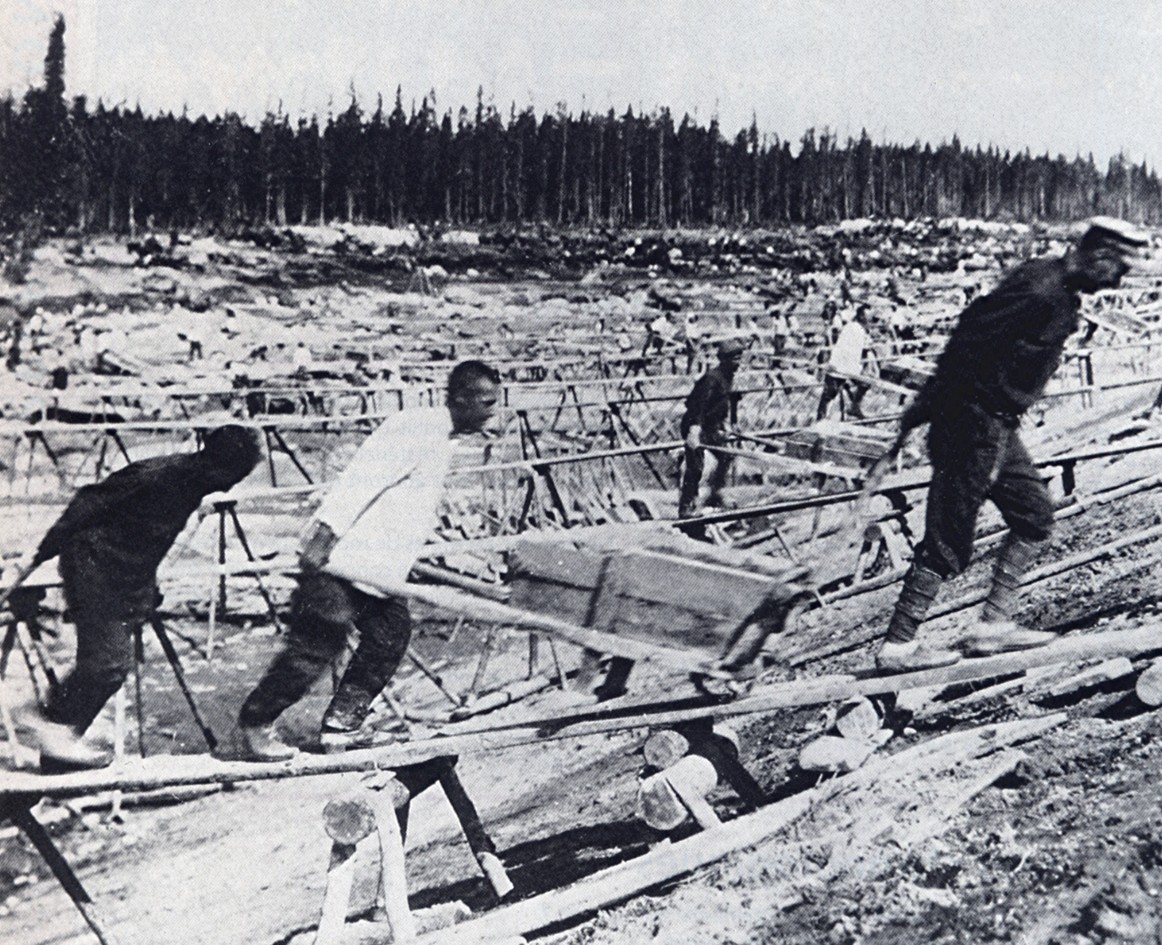
[edit]- North Korea is known to operate six camps with prison-labor colonies for political criminals (Kwan-li-so). The total number of prisoners in these colonies is 150,000 to 200,000. Once condemned as a political criminal in North Korea, the defendant and his/or her family are incarcerated for life in one of the camps without trial and cut off from all outside contact.[14]
- See also: North Korean prison system
Romania
[edit]Russia and the Soviet Union
[edit]- Imperial Russia operated a system of remote Siberian forced labor camps as part of its regular judicial system, called katorga.
- The Soviet Union took over the already extensive katorga system and expanded it immensely, eventually organizing the Gulag to run the camps. In 1954, a year after Stalin's death, the new Soviet government of Nikita Khrushchev began to release political prisoners and close down the camps. By the end of the 1950s, virtually all "corrective labor camps" were reorganized, mostly into the system of corrective labor colonies. Officially, the Gulag was terminated by the MVD order 20 of January 25, 1960.[15]
- During the period of Stalinism, the Gulag labor camps in the Soviet Union were officially called "Corrective labor camps". The term "labor colony"; more exactly, "Corrective labor colony", (Russian: исправительно-трудовая колония, abbr. ИТК), was also in use, most notably the ones for underaged (16 years or younger) convicts and captured besprizorniki (street children, literally, "children without family care"). After the reformation of the camps into the Gulag, the term "corrective labor colony" essentially encompassed labor camps.[citation needed]
Russian Federation
[edit]Sweden
[edit]- 14 labor camps were operated by the Swedish state during World War II. The majority of internees were communists, but radical social democrats, syndicalists, anarchists, trade unionists, anti-fascists and other "unreliable elements" of Swedish society, as well as German dissidents and deserters from the Wehrmacht, were also interned. The internees were placed in the labor camps indefinitely, without trial, and without being informed of the accusations made against them. Officially, the camps were called "labor companies" (Swedish: arbetskompanier). The system was established by the Royal Board of Social Affairs and sanctioned by the third cabinet of Per Albin Hansson, a grand coalition which included all parties represented in the Swedish Riksdag, with the notable exception of the Communist Party of Sweden.
- After the war, many former camp inmates had difficulty finding a job, since they had been branded as "subversive elements".[16]
Turkey
[edit]United States
[edit]- During the United States occupation of Haiti, the United States Marine Corps and their Gendarmerie of Haiti subordinates enforced a corvée system upon Haitians.[17][18][19] The corvée resulted in the deaths of hundreds, and possibly thousands, of Haitians, with Haitian American academic Michel-Rolph Trouillot estimating that about 5,500 Haitians died in labor camps.[20] In addition, Roger Gaillard writes that some Haitians were killed fleeing the camps or if they did not work satisfactorily.[21]
Vietnam
[edit]Yugoslavia
[edit]- The Goli Otokprison camp for political opponents ran from 1946 to 1956.
21st century
[edit]China
[edit]- The Standing Committee of the National People's Congress of the People's Republic of China, which closed on December 28, 2013, passed a decision on abolishing the legal provisions on reeducation through labor. However, penal labor allegedly continues to exist in Xinjiang internment camps.[22][23][24][25][26]
North Korea
[edit]- North Korea is known to operate six camps with prison-labor colonies for political criminals (Kwan-li-so). The total number of prisoners in these colonies is 150,000 – 200,000. Once condemned as a political criminal in North Korea, the defendant and their families are incarcerated for lifetime in one of the camps without trial, and are cut off from all outside contact.[14]
United States
[edit]- In 1997, a United States Army document was developed that "provides guidance on establishing prison camps on [US] Army installations."[27]
The United States makes use of forced penal labour in its prison system, through collaboration with companies such as Whole Foods, McDonald's, Target, IBM, and more.[28]
See also
[edit]References
[edit]- ^ Encyclopedia of the United Nations and International Agreements: G to M, Routledge - New York, London, 1 January 2003, retrieved 19 July 2024
- ^
Gibson, Mary; Poerio, Ilaria (2018). "Modern Europe, 1750–1950". In Anderson, Clare (ed.). A Global History of Convicts and Penal Colonies. Bloomsbury Publishing. ISBN 978-1350000698. Retrieved 2019-10-07.
A second early modern form of punishment, the galleys, constituted a more direct precedent to the earliest hard labour camps. [...] Galley rowing offered no promise of rehabilitation and, in fact, often led to disease and death. However, it shared with the prison workhouses of northern Europe a new aspiration to integrate hard labour into punishment for the eeconomic benefit of the state.
- ^
Magocsi, Paul Robert (1996). A History of Ukraine: The Land and Its Peoples (2nd ed.). Toronto: University of Toronto Press (published 2010). p. 185. ISBN 978-1442698796. Retrieved 2019-10-07.
And what happened to the captives from Ukraine [...]? The slaves functioned at all levels of Ottoman society [...]. At the lowest end of the social scale were galley slaves conscripted into the imperial naval fleet and field hands who labored on Ottoman landed estates.
- ^
van Ruymbeke, Bertrand (2005). "'A Dominion of True Believers Not a Republic for Heretics': French Colonial Religious Policy and the Settlement of Early louisiana, 1699–1730". In Bond, Bradley G. (ed.). French Colonial Louisiana and the Atlantic World. Baton Rouge: Louisiana State University Press. p. 90. ISBN 978-0807130353. Retrieved 2019-10-07.
Andre Zysberg's study shows that [...] nearly 1,500 Huguenots were sentenced to the galleys between 1680 and 1716 [...].
- ^ John Dietrich, The Morgenthau Plan: Soviet Influence on American Postwar Policy (2002) ISBN 1-892941-90-2
- ^ "Burma's forced labour". www.newstatesman.com. 9 June 2008.
- ^ Mühlhahn, Klaus (2009). Criminal Justice in China: A History. Cambridge, Massachusetts: Harvard University Press ISBN 978-0-674-03323-8. pp. 132–133.
- ^ "A book sheds light on a dark chapter in Cuban history" Archived 2009-11-03 at the Wayback Machine, El Nuevo Herald, January 19, 2003. (in Spanish)
- ^ Sivoš, Jerguš. "Tábory Nucených Prací (TNP) v Československu" (in Czech). totalita.cz. Retrieved 2013-03-12.
- ^ From secret interrogations to the “Vatican” of transit prison
- ^ Internment
- ^ General History of Africa, Albert Adu Boahen, Unesco. International Scientific Committee for the Drafting of a General History of Africa, p. 196, 1990
- ^ Herbert, Ulrich (2000). "Forced Laborers in the Third Reich: An Overview (Part One)" (PDF). International Labor and Working-Class History. 58. doi:10.1017/S0147547900003677. S2CID 145344942. Archived from the original (PDF) on 2013-05-09. (offprint)
- ^ a b "The Hidden Gulag – Part Two: Kwan-li-so Political Panel Labor Colonies" (PDF). The Committee for Human Rights in North Korea. pp. 25–82. Retrieved September 20, 2012.
- ^ "Система исправительно-трудовых лагерей в СССР". old.memo.ru.
- ^ Berglund, Tobias; Sennerteg, Niclas (2008). Svenska koncentrationsläger i Tredje rikets skugga. Stockholm: Natur & Kultur. ISBN 978-9127026957.
- ^ Alcenat, Westenly. "The Case for Haitian Reparations". Jacobin. Retrieved 2021-02-20.
- ^ "U.S. Invasion and Occupation of Haiti, 1915–34". United States Department of State. 2007-07-13. Retrieved 2021-02-24.
- ^ Paul Farmer, The Uses of Haiti (Common Courage Press: 1994)
- ^ Belleau, Jean-Philippe (2016-01-25). "Massacres perpetrated in the 20th Century in Haiti". Sciences Po. Retrieved 2021-05-28.
- ^ Belleau, Jean-Philippe (2016-01-25). "Massacres perpetrated in the 20th Century in Haiti". Sciences Po. Retrieved 2021-05-28.
- ^ Finley, Joanne Smith (2022-09-01). "Tabula rasa: Han settler colonialism and frontier genocide in "re-educated" Xinjiang". HAU: Journal of Ethnographic Theory. 12 (2): 341–356. doi:10.1086/720902. ISSN 2575-1433. S2CID 253268699.
- ^ Clarke, Michael (2021-02-16). "Settler Colonialism and the Path toward Cultural Genocide in Xinjiang". Global Responsibility to Protect. 13 (1): 9–19. doi:10.1163/1875-984X-13010002. ISSN 1875-9858. S2CID 233974395.
- ^ Byler, Darren (2021-12-10). Terror Capitalism: Uyghur Dispossession and Masculinity in a Chinese City. Duke University Press. doi:10.1215/9781478022268. ISBN 978-1-4780-2226-8. JSTOR j.ctv21zp29g. S2CID 243466208.
- ^ Byler, Darren (2021). In the Camps: China's High-Tech Penal Colony. Columbia Global Reports. ISBN 978-1-7359136-2-9. JSTOR j.ctv2dzzqqm.
- ^ Lipes, Joshua (November 12, 2019). "Expert Estimates China Has More Than 1,000 Internment Camps For Xinjiang Uyghurs". Radio Free Asia. Retrieved November 13, 2019.
- ^ "US Army Civilian Inmate Labor Program" (PDF). Army.mil. Archived (PDF) from the original on 2003-04-03.
- ^ Burrows, Sara (June 13, 2016). "How Prison Labor is the New American Slavery and Most of Us Unknowingly Support it". Return to Now. Archived from the original on June 7, 2023.
External links
[edit] Media related to Communist labour camps at Wikimedia Commons
- Media related to Concentration camps at Wikimedia Commons


Segregation in countries by type (in some countries, categories overlap) | |
|---|---|
| Religious | |
| Ethnic and racial | |
| Gender | |
| Dynamics | |
| Related topics |
|
| International | |
|---|---|
| National | |
| Other | |

Labor camp
View on GrokipediaDefinition and Characteristics
Core Features and Distinctions
Labor camps are detention facilities where inmates face compulsory physical labor as the primary punitive measure, often involving strenuous tasks such as mining, logging, construction, or agriculture under coercive oversight. This forced labor regime typically occurs in isolated locations with rudimentary infrastructure, where daily quotas enforce productivity amid armed guards and severe penalties for non-compliance, including beatings or execution. Provisions for food, clothing, and medical care are deliberately insufficient, calibrated to maintain minimal workforce functionality while inducing attrition through overwork, starvation, and exposure, resulting in death rates that could exceed 10-20% annually in notorious systems like the Soviet Gulag during peak operations in the 1930s and 1940s.[9][10] Key operational features include hierarchical inmate structures for internal control, ideological justifications framing labor as rehabilitative or redemptive, and economic integration where camp output contributes to state projects, such as canal building or armament production. Unlike voluntary work programs or rehabilitative workshops, labor in these camps lacks consent, remuneration, or safety standards, with tasks designed for exploitation rather than skill-building. High mortality stems not from deliberate extermination but from systemic neglect and overload, where weaker inmates are expendable, as evidenced in Nazi subcamps where forced labor yielded profits for SS enterprises until inmates perished from exhaustion.[10][11] Labor camps distinguish from ordinary prisons, which prioritize secure confinement with optional or limited work for discipline or income, by centering the entire institutional purpose on labor extraction, often rendering idleness impossible and tying rations directly to output. In contrast to concentration camps, which broadly detain political adversaries or minorities for containment and terror with variable labor demands, labor camps systematize work as the core activity, extending to penal colonies or re-education facilities where productivity metrics dictate survival. Extermination camps, focused on rapid mass killing via gas chambers or shootings, differ fundamentally by obviating sustained labor, whereas labor camps prolong exploitation until natural decline, though conditions can blur into de facto death through toil; for instance, Nazi work camps integrated into the concentration system emphasized armament labor over immediate elimination. Penal labor camps also contrast with slavery by lacking personal ownership, instead operating as state-administered coercion without legal manumission pathways, as formalized in decrees like the Soviet Union's 1930 establishment of camps for economic utilization of "counter-revolutionary" elements.[12][13][9]Ideological Rationales and Variations
In totalitarian regimes, labor camps were ideologically rationalized as mechanisms for enforcing ideological conformity, extracting economic value from designated enemies, and reshaping society according to the ruling doctrine, often drawing on pseudo-scientific or revolutionary theories to legitimize coercion as transformative.[14][15] Communist variants, prevalent in the Soviet Union, China, and allied states, framed camps as sites of class-based redemption, where manual toil purportedly purged bourgeois or counter-revolutionary tendencies, enabling prisoners to contribute to proletarian progress; this echoed Lenin's 1918 decrees on corrective labor camps, which integrated punishment with state-building under the pretext of Marxist historical materialism.[16][4] In contrast, fascist and Nazi ideologies subordinated labor camps to racial hierarchies, viewing forced work by Jews, Slavs, and other "inferior" groups as a utilitarian exploitation for Aryan supremacy and wartime production, without pretense of rehabilitation—exemplified by Heinrich Himmler's 1942 Posen speeches prioritizing extermination over mere subjugation.[10][17] Soviet Gulag ideology evolved from early Bolshevik experiments in the 1920s, emphasizing "reforging" (perekovka) through labor to ideologically realign prisoners with socialism, as articulated in camp newspapers and NKVD directives; by the 1930s under Stalin, this merged with economic imperatives, with camps supplying up to 10% of Soviet gold production in 1940 via prisoner output, justified as accelerating industrialization against capitalist encirclement.[18][19] Chinese laogai camps, formalized in 1949-1950 under Mao Zedong's regime, adapted this model via "reform through labor" (laodong gaizao), rooted in Maoist thought reform campaigns like the 1951-1952 suppression of counter-revolutionaries, positing work as dialectical antidote to ideological deviance; unlike Soviet emphasis on industrial output, laogai integrated agricultural and light industry tasks with mass criticism sessions to enforce Confucian-Marxist virtue, sustaining an estimated 4-6 million inmates by the 1970s for self-reliance under the Great Leap Forward.[1][20] North Korean variants, such as kwalliso camps established post-1948, amplified Juche ideology's self-reliance through total isolation and labor, rationalized as purging "hostile class" elements to preserve dynastic purity, differing from Soviet models by forgoing even nominal release prospects. Nazi labor camps diverged sharply by embedding forced work within eugenic and expansionist goals, as in the 1938-1945 expansion of concentration camps to furnish 7-8 million foreign laborers by 1944, ideologically framed in Alfred Rosenberg's writings as harnessing "racial others" for Lebensraum without egalitarian rhetoric; this contrasted communist camps' class-fluid redemption narratives, prioritizing Vernichtung durch Arbeit (extermination through labor) over ideological conversion, with death rates exceeding 50% annually in sites like Auschwitz-Monowitz due to deliberate overwork.[5][21] Fascist Italy's confino and colonial camps in Libya (1920s-1930s) offered milder variations, justifying internal exile and marsh reclamation labor as national discipline against subversives, lacking Nazi racial absolutism but aligning with corporatist state control.[22] Across regimes, these rationales masked causal realities of power consolidation—empirical data from declassified archives reveal camps' primary function as terror instruments, with ideological veneers serving elite control rather than genuine societal uplift, as evidenced by persistent high mortality (e.g., 1.6 million Gulag deaths 1930-1953) despite reformist claims.[16]Historical Precursors
Ancient and Colonial Examples
In ancient Rome, criminals convicted of serious offenses were often sentenced to forced penal labor as an alternative to execution or exile, particularly from the late Republic onward. Such punishments included damnatio ad metalla, condemning individuals to lifelong toil in state-controlled mines and quarries, where conditions involved extreme physical strain, poor ventilation, and high mortality rates from exhaustion, accidents, or disease; estimates suggest lifespans of convicts in these settings rarely exceeded a few years.[23] Similarly, lower-status offenders could face ad pistrinum, confinement in prison mills grinding grain under chained conditions, a form of punitive servitude documented in legal texts and archaeological evidence of bakery structures interpreted as involving coerced labor.[24] These practices served both punitive and economic purposes, supplying labor for imperial infrastructure without relying solely on slave imports, though they blurred lines between slavery and penal systems prevalent in Roman society.[25] Comparable systems existed in other ancient civilizations, such as early imperial China during the Han dynasty (206 BCE–220 CE), where penal servitude (tu) was imposed for hundreds of offenses, forcing convicts to labor on massive public works like the Great Wall extensions, roads, and canals under military oversight.[26] Records indicate that by the Eastern Han period, such servitude affected tens of thousands annually, with crimes redeemable by fines for elites but entailing harsh confinement and work for commoners, often in remote camps to prevent escape.[25] These ancient precedents emphasized coerced productivity over mere incarceration, foreshadowing later labor camp models by integrating punishment with state resource extraction. During the colonial era, European empires expanded penal labor through overseas transportation, establishing remote settlements where convicts provided forced workforce for colonization. Britain transported approximately 162,000 convicts to Australian penal colonies between 1788 and 1868, primarily to New South Wales and Van Diemen's Land (Tasmania), where they endured hard labor constructing roads, bridges, public buildings, and farms under overseer supervision, with floggings and chain gangs enforcing compliance.[27] This system alleviated British prisons' overcrowding while advancing imperial expansion, though mortality from disease, malnutrition, and overwork was significant in early years, such as the Second Fleet's 25% death rate en route in 1790.[28] In North American colonies, Britain similarly shipped 30,000 to 50,000 convicts between 1718 and 1776 to Virginia and other tobacco plantations, assigning them to indentured-style penal servitude for terms up to 14 years, blending punishment with economic demands for agricultural and infrastructural labor.[29] These colonial experiments institutionalized confined, productive coercion, differing from ancient ad hoc servitude by emphasizing geographic isolation to deter recidivism and harness labor for settler economies.[30]19th-Century Developments
In the 19th century, European powers and the United States expanded systems of forced penal labor, often in remote colonies or domestic prisons, to punish offenders while extracting economic value through infrastructure development, mining, and agriculture. These arrangements emphasized hard physical toil under coercive conditions, with high mortality rates due to disease, malnutrition, and overwork, foreshadowing the scale and brutality of 20th-century labor camps. Unlike earlier sporadic uses of convict labor, 19th-century systems institutionalized mass transportation and leasing, driven by imperial expansion needs and post-abolition labor shortages.[30] The Russian Empire's katorga system exemplified this trend, mandating penal servitude in Siberian mines and factories for serious criminals and political exiles. Originating under Peter the Great but peaking in the 19th century, katorga involved chaining prisoners for grueling tasks like silver extraction in Nerchinsk, where conditions led to widespread suffering and escape attempts. By the century's end, over 800,000 individuals had been exiled to Siberia under hard labor regimes, with reforms in 1879 attempting to standardize but not alleviate the punitive labor focus.[31][32][33] Britain's transportation of convicts to Australia, from 1788 to 1868, deployed approximately 166,000 prisoners for colonial development, including road-building, farming, and urban construction in penal settlements like Van Diemen's Land. Convicts worked under military oversight from dawn to dusk, with assignment to private settlers amplifying exploitation; non-violent property offenders comprised three-quarters of transportees, many on first offenses. The system's decline reflected free labor immigration and humanitarian critiques, yet it established precedents for state-directed forced work in frontier economies.[34] France established bagne penal colonies in Guiana (from 1852) and New Caledonia, shipping over 42,000 prisoners by 1885 for tasks like road and canal construction amid tropical hardships. Mortality exceeded 38% in Guiana's camps due to malaria and exhaustion, with doublage rules extending sentences for settlement.[35] In the United States, post-Civil War convict leasing in Southern states like Alabama (from 1846) and Georgia outsourced prisoners—disproportionately Black men arrested under vagrancy laws—to private firms for railroad, mining, and plantation labor, generating state revenue but causing thousands of deaths from abuse. Alabama's system persisted until 1928, with lessees controlling conditions unchecked, echoing slavery's economic model under legal guise.[36][37]Labor Camps in Communist Regimes
Soviet Union and Successor States
The Soviet labor camp system, commonly referred to as the Gulag, emerged from early post-revolutionary concentration camps established in 1919 but underwent massive expansion under Joseph Stalin starting in the late 1920s to enforce political control and extract economic value through coerced labor.[4] Administered initially by the OGPU and later the NKVD, the Gulag encompassed a sprawling network of camps, colonies, and special settlements primarily in remote regions like Siberia, the Arctic, and Central Asia, where prisoners built infrastructure, extracted resources, and supported industrialization efforts amid minimal mechanization and extreme conditions.[38] Prisoners included political opponents, kulaks dispossessed during collectivization, ethnic deportees, and common criminals, with convictions often based on fabricated charges under Article 58 of the criminal code for counter-revolutionary activities.[14] The system's scale peaked during World War II and the early postwar years, with official records indicating a prisoner population exceeding 2 million by 1950, though archival data suggest around 18 million individuals passed through the camps between 1930 and 1953.[39] Mortality rates were extraordinarily high, particularly from 1941 to 1943 when famine, disease, and overwork led to death rates approaching 25% annually in some camps; conservative estimates place total deaths at 1.5 to 2 million, excluding executions and those who perished post-release due to weakened health.[40] Labor quotas enforced under threat of punishment prioritized output over survival, with inadequate food rations—often below 1,200 calories daily—exacerbating starvation, while inadequate medical care and exposure to subzero temperatures contributed to widespread tuberculosis and scurvy.[40] Prominent projects exemplified the Gulag's role in Soviet development, such as the White Sea–Baltic Canal completed in 1933 using over 126,000 prisoners from the Solovki camps, where primitive tools and brutal oversight resulted in 12,000 to 25,000 deaths, rendering the canal initially too shallow for large vessels.[41] Similar efforts included the Moscow-Volga Canal and Kolyma gold mines, where forced labor sustained key sectors despite high human costs, with camp economies integrated into national plans for timber, mining, and railway construction.[42] Following Stalin's death in 1953, Nikita Khrushchev's de-Stalinization initiated mass amnesties and camp closures, reducing the Gulag population to under 1 million by 1956 and effectively dismantling the system by the early 1960s, though some facilities persisted as correctional colonies.[43] In the post-Soviet era after 1991, successor states like Russia retained penal colonies requiring inmate labor, but these lack the ideological coercion and scale of the Gulag, functioning more as standard prisons with voluntary work options amid ongoing human rights concerns.[44] Central Asian republics, sites of major Gulag clusters like Kazakhstan's Karlag, have not revived comparable systems, focusing instead on modern incarceration without forced labor mandates.[45]China
The laogai system, translating to "reform through labor," was established by the Chinese Communist Party shortly after its assumption of power in 1949, functioning as a network of forced labor camps designed to punish and ideologically remold perceived enemies of the state, including counterrevolutionaries, intellectuals, and landowners.[1][46] The system's ideological foundation drew from Marxist-Leninist principles of transforming individuals via productive labor, but in practice, it prioritized economic output—such as mining, farming, and manufacturing—for state goals, often under brutal conditions that included physical punishment, starvation rations, and medical neglect.[47] During the Mao era, particularly amid campaigns like the Anti-Rightist Movement (1957) and the Cultural Revolution (1966–1976), laogai camps swelled with political detainees, contributing to infrastructure projects like dams and railways while suppressing dissent.[48] Eyewitness accounts, notably from Harry Wu, who endured 19 years of imprisonment across 12 laogai camps from 1960 to 1979 for criticizing the Great Leap Forward, reveal a sprawling apparatus with over 1,000 documented facilities by the 1990s, holding millions of inmates at peak periods.[49][50] Wu's investigations through the Laogai Research Foundation estimated that 40 to 50 million people had cycled through the system since its inception, with labor products exported globally despite U.S. prohibitions under the 1992 Prison Labor Convention.[51] Mortality was severe, with Wu attributing millions of deaths to executions, overwork, and disease, exacerbated by policies denying adequate food—often limited to 300–500 grams of grain daily—and prohibiting family contact.[50][20] Official Chinese records obscure these figures, claiming rehabilitative success, but survivor testimonies and smuggled documents contradict such narratives, indicating systemic abuse rather than genuine reform.[52] In 1994, amid international pressure, the Chinese government rebranded laogai camps as standard prisons under the term "qinjiao" (punishment and reform), ostensibly abolishing indefinite administrative detention, though forced labor persisted for convicted criminals and administrative detainees alike.[53] This shift coincided with targeting new groups, such as Falun Gong practitioners after the 1999 crackdown, with tens of thousands reportedly subjected to laojiao (re-education through labor) camps involving organ harvesting allegations and slave labor.[47] By the 2010s, the system evolved into more opaque forms, but forced labor endures, particularly in Xinjiang Uyghur Autonomous Region, where since 2017, over one million Uyghurs, Kazakhs, and other Muslims have been confined in "vocational training" facilities tied to compulsory work in cotton, electronics, and solar industries—supplying global supply chains.[54][55] Beijing maintains these programs are voluntary poverty alleviation, yet U.S. State Department assessments and a 2025 UN report document coercive transfers, surveillance-enforced quotas, and cultural suppression, marking a continuity of laogai-like exploitation under ethnic re-education pretexts.[56][57]North Korea
North Korea maintains an extensive system of penal facilities incorporating forced labor, primarily through kwan-li-so (political prison camps) and kyo-hwa-so (re-education labor camps). The kwan-li-so target individuals and their families deemed politically unreliable, often for offenses such as criticizing the regime, possessing South Korean media, or associating with defectors, with punishments extending to three generations under the "guilt by association" policy.[58] These camps, modeled on Soviet gulag precedents but intensified for total ideological control, were formalized in the 1970s under Kim Il-sung, though elements trace to post-Korean War purges in the 1950s.[58] The regime officially denies their existence, attributing reports to fabricated Western propaganda, yet satellite imagery and defector testimonies confirm operations at sites like Yodok (Camp 15, established around 1970), Hwasong (Camp 12), and Chongjin (Camp 25).[59][60] Forced labor constitutes the core activity in kwan-li-so, where prisoners, including children and elderly, endure 12-15 hour daily shifts in mining, logging, agriculture, or construction under minimal caloric intake—often 300-500 grams of cornmeal daily—leading to widespread malnutrition, disease, and death rates estimated at 20-40% annually in some facilities.[58][6] Executions, torture (including beatings, waterboarding, and stress positions), and forced abortions for repatriated women occur routinely to enforce compliance and extract confessions, with guards incentivized by rations tied to prisoner productivity.[59][61] The United Nations Commission of Inquiry in 2014 documented these as crimes against humanity, based on 80,000-120,000 prisoners across 5-6 operational kwan-li-so as of the 2010s, though numbers fluctuate with purges; for instance, Camp 14 at Kaechon holds re-education facilities with similar labor demands for sentences up to 15 years.[59][62] Kyo-hwa-so serve as lower-tier facilities for criminal and lesser political offenses, emphasizing "re-education" through labor in factories or farms, but conditions mirror kwan-li-so with reports of starvation and abuse; Pokchong-ni's facility, post-Korean War origins, exemplifies this, housing thousands in communal barracks.[62] Under Kim Jong-il and Kim Jong-un, the system expanded amid famine responses and loyalty campaigns, with satellite analysis showing infrastructure growth at Camp 25 despite a 2010s official "closure" of Camp 18 (disputed by imagery).[63][64] Defector accounts, cross-verified by organizations like the Committee for Human Rights in North Korea, indicate over 400,000 deaths since the 1970s from labor-induced exhaustion and neglect, underscoring the camps' role in regime survival via terror and resource extraction.[58] Reports from state media and official channels, conversely, portray such facilities as voluntary reform centers, a narrative rejected by independent evidence due to the regime's history of information control.[65]Eastern Europe and Other Communist States
In the satellite states of Eastern Europe under Soviet influence, communist regimes from the late 1940s onward operated networks of forced labor camps targeting political opponents, intellectuals, ethnic minorities, and perceived class enemies, often modeled on the Soviet Gulag system but scaled to local needs such as resource extraction and infrastructure projects. These camps combined punitive detention with compulsory work under harsh conditions, resulting in high mortality from malnutrition, disease, and overwork; estimates suggest tens of thousands perished across the region, though exact figures remain contested due to regime suppression of records. Unlike voluntary labor mobilization propaganda, camps enforced quotas via coercion, with prisoners denied fair trials or legal recourse, reflecting the regimes' prioritization of control over human costs.[66][67] In Poland, post-1945 communist authorities under Soviet oversight established camps like Zgoda in Silesia, where up to 6,000 German civilians and Polish anti-communists were interned from February 1945, enduring forced labor in coal mines and factories amid reported atrocities including beatings and starvation, leading to approximately 1,850 deaths by camp closure in October 1945. Additional facilities repurposed former Nazi sites, such as parts of Auschwitz until the early 1950s, for detaining and exploiting anti-communist Poles, Silesians, and Ukrainians through quarry and construction work. These operations, justified as re-education, served to consolidate power by liquidating opposition during Stalinist purges.[68][69] East Germany's German Democratic Republic (GDR) integrated forced labor into its prison system, compelling around 30,000 inmates—many political prisoners convicted of "anti-state activities"—to produce goods like textiles and electronics for export, with output funneled to Western firms via intermediaries, generating foreign currency for the regime from the 1950s through the 1980s. Soviet NKVD special camps in the occupation zone, such as those at Sachsenhausen from 1945 to 1950, held over 200,000 suspects for interrogation and labor in agriculture and reconstruction, with death rates exceeding 40% due to deliberate neglect; these transitioned into GDR facilities post-1949, perpetuating exploitation under the guise of socialist productivity.[70][67][71] Romania's communist government under Gheorghiu-Dej and later Ceaușescu deployed mass forced labor for megaprojects like the Danube-Black Sea Canal, initiated in 1949 and revived in 1950, where 100,000 prisoners—including intellectuals, peasants, and clergy—dug 64 kilometers of waterway using rudimentary tools, resulting in an estimated 20,000-100,000 deaths from exhaustion, exposure, and executions between 1950 and 1954. Camps along the route, such as those at Galeșu and Nazarcea, exemplified "re-education through labor," blending ideological indoctrination with economic output, though the project's inefficiencies highlighted the primacy of political terror over practical utility.[72][66] Czechoslovakia's camps, peaking during the 1950s Stalinist era, centered on uranium mining in Jáchymov and Slavkov, where political prisoners extracted ore for Soviet nuclear programs under the National Security Corps; facilities like the Nikolaj Camp held thousands, with survivors reporting radiation exposure, cave-ins, and daily quotas enforced by guards, contributing to a "Czech Gulag" that processed over 70,000 inmates by 1954. The Vojna camp near Příbram, operational from 1949, combined quarry labor with torture, interning opponents of the 1948 communist coup; mortality stemmed from systematic brutality rather than accidental hazards, underscoring the regime's use of camps to mine both resources and loyalty.[73][74] Hungary's Hortobágy camps in the eastern plains, established in 1950, interned 15,000-20,000 "class aliens" such as kulaks and former officials for agricultural reclamation, exposing them to marsh drainage and farming under famine rations, with closures by 1953 following Stalin's death but legacy of purges intact. The Recsk camp (1950-1953) near Mátraverebély forced 1,800 prisoners into stone quarrying and road-building amid isolation and abuse, serving as a prototype for domestic repression independent of Soviet deportation of Hungarian POWs, which affected over 500,000 but occurred externally.[75][76] Bulgaria maintained over 50 forced labor camps from 1944 to 1989, with Belene on the Danube island holding 20,000 political prisoners by the 1960s for tasks like rock-breaking and farming, where dissenters faced beatings and isolation; the system, peaking at 17,000 inmates in 1959, targeted intellectuals and peasants, with documented escapes and uprisings revealing underlying resistance despite official narratives of voluntary socialism. Reforms in 1962 reduced but did not eliminate camps, which persisted for "re-education" until the regime's fall.[77][78] Albania's isolationist regime under Enver Hoxha operated the most repressive network, with Spaç copper mine camp (1968-1991) exemplifying forced extraction where prisoners mined pyrite amid cave-ins and shootings, contributing to an estimated 25,000 deaths across 40+ sites; Tepelenë internment camp (1949-1954) interned families of "enemies," enforcing agricultural labor under starvation diets. Up to 200,000 passed through these facilities, justified as anti-imperialist defense but functioning as tools for total societal control, with minimal economic viability due to Hoxha's purges of even loyal communists.[79][80]Cuba and Vietnam
In Cuba, the revolutionary government under Fidel Castro established forced labor camps as early as 1960, with Ernesto "Che" Guevara overseeing the creation of the Guanahacabibes camp in the western peninsula to detain and rehabilitate individuals deemed socially deviant or politically unreliable through manual labor in harsh remote conditions.[81] These early camps laid the groundwork for expanded systems, including the Military Units to Aid Production (UMAP), agricultural forced labor facilities operational from 1965 to 1968 that targeted conscientious objectors, religious minorities such as Jehovah's Witnesses, homosexuals, and political dissidents unfit for regular military service.[82] Approximately 35,000 individuals passed through the UMAP camps, where inmates endured long hours of sugarcane harvesting, construction, and other fieldwork under military discipline, with reports of physical abuse, malnutrition, and psychological coercion leading to around 500 transfers to psychiatric wards due to mental breakdowns.[83] The camps closed amid domestic protests and international scrutiny following documented suicides and deaths from exhaustion, though the underlying rationale of using coerced labor for ideological conformity and economic output persisted.[82] Cuba's prison system incorporated labor camps throughout the Castro era, with an estimated 200 such facilities by the 1990s integrating forced work in agriculture, garment production, and infrastructure projects, where political prisoners received minimal or no wages despite international labor standards ratified by the government.[84] Inmates often labored 12-15 hours daily in unsanitary conditions, exacerbating health issues like tuberculosis and dengue, as evidenced by cases such as dissidents sentenced to camps like Abel Santamaría in 1998 for minor infractions under vague "enemy propaganda" laws.[84] This integration of punishment and production reflected a policy prioritizing state resource extraction over voluntary incentives, yielding low productivity due to sabotage, malingering, and lack of skill development among coerced workers. In Vietnam, the communist government post-1975 unification implemented re-education camps (trại cải tạo) to detain former Republic of Vietnam officials, military officers, intellectuals, and suspected counterrevolutionaries, with estimates ranging from 500,000 to 1 million individuals interned without trials across a network modeled on Soviet gulags and Chinese laogai systems.[85] These facilities combined mandatory ideological sessions with forced manual labor in remote areas, including rice farming, road construction, and logging, where prisoners received inadequate rations and worked under armed guard to support national reconstruction efforts.[85] Detention periods defied initial promises of short "self-criticism" stints—low-ranking personnel faced days to weeks, while generals and high officials endured 10-18 years, contributing to widespread malnutrition, disease outbreaks, and family separations without legal recourse.[85] [86] The camps' economic role emphasized self-sufficiency through inmate labor, but empirical accounts highlight inefficiencies from unskilled, unmotivated workers operating in isolated, under-resourced settings, with productivity hampered by escapes, tool shortages, and psychological demoralization.[87] Releases accelerated in the late 1970s and 1980s amid international pressure and Vietnam's economic reforms, though remnants of coerced labor persisted in state farms and detention centers, underscoring a pattern of using internment for both political neutralization and resource mobilization at the expense of human capital efficiency.[85]Labor Camps in Fascist and Axis Regimes
Nazi Germany
The Nazi regime in Germany initiated its camp system with the establishment of Dachau concentration camp on March 22, 1933, shortly after Adolf Hitler's appointment as Chancellor, primarily to detain political opponents such as communists and social democrats without trial.[88] This marked the beginning of a network that evolved to include forced-labor components, where prisoners performed grueling tasks under SS oversight, often in quarries, factories, and construction projects. By 1934, the camp system formalized under the SS inspectorate led by Theodor Eicke, emphasizing discipline through violence and labor as punishment.[89] Forced labor became integral to the camps from their inception, though initially secondary to detention and intimidation; prisoners at Dachau, for instance, worked on camp maintenance and local infrastructure with minimal output value.[10] The system's expansion accelerated after the outbreak of World War II in September 1939, as labor shortages prompted the Nazis to exploit camp inmates for the war economy, including armaments production. Camps like Mauthausen, opened in August 1938 near a granite quarry, exemplified this shift, where prisoners hauled stone blocks up steep "stairs of death" in a deliberate policy of "extermination through labor." By 1944, the network encompassed over 20 main concentration camps and thousands of subcamps adjacent to industrial sites, such as those supplying IG Farben's synthetic rubber plants at Auschwitz or munitions factories operated by Krupp.[90] Conditions in these labor camps were designed to maximize exploitation while ensuring high mortality, with prisoners receiving starvation rations—typically 1,000-1,700 calories daily—insufficient for the demanded 12-hour shifts in hazardous environments lacking protective gear.[91] SS guards and kapos enforced productivity through beatings, summary executions, and medical experiments, resulting in death rates that spiked during evacuations and overwork; for example, at Gross-Rosen, focused on textile and armaments labor, over 40,000 of the 120,000 prisoners perished between 1941 and 1945.[5] Private firms leased inmate labor at rates far below free workers, generating profits for the SS via the Deutsche Ausrüstungswerke (DAW) enterprise, though overall economic efficiency was undermined by sabotage, illness, and the frequent need to replace deceased workers.[5] The labor camp system targeted diverse groups, initially German political prisoners and criminals, but increasingly Jews, Poles, Soviet POWs, and Roma after 1938, with the 1942 Wannsee Conference formalizing the deportation of Jews for labor prior to extermination.[90] Subcamps proliferated to 1,000 by war's end, integrating with the German economy; Auschwitz III-Monowitz alone housed 10,000 forced laborers for chemical production by 1944. Despite purported contributions to output—such as V-2 rocket components from Mittelbau-Dora—historians note the system's counterproductive nature, as terror reduced productivity and required vast administrative overhead.[89] Liberation by Allied forces in 1945 revealed emaciated survivors and mass graves, underscoring the camps' dual role in suppression and genocidal labor policy.[92]Imperial Japan
During World War II, Imperial Japan systematically utilized forced labor from colonial subjects, prisoners of war, and civilians in occupied territories to support its war economy, including mining, munitions production, and infrastructure projects such as airfields and dams. This labor was extracted through coercive recruitment, often under the guise of voluntary service, but enforced by military police and local authorities, with laborers housed in rudimentary camps or barracks near worksites. Conditions were characterized by malnutrition, with daily rations frequently insufficient to sustain heavy physical toil—often limited to rice and meager supplements leading to widespread beriberi and dysentery—combined with 10-12 hour workdays, exposure to hazardous environments like coal mines and construction sites, and routine corporal punishment for perceived infractions. Mortality arose primarily from exhaustion, disease, and abuse rather than deliberate extermination policies, though executions occurred for escape attempts or sabotage.[93][94] Koreans, as colonial subjects under Japanese rule since 1910, formed the largest group of imported laborers to the Japanese home islands, with approximately 798,000 mobilized between 1939 and 1945 through escalating quotas imposed on local governments in Korea. Initial recruitment from 1939 relied on deception and economic incentives, but by 1944 it devolved into direct conscription and abductions, dispatching workers to 1,589 sites across Japan, including 381 in Hokkaido for coal mining and dam construction. Death rates exceeded 10%, equating to roughly 80,000 fatalities, with documented cases like 3,000 Koreans at the Uryū Dam site succumbing to illness and accidents; identified graves number over 9,000, though many remains were disposed of in mass burials or at sea to conceal losses. Chinese laborers, numbering around 38,935 forcibly transported to Japan starting in 1944 from northern China, faced similar brutality in mines and factories, with high attrition from starvation and overwork amplifying the system's inefficiency, as weakened workers yielded low productivity.[93][95][94] In occupied territories, Japan imposed romusha labor drafts on local populations, such as in Indonesia (formerly Dutch East Indies), where millions of Javanese and others were conscripted from 1942 onward for projects like airfields and railways, often transported in squalid conditions with death rates during transit and work exceeding 20-30% due to disease and neglect. Allied prisoners of war, totaling over 140,000 captured across the Pacific theater, were funneled into approximately 150 camps in Japan and occupied areas, compelled to labor in shipyards, steel mills, and the Thailand-Burma Railway, where overall POW mortality reached 27-40%, driven by forced marches, inadequate medical care, and reprisals—far surpassing rates in European Axis camps. These practices stemmed from Japan's militaristic ideology viewing non-Japanese as expendable, prioritizing short-term extraction over worker welfare, which empirically undermined output as evidenced by frequent project delays and high absenteeism from illness.[96][97][94]Other Axis Powers
In Fascist Italy, the Mussolini regime operated a network of civilian internment camps from 1940 to 1943, primarily for confining political dissidents, Slavs from occupied Yugoslavia, and Jews, with forced labor imposed in some facilities such as agricultural work or infrastructure projects in remote areas like islands and southern Italy.[98] These camps, numbering around 100 by 1942, held approximately 10,000 internees at peak, but labor exploitation was inconsistent and secondary to isolation, differing from the industrialized slave labor systems elsewhere in the Axis.[99] In occupied territories like Gorizia, Italian authorities compelled Jewish residents into forced labor battalions for construction and fortification tasks starting in September 1942, though this affected smaller numbers compared to core Italian operations.[100] After Italy's 1943 armistice, former Italian soldiers captured by Germany—designated as "military internees"—faced deportation to Nazi labor camps, where over 600,000 endured brutal conditions, but this fell under German control rather than Italian initiative.[101] Hungary, under Regent Miklós Horthy and later the Arrow Cross regime, implemented a compulsory labor service system (munkaszolgálat) from 1939 onward, targeting Jewish men aged 18-42 and other "politically unreliable" individuals unfit for regular military service, with units deployed for frontline digging, road repair, and munitions support.[102] By 1944, amid German occupation, these battalions numbered over 50,000 Jews, subjected to minimal rations, abusive non-Jewish overseers, and exposure to combat zones, resulting in an estimated 40,000-50,000 deaths from starvation, disease, beatings, and executions before the war's end.[103] The system's mortality rate exceeded 80% in some units, as documented in survivor accounts and postwar trials, reflecting deliberate neglect rather than economic optimization.[104] Romania's Ion Antonescu dictatorship, aligned with the Axis from 1940, mobilized over 105,000 Jews into forced labor detachments between 1941 and 1944, primarily for Odessa reconstruction, road building, and Black Sea fortifications following military defeats.[105] These units, often under military guard, operated in brutal conditions with death rates reaching 90% in sites like Bogdanovca due to typhus, malnutrition, and arbitrary killings, contributing to the broader toll of 220,000 Romanian Jewish deaths during the regime.[106] Labor was framed as "rehabilitation" but served punitive and wartime purposes, with Jewish workers denied tools, shelter, or pay, as evidenced by Romanian military records and international commissions.[107] Similar but smaller-scale camps existed in Bulgaria, where Jewish men faced forced labor in construction battalions from 1941, though the Tsar Boris III government resisted full deportations from core territories.[108]Labor Camps in Democratic and Allied Contexts
United States
In the post-Civil War South, the convict leasing system emerged as a primary mechanism for forced penal labor, whereby state governments leased prisoners—predominantly African American men convicted under vague vagrancy and Black Codes—to private contractors for work in mines, railroads, and turpentine camps.[109] This practice began in states like Alabama in 1846 but expanded dramatically after 1865, with Georgia initiating widespread leasing in 1868 to generate revenue from convict labor without direct state oversight.[110] Conditions were brutal, with inadequate food, shelter, and medical care leading to high mortality; in Mississippi's Parchman Farm and similar sites, death rates exceeded 10% annually in the 1880s-1890s due to disease, exhaustion, and violence from overseers.[109] By 1900, an estimated 10,000-20,000 convicts were leased across Southern states, generating millions in profits for lessees while states received fixed fees, effectively perpetuating coerced labor under the 13th Amendment's exception for criminal punishment.[110] Reforms in the early 20th century shifted toward state-controlled chain gangs, where shackled prisoners performed public works like road construction in remote labor camps, reducing private profiteering but maintaining forced labor.[111] Georgia's 1908 constitutional amendment mandated chain gang labor for able-bodied convicts, deploying thousands to build over 10,000 miles of roads by the 1920s under armed guards and minimal rations.[111] These camps, often in swamps or forests, featured wooden barracks and widespread abuse, including whippings; Alabama and Florida operated similar systems into the 1940s, with Florida's camps housing up to 5,000 men by 1923.[112] Chain gangs phased out nationally by the 1950s amid civil rights scrutiny and mechanized alternatives, though isolated revivals occurred, such as Arizona's short-lived program in 1995.[112] During World War II, Japanese American internment camps incorporated coerced labor elements, with approximately 120,000 individuals of Japanese descent incarcerated from 1942 to 1945 under Executive Order 9066.[113] Incarcerees at sites like Manzanar and Tule Lake performed unpaid or minimally compensated work ($12-19 monthly) for camp maintenance, agriculture, and external farms to offset operational costs, producing crops and even war materials under War Relocation Authority directives.[113] While not designed as penal labor facilities, refusal to work could lead to reduced rations or segregation, and labor recruitment addressed wartime shortages in Western agriculture.[114] These programs, affecting over 10,000 workers at peak, ended with camp closures by 1946, though economic losses for internees totaled billions in foregone property and wages.[113] Contemporary U.S. prison labor, governed by the 1935 Ashurst-Sumners Act restricting interstate commerce in prison goods, continues forced work in facilities but lacks the isolated camp structure of historical systems, with inmates producing goods for minimal pay under constitutional allowances.[110] Federal and state programs, such as UNICOR, employ about 20,000 inmates annually in manufacturing, emphasizing rehabilitation over punishment, though critics note exploitative dynamics persist.[110]Other Western Democracies
In Canada, the government forcibly relocated over 22,000 Japanese Canadians from the Pacific coast between 1942 and 1949 under the War Measures Act, citing national security amid unsubstantiated fears of espionage. Approximately 2,150 single men and others were dispatched to remote road camps in British Columbia and Ontario, where they performed compulsory manual labor such as highway construction for the Trans-Canada Highway project, often separated from families and under armed guard.[115][116] Workers received minimal wages deducted for camp costs, with conditions including inadequate housing and harsh weather, though mortality remained low compared to totalitarian systems.[117] The policy resulted in property seizures valued at over $400 million in modern terms, with labor serving both infrastructure needs and internee self-support, though participation was effectively coerced through threats of indefinite detention.[118] Australia maintained internment camps for around 7,000 enemy aliens during World War I and up to 18,000 civilians plus POWs in World War II, primarily Germans, Italians, and Japanese residents, housed in facilities like Loveday and Tatura.[119] Unlike penal systems elsewhere, internees engaged in voluntary agricultural or camp maintenance work for pay and rations, with no widespread evidence of systematic forced labor; POWs under Geneva Conventions performed permitted tasks like farming.[120] Historical convict transportation (1788–1868) supplied forced labor for colonial infrastructure, but by the early 20th century, such practices had transitioned to standard prison systems without dedicated remote camps.[121] In the United Kingdom, World War II internment of roughly 28,000 enemy aliens—mostly German and Austrian Jewish refugees—occurred briefly in 1940 on the Isle of Man and elsewhere, following Churchill's "collar the lot" directive amid invasion fears. Camps emphasized self-governance and recreation over punishment, with internees undertaking optional internal labor like cooking or education programs, not external forced projects; policy reversed by late 1940 due to labor shortages and refugee contributions to war efforts.[122] Earlier Boer War camps (1900–1902) detained 116,000 Afrikaner civilians in poor conditions leading to 28,000 deaths from disease, but functioned as containment rather than labor facilities.[123] Other democracies like France post-1945 avoided large-scale labor camps, confining such measures to Vichy-era internment (1940–1944) under authoritarian rule, with democratic governments thereafter relying on prisons with limited work requirements compliant with ILO conventions.[124] These instances reflect wartime exigencies rather than ideological systems, with empirical data showing lower coercion and mortality than in non-democratic regimes, attributable to rule-of-law constraints and post hoc redress like Canada's 1988 apology and compensation.[117]Economic Realities
Purported Economic Contributions
Regimes employing labor camps frequently asserted that such systems delivered substantial economic value through the mobilization of otherwise idle or coerced populations for infrastructure development, resource extraction, and industrial output at minimal wage costs. In the Soviet Union, the NKVD and subsequent overseers portrayed the Gulag as integral to frontier development and heavy industry, enabling projects infeasible with free labor alone due to harsh conditions and remoteness. For instance, the White Sea-Baltic Canal, completed in 1933 using approximately 126,000 prisoners, was propagandized as a triumph of socialist construction, purportedly linking northern timber resources to Baltic ports and facilitating transport for 140 million cubic meters of earth moved. [41] Soviet official narratives claimed Gulag camps supplied critical raw materials, with forced labor accounting for significant shares of outputs like gold (around 60% in some periods), nickel (46.5%), and tin (76%) by the late 1930s, ostensibly bolstering industrialization during the Five-Year Plans. [125] The system was credited with constructing railways, mines, and factories in underpopulated regions, where the Gulag's share of total labor reached up to 45% in penal sectors by 1940, according to declassified archives analyzed by economic historians. [126] Proponents within the regime argued this coerced workforce enforced state economic priorities without market disincentives, extending operations to civil enterprises via labor contracting. [127] In Nazi Germany, forced labor from concentration camps and POWs was framed as a pragmatic necessity for wartime autarky and rearmament, purportedly alleviating labor shortages and sustaining production in armaments, construction, and agriculture. Economic analyses indicate that by 1944, foreign laborers including camp inmates comprised about 25% of the Reich's workforce, contributing to sectors like coal mining and synthetic fuel production deemed vital for prolonging the war effort. [128] German authorities, including the Organisation Todt, claimed efficiencies from deploying prisoners in infrastructure like the Atlantic Wall, where costs were minimized through non-remunerated work, though these assertions overlooked supervisory overheads and productivity losses. [129] Similar rationales appeared in other contexts, such as Imperial Japan's use of Allied POWs and conscripted Asians for projects like the Burma Railway, touted by military planners as accelerating logistics for Pacific campaigns at reduced expense. [5] These purported contributions, however, were advanced by state apparatuses with incentives to justify repression, often drawing on selective metrics that emphasized gross outputs over net economic viability or human capital depreciation.Empirical Evidence of Inefficiency
Economic analyses of major forced labor systems, including the Soviet Gulag and Nazi concentration camps, consistently demonstrate lower productivity relative to free labor, attributable to malnutrition, high mortality, lack of worker incentives, sabotage, and substantial overhead costs for supervision and security. In the Gulag, penal laborers exhibited productivity levels roughly 50% below those of free workers in analogous roles, as wages were halved but output per unit remained elevated in cost due to diminished effort and health.[127] This gap persisted despite administrative efforts at close monitoring, which failed to overcome inherent conflicts between repressive objectives and economic goals.[130] Gulag output metrics further underscore inefficiency: by the early 1950s, labor productivity declined markedly, with 26-28% of prisoners on piecework failing to meet assigned targets amid widespread shirking and inadequate skills matching.[42] Although the system mobilized up to 2.5 million inmates—representing about 2.5% of the Soviet labor force—its net contribution to gross domestic product hovered below 4%, and often nearer 2.5% or less when adjusted for non-productive inmates (e.g., the ill or elderly) and hidden costs like guard rations exceeding prisoner allocations.[131] [125] Case studies of specific camps, such as those in Norilsk, reveal that free workers received premiums like extra pay and vacations, yielding higher sustained output than coerced inmates under comparable harsh conditions.[125] Nazi forced labor programs exhibited parallel shortcomings, exacerbated by ideological extermination priorities that prioritized rapid workforce depletion over sustained utilization. Prisoner-of-war and camp labor, while numerically significant (millions deployed), suffered from administrative disarray and mistreatment, amplifying human capital losses and yielding marginal net gains amid high guarding expenses and frequent replacements due to death rates exceeding 20% annually in many facilities.[129] [128] Productivity experiments, such as caloric rationing to boost output, yielded inconsistent results, as underlying factors like skill mismatches and motivational deficits rendered slave labor inherently less efficient than voluntary alternatives.[132] Broader empirical assessments of forced labor affirm these patterns: coerced systems generate inefficiencies through moral hazard, where workers minimize effort absent incentives, and principal-agent problems requiring disproportionate oversight, often rendering net economic value negative when factoring turnover and opportunity costs of alternative free labor deployment.[133] In both Gulag and Nazi contexts, initial infrastructural projects (e.g., canals, mines) provided short-term gains but long-term losses, as substandard construction and depleted resources outweighed outputs, confirming causal links between coercion and diminished returns.[134]Human Costs and Atrocities
Mortality Rates and Conditions
Labor camps historically exhibited mortality rates far exceeding those in civilian populations, primarily due to deliberate policies of overwork, caloric deprivation, inadequate shelter, and exposure to infectious diseases, compounded by arbitrary executions and medical neglect. In systems designed for economic exploitation under totalitarian regimes, prisoners often received rations insufficient for survival under intense labor demands—typically 1,000-1,500 calories daily against requirements of 3,000 or more for heavy manual work—leading to rapid emaciation, weakened immunity, and cascading organ failure. Typhus, dysentery, tuberculosis, and scurvy proliferated in overcrowded, unsanitary barracks, where lack of sanitation and medical intervention transformed treatable illnesses into mass killers; for instance, untreated gastrointestinal infections alone accounted for significant portions of deaths in confined environments.[5][135] In Nazi Germany's concentration and forced-labor camps, annual mortality rates frequently reached 20-50% during peak wartime operations, driven by "extermination through labor" policies that prioritized short-term output over prisoner longevity. At camps like Auschwitz and Gross-Rosen, where inmates quarried stone or manufactured armaments, deaths from exhaustion and starvation numbered in the hundreds of thousands; overall, forced laborers among non-Jewish victims contributed to estimates of 2.5-5 million fatalities across the system, with hyperintense killing phases in 1942 yielding daily rates equivalent to 1-6% of camp populations in extermination-linked labor sites. Soviet records, often manipulated to underreport by releasing terminal cases shortly before death, masked true Gulag mortality, which empirical reconstructions place at 10-25% annually during famines and wartime (1930s-1950s), totaling 1.5-2 million excess deaths from similar causes: subarctic exposure, protein-deficient diets, and punitive quotas enforced by beatings.[136][137][40] Imperial Japan's wartime labor camps for Allied POWs and conscripted Asian civilians similarly recorded death rates of 25-40%, as in the Thailand-Burma Railway where 60,000-100,000 perished from malaria, beriberi, and untreated wounds amid 12-18 hour shifts on minimal rice rations. Conditions universally fostered a cycle of attrition: guards incentivized brutality to meet production targets, while regime ideology dehumanized inmates, rationalizing high turnover as expendable for imperial goals; post-liberation autopsies consistently revealed widespread protein malnutrition and opportunistic infections as terminal factors, underscoring how labor camps functioned less as sustainable enterprises and more as de facto disposal mechanisms.[94][138][139]| System | Estimated Annual Mortality Rate | Primary Causes | Total Estimated Deaths |
|---|---|---|---|
| Nazi Forced Labor Camps (1941-1945) | 20-50% | Starvation, disease, overwork | 2.5-5 million (non-Jewish laborers)[136][137] |
| Soviet Gulag (1930-1956) | 10-25% (peaks in 1942-43) | Exposure, malnutrition, releases of dying | 1.5-2 million excess[40][140] |
| Japanese Labor Camps (1941-1945) | 25-40% | Tropical diseases, starvation, abuse | 60,000+ (e.g., railway laborers)[94][138] |