


Community hub
Recent from talks
Contribute something
Nothing was collected or created yet.
Mutiny
View on Wikipedia
Mutiny is a revolt among a group of people (typically of a military or a crew) to oppose, change, or remove superiors or their orders. The term is commonly used for insubordination by members of the military against an officer or superior, but it can also sometimes mean any type of rebellion against any force. Mutiny does not necessarily need to refer to a military force and can describe a political, economic, or power structure in which subordinates defy superiors.
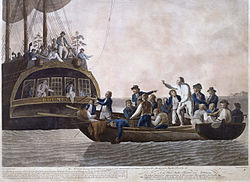
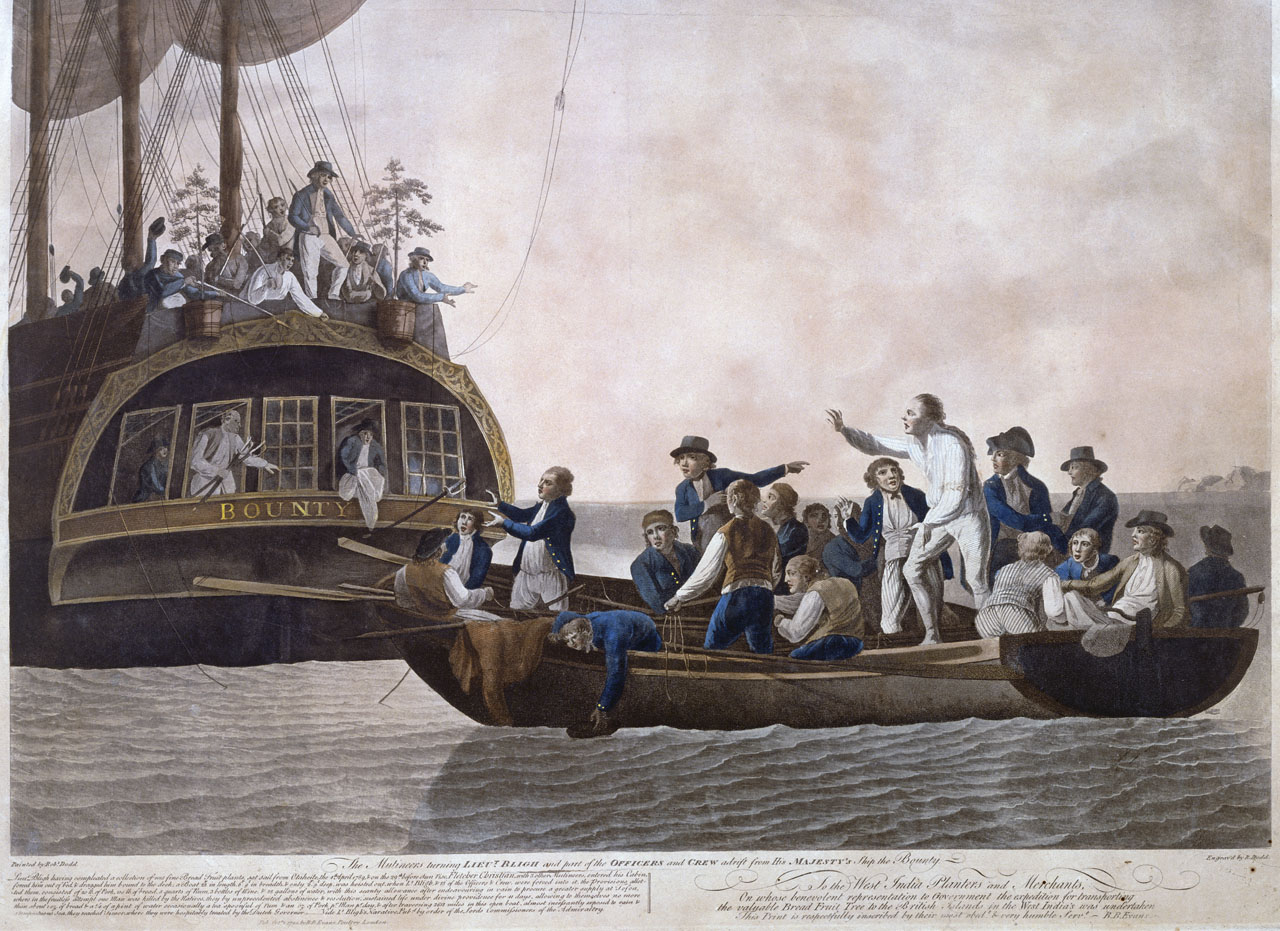
During the Age of Discovery, mutiny particularly meant open rebellion against a ship's captain. This occurred, for example, during Ferdinand Magellan's journeys around the world, resulting in the killing of one mutineer, the execution of another, and the marooning of others; on Henry Hudson's Discovery, resulting in Hudson and others being set adrift in a boat; and the famous mutiny on the Bounty.
Mutiny is widely considered a serious crime, punishable by imprisonment, penal labour or death. Failure to prevent or suppress a mutiny may also be punishable depending on the circumstances; negligent failure may result in dishonourable discharge while wilful failure may bring any punishment including death.[1][2] The UK has passed various Mutiny Acts to establish procedure and punishment, the latest of which is the Armed Forces Act 2006. Military mutineers are usually tried at court martial, represented by counsel. Pirate captains have been known to mete out punishment ad hoc without due process.
Penalty
[edit]Those convicted of mutiny often faced capital punishment.
United Kingdom
[edit]Until 1689, mutiny was regulated in England by Articles of War instituted by the monarch and effective only in a period of war. In 1689, the first Mutiny Act was approved, which passed the responsibility to enforce discipline within the military to Parliament. The Mutiny Act, altered in 1803, and the Articles of War defined the nature and punishment of mutiny until the latter were replaced by the Army Discipline and Regulation Act in 1879. This, in turn, was replaced by the Army Act in 1881.
Today the Armed Forces Act 2006 defines mutiny as follows:[3]
(2)For the purposes of this section a person subject to service law takes part in a mutiny if—
(a)in concert with at least one other person subject to service law, he—
(i)acts with the intention of overthrowing or resisting authority; or
(ii)disobeys authority in such circumstances as to subvert discipline;
(b)he agrees with at least one other person subject to service law to overthrow or resist authority; or
(c)he agrees with at least one other person subject to service law to disobey authority, and the agreed disobedience would be such as to subvert discipline.
The same definition applies in the Royal Navy and Royal Air Force.
The military law of England in early times existed, like the forces to which it applied, in a period of war only. Troops were raised for a particular service and were disbanded upon the cessation of hostilities. The crown, by prerogative, made laws known as Articles of War for the government and discipline of the troops while thus embodied and serving. Except for the punishment of desertion, which was made a felony by statute in the reign of Henry VI, these ordinances or Articles of War remained almost the sole authority for enforcing discipline until 1689. That year, the first Mutiny Act was passed and the military forces of the crown were brought under the direct control of Parliament. Even the Parliamentary forces in the time of Charles I and Oliver Cromwell were governed not by an act of the legislature, but by articles of war similar to those issued by the king and authorized by an ordinance of the Lords and Commons exercising in that respect the sovereign prerogative. This power of law-making by prerogative was however held to be applicable during a state of actual war only, and attempts to exercise it in times of peace were ineffectual. Subject to this limitation, it existed for considerably more than a century after the passing of the first Mutiny Act.
From 1689 to 1803, the Mutiny Act occasionally expired during times of peace. Yet statutory power was given to the crown to make Articles of War that operated in the colonies and elsewhere beyond the seas in the same manner as those made by prerogative in times of war.
In 1715, in consequence of the rebellion, this power was created in respect of the forces in the kingdom, but apart from and in no respect affected the principle acknowledged all this time that the crown of its mere prerogative could make laws for the government of the army in foreign countries in time of war.
The Mutiny Act 1803 effected a great constitutional change in this respect: the power of the Crown to make any Articles of War became altogether statutory, and the prerogative merged in the act of Parliament. The Mutiny Act 1873 was passed in this manner.
Such matters remained until 1879 when the last Mutiny Act was passed and the last Articles of War were promulgated. The Mutiny Act legislated for offences in respect of which death or penal servitude could be awarded. Meanwhile, the Articles of War, while repeating those provisions of the act, constituted the direct authority for dealing with offences for which imprisonment was the maximum punishment, as well as with many matters relating to trial and procedure.
The act and the articles were found not to harmonize in all respects. Their general arrangement was faulty, and their language sometimes obscure. In 1869, a royal commission recommended that both should be recast in a simple and intelligible shape. In 1878, a committee of the House of Commons endorsed this view and made recommendations for performing the task. In 1879, a measure was passed into law consolidating in one act both the Mutiny Act and the Articles of War, and amending their provisions in certain important respects. This measure was called the Army Discipline and Regulation Act 1879.
After one or two years of experience highlighted the need for improvement, it was superseded by the Army Act 1881, which formed the foundation and main portion of the military law of England. The act contained a proviso saving the right of the crown to make Articles of War, but in such a manner as to render the power in effect a nullity by enacting that no crime made punishable by the act shall be otherwise punishable by such articles. As the punishment of every conceivable offence was provided, any articles made under the act could be no more than an empty formality having no practical effect.
Thus the history of English military law up to 1879 may be divided into three periods, each having a distinct constitutional aspect: (I) prior to 1689, the army, being regarded as so many personal retainers of the sovereign rather than servants of the state, was mainly governed by the will of the sovereign; (2) between 1689 and 1803, the army, being recognised as a permanent force, was governed within the realm by statute and without it by the prerogative of the crown; and (3) from 1803 to 1879, it was governed either directly by statute or by the sovereign under an authority derived from and defined and limited by statute. Although in 1879 the power of making Articles of War became in effect inoperative, the sovereign was empowered to make rules of procedure, having the force of law, to regulate the administration of the act in many matters formerly dealt with by the Articles of War. These rules, however, must not be inconsistent with the provisions of the Army Act itself, and must be laid before parliament immediately after they are made. Thus in 1879, the government and discipline of the army became for the first time completely subject either to the direct action or the close supervision of Parliament.
A further notable change took place at the same time. The Mutiny Act had been brought into force on each occasion for one year only, in compliance with the constitutional theory:
that the maintenance of a standing army in time of peace, unless with the consent of parliament, is against law. Each session therefore the text of the act had to be passed through both Houses clause by clause and line by line. The Army Act, on the other hand, is a fixed permanent code. But constitutional traditions are fully respected by the insertion in it of a section providing that it shall come into force only by virtue of an annual act of parliament. This annual act recites the illegality of a standing army in time of peace unless with the consent of parliament, and the necessity nevertheless of maintaining a certain number of land forces (exclusive of those serving in India) and a body of royal marine forces on shore, and of keeping them in exact discipline, and it brings into force the Army Act for one year.
Sentence
[edit]Until 1998, mutiny and another offence of failing to suppress or report a mutiny were each punishable with death.[4] Section 21(5) of the Human Rights Act 1998 completely abolished the death penalty in the United Kingdom. (Prior to this, the death penalty had already been abolished for murder, but it had remained in force for certain military offences and treason, although no executions had been carried out for several decades.) This provision was not required by the European Convention on Human Rights, since Protocol 6 of the Convention permitted the death penalty in time of war, and Protocol 13, which prohibits the death penalty for all circumstances, did not then exist. The government introduced section 21(5) as a late amendment in response to parliamentary pressure.
United States
[edit]The United States' Uniform Code of Military Justice defines mutiny thus:
- Art. 94. (§ 894.) 2004 Mutiny or Sedition.
- (a) Any person subject to this code (chapter) who—
- (1) with intent to usurp or override lawful military authority, refuses, in concert with any other person, to obey orders or otherwise do his duty or creates any violence or disturbance is guilty of mutiny;
- (2) with intent to cause the overthrow or destruction of lawful civil authority, creates, in concert with any other person, revolt, violence, or other disturbance against that authority is guilty of sedition;
- (3) fails to do his utmost to prevent and suppress a mutiny or sedition being committed in his presence, or fails to take all reasonable means to inform his superior commissioned officer or commanding officer of a mutiny or sedition which he knows or has reason to believe is taking place, is guilty of a failure to suppress or report a mutiny or sedition.
- (b) A person who is found guilty of attempted mutiny, mutiny, sedition, or failure to suppress or report a mutiny or sedition shall be punished by death or such other punishment as a court-martial may direct.[citation needed]
U.S. military law requires obedience only to lawful orders. Disobedience to unlawful orders (see Superior orders) is the obligation of every member of the U.S. military, a principle established by the Nuremberg and Tokyo Trials following World War II and reaffirmed in the aftermath of the My Lai Massacre during the Vietnam War. However, a U.S. soldier who disobeys an order after deeming it unlawful will almost certainly be court-martialed to determine whether the disobedience was proper. In addition, simple refusal to obey is not mutiny, which requires collaboration or conspiracy to disobedience.
Famous mutinies in history
[edit]16th century
[edit]- Sack of Antwerp, one of the many mutinies in the Spanish Army of Flanders[5] during the Eighty Years' War; this mutiny caused the provinces of the Habsburg Netherlands to temporarily unite in rebellion against Philip II of Spain and sign the Pacification of Ghent.
- Sack of Rome (1527), military event carried out by the mutinous troops of Charles V, Holy Roman Emperor.
17th century
[edit]- Discovery mutiny in 1611 during the 4th voyage of Henry Hudson, after having been trapped in pack ice over the winter, his desire to continue incited the crew to casting him and 8 others adrift.
- Batavia was a ship of the Dutch East India Company (VOC), built in 1628 in Amsterdam, which suffered both mutiny and shipwreck during her maiden voyage.
- Second English Civil War
- Corkbush Field mutiny (1647)
- Banbury mutiny (1649)
- Bishopsgate mutiny (1649)
18th century
[edit]- The Wager Mutiny – the main body of the crew of the British war ship HMS Wager mutinied against their Captain after she was wrecked on a desolate island off the south coast of Chile in 1741. The ship was part of a squadron bound to attack Spanish interests in the Pacific.
- A failed 1787 mutiny aboard the Middlesex occurred two weeks before HMS Bounty's final departure from England, which included the lead mutineer of HMS Bounty Fletcher Christian's older brother Charles.
- Mutiny aboard HMS Bounty, a mutiny aboard a British Royal Navy ship in 1789 that has been made famous by several books and films.
- Quibéron mutinies were major mutinies in the French fleet in 1793.
- HMS Hermione was a 32-gun fifth-rate frigate of the British Royal Navy. While operating in the Caribbean in 1797 a portion of the crew mutinied, killing the captain, eight other officers, two midshipmen and a clerk before surrendering the ship to the Spanish authorities. The mutiny was the bloodiest recorded in the history of the Royal Navy.
- Spithead and Nore mutinies were two major mutinies by sailors of the British Royal Navy in 1797.
- Schemes for mutiny onboard nine British warships between June and mid-August 1798, resulting in courts-martial for crew from HMS Adamant, HMS Atlas, HMS Caesar, HMS Defiance, HMS Glory, HMS Haughty, HMS Neptune, HMS Queen Charlotte and HMS St George[6]
- The Vlieter Incident was a mutiny of a squadron of the fleet of the Batavian Republic which caused it to be surrendered to the British without a fight in 1799 at the start of the Anglo-Russian invasion of Holland.
19th century
[edit]- HMS Dominica - in May 1806, crew members mutinied, took over the ship and turned her over to the French. She was later recaptured by the British and the mutiny's ringleader hanged.
- Vellore Mutiny, outbreak against the British East India Company on 10 July 1806, by sepoys forming part of the garrison of a fortress and palace complex at Vellore (now in Tamil Nadu state, southern India).
- The Froberg mutiny by the Froberg Regiment in Fort Ricasoli, Malta in 1807. The mutiny was suppressed and 30 men were executed.
- The US whaler Globe mutiny of 1824. Captain and several crewmen were brutally murdered by whaler Samuel Comstock of Nantucket. Comstock was then murdered on Mili, a remote but inhabited Pacific island that he intended to take over and make his own, by the ship's remaining survivors.[7]
- Barrackpore Mutiny, (2 November 1824), incident during the First Anglo-Burmese War (1824–26), generally regarded as a dress rehearsal for the Indian Mutiny of 1857 because of its similar combination of Indian grievances against the British.
- St. Joseph Mutiny (1837): rebellion of forcibly conscripted African soldiers in the 1st West India Regiment in British Trinidad.[8]
- La Amistad, in 1839. A group of captured African slaves being transported in Cuba mutinied against the crew, killing the captain.[9]
- The brig USS Somers had a mutiny plotted onboard on her first voyage in 1842. Three men were accused of conspiring to commit mutiny, and were hanged.[10]
- Lady Franklin (1854) seized by convicts
- The Indian rebellion of 1857 was a period of armed uprising in India against British colonial power, and was popularly remembered in Britain as the Indian Mutiny or Sepoy Mutiny. It is remembered in India as the First War of Independence.
- The Sharon, a Fairhaven whaleship, was subject to multiple mass desertions, mutinies and the murder and dismemberment of a cruel (and from the record, sociopathic) captain by four Polynesians who had been pressed into service on the Sharon.[11]
- In 1857 on the whaleship Junior, Cyrus Plummer and several accomplices engineered a mutiny that resulted in the murder of Captain Archibald Mellen and Third Mate John Smith. The mutineers were captured and found guilty in the fall of 1858. Plummer was sentenced to be hanged and his accomplices received life sentences. The story made national and international news and Plummer was able to garner a stay of execution from President James Buchanan and was ultimately pardoned by Ulysses S. Grant.
- The Cavite Mutiny of 1872 in the Philippines.
- The Brazilian Naval Revolt was the occasion of two mutinies in 1893 and 1894.
20th century
[edit]
- Mutiny aboard the Russian battleship Potemkin, a rebellion of the crew against their officers in June 1905 during the Russian Revolution of 1905. It was made famous by the film Battleship Potemkin.
- The Revolta da Chibata ("Revolt of the Lash") was a Brazilian naval mutiny of 1910, where Afro-Brazilian crewmen rose up against oppressive white officers who frequently beat them. Their goal was to have their living conditions improved and the chibata (whips or lashes) banned from the navy.
- Guaymas Mutiny On 22 February 1914, Mexican Navy sailors under Lieutenant Hilario Rodríguez Malpica seized control of gunboat Tampico off Guaymas, Mexico. This event led to a naval campaign off Topolobampo during the Mexican Revolution.
- Curragh Incident, also known as the Curragh Mutiny of 20 July 1914 occurred in the Curragh, Ireland, where British officers threatened to resign rather than enforce the Home Rule Act 1914.
- Etaples Mutiny by British troops, 1917
- French Army mutinies in 1917. The failure of the Nivelle Offensive in April and May 1917 resulted in widespread mutiny in many units of the French Army.
- Wilhelmshaven mutiny broke out in the German High Seas Fleet on 29 October 1918. The mutiny led directly to the Kiel mutiny a few days later.
- Kiel mutiny: Major revolt by sailors on 3 November 1918 in response to arrests of suspected Wilhelmshaven ringleaders. It sparked the German Revolution of 1918-1919, which led to the collapse of the monarchy and the establishment of the Weimar Republic.
- Luxembourg Rebellions: After two failed communist revolutions in November and after a minor mutiny in December, the Luxembourg Army took over the Chamber of Deputies, and proclaimed a republic.
- Black Sea mutiny (1919) by crews aboard the French dreadnoughts Jean Bart and France, sent to assist the White Russians in the Russian Civil War. The ringleaders (including André Marty and Charles Tillon) received long prison sentences.
- The 1920 mutiny of the mainly Irish unit of Connaught Rangers in the British Army against martial law being imposed and brutally enforced by the Black and Tans in Ireland during the Irish War of Independence. The leader, Private James Daly, became the last member of the British Armed Forces to be executed for mutiny when he was shot by firing squad on 2 November 1920.
- Kronstadt rebellion, an unsuccessful uprising of Russian sailors, led by Stepan Petrichenko, against the government of the early Russian SFSR in the first weeks of March in 1921. It proved to be the last large rebellion against Bolshevik rule.
- Irish Army Mutiny, a crisis in March 1924 provoked by a proposed reduction in army numbers in the immediate post-Civil War period.[12][13]
- Invergordon Mutiny, an industrial action by around a thousand sailors in the British Atlantic Fleet, that took place on 15–16 September 1931. For two days, ships of the Royal Navy at Invergordon were in open mutiny, in one of the few military strikes in British history.
- Mutiny aboard the Dutch warship the De Zeven Provinciën as a result of salary cuts in early February 1933.
- 1936 Naval Revolt in Portugal, also known as the Mutiny on the Tagus ships. Sailors aboard two Portuguese ships imprisoned their officers and attempted to sail out into the open sea. Coastal artillery disabled both ships and the Estado Novo shortly thereafter founded the Legião Portuguesa.
- Cocos Islands Mutiny, a failed mutiny by Sri Lankan servicemen on the then-British Cocos (Keeling) Islands during the Second World War.
- Battle of Bamber Bridge on 24–25 June 1943, a racially motivated mutiny by African American soldiers in a segregated U.S. Army truck unit stationed in Bamber Bridge, Lancashire, United Kingdom.
- Townsville mutiny on 22 May 1942, a mutiny by about 600 African American servicemen of the 96th Engineer Battalion of the United States Army while serving in Townsville, Australia, during World War II. See also African-American mutinies in the United States armed forces.
- Port Chicago mutiny on August 9, 1944, three weeks after the Port Chicago disaster. 258 out of the 320 African-American sailors in the ordnance battalion refused to load any ammunition.[14]
- Terrace mutiny, a mutiny by French-Canadian soldiers in Terrace, British Columbia, in November 1944.
After World War II
[edit]- Post–World War II demobilization strikes occurred within Allied military forces stationed across the Middle East, India and Southeast Asia in the months and years following the Second World War.
- The Royal Indian Navy Mutiny encompasses a total strike and subsequent mutiny by the Indian sailors of the Royal Indian Navy on board ship and shore establishments at Bombay Harbour on 18 February 1946.
- SS Columbia Eagle incident occurred on 14 March 1970 during the Vietnam War when sailors aboard an American merchant ship mutinied and hijacked the ship to Cambodia.
- The East Bengal Regiment switched sides from the Pakistan Army to the Bangladesh Forces during the Bangladesh Liberation War.
- The Unit 684 mutiny occurred in 23 August 1971 when members of Republic of Korea Air Force black ops Unit 684 mutinied for unclear reasons.
- The Storozhevoy mutiny occurred on 9 November 1975 in Riga, Latvian SSR, Soviet Union. The political officer locked up the Soviet Navy captain and sailed the ship toward Leningrad.
- The Velos mutiny: On 23 May 1973, the captain of Velos destroyer refused to return to Greece after a NATO exercise to protest against the dictatorship in Greece.
- 1977 Bangladesh Air Force Mutiny, during which 11 officers of the Bangladesh Air Force were killed by mutineers.
- The Coup d'état of December Twelfth in 1979, where a secret society of military officers in South Korea led by Major General Chun Doo-hwan mutinied against the Chief of Staff of the Republic of Korea Army General Jeong Seung-hwa.
- Following Operation Blue Star against Sikh militants holed in the Golden Temple in the Sikh holy city of Amritsar, many soldiers and officers of Indian Army's Sikh Regiment mutinied or resigned.[15][16]
21st century
[edit]- 2003 Oakwood mutiny – A group of 321 officers and personnel of the Philippines Armed Forces took over the Oakwood Premier Ayala Center serviced apartment tower in Makati to show the Filipino people the alleged corruption of President Gloria Macapagal Arroyo.
- 2003 Fort Bonifacio Crisis – Members of the Philippine Marines staged a protest over the removal of their Commandant Maj. Gen. Renato Miranda.
- 2009 Bangladesh Rifles revolt – A group of Bangladesh border guards revolted, demanding equal rights to the regular army and killed several of their officers.
- 2011 Mutiny on Lurongyu 2682, a Chinese fishing trawler in the South Pacific. After a month of killings, 11 of the 33 crew returned to China.
- 2013 Eritrean Army mutiny on 21 January 2013, when around 100 to 200 soldiers of the Eritrean Army seized the headquarters of the state broadcaster, EriTV, to resist the rule of President Isaias Afwerki.
- 2013 1st Battalion Yorkshire Regiment, British Army – Sixteen soldiers were jailed after a court martial for staging a 'sit-in' protest against their Captain and Colour Sergeant[17]
- 2014 Nigerian Army: A total of 54 soldiers were sentenced to death by firing squad by a court martial in two separate trials, after they had refused to fight to recapture a town that had been captured by Boko Haram insurgents. The sentences are subject to the approval of senior officers.[18][19]
- 2020 Malian mutiny, where elements of the Malian Armed Forces mutinied before developing into a coup which overthrew the civilian government of President Ibrahim Keïta.
- 2022 Russian Ground Forces: Obozrevatel reported that around 5,000 contract soldiers in the city of Belgorod rioted after being told that they would be sent to fight in Ukraine.[20] Russian soldiers had also been surrendering en masse, and many had reportedly sabotaged their own vehicles, with prime examples being instances of gas tank sabotage among soldiers in the Russian Kyiv convoy.[21][22]
- 2022 Russian Naval Infantry: Russian conscripts rioted aboard Russian naval ships which were going to land in Odessa as part of the Russian invasion of Ukraine. As a result of the riot, the landing was called off.[23][24]
- 2022 Russian Ground Forces: Russian soldiers of the 37th Motor Rifle Brigade purposefully ran over their commanding officer, Colonel Yuri Medvedev, killing or severely injuring him. This was reportedly because the 37th Brigade had lost close to 50% of their men during the Battle of Makariv under the leadership of Medvedev.[25][26]
- 2023 Wagner Group mutiny, where the Russian private military company Wagner Group mutinied against the Russian Ministry of Defense for intentionally concealing the true number of soldiers killed in the war in Ukraine and allegedly attempting to deceive the public and President Vladimir Putin by portraying Ukraine as an aggressive and hostile adversary which, in collaboration with NATO, was plotting an attack on Russian interests.
- 2024 Voznesensk munity: On 4 October 2024, Ukrainian soldiers of the 187th Battalion of the 123rd Territorial Defense Brigade refused orders to perform a combat mission and went AWOL. The soldiers then held a rally in Voznesensk where they attempted to draw attention to the lack of training and weapons to participate in combat operations in the Donetsk sector.[27]
See also
[edit]References
[edit]- ^ "Naval Discipline Act 1860". UK National Archives. Retrieved 25 April 2025.
- ^ "10 U.S. Code § 894 - Art. 94. Mutiny or sedition". Cornell Law School. Retrieved 25 April 2025.
- ^ Armed Forces Act 2006 (c.52). Parliament of the United Kingdom. 2006. s. 6.
- ^ Army Act 1955 (c.18). Parliament of the United Kingdom. 1955. Part II Discipline and Trial and Punishment of Military Offences.
- ^ Parker, G. (2004) The Army of Flanders and the Spanish Road 1567–1659. Second edition. Cambridge U.P., ISBN 978-0-521-54392-7, ch.8
- ^ MacDougall, Phillip (2022). "The Naval Mutinies of 1798". The Mariner's Mirror. 108 (4). Society for Nautical Research: 423–438. doi:10.1080/00253359.2022.2117457. S2CID 253161503.
- ^ "A narrative of the mutiny on board the ship Globe, of Nantucket, in the Pacific Ocean, Jan. 1824: And the journal of a residence of two years on the Mulgrave Islands : With observations on the manners and customs of the inhabitants by William Lay, of Saybrook, Conn. And Cyrus M. Hussey, of Nantucket, the only survivors from the massacre of the ship's company by the natives". 1828.
- ^ August, Thomas (1991). "Rebels with a cause: The St. Joseph Mutiny of 1837". Slavery & Abolition. 12 (2): 73–91. doi:10.1080/01440399108575034.
- ^ "Unidentified Young Man". World Digital Library. 1839–1840. Retrieved 2013-07-28.
- ^ Memmott, Jim (November 20, 2017), "Jim Memmott: A high-seas mutiny with a Canandaigua connection", Democrat & Chronicle (USA Today), Rochester, retrieved May 30, 2019
- ^ Druett, Joan (2003). In the Wake of Madness. Algonquin Books of Chapel Hill.
- ^ Garret FitzGerald Reflections On The Foundation of the Irish State Archived 2011-03-19 at the Wayback Machine, University College Cork, April 2003
- ^ Irish Times March 10th, 1924 10 Mar 2012
- ^ Though 50 sailors were convicted of mutiny after the Port Chicago disaster, there is some question as to whether there was a conspiracy, a prerequisite of mutiny, rather than simple refusal to obey a lawful order. All of the sailors were willing to do any other task except load ammunition under unsafe conditions.
- ^ AP (1984-07-02). "General Promises To Punish Sikh Mutineers". The New York Times. India; Amritsar (India); Punjab State (India). Retrieved 2012-06-10.
- ^ "Operation Blue Star 1984 Golden Temple Attack Sikhs". Sikhmuseum.com. 1984-06-11. Retrieved 2012-06-10.
- ^ "Yorkshire Regiment soldiers jailed for sit-in protest". BBC News. 2013-12-10. Retrieved 2014-04-07.
- ^ "BREAKING: Nigerian Military Sentences 54 Soldiers To Death For Mutiny". Sahara Reporters. 17 December 2014. Retrieved 12 March 2017.
- ^ "Nigerian soldiers given death penalty for mutiny". BBC News. 17 December 2014. Retrieved 12 March 2017.
- ^ Рагуцька, Лілія (2022-02-26). "У Білгороді 5 тис. контрактників влаштували бунт та відмовилися їхати воювати з Україною. Ексклюзив". OBOZREVATEL NEWS (in Ukrainian). Retrieved 2022-03-28.
- ^ Balevic, Katie. "Pentagon official says Russian troops have 'deliberately punched holes' in their own gas tanks in apparent attempts to avoid combat as morale declines: report". Business Insider. Retrieved 2022-03-28.
- ^ "Mass surrender, sabotage of own equipment – Pentagon on Russian military units". Interfax-Ukraine. Retrieved 2022-03-28.
- ^ "Russian young marine conscripts staged a riot against landing in Odessa". odessa-journal.com. 2022-03-01. Retrieved 2022-03-28.
- ^ Дібров, Сергій (February 28, 2022). "Russian Marine conscripts riot when ordered to land 'straight to Odessa'". Dumskaya. Retrieved February 28, 2022.
- ^ Российский военный переехал на танке своего командира в отместку за гибель товарищей в боях под Киевом
- ^ "Russian troops attack own commanding officer after suffering heavy losses". The Hill. 2022-03-25. Archived from the original on 2023-03-26.
- ^ "Самовільно залишили військову частину на Донбасі: у Вознесенську воїни 123-ї бригади ТрО вийшли на мітинг" [Went AWOL from Donbass: in Voznesensk, the soldiers of the 123rd brigade of the TDF went to a rally]. Suspilne Mykolaiv. 3 October 2024. Archived from the original on 3 October 2024.
Further reading
[edit]- Jaclyn Johnson's Military Mutinies and Defections Database (MMDD), 1945–2017.
- Chisholm, Hugh, ed. (1911). "Mutiny". Encyclopædia Britannica (11th ed.). Cambridge University Press.
- Easton, Callum, The 1797 Naval Mutinies and Popular Protest in Britain: Negotiation through Collective Action (Palgrave Macmillan, 2025) ISBN 978-3-031-98839-4, https://doi.org/10.1007/978-3-031-98840-0
- Guttridge, Leonard F (1992). Mutiny: A History of Naval Insurrection. Annapolis, Maryland: United States Naval Institute Press. ISBN 0-87021-281-8.
- Bell, Christopher M; Elleman, Bruce A, eds. (2003). Naval Mutinies of the Twentieth Century: An International Perspective. Portland, Oregon: Frank Cass Publishers. ISBN 0-7146-8468-6. OCLC 464313205.
- Pfaff, Steven and Michael Hechter. 2020. The Genesis of Rebellion: Governance, Grievance, and Mutiny in the Age of Sail. Cambridge University Press.


| International | |
|---|---|
| National | |
| Other | |

Mutiny
View on GrokipediaDefinition and Conceptual Foundations
Legal and Historical Definitions
Historically, mutiny denoted a collective insurrection or sedition by military personnel, particularly sailors or soldiers, against established command authority, with roots in 17th-century naval governance. The British 1661 Act Establishing Articles and Orders for the Regulation of the Navy explicitly addressed mutiny in Article 19, prescribing death for those uttering words of sedition, making mutinous assemblies, or failing to suppress them, thereby framing it as any organized defiance threatening shipboard or fleet discipline.[6] [7] This definition prioritized the preservation of hierarchical order in isolated maritime environments, where individual acts of disobedience were distinguished from concerted rebellion requiring multiple participants.[8] In modern legal frameworks, mutiny retains its core as an intentional collective challenge to lawful authority but is codified with precise elements in military and maritime statutes. Under Article 94 of the U.S. Uniform Code of Military Justice (UCMJ), enacted in 1950 and amended periodically, mutiny occurs when two or more service members, with intent to usurp or override military authority, either refuse in concert to obey orders or perform duties, or create a violence or disturbance aimed at the same end; attempted mutiny follows similar intent without success.[1] [2] Sedition, often paired with mutiny, involves analogous advocacy to subvert authority, underscoring the requirement for group action and purposeful disruption of command. Maritime-specific definitions extend to civilian seafarers, as in 18 U.S.C. § 2193, which criminalizes seamen's revolt or mutiny through unlawful resistance to a vessel's master or officers in the exercise of authority, punishable by up to ten years imprisonment, reflecting admiralty jurisdiction over high seas conduct.[9] Internationally, no unified definition exists under treaties like the United Nations Convention on the Law of the Sea (UNCLOS, 1982), where mutiny remains subject to the flag state's domestic law, with exclusive jurisdiction absent piracy or universal crimes, emphasizing state sovereignty over vessel discipline.[10] Black's Law Dictionary concisely defines it as "an insurrection of soldiers or seamen against the authority of their commanders," aligning historical and contemporary emphases on rebellious collective action.[11]Etymology and Evolution of the Term
The English noun mutiny, denoting forcible resistance or revolt against constituted authority, particularly by soldiers or sailors, first appeared in the mid-16th century. Its earliest documented use dates to 1567 in Geoffrey Fenton's The Book of Bandello, a translation from Italian, where it described seditious discord. The term derives from the Middle French verb mutiner ("to rebel") and noun mutin ("rebellious person" or "rioter"), which emerged around the late 15th century. These French forms trace to Vulgar Latin movita, a feminine past participle implying a "military uprising" or "movement" away from order, ultimately from the classical Latin mōvĕre ("to move" or "to set in motion"), rooted in the Proto-Indo-European meue- ("to push away").[12][13][14] By the early 17th century, mutiny had crystallized in English legal and military texts to specify organized insubordination within hierarchical structures, distinguishing it from mere riot or individual disobedience. This narrowing reflected the term's frequent application to naval and army contexts, where collective defiance threatened command chains, as seen in statutes like England's 1689 Mutiny Act, which formalized penalties for such acts among troops.[12] The association intensified during the Age of Sail, with high-profile events embedding the word in popular lexicon, though its core denotation—concerted revolt against superiors—remained stable, avoiding conflation with broader rebellion or mutation-like change.[13] In the 19th and 20th centuries, while mutiny retained primacy in maritime and military law (e.g., U.S. Uniform Code of Military Justice definitions post-1950), colloquial extensions appeared for civilian analogs like prison uprisings, yet without altering its etymological essence tied to authoritative "movement" against discipline. Legal precision has preserved distinctions, emphasizing collective intent over passive resistance, as affirmed in precedents like the 1917 Étaples Mutiny inquiries. This evolution underscores the term's adaptation to formalized command environments rather than ideological shifts, grounded in empirical patterns of organized defiance observed in historical records.[12]Causes and Precipitating Factors
Grievances Related to Conditions and Pay
Grievances over inadequate pay and harsh living conditions have frequently precipitated mutinies, particularly in naval contexts where sailors endured prolonged voyages with limited resources and stagnant wages. In the Royal Navy during the late 18th century, seamen faced pay scales unchanged since 1653, amounting to roughly 19 shillings and 6 pence per lunar month for able seamen after deductions for food and clothing, while inflation and wartime demands exacerbated financial strain.[15] Poor provisions, including short rations of salted meat and weevily bread, combined with overcrowding and disease-prone ships, further fueled discontent, as crews received no equitable adjustments despite extended service.[16] The Spithead Mutiny of April 1797 exemplifies these issues, involving over 16 ships and approximately 10,000 sailors who refused duty until demands for a pay increase—effectively the first in over a century—better-quality food, and more frequent shore leave were met.[17] Negotiations succeeded, yielding wage hikes of up to 25% for lower ratings, abolition of ticket deductions for merchants, and improved medical care for the wounded, averting broader unrest by addressing economic hardships without ideological overtones.[15] In contrast, the subsequent Nore Mutiny in May 1797, affecting 28 vessels, reiterated similar claims for equitable pay and compensation for illnesses contracted at sea, though it escalated due to unmet expectations and leadership vacuums, resulting in executions and suppressed concessions.[18] Among land forces, the Indian Rebellion of 1857 arose partly from sepoy frustrations with pay disparities, where native troops earned half the salary of British soldiers for comparable duties—about 7 rupees monthly for an infantryman versus 14 for a European counterpart—compounded by withheld pensions, overseas deployment allowances denied to Indians, and stagnant promotions amid rising living costs.[19] These economic inequities, alongside grievances over substandard barracks and rations, eroded loyalty, though the immediate spark involved rifle cartridges; British reforms post-rebellion included pay equalization and better terms to mitigate recurrence.[20] Such cases underscore how unaddressed material deprivations, rather than abstract ideals, often ignite collective defiance when crews or troops perceive systemic exploitation by command structures.Failures of Leadership and Command
Failures of leadership and command have historically precipitated mutinies by eroding the legitimacy of authority, which depends on perceived competence, fairness, and mutual loyalty between officers and subordinates. In naval and military contexts, commanders who resort to arbitrary cruelty, fail to mitigate unnecessary hardships, or demonstrate strategic incompetence often face collective defiance, as subordinates calculate that obedience yields worse outcomes than rebellion. Empirical patterns from documented cases reveal that such failures are not merely personal flaws but systemic breakdowns in hierarchical trust, where unchecked abuse or repeated tactical blunders signal to ranks that leadership prioritizes self-preservation over unit welfare.[3][21] A paradigmatic naval example is the mutiny aboard HMS Bounty on April 28, 1789, where Lieutenant William Bligh's irascible temperament and emphasis on rigorous discipline alienated the crew during the voyage to collect breadfruit plants. Bligh, despite his navigational expertise, flogged crew members at a rate exceeding contemporary norms—administering over 160 lashes in the ship's log before the mutiny—often for minor infractions, fostering resentment without balancing it with equitable treatment. This approach, compounded by a post-Tahiti relaxation followed by abrupt reimposition of harsh measures, culminated in Acting Lieutenant Fletcher Christian leading 25 men to seize the vessel, casting Bligh and 18 loyalists adrift; historical analyses attribute the uprising directly to Bligh's failure to sustain morale amid prolonged isolation and his verbal tirades, which undermined command cohesion despite the absence of starvation or extreme privation.[22][23] Similarly, the HMS Hermione mutiny on September 21, 1797, stemmed from Captain Hugh Pigott's tyrannical governance, marked by excessive floggings—up to 13 dozen lashes for errors like slow sail handling—and deliberate humiliation of subordinates, which naval records describe as "outrageous conduct" insufficient alone to spark revolt until Pigott imposed short rations amid ongoing abuses. The crew, numbering around 120, slaughtered Pigott and eight officers before sailing to a Spanish port, illustrating how leadership that combines sadistic enforcement with neglect of basic provisioning transforms routine grievances into lethal insubordination; post-mutiny inquiries confirmed Pigott's personal failings as the catalyst, distinct from broader economic pressures seen in contemporaneous Spithead events.[3] In land warfare, the French Army mutinies of 1917 exemplify command incompetence on a massive scale, erupting after General Robert Nivelle's failed Chemin des Dames offensive from April 16 to May 9, 1917, which inflicted over 130,000 casualties for negligible gains due to flawed planning and underestimation of German defenses. Spreading to approximately 50 divisions and involving up to 40,000 soldiers refusing frontal assaults, the mutinies reflected eroded faith in high command's strategic judgment, with troops demanding rotations, better rations, and leave rather than ideological overthrow; Pétain's restoration of order through executions (49 confirmed) and concessions addressed the leadership vacuum, but analyses underscore Nivelle's overconfidence and disconnect from frontline realities as the precipitant, validating mutinies as rational responses to sacrificial tactics absent viable alternatives.[21][24] These instances highlight causal mechanisms: abusive micromanagement alienates skilled subordinates, while battlefield miscalculations impose asymmetric risks on enlisted personnel, prompting collective action when perceived command efficacy collapses. Modern military doctrines, informed by such precedents, emphasize adaptive leadership to preempt defiance, recognizing that mutinies thrive on verifiable disparities between officer decisions and subordinate survival imperatives.[25]Ideological and Psychological Drivers
Ideological drivers of mutiny frequently stem from the propagation of radical political doctrines that erode allegiance to hierarchical command structures, portraying authority as illegitimate or tyrannical. In the revolutionary 1790s, mutinies across British, French, and Dutch navies coincided with the spread of Enlightenment republicanism and anti-monarchical sentiments, as sailors and officers internalized ideas of popular sovereignty that clashed with naval discipline.[26] Similarly, the Cattaro Mutiny of February 3–4, 1918, involving over 40 Austro-Hungarian warships, was fueled by socialist agitation among the predominantly Slavic crews, who raised red flags and demanded an end to the war, influenced by Bolshevik revolutionary rhetoric filtering through wartime propaganda.[27] These instances illustrate how ideological contagion—often amplified by external political upheavals—transforms latent discontent into overt rebellion by reframing obedience as complicity in systemic injustice. Psychological drivers center on the erosion of command legitimacy through collective frustration, where perceived inequities trigger a breakdown in obedience norms. Grievances in the Royal Navy from 1740–1820, analyzed through structural (e.g., low social status) and incidental (e.g., specific hardships) lenses, demonstrate how accumulated deprivations foster mutinous coordination when crews interpret conditions as unjust relative to expectations or peers.[4] The "Mutiny Wagon Wheel" model identifies key factors including alienation from leaders, environmental stressors, diminished hope, and primary group cohesion, which collectively lower the threshold for insubordination during high-stress operations like combat.[28] In the French Army mutinies of 1917, affecting 49 divisions after the failed Nivelle Offensive on April 16, 1917, psychological exhaustion from prolonged attrition warfare—coupled with intact unit loyalties—produced partial refusals rather than full revolts, highlighting how group dynamics mediate between individual despair and collective action.[29] Empirical analyses of modern mutinies further link these drivers to policy missteps by elites, such as flawed strategies that alienate rank-and-file troops, amplifying morale collapse into defiance.[30]Legal Treatment and Penalties
Frameworks in International and Maritime Law
In international maritime law, jurisdiction over mutiny on vessels at sea is primarily allocated to the flag state under Article 92 of the United Nations Convention on the Law of the Sea (UNCLOS, 1982), which mandates that ships on the high seas are subject to the exclusive jurisdiction of the state whose flag they fly, barring exceptional cases defined in international treaties such as piracy.[31] This principle, rooted in the territoriality of vessels as extensions of state sovereignty, ensures that internal crew rebellions—defined as collective resistance against the master's authority—are prosecuted under the flag state's domestic penal or maritime codes rather than through universal international mechanisms.[32] For warships and government vessels used exclusively on non-commercial service, Article 96 of UNCLOS grants complete immunity from foreign jurisdiction, reinforcing that mutinies aboard such ships fall solely under the operating state's military discipline frameworks.[32] Mutiny is distinguished from piracy, which invokes universal jurisdiction under Article 101 of UNCLOS, as the latter requires acts of violence or detention committed for private ends on the high seas against another ship or persons, or any act of depredation.[31] Pure mutiny, involving internal seizure or control without external robbery or violence against third parties, does not qualify as piracy and thus remains outside international criminalization, as affirmed in scholarly analysis of customary law and the 1958 Geneva Convention on the High Seas (predecessor to UNCLOS Article 6).[33] Historical proposals to equate mutiny with piracy, such as China's withdrawn amendment at the 1958 Geneva Conference, failed to gain traction, preserving flag state exclusivity.[34] The 1988 Convention for the Suppression of Unlawful Acts Against the Safety of Maritime Navigation (SUA Convention) provides a limited international framework for mutinies escalating to violent seizure or control of a vessel, criminalizing such acts under Article 3(1)(a) and requiring states parties to prosecute or extradite offenders found within their territory, irrespective of flag state. However, this applies only to offenses with intent to compel government action or for broader threats to maritime safety, not routine disciplinary mutinies, and defers to flag state primacy absent such elements. No dedicated international treaty exclusively addresses mutiny, reflecting its treatment as a matter of national sovereignty rather than a delict of universal concern, unlike piracy or slave trading.[34]Penalties in Major Jurisdictions
In the United States, mutiny and sedition are addressed under Article 94 of the Uniform Code of Military Justice (UCMJ), where any person subject to the code who, with intent to usurp or override lawful military authority, creates acts of insubordination or refuses to obey orders, or fails to suppress or report such acts, faces punishment by death or such other penalty as a court-martial may direct.[5][2] This maximum penalty reflects the offense's potential to undermine command structure, though actual sentences vary based on circumstances and military judicial discretion. In the United Kingdom, the Armed Forces Act 2006 criminalizes mutiny, defined as taking part in a combination to override lawful authority on active service or failure to suppress it, with liability to any punishment authorized by the Act's sentencing table, including life imprisonment.[35] Failure to prevent or suppress mutiny carries the same maximum, emphasizing collective responsibility in maintaining discipline.[36] In India, Section 37 of the Army Act, 1950, stipulates that any person subject to the Act who uses violence or criminal force to a superior officer, or uses violence with intent to compel obedience by such an officer, or assembles to commit mutiny, or abets mutiny, shall on conviction by court-martial be liable to suffer death.[37] This provision applies across army, navy, and air force contexts, underscoring mutiny's existential threat to operational integrity. In Russia, Article 279 of the Criminal Code, amended as of December 28, 2024, prescribes 15 to 20 years' imprisonment for armed mutiny; if the act results in death or other grave consequences, penalties escalate to life imprisonment or death.[38] These enhancements, signed into law by President Vladimir Putin, aim to deter disruptions amid ongoing conflicts, though Russia's moratorium on executions since 1997 limits practical application of capital punishment.[39]| Jurisdiction | Key Statute | Maximum Penalty |
|---|---|---|
| United States | UCMJ Article 94 | Death or court-martial directed |
| United Kingdom | Armed Forces Act 2006 | Life imprisonment |
| India | Army Act, 1950, Section 37 | Death |
| Russia | Criminal Code Article 279 (2024) | Life imprisonment or death (if grave consequences) |
Historical Enforcement and Reforms
In the British Royal Navy during the 17th and 18th centuries, enforcement of mutiny laws under the Articles of War, originally enacted in 1661 and revised in 1749, mandated severe punishments including death by hanging from the yardarm for participants in open resistance to authority.[40] Courts-martial routinely imposed capital sentences, as seen after the 1797 Nore mutiny, where over 60 sailors received death penalties under Article 19, with at least 29 executions carried out and others commuted to transportation or imprisonment to restore order amid fears of revolutionary contagion.[40] Similarly, in the 1800 Hermione mutiny—where Spanish forces seized a British ship after crew rebellion—British authorities executed recaptured mutineers without mercy, reflecting a doctrine prioritizing deterrence through exemplary terror to maintain hierarchical command in isolated maritime environments.[41] Enforcement extended to armies, where mutiny often triggered summary executions or decimation-like measures in extremis, though naval cases dominated due to the unique pressures of long voyages and impressment. In the U.S. Navy, early 19th-century Articles for the Government of the Navy (1775 onward) authorized death or severe corporal punishment like flogging for mutiny, with courts-martial empowered to adjudge based on intent and violence; for instance, flogging persisted until partially curtailed by the 1855 naval discipline act, which introduced summary proceedings for lesser disorders but retained capital options for grave insubordination.[42] Historical records indicate enforcement was inconsistent, often tempered by operational necessities—commanders sometimes overlooked embryonic unrest to avoid broader collapse—but failures led to mass trials, as in the 1944 Port Chicago incident, where 50 Black sailors convicted of mutiny for refusing unsafe ammunition loading duties received 8–15 years of hard labor alongside dishonorable discharges.[24] Reforms emerged reactively from mutinies exposing causal failures in leadership, pay, and provisions, prompting concessions to preempt recurrence rather than doctrinal shifts. After the 1797 Spithead mutiny—a disciplined strike by Channel Fleet crews—Admiral Lord Howe secured royal pardons and government increases in wages (the first since 1653), better-quality food distribution, and removal of tyrannical officers, averting escalation while addressing empirical grievances like inflation-eroded pay during wartime mobilization.[43] These measures, though limited, correlated with reduced mutiny rates by aligning incentives with loyalty, illustrating how causal realism in policy—treating unrest as grievance-driven rather than mere sedition—yielded stabilizing effects without undermining command. In the U.S., post-Civil War evolutions culminated in the 1951 Uniform Code of Military Justice, which defined mutiny more precisely as concerted unlawful resistance with intent to override authority, capping penalties at death or life imprisonment but emphasizing prevention through improved welfare and due process, reflecting a transition from arbitrary severity to codified restraint amid professionalization.[44] By the late 20th century, reforms in major Western militaries de-emphasized capital enforcement; the UK's Armed Forces Act retained theoretical death penalties for wartime mutiny until full abolition in 1998, prioritizing imprisonment amid declining incidence due to volunteer forces and grievance mechanisms.[45] U.S. practice under the UCMJ similarly saw no executions for mutiny post-World War II, with mass postwar refusals (e.g., tens of thousands refusing discharge delays) resolved administratively via discharges rather than trials, underscoring enforcement's adaptation to democratic norms and reduced reliance on coercion.[46] Such changes stemmed from empirical observation that harsh penalties alone failed against underlying causes like poor conditions, favoring systemic reforms in recruitment, pay equity, and command accountability to sustain cohesion.Historical Instances
Pre-19th Century Naval and Military Mutinies
In the Roman Republic, military mutinies occurred amid the stresses of prolonged warfare, such as the Mutiny at Sucro in 206 BC during the Second Punic War, where Iberian garrison troops rebelled over unequal pay and plunder distribution compared to newer recruits.[47] Scipio Africanus resolved the uprising by granting partial demands, including back pay equalization, while executing ringleaders to restore discipline.[48] Similarly, Julius Caesar faced a mutiny by the Ninth Legion in 47 BC near Rome, where veterans demanded discharge and bonuses after campaigns in Greece; Caesar addressed them sternly, decimating their ranks symbolically by dismissing the entire unit except those who begged reinstatement, leveraging their loyalty to avert broader unrest.[49] Under the early Empire, the mutinies of AD 14 following Augustus's death exemplified legionary grievances over pay stagnation and harsh service terms, affecting units in Pannonia and Germania.[50] In Pannonia, three legions refused orders, looted, and killed officers amid demands for donatives and shorter terms; Drusus quelled it through concessions like bonus payments and executions of agitators.[51] The Germania mutiny, involving four legions under Germanicus, escalated with violence against centurions but subsided after Germanicus distributed funds, promised reforms, and executed nine ringleaders by hurling them into the Rhine, preventing potential invasion exploitation by enemies.[52] Naval mutinies emerged prominently in the Age of Sail, driven by brutal discipline and poor conditions. In 1611, Henry Hudson's crew on the Discovery mutinied during a Northwest Passage voyage, casting Hudson, his son, and seven loyalists adrift in Hudson Bay; the survivors reached England but faced no severe punishment due to lacking evidence against them.[53] The 1789 Mutiny on HMS Bounty saw Master's Mate Fletcher Christian and 18 crew seize the vessel from Lieutenant William Bligh during the return from Tahiti, citing harsh command and flogging; Bligh and 18 loyalists navigated 3,618 nautical miles in an open launch to Timor over 47 days, with one death from exhaustion.[54] The mutineers settled on Pitcairn Island, burning the ship in 1790 to evade detection.[22] During the French Revolutionary Wars, the Spithead Mutiny of April 1797 involved crews of 16 Royal Navy ships demanding wage increases unchanged since 1655 and better provisions; negotiations with Admiral Lord Bridport yielded concessions, including pay hikes and pardons, averting escalation.[16] The subsequent Nore Mutiny in May-June 1797, led by Richard Parker across 10 ships blockading the Thames, sought broader reforms but collapsed under naval bombardment and defections, resulting in Parker's execution and over 30 hangings.[55] The HMS Hermione mutiny on September 21, 1797, was the bloodiest in British naval history, with 84 crew members slaughtering Captain Hugh Pigot and eight officers before delivering the frigate to Spanish forces in Puerto Cabello; British reprisals recaptured the ship as HMS Retribution in 1805.[55]19th Century Examples
One prominent example was the Somers affair aboard the USS Somers in 1842. The U.S. Navy brig, carrying midshipmen as part of an experimental training program, departed New York on September 24, 1842, for a cruise to the Caribbean and West Africa.[56] On November 26, Commander Alexander Slidell Mackenzie arrested midshipman Philip Spencer—son of U.S. Secretary of War John C. Spencer—for allegedly plotting to seize the ship, murder officers, and turn it into a pirate vessel; boatswain's mate Samuel Cromwell and seaman Elisha Small were later implicated as ringleaders based on confessions and crew testimony.[57] Without time for a court-martial amid fears of imminent takeover, Mackenzie ordered their execution by hanging from the yardarm on December 1, 1842, approximately 250 miles east of Veracruz, Mexico.[58] The incident sparked intense controversy upon the Somers' return to New York on December 16, 1842, with Mackenzie's brother-in-law, author Herman Melville, later drawing on it for his novella Billy Budd.[59] A naval court of inquiry from December 28, 1842, to January 19, 1843, exonerated Mackenzie, citing evidence of Spencer's prior disloyalty, including attempts to recruit crew via notes and conversations, though critics argued the plot's scale was exaggerated to justify summary justice.[60] The affair exposed vulnerabilities in naval discipline and apprentice training, contributing to reforms that established the U.S. Naval Academy in 1845 to professionalize officer education and reduce risks of internal unrest.[61] The Indian Rebellion of 1857 originated as a sepoy mutiny within the British East India Company's Bengal Army. On March 29, 1857, sepoy Mangal Pandey of the 34th Bengal Native Infantry attacked British officers at Barrackpore, north of Calcutta, protesting the introduction of Enfield rifles requiring cartridges allegedly greased with cow and pig fat—offensive to Hindu and Muslim religious sensibilities, respectively.[19] Pandey was executed on April 8, 1857, heightening tensions over pay disparities, cultural insensitivities, and fears of forced conversion or overseas deployment violating caste norms.[62] The mutiny erupted on May 10, 1857, in Meerut, where 85 sepoys imprisoned for refusing the cartridges were freed by comrades from the 3rd Bengal Light Cavalry and 11th and 20th Bengal Native Infantry; the rebels killed British officers, burned bungalows, and marched 40 miles to Delhi, proclaiming Mughal prince Bahadur Shah II as emperor.[63] The uprising rapidly spread to Kanpur, Lucknow, and Jhansi, blending military defections with civilian grievances against Company land policies and taxation, though core mutinous actions involved army units refusing orders and attacking garrisons.[20] British reinforcements, including loyal Sikh and Gurkha troops, suppressed the rebellion by June 1858, with key sieges at Delhi (recaptured September 1857) and Lucknow (relieved November 1857); reprisals included mass executions and village burnings, resulting in an estimated 6,000 British deaths and up to 800,000 Indian casualties from combat, famine, and disease.[62] The rebellion's suppression led to the Government of India Act 1858, transferring control from the East India Company to the British Crown, dissolving the Bengal Army units involved, and implementing reforms like increased European troop ratios to prevent future mutinies.[19] While some Indian nationalists later framed it as a war of independence, contemporary accounts emphasize its initial sepoy-driven character, fueled by logistical grievances rather than unified anti-colonial ideology.[63]20th Century Cases
The mutiny aboard the Russian battleship Potemkin erupted on June 14, 1905, when over 600 sailors rebelled against officers after being served rancid meat and witnessing the fatal shooting of a crew member who protested; the insurgents killed seven officers, seized control of the vessel, and sailed to Odessa in solidarity with revolutionary strikes ashore.[64] The event, part of the broader 1905 Russian Revolution, failed to spark a wider uprising due to lack of support from other Black Sea Fleet ships, leading to the crew's dispersal and the ship's recapture by loyalist forces after eleven days.[65][66] ![The Russian Revolution, 1905_Q81546.jpg][float-right] In the German High Seas Fleet, the Kiel mutiny began on October 29, 1918, as sailors at the naval base refused orders to sortie against the British Royal Navy amid World War I exhaustion and wartime hardships, rapidly escalating into armed clashes that killed 13 mutineers and spread to civilian workers, contributing directly to the abdication of Kaiser Wilhelm II and the Weimar Republic's formation.[67][68] A parallel mutiny in Wilhelmshaven days earlier involved similar refusals, with crews electing councils and arresting officers, though suppressed by army intervention before full revolutionary contagion.[69] The Invergordon Mutiny in the British Royal Navy occurred from September 15-16, 1931, when approximately 12,000 sailors in the Atlantic Fleet protested a 10% pay cut imposed during the Great Depression, refusing to prepare ships for sea and prompting government fears of Bolshevik influence despite limited ideological motives.[68][67] The action ended peacefully after pay adjustments for lower ranks, with 200 arrests but no executions, highlighting economic grievances over command failures.[69] Chile's naval mutiny commenced on September 1, 1931, as enlisted sailors aboard multiple warships, including the cruiser Chile, overthrew officers in response to economic crisis austerity measures and perceived government weakness under provisional president Pedro Darío Opazo, resulting in over 700 deaths during suppression by army and air forces at ports like Coquimbo and Talcahuano.[70] The rebels briefly established a socialist-leaning junta but surrendered after a week due to lack of land support, exacerbating political instability that led to further coups.[71] The Port Chicago disaster mutiny in the U.S. Navy followed a July 17, 1944, explosion at a California ammunition loading facility that killed 320, mostly African-American sailors, prompting 258 survivors to refuse hazardous duties on August 9 due to inadequate training and racial segregation in handling munitions.[72] Courts-martial convicted 50 of mutiny, with sentences up to 15 years, though all were released by 1946 amid civil rights scrutiny; the incident underscored systemic discrimination rather than ideological rebellion.[69] The Royal Indian Navy mutiny ignited on February 18, 1946, in Bombay when ratings on the depot ship HMIS Talwar struck over racial discrimination, substandard food, and pay disparities, rapidly expanding to 78 ships and shore establishments involving 20,000 sailors who hoisted nationalist flags and clashed with British troops, killing six.[73] Influenced by independence movements and wartime service frustrations, the unrest subsided by February 23 after appeals from leaders like Gandhi and Nehru, but prompted British recognition of eroding colonial loyalty, accelerating partition negotiations.[74][75]21st Century Developments
The 2009 Bangladesh Rifles revolt, occurring on February 25–26 at the Pilkhana headquarters in Dhaka, involved approximately 1,400 paramilitary personnel rebelling against their command structure, primarily over grievances including inadequate pay, poor living conditions, and perceived corruption among officers seconded from the army.[76] Mutineers killed 57 army officers on deputation to the BDR, along with 17 BDR personnel, for a total death toll of at least 74, with acts including shootings, stabbings, and mutilations; over 100 family members of officers were held hostage, some subjected to abuse.[77] The uprising was suppressed by the Bangladesh Army after negotiations failed, leading to the surrender of mutineers and subsequent trials of over 6,000 personnel, with 152 death sentences initially issued, later commuted or under review.[78] Investigations attributed the mutiny to long-standing internal resentments but raised questions about possible external instigation to destabilize the government.[79] In Côte d'Ivoire, recurrent army mutinies since the early 2000s reflected chronic dissatisfaction with pay arrears and integration policies post-civil conflict, culminating in three major episodes in 2017 alone, where soldiers seized control of barracks and cities like Bouaké and Abidjan, demanding back wages and promotions.[80] These events, involving gunfire exchanges that killed at least 20 civilians and prompted evacuations of foreign nationals, were quelled through government concessions totaling millions in payments, highlighting how economic incentives rather than ideological motives drove compliance in fragile post-conflict militaries.[80] The June 2023 Wagner Group uprising in Russia represented a high-profile case involving a private military company, when leader Yevgeny Prigozhin, citing corruption and incompetence in the Russian Defense Ministry, ordered his 25,000-strong force to rebel, capturing Rostov-on-Don military headquarters with minimal resistance and advancing 200 kilometers toward Moscow.[81] Wagner fighters shot down six helicopters and an aircraft, killing 13 pilots, before halting the march after a reported deal brokered by Belarusian President Alexander Lukashenko, which granted Prigozhin amnesty and exile; Prigozhin died in a plane crash two months later.[82] The event exposed fissures in Russia's command during the Ukraine war but ended without broader military defection, as regular forces largely stood down.[81] These incidents underscore mutinies' persistence in non-professional or mercenary-like forces amid resource strains, contrasting with their rarity in well-paid Western militaries, where disciplinary frameworks and socioeconomic improvements have minimized large-scale refusals of orders since 2000.[83]Distinctions and Related Phenomena
Mutiny Versus Coups d'État
Mutinies involve a collective revolt by subordinate military personnel, typically rank-and-file soldiers or sailors, against their immediate commanders or disciplinary authority within a specific unit, often driven by grievances such as unpaid wages, harsh conditions, or perceived injustices in orders.[84] In contrast, a coup d'état constitutes an orchestrated attempt by senior military officers, political elites, or a small cadre of insiders to unlawfully seize control of a national government, replacing the incumbent leadership with the plotters' preferred regime.[85] This distinction arises from the actors involved: mutinies originate from lower echelons lacking broader political ambitions, whereas coups are executed by those with access to levers of state power, aiming for systemic overthrow rather than localized reform.[86] The scope and objectives further delineate the two. Mutinies remain confined to internal military dynamics, seeking concessions like policy changes within the armed forces without challenging the sovereign government; for instance, the 1789 mutiny on HMS Bounty targeted Captain Bligh's command over navigation and provisioning disputes, not British rule.[85] Coups, however, target the polity's apex, employing military assets to capture key institutions such as capitals, media outlets, or legislatures, as seen in the 1973 Chilean coup where General Augusto Pinochet's forces ousted President Salvador Allende to install a junta.[87] Mutinies often manifest publicly to amplify demands and coerce superiors, but they rarely sustain governance ambitions; coups prioritize stealthy execution to minimize resistance, with success measured by retention of seized authority.[84] Legally, mutinies fall under military codes punishing insubordination or failure to obey orders, such as Article 94 of the U.S. Uniform Code of Military Justice, which defines mutiny as concerted resistance against lawful authority, punishable by death in severe cases.[1] Coups d'état, extending beyond military discipline, invoke civilian statutes on treason, sedition, or constitutional subversion, often internationally condemned under frameworks like the UN Charter's prohibition on forcible government change.[85] Empirical trends underscore these variances: mutinies have declined since the mid-20th century due to professionalized militaries addressing rank-and-file welfare, while coups persist in weakly institutionalized states, with 13 attempted globally in 2023 alone per tracking data.[86]| Aspect | Mutiny | Coup d'État |
|---|---|---|
| Primary Actors | Lower-rank personnel (e.g., enlisted troops) | Senior officers or elites |
| Scope | Unit-level, internal to military | National government overthrow |
| Objectives | Grievance resolution (e.g., pay, conditions) | Political power seizure |
| Legal Basis | Military discipline codes | Treason/sedition laws |
| Historical Frequency | Declining post-1945 due to reforms | Persistent, ~500 attempts since 1950 |