


Community hub
Recent from talks
Contribute something
Nothing was collected or created yet.
Naiad
View on Wikipedia | This article needs additional citations for verification. (December 2021) |
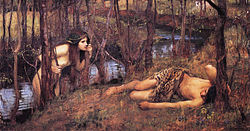
 A Naiad by John William Waterhouse, 1893; a water nymph approaches the sleeping Hylas. | |
| Creature information | |
|---|---|
| Grouping | Nymphs |
| Sub grouping | Water spirit Elemental |
| Similar entities | Mermaid Huldra Selkie Siren |
| Origin | |
| Habitat | Any body of fresh water |
| Greek deities series |
|---|
| Water deities |
| Water nymphs |
In Greek mythology, the naiads (/ˈnaɪædz, ˈneɪædz, -ədz/; Ancient Greek: ναϊάδες, romanized: naïádes), sometimes also hydriads,[1] are a type of female spirit, or nymph, presiding over fountains, wells, springs, streams, brooks and other bodies of fresh water.
They are distinct from river gods, who embodied rivers, and the very ancient spirits that inhabited the still waters of marshes, ponds and lagoon-lakes such as pre-Mycenaean Lerna in the Argolis.
Etymology
[edit]The Greek word is ναϊάς (naïás [naːiás]), plural ναϊάδες (naïádes [naːiádes]). It derives from νάειν (náein), "to flow", or νᾶμα (nâma), "body of flowing water".[citation needed]
Mythology
[edit]
Naiads were often the object of archaic local cults, worshipped as essential to humans. Boys and girls at coming-of-age ceremonies dedicated their childish locks to the local naiad of the spring. In places like Lerna their waters' ritual cleansings were credited with magical medical properties. Animals were ritually drowned there. Oracles might be situated by ancient springs.
Naiads could be dangerous: Hylas of the Argo’s crew was lost when he was taken by naiads fascinated by his beauty. The naiads were also believed to exhibit jealous tendencies. Theocritus's story of naiad jealousy was that of a shepherd, Daphnis, who was the lover of Nomia or Echenais; Daphnis had on several occasions been unfaithful to Nomia and as revenge she permanently blinded him. The nymph Salmacis raped Hermaphroditus and fused with him when he tried to escape.
The water nymph associated with particular springs was known all through Europe in places with no direct connection with Greece, surviving in the Celtic wells of northwest Europe that have been rededicated to Saints, and in the medieval Melusine.
Walter Burkert points out, "When in the Iliad [xx.4–9] Zeus calls the gods into assembly on Mount Olympus, it is not only the well-known Olympians who come along, but also all the nymphs and all the rivers; Okeanos alone remains at his station",[2] Greek hearers recognized this impossibility as the poet's hyperbole, which proclaimed the universal power of Zeus over the ancient natural world: "the worship of these deities," Burkert confirms, "is limited only by the fact that they are inseparably identified with a specific locality."[2]
Interpretation
[edit]In the back-story of the myth of Aristaeus, Hypseus, a king of the Lapiths, married Chlidanope, a naiad, who bore him Cyrene. Aristaeus had more than ordinary mortal experience with the naiads: when his bees died in Thessaly, he went to consult them. His aunt Arethusa invited him below the water's surface, where he was washed with water from a perpetual spring and given advice.
Place names
[edit]- St. Charles Avenue in New Orleans was formerly known as Nyades Street, and is parallel to Dryades Street.[citation needed]
- Naiad Lake in Antarctica is named after the nymphs.[3]
- Naiad, the innermost moon of Neptune, is named after the nymphs.
Gallery
[edit]-
 Naiads, Cyprian Kamil Norwid, 1846
 -
 Gioacchino Pagliei - The Naiads, 1881
 -
 Fountain of the Naiads, 1888, Piazza della Repubblica, Rome
 -
 Hylas and the Water Nymphs by Henrietta Rae, 1909
 -
 The Invocation of the Water Nymphs by Marek Hapon, 2013


.png)

See also
[edit]Notes
[edit]- ^ Postgate, J. P. (1897). "On the Alleged Confusion of Nymph-Names. Appendix". The American Journal of Philology. 18 (1): 74–75. doi:10.2307/287931. ISSN 0002-9475. JSTOR 287931.
- ^ a b Burkert, III, 3.3, p. 174.
- ^ Naiad Lake. SCAR Composite Gazetteer of Antarctica
References
[edit]
- Bibliotheca (Pseudo-Apollodorus) 2.95, 2.11, 2.21, 2.23, 1.61, 1.81, 1.7.6
- Homer. Odyssey 13.355, 17.240, Iliad 14.440, 20.380
- Ovid. Metamorphoses
- Hesiod. Theogony
- Burkert, Walter, Greek Religion, Harvard University Press, 1985. ISBN 0-674-36281-0.
- Edgar Allan Poe, "Sonnet to Science" 1829
| International | |
|---|---|
| National | |
| Other | |

Naiad
View on GrokipediaDefinition and Etymology
Etymology
The term "naiad" originates from the Latin nāias (genitive nāiadis), borrowed from Ancient Greek Ναϊάς (Naiás, pronounced [na.i̯ás]), the singular form of Ναϊάδες (Naiádes, [na.i̯á.des]), referring to female divinities presiding over flowing fresh waters such as springs, rivers, and fountains.[6] This derives directly from the Greek verb νάω (náō) or ναίω (naíō), meaning "to flow," which aptly captures the nymphs' association with the dynamic movement of water.[7][8] Linguistically, the Greek root traces to the Proto-Indo-European (PIE) base *na-, denoting "to flow," a stem that also underlies terms for water motion in other Indo-European languages.[6] This etymological connection underscores the conceptual link between the nymphs and the vital, life-giving flow of freshwater in ancient conceptions of nature. The earliest attestations of "Naiades" appear in Homeric texts, where they are portrayed as nymphs of fresh water bodies; for instance, the Odyssey (13.102–112) describes a sacred cave of the Naiads on Ithaca, and the Iliad (14.444, 20.383) alludes to similar figures as mothers of heroes.[1] Spelling variations, such as Νηιάς (Nēiás) or Νηιάδες (Nēiádes), occur across ancient sources, including Hesiod's Theogony (lines 346–352), which references the daughters of Oceanus and Tethys akin to Naiads amid the broader genealogy of water deities.[9][1] These transliterations reflect dialectal differences in Ionic and Attic Greek, with the aspirated η (ē) sometimes substituting for αι (ai) in poetic contexts.[7]Core Characteristics
Naiads, as freshwater nymphs in Greek mythology, were generally regarded as long-lived but not strictly immortal, with their existence tied directly to the vitality of their associated water sources; if a spring, river, or fountain dried up, the corresponding naiad would perish or undergo transformation.[4] This conditional longevity distinguished them from the more enduring Olympian gods, emphasizing their role as embodiments of natural cycles rather than absolute eternality.[9] They were typically depicted in ancient art and literature as beautiful young women, often with flowing long hair symbolizing the movement of water, and attired in garments or accessories evoking aquatic themes, such as holding pitchers or vases while seated beside streams or fountains.[1] Their etymological root in the Greek verb nāein, meaning "to flow," underscores this fluid, dynamic representation.[1] Naiads possessed powers centered on their watery domains, including the ability to inspire prophecy through oracles at sacred springs, provide healing via medicinal waters, and influence the fertility of land and growth of vegetation dependent on freshwater.[10] They could also bestow boons or inflict curses related to water, such as granting wishes for safe passage or prosperity near their sources, or causing floods and droughts to punish offenses against them.[11] Unlike other nymph varieties, such as dryads bound to trees or oreads to mountains, naiads were exclusively linked to freshwater bodies like rivers, lakes, and springs, reflecting their specialized guardianship over these elements.[12] As female divinities, naiads formed a gendered class of minor deities, with rare male equivalents in the form of potamoi, the river gods who personified larger waterways and often served as their fathers or consorts.[13] This exclusivity highlighted their nurturing yet potent feminine essence in the mythological hierarchy.[1]Types and Habitats
Classifications of Naiads
Naiads in Greek mythology were categorized into distinct subtypes based on the particular freshwater features they presided over, reflecting the ancient Greeks' nuanced understanding of hydrological sources. These classifications, drawn from classical descriptions, emphasize the Naiads' roles as localized spirits tied to specific water types, with variations noted across authors. The main subtypes include the Potameides, Kreneiai, Limnades, Pegaiai, Heleionomai, and Ephyriades, each associated with different manifestations of fresh water.[1][14] Potameides were the Naiads of rivers and streams, embodying the flowing, dynamic aspects of surface water. They were frequently depicted as daughters of the Potamoi, the river gods themselves, underscoring their integral connection to fluvial systems. This subtype highlights the Naiads' role in sustaining life along waterways, with their essence bound to the continuous motion of currents.[1][15] Kreneiai, also known as Crinaeae, inhabited fountains, serving as guardians of the visible emergence points where water surfaces from the earth. These Naiads were linked to sites of renewal and purification, often venerated at oracular or sacred locales due to their association with fresh, bubbling outflows. Their domain emphasized accessibility and vitality, distinguishing them from more hidden water sources.[1][14] Limnades, or Limnatides, were associated with lakes and still ponds, presiding over calmer, enclosed bodies that supported diverse ecosystems but carried connotations of mystery and introspection due to their motionless nature. This subtype's scope focused on quiescent freshwater habitats.[1][16] Pegaiai, or Pegaeae, were the Naiads of springs, embodying the natural emergence of groundwater to the surface. These nymphs were often venerated at sites with healing or prophetic waters, such as the Anigrides in Elis, and invoked in contexts of renewal and vitality. Their focus on natural outflows underscored the ancient perception of water as a life-giving resource.[1][14] Heleionomai, also known as Eleionomae, were the Naiads of marshes and wetlands, tied to boggy or fen-like areas. They presided over these moist, vegetated environments, often attending to the Potamoi and supporting the unique flora and fauna of such habitats.[1][14] Ephyriades were Naiads associated with river bends, meadows, or specific prominent springs and fountains. Examples include those near the Pirene fountain, highlighting their connection to transitional or verdant waterside landscapes.[1] Hierarchically, Naiads of all subtypes were subordinate to greater water deities, such as the primordial Oceanus, who fathered the Potamoi, or Poseidon, the Olympian god overseeing seas and inland waters. This structure positioned the Naiads as minor divinities within a broader aquatic pantheon, dependent on these higher entities for their origins and authority.[1]Associated Water Bodies
Naiads were primarily associated with freshwater environments across ancient Greece and surrounding regions, including rivers, springs, fountains, lakes, marshes, and wells, where they were regarded as the divine inhabitants and guardians of these vital sources.[1] These nymphs embodied the flowing and life-sustaining qualities of water, often depicted as daughters of local river gods or Zeus, tying their essence directly to the natural features they presided over.[1] In their symbolic role, Naiads were seen as maintainers of ecological balance within these water bodies, ensuring the purity and seasonal flow of freshwater that supported agriculture, rituals, and daily life in ancient communities.[17] Classical texts portray them as protective spirits who nourished the land through their waters, with some subtypes like Potameides specifically linked to rivers to regulate their courses and prevent floods or droughts.[1] This protective function extended to human settlements, where Naiads were invoked to safeguard water supplies from contamination or depletion.[14] Geographical examples highlight their localized presence, such as the sacred Castalian Spring at Delphi in Phocis, home to the Naiad Castalia, whose waters were used for prophetic purification rituals at the oracle of Apollo.[18] Similarly, the river system of the Achelous in western Greece was tied to numerous Naiads as daughters of the river god Achelous, symbolizing the fertile and navigable waterways of the mainland.[1] These sites underscore how Naiads were integrated into specific landscapes, from central Phocis to Aetolia. The fate of Naiads was intrinsically vulnerable to the health of their associated water bodies; ancient beliefs held that if a spring dried up or suffered from drought, the corresponding Naiad would sicken and perish, reflecting their mortal-like dependency on the natural world despite their divine status.[19] This connection emphasized the fragility of freshwater ecosystems in the Mediterranean climate, where seasonal aridity could threaten both nymph and human alike.[20] As localized spirits, Naiads varied culturally by region, appearing more prominently in mainland Greece with its abundant rivers and oracular springs, whereas island locales like those in the Aegean emphasized marine nymphs over freshwater ones due to limited inland water sources.[10] This regional mapping reinforced their role as hyper-local deities, worshipped through site-specific cults rather than pan-Hellenic reverence.[1]Role in Mythology
Worship and Cult Practices
The worship of Naiads in ancient Greece centered on nymphaea, which were sacred groves, caves, and shrines situated near natural water sources like springs, fountains, and streams, serving as focal points for veneration and ritual activity. These sites facilitated communal and individual devotion, where devotees offered libations of water, milk, or honey, as well as personal dedications such as locks of hair from children to ensure protection from drowning or to invoke blessings for health and growth. Such practices underscored the Naiads' role as benevolent guardians of freshwater, with rituals often involving purification baths or the pouring of liquids directly into the water to honor their presence.[21] Naiad cults integrated into broader local festivals and rites, particularly those associated with spring renewal and river deities, where purification ceremonies marked seasonal transitions and sought fertility for crops and livestock. Participants would make vows for safe travel across waters or family prosperity, often reciting hymns or prayers at the shrine's altar before immersing in or anointing with the sacred spring. Priestly roles were typically informal, managed by local communities or families rather than specialized priesthoods, emphasizing grassroots participation in maintaining the site through cleaning and periodic offerings. Archaeological evidence reveals the extent of these practices through inscriptions and votive artifacts discovered at key sites, including the Athenian Agora, where reliefs depicting dancing nymphs alongside altars attest to dedications for healing and safe passage, and Corinth, yielding terracotta figurines and pottery inscribed with thanks to the Naiads. Cave sanctuaries in Attica, such as those near natural springs, have produced hundreds of such offerings dating from the Archaic to Hellenistic periods, confirming the cults' popularity and persistence across regions.[21] Syncretism characterized Naiad worship, with the nymphs frequently honored alongside major deities; for instance, they were invoked as handmaidens to Artemis in rites emphasizing chastity and the hunt near wooded springs, or to Demeter in agricultural ceremonies linking water sources to bountiful harvests. This blending reflected the Naiads' subordinate yet essential status in the pantheon, enhancing local rituals without dedicated panhellenic festivals.Interactions with Deities and Mortals
Naiads frequently engaged in romantic interactions with major deities, often as objects of pursuit or seduction that resulted in divine offspring. Gods such as Zeus and Apollo were particularly noted for their amorous advances toward these freshwater nymphs, with Zeus fathering numerous children through unions with Naiads, thereby integrating them into the broader pantheon of divine lineages. Apollo, too, sought Naiads as lovers, leading to progeny who inherited aspects of their divine heritage, as described in ancient accounts of mythological liaisons. These encounters underscored the Naiads' allure and their role in propagating heroic bloodlines across Greek lore.[1][4] In alliances with mortal heroes, Naiads provided essential aid during quests, offering sustenance through their waters or guidance to navigate perilous journeys. For instance, in the Odyssey, nymphs, including those akin to Naiads, facilitated the hero's safe passage and integration into foreign lands by mediating between human wanderers and the natural world, symbolizing protective intervention in epic narratives. Such support highlighted the Naiads' nurturing capacity, extending their domain's vitality to aid human endeavors without direct confrontation.[1][22] Conflicts arose when mortals violated the sanctity of Naiad-inhabited waters, prompting retaliatory actions like floods or droughts to enforce natural balance. Polluting a spring or river was viewed as sacrilege, incurring swift divine wrath from the affected nymph, who could withhold life-giving resources or unleash calamities to punish the offenders. These episodes emphasized the Naiads' guardianship over pure water sources, deterring desecration through supernatural repercussions.[23][24] As familial ties, Naiads were commonly depicted as daughters of the Potamoi, the river gods who were themselves offspring of Oceanus and Tethys, thus forming an extended network within the divine hierarchy. This parentage positioned them as sisters or kin to other water deities, reinforcing their collective authority over freshwater realms and their interconnected roles in mythological genealogies.[1][4] These interactions conveyed moral lessons on hospitality toward sacred natural spaces and the severe consequences of their violation, promoting reverence for ecological purity in ancient Greek thought. Narratives often illustrated how respecting Naiad domains ensured prosperity, while neglect or harm invited retribution, embedding themes of environmental stewardship and divine reciprocity in cultural teachings.[1][23]Notable Figures
Famous Naiads in Myths
Daphne was a Naiad nymph associated with the river Ladon in Arcadia or the Peneios in Thessaly, northern Greece, and daughter of the river-god Peneios.[25] She is renowned in mythology for her chastity and her desperate flight from the advances of the god Apollo, culminating in her transformation into a laurel tree to evade capture.[25] This metamorphosis not only preserved her purity but also established the laurel as a sacred plant to Apollo, symbolizing victory and poetic inspiration.[25] Arethusa served as the Naiad nymph of a sacred spring in the Greek colony of Syracuse on the island of Ortygia, Sicily, southern Italy.[26] Originally from Elis or Arcadia in mainland Greece, she was a devoted follower of Artemis and fled the pursuing river-god Alpheios across land and sea, eventually emerging as the fountain that bears her name after Artemis transformed her to escape union with the god.[26] Her myth underscores the connection between Sicilian waters and mainland Greek rivers, with the spring of Arethusa believed to receive waters from the Alpheios River in Elis.[26] Syrinx was a Naiad nymph of the river Ladon in Arcadia, southern Greece, known for her beauty and dedication to the hunt as an attendant of Artemis.[27] Pursued relentlessly by the rustic god Pan, she sought refuge by the Ladon and, upon reaching its banks, beseeched her Naiad sisters or the river itself for aid, transforming into a cluster of river reeds just as Pan grasped her.[27] From these reeds, Pan fashioned his signature panpipes, the syrinx, thereby immortalizing her in the instrument's haunting melody.[27] The Danaides, or Danaïdes, were the fifty daughters of King Danaus of Libya, regarded in certain mythological traditions as Naiad-like figures due to their descent from river nymphs and their association with water sources.[28] They are collectively infamous for slaying their cousin-husbands, the sons of Aegyptus, on their wedding night—all except Hypermnestra, who spared her spouse Lynceus—leading to their eternal punishment in Hades where they endlessly pour water into a leaking sieve.[28] This group punishment highlights themes of retribution and the futility of futile labor in the underworld.[28] Naiads often played significant genealogical roles in myths, linking divine and heroic lineages through their offspring. Peirene exemplifies this as the Naiad nymph of the famed spring in Corinth, southern Greece, daughter of the river-god Asopos of Sicyon.[29] Beloved by Poseidon, she bore him two sons: Cenchrias, a hunter accidentally slain by Artemis, and Lecheas (or Leches), thereby connecting the Corinthian water source to the city's heroic and divine heritage.[29] Her spring, formed from her tears of grief over Cenchrias' death in one variant, became a vital landmark symbolizing maternal sorrow and watery renewal.[29]Key Legends and Transformations
One prominent motif in Naiad legends involves metamorphosis as a means of escape from amorous pursuits by gods or mortals, often resulting in transformations into plants or other natural elements tied to water sources. For instance, Daphne, a Naiad daughter of the river god Peneus, fled the advances of Apollo and, upon praying for aid, was transformed into a laurel tree by her father or the gods, her form forever rooted near flowing waters to symbolize her enduring chastity. Similarly, Syrinx, an Arcadian Naiad and follower of Artemis, evaded the pursuit of Pan by the river Ladon; as he closed in, she was changed into a cluster of reeds by her nymph sisters, from which Pan fashioned his panpipes, binding her essence eternally to the riparian landscape. These transformations underscore themes of violated chastity and the Naiads' inescapable connection to water, where even altered states preserve their watery domain. Arethusa's legend exemplifies pursuit across regions, highlighting metamorphic resolution through divine intervention. As a Naiad of the Alpheus River in Elis and attendant to Artemis, Arethusa bathed in the stream when the river god Alpheus fell in love with her and gave chase; to escape, Artemis shrouded her in mist and cleaved the earth, allowing Arethusa to flow underground as a hidden stream to Sicily, where she emerged as the sacred spring of Ortygia in Syracuse, forever mingled with Alpheus's waters despite her pleas for separation.[26] This tale, rooted in Sicilian cult practices, emphasizes the theme of relentless divine pursuit and the Naiad's transformation into a perpetual, unified water bond, contrasting with more localized Greek variants that portray Alpheus's river as less aggressively personified. In a rarer instance of mutual transformation driven by desire rather than flight, the Naiad Salmacis of a fountain near Halicarnassus rejected Artemis's chaste ways and lusted after the youth Hermaphroditus, son of Hermes and Aphrodite; when he bathed in her pool, she embraced him forcibly, praying to the gods for inseparability, resulting in their bodies merging into a single androgynous form, with the spring thereafter altering all who entered it to share the same dual nature. This metamorphosis, unique for its consensual undertone from Salmacis's perspective, explores themes of obsessive pursuit and the blurring of identities, eternally linking the Naiad to her watery abode through a cursed, transformative legacy. Naiads also feature in heroic legends, often intervening in ways that aid or complicate quests, as seen in the Argonautica expedition. During the voyage of Jason and the Argonauts, Heracles's young companion Hylas ventured to a Mysian spring for water and was drawn into its depths by enamored Naiads—Echionoe, Nyche, and others—who, struck by his beauty, pulled him under to keep him as a consort, inadvertently hindering Heracles's participation as he delayed the ship in frantic search, forcing the Argo to depart without him.[30] This intervention highlights the Naiads' capricious role in mortal endeavors, driven by themes of irresistible attraction and the perilous allure of fresh waters. Regional variants in Naiad legends reveal differences between literary compilations and local traditions, with Ovid's Metamorphoses emphasizing dramatic, pan-Hellenic pursuits and transformations, while Pausanias's periegetic accounts in Description of Greece focus on site-specific cults and lesser-known metamorphoses tied to particular springs. For example, Pausanias describes the Naiad Telphusa near Thebes, associated with a spring on Mount Tilphusius in the context of Apollo's oracle myths. Such variants underscore the Naiads' role as eternal guardians of water, where themes of chastity and pursuit resolve in bonds that sustain both myth and landscape across Greek locales.Interpretations and Symbolism
Ancient Perspectives
In ancient Greek literature, Naiads were frequently portrayed as benevolent guardians of freshwater sources who could also exhibit capricious behavior, reflecting the unpredictable nature of water itself. Hesiod, in his Theogony, describes the Naiads as daughters of the Potamoi, the river gods who were offspring of Oceanus and Tethys, emphasizing their role as vital, life-sustaining spirits associated with springs, rivers, and fountains that nourish the earth and humanity.[1] Pindar, in his victory odes such as Olympian 12, invokes Naiads as inspirers of poetic and athletic excellence, linking them to sacred springs like those at Delphi where they offer both nurturing support and the risk of sudden withdrawal, underscoring their dual temperament.[1] Nonnus, in the Dionysiaca, depicts Naiads in dynamic scenes with Dionysus, such as a Naiad evading a pursuing Satyr in Book 12, portraying them as lively and elusive figures, sometimes benevolent or capricious in their interactions.[31] Philosophical interpretations in pre-Socratic thought connected nymphs to broader animistic beliefs, viewing natural elements like freshwater as infused with divine vitality, aligning with traditions that attributed spirits to landscapes.[32] This perspective echoed in religious practices, where Naiads were revered as numinous presences ensuring fertility and purity, bridging mythic personification with emerging inquiries into the elemental origins of life.[1] Roman adaptations equated Greek Naiads with indigenous fontium numina, the divine spirits of springs and fountains, integrating them into Latin religious and literary frameworks. Virgil, in the Aeneid, features Juturna as a prominent Naiad—Turnus's sister and a water nymph—who intervenes in the Trojan War with both protective agency and tragic volatility, disguising herself as a warrior in Book 12 to rally the Latins and aid her brother, thus adapting the Greek archetype to emphasize Roman themes of fate and piety.[33] These numina fontium were invoked in rituals to ensure water's abundance, much like their Greek counterparts, but often framed within the Roman emphasis on localized genius loci, or protective spirits of place.[34] Representations of Naiads in ancient myths highlighted gender dynamics, portraying them as symbols of vulnerability within patriarchal structures while occasionally asserting agency through alliances with gods or heroes. Frequently pursued and transformed by male deities—such as Zeus or Apollo—Naiads embodied the perils faced by women in a male-dominated society, their beauty rendering them susceptible to violation or relocation, as seen in tales of abduction that mirrored societal constraints on female autonomy.[35] Yet, they also demonstrated resilience and influence, serving as nurses to divine offspring or advisors to mortals, thereby navigating patriarchal myths with subtle power, such as protecting young girls in transition to adulthood under Artemis's aegis.[1] Historical evidence from ancient art, including vase paintings and reliefs, illustrates Naiads in ritualistic roles, often as water pourers or participants in processions honoring natural and divine forces. Attic red-figure vases from the 5th century BCE, such as one in the Rhode Island School of Design Museum depicting a Naiad holding a hydria (water jug) beside a river god, show them in serene, beneficent poses symbolizing abundance.[36] Similarly, reliefs from sanctuaries like those at Eleusis portray Naiads in processional scenes, pouring libations from pitchers amid floral wreaths, emphasizing their communal worship in festivals tied to water's life-giving properties.[37] These depictions, common in Boeotian and Attic workshops, reinforced their status as approachable yet sacred intermediaries between humans and the elemental world.[1]Modern Scholarly Analysis
In the 20th and 21st centuries, scholars have reinterpreted Naiads through an ecological lens, viewing them as symbolic guardians of freshwater sources that underscore the vulnerability of natural water resources in the face of environmental degradation and climate change. This perspective draws on their ancient association with springs, rivers, and fountains as life-sustaining entities, positioning Naiads as early archetypes for sustainable water management and the interconnectedness of human societies with aquatic ecosystems.[38] Feminist critiques of Naiad myths have emphasized the pursuit narratives, such as those involving Daphne or Salmacis, as metaphors for female autonomy, resistance to patriarchal control, and the subversion of male desire. Scholars like Froma Zeitlin have explored how these stories reflect broader gender dynamics in Greek literature, where Naiads' transformations or rejections symbolize the limits of female agency within a male-dominated mythological framework. Similar analyses highlight the Naiads' role as liminal figures, embodying both vulnerability and power in their interactions with gods and mortals.[39][40] Comparative mythology has revealed parallels between Naiads and water spirits in other Indo-European traditions, such as Celtic sulgans or Norse nixies, which share motifs of seductive, localized female entities bound to specific water bodies and capable of bestowing fertility or danger. These similarities suggest a common Proto-Indo-European archetype of freshwater divinities that evolved into localized guardians across cultures, emphasizing themes of territorial sanctity and human-water relations.[41] Recent scholarship has addressed gaps in ancient literary sources, which predominantly focus on Attic Naiads, by incorporating archaeological evidence from non-Attic sites like the Peloponnese and Asia Minor. Excavations of nymphaea and votive offerings reveal widespread cult practices for Naiads in rural and peripheral regions, indicating their significance in local identities and water veneration beyond urban Athenian contexts. Jennifer Larson's comprehensive study integrates epigraphic and material evidence to illuminate these underrepresented aspects, challenging the urban bias in classical texts.[42] Psychoanalytic interpretations, particularly Jungian, frame Naiads as manifestations of the anima archetype—the unconscious feminine principle in the male psyche—representing instinctual, fluid aspects of the soul tied to emotional depths and natural cycles. Their elusive, watery nature symbolizes the integration of repressed femininity, with myths of pursuit or union evoking the psychological journey toward wholeness.[43]Cultural Legacy
Influence on Place Names
In ancient Greece, numerous freshwater sources bore names derived from specific Naiads, reflecting the deep integration of these nymphs into local geography and cult practices. For instance, the spring of Arethusa in Syracuse, Sicily, was named after the Naiad Arethusa, who was mythologically linked to an underground river connecting it to the Alpheios in Elis; Pausanias describes the Sicilian spring as a sacred site where the nymph emerged after fleeing the river god Alpheios. Similarly, the Herkyna River in Boeotia derived its name from the Naiad Herkyna, daughter of the seer Trophonios, whose spring was revered for its oracular properties near Lebadeia.[44] These hydronyms and toponyms underscored the belief that Naiads embodied and protected their watery domains, with Pausanias cataloging such sites in his Description of Greece as vital landmarks tied to mythological narratives. Modern survivals of Naiad-inspired nomenclature persist in hydronyms and settlements across Greece and Italy, preserving ancient etymologies amid evolving landscapes. Villages like Nymfaion in northern Greece trace their names to "nymphaeum," sacred groves or fountains dedicated to nymphs including Naiads, evoking the freshwater spirits' enduring cultural resonance. In Italy, the Fontana delle Naiadi in Rome's Piazza della Repubblica explicitly honors Naiads through its Art Nouveau sculptures of water nymphs representing rivers, lakes, geysers, and oceans, completed in 1912 but rooted in classical revivalism.[45] These examples illustrate how Naiad mythology influenced urban and rural naming conventions, blending antiquity with contemporary identity. The Naiad motif extends into scientific nomenclature, where it has shaped taxonomic labels in biology and astronomy. The genus Najas (commonly called naiads or water nymphs), comprising submerged aquatic plants, derives its name from the Greek Naiades due to their association with freshwater habitats, as first described by Linnaeus in 1753.[46] In astronomy, Neptune's innermost moon, discovered in 1989 during the Voyager 2 flyby, was officially named Naiad in 1991 after the nymphs presiding over springs and streams, aligning with the tradition of naming Neptunian satellites after water deities.[47] Pausanias' second-century CE Description of Greece played a pivotal role in the cartographic legacy of Naiad etymologies, mapping and preserving names of springs and rivers tied to these nymphs across regions like Arcadia and Boeotia, which informed later European cartography from medieval manuscripts to 19th-century atlases.[48] This documentation ensured that Naiad-derived toponyms, such as the Theisoa spring in Arcadia named for the nymph Theisoa, endured in geographical records.[49] During the 19th-century Romantic era, a revival of classical mythology spurred the naming of parks and estates after Naiads, evoking idyllic natural harmony amid industrialization. The Garden of Ninfa near Rome, developed from the 1920s but conceptualized in late-19th-century aesthetic ideals by the Caetani family, draws its name from a Roman-era temple to Naiad nymphs and features lush, unmanaged plantings symbolizing watery paradises.[50] Such naming reflected Romanticism's fascination with ancient water spirits as emblems of untamed beauty, influencing landscape designs in Europe and America.[51]Depictions in Art and Literature
In ancient art, Naiads were commonly represented in Hellenistic sculptures as youthful female figures poised beside water sources, often holding a hydria or pitcher to pour water, emphasizing their role as guardians of springs and streams.[1] These depictions captured their ethereal grace, with flowing drapery suggesting movement like rippling water. In Roman contexts, Pompeian frescoes from the first century CE portrayed Naiads in sacral-idyllic landscapes, frequently shown reclining in grottoes or emerging from fountains, surrounded by lush vegetation to evoke sacred natural settings.[52] Such representations, preserved in various Pompeian sites, integrated Naiads into domestic decorative schemes, blending mythology with everyday reverence for water deities.[53] The Renaissance saw a revival of Naiad imagery, with artists drawing on classical sources to infuse mythological pursuits with humanistic vitality. Titian, in his 1556–1559 painting Diana and Actaeon, depicted Naiads bathing in a woodland fountain, their lithe forms and dynamic poses set against idyllic, verdant landscapes that highlight themes of vulnerability and desire drawn from Ovid's Metamorphoses. Similarly, Nicolas Poussin's The Birth of Bacchus (c. 1625–1626) features Naiads seated in shallow waters, curiously observing the infant god, their serene expressions and watery environs underscoring harmonious classical ideals in a balanced composition.[54] These works marked a stylistic evolution, shifting from static ancient forms to more narrative-driven scenes that celebrated the Renaissance fascination with antiquity. In literature, Naiads echoed as symbols of natural purity and transience, particularly in Romantic poetry and Victorian novels. John Keats evoked a Naiad amid her reeds in Hyperion (1818–1819), using her silent gesture to convey mythic stillness and the quiet power of water spirits in a cosmos of divine upheaval.[55] Victorian authors extended this symbolism, portraying Naiads or water nymphs as emblems of innocence and moral clarity, often in narratives exploring human connection to untamed nature, as seen in Charles Kingsley's The Water-Babies (1863), where freshwater nymphs guide the protagonist toward redemption through aquatic purity. Twentieth-century media adapted Naiads into fantastical realms, blending ancient lore with modern storytelling. In C.S. Lewis's The Chronicles of Narnia series, particularly The Lion, the Witch and the Wardrobe (1950), Naiads emerge from frozen rivers as embodiments of renewal, dancing and singing during Narnia's thaw to symbolize life's resurgence under Aslan's influence.[56] The Percy Jackson film series (2010–2013), adapted from Rick Riordan's novels, features Naiads at Camp Half-Blood as ethereal allies to demigods, aiding Percy in watery quests and reinforcing their role as benevolent freshwater guardians in a contemporary mythological framework.[57] Throughout these depictions, consistent iconographic motifs endure, such as diaphanous flowing garments that mimic water's fluidity, seashells or conches held as attributes of marine kinship, and stylized water jets or cascades issuing from vessels, linking Naiads visually to their elemental domain across artistic eras.[58] These elements evolved from rigid ancient conventions to more expressive Renaissance interpretations, yet retained a core emphasis on grace and liquidity.References
- https://en.wiktionary.org/wiki/naiad