


Community hub
Recent from talks
Contribute something
Nothing was collected or created yet.
Nail (fastener)
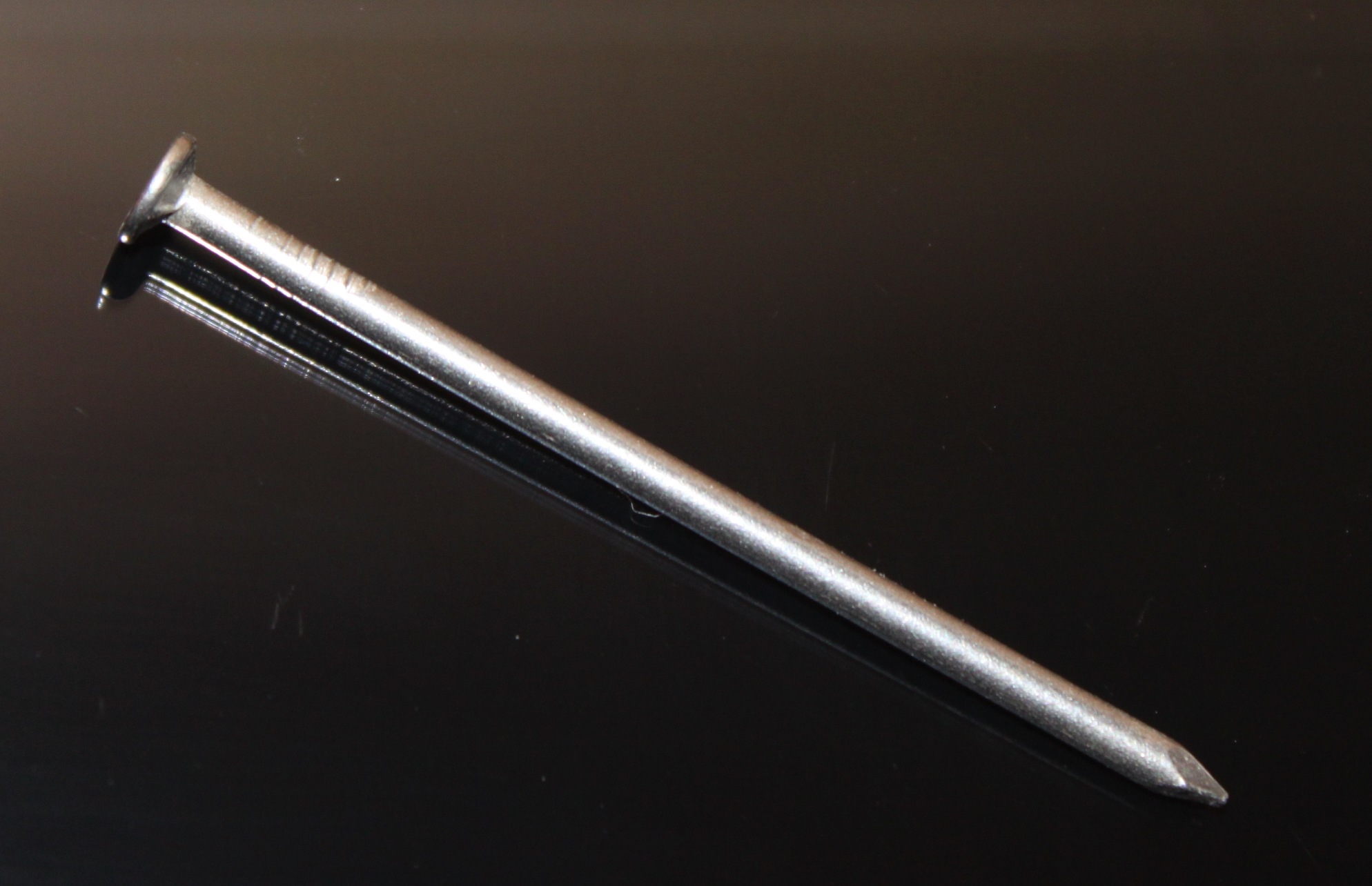
View on Wikipedia A metal nail | |
| Classification | Fastener |
|---|---|
| Used with | Wood, concrete |
In woodworking and construction, a nail is a small object made of metal (or wood, called a tree nail or "trunnel") which is used as a fastener, as a peg to hang something, or sometimes as a decoration.[1] Generally, nails have a sharp point on one end and a flattened head on the other, but headless nails are available. Nails are made in a great variety of forms for specialized purposes. The most common is a wire nail.[2] Other types of nails include pins, tacks, brads, spikes, and cleats.
Nails are typically driven into the workpiece by a hammer or nail gun. A nail holds materials together by friction in the axial direction and shear strength laterally. The point of the nail is also sometimes bent over or clinched after driving to prevent pulling out.
History
[edit]
The history of the nail is divided roughly into three distinct periods:
- Hand-wrought (forged) nail (pre-history until 19th century)
- Cut nail (roughly 1800 to 1914)
- Wire nail (roughly 1860 to the present)
From the late 1700s to the mid-1900s, nail prices fell by a factor of 10; since then nail prices have increased slightly, reflecting in part an upturn in materials prices and a shift toward specialty nails.[3]
Hand wrought
[edit]In hand-working of nails, a smith works an approximately conical iron pin tapering to a point. This is then inserted into a nail-header (also known as a nail-plate), essentially a plate of iron with a small hole in it. The broad end of the pin is slightly wider than the hole of the nail-header: the smith fits the pin into the hole of the nail-header and then hammers the broad end of the pin. Unable to advance through the hole, the broad end is flattened against the nail-header to create a nail-head. In at least some metalworking traditions, nail-headers might have been identical to draw-plates (a plate bored with tapering holes of different sizes through which wire can be drawn to extrude it to increasingly fine proportions).[4]
The Bible provides a number of references to nails, including the story in Judges of Jael the wife of Heber, who drives a nail (or tent-peg) into the temple of a sleeping Canaanite commander;[5] the provision of iron for nails by King David for what would become Solomon's Temple;[6] and in connection with the crucifixion of Jesus Christ.
The Romans made extensive use of nails. The Roman army, for example, left behind seven tons of nails when it evacuated the fortress of Inchtuthil in Perthshire in Scotland in 86 to 87 CE.
The term "penny", as it refers to nails, probably originated in medieval England to describe the price of a hundred nails.[citation needed] Nails themselves were sufficiently valuable and standardized to be used as an impromptu medium of exchange; trading between James Cook's entourage and Tahitians in the later half of the 18th century being a notable example with the absence of metals in Polynesia's volcanic islands until knowledge of the malleable iron came spread following the breaking apart of Jacob Roggeveen's abandoned Afrikaansche Galey wreck by Takapoto islanders in 1722.[7]
Until around 1800 artisans known as nailers or nailors made nails by hand – note the surname Naylor.[8] (Workmen called slitters cut up iron bars to a suitable size for nailers to work on. From the late 16th century, manual slitters disappeared with the rise of the slitting mill, which cut bars of iron into rods with an even cross-section, saving much manual effort.)
At the time of the American Revolution, England was the largest manufacturer of nails in the world.[9] Nails were expensive and difficult to obtain in the American colonies, so that abandoned houses were sometimes deliberately burned down to allow recovery of used nails from the ashes.[10] This became such a problem in Virginia that a law was created to stop people from burning their houses when they moved.[11] Families often had small nail-manufacturing setups in their homes; during bad weather and at night, the entire family might work at making nails for their own use and for barter. Thomas Jefferson wrote in a letter: "In our private pursuits it is a great advantage that every honest employment is deemed honorable. I am myself a nail maker."[12] The growth of the trade in the American colonies was theoretically held back by the prohibition of new slitting mills in America by the Iron Act, though there is no evidence that the Act was actually enforced.
The production of wrought-iron nails continued well into the 19th century, but ultimately was reduced to nails for purposes for which the softer cut nails were unsuitable, including horseshoe nails.
Cut
[edit]The slitting mill, introduced to England in 1590, simplified the production of nail rods, but the real first efforts to mechanise the nail-making process itself occurred between 1790 and 1820, initially in England and the United States, when various machines were invented to automate and speed up the process of making nails from bars of wrought iron. Also in Sweden in the early 1700s Christopher Polhem produced a nail cutting machine as part of his automated factory.[13] These nails were known as cut nails because they were produced by cutting iron bars into rods; they were also known as square nails because of their roughly rectangular cross section.
The cut-nail process was patented in the U.S. by Jacob Perkins in 1795 and in England by Joseph Dyer, who set up machinery in Birmingham. The process was designed to cut nails from sheets of iron, while making sure that the fibres of the iron ran down the nails. The Birmingham industry expanded in the following decades, and reached its greatest extent in the 1860s, after which it declined due to competition from wire nails, but continued until the outbreak of World War I.[14]
Cut nails were one of the important factors in the increase in balloon framing beginning in the 1830s and thus the decline of timber framing with wooden joints.[15] Though still used for historical renovations, and for heavy-duty applications, such as attaching boards to masonry walls, cut nails are much less common today than wire nails.
During the time when the settlers were annexing Texas, the Salish were in the Pacific Northwest using the nail. The nail they used was made of wood, cedar, and copper. They made the wooden ones using a form of carving. The copper nails were made from melting copper and shaping it into a nail form.
Wire
[edit]Wire nails are formed from wire. Usually coils of wire are drawn through a series of dies to reach a specific diameter, then cut into short rods that are then formed into nails. The nail tip is usually cut by a blade; the head is formed by reshaping the other end of the rod under high pressure. Other dies are used to cut grooves and ridges. Wire nails were also known as "French nails" for their country of origin.[16] Belgian wire nails began to compete in England in 1863. Joseph Henry Nettlefold was making wire nails at Smethwick by 1875.[14] Over the following decades, the nail-making process was almost completely automated. Eventually the industry had machines capable of quickly producing huge numbers of inexpensive nails with little or no human intervention.[17]
With the introduction of cheap wire nails, the use of wrought iron for nail making quickly declined, as more slowly did the production of cut nails. In the United States, in 1892 more steel-wire nails were produced than cut nails. In 1913, 90% of manufactured nails were wire nails. Nails went from being rare and precious to being a cheap mass-produced commodity. Today almost all nails are manufactured from wire, but the term "wire nail" has come to refer to smaller nails, often available in a wider, more precise range of gauges than is typical for larger common and finish nails. Today, many nails are made using the modern rotary principle nail machine, which allows wire feeding, wire cutting and nail head forming to take place in one continuous process of rotating movements.[18]
Materials
[edit]Nails were formerly made of bronze or wrought iron and were crafted by blacksmiths and nailors. These crafts people used a heated square iron rod that they forged before they hammered the sides which formed a point. After reheating and cutting off, the blacksmith or nailor inserted the hot nail into an opening and hammered it.[19] Later new ways of making nails were created using machines to shear the nails before wiggling the bar sideways to produce a shank. For example, the Type A cut nails were sheared from an iron bar type guillotine using early machinery. This method was slightly altered until the 1820s when new heads on the nails' ends were pounded via a separate mechanical nail heading machine. In the 1810s, iron bars were flipped over after each stroke while the cutter set was at an angle. Every nail was then sheared off of taper allowing for an automatic grip of each nail which also formed their heads.[19] Type B nails were created this way. In 1886, 10 percent of the nails that were made in the United States were of the soft steel wire variety and by 1892, steel wire nails overtook iron cut nails as the main type of nails that were being produced. In 1913, wire nails were 90 percent of all nails that were produced.[19]
Today's nails are typically made of steel, often dipped or coated to prevent corrosion in harsh conditions or to improve adhesion. Ordinary nails for wood are usually of a soft, low-carbon or "mild" steel (about 0.1% carbon, the rest iron and perhaps a trace of silicon or manganese). Nails for masonry applications are tempered and have a higher carbon content.[20]
Types
[edit].jpg)
1) roofing
2) umbrella head roofing
3) brass escutcheon pin
4) finish
5) concrete
6) spiral-shank
7) ring-shank (a used, bent "gun" nail, with barbs left over from the tool's feed system)


Types of nail include:
- Aluminium nails – Made of aluminium in many shapes and sizes for use with aluminium architectural metals
- Box nail – like a common nail but with a thinner shank and head
- Brads are small, thin, tapered nails with a lip or projection to one side rather than a full head[21] or a small finish nail[22]
- Floor brad ('stigs') – flat, tapered and angular, for use in fixing floor boards
- Oval brad – Ovals utilize the principles of fracture mechanics to allow nailing without splitting. Highly anisotropic materials like regular wood (as opposed to wood composites) can easily be wedged apart. Use of an oval perpendicular to the wood's grain cuts the wood fibers rather than wedges them apart, and thus allows fastening without splitting, even close to edges
- Panel pins
- Tacks or Tintacks are short, sharp pointed nails often used with carpet, fabric and paper.[23] Normally cut from sheet steel (as opposed to wire), the tack is used in upholstery, shoe making and saddle manufacture. The triangular shape of the nail's cross section gives greater grip and less tearing of materials such as cloth and leather compared to a wire nail.
- Brass tack – brass tacks are commonly used where corrosion may be an issue, such as furniture where contact with human skin salts will cause corrosion on steel nails
- Canoe tack – A clinching (or clenching) nail. The nail point is tapered so that it can be turned back on itself using a clinching iron.[24] It then bites back into the wood from the side opposite the nail's head, forming a rivet-like fastening.[25]
- Clench-nails used in building clinker boats.[26]
- Shoe tack – A clinching nail (see above) for clinching leather and sometimes wood, formerly used for handmade shoes.[27]
- Carpet tack
- Upholstery tacks – used to attach coverings to furniture
- Thumbtack (or "push-pin" or "drawing-pin") are lightweight pins used to secure paper or cardboard.
- Casing nails – have a head that is smoothly tapered, in comparison to the "stepped" head of a finish nail. When used to install casing around windows or doors, they allow the wood to be pried off later with minimal damage when repairs are needed, and without the need to dent the face of the casing in order to grab and extract the nail. Once the casing has been removed, the nails can be extracted from the inner frame with any of the usual nail pullers
- Clout nail – a roofing nail
- Coil nail – nails designed for use in a pneumatic nail gun assembled in coils
- Common nail – smooth shank, wire nail with a heavy, flat head. The typical nail for framing
- Convex head (nipple head, springhead) roofing nail – an umbrella shaped head with a rubber gasket for fastening metal roofing, usually with a ring shank
- Copper nail – nails made of copper for use with copper flashing or slate shingles etc.
- D-head (clipped head) nail – a common or box nail with part of the head removed for some pneumatic nail guns
- Double-ended nail – a rare type of nail with points on both ends and the "head" in the middle for joining boards together. See this patent. Similar to a dowel nail but with a head on the shank.
- Double-headed (duplex, formwork, shutter, scaffold) nail – used for temporary nailing; nails can easily pulled for later disassembly
- Dowel nail – a double pointed nail without a "head" on the shank, a piece of round steel sharpened on both ends
- Drywall (plasterboard) nail – short, hardened, ring-shank nail with a very thin head
- Fiber cement nail – a nail for installing fiber cement siding
- Finish nail (bullet head nail, lost-head nail) – A wire nail with a small head intended to be minimally visible or driven below the wood surface and the hole filled to be invisible
- Gang nail – a nail plate
- Hardboard pin – a small nail for fixing hardboard or thin plywood, often with a square shank
- Horseshoe nail – nails used to hold horseshoes on hoofs
- Joist hanger nail – special nails rated for use with joist hangers and similar brackets. Sometimes called "Teco nails" (1+1⁄2 × .148 shank nails used in metal connectors such as hurricane ties)
- Lost-head nail – see finish nail
- Masonry (concrete) – lengthwise fluted, hardened nail for use in concrete
- Oval wire nail – nails with an oval shank
- Panel pin
- Gutter spike – Large long nail intended to hold wooden gutters and some metal gutters in place at the bottom edge of a roof
- Ring (annular, improved, jagged) shank nail – nails that have ridges circling the shank to provide extra resistance to pulling out
- Roofing (clout) nail – generally a short nail with a broad head used with asphalt shingles, felt paper or the like
- Screw (helical) nail – a nail with a spiral shank - uses including flooring and assembling pallets
- Shake (shingle) nail – small headed nails to use for nailing shakes and shingles
- Sprig – a small nail with either a headless, tapered shank or a square shank with a head on one side.[28] Commonly used by glaziers to fix a glass plane into a wooden frame.
- Square nail – a cut nail
- T-head nail – shaped like the letter T
- Veneer pin
- Wire (French) nail – a general term for a nail with a round shank. These are sometimes called French nails from their country of invention
- Wire-weld collated nail – nails held together with slender wires for use in nail guns
Sizes
[edit]Most countries, except the United States, use a metric system for describing nail sizes. A 50 × 3.0 indicates a nail 50 mm long (not including the head) and 3 mm in diameter. Lengths are rounded to the nearest millimetre.
For example, finishing nail* sizes typically available from German suppliers are:
| Length, mm | Diameter, mm |
|---|---|
| 20 | 1.2 |
| 25 | 1.4 |
| 30 | 1.6 |
| 35 | 1.6 |
| 35 | 1.8 |
| 40 | 2.0 |
| 45 | 2.2 |
| 50 | 2.2 |
| 55 | 2.2 |
| 55 | 2.5 |
| 60 | 2.5 |
| 60 | 2.8 |
| 65 | 2.8 |
| 65 | 3.1 |
| 70 | 3.1 |
| 80 | 3.1 |
| 80 | 3.4 |
| 90 | 3.4 |
| 90 | 3.8 |
| 100 | 3.8 |
| 100 | 4.2 |
| 110 | 4.2 |
| 120 | 4.2 |
| 130 | 4.6 |
| 140 | 5.5 |
| 160 | 5.5 |
| 180 | 6.0 |
| 210 | 7.0 |
- Drahtstift mit Senkkopf (Stahl, DIN 1151)
United States penny sizes
[edit]In the United States, the length of a nail is designated by its penny size.
| penny size |
length, inches | length, mm (nearest) |
|---|---|---|
| 2d | 1 | 25 |
| 3d | 1+1⁄4 | 33 |
| 4d | 1+1⁄2 | 38 |
| 5d | 1+3⁄4 | 44 |
| 6d | 2 | 51 |
| 7d | 2+1⁄4 | 57 |
| 8d | 2+1⁄2 | 64 |
| 9d | 2+3⁄4 | 70 |
| 10d | 3 | 76 |
| 12d | 3+1⁄4 | 83 |
| 16d | 3+1⁄2 | 89 |
| 20d | 4 | 102 |
| 30d | 4+1⁄2 | 114 |
| 40d | 5 | 127 |
| 50d | 5+1⁄2 | 140 |
| 60d | 6 | 152 |
Terminology
[edit]- Box: a wire nail with a head; box nails have a smaller shank than common nails of the same size
- Bright: no surface coating; not recommended for weather exposure or acidic or treated lumber
- Casing: a wire nail with a slightly larger head than finish nails; often used for flooring
- CC or Coated: "cement coated"; nail coated with adhesive, also known as cement or glue, for greater holding power; also resin- or vinyl-coated; coating melts from friction when driven to help lubricate then adheres when cool; color varies by manufacturer (tan, pink, are common)
- Common: a common construction wire nail with a disk-shaped head that is typically 3 to 4 times the diameter of the shank: common nails have larger shanks than box nails of the same size
- Cut: machine-made square nails. Now used for masonry and historical reproduction or restoration
- Duplex: a common nail with a second head, allowing for easy extraction; often used for temporary work, such as concrete forms or wood scaffolding; sometimes called a "scaffold nail"
- Drywall: a specialty blued-steel nail with a thin broad head used to fasten gypsum wallboard to wooden framing members
- Finish: a wire nail that has a head only slightly larger than the shank; can be easily concealed by countersinking the nail slightly below the finished surface with a nail-set and filling the resulting void with a filler (putty, spackle, caulk, etc.)
- Forged: handmade nails (usually square), hot-forged by a blacksmith or nailor, often used in historical reproduction or restoration, commonly sold as collector's items
- Galvanized: treated for resistance to corrosion and/or weather exposure
- Electrogalvanized: provides a smooth finish with some corrosion resistance
- Hot-dip galvanized: provides a rough finish that deposits more zinc than other methods, resulting in very high corrosion resistance that is suitable for some acidic and treated lumber;
- Mechanically galvanized: deposits more zinc than electrogalvanizing for increased corrosion resistance
- Head: round flat metal piece formed at the top of the nail; for increased holding power
- Helix: the nail has a square shank that has been twisted, making it very difficult to pull out; often used in decking so they are usually galvanized; sometimes called decking nails
- Length: distance from the bottom of the head to the point of a nail
- Phosphate-coated: a dark grey to black finish providing a surface that binds well with paint and joint compound and minimal corrosion resistance
- Point: sharpened end opposite the "head" for greater ease in driving
- Pole barn: long shank (2+1⁄2 in to 8 in, 6 cm to 20 cm), ring shank (see below), hardened nails; usually oil quenched or galvanized (see above); commonly used in the construction of wood framed, metal buildings (pole barns)
- Ring shank: small directional rings on the shank to prevent the nail from working back out once driven in; common in drywall, flooring, and pole barn nails
- Shank: the body the length of the nail between the head and the point; may be smooth, or may have rings or spirals for greater holding power
- Sinker: these are the most common nails used in framing today[citation needed]; same thin diameter as a box nail; cement coated (see above); the bottom of the head is tapered like a wedge or funnel and the top of the head is grid embossed to keep the hammer strike from sliding off
- Spike: a large nail; usually over 4 in (100 mm) long
- Spiral: a twisted wire nail; spiral nails have smaller shanks than common nails of the same size
In art and religion
[edit]Nails have been used in art, such as the Nail Men—a form of fundraising common in Germany and Austria during World War I.
Before the 1850s bocce and pétanque boules were wooden balls, sometimes partially reinforced with hand-forged nails. When cheap, plentiful machine-made nails became available, manufacturers began to produce the boule cloutée—a wooden core studded with nails to create an all-metal surface. Nails of different metals and colors (steel, brass, and copper) were used to create a wide variety of designs and patterns. Some of the old boules cloutées are genuine works of art and valued collector's items.
Once nails became cheap and widely available, they were often used in folk art and outsider art as a method of decorating a surface with metallic studs. Another common artistic use is the construction of sculpture from welded or brazed nails.
Nails were sometimes inscribed with incantations or signs intended for religious or mystical benefit, used at shrines or on the doors of houses for protection.[29]
-
 Roman bronze nails with magical signs and inscriptions, 3rd–4th century AD.
 -


See also
[edit]- Date nail – a tagging device utilized by railroads to visually identify the age of a railroad tie
- Denailer – a tool that removes used nails
- Nails (1979 film)
- Rail spike
- Screw
- Truss connector plate
References
[edit]- ^ Nail II. def. 4.a. Oxford English Dictionary Second Edition on CD-ROM (v. 4.0) © Oxford University Press 2009.
- ^ "Wire Nails vs Concrete Nails - Uniwin Machines". 2022-04-30. Retrieved 2022-12-17.
- ^ Sichel, Daniel E. (December 2021). "The Price of Nails since 1695: A Window into Economic Change". Working Paper Series. National Bureau of Economic Research. doi:10.3386/w29617. S2CID 245712757.
{{cite journal}}: Cite journal requires|journal=(help) - ^ E. G. Thomsen and H. H. Thomsen, 'Early Wire Drawing Through Dies', Journal of Manufacturing Science and Engineering, 96.4 (November 1974), 1216–21.
- ^ Bible, Judges 4:21: "Then Jael Heber's wife took a nail of the tent, and took a hammer in her hand, and went softly unto him, and smote the nail into his temples, and fastened it into the ground: for he was fast asleep and weary. So he died."
- ^ Bible, 1 Chronicles 22:3: "And David prepared iron in abundance for the nails for the doors of the gates, and for the joinings; and brass in abundance without weight[.]
- ^ Ferdon, Edwin N. (1981). Early Tahiti As the Explorers Saw It, 1767-1797. University of Arizona Press. pp. 281–3. ISBN 9780816534777.
- ^
Hanks, Patrick; Hodges, Flavia (1988). A dictionary of surnames. Oxford: Oxford university Press. p. 384. ISBN 0192115928.
Naylor [...]: occupational name for a maker of nails [...].
- ^ Wenkart, Michael (2014). 50 scientific discoveries that changed the world. Books on Demand. p. 221. ISBN 978-3735724991.
- ^ Temin, Peter (1964). Iron and Steel in Nineteenth-Century America: An Economic Inquiry. M.I.T. Press. p. 42 web. ISBN 9780262200035.
{{cite book}}: ISBN / Date incompatibility (help) - ^ "The Blacksmith in Colonial Virginia".
- ^ "Thomas Jefferson letter to Jean Nicolas Démeunier". Quotes Database. Archived from the original on 2017-05-10.
- ^ Teknologföreningen, Svenska (1963). "Christopher Polhem, the Father of Swedish Technology".
- ^ a b G. Sjögren (2013). "The rise and decline of the Birmingham cut-nail trade, c. 1811–1914". Midland History. 38 (1): 36–57. doi:10.1179/0047729X13Z.00000000016. S2CID 153675934.
- ^ Kirby, Richard Shelton. Engineering in history. 1956. Reprint. New York: Dover Publications, 1990. 325. ISBN 0486264122
- ^ Notes on Building Construction. Part III. Materials. London, Oxford, and Cambridge: Rivingtons. 1879. p. 441.
- ^ "A New English Nail Machine". Hardware. 7 Feb 1890. Retrieved 19 April 2013.
- ^ "About ENKOTEC". ENKOTEC. Retrieved 28 Jun 2023.
- ^ a b c Visser, Thomas D. "Nails: Clues to a Building's History". University of Vermont. Retrieved 1 September 2019.
- ^ Ching, Francis D. K.; Mulville, Mark (10 February 2014). European Building Construction Illustrated. John Wiley & Sons. p. 59. ISBN 978-1-119-95317-3.
- ^ Whitney, William Dwight; Smith, Benjamin E. (1901). Brad def. 1. Vol. 1. New York: Century Co. pp. 654–655.
{{cite book}}:|work=ignored (help) - ^ Davies, Nikolas; Jokiniemi, Erkki (2011). Brad def. 1. Oxford: Architectural Press. p. 56.
{{cite book}}:|work=ignored (help) - ^ Whitney, William Dwight; Smith, Benjamin E. (1901). Tack def. 1. Vol. 1. New York: Century Co.
{{cite book}}:|work=ignored (help) - ^ "Tools - Northwoods Canoe Co". wooden-canoes.com.
- ^ "Faering Design, copper nails, roves, and fasteners". www.faeringdesigninc.com.
- ^ "Heritage Gateway - Results". www.heritagegateway.org.uk.
- ^ "Catalog" (PDF). shakerovalbox.com.
- ^ Sprig. def. 1. Oxford University Press. 2009.
{{cite book}}:|work=ignored (help) - ^ Bronze nails with magical signs and inscriptions; Roman, 3rd-4th century AD. British Museum info card for item "BM Cat Bronzes 3191, 3193, 3192, 3194": British Museum.
{{cite book}}: CS1 maint: location (link)
Further reading
[edit]- Sichel, Daniel E. (2022-02). "The Price of Nails since 1695: A Window into Economic Change". Journal of Economic Perspectives. 36 (1): 125–150.
External links
[edit]

- UK DIY site - description of different types of nails
- US DIY site - description of different nails
- Nail forging movie


Nail (fastener)
View on GrokipediaHistory
Ancient origins
The earliest known use of nail-like fasteners dates back to around 3500 BCE in ancient Mesopotamia, where simple metal pegs crafted from copper or bronze served basic functions such as hanging objects or securing materials.[6] These rudimentary implements were hand-forged, reflecting the nascent stages of metalworking in the region, and represent the foundational shift from purely organic binding methods to metallic ones.[7] Archaeological evidence from ancient Egypt further illustrates the evolution of these fasteners, with bronze and copper nails appearing in woodworking applications by approximately 2000 BCE during the Middle Kingdom. These nails were employed to join wooden elements in furniture and structural elements, marking an early adoption in carpentry. In shipbuilding, copper nails were hammered into mortise-and-tenon joints to reinforce hull planking, as seen in vessels from the period, enhancing durability for Nile and maritime trade. By the Eighteenth Dynasty (circa 1550–1292 BCE), such nails became more commonplace in woodwork, transitioning from decorative or auxiliary roles to essential fasteners.[8] In the Roman era, hand-wrought iron nails produced by blacksmiths became widespread for construction and military purposes, forged by heating iron rods and hammering them into tapered shapes with square or rose-headed tops. Examples include the massive hoard of nearly 875,000 nails buried at the Inchtuthil fortress in Scotland around 87 CE to deny resources to local tribes. This tradition persisted into the medieval period, where iron nails hand-forged by smiths secured timber framing in grand structures like European cathedrals. Viking longships from the 9th–11th centuries also utilized similar hand-forged iron rivets—functionally akin to nails with added roves—for clinker-built hulls, as evidenced by finds from the Gokstad ship burial in Norway.[9][10][11] Early civilizations initially relied on wooden treenails (trunnels)—tapered wooden pegs driven into holes for joining timber—before the broader adoption of metal alternatives, a transition driven by metalworking advancements. In ancient Egyptian tombs, such as those from the Old Kingdom (circa 2686–2181 BCE), treenails predominated in coffin and furniture assembly, with metal nails emerging later for enhanced strength in high-status burials during the New Kingdom. This shift, evident in artifacts from sites like Saqqara, underscored metal's superiority in permanence and load-bearing capacity.[8][12]Industrial developments
The mechanization of nail production began in the late 18th century with the invention of cut nails, a pivotal development that shifted from labor-intensive hand-forging to machine-based manufacturing. Around 1780, Ezekiel Reed of Massachusetts devised an early hand-operated machine that cut wedge-shaped blanks from hoop iron sheets using shears, clamped them, and formed heads by hammering, enabling production of up to 3,000 tacks per day.[13] This innovation, initially powered by human effort, marked the onset of industrialized nail-making in New England, where water-powered variants soon emerged to slice thin iron sheets into tapered nails with greater efficiency.[3] By the 1790s, cut nail production had spread widely across the United States, with factories like William J. Folsome's in Harrisburg, Pennsylvania, outputting 120,000 nails per week using water or early steam power.[3] In Britain, similar mechanized processes were adopted in the early 19th century, transforming scattered blacksmith operations into centralized factories that capitalized on the Industrial Revolution's emphasis on scale.[14] These advancements drastically reduced reliance on imported nails post-American Revolution and supported domestic construction surges, as machines allowed for consistent sizing and volume unattainable by manual methods.[3] The introduction of dedicated heading machines in the 1820s further refined the process, separating the cutting and heading operations to produce more uniform nails at higher speeds.[15] These mechanical headers pounded heads onto cut shanks, eliminating much of the manual finishing required in earlier designs and enabling factories to meet the demands of expanding urban infrastructure.[15] By this decade, such innovations had become standard in American and British naileries, boosting output and quality for the era's building booms.[16] Economically, the cut nail revolution lowered production costs dramatically, transitioning the industry from a cottage-based, hand-wrought model to factory-scale operations by the early 1820s and rendering traditional blacksmithing obsolete in Europe by the mid-19th century.[16] In the US, this shift not only cut expenses—from expensive per-nail forging to affordable mass output—but also spurred regional industrial clusters, such as those in Wheeling, West Virginia, which by 1875 accounted for 40% of national production through optimized mechanization.[16] Overall, these developments made nails accessible for widespread construction, fueling economic growth during the Industrial Revolution.[14]Modern advancements
The development of wire nails in the late 19th century marked a pivotal shift in fastener production, with machines using coil-fed wire drawing and cutting processes becoming widespread by the 1890s. These innovations, building on earlier early 19th-century patents like James White's 1811 single-operation machine, enabled production rates of up to 500 nails per minute and drastically reduced material waste compared to cut nails, which required more labor and generated significant scrap. By 1892, wire nail output surpassed that of cut nails in the United States, revolutionizing construction efficiency and enabling the widespread adoption of balloon framing techniques that relied on lighter, more uniform fasteners.[5][17] Following World War II, automation further transformed nail usage through the introduction of high-speed pneumatic nailers in the 1950s, which fired 40 to 60 nails per minute for tasks like subflooring installation. Collated nails, held together by plastic strips or wire welds for sequential feeding into these tools, emerged alongside portable pneumatic models, boosting productivity in framing and sheathing by allowing rapid, consistent driving without manual hammering. These advancements, initially developed for industrial packaging and upholstery, quickly permeated residential construction, reducing labor costs and injury risks associated with traditional nailing.[18] In recent decades, nail production has emphasized sustainability and precision, with eco-friendly practices like the use of recycled steel—comprising up to 85% of input in some facilities—gaining traction since the 2000s to minimize environmental impact. Precision engineering has tailored nails for specialized industries, such as aerospace and automotive, through advanced coatings for corrosion resistance and shank designs like ring or screw threads that enhance pull-out strength by up to 50% in demanding applications. Globally, nail production reached approximately 2.5 million tons in 2024, with China as the dominant producer, accounting for over 50% of output due to its vast manufacturing infrastructure and export focus.[19][20][21]Materials and Manufacturing
Common materials
Steel serves as the predominant material in the construction of modern nails, valued for its excellent strength-to-weight ratio, malleability during forming, and relatively low cost. Carbon steel, particularly low-carbon variants, constitutes the bulk of general-purpose nails due to its ductility, which allows easy driving into wood without fracturing, while higher-carbon steel enhances hardness and shear resistance for demanding applications like framing. Alloy steels, incorporating elements such as manganese or silicon, further improve tensile strength and durability in specialized fasteners.[22][23] Stainless steel nails, alloyed with at least 10.5% chromium, offer superior corrosion resistance by forming a self-healing oxide layer on the surface, making them ideal for harsh environments such as coastal construction or chemical exposure sites. These properties prevent rust formation even in moist or saline conditions, extending service life compared to plain carbon steel.[24] Galvanized steel nails incorporate a zinc coating on a carbon steel base to inhibit corrosion through sacrificial protection, where zinc oxidizes preferentially to shield the underlying metal. Hot-dip galvanizing, involving immersion in molten zinc at around 450°C, produces a thicker alloy layer (typically 50-100 microns) for superior longevity in outdoor or high-humidity settings, whereas electroplating applies a uniform but thinner zinc deposit (5-15 microns) via electrolytic processes, suiting applications requiring a smoother finish.[25] Non-metallic alternatives include wooden treenails, cylindrical pegs crafted from hardwoods like oak or locust, historically essential in shipbuilding for securing hull planks to frames without introducing ferrous metals that could promote electrolytic corrosion in seawater. These swell upon water absorption to create tight, self-tightening joints, though they lack the shear strength of metals. In contemporary uses, plastic composite nails—blends of polymers and fiberglass—provide lightweight, non-corrosive fastening for temporary applications like CNC machine workholding, where they secure panels without damaging tools or leaving conductive residues.[26][27] Aluminum nails, lightweight and resistant to certain forms of corrosion, find specialized use in attaching aluminum siding, trim, or fascia to prevent galvanic reactions with dissimilar metals. Copper nails excel in roofing installations involving slate, tile, or copper flashing, offering inherent corrosion resistance and developing a protective patina over time for aesthetic appeal, while their high electrical conductivity suits grounding or conductive fastening needs.[28][29]Production methods
The majority of modern nails, known as wire nails, are produced from steel wire coils through a multi-step process that emphasizes precision and efficiency. The process begins with wire drawing, where low-carbon steel wire rods, typically 5.5 to 6.5 mm in diameter, are heated slightly if necessary and pulled through a series of progressively smaller dies to reduce the diameter to the desired gauge, often between 2.0 and 4.6 mm. This drawing action not only achieves the required shank thickness but also work-hardens the metal, increasing its tensile strength.[30][31] Following wire drawing, the straightened wire is fed into a high-speed nail-making machine, where it is cut to the specified length using rotary cutters or shears. The cut blanks are then pointed at one end by chiseling or grinding to form a sharp tip, and the opposite end is headed through cold forging, in which mechanical pressure displaces the metal to create the nail head shape, such as flat, round, or countersunk. This integrated process occurs in automated lines capable of producing up to 1,000 nails per minute, minimizing material waste and ensuring uniformity.[32][33] An alternative method is used for cut nails, particularly those requiring a rectangular or square cross-section for specialized applications like flooring or restoration. In this approach, thin steel sheets are sheared into rectangular blanks using guillotine-like cutters, which slice across the grain to form tapered shanks. The blanks are then stamped to sharpen the point and flatten or upset the head, often under heat to facilitate forming, resulting in nails with visible shear marks on the sides. This traditional technique, though less common today, preserves the iron fibers aligned lengthwise for enhanced holding power.[34][35] Forming techniques vary by nail type and scale. Cold forging, predominant for standard wire nails, involves deforming the metal at room temperature using high-pressure dies, which maintains surface finish and avoids scaling but is limited to ductile materials like low-carbon steel. Hot forging, applied to larger or harder nails such as spikes, heats the blanks to 800–1,200°C before pressing, allowing greater deformation but requiring additional cleaning to remove oxide layers. Modern automated systems combine these methods with computer-controlled presses for consistency across production runs.[30][36] Quality control is integral throughout production to ensure structural integrity. During wire drawing and forming, dimensional inspections using laser gauges verify shank diameter and length tolerances within 0.1 mm. Tensile strength testing subjects samples to pull forces until failure, confirming values typically exceeding 500 MPa for common steel nails. Withdrawal or pull-out resistance is evaluated by embedding nails in wood or concrete substrates and measuring the axial force required for extraction, with typical ultimate values ranging from 100–500 lbs depending on nail size, penetration depth, and substrate—for instance, a 16d common nail driven into seasoned oak resists approximately 200–400 lbs. Non-destructive tests, including visual checks for bends or cracks and coating adhesion, further validate batches before packaging.[37][38]Design and Components
Anatomical parts
A nail (fastener) is composed of three primary anatomical parts: the head, the shank, and the point, each contributing to its functionality in driving, penetration, and holding power.[39][40] The head serves as the striking surface, the shank provides the structural length and grip, and the point facilitates entry into materials. These elements are typically formed from a single piece of wire, with proportions such as the length-to-diameter ratio influencing overall performance, including shear strength.[41] The head is the enlarged top portion designed for impact during driving and to bear loads once installed. It typically has a diameter 2 to 2.5 times that of the shank to distribute force effectively.[42] Common types include the flat head, which sits flush or countersunk for a smooth surface, allowing it to be driven below the material level without protrusion. Another variant is the clinch head, featuring a broad, flat design that resists pulling out by bending over after insertion, enhancing withdrawal resistance in applications like boxing or temporary framing.[43][44] The shank forms the main body of the nail, extending from the underside of the head to the point, and is responsible for the primary holding power through friction or material deformation. In its standard form, it is a straight, cylindrical shaft that embeds into the substrate, with its smooth or textured surface interacting with fibers to prevent slippage. The shank's diameter and length determine the nail's resistance to shear forces, as a greater length-to-diameter ratio generally improves embedding depth and load distribution while maintaining structural integrity.[39][40][45] The point is the tapered distal end that initiates penetration by wedging apart the material fibers. It narrows gradually from the shank's full diameter to a sharp tip, reducing the force required for entry. Variants include the diamond point, a four-faceted taper that provides clean penetration and high holding power in wood by minimizing splitting, and the blunt point, which has a rounded tip to further reduce material damage in denser substrates like hardwoods.[39][44] In a standard anatomical diagram of a nail, the head appears as a widened cap at the proximal end, connected seamlessly to the elongated shank, which comprises the majority of the length and tapers to the pointed tip at the distal end; such illustrations highlight how the shank's proportions relative to the head and point optimize balance between drivability and strength.[40]Coatings and modifications
Galvanizing involves applying a zinc coating to nails to provide sacrificial corrosion protection, preventing rust by allowing the zinc to corrode preferentially to the underlying steel. This process is particularly essential for outdoor applications where exposure to moisture and environmental elements is high. Hot-dip galvanizing, the most common method for nails, immerses the fastener in molten zinc, resulting in a coating thickness typically ranging from 50 to 100 microns, which ensures durability in harsh conditions.[46] Phosphate coatings, often applied as a thin layer of zinc phosphate, offer limited corrosion resistance and are primarily used to reduce friction during driving, enhancing performance in interior applications like drywall installation. For use in pressure-treated wood, which contains chemicals such as alkaline copper quaternary (ACQ) that can accelerate corrosion, more robust options like epoxy or polymer-based coatings are employed to improve adhesion and mitigate chemical-induced degradation. These coatings form a barrier that resists the corrosive effects of wood preservatives, extending the nail's service life in treated lumber environments.[47][48] Modifications to the nail shank, such as annular (ring) or helical (spiral) threading, significantly enhance withdrawal resistance compared to smooth-shank designs by creating mechanical interlocks with the wood fibers. Annular threading, with raised rings along the shank, can increase withdrawal resistance by 50-100% or more, making it ideal for structural applications requiring high holding power. Helical threading provides similar benefits, often achieving 50-100% greater resistance, and is easier to drive while still offering improved pull-out strength in softer woods.[49][50][51] Polymer coatings, in addition to providing lubrication for smoother driving and reduced splitting in wood, can be color-coded to facilitate identification of nail size, type, or application during installation and inspection. For instance, vinyl or resin-based polymer layers decrease driving friction, allowing nails to penetrate more efficiently, while color variations on the head or coating enable quick visual verification on job sites. These modifications are commonly used in pneumatic nailing systems for framing and sheathing.[52][53]Types
General-purpose nails
General-purpose nails encompass a category of versatile fasteners primarily used in construction and woodworking, where their simple design allows for broad applicability in tasks requiring reliable, friction-based holding without specialized features. These nails typically feature smooth shanks that embed into wood via mechanical interlock with the material's fibers, providing withdrawal resistance that scales with nail diameter, penetration depth, and wood density.[45] In residential building, they secure framing members, sheathing, and trim, balancing strength and ease of installation across everyday projects.[45] Common nails, the most ubiquitous type, consist of a thick shank—often 2.87 mm in diameter for a 6d size—and a broad flat head that facilitates hammering and distributes load effectively.[45] This robust construction suits heavy-duty applications like framing joists and general carpentry, where the nail's stiffness resists bending under shear forces.[54] Available in lengths from 2 to 6 inches, they offer strong holding power through extensive wood contact, making them a staple for structural assemblies in woodworking.[55] Box nails serve as a lighter counterpart to common nails, featuring a slender shank—approximately 2.49 mm for a 6d size—to reduce the risk of splitting softer woods during installation.[45] With a flat head similar to common nails but smaller overall diameter, they are employed in lighter framing, box construction, and carpentry where over-penetration could compromise material integrity.[56] Their design maintains adequate friction grip for non-critical loads while prioritizing precision in delicate applications.[57] Finishing nails are engineered for aesthetic outcomes, incorporating a small, often brad-style head that can be countersunk and concealed with filler, alongside a finer wire gauge for minimal surface disruption.[58] The brad awl point enables clean, precise entry into wood, ideal for trim work, molding, and cabinetry where visible fasteners would detract from the finish.[59] Though their holding power is lower than that of common or box nails due to reduced shank thickness, they rely on friction interlock for sufficient retention in low-stress, decorative residential elements.[45] The mechanics of holding power in general-purpose nails stem from frictional resistance along the shank-wood interface, where embedment compresses wood fibers to create a grip proportional to the nail's perimeter and the material's specific gravity—for instance, higher in dense species like oak compared to pine.[45] In residential contexts, this enables secure fastening of wall frames or baseboards, with withdrawal loads often exceeding 50 pounds per inch of penetration in softwoods under standard conditions.[45] Sizing follows penny designations (e.g., 8d to 16d), influencing both grip strength and suitability for specific thicknesses.[45]Specialized nails
Specialized nails are engineered for specific substrates or demanding environments, incorporating features like unique shank designs or coatings to enhance performance in targeted applications such as masonry or roofing. These adaptations address challenges like material brittleness or exposure to weather, ensuring greater durability and compliance with industry standards compared to general-purpose nails.[60] Masonry nails are constructed from tempered hardened steel with fluted shanks, enabling them to penetrate concrete, brick, or uncured masonry without causing cracking or crumbling while providing a secure hold. The fluted design grips the substrate firmly, making these nails ideal for attaching furring strips, floor plates, or partition walls to green concrete.[61][62][63] Roofing nails feature large flat heads that are electro-galvanized for corrosion resistance, paired with diamond points that facilitate easy penetration into asphalt shingles or underlayment. These nails meet ASTM F1667 standards for roofing applications, ensuring they withstand outdoor exposure and secure roofing materials effectively during installation.[64][65] Siding and joist hanger nails typically employ ring-shank configurations to maximize pull-out resistance, which is crucial for exterior applications where wind loads or structural movement could dislodge fasteners. The annular rings on the shank embed into wood or framing, reducing cupping in siding boards and providing long-term stability for joist hangers in decks or substructures.[66][67][68] Collated nails are assembled in strips using paper or plastic collation for compatibility with pneumatic nail guns, streamlining high-volume fastening in mass production settings like subflooring installation. Paper collations minimize debris and ensure consistent penetration, while plastic versions offer weather resistance for outdoor use, both enhancing efficiency in framing and sheathing tasks.[69][70][71]Sizing Systems
Measurement standards
Nail lengths are measured from the underside of the head to the tip of the point, providing a key dimension for determining penetration depth and holding capacity in applications such as framing or finishing. Common lengths range from 1/2 inch (12.7 mm) to 6 inches (152 mm), with shorter nails suited for trim work and longer ones for structural connections.[72] The diameter of a nail's shank, which influences its shear strength and withdrawal resistance, is typically specified in inches or millimeters, or by the American Wire Gauge (AWG) system, where a lower gauge number corresponds to a thicker diameter. For instance, a 16-gauge nail has a shank diameter of 0.0625 inches (1.59 mm), while an 8-gauge nail measures 0.165 inches (4.19 mm), correlating directly to increased holding power for heavier loads.[73][74] In the United States, the ASTM F1667 standard governs dimensions and tolerances for driven fasteners like nails, ensuring consistency in length, shank diameter, and head size across types such as common and box nails. This standard includes nominal dimensions; for example, a 16d common nail is specified at 3.5 inches (89 mm) in length with a 0.162-inch (4.11 mm) shank diameter. Internationally, the European standard EN 14592 specifies dimensions for dowel-type fasteners used in timber structures, with shank diameters ranging from 2.5 mm to 6.0 mm and lengths from 20 mm to 100 mm or more, depending on the application.[75][42] Mechanical properties under these standards emphasize tensile strength to ensure nails withstand pulling forces without fracturing. ASTM F1667 requires a minimum ultimate tensile strength of 100,000 psi (689 MPa) for carbon steel wire nails with shank diameters of 0.135 inches (3.43 mm) or larger, dropping to 90,000 psi (621 MPa) for smaller diameters, alongside ductility and bending yield strength tests. EN 14592 classifies nails by performance classes (e.g., 4.2 or 4.6), with characteristic tensile strengths typically ranging from 410 MPa to 700 MPa, verified through testing for yield moment and embedding strength.[75][76] For cross-border compatibility, conversion between imperial and metric systems is essential, with lengths directly convertible (1 inch = 25.4 mm) and gauges mapped to decimal equivalents. The following table summarizes common AWG gauges used for nails, their imperial diameters, and metric conversions:| Gauge | Diameter (inches) | Diameter (mm) |
|---|---|---|
| 4 | 0.225 | 5.72 |
| 6 | 0.192 | 4.88 |
| 8 | 0.165 | 4.19 |
| 9 | 0.148 | 3.76 |
| 10 | 0.135 | 3.43 |
| 12 | 0.106 | 2.69 |
| 14 | 0.080 | 2.03 |
| 16 | 0.063 | 1.60 |