


Community hub
Recent from talks
Contribute something
Nothing was collected or created yet.
Neoclassical architecture
View on Wikipedia| Neoclassical architecture | |
|---|---|
   Top: The Petit Trianon (Versailles, France), 1764, by Ange-Jacques Gabriel; Centre: The Brandenburg Gate (Berlin, Germany), 1791, by Carl Gotthard Langhans; Bottom: Arc de Triomphe du Carrousel (Paris), 1806–1808, by Pierre-François-Léonard Fontaine | |
| Years active | 18th century–mid-19th century |
| Location | Western world |
| Influences | |
| Influenced | |
Neoclassical architecture, sometimes referred to as Classical Revival architecture, is an architectural style produced by the Neoclassical movement that began in the mid-18th century in Italy, France and Germany.[1] It became one of the most prominent architectural styles in the Western world.[2] The prevailing styles of architecture in most of Europe for the previous two centuries, Renaissance architecture and Baroque architecture, already represented partial revivals of the Classical architecture of ancient Rome and ancient Greek architecture, but the Neoclassical movement aimed to strip away the excesses of Late Baroque and return to a purer, more complete, and more authentic classical style, adapted to modern purposes.
The development of archaeology and published accurate records of surviving classical buildings was crucial in the emergence of Neoclassical architecture. In many countries, there was an initial wave essentially drawing on Roman architecture, followed, from about the start of the 19th century, by a second wave of Greek Revival architecture. This followed increased understanding of Greek survivals. As the 19th century continued, the style tended to lose its original rather austere purity in variants like the French Empire style. The term "neoclassical" is often used very loosely for any building using some of the classical architectural vocabulary.
In form, Neoclassical architecture emphasizes the wall rather than chiaroscuro and maintains separate identities to each of its parts. The style is manifested both in its details as a reaction against the Rococo style of naturalistic ornament, and in its architectural formulae as an outgrowth of some classicizing features of the Late Baroque architectural tradition. Therefore, the style is defined by symmetry, simple geometry, and social demands instead of ornament.[3] In the 21st century, a version of the style continues, sometimes called New Classical architecture or New Classicism.
History
[edit]Neoclassical architecture is a specific style and moment in the late 18th and early 19th centuries that was specifically associated with the Enlightenment, empiricism, and the study of sites by early archaeologists.[4] Classical architecture after about 1840 must be classified as one of a series of "revival" styles, such as Greek, Renaissance, or Italianate. Various historians of the 19th century have made this clear since the 1970s. Classical architecture during the 20th century is classified less as a revival, and more a return to a style that was decelerated with the advent of Modernism. Yet still Neoclassical architecture is beginning to be practiced again in the 21st century more in the form of New Classical architecture and even in Gentrification and Historicism Architecture, the Neoclassical architecture or its important elements are still being used, even when Postmodern architecture is dominant throughout the world.
Palladianism
[edit]_-_facade_on_Piazza_dei_signori.jpg)
A return to more classical architectural forms as a reaction to the Rococo style can be detected in some European architecture of the earlier 18th century, most vividly represented in the Palladian architecture of Georgian Britain and Ireland. The name refers to the designs of the 16th-century Venetian architect Andrea Palladio.
The Baroque style had never truly been to the English taste. Four influential books were published in the first quarter of the 18th century which highlighted the simplicity and purity of classical architecture: Vitruvius Britannicus by Colen Campbell (1715), Palladio's I quattro libri dell'architettura (The Four Books of Architecture, 1715), De re aedificatoria by Leon Battista Alberti (first published in 1452) and The Designs of Inigo Jones... with Some Additional Designs (1727). The most popular was the four-volume Vitruvius Britannicus by Colen Campbell. The book contained architectural prints of famous British buildings that had been inspired by the great architects from Vitruvius to Palladio. At first the book mainly featured the work of Inigo Jones, but the later tomes contained drawings and plans by Campbell and other 18th-century architects. Palladian architecture became well established in 18th-century Britain.
At the forefront of the new school of design was the aristocratic "architect earl", Richard Boyle, 3rd Earl of Burlington; in 1729, he and William Kent designed Chiswick House. This house was a reinterpretation of Palladio's Villa Capra "La Rotonda", but purified of 16th-century elements and ornament. This severe lack of ornamentation was to be a feature of Palladianism. In 1734, William Kent and Lord Burlington designed one of England's finest examples of Palladian architecture, Holkham Hall in Norfolk. The main block of this house followed Palladio's dictates quite closely, but Palladio's low, often detached, wings of farm buildings were elevated in significance.
This classicizing vein was also detectable, to a lesser degree, in the Late Baroque architecture in Paris, such as in the Louvre Colonnade. This shift was even visible in Rome at the redesigned façade for Archbasilica of Saint John Lateran.
-

-
 Louvre Colonnade, Paris, 1667–1674
 -
![Russborough House, County Wicklow, Ireland. A notable example of Irish Palladianism,[5] 1741–1755, by Richard Cassels](//upload.wikimedia.org/wikipedia/commons/thumb/5/50/Russborough-House_Part-of-the-facade.jpg/250px-Russborough-House_Part-of-the-facade.jpg) Russborough House, County Wicklow, Ireland. A notable example of Irish Palladianism,[5] 1741–1755, by Richard Cassels
Russborough House, County Wicklow, Ireland. A notable example of Irish Palladianism,[5] 1741–1755, by Richard Cassels -
 Woburn Abbey, Woburn, Bedfordshire, England, 1746, by Henry Flitcroft
 -
 Nova Scotia Legislature Building from Halifax, Nova Scotia, Canada, 1819


![Russborough House, County Wicklow, Ireland. A notable example of Irish Palladianism,[5] 1741–1755, by Richard Cassels](https://en.wikipedia.org/wiki/File:Russborough-House_Part-of-the-facade.jpg)

.jpg)
Neoclassicism
[edit]
_-_2043-0077-0.jpg)
By the mid-18th century, the movement broadened to incorporate a greater range of classical influences, including those from Ancient Greece. An early centre of neoclassicism was Italy, especially Naples, where by the 1730s court architects such as Luigi Vanvitelli and Ferdinando Fuga were recovering classical, Palladian and Mannerist forms in their Baroque architecture. Following their lead, Giovanni Antonio Medrano began to build the first truly neoclassical structures in Italy in the 1730s. In the same period, Alessandro Pompei introduced neoclassicism to the Venetian Republic, building one of the first lapidariums in Europe in Verona, in the Doric style (1738). During the same period, neoclassical elements were introduced to Tuscany by architect Jean Nicolas Jadot de Ville-Issey, the court architect of Francis Stephen of Lorraine. On Jadot's lead, an original neoclassical style was developed by Gaspare Maria Paoletti, transforming Florence into the most important centre of neoclassicism in the peninsula. In the second half of the century, Neoclassicism flourished also in Turin, Milan (Giuseppe Piermarini) and Trieste (Matteo Pertsch). In the latter two cities, just as in Tuscany, the sober neoclassical style was linked to the reformism of the ruling Habsburg enlightened monarchs.
The shift to neoclassical architecture is conventionally dated to the 1750s. It first gained influence in England and France; in England, Sir William Hamilton's excavations at Pompeii and other sites, the influence of the Grand Tour, and the work of William Chambers and Robert Adam, were pivotal in this regard. In France, the movement was propelled by a generation of French art students trained in Rome, and was influenced by the writings of Johann Joachim Winckelmann. The style was also adopted by progressive circles in other countries such as Sweden and Russia.
International neoclassical architecture was exemplified in Karl Friedrich Schinkel's buildings, especially the Altes Museum in Berlin, Sir John Soane's Bank of England in London and the newly built White House and Capitol in Washington, D.C. of the nascent American Republic. The style was international. The Baltimore Basilica, which was designed by Benjamin Henry Latrobe in 1806, is considered one of the finest examples of neoclassical architecture in the world[by whom?].
A second neoclassic wave, more severe, more studied and more consciously archaeological, is associated with the height of the First French Empire. In France, the first phase of neoclassicism was expressed in the Louis XVI style, and the second in the styles called Directoire and Empire. Its major proponents were Percier and Fontaine, court architects who specialized in interior decoration.[6]
In the decorative arts, neoclassicism is exemplified in French furniture of the Empire style; the English furniture of Chippendale, George Hepplewhite and Robert Adam, Wedgwood's bas reliefs and "black basaltes" vases, and the Biedermeier furniture of Austria. The Scottish architect Charles Cameron created palatial Italianate interiors for the German-born Catherine the Great in Saint Petersburg.[7]
-
 Oratire du Louvre façade (1855)
 -
 The Panthéon, Paris, 1758–1790
 -
 The Grand Theater, Bordeaux, by Victor Louis, 1773-1780
 -
 The Rotunda (University of Virginia), Charlottesville, Virginia, by Thomas Jefferson and Stanford White, 1826
 -
 The Academy of Athens, 1859, by Theophil Hansen
 -
 Old Legislative Building (Manila), Philippines, 1918 and rebuilt in 1945
 -
 Oudenbosch Basilica, 1892 (Oudenbosch, The Netherlands)
 -
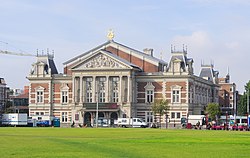 Concertgebouw, Amsterdam, The Netherlands, 1886
 -
 Soestdijk Palace, The Netherlands, more times Renovated
 -
 Tajhat Palace, late 19th century (Rangpur, Bangladesh)
 -
 Ripon Building, 1909 (Chennai, India)
 -
 HSBC Building, 1923 (Shanghai, China)


.jpg)


Interior design
[edit]
Indoors, neoclassicism made a discovery of the genuine classic interior, inspired by the rediscoveries at Pompeii and Herculaneum. These had begun in the late 1740s, but only achieved a wide audience in the 1760s, with the first luxurious volumes of tightly controlled distribution of Le Antichità di Ercolano Esposte (The Antiquities of Herculaneum Exposed). The antiquities of Herculaneum showed that even the most classicizing interiors of the Baroque, or the most "Roman" rooms of William Kent were based on basilica and temple exterior architecture turned outside in, hence their often bombastic appearance to modern eyes: pedimented window frames turned into gilded mirrors, fireplaces topped with temple fronts.
The new interiors sought to recreate an authentically Roman and genuinely interior vocabulary. Techniques employed in the style included flatter, lighter motifs, sculpted in low frieze-like relief or painted in monotones en camaïeu ("like cameos"), isolated medallions or vases or busts or bucrania or other motifs, suspended on swags of laurel or ribbon, with slender arabesques against backgrounds, perhaps, of "Pompeiian red" or pale tints, or stone colours. The style in France was initially a Parisian style, the goût grec ("Greek taste"), not a court style; when Louis XVI acceded to the throne in 1774, Marie Antoinette, his fashion-loving Queen, brought the Louis XVI style to court. However, there was no real attempt to employ the basic forms of Roman furniture until around the turn of the century, and furniture-makers were more likely to borrow from ancient architecture, just as silversmiths were more likely to take from ancient pottery and stone-carving than metalwork: "Designers and craftsmen [...] seem to have taken an almost perverse pleasure in transferring motifs from one medium to another".[8]
A new phase in neoclassical design was inaugurated by Robert and James Adam, who travelled in Italy and Dalmatia in the 1750s, observing the ruins of the classical world. On their return to Britain, they published a book entitled The Works in Architecture in installments between 1773 and 1779. This book of engraved designs made the Adam style available throughout Europe. The Adam brothers aimed to simplify the Rococo and Baroque styles which had been fashionable in the preceding decades, to bring what they felt to be a lighter and more elegant feel to Georgian houses. The Works in Architecture illustrated the main buildings the Adam brothers had worked on and crucially documented the interiors, furniture and fittings, designed by the Adams.
-
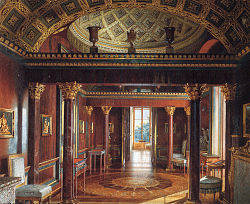 The Agate Pavilion, Tsarskoye Selo, designed by Charles Cameron in "Pompeian" style
 -

-
 Detail of the ceiling of the Arc de Triomphe from Paris
 -
 Design for a room in the Etruscan or Pompeian style, from 1833, in the Metropolitan Museum of Art (New York City)
 -
 Dining room of the Centralhotel (Berlin), designed in 1881 by Hermann von der Hude & Julius Hennicke
 -
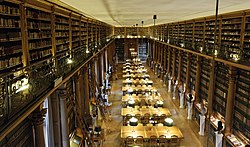 The Reading Room of the Bibliothèque Mazarine, Paris

,_palais,_salon_Bleu_3.jpg)
.jpg)
_MET_DP804393.jpg)


Greek Revival
[edit]
From about 1800 a fresh influx of Greek architectural examples, seen through the medium of etchings and engravings, gave a new impetus to neoclassicism, the Greek Revival. There was little direct knowledge of surviving Greek buildings before the middle of the 18th century in Western Europe, when an expedition funded by the Society of Dilettanti in 1751 and led by James Stuart and Nicholas Revett began serious archaeological enquiry. Stuart was commissioned after his return from Greece by George Lyttelton to produce the first Greek building in England, the garden temple at Hagley Hall (1758–59).[9] A number of British architects in the second half of the century took up the expressive challenge of the Doric from their aristocratic patrons, including Joseph Bonomi the Elder and John Soane, but it was to remain the private enthusiasm of connoisseurs up to the first decade of the 19th century.[10]
Seen in its wider social context, Greek Revival architecture sounded a new note of sobriety and restraint in public buildings in Britain around 1800 as an assertion of nationalism attendant on the Act of Union, the Napoleonic Wars, and the clamour for political reform. It was to be William Wilkins's winning design for the public competition for Downing College, Cambridge, that announced the Greek style was to be the dominant idiom in architecture. Wilkins and Robert Smirke went on to build some of the most important buildings of the era, including the Theatre Royal, Covent Garden (1808–1809), the General Post Office (1824–1829) and the British Museum (1823–1848), Wilkins University College London (1826–1830) and the National Gallery (1832–1838). In Scotland, Thomas Hamilton (1784–1858), in collaboration with the artists Andrew Wilson (1780–1848) and Hugh William Williams (1773–1829) created monuments and buildings of international significance; the Burns Monument at Alloway (1818) and the Royal High School, Edinburgh (1823–1829).
At the same time the Empire style in France was a more grandiose wave of neoclassicism in architecture and the decorative arts. Mainly based on Imperial Roman styles, it originated in, and took its name from, the rule of Napoleon I in the First French Empire, where it was intended to idealize Napoleon's leadership and the French state. The style corresponds to the more bourgeois Biedermeier style in the German-speaking lands, Federal style in the United States, the Regency style in Britain, and the Napoleonstil in Sweden. According to the art historian Hugh Honour "so far from being, as is sometimes supposed, the culmination of the Neo-classical movement, the Empire marks its rapid decline and transformation back once more into a mere antique revival, drained of all the high-minded ideas and force of conviction that had inspired its masterpieces".[11]
-

-
 British Museum, London, by Robert Smirke, 1823-1847
 -
 Bordeaux Courthouse, Bordeaux, France, unknown architect, 1839-1846
 -
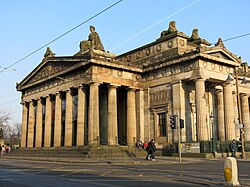 Royal Scottish Academy, Edinburgh, Scotland, unknown architect, unknown date
 -
 Propylaea (Munich), Germany, by Leo von Klenze, finished in 1862
 -
 Austrian Parliament Building, Vienna, by Theophil Hansen, 1874–1883
 -
 Friedrich-von-Thiersch hall of the Kurhaus, Wiesbaden, Germany, 1905–1907, by Friedrich von Thiersch

.JPG)


Characteristics
[edit]
High neoclassicism was an international movement. Architects reacted against the excesses and profuse ornament used in Late Baroque architecture. The new "classical" architecture emphasized planar qualities, rather than elaborate sculptural ornament in both the interior and the exterior. Projections and recessions and their effects of light and shade were more flat; sculptural bas-reliefs were flat and tended to be framed by friezes, tablets or panels. This was the first "stripped down" classical architecture, and appeared to be modern in the context of the Revolutionary period in Europe. At its most elemental, as in the work of Etienne-Louis Boullée, it was highly abstract and geometrically pure.[12]

Neoclassicism also influenced city planning. The ancient Romans had used a consolidated scheme for city planning for both defence and civil convenience; however, the roots of this scheme go back to even older civilizations. At its most basic, the grid system of streets, a central forum with city services, two main slightly wider boulevards, and the occasional diagonal street were characteristic of the very logical and orderly Roman design. Ancient façades and building layouts were oriented to these city design patterns and they tended to work in proportion with the importance of public buildings.
Many of these urban planning patterns found their way into the first modern planned cities of the 18th century. Exceptional examples include Karlsruhe, Washington, D.C., Saint Petersburg, Buenos Aires, Havana, and Barcelona. Contrasting models may be found in Modernist designs exemplified by Brasília, the Garden city movement, and levittowns.
Regional trends
[edit]France
[edit]
The first phase of neoclassicism in France is expressed in the Louis XV style of architect Ange-Jacques Gabriel (Petit Trianon, 1762–1768); the second phase, in the styles called Directoire and Empire, might be characterized by Jean-François Chalgrin's severe astylar Arc de Triomphe (designed in 1806). In England the two phases might be characterized first by the structures of Robert Adam, the second by those of Sir John Soane. The interior style in France was initially a Parisian style, the "Goût grec" ("Greek style") not a court style. Only when the young King Louis XVI acceded to the throne in 1774 did Marie Antoinette, his fashion-loving Queen, bring the Louis XVI style to court.
Many early 19th-century neoclassical architects were influenced by the drawings and projects of Étienne-Louis Boullée and Claude Nicolas Ledoux. The many graphite drawings of Boullée and his students depict spare geometrical architecture that emulates the eternality of the universe. There are links between Boullée's ideas and Edmund Burke's conception of the sublime. Ledoux addressed the concept of architectural character, maintaining that a building should immediately communicate its function to the viewer: taken literally, such ideas give rise to architecture parlante ("speaking architecture").
From about 1800 a fresh influx of Greek architectural examples, seen through the medium of etchings and engravings, gave a new impetus to neoclassicism that is called the Greek Revival. Although several European cities – notably Saint Petersburg, Athens, Berlin and Munich – were transformed into veritable museums of Greek revival architecture, the Greek Revival in France was never popular with either the state or the public.
-
 Boudoir de la Reine of the Palace of Fontainebleau (Fontainbleau)
 -

-
 Stairway of the Grand Theater of Bordeaux, 1780, by Victor Louis
 -
 The Palais de la Légion d'Honneur (Paris), 1782–1787, by Pierre Rousseau
 -
 Cabinet doré of Marie Antoinette at the Palace of Versailles (1783)
 -
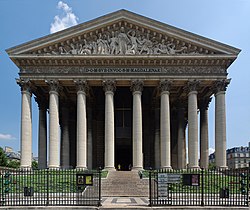 Église de la Madeleine (Paris), 1807–1828, by Pierre-Alexandre Vignon
 -
-
 Empress's bedroom from the Château de Malmaison, another Empire interior
 -
 The Vendôme Column (Paris), modelled after Trajan's Column, 1810
 -
 The Guimet Museum (Paris), by Jules Chatron


.jpg)


Germany
[edit]Neoclassical architecture became a symbol of national pride during the 18th century in Germany, in what was then Prussia. Karl Friedrich Schinkel built many notable buildings in this style, including the Altes Museum in Berlin. While the city remained dominated by Baroque city planning, his architecture and functional style provided the city with a distinctly neoclassical center.
Schinkel's work is very comparable to Neoclassical architecture in Britain since he drew much of his inspiration from that country. He made trips to observe the buildings and develop his functional style.[3]
-
 Brandenburg Gate in Berlin (1788–1791) by Carl Gotthard Langhans
 -

-
 Konzerthaus Berlin in Berlin (1818–1821) by Karl Friedrich Schinkel
 -
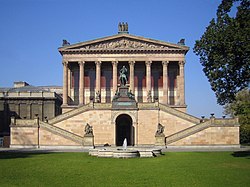
 Altes Museum in Berlin (1825–1830) by Karl Friedrich Schinkel
 -
 Glyptothek in Munich (1816–1830) by Leo von Klenze
 -
 Walhalla (1830–1842) by Leo von Klenze
 -
 Propylaea (Munich) (1854–1862) by Leo von Klenze
 -


Great Britain and Ireland
[edit] |
From the middle of the 18th century, exploration and publication changed the course of British architecture from the Palladian architecture towards a purer vision of the Ancient Greco-Roman ideal. James 'Athenian' Stuart's work The Antiquities of Athens and Other Monuments of Greece was very influential in this regard, as were Robert Wood's Palmyra and Baalbec. A combination of simple forms and high levels of enrichment was adopted by the majority of contemporary British architects and designers. The revolution begun by Stuart was soon to be eclipsed by the work of the Adam brothers, James Wyatt, Sir William Chambers, George Dance the Younger, James Gandon, and provincially based architects such as John Carr and Thomas Harrison of Chester.
In Scotland and the north of England, where the Gothic Revival was less strong, architects continued to develop the neoclassical style of William Henry Playfair. The works of Cuthbert Brodrick and Alexander Thomson show that by the end of the 19th century the results could be powerful and eccentric.
In Ireland, where Gothic Revival was also less popular, a refined, restrained form of the neoclassical developed, and can be seen in the works of James Gandon and other architects working at the time. It is particularly evident in Dublin, which is a largely neoclassical and Georgian city.
-
 The Circus, Bath, Somerset, England, 1754–1768, by John Wood, the Elder
 -
 Bedroom in Harewood House, Harewood, West Yorkshire, England, 1759–1771, by Robert Adam
 -
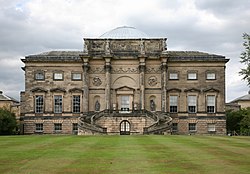 Kedleston Hall, Kedleston, Derbyshire, England based on the Arch of Constantine in Rome, the 1760s, by Robert Adam
 -
 Interior of Syon House, London with Ionic columns and gilded statues, 1767–1775, by Robert Adam
 -
 Dining room of Syon House, with a complex ceiling
 -
 General Register House, Edinburgh, Scotland, 1774–1788, by Robert Adam
 -
 Buildings in Lower O'Connell Street, Dublin constructed between 1918 and 1923 in the highly refined and aesthetically restrained style typical of the Irish capital
 -
 The central courtyard of Somerset House, London, 1776, by Sir William Chambers
 -
 Ionic Temple at Chiswick House, London, an example of English landscape garden
 -
 Greek hexastyle portico of the General Post Office, Dublin completed in 1818
 -
 The Custom House, Dublin
 -


.jpg)


.jpg)


Greece
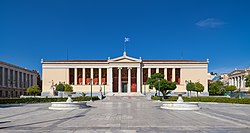
[edit]After the establishment of the Kingdom of Greece in 1832, the architecture of Greece was mostly influenced by the Neoclassical architecture. For Athens, the first King of Greece, Otto I, commissioned the architects Stamatios Kleanthis and Eduard Schaubert to design a modern city plan. The Old Royal Palace was the first important public building to be built, between 1836 and 1843. Later, in the mid- and late 19th century, Theophil Hansen and Ernst Ziller took part in the construction of many neoclassical buildings. Theophil Hansen designed his first building, the National Observatory of Athens, and two of the three contiguous buildings forming the so-called "Athens Classical Trilogy", namely the Academy of Athens (1859) and the National Library of Greece (1888), the third building of the trilogy being the National and Capodistrian University of Athens (1843), which was designed by his brother Christian Hansen. Also he designed the Zappeion Hall (1888). Ernst Ziller also designed many private mansions in the centre of Athens which gradually became public, usually through donations, such the mansion of Heinrich Schliemann, Iliou Melathron (1880).
The city of Nafplio in the Peloponnese is also an important example of Neoclassical architecture along with the island towns of Poros, Syros (in the capital Ermoupoli) and Symi.
-
 The Old Royal Palace, completed in 1843
 -
 National Library of Greece designed by Theophil Hansen (1888)
 -
The main building of the Academy of Athens, one of Theophil Hansen's "Trilogy" in central Athens (1859)
-
-
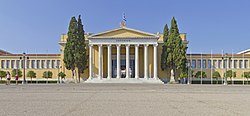 Zappeion (1888)
 -

-
 Presidential Mansion, Athens (formerly the Crown Prince's Palace) built by Ernst Ziller

.jpg)


Hungary
[edit] |
The earliest examples of neoclassical architecture in Hungary may be found in Vác. In this town the triumphal arch and the neoclassical façade of the Baroque Cathedral were designed by the French architect Isidor Marcellus Amandus Ganneval (Isidore Canevale) in the 1760s. Also the work of a French architect, Jean-Charles-Alexandre Moreau, is the garden façade of the Esterházy Palace (1797–1805) in Kismarton (today Eisenstadt in Austria).
The two principal architects of Neoclassicism in Hungary were Mihály Pollack and József Hild. Pollack's major work is the Hungarian National Museum (1837–1844). Hild is famous for his designs for the Cathedral of Eger and Esztergom. The Reformed Great Church of Debrecen is an outstanding example of the many Protestant churches that were built in the first half of the 19th century. This was the time of the first iron structures in Hungarian architecture, the most important of which is the Széchenyi Chain Bridge by William Tierney Clark.
-
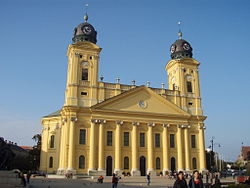 Reformed Great Church of Debrecen (1805–1824)
 -
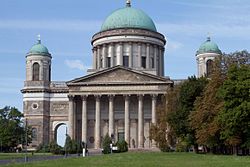 Esztergom Basilica (1822–1869)
 -
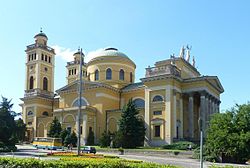 Cathedral Basilica of Eger (1831–1837)
 -
 Hungarian National Museum (1837–1844)


Japan
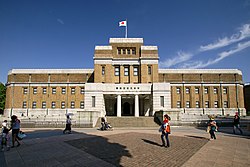
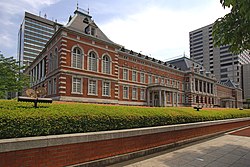
[edit]Although not a western country, due to Western influence Japan has had neoclassical architecture produced in it. This includes the unique Hiko Shrine, which is a Shinto shrine based on Greek temples. It later developed into the Imperial Crown Style, which contains elements of both Eastern and Western design.[13] Roofs are notably distinctly Asian in this style, and it was used heavily by the Japanese Empire in its colonies.[14][15][16]
-
-
 Hiko Shrine (1915)
 -
 Osaka Exchange (1949)
 -

_4.jpg)


Malta
[edit]Neoclassical architecture was introduced in Malta in the late 18th century, during the final years of Hospitaller rule. Early examples include the Bibliotheca (1786),[17] the De Rohan Arch (1798)[18] and the Hompesch Gate (1801).[19] However, neoclassical architecture only became popular in Malta following the establishment of British rule in the early 19th century. In 1814, a neoclassical portico decorated with the British coat of arms was added to the Main Guard building so as to serve as a symbol of British Malta. Other 19th-century neoclassical buildings include the Monument to Sir Alexander Ball (1810), RNH Bighi (1832), St Paul's Pro-Cathedral (1844), the Rotunda of Mosta (1860) and the now-destroyed Royal Opera House, Valletta (1866).[20]
Neoclassicism gave way to other architectural styles by the late 19th century. Few buildings were built in the neoclassical style during the 20th century, such as the Domvs Romana museum (1922),[21] and the Courts of Justice building (Valletta) (1965–1971).[22]
-
 Rotunda of Mosta, built between 1833 and 1860
 -
 St Paul's Pro-Cathedral, Valletta, built between 1839 and 1844


Mexico
[edit]
Neoclassical architecture in Mexico had two main eras, the first was toward the end of Spanish viceregal era and the second phase was during independent Mexico beginning in the mid-19th century.
Viceregal Mexico
[edit]As part of the Spanish Enlightenment's cultural impact on the Kingdom of New Spain (Mexico), the crown established the Academy of San Carlos in 1785 to train painters, sculptors, and architects in New Spain, under the direction of the peninsular Gerónimo Antonio Gil.[23] The academy emphasized neoclassicism, which drew on the inspiration of the clean lines of Greek and Roman architecture, but also, for some monuments, from the Aztec and Maya architectural traditions.[24] The preeminent Neoclassical architect in Mexico was Manuel Tolsá.
Neoclassicism in Mexican architecture was directly linked to crown policies that sought to rein in the exuberance of the New Spanish Baroque, and to create public buildings of "good taste" funded by the crown, such as the Palacio de Minería in Mexico City, the Hospicio Cabañas in Guadalajara, and the Alhóndiga de Granaditas in Guanajuato, all built in the late colonial era.[25]
The Mexico City Metropolitan Cathedral, begun in the 16th century, incorporates Neoclassical style primarily in its upper portions, particularly the bell towers and façade, which were completed in the late 18th and early 19th centuries by architects like Manuel Tolsá. While the lower sections are predominantly Baroque, the Neoclassical elements introduced by architects like Tolsá added a more restrained aesthetic and height with the incorporation of new domes and sculptures.
-
 Palacio del Marqués del Apartado, Mexico City, by Manuel Tolsá (1795–1805)
 -
 Hospicio Cabañas, Guadalajara, by Manuel Tolsá (1796–1810), one of the oldest and largest hospital complexes in the Americas
 -
 Palacio de Minería, Mexico City, by Manuel Tolsá (1797–1813)
 -
 Nuestra Señora de Loreto Church, Mexico City, by Ignacio Castera y Agustín Paz (1806–1819), last church finished before consummation of Independence


_160523.jpg)
.jpg)
Independent Mexico
[edit]Following Independence, the construction of major neoclassical buildings came to an end as a result of interruptions to the operation of the Academy of San Carlos and economic turmoil caused by the War of Independence. The economic slump was worsened by a succession of wars, including the Spanish reconquest attempts, First French Intervention, First American Intervention, Reform War, followed by the subsequent Second Mexican Empire. It was not until the late 1860s, with the restoration of the Republic and the subsequent stability of the Pax Porfiriana that Mexico saw a significant number of new neoclassical buildings. The Academy of San Carlos saw a renewal of neoclassicism ideals under director Francesco Saverio Cavallari.
During the Porfiriato, the predominant architectural taste favored Eclecticism. Buildings and monuments such as the Teatro Juárez, Museo Nacional de Arte, Palacio de Bellas Artes, and the Monument to Cuauhtémoc are 19th century eclectic buildings that combine different architectural styles, such as the Neoindigenismo, and are not solely neoclassical, especially in the European sense.
An important unfinished neoclassical building was the planned Palacio Legislativo Federal by Émile Bénard. Construction was halted by the Mexican Revolution and it was eventually turned into the Monumento a la Revolución.
-
 The drawings for the unfinished Palacio Legislativo Federal by Émile Bénard
 -
 Degollado Theater, Guadalajara, by Jacobo Gálvez, (1856–1866)
 -
 Aguascalientes Museum, Aguascalientes City, by Refugio Reyes Rivas (1903)
 -
 Benito Juárez Hemicycle, Mexico City, by Guillermo Heredia (1906–1910)
 -
![St. Joseph Parish, San José Iturbide, by Ramón Ramírez y Arangoiti (1866–1995)[26]](//upload.wikimedia.org/wikipedia/commons/thumb/5/51/Parroquia_de_San_Jos%C3%A9_-_San_Jos%C3%A9_Iturbide%2C_Guanajuato%2C_M%C3%A9xico.jpg/250px-Parroquia_de_San_Jos%C3%A9_-_San_Jos%C3%A9_Iturbide%2C_Guanajuato%2C_M%C3%A9xico.jpg) St. Joseph Parish, San José Iturbide, by Ramón Ramírez y Arangoiti (1866–1995)[26]
St. Joseph Parish, San José Iturbide, by Ramón Ramírez y Arangoiti (1866–1995)[26] -
 The courtyard of the Museo Nacional de Arte.


![St. Joseph Parish, San José Iturbide, by Ramón Ramírez y Arangoiti (1866–1995)[26]](https://en.wikipedia.org/wiki/File:Parroquia_de_San_Jos%C3%A9_-_San_Jos%C3%A9_Iturbide,_Guanajuato,_M%C3%A9xico.jpg)

Rest of Latin America
[edit]The Neoclassical style arrived in the American empires of Spain and Portugal through projects designed in Europe or carried out locally by European or Criollo architects trained in the academies of the metropolis. There are also examples of the adaptation to the local architectural language, which during previous centuries had made a synthesis or syncretism of European and pre-Columbian elements in the so-called Colonial Baroque.
Two more Classical criteria belong, in Chile, the La Moneda Palace (1784–1805) and the Santiago Metropolitan Cathedral (1748–1899), both works by the Italian architect Joaquín Toesca. In Ecuador, the Quito's Palacio de Carondelet (Ecuador's Government Palace) built between 1611 and 1801 by Antonio García. At the dawn of the independence of Hispanic America, constructive programs were developed in the new republics. Neoclassicism was introduced in New Granada by Marcelino Pérez de Arroyo. Later, in Colombia, the Capitolio Nacional was built in Bogotá between 1848 and 1926 by Thomas Reed, trained at the Berlin Bauakademie; the Primatial Cathedral of Bogotá (1807–1823), designed by Friar Domingo de Petrés; and in Peru the Basilica Cathedral of Arequipa built between 1540 and 1844 by Lucas Poblete.
Brazil, which became the seat of the court of the Portuguese monarchy, gaining independence from its metropolis as the Empire of Brazil, also used the resources of architecture for the glorification of political power, and it was decided to resort to architects trained in the Académie royale d'architecture. To this period belong the portal of the Imperial Academy of Fine Arts in Rio de Janeiro made in 1826 and the Imperial Palace of Petrópolis built between 1845 and 1862.
Argentina is another of the countries that seeks to shed its colonial past, but in the context of the reorganization of the country after independence in 1810, an aspect of power was sought that transmitted the presence of the State, inspiring respect and devotion, including of course the architecture. However, a style of its own was not conceived, but the Classical canon was introduced, not in the form of a replica of buildings from Antiquity, but with a classical predominance and a lot of influence from French Classicism; which lasted until the 20th century.
-

-
 Santiago Metropolitan Cathedral, Chile (1748–1906) by Joaquín Toesca and Ignacio Cremonesi
 -
 Palacio de Carondelet Quito, Ecuador built between (1611–1801) by Antonio García
 -
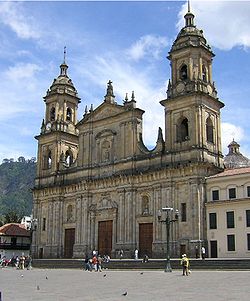 Primatial Cathedral of Bogotá, Bogotá, Colombia (1807–1823) by Friar Domingo de Petrés
 -
 Palace of Justice, Lima, Peru (1939) by Bruno Paprowsky
 -
 Imperial Palace of Petrópolis, Petrópolis, Brazil (1845–1862) by Julius Friedrich Koeler
 -
 Buenos Aires Metropolitan Cathedral, (Buenos Aires, Argentina) (1754–1823) by Antonio Masella and Prosper Catelin
 -
 Palace of the Argentine National Congress (1896–1906) by Vittorio Meano
 -
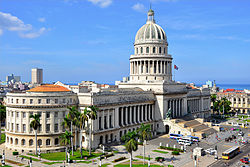 El Capitolio, Havana, Cuba (1926–1929) by Eugenio Rayneri Piedra
.jpg)


.jpg)
.JPG)
.jpg)
.jpg)

Norway
[edit]Norway has many examples of Neoclassical architecture, notably in Oslo, exemplified by the Royal Palace, Oslo University, and the Vigeland Museum, which showcases elegant proportions and classical details. This style was a significant architectural phase in the 19th century and the early 20th century, with a transition into Functionalism after the period of Nordic Classicism between 1910 and 1930.
-
 The Royal Palace of Norway
 -
 The University of Oslo
.JPG)

Philippines
[edit]Like most western traditions in the former Spanish East Indies, neoclassicism arrived in the Pacific Archipelagos via rule from New Spain (Mexico) during the period of governance by Mexico City as an architecture manifested in churches and civic buildings. When the power over the archipelago was transferred from the Spanish Crown to the United States of America, the style became more popular and developed from slightly simple approach during the Spanish era, to a more ornamented style of the Beaux-Arts architecture sparked by the return of massive number of architectural students to the islands from the western schools. It also became a symbol of American-style democracy and the approaching republic during the commonwealth.
.jpg)


Polish–Lithuanian Commonwealth
[edit]The centre of Polish-Lithuanian Neoclassicism was Warsaw and Vilnius under the rule of the last Polish king and Lithuanian grand duke, Stanisław August Poniatowski. Vilnius University was another important centre of Neoclassical architecture in Europe, led by the notable professors of architecture Marcin Knackfus, Laurynas Gucevičius and Karol Podczaszyński. The style was expressed in the shape of main public buildings, such as the Vilnius University Astronomical Observatory, Vilnius Cathedral and the town hall.
The best-known architects and artists, who worked in the Polish–Lithuanian Commonwealth were Dominik Merlini, Jan Chrystian Kamsetzer, Szymon Bogumił Zug, Jakub Kubicki, Antonio Corazzi, Efraim Szreger, Chrystian Piotr Aigner and Bertel Thorvaldsen.
-

-
 Królikarnia in Warsaw by Domenico Merlini, (1782–86)
 -
 Vilnius Cathedral by Laurynas Gucevičius, (1777–1801)
 -
 Vilnius Town Hall by Laurynas Gucevičius, (1785-1799)
 -
 Grand Theatre, Warsaw by Antonio Corazzi, (1825–33)
 -

-
 St. Alexander's Church, Warsaw by Piotr Aigner, (1818–25)
 -
 Belvedere Palace in Warsaw by Jakub Kubicki, (1819–22)


.JPG)
Russia
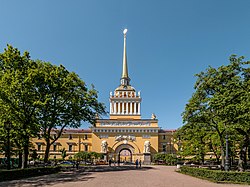
[edit]In the Russian Empire at the end of the 19th century, neoclassical architecture was equal to Saint Petersburg architecture because this style was specific for a huge number of buildings in the city. Catherine the Great adopted the style during her reign by allowing the architect Jean-Baptiste Vallin de la Mothe to build the Old Hermitage and the Imperial Academy of Arts.[3]
-
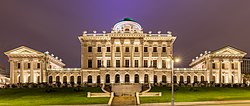
-
 Marble Bridge, 1772, by Vasily Neyolov
 -
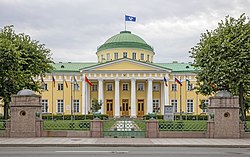 Tauride Palace, 1783-1789, by Ivan Starov
 -
 Marble Palace, 1768-1785, by Antonio Rinaldi
 -
-
 General Staff Building, 1819–1829, by Carlo Rossi
 -

-
 Main building of the Pulkovo Observatory, 1837, by Alexander Brullov
 -

-
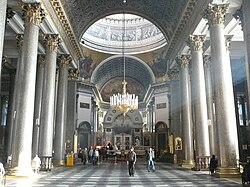 An interior of Kazan Cathedral, Saint Petersburg, by Andrey Voronikhin
 -
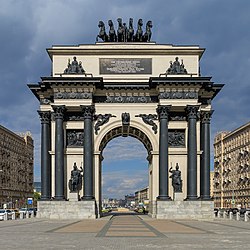
-
 Teatralna street in Yelisavetgrad (today, Kropyvnytskyi, Ukraine)


.JPG)


Spain
[edit]Spanish Neoclassicism was exemplified by the work of Juan de Villanueva, who adapted Edmund Burke's theories of beauty and the sublime to the requirements of Spanish climate and history. He built the Museo del Prado, which combined three functions: an academy, an auditorium, and a museum in one building with three separate entrances.
This was part of the ambitious program of Charles III, who intended to make Madrid the Capital of the Arts and Sciences. Very close to the museum, Villanueva built the Royal Observatory of Madrid. He also designed several summer houses for the kings in El Escorial and Aranjuez and reconstructed the Plaza Mayor, Madrid, among other important works. Villanueva's pupils expanded the Neoclassical style in Spain.
-
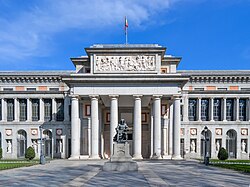 The Museo del Prado in Madrid, by Juan de Villanueva
 -
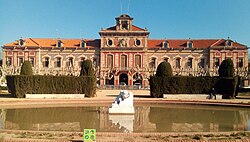 Palau del Parlament de Catalunya in Barcelona, Catalonia, built between 1716 and 1748 by Marquis of Verboom
 -
 Colegio Mayor de San Bartolomé, Salamanca, Castile and León, built in 1760
 -
 Neoclassical facade of Lugo Cathedral in Lugo, Galicia, by Julián Sánchez Bort
.jpg)

.jpg)

United States
[edit]In the new republic, Robert Adam's neoclassical manner was adapted for the local late 18th- and early 19th-century style, called Federal architecture. One of the pioneers of this style was the English-born Benjamin Henry Latrobe, who is often noted as one of America's first formally trained professional architects and the father of American architecture. The Baltimore Basilica, the first Roman Catholic cathedral in the United States, is considered by many experts to be Latrobe's masterpiece.
Another notable American architect who is identified with Federal architecture was Thomas Jefferson. He was very interested in the building he saw in Paris when he served there as ambassador, and built several neoclassical buildings, with his own innovations, including his personal estate Monticello, the Virginia State Capitol, and the University of Virginia.[3]
A second neoclassical manner found in the United States during the 19th century was called Greek Revival architecture. It differs from Federal architecture as it strictly follows the Greek idiom; however, it was used to describe all buildings of the Neoclassical period that display classical orders.[27]
-
University of Virginia Rotunda, an example of the Neoclassical architecture Thomas Jefferson built on campus.
-
 Butler Library at Columbia University in New York City (finished in 1934)
 -
 The United States Capitol was originally finished in 1800, and was greatly rebuilt in subsequent decades. The dome was added in 1855–1866.
 -

-
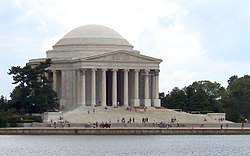 Jefferson Memorial in Washington D.C (1939–1943)
 -
 North and south sides of the White House (completed in 1800)
 -
 Front view of the Huntington City Hall, in Huntington, West Virginia (completed in 1915)
.jpg)


.jpg)


See also
[edit]
References
[edit]- ^ "Western architecture - German Gothic, Baroque, Renaissance | Britannica".
- ^ "Neoclassical architecture". Encyclopædia Britannica. Retrieved 7 July 2017.
- ^ a b c d Middleton, Robin. (1993). Neoclassical and 19th century architecture. Electa. ISBN 0-8478-0850-5. OCLC 444534819.
- ^ See, for instance, Joseph Rykwert, The First Moderns: the architects of the eighteenth century (Cambridge, MIT Press: 1980) and Alberto Perez Gomez, Architecture and the Crisis of Modern Science, (Cambridge, MIT Press: 1983)
- ^ "Andrea Palladio 1508–1580". Irish Architectural Archive. 2010. Archived from the original on 23 September 2018. Retrieved 23 September 2018.
- ^ Barry Bergdoll, Ed., The Complete Works of Percier and Fontaine, (New York, Princeton Architectural Press: 2018)
- ^ "Neoclassical Architecture (1640–1850)". www.visual-arts-cork.com. Retrieved 7 July 2017.
- ^ Honour, 110–111, 110 quoted
- ^ Though Giles Worsley detects the first Grecian influenced architectural element in the windows of Nuneham House from 1756, see Giles Worsley, "The First Greek Revival Architecture", The Burlington Magazine, Vol. 127, No. 985 (April 1985), pp. 226–229.
- ^ Joseph Mordant Crook, The Greek Revival: neoclassical attitudes in British architecture, 1760–1870 (London, John Murray: 1972)
- ^ Honour, 171–184, 171 quoted
- ^ Robin Middleton and David Watkin, NeoClassical and Nineteenth Century Architecture2 vols. (New York, Electa/Rizzoli: 1987)
- ^ Francis Chia-Hui Lin (9 January 2015). Heteroglossic Asia: The Transformation of Urban Taiwan. Taylor & Francis. pp. 85–. ISBN 978-1-317-62637-4.
- ^ Yukiko Koga (28 November 2016). Inheritance of Loss: China, Japan, and the Political Economy of Redemption after Empire. University of Chicago Press. pp. 290–. ISBN 978-0-226-41227-6.
- ^ Satō, Yoshiaki (2006). "Chapter 5 Appendix: 帝冠様式について" [About Imperial Crown Style]. 神奈川県庁本庁舎と大正昭和初期の神奈川県技術者に関する建築史的研究 [Architecture Historical Research of the Kanagawa Prefecture Main Office Building and the early Taishō Shōwa Kanagawa Prefecture Engineers] (in Japanese).
- ^ Morohashi, Kaz (Winter 2015). "Museums in Japan". e-magazine. Norwich, UK: Sainsbury Institute for the Study of Japanese Arts and Culture. Archived from the original on 9 August 2018. Retrieved 9 August 2018.
- ^ "Bibliotheca" (PDF). National Inventory of the Cultural Property of the Maltese Islands. 28 December 2012. Archived from the original (PDF) on 6 December 2015.
- ^ "Rohan Gate, Żebbuġ". Times of Malta. 11 December 2012. Archived from the original on 4 December 2015.
- ^ Bötig, Klaus (2011). Malta, Gozo. Con atlante stradale (in Italian). EDT srl. p. 54. ISBN 9788860407818.
- ^ "Architecture in Malta under the British". culturemalta.org. Archived from the original on 7 October 2015.
- ^ "Domvs Romana". Heritage Malta. Archived from the original on 5 January 2015.
- ^ "The Courts". The Judiciary – Malta. Archived from the original on 6 January 2015.
- ^ Jean Charlot, Mexican Art and the Academy of San Carlos, 1785–1915. Austin: University of Texas Press 1962, p. 25
- ^ Ladd, Doris M. (1974). "Los orígenes del nacionalismo mexicano". Hispanic American Historical Review. 54 (3): 525–528. doi:10.1215/00182168-54.3.525.
- ^ James Oles, Art and Architecture in Mexico. London: Thames and Hudson 2013, pp.132–33, 150.
- ^ "History of the City of San José Iturbide, Guanajuato Historical Marker". www.hmdb.org. Retrieved 8 August 2024.
- ^ Pierson, William Harvey (1976). American buildings and their architects. Anchor Press/Doubleday. OCLC 605187550.
28. ^ Guagliumi, Silvia (2014), "La Villa Archinto a Monza.Analogie con alcuni esempi d'architettura neoclassica in Lombardia", Silvia editrice (ISBN 978-88-96036-62-4), basata sulla propria Tesi di Laurea in Architettura presso il Politecnico di Milano discussa nell'anno accademico 1982/'83 con Relatore il Prof.Arch.C.Perogalli.
Further reading
[edit]- Détournelle, Athanase, Recueil d'architecture nouvelle, A Paris : Chez l'auteur, 1805
- Groth, Håkan, Neoclassicism in the North: Swedish Furniture and Interiors, 1770–1850
- Honour, Hugh, Neoclassicism
- Irwin, David, Neoclassicism (in series Art and Ideas) Phaidon, paperback, 1997
- Lorentz, Stanislaw, Neoclassicism in Poland (Series History of art in Poland)
- McCormick, Thomas, Charles-Louis Clérisseau and the Genesis of Neoclassicism Architectural History Foundation, 1991
- Praz, Mario. On Neoclassicism
- Guagliumi, Silvia, " La Villa Archinto a Monza.Analogie con alcuni esempi d'architettura neoclassica in Lombardia", Silvia editrice, 2014 (ISBN 9788896036624)
External links
[edit]
- Institute of Classical Architecture and Art (official website)
- Traditional Architecture Group (archived 9 June 2013)
- OpenSource Classicism – project for free educational content about neoclassical architecture
| International | |
|---|---|
| National | |
| Other | |

Neoclassical architecture
View on GrokipediaHistorical Development
Palladianism
Palladianism originated in Renaissance Italy through the work of Andrea Palladio (1508–1580), whose designs for villas and palaces in the Veneto region drew heavily from ancient Roman architecture as interpreted through Vitruvius and other classical sources.[7] Palladio's influential treatise, I Quattro Libri dell'Architettura (1570), codified his approach, advocating for strict adherence to symmetry, mathematical proportion, and the five classical orders (Tuscan, Doric, Ionic, Corinthian, and Composite) to achieve harmonic beauty in building design.[8] Examples include the Villa Rotonda near Vicenza, where Palladio applied these principles to create a centralized plan with identical porticos on all four sides, emphasizing balance and rationality over medieval asymmetry.[9] The style spread to England in the early 17th century, primarily through the efforts of Inigo Jones (1573–1652), who encountered Palladio's ideas during travels to Italy and adapted them to British contexts.[10] Jones's Queen's House at Greenwich (1616–1635), commissioned for Queen Anne of Denmark, marked the introduction of pure classical forms to England, featuring a cubic form with symmetrical elevations, a central portico, and precise proportions inspired by Palladio's villas.[11] This building, set within the Tudor palace grounds, represented a deliberate break from Gothic and Jacobean traditions, prioritizing classical restraint and elegance.[12] By the early 18th century, Palladianism gained renewed prominence in Britain, fueled by publications and patronage that tailored the style to grand country estates. Colen Campbell's Vitruvius Britannicus (1715), a lavishly illustrated survey of British architecture, promoted Palladian designs by showcasing Jones's works alongside new commissions, positioning them as models for aristocratic homes.[13] Richard Boyle, 3rd Earl of Burlington (1694–1753), further advanced the movement with Chiswick House (1729), a villa in west London that directly emulated Palladio's Veneto prototypes, including a domed central block and Ionic porticos, serving as both residence and architectural manifesto.[14] These adaptations emphasized the style's suitability for English landscapes, with symmetrical facades and wings extending into gardens to evoke ancient Roman villas.[10] Central to Palladianism were principles of harmonic proportion derived from Vitruvius, where building dimensions followed musical ratios (such as 1:2 or 3:4) to create visual unity and emotional resonance.[9] Key features included prominent pediments over entrances to denote temple-like authority, projecting porticos supported by columns for dramatic depth, and Serlian (or Palladian) windows—tripartite openings with a central arched light flanked by rectangular sidelights—to balance solidity and openness.[10] These elements, rooted in Palladio's synthesis of antiquity, prioritized clarity and order, influencing facades that appeared monumental yet approachable. Palladianism laid the groundwork for neoclassicism by reviving interest in classical forms, but the style evolved in the mid-18th century with archaeological excavations at Herculaneum (1738) and Pompeii (1748), which revealed more authentic Roman interiors and details beyond Palladio's interpretations.[15] These discoveries shifted emphasis toward direct emulation of ancient sites, bridging Palladian rationalism to a broader neoclassical pursuit of archaeological precision.[16]Early Neoclassicism
Early Neoclassicism emerged in the mid-18th century as a reaction to the ornate excesses of the Baroque and Rococo styles, emphasizing simplicity, severity, and geometric purity in architectural forms. This shift was profoundly influenced by the Enlightenment's rationalist ideals, which sought to revive the moral and intellectual clarity of ancient Greek and Roman architecture. Johann Joachim Winckelmann's seminal work, Geschichte der Kunst des Alterthums (1764), played a pivotal role by advocating the imitation of Greek art as a means to achieve noble simplicity and serene grandeur, thereby elevating architecture as a tool for ethical and rational expression.[17] Winckelmann's text, published in Dresden, marked a cultural turning point, inspiring architects across Europe to prioritize unadorned forms and proportional harmony over decorative flourish.[18] In France, Early Neoclassicism found expression through institutional and built examples that bridged Rococo elegance with classical restraint. Architect Ange-Jacques Gabriel's design for the Petit Trianon at Versailles, constructed between 1762 and 1768, exemplifies this transition with its cubic form, flat roof, and minimal ornamentation, drawing on Greek temple ideals while maintaining French symmetry.[19] The structure's sober rationality promoted a move toward neoclassical principles, serving as a private retreat for Louis XV that embodied Enlightenment values of order and proportion.[20] Concurrently, the École des Beaux-Arts, evolving from earlier academies, integrated a curriculum focused on the study of classical antiquity, training students in the analysis of ancient Roman and Greek structures to foster disciplined, rational design practices.[21] This educational framework reinforced neoclassicism's emphasis on geometric precision and historical fidelity, influencing generations of French architects. Across the Channel, British scholars advanced the movement through empirical scholarship that prioritized accurate reproduction of classical sources. James Stuart and Nicholas Revett's Antiquities of Athens (1762) provided the first precise measured survey of ancient Greek buildings, such as the Tower of the Winds and the Choragic Monument of Lysicrates, complete with detailed engravings and descriptions of the Doric, Ionic, and Corinthian orders.[22] This publication shifted British architecture from Roman-inspired Palladianism toward a more authentic Hellenic revival, enabling designers to replicate Greek severity and purity in structures like garden temples and public edifices.[23] The style's dissemination extended to northern Europe and the American colonies, where early adopters adapted classical ideals to local contexts before the revolutionary upheavals of the late 18th century. In Sweden, Carl Fredrik Adelcrantz contributed through works like the Adolf Fredrik Church in Stockholm (1768–1774), which incorporated French classical influences in its restrained facade and interior proportions, marking a neoclassical evolution from his earlier Rococo projects.[24] In pre-Revolutionary America, neoclassical ideas arrived via educational curricula emphasizing classical texts and through imported plaster casts of ancient sculptures, such as those brought by artist John Smibert in 1729, which inspired colonial builders to incorporate symmetrical, unornamented forms in libraries and homes as symbols of republican virtue.[25] This foundational exposure laid the groundwork for later American neoclassicism, distinct from the Baroque's dramatic curves and lavish details by favoring clean lines and intellectual restraint.[26]Greek Revival
The Greek Revival emerged as a prominent strand of neoclassicism in the early 19th century, intensifying interest in ancient Greek temple forms amid rising European nationalism and philhellenism.[27] This movement gained momentum following the Greek War of Independence (1821–1830), which inspired architects to evoke the democratic ideals of classical Greece in public buildings, symbolizing liberation from Ottoman rule.[27] Concurrently, the arrival of the Elgin Marbles in London around 1806 and the ensuing parliamentary debates over their acquisition from 1816 onward fueled fascination with authentic Greek sculpture and architecture, prompting widespread publication of measured drawings and engravings of sites like the Parthenon.[27] Architectural hallmarks of the Greek Revival included the strict application of Doric and Ionic orders, characterized by fluted columns, plain or voluted capitals, and unadorned entablatures that prioritized symmetry and solidity over Roman elaboration.[27] Peristyles—colonnaded surrounds—and pedimented porticos directly mimicked temple facades, often rendered in stone or stucco to achieve a monumental, timeless appearance.[27] A seminal example is the Altes Museum in Berlin (1823–1830), designed by Karl Friedrich Schinkel, featuring a grand Ionic colonnade inspired by the Temple of Athena Polias at Priene, which set a standard for museum design as sacred repositories of art.[28] In Europe, the style spread through nationalist projects, such as Denmark's Thorvaldsen Museum in Copenhagen (1839–1848) by Michael Gottlieb Bindesbøll, a temple-like structure honoring sculptor Bertel Thorvaldsen with Greek-inspired porticos and courtyards.[29] Post-Napoleonic France saw restrained applications in public commissions, like the restoration of classical motifs in Parisian institutions, reflecting a shift toward purer Hellenic forms after imperial pomp.[27] In the United States, Greek Revival architecture symbolized republican virtues and was enthusiastically adopted for civic and educational structures. Thomas Jefferson incorporated Greek-inspired elements in his design for the University of Virginia (1819–1826), particularly in the pavilions' columnar orders along the Lawn, blending them with his broader neoclassical vision to foster an "academical village" evoking ancient academies.[30] State capitols further exemplified this trend, with buildings like the Tennessee State Capitol in Nashville (1845–1859) by William Strickland employing a Greek Doric temple form with a prominent portico reminiscent of the Parthenon's scale and proportion.[31] By the mid-19th century, the style dominated American public architecture, appearing in banks, courthouses, and residences to assert cultural sophistication.[30] The Greek Revival began to decline in the late 19th century as architects turned to historicism, embracing eclectic combinations of styles from multiple eras, and the Beaux-Arts movement, which favored ornate, French-inflected classicism over strict Greek purity.[27] This shift reflected broader cultural changes, including industrialization and a desire for more decorative opulence in urban settings, rendering the austere Greek temple model less adaptable to emerging needs.[32]Architectural Characteristics
Exterior Features
Neoclassical architecture emphasizes strict symmetry and axial planning in its exterior design, creating balanced facades that reflect the rational ideals of the Enlightenment. Elevations are typically organized according to the classical orders—Doric, Ionic, and Corinthian—derived from ancient Greek and Roman precedents, with columns or pilasters supporting entablatures to establish hierarchical proportions.[16][33][34] Prominent exterior features include pedimented porticos, which project forward with triangular gables supported by columns, evoking temple fronts, as seen in the Panthéon in Paris. Colonnades of repeating columns line facades for rhythmic unity, while entablatures—comprising architraves, friezes, and cornices—crown these elements to reinforce classical grammar. Balustrades often edge parapets or terraces, adding refined detailing, and rustication—rough-hewn stone blocks—frequently articulates ground floors to suggest solidity and contrast with smoother upper levels.[34][16][35] Roofs in neoclassical buildings are generally low-pitched and hipped, frequently concealed behind parapets or balustrades to maintain a flat, monumental silhouette. Fenestration consists of evenly spaced rectangular windows aligned in strict rows, framed by architraves or pediments to enhance symmetry and proportion without ornate interruptions.[34][16] The scale and proportion of exteriors often employ giant orders, where columns or pilasters extend across multiple stories to amplify grandeur, as exemplified in Claude-Nicolas Ledoux's tollhouses built in the 1770s and 1780s around Paris, featuring rusticated bases and oversized classical elements.[36][37] For public buildings, neoclassical exteriors adapt these principles into monumental facades that mimic ancient temples or basilicas, using expansive colonnades and pediments to convey authority and civic permanence, such as the Virginia State Capitol's temple-like portico.[16][34]Interior Elements
Neoclassical interiors emphasize spatial harmony and classical restraint, with room layouts typically arranged in enfilade sequences of rectangular rooms that facilitate a linear progression and visual continuity. These configurations draw from ancient Roman precedents, promoting symmetry and proportion while allowing light to penetrate deeply into the structure. Coffered ceilings and neoclassical cornices further define these spaces, creating a sense of elevated grandeur without overwhelming ornamentation.[38] Decorative motifs in neoclassical interiors favor subtle classical references, such as bas-reliefs and friezes illustrating mythological or historical scenes, rendered in low relief to preserve surface clarity and avoid the exuberance of preceding styles. Plasterwork or scagliola, a technique mimicking marble veining through colored plasters, is employed judiciously on walls and panels to suggest antiquity's patina while maintaining a clean, unadorned aesthetic. This restrained approach underscores the movement's philosophical alignment with Enlightenment ideals of order and rationality.[39][40] Furniture and fittings are designed to complement the architecture, integrating neoclassical motifs into functional elements like chimneypieces with classical pediments, doorcases framed by pilasters, and geometric parquet flooring that adds understated pattern to the floor plane. These details ensure a cohesive environment where movable objects echo the built form's lines and proportions.[38][41] Lighting in neoclassical interiors relies on architectural features such as skylights and clerestories to diffuse natural illumination, accentuating the volumes and surfaces while evoking the luminous quality of ancient temples. Color palettes are pale and monochromatic, dominated by whites, ivories, and soft neutrals that enhance spatial openness and timeless serenity.[40][16] Prominent examples include the interiors of the Panthéon in Paris (1758–1790), where Jacques-Germain Soufflot's design features a vast, light-filled nave with Corinthian columns, coffered dome, and a frieze inscribed with patriotic motifs, embodying neoclassical purity. Likewise, Thomas Jefferson's Monticello (1769–1809) showcases enfilade room sequences, scagliola accents, pilastered doorways, and parquet floors, harmonizing domestic scale with classical ideals.[40][38]Materials and Construction
Neoclassical architecture relied heavily on durable stone materials for facades to evoke the grandeur of ancient Greek and Roman structures, with limestone and marble being the primary choices due to their workability, aesthetic qualities, and availability. Limestone, often sourced from regional quarries, provided a light-colored, fine-grained surface ideal for carving classical details, while marble offered a more luxurious, polished finish for prominent public buildings. For instance, Indiana limestone and Colorado Yule marble were prominently used in American neoclassical courthouses like the Byron White U.S. Courthouse in Denver.[42][43] To achieve economic efficiency without compromising the classical silhouette, builders frequently employed brick for structural infill behind the stone veneer, coated with stucco rendering to simulate seamless ashlar masonry. This technique allowed for cost-effective mass construction while maintaining the smooth, unadorned surfaces characteristic of the style.[44] Construction techniques in neoclassical buildings emulated antiquity through the post-and-lintel system, where vertical columns or piers supported horizontal beams or entablatures, creating open porticos and pedimented facades without the need for arches in primary elevations. This method emphasized structural clarity and proportional harmony, directly referencing Vitruvian principles revived during the Renaissance. In 19th-century developments, particularly in industrializing regions, cast iron reinforcements were integrated into columns and beams to enable larger spans and multi-story heights, as seen in early textile mills and civic structures where traditional stone alone proved insufficient for rapid urbanization.[45][46] Innovations in materials included the 18th-century rediscovery of hydraulic lime mortars, inspired by Roman techniques using pozzolana, as employed by engineer John Smeaton for foundations in marine environments, such as the Eddystone Lighthouse (1759).[47] Prefabricated components like Coade stone, a frost-resistant ceramic composite developed in the late 18th century, were widely adopted for sculptural ornaments and bas-reliefs, allowing off-site production of intricate details that withstood outdoor exposure better than natural stone. Sustainability was inherent in these practices through local sourcing, which minimized transportation costs and environmental impact; for example, French limestone from quarries near Paris was quarried for neoclassical extensions at Versailles, such as the Petit Trianon, ensuring material durability against regional climate while supporting long-term structural integrity.[48] Despite their robustness, neoclassical structures face ongoing challenges from weathering, particularly on limestone facades where acid rain and pollution accelerate surface erosion, blackening, and gypsum formation, leading to loss of fine details like moldings and capitals. Maintenance of classical proportions in large-scale projects is further complicated by differential settling of materials over time, requiring meticulous interventions such as repointing mortar joints and applying consolidants to prevent cracking and ensure aesthetic fidelity. These issues underscore the need for proactive conservation strategies to preserve the style's monumental scale.[49][50]Regional Variations
France and Italy
Neoclassical architecture in France and Italy developed as a deliberate counterpoint to the elaborate Baroque style, favoring austere lines, symmetrical compositions, and motifs drawn from ancient Greco-Roman antiquity to evoke rationality and order. In these countries, where the movement first coalesced in the mid-18th century, it intertwined with urban renewal projects and institutional buildings, reflecting Enlightenment ideals of harmony and proportion. This continental variant emphasized geometric precision and public monumentality, often serving state or royal agendas distinct from more domestic interpretations elsewhere. In France, Ange-Jacques Gabriel's design for the Place de la Concorde, constructed between 1755 and 1775, stands as a seminal example of neoclassical urbanism, featuring a vast octagonal plaza framed by matching neoclassical pavilions with Corinthian colonnades and pediments that underscore symmetry and civic grandeur.[51] Claude-Nicolas Ledoux advanced these principles in his visionary projects of the 1770s, particularly the unbuilt ideal city of Chaux centered on the Saline Royale at Arc-et-Senans, where cylindrical and cubic forms organized communal and industrial spaces to promote moral and social utopianism through stark geometric abstraction.[52] The Napoleonic era further monumentalized the style with the Arc de Triomphe, commissioned in 1806 and completed in 1836, a colossal triumphal arch by Jean-François Chalgrin that drew on Roman precedents to glorify imperial conquests via its unadorned entablature and sculptural reliefs.[53] Italy's neoclassical expressions often bridged late Baroque opulence and purer classical revival, as seen in Luigi Vanvitelli's Royal Palace of Caserta, initiated in 1752 and largely completed by 1780, a vast complex blending transitional Baroque scale with neoclassical facades of pilasters, pediments, and restrained ornamentation to symbolize Bourbon absolutism.[54] A later exemplar is the Brera Academy in Milan, redeveloped in the 1770s under Giuseppe Piermarini's neoclassical interventions, which transformed the medieval palazzo into a rational ensemble of porticos and loggias to house the Enlightenment-era fine arts institution.[55] The mid-century excavations at Pompeii profoundly shaped Italian neoclassicism by revealing intact Roman wall paintings and atrium houses, inspiring architects to adopt authentic motifs like Pompeian red frescoes and atria in residential and public designs for their perceived purity and domestic intimacy.[56] Across both nations, neoclassical works integrated seamlessly with urban planning, exemplified by Étienne-Louis Boullée's unbuilt cenotaph proposals of the 1780s, such as the spherical monument to Isaac Newton, which prioritized sublime geometric volumes—like a massive dome pierced by an oculus—to evoke cosmic order and intellectual reverence without superfluous decoration.[57] Socio-politically, the style in France reinforced absolutist monarchy by adorning royal spaces with symbols of eternal authority, aligning with Louis XV's centralized power, while in Italy it supported Enlightenment academies like the Brera, fostering rational discourse and artistic reform amid Habsburg and Bourbon reforms./01%3A_Chapters/1.02%3A_Neoclassicism_and_the_French_Revolution)[58] By the 1830s, however, neoclassicism waned in France and Italy as Romanticism gained prominence, favoring expressive individualism and medieval revival over classical restraint amid post-Napoleonic cultural shifts.[59]Britain and Ireland
Neoclassical architecture in Britain and Ireland evolved from Palladian foundations, emphasizing symmetry, classical orders, and restrained ornamentation in both rural estates and urban developments. Architects drew inspiration from ancient Roman and Greek models, adapting them to Georgian-era contexts for grandeur and functionality. This style flourished in the late 18th and early 19th centuries, reflecting Enlightenment ideals of reason and proportion.[60] The Grand Tour, a formative journey undertaken by British elites to continental Europe, profoundly shaped neoclassical design by exposing architects to classical antiquities. Robert Adam, during his 1754–1758 tour of France and Italy, studied under draughtsmen like Charles-Louis Clérisseau and Giovanni Battista Piranesi, which informed his innovative "Adam style" blending Roman elements with modern elegance.[61] Similarly, the Society of Dilettanti, founded in 1734 by British aristocrats, sponsored expeditions to document ancient sites, producing influential publications like The Antiquities of Athens (1762–1816) by James Stuart and Nicholas Revett, which promoted Greek architectural purity in Britain.[62] In rural settings, neoclassicism manifested in opulent country houses designed as "temples of the arts." Kedleston Hall in Derbyshire, commissioned by Nathaniel Curzon and redesigned by Robert Adam from 1759 to 1765, exemplifies this with its Corinthian-columned Marble Hall and domed Saloon, intended for lavish entertainments and art display.[63] Adam's interiors featured bespoke furniture and intricate plasterwork, creating a sense of classical immersion.[63] Public buildings in Britain showcased neoclassicism's monumental potential. Robert Adam's General Register House in Edinburgh, constructed between 1774 and 1789, features a grand domed rotunda and Craigleith stone facade, embodying Roman-inspired centrality and administrative dignity.[60] Sir John Soane's Bank of England, developed incrementally from 1788 to 1833 on Threadneedle Street, integrated neoclassical motifs like vaults and light wells into a secure, labyrinthine complex, highlighting functional innovation within classical forms.[64] The Greek Revival phase emerged prominently in the British Museum, where Sir Robert Smirke's quadrangular design (1823–1852) employed 44 Ionic columns and a pedimented portico, evoking Athenian temples to house Enlightenment collections.[65] In Ireland, neoclassicism supported civic enhancement under British influence. James Gandon's Custom House in Dublin, built from 1781 to 1791 on the River Liffey, presents a symmetrical facade with a central dome and riverine sculptures by Edward Smyth, symbolizing administrative authority.[66] The Wide Streets Commission, established in 1757, transformed Dublin's urban fabric through neoclassical projects, including the creation of Westmoreland Street, D’Olier Street, and the extension of Sackville Street (now O’Connell Street) to the quays, enforcing uniform facades and grand proportions for over 94 years.[67] Urban applications extended to residential terracing, where neoclassical facades lent elegance to speculative housing. In Bath, John Wood the Younger's Royal Crescent (1767–1775) curves 30 uniform houses with Palladian-inspired Ionic pilasters, creating a unified classical ensemble.[68] London's commercial districts adopted similar vernacular neoclassicism, as seen in Charles Parker's Hoare’s Bank (1830) with its Bath stone pediment and restrained orders, blending domestic scale with institutional poise.[69] By the 19th century, neoclassicism faced challenges from the Gothic Revival, sparking debates over national identity and style suitability. The 1834 Palace of Westminster fire competition pitted Robert Smirke's Italianate neoclassical proposal against Charles Barry's Gothic design (with A.W.N. Pugin), the latter prevailing to evoke medieval heritage.[70] This "Battle of the Styles" in the 1850s, including disputes over the Foreign Office, marked neoclassicism's shift from dominance to selective use in secular and commercial contexts.[70]Germany and Central Europe
Neoclassical architecture in Germany and Central Europe emphasized scholarly precision, drawing on ancient Greek and Roman models to symbolize enlightenment, state authority, and emerging national identities. In Prussia, this style flourished under royal patronage, particularly through the works of Karl Friedrich Schinkel, whose designs integrated classical proportions and symmetry into public institutions, reflecting the era's intellectual currents. Schinkel's architecture often served civic functions, promoting education and commemoration while aligning with the Prussian state's aspirations for cultural prestige.[71] A pivotal early example is Schinkel's Neue Wache in Berlin, constructed between 1816 and 1818 as a guardhouse for the royal palace and a memorial to the victims of the Napoleonic Wars of Liberation. The building's austere neoclassical facade, with its pedimented portico and Doric-inspired simplicity, evoked Roman military architecture, underscoring themes of duty and resilience in the post-Napoleonic era. This commission marked Schinkel's rise as Prussia's chief architect, influencing subsequent state projects that prioritized monumental clarity over ornamentation.[72][73] Schinkel's Altes Museum, built from 1823 to 1830 on Berlin's Museum Island, further exemplifies this approach, featuring a grand Ionic colonnade and a rotunda atrium reminiscent of the Pantheon, designed to house the royal art collection for public edification. Commissioned by King Friedrich Wilhelm III, the museum embodied Wilhelm von Humboldt's educational reforms, which advocated for accessible knowledge and the unity of research and teaching, transforming neoclassicism into a tool for civic enlightenment. Johann Joachim Winckelmann's influential writings on the nobility of Greek art profoundly shaped Schinkel's aesthetic, inspiring the use of pure classical forms in Prussian theaters, such as the Altes Schauspielhaus (1814–1815), and academies to foster cultural and moral uplift.[71][74][15] In Austria, neoclassicism evolved into a symbol of imperial and later parliamentary order, with Theophil von Hansen designing the Austrian Parliament Building in Vienna from 1873 to 1883. This late-phase structure adopts a Greek Revival style, complete with Corinthian columns and a pedimented entrance, evoking Athenian democracy while accommodating the Habsburg monarchy's constitutional shifts. Hansen's work, informed by his studies in Athens, integrated neoclassical elements into Vienna's Ringstrasse ensemble, blending academic rigor with national representation.[75] Across Central Europe, including the Czech lands, neoclassicism intersected with enlightened reforms under Emperor Joseph II (r. 1780–1790), who promoted rational governance and secular institutions. In Prague, extensions to the Clementinum complex during this period incorporated neoclassical motifs, such as simplified facades and symmetrical layouts, to modernize the former Jesuit college into a national library hub, aligning with Joseph II's abolition of monastic orders and centralization of knowledge. Following the 1848 revolutions, neoclassicism gained renewed prominence as a emblem of liberal nationalism in Germany and Austria, appearing in public buildings that celebrated constitutionalism and unity amid fragmented states, distinct from earlier monarchical uses.[76][77]Russia and Eastern Europe
Neoclassical architecture in Russia emerged prominently under the patronage of Catherine the Great, who actively promoted classical ideals to align with her vision of an enlightened empire. A key example is the Hermitage Theatre in St. Petersburg, commissioned by Catherine and designed by the Italian architect Giacomo Quarenghi, with construction spanning 1783 to 1787. This intimate yet grand structure, inspired by ancient Roman theaters and featuring symmetrical facades, Corinthian columns, and a pedimented portico, marked a deliberate shift from the ornate Baroque toward restrained classical proportions, serving as a venue for intellectual and artistic gatherings.[78] The theater's design emphasized rational geometry and antique motifs, reflecting Catherine's broader sponsorship of neoclassical projects that imported European expertise to elevate Russian cultural prestige.[79] This imperial impetus continued into the early 19th century, with architects adapting neoclassicism to vast scales suited to Russia's autocratic landscape. Carlo Rossi, an Italian-born architect active in St. Petersburg, created expansive ensembles from the 1810s to 1830s, including the Alexandrinsky Theatre (1828–1832) and the adjacent Alexander Column ensemble, which integrated theaters, squares, and administrative buildings into unified, monumental compositions. These works highlighted neoclassicism's emphasis on harmony and order, often blending Greek temple forms with Russian imperial symbolism to project state power. A distinctive feature of Russian neoclassicism was its hybridity with lingering Baroque elements.[80][81] The style reached its 19th-century zenith under Alexander I, whose reconstruction plans for Moscow after the 1812 fire incorporated neoclassical principles to modernize the city. Architects such as Joseph Bové and Osip Bove designed wide boulevards, neoclassical facades, and public spaces like Red Square's expansions, using pediments, porticos, and colonnades to impose a sense of imperial rationality on the post-disaster urban fabric, with over 1,000 buildings rebuilt in this vein by the 1820s.[82] In Poland-Lithuania, neoclassicism gained traction through the enlightened reforms of King Stanisław August Poniatowski, who sponsored reconstructions in the 1760s to 1780s to embody classical virtue and national renewal. The Royal Castle in Warsaw underwent significant neoclassical refurbishment under architects Dominik Merlini and Jan Christian Kamsetzer, featuring added colonnades, vaulted ceilings, and marble-clad interiors that drew on Vitruvian principles, transforming the medieval structure into a symbol of royal patronage and cultural aspiration.[83] Across other regions of Eastern Europe, neoclassicism manifested in civic and national projects, often adapting to local contexts. In Hungary, early 19th-century developments included the Hungarian National Museum in Budapest, designed by Mihály Pollack and constructed from 1837 to 1847, which employed a grand portico and Doric columns to evoke ancient grandeur while housing artifacts of Hungarian heritage, aligning with the Diet's sessions and the push for constitutional identity. Post-Ottoman independence in the Balkans further amplified Greek influences, as seen in Greece's urban planning after 1830, where Danish architect Christian Hansen designed the University of Athens (1839–1864), using temple-like forms and white marble to revive classical Hellenic roots and assert cultural continuity against Ottoman legacies.[84]United States and Latin America
Neoclassical architecture in the United States emerged prominently in the late 18th and early 19th centuries, reflecting the nation's revolutionary ideals of democracy and republican governance. Thomas Jefferson, a key proponent, designed his estate Monticello between 1769 and 1809, incorporating neoclassical elements inspired by ancient Roman and Palladian models, such as a central portico and symmetrical wings, to symbolize Enlightenment values.[85] The U.S. Capitol, initiated in 1793 and substantially completed by 1865, exemplifies this style through contributions from architects Benjamin Henry Latrobe and Charles Bulfinch, who introduced Greek Revival influences like Doric columns and pediments to evoke classical antiquity and civic virtue.[86] Similarly, the Massachusetts State House, constructed from 1795 to 1798 under Bulfinch's design, featured a neoclassical dome and Corinthian portico, blending Federalist restraint with Greek Revival symbolism to represent state sovereignty.[87] In Latin America, neoclassicism arrived during the colonial period and flourished post-independence, often through European-trained architects adapting the style to local contexts. The Palacio de Minería in Mexico City, built from 1797 to 1813 by Spanish architect Manuel Tolsá, stands as a prime example, with its clean lines, Ionic columns, and central courtyard embodying rationalist ideals amid late colonial mining administration.[88] Following Brazil's independence in 1822, the Imperial Palace in Petrópolis—commissioned by Emperor Pedro II and constructed between 1845 and 1869—adopted neoclassical features like a grand pedimented facade and symmetrical layout, signaling imperial continuity with European monarchies while asserting national identity.[89] The spread of neoclassicism in the Americas was deeply intertwined with independence movements, such as the U.S. declaration in 1776 and Mexico's in 1821, where the style symbolized republican aspirations and drew on European émigré architects who brought Palladian and Vitruvian principles to civic projects.[90] In both regions, governments favored neoclassical designs for public buildings, like legislatures and palaces, to project stability and democratic legitimacy, as seen in the U.S. Capitol's role in fostering national unity.[91] Regional adaptations addressed environmental challenges, particularly in tropical areas; Caribbean neoclassical structures often incorporated arcades and verandas for shade and ventilation, as in Puerto Rican civic buildings from the early 19th century that blended classical pediments with vernacular climate-responsive elements.[92] By the 19th century, neoclassicism influenced the evolution of California missions, where post-secularization restorations and expansions introduced simpler neoclassical motifs, such as restrained cornices and pilasters, in altar screens and facades during the 1830s to 1850s.[93]Other Global Influences
Neoclassical architecture spread to regions outside Europe and the Americas primarily through colonial expansion, where it served as a symbol of administrative authority and cultural imposition by European powers. In Asia, Africa, and Oceania, this style often blended with indigenous materials, motifs, and climatic adaptations, creating hybrid forms known as syncretic or colonial neoclassicism, which emphasized symmetry, columns, and pediments while incorporating local elements like verandas or tropical ventilation. These buildings typically housed government offices, banks, and public institutions, reinforcing colonial governance structures.[94] In the Philippines, Spanish and later American colonial influences introduced neoclassical elements, particularly in public edifices during the early 20th century. The Legislative Building (now the Old Legislative Building or National Museum of Fine Arts) in Manila, designed primarily by American architect Ralph Harrington Doane with contributions from Filipino architects Antonio Mañalac Toledo and Juan M. Arellano, exemplifies this with its Beaux-Arts neoclassical facade featuring Corinthian columns and a grand portico; construction began in the 1920s but remained incomplete due to World War II destruction. Churches from the Spanish colonial era, such as Binondo Church (also known as Our Lady of the Most Holy Rosary Parish), incorporated neoclassical motifs in their reconstructed interiors and altars post-earthquakes, blending European symmetry with local Baroque flourishes, though the overall style leans toward Renaissance-inspired forms.[95][96][97] Japan's encounter with neoclassicism occurred during the Meiji era (1868–1912), as part of rapid Westernization efforts. The Bank of Japan headquarters in Tokyo, completed in 1896 and designed by architect Kingo Tatsuno, represents an early adoption of the style, drawing on European classicism with its granite facade, Ionic columns, and symmetrical layout, while adapting to Japanese construction techniques like brick masonry for seismic resilience. This building blended neoclassical grandeur with subtle local proportions, serving as a financial symbol of modernization and imperial ambition.[98][99] Under British rule, Malta saw neoclassical influences in public spaces during the early 19th century, reflecting the island's strategic role in the Mediterranean. The Upper Barrakka Gardens in Valletta, established in 1661 but enhanced with neoclassical memorials around 1810–1824, feature Greek-inspired temples and tombs, such as those for Governor Thomas Maitland and Judge Giuseppe Nicola Zammit, designed by Giorgio Pullicino; these elements evoked Roman and Athenian ideals to legitimize British administration. The gardens' layout integrated neoclassical sculptures and arcades with the bastioned fortifications, creating a hybrid landscape of colonial oversight and leisure.[100] In India, British Raj architecture fused neoclassicism with indigenous features in monumental government structures. Rashtrapati Bhavan (formerly Viceroy's House) in New Delhi, constructed between 1911 and 1929 under architects Edwin Lutyens and Herbert Baker, incorporates neoclassical columns, domes, and porticos inspired by ancient Rome and Greece, alongside Indian motifs like chhatris (domed pavilions) and jaali screens for ventilation; this syncretism symbolized imperial permanence while adapting to the subcontinent's climate. The building's scale and rationalist order underscored colonial authority over vast territories.[101][102] Australia's colonial neoclassicism emerged in the mid-19th century amid British settlement. Parliament House in Melbourne, initiated in 1856 by architects Peter Kerr and John George Knight, embodies this with its bluestone facade, pedimented porticos, and Corinthian columns, evoking Greek Revival ideals to project democratic stability in a new colony; the design drew from London's Houses of Parliament but adapted to local stone for durability. Construction proceeded in phases, reflecting Victoria's gold rush prosperity and administrative needs.[103][104] Following independence movements in the 20th century, many of these neoclassical structures faced threats from urbanization and conflict but underwent preservation efforts to balance historical recognition with national identity. In the Philippines, post-1946 restoration initiatives saved remnants like the Legislative Building, now a cultural landmark amid decolonization debates. Japan's Meiji-era buildings, including the Bank of Japan, were protected through national heritage laws post-1945, emphasizing technological legacy. In India, Rashtrapati Bhavan was repurposed as the presidential residence after 1947, with conservation highlighting its hybrid value. Australian sites like Parliament House received heritage status in the 1970s, while Malta's Barrakka Gardens were maintained as public spaces under post-1964 independence policies, illustrating ongoing syncretic appreciation in former colonies.[105][106]Legacy and Influence
Notable Architects and Buildings
Neoclassical architecture drew significant inspiration from the Renaissance master Andrea Palladio (1508–1580), whose designs for villas, such as the Villa Rotonda near Vicenza, emphasized symmetry, proportion, and classical orders, profoundly shaping later neoclassicists through his treatise I Quattro Libri dell'Architettura.[107] Palladio's adaptation of ancient Roman forms to contemporary villas influenced the movement's emphasis on rational harmony and open landscapes. Thomas Jefferson (1743–1826), a key figure in American neoclassicism, adapted Palladio's principles for public buildings, viewing them as symbols of republican virtue. His Monticello plantation house in Virginia (1769–1809) incorporated Palladian motifs like a central dome and portico, while the University of Virginia (1817–1826) featured pavilions linked by colonnades, blending classical elements with democratic ideals.[107] Jefferson's designs prioritized functionality and education, adapting Palladio's symmetry to suit the American context without ornate excess.[108] In Europe, Étienne-Louis Boullée (1728–1799) advanced neoclassicism through theoretical designs that envisioned monumental architecture evoking sublime emotions, such as his Cenotaph to Newton (1784), a spherical monument symbolizing cosmic order, though never built.[109] These ink-wash drawings emphasized geometric purity and vast scale, influencing visionary neoclassical thought despite their unrealized nature.[110] Karl Friedrich Schinkel (1781–1841) applied neoclassical principles practically in Prussian institutions, designing the Altes Museum in Berlin (1823–1830) with a Greek-inspired colonnade and rotunda to house antiquities. Schinkel integrated architecture with landscape, as seen in his Tegel Palace (1820–1824), where buildings harmonized with surrounding parks to create unified ensembles.[74][111] Exemplary buildings illustrate neoclassicism's global reach. The Panthéon in Paris (1758–1790), designed by Jacques-Germain Soufflot, transformed the Church of Sainte-Geneviève into a secular mausoleum with a Corinthian portico and expansive dome, blending Gothic lightness with classical rigor.[112] The White House in Washington, D.C. (1792–1800), by James Hoban, adopted a neoclassical palladian facade with Ionic columns, modeled after Dublin's Leinster House to evoke stability for the new republic.[113] The Brandenburg Gate in Berlin (1788–1791), by Carl Gotthard Langhans, featured twelve Doric columns inspired by the Athenian Propylaea, serving as a triumphal arch symbolizing Prussian unity.[114]| Building | Location | Architect | Dates |
|---|---|---|---|
| Panthéon | Paris, France | Jacques-Germain Soufflot | 1758–1790 |
| White House | Washington, D.C., USA | James Hoban | 1792–1800 |
| Brandenburg Gate | Berlin, Germany | Carl Gotthard Langhans | 1788–1791 |
| Altes Museum | Berlin, Germany | Karl Friedrich Schinkel | 1823–1830 |
| Monticello | Charlottesville, Virginia, USA | Thomas Jefferson | 1769–1809 |
| University of Virginia | Charlottesville, Virginia, USA | Thomas Jefferson | 1817–1826 |
| Villa Rotonda | Vicenza, Italy | Andrea Palladio | 1566–1571 |
| Cenotaph to Newton (theoretical) | Unbuilt | Étienne-Louis Boullée | 1784 |
| U.S. Capitol | Washington, D.C., USA | William Thornton et al. | 1793–1866 |
| British Museum | London, UK | Robert Smirke | 1823–1852 |