


Community hub
Recent from talks
Contribute something
Nothing was collected or created yet.
Sitka, Alaska
View on Wikipedia
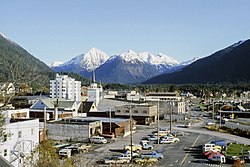
Sitka (Tlingit: Sheetʼká; Russian: Ситка) is a unified city-borough in the southeast portion of the U.S. state of Alaska. It was under Russian rule from 1799 to 1867. The city is situated on the west side of Baranof Island and the south half of Chichagof Island in the Alexander Archipelago of the Pacific Ocean (part of the Alaska Panhandle). As of the 2020 census, Sitka had a population of 8,458,[4] making it the fifth-most populated city in the state.
Key Information


With a consolidated land area of 2,870.3 square miles (7,434 square kilometers) and total area (including water) of 4,811.4 square miles (12,461 km2), Sitka is the largest city by total area in the U.S.
History
[edit]As part of Russia, it was known as New Archangel (Russian: Ново-Архангельск, romanized: Novo-Arkhangelsk).[5]
The current name, Sitka (derived from Sheetʼká, a contraction of the Tlingit Shee Atʼiká),[6] means "People on the Edge of Shee", with Shee being the Tlingit name for Baranof Island (the Tlingit name for the island is Sheetʼ-ká Xʼáatʼl but is often contracted to Shee).[5]
Russian America
[edit]

_by_Postels.jpg)
Russian explorers settled Old Sitka in 1799, naming it the Fort of Archangel Michael (Russian: форт Архангела Михаила, romanized: Fort Arkhangela Mikhaila). The governor of Russian America, Alexander Baranov, arrived under the auspices of the Russian-American Company, a colonial trading company chartered by Russian emperor Paul I. In June 1802, Tlingit warriors destroyed the original settlement, killing many of the Russians, with only a few managing to escape.[7]: 37–39 Baranov was forced to levy 10,000 rubles in ransom to Captain Barber of the British sailing ship Unicorn for the safe return of the surviving settlers.[8][9]
Baranov returned to Sitka in August 1804 with a large force, including Yuri Lisyansky's Neva. The ship bombarded the Tlingit fortification on the 20th but was not able to cause significant damage. The Russians then launched an attack on the fort and were repelled. Following two days of bombardment, the Tlingit "hung out a white flag" on the 22nd, deserting the fort on the 26th.[7]: 44–49
Following their victory at the Battle of Sitka in October 1804, the Russians established the settlement called New Archangel, named after Arkhangelsk. As a permanent settlement, New Archangel became the largest city in the region. The Tlingit re-established their fort on the Chatham Strait side of Peril Strait to enforce a trade embargo with the Russian establishment. In 1808, with Baranov still governor, Sitka was designated the capital of Russian America.[10]
Bishop Innocent lived in Sitka after 1840. He was known for his interest in education, and his house, the Russian Bishop's House, parts of which served as a schoolhouse, has since been restored by the National Park Service as part of the Sitka National Historical Park.
The original Cathedral of Saint Michael was built in Sitka in 1848 and became the seat of the Russian Orthodox bishop of Kamchatka, the Kurile and Aleutian Islands, and Alaska. The original church burned to the ground in 1966, losing its handmade bells, the large icon of the Last Supper that decorated the top of the royal doors, and the clock in the bell tower. Also lost was the large library containing books in the Russian, Tlingit, and Aleut languages. Although the church was restored to its original appearance, one exception was its clock face, which is black in photographs taken before 1966, but white in subsequent photos.[11]
Swedes, Finns and other nationalities of Lutherans worked for the Russian-American Company,[12] which led to the creation of a Lutheran congregation. The Sitka Lutheran Church building was built in 1840 and was the first Protestant church on the Pacific coast. After the transition to American control, following the purchase of Alaska from Russia by the United States in 1867, the influence of other Protestant religions increased, and Saint-Peter's-by-the-Sea Episcopal Church was consecrated as "the Cathedral of Alaska" in 1900.[13]
Territorial Alaska
[edit]

_-_NARA_-_297241.jpg)
Sitka was the site of the transfer ceremony for the Alaska Purchase on October 18, 1867. Russia was going through economic and political turmoil after it lost the Crimean War to Britain, France, and the Ottoman Empire in 1856, and decided it wanted to sell Alaska before British Canadians tried to conquer the territory. Russia offered to sell it to the United States. Secretary of State William Seward had wanted to purchase Alaska for quite some time, as he saw it as an integral part of Manifest Destiny and America's reach to the Pacific Ocean.[14] While the agreement to purchase Alaska was made in April 1867, the actual purchase and transfer of control took place on October 18, 1867. The cost to purchase Alaska was $7.2 million, at 2 cents per acre.
Sitka served as both the U.S. Government Capital of the Department of Alaska (1867–1884) and District of Alaska (1884–1906). The seat of government was relocated north to Juneau in 1906 due to the declining economic importance of Sitka relative to Juneau, which gained population in the Klondike Gold Rush.
Alaska Native Brotherhood, Alaska Native Sisterhood
[edit]The Alaska Native Brotherhood was founded in Sitka in 1912 to address racism against Alaska Native people in Alaska.[15] By 1914, the organization had constructed the Alaska Native Brotherhood Hall on Katlian Street, which was named after a Tlingit war chief in the early period of Russian colonization.[16]
World War II
[edit]In 1937, the United States Navy established the first seaplane base in Alaska on Japonski Island, across the Sitka Channel from the town.[17] In 1941, construction began on Fort Ray, an army garrison to protect the naval air station.[17] Both the army and navy remained in Sitka until the end of WWII, when the army base was put into caretaker status. The naval station in Sitka was deactivated in June 1944.[17] A shore boat system was then established to transfer the approximately 1,000 passengers a day until the O'Connell Bridge was built in 1972.[18]
Economy
[edit]The Alaska Pulp Corporation was the first Japanese investment in the United States after WWII. In 1959, it began to produce pulp harvested from the Tongass National Forest under a 50-year contract with the US Forest Service.[19] At its peak, the mill employed around 450 people before closing in 1993.
Sitka's Filipino community established itself in Sitka before 1929. It later became institutionalized as the Filipino Community of Sitka in 1981.[20]
Gold mining and fish canning paved the way for the town's initial growth. Today Sitka encompasses portions of Baranof Island and the smaller Japonski Island, which is connected to Baranof Island by the John O'Connell Bridge (which uses the cable-stayed suspension method as its means of support). Japonski Island is home to Sitka Rocky Gutierrez Airport (IATA: SIT; ICAO: PASI), the Sitka branch campus of the University of Alaska Southeast, Mt. Edgecumbe High School (a state-run boarding school for rural Alaskans), Southeast Alaska Regional Health Consortium's Mt. Edgecumbe Hospital, U.S. Coast Guard Air Station Sitka, and the port and facilities for the USCGC Kukui.[21]
Sitka has become a destination for visiting cruise ships.[22] In May 2025, a special referendum on restricting cruise ship tourism took place in the town with 3,000 votes cast.[22] The referendum was less than 10 percent from their all-time high for a special election and some 73% of the voters rejected the limits on cruise ships with only 27% voting in favor of the proposed limits.[22]
Geography
[edit]

According to the United States Census Bureau, the borough is the largest incorporated city by area in the U.S., with a total area of 4,811 square miles (12,460.4 km2), of which 2,870 square miles (7,400 km2) is land and 1,941 square miles (5,030 km2), comprising 40.3%, is water. As a comparison, this is almost four times the size of the state of Rhode Island.
Sitka displaced Juneau, Alaska, as the largest incorporated city by area in the United States upon the 2000 incorporation with 2,874 square miles (7,440 km2) of incorporated area. Juneau's incorporated area is 2,717 square miles (7,040 km2). Jacksonville, Florida, is the largest city in area in the contiguous 48 states at 758 square miles (1,960 km2).
Climate
[edit]_-_SITKA_AIRPORT,_AK.svg)
Sitka has an oceanic climate (Köppen: Cfb) with moderate, but generally cool, temperatures and abundant precipitation. The average annual precipitation is 131.74 inches (3,350 mm); average seasonal snowfall is 33 inches (84 cm), falling on 233 and 19 days, respectively. The mean annual temperature is 45.3 °F (7.4 °C), with monthly means ranging from 36.4 °F (2.4 °C) in January to 57.2 °F (14.0 °C) in August.
The climate is relatively mild when compared to other parts of the state. Only 5.1 days per year see highs at or above 70 °F (21 °C); conversely, there are only 10 days with the high not above freezing.[23] The winters are extremely mild compared to inland areas of similar and much more southerly parallels, due to the intense maritime moderation. The relatively mild nights ensure that four months stay above the 50 °F (10 °C) isotherm that normally separates inland areas from being boreal in nature. Due to the mild winter nights, hardiness zone is high for the latitude (from 6b to 8a).
The highest temperature ever recorded was 88 °F (31.1 °C) on July 30, 1976, and July 31, 2020. The lowest temperature ever recorded was −1 °F (−18.3 °C) on February 16–17, 1948.[23]
| Climate data for Sitka, Alaska (Japonski Island, 1991–2020 normals, extremes 1944–present) | |||||||||||||
|---|---|---|---|---|---|---|---|---|---|---|---|---|---|
| Month | Jan | Feb | Mar | Apr | May | Jun | Jul | Aug | Sep | Oct | Nov | Dec | Year |
| Record high °F (°C) | 60 (16) |
61 (16) |
67 (19) |
76 (24) |
82 (28) |
83 (28) |
88 (31) |
84 (29) |
77 (25) |
70 (21) |
65 (18) |
65 (18) |
88 (31) |
| Mean maximum °F (°C) | 50.9 (10.5) |
50.8 (10.4) |
52.1 (11.2) |
60.1 (15.6) |
65.8 (18.8) |
69.5 (20.8) |
70.8 (21.6) |
71.4 (21.9) |
67.1 (19.5) |
58.5 (14.7) |
52.7 (11.5) |
50.6 (10.3) |
75.6 (24.2) |
| Mean daily maximum °F (°C) | 40.5 (4.7) |
41.2 (5.1) |
42.5 (5.8) |
48.1 (8.9) |
53.3 (11.8) |
57.6 (14.2) |
60.4 (15.8) |
61.8 (16.6) |
57.9 (14.4) |
50.8 (10.4) |
44.3 (6.8) |
41.5 (5.3) |
50.0 (10.0) |
| Daily mean °F (°C) | 36.5 (2.5) |
36.7 (2.6) |
37.5 (3.1) |
42.6 (5.9) |
48.1 (8.9) |
53.0 (11.7) |
56.5 (13.6) |
57.3 (14.1) |
53.2 (11.8) |
46.4 (8.0) |
40.0 (4.4) |
37.5 (3.1) |
45.4 (7.4) |
| Mean daily minimum °F (°C) | 32.4 (0.2) |
32.1 (0.1) |
32.5 (0.3) |
37.2 (2.9) |
43.0 (6.1) |
48.3 (9.1) |
52.5 (11.4) |
52.9 (11.6) |
48.5 (9.2) |
41.9 (5.5) |
35.8 (2.1) |
33.4 (0.8) |
40.9 (4.9) |
| Mean minimum °F (°C) | 18.1 (−7.7) |
21.4 (−5.9) |
21.8 (−5.7) |
29.7 (−1.3) |
35.9 (2.2) |
42.1 (5.6) |
47.5 (8.6) |
47.1 (8.4) |
40.1 (4.5) |
32.0 (0.0) |
25.3 (−3.7) |
21.1 (−6.1) |
13.3 (−10.4) |
| Record low °F (°C) | 0 (−18) |
−1 (−18) |
4 (−16) |
15 (−9) |
29 (−2) |
35 (2) |
41 (5) |
34 (1) |
31 (−1) |
20 (−7) |
2 (−17) |
1 (−17) |
−1 (−18) |
| Average precipitation inches (mm) | 8.22 (209) |
5.93 (151) |
5.60 (142) |
4.31 (109) |
3.81 (97) |
2.92 (74) |
4.62 (117) |
7.25 (184) |
11.69 (297) |
11.78 (299) |
9.91 (252) |
8.43 (214) |
84.47 (2,146) |
| Average snowfall inches (cm) | 9.5 (24) |
8.0 (20) |
4.9 (12) |
0.9 (2.3) |
trace | 0.0 (0.0) |
0.0 (0.0) |
0.0 (0.0) |
0.0 (0.0) |
0.3 (0.76) |
4.7 (12) |
4.0 (10) |
32.3 (82) |
| Average precipitation days (≥ 0.01 in) | 21.2 | 16.9 | 18.4 | 17.5 | 16.4 | 16.7 | 18.9 | 19.4 | 22.4 | 23.7 | 22.0 | 21.6 | 235.1 |
| Average snowy days (≥ 0.1 in) | 4.5 | 3.8 | 3.4 | 0.8 | 0.1 | 0.0 | 0.0 | 0.0 | 0.0 | 0.4 | 3.3 | 2.7 | 19.0 |
| Source: NOAA (snow/snow days 1981–2010)[23][24][25] | |||||||||||||
| Climate data for Sitka, Alaska (Hidden Falls, 1991–2020 normals, extremes 1992–2020) | |||||||||||||
|---|---|---|---|---|---|---|---|---|---|---|---|---|---|
| Month | Jan | Feb | Mar | Apr | May | Jun | Jul | Aug | Sep | Oct | Nov | Dec | Year |
| Record high °F (°C) | 53 (12) |
57 (14) |
53 (12) |
66 (19) |
73 (23) |
85 (29) |
83 (28) |
83 (28) |
69 (21) |
61 (16) |
54 (12) |
51 (11) |
85 (29) |
| Mean maximum °F (°C) | 44.9 (7.2) |
44.9 (7.2) |
46.7 (8.2) |
53.7 (12.1) |
63.4 (17.4) |
66.7 (19.3) |
69.2 (20.7) |
68.8 (20.4) |
61.3 (16.3) |
53.8 (12.1) |
47.4 (8.6) |
44.4 (6.9) |
72.5 (22.5) |
| Mean daily maximum °F (°C) | 34.7 (1.5) |
35.7 (2.1) |
38.5 (3.6) |
45.7 (7.6) |
53.3 (11.8) |
57.9 (14.4) |
59.9 (15.5) |
59.6 (15.3) |
54.7 (12.6) |
46.8 (8.2) |
39.0 (3.9) |
35.9 (2.2) |
46.8 (8.2) |
| Daily mean °F (°C) | 31.3 (−0.4) |
32.0 (0.0) |
34.0 (1.1) |
39.6 (4.2) |
46.8 (8.2) |
52.3 (11.3) |
55.0 (12.8) |
55.0 (12.8) |
50.5 (10.3) |
43.1 (6.2) |
35.6 (2.0) |
32.9 (0.5) |
42.3 (5.7) |
| Mean daily minimum °F (°C) | 27.8 (−2.3) |
28.2 (−2.1) |
29.4 (−1.4) |
33.5 (0.8) |
40.3 (4.6) |
46.6 (8.1) |
50.2 (10.1) |
50.4 (10.2) |
46.3 (7.9) |
39.4 (4.1) |
32.2 (0.1) |
29.9 (−1.2) |
37.8 (3.2) |
| Mean minimum °F (°C) | 14.5 (−9.7) |
17.1 (−8.3) |
19.9 (−6.7) |
27.5 (−2.5) |
34.1 (1.2) |
40.5 (4.7) |
45.3 (7.4) |
45.4 (7.4) |
39.1 (3.9) |
31.5 (−0.3) |
23.0 (−5.0) |
17.9 (−7.8) |
10.6 (−11.9) |
| Record low °F (°C) | 4 (−16) |
6 (−14) |
6 (−14) |
15 (−9) |
28 (−2) |
35 (2) |
33 (1) |
40 (4) |
29 (−2) |
13 (−11) |
11 (−12) |
3 (−16) |
3 (−16) |
| Average precipitation inches (mm) | 13.57 (345) |
9.27 (235) |
10.66 (271) |
8.11 (206) |
4.77 (121) |
4.03 (102) |
5.06 (129) |
6.90 (175) |
12.94 (329) |
15.96 (405) |
18.98 (482) |
17.83 (453) |
128.08 (3,253) |
| Average snowfall inches (cm) | 29.7 (75) |
20.0 (51) |
21.1 (54) |
0.6 (1.5) |
0.0 (0.0) |
0.0 (0.0) |
0.0 (0.0) |
0.0 (0.0) |
0.0 (0.0) |
0.5 (1.3) |
11.5 (29) |
22.8 (58) |
106.2 (269.8) |
| Average precipitation days (≥ 0.01 in) | 21.1 | 13.2 | 20.4 | 16.9 | 13.1 | 15.6 | 14.9 | 12.8 | 20.5 | 22.0 | 23.0 | 23.6 | 217.1 |
| Average snowy days (≥ 0.1 in) | 7.1 | 4.9 | 6.1 | 0.5 | 0.0 | 0.0 | 0.0 | 0.0 | 0.0 | 0.2 | 3.1 | 6.6 | 28.5 |
| Source: NOAA[23][26] | |||||||||||||
 | This graph was using the legacy Graph extension, which is no longer supported. It needs to be converted to the new Chart extension. |
See or edit raw graph data.
Geology
[edit]
Mount Edgecumbe, a 3,200-foot (980 m) "historically active"[27] stratovolcano, is located on southern Kruzof Island, approximately 24 km (15 mi) west of Sitka and can be seen from the city on a clear day.
On April 22, 2022, the Alaska Volcano Observatory reported that:
[a] swarm of earthquakes was detected in the vicinity of Mount Edgecumbe volcano beginning on Monday, April 11, 2022. There were hundreds of small quakes in the swarm, though the large majority were too small to locate. Over the past few days, earthquake activity has declined and is currently at background levels.
[...]
The recent swarm inspired an in-depth analysis of the last 7.5 years of ground deformation detectable with radar satellite data. Analysis of these data from recent years reveals a broad area, about 17 km (11 mi) in diameter, of surface uplift centered about 2.5 km (1.6 mi) to the east of Mt Edgecumbe. This uplift began in August 2018 and has been continuing to the present at a rate of up to 8.7 cm/yr (3.4 in/yr) in the center of the deforming area. Deformation has been constant since 2018, and there has not been an increase with the recent earthquake activity. The total deformation since 2018 is about 27 cm (11 in). [...] The coincidence of earthquakes and ground deformation in time and location suggests that these signals are likely due to the movement of magma beneath Mount Edgecumbe, as opposed to tectonic activity. Initial modeling of the deformation signal shows that it is consistent with an intrusion of new material (magma) at about 5 km (3.1 mi) below sea level. The earthquakes likely are caused by stresses in the crust due to this intrusion and the substantial uplift that it is causing.
Intrusions of new magma under volcanoes do not always result in volcanic eruptions. The deformation and earthquake activity at Edgecumbe may cease with no eruption occurring. If the magma rises closer to the surface, this would lead to changes in the deformation pattern and an increase in earthquake activity. Therefore, it is very likely that if an eruption were to occur it would be preceded by additional signals that would allow advance warning.[28]
Adjacent boroughs and census areas
[edit]- Hoonah-Angoon Census Area, Alaska – north, northeast
- Prince of Wales–Hyder Census Area, Alaska – southeast
National protected areas
[edit]- Alaska Maritime National Wildlife Refuge (part of Gulf of Alaska unit)
- Sitka National Historical Park
- Tongass National Forest (part)
Demographics
[edit]| Census | Pop. | Note | %± |
|---|---|---|---|
| 1880 | 916 | — | |
| 1890 | 1,190 | 29.9% | |
| 1900 | 1,396 | 17.3% | |
| 1910 | 1,039 | −25.6% | |
| 1920 | 1,175 | 13.1% | |
| 1930 | 1,056 | −10.1% | |
| 1940 | 1,987 | 88.2% | |
| 1950 | 1,985 | −0.1% | |
| 1960 | 3,237 | 63.1% | |
| 1970 | 3,370 | 4.1% | |
| 1980 | 7,803 | 131.5% | |
| 1990 | 8,588 | 10.1% | |
| 2000 | 8,835 | 2.9% | |
| 2010 | 8,881 | 0.5% | |
| 2020 | 8,458 | −4.8% | |
| 2024 (est.) | 8,355 | [29] | −1.2% |
| U.S. Decennial Census[30] 2010-2020[4] | |||
1880 and 1890 censuses
[edit]Sitka first reported on the 1880 census as an unincorporated village. Of 916 residents, there were 540 Tlingit, 219 Creole (Mixed Russian and Native) and 157 Whites reported.[31] It was the largest community in Alaska at that census. In 1890, it fell to second place behind Juneau. It reported 1,190 residents, of whom 861 were Native, 280 were White, 31 were Asian, 17 Creole, and 1 Other.[32] In 1900, it fell to 4th place behind Nome, Skagway and Juneau. It did not report a racial breakdown.[33]
1910 and 1920 censuses
[edit]In 1910, Sitka was reported as two separate communities based on race: the village with mostly non-natives (population 539) and the part of the village with natives (population 500).[34] Separately, they placed as the 15th and 17th largest communities. United, they would be 8th largest. For the purposes of comparison and the fact that the village was not officially politically/racially divided except by the census bureau report, the combined total (1,039) is reported on the historic population list. In 1913, Sitka was incorporated as a city, rendering the division by the census bureau for 1910 moot. In 1920, Sitka became the 4th largest city in the territory.[35] In 1930, it fell to 7th place with 1,056 residents. Of those, 567 reported as Native, 480 as White and 9 as Other.[36] In 1940, it rose to 5th place, but did not report a racial breakdown.[37]
1950 and 1960 censuses
[edit]In 1950, it reported as the 9th largest community in Alaska (6th largest incorporated city).[38] It did not report a racial breakdown. At statehood in 1960, it became the 6th largest community (5th largest incorporated city). With the annexations increasing its population to 3,237, it reported a White majority for its first time: 2,160 Whites, 1,054 Others (including Natives) and 23 Blacks.[39] In 1970, it fell to 14th place overall (though 7th largest incorporated city) with 3,370 residents. Of those, 2,503 were White, 676 Native Americans, 95 Others, 74 Asians and 22 Blacks.[40] In 1980, Sitka rose to 4th largest city with 7,803 residents (of whom 5,718 were non-Hispanic White, 1,669 were Native American, 228 were Asian, 108 were Hispanic (of any race), 87 were Other, 44 were Black and 7 were Pacific Islander).[41]
1990 and 2000 censuses
[edit]In 1990, Sitka fell to 5th largest (4th largest incorporated) with 8,588 residents. 6,270 were non-Hispanic White; 1,797 were Native American; 315 were Asian; 209 were Hispanic (of any race); 60 were Other; 39 were Black and 18 Pacific Islanders.[42] In 2000, Sitka retained its 5th largest (and 4th largest incorporated) position. In 2010, it slipped to 7th largest community overall (but still remained the 4th largest incorporated city).
2010 census
[edit]As of the census of 2010, there were 8,881 people living in the borough. The racial makeup of the borough, based on one race alone or in combination with one or more other races, was, 64.6% White (including White Hispanic and Latino Americans), 1% Black or African American, 24.6% Native American, 8.1% Asian, 0.9% Pacific Islander, 1.8% from other races. In addition, 4.9% of the population were Hispanic and Latino Americans of any race.
There were 3,545 households, out of which 29.5% had children under the age of 18 living with them, 45.5% were married couples living together, 10.7% had a female householder with no husband present, 6.1% had a male householder with no wife present, and 37.6% were non-families. The average household size was 2.43 and the average family size was 3.01.[43]
2020 census
[edit]| Race (NH = Non-Hispanic) | % 2020[44] | % 2010[45] | % 2000[46] | Pop 2020 | Pop 2010 | Pop 2000 |
|---|---|---|---|---|---|---|
| White alone (NH) | 59.7% | 63.5% | 67.1% | 5,050 | 5,641 | 5,927 |
| Black alone (NH) | 0.4% | 0.5% | 0.3% | 37 | 43 | 24 |
| American Indian alone (NH) | 14.3% | 16.2% | 18.1% | 1,206 | 1,442 | 1,597 |
| Asian alone (NH) | 6.8% | 5.7% | 3.7% | 573 | 509 | 329 |
| Pacific Islander alone (NH) | 0.2% | 0.3% | 0.4% | 14 | 29 | 31 |
| Other race alone (NH) | 0.6% | 0.1% | 0.2% | 53 | 11 | 17 |
| Multiracial (NH) | 12.1% | 8.7% | 7% | 1,024 | 769 | 620 |
| Hispanic/Latino (any race) | 5.9% | 4.9% | 3.3% | 501 | 437 | 290 |
Economy
[edit]In 2010, Sitka's two largest employers were the Southeast Alaska Regional Health Consortium (SEARHC), employing 482 people, and the Sitka School District, which employs 250 people. However, there are more people employed in the seafood industry than in any other sector. An estimated 18% of Sitka's population earns at least a portion of their income from fishing and seafood harvesting and processing. Many Sitkans hunt and gather subsistence foods such as fish, deer, berries, seaweeds and mushrooms for personal use.[48]
Within the total 2010 population of 8,881 residents, an estimated 7,161 were over 16 years of age. Of residents aged 16 and over, an estimated 4,692 were employed within the civilian labor force, 348 were unemployed (looking for work), 192 were employed in the armed forces (U.S. Coast Guard), and 1,929 were not in the labor force. The average unemployment rate between 2006 and 2010 was 6.9%. The median household income in 2010 inflation adjusted dollars was $62,024. An estimated 4.3% of all families / 7% of all residents had incomes below the poverty level "in the past twelve months"(2010).[49]
Sitka's electrical power is generated by dams at Blue Lake and Green Lake, with supplemental power provided by burning diesel when electric demand exceeds hydro capacity. In December 2012 the Blue Lake Expansion project began, which added 27 percent more electricity for the residents of Sitka. The project was completed in November 2014.[50]
Port
[edit]
Sitka is the 6th largest port by value of seafood harvest in the United States.[48] International trade is relatively minor, with total exports and imports valued at $474,000 and $146,000, respectively, in 2005 by the American Association of Port Authorities.[51] The port has the largest harbor system in Alaska with 1,347 permanent slips.
During Russian rule, Sitka was a busy seaport on the west coast of North America,[52] mentioned a number of times by Dana in his popular account of an 1834 sailing voyage Two Years Before the Mast. After the transfer of Alaska to U.S. rule, the Pacific Coast Steamship Company began tourist cruises to Sitka in 1884. By 1890, Sitka was receiving 5,000 tourist passengers a year.[53]
Old Sitka Dock,[54] located at Halibut Point, one mile south of the Old Sitka State Historical Park, commemorating the 1800s Russian settlement, and six miles north of downtown Sitka, is a private deep water port offering moorage facilities.[55] A 470-foot-long floating dock for vessels up to 1100 feet was constructed there by its owners in 2012 and was first used in 2013.[56] In Spring 2016, Holland America Line agreed to dock its ships at the Old Sitka Dock. [57] Since then, the majority of the cruise ships calling on Sitka berth at the Old Sitka Dock, with the remainder anchoring offshore in Crescent Harbor and tendering their passengers to downtown Sitka. In the 2017 season, there were 136 cruise ship calls at Sitka with more than 150,000 passengers in total; of these fewer than 30,000 were tendered.[58] The number of cruise ships visitors to Sitka more than doubled over two seasons in the years 2022 and 2023.[22] At its peak, the city can receive some 13,000 visitors a day, exceeding the number of residents.[22]
The United States Coast Guard plans to homeport one of its Sentinel-class cutters in Sitka.[56]
Arts and culture
[edit]There are 22 buildings and sites in Sitka that appear in the National Register of Historic Places.[59]
On October 18, Alaska celebrates Alaska Day to commemorate the Alaska purchase. The City of Sitka holds an annual Alaska Day Festival. This week-long event includes a reenactment ceremony of the signing of the Alaska purchase, as well as interpretive programs at museums and parks, special exhibits, aircraft displays and film showings, receptions, historic sites and buildings tours, food, prose writing contest essays, Native and other dancing, and entertainment and more. The first recorded Alaska Day Festival was held in 1949.[60]
Government
[edit]| Year | Republican | Democratic | Third party(ies) | |||
|---|---|---|---|---|---|---|
| No. | % | No. | % | No. | % | |
| 1960 | 982 | 46.28% | 1,140 | 53.72% | 0 | 0.00% |
| 1964 | 629 | 28.59% | 1,571 | 71.41% | 0 | 0.00% |
| 1968 | 1,023 | 44.29% | 1,148 | 49.70% | 139 | 6.02% |
| 1972 | 1,280 | 52.61% | 1,080 | 44.39% | 73 | 3.00% |
| 1976 | 1,559 | 58.41% | 1,004 | 37.62% | 106 | 3.97% |
| 1980 | 1,862 | 53.00% | 1,212 | 34.50% | 439 | 12.50% |
| 1984 | 2,380 | 61.09% | 1,403 | 36.01% | 113 | 2.90% |
| 1988 | 2,232 | 54.89% | 1,720 | 42.30% | 114 | 2.80% |
| 1992 | 1,741 | 37.79% | 1,695 | 36.79% | 1,171 | 25.42% |
| 1996 | 1,823 | 42.10% | 1,732 | 40.00% | 775 | 17.90% |
| 2000 | 2,067 | 48.20% | 1,484 | 34.61% | 737 | 17.19% |
| 2004 | 1,726 | 47.59% | 1,737 | 47.89% | 164 | 4.52% |
| 2008 | 2,129 | 46.00% | 2,355 | 50.89% | 144 | 3.11% |
| 2012 | 1,832 | 41.49% | 2,340 | 53.00% | 243 | 5.50% |
| 2016 | 1,830 | 40.89% | 2,135 | 47.71% | 510 | 11.40% |
| 2020 | 1,745 | 43.29% | 2,124 | 52.69% | 162 | 4.02% |
| 2024 | 1,659 | 42.92% | 2,057 | 53.22% | 149 | 3.86% |
The City and Borough of Sitka is a Unified Home Rule[63][64] city. The home rule charter of the City and Borough of Sitka was adopted on December 2, 1971,[65] for the region of the Greater Sitka Borough, which included Japonski Island and Port Alexander and Baranof Warm Springs on Baranof Island. The city was incorporated on September 24, 1963.[66] On October 23, 1973, the city of Port Alexander was detached from the borough.[67]
Police
[edit]Education
[edit]Colleges and universities
[edit]Sitka hosts one active post-secondary institution, the University of Alaska Southeast-Sitka Campus, located on Japonski Island in an old World War II hangar. Sheldon Jackson College, a small Presbyterian-affiliated private college, suspended operations in June 2007, after several years of financial stress.[68] Outer Coast College, a private liberal arts college established in 2015, is currently in development as an undergraduate institution founded on the former campus of Sheldon Jackson College.
Schools
[edit]
The Sitka School District, the designated public school district,[69] runs several schools in Sitka, including Sitka High School and Pacific High School, as well as the town's only middle school, Blatchley Middle School. It also runs a home school assistance program through Terry's Learning Center.
Mt. Edgecumbe High School, a State of Alaska-run boarding high school for rural, primarily Native students, is located on Japonski Island adjacent to University of Alaska Southeast.
One private school is available in Sitka: Sitka Adventist School.[70]
Alaska State Trooper Academy
[edit]The Alaska State Trooper Academy – the academy for all Alaska State Troopers – is located in Sitka.
Libraries
[edit]Sitka Public Library, formerly Kettleson Memorial Library, is the public library for Sitka. It receives about 100,000 guests annually and houses a collection of 75,000 books, audiobooks, music recordings, reference resources, videos (DVD and VHS), as well as an assortment of Alaskan and national periodicals. Its annual circulation is 133,000. The library is well known by visitors for its view. The large windows in front of the reading area look south across Eastern Channel towards the Pyramids.
Until its closing, Sitka was also home to Stratton Library, the academic library of Sheldon Jackson College.[71]
Media
[edit]Sitka is served by the Daily Sitka Sentinel, one of the few remaining independently owned daily newspapers in the state. Sitka also receives circulation of the Capital City Weekly, a weekly regional newspaper based out of Juneau.
Alaska's first newspaper following the Alaska purchase, the Sitka Times, was published by Barney O. Ragan on September 19, 1868. Only four issues were published that year, as Ragan cited a lack of resources available at the time. The paper resumed publishing the following year as the Alaska Times. In 1870, it moved to Seattle, where the year following it was renamed the Seattle Times (not to be confused with the modern-day newspaper of the same name).[72]
Radio
[edit]Sitka has three radio stations, public radio station KCAW (Raven Radio), and commercial radio stations KIFW, and KSBZ. Sitka previously had a Presbyterian Church owned KSEW.
Television
[edit]KTNL-TV (MeTV) broadcasts out of Sitka on Channel 13 (Cable 6) serving Southeast Alaska. Additionally, KSCT-LP (NBC) Channel 5, KTOO (PBS) Channel 10,[73] and KJUD (ABC/CW) serve the region. There was a previous NBC affiliate in the Region, KSA-TV, available to cable systems, which is now defunct.
Infrastructure
[edit]Transportation
[edit]
Sitka is only accessible by boat or plane as it is on a pair of islands in the Pacific Ocean. Vehicles are usually brought to Sitka via the Alaska Marine Highway ferry system or the barge. However, a vehicle is not an absolute necessity in Sitka, as there are only 14 miles (23 kilometers) of road from one end of the island to another. Almost everything is within walking distance from the downtown area, which is where the majority of employers are situated. Public transportation is also available.
By air, Sitka Rocky Gutierrez Airport offers scheduled passenger jet service operated year-round by Alaska Airlines and seasonally by Delta Connection.
Delays in fall and winter due to Sitka's weather are frequent. The airport is located on Japonski Island, which is connected to Baranof Island by the O'Connell Bridge. The O'Connell Bridge, completed in 1972, was the first vehicular cable-stayed bridge in the United States. The Sitka Seaplane Base is a seaplane landing area situated in the Sitka Channel, adjacent to the airport.
Ferry travel back and forth to Juneau, Ketchikan and other towns in Southeast Alaska is provided through the Alaska Marine Highway System. The ferry terminal is located 7 miles (11 km) north of downtown and a ferry ticket costs about $89 per person each way to Juneau (as of February 2023). Vehicles, pets and bicycles can also be taken on the ferry for an additional charge.
Sitka's location on the outer coast of the Alaska Panhandle is removed from routes running through Chatham Strait. The tides of Peril Strait allow mainline vessels through only at slack tide.[74]
Alaska Marine Lines, a barge and freight company, has the ability to move cars to other communities connected to the mainland by road systems.
A three-way partnership of non-profits (Center for Community, Sitka Tribe of Alaska, and Southeast Senior Services) offers public bus transit, funded by the Federal Transit Administration and the Alaska Department of Transportation. All buses are fully accessible, with service from 6:30 a.m. to 7:30 p.m., Monday through Friday.
In 2008, the League of American Bicyclists awarded Sitka the bronze level in bicycle friendliness, making Sitka the first bicycle-friendly community in Alaska. In 2013, the Walk Friendly Communities[75] program awarded Sitka with a bronze award, making Sitka the first Alaska community with a Walk Friendly Communities designation. Sitka is the only Alaska community to have both a Bicycle Friendly Community and a Walk Friendly Communities designation.
Healthcare
[edit]There is currently one hospital serving Sitka, Edgecumbe Hospital, which sits on Japonski Island across Sitka Harbor from the city. The facility is part of the Southeast Alaska Regional Health Consortium, or SEARHC, a non-profit tribal health consortium of 18 Native communities. The hospital serves as a regional referral center for people throughout Southeast Alaska, and also provides primary outpatient care. Numerous specialty clinics are offered at the hospital that are not available in the smaller communities such as neurology, orthopedic, dermatology, ophthalmology and denture clinics.
The former Sitka Community Hospital was purchased by the Southeast Alaska Regional Health Consortium (SEARHC) in April 2019, and now functions as a long-term care facility for patients of Edgecumbe hospital.[76]
Notable people
[edit]- Augusta Cohen Coontz (1867–1940), American First Lady of Guam
- Dale DeArmond (1914–2006), printmaker, book illustrator
- Annie Furuhjelm (1859–1937), Finnish journalist, legislator
- Sheldon Jackson (1834–1909), Presbyterian missionary in Alaska in the late 19th century
- Rebecca Himschoot, State representative
- Richard Nelson (1941–2019), cultural anthropologist, writer, activist
- Teri Rofkar (1956–2016), Tlingit weaver
- John Straley (born 1953), award-winning author
- Mary Bong (1880-1958), as Sing Deuh, Ah Fuh/Fur, or Qui Fah.[77] One of the first Chinese immigrants to live in Sitka; also known as "China Mary".[78]
Twin towns – sister cities
[edit]
Attractions
[edit]

Sitka's attractions include:
- Alaska Raptor Center
- Baranof Castle Hill
- Fortress of the Bear
- Sheet'ká Kwáan Naa Kahídi
- Russian Bishop's House
- Saint Lazaria National Wildlife Refuge
- St. Michael's Cathedral
- Sheldon Jackson Museum
- Sitka Fine Arts Camp
- Sitka Historical Museum
- Sitka Jazz Festival
- Sitka Lutheran Church
- Sitka National Historical Park
- Sitka Pioneer Home
- Sitka Summer Music Festival
- Swan Lake
- Tongass National Forest
The flora and fauna of Sitka and its surrounding area are popular. Day cruises and guided day trips (hiking) are large enterprises in Sitka. Floatplane "flightseeing" excursions are a way to view the area's sights from above.
Outdoor opportunities
[edit]Sitka's position between the Pacific Ocean and the most mountainous island in the Alexander Archipelago creates a variety of outdoor opportunities:

- Kayaking is a popular activity and small guided day excursions are offered locally.
- There are a number of maintained trails in the Sitka area, many of which are accessible from Sitka's road system.
- The dormant volcano Mount Edgecumbe is also a popular mountain to summit and features a seven-mile (11 km) trail up to the top. Guided day-trips are available, but the trip does not require much knowledge to undertake.
In popular culture
[edit]- Louis L'Amour penned Sitka, his fictional account of the events surrounding the United States' purchase of the Alaska Territory from the Russians for $7.2 million in 1867.
- Novelist James Michener lived at Sitka's Sheldon Jackson College while doing research for his epic work, Alaska.
- The 1952 film The World in His Arms has Russian Sitka as one of its settings.
- Sitka is the opening setting in Ivan Doig's 1982 historical fiction, The Sea Runners.
- Sitka is mentioned in Chapter 53 of James Clavell's 1993 historical fiction about Japan, Gai-Jin.
- Mystery author John Straley described Sitka as "...an island town where people feel crowded by the land and spread out on the sea."
- Part of the action in the novel César Cascabel by Jules Verne takes place in Sitka in May–June 1867, during the transfer of ownership to the United States.
- A fictionalized Sitka, inhabited by several million Jews who fled from Nazi-occupied Europe and their descendants, is the setting of the alternate history detective novel The Yiddish Policemen's Union, by Michael Chabon.
- Sitka is featured in the episode "Z-9000" of the Argentine TV series Los simuladores as the place where its antagonist, Lorenzo, is sent to keep him away from his wife whom he used to assault, under the pretext that a clone of him is trying to kill him.
- Sitka is a setting in the 2009 film The Proposal starring Sandra Bullock and Ryan Reynolds, although the scenes were filmed in Rockport, Massachusetts.
- Sitka is the name of one of the characters in the Disney film Brother Bear (2004).
- Sitka was featured in a 2012 episode of the Travel Channel's popular series Bizarre Foods,[81] starring Andrew Zimmern. In this episode Zimmern ate herring eggs, stink heads, and sea cucumbers.
- Sitka was named one of the Top 20 Small Towns to Visit in 2013[82] by Smithsonian magazine.
See also
[edit]References
[edit]- ^ From November 1867 to February 1873, the earliest American settlers in Sitka established and conducted affairs under a "provisional city government", as Alaskan communities were prohibited from legally incorporating until the U.S. Congress passed legislation allowing them to do so in 1900. Mayors of Sitka under this government included William Sumner Dodge and John Henry Kinkead. See Atwood, Evangeline; DeArmond, Robert N. (1977). Who's Who in Alaskan Politics. Portland, Oregon: Binford & Mort for the Alaska Historical Commission. p. 24.; Wheeler, Keith (1977). "Learning to cope with 'Seward's Icebox'". The Alaskans. Alexandria, Virginia: Time–Life Books. pp. 57–64. ISBN 0-8094-1506-2.
- ^ "City and Borough of Sitka Alaska - Government - City Assembly". www.cityofsitka.com. City of Sitka. Archived from the original on July 31, 2017. Retrieved February 28, 2022.
- ^ "2020 U.S. Gazetteer Files". United States Census Bureau. Retrieved October 29, 2021.
- ^ a b "State & County QuickFacts". United States Census Bureau. Retrieved April 20, 2023.
- ^ a b Everett-Heath, John (October 22, 2020). "Sitka". Concise Oxford Dictionary of World Place Names. Oxford University Press. ISBN 978-0-19-190563-6.
- ^ Joseph, Charlie; Brady, I.; Makinen, E.; David, R.; Davis, V.; Johnson, A.; Lord, N. (2001). "Sheet'kwaan Aani Aya". Sitka Tribe of Alaska. Archived from the original on July 25, 2008. Retrieved October 27, 2009.
- ^ a b Khlebnikov, K.T., 1973, Baranov, Chief Manager of the Russian Colonies in America, Kingston: The Limestone Press, ISBN 0919642500
- ^ Chevigny, Hector (1942). Lord of Alaska: Baranov and the Russian adventure. Cornell University: Viking Press. p. 320. OCLC 11877412. Archived from the original on August 11, 2016. Retrieved March 16, 2016.
- ^ Black, Lydia (2014). Russians in Alaska. Alaska: University of Alaska Press. pp. 158–159. ISBN 9781889963044.
- ^ "The City & Borough of Sitka Alaska - About Sitka". www.cityofsitka.com. Retrieved November 6, 2022.
- ^ Swaney, Deanna (2012). Alaska. Inc DK Publishing. London: DK. p. 140. ISBN 978-0-7566-9191-2. OCLC 794289670.
- ^ Sitka Lutheran Church Archived June 2, 2013, at the Wayback Machine
- ^ "NRHP nomination for St. Peter's Church". National Park Service. Retrieved October 24, 2014.
- ^ "Meeting of Frontiers: Alaska — The Alaska Purchase". Archived from the original on July 30, 2013. Retrieved July 28, 2013.
- ^ "ANB celebrates 100th at ANB/ANS Grand Camp in Sitka" (Press release). Raven Radio. September 29, 2012. Archived from the original on December 3, 2012. Retrieved January 7, 2013.
- ^ Historic Sitka Harbor and Waterfront Self-Guided Tour:Points of Interest on Sitka's Historic Waterfront (Map). Sitka Maritime Heritage Society.
- ^ a b c Yarborough, Michael R. (April 10, 2009), Statement of Significance for the Fort Ray Historic District (Charcoal and Alice Islands) and the Mermaid Cove Mausoleum (PDF), Alaska Department of Transportation and Public Facilities, archived from the original (PDF) on October 25, 2016, retrieved October 24, 2016
- ^ "Sitka Yesterday", Daily Sitka Sentinel, p. 2, September 2, 2022
- ^ "The Evolution of a Marine Industrial Park". www.sitka.net. Archived from the original on October 25, 2016. Retrieved October 24, 2016.
- ^ Klaney, Carol Kelty (1995). Gunalcheesh!. Haines, Alaska: Ptarmigan Press. pp. 77–78.
- ^ "Japonski Island". Visit Sitka. September 21, 2017. Retrieved November 11, 2020.
- ^ a b c d e The Maritime Executive (May 29, 2025). "Sitka, a Small Town in Alaska, Resoundingly Rejects Cruise Ship Limits". The Maritime Executive. Retrieved June 3, 2025.
- ^ a b c d "NOAA Online Weather Data". National Oceanic and Atmospheric Administration. Retrieved February 16, 2013.
- ^ "U.S. Climate Normals Quick Access – Station: Sitka, Airport (1991–2020)". National Oceanic and Atmospheric Administration. Archived from the original on May 6, 2023. Retrieved February 15, 2023.
- ^ "U.S. Climate Normals Quick Access – Station: Sitka Airport, AK (1981-2010)". National Oceanic and Atmospheric Administration. Archived from the original on May 6, 2023. Retrieved February 15, 2023.
- ^ "U.S. Climate Normals Quick Access – Station: Hidden Falls Hatchery, AK". National Oceanic and Atmospheric Administration. Retrieved February 15, 2023.
- ^ "Mount Edgecumbe volcanic field changes from 'dormant' to 'active' – what does that mean?". Alaska Volcano Observatory. May 9, 2022. Retrieved June 2, 2022.
The Mount Edgecumbe volcanic field (MEVF) is now classed as 'historically active' by the standards of the Alaska Volcano Observatory (AVO) because it is experiencing deformation related to the presence of magma intruding three miles below the surface.
- ^ "Mount Edgecumbe Information Statement, April 22, 2022". Alaska Volcano Observatory. April 22, 2022. Retrieved June 2, 2022.
- ^ "County Population Totals and Components of Change: 2020-2024". United States Census Bureau. Retrieved June 3, 2025.
- ^ United States Census Bureau. "Census of Population and Housing". Retrieved September 11, 2013.
- ^ "Archived copy" (PDF). Archived (PDF) from the original on August 17, 2017. Retrieved June 11, 2018.
{{cite web}}: CS1 maint: archived copy as title (link) - ^ "Archived copy" (PDF). Archived (PDF) from the original on August 29, 2017. Retrieved June 11, 2018.
{{cite web}}: CS1 maint: archived copy as title (link) - ^ "Archived copy" (PDF). Archived (PDF) from the original on July 22, 2017. Retrieved June 11, 2018.
{{cite web}}: CS1 maint: archived copy as title (link) - ^ "Archived copy" (PDF). Archived (PDF) from the original on August 30, 2017. Retrieved June 11, 2018.
{{cite web}}: CS1 maint: archived copy as title (link) - ^ "Archived copy" (PDF). Archived (PDF) from the original on August 17, 2017. Retrieved June 11, 2018.
{{cite web}}: CS1 maint: archived copy as title (link) - ^ "Archived copy" (PDF). Archived (PDF) from the original on August 29, 2017. Retrieved June 11, 2018.
{{cite web}}: CS1 maint: archived copy as title (link) - ^ "Archived copy" (PDF). Archived (PDF) from the original on August 29, 2017. Retrieved June 11, 2018.
{{cite web}}: CS1 maint: archived copy as title (link) - ^ "Archived copy" (PDF). Archived (PDF) from the original on July 23, 2017. Retrieved June 11, 2018.
{{cite web}}: CS1 maint: archived copy as title (link) - ^ "Archived copy" (PDF). Archived (PDF) from the original on July 23, 2017. Retrieved June 11, 2018.
{{cite web}}: CS1 maint: archived copy as title (link) - ^ "Archived copy" (PDF). Archived (PDF) from the original on August 17, 2017. Retrieved June 11, 2018.
{{cite web}}: CS1 maint: archived copy as title (link) - ^ "Archived copy" (PDF). Archived (PDF) from the original on August 18, 2017. Retrieved June 11, 2018.
{{cite web}}: CS1 maint: archived copy as title (link) - ^ "Archived copy" (PDF). Archived (PDF) from the original on August 30, 2017. Retrieved June 11, 2018.
{{cite web}}: CS1 maint: archived copy as title (link) - ^ "American FactFinder: Results". United States Census Bureau. Archived from the original on May 21, 2019.
- ^ "HISPANIC OR LATINO, AND NOT HISPANIC OR LATINO BY RACE (2020)". data.census.gov. U.S. Census Bureau.
- ^ "HISPANIC OR LATINO, AND NOT HISPANIC OR LATINO BY RACE (2010)". data.census.gov. U.S. Census Bureau.
- ^ Alaska: 2000 (PDF). U.S. Census Bureau. pp. 30–31.
- ^ "TOTAL POPULATION". data.census.gov. U.S. Census Bureau.
- ^ a b Sitka, Alaska: 2010–2011 Community Profile (Report). Sitka Economic Development Association. p. 3.
- ^ "American Community Survey, 2006–2010 5-Year Estimates". U.S. Census Bureau. Archived from the original on February 12, 2020. Retrieved December 15, 2011.
- ^ "Completing the Blue Lake expansion". International Water Power & Dam Construction magazine. January 6, 2015. Archived from the original on December 23, 2017. Retrieved December 22, 2017.
- ^ "Table of 2005 U.S. Port Rankings by Foreign Commerce Cargo Value: American Association of Port Authorities". cms-plus.com. Archived from the original on April 7, 2010. Retrieved November 26, 2009.
- ^ Bunten, Alexis Celeste (2008). "Sharing Culture or Selling Out?: Developing the commodified persona in the heritage industry". American Ethnologist. 35 (3). American Anthropological Association: 382. doi:10.1111/j.1548-1425.2008.00041.x. ISSN 0094-0496.
- ^ Ashley, McClelland (March 31, 2012). The Art of Innovation: The Effects of Trade and Tourism on Tlingit Dagger Production in the Nineteenth Century (Speech). Wooshteen Kanaxtulaneegí Haa At Wuskóowu / Sharing Our Knowledge, A conference of Tlingit Tribes and Clans: Haa eetí ḵáa yís / For Those Who Come After Us. Sitka, Alaska. Archived from the original on January 27, 2013. Retrieved March 31, 2012.
- ^ "Halibut Point Marine Services: Cruise Terminal; Boat Yard". Archived from the original on September 26, 2017. Retrieved September 13, 2017.
Old Sitka Dock located at Halibut Point is the docking location for the majority of the large cruise ships that visit Sitka.
- ^ "Sitka's new dock is old Sitka Dock: private infrastructure for public good". thefreelibrary.com. November 1, 2013. Archived from the original on September 15, 2017. Retrieved September 13, 2017.
McGraw [owner] designed his floating dock and named it the Old Sitka Dock in recognition of its proximity to the Old Sitka historical site.
- ^ a b "Sitka dock to get first regular visits in 2013". kcaw.org. December 4, 2012. Archived from the original on September 15, 2017. Retrieved September 13, 2017.
- ^ "Sitka cruises to bring passengers to shore". Alaska public media. April 26, 2016. Archived from the original on September 15, 2017. Retrieved September 13, 2017.
- ^ "RFP for transit services between Old Sitka Dock and Harrigan Centennial Hall" (PDF). cityofsitka.com. March 2017. Archived from the original (PDF) on September 15, 2017. Retrieved September 13, 2017.
- ^ "National Register of Historic Places, Sitka, Alaska". Archived from the original on August 16, 2004. Retrieved May 17, 2005.
- ^ "Alaska Day Festival, Sitka, Alaska". Archived from the original on July 28, 2013. Retrieved December 3, 2019.
- ^ Leip, David. "Dave Leip's Atlas of U.S. Presidential Elections". uselectionatlas.org. Archived from the original on March 23, 2018. Retrieved April 30, 2023.
- ^ "The City & Borough of Sitka Alaska - Election Results and Sample Ballots by Year". cityofsitka.com. Archived from the original on June 12, 2023. Retrieved April 30, 2023.
{{cite web}}: CS1 maint: bot: original URL status unknown (link) - ^ "Alaska Taxable 2011: Municipal Taxation – Rates and Policies" (PDF). Division of Community and Regional Affairs, Alaska Department of Commerce, Community and Economic Development. January 2012. Archived from the original (PDF) on April 25, 2013. Retrieved January 23, 2013.
- ^ "City-Borough Sitka" (PDF). Alaska Department of Commerce, Community and Economic Development (FTP). Retrieved July 16, 2008.[dead ftp link] (To view documents see Help:FTP)
- ^ "Home Rule Charter of the City and Borough of Sitka" (PDF). Archived from the original (PDF) on February 3, 2007.
- ^ "Community/Borough Map: State of Alaska Department of Community and Economic Development" (PDF). ak-prepared.com. Archived from the original (PDF) on June 19, 2007.
- ^ "Certificate of Organization of the Unified Home Rule Municipality of the City an Borough of Sitka" (PDF). Alaska Department of Commerce, Community and Economic Development, Division of Community and Regional Affairs (DCRA). June 18, 1990. Archived from the original (PDF) on June 15, 2010. Retrieved May 4, 2012.
- ^ Hesse, Tom (December 20, 2015). "Group targets Sheldon Jackson campus for new college". Daily Sitka Sentinel. Archived from the original on July 8, 2018. Retrieved December 22, 2017 – via Fairbanks Daily News-Miner.
- ^ "2020 Census – School District Reference Map: Sitka City and Borough, AK" (PDF). United States Census Bureau. Archived (PDF) from the original on October 9, 2022. Retrieved July 22, 2022. - Text list
- ^ "Sitka, AK Private Schools". www.privateschoolreview.com. Archived from the original on April 25, 2017. Retrieved April 25, 2017.
- ^ Woolsey, Robert (December 22, 2010). "Book sale brings end to Stratton Library story". KCAW. Archived from the original on December 23, 2017. Retrieved December 22, 2017.
- ^ Guide to Alaska Newspapers on Microfilm (PDF). Juneau: Alaska State Library. 1998. pp. 324, 332. Archived from the original (PDF) on November 28, 2007. Retrieved October 29, 2011.
- ^ How to Find KTOO on Your Dial www.ktoo.org Archived July 27, 2011, at the Wayback Machine
- ^ "Tides - Suemez Island, Port Santa Cruz, Sitka, Alaska". www.geotides.com. Retrieved November 6, 2022.
- ^ "Walk Friendly Communities". www.walkfriendly.org. January 5, 2017. Archived from the original on April 8, 2018.
- ^ "Assembly approves sale of Sitka Community Hospital". April 16, 2019.
- ^ CHINESE WOMEN IN THE NORTHWEST www.cinarc.org
- ^ Welcome to Sitka Borough, Alaska genealogytrails.com
- ^ "Alaska sister cities index". Archived from the original on February 5, 2012.
- ^ "Data Visualizations – Asia – Sister Partnerships – Asia – Asia Matters for America". Archived from the original on January 13, 2020. Retrieved January 9, 2020.
- ^ "Diving for Dinner in Alaska". Travel Channel. Archived from the original on July 31, 2013. Retrieved July 28, 2013.
- ^ Spano, Susan (March 31, 2013). "The 20 Best Small Towns to Visit in 2013". Smithsonian. Archived from the original on August 21, 2013.
Further reading
[edit]- Andrews, C.L. (1944). The Story of Alaska. Caldwell, Ohio: The Caxton Printers, Ltd.
- Fedorova, Svetlana G. (1973). The Russian Population in Alaska and California: Late 18th century – 1867 (trans. & ed. by Richard A. Pierce and Alton S. Donnelly). Kingston, Ontario: Limestone Press. ISBN 0-919642-53-5.
- Hope, Herb (2000). "The Kiks.ádi Survival March 1804". In Andrew Hope III; Thomas F. Thornton (eds.). Will the Time Ever Come? A Tlingit Source Book. Fairbanks, Alaska: Alaska Native Knowledge Network. pp. 48–79.
- Naske, Claus-M & Herman E. Slotnick (2003). Alaska: A History of the 49th State. Norman, Oklahoma: University of Oklahoma Press. ISBN 0-8061-2099-1.
- Nordlander, David J. (1994). For God & Tsar: A Brief History of Russian America 1741–1867. Anchorage: Alaska Natural History Association. ISBN 0-930931-15-7.
- Vaillant, John (2006). The Golden Spruce: A True Story of Myth, Madness and Greed. Vintage Canada. ISBN 978-0-676-97646-5.
- Wharton, David (1991). They Don't Speak Russian in Sitka: A New Look at the History of Southern Alaska. Menlo Park, California: Markgraf Publications Group. ISBN 0-944109-08-X.
- Wilber, Glenn (1993). The Sitka Story: Crown Jewel of Baranof Island. "Land of Destiny"—Alaska Publications.
- Tlingit Geographical Place Names for the Sheet'ká Kwáan — Sitka Tribe of Alaska, an interactive map of Sitka Area native place names.
External links
[edit]

- City & Borough of Sitka website
- Historic images
- . Encyclopædia Britannica (11th ed.). 1911.
- . Collier's New Encyclopedia. 1921.
- . . 1914.
- . New International Encyclopedia. 1905.
Places adjacent to Sitka, Alaska | ||||||||||||||||
|---|---|---|---|---|---|---|---|---|---|---|---|---|---|---|---|---|
| ||||||||||||||||


Municipalities and communities of the City and Borough of Sitka, Alaska, United States | ||
|---|---|---|
| Unincorporated communities |  | |

| International | |
|---|---|
| National | |
| Geographic | |
| Other | |
Sitka, Alaska
View on GrokipediaThe City and Borough of Sitka is a consolidated municipality in southeastern Alaska, United States, situated on the western shore of Baranof Island within the Alexander Archipelago and encompassing surrounding waters and islands.[1] With a land area of 2,874 square miles, it ranks as the largest incorporated city in the United States by land area, despite a sparse population density of about 3 people per square mile and a 2020 census count of 8,458 residents.[1] [2] Originally established by Russian fur traders as the settlement of New Archangel (Novoarkhangelsk) in 1804 following their victory over Tlingit forces in the Battle of Sitka, it functioned as the capital and primary administrative center of Russian America until the U.S. acquisition of Alaska in 1867.[3] Sitka's defining characteristics blend indigenous Tlingit heritage, dating back approximately 10,000 years, with Russian colonial influences evident in preserved architecture such as St. Michael's Cathedral and the Russian Bishop's House, alongside its status as a hub for commercial fishing—particularly salmon, halibut, and black cod—and ecotourism drawn to the Tongass National Forest, abundant wildlife, and coastal scenery.[1] [3] The local economy relies heavily on seafood harvesting and processing, which remains the largest private-sector employer, supplemented by visitor services including charter fishing and wildlife viewing, though challenges include fluctuating fish stocks and seasonal tourism patterns.[1] Its maritime climate features high precipitation, with 86 inches of annual rainfall, supporting lush temperate rainforest ecosystems while limiting agricultural development.[1] Notable sites include Sitka National Historical Park, preserving Tlingit totem poles and the site of the 1804 battle, underscoring the area's layered cultural and historical significance without major ongoing controversies beyond typical resource management debates in Alaska's fisheries.[3]
History
Pre-Contact Tlingit Settlement
Archaeological investigations in the Sitka area reveal human occupation dating back at least 8,000 to 8,600 years, with Tlingit oral histories and material evidence supporting continuous indigenous presence by specific clans for millennia prior to European contact.[4] The Sheet'ká Kwáan, the Tlingit group associated with the Sitka region, maintained fortified villages such as Sheet'ká on Baranof Island's western coast, occupied by clans including the Kiks.ádi (Raven moiety) and Kaagwaantaan (Eagle/Wolf moiety), alongside others like L'uknax.adi and Coho.[5][6] These clans structured settlements around plank houses and defensive palisades, reflecting adaptations to the coastal environment and interpersonal conflicts.[6] Tlingit subsistence in the region centered on seasonal salmon runs, which formed the economic backbone through fishing, drying, and storage practices essential for winter survival.[6] This was supplemented by hunting marine mammals such as seals and sea otters for meat, oil, and hides, with zooarchaeological analysis of precontact assemblages confirming their dietary role despite cultural taboos on routine consumption in some contexts.[7] Inter-group trade networks exchanged these resources, along with furs and eulachon oil, across Tlingit territories and with neighboring peoples, fostering economic interdependence without centralized markets.[6] Precontact population estimates for Tlingit in southeastern Alaska, including the Sitka area, range conservatively from 10,000 to 15,000, sustained by these localized, resource-intensive practices.[8] Social organization followed a matrilineal clan system divided into exogamous moieties—Raven and Eagle/Wolf—with status hierarchies validated through potlatch distributions of wealth and goods to affirm rank and resolve disputes.[9] Shamans held influence in mediating spiritual and healing matters, interpreting omens and conducting rituals tied to clan crests and natural forces.[10] Inter-clan warfare, often stemming from revenge feuds or resource competition, was common, prompting the construction of fortified villages and occasional raids that shaped territorial boundaries and alliances.[11]Russian Colonization and Conflicts
In 1799, Alexander Baranov, chief manager of the Russian-American Company, established a trading post known as Old Sitka (or Arkhangelsk) approximately seven miles north of the main Tlingit village on Baranof Island, following negotiations with local Kiks.ádi clan leaders for a fur hunting base amid the lucrative sea otter trade.[3] The post relied on relocated Aleut hunters, conscripted for their expertise in pursuing sea otters whose pelts fetched high prices in Asian markets, enabling the economic viability of Russian expansion despite logistical challenges from Siberia.[3][12] Tlingit resistance escalated, culminating in a coordinated attack on June 20, 1802 (Julian calendar), when warriors overran the underdefended fort, killing around 20 Russians and colonists while destroying structures and seizing thousands of pelts, forcing survivors to evacuate by sea.[13] This expulsion disrupted Russian operations but highlighted the strategic necessity of controlling prime otter hunting grounds, as the Tlingit controlled access to these resources essential for sustaining the colony's trade-based economy.[3] Baranov returned in September 1804 with reinforced forces totaling about 150 Russians and 400-500 Aleut auxiliaries aboard the ship Neva, launching an assault on the Tlingit stronghold at what became known as the Battle of Sitka.[14] Initial Tlingit defenses repelled the land advance, inflicting casualties including a chest wound to Baranov, but Neva's cannon bombardment from October 4-6 shattered the wooden fort, prompting Tlingit retreat northward and abandonment of the site without decisive counterattack.[14] Russian losses numbered around 12 killed and many wounded, securing the area for a permanent fortified settlement and underscoring naval artillery's role in overcoming fortified indigenous positions to protect fur trade assets.[3] This victory facilitated sustained resource extraction, with Aleut labor parties continuing otter hunts under Russian oversight to offset high operational costs and imperial ambitions.[3]Russian America Capital Period
In 1808, following the reconstruction after the 1804 Tlingit attack, New Archangel (Novo-Arkhangelsk) was designated the capital of Russian America, serving as the administrative center for the Russian-American Company until 1867.[15] This relocation centralized governance, with the company managing colonial operations from Sitka, including oversight of fur trade expeditions and settlement expansion across Alaska.[3] By 1867, the colonial population in New Archangel comprised approximately 800 Russians, Creoles (mixed Russian-native descendants), and European settlers, alongside thousands of coerced Tlingit and Aleut laborers who supported the economy but were not integrated as full residents.[16] The settlement featured fortified infrastructure to defend against Tlingit resistance, including palisade walls, blockhouses, and the Baranov-built stockade on Castle Hill, which housed administrative buildings and warehouses.[17] St. Michael's Cathedral, constructed between 1844 and 1848 under Bishop Innokenty Veniaminov's design, stood as the largest structure in Russian America, symbolizing Orthodox influence and serving as a center for missionary activities aimed at native conversion.[18] The Russian Orthodox Church played a key role in cultural assimilation, with clergy like Veniaminov adapting Christian practices to indigenous customs, providing education to Creoles, and administering smallpox vaccinations during epidemics, such as the 1836 outbreak that threatened Tlingit populations despite saving some lives.[19] However, assimilation efforts coexisted with systemic exploitation, as natives faced forced labor contracts and subjugation under company rule.[3] Economically, New Archangel peaked as a fur trade hub, hosting auctions of sea otter and other pelts that generated significant revenue for the Russian-American Company, with operations peaking in the early 19th century before overhunting depleted stocks.[20] Shipbuilding emerged as a vital industry, with at least 24 vessels constructed locally between 1804 and 1867, utilizing abundant timber to support trade fleets and reduce reliance on imported ships.[21] These achievements masked harsh realities, including native servitude where Tlingit and Aleuts were compelled into hunting and labor under threat of violence, contributing to demographic collapse from introduced diseases like smallpox, which repeatedly decimated indigenous groups lacking immunity.[3] Epidemics, including major outbreaks in the 1830s, reduced Tlingit numbers significantly, exacerbating labor shortages and dependency on coerced workforces.[22]American Acquisition and Early Territorial Years
The formal transfer of Alaska from Russia to the United States occurred on October 18, 1867, at Castle Hill in Sitka, where U.S. Army troops raised the American flag after lowering the Russian ensign in a ceremony attended by approximately 250 American soldiers and Russian officials.[23][24] This event marked the legal acquisition of the territory for $7.2 million, with Sitka serving as the initial U.S. administrative center, though the Tlingit people, who had never ceded control of the surrounding lands, viewed the Russian departure as an opportunity to reassert dominance over the area beyond the hill itself.[25][26] October 18 became known as Alaska Day, signifying the official end of Russian claims despite ongoing native assertions of territorial rights.[27] Following the handover, U.S. military governance under the Army lasted until 1877, during which infrastructure inherited from Russian operations, including forts and administrative buildings, deteriorated due to neglect and insufficient funding, while tensions with Tlingit clans escalated over land access and resource disputes.[25][28] The Army's withdrawal in 1877 left Sitka without formal civil authority, fostering a period of lawlessness characterized by unregulated saloons, transient populations, and sporadic violence, including incidents of native incursions into abandoned areas and retaliatory U.S. military actions such as the 1869 bombardment of Kake village after killings of American citizens.[25][29] No significant native raids directly targeted Sitka proper in this era, but unresolved grievances contributed to broader instability until naval and revenue cutter patrols provided intermittent order.[26] Presbyterian missionary efforts began in earnest in 1878 with the arrival of Sheldon Jackson, who established the Sitka Industrial Training School to promote assimilation through education and vocational training aimed at integrating Tlingit youth into American societal norms.[30] Jackson's initiatives, funded largely through church networks rather than federal support, focused on displacing traditional practices with Protestant values and manual labor skills, though economic activity in Sitka remained stagnant, reliant on subsistence and limited trade amid abandoned Russian enterprises.[31] This dormancy persisted until the 1880s, when gold discoveries elsewhere in the region, such as Juneau in 1880, began diverting population and investment away from Sitka, underscoring the territory's initial administrative and developmental failures.[32][33]Native Advocacy and Organizational Developments
The Alaska Native Brotherhood (ANB) was founded on November 5, 1912, in Sitka by twelve Tlingit and Tsimshian men and one woman, who sought to address discrimination against Alaska Natives by advocating for U.S. citizenship, land rights, and economic equality.[34][35] The organization drew inspiration from non-Native fraternal groups like the Arctic Brotherhood and focused on promoting Native solidarity while challenging legal barriers that prevented Natives from owning land, voting, or accessing equal education.[34] In 1915, the Alaska Native Sisterhood (ANS) formed in Wrangell as a women's auxiliary to the ANB, collaborating on civil rights efforts including pushes for Native suffrage and integrated schools during territorial legislative sessions that year.[36] These groups lobbied federal authorities, contributing to the Indian Citizenship Act of June 2, 1924, which extended U.S. citizenship to all Native Americans born in the United States, including Alaska Natives, though full voting rights in Alaska faced ongoing state-level obstacles until later reforms.[37][38] Post-World War II, the ANB and ANS intensified land claims advocacy amid growing pressures from resource development, helping catalyze the Alaska Native Claims Settlement Act (ANCSA) signed into law on December 18, 1971, which extinguished aboriginal title in exchange for $962.5 million in cash and nearly 44 million acres of land distributed to newly formed Native corporations.[39] In Sitka, this resulted in the creation of Shee Atiká Incorporated as the urban Native corporation under ANCSA, alongside regional entity Sealaska Corporation for Southeast Alaska, enabling Natives to hold shares in for-profit businesses focused on timber, fisheries, and other resources.[40][41] While these developments provided economic mechanisms and legal resolution to claims unresolved since the 1867 Alaska Purchase, critics have argued that ANCSA's structure of racially exclusive corporations reinforced separatist tendencies by prioritizing group-based entitlements over individual integration into broader markets, potentially hindering assimilation and perpetuating reliance on government subsidies.[42] Empirical outcomes include persistent high unemployment and poverty in many Native communities, with some analysts attributing this to a legacy of welfare dependency fostered by advocacy emphasizing collective claims rather than self-reliant economic participation, as evidenced by ongoing federal funding dependencies documented in regional studies.[43][44]World War II Military Role
The establishment of military bases in Sitka during World War II transformed the town into a strategic hub for defending Alaska's southeastern approaches against Japanese forces, particularly following the 1942 Aleutian Islands campaign. In response to escalating threats after Pearl Harbor, the U.S. Army authorized Fort Ray in early 1941 as Alaska's inaugural World War II military installation, positioned for harbor defense across Alice and Charcoal Islands to safeguard naval assets in Sitka Sound.[45] Designed to house 2,988 enlisted men and 194 officers in 136 structures, including semi-permanent barracks and defensive batteries, Fort Ray's rapid construction emphasized coastal artillery and observation posts integrated with searchlight stations to monitor potential incursions.[46] Complementing this, the U.S. Navy expanded its presence on Japonski Island, commissioning the Sitka Naval Operating Base in March 1942 as Alaska's first dedicated air station, from which patrol aircraft conducted surveillance over the Gulf of Alaska and supported Aleutian reinforcements amid heightened alerts after Japanese landings at Attu and Kiska.[47][48] These fortifications directly bolstered North American continental defense by enabling early warning and interdiction capabilities, with Army coastal defenses incorporating base-end stations and gun emplacements to protect the naval airfield's vulnerability to air and sea attack. Construction projects, including dredging, causeways, and auxiliary facilities like Fort Rousseau, drew civilian contractors and local laborers—encompassing Tlingit residents and non-Native workers—for fortification and maintenance tasks, providing a surge in wartime employment tied to federal funding and material shipments.[47][49] The bases' operational scale, peaking with integrated Army-Navy coordination for patrols and anti-submarine warfare, underscored Sitka's role in deterring further Japanese advances beyond the Aleutians, though no direct engagements occurred locally.[50] By late 1944, as Pacific threats receded, both Fort Ray and the Sitka Naval Operating Base deactivated, with Army garrisons transferred out by August and naval operations ceasing amid demobilization, marking the end of Sitka's acute military phase and reverting infrastructure to civilian use.[45][51] This temporary expansion, driven by immediate defensive imperatives rather than long-term planning, yielded short-lived economic activity from base-related labor but left remnants like observation posts as artifacts of Alaska's broader wartime mobilization.[47]Post-Statehood Growth and Transitions
Alaska's admission to statehood on January 3, 1959, facilitated expanded local management of marine resources, spurring growth in Sitka's fisheries sector as the state prioritized sustainable practices over prior federal trap systems.[52] The Magnuson-Stevens Act of 1976 further extended U.S. jurisdiction to 200 nautical miles, enabling Alaskan fisheries—including those around Sitka—to capture greater shares of salmon and shellfish harvests, with production volumes rising amid improved regulatory frameworks.[12] Population in the Sitka area increased from approximately 2,500 residents in 1960 to over 6,100 by 1970, reflecting influxes tied to resource-based employment opportunities.[53] In the 1970s, the formation of the unified City and Borough of Sitka consolidated municipal and regional governance, streamlining administration across the expansive Baranof Island territory and supporting infrastructure development for growing industries. Logging operations in the Tongass National Forest peaked during this era, with statewide timber harvests reaching 570 million board feet in 1980, much of it from Southeast Alaska including Sitka-area mills, before market saturation and competition from Pacific Northwest sources initiated declines in the mid-1980s. Seafood processing similarly boomed through the early 1980s via longline innovations but faced volatility from overharvest signals and global price fluctuations, prompting diversification.[52] By the late 1980s, tourism emerged as a stabilizing force, with visitor numbers in Sitka climbing from resource-dependent lows as cruise operations expanded, reaching 167,000 arrivals by 1992 and nearing 250,000 by 1996, thereby buffering against fishery and timber contractions.[54] This shift underscored a transition toward service-oriented self-reliance, though federal land management in the Tongass continued influencing resource access and local economic dependencies.[55] Population stabilized around 8,000-8,500 through the 1990s, with employment metrics reflecting moderated unemployment amid these adaptations, averaging below state highs during downturns.[56]Geography and Environment
Location and Physical Features
The City and Borough of Sitka occupies portions of Baranof Island and the southern part of Chichagof Island in the Alexander Archipelago of southeastern Alaska, facing the Pacific Ocean along the outer coast.[1][57] This island setting places Sitka amid a network of islands separated by narrow channels and fjords characteristic of the archipelago's topography.[1] The consolidated borough spans a land area of 2,870 square miles, yielding a population density of approximately 3 residents per square mile based on recent census data.[58] Sitka is situated about 95 miles southwest of Juneau, the Alaska state capital, and roughly 150 miles west of Petersburg, with access limited to air and sea travel due to the surrounding rugged terrain.[59] The physical landscape features steep, glacially carved mountains rising sharply from the coast, including prominent peaks such as Mount Verstovia, located just east of the city center.[60] Deep fjords and coastal bays define the shoreline, contributing to the area's intricate waterway system and isolating the community from mainland Alaska.[1]Climate Characteristics
Sitka possesses a marine west coast climate, classified as Köppen Cfb, marked by mild year-round temperatures moderated by the adjacent Pacific Ocean and Gulf of Alaska, alongside persistently high moisture levels.[61] Annual average temperatures hover around 45°F, with extremes seldom exceeding 80°F or dropping below 0°F, reflecting the absence of continental polar influences.[62] Precipitation averages 86 inches annually, falling as rain on approximately 230 days and snow on about 20 days, yielding 39 inches of seasonal snowfall primarily from November to March.[1] Summer months (June through September) feature cool conditions, with average daily highs ranging from 58°F to 62°F and lows near 50°F, accompanied by partial cloud cover and reduced precipitation relative to winter.[63] Winters (December through February) remain mild for Alaska's latitude, averaging highs of 42°F to 45°F and lows of 32°F to 35°F, though overcast skies and persistent drizzle prevail, with no monthly mean below freezing.[63] October stands as the wettest month, typically delivering over 10 inches of rain.[63] Fog occurs frequently, especially during summer due to coastal upwelling and temperature inversions, often reducing visibility and complicating maritime and air navigation in the surrounding channels.[64] Winds average 8-10 mph year-round, with prevailing southerlies strengthening to gusts over 20 mph in winter storms, contributing to turbulent seas but rarely hurricane-force events.[63] These patterns derive from long-term observations at the NOAA-operated Sitka Airport station, with reliable records extending from the 1950s onward, standardized in 30-year normals for the 1991-2020 period.[65]Geological Formation and Hazards
Sitka occupies Baranof Island in the Alexander Archipelago, a chain of islands formed through the accretion of allochthonous terranes to the North American continental margin during the Mesozoic era, driven by subduction of oceanic plates along the Pacific Ring of Fire.[66] The underlying bedrock primarily consists of the Sitka Graywacke, a Jurassic-Cretaceous sedimentary sequence of turbidites, argillites, and minor volcanic rocks deposited in a forearc basin setting adjacent to the subduction zone.[67] Baranof Island's geology diverges from much of southeastern Alaska, featuring elements of the Chugach terrane intruded by Cretaceous plutons of the Sanak-Baranof belt, indicative of near-trench magmatism rather than continental arc processes.[68] The modern topography of Sitka reflects extensive Pleistocene glaciation, with multiple advances of the Cordilleran Ice Sheet carving fjords, U-shaped valleys, and cirques while depositing thin till and outwash sediments; isostatic rebound from glacial unloading has elevated shorelines by at least 10.7 meters relative to current sea level.[69] Glacial erosion has produced steep, rocky slopes with minimal soil cover, contributing to landslide susceptibility during heavy precipitation or seismic events, though no major active faults dissect the immediate urban area.[70] Sitka faces elevated seismic hazards due to its proximity to the Yakutat terrane collision and the Aleutian subduction zone, where the Pacific Plate subducts beneath North America at rates of 5-7 cm/year, generating frequent moderate earthquakes and rare megathrust events.[71] The 1964 Great Alaska Earthquake (Mw 9.2), centered 600 km east in Prince William Sound, produced tsunamis with runup heights of 3-5 meters in Sitka Harbor, damaging docks, boats, and waterfront structures while causing localized flooding.[72] A more proximal event, the 1972 Sitka Earthquake (Mw 7.6), struck directly beneath the city, inflicting moderate structural damage, ground cracking, and minor tsunamis up to 2 meters high, highlighting the region's vulnerability to crustal quakes along strike-slip faults.[73] Volcanic risks are distal but notable, as Sitka lacks active vents on Baranof Island; however, the Mount Edgecumbe volcanic field on nearby Kruzof Island, dormant for ~800 years until recent unrest, exhibited over 400 earthquakes in 2022 indicative of magma intrusion at 5-10 km depth, posing potential threats of ashfall disrupting air travel and water supplies.[74] Tsunami generation from submarine landslides or distant subduction-zone ruptures remains a persistent concern, amplified by Sitka's coastal setting amid narrow channels.[71]Biodiversity and Protected Lands
Sitka lies within the coastal temperate rainforest biome, dominated by coniferous forests where Sitka spruce (Picea sitchensis) and western hemlock (Tsuga heterophylla) form the primary canopy species, often reaching heights over 100 feet.[75] [76] These old-growth stands, interspersed with red alder (Alnus rubra) in secondary growth areas disturbed by historical logging or natural events, support understory vegetation including devil's club (Oplopanax horridus), skunk cabbage (Lysichiton americanus), and extensive moss and fern cover adapted to the region's high humidity and annual precipitation averaging 86 inches.[77] While often idealized as pristine, much of the forest reflects human-influenced regeneration, with selective harvesting shaping composition since Russian and American eras.[77] Terrestrial wildlife includes brown bears (Ursus arctos), which forage on salmon and berries in riparian zones, and Sitka black-tailed deer (Odocoileus hemionus sitkensis), whose populations fluctuate with winter severity and habitat alterations from logging.[78] Avian species number over 200 in the vicinity, featuring bald eagles (Haliaeetus leucocephalus) nesting in mature trees, with Alaska hosting more than 30,000 individuals statewide.[79] [80] Marine fauna encompasses humpback whales (Megaptera novaeangliae) migrating through surrounding waters, alongside harbor seals (Phoca vitulina) and sea otters (Enhydra lutris), contributing to approximately 30 mammal species observed in local habitats.[79] [81] Aquatic biodiversity centers on Pacific salmon runs, with all five species—pink (Oncorhynchus gorbuscha), chum (O. keta), sockeye (O. nerka), coho (O. kisutch), and Chinook (O. tshawytscha)—spawning in streams draining into Sitka Sound, sustaining ecosystem trophic levels from invertebrates to top predators.[82] However, Chinook populations have declined regionally due to oceanographic shifts and overharvest pressures, prompting harvest caps; for instance, Southeast Alaska commercial fisheries operate under emergency orders limiting gillnet openings to protect escapement goals of 1,400–2,800 large Chinook for certain stocks.[83] [84] Protected areas encompass portions of the Tongass National Forest, the largest U.S. national forest at 16.7 million acres, where Sitka-area lands include intact old-growth spruce-hemlock forests comprising about 90% upland cover, managed by the U.S. Forest Service for conservation alongside sustained-yield timber programs.[85] [86] Sitka National Historical Park, spanning 113 acres, preserves secondary rainforest habitats with similar flora, serving as a managed enclave amid urban proximity, where invasive species like Japanese knotweed are monitored to maintain native assemblages.[77] [87] These designations enforce regulations such as riparian buffers and old-growth retention to mitigate fragmentation effects from past clear-cutting, underscoring active stewardship over unmanaged wilderness.[88][89]Demographics
Historical Population Data
Sitka's population declined markedly after the 1867 transfer from Russia to the United States, as at least 537 Russian colonists departed for Russia between 1867 and 1868, contributing to an overall drop from pre-transfer levels exceeding 2,000 residents (including colonists, creoles, and natives) to a few hundred by 1873.[28] [90] This post-acquisition contraction reflected the exodus of the Russian American Company's administrative and trading personnel, leaving a reduced non-native presence amid a stagnant local economy. By the 1880 U.S. Census, the unincorporated village recorded approximately 1,000 residents, comprising a mix of natives and white settlers.[91] Growth accelerated in the early 20th century with the expansion of salmon canning and other fisheries, alongside limited mining and logging activities, though the city proper remained small until mid-century. The establishment of a U.S. Navy operating base in 1939 spurred a wartime influx, transforming Sitka into a key North Pacific defense hub during World War II and fostering post-war infrastructure development that supported population increases into the 1950s and 1960s.[47] Commercial fishing boomed from the 1960s through the 1970s, driving rapid expansion as processing facilities and related employment attracted workers; however, industry volatility, including overfishing and market shifts in the 1980s, contributed to stabilization rather than continued growth.[92] Prior to the 1971 consolidation of the City of Sitka and surrounding borough into a unified city-borough government, census figures pertained to the city proper; subsequent data encompass the larger consolidated entity. Decennial U.S. Census populations illustrate these trends:| Year | Population |
|---|---|
| 1880 | 916 |
| 1910 | 1,059 |
| 1920 | 1,142 |
| 1930 | 1,753 |
| 1940 | 1,867 |
| 1950 | 2,376 |
| 1960 | 3,379 |
| 1970 | 3,488 |
| 1980 | 7,803 |
| 1990 | 8,612 |
| 2000 | 8,835 |
| 2010 | 8,881 |
| 2020 | 8,458 |
Current Ethnic and Cultural Composition
As of the 2020 United States Census, Sitka's population stood at 8,458, with non-Hispanic Whites comprising 59.3% (approximately 5,018 individuals), reflecting the dominant ethnic group amid ongoing influxes from mainland U.S. states. American Indians and Alaska Natives, primarily Tlingit with smaller Haida and Tsimshian contingents, accounted for 13.7% alone (1,158 persons) but reached about 25% when including those reporting Native ancestry in combination with other races, underscoring significant multiracial identification driven by historical and contemporary intermarriage patterns. Asians formed 6.8% (576 persons), largely from Filipino and other Pacific Rim backgrounds tied to fishing and service industries, while Pacific Islanders and other groups remained under 1% each. High intermarriage rates between Alaska Natives and non-Natives have fostered a multiracial segment exceeding 12% of the population, with studies indicating that over half of Native Alaskans in urban settings like Sitka report mixed heritage, facilitating cultural blending yet preserving distinct clan-based Tlingit moieties and totemic systems.[96] This integration is bolstered by Shee Atiká, Inc., the ANCSA village corporation representing around 3,500 Native shareholders in Sitka, which channels dividends and programs to sustain heritage amid demographic shifts.[97] Culturally, Tlingit linguistic vitality endures modestly, with fluent or proficient speakers estimated at roughly 10% of the local Native population—numbering in the low hundreds regionally—supported by immersion programs despite fewer than 50 elder first-language speakers borough-wide as of 2020 surveys.[98] Russian ethnic remnants, descendants of colonial-era Creoles and Orthodox adherents, constitute a negligible fraction under 1%, though their influence lingers via St. Michael's Cathedral and annual heritage events, distinct from the broader Orthodox Native congregants.[99] Persistent cultural divides manifest in separate Native governance forums, such as the Sitka Tribe of Alaska, addressing land claims and social services apart from municipal structures, reflecting incomplete assimilation despite intermarriage.[100]Socioeconomic Indicators
The median household income in Sitka City and Borough was $101,207 for the period 2019-2023, surpassing the U.S. median but tied to the volatility of resource-based industries like fishing, which provide high seasonal earnings offset by off-season lulls, limiting broader economic diversification.[101] Per capita income reached $51,176, reflecting similar dependencies on public administration and tourism wages that fluctuate with visitor influxes, though remote geography constrains remote work adoption despite national trends.[102] Poverty affected 8.4% of residents in 2023, below Alaska's statewide rate of 10.4% but elevated among Alaska Native subgroups due to factors including limited access to high-skill training and competition from non-local seasonal labor in fisheries.[103][104] Unemployment remained low at 2.5-2.9% throughout 2023, sustained by federal and state government positions but susceptible to disruptions in tourism-dependent services, which swell the summer workforce without proportional year-round stability.[105] Educational attainment stands at 95.1% high school completion or equivalent for adults aged 25 and over (2019-2023), bolstered by strong local graduation rates of 91% at Sitka High School, yet hampered by isolation that elevates costs for postsecondary access and discourages retention amid better opportunities elsewhere.[106] Housing affordability pressures intensified, with median home values estimated at $460,935 in 2023, up approximately 8% from prior years amid supply constraints from steep terrain and rising demand from transient tourism workers, exacerbating mismatches between fixed incomes and living expenses in a ferry-reliant locale.[107][108]| Key Indicator | 2023 Value | Notes |
|---|---|---|
| Median Household Income | $101,207 | 2019-2023 ACS; industry-driven variability.[101] |
| Poverty Rate | 8.4% | Overall; higher for natives due to employment barriers.[103] |
| Unemployment Rate | 2.5-2.9% | Monthly average; seasonal tourism influence.[105] |
| High School Attainment (25+) | 95.1% | ACS; geographic limits on advancement. |
| Median Home Value | $460,935 | Estimated; 8% annual rise from demand pressures.[107] |
Economy
Commercial Fishing and Processing
Commercial fishing anchors Sitka's economy, with primary targets encompassing pink and chum salmon, halibut, king crab, and herring for roe-on-kelp products. Local waters in the Gulf of Alaska and Sitka Sound support these harvests, integral to Alaska's position as the top U.S. seafood producer, landing over 5 billion pounds annually across all species.[109] Sitka's fleet contributes through directed fisheries, though exact local ex-vessel values fluctuate with market conditions and quotas; statewide commercial landings generated approximately $2 billion in 2022 before recent downturns from global factors.[110] Processing facilities, including those of North Pacific Seafoods and Trident Seafoods, handle incoming catches by filleting, freezing, and exporting, employing hundreds of seasonal workers during peak summer and fall operations.[111][112] Charter operations targeting salmon and bottomfish like halibut and rockfish have expanded over the past decade, driven by recreational demand and the proliferation of guide services amid stable sport bag limits.[113] This growth supplements commercial efforts but faces competition from regulatory frameworks, including federal observer requirements and quota systems under the North Pacific Fishery Management Council, which industry voices criticize for imposing compliance costs that disproportionately burden small-scale operators and independent vessels.[114][115] In 2025, anomalous warm water incursions facilitated unprecedented tuna presence off Sitka's coast, yielding brief commercial and sport harvests of albacore and skipjack, spurring state issuance of commissioner's permits for exploratory fishing in the eastern Gulf of Alaska.[116] Parallel tensions persist in the herring roe fishery, where subsistence users, including Tlingit communities, advocate for expanded closures to commercial sac roe operations to safeguard traditional access and distribution networks, citing unreliable spawning in accessible nearshore areas despite robust overall runs.[117][118] These debates highlight allocation conflicts under Alaska's tiered priority system favoring rural subsistence over urban commercial interests.[119]Tourism and Visitor Industry
![Sitka Harbor.jpg][float-right] Sitka's visitor industry primarily revolves around cruise ship tourism, which brought approximately 585,000 passengers to the city in 2023, a figure expected to remain high into subsequent seasons following the rejection of proposed caps.[120] This influx generates substantial economic activity through passenger spending on shore excursions, retail, and services, supporting seasonal employment in hospitality and guiding roles that expand the local workforce during peak months. While precise annual figures for Sitka vary, cruise-related revenue contributes tens of millions in direct input, bolstering businesses amid broader Southeast Alaska tourism impacts exceeding $800 million regionally in pre-pandemic projections.[121] The seasonal surge effectively doubles the effective population during summer, with peak daily disembarkations straining roads, trails, and public facilities as visitors concentrate on key sites like harbors and natural viewpoints. Infrastructure challenges include heightened traffic from buses and e-bikes, alongside increased waste volumes requiring enhanced municipal collection efforts, though regulated cruise operations mitigate some discharges via compliance with state environmental standards.[122] Eco-tourism elements, such as wildlife viewing and kayaking, draw independent travelers and complement cruise activities, fostering job diversity in interpretive guiding without the scale of mass arrivals.[123] Debates over balancing growth with livability culminated in the May 2025 rejection of Proposition 1, which sought daily limits of 4,500 visitors and an annual cap of 300,000 to address overcrowding and resource pressures; voters favored continued economic benefits over restrictions by a 2-to-1 margin.[124] Proponents of expansion highlight sustained job creation and revenue that offset off-season downturns, while critics point to tangible disruptions like site congestion and episodic wastewater exceedances from vessels, underscoring the need for targeted infrastructure investments over blanket limits.[125] This dynamic reflects causal trade-offs where visitor-driven prosperity enables public services but necessitates pragmatic management of peak loads to preserve community functionality.Government and Public Administration
The City and Borough of Sitka functions as a unified home rule municipality under an Assembly-Administrator government structure, with a seven-member elected Assembly handling legislative duties and the appointed Municipal Administrator serving as the chief executive responsible for day-to-day operations and policy implementation.[126] Public administration is organized into key departments including administration, public works, fire services, and police, which manage essential functions such as infrastructure development, emergency response, and community safety, with the borough employing staff for these roles through competitive hiring processes.[127][128] Federal agencies play a prominent role in local public administration, notably the U.S. Coast Guard, which maintains Air Station Sitka for search-and-rescue and maritime operations, alongside the National Park Service's oversight of Sitka National Historical Park for cultural preservation and visitor management.[129] State-level contributions include hosting the Alaska State Trooper Academy for law enforcement training. In 2019, government sector earnings constituted about 27% of Sitka's total wage and salary payroll, reflecting a significant public employment footprint that provides economic stability amid private sector seasonality in fishing and tourism.[130] Recent borough and federal initiatives underscore public administration's focus on infrastructure resilience, including a August 2025 U.S. Coast Guard contract valued at up to $50.475 million awarded to Whiting-Turner Contracting Company for designing and building waterfront homeport facilities on Japonski Island to support a fast response cutter, with construction expected from 2026 to 2028.[131] This project, funded federally, highlights administrative coordination between local and national entities to enhance maritime capabilities. Empirical comparisons indicate public sector average wages in Alaska communities like Sitka often surpass private sector equivalents due to federal adjustments and benefits, though private payrolls drive broader economic multipliers through reinvestment.[132] Critics of heavy public sector reliance, drawing from Alaska-wide data, argue it can suppress private job creation by inflating local wage baselines without corresponding productivity gains.[133]Challenges and Recent Trends
Sitka has demonstrated economic resilience following the COVID-19 disruptions of 2020, with nearly 200 additional jobs added in 2025 and rising wages, though population decline persists amid high living costs.[134] The local economy, heavily influenced by external factors such as global seafood market fluctuations and federal funding variability, faced a downturn in fisheries starting in 2023 due to inflation, geopolitics, and competition, yet tourism rebound has provided a counterbalance.[114] Housing affordability emerged as a pressing challenge, exacerbated by an 8% rise in median adjusted rents since 2023, outpacing the statewide average, and ongoing shortages linked to restrictive zoning laws and short-term rental conversions that reduce long-term supply.[135] [136] Local critiques highlight regulatory barriers, including zoning codes that fail to accommodate modern housing needs, as contributing to workforce retention issues, with affordable housing cited as the primary reason for outmigration among younger residents.[137] [138] In response to vulnerabilities from overreliance on tourism and federal grants, which expose the community to policy shifts and seasonal volatility, Sitka's Sustainability Commission outlined 2024-2025 priorities including community renewable energy strategies, electric vehicle adoption, and solid waste reduction to enhance self-sufficiency.[139] [140] Emerging opportunities, such as a brief 2025 influx of albacore tuna due to warming coastal waters exceeding 60°F, prompted excitement over potential new fisheries, with anglers landing dozens near Sitka as regulators opened limited harvests.[141] [142] These trends underscore adaptive efforts amid climate-driven changes, though sustained diversification remains critical to mitigate risks from external dependencies.Government and Politics
Municipal Structure and Administration
Sitka functions as a unified city-borough, consolidating municipal services for both urban and rural areas under a single home rule charter adopted in 1971.[143] This structure eliminates the need for separate city and borough governments, streamlining administration over its approximately 2,870 square miles of land and water.[1] The borough is governed by a mayor and a seven-member assembly, with the mayor serving as the presiding officer and handling executive responsibilities such as budget preparation and policy enforcement. Assembly members, including the vice deputy mayor, are elected to represent specific districts and the at-large community, meeting regularly twice per month to address ordinances, budgets, and public services.[144][145] Funding for borough operations derives mainly from local sales taxes, which constitute a primary revenue source, supplemented by property taxes, user fees, and state and federal grants. The fiscal year 2025 consolidated operating budget totals $100.8 million in expenditures, reflecting a 14.6% increase from the prior year while projecting a modest $44,000 surplus.[146] A 2022-2027 strategic plan guides long-term priorities, emphasizing improvements in housing availability, infrastructure maintenance, utility cost relief, and economic resilience amid tourism growth and rising living expenses.[147] Local law enforcement is managed by the Sitka Police Department, which responds to calls, conducts investigations, and maintains public safety records within borough limits. Complementing this, the Alaska Department of Public Safety operates the Public Safety Training Academy in Sitka, providing an 18-week residential program for state trooper recruits that includes training in firearms, defensive tactics, and criminal justice.[148][149]Local Political Dynamics
Sitka's electorate exhibits a mixed political composition, with local voting patterns reflecting divisions on national issues but pragmatic consensus on economic matters. In the November 2024 general election, Sitka's two precincts split on the presidential race, with Precinct No. 1 favoring the Trump-Vance ticket by 32 votes, while Precinct No. 2 supported Harris-Walz; however, voters strongly backed Democratic incumbent Mary Peltola for Congress by a wide margin.[150] Local municipal elections, such as the October 2025 regular election, saw incumbents like Thor Christianson secure reelection to the Assembly amid competition focused on community challenges rather than partisan ideology.[151] Tensions over free speech have surfaced in educational governance, exemplified by a September 2025 Sitka School Board meeting where public commenters were prohibited from naming a teacher accused of praising a violent incident against conservative counter-protesters during a local demonstration, redirecting complaints to written forms instead.[152] This incident highlights efforts to manage discourse amid conservative critiques, though the board emphasized procedural guidelines for handling personnel complaints. Similar dynamics appeared in an August 2025 lawsuit by Assembly candidate Austin Cranford against the city, alleging social media censorship of his campaign posts critical of municipal policies.[153] The Sitka Assembly frequently debates practical issues like tourism impacts and wildlife management, often prioritizing economic viability with conservative-leaning restraint on overregulation. On cruise ships, a key revenue driver, the Assembly approved a memorandum limiting passenger volumes in a 4-3 vote, balancing industry benefits against resident concerns over overcrowding and infrastructure strain, as seen in resident-led initiatives for hard caps submitted in 2024.[154] Bear-human conflicts, exacerbated by Sitka's dense black bear population, prompted joint Assembly-Tribal Council sessions in November 2024 to explore solutions like enhanced wildlife enforcement partnerships, reflecting pragmatic responses to safety without broad culls.[155] Native tribal influences shape local dynamics through entities like the Sitka Tribe of Alaska (STA), which defends programs amid scrutiny; in March 2025, STA rebutted federal funding critics claiming waste in its $2.4 million Local Food Purchase Assistance grant for distributing traditional seafood to tribal households, asserting the initiative's role in food sovereignty and cultural preservation.[156] This defense underscores tribal advocacy in Assembly discussions, integrating indigenous priorities with broader economic pragmatism.[157]Intergovernmental Relations
The Alaska Department of Fish and Game (ADF&G) exercises primary authority over commercial and recreational fisheries in the Sitka area, including management of Pacific salmon runs, groundfish, and herring stocks through annual plans and emergency orders tailored to local conditions.[158][159] ADF&G also oversees Sitka black-tailed deer populations via population surveys, harvest reporting, and habitat evaluations to sustain hunting opportunities amid environmental pressures like severe winters.[160][161] These state-level controls intersect with federal regulations in adjacent waters, where the North Pacific Fishery Management Council coordinates on species like halibut under the Magnuson-Stevens Act.[162] Federal oversight of the Tongass National Forest, which encompasses over 16 million acres surrounding Sitka, falls to the U.S. Forest Service's Sitka Ranger District, responsible for land use planning, timber harvest allocations, and roadless area protections amid ongoing debates over logging exemptions and ecological preservation.[163] Recent USDA decisions, including the 2023 restoration of roadless rules to 9 million acres, have reinforced restrictions on development, influencing local access to timber and recreation while highlighting tensions between resource extraction and conservation mandates.[164] Sitka's municipal government coordinates with the Forest Service on land transfers and habitat impacts, as evidenced by state-facilitated conveyances of 88,000 acres since 2015 for community expansion.[165] Intergovernmental relations include mandatory consultations with the Sitka Tribe of Alaska (Sheet'ká Ḵwáan), a federally recognized entity that engages state and federal agencies on fisheries, land use, and cultural resource protections under Executive Order 13175.[166][167] The tribe's policy emphasizes government-to-government dialogue, as seen in ongoing archaeological monitoring for projects like airport expansions, where tribal input addresses inadvertent discoveries of ancestral sites. These processes often reveal bureaucratic overlaps, with ADF&G and federal entities like NOAA Fisheries required to incorporate tribal subsistence priorities, though implementation can delay permitting due to layered approvals.[168] In 2025, the U.S. Coast Guard awarded a $50.4 million contract for waterfront improvements at its Sitka mooring to accommodate a new Seagoing Buoy Tender homeport, with construction slated for 2026–2028 to enhance Arctic readiness and buoy maintenance operations.[131][169] This federal investment underscores Sitka's strategic role in maritime security, funded through congressional appropriations and coordinated with local infrastructure needs, exemplifying dependency on national defense allocations for port enhancements.[170] Overall, these relations reflect Sitka's reliance on state-managed resources and federal grants, which comprised significant portions of municipal revenues as of fiscal year 2022, including over $4 million in direct aid.Controversies and Debates
Historical Commemoration Disputes
In Sitka, historical commemoration disputes primarily revolve around the interpretation of the Russian colonial era (1799–1867) and the 1867 transfer of Alaska to the United States, pitting celebrations of European settlement and governance against Tlingit narratives of land loss, displacement, and resistance. Russian forces under Alexander Baranov established the fortified capital of New Archangel (modern Sitka) in 1804 following the Battle of Sitka, a conflict where Tlingit warriors repelled an initial Russian attempt in 1802 before Russian reinforcements, including allied Alaskan Natives and Aleuts, prevailed, enabling permanent colonial control over the area previously inhabited by Tlingit clans.[14] This era involved fur trade expansion, intermarriage, and cultural exchanges but also Tlingit population declines from disease, warfare, and coerced labor in the Russian-American Company, which Baranov directed.[3] Critics of revisionist commemorations argue that downplaying Russian achievements—such as infrastructure development and administrative precedents that persisted post-transfer—risks erasing the empirical foundations of Sitka's urban evolution, while Tlingit advocates emphasize unceded sovereignty and the 1804 battle as a symbol of indigenous defiance.[171] Alaska Day, observed annually on October 18 to mark the 1867 flag-raising ceremony at Castle Hill transferring Russian America to U.S. control, has become a flashpoint. Local events in Sitka traditionally reenact the transfer with parades and ceremonies, reflecting pride in the transition that integrated the territory into American governance and preserved elements like the Russian Orthodox Church.[172] However, Tlingit communities view the date as a day of mourning for the alienation of Lingít Aani (Tlingit lands), prompting protests and alternative observances; in 2017, during the 150th anniversary, the Kiks.ádi clan gathered at Noow Tlein (Indian River) to honor their history rather than join official festivities.[173] By 2021, groups advocated replacing Alaska Day with "Reconciliation Day" to center indigenous perspectives, with about 100 participants assembling atop Noow Tlein to recognize Tlingit stewardship predating Russian arrival by millennia.[174] These tensions highlight causal divergences: Russian and U.S. commemorations credit colonization with stabilizing trade and averting potential British or native factional collapses, whereas Tlingit accounts stress unbroken territorial claims disrupted by foreign imposition.[175] Local media, often aligned with progressive outlets, amplify native critiques, though empirical records show Russian governance introduced written administration and Orthodox missions that mitigated some isolation effects compared to pre-contact Tlingit clan warfare.[176] A prominent 2020 dispute focused on a statue of Alexander Baranov, erected in 2003 outside Centennial Hall to honor his role as the Russian-American Company's manager and founder of Sitka's colonial economy. Baranov's expeditions secured the fur trade monopoly but involved violent reprisals, including the 1804 battle where Tlingit fort Shís'gi Noow was bombarded, leading to clan retreats and enabling Russian settlement on contested grounds.[177] Amid national statue removal campaigns following George Floyd's death, over 20 speakers at a Sitka Assembly meeting—primarily from the Sitka Tribe of Alaska, Alaska Native Brotherhood, and Sisterhood—demanded relocation, citing Baranov's alleged enslavement of natives and role in displacing Tlingit from key sites. On July 14, 2020, the Assembly voted 5-1 to remove it from public view, relocating the statue to the Sitka History Museum by October for contextual display rather than destruction, with organizers urging respect for the sculptor's work.[178] Detractors framed the move as cancel culture targeting colonial figures whose enterprises, despite coercive elements, generated verifiable economic outputs like shipbuilding and exports that sustained the outpost until U.S. acquisition, countering narratives that portray Baranov solely as a villain without acknowledging allied native participation in Russian forces or the pre-existing Tlingit slave trade.[179] Such relocations, while preserving artifacts, underscore broader debates on whether sanitizing public spaces from "colonialist" symbols distorts causal histories of development in favor of selective indigenous rectification.[180]Resource Management Conflicts
In Sitka Sound, tensions have persisted between subsistence harvesting of herring roe—primarily by Tlingit communities who prioritize eggs on hemlock branches and kelp for traditional quality—and the commercial sac roe fishery, which targets fish sacs and has been accused of reducing spawn density and accessibility. The Sitka Tribe of Alaska filed suit against the state in 2018, alleging that commercial management violated subsistence priority under Alaska's constitution by allowing harvests that led to poor egg yields in 2017 and 2018, with subsistence users reporting insufficient spawn for cultural needs despite overall herring biomass remaining stable per state assessments.[181][182] Proposals from 2011 onward, including area closures and permit requirements for roe-on-branches, were repeatedly submitted to the Alaska Board of Fisheries but withdrawn between 2011 and 2022 amid debates over whether commercial quotas—set at sustainable levels based on annual biomass surveys exceeding 100,000 tons—empirically harmed subsistence, with the state arguing that spawn variability stems more from natural factors like ocean conditions than overfishing.[183][184] The Alaska Supreme Court upheld state management in 2023, finding no constitutional violation as subsistence users still accessed adequate quantities, though critics contend this overlooks qualitative cultural preferences for undisturbed spawning sites over aggregate yield data.[185] Human-brown bear conflicts in Sitka escalated in 2021, prompting the reconvening of a Bear Task Force in March 2022 to address a record number of bear relocations and euthanizations—over 20 incidents annually—largely attributed to attractants like unsecured garbage rather than population overabundance, with the local bear density estimated at 0.5-1 per square mile aligning with regional norms.[186] The task force, comprising representatives from the Alaska Department of Fish and Game, local police, and community stakeholders, recommended proactive measures such as enhanced waste management and public education in its 2023 final report, emphasizing that empirical data on conflict hotspots (e.g., residential edges near salmon streams) indicate behavioral management over culling, as bears exhibit learned foraging patterns responsive to human subsidies.[187] This approach contrasts with subsistence viewpoints favoring tolerance rooted in traditional coexistence, potentially at odds with data-driven relocation efficacy, where recidivism rates exceed 50% without addressing attractants.[188] A 2025 citizen initiative, Proposition 1, sought to cap large cruise ship port calls at 1.2 million visitors annually starting 2026—projected to reduce 2024's record 1.5 million by limiting vessel days—citing environmental strains like wastewater discharge and trail erosion, but voters rejected it 2-to-1 on May 28, prioritizing tourism's $200 million economic contribution over unproven overcapacity claims, as harbor infrastructure handled peaks without measurable ecological collapse per monitoring data.[124][189] Proponents argued for precautionary limits amid rising visitor numbers (up 20% yearly since 2020), yet rejection underscored that fears of regulatory overreach were unsubstantiated, with sustainable yield models for tourism revenue showing no threshold breach and alternatives like voluntary codes deemed sufficient by industry assessments.[190]Social and Cultural Tensions
In August 2025, a protest in Sitka over Israel's actions in Gaza escalated into violence when counter-protesters supporting Israel and former President Trump were assaulted by a participant from a leftist rally. On August 30, one attacker, identified as a Juneau resident, allegedly seized an Israeli flag from a counter-protester and used it to strike two men, resulting in charges of two felony assaults, theft, criminal mischief, and robbery; one victim, local conservative Marshall Albertson, sustained a concussion and broken nose.[191][192] This incident exemplified physical manifestations of ideological divides, with the attacker facing grand jury indictment in September 2025.[192] The aftermath intensified institutional tensions when a Sitka school teacher publicly praised the assault on social media, framing it as justified against perceived conservative views. During a September 3, 2025, School Board meeting, public comments critiquing the teacher's stance were redirected or blocked by board members, who deemed the forum inappropriate for personnel complaints, prompting accusations of shielding ideologically aligned educators.[152][193] Such responses highlighted perceived biases in local educational governance, where critiques of violence-endorsing statements faced procedural barriers, contrasting with expectations of impartial rule enforcement.[152] Community disputes at the Sitka Animal Shelter further underscored breakdowns in volunteer-city relations, rooted in management clashes that led to volunteers being locked out in summer 2024 after handling operations for nearly a year. Tensions peaked over a lost cat incident and unverified euthanasia practices, including reports of animals shot by police in September 2024, which seven local veterinarians contested as unacceptable despite official defenses.[194][195] An assembly-approved memorandum in February 2025 reinstated volunteer involvement but followed police intervention to prevent conflicts, revealing strains from opaque decision-making and eroding trust in municipal oversight.[196] These episodes reflect broader empirical polarization in Sitka, where local media and institutional norms amplify divides between progressive activism and conservative dissent, often prioritizing narrative alignment over consistent application of standards like free speech or accountability.[191][193] Critics attribute such patterns to entrenched left-leaning influences in public bodies, evidenced by selective enforcement that undermines neutral rule-of-law principles.[152]Culture and Heritage
Russian Architectural and Institutional Legacy
Sitka, established by Russians as New Archangel in 1804 following the destruction of the initial settlement at Old Sitka, served as the capital of Russian America until 1867.[197] This period left a tangible architectural legacy, exemplified by structures demonstrating Russian colonial building techniques using local spruce logs.[197] Preservation of these sites underscores their historical significance, providing empirical evidence of Russia's administrative and ecclesiastical presence in North America. St. Michael's Cathedral, constructed between 1844 and 1848 under the design of Bishop Innocent Veniaminov, represents the earliest Russian Orthodox cathedral in the New World.[18] Originally built with spruce timber and sailcloth insulation, it functioned as the seat of the Russian Orthodox Diocese overseeing North America from 1840 to 1872.[18] Destroyed by fire in 1966, it was rebuilt in 1976 as a faithful replica using fire-retardant materials, retaining original icons and artifacts that highlight Russian ecclesiastical artistry.[18] Designated a National Historic Landmark, the cathedral continues to host services and attracts visitors interested in preserved Russian religious heritage.[18] The Russian Bishop's House, completed in 1842 by the Russian American Company, stands as one of the few extant examples of Russian colonial architecture north of Mexico.[197] Intended as the residence for Bishop Innocent, it served as the administrative hub for Orthodox missionary activities, including education and cultural dissemination.[197] Restored by the National Park Service, the structure features original log construction and interiors that illustrate the integration of Russian institutional functions in frontier governance.[197] The Old Russian Cemetery, dating to the early 19th century, remains an active burial ground for Russian Orthodox parishioners, featuring weathered stone and wooden headstones from the colonial era.[198] Located near the town center, it preserves graves of Russian settlers and officials, offering physical continuity of Orthodox burial practices established during New Archangel's tenure.[198] Institutionally, the Russian Orthodox Diocese of Sitka and Alaska endures as North America's oldest Orthodox jurisdiction, tracing origins to the 1794 establishment of the first mission in Alaska.[199] Despite the 1867 transfer to U.S. control, the church maintained its autonomy, fostering linguistic and liturgical traditions that persisted amid demographic shifts.[199] This continuity, evidenced by ongoing services at St. Michael's and community adherence, demonstrates the resilience of Russian ecclesiastical structures against post-colonial assimilation pressures.[200] Early governance under the Russian American Company integrated church oversight with colonial administration, prioritizing resource extraction while embedding Orthodox institutions that outlasted imperial rule.[197]Tlingit Traditions and Contemporary Influence
The Tlingit people of Sitka maintain traditions centered on clan-based social structures, exemplified by totem poles and clan houses preserved in Sitka National Historical Park. These totem poles, carved from cedar, serve as house posts supporting traditional clan houses and depict clan crests, legends, and ancestral figures, with trails in the park featuring replicas and originals representing specific Tlingit clans.[201] [202] Oral histories form a core element of Tlingit cultural transmission in Sitka, recounting clan migrations, battles, and resource use along the Indian River and surrounding areas, as documented through archaeological correlations and elder narratives preserved by the Sitka Tribe.[4] [203] In contemporary Sitka, Tlingit influence manifests through entities like Shee Atika Incorporated, an urban Native corporation established under the 1971 Alaska Native Claims Settlement Act, with headquarters in Sitka and shareholders predominantly of Tlingit descent from clans such as L'uknax.adi and Kiks.ádi.[40] Language revitalization efforts, led by organizations like the Sealaska Heritage Institute, aim to preserve Tlingit amid a sharp decline in fluent speakers; as of recent estimates, fewer than 10 fully fluent elders remain in Southeast Alaska, down from around 40 in 2017, with programs focusing on basic vocabulary and immersion to counter generational loss.[204] [205] Tlingit subsistence practices in Sitka integrate traditional harvesting of salmon, deer, and berries with a mixed economy, where approximately 48% of residents engage in hunting and fishing, and 24% receive shared subsistence foods, but activities incur significant costs for equipment, fuel, and permits, necessitating supplementation from wage labor, commercial fishing, and public assistance programs.[206] [207] This blend reflects adaptation to modern economic pressures rather than isolated traditional self-sufficiency, with federal subsistence priorities under Alaska law allocating resources amid competing commercial interests.[208]Arts, Media, and Community Events
Sitka's local media landscape is dominated by the Daily Sitka Sentinel, an independent, family-owned newspaper published on non-holiday weekdays since 1941, which provides in-depth coverage of community affairs, including political debates and resource disputes.[209] KCAW Raven Radio, a non-commercial public FM station established in 1980, serves Sitka and eight surrounding Southeast Alaska communities with local news, election reporting, and cultural programming, often collaborating with the Sentinel on investigative stories.[210] These outlets maintain a focus on empirical local reporting, such as fisheries management conflicts and intergovernmental tensions, countering broader institutional biases through direct sourcing from residents and officials.[211] In the arts, the Greater Sitka Arts Council, a nonprofit organization, advocates for and programs visual, performing, and literary arts, including grants and workshops to foster community creativity.[212] The Sitka Fine Arts Camp, founded in 1973, delivers intensive arts training in music, theater, and visual media to youth and adults, emphasizing skill-building in isolated Alaskan settings.[213] The Sheldon Jackson Museum supports contemporary Native arts through its annual artist residency program, where Alaska Native creators from various regions demonstrate and sell traditional and modern works, drawing on its collection of over 13,000 ethnographic artifacts.[214] Community events center on seasonal gatherings that highlight Sitka's maritime heritage and social bonds. The Alaska Day Festival, held annually around October 18 to commemorate the 1867 U.S. acquisition of Alaska from Russia, features a parade with period costumes, historical reenactments at Castle Hill, dances, and a formal ball attended by up to 1,000 participants.[215][216] The Sitka Salmon Derby, organized by the Sitka Sportsman's Association since 1956, spans two weekends around Memorial Day and drew 155 anglers catching 312 king salmon averaging 15 pounds in its 70th edition in 2025, awarding cash prizes based on weight and length measurements.[217][218] Local radio and print media extensively cover these events, amplifying debates over their cultural significance amid Tlingit-Russian historical contexts.[210]Education and Healthcare
Public Schools and Educational Institutions
The Sitka School District oversees six public schools serving approximately 1,130 students in grades K-12 across the City and Borough of Sitka.[219] Enrollment figures for the 2023-2024 school year indicate 1,120 students district-wide, with a minority enrollment of 50% and 23.9% economically disadvantaged.[220] The district maintains relatively high graduation rates compared to state averages, averaging 82% overall, with Sitka High School reporting a 91% four-year graduation rate.[221][222] Sitka High School, the district's primary secondary institution, enrolls around 335 students in grades 9-12 and ranks eighth among Alaska high schools, with 45% AP participation.[223] Blatchley Middle School and elementary schools such as Keet Gooshi Héen and Galankin contribute to the K-8 continuum, emphasizing core academics amid Alaska's remote challenges.[224] Performance data from the Alaska Department of Education highlight universal support needs at the high school level, with proficiency varying by subject.[225] In 2025, the district encountered controversy when a Blatchley Middle School teacher, Alexander Allison, publicly praised a violent attack on local conservatives during an anti-Trump protest, leading to public complaints at school board meetings.[152] Board members redirected discussions, citing procedural limits, which critics argued shielded ideological bias in staff conduct.[193] This incident underscores concerns over political impartiality in public education, though district responses emphasized policy adherence over curriculum content.[152] The Sitka Public Library supplements K-12 education by providing free access to informational and cultural resources, including materials selected for student support since its tax-supported establishment in 1923.[226] School libraries, such as those at Sitka High and elementary levels, integrate digital and print resources aligned with district curricula.[227]Higher Education and Training Facilities
The University of Alaska Southeast operates a Sitka campus focused on associate degrees, certificates, and vocational training tailored to regional industries, including fisheries technology, aquaculture, construction management, and applied sciences such as oceanography, fish biology, and mariculture.[228][229] The campus emphasizes hands-on programs like the Fisheries Technology initiative, which provides associate degrees and certifications in commercial fisheries, seafood processing, and hatchery operations, often incorporating practical fieldwork at local facilities such as the Sitka Sound Science Center hatchery.[230] These offerings support Alaska's seafood sector by training technicians in sustainable practices and scientific diving, with courses available both on-site and via distance delivery.[229] Sheldon Jackson College, established in 1878 as Alaska's first institution of higher learning—a Presbyterian mission school that evolved into a four-year college—closed in 2007 amid financial challenges, but its campus preserves a historical role in educating Native Alaskans and advancing vocational skills like fisheries and trades.[231] The site now serves Outer Coast, a private liberal arts college founded in the 2020s on the former Sheldon Jackson grounds, delivering immersive, cohort-based undergraduate programs emphasizing self-directed inquiry, interdisciplinary studies, and community governance for small groups of students.[232] Sitka hosts the Alaska Department of Public Safety Academy, a residential training facility offering an 18-week program for aspiring state troopers, covering law enforcement tactics, physical fitness, and scenario-based simulations, with graduates deployed statewide.[149] Complementary UAS-led Alaska Law Enforcement Training provides a 15-week certificate course in policing fundamentals, instructed by active officers and open to broader public safety roles.[233] Specialized seafood and maritime safety training occurs through partnerships like AMSEA courses on cold-water survival and equipment use, addressing hazards in Sitka's fishing fleet.[234]Healthcare Services and Providers
Mt. Edgecumbe Medical Center, operated by the SouthEast Alaska Regional Health Consortium (SEARHC), serves as the primary hospital in Sitka, functioning as a 25-bed critical access hospital with capabilities in emergency care, inpatient treatment, and a range of medical and surgical specialties.[235] The facility, located at 222 Tongass Drive, provides 24-hour emergency department services equipped to handle acute cases, including stabilization before potential transfers for advanced care.[236] SEARHC's affiliated Sitka Medical Center offers comprehensive primary care for adults and children, encompassing routine checkups, preventive services, and management of chronic conditions.[237] Emergency medical services in Sitka are coordinated through the hospital's department and local EMS providers, which respond to incidents via ground ambulances and, when necessary, coordinate with air medevac for inter-facility transfers.[236] The system's design as a critical access hospital prioritizes essential services for the local population of approximately 8,500 residents and surrounding Southeast Alaska communities, but it lacks on-site capabilities for highly specialized procedures like organ transplants or advanced oncology, necessitating patient transport to urban hubs such as Juneau or Anchorage.[238] Sitka's geographic isolation as an island community exacerbates healthcare delivery challenges, including dependence on maritime or air transport for supplies, personnel, and critical evacuations, which can be disrupted by frequent adverse weather.[239] Staffing shortages persist due to the high cost of living, remote location, and difficulties in recruiting and retaining specialized providers, a pattern observed across rural Alaskan tribal health systems.[240] Telehealth integration helps mitigate some access gaps by connecting local providers to distant specialists, though it cannot fully substitute for hands-on interventions in emergencies.[241] Empirical indicators include the hospital's role in serving a service area with elevated rates of preventable conditions tied to limited primary care access, underscoring the need for ongoing federal support through programs like the Indian Health Service.[242]Infrastructure and Transportation
Maritime and Port Facilities
Sitka's maritime infrastructure in Sitka Sound supports commercial fishing, cruise ship operations, and ferry services, serving as a vital hub for Southeast Alaska's waterborne economy. The city maintains the largest small boat harbor system in the state, with 2,059 registered vessels as of 2016, primarily accommodating the commercial fishing fleet through facilities like the Harris Harbor and Crescent Harbor complexes.[243] These harbors provide essential berthing, fuel, and maintenance services for vessels engaged in seafood harvesting and processing. Sitka ranks as the 14th largest U.S. fishing port by weight landed and 11th by ex-vessel value, underscoring its economic significance in the seafood industry. The Sitka Sound Cruise Terminal, operated by Sitka Dock Company, functions as a private deep-water facility capable of berthing vessels up to 1,100 feet in length, handling two large cruise ships simultaneously.[244] In 2023, approximately 585,000 cruise passengers disembarked in Sitka, contributing $15.6 million directly to the local economy through spending on goods, services, and taxes totaling $3 million to municipal coffers.[245][246] The Alaska Marine Highway System (AMHS) operates a ferry terminal in Sitka, facilitating passenger and vehicle transport along Southeast Alaska routes with vessels like the MV Chenega.[247] This terminal integrates with the broader AMHS network, which in 2025 continues service amid fleet modernization efforts outlined in the system's 2045 Long-Range Plan, including plans for hybrid ferries though not specific to Sitka upgrades.[248] U.S. Coast Guard facilities bolster maritime safety, with Air Station Sitka providing helicopter support for search and rescue across 12,000 miles of rugged coastline.[249] In August 2025, the Coast Guard awarded a $50.475 million contract for waterfront homeport improvements in Sitka to accommodate a fast response cutter, enhancing operational readiness for regional missions.[131]Air and Ground Transport
Sitka is served by Sitka Rocky Gutierrez Airport (IATA: SIT, ICAO: PASI), a public-use facility located approximately 4 miles southwest of downtown on Japonski Island.[250] The airport handles commercial passenger flights primarily operated by Alaska Airlines, with daily services to regional hubs including Juneau (JNU) and Ketchikan (KTN), as well as connections to Anchorage (ANC).[251] [252] Additional carriers, such as those operating under codeshares with Hawaiian Airlines, provide scheduled departures, typically with multiple flights per day during peak seasons.[251] Direct non-stop flights from SIT connect to five destinations, emphasizing its role as a key aviation node in Southeast Alaska despite the region's rugged terrain limiting expansion.[253] Ground transportation in Sitka is constrained by the absence of highway connections to mainland Alaska or other communities, as the city occupies Baranof Island with no bridges or roads extending beyond the local road system.[254] Internal mobility relies on a network of approximately 25-30 miles of paved and gravel roads, including Halibut Point Road, Sawmill Creek Road, and Indian River Road, which facilitate access to residential areas, schools, and recreational sites but end at island peripheries.[255] Public transit is provided by The Ride, a fixed-route bus system operated by the Sitka Tribe of Alaska, featuring three main lines—Red (Halibut Point Road), Blue (Sawmill Creek Road), and Green (Japonski Island and Indian River)—with service running weekdays and limited weekends, fares typically under $2 per ride for accessibility-focused travel.[256] [257] Taxis and shuttle services, such as Baranof Taxi & Tours and Cummins Taxi, offer on-demand rides covering the airport, ferry terminal, and local destinations, with typical short-haul fares ranging from $10-25 depending on distance and group size.[258] [259] Bicycles and walking trails supplement options in the compact urban core, though weather and topography influence practicality.[260]Utilities and Public Services
Sitka's electricity is generated primarily through municipally owned hydroelectric facilities at Blue Lake and Green Lake, providing nearly 100% renewable power with diesel backups for reliability during low water periods or maintenance.[261][262] The Blue Lake project, expanded in the 2010s by raising the dam 83 feet and adding capacity, generates about 44 GWh annually, supporting the city's energy independence and reducing reliance on imported fuel.[263] Residential rates follow a seasonal structure, with summer peaks at approximately 22 cents per kWh (April–September) due to higher tourism demand and lower hydro output from reduced precipitation, compared to 13 cents per kWh in winter, averaging 20.89 cents per kWh overall—above the national average but competitive for remote Alaska.[264][265] Water supply draws from Blue Lake reservoir as the primary surface source, delivering raw, unfiltered water via a penstock system, with Indian River as an emergency backup; a new Blue Lake Water Treatment Plant, completed in recent years, enhances treatment for turbidity spikes from heavy rains, bolstering supply reliability amid climate variability.[266][267] Wastewater and solid waste services are managed through city contracts with Alaska Waste, offering curbside collection in 48- or 96-gallon carts, a transfer station at 205 Jarvis Street, and recycling operations; rates increased by 7.5% for wastewater and 4% for solid waste in fiscal year 2025 to cover operational costs.[268][269][270] Broadband access is provided by providers such as GCI and Alaska Communications, with fiber-optic networks enabling speeds up to 2.5 Gbps, though undersea cable maintenance can cause multi-day outages, as occurred in March 2025; satellite options like Starlink supplement coverage in remote areas.[271][272][273] Utility infrastructure demonstrates resilience to seismic and tsunami hazards through hydroelectric backups and elevated facilities, but vulnerabilities persist from landslides and erosion, prompting ongoing risk assessments using FEMA's Hazus modeling for earthquakes, floods, and tsunamis.[274][275] The city utility office at 100 Lincoln Street handles billing and customer service for electric, water, and related fees, operating Monday–Thursday from 9 a.m. to 4 p.m.[276]Notable Individuals
Historical Figures
Alexander Andreyevich Baranov (1747–1819) served as the first chief manager of the Russian-American Company and de facto governor of Russian Alaska from 1790 until 1818.[277] He established the initial Russian settlement at Old Sitka in 1799, which was destroyed by Tlingit forces in 1802, prompting his leadership in the reestablishment of New Archangel (modern Sitka) following the Battle of Sitka on October 1, 1804, where Russian forces, aided by naval support, overcame Tlingit defenses at the fortified village of Kiks.ádi.[14] Baranov's administration focused on fur trade expansion, including sea otter hunting, and efforts to secure food supplies through agricultural initiatives and interactions with Native populations, though marked by conflicts arising from resource competition.[277] Katlian, a prominent chief of the Kiks.ádi clan of the Tlingit people, led the resistance against Russian encroachment in the early 19th century.[14] In 1802, under his command, Tlingit warriors destroyed the Russian fort at Old Sitka, forcing the colonists to evacuate temporarily and demonstrating effective use of terrain and traditional warfare tactics against European firearms and fortifications.[278] Katlian rallied clan leaders for the defense of Sheet'ká (Sitka) during the Russian counterattack in 1804, utilizing a stronghold with palisades and strategic positioning, though superior Russian numbers and artillery ultimately prevailed, leading to the relocation of Tlingit clans and long-term Russian control.[14] His leadership exemplified Tlingit clan-based organization and adaptation to external threats, preserving cultural autonomy amid colonial pressures. Sheldon Jackson (1834–1909), a Presbyterian missionary, arrived in Alaska in 1877 and founded the Sitka Industrial Training School in 1878 to provide education and vocational training to Native children, emphasizing assimilation through literacy, agriculture, and trades.[279] Recognizing famine risks from declining marine mammal populations, Jackson imported reindeer from Siberia starting in 1891, distributing over 1,000 animals by 1900 to establish herds as a sustainable food source for Alaskan Natives, averting starvation in several regions based on observed nutritional dependencies.[31] He also advocated for federal support in education and law enforcement, contributing to the establishment of public schools and the suppression of alcohol trade among Natives, driven by empirical assessments of social disruptions post-Russian era.[279]Modern Residents and Contributors
Jonathan Kreiss-Tomkins, born and raised in Sitka, served as a Democratic member of the Alaska House of Representatives for District 35 from 2013 to 2023, representing Sitka and surrounding areas. During his tenure, he sponsored legislation addressing salmon habitat protection and coastal economic resilience, and co-founded Outer Coast, a Sitka-based liberal arts program offering experiential education to foster local talent development.[280][281][282] Marko Dapcevich, born in 1969, held the office of mayor of Sitka from 2004 to 2008, overseeing municipal governance during a period of infrastructure expansion including harbor improvements. As mayor, he signed the U.S. Mayors' Climate Protection Agreement in 2005, committing the city to reducing greenhouse gas emissions.[283][284] In the arts, Nicholas Galanin, born in 1979 to the Sitka Tribe of Alaska and of Tlingit and Unangax̂̂ descent, works as a multidisciplinary artist exploring themes of Indigenous sovereignty, cultural disruption, and resilience through sculpture, performance, and video. His pieces, such as those critiquing commodification of Native artifacts, have been acquired by institutions like the Whitney Museum and earned him recognition including a 2023 Joan Mitchell Fellowship.[285][286] Halie Loren, born in Sitka in 1984, emerged as a jazz singer-songwriter with albums like From the Wild Sky (2018) that topped the Billboard Japan Top Jazz Albums chart, blending standards with original compositions influenced by her Alaskan upbringing. She debuted publicly at age ten in Sitka before building a career with international tours and recordings exceeding 100,000 units sold globally.[287][288] Diane E. Benson, a Tlingit raised partly in Sitka and born in 1954, contributed to Native advocacy and culture as a playwright, educator, and 2010 Democratic nominee for Alaska lieutenant governor, where she campaigned on rural economic equity and Indigenous rights. She authored works like Witness to the Stolen (2002) and founded programs advancing Tlingit language and theater.[289][290]Recreation and Attractions
Natural and Outdoor Pursuits
Sitka's temperate rainforest and coastal location provide abundant opportunities for wilderness pursuits, including hiking, kayaking, wildlife viewing, and hunting, primarily accessible during the summer months from mid-July to mid-August when weather conditions are most favorable for extended outdoor activities.[63] The region's proximity to the Tongass National Forest and surrounding waters supports activities centered on its old-growth forests, rivers, and marine environments, though persistent rainfall—averaging 87 inches annually—and frequent fog necessitate preparation for wet conditions year-round.[63] Hiking trails like the Indian River Trail offer easy access to rainforest ecosystems, spanning approximately 4.5 to 5 miles one way with gradual climbs through second- and old-growth temperate forest to a 70-foot waterfall, rated as easy difficulty with some muddy sections.[291][292] Late summer and early fall provide views of salmon spawning along the river, enhancing the trail's appeal for observing natural cycles without requiring advanced skills.[293] Bear viewing opportunities peak during the July through September salmon runs, when brown bears congregate at rivers near Sitka to feed, with guided tours or sanctuaries like Fortress of the Bear providing safe, elevated observation platforms for orphaned bears in naturalistic enclosures.[294] Wild sightings occur throughout Baranof Island, but encounters require caution due to the estimated 1,050 brown bears on the island, or roughly one per square mile.[295] Kayaking in Sitka Sound and nearby bays, such as Camp Coogan Bay, allows paddlers to navigate calm coastal waters amid potential sightings of marine life, with guided half-day tours typically lasting 1.5 to 3 hours and suitable for beginners under instruction.[296][297] Sport fishing targets species like king salmon (nonresident bag limit of one fish 28 inches or greater per day, with an annual limit of one) and coho salmon (up to six per day), while halibut regulations for 2025 permit one fish per day measuring under 37 inches or over 80 inches, with closures on Tuesdays except for guided angler fisheries from May 13 to September 9.[298][299] Regulations from the Alaska Department of Fish and Game emphasize sustainable harvest, requiring licenses and stamps for nonresidents.[298] Deer hunting focuses on Sitka black-tailed deer in Game Management Unit 4, with seasons generally running from August through December and a bag limit of six deer per regulatory year following a 2019 increase to support population management.[300][301] Hunters must adhere to unit-specific rules, including salvage requirements for harvested animals. Whale watching centers on humpback whales, present from April through October with peak sightings from May to August as they feed in nutrient-rich waters before migrating south.[302] Tours in Sitka Sound often combine viewing with other marine observations, capitalizing on the species' seasonal abundance in the Inside Passage. Safety in these pursuits demands vigilance against brown bears, which inhabit all areas; standard protocols include making noise to avoid surprises, maintaining at least 50 yards distance, carrying bear spray, and never running from encounters—backing away slowly while facing the animal instead.[303] Weather risks involve sudden fog reducing visibility and heavy rain increasing slip hazards on trails, underscoring the need for layered clothing, waterproof gear, and group travel to mitigate isolation in remote terrain.[304][303]Cultural and Historical Sites
Sitka National Historical Park encompasses 113 acres along the Indian River and preserves the site of the 1804 Battle of Sitka, where Tlingit warriors defended their fort against Russian colonizers led by Alexander Baranov, resulting in the Tlingit retreat after a three-day siege.[305] The park features a replica of the Tlingit fort and clan house, constructed in the 1960s based on archaeological evidence and oral histories to interpret pre-contact Tlingit life and the conflict's significance.[197] A one-mile Totem Trail displays 15-20 totem poles, many carved in the early 20th century by Tlingit artists and repatriated from museums, symbolizing clan crests and historical narratives.[306] The Russian Bishop's House, built in 1842 under the direction of Bishop Innocent Veniaminov, served as the administrative center for the Russian Orthodox Church's Alaskan diocese, which extended from California to Siberia, and exemplifies Russian colonial architecture with its log construction and period furnishings.[197] Designated a National Historic Landmark in 1970, it offers guided tours detailing ecclesiastical influence on indigenous populations, including missionary efforts to convert Tlingit residents.[307] Castle Hill, a rocky promontory overlooking Sitka harbor, was the site of the original Russian fort established in 1804 after the battle and Baranof Castle, the colonial capital until 1867, when U.S. Secretary of State William Seward formally received Russian America there on October 18.[17] Archaeological excavations since the 1970s have uncovered Russian artifacts, informing reconstructions and debates over the site's layered Tlingit, Russian, and American histories.[308] These sites attract substantial visitation, with Sitka National Historical Park recording 185,151 visitors in 2015, contributing to local economic impacts, though numbers fluctuate with cruise ship schedules, averaging around 265,000 annually in the 2010s.[309][310] Preservation challenges include climate-driven deterioration of totems, addressed through conservator interventions like UV-protective coatings and repatriation protocols, amid tourism pressures and the global pandemic's disruptions.[311] The Sitka Indian Village, adjacent to the park, features endangered Tlingit clan houses, with only eight remaining from over 40 historically, prompting National Trust designations in 2024 for threats from neglect and development.[312] Controversies arise over interpretive signage, such as a 2025 park display critiquing missionary cultural suppression, which faced federal scrutiny for ideological bias under the Trump administration's review processes.[313] Local Tlingit groups advocate for co-management to balance Russian-era emphases with indigenous perspectives, reflecting ongoing tensions in historical narration.[306]