Hubbry Logo
Sacred lotus in religious artSacred lotus in religious artMain
Open search
Sacred lotus in religious art
Community hub
Sacred lotus in religious art
logo
8 pages, 0 posts
0 subscribers
Be the first to start a discussion here.
Contribute something
Sacred lotus in religious art
from Wikipedia
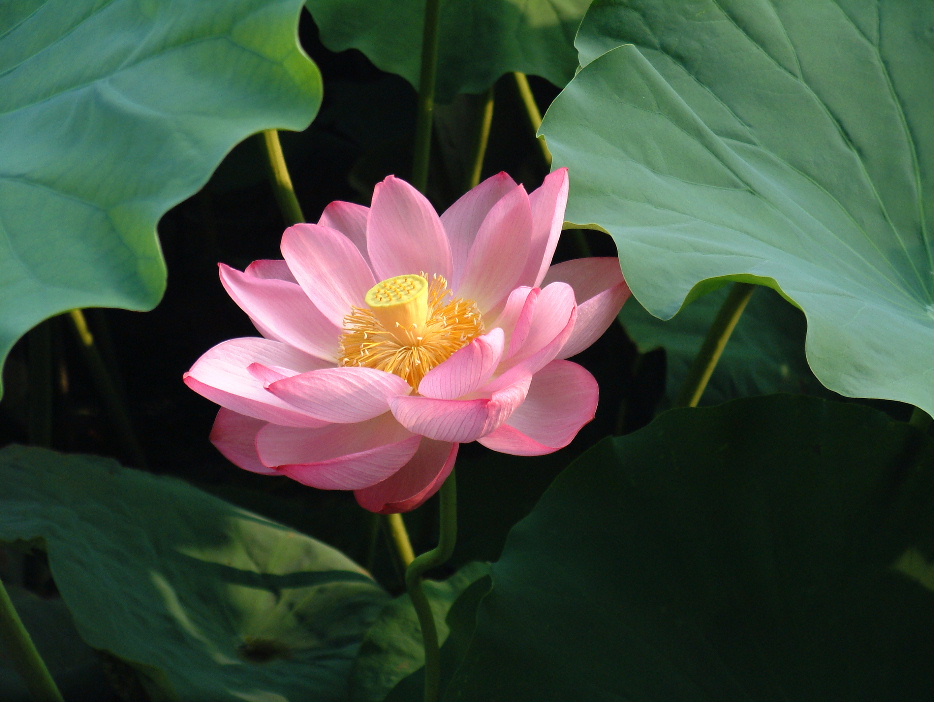
The lotus, Nelumbo nucifera

The lotus (Sanskrit: पद्म, romanizedPadmā), Nelumbo nucifera, is an aquatic plant that plays a central role in the art of Indian religions such as Hinduism, Buddhism and Jainism.

In Asian art, a lotus throne is a stylized lotus flower used as the seat or base for a figure. It is the normal pedestal for divine figures in Buddhist art and Hindu art and is often seen in Jain art. Originating in Indian art, it followed Indian religions to East Asia in particular.

Hinduism

[edit]
The Hindu goddess Lakshmi holding and standing on a lotus, Sri Lakshmi by Raja Ravi Varma

The Hindu divinities Vishnu and Lakshmi are often portrayed on a pink lotus in iconography; historically, many deities, namely Brahma, Saraswati, Lakshmi, and Kubera, usually sit on a stylized lotus throne. In the representation of Vishnu as Padmanabha (Lotus navel), a lotus issues from his navel with Brahma on it. The goddess Saraswati is portrayed on a white lotus. The lotus is the symbol of what is divine or immortal in humanity, and also symbolizes divine perfection. The lotus is the attribute of sun and fire gods. It symbolizes the realization of inner potential, and in Tantric and Yogic traditions, it symbolizes the potential of an individual to harness the flow of energy moving through the chakras (often depicted as wheel-like lotuses) flowering as the thousand-petaled lotus of enlightenment at the top of the skull.[1]

Vishnu is often described as the "Lotus-Eyed One" (Pundarikaksha).[2] The lotus's unfolding petals suggest the expansion of the soul. The growth of its pure beauty from the mud of its origin holds a benign spiritual promise. In Hindu iconography, other deities, like Ganga and Ganesha, are often depicted with lotus flowers as their seats.

The lotus plant is cited extensively within Puranic and Vedic literature, for example:

One who performs his duty without attachment, surrendering the results unto the Supreme Lord, is unaffected by sinful action, as the lotus is untouched by water.

— Bhagavad Gita 5.10:

Buddhism

[edit]
The boy Buddha appearing within a lotus. Crimson and gilded wood, Trần-Hồ dynasty, Vietnam, 14th–15th century

In the Aṅguttara Nikāya, the Buddha compares himself to a lotus (padma in Sanskrit, in Pali, paduma),[3] saying that the lotus flower rises from the muddy water unstained, as he rises from this world, free from the defilements taught in the specific sutta.[4][5]

In Buddhist symbolism, the lotus represents purity of the body, speech and mind, as if floating above the murky waters of material attachment and physical desire. According to the traditional biographies, Gautama Buddha's first seven steps made lotus flowers appear.[6] Lotus thrones are the normal pedestal for most important figures in Buddhist art, and often that of other Indian religions.

In Tibet, Padmasambhava, the Lotus-Born, is considered the Second Buddha, having brought Buddhism to that country by conquering or converting local deities; he is normally depicted sitting on a lotus flower and holding a vajra and a skullcup.[7] One account of his birth is that he appeared inside a lotus flower.

Confucianism

[edit]

In Chinese culture, Confucian scholar Zhou Dunyi (1017–1073) wrote (borrowing from Gautama Buddha's famous metaphor):

I love the lotus because while growing from mud, it is unstained.

Chinese: 予獨愛蓮之出淤泥而不染。[8]

The lotus is the emblem of Macau and appears on its flag.[9]

Jainism

[edit]

The founders (tirthankaras) of Jainism are portrayed seated or standing on lotus thrones.[10] As his name suggests, the Jain tirthankara Padmaprabha is also represented by the symbol of a lotus. Padmaprabha means 'bright as a red lotus' in Sanskrit. It is said in Śvetāmbara sources that his mother had a fancy for a couch of red lotuses – padma – while he was in her womb.[11]

Manichaeism

[edit]
From left-to-right, Mani, Zarathustra, Shakyamuni, and Jesus depicted seated atop lotus flowers.

Chinese Manichaeism borrowed the iconography of Chinese Buddhism, frequently depicting religious figures revered in Manichaeism seated upon lotus thrones in its religious art.

Christianity

[edit]

Since the introduction of Christianity to India, the iconography of the Saint Thomas Christians has depicted the Saint Thomas Christian cross, also called the Persian cross, resting on a lotus throne, a stylised lotus flower. Likewise, following the introduction of Christianity to China by the Church of the East, the Nestorian cross was frequently depicted on a lotus flower in Chinese Christian iconography.

Baháʼí Faith

[edit]

The international Baháʼí Faith community adopted the symbolism of the lotus in the design of the Lotus Temple in New Delhi, India.[12]

Cultural

[edit]

In the classical written and oral literature of many Asian cultures the lotus is present in figurative form, representing elegance, beauty, perfection, purity and grace, being often used in poems and songs as an allegory for ideal feminine attributes. In Sanskrit the word lotus (पद्म padma) has many synonyms: since the lotus thrives on water, ja (denoting birth) is added to words for water to derive synonyms for lotus, like rajiva, ambuja (ambu (water) + ja (born of)), neeraja (neera (water) + ja (born of)), pankaja (panka (mud) + ja(born of)), kamala, kunala, aravinda, nalini and saroja and names derived from the lotus, like padmavati (possessing lotuses) or padmini (full of lotuses). These names and derived versions are often used to name girls, and to a lesser extent boys, throughout South and Southeast Asia.[13][14]

The lotus flower is the state flower of several Indian states, including Karnataka, Haryana, and Andhra Pradesh.[15] The lotus flower is the election symbol of the Bharatiya Janata Party, one of the major political parties in India.[16]

Symbolism

[edit]

It has been considered a symbol of beauty, absolute purity, honesty, rebirth, self-regeneration, enlightenment. Another plant known as a lotus (Nymphaea spp.) was considered a supreme plant by Egyptians for its fragrant transformative scent while living its alternating existence below and above the water surface. It was also used by the Egyptians as a means of inducing altered states of consciousness and making contact with other realms of existence. The blue lotus, N. caerulea, was considered as a symbol of the sun rising out of night.[17]

In Hindu philosophy, the lotus is regarded to be the first born of creation and a magic womb for the universe and gods. It has also been associated with longevity, fertility, wealth, and knowledge.

It is considered a symbol of freedom from desire and material attachment while invoking purity at a level of mind, speech and action by Buddhist tradition. Also connected:

  • The blue lotus symbolizes the victory of spirit over that of intelligence, knowledge and wisdom. (This is not Buddhist but ancient Egyptian; Nelumbo nucifera has no blue cultivars.)[18]
  • The white lotus symbolizes the Bodhi being awakened, ascent towards mental purity, and spiritual perfection. It also implies a state of spiritual maturity connected to the pacification of one's nature.
  • The pink lotus is considered to be Buddha's true lotus and the supreme one out of all of the other lotuses.[19]

See also

[edit]

References

[edit]

Further reading

[edit]
[edit]
Revisions and contributorsEdit on WikipediaRead on Wikipedia
from Grokipedia
The sacred lotus (Nelumbo nucifera), an aquatic plant native to Asia, occupies a central role in the religious art of Hinduism, Buddhism, and Jainism, symbolizing purity, enlightenment, and spiritual rebirth owing to its emergence unstained from muddy waters. In these traditions, the lotus frequently appears as a throne or pedestal for deities in sculptures and paintings, as seen in depictions of Brahma arising from Vishnu's navel or Lakshmi standing upon its petals, underscoring themes of divine creation and prosperity. Its iconography extends to architectural motifs in temples and mandalas, where multi-petaled lotuses represent cosmic order and the unfolding of consciousness. Originating in ancient Indian artistic traditions, the lotus motif proliferated through the spread of across Asia, influencing Gandharan Greco-Buddhist sculpture and Chinese sacred art, where it embodies detachment from worldly attachments. In Buddhist iconography, figures such as or bodhisattvas are often seated on lotus thrones to signify transcendence over defilements, a convention that persisted from early aniconic representations to elaborate medieval tangkas. similarly employs the lotus as an emblem of spiritual ascent, associating it with tirthankaras' enlightenment. Beyond these core traditions, syncretic appearances occur in Manichaean diagrams and Nestorian Christian artifacts along routes, reflecting cultural exchanges rather than native doctrinal symbolism. The lotus's defining characteristic in religious art lies in its naturalistic yet stylized rendering—closed buds evoking potentiality, fully bloomed flowers perfection—facilitating layered interpretations across texts like the in , which equates its purity to the Buddha's teachings. This motif's endurance stems from the plant's observable , grounding abstract theological concepts in empirical observation of renewal cycles, without reliance on unsubstantiated myths.

Botanical and Empirical Foundations

Biological Traits Informing Symbolism

The sacred lotus (Nelumbo nucifera), an aquatic perennial in the family Nelumbonaceae, propagates via thickened rhizomes anchored in oxygen-poor, muddy sediments of shallow freshwater bodies, typically 30-150 cm deep. These rhizomes store carbohydrates, enabling the plant to withstand seasonal drying and nutrient fluctuations, while erect petioles extend leaves and flowers 1-2 meters above the water surface. The emergent foliage and blooms remain untainted by subsurface impurities, a phenotypic adaptation rooted in epicuticular waxes and structural papillae that repel adhesion of particulates and pathogens. Leaves are peltate and orbicular, attaining diameters up to 60 cm, with a waxy conferring superhydrophobicity—the ""—wherein water droplets maintain high contact angles (over 150°) and roll off, dislodging contaminants via capillary forces. Flowers, 10-20 cm across, feature 20-30 imbricated surrounding fertile stamens and a conical receptacle that matures into a fruiting pod with embedded achenes; maintains temperatures 10-20°C above ambient air during , enhancing volatile emission for attraction. This diurnal blooming, coupled with radial symmetry and luminous coloration (predominantly white to pink), mimics solar progression, influencing perceptual analogies to enlightenment and cosmic order. Seeds exhibit extreme , with radiocarbon-dated specimens from northeastern germinating after 1,300 years of in dry lakebed conditions, due to impermeable lignified coats impermeable to oxygen and water, coupled with enzymes that mitigate oxidative damage during quiescence. Physical is breached by , yielding rapid emergence in 3-6 days under moist, aerobic settings. Such resilience against and temporal decay parallels motifs of rebirth, as viable propagules persist through environmental vicissitudes that would degrade most angiosperm embryos. These empirically observable traits—contrasting foul origins with pristine form, self-cleansing surfaces, radiant thermogenic display, and millennial viability—causally underpin symbolic appropriations in religious contexts, predating circa 7,000 years ago in .

Causal Origins of Sacred Status

The sacred status of the lotus (Nelumbo nucifera) traces causally to its empirical growth in the subtropical wetlands of South and East Asia, where rhizomes embed in oxygen-deprived, sediment-laden mud, yet erect leaves and flowers rise untarnished above the waterline, a phenomenon directly observable by ancient agrarian societies. This biological adaptation—enabling pristine emergence from foul conditions—evoked early metaphorical links to transcendence over material defilement, as the flower's waxy, self-cleaning petals resist adhesion of dirt and pathogens, maintaining visual and olfactory purity amid decay. Archaeological remains of lotus seeds and rhizomes from Chinese sites dating to approximately 2000 BCE indicate long-term human cultivation and interaction, predating formalized religious but establishing the plant's prominence in regional ecosystems and economies, which likely amplified its perceptual salience for symbolic elevation. In the Indian subcontinent, where N. nucifera proliferates in ponds and rivers, Vedic texts from around 1500–1200 BCE reference the lotus (padma) in contexts of cosmic origins and divine manifestation, reflecting pre-Axial Age observations of its diurnal blooming cycle: petals unfurl at sunrise after nocturnal closure, mirroring renewal and enlightenment amid adversity. This pattern, coupled with the plant's nutritional and medicinal utility—rhizomes yielding starch and seeds providing oil—integrated it into ritual practices, transitioning from utilitarian reverence to sacralization as populations anthropomorphized its resilience onto human spiritual aspirations. Peer-reviewed archaeobotanical data confirm sustained exploitation from the Indus Valley Civilization onward, underscoring how ecological availability and phenotypic distinctiveness causally propelled the lotus beyond mere flora into emblematic status, independent of later doctrinal overlays. Cross-regional diffusion via trade routes further entrenched this foundation, with Persian intermediaries potentially conveying stylized motifs from Egyptian water lilies, though 's native Asian traits provided the primary causal impetus in Dharmic contexts. Empirical consistency in ancient accounts prioritizes the plant's innate properties over exogenous imposition, as no evidence suggests contrived attribution; instead, the lotus's capacity for repeated flowering across seasons reinforced notions of eternal purity, directly informing its adoption in as a substrate for deities and enlightened figures.

Core Symbolism Across Traditions

Purity and Transcendence

The sacred lotus (Nelumbo nucifera) embodies purity in religious art through its observed biological trait of blooming pristine despite rooting in sediment-laden waters, where its hydrophobic leaf and petal surfaces—characterized by micro-papillae and epicuticular waxes—repel dirt and water droplets, maintaining cleanliness without human intervention. This empirical phenomenon, visible to ancient observers in South Asian wetlands, provides a causal foundation for the flower's depiction as untainted by worldly impurities, symbolizing the transcendence of the spirit over material corruption. In , the lotus serves as a for deities such as and , elevating them above the chaotic waters of existence to signify divine detachment and moral purity, as seen in temple carvings and paintings from the Gupta period onward (circa 4th–6th centuries CE), where the flower's petals radiate symmetrically to emphasize ethereal elevation. For instance, Brahma's emergence from Vishnu's navel on a lotus stalk illustrates creation's pure origin amid cosmic dissolution, underscoring transcendence from cyclical decay to renewed sanctity. Buddhist art similarly employs the lotus to convey enlightenment's purity, with the Buddha often seated in padmasana (lotus position) upon a blooming pedestal, representing the mind's ascent from the "mud" of ignorance and desire to unblemished wisdom, a motif prevalent in Gandharan sculptures (1st–5th centuries CE) and later Tibetan thangkas where multi-tiered lotuses denote progressive spiritual stages. The white lotus, in particular, denotes bodhi—spiritual perfection—contrasting the pink lotus of the historical Buddha, both affirming the flower's role in visualizing transcendence beyond samsaric attachments. This symbolism persists in East Asian adaptations, such as Japanese mandalas, where the lotus's layered unfolding mirrors meditative transcendence.

Creation, Divinity, and Prosperity

In , the sacred lotus () embodies creation as depicted in religious art where , the creator god, emerges from a lotus flower sprouting from the navel of reclining on the serpent Ananta-Shesha. This motif, central to Puranic narratives, illustrates the lotus as the primordial womb from which the universe unfolds, with the flower's emergence from divine essence signifying the causal origin of cosmic order and multiplicity from unity. The lotus further symbolizes divinity through its role as a throne or pedestal for deities in across Dharmic traditions, elevating figures like , , and enlightened beings above worldly impurities while denoting their transcendent purity and spiritual authority. In , such as Gandharan sculptures from the 1st-5th centuries CE, bodhisattvas and are portrayed seated in (padmasana) or upon lotus pedestals, reinforcing the flower's association with divine awakening and the unchained spirit. This representational convention underscores the lotus's empirical basis in its aquatic resilience—rising unsoiled from mud—as a for divine detachment from material causation. Linked to prosperity, the lotus appears in depictions of , the goddess of wealth and abundance, who is frequently shown standing on a fully bloomed lotus or holding it as an attribute, symbolizing material fortune alongside spiritual enrichment derived from purity. Hindu temple carvings and paintings, such as those from the Gupta period (circa 320-550 CE), integrate the lotus with Lakshmi to invoke economic flourishing and fertility, attributing to the flower attributes of , renewal, and inexhaustible yield observed in its seasonal blooming cycles. While less emphasized in Buddhist contexts, the lotus's prosperity connotations persist in syncretic East Asian traditions where it adorns images of wealth deities, blending with motifs of eternal renewal.

Depictions in Dharmic Religions

Hinduism

In Hindu religious art, the sacred lotus (Nelumbo nucifera), known as padma, frequently appears as a pedestal or throne (padmasana) for deities, embodying purity and divine transcendence, as the bloom rises immaculate from murky waters. This motif underscores the flower's empirical origin in aquatic environments, where its unsoiled petals despite submerged roots parallel spiritual detachment from worldly impurities, a concept echoed in texts like the Bhagavad Gita. Artistically, the lotus adorns sculptures and paintings from ancient temple carvings to later iconography, often in pink or white variants to denote prosperity or knowledge. Central to creation narratives, depictions show Brahma emerging from a lotus sprouting from Vishnu's navel while Vishnu reclines on the serpent Ananta, symbolizing cosmic genesis; such scenes feature in Odisha temple sculptures, including at Jagannath Temple in Puri. Lakshmi, consort of Vishnu and goddess of wealth, stands or sits on a pink lotus, frequently holding another, as rendered in Raja Ravi Varma's painting circa 1894, emphasizing fertility and abundance. Vishnu himself grasps the lotus (padma), signifying creative potency, evident in 5th-6th century sculptures and a circa 1750 piece at the National Museum, New Delhi. Saraswati, deity of wisdom, pairs with a white lotus, portrayed in artworks from circa 1680-1700. Historically, lotus motifs trace to Mauryan-era pillars (3rd century BCE) and Sunga-period stupas at and Sanchi (3rd-1st century BCE), evolving into elaborate temple reliefs in regions like , where engravings at sites such as Maa Temple depict deities amid lotus blooms. These carvings, often integrated into architectural elements like bases and walls, reflect the flower's causal role in rituals, such as offerings during festivals, reinforcing its status as a conduit for without reliance on interpretive bias in scriptural .

Buddhism

In Buddhist , the sacred lotus () symbolizes purity and enlightenment, as its roots anchor in mud while its blooms rise unstained above water, mirroring the practitioner's emergence from samsaric defilements to awakened awareness. This botanical trait underpins its causal role in doctrinal metaphors, emphasizing transcendence through disciplined rather than inherent sanctity. Depictions of the Buddha seated in padmāsana () upon a dominate Buddhist statuary, with tiered petals forming the pedestal to signify divine elevation and unassailable wisdom. Early examples appear in from the 1st to 5th centuries CE, where lotus motifs adorn throne bases and architectural friezes, blending Hellenistic realism with indigenous symbolism to propagate ideals across trade routes. In these sculptures, the lotus often supports preaching or meditative mudras, reinforcing narrative scenes of doctrinal dissemination, such as the first sermon at . Lotus variants in art convey nuanced attributes: white lotuses denote mental purity and the historical Buddha's teachings, pink ones embody the supreme Buddha (Siddhartha Gautama), blue symbolize wisdom of esoteric paths, and red evoke compassion and the bodhisattva vow. In Vajrayana traditions, the lotus pairs with the vajra as vajra-padmā, representing method and wisdom's union, frequently carved into mandala centers or deity thrones in Tibetan and Japanese temple reliefs dating from the 8th century onward. Mandala compositions integrate lotuses as radial supports for enlightened figures, with petal counts—often eight or thousand-petaled—encoding cosmological layers and meditative foci, as seen in 11th-century thangkas from Nalanda traditions. Offerings of lotuses in ritual scenes underscore devotion, appearing in wall paintings at Ajanta Caves (2nd century BCE–6th century CE), where they frame Jataka tales to illustrate karmic purity's rewards. Regional adaptations, such as stylized lotuses in East Asian ink paintings from the Tang dynasty (618–907 CE), retain core symbolism while incorporating local flora aesthetics, evidencing transmission without doctrinal dilution.

Jainism

In Jain iconography, the sacred lotus (Nelumbo nucifera) serves as an emblem of purity, spiritual elevation, and divine origin, often depicted to underscore the transcendence of enlightened beings amid worldly impurities. It is most prominently linked to Padmaprabhu, the sixth of the current time cycle, whose name derives from terms meaning "lord with a lotus-like glow" or "bright as a crimson lotus," with the red lotus flower as his specific cognizance symbol (lanchhana). Sculptural representations of Padmaprabhu, dating from medieval periods such as the 11th-12th centuries CE in sites like and , typically show him in meditative posture ( or padmasana) atop or supported by an open lotus bloom, emphasizing his untainted enlightenment and separation from karmic defilements. Beyond this titular association, lotus motifs recur in as symbols of perfection and auspiciousness, appearing incised on the palms and soles of idols to evoke the flawless detachment of liberated souls. These elements, evident in and stone carvings from the early medieval era (circa 6th-13th centuries CE), align with broader Jaina textual descriptions of purity rising above mud-like ignorance, as articulated in canonical works like the Acaranga Sutra. Portable Jain artifacts, such as lotus mandalas from the 18th-19th centuries, further integrate the flower into devotional art: these are hinged shrines with eight petals enclosing a central Jina figure, mimicking a budding lotus to facilitate on cosmic order and non-attachment. The lotus also features in narrative reliefs depicting the 14 auspicious dreams (svapna) experienced by the mothers of Tirthankaras, where floral lakes or blooming lotuses signify the pure conception of world-teachers, as illustrated in temple friezes at sites like Dilwara (built 11th-13th centuries CE). This usage parallels its role in emphasizing causal detachment from material bonds, though Jaina art prioritizes ascetic minimalism over the more elaborate floral thrones common in contemporaneous Hindu depictions. Historical evidence from archaeological surveys indicates these motifs proliferated during the Solanki dynasty (circa 942-1244 CE), reflecting regional adaptations in where lotus carvings adorned chaumukha (four-faced) shrines symbolizing omniscience.

Depictions in East Asian and Syncretic Traditions

Confucianism

In Confucian philosophy, the sacred lotus (Nelumbo nucifera) symbolizes moral integrity and the ideal gentleman (junzi), who maintains purity amid worldly corruption, much like the flower's emergence unstained from muddy waters. This association draws from Neo-Confucian thinker Zhou Dunyi (1017–1073), whose essay Ai Lian Shuo (Rhapsody on the Love of the Lotus), composed around the mid-11th century, praises the lotus as the sole flower embodying virtue: "I love the lotus because, while rising from the mud, it remains unstained by it." Zhou's work, influential in Song dynasty (960–1279) intellectual circles, links the plant's qualities to Confucian virtues of modesty, self-cultivation, and detachment from vulgarity, influencing later scholarly appreciation. Depictions of the lotus in Confucian contexts appear primarily in literati paintings, garden designs, and poetic motifs rather than ritual icons, reflecting Confucianism's emphasis on ethical symbolism over devotional imagery. For instance, Song and scholar-artists incorporated lotus motifs in ink paintings to evoke moral exemplars, aligning with Confucian ideals of harmony with nature and personal rectitude. In temple gardens associated with Confucian academies, such as those at (founded 976 CE in ), lotuses were cultivated and referenced in inscriptions to symbolize scholarly purity, though without the pedestal or divine connotations seen in . These representations underscore the lotus's role as a for ethical transcendence in Confucian thought, distinct from its soteriological uses elsewhere.

Manichaeism

In Chinese Manichaean art, the sacred lotus served primarily as a throne motif for prophets and deities, adopted from Buddhist iconography prevalent in and where spread after the CE. This borrowing is evident in depictions of the religion's four principal prophets—Mani (c. 216–274 CE), , Shakyamuni Buddha, and —seated cross-legged on blooming lotus pedestals, symbolizing elevated spiritual purity amid material impurity, akin to Buddhist interpretations but integrated into Manichaean dualistic cosmology of light versus darkness. A notable example appears in the Manichaean Diagram of the Universe, a 10th-century manuscript fragment from the Turfan region, where the prophets are arranged in sequence atop lotuses, reflecting syncretic influences from Indian and Buddhist artistic traditions during Manichaeism's eastward expansion under Uyghur patronage from the 8th to 11th centuries. Similarly, the 12th–13th century Manichaean Painting of the , measuring 153.5 cm by 58.7 cm, portrays a nimbate figure—interpreting as a Manichaean emissary—enthroned on a lotus while holding a , blending Christian, Buddhist, and indigenous Chinese elements without direct Buddhist affiliation. This lotus throne usage underscores Manichaeism's adaptive strategy in regions dominated by , employing familiar motifs to convey the transcendence of over earthly matter, though primary Manichaean texts like Mani's Shabuhragan (mid-3rd century) lack explicit lotus references, indicating the symbol's secondary, artistic role rather than core doctrinal significance. Academic analyses attribute such motifs to rather than indigenous development, with no evidence of pre-Buddhist lotus symbolism in Sassanid Persian Manichaean origins.

Depictions in Abrahamic-Influenced Traditions

Christianity

In Eastern Christian traditions, the sacred lotus (Nelumbo nucifera) integrates into religious art through syncretic motifs, particularly in the Church of the East and among Saint Thomas Christians, where it supports the cross as a symbol of purity emerging from worldly impurity, paralleling Christ's resurrection. This adaptation reflects missionary efforts in Asia, incorporating local floral iconography to convey theological truths without altering core doctrine. The , characteristic of the , often depicts a Maltese-style rising from a lotus bloom, as seen in 8th-century Chinese inscriptions. For example, the , erected in 781 AD by the Nestorian monk , illustrates a atop a lotus, signifying Christ's transcendence over the material world while rooted in humanity, akin to the lotus's growth from mud to pristine flower. This motif facilitated evangelization in Buddhist-influenced regions by evoking purity and enlightenment, though it remains distinct from Eastern Orthodox or Roman Catholic canon. Among in , , the Mar Thoma Sleeha () features a mounted on a lotus pedestal with three tiers of petals, symbolizing the triumph of amid Indic spiritual traditions. examples from the 7th to 10th centuries, such as those at and , bear Pahlavi inscriptions linking to Persian Christian influences, with the lotus base denoting cultural accommodation to Hindu and of divine rebirth. These crosses, venerated in Syro-Malabar liturgy, underscore themes, as the lotus's daily emergence mirrors Christ's victory over death. Such depictions are absent in Western Christian art, where the lily or rose predominates for purity and Marian devotion; the lotus's role in Christianity thus highlights regional evangelistic strategies rather than universal symbolism.

Baháʼí Faith

The Baháʼí House of Worship in New Delhi, India, commonly known as the Lotus Temple, exemplifies the lotus's adoption in Baháʼí religious architecture, with its nine-sided structure composed of 27 free-standing marble-clad "petals" arranged in clusters to evoke the unfolding of a lotus flower (Nelumbo nucifera). Designed by Iranian architect Fariborz Sahba and completed in December 1986, the temple draws on the lotus as a symbol of purity, tenderness, and the Manifestation of God, reflecting its emergence pristine from muddy waters as an emblem of spiritual detachment and divine revelation. This architectural motif aligns with Baháʼí emphasis on and harmony across religions, incorporating the lotus's established Indian symbolism of non-attachment and enlightenment without direct scriptural mandate in Baháʼí texts for Nelumbo nucifera itself, distinguishing it from the "Lote-Tree" (Ziziphus lotus) referenced in Baháʼí writings as a mystical boundary. The design promotes accessibility and universality, seating over 2,500 worshippers in a central hall surrounded by nine pools, and has attracted millions of visitors annually, underscoring the lotus's role in fostering rather than traditional iconographic art. No prominent depictions of the lotus appear in Baháʼí or traditions, which prioritize abstract symbols like the nine-pointed star over floral motifs.

Artistic Representations and Evolution

Iconographic Motifs and Styles

The sacred lotus serves as a central in Hindu , often depicted as a (padmāsana) elevating deities above impurity, with emerging from 's navel on a lotus stem to symbolize the origin of creation from divine essence. , goddess of prosperity, holds lotuses or stands upon them, embodying fertility and spiritual purity amid material abundance. In Buddhist iconography, the supports enlightened beings, its multilayered petals representing progressive stages of awakening, from attachment to nirvana, with the white lotus specifically denoting Bodhi or full enlightenment. The blue lotus motif underscores the supremacy of spiritual insight over mere knowledge. Artistic styles of lotus depiction emphasize its botanical realism to evoke transcendence, with petals rendered in precise, radiating in ancient Indian temple carvings dating to the period (circa 4th-6th centuries CE), where lotuses adorn pillars and ceilings as divine seats. In paintings, such as those in Himalayan traditions, the lotus appears with elongated stems rising from primordial waters, petals unfurling to mirror enlightenment's emergence from suffering. East Asian adaptations stylized the motif for sculptures and frescoes, evolving from naturalistic forms in (618-907 CE) Buddhist caves to abstracted, geometric patterns in later , facilitating mass replication in textiles and ceramics. In syncretic contexts like Manichaean diagrams, the lotus integrates with cosmological elements, forming bases for light symbols amid dualistic battles, while Nestorian Christian artifacts blend it with crosses, adapting the motif to signify by the 7th-8th centuries CE in . Jain art employs similar thrones for Tirthankaras, with lotuses carved in high relief on 11th-century temples, petals counted in multiples of eight to align with cosmic directions. These motifs consistently prioritize the flower's vertical ascent and pristine bloom, rendered in durable stone or vibrant pigments to convey eternal purity across media.

Historical Development and Regional Variations

The sacred lotus motif originated in the Indian subcontinent, where it emerged as a central iconographic element in Hindu, Buddhist, and Jain religious art by the early centuries CE. In Hindu sculptures dating to the 5th and 6th centuries, deities such as Vishnu are depicted holding or emerging from lotuses, symbolizing creative power and divine purity amid worldly impurity. Similarly, in Jain art, the lotus serves as a pedestal for tirthankaras, emphasizing spiritual enlightenment and detachment, with motifs appearing in temple carvings from the Gupta period onward. This symbolism, rooted in the flower's growth from mud to pristine bloom, reflects first-principles associations of transcendence over material origins, predating widespread Buddhist adoption but amplified through shared Indic traditions. With the expansion of from around the 1st century CE, the lotus motif proliferated across , undergoing regional adaptations in iconography and style. In , by the (618–907 CE), integrated the for figures like Amitabha, enriching local symbolism with connotations of enlightenment and untainted wisdom, often rendered in intricate stone reliefs at sites like . Japanese adaptations, evident from the (794–1185 CE), stylized the lotus in paintings and temple icons, portraying it as a pathway from ignorance to wisdom, with delicate, layered petals in ink and color on silk scrolls. These variations maintained core purity themes but incorporated sinicized aesthetics, such as symmetrical arrangements in Confucian-influenced temple designs, contrasting the more naturalistic, voluminous blooms in Indian prototypes. Syncretic traditions further diversified the lotus in Central and East Asian during the medieval period. Manichaean manuscripts from 8th–10th century depict prophets like Mani and seated on lotus thrones, borrowing Buddhist to convey universal illumination amid dualistic cosmology. Nestorian Christian artifacts, such as 7th–9th century steles from and Fangshan, feature crosses atop lotuses, blending the flower's purity symbolism—adopted from Persian and Buddhist contexts—with Christian motifs, as seen in rubbings from the Temple of the Cross. This adaptation, likely pragmatic for evangelizing in Buddhist-dominated regions, persisted in Tang-era tomb inscriptions, illustrating causal influences of cultural exchange over doctrinal purity. By the Mughal era in (16th–19th centuries), the lotus transitioned from divine pedestal to decorative frieze in , diluting religious specificity for ornamental universality.

References

Add your contribution
Related Hubs
Contribute something
User Avatar
No comments yet.