Recent from talks
Contribute something
Nothing was collected or created yet.
Pre-Raphaelite Brotherhood
View on Wikipedia

| History of art |
|---|
The Pre-Raphaelite Brotherhood (PRB), later known as the Pre-Raphaelites, was a group of English painters, poets, and art critics, founded in 1848 by William Holman Hunt, John Everett Millais, Dante Gabriel Rossetti, William Michael Rossetti, James Collinson, Frederic George Stephens and Thomas Woolner who formed a seven-member "Brotherhood" partly modelled on the Nazarene movement.[1] The Brotherhood was only ever a loose association and their principles were shared by other artists and poets of the time, including Algernon Charles Swinburne, William Morris, Ford Madox Brown, Arthur Hughes and Marie Spartali Stillman. Later followers of the principles of the Brotherhood included Edward Burne-Jones and John William Waterhouse.
The group sought a return to the abundant detail, intense colours and complex compositions of Quattrocento Italian art. They rejected what they regarded as the mechanistic approach first adopted by Mannerist artists who succeeded Raphael and Michelangelo. The Brotherhood believed the Classical poses and elegant compositions of Raphael in particular had been a corrupting influence on the academic teaching of art, hence the name "Pre-Raphaelite". In particular, the group objected to the influence of Sir Joshua Reynolds, founder of the English Royal Academy of Arts, whom they called "Sir Sloshua". To the Pre-Raphaelites, according to William Michael Rossetti, "sloshy" meant "anything lax or scamped in the process of painting ... and hence ... any thing or person of a commonplace or conventional kind".[2] The group associated their work with John Ruskin,[3] an English critic whose influences were driven by his religious background. Christian themes were abundant.[4]
The group continued to accept the concepts of history painting and mimesis, imitation of nature, as central to the purpose of art. The Pre-Raphaelites defined themselves as a reform movement, created a distinct name for their form of art, and published a periodical, The Germ, to promote their ideas. The group's debates were recorded in the Pre-Raphaelite Journal. The Brotherhood separated after almost five years.[5]
Beginnings
[edit]
The Pre-Raphaelite Brotherhood was founded in John Millais's parents' house on Gower Street, London in 1848. At the first meeting, the painters John Everett Millais, Dante Gabriel Rossetti, and William Holman Hunt were present. Hunt and Millais were students at the Royal Academy of Arts and had met in another loose association, the Cyclographic Club, a sketching society. At his own request Rossetti became a pupil of Ford Madox Brown in 1848.[6] At that date, Rossetti and Hunt shared lodgings in Cleveland Street, Fitzrovia, Central London. Hunt had started painting The Eve of St. Agnes based on Keats's poem of the same name, but it was not completed until 1867.[7]
As an aspiring poet, Rossetti wished to develop the links between Romantic poetry and art. By autumn, four more members, painters James Collinson and Frederic George Stephens, Rossetti's brother, poet and critic William Michael Rossetti, and sculptor Thomas Woolner, had joined to form a seven-member-strong brotherhood.[7] Ford Madox Brown was invited to join, but the more senior artist remained independent but supported the group throughout the PRB period of Pre-Raphaelitism and contributed to The Germ. Other young painters and sculptors became close associates, including Charles Allston Collins, and Alexander Munro. The PRB intended to keep the existence of the brotherhood secret from members of the Royal Academy.[citation needed]
Early doctrines
[edit]The brotherhood's early doctrines, as defined by William Michael Rossetti, were expressed in four declarations:
- to have genuine ideas to express;
- to study Nature attentively, so as to know how to express them;
- to sympathise with what is direct and serious and heartfelt in previous art, to the exclusion of what is conventional and self-parading and learned by rote; and
- most indispensable of all, to produce thoroughly good pictures and statues.[8]
The principles were deliberately non-dogmatic, since the brotherhood wished to emphasise the personal responsibility of individual artists to determine their own ideas and methods of depiction. Influenced by Romanticism, the members thought freedom and responsibility were inseparable. Nevertheless, they were particularly fascinated by medieval culture, believing it to possess a spiritual and creative integrity that had been lost in later eras. The emphasis on medieval culture clashed with principles of realism which stress the independent observation of nature. In its early stages, the Pre-Raphaelite Brotherhood believed its two interests were consistent with one another, but in later years the movement divided and moved in two directions. The realists were led by Hunt and Millais, while the medievalists were led by Rossetti and his followers, Edward Burne-Jones and William Morris. The split was never absolute, since both factions believed that art was essentially spiritual in character, opposing their idealism to the materialist realism associated with Courbet and Impressionism.
The Pre-Raphaelite Brotherhood was greatly influenced by nature and its members used great detail to show the natural world using bright and sharp-focus techniques on a white canvas. In attempts to revive the brilliance of colour found in Quattrocento art, Hunt and Millais developed a technique of painting in thin glazes of pigment over a wet white ground in the hope that the colours would retain jewel-like transparency and clarity. Their emphasis on brilliance of colour was a reaction to the excessive use of bitumen by earlier British artists, such as Reynolds, David Wilkie and Benjamin Robert Haydon. Bitumen produces unstable areas of muddy darkness, an effect the Pre-Raphaelites despised.
In 1848, Rossetti and Hunt made a list of "Immortals", artistic heroes whom they admired, especially from literature, some of whose work would form subjects for PRB paintings, notably including Keats and Tennyson.[9]
First exhibitions and publications
[edit]The first exhibitions of Pre-Raphaelite work occurred in 1849. Both Millais's Isabella (1848–1849) and Holman Hunt's Rienzi (1848–1849) were exhibited at the Royal Academy. Rossetti's The Girlhood of Mary Virgin was shown at a Free Exhibition on Hyde Park Corner. As agreed, all members of the brotherhood signed their work with their name and the initials "PRB". Between January and April 1850, the group published a literary magazine, The Germ edited by William Rossetti which published poetry by the Rossettis, Woolner, and Collinson and essays on art and literature by associates of the brotherhood, such as Coventry Patmore. As the short run-time implies, the magazine did not manage to achieve sustained momentum. (Daly 1989)
Public controversy
[edit]
In 1850, the Pre-Raphaelite Brotherhood became the subject of controversy after the exhibition of Millais's painting Christ in the House of His Parents was considered to be blasphemous by many reviewers, notably Charles Dickens.[10] Dickens considered Millais's Mary to be ugly.[11] Millais had used his sister-in-law, Mary Hodgkinson, as the model for Mary in his painting. The brotherhood's medievalism was attacked as backward-looking and its extreme devotion to detail was condemned as ugly and jarring to the eye.[12] According to Dickens, Millais made the Holy Family look like alcoholics and slum-dwellers, adopting contorted and absurd "medieval" poses.[13]
After the controversy, James Collinson resigned from the Brotherhood due to his belief that it was bringing the Christian religion into disrepute. The remaining members met to discuss whether he should be replaced by Charles Allston Collins or Walter Howell Deverell, but were unable to make a decision. From that point the group disbanded, though its influence continued. Artists who had worked in the style initially continued but no longer signed works "PRB".[14]

The brotherhood found support from the critic John Ruskin, who praised its devotion to nature and rejection of conventional methods of composition. The Pre-Raphaelites were influenced by Ruskin's theories. He wrote to The Times defending their work and subsequently met them. Initially, he favoured Millais, who travelled to Scotland in the summer of 1853 with Ruskin and Ruskin's wife, Euphemia Chalmers Ruskin, née Gray (now best known as Effie Gray). The main object of the journey was to paint Ruskin's portrait.[15] Effie became increasingly attached to Millais,[16] creating a crisis. In subsequent annulment proceedings, Ruskin himself made a statement to his lawyer to the effect that his marriage had been unconsummated.[17] The marriage was annulled on grounds of non-consummation, leaving Effie free to marry Millais,[18] but causing a public scandal. Millais began to move away from the Pre-Raphaelite style after his marriage, and Ruskin ultimately attacked his later works. Ruskin continued to support Hunt and Rossetti and provided funds to encourage the art of Elizabeth Siddal, later Rossetti's wife.
By 1853 the original PRB had virtually dissolved,[19] with only Holman Hunt remaining true to its stated aims.[according to whom?] But the term "Pre-Raphaelite" stuck to Rossetti and others, including William Morris and Edward Burne-Jones, with whom he became involved in Oxford in 1857.[20] Hence the term Pre-Raphaelite is associated with a much wider and long-lived art movement.
Later developments and influence
[edit]
Artists influenced by the brotherhood include John Brett, Philip Calderon, Arthur Hughes, Gustave Moreau, Evelyn De Morgan,[21] Frederic Sandys (who entered the Pre-Raphaelite circle in 1857)[21] and John William Waterhouse. Ford Madox Brown, who was associated with them from the beginning, is often seen as most closely adopting the Pre-Raphaelite principles. One follower who developed his own distinct style was Aubrey Beardsley, who was pre-eminently influenced by Burne-Jones.[21]
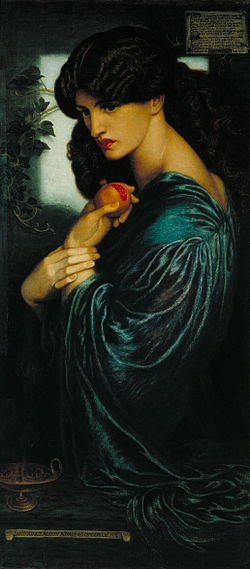
After 1856, Dante Gabriel Rossetti became an inspiration for the medievalising strand of the movement. He was the link between the two types of Pre-Raphaelite painting (nature and Romance) after the PRB became lost in the later decades of the century. Rossetti, although the least committed to the brotherhood, continued the name and changed its style. He began painting versions of femme fatales using models including Jane Morris, in paintings such as Proserpine, The Day Dream, and La Pia de' Tolomei. His work influenced his friend William Morris, in whose firm Morris, Marshall, Faulkner & Co. he became a partner, and with whose wife Jane he may have had an affair. Ford Madox Brown and Edward Burne-Jones also became partners in the firm. Through Morris's company, the ideals of the Pre-Raphaelite Brotherhood influenced many interior designers and architects, arousing interest in medieval designs and other crafts leading to the Arts and Crafts movement headed by William Morris. Holman Hunt was involved with the movement to reform design through the Della Robbia Pottery company.
After 1850, Hunt and Millais moved away from direct imitation of medieval art. They stressed the realist and scientific aspects of the movement, though Hunt continued to emphasise the spiritual significance of art, seeking to reconcile religion and science by making accurate observations and studies of locations in Egypt and Palestine for his paintings on biblical subjects. In contrast, Millais abandoned Pre-Raphaelitism after 1860, adopting a much broader and looser style influenced by Reynolds. William Morris and others condemned his reversal of principles.

Pre-Raphaelitism had a significant impact in Scotland and on Scottish artists. The figure in Scottish art most associated with the Pre-Raphaelites was the Aberdeen-born William Dyce (1806–1864). Dyce befriended the young Pre-Raphaelites in London and introduced their work to Ruskin.[22] His later work was Pre-Raphaelite in its spirituality, as can be seen in his The Man of Sorrows and David in the Wilderness (both 1860), which contain a Pre-Raphaelite attention to detail.[23] Joseph Noel Paton (1821–1901) studied at the Royal Academy schools in London, where he became a friend of Millais and he subsequently followed him into Pre-Raphaelitism, producing pictures that stressed detail and melodrama such as The Bludie Tryst (1855). His later paintings, like those of Millais, have been criticised for descending into popular sentimentality.[24] Also influenced by Millais was James Archer (1823–1904), whose work includes Summertime, Gloucestershire (1860)[24] and who from 1861 began a series of Arthurian-based paintings including La Morte d'Arthur and Sir Lancelot and Queen Guinevere.[25]
Pre-Raphaelism also inspired painters like Lawrence Alma-Tadema.[26] The movement influenced many later British artists into the 20th century.
Rossetti came to be seen as a precursor of the wider European Symbolist movement. There is evidence to suggest that a number of paintings by the German artist Paula Modersohn-Becker were influenced by Rossetti.[27]
Birmingham Museum & Art Gallery has a world-renowned collection of works by Burne-Jones and the Pre-Raphaelites that, some claim, strongly influenced the young J. R. R. Tolkien,[28] who wrote The Hobbit and The Lord of the Rings, with influences taken from the same mythological scenes portrayed by the Pre-Raphaelites. Tolkien considered his own group of school friends and artistic associates, the so-called TCBS, as a group in the vein of the Pre-Raphaelites.

In the 20th century artistic ideals changed, and art moved away from representing reality. After the First World War, Pre-Raphaelite art was devalued for its literary qualities[29] and was scorned by critics as sentimental and concocted "artistic bric-a-brac".[30] In the 1960s there was a major revival of Pre-Raphaelitism. Exhibitions and catalogues of works, culminating in a 1984 exhibition in London's Tate Gallery, re-established a canon of Pre-Raphaelite work.[31] Among many other exhibitions, there was another large show at Tate Britain in 2012–13.[32]
In the late 20th century the Brotherhood of Ruralists based its aims on Pre-Raphaelitism, while the Stuckists and the Birmingham Group have also derived inspiration from it.
List of artists
[edit]Pre-Raphaelite Brotherhood
[edit]- James Collinson (painter)
- William Holman Hunt (painter)
- John Everett Millais (painter)
- Dante Gabriel Rossetti (painter, poet)
- William Michael Rossetti (critic)
- Frederic George Stephens (critic)
- Thomas Woolner (sculptor, poet)
Associated artists and figures
[edit]- John Brett (painter)
- Ford Madox Brown (painter, designer)
- Lucy Madox Brown (painter, writer)
- Richard Burchett (painter, educator)
- Edward Burne-Jones (painter, designer)
- Charles Allston Collins (painter)
- Frank Cadogan Cowper (painter)
- Fanny Cornforth (artist's model)
- Evelyn De Morgan (painter)
- Walter Deverell (painter)
- Fanny Eaton (artist's model)
- Frederick Startridge Ellis (publisher, editor, poet)
- John William Godward (painter)
- Effie Gray (artist's model)
- Henry Holiday (painter, stained-glass artist, illustrator)
- Arthur Hughes (painter, book illustrator)
- Edward Robert Hughes (painter and artist's model)
- Frederic, Lord Leighton (painter)
- Mary Lizzie Macomber (painter)
- Robert Braithwaite Martineau (painter)
- Annie Miller (artist's model)
- Jane Morris (artist's model)
- Louisa, Marchioness of Waterford (painter and artist's model)
- May Morris (embroiderer and designer)
- William Morris (designer, writer)
- Christina Rossetti (poet and artist's model)
- John Ruskin (critic)
- Anthony Frederick Augustus Sandys (painter)
- Emma Sandys (painter)
- Thomas Seddon (painter)
- Frederic Shields (painter)
- Elizabeth Siddal (artist, poet, and artist's model)
- Simeon Solomon (painter)
- Marie Spartali Stillman (painter)
- Algernon Charles Swinburne (poet)
- Henry Wallis (painter)
- William Lindsay Windus (painter)
Loosely associated artists
[edit]- Lawrence Alma-Tadema (painter)
- Sophie Gengembre Anderson (painter)
- Wyke Bayliss (painter)
- George Price Boyce (painter)
- Joanna Mary Boyce (painter)
- Sir Frederick William Burton (painter)
- Kate Elizabeth Bunce (painter)
- Julia Margaret Cameron (photographer)
- James Campbell (painter)
- Joseph Clare (painter)
- John Collier (painter)
- Marian Collier (painter)
- William Davis (painter)
- Frank Bernard Dicksee (painter)
- Thomas Cooper Gotch (painter)
- John Atkinson Grimshaw (painter)
- Charles Edward Hallé (painter)
- John Lee (painter)
- Edmund Leighton (painter)
- James Lionel Michael (minor poet, mentor to Henry Kendall)
- Charles William Mitchell (painter)
- Joseph Noel Paton (painter)
- Charles Edward Perugini (painter)
- Gustav Pope (painter)
- Henry Meynell Rheam (painter)
- Frederick Smallfield (painter)
- James Tissot (painter)
- Elihu Vedder (painter)
- John William Waterhouse (painter)
- George Frederic Watts (painter, sculptor)
- William James Webbe (painter)
- Daniel Alexander Williamson (painter)
- James Abbott McNeill Whistler (painter)
- Aubrey Beardsley (painter)
Illustration and poetry
[edit]Many members of the 'inner' Pre-Raphaelite circle (Dante Gabriel Rossetti, John Everett Millais, William Holman Hunt, Ford Madox Brown, Edward Burne-Jones) and 'outer' circle (Frederick Sandys, Arthur Hughes, Simeon Solomon, Henry Hugh Armstead, Joseph Noel Paton, Frederic Shields, Matthew James Lawless) were working concurrently in painting, illustration, and sometimes poetry.[33] Victorian morality judged literature as superior to painting, because of its "noble grounds for noble emotion."[34] Robert Buchanan (a writer and opponent of the Pre-Raphaelite Brotherhood) felt so strongly about this artistic hierarchy that he wrote: "The truth is that literature, and more particularly poetry, is in a very bad way when one art gets hold of another, and imposes upon it its conditions and limitations."[35] This was the hostile environment in which Pre-Raphaelites were defiantly working in various media. The Pre-Raphaelites attempted to revitalize subject painting, which had been dismissed as artificial. Their belief that each picture should tell a story was an important step for the unification of painting and literature (eventually deemed the Sister Arts[36]), or at least a break in the rigid hierarchy promoted by writers like Robert Buchanan.[37]
The Pre-Raphaelite desire for more extensive affiliation between painting and literature also manifested in illustration. Illustration is a more direct unification of these media and, like subject painting, can assert a narrative of its own. For the Pre-Raphaelites, and Dante Gabriel Rossetti specifically, there was anxiety about the constraints of illustration.[37] In 1855, Rossetti wrote to William Allingham about the independence of illustration: "I have not begun even designing for them yet, but fancy I shall try the 'Vision of Sin' and 'Palace of Art' etc. – those where one can allegorize on one's own hook, without killing for oneself and everyone a distinct idea of the poet's."[37] This passage makes apparent Rossetti's desire to not just support the poet's narrative, but to create an allegorical illustration that functions separately from the text as well. In this respect, Pre-Raphaelite illustrations go beyond depicting an episode from a poem, but rather function like subject paintings within a text.
Collections
[edit]
There are major collections of Pre-Raphaelite work in United Kingdom museums such as the Birmingham Museum and Art Gallery, the Tate Gallery, Victoria and Albert Museum, Manchester Art Gallery, Lady Lever Art Gallery, and Liverpool's Walker Art Gallery. The Art Gallery of South Australia and the Delaware Art Museum in the US have the most significant collections of Pre-Raphaelite art outside the UK. The Museo de Arte de Ponce in Puerto Rico also has a notable collection of Pre-Raphaelite works, including Sir Edward Burne-Jones' The Last Sleep of Arthur in Avalon, Frederic Lord Leighton's Flaming June, and works by William Holman Hunt, John Everett Millais, Dante Gabriel Rossetti, and Frederic Sandys. The Ger Eenens Collection The Netherlands includes a work by John Collier, Circe (signed and dated 1885), that was exhibited at the Chicago World Fair 1893. The British exhibit occupied 14 rooms, showcased a theme familiar with the Fair's outlook, hence they had a sizeable exhibit of Pre-Raphaelite and New-Classical painters. They were extremely well received.

There is a set of Pre-Raphaelite murals in the Old Library at the Oxford Union, depicting scenes from the Arthurian legends, painted between 1857 and 1859 by a team of Dante Gabriel Rossetti, William Morris, and Edward Burne-Jones. The National Trust houses at Wightwick Manor, Wolverhampton, and at Wallington Hall, Northumberland, both have significant and representative collections. Andrew Lloyd Webber is an avid collector of Pre-Raphaelite works, and a selection of 300 items from his collection were shown at an exhibition at the Royal Academy in London in 2003.
Kelmscott Manor, the country home of William Morris from 1871 until his death in 1896, is owned by the Society of Antiquaries of London and is open to the public. The Manor is featured in Morris' 1890 novel News from Nowhere. It also appears in the background of Water Willow, a portrait of his wife, Jane Morris, painted by Dante Gabriel Rossetti in 1871. There are exhibitions connected with Morris and Rossetti's early experiments with photography.
Portrayal in popular culture
[edit]The story of the brotherhood, from its controversial first exhibition to being embraced by the art establishment, has been depicted in two BBC television series. The first, The Love School, was broadcast in 1975; the second is the 2009 BBC television drama serial Desperate Romantics by Peter Bowker. Although much of the latter's material is derived from Franny Moyle's factual book Desperate Romantics: The Private Lives of the Pre-Raphaelites,[38] the series occasionally departs from established facts in favour of dramatic licence and is prefaced by the disclaimer: "In the mid-19th century, a group of young men challenged the art establishment of the day. The pre-Raphaelite Brotherhood were inspired by the real world around them, yet took imaginative licence in their art. This story, based on their lives and loves, follows in that inventive spirit."[39]
Ken Russell's television film Dante's Inferno (1967) contains brief scenes on some of the leading Pre-Raphaelites but mainly concentrates on the life of Rossetti, played by Oliver Reed.
Chapter 36 of the 1952 novel East of Eden by John Steinbeck references pre-Raphaelite influenced images used to identify different classrooms: "The pictures identified the rooms, and the pre-Raphaelite influence was overwhelming. Galahad standing in full armor pointed the way for third-graders; Atalanta's race urged on the fourth, the Pot of Basil confused the fifth grade, and so on until the denunciation of Catiline sent the eighth-graders on to high school with a sense of high civic virtue. Cal and Aron were assigned to the seventh grade because of their age, and they learned every shadow of its picture—Laocoön completely wrapped in snakes".
Comparisons with contemporary European movements
[edit]The Pre-Raphaelite Brotherhood was not only about the British aesthetic,; they could be linked to other 19th-century European art movements. French Realism, for example, that was promoted by artists like Gustave Courbet, was about the truth of modern life and work.[40][41][42] The Pre-Raphaelites wanted to go back to spiritual and aesthetic standards of the medieval and early Renaissance. Their naturalism and storytelling was different from the social and the political emphasis of continental Realism.[43]
Impressionism in France was about fleeting light and modern leisure. We can see this in the PRB's love of narrative, clarity and moral themes. The Pre-Raphaelites preferred permanence, while Monet and Renoir, the Impressionists, captured the moment. This difference on ideology and style was what made the Brotherhood different, i.e. being more in line with the early German Nazarenes' moral romanticism than the material modernity of their French contemporaries.[44][45]
See also
[edit]References
[edit]- ^ Henri Dorra, Symbolist Art Theories: A Critical Anthology (Berkeley, University of California Press, 1995), p. 17.
- ^ Hilton 1971, p. 46.
- ^ Landow, George P. "Pre-Raphaelites: An Introduction". The Victorian Web. Retrieved 15 June 2014.
- ^ "Christianity and Art: The Pre-Raphaelites". byfaith.org. Retrieved 15 September 2020.
- ^ "Pre-Raphaelite Brotherhood". Encyclopedia Britannica.
- ^ McGann, Jerome J., ed. (7 May 2005). "The Girlhood of Mary Virgin". The Rossetti Archive. Archived from the original on 23 March 2023.
- ^ a b Hilton 1971, pp. 28–33
- ^ Quoted by Latham, pp. 11–12; see also his comments
- ^ "The Pre-Raphaelites". The British Library.
- ^ Slater, Michael (2009). Charles Dickens, p. 309. Yale University Press.
- ^ Andres, Sophia (2005). The Pre-Raphaelite Art of the Victorian Novel: Narrative Challenges to Visual Gendered Boundaries, p. 9. Ohio State University Press.
- ^ The Times, Saturday, 3 May 1851; pg. 8; Issue 20792: Exhibition of the Royal Academy. (Private View.), First Notice: "We cannot censure at present, as amply or as strongly as we desire to do, that strange disorder of the mind or the eyes which continues to rage with unabated absurdity among a class of juvenile artists who style themselves "P.R.B.," which being interpreted means Pre-Raphael Brethren. Their faith seems to consist in an absolute contempt for perspective and the known laws of light and shade, an aversion to beauty in every shape, and a singular devotion to the minute accidents of their subjects, including, or rather seeking out, every excess of sharpness and deformity."
- ^ Fowle, Frances (2000). "Sir John Everett Millais, Bt, Christ in the House of His Parents ('The Carpenter's Shop'), 1849–50". Tate. Retrieved 28 January 2019.
- ^ "Pre-Raphaelites: An Introduction". www.victorianweb.org. Retrieved 28 January 2019.
- ^ Dearden 1999, pp. 36–37.
- ^ Phyllis Rose, Parallel Lives: Five Victorian Marriages, 1983, pp. 49–94.
- ^ Lutyens, Mary. (1967). Millais and the Ruskins. London: John Murray. p. 191. ISBN 0719517001.
- ^ Dearden 1999, p. 43.
- ^ Clarke, Michael (2010). The concise Oxford dictionary of art terms – Pre-Raphaelite Brotherhood. Oxford: Oxford University Press. ISBN 9780199569922.
- ^ Whiteley, Jon (1989). Oxford and the Pre-Raphaelites. Oxford: Ashmolean Museum. ISBN 0907849946.
- ^ a b c Hilton 1971, pp. 202–05
- ^ D. Macmillan, Scottish Art 1460–1990 (Edinburgh: Mainstream, 1990), ISBN 0500203334, p. 348.
- ^ M. MacDonald, Scottish Art (London: Thames and Hudson, 2000), ISBN 0500203334, p. 100.
- ^ a b D. Macmillan, Scottish Art 1460–1990 (Edinburgh: Mainstream, 1990), ISBN 0500203334, p. 213.
- ^ R. Barber, The Holy Grail: Imagination and Belief (Harvard University Press, 2004), ISBN 0674013905, p. 275.
- ^ "Fine Art Books Art Instruction | Photography Books | Visual Arts Periods, Groups & Movements: Pre-Raphaelites". fineartbookstore.com. Retrieved 27 December 2017.
- ^ Rebecca Jelbert: "Paula Modersohn-Becker’s self-portraits and the influence of Dante Gabriel Rossetti." The Burlington Magazine, vol.159, no.1373 (2017): 617–22.
- ^ See, for example, Bucher (2004) for a brief discussion on the influence of the Pre-Raphaelites on Tolkien.
- ^ Treuherz, Julian (2003). "Pre-Raphaelitism". In Turner, Jane (ed.). The Dictionary of Art. Oxford University Press. doi:10.1093/gao/9781884446054.article.t069496. ISBN 978-1-884446-05-4. OCLC 5104656181.
- ^ Burroughs, B. (1935). "1935 Views the Pre-Raphaelites". The American Magazine of Art, 28(1): 6–13.
- ^ Barringer, Tim (1999). Reading the Pre-Raphaelites, p. 17. Yale University Press.
- ^ Pre-Raphaelites: Victorian Avant-Garde, Tate Britain, accessed 27 August 2014
- ^ Goldman, Paul (2004). Victorian Illustration: The Pre-Raphaelites, the Idyllic School and the High Victorians. Burlington, VT: Lund Humphries. pp. 1–51.
- ^ Welland, Dennis S. R. (1953). The Pre-Raphaelites in Literature and Art. London, UK: George G. Harrap & Co. Ltd. pp. 14. ISBN 9780836960464.
{{cite book}}: ISBN / Date incompatibility (help) - ^ Buchanan, Robert W. (October 1871). "The Fleshly School of Poetry: Mr. D.G. Rossetti". The Contemporary Review. as cited in Welland, D.S.R. The Pre-Raphaelites in Literature and Art. London, UK: George G. Harrap & Co. Ltd., 14.
- ^ "Chapter One: Ruskin's Theories of the Sister Arts — Ut Pictura Poesis". www.victorianweb.org. Retrieved 21 November 2017.
- ^ a b c Rossetti, Dante Gabriel (1855). Letter from D.G. Rossetti to William Allingham.
{{cite book}}:|work=ignored (help) - ^ Desperate Romantics press pack: introduction BBC Press Office. Retrieved on 24 July 2009.
- ^ Armstrong, Stephen (5 July 2009). "BBC2 drama on icons among Pre-Raphaelites". The Sunday Times. Archived from the original on 26 August 2011. Retrieved 25 July 2009.
- ^ Clark, T. J.; Clark, Timothy J. (1 January 1999). Image of the People: Gustave Courbet and the 1848 Revolution. University of California Press. ISBN 978-0-520-21745-4.
- ^ Smajić, Srdjan. "Pre-Raphaelite Painting and Nineteenth-Century Realism". ResearchGate.
- ^ "The 19th Century Paintings". NY Elizabeth. Retrieved 26 April 2025.
- ^ "Defining Pre-Raphaelite Realism". Victorian Web. Retrieved 26 April 2025.
- ^ Saunders, Max (2009). "From Pre-Raphaelism to Impressionism". International Ford Madox Ford Studies. 8: 51–70. ISSN 1569-4070.
- ^ "handprint : the pre-raphaelites". www.handprint.com. Retrieved 26 April 2025.
Sources
[edit]- Barringer, Tim (1998). Reading the Pre-Raphaelites. New Haven, Conn.: Yale University Press. ISBN 978-0300177336.
- Barringer, Tim, Jason Rosenfeld, and Alison Smith (2012). Pre-Raphaelites: Victorian Avant-Garde, London, England: Tate Publishing, ISBN 978-1854379306
- Bucher, Gregory (2004). "Review of Matthew Dickerson. 'Following Gandalf. Epic Battles and Moral Victory in The Lord of the Rings'", Journal of Religion & Society, 6, ISSN 1522-5658, webpage accessed 13 October 2007
- Daly, Gay (1989). Pre-Raphaelites in Love. New York: Ticknor & Fields. ISBN 0-89919-450-8.
- Dearden, James S. (1999). John Ruskin: A Life in Pictures. Sheffield: Sheffield Academic Press. ISBN 978-1-84127-045-6. OCLC 247338280.
- Dickerson, Matthew (2003). Following Gandalf: Epic Battles and moral victory in the Lord of the rings, Grand Rapids, Mich. : Brazos Press, ISBN 1-58743-085-1
- Gaunt, William (1975). The Pre-Raphaelite Tragedy (rev. ed.). London: Cape. ISBN 0-224-01106-5.
- Hawksley, Lucinda (1999). Essential Pre-Raphaelites. Bath: Dempsey Parr. ISBN 1-84084-524-4.
- Hilton, Timothy (1971). The Pre-Raphaelites. New York: H.N. Abrams. ISBN 978-0-8109-0424-8. OCLC 691232293 – via Internet Archive.
- The Pre-Raphaelites, 1984 (exhibition catalogue, various authors), Tate Gallery, London, ISBN 0713916389
- Latham, David, Haunted Texts: Studies in Pre-Raphaelitism in Honour of William E. Fredeman, William Evan Fredeman, David Latham, eds, 2003, University of Toronto Press, ISBN 0802036627, 9780802036629, google books
- Prettejohn, Elizabeth (2000). The Art of the Pre-Raphaelites. Princeton, N.J.: Princeton University Press. ISBN 0-691-07057-1.
- Ramm, John (2003). "The Forgotten Pre-Raphaelite: Henry Wallis", Antique Dealer & Collectors Guide, 56 (March/April), p. 8–9
Further reading
[edit]- Andres, Sophia. (2005) The Pre-Raphaelite Art of the Victorian Novel: Narrative Challenges to Visual Gendered Boundaries. Ohio State University Press, ISBN 0-8142-5129-3
- Baker, Kenneth (10 August 1982). "Truth and not beauty: Dante Gabriel Rossetti and the Pre-Raphaelite dream". The Boston Phoenix. Retrieved 13 September 2024.
- Bate, P.H. [1901] (1972) The English Pre-Raphaelite Painters: Their Associates and Successors, New York: AMS Press, ISBN 0-404-00691-4
- Daly, G. (1989) Pre-Raphaelites in Love, New York : Ticknor & Fields, ISBN 0-89919-450-8
- des Cars, L. (2000) The Pre-Raphaelites: Romance and Realism, "Abrams Discoveries" series, New York: Harry N. Abrams, ISBN 0-8109-2891-4
- Garnett, Henrietta. (2012) Wives and Stunners: The Pre-Raphaelites and Their Muses, London: Macmillan, ISBN 978-0-230-70940-9
- MacCarthy, Fiona. (2011) The Last Pre-Raphaelite: Edward Burne-Jones and the Victorian Imagination, London: Faber & Faber, ISBN 978-0-571-22861-4
- MacCarthy, Fiona. (1994) William Morris: A Life for Our Time, London: Faber & Faber, ISBN 978-0-571-14250-7
- Mancoff, D.N. (2003) Flora Symbolica: Flowers in Pre-Raphaelite Art, Munich; London; New York: Prestel, ISBN 3-7913-2851-4
- Marsh, Jan. (1999) Dante Gabriel Rossetti: Painter and Poet, London: Weidenfeld & Nicolson, ISBN 978-0-297-81703-1
- Marsh, J. and Nunn, P.G. (1998) Pre-Raphaelite Women Artists, London: Thames & Hudson, ISBN 0-500-28104-1
- Sharp, Frank C and Marsh, Jan. (2012) The Collected Letters of Jane Morris, Boydell & Brewer, London
- Staley, A. and Newall, C. (2004) Pre-Raphaelite Vision: Truth to Nature, London: Tate, ISBN 1-85437-499-0
- Townsend, J., Ridge, J. and Hackney, S. (2004) Pre-Raphaelite Painting Techniques: 1848–56, London: Tate, ISBN 1-85437-498-2
External links
[edit]- Birmingham Museums & Art Gallery's Pre-Raphaelite Online Resource
- Pre-Raphaelites exhibition at Tate Britain
- Liverpool Walker Art Gallery's Pre-Raphaelite collection
- Pre-Raphaelitism – lecture by John Ruskin
- The Pre-Raphaelite Society
- Pre-Raphaelite online resource project at the Birmingham Museums & Art Gallery
- The Samuel and Mary R. Bancroft Collection of Pre-Raphaelite Art
- Edward Burne-Jones, Victorian artist-dreamer, full text exhibition catalog from The Metropolitan Museum of Art
- Pre-Raphaelite murals in the Old Library at the Oxford Union. This podcast covers their painting. Oxford Brookes University has a series of podcasts on the Pre-Raphaelites in Oxford, with this one on YouTube dedicated to the Union murals.
- Pre-Raphaelites: Born Out of Desire for Change
Pre-Raphaelite Brotherhood
View on GrokipediaFormation and Principles
Origins and Founding
The Pre-Raphaelite Brotherhood emerged in mid-19th-century Britain amid the profound social and economic transformations of the Industrial Revolution, which had accelerated urbanization, mechanization, and a growing sense of artistic stagnation. Young artists at the Royal Academy of Arts in London felt disillusioned with the institution's emphasis on classical ideals, particularly the influence of Sir Joshua Reynolds and the perceived decline in British art following the High Renaissance master Raphael. This dissatisfaction was compounded by broader cultural shifts, including political unrest like the Chartist movement for social reform and revolutionary fervor across Europe in 1848, prompting a desire for artistic renewal rooted in sincerity and direct observation of nature. Influenced by critic John Ruskin's advocacy in Modern Painters (1843) for truthful representation of the natural world—"go to nature in all singleness of heart"—the group sought to reject academic conventions in favor of a return to the vivid detail and moral intensity of pre-Renaissance art.[1][4][2] In September 1848, seven youthful artists and writers, all in their late teens or early twenties and studying at the Royal Academy Schools, founded the group as a secret society during informal meetings, including at the family home of Dante Gabriel Rossetti. William Holman Hunt, often regarded as the leader, along with John Everett Millais and Dante Gabriel Rossetti, formed the core trio, driven by a shared rebellion against the "mannered" and formulaic teachings of the Academy. The other founding members were William Michael Rossetti (Dante Gabriel's brother and a critic), painter James Collinson, art critic Frederic George Stephens, and sculptor Thomas Woolner. Their motivations centered on revitalizing British art through genuine ideas, attentive study of nature, and sympathy for the direct, heartfelt qualities of earlier art, excluding conventional or rote-learned styles.[5][6][7][2] The group named itself the Pre-Raphaelite Brotherhood (PRB) to evoke admiration for the naturalism, clarity, and detail of Italian art before Raphael's era, positioning themselves as heirs to medieval and early Renaissance traditions rather than followers of Renaissance mannerism. This nomenclature underscored their intent to "imbue their art with seriousness, sincerity, and truth to nature" as a moral and artistic reform. The Brotherhood's core doctrines, briefly outlined in their initial aims, emphasized expressing genuine ideas through nature's faithful depiction and avoiding self-parodying conventions. Their first public declaration came in 1849, when they exhibited works signed with the "PRB" initials at the Royal Academy and other London venues, marking the debut of their revolutionary approach.[1][4][6][2]Core Doctrines and Manifesto
The Pre-Raphaelite Brotherhood's artistic philosophy was articulated primarily through the P.R.B. Journal, a diary maintained by William Michael Rossetti beginning in September 1849 and extending into 1850, which served as an informal manifesto containing discussions, essays on art criticism, and the group's foundational declarations.[8] This document captured the Brotherhood's commitment to reforming contemporary art by rejecting the academic conventions of the Royal Academy, which they viewed as overly mannered and derivative of Raphael's Renaissance style. Instead, the journal outlined principles emphasizing direct observation from nature, moral sincerity, and inspiration from pre-Renaissance sources, positioning art as a medium for truthful expression and spiritual insight.[9] Central to their doctrines were four key declarations recorded in the journal: to have genuine ideas to express; to study nature attentively to convey those ideas accurately; to sympathize with direct, serious, and heartfelt elements in prior art while rejecting conventional, rote-learned formulas; and, above all, to produce thoroughly good works.[10] These rules promoted "truth to nature," advocating unidealized, detailed depiction through assiduous outdoor study and avoidance of smooth finishes or contrived compositions, free from subjection to "doubtful authority."[4] The Brotherhood drew heavily from medieval and early Renaissance artists such as Giotto and Fra Angelico, seeking to revive the naive directness and abundant detail of 14th- and 15th-century Italian and Northern European art.[1] This medievalism aligned with broader Victorian Gothic Revival ideals, infusing their work with a moral and religious purpose influenced by High Church Anglicanism, where art functioned as a vehicle for conveying spiritual truths and ethical conviction. Early validation for these principles came from critic John Ruskin, who, in his 1851 pamphlet Pre-Raphaelitism, praised the Brotherhood's fidelity to nature as a prophetic adherence to divine intent in art, urging artists to reject artificiality in favor of honest representation.[11] Ruskin's endorsement, rooted in his own advocacy for naturalism, helped legitimize the group's rejection of idealized forms and emphasis on sincere, conviction-driven depiction, reinforcing art's role in moral and spiritual renewal.[12]Early Activities and Reception
Initial Exhibitions and Publications
The Pre-Raphaelite Brotherhood made their public debut in 1849 through exhibitions at two key London venues, marking the first presentation of their distinctive style inspired by medieval and early Renaissance art. At the Royal Academy's Summer Exhibition, John Everett Millais displayed Isabella, an illustration of a scene from John Keats's poem "Isabella; or, the Pot of Basil," featuring meticulous detail in the depiction of a banquet scene with symbolic elements like the forbidden basil pot.[2] Simultaneously, William Holman Hunt exhibited Rienzi Vowing to Obtain Justice for the Death of His Young Brother, Slain in a Skirmish between the Colonna and Orsini Factions, drawn from Edward Bulwer-Lytton's novel Rienzi, the Last of the Tribunes, portraying the protagonist in a moment of intense emotion amid a richly textured interior.[2] These works, while not yet bearing the "PRB" monogram, embodied the group's commitment to truthful representation and rejection of academic conventions. Dante Gabriel Rossetti's The Girlhood of Mary Virgin was shown at the Free Exhibition on Hyde Park Corner, the first painting to feature the "PRB" initials alongside the artist's signature, depicting the young Mary learning to embroider under her mother's guidance, with symbolic objects like lilies and a book of seeds representing faith and redemption. In 1850, the Brotherhood continued their exhibition efforts, though facing logistical hurdles in securing prominent spaces at the Royal Academy due to the institution's selective hanging committee and preference for established styles. Millais submitted Christ in the House of His Parents (The Carpenter's Shop) to the Royal Academy, boldly signing it with "PRB" and portraying a domestic scene of the Holy Family with unflinching realism, including elements like Joseph's tools and Mary's mourning attire to emphasize human divinity. Rossetti opted for the alternative National Institution of Fine Arts at the Old Portland Gallery on Regent Street, where he exhibited Ecce Ancilla Domini! (The Annunciation), another "PRB"-marked work showing the angel Gabriel announcing to a startled Mary in a sparse, modern bedroom setting, highlighting the group's innovative approach to biblical subjects.[13] Hunt exhibited A Converted British Family Sheltering a Christian Missionary from the Persecution of the Druids at the Royal Academy that year. These showings achieved limited sales—Isabella was sold for £150 to a tailor, while most works remained unsold initially—but garnered early notice from discerning critics.[14] Complementing their visual debuts, the Brotherhood launched The Germ: Thoughts towards Nature in Poetry, Literature and Art in January 1850 as a self-published literary magazine to articulate their principles and foster interdisciplinary dialogue between art and poetry. Edited by William Michael Rossetti and printed by Aylott & Jones (later Bradbury & Evans), the periodical ran for four issues through April, with members funding production amid challenges in finding commercial publishers willing to back their avant-garde content.[15] Its contents included poems such as Dante Gabriel Rossetti's "The Blessed Damozel," envisioning a heavenly reunion with medieval imagery; Christina Rossetti's "Symbols" and "A Pause," exploring spiritual themes through natural metaphors; and essays like William Michael Rossetti's "Introductory Sonnet" and Ford Madox Brown's sonnet "The Love of Beauty," alongside etched illustrations by Hunt, Rossetti, and others to visually reinforce the texts' aims.[15] Intended to promote sincere expression and nature's fidelity in creative works, The Germ sold modestly—around 200 copies per issue—resulting in financial losses covered by the Brotherhood, yet it drew thoughtful recognition from critic David Masson, who in 1852 praised its earnest linkage of visual and literary truths in the British Quarterly Review.Public Controversy and Criticism
The exhibition of John Everett Millais's Christ in the House of His Parents at the Royal Academy in 1850 ignited immediate backlash against the Pre-Raphaelite Brotherhood, with critics decrying the work's unconventional realism and perceived irreverence toward sacred subjects. Charles Dickens, in a highly influential review published in his periodical Household Words on 8 June 1850, lambasted the painting as "mean, odious, and repulsive," portraying Christ as a "hideous, wry-necked, blubbering, red-eyed boy in a nightcap" amid a dingy workshop scene that he deemed blasphemous and aesthetically offensive.[16] Dickens's attack amplified public outrage, framing the Brotherhood's approach as a deliberate affront to traditional artistic decorum and Christian iconography.[17] The Royal Academy itself contributed to the opposition, with its president, Sir Charles Eastlake, voicing disapproval of the group's "eccentricities" and their rejection of academic conventions influenced by Raphael and later masters.[18] Eastlake, a proponent of classical reform in British art, saw the Pre-Raphaelites' meticulous detail and medieval-inspired naturalism as disruptive to the institution's standards, exacerbating tensions during the 1850 and 1851 exhibitions.[19] This institutional resistance fueled a broader media storm, including satirical parodies in Punch magazine that mocked the Brotherhood's hyper-detailed style and "PRB" monogram as pretentious and overly literal, such as John Leech's caricatures exaggerating their fidelity to nature at the expense of beauty.[20] Defenses emerged to counter the vitriol, most notably from critic John Ruskin, who published an open letter in The Times on 13 May 1851, hailing the Pre-Raphaelites for their "earnestness" and "severe adherence to truth" in rendering nature with unprecedented accuracy, arguing that their work revived the sincerity of early Italian art.[21] Painter Ford Madox Brown, though not a formal member, provided steadfast support to the young artists, encouraging their principles and defending their innovations against detractors like Dickens during private and public discussions. These interventions helped temper the criticism, but the initial uproar included widespread public condemnation, with letters to newspapers and calls for removal of the offending works from exhibition, portraying the "PRB" as a subversive cabal threatening moral and artistic norms.[22] The controversy profoundly affected the Brotherhood, prompting founding member James Collinson to resign in May 1850, as he believed the group's depictions risked bringing the Christian religion into disrepute amid accusations of blasphemy. By 1853, in response to ongoing hostility, the members ceased using the "PRB" signature on their works to distance themselves from the scandal and refocus on their artistic goals without the burden of public notoriety.[23] This early backlash highlighted a deeper cultural tension in Victorian society, where the Brotherhood's unflinching naturalism—depicting unidealized bodies, labor, and religious scenes—clashed with prevailing prudishness and expectations of sanitized, idealized beauty in art.[2]Key Artists and Contributors
Founding Members
The Pre-Raphaelite Brotherhood was founded in September 1848 by seven young men, most of them students at the Royal Academy of Arts, who sought to reform British art by rejecting academic conventions and embracing direct observation from nature, medieval and early Renaissance influences, and moral or literary themes.[24] The core members included painters William Holman Hunt, John Everett Millais, and Dante Gabriel Rossetti; critic and writer William Michael Rossetti; painter James Collinson; critic and painter Frederic George Stephens; and sculptor Thomas Woolner.[24] William Holman Hunt (1827–1910) was a central figure as a landscape and religious painter, insisting on the importance of outdoor sketching to capture natural light and detail accurately, a practice that became a hallmark of the Brotherhood's early works.[5] His painting The Hireling Shepherd (1851), depicting a negligent shepherd distracting a young woman from her duties, exemplifies the group's focus on moral narratives drawn from everyday rural life, rendered with meticulous realism.[25] Hunt's commitment to truthfulness in representation influenced the Brotherhood's rejection of idealized studio techniques.[24] John Everett Millais (1829–1896), the youngest member at age 19, specialized in portraits and narrative scenes, quickly achieving prominence for his technical precision and emotional depth.[26] His Ophelia (1851–52), illustrating Shakespeare's Hamlet with a drowning figure amid hyper-detailed flora observed from the Hogsmill River, showcased the Brotherhood's innovative approach to literary subjects and naturalism, propelling Millais to early fame despite initial backlash.[27] Later in life, he became president of the Royal Academy, marking his transition from radical innovator to establishment figure.[26] Dante Gabriel Rossetti (1828–1882), a poet-painter with a medievalist bent, emphasized themes of feminine beauty, love, and spirituality, often blending visual art with literary sources.[28] His illustrations for his own poem The Blessed Damozel (first published in 1850), portraying a heavenly woman leaning from paradise, captured the ethereal and romantic ideal that defined his contributions to the Brotherhood, inspiring later symbolic interpretations.[29] William Michael Rossetti (1829–1919), brother of Dante Gabriel, served as the Brotherhood's honorary secretary and primary critic, managing its publications with a focus on promoting its principles through writing rather than visual art.[30] He edited The Germ (1850), the group's short-lived journal that featured poetry, essays, and illustrations to articulate their doctrines, though his own artistic output was minimal.[31] James Collinson (1825–1881) contributed paintings on religious themes, aligning with the Brotherhood's interest in moral and devotional subjects, but resigned in May 1850 amid the controversy over their perceived irreverence toward established art norms, believing it conflicted with his Catholic faith.[3] He later pursued a religious vocation, eventually becoming a priest, which curtailed his artistic involvement.[32] Frederic George Stephens (1828–1907), initially a painter, shifted to art criticism, authoring defenses of the Brotherhood's works in periodicals like The Athenaeum to counter public criticism and elucidate their innovative techniques and subjects.[33] His writings provided intellectual support, though his own painting output remained limited during the core period.[24] Thomas Woolner (1825–1892), the group's sole sculptor and also a poet, created medallions and busts that extended Pre-Raphaelite ideals into three dimensions, emphasizing realistic portraiture and symbolic depth.[34] Facing financial difficulties in the competitive London art scene, he emigrated briefly to Australia in 1852 to seek gold-mining opportunities and commissions, returning in 1854 to resume his career.[35] The founding members fostered close group dynamics through regular meetings in shared studios, such as those used by Hunt and Millais, where they conducted mutual critiques of works in progress and discussed literature, art theory, and ethics to maintain fidelity to their manifesto.[24] Financial struggles were common, exacerbated by the Brotherhood's unconventional style, which limited sales and patronage, leading to personal hardships like Woolner's emigration; despite this, their collaborative spirit sustained the group until its informal dissolution around 1853.[24]Associated and Later Artists
Ford Madox Brown served as a pivotal mentor figure to the Pre-Raphaelite Brotherhood, though he never formally joined as a member, influencing the group through his teachings and collaborations from the late 1840s onward.[36] He briefly instructed Dante Gabriel Rossetti in 1848 and contributed to early exhibitions, such as sharing studio space and ideas that shaped their rejection of academic conventions.[28] His monumental painting Work (1852–1865), depicting laborers in a modern urban scene with meticulous detail and symbolic depth, exemplified Pre-Raphaelite principles of realism and moral commentary, earning praise for its innovative composition despite initial delays in completion.[37] Elizabeth Siddal emerged as both a muse and an independent artist within the Pre-Raphaelite circle, modeling for iconic works like John Everett Millais's Ophelia (1851–1852) and becoming Dante Gabriel Rossetti's lifelong partner and inspiration.[38] As an artist, she produced watercolor illustrations and poems infused with medieval themes and subtle critiques of gender constraints, exhibiting at the 1857 Pre-Raphaelite exhibition alongside male counterparts, which marked her as the only woman to do so at that time.[39] Her works, such as Lady of Shalott (1853), reflected early feminist undertones through portrayals of isolated, resilient female figures, though her career was tragically curtailed by health issues and her death in 1862 at age 32.[40] Women contributors played a crucial role in expanding the Brotherhood's scope, often navigating barriers in a male-dominated art world while infusing Pre-Raphaelite aesthetics with personal and literary depth. Christina Rossetti, sister of Dante Gabriel, provided poetry for the group's publication The Germ (1850), including pieces like "Goblin Market" that echoed Pre-Raphaelite interests in fantasy, morality, and female agency, influencing visual interpretations by her brother and others.[41] Joanna Boyce, sister of watercolourist George Price Boyce, established herself as a skilled painter of portraits and genre scenes with Pre-Raphaelite precision, as seen in Elgiva (1855), which addressed historical themes of power and intrigue, and she actively participated in exhibitions that highlighted emerging female talents.[42] These women not only modeled but asserted artistic voices, challenging Victorian gender roles through their integrations of literature and symbolism in works that paralleled the Brotherhood's foundational ethos.[43] In 1857, a short-lived attempt at revival known as the "Second Brotherhood" formed among younger associates, including Val Prinsep, John Hungerford Pollen, and Arthur Hughes, aiming to sustain Pre-Raphaelite ideals amid the original group's fragmentation.[44] This informal alliance, centered in Oxford and London, focused on collaborative sketches and exhibitions but dissolved within a few years due to differing artistic paths and lack of unified manifesto, though it fostered connections that extended Pre-Raphaelite influences into the 1860s.[44] Later artists in the 1870s and 1880s adopted and adapted Pre-Raphaelite styles, particularly in mythological subjects, bridging the movement to broader Victorian symbolism. Key figures in the second wave included Edward Burne-Jones and William Morris, who extended Pre-Raphaelite aesthetics into decorative arts and design through the Arts and Crafts Movement, and Simeon Solomon, whose paintings explored themes of beauty and androgyny with symbolic depth.[1] John William Waterhouse, while not a direct member, drew heavily from Pre-Raphaelite attention to detail and narrative in paintings like The Lady of Shalott (1888), which revived Tennyson's poem with luminous, ethereal female figures amid natural settings.[45] Evelyn De Morgan, influenced by the Brotherhood through her uncle John Roddam Spencer Stanhope, produced symbolic works such as Flora (1894), featuring intricate floral motifs and allegorical women that echoed Pre-Raphaelite medievalism and spiritual themes, often exploring feminist ideals of independence and mysticism.[46] Aubrey Beardsley maintained loose ties to Pre-Raphaelite legacies through mentorship from Edward Burne-Jones in the 1890s, incorporating their linear precision and literary illustrations into his decadent style, as evident in designs for Le Morte Darthur (1893–1894), though his bolder, erotic interpretations marked a departure toward fin-de-siècle aesthetics.[47]Artistic Themes and Practices
Illustration and Literary Collaborations
The Pre-Raphaelite Brotherhood drew significant literary influences from Romantic poets such as John Keats and Percy Bysshe Shelley, favoring their emphasis on emotion, imagination, and medieval themes over the prevailing Victorian realism in prose and narrative poetry.[48][49] This preference manifested in the group's adoption of romantic medievalism, which celebrated chivalric tales, supernatural elements, and symbolic depth as antidotes to the era's industrial and moralistic literary conventions.[50][51] A pivotal early project illustrating this fusion was the 1857 Moxon edition of Alfred Tennyson's Poems, featuring wood engravings by founding members John Everett Millais, William Holman Hunt, and Dante Gabriel Rossetti, which integrated Pre-Raphaelite visual precision with Tennyson's lyrical medievalism.[52][53] Rossetti's contributions, such as his design for "The Palace of Art," exemplified the Brotherhood's aim to elevate poetry through illustrative detail drawn from nature and historical sources.[54] Dante Gabriel Rossetti exemplified the Brotherhood's interdisciplinary approach through his dual role as poet and illustrator, creating pen-and-ink designs for his sonnet sequence The House of Life (published 1870 and 1881), where visual elements like illuminated borders enhanced themes of love and mortality.[55][56] He also engaged in literary collaborations with Algernon Charles Swinburne, co-composing lines and sharing poetic influences that blended sensual imagery with classical and medieval motifs, as seen in their mutual exchanges during the 1860s.[57][58] Rossetti extended this practice to family works, designing the cover and frontispiece for his sister Christina Rossetti's 1862 collection Goblin Market and Other Poems, where his illustrations captured the title poem's blend of sensual temptation and moral redemption through goblin merchants and sisterly sacrifice.[59][60] In a later phase, William Morris channeled Pre-Raphaelite ideals through the Kelmscott Press, founded in 1891, culminating in the 1896 Works of Geoffrey Chaucer, an illuminated edition with 87 wood-engraved illustrations by Edward Burne-Jones that revived medieval manuscript aesthetics in book design.[61][62] This project underscored the enduring Pre-Raphaelite commitment to merging poetry with ornate visual artistry, influencing the Arts and Crafts movement's typographic innovations.[63] Recent scholarship has deepened understandings of these art-poetry fusions, with Elizabeth Helsinger's 2008 analysis highlighting how Rossetti and Morris used "translation" between media to innovate poetic form and visual narrative.[64] Projects like the Pre-Raphaelites Online initiative (2010s) and the Rossetti Archive provide digital reproductions of manuscripts and illustrations, enabling interdisciplinary studies that reveal overlooked interconnections in the Brotherhood's output.[65][56] These resources address gaps in traditional analyses by facilitating global access to hybrid works, as noted in 2022 bibliographic overviews.[66]Techniques, Subjects, and Innovations
The Pre-Raphaelite Brotherhood emphasized meticulous techniques that prioritized realism and luminosity, drawing inspiration from early Renaissance practices while adapting them to modern materials. Artists employed fine brushwork with small, delicate brushes—often watercolor types adapted for oils—to achieve hyper-detailed realism, rendering every element, such as individual strands of fur or intricate floral patterns, with precision.[67] They painted directly onto a wet white ground prepared with lead white or chalk over glue-sized canvas, which reflected light upward to enhance color vibrancy and prevent desaturation, allowing thin, transparent glazes of pure pigment to build depth without muddying tones.[67][68] En plein air sketching was another key practice, with artists like John Everett Millais working outdoors to capture natural light and details accurately, as seen in the on-site studies for Ophelia (1851–52) along the Hogsmill River.[67][1] In terms of subjects, the Brotherhood focused on narratives drawn from biblical stories, medieval literature, and Arthurian legends, infusing them with moral and symbolic depth to evoke spiritual and emotional resonance. Biblical scenes, such as depictions of Christ’s life or Old Testament events, were rendered with strict fidelity to natural observation, emphasizing piety and human drama.[1] Literary sources like Alfred Tennyson’s poetry and Dante’s Divine Comedy inspired compositions featuring chivalric quests and romantic ideals, while natural elements—botanically accurate flowers, foliage, and landscapes—served as symbolic motifs, representing purity or transience.[51] Female figures often embodied ideals of beauty and virtue, portrayed as ethereal muses or tragic heroines with flowing hair and symbolic accessories like lilies for innocence, though sometimes critiqued for their stylized sensuality.[1][51] The group's innovations extended their doctrinal commitment to truth-to-nature into experimental mediums and approaches, revitalizing Victorian art. William Holman Hunt’s extended trips to the Middle East, beginning in 1854, enabled on-site studies for authentic religious subjects, producing works like The Finding of the Saviour in the Temple (1854–60) with unprecedented ethnographic detail drawn from direct observation.[1] In 1857, the Brotherhood undertook ambitious fresco experiments at the Oxford Union Library, where Dante Gabriel Rossetti and associates, including Edward Burne-Jones and William Morris, painted Arthurian murals directly onto unprepared walls without preliminary plaster, aiming to revive medieval mural traditions; however, the untested technique led to rapid fading due to poor adhesion and exposure.[44] Compositionally, they adopted vibrant palettes of unmixed, jewel-like colors and flattened perspectives reminiscent of early Italian art, deliberately avoiding the dramatic chiaroscuro of Renaissance masters like Rembrandt to maintain even illumination and symbolic clarity across the picture plane.[69] Later, Burne-Jones revived tempera-like effects in oil paintings, using cross-hatching and underpainting with greens for luminous flesh tones, as in The Annunciation and Adoration of the Magi (1861), emulating 14th-century Italian methods; 21st-century conservation analyses, including X-radiography, have revealed these layered techniques and compositional revisions, confirming the stability of such hybrid mediums when properly executed.[70]Evolution and Broader Impact
Later Developments and Dissolution
By the early 1850s, the Pre-Raphaelite Brotherhood had effectively dissolved as a formal group, with members abandoning the "PRB" initials amid ongoing public controversy over their realistic depictions and unconventional subjects.[51] The backlash, particularly against works like John Everett Millais's Christ in the House of His Parents (1850), led to divergent paths; Millais, for instance, shifted toward lucrative society portraits to establish financial stability, marking a departure from the group's radical ideals.[1] Holman Hunt continued traveling for inspiration, while Dante Gabriel Rossetti focused on private commissions, underscoring the Brotherhood's fragmentation by 1853.[71] A notable collaborative effort in 1857 involved Rossetti, William Morris, Edward Burne-Jones, and others painting murals in the Oxford Union Library, depicting Arthurian legends in a medieval style.[44] The project failed technically due to the artists' inexperience with fresco techniques and poor wall preparation, resulting in rapid deterioration from dampness and smoke; however, it introduced Morris and Burne-Jones to the Pre-Raphaelite circle, fostering their later involvement in decorative arts.[72] In 1861, Morris founded Morris, Marshall, Faulkner & Co. with Rossetti, Burne-Jones, Ford Madox Brown, and others, transitioning the group's energies from painting to applied design in furniture, textiles, and stained glass, which laid groundwork for the Arts and Crafts movement.[1] This firm emphasized medieval-inspired craftsmanship and collaborative workshops, reflecting a broader evolution away from fine art toward integrated design.[73] Personal tragedies further eroded group cohesion: Elizabeth Siddal, Rossetti's wife and a key model, died of a laudanum overdose in 1862 at age 32, plunging Rossetti into grief and addiction that isolated him from former collaborators.[74] In 1869, Rossetti authorized the exhumation of Siddal's coffin from Highgate Cemetery to retrieve a manuscript of poems he had buried with her, an event that intensified his emotional turmoil and symbolized the Brotherhood's unraveling personal bonds.[75] Despite formal dissolution, the "Pre-Raphaelite" label persisted informally through exhibitions and networks into the 1890s, with artists like Burne-Jones continuing medieval-themed works under the umbrella of Aestheticism.[40] Recent scholarship, including the 2020 "Pre-Raphaelite Sisters" exhibition at the National Portrait Gallery and ongoing research by groups like the Post-Raphaelites network, has illuminated post-dissolution collaborations and overlooked revivals among associated figures.[76]Influence on Subsequent Movements
The Pre-Raphaelite Brotherhood's revival of medieval aesthetics and rejection of industrial mechanization directly shaped the Arts and Crafts Movement, particularly through the efforts of William Morris, a key associate who founded Morris, Marshall, Faulkner & Co. (later known as Morris & Co.) in 1861 to produce handcrafted textiles, wallpapers, and furniture inspired by natural forms and pre-industrial techniques.[51] Morris's designs, such as the floral-patterned "Strawberry Thief" (1883), embodied the Brotherhood's commitment to authenticity and beauty in everyday objects, promoting a socialist vision of labor that countered Victorian mass production.[77] This influence extended the Pre-Raphaelite ideals from fine art to decorative practices, emphasizing handmade quality and medieval motifs as a form of social reform.[78] In the realm of fine art, the Brotherhood's focus on idealized beauty and sensory appeal contributed to the Aesthetic Movement of the 1870s and 1880s, where artists like James McNeill Whistler blended Pre-Raphaelite sensuality with Japanese influences to prioritize "art for art's sake."[79] Whistler's ethereal portraits and nocturnes echoed the Pre-Raphaelites' luminous detail and medieval-inspired compositions, as seen in his associations with Dante Gabriel Rossetti, while advancing a decorative aesthetic that rejected narrative moralism in favor of pure visual harmony.[51] This synthesis helped establish the Movement's emphasis on beauty as an autonomous value, influencing British design and interior decoration during the fin de siècle.[80] The Pre-Raphaelites' mystical symbolism and intricate naturalism also resonated in European movements like Symbolism and Art Nouveau, with Gustave Moreau drawing parallels to their dreamlike intensity in works such as Oedipus and the Sphinx (1864), which shared the Brotherhood's fusion of myth, sensuality, and ornate detail.[81] Moreau's emphasis on spiritual ecstasy and exoticism mirrored Pre-Raphaelite explorations of literary and biblical themes, fostering a decadent aesthetic that prioritized emotional depth over realism.[82] Similarly, Art Nouveau adopted the Brotherhood's flowing organic lines and medieval revivalism in architecture and design, as evident in the sinuous motifs of artists like Aubrey Beardsley, who extended Pre-Raphaelite ornamentation into modern decorative forms.[40] In the 20th century, Pre-Raphaelite visual language revived in fantasy art and illustration, notably through Arthur Rackham's ethereal, nature-infused depictions in books like Peter Pan in Kensington Gardens (1906), which echoed the Brotherhood's detailed foliage and mythical narratives to evoke wonder and escapism.[83] This influence permeated modern fantasy genres, providing a template for intricate, medieval-inspired worlds in literature and visual media, from J.R.R. Tolkien's illustrations to contemporary digital art that romanticizes enchanted landscapes.[84] Rackham's style, rooted in Pre-Raphaelite precision and symbolism, helped sustain the Brotherhood's legacy in popular imagination.[85] Within British academic institutions, the Pre-Raphaelite approach gained formal acceptance following John Everett Millais's election as President of the Royal Academy in 1896, marking a shift where elements of their detailed naturalism and color vibrancy were integrated into Academy exhibitions and teaching.[86] Millais's leadership symbolized the reconciliation of the Brotherhood's early rebellion against academic conventions with mainstream practice, allowing subsequent generations of Royal Academicians to incorporate Pre-Raphaelite techniques in portraiture and landscape genres.[7] This institutional embrace solidified their impact on professional art education in Britain.[87] Recent scholarship in the 2020s has illuminated the environmental dimensions of Pre-Raphaelite nature depictions, interpreting their plein air landscapes and anti-industrial stance as early expressions of ecological awareness, as explored in analyses of works like Millais's Ophelia (1851–52) and Hunt's The Scapegoat (1854–55).[88] These studies highlight how the Brotherhood's precise renderings of flora and geology, influenced by John Ruskin, critiqued Victorian exploitation of the natural world and anticipated modern ecocriticism by valuing unadulterated wilderness.[89] Ongoing research includes exhibitions such as "Scent and the Art of the Pre-Raphaelites" at Birmingham Museum and Art Gallery (October 2024–January 2025) and refurbished Pre-Raphaelite galleries there (opened October 2025), as well as major grants awarded to the Delaware Art Museum in August 2025 for advancing Pre-Raphaelite studies.[90][91][92] Such interpretations underscore the enduring relevance of their art to contemporary discussions on sustainability and human-nature relations.[93]Legacy and Cultural Presence
Major Collections and Preservation
The Tate Britain in London houses the most extensive collection of Pre-Raphaelite works in the United Kingdom, featuring paintings, drawings, and related artifacts by founding members and associates.[4] Iconic pieces include John Everett Millais's Ophelia (1851–52), a seminal depiction of Shakespearean tragedy that exemplifies the Brotherhood's commitment to naturalistic detail and vivid color. This collection, bolstered by acquisitions from the original Henry Tate gift in 1894, serves as a primary resource for scholars studying the movement's evolution.[38] The Birmingham Museum and Art Gallery maintains a renowned holding of over 60 Pre-Raphaelite paintings, sculptures, and stained glass panels, with a particular emphasis on later developments associated with the movement.[94] Works by Edward Burne-Jones, such as The Merciful Knight (1863), highlight the gallery's focus on Aesthetic influences and medieval revivalism that extended the Pre-Raphaelite legacy.[91] Complementing this, the nearby Barber Institute of Fine Arts at the University of Birmingham holds significant Pre-Raphaelite pieces, including loans and permanent items explored in recent thematic exhibitions on sensory elements in the art.[95] Beyond the UK, the Delaware Art Museum in Wilmington preserves the Samuel and Mary R. Bancroft Collection, the largest assembly of Pre-Raphaelite art outside Britain, comprising approximately 200 paintings, prints, drawings, and related items acquired between 1880 and 1915.[96] This trove includes paintings by Dante Gabriel Rossetti and William Holman Hunt, donated in 1935, and supports ongoing research into the Brotherhood's transatlantic appeal.[10] The Minneapolis Institute of Art also features notable Pre-Raphaelite holdings, such as drawings by Rossetti and oils by associated artists, augmented by major loans for exhibitions that have drawn international attention.[97] Preservation of Pre-Raphaelite works presents ongoing challenges, particularly the fading of organic pigments like madder lake in oil paintings, which can alter the intended vibrancy over time due to light exposure and aging varnishes.[67] Conservators address these issues through meticulous techniques, including solvent-based cleanings and inpainting with stable modern pigments. Digital initiatives have enhanced accessibility since 2020, with institutions like the Delaware Art Museum launching online archives of the Bancroft Collection's manuscripts and artworks, enabling global study without physical handling.[98] These efforts, supported by major grants including a $2.5 million award from the Lilly Endowment in late 2024 and additional funding in 2025 to advance Pre-Raphaelite scholarship, digitize high-resolution images and provenance records to update and expand beyond outdated public catalogs.[92] Public engagement is furthered through traveling exhibitions, such as the 2012–2013 "Pre-Raphaelites: Victorian Avant-Garde," organized by Tate Britain and shown in Moscow and Tokyo, which displayed over 150 works to introduce the movement's innovations to diverse audiences.[37]Portrayals in Modern Media
The Pre-Raphaelite Brotherhood has been depicted in several films that emphasize the personal scandals and romantic entanglements of its members, often prioritizing drama over artistic achievements. The 2009 BBC television series Desperate Romantics, a six-part drama, portrays the founding members' bohemian lifestyles, love affairs, and conflicts in 19th-century London, drawing inspiration from historical accounts of their rebellious pursuits.[99] Similarly, Ken Russell's 1967 docudrama Dante's Inferno: The Private Life of Dante Gabriel Rossetti, Poet and Painter focuses on Rossetti's tumultuous marriage to Elizabeth Siddal and his obsessive grief following her death, blending biographical elements with stylized reenactments to highlight emotional turmoil.[100] In literature, fictional narratives have reimagined the Brotherhood's dynamics, particularly through the lens of Siddal's experiences as both muse and artist. Rita Cameron's 2015 novel Ophelia's Muse dramatizes Siddal's relationship with Rossetti, exploring her artistic aspirations amid the Pre-Raphaelite circle's interpersonal scandals and gender constraints.[101] Such works often romanticize the group's scandals, contrasting with non-fictional surveys like Christopher Wood's 1981 illustrated history The Pre-Raphaelites, which provides a broader overview of their legacy without emphasizing personal intrigue.[102] The Brotherhood's influence extends to music and theater, where Christina Rossetti's poetry has inspired adaptations that evoke Pre-Raphaelite themes of temptation and redemption. Albums such as Emma Topping's 2008 The Poetry of Christina Rossetti set poems like "Goblin Market" to music, capturing their narrative intensity through vocal and instrumental arrangements.[103] In theater, Polly Pen and Peggy Harmon's 1985 musical adaptation Goblin Market, based on Christina Rossetti's poem, has been staged widely, including at the Vineyard Theatre in 1986, portraying the sisters' encounter with goblin merchants as a metaphor for Victorian moral scandals.[104][105] Recent media in the 2020s has increasingly examined the Brotherhood through feminist perspectives, spotlighting women's roles beyond muse status. Podcasts like The Pre-Raphaelite Podcast's 2025 episode "Finding Elizabeth Siddall" discuss Siddal's creative agency and challenge mythic portrayals shaped by male narratives.[106] Similarly, the 2022 ArtCurious Podcast episode on Siddal highlights her poetry and paintings, reframing her as an active participant in the movement rather than a tragic figure.[107] These audio formats, along with emerging literary retellings, explore feminist angles on figures like Siddal and Joanna Mary Boyce, whose brief career as a Pre-Raphaelite-associated painter is reevaluated for its innovative female gaze.[108] Critics have noted that modern media often sensationalizes the Brotherhood's personal dramas—such as infidelities and addictions—at the expense of their artistic innovations, reducing complex figures to archetypes of Victorian excess. For instance, reviews of Desperate Romantics argue it indulges in "bawdy" escapades and historical liberties, overshadowing the group's technical rebellion against academic art.[109][110] This focus perpetuates romanticized scandals, as seen in portrayals that prioritize Rossetti's relationships over the collective's broader cultural impact.[111]Global and Comparative Context
Comparisons with European Contemporaries
The Pre-Raphaelite Brotherhood exhibited notable parallels with the German Nazarene movement, established in 1809 by artists such as Johann Friedrich Overbeck and Franz Pforr, who sought to restore the piety, simplicity, and spiritual depth of medieval and early Renaissance art. As discussed in Hugh Honour's Romanticism (1979), the Pre-Raphaelites are situated within the legacy and consequences of Romanticism in art, particularly through the medieval revival. Honour describes their foundation in 1848 by Dante Gabriel Rossetti, John Everett Millais, and William Holman Hunt as a rejection of official academies and the frivolous contemporary art of the time, in favor of a serious return to pre-Renaissance art. He notes that initially the Pre-Raphaelites were less concerned with Christian art than the Nazarenes.[112] Both groups rejected the prevailing academic styles of their eras, favoring symbolic and emblematic compositions drawn from biblical and literary sources like Dante. However, the Nazarenes adopted a communal, monastic lifestyle in Rome, viewing religious devotion as the core purpose of art, whereas the Pre-Raphaelites formed a more secular, discussion-based brotherhood that prioritized "truth to nature" and incorporated contemporary social and moral themes, such as in William Holman Hunt's The Awakening Conscience (1853).[113] In Italy, the Macchiaioli group, active from the 1850s in Tuscany, shared the Pre-Raphaelites' opposition to rigid academic conventions and their emphasis on direct observation of nature through outdoor painting. Artists like Giovanni Fattori and Silvestro Lega pursued realistic depictions of everyday life and landscapes, much like the Pre-Raphaelites' commitment to natural detail over idealized forms. Yet, the Macchiaioli employed looser, impressionistic techniques to convey light and atmosphere, often infusing their work with social and political commentary on Italian unification, in contrast to the Pre-Raphaelites' intricate, linear precision and focus on moral symbolism derived from literature.[114] The French Barbizon School, centered around artists such as Jean-Baptiste-Camille Corot and Théodore Rousseau in the 1830s–1860s, aligned with the Pre-Raphaelites in advocating truthful representations of nature, moving away from neoclassical artifice toward plein-air studies of the Fontainebleau forest. This shared pursuit of unmediated naturalism influenced both movements' landscapes, as seen in Corot's subtle tonal harmonies paralleling the Pre-Raphaelites' detailed botanicals. However, the Barbizon painters favored a softer, more atmospheric brushwork that prefigured Impressionism, diverging from the Pre-Raphaelites' rejection of such looseness in favor of hyper-detailed, almost scientific accuracy to evoke moral and spiritual resonance.[115] Broader connections to European Romanticism are evident in the Pre-Raphaelites' adoption of vibrant, expressive colors reminiscent of Eugène Delacroix's dynamic palettes in works like Liberty Leading the People (1830), which emphasized emotional intensity over classical restraint. Nonetheless, the Brotherhood's stance was particularly radical within Britain's conservative art establishment, amplifying their critique of Renaissance-influenced idealism in a way that distinguished them from continental Romantics. Recent scholarship, including the 2024 exhibition at the San Domenico Museums in Forlì, Italy—the largest Pre-Raphaelite display in the country—has deepened these comparisons by juxtaposing British works with Italian contemporaries like the Macchiaioli, revealing nuanced exchanges beyond earlier superficial analyses.[116]Enduring Relevance and Recent Scholarship
The Pre-Raphaelite Brotherhood's legacy has undergone significant feminist reinterpretation in recent decades, particularly through exhibitions that reposition female figures such as Elizabeth Siddal and Joanna Boyce as active artists rather than mere muses. The 2019-2020 "Pre-Raphaelite Sisters" exhibition at London's National Portrait Gallery showcased Siddal's watercolors, including Lovers Listening to Music (c. 1850s), highlighting her technical proficiency and self-funded artistic practice amid her modeling for works like Millais's Ophelia. Similarly, Boyce's paintings such as Gretchen (1861) and portraits like Study of Fanny Eaton (1861) were emphasized to underscore her resistance to societal constraints on women artists, as praised by John Ruskin for her historical and imaginative subjects. This curation, led by Jan Marsh, challenged the male-centric narrative by featuring twelve women as creators and collaborators, fostering a broader scholarly reappraisal of gender dynamics within the movement. Building on this, a 2025 PhD thesis by Alex Round, "Reassessing the 'Pre-Raphaelite Sisterhood'," further unearths forgotten contributions by female associates, enriching understandings of their agency.[117][118][119] Environmental readings of Pre-Raphaelite art have gained traction in 2020s scholarship, interpreting their meticulous depictions of nature as proto-ecological responses to industrialization and a call for moral reconnection with the natural world. The Brotherhood's emphasis on precise observation, influenced by John Ruskin, positioned landscapes as symbols of authenticity lost to Victorian progress, as seen in works like Millais's Ophelia (1851-1852) and Hunt's biblical scenes amid natural settings. Recent analyses frame this attentiveness—evident in their collaboration with scientists for natural history museums—as an early ecological ethic, blending art with emerging scientific views on evolution and biodiversity to critique human detachment from the environment. For instance, a 2023 study links their aesthetic to the Arts and Crafts movement's advocacy for sustainable design, viewing nature's detailed rendering as a prescient commentary on ecological harmony.[120][121] Decolonization critiques have increasingly examined the Brotherhood's Orientalist elements, particularly William Holman Hunt's The Scapegoat (1854-1855), for reinforcing imperial ideologies through exoticized depictions of the Near East. Painted on-site in Palestine, the work's barren Dead Sea landscape and symbolic goat serve as a biblical allegory but also embody Victorian racial hierarchies, with the East portrayed as a desolate stage for Western religious narratives. Scholarship in the 2020s, building on Edward Said's framework, reevaluates Hunt's travels and motifs—such as in The Finding of the Saviour in the Temple (1854-1860)—as complicit in colonial exoticism, where non-Western spaces and figures are marginalized to affirm British cultural superiority. This lens highlights gaps in earlier art historical accounts, urging a postcolonial reframing of Pre-Raphaelite global engagements.[122][123] Advancements in digital technology and global markets have enhanced access to Pre-Raphaelite works, including virtual reconstructions and high-profile auctions that underscore their enduring economic value. Digital initiatives, such as the Bodleian Libraries' online archives, provide high-resolution scans of related manuscripts and designs, while virtual tours—though not full VR for the Oxford Union murals—enable worldwide exploration of sites like the Ashmolean Museum's Pre-Raphaelite holdings. In 2023, international auctions saw robust sales of Dante Gabriel Rossetti's pieces, including Study for 'Joli Coeur' (1866) on October 20 and Study for 'Morning Music' (c. 1864) on July 5, reflecting sustained collector interest and prices often exceeding estimates. This trend continued in 2024, with works such as Rossetti's ink drawing The Princess Sabra Taken to the Dragon selling at Sotheby's on July 3. These developments democratize access beyond physical collections, bridging historical art with contemporary global audiences.[124][44][125] Recent scholarship has addressed prior gaps by expanding bibliographies on queer readings of Rossetti's oeuvre, moving beyond 2010s overviews to explore homoerotic and homosocial undercurrents in his paintings and poetry. Works like The Blessed Damozel (c. 1875-1878) are now analyzed for fluid gender dynamics and same-sex intimacies within the Brotherhood's circles, drawing on queer theory to reinterpret male-female interactions as sites of subversive desire. A 2024 study on female collectors commissioning Rossetti's art reveals homoerotic symbolism in religious motifs, linking his iconography to broader Victorian queer networks. Similarly, theses like the 2023 queer analysis of associated figures such as Siddal extend these readings, compiling updated resources that emphasize intersectional identities in Pre-Raphaelite production. This evolving body of work fills interpretive voids, enriching understandings of the movement's sexual and social complexities.[126][127]References
- https://en.wikisource.org/wiki/Arthur_Rackham:_His_Life_and_Work/Chapter_3