

Saxony
View on Wikipedia

Key Information


Saxony,[a] officially the Free State of Saxony,[b] is a landlocked state of Germany, bordering the states of Brandenburg, Saxony-Anhalt, Thuringia, and Bavaria, as well as the countries of Poland and the Czech Republic. Its capital is Dresden, and its largest city is Leipzig. Saxony is the tenth largest of Germany's sixteen states, with an area of 18,413 square kilometres (7,109 sq mi), and the seventh most populous, with more than 4 million inhabitants.
The term Saxony has been in use for more than a millennium. It was used for the medieval Duchy of Saxony, the Electorate of Saxony of the Holy Roman Empire, the Kingdom of Saxony, and twice for a republic. The first Free State of Saxony was established in 1918 as a constituent state of the Weimar Republic. After World War II, it was under Soviet occupation before it became part of communist East Germany and was abolished by the government in 1952. Following German reunification, the Free State of Saxony was reconstituted with enlarged borders in 1990 and became one of the five new states of the Federal Republic of Germany.
The area of the modern state of Saxony should not be confused with Old Saxony, the area inhabited by Saxons. Old Saxony corresponds roughly to the modern German states of Lower Saxony, Saxony-Anhalt, and the Westphalian portion of North Rhine-Westphalia. Historically the region of Saxony has sometimes been referred to as Upper Saxony or Obersachsen in German to distinguish it from Lower Saxony.
The state is also home to a minority of Sorbs, a West Slavic ethnic group native to the area, numbering an estimated 80,000 people.[5]
History
[edit]Saxony has a long history as a duchy, an electorate of the Holy Roman Empire (the Electorate of Saxony), and finally as a kingdom (the Kingdom of Saxony). In 1918, after Germany's defeat in World War I, its monarchy was overthrown and a republican form of government was established under the current name. The state was broken up into smaller units during communist rule (1949–1989), but was re-established on 3 October 1990 on the reunification of East and West Germany.
Prehistory
[edit]In prehistoric times, the territory of present-day Saxony was the site of some of the largest of the ancient central European monumental temples, dating from the fifth millennium BC. Notable archaeological sites have been discovered in Dresden and the villages of Eythra and Zwenkau near Leipzig. The Germanic presence in the territory of today's Saxony is thought to have begun in the first century BC.
Parts of Saxony were possibly under the control of the Germanic King Marobod during the Roman empire era. By the late Roman period, several tribes known as the Saxons emerged, from which the subsequent state(s) draw their name.
Stem Duchy of Saxony
[edit]Since the late 6th century, the territory of modern-day Saxony and parts of Thuringia was populated by Polabian Slavs, most prominently the Sorbs. It was conquered by Francia and subsequently organized as the Sorbian March.[6][7] A legacy of this period is the modern ethnic group of Sorbs in Saxony. Eastern and western[8] parts of present Saxony were ruled by Bohemia at various times between 1075 and 1635 (with some intermissions), and Schirgiswalde (Upper Sorbian: Šěrachów; Czech: Šerachov) remained a Bohemian exclave until 1809. Eastern parts were also ruled by Poland between 1002 and 1032, by the Duchy of Jawor, the southwesternmost duchy of fragmented Piast-ruled Poland, from 1319 to 1346,[9][10] and by Hungary from 1469 to 1490,[11] and Pechern (Upper Sorbian: Pěchč) was part of the Duchy of Żagań, one of the Lower Silesian duchies formed in the course of the medieval fragmentation of Poland,[12] remaining under the Piast dynasty until 1472.

The first medieval Duchy of Saxony was a late Early Middle Ages "Carolingian stem duchy", which emerged around the start of the 8th century AD and grew to include the greater part of Northern Germany, what are now the modern German states of Bremen, Hamburg, Lower Saxony, North Rhine-Westphalia, Schleswig-Holstein and Saxony-Anhalt. Saxons converted to Christianity during this period, with Charlemagne outlawing pagan practices.[13] This geographical region is unrelated to present-day Saxony but the name moved southwards due to certain historical events (see below).
Holy Roman Empire
[edit]The territory of the Free State of Saxony became part of the Holy Roman Empire by the 10th century, when the dukes of Saxony were also kings (or emperors) of the Holy Roman Empire, comprising the Ottonian, or Saxon, dynasty. The Margravate of Meissen was founded in 985 as a frontier march, that soon extended to the Kwisa (Queis) river to the east and as far as the Ore Mountains. In the process of Ostsiedlung, settlement of German farmers in the sparsely populated area was promoted. Around this time, the Billungs, a Saxon noble family, received extensive lands in Saxony. The emperor eventually gave them the title of dukes of Saxony. After Duke Magnus died in 1106, causing the extinction of the male line of Billungs, oversight of the duchy was given to Lothar of Supplinburg, who also became emperor for a short time.
In 1137, control of Saxony passed to the Guelph dynasty, descendants of Wulfhild Billung, eldest daughter of the last Billung duke, and the daughter of Lothar of Supplinburg. In 1180 large portions west of the Weser were ceded to the Bishops of Cologne, while some central parts between the Weser and the Elbe remained with the Guelphs, becoming later the Duchy of Brunswick-Lüneburg. The remaining eastern lands, together with the title of Duke of Saxony, passed to an Ascanian dynasty (descended from Eilika Billung, Wulfhild's younger sister) and were divided in 1260 into the two small states of Saxe-Lauenburg and Saxe-Wittenberg. The former state was also named Lower Saxony, the latter Upper Saxony, thence the later names of the two Imperial Circles Saxe-Lauenburg and Saxe-Wittenberg. Both claimed the Saxon electoral privilege for themselves, but the Golden Bull of 1356 accepted only Wittenberg's claim, with Lauenburg nevertheless continuing to maintain its claim. In 1422, when the Saxon electoral line of the Ascanians became extinct, the Ascanian Eric V of Saxe-Lauenburg tried to reunite the Saxon duchies.
However, Sigismund, King of the Romans, had already granted Margrave Frederick IV the Warlike of Meissen (House of Wettin) an expectancy of the Saxon electorate in order to remunerate his military support. On 1 August 1425 Sigismund enfeoffed the Wettinian Frederick as Prince-Elector of Saxony, despite the protests of Eric V. Thus the Saxon territories remained permanently separated.
The Electorate of Saxony was then merged with the much larger Wettinian Margraviate of Meissen; however, it used the higher-ranking title Electorate of Saxony and even the Ascanian coat-of-arms for the entire monarchy.[14] Thus Saxony came to include Dresden and Meissen. Hence, the territory of the modern Free State of Saxony shares the name with the old Saxon stem duchy for historical and dynastic reasons rather than any significant ethnic, linguistic or cultural connection. In the 18th and 19th centuries Saxe-Lauenburg was colloquially called the Duchy of Lauenburg, which was held in a personal union by the Electorate of Hanover from the 18th century to the Napoleonic wars, and in a personal union with Denmark (along with neighbouring Holstein and Schleswig) for much the 19th century. In 1876 it was absorbed into Prussia as the Duchy of Lauenburg district of the Province of Schleswig-Holstein).
Foundation of the second Saxon state
[edit].svg)
Saxe-Wittenberg, mostly in modern Saxony-Anhalt, became subject to the margravate of Meissen, ruled by the Wettin dynasty in 1423. This established a new and powerful state, occupying large portions of the present Free State of Saxony, Thuringia, Saxony-Anhalt and Bavaria (Coburg and its environs). Although the centre of this state was far to the southeast of the former Saxony, it came to be referred to as Upper Saxony and then simply Saxony, while the former Saxon territories in the north were now known as Lower Saxony (the modern term Niedersachsen deriving from this).
In 1485, Saxony was split in the Treaty of Leipzig. A collateral line of the Wettin princes received what later became Thuringia and founded several small states there (see Ernestine duchies). Since these princes were allowed to use the Saxon coat of arms, in many towns of Thuringia, the coat of arms can still be found in historical buildings.
The remaining Saxon state became still more powerful, receiving Upper and Lower Lusatia in the Peace of Prague (1635). It also became known in the 18th century for its cultural achievements, although it was politically weaker than Prussia and Austria, states which oppressed Saxony from the north and south, respectively.
Between 1697 and 1763, two successive Electors of Saxony were also elected Kings of Poland in personal union. Many landmarks in Saxony date from this period and contain remnants of the former close Polish-Saxon relation, such as the coat of arms of the Polish–Lithuanian Commonwealth on the facades and in the interiors of palaces, churches, edifices, etc. (e.g. Zwinger, Dresden Cathedral, Moritzburg Castle), and on numerous mileposts, and the close political and cultural relationship persisted well into the 19th century, with Saxony being the place of preparations for the Polish Kościuszko Uprising against the partitioning powers,[15] and one of the chief destinations for Polish refugees from partitioned Poland, including the artistic and political elite, such as composer Frédéric Chopin, war hero Józef Bem and writer Adam Mickiewicz.[16]
In 1756, Saxony joined a coalition of Austria, France and Russia against Prussia. Frederick II of Prussia chose to attack preemptively and invaded Saxony in August 1756, precipitating the Third Silesian War (part of the Seven Years' War). The Prussians quickly defeated Saxony and incorporated the Saxon army into the Prussian Army. At the end of the Seven Years' War, Saxony recovered its independence in the 1763 Treaty of Hubertusburg.
19th century
[edit]
In 1806, French Emperor Napoleon abolished the Holy Roman Empire and established the Electorate of Saxony as a kingdom in exchange for military support. The Elector Frederick Augustus III accordingly became King Frederick Augustus I of Saxony. Frederick Augustus remained loyal to Napoleon during the wars that swept Europe in the following years; he was taken prisoner and his territories were declared forfeit by the allies in 1813, after the defeat of Napoleon. Prussia intended the annexation of Saxony but the opposition of Austria, France, and the United Kingdom to this plan resulted in the restoration of Frederick Augustus to his throne at the Congress of Vienna although he was forced to cede the northern part of the kingdom to Prussia, which led to the loss of nearly 60% of the Saxon territory,[17] and 40% of its population. Most of these lands were merged with the Duchy of Magdeburg, the Altmark and some smaller territories to become the Prussian Province of Saxony, a predecessor of the modern state of Saxony-Anhalt. Lower Lusatia and part of the former Saxe-Wittenberg territory became part of the Province of Brandenburg and the northeastern part of Upper Lusatia became part of the Province of Silesia. The rump Kingdom of Saxony had roughly the same extent as the present state, albeit slightly smaller.

Meanwhile, in 1815, the Kingdom of Saxony joined the German Confederation.[18] In the politics of the Confederation, Saxony was overshadowed by Prussia and Austria. King Anthony of Saxony came to the throne of Saxony in 1827. Shortly thereafter, liberal pressures in Saxony mounted and broke out in revolt during 1830—a year of revolution in Europe.[18] The revolution in Saxony resulted in a constitution for the Kingdom of Saxony that served as the basis for its government until 1918.[18]
During the 1848–49 constitutionalist revolutions in Germany, Saxony became a hotbed of revolutionaries, with anarchists such as Mikhail Bakunin and democrats including Richard Wagner and Gottfried Semper taking part in the May Uprising in Dresden in 1849. The May uprising in Dresden forced King Frederick Augustus II of Saxony to concede further reforms to the Saxon government.[18]
In 1854 Frederick Augustus II's brother, King John of Saxony, succeeded to the throne. A scholar, King John translated Dante.[18] King John followed a federalistic and pro-Austrian policy throughout the early 1860s until the outbreak of the Austro-Prussian War. During that war, Prussian troops overran Saxony without resistance and then invaded Austrian Bohemia.[19] After the war, Saxony was forced to pay an indemnity and to join the North German Confederation in 1867.[20] Under the terms of the North German Confederation, Prussia took over control of the Saxon postal system, railroads, military and foreign affairs.[20] In the Franco-Prussian War of 1870, Saxon troops fought together with Prussian and other German troops against France.[20] In 1871, Saxony joined the newly formed German Empire.[20]
20th century
[edit]
After King Frederick Augustus III of Saxony abdicated on 13 November 1918, Saxony, remaining a constituent state of Germany (Weimar Republic), became the Free State of Saxony under a new constitution enacted on 1 November 1920. In October 1923, when the Communist Party of Germany entered the Social Democratic-led government in Dresden with hidden revolutionary intentions, the Reich government under Chancellor Gustav Stresemann used a Reichsexekution to send troops into Saxony to remove the Communists from the government.[21] The state retained its name and borders during the Nazi era as a Gau (Gau Saxony), but lost its quasi-autonomous status and its parliamentary democracy.
During World War II, under the secret Nazi programme Aktion T4, an estimated 15,000 people suffering from mental and physical disabilities, as well as a number of concentration camp inmates, were murdered at Sonnenstein killing centre near Pirna. Numerous subcamps of the Buchenwald, Flossenburg and Gross-Rosen concentration camps were operated in Saxony.[22][23][24]
As the war drew to its end, U.S. troops under General George Patton occupied the western part of Saxony in April 1945, while Soviet troops occupied the eastern part. That summer, the entire state was handed over to Soviet forces as agreed in the London Protocol of September 1944. Britain, the US, and the USSR then negotiated Germany's future at the Potsdam Conference. Under the Potsdam Agreement, all German territory East of the Oder-Neisse line was annexed by Poland and the Soviet Union, and, unlike in the aftermath of World War I, the annexing powers were allowed to expel the inhabitants. During the following three years, Poland and Czechoslovakia expelled German-speaking people from their territories, and some of these expellees came to Saxony. Only a small area of Saxony lying east of the Neisse River and centred around the town of Reichenau (Bogatynia) was annexed by Poland. Traditional close relations of Saxony with neighbouring German-speaking Egerland were thus completely destroyed, making the border of Saxony along the Ore Mountains a linguistic border.
Part of the former Prussian province of Lower Silesia lay west of the Oder-Neisse line and therefore was separated from the bulk of its former province; the Soviet Military Administration in Germany (SVAG) merged this territory into Saxony.[25] This former Silesian territory broadly corresponded with the Upper Lusatian territory annexed by Prussia in 1815.
On 20 October 1946, SVAG organised elections for the Saxon state parliament (Landtag), but many people were arbitrarily excluded from candidacy and suffrage, and the Soviet Union openly supported the Socialist Unity Party of Germany (SED). The new minister-president Rudolf Friedrichs (SED), had been a member of the SPD until April 1946. He met his Bavarian counterparts in the U.S. zone of occupation in October 1946 and May 1947, but died suddenly in mysterious circumstances the following month. He was succeeded by Max Seydewitz, a loyal follower of Joseph Stalin.[citation needed]
The German Democratic Republic (East Germany), including Saxony, was established in 1949 out of the Soviet zone of Occupied Germany, becoming a constitutionally socialist state, part of COMECON and the Warsaw Pact, under the leadership of the SED. In 1952 the government abolished the Free State of Saxony, and divided its territory into three Bezirke: Leipzig, Dresden, and Karl-Marx-Stadt (formerly and currently Chemnitz). Areas around Hoyerswerda were also part of the Cottbus Bezirk.
The Free State of Saxony was reconstituted with slightly altered borders in 1990, following German reunification. Besides the formerly Silesian area of Saxony, which was mostly included in the territory of the new Saxony, the free state gained further areas north of Leipzig that had belonged to Saxony-Anhalt until 1952.
Geography
[edit]![[icon]](https://en.wikipedia.org/wiki/File:Wiki_letter_w_cropped.svg) | This section needs expansion. You can help by adding to it. (May 2020) |
Topography
[edit]The highest mountain in Saxony is the Fichtelberg (1,215 m; 3,986 ft) in the Western Ore Mountains.
Rivers
[edit]
There are numerous rivers in Saxony. The Elbe is the most dominant one. The Neisse defines the border between Saxony and Poland. Other rivers include the Mulde and the White Elster.
Largest cities and towns
[edit]The largest cities and towns in Saxony according to the 31 July 2022 estimate are listed below.[26] Leipzig forms a conurbation with Halle, known as Ballungsraum Leipzig/Halle.[27] The latter city is located just across the border of Saxony-Anhalt. Leipzig shares, for instance, an S-train system (known as S-Bahn Mitteldeutschland)[28] and an airport[29] with Halle.
| Rank | City | Population |
|---|---|---|
| 1 | Leipzig | 612,441 |
| 2 | Dresden | 560,648 |
| 3 | Chemnitz | 246,537 |
| 4 | Zwickau | 87,027 |
| 5 | Plauen | 64,419 |
| 6 | Görlitz | 56,443 |
| 7 | Freiberg | 40,271 |
| 8 | Freital | 39,576 |
| 9 | Pirna | 38,771 |
| 10 | Bautzen | 38,331 |


Politics
[edit]
Saxony is a parliamentary democracy. The Minister President of Saxony heads the government of Saxony. Michael Kretschmer has been Minister President since 13 December 2017.
2024 state election
[edit] | |||||||||
|---|---|---|---|---|---|---|---|---|---|
| Party | Party-list | Constituency | Total seats | +/– | |||||
| Votes | % | Seats | Votes | % | Seats | ||||
| Christian Democratic Union | 749,216 | 31.91 | 15 | 805,231 | 34.43 | 27 | 42 |  3 3 | |
| Alternative for Germany | 719,274 | 30.63 | 13 | 794,176 | 33.96 | 28 | 41 |  3 3 | |
| Bündnis Sahra Wagenknecht | 277,173 | 11.81 | 15 | 148,350 | 6.34 | 0 | 15 | New | |
| Social Democratic Party | 172,002 | 7.33 | 9 | 144,407 | 6.17 | 0 | 9 | 1 | |
| Alliance 90/The Greens | 119,964 | 5.11 | 4 | 119,016 | 5.09 | 2 | 6 | 6 | |
| The Left | 104,888 | 4.47 | 4 | 149,120 | 6.38 | 2 | 6 | 8 | |
| Free Voters | 53,008 | 2.26 | 0 | 113,042 | 4.83 | 1 | 1 | 1 | |
| Free Saxons | 52,195 | 2.22 | 0 | 12,771 | 0.55 | 0 | 0 |  0 0 | |
| Action Party for Animal Welfare | 23,576 | 1.00 | 0 | 0 | 0 | ||||
| Free Democratic Party | 21,003 | 0.89 | 0 | 33,644 | 1.44 | 0 | 0 | 0 | |
| Die PARTEI | 19,870 | 0.85 | 0 | 2,607 | 0.11 | 0 | 0 | 0 | |
| Pirate Party | 6,842 | 0.29 | 0 | 0 | 0 | ||||
| Bündnis Deutschland | 6,753 | 0.29 | 0 | 972 | 0.04 | 0 | 0 | New | |
| Values Union | 6,469 | 0.28 | 0 | 1,819 | 0.08 | 0 | 0 | New | |
| Grassroots Democratic Party of Germany | 4,483 | 0.19 | 0 | 702 | 0.03 | 0 | 0 | New | |
| Alliance C | 4,368 | 0.19 | 0 | 0 | 0 | ||||
| V-Partei3 | 3,286 | 0.14 | 0 | 0 | 0 | ||||
| Ecological Democratic Party | 1,966 | 0.08 | 0 | 322 | 0.01 | 0 | 0 | 0 | |
| Civil Rights Movement Solidarity | 1,580 | 0.07 | 0 | 752 | 0.03 | 0 | 0 | 0 | |
| Team Zastrow | 6,984 | 0.30 | 0 | 0 | 0 | ||||
| Solutions for our region | 2,152 | 0.09 | 0 | 0 | 0 | ||||
| Party of Progress | 248 | 0.01 | 0 | 0 | 0 | ||||
| We Are Leipzig | 382 | 0.02 | 0 | 0 | 0 | ||||
| Independents | 2,038 | 0.09 | 0 | 0 | 0 | ||||
| Total | 2,347,916 | 100.00 | 60 | 2,338,735 | 100.00 | 60 | 120 | – | |
| Valid votes | 2,347,916 | 99.16 | 2,338,735 | 98.78 | |||||
| Invalid/blank votes | 19,783 | 0.84 | 28,964 | 1.22 | |||||
| Total votes | 2,367,699 | 100.00 | 2,367,699 | 100.00 | |||||
| Registered voters/turnout | 3,181,013 | 74.43 | 3,181,013 | 74.43 | |||||
Members of the state government
[edit]| Government office | Picture | Name | Party | State Secretary | Party | ||
|---|---|---|---|---|---|---|---|
| Minister President | .jpg) |
Michael Kretschmer | CDU | ||||
| First Deputy of the Minister President |  |
Wolfram Günther | B'90/Die Grünen | ||||
| Saxon State Ministry for Energy, Climate protection, Environment und Agriculture (SMEKUL) | Gerd Lippold
Gisela Reetz |
B'90/Die Grünen | |||||
| Second Deputy of the Minister President | _by_Sandro_Halank.jpg) |
Martin Dulig | SPD | ||||
| Saxon State Ministry for Economic Affairs, Labour and Transport (SMWA) | Hartmut Mangold
Ines Fröhlich |
SPD | |||||
| Saxon State Ministry of the Interior (SMI) | _by_Sandro_Halank%E2%80%93034.jpg) |
Roland Wöller | CDU | Thomas Rechentin Head of office |
CDU | ||
| Saxon State Ministry of Finance (SMF) | Hartmut Vorjohann | CDU | Dirk Diedrichs Head of office |
non-party | |||
| Saxon State Ministry of Justice and for Democracy, European Affairs and Equality (SMJ) |  |
Katja Meier | B'90/Die Grünen | Mathias Weilandt
Gesine Märtens |
B'90/Die Grünen | ||
| Saxon State Ministry of Education (SMK) |  |
Christian Piwarz | CDU | Herbert Wolff | CDU | ||
| Saxon State Ministry of Science (SMWK) | _by_Sandro_Halank%E2%80%931.jpg) |
Sebastian Gemkow | CDU | Andrea Franke | CDU | ||
| Saxon State Ministry of Culture and Tourism (SMWK) |  |
Barbara Klepsch | CDU | ||||
| Saxon State Ministry of Social Affairs (SMS) | _by_Sandro_Halank%E2%80%934.jpg) |
Petra Köpping | SPD | Uwe Gaul (until July 5, 2021) Sebastian Vogel (since July 6, 2021) Dagmar Neukirch |
SPD | ||
| Saxon State Ministry of Regional Development (SMR) |  |
Thomas Schmidt | CDU | Frank Pfeil | non-party | ||
| Head of the Saxon State Chancellery and State Minister of Federal matters and Media | Oliver Schenk | CDU | Thomas Popp Digital Administration and Administrative modernization (Member of the state government) Conrad Clemens |
CDU | |||
2024 European Parliament Election
[edit]In the 2024 European Parliament election, AfD received the highest percentage of votes in Saxony, winning 31.8% of the ballots. The other states where AfD has become the strongest party are Thuringia, Saxony-Anhalt, Mecklenburg-Vorpommern, and Brandenburg. These four states were part of East Germany like Saxony. Compared to the last election, AfD increased their votes in Saxony which was 25.3% in the 2019 European Parliament election.[30][31]
CDU/CSU received 21.8% of the votes in Saxony and became the second strongest party in the 2024 EP election. BSW was in the third place by receiving 12.6% of the votes. The Left lost a significant proportion of their votes compared to the 2019 election. Their votes regressed from 11.7% to 4.9%.[32]
Federal politics
[edit]Saxony has 16 constituencies for the Bundestag.
| Current | |
|---|---|
| Other states | |
| See also | |
Administration
[edit]Saxony is divided into 10 districts:

1. Bautzen (BZ)
2. Erzgebirgskreis (ERZ)
3. Görlitz (GR)
4. Leipzig (L)
5. Meissen (MEI) (Meissen)
6. Mittelsachsen (FG)
7. Nordsachsen (TDO)
8. Sächsische Schweiz-Osterzgebirge (PIR)
9. Vogtlandkreis (V)
10. Zwickau (Z)
In addition, three cities have the status of an urban district (German: kreisfreie Stadt):
Between 1990 and 2008, Saxony was divided into the three regions (Regierungsbezirke) of Chemnitz, Dresden, and Leipzig. The 1994–1996 Saxony district reform created 22 new districts and seven independent cities. After the 2008 Saxony district reform, these regions – with some alterations of their respective areas – were called Direktionsbezirke. In 2012, the authorities of these regions were merged into one central authority, the Landesdirektion Sachsen.
Demographics
[edit]Population change
[edit]Saxony is a densely populated state if compared with more rural German states such as Bavaria or Lower Saxony. However, the population has declined over time. The population of Saxony began declining in the 1950s due to emigration, a process which accelerated after the fall of the Berlin Wall in 1989. After bottoming out in 2013, the population has stabilized due to increased immigration and higher fertility rates. The cities of Leipzig, Dresden and Chemnitz, and the towns of Radebeul and Markkleeberg in their vicinity, have seen their populations increase since 2000. The following tables illustrate the foreign resident populations and the population of Saxony from 1816 to 2022:
| Nationality | Population (2022) | | Population (2023) |
|---|---|---|
 Ukraine Ukraine |
61,795 | 65,750 |
 Syria Syria |
31,310 | 37,985 |
 Poland Poland |
23,730 | 25,170 |
 Romania Romania |
15,725 | 16,200 |
 Afghanistan Afghanistan |
9,270 | 14,605 |
 Russia Russia |
11,620 | 13,985 |
 Vietnam Vietnam |
9,735 | 10,020 |
 Turkey Turkey |
7,130 | 9,790 |
 Czech Republic Czech Republic |
8,840 | 9,745 |
 India India |
7,675 | 8,670 |
|
|
Birthrate
[edit]The average number of children per woman in Saxony was 1.60 in 2018, the fourth-highest rate of all German states.[34] Within Saxony, the highest is the Bautzen district with 1.77, while Leipzig is the lowest with 1.49. Dresden's fertility rate of 1.58 is the highest of all German cities with more than 500,000 inhabitants.
Sorbian population
[edit]Saxony is home to the Sorbs. There are currently between 45,000 and 60,000 Sorbs living in Saxony (Upper Lusatia region).[35][36] Today's Sorb minority is the remainder of the Slavic population that settled throughout Saxony in the early Middle Ages and over time slowly assimilated into the German speaking society. Many geographic names in Saxony are of Sorbic origin (including the three largest cities Chemnitz, Dresden and Leipzig). The Sorbic language and culture are protected by special laws and cities and villages in eastern Saxony that are inhabited by a significant number of Sorbian inhabitants have bilingual street signs and administrative offices provide service in both, German and Sorbian. The Sorbs enjoy cultural self-administration which is exercised through the Domowina. Former Minister President Stanislaw Tillich is of Sorbian ancestry and has been the first leader of a German state from a national minority.
Religion
[edit]As of 2011, 72.6% of people are not affiliated with any religion. The Protestant Church in Germany represents the largest Christian denomination in the state, adhered to by 21.4% of the population. Members of the Roman Catholic Church formed a minority of 3.8%. About 0.9% of the Saxons belonged to an Evangelical free church (Evangelische Freikirche, i.e. various Protestants outside the EKD), 0.3% to Orthodox churches and 1% to other religious communities.[37] The Moravian Church (see above) still maintains its religious centre in Herrnhut and it is there where 'The Daily Watchwords' (Losungen) are selected each year which are in use in many churches worldwide. In particular in the larger cities, there are numerous smaller religious communities.
The international Church of Jesus Christ of Latter-day Saints has a presence in the Freiberg Germany Temple which was the first of its kind in Germany, opened in 1985 even before its counterpart in Western Germany. It now also serves as a religious center for the church members in Poland, the Czech Republic, Slovakia, and Hungary.[38] In Leipzig, there is a significant Buddhist community, which mainly caters to the population of Vietnamese origin, with one Buddhist temple built in 2008 and another one currently under construction.[39] The Sikh faith also maintains a presence in Saxony's three largest cities with three (though small) Gurdwara.[40]
Economy
[edit]The Gross domestic product (GDP) of the state was 124.6 billion euros in 2018, accounting for 3.7% of German economic output. GDP per capita adjusted for purchasing power was 28,100 euros or 93% of the EU27 average in the same year. The GDP per employee was 85% of the EU average. The GDP per capita was the highest of the states of the former GDR.[41] Saxony has a "very high" Human Development Index value of 0.930 (2018), which is at the same level as Denmark.[42] Within Germany Saxony is ranked 9th.
|
|
Saxony has, after Saxony-Anhalt,[43] the most vibrant economy of the states of the former East Germany (GDR). Its economy grew by 1.9% in 2010.[44] Nonetheless, unemployment remains above the German average. The eastern part of Germany, excluding Berlin, qualifies as an "Objective 1" development-region within the European Union, and was eligible to receive investment subsidies up to 30% until 2013.[45] FutureSAX, a business plan competition and entrepreneurial support organisation, has been in operation since 2002.[46]
Microchip-makers near Dresden have given the region the nickname "Silicon Saxony". The publishing and porcelain industries of the region are well known, although their contributions to the regional economy are no longer significant. Today, the automobile industry, machinery production, and services mainly contribute to the economic development of the region.
Saxony reported an average unemployment of 5.5% in 2019.[47]
The Leipzig area, which until recently was among the regions with the highest unemployment rate, could benefit greatly from investments by Porsche and BMW. With the VW Phaeton factory in Dresden, and many parts suppliers, the automobile industry has again become one of the pillars of Saxon industry, as it was in the early 20th century. Zwickau is another major Volkswagen location. Freiberg, a former mining town, has emerged as a foremost location for solar technology. Dresden and some other regions of Saxony play a leading role in some areas of international biotechnology, such as electronic bioengineering. While these high-technology sectors do not yet offer a large number of jobs, they have stopped or even reversed the brain drain that was occurring until the early 2000s in many parts of Saxony.[48] Regional universities have strengthened their positions by partnering with local industries. Glashütte is the birthplace of the German watchmaking industry and home to highly regarded watch manufacturers such as A. Lange & Söhne and Glashütte Original.
-
 Dresden is the hub of Silicon Saxony.
 -
 Mitteldeutscher Rundfunk is one of Germany's public broadcasters.
 -
 Leipzig/Halle Airport is the main hub of DHL and the fifth-busiest airport in Europe in terms of cargo traffic.
 -
 Glashütte is the birthplace of the German watchmaking industry.
 -
 VNG – Verbundnetz Gas in Leipzig is the third-largest natural-gas importer in Germany.
 -
 Porsche customer center in Leipzig
 -
 BMW production facility in Leipzig
 -
 Bombardier Transportation in Bautzen


International trade
[edit]Saxony is a strongly export-oriented economy. In 2018, exports amounted to 40.48 billion euros while imports stood at 24.41 billion euros. The largest export partner of Saxony is China with an amount of 6.72 billion euros, while the second largest export market are the United States with 3.59 billion.[49] The largest exporting sectors are the automobile industry and mechanical engineering.
In April 2022, Saxony received about 84% of its imported oil and gas from Russia while nationally Germany only imported about one third from Russia.[50] This is mainly due to the pipeline network, which since the time of the GDR has been strongly integrated with the Soviet Union, similar to other states of Eastern Europe.[51]
Tourism
[edit]Saxony is a renowned tourist destination in Germany. The cities of Dresden and Leipzig are two of Germany's most visited cities.[52] Areas along the border with the Czech Republic, such as the Lusatian Mountains, Ore Mountains, Saxon Switzerland, and Vogtland, attract significant numbers of visitors. In addition, Saxony has well-preserved historic towns such as Görlitz, Bautzen, Freiberg, Pirna, Meissen and Stolpen as well as numerous castles and palaces. New tourist destinations are developing, notably in the Lusatian Lake District.[53]
-
 Dresden is one of the most visited cities in Germany and Europe.
 -
 The Dresden Frauenkirche. It now serves as a symbol of reconciliation between former warring enemies.
 -
 Leipziger Neuseenland is a large lake district south of Leipzig, one of Germany's most vibrant cities.
 -
 The Bastei bridge in Saxon Switzerland
 -
 The Rakotz bridge at Azalea and Rhododendron Park Kromlau
 -
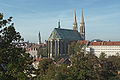 The historical city of Görlitz
 -
 The Elbe valley with Meissen in the background
 -
 Saxony is home to numerous castles, such as Schloss Moritzburg north of Dresden.
 -


.jpg)


.jpeg)

Education
[edit]Saxony has four large universities, six Fachhochschulen (Universities of Applied Sciences) and six art schools.

The Dresden University of Technology (TU Dresden), founded in 1828, is one of Germany's oldest universities, and one of the ten largest universities in Germany. It is a member of TU9, a consortium of nine leading German Institutes of Technology.
Leipzig University, founded in 1409, is one of the oldest universities in the world, and the second-oldest university (by consecutive years of existence) in Germany. Famous alumni include Leibniz, Goethe, Ranke, Nietzsche, Wagner, Cai Yuanpei, Angela Merkel, Raila Odinga, and Tycho Brahe; the university is, additionally, associated with nine Nobel laureates.
With over 11,000 students, the Chemnitz University of Technology is the third largest university in Saxony.
Established in 1765, the Freiberg University of Mining and Technology, located in the former mining town of Freiberg, is the oldest university of mining and metallurgy in the world.[54]
Saxony is home to several Max Planck Institutes and research institutions of the Fraunhofer Society, and one of the two main campuses of the German National Library is located in Leipzig.
Culture
[edit]Saxony is part of Central Germany as a cultural area. As such, throughout German history it has played an important role in shaping German culture.
Languages
[edit].jpg)
The most common patois spoken in Saxony are combined in the group of "Thuringian and Upper Saxon dialects". Due to the inexact use of the term "Saxon dialects" in colloquial language, the Upper Saxon attribute has been added to distinguish it from Old Saxon and Low Saxon. Other German dialects spoken in Saxony are the dialects of the Ore Mountains, which have been affected by Upper Saxon dialects, and the dialects of the Vogtland, which are more affected by the East Franconian languages.
Upper Sorbian (a West Slavic language) is spoken in the parts of Upper Lusatia that are inhabited by the Sorbian minority. The Germans in Upper Lusatia speak distinct dialects of their own (Lusatian dialects).
Motherland of the Reformation
[edit]Saxony is often seen as the motherland of the Reformation.[55] It was predominantly Lutheran Protestant from the Reformation until the late 20th century.
The Electoral Saxony, a predecessor of today's Saxony, was the original birthplace of the Reformation. The elector was Lutheran starting in 1525. The Lutheran church was organized through the late 1510s and the early 1520s. It was officially established in 1527 by John the Steadfast. Although some of the sites associated with Martin Luther also lie in the current state of Saxony-Anhalt (including Wittenberg, Eisleben and Mansfeld), today's Saxony is usually viewed as the formal successor to what used to be Luther's country back in the 16th century (i.e. the Electoral Saxony).
Martin Luther personally oversaw the Lutheran church in Saxony and shaped it consistently with his own views and ideas. The 16th, 17th and 18th centuries were heavily dominated by Lutheran orthodoxy. In addition, the Reformed faith made inroads with the so-called crypto Calvinists, but was strongly persecuted in an overwhelmingly Lutheran state. In the 17th century, Pietism became an important influence. In the 18th century, the Moravian Church was set up on Count von Zinzendorf's property at Herrnhut. From 1525, the rulers were traditionally Lutheran and widely acknowledged as defenders of the Protestant faith, although – beginning with Augustus II the Strong, who was required to convert to Roman Catholicism in 1697 in order to become King of Poland – its monarchs were exclusively Roman Catholic. That meant Augustus and the subsequent Electors of Saxony, who were Roman Catholic, ruled over a state with an almost entirely Protestant population.
In 1925, 90.3% of the Saxon population was Protestant, 3.6% was Roman Catholic, 0.4% was Jewish and 5.7% was placed in other religious categories.[56]
After World War II, Saxony was incorporated into East Germany which pursued a policy of state atheism. After 45 years of Communist rule, the majority of the population has become unaffiliated. Nonetheless, even during this time Saxony remained an important place of religious dialogue and it was at Meissen where the agreement on mutual recognition between the German Evangelical Church and the Church of England was signed in 1988.[57]
Sports
[edit]
In 2020, there were 4,447 registered sports clubs of various disciplines with over 600,000 members in Saxony.[58] The most popular sport in Saxony is football. With RB Leipzig there is one Saxon team playing in the Bundesliga as well as the European Champions League. Leipzig is notable for a longstanding football tradition, a Leipzig team having been the first national football champion in German history. Another popular sport is handball with SC DHfK Leipzig playing in the Bundesliga. On a local level sports such as table tennis, cycling, mountaineering and volleyball are popular.
Rock climbing
[edit]Saxony prides itself to have been one of the first places in the world where modern recreational rock climbing was developed. Falkenstein rock in the area of Bad Schandau is considered to be the place were the German rock climbing tradition started in 1864.
Winter sports
[edit]The Ore Mountains in southern Saxony are a traditional center for winter sports, and there are a number of training facilities for the German Winter Olympics team in the region. Thus, climate change poses a certain threat to the development of the region's winter sports industry.
The ski resort of Oberwiesenthal is the highest town of Germany, at an altitude of 900 m, though the surrounding mountains do not reach the same height as those found in the alpine areas of Southern Germany.
Art
[edit]
The two major cultural centers of Saxony are Dresden and Leipzig. The two cities have each a unique character which is reflecting the role they played throughout Saxon and German history, Dresden being a political center while Leipzig has been a major trading city. Thus, Dresden is well known for the art collections of the former Saxon kings (Dresden State Art Collections with the Green Vault and Zwinger as the most well-known parts).
Leipzig on the other hand never had a royal court, so its culture is borne largely by its citizens. The city is famous for its relationship with classical music and names like Johann Sebastian Bach, Mendelssohn or Wagner are linked to it. Over the past decades the city became famous for its modern art scene, most notably the Neue Leipziger Schule (New Leipzig School) with artists such as Neo Rauch.
Porcelain
[edit]Saxony was the first place in Europe to develop and produce white porcelain, a luxury good until then imported only from China. The Meissen Porcelain manufactory has been producing porcelain since 1710. It is one of the world's leading porcelain manufacturers and one of the oldest and most internationally known German luxury brands.[59]
Cuisine
[edit]Saxon cuisine encompasses regional cooking traditions of Saxony. In general the cuisine is very hearty and features many peculiarities of Mid-Germany such as a great variety of sauces which accompany the main dish and the fashion to serve potato dumplings (Klöße/Knödel) as a side dish instead of potatoes, pasta or rice. Also much freshwater fish is used in Saxon cuisine. The area around Dresden is home to the easternmost wine region in Germany (see: Saxony (wine region)).
Anthem
[edit]Saxony (as other German states) has its own anthem, dating back to the monarchy of the 19th century. 'Gott segne Sachsenland' (God save Saxony) is based on the melody of God save the King.
Transport
[edit]Air
[edit]The state has two major international airports:
- Leipzig/Halle Airport which provides flights to other parts of Germany and other European destinations. The airport also serves as the main European hub for cargo flights operated by DHL Aviation and the main hub for AeroLogic.
- Dresden Airport also provides flights to other parts of Germany and other European destinations.
See also
[edit]
Notes
[edit]- ^ German: Sachsen [ˈzaksn̩] ⓘ; Upper Saxon: Saggsn; Upper Sorbian: Sakska
- ^ German: Freistaat Sachsen [ˈfʁaɪʃtaːt ˈzaksn̩]; Upper Saxon: Freischdaad Saggsn; Upper Sorbian: Swobodny stat Sakska [ˈswɔbɔdnɨ ˈstat ˈsakska]
References
[edit]- ^ "Fläche und Bevölkerung". Statistische Ämter des Bundes und der Länder (in German). Retrieved 18 June 2025.
- ^ "Bevölkerung am 31.12.2023 nach Nationalität und Bundesländern". Statistisches Bundesamt (in German). Retrieved 17 June 2025.
- ^ "Gross domestic product, gross value added in the states of the Federal Republic of Germany 1991 to 2024 (Series 1 Volume 1)". Statistische Ämter des Bundes und der Länder (in German). 2025.
- ^ "Subnational HDI". hdi.globaldatalab.org. Retrieved 17 June 2025.
- ^ Gebel, K. (2002). Language and ethnic national identity in Europe: the importance of Gaelic and Sorbian to the maintenance of associated cultures and ethno cultural identities (PDF). London: Middlesex University. Archived from the original (PDF) on 1 May 2019. Retrieved 13 June 2019.
- ^ Brather, Sebastian (2004). "The beginnings of Slavic settlement east of the river Elbe". Antiquity, Volume 78, Issue 300. pp. 314–329
- ^ Brather, Sebastian. (2001; 2nd ed. 2008). Archäologie der westlichen Slawen: Siedlung, Wirtschaft und Gesellschaft im früh- und hochmittelalterlichen Ostmitteleuropa. Walter de Gruyter. ISBN 9783110206098
- ^ Chisholm, Hugh, ed. (1911). . Encyclopædia Britannica. Vol. 21 (11th ed.). Cambridge University Press.
- ^ Bogusławski, Wilhelm (1861). Rys dziejów serbo-łużyckich (in Polish). Petersburg. p. 142.
{{cite book}}: CS1 maint: location missing publisher (link) - ^ Rieck, Gisela (2014). "Herzog Heinrich von Jauer herrscht über die östliche Oberlausitz". Ora et labora (in German). No. 49. Ostritz: Freundeskreis der Abtei St. Marienthal. p. 17.
- ^ Köhler, Gustav (1846). Der Bund der Sechsstädte in der Ober-Lausitz: Eine Jubelschrift (in German). Görlitz: G. Heinze & Comp. p. 30.
- ^ Gemeinde Krauschwitz i.d. O.L. (in German). p. 9.
- ^ Karras, Ruth Mazo (1986). "Pagan Survivals and Syncretism in the Conversion of Saxony". The Catholic Historical Review. 72 (4): 553–572. ISSN 0008-8080. JSTOR 25022405.
- ^ The Ascanian coat-of-arms shows the Ascanian barry of ten, in sable and or, covered by a crancelin of rhombs bendwise in vert.
- ^ "Insurekcja Kościuszkowska – ostatnia próba ratowania Rzeczpospolitej". Dzieje.pl (in Polish). Retrieved 22 June 2024.
- ^ Sadowski, Aleksander Marek (2022). "Sachsen und Polen – Tausend Jahre Nachbarschaft / Polska i Saksonia – tysiąc lat sąsiedztwa". Polonus (in German and Polish). No. 5. Ostritz. p. 39. ISSN 2701-6285.
- ^ Pollock & Thomas (1952), p. 486
- ^ a b c d e Pollock & Thomas (1952), p. 510
- ^ Pollock & Thomas (1952), pp. 510–511
- ^ a b c d Pollock & Thomas (1952), p. 511
- ^ Sturm, Reinhard (23 December 2011). "Kampf um die Republik 1919–1923" [Battle for the Republic 1919–1923]. Bundeszentrale für politische Bildung (in German). Retrieved 6 May 2023.
- ^ "Buchenwald war überall". aussenlager-buchenwald.de (in German). Retrieved 22 June 2024.
- ^ "Subcamps". KZ-Gedenkstätte Flossenbürg. Retrieved 22 June 2024.
- ^ "Subcamps of KL Gross-Rosen". Gross-Rosen Museum in Rogoźnica. Retrieved 22 June 2024.
- ^ Kosiński, Leszek (1960) "Pochodzenie terytorialne ludności Ziem Zachodnich w 1950 r. [Territorial origins of inhabitants of the Western Lands in year 1950]" (PDF). Dokumentacja Geograficzna (in Polish). Warsaw: PAN (Polish Academy of Sciences), Institute of Geography. 2: Tabela 1 (data by county) – via Repozytorium Cyfrowe Instytutów Naukowych.
- ^ "Bevölkerung des Freistaates Sachsen jeweils am Monatsende ausgewählter Berichtsmonate nach Gemeinden". Statistik.sachsen.de. 31 July 2022. Retrieved 7 November 2022.
- ^ "Ballungsraum Leipzig/Halle". Stadtplan.net. Retrieved 5 November 2018.
- ^ eCommerce, Deutsche Bahn AG, Unternehmensbereich Personenverkehr, Marketing. "S-Bahn Mitteldeutschland". S-bahn-mitteldeutschland.de. Archived from the original on 24 February 2018. Retrieved 5 November 2018.
{{cite web}}: CS1 maint: multiple names: authors list (link) - ^ "Flughafen Leipzig/Halle – Passengers and visitors > Flights > Flights". Leipzig-halle-airport.de. Retrieved 5 November 2018.
- ^ "Far-right AfD becomes strongest party in eastern German states". www.aa.com.tr. Retrieved 9 July 2024.
- ^ "Ergebnisse – Die Bundeswahlleiterin". www.bundeswahlleiterin.de. Retrieved 9 July 2024.
- ^ "European Parliament election 2019 – The Federal Returning Officer". www.bundeswahlleiterin.de. Retrieved 9 July 2024.
- ^ "Zensus 2014: Bevölkerung" (PDF). German Statistical Office. 31 December 2014. Archived from the original (PDF) on 3 March 2016. Retrieved 8 June 2015.
- ^ "Gestiegene Geburtenhäufigkeit bei älteren Müttern". Destatis. 3 September 2019. Retrieved 2 February 2020.
- ^ Jana Šołćina, Edward Wornar: Obersorbisch im Selbststudium, Hornjoserbšćina za samostudij. Bautzen: Domowina-Verlag, 2000. Page 10.
- ^ Gebel, K. (2002). Language and ethnic national identity in Europe: the importance of Gaelic and Sorbian to the maintenance of associated cultures and ethno cultural identities (PDF). London: Middlesex University. Archived from the original (PDF) on 1 May 2019. Retrieved 13 June 2019.
- ^ "Zensusdatenbank". Ergebnisse.zensus2011.de. 2 December 2021. Archived from the original on 10 November 2016. Retrieved 7 March 2015.
- ^ Taylor, Scott (6 September 2010). "Non-Mormons call Freiberg Germany LDS temple their own". Deseret News. Archived from the original on 22 October 2016. Retrieved 10 October 2010.
- ^ "Hier entsteht der größte buddhistische Tempel Sachsens". www.sachsen-fernsehen.de. 22 October 2017.
- ^ "Gurdwara Germany".
- ^ "Regional GDP per capita ranged from 30% to 263% of the EU average in 2018". Eurostat.
- ^ "Sub-national HDI – Area Database". Global Data Lab. Retrieved 13 September 2018.
- ^ "Die Arbeitsmarkt im Juli 2014" (PDF). IHK Berlin. Archived from the original (PDF) on 17 October 2014. Retrieved 17 October 2014.
- ^ Freistaat Sachsen – Die angeforderte Seite existiert leider nicht Archived 30 July 2007 at the Wayback Machine. Smwa.sachsen.de. Retrieved on 2013-07-16.
- ^ "Germany". The Economist. Retrieved 13 October 2022.[permanent dead link]
- ^ "NextGen | futureSAX". www.futuresax.de. Retrieved 8 June 2023.
- ^ "Arbeitslosenquote* in Sachsen von 1999 bis 2019". Statista. Retrieved 2 February 2020.
- ^ Emmanuel, Ojukwu (6 July 2022). "Nigeria Tech Talent Shortage – How Brain Drain Is Threatening Recruitment". Tekedia. Retrieved 8 June 2023.
- ^ "Sachsens Exportpartner 2020 (insgesamt €36,79 Mrd.)". Saechsisches Landesamt fuer Statistik (Saxon Statistics Authority). Retrieved 7 June 2019.
- ^ Stanley-Becker, Isaac; Guinan-Bank, Vanessa (19 April 2022). "Russia finds sympathy in Germany's east, Putin's old stomping ground: As Berlin faces calls to deepen its support for Ukraine, attitudes in Saxony show competing pressures on German leaders". Washington Post. Archived from the original on 15 April 2022. Retrieved 20 April 2022.
- ^ Vale, Michel; Bethkenhagen, Jochen (1982). "The Development of GDR Economic Relations with the USSR". International Journal of Politics. 12 (1/2): 232–260. ISSN 0012-8783. JSTOR 40470040.
- ^ Zahlen Daten Fakten 2012 Archived 1 January 2015 at the Wayback Machine (in German), German National Tourist Board
- ^ "Still Troubled". The Economist. Retrieved 25 August 2014.
- ^ "From the history of the TU Bergakademie Freiberg". tu-freiberg.de. Archived from the original on 12 August 2020. Retrieved 25 September 2020.
- ^ "Motherland of the Reformation". sachsen-tourismus.de. Retrieved 31 May 2020.
- ^ Grundriss der Statistik. II. Gesellschaftsstatistik by Wilhelm Winkler, p. 36
- ^ [1][dead link]
- ^ E-Mail, Annegret Müller Referentin Öffentlichkeitsarbeit / Pressesprecherin +49 341 21631-14. "Pressemitteilungen". Landessportbund Sachsen (in German). Archived from the original on 10 July 2020. Retrieved 25 May 2021.
{{cite web}}: CS1 maint: numeric names: authors list (link) - ^ Florian Langenscheidt, Bernd Venohr (Hrsg.): Lexikon der deutschen Weltmarktführer. Die Königsklasse deutscher Unternehmen in Wort und Bild. Deutsche Standards Editionen, Köln 2010, ISBN 978-3-86936-221-2.
Bibliography
[edit]- Pollock, James K.; Thomas, Homer (1952). Germany in Power and Eclipse. New York, NY: Dylan Hill.
External links
[edit]

- Official governmental portal
 Geographic data related to Saxony at OpenStreetMap

| States |
|  |
|---|---|---|
| City-states | ||
| Former states |
| |
Places adjacent to Saxony | |
|---|---|


 Urban and rural districts in Saxony, Germany Urban and rural districts in Saxony, Germany | |
|---|---|
| Urban districts | |
| Rural districts | |
| Former urban districts | |
| Former rural districts | |
States of the Weimar Republic (1919–1933) | |||||||
|---|---|---|---|---|---|---|---|
| States |
|  | |||||
| City-states | |||||||
| Until 1920 |
| ||||||
| Unrecognized separatist movements | |||||||

Saxony
View on GrokipediaHistory
Prehistory and Ancient Settlement
The earliest evidence of settled human activity in the region of modern Saxony dates to the Neolithic period, with the Linear Pottery culture (Linearbandkeramik, or LBK) establishing farming communities around 5500 BCE. Excavations at sites such as Dresden-Cotta have revealed characteristic incised pottery, flint tools, grinding stones, and remnants of longhouses up to 40 meters in length, indicating sedentary agriculture focused on emmer wheat, barley, and domesticated cattle, alongside early forest clearance. These settlements, part of a broader Central European expansion of Neolithic practices from the Danube region, demonstrate a shift from hunter-gatherer economies, supported by radiocarbon-dated organic remains and soil pollen analysis showing cultivated fields. [6] [7] Subsequent Chalcolithic and early Bronze Age phases (circa 4500–2200 BCE) feature corded ware and bell-beaker influences, with isolated megalithic tombs and copper tools signaling initial metallurgy, though sites remain sparse compared to western Germany. The middle to late Bronze Age (2200–800 BCE) brought intensified activity, including placer tin mining in the Erzgebirge mountains, where stream sediments yielded cassiterite deposits exploited for bronze production, as confirmed by geochemical assays of slag and ore residues. Large hoards, such as the 16 kg assemblage of 310 bronze items (sickles, axes, jewelry) discovered near Görlitz in Upper Lusatia, point to ritual depositions possibly linked to elite status or votive offerings, with X-ray fluorescence analysis revealing alloys sourced from Alpine and local ores, evidencing regional trade networks. [8] [9] [10] The Lusatian culture dominated the late Bronze and early Iron Ages (1300–500 BCE), marked by urnfield cemeteries with cremated remains in cord-decorated pottery urns, as excavated in Upper Lusatia and along the Elbe valley. Fortified hilltop settlements with palisades and storage pits, alongside evidence of field systems from aerial photography and geophysical surveys, reflect a mixed agrarian economy with sheep herding and iron smelting by the Hallstatt C phase. These material patterns, including fibulae and weapons, align with broader Central European developments without direct ethnic attribution, based on consistent ceramic typology and burial rites across eastern Germany. [11] Roman influence remained marginal, confined to the empire's northeastern frontier along the Elbe River, with no archaeological traces of legionary camps, villas, or coin hoards indicating conquest or colonization within Saxony's core territory. Isolated amber trade artifacts or auxiliary scout contacts may have occurred, but excavations near Dresden and Bautzen yield no imported Roman pottery or military equipment, underscoring cultural continuity of local Iron Age traditions into the Migration Period.Stem Duchy of Saxony (8th-10th Centuries)
The Stem Duchy of Saxony emerged from the tribal confederation of Saxon peoples inhabiting the region between the Rhine, North Sea, and Elbe rivers following their subjugation by Charlemagne during the Saxon Wars (772–804). These campaigns began in 772 with the Frankish destruction of the Irminsul, a central pagan pillar symbolizing Saxon religious and cultural unity, prompting widespread resistance from decentralized tribal leaders lacking a centralized state structure.[12] Widukind, a Westphalian noble who emerged as the primary Saxon coordinator by 777, exemplified this fragmented opposition through guerrilla tactics, evading Frankish armies and rallying tribes across Westphalia, Angria, and Eastphalia for raids into Frankish territory, including the destruction of Frankish fortifications like Karlburg in 778.[13] His submission and baptism in 785 at Attigny marked a temporary pacification of the western tribes, though revolts persisted until final Saxon capitulation in 804 after Charlemagne's relocation of thousands of resistant pagans and execution of leaders.[12] Forced Christianization, enforced via the Capitulatio de partibus Saxoniae (c. 785), played a causal role in forging a cohesive Saxon ethnic identity amid conquest, as draconian penalties—including death for refusing baptism, desecrating churches, or practicing pagan rites—intensified tribal solidarity against Frankish cultural imposition rather than yielding immediate assimilation.[14] This decree, issued amid ongoing rebellions like the 782 Massacre of Verden where 4,500 Saxons were executed for revolt, prioritized imperial unity over gradual conversion, substituting tribal customs with Frankish feudal obligations and church hierarchies, yet inadvertently unified disparate Saxon groups through shared persecution and resistance narratives.[14] Empirical evidence from Frankish annals indicates over 30 years of intermittent warfare, with Saxon forces leveraging terrain for ambushes, such as the 782 Battle of Suntel where Widukind's tactics inflicted heavy Frankish losses, underscoring the limits of centralized empire-building against decentralized tribal warfare.[12] Following the 843 Treaty of Verdun, which partitioned the Carolingian Empire into East Francia (under Louis the German), Middle Francia, and West Francia, the Saxon territories were integrated into East Francia as a frontier duchy, with its core divided administratively into the tribal gaue of Westphalia, Angria, and Eastphalia to facilitate governance and defense against Slavic incursions. Charlemagne's prior land grants, totaling thousands of mansi (farm units) to loyal Saxon and Frankish nobles alongside the establishment of bishoprics at Münster, Osnabrück, and Bremen, laid the foundation for feudal integration, while fortifications like refurbished Eresburg and new burgs along the Elbe secured the eastern marches.[15] By the late 9th century, under Carolingian counts, these measures enabled Saxon elites to participate in East Frankish assemblies, transitioning the duchy from conquered periphery to a stem duchy with hereditary leadership emerging under the Liudolfing family by the early 10th century, though local autonomy persisted amid ongoing Slavic pressures.[16]Holy Roman Empire and Medieval Developments
Following the deposition of Duke Henry the Lion by Emperor Frederick I in 1180, the vast Duchy of Saxony underwent significant fragmentation, with its territories divided among rival princes through imperial grants and feudal partitions documented in contemporary charters. The Ascanian house, originating from the County of Ballenstedt, secured the eastern Saxon lands, establishing the Duchy of Saxe-Wittenberg as their primary holding by the early 13th century; this line's authority was formalized via imperial investitures that emphasized primogeniture to counter internal divisions.[17] The issuance of the Golden Bull by Emperor Charles IV on January 10, 1356, at the Diet of Metz irrevocably designated the Duke of Saxe-Wittenberg as one of the seven prince-electors, granting the right to elect the Holy Roman Emperor and privileges such as hereditary succession and exemption from certain imperial taxes, which stabilized the Ascanians' position amid ongoing princely rivalries.[18] This elevation reflected Saxony's strategic importance in the empire's eastern marches, where electoral votes influenced dynastic alliances and territorial claims.[17] Concurrently, the Wettin dynasty, margraves of Meissen since their appointment by Emperor Henry IV around 1081, pursued aggressive expansion through marriages, purchases, and imperial charters, acquiring adjacent lordships like the Osterland by 1265 and challenging Ascanian dominance in electoral Saxony via legal disputes over precedence. Silver mining emerged as a critical economic pillar, with the discovery of rich veins near Freiberg in the 1160s prompting Margrave Otto II (the Rich) to found the city around 1186 and institute mining codes that centralized revenues under feudal lords, funding military campaigns and administrative consolidation.[19] By the 14th century, Freiberg's output, managed through guild-regulated shafts, generated substantial ducal income—estimated at thousands of marks annually—bolstering Wettin infrastructure like fortifications and roads in the Ore Mountains.[20] Border conflicts with Poland, including incursions over Lusatian territories from the 11th century onward, strained Saxon resources but facilitated demographic influxes of German settlers under charters promoting colonization, as evidenced by 13th-century tax rolls indicating increased taxable hearths in frontier counties. The extinction of the Ascanian electoral line in 1422 led to the Wettins' acquisition of Saxe-Wittenberg via a 1425 imperial enfeoffment, merging margravial and ducal lands into a unified electorate and resolving prior dynastic contests through pragmatic inheritance pacts.[17]Reformation Era and Electoral Saxony (16th-18th Centuries)
The Protestant Reformation ignited in Saxony through Martin Luther's activities at the University of Wittenberg, where he posted his Ninety-Five Theses on October 31, 1517, challenging indulgences and papal authority on scriptural grounds. As an Augustinian monk and theology professor in Electoral Saxony's capital, Luther's critiques stemmed from empirical observation of clerical abuses, such as the sale of indulgences funding St. Peter's Basilica, which he viewed as contradicting justification by faith alone. Frederick III, Elector of Saxony from 1486 to 1525, provided crucial protection despite his personal Catholicism, refusing to extradite Luther after the 1521 Diet of Worms and concealing him at Wartburg Castle to evade imperial execution, thereby enabling the spread of reformist ideas across Saxony's territories.[21] This patronage, motivated by Frederick's emphasis on due process and skepticism of Roman interference, allowed Luther to translate the New Testament into German, fostering vernacular literacy and doctrinal dissemination.[22] Pivotal debates reinforced Saxony's role as a Reformation epicenter. The 1519 Leipzig Disputation, hosted under the auspices of Duke George of Saxony but involving Wittenberg reformers, pitted Luther against Johann Eck on papal primacy; Luther's defense of conciliar authority over popes marked his shift toward rejecting Rome's supremacy, galvanizing Saxon intellectuals and nobility.[23] Luther's 1525 marriage to former nun Katharina von Bora in Wittenberg exemplified practical rejection of mandatory clerical celibacy, a sacrament he deemed unbiblical, and modeled Protestant family life, influencing social norms in Saxony by prioritizing marital unions over monastic vows.[24] Following Frederick III's death, his successor John (r. 1525–1532) formally implemented reforms, ordering the removal of Catholic masses in 1527 and establishing a state-supervised church aligned with Luther's teachings. The 1530 Augsburg Confession, drafted primarily by Philipp Melanchthon, was presented by Saxony's delegation under John at the Diet of Augsburg, articulating Lutheran doctrines like sola scriptura and the real presence in the Eucharist while seeking imperial reconciliation.[25] Saxony's endorsement solidified its commitment, leading to the 1531 Schmalkaldic League formation with other Protestant states for mutual defense. This state-backed Reformation causally shifted ecclesiastical control to secular princes, evident in the 1539 Wittenberg Concord unifying Saxon liturgical practices. Under subsequent electors like Henry (r. 1532–1542) and Maurice (r. 1547–1553), who secured the electorate for the Albertine Wettin line post-Schmalkaldic War, Saxony maintained Lutheran orthodoxy amid conflicts, including the 1547 Battle of Mühlberg where imperial forces briefly subdued reforms but failed to reverse them.[26] Secularization of church lands provided empirical economic gains, reallocating monastic properties—previously exempt from taxation—to princely domains, boosting Electoral Saxony's revenues by an estimated 20-30% in the mid-16th century through direct control and leasing. This resource shift, driven by princes' incentives to curb papal extraction and fund territorial administration, enhanced fiscal autonomy without broad growth effects but stabilized governance by reducing ecclesiastical veto power over policy.[27] By the 17th-18th centuries, under rulers like John George I (r. 1611–1656), who navigated the Thirty Years' War as a Protestant elector, and Augustus II (r. 1694–1733), Saxony leveraged these assets for military and cultural patronage, including Dresden's baroque developments, while adhering to confessional lines formalized in the 1555 Peace of Augsburg. Socially, the reforms promoted university expansions in Leipzig and Wittenberg, emphasizing scriptural education over scholasticism, though enforcement varied, with residual Catholic influences in Albertine territories until full Lutheranization.[28]Kingdom of Saxony and Napoleonic Wars (1806-1815)
In December 1806, following the decisive French victory over Prussian and Saxon forces at the Battle of Jena-Auerstedt on October 14, Elector Frederick Augustus III of Saxony signed the Treaty of Posen with Napoleon on December 11, formally allying Saxony with France and withdrawing from the Fourth Coalition.[29] This treaty elevated the Electorate of Saxony to the status of a kingdom, with Frederick Augustus assuming the title of King Frederick Augustus I, in recognition of Saxony's strategic alignment and as an incentive to join the Confederation of the Rhine.[30] Prior to the treaty, Saxon troops, numbering approximately 10,000 under General Hans Gottlob von Zezschwitz, had participated in the Prussian-Saxon army's failed defense at Jena, where they formed part of the rearguard but suffered rout alongside their allies amid the French envelopment.[31][32] As the Kingdom of Saxony, the state provided significant military support to Napoleon's campaigns, including contingents in the 1812 invasion of Russia, though exact Saxon losses in that expedition remain sparsely documented in primary records. By 1813, amid growing anti-French sentiment, King Frederick Augustus I sought to maintain the alliance despite domestic pressures, committing around 20,000 Saxon troops to the French order of battle at the Battle of Leipzig from October 16–19. These forces, integrated into Marshal Ney's corps and other units, endured heavy fighting, contributing to the French coalition's total casualties of approximately 38,000 killed or wounded and 20,000 captured, though specific Saxon figures are estimated in the thousands given their exposed positions in the northern sectors.[33] Mid-battle, on October 18, Saxon troops partially defected or refused orders as coalition advances threatened encirclement, reflecting the perils of Saxony's opportunistic alignment with a faltering empire. The war's conclusion at the Congress of Vienna in 1815 imposed severe territorial penalties on Saxony for its prolonged adherence to Napoleon, with Prussia annexing roughly 40% of its land, including northern districts such as the Elbe river valleys and Wittenberg, reducing the kingdom's area from about 38,000 square kilometers to under 15,000.[34] Despite Prussian demands for full annexation—stoked by Saxony's perceived disloyalty—the great powers preserved Saxony's sovereignty to balance German Confederation dynamics, granting it membership while compensating Prussia with Rhineland gains. This reconfiguration halved Saxony's population and resources, underscoring the fiscal and demographic strain of absolutist foreign policy commitments without corresponding defensive gains.[35]Industrialization and 19th-Century Revolutions
Saxony experienced rapid industrialization starting in the early 19th century, particularly in textiles and mining, which laid the foundation for its economic prominence within the German states. The textile sector, centered in regions like Chemnitz and Plauen, shifted from traditional woolens to cotton processing, with Saxony emerging as a leader in mechanized production by the 1830s.[36] Mining, especially coal and lignite extraction in areas such as the Erzgebirge and Upper Lusatia, expanded significantly from the mid-century, providing fuel for factories and steam engines; lignite output in German territories, including Saxony, rose from 170,000 tonnes in 1840 to millions by century's end.[37] Saxony's accession to the Zollverein customs union in 1834 facilitated tariff reductions and market access, boosting textile exports and integrating the kingdom into broader German economic networks.[38] Infrastructure development accelerated this growth, with the railway network expanding to connect industrial centers and ports. The first line, between Leipzig and Dresden, opened in 1839, and by the late 19th century, Saxony's rail system exceeded 2,000 kilometers, enabling efficient transport of goods like textiles and coal.[39] This connectivity supported urbanization in cities such as Chemnitz, dubbed the "Saxon Manchester," where factory employment surged. The Industrial Revolution coincided with political unrest, culminating in the Revolutions of 1848–1849. Liberal and democratic demands for constitutional reform, expanded suffrage, and support for the Frankfurt Parliament gained traction among workers, artisans, and intellectuals in Saxony.[40] Tensions peaked in the May Uprising in Dresden from May 3 to 9, 1849, where revolutionaries erected barricades and called for a popular assembly to enact a democratic constitution; the revolt drew participation from figures like composer Richard Wagner.[41] Prussian and Saxon troops, numbering around 5,000, suppressed the insurgents after intense street fighting, resulting in over 200 revolutionary deaths and the restoration of monarchical authority.[42] Following the revolutions' failure, Saxony aligned with Prussian-led unification efforts under Otto von Bismarck. After defeat in the Austro-Prussian War of 1866, the kingdom joined the North German Confederation in 1867 and became a constituent state of the German Empire upon its proclamation in 1871, retaining internal autonomy while contributing to imperial economic and military policies. This integration stabilized Saxony's industrial trajectory amid the Empire's rapid modernization.World War I, Weimar Republic, and Path to WWII
During World War I, Saxony's industrial centers, particularly Leipzig, faced acute shortages of food and raw materials, contributing to widespread labor unrest on the home front. The January 1918 general strike, involving over a million workers nationwide, paralyzed production in Saxon factories and munitions plants, highlighting the limits of wartime mobilization and eroding support for the imperial government.[43] By late October and November 1918, soldiers' mutinies and workers' strikes in Leipzig escalated into the German Revolution, with local soldiers' and workers' councils seizing control of key institutions and demanding the Kaiser's abdication, which facilitated the republic's formation on November 9.[44] As the Free State of Saxony under the Weimar Republic, the region displayed chronic political fragmentation, with its industrialized urban areas fostering strong Communist Party of Germany (KPD) support among proletarian voters and the German National People's Party (DNVP) appealing to agrarian conservatives and displaced monarchists. Landtag elections reflected this bipolar extremism, as economic grievances from deindustrialization in textiles and mining sustained high strike activity, with over 100 major work stoppages recorded annually in the early 1920s, often tied to wage disputes amid currency instability.[45] The 1923 hyperinflation crisis intensified volatility, wiping out middle-class savings and sparking food riots; in Saxony, a short-lived SPD-KPD coalition government pursued socialist policies, prompting Reichswehr invasion on October 29 to suppress the "uprising" and restore federal authority, underscoring the fragility of republican institutions in radicalized states.[46] The Great Depression from 1929 onward devastated Saxony's export-dependent industries, driving unemployment above 30% in cities like Chemnitz and Zwickau by 1932 and fueling a surge in strikes—peaking at 200,000 participants in 1931 alone—as causal desperation shifted allegiances toward anti-system parties. KPD membership swelled in response to perceived SPD moderation, while Nazi (NSDAP) vote shares in Saxon elections climbed from under 5% in 1928 to approximately 37% in the July 1932 Reichstag poll, reflecting Protestant rural discontent and urban Protestant workers' rejection of Weimar's deflationary policies in favor of promises of autarkic revival.[47] This polarization, rooted in empirical correlations between local joblessness rates and extremist turnout, eroded centrist coalitions and paved the way for authoritarian consolidation.[48]Nazi Rule, WWII Destruction, and Postwar Division
Under National Socialist rule, Saxony was organized as the Gau Saxony, a primary administrative subdivision led by Martin Mutschmann, who held the position of Gauleiter from 1926 and was appointed Reichsstatthalter following the regime's consolidation of power in 1933.[49] Mutschmann, a longtime party supporter and industrialist, centralized control over local governance, aligning Saxon institutions with central directives from Berlin, including the suppression of political opposition and integration into the regime's totalitarian structure.[50] The region's industries, particularly armaments production in cities like Leipzig and Chemnitz, increasingly relied on forced labor from occupied territories and concentration camps to sustain wartime output, with millions across Germany coerced into such roles amid labor shortages.[51] This exploitation extended to Saxony's metalworking and chemical sectors, where foreign workers faced brutal conditions to bolster the war economy.[52] Saxony endured extensive destruction during World War II, culminating in the Allied bombing of Dresden from February 13 to 15, 1945, when British and American air forces dropped over 3,900 tons of high-explosive and incendiary bombs, creating a firestorm that razed the historic city center.[53] The raids killed approximately 25,000 civilians, many of them refugees fleeing the Eastern Front, though Nazi propaganda inflated figures to over 200,000 to equate the event with Allied war crimes.[54][55] An estimated 6,500 tons of bombs destroyed or damaged tens of thousands of buildings, rendering about 80% of the city's infrastructure uninhabitable, yet the strikes targeted a cultural hub with limited military significance late in the war, raising questions about the strategic efficacy of area bombing against dispersed, resilient Nazi defenses versus its disproportionate civilian toll.[56] Other Saxon industrial centers, including Leipzig and Plauen, faced repeated raids that crippled production but failed to decisively hasten the regime's collapse.[57] Following Germany's unconditional surrender on May 8, 1945, Saxony was allocated to the Soviet occupation zone under agreements formalized at the Potsdam Conference from July 17 to August 2, 1945, where Allied leaders delineated zones to administer defeated Germany and exact reparations.[58][59] This placement subjected the region to Soviet military administration, which pursued aggressive denazification through mass internments, trials, and executions, including that of Mutschmann in 1947 after his capture.[60] In contrast to the Western zones' questionnaire-based screening and rapid reintegration of lesser Nazis for reconstruction needs amid emerging Cold War tensions, Soviet efforts in Saxony emphasized ideological purge but pragmatically retained some functionaries, fostering disparities in thoroughness and long-term accountability.[60][61]GDR Period: Socialist Policies and Economic Stagnation (1949-1990)
Following the establishment of the German Democratic Republic (GDR) in 1949, Saxony underwent rapid nationalization of industry and collectivization of agriculture under Soviet-influenced socialist policies, prioritizing heavy industry such as lignite mining, chemicals, and machinery production to fulfill central planning quotas set by the Socialist Unity Party (SED).[62] These measures, enforced through state-owned enterprises (VEBs), aimed to redirect resources from consumer goods toward export-oriented heavy sectors, but resulted in chronic misallocation as local managers prioritized quota fulfillment over efficiency or innovation.[63] In Saxony's industrial heartlands like Chemnitz (renamed Karl-Marx-Stadt in 1953) and the Leipzig area, lignite extraction expanded dramatically, with output rising from 66 million tons in 1950 to over 250 million tons by 1989 across the GDR, devastating landscapes through open-pit mining that displaced villages and contaminated soil and water with sulfur emissions and ash deposits.[64] This environmental degradation, a direct consequence of unchecked quotas ignoring ecological costs, exacerbated health issues like respiratory diseases in mining regions, underscoring the causal link between centralized directives and resource overuse without market signals for sustainability.[65] The imposition of rigid production norms, often increased unilaterally without corresponding wage adjustments, sparked widespread worker discontent, culminating in the 1953 uprising that began with strikes against a 10% quota hike decreed in May.[66] In Plauen, Saxony's textile hub, thousands of workers halted production on June 16, 1953, protesting the norms that effectively cut real earnings by reducing piece-rate incentives, with demonstrations spreading to demand free elections and an end to forced collectivization.[62] The SED's response—deploying Soviet tanks and arresting over 6,000—temporarily quelled the revolt but revealed the fragility of the system, as quotas incentivized quantity over quality, leading to shoddy outputs and hidden shortfalls reported as successes to Berlin.[66] Agriculture in rural Saxony faced similar coercion, with collectivization accelerating after 1959's "socialist spring," forcing private farms into LPG cooperatives that yielded persistent food shortages due to demotivated labor and bureaucratic interference, contrasting sharply with West Germany's productivity gains.[63] Economic stagnation in Saxony manifested in lagging growth rates, with per capita output in heavy industry stagnating at 50-60% of West German levels by the 1970s, attributable to the absence of price mechanisms and innovation stifled by plan fulfillment over technological upgrades.[67] Saxony's engineering talent, vital for machinery and optics sectors in Dresden and Leipzig, suffered severe brain drain, as over 2.6 million East Germans—including a disproportionate share of 15,000+ engineers and technicians—fled to the West between 1949 and 1961, drawn by higher wages and freedoms unavailable under SED controls. This exodus, peaking at 200,000 annually by 1960, depleted Saxony's skilled workforce, forcing reliance on outdated Soviet technology and perpetuating a cycle of inefficiency where quotas masked underlying productivity failures rooted in suppressed individual incentives.[63] By the 1980s, despite propaganda claims of catching up, Saxony's economy exhibited chronic shortages and black markets, as central planning's top-down directives ignored local needs, culminating in systemic collapse evident in unmet Five-Year Plan targets.[67]Reunification: Economic Shock Therapy and Social Upheaval (1990-Present)
Following German reunification on October 3, 1990, the Treuhandanstalt was tasked with privatizing approximately 8,500 state-owned enterprises across East Germany, many of which were uncompetitive under market conditions, resulting in widespread closures and restructuring.[68] In Saxony, an industrial powerhouse of the former GDR with heavy reliance on sectors like chemicals, machinery, and textiles, this process led to the liquidation or sale of thousands of firms, exacerbating job losses as inefficient operations could not withstand competition from western imports.[69] The agency's rapid "shock therapy" approach, aimed at integrating the east into the social market economy, prioritized quick privatization over gradual reform, contributing to a sharp economic contraction.[70] Unemployment in Saxony surged as a direct consequence, reaching peaks exceeding 20% in the mid-1990s amid factory shutdowns and the collapse of supply chains.[71] By 1992, registered unemployment in East Germany, including Saxony, had climbed to around 15%, with short-time work and early retirements masking the full extent of labor market dislocation.[72] Social upheaval followed, marked by protests, rising welfare dependency, and a loss of industrial heritage, as former GDR workers faced wage disparities—eastern salaries initially set at about 50-60% of western levels despite subsidies.[73] This period saw the demolition of unviable plants and the sale of viable ones predominantly to West German buyers, which accelerated modernization but deepened perceptions of external domination.[74] Demographic consequences were profound, with Saxony experiencing a net migration loss of over 1 million residents since 1990, predominantly young and skilled individuals seeking opportunities in western states.[75] This exodus, peaking in the early 1990s with annual outflows of tens of thousands, hollowed out rural areas and strained urban centers, contributing to a population decline from about 5 million in 1990 to 4.1 million by 2023.[76] The brain drain, driven by better prospects elsewhere, perpetuated a cycle of aging and underinvestment, with youth migration rates remaining elevated into the 2000s.[77] Despite partial recovery, east-west economic divides persist, evidenced by Saxony's GDP per capita of €38,624 in 2023, lagging the national average by roughly 20-25%.[5] Sectors like automotive manufacturing have provided anchors, notably Volkswagen's Zwickau plant, which employs over 10,000 and shifted to electric vehicle production, bolstering regional clusters in suppliers and logistics.[78] However, 2024 growth forecasts for Saxony at 0.4% mirror national stagnation, with structural challenges like slower productivity gains maintaining the gap relative to western states.[79] Investments in semiconductors and renewables offer potential, but the legacy of privatization-induced upheaval continues to influence labor markets and social cohesion.[80]Geography
Topography and Natural Regions
Saxony's topography transitions from rugged low mountains and hilly terrain in the south and east to expansive lowlands in the north, spanning an area of approximately 18,450 square kilometers with elevation differences exceeding 1,200 meters. Geological foundations include Paleozoic crystalline rocks in the south, Cretaceous sandstones in the southeast, and Quaternary sediments in the northern basins, shaped by tectonic uplift, erosion, and glacial influences during the Pleistocene. These features delineate distinct natural regions, including the Ore Mountains, Elbe Sandstone Mountains, and Upper Lusatian heathlands, as classified in physico-geographical surveys emphasizing relief, soils, and hydrology.[81][82] The Ore Mountains (Erzgebirge), forming Saxony's southern boundary with the Czech Republic, constitute a mid-elevation range of folded and faulted Variscan basement rocks, including granites and metamorphic schists rich in ore deposits that historically drove mining from the 12th century onward. Elevations average 500–800 meters, peaking at 1,215 meters on Fichtelberg near Oberwiesenthal, where granitic intrusions and hydrothermal veins facilitated extraction of silver, tin, and cobalt until the 20th century. The region's plateaus, deeply incised valleys, and coniferous forests reflect post-orogenic denudation, with fault lines contributing to localized seismic vulnerability.[83][84] Southeast of the Ore Mountains lies the Elbe Sandstone Mountains (Elbsandsteingebirge), a dissected plateau of Upper Cretaceous sandstones overlying older strata, eroded into isolated table mountains, towers, and gorges over millions of years by the Elbe River and tributaries. This area, encompassing Saxon Switzerland National Park established in 1990, features vertical cliffs up to 450 meters in relative relief and over 1,000 freestanding sandstone pinnacles, such as those at Bastei, formed through joint-controlled weathering and mass wasting. The geological record includes marine sedimentation from the Late Cretaceous followed by Alpine tectonics uplifting the Bohemian Massif margin.[85] Eastern Saxony includes the Upper Lusatian Heath and Pond Landscape, a glacial-fluvial plain of Pleistocene sands and gravels dotted with mires, heaths, and more than 1,000 medieval-era ponds engineered for aquaculture, covering about 2,300 square kilometers in a UNESCO Biosphere Reserve since 1996. Northern Saxony comprises low-relief plains like the Leipzig Basin, underlain by Tertiary and Quaternary fill in subsiding grabens, with minimal dissection except along rivers. Saxony experiences low-level seismicity, primarily in western areas along the Elbe Fault System—a WNW-striking crustal weakness zone—and the Vogtland rift extension, recording events up to local magnitude 2.8 between Leipzig and the Czech border from 1990 to 2010, linked to intra-plate stresses rather than active plate boundaries.[86][84][87][88]Climate Patterns and Environmental Conditions
Saxony exhibits a temperate continental climate characterized by cold winters and warm summers, with an annual average temperature of approximately 9°C, ranging from 8°C in higher elevations to 10°C in the lowlands.[89] Precipitation varies regionally, averaging 600-800 mm annually in the Elbe Lowlands and Leipzig Basin, while the Ore Mountains receive up to 1,200 mm due to orographic effects, contributing to higher humidity and snowfall in winter.[90] These patterns result from Saxony's position in Central Europe's transition zone between maritime influences from the west and continental air masses from the east, leading to frequent frontal systems and variable weather.[91] Extreme weather events underscore the region's vulnerability, as seen in the August 2002 Elbe River flood, triggered by prolonged heavy rainfall exceeding 500 mm in parts of the catchment, which caused water levels to rise up to 9 meters above normal in Dresden. This event resulted in 20 fatalities and approximately 110 injuries in Saxony alone, with direct economic damages estimated at €6.084 billion, representing over two-thirds of Germany's total flood losses.[92][93] Lignite mining and combustion, historically dominant in the Lausitz and Zwickau regions, have impacted air quality through elevated particulate matter, sulfur dioxide, and nitrogen oxide emissions; however, post-1990 reductions in coal usage and installation of scrubbers led to a 15% drop in SO2 and 26% in NOx emissions by 2022 compared to 2005 levels.[94] Environmental conditions reflect anthropogenic influences from industrialization, particularly during the German Democratic Republic (GDR) era, when sulfur emissions from lignite-fired power plants caused widespread forest dieback, affecting up to 50% of spruce stands in the Ore Mountains by the 1980s due to acid deposition.[95] Following reunification in 1990, targeted reforestation and afforestation initiatives, supported by federal and state programs, restored woodland cover, with Saxony planting millions of trees annually in degraded areas to enhance biodiversity and soil stability, countering prior losses from pollution and overexploitation.[95] These efforts have improved ecosystem resilience, though legacy contamination from mining persists in localized soil and groundwater metrics.[94]Rivers, Hydrology, and Water Management
The Elbe River constitutes Saxony's principal waterway, spanning approximately 194 km within the state from its entry near Schöna on the Czech border to the outflow near Torgau, where it transitions into Saxony-Anhalt. Its key tributaries in Saxony encompass the Mulde—formed by the confluence of the Zwickauer Mulde (148 km) and Freiberger Mulde (124 km)—as well as the Schwarze Elster (180 km) and Spree (around 400 km total, with significant Saxon segments). These rivers form a dendritic drainage pattern, channeling precipitation from the Ore Mountains and Upper Lusatia into the Elbe basin, which covers about 18,000 km² in Saxony alone. Hydrologically, the Elbe exhibits a pluvial-nival regime, with peak discharges typically in late winter to spring from snowmelt and summer convective storms, averaging 300–500 m³/s at Dresden gauging stations but capable of surges exceeding 5,000 m³/s during extremes.[96][97] The Elbe and its tributaries have historically underpinned trade via navigable stretches up to 1,300 tonnes capacity vessels reaching Dresden and beyond, facilitating bulk cargo like coal, machinery, and agricultural products from Saxony's industrial heartlands, with annual freight volumes historically peaking at over 10 million tonnes pre-1990s declines. Ecologically, these waterways sustain alluvial floodplains fostering nutrient-rich sediments that support agriculture and biodiversity hotspots, including protected Elbe riverine habitats under Natura 2000, though channelization for navigation has reduced natural meandering and floodplain connectivity, impacting sediment transport and fish migration for species like Atlantic salmon.[98][99] Water management prioritizes flood mitigation, bolstered post-2002 Elbe flood—which inundated Dresden with peak flows of 8,510 m³/s and caused €4.3 billion in Saxon damages—through upgraded reservoirs like the Malter Dam on the Müglitz tributary (8.78 million m³ retention, constructed 1907–1910) and over 1,600 structural measures across 47 Elbe basin plans, including polders and retention basins reducing peak flows by up to 20% in modeled scenarios. In Lusatia, lignite open-pit mining has induced profound hydrological alterations, with dewatering operations extracting groundwater at a 7:1 ratio to coal output (historically 100–200 million m³ annually across sites like Nochten and Jänschwalde), lowering regional aquifers by 50–100 m and creating a 8 km³ deficit that propagates subsidence risks and necessitates perpetual pumping stations for post-2038 phase-out stabilization.[100][101][102] Saxony's adherence to the EU Water Framework Directive (2000/60/EC), transposed nationally by 2005, grapples with mining legacies introducing heavy metals (e.g., arsenic, cadmium) into groundwater and surface waters, alongside morphological pressures from historical straightening, resulting in only 40–50% of monitored bodies achieving good status by 2022 reporting cycles and requiring derogations for cost-prohibitive restorations estimated at €2–3 billion. Remediation involves backfilling pits to form lakes and controlled flooding, yet persistent nutrient loads from agriculture and incomplete pollutant dilution challenge timelines for 2027 targets, with federal-state coordination via the Elbe River Basin Commission addressing transboundary flows.[103][104]Largest Cities, Urbanization, and Infrastructure
Saxony's three largest cities are Leipzig, Dresden, and Chemnitz, which together account for a significant portion of the state's urban population. As of recent estimates, Leipzig has 611,850 inhabitants, Dresden 564,904, and Chemnitz 245,618.[1] Dresden, the state capital, underwent extensive reconstruction of its Baroque core following destruction in 1945, preserving its historical urban fabric amid modern development.[105] Leipzig functions as a trade fair hub, supporting regional connectivity and events that draw visitors from across Germany.[106] The state's overall population density stands at 219.1 inhabitants per square kilometer, marginally lower than Germany's national average of approximately 235.[107] Since the 1990s, urbanization has featured urban sprawl in eastern Germany, with growth concentrated in metropolitan areas like Leipzig-Halle, which encompasses over 1 million residents in its conurbation.[108] This trend reflects post-reunification migration to urban centers, reversing earlier depopulation in some inner cities while expanding suburban zones.[109] Infrastructure in Saxony includes integration into Germany's InterCity Express (ICE) high-speed rail network, with connections from Leipzig and Dresden to Berlin facilitated by lines such as the Erfurt-Leipzig/Halle route operational since 2017.[110] The autobahn system features key corridors like the A4 linking Dresden and Chemnitz, A13 to Berlin, and A14 serving Leipzig, though some rural peripheries experience connectivity gaps compared to denser western states.[111] These networks support intercity travel but highlight disparities in transport density between urban cores and outlying areas.[112]Politics
Current State Government and Administration
The executive power in Saxony is exercised by the Minister-President and the State Ministry (Staatsministerium), with Michael Kretschmer of the Christian Democratic Union (CDU) serving as Minister-President since December 20, 2017, and re-elected to lead the third Kretschmer cabinet on December 18, 2024.[113][114] This minority government comprises the CDU and Social Democratic Party (SPD), holding a combined 59 seats in the 127-seat Landtag, and operates without a fixed majority, requiring ad hoc support for legislative passage.[113][114] The unicameral Landtag of Saxony, elected on September 1, 2024, for a five-year term, serves as the legislative body with 127 members apportioned by proportional representation plus overhang and leveling seats to ensure proportionality.[115] It convenes in Dresden and holds authority over state laws, budget approval, and electing the Minister-President, who must command a majority in investiture votes. Administrative governance occurs through 10 rural districts (Landkreise) and three urban districts (kreisfreie Städte: Dresden, Leipzig, Chemnitz), a consolidation implemented via the 2008 district reform (Kreiskreform) that merged 22 prior districts to streamline operations, reduce costs, and enhance service delivery amid post-reunification fiscal pressures. District administrators (Landräte) are elected, overseeing local planning, social services, and infrastructure, while state ministries in Dresden handle policy execution across sectors like education and environment. The 2025–2026 double budget, approved by the Landtag on June 26, 2025, totals approximately €15.5 billion annually, allocating priority funds to infrastructure projects such as road and rail upgrades (€2.1 billion in 2025) and digitalization initiatives, while limiting expansions in social welfare expenditures to comply with fiscal discipline rules and address structural deficits.[116] This approach reflects constraints from the federal debt brake and Saxony's €1.2 billion debt servicing costs, favoring capital investments over recurrent spending increases.[116]2024 State Election Results and Implications
The 2024 Saxony state election occurred on September 1, 2024, to elect the 8th Landtag, comprising 127 seats following overhang and leveling mandates. Voter turnout reached 73.9%, an increase from 69.5% in 2019, reflecting heightened engagement amid national political tensions.[117][118] The Christian Democratic Union (CDU) secured the largest share with 31.0% of the vote, translating to 41 seats, a gain from 26.9% and 44 seats in 2019 despite a slight reduction in seats due to electoral mechanics.[117][4] The Alternative for Germany (AfD) followed closely with 30.6%, yielding 40 seats, up from 27.5% in 2019, marking its strongest performance yet in Saxony.[117][4] The Sahra Wagenknecht Alliance (BSW) entered as third with 11.2% and 14 seats, while the Social Democratic Party (SPD) obtained 7.4% and 10 seats; both Greens and The Left fell below the 5% threshold, failing to secure representation.[117]| Party | Vote Share (%) | Seats | Change in Vote Share (from 2019) |
|---|---|---|---|
| CDU | 31.0 | 41 | +4.1 |
| AfD | 30.6 | 40 | +3.1 |
| BSW | 11.2 | 14 | New |
| SPD | 7.4 | 10 | -11.2 |
| Greens | 4.6 | 0 | -10.0 |
| The Left | 4.5 | 0 | -10.0 |