
_logo.svg/250px-APL_(programming_language)_logo.svg.png)


_logo.svg/2000px-APL_(programming_language)_logo.svg.png)
Community hub
Recent from talks
Contribute something
Nothing was collected or created yet.
APL (programming language)
View on Wikipedia| APL | |
|---|---|
_logo.svg) | |
| Paradigm | Array, functional, structured, modular |
| Family | APL |
| Designed by | Kenneth E. Iverson |
| Developer | Larry Breed, Dick Lathwell, Roger Moore, others |
| First appeared | November 27, 1966[1] |
| Stable release | ISO/IEC 13751:2001
/ February 1, 2001 |
| Typing discipline | Dynamic |
| Platform | Cross-platform |
| License | Proprietary, open source |
| Website | aplwiki |
| Major implementations | |
| |
| Influenced by | |
| Mathematical notation | |
| Influenced | |

APL (named after the book A Programming Language)[3] is a programming language developed in the 1960s by Kenneth E. Iverson. Its central datatype is the multidimensional array. It uses a large range of special graphic symbols[4] to represent most functions and operators, leading to very concise code. It has been an important influence on the development of concept modeling, spreadsheets, functional programming,[5] and computer math packages.[6] It has also inspired several other programming languages.[7][8]
History
[edit]Mathematical notation
[edit]A mathematical notation for manipulating arrays was developed by Kenneth E. Iverson, starting in 1957 at Harvard University. In 1960, he began work for IBM where he developed this notation with Adin Falkoff and published it in his book A Programming Language in 1962.[3] The preface states its premise:
Applied mathematics is largely concerned with the design and analysis of explicit procedures for calculating the exact or approximate values of various functions. Such explicit procedures are called algorithms or programs. Because an effective notation for the description of programs exhibits considerable syntactic structure, it is called a programming language.
This notation was used inside IBM for short research reports on computer systems, such as the Burroughs B5000 and its stack mechanism when stack machines versus register machines were being evaluated by IBM for upcoming computers.
Iverson also used his notation in a draft of the chapter A Programming Language, written for a book he was writing with Fred Brooks, Automatic Data Processing, which would be published in 1963.[9][10]
In 1979, Iverson received the Turing Award for his work on APL.[11]
Development into a computer programming language
[edit]As early as 1962, the first attempt to use the notation to describe a complete computer system happened after Falkoff discussed with William C. Carter his work to standardize the instruction set for the machines that later became the IBM System/360 family.
In 1963, Herbert Hellerman, working at the IBM Systems Research Institute, implemented a part of the notation on an IBM 1620 computer, and it was used by students in a special high school course on calculating transcendental functions by series summation. Students tested their code in Hellerman's lab. This implementation of a part of the notation was called Personalized Array Translator (PAT).[12]
In 1963, Falkoff, Iverson, and Edward H. Sussenguth Jr., all working at IBM, used the notation for a formal description of the IBM System/360 series machine architecture and functionality, which resulted in a paper published in IBM Systems Journal in 1964. After this was published, the team turned their attention to an implementation of the notation on a computer system. One of the motivations for this focus of implementation was the interest of John L. Lawrence who had new duties with Science Research Associates, an educational company bought by IBM in 1964. Lawrence asked Iverson and his group to help use the language as a tool to develop and use computers in education.[13]
After Lawrence M. Breed and Philip S. Abrams of Stanford University joined the team at IBM Research, they continued their prior work on an implementation programmed in FORTRAN IV for a part of the notation which had been done for the IBM 7090 computer running on the IBSYS operating system. This work was finished in late 1965 and later named IVSYS (for Iverson system). The basis of this implementation was described in detail by Abrams in a Stanford University Technical Report, "An Interpreter for Iverson Notation" in 1966. The academic aspect of this was formally supervised by Niklaus Wirth.[14] Like Hellerman's PAT system earlier, this implementation omitted the APL character set, but used special English reserved words for functions and operators. The system was later adapted for a time-sharing system and, by November 1966, it had been reprogrammed for the IBM System/360 Model 50 computer running in a time-sharing mode and was used internally at IBM.[15]
Hardware
[edit]

A key development in the ability to use APL effectively, before the wide use of cathode-ray tube (CRT) terminals, was the development of a special IBM Selectric typewriter interchangeable typing element with all the special APL characters on it. This was used on paper printing terminal workstations using the Selectric typewriter and typing element mechanism, such as the IBM 1050 and IBM 2741 terminal. Keycaps could be placed over the normal keys to show which APL characters would be entered and typed when that key was struck. For the first time, a programmer could type in and see proper APL characters as used in Iverson's notation and not be forced to use awkward English keyword representations of them. Falkoff and Iverson had the special APL Selectric typing elements, 987 and 988, designed in late 1964, although no APL computer system was available to use them.[16] Iverson cited Falkoff as the inspiration for the idea of using an IBM Selectric typing element for the APL character set.[17]
Many APL symbols, even with the APL characters on the Selectric typing element, still had to be typed in by over-striking two extant element characters. An example is the grade up character, which had to be made from a delta (shift-H) and a Sheffer stroke (shift-M). This was necessary because the APL character set was much larger than the 88 characters allowed on the typing element, even when letters were restricted to upper-case (capitals).
Commercial availability
[edit]The first APL interactive login and creation of an APL workspace was in 1966 by Larry Breed using an IBM 1050 terminal at the IBM Mohansic Labs near Thomas J. Watson Research Center, the home of APL, in Yorktown Heights, New York.[16]
IBM was chiefly responsible for introducing APL to the marketplace. The first publicly available version of APL was released in 1968 for the IBM 1130. IBM provided APL\1130 for free but without liability or support.[18][19] It would run in as little as 8k 16-bit words of memory, and used a dedicated 1 megabyte hard disk.
APL gained its foothold on mainframe timesharing systems from the late 1960s through the early 1980s, in part because it would support multiple users on lower-specification systems that had no dynamic address translation hardware.[20] Additional improvements in performance for selected IBM System/370 mainframe systems included the APL Assist Microcode in which some support for APL execution was included in the processor's firmware, as distinct from being implemented entirely by higher-level software. Somewhat later, as suitably performing hardware was finally growing available in the mid- to late-1980s, many users migrated their applications to the personal computer environment.
Early IBM APL interpreters for IBM 360 and IBM 370 hardware implemented their own multi-user management instead of relying on the host services, thus they were their own timesharing systems. First introduced for use at IBM in 1966, the APL\360[21][22][23] system was a multi-user interpreter. The ability to programmatically communicate with the operating system for information and setting interpreter system variables was done through special privileged "I-beam" functions, using both monadic and dyadic operations.[24]
In 1973, IBM released APL.SV, which was a continuation of the same product, but which offered shared variables as a means to access facilities outside of the APL system, such as operating system files. In the mid-1970s, the IBM mainframe interpreter was even adapted for use on the IBM 5100 desktop computer, which had a small CRT and an APL keyboard, when most other small computers of the time only offered BASIC. In the 1980s, the VSAPL program product enjoyed wide use with Conversational Monitor System (CMS), Time Sharing Option (TSO), VSPC, MUSIC/SP, and CICS users.
In 1973–1974, Patrick E. Hagerty directed the implementation of the University of Maryland APL interpreter for the 1100 line of the Sperry UNIVAC 1100/2200 series mainframe computers.[25] In 1974, student Alan Stebbens was assigned the task of implementing an internal function.[26] Xerox APL was available from June 1975 for Xerox 560 and Sigma 6, 7, and 9 mainframes running CP-V and for Honeywell CP-6.[27]
In the 1960s and 1970s, several timesharing firms arose that sold APL services using modified versions of the IBM APL\360[23] interpreter. In North America, the better-known ones were IP Sharp Associates, Scientific Time Sharing Corporation (STSC), Time Sharing Resources (TSR), and The Computer Company (TCC). CompuServe also entered the market in 1978 with an APL Interpreter based on a modified version of Digital Equipment Corp and Carnegie Mellon's, which ran on DEC's KI and KL 36-bit machines. CompuServe's APL was available both to its commercial market and the consumer information service. With the advent first of less expensive mainframes such as the IBM 4300, and later the personal computer, by the mid-1980s, the timesharing industry was all but gone.
Sharp APL was available from IP Sharp Associates, first as a timesharing service in the 1960s, and later as a program product starting around 1979. Sharp APL was an advanced APL implementation with many language extensions, such as packages (the ability to put one or more objects into a single variable), a file system, nested arrays, and shared variables.
APL interpreters were available from other mainframe and mini-computer manufacturers also, notably Burroughs, Control Data Corporation (CDC), Data General, Digital Equipment Corporation (DEC), Harris, Hewlett-Packard (HP), Siemens, Xerox and others.
Garth Foster of Syracuse University sponsored regular meetings of the APL implementers' community at Syracuse's Minnowbrook Conference Center in Blue Mountain Lake, New York. In later years, Eugene McDonnell organized similar meetings at the Asilomar Conference Grounds near Monterey, California, and at Pajaro Dunes near Watsonville, California. The SIGAPL special interest group of the Association for Computing Machinery continues to support the APL community.[28]
Microcomputers
[edit]On microcomputers, which became available from the mid-1970s onwards, BASIC became the dominant programming language.[29] Nevertheless, some microcomputers provided APL instead – the first being the Intel 8008-based MCM/70 which was released in 1974[30][31] and which was primarily used in education.[32] Another machine of this time was the VideoBrain Family Computer, released in 1977, which was supplied with its dialect of APL called APL/S.[33]
The Commodore SuperPET, introduced in 1981, included an APL interpreter developed by the University of Waterloo.[34]
In 1976, Bill Gates claimed in his Open Letter to Hobbyists that Microsoft Corporation was implementing APL for the Intel 8080 and Motorola 6800 but had "very little incentive to make [it] available to hobbyists" because of software piracy.[35] It was never released.
APL2
[edit]Starting in the early 1980s, IBM APL development, under the leadership of Jim Brown, implemented a new version of the APL language that contained as its primary enhancement the concept of nested arrays, where an array can contain other arrays, and new language features which facilitated integrating nested arrays into program workflow. Ken Iverson, no longer in control of the development of the APL language, left IBM and joined I. P. Sharp Associates, where one of his major contributions was directing the evolution of Sharp APL to be more in accord with his vision.[36][37][38] APL2 was first released for CMS and TSO in 1984.[39] The APL2 Workstation edition (Windows, OS/2, AIX, Linux, and Solaris) followed later.[40][41]
As other vendors were busy developing APL interpreters for new hardware, notably Unix-based microcomputers, APL2 was almost always the standard chosen for new APL interpreter developments. Even today, most APL vendors or their users cite APL2 compatibility as a selling point for those products.[42][43] IBM cites its use for problem solving, system design, prototyping, engineering and scientific computations, expert systems,[44] for teaching mathematics and other subjects, visualization and database access.[45]
Modern implementations
[edit]Various implementations of APL by APLX, Dyalog, et al., include extensions for object-oriented programming, support for .NET, XML-array conversion primitives, graphing, operating system interfaces, and lambda calculus expressions. Freeware versions include GNU APL for Linux and NARS2000 for Windows (which also runs on Linux under Wine). Both of these are fairly complete versions of APL2 with various language extensions.
Derivative languages
[edit]APL has formed the basis of, or influenced, the following languages:[citation needed]
- A and A+, an alternative APL, the latter with graphical extensions.
- FP, a functional programming language.
- Ivy, an interpreter for an APL-like language developed by Rob Pike, and which uses ASCII as input.[46]
- J, which was also designed by Iverson, and which uses ASCII with digraphs instead of special symbols.[7]
- K, a proprietary variant of APL developed by Arthur Whitney.[8]
- MATLAB, a numerical computation tool.[6]
- Nial, a high-level array programming language with a functional programming notation.
- Polymorphic Programming Language, an interactive, extensible language with a similar base language.
- S, a statistical programming language (usually now seen in the open-source version known as R).
- Snap!, a low-code block-based programming language, born as an extended reimplementation of Scratch
- Speakeasy, a numerical computing interactive environment.
- Wolfram Language, the programming language of Mathematica.[47]
Language characteristics
[edit]Character set
[edit]APL has been criticized and praised for its choice of a unique character set. In the 1960s and 1970s, few terminal devices or even displays could reproduce the APL character set. The most popular ones employed the IBM Selectric print mechanism used with a special APL type element. One of the early APL line terminals (line-mode operation only, not full screen) was the Texas Instruments TI Model 745 (c. 1977) with the full APL character set[48] which featured half and full duplex telecommunications modes, for interacting with an APL time-sharing service or remote mainframe to run a remote computer job, remote job entry (RJE).
Over time, with the universal use of high-quality graphic displays, printing devices and Unicode support, the APL character font problem has largely been eliminated. However, entering APL characters requires the use of input method editors, keyboard mappings, virtual/on-screen APL symbol sets,[49][50] or easy-reference printed keyboard cards which can frustrate beginners accustomed to other programming languages.[51][52][53] With beginners who have no prior experience with other programming languages, a study involving high school students found that typing and using APL characters did not hinder the students in any measurable way.[54]
In defense of APL, it requires fewer characters to type, and keyboard mappings become memorized over time. Special APL keyboards are also made and in use today, as are freely downloadable fonts for operating systems such as Microsoft Windows.[49] The reported productivity gains assume that one spends enough time working in the language to make it worthwhile to memorize the symbols, their semantics, keyboard mappings, and many idioms for common tasks.[citation needed]
Design
[edit]Unlike traditionally structured programming languages, APL code is typically structured as chains of monadic or dyadic functions, and operators[55] acting on arrays.[56] APL has many nonstandard primitives (functions and operators) that are indicated by a single symbol or a combination of a few symbols. All primitives are defined to have the same precedence, and always associate to the right. Thus, APL is read or best understood from right-to-left.
Early APL implementations (c. 1970 or so) had no programming loop control flow structures, such as do or while loops, and if-then-else constructs. Instead, they used array operations, and use of structured programming constructs was often unneeded, since an operation could be performed on a full array in one statement. For example, the iota function (ι) can replace for-loop iteration: ιN when applied to a scalar positive integer yields a one-dimensional array (vector), 1 2 3 ... N. Later APL implementations generally include comprehensive control structures, so that data structure and program control flow can be clearly and cleanly separated.
The APL environment is called a workspace. In a workspace the user can define programs and data, i.e., the data values exist also outside the programs, and the user can also manipulate the data without having to define a program.[57] In the examples below, the APL interpreter first types six spaces before awaiting the user's input. Its own output starts in column one.
n ← 4 5 6 7
|
Assigns vector of values, {4 5 6 7}, to variable n, an array create operation. An equivalent yet more concise APL expression would be n ← 3 + ⍳4. Multiple values are stored in array n, the operation performed without formal loops or control flow language.
|
      n
4 5 6 7
|
Display the contents of n, currently an array or vector.
|
      n+4
8 9 10 11
|
4 is now added to all elements of vector n, creating a 4-element vector {8 9 10 11}.As above, APL's interpreter displays the result because the expression's value was not assigned to a variable (with a ←).
|
      +/n
22
|
APL displays the sum of components of the vector n, i.e., 22 (= 4 + 5 + 6 + 7) using a very compact notation: read +/ as "plus, over..." and a slight change would be "multiply, over..."
|
      m ← +/3+⍳4
      m
22
|
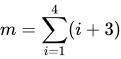
These operations can be combined into one statement, remembering that APL evaluates expressions right to left: first ⍳4 creates an array, [1,2,3,4], then 3 is added to each component, which are summed together and the result stored in variable m, finally displayed. In normal mathematical notation, it is equivalent to: . Recall that mathematical expressions are not read or evaluated from right-to-left.
|
The user can save the workspace with all values, programs, and execution status.
APL uses a set of non-ASCII symbols, which are an extension of traditional arithmetic and algebraic notation. Having single character names for single instruction, multiple data (SIMD) vector functions is one way that APL enables compact formulation of algorithms for data transformation such as computing Conway's Game of Life in one line of code.[58] In nearly all versions of APL, it is theoretically possible to express any computable function in one expression, that is, in one line of code.[citation needed]
Due to the unusual character set, many programmers use special keyboards with APL keytops to write APL code.[59] Although there are various ways to write APL code using only ASCII characters,[60] in practice it is almost never done. (This may be thought to support Iverson's thesis about notation as a tool of thought.[61]) Most if not all modern implementations use standard keyboard layouts, with special mappings or input method editors to access non-ASCII characters. Historically, the APL font has been distinctive, with uppercase italic alphabetic characters and upright numerals and symbols. Most vendors continue to display the APL character set in a custom font.
Advocates of APL[who?] claim that the examples of so-called write-only code (badly written and almost incomprehensible code) are almost invariably examples of poor programming practice or novice mistakes, which can occur in any language. Advocates also claim that they are far more productive with APL than with more conventional computer languages, and that working software can be implemented in far less time and with far fewer programmers than using other technology.[citation needed]
They also may claim that because it is compact and terse, APL lends itself well to larger-scale software development and complexity, because the number of lines of code can be reduced greatly. Many APL advocates and practitioners also view standard programming languages such as COBOL and Java as being comparatively tedious. APL is often found where time-to-market is important, such as with trading systems.[62][63][64][65]
Terminology
[edit]APL makes a clear distinction between functions and operators.[55][66] Functions take arrays (variables or constants or expressions) as arguments, and return arrays as results. Operators (similar to higher-order functions) take functions or arrays as arguments, and derive related functions. For example, the sum function is derived by applying the reduction operator to the addition function. Applying the same reduction operator to the maximum function (which returns the larger of two numbers) derives a function which returns the largest of a group (vector) of numbers. In the J language, Iverson substituted the terms verb for function and adverb or conjunction for operator.
APL also identifies those features built into the language, and represented by a symbol, or a fixed combination of symbols, as primitives. Most primitives are either functions or operators. Coding APL is largely a process of writing non-primitive functions and (in some versions of APL) operators. However a few primitives are considered to be neither functions nor operators, most noticeably assignment.
Some words used in APL literature have meanings that differ from those in both mathematics and the generality of computer science.
| Term | Description |
|---|---|
| function | operation or mapping that takes zero, one (right) or two (left & right) arguments which may be scalars, arrays, or more complicated structures, and may return a similarly complex result. A function may be: |
| array | data valued object of zero or more orthogonal dimensions in row-major order in which each item is a primitive scalar datum or another array.[68] |
| niladic | not taking or requiring any arguments, nullary[69] |
| monadic | requiring only one argument; on the right for a function, on the left for an operator, unary[69] |
| dyadic | requiring both a left and a right argument, binary[69] |
| ambivalent or monadic |
capable of use in a monadic or dyadic context, permitting its left argument to be elided[definition needed][67] |
| operator | operation or mapping that takes one (left) or two (left & right) function or array valued arguments (operands) and derives a function. An operator may be: |
Syntax
[edit]APL has explicit representations of functions, operators, and syntax, thus providing a basis for the clear and explicit statement of extended facilities in the language, and tools to experiment on them.[70]
Examples
[edit]Hello, world
[edit]This displays "Hello, world":
'Hello, world'
A design theme in APL is to define default actions in some cases that would produce syntax errors in most other programming languages.
The 'Hello, world' string constant above displays, because display is the default action on any expression for which no action is specified explicitly (e.g. assignment, function parameter).
Exponentiation
[edit]Another example of this theme is that exponentiation in APL is written as 2*3, which indicates raising 2 to the power 3 (this would be written as 2^3 or 2**3 in some languages, or relegated to a function call such as pow(2, 3); in others). Many languages use * to signify multiplication, as in 2*3, but APL chooses to use 2×3. However, if no base is specified (as with the statement *3 in APL, or ^3 in other languages), most programming languages one would see this as a syntax error. APL, however, assumes the missing base to be the natural logarithm constant e, and interprets *3 as 2.71828*3.
Simple statistics
[edit]
Suppose that X is an array of numbers. Then (+/X)÷⍴X gives its average. Reading right-to-left, ⍴X gives the number of elements in X, and since ÷ is a dyadic operator, the term to its left is required as well. It is surrounded by parentheses since otherwise X would be taken (so that the summation would be of X÷⍴X—each element of X divided by the number of elements in X), and +/X gives the sum of the elements of X. Building on this, the following expression computes standard deviation:
((+/((X - (+/X)÷⍴X)*2))÷⍴X)*0.5
Naturally, one would define this expression as a function for repeated use rather than rewriting it each time. Further, since assignment is an operator, it can appear within an expression, so the following would place suitable values into T, AV and SD:
SD←((+/((X - AV←(T←+/X)÷⍴X)*2))÷⍴X)*0.5
Pick 6 lottery numbers
[edit]This following immediate-mode expression generates a typical set of Pick 6 lottery numbers: six pseudo-random integers ranging from 1 to 40, guaranteed non-repeating, and displays them sorted in ascending order:
x[⍋x←6?40]
The above does a lot, concisely, although it may seem complex to a new APLer. It combines the following APL functions (also called primitives[71] and glyphs[72]):
- The first to be executed (APL executes from rightmost to leftmost) is dyadic function
?(nameddealwhen dyadic) that returns a vector consisting of a select number (left argument: 6 in this case) of random integers ranging from 1 to a specified maximum (right argument: 40 in this case), which, if said maximum ≥ vector length, is guaranteed to be non-repeating; thus, generate/create 6 random integers ranging from 1 to 40.[73] - This vector is then assigned (
←) to the variablex, because it is needed later. - This vector is then sorted in ascending order by a monadic
⍋function, which has as its right argument everything to the right of it up to the next unbalanced close-bracket or close-parenthesis. The result of⍋is the indices that will put its argument into ascending order. - Then the output of
⍋is used to index the variablex, which we saved earlier for this purpose, thereby selecting its items in ascending sequence.
Since there is no function to the left of the left-most x to tell APL what to do with the result, it simply outputs it to the display (on a single line, separated by spaces) without needing any explicit instruction to do that.
? also has a monadic equivalent called roll, which simply returns one random integer between 1 and its sole operand [to the right of it], inclusive. Thus, a role-playing game program might use the expression ?20 to roll a twenty-sided die.
Prime numbers
[edit]The following expression finds all prime numbers from 1 to R. In both time and space, the calculation complexity is (in Big O notation).

(~R∊R∘.×R)/R←1↓⍳R
Executed from right to left, this means:
- Iota
⍳creates a vector containing integers from1toR(ifR= 6at the start of the program,⍳Ris1 2 3 4 5 6) - Drop first element of this vector (
↓function), i.e.,1. So1↓⍳Ris2 3 4 5 6 - Set
Rto the new vector (←, assignment primitive), i.e.,2 3 4 5 6 - The
/replicate operator is dyadic (binary) and the interpreter first evaluates its left argument (fully in parentheses): - Generate outer product of
Rmultiplied byR, i.e., a matrix that is the multiplication table of R by R (°.×operator), i.e.,
| 4 | 6 | 8 | 10 | 12 |
| 6 | 9 | 12 | 15 | 18 |
| 8 | 12 | 16 | 20 | 24 |
| 10 | 15 | 20 | 25 | 30 |
| 12 | 18 | 24 | 30 | 36 |
- Build a vector the same length as
Rwith1in each place where the corresponding number inRis in the outer product matrix (∈, set inclusion or element of or Epsilon operator), i.e.,0 0 1 0 1 - Logically negate (not) values in the vector (change zeros to ones and ones to zeros) (
∼, logical not or Tilde operator), i.e.,1 1 0 1 0 - Select the items in
Rfor which the corresponding element is1(/replicate operator), i.e.,2 3 5
(This assumes the APL origin is 1, i.e., indices start with 1. APL can be set to use 0 as the origin, so that ι6 is 0 1 2 3 4 5, which is convenient for some calculations.)
Sorting
[edit]The following expression sorts a word list stored in matrix X according to word length:
X[⍋X+.≠' ';]
Game of Life
[edit]The following function "life", written in Dyalog APL,[74][75] takes a Boolean matrix and calculates the new generation according to Conway's Game of Life. It demonstrates the power of APL to implement a complex algorithm in very little code, but understanding it requires some advanced knowledge of APL (as the same program would in many languages).
life ← {⊃1 ⍵ ∨.∧ 3 4 = +/ +⌿ ¯1 0 1 ∘.⊖ ¯1 0 1 ⌽¨ ⊂⍵}
HTML tags removal
[edit]In the following example, also Dyalog, the first line assigns some HTML code to a variable txt and then uses an APL expression to remove all the HTML tags:
      txt←'<html><body><p>This is <em>emphasized</em> text.</p></body></html>'
      {⍵ /⍨ ~{⍵∨≠\⍵}⍵∊'<>'} txt
This is emphasized text.
Naming
[edit]APL derives its name from the initials of Iverson's book A Programming Language,[3] even though the book describes Iverson's mathematical notation, rather than the implemented programming language described in this article. The name is used only for actual implementations, starting with APL\360.
Adin Falkoff coined the name in 1966 during the implementation of APL\360 at IBM:
As I walked by the office the three students shared, I could hear sounds of an argument going on. I poked my head in the door, and Eric asked me, "Isn't it true that everyone knows the notation we're using is called APL?" I was sorry to have to disappoint him by confessing that I had never heard it called that. Where had he got the idea it was well known? And who had decided to call it that? In fact, why did it have to be called anything? Quite a while later I heard how it was named. When the implementation effort started in June of 1966, the documentation effort started, too. I suppose when they had to write about "it", Falkoff and Iverson realized that they would have to give "it" a name. There were probably many suggestions made at the time, but I have heard of only two. A group in SRA in Chicago which was developing instructional materials using the notation was in favor of the name "Mathlab". This did not catch on. Another suggestion was to call it "Iverson's Better Math" and then let people coin the appropriate acronym. This was deemed facetious.
Then one day Adin Falkoff walked into Ken's office and wrote "A Programming Language" on the board, and underneath it the acronym "APL". Thus it was born. It was just a week or so after this that Eric Iverson asked me his question, at a time when the name hadn't yet found its way the thirteen miles up the Taconic Parkway from IBM Research to IBM Mohansic.
APL is occasionally re-interpreted as Array Programming Language or Array Processing Language,[77] thereby making APL into a backronym.
Logo
[edit]
There has always been cooperation between APL vendors, and joint conferences were held on a regular basis from 1969 until 2010.[78] At such conferences, APL merchandise was often handed out, featuring APL motifs or collection of vendor logos. Common were apples (as a pun on the similarity in pronunciation of apple and APL) and the code snippet ⍺*⎕ which are the symbols produced by the classic APL keyboard layout when holding the APL modifier key and typing "APL".
Despite all these community efforts, no universal vendor-agnostic logo for the programming language emerged. As popular programming languages increasingly have established recognisable logos, Fortran getting one in 2020,[79] British APL Association launched a campaign in the second half of 2021, to establish such a logo for APL, and after a community election and multiple rounds of feedback, a logo was chosen in May 2022.[80]
Use
[edit]APL is used for many purposes including financial and insurance applications,[81] artificial intelligence,[82][83] neural networks[84] and robotics.[85] It has been argued that APL is a calculation tool and not a programming language;[86] its symbolic nature and array capabilities have made it popular with domain experts and data scientists[87] who do not have or require the skills of a computer programmer.[citation needed]
APL is well suited to image manipulation and computer animation, where graphic transformations can be encoded as matrix multiplications. One of the first commercial computer graphics houses, Digital Effects, produced an APL graphics product named Visions, which was used to create television commercials and animation for the 1982 film Tron.[88] Latterly, the Stormwind boating simulator uses APL to implement its core logic, its interfacing to the rendering pipeline middleware and a major part of its physics engine.[89]
Today, APL remains in use in a wide range of commercial and scientific applications, for example investment management,[81] asset management,[90][citation needed] health care,[91] and DNA profiling.[92][93]
Notable implementations
[edit]APL\360
[edit]The first implementation of APL using recognizable APL symbols was APL\360 which ran on the IBM System/360, and was completed in November 1966[1] though at that time remained in use only within IBM.[39] In 1973 its implementors, Larry Breed, Dick Lathwell and Roger Moore, were awarded the Grace Murray Hopper Award from the Association for Computing Machinery (ACM). It was given "for their work in the design and implementation of APL\360, setting new standards in simplicity, efficiency, reliability and response time for interactive systems."[94][95][96]
In 1975, the IBM 5100 microcomputer offered APL\360[97] as one of two built-in ROM-based interpreted languages for the computer, complete with a keyboard and display that supported all the special symbols used in the language.[98]
Significant developments to APL\360 included CMS/APL, which made use of the virtual storage capabilities of CMS and APLSV, which introduced shared variables, system variables and system functions. It was subsequently ported to the IBM System/370 and VSPC platforms until its final release in 1983, after which it was replaced by APL2.[39]
APL\1130
[edit]In 1968, APL\1130 became the first publicly available APL system, created by IBM for the IBM 1130.[99] It became the most popular IBM Type-III Library software that IBM released.[100]
APL*Plus and Sharp APL
[edit]APL*Plus and Sharp APL are versions of APL\360 with added business-oriented extensions such as data formatting and facilities to store APL arrays in external files. They were jointly developed by two companies, employing various members of the original IBM APL\360 development team.[101]
The two companies were I. P. Sharp Associates (IPSA), an APL\360 services company formed in 1964 by Ian Sharp, Roger Moore and others, and STSC, a time-sharing and consulting service company formed in 1969 by Lawrence Breed and others. Together the two developed APL*Plus and thereafter continued to work together but develop APL separately as APL*Plus and Sharp APL. STSC ported APL*Plus to many platforms with versions being made for the VAX 11,[102] PC and UNIX, whereas IPSA took a different approach to the arrival of the personal computer and made Sharp APL available on this platform using additional PC-XT/360 hardware. In 1993, Soliton Incorporated was formed to support Sharp APL and it developed Sharp APL into SAX (Sharp APL for Unix). As of 2018[update], APL*Plus continues as APL2000 APL+Win.
In 1985, Ian Sharp, and Dan Dyer of STSC, jointly received the Kenneth E. Iverson Award for Outstanding Contribution to APL.[103]
APL2
[edit]APL2 was a significant re-implementation of APL by IBM which was developed from 1971 and first released in 1984. It provides many additions to the language, of which the most notable is nested (non-rectangular) array support.[39] The entire APL2 Products and Services Team was awarded the Iverson Award in 2007.[103]
In 2021, IBM sold APL2 to Log-On Software, who develop and sell the product as Log-On APL2.[104]
APLGOL
[edit]In 1972, APLGOL was released as an experimental version of APL that added structured programming language constructs to the language framework. New statements were added for interstatement control, conditional statement execution, and statement structuring, as well as statements to clarify the intent of the algorithm.[105] It was implemented for Hewlett-Packard in 1977.[106]
Dyalog APL
[edit]Dyalog APL was first released by British company Dyalog Ltd.[107] in 1983[108] and, as of 2018[update], is available for AIX, Linux (including on the Raspberry Pi), macOS and Microsoft Windows platforms. It is based on APL2, with extensions to support object-oriented programming,[109] functional programming,[110] and tacit programming.[111] Licences are free for personal/non-commercial use.[112]
In 1995, two of the development team – John Scholes and Peter Donnelly – were awarded the Iverson Award for their work on the interpreter.[103] Gitte Christensen and Morten Kromberg were joint recipients of the Iverson Award in 2016.[113]
NARS2000
[edit]NARS2000 is an open-source APL interpreter written by Bob Smith, a prominent APL developer and implementor from STSC in the 1970s and 1980s. NARS2000 contains advanced features and new datatypes and runs natively on Microsoft Windows, and other platforms under Wine. It is named after a development tool from the 1980s, NARS (Nested Arrays Research System).[114]
APLX
[edit]APLX is a cross-platform dialect of APL, based on APL2 and with several extensions, which was first released by British company MicroAPL in 2002. Although no longer in development or on commercial sale it is now available free of charge from Dyalog.[115]
York APL
[edit]York APL[116] was developed at the York University, Ontario around 1968, running on IBM 360 mainframes. One notable difference between it and APL\360 was that it defined the "shape" (ρ) of a scalar as 1 whereas APL\360 defined it as the more mathematically correct 0 — this made it easier to write functions that acted the same with scalars and vectors.
GNU APL
[edit]GNU APL is a free implementation of Extended APL as specified in ISO/IEC 13751:2001 and is thus an implementation of APL2. It runs on Linux, macOS, several BSD dialects, and on Windows (either using Cygwin for full support of all its system functions or as a native 64-bit Windows binary with some of its system functions missing). GNU APL uses Unicode internally and can be scripted. It was written by Jürgen Sauermann.[117]
Richard Stallman, founder of the GNU Project, was an early adopter of APL, using it to write a text editor as a high school student in the summer of 1969.[118]
Interpretation and compilation of APL
[edit]APL is traditionally an interpreted language, having language characteristics such as weak variable typing not well suited to compilation.[119] However, with arrays as its core data structure[120] it provides opportunities for performance gains through parallelism,[121] parallel computing,[122][123] massively parallel applications,[124][125] and very-large-scale integration (VLSI),[126][127] and from the outset APL has been regarded as a high-performance language[128] – for example, it was noted for the speed with which it could perform complicated matrix operations "because it operates on arrays and performs operations like matrix inversion internally".[129]
Nevertheless, APL is rarely purely interpreted and compilation or partial compilation techniques that are, or have been, used include the following:
Idiom recognition
[edit]Most APL interpreters support idiom recognition[130] and evaluate common idioms as single operations.[131][132] For example, by evaluating the idiom BV/⍳⍴A as a single operation (where BV is a Boolean vector and A is an array), the creation of two intermediate arrays is avoided.[133]
Optimised bytecode
[edit]Weak typing in APL means that a name may reference an array (of any datatype), a function or an operator. In general, the interpreter cannot know in advance which form it will be and must therefore perform analysis, syntax checking etc. at run-time.[134] However, in certain circumstances, it is possible to deduce in advance what type a name is expected to reference and then generate bytecode which can be executed with reduced run-time overhead. This bytecode can also be optimised using compilation techniques such as constant folding or common subexpression elimination.[135] The interpreter will execute the bytecode when present and when any assumptions which have been made are met. Dyalog APL includes support for optimised bytecode.[135]
Compilation
[edit]Compilation of APL has been the subject of research and experiment since the language first became available; the first compiler is considered to be the Burroughs APL-700[136] which was released around 1971.[137] In order to be able to compile APL, language limitations have to be imposed.[136][138] APEX is a research APL compiler which was written by Robert Bernecky and is available under the GNU General Public License.[139]
The STSC APL Compiler is a hybrid of a bytecode optimiser and a compiler – it enables compilation of functions to machine code provided that its sub-functions and globals are declared, but the interpreter is still used as a runtime library and to execute functions which do not meet the compilation requirements.[140]
Standards
[edit]APL has been standardized by the American National Standards Institute (ANSI) working group X3J10 and International Organization for Standardization (ISO) and International Electrotechnical Commission (IEC), ISO/IEC Joint Technical Committee 1 Subcommittee 22 Working Group 3. The Core APL language is specified in ISO 8485:1989, and the Extended APL language is specified in ISO/IEC 13751:2001.
See also
[edit]References
[edit]- ^ a b "APL Quotations and Anecdotes". jsoftware.com. Retrieved April 14, 2018.
- ^ "std::iota". cppreference.com.
- ^ a b c Kenneth E. Iverson (1962). A Programming Language. Wiley. ISBN 978-0-471-43014-8. LCCN 62015180. OL 26792153M. Wikidata Q133329895. Retrieved 2023-08-06.
{{cite book}}: ISBN / Date incompatibility (help) - ^ McIntyre, Donald B. (1991). "Language as an Intellectual Tool: From Hieroglyphics to APL". IBM Systems Journal. 30 (4): 554–581. doi:10.1147/sj.304.0554. Archived from the original on March 4, 2016. Retrieved January 9, 2015.
- ^ "ACM Award Citation – John Backus". Awards.acm.org. 1977. Archived from the original on February 12, 2008. Retrieved February 3, 2010.
- ^ a b Moler, Cleve. "The Growth of MATLAB" (PDF). Archived from the original (PDF) on April 11, 2009. Retrieved February 3, 2010.
- ^ a b Hui, Roger. "A Bibliography of APL and J". jsoftware.com/jwiki. Retrieved March 2, 2010.
- ^ a b "An Interview with Arthur Whitney". Kx Systems. January 4, 2004. Archived from the original on April 4, 2009. Retrieved March 2, 2010.
- ^ Iverson, Kenneth E., "Automatic Data Processing: Chapter 6: A programming language" Archived June 4, 2009, at the Wayback Machine, 1960, Draft copy for Brooks and Iverson 1963 book, Automatic Data Processing.
- ^ Brooks, Fred; Iverson, Kenneth, (1963), Automatic Data Processing, John Wiley & Sons Inc.
- ^ "Turing Award Citation 1979". Awards.acm.org. Archived from the original on 2009-12-23. Retrieved February 3, 2010.
- ^ Hellerman, H. (July 1964). "Experimental Personalized Array Translator System". Communications of the ACM. 7 (7): 433–438. doi:10.1145/364520.364573. S2CID 2181070.
- ^ Falkoff, Adin D.; Iverson, Kenneth E. (August 1978). "The Evolution of APL". ACM SIGPLAN Notices. 13 (8): 47–57. doi:10.1145/960118.808372.
- ^ Abrams, Philip S., An interpreter for "Iverson notation", Technical Report: CS-TR-66-47, Department of Computer Science, Stanford University, August 1966;
- ^ Haigh, Thomas (2005). "Biographies: Kenneth E. Iverson". IEEE Annals of the History of Computing. doi:10.1109/MAHC.2005.4.
- ^ a b Breed, Larry, "The First APL Terminal Session", APL Quote Quad, Association for Computing Machinery, Volume 22, Number 1, September 1991, p. 2–4.
- ^ 19, 2009 Adin Falkoff – Computer History Museum. "Iverson credited him for choosing the name APL and the introduction of the IBM golf-ball typewriter with the replacement typehead, which provided the famous character set to represent programs."
- ^ Breed, Larry (August 2006). "How We Got to APL\1130". Vector (British APL Association). 22 (3). ISSN 0955-1433. Archived from the original on 2008-05-12. Retrieved 2007-04-02.
- ^ APL\1130 Manual Archived 2011-02-21 at the Wayback Machine, May 1969
- ^ "Remembering APL". Quadibloc.com. Retrieved June 17, 2013.
- ^ Falkoff, Adin; Iverson, Kenneth E., "APL\360 Users Guide" Archived 2012-02-29 at the Wayback Machine, IBM Research, Thomas J. Watson Research Center, Yorktown Heights, NY, August 1968.
- ^ "APL\360 Terminal System" Archived 2010-07-11 at the Wayback Machine, IBM Research, Thomas J. Watson Research Center, March 1967.
- ^ a b Pakin, Sandra (1968). APL\360 Reference Manual. Science Research Associates, Inc. ISBN 978-0-574-16135-2.
- ^ Falkoff, Adin D.; Iverson, Kenneth E.,The Design of APL, IBM Journal of Research and Development, Volume 17, Number 4, July 1973. "These environmental defined functions were based on the use of still another class of functions—called "I-beams" because of the shape of the symbol used for them—which provide a more general facility for communication between APL programs and the less abstract parts of the system. The I-beam functions were first introduced by the system programmers to allow them to execute System/360 instructions from within APL programs, and thus use APL as a direct aid in their programming activity. The obvious convenience of functions of this kind, which appeared to be part of the language, led to the introduction of the monadic I-beam function for direct use by anyone. Various arguments to this function yielded information about the environment such as available space and time of day."
- ^ Minker, Jack (January 2004). "2.3.4 Computer Software Developments in the CSC, 1962–1973". Beginning of Computing and Computer Sciences at the University of Maryland (PDF) (Report). University of Maryland. p. 38. Archived from the original (PDF) on June 10, 2011. Retrieved May 23, 2011.
- ^ Stebbens, Alan. "How it all began". Archived from the original on 2016-03-04. Retrieved 2011-05-22.
- ^ "Xerox APL Language and Operations Reference Manual" (PDF). Archived (PDF) from the original on 2022-10-09.
- ^ "SIGAPL". Sigapl.org. Retrieved June 17, 2013.
- ^ "Fifty Years of BASIC, the Programming Language That Made Computers Personal". Time. April 29, 2014. Archived from the original on June 2, 2023. Retrieved April 29, 2018.
- ^ "MCM Computers M70/M700". old-computers.com. Archived from the original on April 3, 2018. Retrieved April 8, 2018.
- ^ Stachniak, Stachniak (2011). Inventing the PC: The MCM/70 Story. McGill Queens's University Press. ISBN 978-0-7735-3852-8.
- ^ Miller, Michael (December 17, 2014). "PCs That Paved the Way for the Altair". PC Magazine. Ziff Davis. Retrieved April 29, 2018.
- ^ "VideoBrain Family Computer", Popular Science, November 1978, advertisement.
- ^ "A Look at SuperPet". Compute!. Small System Services Inc. December 1981. Retrieved April 29, 2018.
- ^ Gates, Bill (January 31, 1976). "An Open Letter to Hobbyists". Homebrew Computer Club Newsletter. Retrieved April 29, 2018.
- ^ Hui, Roger. "Remembering Ken Iverson". keiapl.org. KEIAPL. Archived from the original on April 15, 2013. Retrieved January 10, 2015.
- ^ "Kenneth E. Iverson". ACM A.M. Turing Award. ACM. Retrieved January 10, 2015.
- ^ "APL2: The Early Years: Can you and should you compromise on technical issues?". SIGPLAN Chapter on Array-Programming Languages. ACM. Retrieved January 10, 2015.
- ^ a b c d Falkoff, Adin D. (1991). "The IBM family of APL systems". IBM Systems Journal. 30 (4): 416–432. doi:10.1147/sj.304.0416. S2CID 19030940.
- ^ "IBM APL2". EDM2. 2019-10-09. Archived from the original on 2021-11-17. Retrieved 2021-11-17.
- ^ "APL2: What's New". ibm.com. IBM. Retrieved April 22, 2018.
- ^ Micro APL. "Overview of the APL System". microapl.com. Micro APL. Retrieved January 10, 2015.
- ^ Robertson, Graeme. "A Personal View of APL2010". archive.vector.org.uk. Vector – Journal of the British APL Association. Archived from the original on April 2, 2015. Retrieved January 10, 2015.
- ^ Rodriguez, P.; Rojas, J.; Alfonseca, M.; Burgos, J. I. (1989). "An Expert System in Chemical Synthesis written in APL2/PC". ACM SIGAPL APL Quote Quad. 19 (4): 299–303. doi:10.1145/75144.75185. S2CID 16876053.
- ^ "APL2: A Programming Language for Problem Solving, Visualization and Database Access". www-03.ibm.com. IBM. Archived from the original on November 22, 2013. Retrieved January 10, 2015.
- ^ Pike, Rob (2018-03-25). "Ivy". GoDoc. Archived from the original on 2019-08-13.
- ^ "Wolfram Language FAQ". Wolfram. Retrieved February 20, 2020.
LISP and APL were two early influences
- ^ Texas Instruments (1977). "TI 745 full page ad: Introducing a New Set of Characters". Computerworld. 11 (27): 32. Retrieved January 20, 2015.
- ^ a b "APL Fonts and Keyboards". Dyalog, Ltd. 2004–2024. Retrieved November 1, 2024.
- ^ Smith, Bob. "NARS2000 Keyboard". www.sudleyplace.com. Bob Smith; NARS2000. Retrieved January 19, 2015.
- ^ "Introduction to APL – APL Symbols". www.microapl.co.uk. MicroAPL Ltd. Retrieved January 8, 2015.
- ^ Brown, James A.; Hawks, Brent; Trimble, Ray (1993). "Extending the APL character set". ACM SIGAPL APL Quote Quad. 24 (1): 41–46. doi:10.1145/166198.166203.
- ^ Kromberg, Morten. "Unicode Support for APL". archive.vector.org.uk. Vector, Journal of the British APL Association. Archived from the original on January 20, 2015. Retrieved January 8, 2015.
- ^ Hsu, Aaron. "Computer Science Outreach and Education with APL". Dyalog, Ltd. Archived from the original on August 17, 2016. Retrieved July 15, 2016.
- ^ a b MicroAPL. "Operators". www.microapl.co.uk. MicroAPL. Retrieved January 12, 2015.
- ^ Primitive Functions. "Primitive Functions". www.microapl.co.uk/. Retrieved January 1, 2015.
- ^ Workspace. "The Workspace". www.microapl.co.uk. Retrieved January 1, 2015.
- ^ "example". Catpad.net. Archived from the original on July 8, 2013. Retrieved June 17, 2013.
- ^ "Entering APL Symbols". www.microapl.co.uk. Retrieved January 1, 2015.
- ^ Dickey, Lee (1993). "A list of APL Transliteration Schemes". Archived from the original on 2006-09-29.
- ^ Iverson, K.E. (August 1980). "Notation as a Tool of Thought". Communications of the ACM. 23 (8): 444–465. doi:10.1145/358896.358899. Archived from the original on 2013-09-20.
- ^ Batenburg. "APL Efficiency". www.ekevanbatenburg.nl. Retrieved January 1, 2015.
- ^ Vaxman. "APL Great Programming" (PDF). www.vaxman.de. Archived (PDF) from the original on 2022-10-09. Retrieved January 1, 2015.
- ^ Janko, Wolfgang (May 1987). "Investigation into the efficiency of using APL for the programming of an inference machine". ACM SIGAPL APL Quote Quad. 17 (4): 450–456. doi:10.1145/384282.28372.
- ^ Borealis. "Why APL?". www.aplborealis.com. Retrieved January 1, 2015.
- ^ Iverson, Kenneth E. (1987). "A Dictionary of APL". www.jsoftware.com. Retrieved January 20, 2015.
- ^ a b c d e f "APL concepts". Microapl.co.uk. Retrieved February 3, 2010.
- ^ "Nested array theory". Nial.com. Archived from the original on 2011-07-09. Retrieved February 3, 2010.
- ^ a b c "Programmera i APL", Bohman, Fröberg, Studentlitteratur, ISBN 91-44-13162-3
- ^ Iverson, Kenneth E. (1983). "APL Syntax and Semantics". www.jsoftware.com. I. P. Sharp Associates. Retrieved January 11, 2015.
- ^ MicroAPL. "APL Primitives". www.microapl.co.uk. MicroAPL. Retrieved January 11, 2015.
- ^ "APL Font – Extra APL Glyphs". wiki.nars2000.org. NARS2000. Retrieved January 11, 2015.
- ^ Fox, Ralph L. "Systematically Random Numbers". www.sigapl.org. SIGAPL. Retrieved January 11, 2015.
- ^ Scholes, John (January 26, 2009). Conway's Game of Life in APL (video). YouTube. Retrieved November 20, 2021.
- ^ Further technical details in APL Wiki's article "Conway's Game of Life". Retrieved November 20, 2021.
- ^ McDonnell, E.E. The introduction to A Source Book in APL, APL Press, 1981. (full book scan)
- ^ Acharya, R; Pereira, (904567457) N.E. APL Programming Language Archived 2021-11-03 at the Wayback Machine. Paper for CS5314 (Concepts of Programming Languages) at Virginia Tech.
- ^ APL Wiki. APL Conference. Retrieved 13 Oct 2021.
- ^ Jacob Williams. Degenerate Conic: New Blood. Retrieved 13 Oct 2021.
- ^ APL Wiki. APL logo. Retrieved 20 May 2022.
- ^ a b "2017 Annual Report" (PDF). SimCorp. February 1, 2018. Archived (PDF) from the original on 2022-10-09. Retrieved April 3, 2018.
Sofia is a front-to-back investment management platform like SimCorp Dimension. ... Sofia is based on the APL coding language just like some parts of SimCorp Dimension.
- ^ Lee, Georges; Lelouche, Ruddy; Meissonnier, Vincent; Zarri, Gian Piero (September 1, 1982). "Using APL in an Artificial Intelligence environment". ACM SIGAPL APL Quote Quad. 13 (1): 183–191. doi:10.1145/390006.802242. Retrieved April 3, 2018.
- ^ Fordyce, K.; Sullivan, G. (1985). "Artificial Intelligence Development Aids". APL Quote Quad. APL 85 Conf. Proc. (15): 106–113. doi:10.1145/255315.255347.
- ^ Alfonseca, Manuel (July 1990). "Neural networks in APL". ACM SIGAPL APL Quote Quad. 20 (4): 2–6. doi:10.1145/97811.97816. Retrieved April 3, 2018.
- ^ Kromberg, Morten. "Robot Programming in APL". www.dyalog.com/. Retrieved January 6, 2015.
- ^ Holmes, W.N. (May 1978). "Is APL a Programming Language?". The Computer Journal. 21 (2): 128–131. doi:10.1093/comjnl/21.2.128.
- ^ Hsu, Aaron (November 18, 2017). "Design Patterns vs. Anti-pattern in APL". functionalconf.com. Archived from the original on March 23, 2018. Retrieved 2018-04-07.
- ^ Magnenat-Thalmann, Nadia; Thalmann, Daniel (1985). Computer Animation Theory and Practice. Springer-Verlag. p. 38. ISBN 9784431684336. Retrieved April 3, 2018.
Digital Effects is another production house that worked on Tron. They used a laser-scanning system to digitize, store and reproduce images. Judson Rosebush, president of Digital Effects, is the primary designer of APL VISION and FORTRAN VISION, two computer animation packages that are currently used.
- ^ Gutsell, Sam (October 17, 2017). "Stormwind Simulator at Dyalog '16". www.optima-systems.co.uk. Optima Systems. Retrieved April 3, 2018.
Stormwind is a [3D boating simulator] that has gained a huge amount of interest in the APL community.
- ^ "OP-Pohjola ja Tieto hoitivat sovelluksen muutostyöt sujuvalla yhteistyöllä" [Smooth cooperation between OP-Pohjola and Tieto enabled app modification] (PDF). www.tieto.com (in Finnish). Tieto. Archived from the original (PDF) on 2022-10-09. Retrieved April 3, 2018.[permanent dead link]
- ^ "Vi idag" [We today]. profdoccare.se (in Swedish). Archived from the original on April 7, 2018. Retrieved April 3, 2018.
Through the choice of APL as a technical platform, it is relatively easy to quickly build a solution that can be called a executable prototype (translated from the original)
- ^ Brenner, Charles. "DNA Identification Technology and APL". dna-view.com. Presentation at the 2005 APL User Conference. Retrieved January 9, 2015.
- ^ Brenner, Charles (17 October 2014). "There's DNA Everywhere – an Opportunity for APL". www.youtube.com. YouTube. Archived from the original on 2021-11-14. Retrieved January 9, 2015.
- ^ "Awards – 1973 – Lawrence Breed". Association for Computing Machinery. Archived from the original on April 2, 2012.
- ^ "Awards – 1973 – Richard Lathwell". Association for Computing Machinery. Archived from the original on April 2, 2012.
- ^ "Awards – 1973 – Roger Moore". Association for Computing Machinery. Archived from the original on April 2, 2012.
- ^ "IBM 5100". old-computers.com. Archived from the original on April 30, 2018. Retrieved April 8, 2018.
- ^ "Welcome, IBM, to personal computing". Byte. December 1975. p. 90. Retrieved April 29, 2018.
- ^ "Chronology of APL and its Influences on Computer Language Development". www.sigapl.org. ACM. Retrieved April 29, 2018.
- ^ Larry Breed (August 2006). "How We Got To APL\1130". Vector (British APL Association). 22 (3). ISSN 0955-1433. Archived from the original on May 12, 2008. Retrieved April 29, 2018.
- ^ Roger Moore (2005). "History of I. P. Sharp Associates Timesharing and Network". Rogerdmoore.ca. Roger Moore. Archived from the original on April 4, 2019. Retrieved March 7, 2018.
- ^ Blumenthal, Marcia (May 18, 1981). "VAX-11s Acquire APL Processor". Computerworld. Retrieved April 22, 2018.
- ^ a b c "Kenneth E. Iverson Award for Outstanding Contribution to APL". SIGPLAN Chapter on Array Programming Languages (SIGAPL). Archived from the original on February 26, 2012.
- ^ Mark Schora (2021-01-26). "Log-On Software announces Log-On APL2". Log-On Software. Archived from the original on 2021-11-17. Retrieved 2021-11-17.
- ^ Kelley, R.A. (1973). "APLGOL, an Experimental Structured Programming Language". IBM Journal of Research and Development. 17: 69–73. doi:10.1147/rd.171.0069.
- ^ Johnston, Ronald L. (July 1977). "APLGOL: Structured Programming Facilities for APL". Hewlett-Packard Journal.
- ^ "Dyalog Ltd website". Retrieved 6 June 2018.
- ^ "Dyalog at 25" (PDF). Vector Magazine. British APL Association. September 2008. Retrieved April 14, 2018.[permanent dead link]
- ^ Kromberg, Morten (22 October 2007). "Arrays of objects" (PDF). Proceedings of the 2007 symposium on Dynamic languages. p. 20. doi:10.1145/1297081.1297087. ISBN 9781595938688. S2CID 18484472. Archived (PDF) from the original on 2022-10-09. Retrieved 27 August 2018.
- ^ Scholes, John. "D: A functional subset of Dyalog APL". British APL Association.
- ^ Scholes, John. "Translation of D-functions into tacit form". Dyalog Ltd.
- ^ "Dyalog – Prices and Licences".
- ^ "2016 Iverson Award Recognises Dyalog's CEO and CXO". Retrieved 6 June 2018.
- ^ "Nested Arrays Research System – NARS2000: An Experimental APL Interpreter". NARS2000. Sudley Place Software. Retrieved July 10, 2015.
- ^ "APLX has been withdrawn from commercial sale but can be downloaded free of charge". Microapl.com. Retrieved April 14, 2018.
- ^ "York APL".
- ^ "GNU APL". directory.fsf.org. Free Software Directory. Retrieved September 28, 2013.
- ^ Stallman, Richard M. "RMS Berättar". Archived from the original on November 26, 2018. Retrieved April 22, 2018.
- ^ Budd, Timothy (1988). An APL Compiler. Springer-Verlag. ISBN 978-0-387-96643-4.
- ^ "What is APL?". www.sigapl.org. SIGAPL. Retrieved January 20, 2015.
- ^ Ju, Dz-Ching; Ching, Wai-Mee (1991). "Exploitation of APL data parallelism on a shared-memory MIMD machine". Proceedings of the third ACM SIGPLAN symposium on Principles and practice of parallel programming. Vol. 26. pp. 61–72. doi:10.1145/109625.109633. ISBN 0-89791-390-6. S2CID 8584353.
- ^ Hsu, Aaron W.; Bowman, William J. "Revisiting APL in the Modern Era" (PDF). www.cs.princeton.edu. Archived (PDF) from the original on 2022-10-09. Retrieved January 20, 2015.
- ^ Ching, W.-M.; Ju, D. (1991). "Execution of automatically parallelized APL programs on RP3". IBM Journal of Research & Development. 35 (5/6): 767–777. doi:10.1147/rd.355.0767. Archived from the original on March 3, 2016. Retrieved January 20, 2015.
- ^ Blelloch, Guy E.; Sabot, Gary W. (1990). "Compiling Collection-Oriented Languages onto Massively Parallel Computers". Journal of Parallel and Distributed Computing. 8 (2): 119–134. CiteSeerX 10.1.1.51.5088. doi:10.1016/0743-7315(90)90087-6.
Collection oriented languages include APL, APL2
- ^ Jendrsczok, Johannes; Hoffmann, Rolf; Ediger, Patrick; Keller, Jörg. "Implementing APL-like data parallel functions on a GCA machine" (PDF). www.fernuni-hagen.de. pp. 1–6. Archived from the original (PDF) on January 22, 2015. Retrieved January 22, 2015.
GCA – Global Cellular Automation. Inherently massively parallel. 'APL has been chosen because of the ability to express matrix and vector' structures.
- ^ Brenner, Norman (1984). "VLSI circuit design using APL with fortran subroutines". Proceedings of the international conference on APL - APL '84. Vol. 14. pp. 77–79. doi:10.1145/800058.801079. ISBN 0-89791-137-7. S2CID 30863491.
APL for interactiveness and ease of coding
• Brenner, Norman (1984). "VLSI circuit design using APL with fortran subroutines". Proceedings of the international conference on APL – APL '84. ACM SIGAPL. ISBN 978-0897911375. - ^ Gamble, D.J.; Hobson, R.F. (1989). "Towards a graphics/Procedural environment for constructing VLSI module generators". Conference Proceeding IEEE Pacific Rim Conference on Communications, Computers and Signal Processing. pp. 606–611. doi:10.1109/PACRIM.1989.48437. S2CID 7921438.
VLSI module generators are described. APL and C, as examples of interpreted and compiled languages, can be interfaced to an advanced graphics display.
- ^ Lee, Robert S. (1983). "Two Implementations of APL". PC Magazine. 2 (5): 379. Retrieved January 20, 2015.
- ^ "The APL Computer Language". MARTHA and LLAMA. Archived from the original on February 13, 2015. Retrieved January 20, 2015.
- ^ Metzger, Robert; Wen, Zhaofang (2000). Automatic Algorithm Recognition and Replacement: A New Approach to Program Optimization. The MIT press. ISBN 9780262133685. Retrieved May 6, 2018.
- ^ Snyder, Lawrence (1982). "Recognition and Selection of Idioms for Code Optimization". Acta Informatica. 17 (3). doi:10.1007/BF00264357. S2CID 8369972.
- ^ Cheng, Feng Sheng (1981). Idiom matching: an optimization technique for an APL compiler (Thesis). Iowa State University. Retrieved May 6, 2018.
- ^ "Idiom Recognition". dyalog.com. Retrieved May 6, 2018.
- ^ Strawn, George O. (March 1977). "Does APL really need run-time parsing?". Software: Practice and Experience. 7 (2): 193–200. doi:10.1002/spe.4380070207. S2CID 1463012.
- ^ a b "Compiler User Guide" (PDF). www.dyalog.com. Dyalog Ltd. Archived (PDF) from the original on 2022-10-09. Retrieved May 7, 2018.
- ^ a b Driscoll, Graham C. Jr.; Orth, Donald L. (November 1986). "Compiling APL: The Yorktown APL Translator". IBM Journal of Research and Development. 30 (6): 583–593. doi:10.1147/rd.306.0583. S2CID 2299699.
- ^ "Chronology of APL". www.sigapl.org. ACM. Retrieved May 7, 2018.
- ^ Wai-Mee, Ching (November 1986). "Program Analysis and Code Generation in an APL/370 Compiler". IBM Journal of Research and Development. 30 (6): 594–602. doi:10.1147/rd.306.0594. S2CID 17306407.
- ^ "The APEX Project".
- ^ "APL Compiler (message from Jim Weigang to the comp.lang.apl Newsgroup)". Apr 5, 1994.
Further reading
[edit]- An APL Machine Archived 2024-01-27 at the Wayback Machine (1970 Stanford doctoral dissertation by Philip Abrams)
- A Personal History Of APL Archived 2023-11-07 at the Wayback Machine (1982 article by Michael S. Montalbano)
- McIntyre, Donald B. (1991). "Language as an intellectual tool: From hieroglyphics to APL" (PDF). IBM Systems Journal. 30 (4): 554–581. doi:10.1147/sj.304.0554. Archived from the original (PDF) on May 4, 2006.
- Iverson, Kenneth E. (1991). "A Personal view of APL" (PDF). IBM Systems Journal. 30 (4): 582–593. doi:10.1147/sj.304.0582. Archived from the original (PDF) on February 27, 2008.
- A Programming Language by Kenneth E. Iverson
- APL in Exposition by Kenneth E. Iverson
- Brooks, Frederick P.; Kenneth Iverson (1965). Automatic Data Processing, System/360 Edition. ISBN 0-471-10605-4.
- Askoolum, Ajay (August 2006). System Building with APL + Win. Wiley. ISBN 978-0-470-03020-2.
- Falkoff, Adin D.; Iverson, Kenneth E.; Sussenguth, Edward H. (1964). "A Formal Description of System/360" (PDF). IBM Systems Journal. 3 (2): 198–261. doi:10.1147/sj.32.0198. Archived from the original (PDF) on February 27, 2008.
- Wexelblat, Richard L, ed. (1981). "XIV". History of Programming Languages: Proceedings of the History of Programming Languages Conference, Los Angeles, Calif., June 1-3, 1978. Academic Press. ISBN 978-0127450407.
- Banon, Gerald Jean Francis (1989). Bases da Computacao Grafica. Rio de Janeiro: Campus. p. 141.
- LePage, Wilbur R. (1978). Applied A.P.L. Programming. Prentice Hall.
- Mougin, Philippe; Ducasse, Stephane (November 2003). "OOPAL: Integrating array programming in object-oriented programming" (PDF). ACM SIGPLAN Notices. 38 (11): 65–77. doi:10.1145/949343.949312. Archived from the original (PDF) on November 14, 2006.
- An Introduction to Object Oriented Programming For APL Programmers (PDF). Dyalog Limited. September 2006. Archived from the original (PDF) on October 4, 2007.
- Shustek, Len (October 10, 2012). "The APL Programming Language Source Code". Computer History Museum (CHM). Archived from the original on September 6, 2017. Retrieved September 6, 2017.
- Svoboda, Antonín; White, Donnamaie E. (2016) [2012, 1985, 1979-08-01]. Advanced Logical Circuit Design Techniques (PDF) (retyped electronic reissue ed.). Garland STPM Press (original issue) / WhitePubs Enterprises, Inc. (reissue). ISBN 978-0-8240-7014-4. LCCN 78-31384. Archived (PDF) from the original on 2017-04-14. Retrieved 2017-04-15. [1] [2]
Video
[edit]- The Origins of APL on YouTube – a 1974 talk show style interview with APL's original developers
- APL demonstration on YouTube – a 1975 live demonstration of APL by Professor Bob Spence, Imperial College London
- Conway's Game Of Life in APL on YouTube – a 2009 tutorial by John Scholes of Dyalog Ltd., implementing Conway's Game of Life in one line of APL
- 50 Years of APL on YouTube – a 2009 introduction to APL by Graeme Robertson
External links
[edit]
- TryAPL.org, an online APL primer
- APL2C, links to APL compilers
| Features | | ||||||||||||
|---|---|---|---|---|---|---|---|---|---|---|---|---|---|
| Implementations |
| ||||||||||||
| Community |
| ||||||||||||
| |||||||||||||


APL (programming language)
View on GrokipediaHistory
Origins in mathematical notation
Kenneth E. Iverson began developing a mathematical notation for describing computational processes during his time as an assistant professor of applied mathematics at Harvard University in the mid-1950s.[6] His work focused on creating a concise system to express algorithms and procedures in a form suitable for both theoretical analysis and practical application, drawing from his doctoral research on machine solutions to linear systems.[7] This notation emphasized array structures to represent data and operations, aiming to bridge abstract mathematics with systematic computation description.[8] In 1960, Iverson joined IBM's Thomas J. Watson Research Center, where he continued refining his notation amid growing interest in computer-based implementations, though his primary goal remained mathematical expressiveness rather than direct execution.[2] His seminal publication, A Programming Language (1962), formalized this system as a tool for algorithm description, introducing an array-oriented framework that treated vectors and matrices as fundamental primitives.[8] The book presented the notation without reference to specific computing machinery, positioning it as an extension of mathematical language for complex processes.[9] Central to Iverson's notation were representations of vectors and matrices as multidimensional arrays, enabling uniform treatment of scalar, vector, and higher-order data.[10] Operations such as reversal, which inverts the order of array elements, and indexing, which selects specific components or subarrays, were defined to manipulate these structures efficiently.[7] Inner and outer products extended classical matrix multiplication: the inner product combined arrays via summation over matching dimensions, while the outer product generated higher-dimensional results from element-wise pairings, facilitating compositions like convolutions.[6] Iverson's approach was heavily influenced by matrix algebra, which provided the basis for array manipulations in linear systems, and by logical calculus, incorporating Boolean operations into array frameworks for decision processes and set manipulations.[7] These elements allowed the notation to describe both numerical computations and symbolic reasoning in a integrated manner, laying the groundwork for its later adaptation into executable form.[2]Development as a programming language
Kenneth E. Iverson's 1962 book A Programming Language formalized his mathematical notation into a comprehensive framework suitable for computational expression, shifting it from a descriptive tool to the basis of an executable language. This publication outlined the syntax and semantics of what would become APL, emphasizing array operations and function composition as core elements.[11] The first computational implementation occurred in 1965 at IBM's Thomas J. Watson Research Center, where Adin Falkoff and Iverson developed IVSYS, an interpreter for the IBM 7090 computer. IVSYS translated Iverson notation into machine-executable code using FORTRAN as the host language, enabling practical testing of the notation's programmability and demonstrating its viability for data processing tasks. This marked the transition from theoretical notation to a working system, though it remained batch-oriented and limited in scope.[7] By 1966, advancements led to the release of APL\360, an interactive implementation for the IBM System/360 mainframe, developed primarily by Larry Breed, Richard Lathwell, and Roger Moore under Falkoff and Iverson's direction. APL\360 introduced time-sharing capabilities via typewriter terminals, allowing immediate feedback and iterative development, which solidified APL as a full-fledged programming language for interactive computing. This version expanded the language's primitives and supported complex array manipulations, fostering its use in scientific and engineering applications.[12] Early adoption faced significant challenges due to APL's non-standard character set, which included over 50 unique symbols for operators and functions not found on conventional keyboards. Implementations like APL\360 required custom keyboards with shifted uppercase mappings to these glyphs, complicating input and portability across systems. These hurdles initially restricted accessibility but spurred innovations in terminal design and encoding.[4] The growing interest in APL culminated in the first APL Users Conference, held July 11–12, 1969, at the State University of New York at Binghamton—the first university to install an APL system. Sponsored by Binghamton's Computer Center, the event gathered researchers and practitioners to exchange implementations, applications, and extensions, highlighting APL's expanding role in academic and research environments. By the early 1970s, APL saw widespread adoption in universities for teaching mathematics, statistics, and computer science, as well as in research for simulation and data analysis, evidenced by increasing publications and system installations.[13]Early hardware and commercial adoption
The initial implementation of APL, designated APL\360, ran on IBM System/360 mainframe computers starting in 1966, marking the transition from mathematical notation to a practical programming system. This version was developed by a team at IBM's Thomas J. Watson Research Center, including Larry Breed, Dick Lathwell, and Roger Moore, who adapted the language for time-sharing environments on these large-scale machines.[4][7] Early use of APL\360 required specialized hardware to accommodate its unique character set, as standard terminals lacked support for the over 50 non-ASCII symbols. The IBM 1050 data communications terminal, equipped with a custom APL typing element, enabled the first interactive APL login in 1966, allowing users to input and execute code directly. Similarly, the IBM 2741 terminal, based on the Selectric typewriter mechanism with interchangeable APL typeballs, became a common choice for its ability to print the full symbol set, though such devices were expensive, often exceeding $8,000 per unit, limiting accessibility to well-funded institutions. To address input challenges in non-interactive settings, users sometimes relied on paper tape or punch cards for batch processing, while rudimentary emulators began emerging to simulate APL keyboards on standard equipment.[14][15] Commercial adoption accelerated in the 1970s through IBM's time-sharing services, which provided remote access to APL on System/360 and System/370 mainframes, enabling widespread use without dedicated hardware ownership. By 1970, thousands of users, including IBM's research and design teams, were employing APL for data analysis and modeling tasks. The language found particular traction in finance for actuarial computations and risk modeling, as well as in scientific applications for statistical processing and array-based simulations. Ports to smaller systems expanded availability; for instance, the IBM 5100 portable computer, released in 1975, included APL as one of two built-in interpreters. Scientific Time Sharing Corporation (STSC) contributed significantly with SHARP APL, a time-sharing implementation launched in the early 1970s, and APL*PLUS, initially for mainframes in 1970 and later adapted for microcomputers like the IBM PC in the early 1980s.[16][17] A pivotal event in 1973 was the proposal of an APL-ASCII overlay standard for terminals, which mapped APL symbols onto ASCII keyboards using shifted keys, easing adoption by reducing reliance on custom hardware. That same year, the APL\360 implementation team received the Grace Murray Hopper Award from the Association for Computing Machinery for their innovative design and implementation. These developments helped mitigate hardware barriers, fostering broader commercial deployment despite ongoing costs associated with mainframe access.[18][19]Evolution through extensions and derivatives
In 1984, IBM introduced APL2 as a major extension to the original APL, incorporating nested arrays that allowed arrays to contain other arrays of varying shapes, thereby enabling more flexible representations of hierarchical data structures, alongside support for inner functions that permitted functions to be defined and executed within other functions.[20] This extension addressed limitations in handling complex, non-uniform data while maintaining APL's array-centric paradigm, and it became a standard for subsequent implementations.[21] The 1980s and 1990s saw the emergence of several derivatives that adapted APL's principles to new constraints, such as ASCII compatibility and domain-specific needs. In 1990, Arthur Whitney developed J as an ASCII-based successor to APL, co-designed with Kenneth Iverson, emphasizing terse syntax and array operations without special characters, which facilitated broader accessibility on standard keyboards.[22] Concurrently, Whitney created A+ at Morgan Stanley in 1988 as a flat-array variant optimized for financial data processing, retaining APL's array primitives but adding features like rational numbers and improved performance for numerical applications.[23] Building on similar ideas, K emerged in 1993 as a minimalist, vector-oriented language also by Whitney, tailored for high-speed financial computations with a focus on concise expressions for time-series data analysis.[24] During the 1990s and 2000s, further extensions enhanced APL's modernity and interoperability. Dyalog APL, initially released in 1983 but significantly extended in 1994, incorporated object-oriented programming features such as classes, namespaces, and methods, allowing APL code to integrate with graphical user interfaces and external systems while preserving nested array support. Similarly, NARS2000, developed starting in the late 1990s, introduced comprehensive Unicode support for APL symbols, enabling seamless integration with contemporary text encoding standards and expanding the language's usability in diverse computing environments.[25] Central to these developments was the ongoing debate between flat and nested array models, where flat arrays enforce uniform shapes for efficient scalar extension and parallelism, as advocated in APL derivatives like A+ and K, while nested arrays, as in APL2 and Dyalog, prioritize expressive power for irregular data at the potential cost of uniformity.[26] J advanced this discourse through tacit programming, a point-free style where functions compose without explicit argument references, promoting reusable, implicit data flows that enhance APL's idiomatic conciseness.[27] A more recent derivative, BQN, released in 2020 by Marshall Lochbaum, modernizes APL-inspired array programming with a unified rank-based model that resolves some flat-nested tensions, improved Unicode glyph rendering, and optimizations for single-CPU performance in scripting and numerical tasks.[28]Language Features
Core design principles
APL was conceived by Kenneth E. Iverson as a notation that could serve both as a precise mathematical description and as an executable programming language, reducing the verbosity typical of early computer codes by directly translating algorithmic ideas into concise expressions. This goal stemmed from Iverson's work at Harvard in the late 1950s, where he sought to create a system for describing and executing computations on structured data in a manner akin to mathematical writing.[29] At its core, APL embodies an array-oriented paradigm, in which all data structures are treated as multi-dimensional arrays, enabling operations to apply uniformly across entire datasets without the need for iterative loops or explicit indexing in many cases. This approach facilitates vectorized computations, where functions operate element-wise or along array dimensions, promoting efficiency and clarity in handling large-scale numerical and symbolic data. Iverson emphasized that "the central role of arrays in the notation reflects their importance in applications," allowing complex manipulations to be expressed succinctly.[7] Fundamental to APL's execution model are its evaluation rules: expressions are parsed and computed from right to left, with no operator precedence hierarchy—all functions and operators are applied at the same syntactic level, determined solely by their position in the expression. This uniform treatment simplifies parsing and eliminates ambiguities common in other languages, as Iverson noted in describing the language's structure to minimize syntactic rules. Additionally, arrays in APL are immutable; primitive operations and user-defined functions always produce new arrays as results, preserving the integrity of original data structures during computation.[29] APL's vocabulary is built around specific terminology that underscores its design: primitives refer to the built-in functions that perform fundamental operations on arrays, such as arithmetic, logical, and structural manipulations; these are denoted by glyphs, the distinctive symbolic characters that form the language's extended character set for concise representation. Workspaces serve as self-contained environments that encapsulate variables, functions, and data, allowing users to manage and share computational contexts interactively. These elements collectively support APL's emphasis on practicality and simplicity, as articulated by Iverson in balancing minimal rules with extensive functionality.[29]Character set and symbols
APL's character set is renowned for its extensive use of non-ASCII symbols derived from mathematical notation, allowing for highly concise code that mirrors array-based computations. In its original 1960s implementation at IBM, the language employed a set of approximately 50 special symbols beyond the standard Latin alphabet, including ⍳ (index generator), ⊢ (right argument indicator), and ÷ (division). These symbols were chosen to directly represent operations in Iverson's mathematical notation, facilitating the transition from descriptive theory to executable programs.[7] The character set underwent formal standardization in the late 1970s to promote interoperability across implementations. The American National Standards Institute (ANSI) began developing the standard around 1979,[30] culminating in the international ISO 8485:1989 standard, which defined a core repertoire of 138 characters, comprising 88 shared with ASCII and 50 unique non-alphabetic symbols such as ← (assignment) and ⍴ (reshape). This standardization addressed variations in early systems like IBM's APL\360, ensuring consistent symbol interpretation while accommodating extensions in commercial variants. Support for APL in modern computing was significantly advanced by Unicode, which incorporated the symbols starting with version 1.1 in 1993. Key glyphs are encoded in the Miscellaneous Technical block (U+2300–U+23FF), including the APL Functional Symbol subrange (U+233F–U+237A), enabling seamless display and exchange in text-based environments without proprietary encodings. This integration resolved long-standing issues with legacy 8-bit or custom code pages used in 1970s and 1980s APL systems. Inputting APL symbols has historically required specialized hardware, such as the APL typeball for IBM Selectric typewriters in the 1960s and 1970s, which allowed over 100 characters on a single element. Contemporary solutions include software emulators that remap standard keyboards—often using dead keys or modifiers like AltGr—and integrated virtual keyboards in IDEs such as Dyalog APL or GNU APL, which provide on-screen selection or IME (Input Method Editor) support for Unicode entry. These adaptations have made APL accessible on standard hardware without dedicated peripherals.[31][32] A primary challenge with APL's character set has been portability across diverse systems and media, as the symbols exceeded common 7-bit ASCII limitations. Early solutions involved overstriking on line printers or typewriters—such as combining / and = to form ≠ (not equal)—to compose glyphs from available characters, a technique documented in IBM's 1975 APL reference for the System/5100. While Unicode has largely mitigated these issues, legacy code may still require conversion tools for full compatibility.[33][31]Array model and primitives
APL's data model centers on multidimensional arrays as the fundamental structure for representing and manipulating data. An array is defined by its rank, which is the number of dimensions or axes it possesses, equivalent to the length of its shape vector.[34] The shape specifies the extent of the array along each axis, forming a non-negative integer vector whose product gives the total number of scalar elements.[35] For instance, a vector of length 5 has shape 5 and rank 1, while a 3-by-4 matrix has shape 3 4 and rank 2. Arrays of rank 0 are scalars, rank 1 are vectors, rank 2 are matrices, and higher ranks are termed higher-dimensional arrays.[36] Within this model, cells represent sub-arrays of a fixed rank, ranging from scalars (rank 0 cells) to the full array itself (rank equal to the array's rank). Operations often apply to these cells, enabling uniform treatment across dimensions. A key mechanism is scalar extension, which allows scalar functions to operate on arrays by implicitly replicating scalar values to conform to the array's shape during computation, ensuring element-wise application without explicit loops.[37][38] This conformability rule, including leading axis agreement for higher-rank operations, facilitates seamless array manipulations.[36] APL distinguishes between flat and nested arrays, with the original model using flat arrays where all elements are simple scalars, while extensions like APL2 introduced nested arrays permitting array elements to contain other arrays, enhancing flexibility for complex data structures—though details of this evolution appear in the history section.[39] The language's primitives form the core set of built-in functions and operators that directly manipulate arrays, categorized as monadic (unary, operating on a single right argument) or dyadic (binary, with both left and right arguments). Monadic primitives typically modify or derive properties from their argument, such as negation or shape extraction, while dyadic ones combine or transform two arrays, like addition or indexing. For example, the primitive+ acts monadically as complex conjugate on numeric arrays and dyadically as addition, applying element-wise via scalar extension to produce a result array of compatible shape.[38]
Key primitives include indexing with ⍳ (iota), which monadically generates a vector of consecutive integers from 1 to the argument's value, and dyadically finds the positions of the left argument's elements within the right argument array. Reshape via ⍴ (rho) is monadic for obtaining the shape vector of an array and dyadic for restructuring the right argument to match the shape specified by the left argument, filling with replicated elements if necessary. Reduction primitives, such as +/ for summation, collapse an array along specified axes by applying the enclosed function cumulatively to cells, yielding a lower-rank result; for vectors, this computes totals, and for matrices, row or column aggregates.
These primitives enable concise vector and matrix operations, such as element-wise arithmetic on conformable arrays through scalar extension, or axis-wise reductions to summarize multidimensional data without iterative constructs. For instance, dyadic multiplication scales matrix rows by a vector via broadcasting, while indexing primitives allow selection of sub-arrays or generation of indices for traversal, all preserving the array-oriented paradigm.[40][36]
Syntax and control structures
APL employs a distinctive syntax characterized by right-to-left evaluation of expressions, with no operator precedence levels among primitive functions. This means that functions are applied starting from the rightmost operator, taking the immediate left and right arguments, and proceeding leftward unless parentheses alter the order. For example, the expression2 + 3 × 4 is evaluated as 2 + (3 × 4), yielding 14, rather than following conventional arithmetic precedence.[41]
The language uses infix notation for dyadic (two-argument) functions, where the function symbol appears between its left and right arguments, such as leftArg f rightArg. Monadic (one-argument) functions prefix their argument, like f arg. Parentheses are typically unnecessary due to the evaluation rule, but they can group subexpressions for clarity or to enforce left-to-right order within them. Dynamic functions (dfns), enclosed in curly braces {...}, allow local variables and scoping within expressions, enhancing expressiveness without explicit declarations.[42]
In terms of argument scoping, the right argument is denoted by ⍵ (omega) and the left by ⍺ (alpha), which are read-only within the function's context and automatically bound during evaluation. Results can be values or functions, enabling higher-order compositions where a function's output serves as input to another.[42]
Control structures in APL emphasize functional and array-oriented paradigms over traditional imperative loops, favoring recursion or primitive iterations instead. Early implementations relied on labels and branching for flow control: a label is defined as L:: followed by executable statements, and branching occurs via →L to jump to label L, or →0 to resume after the current statement. Error trapping uses the arrow → to redirect on errors, such as →0 to continue execution or →L to branch to a handler label.[43]
Modern dialects like Dyalog APL extend this with structured control words prefixed by colon (:), which are case-insensitive and include :If condition ⋄ statements :EndIf for conditionals, :While condition ⋄ statements :EndWhile and :Repeat ⋄ statements :EndWhile for loops, and :For var :In iterable ⋄ statements :EndFor for iteration. The :Select structure provides case-like selection with :Case clauses ending in :EndSelect. Additionally, :Trap offers advanced error handling, capturing errors and allowing custom responses before continuing. These mechanisms integrate seamlessly with APL's expression-oriented syntax, maintaining concise code.[44]
Functions, operators, and idioms
APL employs two primary styles for defining user-defined functions: traditional functions (tradfns) and direct functions (dfns). Traditional functions, the original form from early APL implementations, are defined using a header line specifying the function name and arguments, followed by a body of labeled lines containing APL statements, and terminated by a definition line.[45] These functions support branching and side effects, making them suitable for complex control flows, but they require explicit management of local variables and can be verbose. In contrast, dfns, introduced in Dyalog APL in the 1990s, allow inline definitions within expressions using a formal syntax enclosed in curly braces, promoting concise, functional-style programming without the need for labeled lines or explicit variable scoping.[42] Dfns are typically designed for pure computations, avoiding external dependencies, and integrate seamlessly with APL's array-oriented primitives, enhancing readability for mathematical expressions.[42] A distinctive feature of APL programming is tacit programming, which enables the composition of functions without explicit variables, relying instead on function trains—sequences of functions connected by operators that implicitly handle argument binding.[46] In tacit style, expressions are built by juxtaposing primitives, user-defined functions, and operators, where the right-to-left evaluation rule determines how arguments flow through the train; for instance, a two-train applies the first function to the result of the second applied to the argument.[46] This approach, inspired by Ken Iverson's work on operator-based notation, facilitates reusable, point-free definitions that emphasize algorithmic structure over procedural steps, and it applies to dfns, tradfns, and derived functions alike.[47] Operators in APL are higher-order constructs that modify or combine functions to produce new functions, extending the language's expressiveness beyond simple primitives.[48] Primitive operators include modification types such as reduction (denoted by /), which applies a function cumulatively across an array's dimension to yield a scalar or reduced-rank result, and scan (), which produces partial accumulations preserving the original shape. For example, reduction with addition sums array elements along a specified axis. Higher-order operators, like each (¨), apply a function element-wise to nested arrays, while inner product (.) combines two functions for matrix operations, such as dot product. User-defined operators follow similar valences, accepting functions as operands to create derived functions, as formalized in Iverson's foundational treatments.[47] Idioms in APL refer to short, frequently used expression patterns that are optimized by interpreters for efficiency, often outperforming equivalent explicit code through internal recognition and specialized evaluation. Common idioms include prefix selection (e.g., n↑array to take the first n elements), replicate (e.g., mask/⍨data to expand based on a boolean mask), and reversal (e.g., ⌽¨nested for element-wise reversal in nests). These patterns, cataloged in APL resources since the 1970s, leverage the language's array primitives to achieve concise solutions for tasks like sorting keys or unique elements, with performance gains from avoiding temporary arrays.[49] Dyalog APL's reference includes over 100 such idioms, emphasizing their role in idiomatic, efficient coding. Advanced features include axis specification, which allows targeting specific dimensions in function applications using notation, where k is an integer index, enabling operations like summing along rows versus columns without reshaping. This extends primitives and operators to multidimensional data efficiently. Enclosures support nesting by wrapping arrays within scalar containers (using ⊂), facilitating heterogeneous structures like lists of mixed types or recursive data, essential for modeling complex hierarchies while maintaining APL's uniform array model.[50] Together, these constructs enable sophisticated compositions, as in enclosing reductions over nested arguments.Examples
Introductory programs
To introduce APL's concise syntax and array-oriented nature, simple programs demonstrate fundamental operations like output, arithmetic, aggregation, sorting, and algorithmic outlines. These examples use APL primitives to perform tasks that would require more verbose code in other languages, highlighting the language's emphasis on expressiveness through symbols. Note: Examples are in Dyalog APL, which uses 1-based indexing by default (⎕IO←1). A classic "Hello World" program in APL outputs a string using the quad output primitive⎕← followed by the literal text. The expression ⎕←'Hello, World!' evaluates to and displays "Hello, World!" on the session, serving as the simplest way to produce output without defining functions or variables.[51]
APL handles exponentiation directly with the power primitive *, where the left argument is the base and the right is the exponent. For instance, 2*10 computes 2 raised to the power of 10, yielding 1024, which illustrates scalar arithmetic on numeric arguments. This primitive extends naturally to arrays, such as 2*⍳5 producing 2 4 8 16 32 (powers of 2 for indices 1 through 5). To generate powers starting from 2^0, set ⎕IO←0 then 2*⍳5 yields 1 2 4 8 16.[52]
For basic statistics, APL's reduction (/) and shape (≢) primitives enable one-liners for computations like the mean of a vector. The expression +/÷≢ sums the elements (via monadic + reduced with /) and divides by the count (≢), so applied to data like 3 1 4 1 3 it returns 2.4 as the average. This can be assigned to a train function for reuse: Mean←+/÷≢, allowing Mean 3 1 4 1 3 to compute the mean efficiently.[45]
Sorting leverages the grade-up primitive ⍋, which returns indices that order the argument ascendingly. For an array data←5 2 8 1 9, ⍋data yields 4 2 1 3 5 (1-based indices), and data[⍋data] yields the sorted result 1 2 5 8 9 by indexing into the original array. (If ⎕IO←0, indices would be 3 1 0 2 4.) This idiom avoids explicit loops and works seamlessly on higher-rank arrays.[52]
An outline for a prime sieve, such as the Sieve of Eratosthenes, uses APL's array operations to mark composites efficiently up to a limit n. A valid implementation might initialize is_prime ← 1 ⍴⍨ n+1 (true for 1 to n+1, adjusting index 0/1 as needed), then use a loop: i ← 2 ⋄ L: →(i*i > n) R ⋄ is_prime ← is_prime ∧ ~ (i×⍳⌈n/i) ∊ i×⍳⌈n/i ⋄ i ← i+1 ⋄ →L ⋄ R: (⍳n)[⍸ is_prime[2+⍳n-1]]. For n←100, this produces the primes up to 97, demonstrating APL's strength in vectorized sieving without recursion.[53]
Mathematical and statistical applications
APL excels in mathematical and statistical applications due to its array-oriented design, which facilitates concise expressions for numerical computations and data analysis. Its primitives enable efficient handling of vectors and matrices, making it suitable for linear algebra, statistical modeling, and simulation tasks commonly encountered in scientific computing.[54] Early adopters recognized APL's potential for statistical work, as evidenced by dedicated libraries and guides developed in the 1970s and 1980s for tasks like regression analysis and variance calculations.[55] Matrix operations in APL leverage built-in primitives for transposition and inner products, allowing complex linear algebra to be expressed idiomatically. The transpose function, denoted by ⍉, permutes the axes of an array; for a matrix , ⍉A swaps rows and columns to produce the transpose . This is particularly useful in preparing data for operations like solving systems of equations. For instance, given a matrix of coefficients, transposing it aligns dimensions for subsequent computations.[56] The inner product operator, formed by +.×, computes the dot product or matrix multiplication efficiently over arrays. For vectors and , yields their scalar dot product ; extended to matrices, it performs standard multiplication . In linear regression, this appears in the normal equations as , where coefficients are solved via matrix inversion.[52]coefs ← 3 2 ⍴ 1.2 0.8 2.1 1.5 0.9 1.1 ⍝ Example coefficient matrix
(⍉coefs) +.× coefs ⍝ Gram matrix for least squares
coefs ← 3 2 ⍴ 1.2 0.8 2.1 1.5 0.9 1.1  ⍝ Example coefficient matrix
(⍉coefs) +.× coefs                          ⍝ Gram matrix for least squares
var ← { n ← ≢ ⍵ ⋄ m ← +/ ⍵ ⋄ (+/ (⍵ - m ÷ n) * (⍵ - m ÷ n)) ÷ n }  ⍝ Population variance
data ← 1.1 2.3 3.5 4.2 [5.0](/page/5.0)
var data  ⍝ Returns ≈1.512
var ← { n ← ≢ ⍵ ⋄ m ← +/ ⍵ ⋄ (+/ (⍵ - m ÷ n) * (⍵ - m ÷ n)) ÷ n }  ⍝ Population variance
data ← 1.1 2.3 3.5 4.2 [5.0](/page/5.0)
var data  ⍝ Returns ≈1.512
⍳6?49 produces six unique integers from 1 to 49, simulating a 6/49 lottery pick by indexing into the range with the deal function (?). This idiom exploits APL's indexing (⍳) and random generation primitives for straightforward Monte Carlo methods.
⍳6?49 ⍝ Example output: 7 12 23 31 41 48
⍳6?49 ⍝ Example output: 7 12 23 31 41 48
~v ∊ v ∘.× v / v ← 1↓⍳100 yields the primes directly (2 3 5 7 11 ... 97). This leverages outer product (∘.×) and membership (∊) for efficient sieving, demonstrating APL's power in number-theoretic computations. (The initial example was invalid and removed.)[53]
Data manipulation in mathematical contexts often involves cleaning text-derived inputs, such as stripping HTML tags from datasets using regex primitives in extended APL dialects like Dyalog. The replace operator ⎕R applies a pattern like <[^>]*> to match and remove tags, preserving content for statistical processing:
html ← '<p>Hello <b>world</b></p>'
html ⎕R '' ⊣ '<[^>]*>'  ⍝ Returns 'Hello world'
html ← '<p>Hello <b>world</b></p>'
html ⎕R '' ⊣ '<[^>]*>'  ⍝ Returns 'Hello world'
Complex simulations and algorithms
APL's array-oriented nature facilitates the implementation of complex simulations such as Conway's Game of Life, a cellular automaton that evolves a two-dimensional grid of cells based on simple rules involving neighbor counts. In this model, each cell is either alive (1) or dead (0), and the next generation is determined by rules where a live cell with fewer than two live neighbors dies (underpopulation), two or three live neighbors survives, more than three dies (overpopulation), and a dead cell with exactly three live neighbors becomes alive (reproduction). A seminal one-liner implementation in Dyalog APL by John Scholes leverages array primitives for efficient computation without explicit loops. The function is defined aslife ← {↑1 ⍵∨.∧3 4=+/,¯1 0 1∘.⊖¯1 0 1∘.⌽⊂⍵}, where ⊂⍵ encloses the input grid to allow nested operations, ¯1 0 1∘.⌽ and ¯1 0 1∘.⊖ generate the nine positions (including center) via rotations along columns and rows, , concatenates these shifted arrays, +/ sums them for each cell (total including self), 3 4= checks for totals of 3 or 4 (corresponding to 2/3 neighbors for live cells, 3 for birth), and ⍵∨.∧ applies logical OR for birth and AND for survival relative to the original grid ⍵, with ↑1 handling border replication.[58][59]
This implementation exemplifies APL's strength in parallelizable simulations, as the neighbor counting is performed vectorially across the entire grid in constant time relative to array size, making it suitable for large-scale automata. The code's conciseness—fitting in a single expression—highlights how primitives like outer product (∘.) and reduction (+/) replace iterative neighbor enumeration found in imperative languages. Scholes' approach has been widely demonstrated and analyzed, influencing APL pedagogy for teaching array-based computation in dynamic systems.[59]
Sorting networks, such as the bitonic sort, can be elegantly expressed in APL due to its support for vectorized comparisons and swaps across arrays, enabling parallel algorithm designs without explicit threading. Bitonic sort constructs increasing and decreasing subsequences recursively, merging them through comparator stages where each stage applies min/max operations to pairs at specific distances. In APL, this can be implemented using recursive functions with array indexing and selective replacement, for example, a bitonic merger function that halves the problem at each level: a base case for length 2 uses (⍵/2 1)⌷⍵ for comparison and swap if needed, recursing on up and down sequences. The full sorter builds bitonic sequences via recursive calls, applying the merger at each log n phase. This loopless structure aligns with APL's dataflow paradigm, as described in explorations of parallel primitives for sorting networks.[60]
For graph traversal algorithms, APL's enclosures provide closures that encapsulate state, such as a visited set, enabling recursive depth-first search (DFS) without global variables. Consider a graph represented as an adjacency list G ← (1 2)(2 3 4)(3)(4 1), where each row lists neighbors (1-based). A simple DFS function using an enclosure might be defined as a dfn that builds the path: dfs ← { visited ← ⍬ ⋄ path ← ⍬ ⋄ { path ,← ⍵ ⋄ visited ,← ⍵ ⋄ (G[⍵] ~ visited) dfs ¨ } ⍵ ⋄ path }, but for full implementation, recursion on unvisited neighbors is applied via a derived function. This leverages APL's functional composition for stateful traversal, avoiding mutable structures common in other languages.
A specific algorithmic example is simulating a Pick 6 lottery draw, selecting 6 unique numbers from 1 to 49 with random permutation and sorting for presentation. Using the roll primitive ? for uniform random selection, generate a permutation of indices (⍳49)[?49], take the first 6 with 6 ↑, and sort ascending via the grade primitive ⍒ reversed: ⊒ 6 ↑ (⍳49)[?49]. This ensures uniqueness through permutation and provides reproducible simulations by seeding with ⎕RL. Such idiomatic use of indexing and grading primitives demonstrates APL's efficiency for combinatorial algorithms involving randomness and uniqueness checks.
Implementations
Historical systems
Prior to the development of APL\360, there were experimental implementations of Iverson notation. The Personalized Array Translator (PAT), developed by Herbert Hellerman at IBM in 1963, was an early batch-oriented translator. This was followed by IVSYS in 1965, implemented by Larry Breed and Philip Abrams in FORTRAN for the IBM 7090, providing the first computer execution of APL-like statements in a batch environment.[4] A major early implementation, APL\360, was developed by IBM and became operational in November 1966 on the IBM System/360 mainframe computer, specifically the Model 50. This system interpreted APL statements directly and supported the core array-oriented features of the language, running under the OS/360 operating system. APL\360 was written in assembly language and emphasized interactive use via terminals, marking a significant advancement in array programming for scientific and mathematical applications.[4] Following the success of APL\360, IBM released APL\1130 in late 1968 for the IBM 1130 minicomputer, a 16-bit desktop system aimed at smaller-scale computing environments. Implemented in 1967 and publicly available the following year, APL\1130 extended APL to more accessible hardware, supporting up to 8K words of core memory and disk storage for workspaces. This version introduced practical limitations inherent to the 16-bit architecture, such as restricted addressing space that constrained array sizes to approximately 32,000 elements, making it suitable for educational and modest research tasks but less ideal for large-scale data processing.[12] In the commercial sphere, Scientific Time Sharing Corporation (STSC) introduced APLPLUS in 1970 as a time-sharing service on IBM mainframes, quickly evolving into a widely adopted product. By 1982, STSC ported it to the IBM PC as APLPLUS/PC, adapting the interpreter for personal computers with MS-DOS and supporting extended memory configurations. This implementation maintained compatibility with IBM's APL standards while adding features like improved I/O handling, though it initially adhered to flat array semantics without nested structures.[12] I.P. Sharp Associates (IPSA) developed SHARP APL starting in the late 1960s, launching it as a key component of their global time-sharing network in the early 1970s on IBM System/370 mainframes. To accommodate standard ASCII terminals lacking APL-specific keyboards, SHARP APL employed transliteration techniques, such as underlining characters (e.g., ¯ for negative) and overstriking to approximate symbols, enabling broader accessibility without specialized hardware. This system emphasized multi-user environments and database integration, influencing APL's spread in business and financial sectors.[61] York University created York APL in 1969 for IBM System/360 mainframes, designing it to be cost-effective and tailored for academic use with enhanced file I/O interfaces to OS datasets. By the 1980s, it was ported to Unix systems, providing a lightweight interpreter that supported branching and control structures beyond standard APL while remaining compatible with core primitives. York APL's focus on portability and integration with university computing resources made it a staple in educational settings.[62] Early APL systems, including APL\360 and APL\1130, operated exclusively with flat arrays, lacking support for nested structures that would allow arrays of arrays—a limitation that persisted until the 1980s with extensions like STSC's Nested Array System. Additionally, implementations on 16-bit platforms such as the IBM 1130 imposed memory and addressing constraints, typically limiting workspace sizes to under 100 KB and restricting complex simulations to simpler datasets. These hardware-bound restrictions shaped APL's initial applications toward prototyping and analysis rather than production-scale computing.[63]Modern interpreters and environments
Dyalog APL, first developed in the 1980s and actively maintained since, remains one of the most widely used modern APL interpreters, offering interoperability with .NET and Java ecosystems for integrating APL code into broader applications.[64] Its 2025 release, version 20.0, introduces enhanced parallelism through multi-core processing support, alongside features like APL array notation and inline tracing to facilitate advanced data science workflows.[65] This interpreter complies with the ISO/IEC 13751 standard, ensuring compatibility with extended APL features while prioritizing performance optimizations for contemporary hardware.[64] GNU APL, initiated in the early 2000s, provides a free, open-source interpreter that implements nearly all features of the ISO/IEC 13751:2001 standard for extended APL, making it accessible for educational and research purposes without licensing costs.[66] It supports nested arrays, traditional APL primitives, and extensions like workspace management, running on multiple platforms including Linux, Windows, and macOS via standard build tools.[67] NARS2000, developed from the 2000s onward by Bob Smith, is an open-source APL interpreter emphasizing experimental extensions beyond standard APL, available in both 32-bit and 64-bit editions for Windows to handle large-scale array operations efficiently.[25] It incorporates full Unicode support for APL symbols, enabling seamless integration with modern text environments and international character sets.[68] APLX, an influential object-oriented APL variant from MicroAPL released in the 1990s and updated into the 2000s, introduced features like explicit loops and GUI components but was discontinued in 2016, with its final version 5.0 now available as a free download hosted by Dyalog.[69] More recent developments include APL64, a 64-bit interpreter from APL2000 released in production version 2025.0.9 in September 2025, which adds a dedicated string datatype via the ⎕STRING system function and support for inner functions to enhance modularity in code organization. Dzaima/APL, an open-source APL derivative created in the 2020s and implemented in Java, offers cross-platform execution with a focus on Dyalog-compatible syntax and custom primitives, suitable for experimentation on desktops and mobile devices like Android.[70] Modern APL environments extend beyond core interpreters to include integrated development tools. The RIDE (Remote IDE for Dyalog APL), an open-source cross-platform editor, provides syntax highlighting, debugging, and remote session management for Dyalog, supporting Windows, macOS, and Linux users in collaborative workflows.[71] Online platforms like TryAPL offer browser-based access to a Dyalog APL session, allowing immediate experimentation with APL expressions and tutorials without local installation.[72]Compilation techniques and optimizations
APL implementations primarily rely on interpretation for execution, where source code is tokenized into lexical elements such as names, primitives, and constants before being parsed into an abstract syntax tree composed of primitive functions and operators.[73] This process enables the dynamic nature of APL, allowing flexible array manipulations without prior type declarations. The evaluation proceeds strictly from right to left, with no operator precedence hierarchy, ensuring that each function applies to the result of the expression to its right.[74] For instance, the expression2 × 3 + 4 evaluates as 2 × (3 + 4), yielding 14, whereas conventional arithmetic precedence would yield 10 as (2 × 3) + 4.[75]
Optimizations in APL interpreters focus on recognizing and accelerating common patterns to mitigate the overhead of dynamic evaluation. In Dyalog APL, idiom recognition identifies exact matches for frequently used expressions, such as function trains or reductions, and replaces them with pre-optimized, compiled equivalents during parsing, significantly reducing execution time for idiomatic code. This technique is precise, requiring verbatim matches to avoid altering semantics, and is particularly effective for array operations like sorting or inner products.
Some APL systems employ bytecode as an intermediate representation to enhance performance. APL2, for example, translates parsed expressions into an optimized internal code form that facilitates faster execution than direct interpretation, incorporating techniques like copy elimination and arithmetic progression vector usage.[76] Modern open-source implementations, such as GNU APL, maintain a similar interpretive approach with internal optimizations but lack explicit just-in-time (JIT) compilation for dynamic code generation.[67]
Full compilation to lower-level languages addresses performance needs in specialized applications, though APL's dynamic typing and rank/shape variability pose challenges. NARS2000 supports compiling APL code to C, embedding source as inline functions within C headers for subsequent machine code generation, enabling standalone executables while preserving APL's nested array semantics.[77] This method requires careful handling of type inference and runtime checks to manage APL's flexibility, as unchecked assumptions about array dimensions can lead to errors.[78]