


Community hub
Recent from talks
Contribute something
Nothing was collected or created yet.
Asclepius
View on Wikipedia
| Asclepius | |
|---|---|
God of medicine, healing, rejuvenation and physicians | |
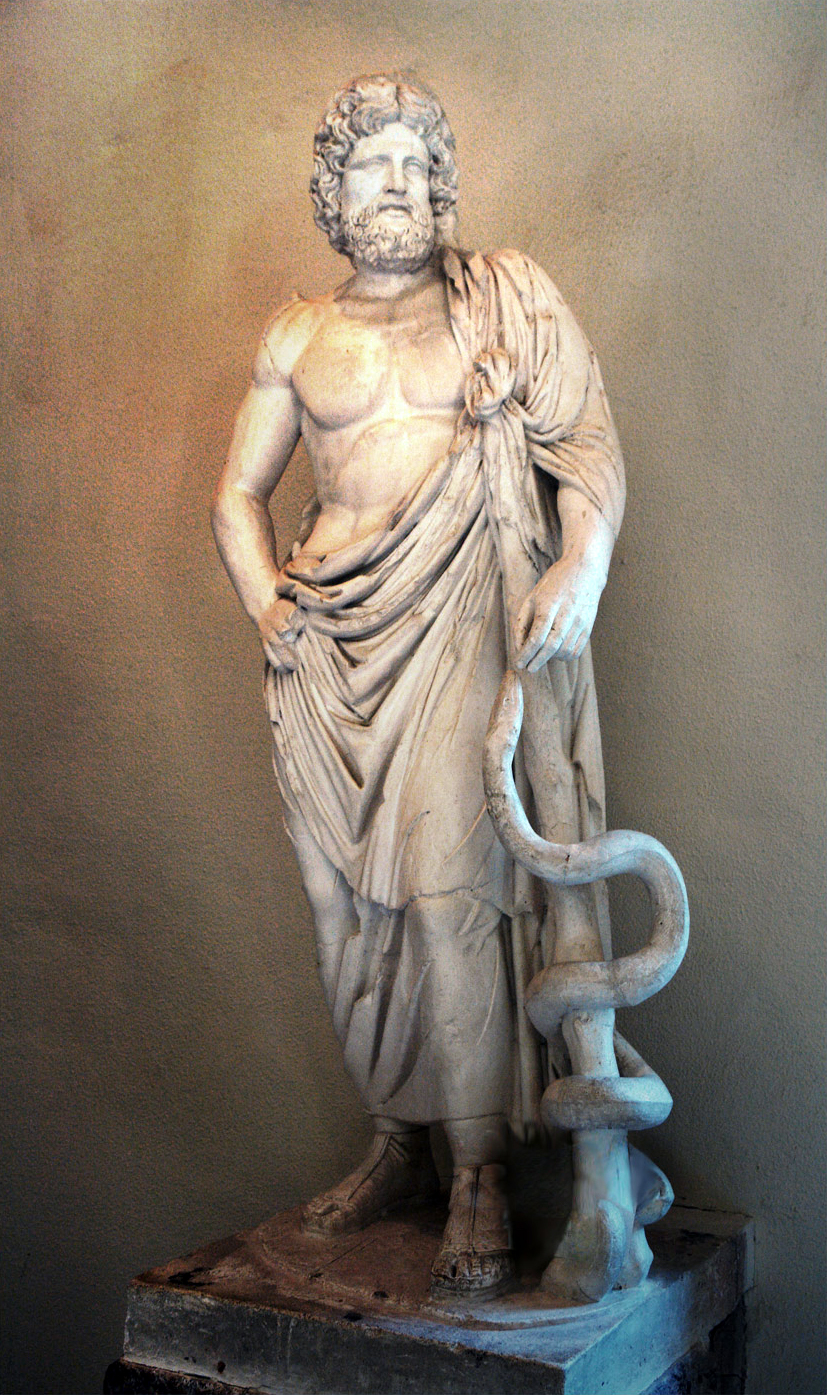
 Asclepius with his serpent-entwined staff, Roman statue in the Altes Museum | |
| Abode | Mount Olympus |
| Symbol | Serpent-entwined staff |
| Festivals | Epidauria, Asclepia |
| Genealogy | |
| Parents | Apollo and Coronis |
| Siblings | half-siblings of Asclepius |
| Consort | Epione, Aristodeme, Xanthe, Hygieia (sometimes daughter) |
| Children |
|
| Part of a series on |
| Ancient Greek religion |
|---|
 |


Asclepius (/æsˈkliːpiəs/; Ancient Greek: Ἀσκληπιός Asklēpiós [asklɛːpiós]; Latin: Aesculapius) is a hero and god of medicine in ancient Greek religion and mythology. He is the son of Apollo and Coronis, or Arsinoe, or of Apollo alone. Asclepius represents the healing aspect of the medical arts; his daughters, the Asclepiades, are: Hygieia ("Health, Healthiness"), Iaso (from ἴασις "healing, recovering, recuperation", the goddess of recuperation from illness), Aceso (from ἄκεσις "healing", the goddess of the healing process), Aegle (the goddess of good health) and Panacea (the goddess of universal remedy). He has several sons as well. He was associated with the Roman/Etruscan god Vediovis and the Egyptian Imhotep.[1] The rod of Asclepius, a snake-entwined staff similar to the caduceus, remains a symbol of medicine today. Those physicians and attendants who served this god were known as the Therapeutae of Asclepius.
Etymology
[edit]The etymology of the name is unknown. In his revised version of Frisk's Griechisches etymologisches Wörterbuch (Greek Etymological Dictionary), R. S. P. Beekes gives this summary of the different attempts:
- "H. Grégoire (with R. Goossens and M. Mathieu) in Asklépios, Apollon Smintheus et Rudra 1949 (Mém. Acad. Roy. de Belgique. Cl. d. lettres. 2. sér. 45), explains the name as "the mole-hero", connecting σκάλοψ, ἀσπάλαξ 'mole' and refers to the resemblance of the Tholos in Epidauros and the building of a mole. (Thus Puhvel, Comp. Mythol. 1987, 135.) But the variants of Asklepios and those of the word for "mole" do not agree.
- The name is typical for Pre-Greek words; apart from minor variations (β for π, αλ(α) for λα) we find α/αι (a well known variation; Fur. 335–339) followed by -γλαπ- or -σκλαπ-/-σχλαπ/β-, i.e. a voiced velar (without -σ-) or a voiceless velar (or an aspirated one: we know that there was no distinction between the three in the substr. language) with a -σ-. I think that the -σ- renders an original affricate, which (prob. as δ) was lost before the -γ- (in Greek the group -σγ- is rare, and certainly before another consonant).
- Szemerényi's etymology (JHS 94, 1974, 155) from Hitt. assula(a)- "well-being" and piya- "give" cannot be correct, as it does not explain the velar."[2]
Beekes suggested a Pre-Greek proto-form *(a)-syklap-.[3]
His name may mean "to cut open" from a story about his birth.[4]
Epithets
[edit]He shared with Apollo the epithet Paean ("the Healer").[5] He was called Aulonius, derived from a temple he had in Aulon, a valley in ancient Messenia.[6]
Mythology
[edit]Birth
[edit]Asclepius was the son of Apollo and, according to the earliest accounts, a mortal woman named Koronis (Coronis), who was a princess of Tricca in Thessaly.[7][8] When she displayed infidelity by sleeping with a mortal named Ischys, Apollo found out with his prophetic powers and killed Ischys. Coronis was killed by Artemis for being unfaithful to Apollo and was laid out on a funeral pyre to be consumed, but Apollo rescued the child by cutting him from Coronis's womb.[9]
According to Delphian tradition, Asclepius was born in the temple of Apollo, with Lachesis acting as a midwife and Apollo relieving the pains of Coronis. Apollo named the child after Coronis's nickname, Aegle.[10]
Phoenician tradition maintains that Asclepius was born of Apollo without any woman involved.[11]
According to the Roman version, Apollo, having learned about Coronis's betrayal with the mortal Ischys through his raven Lycius, killed her with his arrows. Before breathing her last breath, she revealed to Apollo that she was pregnant with his child. He repented his actions and unsuccessfully tried to save her. At last, he removed their son safely from her belly before she was consumed by the fire.[12]
In yet another version, Coronis who was already pregnant with Apollo's child, had to accompany her father to Peloponnesos. She had kept her pregnancy hidden from her father. In Epidaurus, she bore a son and exposed him on a mountain called Tittheion (from τίτθη "wet nurse", τιτθεύω "to suckle, breastfeed"). The child was given milk by one of the goats that pastured about the mountain, and was guarded by the watch-dog of the herd. Aresthanas, the owner of goats and the guard dogs found the child. As he came near, he saw lightning that flashed from the child, and thinking of it to be a sign of the divine, he left the child alone. Asclepius was later taken by Apollo.[13]
According to Strabo and other traditions, the birthplace of Asclepius is considered to be Tricca (modern Trikala city in Thessaly).[8][14]
Education and adventures
[edit]
Apollo named the rescued baby "Asclepius" and reared him for a while, and taught him many things about medicine.[15] However, like his half-brother, Aristaeus, Asclepius had his formal education under the centaur Chiron who instructed him in the art of medicine.[16]
It is said that in return for some kindness rendered by Asclepius, a snake licked Asclepius's ears clean and taught him secret knowledge (to the Greeks, snakes were sacred beings of wisdom, healing, and resurrection). Asclepius bore a rod wreathed with a snake, which became associated with healing. Another version states that when Asclepius (or in another myth Polyidus) was commanded to restore the life of Glaucus, he was confined in a secret prison. While pondering what he should do, a snake crept near his staff. Lost in his thoughts, Asclepius unknowingly killed it by hitting it again and again with his staff. Later, another snake came there with an herb in its mouth and placed it on the head of a dead snake, which soon came back to life. Seeing this, Asclepius used the same herb, which brought Glaucus back.[17] A species of non-venomous pan-Mediterranean serpent, the Aesculapian snake (Zamenis longissimus) is named for the god.
He was originally called Hepius but received his popular name of Asclepius after he cured Ascles, ruler of Epidaurus who suffered an incurable ailment in his eyes.[18] Asclepius became so proficient as a healer that he surpassed both Chiron and his father, Apollo. Asclepius was therefore able to evade death and to bring others back to life from the brink of death and beyond. This caused an excessive abundance of human beings, and Zeus resorted to killing him to maintain balance in the numbers of the human population.
At some point, Asclepius was among those who took part in the Calydonian Boar hunt. Also, he was one of the Argonauts.

Marriage and family
[edit]Asclepius was married to Epione, with whom he had five daughters: Iaso, Panacea, Hygieia, Aceso, and Aegle,[19] and three sons: Machaon, Podaleirios and Telesphoros. He also sired a son, Aratus, with Aristodeme.[20]
Death and immortality
[edit]Asclepius once started bringing back to life the dead people like Tyndareus, Capaneus, Glaucus, Hymenaeus, Lycurgus and others.[21] Others say he brought Hippolytus back from the dead on Artemis's request, and accepted gold for it,[22] or maybe he did it for love.[23] It is the only mention of Asclepius resurrecting the dead.[clarification needed] In all other accounts he is said to use his skills simply as a physician.
However, Hades accused Asclepius of stealing his subjects and complained to his brother Zeus about it.[24] According to others, Zeus was afraid that Asclepius would teach the art of resurrection to other humans as well.[25] Concerning the fate of Asclepius, Ovid writes that "the youth [Asclepius] blasted by ancestral bolts [of Zeus] soars from earth [rising as the constellation Ophiuchus] and flings his hands coiled with double snakes."[26] Later accounts read "The Serpent-Holder. Many astronomers have imagined that he is Aesculapius [Asclepius], whom Jupiter [Zeus], for the sake of Apollo, put among the stars."[27] Asclepius was killed by Zeus, and by Apollo's request, was subsequently immortalized as a star.[28][29][30]
Sacred places and practices
[edit]
The most ancient and the most prominent asclepeion (or healing temple) according to the geographer of the 1st century BC, Strabo, was situated in Trikala.[31] The 1st century AD Pool of Bethesda, described in the Gospel of John, chapter 5, was found by archaeologists in 1964 to be part of an asclepeion.[32][33] One of the most famous temples of Asclepius was at Epidaurus in north-eastern Peloponnese, dated to the fourth century BC.[34] Another famous asclepeion was built approximately a century later on the island of Kos,[34] where Hippocrates, the legendary "father of medicine", may have begun his career. Other asclepieia were situated in Gortys (in Arcadia), and Pergamum in Asia.

From the fifth century BC onwards,[35] the cult of Asclepius grew very popular and pilgrims flocked to his healing temples (Asclepieia) to be cured of their ills. Ritual purification would be followed by offerings or sacrifices to the god (according to means), and the supplicant would then spend the night in the holiest part of the sanctuary—the abaton (or adyton). Any dreams or visions would be reported to a priest who would prescribe the appropriate therapy by a process of interpretation.[36] Some healing temples also used sacred dogs to lick the wounds of sick petitioners.[37] In honor of Asclepius, a particular type of non-venomous snake was often used in healing rituals, and these snakes—the Aesculapian Snakes—slithered around freely on the floor in dormitories where the sick and injured slept. These snakes were introduced at the founding of each new temple of Asclepius throughout the classical world.
The original Hippocratic Oath began with the invocation "I swear by Apollo the Physician and by Asclepius and by Hygieia and Panacea and by all the gods ...".[37]
Epidauria (τὰ Ἐπιδαύρια) was a festival at Athens in honour of Asclepius.[38]
_-_A_Visit_to_Aesculapius_-_N01586_-_National_Gallery.jpg)
Some later religious movements claimed links to Asclepius. In the 2nd century AD the controversial miracle-worker Alexander claimed that his god Glycon, a snake with a "head of linen"[39] was an incarnation of Asclepius. The Greek language rhetorician and satirist Lucian produced the work Alexander the False Prophet to denounce the swindler for future generations. He described Alexander as having a character "made up of lying, trickery, perjury, and malice; [it was] facile, audacious, venturesome, diligent in the execution of its schemes, plausible, convincing, masking as good, and wearing an appearance absolutely opposite to its purpose."[39] In Rome, the College of Aesculapius and Hygia was an association (collegium) that served as a burial society and dining club that also participated in the Imperial cult.
The botanical genus Asclepias (commonly known as milkweed) is named after him and includes the medicinal plant A. tuberosa or "Pleurisy root".
Asclepius was depicted on the reverse of the Greek 10,000 drachmas banknote of 1995–2001.[40]
At the city of Miletus, archaeologists discovered a cave under the city's theatre which was associated with Asclepius cult.[41][42]
At Hyperteleatum, Hypsi and Hyettus there were temples of Asclepius.[43][44][45]
See also
[edit]Notes
[edit]- ^ Pinch, Geraldine (1 January 2002). Handbook of Egyptian Mythology. ABC-CLIO. ISBN 9781576072424.
- ^ Greek etymology database (online source requires login and is located at iedo.brillonline.nl Archived 29 September 2014 at the Wayback Machine). Originally: "Archived copy". Archived from the original on 28 September 2007. Retrieved 11 April 2009.
{{cite web}}: CS1 maint: archived copy as title (link) Also in: R.S.P. Beekes, Etymological Dictionary of Greek, Brill, 2009, p. 151. - ^ R.S.P. Beekes, Etymological Dictionary of Greek, Brill, 2009, p. xxv.
- ^ "Asklepios". Theoi.com. Retrieved 25 November 2020.
- ^ Mitchell-Boyask, p. 141
- ^ Pausanias, Description of Greece 4.36.5
- ^ Homeric Hymn to Asclepius (16), 1–4; Diodorus Siculus, 5.74.6
- ^ a b "ASCLEPIUS (Asklepios) - Greek God of Medicine & Doctors".
- ^ Pindar, Pythian Odes 3.5
- ^ Isyllus, Hymn to Asclepius
- ^ Pausanias, 7.23.7
- ^ Ovid, Metamorphoses 2.620
- ^ Pausanias, 2.26.1–7
- ^ Cartwright, Mark (20 June 2013). "Asclepius". World History Encyclopedia.
- ^ Diodorus Siculus, 5.64.6
- ^ Pindar, Pythian Ode 3.5 ff. (trans. Conway)
- ^ Hyginus, De astronomia 2.14
- ^ Tzetzes, Chiliades 10.49, p. 712–714
- ^ Greek Lyric V Anonymous, fr. 939 (Inscription from Erythrai) (trans. Campbell); Suida, s.v. Epione (trans. Suda On Line)
- ^ Homer, Iliad 2.730 ff.; 4.193, 217 ff. & 11.518 ff. (trans. Lattimore); Diodorus Siculus, 4.71.3 (trans. Oldfather); Pausanias, 2.29.1; Lycophron, 1047 ff. (trans. Mair); Suida, s.v. Epione (trans. Suda On Line)
- ^ Stesichorus, fr. 147 from Sextus Empricicus, Against the Professors)
- ^ Pindar, Pythian Ode 3; Plato, Republic 408b; Philodemus, On Piety (trans. Campbell, Vol.); Greek Lyric IV; Stesichorus, fr. 147 and Cinesias, fr. 774)
- ^ Clement of Alexandria, Clementina Homilia, V, 15.
- ^ Diodorus Siculus, 4.71.3
- ^ Apollodorus, 3.121
- ^ Ovid, Fasti 6, 735–762 (Translation by Boyle, A. J. & Woodard, R. D.)
- ^ Pseudo-Hyginus, Astronomica 2.14
- ^ Emma and Ludwig Edelstein, Asclepius: Collection and Interpretation of the Testimonies, Volume 1, Page 51
- ^ Sabine G. MacCormack Concise Encyclopedia of Greek and Roman Mythology p.47
- ^ Theony Condos, Star Myths of the Greeks and Romans, p.141
- ^ "Asclepeion of ancient Trikki | Municipality of Trikala". Municipality of Trikala. 14 June 2017.
- ^ An archaeological diagram of the layout – the diagram displayed at the location itself – is visible at this link Archived 4 June 2011 at the Wayback Machine.
- ^ Jerome Murphy-O'Connor, The Holy Land, (2008), page 29
- ^ a b Edelstein, Ludwig and Emma Edelstein. Asclepius: a Collection and Interpretation of the Testimonies. Vol. 2. Baltimore: Johns Hopkins Press, 1998. p. 243
- ^ Wickkiser, Bronwen. Asklepios, Medicine, and the Politics of Healing in Fifth-century Greece: Between Craft and Cult. Johns Hopkins Press, 2008. p. 106
- ^ Sigerist 1987, pp. 63ff
- ^ a b Farnell, Chapter 10, "The Cult of Asklepios" (pp. 234–279)
- ^ Harry Thurston Peck, Harpers Dictionary of Classical Antiquities (1898), Epidauria
- ^ a b Lucian, Alexander the False Prophet (trans A.M. Harmon) (Cambridge: Loeb Classical Library, 1936), Lucian, vol IV. Accessible online at http://www.tertullian.org/rpearse/lucian/lucian_alexander.htm
- ^ Bank of Greece Archived 28 June 2015 at the Wayback Machine. Drachma Banknotes Archived 11 July 2010 at the Wayback Machine. 10,000 drachma note (pdf) Archived 11 June 2011 at the Wayback Machine – Retrieved 26 July 2010.
- ^ "Sacred Cave" in ancient Miletos awaits visitors
- ^ The Ancient City of Miletos's "Sacred Cave" Opened to Visitors
- ^ Dictionary of Greek and Roman Geography (1854), Hyperteleatum
- ^ Dictionary of Greek and Roman Geography (1854), Hypsi
- ^ Dictionary of Greek and Roman Geography (1854), Hyettus
References
[edit]Primary sources
[edit]- Apollodorus, The Library with an English Translation by Sir James George Frazer, F.B.A., F.R.S. in 2 Volumes, Cambridge, MA, Harvard University Press; London, William Heinemann Ltd. 1921. ISBN 0-674-99135-4. Online version at the Perseus Digital Library. Greek text available from the same website.
- Apollonius Rhodius, Argonautica translated by Robert Cooper Seaton (1853–1915), R. C. Loeb Classical Library Volume 001. London, William Heinemann Ltd, 1912. Online version at the Topos Text Project.
- Apollonius Rhodius, Argonautica. George W. Mooney. London. Longmans, Green. 1912. Greek text available at the Perseus Digital Library.
- Diodorus Siculus, The Library of History translated by Charles Henry Oldfather. Twelve volumes. Loeb Classical Library. Cambridge, Massachusetts: Harvard University Press; London: William Heinemann, Ltd. 1989. Vol. 3. Books 4.59–8. Online version at Bill Thayer's Web Site
- Diodorus Siculus, Bibliotheca Historica. Vol 1-2. Immanel Bekker. Ludwig Dindorf. Friedrich Vogel. in aedibus B. G. Teubneri. Leipzig. 1888–1890. Greek text available at the Perseus Digital Library.
- Gaius Julius Hyginus, Astronomica from The Myths of Hyginus translated and edited by Mary Grant. University of Kansas Publications in Humanistic Studies. Online version at the Topos Text Project.
- Homer, The Iliad with an English Translation by A.T. Murray, Ph.D. in two volumes. Cambridge, MA., Harvard University Press; London, William Heinemann, Ltd. 1924. ISBN 978-0674995796. Online version at the Perseus Digital Library.
- Homer, Homeri Opera in five volumes. Oxford, Oxford University Press. 1920. ISBN 978-0198145318. Greek text available at the Perseus Digital Library
- The Homeric Hymns and Homerica with an English Translation by Hugh G. Evelyn-White. Homeric Hymns. Cambridge, MA., Harvard University Press; London, William Heinemann Ltd. 1914. Online version at the Perseus Digital Library. Greek text available from the same website.
- Lycophron, The Alexandra translated by Alexander William Mair. Loeb Classical Library Volume 129. London: William Heinemann, 1921. Online version at the Topos Text Project.
- Lycophron, Alexandra translated by A.W. Mair. London: William Heinemann; New York: G.P. Putnam's Sons. 1921. Greek text available at the Perseus Digital Library.
- Marcus Tullius Cicero, Nature of the Gods from the Treatises of M.T. Cicero translated by Charles Duke Yonge (1812–1891), Bohn edition of 1878. Online version at the Topos Text Project.
- Marcus Tullius Cicero, De Natura Deorum. O. Plasberg. Leipzig. Teubner. 1917. Latin text available at the Perseus Digital Library.
- Pausanias, Description of Greece with an English Translation by W.H.S. Jones, Litt.D., and H.A. Ormerod, M.A., in 4 Volumes. Cambridge, MA, Harvard University Press; London, William Heinemann Ltd. 1918. ISBN 0-674-99328-4. Online version at the Perseus Digital Library
- Pausanias, Graeciae Descriptio. 3 vols. Leipzig, Teubner. 1903. Greek text available at the Perseus Digital Library.
- Pindar, Odes translated by Diane Arnson Svarlien. 1990. Online version at the Perseus Digital Library.
- Pindar, The Odes of Pindar including the Principal Fragments with an Introduction and an English Translation by Sir John Sandys, Litt.D., FBA. Cambridge, MA., Harvard University Press; London, William Heinemann Ltd. 1937. Greek text available at the Perseus Digital Library.
- Publius Ovidius Naso, Fasti translated by James G. Frazer. Online version at the Topos Text Project.
- Publius Ovidius Naso, Fasti. Sir James George Frazer. London; Cambridge, MA. William Heinemann Ltd.; Harvard University Press. 1933. Latin text available at the Perseus Digital Library.
- Tzetzes, John, Book of Histories, Book IX-X translated by Jonathan Alexander from the original Greek of T. Kiessling's edition of 1826. Online version at theoi.com
Secondary sources
[edit]- Edelstein, Ludwig and Emma Edelstein. Asclepius: Collection and Interpretation of the Testimonies, Baltimore, The Johns Hopkins Press, 1945.
- von Ehrenheim, Hedvig. Greek Incubation Rituals in Classical and Hellenistic Times. Kernos. Supplément, 29. Liège: Presses Universitaires de Liège, 2015.
- Farnell, Lewis Richard. Greek Hero Cults and Ideas of Immortality, (Oxford Clarendon Press,1921).
- Grimal, Pierre, The Dictionary of Classical Mythology, Wiley-Blackwell, 1996, ISBN 978-0-631-20102-1. "Asclepius" pp. 62–63
- Hart, Gerald D. MD. Asclepius: The God of Medicine (Royal Society of Medicine Press, 2000)
- Kool, S. "The Soother of Evil Pains: Asclepius and Freud." Akroterion 60, 2015, pp. 13–32.
- LiDonnici, Lynn R. The Epidaurian Miracle Inscriptions: Text, Translation, and Commentary. Atlanta: Scholars, 1995.
- Mitchell-Boyask, Robin, Plague and the Athenian Imagination: Drama, History and the Cult of Asclepius, Cambridge University Press, 2008, ISBN 978-0-521-87345-1.
- Oberhelman, Steven M. (ed.), Dreams, Healing, and Medicine in Greece: From Antiquity to the Present. Farnham; Burlington, VT: Ashgate, 2013.
- Renberg, Gil H. "Public and Private Places of Worship in the Cult of Asclepius at Rome". Memoirs of the American Academy in Rome, 51/52, 2006, pp. 87–172.
- Riethmüller, Jürgen W. Asklepios : Heiligtümer und Kulte, Heidelberg, Verlag Archäologie und Geschichte, 2005, ISBN 3-935289-30-8
- Sigerist, Henry E. (1987). A History of Medicine Volume 2: Early Greek, Hindu, and Persian Medicine (1st ed.). New York: Oxford University Press. ISBN 978-0-19-505079-0.
- Wickkiser, Bronwen. Asklepios, Medicine, and the Politics of Healing in Fifth-century Greece: Between Craft and Cult. JHU Press, 2008.
External links
[edit]


Asclepius
View on GrokipediaNames and Etymology
Etymology
The name Asclepius, attested in ancient Greek as Ἀσκληπιός (Asklēpiós), derives from a pre-Greek substrate language and lacks a clear Indo-European etymology. Philologist Robert S. P. Beekes reconstructs a proto-form *(a)sḱlāp-, characteristic of pre-Greek words with initial a/ai- followed by clusters like -sklāp-, and suggests it may connote "to cut open," evoking surgical incision in the context of healing practices.[4] This proposed meaning aligns with the god's association with medicine, though the precise semantic link remains speculative among scholars. Alternative theories, such as derivations from Indo-European roots for "mole" or "vermin" (e.g., linking to words like askalábas), have been advanced but dismissed by Beekes and others due to inconsistent dialectal correspondences. The name shows regional variations across Greek dialects, including Ἀσκλαπιός (Asklapios) in Doric forms and extended compounds like Ἀσκληπιάδης (Asklēpiadēs) in Attic and Ionic contexts, reflecting phonetic adaptations such as π to β or λ shifts in local usage.[4] Debates on the etymology trace to 19th-century works by philologists like Hjalmar Frisk, who revised earlier Greek etymological dictionaries, and culminated in 20th-century analyses by Beekes, emphasizing non-Indo-European origins over folk etymologies tied to healing verbs.[2]Epithets
Asclepius was known by numerous epithets in ancient Greek literature and inscriptions, reflecting his roles as healer, protector, and savior in various cult contexts. These titles often emphasized his therapeutic powers and were invoked in prayers, hymns, and dedications at sanctuaries, highlighting regional variations in worship.[5] One prominent epithet shared with his father Apollo was Paean, meaning "Healer," originally denoting a Homeric physician of the gods before becoming associated with Asclepius' divine medical interventions. This title underscored his ability to cure diseases and restore health, appearing in cult practices across Greece, such as in Athens where it invoked his healing presence.[5] The epithet Aulonius derived from a temple in Aulon, a valley in ancient Messenia, linking Asclepius to local topography and possibly implying connections to pastoral or Delphic traditions through the site's serene, valley setting. Pausanias described a statue and temple dedicated to Asclepius Aulonius there, marking it as a boundary sanctuary near the Neda River.[5] At the major sanctuary of Epidaurus, inscriptions frequently employed epithets like Soter ("Savior"), Iatros ("Physician"), and Alexikakos ("Averter of Evil"), which celebrated his capacity to deliver supplicants from illness and misfortune through incubation rituals and divine cures. These titles appeared in healing testimonials (iamata) etched on steles, portraying Asclepius as both a practical healer and a protective deity against plagues and harm.[6][5] Regional variations included Epidotes ("Giver of Gifts") at sanctuaries like Sicyon, where it evoked Asclepius' benevolence in bestowing health and prosperity upon devotees, often in tandem with other healing deities. This epithet appeared in descriptions of bountiful cult sites, emphasizing his generous dispensation of remedies and oracles.[5]Mythological Accounts
Birth and Early Life
In Greek mythology, Asclepius is described as the son of the god Apollo and the mortal Coronis, daughter of Phlegyas, a king of the Lapiths in Thessaly. Some accounts, however, identify Arsinoe, daughter of Leucippus, as his mother instead.[7] The primary narrative of his conception and birth centers on Coronis's infidelity. While pregnant by Apollo, she took Ischys, son of Elatus, as a lover. Apollo, who had dispatched a white raven to monitor her, learned of the affair when the bird reported it; in anger at the raven's delay, he scorched its feathers black—a punishment that explains the bird's modern coloration—and then slew Coronis with arrows. As her body burned on the funeral pyre, Apollo snatched the still-living infant Asclepius from the flames to save him. An alternative version in Apollodorus's Library states that Apollo killed Coronis with an arrow as she was giving birth and immediately cut the child from her womb.[7] Following the birth, Apollo entrusted the infant Asclepius to the centaur Chiron on Mount Pelion for safekeeping and initial care.[7] Local variants place the birth at specific sites tied to Apollo's cults: Pausanias locates it at Tricca (modern Trikala) in Thessaly, while Delphian tradition holds that it occurred in Apollo's temple at Delphi, with the Fate Lachesis acting as midwife and Apollo alleviating Coronis's labor pains.[8] Phoenician accounts, by contrast, depict Asclepius as born to Apollo without a mortal mother.[9]Education and Adventures
After his infancy, Asclepius was entrusted to the centaur Chiron, who raised him on Mount Pelion and served as his primary mentor in the healing arts.[2] Under Chiron's guidance, Asclepius mastered herbal medicine, surgical techniques, and the prophetic arts, drawing on the centaur's renowned expertise in these disciplines, which Chiron had himself acquired from Apollo.[2] Pindar describes Asclepius as becoming a "craftsman of health" through this training, excelling in remedies that combined drugs, incantations, and physical interventions to cure ailments. Asclepius further advanced his knowledge through an encounter with serpents, which symbolized the acquisition of esoteric healing secrets in Greek mythology. In one account, while seeking to revive the deceased Glaucus, son of King Minos of Crete, Asclepius observed serpents using a specific herb to resurrect a companion, prompting him to apply the same plant successfully in the revival. Hyginus recounts this episode, noting how the serpents' ritual revealed the herb's resurrective properties, marking Asclepius's entry into advanced resurrection techniques. Athena also aided him by providing a vial of Gorgon's blood—the right side of which could restore life—enhancing his abilities beyond mortal limits. Asclepius's education intertwined with heroic adventures that showcased his emerging skills as a healer. He participated in the Calydonian Boar hunt, a perilous quest led by King Oeneus of Calydon to slay the monstrous boar ravaging the land, where his medical prowess likely supported the wounded hunters. Similarly, Asclepius joined the Argonaut expedition under Jason, sailing aboard the Argo to retrieve the Golden Fleece; during the voyage, he treated injuries, including healing Jason himself from a severe wound inflicted in combat. Apollonius Rhodius highlights this role, portraying Asclepius as an indispensable physician among the heroes, whose interventions ensured the crew's survival amid trials. These exploits not only honed his practical expertise but also established his reputation as a master healer capable of sustaining warriors in epic endeavors.[2]Family and Descendants
Asclepius was married to Epione, the goddess associated with the soothing of pain, and their union is often interpreted as embodying the complete spectrum of healing, from alleviation to restoration.[10] This partnership is attested in ancient accounts of the cult at Epidaurus, where statues of both were erected in the god's precinct. With Epione, Asclepius fathered five daughters, each representing an aspect of medical and healthful processes: Hygieia, the goddess of health and preventive care; Panacea, embodying the universal remedy; Iaso, linked to recuperation from illness; Aceso, symbolizing the gradual process of healing; and Aegle, associated with bodily radiance and vitality.[11] These figures appear together in dedicatory inscriptions and literary fragments, underscoring their roles as attendants in Asclepius's healing domain.[2] Asclepius also had three sons: Machaon and Podalirius, renowned healers who participated in the Trojan War, and Telesphorus, sometimes regarded as a son and the bringer of recovery and completion in treatment.[12] Machaon and Podalirius, described in Homeric epic as skilled physicians leading thirty ships from Tricca, Ithome, and Oechalia, were among the suitors of Helen and served as commanders and medical experts for the Greek forces.[13] Their expertise in surgery and internal medicine extended their father's legacy into the realm of wartime healing.[2]Death and Deification
Asclepius's exceptional skill in medicine extended to the resurrection of the dead, employing the blood of the Gorgon Medusa provided by Athena to revive figures such as Hippolytus, Glaucus son of Minos, Tyndareus, and others, which alarmed Zeus as it disrupted the natural balance between life and death by allowing mortals to evade their fate.[7] In response, Zeus struck Asclepius down with a thunderbolt, viewing his actions as an overstep that threatened the cosmic order and the authority of the gods.[7] This event is echoed in Pindar's account, where Zeus destroys both the healer and his patient with the bolt for such transgressions against divine limits. Enraged by the death of his son, Apollo sought vengeance by slaying the Cyclopes—Arges, Brontes, and Steropes—who had forged the thunderbolt for Zeus.[14] As punishment for this act, Zeus compelled Apollo to serve as a mortal herdsman for one year under King Admetus of Thessaly.[7] Despite his death, Asclepius was soon resurrected by Zeus at Apollo's intercession and elevated to divine status among the gods, thereafter honored through temples across the Greek world as the god of healing.[2] To commemorate his apotheosis, Zeus placed him in the heavens as the constellation Ophiuchus, the Serpent-Bearer, symbolizing his mastery over life and serpentine associations with medicine.[15] In variant traditions, such as those recorded by Hyginus, this stellar placement directly follows his restoration to life for overstepping mortal bounds.[15]Worship and Cult Practices
Sacred Sites
The primary sanctuary dedicated to Asclepius, known as the Asclepeion at Epidaurus in the northeastern Peloponnese, was established in the 4th century BCE as the central hub of his healing cult.[16] This expansive complex featured a Doric temple to the god, a renowned open-air theater with exceptional acoustics seating up to 14,000 spectators, and an abaton—a large porticoed dormitory where pilgrims underwent incubation, sleeping in hopes of receiving curative dreams from Asclepius.[16] The site's historical development reflected the evolution of Greek medicine from ritual healing to more structured practices, with expansions continuing into the Roman era; it was designated a UNESCO World Heritage Site in 1988 for its architectural and cultural significance in ancient therapeutic traditions.[16] Among other prominent Asclepeia, the sanctuary on the island of Kos, founded in the Hellenistic period after the 4th century BCE, held a unique connection to Hippocrates, the "father of medicine," whose school emphasized empirical observation alongside divine intervention.[17] The Asclepeion at Pergamon in Asia Minor, often regarded as the grandest of these healing centers due to its terraced layout, library, and thermal springs, reached its peak in the 2nd century CE under Roman patronage and attracted patients empire-wide.[18] In Trikala (ancient Trikke) in Thessaly, considered the earliest sanctuary linked to Asclepius's birth myth—where his mother Coronis died and Apollo revived the infant god—the cult site dates to the 6th century BCE and served as a foundational pilgrimage center.[19] Athens hosted an urban Asclepeion near the Acropolis, established around 420 BCE in response to a devastating plague, integrating the god's worship into civic life with temples and altars dedicated to both Asclepius and his daughter Hygieia.[20] Archaeological evidence from these sites includes thousands of inscriptions recording miraculous cures and dedications, such as the "Praxias' dedication" pillar from Athens invoking prayers for health.[21] Votive offerings, particularly anatomical terracotta models of afflicted body parts like limbs, eyes, and genitals, were ubiquitous, symbolizing gratitude for healings and providing insights into prevalent ailments in antiquity.[22] Distinct structures, such as the cave sanctuary beneath Miletus's theater in Asia Minor—used from the Hellenistic period for rituals tied to Asclepius's chthonic aspects—and the Pool of Bethesda in Jerusalem, where Roman-era remains suggest a possible Asclepeion with healing pools built by Hadrian in the 2nd century CE, highlight the cult's spread beyond Greece.[23][24] Excavations at Epidaurus since 2020 have uncovered remains of an earlier temple dating to the late 7th or early 6th century BCE, predating the 4th century BCE structure and providing insights into the early development of the cult.[25][26] Earlier archaeological work at the site has revealed artifacts from the Mycenaean period, indicating long-term religious continuity.[27] Surgical instruments and medical tools uncovered in past excavations suggest advanced therapeutic practices were conducted at the sanctuary. Digital reconstructions, employing 3D modeling from these findings, have aided in visualizing the complex's layout and its role in ancient wellness tourism.[16]Rituals and Festivals
The central ritual in the cult of Asclepius was dream incubation, known as enkoimesis, practiced in the abaton—a designated sleeping chamber within the sanctuary—where supplicants would lie down after purification to receive divine diagnoses and prescriptions through prophetic dreams from the god.[5] Patients often experienced visions in which Asclepius, his daughters, or sacred animals appeared to guide treatments, such as surgeries performed in the dream that manifested as real healings upon waking.[28] This practice, integral to the therapeutic process at major sanctuaries like Epidaurus, emphasized the god's direct intervention and was preceded by preparatory rites to ensure ritual purity.[29] Non-venomous serpents served as sacred emblems of Asclepius, often appearing in incubation dreams to lick wounds or apply salves, symbolizing renewal and the god's chthonic ties; these yellowish, tame snakes roamed freely in the sanctuaries and were considered manifestations of the deity.[30] Dogs, also sacred to the cult, participated in healing by licking afflicted body parts in visions or reality, as recorded in testimonials, while purifying baths in sacred springs or the sea were mandatory before entering the abaton to cleanse both body and spirit.[5] Although animal sacrifices accompanied these rites, the focus remained on non-violent, symbolic interactions with the god's animal avatars to facilitate cures.[31] The Epidauria festival, held annually at Epidaurus, celebrated Asclepius with grand processions from the city to the sanctuary, athletic contests, and theatrical performances in the adjacent theater, drawing pilgrims to honor the god's healing powers and renew communal bonds.[32] This event, tied to the god's mythical arrival from Epidaurus to Athens, integrated athletic games reminiscent of the Olympics with dramatic reenactments of myths, underscoring the festival's role in promoting physical and spiritual well-being.[33] Healing testimonials, or iamata, were inscribed on stone stelae at sanctuaries like Epidaurus, documenting over seventy miraculous cures to inspire faith and instruct future supplicants; these narratives detailed ailments such as blindness, infertility, and chronic pain resolved through incubation, often involving serpents or divine surgery.[28] For instance, one inscription recounts a blind woman from Athens regaining sight after a dream where the god touched her eyes, leading her to dedicate a silver pig in thanks, while another describes a man whose infected toe was healed by a sacred snake's tongue.[28] These public records, erected in the late fourth century BCE, served both as votive offerings and evidentiary propaganda for the cult's efficacy, blending empirical detail with divine wonder.[28]Iconography and Symbolism
Primary Symbols
The Rod of Asclepius, consisting of a rough-hewn staff entwined by a single serpent, serves as the god's most distinctive emblem, symbolizing healing and renewal in ancient Greek mythology. This symbol originates from myths in which Asclepius observed serpents using a specific herb to revive a dead companion, inspiring him to apply the plant for resurrecting humans, as recounted in Hyginus's Astronomica (2.14). The serpent represents the cycle of shedding skin and rebirth, qualities associated with health and regeneration, distinguishing Asclepius as the patron of medicine.[34] Sacred animals closely tied to Asclepius include non-venomous snakes, such as the Aesculapian snake (Zamenis longissimus), and dogs, both embodying protective and curative roles in his cult. Snakes, revered for their association with earth-bound healing and prophecy, were housed in temple enclosures and participated in rituals where they "licked" supplicants to effect cures, as described by Pausanias (2.28.1). Dogs, linked to myths where they guarded the infant Asclepius from danger, symbolized fidelity and vigilance, often appearing alongside him in temple iconography (Pausanias 2.27.2). The cock, another key animal attribute, signified vigilance and atonement, frequently offered as a sacrifice by those healed through incubation rites (Plato, Phaedo 118). Additional attributes include the laurel wreath, evoking Apollo's prophetic domain and underscoring Asclepius's divine lineage as his son, and bundles of herbs representing his pharmacological knowledge acquired from the centaur Chiron (Pindar, Pythian Ode 3.5). These elements collectively identified Asclepius in ancient contexts, such as votive offerings and sanctuary dedications, where they reinforced his role in therapeutic practices. The Rod of Asclepius is markedly distinct from similar symbols of other deities: unlike Hermes's caduceus, which features two serpents and wings to denote commerce and mediation, it employs a single serpent to emphasize solitary healing without heraldic flourishes.[34] It also contrasts with Apollo's lyre, an instrument of music and divination, highlighting Asclepius's grounded focus on physical restoration rather than his father's broader oracular arts.[2]Artistic Depictions
In classical Greek sculpture, Asclepius was typically represented as a mature, bearded man dressed in a chiton or himation draped over his torso, holding a staff entwined with a serpent and often accompanied by his daughter Hygieia, symbolizing health.[35] This iconographic type emphasized his role as a benevolent healer, with the figure standing in a contrapposto pose that conveyed calm authority; a well-preserved example is a 2nd-century A.D. Roman marble statue from the Getty Villa, copying a Hellenistic prototype derived from a classical original, where Asclepius wears a ring-shaped crown, tongued sandals, and a himation, with a snake coiled at his side.[35] At the Sanctuary of Asclepius in Epidaurus, the cult statue crafted by the sculptor Thrasymedes in the 4th century B.C. depicted him seated on a throne, grasping a staff in one hand while resting the other on a dog's head, with the animal lying beside him, crafted in ivory and gold for grandeur.[2] Depictions of Asclepius in vase painting were rare during the classical period, reflecting his later prominence in cult worship rather than early mythic narratives, though isolated 5th-century B.C. Attic red-figure examples illustrate him alongside Apollo or in healing scenes, such as tending to patients with his staff.[2] These sparse representations, often on kraters or amphorae, show a bearded figure in dynamic interaction, marking an evolution from more static heroic portrayals to those highlighting medical attributes.[2] Roman adaptations of Asclepius imagery incorporated imperial symbolism, appearing frequently on coins and in mosaics from the 2nd to 3rd centuries A.D., with regional variations in provincial mints like Pergamon emphasizing temple contexts.[36] On bronze coins from Pergamon under Emperor Commodus (A.D. 166–177), Asclepius leans on his serpent-staff within a temple facade, underscoring the sanctuary's prominence.[36] Imperial issues, such as gold aurei of Caracalla from A.D. 214, portray him standing nude to the waist, holding the staff and a globe, sometimes with the dwarf god Telesphorus or in sacred precinct scenes, blending Greek origins with Roman motifs of global dominion.[37] Mosaics extended this, as in a 2nd–3rd-century A.D. panel from Kos depicting Asclepius disembarking from a boat with his staff, welcomed by locals in a narrative of cult arrival.[38] Archaeological evidence from key sanctuaries reveals stylistic evolution and regional differences, with Hellenistic influences introducing more fluid drapery and emotional expression compared to classical rigidity. At Epidaurus, a 2nd-century A.D. plaster cast of a Roman copy of a late classical statue shows Asclepius leaning on his serpent-rod, discovered in the site's bath complex and library, exemplifying continuity in Greek temple art.[39] In Pergamon's Asclepieion, Hellenistic-period reliefs from ca. 400–350 B.C., such as votive slabs depicting Asclepius healing sleeping patients with Hygieia nearby, feature high-relief carving and narrative depth, reflecting the site's expansion under Attalid rulers and blending Greek and emerging Roman elements.[40] These Pergamon examples, often in marble and found in therapeutic contexts, highlight a shift toward personalized devotee interactions, contrasting the more generalized heroic forms of mainland Greek sculpture.[41]Cultural and Historical Legacy
Influence in Antiquity
The cult of Asclepius spread widely across the Greek world beginning in the fifth century BCE, as evidenced by the establishment of major sanctuaries and the influx of pilgrims seeking healing, coinciding with the emergence of systematic medical practices.[42] This expansion was particularly notable in cities like Athens, where political leaders supported the introduction of the cult around 420 BCE to bolster imperial ambitions and address public health needs amid the Peloponnesian War.[42] The primary center at Epidaurus served as a model, with its rituals attracting devotees from throughout the Mediterranean and fostering the god's integration into state religion as a protector against disease.[43] The cult's influence extended to Rome in 293 BCE, where it was adopted as Aesculapius following a devastating plague that prompted consultation of the Sibylline Books.[44] Roman envoys traveled to Epidaurus, retrieving a sacred serpent emblematic of the god, which legend held guided them to Tiber Island, the site of the new temple dedicated in 291 BCE.[44] This importation marked Aesculapius's role in Roman state religion, with the temple becoming a focal point for healing vows and public expiations during epidemics.[45] Asclepius featured prominently in ancient literature, reflecting his evolving status from hero to divine healer. In Homer's Iliad, he appears as a mortal hero and "blameless physician," whose sons Machaon and Podalirius served as surgeons for the Greek forces at Troy, treating wounds with skill derived from their father's teachings.[46] Euripides invoked Asclepius in several tragedies, such as Alcestis, where the chorus laments his death—struck by Zeus for resurrecting the dead—and wishes for his intervention to restore the dying queen, highlighting the tension between divine power and mortal limits.[47] Pausanias's second-century CE travelogues meticulously describe numerous Asclepius sanctuaries, including the elaborate temple at Sicyon with its gold-and-ivory statue by Calamis, underscoring the god's widespread cultic presence and architectural grandeur across Greece.[48] Asclepius's cult significantly shaped early medicine, particularly at the Kos Asclepeion, where divine healing intertwined with rational inquiry. This sanctuary, associated with Hippocrates—the "Father of Medicine" who practiced there in the fifth century BCE—combined incubation rituals, in which patients received prescriptive dreams from the god, with empirical treatments like diet, surgery, and pharmacology.[1] This synthesis allowed the cult to complement Hippocratic emphasis on natural causes of disease, as physicians at Kos viewed Asclepius as a patron whose interventions validated observational methods without supplanting them.[1] Politically, Asclepius served as a symbol of salvation and legitimacy for Hellenistic rulers. Alexander the Great reportedly experienced visions attributed to the god, including a dream during his Asian campaign in which a serpent—Asclepius's emblem—revealed a healing plant's properties to aid his wounded troops, reinforcing his self-image as a divinely favored conqueror.[49] In the ensuing Hellenistic era, monarchs like the Ptolemies in Egypt patronized Asclepius temples, incorporating his healing attributes into ruler cults to portray themselves as soteres (saviors) who mirrored the god's protective role over subjects.[50]Modern Interpretations and Impact
The Rod of Asclepius, featuring a single serpent entwined around a staff, remains a central symbol in modern medicine, representing healing and renewal. The World Health Organization incorporates it into its emblem, surmounting the United Nations symbol with the staff and snake to signify global health efforts.[51] Similarly, the American Medical Association adopted the rod as its official logo in the early 20th century, emphasizing ethical medical practice over the more commercial caduceus.[34] In pharmacy, the symbol traces back to depictions of Asclepius carrying the staff, symbolizing wisdom and therapeutic knowledge, and continues to appear in professional insignia worldwide. However, widespread confusion persists with the caduceus—Hermes' winged staff with two serpents—which erroneously adorns many U.S. military and commercial medical logos, despite scholarly consensus favoring the Rod of Asclepius as the authentic emblem of healing.[52] Asclepius's figure experienced cultural revivals across periods, influencing art and literature that drew on classical mythology for themes of health and divinity. During the Renaissance, artists revived ancient iconography, as seen in Florentine sculptures like the Uffizi's contemplative Asclepius statue, a replica emphasizing the god's role in medical humanism.[53] Lucia Anguissola's 16th-century portrait of the physician Pietro Manna holding the staff further integrated the symbol into professional identity, blending classical reverence with contemporary portraiture.[54] In the 19th century, Romantic-era works echoed this through classical allusions, such as Edward Poynter's 1880 painting A Visit to Aesculapius, which romanticizes the god's sanctuary as a site of miraculous recovery amid Victorian interests in antiquity.[55] Contemporary fiction sustains this legacy; in Rick Riordan's The Heroes of Olympus series, particularly The Blood of Olympus (2014), Asclepius appears as a pragmatic deity of medicine, highlighting ethical dilemmas in resurrection and healing for young readers. Recent scholarship has illuminated Asclepius's historical role through innovative methodologies, positioning asclepeia as precursors to modern hospitals. A 2022 study reframes the Epidaurus Asclepion as an integrated healing environment combining architecture, rituals, and patient care, influencing contemporary therapeutic design.[56] Post-2020 epigraphic analyses, including temporal modeling of inscriptions, reveal no surge in Asclepius dedications during the Antonine Plague (165–180 CE), challenging assumptions of crisis-driven cult popularity and underscoring steady Greco-Roman devotion to healing deities.[57] Digital tools have enabled detailed examinations of healing inscriptions, such as those at Epidaurus, facilitating virtual reconstructions that highlight narrative patterns in miracle testimonies and their psychological resonance.[58] Asclepius's global impact endures in modern festivals and therapeutic interpretations, bridging ancient practices with contemporary wellness. The annual Athens Epidaurus Festival, held since 1954 at the Sanctuary of Asclepius, features dramatic reenactments and performances that evoke ancient rituals, drawing international audiences to the UNESCO-listed site.[59] Modern Epidauria-inspired events at Epidaurus occasionally include processions and communal meals honoring the god, fostering cultural heritage tourism.[60] Psychologically, the incubation ritual—patients sleeping in temples for divine dream guidance—has been reinterpreted as an early form of dream therapy, promoting subconscious processing akin to modern psychoanalysis, with studies emphasizing its role in placebo-enhanced healing.[61]References
- https://commons.wikimedia.org/wiki/Category:Statue_of_Asclepius_in_the_Museum_of_Epidaurus