


Community hub
Recent from talks
Contribute something
Nothing was collected or created yet.
Crystal
View on Wikipedia


A crystal or crystalline solid is a solid material whose constituents (such as atoms, molecules, or ions) are arranged in a highly ordered microscopic structure, forming a crystal lattice that extends in all directions.[1][2] In addition, macroscopic single crystals are usually identifiable by their geometrical shape, consisting of flat faces with specific, characteristic orientations. The scientific study of crystals and crystal formation is known as crystallography. The process of crystal formation via mechanisms of crystal growth is called crystallization or solidification.
The word crystal derives from the Ancient Greek word κρύσταλλος (krustallos), meaning both "ice" and "rock crystal",[3] from κρύος (kruos), "icy cold, frost".[4][5]
Examples of large crystals include snowflakes, diamonds, and table salt. Most inorganic solids are not crystals but polycrystals, i.e. many microscopic crystals fused together into a single solid. Polycrystals include most metals, rocks, ceramics, and ice. A third category of solids is amorphous solids, where the atoms have no periodic structure whatsoever. Examples of amorphous solids include glass, wax, and many plastics.
Despite the name, lead crystal, crystal glass, and related products are not crystals, but rather types of glass, i.e. amorphous solids.
Crystals, or crystalline solids, are often used in pseudoscientific practices such as crystal therapy, and, along with gemstones, are sometimes associated with spellwork in Wiccan beliefs and related religious movements.[6][7][8]
Crystal structure (microscopic)
[edit]

The scientific definition of a "crystal" is based on the microscopic arrangement of atoms inside it, called the crystal structure. A crystal is a solid where the atoms form a periodic arrangement. (Quasicrystals are an exception, see below).
Not all solids are crystals. For example, when liquid water starts freezing, the phase change begins with small ice crystals that grow until they fuse, forming a polycrystalline structure. In the final block of ice, each of the small crystals (called "crystallites" or "grains") is a true crystal with a periodic arrangement of atoms, but the whole polycrystal does not have a periodic arrangement of atoms, because the periodic pattern is broken at the grain boundaries. Most macroscopic inorganic solids are polycrystalline, including almost all metals, ceramics, ice, rocks, etc. Solids that are neither crystalline nor polycrystalline, such as glass, are called amorphous solids, also called glassy, vitreous, or noncrystalline. These have no periodic order, even microscopically. There are distinct differences between crystalline solids and amorphous solids: most notably, the process of forming a glass does not release the latent heat of fusion, but forming a crystal does.
A crystal structure (an arrangement of atoms in a crystal) is characterized by its unit cell, a small imaginary box containing one or more atoms in a specific spatial arrangement. The unit cells are stacked in three-dimensional space to form the crystal.
The symmetry of a crystal is constrained by the requirement that the unit cells stack perfectly with no gaps. There are 219 possible crystal symmetries (230 is commonly cited, but this treats chiral equivalents as separate entities), called crystallographic space groups.[9] These are grouped into 7 crystal systems, such as cubic crystal system (where the crystals may form cubes or rectangular boxes, such as halite shown at right) or hexagonal crystal system (where the crystals may form hexagons, such as ordinary water ice).
Crystal faces, shapes and crystallographic forms
[edit]
Crystals are commonly recognized, macroscopically, by their shape, consisting of flat faces with sharp angles. These shape characteristics are not necessary for a crystal—a crystal is scientifically defined by its microscopic atomic arrangement, not its macroscopic shape—but the characteristic macroscopic shape is often present and easy to see.
Euhedral crystals are those that have obvious, well-formed flat faces. Anhedral crystals do not, usually because the crystal is one grain in a polycrystalline solid.
The flat faces (also called facets) of a euhedral crystal are oriented in a specific way relative to the underlying atomic arrangement of the crystal: they are planes of relatively low Miller index.[10] This occurs because some surface orientations are more stable than others (lower surface energy). As a crystal grows, new atoms attach easily to the rougher and less stable parts of the surface, but less easily to the flat, stable surfaces. Therefore, the flat surfaces tend to grow larger and smoother, until the whole crystal surface consists of these plane surfaces. (See diagram on right.)
One of the oldest techniques in the science of crystallography consists of measuring the three-dimensional orientations of the faces of a crystal, and using them to infer the underlying crystal symmetry.
A crystal's crystallographic forms are sets of possible faces of the crystal that are related by one of the symmetries of the crystal. For example, crystals of galena often take the shape of cubes, and the six faces of the cube belong to a crystallographic form that displays one of the symmetries of the isometric crystal system. Galena also sometimes crystallizes as octahedrons, and the eight faces of the octahedron belong to another crystallographic form reflecting a different symmetry of the isometric system. A crystallographic form is described by placing the Miller indices of one of its faces within brackets. For example, the octahedral form is written as {111}, and the other faces in the form are implied by the symmetry of the crystal.
Forms may be closed, meaning that the form can completely enclose a volume of space, or open, meaning that it cannot. The cubic and octahedral forms are examples of closed forms. All the forms of the isometric system are closed, while all the forms of the monoclinic and triclinic crystal systems are open. A crystal's faces may all belong to the same closed form, or they may be a combination of multiple open or closed forms.[11]
A crystal's habit is its visible external shape. This is determined by the crystal structure (which restricts the possible facet orientations), the specific crystal chemistry and bonding (which may favor some facet types over others), and the conditions under which the crystal formed.
Occurrence in nature
[edit]

Rocks
[edit]By volume and weight, the largest concentrations of crystals in the Earth are part of its solid bedrock. Crystals found in rocks typically range in size from a fraction of a millimetre to several centimetres across, although exceptionally large crystals are occasionally found. As of 1999[update], the world's largest known naturally occurring crystal is a crystal of beryl from Malakialina, Madagascar, 18 m (59 ft) long and 3.5 m (11 ft) in diameter, and weighing 380,000 kg (840,000 lb).[12]
Some crystals have formed by magmatic and metamorphic processes, giving origin to large masses of crystalline rock. The vast majority of igneous rocks are formed from molten magma and the degree of crystallization depends primarily on the conditions under which they solidified. Such rocks as granite, which have cooled very slowly and under great pressures, have completely crystallized; but many kinds of lava were poured out at the surface and cooled very rapidly, and in this latter group a small amount of amorphous or glassy matter is common. Other crystalline rocks, the metamorphic rocks such as marbles, mica-schists and quartzites, are recrystallized. This means that they were at first fragmental rocks like limestone, shale and sandstone and have never been in a molten condition nor entirely in solution, but the high temperature and pressure conditions of metamorphism have acted on them by erasing their original structures and inducing recrystallization in the solid state.[13]
Other rock crystals have formed out of precipitation from fluids, commonly water, to form druses or quartz veins. Evaporites such as halite, gypsum and some limestones have been deposited from aqueous solution, mostly owing to evaporation in arid climates.
Ice
[edit]Water-based ice in the form of snow, sea ice, and glaciers are common crystalline/polycrystalline structures on Earth and other planets.[14] A single snowflake is a single crystal or a collection of crystals,[15] while an ice cube is a polycrystal.[16] Ice crystals may form from cooling liquid water below its freezing point, such as ice cubes or a frozen lake. Frost, snowflakes, or small ice crystals suspended in the air (ice fog) more often grow from a supersaturated gaseous-solution of water vapor and air, when the temperature of the air drops below its dew point, without passing through a liquid state. Another unusual property of water is that it expands rather than contracts when it crystallizes.[17]
Organigenic crystals
[edit]Many living organisms are able to produce crystals grown from an aqueous solution, for example calcite and aragonite in the case of most molluscs or hydroxylapatite in the case of bones and teeth in vertebrates.
Polymorphism and allotropy
[edit]The same group of atoms can often solidify in many different ways. Polymorphism is the ability of a solid to exist in more than one crystal form. For example, water ice is ordinarily found in the hexagonal form Ice Ih, but can also exist as the cubic Ice Ic, the rhombohedral ice II, and many other forms. The different polymorphs are usually called different phases.
In addition, the same atoms may be able to form noncrystalline phases. For example, water can also form amorphous ice, while SiO2 can form both fused silica (an amorphous glass) and quartz (a crystal). Likewise, if a substance can form crystals, it can also form polycrystals.
For pure chemical elements, polymorphism is referred to as allotropy. For example, diamond and graphite are two crystalline forms of carbon, while amorphous carbon is a noncrystalline form. Polymorphs, despite having the same atoms, may have very different properties. For example, diamond is the hardest substance known, while graphite is so soft that it is used as a lubricant. Chocolate can form six different types of crystals, but only one has the suitable hardness and melting point for candy bars and confections. Polymorphism in steel is responsible for its ability to be heat treated, giving it a wide range of properties.
Polyamorphism is a similar phenomenon where the same atoms can exist in more than one amorphous solid form.
Crystallization
[edit]
Crystallization is the process of forming a crystalline structure from a fluid or from materials dissolved in a fluid. (More rarely, crystals may be deposited directly from gas; see: epitaxy and frost.)
Crystallization is a complex and extensively-studied field, because depending on the conditions, a single fluid can solidify into many different possible forms. It can form a single crystal, perhaps with various possible phases, stoichiometries, impurities, defects, and habits. Or, it can form a polycrystal, with various possibilities for the size, arrangement, orientation, and phase of its grains. The final form of the solid is determined by the conditions under which the fluid is being solidified, such as the chemistry of the fluid, the ambient pressure, the temperature, and the speed with which all these parameters are changing.
Specific industrial techniques to produce large single crystals (called boules) include the Czochralski process and the Bridgman technique. Other less exotic methods of crystallization may be used, depending on the physical properties of the substance, including hydrothermal synthesis, sublimation, or simply solvent-based crystallization.
Large single crystals can be created by geological processes. For example, selenite crystals in excess of 10 m are found in the Cave of the Crystals in Naica, Mexico.[18] For more details on geological crystal formation, see above.
Crystals can also be formed by biological processes, see above. Conversely, some organisms have special techniques to prevent crystallization from occurring, such as antifreeze proteins.
Defects, impurities, and twinning
[edit]
An ideal crystal has every atom in a perfect, exactly repeating pattern.[19] However, in reality, most crystalline materials have a variety of crystallographic defects: places where the crystal's pattern is interrupted. The types and structures of these defects may have a profound effect on the properties of the materials.
A few examples of crystallographic defects include vacancy defects (an empty space where an atom should fit), interstitial defects (an extra atom squeezed in where it does not fit), and dislocations (see figure at right). Dislocations are especially important in materials science, because they help determine the mechanical strength of materials.
Another common type of crystallographic defect is an impurity, meaning that the "wrong" type of atom is present in a crystal. For example, a perfect crystal of diamond would only contain carbon atoms, but a real crystal might perhaps contain a few boron atoms as well. These boron impurities change the diamond's color to slightly blue. Likewise, the only difference between ruby and sapphire is the type of impurities present in a corundum crystal.

In semiconductors, a special type of impurity, called a dopant, drastically changes the crystal's electrical properties. Semiconductor devices, such as transistors, are made possible largely by putting different semiconductor dopants into different places, in specific patterns.
Twinning is a phenomenon somewhere between a crystallographic defect and a grain boundary. Like a grain boundary, a twin boundary has different crystal orientations on its two sides. But unlike a grain boundary, the orientations are not random, but related in a specific, mirror-image way.
Mosaicity is a spread of crystal plane orientations. A mosaic crystal consists of smaller crystalline units that are somewhat misaligned with respect to each other.
Chemical bonds
[edit]In general, solids can be held together by various types of chemical bonds, such as metallic bonds, ionic bonds, covalent bonds, van der Waals bonds, and others. None of these are necessarily crystalline or non-crystalline. However, there are some general trends as follows:
Metals crystallize rapidly and are almost always polycrystalline, though there are exceptions like amorphous metal and single-crystal metals. The latter are grown synthetically, for example, fighter-jet turbines are typically made by first growing a single crystal of titanium alloy, increasing its strength and melting point over polycrystalline titanium. A small piece of metal may naturally form into a single crystal, such as Type 2 telluric iron, but larger pieces generally do not unless extremely slow cooling occurs. For example, iron meteorites are often composed of single crystal, or many large crystals that may be several meters in size, due to very slow cooling in the vacuum of space. The slow cooling may allow the precipitation of a separate phase within the crystal lattice, which form at specific angles determined by the lattice, called Widmanstatten patterns.[20]
Ionic compounds typically form when a metal reacts with a non-metal, such as sodium with chlorine. These often form substances called salts, such as sodium chloride (table salt) or potassium nitrate (saltpeter), with crystals that are often brittle and cleave relatively easily. Ionic materials are usually crystalline or polycrystalline. In practice, large salt crystals can be created by solidification of a molten fluid, or by crystallization out of a solution. Some ionic compounds can be very hard, such as oxides like aluminium oxide found in many gemstones such as ruby and synthetic sapphire.
Covalently bonded solids (sometimes called covalent network solids) are typically formed from one or more non-metals, such as carbon or silicon and oxygen, and are often very hard, rigid, and brittle. These are also very common, notable examples being diamond and quartz respectively.[21]
Weak van der Waals forces also help hold together certain crystals, such as crystalline molecular solids, as well as the interlayer bonding in graphite. Substances such as fats, lipids and wax form molecular bonds because the large molecules do not pack as tightly as atomic bonds. This leads to crystals that are much softer and more easily pulled apart or broken. Common examples include chocolates, candles, or viruses. Water ice and dry ice are examples of other materials with molecular bonding.[22]Polymer materials generally will form crystalline regions, but the lengths of the molecules usually prevent complete crystallization—and sometimes polymers are completely amorphous.
Quasicrystals
[edit]
A quasicrystal consists of arrays of atoms that are ordered but not strictly periodic. They have many attributes in common with ordinary crystals, such as displaying a discrete pattern in x-ray diffraction, and the ability to form shapes with smooth, flat faces.
Quasicrystals are most famous for their ability to show five-fold symmetry, which is impossible for an ordinary periodic crystal (see crystallographic restriction theorem).
The International Union of Crystallography has redefined the term "crystal" to include both ordinary periodic crystals and quasicrystals ("any solid having an essentially discrete diffraction diagram"[23]).
Quasicrystals, first discovered in 1982, are quite rare in practice. Only about 100 solids are known to form quasicrystals, compared to about 400,000 periodic crystals known in 2004.[24] The 2011 Nobel Prize in Chemistry was awarded to Dan Shechtman for the discovery of quasicrystals.[25]
Special properties from anisotropy
[edit]Crystals can have certain special electrical, optical, and mechanical properties that glass and polycrystals normally cannot. These properties are related to the anisotropy of the crystal, i.e. the lack of rotational symmetry in its atomic arrangement. One such property is the piezoelectric effect, where a voltage across the crystal can shrink or stretch it. Another is birefringence, where a double image appears when looking through a crystal. Moreover, various properties of a crystal, including electrical conductivity, electrical permittivity, and Young's modulus, may be different in different directions in a crystal. For example, graphite crystals consist of a stack of sheets, and although each individual sheet is mechanically very strong, the sheets are rather loosely bound to each other. Therefore, the mechanical strength of the material is quite different depending on the direction of stress.
Not all crystals have all of these properties. Conversely, these properties are not quite exclusive to crystals. They can appear in glasses or polycrystals that have been made anisotropic by working or stress—for example, stress-induced birefringence.
Crystallography
[edit]Crystallography is the science of measuring the crystal structure (in other words, the atomic arrangement) of a crystal. One widely used crystallography technique is X-ray diffraction. Large numbers of known crystal structures are stored in crystallographic databases.
Image gallery
[edit]-
 Insulin crystals grown in earth orbit. The low gravity allows crystals to be grown with minimal defects.
 -
 Hoar frost: A type of ice crystal (picture taken from a distance of about 5 cm).
 -
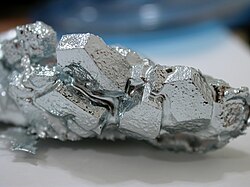 Gallium, a metal that easily forms large crystals.
 -
 An apatite crystal sits front and center on cherry-red rhodochroite rhombs, purple fluorite cubes, quartz and a dusting of brass-yellow pyrite cubes.
 -

-
 A specimen consisting of a bornite-coated chalcopyrite crystal nestled in a bed of clear quartz crystals and lustrous pyrite crystals. The bornite-coated crystal is up to 1.5 cm across.
 -

-
 Crystallized sugar. Crystals on the right were grown from a sugar cube, while the left from a single seed crystal taken from the right. Red dye was added to the solution when growing the larger crystal, but, insoluble with the solid sugar, all but small traces were forced to precipitate out as it grew.


See also
[edit]References
[edit]- ^ Stephen Lower. "Chem1 online textbook—States of matter". Retrieved 2016-09-19.
- ^ Ashcroft and Mermin (1976). Solid State Physics.
- ^ κρύσταλλος, Henry George Liddell, Robert Scott, A Greek-English Lexicon, on Perseus Digital Library
- ^ κρύος, Henry George Liddell, Robert Scott, A Greek-English Lexicon, on Perseus Digital Library
- ^ "crys·tal". The American Heritage Dictionary of the English Language. Retrieved 2023-06-17.
- ^ Regal, Brian. (2009). Pseudoscience: A Critical Encyclopedia. Greenwood. p. 51. ISBN 978-0-313-35507-3
- ^ Patti Wigington (31 August 2016). "Using Crystals and Gemstones in Magic". About.com. Archived from the original on 15 November 2016. Retrieved 14 November 2016.
- ^ "The Magic of Crystals and Gemstones". WitchesLore. 14 December 2011. Retrieved 14 November 2016.
- ^ Welberry, T. R, ed. (2021), International Tables for Crystallography, vol. A, Chester, England: International Union of Crystallography, doi:10.1107/97809553602060000001, ISBN 978-1-119-95235-0, S2CID 146060934
- ^ The surface science of metal oxides, by Victor E. Henrich, P. A. Cox, page 28, google books link
- ^ Sinkankas, John (1964). Mineralogy for amateurs. Princeton, N.J.: Van Nostrand. pp. 134–138. ISBN 0442276249.
{{cite book}}: CS1 maint: ignored ISBN errors (link) - ^ G. Cressey and I. F. Mercer, (1999) Crystals, London, Natural History Museum, page 58
- ^ One or more of the preceding sentences incorporates text from a publication now in the public domain: Flett, John Smith (1911). "Petrology". In Chisholm, Hugh (ed.). Encyclopædia Britannica. Vol. 21 (11th ed.). Cambridge University Press.
- ^ Yoshinori Furukawa, "Ice"; Matti Leppäranta, "Sea Ice"; D.P. Dobhal, "Glacier"; and other articles in Vijay P. Singh, Pratap Singh, and Umesh K. Haritashya, eds., Encyclopedia of Snow, Ice and Glaciers (Dordrecht, NE: Springer Science & Business Media, 2011). ISBN 904812641X, 9789048126415
- ^ Libbrecht, Kenneth; Wing, Rachel (2015-09-01). The Snowflake: Winter's Frozen Artistry. Voyageur Press. ISBN 9781627887335.
- ^ Hjorth-Hansen, E. (2017-10-19). Snow Engineering 2000: Recent Advances and Developments. Routledge. ISBN 9781351416238.
- ^ Nucleation of Water: From Fundamental Science to Atmospheric and Additional Applications by Ari Laaksonen, Jussi Malila -- Elsevier 2022 Page 239--240
- ^ Shea, Neil (November 2008). "Cave of Crystal Giants". National Geographic Magazine. Archived from the original on Dec 19, 2017.
- ^ Britain), Science Research Council (Great (1972). Report of the Council. H.M. Stationery Office.
- ^ Encyclopedia of the Solar System by Tilman Spohn, Doris Breuer, Torrence V. Johnson -- Elsevier 2014 Page 632
- ^ "12.5: Network Covalent Solids and Ionic Solids". Chemistry LibreTexts. 2015-01-18. Retrieved 2025-10-11.
- ^ Science for Conservators, Volume 3: Adhesives and Coatings by Museum and Galleries Commission -- Museum and Galleries Commission 2005 Page 57
- ^ International Union of Crystallography (1992). "Report of the Executive Committee for 1991". Acta Crystallogr. A. 48 (6): 922–946. Bibcode:1992AcCrA..48..922.. doi:10.1107/S0108767392008328. PMC 1826680.
- ^ Steurer W. (2004). "Twenty years of structure research on quasicrystals. Part I. Pentagonal, octagonal, decagonal and dodecagonal quasicrystals". Z. Kristallogr. 219 (7–2004): 391–446. Bibcode:2004ZK....219..391S. doi:10.1524/zkri.219.7.391.35643.
- ^ "The Nobel Prize in Chemistry 2011". Nobelprize.org. Retrieved 2011-12-29.

Further reading
[edit] Definitions from Wiktionary
 Media from Commons
 News from Wikinews
 Quotations from Wikiquote
 Texts from Wikisource
 Textbooks from Wikibooks
 Resources from Wikiversity


- Howard, J. Michael; Darcy Howard (Illustrator) (1998). "Introduction to Crystallography and Mineral Crystal Systems". Bob's Rock Shop. Archived from the original on 2006-08-26. Retrieved 2008-04-20.
- Krassmann, Thomas (2005–2008). "The Giant Crystal Project". Krassmann. Archived from the original on 2008-04-26. Retrieved 2008-04-20.
- "Teaching Pamphlets". Commission on Crystallographic Teaching. 2007. Archived from the original on 2008-04-17. Retrieved 2008-04-20.
- "Crystal Lattice Structures:Index by Space Group". 2004. Retrieved 2016-12-03.
- "Crystallography". Spanish National Research Council, Department of Crystallography. 2010. Retrieved 2010-01-08.
| Patterns | .jpg) | |
|---|---|---|
| Causes | ||
| People | ||
| Related | ||
| International | |
|---|---|
| National | |
| Other | |

Crystal
View on GrokipediaFundamentals
Definition and Characteristics
A crystal is a solid material whose constituents, such as atoms, molecules, or ions, are arranged in a highly ordered, repeating three-dimensional pattern that extends throughout the entire structure.[4] This arrangement, known as a crystal lattice, exhibits long-range translational symmetry, meaning the pattern repeats periodically in all directions without interruption.[5] Crystals form under conditions that allow sufficient time and stability for their components to organize into this precise configuration, often during cooling from a melt or precipitation from a solution.[1] Key characteristics of crystals include their periodicity, which leads to distinct physical behaviors such as the diffraction of X-rays or light into sharp patterns, enabling detailed structural analysis.[6] They typically exhibit sharp melting points due to the uniform energy required to disrupt the ordered lattice, as well as anisotropy in properties like thermal conductivity, electrical resistivity, and mechanical strength, where values vary depending on the direction relative to the lattice axes.[7] These traits arise from the long-range order, contrasting with the more random atomic placements in non-crystalline solids.[8] In distinction from amorphous materials like glass or certain polymers, crystals possess translational symmetry that propagates over large distances, whereas amorphous solids lack this repeating order, resulting in isotropic properties and gradual softening rather than a defined melting point.[9] Basic examples of crystals include sodium chloride (NaCl), commonly known as table salt, which forms cubic lattices; diamond, composed of carbon atoms in a tetrahedral network; and quartz, a silicon dioxide mineral with a trigonal structure.[10] These materials illustrate the diverse compositions possible within crystalline forms.Crystal Systems
Crystal systems represent the fundamental classification of crystalline materials based on their geometric symmetry and lattice parameters, which determine the overall arrangement of atoms in the solid lattice. These systems are defined by the lengths of the three crystallographic axes (a, b, c) and the angles between them (α between b and c, β between a and c, γ between a and b). The seven crystal systems—cubic, tetragonal, orthorhombic, hexagonal, trigonal (or rhombohedral), monoclinic, and triclinic—emerge from the possible combinations of these parameters that preserve translational symmetry while adhering to the constraints of crystallographic point group symmetries. This classification, rooted in the work of Auguste Bravais and others in the 19th century, provides a framework for understanding how symmetry influences physical properties such as optical behavior and mechanical strength.[11] Symmetry elements are the operations that leave the crystal lattice unchanged and are central to defining each system. These include axes of rotation (n-fold, where n=2, 3, 4, or 6, indicating rotations by 180°, 120°, 90°, or 60° that map the lattice onto itself), mirror planes (reflections across planes that preserve the structure), and inversion centers (points through which every lattice point has a corresponding point at equal distance in the opposite direction). For instance, the cubic system exhibits the highest symmetry with four threefold rotation axes, multiple mirror planes, and an inversion center, while the triclinic system has none of these elements. These symmetries restrict the possible lattice configurations and are quantified through the 32 crystallographic point groups, which further subdivide the systems. Within these seven systems, there are 14 distinct Bravais lattices, which describe the unique ways lattice points can be arranged while maintaining the system's symmetry; these include primitive (P), body-centered (I), face-centered (F), and base-centered (C) variants. The distribution is as follows: three in cubic (P, I, F), two in tetragonal (P, I), four in orthorhombic (P, I, C, F), one in hexagonal (P), one in trigonal (R, rhombohedral), two in monoclinic (P, C), and one in triclinic (P). Representative examples illustrate these systems: sodium chloride (NaCl) adopts a face-centered cubic lattice with a = b = c and α = β = γ = 90°; graphite forms a hexagonal lattice with a = b ≠ c, α = β = 90°, and γ = 120°; and turquoise crystallizes in the triclinic system with a ≠ b ≠ c and α ≠ β ≠ γ ≠ 90°.[11][12][13][14]| Crystal System | Lattice Parameters | Key Symmetry Elements | Bravais Lattices | Example |
|---|---|---|---|---|
| Cubic | a = b = c, α = β = γ = 90° | Four 3-fold axes, mirror planes, inversion center | P, I, F | NaCl (face-centered cubic)[12] |
| Tetragonal | a = b ≠ c, α = β = γ = 90° | One 4-fold axis | P, I | White tin |
| Orthorhombic | a ≠ b ≠ c, α = β = γ = 90° | Three perpendicular 2-fold axes | P, I, C, F | Sulfur (orthorhombic) |
| Hexagonal | a = b ≠ c, α = β = 90°, γ = 120° | One 6-fold axis | P | Graphite[13] |
| Trigonal (Rhombohedral) | a = b = c, α = β = γ ≠ 90° | One 3-fold axis | R | Calcite |
| Monoclinic | a ≠ b ≠ c, α = γ = 90° ≠ β | One 2-fold axis | P, C | Gypsum |
| Triclinic | a ≠ b ≠ c, α ≠ β ≠ γ ≠ 90° | None | P | Turquoise[14] |
Microscopic Structure
Atomic Arrangement
In crystals, atoms or molecules are organized in a periodic arrangement that exhibits translational invariance, meaning the structure repeats indefinitely in three dimensions through identical repeating units known as the crystal lattice. This periodicity arises from the regular spacing of lattice points, where each point represents a position equivalent to all others by translation vectors, forming an infinite array that defines the crystal's microscopic order. Such arrangements ensure that the positions of constituent particles are predictable and symmetric, distinguishing crystalline solids from amorphous materials.[15] The coordination and packing of atoms within this lattice vary depending on the bonding type and atomic sizes. In metallic crystals, atoms often adopt close-packed structures to maximize density and bonding efficiency, such as face-centered cubic (FCC) or hexagonal close-packed (HCP) arrangements, where each atom is surrounded by 12 nearest neighbors, achieving a packing efficiency of about 74%. For example, copper exhibits an FCC structure, while magnesium forms HCP. In contrast, ionic crystals typically feature more open structures due to the need to balance electrostatic attractions between cations and anions, resulting in lower packing densities; common examples include the rock salt (NaCl) structure with octahedral coordination or the zinc blende structure with tetrahedral coordination.[16][17][18] A key aspect of atomic arrangement is the motif or basis, which describes the specific grouping of atoms or ions positioned relative to each lattice point. The motif can consist of a single atom in simple elemental crystals or multiple atoms in compounds, determining the overall symmetry and properties of the structure. For instance, in a primitive lattice, the basis might place atoms at the lattice point and offset positions, ensuring the repeating unit captures the full atomic configuration. This combination of lattice and basis generates the complete crystal structure, influenced by the seven crystal systems that dictate the lattice geometry.[19][20] Visualizations of these arrangements often employ ball-and-stick models to illustrate bonding and spatial relationships. In diamond, carbon atoms form a tetrahedral motif with each atom bonded to four others at 109.5° angles, creating a rigid, three-dimensional network that exemplifies covalent crystal packing. Similarly, the perovskite structure, common in compounds like CaTiO₃, features a basis of a large cation (A-site) at the cube corners, a smaller cation (B-site) at the body center, and anions (X) at the face centers, forming corner-sharing octahedra that highlight the layered ionic coordination.[21][22]Unit Cell and Lattice
The unit cell represents the smallest repeating unit that, when translated throughout space via lattice vectors, generates the entire crystal lattice. It is defined as the parallelepiped formed by the basis vectors , , and of the direct lattice, encapsulating the periodic arrangement of atoms or molecules in the crystal.[23] The choice of unit cell is not unique; a primitive unit cell contains exactly one lattice point and is constructed from a primitive basis, where every lattice vector can be expressed as an integer linear combination of the basis vectors, ensuring minimal volume while tiling space without overlap or gaps.[24] In contrast, a conventional unit cell aligns edges parallel to principal symmetry directions and may include additional lattice points at face centers or the body center, resulting in a multiple cell with volume equal to an integer multiple of the primitive cell; this choice facilitates symmetry description but is non-primitive.[25][23] Lattice parameters quantify the geometry of the unit cell, consisting of edge lengths , , and interaxial angles (between and ), (between and ), (between and ). The volume of the unit cell is given by which derives from the scalar triple product and accounts for the parallelepiped's obliqueness in the general triclinic case. For higher-symmetry systems, this simplifies; for example, in cubic lattices where and , . The interplanar spacing , the perpendicular distance between parallel lattice planes, is calculated as where the angular terms arise from the metric tensor of the lattice, ensuring applicability across crystal systems; in orthogonal cases like cubic, the angular terms vanish, yielding .[26] The reciprocal lattice provides a mathematical transform of the direct lattice, essential for analyzing diffraction patterns where wave vectors interact with the periodic structure. Its basis vectors are defined as with the direct lattice volume, ensuring , , etc., and the reciprocal volume .[27] This construction maps planes in direct space to points in reciprocal space, facilitating interpretations of scattering phenomena in X-ray, electron, or neutron diffraction.[27] Miller indices offer a standardized notation for specifying lattice planes and directions within the unit cell. A plane intersecting the axes at fractions , , of the lattice parameters , , is denoted by the triplet , where , , are the smallest integers proportional to the reciprocals of the intercepts, cleared of fractions and reduced to lowest terms; negative indices are barred, e.g., ().[28] The notation denotes a crystal form, comprising all symmetry-equivalent planes related by the lattice's point group, such as for the set of faces perpendicular to the axes in cubic systems.[28] This system adheres to the law of rational indices, ensuring indices reflect the rational ratios inherent to periodic lattices.[28]Macroscopic Features
Crystal Faces and Forms
Crystal faces are the flat, planar surfaces that bound a crystal, typically meeting at straight edges and often displaying characteristic angles determined by the crystal's internal symmetry. These faces arise from the ordered arrangement of atoms and represent the external manifestation of lattice planes within the crystal structure.[29] The orientation and identity of each face are precisely described using Miller indices, a notation system consisting of three integers (hkl) that are the reciprocals of the face's intercepts on the crystallographic axes, reduced to the smallest integers with no common divisor.[30] For instance, a face parallel to the b- and c-axes but intercepting the a-axis at one unit length has Miller indices (100). Crystallographic forms refer to sets of faces that are equivalent by symmetry within a given crystal class, denoted by enclosing the Miller indices in braces {hkl}. These forms are closed sets that, when combined, can generate the full symmetry of the crystal. A classic example is the octahedron in the cubic crystal system, represented as {111}, which consists of eight equilateral triangular faces oriented such that each intercepts all three axes at equal distances.[29] The development of specific forms is governed by the crystal's point group symmetry, ensuring that all faces in a form are indistinguishable except for their position.[31] Common types of face development include pinacoids, prisms, and pyramids, each characterized by their geometric configuration and relation to the crystal axes. A pinacoid is the simplest form, comprising two parallel faces perpendicular to one of the crystallographic axes, such as the basal pinacoid {001} that caps the ends of prismatic crystals.[29] Prisms consist of three or more lateral faces parallel to the principal crystal axis, forming elongated sides; for example, a tetragonal prism {100} has four rectangular faces.[32] Pyramids involve three or more faces that converge at an apex, inclined to the principal axis, like the trigonal pyramid {111} with three triangular faces meeting at a point.[32] These forms can be open (requiring another form to close the crystal) or closed, and their prominence depends on growth kinetics and environmental factors during crystallization.[33] Zoning and striations on crystal faces provide evidence of fluctuating growth conditions, such as variations in temperature, composition, or supersaturation during formation. Zoning appears as concentric bands or color variations parallel to the face, reflecting compositional changes over time as the crystal grows outward from the core.[34] Striations, manifested as fine linear features or growth lines on the face, often result from oscillatory processes like periodic twinning or interruptions in growth due to impurities or pressure changes.[35] These surface features are diagnostic of non-equilibrium conditions and can be observed through optical or scanning electron microscopy.[36]Habits and Growth Shapes
Crystal habit refers to the characteristic external shape or appearance of a mineral crystal or aggregate of crystals, which arises from the interplay between the mineral's internal atomic structure and external growth conditions.[37] This habit can vary significantly, even for the same mineral, depending on the environment in which the crystal forms. Well-formed crystals, known as idiomorphic or euhedral, are bounded by their characteristic flat faces and exhibit sharp, symmetrical edges, allowing clear recognition of the underlying crystal system.[38] In contrast, anhedral crystals display irregular shapes lacking well-defined faces, often resulting from constrained growth in crowded or rapidly cooling environments like igneous rocks. Common crystal habits include euhedral prisms, which are elongated with parallel lateral faces, as seen in tourmaline where growth is dominant along one axis.[39] Dendritic habits feature branching, tree-like patterns formed by rapid, diffusion-limited growth in high-supersaturation conditions, such as in native copper deposits.[37] Skeletal and hopper crystals develop hollow or stepped interiors due to accelerated growth at edges and corners compared to face centers, exemplified by hopper halite in evaporite settings.[37] These habits reflect slight modifications to the underlying crystallographic forms but are primarily shaped by growth dynamics.[29] Several environmental factors influence crystal habit by differentially affecting the growth rates of crystal faces. Temperature modulates face-specific growth kinetics, with higher temperatures often favoring slower-growing, more stable faces and leading to blockier habits, as observed in sucrose crystals that elongate at 30°C but become more isometric at 40°C.[40] Pressure can induce concave surfaces on growing faces under excess load or promote flatness with reduced pressure, altering overall morphology.[41] The choice of solvent impacts habit through selective adsorption on faces, for instance, ethanol yielding pseudohexagonal tabular ibuprofen crystals while ethyl acetate produces thinner platelets.[40] Impurities further modify habits by adsorbing at growth sites like steps or kinks, slowing certain faces more than others; for example, trace Cr³⁺ ions increase step spacing on ammonium dihydrogen phosphate faces, promoting elongated habits.[41] Representative examples illustrate these variations: gypsum often forms acicular, needle-like habits in pure aqueous solutions due to rapid elongation along the c-axis, resulting in slender, fragile crystals.[42] Hematite, conversely, commonly exhibits tabular habits with flat, plate-like crystals, where growth is restricted perpendicular to the basal plane, forming thin, discoidal shapes in hydrothermal environments.[43]Natural Occurrence
In Rocks and Minerals
Minerals are naturally occurring inorganic solids with well-defined crystal structures, and over 6,000 species have been identified, many exhibiting crystalline forms essential to geological compositions.[44] For instance, quartz, with the chemical formula SiO₂, crystallizes in the hexagonal system and is one of the most abundant minerals in the Earth's crust.[45] Feldspars, comprising a major group of framework silicates, form three-dimensional networks of linked silicate tetrahedra and are primary constituents in many rocks.[46] In igneous rocks, crystals often appear as phenocrysts—larger embedded crystals within a finer matrix—such as olivine in basalt, where these magnesium-iron silicates form early during magma cooling.[47] Pegmatites, coarse-grained igneous intrusions, host exceptionally large crystals due to slow cooling and volatile enrichment, including tourmaline crystals up to nearly a meter long in exceptional cases.[48] Sedimentary rocks feature crystals in evaporites, formed by precipitation from concentrated brines, with halite (NaCl) being a classic cubic example in deposits like those of the Permian Basin.[49] In metamorphic rocks, quartz veins develop through fluid infiltration and recrystallization under heat and pressure, filling fractures in host rocks like schist or gneiss.[50] Crystals in rocks hold significant economic value; diamond, a cubic carbon polymorph, serves as a premier gemstone, contributing billions to global trade through mining in regions like Botswana.[51] Similarly, galena (PbS), the chief ore of lead, supplies the metal for batteries and alloys, with major deposits mined worldwide.[52] Diamond and graphite exemplify mineral polymorphism, sharing the composition carbon but differing in structure and properties.[53]Biological Crystals
Biological crystals form through biomineralization processes in living organisms, where organic matrices guide the deposition of inorganic minerals to create functional structures. In mollusks, such as mussels, the outer prismatic layer consists of calcite crystals arranged as long, slender fibers approximately 1–2 μm wide and hundreds of μm long, while the inner nacreous layer features aragonite tablets that are 200–500 nm thick, tightly packed with organic bridges for enhanced toughness.[54] These polymorphs of calcium carbonate are biologically controlled, resulting in species-specific morphologies that provide mechanical protection for the shell.[54] In vertebrates, hydroxyapatite (Ca₁₀(PO₄)₆(OH)₂) crystals dominate bone and tooth composition, accounting for 65–70% of bone by weight, about 70% of dentin, and approximately 96% of enamel by weight.[55] These plate- or needle-shaped nanocrystals, typically 40–60 nm long and 20 nm wide in bone, form within type-I collagen fibrils through nucleation from amorphous calcium phosphate precursors, oriented parallel to the fibrils for optimal strength.[56] In teeth, enamel hydroxyapatite crystals, lacking collagen, grow to 160–1000 nm in length within an amelogenin protein framework, enabling remineralization and hardness.[57] Organigenic crystals arise pathologically from supersaturated bodily fluids, contrasting with functional biomineralization. Uric acid crystals precipitate in acidic urine (pH <5.5) with high urate concentrations (>800 mg/day in males), forming stones that comprise about 10% of urinary calculi and cause obstruction.[58] Similarly, cholesterol crystals nucleate in supersaturated gallbladder bile, often promoted by mucin glycoproteins, leading to gallstones in up to 80% of cases in developed countries.[59] Ice crystals exemplify abiotic yet environmentally influenced biological contexts, adopting a hexagonal lattice due to water molecule geometry, which imparts sixfold symmetry to snowflakes starting as small prisms (0.1 mm).[60] Under high humidity and rapid growth, dendritic branching occurs via instability at prism faces, producing fernlike structures up to 10 mm with sidebranches at 60° angles; this pattern also manifests in frost on surfaces.[61] Functional biological crystals include otoliths in fish, which are calcium carbonate bio-crystals (primarily aragonite, with calcite or vaterite polymorphs) that sense linear acceleration and gravity for balance and hearing by coupling to sensory hair cells.[62][63] In bacteria, magnetosomes consist of magnetite (Fe₃O₄) or greigite (Fe₃S₄) crystals arranged in chains within membrane vesicles, enabling magnetotaxis along geomagnetic fields to optimize microoxic environments.[64] These examples highlight crystals' dual roles in physiology versus pathology, distinct from abiotic geological formations.Polymorphism
Polymorphic Transitions
Polymorphism in crystals refers to the ability of a compound to adopt multiple distinct crystal structures, or polymorphs, despite having the same chemical composition, resulting from different atomic or molecular arrangements.[65] These polymorphs often exhibit significantly different physical properties, such as density, hardness, and reactivity, due to variations in packing efficiency and bonding interactions.[65] A well-known example is carbon, which forms diamond with a rigid cubic lattice and graphite with a layered hexagonal structure, illustrating how polymorphism arises from alternative bonding configurations.[66] Polymorphic transitions describe the structural changes between these forms, typically driven by external factors like temperature or pressure, and are classified thermodynamically as enantiotropic or monotropic.[67] In enantiotropic transitions, the polymorphs are reversibly interconvertible, with stability alternating based on temperature; below the transition point, the low-temperature polymorph has lower free energy, while above it, the high-temperature form is favored.[68] This reversibility stems from a finite transition temperature where the Gibbs free energies of the two phases are equal.[67] Quartz provides a classic enantiotropic example, undergoing a displacive transition from the trigonal α-quartz to the hexagonal β-quartz at 573°C under ambient pressure, with the change involving rotation of SiO₄ tetrahedra without bond breaking.[69] Monotropic transitions, in contrast, are irreversible under normal conditions, as one polymorph remains thermodynamically stable across all accessible temperatures and pressures, rendering the other metastable.[67] The metastable form can persist kinetically but will eventually convert to the stable one upon sufficient activation, such as heating.[68] In titanium dioxide (TiO₂), the tetragonal anatase phase transforms monotropically to the more stable rutile phase at temperatures above approximately 600°C, involving reconstruction of the octahedral TiO₆ units and accompanied by a density increase.[70] Similarly, in carbonates, aragonite (orthorhombic) converts irreversibly to the rhombohedral calcite form, which is denser and stable at Earth's surface conditions, a process relevant to biomineralization and sedimentary geology.[71] The conditions governing these transitions are mapped in pressure-temperature (P-T) phase diagrams, which delineate stability fields for each polymorph based on Gibbs free energy minimization.[72] For enantiotropic systems, the phase boundary appears as a curve or line in P-T space, often with a slope determined by the Clapeyron equation, reflecting differences in molar volume (ΔV) and entropy (ΔS) between phases; a positive slope indicates the high-temperature phase has larger volume.[72] In monotropic cases, no equilibrium boundary exists within practical P-T ranges, as the metastable phase's stability field is confined to inaccessible regions, such as extreme pressures.[73] These diagrams, derived from experimental data or computational predictions, are essential for predicting transition behavior in materials synthesis and natural processes.[74]Allotropy in Elements
Allotropy is the phenomenon where a chemical element exists in two or more distinct crystalline forms, known as allotropes, in the same physical state, typically the solid phase, each with different physical and chemical properties due to variations in atomic arrangement.[75] This structural diversity arises without changes in chemical composition, allowing elements to adapt to different thermodynamic conditions.[76] A prominent example is carbon, which forms diamond with a rigid three-dimensional tetrahedral network in a cubic lattice, graphite with stacked layers of hexagonal rings in a hexagonal structure, and fullerenes such as C60 buckyballs that create closed molecular cages.[77] Diamond's dense packing makes it the hardest known material, while graphite's layered structure imparts lubricity and electrical conductivity. Phosphorus also demonstrates allotropy, with white phosphorus consisting of discrete P4 tetrahedral molecules that are highly reactive and phosphorescent, red phosphorus as a polymeric amorphous solid less reactive than its white counterpart, and black phosphorus featuring a puckered layered orthorhombic lattice similar to graphite but with semiconducting properties.[78] Black phosphorus is the most thermodynamically stable allotrope under ambient conditions. Iron exhibits temperature-dependent allotropy critical to metallurgy, with α-ferrite adopting a body-centered cubic (BCC) structure stable below 912°C, γ-austenite a face-centered cubic (FCC) form between 912°C and 1394°C that enables greater solubility of carbon for steel alloying, and δ-ferrite reverting to BCC above 1394°C until melting.[79] These phase transitions, occurring at specific temperatures, underpin heat treatment processes like annealing and quenching in steel production to achieve desired mechanical properties. Sulfur displays allotropy with rhombic sulfur, the stable form at room temperature featuring crown-shaped S8 rings in an orthorhombic lattice, monoclinic sulfur with similar S8 units but in a different packing stable from 95.5°C to 119°C, and plastic sulfur as a viscoelastic amorphous polymer of long chains formed by rapid cooling of molten sulfur.[80] The prevalence and stability of allotropes are governed by thermodynamic factors, particularly differences in enthalpy (internal energy contributions from bonding) and entropy (disorder from atomic vibrations and configurations), which determine the Gibbs free energy minimum at a given temperature and pressure.[81] For instance, graphite's higher entropy from its loosely bound layers favors its stability over diamond at standard conditions, despite diamond's lower enthalpy from stronger bonds, while pressure shifts the balance toward diamond.[82] In phosphorus, black phosphorus's lower enthalpy and suitable entropy make it the stable allotrope, contrasting with the metastable white form.[83] These drivers explain reversible transitions, such as sulfur's rhombic-to-monoclinic shift at 95.5°C, where entropy gains outweigh enthalpy changes.[84]Formation
Crystallization Processes
Crystallization processes involve the formation of ordered crystal structures from disordered phases such as solutions, melts, or vapors, driven primarily by supersaturation or supercooling, which creates a thermodynamic imbalance favoring the solid phase.[85] Supersaturation occurs when the concentration of the solute exceeds its equilibrium solubility, often induced by cooling, evaporation, or addition of antisolvents, while supercooling refers to undercooling a melt below its freezing point without solidification.[86] These conditions provide the necessary driving force by increasing the chemical potential difference between the parent phase and the emerging crystal lattice.[87] The process typically unfolds in three main stages: preparation of the supersaturated or supercooled system, initiation through nucleation, and propagation via crystal growth. In the preparation stage, a solution or melt is conditioned to achieve the desired supersaturation level, such as by dissolving a solute in a solvent at elevated temperature. Initiation begins with the spontaneous formation of small crystal clusters, marking the onset of ordering, while propagation involves the attachment of molecules to these nuclei, extending the lattice until macroscopic crystals form.[88] Common methods to induce crystallization include slow cooling, where gradual temperature reduction promotes controlled supersaturation and larger crystal sizes; evaporation, which concentrates the solute by removing solvent vapor; precipitation, achieved by mixing solutions to rapidly generate supersaturation through chemical reaction or antisolvent addition; and sublimation, a vapor-phase technique where a solid sublimes to gas and redeposits as crystals under reduced pressure, ideal for thermally stable, volatile compounds.[89] These methods are selected based on the material's properties, with slow cooling and evaporation often yielding higher purity in solution-based systems.[90] The kinetics of crystallization are fundamentally described by classical nucleation theory (CNT), which posits that nucleation arises from statistical fluctuations forming transient clusters in the supersaturated phase. Developed from Gibbs' thermodynamic framework in the late 19th century and formalized by Volmer and Weber in 1926, followed by Becker and Döring in 1935, CNT emphasizes the competition between bulk free energy gain, which stabilizes growing clusters, and surface energy penalty, which favors dissolution of subcritical sizes.[87] Only clusters exceeding a critical radius—determined by the degree of supersaturation—persist and grow, with the nucleation rate exponentially dependent on this energy barrier. This theory provides a foundational understanding of how process parameters like temperature and concentration influence the balance between nucleation and growth rates, though it assumes macroscopic properties for nanoscale clusters.[91]Nucleation and Growth
Nucleation is the initial stage of crystal formation, where small aggregates of atoms or molecules, known as nuclei, emerge from a supersaturated or supercooled parent phase, such as a melt, solution, or vapor. This process is governed by classical nucleation theory (CNT), originally formulated by J. Willard Gibbs, which posits that nucleation involves overcoming a free energy barrier arising from the competition between the favorable bulk free energy gain and the unfavorable interfacial energy cost. In homogeneous nucleation, which occurs spontaneously within a pure phase without external aids, the formation of a stable nucleus requires significant supersaturation to surmount this barrier, making it relatively rare under typical conditions. The free energy change for forming a spherical nucleus of radius is given by where is the bulk free energy change per unit volume (negative under supersaturation) and is the interfacial energy per unit area. The critical nucleus size corresponds to the maximum of this function, yielding the critical radius (or equivalently ), beyond which the cluster grows spontaneously.[92] Heterogeneous nucleation, by contrast, is far more common and initiates at preferential sites such as container walls, impurities, or existing crystal surfaces, which reduce the energy barrier by providing a lower-energy interface for nucleus attachment. The critical radius remains the same as in the homogeneous case, but the activation energy is diminished by a geometric factor depending on the wetting angle between the nucleus and the substrate, typically expressed as , where for partial wetting. This mechanism dominates natural and industrial crystallization processes due to its lower supersaturation requirement.[93] Once a supercritical nucleus forms, crystal growth proceeds by the addition of material to the nucleus surface. Growth modes are classified based on the balance between adatom-substrate and adatom-adatom interactions. In the layer-by-layer or Frank-van der Merwe mode, strong adhesion to the substrate promotes two-dimensional wetting and epitaxial layer growth, ideal for coherent thin films. Conversely, the island or Volmer-Weber mode occurs when adatom-adatom bonds are stronger, leading to three-dimensional clustering and island formation to minimize energy. A mixed Stranski-Krastanov mode combines initial layer growth followed by islanding due to strain buildup. These modes, first systematically described in early epitaxial studies, determine the morphology and quality of the resulting crystal. Crystal growth can be limited by either diffusion of material to the interface or by the kinetics of attachment at the interface itself. Diffusion-limited growth, prevalent in solutions or melts at high supersaturation, is controlled by the transport rate of solute or heat through the boundary layer, resulting in dendritic or irregular shapes as predicted by models like the Ivantsov solution. Interface-limited growth, dominant at low supersaturation, depends on the activation barriers for atom incorporation, often yielding faceted crystals with rates proportional to supersaturation. The Burton-Cabrera-Frank (BCF) theory integrates these aspects by modeling step flow on vicinal surfaces.[94] A key insight from BCF theory is the role of screw dislocations in enabling continuous growth at low driving forces, where flat faces would otherwise be stable. Screw dislocations introduce permanent atomic steps that serve as self-perpetuating sources for growth spirals, with the step velocity and spiral pitch determined by diffusion fields around the dislocation core. This spiral growth mechanism explains observed polygonal hillocks and parabolic growth rates on low-index faces, providing a foundational model for defect-mediated crystallization.[95]Imperfections
Crystal Defects
Crystal defects refer to deviations from the ideal, periodic arrangement of atoms in a crystal lattice, arising due to thermal vibrations, processing conditions, or external influences during formation. These imperfections are categorized by their dimensionality—point, line, plane, and volume—and occur even in the purest crystals, influencing atomic diffusion, mechanical behavior, and electronic properties without altering the overall lattice symmetry. While perfect crystals are theoretically possible at absolute zero, real crystals contain defects at finite temperatures, with their concentrations governed by thermodynamic equilibrium.[96]Point Defects
Point defects are zero-dimensional imperfections confined to individual atomic sites, representing the simplest disruptions to lattice order. A vacancy forms when an atom or ion is absent from its regular lattice position, often created by thermal excitation where atoms migrate to the surface or grain boundaries. Self-interstitials occur when an atom occupies a position between regular lattice sites, causing significant local strain due to the compressed surrounding lattice. In ionic crystals, Schottky defects maintain charge neutrality through a pair of cation and anion vacancies, typically requiring energies around 2 eV per pair for formation.[97] Frenkel defects, also prevalent in ionic materials, involve the displacement of an ion to an interstitial site, generating a vacancy-interstitial pair without net mass change, with formation energies often lower than for isolated defects due to the paired nature. The equilibrium concentration of these point defects follows the Boltzmann distribution, given bywhere is the defect formation energy, is the Boltzmann constant, and is the absolute temperature; for example, in copper at 1000°C, eV yields a vacancy concentration of about relative to lattice sites.[96][98][99]