



Community hub
Recent from talks
Contribute something
Nothing was collected or created yet.
Habsburg monarchy
View on WikipediaThe Habsburg monarchy,[i] also known as Habsburg Empire, or Habsburg Realm[j] (/ˈhæpsbɜːrɡ/), was the collection of empires, kingdoms, duchies, counties and other polities (composite monarchy) that were ruled by the House of Habsburg. From the 18th century it is also referred to as the Austrian monarchy, the Austrian Empire (Latin: Monarchia Austriaca) or the Danubian monarchy.[k][2]
Key Information


.svg)


The history of the Habsburg monarchy can be traced back to the election of Rudolf I as King of Germany in 1273[2] and his acquisition of the Duchy of Austria for the Habsburgs in 1282. In 1482, Maximilian I acquired the Netherlands through marriage. Both realms passed to his grandson and successor, Charles V, who also inherited the Spanish throne and its colonial possessions, and thus came to rule the Habsburg empire at its greatest territorial extent. The abdication of Charles V in 1556 led to a division within the dynasty between his son Philip II of Spain and his brother Ferdinand I, who had served as his lieutenant and the elected king of Hungary, Croatia and Bohemia. The Spanish branch (which held all of Iberia, the Netherlands, and lands in Italy) became extinct in the male line in 1700, but continued through the female line through the House of Bourbon. The Austrian branch (which ruled the Holy Roman Empire, Hungary, Bohemia and various other lands) was itself split into different branches in 1564 but reunited 101 years later. It became extinct in the male line in 1740, but continued through the female line as the House of Habsburg-Lorraine.
The Habsburg monarchy was a union of crowns, with only partial shared laws and institutions other than the Habsburg court itself; the provinces were divided in three groups: the Archduchy proper, Inner Austria that included Styria and Carniola, and Further Austria with Tyrol and the Swabian lands. The territorial possessions of the monarchy were thus united only by virtue of a common monarch. The Habsburg realms were unified in 1804 with the formation of the Austrian Empire and later split in two with the Austro-Hungarian Compromise of 1867. The monarchy began to fracture in the face of inevitable defeat during the final years of World War I and ultimately disbanded with the proclamation of the Republic of German-Austria and the First Hungarian Republic in late 1918.[3][4]
In historiography, the terms "Austria" or "Austrians" are frequently used as shorthand for the Habsburg monarchy since the 18th century. From 1438 to 1806, the rulers of the House of Habsburg almost continuously reigned as Holy Roman Emperors. However, the realms of the Holy Roman Empire were mostly self-governing and are thus not considered to have been part of the Habsburg monarchy. Hence, the Habsburg monarchy (of the Austrian branch) is often called "Austria" by metonymy. Around 1700, the Latin term monarchia austriaca came into use as a term of convenience.[5] Within the empire alone, the vast possessions included the original Hereditary Lands, the Erblande, from before 1526; the Lands of the Bohemian Crown; the formerly Spanish Austrian Netherlands from 1714 until 1794; and some fiefs in Imperial Italy. Outside the empire, they encompassed all the Kingdom of Hungary as well as conquests made at the expense of the Ottoman Empire. The dynastic capital was Vienna, except from 1583 to 1611, when it was in Prague.[6]
Origins and expansion
[edit]
The first Habsburg who can be reliably traced was Radbot of Klettgau, who was born in the late 10th century; the family name originated with Habsburg Castle, in present-day Switzerland, which was built by Radbot.[7] After 1279, the Habsburgs came to rule in the Duchy of Austria, which was part of the elective Kingdom of Germany within the Holy Roman Empire. King Rudolf I of Germany of the Habsburg family assigned the Duchy of Austria to his sons at the Diet of Augsburg (1282), thus establishing the "Austrian hereditary lands". From that moment, the Habsburg dynasty was also known as the House of Austria. Between 1438 and 1806, with few exceptions, the Habsburg Archduke of Austria was elected as Holy Roman Emperor.
The Habsburgs grew to European prominence as a result of the dynastic policy pursued by Maximilian I, Holy Roman Emperor. Maximilian married Mary of Burgundy, thus bringing the Burgundian Netherlands into the Habsburg possessions. Their son, Philip the Handsome, married Joanna the Mad of Spain (daughter of Ferdinand II of Aragon and Isabella I of Castile). Charles V, Holy Roman Emperor, the son of Philip and Joanna, inherited the Habsburg Netherlands in 1506, Habsburg Spain and its territories in 1516, and Habsburg Austria in 1519.
At this point, the Habsburg possessions were so vast that Charles V was constantly travelling throughout his dominions and therefore needed deputies and regents, such as Isabella of Portugal in Spain and Margaret of Austria in the Low Countries, to govern his various realms. At the Diet of Worms in 1521, Emperor Charles V came to terms with his younger brother Ferdinand. According to the Habsburg compact of Worms (1521), confirmed a year later in Brussels, Ferdinand was made Archduke, as a regent of Charles V in the Austrian hereditary lands.[8][9]
Following the death of Louis II of Hungary in the Battle of Mohács against the Ottoman Turks, Archduke Ferdinand (who was his brother-in-law by virtue of an adoption treaty signed by Maximilian and Vladislaus II, Louis's father at the First Congress of Vienna) was also elected the next king of Bohemia and Hungary in 1526.[10][6] Bohemia and Hungary became hereditary Habsburg domains only in the 17th century: Following victory in the Battle of White Mountain (1620) over the Bohemian rebels, Ferdinand II promulgated a Renewed Land Ordinance (1627/1628) that established hereditary succession over Bohemia. Following the Battle of Mohács (1687), in which Leopold I reconquered almost all of Ottoman Hungary from the Turks, the emperor held a diet in Pressburg to establish hereditary succession in the Hungarian kingdom.

Charles V divided the House in 1556 by ceding Austria along with the Imperial crown to Ferdinand (as decided at the Imperial election, 1531), and the Spanish Empire to his son Philip. The Spanish branch (which also held the Netherlands, the Kingdom of Portugal between 1580 and 1640, and the Mezzogiorno of Italy) became extinct in 1700. The Austrian branch (which also ruled the Holy Roman Empire, Hungary and Bohemia) was itself divided between different branches of the family from 1564 until 1665, but thereafter it remained a single personal union. It became extinct in the male line in 1740, but through the marriage of Queen Maria Theresa with Francis of Lorraine, the dynasty continued as the House of Habsburg-Lorraine.
Names
[edit]- Habsburg monarchy (German Habsburgermonarchie): this is an unofficial umbrella term, very frequently used, but was not an official name.
- Austrian monarchy (Latin: monarchia austriaca) came into use around 1700 as a term of convenience for the Habsburg territories.[5]
- "Danubian monarchy" (German: Donaumonarchie) was an unofficial name often used contemporaneously.
- "Dual monarchy" (German: Doppel-Monarchie) referred to the combination of Cisleithania and the Transleithania, two states under one crowned ruler.
- Austrian Empire (German: Kaisertum Österreich): This was the official name of the new Habsburg empire created in 1804, immediately prior to the Holy Roman Empire being dissolved in 1806. In this context, the English word empire refers to a territory ruled by an emperor, and not to a "widespreading domain".
- Austria-Hungary (German: Österreich-Ungarn), 1867–1918: This name was commonly used in international relations, although the official name was Austro-Hungarian Monarchy (German: Österreichisch-Ungarische Monarchie).[11][12][13][14]
- Crownlands or crown lands (Kronländer) (1849–1918): This is the name of all the individual parts of the Austrian Empire (1849–1867), and then of Austria-Hungary from 1867 on. The Kingdom of Hungary (more exactly the Lands of the Hungarian Crown) was not considered a "crownland" anymore after the establishment of Austria-Hungary in 1867, so that the "crownlands" became identical with what was called the Kingdoms and Lands represented in the Imperial Council (Die im Reichsrate vertretenen Königreiche und Länder).
- The Hungarian parts of the empire were called "Lands of the Crown of Saint Stephen" or "Lands of Holy (St.) Stephen's Crown" (Länder der Heiligen Stephans Krone). The Bohemian (Czech) Lands were called "Lands of the St. Wenceslaus' Crown" (Länder der Wenzels-Krone).
Names of some smaller territories:
- The Prince-Archbishopric of Salzburg finally became Austrian in 1816 after the Napoleonic wars; before that it was ruled by the prince-archbishops of Salzburg as a sovereign territory.
- The Prince-Bishopric of Trent and Prince-Bishopric of Brixen became Austrian in 1803 following the Treaty of Lunéville.
- Austria, historically, was split into "Austria above the Enns" and "Austria below the Enns" (the Enns river is the state-border between Upper- and Lower Austria). Upper Austria was enlarged after the Treaty of Teschen (1779) following the War of the Bavarian Succession by the so-called Innviertel ("Inn Quarter"), formerly part of Bavaria.
- Hereditary Lands (Erblande or Erbländer; mostly used Österreichische Erblande) or German Hereditary Lands (in the Austrian monarchy) or Austrian Hereditary Lands (Middle Ages – 1849/1918): In a narrower sense these were the "original" Habsburg territories, principally the Archduchy of Austria (Oesterreich), Duchy of Styria (Steiermark), Duchy of Carinthia (Kaernten), Duchy of Carniola (Krain), County of Tyrol (Tirol) and Vorarlberg. In a wider sense the Lands of the Bohemian Crown were also included (from 1526; definitively from 1620/27) in the Hereditary Lands. The term was replaced by the term "Crownlands" (see above) in the 1849 March Constitution, but it was also used afterwards.
The Erblande also included many small territories that were principalities, duchies or counties in other parts of the Holy Roman Empire, such as Further Austria.
Territories
[edit]

The territories ruled by the Austrian monarchy changed over the centuries, but the core always consisted of four blocs:
- The Hereditary Lands, which covered most of the modern states of Austria and Slovenia, as well as territories in northeastern Italy and (before 1797) southwestern Germany. To these were added in 1779 the Inn Quarter of Bavaria and in 1803 the Prince-Bishoprics of Trent and Brixen. The Napoleonic Wars caused disruptions where many parts of the Hereditary lands were lost, but all these, along with the former Prince-Archbishopric of Salzburg, which had previously been temporarily annexed between 1805 and 1809, were recovered at the Congress of Vienna 1815, with the exception of Further Austria. The Hereditary provinces included:
- Archduchy of Austria
- Inner Austria
- Duchy of Styria
- Duchy of Carinthia
- Duchy of Carniola
- The Imperial Free City of Trieste
- Margraviate of Istria (although much of Istria was Venetian territory until 1797)
- Princely County of Gorizia and Gradisca
- County of Tyrol (although the Bishoprics of Trent and Brixen dominated what would become the South Tyrol before 1803
- Duchy of Salzburg
- Further Austria, mostly ruled jointly with Tyrol.
- Vorarlberg (actually a collection of provinces, only united in the 19th century)
- The Vorlande, a group of territories in Breisgau and elsewhere in southwestern Germany lost in 1801 (although the Alsatian territories (Sundgau) which had formed a part of it had been lost as early as 1648)
- Grand Duchy of Salzburg (only after 1805)
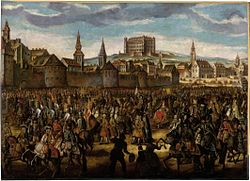
Coronation of Maria Theresa in Pressburg, Kingdom of Hungary, 1741
- The Lands of the Bohemian Crown. The Bohemian Diet elected Ferdinand, later Holy Roman Emperor Ferdinand I, as king in 1526. Initially consisting of the five lands:
- Kingdom of Bohemia
- Margraviate of Moravia
- Silesia, Most of Silesia was conquered by Prussia in 1740–1742 and the remnants which stayed under Habsburg sovereignty were ruled as Duchy of Upper and Lower Silesia (Austrian Silesia).
- Lusatia, was ceded to Saxony in 1635.
- The Kingdom of Hungary – two-thirds of the former territory that was administered by the medieval Kingdom of Hungary was conquered by the Ottoman Empire and the Princes of vassal Ottoman Transylvania, while the Habsburg administration was restricted to the western and northern territories of the former kingdom, which remained to be officially referred as the Kingdom of Hungary. In 1699, at the end of the Ottoman–Habsburg wars, one part of the territories that were administered by the former medieval Kingdom of Hungary came under Habsburg administration, with some other areas being acquired in 1718 (some of the territories that were part of medieval kingdom, notably those in the south of the Sava and Danube rivers, remained under Ottoman administration).
- Kingdom of Croatia
- Military Frontier


Over the course of its history, other lands were, at times, under Austrian Habsburg rule (some of these territories were secundogenitures, i.e. ruled by other lines of Habsburg dynasty):
- Serbia occupation (1686–1691)
- Kingdom of Slavonia (1699–1868)
- Duchy of Milan (1706–1797)
- Duchy of Mantua (1706–1797)
- Kingdom of Naples (1707–1735)
- Kingdom of Sardinia (1707–1720)
- State of the Presidi (1707–1733)
- Austrian Netherlands, consisting of most of modern Belgium and Luxembourg (1713–1795)
- Grand Principality of Transylvania, between 1699 (Treaty of Karlowitz) and 1867 (Austro-Hungarian Compromise of 1867)
- Kingdom of Serbia (1718–1739)
- Banat of Temeswar (1718–1778)
- Banat of Craiova (1718–1739 de facto, 1716–1737)
- Kingdom of Sicily (1720–1735)
- Duchy of Parma and Piacenza (1735–1748)
- Kingdom of Galicia and Lodomeria, in modern Poland and Ukraine (1772–1918)
- Duchy of Bukovina (1774–1918)
- Serbia occupation (1788–1791)
- West Galicia, the Polish lands, including Kraków, taken in the Third Partition (1795–1809)
- Venetia (1797–1805)
- Kingdom of Dalmatia (1797–1805, 1814–1918)
- Kingdom of Lombardy–Venetia (1814–1866)
- Grand Duchy of Kraków, which was incorporated into Galicia (1846–1918)
- Serbian Vojvodina (1848–1849) de facto entity, officially unrecognized
- Voivodeship of Serbia and Banat of Temeschwar (1849–1860)
- Kingdom of Croatia-Slavonia (1868–1918)
- Sanjak of Novi Pazar occupation (1878–1908)
- Austro-Hungarian rule in Bosnia and Herzegovina (1878–1918)
The boundaries of some of these territories varied over the period indicated, and others were ruled by a subordinate (secundogeniture) Habsburg line. The Habsburgs also held the title of Holy Roman Emperor between 1438 and 1740, and again from 1745 to 1806.
Characteristics
[edit]
Within the early modern Habsburg monarchy, each entity was governed according to its own particular customs. Until the mid-17th century, not all of the provinces were even necessarily ruled by the same person—junior members of the family often ruled portions of the Hereditary Lands as private apanages. Serious attempts at centralization began under Maria Theresa and especially her son Joseph II, Holy Roman Emperor in the mid to late 18th century, but many of these were abandoned following large scale resistance to Joseph's more radical reform attempts, although a more cautious policy of centralization continued during the revolutionary period and the Metternichian period that followed.
Another attempt at centralization began in 1849 following the suppression of the various revolutions of 1848. For the first time, ministers tried to transform the monarchy into a centralized bureaucratic state ruled from Vienna. The Kingdom of Hungary was placed under martial law, being divided into a series of military districts, and the Diet of Hungary was forced to dissolve after the revolution was suppressed by Austrian troops under the command of Julius Jacob von Haynau. Following the Habsburg defeats in the Second Italian War of Independence (1859) and Austro-Prussian War (1866), these policies were gradually abandoned.[16]
After experimentation in the early 1860s, the famous Austro-Hungarian Compromise of 1867 was arrived at, by which the so-called dual monarchy of Austria-Hungary was set up. In this system, the Kingdom of Hungary ("Lands of the Holy Hungarian Crown of St. Stephen.") was an equal sovereign with only a personal union and a joint foreign and military policy connecting it to the other Habsburg lands. Although the non-Hungarian Habsburg lands were referred to as "Austria", received their own central parliament (the Reichsrat, or Imperial Council) and ministries, as their official name – the "Kingdoms and Lands Represented in the Imperial Council". When Bosnia and Herzegovina was annexed (after 30 years of occupation and administration), it was not incorporated into either half of the monarchy. Instead, it was governed by the joint Ministry of Finance.
During the dissolution of Austria-Hungary, the Austrian territories collapsed under the weight of the various ethnic independence movements that came to the fore with its defeat in World War I. After its dissolution, the new republics of Austria (the German-Austrian territories of the Hereditary lands) and the First Hungarian Republic were created. In the peace settlement that followed, significant territories were ceded to Romania and Italy and the remainder of the monarchy's territory was shared out among the new states of Poland, the Kingdom of Serbs, Croats and Slovenes (later Yugoslavia), and Czechoslovakia.
Other lines
[edit]A junior line ruled over the Grand Duchy of Tuscany between 1765 and 1801, and again from 1814 to 1859. While exiled from Tuscany, this line ruled at Salzburg from 1803 to 1805, and in Grand Duchy of Würzburg from 1805 to 1814. The House of Austria-Este ruled the Duchy of Modena from 1814 to 1859, while Empress Marie Louise, Napoleon's second wife and the daughter of Austrian Emperor Francis I, ruled over the Duchy of Parma and Piacenza between 1814 and 1847. Also, the Second Mexican Empire, from 1863 to 1867, was headed by Maximilian I of Mexico, the brother of Emperor Franz Josef of Austria.
Rulers, 1508–1918
[edit]The so-called "Habsburg monarchs" or "Habsburg emperors" held many different titles and ruled each kingdom separately through a personal union.


- Frederick III (1452–1493)
- Maximilian I (1493–1519)
- Charles V (1519–1556)
- Ferdinand I (1556–1564)
- Maximilian II (1564–1576)
- Rudolf II (1576–1612)
- Matthias (1612–1619)
- Ferdinand II (1619–1637)
- Ferdinand III (1637–1657)
- Leopold I (1657–1705)
- Joseph I (1705–1711)
- Charles VI (1711–1740)
- Maria Theresa (1740–1780)
- Joseph II (1780–1790)
- Leopold II (1790–1792)
- Francis II (1792–1835)
- Ferdinand I (1835–1848)
- Francis Joseph I (1848–1916)
- Charles I (1916–1918)
Family tree
[edit]Male-line family tree
[edit]See also
[edit]References
[edit]Notes
[edit]- ^ First monarch as king of Germany.
- ^ First Holy Roman Emperor of the Habsburg dynasty.
- ^ Last monarch of a uniform House of Habsburg.
- ^ First ruler of the Spanish branch of a divided Habsburg dynasty.
- ^ First ruler of the Austrian branch of a divided Habsburg dynasty.
- ^ Last ruler of the Spanish branch.
- ^ Last Holy Roman Emperor and, as Francis I, first emperor of Austria.
- ^ Final monarch of the House of Habsburg.
- ^ German: Habsburgermonarchie, pronounced [ˈhaːpsbʊʁɡɐmonaʁˌçiː] ⓘ
- ^ German: Habsburgerreich [ˈhaːpsbʊʁɡɐˌʁaɪç] ⓘ
- ^ German: Donaumonarchie [ˈdoːnaʊmonaʁˌçiː] ⓘ
Citations
[edit]- ^ "Quando il 13 dicembre l'imperatore Francesco restituì a Venezia i suoi 4 cavalli" [On December 13, Emperor Francis returned the 4 Horses to Venice]. L'Indipendenza Nuova (in Italian). 13 December 2015. Archived from the original on 24 September 2021. The Austrian flag in Venice during the Habsburg rule.
- ^ a b c Lott, Elizabeth S.; Pavlac, Brian A., eds. (2019). "Rudolf I (r. 1273–1291)". The Holy Roman Empire: A Historical Encyclopedia. Vol. 1. Santa Barbara, California: ABC-Clio. pp. 266–268. ISBN 978-1-4408-4856-8. LCCN 2018048886. Archived from the original on 2022-11-07. Retrieved 2022-11-07.
- ^ Vienna website; "Austro-Hungarian Empire k.u.k. Monarchy dual-monarchic Habsburg Emperors of Austria". Archived from the original on 2011-11-23. Retrieved 2011-09-11.
- ^ Encyclopædia Britannica online article Austria-Hungary; https://www.britannica.com/EBchecked/topic/44386/Austria-Hungary Archived 2015-04-29 at the Wayback Machine
- ^ a b Hochedlinger 2013, p. 9.
- ^ a b "Czech Republic – Historic Centre of Prague (1992)" Heindorffhus, August 2007, HeindorffHus-Czech Archived 2007-03-20 at archive.today.
- ^ Rady 2020, pp. 12, 14–15
- ^ Kanski, Jack J. (2019). History of the German speaking nations. Troubador Publishing. ISBN 978-1789017182.
- ^ Pavlac, Brian A.; Lott, Elizabeth S. (2019). The Holy Roman Empire: A Historical Encyclopedia [2 volumes]. Abc-Clio. ISBN 978-1440848568.
- ^ "Ferdinand I". Encyclopædia Britannica. 9 June 2023. Archived from the original on 29 April 2015. Retrieved 21 June 2022.
- ^ Kotulla 2008, p. 485.
- ^ Simon Adams (2005). The Balkans. Black Rabbit Books. pp. 1974–. ISBN 978-1-58340-603-8.
- ^ Scott Lackey (1995). The Rebirth of the Habsburg Army: Friedrich Beck and the Rise of the General Staff. ABC-CLIO. pp. 166–. ISBN 978-0-313-03131-1.
- ^ Carl Cavanagh Hodge (2008). Encyclopedia of the Age of Imperialism, 1800–1914: A–K. Greenwood Publishing Group. pp. 59–. ISBN 978-0-313-33406-1.
- ^ Ströhl, Hugo Gerhard (1890). Oesterreichisch-Ungarische Wappenrolle: die Wappen ihrer K.u.k. Majestäten, die Wappen der durchlauchtigsten Herren Erzherzoge, die Staatswappen von Oesterreich und Ungarn, die Wappen der Kronländer und der ungarischen Comitate, die Flaggen, Fahnen und Cocarden beider Reichshälften, sowie das Wappen des souverainen Fürstenthumes [An Austro-Hungarian Roll of Arms] (in German).
- ^ Taylor, A.J.P. (1976). The Habsburg monarchy, 1809–1918: a history of the Austrian Empire and Austria-Hungary. University of Chicago Press.
Sources
[edit]- Hochedlinger, Michael (2013) [2003]. Austria's Wars of Emergence, 1683–1797. Abingdon: Routledge. ISBN 978-0-582-29084-6.
- Kotulla, Michael (2008). Deutsche Verfassungsgeschichte: Vom Alten Reich bis Weimar (1495–1934) (in German). Berlin: Springer. ISBN 978-3-540-48705-0.
- Rady, Martyn (2020). The Habsburgs: The Rise and Fall of a World Power. London: Allen Lane. ISBN 978-0-241-33262-7.
Further reading
[edit]- Bérenger, Jean (2013). A History of the Habsburg Empire, 1273–1700. Routledge.
- —— (2014). A History of the Habsburg Empire, 1700–1918. Routledge.
- Evans, Robert John Weston (1979). The Making of the Habsburg Monarchy, 1550–1700: An Interpretation. Oxford University Press. ISBN 0-1987-3085-3.
- —— (May 2020). "Remembering the Fall of the Habsburg Monarchy One Hundred Years on: Three Master Interpretations". Austrian History Yearbook. 51: 269–291. doi:10.1017/S0067237820000181. S2CID 216447628.
- Fichtner, Paula Sutter (2003). The Habsburg Monarchy, 1490–1848: Attributes of Empire, Palgrave Macmillan.
- Goleșteanu-Jacobs, Raluca (2023), Habsburg Galicia and the Romanian Kingdom Sociocultural Development, 1866–1914, Poland-Transnational Histories, Routledge
- Henderson, Nicholas. "Joseph II" History Today (Sept 1955) 5#9 pp. 613–621.
- Ingrao, Charles (1979). In Quest and Crisis: Emperor Joseph I and the Habsburg Monarchy. Purdue University Press. ISBN 978-0-9111-9853-9.
- —— (2000). The Habsburg Monarchy, 1618–1815. Cambridge University Press. ISBN 978-0-5213-8009-6.
- Judson, Pieter M. The Habsburg Empire: A New History (2016) excerpt Archived 2022-08-18 at the Wayback Machine
- Kann, Robert A. A History of the Habsburg Empire: 1526–1918 (University of California Press, 1974) online
- Lieven, Dominic. Empire: The Russian empire and its rivals (Yale University Press, 2002), comparisons with Russian, British, & Ottoman empires.
- Macartney, Carlile Aylmer (1969). The Habsburg Empire, 1790–1918. Macmillan.
- McCagg Jr., William O (1989). A History of the Habsburg Jews, 1670–1918 (Indiana University Press.
- Mitchell, A. Wess (2018). The Grand Strategy of the Habsburg Empire. Princeton University Press.
- Oakes, Elizabeth and Eric Roman (2003). Austria-Hungary and the Successor States: A Reference Guide from the Renaissance to the Present.
- Sked, Alan (1989). The Decline and Fall of the Habsburg Empire, 1815–1918. Longman.
- Stone, Norman. "The Last Days of the Habsburg Monarchy", History Today (Aug 1968), Vol. 18 Issue 8, pp. 551–560
- Steed, Henry Wickham; et al. (1914). A short history of Austria-Hungary and Poland. Encyclopaedia Britannica Company. p. 145.
- Taylor, A. J. P. (1964). The Habsburg monarchy, 1809–1918: a history of the Austrian Empire and Austria-Hungary (2nd ed.). Penguin Books.
External links
[edit]- Habsburg in an email discussion list dealing with the culture and history of the Habsburg Monarchy and its successor states in central Europe since 1500, with discussions, syllabi, book reviews, queries, conferences; edited daily by scholars since 1994.
| Authority control databases: National |
|---|

Habsburg monarchy
View on GrokipediaRooted in the family's acquisition of the Duchy of Austria in 1282, the monarchy expanded via marital alliances—epitomized by the adage Tu felix Austria nube (You, happy Austria, marry)—and opportunistic inheritances to encompass core lands including the Kingdoms of Bohemia, Hungary, and Croatia-Slavonia, alongside peripheral holdings in Italy, the Low Countries, and, temporarily, Spain through the senior branch until 1700.[3][4][5]
This composite polity, unbound by modern notions of national uniformity, sustained cohesion through Habsburg personal rule, feudal loyalties, and Catholic hegemony amid a mosaic of German, Magyar, Slavic, and Romance-speaking populations, enabling resilience against existential threats like Ottoman invasions that twice besieged Vienna in 1529 and 1683.[2][6]
Dynastic rulers, who monopolized the Holy Roman imperial throne from 1438 to 1806 barring brief interruptions, orchestrated Europe's balance of power, though chronic inbreeding eroded genetic vitality and administrative centralization efforts under absolutists like Maria Theresa (r. 1740–1780) and Joseph II (r. 1780–1790) provoked backlash from entrenched estates and ethnic particularisms.[7][2]
Napoleonic upheavals prompted the 1804 elevation to Austrian Empire and the 1867 Ausgleich forging the Austro-Hungarian dualist structure, yet mounting nationalist agitations among subject peoples, compounded by strategic missteps in the Balkans and alliance entanglements precipitating 1914's catastrophe, precipitated the monarchy's fragmentation into nascent nation-states.[8][6]
Terminology and Historiography
Names and Definitions
The Habsburg monarchy refers to the composite entity comprising the hereditary lands, kingdoms, and other territories ruled by the House of Habsburg through dynastic inheritance and personal union, spanning Central and parts of Southeastern Europe from the early 16th century until the dynasty's dissolution in 1918.[7] This structure lacked a unified constitutional framework or centralized administration, instead operating as a patchwork of semi-autonomous provinces bound by allegiance to the Habsburg sovereign, who held multiple crowns such as those of Austria, Bohemia, and Hungary.[3] The term "Habsburg monarchy" itself emerged retrospectively in historical scholarship to describe this dynastic agglomeration, reflecting its reliance on familial succession rather than elective or contractual legitimacy, in contrast to more integrated states.[9] The name "Habsburg" derives from Habichtsburg (Hawk's Castle), a fortress constructed around 1020 in what is now Switzerland by Count Radbot of Klettgau, marking the origins of the dynasty as a Swabian noble family before their elevation through imperial service and strategic marriages.[10] Alternative designations included "Austrian monarchy," which gained currency around 1700 to emphasize the core role of the Archduchy of Austria as the dynasty's power base, and "Danubian monarchy," highlighting the geographical focus along the Danube River valley encompassing diverse ethnic groups from Germans to Magyars and Slavs.[11] These names underscored the monarchy's decentralized nature, where governance varied by territory—feudal estates in the hereditary lands versus elective elements in Bohemia—without a singular official title until the proclamation of the Empire of Austria in 1804.[7] Distinguishing the Habsburg monarchy from the Holy Roman Empire is essential, as the latter was an elective confederation of principally German-speaking principalities, duchies, and free cities under an emperor often from the Habsburg line, but encompassing far broader and non-Habsburg holdings beyond direct dynastic control.[12] While Habsburg rulers like Maximilian I (r. 1493–1519) and Charles V (r. 1519–1556) held the imperial crown nearly continuously from 1438 to 1806, the monarchy's distinct territories—such as the Hungarian and Croatian lands acquired after the Battle of Mohács in 1526—lay outside the Empire's jurisdiction, forming a separate sphere of personal sovereignty.[13] This duality allowed Habsburg emperors to wield influence in the Empire through prestige and resources from their private domains, but the monarchy proper excluded the Empire's autonomous entities, preventing conflation of the two despite overlapping personnel and occasional policy alignment.[14]Interpretations in Modern Scholarship
Modern scholarship on the Habsburg Monarchy has increasingly challenged earlier narratives portraying it as a relic of feudalism doomed by ethnic nationalism and administrative inefficiency. Historians such as Pieter Judson argue that the monarchy functioned as a flexible, bureaucratic state capable of managing multinational diversity through supranational institutions rather than rigid ethnic categories, emphasizing how imperial administration fostered overlapping loyalties and modern governance practices that persisted until the external shocks of World War I.[15] This revisionist perspective counters 19th- and early 20th-century views, often influenced by nationalist historiography, which depicted the empire as a "prison of peoples" inherently unstable due to rising national consciousness among groups like Czechs, Hungarians, and Poles.[16] Empirical evidence from administrative records and census data supports interpretations of the monarchy's adaptability, particularly in the late 19th century under the Ausgleich of 1867, which decentralized power to Hungary while maintaining central fiscal and military control, enabling economic modernization and infrastructure projects like the expansion of railways from 3,700 km in 1867 to over 20,000 km by 1913. Scholars highlight how Habsburg policies, such as language reforms and education initiatives, promoted functional multilingualism in bureaucracy and courts, integrating elites across ethnic lines rather than suppressing them outright, as evidenced by the stability of crownlands like Bohemia and Galicia despite occasional unrest.[17] Traditional critiques, drawing from liberal economists like David Good, pointed to slower industrialization compared to Prussia (e.g., Austria's per capita GDP lagging behind Germany's by about 20% in 1913), attributing this to aristocratic dominance and protectionism, yet recent analyses credit the monarchy with catch-up growth through state-led investments in heavy industry and banking reforms post-1848.[18] Debates persist on the role of nationalism in the monarchy's dissolution in 1918, with some scholars, including Judson, contending that ethnic mobilization was not inexorable but amplified by wartime privations and Allied propaganda, as pre-1914 censuses showed most subjects identifying with local or dynastic affiliations over exclusive national ones—e.g., only 13% of Bohemian Czechs reported exclusive Czech nationality in 1910 surveys.[19] Critics of this view, such as those invoking the "three master interpretations" (dynastic personalism, supranational idealism, and multinational dysfunction), argue that structural rigidities, like the veto powers in the Delegations assembly, prevented federal reforms that could have accommodated demands from dualist Hungary's 1867 concessions, which privileged Magyarization over broader equality.[20] Causal analyses grounded in military history underscore that the monarchy's armed forces, comprising 8 million mobilized by 1918 from diverse ethnicities, held cohesion until defeat at fronts like Caporetto and Piave, suggesting external military failure, not internal ethnic betrayal, as the proximate cause of collapse, with post-war nation-states inheriting similar diversity issues but fracturing sooner due to Wilsonian principles.[21] Cultural and intellectual interpretations in contemporary works portray the Habsburg realms as a cosmopolitan laboratory for hybrid identities, evident in fin-de-siècle Vienna's contributions to psychology (Freud), philosophy (Wittgenstein), and architecture (Secession movement), which thrived amid tolerated pluralism rather than homogeneity.[22] However, awareness of historiographical biases notes that post-1945 scholarship, often shaped by émigré liberals and Cold War anti-imperialism, amplified decline narratives, while empirical reassessments, leveraging digitized archives, reveal the dynasty's success in sustaining territorial integrity from 1526 to 1918 through pragmatic decentralization over ideological uniformity.[23] This body of work underscores the monarchy's causal resilience via elite co-optation and avoidance of totalizing nation-building, contrasting with the ethnic conflicts that plagued successor states like Czechoslovakia and Yugoslavia by the 1930s.[24]Origins and Expansion
Early Habsburg Consolidation in Austria
The Habsburgs established their initial foothold in Austria through Rudolf I's military triumph over Ottokar II of Bohemia at the Battle of the Marchfeld on 26 August 1278, a conflict waged on the broad plain east of Vienna between the armies of the King of the Romans and the Přemyslid forces. Ottokar's defeat and subsequent death in the battle compelled him to forfeit the disputed territories of Austria and Styria, which had fallen under Bohemian administration after the male-line extinction of the Babenberg dukes in 1246, thereby transferring effective control to Rudolf as a fief of the Empire.[25][26] This acquisition laid the groundwork for dynastic entrenchment, formalized when Rudolf I enfeoffed his sons Albert I and Rudolf II jointly and indivisibly with the Duchies of Austria and Styria at the Diet of Augsburg in December 1282, inaugurating Habsburg ducal governance over these core Alpine lands previously held by non-imperial dynasties.[27] To avert fragmentation that could undermine authority, the Treaty of Rheinfelden on 1 June 1283 mandated Rudolf II's renunciation of his co-ducal rights in favor of Albert I, concentrating rule under the elder son and enabling focused administration amid lingering loyalties to the defeated Přemyslids.[27] Albert I's reign (1282–1308) emphasized subduing internal dissent to solidify Habsburg dominance, including the suppression of a noble revolt in Austria in 1295, which targeted ducal overreach, through targeted campaigns that reimposed feudal obligations and curtailed autonomies of families like the Kuenrings. His assassination on 1 May 1308 at Windisch by nephew John of Swabia sparked anti-Habsburg unrest, yet sons Frederick the Fair and Leopold I preserved territorial integrity via defensive warfare, such as countering Swiss resistance, and by leveraging imperial elections to affirm hereditary claims despite the Interregnum's disruptions.[28][29] Subsequent rulers advanced consolidation by expanding administrative oversight and hereditary privileges; Albert II the Wise (r. 1330–1358) reclaimed Carniola in 1335 and integrated it durably, while his brother Leopold I's line secured Carinthia, fostering economic ties through mining and trade routes that bolstered fiscal autonomy from imperial oversight. The 1379 partition between Albert III (Austria proper) and Leopold III (Styria, Carinthia, Tyrol) tested unity but preserved Habsburg preeminence, as lateral branches reconciled under shared dynastic imperatives rather than ceding lands to rivals, setting precedents for later reunifications.[30][31]Dynastic Marriages and Territorial Gains
The Habsburgs pursued territorial expansion predominantly through dynastic marriages, a strategy that minimized reliance on prolonged warfare and capitalized on inheritance laws prevalent in European monarchies. This approach is epitomized by the Latin adage Bella gerant alii, tu felix Austria nube ("Let others wage war; you, happy Austria, marry"), which reflected the dynasty's success in acquiring lands via matrimonial alliances from the late 15th century onward.[32] Such unions often positioned Habsburg heirs to inherit thrones upon the extinction of rival male lines, though claims frequently necessitated diplomatic or military enforcement to realize gains. A pivotal marriage occurred in 1477 when Maximilian I, son of Emperor Frederick III, wed Mary of Burgundy following the death of her father, Charles the Bold, without male heirs. Celebrated on August 19 in Ghent, this union transferred to the Habsburgs the core Burgundian territories, including the wealthy Low Countries (modern-day Belgium, Netherlands, and Luxembourg) and Franche-Comté, vastly augmenting the dynasty's economic and strategic resources. Despite French incursions under Louis XI that annexed portions like Burgundy proper, Maximilian's forces, bolstered by alliances, retained most of the inheritance, establishing a Habsburg foothold in northwestern Europe that endured until the 16th-century partition.[33] Further expansion materialized through the 1521 marriage of Ferdinand, brother of Spanish Habsburg ruler Charles V, to Anna Jagiellonica, daughter of Vladislaus II of Bohemia and Hungary. Arranged via the 1515 Congress of Vienna's double wedding—betrothing Ferdinand to Anna and his sister Mary to Anna's brother Louis II—this alliance secured Habsburg succession rights in the Jagiellonian realms. Louis II's childless death at the Battle of Mohács in 1526 against Ottoman forces enabled Ferdinand's election as King of Bohemia in the same year and, for Royal Hungary, in 1527, despite rival claimant John Zápolya and subsequent Ottoman-Suleiman interventions that partitioned Hungary. These acquisitions integrated Bohemia fully and parts of Hungary into the Habsburg monarchy, extending its influence eastward amid threats from the Ottoman Empire.[34]Territories and Administration
Hereditary Lands and Core Provinces
The Hereditary Lands (German: Erblande) comprised the core hereditary territories of the House of Habsburg, forming an Alpine and Danubian heartland ruled by direct succession from the late 13th century onward. These provinces constituted the dynasty's original power base within the Holy Roman Empire, administered more centrally than peripheral kingdoms like Bohemia or Hungary, which retained distinct legal and institutional frameworks. By the 18th century, they provided the monarchy's administrative nucleus, shared taxation systems, and military recruitment grounds, underpinning Habsburg resilience amid broader European conflicts.[35][36] The Archduchy of Austria anchored the Erblande, subdivided into Lower Austria—centered on Vienna as the imperial residence—and Upper Austria around Linz. Inner Austria grouped the southern duchies of Styria, Carinthia, and Carniola (including modern Slovenian territories), which supplied key agricultural output and frontier defenses. Further Austria extended Habsburg influence westward, incorporating the County of Tyrol with its vital Alpine passes and mining resources, alongside fragmented Swabian enclaves and Vorarlberg. These divisions persisted into the late 18th century, reflecting partitions among Habsburg branches before reunification under senior lines.[35][3][36] Acquired through conquest, election, and inheritance, the core provinces solidified Habsburg control: Austria and Styria fell to Rudolf I in 1282 via imperial investiture, Carinthia and Carniola followed in 1335, and Tyrol integrated in 1363 via marriage alliance. While peripheral holdings like Alsace and Swiss territories eroded by the 17th century—Alsace ceded in 1648, Swabian lands secularized post-1803—the enduring Erblande emphasized German-speaking and Slovene regions, fostering a composite yet cohesive administrative core resistant to full centralization. Their economic vitality, from Tyrolean silver mines to Styrian ironworks, funded dynastic ambitions, though local estates (Landtage) preserved feudal privileges against absolutist reforms.[36][35]Associated Kingdoms and Peripheral Holdings
The primary associated kingdoms of the Habsburg Monarchy were the Kingdom of Bohemia and the Kingdom of Hungary, along with the linked Kingdom of Croatia, integrated through electoral processes after the death of King Louis II Jagiellon at the Battle of Mohács on August 29, 1526. Archduke Ferdinand I of Austria was elected King of Bohemia by the Bohemian Diet on October 24, 1526, establishing Habsburg rule over Bohemia, Moravia, and Silesia as a personal union with significant autonomy retained via the Bohemian estates and diet.[37] Ferdinand's coronation as King of Bohemia occurred on February 24, 1527, solidifying Habsburg claims amid resistance from Protestant nobles that later culminated in the Defenestration of Prague in 1618.[38] In Hungary, Ferdinand I was elected king by a assembly of nobles in Pozsony (Pressburg) on November 7, 1526, though Ottoman control over central Hungary limited Habsburg authority to the western and northern regions known as Royal Hungary, with Transylvania functioning semi-independently under Ottoman suzerainty until the late 17th century.[39] Croatian nobles, facing Ottoman incursions, independently elected Ferdinand I as King of Croatia in the Cetin Parliament on January 1, 1527, affirming a union with Hungary but preserving Croatian institutions like the Sabor assembly and banate governance.[40] These kingdoms maintained separate legal traditions, diets, and noble privileges, contributing to the Monarchy's decentralized structure, though Habsburg rulers increasingly centralized power through military reconquests, such as the liberation of Buda in 1686 after the Ottoman siege.[41] Peripheral holdings expanded the Monarchy's reach beyond core Central European territories, often acquired via dynastic inheritance, war settlements, or partitions. The Austrian Netherlands, encompassing modern Belgium and Luxembourg, were ceded to the Habsburgs under the Treaty of Rastatt on March 7, 1714, following the War of the Spanish Succession, and governed as a distinct province with its own States General until annexation by France in 1797.[42] In Italy, the Duchy of Milan came under Habsburg control through the same 1714 treaty, serving as a strategic buffer against France until lost to Napoleon in 1796; other transient Italian possessions included the Kingdom of Naples and Sicily (1713–1735) and the Duchy of Mantua (1708–1797).[43] Further peripheral territories included the Kingdom of Galicia and Lodomeria, annexed from the Polish–Lithuanian Commonwealth during the First Partition of Poland on August 5, 1772, incorporating Ukrainian and Polish populations with Lemberg (Lviv) as its capital and administering approximately 72,000 square kilometers by 1910.[44] Additional borderlands, such as the Banat of Temesvár (ceded by the Ottomans in 1718 via the Treaty of Passarowitz) and Bukovina (acquired in 1775), functioned as military frontiers with fortified settlements to counter Ottoman and later Russian threats.[45] These holdings, while economically vital—Galicia's oil fields near Drohobych produced over 5% of world output by the 1890s—often strained administrative resources due to ethnic diversity and resistance to Vienna's centralizing reforms.[44]Governance Structures and Decentralization
The Habsburg Monarchy operated as a composite polity, comprising diverse territories united primarily under the personal sovereignty of the Habsburg ruler rather than through a unified constitutional framework. This structure encompassed hereditary lands such as Austria, Bohemia, and Hungary, each retaining distinct legal traditions, privileges, and institutions derived from medieval charters and pacts, which necessitated governance through negotiation with local elites rather than absolute central command.[46] Provincial diets, or estates assemblies (Landtage in German-speaking areas, Diets in kingdoms like Hungary and Bohemia), represented nobility, clergy, and towns; these bodies held veto power over taxation and could withhold consent to Habsburg policies, enforcing decentralization by embedding local autonomy as a bulwark against royal overreach.[47] Central institutions provided limited cohesion, including the Court Chancellery (Hofkanzlei) for foreign affairs and the Aulic Council (Reichshofrat) for judicial oversight of disputes among estates, but these operated alongside regional administrations that preserved feudal hierarchies and customary rights. Maria Theresa (r. 1740–1780) initiated reforms to streamline bureaucracy, establishing a unified tax cadastre in 1748–1760 and creating the United Bohemian and Austrian Chancellery in 1749 to consolidate internal governance, yet these measures respected provincial diets' fiscal roles to avert rebellion. Her son Joseph II (r. 1780–1790) pursued more aggressive centralization, issuing decrees in 1781 to abolish internal customs barriers, mandate German as the administrative language across non-German territories, and partially emancipate serfs from labor obligations, aiming to forge a rational, absolutist state; however, widespread revolts in Hungary, the Austrian Netherlands, and Galicia—triggered by perceived violations of historic privileges—forced his successor Leopold II to rescind many edicts by 1790, underscoring the monarchy's structural resistance to uniformity.[48][49] Post-Napoleonic absolutism under Francis I (r. 1804–1835) and Ferdinand I (r. 1835–1848) maintained a veneer of central control via Vienna's bureaucracy, but the 1848 revolutions exposed fractures, leading to neo-absolutism under Francis Joseph I (r. 1848–1916), which relied on military enforcement rather than consent. Defeat in the 1866 Austro-Prussian War compelled the Ausgleich (Compromise) of 1867, formalizing extreme decentralization through the dual monarchy of Austria-Hungary: Cisleithania (Austrian lands) and Transleithania (Hungarian lands) gained separate parliaments, cabinets, and currencies, with Hungary securing veto influence via joint delegations; common affairs—foreign policy, defense, and partial finances (allocated 70% to Austria, 30% to Hungary)—remained under imperial purview, but this pact entrenched ethnic and regional divisions to secure Magyar elite loyalty at the expense of broader integration.[50] This arrangement perpetuated inefficiency, as provincial diets and county assemblies retained sway over local implementation, reflecting causal realities of elite bargaining and geographic fragmentation over ideological uniformity.[47]Rulers and Succession
House of Habsburg Rulers (1508–1780)
Maximilian I ruled from 1508 to 1519, assuming the title of Holy Roman Emperor without papal coronation, which solidified Habsburg claims to imperial authority and emphasized dynastic marriages for territorial expansion, exemplified by alliances securing the Burgundian inheritance and Hungarian-Bohemian prospects.[51] His policies focused on reforming imperial institutions, such as the establishment of the Reichsregiment in 1500, though extended into his later effective rule, and military campaigns against Venice and the Swiss, resulting in the loss of some Swabian territories but gains in Tyrol.[51] Charles V, briefly as Charles I of Austria from 1519 to 1520 before focusing on his vast Spanish empire, inherited the Habsburg lands and initiated defenses against Ottoman incursions, notably the failed defense of Belgrade in 1521 under his auspices.[51] Ferdinand I then governed from 1520 to 1564, securing the Austrian inheritance after Charles's abdication in 1556, acquiring Bohemia and Hungary through election and inheritance, and promulgating the Augsburg Interim in 1548 to manage religious tensions amid the Reformation, while establishing the Habsburgs as defenders of Catholicism in Central Europe.[51] Maximilian II reigned from 1564 to 1576, pursuing tolerant religious policies that allowed Protestantism in some hereditary lands to avert civil war, while negotiating the Peace of Adrianople in 1568 with the Ottomans to stabilize frontiers; his rule saw administrative centralization efforts but limited success due to fiscal strains from ongoing wars.[51] Rudolf II, from 1576 to 1608 (extending as emperor to 1612), centered his court in Prague, fostering a cultural renaissance in arts and sciences with figures like Tycho Bra Brahe and Johannes Kepler, but his reclusive nature and mental instability contributed to governance lapses, exacerbating religious divisions that presaged the Thirty Years' War.[51] Matthias ruled from 1608 to 1619, implementing pragmatic sanctions to secure Habsburg succession and attempting religious compromises via the 1609 Letter of Majesty in Bohemia, though these failed to prevent the 1618 Defenestration of Prague, marking the onset of widespread revolt.[51] Ferdinand II (1619–1637) aggressively countered Protestant uprisings, reclaiming Bohemia at the Battle of White Mountain in 1620 and enforcing Catholic reconversion through the Edict of Restitution in 1629, but his absolutist policies prolonged the Thirty Years' War, devastating the hereditary lands economically and demographically with population losses estimated at 20-30% in affected regions.[51] Ferdinand III (1637–1657) navigated the war's later phases, achieving the Peace of Westphalia in 1648 that preserved Habsburg imperial dignity despite territorial concessions and recognized Calvinism alongside Lutheranism and Catholicism, while prioritizing Ottoman threats, culminating in the 1645 Peace of Vasvár.[51] Leopold I's long reign (1657–1705) emphasized Baroque absolutism and sustained conflicts, including the Great Turkish War (1683–1699), where the Habsburgs, allied with Poland and Venice, recaptured Hungary after the Siege of Vienna in 1683, expanding territories via the Treaty of Karlowitz in 1699 to include most of Hungary and Transylvania.[51] His era also involved the War of the Spanish Succession (1701–1714), securing the Austrian Succession through the Pragmatic Sanction but incurring heavy debts. Joseph I (1705–1711) briefly continued anti-Ottoman and anti-French campaigns, gaining territories like Naples and Milan via the Treaty of Szatmár in 1711, but died young, leaving succession uncertainties.[51] Charles VI (1711–1740) focused on enforcing the Pragmatic Sanction of 1713 to ensure female succession, entailing diplomatic efforts across Europe, but his death without male heirs triggered the War of the Austrian Succession, challenging Habsburg holdings.[51] Maria Theresa ruled from 1740 to 1780, defending the monarchy against Prussian and Bavarian incursions in the War of the Austrian Succession (1740–1748), losing Silesia but retaining core lands through the Treaty of Aix-la-Chapelle; she implemented centralizing reforms, including the Theresian Cadastre for taxation in 1749 and military modernization, while allying with France and Russia in the Seven Years' War (1756–1763), which preserved the empire despite further Silesian confirmation to Prussia via the Treaty of Hubertusburg in 1763.[51]| Ruler | Reign Years | Key Contributions and Challenges |
|---|---|---|
| Maximilian I | 1508–1519 | Dynastic expansion; imperial title assumption; Reichsregiment reform.[51] |
| Charles V | 1519–1520 | Ottoman defense initiation; transition to Austrian line.[51] |
| Ferdinand I | 1520–1564 | Acquisition of Bohemia/Hungary; Augsburg Interim.[51] |
| Maximilian II | 1564–1576 | Religious tolerance; Peace of Adrianople.[51] |
| Rudolf II | 1576–1608 | Prague cultural patronage; religious tensions buildup.[51] |
| Matthias | 1608–1619 | Pragmatic Sanction; Letter of Majesty failures.[51] |
| Ferdinand II | 1619–1637 | Counter-Reformation; Thirty Years' War prolongation.[51] |
| Ferdinand III | 1637–1657 | Westphalia Peace; Ottoman focus.[51] |
| Leopold I | 1657–1705 | Karlowitz gains; Spanish Succession War.[51] |
| Joseph I | 1705–1711 | Territorial acquisitions; early death.[51] |
| Charles VI | 1711–1740 | Pragmatic Sanction; succession crisis trigger.[51] |
| Maria Theresa | 1740–1780 | Defensive wars; administrative reforms; Silesia loss.[51] |
House of Habsburg-Lorraine Rulers (1780–1918)
Joseph II, eldest son of Maria Theresa and Francis I of Lorraine, assumed sole rule of the Habsburg lands on 29 November 1780 following his mother's death, while retaining his position as Holy Roman Emperor since 1765.[52] His reign until 20 February 1790 emphasized centralized absolutism and Enlightenment-inspired reforms, such as the 1781 Edict of Tolerance granting civil rights to Protestants and Jews, partial emancipation of peasants via the 1781 agrarian patent, and suppression of monastic orders deemed unproductive, though many policies faced provincial resistance and were partially reversed after his death.[52] Leopold II, Joseph's younger brother, succeeded on 20 February 1790 and ruled until his death on 1 March 1792, also as Holy Roman Emperor and Grand Duke of Tuscany until 1790.[53] Facing backlash against Joseph's reforms, Leopold moderated them to restore stability, negotiated the 1790 Convention of Reichenbach to end the Brabant Revolution in the Austrian Netherlands, and pursued pragmatic diplomacy amid the French Revolutionary Wars' onset, including alliances against revolutionary France while avoiding overcommitment.[54] Francis II, son of Leopold II, became Holy Roman Emperor on 1 March 1792 and ruled until 6 August 1806, when he dissolved the Holy Roman Empire in response to Napoleon's threats; he concurrently adopted the title Emperor Francis I of Austria from 11 August 1804 until his death on 2 March 1835.[55] His long reign navigated the Napoleonic Wars, including defeats at Austerlitz in 1805 leading to the loss of the Holy Roman crown and territorial concessions via the Peace of Pressburg, reliance on Klemens von Metternich for conservative restoration post-1815 Congress of Vienna, and maintenance of absolutist governance amid growing liberal and nationalist pressures.[56] Ferdinand I, eldest son of Francis II, ascended as Emperor of Austria, King of Hungary, Bohemia, and Croatia on 2 March 1835, reigning until his abdication on 2 December 1848 amid the Revolutions of 1848.[57] Afflicted by neurological impairments including epilepsy that limited his effective rule, governance was effectively directed by advisors like Metternich until his fall, with the 1848 uprisings in Vienna, Hungary, and Italy forcing concessions before Ferdinand's deposition in favor of his nephew.[57] Franz Joseph I, nephew of Ferdinand I and son of Archduke Franz Karl, took the throne on 2 December 1848 and ruled as Emperor of Austria (and from 1867 as King of Hungary in the Austro-Hungarian Compromise) until his death on 21 November 1916, the longest reign in Habsburg history at 68 years.[58] He centralized authority post-1848 through neo-absolutism until 1859 defeats against Piedmont-Sardinia and France prompted the 1867 Ausgleich establishing dual monarchy, managed military humiliations like the 1866 loss to Prussia at Königgrätz excluding Austria from German affairs, and presided over cultural flourishing alongside rising ethnic tensions culminating in the 1914 assassination of heir Franz Ferdinand that precipitated World War I.[58] Charles I, grandnephew of Franz Joseph and son of Archduke Otto, succeeded on 21 November 1916 as the final Emperor of Austria and King of Hungary, attempting federalist reforms like the 1917 Ausgleich proposal to address nationalities' demands amid wartime collapse.[59] The empire dissolved by November 1918 following military defeats, Allied armistices, and internal revolts, leading to Charles's renunciation of state affairs on 11 November 1918 without formal abdication; he died in exile on 1 April 1922.[59]| Ruler | Reign Dates | Primary Titles | Key Succession Note |
|---|---|---|---|
| Joseph II | 1780–1790 | Holy Roman Emperor, Archduke of Austria, King of Hungary and Bohemia | Succeeded mother Maria Theresa as sole ruler of Habsburg domains.[52] |
| Leopold II | 1790–1792 | Holy Roman Emperor, Archduke of Austria, King of Hungary and Bohemia | Succeeded brother Joseph II.[53] |
| Francis II/I | 1792–1835 | Holy Roman Emperor (to 1806), Emperor of Austria (from 1804), King of Hungary and Bohemia | Succeeded father Leopold II.[55] |
| Ferdinand I | 1835–1848 | Emperor of Austria, King of Hungary, Bohemia, and Croatia | Succeeded father Francis II/I.[57] |
| Franz Joseph I | 1848–1916 | Emperor of Austria, King of Hungary (from 1867), King of Bohemia | Succeeded uncle Ferdinand I after abdication.[58] |
| Charles I | 1916–1918 | Emperor of Austria, King of Hungary, King of Bohemia | Succeeded granduncle Franz Joseph I.[59] |