

Honey bee
View on Wikipedia
| Honey bee Temporal range:
| |
|---|---|

| |
| Western honey bee on the bars of a horizontal top-bar hive | |
Scientific classification 
| |
| Kingdom: | Animalia |
| Phylum: | Arthropoda |
| Class: | Insecta |
| Order: | Hymenoptera |
| Family: | Apidae |
| Clade: | Corbiculata |
| Tribe: | Apini Latreille, 1802 |
| Genus: | Apis Linnaeus, 1758 |
| Type species | |
| Apis mellifera | |
| Species | |
| |
A honey bee (also spelled honeybee) is a eusocial flying insect from the genus Apis of the largest bee family, Apidae.[1] All honey bees are nectarivorous pollinators native to mainland Afro-Eurasia,[2][3] but human migrations and colonizations to the New World since the Age of Discovery have been responsible for the introduction of multiple subspecies of the western honey bee into South America (early 16th century), North America (early 17th century) and Australia (early 19th century), resulting in the current cosmopolitan distribution of honey bees in all continents except Antarctica.[2]
Honey bees are known for their construction of perennial nests within cavities (i.e. beehives) containing hexagonal cells made of secreted wax,[4] their large colony sizes, and their routine regurgitation of digested carbohydrates as surplus food storage in the form of honey, the lattermost of which distinguishes their hives as a prized foraging target of many mellivorous animals including honey badgers, bears and human hunter-gatherers. Only 8 extant species of honey bees are recognized, with a total of 43 subspecies, though historically 7 to 11 species are recognized. Although honey bees represent only a small fraction of the roughly 20,000 known species of bees, they are the bee clade most familiar to humans and are also the most valuable beneficial insects to agriculture and horticulture.[5]
The best-known honey bee species is the western honey bee (Apis mellifera), which was domesticated and farmed (i.e. beekeeping) for honey production and crop pollination. The only other domesticated species is the eastern honey bee (Apis cerana), which are raised in South, Southeast and East Asia. Only members of the genus Apis are true honey bees,[6] but some other bee species also produce and store honey and have been kept by humans for that purpose, including the stingless bees belonging to the genus Melipona and the Indian stingless or dammar bee Tetragonula iridipennis. In addition to harvesting honey, modern humans also use beeswax in making candles, soap, lip balms and various cosmetics, as a lubricant and in mould-making using the lost wax process. Other honey bee secretions such as royal jelly and bee venom are used pharmaceutically, especially in alternative medicine.
Etymology and name
[edit]The genus name Apis is Latin for "bee".[7][8] Although modern dictionaries may refer to Apis as either honey bee or honeybee, entomologist Robert Snodgrass asserts that correct usage requires two words, i.e., honey bee, because it is a kind or type of bee. It is incorrect to run the two words together, as in dragonfly or butterfly, which are appropriate because dragonflies and butterflies are not flies.[9] Honey bee, not honeybee, is the listed common name in the Integrated Taxonomic Information System, the Entomological Society of America Common Names of Insects Database, and the Tree of Life Web Project.[10][11][12]
Origin, systematics, and distribution
[edit]

Honey bees appear to have their center of origin in South and Southeast Asia (including the Philippines), as all the extant species except Apis mellifera are native to that region. Notably, living representatives of the earliest lineages to diverge (Apis florea and Apis andreniformis) have their center of origin there.[3]
The first Apis bees appear in the fossil record at the Eocene–Oligocene boundary (34 mya), in European deposits. The origin of these prehistoric honey bees does not necessarily indicate Europe as the place of origin of the genus, only that the bees were present in Europe by that time. Few fossil deposits are known from South Asia, the suspected region of honey bee origin, and fewer still have been thoroughly studied.
No Apis species existed in the New World during human times before the introduction of A. mellifera by Europeans. Only one fossil species is documented from the New World, Apis nearctica, known from a single 14 million-year-old specimen from Nevada.[14]
The close relatives of modern honey bees—e.g., bumblebees and stingless bees—are also social to some degree, and social behavior is considered to be a trait that predates the origin of the genus. Among the extant members of Apis, the more basal species make single, exposed combs, while the more recently evolved species nest in cavities and have multiple combs, which has greatly facilitated their domestication.
Species
[edit]While about 20,000 species of bees exist,[15] only eight species of honey bee are recognized, with a total of 43 subspecies, although historically seven to 11 species are recognized:[16] Apis andreniformis (the black dwarf honey bee); Apis cerana (the eastern honey bee); Apis dorsata (the giant honey bee); Apis florea (the red dwarf honey bee); Apis koschevnikovi (Koschevnikov's honey bee); Apis laboriosa (the Himalayan giant honey bee); Apis mellifera (the western honey bee); and Apis nigrocincta (the Philippine honey bee).[17]
Honey bees are the only extant members of the tribe Apini. Today's honey bees constitute three clades: Micrapis (the dwarf honey bees), Megapis (the giant honey bees), and Apis (the western honey bee and its close relatives).[16][18]
Most species have historically been cultured or at least exploited for honey and beeswax by humans indigenous to their native ranges. Only two species have been truly domesticated: Apis mellifera and Apis cerana. A. mellifera has been cultivated at least since the time of the building of the Egyptian pyramids, and only that species has been moved extensively beyond its native range.[19]
Micrapis
[edit]Apis florea and Apis andreniformis are small honey bees of southern and southeastern Asia. They make very small, exposed nests in trees and shrubs. Their stings are often incapable of penetrating human skin, so the hive and swarms can be handled with minimal protection. They occur largely sympatrically, though they are very distinct evolutionarily and are probably the result of allopatric speciation, their distribution later converging.
Given that A. florea is more widely distributed and A. andreniformis is considerably more aggressive, honey is, if at all, usually harvested from the former only. They are the earliest-diverging extant lineage of honey bees.[18] Apis florea have smaller wing spans than its sister species.[20] Apis florea are also completely yellow except the scutellum of workers, which is black.[20]
Megapis
[edit]Two species are recognized in the subgenus Megapis. They usually build single or a few exposed combs on high tree limbs, on cliffs, and sometimes on buildings. They can be very fierce. Periodically robbed of their honey by human "honey hunters", colonies are easily capable of stinging a human being to death if provoked.
- Apis dorsata, the giant honey bee, is native and widespread across most of South and Southeast Asia.
- A. d. binghami, the Indonesian giant honey bee, is classified as the Indonesian subspecies of the giant honey bee or a distinct species; in the latter case, A. d. breviligula and/or other lineages would probably also have to be considered species.[21]
- Apis laboriosa, the Himalayan giant honey bee, was initially described as a distinct species. Later, it was included in A. dorsata as a subspecies[16] based on the biological species concept, though authors applying a genetic species concept have suggested it should be considered a separate species[18] and more recent research has confirmed this classification.[22] Essentially restricted to the Himalayas, it differs little from the giant honey bee in appearance but has extensive behavioral adaptations that enable it to nest in the open at high altitudes despite low ambient temperatures. It is the largest living honey bee.
Apis
[edit]
Eastern Apis species include three or four species, including A. koschevnikovi, A. nigrocincta, and A. cerana. The genetics of the western honey bee (A. mellifera) are unclear.
Koschevnikov's honey bee
[edit]Koschevnikov's honey bee (Apis koschevnikovi) is often referred to in the literature as the "red bee of Sabah"; however, A. koschevnikovi is pale reddish in Sabah State, Borneo, Malaysia, but a dark, coppery colour in the Malay Peninsula and Sumatra, Indonesia.[23] Its habitat is limited to the tropical evergreen forests of the Malay Peninsula, Borneo and Sumatra and they do not live in tropical evergreen rain forests which extend into Thailand, Myanmar, Cambodia and Vietnam.[23]
Philippine honey bee
[edit]Apis nigrocincta is a cavity-nesting species. The species has rust-coloured scapes, legs, and clypeuses, with reddish-tan hair colour that covers most of the body.[24]
Eastern honey bee
[edit]Apis cerana, the eastern honey bee proper, is the traditional honey bee of southern and eastern Asia. One of its subspecies, the Indian honey bee (A. c. indica), was domesticated and kept in hives in a fashion similar to A. mellifera, though on a more limited, regional scale.
It has not been possible yet to resolve its relationship to the Bornean honey bee A. c. nuluensis and Apis nigrocincta from the Philippines to satisfaction; some researchers argue that these are indeed distinct species, but that A. cerana as defined is still paraphyletic, consisting of several separate species,[18] though other researchers argue cerana is a single monophyletic species.[25]
Western honey bee
[edit]
A. mellifera, the most common domesticated[26] species, was first domesticated before 2600 BC[27] and was the third insect to have its genome mapped. It seems to have originated in eastern tropical Africa and spread from there to Europe and eastwards into Asia to the Tian Shan range. It is variously called the European, western, or common honey bee in different parts of the world. Many subspecies have adapted to the local geographic and climatic environments; in addition, breeds such as the Buckfast bee have been bred. Behavior, colour, and anatomy can be quite different from one subspecies or even strain to another.[28]
A. mellifera phylogeny is the most enigmatic of all honey bee species. It seems to have diverged from its eastern relatives only during the Late Miocene. This would fit the hypothesis that the ancestral stock of cave-nesting honey bees was separated into the western group of East Africa and the eastern group of tropical Asia by desertification in the Middle East and adjacent regions, which caused declines of food plants and trees that provided nest sites, eventually causing gene flow to cease.[28]
The diversity of A. mellifera subspecies is probably the product of a largely Early Pleistocene radiation aided by climate and habitat changes during the last ice age. That the western honey bee has been intensively managed by humans for many millennia—including hybridization and introductions—has apparently increased the speed of its evolution and confounded the DNA sequence data to a point where little of substance can be said about the exact relationships of many A. mellifera subspecies.[18]
Apis mellifera is not native to the Americas, so it was not present when the European explorers and colonists arrived. However, other native bee species were kept and traded by indigenous peoples.[29] In 1622, European colonists brought the German honey bee (A. m. mellifera) to the Americas first, followed later by the Italian honey bee (A. m. ligustica) and others. Many of the crops that depend on western honey bees for pollination have also been imported since colonial times. Escaped swarms (known as "wild" honey bees, but actually feral) spread rapidly as far as the Great Plains, usually preceding the colonists. Honey bees did not naturally cross the Rocky Mountains; they were transported by the Mormon pioneers to Utah in the late 1840s, and by ship to California in the early 1850s.[30]

Africanized honey bee
[edit]Africanized honey bees (known colloquially as "killer bees") are hybrids between European stock and the African subspecies A. m. scutellata. They are often more aggressive than European honey bees and do not create as much of a honey surplus, but are more resistant to disease and are better foragers.[31] Accidentally released from quarantine in Brazil, they have spread to North America and constitute a pest in some regions. However, these strains do not overwinter well, so they are not often found in the colder, more northern parts of North America. The original breeding experiment for which the African honey bees were brought to Brazil in the first place has continued (though not as originally intended). Novel hybrid strains of domestic and re-domesticated Africanized honey bees combine high resilience to tropical conditions and good yields. They are popular among beekeepers in Brazil.[32]
Living and fossil honey bees (Apini: Apis)
[edit]Tribe Apini Latreille[33]
Genus Apis Linnaeus (sensu lato)
- henshawi species group (†Priorapis Engel, †Synapis Cockerell)
- †A. vetusta Engel
- †A. henshawi Cockerell
- †A. petrefacta (Říha)
- †A. miocenica Hong
- †A. "longtibia" Zhang
- †A. "Miocene 1"
- armbrusteri species group (†Cascapis Engel)
- †A. armbrusteri Zeuner
- †A. nearctica, species novus
- florea species group (Micrapis Ashmead)
- A. florea Fabricius
- A. andreniformis Smith
- dorsata species group (Megapis Ashmead)
- †A. lithohermaea Engel
- A. dorsata Fabricius
- A. laboriosa Smith
- mellifera species group (Apis Linnaeus sensu stricto)
- mellifera subgroup
- A. mellifera Linnaeus (Apis Linnaeus sensu strictissimo)
- cerana subgroup (Sigmatapis Maa)
- A. cerana Fabricius
- A. nigrocincta Smith
- A. koschevnikovi Enderlein
- mellifera subgroup
Life cycle
[edit]As in a few other types of eusocial bees, a colony generally contains one queen bee, a female; seasonally up to a few thousand drone bees, or males;[34] and tens of thousands of female worker bees. Details vary among the different species of honey bees, but common features include:
- Eggs are laid singly in a cell in a wax honeycomb, produced and shaped by the worker bees. Using her spermatheca, the queen can choose to fertilize the egg she is laying, usually depending on which cell she is laying it into. Drones develop from unfertilised eggs and are haploid, while females (queens and worker bees) develop from fertilised eggs and are diploid. Larvae are initially fed with royal jelly produced by worker bees, later switching to honey and pollen. The exception is a larva fed solely on royal jelly, which will develop into a queen bee. The larva undergoes several moultings before spinning a cocoon within the cell, and pupating.
- Young worker bees, sometimes called "nurse bees", clean the hive and feed the larvae. When their royal jelly-producing glands begin to atrophy, they begin building comb cells. They progress to other within-colony tasks as they become older, such as receiving nectar and pollen from foragers and guarding the hive. Later still, a worker takes her first orientation flight and finally leaves the hive and typically spends the remainder of her life as a forager.
- Worker bees cooperate to find food and use a pattern of "dancing" (known as the bee dance or waggle dance) to communicate information regarding resources with each other; this dance varies from species to species, but all living species of Apis exhibit some form of the behavior. If the resources are very close to the hive, they may also exhibit a less specific dance commonly known as the "round dance".
- Honey bees also perform tremble dances, which recruit receiver bees to collect nectar from returning foragers.
- Virgin queens go on mating flights away from their home colony to a drone congregation area and mate with multiple drones before returning. The drones die in the act of mating. Queen honey bees do not mate with drones from their home colony.
- Colonies are established not by solitary queens, as in most bees, but by groups known as "swarms", which consist of a mated queen and a large contingent of worker bees. This group moves en masse to a nest site that was scouted by worker bees beforehand and whose location is communicated with a special type of dance. Once the swarm arrives, they immediately construct a new wax comb and begin to raise a new worker brood. This type of nest founding is not seen in any other living bee genus, though several groups of vespid wasps also found new nests by swarming (sometimes including multiple queens). Also, stingless bees will start new nests with large numbers of worker bees, but the nest is constructed before a queen is escorted to the site, and this worker force is not a true "swarm".
Gallery
[edit]-
 Honey bee eggs shown in opened wax cells
 -
 Eggs and larvae
 -
 Drone pupae
 -
 Emergence of a European dark honey bee (A. m. mellifera)
 -


.jpg)
Winter survival
[edit]In cold climates, honey bees stop flying when the temperature drops below about 10 °C (50 °F) and crowd into the central area of the hive to form a "winter cluster". The worker bees huddle around the queen bee at the center of the cluster, shivering to keep the center between 27 °C (81 °F) at the start of winter (during the broodless period) and 34 °C (93 °F) once the queen resumes laying. The worker bees rotate through the cluster from the outside to the inside so that no bee gets too cold. The outside edges of the cluster stay at about 8–9 °C (46–48 °F). The colder the weather is outside, the more compact the cluster becomes. During winter, they consume their stored honey to produce body heat. The amount of honey consumed during the winter is a function of winter length and severity but ranges in temperate climates from 15 to 50 kilograms (33 to 110 lb).[35] In addition, certain bees, including the western honey bee as well as Apis cerana, are known to engage in effective methods of nest thermoregulation during periods of varying temperature in both summer and winter. During the summer, however, this is achieved through fanning and water evaporation from water collected in various fields.[36][37]
Pollination
[edit]
Of all the honey bee species, only A. mellifera has been used extensively for commercial pollination of fruit and vegetable crops. The scale of these pollination services is commonly measured in the billions of dollars, credited with adding about 9% to the value of crops across the world. However, despite contributing substantially to crop pollination, there is debate about the potential spillover to natural landscapes and competition between managed honey bees and many of the ~20,000 species of wild pollinators.[38]
Species of Apis are generalist floral visitors, and pollinate many species of flowering plants, but because of their "generalized" nature, they often do so inefficiently. Without specialized adaptations for specific flowers, their ability to reach pollen and nectar is often limited. This combined with their behavioural flexibility may be why they are the most commonly documented pollen thieves.[39] Indeed, for plant species with more specialized pollinators, experiments show that increased honeybee visitation can reduce pollination, both where honey bees are non-native[40] and even where they are native.[41] What is more, their tendency to visit all species in a given area means that the pollen they carry for any one species is often very diluted. As such, they can provide some pollination to many plants, but most plants have some native pollinator that is more effective at pollinating that species.[42] When honey bees are present as an invasive species in an area, they compete for flowers with native pollinators, which can actually push out the native species.[43]
Claims of human dependency
[edit]Western honey bees have been described as essential to human food production, leading to claims that without their pollination humanity would starve or die out.[44][45] Apples, blueberries, and cherries, for example, are 90 percent dependent on honeybee pollination.[46] Albert Einstein is sometimes misquoted as saying "If bees disappeared off the face of the earth, man would only have four years left to live".[47] Einstein did not say this and there is no science to support this prediction.[48]
Many important crops need no insect pollination at all. The ten most important crops,[49] comprising 60% of all human food energy,[50] fall into this category: plantains are sterile and propagated by cuttings, as are cassava; potatoes, yams, and sweet potatoes are root vegetables propagated by tubers; soybeans are self-pollinated; and rice, wheat, sorghum, and maize, are wind-pollinated, as are most other grasses.[51]
No crops originating in the New World depend on the western honey bee (Apis mellifera) at all, as the bee is an invasive species brought over with colonists in the last few centuries.[52] Tomatoes, peppers, squash, and all other New World crops evolved with native pollinators such as squash bees, bumble bees, and other native bees.[citation needed] The stingless bees mentioned by Jefferson[clarification needed] are distant relatives of the honey bees, in the genus Melipona.[citation needed]
Still, honey bees are considered "crucial to the food supply, pollinating more than 100 of the crops we eat, including nuts, vegetables, berries, citrus and melons."[53] The USDA reports "Three-fourths of the world's flowering plants and about 35 percent of the world's food crops depend on animal pollinators to reproduce"[54] and honey bees "pollinate 80 percent of all flowering plants, including more than 130 types of fruits and vegetables."[55]
Nutrition
[edit]
Honey bees obtain all of their nutritional requirements from a diverse combination of pollen and nectar. Pollen is the only natural protein source for honey bees. Adult worker honey bees consume 3.4–4.3 mg of pollen per day to meet a dry matter requirement of 66–74% protein.[56] The rearing of one larva requires 125-187.5 mg pollen or 25–37.5 mg protein for proper development.[56] Dietary proteins are broken down into amino acids, ten of which are considered essential to honey bees: methionine, tryptophan, arginine, lysine, histidine, phenylalanine, isoleucine, threonine, leucine, and valine. Of these amino acids, honey bees require the highest concentrations of leucine, isoleucine, and valine; however, elevated concentrations of arginine and lysine are required for brood rearing.[57] In addition to these amino acids, some B vitamins including biotin, folic acid, nicotinamide, riboflavin, thiamine, pantothenate, and most importantly, pyridoxine are required to rear larvae. Pyridoxine is the most prevalent B vitamin found in royal jelly and concentrations vary throughout the foraging season with the lowest concentrations found in May and the highest concentrations found in July and August. Honey bees lacking dietary pyridoxine were unable to rear brood.[57]

Pollen is also a lipid source for honey bees ranging from 0.8% to 18.9%.[56] Lipids are metabolized during the brood stage for precursors required for future biosynthesis. Fat-soluble vitamins A, D, E, and K are not considered essential but have been shown to significantly improve the number of brood reared.[56] Honey bees ingest phytosterols from pollen to produce 24-methylene cholesterol and other sterols as they cannot directly synthesize cholesterol from phytosterols. Nurse bees can selectively transfer sterols to larvae through brood food.[56]
Nectar is collected by foraging worker bees as a source of water and carbohydrates in the form of sucrose. The dominant monosaccharides in honey bee diets are fructose and glucose but the most common circulating sugar in hemolymph is trehalose which is a disaccharide consisting of two glucose molecules.[58] Adult worker honey bees require 4 mg of utilizable sugars per day and larvae require about 59.4 mg of carbohydrates for proper development.[56]
Honey bees require water to maintain osmotic homeostasis, prepare liquid brood food, and cool the hive through evaporation. A colony's water needs can generally be met by nectar foraging as it has high water content. Occasionally on hot days or when nectar is limited, foragers will collect water from streams or ponds to meet the needs of the hive.[59]
Beekeeping
[edit]


The only domesticated species of honey bee are A. mellifera and A. cerana, and they are often maintained, fed, and transported by beekeepers. In Japan, where A. mellifera is vulnerable to local hornets and disease, the Japanese honey bee A. cerana japonica is used in its place. Modern hives also enable beekeepers to transport bees, moving from field to field as the crop needs pollinating and allowing the beekeeper to charge for the pollination services they provide, revising the historical role of the self-employed beekeeper, and favoring large-scale commercial operations. Bees of various types other than honey bees are also domesticated and used for pollination or other means around the world, including Tetragonula iridipennis in India, the blue orchard bee for tree nut and fruit pollination in the United States, and several species of Bombus (bumblebees) for pollination in various regions globally, such as tomatoes, which are not effectively pollinated by honey bees.[60]
Colony collapse disorder
[edit]Primarily in places where western honey bees were imported by humans, periodic collapses in western honey bee populations have occurred at least since the late 19th century.[61]
However, as humans continued to manipulate the western honey bee and deliberately transferred them on a global scale, diseases simultaneously spread and harmed managed colonies. Colony losses have occurred periodically throughout history. Fungus, mites, and starvation have all been thought to be the cause of the deaths. Limited occurrences resembling CCD were documented as early as 1869.[62][63] Colony collapses were called "May Disease" in Colorado in 1891 and 1896.[64]
Starting in the first decade of the 21st century, abnormally high die-offs (30–70% of hives) of western honey bee colonies have occurred in North America. This has been dubbed "colony collapse disorder" (CCD) and was at first unexplained.[65] It seems to be caused by a combination of factors rather than a single pathogen or poison, possibly including neonicotinoid pesticides[66] or Israeli acute paralysis virus.[67]
A survey by the University of Maryland and Auburn University published in 2023 found the number of United States honeybee colonies "remained relatively stable" although 48% of colonies were lost in the year that ended April 1, 2023, with a 12-year average annual mortality rate of 39.6%. The previous year (2021–2022) the loss was 39% and the 2020–2021 loss was 50.8%. Beekeepers told the surveying scientists that a 21% loss over the winter is acceptable and more than three-fifths of beekeepers surveyed said their losses were higher than that in 2022–2023.[53]
Parasites
[edit]Acarapis woodi
[edit]Acarapis woodi (or "tracheal mites") are parasitic mites that live and reproduce in adult bees' tracheae, or respiratory tubes, piercing the tube walls with their mouthparts to feed on haemolymph. To infest new hosts, the mites must find newly emerged bees; after three days, the bristles (setae) guarding the spiracles are firm enough to prevent the mites' entry into the tracheae. Mite infestations are known as acarine and have been called "Isle of Wight disease".[68]
Galleria mellonella
[edit]Larval stages of the moth Galleria mellonella parasitize both wild and cultivated honey bees, in particular Apis mellifera and Apis cerana. Eggs are laid within the hive and the larvae that hatch tunnel through and destroy the honeycombs that contain bee larva and their honey stores. The tunnels they create are lined with silk, which entangles and starves emerging bees. Destruction of honeycombs also results in honey leaking and being wasted. Both G. mellonella adults and larvae are possible vectors for pathogens that can infect bees, including the Israeli acute paralysis virus and the black queen cell virus.[69]
To manage the mites, temperature treatments are possible, but also distort the wax of the honeycombs. Chemical fumigants, particularly CO2, are also used.[69]
Varroa mites
[edit]Varroa mites are arguably the biggest threat to honey bees in the United States.[53] These mites invade hives and reproduce by laying eggs on the pupa. The hatching mites eat away at the pupa, causing deformities as well as spreading disease. If not detected and treated early on, the mite population may increase to such an extent that the hive will succumb to the diseases and deformities caused by the mites. It was widely believed that the mites drank the blood of bees. However, a 2018 study Article in PNAS: "Linking pesticides and gut health in bees" showed that they feed on the fat body tissue of live bees, not the blood.
Mite treatment is accomplished by several methods, including treatment strips and acid vaporization.
Bee products
[edit]Honey
[edit]Honey is a complex substance made when bees ingest nectar, process it, and store the substance in honeycombs.[70] All living species of Apis have had their honey gathered by indigenous peoples for consumption. A. mellifera and A. cerana are the only species that have had their honey harvested for commercial purposes.
Beeswax
[edit]Worker bees of a certain age secrete beeswax from a series of exocrine glands on their abdomens.[71] They use the wax to form the walls and caps of the comb. As with honey, beeswax is gathered by humans for various purposes such as candle making, waterproofing, soap and cosmetics manufacturing, pharmaceuticals, art, furniture polish, and more.[72]
Bee bread
[edit]Bees collect pollen in their pollen baskets called corbiculae and carry it back to the hive.[73]
Worker bees combine pollen, honey, and glandular secretions and allow them to ferment in the comb to make bee bread. The fermentation process releases additional nutrients from the pollen and can produce antibiotics and fatty acids which inhibit spoilage.[74] Bee bread is eaten by nurse bees (younger workers) which produce the protein-rich royal jelly needed by the queen and developing larvae in their hypopharyngeal glands.
In the hive, pollen is used as a protein source necessary during brood-rearing. In certain environments, excess pollen can be collected from the hives of A. mellifera and A. cerana. The product is used as a health supplement. It has been used with moderate success as a source of pollen for hand pollination.
Bees as food
[edit]Bee brood—the eggs, larvae or pupae of honey bees—is nutritious and seen as a delicacy in countries such as Indonesia,[75] Mexico, Thailand, and many African countries; it has been consumed since ancient times by the Chinese and Egyptians.[a][77][78]
Adult wild honeybees are also consumed as food in parts of China, including Yunnan. According to a worker at a Yunnan-based specialty restaurant, the bees are best served "deep-fried with salt and pepper", and they are "naturally sweet and tasty". Kellie Schmitt of CNN described the dish as one of "Shanghai's weirdest foods".[79]
Propolis
[edit]Propolis is a resinous mixture collected by honey bees from tree buds, sap flows, or other botanical sources, which is used as a sealant for unwanted open spaces in the hive.[80] Propolis may cause severe allergic reactions and have adverse interactions with prescription drugs in some individuals.[81] Propolis is also used in wood finishes on string instruments.[82]
Royal jelly
[edit]Royal jelly is a honey bee secretion made in the hypopharyngeal and mandibular glands of nurse bees used to nourish larvae and queen bees. It is marketed for its alleged but unsupported claims of health benefits.[83][84] On the other hand, it may cause severe allergic reactions in some individuals.[85]
Sexes and castes
[edit]Honey bees have three castes: drones, workers, and queens.[86][87][88] Drones are male, while workers and queens are female.[88]
Drones
[edit]
Drones are typically haploid, having only one set of chromosomes, and primarily exist for reproduction.[88] They are produced by the queen if she chooses not to fertilize an egg or by an unfertilized laying worker. There are rare instances of diploid drone larvae. This phenomenon usually arises when there are more than two generations of brother-sister mating.[89] Sex determination in honey bees is initially due to a single locus, called the complementary sex determiner (csd) gene. In developing bees, if the conditions are that the individual is heterozygous for the csd gene, they will develop into females. If the conditions are so that the individual is hemizygous or homozygous for the csd gene, they will develop into males. The instances where the individual is homozygous at this gene are the instances of diploid males.[90] Drones take 24 days to develop and may be produced from summer through to autumn, numbering as many as 500 per hive.[88] They are expelled from the hive during the winter months when the hive's primary focus is warmth and food conservation.[88] Drones have large eyes used to locate queens during mating flights. They do not defend the hive or kill intruders and do not have a stinger.[91]
Workers
[edit]Workers have two sets of chromosomes.[92] They are produced from an egg that the queen has selectively fertilized from stored sperm. Workers typically develop in 21 days. A typical colony may contain as many as 60,000 worker bees.[88] Workers exhibit a wider range of behaviors than either queens or drones. Their duties change with age in the following order (beginning with cleaning out their cell after eating through their capped brood cell): feed brood, receive nectar, clean hive, guard duty, and forage.[88][91] Some workers engage in other specialized behaviors, such as "undertaking" (removing corpses of their nestmates from inside the hive).[91]
Workers have morphological specializations, including the pollen basket (corbicula),[93] abdominal glands that produce beeswax, brood-feeding glands, and barbs on the sting. Under certain conditions (for example, if the colony becomes queenless), a worker may develop ovaries.
Worker honey bees perform different behavioural tasks that cause them to be exposed to different local environments.[94][95] The gut microbial composition of workers varies according to the landscape and plant species they forage, such as differences in rapeseed crops,[94] and with different hive tasks, such as nursing or food processing.[95]
Queens
[edit]Queen honey bees are created when worker bees feed a single female larva an exclusive diet of a food called "royal jelly".[88][91] Queens are produced in oversized cells and develop in only 16 days; they differ in physiology, morphology, and behavior from worker bees. In addition to the greater size of the queen, she has a functional set of ovaries, and a spermatheca, which stores and maintains sperm after she has mated. Apis queens practice polyandry, with one female mating with multiple males. The highest documented mating frequency for an Apis queen is in Apis nigrocincta, where queens mate with an extremely high number of males with observed numbers of different matings ranging from 42 to 69 drones per queen.[96] The sting of queens is not barbed like a worker's sting, and queens lack the glands that produce beeswax. Once mated, queens may lay up to 2,000 eggs per day.[91] They produce a variety of pheromones that regulate the behavior of workers and help swarms track the queen's location during the swarming.[91]
Queen-worker conflict
[edit]When a fertile female worker produces drones, a conflict arises between her interests and those of the queen. The worker shares half her genes with the drone and one-quarter with her brothers, favouring her offspring over those of the queen. The queen shares half her genes with her sons and one-quarter with the sons of fertile female workers.[97] This pits the worker against the queen and other workers, who try to maximize their reproductive fitness by rearing the offspring most related to them. This relationship leads to a phenomenon known as "worker policing". In these rare situations, other worker bees in the hive who are genetically more related to the queen's sons than those of the fertile workers will patrol the hive and remove worker-laid eggs. Another form of worker-based policing is aggression toward fertile females.[98] Some studies have suggested a queen pheromone which may help workers distinguish worker- and queen-laid eggs, but others indicate egg viability as the key factor in eliciting the behavior.[99][100] Worker policing is an example of forced altruism, where the benefits of worker reproduction are minimized and that of rearing the queen's offspring maximized.
In very rare instances workers subvert the policing mechanisms of the hive, laying eggs which are removed at a lower rate by other workers; this is known as anarchic syndrome. Anarchic workers can activate their ovaries at a higher rate and contribute a greater proportion of males to the hive. Although an increase in the number of drones would decrease the overall productivity of the hive, the reproductive fitness of the drones' mother would increase. The anarchic syndrome is an example of selection working in opposite directions at the individual and group levels for the stability of the hive.[101]
Under ordinary circumstances, the death (or removal) of a queen increases reproduction in workers, and a significant proportion of workers will have active ovaries in the absence of a queen. The workers of the hive produce the last batch of drones before the hive eventually collapses. Although during this period worker policing is usually absent, in certain groups of bees it continues.[102]
According to the strategy of kin selection, worker policing is not favored if a queen does not mate multiple times. Workers would be related by three-quarters of their genes, and the difference in relationship between the sons of the queen and those of the other workers would decrease. The benefit of policing is negated, and policing is less favored. Experiments confirming this hypothesis have shown a correlation between higher mating rates and increased rates of worker policing in many species of social hymenoptera.[103]
Timeline of reproduction
[edit]For Apis mellifera, queens are the central reproducers among their colonies. Although reproduction may occur around the calendar, it may stop in the late fall due to falling temperatures. If a colony does not have a queen or she is unable to reproduce, workers can lay unfertilized eggs that may develop into males. The queens, however, do not reach this point immediately. Typically, it takes a queen 16 days to reach adulthood, with an additional week to begin developing and laying eggs.[104] To begin the process of reproduction in a honeybee colony, workers begin to produce queen larvae while simultaneously finding a place to create a new hive.[104] The queen larvae will then hatch at the old hive, and the queens will fight one another until there is only a single queen left to begin reproducing.[104]
Reproductive strategies
[edit]Once a queen matures and is ready to begin reproducing, she will begin making flights to orient to mating in free flight and finding mates before actually beginning to mate. Queens that are ready to mate take between 1 and 6 flights across multiple consecutive days, called nuptial flights.[105] Throughout their nuptial flights, queens engage with multiple mates and have little control over the number of times they do so.[104]
The process of queens engaging with their mates is not widely understood because the process takes place in free flight, so it is difficult to observe despite various advances in technology and observation techniques. It begins with drones flying in the same area where they know the queen will soon arrive, waiting for her to join them.[106] When the queen arrives, she is crowded immediately by the drones who are eager to mate with her. The drones receive a signal from the queen that her "sting chamber" is open, which induces the drones to mate with her and bring forward their physical contact which warrants reproduction. A successful drone clasps onto the queen and releases seminal fluid and spermatozoa into the queen. After this process is complete, the drone typically remains inside of the queen, which is indicative of the drone's desire to deter other drones from engaging with the queen and reproducing.[107] This behavior also indicates that if the drone blocks other drones from mating with the queen, it will allow the mating drone to fertilize a greater number of the queen's eggs. If the drone does not remain within the queen and removes itself from her, the drone can reproduce again with slim chances. Finally, the drone will die after mating with the queen within minutes or hours after reproduction is complete.
Defense
[edit]
All honey bees live in colonies where the workers sting intruders as a form of defense, and alarmed bees release a pheromone that stimulates the attack response in other bees. The different species of honey bees are distinguished from all other bee species by the possession of small barbs on the sting, but these barbs are found only in the worker bees.[108]
The sting apparatus, including the barbs, may have evolved specifically in response to predation by vertebrates, as the barbs do not usually function (and the sting apparatus does not detach) unless the sting is embedded in fleshy tissue. While the sting can also penetrate the membranes between joints in the exoskeleton of other insects (and is used in fights between queens), in the case of Apis cerana japonica, defense against larger insects such as predatory wasps (e.g. Asian giant hornet) is usually performed by surrounding the intruder with a mass of defending worker bees, which vibrate their muscles vigorously to raise the temperature of the intruder to a lethal level ("balling").[109] Previously, heat alone was thought to be responsible for killing intruding wasps, but recent experiments have demonstrated the increased temperature in combination with increased carbon dioxide levels within the ball produce the lethal effect.[110][111] This phenomenon is also used to kill a queen perceived as intruding or defective, an action known to beekeepers as 'balling the queen', named for the ball of bees formed.
Defense can vary based on the habitat of the bee. In the case of those honey bee species with open combs (e.g., A. dorsata), would-be predators are given a warning signal that takes the form of a "wave" that spreads as a ripple across a layer of bees densely packed on the surface of the comb when a threat is perceived and consists of bees momentarily arching their bodies and flicking their wings.[112] In cavity dwelling species such as Apis cerana, Apis mellifera, and Apis nigrocincta, entrances to these cavities are guarded and checked for intruders in incoming traffic. Another act of defense against nest invaders, particularly wasps, is "body shaking", a violent and pendulum-like swaying of the abdomen, performed by worker bees.[113]
A 2020 study of Apis cerana in Vietnam found that they use feces and even human urine to defend their hives against raids by hornets (Vespa soror), a strategy not replicated by their European and North American counterparts,[114] though collection and use of feces in nest construction is well-known in stingless bees.[115][116]
Venom
[edit]The stings of honey bees are barbed and therefore embed themselves into the sting site, and the sting apparatus has its own musculature and ganglion which keep delivering venom even after detachment.[117] The gland which produces the alarm pheromone is also associated with the sting apparatus. The embedded stinger continues to emit additional alarm pheromones after it has torn loose; other defensive workers are thereby attracted to the sting site. The worker dies after the sting becomes lodged and is subsequently torn loose from the bee's abdomen. The honey bee's venom, known as apitoxin, carries several active components, the most abundant of which is melittin,[118] and the most biologically active are enzymes, particularly phospholipase A2.[119]
.png)
.png)
Honey bee venom is under laboratory and clinical research for its potential properties and uses in reducing risks for adverse events from bee venom therapy,[122] rheumatoid arthritis,[123] and use as an immunotherapy for protection against allergies from insect stings.[124] Bee venom products are marketed in many countries, but, as of 2018, there are no approved clinical uses for these products which carry various warnings for potential allergic reactions.[125]
Competition
[edit]With an increasing population of honey bees in specific areas due to beekeeping, Western honey bees (as an invasive species) and native wild bees often have to compete for the limited habitat and food sources available,[126][127][128] and Western honey bees may become defensive in response to the seasonal arrival of competition from other colonies, particularly Africanized bees which may be on the offence and defence year round due to their tropical origin.[129]
Communication
[edit]Honey bees are known to communicate through many different chemicals and odors, as is common in insects. They also rely on a sophisticated dance language that conveys information about the distance and direction to a specific location (typically a nutritional source, e.g., flowers or water). The dance language is also used during the process of colony fission, or swarming, when scouts communicate the location and quality of nesting sites.[130]
The details of the signalling being used vary from species to species; for example, the two smallest species, Apis andreniformis and A. florea, dance on the upper surface of the comb, which is horizontal (not vertical, as in other species), and worker bees orient the dance in the actual compass direction of the resource to which they are recruiting.
Carniolan honey bees (Apis mellifera carnica) use their antennae asymmetrically for social interactions, with a strong lateral preference to use their right antennae.[131][132]
There has been speculation as to honey bee consciousness.[133] While honey bees lack the parts of the brain that a human being uses for consciousness like the cerebral cortex or even the cerebrum itself, when those parts of a human brain are damaged, the midbrain seems able to provide a small amount of consciousness. Honey bees have a tiny structure that appears similar to a human midbrain, so if it functions the same way they may be able to achieve a small amount of simple awareness of their bodies.
Symbolism
[edit]The bee was used as a symbol of government by Emperor Napoleon I of France.[134] Both the Hindu Atharva Veda[135] and the ancient Greeks associated lips anointed with honey with the gift of eloquence and even of prescience. The priestess at Delphi was the "Delphic Bee".
The Quran has a Sura (chapter) titled "The Bee". It is named after honey bees and contains a comparison of the industry and adaptability of honey bees to the industry of man.[136]
And your Lord inspired the bees: "Make [your] homes in the mountains, the trees, and in what people construct, and feed from [the flower of] any fruit [you please] and follow the ways your Lord has made easy for you." From their bellies comes forth liquid of varying colours, in which there is healing for people. Surely in this is a sign for those who reflect.
In ancient Egyptian mythology, honey bees were believed to be born from the tears of the Sun god, Ra.[138] Because of their divine origin, they were used to represent the Pharaoh. They were also used as a symbol of Lower Egypt in conjunction with the sedge, which represented Upper Egypt.[139]
In Joseph and Asenath, a work composed by ancient Egyptian Jews who may have been affiliated with the Leontopolis temple, bee and honey imagery appears when Asenath converts and is visited by an angel. If the work was indeed connected to the Leontopolis temple, the bees likely represent Levite priests, and the imagery intends to signify the legitimacy of a Jewish temple in Egypt.[140]
A community of honey bees has often been employed by political theorists as a model of human society, from Aristotle and Plato to Virgil.[141][142] Honey bees, signifying immortality and resurrection, were royal emblems of the Merovingians. The U.S. state of Utah is called the "Beehive State", the state emblem is the beehive, the state insect is the honey bee, and a beehive and the word "industry" appear on both the state flag and seal.[143]
Gallery
[edit]-
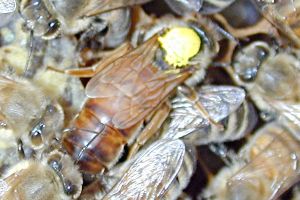 A coloured dot applied by a beekeeper identifies a queen Western honey bee.
 -
 Western honey bee foragers loaded with pollen on the hive landing board
 -
 Eastern honey bee (A. cerana) in Hong Kong
 -
 Giant honey bee (A. dorsata)
 -
 Western honey bee visiting flowers
 -
 A colony of giant honey bees (A. dorsata) on their comb
 -

-
 Western honey bee on rock rose (Cistus) in Oakland, California
 -
 Western honey bee collecting pollen from turnip blossoms in Eastern Oklahoma
 -
 A predator, the Asian green bee-eater
 -
 A wild colony in Chandigarh
 -


.jpg)


See also
[edit]- Honey bee life cycle
- Honey bee starvation
- More than Honey – a 2012 Swiss documentary film about honey bees
- Melittology (also known as apiology) – the study of bees
- Brachygastra – Genus of wasps (honey wasps) known to collect and store nectar as honey
- Pollen wasp – Subfamily of wasps unique among wasps in feeding their larvae exclusively with pollen and nectar, in a fashion quite similar to many solitary bees
- Honeypot ant
Notes
[edit]- ^ The Mayans kept and collected honey and brood, but from stingless social bees such as Melipona beecheii, not from Apis honeybees.[76]
References
[edit]- ^ Crane, Eva (2009). "Chapter 9 – Apis Species: (Honey Bees)". In Resh, Vincent H.; Cardé, Ring T. (eds.). Encyclopedia of Insects (Second Edition). Academic Press. pp. 31–32. doi:10.1016/B978-0-12-374144-8.00009-6. ISBN 978-0-12-374144-8.
- ^ a b Whitfield, Charles W.; Behura, Susanta K.; Berlocher, Stewart H.; et al. (27 October 2006). "Thrice Out of Africa: Ancient and Recent Expansions of the Honey Bee, Apis mellifera". Science. 314 (5799): 642–645. Bibcode:2006Sci...314..642W. doi:10.1126/science.1132772. PMID 17068261. S2CID 15967796.
- ^ a b Han, Fan; Wallberg, Andreas; Webster, Matthew T. (August 2012). "From where did the Western honeybee (Apis mellifera) originate?". Ecology and Evolution. 2 (8): 1949–1957. Bibcode:2012EcoEv...2.1949H. doi:10.1002/ece3.312. PMC 3433997. PMID 22957195.
- ^ Smith, Michael L. (2021). "Nest Structure: Honey Bees". In Starr, Christopher K. (ed.). Encyclopedia of Social Insects. Springer, Cham. pp. 626–632. doi:10.1007/978-3-030-28102-1_85. ISBN 978-3-030-28102-1.
- ^ Papa, Giulia; Maier, Roberto; Durazzo, Alessandra; Lucarini, Massimo; Karabagias, Ioannis K.; Plutino, Manuela; Bianchetto, Elisa; Aromolo, Rita; Pignatti, Giuseppe; Ambrogio, Andrea; Pellecchia, Marco; Negri, Ilaria (2022). "The Honey Bee Apis mellifera: An Insect at the Interface between Human and Ecosystem Health". Biology. 11 (2): 233. doi:10.3390/biology11020233.
- ^ Buchmann, Stephen L. (8 June 2010). Honey Bees: Letters from the Hive (1st ed.). New York: Random House Children's Books. p. 157. ISBN 978-0-375-89557-9.
- ^ "Apis". The Latin Dictionary. Retrieved 23 November 2021.
- ^ "Honeybee". Online Etymology Dictionary, Douglas Harper. 2019. Retrieved 27 February 2016.
- ^ Snodgrass, Robert E. (1984). Anatomy of the Honey Bee. Cornell University Press. p. vii. ISBN 978-0-8014-9302-7.
- ^ "Integrated Taxonomic Information System – Search, Apinae". 2008. Retrieved 26 February 2016.
- ^ "Common Names of Insects Database". Entomological Society of America. Retrieved 21 February 2016.
- ^ "Apinae". Tree of Life Web Project. 2004. Retrieved 25 February 2016.
- ^ Smith, Deborah R. (2021). "Biogeography of Honey Bees". In Starr, Christopher K. (ed.). Encyclopedia of Social Insects. Springer, Cham. pp. 117–131. doi:10.1007/978-3-030-28102-1_60. ISBN 978-3-030-28102-1.
- ^ Engel, Michael S.; Hinojosa-Díaz, I. A.; Rasnitsyn, A. P. (2009). "A honey bee from the Miocene of Nevada and the biogeography of Apis (Hymenoptera: Apidae: Apini)". Proceedings of the California Academy of Sciences. 60 (3): 23–38.
- ^ Nicholls, Henry (15 June 2015). "The truth about bees". BBC. Retrieved 9 July 2020.
- ^ a b c Engel, Michael S. (1999). "The taxonomy of recent and fossil honey bees (Hymenoptera: Apidae: Apis)". Journal of Hymenoptera Research. 8: 165–196.
- ^ "Honey Bees". Encyclopedia of Life. Retrieved 9 July 2020.
- ^ a b c d e Arias, Maria C.; Sheppard, Walter S. (2005). "Phylogenetic relationships of honey bees (Hymenoptera:Apinae:Apini) inferred from nuclear and mitochondrial DNA sequence data". Molecular Phylogenetics and Evolution. 37 (1): 25–35. Bibcode:2005MolPE..37...25A. doi:10.1016/j.ympev.2005.02.017. PMID 16182149.
Arias, Maria C.; Sheppard, Walter S. (2005). "Corrigendum to "Phylogenetic relationships of honey bees (Hymenoptera:Apinae:Apini) inferred from nuclear and mitochondrial DNA sequence data"". Molecular Phylogenetics and Evolution. 40 (1): 315. doi:10.1016/j.ympev.2006.02.002. - ^ Clark, Michael C. (2018-04-03). Coexisting on Earth Homo sapiens Quagmire. Michael C. Clark.
- ^ a b Wongsiri, S.; et al. (1997). "Comparative biology of Apis andreniformis and Apis florea in Thailand". Bee World. 78 (1): 23–35. doi:10.1080/0005772X.1997.11099328.
- ^ Lo, Nathan; Gloag, Rosalyn S.; Anderson, Denis L.; Oldroyd, Benjamin P. (2009). "A molecular phylogeny of the genus Apis suggests that the Giant Honey Bee of the Philippines, A. breviligula Maa, and the Plains Honey Bee of southern India, A. indica Fabricius, are valid species". Systematic Entomology. 35 (2): 226–233. doi:10.1111/j.1365-3113.2009.00504.x. S2CID 84531938.
- ^ Kitnya N, Prabhudev MV, Bhatta CP, Pham TH, Nidup T, Megu K, Chakravorty J, Brockmann A, Otis GW (2020) Geographical distribution of the giant honey bee Apis laboriosa Smith, 1871 (Hymenoptera, Apidae). ZooKeys 951: 67–81. https://doi.org/10.3897/zookeys.951.49855
- ^ a b Hadisoesilo, S.; Raffiudin, Rika; Susanti, Wirian; Atmowidi, Tri; Hepburn, Colleen; Radloff, Sarah E.; Fuchs, Stefan; Hepburn, H. Randall (1 September 2008). "Morphometric analysis and biogeography of Apis koschevnikovi Enderlein (1906)". Apidologie. 39 (5): 495–503. doi:10.1051/apido:2008029. ISSN 0044-8435. S2CID 6605920.
- ^ Hadisoesilo, S.; Otis, G. W.; Meixner, M. (1995). "Two distinct populations of cavity-nesting honey bees (Hymenoptera: Apidae) in South Sulawesi, Indonesia". Journal of the Kansas Entomological Society. 68 (4): 399–407. JSTOR 25085613.
- ^ Radloff, Sarah E.; Hepburn, Colleen; Hepburn, H. Randall; Fuchs, Stefan; Hadisoesilo, Soesilawati; Tan, Ken; Engel, Michael S.; Kuznetsov, Viktor (15 March 2010). "Population structure and classification of Apis cerana" (PDF). Apidologie. 41 (6): 589–601. doi:10.1051/apido/2010008. S2CID 32751472.
- ^ "What's Happening To The Bees? – Part 5: Is There A Difference Between Domesticated And Feral Bees?". scientificbeekeeping.com. 26 June 2014.
- ^ "Egyptian honeybee – Arca del Gusto". Slow Food Foundation.
- ^ a b Reuber, Brant (21 February 2015). 21st Century Homestead: Beekeeping (First ed.). lulu.com. p. 116. ISBN 978-1-312-93733-8.
- ^ Villanueva, Rogel; et al. (2005). "Extinction of Melipona beecheii and traditional beekeeping in the Yucatán peninsula". Bee World. 86 (2): 35–41. doi:10.1080/0005772X.2005.11099651. S2CID 31943555.
- ^ Head, RJ (2008). "A Brief Survey of Ancient Near Eastern Beekeeping; A Final Note". The FARMS Review. Archived from the original on 30 July 2013. Retrieved 16 January 2012.
- ^ "Africanized honey bee – Apis mellifera scutellata Lepeletier". entnemdept.ufl.edu. Retrieved 1 May 2019.
- ^ "Africanized Bees". Smithsonian Institution. Department of Systematic Biology. Retrieved 2024-10-28.
{{cite web}}: CS1 maint: others (link) - ^ Engel, Michael S.; Hinojosa-Díaz, Ismael A. & Rasnitsyn, Alexandr P. (2009). "A honey bee from the Miocene of Nevada and the biogeography of Apis (Hymenoptera: Apidae: Apini)" (PDF). Proceedings of the California Academy of Sciences. 4. 60 (3): 23–38. Archived from the original (PDF) on 2021-02-27. Retrieved 2017-10-28.
- ^ Gould, James L.; Gould, Carol Grant (1995). The Honey Bee. Scientific American Library. p. 19. ISBN 978-0-7167-6010-8.
- ^ "What do bees do in the winter?". Archived from the original on 4 March 2016. Retrieved 12 March 2016.
- ^ Oldroyd, Benjamin P.; Wongsiri, Siriwat (2006). Asian Honey Bees (Biology, Conservation, and Human Interactions). Cambridge, Massachusetts and London, England: Harvard University Press.ISBN 0674021940.
- ^ "Conservation Work for Honey Bees". USDA. Retrieved 24 November 2021.
- ^ Geldmann, Jonas; González-Varo, Juan P. (2018). "Conserving honey bees does not help wildlife". Science. 359 (6374): 392–393. Bibcode:2018Sci...359..392G. doi:10.1126/science.aar2269. PMID 29371456. S2CID 206665383.
- ^ Hargreaves, Anna L.; Harder, Lawrence D.; Johnson, Steven D. (2009). "Consumptive emasculation: the ecological and evolutionary consequences of pollen theft". Biological Reviews. 84 (2): 259–276. doi:10.1111/j.1469-185X.2008.00074.x. PMID 19382932. S2CID 205599079.
- ^ do Carmo, Roselaini Mendes; Franceschinelli, Edivani Villaron; da Silveira, Fernando Amaral (2004). "Introduced Honeybees (Apis mellifera) Reduce Pollination Success without Affecting the Floral Resource Taken by Native Pollinators". Biotropica. 36 (3): 371–376. Bibcode:2004Biotr..36..371D. doi:10.1111/j.1744-7429.2004.tb00329.x. ISSN 0006-3606. JSTOR 30043128. S2CID 86316179.
- ^ Hargreaves, Anna L.; Harder, Lawrence D.; Johnson, Steven D. (2010). "Native pollen thieves reduce the reproductive success of a hermaphroditic plant, Aloe maculata". Ecology. 91 (6): 1693–1703. Bibcode:2010Ecol...91.1693H. doi:10.1890/09-0792.1. ISSN 0012-9658. PMID 20583711.
- ^ Plants, Pollinators, and the Price of Almonds Archived 2018-09-19 at the Wayback Machine
"Flowers set more seeds when visited by wild insects, and the more plants that were visited by wild insects, the more likely they were to set fruit. In some places the researchers considered, wild insects were pollinating most of the plants despite rented honey bees being present." - ^ Saving pollinators is about more than just honeybees
The problem is that there are only so many flowers and places to nest. And once the numbers of honeybees have been artificially inflated (commercial-scale beekeeping would not exist without humans) the increased competition for these resources can push native non-Apis pollinators out of their natural habitats. Honeybees also spread exotic plants and transmit pathogens, both of which have been shown to harm other pollinators. - ^ Haltiwanger, John (15 September 2014). "If All The Bees In The World Die, Humans Will Not Survive". Elite Daily. Retrieved 11 August 2025.
- ^ Spector, Dina (2013-06-22). "What Our World Would Look Like Without Honeybees". Business Insider. Retrieved 2025-08-11.
- ^ "Supporting pollination in agriculture". AgBioResearch, Michigan State University College of Agriculture & Natural Resources. 2018-10-01. Retrieved 2022-07-09.
- ^ What Would Happen if All the Bees Went Extinct?
"First, the easy part: "I've never seen anything definitively link the quote to Einstein," says Mark Dykes, the chief inspector for Texas Apiary Inspection Service. Quote checkers like this one, and this one agrees. But debunking its message? That's more complicated." - ^ Would a World Without Bees Be a World Without Us?
"Albert Einstein is sometimes quoted as saying, "If the bee disappears from the surface of the earth, man would have no more than four years to live." It's highly unlikely that Einstein said that. For one thing, there's no evidence of him saying it. For another, the statement is hyperbolic and wrong (and Einstein was rarely wrong)." - ^ Goldschein, Eric. "The 10 Most Important Crops In The World". Business Insider.
- ^ "What Are the World's Most Important Staple Foods?". WorldAtlas. 7 June 2019.
- ^ Gibson, D.J. (2009). Grasses and grassland ecology. Oxford: Oxford University Press. p. 82. ISBN 978-0-19-852918-7.
- ^ "Are honey bees native to North America?". USGS. 7 May 2024.
- ^ a b c "Struggling beekeepers stabilize U.S. honeybee population after nearly half of colonies died last year". PBS News. June 22, 2023.
- ^ "The Importance of Pollinators | USDA". usda.gov.
- ^ "The Value of Birds and Bees". Farmers.gov. June 22, 2020.
- ^ a b c d e f Brodschneider, Robert; Crailsheim, Karl (1 May 2010). "Nutrition and health in honey bees" (PDF). Apidologie. 41 (3): 278–294. doi:10.1051/apido/2010012. ISSN 0044-8435. S2CID 40046635.
- ^ a b Anderson, Leroy M; Dietz, A. (1976). "Pyridoxine Requirement of the Honey Bee (Apis mellifera) For Brood Rearing". Apidologie. 7: 67–84. doi:10.1051/apido:19760105.
- ^ Karasov, William H.; Martinez del Rio, Carlos (2008). Physiological Ecology: How Animals Process Energy, Nutrients, and Toxins. Princeton. pp. 63–66.
- ^ Kuhnholz, Susanne (1997). "The Control of Water Collection in Honey Bee Colonies". Behavioral Ecology and Sociobiology. 41 (6): 407–422. Bibcode:1997BEcoS..41..407K. doi:10.1007/s002650050402. S2CID 41311766.
- ^ "Bumblebee species | Biobest". biobestgroup.com.
- ^ "Colony Collapse Disorder: The Vanishing Honeybee (Apis Mellifera)" (PDF). CU Scholar. 12 March 2011. Retrieved 26 March 2024.
- ^ Underwood, Robyn M.; van Engelsdorp, Dennis. "Colony Collapse Disorder: Have We Seen This Before?". The Pennsylvania State University, Department of Entomology. Retrieved 2010-05-02.
- ^ Lester, Benjamin (7 March 2007). "Mystery of the dying bees". Cosmos. Archived from the original on 24 March 2008.
- ^ vanEngelsdorp, Dennis; Evans, Jay D.; Saegerman, Claude; Mullin, Chris; Haubruge, Eric; Nguyen, Bach Kim; Frazier, Maryann; Frazier, Jim; Cox-Foster, Diana; Chen, Yanping; Underwood, Robyn; Tarpy, David R.; Pettis, Jeffery S. (August 2009). "Colony Collapse Disorder: A Descriptive Study" (PDF). PLOS ONE. 4 (8) e6481. Bibcode:2009PLoSO...4.6481V. doi:10.1371/journal.pone.0006481. PMC 2715894. PMID 19649264.
- ^ Bryony, Bonning (11 November 2009). "Honey Bee Disease Overview". Journal of Invertebrate Pathology. 103: S2-4. doi:10.1016/j.jip.2009.07.015. PMID 19909974.
- ^ McDonald-Gibson, Charlotte. "'Victory for bees' as European Union bans neonicotinoid pesticides blamed for destroying bee population". The Independent. Retrieved 2 July 2014.
- ^ "Colony Collapse Disorder". Beeologics. Archived from the original on 6 February 2013. Retrieved 23 October 2014.
- ^ ""Tracheal mites" Tarsonemidae". Agricultural Research Service, United States Department of Agriculture. February 18, 2005. Archived from the original on May 17, 2011. Retrieved March 10, 2011.
- ^ a b Kwadha, Charles A.; Ong'amo, George O.; Ndegwa, Paul N.; Raina, Suresh K.; Fombong, Ayuka T. (9 June 2017). "The Biology and Control of the Greater Wax Moth, Galleria mellonella". Insects. 8 (2): 61. doi:10.3390/insects8020061. PMC 5492075. PMID 28598383.
- ^ Crane, E (1990). "Honey from honeybees and other insects". Ethology Ecology & Evolution. 3 (sup1): 100–105. doi:10.1080/03949370.1991.10721919.
- ^ Sanford, M.T.; Dietz, A. (1976). "The fine structure of the wax gland of the honey bee (Apis mellifera L.)". Apidologie. 7 (3): 197–207. doi:10.1051/apido:19760301.
- ^ "Wax Rendering | Bee Culture". Bee Culture. 23 March 2016. Retrieved 26 October 2018.
- ^ Gillott, Cedric (1995). Entomology. Springer. p. 79.
- ^ Anderson, Kirk E.; Carroll, Mark J.; Sheehan, Tim; Lanan, Michele C.; Mott, Brendon M.; Maes, Patrick; Corby-Harris, Vanessa (5 November 2014). "Hive-stored pollen of honey bees: many lines of evidence are consistent with pollen preservation, not nutrient conversion". Molecular Ecology. 23 (23): 5904–5917. Bibcode:2014MolEc..23.5904A. doi:10.1111/mec.12966. PMC 4285803. PMID 25319366.
- ^ Haris, Emmaria (6 December 2013). "Sensasi Rasa Unik Botok Lebah yang Menyengat (Unique taste sensation botok with stinging bees)" (in Indonesian). Sayangi.com. Archived from the original on 22 June 2015. Retrieved 14 February 2018.
- ^ Pearson, Gwen (3 May 2014). "Women Work to Save Native Bees of Mexico". Wired. Retrieved 15 May 2018.
- ^ "How to collect drone larvae from the beehive". Home technologies and practices for small agricultural producers, UN Food and Agriculture Organization. 29 August 2016. Archived from the original on 13 February 2018. Retrieved 13 February 2018.
- ^ Holland, Jennifer (14 May 2013). "U.N. Urges Eating Insects: 8 Popular Bugs to Try". National Geographic. Archived from the original on June 6, 2013.
- ^ Schmitt, Kellie (26 December 2011). "Shanghai's weirdest foods". CNN. Archived from the original on 28 March 2013.
- ^ Simone-Finstrom, Michael; Spivak, Marla (May–June 2010). "Propolis and bee health: The natural history and significance of resin use by honey bees". Apidologie. 41 (3): 295–311. doi:10.1051/apido/2010016. hdl:11299/182451.
- ^ "Propolis". U.S. National Library of Medicine. 28 July 2022. Retrieved 5 February 2023.
- ^ Gambichler, T; Boms, S; Freitag, M (April 2004). "Contact dermatitis and other skin conditions in instrumental musicians". BMC Dermatol. 4: 3. doi:10.1186/1471-5945-4-3. PMC 416484. PMID 15090069.
- ^ EFSA Panel on Dietetic Products, Nutrition and Allergies, European Food Safety Authority (2011). "Scientific Opinion on the substantiation of health claims related to: anthocyanidins and proanthocyanidins (ID 1787, 1788, 1789, 1790, 1791); sodium alginate and ulva (ID 1873); vitamins, minerals, trace elements and standardised ginseng G115 extract (ID 8, 1673, 1674); vitamins, minerals, lysine and/or arginine and/or taurine (ID 6, 1676, 1677); plant-based preparation for use in beverages (ID 4210, 4211); Carica papaya L. (ID 2007); "fish protein" (ID 651); acidic water-based, non-alcoholic flavoured beverages containing calcium in the range of 0.3 to 0.8 mol per mol of acid with a pH not lower than 3.7 (ID 1170); royal jelly (ID 1225, 1226, 1227, 1228, 1230, 1231, 1326, 1328, 1329, 1982, 4696, 4697); foods low in cholesterol (ID 624); and foods low in trans-fatty acids (ID 672, 4333) pursuant to Article 13(1) of Regulation (EC) No 1924/2006". EFSA Journal. 9 (4): 2083. doi:10.2903/j.efsa.2011.2083.
{{cite journal}}: CS1 maint: multiple names: authors list (link) - ^ "Federal Government Seizes Dozens of Misbranded Drug Products: FDA warned company about making medical claims for bee-derived products". Food and Drug Administration. 5 April 2010. Archived from the original on April 7, 2010.
- ^ Leung, R; Ho, A; Chan, J; Choy, D; Lai, CK (March 1997). "Royal jelly consumption and hypersensitivity in the community". Clin. Exp. Allergy. 27 (3): 333–6. doi:10.1111/j.1365-2222.1997.tb00712.x. PMID 9088660. S2CID 19626487.
- ^ Cervoni, Mário Sérgio; Hartfelder, Klaus (2021). "Caste Differentiation: Honey Bees". In Starr, Christopher K. (ed.). Encyclopedia of Social Insects. Springer, Cham. pp. 177–184. doi:10.1007/978-3-030-28102-1_151. ISBN 978-3-030-28102-1.
- ^ "Bee castes". Visual Dictionary, QA International. 2017. Retrieved 18 May 2017.
- ^ a b c d e f g h "Getting Started: Honey Bee Biology". University of Georgia College of Agricultural and Environmental Sciences. 2017. Archived from the original on 24 January 2018. Retrieved 18 May 2017.
- ^ Woyka, J.; Pszczelnictwa, Zaklad; Drone Larvae from Fertilized Eggs of the Honey Bee Archived 2014-10-22 at the Wayback Machine Journal of Apiculture Research, (1963), pages 19–24
- ^ Weinstock, George M.; Robinson, Gene E., & the Honeybee Genome Sequencing Consortium Insights into social insects from the genome of the honeybee Apis mellifera Nature, volume "'443'" (2006), pages 931–949
- ^ a b c d e f "Worker, drone and queen bees". PerfectBee LLC. 2017. Retrieved 18 May 2017.
- ^ Harbo, JR; Rinderer, TE (1980). "Breeding and Genetics of Honey Bees". Beesource Beekeeping. Retrieved 18 May 2017.
- ^ "Morphology of a honeybee: worker". Visual Dictionary, QA International. 2017. Retrieved 18 May 2017.
- ^ a b Jones, Julia C; Fruciano, Carmelo; Hildebrand, Falk; Al Toufalilia, Hasan; Balfour, Nicholas J; Bork, Peer; Engel, Philipp; Ratnieks, Francis LW; Hughes, William OH (2018). "Gut microbiota composition is associated with environmental landscape in honey bees". Ecology and Evolution. 8 (1): 441–451. Bibcode:2018EcoEv...8..441J. doi:10.1002/ece3.3597. PMC 5756847. PMID 29321884.
- ^ a b Jones, J. C; Fruciano, C; Marchant, J; Hildebrand, F; Forslund, S; Bork, P; Engel, P; Hughes, W. O. H (2018). "The gut microbiome is associated with behavioural task in honey bees". Insectes Sociaux. 65 (3): 419–429. doi:10.1007/s00040-018-0624-9. PMC 6061168. PMID 30100619.
- ^ Hadisoesilo, Soesilawati. "The Comparative Study of Two Species of Cavity-Nesting Honey Bees of Sulawesi, Indonesia" (PDF).
- ^ Wenseleers, T.; Helanterä, H.; Hart, A.; Ratnieks, F. L. W. (2004). "Worker reproduction and policing in insect societies: an ESS analysis". Journal of Evolutionary Biology. 17 (5): 1035–1047. doi:10.1111/j.1420-9101.2004.00751.x. PMID 15312076. S2CID 7239058.
- ^ Ratnieks, F.; Visscher, P. Kirk (1989). "Worker policing in the honeybee". Nature. 342 (6251): 796–797. Bibcode:1989Natur.342..796R. doi:10.1038/342796a0. S2CID 4366903.
- ^ Pirk, C.; Neumann, P.; Hepburn, R.; Moritz, R.; Tautz, J. (2003). "Egg viability and worker policing in honey bees". PNAS. 101 (23): 8649–8651. Bibcode:2004PNAS..101.8649P. doi:10.1073/pnas.0402506101. PMC 423249. PMID 15169961.
- ^ Oldroyd, B.; Ratnieks, Francis (2002). "Egg-marking pheromones in honey-bees Apis mellifera". Behavioral Ecology and Sociobiology. 51 (6): 590–591. Bibcode:2002BEcoS..51..590O. doi:10.1007/s00265-002-0480-4. S2CID 30446742.
- ^ Barron, A.; Oldroyd, B; Ratnieks, F.L.W. (2001). "Worker reproduction in honey-bees (Apis) and the anarchic syndrome: a review". Behavioral Ecology and Sociobiology. 50 (3): 199–208. Bibcode:2001BEcoS..50..199B. doi:10.1007/s002650100362. S2CID 17246102.
- ^ Châline, N.; Martin, S.J.; Ratnieks, F.L.W. (2004). "Worker policing persists in a hopelessly queenless honey bee colony (Apis mellifera)". Insectes Soc. 51 (2): 1–4. doi:10.1007/s00040-003-0708-y. S2CID 11988371.
- ^ Davies, N.R., Krebs, J.R., and West, S.A. An Introduction to Behavioral Ecology. 4th ed. West Sussex: Wiley-Blackwell, 2012. Print. pp. 387–388
- ^ a b c d Hammond, George; Blankenship, Madison. "Apis mellifera (honey bee)". Animal Diversity Web. Retrieved 2023-04-17.
- ^ Heidinger, Ina Monika Margret; Meixner, Marina Doris; Berg, Stefan; Büchler, Ralph (2014-07-01). "Observation of the Mating Behavior of Honey Bee (Apis mellifera L.) Queens Using Radio-Frequency Identification (RFID): Factors Influencing the Duration and Frequency of Nuptial Flights". Insects. 5 (3): 513–527. doi:10.3390/insects5030513. ISSN 2075-4450. PMC 4592583. PMID 26462822.
- ^ Barron, Andrew B.; Oldroyd, Benjamin P.; Ratnieks, Francis L. (2001-08-01). "Worker reproduction in honey-bees (Apis) and the anarchic syndrome: a review". Behavioral Ecology and Sociobiology. 50 (3): 199–208. Bibcode:2001BEcoS..50..199B. doi:10.1007/s002650100362. ISSN 1432-0762. S2CID 17246102.
- ^ "Chapter 8: Most Spectacular Mating | The University of Florida Book of Insect Records | Department of Entomology & Nematology | UF/IFAS". entnemdept.ufl.edu. Retrieved 2023-04-17.
- ^ "Bee Bonanza. The story of Honey Bees". askabiologist.asu.edu. Arizona State University. 13 June 2017. Retrieved 15 March 2022.
- ^ Thawley, C. H. "Heat tolerance as a weapon". Davidson College. Archived from the original on 18 July 2010. Retrieved 1 June 2010.
- ^ Michio Sugahara; Fumio Sakamoto (2009). "Heat and carbon dioxide generated by honeybees jointly act to kill hornets". Naturwissenschaften. 96 (9): 1133–6. Bibcode:2009NW.....96.1133S. doi:10.1007/s00114-009-0575-0. PMID 19551367. S2CID 22080257.
- ^ Gill, Victoria (3 July 2009). "Honeybee mobs overpower hornets". BBC News. Retrieved 5 July 2009.
- ^ "Giant Honeybees Use Shimmering 'Mexican Waves' To Repel Predatory Wasps". ScienceDaily. 15 September 2008. Retrieved 11 August 2025.
- ^ Radloff, Sara E.; Hepburn, H. Randall; Engel, Michael S. (2011). Honeybees of Asia. Berlin: Springer Science & Business Media. ISBN 978-3642164217.
- ^ Mattila, Heather R.; Otis, Gard W.; Nguyen, Lien T. P.; Pham, Hanh D.; Knight, Olivia M.; Phan, Ngoc T. (9 December 2020). Blenau, Wolfgang (ed.). "Honey bees (Apis cerana) use animal feces as a tool to defend colonies against group attack by giant hornets (Vespa soror)". PLOS ONE. 15 (12) e0242668. Bibcode:2020PLoSO..1542668M. doi:10.1371/journal.pone.0242668. ISSN 1932-6203. PMC 7725375. PMID 33296376. S2CID 228087051.
- ^ Basari, Norasmah; Ramli, Sarah Najiah; Mohd Khairi, Nur 'Aina Syakirah (2018-10-11). "Food Reward and Distance Influence the Foraging Pattern of Stingless Bee, Heterotrigona itama". Insects. 9 (4): 138. doi:10.3390/insects9040138. ISSN 2075-4450. PMC 6315735. PMID 30314344.
- ^ Jalil, Abu Hassan (8 July 2014). Beescape for Meliponines: Conservation of Indo-Malayan Stingless Bees. Partridge Publishing Singapore. ISBN 978-1-4828-2362-2.
- ^ Biller, Jose; Ferro, Jose M (7 February 2014). Neurologic Aspects of Systemic Disease, Part II (1st ed.). Elsevier. p. 995. ISBN 978-0-7020-4087-0.
- ^ Chen J, Guan SM, Sun W, Fu H (2016). "Melittin, the Major Pain-Producing Substance of Bee Venom". Neuroscience Bulletin. 32 (3): 265–72. doi:10.1007/s12264-016-0024-y. PMC 5563768. PMID 26983715.
- ^ Ramanadham, S; Ali, T; Ashley, J. W; Bone, R. N; Hancock, W. D; Lei, X (2015). "Calcium-independent phospholipases A2 and their roles in biological processes and diseases". Journal of Lipid Research. 56 (9): 1643–1668. doi:10.1194/jlr.R058701. PMC 4548770. PMID 26023050.
- ^ Honey Bee Colonies (May 2016) (PDF) (Report). National Agricultural Statistics Service. 2016-05-12. ISSN 2470-993X. Retrieved 2025-06-07.
- ^ Honey Bee Colonies (August 2024) (PDF) (Report). National Agricultural Statistics Service. 2024-08-01. ISSN 2470-993X. Retrieved 2025-06-07.
- ^ Park, J. H; Yim, B. K; Lee, J. H; Lee, S; Kim, T. H (2015). "Risk Associated with Bee Venom Therapy: A Systematic Review and Meta-Analysis". PLOS ONE. 10 (5) e0126971. Bibcode:2015PLoSO..1026971P. doi:10.1371/journal.pone.0126971. PMC 4440710. PMID 25996493.
- ^ Lee, J. A; Son, M. J; Choi, J; Jun, J. H; Kim, J. I; Lee, M. S (2014). "Bee venom acupuncture for rheumatoid arthritis: A systematic review of randomised clinical trials". BMJ Open. 4 (11) e006140. doi:10.1136/bmjopen-2014-006140. PMC 4225238. PMID 25380812.
- ^ Boyle, R. J; Elremeli, M; Hockenhull, J; Cherry, M. G; Bulsara, M. K; Daniels, M; Oude Elberink, J. N (2012). "Venom immunotherapy for preventing allergic reactions to insect stings" (PDF). Cochrane Database of Systematic Reviews. 10 (2) CD008838. doi:10.1002/14651858.CD008838.pub2. PMC 8734599. PMID 23076950.
- ^ "Wasp and Bee venom". Drugs.com. 2018. Retrieved 29 June 2018.
- ^ Hudewenz, Anika; Klein, Alexandra-Maria (1 December 2013). "Competition between honey bees and wild bees and the role of nesting resources in a nature reserve". Journal of Insect Conservation. 17 (6): 1275–1283. Bibcode:2013JICon..17.1275H. doi:10.1007/s10841-013-9609-1. ISSN 1366-638X. S2CID 16268870.
- ^ MacInnis, Gail; Normandin, Etienne; Ziter, Carly D. (2023-02-03). "Decline in wild bee species richness associated with honey bee ( Apis mellifera L.) abundance in an urban ecosystem". PeerJ. 11 e14699. doi:10.7717/peerj.14699. ISSN 2167-8359. PMC 9901307. PMID 36755869.
- ^ Geldmann, Jonas; González-Varo, Juan P. (2018-01-26). "Conserving honey bees does not help wildlife" (PDF). Science. 359 (6374): 392–393. Bibcode:2018Sci...359..392G. doi:10.1126/science.aar2269. ISSN 0036-8075. PMID 29371456.
- ^ Johnson, Brian R.; Nieh, James C. (1 November 2010). "Modeling the Adaptive Role of Negative Signaling in Honey Bee Intraspecific Competition". Journal of Insect Behavior. 23 (6): 459–471. Bibcode:2010JIBeh..23..459J. doi:10.1007/s10905-010-9229-5. ISSN 0892-7553. PMC 2955239. PMID 21037953.
- ^ Tarpy, David (2016). "The Honey Bee Dance Language". NC State Extension.
- ^ Rogers, Lesley J.; Rigosi, Elisa; Frasnelli, Elisa; Vallortigara, Giorgio (27 June 2013). "A right antenna for social behaviour in honeybees". Scientific Reports. 3: 2045. Bibcode:2013NatSR...3.2045R. doi:10.1038/srep02045. PMC 3694496. PMID 23807465.
- ^ Shugart, Jessica. "Honeybees use right antennae to tell friend from foe". Science News. Retrieved 12 March 2016.
- ^ Gorman, James (18 April 2016). "Do Honeybees Feel? Scientists Are Entertaining the Idea". The New York Times.
- ^ "The symbols of empire". Napoleon.org. Retrieved 1 June 2010.
- ^ "O Asvins, lords of brightness, anoint me with the honey of the bee, that I may speak forceful speech among men! Atharva Veda 91–258, quoted in Maguelonne Toussaint-Samat (Anthea Bell, tr.) The History of Food, 2nd ed. 2009:14.
- ^ "THE HONEY BEE". islamicity.com.
- ^ "Honey Bees in Quran". miracles-of-quran.com. Archived from the original on 2019-08-25. Retrieved 2019-08-25.
- ^ Norton, Holly (24 May 2017). "Honey, I love you: our 40,000-year relationship with the humble bee". The Guardian. Retrieved 29 June 2018.
- ^ Haynes, Dawn. The Symbolism and Significance of the Butterfly in Ancient Egypt (PDF).
- ^ Piotrkowski, Meron M. (2019). Priests in exile: the history of the temple of Onias and its community in the Hellenistic Period. Studia Judaica. Berlin: De Gruyter. ISBN 978-3-11-059107-1. OCLC 1076801783.
- ^ Virgil, Georgics, book IV.
- ^ Wilson, Bee (2004). The Hive: The Story of the Honeybee. London: John Murray. p. 14. ISBN 978-0-7195-6598-4.
- ^ "Utah State Motto and Emblem". Utah State Library. Archived from the original on 21 October 2017. Retrieved 13 October 2017.
External links
[edit]


- Could a Mushroom Save a Honeybee? Archived 2016-04-07 at the Wayback Machine Documentary produced by Oregon Field Guide, 14 October 2015
| Aspects of insects in culture |
| ||||||||||||||
|---|---|---|---|---|---|---|---|---|---|---|---|---|---|---|---|
| Pioneers |
| ||||||||||||||
| Concerns | |||||||||||||||
| Categories, templates | |||||||||||||||

| Topics |  | |
|---|---|---|
| Groups | ||
| In culture | ||
| Pioneers, works |
| |
| International | |
|---|---|
| National | |
| Other | |

Honey bee
View on GrokipediaTaxonomy and Evolution
Etymology and Naming
The term "honey bee" derives from Middle English "hony bee," a compound of "honey" (from Old English "huniġ," ultimately from Proto-Indo-European *melit- "honey") and "bee" (from Old English "beo," from Proto-Germanic *bion, from Proto-Indo-European *bʰey- "bee").[7][8] This nomenclature emerged around 1400 CE, distinguishing bees of the genus Apis that produce harvestable honey from other bee species, which either do not store honey in large quantities or lack the social structure for commercial exploitation.[9] The genus Apis specifically denotes true honey-producing bees, as opposed to solitary or less honey-focused bees in other genera like Bombus (bumblebees) or Megachile (leafcutter bees).[10] The scientific genus name Apis originates from Latin "apis," meaning "bee," a term attested in ancient Roman texts such as Pliny the Elder's Natural History (circa 77 CE), where it describes the insect's behavior and products, and Virgil's Georgics (29 BCE), which details beekeeping practices.[11] The etymology of Latin "apis" remains uncertain, possibly a pre-Indo-European substrate word or loan from a Semitic or Egyptian source, unrelated to the widespread Indo-European root *bʰey- for "bee" found in Germanic languages.[11] In various languages, names for the honey bee trace back to Indo-European roots, reflecting shared linguistic heritage. For instance, German "Biene" and Dutch "bij" descend from Proto-Germanic *bijǭ, a cognate of English "bee" via *bʰey-, while French "abeille" derives directly from Latin "apis" through Old French "abeille."[8][12] These variations highlight how the honey bee's cultural significance as a honey producer influenced nomenclature across Europe, often emphasizing its buzzing sound (e.g., onomatopoeic elements in *bʰey-). Such naming conventions align with broader taxonomic classifications, where linguistic roots inform evolutionary groupings within the genus.[13] Subspecies of the western honey bee (Apis mellifera) follow trinomial nomenclature, appending a specific epithet to the species name, typically denoting geographic origin, a discoverer, or morphological traits (e.g., Apis mellifera carnica for the Carniolan bee from Slovenia, named after the region).[14] This system, governed by the International Code of Zoological Nomenclature, recognizes 33 subspecies grouped into evolutionary lineages (A, M, C, O, Y, and Z), with names like Apis mellifera adansonii (African lineage) reflecting regional adaptations without implying strict boundaries.[15]Systematics and Distribution
Honey bees belong to the order Hymenoptera, which includes ants, wasps, and other bees, and are classified within the family Apidae, subfamily Apinae, and tribe Apini.[16] The genus Apis, derived from the Latin word for "bee," encompasses the true honey bees and is distinguished by their eusocial behavior and ability to produce and store honey.[17] The genus Apis comprises approximately 10 recognized species, divided into subgenera such as Apis (cavity-nesting bees like A. mellifera), Megapis (giant honey bees like A. dorsata), and Micrapis (dwarf honey bees like A. florea).[18] These species are morphologically and behaviorally distinct, with variations in nest architecture, body size, and foraging habits that reflect adaptations to diverse environments.[19] Native to Eurasia, Africa, and Southeast Asia, the distribution of Apis species is shaped by ecological niches ranging from tropical forests to temperate grasslands.[18] For instance, A. mellifera originates from Europe, Africa, and the Middle East, while Asian species like A. cerana and A. dorsata are confined to South and Southeast Asia.[18] Human activities have significantly expanded their ranges since the 17th century, with A. mellifera introduced to the Americas starting in 1622 via European colonists, and later to Australia, New Zealand, and other regions for pollination and honey production.[20] These introductions, often intentional for agricultural benefits, have led to feral populations and occasional ecological impacts in non-native habitats.[21]Species Diversity
The genus Apis comprises the true honey bees, divided into three recognized subgenera based on morphological and ecological traits: Micrapis (dwarf honey bees), Megapis (giant honey bees), and Apis (cavity-nesting species).[22][23] These subgenera reflect adaptations to diverse habitats across Asia, Africa, and Europe, with Micrapis and Megapis primarily tropical Asian forms, while Apis includes more widespread species.[24] Key species within the subgenus Apis include Apis mellifera (Western honey bee), a medium-sized cavity-nester (workers 12–15 mm long) with variable coloration from black to golden, native to Europe, western Asia, and Africa, where it constructs nests in tree hollows or rock crevices up to 50 liters in volume.[25] Apis cerana (Eastern honey bee), slightly smaller (workers 10–12 mm), inhabits cavities in Asia from the Middle East to Japan, often in smaller enclosures like wall voids, and features a more compact body adapted to humid tropical forests.[26] In the subgenus Megapis, Apis dorsata (giant honey bee) stands out with workers reaching 17–20 mm and a predominantly black abdomen with yellow bands, building massive single-comb nests (up to 1 m across) exposed on high tree branches or cliffs in South and Southeast Asia.[27] The subgenus Micrapis is represented by Apis florea (dwarf honey bee), the smallest species (workers 7–10 mm) with a slender build and pale coloration, which constructs small, exposed nests (about 15 cm diameter) in low shrubs or bushes across the Middle East and Asia.[28] Regional endemics highlight further diversity, such as Apis koschevnikovi (Koschevnikov's bee), a cavity-nesting species endemic to Borneo and nearby Malaysian and Indonesian islands, distinguished by its reddish-brown metasoma and legs, with workers 12–13 mm long nesting in tree hollows.[29][23] Similarly, Apis nigrocincta (Philippine honey bee or black-banded honey bee), native to Mindanao in the Philippines and Indonesian islands like Sulawesi and Sangihe, features bold black-and-yellow abdominal bands and nests in low-elevation cavities, with workers around 11–12 mm.[30][31] Hybridization among Apis species is possible and has produced notable variants, such as Africanized honey bees, which arose from crosses between the African subspecies Apis mellifera scutellata (small, dark workers adapted to open savannas) and European A. mellifera strains after accidental releases in Brazil in the 1950s, resulting in highly defensive hybrids that have spread across the Americas.[32][33]Fossil and Evolutionary History
The fossil record of the genus Apis begins in the late Eocene, approximately 40 million years ago, with primitive species exhibiting traits such as relatively unspecialized wing venation and body structures adapted for early social behaviors. Specimens from Baltic amber, dated to the middle Eocene (around 44–40 million years ago), include Apis-like bees that represent the earliest known members of the genus, preserving details of their morphology in a subtropical European ecosystem. These fossils indicate that honey bees had already developed key features for pollen collection and nest building by this time.[34] Honey bees diverged from other bee lineages around 20 million years ago (16–30 million years ago) during the early Miocene, coinciding with the evolution of advanced eusociality, including cooperative brood care, division of labor among castes, and complex nest architectures. This divergence within the corbiculate Apidae is evidenced by the appearance of specialized adaptations like the corbicula (pollen basket) on hind legs, which facilitated efficient foraging in flowering plant-dominated environments. Fossil-calibrated molecular clocks support this timeline, placing the origin of eusocial honey bees in the early Miocene of the Neogene period.[35][36] Key fossil sites reveal the early diversity of Apis. The Green River Formation in the western United States (early Eocene, ~53–38 million years ago) contains well-preserved bee fossils, including Apidae relatives that highlight the genus's North American presence during its formative stages. The Florissant Formation in Colorado (late Eocene, ~37–34 million years ago) has yielded species like Apis henshawi, one of the earliest definitive honey bee fossils, showing intermediate traits between primitive and modern forms. Additionally, the Miocene deposits of Iki Island, Japan (~16–14 million years ago), preserve Apis lithohermaea, a giant species comparable in size to modern A. dorsata and providing evidence of early diversification in the dorsata subgroup.[37][38][39] Phylogenetic analyses, integrating genetic data from mitochondrial and nuclear genomes with morphological traits, delineate the divergence of Apis subgenera during the Oligocene to Miocene. The dwarf honey bees (Micrapis) represent the basal lineage, diverging first around 25–30 million years ago, followed by the split between giant honey bees (Megapis) and cavity-nesting species (Apis) approximately 16–20 million years ago. These relationships are corroborated by sequence divergence in genes like COI and morphological features such as body size, wing shape, and proboscis length, underscoring an Asian origin for the genus with subsequent radiations.[40][19]Biology and Life History
Life Cycle Stages
Honey bees undergo holometabolous metamorphosis, a complete transformation involving four distinct developmental phases: egg, larva, pupa, and adult (imago).[41] This process ensures the transition from a worm-like larva to a winged adult, with profound morphological changes occurring during the pupal stage.[42] The cycle begins with the egg stage, lasting approximately 3 days, during which the egg hatches into a larva.[42] In the subsequent larval stage, which endures about 6 days, the larva is fed a mixture of royal jelly and worker jelly by nurse bees, promoting rapid growth through multiple molts.[42] The larva then spins a cocoon and enters the pupal stage, lasting around 12 days for workers, where internal restructuring transforms it into the adult form.[42] The entire development from egg to adult typically takes 21 days for worker bees.[42]| Stage | Duration (Worker Bees) | Key Features |
|---|---|---|
| Egg | 3 days | Fertilized or unfertilized; hatches into larva. |
| Larva | 6 days | Fed jelly secretions; grows rapidly. |
| Pupa | 12 days | Enclosed in cell; metamorphosis occurs. |
| Adult | Emergence | Fully formed bee chews out of cell. |