


Community hub
Recent from talks
Contribute something
Nothing was collected or created yet.
 | |
| Alternative names | Idly |
|---|---|
| Course | Breakfast, dinner |
| Region or state | South India |
| Associated cuisine | India, Sri Lanka |
| Serving temperature | Hot with a condiment such as sambar or chutney in South India, ghugni and aloo dum in East India |
| Main ingredients | Black lentils (de-husked), rice |
| Variations | Button idli, tatte idli, sanna, sambar idli, rava idli, masala idli, shell idli |


Idli or idly (/ˈɪdliː/; plural: idlis) is a type of savoury rice cake, originating from South India, popular as a breakfast food in India and in Sri Lanka. The cakes are made by steaming a batter consisting of fermented de-husked black lentils and rice. The fermentation process breaks down the starches so that they are more readily metabolised by the body.
Idli has several variations, including rava idli, which is made from semolina. Regional variants include sanna of Konkan.
History
[edit]A precursor of the modern idli is mentioned in several ancient Indian works. Vaddaradhane, a 920 CE Kannada language work by Shivakotiacharya, mentions "iddalige", prepared only from a black gram batter. Chavundaraya II, the author of the earliest available Kannada encyclopedia, Lokopakara (c.1025 CE), describes the preparation of this food by soaking black gram in buttermilk, ground to a fine paste, and mixed with the clear water of curd and spices.[1] The Western Chalukya king and scholar Someshwara III, reigning in the area now called Karnataka, included an idli recipe in his encyclopedia, Manasollasa (1130 CE). This Sanskrit-language work describes the food as iḍḍarikā. In Karnataka, the Idli in 1235 CE is described as being "light, like coins of high value", which is not suggestive of a rice base.[2] The food prepared using this recipe is now called uddina idli in Karnataka.
The recipe mentioned in these ancient Indian works leaves out three key aspects of the modern idli recipe: the use of rice (not just black gram), the long fermentation of the mix, and the steaming for fluffiness. The references to the modern recipe appear in the Indian works only after 1250 CE. Food historian K. T. Achaya speculates that the modern idli recipe might have originated in present-day Indonesia, which has a long tradition of fermented food. According to him, the cooks employed by the Hindu kings of the Indianised kingdoms might have invented the steamed idli there, and brought the recipe back to India during 800–1200 CE.[3][4] Achaya mentioned an Indonesian dish called "kedli", which according to him, was like an idli.[5][3] However, Janaki Lenin was unable to find any recipe for an Indonesian dish by this name.[6] According to food historian Colleen Taylor Sen the fermentation process of idli batter is a natural process that was discovered independently in India, since nearly all cultures use fermentation in some form.[7] According to Dorian Fuller, the steaming technique was already in use in Neolithic South India around 2000 BCE.[8]
The Gujarati work Varṇaka Samuccaya (1520 CE) mentions idli as idari, and also mentions its local adaptation, idada (a non-fermented version of dhokla).[9]
The earliest extant Tamil work to mention idli (as itali) is Maccapuranam, dated to the 17th century.[10][11] In 2015, Chennai-based idli caterer Eniyavan started celebrating March 30 as "World Idli Day".[12]
Preparation
[edit]| Nutritional value per 1 piece (30 gm) | |||||||||||||
|---|---|---|---|---|---|---|---|---|---|---|---|---|---|
| Energy | 167 kJ (40 kcal) | ||||||||||||
7.89 g | |||||||||||||
| Dietary fiber | 1.5 g | ||||||||||||
0.19 g | |||||||||||||
| Saturated | 0.037 g | ||||||||||||
| Monounsaturated | 0.035 g | ||||||||||||
| Polyunsaturated | 0.043 g | ||||||||||||
1.91 g | |||||||||||||
| |||||||||||||
| †Percentages estimated using US recommendations for adults,[14] except for potassium, which is estimated based on expert recommendation from the National Academies.[15] Source: [13] | |||||||||||||
To make Idli, four parts uncooked rice (idli rice or parboiled rice) to one part whole white lentil (black gram, Vigna mungo) are soaked separately for at least four hours to six hours or overnight. Optionally spices such as fenugreek seeds can be added at the time of soaking for additional flavour. Once done soaking, the lentils are ground to a fine paste and the rice is separately coarsely ground, then they are combined. Next, the mixture is left to ferment overnight during which its volume will more than double. After fermentation, some of the batter may be kept as a starter culture for the next batch. The finished idli batter is put into greased moulds of an idli tray or "tree" for steaming. The perforated molds allow the idlis to be cooked evenly. The tree holds the trays above the level of boiling water in a pot, and the pot is covered until the idlis are done (about 10–25 minutes, depending on size). A more traditional method is to use leaves instead of moulds.[16]
- Making idlis
-
 Key ingredients used are rice and black gram.
 -
 Idli batter
 -
 Idli mold
 -
 Batter poured into the mold
 -
 Several molds stacked over another
 -
 Idli steaming in cooker
 -
 Cooked idli
 -
 Molds removed from cooker
 -
 Idlis ready to eat


Serving
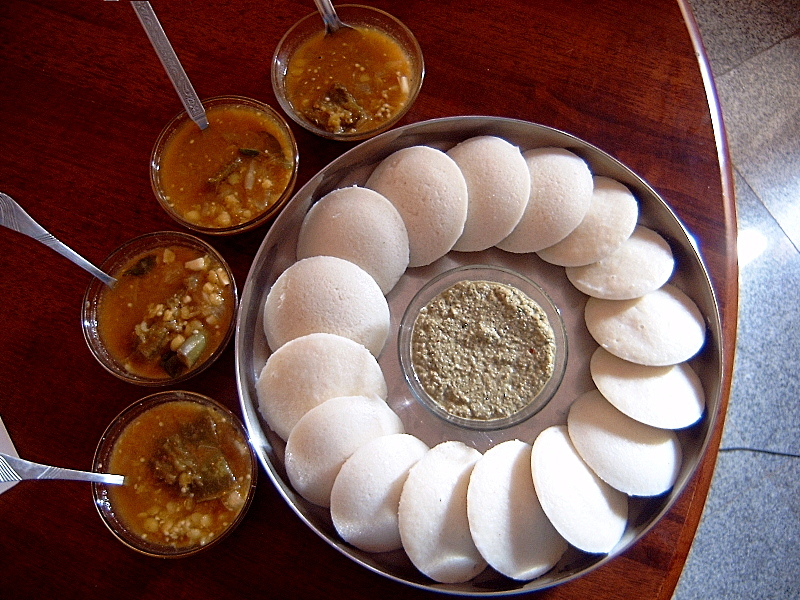
[edit]Since plain idlis are mild in taste, a condiment is considered essential. Idlis are often served with chutneys (coconut-based), sambar and Medu vada. However, this varies greatly by region and personal taste, it is also often served with kaara chutney (onion-based) or spicy fish curries. The dry spice mixture podi is convenient while travelling.

Variations
[edit]There are several regional variations of idlis made in South India and Sri Lanka. With the emigration of south Indians and Sri Lankans throughout the region and world, many variations on idli have been created in addition to the almost countless local variations. Hard-to-get ingredients and differing cooking customs have required changes in both ingredients and methods. Parboiled rice can reduce the soaking time considerably. Store-bought ground rice or cream of rice may also be used.[17] Similarly, semolina or cream of wheat may be used for preparing rava idli (wheat idli).[18] Dahi (yogurt) may be added to provide the sour flavour for unfermented batters. Pre-packaged mixes allow for almost instant idlis.[19]
In addition to or instead of fenugreek, other spices may be used such as mustard seeds, chili peppers, cumin, coriander, ginger, etc.[20] Sugar may be added to make them sweet instead of savoury. Idli may also be stuffed with a filling of potato, beans, carrot and masala.[21] Leftover idlis can be cut-up or crushed and sautéed for a dish called idli upma.[22] A microwave or an automatic electric steamer that is non-stick is considered to be a convenient alternative to conventional stovetop steamers. Batter preparation using a manual rocking rock grinder can be replaced by electric grinders or blenders. Many restaurants have also come up with fusion recipes of idlis such as idly manchurian, idly fry, chilly idly, stuffed idly, to name a few.
-
 Idlis cooked traditionally in coconut shells, Karnataka
 -
 Idli served with rasam
 -
 Moode idli steamed in fragrant screwpine leaves, Mangalore, Karnataka.
 -
 Sambar idli as served in Tamil Nadu
 -
 Kotte kadubu idlis steamed in jackfruit leaves, Karnataka
 -

-


.jpg)
.jpg)
Batter fermentation
[edit]Fermentation of idli batter results in both leavening caused by the generation of carbon dioxide as well as an increase in acidity. This fermentation is performed by lactic acid bacteria, especially the heterofermentative strain Leuconostoc mesenteroides and the homofermentative strain Enterococcus faecalis (formerly classified as Streptococcus faecalis). Heterofermentative lactic acid bacteria such as L. mesenteroides generate both lactic acid as well as carbon dioxide whereas homofermentative lactic acid bacteria only generate lactic acid.
Both L. mesenteroides and E. faecalis are predominantly delivered to the batter by the black gram. Both strains start multiplying while the grains are soaking and continue to do so after grinding.
L. mesenteroides tolerates high concentrations of salt unlike most other bacteria. Hence the salt in the batter and the ongoing generation of lactic acid both suppress the growth of other undesirable micro-organisms.[23][24]
Idli Day
[edit]See also
[edit]
References
[edit]- ^ Edward R. Farnworth 2003, p. 11.
- ^ K. T. Achaya 1994, p. 90.
- ^ a b K.T. Achaya (1 November 2003). The Story of Our Food. Universities Press. pp. 80–. ISBN 978-81-7371-293-7.
- ^ D. Balasubramanian (21 October 2004). "Changes in the Indian menu over the ages". The Hindu. Archived from the original on 6 December 2014.
- ^ "Idli saga: A study into the origin of the South Indian dish". Archived from the original on 24 April 2016. Retrieved 25 August 2014.
- ^ Lenin, Janaki (30 March 2012). "A tale of two sambhars". The Hindu – via www.thehindu.com.
- ^ Feasts and Fasts: A History of Food in India, page 146, Colleen Taylor Sen (2015)
- ^ Renfrew, Colin; Bahn, Paul (9 June 2014). The Cambridge World Prehistory. Cambridge University Press. p. 2049. ISBN 978-1-107-64775-6.
In the South Indian Neolithic, boiling and grinding were both essential techniques in food preparation. Steaming was added to this repertoire around 2000 BCE.
- ^ Achyut Yagnik; Suchitra Seth (24 August 2005). Shaping Of Modern Gujarat. Penguin Books Limited. p. 24. ISBN 978-81-8475-185-7.
- ^ Vikram Doctor (28 April 2007). "Idli saga: A study into the origin of the South Indian dish". Economic Times. Archived from the original on 24 April 2016. Retrieved 25 August 2014.
- ^ K.T. Achaya (5 March 2009). The Illustrated Foods of India. OUP India. ISBN 978-0-19-569844-2.
- ^ "World Idli Day 2018: Here's The Intriguing Story Behind This Delicious Day". NDTV. 30 March 2018.
- ^ "Calories in Idli and Nutrition Facts". www.fatsecret.co.in.
- ^ United States Food and Drug Administration (2024). "Daily Value on the Nutrition and Supplement Facts Labels". FDA. Archived from the original on 27 March 2024. Retrieved 28 March 2024.
- ^ "TABLE 4-7 Comparison of Potassium Adequate Intakes Established in This Report to Potassium Adequate Intakes Established in the 2005 DRI Report". p. 120. In: Stallings, Virginia A.; Harrison, Meghan; Oria, Maria, eds. (2019). "Potassium: Dietary Reference Intakes for Adequacy". Dietary Reference Intakes for Sodium and Potassium. pp. 101–124. doi:10.17226/25353. ISBN 978-0-309-48834-1. PMID 30844154. NCBI NBK545428.
- ^ "Idlis in jackfruit leaves". Aayi's Recipes. 2006. Retrieved 14 October 2014.
- ^ "Idli using Cream of Rice". Edibly Asian. Retrieved 14 October 2014.
- ^ Geeta, Seth. "Rava Idli : (Cream of wheat or sooji idli)". North India Cooking. Retrieved 14 October 2014.
- ^ "instant idli mix". Tarla Dalal. Sanjay & Co. Retrieved 14 October 2014.
- ^ Rachana, Gorikapudi (2012). "Fenugreek Leaves Idli". SPICY CURRIES. Retrieved 14 October 2014.
- ^ "Stuffed Idli". Spicy Tasty. 2013. Archived from the original on 1 August 2020. Retrieved 14 October 2014.
- ^ "Idli Upma Recipe-Recipe with Leftover idlis". Padhu's Kitchen. 2012. Retrieved 14 October 2014.
- ^ VEEN, A. G.; HACKLER, L. ROSS; STEINKRAUS, K. H.; MUKHERJEE, S. K. (28 June 2008). "Nutritive Quality of Idli, a Fermented Food of India". Journal of Food Science. 32 (3): 339–341. doi:10.1111/j.1365-2621.1967.tb01326_32_3.x. ISSN 0022-1147.
- ^ Council, National Research (1 January 1992). Applications of Biotechnology in Traditional Fermented Foods. doi:10.17226/1939. ISBN 978-0-309-04685-5. PMID 25121339.
- ^ Agrawal, Saumya. "World Idli Day". Times Now News. Retrieved 30 March 2022.
- ^ Saha, Somdatta. "World Idli Day 2021". NDTV Food. Retrieved 30 March 2022.
Bibliography
[edit]- K. T. Achaya (12 May 1994). Indian Food: A Historical Companion. Oxford University Press, USA. ISBN 978-0-19-563448-8.
- Devi, Yamuna (1987). Lord Krishna's Cuisine: The Art of Indian Vegetarian Cooking, Dutton. ISBN 0-525-24564-2.
- Edward R. Farnworth (2003). Handbook of Fermented Functional Foods. CRC Press. ISBN 978-0-8493-1372-1.
- Jaffrey, Madhur (1988). A Taste of India, Atheneum. ISBN 0-689-70726-6
- Rau, Santha Rama (1969). The Cooking of India, Time-Life Books.
| Dishes |
| ||||||||||
|---|---|---|---|---|---|---|---|---|---|---|---|
| Side dishes | |||||||||||
| Snacks | |||||||||||
| Beverages | |||||||||||
| Sweets & desserts |
| ||||||||||
| Condiments | |||||||||||
| Ingredients | |||||||||||


| Common dishes |
| ||||||||||||
|---|---|---|---|---|---|---|---|---|---|---|---|---|---|
| Snacks |
| ||||||||||||
| Desserts | |||||||||||||
| Drinks |
| ||||||||||||
| Condiments | |||||||||||||

Overview
Description
Idli is a savory steamed rice cake originating from South Indian cuisine, renowned for its light and digestible qualities. It is prepared by steaming a fermented batter, resulting in a distinctive spongy texture that distinguishes it from other rice-based dishes.[8][1] Typically shaped as small cylinders or discs, idlis measure about 3-5 cm in diameter and height, offering a palm-sized portion ideal for breakfast or light meals. The exterior is smooth and slightly firm, enclosing a soft, fluffy interior with a pale white color. Its mild, tangy flavor arises from the natural fermentation, providing a subtle sourness complemented by its neutral, airy profile.[1][9][10] The basic composition involves a batter of ground rice and urad dal (split black gram), fermented to develop its characteristic aeration before being poured into molds and steamed. This simple yet precise combination yields the idli's signature lightness and volume. The term "idli" derives from the Kannada word "iddalige," denoting a steamed food preparation, reflecting its method of creation.[10] In South Indian daily life, idli serves as a staple breakfast item, often paired with accompaniments to enhance its versatility.[1]Cultural significance
Idli serves as a staple breakfast food across South Indian states including Tamil Nadu, Karnataka, Andhra Pradesh, and Kerala, where it is commonly prepared in households and eateries as a light, steamed rice cake paired with chutneys and sambar.[11] This dish embodies simplicity and health within vegetarian diets, valued for its fermented batter that enhances digestibility and nutritional profile through natural probiotics, making it a preferred choice for daily sustenance.[12] In cultural traditions, idli holds symbolic importance in festivals and religious practices, such as during Pongal, the Tamil harvest celebration, where idli sambar is specially prepared as part of festive meals to honor prosperity and community gatherings.[13] It also features prominently as prasadam, or sacred offering, in South Indian temples; for instance, the spiced Kanchipuram idli is distributed at the Varadaraja Perumal Temple in Tamil Nadu, representing purity and devotion in rituals.[14] Beyond religious contexts, idli plays a key role in hospitality and family meals, often served to guests as a gesture of warmth and shared during everyday bonding, reinforcing social ties in South Indian households.[12] World Idli Day, observed annually on March 30 since 2015, was established by Chennai-based idli specialist E. Eniyavan to promote the dish's cultural heritage globally through events, recipe sharing, and awareness campaigns that highlight its versatility and nutritional benefits.[15] The initiative has gained traction among Indian diaspora communities worldwide, where idli remains popular in homes and restaurants, adapting to local tastes through fusions like cheese-stuffed or herb-infused variants in cities such as London, New York, and Sydney.[16]History
Origins
The origins of idli trace back to ancient South India, where early textual references describe steamed cakes resembling the dish. The earliest known mention appears in the Kannada work Vaddaradhane (c. 920 CE) by Shivakotiacharya, which refers to "iddalige," a preparation made from a batter of finely ground black gram (urad dal) mixed with buttermilk, cumin seeds, and black pepper, then steamed into soft cakes without rice.[17] This precursor lacked the rice component and the explicit overnight fermentation central to the modern idli, suggesting an initial form focused on lentil-based steaming techniques, though soaking in buttermilk may have induced some natural leavening.[18] Subsequent references in 10th-century Kannada literature describe similar idli-like dishes prepared with black gram flour, buttermilk, and spices, indicating its growing presence in medieval Deccan cuisine.[19] These accounts reflect broader ancient fermentation practices in Dravidian culinary traditions, where lentils and grains were soaked and allowed to naturally leaven, aiding digestion and preservation in the region's tropical climate.[20] While no explicit archaeological evidence exists, these textual allusions point to idli's indigenous evolution from steamed lentil preparations in early Tamil and Kannada-speaking communities. Food historian K.T. Achaya posits that the modern idli's fermented rice-lentil batter may have been influenced by Southeast Asian traditions, potentially introduced via Indonesian traders or Hindu kingdom envoys around 800–1200 CE, drawing from fermented rice dishes like "kedli" in regions under dynasties such as the Shailendra.[21] However, Achaya emphasizes idli's primary development as an indigenous adaptation within South Indian contexts, blending local fermentation with trade-inspired steaming methods, rather than a direct import; this hypothesis remains speculative and debated among scholars, with many arguing for fully indigenous origins.[18] By the Vijayanagara Empire (14th–16th centuries), idli had become a staple across social classes, referenced in inscriptions and culinary texts as "iddalige" or similar, prepared with black gram and served in royal and common households alike.[22]Evolution and spread
The idli, first documented in 10th-century Kannada literature as a steamed dish known as iddalige, underwent significant evolution in its preparation and ingredients during the medieval period.[23] Food historian K.T. Achaya posits that the modern recipe, combining rice and black gram in a fermented batter, likely emerged between 800 and 1200 CE, possibly influenced by Southeast Asian fermentation practices that reached South India through trade routes.[21] By the 16th century, the dish had solidified as a staple in South Indian cuisine, with refinements in batter consistency achieved through manual stone grinding techniques that persisted until the 20th century.[4] During the British colonial era in the 19th and early 20th centuries, idli began spreading beyond its South Indian heartlands to other regions of India, facilitated by the migration of laborers and workers to urban centers and plantations.[24] This dissemination was further aided by the establishment of South Indian eateries in colonial cities like Mumbai and Kolkata, where the dish adapted to diverse palates while retaining its core form. Following India's independence in 1947, idli's popularity surged amid rapid urbanization and the rise of street food culture in the mid-20th century.[25] As populations flocked to cities for industrial jobs, affordable and portable breakfast options like idli became fixtures at roadside stalls and tiffin rooms, particularly in Bengaluru and Chennai, embedding it deeper into everyday urban diets.[26] The global presence of idli expanded significantly from the 1970s to the 2000s through the Indian diaspora, with communities in Southeast Asia, the Middle East, the United States, and the United Kingdom introducing it to local cuisines.[27] Today, it is served in restaurants worldwide, often in frozen or instant formats to suit expatriate lifestyles and international tastes.[24] Commercialization of pre-mixed idli batters was pioneered by MTR Foods with their rava idli mix in the 1940s, with further acceleration in the late 20th century allowing home preparation without the labor-intensive wet grinding process.[28] This innovation democratized access, boosting domestic consumption and supporting exports to diaspora markets.Ingredients
Traditional components
The traditional idli batter is primarily composed of parboiled rice and urad dal (black gram), which form the foundational elements providing structure, carbohydrates, and proteins essential for the dish's texture and nutritional profile.[5] The standard proportion is 3:1 to 4:1 rice to urad dal by volume (though ratios can vary from 2:1 to 4:1), with the rice contributing the bulk of the fermentable starches and the dal supplying proteins that support batter stability.[29] Urad dal, typically used as whole or split dehusked black gram, plays a key role in introducing natural fermentation agents through its microbial content.[30] Fenugreek seeds (methi) are a common additional component, added in small quantities—often 0.5 to 1 teaspoon per cup of dal—to impart a subtle nutty flavor and enhance the batter's fermentation process by promoting microbial activity.[6] Salt is incorporated after fermentation to preserve the batter's integrity without interfering with the natural leavening.[31] In some preparations, poha (flattened rice) is included as an optional element to increase softness by improving water absorption and texture.[32] The rice variety known as idli rice—a short-grain parboiled type, such as Sona Masuri or Ponni—is preferred for its ability to absorb water efficiently during soaking, resulting in a fine, cohesive grind suitable for the batter.[5] Urad dal is sourced as whole black gram for optimal protein content or split for easier processing, both ensuring the traditional balance in the mixture.[33]Modern substitutions
In contemporary preparations, idli rava—coarsely ground parboiled rice granules—serves as a popular substitute for the traditional wet-ground rice, enabling quicker batter mixing without extensive soaking or grinding while yielding a slightly grainier texture.[34] This adaptation reduces preparation time to under an hour, appealing to urban households seeking convenience, though it may require added poha or curd for optimal softness.[34] For the urad dal component, alternatives like moong dal provide a high-protein option that ferments similarly, suitable for gluten-free diets, often blended with minimal rice or rava for structure.[35] Chickpeas, either whole or split (such as chana dal), can replace urad dal, often in a 4:1 rice to chickpea ratio with added fenugreek seeds to enhance binding and nutrition, creating protein-rich variations that maintain the dish's plant-based nature.[36] Instant mixes frequently incorporate rice flour blends with urad or moong flour, eliminating fermentation altogether by relying on baking soda for leavening, thus catering to time-constrained cooks.[37] Millet-based substitutions, such as ragi (finger millet) or jowar (sorghum), replace rice entirely for low-carb, nutrient-dense idlis that promote better glycemic control and fiber intake, often combined with urad dal for fermentation.[38] These adaptations gained traction in the 2010s amid health trends, reviving ancient grains in modern South Indian cuisine.[38] Commercial products from brands like MTR and Gits, launched as pre-packaged instant mixes in the late 20th century but expanded with gluten-free and organic variants by the 2010s, further popularized these substitutions by offering ready-to-use batters with millet or rava bases.[39] These options, verified gluten-free and preservative-free, ensure accessibility for diaspora communities and dietary restrictions while preserving authentic flavors.Preparation
Batter fermentation
The preparation of idli batter begins with soaking the rice and black gram (urad dal) separately in water using proportions matching the desired batter ratio, for 4-6 hours, often at around 30°C to initiate hydration and enzymatic activity.[5] Fenugreek seeds (typically 0.5-1% of the total weight) are soaked along with the black gram to enhance the fermentation process by providing mucilaginous properties that aid in gas retention.[40] Following soaking, the rice is wet-ground to a coarse batter consistency, while the black gram and fenugreek are ground finer, with water added gradually to achieve a smooth texture; the two batters are then mixed in a 2:1 to 4:1 rice-to-dal ratio, along with salt (about 1-2%).[41] The combined batter is left to ferment for 8-12 hours at 25-30°C, during which natural microorganisms proliferate, leading to the characteristic rise and flavor development.[5] The fermentation is driven primarily by lactic acid bacteria (LAB) such as Leuconostoc mesenteroides, Lactobacillus fermentum, and Lactobacillus delbrueckii, which metabolize carbohydrates to produce carbon dioxide (CO₂) for leavening and puffing the batter, as well as lactic acid that imparts the tangy flavor.[42] Yeasts such as Torulopsis holmii and Candida spp. also contribute to CO₂ production and ethanol formation, enhancing the overall leavening and aroma, though LAB dominate the microbial succession, comprising up to 86% of the bacterial population.[43] These microorganisms originate from the raw ingredients and environment, initiating a spontaneous fermentation that lowers the pH from neutral to around 4.5-5.0.[44] Key factors influencing successful fermentation include temperature, with an optimal range of 28-30°C promoting rapid microbial growth; lower temperatures slow the process, while higher ones may lead to over-acidification.[41] Humidity levels above 70% and the water content in the batter (typically 50-60% post-grinding) also support microbial activity, as does the initial soaking water ratio.[45] Readiness is indicated by the batter doubling in volume, developing a bubbly surface, and acquiring a mild sour aroma due to acid accumulation.[5] In traditional settings, particularly in tropical climates, the batter ferments overnight at ambient room temperature without additives, relying on indigenous microbiota for authenticity in texture and taste.[44] Modern shortcuts, such as adding baking soda to induce chemical leavening in cooler environments, are sometimes employed to accelerate rising but are generally avoided to preserve the natural fermented qualities.[41]Steaming method
The steaming method for idli utilizes a traditional idli steamer, a multi-tiered stainless steel or brass vessel equipped with perforated plates containing circular molds, allowing multiple idlis to cook simultaneously over boiling water.[46] This setup, often called an idli stand or dhokla/idli steamer, fits into a large pot or pressure cooker base to generate steam efficiently. Modern adaptations include using an Instant Pot's steaming function with compatible idli trays or a microwave-safe idli maker for faster preparation, typically reducing cooking time while maintaining texture.[47] To prepare, lightly grease each mold with neutral oil using a brush or fingers to ensure easy release of the cooked idlis. Stir the fermented batter gently to redistribute air bubbles, then spoon it into the molds, filling them to about three-quarters capacity to allow for expansion during steaming. Place the stacked molds in the steamer over 1-2 inches of boiling water, cover with a lid (using a damp cloth if needed to trap steam), and steam on medium-high heat.[48] The process takes 10-15 minutes, depending on batch size and equipment; idlis are done when a toothpick or skewer inserted into the center emerges clean, indicating a firm yet spongy interior.[47] For optimal texture, monitor closely to avoid over-steaming, which can result in dry or rubbery idlis, and let the steamer sit off-heat for 2-4 minutes post-cooking—this resting period firms the bottoms and facilitates smooth unmolding with a spoon.[46] A standard recipe starting with 4 cups combined soaked rice and dal, after grinding and fermentation, yields approximately 20-30 idlis across 2-3 batches in a typical 12-16 mold steamer.[47]Serving and accompaniments
Traditional presentation
In traditional South Indian contexts, idli is typically served on a stainless steel thali for everyday breakfasts, with servings often consisting of 2-4 pieces per plate. It forms a staple part of breakfast or light dinner meals, where adult portions typically range from 2 to 4 idlis to provide a balanced, filling start or end to the day.[49] Idli is served piping hot immediately after steaming to retain its characteristic softness and fluffiness, and it is consumed using the right hand for an authentic experience or with a spoon for convenience, in line with broader South Indian dining etiquette that emphasizes cleanliness and minimal use of cutlery.[50] Regional variations in presentation reflect local customs: in Tamil Nadu, idli is commonly served with multiple chutneys (such as white, red tomato-onion, and green), podi (spice powder), and sambar, while in Karnataka, it is often plated with a single white chutney for simplicity and quality.[51]Common pairings
Idli, known for its mild, tangy flavor, is traditionally paired with complementary side dishes that provide contrasting textures, spices, and tanginess to enhance the meal.[48] The core accompaniments include sambar, a lentil-based vegetable stew flavored with tamarind for sourness, drumsticks for subtle bitterness, and a blend of spices like coriander, cumin, and fenugreek seeds, which is simmered with toor dal and assorted vegetables such as carrots and okra.[52] Coconut chutney, a creamy paste made by grinding fresh coconut with green chilies, ginger, roasted chana dal, and tempered with mustard seeds and curry leaves, offers a cooling, mildly spicy contrast.[53] Tomato chutney, prepared by sautéing onions, tomatoes, and red chilies with lentils like chana dal and urad dal, then grinding into a tangy, vibrant red sauce, adds a sharp, savory depth.[54] Another popular variant is green chutney, crafted from fresh cilantro and mint leaves blended with green chilies, ginger, cumin, and a touch of lemon juice for brightness, providing a herbaceous, zesty element that balances idli's neutrality.[55] In regional contexts, Andhra-style spicy peanut chutney features roasted peanuts ground with tomatoes, garlic, and red chilies, tempered with curry leaves and cumin for a nutty, fiery kick suited to the bolder palates of the region.[56] Kerala's onion-tomato chutney variant emphasizes red onions and ripe tomatoes sautéed with coconut scraps, green chilies, and shallots, resulting in a mildly sweet, aromatic paste that reflects the state's coconut-centric cuisine.[57] To complement these pairings and cut through the tanginess, beverages like South Indian filter coffee—strong, decoction-brewed with chicory and milk—or spiced buttermilk (moru), churned from yogurt with cumin and curry leaves, are commonly served alongside.[58]Variations
Regional adaptations
In Karnataka, rava idli represents a semolina-based adaptation of the traditional idli, prepared by roasting semolina and mixing it with sour curd, mustard seeds, and curry leaves before steaming, resulting in a lighter, quicker-to-make version with a slightly drier texture compared to the fermented rice-lentil original.[59] This variation is particularly popular in Bengaluru and other urban areas of the state, offering a convenient breakfast option without the need for overnight fermentation.[60] Another distinctive Karnataka style is the button idli, which are small, bite-sized idlis steamed in miniature molds, ideal for snacking or serving as appetizers, often enjoyed with chutneys or sambar.[61] In Andhra Pradesh and Telangana, punugulu offers a fried alternative to the steamed idli, made by shaping fermented idli or dosa batter into small balls, incorporating onions, coriander leaves, and yogurt, then deep-frying them to a crispy exterior while retaining a soft interior.[62] This street food staple highlights a textural contrast to the soft, spongy idli, providing a savory, crunchy bite commonly relished as an evening snack. Kerala's regional twists include the Ramasseri idli, prevalent in Palakkad, which features a flatter, more porous shape achieved through steaming on wet cotton cloths tied over clay steamers, often served on banana leaves to enhance its feather-light texture and earthy flavor.[63] Tamil Nadu upholds the classic plain idli as its foundational form—cylindrical, spongy steamed cakes from fermented rice and urad dal batter—served simply with sambar and coconut chutney, embodying the region's emphasis on purity and subtlety in breakfast fare.[1] A popular enhancement is podi idli, where steamed idlis (often mini-sized) are tossed or dusted with spicy milagai podi—a coarse powder of roasted lentils, chilies, and sesame—mixed with ghee for added flavor and crunch.[64]Contemporary innovations
In recent years, idli has inspired a range of fusion dishes that blend traditional preparation with global flavors, appealing to urban consumers and younger demographics in India. Cheese-stuffed idli, where grated cheese is incorporated into the batter or filled within the steamed idli before serving, offers a creamy, indulgent twist popular in city eateries and home cooking for its kid-friendly appeal. Similarly, pizza idli tops sliced idlis with pizza sauce, vegetables, and melted cheese, then bakes or grills them, creating a desi-Italian hybrid enjoyed in metropolitan areas like Mumbai and Bangalore as a quick snack. Chocolate idli reimagines the dish as a dessert by mixing cocoa powder into the batter and pairing it with chocolate sauce or ganache, providing a sweet, steamed alternative to baked cakes that has gained traction in innovative cafes. Health-conscious innovations have led to nutrient-enhanced versions of idli, substituting or supplementing traditional rice and urad dal with superfoods to boost protein and fiber while reducing carbohydrates. Protein-packed idlis made with quinoa and oats involve soaking and grinding these grains with lentils to form the batter, resulting in fluffy idlis with higher protein content, making them suitable for weight management and diabetic diets. Low-carb variants using almond flour replace rice entirely, yielding softer textures through a mix of almond meal, eggs or yogurt, and minimal binders, which lowers net carbs and caters to keto followers seeking gluten-free options. Globally, idli has been adapted in international chains, introducing localized accompaniments to broaden its appeal beyond South Indian communities. In outlets like Saravanaa Bhavan, which operates over 90 locations across 28 countries including the US, UK, and UAE, classic idlis are served with traditional sambar but also paired with fruit-based chutneys to suit diverse palates. Technological advances have modernized idli preparation, emphasizing convenience and reduced oil use. Air-fried idli, where pre-steamed idlis are cubed and cooked in an air fryer at 180°C for 10-15 minutes with minimal or no oil, produces crispy exteriors while retaining moisture, appealing to health-focused cooks avoiding deep-frying. Emerging in the 2020s, 3D-printed idli molds and batters allow for custom shapes like stars or hearts using extrusion-based printers on fortified doughs, such as pearl millet blends; studies show post-printing fermentation enhances texture and digestibility without compromising nutritional value.[65]Nutritional profile
Composition and nutrients
Idli exhibits a balanced macronutrient profile characteristic of fermented rice-lentil preparations, with low fat content and moderate energy density. Per 100 grams of edible portion, it typically provides 120-140 kcal of energy, comprising approximately 20-25 grams of carbohydrates primarily derived from rice, 4-6 grams of protein sourced from black gram dal, and about 0.5 grams of total fat.[66] These values reflect the steamed nature of idli, which minimizes added fats while retaining the inherent nutrients from its base ingredients. In terms of micronutrients, idli is enriched during batter fermentation, yielding notable levels of B vitamins such as thiamine (approximately 0.73 mg) and riboflavin (approximately 0.76 mg) per 100 grams.[5] The black gram dal contributes essential minerals, including iron (around 0.9-1 mg) and magnesium (approximately 25 mg) per 100 grams.[66][67] Furthermore, the lactic acid bacteria involved in fermentation produce metabolites that support gut health indirectly by enhancing digestibility.[45] The glycemic index of idli varies between approximately 65 and 80 across studies, generally classifying it as medium to high, as the fermentation process partially breaks down starches and slows digestion.[68] A standard idli, weighing about 30 grams, delivers 40-50 kcal, positioning it as a lightweight, nutrient-dense option for balanced dietary intake.[67]| Nutrient | Approximate Amount per 100 g |
|---|---|
| Energy | 120-140 kcal |
| Carbohydrates | 20-25 g |
| Protein | 4-6 g |
| Fat | 0.5 g |
| Thiamine | 0.73 mg |
| Riboflavin | 0.76 mg |
| Iron | 0.9-1 mg |
| Magnesium | 25 mg |