Hubbry Logo
MyoDMyoDMain
Open search
MyoD
Community hub
MyoD
logo
8 pages, 0 posts
0 subscribers
Be the first to start a discussion here.
MyoD
MyoD
from Wikipedia

MYOD1
Available structures
PDBOrtholog search: PDBe RCSB
Identifiers
AliasesMYOD1, MYF3, MYOD, PUM, bHLHc1, myogenic differentiation 1, MYODRIF
External IDsOMIM: 159970; MGI: 97275; HomoloGene: 7857; GeneCards: MYOD1; OMA:MYOD1 - orthologs
Orthologs
SpeciesHumanMouse
Entrez
Ensembl
UniProt
RefSeq (mRNA)

NM_002478

NM_010866

RefSeq (protein)

NP_002469

NP_034996

Location (UCSC)Chr 11: 17.72 – 17.72 MbChr 7: 46.03 – 46.03 Mb
PubMed search[3][4]
Wikidata
View/Edit HumanView/Edit Mouse

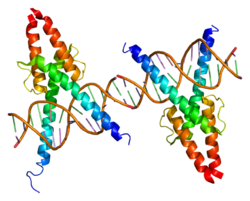
MyoD, also known as myoblast determination protein 1,[5] is a protein in animals that plays a major role in regulating muscle differentiation. MyoD, which was discovered in the laboratory of Harold M. Weintraub,[6] belongs to a family of proteins known as myogenic regulatory factors (MRFs).[7] These bHLH (basic helix loop helix) transcription factors act sequentially in myogenic differentiation. Vertebrate MRF family members include MyoD1, Myf5, myogenin, and MRF4 (Myf6). In non-vertebrate animals, a single MyoD protein is typically found.

MyoD is one of the earliest markers of myogenic commitment. MyoD is expressed at extremely low and essentially undetectable levels in quiescent satellite cells, but expression of MyoD is activated in response to exercise or muscle tissue damage. The effect of MyoD on satellite cells is dose-dependent; high MyoD expression represses cell renewal, promotes terminal differentiation and can induce apoptosis. Although MyoD marks myoblast commitment, muscle development is not dramatically ablated in mouse mutants lacking the MyoD gene. This is likely due to functional redundancy from Myf5 and/or Mrf4. Nevertheless, the combination of MyoD and Myf5 is vital to the success of myogenesis.[8][9]

History

[edit]

MyoD was cloned by a functional assay for muscle formation reported in Cell in 1987 by Davis, Weintraub, and Lassar. It was first described as a nuclear phosphoprotein in 1988 by Tapscott, Davis, Thayer, Cheng, Weintraub, and Lassar in Science. The researchers expressed the complementary DNA (cDNA) of the murine MyoD protein in a different cell lines (fibroblast and adipoblast) and found MyoD converted them to myogenic cells.[6][10] The following year, the same research team performed several tests to determine both the structure and function of the protein, confirming their initial proposal that the active site of the protein consisted of the helix loop helix (now referred to as basic helix loop helix) for dimerization and a basic site upstream of this bHLH region facilitated DNA binding only once it became a protein dimer.[11] MyoD has since been an active area of research as still relatively little is known concerning many aspects of its function.

Function

[edit]

The function of MyoD in development is to commit mesoderm cells to a skeletal myoblast lineage, and then to regulate that continued state. MyoD may also regulate muscle repair. MyoD mRNA levels are also reported to be elevated in aging skeletal muscle.

One of the main actions of MyoD is to remove cells from the cell cycle (halt proliferation for terminal cell cycle arrest in differentiated myocytes) by enhancing the transcription of p21 and myogenin. MyoD is inhibited by cyclin dependent kinases (CDKs). CDKs are in turn inhibited by p21. Thus MyoD enhances its own activity in the cell in a feedforward manner.

Sustained MyoD expression is necessary for retaining the expression of muscle-related genes.[12]

MyoD is also an important effector for the fast-twitch muscle fiber (types IIA, IIX, and IIB) phenotype.[13][14]

Mechanisms

[edit]

MyoD is a transcription factor and can also direct chromatin remodelling through binding to a DNA motif known as the E-box. MyoD is known to have binding interactions with hundreds of muscular gene promoters and to permit myoblast proliferation. While not completely understood, MyoD is now thought to function as a major myogenesis controller in an on/off switch association mediated by KAP1 (KRAB [Krüppel-like associated box]-associated protein 1) phosphorylation.[15] KAP1 is localized at muscle-related genes in myoblasts along with both MyoD and Mef2 (a myocyte transcription enhancer factor). Here, it serves as a scaffold and recruits the coactivators p300 and LSD1, in addition to several corepressors which include G9a and the Histone deacetylase HDAC1. The consequence of this coactivator/corepressor recruitment is silenced promoting regions on muscle genes. When the kinase MSK1 phosphorylates KAP1, the corepressors previously bound to the scaffold are released allowing MyoD and Mef2 to activate transcription.[16]

Once the "master controller" MyoD has become active, SETDB1 is required to maintain MyoD expression within the cell. Setdb1 appears to be necessary to maintain both MyoD expression and also genes that are specific to muscle tissues because reduction of Setdb1 expression results in a severe delay of myoblast differentiation and determination.[17] In Setdb1 depleted myoblasts that are treated with exogenous MyoD, myoblastic differentiation is successfully restored. In one model of Setdb1 action on MyoD, Setdb1 represses an inhibitor of MyoD. This unidentified inhibitor likely acts competitively against MyoD during typical cellular proliferation. Evidence for this model is that reduction of Setdb1 results in direct inhibition of myoblast differentiation which may be caused by the release of the unknown MyoD inhibitor.

Stdb1/MyoD possible pathway.
Evidence suggests that Setdb1 inhibits a repressor of MyoD and this is the mechanism through which MyoD expression is retained in differentiated myoblasts.

MyoD has also been shown to function cooperatively with the tumor suppressor gene, Retinoblastoma (pRb) to cause cell cycle arrest in the terminally differentiated myoblasts.[18] This is done through regulation of the Cyclin, Cyclin D1. Cell cycle arrest (in which myoblasts would indicate the conclusion of myogenesis) is dependent on the continuous and stable repression of the D1 cyclin. Both MyoD and pRb are necessary for the repression of cyclin D1, but rather than acting directly on cyclin D1, they act on Fra-1 which is immediately early of cyclin D1. MyoD and pRb are both necessary for repressing Fra-1 (and thus cyclin D1) as either MyoD or pRb on its own is not sufficient alone to induce cyclin D1 repression and thus cell cycle arrest. In an intronic enhancer of Fra-1 there were two conserved MyoD binding sites discovered. There is cooperative action of MyoD and pRb at the Fra-1 intronic enhancer that suppresses the enhancer, therefore suppressing cyclin D1 and ultimately resulting in cell cycle arrest for terminally differentiated myoblasts.[19]

Wnt signalling can affect MyoD

[edit]

Wnt signalling from adjacent tissues has been shown to induce cells in somites that receive these Wnt signals to express Pax3 and Pax7 in addition to myogenic regulatory factors, including Myf5 and MyoD. Specifically, Wnt3a can directly induce MyoD expression via cis-element interactions with a distal enhancer and Wnt response element.[20] Wnt1 from dorsal neural tube and Wnt6/Wnt7a from surface ectoderm have also been implicated in promoting myogenesis in the somite; the latter signals may act primarily through Myod.

In typical adult muscles in a resting condition (absence of physiological stress) the specific Wnt family proteins that are expressed are Wnt5a, Wnt5b, Wnt7a and Wnt4. When a muscle becomes injured (thus requiring regeneration) Wnt5a, Wnt5b, and Wnt7a are increased in expression. As the muscle completes repair Wnt7b and Wnt3a are increased as well. This patterning of Wnt signalling expression in muscle cell repair induces the differentiation of the progenitor cells, which reduces the number of available satellite cells. Wnt plays a crucial role in satellite cell regulation and skeletal muscle aging and also regeneration. Wnts are known to active the expression of Myf5 and MyoD by Wnt1 and Wnt7a. Wnt4, Wnt5, and Wnt6 function to increase the expression of both of the regulatory factors but at a more subtle level. Additionally, MyoD increases Wnt3a when myoblasts undergo differentiation. Whether MyoD is activated by Wnt via cis-regulation direct targeting or through indirect physiological pathways remains to be elucidated.[21]

Coactivators and repressors

[edit]

IFRD1 is a positive cofactor of MyoD, as it cooperates with MyoD at inducing the transcriptional activity of MEF2C (by displacing HDAC4 from MEF2C); moreover IFRD1 also represses the transcriptional activity of NF-κB, which is known to inhibit MyoD mRNA accumulation.[22][23]

NFATc1 is a transcription factor that regulates composition of fiber type and the fast-to-slow twitch transition resulting from aerobic exercise requires the expression of NFATc1. MyoD expression is a key transcription factor in fast twitch fibers which is inhibited by NFATc1 in oxidative fiber types. NFATc1 works to inhibit MyoD via a physical interaction with the MyoD N-terminal activation domain resulting in inhibited recruitment of the necessary transcriptional coactivator p300. NFATc1 physically disrupts the interaction between MyoD and p300. This establishes the molecular mechanism by which fiber types transition in vivo through exercise with opposing roles for NFATc1 and MyoD. NFATc1 controls this balance by physical inhibition of MyoD in slow-twitch muscle fiber types.[24]

Recruitment of transcription factors by MyoD.
MyoD works with a transient placeholder protein that functions to prevent other transcription factors from binding to the DNA and also retains an inactive conformation for the DNA. Once the placeholder is removed (or possibly deactivated) the necessary transcription factors are free to bind and initiate recruitment of RNA Polymerase II and initiate active RNA transcription.

The histone deacetyltransferase p300 functions with MyoD in an interaction that is essential for the myotube generation from fibroblasts that is mediated by MyoD. Recruitment of p300 is the rate-limiting process in the conversion of fibroblasts to myotubes.[25] In addition to p300, MyoD is also known to recruit Set7, H3K4me1, H3K27ac, and RNAP II to the enhancer that is bound with and this allows for the activation of muscle gene that is condition-specific and established by MyoD recruitment. Endogenous p300 though, is necessary for MyoD functioning by acting as an essential coactivator. MyoD associatively binds to the enhancer region in conjunction with a placeholding "putative pioneer factor" which helps to establish and maintain a both of them in a specific and inactive conformation. Upon the removal or inactivation on the placeholder protein bound to the enhancer, the recruitment of the additional group of transcription factors that help to positively regulate enhancer activity is permitted and this results in the MyoD-transcription factor-enhancer complex to assume a transcriptionally active state.

Interactions

[edit]

MyoD has been shown to interact with:

References

[edit]
[edit]
Revisions and contributorsEdit on WikipediaRead on Wikipedia
from Grokipedia
MyoD, also known as myoblast determination protein 1, is a basic helix-loop-helix (bHLH) that serves as a master regulator of development by initiating myogenic lineage commitment and activating muscle-specific . Discovered in 1987 through a pioneering screen in 10T1/2 fibroblasts treated with 5-azacytidine, MyoD was identified for its unique ability to convert non-muscle cells into stable myoblasts, marking the first demonstration of a single factor reprogramming cell fate toward . As a member of the myogenic regulatory factor (MRF) family—which includes Myf5, myogenin, and MRF4—MyoD shares structural homology in its bHLH domain, enabling dimerization with E proteins to bind DNA motifs (CANNTG) and orchestrate for . MyoD plays a pivotal role in embryonic muscle formation, where it is expressed starting around embryonic day 10.5 in the hypaxial and limb buds, regulated by signaling pathways including Wnt (promoting ) and BMP4 (inhibiting via antagonists like Noggin), driving the specification of myogenic progenitors from somites. In contrast to Myf5, which primarily handles early , MyoD excels at promoting both and progression to differentiation by recruiting complexes via interactions with BAF60c and Pbx proteins, thereby activating downstream targets like myogenin. Genetic studies reveal functional redundancy with Myf5 in myoblast commitment—double knockouts abolish all —but MyoD is essential for maintaining satellite cell numbers and function for postnatal muscle regeneration and repair. Beyond development, MyoD's regulatory functions extend to adult muscle , where it responds to signals from /7 and to reactivate quiescent satellite cells, ensuring tissue maintenance and adaptation to exercise or stress. Its activity is finely tuned by post-translational modifications and interactions with non-coding RNAs, preventing that could disrupt other lineages. Dysregulation of MyoD has been implicated in muscle disorders, including —where it promotes tumor survival via epigenetic mechanisms—and dystrophies. Recent research (as of 2025) has revealed MyoD's repressive transcriptional role, offering new avenues for therapies in .

Discovery and History

Initial Identification

MyoD was first identified in 1987 by researchers in Harold Weintraub's laboratory at the Center through a functional approach aimed at isolating genes responsible for myoblast . Using subtractive hybridization, they enriched for cDNAs from myoblasts induced by 5-azacytidine treatment of C3H/10T1/2 mouse embryonic fibroblasts, specifically expressed in these myoblasts but absent in non-myogenic 10T1/2 fibroblasts, generating a library of candidate transcripts. These cDNAs were then transfected into 10T1/2 fibroblasts, and clones were screened for their ability to induce myogenic conversion, leading to the isolation of the MyoD gene as a single cDNA capable of activating the muscle differentiation program. Subsequent characterization revealed MyoD as a nuclear with a molecular weight of approximately 45 kDa, localized to the nuclei of proliferating myoblasts and differentiated myotubes but undetectable in fibroblasts or other non-muscle cells. Overexpression of MyoD in various non-myogenic cell types, including fibroblasts, resulted in their phenotypic conversion to myoblasts, marked by the formation of multinucleated myotubes and the expression of muscle-specific markers. This demonstrated MyoD's potent regulatory role in initiating from non-committed precursors. Early biochemical studies identified MyoD as a member of the basic helix-loop-helix (bHLH) family of transcription factors, featuring a conserved helix-loop-helix motif that facilitates dimerization and a basic region for DNA binding. MyoD binds specifically to the consensus sequence (CANNTG) in the regulatory regions of muscle genes, enabling sequence-specific transcriptional activation. Initial experiments confirmed that MyoD overexpression activates endogenous muscle-specific genes, such as the myosin heavy chain, in transfected fibroblasts, underscoring its function as a master regulator of myogenic differentiation.

Key Research Milestones

Following the foundational discovery of MyoD in 1987 as a nuclear protein capable of converting non-muscle cells into myoblasts, subsequent rapidly expanded the understanding of its regulatory network. In 1989, the identification of additional family members—Myf5, myogenin, and MRF4—established MyoD as part of a core set of myogenic regulatory factors (MRFs) that orchestrate determination and differentiation. Myf5 was isolated as a distinct bHLH inducing in non-muscle cells, while myogenin was characterized for its role in promoting terminal muscle differentiation, and MRF4 was recognized as another MRF with overlapping myogenic potential. These discoveries highlighted the MRF family's coordinated action as master regulators of . In the 1990s, genetic studies using knockout mice revealed functional redundancy among MRFs, particularly between MyoD and Myf5 in embryonic myogenesis. Single MyoD-null mice exhibited normal skeletal muscle development due to compensatory upregulation of Myf5, indicating MyoD's dispensability in embryogenesis but suggesting overlapping roles in myoblast specification. However, double MyoD/Myf5 knockouts resulted in a complete absence of skeletal myoblasts and body wall musculature at birth, confirming that at least one of these factors is essential for myogenic determination and progenitor cell viability during embryogenesis. These findings underscored the interchangeable yet critical functions of MyoD and Myf5 in initiating the myogenic lineage. During the , investigations elucidated MyoD's mechanisms in gene , focusing on its in and sequential activation of muscle genes during differentiation. MyoD was shown to recruit complexes to promoters like myogenin, facilitating eviction and transcriptional activation at silent loci. Further studies demonstrated that MyoD initiates early modifications at shared promoters, enabling subsequent MyoG-dependent activation of late differentiation genes, thus establishing a temporal hierarchy in myogenic progression. Additionally, homeodomain proteins like Pbx were found to mark MyoD target loci in inactive , enhancing MyoD's access and myogenic potential. These advancements revealed MyoD as a pioneer factor that reprograms landscapes for muscle-specific transcription. Post-2020 research has highlighted MyoD's evolving roles in adult muscle maintenance and , with 2025 studies emphasizing its interactions in the cell niche and metabolic regulation. In adult cells, MyoD-null conditions suppress expression of (ECM) components such as and collagen IV, impairing cell adherence to substrates like and delaying myoblast fusion during regeneration. Concurrently, MyoD has been implicated in regulating oxidative by cooperating with RelB to activate genes like PGC-1β, promoting in slow-twitch fibers and supporting metabolic adaptations in mature muscle. These findings illustrate MyoD's persistent influence on ECM dynamics and in adult .

Gene and Protein Structure

Genomic Organization

The human MYOD1 gene is located on the short arm of at position 11p15.1 and spans approximately 2.6 kb (from 17,719,571 to 17,722,136 bp on the GRCh38 assembly), comprising three exons separated by two introns. The promoter region of MYOD1 features two proximal motifs (CANNTG sequences) located near the transcription start site, which serve as binding sites for MyoD-E protein heterodimers to enable positive autoregulation of the gene. Upstream of the promoter, a core enhancer element contains binding sites for paired-box transcription factors and PAX7, which activate MYOD1 expression in somitic and limb bud progenitors during early . The genomic organization of MYOD1 is highly conserved among vertebrates, with the mouse ortholog Myod1 similarly mapping to and exhibiting three exons within a compact ~2.6 kb span. This conservation extends to the promoter and enhancer regions, reflecting shared regulatory logic for myogenic commitment. MyoD orthologs first emerged in the lineage, as demonstrated by a single ancestral MyoD family gene in the Ciona intestinalis, which encodes two differentially expressed protein isoforms through alternative rather than splicing. In humans, MYOD1 primarily generates a single canonical mRNA transcript (NM_002478.5), with limited evidence of alternative splicing; however, minor isoforms involving intron retention have been reported in myogenic contexts, potentially influencing expression levels in differentiating muscle cells. In contrast, orthologs in other vertebrates, such as trout TmyoD1, produce multiple splice variants with tissue-specific patterns, including a non-coding γ-isoform enriched in fast-twitch muscle that regulates transcript stability via nonsense-mediated decay.

Protein Domains

The MyoD protein has a molecular weight of approximately 45 and consists of 320 residues in humans, exhibiting a modular architecture typical of basic helix-loop-helix (bHLH) transcription factors. This structure includes distinct domains that contribute to its biochemical properties, such as DNA recognition, protein-protein interactions, and subcellular localization, all encoded by the three-exon MYOD1 gene on chromosome 11. The core bHLH domain, spanning residues 109–160, is the defining feature of MyoD and comprises two subregions: a basic region (residues 109–125) and a helix-loop-helix motif (residues 126–160). The basic region forms an alpha-helix that directly contacts the major groove of DNA, binding specifically to E-box consensus sequences (CANNTG) found in the promoters of muscle-specific genes; structural studies reveal that key residues like Arg112 and Glu127 make hydrogen bonds with the DNA backbone and bases, ensuring sequence-specific recognition. The adjacent helix-loop-helix motif features two amphipathic alpha-helices separated by a short loop, which positions the helices for coiled-coil interactions that stabilize dimer formation, although detailed partner specificity is determined by flanking sequences. At the , residues 1–53 encompass the (TAD), an acidic region rich in glutamate and aspartate residues that serves as a platform for recruiting coactivators such as acetyltransferases and components of complex. This domain exhibits potent transcriptional activation potential when unmasked, with alanine-scanning identifying critical residues like Glu13 and Asp19 that interact with coactivator surfaces to facilitate and recruitment. MyoD also harbors nuclear localization signals (NLS) embedded within the basic region of the bHLH domain, specifically two bipartite motifs in the basic-helix 1 area (around residues 122–132 and 142–152) that mediate active import through the nuclear pore complex via importin-mediated transport; these signals operate independently and are essential for the protein's nuclear accumulation, as demonstrated by mutagenesis studies showing cytoplasmic retention upon their disruption. Phosphorylation sites within the bHLH domain, notably Ser200 and nearby residues like Ser199, represent key regulatory points influenced by MAPK signaling pathways. For instance, p38γ MAPK phosphorylates Ser199 and Ser200, enhancing MyoD's stability and transcriptional potency during muscle differentiation by altering its conformation and interactions. Similarly, Ser204 can be targeted by other kinases in the MAPK cascade, contributing to fine-tuned modulation of the protein's activity through charge alterations that affect DNA binding affinity and dimer stability.

Expression Patterns

Embryonic Development

MyoD expression initiates in the embryo at embryonic day 10.5 (E10.5) in the ventrolateral (hypaxial) domain of newly formed , marking the early commitment of paraxial mesoderm cells to the myogenic lineage during primary formation. This onset follows the earlier activation of Myf5 at E8.0 in the same domain and is induced by somitogenesis-associated signals, particularly Wnt proteins secreted from the overlying surface , which preferentially activate MyoD in the hypaxial (ventrolateral) domain while Myf5 responds to dorsal signals. By E11.5, MyoD transcripts extend throughout the maturing , supporting the and migration of myogenic progenitors that contribute to both epaxial and hypaxial muscle masses. MyoD plays a critical role in the development of primary myotomes, which form the initial embryonic muscle layer, and later contributes to secondary myotome expansion around E12.5–E14.5, where additional myoblasts fuse to enlarge muscle fibers. Functional redundancy between MyoD and Myf5 ensures the robustness of this process; single mutants exhibit viable muscle formation, but double knockouts completely abolish all skeletal myoblasts, resulting in the absence of all skeletal muscles, highlighting their overlapping roles in myoblast specification and survival during embryonic myogenesis. This compensation is evident in Myf5-null embryos, where delayed primary myotome formation is rescued by ectopic MyoD activation starting at E10.5. Along the anterior-posterior axis, establish segment-specific patterning of MyoD expression by modulating myogenic regulatory enhancers in the somites, ensuring appropriate muscle identity in different vertebral levels. For instance, Hox group 6 proteins (e.g., Hoxb6) bind to the Myf5/MyoD locus at E9.5–E10.5 to upregulate expression in thoracic somites, promoting hypaxial development and rib-associated muscles, whereas Hox group 10 (e.g., Hoxa10) represses it in regions to prevent ectopic rib formation. In limb buds, MyoD expression emerges at E11.5 in the proximal of fore- and hindlimbs, driven by similar Hox-dependent cues that guide migrating somite-derived progenitors to form limb-specific muscles. Upon commitment, MyoD-expressing myoblasts in the embryonic undergo a transition from proliferative expansion to differentiation, as MyoD directly activates downstream targets like myogenin to enforce exit and initiate fusion into multinucleated myofibers. This switch is particularly pronounced in hypaxial progenitors around E10.5–E12.5, where MyoD overrides proliferative signals to coordinate the timely assembly of embryonic .

Adult Tissues and Regeneration

In adult , MyoD exhibits low basal expression in quiescent satellite cells, which reside beneath the and maintain a dormant state characterized by the absence of detectable MyoD protein despite expressing Pax7 and Myf5 transcripts. Upon muscle injury or regenerative stimuli, satellite cells activate and rapidly upregulate MyoD, marking their commitment to the myogenic lineage and entry into the . This upregulation is modulated by signaling pathways such as Notch, which sustains quiescence by inhibiting MyoD in resting cells but declines post-injury to permit MyoD induction and proliferation. Similarly, (IGF) signaling contributes to MyoD activation by enhancing Myf5 expression through PI3K/Akt and ERK pathways, thereby promoting satellite cell proliferation and myogenic progression during repair. MyoD plays a critical role in adult myonuclear accretion, the process by which fusing myoblasts add new nuclei to existing myofibers to support and repair, ensuring the myonuclear domain remains balanced for cytoplasmic demands. In this context, MyoD drives the differentiation and fusion of activated cells, facilitating the integration of myonuclei into mature during regenerative responses. Additionally, MyoD contributes to type maintenance in muscle, with higher protein levels observed in fast-twitch fibers compared to slow-twitch ones, influencing isoform expression and contractile properties. This differential accumulation suggests MyoD helps sustain fiber-specific identities, potentially through regulation of gene programs that resist type shifts under stress. Satellite cell populations in adult muscle display heterogeneity with respect to MyoD expression, comprising distinct MyoD-negative (MyoD-) and MyoD-positive (MyoD+) progenitors that differ in self-renewal and differentiation potential. Quiescent satellite cells are predominantly MyoD-, serving as a reserve pool with high self-renewal capacity, while a subset of activated cells becomes MyoD+ and progresses toward myoblast differentiation and fusion. Approximately 10% of quiescent cells lack both MyoD and Myf5, representing true stem-like progenitors that asymmetrically divide to generate MyoD+ committed daughters, thereby preserving the stem cell niche during homeostasis. This MyoD-based dichotomy ensures a balanced output of progenitors for both renewal and myogenic expansion. With advancing age, MyoD expression in cells declines, particularly in their response, leading to impaired myogenic differentiation and reduced regenerative efficiency. Aged satellite cells exhibit delayed or diminished MyoD upregulation upon injury, correlating with a smaller pool of functional MyoD+ progenitors and increased propensity for . This age-related attenuation contributes to , the progressive loss of muscle mass and strength, by limiting myonuclear addition and fiber repair, ultimately exacerbating frailty in older adults. Recent studies as of 2025 indicate that exercise induces MyoD mRNA expression in human 3–12 hours post-exercise, with variations by age and sex influencing regenerative responses.

Function in Myogenesis

Myoblast Determination

MyoD plays a pivotal role in committing multipotent progenitors, particularly Pax3/7-positive cells, to the myogenic lineage by activating the skeletal muscle-specific transcriptional program. In these progenitors, Pax3 and Pax7 bind to regulatory elements of the MyoD promoter, such as the paired box site at -1502, and cooperate with FoxO3 to recruit RNA polymerase II, forming a pre-initiation complex that drives MyoD transcription. This activation ensures myoblast-specific expression of MyoD, suppressing alternative non-muscle fates through the inhibition of non-myogenic gene programs and promotion of muscle lineage specification. Experimental depletion of Pax3/7 reduces FoxO3 binding and MyoD levels, confirming their essential upstream regulatory function in myogenic commitment. MyoD cooperates with Myf5 during early myogenic , where the two basic helix-loop-helix factors redundantly specify myogenic progenitors, with MyoD compensating for Myf5 loss to maintain lineage commitment. In Myf5-null mutants, MyoD activates key growth-phase genes like Six1 and Runx1, as well as differentiation markers such as myosin heavy chain, albeit less efficiently than in wild-type contexts, enabling partial rescue of . Genome-wide binding studies reveal that Myf5 and MyoD occupy the same sites, but Myf5 primarily induces chromatin modifications like histone H4 acetylation without robust transcriptional activation, whereas MyoD recruits to drive and complete . This functional divergence underscores MyoD's role in advancing progenitors beyond initial specification toward stable myogenic identity. A critical aspect of MyoD-mediated commitment involves inhibition of the , achieved through upregulation of the cyclin-dependent kinase inhibitor p21, which promotes exit from proliferation and enforces irreversible myoblast arrest. MyoD directly activates p21 expression independently of , leading to sustained p21 levels that block s and prevent in differentiating myoblasts. This mechanism is evident in MyoD-transfected 10T1/2 fibroblasts, where p21 induction correlates with cell cycle withdrawal, and is preserved in myogenic cells from MyoD/myogenin-deficient mice, highlighting p21's broad role in terminal differentiation. Lineage tracing experiments further establish MyoD as a marker of stable commitment to the lineage, demonstrating that MyoD-expressing cells in the epiblast resist redirection to non-myogenic fates. In chick embryos, MyoD-positive epiblast cells microinjected into cardiac or neural environments continue to express MyoD mRNA and protein but fail to differentiate into cardiomyocytes or neurons, unlike MyoD-negative counterparts that adapt to the host tissue.

Differentiation and Fusion

Following myoblast determination, MyoD drives terminal maturation by orchestrating the expression of genes essential for cytoskeletal reorganization and contractile apparatus assembly. During this phase, MyoD sequentially activates structural genes such as desmin, which supports formation in maturing myoblasts, and isoforms, which enable calcium-sensitive regulation of contraction. MyoD also induces contractile proteins like myosin heavy chain and skeletal α-actin, ensuring the progressive buildup of sarcomeric structures as myoblasts exit the proliferative state. This temporal progression in is governed by promoter-specific binding affinities of MyoD, which distinguish early differentiation genes (e.g., those for initial cytoskeletal components) from late genes (e.g., those for mature contractile elements). MyoD exhibits higher affinity for enhancers of early genes during initial commitment, facilitating chromatin opening, while late gene promoters require cooperative interactions with factors like myogenin for sustained activation, ensuring orderly maturation. MyoD further promotes myoblast fusion into multinucleated myotubes by binding to enhancers of genes that mediate and membrane remodeling, including M-cadherin (a key cadherin in myoblast recognition) and myomaker (a fusogenic protein essential for membrane fusion). Junctional adhesion molecules (JAMs), such as JAM-B and JAM-C, facilitate heterotypic interactions during fusion, complementing adhesion programs to align and merge myoblasts. studies demonstrate that MyoD overexpression in non-myogenic cells, such as fibroblasts, robustly induces differentiation and fusion, yielding elongated, multinucleated myotubes capable of contractile activity.

Molecular Mechanisms

Transcriptional Regulation

MyoD functions as a basic helix-loop-helix (bHLH) transcription factor that binds to canonical E-box sequences with the consensus motif CANNTG in the promoters and enhancers of muscle-specific genes, thereby initiating their transcriptional activation. This sequence-specific binding is mediated by the basic domain of MyoD, which recognizes the DNA motif, while the affinity for the E-box can be modulated by the flanking nucleotide sequences surrounding the core CANNTG. To achieve high-affinity DNA binding, MyoD heterodimerizes with E-proteins such as E47 or E12, forming active bHLH complexes that preferentially recognize and bind E-boxes in regulatory regions of target genes. These heterodimers are essential for MyoD's transcriptional activity, as MyoD homodimers exhibit low DNA-binding efficiency and transcriptional potency. The transactivation domain (TAD) of MyoD recruits RNA polymerase II (Pol II) and associated general transcription factors to the promoters of target genes, facilitating the assembly of the pre-initiation complex and promoting transcriptional initiation. This recruitment is a key step in MyoD-mediated gene activation, enabling the transition from poised to active transcription states at muscle-specific loci. In addition to activation, MyoD can function as a transcriptional by binding to non-E-box motifs, silencing non-myogenic genes to erase prior identities and facilitate toward the myogenic fate. This dual activator- role enhances MyoD's efficiency in muscle regeneration and differentiation. Representative examples of MyoD's transcriptional targets include MEF2C, which MyoD activates through direct binding to an essential in the skeletal muscle enhancer of the Mef2c gene, establishing synergistic of myogenic differentiation. Similarly, MyoD drives the expression of myogenin by targeting its promoter via elements and recruiting Pol II, thereby amplifying the myogenic regulatory network.

Chromatin Dynamics

MyoD functions as a pioneer transcription factor, enabling access to closed regions during the early stages of by binding to specific motifs within compacted nucleosomes. This capability allows MyoD to initiate chromatin reconfiguration prior to widespread transcriptional , distinguishing it from later-acting factors like myogenin that preferentially target more accessible sites. Studies have demonstrated that MyoD's basic helix-loop-helix domain facilitates this pioneer activity, promoting the opening of repressive chromatin landscapes in multipotent precursors to establish myogenic identity. Once bound, MyoD recruits such as p300 and CBP to target loci, catalyzing of tails to promote an open chromatin conformation conducive to myogenic . This recruitment enhances lysine 27 (H3K27ac) at enhancers and promoters, facilitating the assembly of active transcriptional complexes during differentiation. For instance, while p300/CBP-mediated is dispensable for early myogenic genes like myogenin, it is essential for late differentiation markers such as MHC and MCK, with differential roles observed where CBP and p300 regulate distinct gene sets. The activity of these enzymes is critical for terminal differentiation and myotube fusion, as mutants lacking this function impair myogenic progression despite intact protein recruitment. MyoD also cooperates with ATP-dependent SWI/SNF chromatin remodeling complexes to reposition nucleosomes and expose regulatory elements during muscle differentiation. Through interactions with subunits like BAF60c and Brg1, MyoD incorporates these complexes into promoter and enhancer regions, enabling nucleosome eviction and increased DNA accessibility at myogenic loci. This remodeling is temporally regulated, occurring post-MyoD binding to support sustained gene activation, and is vital for overcoming chromatin barriers in differentiating myoblasts. Dominant-negative SWI/SNF components block MyoD-induced differentiation, underscoring the complex's necessity in facilitating the transition from proliferation to fusion. Feedback mechanisms involving MyoD further reinforce dynamics through auto-regulatory loops mediated by enhancer-promoter interactions. MyoD binding at its own promoter and upstream enhancers promotes its expression, creating a circuit essential for maintaining myogenic commitment.

Regulation of MyoD

Upstream Pathways

The upstream regulation of MyoD involves multiple signaling pathways that modulate its expression and activity during myogenic commitment and differentiation. The canonical Wnt/β-catenin pathway promotes MyoD expression in early myogenic progenitors within somites, driving lineage commitment and specification. However, in committed myoblasts such as cells, Wnt3a activation inhibits terminal differentiation by downregulating myogenin and other late myogenic targets, thereby favoring progression and proliferation over fusion. This dual role helps balance progenitor expansion and progression during embryonic . Bone morphogenetic protein (BMP) and fibroblast growth factor (FGF) pathways similarly suppress MyoD in early myogenic stages to promote proliferation of undifferentiated cells. , primarily through and BMP-4, inhibits the transcriptional activity of MyoD without altering its nuclear localization or DNA-binding capability, leading to reduced expression of muscle-specific genes like muscle . In 10T1/2 fibroblasts stably expressing MyoD, treatment dose-dependently blocks myotube formation and heavy chain expression, highlighting its role in suppressing terminal differentiation during embryonic . Complementing this, delays MyoD expression in somitic progenitors and myoblasts by sustaining proliferative states; for example, in somites, reduced FGF8 activity elevates MyoD levels, accelerating myogenic commitment, while excess FGF maintains higher /7 expression and lower MyoD. These pathways thus coordinate to restrict MyoD induction until environmental cues, such as withdrawal, favor differentiation. In contrast, insulin-like growth factor-1 (IGF-1) and p38 mitogen-activated protein kinase (MAPK) provide activating inputs through post-translational modifications of MyoD. IGF-1 stimulates p38 MAPK phosphorylation in early , enhancing MyoD's ability to drive myoblast differentiation in normoxic conditions, as evidenced by p38 inhibition (e.g., via SB203580) blocking IGF-induced myotube formation in cells. Under hypoxia, this pathway is dampened, shifting IGF-1 toward mitogenic effects, but normoxic activation of p38 by IGF-1 directly supports MyoD-dependent without relying on parallel PI3K/Akt signaling. p38 MAPK further potentiates MyoD activity indirectly by phosphorylating co-factors like MEF2, amplifying myogenic conversion in embryonic fibroblasts where p38α knockout reduces MyoD efficiency by approximately 45%. Notch signaling in adult satellite cells fine-tunes MyoD induction to balance self-renewal and differentiation. Active Notch, driven by ligands like Delta-like 1 (DLL1), upregulates Pax7 while repressing MyoD expression through downstream effectors such as Hes/Hey repressors, which bind MyoD promoters to inhibit its transcription and maintain quiescence or proliferation. Upon muscle injury, declining Notch activity permits MyoD upregulation, enabling exit and myogenic progression; for example, constitutive Notch activation in cells elevates Pax7 and blocks MyoD, preserving the pool at the expense of differentiation. Oscillatory DLL1-Notch dynamics further ensure this equilibrium, preventing exhaustive differentiation during regeneration.

Coactivators and Repressors

MyoD's transcriptional activity is modulated by coactivators that enhance its ability to drive myogenic . The myocyte enhancer factor 2 (MEF2) members synergize with MyoD through direct physical interactions, enabling combinatorial control of muscle-specific promoters and amplifying in a cooperative manner. This synergy is particularly evident in the of genes required for differentiation, where MEF2 binding sites adjacent to MyoD-responsive E-boxes facilitate enhanced transactivation. Additionally, the p300 serves as a key coactivator by interacting with MyoD's amino-terminal domain, promoting acetylation of and MyoD itself to facilitate chromatin opening and transcriptional initiation. p300's role is critical for MyoD-dependent myoblast conversion, as its recruitment correlates with increased expression of muscle genes like myogenin. Recent single-cell studies have revealed heterogeneous MyoD expression patterns in adult muscle stem cells (MuSCs), highlighting additional regulatory layers such as copper-responsive factors like cysteine-rich intestinal protein 2 (CRIP2), which modulates MyoD in primary myoblasts under metal cues. Dual-specificity phosphatases 13 and 27 (DUSP13/27) also act as switches, dephosphorylating targets to transition MuSCs from proliferation to MyoD-driven differentiation. In contrast, repressors inhibit MyoD function by counteracting these activation mechanisms. Histone deacetylases (HDACs), particularly class II HDACs such as HDAC4 and HDAC5, associate with MyoD and MEF2 to deacetylate , thereby blocking access to myogenic promoters and preventing differentiation. This repression maintains myoblasts in a proliferative state until signals trigger HDAC dissociation. , a zinc-finger , represses MyoD during epithelial-mesenchymal transitions by competing for binding sites and recruiting corepressors, which suppresses myogenic conversion in contexts like tumor progression or development. SNAI2's interaction with MyoD enhances oncogenesis by overriding myogenic programs in cells. MyoD regulation exhibits context-dependent switching between activation and repression. For instance, the FOXP1-MTA1 complex represses in non-muscle cells by FOXP1 directly binding MyoD's bHLH domain to inhibit DNA binding, while MTA1 as part of the NuRD complex contributes to chromatin deacetylation for sustained repression during proliferative phases or in fibroblasts. This mechanism ensures MyoD activity is restricted outside committed myogenic lineages. MyoD levels are further controlled by ubiquitination-mediated degradation, with the E3 TRIM32 playing a pivotal role in fine-tuning . TRIM32 targets inhibitors like c-Myc for ubiquitination and proteasomal degradation, indirectly stabilizing MyoD function and promoting timely differentiation of muscle progenitors. Mutations in TRIM32 disrupt this balance, leading to impaired muscle regeneration as seen in limb-girdle type 2H.

Protein Interactions

With Myogenic Regulatory Factors

MyoD coordinates through interactions with other myogenic regulatory factors (MRFs), including Myf5, myogenin, and MRF4, primarily via their shared basic helix-loop-helix (bHLH) domains. These domains enable the formation of higher-order protein complexes that enhance DNA binding to motifs (CANNTG) in target gene promoters, facilitating cooperative regulation of muscle-specific . Although MRFs predominantly dimerize with E proteins (such as E12 or E47) for high-affinity binding, they can also engage in homo- or heterodimerization among themselves, allowing MyoD to modulate the activity of family members during distinct phases of myoblast determination and differentiation. A key aspect of these interactions is the and compensatory mechanisms between MyoD and Myf5 in initiating . MyoD and Myf5 exhibit overlapping functions in committing multipotent progenitors to the myogenic lineage, as evidenced by the viable and normal development in single MyoD-null or Myf5-null mice, where the remaining factor upregulates to compensate. In contrast, Myf5/MyoD double-null mice with intact MRF4 expression undergo delayed , forming small myotomes due to late activation of downstream targets like myogenin, demonstrating MRF4's partial compensatory role in myoblast specification. This ensures robust of the myogenic program despite the loss of individual MRFs. MyoD further interacts with myogenin to promote differentiation and myoblast fusion, acting sequentially by directly activating the myogenin promoter. Early expression of MyoD in proliferating myoblasts recruits the TAF3/TRF3 complex to the myogenin promoter, switching core promoter recognition and enabling robust transcription of myogenin, which then drives terminal differentiation. MyoD-myogenin complexes enhance this process by binding shared enhancers, ensuring coordinated withdrawal from the and expression of contractile proteins like heavy chain. These interactions highlight MyoD's pivotal role in transitioning from (with Myf5) to differentiation (with myogenin) within the MRF network.

With Signaling Effectors

MyoD engages with signaling effectors from the p38 (MAPK) pathway to modulate its transcriptional activity during . Specifically, p38 MAPK phosphorylates the E-protein E47 at serine 140, which promotes the formation of MyoD/E47 heterodimers and enhances their binding to DNA sequences, thereby activating muscle-specific . Additionally, p38 activation stabilizes MyoD mRNA by phosphorylating the RNA-binding protein KSRP, inhibiting its decay-promoting function and increasing MyoD protein levels to support differentiation. In certain contexts, such as satellite cell activation, the p38γ isoform directly phosphorylates MyoD at serines 199 and 200, facilitating interactions that fine-tune myogenic progression. MyoD also interfaces with extracellular matrix (ECM) components through integrin-mediated adhesion in satellite cells, which is critical for muscle regeneration. During injury-induced repair, MyoD regulates the expression of basement membrane proteins and integrins, such as α7β1, enabling satellite cells to adhere to the ECM and migrate to sites of damage. Integrin signaling, in turn, activates focal adhesion kinase (FAK) and downstream pathways like p38 MAPK, which amplify MyoD activity to promote cell spreading and myoblast alignment necessary for efficient tissue rebuilding. This bidirectional interplay ensures proper niche interactions, preventing aberrant proliferation and supporting ordered regeneration without excessive fibrosis. Synergy between MyoD and the (pRb) drives exit in myoblasts, facilitating terminal differentiation. pRb binds to MyoD and cooperates to repress E2F-dependent proliferation genes while activating myogenic targets like p21, enforcing G1 arrest and commitment to the myotube fate. This interaction is essential in post-mitotic contexts, where pRb hypophosphorylation stabilizes MyoD function, preventing re-entry into the and ensuring synchronized muscle fiber formation. In hypertrophy scenarios, and HDAC5 interact with MEF2 to repress myogenic differentiation genes such as myogenin, prioritizing fiber growth over fusion in response to mechanical stress. This repressive mechanism, involving deacetylation, balances maintenance and adaptation in mature muscle by dampening aspects of the MyoD-driven differentiation program.

Broader Physiological Roles

Muscle Maintenance and Metabolism

In adult , MyoD maintains low-level expression primarily in fast-twitch fibers, where it accumulates in the nuclei of the fastest fiber classes (IIB/IIX), contributing to the preservation of their contractile properties. This bias toward fast-twitch maintenance is evident from studies showing that MyoD disruption in shifts fast muscles toward a slower while slow muscles adopt faster characteristics, underscoring its role in fiber type . MyoD further supports muscle maintenance by regulating oxidative metabolism through direct transcriptional activation of genes involved in , such as PGC-1β, a key coactivator that coordinates energy production pathways including oxidation and the . In mature myofibers, this MyoD-mediated control, often in cooperation with alternative signaling, ensures adequate ATP availability for sustained contraction and prevents metabolic imbalances during routine activity. Adaptation to exercise involves transient upregulation of MyoD in cells, which activates their proliferation and fusion to existing fibers without inducing overt damage. Following resistance training, MyoD mRNA levels rise significantly within 24 hours post-exercise, amplifying as marked by increased Pax7+/MyoD+ cells per fiber, thereby facilitating hypertrophic responses and long-term muscle plasticity. MyoD also influences whole-body metabolism by enhancing insulin sensitivity and glucose uptake in myofibers via its promotion of myogenic differentiation. Enhancement of MyoD expression, as seen with certain hypoglycemic agents, activates the PI3K/AKT pathway to improve insulin responsiveness and lower blood glucose in insulin-resistant models. Additionally, MyoD directly regulates transcription of the glucose transporter through muscle-specific enhancers, optimizing postprandial glucose handling in .

Response to Injury

Upon muscle injury, satellite cells, the primary s responsible for repair, rapidly activate and upregulate MyoD expression to initiate the regenerative process. This upregulation occurs in response to damage signals, such as those from cardiotoxin-induced injury models, where MyoD coordinates the proliferation of activated satellite cells and their subsequent differentiation into myoblasts; asymmetric division allows a subset to self-renew and return to quiescence to replenish the stem cell pool. MyoD's role in this coordination ensures balanced expansion of progenitors without depleting the quiescent reserve, as evidenced by impaired proliferation and delayed regeneration in MyoD-deficient models. MyoD works in coordination with Pax7, a key regulator of satellite cell identity, to drive asymmetric cell divisions that maintain stem cell heterogeneity during regeneration. In these divisions, one daughter cell retains high Pax7 and low MyoD expression to self-renew as a quiescent , while the other upregulates MyoD alongside Pax7 to commit to proliferation and myogenic differentiation. This process, observed in injury models, relies on polarity cues like the Par complex, which asymmetrically activates signaling pathways (e.g., p38 MAPK) to induce MyoD in the committed progeny, thereby sustaining long-term regenerative capacity. MyoD contributes to scarless muscle healing by promoting efficient myogenic repair that suppresses excessive fibrotic deposition through regulation of genes favoring myoblast fusion over stromal accumulation. In experimental cardiotoxin-induced damage, MyoD- and Myf5-null cells fail to mount effective regeneration, resulting in persistent and increased fibrotic tissue formation, underscoring its essential role in anti-fibrotic outcomes. This regenerative efficiency contrasts with the steady-state metabolic maintenance in uninjured muscle, where MyoD levels remain low.

Clinical and Research Implications

Role in Muscular Disorders

In (DMD), the absence of results in significantly reduced MyoD expression in proliferating myoblasts, leading to dysregulation of over 170 genes involved in muscle development and function. This downregulation, observed in both mouse Dmdmdx models and human DMD-derived myoblasts, impairs cell regeneration by altering , , and differentiation dynamics, thereby exacerbating muscle degeneration through cell-autonomous defects. Consequently, the compromised regenerative capacity of cells contributes to progressive muscle wasting and characteristic of DMD. Therapeutic approaches targeting MyoD enhancement in cells show promise for restoring muscle repair in DMD. For instance, strategies utilizing lentiviral vectors to overexpress MyoD in fibroblasts from mdx mice reprogram these cells into induced myogenic progenitor cells (iMPCs), which, upon transplantation, integrate into dystrophic muscle and promote regeneration of -expressing myofibers. Similarly, combining MyoD overexpression with / editing in DMD mouse-derived iMPCs corrects mutations, enabling engraftment into host muscle and partial restoration of the cell pool, thus improving overall muscle function. These methods leverage MyoD's role in myogenic commitment to bypass intrinsic cell dysfunction. Alterations in MyoD expression with aging, including higher basal levels but a blunted response to exercise, contribute to , the progressive loss of skeletal muscle mass and strength, by diminishing the regenerative potential of cells. Exercise serves as a key modulator, inducing MyoD mRNA expression in human to support , although the response is attenuated in older adults compared to younger individuals, highlighting age-specific impairments in muscle adaptation. Mouse models demonstrate that enhancing MyoD activity ameliorates DMD phenotypes. In mdx mice lacking MyoD, dystrophic symptoms worsen dramatically, with increased , , and reduced regeneration due to excessive satellite cell self-renewal at the expense of differentiation; conversely, maintaining or boosting MyoD function preserves regenerative efficiency and mitigates severity.

Implications in Cancer

MyoD, a key myogenic regulatory factor, exhibits tumor-suppressive properties in certain malignancies, particularly by inhibiting processes that promote cancer progression. In gastric cancer, MyoD1 expression is significantly reduced in tumor tissues compared to normal , and its overexpression suppresses and through direct transcriptional inhibition of fucosyltransferase 4 (FUT4). Specifically, MyoD1 binds to the FUT4 promoter region, reducing FUT4-mediated fucosylation of glycoproteins that facilitate metastatic behaviors, thereby highlighting MyoD's role in restraining epithelial-mesenchymal transition (EMT)-like phenotypes in this cancer type. In (RMS), a of origin, MyoD dysregulation contributes to aggressive tumor biology. Mutations such as the L122R substitution in the MYOD1 gene are recurrent in spindle cell and sclerosing RMS subtypes, leading to impaired myogenic differentiation and enhanced proliferation due to altered DNA binding and capabilities. These mutants drive uncontrolled by failing to induce terminal differentiation, resulting in poor clinical outcomes and resistance to therapy across age groups. Additionally, epigenetic silencing or functional inhibition of wild-type MyoD in fusion-negative RMS sustains proliferative states by disrupting heterodimer formation with E-proteins, which normally switches cells toward differentiation. MyoD displays a dual role in cancer, acting as a pro-myogenic driver of differentiation in normal cells while potentially functioning as an in pathological contexts involving lineage . In , MyoD acts as a tumor suppressor, as its loss accelerates tumor development in mouse models. Conversely, in RMS, MyoD sustains tumor survival by upregulating DNA methyltransferases that silence pro-apoptotic genes like CYLD, thereby enabling oncogenic and resistance to . Recent investigations have elucidated MyoD's interactions with repressors like SNAI2, which promote EMT and oncogenesis in . In fusion-negative RMS, SNAI2-MyoD complexes enhance tumor growth and by blocking myogenic differentiation and facilitating EMT, with SNAI2 overexpression correlating to aggressive disease phenotypes. This interaction underscores MyoD's context-dependent contributions to progression, where it shifts from differentiation inducer to EMT facilitator.

References

Add your contribution
Related Hubs
User Avatar
No comments yet.