Hubbry Logo
Cloth merchantCloth merchantMain
Open search
Cloth merchant
Community hub
Cloth merchant
logo
8 pages, 0 posts
0 subscribers
Be the first to start a discussion here.
Cloth merchant
Cloth merchant
from Wikipedia
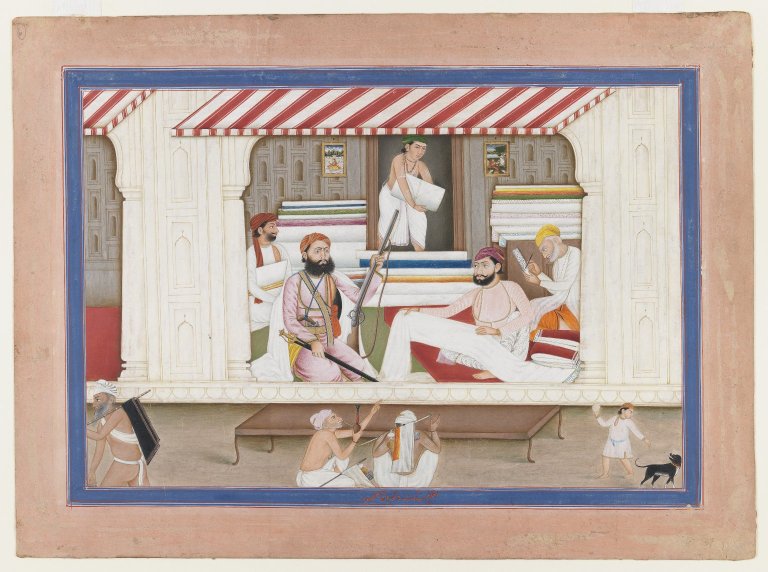
Cloth Merchant's Shop, Brooklyn Museum, depicts an establishment in India.

In the Middle Ages or 16th and 17th centuries, a cloth merchant was one who owned or ran a cloth (often wool) manufacturing or wholesale import or export business.[1] A cloth merchant might additionally own a number of draper's shops. Cloth was extremely expensive and cloth merchants were often very wealthy. A number of Europe's leading banking dynasties such as Medici and Berenberg built their original fortunes as cloth merchants.

In England, cloth merchants might be members of one of the important trade guilds, such as the Worshipful Company of Drapers.

Alternative names are clothier, which tended to refer more to someone engaged in production and the sale of cloth, whereas a cloth merchant would be more concerned with distribution, including overseas trade, or haberdasher, who were merchants in sewn and fine fabrics (e.g. silk) and in London, members of the Haberdashers' Company.

The largely obsolete term merchant taylor also describes a business person who trades in textiles, and initially a tailor who keeps and sells materials for the garments which he makes. In England, the term is best known in the context of the Worshipful Company of Merchant Taylors, one of the livery companies of the City of London, nowadays a charitable institution best known for the Merchant Taylors' schools – the Company preserves the ancient spelling "taylor" in its name.

Notable cloth merchants

[edit]

See also

[edit]

References

[edit]
Revisions and contributorsEdit on WikipediaRead on Wikipedia
from Grokipedia
A cloth merchant, also known as a clothier, draper, or mercer in historical contexts, was a specialized trader who bought, sold, and distributed textiles such as woolens, linens, silks, and cottons, often coordinating the entire process from to finished product marketing. With roots in ancient trade but emerging prominently in medieval , particularly in , where it became central to the by the late , transforming rural areas into industrial hubs through the organization of sorting, spinning, , , , and finishing. In the and (roughly 1450–1550), cloth merchants operated as entrepreneurs, employing the to distribute materials to rural workers or establishing early centralized workshops, which employed up to one in seven laborers and one in four households in key regions like , , and the . They facilitated long-distance trade, exporting high-quality broadcloths to continental markets via London merchants, while domestic sales occurred at fairs, markets, and shops where fabrics were measured and displayed using standardized tools like yardsticks. Distinct roles included clothiers who managed production and inventories, drapers who retailed finished goods, and mercers who handled finer imported fabrics, often extending to sustain the . The cloth trade's economic dominance—accounting for up to 31.8% of England's output by the early —generated substantial wealth, funding lavish buildings, church endowments, and even early banking innovations among families, though it faced regulations and competition from newer fabrics after 1550. While guilds regulated related crafts like tailoring, cloth s often worked independently or through merchant networks for imports, influencing urban development and social structures across .

Definition and Role

Historical Definition

A cloth merchant in historical contexts was a specialized trader who focused on the purchase, sale, and distribution of finished cloth or textiles, primarily serving as an between producers such as and dyers and broader markets. This role emphasized the handling of completed goods rather than raw materials or processes, facilitating the movement of textiles from local production sites to domestic and overseas consumers. Cloth merchants were distinct from related occupations in the textile trade. Unlike clothiers, who oversaw the and production of cloth—including sourcing , managing spinning, , and finishing—cloth merchants dealt exclusively with the of ready-made fabrics. They differed from drapers, who typically functioned as urban wholesalers or retailers supervising cloth makers and reselling to local buyers or tailors, often without extensive export involvement. In contrast to wool merchants, who traded raw as a to suppliers and producers, cloth merchants concentrated on processed textiles for end-use markets. Key characteristics of cloth merchants included engagement in bulk transactions, establishment of international trade networks, and significant capital investments in shipping, storage, and inventory management to support large-scale distribution. They commonly dealt in various cloth types such as woolens, linens, silks, and cottons, with regional specialties like the high-quality English exemplifying their focus on premium, export-oriented goods.

Functions in Trade

Cloth merchants served as key intermediaries in the textile supply chain by purchasing finished cloth from clothiers and producers at local markets, fairs, or directly from workshops. They often extended to producers to secure supplies and facilitate the flow of . Quality inspection was a critical step, with merchants examining purchased cloth for defects and sometimes applying personal marks or brands to certify standards before resale, ensuring market acceptance. Price negotiations occurred at production sites and markets, balancing acquisition costs against anticipated demand from buyers. Transportation relied on land routes with horses and pack animals for regional distribution or sea voyages via cogs and hulks for international export, navigating challenges like overland tolls and maritime perils. Sales targeted wholesalers, exporters, and urban retailers, with finished cloth bundled and shipped to ports or fairs for bulk transactions. Economic mechanisms underpinned these activities, including bills of exchange that financed cloth purchases by converting local currencies into foreign payments, as seen in Flemish woollen exports to Mediterranean markets where loans yielded profits from differences. involved maritime contracts, pioneered in like and , which protected shipments of cloth against losses from storms or by pooling premiums among merchants. Merchants also practiced market speculation, advancing purchases of finished cloth to exploit seasonal price fluctuations driven by harvests and trade disruptions. Daily operations revolved around seasonal rhythms, with merchants attending international fairs such as the Champagne cycles—six annual events rotating through towns like and —where English cloth was traded for continental goods over dedicated selling periods. Inventory management required maintaining ledgers to record stocks of finished cloth and sales records, supporting large-scale distribution networks. Building networks with agents in foreign ports, such as or , depended on sedentary oversight from home bases, using clerks or ship captains bound by communal reputation systems to handle deliveries and collections. In urban economies, cloth merchants drove growth by integrating rural production with city and international markets, often through guilds like the Merchant Adventurers, which facilitated exports and accounted for a significant portion of England's overseas . Their accumulated from funded civic projects, including church expansions and community bequests, bolstering local infrastructure and social welfare in cloth-trading regions.

History

Origins in Ancient Trade

The earliest evidence of organized cloth trade emerges in around 3000 BCE, where textiles and linen were bartered and exported along nascent overland routes connecting the region to the and , serving as precursors to later extensive networks like the . tablets from cities such as document the production and shipment of garments and cloth in exchange for metals and , highlighting textiles as a key export commodity in the economy. Major ancient hubs facilitated the spread of cloth trade, with Egypt renowned for its fine linens produced from , which were exported across the Mediterranean to regions including by the first millennium BCE, often via maritime routes controlled by intermediaries like the Phoenicians. In the Indus Valley Civilization (c. 2600–1900 BCE), textiles—among the world's earliest woven examples—were manufactured in surplus and traded eastward to and westward toward the , as evidenced by textile fragments and bead seals from sites like . , meanwhile, relied on wool imports from during the , where Assyrian merchants facilitated exchanges of raw wool and finished cloths through colonies like Kanesh, integrating Greek economies into broader Near Eastern networks. In these early economies, cloth merchants primarily acted as intermediaries within palace-controlled systems, managing the procurement, transport, and exchange of under institutional oversight, as recorded in administrative tablets that detail allocations for workshops and export quotas. This state-dominated model supported temple and royal needs while fostering regional specialization, such as wool production in and linen in . By around 1000 BCE, during the transition to the , independent professional merchants began to emerge in the and Mediterranean, operating outside strict palace frameworks through private ventures, exemplified by Phoenician traders who specialized in textile distribution across expanding maritime routes.

Medieval and Renaissance Developments

The medieval period witnessed a significant boom in the , particularly from the 11th to the 15th centuries, centered in and , where high-quality from English breeds like those in the and fueled economic expansion. English exports peaked in the early , reaching approximately 35,000 sacks annually around 1310-1311, driven by demand from Flemish cloth producers in cities such as , , and . These exports were primarily directed to the for processing into finished cloth, with a substantial portion—about one-fifth by the —also shipped to Italian markets via ports like , supporting the luxury industries in and other city-states. This not only enriched merchants but also became a of royal revenue through export taxes, such as the 1275 levy of 7s. 6d. per sack and the 1294 "maltote" of 40s. per sack, which financed English military endeavors. Technological and organizational innovations further propelled the cloth trade during this era. The introduction of fulling mills in the , particularly in , automated the labor-intensive process of cleaning and felting woolen cloth, replacing manual stomping with water-powered hammers to improve efficiency and consistency in production. This advancement allowed Flemish and English producers to scale output, enhancing the quality of exported broadcloths and meeting growing European demand. Complementing these developments, the , emerging in the 13th century and encompassing up to 170 cities by 1400, dominated Baltic trade routes, facilitating the exchange of English and Flemish cloth for timber, furs, and grain from northern ports like and Danzig. Hanseatic merchants secured over 90% of England's wool exports by the through their enclave, established in 1320, which provided secure warehousing and favorable trade concessions. The of 1348 profoundly disrupted yet ultimately reshaped the cloth landscape by decimating populations and altering labor dynamics. In , the plague reduced the agricultural workforce, leading to a 30-40% and enabling surviving laborers to demand higher wages—rising 20-40% between the 1340s and 1360s—while prices inflated until the mid-1370s before deflating. This prompted consolidation, as fewer hands meant higher production costs but also opportunities for survivors to invest in larger-scale operations; by 1400, English cloth exports reached 40,000 pieces annually, rivaling Flemish output as producers shifted toward luxury textiles. In , similar wage surges and labor shortages forced weavers to adapt by reselling English cloth or specializing in high-end fabrics, consolidating trade power among urban guilds. The (1337-1453) introduced both disruptions and opportunities for cloth merchants, exacerbating trade volatility while spurring adaptations. French naval raids and conflicts in key shipping lanes like and caused exports to plummet—to as low as 4,310 sacks in 1336-1337—due to heightened risks and Edward III's 1336 export ban aimed at bolstering domestic . However, the war created windfalls for resilient English merchants through advance contracts with Italian financiers, such as those supplying with capital for flock replenishment, and a domestic surplus in the 1330s-1340s that fueled local cloth industries. Flemish merchants, caught between English suppliers and French aggressors, navigated alliances to maintain inflows, ultimately benefiting from the conflict's role in redirecting trade toward English-controlled ports. Regionally, Italian city-states like , , and emerged as hubs for and trade during the , building on medieval foundations to produce luxury textiles that complemented imports. manufacturing, initiated in in the , expanded dramatically by the , with guilds like Florence's Arte di Por Santa Maria regulating production through statutes in 1411 and 1461, while innovations such as the circular silk-throwing machine boosted efficiency. Lucchese merchants migrated to these centers, organizing supply chains that integrated with for high-value exports across . In , the Staple system, established in 1314 and formalized by Edward III's 1347 charter, centralized exports through designated ports like , granting a monopoly to the Company of Merchants of the Staple—limited to about 200 freemen by 1363—in exchange for royal levies. This control stabilized trade flows to continental markets, empowering merchants to influence policy and finance crown loans, though it restricted foreign participation and fostered .

Colonial and Early Modern Expansion

The Age of Exploration from the 15th to 18th centuries propelled the global expansion of cloth merchants, as European traders sought new markets and resources, importing vibrant Indian calicoes—dyed and printed cotton textiles from regions like —for reexport to and the . These imports, facilitated by maritime voyages, flooded European markets and sparked demand, with the alone handling significant volumes by the late . In parallel, European merchants, particularly from Britain, exported woolens and other textiles to the and , where cloth constituted over two-thirds of English shipments to in the , often exchanged for raw materials or enslaved labor. This bidirectional flow integrated cloth into emerging colonial economies, transforming merchants from regional intermediaries into key players in intercontinental networks. Key trade networks emerged through chartered companies like the Dutch East India Company (VOC), established in 1602, and the English East India Company (EIC), founded in 1600, which dominated spice-cloth exchanges in Asia during the 17th century. The VOC commissioned Indian textiles for barter in spice-producing regions like the Indonesian archipelago, generating profits by supplying Asian consumers with high-demand cottons that Europeans could not produce competitively. Similarly, the EIC imported cotton cloths alongside spices, reexporting them to sustain triangular trade routes linking Europe, Africa, and the Americas, where European cloth—such as woolens and linens—was traded in African ports for captives destined for colonial plantations. These routes amplified cloth's role as a currency of exchange, with merchants leveraging company monopolies to navigate vast oceanic paths and bypass local intermediaries. The rise of mechanized production in 18th-century Britain marked a pivotal shift for cloth merchants, transitioning them from reliance on handmade textiles to factory-sourced goods powered by innovations like the (1733) and (1769). This industrialization, centered in and the , boosted output and reduced costs, enabling merchants to supply imperial markets with affordable cottons that rivaled Asian imports and supported reexports to colonies. By integrating production with global trade, merchants adapted to proto-industrial changes, sourcing from urban factories rather than rural artisans, which enhanced competitiveness in the Atlantic economy. Cloth merchants faced significant challenges from mercantilist policies designed to favor domestic industries, including the of 1651, which restricted colonial manufacturing of textiles like woolens to ensure British exports dominated within the empire. These acts limited American production of cloth and furniture, channeling demand back to English merchants and reinforcing imperial control over raw materials and finished goods. Competition from Asian producers intensified pressures, prompting protective measures like the of 1700 and 1721, which banned Indian calico imports for domestic use in Britain—though exemptions allowed reexports to colonies—while prohibiting printed cottons to shield local weavers from cheaper foreign textiles. Such policies, amid weavers' riots in 1697 and 1719, forced merchants to pivot toward colonial markets, sustaining volumes despite restrictions that persisted until 1774.

Guilds and Regulation

Formation and Structure of Guilds

Cloth merchant guilds originated in 12th-century as associations formed by traders to regulate competition, standardize practices, and secure monopolies in the expanding textile trade. These organizations emerged amid growing commercialization, where merchants sought collective protection against rivals, bandits, and arbitrary tolls imposed by local lords. By uniting, members could negotiate better terms with rulers and establish dominant positions in key markets for and finished cloth. For example, the , a confederation of northern German towns and merchants, began coalescing around 1159 to safeguard trade routes and interests, including the export of Flemish and English cloth across the Baltic and North Seas. In , the Florentine , a dedicated to production and , was formally established by 1182, becoming one of the city's seven greater guilds by 1236 and central to Florence's economic dominance in textiles. Similarly, in , livery companies related to cloth, such as those of the drapers and merchant taylors, took shape in the 13th century, evolving from earlier merchant fraternities to formal bodies that controlled access to the . The Company of Merchant Adventurers of received its in 1407, focusing on exporting English to and appointing overseas factors to manage foreign depots and negotiations. Internally, these guilds adopted a hierarchical structure to maintain order and skill transmission. At the top were masters, independent cloth merchants or manufacturers who owned workshops or trading enterprises; below them ranked journeymen, qualified workers traveling to gain experience before achieving mastery; and at the base were apprentices, bound for several years to learn the through supervised labor. Governance was handled by elected officials, such as consuls or wardens—often numbering two to eight—who managed membership enrollments, adjudicated internal disputes, and audited finances, ensuring only vetted individuals participated in guild-sanctioned . Beyond regulation, guilds fulfilled social and political roles to bolster member welfare and influence. They established mutual aid funds to support widows, orphans, and impoverished members during hardships like illness or trade disruptions, often financing burials, hospitals, and poor relief. Politically, guilds lobbied monarchs and city councils for privileges, such as exclusive market rights, tax exemptions, or safe-conduct passes for caravans, exemplified by the Arte della Lana's role in negotiating Florentine treaties with neighboring states. Additionally, they hosted annual banquets, processions, and trade fairs to build camaraderie, display prosperity, and attract apprentices, reinforcing the guild's prestige and networks.

Regulations on Quality and Trade

Cloth guilds in medieval imposed stringent quality controls to ensure uniformity and reliability in production, primarily through the system of aulnage, where official inspectors known as aulnagers measured cloths for compliance with statutory dimensions. These inspections verified length and width—typically set at two ells wide under the 1197 Assize of Measures—and checked for defects such as improper stretching on tenters, with seals affixed to approved pieces as proof of standard. was restricted to designated boroughs to maintain color fastness and , as seen in regulations reserving the process for urban centers by the late , while fraud like overstretching or substandard resulted in confiscation of goods, as enforced in cases like the 1412 seizure of non-assized cloths at Westminster Fair. Trade regulations further protected local industries by controlling and entry into the , including bans on foreign cloth imports to bolster domestic production, as evidenced by Edward III's policies in the 1330s that hindered overseas competition and promoted English . Guilds fixed prices to prevent undercutting, with examples from 15th-century Salisbury ordinances limiting sales of external cloths and setting values like 1s. 3d. per yard for black cloth, while quotas were indirectly managed through aulnage fees that tracked and taxed shipments, rising from £60 in 1362 to £100 in 1403 as expanded. requirements mandated a minimum of seven years of training under a master, a custom codified later but rooted in practices by the , ensuring skilled labor without immediate competition. Enforcement relied on guild courts and royal authority, where violations led to fines, expulsion, or public shaming; for instance, 's 1345 rules imposed 8d. fines per cloth sold outside designated areas, split between town and lord, with keepers overseeing compliance by 1437. Royal charters and ordinances granted legal backing, such as Henry II's 1163 charter permitting specific cloth types in and the Magna Carta's reiteration of measure standards, while 15th-century city bylaws in places like empowered s to restrict trade and inspect goods. Guild hierarchies, including masters and wardens, facilitated these courts, adjudicating disputes with penalties up to . These regulations standardized cloth production, facilitating long-distance trade by building buyer trust—evidenced by the sealing of over 5,000 cloths annually in by the 1390s—and driving industry growth in centers like , where output reached 36,000 cloths under Richard II. However, rigid controls stifled innovation, such as resistance to new techniques or machinery, contributing to decline by the 18th century as market demands shifted toward freer enterprise and imports resumed.

Notable Cloth Merchants

Influential Individuals

Francesco Datini (1335–1410), an Italian merchant from , played a pivotal role in the wool trade during the late medieval period. Starting with local wool production in , he expanded operations by importing high-quality English for , establishing a multinational network that included branches in , , , , , , and . This infrastructure supported banking, wool processing, and long-distance commerce across the Mediterranean, with Datini's companies active from 1382 to 1410. His archives, preserved in and comprising over 600 account books and 140,000 letters, offer unparalleled detailed trade ledgers that illuminate 14th-century economic practices, including through —such as securing 128 policies from 490 insurers between 1390 and 1401 to cover shipping hazards. Richard Whittington (c. 1350–1423), an English mercer specializing in cloth trade, accumulated substantial wealth through the sale of luxury fabrics to royalty and nobility in late medieval . By the 1390s, he supplied garments to King Richard II valued at £3,500 (equivalent to roughly £3.9 million in 2023 terms), and he extended substantial loans to the Crown, including to King Henry IV, which bolstered his financial influence. Elected four times (1397, 1406, 1419, and posthumously in 1420), Whittington channeled his fortune into public works, funding the rebuilding of to improve its conditions, repairs to , enlargement of the Greyfriars library, and infrastructure like drainage systems and a ward at for unmarried mothers. At his death, he bequeathed his estate—valued at around £7,000, or approximately £6.2 million today—to charitable causes, establishing a lasting endowment that continues to support public welfare. Jacob Fugger (1459–1525), dubbed "the Rich," transformed his family's Augsburg-based textile business into a cornerstone of European finance during the . Originating from Hans Fugger's 1367 settlement in , the enterprise involved supplying and to on and reselling finished cloths at profit, doubling the family's wealth between 1472 and 1486. Jakob, taking over after training in , leveraged these earnings to finance Habsburg rulers, beginning with textiles for Maximilian I's 1473 wedding and escalating to a 540,000-guilder in 1519 that secured Charles V's election as , in exchange for mining concessions. His accumulated fortune, estimated at several million gold florins or about 2% of Europe's GDP at the time (equivalent to $400 billion in modern terms), funded expansive legacies like the social housing complex, influencing trade networks and imperial politics through cloth-derived capital.

Prominent Families and Companies

The Medici family rose to prominence in 14th- and 15th-century through their involvement in the wool trade, importing raw wool from and processing it into high-quality cloth under the oversight of the guild. This textile enterprise provided the initial capital that enabled (1360–1429) to establish the , which expanded across Europe and served as bankers to the papacy, generating immense wealth. Profits from cloth sales and banking were strategically reinvested into political influence and cultural patronage; (1389–1464), for instance, commissioned major works like ’s sculptures and Brunelleschi’s dome for , solidifying the family's de facto rule over the city and fostering the artistic revival. In 17th-century , the exemplified dynastic cloth trading in during the , with their merchant operations contributing to the republic's expansive commerce, including exports that supported trade routes to the via the . Originating from Flemish roots, the family built wealth through the import and sale of fine woolens and linens, with figures like Jean Six (1575–1617) establishing a foundation that propelled his son Jan Six (1618–1700) into political roles such as burgomaster, while maintaining ties to international networks. Their success reflected Amsterdam's dominance in Baltic and Asian trade, where Dutch cloth goods were exchanged for spices and silks, bolstering the era's economic prosperity. Early chartered companies marked a shift from individual or familial ventures to organized monopolies in cloth trade. The English , founded in 1581 by from Queen Elizabeth I, began as a regulated of merchants trading with the , primarily exporting English cloth, tin, and lead in exchange for raw and spices, achieving early profits of up to 300%. It evolved into a full monopoly through renewed charters in 1600 and 1661, imposing duties on non-members and centralizing control over Levantine routes until its decline in the . Similarly, the Royal African Company, established in 1660 by King Charles II as a successor to earlier adventurer , held a monopoly on English trade with ; it exported European including cloth, muskets, and iron bars in exchanges for , ivory, and enslaved people, thereby facilitating the transatlantic slave trade. By 1672, its formalized exclusive , transforming loose alliances into a structured entity that dominated English African commerce for decades. These prominent families and companies exerted long-term influence through strategic intermarriages that forged commercial alliances, as seen in Renaissance where Medici partnerships often intertwined with marital ties to secure and networks. Such unions facilitated estate accumulations, enabling diversification into landownership and , while the Medici model of transitioning from cloth profits to banking inspired similar evolutions among European merchant dynasties, blending capital with to sustain generational dominance. In , for example, elite trading families used marriages during 1400–1599 to monopolize lucrative routes, illustrating how familial consolidation preserved market control across centuries.

Modern Equivalents

Evolution into Textile Trading

The , beginning in the late , fundamentally transformed the role of cloth merchants by shifting production from artisanal workshops to mechanized mills, particularly in , . Prior to the 1760s, merchants relied on domestic spinners and weavers under the , sourcing hand-spun and hand-woven cloth from rural households. However, inventions such as ' in 1764 and Richard Arkwright's in 1769 enabled factory-based production of finer, stronger , allowing merchants to procure larger volumes from centralized mills rather than scattered artisans. By the , over 20,000 were operational in British factories, accelerating the Lancashire cotton boom as raw imports from colonial networks fueled mill output. This transition to reduced costs and increased supply, with Britain's cotton exports surging from £5.4 million in 1800 to £46.8 million by 1860, positioning merchants as key intermediaries between mills and global markets. Key adaptations in the 19th century included the adoption of steamships and railroads, which revolutionized distribution and enabled merchants to handle greater volumes over longer distances. Steamships, emerging in the late 19th century, halved shipping times on major routes by eliminating reliance on wind patterns, boosting exports in industrialized nations and facilitating faster global integration between 1870 and 1913. Concurrently, railroads expanded internal networks, connecting mills to ports like and allowing merchants to distribute cloth efficiently across Britain and abroad. This infrastructure shift encouraged a move away from owning goods outright toward operating as commission agents, who earned fees by facilitating sales without holding inventory, reducing in volatile markets. In regions like , merchants increasingly commissioned mills to produce cloth to specific designs, further specializing their role in coordination rather than production. The 20th century brought further disruptions and diversification for cloth merchants, beginning with the introduction of synthetic fibers in the . , developed as an , gained popularity for its affordability and versatility, challenging traditional natural fibers like and in garment production. The invention of by at DuPont in 1938 marked a pivotal advancement, offering durable alternatives derived from abundant , which merchants adopted to mitigate shortages of imported —over 90% of U.S. imports of which came from in the 1930s. World Wars I and II exacerbated vulnerabilities, with blockades and halving European textile imports and devastating production in occupied areas, such as France's loss of 94% of output in 1914. These events prompted merchants to diversify portfolios beyond natural fibers, incorporating synthetics and exploring new sources like and to maintain trade flows.

Contemporary Global Practices

In the contemporary global textile industry, cloth merchants primarily function as intermediaries in international supply chains, acting as importers, exporters, and coordinators to facilitate the movement of fabrics and finished textiles across borders. These roles have evolved with digital platforms, where sites like Alibaba, established in 1999, enable bulk fabric trades by connecting manufacturers, wholesalers, and buyers worldwide for efficient B2B transactions. Merchants often manage sourcing from production hubs, negotiating contracts, and ensuring compliance with international standards to streamline global distribution. Asian countries dominate the global textile landscape, with and collectively accounting for over 60% of world production in the , driven by their scale in manufacturing and apparel output. holds more than 40% of the in global exports, while leads in production at approximately 25% of the world's total. To address labor issues prevalent in these hubs, certifications such as the Fairtrade Textile Standard have gained traction, enforcing requirements for fair wages, safe working conditions, and worker representation in factories to mitigate exploitation in garment production. Contemporary cloth merchants face significant challenges from sustainability regulations, rapid market shifts, and economic pressures. The European Union's Green Deal, launched in 2019, imposes stringent requirements on textiles, including mandates for practices and reduced environmental impact, compelling merchants to adapt s for eco-friendly sourcing and waste reduction. Innovations like technology enhance tracking by providing immutable records of fabric origins and transactions, improving transparency and verifying ethical practices from fiber to finished product. Meanwhile, cycles, characterized by accelerated production and trend turnover, pressure merchants to shorten lead times and manage volatile demand, often exacerbating overproduction and labor strains in global networks. The economic scale of the global textile trade underscores these dynamics, with a value exceeding $1 trillion annually as of 2023 and estimated at USD 1.16 trillion in 2025. Cloth merchants navigate this by handling tariffs—such as those intensified by U.S.- trade policies, with further escalations in 2025—and employing currency hedging strategies to mitigate fluctuations, which can erode profitability amid geopolitical tensions. These practices ensure resilience in a sector projected to reach $1.61 trillion by 2033.

References

Add your contribution
Related Hubs
User Avatar
No comments yet.