


Community hub
Recent from talks
Contribute something
Nothing was collected or created yet.
Mediterranean monk seal
View on Wikipedia
| Mediterranean monk seal | |
|---|---|

| |
| Alonnisos Marine Park, Greece | |
CITES Appendix I
| |
Scientific classification 
| |
| Kingdom: | Animalia |
| Phylum: | Chordata |
| Class: | Mammalia |
| Order: | Carnivora |
| Family: | Phocidae |
| Genus: | Monachus Fleming, 1822 |
| Species: | M. monachus
|
| Binomial name | |
| Monachus monachus (Hermann, 1779)
| |

| |

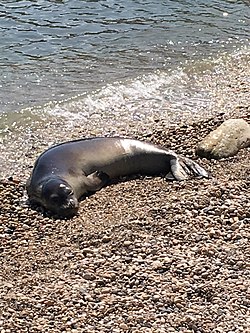
The Mediterranean monk seal (Monachus monachus) is a monk seal belonging to the family Phocidae. As of 2015[update], it is estimated that fewer than 700 individuals survive in three or four isolated subpopulations in the Mediterranean, (especially) in the Aegean Sea, the archipelago of Madeira and the Cabo Blanco area in the northeastern Atlantic Ocean.[3] It is believed to be the world's rarest pinniped species.[1] It is the only extant species in the genus Monachus.
Description
[edit]This species of seal grows from approximately 80 centimetres (2.6 ft) long at birth up to an average of 2.4 metres (7.9 ft) as adults, females slightly shorter than males.[4] Males weigh an average of 320 kilograms (710 lb) and females weigh 300 kilograms (660 lb), with overall weight ranging from 240–400 kilograms (530–880 lb).[1][5][6][7] They are thought to live up to 45 years old;[5] the average life span is thought to be 20 to 25 years old and reproductive maturity is reached at around age four.
The monk seals' pups are about 1 metre (3.3 ft) long and weigh around 15–18 kilograms (33–40 lb), their skin being covered by 1–1.5 centimeter-long, dark brown to black hair. On their bellies, there is a white stripe, which differs in color and shape between the two sexes. In females the stripe is usually rectangular in shape whereas in males it is usually butterfly shaped.[8] This hair is replaced after six to eight weeks by the usual short hair adults carry.[5] Adults will continue to molt annually, causing their color vibrancy to change throughout the year.[9]
Pregnant Mediterranean monk seals typically use inaccessible undersea caves while giving birth, though historical descriptions show they used open beaches until the 18th century. There are eight pairs of teeth in both jaws.
Believed to have the shortest hair of any pinniped, the Mediterranean monk seal fur is black (males) or brown to dark grey (females), with a paler belly, which is close to white in males. The snout is short broad and flat, with very pronounced, long nostrils that face upward, unlike their Hawaiian relative, which tend to have more forward nostrils. The flippers are relatively short, with small slender claws. Monk seals have two pairs of retractable abdominal teats, unlike most other pinnipeds.
Reproduction
[edit].jpg)
Very little is known of this seal's reproduction. As of 2020, it is thought that there are roughly 500 pairs of monk seals remaining in the world.[10] Scientists have suggested that they are polygynous, with males being very territorial where they mate with females. Although there is no breeding season since births take place year-round, there is a peak in September, October, and November. Although mating will take place in the water, females will give birth and care for the pups on beaches or underwater caves. The use of underwater caves may have begun in order to make predatory actions almost impossible as these caves are difficult to access. Because they will stay with the pups to nurse and protect, they use their stored fat reserves to nurse.[4] Data analysis indicates that only 29% of pups born between September and January survive. One cause of this low survival rate is the timing of high surf around the areas of breeding, creating a threat to young pups. As well, if a female determines that her environment is not a safe one, she can initiate an abortion, indirectly lowering the population.[10] Because of smaller populations there is an increase in genetic events such as inbreeding and lack of genetic variation. During other months of the year, pups have an estimated survival rate of 71%.[1]
In 2008, lactation was reported in an open beach, the first such record since 1945, which could suggest the seal could begin feeling increasingly safe to return to open beaches for breeding purposes in Cabo Blanco.[11]
Pups make first contact with the water two weeks after their birth and are weaned at around 18 weeks of age; females caring for pups will go off to feed for an average of nine hours.[1] Most female individuals are believed to reach maturity at four years of age, at which point they will begin to breed.[4] Males begin to breed at age six.[9] The gestation period lasts close to a year. However, it is believed to be common among monk seals of the Cabo Blanco colony to have a gestation period lasting slightly longer than a year.[12]
Diet
[edit]Mediterranean monk seals are diurnal and feed on a variety of fish, crustaceans, and mollusks, primarily octopus, squid, lobsters, mullets, flatfish, tuna, sardines, and eels, up to 3 kg per day.[13] Although they commonly feed in shallow coastal waters, they are also known to forage at depths up to 250 meters, with an average depth varying between specimens.[1] Monk seals prefer hunting in wide-open spaces, enabling them to use their speed more effectively. They are successful bottom-feeding hunters; some have even been observed lifting slabs of rock in search of prey.
Habitat
[edit]The habitat of this pinniped has changed over the years. In ancient times, and up until the 20th century, Mediterranean monk seals had been known to congregate, give birth, and seek refuge on open beaches. In more recent times, they have left their former habitat and now only use sea caves for these activities. Often these caves are inaccessible to humans. Frequently their caves have underwater entries, and many caves are positioned along remote or rugged coastlines.[14][15][16][17]
Scientists have confirmed this is a recent adaptation, most likely due to the rapid increase in human population, tourism, and industry, which have caused increased disturbance by humans and the destruction of the species' natural habitat. Because of these seals' shy nature and sensitivity to human disturbance, they have slowly adapted to try to avoid contact with humans completely within the last century, and, perhaps, even earlier. The coastal caves are, however, dangerous for newborns, and are causes of major mortality among pups when sea storms hit the caves.[14][18][19][20]
Distribution and status
[edit]The Mediterranean monk seal can be found in the Mediterranean Sea off of Croatia, Cyprus, Greece, and Turkey, as well as the North Atlantic Ocean off of Mauritania and Western Sahara.[1] It may be locally-extinct (extirpated) in and around Albania, Corsica, Egypt, France, Italy, Libya, Malta, Monaco, Montenegro, southern Spain (and the Balearic Islands), and Tunisia.[1] Its status in Algeria, Israel, Lebanon, Morocco and Syria is unknown.[1]
This earless seal's historical range extended from the northern Atlantic coastline of Western Africa east to the Black Sea, including all offshore islands within the Mediterranean, the Canary Islands, Madeira, Desertas, Porto Santo, and as far west as the Azores. Vagrants could be found as far south as The Gambia and the Cape Verde (Cabo Verde) islands, and as far north as Portugal to Northern Spain and the Bay of Biscay to the coast of Brittany.[1]
Several causes provoked a dramatic population decrease over time: on one hand, commercial hunting (especially during the Roman Empire and Middle Ages) and, during the 20th century, eradication by fishermen, who used to consider it a pest due to the damage the seal causes to fishing nets when it preys on fish caught in them; and, on the other hand, coastal urbanization and pollution.[1]
Some seals have survived in the Sea of Marmara,[21] but the last report of a seal in the Black Sea dates to 1997.[1] Monk seals were present at Snake Island until the 1950s, and several locations such as the Danube Plavni Nature Reserve and Doğankent were the last known hauling-out sites post-1990.[22]
Nowadays, its entire population is estimated to be less than 700 individuals widely scattered, which qualifies this species as endangered. Its current very sparse population is one more serious threat to the species, as it only has two key sites that can be deemed viable. One is the Aegean Sea (250–300 animals in Greece, with the largest concentration of animals in Gyaros island,[3] and some 100 in Turkey); the other important subpopulation is in the Atlantic Ocean, in the Western Saharan portion of Cabo Blanco (around 270 individuals which may support the small, but growing, nucleus in the Desertas Islands – approximately 30–40 individuals[23]). There may be some individuals using coastal areas among other parts of Western Sahara, such as in Cintra Bay.[24]
These two key sites are virtually in the extreme opposites of the species' distribution range, which makes natural population interchange between them impossible. All the other remaining subpopulations are composed of less than 50 mature individuals, many of them being only loose groups of extremely reduced size – often less than five individuals.[1]
Other remaining populations are in southwestern Turkey and the Ionian Sea (both in the eastern Mediterranean). The species status is virtually moribund in the western Mediterranean, which still holds tiny Moroccan and Algerian populations, associated with rare sightings of vagrants in the Balearic Islands,[25] Sardinia, and other western Mediterranean locations, including Gibraltar.
In Sardinia the Mediterranean monk seal was last sighted in May 2007 and April 2010. The increase of sightings in Sardinia suggests that the seal occasionally inhabits the Central Eastern Sardinian coasts, preserved since 1998 by the National Park of Golfo of Orosei.[26][27][28]
Colonies on the Pelagie Islands (Linosa and Lampedusa) were destroyed by fishermen, which likely resulted in local extinction.[29]
Cabo Blanco 1997 die off and recovery
[edit]Cabo Blanco, in the Atlantic Ocean, is the largest surviving single population of the species, and the only remaining site that still seems to preserve a colony structure.[1] In the summer of 1997, more than 200 animals[1] or two-thirds of its seal population were wiped out within two months, compromising the species' viable population. While opinions on the precise causes of this epidemic remain divided between a morbillivirus or, more likely, a toxic algae bloom,[1] the mass die-off emphasized the precarious status of a species already regarded as critically endangered throughout its range.
Numbers in this all-important location started a slow-paced recovery ever since. A small but incipient (up to 20 animals by 2009) sub-population in the area had started using open beaches. In 2009, for the first time in centuries, a female delivered her pup on the beach (open beaches are the optimal habitat for the survival of pups, but had been abandoned due to human disturbance and persecution in past centuries).[30]
Only by 2016 the colony had recovered to its previous population (about 300 animals). This was made possible by a recovery plan financed by Spain.[23] Also in 2016, a new record of births was set for the colony (83 pups).[23]
However, the threat of a similar incident, which could severely reduce or wipe out the entire population, remains.[31]
Recent sightings
[edit]


In June 2009, there was a report of a sighting off the island of Giglio, in Italy.[32] On 7 January 2010, fishermen spotted an injured Mediterranean monk seal off the coasts of Tel Aviv, Israel. When zoo veterinarians arrived to help the seal, it had slipped back into the waters. Members of the Israel Marine Mammal Research and Assistance Center arrived at the scene and tried to locate the injured mammal, but with no success. This was the first sighting of the species in the region since Lebanese authorities claimed to have found a population of 10–20 other seals on their coasts 70 years earlier.[33] In addition, the seal was also sighted a couple of weeks later in the northern kibbutz of Rosh Hanikra.[34]
In April 2010, there was a report of a sighting off the island of Marettimo, in the Egadi Islands off the coast of Italy, in Trapani Province.[35] In November 2010, a Mediterranean monk seal, supposedly aged between 10 and 20, had been spotted in Bodrum, Turkey.[36] On 31 December 2010, the BBC Earth news[37] reported that the MOM Hellenic Society[38] had located a new colony of seals on a remote beach in the Aegean Sea. The exact location was not communicated so as to keep the site protected. The society was appealing to the Greek government to integrate the part of the island on which the seals live into a marine protected area.
On 8 March 2011, the BBC Earth news[39] reported that a pup seal had been spotted on 7 February while monitoring a seal colony on an island in the southwestern Aegean Sea. Soon after, it showed signs of weakness and it was taken to a rehabilitation centre to try to save it. The aim is to release it back into the wild as soon as it is strong enough. In April 2011, a monk seal was spotted near the Egyptian coast after long absence of the species from the nation.[40]
On 24 June 2011, the Blue World Institute of Croatia[41] filmed an adult female underwater in the northern Adriatic, off the island of Cres and a specimen of unverified sex on 29 June 2012.[42] On 2 May 2013 a specimen was seen on the southernmost point of Istrian peninsula near the town of Pula.[43] On 9 September 2013, in Pula a male specimen swam to a busy beach and entertained numerous tourists for five minutes before swimming back to the open sea.[44] In summer 2014 sightings in Pula have occurred almost daily and monk seal stayed multiple times on crowded city beaches, sleeping calm for hours just few meters away from humans.[45][46] To prevent accidents and preserve monk seal, local city council acquired special educational boards and installed on city beaches.[47] Despite clear instructions, an incident occurred with a tourist harassing a seal. The whole event was filmed.[48] Less than a month later on 25 August 2014 this female monk seal was found dead in the Mrtvi Puć bay near Šišan, Croatia. Experts said it was natural death caused by her old age.[49]
-
 The monk seal on Mornar Beach, in Pula, Croatia
 -
 A few days before she died in the Mrtvi Puć Bay near Šišan, Croatia


In 2012, a Mediterranean monk seal, was spotted in Gibraltar on the jetty of the private boat owners club at Coaling Island.[50]
In the week of 22–28 April 2013, what is believed to have been a monk seal was viewed in Tyre, southern Lebanon; photographs have been reported among many local media.[51] A study by the Italian Ministry of the Environment in 2013 confirmed the presence of monk seals in marine protected area in the Egadi Islands.[52] In September and October 2013, there were a number of sightings of an adult pair in waters around RAF Akrotiri in British Sovereign Base waters in Cyprus.
In November 2014, an adult monk seal was reportedly seen inside the port of Limassol, Cyprus. A female monk seal, called Argyro by the locals, was repeatedly seen on beaches of Samos island in 2014 and 2015,[53] and two were reported in April 2016.[54] In 2017, Argyro was shot and killed.[55]
On 7 April 2015, a large floating "fish" was reported near Raouche, Beirut in Lebanon, and collected by a local fisherman. This turned out to be the body of a female monk seal known to have been resident there for some time. Further investigations revealed that she was pregnant with a pup.[56]
On 13 August 2015, ten monk seals were spotted in Governor's Beach, Limassol, Cyprus.[57]
On 6 January 2016, a monk seal climbed aboard a parked boat in Kuşadası.[58]
On 10 April 2016, a monk seal was spotted and photographed by a group of foreign exchange students and local bio-engineers in a creek in Manavgat District in Turkey's southern Antalya Province. According to the scientists involved in local projects to protect the animals, this was the first ever documented sighting of a monk seal swimming in a river. Possible reasons for the animal's appearance included better opportunities for hunting, as well as higher salinity levels due to lower water levels.[59]
On 26 April 2016, two monk seals were spotted at the municipal baths area of Paphos, Cyprus.[54]
On 18 October 2016, a monk seal was captured on video around Gulf of Kuşadası.[60]
On 3 November 2016, a monk seal was spotted at the coast of Gialousa in Cyprus.[61]
On 13 June 2017, a specimen was spotted and photographed by a group of fishermen off the coasts of Tricase in the south of Italy.[62]
In early 2018 a mother and her pup were spotted around Paphos Harbour in Cyprus.[63]
In November 2018, a young monk seal was spotted at the coast of Karavostasi in Cyprus, only to be found dead at the same area a few days later.[64]
On 15 March 2019, a monk seal was spotted and photographed by a group of citizens at a marina in Kuşadası.[65]
On 20 July 2019, a monk seal was spotted in Protaras bay area in Cyprus.[66]
On 27 January 2020, a young monk seal was recovered dead from Torre San Gennaro in Apulia.[67]
On 15 December 2020, a monk seal was spotted and videotaped while seated on a sunlounger in Samos Island, Greece.[68]
On 24 July 2021, a previously rescued and rehabilitated monk seal nicknamed "Kostis" was found dead in the waters of the Cycladic islands. MOm, the Hellenic Society for the Study and Protection of the Monk Seal reported that the seal had been executed at close range with a spear gun. Additionally, MOm pledged a €18,000 bounty for any evidence that "will lead to the arrest of the person(s) responsible for the killing of the seal, known as Kostis."[69]
On 24 April 2023, a large monk seal was spotted at Korakonisi, Zakynthos in Greece. It stayed on the surface for around a minute observing onlookers and then dived and was not seen again on that day.[70]
On 12 May 2023, a healthy adult female monk seal was observed and photographed resting for at least a few hours on the beach in Jaffa near Tel Aviv, Israel.[71] Israel's Nature and Park Authority has been monitoring since then this seal dubbed "Yulia", estimated at twenty years of age, spotted by eastern Mediterranean researchers in recent years in Turkey and Lebanon, where she is known as "Tugra". International consultation assessed that she is in normal molt to shed her winter coat, mostly relaxing on the section of beach that has been fenced off for her, and occasionally going into the water.[72][73][74]
On 5 July 2024, a monk seal was spotted in Malta after an absence of 30 years.[75]
Preservation
[edit]
Damage inflicted on fishermen's nets and rare attacks on offshore fish farms in Turkey and Greece are known to have pushed local people towards hunting the Mediterranean monk seal, but mostly out of revenge, rather than population control. Preservation efforts have been put forth by civil organizations, foundations, and universities in both countries since as early as the 1970s. For the past 10 years,[76][77] many groups have carried out missions to educate locals on damage control and species preservation. Reports of positive results of such efforts exist throughout the area.[78]
In the Aegean Sea, Greece has allocated a large area for the preservation of the Mediterranean monk seal and its habitat. The Greek Alonissos Marine Park, that extends around the Northern Sporades islands, is the main action ground of the Greek MOm organisation.[79] MOm is greatly involved in raising awareness in the general public, fundraising for the helping of the monk seal preservation cause, in Greece and wherever needed. Greece is currently investigating the possibility of declaring another monk seal breeding site as a national park and also has integrated some sites in the NATURA 2000 protection scheme. The legislation in Greece is very strict towards seal hunting, and in general, the public is very much aware and supportive of the effort for the preservation of the Mediterranean monk seal.[80][81]
The complex politics concerning the covert opposition of the Greek government towards the protection to the monk seals in the eastern Aegean in the late 1970s is described in a book by William Johnson.[82] Oil companies apparently may have been using the monk seal sanctuary project as a stalking horse to encourage greater cooperation between the Greek and Turkish governments as a preliminary to pushing for oil extraction rights in a geopolitically unstable area. According to Johnson, the Greek secret service, the YPEA, were against such moves and sabotaged the project to the detriment of both the seals and conservationists, who, unaware of such covert motivations, sought only to protect the species and its habitat.[82]
One of the largest groups among the foundations concentrating their efforts towards the preservation of the Mediterranean monk seal is the Mediterranean Seal Research Group (Turkish: Akdeniz Foklarını Araştırma Grubu) operating under the Underwater Research Foundation (Turkish: Sualtı Araştırmaları Derneği) in Turkey (also known as SAD-AFAG). The group has taken initiative in joint preservation efforts together with the Foça municipal officials, as well as phone, fax, and email hotlines for sightings.[83]
Preservation of the species requires both the preservation of land and sea, due to the need for terrestrial haul-out sites and caves or caverns for the animal to rest and reproduce. Even though responsible scuba diving instructors hesitate to make trips to known seal caves, the rumor of a seal sighting quickly becomes a tourist attraction for many. Irresponsible scuba diving trips scare the seals away from caves which could become habitation for the species.[84][85]
The Environment and Urbanization Minister of Turkey announced on 18 November 2019 that a plan was proposed to further preserve the species to allow the sub species of Foça, Gökova, Datça and Bozburun to increase in numbers.[86]
Conservation
[edit]Under the auspices of the Convention on Migratory Species of Wild Animals (CMS), also known as the Bonn Convention, the Memorandum of Understanding (MoU) concerning Conservation Measures for the Eastern Atlantic Populations of the Mediterranean Monk Seal was concluded and came into effect on 18 October 2007. The MoU covers four range States (Mauritania, Morocco, Portugal and Spain), all of which have signed, and aims at providing a legal and institutional framework for the implementation of the Action Plan for the Recovery of the Mediterranean Monk Seal in the Eastern Atlantic.
As there are indications of small population increases in the subpopulations, in 2023 the Mediterranean monk seal's IUCN conservation status was updated from endangered to vulnerable in keeping with the IUCN's speed-of-decline criteria.[1]
In culture
[edit]The Mediterranean monk seal occasionally appears in Classical mythology. In Homer's The Odyssey, the sea god Proteus is shown herding monk seals for Poseidon. The mythical hero Phocus of Aegina (with phokos literally translating to seal in Greek) was the son of the nereid Psamathe, and was conceived while she was transformed into a seal. The ancient city of Phocis (and possibly Phocaea) was named after Phocus, and the city of Phocaea took on the monk seal as an emblem. This has been thought to either be due to the myth of Phocus' birth, or monk seals formerly inhabiting the area where Phocaea was established. There is only a single known surviving depiction of the monk seal from antiquity, this being on a Caeretan hydria likely created by Phocaean refugees in Etruria.[87]
Despite its mythological connections and association with certain peoples, the monk seal still seems to have generally been reviled and feared by the ancient Greeks and Romans due to its form and smell, as well as its association with the unknown nature of the ocean. Many Greek and Roman metaphors and idioms portrayed the seal in a negative light. This antipathy may have contributed to its long-term decline in numbers by spurring persecution of the species.[87]
On the other hand, a 2000-year-old grave with a skeleton of a Mediterranean monk seal was found during archaeological excavations in the port of Rhodes in Greece; and the seal was buried with a ritual that was used for human burials. The skeleton is now exhibited in the Aquarium of Rhodes.[88]
In the 11th century BC, the Assyrian king Tiglath-Pileser I was gifted several animals by the Egyptian pharaoh Ramesses XI, including a crocodile and an unknown creature known as the "river-man". These animals were displayed in the menagerie of his son Ashur-bel-kala, and are portrayed on several of Ashur's obelisk fragments. A pair of hind flippers on one partial fragment has been identified with the "river-man", and if so indicate that the "river man" was almost certainly a monk seal.[89]
When the 1979 Mediterranean Games were organised in Split, SR Croatia, SFR Yugoslavia the mascot of the event was a Mediterranean monk seal named Adriana.[90]
References
[edit]- ^ a b c d e f g h i j k l m n o p q Karamanlidis, A.A.; Dendrinos, P.; Fernandez de Larrinoa, P.; Kıraç, C.O.; Nicolaou, H. & Pires, R. (2023). "Monachus monachus". IUCN Red List of Threatened Species. 2023 e.T13653A238637039. doi:10.2305/IUCN.UK.2023-1.RLTS.T13653A238637039.en. Retrieved 12 December 2023.
- ^ "Appendices | CITES". cites.org. Retrieved 14 January 2022.
- ^ a b Karamanlidis, A.A.; et al. (April 2016). "The Mediterranean monk seal Monachus monachus: status, biology, threats, and conservation priorities". Mammal Review. 46 (2): 92–105. Bibcode:2016MamRv..46...92K. doi:10.1111/mam.12053. hdl:11511/29839. S2CID 86285100.
- ^ a b c Benton, Melody. "Monachus monachus (Mediterranean monk seal)". Animal Diversity Web. Retrieved 16 October 2020.
- ^ a b c "MOm Website". Mom.gr. Archived from the original on 16 March 2012. Retrieved 6 November 2012.
- ^ "Mediterranean Monk Seal Fact Files: Biology: External appearance and anatomy". Monachus-guardian.org. Retrieved 6 November 2012.
- ^ "Mediterranean Monk Seal (Monachus monachus) - Office of Protected Resources - NOAA Fisheries". Nmfs.noaa.gov. 18 November 2005. Retrieved 6 November 2012.
- ^ "Lobo marinho". The City of Funchal. Archived from the original on 16 September 2017. Retrieved 27 November 2016.
- ^ a b Alava, Juan J., ed. (12 July 2017). Tropical Pinnipeds. CRC Press. doi:10.1201/9781315151588. ISBN 978-1-315-15158-8.
- ^ a b Martin, Natalie (22 November 2020). "Alonissos Honoured By National Geographic's 'Best Of The World List' 2021". Greek City Times. Retrieved 2 December 2020.
- ^ "Mediterranean Monk Seal News II - Monachus Guardian 11 (2): November 2008". Monachus-guardian.org. Retrieved 6 November 2012.
- ^ Pastor, T.; Aguilar, A. (2003). "Reproductive Cycle of the Female Mediterranean Monk Seal in the Western Sahara". Marine Mammal Science. 19 (2): 318–330. Bibcode:2003MMamS..19..318P. doi:10.1111/j.1748-7692.2003.tb01111.x. ISSN 1748-7692.
- ^ "ADW: Monachus monachus: INFORMATION". Animal Diversity Web.
- ^ a b Fisheries, NOAA (22 November 2024). "Mediterranean Monk Seal | NOAA Fisheries". NOAA. Retrieved 16 January 2025.
- ^ "Mediterranean Monk Seal". PPNEA. Retrieved 16 January 2025.
- ^ Bundone, Luigi; Panou, Aliki; Molinaroli, Emanuela (2019). "On sightings of (vagrant?) monk seals, in the Mediterranean Basin and their importance for the conservation of the species". Aquatic Conservation: Marine and Freshwater Ecosystems. 29 (4): 554–563. doi:10.1002/aqc.3005. ISSN 1099-0755.
- ^ González, Luis Mariano (2015). "Prehistoric and historic distributions of the critically endangered Mediterranean monk seal (Monachus monachus) in the eastern Atlantic". Marine Mammal Science. 31 (3): 1168–1192. Bibcode:2015MMamS..31.1168G. doi:10.1111/mms.12228. ISSN 1748-7692.
- ^ Notarbartolo di Sciara, G.; Kotomatas, S. (1 January 2016), Notarbartolo Di Sciara, Giuseppe; Podestà, Michela; Curry, Barbara E. (eds.), "Are Mediterranean Monk Seals, Monachus monachus, Being Left to Save Themselves from Extinction?", Advances in Marine Biology, Mediterranean Marine Mammal Ecology and Conservation, 75, Academic Press: 359–386, doi:10.1016/bs.amb.2016.08.004, ISBN 978-0-12-805152-8, PMID 27770990, retrieved 16 January 2025
- ^ Gazo, Manel; Aparicio, Fernando; Cedenilla, Miguel Angel; Layna, Jorge F.; González, Luis Mariano (2000). "Pup Survival in the Mediterranean Monk Seal (monachus Monachus) Colony at Cabo Blanco Peninsula (western Sahara-Mauritania)". Marine Mammal Science. 16 (1): 158–168. Bibcode:2000MMamS..16..158G. doi:10.1111/j.1748-7692.2000.tb00910.x. ISSN 1748-7692.
- ^ Dendrinos, Panagiotis; Adamantopoulou, Styliani; Koemtzopoulos, Kimon; Mpatzios, Panagiotis; Paxinos, Odysseas; Tounta, Eleni; Tsiakalos, Dimitris; Karamanlidis, Alexandros A. (2022). "Anecdotal Observations of Open Beach Use by Female Mediterranean Monk Seals (Monachus monachus) and Their Pups in Greece: Implications for Conservation". Aquatic Mammals. 48 (6): 602–609. Bibcode:2022AqMam..48..602D. doi:10.1578/am.48.6.2022.602. Retrieved 16 January 2025.
- ^ Inanmaz E.Ö.. Değirmenci Ö.. Gücü C.A.. 2014. A new sighting of the Mediterranean Monk Seal, Monachus monachus (Hermann, 1779), in the Marmara Sea (Turkey). pp.278-280. Zoology in the Middle East. Volume 60, 2014 - Issue 3. The Taylor & Francis. Retrieved on 28 March 2017
- ^ Grinevetskiii, S. R.; Zonn, I. S.; Zhilʹtsov, S. S.; Kosarev, A. N.; Kostianoĭ, A. G. (2015). The Black Sea encyclopedia. Berlin. p. 532. ISBN 978-3-642-55227-4.
{{cite book}}: CS1 maint: location missing publisher (link) - ^ a b c Vera, Eloy (22 December 2016). "La colonia de focas monje de Mauritania se ha triplicado desde su crisis de 1997". EFE Verde (in Spanish). Retrieved 8 January 2017.
- ^ Tiwari M.; Aksissou M.; Semmoumy S.; Ouakka K. (2006). Morocco Footprint Handbook. Footprint Travel Guides. p. 265. ISBN 978-1-907263-31-6. Retrieved 27 December 2014.
- ^ "Sighting in Mallorca". Monachus-guardian.org. 20 June 2008. Retrieved 6 November 2012.
- ^ Razzanelli, Matteo (8 May 2007). "Sardegna: rispunta la foca monaca". Ecoblog.it.
- ^ "Riavvistata la foca monaca in Sardegna". centrostudinatura.it. Archived from the original on 3 August 2020. Retrieved 30 November 2012.
- ^ "Gruppo d'Intervento Giuridico o.n.l.u.s." tiscali.it. Archived from the original on 14 November 2012. Retrieved 30 November 2012.
- ^ "A brief survey of Linosa island". The Monachus Guardian. 7 (2): 1. November 2004. Retrieved 5 September 2022.
- ^ The recovery of the Mediterranean monk seal in the Atlantic: a success history. cbd.int
- ^ "Mediterranean Monk Seal Fact Files: Overview". Monachus-guardian.org. 5 May 1978. Retrieved 6 November 2012.
- ^ "Avvistato Esemplare Di Foca Monaca A Giglio Campese | Isola-Del-Giglio | News". Giglionews.it. 8 June 2009. Archived from the original on 25 April 2012. Retrieved 6 November 2012.
- ^ Rinat, Zafrir (8 January 2010). "Critically endangered seal spotted off Israel coast - Israel News". Haaretz.com. Retrieved 6 November 2012.
- ^ "כלב ים נזירי - מין נדיר ביותר - נצפה שוב בחופי ישראל, הפעם בנהריה - מדע וסביבה - הארץ". הארץ. Haaretz.co.il. 20 January 2010. Retrieved 6 November 2012.
- ^ "La foca monaca torna dopo 50 anni - Corriere della Sera". Corriere.it. 10 April 2016. Retrieved 6 November 2012.
- ^ "Bodrum'da fok müjdesi - Doğal Hayat". ntvmsnbc.com. 1 January 1970. Retrieved 6 November 2012.
- ^ Gill, Victoria (31 December 2010). "Refuge of endangered seals found". BBC News.
- ^ "MOm Website". Mom.gr. Archived from the original on 31 October 2012. Retrieved 6 November 2012.
- ^ Gill, Victoria (7 March 2011). "Rare baby seal rescued in Greece". BBC News.
- ^ "Monk seal sightings in Egypt". Wave Action. 2011. Archived from the original on 18 February 2015. Retrieved 18 February 2015.
- ^ Blue World Institute (26 June 2011). "Sredozemna medvjedica snimljena uz zapadnu obalu Cresa - Monk seal observed and filmed on Cres, 24.6.2011. on Vimeo". Vimeo.com. Retrieved 6 November 2012.
- ^ "Sredozemna medvjedica na Cresu" (in Croatian). Plavi-svijet.org. 29 June 2012. Archived from the original on 8 September 2012. Retrieved 6 November 2012.
- ^ "Sredozemna medvjedica na Galebovim stijenama" (in Croatian). regionalexpress.hr/. 2 May 2013. Retrieved 3 May 2013.
- ^ Marić, Dijana (12 September 2013). "Snimili ljepoticu kraj Pule: 'Kao da nas je sve došla pozdraviti'". www.24sata.hr.
- ^ "Turiste ne dira što ne smiju uznemiravati sredozemnu medvjedicu, opkolili je na plaži". index.hr.
- ^ "Sredozemna medvjedica došla među kupače i malo odmorila". www.24sata.hr. 18 June 2014.
- ^ "Postavljena edukativna tabla o sredozemnoj medvjedici". glasistre.hr. 30 April 2014.
- ^ "Objavljena snimka: Makedonski ilegalac uznemiravao sredozemnu medvjedicu na plaži u Puli". index.hr.
- ^ "Uginula Sredozemna medvjedica-VIDEO I FOTO". Regionalexpress.hr.
- ^ Tv, Your Gibraltar. "Your Gibraltar TV 'Seal Spotted at Coaling Island'". Your Gibraltar TV. Archived from the original on 21 September 2013. Retrieved 20 September 2013.
- ^ "فقمة صور الشهيرة احبت مياه المدينة وأهلها فعادت". lebanonfiles.com. 15 April 2013.
- ^ "Soddisfazione di Legambiente per il ritorno della foca monaca alle Egadi: "un evento unico in Italia ed eccezionale nel Mediterraneo"". legambiente.it. 7 April 2022.
- ^ "SNews regarding seal Argiro". zoosos.gr. 2015.
- ^ a b Chrysostomou, Annette (2016-04-26) Monk seals spotted in Paphos sea. cyprus-mail.com
- ^ Kokkinidis, Tasos (9 September 2017). "'Argyro' the Emblematic Seal of Samos Shot and Killed (video)". Greek Reporter.
- ^ "بعد قتل زوجته وابنته "راهب" الدالية وحيداً". lebanonfiles.com. 15 April 2015.
- ^ About Sophia Söderholm (13 August 2015). "Monk seals spotted off Limassol". Newcyprusmagazine.com. Archived from the original on 3 August 2020. Retrieved 5 September 2022.
- ^ Kuşadası'nda limana bağlı tekneye fok çıktı. ensonhaber.com. 2016-01-06.
- ^ "Rare monk seal spotted by students in Antalya". Hurriyet Daily News. 11 April 2016. Retrieved 5 September 2022.
- ^ "Nesli tükenen fok Kuşadası'ndan çıktı". Yenisafak.com. 18 October 2016. Retrieved 5 September 2022.
- ^ Yeni Erenköy'de Akdeniz foku görüntülendi. kibrispostasi.com. (2016-11-08)
- ^ Monk seal spotted off Tricase, Italy. diregiovani.it. 2017-06-13
- ^ Andreou, Evie (2018-02-03) Rare baby monk seal reunited with mother. cyprus-mail.com
- ^ Gemikonağı sahilinde Akdeniz Foku. kibrispostasi.com. (2018-06-11)
- ^ "Kuşadası'nda 15 ay aradan sonra Akdeniz foku görüldü". Cnnturk.com. 15 March 2019. Retrieved 5 September 2022.
- ^ "Σπάνιο αλλά συνέβη στη θάλασσα του Πρωταρά (Φωτος)". 21 July 2019. Archived from the original on 21 July 2019. Retrieved 21 July 2019.
- ^ Fioravanti, Tatiana; Splendiani, Andrea; Righi, Tommaso; Maio, Nicola; Lo Brutto, Sabrina; Petrella, Antonio; Caputo Barucchi, Vincenzo (25 June 2020). "A Mediterranean Monk Seal Pup on the Apulian Coast (Southern Italy): Sign of an Ongoing Recolonisation?". Diversity. 12 (6): 258. Bibcode:2020Diver..12..258F. doi:10.3390/d12060258. hdl:10447/432299.
- ^ @RinChupeco (15 December 2020). "Oh to be a monk seal relaxing atop a lounge chair on Samos Island in Greece" (Tweet) – via Twitter.
- ^ "Reward offered after beloved monk seal found killed in Greece". 24 July 2021.
- ^ "Sighting log on observation.org". 24 April 2023.
- ^ "אירוע נדיר במיוחד: כלבת ים נצפתה בחוף במרכז הארץ". 12 May 2023.
- ^ "Rare, endangered seal named Yulia causes media stir on Tel Aviv beach". The Times of Israel. 16 May 2023.
- ^ "Meet Yulia. Endangered Seal Draws Crowds to Tel Aviv Beach". 16 May 2023.
- ^ "Mediterranean Monk Seal Visits Israel's Shore for First Time". Haaretz.
- ^ "Rare native monk seal spotted in Maltese waters". 6 July 2024.
- ^ "Mediterranean Monk Seal Conservation | TUDAV". TÜDAV. 16 April 2018. Retrieved 16 January 2025.
- ^ Johnson, William M., Lavigne, David M. (1995). "The Mediterranean Monk Seal: Conservation Guidelines". UN Document Repository.
{{cite journal}}: CS1 maint: multiple names: authors list (link) - ^ "WWF - Mediterranean monk seal project". Panda.org. Archived from the original on 7 October 2008. Retrieved 6 November 2012.
- ^ "MOm Website". Mom.gr. Retrieved 6 November 2012.
- ^ "The Monk Seal Alliance and The MedFund join forces with NECCA to strengthen conservation action in Greece – N.E.C.C.A." Retrieved 16 January 2025.
- ^ Writer, Sara Santora; Trends (26 July 2021). "Spearfisherman Kills Famous Endangered Seal, Sparks Internet Outrage". Newsweek. Retrieved 16 January 2025.
- ^ a b Johnson, William (31 March 1988). The Monk Seal Conspiracy. Heretic Books. ISBN 978-0-946097-23-4.
- ^ SAD-AFAG Archived 14 May 2010 at the Wayback Machine
- ^ Johnson, W.; Lavigne, D. (1999). "MASS TOURISM and the MEDITERRANEAN MONK SEAL The role of mass tourism in the decline and possible future extinction of Europe's most endangered marine mammal, Monachus monachus". The Monachus Guardian. S2CID 131045844.
- ^ Trivourea, Maria (1 September 2011). "People and the Mediterranean Monk Seal (Monachus monachus): A Study of the Socioeconomic Impacts of the National Marine Park of Alonissos, Northern Sporades, Greece". Aquatic Mammals. 37 (3): 305–318. Bibcode:2011AqMam..37..305T. doi:10.1578/AM.37.3.2011.305.
- ^ "New plan to protect monk seals in Turkish waters being introduced". DailySabah. 18 November 2019. Retrieved 22 November 2019.
- ^ a b Johnson, William M. (1999). Monk seals in antiquity: the Mediterranean monk seal (monachus monachus) in ancient history and literature. Backhuys Publishers. OCLC 861030988.
- ^ "Hydrobiological Station of Rhodes". rhodes-aquarium.hcmr.gr. Hellenic Centre for Marine Research. Retrieved 20 September 2024.
- ^ "NABU 2022-3 (notes 77-135) – SÉPOA" (in French). 21 November 2022. Retrieved 30 November 2022.
- ^ Matea Mihaljević Jurković (2021). "Mediteranske igre u Splitu 1979. godine" [The 1979 Mediterranean games in Split]. Pleter (in Croatian). 2: 191–211. Retrieved 9 October 2024.
Further reading
[edit]- Randall R. Reeves; Brent S. Stewart; Phillip J. Clapham; James A. Powell (2002). National Audubon Society Guide to Marine Mammals of the World. Alfred A. Knopf, Inc. ISBN 0-375-41141-0.
- Peter Saundry. (2010) C Michael Hogan (Topic Editor) "Mediterranean monk seal" Encyclopedia of Earth. Eds. Cutler J. Cleveland (Washington, DC: Environmental Information Coalition, National Council for Science and the Environment)
- William Johnson, (1988), The Monk Seal Conspiracy, Heretic Books ISBN 0-946097-23-2
External links
[edit]

- Mediterranean Monk Seal
- ARKive – images and movies of the Mediterranean monk seal (Monachus monachus)
- The Monachus Guardian
- Hellenic Society for the study and protection of the monk seal
- Madeira Monk Seal Colony
- SAD-AFAG (English version)
- Turkish National Action Plan for the Preservation of the Mediterranean Monk Seal (Monachus monachus)[permanent dead link]
- Mediterranean monk seal factsheet at the United Nations Environment Programme – World Conservation Monitoring Centre


| National | |
|---|---|
| Other | |

Mediterranean monk seal
View on GrokipediaTaxonomy and phylogeny
Scientific classification
The Mediterranean monk seal is classified in the family Phocidae, the true seals, and subfamily Monachinae, which includes the monk seals as a distinct lineage of southern phocids characterized by tropical affinities and specialized cranial features.[4][3] Its binomial name is Monachus monachus (Hermann, 1779), originally described from Mediterranean specimens, with the genus name reflecting the species' hooded appearance reminiscent of monastic cowls.[5][1]| Taxonomic rank | Classification |
|---|---|
| Kingdom | Animalia |
| Phylum | Chordata |
| Class | Mammalia |
| Order | Carnivora |
| Family | Phocidae |
| Subfamily | Monachinae |
| Genus | Monachus |
| Species | M. monachus |