


Community hub
Recent from talks
Contribute something
Nothing was collected or created yet.
History of the Labour Party (UK)
View on Wikipedia | This article may be too long to read and navigate comfortably. (March 2025) |

The British Labour Party grew out of the trade union movement of the late 19th century and surpassed the Liberal Party as the main opposition to the Conservatives in the early 1920s. In the 1930s and 1940s, it stressed national planning, using nationalisation of industry as a tool, in line with Clause IV of the original constitution of the Labour Party which called for the "common ownership of the means of production, distribution, and exchange, and the best obtainable system of popular administration and control of each industry or service" (this clause was eventually revised in 1994).[3]
Labour has had several spells in government, first as minority governments under Ramsay MacDonald in 1924 and 1929–1931. MacDonald and half his cabinet split with the mainstream of the party and were denounced as traitors. Labour was a junior partner in the wartime coalition from 1940 to 1945. Following the 1945 general election landslide under Clement Attlee (1945–1951) it set up the welfare state with the National Health Service, nationalised a fifth of the economy, joined NATO and opposed the Soviet Union in the Cold War. Under Harold Wilson in 1964–1970 it promoted economic modernisation. Labour was in government again in 1974–1979 under Wilson and then James Callaghan. Escalating economic crises (the "Winter of Discontent") and a split with David Owen and others forming the Social Democratic Party, resulted in opposition status during the Thatcher years from 1979 to 1990.[citation needed]
Labour returned with a 179-seat majority in the 1997 general election under the leadership of Tony Blair. The party's large majority in the House of Commons was slightly reduced to 167 in the 2001 general election and more substantially reduced to 66 in the 2005 general election. Under Gordon Brown, it was defeated in the 2010 general election, becoming the opposition to a Conservative/Liberal-Democrat coalition. The party remained in opposition until Keir Starmer won a landslide victory for Labour in the 2024 general election, returning Labour to government.
Founding of the party
[edit]Background
[edit]The Labour Party's origins lie in the growth of the urban proletariat in the late 19th century and the extension of the franchise to working-class males, when it became apparent that there was a need for a political party to represent the interests and needs of those groups.[4] Some members of the trade union movement became interested in moving into the political field, and after the extensions of the franchise in 1867 and 1885, the Liberal Party endorsed some trade-union sponsored candidates. In addition, several small socialist groups had formed around this time with the intention of linking the movement to political policies. Among these were the Independent Labour Party, the intellectual and largely middle-class Fabian Society, the Social Democratic Federation and the Scottish Labour Party.
It was during this period that British socialism began to make headway in local government. In 1889 the Progressive Party composed of Fabians and British Liberals took control of London County Council at the first elections held there. This was the first council to have substantial socialist influence, and carried out a programme of municipalisation, while constructing some of the first social housing in England and increasing public spending on services such as the London Fire Brigade.[5] In addition, fair wages contracts and minimum wage rates were introduced,[6] the number of parks and public baths were increased, London's sewerage system was improved, roads were widened and paved, and the Blackwall Tunnel, linking the Isle of Dogs with Greenwich, was opened in 1897.[7] The Women's Labour League, which was active in the field of social policy, set up a child welfare clinic in Kensington before the outbreak of World War I.[8]
In 1892, Fred Jowett (a member of the Independent Labour Party) became the first socialist to be elected to Bradford City Council. A few months later, Jowett founded a branch of the Independent Labour Party in that city. As a member of Bradford City Council, Jowett was responsible for the passage of several important reforms that were eventually adopted by other local authorities. In 1904, for instance, Bradford became the first local authority in Britain to provide free school meals, while a successful campaign led to the clearing of a slum area and its replacement with new houses. Jowett was also a supporter of reforming the Poor Law Amendment Act 1834, and attempted to improve the quality of the food given to the children in the Bradford Workhouse after being elected as a Poor Law Guardian.
In 1898, West Ham borough became the first ever Labour council.[9] The new administration embarked on a programme involving the enlargement of the municipal workforce and bringing it directly under public control in order to improve job security, conditions, and pay for workers.[10] A minimum wage and an eight-hour workday were introduced for council employees, together with a fortnight's annual holiday. Although Labour lost its majority two years later, its achievements in the council demonstrated Labour's effectiveness at instigating reform at a municipal level.[11]
In the 1895 General Election the Independent Labour Party put up 28 candidates but won only 44,325 votes. Keir Hardie, the leader of the party believed that to obtain success in parliamentary elections, it would be necessary to join with other left-wing groups.
Labour Representation Committee
[edit]
In 1899, a Doncaster member of the Amalgamated Society of Railway Servants, Thomas R. Steels, proposed in his union branch that the Trades Union Congress call a special conference to bring together all left-wing organisations and form them into a single body that would sponsor Parliamentary candidates. The motion was passed at all stages by the TUC, and the proposed conference was held at the Congregational Memorial Hall on Farringdon Street, London on 26 and 27 February 1900. The meeting was attended by a broad spectrum of working-class and left-wing organisations — trades unions represented about one third of the membership of the TUC delegates.[12]
Following a debate, the 129 delegates passed Hardie's motion to establish "a distinct Labour group in Parliament, who shall have their own whips, and agree upon their policy, which must embrace a readiness to cooperate with any party which for the time being may be engaged in promoting legislation in the direct interests of labour". This created an association called the Labour Representation Committee (LRC), meant to coordinate attempts to support MPs sponsored by trades unions and represent the working-class population.[13] It had no single leader, and in the absence of one, the Independent Labour Party nominee Ramsay MacDonald was elected as Secretary. He had the difficult task of keeping the various strands of opinions in the LRC united. The October 1900 "Khaki election" came too soon for the new party to campaign effectively; total expenses for the election only came to £33.[14] Only 15 candidatures were sponsored, but two were successful; Keir Hardie in Merthyr Tydfil and Richard Bell in Derby.[15]
Support for the LRC was boosted by the 1901 Taff Vale Case, a dispute between strikers and a railway company that ended with the union being ordered to pay £23,000 damages for a strike. The judgment effectively made strikes illegal since employers could recoup the cost of lost business from the unions. The apparent acquiescence of the Conservative Government of Arthur Balfour to industrial and business interests (traditionally the allies of the Liberal Party in opposition to the Conservative's landed interests) intensified support for the LRC against a government that appeared to have little concern for the industrial proletariat and its problems.[16]

In the 1906 election, the LRC won 29 seats—helped by the secret 1903 pact between Ramsay MacDonald and Liberal Chief Whip Herbert Gladstone that aimed to avoid splitting the opposition vote between Labour and Liberal candidates in the interest of removing the Conservatives from office.[17]
In their first meeting after the election the group's Members of Parliament decided to adopt the name "The Labour Party" formally (15 February 1906). Keir Hardie, who had taken a leading role in getting the party established, was elected as Chairman of the Parliamentary Labour Party (in effect, the Leader), although only by one vote over David Shackleton after several ballots. In the party's early years the Independent Labour Party (ILP) provided much of its activist base as the party did not have individual membership until 1918 but operated as a conglomerate of affiliated bodies. The Fabian Society provided much of the intellectual stimulus for the party. One of the first acts of the new Liberal Government was to reverse the Taff Vale judgement,[15] while Labour parliamentarians encouraged and supported progressive measures such as the Workmen's Compensation Act 1906, the Coal Mines Regulation Act 1908,[18] the Old Age Pensions Act 1908, and compulsory medical inspections in state schools.[19] In 1906, the Labour Party scored its first ever legislative success in the new Parliament with the passage of a bill put forward by the Labour MP Fred Jowett in the form of the Education (Provision of Meals) Act 1906.[20]
Labour's influence in the passage of the Liberal welfare reforms was the result of an informal Labour-Liberal alliance that was established in the run up to the general election of 1906. The Labour and Liberal parties reached agreement to accommodate each other's candidates. The Liberals, who were eager to cut deadweight electoral losses to the Conservatives, arrived at a list of 30 constituencies in which they would "stand down", thereby giving the LRC free run against Conservatives in exchange for some sway over LRC campaign planks. Winning 25 out of the 30 seats in question, Labour helped H. H. Asquith's government pass Britain's first national pension law in 1908 and, after extended collaboration in the election of 1910, the National Insurance Act 1911 providing National Insurance for both health and unemployment.[21] Labour was also successful in amending the Workmen's Compensation Act 1906 by the time of its implementation, such as in its level of coverage.[22]
Early years and the rise of the Labour Party
[edit]The Labour Party was emerging from the rapidly growing union movement after 1890. It formed an alliance with the Liberal Party that allowed for cross support in elections, and permitted the emergence of a small labour contingent in Parliament. It was a temporary arrangement until the 1920s, when the Labour Party was strong enough to act on its own, and the Liberals were in an irreversible decline. The causes were subtle social changes in the working class that produced the younger generation that wanted to act independently. Michael Childs argues that the younger generation had reason to prefer Labour over Liberal political styles. Social factors included secularised elementary education (with a lesser role for Dissenting Protestantism); the "New Unionism" after 1890 brought unskilled workers into a movement previously dominated by the skilled workers;[23] and new leisure-time activities, especially the music hall and sports, enthralled youth while repelling the older generation of Liberal voters. Childs notes that the 1918 electoral reforms added many young working-class voters, and the passing of older Liberal-oriented age cohorts during the 1920s enabled Labour to supplant the Liberals.[24]
The 1910 election saw 42 Labour MPs elected to the House of Commons, a significant victory since, a year before the election, the House of Lords had passed the Osborne judgment ruling that Trades Unions in the United Kingdom could no longer donate money to fund the election campaigns and wages of Labour MPs. The governing Liberals were unwilling to repeal this judicial decision with primary legislation. The height of Liberal compromise was to introduce a wage for Members of Parliament to remove the need to involve the Trade Unions. By 1913, faced with the opposition of the largest Trades Unions, the Liberal government passed the Trade Disputes Act to allow Trade Unions to fund Labour MPs once more.
By 1914, there were about 420 Labour representatives sitting on municipal Councils of various kinds, not including a few County councilors in the mining areas, or a much larger number on Boards of Guardians, Parish Councils, and District Councils. Aside from education, and the feeding and medical inspection and treatment of schoolchildren, the issues which the Labour Party pressed most urgently in local government were the local provision of work for the unemployed, the eight-hour workday, the adoption and enforcement of the Fair Wages Clause in public contracts, and fair wages and conditions for local authority employees. In some areas (particularly Birmingham and Glasgow) there was active pressure in support of municipal housing and slum clearance schemes, while there was also continued agitation (in relation to the Board of guardians) for improved treatment both of the unemployed and other classes of paupers, particularly the disabled and the aged. Housebuilding, midway between a public health service and a trading enterprise, became one of the main planks in the Labour municipal platform.[20]
World War I
[edit]World War I marked the break through for the party, as the Liberals declined sharply and Labour moved into second place behind the Conservatives. Historian Andrew Thorpe argues that "Labour's ability to make so much of the opportunities offered by the war was due, mainly, the parties basic underlying unity during the conflict."[25] Before the war the party was officially committed to the antiwar argument that capitalism caused warfare. However, the German invasion of Belgium and the surge of pro-war attitudes among the membership of the party led increasingly to support of British entry into the war. Ramsay MacDonald continued to oppose the war, but he quickly resigned as party leader and was replaced by Arthur Henderson, who was strongly committed to defeating the German Empire. In 1915, the Labour Party gained ministerial office for the first time when Henderson was invited to join Asquith's wartime government. Asquith wanted the co-operation of the trade union movement to greatly expand munitions production. Henderson became President of the Board of Education and served as adviser to Asquith on labour issues. Minor positions were given to G. H. Roberts and William Bruce. In December 1916, when Asquith was replaced by David Lloyd George, more Labour leaders were included in more important positions.[26] Henderson was promoted to the inner war cabinet, while George Barnes of the engineers became Minister of Pensions and John Hodge of the steel workers became Minister of Labour. William Bruce, G. H. Roberts, and James Parker (another Labour MP) took minor posts.[27]
Despite mainstream Labour Party's support for the war effort, the Independent Labour Party was instrumental in opposing conscription through organisations such as the Non-Conscription Fellowship while a Labour Party affiliate, the British Socialist Party, organised a number of unofficial strikes. Arthur Henderson resigned from the Cabinet in 1917 amid calls for party unity to be replaced by George Barnes. Overall, however, the majority of the movement continued to support the war for the duration of the conflict, and the British Labour Party, unlike most of its equivalents in Continental Europe, did not split over the war.[28]
During the course of the First World War, while serving both inside and outside of government, the Labour Party was able to influence a number of progressive developments in social policy. At a time when 90% of housing was privately rented, landlords sought to increase rents in the face of rising wartime prices (and in some cases as a means of profiteering). This resulted in a range of largely spontaneous protests in 1915 which were then often co-ordinated by local Labour movements, such as that in Glasgow, where the ILP played a leading role. This forced the government to pass legislation which fixed wartime rents at pre-war levels. This was significant in that it showed labour to be the party that would defend working-class interests in housing, more than its rivals, while also helping Labour to move away from trade union related issues towards areas which had some direct appeal to women, in particular. In addition, as argued by Andrew Thorpe, it also "added credibility to the idea of state action to control market forces which disadvantaged the working class."[15]
The Labour Party also campaigned for "fair shares," attacking profiteering and unrestricted market forces, and secured some advances by applying pressure on the government. The Labour Party pushed hard for high taxation of war profits, rationing, and other controls, and in 1917 with J. R. Clynes at the Food Commission and in 1918 as Controller, price controls were introduced which stabilised food prices, while rationing, which came into operation at the beginning of 1918, ensuring a real degree of "fair play." An excess profits duty was also introduced in 1915 which stood at 80% by 1917, and Labour's credentials were further established by the WEC's "Conscription of Riches" campaign, launched in 1916.[29]
Since 'fair play' was one of the great traditions of British radicalism, it was clearly to Labour's advantage to push in this direction, and the fact that such policies could be implemented greatly enhanced labour's general credibility.
— Andrew Thorpe, A History of The British Labour Party[15]
The wartime experience of the Labour ministers made them feel more confident of their party's ability to use the machinery of state to bring about social change, and encouraged them to resist policies of "direct action" urged by local Soviets and the fledgling Communist Party of Great Britain.[11] However, at the 1918 Labour Party Conference, the Party adopted Clause IV into its constitution, which had been drafted by Sidney Webb the year previously, and which called for "the common ownership of the means of production, distribution and exchange."
The growth in Labour's local activist base and organisation was reflected in the elections following the war, the co-operative movement now providing its own resources to the Co-operative Party after the armistice. The Co-operative Party later reached an electoral agreement with the Labour Party. The Communist Party of Great Britain was refused affiliation between 1921 and 1923.[30] Meanwhile, the Liberal Party declined rapidly and the party suffered a catastrophic split that allowed the Labour Party to co-opt much of the Liberals' support.
With the Liberals in disarray Labour won 142 seats in 1922, making it the second largest political group in the House of Commons and the official opposition to the Conservative government. After the election the now-rehabilitated Ramsay MacDonald was voted the first official leader of the Labour Party.
Progress continued in local government. In 1919 John Adams (later Baron Adams of Ennerdale) led a successful election challenge to the sitting members of Arlecdon and Frizington District Council in Cumberland. This established the first all-Labour local council to be elected in England.
Elections for the Women's Sections were carried out by postal ballot in 1931. They resulted in the appointment of Clarice Shaw, Ald. Rose Davies, Mrs. Hyde and Jessie Stephen.[31]
First Labour governments under Ramsay MacDonald
[edit]
First Labour government
[edit]The 1923 general election was fought on the Conservatives' protectionist proposals; although they got the most votes and remained the largest party, they lost their majority in parliament, requiring a government supporting free trade to be formed. So with the acquiescence of Asquith's Liberals, Ramsay MacDonald became prime minister in January 1924 and formed the first ever Labour government, despite Labour only having 191 MPs (less than a third of the House of Commons).
The most significant measure introduced by the first Labour government was the Wheatley Housing Act which began a building programme of 500,000 homes for rent to working-class families. However, because the government had to rely on the support of the Liberals it was unable to implement many of its more contentious policies such as nationalisation of the coal industry, or a capital levy. Although no radical changes were introduced, Labour demonstrated that they were capable of governing.[32]
The government collapsed after only nine months when the Liberals voted for a Select Committee inquiry into the Campbell Case, a vote which MacDonald had declared to be a vote of confidence. The ensuing general election saw the publication, four days before polling day, of the hoaxed Zinoviev letter, which implicated Labour in a plot for a Communist revolution in Britain, and the Conservatives were returned to power, although Labour increased its vote from 30.7% of the popular vote to a third of the popular vote—most of the Conservative gains were at the expense of the Liberals. The Zinoviev letter is now generally believed to have been a forgery.[33]
General strike
[edit]The new Conservative government led by Stanley Baldwin took decisive control of the general strike of 1926, ending it in nine days by bringing in middle-class strikebreakers and averting violence. Ramsay MacDonald continued with his policy of opposing strike action, including the general strike, arguing that the best way to achieve social reforms was through the ballot box.[34][35] Labour deeply distrusted the media and lost heavily in the court of public opinion formed by a hostile press. They learned a lesson and switched to a policy of deliberate media engagement, notably with the BBC, which proved successful in the long run.[36]
Second Labour government
[edit]The election of May 1929 left the Labour Party for the first time as the largest grouping in the House of Commons with 287 seats, and 37.1% of the popular vote (actually slightly less than the Conservatives). However, MacDonald was still reliant on Liberal support to form a minority government. MacDonald's government included the first ever woman cabinet minister Margaret Bondfield who was appointed Minister of Labour.[37]
MacDonald's second government was in a stronger parliamentary position than his first, and in 1930 he was able to pass a revised Old Age Pensions Act, a more generous Unemployment Insurance Act, and an act to improve wages and conditions in the coal industry (i.e. the issues behind the General Strike). Under the Coal Mines Act 1930, for instance, marketing schemes for output and price regulation were set up, while a commission was appointed to promote schemes of unification. Minimum wages and subsistence allowances were fixed for one year, while measures for miner's safety were increased and improved. The Pensions Act 1929 granted pensions to over 500,000 children, old people, and widows who had previously been excluded from the pensions system.[38]
Great Depression and the split under MacDonald
[edit]The Wall Street crash of 1929 and eventual Great Depression occurred soon after the government came to power, and the crisis hit Britain hard. By the end of 1930 the unemployment rate had doubled to over two and a half million.[39]
The Labour government struggled to cope with the crisis and found itself attempting to reconcile two contradictory aims; achieving a balanced budget in order to maintain the pound on the Gold Standard, whilst also trying to maintain assistance to the poor and unemployed. All of this whilst tax revenues were falling. The Chancellor of the Exchequer, Philip Snowden refused to permit deficit spending.[40]
One junior minister, Oswald Mosley, put forward a memorandum in January 1930, calling for the public control of imports and banking as well as an increase in pensions to boost spending power. When this was repeatedly turned down, Mosley resigned from the government in February 1931 and went on to form the New Party, and later the British Union of Fascists after he converted to Fascism.[41]
By 1931 the situation had deteriorated further. Under pressure from its Liberal allies as well as the Conservative opposition who feared that the budget was unbalanced, the Labour government appointed a committee headed by Sir George May to review the state of public finances. The May Report of July 1931 urged public-sector wage cuts and large cuts in public spending (notably in payments to the unemployed) in order to avoid a budget deficit.[42]
This proposal proved deeply unpopular within the Labour Party grass roots and the trade unions, which along with several government ministers, refused to support any such measures. Several senior ministers such as Arthur Henderson and J. R. Clynes threatened to resign rather than agree to the cuts.[15] MacDonald, and Philip Snowden however, insisted that the Report's recommendations must be adopted to avoid incurring a budget deficit.
The dispute over spending and wage cuts split the Labour government; as it turned out, fatally. The cabinet repeatedly failed to agree to make cuts to spending or introduce tariffs. The resulting political deadlock caused investors to take fright, and a flight of capital and gold further de-stabilised the economy. In response, MacDonald, on the urging of the king agreed to form a National Government, with the Conservatives and the small group of Liberals. On 24 August 1931 MacDonald submitted the resignation of his ministers and led a small number of his senior colleagues, most notably Snowden and Dominions Secretary J. H. Thomas, in forming the National Government with the other parties. MacDonald and his supporters were then expelled from the Labour Party and formed the National Labour Organisation. The remaining Labour Party, now led by Arthur Henderson, and a few Liberals went into opposition.[43] The resulting 1931 election resulted in a landslide victory for the National Government, and was a disaster for the Labour Party which won only 52 seats, 225 fewer than in 1929.[44]
MacDonald continued as Prime Minister of the Conservative dominated National Government until 1935. MacDonald was vehemently denounced by the Labour Party as a "traitor" and a "rat" for what they saw as his betrayal.[45]
Moving left in 1930s
[edit]Arthur Henderson, who had been elected in 1931 as Labour leader to succeed MacDonald, lost his seat in the 1931 General Election. The only former Labour cabinet member who survived the landslide was the pacifist George Lansbury, who accordingly became party leader.
The party experienced a further split in 1932 when the Independent Labour Party, which for some years had been increasingly at odds with the Labour leadership, opted to disaffiliate from the Labour Party. The ILP embarked on a long drawn out decline. The role of the ILP within the Labour Party was taken up for a time by the Socialist League, which operated inside the Labour Party and was led by Stafford Cripps, which attracted several thousand teachers and intellectuals. In 1937 when the Socialist League proposed a Popular Front coalition with Communist Party of Great Britain, the Labour Party closed it down.[46]
Economics
[edit]The Labour Party moved to the left during the early 1930s. At the 1932 conference Somerville Hastings of the Socialist Medical Association moved a resolution, which was carried, calling for the establishment of a State Medical Service and in 1934 Conference unanimously accepted an official document on a National Health Service largely prepared by SMA members.[47] The party's programme "For Socialism and Peace" adopted in 1934, committed the party to nationalisation of land, banking, coal, iron and steel, transport, power and water supply, as well as the setting up of a National Investment Board to plan industrial development.[15] Harold Laski, a highly influential professor and pamphleteer began to argue that a peaceful, democratic transition to socialism was unlikely because the opposition would resort to violence, and Labour had to be prepared.[48]
There was little innovation in party thinking on economic issues. "Planning" and "nationalisation" remained little more than slogans that Hugh Dalton, the chief economic spokesman, promised would create a new Jerusalem that left economic hardship behind. Party leader Attlee avoided economics. By contrast, the small surviving Liberal party had elaborate analyses and proposals thanks to its experts such as John Maynard Keynes and William Beveridge. When Labour came to power in 1945, it discovered there were no plans on how to conduct nationalisation. No preparation had been made for the shortages in coal that experts had warned was coming. Attlee and his fellow leaders based their postwar policies on wartime experiences.[49][50]
Foreign policy
[edit]The Labour Party was badly divided in the 1930s.[51] The pacifist faction opposing all warfare and British rearmament fought a faction that was willing to support a war provided it was done so under the auspices of the League of Nations to resist aggression.[52]: 269
Public disagreements between the pacifists led by Lansbury and most Party members were focused on Lansbury's opposition to applying sanctions against Italy for its aggression against Ethiopia (called Abyssinia at the time). See Abyssinia Crisis[53] Lansbury had to resign.[54] He was succeeded by his deputy, Clement Attlee, who achieved a revival in Labour's fortunes in the 1935 General Election, securing 154 seats and winning a similar number of votes to those attained in 1929 and actually, at 38% of the popular vote, the highest percentage that Labour had ever achieved. Mild, unassuming and modest Attlee was initially regarded as a weak caretaker leader. However his pragmatism, command of information, and brokering abilities made him highly effective in backstage negotiations and manoeuvres. Attlee became the longest serving party leader, and one of its most successful.[55]
In 1936 the far left rallied to the support of the Soviet-supported Republican forces during the Spanish Civil War and against the threat from Nazi Germany and Fascist Italy in 1936 to 1938. The Spanish crisis discredited the once-dominant pacifist element.[56] The Party now came out in favour of rearmament. This shift largely came about due to the efforts of Ernest Bevin and Hugh Dalton who by 1937 also persuaded the party to oppose Neville Chamberlain's policy of appeasement.[57] The Sudetenland crisis of 1938 caused much internal tension in the Labour Party between its anti-war vs anti-fascist wings with some Labour MPs stating that it would amoral for Britain to go to war against Germany under the grounds that all wars were evil while other Labour MPs argued that Britain had a moral duty to defend Czechoslovakia should Germany invade.[52]: 269 An internal memo in April 1938 for all Labour MPs and peers argued against support for Czechoslovakia under the grounds that it would cause a world war.[52]: 269 However, as the Sudetenland crisis went along, Labour MPs increasingly framed the crisis of a struggle between a small, weak and democratic state, namely Czechoslovakia, that was being bullied by a large, strong and totalitarian state, namely Germany.[52]: 269
Labour achieved a number of by-election upsets in the later part of the 1930s despite the depression ending and unemployment falling. Nevertheless, they remained a small weak party in Parliament. By the time of the Danzig crisis in 1939, the anti-fascist wing of the Labour Party was in ascendency as Labour accepted the imposition of peacetime conscription by the Chamberlain government in May 1939 despite having previously vowed to oppose such a policy and urged the government to create the "peace front" to unite Britain, France and the Soviet Union in an alliance meant to deter Germany from invading Poland.[52]: 270 In an attempt to soothe over the potential split represented by support for rearmament and peacetime conscription, Attlee and the other Labour leaders argued that such a strategy of deterrence via the "peace front" would prevent a war from occurring, and repeatedly criticised the Chamberlain government in the spring and summer of 1939 for not doing more to create the "peace front".[52]: 270 The general Labour line in the Danzig crisis was broadly of support for the government, but at the same time being highly critical of the slow pace of Anglo-Soviet talks and urged the Chamberlain government to do more to conclude an alliance with the Soviet Union as soon as possible.[52]: 270 As the Danzig crisis deepened in the summer of 1939 and the prospect of another world war became ominously real, Attlee and the other Labour leaders had to think seriously about what would be their policy in the event of war.[52]: 270 The Labour line was that in the event of war was to form a coalition government with the Conservatives and the Liberals, but not one led by Chamberlain who had long been a bête noire for Labour.[52]: 270
Local Labour reforms in the inter-war period
[edit]Although Labour remained out of national office for most of the inter-war period, it was able to control many local authorities and put its socialist principles into practice on a small scale.
The Labour-controlled local authorities, and also those in which Labour was the strongest single party, had in practice to concentrate mainly on making the most of the opportunities offered to them by national legislation – especially in the fields of housing, education, public health services, and, after 1929, the services transferred to them from the Boards of Guardians. In all these fields, Labour had a notably good local government record.
— G. D. H. Cole, A History of the Labour Party from 1914[20]
During the inter-war period, Labour in local government sought to use the power of municipal authority to improve the working and living environments of its primarily working-class constituents. The functions of local government provided Labour Party members with experience in office, and provided them with the opportunity to improve the living standards of its constituents through measures such as improvements in housing and health care, the provision of maternity clinics, and free milk and meals for schoolchildren.[19] Labour councillors elected in 1919 adopted a policy of municipal socialism (particularly in boroughs of London) to tackle social problems such as poor health, inadequate housing, and general insecurity. Labour in local government sought to establish a "proto-welfare state" through, for instance, the elected Boards of Guardians, paying more generous levels of poor relief to the jobless and encouraging the construction of clinics, houses, and municipal baths which, apart from providing necessary services, also provided employment opportunities.[8] Also, although Labour groups often remained in the minority on their respective councils, they and their supporters mounted campaigns to safeguard and extend people's standard of living. For example, minority Labour groups could block council initiatives that they saw as going against the interests of their constituents.[19]
During the 1920s, Labour councillors forced the pace in local administration, whether in councils or (until their abolition in 1929) on boards of guardians. As noted by John Wheatley, "One of the brightest results of the growth of the Labour movement is that the control of the poor has been passed on into the hands of popular boards of guardians." In general, Labour councillors showed more willingness than others in pressing their legal powers to the limit and less concerned about the cost to the rates, and before the end of the 1930s, 60 local authorities were under the control of the Labour Party.[58] In London, Labour politicians were able to influence a wide range of progressive social reforms in various metropolitan boroughs.[59]
During the Great Depression, Labour councils made great efforts to protect unemployed people from the worst effects of the slump,[60] and sought to ensure that the public assistance system for the needy was made as generous as possible. In Durham and Glamorgan, the Labour administrations paid more than the minimum, while operating the means test more humanely than they were supposed to.[5] In Hackney, the London Labour Party secretary and London County Council leader Herbert Morrison resorted to charitable methods to counteract the effects of unemployment.[19] In Nelson, the Labour council of the 1930s invested in essential services like education and child welfare.[61] In Glasgow, Patrick Dollan's Glasgow corporation carried out a slum-clearance programme that resulted in the construction of some 200,000 homes between 1934 and 1939. In Barnsley, the school-leaving age was raised by six months in order to promote education and keep some 500 teenagers off the unemployment figure. In addition, priority was given to housing construction and slum clearances.[19]
Labour authorities also sought to humanise the services provided by local authorities, to reduce the harshness of the way in which welfare services operated and to enable working-class people to enjoy the benefits of open space and culture. In Norwich, Labour ensured that school architecture was made bright and modern, while the Labour administration in Glasgow put an end to a controversial system in which elderly couples claiming poor relief could be split up into separate hostel units. In many Labour authorities such as Norwich and West Ham, assistance was given to poor mothers as well as the disabled.
Labour representatives on the Boards of Guardians in the 1920s and on the Public Assistance Committees of the early 1930s sought to offset the effects of unemployment and poverty as best as they could within existing structures. This often led to interventionist measures such as the provision of free school meals or ensuring that benefit claimants received the relief that was owed to them. Labour councils sought to administer the means test in the most favourable terms possible, which involved accepting a higher percentage of applications for transitional benefit than in non-Labour localities and providing the maximum rate of relief available. In Poplar, Bethnal Green, and Stepney, for instance, Labour took positive steps on behalf of its working-class supporters, providing protection, jobs, and relief at a time of economic uncertainty.[19]
Female Labour members played an active role in the policy-making of local labour councils, and the extension of accepted (or expected) municipal responsibility brought politics into areas to which women were the acknowledged experts. As recalled by Hannah Mitchell, when she sat on relief committees she "knew just how much food could be bought out of the allowance, knew the cost of children's clothes and footwear, could tell at a glance if an applicant was in ill health." Through first-hand knowledge of such issues, women contributed to the implementation of reforms which benefited their constituents, such as the building of wash houses, maternity centres, health clinics, playgrounds, and parks. These reforms not only extended Labour's appeal, but also provided women with "a distinctive place within Labour and municipal politics."[19]
Wales
[edit]The Labour Party also enjoyed a strong following in Wales, where in the 1935 general election it won 8 out of 35 seats. In regards to social legislation (including health, housing, and education), the Labour-controlled authorities were both progressive in outlook and generous in spending. This meant that, despite extreme poverty, South Wales (where Labour was strong), had better outcomes in health, housing, and education than other parts of Wales, and this despite the poverty of the councils themselves. For instance, Glamorgan, Carmarthenshire, and parts of Monmouthshire provided free school meals, while provision of this kind was exceptional in most of North Wales, Wrexham being an exception. A move towards expanding secondary school places to be filled on merit was also far more evident in authorities controlled by the Labour Party. In the most industrialised parts of Wales, Labour-dominated councils successfully tried not only to increase the number of secondary-school places (even during the years of the Great depression), but also worked towards providing these places free, and therefore on merit, instead of on ability to pay. By 1932, over 60% of places were free, a far higher figure than in England.[62] In Rhondda, the dominant Labour council introduced progressive measures such as free milk for children from poor households which helped to counteract some of the worst effects of the Great Depression, while in Swansea, a government grant was obtained to finance a number of civic building projects, the means test was exercised relatively humanely and a nursery school was opened.[19]
London county council
[edit]The biggest breakthrough for Labour in local government came in 1934, with the capture of the most powerful local authority in Britain, the LCC. Under the leadership of Herbert Morrison, the Labour-run LCC implemented a wide range of progressive social democratic reforms[63] which transformed London into a model of responsible and progressive local Labour government.[5] A year after taking office, Morrison took steps to raise the rates of London householders to 31% (seven shillings in the pound), and had run through what was termed a "nest egg" of £2,000,000 he had found upon taking office, salted away in London County Council's treasury by London Conservatives. This money was used in treating London's poor more humanely, providing more homes for the aged poor, more free education and modernising hospitals, improving patients' diets and increasing their numbers of staff.[64]
As leader of the LCC, Morrison presided over the development of London's housing, health, education and transport services, together with the unification of the transport system and creating a 'green belt' around London's suburbs. In addition, new schools were constructed,[65] measures to combat corruption and inefficiency were carried out, a major programme of slum clearance and council house construction was carried out, and a municipal health service was set up, which became a model for the NHS.[5] Led by Morrison and his presidium of Charles Latham, Isaac Hayward and Lewis Silkin, the LCC proved to be a successful local Labour administration. An offensive was carried out against London's slums, with new homes built, repairs carried out, and rents reduced for those moving to new municipal accommodation from slum areas. Spending on welfare services, education and health care was increased from 1934 onwards, with more staff employed in hospitals and enjoying better pay and conditions. More free places in secondary education were offered, improvements made in patient care; new schools were constructed, and more amenities were provided, with the initiation of more milk, playing fields, and health visits. The LCC also made efforts to ensure that reforms were carried out to reduce the harshness of public assistance. Morrison's plans for a "green belt" surrounding London also came to fruition, which provided the relevant local authorities with funds to purchase and maintain land.[19]
Services were expanded under Morrison, with the initiation of new main drainage schemes, more major highways and bridge improvements, and new headquarters and appliances for the fire brigade. The LCC parks were also developed, with Victoria Park in the East End "transformed with a wide range of facilities" and other parks got more baths, bowling greens, athletic grounds, paddling pools, playgrounds, refreshment places, gymnasia, and sun-bathing sections. Amenities were provided for children such as entertainment during school holidays in the form of story-tellers, conjurers, and comedians, specially designed saucer-shaped paddling pools were installed to help parents in spotting their children, and special children's lavatories were built to reduce the chance of indecent assault.[66]
In housing, more clearance areas and compulsory purchase orders were introduced, and new sites were found for building. Also, as noted by a biography on Morrison, the opposition attacked Morrison "for the deliberate injection of LCC housing into previous Tory strongholds". The standard of the houses was improved, with more facilities and bigger sizes, and Morrison's administration also scrapped the Municipal Reform tenement where one bathroom was shared by three families. More capital expenditure was allocated towards the LCC housing programme, new flats and houses were built more quickly, and rents were reduced for tenants coming from the slums, "who often found the increased rents difficult to bear when they were rehoused".[66]
More money was allocated towards public health and welfare services by Morrison's administration. Somerville Hastings had a great influence over health policy in London and was for many years Chairman of the Public Health Committee, which was dominated by members of the Socialist Medical Association.[47] Hospitals were modernised and re-equipped, and more staff were employed, with improved conditions and pay. Patients also benefited from the installation of wirelesses, improved diets, and the ending of patient contributions for the residential treatment of tuberculosis. Mental patients were allowed a fortnight long holiday by the sea, and visitors to hospital inmates could have their fares paid. Services for the blind were also improved, and midwifery services were extended.[66] In addition, LCC ambulances were made free for maternity cases.[67]
In education, new schools were built and old schools rebuilt, and more money was channelled towards their books, furniture, and apparatus. More attention was given to playing fields, and more staff were employed (at improved conditions) to reduce class sizes. More nursery schools were established, and special schools were improved, with more aids for the handicapped. More health inspections and more milk were provided for schoolchildren, and technical and commercial education establishments were further developments. Some "Tory Shylockisms", brought about by economy cuts, were abolished: more country scholarships were introduced and prizes were restored, while children in residential schools benefited from an increase in educational visits, in pocket money, and a camp holiday each year. Cadet corps for military training were banned from LCC schools, in conjunction with Morrison's belief, as put by a biography on Morrison, that it was wrong "to inculcate militaristic values into the young", and school visits to military displays like the Aldershot tattoo and the Hendon pageant were stopped.[66]
Various reforms to public assistance were also carried out under Morrison. As noted by a biography on Morrison, the "barrack-liked" mixed workhouses were broken up, and children, the blind, the sick, the old, and expectant mothers were treated separately, "instead of all together in institutions for paupers." Conditions for the receipt of relief were relaxed, and a coal allowance was restored. The administration of public assistance was also reformed, with the investigating committees of councillors and co-opted members (which applicants for relief had to appear before under the Municipal reformers) abolished, and in their place full-time adjudicating officers were to interview applicants and take the decisions. As noted by a biography on Morison, Herbert Morrison, "wanted to streamline the administration of relief and to help the applicant by having his case dealt with by a professional in privacy." During his time in office, Morrison was also responsible for the new Waterloo Bridge, the development of the South Bank, and comprehensive town planning.[66]
Poplar council
[edit]One Labour council that acquired great notoriety during the inter-war period was that of Poplar, where the Labour councillors introduced a wide range of reforms including equal pay for women, the introduction of a minimum wage for municipal workers, and improved municipal services and welfare programmes.[68] Dedicated to improving the lives of poor working-class people, the Labour Poor Law Guardians paid generous scales of relief to the poor that led them to fall into debt. The Labour Guardians refused to hand over payments to London County Council that they were supposed to make, and were imprisoned in 1921.[69]
The Poplar Guardians justified the generous scales of relief they paid out, together with their abandonment of principles of less eligibility in terms of a politics of redistribution of the financial burden of unemployment, stating that
If society cannot organise its economic affairs so as to provide work for all its able-bodied members, then society as a whole should provide them with adequate maintenance from national funds, obtained under existing conditions by increased taxation upon the large and superfluous incomes of those whose social position is maintained only as a result of 'preying on the poor
— Metropolis, London: histories and representations since 1800 by David Feldman
The actions of the Labour Guardians were arguably justified on the grounds that Poplar carried a heavier burden than many other boroughs in carrying the costs of poor relief. In 1921, for instance, Poplar had a rateable value of £4m and 86,500 unemployed persons to support, while other, richer councils could call on a rateable value of £15 to support only 4,800 unemployed. George Lansbury, the new mayor of Poplar, proposed that the Council stop collecting the rates for outside, cross-London bodies. This was agreed and on 31 March 1921, Poplar Council set a rate of 4s 4d instead of 6s 10d.
Despite their imprisonment, the Labour Guardians refused to give way, and were released six weeks after they were imprisoned.[69] In addition, the actions of the Poplar councillors in demanding that the burden of the rates be shared more equitably between poorer and richer boroughs led to the passage of legislation which provided for the greater equality between boroughs that they had demanded.[8] Poplar no longer had to carry an unduly heavy burden as all London areas now shared the costs of poor relief in the future. Poplar continued to provide relatively generous scales of relief, paying £2 19s 6d to a family of seven instead of the agreed London rate of £2 14s.[69]
Labour councils not only brought relief to the poorest sections of the community, they provided opportunities for employment and, through the funding of education and library facilities, self-improvement.
Labour councils also endeavoured to present themselves as model employers. By the Thirties, for instance, most Labour councils had set up municipal works departments, carrying out repair work and construction without having to use a private contractor. Labour council employees also tended to be paid at (or above) trade union wage rates and were subject to union-recognised conditions. In Poplar, the Labour council that was elected in 1919 immediately agreed to, and increased, a minimum wage for all employees. Labour councils sought to employ direct labour to embark on their municipal building schemes, such as in Wigan, where people who were employed to build the town's municipal houses were subject to trade union pay, conditions, and holidays.
Wartime coalition
[edit]
The party returned to government in 1940 as part of the wartime coalition. When Neville Chamberlain resigned in the spring of 1940, incoming-Prime Minister Winston Churchill decided to bring the other main parties into a coalition similar to that of the First World War. Clement Attlee was appointed Lord Privy Seal and a member of the war cabinet, eventually becoming the United Kingdom's first Deputy Prime Minister.
The aggressive trade union leader Ernest Bevin, as Minister of Labour and National Service, directed Britain's allocation of manpower, Herbert Morrison became Home Secretary, Hugh Dalton was Minister of Economic Warfare and later President of the Board of Trade, while A. V. Alexander resumed the role he had held in the previous Labour Government as First Lord of the Admiralty. Labour also filled eight junior posts, a number which rose to seventeen by 1945.[11] According to G. D. H. Cole, the basis of the Wartime Coalition was that the labour ministers would look after the Home Front (including the maintenance of important social services and the mobilisation of manpower). Although the Exchequer remained in the hands of the Conservatives, a firm understanding was made with Labour regarding the equitable distribution of tax burdens.[20]
While serving in coalition with the Conservatives, the Labour members of Churchill's cabinet were able to put their ideals into practice, implementing a wide range of progressive social and economic reforms which did much to improve the living standards and working conditions of working-class Britons. According to Maurice Bruce, "for their influence on the shaping of events this might almost be called the third, as it was certainly the most constructive to date, of Britain's labour governments."[58]
As observed by Kenneth O. Morgan, "Labour ministers were uniquely associated with the triumphs on the home front." Herbert Morrison at the Home Office, assisted by his friend Ellen Wilkinson, was noted for his effective involvement in home defence and presiding over the repairs carried out on major cities affected by the Blitz.[70] Arthur Greenwood, in his capacity as minister without portfolio, commissioned the Beveridge Report which would lay the foundations for the post-war British welfare state.[71] For those in rural areas, Labour in the wartime coalition government was successful in raising unemployment benefits for agricultural workers to a maximum of 41s per week and in introducing a new national minimum wage of 43s.[72]
During the war years, the Labour Party was continuously active (with some success) in pushing for better arrangements of housing and billeting both of evacuees and of workers transferred for war services to already congested industrial areas, for fair systems of food rationing and distribution, for more effective control of prices, and for improvements in service pay and allowances. Labour also pressed hard for better provisions for the victims of air warfare, for more and better civic and industrial restaurants and canteens, and for war-time nurseries for the children of female workers.[20]
In a manifesto on "The Peace", adopted by the 1941 Labour Party Annual Conference, it was claimed that Labour's participation in the Wartime coalition Government had been effective in that, a year after Labour had joined the government, the war was now being fought not only with much greater efficiency, but with a higher regard for social equity as well:
The area of the social services has been increased. Largely through the care and determination of the Trade unions, the standard of life has been well safeguarded. The health of the workers has been protected by the maintenance of the factory codes, and by the institution of factory doctors, canteens, and nurseries. Labour, national and local, has taken its share in civil defence; and in every sphere its activities have done much to improve the provision for the safety and comfort of citizens. The social protection of our people has been facilitated by the alert and continuous watch which has been kept over financial policy. Interest rates have been kept down. The Treasury has assumed powers over the Banks which assure their full co-operation in the policy upon which Parliament decides. The dangers of inflation, ever present in war-time, have been kept to a minimum.[20]
According to the historian G. D. H. Cole, Labour's claims were arguably justified: profiteering was kept down, and there was greater equity both in the allocation of supplies and in taxation. In addition, social services were not merely kept up, but also expanded to meet wartime needs.[20]
Tom Johnston used his position as Secretary of State for Scotland to push through a range of important developmental initiatives, such as the development of hydroelectricity in the Scottish Highlands, while Hugh Dalton's regional policies directly assisted some of the Labour Party's strongest cores of support.[73] The Distribution of Industry Act 1945, pushed through by Hugh Dalton before the end of the wartime coalition, launched a vigorous policy of regenerating "depressed areas" such as industrial Scotland, the North-East of England, Cumbria, and South Wales, while diversifying the economic base of these regions. This foundation of this vigorous regional policy were actually laid during the Second World War, with the extension of the role of the trading estates and the linking of the industrial base of areas like the Welsh mining areas with the operations of government ordinance and armaments plants.[70] James Chuter Ede, a Labour politician who served as the Parliamentary Secretary to the Board of Education, worked together with the conservative politician Rab Butler in drafting the Education Act 1944,[74] while also playing a major role in its passage.[75]
Labour's influence on wartime policy was also evident in the first general statement of peace aims, the Atlantic Charter of August 1941. This included a reference to "improved labour standards, economic advancement and social security" which had been inserted by the War Cabinet into a draft prepared by Franklin D. Roosevelt and Winston Churchill and had actually been insisted on by Bevin.[58]
At the end of 1940, Arthur Greenwood was given the task of planning, in Churchill's words, "a number of practical steps which it is indispensable to take if our society is to move forward." In June 1941, in response to arguments by the Trades Union Congress that there existed inadequacies with the country's system of social insurance, Greenwood set up an Interdepartmental Committee on Social Insurance and Allied Services to look into the state of Britain's social welfare programmes, and see where improvements may be made. Greenwood appointed a Liberal, William Beveridge, chairman of the committee.[58]
Co-operators, in common with the trade unions and labour, pressed hard from the outset of the war for the extension of the food rationing system to cover all essential supplies, arguing that the existence of an unrationed sector would create class injustices and result in time wasted on seeking supplies from shop to shop. Labour responded to Co-operative demands on these issues in March 1941 by establishing a Food Deputation Committee to work for more effective control and rationing of food supplies, together with the creation of an effective Consumers' Council.[20]
In the field of workmen's compensation, Labour succeeded in getting what Labour saw as an unsatisfactory bill withdrawn, and a new Bill introduced "to include single persons and to give improved allowances." The new Workmen's Compensation (Supplementary Allowances) Act, which came into effect in August 1940), provided a supplementary allowance not exceeding 5s a week to all disabled workers, together with a supplementary allowance of 4s a week each for the first and second child, and 3s for each other child younger than 15. For a man with 3 children, the improvement represented 16s a week. For agricultural workers, a bill increasing the maximum unemployment benefit for agricultural workers by 3s a week was amended by Ernest Bevin, with a more generous increase of 6s a week introduced.[76]
A number of reforms were also carried out under the auspices of cabinet member Herbert Morrison. In the area of Civil Defence, rescue services were provided with new methods and new tackle, schools were established to teach rescue men new and safer ways of performing their jobs, and great emphasis was placed on increased training. As noted by a pamphlet documenting Morrison's war work, "From the local week-end school to the NN.F.S. College and the Civil Defence Staff College he insisted on the necessity of adequate training of both officers and men." Morrison is also noted to have worked hard for increases in pay and allowances for Civil Defence and War Reserve police, and in the end flat gratuities were authorised for whole-timers "who had done such a fine job in the blitz." A National Fire Service was also set up under Morrison,[77] which led to improved working conditions such as a reduced working week and higher rates of pay.[78]
In the field of penal administration, Morrison discontinued hard labour, while various measures designed to tackle child problems (such as juvenile wrongdoing) were carried out. The re-war accommodation in Remand Homes was doubled by the addition of 1,000 places, while 3,000 additional places were provided in Approved Schools. In Approved Schools, appointed Welfare Officers were introduced to maintain contact with the boys and girls as they left the schools, while the "classifying schools" reform was carried out to ensure that the Approved Schools to which boys and girls were sent to ones which were suited to their needs. A committee was also established by Morrison (in consultation with the Ministers and Education and Health) to inquire into the question of provision made for the care of children deprived of normal home life, while the inspectorate was increased in order that additional attention could be given to Remand Homes and voluntary homes. In addition, a Departmental Committee was established to review "the question of the salaries and conditions of employment of staff employed both in Approved Schools and in Remand Homes." In addition, under a decision announced by the Home Office and the Scottish Office in March 1943, the provision of the Adoption of Children (Regulation) Act 1939 (which had been postponed due to the outbreak of the war) was brought into operation, forbidding "any body of persons, other than a local authority or registered adoption society, to make arrangements for the adoption of a child."[77]
In terms of the police and probation services, efforts were undertaken to continue the expansion (in spite of an acute shortage of experienced workers) of the Probation Service during the years of the war. Improvements were made in the salaries and conditions of service (with an aim of drawing suitable men and women on their release from the Forces and Civil Defence and industry, while the Probation Training Board was reconstituted to provide better facilities for selection, training, and experience. The Police and Firemen (War Service) Act preserved the rights of constables in the armed forces, while a Defence Regulation was introduced to preserve the constables who had left the service to go into war work. The Police (Appeals) Act of 1943 made it possible (for the first time) for policemen who had suffered reductions in pay or rank to appeal to the Home Secretary, while whole-time auxiliary police were provided with the same rights of appeal against reduction in rank or dismissal. The Auxiliary Police Association was set up to enable the Police War Reserve "to bring to the notice of the Home Secretary matters relating to welfare and efficiency," while the employment of women (both as constables and as auxiliaries) was significantly extended to tackle war-time problems.[77]
In regards to workmen's compensation, various measures were introduced by Morrison to improve provisions for injured workers, meeting the requests of the miners for the inclusion of pneumoconiosis and the cotton trade unions for the inclusion of byssinosis within the scope of the Compensation Acts. A long-standing issue was the case of long-standing injury in which a man was compensated under the old Acts, and at a very different standard of wages than had ruled in his industry since. Morrison tackled this problem by carrying an Act through Parliament in 1943 that helped such cases "by providing that pre-accident earnings were to be reviewed, if and when a change occurs, after the date of the accident, in the rate of remuneration in the class of employment in which the injured man had been employed." This applied dating as far back as 1924, and many long standing cases had thus derived "substantial benefits resulting from war-time increases the rates of pay of their trade." By this means, partial disability cases were significantly safeguarded from a reduction in compensation when rises in wage rates were given in their pre-injury employment. The Act also included a provision enabling the Court "in deciding dependency to disregard the earnings of the widow from work to which she had been directed, or which she had taken up during the war," thereby safeguarding widows whose work could end with the war, and who "might then be dependent on compensation for her late husband's accident."[77]
In 1941, the annual limit for non-manual workers under the Compensation Acts was increased from £350 to £420, while a further Act in 1943 raised the allowances for injured men and their children, and provided (for the first time) an allowance for wives. The maximum allowances for adult dependants of workmen killed by accidents was also increased, together with the total sum payable where adults and children were left. In addition, under Morrison, the Welsh language could now be used "in any Court in Wales by any person whose natural language is Welsh," while the long-standing problem of the Welsh Church burial grounds was finally sorted out. To promote opportunities for women, a female Deputy Regional Commissioner, a Home Office Police Staff Officer, and a Stipendiary Magistrate were appointed for the first time under Morrison's recommendations.[77]
The Minister of Labour and National Service, Ernest Bevin did much to improve working conditions, raising the wages of the lowest paid male workers, such as miners, railwaymen, and agricultural labourers, while also persuading and forcing employers, under threat of removal of their Essential Works Order, to improve company medical and welfare provision, together with sanitary and safety provisions. This was important both for improving working conditions and for cementing worker consent to the war effort, and as a result of Bevin's efforts, doctors, nurses, and welfare officers multiplied on the shop floor while there was a threefold increase in the provision of works canteens. Almost 5,000 canteens were directly created by Bevin in controlled establishments, while a further 6,800 were set up by private employers by 1944. During the course of the war, the number of works doctors increased from 60 to about 1,000. This provision, however, was much more extensive within larger factories, with smaller employers continuing "to barely comply with the minimum provision of a first aid box." Accident rates did, however, decline after 1942.[79]
Under the Essential Work Orders, provision was made for such initiatives as guaranteed employment, the payment of proper wages, the honouring of wage agreements, and proper welfare facilities for workers. Bevin also encouraged the Minister of Food, W.S. Morrison, to develop communal feeding (especially in factories), resulting in provisions for communal feeding being extended throughout the country. As part of his Welfare Scheme, Bevin introduced various forms of entertainment in the factories, including mid-day canteen concerts. Nurseries were also set up for the children of working mothers by the Ministry of Health (under the recommendation of the Ministry of Labour). For workers who found it hard to get their shopping due to circumstances such as blackouts, special shopping facilities were set up to get around this problem. National standards were also introduced providing proper welfare and wages and conditions for the domestic staff of hospitals and institutions.[80] A scheme for training and resettling disabled persons was also launched,[81] and improvements in nurses' pay were carried out.[82]
Lay-out experts, Production Engineers, Technical Advisers, and Labour Inspectors had to be employed to advise firms on how to change-over to wartime production which, according to one source, "gave an opportunity to upgrade labour so that dilution would work, gradually bringing in the less skilled at the back and training them." Apart from the steps taken to train people at the various factories and works, many thousands of supervisors, managers, and workers received instruction in Ministry of Labour Training Centres. Steps were also taken to ensure that adequate training was provided to the fighting forces and also to repair disabled ships. For seamen, upon taking office, Bevin inaugurated the Seamen's Welfare Convention and hours of labour were introduced equal to those proposed in the convention. Various measures were also introduced to improve conditions for miners, including a Medical Service, a Guaranteed Week, a National Minimum Wage, and a National Board. Various laws were also passed under Bevin to help people return to their jobs or trades. The Re-instatement in Civil Employment Act gave the right of re-instatement to all those who had jobs "whether they had volunteered for Service, were called up as Territorials, or were conscripted," while the Interrupted Apprenticeship Scheme covered those who had been learning their trade prior to their service, which also included people who had been training for promotion and for a career.[80]
A bill was introduced by Bevin increased unemployment benefits and extended unemployment insurance coverage to non-manual workers earnings earning up to £420. National Health Insurance benefits were also increased, while the income level was increased to the same level. In addition, a further Bill raised Supplementary Old Age Pensions and Unemployment Assistance. New Orders were also made governing Industrial Diseases, "both extending and improving welfare and medical services in these fields," while in the field of industrial relations Bevin assisted in the creation of 43 new Joint Industrial Councils. A system of resettlement grants was also established to help ex-Service men and women to either start or restart a business.[80]
The Second World War also saw significant improvements in the position of trade unions, which were encouraged by Bevin. Trade unions were integrated into joint consultation at all levels of government and industry, with the TUC drawn in to represent labour on the National Joint Advisory Council (1939) and the joint Consultative Committee (1940). A similar status was bestowed upon employers' organisations, which led Middlemass to argue that capital and organised labour had become "governing institutions" within a tripartite industrial relations system "with the state at the fulcrum." The elevation of the status of organised labour to one of parity with capital in Whitehall was effectively summed up by Bevin's biographer as such:
The organised working class represented by the trade unions was for the first time brought into a position of partnership in the national enterprise of war – a partnership on equal not inferior terms, as in the First World War.[79]
Collective bargaining was further extended by Bevin, who radically extended both the Wages Boards (the renamed Trades Boards) and the Whitley Committees, 46 of the latter were formed during the Second World War, and by the end of the war 15.5 million workers were covered by the minimum wage provisions by the Wages Boards. On the shop floor, Bevin directly encouraged the formation of joint production committees to extend worker's participation in industry. By June 1944, almost 4,500 such committees were in existence, covering 3.5 million workers. By the end of the war, the joint production committees were intervening in areas once considered to be the sacrosanct domain of employers, such as health, welfare, transfers of labour, machine staffing, technology, piece rate fixing, and wage payment systems. These developments brought about significant improvements to conditions in the workplace, with a Mass-Observation survey carried out in 1942 noting that "the quick sack and the unexplained instability" of the 1930s had practically vanished. During the 1940s, significant improvements in occupational health and safety standards were brought about both by the rising bargaining power of workers within the older "staple" sectors of the economy and the rise of "the pro-active wartime and post-war state."[79]
Also in the 1940s, trade union power and authority was extended further than in British history up until that point, with labour's ability to regulate and control work significantly enhanced during this period. This was assisted by developments such as full employment, the growth of union membership, rising from 32% to 45% of the workforce from 1939 to 1950 and increasing workplace representation, as characterised by the large increase in the number of shop stewards. The progressive social changes were continued in the initial post-war period, with the creation of the Welfare State (which placed a floor under wages) and the extension of the legal rights of unions through the repeal of the Trade Disputes and Trade Unions Act 1927 in 1946, while the 1948 Industrial Injuries Act provided workers' compensation for accidents in the workplace.[79]
The war years also witnessed a significant extension of collective bargaining, which was directly encouraged by Bevin. By 1950, between nine and ten million workers were covered by collective voluntary bargaining. Bevin also established 46 new Joint Industrial Councils and extended the coverage of the Wages Boards between 1943 and 1945. By 1950, as a result of these changes, virtually all of the poorly organised and low-paid categories of workers were subject to state sponsored wage regulation and collective bargaining. This transformation in worker's protection and bargaining power had the definitive effect of reducing long-established local and regional wage differences.[79]
Bevin was also responsible for the passage of the Determination of Needs Act in 1941, which finally abolished the long-detested household means test.[79] After the passage of the Determination of Needs Act, the Labour Movement continued to press for improvements, particularly for the extension of the principles of the new legislation to cover Public Assistance and other services as well (at that time, it only covered the Assistance Board). In 1943, this was achieved by further legislation, which also improved conditions relating to supplementary pensions. Throughout the war period, the Labour movement (both in and out of Parliament) pressed successfully for a number of changes liberalising the administration of the social services.[20]
The Catering Wages Act (1943), another initiative by Bevin, established a Catering Wages Commission to oversee wages and working conditions in restaurants and hotels. Inspectors were also appointed to ensure that employers complied with Bevin's insistence on the provision of canteens, welfare officers, and personnel officers in factories.[79] Bevin also did much to improve conditions for those with disabilities, of which little had been done for before the outbreak of the war. In 1941, Bevin introduced an interim retraining scheme, which was followed by the interdepartmental Tomlinson Committee of the Rehabilitation and Resettlement of the Disabled. According to the historian Pat Thane, the Committee served as "a mouthpiece for Bevin's own aspirations," and its proposals for improving the lives of the disabled culminated in the Disabled Persons (Employment) Act 1944.[83]
Bevin and the other Labour ministers were also able to ensure that, compared with the First World War, there was greater equality of sacrifice within society. Profiteering was effectively controlled, while rent controls and food subsidies helped to keep down wartime inflation. Wartime wages were allowed to increase in line with, and earnings to surpass, the rate of price inflation, while the tax system became more progressive, with taxation becoming heavier on the very rich (this movement towards greater progressivity was maintained under the Attlee government, with the top rate of income tax reaching 98% in 1949). These policies led to a narrowing of wealth inequalities, with the real value of wage incomes increasing by some 18% between 1938 and 1947, while the real value of property income fell by 15% and salaries by some 21% over that same period.[79]
The influence of the Labour Party in the wartime coalition was commented on by one right-winger in 1945, who complained that "We've had a Labour government for five years ... Winston hardly touched the home front and that's why he's out."[84]
Post-War victory under Clement Attlee
[edit]
With the end of the war in Europe in May 1945, Labour resolved not to repeat the Liberal Party's error of 1918, and withdrew from the government to contest the 1945 general election (5 July) in opposition to Churchill's Conservatives. Surprising many observers, Labour won a landslide victory, winning just under 50% of the vote with a majority of 145 seats. The exact reasons for the victory are still debated. During the war, public opinion surveys showed public opinion moving to the left and in favour of radical social reform.[39] There was little public appetite for a return to the poverty and mass unemployment of the inter-war years which had become associated with the Conservatives.
Francis (1995) argues there was consensus both in the Labour's national executive committee and at party conferences on a definition of socialism that stressed moral improvement as well as material improvement. The Attlee government was committed to rebuilding British society as an ethical commonwealth, using public ownership and controls to abolish extremes of wealth and poverty. Labour's ideology contrasted sharply with the contemporary Conservative Party's defence of individualism, inherited privileges, and income inequality.[85]
Attlee's government proved itself to be one of the most radical British governments of the 20th century, implementing the economic theories of Liberal economist John Maynard Keynes, presiding over a policy of nationalising major industries and utilities including the Bank of England, coal mining, the steel industry, electricity, gas, telephones, and inland transport including railways, road haulage and canals. It developed and implemented the "cradle to grave" welfare state conceived by the Liberal economist William Beveridge. To this day the party considers the 1948 creation of Britain's publicly funded National Health Service under health minister Aneurin Bevan its proudest achievement.[86] Attlee's government also began the process of dismantling the British Empire when it granted independence to India and Pakistan in 1947, followed by Burma (Myanmar) and Ceylon (Sri Lanka) the following year. At a secret meeting in January 1947, Attlee and six cabinet ministers, including Foreign Secretary Ernest Bevin, decided to proceed with the development of Britain's nuclear weapons programme,[39] in opposition to the pacifist and anti-nuclear stances of a large element inside the Labour Party.
Labour won the 1950 general election but with a much reduced majority of five seats. Soon after the 1950 election, things started to go badly wrong for the Labour government. Defence became one of the divisive issues for Labour itself, especially defence spending (which reached 14% of GDP in 1951 during the Korean War[87]). These costs put enormous strain on public finances, forcing savings to be found elsewhere. The Chancellor of the Exchequer, Hugh Gaitskell introduced prescription charges for NHS dentures and spectacles, causing Bevan, along with Harold Wilson (President of the Board of Trade) to resign over the dilution of the principle of free treatment.
Soon after this, another election was called. Labour narrowly lost the October 1951 election to the Conservatives, despite their receiving a larger share of the popular vote and, in fact, their highest vote ever numerically.
Most of the changes introduced by the 1945–51 Labour government however were accepted by the Conservatives and became part of the "post-war consensus", which lasted until the 1970s.
"Thirteen Wasted Years"
[edit]Following its defeat in 1951, the party became split over the future direction of socialism. The "Gaitskellite" right of the party led by Hugh Gaitskell and associated with thinkers such as Anthony Crosland wanted the party to adopt a moderate, social democratic position, whereas the "Bevanite" left led by Aneurin Bevan wanted the party to adopt a more radical, socialist position. This split, and the fact that the 1950s saw economic recovery and general public contentment with the Conservative governments of the time, helped keep the party out of power for thirteen years.
After being defeated once again at the 1955 general election, Attlee resigned as leader and was replaced by Gaitskell. The trade union block vote, which generally voted with the leadership, ensured that the Bevanites were eventually defeated.[39]
In the decade following the Second World War, Labour councils played an important part in the housing reconstruction that followed the end of the conflict, and stood as important players in the reconstruction of housing and city centres. In Newcastle, under the leadership of the visionary but corrupt T. Dan Smith, an accelerated "modernisation" of the city took place, as characterised by an ambitious programme of road construction and public building and the replacement of slum terraces with new innovative estates such as the Byker "wall".[5]
The three key divisive issues which were to split the Labour party in successive decades emerged during this period; nuclear disarmament, the famous Clause IV of the party's constitution, which called for the ultimate nationalisation of all means of production in the British economy, and Britain's entry into the European Economic Community (EEC). Tensions between the two opposing sides were exacerbated after Attlee resigned as leader in 1955 and Gaitskell defeated Bevan in the leadership election that followed. The party was briefly revived and unified during the Suez Crisis of 1956, which badly damaged the Conservative Party, by its opposition to the policy of prime minister Anthony Eden. Eden was replaced by Harold Macmillan, but the economy continued to improve.
In the 1959 election the Conservatives fought under the slogan "Life is better with the Conservatives, don't let Labour ruin it", which saw the government majority increase. Following the election bitter internecine disputes resumed. Gaitskell blamed the Left for the defeat and attempted unsuccessfully to amend Clause IV. At a hostile party conference in 1960, he failed to prevent a vote adopting unilateral nuclear disarmament as a party policy, declaring in response that he would "fight, fight and fight again to save the party I love". The decision was reversed the following year, but it remained a divisive issue and many in the left continued to call for a change of leadership.
When the Conservative government of Harold Macmillan attempted to take Britain into the European Communities in 1962, Gaitskell alienated some of his supporters by his opposition to British membership. In a speech to the party conference in October 1962, Gaitskell claimed that membership in the EEC would mean "the end of Britain as an independent European state. I make no apology for repeating it. It means the end of a thousand years of history".
Labour revisionism turned out to be a powerful ideological tendency within the Party in the 1950s and 1960s, taking intellectual sustenance from Anthony Crosland's book, The Future of Socialism (1956) and political leadership from Hugh Gaitskell. Its most important intellectuals included Douglas Jay, Roy Jenkins and the writers who contributed to Socialist Commentary. The goal was to reformulate old socialist principles and bring the Labour Party's policies up to date with an ever-changing British society and economy. Revisionism rejected the old view that socialism ought to be primarily identified with the ownership of the means of production. This led to continuous nationalisation losing its position as a central goal. Secondly, revisionism espoused a series of political values focused on personal liberty, social welfare and equality. Themes of destroying or overthrowing the rich and elite were downplayed in favour of government policies of taxation, widespread educational opportunity and expanded social services. Revisionists insisted on the necessity of a market-oriented mixed economy with a central role for capitalism and entrepreneurship.[88][89]
Gaitskell died suddenly in January 1963 from kidney failure as a result of contracting the rare Lupus disease. His death made way for Harold Wilson to lead the party. The term "thirteen wasted years" was coined by Wilson as a slogan for the 1964 general election, in reference to what he claimed were thirteen wasted years of Conservative government.[39]
1963–1976: Labour Party under Harold Wilson
[edit]
A downturn in the economy, along with a series of scandals in the early 1960s (the most notorious being the Profumo affair), engulfed the Conservative government by 1963. The Labour party returned to government with a wafer-thin 4 seat majority under Wilson in the 1964 election, and increased their majority to 96 in 1966 election remaining in power until the 1970 election which, contrary to expectations during the campaign, they lost.
Economic policies
[edit]The 1960s Labour government had a different emphasis from its 1940s predecessor. Harold Wilson put faith in economic planning as a way to solve Britain's economic problems. Wilson famously referred to the "white heat of technology", referring to the modernisation of British industry. This was to be achieved through the swift adoption of new technology, aided by government-funded infrastructure improvements and the creation of large high-tech public sector corporations guided by a Ministry of Technology. Economic planning through the new Department of Economic Affairs was to improve the trade balance,[15] whilst Labour carefully targeted taxation aimed at "luxury" goods and services.
In practice however, Labour had difficulty managing the economy under the "Keynesian consensus" and the international markets rallied against the party. Events derailed much of the initial optimism. Upon coming to power, the government was informed that the trade deficit was far worse than expected.[15] This soon led to a currency crisis; despite enormous efforts to shore up the value of sterling, in November 1967 the government was forced into devaluation of the pound from $2.80 to $2.40,[15] which damaged the government's popularity to some extent.
For much of the remaining Parliament the government followed stricter controls in public spending and the necessary austerity measures caused consternation amongst the Party membership and the trade unions.
In the event, the devaluation, and austerity measures successfully restored the balance of payments into a surplus by 1969. However, they unexpectedly turned into a small deficit again in 1970. The bad figures were announced just before polling in the 1970 general election, and are often cited as one of the reasons for Labour's defeat.[15]
As a gesture towards Labour's more left-wing supporters, Wilson's government renationalised the steel industry in 1967 (which had been denationalised by the Conservatives in the 1950s) creating British Steel Corporation.
Social and educational reforms
[edit]The 1964–1970 Labour government carried out a broad range of reforms during its time in office, in such areas as social security,[90][91][92][93][94] civil liberties,[95] housing,[96][97][98][99] health,[100][101] education,[102][page needed][103][page needed][104][page needed][105][page needed] and worker's rights.[106][107][108][109][110][111]
It is perhaps best remembered for the liberal social reforms introduced or supported by Home Secretary Roy Jenkins. Notable amongst these was the partial decriminalisation of male homosexuality and abortion, reform of divorce laws, the abolition of theatre censorship and capital punishment (except for a small number of offences — notably high treason) and various legislation addressing race relations and racial discrimination.[15]
In Wilson's defence, his supporters also emphasise the easing of means testing for non-contributory welfare benefits, the linking of pensions to earnings, and the provision of industrial-injury benefits. Wilson's government also made significant reforms to education, most notably the expansion of comprehensive education and the creation of the Open University.
In spite of the economic difficulties faced by Wilson's government, it was therefore able to achieve important advances in a number of domestic policy areas. As reflected by Harold Wilson in 1971,
It was a government which faced disappointment after disappointment and none greater than the economic restraints in our ability to carry through the social revolution to which we were committed at the speed we would have wished. Yet, despite those restraints and the need to transfer resources from domestic expenditure, private and public, to the needs of our export markets, we carried through an expansion in the social services, health, welfare and housing, unparalleled in our history.[112]
As noted by one historian, in summing up the reform record of Wilson's government, "In spite of the economic problems encountered by the First Wilson Government and in spite of (and to some degree in response to) the criticisms of its own supporters, Labour presided over a notable expansion of state welfare during its time in office."[113]
"In Place of Strife"
[edit]Wilson's government in 1969 proposed a series of reforms to the legal basis for industrial relations (labour law) in the UK, which were outlined in a White Paper entitled "In Place of Strife", which proposed to give trade unions statutory rights, but also to limit their power. The White Paper was championed by Wilson and Barbara Castle. The proposals however faced stiff opposition from the Trades Union Congress, and some key cabinet ministers such as James Callaghan.
The opponents won the day and the proposals were shelved. This episode proved politically damaging for Wilson, whose approval ratings fell to 26%; the lowest for any Prime Minister since polling began.[15]
In hindsight, many have argued that the failure of the unions to adopt the proposals of In Place of Strife, led to the far more drastic curbs on trade union power under Margaret Thatcher in the 1980s.[15]
1970s
[edit]In the 1970 general election, Edward Heath's Conservatives narrowly defeated Harold Wilson's government reflecting some disillusionment amongst many who had voted Labour in 1966. The Conservatives quickly ran into difficulties, alienating Ulster Unionists and many Unionists in their own party after signing the Sunningdale Agreement in Ulster. Heath's government also faced the 1974 miners strike which forced the government to adopt a "Three-Day Week". The 1970s proved to be a very difficult time for the Heath, Wilson and Callaghan administrations. Faced with a mishandled oil crisis, a consequent worldwide economic downturn, and a badly suffering British economy.
The 1970s saw tensions re-emerge between Labour's left and right wings,[15] which eventually caused a catastrophic split in the party in the 1980s and the formation of the Social Democratic Party. Following the perceived disappointments of the 1960s Labour government and the failures of the 'revisionist' right, the left of the party under Tony Benn and Michael Foot became increasingly influential during the early 1970s.[114]
The left drew up a radical programme; Labour's Programme 1973, which pledged to bring about a "fundamental and irreversible shift in the balance of power and wealth in favour of working people and their families". This programme referred to a "far reaching Social Contract between workers and the Government" and called for a major extension of public ownership and state planning. The programme was accepted by that year's party conference. Wilson publicly accepted many of the policies of the Programme with some reservations, but the condition of the economy allowed little room for manoeuvre. In practice many of the proposals of the programme were heavily watered down when Labour returned to government.[15]
Return to power in 1974
[edit]Labour returned to power again under Wilson a few weeks after the February 1974 general election, forming a minority government with Ulster Unionist support. The Conservatives were unable to form a government as they had fewer seats, even though they had received more votes. It was the first general election since 1924 in which both main parties received less than 40% of the popular vote, and was the first of six successive General Elections in which Labour failed to reach 40% of the popular vote. In a bid for Labour to gain a majority, a second election was soon called for October 1974 in which Labour, still with Harold Wilson as leader, scraped a majority of three, gaining just 18 seats and taking their total to 319.
European referendum
[edit]Britain had entered the European Economic Community (EEC) in 1973 while Edward Heath was prime minister. Although Harold Wilson and the Labour party had opposed this, in government Wilson switched to backing membership, but was defeated in a special one day Labour conference on the issue[115] leading to a national referendum on which the yes and no campaigns were both cross-party – the referendum voted in 1975 to continue Britain's membership by two-thirds to one third. This issue later caused catastrophic splits in the Labour Party in the 1980s, leading to the formation of the Social Democratic Party.
In the initial legislation during the Heath Government, the Bill affirming Britain's entry was only passed because of a rebellion of 72 Labour MPs led by Roy Jenkins and including future leader John Smith, who voted against the Labour whip and along with Liberal MPs more than countered the effects of Conservative rebels who had voted against the Conservative Whip.[116]
Harold Wilson steps down
[edit]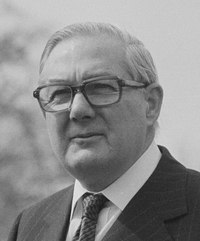
In April 1976 Wilson surprisingly stood down as Labour Party leader. He was replaced by James Callaghan who immediately removed a number of left-wingers (such as Barbara Castle) from the cabinet.
The party in Scotland suffered the breakaway of two MPs into the Scottish Labour Party (SLP). Whilst ultimately the SLP proved no real threat to the Labour Party's strong Scottish electoral base it did show that the issue of Scottish devolution was becoming increasingly contentious, especially after the discovery of North Sea Oil.
Economic and political troubles
[edit]The 1970s Labour government faced enormous economic problems and a precarious political situation. Faced with a global recession and spiralling inflation. Many of Britain's traditional manufacturing industries were collapsing in the face of foreign competition. Unemployment, and industrial unrest were rising.
Economic record
[edit]The ambitious promise made by Labour in a 1973 party programme was to bring about "a fundamental irreversible shift in the balance of power and wealth, in favour of working people and their families".[117] Following an expansionary fiscal policy,[118] as characterised by boosts to public spending,[119] more restrictive economic policies were adopted, with expenditure cuts and limits on wage increases. In 1975, for instance, an austerity budget was introduced that reduced public spending for 1977–78 by £900 million, at the expense of about 200,000 jobs.[120] To reduce high levels of inflation, various income policies were implemented that reduced the real earnings of most workers, with a 1980 Fabian study by Paul Ormerod noting that the attainment of lower inflation doesn't correspond with a rise in real incomes, as it would take two years (according to the economic models of the Treasury, the National Institute and the London Business School) that workers "can realise real wage increases through reductions in the rate of increase of prices following heir wage restraint". Recognising the negative impact that wage restraint was having on the living standards of ordinary workers, the government introduced expansionary budgets in March and October 1977 and again in April 1978, which were partly designed to boost take home pay in real terms via tax reductions. The April 1978 budget introduced a reduced tax rate band along with significant increases in child benefit.[118] The so-called "Rooker-Wise" amendment to a 1977 budget, named after the labour backbenchers Jeff Rooker and Audrey Wise, indexed income tax allowances to cost-of-living rises as a means of safeguarding taxpayers from "fiscal creep", a situation where inflation increases tax bills "by reducing the real value of income tax allowances".[121] Despite such measures, however, most people by September 1978 "were no better off in real terms than they had been in March 1975".[118]
Between 1974 and 1977, real disposable incomes fell by approximately 7%, while according to the Family Expenditure Survey, the reduction in the disposable income of families with four children was as high as 20.% Although by 1978/79 the living standards of most household types had almost been restored to the levels they had reached back in 1973/74, this was, as noted by academic Peter Townsend, "scarcely cause for congratulation for five years of Labour government". The share of government expenditure on goods and services declined from 24.5% in 1973/74 to 23.5% in 1978/79, while total spending (excluding debt interest) went down between 1975/76 and 1978/79 in real terms. Priority services for disabled people and the elderly were cut in a large number of areas while the number of discretionary LEA discretionary grants fell during Labour's latter period in office. While eligibility limits for free school meals had been made more generous, a 1977 price increase resulted in a fall of over 500,000 in the number of children eating school dinners and a rise of about 170,000 in the numbers eligible for free meals but not actually receiving them.[118] In addition, during Labour’s time in office from 1974 to 1979, annual public spending was increased in a number of areas while cut in others. [122]
Gains in education
[edit]According to a study by Tessa Blackstone, Labour did score various achievements in the field of education. Between 1974 and 1979, nearly 1,000 new comprehensive schools were established, and by Labour's final year in office over 80% of children attended such schools. The number of further education courses carrying mandatory awards were increased in 1976. In addition, the amount spent per head rose considerably in the school sector between 1973/74 and 1976/77 (which was especially true of nursery, primary and special schools) and, while there had been reductions in expenditure per head at the post-school stage, there had been "a small improvement in the distribution of resources towards the universal part of the system from which all benefit relative to the selective parts from which only a minority benefit". Nevertheless, according to the same study, the government failed to ensure that cuts in expenditure growth "did not hit some areas of education where working class children or adults were most likely to be affected; nor did it make much impact on redistributing existing resources".[118] In the field of taxation, a proposed wealth tax never materialised,[123] and in 1977 the number of higher rate tax payers were reduced by a quarter while a further reduction took place a year later following amendments by the Conservative opposition supported by the Liberal Party.[118]
Outside financial help
[edit]In the autumn of 1976 the Labour Government under Chancellor Denis Healey was forced to ask the International Monetary Fund (IMF) for a loan to ease the economy through its financial troubles. The conditions attached to the loan included harsh austerity measures such as sharp cuts in public spending, which were highly unpopular with party supporters. This forced the government to abandon much of the radical program which it had adopted in the early 1970s, much to the anger of left wingers such as Tony Benn. It later turned out however that the loan had not been necessary. The error had been caused by incorrect financial estimates by the Treasury which overestimated public borrowing requirements.[15] The government only drew on half of the loan and was able to pay it back in full by 1979.
The 1970s Labour government adopted an interventionist approach to the economy, setting up the National Enterprise Board to channel public investment into industry, and giving state support to ailing industries. Several large nationalisations were carried out during this era: The struggling motor manufacturer British Leyland was partly nationalised in 1975. In 1977 British Aerospace as well as what remained of the shipbuilding industry were nationalised, as well as the British National Oil Corporation.[15] The Government also succeeded in replacing the Family Allowance with the more generous child benefit, while the Development Land Tax of 1976 introduced an 80% tax on development gain after the first £160,000.[124]
No majority in Commons
[edit]The Wilson and Callaghan governments were hampered by their lack of a workable majority in the Commons. At the October 1974 election, Labour won a majority of only three seats. Several by-election losses meant that by 1977, Callaghan was heading a minority government, and was forced to do deals with other parties to survive. An arrangement was negotiated in 1977 with the Liberals under David Steel known as the Lib-Lab pact, but this ended after one year. After this, deals were made with the Scottish National Party and the Welsh nationalist Plaid Cymru, which prolonged the life of the government slightly longer.
Scottish National Party withdraws support
[edit]The nationalist parties demanded devolution to their respective countries in return for their support for the government. When referendums for Scottish and Welsh devolution were held in March 1979, the Welsh referendum was rejected outright, and the Scottish referendum had a narrow majority in favour but did not reach the threshold of 40% support that the Labour government insisted must be met, invalidating the result. This led to the SNP withdrawing support for the government, which finally brought it down.
"Winter of Discontent" and defeat by Margaret Thatcher
[edit]The 1973 oil crisis had caused a legacy of high inflation in the British economy which peaked at 26.9% in 1975. The Wilson and Callaghan governments attempted to combat this by entering into a social contract with the trade unions, which introduced wage restraint and limited pay rises to limits set by the government. This policy was initially fairly successful at controlling inflation, which had been reduced to 7.4% by 1978.[15]
Callaghan had been widely expected to call a general election in the autumn of 1978, when most opinion polls showed Labour to have a narrow lead.[15] However instead, he decided to extend the wage restraint policy for another year in the hope that the economy would be in a better shape in time for a 1979 election. This proved to be a big mistake. The extension of wage restraint was unpopular with the trade unions, and the government's attempt to impose a "5% limit" on pay rises caused resentment amongst workers and trade unions, with whom relations broke down.
During the winter of 1978–79 there were widespread strikes in favour of higher pay rises which caused significant disruption to everyday life. The strikes affected lorry drivers, railway workers, car workers and local government and hospital workers. These came to be dubbed as the "Winter of Discontent".
The perceived relaxed attitude of Callaghan to the crisis reflected badly upon public opinion of the government's ability to run the country. After the withdrawal of SNP support for the government, the Conservatives put down a vote of no confidence, which was held and passed by one vote on 28 March 1979, forcing a general election.
In the 1979 general election, Labour suffered electoral defeat to the Conservatives led by Margaret Thatcher. The numbers voting Labour hardly changed between February 1974 and 1979, but in 1979 the Conservative Party achieved big increases in support in the Midlands and South of England, mainly from the ailing Liberals, and benefited from a surge in turnout.
The actions of the trade unions during the Winter of Discontent were used by Margaret Thatcher's government to justify anti-trade union legislation during the 1980s.
The Wilson and Callaghan governments of the 1970s tried to control inflation (which reached 23.7% in 1975[125]) by a policy of wage restraint. This was fairly successful, reducing inflation to 7.4% by 1978,[15][125] but led to increasingly strained relations between the government and the trade unions. The Labour governments of the 1970s did, however, manage to protect many people from the economic storm, with pensions increasing by 20% in real terms between 1974 and 1979, while measures such as rent controls and food and transport subsidies prevented the incomes of other people from deteriorating further.[126]
As a means of improving the living standards of those in receipt of state benefits, the government index-linked short-term benefits to the rate of inflation, while pensions and long-term benefits were tied to increases in prices or earnings, whichever was higher (previously, benefit increases were tied only to prices).[127] In addition, new benefits for the disabled and infirm were introduced whilst pensioners benefited from the largest ever increase in pensions up until that period. New employment legislation strengthened equal pay provisions, guaranteed payments for workers on short-time and temporarily laid-off and introduced job security and maternity leave for pregnant women.[128] Housing rehabilitation was encouraged via the establishment of Housing Action Areas and better improvement grants, whilst public sector housing completions rose 40,000 from the 111,500 achieved in 1974, before falling to barely 95,000 by 1979. In addition, furnished tenants were finally provided with security of tenure.[129]
Under the Social Security Act of 1975, the government committed itself to the uprating of long-term benefits in line with earnings or prices, whichever was more beneficial to recipients. However, short-term benefits were only linked to prices.[130] The Supplementary Benefits Act 1976 introduced new levels of financial support for those on little or no income,[131] while new benefits were introduced for those with disabilities.[132] For families with children, the system of child cash and tax allowances was replaced in 1977 by a universal Child Benefit for all families with at least one child,[133] For those at work, a supplementary pension scheme was introduced to provide members of the workforce with an additional income in retirement.[134]
The 1974–79 Labour governments also introduced a wide range of new rights for women. Maternity leave was introduced in 1975, while the Sex Discrimination Act 1975 prohibited discrimination against women at work.[135] The Domestic Violence and Matrimonial Proceedings Act 1976 enabled both married and non-married (but cohabiting) women to apply for non-molestation or exclusion orders against abusive partners, while the Homeless Persons Act 1977 required local authorities to permanently house women made homeless as a result of domestic violence. In addition, the Domestic Proceedings and Magistrates' Courts Act 1978 enabled women who were married to abusive partners to apply for injunctions from magistrates' courts to stop further abuse.[136]
A more effective system of workplace inspection was set up, together with the Health and Safety Executive, in response to the plight of many workers who suffered accidents or ill-health as a result of poor working conditions (whose plight, according to Eric Shaw, had long been ignored by the media). Industrial tribunals also provided protection through compensation for unfair dismissal, while the Advisory, Conciliation and Arbitration Service performed an effective function in the management of industrial disputes.[128] Income inequality also fell during the years of the Wilson and Callaghan governments. Full employment and income policy helped to reduce wage differentials, while subsidies on coal, gas, and electricity increased the social wage.[137] Other reforms introduced by Labour included the Congenital Disabilities (Civil Liability) Act 1976 (which provided children who were born disabled due to cases of negligence with a statutory right to claim damages[138] and the Dock Work Regulation Act 1976 (which extended registered dock work to cold-storage depots and warehouses five miles from any waterfront).[139]
Although the Wilson and Callaghan governments were accused by many socialists of failing to put the Labour Party's socialist ideals into practice, it did much to bring about a greater deal of social justice in British society, as characterised by a significant reduction in poverty during the course of the 1970s,[140][141] and arguably played as great a role as the Attlee Government in advancing the cause of social democracy and reducing social and economic inequalities in the United Kingdom. As noted by the historian Eric Shaw: "In the seventeen years that it occupied office, Labour accomplished much in alleviating poverty and misery, and in giving help and sustenance to groups – the old, the sick, the disabled – least capable of protecting themselves in a market economy."[128]
1979–1997: "Wilderness Years"
[edit]Michael Foot
[edit].jpg)
The aftermath of the 1979 election defeat saw a period of bitter internal rivalry in the Labour Party which had become increasingly divided between the ever more dominant left wingers under Michael Foot and Tony Benn (whose supporters dominated the party organisation at the grassroots level), and the right under Denis Healey.[citation needed] It was widely considered that Healey would win the 1980 leadership election, but he was narrowly defeated by Foot, who succeeded Callaghan as party leader late in 1980.
The Thatcher government was determined not to be deflected from its agenda as the Heath government had been. A deflationary budget in 1980 led to substantial cuts in welfare spending and an initial short-term sharp rise in unemployment. The Conservatives reduced or eliminated state assistance for struggling private industries, leading to large redundancies in many regions of the country, notably in Labour's heartlands. However, Conservative legislation extending the right for residents to buy council houses from the state proved very attractive to many Labour voters. (Labour had previously suggested this idea in their 1970 election manifesto, but had never acted on it.)
The election of Campaign for Nuclear Disarmament (CND) veteran Michael Foot to the leadership disturbed many Atlanticists in the party. Other changes increased their concern; the constituencies were given the ability to easily deselect sitting MPs, and a new voting system in leadership elections was introduced that gave party activists and affiliated trade unions a vote in different parts of an electoral college.
The party's move to the left in the early 1980s led to the decision by a number of centrist party members led by the Gang of Four of former Labour cabinet ministers (Shirley Williams, Bill Rodgers, Roy Jenkins, and David Owen) to form the breakaway Social Democratic Party (SDP) on 25 January 1981. The broader aims of the party were set out in the Limehouse Declaration the following day.[142]
In 1981 the St Ermin's group of senior trade union leaders was created, meeting secretly every month initially at the St. Ermin's Hotel, who organised to prevent the Bennite left taking over the party. Four MPs also attended, Denis Howell, John Golding, Denis Healey and Giles Radice. The group was created following the 1981 special conference decision to establish an electoral college (40% trade unions, 30% members, 30% MPs) to elect the Labour Party leader and deputy rather than the Parliamentary Labour Party choosing. A major effort of the group was to use union block votes to overturn the left's majority on the Labour National Executive Committee and the Trades Union Congress general council.[143][144]
The departure of members from the centre and right further swung the party to the left, but not quite enough to allow Tony Benn to be elected as Deputy Leader when he challenged for the job at the September 1981 party conference.[143] The party was so split that its third-place finish in the 1982 Glasgow Hillhead by-election reportedly pleased some right-wing backbenchers, who expected that the poor result would help them defeat the Bennites.[145]
Under Foot's leadership, the party's agenda became increasingly dominated by the politics of the hard left. Accordingly, the party went into the 1983 general election with the most left wing manifesto that Labour ever stood upon. It was indeed dubbed by the Labour MP Gerald Kaufman as "the longest suicide note in history".
The manifesto contained pledges for abolition of the House of Lords, unilateral nuclear disarmament, withdrawal from the European Economic Community, withdrawal from NATO and a radical and extensive extension of state control over the economy and financial institutions.[146]
This alienated many of the party's more right-wing supporters. The Bennites were in the ascendency and there was very little that the right could do to resist or water down the manifesto, many also hoped that a landslide defeat would discredit Michael Foot and the hard left of the party moving Labour away from explicit Socialism and towards weaker social-democracy.
Much of the press, particularly the sections backing the Conservative government of Margaret Thatcher, attacked both the Labour Party's manifesto and its style of campaigning, which tended to rely upon public meetings and canvassing rather than media. By contrast, the Conservatives ran a professional campaign which played on the voters' fears of a repeat of the Winter of Discontent. To add to this, the Thatcher government's popularity rose sharply on a wave of patriotic feeling following victory in the Falklands War in June 1982, allowing it to recover from its initial unpopularity over unemployment and economic difficulty. Indeed, Margaret Thatcher felt confident to call a general election for June 1983 despite not being obliged to do so for a further 12 months.
At the 1983 election, Labour suffered a landslide defeat, winning only 27.6% of the vote and securing just 209 seats. This was their worst performance at a general election since 1918. Labour won only half a million votes more than the SDP–Liberal Alliance, which had attracted the votes of many moderate Labour supporters, although the Alliance only won 23 seats. Michael Foot criticised the Alliance for "siphoning" Labour support and allowing the Conservatives to win more seats.
Neil Kinnock
[edit].jpg)
Michael Foot resigned and was replaced as leader by Neil Kinnock who was elected on 2 October 1983 and progressively moved the party towards the centre. Labour improved its performance in the 1987 general election, gaining 20 seats and so reducing the Conservative majority from 144 to 102. They were now firmly established as the second political party in Britain as the Alliance had once again failed to make a breakthrough with seats and it subsequently collapsed, prompting a merger of the SDP and Liberals to form the Liberal Democrats.
The 1970s and early 1980s were significant for Labour in the rise of left-wing Labour councils (derided by their opponents as the "loony left") which emphasised improvements in housing and amenities,[147] participation and rights for women and minorities, workers' control, decentralisation, and opposition to neoliberalism. The left regarded local councils as part of an extra-parliamentary mode of opposition, alongside community groups and town halls. David Blunkett, once a member of Labour's left-wing, described Labour town halls as "a rudimentary opposition movement against the ruling party in Westminster." The left councils greatly advanced the cause of blacks, women, and homosexuals within the political system, while also opening up council-decision making.[5]
Increasingly, some Labour councils were radicalised to act in open defiance of the Thatcher Government. Instead of cutting expenditure, they raised rates and all kinds of borrowing and lease-back arrangements were entered into with overseas banks and private financial institutions in order to sustain capital programmes. The increased radicalisation of Labour councils during this period could be attributed to the policies of the Thatcher Government, which involved reductions in government financial aid to both council housing and local authorities, together with a change in the government's allocation formula so that local authority areas of high expenditure were disproportionately affected. As noted by Peter Shore,
Since the areas of critical housing need were invariably Labour-controlled, as were the high-spending councils where social needs of all kinds were at their greatest, it was Labour councils in inner-city areas that were targeted to take the full brunt of government expenditure cuts.[148]
The Greater London Council, under the leadership of Ken Livingstone from 1981 to 1986, carried out a number of progressive policies[149][150] such as a programme of grants to voluntary groups (which cost £47 million in 1984–85: £100 million in 1999 prices) and a "Fares Fair" policy, which cut London Transport fares by 25%. Although this policy was controversially ruled out by a House of Lords judgement, it was replaced by a more subtle cheap fares policy before London Transport was removed from GLC control by the government in 1984.[5]
In 1983, the Liverpool Labour party (then under the effective control of the Trotskyist Militant tendency) embarked upon an ambitious programme of municipal reform. Apart from promoting propaganda for class conflict, as characterised by continual protests and "days of action" in which council workers and even school pupils were encouraged to participate, the Liverpool City Council devoted much time and effort to improving the quality of the inner-city environment. New houses were constructed, while new parks, sports centres,[5] and other leisure facilities were created. In addition, within a short period of time, 8,000 housing units were refurbished and 4,000 units had been built.[151] Altogether, the results were an improvement on previous councils run by all parties.[5] Following the 1987 election, Kinnock resumed the expulsion of Militant's members from the party which had begun under his predecessor.
During the course of the 1980s, the GLC and several other Labour councils attempted to promote local economic recovery by setting up a network of enterprise boards and agencies. In addition, the GLC, Glasgow, Liverpool, Sheffield, and smaller London councils like Lambeth, Camden, and Islington adopted policies that challenged the Thatcher Government's insistence on budgetary cuts and privatisation.[39]
The Labour councils in old metropolitan counties of West Midlands, South Yorkshire, Greater London, and Greater Manchester led the way in developing interventionist economic policies. In these metropolitan county areas, Inward Investment Agencies, Enterprise Boards, Low Pay Units, and Co-operative Development Agencies proliferated, while parts of the country such as Salford Quays and Cardiff Bay were redeveloped. The Labour Birmingham City Council in the 1980s worked to diversify the business visitor economy, as characterised by the decision to build a new, purpose-built convention centre in a decaying, inner-city district around Broad Street. By the mid-1990s, the success of this strategy was evident by the success of the International convention centre leading to wider redevelopment, as characterised by the building of a Sea Life Centre, the National Indoor Arena, bars, hotels, and thousands of newly constructed and refurbished flats and houses. This helped to revitalise the city centre and brought in people and money to both and the city and the West Midlands region as a whole.[7]
During the 1980s and 1990s, Labour councils vied to attract inward investment and build themselves up as tourist and retail centres. The relatively left-wing Labour Southampton City Council was popular among property developers for its ambitious city centre plans, while the labour council in Sheffield set up a partnership with businesses in order to redevelop a large part of the city that had been abandoned by the decline of the steel industry. Some Labour councils also remedied the neglect of management and service delivery during the mid-1980s under the Thatcher Government and introduced charters and guaranteed standards of service for local residents before a similar "Citizen's Charter" was launched by the Major Government.[5]
In November 1990, Margaret Thatcher resigned as prime minister and was succeeded by John Major. Most opinion polls had shown Labour comfortably ahead of the Conservatives in the 18 months leading up to Thatcher's resignation, with the fall in Tory support blamed largely on the introduction of the unpopular poll tax, combined with the fact that the economy was sliding into recession at the time. One of the reasons Thatcher gave for her resignation was that she felt the Conservatives would stand a better chance of re-election with a new leader at the helm.
The change of leader in the Tory government saw a turnaround in support for the Conservatives, who regularly topped the opinion polls throughout 1991 in spite of the continuing recession, although Labour regained the lead of the polls more than once that year. John Major resisted calls within parliament to hold a general election throughout 1991.
The "yo yo" in the opinion polls continued into 1992, though after November 1990 any Labour lead in the polls was rarely sufficient for a majority, suggesting that Labour could only rule as a minority government or in coalition with other parties. Major resisted Kinnock's calls for a general election throughout 1991. Kinnock campaigned on the theme "It's Time for a Change", urging voters to elect a new government after more than a decade of unbroken Conservative rule – which had seen two recessions. However, the Conservatives themselves had undergone a dramatic change in the change of leader from Margaret Thatcher to John Major, at least in terms of style if not substance, whereas Kinnock was now the longest serving leader of any of the major political parties at the time, and the longest-serving opposition leader in British political history.
From the outset, it was clearly a well-received change, as Labour's 14-point lead in the November 1990 "Poll of Polls" was replaced by an 8% Tory lead a month later.
The 1992 general election on 9 April was widely tipped to result in a hung parliament or a narrow Labour majority, but in the event the Conservatives were returned to power, though with a much reduced majority of 21, despite the Conservative mandate being at a record of more than 14 million votes.[152] Despite the increased number of seats and votes, it was still an incredibly disappointing result for members and supporters of the Labour party, and there was serious doubt among the public and the media as to whether Labour could ever return to government, just as there had been back in 1959, while at the same time there were doubts with the Conservative Party as to whether a fifth successive election victory was a likelihood.
Even before the country went to the polls, it seemed doubtful as to whether Labour could win a parliamentary majority as an 8% electoral swing was needed across the country for this to be achieved.[153] When Labour lost the election, there was widespread public and media debate as to whether the party could ever return to government, as had happened in 1959, not least due to the fact that it had failed to beat an incumbent Conservative government during a time of recession and high unemployment – an economic climate which would normally be expected to result in a change of government.[154]
In the party's inquiry into why it had lost, it was considered that the "Shadow Budget" announced by John Smith had opened the way for Conservatives to attack the party for wanting to raise taxes.[citation needed] In addition, a triumphalist party rally held in Sheffield eight days before the election, was generally considered to have backfired. The party had also suffered from a powerfully co-ordinated campaign from the right-wing press, particularly Rupert Murdoch's Sun newspaper. Kinnock, who in particular had been vilified by The Sun with headlines including "Nightmare on Kinnock Street" and the election day front-page headline "If Kinnock wins today will the last person to leave Britain please turn out the lights", resigned after the defeat, blaming the right-wing media for Labour's failure to win the election.
John Smith
[edit]John Smith was elected to succeed Kinnock in July 1992 despite his involvement with the Shadow Budget.
Smith's leadership once again saw the re-emergence of tension between those on the party's left and those identified as "modernisers", both of whom advocated radical revisions of the party's stance albeit in different ways. At the 1993 conference, Smith successfully changed the party rules and lessened the influence of the trade unions on the selection of candidates to stand for Parliament by introducing a one member, one vote system called OMOV – but only barely, following a barnstorming speech by John Prescott which required Smith to compromise on other individual negotiations.
The Black Wednesday economic disaster in September 1992, which led to Britain's exit from the European Exchange Rate Mechanism, left the Conservative government's reputation for monetary excellence in shreds, and by the end of that year Labour had a comfortable lead over the Conservatives in the opinion polls. Although the recession was declared over in April 1993 and a period of strong and sustained economic growth followed, coupled with a relatively swift fall in unemployment, the Labour lead in the opinion polls remained strong.
The growing strength of the Labour Party during the 1990s was demonstrated by its success in preventing the passage of two major policy initiatives of the Major Government. Plans to privatise Royal Mail were abandoned as a result of pressure from Labour, the Communications Workers Union and voters in Conservative rural heartlands who sought to protect post office services. Another major policy abandonment came as a result of Norman Lamont's 1993 announcement that VAT on domestic fuel and lighting would be introduced, starting at a rate of 8% in April 1994 and reaching the full rate the following April. The Labour Party launched a massive public campaign against the controversial tax, collecting 1.5 million signatures on a petition. An important House of Commons vote on introducing the second stage of the tax took place in December 1994. Concerted pressure was put on Conservative backbenchers from marginal seats to vote against the controversial tax, and in the end the Major Government was narrowly defeated, with 319 voting against the tax compared to 311 for. This not only represented a victory for the Labour party's campaign, but it further demonstrated Labour's social democratic credentials and its growing political strength.[155] During this period party membership increased dramatically, rising from 305,000 in 1994 to a high point of 405,000 in 1998.[156]
John Smith died suddenly on 12 May 1994 of a severe heart attack, prompting a leadership election for his successor, likely to be the next Prime Minister. With 57% of the vote, Tony Blair won a resounding victory in a three-way contest with John Prescott and Margaret Beckett. Prescott became deputy leader, coming second in the poll, the results of which were announced on 21 July 1994.
New Labour
[edit]Origins
[edit]
"New Labour" was an alternative branding for the Labour Party, used primarily during the period under Tony Blair's leadership. Being used first as a slogan, its first appearance in party literature was the 1996 draft manifesto, New Labour, New Life For Britain. The rise of the name coincided with a rightwards shift of the British political spectrum; for Labour, this was a continuation of the trend that had begun under the leadership of Neil Kinnock. "Old Labour" is sometimes used by commentators to describe the older, more left-wing members of the party, or those with strong Trade Union connections.
Tony Blair, Gordon Brown, Peter Mandelson, Anthony Giddens and Alastair Campbell are most commonly cited as the creators and architects of "New Labour". Blair proposed a rewrite of Clause IV of the party constitution, abandoning the party's commitments and what Blair referred to as "state socialism" (as opposed to ethical socialism). The party became an advocate of the shift in European social democracy during the 1990s, known as the "Third Way". Although this policy was advantageous to the Labour Party in the eyes of the British electorate, it alienated many grassroots members by distancing itself from the ideals of socialism in favour of free market policy decisions.
The "modernisation" of Labour Party policy and the unpopularity of John Major's Conservative government, along with a well co-ordinated use of PR, greatly increased Labour's appeal to "middle England". The party was concerned not to put off potential voters who had previously supported the Conservatives, and pledged to keep to the spending plans of the previous government, and not to increase the basic rate of income tax. The party won the 1997 election with a landslide majority of 179. Following a second and third election victory in the 2001 election and the 2005 election, the name has diminished in significance. "New Labour" as a name has no official status but remains in common use to distinguish modernisers from those holding to more traditional positions who normally are referred to as "Old Labour".
Many of the traditional grassroots working-class members of the Labour Party who became upset and disillusioned with "New Labour" left the Party and went on to join political parties such as the Socialist Party, the Socialist Labour Party and even the Communist Party of Great Britain[citation needed] – all parties claiming to never neglect the "ordinary British people". David Osler, the journalist and author of "Labour Party plc" seems to hint in his book that Labour's supposed steady shift from Socialism and its neglect of support for the working-class people of Britain began to show during the Party's years under Harold Wilson. In the book, Osler claims that the Party is now only a socialist party and indeed a "Labour" party in name only, and is now a capitalism-embracing Party which differs little from the Conservative Party. Other historians have argued that Old Labour's record in putting its social democratic ideals into practice was less successful than comparable northern European parties.[128]
1997–2010: In government
[edit]The Labour Party won the 1997 general election with a landslide majority of 179; it was the largest Labour majority ever, and the largest swing to a political party achieved since 1945. Over the next decade, a wide range of progressive social reforms were enacted,[157][158][159] with millions lifted out of poverty during Labour's time in office largely as a result of various tax and benefit reforms.[160][161][162] Labour's time in office also saw a steady rise in living standards, with real earnings for all employees going up by about 18% between 1997 and 2009.[163]
Amongst the early acts of Tony Blair's government were the establishment of the national minimum wage, the devolution of power to Scotland, Wales and Northern Ireland and the reestablishment of a city-wide governing body for London, the Greater London Authority, with its own elected Mayor. Combined with a Conservative opposition that had yet to organise effectively under William Hague, as well as Blair's continuing popularity, Labour went on to win the 2001 election with a similar majority, dubbed the "quiet landslide" by the media.[164]
Total funding per pupil was increased by over £300 million in real terms between 1997 and 2001, whilst the number of 5-, 6- and 7-year-olds taught in classes of over 30 was reduced by 450,000 during that same period. 5,000 more nurse training places were established from 1997 to 2001, whilst pay for nurses was increased by three times more than inflation during that same period of time. Charges on eye tests for older people were abolished and the National Foundation of Youth Music was established to provide children with after-school musical activities and training. Supporters Direct was established to assist football fans in establishing mutual trusts to enable them to take "a greater financial stake in their clubs and have a greater say in how they are run". The average wait from arrest to sentencing for young offenders was reduced from 142 days to less than 100 days, the Stephen Lawrence Inquiry was established and new offences of racially aggravated violence, harassment and criminal damage were introduced.[165] The School Standards and Framework Act 1998 included policy developments such as action to raise school standards, a new framework of community, foundation and voluntary schools, and measures to reduce class sizes for 5-year-olds.[166] As a means of improving primary school standards, a daily literacy hour and a National Numeracy Strategy were introduced.[167] Additionally, free nursery places for four-year-olds were introduced.[168]
Pension Credit (an additional income benefit for senior citizens) was introduced, together with Educational Maintenance Allowances, which enabled students from poorer backgrounds to stay in education for longer. £37 billion was invested in a Decent Homes programme, aimed at improving the conditions of run-down council homes, with installations of central heating, new kitchens and bathrooms. As a result of this initiative, by 2009 8% of England's total social housing stock was considered to be unfit, compared with 39% in 2001. The New Deal programme found work for half-a-million long-term unemployed young people, although studies highlighted concerns over the effect of stricter conditions for unemployment benefit on single younger men. Between 1997 and 2009, cash spending on education was doubled, representing a real-terms increase of three-quarters. Across England, primary school expenditure on each pupil increased from £2210 in 1997–98 to £3580 by 2007–08 in real terms, a rise of a third. From 2000 onwards, spending on the NHS doubled in real terms, while Agenda for Change led to improved pay scales within the organisation. In addition, much was done to enhance the level of public services. As noted by one study
Labour bequeathed a public realm that shone. They renovated, restocked and rebuilt schools, hospitals and clinics, arts and sports venues, parks and museums. J.K. Galbraith once talked about private affluence and public squalor; now there was plenty of the former, despite the recession, but much less of the latter. Public spaces no longer felt second-best or the shabby poor relations of commerce. Sober academics talked of a renaissance of England's northern cities, and you could say the same of Glasgow and Belfast. For years to come, civic buildings will stand as monuments to the Labour era.[169]
A perceived turning point was when Tony Blair controversially allied himself with US President George W. Bush in supporting the Iraq War, which caused him to lose much of his political support.[170] The UN Secretary-General, among many, considered the war illegal.[171] The Iraq War was deeply unpopular in most western countries, with Western governments divided in their support[172] and under pressure from worldwide popular protests. At the 2005 election, Labour was re-elected for a third term, but with a reduced majority of 66. The decisions that led up to the Iraq war and its subsequent conduct were the subject of Sir John Chilcot's Iraq Inquiry.
.jpg)
Tony Blair announced in September 2006 that he would quit as leader within the year, though he had been under pressure to quit earlier than May 2007 in order to get a new leader in place before the May elections which were expected to be disastrous for Labour.[173] In the event, the party did lose power in Scotland to a minority Scottish National Party government at the 2007 elections and, shortly after this, Tony Blair resigned as prime minister and was replaced by his Chancellor, Gordon Brown. Although the party experienced a brief rise in the polls after this, its popularity soon slumped to its lowest level since the days of Michael Foot. During May 2008, Labour suffered heavy defeats in the London mayoral election, local elections and the loss in the Crewe and Nantwich by-election, culminating in the party registering its worst ever opinion poll result since records began in 1943, of 23%, with many citing Brown's leadership as a key factor.[174] Membership of the party also reached a low ebb, falling to 156,205 by the end of 2009: over 40 per cent of the 405,000 peak reached in 1997 and thought to be the lowest total since the party was founded.[156][175][176]
Finance proved a major problem for the Labour Party during this period; a "cash for peerages" scandal under Tony Blair resulted in the drying up of many major sources of donations. Declining party membership, partially due to the reduction of activists' influence upon policy-making under the reforms of Neil Kinnock and Tony Blair, also contributed to financial problems. Between January and March 2008, the Labour Party received just over £3 million in donations and were £17 million in debt; compared to the Conservatives' £6 million in donations and £12 million in debt.[177]
In the 2010 general election on 6 May that year, Labour with 29.0% of the vote won the second largest number of seats (258). The Conservatives with 36.5% of the vote won the largest number of seats (307), but no party had an overall majority, meaning that Labour could still remain in power if they managed to form a coalition with at least one smaller party.[178] However, the Labour Party would have had to form a coalition with more than one other smaller party to gain an overall majority; anything less would result in a minority government.[179] On 10 May 2010, after talks to form a coalition with the Liberal Democrats broke down, Gordon Brown announced his intention to stand down as Leader before the Labour Party Conference but a day later resigned as both Prime Minister and party leader.[180]
2010–2024: Opposition and internal conflict
[edit]Ed Miliband
[edit]
Harriet Harman became the Leader of the Opposition and acting Leader of the Labour Party following the resignation of Gordon Brown on 11 May 2010, pending a leadership election[181] subsequently won by Ed Miliband. This period has to date witnessed a revival in Labour's opinion poll fortunes, with the first Labour lead recorded since the commencement of Gordon Brown's premiership in 2007 being reported in a YouGov poll for The Sun on 27 September 2010[182] during the 2010 Labour Party Conference. This phenomenon has been speculatively attributed to the sharp decline[183] in Liberal Democrat support since May 2010, with disillusioned Liberal Democrat supporters defecting their support to Labour.[184] Such poll leads, up to 6% above the Conservatives in a 20 December 2010 opinion poll,[185] are in contrast to Ed Miliband's low public satisfaction ratings;[186] +1% in an Ipsos MORI poll, interpreted by a spokesperson for the said pollster as "...bad news for Ed Miliband. We have to go back to Michael Foot who led the party to a crushing defeat in 1983 to find a lower satisfaction rating at this stage".[187] Foot, in fact, had actually enjoyed a lead in the opinion polls over the Conservatives wide enough to win an election with a majority of up to 130 seats immediately after becoming leader in 1980,[188] although that lead was wiped out in 1981 following the advent of the Social Democratic Party.[189] In September 2010 the party reported a surge of 32,000 new members since the general election;[190] at the end of 2011 this figure had reached 65,000 new members.[191][192]
The Parliamentary Labour Party voted to abolish Shadow Cabinet elections at a meeting on 5 July 2011,[193] ratified by the National Executive Committee and Party Conference. Henceforth the leader of the party chose the Shadow Cabinet members.[194] As a result, the 2010 Shadow Cabinet election was the last.
Miliband emphasised "responsible capitalism" and greater state intervention to change the balance of the UK economy away from financial services.[195] Tackling vested interests[196] and opening up closed circles in British society[197] were also themes he returned to a number of times. Miliband also argued for greater regulation on banks and the energy companies.[198]
Blue Labour was a recent[199] ideological tendency in the party that advocates the belief that working class voters will be won back to Labour through more conservative policies on certain social and international issues, such as immigration and crime,[200] a rejection of neoliberal economics[201] in favour of ideas from guild socialism and continental corporatism,[202] and a switch to local and democratic community management and provision of services,[203] rather than relying on a traditional welfare state that is seen as excessively 'bureaucratic'.[204] These ideas have been given an endorsement by Ed Miliband who in 2011 wrote the preface to a book expounding Blue Labour's positions.[205] However, it lost its influence after comments by Maurice Glasman in the Telegraph newspaper.[206]
Despite its years in opposition, Labour has nevertheless continued to be active on a local level, introducing measures such as free breakfasts in schools, schemes to tackle fuel poverty, new apprenticeship opportunities, financial support for students in education, and the building of social housing units.[207] The party's performance held up in local elections in 2012 with Labour consolidating its position in the North and Midlands, while also regaining some ground in Southern England.[208]
Labour's decline in Scotland's parliamentary election in 2011 presaged greater losses as part of the party's defeat in the 2015 general election. With the party bidding to return to government in Westminster under the leadership of Ed Miliband, Labour gained more than 20 seats in England and Wales, mostly from the Liberal Democrats but also from the Conservative Party,[209][210] although several of its MPs lost reelection to Conservative challengers, including Ed Balls.[211] However, the fall of what was popularly dubbed Labour's "Scottish fortress"[212] to the Scottish National Party turned out 40 Labour MPs from their seats, including Scottish Labour leader Jim Murphy.[213] Discounting pickups, the party lost 48 seats in total throughout Great Britain, falling to 232 seats in the House of Commons.[214]
Jeremy Corbyn
[edit]
The day after the 7 May 2015 election, Miliband resigned as party leader. Harriet Harman again took charge as interim leader.[211] Following a leadership election, Jeremy Corbyn was announced as the new party leader on 12 September 2015. Corbyn, then a member of the Socialist Campaign Group and a fixture of the party's left,[215] was considered little more than a fringe hopeful when the contest began, but benefited from a large influx of new members as well as the registration of significant numbers of the new affiliated and registered classes of voting supporters introduced under Miliband.[216] Corbyn received the backing of only 16 of the party's MPs.[217] Membership numbers continued to climb after the start of Corbyn's leadership.[218]
Tensions soon developed in the parliamentary party over Corbyn's leadership. Following the referendum on EU membership more than two dozen members of the Shadow Cabinet resigned in late June 2016,[219] and a no-confidence vote was supported by 172 MPs against 40 supporting Corbyn.[220] On 11 July 2016 an official leadership election was called as Angela Eagle launched a challenge against Corbyn.[221] She was soon joined by rival challenger Owen Smith, prompting Eagle to withdraw on 19 July 2016 in order to ensure there was only one challenger on the ballot.[222] On 24 September 2016 Corbyn retained leadership of the party with an increased share of the vote.[223] By the end of the contest Labour's membership had grown to more than 500,000, making it the largest political party in terms of membership in Western Europe.[224]
Following the party's decision to support the European Union (Notification of Withdrawal) Bill 2017, at least three shadow cabinet ministers, all representing constituencies which voted to remain in the EU, resigned from their position as a result of the party's decision to invoke Article 50 under the bill.[225] 47 of 229 Labour MPs voted against the bill (in defiance of the party's three-line whip).[226] Unusually, the rebel frontbenchers did not face immediate dismissal.[227]
On 18 April 2017, the Prime Minister Theresa May announced she would seek an unexpected snap election on 8 June 2017.[228] Corbyn said he welcomed May's proposal and said his party would support the government's move in the parliamentary vote announced for 19 April.[229][230] The necessary super-majority of two-thirds was achieved when 522 of the 650 Members of Parliament voted in support.[228] Some of the opinion polls had shown a 20-point Conservative lead over Labour before the election was called, but this lead had narrowed by the day of the 2017 general election, which resulted in a hung parliament. Despite remaining in opposition for its third election in a row, Labour at 40.0% won its greatest share of the vote since 2001, made a net gain of 30 seats to reach 262 total MPs, and achieved the biggest percentage-point increase in its vote share in a single general election since 1945.[231] Immediately following the election party membership rose by 35,000.[232]
Following the large increase in party membership with Corbyn becoming leader, membership fees became the largest component of party income, overtaking trade unions donations which had previously been of most financial importance. This increase made Labour the most financially well-off British political party in 2017.[233] This large membership also in 2018 ensured that the NEC was firmly under pro-Corbyn control, when all nine constituency members were elected from the pro-Corbyn slate; previously such control had not been entirely secure.[234] Parliamentary candidates selected in this period were more likely to be aligned with the Labour Party's 'progressive' faction.[235]
In the 2019 general election, Labour's vote share fell to 32%, leading to a net loss of 60 seats and leaving it with 202, its fewest since 1935. Corbyn subsequently announced he would not lead Labour into the next election. On 18 December, Blair accused Corbyn of not having a clear position on Brexit unlike his Conservative opponent Boris Johnson who supported withdrawal from the European Union and the Liberal Democrats that were strictly pro-European, thus dividing voters who supported Remain in the 2016 referendum while the Brexit Party under Nigel Farage did not do the same with Vote Leave, ending up without seats in the House of Commons despite achieving a decisive victory in the United Kingdom elections for the European Parliament.[236]
2024–present: Return to government
[edit] | This article has multiple issues. Please help improve it or discuss these issues on the talk page. (Learn how and when to remove these messages)
|
![[icon]](https://en.wikipedia.org/wiki/File:Wiki_letter_w_cropped.svg)

.jpg)
On 4 April 2020, Keir Starmer was elected as Leader of the Labour Party amidst the COVID-19 pandemic.[237] During his tenure as opposition leader, Starmer repositioned the party from the left toward the centre-left and political centre, and emphasised the importance of eliminating antisemitism within the party. Starmer led Labour to victory in the local elections in 2023 and 2024. In 2023, Starmer set out five missions for his government, targeting issues such as economic growth, health, clean energy, crime and education.[238]
During the 2024 general election, Labour maintained a strong poll lead, with its manifesto focusing on economic growth, planning system reform, infrastructure, clean energy, healthcare, education, childcare, constitutional reform, and strengthening workers' rights.[239][240]
Despite receiving half a million fewer votes than Corbyn did in 2019 Starmer led Labour to a landslide victory, ending fourteen years of Conservative government with Labour becoming the largest party in the House of Commons[241] having won 63% of the seats with just 33.7% of the vote making this the lowest vote share of any party forming a majority government since World War II.[2]
He succeeded Rishi Sunak as prime minister on 5 July 2024, becoming the first Labour prime minister since Gordon Brown in 2010 and the first one to win a general election since Tony Blair at the 2005 general election.[242] One of Starmer's first cabinet appointments was Rachel Reeves as Chancellor, which made her the first woman to hold the office.[243]
See also
[edit]


References
[edit]- ^ Cracknell, Richard; Uberoi, Elise; Burton, Matthew (9 August 2023). "UK Election Statistics: 1918–2023, A Long Century of Elections" (PDF). House of Commons Library. UK Parliament. pp. 20–24. CBP7529. Retrieved 5 July 2024.
- ^ a b Cracknell, Richard; Baker, Carl (24 September 2024). "General election 2024: Results and analysis" (PDF). House of Commons Library. UK Parliament. p. 6,11. CBP-10009. Retrieved 22 November 2024.
- ^ "What is Clause IV and why is it so divisive?". The Independent. 9 August 2015. Retrieved 18 December 2017.
- ^ See, for instance, the 1899 Lyons vs. Wilkins judgement, which limited certain types of picketing.
- ^ a b c d e f g h i j The Labour Party: A Centenary History edited by Brian Brivati and Richard Hefferman.
- ^ Political Change and the Labour Party 1900–1918 By Duncan Tanner, 2003, p. 169.
- ^ a b Yeowell, Nathan; Bates, Dennis (2008). Leading the Way: Labour Local Government's Response to the Credit Crunch (PDF). Local Government Association. ISBN 978-0-9560346-1-8. Retrieved 19 May 2019.
- ^ a b c The Longman Companion to The Labour Party 1900–1998 by Harry Harmer.
- ^ Currents of Radicalism: Popular Radicalism, Organised Labour and Party Politics in Britain, 1850–1914 by Eugenio F. Biagini and Alastair J. Reid.
- ^ Katwala, Sunder (13 July 2010). "Why Keir Hardie rejected the Liberals". Next Left. Archived from the original on 15 July 2010. Retrieved 8 September 2012.
- ^ a b c Speak for Britain! A New History of the Labour Party by Martin Pugh.
- ^ 'The formation of the Labour Party – Lessons for today' Archived 22 June 2008 at the Wayback Machine Jim Mortimer, 2000; Jim Mortimer was a General Secretary of the Labour Party in the 1980s.
- ^ "History of the Labour Party". Labour Party. 27 February 2010. Archived from the original on 14 April 2010. Retrieved 13 April 2010.
- ^ Wright T. & Carter M, (1997) "The People's Party" Thames & Hudson, ISBN 0-500-27956-X
- ^ a b c d e f g h i j k l m n o p q r s t Thorpe, Andrew. (2001) A History of the British Labour Party, Palgrave, ISBN 0-333-92908-X
- ^ Norman McCord, "Taff Vale Revisited," History 78#253 (1993), pp. 243–260 in JSTOR
- ^ Frank Bealey, "The Electoral Arrangement between the Labour Representation Committee and the Liberal Party," Journal of Modern History 28#4 (1956), pp. 353–373 in JSTOR
- ^ British Economic and Social History 1700–1964 by C. P. Hill.
- ^ a b c d e f g h i Labour Inside the Gate: A History of the British Labour Party between the Wars by Matthew Worley.
- ^ a b c d e f g h i A History of the Labour Party from 1914 by G. D. H. Cole.
- ^ Social Democracy and Welfare Capitalism: A Century of Income Security Politics by Alexander Hicks.
- ^ The Case for The Labour Party A HANDBOOK OF FACTS & FIGURES FOR WORKERS, 1909, p. 110.
- ^ G. R. Searle, A new England?: peace and war, 1886–1918 (2004), pp. 185–87.
- ^ Michael Childs, "Labour Grows Up: The Electoral System, Political Generations, and British Politics 1890–1929." Twentieth Century British History 6#2 (1995): 123–144.
- ^ Andrew Thorpe, A History of the British Labour Party (3rd ed. 2008), pp. 36–59.
- ^ Chris Wrigley, David Lloyd George and the British labour movement: peace and war (1976), ch 1.
- ^ Eric Hopkins, A Social History of the English Working Classes 1815–1945.
- ^ David Swift, For Class and Country: the Patriotic Left and the First World War (2017).
- ^ Tony Judge (2016). J.R. Clynes, A Political Life. CreateSpace Independent Publishing Platform. pp. 111–114. ISBN 9781518761980.
- ^ "Red Clydeside: The Communist Party and the Labour government [booklet cover] / Communist Party of Great Britain, 1924". Glasgow Digital Library. Retrieved 13 April 2010.
- ^ Labour Party (Great Britain) (1931). Report of the Annual Conference. Labour Representation Committee. p. 38. Retrieved 7 December 2012.
- ^ Thorpe, Andrew (2001). A History of the British Labour Party. Palgrave. pp. 51–53. ISBN 0-333-92908-X.
- ^ "The truth about Churchill's spy chief and the Zinoviev Letter". The Independent. London. 8 October 2006. Archived from the original on 20 October 2006.
- ^ Reid, Alastair; Tolliday, Steven (1977). "The General Strike, 1926". Historical Journal. 20 (4): 1001–1012. JSTOR 2638422.
- ^ Martin Pugh, "The General Strike." History Today 56#5 (2006): 40+.
- ^ Laura Beers, Your Britain: Media and the Making of the Labour Party (Harvard University Press, 2010).
- ^ A.J.P. Taylor, English History 1914–1945 (1965), pp. 264–97.
- ^ The Record of the Second Labour Government, The Labour Publications Dept., Transport House, Smith Square, London, S.W.1., October 1935.
- ^ a b c d e f A. J. Davies, To Build A New Jerusalem: The British Labour Party from Keir Hardie to Tony Blair (1996)
- ^ Taylor, English History 1914–1945 (1965), pp. 284–97.
- ^ Mandle, W. F. (1967). "Sir Oswald Leaves the Labour Party, March 1931". Labour History. 12 (12): 35–51. doi:10.2307/27507860. JSTOR 27507860.
- ^ McKibbin, Ross (1975). "The Economic Policy of the Second Labour Government 1929–1931". Past & Present (68): 95–123. doi:10.1093/past/68.1.95. JSTOR 650274.
- ^ Fair, John D. (1980). "The Conservative Basis for the Formation of the National Government of 1931". Journal of British Studies. 19 (2): 142–164. doi:10.1086/385759. JSTOR 175497. S2CID 144831450.
- ^ Andrew Thorpe, The British general election of 1931 (1991).
- ^ Austen Morgan (1987). J. Ramsay MacDonald. Manchester University Press. p. 3. ISBN 9780719021688.
- ^ Pimlott, Ben (1971). "The Socialist League: Intellectuals and the Labour Left in the 1930s". Journal of Contemporary History. 6 (3): 12–38. doi:10.1177/002200947100600302. JSTOR 259876. S2CID 162319446.
- ^ a b Stark Murray, David (1971). Why a National Health Service contents. London: Pemberton Books.
- ^ Michael Newman, "Laski, Harold Joseph (1893–1950)", Oxford Dictionary of National Biography (Oxford University Press, 2004) online edn, Jan 2011 accessed 11 June 2013 doi:10.1093/ref:odnb/34412.
- ^ Booth, Alan (1996). "How Long are Light Years in British Politics? The Labour Party's Economic Ideas in the 1930s". Twentieth Century British History. 7 (1): 1–26. doi:10.1093/tcbh/7.1.1.
- ^ Elizabeth Durbin, New Jerusalems: The Labour Party and the Economics of Democratic Socialism (1985) argues that Keynesianism was known and accepted by a handful of Labour economists such as her father.
- ^ Rhiannon Vickers, The Labour Party and the World, Volume 1: The Evolution of Labour's Foreign Policy, 1900–51 (2004).
- ^ a b c d e f g h i Imlay, Talbot (2011). "Politics, Strategy and Economics: A Comparative Analysis of British and French 'Appeasement'". In Frank McDonough (ed.). The Origins of the Second World War. London: Continuum. p. 262–279.
- ^ Paul Steven Corthorn, " The British labour party and the League of Nations 1933-5" (PhD disst. Durham University, 1999). online
- ^ J. Shepherd, "Labour and the Trade Unions: George Lansbury, Ernest Bevin and the leadership Crisis of 1935," in C. Wrigley and J. Shepherd (eds ), On the Move (1991), pp. 204–230.
- ^ Whiting, R. C. (January 2011) [online edn, print 2004]. "Attlee, Clement Richard, first Earl Attlee (1883–1967)". Oxford Dictionary of National Biography (online ed.). Oxford University Press. doi:10.1093/ref:odnb/30498. Retrieved 12 June 2013. (Subscription, Wikipedia Library access or UK public library membership required.)
- ^ Fleay, C.; Sanders, M. L. (1985). "The Labour Spain Committee: Labour Party Policy and the Spanish Civil War". Historical Journal. 28 (1): 187–197. doi:10.1017/s0018246x00002272.
- ^ Richard Toye, "The Labour Party and the Economics of Rearmament, 1935–39." Twentieth Century British History 12#3 (2001): 303–326.
- ^ a b c d The Coming of the Welfare State by Maurice Bruce.
- ^ Labour in Power And Labour Not in Power The Story of the Metropolitan Borough Councils : 1919-1922, Second Edition, The London Labour Party, 1922
- ^ Welfare State and Welfare Change by Martin Powell and Martin Hewitt.
- ^ "Why we did not Celebrate: A Reasoned Case for Reasonable People" (PDF). The Gazette. 7 May 1935. Archived from the original (PDF) on 2 April 2012.
- ^ Modern Wales: a concise history by Gareth Elwyn Jones.
- ^ "What Labor has done for London". fau.digital.flvc.org. Retrieved 15 March 2016.
- ^ "Foreign News: Egg to Poor". Time. 11 March 1935. Archived from the original on 22 December 2011.
- ^ Yeowell, Nathan; Bates, Dennis, eds. (2008). Leading the Way: Labour Local Government's Response to the Credit Crunch (PDF). London: LGA Labour Group. ISBN 978-0-9560346-1-8. Archived from the original (PDF) on 29 March 2012.
- ^ a b c d e Herbert Morrison: Portrait of a Politician by Bernard Donoghue and G. W. Jones.
- ^ "THE LONDON COUNTY COUNCIL UNDER A LABOUR ADMINISTRATION, 1934–1936. – 2007 – Annals of Public and Cooperative Economics — Wiley Online Library". Annals of Public and Cooperative Economics. 13 (1): 122–148. 31 March 2007. doi:10.1111/j.1467-8292.1937.tb00524.x.
- ^ Rose, Gillian (October 1990). "Imagining Poplar in the 1920s: Contested concepts of community". Journal of Historical Geography. 16 (4): 425–437. doi:10.1016/0305-7488(90)90144-Z.
- ^ a b c The British Welfare State, 1900–1950 by Sydney Wood.
- ^ a b Labour in Power, 1945–1951 by Kenneth Morgan.
- ^ "The Politics of social policy in the United States" by Margaret Weir, Ann Shola Orloff, Project on the Federal Social Role (U.S.)
- ^ Tichelar, Michael (2003). "The Labour Party, agricultural policy and the retreat from rural land nationalisation during the Second World War" (PDF). The Agricultural History Review. 51 (2).
- ^ A History of the Labour Party by Andrew Thorpe.
- ^ A Century of Change: 1837-Today by R. J. Unstead.
- ^ The making of the 1944 Education Act by Michael Barber.
- ^ "Labour in the Government: A Record of Social Legislation in War Time Published" by the Labour Party, Transport House, Smith Square, S.W.1, May 1941.
- ^ a b c d e Party, Labour, Herbert Morrison's work in the War Government 1940-1945 [1]
- ^ Hill, Dennis (2003). Bath Fire Brigade and Ambulance Service, 1891 to 1974: An Illustrated History — Dennis Hill — Google Books. Millstream. p. 128. ISBN 978-0-948975-69-1. Retrieved 15 March 2016.
- ^ a b c d e f g h A History of Work in Britain, 1880–1950 by Arthur McIvor.
- ^ a b c Ernest Bevin's Work in Wartime 1940–1945 Published by the Labour Party, Printed by the Victoria House Printing Co., Ltd. (T.U. all Depts.), 14–15, Elm Street, Gray's Inn Road, London, W.C.1.
- ^ Penelope Hall, M (5 November 2013). The Social Services of Modern England — M. Penelope Hall — Google Books. Routledge. p. 295. ISBN 978-1-136-26301-9. Retrieved 15 March 2016.
- ^ Cherry, Steven (2003). Mental Health Care in Modern England: The Norfolk Lunatic Asylum/St. Andrew ... – Steven Cherry — Google Books. Boydell Press. p. 219. ISBN 978-0-85115-920-1. Retrieved 15 March 2016.
- ^ The Foundations of the Welfare State by Pat Thane.
- ^ Post-war Britain A Political History By Alan Sked and Chris Cook, 1984, p. 23.
- ^ Francis, Martin (1995). "Economics and Ethics: The Nature of Labour's Socialism, 1945–1951". Twentieth Century British History. 6 (2): 220–243. doi:10.1093/tcbh/6.2.220.
- ^ "Proud of the NHS at 60". labour.org.uk. Labour Party. Archived from the original on 14 April 2010. Retrieved 15 March 2010.
- ^ Clark, Sir George, Illustrated History of Great Britain, (1987) Octopus Books.
- ^ Stephen Haseler, The Gaitskellites: Revisionism in the British Labour Party 1951–64 (Springer, 1969).
- ^ F. M. Leventhal, Twentieth-century Britain: an encyclopedia (Peter Lang, 2002), pp. 435–6.
- ^ "House of Commons — Social Security — Minutes of Evidence". Parliament of the United Kingdom. 13 December 1999. Retrieved 15 March 2016.
- ^ "The Evolution of Disability Benefits in the UK Re-weighting the basket" (PDF). London School of Economics.
- ^ Labour Party (Great Britain) (19 March 2007). Report of the Annual Conference — Labour Party (Great Britain) – Google Books. Retrieved 15 March 2016.
- ^ Sheard, Sally (2014). The Passionate Economist — Sally Sheard — Google Books. Policy Press. p. 259. ISBN 9781447314844. Retrieved 15 March 2016.
- ^ George, Victor (January 2003). Social Security: Beveridge and After — Victor George — Google Books. Psychology Press. p. 38. ISBN 9780415177238. Retrieved 15 March 2016.
- ^ Pearce, Malcolm; Stewart, Geoffrey (13 September 2013). British Political History, 1867–2001: Democracy and Decline — Malcolm Pearce, Geoffrey Stewart — Google Books. Routledge. p. 489. ISBN 9781136453533. Retrieved 15 March 2016.
- ^ Holmans, A. E (28 January 1997). Directions in Housing Policy: Towards Sustainable Housing Policies for the UK — A. E. Holmans — Google Books. Sage Publications (CA). p. 75. ISBN 9781446226650. Retrieved 15 March 2016.
- ^ Jones, Daniel Stedman (16 September 2012). Masters of the Universe: Hayek, Friedman, and the Birth of Neoliberal Politics — Daniel Stedman Jones — Google Books. Princeton University Press. p. 315. ISBN 9781400844739. Retrieved 15 March 2016.
- ^ Smith, John Grieve (30 January 2005). There Is a Better Way: A New Economic Agenda for Labour — John Grieve Smith — Google Books. Anthem Press. p. 60. ISBN 9780857287342. Retrieved 15 March 2016.
- ^ Lund, Brian (2011). Understanding Housing Policy — Brian Lund — Google Books. Policy Press. p. 181. ISBN 9781847426314. Retrieved 15 March 2016.
- ^ Englund, H.M; Beery, W.T (2 October 2013). Proceedings of the Second International Clean Air Congress — Google Books. Elsevier. p. 1189. ISBN 9781483272436. Retrieved 15 March 2016.
- ^ "John Barnes, Historian — Political Change". Barneshistorian.com. Retrieved 15 March 2016.
- ^ "International yearbook of education, v. 28, 1966". UNESCO International Bureau of Education.
- ^ "International yearbook of education, v. 29, 1967". UNESCO International Bureau of Education.
- ^ "International yearbook of education, v. 30, 1968". UNESCO International Bureau of Education.
- ^ "International yearbook of education, v. 31, 1969". UNESCO International Bureau of Education.
- ^ Phillips, Jim (1 January 1996). The Great Alliance: Economic Recovery and the Problems of Power, 1945–1951. Pluto Press. ISBN 9780745310374.
- ^ Smith, Ian; Baker, Aaron (30 May 2013). Smith & Wood's Employment Law. OUP Oxford. ISBN 9780199664191.
- ^ Buchan, R. D.; Fleming, Eric; Grant, Fiona (16 May 2012). Estimating for Builders and Surveyors. Routledge. ISBN 9781136405082.
- ^ Workplace Law Group (3 December 2011). Health and Safety, Premises and Environment Handbook 2012. Kogan Page Publishers. ISBN 9780749466398.
- ^ Gauvain, Suzette (22 October 2013). Occupational Health: A Guide to Sources of Information. Butterworth-Heinemann. ISBN 9781483141763.
- ^ "Agriculture Act 1967".
- ^ Harold Wilson, The Labour Government 1964–1970: A Personal Record.
- ^ Labour's First Century by Duncan Tanner, Pat Thane, and Nick Tiratsoo.
- ^ Jones, Tudor (1996). Remaking the Labour Party: From Gaitskell to Blair By Tudor Jones. Psychology Press. ISBN 9780415125499. Retrieved 8 September 2012.
- ^ "26 April 1975: Labour votes to leave the EEC". BBC News. 26 April 1975. Retrieved 25 June 2007.
- ^ "Brief Chronology, June 1970 to March 1974". CABINET PAPERS: Complete classes from the CAB & PREM series in the Public Record Office. Adam Matthew Publications Ltd. Retrieved 31 January 2008.
- ^ Rubinstein, David (1 January 2006). The Labour Party and British Society: 1880–2005. Sussex Academic Press. ISBN 9781845190569.[permanent dead link]
- ^ a b c d e f Labour and Inequality: A Fabian Study of Labour in Power, 1974–79 edited by Nick Bosanquet and Peter Townsend.
- ^ Burk, Kathleen; Cairncross, Alec (1 January 1992). Good-bye, Great Britain: The 1976 IMF Crisis. Yale University Press. ISBN 978-0300057287.
- ^ A history of British trade unionism c. 1770–1990 by Keith Laybourn.
- ^ Needham, D. (9 May 2014). UK Monetary Policy from Devaluation to Thatcher, 1967–82. Springer. ISBN 9781137369543.
- ^ Labour's Economic Policies 1974-1979 By Michael J. Artis, David P. Cobham, 1991, P.80
- ^ Karen, Rowlingson; D, McKay, Stephen (7 December 2011). Wealth and the wealthy: Exploring and tackling inequalities between rich and poor. Policy Press. ISBN 9781447308096.
{{cite book}}: CS1 maint: multiple names: authors list (link) - ^ Lund, Brian (1 January 2011). Understanding Housing Policy. Policy Press. ISBN 9781847426314.
- ^ a b Anthony Seldon; Kevin Hickson (2004). New Labour, old Labour: the Wilson and Callaghan governments, 1974–79. Routledge. p. 64. ISBN 978-0-415-31281-3. Retrieved 29 October 2010.
- ^ The Labour Party: An introduction to its history, structure and politics edited by Chris Cook and Ian Taylor.
- ^ A Hard Pounding: Politics and Economic Crisis, 1974–1976 by Edmund Dell.
- ^ a b c d The Labour Party since 1945 by Eric Shaw.
- ^ The Five Giants: A Biography of the Welfare State by Nicholas Timmins.
- ^ Testing the Limits of Social Welfare International perspectives on policy changes in nine countries edited by Robert Morris, University Press of New England, 1988, P.45
- ^ Clark, James. "The James Callaghan Premiership". Retrieved 20 September 2016.
- ^ Legislation on the Rehabilitation of People with Disabilities in Sixteen Member States of the Council of Europe: Report. Council of Europe. 1 January 1993. ISBN 9789287123169.
- ^ Pennings, Frans (1 January 2006). Between Soft and Hard Law: The Impact of International Social Security Standards on National Social Security Law. Kluwer Law International. ISBN 9789041124913.
- ^ Hansen, Hans (1 January 2006). Public Pensions Schemes in Seven European Countries: A Micro Simulation Approach. Nova Publishers. ISBN 9781600210501.
- ^ Linsley, Trevor (21 June 2005). Advanced Electrical Installation Work. Taylor & Francis. ISBN 9781136430763.
- ^ Squires, Peter (1 January 2006). Community Safety: Critical Perspectives on Policy and Practice. Policy Press. ISBN 9781861347299.
- ^ Ten Years of New Labour edited by Matt Beech and Simon Lee
- ^ Greene, Brendan (4 April 2005). Understanding Medical Law. Taylor & Francis. ISBN 9781843147060.
- ^ Elliott, Larry; Atkinson, Dan (1 January 1999). The Age of Insecurity. Verso. ISBN 9781859842256.
- ^ "Poverty and wealth across Britain 1968 to 2005" (PDF). Findings. Housing Research Programme. Joseph Rowntree Foundation. July 2007. ISSN 0958-3084. Archived from the original (PDF) on 10 March 2012.
- ^ Poverty, wealth and place in Britain, 1968 to 2005 (PDF). Joseph Rowntree Foundation. 2007. ISBN 978-1-86134-995-8.
- ^ Cook, Chris; Stevenson, John (10 July 2014). Longman Handbook to Modern British History 1714 – 2001 (revised ed.). Routledge. p. 144. ISBN 9781317875246. Retrieved 4 April 2015.
- ^ a b Hayter, Dianne (2004). "St Ermins group (act. 1981–1987)". Oxford Dictionary of National Biography (online ed.). Oxford University Press. doi:10.1093/ref:odnb/96690. Retrieved 26 April 2017. (Subscription, Wikipedia Library access or UK public library membership required.)
- ^ "St Ermin's Group, also known as Trade Union Solidarity, 1979-1995". Epexio. University of Warwick. Retrieved 21 July 2019.
- ^ Parkhouse, Geoffrey (27 March 1982). "Steel campaigns to 'crown' Hillhead victor". The Glasgow Herald. p. 1. Retrieved 7 November 2024.
- ^ Vaidyanathan, Rajini (4 March 2010). "Michael Foot: What did the 'longest suicide note' say?". BBC. Retrieved 4 April 2015.
- ^ Eco-Socialism: From Deep Ecology to Social Justice. 18 August 1993. Retrieved 8 September 2012.
- ^ Leading The Left by Peter Shore.
- ^ Cohen, Marcy (2005). Democratizing Public Services: Lessons from Other Jurisdictions and Implications for Health Care Reform in BC. Canadian Centre Policy Alternatives. ISBN 9780886274092. Retrieved 31 May 2013.
- ^ Brooke, Stephen (24 November 2011). Sexual Politics: Sexuality, Family Planning, and the British Left from the 1880s to the Present Day. OUP Oxford. ISBN 9780199562541. Retrieved 31 May 2013.
- ^ Cities in the International Marketplace: The Political Economy of Urban Development in North America and Western Europe by H.V. Savitch and Paul Kantor.
- ^ "1992: Tories win again against odds". BBC News. 5 April 2005.
- ^ "BBC Politics 97". BBC. Retrieved 3 December 2010.
- ^ "VOTE2001 | THE ELECTION BATTLES 1945–1997". BBC News. Retrieved 31 May 2013.
- ^ The People's Party: the History of the Labour Party by Tony Wright and Matt Carter.
- ^ a b Marshall, John (17 August 2009). "Membership of UK political parties" (PDF). House of Commons Library. p. 9. Archived from the original (PDF) on 23 April 2010. Retrieved 20 May 2019.
- ^ "Final request" (PDF). Archived from the original on 23 October 2006.
- ^ "Reforms — ISSA". Issa.int. 7 January 2004. Archived from the original on 23 January 2016. Retrieved 8 September 2012.
- ^ Waldfogel, Jane (8 April 2010). Britains War on Poverty — Jane Waldfogel — Google Books. Russell Sage Foundation. ISBN 9780871548979. Retrieved 31 May 2013.
- ^ Making a difference: Tackling poverty – a progress report (PDF). Department for Work and Pensions. March 2006. ISBN 978-1-84388-994-6. Archived from the original (PDF) on 16 May 2011.
- ^ "UK: numbers in low income — The Poverty Site". Poverty.org.uk. Archived from the original on 13 July 2010. Retrieved 8 September 2012.
- ^ Waldfogel, Jane (8 July 2010). "Britain's War on Poverty: Presentation to OECD, The Directorate for Employment, Labour and Social Affairs" (PDF). oecd.org.
- ^ Kasparova, Diana; Wyatt, Nick; Mills, Thomas; Roberts, Sam (June 2010). Pay: Who were the winners and losers of the New Labour era? (PDF). Provocation Paper 8. The Work Foundation. Archived from the original (PDF) on 29 May 2014. Retrieved 31 January 2016.
- ^ Mitchinson, John; Pollard, Justin; Oldfield, Molly; Murray, Andy (26 December 2009). "QI: Our Quite Interesting Quiz of the Decade, compiled by the elves from the TV show". The Daily Telegraph. London. Retrieved 14 May 2010.
- ^ By choice, not chance: Fabian facts for socialists Edited by Jessica Asato, Howard Dawber and Paul Richards, Additional economic research by Jacob Bridges.
- ^ Baldock, John; Mitton, Lavinia; Manning, Nick; Vickerstaff, Sarah (22 September 2011). Social Policy. OUP Oxford. ISBN 9780199570843.
- ^ Taylor, Cyril; Ryan, Conor (13 May 2013). Excellence in Education: The Making of Great Schools. Routledge. ISBN 978-1136610141.
- ^ "Labour's 1997 pledges: Education". BBC. 6 May 2002. Retrieved 20 September 2016.
- ^ The Verdict: Did Labour Change Britain? By Polly Toynbee and David Walker.
- ^ "European Opposition To Iraq War Grows | Current Affairs". Deutsche Welle. 13 January 2003. Retrieved 13 April 2010.
- ^ "Iraq war illegal, says Annan". BBC News. 16 September 2004. Retrieved 13 April 2019.
- ^ Bennhold, Katrin (28 August 2004). "Unlikely alliance built on opposition to Iraq war now raises questions". International Herald Tribune. Archived from the original on 7 December 2008. Retrieved 13 April 2010.
- ^ "I will quit within a year – Blair". BBC News. 7 September 2007.
- ^ Lovell, Jeremy (30 May 2008). "Brown hit by worst party rating". Reuters. Archived from the original on 25 December 2008. Retrieved 28 June 2008.
- ^ Kirkup, James; Prince, Rosa (30 July 2008). "Labour Party membership falls to lowest level since it was founded in 1900". The Daily Telegraph. London.
- ^ "Archived copy". vote-2007.co.uk. Archived from the original on 26 January 2021. Retrieved 15 January 2022.
{{cite web}}: CS1 maint: archived copy as title (link) - ^ "New figures published showing political parties' donations and borrowing". The Electoral Commission. 22 May 2008. Retrieved 2 July 2008.
- ^ "UK election results: data for every candidate in every seat". The Guardian. 7 May 2010.
- ^ Wintour, Patrick (7 May 2010). "General election 2010: Can Gordon Brown put together a rainbow coalition?". The Guardian. London.
- ^ Mason, Trevor; Smith, Jon (10 May 2010). "Gordon Brown to resign as Labour leader". The Independent. London.
- ^ "Harman made acting Labour leader". BBC News. 11 May 2010.
- ^ YouGov/Sun – 39/40/12 27 Sep 2010 (27 September 2010). "UK Polling Report". UK Polling Report. Retrieved 2 February 2011.
{{cite web}}: CS1 maint: numeric names: authors list (link) - ^ YouGov – Lib Dems hit 8% 8 December 2010 (8 December 2010). "UK Polling Report". UK Polling Report. Retrieved 2 February 2011.
{{cite web}}: CS1 maint: numeric names: authors list (link) - ^ "News | Liberal Democrat support dropping dramatically in some regions". Ipsos MORI. 9 December 2010. Retrieved 2 February 2011.
- ^ YouGov/Sun – 40/42/9 21 December 2010 (21 December 2010). "UK Polling Report". UK Polling Report. Retrieved 2 February 2011.
{{cite web}}: CS1 maint: numeric names: authors list (link) - ^ "How bad are the polls for Ed? | LabourList.org 2.0.2". LabourList.org. 17 December 2010. Archived from the original on 21 December 2010. Retrieved 2 February 2011.
- ^ Wintour, Patrick (14 December 2010). "Lib Dems face 'immense unpopularity' says Chris Huhne, as support slides". The Guardian. London. Retrieved 2 February 2011.
- ^ "Why did Labour lose in 1980s?|4Dec99". Socialist Worker. 4 December 1999. Archived from the original on 23 September 2012. Retrieved 8 September 2012.
- ^ "SDP: Breaking the mould". BBC News. 25 January 2001.
- ^ PA (13 September 2010). "32,000 'surge' in Labour party membership — UK Politics — UK". The Independent. London. Retrieved 31 May 2013.
- ^ Turley, Anna (5 January 2012). "Is this Labour's New Year strategy memo?". Labourlist.org. Retrieved 8 September 2012.
- ^ "Peter Kenyon: An indelicate question: Labour Party membership — stalled locally, nationally?". Petergkenyon.typepad.com. 5 January 2012. Retrieved 8 September 2012.
- ^ Neild, Barry (6 July 2011). "Labour MPs vote to abolish shadow cabinet elections". The Guardian. Retrieved 26 July 2011.
- ^ "John Prescott calls for Labour shadow cabinet reshuffle". BBC News. 26 September 2011. Retrieved 31 October 2016.
- ^ Miliband, Ed (25 May 2012). "Building a responsible capitalism". Juncture (IPPR). Archived from the original on 26 May 2012. Retrieved 5 June 2012.
- ^ "Ed Miliband: Surcharge culture is fleecing customers". BBC News. 19 January 2012. Retrieved 5 June 2012.
- ^ "Ed Miliband speech on Social Mobility to the Sutton Trust". The Labour Party. 21 May 2012. Archived from the original on 24 May 2012. Retrieved 5 June 2012.
- ^ "Ed Miliband's Banking Reform Speech: The Full Details". New Statesman. Retrieved 5 October 2014.
- ^ Wintour, Patrick (21 April 2011). "Miliband Speech To Engage With Blue Labour Ideals". The Guardian. London.
- ^ Goodhart, David (20 March 2011). "Labour can have its own coalition too". The Independent. London.
- ^ Barrett, Matthew (20 May 2011). "Ten Things You Need to Know About Blue Labour". LeftWatch.
- ^ "A nation of shoppers". The Economist. 19 May 2011.
- ^ Grady, Helen (21 March 2011). "Blue Labour: Party's radical answer to the Big Society?". BBC News.
- ^ Wintour, Patrick (17 May 2011). "Ed Miliband endorses 'Blue Labour' thinking". The Guardian. Retrieved 20 September 2016.
- ^ Dan Hodges (20 July 2011). "Exclusive: the end of Blue Labour". New Statesman. Retrieved 16 June 2012.
- ^ 50 Top Achievements by Labour Councils. LGA Labour Group. Archived from the original on 4 October 2015. Retrieved 25 July 2015.
- ^ "At-a-glance: Elections 2012". BBC News. 4 May 2012. Retrieved 31 May 2013.
- ^ "UK Election: Telling the story using numbers". The Irish Times. 8 May 2015. Retrieved 8 May 2015.
- ^ "Election 2015 results MAPPED: 2015 full list". The Telegraph. 8 May 2015. Retrieved 8 May 2015.
- ^ a b "Labour election results: Ed Miliband resigns as leader". BBC News. 8 May 2015. Retrieved 8 May 2015.
- ^ "General Election 2015: The campaign for leaders to dodge brickbats and 'address' Scotland". The Independent. 1 May 2015. Retrieved 8 May 2015.
- ^ "Scotland election 2015 results: SNP landslide amid almost total Labour wipeout — as it happened". The Telegraph. 8 May 2015. Retrieved 8 May 2015.
- ^ "How many seats did Labour win?". The Independent. 8 May 2015. Retrieved 8 May 2015.
- ^ Mason, Rowena (12 September 2015). "Labour leadership: Jeremy Corbyn elected with huge mandate". The Guardian. London. Retrieved 12 September 2015.
- ^ "Labour leadership: Huge increase in party's electorate". BBC. 12 August 2015. Retrieved 15 September 2015.
- ^ Eaton, George (12 September 2015). "The epic challenges facing Jeremy Corbyn as Labour leader". New Statesman. Retrieved 20 September 2015.
- ^ "Jeremy Corbyn: Membership of Labour party has doubled since 2015 general election". International Business Times. 8 October 2015. Retrieved 11 October 2016.
- ^ Rajeev Syal; Frances Perraudin; Nicola Slawson (27 June 2016). "Shadow cabinet resignations: who has gone and who is staying". The Guardian. Retrieved 8 July 2016.
- ^ Asthana, Anushka; Elgot, Jessica; Syal, Rajeev (28 June 2016). "Jeremy Corbyn suffers heavy loss in Labour MPs confidence vote". The Guardian. Retrieved 28 June 2016.
- ^ "Labour leadership: Angela Eagle says she can unite the party". BBC News. 11 July 2016. Retrieved 11 July 2016.
- ^ Grice, Andrew (19 July 2016). "Labour leadership election: Angela Eagle pulls out of contest to allow Owen Smith straight run at Jeremy Corbyn". The Independent. London, UK. Retrieved 19 July 2016.
- ^ "Labour leadership: Jeremy Corbyn defeats Owen Smith". BBC News. 24 September 2016. Retrieved 24 September 2016.
- ^ "Jeremy Corbyn Is Re-elected as Leader of Britain's Labour Party". The New York Times. 24 September 2016. Retrieved 11 October 2016.
- ^ Mason, Rowena; Stewart, Heather (1 February 2017). "Brexit bill: two more shadow cabinet members resign". The Guardian. Retrieved 4 February 2017.
- ^ Chorley, Matt (2 February 2017). "Brexit is an instrument of torture for Labour". The Times. Archived from the original on 2 February 2017. Retrieved 4 February 2017.
- ^ Savage, Michael (3 February 2017). "Labour members resign in their thousands over vote". The Times. Retrieved 4 February 2017.
- ^ a b "Theresa May seeks general election". BBC News. 18 April 2017. Retrieved 18 April 2017.
- ^ "Corbyn welcomes PM's election move". Sky News. 18 April 2017. Retrieved 18 April 2017.
- ^ Stone, Jon (18 April 2017). "Jeremy Corbyn welcomes Theresa May's announcement of an early election". The Independent. Retrieved 18 April 2017.
- ^ Griffin, Andrew (9 June 2017). "Corbyn gives Labour biggest vote share increase since 1945". The London Economic. Archived from the original on 11 June 2017. Retrieved 10 June 2017.
- ^ Bulman, May (13 June 2017). "Labour Party membership soars by 35,000 since general election". The Independent. Retrieved 20 June 2017.
- ^ Sabbagh, Dan (22 August 2018). "Labour is Britain's richest party – and it's not down to the unions". The Guardian. Retrieved 23 August 2018.
- ^ Bush, Stephen (3 September 2018). "Pro-Corbyn candidates sweep the board in elections to Labour's ruling NEC". New Statesman. Retrieved 5 September 2018.
- ^ Cowburn, Mike; Kerr, Rebecca (March 2023). "Inclusivity and Decentralisation of Candidate Selectorates: Factional Consequences for Centre-Left Parties in England, Germany, and the United States". Political Research Quarterly. 76 (1): 292–307. doi:10.1177/10659129221081213. S2CID 248288611.
- ^ Smith, Norman (18 December 2019). "General election 2019: Blair attacks Corbyn's 'comic indecision' on Brexit". BBC News. Retrieved 27 December 2019.
- ^ "Keir Starmer elected as new Labour leader". 4 April 2020. Archived from the original on 25 April 2020. Retrieved 4 April 2020.
- ^ Mason, Chris; Whannel, Kate (23 February 2023). "Keir Starmer unveils Labour's five missions for the country". BBC News. Retrieved 5 July 2024.
- ^ "Labour manifesto 2024: Find out how Labour will get Britain's future back". The Labour Party. 23 May 2024. Archived from the original on 13 June 2024. Retrieved 12 June 2024.
- ^ "Labour Party Manifesto 2024" (PDF). Labour Party Manifesto 2024.
- ^ Brown, Faye (5 July 2024). "'Change begins now', Starmer says – as Labour win historic landslide". Sky News. Archived from the original on 5 July 2024. Retrieved 5 July 2024.
- ^ Mason, Rowena (5 July 2024). "Keir Starmer promises 'stability and moderation' in first speech as PM". The Guardian. ISSN 0261-3077. Retrieved 5 July 2024.
- ^ "Rachel Reeves Goes for Growth as UK's First Female Chancellor". Bloomberg News. 5 July 2024. Retrieved 5 July 2024.
Further reading
[edit]- Adelman, Paul. The Rise of the Labour Party 1880–1945 (3rd ed. 1996). online
- Avril, Emmanuelle, and Yann Béliard, eds. Labour United and Divided from the 1830s to the Present (Manchester UP, 2018), topical essays by experts
- Bassett, R. Nineteen Thirty-One Political Crisis (1958)
- Bassett, Lewis. "Corbynism: Social democracy in a new left garb." Political Quarterly 90.4 (2019): 777–784 online
- Brand, Carl F. The British Labour Party – A Short History (Oxford UP, 1964), online
- Brivati, Brian, and Richard Heffernan, eds. The Labour Party: A Centenary History (2000) online, 27 chapters by experts
- Bulmer-Thomas, Ivor. The Growth of the British Party System Volume I 1640–1923 (1967); The Growth of the British Party System Volume II 1924–1964 (1967); detailed scholarly narrative.
- Childs, David. Britain since 1945: A Political History (7th ed. 2012), a standard textbook. 5th ed. 2001 online
- Clarke, Charles & Toby S. James (eds.) British Labour Leaders (Biteback, 2015).
- Cole, G. D. H. A History of the Labour Party from 1914 (1969).
- Davies, A. J. To Build A New Jerusalem: The British Labour Party from Keir Hardie to Tony Blair (1996) Abacus, ISBN 0-349-10809-9
- Diamond, Patrick and Michael Kenny. Reassessing New Labour: Market, State and Society under Blair and Brown (2011).
- Driver, Stephen and Luke Martell. New Labour: Politics after Thatcherism (Polity Press, wnd ed. 2006).
- Durbin, Elizabeth. New Jerusalems: the Labour Party and the economics of democratic socialism (Routledge, 2018).
- Field, Geoffrey G. Blood, Sweat, and Toil: Remaking the British Working Class, 1939–1945 (2011) doi:10.1093/acprof:oso/9780199604111.001.0001 online.
- Fielding, Steven. The Labour Party: continuity and change in the making of 'New' Labour (Macmillan International Higher Education, 2017_.
- Foote, Geoffrey. The Labour Party's Political Thought: A History (Macmillan, 1997).
- Francis, Martin. Ideas and Policies under Labour 1945–51 (Manchester UP, 1997).
- Garnett, Mark, Gavin Hyman, and Richard Johnson. Keeping the Red Flag Flying: The Labour Party in Opposition Since 1922 (John Wiley & Sons, 2024).
- Harmer, Harry J. P., ed. The Longman Companion to the Labour Party, 1900–1998 (1999); lists and statistics online
- Holmes, Martin. The Labour Government, 1974–79 Political Aims and Economic Reality (1985)
- Foote, Geoffrey. The Labour Party's Political Thought: A History (Macmillan, 1997).
- Francis, Martin. Ideas and Policies under Labour 1945–51 (Manchester UP, 1997).
- Jeffreys, Kevin. The Labour Party since 1945 (1993)
- Jones, Tudor. Remaking the Labour Party: From Gaitskell to Blair (2005).
- Kavanagh, Dennis. The Reordering of British Politics: Politics after Thatcher. (1997).
- Lyman, Richard W. "The British Labour Party: The Conflict between Socialist Ideals and Practical Politics between the Wars". Journal of British Studies 5#1 1965, pp. 140–152. online
- McKibbin, Ross. "The Economic Policy of the Second Labour Government 1929–1931" Past & Present, No. 68 (Aug. 1975), pp. 95–123 online
- Matthew, H. C. G., R. I. McKibbin, J. A. Kay. "The Franchise Factor in the Rise of the Labour Party", English Historical review 91#361 (October 1976), pp. 723–752 online
- Morgan, Kenneth O. Labour in Power 1945–51 (1984), an influential study.
- Morgan, Kenneth O. Labour People: Leaders and Lieutenants, Hardie to Kinnock (Oxford UP, 1992), scholarly biographies of 30 key leaders.
- Morgan, Kenneth O. "United Kingdom: A Comparative Case Study of Labour Prime Ministers Attlee, Wilson, Callaghan and Blair" The Journal of Legislative Studies 10.2–3 (2004): 38–52. https://doi.org/10.1080/135723304200032220
- Mowat, Charles L. "The Fall of the Labour Government in Great Britain, August 1931," Huntington Library Quarterly 7#4 (1944), pp. 353–386 online
- Pearce, Robert. Attlee's Labour Governments 1945–51 (Routledge, 2006).
- Pearce, Malcolm, and Geoffrey Stewart. British political history, 1867–1990: democracy and decline (1992).
- Pelling, Henry and Alastair J. Reid. A Short History of the Labour Party (12th ed. 2005)
- Pimlott, Ben, and Chris Cook, eds. Trade unions in British politics: the first 250 years (2nd ed. Longman, 1991)
- Pimlott, Ben. Labour and the Left in the 1930s (2008) excerpt and text search
- Plant, Raymond, et al. The struggle for Labour's soul: Understanding Labour's political thought since 1945 (2004).
- Pugh, Martin. Speak for Britain!: A New History of the Labour Party (2011) online
- Riddell, Neil. Labour in Crisis: The Second Labour Government 1929–1931 (Manchester University Press, 1999). online
- Rubinstein, David. The Labour Party and British Society 1880–2005 (2005)
- Saville, John. The Politics of Continuity: British Foreign Policy and the Labour Government, 1945–46 (Verso, 1993).
- Seldon, Anthony. Blair's Britain, 1997–2007 (2008) excerpt and text search
- Shaw, Eric. The Labour Party Since 1945 (1996)
- Sked, Alan and Chris Cook. Post-War Britain: A Political History (1993), a standard textbook.
- Tanner, Duncan, et al. The Labour Party in Wales, 1900–2000 (2002)
- Tanner, Duncan, et al. Labour's First Century (2007). articles by scholars
- Tanner, Duncan. Political Change and the Labour Party 1900–1918 (2003)
- Taylor, Robert. The Parliamentary Labour Party: A History 1906–2006 (2007).
- Thompson, Noel. Political economy and the Labour Party: the economics of democratic socialism 1884–2005 (Routledge, 2006).
- Thorpe, Andrew. A History of the British Labour Party (4th ed 2015, Red Globe)
- Toye, Richard. The Labour Party and the Planned Economy, 1931–1951 (2003) online
- Whiting, R. C. The Labour Party and Taxation: Party Identity and Political Purpose in Twentieth-Century Britain (2006) excerpt and text search
- Worley, Matthew. Labour inside the gate: A history of the British Labour Party between the wars (Bloomsbury Publishing, 2005) online.
Biographies
[edit]- The Dictionary of Labour Biography (15 vol, 1972–2019) with 1,090 individuals. see DLB List of Names
- Bew, John. Citizen Clem : a biography of Attlee(2017) online
- Bogdanor, V. From New Jerusalem to New Labour: British Prime Ministers from Attlee to Blair (2014).
- Bullock, Alan. The life and times of Ernest Bevin. Vol. 1, Trade union leader, 1881–1940 (1960) online
- Clarke, C. & James, T. S. British Labour Leaders. (Biteback. 2015)
- Haseler, Stephen. The Gaitskellites: Revisionism in the British Labour Party 1951–64. (Springer, 1969).
- Howell, David. MacDonald's Party, (Oxford University Press, 2002).
- Jeffreys, Kevin. Leading Labour: From Keir Hardie to Tony Blair (1999).
- Leventhal, Fred Marc. Arthur Henderson (Manchester University Press, 1989).
- Marquand, David. Ramsay MacDonald (1977) online
- Morgan, Kenneth O. Labour People (1987), short scholarly biographies of 30 key leaders online
- Pimlott, Ben. Harold Wilson (1992).
- Reeves, Rachel, and Martin McIvor. "Clement Attlee and the foundations of the British welfare state." Renewal: a Journal of Labour Politics 22.3/4 (2014): 42+ online Archived 15 December 2018 at the Wayback Machine
- Rosen, Greg, ed. Dictionary of Labour Biography. Politicos Publishing, 2001, 665pp; 300+ short entries
- Thomas-Symonds, Nick. Attlee: A Life in Politics (Bloomsbury, 2023).
- Thomas-Symonds, Nick. Nye: the political life of Aneurin Bevan (Bloomsbury, 2014).
Foreign policy
[edit]- Barclay, Roderick. Ernest Bevin and the Foreign Office, 1932–1969 (1975)
- Bullock, Alan. Ernest Bevin, foreign secretary, 1945–1951 (1985) online, a major scholarly history
- Burridge, T.D. British Labour and Hitler's War (1976)
- Fitzsimmons, M. A. The Foreign Policy of the British Labour Government, 1945–1951 (1953)
- Howard, Christopher. "MacDonald, Henderson, and the Outbreak of War, 1914." Historical Journal 20.4 (1977): 871–891. online
- Ovendale, Ritchie, ed. The Foreign Policy of the British Labour Governments, 1945–1951 (1984)
- Ovendale, Ritchie. "The Palestine policy of the British Labour government 1947: the decision to withdraw." International Affairs 56.1 (1980): 73–93. online
- Ovendale, Ritchie. "The South African Policy of the British Labour Government, 1947–51." International Affairs 59.1 (1982): 41–58. online
- Ovendale, Ritchie. "Britain, the United States, and the Cold War in South-East Asia, 1949–1950." International Affairs 58.3 (1982): 447–464. online
- Ovendale, Ritchie. "Britain, the USA and the European Cold War, 1945–8." History 67.220 (1982): 217–236. online
- Rose, Richard. The relation of socialist principles to British Labour foreign policy, 1945–51 (PhD. Dissertation. U of Oxford, 1960) online
- Vickers, Rhiannon. The Labour Party and the World, Volume 1: The Evolution of Labour's Foreign Policy, 1900–51 (2004) vol 1 online
- Vickers, Rhiannon. The Labour Party and the World Volume 2: Labour's Foreign Policy Since 1951 (2011)
- Weiler, Peter. "British Labour and the cold war: the foreign policy of the Labour governments, 1945–1951." Journal of British Studies 26.1 (1987): 54–82. online, historiographical review of the main scholarly studies.
Historiography
[edit]- Callaghan, John, et al. eds., Interpreting the Labour Party: Approaches to Labour Politics and History (2003)
- Favrettoa, Ilaria (2000). "'Wilsonism' 'reconsidered: Labour party revisionism 1952–64". Contemporary British History. 14 (4): 54–80. doi:10.1080/13619460008581603. S2CID 154861968.
- Taylor, Antony (2016). "The Transnational Turn in British Labour History" (PDF). Labour History Review. 81 (1): 77–87. doi:10.3828/lhr.2016.4.
External links
[edit]History of the Labour Party (UK)
View on GrokipediaFormation and Early Years (1900–1918)
Precursors and the Labour Representation Committee
The precursors to the Labour Representation Committee (LRC) emerged from the expansion of the British trade union movement in the late 19th century, alongside socialist organizations seeking independent political representation for workers. Trade unions, representing growing numbers of industrial workers, increasingly sought parliamentary influence amid limited gains through affiliation with the Liberal Party, which often prioritized middle-class interests. Key socialist groups included the Independent Labour Party (ILP), founded on January 13, 1893, in Bradford by James Keir Hardie and others to advocate for working-class candidates unbound by Liberal patronage; the Fabian Society, established in 1884 to promote gradualist socialism through intellectual and municipal reform; and the Social Democratic Federation (SDF), formed in 1881 as a Marxist-oriented group pushing for revolutionary change.[2][6][7] Dissatisfaction culminated in a resolution at the 1899 Trades Union Congress (TUC), drafted by James Ramsay MacDonald, calling for a conference to establish a committee for labor representation in Parliament independent of existing parties. On February 27, 1900, 129 delegates convened at Memorial Hall in Farringdon Street, London, including 65 from trade unions representing approximately 375,000 members and others from socialist societies like the ILP, SDF, and Fabians. The LRC was formally established to coordinate candidacies, secure funding from affiliates, and promote working-class MPs, with Keir Hardie elected as chairman and MacDonald as secretary. Its constitution emphasized practical electioneering over doctrinal disputes, uniting unions focused on industrial protections with socialists advocating broader reforms.[8][9][10] In the 1900 general election, the LRC fielded 15 candidates and secured two parliamentary seats—Keir Hardie in Merthyr Tydfil and Richard Bell in Derby—marking initial breakthroughs despite limited resources. The 1901 Taff Vale Railway Company v Amalgamated Society of Railway Servants House of Lords judgment, which held unions liable for strike-induced damages and negated their immunity, intensified union fears of legal vulnerability, prompting a surge in LRC affiliations from 67 unions by 1903 and funding via political levies. This bolstered the committee's growth, leading to 27 MPs in the 1906 election, after which it adopted the name "Labour Party" at its Manchester conference.[11][12][13]Emergence as a Major Opposition Force
The Labour Representation Committee (LRC), formed in 1900 to secure working-class representation in Parliament, achieved its first significant electoral success in the 1906 general election, winning 29 seats out of 670.[14] This outcome was facilitated by an electoral pact with the Liberal Party, which agreed not to contest certain seats in exchange for Labour's support, allowing the LRC to focus on winnable constituencies dominated by trade union interests. Following this breakthrough, the LRC formally renamed itself the Labour Party at its 1906 annual conference, marking its transition from a pressure group to a structured political entity.[15] James Keir Hardie, a miner and Independent Labour Party (ILP) founder, was elected as the first leader of the Parliamentary Labour Party in 1906, guiding its initial operations in the House of Commons.[7] Labour MPs, numbering around 30 including Lib-Lab pact holders, positioned themselves as a distinct force to the left of the Liberal government, advocating for trade union rights, unemployment relief, and opposition to the Boer War's legacy, though they generally supported the Liberal administration on key votes of confidence.[2] The party's growth was bolstered by affiliation from major unions like the Miners' Federation, which joined en masse in 1908, swelling membership and funding.[13] Challenges emerged with the 1909 Osborne judgment, which ruled union political levies illegal, temporarily crippling finances until the 1913 Trade Union Act restored them under opt-out provisions.[16] Despite this, Labour expanded its parliamentary presence in the January 1910 general election to 40 seats and maintained 42 in December 1910, capitalizing on Liberal vulnerabilities and urban working-class discontent.[2] By 1914, with approximately 42 MPs, Labour had solidified as the primary voice for organized labor, critiquing Liberal reforms like the People's Budget while pushing for bolder measures such as national minimum wages and public works programs.[17] This parliamentary foothold, combined with rising trade union militancy and the ILP's ideological drive, elevated Labour from a fringe grouping to a credible alternative, eroding Liberal dominance among the working class and foreshadowing its role as the main opposition to Conservatism post-World War I.[16] Hardie's leadership emphasized moral socialism over class conflict, attracting ethical reformers, though internal tensions with Marxist elements like the Social Democratic Federation persisted.[18]World War I, Conscription, and Party Divisions
Upon the outbreak of the First World War on 4 August 1914, the Labour Party faced immediate internal tensions over Britain's involvement. Ramsay MacDonald, chairman of the Parliamentary Labour Party, resigned from the position on 6 August 1914, citing moral opposition to the conflict and refusing to endorse the government's initial £100 million war credits vote.[19] Of the party's 37 MPs, only four, including MacDonald and Keir Hardie, voted against the war credits, while the majority aligned with the national effort.[20] Arthur Henderson succeeded MacDonald as leader and shifted the party toward support for the war, joining the Liberal-led coalition government in May 1915 as President of the Board of Education.[21] Conscription emerged as a flashpoint exacerbating divisions. The Labour Party's annual conference in late 1915 passed a resolution opposing compulsory military service, favoring voluntary enlistment to preserve industrial workforce integrity and individual liberties.[22] Similarly, the Trades Union Congress unanimously rejected conscription that year, reflecting trade unionists' concerns over labor dilution and state coercion.[23] Despite this, mounting casualties prompted the introduction of the Military Service Act on 27 January 1916, initially for unmarried men aged 18-41, extended to married men in May 1916; the Labour leadership under Henderson pragmatically accepted these measures as essential to the allied war effort, prioritizing national defense over pre-war pacifist ideals.[24] Persistent divisions stemmed primarily from the Independent Labour Party (ILP), an affiliated but autonomous socialist group rooted in pacifism and working-class internationalism, which vehemently opposed the war and conscription from the outset. ILP activists, including figures like Fenner Brockway, spearheaded the No-Conscription Fellowship, coordinating resistance and supporting conscientious objectors, many of whom faced imprisonment.[25] While the ILP's anti-war stance marginalized its influence within the pro-war Labour majority, it sustained ideological dissent without fracturing the party structure, as Henderson's coalition participation enhanced Labour's governmental legitimacy and post-war electoral prospects.[26] By 1917, Henderson's resignation from the Lloyd George cabinet over stalled peace negotiations underscored lingering tensions, yet the party's wartime adaptation underscored its evolution from fringe opposition to pragmatic national player.[21]Interwar Struggles and Experiments (1918–1939)
MacDonald Governments and Economic Crises
Ramsay MacDonald led the Labour Party to form its first minority government on 22 January 1924, following the collapse of the Conservative administration under Stanley Baldwin due to a narrow parliamentary majority. This government, lasting nine months until November 1924, operated without a secure majority, relying on tacit Liberal support, and prioritized diplomatic recognition of the Soviet Union on 1 February 1924, marking a shift in foreign policy. Domestically, it advanced modest social reforms, including the passage of the Housing (Financial Provisions) Act 1924, which facilitated subsidized council housing construction to address urban shortages. However, economic policies remained cautious, avoiding radical redistribution amid post-war fiscal constraints, with unemployment hovering around 10-11% and limited scope for expansive public spending.[27][28][3] The government's downfall came amid the "Campbell Case," where charges against a Communist newspaper editor were dropped, fueling Conservative accusations of leniency toward subversion, compounded by the forged Zinoviev Letter alleging Soviet interference in British elections. Labour suffered electoral defeat in the October 1924 general election, securing only 151 seats against the Conservatives' 419, highlighting vulnerabilities in maintaining progressive momentum without broader coalition support.[29]First Minority Government (1924)
The 1924 Labour administration, with 191 seats, focused on incremental welfare enhancements rather than sweeping nationalization, reflecting MacDonald's pragmatic socialism. Key achievements included extending unemployment benefits and negotiating the Dawes Plan for German reparations, easing international financial tensions. Yet, internal divisions surfaced, as hardline socialists criticized the moderation, while fiscal orthodoxy limited anti-austerity measures despite industrial unrest. The government's brevity underscored Labour's nascent parliamentary inexperience and dependence on external alliances.[27]General Strike (1926) and Union Influence
In opposition during the 1926 General Strike, called by the Trades Union Congress from 3 to 12 May in solidarity with locked-out coal miners facing wage reductions under the Samuel Commission recommendations, MacDonald adopted a stance of constitutional restraint. He publicly opposed the strike as extralegal, arguing in parliamentary speeches that it risked national stability without advancing workers' long-term interests, prioritizing negotiation over confrontation. Labour's detachment from the TUC action strained party-union ties, with membership debates over industrial militancy versus electoral strategy; the strike's collapse, involving over 1.7 million participants, weakened union leverage and reinforced MacDonald's preference for gradualism, though it bolstered Labour's 1929 electoral gains by highlighting Conservative intransigence.[30][19]Second Government, Great Depression, and National Government Split (1929–1931)
Formed on 5 June 1929 with 287 seats but still a minority reliant on Liberals, MacDonald's second government confronted the Great Depression's onset, with UK unemployment surging from 1.1 million in 1929 to 2.7 million by 1931 amid global trade collapse and adherence to the gold standard. Policies emphasized public works, such as the Coal Mines Act 1930 reducing hours to boost employment, and exploratory schemes for road-building and land drainage, though these proved insufficient against deflationary pressures and balanced budget dogma. Chancellor Philip Snowden's orthodox fiscalism rejected deficit spending, contrasting emerging Keynesian advocacy for stimulus, as industrial output fell 11% and exports plummeted.[27] By August 1931, a sterling crisis prompted demands for austerity, including a 10% cut to unemployment benefits and public sector pay reductions to secure international loans. Cabinet rebellion ensued, with 11 of 19 ministers, including Arthur Henderson, opposing the measures as betraying Labour's anti-poverty ethos; MacDonald, urged by King George V, formed the National Government on 24 August 1931, incorporating Conservatives and Liberals for stability. This precipitated Labour's expulsion of MacDonald and a schism, yielding only 52 seats in the ensuing election versus the National coalition's 554, as voters punished perceived economic mismanagement. The split entrenched ideological rifts, with orthodox economists crediting the National Government's subsequent gold standard abandonment in September 1931 for averting deeper collapse, though Labour critics decried it as capitulation to creditors over constituents.[19][31]First Minority Government (1924)
The first Labour minority government was formed on 22 January 1924, when King George V invited Ramsay MacDonald to become Prime Minister following the Conservative Party's loss of its parliamentary majority in the December 1923 general election.[29] Labour held 191 seats in the House of Commons, short of a majority, and relied on abstention or support from the 158 Liberal MPs to govern.[27] MacDonald assumed the roles of both Prime Minister and Foreign Secretary, leading a cabinet that included figures such as Philip Snowden as Chancellor of the Exchequer and John Wheatley as Minister of Health.[3] Despite its brief tenure of nine months, the government pursued modest reforms in housing and social welfare. The Housing (Financial Provisions) Act 1924, known as the Wheatley Act, subsidized the construction of council houses to address post-war shortages, enabling local authorities to build over 500,000 homes in subsequent years.[32] In foreign policy, MacDonald facilitated the recognition of the Soviet Union on 2 February 1924 and chaired the London Conference in July 1924 to implement the Dawes Plan, which restructured German reparations payments to ease European economic tensions.[33] The government also extended unemployment benefits and increased old-age pensions, though these measures were constrained by fiscal prudence and opposition scrutiny.[27] The government's downfall stemmed from the Campbell Case in August 1924, when Attorney-General Patrick Hastings controversially dropped sedition charges against Communist Worker's editor J. R. Campbell for an article urging soldiers not to fire on strikers, prompting Conservative leader Stanley Baldwin to table a motion of no confidence.[34] Labour lost the vote 364–198 on 9 October 1924, triggering a general election on 29 October.[35] Four days before polling, the Daily Mail published the forged Zinoviev Letter, purportedly from Soviet Comintern leader Grigory Zinoviev, which urged British communists to promote revolution and implied Labour's pro-Soviet leanings; while its authenticity was later debunked, it amplified fears of Bolshevik influence and contributed to Labour's defeat, with Conservatives securing 419 seats.[35] [36]General Strike (1926) and Union Influence
The 1926 General Strike originated from a dispute in the coal industry, where mine owners, following the expiration of a government subsidy on 30 April 1926, demanded wage reductions of up to 25% and extended working hours from seven to eight days per fortnight for miners.[37] The National Union of Mineworkers (NUM) rejected these terms, leading to a lockout of approximately 1.1 million miners starting 1 May 1926.[38] In solidarity, the Trades Union Congress (TUC) General Council, representing affiliated unions that provided foundational financial and organizational support to the Labour Party, authorized a national general strike commencing at midnight on 3 May 1926, involving over 1.7 million workers across transport, manufacturing, and other sectors by the first day.[39] Labour Party leader Ramsay MacDonald, whose party had formed a minority government in 1924 partly due to union backing, expressed reservations about the strike's potential to undermine parliamentary democracy, viewing it as a risky escalation rather than a coordinated political strategy.[40] The party's National Executive Committee urged restraint, prioritizing electoral viability over direct confrontation with the Conservative government under Stanley Baldwin, which had prepared contingencies including the expansion of the BBC for propaganda and the formation of the Organization for the Maintenance of Supplies.[38] While some Labour activists participated locally, the leadership maintained distance, publishing the party's Daily Herald under TUC oversight but avoiding endorsement of revolutionary aims, reflecting MacDonald's commitment to constitutional socialism amid internal debates over union militancy.[37] The strike collapsed after nine days on 12 May 1926, when the TUC General Council unilaterally ended it without securing concessions for the miners, who continued their struggle until capitulating in November 1926 after severe hardships, including evictions and reliance on strike pay reduced to minimal levels.[39] This outcome depleted union resources, with funds falling by £4 million by the end of 1926 and membership declining by over 500,000 in 1927 alone, temporarily curtailing the financial leverage unions held over Labour through affiliation fees and the political levy.[37] In response, the Conservative government enacted the Trade Disputes and Trade Unions Act 1927 on 29 July 1927, prohibiting general and sympathy strikes, restricting mass picketing, and shifting union political contributions to an opt-in "contracting-in" system, which halved Labour's funding from unions initially.[39] The episode underscored tensions in Labour-union relations, as the party's moderate leadership under MacDonald prioritized avoiding perceptions of syndicalism to appeal to middle-class voters, while rank-and-file union members and left-wing factions criticized the TUC's tactical retreat as a betrayal that preserved capitalist structures without advancing socialist goals.[40] Labour's 1929 election manifesto pledged repeal of the 1927 Act, framing it as an assault on workers' rights, yet the strike's failure reinforced MacDonald's skepticism toward extra-parliamentary action, influencing the party's strategy to channel union influence through legislative rather than disruptive means, despite ongoing dependencies on union ballots and donations for campaign sustainability.[37][39]Second Government, Great Depression, and National Government Split (1929–1931)
The second Labour government was formed by Ramsay MacDonald on 5 June 1929, following the general election on 30 May where Labour won the largest share of seats in a hung parliament, securing a minority administration reliant on Liberal support.[27] The government pursued social reforms, including appointing Margaret Bondfield as the first female cabinet minister and establishing a committee under J.H. Thomas to address unemployment through public works schemes.[27] However, ambitious proposals like Oswald Mosley's memorandum for large-scale state intervention and protectionism were rejected by the cabinet, which favored orthodox fiscal policies under Chancellor Philip Snowden.[41] The onset of the Great Depression, triggered by the Wall Street Crash of October 1929, severely undermined the government's efforts, with British exports halving and unemployment surging to approximately 2.75 million by 1931, particularly devastating export-dependent industries like coal and shipbuilding.[41] The Labour administration expanded unemployment benefits but resisted substantial deficit spending, adhering to balanced budget principles amid rising public expenditure that doubled unemployment figures from pre-crash levels.[42] International financial strains, including European banking failures, pressured the pound, exacerbating domestic economic woes without decisive deviation from gold standard commitments.[41] By mid-1931, a budget deficit of £120 million prompted the appointment of the May Committee, whose July report recommended £96.5 million in expenditure cuts, including a 10% reduction in unemployment benefits and economies in salaries and services, to restore fiscal balance.[41] The Labour cabinet fractured over these austerity measures, with Snowden advocating acceptance to avert sterling crisis, while a majority, prioritizing protection of the working class from benefit slashes, refused, viewing cuts as politically untenable amid mass unemployment.[42] MacDonald, unable to reconcile divisions, tendered resignation on 24 August 1931 after failing to secure cabinet consensus.[27] MacDonald then formed the National Government on 24 August 1931, a coalition incorporating Conservatives and Liberals to implement economies and defend the currency, retaining only four Labour ministers including himself and Snowden.[27] This decision provoked a profound split in the Labour Party, which branded it a betrayal of socialist principles and working-class interests, leading to MacDonald's expulsion by the National Executive Committee and mass resignations.[19] The ensuing October 1931 election decimated Labour, reducing its parliamentary representation to 52 seats as the National Government secured a landslide, entrenching divisions that hindered Labour's recovery until the late 1930s.[19]Ideological Shifts in the 1930s
Following the collapse of the second MacDonald minority government and the formation of the National Government in August 1931, the Labour Party experienced a pronounced leftward ideological pivot, emphasizing state-directed economic planning as a response to the Great Depression's mass unemployment, which peaked at over 3 million in Britain by 1932.[43] The party's 1931 general election campaign adopted the slogan "Plan or Perish," committing to comprehensive socialist measures including nationalization of key industries, import controls, and public works to redistribute resources and achieve full employment, marking a rejection of the laissez-faire orthodoxy associated with Chancellor Philip Snowden.[43] This shift was ratified at the 1932 Labour conference, where delegates endorsed interventionist policies over fiscal austerity, though implementation remained constrained by opposition status.[44] Internally, these changes exacerbated tensions between moderate reformists and advocates for more doctrinaire socialism, with limited Marxist influence despite rhetoric from figures like Stafford Cripps. The Independent Labour Party (ILP), a founding affiliate pushing for immediate socialist demands such as a living wage for the unemployed, disaffiliated in July 1932 after the Labour National Executive refused to override parliamentary discipline on benefit cuts, leading to the ILP's independent candidacy and eventual electoral decline.[45] In response, the Socialist League formed in January 1931 by around 40 left-wing MPs, including Cripps and Harold Laski, to promote "immediate" socialism through extra-parliamentary action and economic planning, but it faced resistance from trade union leaders like Ernest Bevin, who prioritized party unity and gradualism.[46] The League's influence peaked with the 1937 programme For Socialism and Peace, advocating public ownership and anti-fascist unity, yet it dissolved that May after Labour leadership banned alliances with communists, reflecting the party's aversion to revolutionary tactics amid fears of alienating moderate voters.[47] On foreign policy, Labour initially adhered to pacifist principles dominant in the early decade, opposing rearmament and endorsing League of Nations sanctions only if non-military, as evidenced by the 1933 Fulham by-election victory of a pacifist Labour candidate on an anti-war platform.[48] Leader George Lansbury, a committed pacifist, resigned in October 1935 at the Brighton conference following a confrontation with Bevin, who argued that moral appeals alone could not counter fascist aggression in Ethiopia and elsewhere, forcing a leadership contest won by Clement Attlee.[49] This marked a pragmatic turn toward "collective security," with Labour by 1937 supporting limited rearmament for defensive purposes and criticizing appeasement, though divisions persisted over intervention in the Spanish Civil War (1936–1939), where the party officially abstained from aiding Republicans to avoid escalating European conflict.[50] By 1938, Attlee's stance against the Munich Agreement underscored a realist critique of isolationism, prioritizing anti-fascist alliances over unqualified pacifism, influenced by the Depression's erosion of faith in capitalist diplomacy.[51] These debates reinforced Labour's commitment to internationalism rooted in working-class solidarity, yet constrained by domestic electoral imperatives and trade union skepticism of militarism.Internal Debates on Socialism and Marxism
The collapse of the second Labour government in 1931 prompted a leftward ideological shift within the party, with debates centering on accelerating the transition to socialism through economic planning rather than the pre-crisis emphasis on gradual, evolutionary reform. This marked a departure from the incrementalism associated with leaders like Ramsay MacDonald, as party activists and intellectuals argued for state-directed industry to combat the Great Depression, drawing partial inspiration from Soviet five-year plans but adapted to Britain's parliamentary framework.[43][52] A key fracture emerged with the disaffiliation of the Independent Labour Party (ILP) on 27 July 1932, after its conference voted 2,168 to 736 to leave, citing Labour's insufficient commitment to immediate socialist transformation and its adherence to "gradualism" via constitutional means. The ILP, rooted in ethical socialism and influenced by guild socialist ideas, demanded policies like "socialism in our time" through direct action and rejected Labour's standing orders, which prioritized party discipline over independent ILP parliamentary voting; this split reduced Labour's left flank but allowed the mainstream party to consolidate around reformist socialism.[53][45] In response, the Socialist League formed within Labour on 30 January 1932, led by figures such as Stafford Cripps, Aneurin Bevan, and Harold Laski, to advocate radical measures including widespread nationalization, import controls, and opposition to fascism through a united front. The group, peaking at around 300 branches and 30,000 members, pushed for extraparliamentary mobilization but clashed with party leadership over its tolerance of communist alliances and dismissal of gradualism as inadequate amid economic crisis; these tensions reflected broader debates on whether socialism required class confrontation or ethical, democratic evolution.[54][55] Marxist ideas exerted limited influence, primarily through intellectuals like Laski, who incorporated historical materialism into analyses of capitalism's crises, yet the party rejected revolutionary Marxism's emphasis on proletarian dictatorship and class war. Labour's 1930 proscription of communist organizations, including the Communist Party of Great Britain (CPGB), and refusal of united front proposals underscored this stance, prioritizing trade unionist reformism and Fabian gradualism over Bolshevik models; by the late 1930s, self-identified Marxists held senior roles but subordinated doctrinal purity to electoral viability.[56][55] These debates culminated at the 1937 annual conference, where the party adopted the programme For Socialism and Peace on 9 June, committing to public ownership of key industries, workers' control via planning, and anti-fascist internationalism, but defeating Socialist League amendments for immediate action and Popular Front coalitions with communists by margins like 2,154,000 to 350,000 votes. The League's subsequent dissolution on 22 May 1937, following NEC pressure, signaled the triumph of pragmatic, constitutional socialism, marginalizing both Marxist revolutionaries and impatient radicals in favor of disciplined opposition strategy under Clement Attlee.[55][57]Foreign Policy: Pacifism, Appeasement, and Anti-Fascism Critiques
In the early 1930s, the Labour Party, led by George Lansbury from 1932 to 1935, embraced a staunch pacifist foreign policy rooted in opposition to military rearmament amid the rise of fascist regimes in Germany and Italy. Lansbury, a committed Christian socialist, advocated "peace at any price" and rejected any form of armaments, arguing that moral suasion and international arbitration through the League of Nations could avert conflict, even as Hitler remilitarized the Rhineland in March 1936. This position aligned with broader party sentiments influenced by the trauma of World War I and a belief that economic sanctions alone sufficed against aggressors, as evidenced by Labour's lukewarm response to Italy's invasion of Abyssinia in 1935, where it prioritized League sanctions over military intervention.[49][50] Lansbury's leadership culminated in his resignation at the Labour Party conference in Brighton on October 8, 1935, after delegates, swayed by figures like Ernest Bevin, voted 2,170,000 to 102,000 against absolute pacifism in favor of "collective security" that permitted limited rearmament for defensive purposes under international auspices. Under new leader Clement Attlee, the party shifted toward advocating sanctions and alliances against fascist expansion, opposing Britain's non-intervention in the Spanish Civil War (1936–1939) and criticizing the National Government's failure to aid the Republican side against Franco's forces, whom Labour viewed as fascist proxies backed by Hitler and Mussolini. By 1938, Labour firmly rejected the Munich Agreement of September 30, 1938, which ceded the Sudetenland to Nazi Germany; Attlee denounced it in Parliament as a "surrender" that undermined collective security without guarantees, aligning the party with critics like Winston Churchill in demanding stronger resistance, though still prioritizing League mechanisms over immediate unilateral action.[58][59] Critiques of Labour's foreign policy centered on its early pacifism as a form of de facto appeasement that emboldened dictators by signaling British irresolution, with historians noting that the party's anti-rearmament stance from 1933 to 1936 contributed to perceptions of Western weakness, allowing Hitler to rearm unchecked under the Versailles Treaty's constraints. Conservative figures like Churchill lambasted Labour's "guilty men" pacifism for prioritizing disarmament conferences over deterrence, arguing it mirrored the government's later concessions while ignoring fascism's ideological drive for conquest, as seen in Germany's absorption of Austria in March 1938. On anti-fascism, detractors, including some within Labour's right wing, faulted the party's flirtations with Soviet-aligned "popular fronts" against fascism—such as failed united front proposals from the Communist Party in 1935—as naive, potentially subordinating anti-fascist efforts to Stalin's imperialism and diluting focus on Nazi threats, evidenced by Labour's initial resistance to arming against Mussolini despite Abyssinia's occupation. These positions, while principled in opposing aggression, were seen by realists as causally linked to delayed confrontation, prolonging the path to war until September 1939.[60][61]Local Authority Challenges and Reforms
In the interwar period, Labour-controlled local authorities grappled with acute fiscal pressures from mass unemployment, inadequate central grants, and statutory obligations to fund poor relief and infrastructure, often exceeding their rateable resources in industrial heartlands. These councils sought to expand public services and housing amid economic contraction, defying Whitehall's insistence on balanced budgets and uniform rating, which Labour viewed as punitive to poorer districts. Such efforts highlighted tensions between municipal autonomy and national fiscal orthodoxy, prompting both confrontational tactics and legislative responses that equalized burdens across wealthier and poorer areas.[62][63]Poplar Rates Rebellion and Fiscal Defiance
Labour first won control of Poplar Borough Council in the 1919 local elections, capturing nearly all seats in this impoverished East London docklands area plagued by high poor rates—reaching 13s 6d in the pound by 1920, far above the metropolitan average. Under George Lansbury's leadership, the council prioritized generous outdoor relief for the unemployed, spending £300,000 annually on assistance while refusing to levy the full rates demanded by the London County Council (LCC) for shared services like asylums and main drainage. On 28 May 1921, councillors voted to set a reduced precept of 2s in the pound instead of the required 4s, explicitly defying central equalization to avoid burdening local ratepayers and to protest wealthier boroughs' under-contribution.[64][65] This stance escalated into the Poplar Rates Rebellion when 30 Labour councillors, including Lansbury, were surcharged £15,000 for non-compliance and imprisoned for six weeks starting 29 June 1921, after rejecting a High Court order; they entered Wormwood Scrubs singing the Red Flag, galvanizing working-class support and prompting a one-day general strike in London on 28 August. The episode, dubbed "Poplarism," influenced over 20 other Labour councils to withhold precepts, pressuring Parliament to enact the 1921 Metropolis Management (Amendment) Act, which partially equalized rates via a central pool funded by richer areas. While critics, including some Labour moderates, decried it as fiscally irresponsible amid post-war austerity, it underscored the party's commitment to redistributive localism, though it strained relations with national leadership wary of alienating middle-class voters.[62][66][67]London County Council and Welsh Innovations
Labour achieved a landmark victory in the 1934 LCC election, securing 82 seats to the Municipal Reformers' 64, marking the first time the party controlled London's strategic county authority and enabling leader Herbert Morrison to pursue expansive public works despite Depression-era constraints. The LCC under Morrison initiated a housing drive, constructing 27,000 units by 1939 through slum clearance schemes that demolished 8,000 insanitary dwellings and rehousing 40,000 people, while pioneering the Green Belt Act 1938 to preserve 15,000 acres of countryside against urban sprawl. Transport reforms included unifying bus services under the London Passenger Transport Board (created 1933) and extending the Underground, funded partly by rate increases but yielding efficiencies that reduced fares and improved access for working-class commuters.[68][69][70] In Wales, Labour-dominated councils in the coalfield valleys, such as Merthyr Tydfil and Rhondda, innovated amid interwar collapse of mining employment—which fell from 250,000 in 1920 to under 120,000 by 1939—by expanding municipal relief works and testing proto-welfare models. Merthyr's Labour council, controlling since 1922, defied Treasury limits to fund soup kitchens and allotments for 20,000 unemployed, while introducing means-tested family allowances precursors and public medical clinics serving 10,000 annually by 1935, drawing on local trade union funds to supplement inadequate Unemployment Assistance Board grants. These efforts, though hampered by the 1929-1931 means test and central vetoes, prefigured national reforms and fostered Labour's hegemony in Welsh local government, with the party holding most south Wales councils by 1937.[71][72]Poplar Rates Rebellion and Fiscal Defiance
In the impoverished East End borough of Poplar, London, the Labour Party gained control of the local council in the 1919 elections, marking a significant shift as working-class representatives, including dockworkers and housewives, displaced the previous Progressive and Municipal Reform majorities.[64] Led by George Lansbury, a longstanding socialist and Poor Law guardian, the new council prioritized welfare enhancements amid post-World War I economic distress, implementing measures such as equal pay for female employees, improved street lighting, public wash houses, parks, and housing initiatives to address overcrowding and poverty.[73] These reforms strained finances, as Poplar's high unemployment and poor relief demands—exacerbated by the demobilization of soldiers and industrial decline—resulted in rates (local property taxes) far exceeding those in wealthier West London boroughs, where a one-pound rate yielded more revenue due to higher property values.[65] The council's fiscal defiance crystallized in demands for rates equalization across London's 28 metropolitan boroughs, arguing that poorer areas like Poplar subsidized richer ones through disproportionate contributions to shared bodies such as the London County Council (LCC) and Metropolitan Boroughs Standing Joint Committee. In April 1921, Poplar councillors resolved to set rates only at levels sufficient for local services—approximately 4s in the pound—while refusing precepts (required payments) to central authorities, totaling around £25,000 owed to the LCC and guardians' committees.[62] This "rates rebellion" defied legal obligations under the Poor Law and municipal finance acts, prompting lawsuits; by June 1921, the High Court issued a writ of mandamus compelling compliance, which the council ignored, leading to contempt charges.[73] On 29 July 1921, George Lansbury and 29 other Labour councillors were sentenced to terms of one to two months' imprisonment for refusing to levy the full rates, with many serving six weeks at Brixton Prison amid widespread protests, marches involving thousands, and supportive rent strikes.[62] The action drew sharp criticism from Labour Party leader J. Ramsay MacDonald, who viewed it as unconstitutional and detrimental to parliamentary strategy, urging adherence to legal processes rather than direct action. Despite internal party divisions, the rebellion galvanized working-class solidarity, highlighting Labour's grassroots militancy against fiscal inequities rooted in uneven rateable values—Poplar's low property assessments meant higher per-pound levies to fund equivalent services.[63] The councillors' release on 1 October 1921 followed partial concessions, but sustained pressure culminated in the Local Authorities (Financial Provisions) Act 1921, enacted by December, which mandated equalization of rate burdens across London boroughs via a central pool, reducing Poplar's rates by 7s 6d in the pound and granting the borough an annual £250,000 subsidy from wealthier areas.[62][73] This legislative victory validated the strategy of fiscal defiance, influencing subsequent Labour advocacy for redistributive local finance and demonstrating how localized rebellion could force national reform, though it underscored tensions between moderate party leadership and radical municipal activism. The episode entrenched "Poplarism" as a model of principled resistance, prioritizing empirical needs of the destitute over abstract legalism, and boosted Lansbury's stature within Labour's left wing.[64]London County Council and Welsh Innovations
In the 1934 London County Council election, the Labour Party secured its first majority, with Herbert Morrison elected as leader, a position he held until 1940.[74] This victory enabled the implementation of municipal socialist policies amid economic hardship, emphasizing public ownership and welfare provision. The council prioritized slum clearance and housing construction, building thousands of new homes, including large estates to rehouse working-class families displaced from inner-city tenements.[68] Morrison's LCC also reformed education by expanding access to further and higher education through colleges and polytechnics, alongside modernizing adult education programs to serve London's diverse workforce.[68] In health, the council controlled approximately 40,000 of London's 55,000 general hospital beds by the mid-1930s, upgrading outdated Victorian facilities and integrating services for better efficiency.[68] Transport improvements included oversight of trams and select bus routes, contributing to coordinated urban mobility, while broader initiatives like land acquisition for a green belt aimed to curb suburban sprawl and preserve open spaces.[68] These efforts, funded largely by local revenues (77% in 1936–37), demonstrated Labour's capacity for pragmatic governance at the municipal level despite national opposition.[68] In Wales, Labour established dominance in local authorities across the industrial south, particularly mining boroughs like Merthyr Tydfil and Rhondda, by the late 1920s and 1930s, reflecting the party's appeal amid coal industry decline and mass unemployment.[75] These councils innovated in social provision by leveraging national legislation, such as the 1930 Housing Act, to enforce slum clearances and subsidize rehousing, constructing municipal homes tailored to dense valley communities facing acute poverty.[76] Local adaptations included expanded public works for relief employment and enhanced welfare services, like communal facilities and anti-means-test campaigns, which challenged central government austerity and prioritized community needs over fiscal orthodoxy.[77] Such measures, rooted in trade union influence, fostered a radical tradition of municipal defiance, though constrained by limited funds and regional economic collapse.[78]World War II Coalition and Transition (1939–1945)
Attlee's Role in Churchill's Government
Following Neville Chamberlain's resignation amid the Norway Debate on 10 May 1940, Winston Churchill formed a national coalition government, inviting Labour to participate after Attlee and the Labour leadership declined to join Chamberlain's administration.[79] Attlee, as Labour Party leader since 1935, supported entry into the coalition under Churchill to prosecute the war effort, leading Labour's executive committee to approve participation on 11 May 1940.[79] He was immediately appointed Lord Privy Seal and admitted to the five-member War Cabinet, positions that positioned him as the principal Labour representative in high-level decision-making.[79] In his early War Cabinet role, Attlee advocated for administrative efficiency, persuading Churchill to limit the Cabinet to a small strategic body while establishing dedicated ministries for domestic and economic affairs to avoid overlap and enhance focus on the war.[80] This restructuring facilitated coordinated responses to immediate challenges like evacuation, rationing, and industrial mobilization. Attlee also handled coordination of home front policies, including support for the Beveridge Committee's work on social insurance, which laid groundwork for post-war reforms without diverting from wartime priorities.[81] On 19 February 1942, Attlee was elevated to Deputy Prime Minister—the first to formally hold the title—alongside his appointment as Secretary of State for Dominion Affairs, responsible for relations with Commonwealth nations contributing to the Allied cause.[79] In September 1943, he additionally became Lord President of the Council, overseeing legislative coordination and continuing to deputize for Churchill during overseas conferences and illnesses.[79] As Deputy Prime Minister, Attlee chaired numerous Cabinet and committee meetings in Churchill's absence, managed day-to-day government operations, and ensured bipartisan consensus on critical issues such as manpower allocation and economic controls, demonstrating administrative competence that contrasted with pre-war perceptions of Labour disunity.[82] Attlee's continuous service in the War Cabinet from May 1940 until Labour's withdrawal on 23 May 1945—shared only with Churchill—fostered trust across parties and showcased Labour's ability to govern effectively under crisis, factors that contributed to the party's landslide victory in the July 1945 general election.[79] His restraint in pursuing partisan agendas during the coalition preserved party discipline while allowing Labour ministers like Ernest Bevin (Minister of Labour) and Herbert Morrison (Home Secretary) to implement practical wartime measures, such as labor conscription and civil defense, which validated socialist principles in action without ideological overreach.[83] This period marked Attlee's transition from opposition figure to proven statesman, bridging ideological divides through pragmatic leadership.[81]Attlee Era: Reforms Amid Austerity (1945–1951)
Nationalizations, Welfare State, and Economic Controls
The Attlee government implemented an extensive program of nationalizations to consolidate key industries under public ownership, with the stated aims of eliminating private profit motives, improving coordination, and directing resources toward post-war reconstruction. The Bank of England was nationalized through the Bank of England Act 1946, effective 1 March 1946, transferring its stock to public ownership and placing it under Treasury oversight.[84] The coal industry followed via the Coal Industry Nationalisation Act 1946, passed on 12 July 1946 and effective from 1 January 1947, establishing the National Coal Board to manage over 1,600 collieries employing nearly 700,000 workers.[85] Railways were nationalized under the Transport Act 1947, taking effect on 1 January 1948 and creating British Railways within the British Transport Commission, which also absorbed road transport and inland waterways.[86] Subsequent measures included the electricity sector in 1948, gas utilities in 1949, and iron and steel production in 1949, encompassing roughly 20% of the economy's productive capacity. These steps were justified by Labour's manifesto commitment to public control over "the commanding heights" of industry, though implementation involved compensating private owners at market values totaling over £2.5 billion in government bonds.[87] The welfare state was constructed through legislation realizing the 1942 Beveridge Report's framework for universal social insurance against unemployment, sickness, and old age, funded by flat-rate contributions from workers, employers, and the Exchequer. The National Insurance Act 1946 mandated compulsory contributions for all working-age adults (excluding married women opting out), providing benefits for unemployment (up to 30 weeks at 37 shillings weekly for men), sickness, maternity, widows, and retirement pensions starting at age 65 for men.[88] Complementary acts included the Family Allowances Act 1945, paying 5 shillings weekly per child after the first, and the National Assistance Act 1948 for means-tested aid to those outside insurance coverage. The National Health Service Act 1946, operational from 5 July 1948, centralized hospital and general practitioner services under regional boards, offering free care funded by taxation and insurance, with Health Minister Aneurin Bevan overseeing the integration of 2,807 voluntary hospitals and 1,432 local authority facilities. These reforms markedly reduced poverty rates, with national assistance claims peaking at 1.4 million in 1948 before declining, though they strained public finances amid reconstruction costs exceeding £7 billion annually by 1948.[89] Economic management relied on stringent controls and austerity to address chronic balance-of-payments deficits, exacerbated by wartime debts of £3.5 billion and the 1947 sterling convertibility crisis, which drained reserves by £450 million in six weeks. Chancellor Stafford Cripps enforced wage restraint through a 1948 voluntary freeze agreed with unions, alongside price controls, export quotas targeting 50% of production, and continued rationing of food, fuel, and consumer goods until 1954—bread rationing was briefly imposed in 1946 and withdrawn after public backlash. The pound was devalued by 30% from $4.03 to $2.80 on 18 September 1949 to stimulate exports, which rose 75% in dollar terms by 1950, but real wages remained flat, with living standards lagging behind pre-war levels until 1951. Annual GDP growth averaged approximately 2.1% from 1946 to 1951, hampered by these policies prioritizing investment over consumption, though inflation stayed below 4% due to controls.[87] Nationalizations yielded mixed results, with initial investments in modernization—such as £40 million annually in coal mechanization—boosting output temporarily, but productivity gains stalled amid bureaucratic inertia, union resistance to closures, and overmanning; coal output per manshift, for instance, improved modestly to 1.15 tons by 1950 from 0.98 in 1947 but failed to match international competitors like the U.S., contributing to persistent shortages and strikes totaling 1.4 million days lost in 1947 alone. Critics, including contemporary economists, attributed inefficiencies to the removal of competitive pressures and politicized management, as evidenced by the coal industry's inability to exceed 1938 production peaks until 1953 despite national resources; these shortcomings, compounded by austerity's suppression of demand, fostered a legacy of subsidized losses exceeding £100 million yearly by the early 1950s in some sectors.[90][87]Foreign Policy: Decolonization, NATO, and Cold War Alignment
The Attlee government's foreign policy, primarily shaped by Foreign Secretary Ernest Bevin, prioritized alignment with the United States against Soviet expansionism while accelerating decolonization to manage Britain's diminished post-war resources. This approach reflected pragmatic realism amid economic austerity, rejecting isolationism or neutralism despite ideological sympathies for anti-colonial movements within the Labour Party. Bevin, a staunch anti-communist trade unionist, advocated for a Western defensive bloc, influencing key initiatives like the Marshall Plan and NATO, even as domestic critics on the left questioned the shift from interwar pacifism.[83] Decolonization proceeded rapidly, driven by imperial overstretch and nationalist pressures rather than unilateral socialist idealism. On 20 February 1947, Attlee announced in Parliament the intent to transfer power in British India to Indian hands by June 1948, appointing Lord Mountbatten as Viceroy to oversee partition into India and Pakistan, which occurred on 15 August 1947 amid communal violence displacing millions.) Similar grants of dominion status followed for Ceylon (now Sri Lanka) on 4 February 1948 and full independence for Burma (now Myanmar) on 4 January 1948, both retaining Commonwealth ties but severing direct Crown rule.[83] In the Middle East, the government withdrew from the Palestine Mandate on 15 May 1948, facilitating the UN partition plan and Israel's declaration of independence, though this exacerbated Arab-Jewish conflict without British intervention.[83] These moves alleviated fiscal burdens—India alone had cost £1 billion annually in military upkeep—but prioritized strategic retreats over prolonged engagements, contrasting with Conservative imperial preferences.[91] On NATO and Cold War alignment, the government forged a transatlantic partnership to counter Soviet threats, accepting $13 billion in U.S. Marshall Plan aid from 1948 to 1951 for European recovery, which bolstered Britain's economy and integrated it into Western institutions. Bevin spearheaded the Brussels Treaty of 1948 with Western European allies, evolving into NATO's North Atlantic Treaty signed on 4 April 1949, committing 12 founding members—including the UK—to collective defense under Article 5. This stance extended to active responses: supporting the Berlin Airlift (1948–1949) with RAF transports, recognizing Israel in 1949 despite Arab oil interests, and committing British forces to the Korean War after North Korea's invasion of South Korea on 25 June 1950, dispatching the 27th Infantry Brigade and naval units by August, with over 1,100 UK fatalities by 1953.[92] Internally, Bevin overrode Labour's pro-Soviet factions, framing alignment as essential for national survival against Stalinist aggression, a position vindicated by events like the 1948 Czech coup and Berlin blockade. This policy entrenched UK dependence on U.S. nuclear guarantees, as Britain's independent deterrent remained nascent until the 1950s.Post-War Economic Strain and 1951 Defeat
The Attlee government inherited a war-ravaged economy in 1945, burdened by massive public debt equivalent to 250% of GDP, depleted reserves, and disrupted export markets.[93] Reconstruction efforts were hampered by persistent shortages, leading to extended rationing of essentials like food and fuel, with bread rationing introduced in 1946 and lasting until 1948.[93] A severe balance of payments crisis erupted in 1947, exacerbated by a harsh winter and the short-lived experiment with sterling convertibility starting July 15, which triggered a rapid drain of $500 million in dollar reserves within weeks as holders converted balances abroad.[94][93] The government suspended convertibility on August 20, 1947, after intense austerity measures, including export drives and import cuts, failed to stem the outflow, highlighting the overextension of Britain's imperial financial commitments and reliance on the 1946 Anglo-American loan.[95] By 1949, mounting pressures from uncompetitive exports and speculative attacks forced a 30.5% devaluation of the pound from $4.03 to $2.80 on September 18, aimed at boosting competitiveness but raising import costs and fueling inflation.[96] Living standards remained below pre-war levels, with calorie intake lagging and housing shortages acute, fostering public frustration despite welfare reforms.[93] The outbreak of the Korean War in June 1950 intensified strains, as the government committed to rearmament, increasing defense spending by over 50% to £4.7 billion over three years, diverting resources from consumption and investment while global commodity prices surged 30-50%. This led to balance of payments deficits exceeding £400 million annually, renewed import controls, and inflationary pressures that eroded real wages, prolonging the "age of austerity" and eroding support for Labour's economic controls.[93][97] Internal divisions compounded economic woes, with Health Minister Aneurin Bevan resigning in April 1951 over proposed NHS charges to fund rearmament, splitting the party between advocates of fiscal prudence and those prioritizing social spending. These fissures, alongside voter fatigue after six years of hardship, undermined Labour's cohesion. In the October 25, 1951, general election, Labour secured 48.8% of the vote (12.1 million) but won only 295 seats, while Conservatives took 48.0% (12.6 million votes? Wait, actually 48.0% for 321 seats due to first-past-the-post dynamics favoring dispersed Conservative support.[98] Conservatives capitalized by portraying Labour's nationalizations and controls as causes of stagnation, pledging deregulation and housing expansion, which resonated amid rationing's end in sight. The defeat reflected not electoral rejection of reforms per se, but exhaustion with austerity's toll and perceived mismanagement of external shocks, marking the end of Labour's postwar mandate despite achieving full employment under 2% unemployment.[93]Opposition Realignment and Wilson Governments (1951–1976)
Thirteen Years in Opposition (1951–1964)
Following the 1951 general election, in which the Labour Party secured 48.8% of the popular vote but lost its parliamentary majority to the Conservatives under Winston Churchill, the party entered a period of opposition lasting until 1964.[16] Labour's vote share exceeded the Conservatives' 48.0%, yet uneven constituency distribution resulted in a Conservative majority of 17 seats, reflecting the first-past-the-post system's impact on seat outcomes.[99] Clement Attlee retained leadership amid internal recriminations over the narrow defeat, which stemmed partly from post-war economic austerity and public fatigue with rationing and controls.[100] Under Attlee's continued tenure until his resignation in December 1955, the party grappled with factional tensions between the left-wing Bevanite group, led by Aneurin Bevan, and centrists favoring moderation. Bevan resigned from the Shadow Cabinet in April 1954 after clashing with Attlee over Labour's support for the Southeast Asia Treaty Organization (SEATO), viewing it as capitulation to American influence.[101] In 1955, Hugh Gaitskell, a proponent of pragmatic revisionism, succeeded Attlee as leader, defeating Herbert Morrison and Aneurin Bevan in the parliamentary ballot with 157 votes.[102] Gaitskell's election marked a shift toward modernizing the party's image to appeal beyond its core working-class base, emphasizing efficiency over expansive nationalization.[101] The 1955 general election under Anthony Eden yielded another Conservative victory, with Labour gaining seats but failing to capitalize on Eden's narrow majority. Labour's opposition intensified during the 1956 Suez Crisis, where Gaitskell condemned the Anglo-French intervention as misguided aggression, contributing to Eden's resignation but not translating into electoral gains amid Britain's economic recovery.[103] Internal divisions escalated in 1957 when Bevan, as Shadow Foreign Secretary, resigned rather than endorse a motion opposing the hydrogen bomb, prioritizing party unity against unilateral disarmament advocates who risked alienating moderate voters. These rifts highlighted Labour's struggle to reconcile socialist principles with electability in an era of Conservative-managed affluence. The 1959 general election under Harold Macmillan resulted in a Conservative landslide, with Labour's vote share dropping to 43.8% amid perceptions of outdated policies and internal discord.[99] Gaitskell attributed the defeat to public aversion to further nationalizations, prompting his 1959-1960 campaign to amend Clause IV of the party constitution, which committed to public ownership of production means; the effort failed at the 1960 conference, underscoring resistance from trade unions and the left.[104] At the Scarborough conference in October 1960, delegates narrowly endorsed unilateral nuclear disarmament by a vote of 3,339,000 to 3,042,000, defying Gaitskell's plea for multilateralism; he responded with a vow to "fight, fight and fight again," leading to its reversal through parliamentary mechanisms and subsequent conferences.[105] This episode exposed vulnerabilities but galvanized centrists, aiding policy realignment. Gaitskell's death in January 1963 triggered a leadership contest won by Harold Wilson over George Brown, positioning Labour for modernization via technology and planning appeals.[101] Wilson's pragmatic synthesis of left and right factions, coupled with Conservative scandals like the Profumo affair, culminated in Labour's narrow 1964 victory, ending 13 years of opposition marked by ideological strife and adaptation to postwar prosperity that bolstered Tory dominance.[99] The period's challenges stemmed from Labour's failure to convincingly counter Conservative economic competence, with GDP growth averaging 2.5% annually under Macmillan, fostering a sense of affluence that diluted class-based appeals.[103]
First Wilson Government (1964–1970)
The First Wilson Government was formed following the Labour Party's narrow victory in the 1964 general election on 15 October, securing 317 seats to the Conservatives' 304, resulting in a majority of just four seats.[106] This ended 13 years of Conservative rule, with Harold Wilson becoming Prime Minister amid promises of modernization through the "white heat of technology." Facing an inherited balance-of-payments deficit exceeding $2 billion in 1964, the government prioritized economic expansion via the National Plan, which aimed for 25% growth in manufacturing output and 6% annual GDP increase by 1970, though these targets proved unattainable due to structural competitiveness issues.[107][108] A larger mandate came in the 31 March 1966 election, where Labour won 363 seats and a 98-seat majority, enabling pursuit of ambitious domestic agenda despite persistent economic pressures.[109] Social legislation marked significant liberalization, including the Murder (Abolition of Death Penalty) Act 1965, which suspended capital punishment for five years (later made permanent), the Sexual Offences Act 1967 decriminalizing private homosexual acts between consenting adults over 21, and the Abortion Act 1967 permitting terminations under specific medical grounds.[107] Additional reforms encompassed the Divorce Reform Act 1969 easing grounds for dissolution, the Family Planning Act 1967 expanding contraception access, and educational expansions like the creation of the Open University in 1969 and promotion of comprehensive secondary schools to replace selective grammar systems. Housing output surged, with over 1.8 million new homes built between 1964 and 1970, surpassing prior Conservative records, alongside pension increases and provisions for the disabled.[107] These changes reflected a shift toward permissive policies, though implementation varied regionally and faced resistance from traditionalist elements within Labour and society.Economic Policies and Devaluation
Early measures included selective employment tax to shift labor from services to manufacturing and corporation tax introduction in 1965 to incentivize investment. The government rejected immediate devaluation, opting for deflationary budgets and wage-price controls to defend the pound at $2.80, supported by international loans totaling over $3 billion from the IMF and allies. Persistent deficits, fueled by import growth outpacing exports and uncompetitiveness relative to post-war recoveries in Germany and Japan, eroded reserves; by mid-1967, speculation intensified amid Vietnam War-induced U.S. strains.[110][111] On 18 November 1967, sterling was devalued by 14% to $2.40, a decision Wilson framed as not diminishing "the pound in your pocket" despite immediate inflationary risks and austerity measures like higher taxes and spending cuts totaling £500 million. Short-term effects included boosted exports (rising 14% in volume by 1969) and GDP growth averaging 3.5% annually post-devaluation, but political damage was severe, eroding credibility and necessitating further IMF oversight. Critics, including economists, argued avoidance prolonged adjustment, exacerbating stop-go cycles inherent to fixed exchange without productivity reforms.[112][110]Social Reforms and Educational Expansion
Beyond criminal justice, the Race Relations Act 1965 targeted discrimination in public places, extended in 1968 to housing and employment following Enoch Powell's Rivers of Blood speech and urban tensions. Health initiatives raised the school leaving age to 16 (implemented 1972) and funded polytechnics for vocational training. Gender equality advanced via Equal Pay Act 1970 (effective 1975) addressing wage disparities, though enforcement lagged. These reforms, often driven by backbench pressure and Home Secretary Roy Jenkins, modernized institutions but strained resources amid fiscal constraints, with some attributing rising social costs to permissive shifts without corresponding cultural integration.[107]Industrial Tensions: In Place of Strife Failure
Union power posed challenges, with strikes averaging 2.5 million days lost annually. Employment Secretary Barbara Castle's 1969 white paper "In Place of Strife" proposed compulsory cooling-off periods for strikes threatening national interests, mandatory ballots, and fines up to £500,000 for non-compliance, aiming to curb wildcat actions without full legal curbs. Facing TUC backlash and cabinet divisions, Wilson withdrew key sanctions in June 1969 after union concessions on voluntary reforms, a retreat that preserved party unity but highlighted government's inability to reform industrial relations, sowing seeds for 1970s unrest.[113] This episode underscored causal tensions between Labour's electoral reliance on unions and needs for discipline to sustain economic stability, with failure attributed to ideological commitments over pragmatic enforcement.[114]Economic Policies and Devaluation
Upon assuming office in October 1964, the Wilson government inherited a balance of payments deficit but pursued expansionary policies, including the National Plan announced in September 1965, which aimed for a 25% increase in national income by 1970 through an annual growth target of 3.8%, coordinated wage-price policies, and industrial modernization via the Department of Economic Affairs.[115] However, the plan faltered amid rising imports and export weakness, exacerbated by an overvalued exchange rate and domestic spending commitments, leading to its effective abandonment by 1966.[116] To address immediate pressures, Chancellor James Callaghan imposed a 15% import surcharge in November 1964, intended as a temporary measure to curb the deficit, though it drew international criticism and was phased out by 1966 under GATT rulings.[117] The government's commitment to maintaining the pound's parity at $2.80 stemmed from Wilson's campaign pledge against devaluation, rooted in Labour's historical opposition to such moves under prior Conservative administrations, despite economists' advocacy for it to restore competitiveness amid Britain's declining export performance relative to West Germany and Japan.[112] [110] Instead, stop-go policies prevailed: deflationary budgets in 1966 raised taxes and interest rates to 7%, curbing demand but stifling investment and growth, while £1.5 billion in international loans from the IMF and Group of Ten nations in 1966 provided short-term relief but imposed austerity conditions.[116] By mid-1967, a seamen's strike and deteriorating terms of trade widened the deficit to £500 million annually, triggering speculative runs on sterling and gold reserve depletion to under £1 billion.[118] Devaluation became inevitable on November 18, 1967, when the pound was reduced by 14.3% to $2.40, a decision Wilson announced in a televised address emphasizing that "the pound in your pocket" retained its value domestically, though imports would cost more and inflation pressures would mount.[110] [119] The move addressed structural uncompetitiveness—UK manufacturing productivity lagged peers by 20-30%—but initially fueled 5-6% inflation in 1968 and required further IMF standby credit of $1.4 billion.[120] Long-term, it boosted exports by 14% volume growth in 1968-69 and yielded a current account surplus of £500 million by 1969, aiding recovery, though political damage contributed to Labour's 1970 election loss.[121] Critics, including monetarists, argued the delay prolonged instability, reflecting ideological resistance over pragmatic adjustment.[115]Social Reforms and Educational Expansion
The first Wilson government facilitated a wave of liberal social reforms, many originating as private members' bills but granted parliamentary time and support by the administration. The Murder (Abolition of Death Penalty) Act 1965 received royal assent on 8 November 1965, suspending capital punishment for murder in England, Wales, and Scotland for five years.[122] This measure, introduced by Sydney Silverman, reflected shifting public opinion following high-profile cases and was confirmed permanent by parliamentary resolutions on 16 and 17 December 1969.[123] The Sexual Offences Act 1967, gaining royal assent on 27 July 1967, decriminalized homosexual acts in private between men aged 21 and over in England and Wales, implementing recommendations from the 1957 Wolfenden Report while maintaining restrictions on public acts and younger participants.[124] The Abortion Act 1967, passed on 27 October 1967 and effective from 1968, permitted abortions by registered medical practitioners under specific medical and social grounds up to 28 weeks, though excluding Northern Ireland.[125] Further reforms included the Theatres Act 1968, which received royal assent on 26 July 1968 and abolished the Lord Chamberlain's longstanding censorship of stage plays, ending a system dating to 1737.[126] The Divorce Reform Act 1969 introduced irretrievable breakdown as the sole ground for divorce, allowing petitions after two years of separation with consent or five years without, simplifying procedures previously requiring proof of fault such as adultery or cruelty; it took effect in 1971.[127] These changes, often attributed to a permissive societal shift, were not uniformly driven by cabinet policy—Wilson personally opposed some, like abortion reform—but proceeded via free votes and backbench initiative amid broader cultural liberalization.[107] In education, the government pursued expansion and restructuring to enhance access and equality. Circular 10/65, issued by the Department of Education and Science on 12 July 1965, required local education authorities to plan the transition from selective grammar and secondary modern schools to non-selective comprehensive systems, effectively challenging the tripartite structure established post-1944.[128] By 1970, over 100 authorities had submitted reorganization schemes, though implementation varied and grammar schools persisted in some areas due to local resistance and incomplete enforcement.[129] Higher education saw the creation of the Open University in 1969, inspired by Wilson's 1963 "white heat of technology" speech, offering distance learning via television, radio, and correspondence to adults without traditional qualifications; it enrolled its first students in 1971.[130] Public expenditure on education rose substantially, with real-terms increases supporting teacher training, school building, and university expansion—from 14 universities in 1964 to 44 by 1970, alongside the designation of polytechnics for applied higher education.[131] These policies aimed to democratize opportunity but faced criticism for diluting academic standards in comprehensives and straining resources amid economic pressures.[132]Industrial Tensions: In Place of Strife Failure
In the late 1960s, the Wilson government confronted escalating industrial unrest, including major strikes such as the 1966 seamen's dispute that lasted 47 days and contributed to economic pressures leading to the November 1967 devaluation of the pound.[133] The 1968 Donovan Royal Commission report on trade unions and employers' associations highlighted chronic issues like unofficial strikes, weak collective bargaining, and low productivity, recommending voluntary reforms but failing to curb unrest effectively.[134] In response, Employment Secretary Barbara Castle drafted the white paper In Place of Strife, published on 17 January 1969 as Command Paper 3888, proposing a mix of voluntary and statutory measures to modernize industrial relations and reduce strikes threatening national interests.[133] The document's core innovations included requiring unions and employers to register collective agreements, with an option to make 20-40% of them legally enforceable to prevent arbitrary breaches.[134] Its most controversial "penal clauses" targeted inter-union disputes or strikes endangering the economy: a mandatory 28-day cooling-off period, followed by a secret ballot if requested by the Secretary of State, with fines up to £500,000 for non-compliant unions or £500 for individuals, enforceable via court.[134] These aimed to replace the ineffective voluntary system, which had allowed over 2,300 stoppages in 1968 alone, costing millions in lost output.[135] Castle argued this would foster responsibility without undermining union freedoms, complementing incentives like an Industrial Relations Commission for dispute resolution.[133] Opposition erupted immediately from the Trades Union Congress (TUC), which viewed the penal clauses as an intolerable infringement on voluntary collective bargaining, a cornerstone of British labor tradition since the 19th century.[136] TUC General Secretary George Woodcock threatened non-cooperation, while Labour's left wing, including figures like Tony Benn, decried it as anti-working-class, fearing it echoed Conservative proposals and alienated the party's union base.[135] Backbench revolts in Parliament, with over 80 Labour MPs signing an early day motion against it, compounded divisions; Wilson, initially supportive, wavered under pressure from union leaders like Jack Jones of the Transport and General Workers' Union.[114] By June 1969, after failed negotiations, the government abandoned the penal clauses in a "sole agreement" with the TUC, retaining only milder reforms like voluntary recognition procedures, rendering In Place of Strife a legislative non-starter.[135] This retreat exposed Wilson's inability to discipline the unions despite Labour's historical ties, as the party relied on union funding and votes; critics within the party, including right-wing MPs, saw it as capitulation that preserved short-term unity at the cost of credibility.[114] The episode fueled perceptions of governmental weakness on industrial discipline, contributing to voter disillusionment evident in opinion polls showing Labour trailing the Conservatives by mid-1970, and ultimately aiding Edward Heath's surprise victory in the June 1970 general election, where industrial relations mismanagement was a key campaign issue.[137]Mid-1970s Governments (1974–1976)
Following the United Kingdom general election on 28 February 1974, which produced a hung parliament, the Labour Party under Harold Wilson secured 301 seats compared to the Conservatives' 297, enabling Wilson to form a minority government on 4 March 1974 without a formal coalition.[138] This outcome stemmed from widespread dissatisfaction with Edward Heath's Conservative administration amid the 1973–1974 miners' strike and energy crisis, though Labour trailed in the popular vote at 37.2% to the Conservatives' 35.8%.[138] The government immediately negotiated an agreement with the National Union of Mineworkers to end the strike, averting further blackouts, while introducing a voluntary "Social Contract" with trade unions to restrain wage demands and curb inflation, which had surged to 16% by year's end amid global oil shocks.[107] Economic pressures intensified in 1974–1975, with inflation peaking at 24.2% in 1975 due to commodity price rises, wage settlements exceeding productivity gains, and expansionary fiscal policies inherited from prior years.[139] Labour's approach emphasized price controls via the Price Commission and subsidies for essential goods, alongside selective nationalizations like those in aerospace and shipbuilding, but these measures failed to stem sterling's depreciation or manufacturing stagnation, as union militancy undermined voluntary restraints.[140] Internally, the party grappled with divisions over European Economic Community membership, culminating in a 1975 referendum where Labour's manifesto pledged renegotiation followed by public vote, reflecting skepticism among its left wing despite Wilson's pragmatic support for continued association.[107] A second general election on 10 October 1974 yielded Labour a narrow working majority of three seats (319 to Conservatives' 277), achieved through tactical gains in industrial areas despite again receiving fewer votes overall (39.2% versus 35.8%).[141] The government persisted with anti-inflation efforts, including threshold agreements linking wages to price indices, but these exacerbated monetary pressures as public spending rose to 45% of GDP by 1975.[142] Social legislation advanced modestly, building on prior reforms, yet fiscal deficits widened, setting the stage for currency instability. Wilson abruptly resigned as Prime Minister on 16 March 1976, citing personal fatigue after 11 years in the role across two terms, though speculation arose over health concerns including memory lapses; he was succeeded by James Callaghan on 5 April after a leadership contest.[107] This transition occurred amid mounting economic woes, with GDP contracting 1.5% in 1975 and unemployment exceeding 1 million, highlighting the fragility of Labour's governance in an era of stagflation where Keynesian demand management clashed with supply-side bottlenecks and union bargaining power.[143] The period underscored causal links between unchecked wage-price spirals and policy impotence, as empirical data showed inflation correlating directly with excessive monetary accommodation rather than external factors alone.[144]EEC Referendum and European Skepticism
The Labour Party's longstanding skepticism toward European integration stemmed from ideological concerns that supranational bodies like the European Economic Community (EEC) would constrain national sovereignty, hinder socialist policies such as widespread nationalization, and prioritize capitalist free-market principles over workers' interests.[145] This view traced back to the 1945–1951 Attlee government, which rejected federal European unity initiatives, arguing they undermined democratic control and national economic planning.[145] By the 1960s, under Harold Wilson, Labour opposed EEC entry, viewing it as a "capitalist club" incompatible with domestic welfare state expansion and Commonwealth ties.[146] Following the party's victory in the February 1974 general election, Labour's manifesto committed to renegotiating the terms of UK EEC membership—agreed under the prior Conservative government—and holding a referendum on the outcome to resolve internal divisions.[147] Wilson, returning as prime minister, pursued renegotiations culminating at the Dublin European Council on 10–11 March 1975, securing minor concessions such as improved access for New Zealand dairy products, limits on Community food imports affecting UK agriculture, and a declaration preserving national parliamentary rights in key areas.[147] These adjustments, however, did not alter core elements like the Common Agricultural Policy or veto powers, leading critics to dismiss them as superficial.[147] On 18 March 1975, Wilson announced the referendum for 5 June, framing it as a means to let the public decide amid party splits, while permitting cabinet ministers a free vote and allowing official campaigning on either side.[147] The referendum exposed deep fissures within Labour, with left-wing figures including Tony Benn, Michael Foot, and Barbara Castle leading the "No" campaign, arguing EEC membership threatened parliamentary sovereignty, imposed neoliberal constraints on public ownership, and favored big business over labor rights.[148] Conversely, pro-marketeers like Roy Jenkins advocated "Yes," warning of economic isolation and job losses from withdrawal; Jenkins resigned as Home Secretary to campaign openly.[148] At the party's special conference on 26 April 1975, delegates voted nearly 2:1 (2,182 to 1,246) to exit the EEC, reflecting grassroots skepticism rooted in fears of lost policy autonomy.[149] The ballot question read: "Do you think that the United Kingdom should remain a member of the European Community (Common Market)?"[147] Nationally, 67.2% voted "Yes" (17,378,581 votes) against 32.8% "No" (8,470,073), with a 64.5% turnout; Labour voters leaned "No" by approximately 56%, but cross-party support, particularly from Conservatives, secured retention.[147] [150] The result temporarily quelled immediate exit demands but entrenched Labour's euroskeptic tradition, as post-referendum analyses from party researchers highlighted ongoing tensions between EEC rules and socialist goals like industrial intervention.[151] Wilson's neutral stance and the free vote preserved government unity short-term but foreshadowed persistent internal debates, contributing to his resignation in March 1976 amid broader strains.[146] This episode underscored Labour's causal prioritization of national democratic control over supranational integration, a stance that influenced subsequent policy until the 1990s.[152]Inflation, IMF Bailout, and Policy Constraints
The mid-1970s Labour governments faced escalating inflation exacerbated by the 1973 oil crisis and domestic wage-price spirals. Retail price inflation surged to a peak of 26.9% in August 1975, driven by union-led pay settlements averaging 25% and rising import costs.[153] By 1976, annual inflation remained above 15%, eroding competitiveness and fueling a balance-of-payments deficit that reached £1.5 billion in the first half of the year.[154] A sterling crisis intensified in summer 1976, with the pound depreciating from $2.02 in January to $1.57 by September amid speculative attacks and investor concerns over fiscal profligacy.[154] Chancellor Denis Healey initially secured short-term loans totaling $5.3 billion from international partners, but depleting reserves forced negotiations with the International Monetary Fund (IMF) in October. On 15 December 1976, the UK obtained a $3.9 billion standby credit, the largest in IMF history at the time.[155] IMF conditions imposed stringent policy constraints, requiring a £2.5 billion fiscal adjustment—equivalent to 4-5% of GDP—through public spending cuts and tax increases to reduce the public sector borrowing requirement from 8.2% to under 5% of GDP.[156] These measures included deferring capital projects, trimming welfare expenditures, and adhering to monetary targets, compelling the government to abandon expansionary Keynesian strategies in favor of demand restraint.[155] The "Letter of Intent" signed by Healey acknowledged inflationary pressures from excessive demand, marking a pragmatic retreat from Labour's full-employment commitments and sparking cabinet divisions, with left-wing ministers decrying the terms as a betrayal of socialist principles.[155] This bailout underscored structural vulnerabilities in the UK economy, including over-reliance on volatile energy imports and union-influenced wage rigidities, while constraining Labour's ability to pursue redistributive policies amid recessionary risks. Inflation moderated to 7.9% by 1980, but at the cost of higher unemployment, rising from 4.7% in 1976 to over 5%, highlighting the trade-offs of IMF-mandated orthodoxy.[153]Late 1970s Collapse (1976–1979)
Callaghan Premiership and Union Power
James Callaghan became Prime Minister on 5 April 1976 following Harold Wilson's resignation, leading a Labour minority government amid severe economic pressures including sterling's devaluation and a balance-of-payments crisis that necessitated an International Monetary Fund loan of approximately $3.9 billion in late 1976.[157] Callaghan, a longstanding advocate for the Labour Party's ties to trade unions—having opposed restrictive legislation like the 1969 In Place of Strife white paper—sought to manage inflation through the Social Contract, a voluntary agreement with the Trades Union Congress (TUC) emphasizing wage restraint in exchange for repealing Conservative-era union laws and enhancing worker protections.[158][159] The Social Contract, initially forged under Wilson in 1974 as a response to the Heath government's failed confrontations with unions, structured phased pay limits: a £6 flat-rate increase in 1975–76, followed by 4.5% in 1976–77 and up to 10% in 1977–78, which temporarily curbed inflation from 24% in 1975 to around 8% by 1978 while union membership peaked at over 13 million.[160] However, this reliance on union cooperation highlighted the structural power of organized labor, as TUC influence over wage negotiations often prioritized member demands over national economic stability, reflecting incentives for unions to capture gains amid rising living costs rather than adhering to voluntary caps.[161] Callaghan's administration bolstered union rights through legislation like the 1976 Trade Union and Labour Relations (Amendment) Act, which protected picketing and closed shops, yet these measures underscored Labour's deference to union autonomy at the expense of fiscal discipline.[159] By mid-1977, Labour's parliamentary weakness—lacking a majority after by-elections—prompted the Lib-Lab Pact with the Liberal Party, providing legislative support until 1978 but not resolving underlying tensions with unions over the proposed 5% pay guideline for 1978–79.[157] Union resistance intensified as inflation ticked up and real wages stagnated, exposing the fragility of the Social Contract's reliance on goodwill rather than enforceable mechanisms, a causal dynamic where union militancy, empowered by legal immunities and Labour's ideological commitment, constrained the government's anti-inflation efforts.[162] Callaghan's 1976 Labour conference address critiqued excessive public spending but affirmed continued partnership with unions, signaling a pragmatic shift toward monetarism influenced by IMF conditions, though union leaders like Jack Jones of the Transport and General Workers' Union wielded veto-like power in policy consultations.[163] This interplay revealed unions' de facto governance role, as their capacity to mobilize strikes threatened economic recovery, compelling concessions that perpetuated stagflation.[164]Winter of Discontent Strikes
The Winter of Discontent encompassed a wave of industrial action from November 1978 to March 1979, triggered by opposition to the Labour government's fourth phase of incomes policy, which capped public sector pay rises at 5% to curb inflation running at over 8%.[165] Workers, facing declining real wages after three years of similar restraints, demanded higher settlements, with private sector deals like the Ford Motor Company's 17% increase in October 1978 setting a precedent that undermined the policy.[166] Over 2,000 strikes occurred, resulting in nearly 30 million working days lost in 1979—the highest annual total since the 1926 General Strike.[167] Strikes escalated in late 1978 with road haulage drivers affiliated to the Transport and General Workers' Union (TGWU) walking out on November 14, causing fuel shortages and supermarket empty shelves as distribution halted.[165] Public sector low-paid workers followed in January 1979, including refuse collectors in London and major cities, leading to uncollected garbage piling up—over 10,000 tons in Leeds alone—and reports of rats infesting streets.[168] Gravediggers in Liverpool and Manchester struck, delaying burials and prompting emergency cremations or storage of over 1,300 bodies, while NHS ancillary staff actions disrupted hospital services.[165] Prime Minister James Callaghan, returning from a Caribbean summit on January 10, 1979, faced accusations of complacency amid media images of chaos, though he denied the paraphrased "Crisis? What crisis?" remark.[169] Callaghan's administration negotiated settlements exceeding the 5% limit, such as 8-10% for some public workers, but rejected invoking the Emergency Powers Act to avoid alienating union allies bound by the 1978 Labour-TUC social contract.[170] Efforts to pass anti-strike legislation failed amid parliamentary divisions, exacerbating perceptions of governmental weakness.[168] The unrest eroded public support for Labour, with opinion polls shifting dramatically toward the Conservatives by February 1979, culminating in a no-confidence vote loss on March 28, 1979, and the general election defeat on May 3.[167] The episode underscored the limits of wage controls enforced through union cooperation, contributing to a broader rejection of corporatist economic management.1979 Rout and Shift to Thatcherism
The Labour government under Prime Minister James Callaghan faced a parliamentary vote of no confidence on 28 March 1979, initiated by the Conservative opposition led by Margaret Thatcher, resulting in a defeat by a single vote of 311 to 310.[171] This loss, amid a minority government reliant on support from the Liberals and Scottish Nationalists, compelled Callaghan to call a general election six weeks earlier than the planned date.[157] The vote's narrow margin highlighted Labour's fragility, exacerbated by internal divisions over Scottish and Welsh devolution bills, where 40 Labour MPs abstained or voted against the government.[172] Preceding the election, the Winter of Discontent from November 1978 to February 1979 severely damaged Labour's public image through widespread strikes involving over 29 trade unions, affecting 1.5 million workers on 22 January alone.[165] Public sector actions, including lorry drivers halting food distribution, gravediggers refusing burials leading to unburied bodies, and refuse collectors causing street rubbish piles in cities like London, symbolized governmental impotence against union demands for wage increases exceeding the 5% cap imposed to combat inflation peaking at 24.1% in 1975.[173] Callaghan's return from a Guyana summit during peak unrest, quipping "Crisis? What crisis?" to journalists on 10 January 1979, further portrayed weak leadership amid economic stagnation, high unemployment at 1.5 million, and the 1976 IMF bailout requiring public spending cuts.[174][165] In the election held on 3 May 1979, the Conservatives secured 339 seats with 43.9% of the vote, achieving a 44-seat majority, while Labour won 269 seats with 36.9%, losing 50 seats net.[174] Thatcher's campaign emphasized restoring "sound money," curbing union power via legal reforms, and rejecting corporatist consensus, resonating with voters alienated by Labour's association with industrial chaos and perceived fiscal irresponsibility.[173] The Liberal Party gained 11 seats with 13.8% vote share, fragmenting the anti-Conservative vote, but Thatcher's personal appeal as a decisive outsider contributed to a swing of 5.2% from Labour.[174] Thatcher's victory inaugurated Thatcherism, a policy paradigm prioritizing monetarism to control inflation through tight money supply, privatization of state industries, deregulation of markets, and confrontation with unions via laws limiting strikes and secondary action.[175] This marked a rupture from the post-1945 Keynesian welfare state model, which Labour had defended but failed to sustain amid stagflation, forcing the party into opposition and prompting debates on adapting to electoral realities beyond union-centric socialism.[176] Labour's rout, with turnout at 76%, reflected voter exhaustion with five years of economic turmoil under two Labour governments since 1974, setting the stage for 18 years of Conservative dominance.[174][173]Prolonged Opposition and Internal Renewal (1979–1997)
Foot Leadership and Militant Entrenchment
Michael Foot, a longstanding left-wing figure in the Labour Party associated with the Bevanite tradition, was elected leader on 10 November 1980 following James Callaghan's resignation after the 1979 defeat.[177] Foot narrowly defeated Denis Healey, the more centrist shadow foreign secretary, in the final round of voting by the parliamentary party, trade unions, and constituency sections, reflecting a leftward shift amid dissatisfaction with the right's perceived failures.[177] This victory highlighted growing influence of extra-parliamentary forces, including trade unions and activist-dominated constituency parties, over the parliamentary Labour Party (PLP). Foot's leadership coincided with deepening internal divisions, as the party's left wing pushed for radical policies including unilateral nuclear disarmament, renationalization of industries, and EEC withdrawal, formalized in the 1983 manifesto.[178] The formation of the Social Democratic Party (SDP) in 1981 by moderate defectors such as Roy Jenkins and Shirley Williams, who cited the party's capture by extremists, further fragmented Labour's electoral coalition and underscored Foot's challenges in unifying the party.[179] Foot's intellectual socialism and oratorical style appealed to the grassroots but alienated moderates and the public, contributing to perceptions of unelectability amid the Falklands War's boost to Margaret Thatcher's Conservatives. The Militant Tendency, a Trotskyist entryist group organized around the Militant newspaper founded in 1964, entrenched itself during Foot's tenure by exploiting Labour's democratic structures, particularly in constituency Labour parties (CLPs) and the Labour Party Young Socialists (LPYS).[180] By the early 1980s, Militant controlled key positions in local parties, such as Liverpool where it dominated the city council by 1983, and influenced national bodies like the National Executive Committee (NEC) through affiliated unions and youth wings.[181] Foot, despite pressure from the PLP and media portraying Militant as a "pestilential nuisance," initially resisted widespread expulsions, viewing them as contrary to party democracy, which allowed the group's influence to grow unchecked.[180] This entrenchment manifested in Militant's advocacy for militant industrial action and opposition to compromise, aligning with Foot's anti-nuclear and pro-union stance but exacerbating factionalism; the group elected two MPs, Terry Fields and Dave Nellist, in the 1983 election.[182] Only in early 1983, under mounting NEC and public pressure, did Foot authorize the expulsion of Militant's editorial board, including figures like Peter Taaffe, though this came too late to stem broader infiltration.[183] In Liverpool, Militant-led council pursued deficit-financed spending and rate-capping defiance, defying central government and highlighting the faction's operational autonomy within Labour structures. Foot's tenure culminated in the 9 June 1983 general election, where Labour secured just 209 seats and 27.6% of the vote—its worst result since 1918—against Thatcher's 397 seats, amid SDP/Liberal Alliance splitting the anti-Conservative vote.[179] The manifesto's radicalism, internal chaos under Foot, and Militant's visible extremism were cited by analysts as key factors in the rout, prompting calls for reform and Foot's resignation in October 1983.[178] This period marked Labour's nadir, with Militant's entrenchment symbolizing the risks of unchecked left-wing activism in alienating voters and elites alike.Kinnock Reforms and Expulsions
![Official portrait of Neil Kinnock]float-right Neil Kinnock assumed leadership of the Labour Party on 2 October 1983, succeeding Michael Foot after the party's worst electoral defeat since 1918, securing only 27.6% of the vote and 209 seats.[184] His tenure focused on purging extremist elements and restructuring the party to restore electoral viability, targeting the Militant Tendency—a Trotskyist entryist faction that had infiltrated local branches and councils, promoting policies of mass defiance against central government fiscal controls.[185] Kinnock's confrontation with Militant escalated amid the group's control of Liverpool City Council, where leaders like Derek Hatton pursued illegal budget strategies, including printing redundant notices for 1,200 workers to circumvent rate-capping limits imposed by the Thatcher government in 1984–1985.[185] At the 1985 party conference in Bournemouth on 1 October, Kinnock delivered an unscripted denunciation, rhetorically dismantling Militant's "grotesque chaos" of hiring taxis to shuttle ballot papers and issuing sackings to fund deficits, declaring, "I'll tell you what happens with impossible promises... You get 1,200 people being sacked."[186][185] The address, lasting over an hour, shifted conference sentiment against the hard left, enabling subsequent disciplinary actions.[187] Expulsions accelerated post-1985, with the National Executive Committee (NEC) launching inquiries into Militant-dominated areas. In early 1986, nine Liverpool Militant councillors were expelled following an NEC probe into the council's finances and tactics, upheld at conference despite protests.[187] Derek Hatton faced expulsion in June 1986 after refusing to disavow Militant affiliation during hearings.[185] By securing a pro-Kinnock NEC majority of 20–9 in March 1986, the leadership expelled key figures and supporters, with over 200 individuals removed by the early 1990s, dismantling Militant's organized presence within the party.[187][181] Parallel reforms targeted internal democracy and policy orthodoxy. Kinnock campaigned for one member, one vote (OMOV) in leadership contests from 1987 onward, aiming to erode trade union bloc voting that had entrenched left-wing influence; partial steps reduced union weight, though full OMOV awaited John Smith's 1993 implementation.[188] After the 1987 election's 31% vote share, a 1988–1990 Policy Review process—chaired jointly by MPs and shadow ministers—revised core pledges, dropping unilateral nuclear disarmament, Eurosceptic withdrawal, and sweeping renationalization to align with voter priorities on defense and economy.[189] These changes, alongside professionalizing communications under appointees like Peter Mandelson from 1985, repositioned Labour toward centrism, though internal resistance from unions and the left persisted.[190]Battle with Militant Tendency
The battle against the Militant Tendency intensified after Neil Kinnock's election as Labour leader on 2 October 1983, as he sought to marginalize the Trotskyist group's influence to restore party discipline and electability. Militant, which had grown to over 8,000 supporters by 1988 with control over local branches, the Labour Party Young Socialists, and two MPs—Terry Fields and Dave Nellist—pursued entryism to transform Labour into a revolutionary socialist vehicle.[191][192][193] A pivotal confrontation occurred in Liverpool, where Militant-led councillors gained a majority on the city council in 1983 and spearheaded defiance against the Conservative government's rate-capping policy in 1985. Facing central government caps on local rates to curb spending, Liverpool's council, alongside others in the "rate-capping rebellion," refused to set a legal budget, instead printing unauthorized Swiss franc loan notes worth £20 million to fund services, which escalated into a financial crisis and legal challenges.[194][195] Kinnock publicly condemned this approach as reckless, culminating in his 29 October 1985 Bournemouth conference speech denouncing Militant's tactics—from "far-fetched resolutions" to "stinking corpses"—which received a standing ovation from most delegates despite boos from hard-left factions.[196] The Labour Party's 1985-1986 inquiry into Militant, initiated under Kinnock's leadership, systematically investigated the group's infiltration and recommended proscribing it as incompatible with party rules. This led to the expulsion of key figures, including Militant's editorial board in 1983 under Michael Foot and further waves in the mid-1980s, such as deputy leader Derek Hatton in 1986.[187][197][198] By October 1986, conference voted to expel Militant members, breaking their hold on Liverpool—where surcharged councillors faced bankruptcy—and reducing their national influence, though resistance persisted through protests and legal battles until the group's effective dissolution within Labour by the early 1990s.[185][187] These purges, while controversial among the left, contributed to Labour's modernization by curbing factional extremism that had alienated moderate voters.[199]Poll Tax and 1992 Defeat
The Community Charge, commonly known as the poll tax, was legislated by the Conservative government under Margaret Thatcher to replace domestic rates with a per-adult flat-rate local tax, effective in Scotland from April 1989 and in England and Wales from April 1990.[200] [201] Labour Party leader Neil Kinnock denounced the policy as regressive and unfair, arguing it disproportionately burdened lower-income households compared to property-based rates, and pledged its abolition in the party's platform.[202] While the official Labour leadership advocated legal opposition through petitions and elections rather than non-payment to avoid legal repercussions for supporters, grassroots campaigns, including those influenced by the Militant Tendency faction within Labour, promoted mass non-payment, leading to an estimated 18 million defaulters by late 1990.[203] [204] Opposition culminated in widespread protests, including the largest riot in London on 31 March 1990, where over 100,000 demonstrators marched against the tax shortly before its implementation in England and Wales, resulting in 113 injuries to police, 340 arrests, and significant property damage.[204] The unrest, alongside chronic non-compliance rates exceeding 20% in some areas, eroded public support for the tax, with polls showing over 90% disapproval by year's end, contributing to internal Conservative divisions and Thatcher's resignation in November 1990 following a leadership challenge.[203] [205] Her successor, John Major, announced the tax's replacement with the banded Council Tax in 1991, defusing a key Labour attack line ahead of the general election.[204] In the 1992 general election campaign, launched after four terms of Conservative rule, Labour under Kinnock emphasized scrapping the poll tax alongside pledges for economic recovery, NHS modernization, and education improvements, capitalizing on perceived Conservative vulnerabilities including the tax's fallout and recessionary pressures.[206] Opinion polls consistently showed Labour leads of up to 10 points in the early months, fostering expectations of victory and prompting Kinnock's exuberant "We're alright!" rally in Sheffield on 1 April 1992, which some analysts later cited as alienating moderate voters by evoking overconfidence.[207] [208] Despite these advantages, Labour secured only 34.4% of the vote and 271 seats on 9 April 1992, falling short of the 8% swing needed for a majority against the Conservatives' 41.9% and 336 seats, in an upset attributed to late economic recovery signals under Major, persistent voter apprehensions over Labour's tax-raising intentions rooted in 1970s crises, and Kinnock's image as insufficiently pragmatic despite internal reforms.[202] [207] Turnout reached 77.7%, the highest since 1964, reflecting mobilized undecideds who favored Conservative stability amid fears of union influence and fiscal profligacy, as evidenced by targeted tabloid campaigns amplifying doubts about Labour's readiness to govern.[208] The defeat prompted Kinnock's resignation and underscored the limits of anti-Conservative sentiment without broader voter trust in Labour's economic competence.[209]Smith Interlude and Sudden Death
John Smith succeeded Neil Kinnock as Labour Party leader following the party's fourth consecutive general election defeat on 9 April 1992, with Smith's uncontested election confirmed on 18 July 1992 after he secured 91% of the membership and affiliate vote in the leadership ballot.[210][211] A veteran Scottish MP for Monklands East since 1970 and Queen's Counsel, Smith had served as Shadow Chancellor from 1987 to 1992, where his 1992 "shadow budget" proposals—including raising the top income tax rate from 40% to 50% to fund pension and child benefit increases—drew Conservative attacks on Labour's fiscal credibility, contributing to perceptions of the party's 1992 loss.[212] As leader, Smith pursued a cautious "one more heave" approach, consolidating Kinnock-era expulsions of the hard-left Militant Tendency while avoiding radical modernization; he emphasized restoring voter confidence through pledges on economic competence, a national minimum wage, and banking reforms like a new reconstruction and renewal unit for failing institutions.[213][214] Smith's tenure, spanning less than two years, saw Labour's poll ratings climb steadily against John Major's divided Conservatives amid the UK's Black Wednesday currency crisis on 16 September 1992, when sterling exited the European Exchange Rate Mechanism, boosting Smith's critiques of Tory economic mismanagement.[215] Internally, he initiated a more inclusive policy review process via the National Policy Forum in May 1993, aiming to broaden input beyond conference resolutions often swayed by union blocs, though this drew resistance from traditionalists wary of diluting Clause IV's commitment to public ownership.[213] Smith's oratorical style—marked by sharp, lawyerly Commons performances—positioned him as a formidable opposition figure likely to capitalize on Conservative scandals, with party membership stabilizing around 300,000 and local election gains signaling recovery.[216] However, his leadership deferred deeper structural changes, prioritizing unity over the Blairite push for market-friendly rebranding that would follow. On 12 May 1994, Smith died suddenly at age 55 from a massive heart attack at his London home, shortly after a second severe cardiac event despite prior health warnings including a 1988 attack.[217][218] The abrupt loss—occurring just weeks after Labour's strong performance in local and European elections—stunned the party and nation, prompting widespread tributes for Smith's integrity and prompting a swift leadership contest under acting leader Margaret Beckett.[214] His death cleared the path for Tony Blair's victory in the subsequent election on 21 July 1994, enabling accelerated modernization that Smith had approached more conservatively, thus marking his interlude as a pivotal but transitional phase in Labour's opposition renewal.[216]New Labour Transformation (1997–2010)
Blair's Third Way and Party Modernization
Following the sudden death of John Smith on 12 May 1994, Tony Blair was elected Leader of the Labour Party on 21 July 1994, securing 57% of the vote in a contest against John Prescott and Margaret Beckett.[219] Blair's leadership marked a continuation and acceleration of the modernization efforts initiated under Neil Kinnock, focusing on repositioning the party toward the political center to broaden electoral appeal after four successive defeats.[220] A pivotal element of this modernization was the reform of Clause IV of the Labour Party constitution, which had committed the party since 1918 to "the common ownership of the means of production, distribution and exchange." At the 1995 Labour Party Conference, Blair successfully campaigned for its replacement with a statement emphasizing democratic socialism through opportunity, enterprise, and cooperation rather than nationalization.[221] This change, achieved with minimal organized opposition due to Blair's authority as a newly elected leader and the absence of a coherent alternative from the left, symbolized Labour's abandonment of Marxist-inspired rhetoric and its embrace of pragmatic, market-friendly policies.[222] Blair's ideological framework, termed the "Third Way," drew from sociologists like Anthony Giddens and aimed to update social democracy by rejecting both traditional socialism and unrestrained neoliberalism. It advocated for active government intervention to promote employability through welfare-to-work programs, skills training, and incentives rather than passive benefits, while accepting globalization and private sector dynamism as drivers of prosperity.[223] This approach involved reducing trade union influence within the party, such as through changes to leadership election rules and candidate selection processes that empowered individual members over block votes, thereby diluting the power of affiliated unions that had dominated under previous leaders.[224] The rebranding as "New Labour" in 1994, formalized in the 1997 manifesto New Labour, New Life for Britain, underscored this centrist pivot, pledging fiscal prudence—no increases in income tax rates—and acceptance of Conservative spending plans for the first two years in office to reassure voters wary of Labour's economic management record.[225] These reforms, while enabling a landslide victory in the 1997 general election with 418 seats, drew criticism from party traditionalists for eroding core socialist principles in favor of electoral expediency, though empirical evidence of voter shifts toward the center supported the strategy's causal logic in overcoming perceptions of unelectability.[226][227]Governments: Boom, Wars, and Scandals
The Labour governments from 1997 to 2010, led first by Tony Blair and then Gordon Brown, oversaw a period of sustained economic expansion punctuated by military interventions abroad and domestic political controversies. Blair's administration, following landslide victories in 1997, 2001, and 2005, pursued a centrist "Third Way" approach that maintained fiscal prudence inherited from the prior Conservative era while expanding public spending on health and education after 2000.[228] Real GDP growth averaged approximately 2.3% annually over the decade, driven by low inflation, rising employment, and a booming financial sector in London, though productivity gains lagged behind output increases.[229] Foreign policy emphasized humanitarian intervention, with UK forces committing to operations in Kosovo (1999), Sierra Leone (2000), Afghanistan (2001), and Iraq (2003), the latter drawing intense domestic opposition due to disputed intelligence on weapons of mass destruction.[230] Scandals, including allegations of honours sold for loans and loans arranged for allies, eroded public trust, culminating in police raids on Downing Street in 2006 over the cash-for-honours affair.[231] Blair's tenure ended in 2007 amid falling approval ratings linked to Iraq, with Brown assuming the premiership without an election. The government's early years featured independence granted to the Bank of England in 1997, which stabilized monetary policy and supported growth, but light-touch financial regulation under Chancellor Brown facilitated risk accumulation in banking.[232] By 2008, the global financial crisis exposed vulnerabilities, prompting massive state interventions. Military commitments strained resources, with over 179 British personnel killed in Iraq by 2009 and ongoing operations in Afghanistan contributing to war fatigue.[233] These elements—economic highs, foreign entanglements, and ethical lapses—defined a transformative yet divisive era for Labour in power.Economic Deregulation and Growth
Gordon Brown's tenure as Chancellor from 1997 emphasized deregulation of financial services to bolster the City of London's competitiveness, including reduced oversight on complex derivatives and mortgage lending, which fueled a credit expansion and asset price inflation.[228] This "light-touch" regime, coupled with low interest rates and global capital inflows, underpinned GDP per capita growth of 1.42% annually from 1997 to 2010, outperforming most G6 peers except the US.[234] Unemployment fell to 5.2% by 2007, with 2.9 million more people in work compared to 1997, supported by tax credits and minimum wage policies that lifted low earners without derailing expansion.[235] Public sector investment rose sharply post-2000, with health spending doubling in real terms to £110 billion by 2009, narrowing inequality metrics like the Gini coefficient temporarily.[236] However, reliance on financial services masked stagnant manufacturing productivity and regional disparities, with growth concentrated in southeast England. Critics attribute the period's stability to inheriting a strong economy rather than innovative policy, as structural reforms like pension privatization yielded mixed long-term results.[237]Iraq Invasion and Foreign Policy Backlash
Blair committed Britain to the US-led invasion of Iraq on March 20, 2003, following House of Commons approval on March 18 despite 139 Labour MPs rebelling—the largest backbench revolt against a prime minister in modern history.[230] The decision rested on claims of Iraqi weapons of mass destruction and ties to terrorism, later discredited by the 2016 Chilcot Inquiry, which found intelligence "flawed" and pre-war planning inadequate, resulting in over 150,000 British troops deployed and 179 fatalities by withdrawal in 2009.[238] This interventionist stance, articulated in Blair's 1999 Chicago doctrine prioritizing human rights over strict national interest, extended prior actions like NATO's Kosovo air campaign (March-June 1999), where UK forces helped halt ethnic cleansing without ground troops, and the Sierra Leone intervention (2000) that stabilized the government against rebels.[239] Afghanistan followed post-9/11, with UK special forces joining Operation Enduring Freedom in October 2001. Iraq's fallout, however, sparked mass protests—over one million marched in London on February 15, 2003—and a 10-15% drop in Labour's poll ratings, fueling perceptions of Blair as overly aligned with US President George W. Bush and eroding the party's anti-war base.[240]2008 Financial Crisis and Bailouts
The 2008 crisis struck as Brown became prime minister, with Northern Rock's nationalization on September 17, 2007, marking the first UK bank run since 1866 amid subprime exposure.[241] The government responded with £137 billion in capital injections, guarantees, and liquidity support for banks like Royal Bank of Scotland (RBS, £45.5 billion injected) and Lloyds (£17 billion), averting systemic collapse but saddling taxpayers with liabilities that yielded £20-30 billion in net costs after recoveries.[241] Fiscal stimulus included VAT cuts from 17.5% to 15% in December 2008 and a £200 billion asset protection scheme, cushioning GDP contraction to -4.3% in 2009—milder than the US's -2.5% but still the deepest since the 1930s.[242] Brown's global coordination, including G20 summits, promoted bank recapitalization worldwide, yet domestic critics highlighted pre-crisis deregulation as enabling excessive leverage, with UK banks' balance sheets ballooning to 440% of GDP by 2007.[243] Public debt rose from 37% of GDP in 2007 to 80% by 2010, setting the stage for austerity debates.[236]  The bailouts preserved financial stability but amplified recessionary pressures through higher borrowing costs and deferred reforms, with unemployment peaking at 8% and youth joblessness at 20% by 2011.[244]Economic Deregulation and Growth
Upon assuming office in 1997, Chancellor Gordon Brown granted the Bank of England operational independence over monetary policy on 6 May 1997, removing interest rate decisions from direct political control to prioritize inflation targeting at 2%.[245] This reform contributed to sustained low inflation, averaging 1.3% annually from 1997 to 2007, fostering a stable macroeconomic environment that supported economic expansion.[228] The Labour government maintained and extended a light-touch regulatory approach to the financial sector, emphasizing flexibility to bolster the City of London's competitiveness as a global hub.[246] This included the creation of the Financial Services Authority (FSA) in 1997 to oversee banking but with principles of minimal intervention, allowing rapid growth in financial services, which accounted for over 8% of GDP by the mid-2000s.[247] Deregulatory policies, building on the 1980s Big Bang reforms, facilitated innovation in derivatives and securitization, driving employment in finance from 500,000 in 1997 to over 1 million by 2007.[248] These measures underpinned robust economic growth, with real GDP expanding at an average annual rate of 2.7% from 1997 to 2007, marking the UK's longest continuous expansion on record.[228] Unemployment declined from 7.2% in 1997 to 5.2% by 2007, while GDP per capita rose 17% relative to 1997 levels by 2010.[228][249] Public spending increased significantly, funded initially by growth dividends and North Sea oil revenues, though this masked rising household debt and sectoral imbalances favoring finance over manufacturing.[228]Iraq Invasion and Foreign Policy Backlash
The Blair government's commitment to joining the US-led invasion of Iraq solidified by mid-2002, with Prime Minister Tony Blair privately assuring President George W. Bush of UK support for regime change during their April 2002 summit at his Texas ranch.[250] This decision preceded the exhaustion of diplomatic alternatives, as the UK chose military action despite unresolved questions over Iraq's alleged weapons of mass destruction (WMDs), which formed the primary justification presented to Parliament and the public.[251] Blair's September 2002 dossier on Iraq's capabilities emphasized an imminent threat, though subsequent inquiries revealed intelligence was overstated and not rigorously challenged within government.[252] On 18 March 2003, the House of Commons approved the invasion by a vote of 412 to 149, marking the first time Parliament explicitly authorized UK military action abroad in this manner. This included the largest rebellion in Labour's modern history, with 139 of its MPs voting against, alongside Foreign Secretary Robin Cook's resignation in protest over the lack of a clear UN mandate. Massive public opposition peaked with the 15 February 2003 protests, drawing an estimated 1.5 million participants in London alone—the largest demonstration in British history—organized by groups like the Stop the War Coalition, reflecting widespread skepticism toward Blair's alignment with US policy.[253] The invasion commenced on 20 March 2003, toppling Saddam Hussein's regime within weeks, but the failure to discover WMDs eroded public trust, with Labour's poll ratings dropping from a post-invasion high of 66% support to sustained opposition by 2004.[254] Internal party fissures deepened, exemplified by the expulsion of MP George Galloway for anti-war rhetoric and ongoing backbench revolts, which strained Blair's leadership and fueled perceptions of a disconnect between the government's interventionist foreign policy and Labour's traditional pacifist elements.[255] The 2016 Chilcot Inquiry formalized the backlash, concluding that Blair had presented the threat from Iraq as more substantial than justified, committed troops without adequate preparation or post-conflict planning, and pursued the US "special relationship" at the expense of independent assessment.[256][251] While Labour secured re-election in 2005 with a reduced majority of 66 seats, the war's legacy of over 179 British military deaths, sectarian violence in Iraq, and domestic disillusionment contributed to Blair's resignation in 2007 and a broader erosion of faith in Labour's foreign policy credentials, influencing subsequent party debates on interventionism.[257][254]2008 Financial Crisis and Bailouts
The 2008 financial crisis intensified in the United Kingdom following the collapse of Lehman Brothers on September 15, 2008, exposing vulnerabilities in major UK banks heavily invested in US subprime mortgages and leveraged assets. Under Prime Minister Gordon Brown, the Labour government had already intervened earlier with the nationalization of Northern Rock on February 17, 2008, after a bank run depleted its liquidity amid the unfolding credit crunch.[241] This marked the first state takeover of a major UK deposit-taking institution since the 1940s, prompted by the bank's overreliance on short-term wholesale funding for long-term mortgage lending.[258] On October 8, 2008, Chancellor Alistair Darling announced a comprehensive £500 billion rescue package to stabilize the banking sector, comprising £50 billion for bank recapitalization, £200 billion in liquidity support guarantees, and expanded access to Bank of England lending facilities.[259] The plan targeted institutions like Royal Bank of Scotland (RBS) and HBOS (later merged into Lloyds Banking Group), with the government acquiring a 58% stake in RBS by December 2008 after injecting £20 billion in capital and extending £45 billion in loans.[241] Total direct capital and loan support reached £137 billion, much of which was later recouped through repayments, asset sales, and dividends, yielding a net return to taxpayers estimated at £20-£40 billion by 2018.[241] Peak financial support across all schemes hit £955 billion in 2009, equivalent to over 60% of GDP, before declining as banks recovered.[260] Brown's administration emphasized coordinated global action, with the UK advocating fiscal stimulus and regulatory reform. Hosting the G20 London Summit on April 2, 2009, Brown secured commitments for $1.1 trillion in additional resources, including $250 billion to bolster IMF funding and $750 billion for multilateral development banks to counter the crisis's spread.[261] Domestically, the government introduced quantitative easing in March 2009, with the Bank of England purchasing £200 billion in assets by 2010 to inject liquidity and support economic activity. These measures averted a systemic collapse but drew criticism for prior "light-touch" regulation under Brown's chancellorship from 1997, which prioritized financial sector growth over risk controls, contributing to excessive bank leverage—UK banks' assets reached 440% of GDP by 2007.[262] Brown later conceded this as a "big mistake," acknowledging failures in anticipating systemic risks from complex financial instruments.[262] The bailouts preserved financial stability but exacerbated the UK's fiscal deficit, which surged to 14.6% of GDP in 2009-10 from 2.1% pre-crisis, fueling public debt rises and political backlash against Labour's economic stewardship.[241] While Brown's decisive interventions earned initial international praise for mitigating a deeper depression, they underscored Labour's vulnerability on fiscal prudence, contributing to the party's defeat in the May 2010 general election.[263] Critics, including subsequent Conservative analyses, attributed partial crisis origins to Labour's decade-long deregulation, which amplified the impact of global imbalances on the UK economy.[243]Brown's Tenure and 2010 Loss
Gordon Brown succeeded Tony Blair as Prime Minister on 27 June 2007, following Blair's resignation after a decade in office.[264] Brown, who had served as Chancellor of the Exchequer since 1997, inherited a government facing mounting public discontent over the Iraq War and domestic policy fatigue after 10 years in power.[5] Initial optimism surrounded Brown's untested leadership, with polls showing a brief "Brown bounce" in popularity, but this dissipated amid early crises like the 2007 Northern Rock bank run, which prompted its nationalization in February 2008.[265] The 2008 global financial crisis dominated Brown's tenure, exacerbating economic vulnerabilities stemming from regulatory policies implemented during his chancellorship, including the 1997 Bank of England independence and light-touch financial oversight that critics argue encouraged excessive risk-taking by banks.[262] In response, Brown's government injected £37 billion into major banks in October 2008 through a partial nationalization scheme, alongside guarantees totaling £250 billion, measures credited with stabilizing the UK banking system and influencing international responses like the G20 summits.[263] However, these interventions ballooned public debt from 40% of GDP in 2007 to over 60% by 2010, fueling opposition narratives of fiscal irresponsibility and setting the stage for post-crisis austerity demands.[266] Brown later acknowledged a "big mistake" in under-regulating the financial sector pre-crisis.[262] Domestic scandals further eroded Labour's standing, notably the 2009 parliamentary expenses controversy, which revealed widespread abuse of allowances by MPs across parties but damaged incumbents most severely.[267] Internally, Brown's leadership faced repeated challenges in 2009, including cabinet resignations such as James Purnell's in June, which triggered coup attempts by party rebels amid poor local election results and slumping polls.[268] [269] Despite surviving these plots and hosting the April 2009 G20 summit in London to coordinate global stimulus, Labour's approval ratings remained low, hampered by Brown's perceived lack of charisma and inability to reconnect with voters weary of 13 years of Labour governance.[264] In the 6 May 2010 general election, Labour suffered its worst defeat since 1983, securing 258 seats—a loss of 91 from 2005—while the Conservatives gained 97 to reach 306, resulting in a hung parliament with the Liberal Democrats holding 57 seats.[270] Labour's vote share fell to 29%, reflecting voter punishment for economic woes, the expenses scandal, and Brown's unpopularity, though structural factors like first-past-the-post distortions amplified seat losses.[271] After failed coalition talks, Brown resigned on 11 May 2010, paving the way for a Conservative-Liberal Democrat coalition under David Cameron.[267] The defeat marked the end of New Labour's electoral dominance, exposing the limits of centrist modernization amid unresolved inequalities and fiscal strains.Fractured Opposition (2010–2024)
Miliband's Unelectable Campaign
Ed Miliband was elected Labour Party leader on 25 September 2010, narrowly defeating his brother David Miliband in the final round of voting with 175,519 votes (50.65%) to David's 175,519 (49.35%), aided by strong support from trade union affiliates comprising one third of the electoral college.[272][273] This fraternal contest highlighted internal divisions, as David, favored by MPs and party members, received 66% of MPs' first-preference votes compared to Ed's 27%.[272] Miliband's victory, secured through union backing, positioned him to challenge the Conservative-Liberal Democrat coalition but exposed early vulnerabilities in unifying the party.[274] Throughout his leadership, Miliband positioned Labour left-of-center, critiquing austerity measures while promising "responsible" fiscal policies, though without a clear apology for the 2008 financial crisis's origins under Labour governance.[275] Key pledges included a freeze on energy prices until 2017 to shield consumers from market volatility, which critics argued would deter investment in supply infrastructure.[276] The 2015 manifesto emphasized funding the NHS via a mansion tax on properties over £2 million, scrapping non-dom tax status, and raising the minimum wage, aiming to address inequality amid post-recession recovery.[276][277] However, these proposals fueled perceptions of anti-business bias, with business leaders expressing concerns over regulatory interventions.[275] Miliband's public image undermined electability, with consistent negative personal ratings; polls showed only 20-25% viewing him favorably by 2015, compared to David Cameron's higher approval.[278] Gaffes, such as the widely mocked 2014 photograph of him awkwardly eating a bacon sandwich, amplified narratives of unelectability.[279] The campaign's "EdStone"—a 2.5-ton limestone slab etched with six pledges, unveiled in June 2015—was derided as gimmicky and reminiscent of Moses, failing to resonate and highlighting desperation to demonstrate policy commitment.[279] In the 7 May 2015 general election, Labour secured 232 seats with 9.3 million votes (30.4%), down from 258 seats in 2010, while Conservatives gained a majority with 331 seats.[280] The defeat stemmed from losses in key marginals, where voters prioritized economic competence—Labour trailed by 20+ points on handling the economy—and fears of a minority Labour government reliant on Scottish National Party (SNP) support after SNP's sweep of 56 Scottish seats.[281][280] Post-election surveys indicated even Labour voters attributed the loss primarily to Miliband's leadership rather than policy specifics.[278] Miliband resigned on 8 May 2015, triggering a leadership contest amid recriminations over strategic missteps.[281]Corbyn Ascendancy and Radicalism
Following Labour's defeat in the 2015 general election, which saw the party lose 26 seats and secure only 232 compared to the Conservatives' 331, Ed Miliband resigned as leader on 8 May 2015.[282] Jeremy Corbyn, a backbench MP for Islington North since 1983 known for his consistent advocacy of socialist causes including opposition to NATO expansion and British military actions abroad, entered the leadership contest after securing the requisite 35 nominations from fellow MPs primarily as a left-wing voice to broaden debate.[283] [284] Corbyn's campaign resonated amid widespread discontent with austerity measures implemented by the Conservative-Liberal Democrat coalition government from 2010 to 2015, drawing support from new members and registered supporters who joined en masse to participate in the vote.[285] Party membership surged from around 190,000 in May 2015 to approximately 388,000 by the time of the leadership ballot in September, with many new affiliates citing anti-austerity motivations and a desire for a break from the perceived centrism of previous leaders.[286] On 12 September 2015, Corbyn won the leadership with 59.5% of first-preference votes under the one-member-one-vote system supplemented by registered supporters, a margin that exceeded Tony Blair's 1994 victory and reflected the influence of the expanded electorate.[287] [282] This ascendancy initiated a pronounced radicalization of party policy and culture, with Corbyn's platform emphasizing renationalization of railways, energy, and water utilities; abolition of university tuition fees; a £10 per hour minimum wage; reversal of welfare cuts; and scrapping the Trident nuclear program.[288] [289] His leadership prioritized grassroots activism over parliamentary pragmatism, fostering an environment where long-standing MPs faced deselection pressures from local branches dominated by newer, ideologically committed members.[290] The shift alienated much of the parliamentary Labour Party (PLP), which viewed Corbyn's positions—rooted in decades of fringe activism including associations with groups critical of Israel and reluctance to condemn IRA violence unequivocally—as electorally toxic and a reversion to 1980s-era militancy that had previously isolated the party from power.[284] [291] By mid-2016, internal fractures intensified, culminating in a no-confidence vote by 172 of 232 Labour MPs against Corbyn on 28 June following the Brexit referendum, triggered by his perceived lukewarm Remain campaign and shadow cabinet resignations en masse.[290] Despite this, Corbyn retained control through member loyalty, doubling membership to over 550,000 by September 2016, the largest of any European social democratic party, sustained by low-cost affiliate schemes introduced under Miliband but amplified under Corbyn's appeal to younger, urban, and digitally mobilized voters.[292] This era entrenched a dual power structure, with the leader's office and membership base overriding PLP authority, prioritizing ideological purity over broad electoral viability as evidenced by stagnant or declining polling against Theresa May's Conservatives.[293]Momentum Surge and Left-Wing Policies
Following Jeremy Corbyn's election as Labour leader on 12 September 2015, Momentum was founded in October 2015 by key figures including Jon Lansman, James Schneider, and Emma Rees to consolidate and expand support for his leadership among party members and affiliates.[294][295] The group positioned itself as a grassroots movement focused on political education, campaigning for socialist policies, and organizing within Labour structures to advance anti-austerity and redistributionist agendas.[296] Momentum played a central role in driving a rapid expansion of Labour's membership base, which grew from around 190,000 full members in May 2015 to approximately 552,000 by January 2016, fueled by low-cost affiliation options and enthusiasm for Corbyn's outsider candidacy.[286] This surge, peaking above 500,000 by mid-2017, empowered left-wing activists to influence internal elections, including gaining control of the National Executive Committee through targeted campaigns and reselection efforts for parliamentary candidates.[297] Momentum's digital organizing techniques, drawing from models like Bernie Sanders' campaign, mobilized volunteers for voter outreach and policy advocacy, contributing to Labour's unexpected resilience in the 2017 general election despite predictions of heavy losses.[298] Under Momentum's influence, Labour shifted toward explicitly left-wing policies emphasizing state intervention and wealth redistribution, diverging from the market-oriented approach of previous leaders. The 2017 manifesto committed to renationalizing railways, the Royal Mail, and water utilities, alongside public ownership of energy distribution networks and the establishment of a National Investment Bank funded by £250 billion over a decade.[299][300] Key pledges included abolishing university tuition fees with £11 billion annual compensation to the Treasury, increasing the top income tax rate to 45% for earnings over £150,000, raising corporation tax to 26%, and reversing austerity through higher public spending on the NHS, housing, and education.[299][301] These measures, rooted in critiques of privatization and inequality, were justified by proponents as restoring public control over essential services but drew skepticism from economists regarding fiscal sustainability and potential deterrence of investment.[302]