



Community hub
Recent from talks
Contribute something
Nothing was collected or created yet.
Arithmetic mean
View on Wikipedia
In mathematics and statistics, the arithmetic mean ( /ˌærɪθˈmɛtɪk/ ⓘ arr-ith-MET-ik), arithmetic average, or just the mean or average is the sum of a collection of numbers divided by the count of numbers in the collection.[1] The collection is often a set of results from an experiment, an observational study, or a survey. The term "arithmetic mean" is preferred in some contexts in mathematics and statistics because it helps to distinguish it from other types of means, such as geometric and harmonic.
Arithmetic means are also frequently used in economics, anthropology, history, and almost every other academic field to some extent. For example, per capita income is the arithmetic average of the income of a nation's population.
While the arithmetic mean is often used to report central tendencies, it is not a robust statistic: it is greatly influenced by outliers (values much larger or smaller than most others). For skewed distributions, such as the distribution of income for which a few people's incomes are substantially higher than most people's, the arithmetic mean may not coincide with one's notion of "middle". In that case, robust statistics, such as the median, may provide a better description of central tendency.
Definition
[edit]The arithmetic mean of a set of observed data is equal to the sum of the numerical values of each observation, divided by the total number of observations. Symbolically, for a data set consisting of the values , the arithmetic mean is defined by the formula:[2]


In simpler terms, the formula for the arithmetic mean is:

For example, if the monthly salaries of employees are , then the arithmetic mean is:


| Person | Salary |
|---|---|
| A | 2500 |
| B | 2700 |
| C | 2300 |
| D | 2650 |
| E | 2450 |
| Average | 2520 |
If the data set is a statistical population (i.e. consists of every possible observation and not just a subset of them), then the mean of that population is called the population mean and denoted by the Greek letter . If the data set is a statistical sample (a subset of the population), it is called the sample mean (which for a data set is denoted as ).


The arithmetic mean can be similarly defined for vectors in multiple dimensions, not only scalar values; this is often referred to as a centroid. More generally, because the arithmetic mean is a convex combination (meaning its coefficients sum to ), it can be defined on a convex space, not only a vector space.

History
[edit]Statistician Churchill Eisenhart, senior researcher fellow at the U. S. National Bureau of Standards, traced the history of the arithmetic mean in detail. In the modern age, it started to be used as a way of combining various observations that should be identical, but were not such as estimates of the direction of magnetic north. In 1635, mathematician Henry Gellibrand described as "meane" the midpoint of a lowest and highest number, not quite the arithmetic mean. In 1668, a person known as "D. B." was quoted in the Transactions of the Royal Society describing "taking the mean" of five values:[3]
In this Table, he [Capt. Sturmy] notes the greatest difference to be 14 minutes; and so taking the mean for the true Variation, he concludes it then and there to be just 1. deg. 27. min.
— D.B., p. 726
Motivating properties
[edit]The arithmetic mean has several properties that make it interesting, especially as a measure of central tendency. These include:
- If numbers have a mean , then . Since is the distance from a given number to the mean, one way to interpret this property is by saying that the numbers to the left of the mean are balanced by the numbers to the right. The mean is the only number for which the residuals (deviations from the estimate) sum to zero. This can also be interpreted as saying that the mean is translationally invariant in the sense that for any real number , .
- If it is required to use a single number as a "typical" value for a set of known numbers , then the arithmetic mean of the numbers does this best since it minimizes the sum of squared deviations from the typical value: the sum of . The sample mean is also the best single predictor because it has the lowest root mean squared error.[4] If the arithmetic mean of a population of numbers is desired, then the estimate of it that is unbiased is the arithmetic mean of a sample drawn from the population.





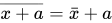

- The arithmetic mean is independent of scale of the units of measurement, in the sense that So, for example, calculating a mean of liters and then converting to gallons is the same as converting to gallons first and then calculating the mean. This is also called first order homogeneity.

Additional properties
[edit]- The arithmetic mean of a sample is always between the largest and smallest values in that sample.
- The arithmetic mean of any amount of equal-sized number groups together is the arithmetic mean of the arithmetic means of each group.
Contrast with median
[edit]The arithmetic mean differs from the median, which is the value that separates the higher half and lower half of a data set. When the values in a data set form an arithmetic progression, the median and arithmetic mean are equal. For example, in the data set , both the mean and median are .


In other cases, the mean and median can differ significantly. For instance, in the data set , the arithmetic mean is , while the median is . This occurs because the mean is sensitive to extreme values and may not accurately reflect the central tendency of most data points.


This distinction has practical implications across different fields. For example, since the 1980s, the median income in the United States has increased at a slower rate than the arithmetic mean income.[5]
Similarly, in climate studies, daily mean temperature distributions tend to approximate a normal distribution, whereas annual or monthly rainfall totals often display a skewed distribution, with some periods having unusually high totals while most have relatively low amounts. In such cases, the median can provide a more representative measure of central tendency.[6]
Generalizations
[edit]Weighted average
[edit]A weighted average, or weighted mean, is an average in which some data points count more heavily than others in that they are given more weight in the calculation.[7] For example, the arithmetic mean of and is , or equivalently . In contrast, a weighted mean in which the first number receives, for example, twice as much weight as the second (perhaps because it is assumed to appear twice as often in the general population from which these numbers were sampled) would be calculated as . Here the weights, which necessarily sum to one, are and , the former being twice the latter. The arithmetic mean (sometimes called the "unweighted average" or "equally weighted average") can be interpreted as a special case of a weighted average in which all weights are equal to the same number ( in the above example and in a situation with numbers being averaged).


Functions
[edit]Continuous probability distributions
[edit]
If a numerical property, and any sample of data from it, can take on any value from a continuous range instead of, for example, just integers, then the probability of a number falling into some range of possible values can be described by integrating a continuous probability distribution across this range, even when the naive probability for a sample number taking one certain value from infinitely many is zero. In this context, the analog of a weighted average, in which there are infinitely many possibilities for the precise value of the variable in each range, is called the mean of the probability distribution. The most widely encountered probability distribution is called the normal distribution; it has the property that all measures of its central tendency, including not just the mean but also the median mentioned above and the mode (the three Ms[8]), are equal. This equality does not hold for other probability distributions, as illustrated for the log-normal distribution here.
Angles
[edit]Particular care is needed when using cyclic data, such as phases or angles. Taking the arithmetic mean of 1° and 359° yields a result of 180°. This is incorrect for two reasons:
- Angle measurements are only defined up to an additive constant of 360° ( or , if measuring in radians). Thus, these could easily be called 1° and -1°, or 361° and 719°, since each one of them produces a different average.
- In this situation, 0° (or 360°) is geometrically a better average value: there is lower dispersion about it (the points are both 1° from it and 179° from 180°, the putative average).


In general application, such an oversight will lead to the average value artificially moving towards the middle of the numerical range. A solution to this problem is to use the optimization formulation (that is, define the mean as the central point: the point about which one has the lowest dispersion) and redefine the difference as a modular distance (i.e. the distance on the circle: so the modular distance between 1° and 359° is 2°, not 358°).

PR is the diameter of a circle centered on O; its radius AO is the arithmetic mean of a and b. Triangle PGR is a right triangle from Thales's theorem, enabling use of the geometric mean theorem to show that its altitude GQ is the geometric mean. For any ratio a:b, AO ≥ GQ.
Symbols and encoding
[edit]See also
[edit]
Notes
[edit]- ^ If NM = a and PM = b. AM = AM of a and b, and radius r = AQ = AG.
Using Pythagoras' theorem, QM² = AQ² + AM² ∴ QM = √AQ² + AM² = QM.
Using Pythagoras' theorem, AM² = AG² + GM² ∴ GM = √AM² − AG² = GM.
Using similar triangles, HM/GM = GM/AM ∴ HM = GM²/AM = HM.
References
[edit]- ^ Jacobs, Harold R. (1994). Mathematics: A Human Endeavor (Third ed.). W. H. Freeman. p. 547. ISBN 0-7167-2426-X.
- ^ Weisstein, Eric W. "Arithmetic Mean". mathworld.wolfram.com. Retrieved 21 August 2020.
- ^ Eisenhart, Churchill (24 August 1971). "The Development of the Concept of the Best Mean of a Set of Measurements from Antiquity to the Present Day" (PDF). Presidential Address, 131st Annual Meeting of the American Statistical Association, Colorado State University. pp. 68–69.
- ^ a b Medhi, Jyotiprasad (1992). Statistical Methods: An Introductory Text. New Age International. pp. 53–58. ISBN 9788122404197.
- ^ Krugman, Paul (4 June 2014) [Fall 1992]. "The Rich, the Right, and the Facts: Deconstructing the Income Distribution Debate". The American Prospect.
- ^ Barry, Roger Graham; Chorley, Richard John (2005). Atmosphere, Weather and Climate (8th ed.). London: Routledge. p. 407. ISBN 978-0-415-27170-7.
- ^ "Mean | mathematics". Encyclopedia Britannica. Retrieved 21 August 2020.
- ^ Thinkmap Visual Thesaurus (30 June 2010). "The Three M's of Statistics: Mode, Median, Mean June 30, 2010". www.visualthesaurus.com. Retrieved 3 December 2018.
Further reading
[edit]- Huff, Darrell (1993). How to Lie with Statistics. W. W. Norton. ISBN 978-0-393-31072-6.


| International | |
|---|---|
| National | |

Arithmetic mean
View on GrokipediaFundamentals
Definition
The arithmetic mean, commonly referred to as the mean or average, is a fundamental measure of central tendency in statistics and mathematics, defined as the sum of a finite set of numerical values divided by the number of values in the set. It provides a single value that summarizes the "center" of the data and is applicable to any finite collection of real numbers, assuming no additional weighting is applied.[1] For a set of numbers , the unweighted arithmetic mean is calculated using the formula where represents the summation of the values (the total obtained by adding them together). This formula assumes a basic understanding of summation as the process of adding multiple terms. For instance, consider the numbers 2, 4, 4, 4, 8, 10: their sum is 32, and with , the arithmetic mean is . In statistical contexts, a distinction is made between the population mean , which is the arithmetic mean of all elements in an entire population, and the sample mean , which is the arithmetic mean computed from a subset (sample) of the population used to estimate . This differentiation is crucial for inferential statistics, where the sample mean serves as an estimator for the unknown population parameter.[10]Calculation
The arithmetic mean, denoted as , of a finite set of numbers where is computed by first calculating the sum and then dividing by the number of observations : This process involves iterating through the dataset once to accumulate the sum, followed by a single division operation. For a simple example with three values, consider the numbers 2, 4, and 6. The sum is , and dividing by gives . For larger datasets, the same procedure applies but may benefit from organized presentation. Consider the following table of 10 temperature readings in degrees Celsius:| Index | Value |
|---|---|
| 1 | 22.5 |
| 2 | 24.1 |
| 3 | 21.8 |
| 4 | 23.0 |
| 5 | 25.2 |
| 6 | 22.9 |
| 7 | 23.7 |
| 8 | 24.5 |
| 9 | 21.3 |
| 10 | 22.8 |
Properties
Motivating properties
The arithmetic mean possesses several intuitive properties that make it a natural choice for summarizing the central tendency of a dataset, particularly when equal importance is assigned to each observation. One key motivating property is its additivity, which states that the mean of the sum of two or more datasets equals the sum of their individual means, scaled appropriately by the number of observations. For instance, if a dataset is partitioned into subsets, the overall mean can be computed as a weighted combination of the subset means, facilitating efficient calculations for large or divided data. This property is particularly useful in aggregating information from multiple sources without recomputing from scratch.[16] Another foundational attribute is the arithmetic mean's linearity, which ensures that the mean of a linear combination of random variables is the corresponding linear combination of their means: , where and are constants. This linearity underpins its compatibility with linear statistical models, such as regression analysis, where predictions and parameter estimates rely on averaging transformed data while preserving structural relationships. It motivates the mean's role in modeling additive processes, like forecasting totals from component averages in economics or engineering.[17] A compelling reason for preferring the arithmetic mean arises from its optimality in minimizing the sum of squared deviations from the data points. Consider a constant model estimating a fixed value for all observations ; the value of that minimizes is precisely the arithmetic mean . To see this, expand the sum: . The cross-term vanishes because , leaving , which is minimized at since the second term is nonnegative and zero only when . This least-squares property positions the mean as the best constant predictor under squared error loss, a criterion central to many statistical applications.[18] In symmetric distributions, the arithmetic mean further justifies its use through its alignment with the concept of a balance point, analogous to the center of mass in physics. For a set of masses at positions , the center of mass reduces to the arithmetic mean when masses are equal (), representing the point where the dataset is equilibrated. This symmetry ensures the mean is an unbiased estimator of the population parameter, as deviations above and below cancel out on average, providing a stable measure of location without directional bias. Such properties make it ideal for symmetric data in fields like physics and quality control.[19] Practically, these properties motivate the arithmetic mean's widespread application in averaging errors or predictions under assumptions of equal weighting. In error analysis, it computes the average deviation to assess model performance, as squared errors emphasize larger discrepancies while the mean provides an interpretable summary. Similarly, in predictive modeling like ensemble methods, averaging forecasts from multiple models reduces variance and improves accuracy, leveraging the mean's additivity and least-squares efficiency for reliable point estimates.[20]Additional properties
The arithmetic mean exhibits idempotence as an aggregation function, meaning that applying the operation twice to a dataset yields the same result as applying it once: if denotes the arithmetic mean of the values in , then the arithmetic mean of (with copies) is again .[21] For positive real numbers , the arithmetic mean satisfies the AM-GM-HM inequality chain: the arithmetic mean (AM) is at least the geometric mean (GM), which is at least the harmonic mean (HM), i.e., , with equality if and only if all are equal.[22] This relationship follows from the convexity of the logarithmic function in the proof of AM ≥ GM (via Jensen's inequality) and a similar argument for GM ≥ HM using the reciprocal function.[23] As a convex combination of the input values with equal weights , the arithmetic mean preserves the bounds of the dataset: for real numbers , it holds that .[24] The arithmetic mean is particularly sensitive to outliers, as a single extreme value disproportionately influences the overall average due to its linear weighting of all observations.[25] This contrasts with more robust measures like the median. Quantitatively, the variance of the sample mean from an independent random sample of size drawn from a population with variance is , which decreases with larger and underscores the mean's stability under repeated sampling but vulnerability to skewed data.[26] A key mathematical property is that the arithmetic mean minimizes the sum of squared deviations from the data points. To derive this, consider the objective function Differentiating with respect to gives which simplifies to , so . The second derivative confirms a minimum. Alternatively, expanding for any estimate yields , with equality only if .[18]Historical Context
Early origins
The concept of the arithmetic mean emerged in ancient civilizations through practical applications in astronomy, resource management, and theoretical philosophy, often without formal mathematical notation. In Babylonian astronomy around 2000 BCE, astronomers calculated mean positions of celestial bodies to predict movements, employing computed mean values, such as the mean lunar month of 29;30,30 days (approximately 29.53 days), based on long-term observations of variations between 29 and 30 days. These computations, recorded on clay tablets, employed linear interpolation and arithmetic progressions to approximate planetary and lunar positions, enabling long-term calendars and eclipse predictions.[27] In ancient Egypt, circa 1650 BCE, the Rhind Mathematical Papyrus demonstrates implicit use of averaging in resource allocation problems, such as dividing loaves of bread or measures of grain among workers using unit fractions and proportional shares for fair allocation in labor or trade contexts. This approach supported administrative tasks in agriculture and construction, where equitable division of supplies was essential.[28] Greek thinkers further conceptualized the arithmetic mean in both musical theory and ethics. The Pythagoreans, around the 6th century BCE, applied numerical averages to harmonics, identifying the arithmetic mean as one of three classical means (alongside geometric and harmonic) to explain consonant intervals in music; for example, they related string lengths to frequency ratios like 2:1 for octaves, using averages to harmonize scales.[29] In ethics, Aristotle (4th century BCE) distinguished the "mean according to arithmetic proportion" as a fixed midpoint—such as 6 between 10 and 2—in his doctrine of the mean from the Nicomachean Ethics, advocating virtue as an intermediate state between excess and deficiency, though relative to individual circumstances rather than strict arithmetic equality.[30] During the medieval Islamic period, scholars like Muhammad ibn Musa al-Khwarizmi (9th century CE) integrated averages into practical computations for inheritance and astronomy. In his treatise Kitab al-Jabr wa'l-Muqabala, al-Khwarizmi addressed inheritance problems by dividing estates proportionally among heirs using algebraic methods to resolve Qur'anic rules for complex family distributions. His astronomical work, Zij al-Sindhind, included tables of mean motions for planetary positions to refine calendars and almanacs.[31] Roman agricultural practices also relied on averaging for yield estimation, as detailed by Lucius Junius Moderatus Columella in De Re Rustica (1st century CE). Columella recommended assessing average crop outputs over multiple seasons to guide farm management; for wheat, he cited typical yields of 10-15 modii per iugerum (about 6-9 bushels per acre) on good soil, derived from observational averages to optimize planting and labor. These estimates emerged from empirical trade and measurement needs, where merchants and farmers averaged quantities of goods like grain or wine to standardize exchanges without precise notation.[32]Formal development
The formal development of the arithmetic mean as a rigorous mathematical and statistical concept began in the 17th and 18th centuries with foundational work in probability and analysis. In 1713, Jacob Bernoulli's posthumously published Ars Conjectandi introduced the weak law of large numbers, demonstrating that the arithmetic mean of a large number of independent Bernoulli trials converges in probability to the expected value, thereby establishing averaging as a principled method for estimating probabilities in repeated experiments.[33] In the early 18th century, Roger Cotes discussed the arithmetic mean in the context of error analysis in his posthumous Opera Miscellanea (1722). Later, Thomas Simpson's 1755 treatise explicitly advocated taking the arithmetic mean of multiple observations to minimize errors in astronomical measurements, influencing its use in probability and statistics.[34] Later in the 18th century, Leonhard Euler advanced the notation and theoretical framework for summation in his 1755 treatise Institutiones calculi differentialis, where he introduced the sigma symbol (Σ) to denote sums, facilitating the precise expression of the arithmetic mean as the total sum divided by the number of terms in analytical contexts.[35] The 19th century saw the arithmetic mean integrated into statistical estimation and probabilistic theory. In 1809, Carl Friedrich Gauss's Theoria Motus Corporum Coelestium formalized the method of least squares, proving that under the assumption of normally distributed errors, the arithmetic mean serves as the maximum likelihood estimator for the true value, marking a pivotal shift toward its use as an optimal statistical estimator in astronomy and beyond.[36] Shortly thereafter, in 1810, Pierre-Simon Laplace's memoir on probability extended this by proving an early version of the central limit theorem, showing that the distribution of the sum of independent random variables approximates a normal distribution, which implies that the arithmetic mean of sufficiently large samples tends to follow a normal distribution centered on the population mean.[37] By the 20th century, the arithmetic mean achieved standardization in statistical practice and education. William Sealy Gosset's 1908 paper "The Probable Error of a Mean," published under the pseudonym "Student," introduced the t-test for inferring population means from small samples, embedding the arithmetic mean centrally in hypothesis testing procedures for comparing group averages.[38] Ronald Fisher's influential 1925 textbook Statistical Methods for Research Workers further codified its role, presenting the arithmetic mean alongside variance and other measures in accessible tables and methods for experimental design, promoting its widespread adoption in biological and social sciences.[39] This progression culminated in a transition from manual, ad hoc calculations to computational tools, enabling efficient computation of arithmetic means in large datasets. During the 1920s and 1930s, mechanical tabulating machines from IBM facilitated batch processing of sums and averages in statistical bureaus, while post-World War II electronic computers and software like SAS (introduced in 1966) automated mean calculations, integrating them into modern data analysis workflows.[40]Comparisons with Other Measures
Contrast with median
The median, in contrast to the arithmetic mean, is defined as the middle value in a dataset when the observations are ordered from smallest to largest; for an even number of observations, it is the average of the two central values.[41] This measure represents the point that divides the data into two equal halves, providing a robust indicator of central tendency without relying on all values equally.[42] A key distinction lies in their sensitivity to outliers: the arithmetic mean can be heavily influenced by extreme values, as it incorporates every observation proportionally, whereas the median remains unaffected by values beyond the central position.[41][43] For instance, in the dataset {1, 2, 3, 100}, the arithmetic mean is 26.5, pulled upward by the outlier, while the median is 2.5, better reflecting the cluster of smaller values.[44] This sensitivity often leads to the mean exceeding the median in datasets with positive outliers, such as income distributions where wealth inequality results in a few high earners distorting the average.[45][46] The choice between the two depends on data symmetry and distribution shape. In symmetric distributions, such as human heights approximating a normal distribution, the mean and median coincide, making the mean preferable for its additional properties like additivity.[41][47] However, for skewed distributions like house prices, where a few luxury properties inflate the mean, the median provides a more representative "typical" value.[43] In a log-normal distribution, which models such positive skew (e.g., certain biological or financial data), the mean exceeds the median due to the right tail.[48] From a statistical perspective, the arithmetic mean is the maximum likelihood estimator and asymptotically efficient under parametric assumptions like normality, minimizing variance among unbiased estimators.[49] In contrast, the median serves as the maximum likelihood estimator for the Laplace distribution and is preferred in non-parametric settings or robust analyses, where it resists outliers and requires fewer distributional assumptions.[50][51] This makes the median particularly valuable when data may violate normality, ensuring more reliable inferences in skewed or contaminated samples.[42]Contrast with mode
The mode of a dataset is defined as the value that appears most frequently, serving as a measure of central tendency that identifies the peak or peaks in the distribution of data.[52] In contrast, the arithmetic mean treats all values equally by summing them and dividing by the number of observations, providing a balanced summary that incorporates every data point without emphasis on frequency.[53] This fundamental difference means the mean reflects the overall "center of mass" of the data, while the mode highlights concentrations or modal values, particularly useful in multimodal distributions where multiple peaks exist.[54] The arithmetic mean is most applicable to quantitative data on interval or ratio scales, such as calculating the average test score in a class (e.g., scores of 85, 90, 92, and 85 yield a mean of 88), where numerical averaging provides meaningful insight. Conversely, the mode excels with categorical or nominal data, identifying the most common category, like the most frequent eye color in a population (e.g., brown appearing 15 times out of 50 observations).[53] In scenarios involving discrete counts or preferences, the mode captures typical occurrences that the mean might obscure, as averaging categories lacks interpretive value. A key limitation of the mode is that it may not exist if all values are unique or appear equally often, or it may not be unique in bimodal or multimodal datasets, leading to ambiguity in representation.[52] For instance, in the dataset {1, 1, 2, 3}, the mode is 1 due to its highest frequency, while the arithmetic mean is $1.75\frac{1+1+2+3}{4}$.[54] In a uniform distribution, such as rolling a fair die where each outcome from 1 to 6 is equally likely, no mode exists because frequencies are identical, yet the mean of 3.5 clearly indicates the central value. The mean, while always definable for numerical data, can sometimes mislead in skewed or discrete datasets by pulling toward extremes, though it remains robust in its comprehensive inclusion of all points.[53] In descriptive statistics, the arithmetic mean and mode are often used together alongside the median to provide a complete profile of central tendency, revealing different aspects of the data's structure—such as average performance via the mean and prevalent categories via the mode—for more informed analysis.[52]Generalizations
Weighted arithmetic mean
The weighted arithmetic mean assigns non-negative weights to each data value (for to ) to reflect their relative importance, extending the standard arithmetic mean for cases where data points contribute unequally. The value is computed as where the denominator normalizes the weights to ensure they sum to unity if they do not already.[55][56] If the weights are predefined to sum to 1, the denominator is simply 1, simplifying the expression while maintaining the proportional influence of each .[57] This measure is widely applied in education for calculating grade point averages (GPAs), where course grades are weighted by the number of credit hours to account for varying course loads.[58] In finance, it determines a portfolio's expected return as the weighted sum of individual asset returns, with weights corresponding to the proportion of capital invested in each asset.[59] The weighted arithmetic mean inherits the linearity of the unweighted version, meaning it can be expressed as a linear combination of the , which facilitates its use in optimization and regression contexts; however, the choice of weights influences the mean's sensitivity to outliers, amplifying the impact of heavily weighted points.[55] It reduces to the unweighted arithmetic mean when all , unifying the two concepts under equal weighting.[60] For illustration, consider test scores of 90, 80, and 70 with respective weights of 0.5, 0.3, and 0.2 (e.g., reflecting differing assessment importances); the weighted mean is .[57] A notable special case is the exponential moving average, a time-weighted variant used in time series analysis, where weights decline exponentially for older observations to emphasize recent data while still incorporating historical values as an infinite weighted sum.[61]Arithmetic mean in probability distributions
In probability theory, the arithmetic mean of a random variable represents its expected value, which serves as the population mean under the probability distribution governing the variable. For a discrete random variable with probability mass function , the expected value is given by . For a continuous random variable with probability density function , it is .[62] This expected value quantifies the long-run average value of the random variable over many independent realizations.[63] When estimating the expected value from a sample, the sample mean is used, where are independent and identically distributed (i.i.d.) observations from the distribution. This sample mean is an unbiased estimator of the population mean, meaning , ensuring that on average, it equals the true expected value across repeated samples.[64] A key result facilitating inference about the population mean is the Central Limit Theorem (CLT), which states that for i.i.d. random variables with finite mean and variance , the distribution of the standardized sample mean converges to a standard normal distribution as the sample size increases, regardless of the underlying distribution's shape.[65] This asymptotic normality underpins much of statistical inference for means. The variability of the sample mean is captured by its variance, which for i.i.d. samples is , where is the population variance; this decreases with larger , reflecting improved precision.[66] In applications, the arithmetic mean enables construction of confidence intervals for the population mean, such as the approximate interval under the CLT, where is the normal quantile and estimates .[67] It also supports hypothesis testing, for instance, the one-sample t-test, which assesses whether the population mean equals a specified value by comparing to under the t-distribution when is unknown.[67] Illustrative examples include the uniform distribution on , where the mean is , representing the midpoint of the interval.[68] For the exponential distribution with rate parameter , the mean is , which models the average waiting time until an event in a Poisson process.[69]Arithmetic mean for angles
The arithmetic mean cannot be directly applied to angular data due to the circular nature of angles, where values wrap around at 360° (or 2π radians), equivalent to 0°. For instance, the angles 1° and 359° intuitively cluster near 0°, but their arithmetic mean yields 180°, which misrepresents the central tendency. This distortion arises from the modular arithmetic of the circle, violating the linearity assumption of the standard mean.[70] To address this, the circular mean (or mean direction) employs a vector-based approach in directional statistics. Each angle θ_i is converted to a unit vector with components x_i = cos θ_i and y_i = sin θ_i, assuming angles in radians; the averages of these components are then computed as \bar{x} = (1/n) ∑ cos θ_i and \bar{y} = (1/n) ∑ sin θ_i. The circular mean \bar{θ} is retrieved via which yields the angle in the correct quadrant. The length of the resultant vector, R = √(\bar{x}^2 + \bar{y}^2), quantifies data concentration: R = 1 indicates perfect alignment (no dispersion), while R = 0 signifies uniform distribution around the circle. This R serves as a circular analog to variance, with lower values reflecting greater spread.[70] For example, consider angles 10°, 30°, and 350° (in degrees). The arithmetic mean is 130°, misleadingly placing the result opposite the cluster near 20°. In contrast, the circular mean is approximately 9.5°, correctly capturing the directional tendency. Another case: angles 0°, 0°, and 90° yield an arithmetic mean of 30°, but the circular mean is about 26.6°, with R ≈ 0.745 highlighting tight concentration except for the outlier.[71] This method finds applications in fields involving periodic directions, such as meteorology for averaging wind directions to assess prevailing flows, horology for summarizing clock times on a 12-hour dial, and robotics for aggregating sensor orientations in navigation or pose estimation.[71] A key limitation is its performance on bimodal data, where angles form distinct clusters (e.g., peaks at 0° and 180°); the circular mean may fall midway, obscuring subgroups, necessitating prior clustering techniques like kernel density estimation on the circle before averaging.[72]Notation and Representation
Common symbols
The arithmetic mean of a sample is commonly denoted by or , where the overline (vinculum) indicates the averaging operation over a subset of data points in statistics.[73][74] This notation, often pronounced "x-bar," distinguishes the sample mean from the broader population parameter. In contrast, the population mean, representing the average over an entire dataset, is standardly denoted by the Greek letter (mu), a convention rooted in probability theory to signify a fixed parameter.[75] In simpler or introductory mathematical contexts, the arithmetic mean may be denoted by , particularly for basic averages without distinguishing between sample and population.[76] For discussions involving inequalities, such as the arithmetic mean-geometric mean (AM-GM) inequality, the arithmetic mean is frequently abbreviated as or to contrast it with other means like the geometric mean .[1][77] Contextual variations extend these notations; for instance, in linear regression analysis, the mean of the dependent variable is typically , while subscripted forms like denote group-specific sample means in analyses such as ANOVA.[76] These adaptations maintain the overline convention for empirical estimates while incorporating subscripts for specificity. Historically, notations for the arithmetic mean evolved from ad hoc representations of sums in early probability texts to standardized symbols in the late 19th and early 20th centuries, largely through the work of statisticians like Karl Pearson and Ronald Fisher, who popularized Greek letters like for parameters and overlines for samples.[78] Field-specific conventions further diversify usage: the overline remains prevalent for sample means in statistics, while is reserved for population parameters; in physics, particularly for expectation values in quantum mechanics or statistical mechanics, the arithmetic mean is often expressed as , using angle brackets to evoke averaging over an ensemble.[79][80]Encoding standards
In digital encoding, the arithmetic mean symbol , representing the sample mean, is typically formed using Unicode's combining overline (U+0305) applied to the Latin lowercase 'x' (U+0078), resulting in the sequence x̄. The population mean is denoted by the Greek lowercase mu (μ, U+03BC). These combining characters allow flexible application across scripts and ensure compatibility in mathematical contexts, as outlined in Unicode Technical Report #25, which details support for mathematical notation including diacritics like overlines.[81] In LaTeX typesetting systems, the overline for is generated using the command\bar{x}, while mu is produced with \mu.[82] For enhanced precision in mathematical expressions, the amsmath package is commonly employed, providing refined spacing and alignment for such symbols. This setup supports professional rendering in printed and digital documents, adhering to standards for mathematical communication.
For web-based representation in HTML and CSS, the combining overline can be inserted via the entity ̅ after the base character, though a spacing overline (‾, U+203E) is available as ‾ or ‾ for standalone use. The Greek mu is encoded with μ or μ. CSS properties like text-decoration: overline may approximate the effect, but for semantic accuracy in mathematical contexts, MathML is recommended to preserve structure.
Font rendering affects visibility: serif fonts, such as those in the Computer Modern family, provide clearer distinction for overlines and Greek letters due to their structural details, whereas sans-serif fonts like Arial can cause alignment issues or reduced legibility in complex expressions.[83] In plain text environments without full Unicode support, approximations such as "x_" or "xbar" are used to denote the sample mean.
The International Standard ISO 80000-2 (2009) recommends for the mean value of a quantity x and μ for the population mean in scientific notation. Updates in the 2019 edition maintain these conventions while expanding on mathematical symbols. Unicode version 15.0 (2022) enhances mathematical support by adding characters and refining normalization for diacritics, improving rendering consistency across platforms.[84]
Accessibility considerations are crucial for math notations; screen readers like NVDA or JAWS often struggle with combining characters such as overlines, interpreting them linearly rather than semantically. Integration with MathML and tools like MathCAT enables better navigation and vocalization, announcing as "x bar" and μ as "mu" for users relying on assistive technologies.