


Community hub
Recent from talks
Contribute something
Nothing was collected or created yet.
Podgorica
View on Wikipedia
Podgorica[a] ([pɔdɡɔɾit͡sa]; Montenegrin Cyrillic: Подгорица;[b] lit. 'Under the Hill') is the capital and largest city of Montenegro. The city is just north of Lake Skadar and close to coastal destinations on the Adriatic Sea. Historically, it was Podgorica's position at the confluence of the Ribnica and Morača rivers and at the meeting-point of the fertile Zeta Plain and Bjelopavlići Valley that encouraged settlement. The surrounding landscape is predominantly mountainous terrain.
Key Information


.jpg)


.jpg)


After World War II, Podgorica was first designated as the capital of Montenegro in 1946. At that time, it was renamed Titograd in honor of Josip Broz Tito, the leader of Yugoslavia. It served as the capital of the Socialist Republic of Montenegro within the Socialist Federal Republic of Yugoslavia until Montenegro's declaration of independence in 2006, after which it was reaffirmed as the capital of an independent Montenegro. The city's original name, Podgorica, had been restored in 1992 following the dissolution of Yugoslavia.
The economy of Podgorica is based on a mix of industries, including manufacturing, trade, and services. The city has seen a rise in the IT sector, with numerous startups and tech companies emerging. Podgorica serves as a central hub for Montenegro's transportation network, with an extensive road and rail system and the nearby Podgorica Airport. Tourism is also a growing sector, with the city being a gateway to Montenegro's natural and cultural attractions.
Podgorica is home to the University of Montenegro, the largest and most significant educational institution in the country. The city's cultural institutions include the Montenegrin National Theatre, the Natural History Museum of Montenegro, and several galleries and libraries. About one-third of the city's area is composed of parks, gardens, and natural landscapes, including the nearby Gorica Hill.
Prominent landmarks in Podgorica include the Millennium Bridge, the Clock Tower, and the Cathedral of the Resurrection of Christ. The city also features historical sites such as the ancient Roman settlement of Doclea and the old Ottoman town of Stara Varoš.
Etymology
[edit]Podgorica is written in Cyrillic as Подгорица, pronounced [pǒdɡoritsa]; UK: /ˈpɒdɡɒrɪtsə, pɒdˈɡɔːr-/,[3] US: /ˈpɒdɡəriːtsə, ˈpɔːdɡɒr-/;[4][5][6] Podgorica literally means 'under the hill'. Gorica (Горица), a diminutive of the word gora (гора) which is another word for 'mountain' or 'hill', means 'little/small hill', is the name of one of the cypress-covered hillocks that overlooks the city center. Some three kilometres (1.9 miles) north-west of Podgorica lie the ruins of the Roman-era town of Doclea, from which the Roman Emperor Diocletian's mother hailed. In later centuries, Romans corrected the name to Dioclea, guessing that an i had been lost in vulgar speech. Duklja is the later South Slavic version of the same word. At its foundation in 426 AD,[7] the town was called Birziminium. In the Middle Ages, it was known as Ribnica (Рибница, [rîbnitsa]). The name Podgorica was used from 1326. From 1946 to 1992, the city was named Titograd (Титоград, [tîtoɡraːd]) in honour of Josip Broz Tito, the President of Socialist Federal Republic of Yugoslavia from 1953 to 1980. In 1992 the city changed its name to "Podgorica", which it remains today.
History
[edit]
Illyria (9th century BCE – 33 BCE)
Roman Republic (33 BCE – 27 BCE)
Byzantine Empire (476 – 997)
First Bulgarian Empire (997 – 1018)
Dioclea (1040 – 1186)
Grand Principality of Serbia (1186 – 1217)
Kingdom of Serbia (1217 – 1346)
Serbian Empire (1346 – 1371)
Zeta under the Balšići (1371 – 1421)
Serbian Despotate (1421 – 1441)
Kingdom of Bosnia (1441 – 1444)
Republic of Venice (1444 – 1448)
Ottoman Empire (1474 – 1878)
Principality of Montenegro (1878 – 1910)
Kingdom of Montenegro (1910 – 1916)
Austria-Hungary (1916 – 1918)
Kingdom of Yugoslavia (1918 – 1941)
Kingdom of Italy (1941 – 1943)
Greater German Reich (1943 – 1944)
SFR Yugoslavia (
SR Montenegro) (1944 – 1992)
FR Yugoslavia (
Republic of Montenegro) (1992 – 2006)
Montenegro (2006 – present; capital)


Early history
[edit]

Podgorica is at the crossroads of several historically important routes, near the rivers Zeta, Morača, Cijevna, Ribnica, Sitnica and Mareza in the valley of Lake Skadar and near the Adriatic Sea, in fertile lowlands with favourable climate. The earliest human settlements were in prehistory: the oldest physical remains are from the late Stone Age.[8]
In the Iron Age, the area between the Zeta and Bjelopavlići valleys was populated by two Illyrian tribes, the Labeates and the Docleatae. The population of the town of Doclea was 8,000–10,000, in which all core urban issues were resolved.[9][10] The high population density (in an area of about 10 km (6 mi) radius) was made possible by the geographical position, favorable climate, and economic conditions and by the defensive positions that were of great importance at that time.[10]
The name Podgorica was first mentioned in 1326 in a court document of the Kotor archives.[11] The city was economically strong: trade routes between the Republic of Ragusa and Serbia, well developed at that time, were maintained via the road that led to Podgorica through Trebinje and Nikšić. As a busy crossroads, Podgorica was a vibrant regional center of trade and communication. This boosted its development, economic power, military strength, and strategic importance.[10]
In 1448, Stefan Crnojević allied himself with the Republic of Venice, and after defeating the despot Đurađ Branković in 1452, he handed over Podgorica to the Venetian Republic, which already held the Shkodër region. However, Venetian rule of Podgorica did not last long, because Mehmed II soon conquered the fortified town of Medun in 1455, and two years later, most of Zeta.[10][11]
Ottoman Empire
[edit]
The Ottoman Empire captured Podgorica in 1474. Podgorica became a kaza of the Sanjak of Scutari (which was historically led by Albanian Pashas). In 1479, The Ottomans built a large fortress in Podgorica, and the existing settlement, with its highly developed merchant connections, became the main Ottoman defensive and attacking bastion in the region. At the beginning of 1474 the Ottoman sultan intended to rebuild Podgorica and Baleč and settle them with 5,000 Muslim families (most of them of Albanian or Slavic origin),[12] in order to stop cooperation between the Principality of Zeta and Albania Veneta.[13]
Podgorica fell again, but this time to the Ottomans in 1484, and the character of the town changed extensively. The Ottomans fortified the city, building towers, gates, and defensive ramparts that give Podgorica the appearance of an Ottoman military city.[citation needed]

Most of today's Montenegro and Podgorica fell under the rule of the Albanian Bushati Family of Shkodra between 1760 and 1831, which ruled independently from the Imperial authority of the Ottoman Sultan.[citation needed]
In 1864, Podgorica became a kaza of the Scutari Vilayet called Böğürtlen ("blackberry", also known as Burguriçe).

On 7 October 1874, in a violent reaction over the murder of a local named Juso Mučin Krnić,[14] Ottoman forces killed at least 15 people in Podgorica.[15] The massacre was widely reported outside of Montenegro and ultimately contributed to the buildup to the Montenegrin-Ottoman War.
The end of the Montenegrin-Ottoman War in 1878 resulted in the Congress of Berlin recognizing vast territories, including that of Podgorica, as part of the newly recognized Principality of Montenegro.[citation needed] At that time there were about 1,500 houses in Podgorica, with more than 8,000 people living there – of Orthodox, Roman Catholic, and Muslim faiths flourishing together.[citation needed]
The Petrović and Karađorđević monarchies
[edit]
After the Berlin Congress in 1878, Podgorica was annexed to the Principality of Montenegro, marking the end of four centuries of Ottoman rule, and the beginning of a new era for Podgorica and Montenegro.[citation needed] The first forms of capital concentration were seen in 1902 when roads were built to all neighboring towns, and tobacco became Podgorica's first significant commercial product. In 1904, a savings bank named Zetska formed the first significant financial institution; this would soon grow into Podgorička Bank.[citation needed]
World War I marked the end of dynamic development for Podgorica, which by then was the largest city in the newly proclaimed Kingdom of Montenegro. On 10 August 1914, nine military personnel and 13 civilians were killed in Podgorica from an aerial bombardment by Austro-Hungarian Aviation Troops.[16] The city was bombed three more times in 1915.[16] Along with the rest of the Kingdom, Podgorica was occupied by Austria-Hungary from 1916 to 1918.
After the liberation by the Allies in 1918, the controversial Podgorica Assembly marked the end of Montenegrin statehood, as Montenegro was merged with the Kingdom of Serbia and incorporated into the Kingdom of Serbs, Croats, and Slovenes. The population of urban Podgorica during this interwar period was approximately 14,000.[17]
During the interwar period (1918–1941), Podgorica had public bathrooms as most residents did not have their own.[17] However, the Imperial hotel built in 1925 had two bathrooms, which was unprecedented at the time.[17] It was one of at least six hotels built in the city during the interwar period.[17]
World War II
[edit]
After the Yugoslav coup d'état on 27 March 1941, demonstrations supporting the coup took place in Podgorica.[18] As a result of the coup, Yugoslavia turned against its previous alliance with the Axis powers and was subsequently invaded. Podgorica was bombed over 80 times throughout the course of the war.[19] The city was first bombed by the Luftwaffe on 6 April 1941. On 5 May 1944, Podgorica was bombed by the USAAF in an attack against Axis forces, although the bombardment that day killed approximately 400 civilians.[20] The city was liberated on 19 December 1944. According to the Museum of Genocide Victims, a total of 1,691 people were killed in Podgorica over the course of the war.[21]
Socialist Yugoslavia
[edit]On 12 July 1946, Josip Broz Tito made one of his early visits to Podgorica from the Radovče hotel, where he spoke to a crowd.[22] It was the first of fifteen total visits made by Tito to the city after World War II.[22]
"Podgorica is destroyed. We will build her altogether because it's our responsibility, because that's what's required of us by the sacrifices which Podgorica gave! We will do it, that's what I promise you in the name of the Federal government." – Josip Broz Tito on 12 July 1946.[22]
On 25 July 1948, the vice president of the People's Parliament of Montenegro, Andrija Mugoša, along with secretary Gavron Cemović, signed a law changing the name of Podgorica into "Titovgrad".[19] The law was "retroactively" activated such that the name change applied to any records starting from 13 July 1946, when it became the capital of Montenegro within the newly formed Socialist Federal Republic of Yugoslavia.[19] However, in a contradiction, the "Službeni list" or legal code of Yugoslavia recorded the name "Titograd" without the letter "v".[19] Ultimately, "Titograd" was used over "Titovgrad".[19]
In addition to the new name, Titograd saw the establishment of new factories. The Radoje Dakić factory, built-in 1946 for the production of heavy machinery, became one of the largest employers in Titograd. In 1964, Radoje Dakić guaranteed hired workers an apartment in the city.[23] In the late 1960s, the cities of Titograd, Zadar, and Mostar competed to be selected as the location of Yugoslavia's expanding aluminum industry.[24] In a highly politicized selection process, Titograd was ultimately chosen and the Kombinat was constructed in 1969.[24] In 1974, the public Veljko Vlahović University was founded in Titograd. On 15 April 1979, the city suffered damage by a 6.9 magnitude earthquake.
Titograd was the site of massive protests during Yugoslavia's anti-bureaucratic revolution. On 10 January 1989, over 10,000 people protested in the city.[25][26] By the turn of the decade, Titograd was recognized as the city with the most greenery in Yugoslavia, along with Banja Luka.[27]
Contemporary history
[edit]As Yugoslavia began to break up, Titograd was renamed to Podgorica after a referendum on 2 April 1992.[28] On 25 May 1992, Podgorica was the site of a Serbian Radical Party rally of approximately 10,000 supporters, during which a Montenegrin Bosniak man named Adem Šabotić attempted to assassinate Vojislav Šešelj via hand bomb after his supporters chanted references to killing Muslims.[29] Šešelj, his bodyguards, and a few bystanders were injured after the bomb detonated but no one was killed.[29]
Otherwise, the Yugoslav wars largely bypassed Podgorica, but the entire country was greatly affected with severe economic stagnation and hyperinflation lasting throughout the 1990s due to international sanctions. In 1999, Podgorica was subject to airstrikes during the NATO bombing of Yugoslavia.[30][31]
On 13 July 2005, the newly constructed Millennium Bridge opened for traffic.[32] Following the results of the independence referendum in May 2006, Podgorica saw significant development as the capital of an independent state, including the reconstruction and renaming of the former Ivan Milutinović Square to Independence Square.
On 13 October 2008, at least 10,000 people protested against Kosovo's declaration of independence.[33] On 19 December 2008, the Moscow Bridge opened for pedestrians.
On 7 August 2013, the 60-year old Hotel Crna Gora was demolished to make way for the new Hilton in its place, which opened in 2016.[34] Construction of the Cathedral of Christ's Resurrection finished after 20 years on 7 October 2013.
In October 2015, protests took place in Podgorica ahead of Montenegro's accession into NATO. After a demonstration of at least 5,000 to 8,000 people,[35] the police used tear gas to disperse demonstrators from the parliament.[36] Protests in the city continued through the 2016 Montenegrin parliamentary election. On 22 February 2018, a Yugoslav Army veteran killed himself at the US embassy in Podgorica.
Administration
[edit]

The city administration consists of a mayor, city assembly, and a number of secretariats and administrative bodies which together act as a city local government. The city assembly has 61 members, elected directly for four-year terms. The mayor used to be directly elected for a five-year term, but since the new law was introduced in Montenegrin municipalities mayors will be elected by the city assembly and will have to maintain its support during the term. Separate elections are held for the local sub-division of Golubovci since it is part of their administrative autonomy inside Podgorica municipality. Constant questions are raised by various politicians over gaining separate municipality status for Golubovci. In 2018, Tuzi became its own municipality after a vote on the Montenegrin Parliament.[37]
On local elections held on 25 May 2014, the Democratic Party of Socialists won 29 seats in the municipal assembly, one short of 30 needed to form a majority. Democratic Front won 17 seats, SNP won 8 seats, while coalition made of Positive Montenegro and SDP won 5 seats. After lengthy negotiations, SDP dissolved coalition with Pozitivna and made an arrangement on forming a majority with DPS, similar to one they have in national government. While SDP is a longtime partner of DPS at the national level, it has been in opposition to Podgorica municipal assembly in 2010–2014 period. Since October 2014, the position of the mayor is held by DPS official, Slavoljub Stijepović, replacing Podgorica mayor od 14 years, Miomir Mugoša. Since October 2018, the position of the Mayor is held by DPS Vice president dr Ivan Vuković, replacing Slavoljub Stijepović. On 13 April 2023, Olivera Injac from PES was sworn in as mayor, thus becoming the first non-DPS mayor since 1998.
City Assembly 2024–2028
[edit]| Party/Coalition | Seats | Local government | |
|---|---|---|---|
| Democratic Party of Socialists | 19 / 59
|
Opposition | |
| ZBCG (NSD–DNP) | 10 / 59
|
Government | |
| Europe Now | 8 / 59
|
Government | |
| Democratic Montenegro | 6 / 59
|
Government | |
| Movement for Podgorica | 4 / 59
|
Government | |
| United Reform Action | 2 / 59
|
Opposition | |
| Social Democrats | 2 / 59
|
Opposition | |
| Party of European Progress | 2 / 59
|
Opposition | |
| Movement Reversal | 2 / 59
|
Opposition | |
| Social Democratic Party | 1 / 59
|
Opposition | |
| Socialist People's Party | 1 / 59
|
Government | |
| United Montenegro | 1 / 59
|
Government | |
| Free Montenegro | 1 / 59
|
Government | |
Local subdivisions
[edit]The entire municipality of Podgorica is further divided into 66 local communities (мјесне заједнице, mjesne zajednice), bodies in which the citizens participate in decisions on matters of relevance to the local community.
Geography
[edit]Podgorica is located in central Montenegro. The area is crossed with rivers and the city itself is only 15 kilometres (9.3 mi) north of Lake Skadar. The Morača and Ribnica rivers flow through the city, while the Zeta, Cijevna, Sitnica and Mareza flow nearby. Morača is the largest river in the city, being 70 m or 230 ft wide near downtown, and having carved a 20 m or 66 ft deep canyon for the length of its course through the city. [citation needed] Except for the Morača and Zeta, other rivers have an appearance of small creeks. The richness in bodies of water is a major feature of the city.
In contrast to most of Montenegro, Podgorica lies in a mainly flat area at the northern end of the Zeta plain, at an elevation of 40 m (130 ft). The only exceptions are hills which overlook the city. The most significant is 130.3 m (427 ft) high Gorica Hill (pronounced [ˈɡǒrit͜sa]), city's namesake, which rises above the city centre. The other hills include Malo brdo ("little hill", 205.4 m or 674 ft), Velje brdo ("big hill", 283 m or 928 ft), Ljubović (101 m or 331 ft) and Dajbapska gora (172 m or 564 ft). Podgorica city proper has an area of 108 square kilometres (42 sq mi), while actual urbanized area is much smaller.
-
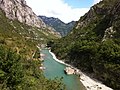 Morača river canyon.
 -

-
 River Cijevna waterfalls near Podgorica
 -
 Podgorica panoramic view.
.jpg)


Climate
[edit]
Under the Köppen climate classification, Podgorica is transitional between a humid subtropical climate (Cfa) and a hot-summer Mediterranean climate (Csa), since the driest summer month gets slightly less than 40 millimeters (1.6 in) of precipitation,[38] with summer highs around 34 °C (93 °F) and winter highs around 11 °C (52 °F). Although the city is only some 35 km (22 mi) north of the Adriatic Sea, an arm of the Mediterranean, Mount Rumija acts as a natural barrier, separating Skadar Lake basin and Podgorica area from the sea, thus limiting temperate maritime influence on the local climate.
The mean annual rainfall is 1,659 mm (65.3 in), making Podgorica by far the wettest capital in Europe, Ljubljana being second with 1,362 mm (53.6 in). The temperature exceeds 25 °C (77 °F) on about 135 days each year.[citation needed] The number of rainy days is about 120, and those with a strong wind around 60.[citation needed] An occasional strong northerly wind influences the climate in the winter, with a wind chill effect lowering the perceived temperature by a few degrees. [citation needed]
The all-time maximum snowfall record was beaten on 11 February 2012, when 58 cm (23 in) of snowfall were measured. Before that, the biggest snowfall in Podgorica was in 1954, when 52 cm (20 in) of snowfall was recorded. Maximum temperature was recorded on 24 August 2007, at 44.8 °C (112.6 °F), while all time minimum was −9.7 °C (14.5 °F), on 4 February 1956.
| Climate data for Podgorica (1991–2020, extremes 1947–present) | |||||||||||||
|---|---|---|---|---|---|---|---|---|---|---|---|---|---|
| Month | Jan | Feb | Mar | Apr | May | Jun | Jul | Aug | Sep | Oct | Nov | Dec | Year |
| Record high °C (°F) | 21.0 (69.8) |
27.1 (80.8) |
27.4 (81.3) |
33.8 (92.8) |
35.4 (95.7) |
40.5 (104.9) |
43.3 (109.9) |
44.8 (112.6) |
39.6 (103.3) |
33.6 (92.5) |
27.2 (81.0) |
20.8 (69.4) |
44.8 (112.6) |
| Mean daily maximum °C (°F) | 11.0 (51.8) |
12.6 (54.7) |
16.3 (61.3) |
20.7 (69.3) |
25.8 (78.4) |
30.7 (87.3) |
33.9 (93.0) |
34.5 (94.1) |
28.4 (83.1) |
22.8 (73.0) |
16.5 (61.7) |
11.8 (53.2) |
22.1 (71.7) |
| Mean daily minimum °C (°F) | 2.2 (36.0) |
3.4 (38.1) |
6.4 (43.5) |
9.9 (49.8) |
14.5 (58.1) |
18.9 (66.0) |
21.6 (70.9) |
21.8 (71.2) |
17.0 (62.6) |
12.3 (54.1) |
7.4 (45.3) |
3.5 (38.3) |
11.6 (52.8) |
| Record low °C (°F) | −9.6 (14.7) |
−9.7 (14.5) |
−5.6 (21.9) |
−0.2 (31.6) |
1.2 (34.2) |
8.0 (46.4) |
12.2 (54.0) |
8.8 (47.8) |
6.0 (42.8) |
0.0 (32.0) |
−5.4 (22.3) |
−8.0 (17.6) |
−9.7 (14.5) |
| Average precipitation mm (inches) | 165 (6.5) |
164 (6.5) |
164 (6.5) |
136 (5.4) |
98 (3.9) |
60 (2.4) |
36 (1.4) |
54 (2.1) |
147 (5.8) |
176 (6.9) |
261 (10.3) |
232 (9.1) |
1,693 (66.8) |
| Average precipitation days (≥ 0.1 mm) | 12 | 12 | 12 | 13 | 10 | 9 | 5 | 6 | 7 | 9 | 14 | 13 | 122 |
| Average relative humidity (%) | 72 | 68 | 65 | 65 | 63 | 60 | 52 | 52 | 62 | 68 | 75 | 74 | 65 |
| Mean monthly sunshine hours | 122.7 | 126.0 | 170.0 | 193.5 | 250.8 | 276.3 | 339.7 | 314.1 | 251.5 | 201.4 | 126.4 | 108.8 | 2,481.2 |
| Source 1: National Oceanic and Atmospheric Administration[39] | |||||||||||||
| Source 2: Hydrological and Meteorological Service of Montenegro[40][41] | |||||||||||||
Demographics
[edit]| Year | Pop. | ±% |
|---|---|---|
| 1948 | 14,369 | — |
| 1953 | 19,868 | +38.3% |
| 1961 | 35,054 | +76.4% |
| 1971 | 61,727 | +76.1% |
| 1981 | 96,074 | +55.6% |
| 1991 | 117,875 | +22.7% |
| 2003 | 136,473 | +15.8% |
| 2011 | 150,977 | +10.6% |
| 2023 | 173,024 | +14.6% |
| Population size may be affected by changes in administrative divisions. | ||
With a population of 179,505,[42] Podgorica is by far the most populous city in Montenegro. Area of former Podgorica Municipality (Podgorica Capital City, Tuzi and Zeta Municipalities) has a population of 208,555, while Podgorica urban area population is 173,024.
According to 2023 census, Podgorica has 64,140 households and 88,431 dwellings. At the end of 2023, there were 90,799 vehicles registered in Podgorica, including 78,047 passenger vehicles and 1,564 motorcycles.[citation needed]
Out of the total population of Podgorica 47.81% are male and 52.19% are female. The average age of the population is 37.65. There are 11,626 foreign nationals in Podgorica, making up 6,5% of city population.[citation needed]
In October 2024, 112,482 residents of Podgorica were officially employed, earning 981€ on average.[citation needed]
Almost 92% of residents are speaking one of the mutually intelligible offshoots of Serbo-Croatian language, including Montenegrin and Serbian language .
Ethnicity
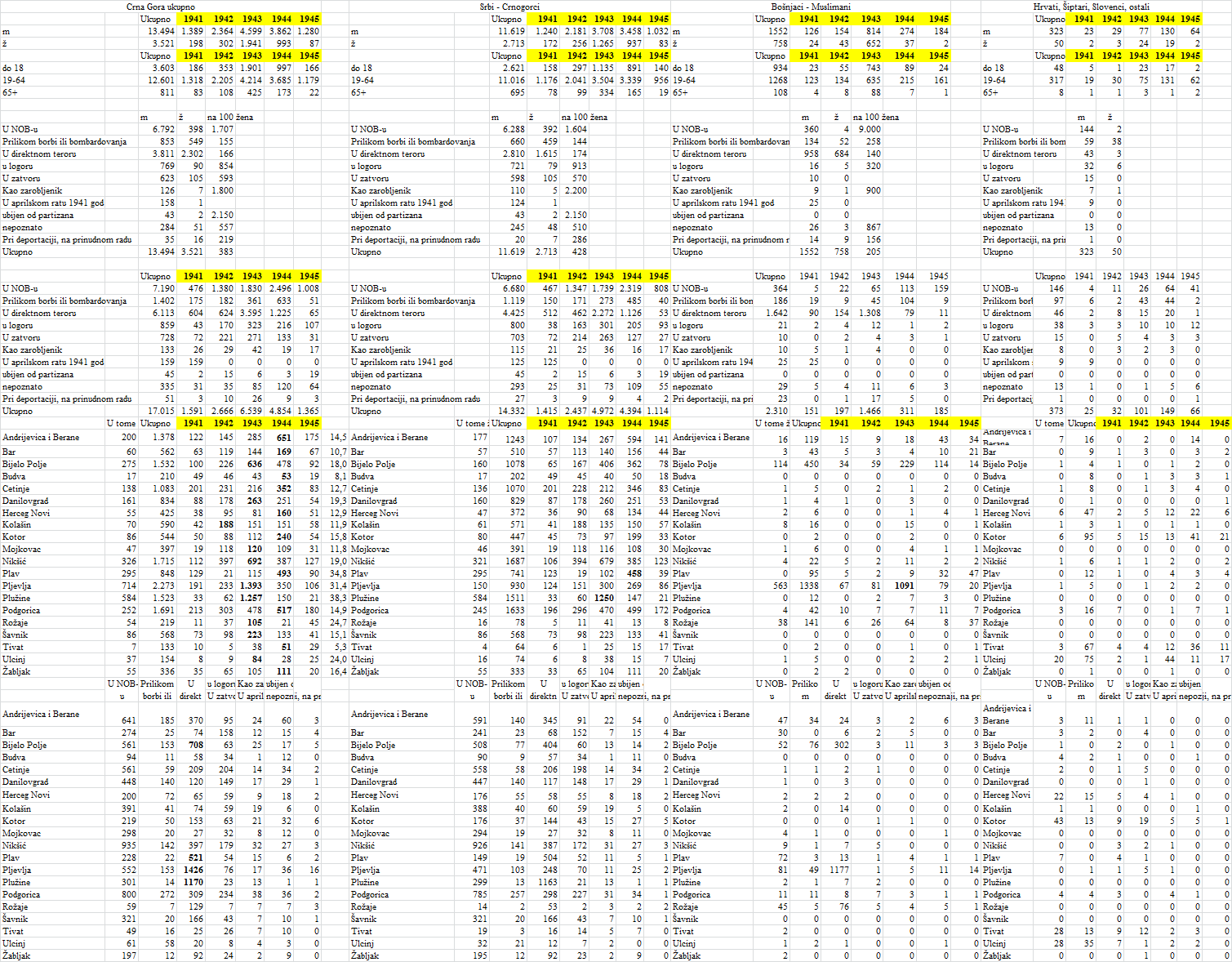
[edit]The town's population in 2023 census was 54.73% Montenegrins, 30.34% Serbs, 2.72% Bosniaks, and 12.21% are other ethnic minorities[43]
Religion
[edit]- Eastern Orthodoxy (79.2%)
- Islam (10.9%)
- Roman Catholicism (1.65%)
- Irreligion (4.70%)
- Other religions (0.04%)
,_at_night.jpg)

Majority of Podgorica residents declare themselves as Orthodox Christians, while there are sizable Muslim and Catholic communities.
Prominent Orthodox Christian places of worship include church of St. George and landmark Cathedral of the Resurrection of Christ.
Church of the Holy Heart of Jesus, built in 1966 in Konik neighbourhood, and notable for its unique brutalist architecture, serves as a primary place of worship for Podgorica Catholic community.
Economy
[edit]Podgorica is not only the administrative center of Montenegro but also its main economic engine. Most of Montenegro's industrial, financial, and commercial base is in Podgorica. [citation needed]
Before World War I, most of Podgorica's economy was in trade and small-scale manufacturing, which was an economic model established during the long rule of the Ottoman Empire. [citation needed] After World War II, Podgorica became Montenegro's capital and a focus of the rapid urbanization and industrialization of the SFRY era. Industries such as aluminium and tobacco processing, textiles, engineering, vehicle production, and wine production were established in and around the city. In 1981, Podgorica's GDP per capita was 87% of the Yugoslav average.[45]

In the early 1990s, the dissolution of Yugoslavia, Yugoslav wars, and the UN-imposed sanctions left Podgorica's industries without traditional markets, suppliers, and available funds. This, combined with typical transition pressures, led to a decline of the industrial base, where many industries collapsed leaving thousands of citizens unemployed. [citation needed] However, some of the industries, including Plantaže, managed to survive the turmoil of the 1990s, and are still major contributors to Montenegrin export and industrial output to this day.
As Montenegro began its push for independence from Serbia in the late 1990s, Podgorica greatly benefited from the increased concentration of government and service sectors. [citation needed] In addition to almost the entire country's government, Podgorica is home to the Montenegro Stock Exchange and other major Montenegrin financial institutions, along with telecommunications carriers, media outlets, Montenegrin flag carrier airline, and other significant institutions and companies.
The large presence of government and service sectors spared the economy of Podgorica from prolonged stagnation in the late 2000s recession, which hit Montenegro hard. Although in mid-2014, some 30% of Montenegro's citizens lived in Podgorica, the municipality accounted for 44% of the country's employed. Out of the entire mass of paid net salaries in Montenegro in that year, some 47% was paid in Podgorica. The average monthly net salary in December 2021 was €537 in Podgorica municipality.[46]
Tourism
[edit]Further cultural and historic monuments in and around Podgorica are Sahat kula (Clock tower) Adži-paše Osmanagića, the ruins of the Ribnica fortress, remnants of the city of Doclea, Stara Varoš, and Vezirov most (Vizier's bridge). Podgorica has excellent transit connections with other centres.
At nine kilometres from the city is the International Airport, with railway and bus stations close to one another.[47]
-
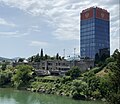 Hotel Podgorica and Bemax Skyscraper
 -
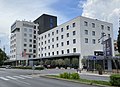 Hotel Hilton


Media
[edit]Podgorica is the media hub of Montenegro. It is home to the headquarters of the state-owned public television broadcaster RTCG. It has also its local TV and radio station Gradska. Commercial broadcasters in Podgorica include TV Vijesti, Prva TV, Nova M and Adria TV. All Montenegro's daily newspapers (oldest Montenegrin daily newspaper Pobjeda, Vijesti, Dnevne Novine and Dan) are published in Podgorica.
Transport
[edit]Public transport
[edit]Public transport in Podgorica consists of 11 urban and 16 suburban bus lines.[48] The city-owned AD Gradski saobraćaj public transport company used to be the sole bus operator until the 1990s, when private carriers were introduced. The company went bankrupt in 2001, and buses were since operated solely by private carriers. As of 2023 Public transport in Podgorica is done only by buses, 12 city and 16 suburban lines.[citation needed]
Public transport faces competition from very popular dispatched taxi services due to recent de-regulation in the sector.[citation needed]
Roads
[edit]Podgorica's location in central Montenegro makes it a natural hub for rail and road transport. Roads in Montenegro (especially those connecting Podgorica to northern Montenegro and Serbia) are usually inferior to modern European roads. Both major Montenegrin motorway projects, Bar-Boljare motorway and Nudo–Božaj motorway, will pass near Podgorica. The first phase of motorway A-1 (Bar-Boljare) was opened on July 13, 2022. The Sozina tunnel (4.2 km) shortened the journey from Podgorica to Bar (Montenegro's main seaport) to under 30 minutes. A new road bypass had been constructed in 2011, to remove transport routes from north to south of the country, out of the city center. A south-western bypass had also been constructed with the same goal of moving heavy transport out of the city core. Podgorica is also characteristic of its extensive network of multi-lane boulevards which make inner-city transport quick and effective. Traffic over the Morača River also goes fluently since river banks are very well connected with 6 vehicular and 3 pedestrian bridges.
The main transit connections of Podgorica are:
- north (E65, E80), towards Belgrade and on to Central Europe
- west (E762), towards Nikšić, Bosnia and on to Western Europe
- south (E65, E80) towards the Adriatic coast
- east (E762), towards Albania
-
 Rental electric scooters
 -
 Sozina Tunnel shortens the journey from Podgorica to Montenegro's main port Bar, by some 25 km.
 -
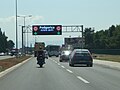


Rail
[edit].jpg)
Podgorica is a hub of the X-shaped Montenegrin rail network. The Belgrade–Bar line converges with the line to Nikšić and line to Shkodër at the Podgorica Rail Station. The station itself is located 1.5 km (0.93 mi) to the southeast of the main city square. Podgorica's main railway link (for both passenger and freight traffic) is Belgrade–Bar. The link to Nikšić was recently under reconstruction (electrification);[49] afterwards, passenger service started in October 2012. The rail link to Shkodër is used as freight-only.
Air
[edit]
Podgorica Airport is located in Zeta Plain, 11 km (6.8 mi) south of Podgorica City centre, and is Montenegro's main international airport. The airport is locally known as Golubovci Airport (Аеродром Голубовци / Aerodrom Golubovci), as it is located within the administrative boundaries of the town of Golubovci. The IATA code of the airport is still TGD because Podgorica was named Titograd, during which time the airport opened. It is the main hub for Air Montenegro and Di Air.
Education
[edit]Most of Montenegro's higher education establishments are in Podgorica including the University of Montenegro, the country's most significant university.

The university's scientific research institutes are also in the Podgorica: Institute of Foreign Languages, Institute of Biotechnology and the Institute of History
The Montenegrin Academy of Sciences and Arts (CANU) is in Podgorica, as well as the parallel scholars' academy DANU.
There are a number of private institutions for higher education including the Mediterranean University which was founded in 2006 as the first private university in Montenegro and the University of Donja Gorica. The municipality of Podgorica has 34 elementary schools and 10 secondary schools, including one gymnasium. The first secondary school established in Podgorica is Gymnasium "Slobodan Škerović" which first opened in 1907. The rebuilt economic high school offers new features and higher quality education. The "Radosav Ljumović National Library" is considered the most comprehensive in Montenegro.
Culture
[edit]
Podgorica is home to many Montenegrin cultural institutions and events. It hosts the Montenegrin National Theatre and a number of museums and galleries. The Montenegrin National Theatre is the most significant theatre not only in Podgorica but in all of Montenegro. Podgorica is also host to the City Theatre (Gradsko pozorište), which includes the Children's Theatre and the Puppet Theatre. Although not as rich in museums and galleries as the historic royal capital Cetinje, there are several noteworthy museums:
- The Podgorica City Museum (Muzej grada Podgorice) preserves Podgorica's rich heritage. Founded in 1950, it has four categories: archaeological, ethnographic, historical, and cultural-historical. It houses artifacts that date back to the Roman and Illyrian eras.[50]
- The Archaeological Research Centre (Centar za arheološka istraživanja) was founded in 1961. Its mission is to gather, classify, restore and display archaeological sites.
- The Marko Miljanov Museum (Muzej Marka Miljanova) in Medun shows life in 19th century Montenegro.
- The Natural History Museum (Prirodnjački muzej) displays specimens of Montenegrin flora and fauna. This museum has no exhibition space of its own, despite many proposals and initiatives to build one. [citation needed]

There is a notable art gallery in the Dvorac Petrovića (Petrović Castle) complex in Podgorica's largest public park. The palace hosted the "Josip Broz Tito" Art Gallery of the Nonaligned Countries between 1984 and 1995. King Nicholas's castle, Perjanički Dom (House of the Honour Guard), castle chapel and surrounding buildings were converted to an art gallery in 1984. Since 1995, it has been part of the Modern Arts Centre (Centar savremenih umjetnosti) and houses approximately 1,500 works of art. The historic Cinema of Culture (Kino Kultura), which was founded in 1949, was closed in November 2008 due to continuous financial losses it generated. It was the only cinema in the city for 6 decades. The building of the former cinema will be converted to host the Podgorica City Theatre. Shortly after its closure, a Ster-Kinekor (later acquired by Cineplexx) 6-screen multiplex cinema opened at BIG Podgorica shopping mall.
A significant cultural institution of over fifty years' standing is the Budo Tomović Cultural-Informational Centre (KIC Budo Tomović). It is a public institution that organizes various artistic events, including Podgorica Cultural Summer (Podgoričko Kulturno Ljeto), FIAT – International Alternative Theatre Festival (Festival Internacionalnog Alternativnog Teatra), DEUS – December Arts Scene (Decembarska Umjetnička Scena).
Sport
[edit]The most popular sports by far are football and basketball. Basketball became especially popular with the success in the late 20th and early 21st centuries of KK Budućnost, both in Regional and European competitions.
Football in Podgorica has a long tradition associated with Budućnost. World-famous players Predrag Mijatović and Dejan Savićević were born in Podgorica and made their debut in that team. The club FK Zeta from the Podgorica suburb of Golubovci has also reached the former first league of Serbia and Montenegro. These clubs, along with Sutjeska from Nikšić, usually compete with each other for leading position in the First League of Montenegro. Other clubs from Podgorica and its surroundings play in the Montenegrin First League e.g. OFK Titograd & Kom. One of the most popular clubs from the suburbs is FK Ribnica from Konik, FK Zabjelo from Zabjelo and FK Podgorica from Donja Gorica.
The volleyball team OK Budućnost and the women's handball team ŽRK Budućnost T-Mobile have had significant success in European competition. Budućnost Podgorica is the most important sports club in Podgorica. Its name means Future.
Chess is another popular sport and some famous global chess players, like Slavko Dedić, are born in Podgorica.
Sporting events like the annual Podgorica Marathon, Coinis no limits Triathlon, and the Morača River jumps attract international competitors. Podgorica was the host of 2009 FINA Men's Water Polo World League.
Venues
[edit]Podgorica has a number of sporting venues; some are under reconstruction and expansion. The main ones are:
- Podgorica City Stadium has a capacity of 11,264 and is the home of FK Budućnost Podgorica and the Montenegro national football team. It is the only venue in Montenegro that complies with FIFA standards for international football matches.
- Morača Sports Center, a multi-functional indoor sports facility. It has a capacity of 6,000 seats. It hosted one group of EuroBasket 2005, while other games were played in Belgrade, Vršac, and Novi Sad.
- Bemax Arena, indoor and outdoor sports facility. It has a capacity of 2,400 seats.
Almost every football club in Podgorica has its own stadium, although these are often only fields with small stands or no stands at all. Other notable venues are the Stadion malih sportova under Gorica hill and the sport shooting range under Ljubović hill. There are many other sports facilities around the city, most notably indoor football fields.
.jpg)


Cityscape
[edit]


Podgorica's mixture of architectural styles reflects the turbulent history of the city and country: as one régime replaced another, the corresponding style was introduced.
As part of the Ottoman Empire until 1878, Podgorica has some examples of Ottoman architecture.[citation needed] The oldest parts of the city, Stara Varoš (Old town) and Drač is typical of this, with two mosques, a Turkish Clock Tower and narrow, winding streets.
When the city was incorporated to Montenegro, the urban core shifted to the other bank of the Ribnica River, where the town developed in a more European style: wider streets with an orthogonal layout. This part of the city is today traditionally regarded as the city center and is called Nova Varoš (New town).
During World War II, Podgorica was almost razed to the ground, being bombed over 80 times.[20] After liberation, rebuilding began as in other cities of the communist-ruled SFRY. Mass residential blocks were erected, with basic design typical of Eastern bloc countries.[citation needed] All that part of the city on the right bank of the Morača River was built this way.
The main contemporary traffic arteries were laid out during this period, which extended the orthogonal street layout of the city center, to the south and west. Residential and infrastructural developments in the SFRY era have mostly shaped the layout of today's Podgorica and accommodated the unprecedented population growth that followed World War II.[citation needed]
-
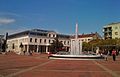 Independence square.
 -

-
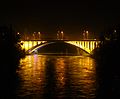 Blažo Jovanović Bridge over the Morača.
 -
 George Washington Street
 -
 Telenor Center in Podgorica.
 -
 St Peter of Cetinje Boulevard
 -
 Millennium Bridge

_(9185505567).jpg)


A major advance in Podgorica architecture began in the late 1990s and, since then, the face of the city has changed rapidly. Residential and business construction are proceeding rapidly, incorporating contemporary glass-and-steel architectural trends. In an effort to create a recognizable and modern state capital, city officials are routing significant investments in the city's public spaces. Thus, the city has gained entirely new squares and some monuments. New landmarks include the Hristovog Vaskrsenja orthodox temple and the Millennium Bridge, the main feature of the Podgorica skyline.

Notable people
[edit]- Stefan Nemanja (born c. 1113), founder of the Nemanjić dynasty
- Miroslav Zavidović (born c. 1130), prince of Hum and the patron of Miroslav's Gospel
- Saint Sava (born c. 1169), the first Archbishop of the Serbian Church
- Božidar Vuković (born c. 1460), one of the first printers in Montenegro
- Ilarion Roganović (born 1828), founder of the Red Cross of Montenegro
- Risto Stijović (born 1894), sculptor
- Vojo Stanić (born 1924), painter and sculptor
- Borislav Pekić (born 1930), writer
Twin towns – sister cities
[edit]


See also
[edit]
Notes
[edit]- ^ English pronunciation: /ˈpɒdɡəriːtsə/ POD-gə-reet-sə, Montenegrin pronunciation: [pǒdɡoritsa]; written identically in Bosnian, Croatian and Serbian; Albanian: Podgoricë (Albanian definite form: Podgorica).
- ^ Written identically in Serbian Cyrillic.
- Milosavljević, Olivera (2003). "Antibirokratska revolucija 1987–1989. godine". In Graovac, Igor; Fleck, Hans-Georg (eds.). Dijalog povjesničara – istoričara 8, Zadar (PDF) (in Serbian). Zagreb, Croatia: Political Science Research Centre Ltd. (PSRC) for Scientific Research Work / Zaklada Friedrich-Naumann. ISBN 953-6922-06-1. Archived from the original (PDF) on 28 September 2007. Retrieved 23 February 2013.
- Morrison, Kenneth (2009). Nationalism, Identity and Statehood in Post-Yugoslav Montenegro. London: I.B. Tauris & Co Ltd. ISBN 978-1-84511-710-8.
- Vasić, Milan (2005). Naselja na Balkanskom Poluostrvu od XVI do XVIII Vijeka (in Serbian). Banja Luka: Narodna I Univerzitetska Biblioteka Republike Srpske. ISBN 99938-0-584-X.
References
[edit]- ^ Egan, John M. K. (2003). Montenegro: A History. London: C. Hurst & Co.
- ^ "Montenegrin 2011 census". Monstat. 2011. Retrieved 15 January 2024.
- ^ Wells, John C. (23 May 2008). Longman Pronunciation Dictionary. Pearson Longman. ISBN 978-1-4058-8118-0.
- ^ "Podgorica" (US) and "Podgorica". Lexico UK English Dictionary. Oxford University Press. Archived from the original on 22 March 2020.
- ^ "Podgorica". The American Heritage Dictionary of the English Language (5th ed.). HarperCollins. Retrieved 11 May 2019.
- ^ "Podgorica". Collins English Dictionary. HarperCollins. Archived from the original on 11 May 2019. Retrieved 11 May 2019.
- ^ Egan, John M. K. (2003). Montenegro: A History. London: C. Hurst & Co.
- ^ "Arheološko odjeljenje – Muzeji i Galerije Podgorice". Retrieved 10 August 2025.
- ^ "Doclea – Turistička organizacija Podgorica". Retrieved 10 August 2025.
- ^ a b c d "Istorija Podgorice". Glavni grad Podgorica. 28 September 2023. Retrieved 5 January 2025.
- ^ a b "The History of Podgorica | Visit Montenegro". www.visit-montenegro.com. Retrieved 10 August 2025.
- ^ Božić, Ivan (1979). "Nemirno pomorje XV veka" (in Serbian). Beograd: Srpska književna zadruga. p. 295. OCLC 5845972. Archived from the original on 10 April 2022. Retrieved 19 November 2020.
почетком 1474 ... о султановој намери да обнови Подгорицу и да је насели са пет хиљада турских домаћинстава, а исто тако да подигне из рушевина стари град Балеч
- ^ Ćorović, Vladimir (2005). Istorija Srba (in Serbian). Zoograf. p. 357. ISBN 978-86-7578-127-1. Archived from the original on 10 April 2022. Retrieved 21 January 2012.
...очвидно из разлога да спрече везе између Зећана и Албанаца
- ^ Marijan-Mašo Miljić. "JUSOVAČA – KAZNENI ZAVOD U PODGORICI (1893–1945)" (in Serbian). Archived from the original on 11 January 2019. Retrieved 5 January 2019.
- ^ Perivoje Popović (7 November 2016). "Изблиза о далеком: Подгорички покољ 1874". ИН4С (in Serbian). Archived from the original on 6 January 2019. Retrieved 5 January 2019.
- ^ a b Veliša Kadić (7 April 2013). "Podgorica: Pustoš ostaje ispod bombi". Večernje novosti (in Serbian). Archived from the original on 22 September 2019. Retrieved 22 September 2019.
- ^ a b c d ""Imperijal" bio najljepši". Privredna komora Crne Gore (in Serbian). 5 August 2013. Archived from the original on 6 August 2020. Retrieved 9 June 2019.
- ^ Morrison 2009, p. 51.
- ^ a b c d e Boban Novović. "Glavni grad je 47 godina nosio pogrešno ime: Kako je Titovgrad postao Titograd?". Vijesti (in Serbian). Archived from the original (via Wayback Machine) on 6 October 2018.
- ^ a b Kovačević, Branislav. Savezničko bombardovanje Crne Gore 1943. – 1944. godine. Svjedočanstvo. Podgorica, 2003. (pg. 57)
- ^ "Stradanje stanovništva Crne Gore u Drugom svetskom ratu". Макроекономија. 3 September 2016. Archived from the original on 22 September 2019. Retrieved 22 September 2019.
- ^ a b c Slobodan Vuković. "Dolazi Tito". Vijesti (in Serbian). Archived from the original (via Wayback Machine) on 2 March 2016.
- ^ "Pogledajte Kako Je Izgledao Ugovor O Radu '60-Ih U Fabrici "Radoje Dakić"" (in Serbian). 8 May 2018. Archived from the original on 12 July 2018. Retrieved 16 March 2019.
- ^ a b Branko Kostić. "POČECI KOMBINATA ALUMINIJUMA". Montenegrina (in Serbian). Archived from the original on 14 March 2019. Retrieved 11 March 2019.
- ^ Milosavljević 2003.
- ^ Milan Milošević, Filip Švarm (29 August 1994). "Serbian President: The Technology of a Showdown". Vreme. Archived from the original on 9 May 2008. Retrieved 16 March 2019.
- ^ Predrag Nikolić (14 September 2018). "INICIJATIVA 100.000 STABALA ZA PODGORICU: Kome smeta drveće". Monitor (in Serbian). Archived from the original on 6 January 2019. Retrieved 5 January 2019.
- ^ Željko Vukmirović (17 August 2016). "Živjeti i umrijeti u Titogradu". Portal Analitika (in Serbian). Archived from the original on 1 February 2019. Retrieved 31 January 2019.
- ^ a b Avdo Huseinović (31 January 2021). "Sudbina atentatora na Šešelja: Znate li priču o Ademu Šabotiću?". BH MAGAZINE (in Bosnian). Archived from the original on 19 December 2021. Retrieved 19 December 2021.
- ^ "Montenegro: Nato Bombing Attacks Latest". Associated Press. 29 April 1999. Archived from the original on 25 April 2020. Retrieved 16 March 2019 – via YouTube.
- ^ William Booth (3 May 1999). "NATO Bombs Hit Montenegro Homes". The Washington Post. p. A31. Retrieved 16 March 2019.
- ^ "Na Dan državnosti Crne Gore otvoreni novi Most Milenijum i Tunel Sozina". eKapija (in Serbian). 14 July 2005. Archived from the original on 12 September 2022. Retrieved 6 January 2022.
- ^ "Neredi u Podgorici zbog Kosova" (in Serbian). Deutsche Welle. 14 October 2008. Archived from the original on 12 September 2022. Retrieved 16 March 2019.
- ^ "Zvanično otvoren prvi Hotel Hilton u Podgorici". Kodex. 20 September 2016. Archived from the original on 12 September 2022. Retrieved 6 January 2022.
- ^ Nemanja Rujević (15 November 2015). "Crna Gora: Protesti i ništa" (in Serbian). Deutsche Welle. Archived from the original on 6 August 2020. Retrieved 16 March 2019.
- ^ "Situacija u gradu se smirila" (in Serbian). Vijesti. 25 October 2015. Retrieved 16 March 2019.
- ^ "Tuzi became its own Municipality". Archived from the original on 20 January 2022. Retrieved 1 March 2019.
- ^ Peel, M. C.; Finlayson, B. L.; McMahon, T. A. (2007). "Updated world map of the Köppen–Geiger climate classification" (PDF). Hydrology and Earth System Sciences. 11 (5): 1633–1644. Bibcode:2007HESS...11.1633P. doi:10.5194/hess-11-1633-2007. ISSN 1027-5606. Archived (PDF) from the original on 3 February 2012. Retrieved 19 July 2015.
- ^ "Climate: Podgorica". National Oceanic and Atmospheric Administration. Retrieved 12 May 2024.
- ^ "Climate: Podgorica" (in Montenegrin). Hydrological and Meteorological Service of Montenegro. Archived from the original on 5 January 2022. Retrieved 6 March 2021.
- ^ "Dnevni prosjeci i ekstremi" (in Montenegrin). Hydrological and Meteorological Service of Montenegro. Archived from the original on 24 December 2021. Retrieved 6 March 2021.
- ^ "Preliminary results of the 2023 Census of Population, Households, and Dwellings". Monstat. Retrieved 25 January 2024.
- ^ "Montenegrin census (2023)". MONSTAT. Retrieved 15 October 2023.
- ^ "Montenegrin census (2023)". MONSTAT. Retrieved 15 October 2023.
- ^ Radovinović, Radovan; Bertić, Ivan, eds. (1984). Atlas svijeta: Novi pogled na Zemlju (in Croatian) (3rd ed.). Zagreb: Sveučilišna naklada Liber.
- ^ "Monthly Statistical Review, no. 6/2014" (PDF). Monstat. 5 May 2014. Archived (PDF) from the original on 19 October 2014. Retrieved 13 October 2014.
- ^ "Podgorica". Visit Montenegro. 6 June 2022. Archived from the original on 22 April 2022.
- ^ "Saobraćaj". Podgorica.me. Archived from the original on 25 March 2013. Retrieved 12 March 2013.
- ^ "U Željeznicu ulažu 52 miliona eura". Archived from the original on 11 June 2015. Retrieved 16 May 2009.
- ^ "Muzej grada – Muzeji i Galerije Podgorice". Retrieved 9 August 2025.
- ^ "Gradovi pobratimi" (in Montenegrin). Podgorica. Archived from the original on 28 December 2019. Retrieved 21 June 2020.
- ^ "Partner cities". Yerevan. Archived from the original on 19 August 2014. Retrieved 21 June 2020.
External links
[edit] Media related to Podgorica at Wikimedia Commons
 Podgorica travel guide from Wikivoyage
- Official website
- Tourism Organisation of Podgorica
- More (mostly modern) buildings of Podgorica


 | ||



Podgorica
View on GrokipediaPodgorica is the capital and largest city of Montenegro, situated at the confluence of the Ribnica and Morača rivers in the Zeta valley of central-southern Montenegro.[1] As of the 2023 census, the municipality of Podgorica has a population of 179,505, representing about 28.8% of Montenegro's total population of 623,633.[2] Located at coordinates 42°26' N latitude and 19°16' E longitude and an elevation of 44.5 meters above sea level, the city spans a municipal area of 997 square kilometers with a population density of 180 inhabitants per square kilometer.[3][4] Podgorica functions as the country's primary political, administrative, economic, and cultural hub, hosting key government institutions, the University of Montenegro, and major commercial activities.[3] The city experienced significant reconstruction following the devastating 1979 earthquake, which reshaped its modern urban landscape with a mix of contemporary architecture and preserved historical sites.[4]
Etymology and Names
Name Origin and Evolution
The name Podgorica derives from the South Slavic terms pod ("under" or "below") and gorica (diminutive of gora, meaning "hill" or "little hill"), literally translating to "under the little hill" or "at the foot of the hill," in reference to the cypress-covered Gorica Hill that overlooks the settlement's original location along the Ribnica River.[5][6] This topographic descriptor reflects the site's position in the Zeta Valley, where the confluence of rivers provided fertile ground but positioned early habitations beneath surrounding elevations for natural defense and water access. The earliest recorded precursor name was Ribnica, denoting a pre-feudal settlement likely named after the Ribnica River on whose banks it developed, with the first mention of Podgorica itself appearing in a 1326 legal document preserved in the Kotor archives, confirming its use during the medieval Nemanjić dynasty era as a regional trade and administrative center.[7][8] Under Ottoman rule from 1474 onward, the name Podgorica persisted in administrative records as the seat of a kaza within the Sanjak of Scutari, though some Turkish-era documents variably rendered it phonetically; speculative ancient references to sites like Birziminium or Alata in Roman itineraries remain unverified as direct antecedents without archaeological linkage.[9] Following World War II, in 1946, the city was redesignated the capital of the People's Republic of Montenegro within the Socialist Federal Republic of Yugoslavia and renamed Titograd to commemorate Josip Broz Tito, the wartime partisan leader and Yugoslav president, as part of broader communist nomenclature honoring revolutionary figures.[8] This change symbolized ideological alignment but was reversed on April 16, 1992, amid the Wars of Yugoslav Succession, when the Podgorica City Assembly voted to restore the historical name, reflecting Montenegro's push for national identity distinct from federal Yugoslav symbols as it navigated toward independence.[10] The reversion aligned with similar de-Titoization efforts across former Yugoslav states, prioritizing pre-socialist ethnolinguistic roots over imposed toponymy.History
Prehistoric and Ancient Settlements
The region surrounding modern Podgorica exhibits evidence of human occupation dating to prehistoric times, with the earliest known settlements associated with the late Stone Age, though specific archaeological artifacts from this period remain limited and primarily consist of general material remains indicative of early hunter-gatherer or proto-agricultural communities adapted to the fertile Zeta valley.[11][9] No major Neolithic or Bronze Age sites have been extensively documented directly within Podgorica's urban core, but nearby tumuli and early Bronze Age finds in the Zeta plain suggest continuity of settlement patterns favoring the area's rivers and topography for resource exploitation.[12] In the Iron Age, the Podgorica area fell within Illyrian tribal territories, particularly those of the Docleatae (or Dokleati) and Labeates, who established fortified settlements leveraging the defensive advantages of the Zeta and Moraca river confluence and surrounding hills.[7] Archaeological evidence from sites like Stari Mataguži and Donji Gostilje reveals Illyrian-Hellenistic urban centers with Hellenistic influences, including fortifications and burial practices predating Roman conquest, reflecting a population density supporting trade and agriculture in the Bjelopavlići-Zeta basin.[13] These pre-Roman communities, part of broader Dalmatian Illyria, were subdued during Roman campaigns in the late 1st century BC, transitioning the region into provincial control without abrupt abandonment of local sites.[12] The principal ancient settlement, Doclea (Latin: Doclea; Montenegrin: Duklja), emerged as a Roman municipium in the early 1st century AD under Emperor Vespasian during the Flavian dynasty, strategically positioned approximately 3 kilometers southeast of modern Podgorica at the Zeta-Moraca confluence to consolidate control over Illyrian hinterlands in the province of Dalmatia.[14] Excavations since the 1890s have uncovered a planned urban layout with cardo and decumanus axes, a central forum, basilicas, temples, thermae, and an extensive necropolis featuring over 300 tombs from the 1st to 4th centuries AD, including vaulted sarcophagi and early Christian elements like a cruciform church overlaying later basilicas built under Justinian I.[14] Doclea served as the administrative hub of Prevalis under Diocletian's reforms in the late 3rd century AD, enduring until Gothic incursions in the 5th century and a devastating earthquake in 518 AD, after which Slavic migrations in the 7th century diminished its classical Roman character.[14]Medieval Period and Early Modern Era
In the early Middle Ages, following the decline of the Roman settlement at Doclea nearby, a Slavic community established the village of Ribnica at the confluence of the Ribnica and Morača rivers, leveraging the site's strategic position for trade and defense.[15][7] The name Ribnica first appears in records from the 12th century, associated with the territory of the former Roman castrum Birziminium, under the influence of Raška's aristocracy.[8] By 1326, the settlement was documented under the name Podgorica in a legal charter preserved in the Kotor archives, indicating its coexistence with or evolution from Ribnica as a recognized locale.[7][8][16] Podgorica served as an economic hub in the Zeta region, facilitating trade routes linking Dubrovnik (Ragusa) merchants with the Nemanjić state's inland territories, supported by its fertile Zeta Plain location and river access for commerce in goods like agricultural products and crafts.[16][7] During the 14th and 15th centuries, Podgorica fell within the Zeta lordship, initially under the Balšić dynasty (c. 1360–1421), which expanded control over coastal and inland Zeta amid Serbian Despotate fragmentation.[17] After the Balšićs' extinction in 1421, the Crnojević family assumed power in Zeta around 1435, consolidating authority against Ottoman incursions and Venetian ambitions; Stefan Crnojević established the dynasty's base in Upper Zeta.[17] Under Ivan Crnojević (r. 1465–1490), Zeta's capital shifted briefly to Žabljak Crnojevića (founded c. 1466 near Podgorica) until 1478, when Ottoman pressure forced relocation to Cetinje; Podgorica remained a peripheral but vital settlement in their domain, benefiting from Zeta's alliances with Venice for military aid against Turkish expansion.[18][19] The Crnojević era marked Zeta's cultural peak before Ottoman dominance, including the establishment of the Obod Printing Press in 1493–1494—the first in the South Slavic world—producing liturgical texts that preserved Orthodox scholarship amid regional turmoil, though Podgorica itself hosted no major printing or ecclesiastical centers.[17] Ottoman forces captured Podgorica in 1474, disrupting local autonomy and integrating it into their administrative structure, though Crnojević resistance persisted until Đurađ Crnojević's flight to Venice in 1496.[16] This transition ended medieval independence, shifting Zeta's remnants to mountainous refuges.[17]Ottoman Domination (1496–1878)
The Ottoman Empire seized Podgorica in 1474, incorporating it as a kaza (judicial district) within the Sanjak of Scutari, an administrative unit centered on Shkodra.[16][20] This conquest marked the onset of direct Ottoman control over the lowland areas around Podgorica, distinguishing it from the more autonomous highland regions of Montenegro.[20] In response to local resistance, the Ottomans fortified the town extensively, erecting a substantial fortress featuring towers, gates, and encircling defensive walls, which shifted Podgorica's role from a pre-conquest trading center to a key military bastion for offensives and defenses against Montenegrin tribes.[16] This militarization halted prior economic, cultural, and artistic advancements, subordinating the settlement to imperial security priorities.[16] Administratively, Podgorica functioned as a prominent urban center in the Ottoman Balkans, overseeing local taxation, judiciary functions, and governance amid persistent tribal unrest and rebellions against fiscal impositions, which characterized the social dynamics through the 17th century.[20] Economic activity remained limited due to the rugged terrain and ongoing conflicts, with Ottoman investment focused primarily on defensive infrastructure rather than development.[20] Ottoman domination endured for over four centuries until the Montenegrin–Ottoman War of 1876–1878, culminating in the Congress of Berlin, which formalized the transfer of Podgorica and surrounding territories to the Principality of Montenegro in 1878.[16]19th-Century Struggles and Kingdom Formation
In the early 19th century, Montenegro remained a semi-independent theocratic polity under prince-bishops (vladikas) of the Petrović-Njegoš dynasty, resisting full Ottoman subjugation through guerrilla tactics and alliances with European powers, but systemic internal challenges like clan rivalries hindered centralized governance. Danilo I Petrović-Njegoš ascended as vladika in 1851 and secularized the state in 1852, establishing the Principality of Montenegro as a hereditary secular monarchy and promulgating the Danilo's Code in 1855 to codify civil law and limit ecclesiastical authority.[21] This reform provoked Ottoman claims of suzerainty, igniting the Montenegrin–Ottoman War of 1852–1853, during which Ottoman forces under Omar Pasha invaded but withdrew after international mediation, preserving Montenegrin autonomy despite heavy casualties.[22] Military momentum built with the Battle of Grahovac from April 28 to May 1, 1858 (May 11–13 by Gregorian calendar), where approximately 5,000–6,000 Montenegrin and Herzegovinian fighters under Grand Duke Mirko Petrović-Njegoš repelled an Ottoman force of 15,000–20,000 near the Zeta River valley, inflicting over 2,000 enemy casualties and capturing artillery, which enhanced Montenegro's reputation for asymmetric warfare efficacy.[23] Danilo's assassination in 1860 led to Prince Nikola I's accession amid instability, prompting the Montenegrin–Ottoman War of 1861–1862; Ottoman expeditions under Omar Pasha advanced deep into Montenegrin territory but stalled due to terrain, supply issues, and great power intervention, resulting in a status quo ante bellum that nonetheless strained Ottoman control over border regions like Podgorica.[24][25] The era's climax unfolded in the Montenegrin–Ottoman War of 1876–1878, intertwined with the Herzegovina Uprising and Russo-Turkish War, as Montenegro coordinated offensives to seize Ottoman-held Zeta lowlands; key actions included assaults on Podgorica's defenses, an Ottoman nahiya center since the 15th century with a mixed Albanian-Muslim-Slav population and strategic Ribnica fortress.[26] Victorious Montenegrin armies occupied Podgorica by early 1878, and the Congress of Berlin formalized its cession—along with Nikšić, Kolašin, and coastal access—ending 382 years of Ottoman dominion, integrating the town as Montenegro's largest urban settlement and economic hub for tobacco and trade.[8][16][27] These expansions, validated by Berlin's recognition of Montenegrin sovereignty, doubled the principality's territory and population, enabling administrative reforms, army professionalization, and diplomatic elevation despite persistent Ottoman-Albanian frontier raids.[22] The cumulative 19th-century victories against superior Ottoman forces—leveraging highland mobility, Russian backing, and European congresses—facilitated Montenegro's transition to constitutional monarchy, culminating in the National Assembly's proclamation of the Kingdom of Montenegro on August 28, 1910, with Nikola I assuming the royal title amid celebrations marking 50 years of his rule.[28]World War I and Interwar Yugoslavia
During World War I, Podgorica, as the principal city of the Kingdom of Montenegro—which declared war on Austria-Hungary alongside Serbia on 5 August 1914—fell under Austro-Hungarian occupation following the successful offensive of 6–15 January 1916 that overran Montenegrin defenses along the Lovćen massif.[8] The occupation imposed harsh military rule, resource extraction, and reprisals on the local population, contributing to widespread suffering until Allied forces liberated the area in late 1918 after the Armistice of Villa Giusti on 3 November.[29] In the immediate aftermath, the Podgorica Assembly—a gathering of 165 delegates from Montenegrin territories—convened from 1 November to 26 November 1918 in the city, where it deposed King Nikola I Petrović-Njeguš and his dynasty on 26 November, voting 87–2 to unite Montenegro unconditionally with Serbia under the Karađorđević dynasty.[30] [31] This decision, driven by pro-unification "Whites" aligned with Serbian Prime Minister Nikola Pašić's vision of a centralized South Slav state, preceded the proclamation of the Kingdom of Serbs, Croats, and Slovenes on 1 December 1918, incorporating Montenegro as its southern oblast; critics, including Montenegrin federalists and royalists ("Greens"), contested the assembly's legitimacy as manipulated by Serbian military presence rather than reflecting broad popular consent.[32] [33] From 1918 to 1941, Podgorica functioned as a regional administrative hub within the Kingdom of Serbs, Croats, and Slovenes—renamed the Kingdom of Yugoslavia in 1929—initially under the Skopje Oblast and later the Zeta Banovina established by the 1929 Yugoslav constitution to centralize governance amid ethnic and regional tensions.[34] The interwar era brought limited infrastructure improvements, such as road connections to the coast, but the city remained economically peripheral, reliant on agriculture and trade, with political life marked by suppression of anti-unification sentiments through arrests and exiles following the failed Christmas Uprising of 1919 led by royalist insurgents.[35]World War II and Partisan Control
Following the Axis invasion of the Kingdom of Yugoslavia in April 1941, Italian forces occupied Podgorica and established the Italian governorate of Montenegro, subjecting the city to foreign administration and resource extraction.[36][37] On July 13, 1941, a major uprising against Italian occupation broke out across Montenegro, including ambushes near Podgorica such as those by insurgents from Ljubotinj and Upper Ceklin targeting Italian convoys.[38][39] Organized by the Communist Party of Yugoslavia but drawing widespread local participation due to resentment over occupation policies, the revolt temporarily liberated much of the territory before Italian reprisals suppressed organized resistance within weeks, though guerrilla actions continued in surrounding areas.[38] In September 1943, after Italy's armistice with the Allies, German troops replaced Italian control in Podgorica, imposing direct occupation and launching offensives against partisan forces in Montenegro.[36] Allied air forces, at the request of Yugoslav Partisans, bombed the city repeatedly from 1943 to 1944 to disrupt German logistics and supply lines, contributing to extensive destruction that left much of Podgorica in ruins by late 1944.[40] Yugoslav Partisan units, including the 1st Bokel Strike Brigade and Montenegrin Strike Brigade, liberated Podgorica from German forces on December 19, 1944, during broader autumn offensives that secured partisan dominance in the region.[37][41] This event marked the establishment of effective Partisan control, transitioning the city from Axis occupation to communist-led administration ahead of the war's end in Yugoslavia.[8]Socialist Federal Republic of Yugoslavia (1945–1992)
Following the liberation by Yugoslav Partisans in April 1945, Podgorica, severely damaged by Allied bombings that destroyed approximately 60% of its structures during World War II, underwent systematic reconstruction as the capital of the newly formed Socialist Republic of Montenegro within the Federal People's Republic of Yugoslavia.[42] The post-war efforts emphasized state-directed rebuilding, prioritizing functional modernist architecture and infrastructure to symbolize the shift to socialism, with rapid construction of residential blocks, public facilities, and memorials commemorating partisan resistance.[43] This reconstruction aligned with broader Yugoslav policies of nationalization and collectivization initiated between 1945 and 1963, transforming the city from a small Ottoman-era settlement into a planned administrative and industrial hub.[44] On July 13, 1946, the city was renamed Titograd in honor of Josip Broz Tito, leader of the partisans and architect of Yugoslavia's socialist federation, reflecting the central role of personality cult in early communist governance.[45] Urban expansion accelerated through the 1950s and 1960s, with the establishment of key industries including heavy machinery production starting in 1946, aluminum processing, tobacco refining, furniture manufacturing, and textiles, drawing migrant labor from rural Montenegro and beyond.[8] These developments, supported by federal investments in heavy industry, shifted the local economy from agrarian dominance toward manufacturing, with industrial output becoming the primary sector by the 1970s.[46] Population growth was pronounced, rising from around 14,000 in 1948 to approximately 35,000 by 1961 and exceeding 100,000 by the 1980s, fueled by industrialization and internal migration that reduced agricultural employment to about 25% of the workforce by 1980.[47] [48] Titograd served as the political center for Montenegro's communist apparatus, hosting the republic's assembly and administrative bodies, while new infrastructure like bridges and public squares reinforced socialist urban ideals. However, by the late 1980s, the city faced strains from Yugoslavia's mounting economic crisis, including inflation and declining industrial productivity, which foreshadowed the federation's dissolution.[27] The name reverted to Podgorica on April 2, 1992, amid the republic's push for sovereignty.[45]Wars of Yugoslav Succession and Independence (1992–2006)
As Yugoslavia disintegrated, Titograd was restored to its historical name, Podgorica, following a referendum on April 2, 1992, reflecting Montenegrin efforts to reclaim pre-communist identity amid the republic's separation from the broader federation.[8] Montenegro, with Podgorica as its administrative capital, then aligned with Serbia to establish the Federal Republic of Yugoslavia (FRY) via a constitutional act on April 27, 1992, preserving a loose union under international isolation due to recognition disputes.[49] Podgorica experienced indirect effects from the early 1990s conflicts in Croatia and Bosnia-Herzegovina, as Montenegro's government initially supplied troops and logistics to Yugoslav forces, though direct fighting spared the city, with no reported battles or sieges within its limits.[50] Economic sanctions against the FRY, imposed by the UN from 1992 to 1995, strained Podgorica's infrastructure and trade, exacerbating hyperinflation that peaked at over 300,000% annually in Serbia-Montenegro by 1993, though Montenegrin leadership under Momir Bulatović began advocating for reduced Belgrade influence by 1996.[51] Tensions escalated in 1999 during NATO's Operation Allied Force, launched March 24 to compel FRY withdrawal from Kosovo; strikes targeted military assets near Podgorica, including Golubovci Airbase (also known as Podgorica Airport), damaging runways and fuel depots on multiple nights.[52] These attacks caused at least one confirmed civilian death in Montenegro on April 29, 1999, from cluster munitions near Podgorica, with additional injuries and property destruction reported in surrounding areas, though the city center avoided widespread devastation.[53][54] Post-1999, Podgorica emerged as the hub for pro-independence sentiment under President Milo Đukanović, who pivoted toward Western integration, culminating in a referendum on May 21, 2006, where 55.5% of voters (230,719 yes against 179,710 no) endorsed separation from Serbia, narrowly surpassing the EU-mandated 55% threshold amid a 86.5% turnout.[55] Independence was formally declared on June 3, 2006, by the Podgorica-based parliament, dissolving the FRY and establishing Montenegro as a sovereign state with Podgorica retaining its capital status, free from prior union obligations.[56]Post-Independence Era (2006–Present)
Following Montenegro's declaration of independence on June 3, 2006, Podgorica solidified its role as the nation's political, administrative, and economic center, experiencing accelerated urban expansion driven by foreign direct investment and a post-socialist market transition.[27] The city's population grew from 136,473 in 2003 to 150,799 by the 2011 census, reflecting internal migration and natural increase, and further to approximately 179,505 by 2023 amid ongoing demographic shifts. This period marked a departure from wartime stagnation, with new residential and commercial developments transforming socialist-era suburbs into modern districts, including high-rise apartments and business centers completed as early as 2007.[57] Infrastructure improvements, such as the Podgorica bypass road and urban road networks, aimed to alleviate traffic congestion in the expanding capital.[58][59] Economic growth in Podgorica post-independence was bolstered by Montenegro's tourism surge and service sector expansion, positioning the city as a hub for trade and administration that attracted net foreign direct investment rising significantly after 2006.[60] Projects like the construction of contemporary business towers and commercial zones, including the Capital Plaza, symbolized the shift toward a dynamic urban economy, though some developments sparked public debate over architectural harmony with existing landmarks.[27] The city's integration into national initiatives, such as highway segments enhancing connectivity, supported logistics and reduced central bottlenecks, contributing to annual population growth rates of 1.6 to 1.9 percent through the 2020s.[59] However, rapid urbanization strained resources, with ongoing efforts to balance expansion and sustainability outlined in smart city profiles emphasizing road and bypass constructions.[59] Local governance in Podgorica during this era reflected national political dynamics, with the Democratic Party of Socialists (DPS) maintaining dominance until broader shifts in 2020 ended their three-decade rule at the parliamentary level.[61] Municipal assemblies saw continued DPS influence, but snap elections on September 29, 2024, resulted in the party securing the most votes—approximately 24,309—and 19 seats in the 59-seat City Assembly, outperforming the ruling Europe Now Movement coalition, which failed to retain a majority amid voter focus on economic issues.[62][63] This outcome highlighted persistent divisions, echoing independence-era debates, and complicated coalition formation for urban policy implementation.[64] Celebrations of milestones, such as the 10th and 15th anniversaries of independence in 2016 and 2021, underscored Podgorica's central role in national identity, though societal cleavages between pro- and anti-independence factions remained evident.[65][66] By 2025, the city continued navigating EU accession aspirations and infrastructure debt challenges, with local projects prioritizing sustainable growth amid geopolitical realignments.[67]Geography and Environment
Physical Geography and Topography
Podgorica occupies the northern part of the Zeta Plain, Montenegro's largest and most fertile lowland expanse, situated at coordinates 42°26' N and 19°16' E with an average elevation of 44.5 meters above sea level.[68] This positioning places the city in a basin formed by alluvial deposits, providing a stark contrast to Montenegro's otherwise dominant karstic highlands and rugged Dinaric Alps, which encircle the plain and rise sharply to elevations exceeding 2,000 meters in surrounding ranges.[69] The topography of Podgorica features predominantly flat to gently undulating terrain, with minimal relief variation across the urban core, enabling expansive development on the loamy soils of the Zeta Valley.[70] Geological underpinnings include Lower Cretaceous carbonate platform strata, indicative of the broader Dinaridic sedimentary sequences that underlie the region, though the plain itself results from fluvial sedimentation rather than exposed bedrock.[71] Hydrologically, the area is defined by the confluence of the Morača River—Montenegro's primary northern waterway—with the Zeta River approximately 3 kilometers north of the city center, after which the combined flow traverses the plain southward toward Lake Skadar.[72] Additional tributaries such as the Ribnica, Cijevna, Sitnica, and Mareza contribute to a network of six rivers threading through or bordering the municipality, shaping the local landscape through erosion and deposition while posing occasional flood risks in the low-lying valley.[73]Climate Patterns
Podgorica exhibits a humid subtropical climate classified as Cfa under the Köppen system, featuring hot summers, mild winters, and precipitation distributed throughout the year without a pronounced dry season.[74] Annual average temperatures hover around 15.3 °C, with extremes typically spanning from 1 °C in January to 33 °C in July and August.[75] This inland location in the Zeta Valley amplifies continental influences, resulting in greater diurnal temperature swings and occasional summer heatwaves compared to coastal Montenegro areas. Summers (June to August) are the warmest and relatively driest period, with average highs exceeding 30 °C and lows rarely dipping below 18 °C; humidity contributes to muggy conditions despite lower precipitation totals averaging 50-70 mm monthly.[76] Winters (December to February) bring cooler temperatures, with average highs of 10-12 °C and lows around 0-2 °C, often accompanied by fog and occasional frost, though snowfall is infrequent due to the low elevation of 46 meters.[76] Transitional seasons see variable weather: spring (March-May) warms progressively with increasing rain, while autumn (September-November) delivers the heaviest precipitation, peaking at over 200 mm in November from Mediterranean storms.[77] Annual precipitation totals approximately 1,700 mm, concentrated in fall and winter (about 60% of the yearly amount), fostering a lush Zeta Valley but also flood risks along the Moraca River during intense events.[77] Historical records indicate a record high of 43 °C, underscoring vulnerability to extreme heat, while lows have approached -3 °C but seldom lower; recent decades show a warming trend of 0.2 °C per decade since 1950, intensifying summer peaks without altering core patterns.[78][79]| Month | Avg. High (°C) | Avg. Low (°C) | Avg. Precip. (mm) |
|---|---|---|---|
| January | 10 | 1 | 140 |
| February | 12 | 2 | 120 |
| March | 15 | 5 | 120 |
| April | 19 | 8 | 110 |
| May | 24 | 13 | 90 |
| June | 28 | 16 | 70 |
| July | 31 | 18 | 50 |
| August | 31 | 18 | 60 |
| September | 27 | 15 | 100 |
| October | 22 | 10 | 150 |
| November | 16 | 6 | 200 |
| December | 12 | 2 | 160 |
Environmental Degradation and Urban Pressures
Podgorica's environmental degradation stems largely from unchecked urbanization and insufficient regulatory enforcement, with the city's population exceeding 150,000 in the municipality as of recent estimates, driving demands on limited infrastructure. Rapid construction and spatial expansion have resulted in overbuilding, particularly in the Zeta valley, exacerbating traffic congestion and straining urban sustainability. Waste management systems lag behind growth, leading to inadequate handling of municipal solid waste, which reached 545 kg per capita nationally in 2019, with Podgorica contributing significantly through informal disposal practices.[80][81] Air pollution represents a persistent urban pressure, with fine particulate matter (PM2.5) levels frequently elevating to moderate or unhealthy ranges, especially during winter when biomass burning for residential heating dominates emissions. Monitoring data indicate seasonal spikes, with Podgorica's air quality index often exceeding safe thresholds from October to March due to vehicle exhaust, industrial activity, and household stoves using low-quality fuels. These pollutants contribute to respiratory health risks, though national air quality assessments highlight institutional gaps in monitoring and mitigation.[82][83] Water bodies, notably the Zeta River traversing the city, endure severe degradation from untreated industrial effluents, agricultural runoff, and communal sewage, earning a "very bad" ecological status classification in 2019 based on poor chemical parameters and invertebrate diversity. Polluters include pig farms, slaughterhouses, and dairies discharging without permits, decimating fish populations such as the endangered softmouth trout and rendering sections unsafe for potable use or recreation. Microplastic contamination in Zeta sediments, alongside the nearby Morača River, further compounds aquatic ecosystem stress, with concentrations reflecting upstream urban and agricultural inputs. Flood events in the Podgorica basin, recurrent due to river overflow, amplify erosion and secondary pollution.[84][85] Illegal dumping proliferates across peri-urban areas around Podgorica, undermining Montenegro's self-proclaimed ecological state status, with hundreds of unauthorized sites polluting meadows and groundwater despite constitutional protections. Recycling rates hover at 1% nationally as of 2024, far short of EU targets, intensifying landfill pressures and leachate risks to soil and water. Climate change intensifies these vulnerabilities through urban heat islands in densely built zones and heightened flood frequency, potentially slashing national GDP by 7.9% by 2050, with Podgorica's low-lying topography particularly exposed to riverine inundation and heat stress. Local initiatives, such as proposed waste-to-energy facilities, aim to address gaps, but enforcement remains inconsistent.[86][87][88][89]Administration and Governance
Municipal Structure and Local Government
Podgorica operates as the Capital City (Glavni grad Podgorica), a distinct local self-government unit with special status under Montenegro's Law on the Administrative Capital City of 2005, granting it authority to establish urban municipalities as subdivisions.[90] This structure distinguishes it from standard municipalities, enabling broader administrative competencies aligned with its role as the national administrative center.[91] The City Assembly (Skupština Glavnog grada Podgorica) serves as the legislative body, comprising councilors directly elected by universal suffrage for four-year terms, with membership set at a base of 30 plus one additional councilor for every 5,000 voters.[90] The Assembly enacts regulations, approves budgets, and oversees executive performance. The Mayor (Gradonačelnik), elected by the Assembly for a concurrent four-year term, holds executive authority, including policy implementation, administrative management, appointment of officials (subject to Assembly approval), and external representation of the city.[90][92] Administrative operations are executed via specialized bodies, including secretariats for sectors like local self-government, which prepare regulations, monitor legal compliance, and manage personnel.[93] An Office of the Chief Administrator functions as a second-instance reviewer for administrative decisions within the city's purview.[94] At the grassroots level, the Capital City is divided into local communities (mjesne zajednice), enabling direct citizen involvement in neighborhood affairs such as maintenance and minor initiatives, as stipulated in the Law on Local Self-Government.[92] Historically, Podgorica has formed urban municipalities like Golubovci and Tuzi as internal subdivisions to decentralize governance, though these have evolved, with some attaining full municipal independence post-2013 territorial adjustments.[95] This setup supports localized decision-making while maintaining centralized coordination under the Capital City's framework.[91]Electoral Politics and Recent Assemblies (Including 2024–2028)
The City Assembly of Podgorica comprises 59 members elected for four-year terms via proportional representation from closed party lists, using the d'Hondt method in a single municipal constituency, with a 3% threshold for entry.[96] The assembly elects the mayor, who serves as the executive head and implements municipal policies. Electoral contests mirror national divisions, long dominated by the Democratic Party of Socialists (DPS), a social-democratic party with roots in the League of Communists, which maintained control through patronage networks until national anti-corruption shifts in the 2020s enabled opposition coalitions emphasizing rule-of-law reforms and EU integration.[62] In the 23 October 2022 elections, eight lists competed amid post-independence polarization; DPS secured a plurality but fell short of a majority, prompting a coalition of Europe Now Movement (PES, centrist pro-EU), Democrats (conservative), and Civic Movement United Reform Action (pro-reform) to form the assembly government, ousting DPS after decades in power and installing a PES-aligned mayor.[97] This reflected broader 2020 and 2023 national realignments against DPS's prolonged rule, accused of systemic corruption despite formal democratic mechanisms.[62] Coalition fractures, including disputes over policy and leadership, triggered snap elections on 29 September 2024, observed as orderly by the Council of Europe but flagged for needing improvements in voter education and media balance.[98] Thirteen lists vied for seats; seven crossed the threshold, with DPS topping at 29.9% of votes (24,309 ballots), translating to 19 seats via proportional allocation.[64] PES garnered 14 seats, Black on White (ZbCG, left-populist) 13, and smaller lists like For the Future of Podgorica-Green (ZBP-G) 6, leaving no single bloc with the 30-seat majority.[99] Turnout stood at approximately 50%, consistent with recent local polls.[98] Post-election negotiations yielded a PES-led majority coalition with Democrats and ZBP-G, electing Saša Mujović (PES, concurrently national Minister of Energy) as mayor on 28 December 2024 by assembly vote.[100] This 2024–2028 assembly prioritizes infrastructure and anti-corruption measures, though observers note persistent risks of instability from Montenegro's fragmented party system and national influences.[101] DPS remains the largest opposition force, critiquing the coalition for continuity in governance deficits.[62]| Party/Coalition | Vote Share (%) | Seats |
|---|---|---|
| Democratic Party of Socialists (DPS) | 29.9 | 19 |
| Europe Now Movement (PES) et al. | ~20 (est.) | 14 |
| Black on White (ZbCG) | ~16 (est.) | 13 |
| For the Future of Podgorica-Green (ZBP-G) et al. | ~8 (est.) | 6 |
| Others (below threshold or minor) | Remainder | 7 total minor |
Corruption, Rule of Law Deficits, and Institutional Weaknesses
Montenegro, with Podgorica as its administrative center, exhibits persistent corruption challenges, as evidenced by its score of 46 out of 100 on the 2024 Corruption Perceptions Index, placing it 65th out of 180 countries and indicating moderate perceived public sector corruption.[102] Local governance in Podgorica has been implicated in specific cases, including a 2019 scandal where former mayor Mićo Orović was recorded receiving $100,000 in cash for Democratic Party of Socialists (DPS) funding, highlighting illicit financing tied to municipal leadership.[103] Additionally, in 2023, charges were filed against former government officials for abuse of office in allocating subsidized apartments in Podgorica, where recipients paid only €77 monthly despite market values far exceeding that, underscoring favoritism in housing distribution under prior DPS control.[104] Rule of law deficits are pronounced in Podgorica's judicial handling of corruption, with the judiciary facing high risks of political interference and inefficiency, as companies report delays and low enforcement of anti-corruption rulings.[105] The Specialized Department of the High Court in Podgorica, tasked with high-level corruption cases, has seen some progress through new investigations following the 2023 appointment of a chief special prosecutor, yet overall judicial reforms lag, contributing to impunity for politically connected actors.[106][107] Montenegro's ranking of 56th out of 142 in the 2024 World Justice Project Rule of Law Index reflects modest improvements but persistent weaknesses in constraints on government powers and absence of corruption, with Podgorica's institutions exemplifying national patterns of selective prosecution.[108] Institutional weaknesses in Podgorica's municipal government stem from state capture and clientelism, where ruling elites maintain influence through patronage networks, eroding public trust and reform efficacy even after the 2020 national regime change.[109] Ineffective public administration, marked by slow implementation of EU-aligned reforms and legal impunity for insiders, hampers service delivery, as seen in ongoing delays in anti-corruption enforcement at the local level.[107] Recent U.S. sanctions in September 2025 against former Podgorica-linked officials, including a police chief and prosecutor for enabling organized crime and drug trafficking, underscore how entrenched networks compromise institutional integrity, with abuses of public office facilitating transnational illicit activities.[110] These issues persist despite increased misdemeanor proceedings for anti-corruption violations, indicating superficial rather than structural change.[111]Demographics
Population Dynamics and Emigration Trends
The population of Podgorica Capital City municipality was recorded at 186,776 in the 2011 census conducted by Montenegro's Statistical Office (MONSTAT).[112] By the 2023 census, this figure had declined to 179,505, representing a net decrease of approximately 4% over the intervening period despite some internal inflows.[113] This stagnation contrasts with modest national population growth from 620,029 in 2011 to 623,633 in 2023, driven partly by foreign inflows offsetting domestic outflows. Low natural increase exacerbates these dynamics, with Montenegro's fertility rate hovering around 1.8 children per woman in recent years, below replacement levels, and an aging population structure evident in the 2023 census data showing 21.7% under age 18 nationally. In Podgorica, internal net positive migration—highest among municipalities at several hundred persons annually—partially counters losses, as rural-to-urban shifts from northern regions bolster the capital's numbers. However, international emigration remains a dominant pressure, with net migration rates nationally negative at around -5 per 1,000 population pre-2022, primarily involving young, skilled workers departing for EU destinations like Germany and Austria due to limited local opportunities in a service-dependent economy.[114] Emigration trends post-2006 independence intensified amid economic transition challenges, with estimates indicating over 100,000 Montenegrins abroad by 2021, disproportionately affecting urban centers like Podgorica through brain drain in sectors such as IT and engineering.[115] Recent shifts show partial mitigation via return migration and foreign residency inflows—particularly Russians and Serbs post-2022 geopolitical events—contributing to residence permit surges to over 96,000 foreigners nationally by mid-2023, though these do not fully reverse youth exodus or demographic aging.[116] Podgorica's 19.7% share of residents with prior long-term foreign stays (per 2023 data) underscores returnee integration efforts, yet sustained outflows risk hollowing out the working-age cohort absent structural reforms.Ethnic Breakdown and Identity Debates
In the 2023 census, Podgorica municipality's population of 179,505 was ethnically dominated by Montenegrins and Serbs, with smaller Bosniak and Albanian communities.[117][118]| Ethnic Group | Population | Percentage |
|---|---|---|
| Montenegrins | 97,894 | 54.6% |
| Serbs | 55,365 | 30.9% |
| Bosniaks | 4,697 | 2.6% |
| Albanians | 1,780 | 1.0% |
| Other/Undeclared | 19,769 | 11.0% |
Religious Composition and Secularization
In Podgorica municipality, Eastern Orthodoxy predominates, reflecting the ethnic majority of Montenegrins and Serbs who overwhelmingly affiliate with this tradition. The 2023 census recorded 143,191 Orthodox adherents out of a total population of 179,505, equating to approximately 79.8%. No religion declarations stood at 8,234, or about 4.6%.[4][123] Detailed municipal-level data for other groups remain preliminary or unpublished, but national 2023 figures indicate Islam at 19.99% and Catholicism at 3.27% overall, with Podgorica's shares likely lower given its central geographic position and limited concentrations of Bosniak or Albanian Muslim communities compared to northern or coastal areas. Religious minorities include Muslims, primarily Sunni and aligned with the Islamic Community of Montenegro, and a smaller Roman Catholic presence tied to historical Italian and Croatian influences. The 2011 census, the last with comprehensive municipal breakdowns, showed Islam at around 10% and Catholicism at 3% in the wider Podgorica area, patterns that align with stable ethnic distributions persisting into 2023 amid minor Serb population growth. Other faiths, such as Judaism or Protestantism, are negligible, with fewer than 1% combined nationally. The Orthodox community itself is divided in practice between adherents of the canonical Serbian Orthodox Church (SOC) and the schismatic Montenegrin Orthodox Church (MOC), though census declarations aggregate them under Eastern Orthodoxy without distinction.[124] Secularization in Podgorica has been limited, with post-communist revival countering earlier Yugoslav-era suppression of religion. Under socialism, state atheism reduced overt practice, but the 1990s dissolution of Yugoslavia spurred a return to traditional affiliations, evidenced by rising church attendance and identification in urban centers like the capital. Recent surveys show strengthening religiosity, with medium levels of personal devotion and institutional engagement, bucking broader European secular trends.[125][126] The Montenegrin constitution enshrines state secularism, prohibiting an official religion and ensuring equality among communities, though political tensions over church property and autocephaly have occasionally blurred lines without eroding high declaration rates. Irreligion, while slightly elevated in Podgorica as an educated urban hub, remains marginal at under 5%, indicating resilient cultural embedding of faith amid modernization.[124][127]Economy
Primary Economic Sectors and Dependencies
Podgorica's economy, as Montenegro's administrative and commercial hub, is predominantly service-oriented, mirroring national trends where the services sector accounts for approximately 76.6% of total employment as of 2024. This includes significant contributions from public administration, wholesale and retail trade, and financial services, bolstered by the city's role as the seat of government and central institutions.[128] Industrial activities, particularly metal production centered around the Kombinat Aluminijuma Podgorica (KAP), represent a key non-service sector, though employment in industry nationwide stands at around 18.8% of the total workforce.[129] Agriculture and fishing contribute minimally, comprising about 5.5% of national GDP in 2023 and roughly 6-7% of employment.[128][130] The city's economic structure exhibits dependencies on external factors, including vulnerability to global demand fluctuations affecting aluminum exports and service trade, as Montenegro's euroized economy lacks independent monetary policy tools to mitigate shocks.[131] Public sector employment provides stability but strains fiscal resources, with national growth moderating to 3.0-3.2% in 2024 amid subdued external demand and lingering post-pandemic recovery challenges.[132][133] Indirect reliance on tourism, which drives national services but less so in inland Podgorica, exposes the broader economy to seasonal and geopolitical risks, amplifying urban pressures like informal labor markets.[134] Limited diversification heightens susceptibility to European Union market conditions, given over 70% of trade orientation toward the EU.[135]Tourism and Real Estate Booms
Podgorica's tourism sector has shown positive growth, with the city welcoming 167,889 tourists in the first ten months of 2024, supported by expanded offerings in cultural events, business conferences, and urban attractions.[136] While Montenegro's coastal regions dominate national visitor numbers—totaling 2.61 million arrivals and 16.39 million overnights in 2023—this inland capital benefits from its role as a gateway for transit passengers and domestic travelers, with developments in hospitality infrastructure aiding off-season stays.[137] Investments in tourism promotion and events have contributed to this uptick, though the sector remains modest compared to seaside destinations, emphasizing city breaks over mass leisure.[136] The real estate market in Podgorica has experienced a boom, leading Montenegro's residential sector with a 20% increase in new construction projects since 2023 and average property prices rising 3.7% in the third quarter of 2025 alone.[138][139] This surge aligns with national trends, where real estate drew €455 million in foreign direct investment in 2023—over half of total FDI—and property prices grew 20.8% in 2024, driven by demand for urban housing, commercial spaces, and proximity to administrative centers.[140][141] Foreign buyers and local developers have fueled high-rise and mixed-use projects, though coastal areas capture more luxury investment, leaving Podgorica focused on mid-tier residential and business properties.[142] These booms interconnect, as rising tourism supports demand for short-term rentals and hotel developments, while real estate expansions enhance the city's appeal to visitors through modern infrastructure and commercial zones like Capital Plaza.[136] However, challenges such as regulatory hurdles and market saturation risks persist, with price growth slowing amid broader economic moderation in 2025.[143]Structural Challenges: Informal Economy, Corruption, and Vulnerabilities
The informal economy in Montenegro, including Podgorica, is estimated to constitute 26-31% of GDP, encompassing unreported profits, unpaid salaries, and unregistered activities that undermine fiscal revenues and formal employment.[144][107] Between 25% and 33% of total employment remains informal, particularly in labor-intensive services prevalent in the capital, where high taxes and generous social assistance incentives discourage formalization.[145] This sector distorts competition, as formal firms in Podgorica report competing against unregistered entities, exacerbating vulnerabilities in a small, open economy reliant on tourism and construction.[146] Corruption permeates public procurement and property transactions in Podgorica, with non-transparent sales of state assets enabling elite capture and deterring foreign investment.[147] Montenegro's 2024 Corruption Perceptions Index score of 46 out of 100 reflects stagnant progress, ranking it as the least corrupt in the Western Balkans but still indicative of systemic issues in rule of law and institutional integrity.[148][102] The Council of Europe's GRECO noted only "very limited" advancements in preventing high-level corruption as of 2024, despite a new national strategy for 2024-2028, with public surveys highlighting widespread perceptions of graft in municipal governance.[149][150] These challenges amplify structural vulnerabilities in Podgorica's economy, including exposure to external shocks in tourism-dependent sectors prone to informal practices and corrupt dealings in real estate booms.[132] High youth unemployment, estimated above 20% nationally in recent years, intersects with informal work and emigration, while corruption erodes trust in institutions, hindering EU integration reforms critical for long-term stability.[107][151] The government's 2024-2026 action plan targets informal suppression through digitalization and enforcement, but entrenched networks in the capital limit efficacy, perpetuating fiscal deficits and inequality.[150]Infrastructure and Transport
Urban Roads and Planning Controversies
Podgorica has faced persistent controversies in urban road planning, stemming from rapid post-socialist urbanization that outpaced infrastructure development, leading to severe traffic congestion. The city's vehicle numbers have surged alongside population growth, exacerbating daily gridlock on key arteries like Boulevard Vojislavljevića and Boulevard Svetog Petra Cetinjskog, where reconstruction works in September 2025 intensified bottlenecks and driver frustration.[152] Critics, including local pilots and urban advocates, argue that Podgorica's car-centric design renders it increasingly unlivable, with calls for prompt resolution of "traffic chaos" highlighting deficiencies in forward-planning for a population exceeding 200,000.[153] Corruption allegations have plagued spatial planning decisions impacting road networks, as documented in a 2005 MANS report revealing the Podgorica Municipality's alterations to approximately 40 detailed town plans between 2004 and early 2005, often favoring private developers over public infrastructure needs. These changes facilitated irregular construction that disregarded legal standards, contributing to fragmented urban road layouts and environmental degradation, such as noise and pollution from poorly sited developments.[154] Independent analyses describe this as "urban devastation," where ethical lapses in planning have prioritized short-term gains, resulting in inadequate road capacity and heightened vulnerability to congestion.[155] Mega-projects like the Velje Brdo development have ignited debates over balancing growth with sustainable urban form, with opponents from NGOs, media, and politics decrying potential over-densification and strain on existing roads despite government backing as of June 2025.[156] Similarly, the proposed redevelopment of the Morača Military Barracks site, funded by private interests in 2018, sparked backlash for threatening green spaces and heritage without commensurate road upgrades, underscoring tensions between developer-driven plans and citizen protections.[157] Efforts to mitigate issues, such as the May 2025 initiation of Vojislavljević Boulevard and the December 2024 tender for a 3.2 km road overhaul, aim to ease chokepoints but face scrutiny over funding and execution amid broader highway debt burdens from Chinese-backed infrastructure.[158][159] Sustainable mobility initiatives have also provoked contention, exemplified by October 2025 protests against the removal of cycling paths, which activists warned would boost car usage and worsen jams in a city already plagued by illegal parking and deficient public transit integration. Urban experts like Jan Gehl have critiqued Podgorica's reliance on expanding roadways, advocating instead for pedestrian-friendly strategies to curb traffic pressure without inducing further sprawl.[160][157] Ongoing Sustainable Urban Mobility Plan (SUMP) analyses identify parking shortages and institutional hurdles as core barriers, reflecting systemic planning shortfalls that prioritize vehicular flow over holistic urban resilience.[161]Public Transit Systems
Public transportation in Podgorica is provided exclusively by bus services, with no tram or metro systems in operation. The primary operator is Gradski prevoz Podgorica, a city-owned company that maintains a fleet of 30 modern buses equipped with air conditioning and comfortable seating for urban and suburban routes.[162][163] These services connect residential neighborhoods, schools, hospitals, shopping centers, and recreational areas across the city's approximately 7-8 kilometer urban diameter.[163][164] The network comprises 19 urban bus lines, covering key intra-city travel needs, supplemented by suburban lines that extend to surrounding areas.[162] Timetables emphasize punctuality, with routes designed for accessibility to major hubs like the main bus station near the railway station.[162][165] Fares remain affordable, though exact pricing varies; certain groups, including nearly 10,000 elementary and high school students, benefit from free rides during the 2024/2025 school year to promote usage among youth.[166] Ongoing efforts focus on sustainability and modernization, including plans to introduce eco-friendly buses and smart technologies such as real-time tracking via apps like Google Maps integration for live bus monitoring and route planning.[163][167] The 2025 municipal budget allocates funds for new bus acquisitions to expand the fleet and potentially add routes, aligning with the city's Sustainable Urban Mobility Plan aimed at reducing reliance on private vehicles.[168][169] Despite these initiatives, challenges persist, including occasional line cancellations amid debates over fleet renewal versus service cuts, as noted by local political observers.[170]Rail and Aviation Connectivity
Podgorica functions as the primary railway hub in Montenegro, anchoring the country's 326 km network that links the capital to coastal, northern, and international routes. The main line, Bar–Podgorica–Vrbnica, spans approximately 167 km of electrified track and facilitates both passenger and freight transport, carrying about 20% of national passenger volume and 60% of freight. Daily intercity trains connect Podgorica to the port city of Bar in roughly 1 hour, with fares starting at €2.80 for second class, while local services extend to Nikšić, about 1 hour away via a 56.6 km branch line originally built as narrow gauge in 1948 but later converted.[171][172][173] Internationally, Podgorica's rail links primarily route through Serbia along the historic Bar–Belgrade corridor, featuring 243 bridges and 254 tunnels across the Dinaric Alps; a daily daytime train and overnight service reach Belgrade in about 11 hours, requiring mandatory reservations. Freight-only connections extend to Shkodër in Albania via a cross-border line, marking Montenegro's sole rail tie to that nation, though passenger services remain absent. Ongoing rehabilitation of the Bar–Podgorica–Vrbnica segment, funded by up to €76 million from the European Investment Bank and EU in 2024, aims to address maintenance deficits and enhance capacity.[174][175][176][177] Podgorica Airport (TGD), Montenegro's busiest facility, supports direct flights to 33 destinations served by 14 airlines, emphasizing seasonal European routes amid tourism-driven demand. Key year-round connections include Belgrade (multiple daily flights via Air Serbia and Air Montenegro), Vienna (Austrian Airlines), and Istanbul (Air Montenegro), with summer expansions in 2025 adding frequencies to London (British Airways, easyJet), Paris (Air France), and new routes like Prague (three weekly from May to September). The airport handled over 90 combined routes with nearby Tivat for the 2025 summer season, reflecting growth in low-cost carriers to cities such as Warsaw, Krakow, and Berlin.[178][179][180][181][182]Ongoing Infrastructure Investments (e.g., 2025 Budget Projects)
Podgorica's 2025 municipal budget amounts to €153 million, with the majority of capital expenditures targeted at infrastructure enhancements, including road construction, upgrades to public lighting, expansions of water supply networks, improvements to sewage systems, and urban planning initiatives to support population growth and economic activity.[168] A flagship project launched in May 2025 involves the construction of Vojislavljević Boulevard, a long-delayed arterial road spanning approximately 3 kilometers designed to alleviate traffic congestion and connect key residential and commercial districts in northern Podgorica; works began after nearly a decade of planning setbacks attributed to funding and regulatory hurdles.[183] In June 2025, Montenegro's transport administration initiated a €7.3 million tender for the reconstruction of an existing bridge over the Ribnica River and the addition of a parallel structure in Podgorica, aimed at enhancing urban mobility and flood resilience in a flood-prone area; the project is expected to commence upon contract award, with completion targeted within 18-24 months.[184] The municipality continues to invest in utility infrastructure, including ongoing expansions of water supply and sewage networks to serve over 200,000 residents, alongside waste management facilities like landfills, as part of sustained annual capital outlays exceeding €20 million for such systems.[185] These efforts are supplemented by international funding, such as a green infrastructure pilot for roofs, facades, and permeable surfaces to mitigate urban heat and stormwater runoff, validated through a 2025 City Climate Gap Fund initiative.[186] Podgorica's projects form part of Montenegro's broader €150 million portfolio of 13 simultaneous infrastructure developments, prioritizing regional connectivity and EU accession-aligned standards.[187]Education
Educational Institutions and Literacy Rates
Podgorica serves as the primary hub for higher education in Montenegro, hosting the bulk of the University of Montenegro's faculties, the nation's flagship public institution established in 1974.[188] This university comprises 19 faculties and three scientific institutes, with key units such as the Faculty of Natural Sciences and Mathematics, Faculty of Mechanical Engineering, Faculty of Metallurgy and Technology, and Faculty of Economics concentrated in the capital.[188] Enrollment exceeds 20,000 students across its programs, making it the largest higher education provider in the country.[188] Private universities in Podgorica include the University of Donja Gorica, which offers bachelor's, master's, and doctoral degrees in fields like international economics, information systems, and tourism, often with English-language options.[189] The Mediterranean University, also private, operates six faculties focused on economics, tourism, and applied arts.[190] Montenegro overall maintains four universities— one public and three private—alongside five independent faculties, with Podgorica dominating due to its urban infrastructure.[191] Primary and secondary education in Podgorica follows the national single-structure system, spanning nine years of compulsory schooling from ages 6 to 15, divided into lower (grades 1-4), middle (5-8), and upper cycles (9).[192] Public primary schools number over a dozen in the municipality, with some offering instruction in Albanian for minority communities alongside Montenegrin.[192] International schools cater to expatriate and affluent families, including QSI International School of Montenegro, which provides preschool through secondary education in English with a focus on 21st-century skills and enrolls students from over 30 nationalities, and Adriatic International School, emphasizing curricula like the International Primary Curriculum for ages 5.5 to 11.[193][194] Secondary gymnasiums and vocational schools prepare students for university or trades, though specific enrollment data for Podgorica remains aggregated nationally. Montenegro's adult literacy rate, applicable to Podgorica as the most developed urban center, stood at 98.98% for individuals aged 15 and above in 2021, reflecting near-universal access to basic education post-independence.[195] Male literacy reached 99.45%, slightly higher than the female rate of 98.54%, with improvements from 98.53% in 2018 attributed to sustained primary enrollment above 99%.[195][196] These figures, drawn from UNESCO and World Bank data, indicate robust foundational literacy but highlight potential gaps in functional skills amid regional disparities. Youth literacy (ages 15-24) approaches 100%, supported by compulsory schooling, though urban-rural divides persist nationally.[197]Challenges in Higher Education and Brain Drain
Higher education in Montenegro, primarily centered at the University of Montenegro in Podgorica, faces persistent funding constraints that limit infrastructure development and program quality, with most state allocations directed to the public institution while private universities receive indirect support via scholarships.[198] [199] These shortages exacerbate a digitalization gap in state universities, including inadequate resources, outdated training, and insufficient practical skills for graduates, contributing to mismatches between education outputs and labor market needs.[200] [201] Quality assurance remains a challenge, as evaluations highlight the need for higher education institutions to better address societal issues like economic stagnation, yet reforms such as the Higher Education Strategy 2024-2027 have struggled to fully implement improvements in relevance and innovation.[198] [202] The system's emphasis on protecting the public university has constrained private sector growth, limiting competition and diversity in offerings, while overall enrollment and completion rates suffer from a lack of alignment with regional job demands.[203] These educational shortcomings fuel brain drain, with Montenegro ranking among the Western Balkans' most affected countries, as highly educated youth emigrate due to limited prospects.[204] In 2024, 46% of young Montenegrins expressed a desire to emigrate for over six months, driven by high youth unemployment at 28% in 2023 and perceptions of poor economic conditions.[205] [206] Graduates from Podgorica's institutions often leave for EU opportunities, exacerbating demographic decline and hindering national development, with studies recommending strategies for diaspora return but noting persistent systemic neglect.[207] [208] Efforts like the Education Reform Strategy 2025-2035 aim to integrate levels of education for better retention, but implementation gaps continue to propel outflows.[209]Culture and Society
Cultural Heritage and Institutions
Podgorica's cultural heritage reflects a layered history marked by Ottoman, Yugoslav socialist, and post-independence influences, though much was obliterated by extensive Allied bombings during World War II, which destroyed over 90% of the city. Surviving Ottoman-era structures include the Sahat Kula, a 19-meter clock tower constructed in the 17th century by Hadži Paša Osmanagić, serving as one of the few pre-war landmarks and a symbol of the city's resilience.[210] The adjacent Stara Varoš quarter preserves cobblestone streets and architectural remnants evoking Ottoman Podgorica, including the ruins of the Osmanagić Mosque. Nearby ancient sites, such as the Roman ruins of Doclea dating to the 1st century AD, represent pre-Ottoman heritage with excavated fortifications, theaters, and basilicas.[211] Yugoslav-era monuments commemorate partisan resistance during World War II, notably the Partisan Monument on Gorica Hill, unveiled in 1957 as a mausoleum housing the remains of 66 to 97 national heroes killed in the People's Liberation War against Axis occupiers. Designed by architects Drago Đurović and Vojislav Đokić, the concrete complex features symbolic sculptures and a central plaza, embodying socialist realism aesthetics prevalent in post-war Yugoslav commemorations.[212] These sites underscore Podgorica's role in Montenegro's partisan uprising, initiated on July 13, 1941, though preservation efforts have faced challenges from urban development and limited funding. Key cultural institutions bolster preservation and contemporary expression. The Montenegrin National Theatre, established in 1953 as the Titograd Town Theatre, functions as the country's premier venue for drama, opera, and ballet, producing over 20 premieres annually and hosting international festivals like the Montenegrin Theatre Biennale since 2007.[213] The Natural History Museum of Montenegro, formalized in 1995 with collections originating in 1961, maintains geological, paleontological, and biological exhibits highlighting endemic species, fossils, and minerals from Montenegro's diverse ecosystems, located at Oktobarske Revolucije 74.[214] The Museums and Galleries of Podgorica, operational since 1961 as a homeland museum from an initial 1950 collection, curates artifacts on local history, ethnography, and archaeology, including Ottoman and partisan-era items. The Centre of Contemporary Art at Petrović Palace, housed in a 19th-century castle complex with auxiliary structures like the Church of St. Dimitrije, focuses on modern and non-aligned movement art exhibitions. Cultural centers such as the KIC Budo Tomović host multidisciplinary events, including theater, music, and poetry, fostering community engagement amid ongoing plans for a new museum district to enhance public access.[215][216][217]Media Landscape and Press Freedoms
The media landscape in Podgorica, as Montenegro's capital and primary hub for national broadcasting, features a diverse array of outlets including the public broadcaster Radio Televizija Crne Gore (RTCG), headquartered there, alongside private entities such as TV Vijesti, TV Prva, and newspapers like Vijesti and Dan. RTCG operates multiple channels and radio stations, while commercial televisions and radios number around 41 nationwide, with many based in or serving Podgorica; print media includes dailies like the state-influenced Pobjeda, and online portals proliferate, contributing to approximately 200 outlets employing roughly 1,800 journalists across the country.[218][219] This fragmentation fosters competition but is marked by polarization, with outlets often aligning along pro-government or opposition lines, reflecting broader political divisions inherited from the long rule of the Democratic Party of Socialists (DPS) until 2020.[220] Montenegro's constitution guarantees freedom of expression and press, yet implementation faces persistent challenges, including political interference and economic vulnerabilities that encourage self-censorship. In the 2024 Reporters Without Borders World Press Freedom Index, Montenegro ranked 40th out of 180 countries, an improvement from prior years but indicative of ongoing threats such as unpunished attacks on journalists and undue influence over public media. Freedom House classifies the country as "Partly Free" with a 2024 score of 69/100, noting that while the public broadcaster has gained some independence since the 2020 government change, media ownership concentration—often tied to foreign or politically connected entities—and selective state advertising allocation exert "soft censorship."[221][222][223] Key issues include unsolved assaults on journalists, particularly those from investigative outlets like Vijesti, which faced vandalism and threats during the DPS era, leading to heightened self-censorship in smaller Podgorica-based or local media to avoid reprisals. Economic pressures amplify vulnerabilities, as state institutions direct advertising to favorable outlets, sidelining critical voices and undermining pluralism; online censorship risks are elevated, with Montenegro scoring lowest regionally (73/149) in freedom from internet controls. Despite legal reforms post-2020 aimed at depoliticizing media regulation, enforcement remains weak, and polarization persists, with pro-government narratives dominating public discourse while opposition media contends with credibility erosion from perceived biases.[224][225][220]Social Issues: Family Structures, Crime, and Traditional Values
In Montenegro, family structures remain predominantly traditional, with 74.27% of the 170,247 families recorded in the 2023 census consisting of married couples, either with or without children, reflecting a cultural emphasis on marital stability over alternative arrangements.[226] Divorce rates are among the lowest globally, ranking fourth worldwide, with 853 divorces recorded against 2,852 marriages in 2024, a ratio underscoring resilience in family bonds despite economic pressures and urbanization in Podgorica.[227] [228] Birth rates, however, are declining at 11.19 per 1,000 population in 2022, contributing to smaller household sizes and challenges in sustaining extended family networks typical of Montenegrin rural heritage, though Podgorica's urban setting amplifies this trend through delayed marriages and higher female workforce participation. Crime in Podgorica is relatively low compared to European averages, with a homicide rate of 2.39 per 100,000 inhabitants in 2021, reflecting effective policing in petty offenses but persistent vulnerabilities to organized crime and corruption, which 2024 surveys indicate are perceived as serious by a majority of residents.[229] [230] Numbeo's 2025 crime index for the city stands at 38.77, positioning it moderately safe among European capitals, though cybercrime investigations have risen, signaling adaptation to modern threats amid traditional underreporting in clan-based disputes.[231] Violent crimes like assaults remain infrequent, per UNODC and Eurostat data, but localized incidents tied to organized groups highlight causal links to post-Yugoslav economic transitions rather than broad societal decay.[231] Traditional values in Podgorica society center on patriarchal norms and familial loyalty, rooted in Orthodox Christian heritage and historical clan structures, where extended families prioritize elder respect and male inheritance lines, often perpetuating son preference as a means of lineage continuity.[232] [233] These values foster social cohesion, evident in low dissolution rates, yet face tensions from youth uncertainties and globalization, with recent studies noting a push to reconcile conservatism—such as defined gender roles—with emerging opportunities, without wholesale abandonment of family-centric ideals.[234] In urban Podgorica, hospitality and communal support persist as markers of cultural resilience, countering individualistic shifts seen elsewhere in Europe.[235]Sports
Prominent Sports and Clubs
FK Budućnost Podgorica, the football section of the multi-sport society SD Budućnost, is the city's most successful club, founded in 1925 and competing in the Montenegrin First League.[236] The team has secured seven national championships and five Montenegrin Cups since independence, including six league titles from 2006 onward, alongside participation in UEFA competitions.[237] In basketball, KK Budućnost Podgorica fields competitive teams in the Montenegrin League and ABA League, with the men's squad claiming one ABA League title and multiple domestic honors, while developing players for national and European levels.[238] The club has produced talents contributing to Montenegro's international basketball presence, though it competes alongside rivals like KK Podgorica Bemax, founded in 2008, and SC Derby, established in 1997.[239][240] Handball sections of Budućnost, particularly the women's team ŽRK Budućnost, have achieved prominence with two EHF Champions League titles in 2012 and 2015, alongside consistent domestic dominance.[241] The men's handball team also maintains strong national league performance. Water polo, a growing sport in Podgorica, features the Budućnost club, formed in 2018, which has quickly risen to lead domestic competitions and host international events at venues like the Morača Sports Centre.[242][243] These clubs underscore Podgorica's emphasis on team sports, supported by facilities such as Stadion pod Goricom for football and Morača Hall for indoor disciplines.[244]Key Venues and Events
Podgorica City Stadium, constructed in 1945 and renovated several times thereafter, serves as the primary venue for football in the city, with a seating capacity of 15,230. It hosts matches for the Montenegro national football team and FK Budućnost Podgorica, as well as athletics events and occasional concerts.[245][246] The Morača Sports Center, opened in 1978 and renovated twice since, including recent upgrades for energy efficiency, is Montenegro's largest multi-purpose indoor facility, accommodating basketball, handball, volleyball, and swimming competitions. It features a main hall with capacity for thousands of spectators and supports events for clubs like KK Budućnost Podgorica in basketball.[247][248] Key annual events include the Podgorica Marathon, held in November, which attracts international runners across full, half, and shorter distances through the city's urban and riverside routes. National football qualifiers, such as the Montenegro vs. Croatia match scheduled for November 17, 2025, draw significant crowds to the City Stadium. Indoor sports fixtures, including Adriatic League basketball games and domestic handball leagues, regularly occur at Morača, underscoring Podgorica's role in regional competitions despite limited infrastructure scale.[249][250]Cityscape and Architecture
Historic Core and Ottoman-Yugoslav Remnants
Stara Varoš constitutes the historic core of Podgorica, preserving fragments of the city's Ottoman heritage from its incorporation into the Ottoman Empire in 1474 until Montenegro's independence in 1878. This neighborhood features narrow cobblestone streets and a limited array of surviving Ottoman-era structures, reflecting the architectural and urban patterns of Turkish administration over four centuries.[251] [252] The Sahat Kula clock tower stands as the most intact Ottoman remnant, erected in 1667 by Hadži-paša Osmanagić, a local notable. This 19-meter freestanding stone structure originally functioned within a mosque complex as a minaret-adapted timekeeper, with its clock mechanism reportedly imported from Istanbul. It endured the Allied air campaigns of 1943–1944, which targeted partisan infrastructure and supply routes.[253] [254] World War II bombings razed approximately 90% of Podgorica's built environment, including most of Stara Varoš's Ottoman mosques, hammams, and residential quarters, leaving Sahat Kula and scattered stone elements as primary survivors. Over 70 raids dropped nearly 300 tons of explosives, motivated by the city's role as a logistical hub for Yugoslav partisans despite its minimal strategic military value.[27] [255] [256] Yugoslav-era remnants in the historic core are sparse, as post-war reconstruction under socialist rule prioritized rapid modernist rebuilding over preservation, incorporating brutalist concrete forms elsewhere in the city. Pre-World War II structures from the Kingdom of Yugoslavia era, such as administrative buildings, were largely obliterated alongside Ottoman ones, with few integrated into the preserved Stara Varoš fabric. Titoist developments emphasized utilitarian design, evident in surviving interwar facades adapted for continued use amid the neighborhood's atmospheric lanes.[257] [258]Socialist-Era and Post-Independence Developments
Following World War II, Podgorica lay in ruins after suffering extensive bombing by Allied forces in 1943 and 1944, which destroyed much of the city's infrastructure and historic core. Reconstruction efforts under the Socialist Federal Republic of Yugoslavia transformed the site into a modern administrative and industrial center, with the city officially renamed Titograd in 1946 to honor Josip Broz Tito, leader of the partisans and president of Yugoslavia.[27] Designated as the capital of the Socialist Republic of Montenegro in 1946, Titograd's urban planning emphasized rapid rebuilding through socialist modernism, featuring prefabricated concrete structures, wide boulevards, and public monuments like the Partisans' Monument commemorating the 1944 liberation battle.[27] Industrial development focused on sectors such as metalworking and tobacco processing, positioning the city as an economic hub within Yugoslavia, though architectural styles often blended functionalist brutalism with local adaptations by architects including Svetlana Kana Radević, who designed notable structures like the Podgorica Hotel in the 1960s.[27][259] The name reverted to Podgorica in 1992 amid Yugoslavia's dissolution and the shift away from Tito-era symbolism. Economic stagnation and international sanctions during the 1990s Yugoslav Wars limited further expansion, preserving much of the socialist-era layout amid political isolation. Montenegro's declaration of independence on June 3, 2006—following a May 21 referendum where 55.5% of voters approved separation from Serbia—reaffirmed Podgorica as the sovereign capital, spurring post-socialist economic liberalization and urban renewal.[66][27] Post-independence growth accelerated, with GDP per capita rising and foreign investment driving commercial developments, including modern business districts and infrastructure upgrades like expanded roadways and the Podgorica Airport terminal completed in 2006. The city population expanded from approximately 117,000 in 2003 to over 150,000 by 2011, reflecting migration and economic opportunities in tourism and services, though challenges persisted in integrating socialist-era blocks with new constructions.[59][27] Recent projects, such as the renovation of Block 5—a 1978-1983 socialist megastructure—highlight efforts to preserve modernist heritage while adapting to contemporary needs, balancing demolition risks with adaptive reuse amid EU accession aspirations.[27]Informal Construction and Urban Sprawl
Informal construction in Podgorica, encompassing buildings erected without permits or in violation of zoning regulations, has been prevalent since the 1970s and accelerated during the 1990s economic transition, affecting peri-urban and protected areas. Data from Montenegro's Real Estate Administration indicate approximately 15,500 illegal structures within the city, contributing to over two-thirds of the national total of around 100,000 illicit buildings concentrated in Podgorica and coastal regions.[260] These developments often involve squatting on unregistered public or private land, driven by population influx, migration from rural areas, and real estate speculation amid weak enforcement of spatial plans.[260][27] Urban sprawl manifests as low-density, unplanned expansion into surrounding plains and hills, exacerbating land degradation and infrastructure deficits. In the Bjelopavlići Plain adjacent to Podgorica, illegal constructions along the Podgorica-Danilovgrad motorway have fragmented agricultural land and heightened vulnerability to seismic risks, while depriving residents of reliable water supply and utilities.[261] Rapid territorial growth, from historical cores to over 1,400 km² by recent plans, stems from the absence of detailed urban plans for more than 40% of land, fostering uncontrolled settlements that house roughly 50% of the urban population informally.[262][260] Such patterns strain municipal services, including sewage and transport, as informal areas evade systematic utility provision.[59] Efforts to curb sprawl include legalization initiatives, with 50,922 applications submitted nationwide by July 2020, though only 1,010 permits were granted, reflecting bureaucratic hurdles and incomplete cadastral records.[263] Podgorica's Spatial Urban Plan acknowledges informal construction as a key impediment, advocating integrated zoning to balance expansion with environmental safeguards, yet systemic issues like inconsistent enforcement persist.[262][123] Recent amendments to national laws aim to facilitate retroactive approvals for structures under 200 m², but low demolition rates—only nine buildings sanctioned in five years—underscore ongoing challenges in compliance.[264][265]Notable People
Political and Military Figures
Jakov Milatović, born on December 7, 1986, in Podgorica, serves as President of Montenegro since May 2023, having won the presidential election with 60% of the vote in a runoff against incumbent Milo Đukanović on April 2, 2023.[266][267] An economist educated in Podgorica and later at the London School of Economics on a U.S. scholarship, Milatović previously held the position of Minister of Economic Development from 2020 to 2022, focusing on EU integration and economic reforms amid Montenegro's NATO membership and stalled EU accession talks.[268] His election marked the end of Đukanović's three-decade dominance, reflecting voter fatigue with prolonged rule by the Democratic Party of Socialists.[269] Blažo Jovanović (1907–1970), born in Velje Brdo near Podgorica, was a key Partisan commander during World War II and became Montenegro's first post-war Prime Minister, serving from 1945 to 1953 before transitioning to President of the People's Assembly until 1963.[270] As a revolutionary leader, he contributed to the establishment of communist governance in the region following the Axis occupation, overseeing reconstruction efforts symbolized by the naming of Podgorica's main bridge after him in 1950.[271] His tenure aligned with Yugoslavia's socialist federal structure under Tito, prioritizing collectivization and industrialization despite internal purges and suppression of non-communist elements.[48] Pavle Đurišić (1909–1945), born in Podgorica, rose to prominence as a major in the Royal Yugoslav Army and later commanded Chetnik forces in eastern Montenegro and Serbia during World War II, conducting guerrilla operations against Italian and Bulgarian occupiers as well as Ustaše forces.[272] Promoted to colonel for his role in the 1941 uprising, Đurišić's units emphasized defense of Serb populations amid ethnic violence, though post-war Partisan narratives and some historical accounts accuse his forces of reprisal killings against Muslims and collaboration in limited Axis auxiliaries to counter communist threats.[273] Captured by communist forces in 1945, he was executed near Banja Luka, with his death marking the Chetniks' defeat in the Yugoslav civil war.[273]Cultural and Scientific Contributors
Borislav Pekić (1930–1992), born in Podgorica on February 4, was a prominent Yugoslav novelist whose works, including The Houses and How to Quiet a Vampire, critically examined themes of ideology, power, and individual resistance under communism.[274][275] Exiled to London in 1971 after facing political persecution, Pekić's prolific output—over a dozen novels and screenplays—earned him recognition as one of the region's leading literary voices, with translations into multiple languages.[276] Vojo Stanić (1924–2024), also born in Podgorica on February 3, was a influential Montenegrin painter and sculptor whose career spanned abstract and figurative styles, often drawing from local landscapes and human forms.[277][278] Trained at the Academy of Sculpture in Belgrade, Stanić's exhibitions in Herceg Novi and beyond highlighted his emphasis on artistic integrity and enduring visual impact, contributing to the post-World War II revival of Montenegrin visual arts.[279] In the sciences and philosophy, Filip Ivanović, born in Podgorica in 1986, has advanced studies in Greek, Byzantine, and patristic philosophy through his academic roles, including as executive director of the Center for Hellenic Studies in Podgorica.[280] Holding degrees from the University of Bologna and a PhD from the University of Nova Gorica, Ivanović's research on aesthetics, philosophy of religion, and ancient thought has been published internationally, bridging classical traditions with contemporary analysis.[281] Contemporary writers like Stefan Bošković, born in Podgorica in 1983, extend cultural contributions with novels and plays exploring existential and social themes, earning awards such as the CEI Young Writers Prize.[282]International Relations
Twin and Partner Cities
Podgorica maintains formal twin city (sister city) partnerships with select international municipalities to advance mutual cooperation in economic development, cultural exchange, tourism, and urban planning. These agreements, often renewed periodically, reflect Podgorica's emphasis on regional Balkan ties alongside broader European and Eurasian connections. As of 2025, the city has established at least seven such partnerships, though comprehensive official listings vary across sources.[283] Key confirmed twin cities include:- Ankara, Turkey (agreement signed March 6, 2019), focusing on strengthening economic, cultural, and bilateral contacts between the capitals.[284][285]
- Bari, Italy (initial agreement renewed in 2004), supporting collaborative projects in tourism, construction, and cultural heritage preservation.[283]
- Sarajevo, Bosnia and Herzegovina (agreement signed July 13, 2022), aimed at enhancing inter-capital relations in the Western Balkans through shared urban and social initiatives.[286]