


Community hub
Recent from talks
Contribute something
Nothing was collected or created yet.
Kingdom of Pontus
View on Wikipedia | This article needs additional citations for verification. (November 2019) |
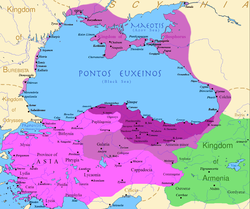
Pontus (Ancient Greek: Πόντος Pontos) was a Hellenistic kingdom centered in the historical region of Pontus in modern-day Turkey, and ruled by the Mithridatic dynasty of Persian origin,[2][3][4][1] which may have been directly related to Darius the Great of the Achaemenid dynasty.[5][1] The kingdom was proclaimed by Mithridates I in 281 BC[6] and lasted until its conquest by the Roman Republic in 63 BC.[7] The Kingdom of Pontus reached its greatest extent under Mithridates VI the Great, who conquered Colchis, Cappadocia, Bithynia, the Greek colonies of the Tauric Chersonesos, and for a brief time the Roman province of Asia. After a long struggle with Rome in the Mithridatic Wars, Pontus was defeated.[8]
Key Information


The kingdom had three cultural strands, which often fused together: Greek (mostly on the coast), Persian, and Anatolian,[9][1] with Greek becoming the official language in the 3rd century BC.[2]
Features of Pontus
[edit]
The Kingdom of Pontus was divided into two distinct areas: the coastal region and the Pontic interior. The coastal region bordering the Black Sea was separated from the mountainous inland area by the Pontic Alps, which run parallel to the coast. The river valleys of Pontus also ran parallel to the coast and were quite fertile, supporting cattle herds, millet, and fruit trees, including cherry, apple, and pear. (Cherry and Cerasus are probably cognates.) The coastal region was dominated by Greek cities such as Amastris and Sinope, which became the Pontic capital after its capture. The coast was rich in timber, fishing, and olives. Pontus was also rich in iron and silver, which were mined near the coast south of Pharnacia; steel from the Chalybian mountains became quite famous in Greece. There were also copper, lead, zinc and arsenic. The Pontic interior also had fertile river valleys such as the river Lycus and Iris. The major city of the interior was Amasia, the early Pontic capital, where the Pontic kings had their palace and royal tombs. Besides Amasia and a few other cities, the interior was dominated mainly by small villages. The kingdom of Pontus was divided into districts named Eparchies.[10]

The division between coast and interior was also cultural. The coast was mainly Greek and focused on sea trade. The interior was occupied by the Anatolian Cappadocians and Paphlagonians ruled by an Iranian aristocracy that went back to the Persian empire. The interior also had powerful temples with large estates. The gods of the Kingdom were mostly syncretic, with features of local gods along with Persian and Greek deities. Major gods included the Persian Ahuramazda, who was termed Zeus Stratios; the moon god Men Pharnacou; and Ma (interpreted as Cybele).[11]
Sun gods were particularly popular, with the royal house being identified with the Persian god Ahuramazda of the Achaemenid dynasty; both Apollo and Mithras were worshipped by the Kings. Indeed, the name used by the majority of the Pontic kings was Mithridates, which means "given by Mithras".[12] Pontic culture represented a synthesis between Iranian, Anatolian and Greek elements, with the former two mostly associated with the interior parts, and the latter more so with the coastal region. By the time of Mithridates VI Eupator, Greek was the official language of the Kingdom, though Anatolian languages continued to be spoken in the interior.[13][1]
History
[edit]
Mithridatic dynasty of Cius
[edit]The region of Pontus was originally part of the Persian satrapy of Cappadocia (Katpatuka).[14] The Persian dynasty which was to found this kingdom had, during the 4th century BC, ruled the Greek city of Cius (or Kios) in Mysia, with its first known member being Mithridates of Cius.[15] His son Ariobarzanes II became satrap of Phrygia. He became a strong ally of Athens and revolted against Artaxerxes, but was betrayed by his son Mithridates II of Cius.[16] Mithridates II remained as ruler after Alexander's conquests and was a vassal to Antigonus I Monophthalmus, who briefly ruled Asia Minor after the Partition of Triparadisus. Mithridates was killed by Antigonus in 302 BC under suspicion that he was working with his enemy Cassander. Antigonus planned to kill Mithridates' son, also called Mithridates (later named Ktistes, 'founder') but Demetrius I warned him and he escaped to the east with six horsemen.[17] Mithridates first went to the city of Cimiata in Paphlagonia and later to Amasya in Cappadocia. He ruled from 302 to 266 BC, fought against Seleucus I and, in 281 (or 280) BC, declared himself king (basileus) of a state in northern Cappadocia and eastern Paphlagonia. He further expanded his kingdom to the river Sangrius in the west. His son Ariobarzanes captured Amastris in 279, its first important Black sea port. Mithridates also allied with the newly arrived Galatians and defeated a force sent against him by Ptolemy I. Ptolemy had been expanding his territory in Asia Minor since the beginning of the First Syrian war against Antiochus in the mid-270s and was allied with Mithridates' enemy, Heraclea Pontica.[18]
Kingdom of Pontus
[edit]We know little of Ariobarzanes' short reign, except that when he died his son Mithridates II (c. 250—189) became king and was attacked by the Galatians. Mithridates II received aid from Heraclea Pontica, who was also at war with the Galatians at this time. Mithridates went on to support Antiochus Hierax against his brother Seleucus II Callinicus. Seleucus was defeated in Anatolia by Hierax, Mithridates, and the Galatians. Mithridates also attacked Sinope in 220 but failed to take the city. He married Seleucus II's sister and gave his daughter in marriage to Antiochus III, to obtain recognition for his new kingdom and create strong ties with the Seleucid Empire. The sources are silent on Pontus for the years following the death of Mithridates II, when his son Mithridates III ruled (c. 220–198/88).[19]

Pharnaces I of Pontus was much more successful in his expansion of the kingdom at the expense of the Greek coastal cities. He joined in a war with Prusias I of Bithynia against Eumenes of Pergamon in 188 BC, but the two made peace in 183 after Bithynia suffered a series of reversals. He took Sinope in 182 BC and although the Rhodians complained to Rome about this, nothing was done. Pharnaces also took the coastal cities of Cotyora, Pharnacia, and Trapezus in the east, effectively gaining control of most of the northern Anatolian coastline. Despite Roman attempts to keep the peace, Pharnaces fought against Eumenes of Pergamon and Ariarathes of Cappadocia. While initially successful, it seems he was overmatched by 179 when he was forced to sign a treaty. He had to give up all lands he had obtained in Galatia, and Paphlagonia and the city of Tium, but he kept Sinope.[20] Seeking to extend his influence to the north, Pharnaces allied with the cities in the Chersonesus and with other Black Sea cities such as Odessus on the Bulgarian coast. Pharnaces' brother, Mithridates IV Philopator Philadelphus adopted a peaceful, pro-Roman policy. He sent aid to the Roman ally Attalus II Philadelphus of Pergamon against Prusias II of Bithynia in 155.[21]
His successor, Mithridates V of Pontus Euergetes, remained a friend of Rome and in 149 BC sent ships and a small force of auxiliaries to aid Rome in the Third Punic War. He also sent troops for the war against Eumenes III (Aristonicus), who had usurped the Pergamene throne after the death of Attalus III. After Rome received the Kingdom of Pergamon in the will of Attalus III in the absence of an heir, they turned part of it into the province of Asia, while giving the rest to loyal allied kings. For his loyalty Mithridates was awarded the region of Phrygia Major. The kingdom of Cappadocia received Lycaonia. Because of this it seems reasonable to assume that Pontus had some degree of control over Galatia, since Phrygia does not border Pontus directly. It is possible that Mithridates inherited part of Paphlagonia after the death of its King, Pylaemenes. Mithridates V married his daughter Laodice to the king of Cappadocia, Ariarathes VI of Cappadocia, and he also went on to invade Cappadocia, though the details of this war are unknown. Hellenization continued under Mithridates V. He was the first king to widely recruit Greek mercenaries in the Aegean, he was honored at Delos, and he depicted himself as Apollo on his coins. Mithridates was assassinated at Sinope in 121/0, the details of which are unclear.[22]
Because both the sons of Mithridates V, Mithridates VI and Mithridates Chrestus, were still children, Pontus now came under the regency of his wife Laodice. She favored Chrestus, and Mithridates VI escaped the Pontic court. Legend would later say this was the time he traveled through Asia Minor, building his resistance to poisons and learning all of the languages of his subjects. He returned in 113 BC to depose his mother; she was thrown into prison, and he eventually had his brother killed.[23]
Mithridates VI Eupator
[edit]
Mithridates VI Eupator, 'the Good Father', followed a decisive anti-Roman agenda, extolling Greek and Iranian culture against ever-expanding Roman influence. Rome had recently created the province of Asia in Anatolia, and it had also rescinded the region of Phrygia Major from Pontus during the reign of Laodice. Mithridates began his expansion by inheriting Lesser Armenia from King Antipater (precise date unknown, c.115–106) and by conquering the Kingdom of Colchis. Colchis was an important region in Black Sea trade – rich with gold, wax, hemp, and honey. The cities of the Tauric Chersonesus now appealed for his aid against the Scythians in the north. Mithridates sent 6,000 men under General Diophantus. After various campaigns in the north of the Crimea he controlled all of the Chersonesus. Mithridates also developed trade links with cities on the western Black Sea coast.[24]
At the time, Rome was fighting the Jugurthine and Cimbric wars. Mithridates and Nicomedes of Bithynia both invaded Paphlagonia and divided it amongst themselves. A Roman embassy was sent, but it accomplished nothing. Mithridates also took a part of Galatia that had previously been part of his father's kingdom and intervened in Cappadocia, where his sister Laodice was queen. In 116 the king of Cappadocia, Ariarathes VI, was murdered by the Cappadocian noble Gordius at the behest of Mithridates, and Laodice ruled as regent over the sons of Ariarathes until 102 BC. After Nicomedes III of Bithynia married Laodice, he tried to intervene in the region by sending troops; Mithridates swiftly invaded, placing his nephew Ariarathes VII of Cappadocia on the throne of Cappadocia. War soon broke out between the two, and Mithridates invaded with a large Pontic army, but Ariarathes VII was murdered in 101 BC before any battle was fought. Mithridates then installed his eight-year-old son, Ariarathes IX of Cappadocia as king, with Gordius as regent. In 97 Cappadocia rebelled, but the uprising was swiftly put down by Mithridates. Afterwards, Mithridates and Nicomedes III both sent embassies to Rome. The Roman Senate decreed that Mithridates had to withdraw from Cappadocia and Nicomedes from Paphlagonia. Mithridates obliged, and the Romans installed Ariobarzanes in Cappadocia. In 91/90 BC, while Rome was busy in the Social War in Italy, Mithridates encouraged his new ally and son-in-law, King Tigranes the Great of Armenia, to invade Cappadocia, which he did, and Ariobarzanes fled to Rome. Mithridates then deposed Nicomedes IV from Bithynia, placing Socrates Chrestus on the throne.[25]
The First Mithridatic War
[edit]A Roman army under Manius Aquillius arrived in Asia Minor in 90 BC, prompting Mithridates and Tigranes to withdraw. Cappadocia and Bithynia were restored to their respective monarchs, but then faced large debts to Rome due to their bribes for the Roman senators, and Nicomedes IV was eventually convinced by Aquillius to attack Pontus in order to repay the debts. He plundered as far as Amastris, and returned with much loot. Mithridates invaded Cappadocia once again, and Rome declared war.[26][pages needed]
In the summer of 89 BC, Mithridates invaded Bithynia and defeated Nicomedes and Aquillius in battle. He moved swiftly into Roman Asia and resistance crumbled; by 88 he had obtained the surrender of most of the newly created province. He was welcomed in many cities, where the residents chafed under Roman tax farming. In 88 Mithridates also ordered the massacre of at least 80,000 Romans and Italians in what became known as the 'Asiatic Vespers'. Many Greek cities in Asia Minor happily carried out the orders; this ensured that they could no longer return to an alliance with Rome. In the autumn of 88 Mithridates also placed Rhodes under siege, but he failed to take it.[27]
In Athens, anti-Roman elements were emboldened by the news and soon formed an alliance with Mithridates. A joint Pontic–Athenian naval expedition took Delos in 88 BC, and granted the city to Athens. Many Greek city-states now joined Mithridates, including Sparta, the Achaean League, and most of the Boeotian League except Thespiae. Finally, in 87 BC, Lucius Cornelius Sulla set out from Italy with five legions. He marched through Boeotia, which quickly surrendered, and began laying siege to Athens and the Piraeus (the Athenian port city, no longer connected by the Long Walls). Athens fell in March 86 BC, and the city was sacked. After stiff resistance, Archelaus, the Pontic general in Piraeus, left by sea, and Sulla utterly destroyed the port city. Meanwhile, Mithridates had sent his son Arcathias with a large army via Thrace into Greece.[28]

Sulla now headed north, seeking the fertile plains of Boeotia to supply his army. At the Battle of Chaeronea, Sulla inflicted severe casualties on Archelaus, who nevertheless retreated and continued to raid Greece with the Pontic fleet. Archelaus regrouped and attacked a second time at the Battle of Orchomenus in 85 BC but was once again defeated and suffered heavy losses. As a result of the losses and the unrest they stirred in Asia Minor, as well as the presence of the Roman army now campaigning in Bithynia, Mithridates was forced to accept a peace deal. Mithridates and Sulla met in 85 BC at Dardanus. Sulla decreed that Mithridates had to surrender Roman Asia and return Bithynia and Cappadocia to their former kings. He also had to pay 2,000 talents and provide ships. Mithridates would retain the rest of his holdings and become an ally of Rome.[29]
Second and Third Mithridatic wars
[edit]The treaty agreed with Sulla was not to last. From 83 to 82 BC Mithridates fought against and defeated Licinius Murena, who had been left by Sulla to organize the province of Asia. The so-called Second Mithridatic war ended without any territorial gains by either side. The Romans now began securing the coastal region of Lycia and Pamphylia from pirates and established control over Pisidia and Lycaonia. When in 74 the consul Lucullus took over Cilicia, Mithridates faced Roman commanders on two fronts. The Cilician pirates had not been completely defeated, and Mithridates signed an alliance with them. He was also allied with the government of Quintus Sertorius in Spain and with his help reorganized some of his troops in the Roman legionary pattern with short stabbing swords.
The Third Mithridatic war broke out when Nicomedes IV of Bithynia died without heirs in 75 and left his kingdom to Rome. In 74 BC Rome mobilized its armies in Asia Minor, probably provoked by some move made by Mithridates, but our sources are not clear on this. In 73 Mithridates invaded Bithynia, and his fleet defeated the Romans off Chalcedon and laid siege to Cyzicus. Lucullus marched from Phrygia with his five legions and forced Mithridates to retreat to Pontus.[30] In 72 BC Lucullus invaded Pontus through Galatia and marched north following the river Halys to the north coast, he besieged Amisus, which withstood until 70 BC. In 71 he marched through the Iris and Lycus river valleys and established his base in Cabeira. Mithridates sent his cavalry to cut the Roman supply line to Cappadocia in the south, but they suffered heavy casualties. Mithridates, still unwilling to fight a decisive engagement, now began a retreat to Lesser Armenia, where he expected aid from his ally Tigranes the Great. Because of his now weakened cavalry, the retreat turned into an all-out rout, and most of the Pontic army was destroyed or captured. These events led Machares, the son of Mithridates and ruler of the Crimean Bosporus, to seek an alliance with Rome. Mithridates fled to Armenia.[31]
In the summer of 69 Lucullus invaded Armenian territory, marching with 12,000 men through Cappadocia into Sophene. His target was Tigranocerta, the new capital of Tigranes's empire. Tigranes retreated to gather his forces. Lucullus laid siege to the city, and Tigranes returned with his army, including large numbers of heavily armored cavalrymen, termed Cataphracts, vastly outnumbering Lucullus' force. Despite this, Lucullus led his men in a charge against the Armenian horses and won a great victory at the Battle of Tigranocerta. Tigranes fled north while Lucullus destroyed his new capital city and dismantled his holdings in the south by granting independence to Sophene and returning Syria to the Seleucid king Antiochus XIII Asiaticus. In 68 BC Lucullus invaded northern Armenia, ravaging the country and capturing Nisibis, but Tigranes avoided battle. Meanwhile, Mithridates invaded Pontus, and in 67 he defeated a large Roman force near Zela. Lucullus, now in command of tired and discontented troops, withdrew to Pontus, then to Galatia. He was replaced by two new consuls arriving from Italy with fresh legions, Marcius Rex and Acilius Glabrio. Mithridates now recovered Pontus while Tigranes invaded Cappadocia.[32]
In response to increasing pirate activity in the eastern Mediterranean, the senate granted Pompey extensive proconsular Imperium throughout the Mediterranean in 67 BC. Pompey eliminated the pirates, and in 66 he was assigned command in Asia Minor to deal with Pontus. Pompey organized his forces, close to 45,000 legionaries, including Lucullus' troops, and signed an alliance with the Parthians, who attacked and kept Tigranes busy in the east. Mithridates massed his army, some 30,000 men and 2,000–3,000 cavalry, in the heights of Dasteira in lesser Armenia. Pompey fought to encircle him with earthworks for six weeks, but Mithridates eventually retreated north. Pompey pursued and managed to catch his forces by surprise in the night, and the Pontic army suffered heavy casualties. After the battle, Pompey founded the city of Nicopolis. Mithridates fled to Colchis, and later to his son Machares in the Crimea in 65 BC. Pompey now headed east into Armenia, where Tigranes submitted to him, placing his royal diadem at his feet. Pompey took most of Tigranes' empire in the east but allowed him to remain as king of Armenia. Meanwhile, Mithridates was organizing a defense of the Crimea when his son Pharnaces led the army in revolt; Mithridates was forced to commit suicide or was assassinated.[33]
Roman province and client kingdoms
[edit]

Most of the western half of Pontus and the Greek cities of the coast, including Sinope, were annexed by Rome directly as part of the Roman province of Bithynia et Pontus. The interior and eastern coast remained an independent client kingdom. The Bosporan Kingdom also remained independent under Pharnaces II of Pontus as an ally and friend of Rome. Colchis was also made into a client kingdom. Pharnaces II later made an attempt at reconquering Pontus. During the civil war of Caesar and Pompey, he invaded Asia Minor (48 BC), taking Colchis, lesser Armenia, Pontus, and Cappadocia and defeating a Roman army at Nicopolis. Caesar responded swiftly and defeated him at Zela, where he uttered the famous phrase 'Veni, vidi, vici'.[34] Pontic kings continued to rule the client Kingdom of Pontus, Colchis, and Cilicia until Polemon II was forced to abdicate the Pontic throne by Nero in AD 62.
Coinage
[edit]Although the Pontic kings claimed descent from the Persian royal house, they generally acted as Hellenistic kings and portrayed themselves as such in their coins, mimicking Alexander's royal stater.[13]
Military
[edit]The army of the Pontic Kingdom had a varied ethnic composition, as it recruited its soldiers from all over the kingdom. The standing army included Armenians, Bastarnae, Bithynians, Cappadocians, Galatians, Heniochoi, Iazyges, Koralloi, Leucosyrians, Phrygians, Sarmatians, Scythians, Tauri, and Thracians, as well as soldiers from other areas around the Black Sea. The Greeks who served in the military were not part of the standing army, but rather fought as citizens of their respective cities.[35] Like many Hellenistic armies, the army of Pontus adopted the Macedonian phalanx; it fielded a corps of Chalkaspides ('bronze-shields'), for example against Sulla at the Battle of Chaeronea,[36] while at the same battle 15,000 phalangites were recruited from freed slaves.[37] Pontus also fielded various cavalry units, including cataphracts.[38] In addition to normal cavalry Pontus also fielded scythed chariots.[39] Under Mithridates VI Pontus also fielded a corps of 120,000 troops armed "in the Roman fashion" and "drilled in the Roman phalanx formation".[40] These units imitated Roman legions, although it is disputed to what degree they achieved this.[citation needed]
The navy was organized in a similar fashion as the army. While the kingdom itself provided the main contingent of ships, a small portion represented the Greek cities. The crewmen either came from the various tribes of the kingdom, or were of Greek origin.[35]
See also
[edit]References
[edit]- ^ a b c d e McGing 2004.
- ^ a b McGing 1986, p. 11.
- ^ Children of Achilles: The Greeks in Asia Minor Since the Days of Troy, by John Freely, p. 69–70
- ^ Strabo of Amasia: A Greek Man of Letters in Augustan Rome, by Daniela Dueck, p. 3.
- ^ Bosworth, A. B.; Wheatley, P. V. (November 1998). "The origins of the Pontic house". The Journal of Hellenic Studies. 118: 155–164. doi:10.2307/632236. ISSN 2041-4099. JSTOR 632236. S2CID 162855144.
- ^ Strabo Geography 12.3
- ^ Östenberg, Ida (December 2013). "Veni Vidi Vici and Caesar's Triumph". Classical Quarterly. 63 (2): 819. doi:10.1017/S0009838813000281. ISSN 0009-8388. S2CID 170291549.
- ^ Kantor, Georgy (2012), "Mithradatic wars", The Encyclopedia of Ancient History, Blackwell Publishing, doi:10.1002/9781444338386.wbeah09172, ISBN 9781444338386
- ^ Children of Achilles: The Greeks in Asia Minor Since the Days of Troy, by John Freely, p. 69–70
- ^ Crook, Lintott & Rawson, The Cambridge Ancient History. Volume IX. The Last Age of the Roman Republic, 146–43 B.C., p. 133–136.
- ^ Cambridge Ancient v. 9, p. 137.
- ^ David Ulansey, The Origins of the Mithraic Mysteries, p. 89.
- ^ a b McGing 1986, p. 10-11.
- ^ Heckel 2020, p. 122.
- ^ McGing 1986, p. 10.
- ^ Xenophon "Cyropaedia", VIII 8.4
- ^ Appian "the Mithridatic wars", II
- ^ McGing 1986, p. 16-17.
- ^ McGing 1986, p. 17-23.
- ^ Polybius "Histories", XXIV. 1, 5, 8, 9 XXV. 2
- ^ Polybius, XXXIII.12
- ^ McGing 1986, p. 36-39.
- ^ Cambridge Ancient v. 9, p. 133.
- ^ Cambridge Ancient v. 9, p. 137–138.
- ^ Cambridge Ancient v. 9, 141–144.
- ^ Appian, II
- ^ Cambridge Ancient v. 9, 146–49.
- ^ Cambridge Ancient v. 9, 150–54.
- ^ Cambridge Ancient v. 9, 155–60.
- ^ Cambridge Ancient v. 9, 229–36.
- ^ Cambridge Ancient v. 9, 237–39.
- ^ Cambridge Ancient v. 9, 240–44.
- ^ Cambridge Ancient v. 9, 249–54.
- ^ John Hazel "Who's who in the Greek world", p. 179.
- ^ a b Stefanidou Vera, "Kingdom of Pontus", 2008, Encyclopaedia of the Hellenic World, Asia Minor
- ^ Plutarch, Life of Sulla, 16.7
- ^ Plutarch, Life of Sulla, 18.5
- ^ The Cambridge Companion to the Hellenistic World by Glenn R. Bugh, p. 272
- ^ Plutarch, Life of Sulla, 15.1
- ^ Plutarch, Life of Lucullus. 7.4
Sources
[edit]Modern sources
[edit]- Crook, John; Lintott, Andrew; Rawson, Elizabeth, eds. (1992). The Cambridge ancient history. Vol. 9 (2nd ed.). Cambridge University Press. ISBN 0-521-85073-8. OCLC 121060.
- Hazel, John (2002). Who's who in the Roman World. Routledge. ISBN 978-0-415-29162-0.
- Heckel, Waldemar (2020). In the Path of Conquest Resistance to Alexander the Great. Oxford University Press.
- McGing, Brian C. (1986). The Foreign Policy of Mithridates VI Eupator, King of Pontus. Brill. ISBN 978-90-04-07591-7.
- McGing, Brian (2004). "Pontus". Encyclopædia Iranica.
Ancient sources
[edit]- Polybius, the histories.
- Appian, the foreign wars.
- Memnon of Heraclea, history of Heraclea.
- Strabo, Geographica.
- Plutarch, Parallel lives. 'Demetrius'.
| Bronze Age | |
|---|---|
| Iron Age | |
| Classical Age | |

| History |  | |
|---|---|---|
| Art | ||
| Architecture | ||
| Culture | ||
| Warfare |
| |
| Diplomacy | ||
| Administration | ||
| Dynasties | ||
| Related | ||

| Authority control databases: National |
|---|

Kingdom of Pontus
View on GrokipediaGeography and Natural Features
Terrain, Climate, and Resources
The Kingdom of Pontus encompassed a narrow coastal strip along the southern shore of the Black Sea in northern Anatolia, backed by the rugged Pontic Mountains that ran parallel to the coast, creating a natural barrier that limited access to the interior highlands and enhanced defensibility while isolating coastal populations.[4][5] Fertile river valleys, such as the plain of Themiscyra east of Amisus and the inland Phanaroea basin formed by the Iris and Lycus rivers, provided viable agricultural lands amid the otherwise steep and forested terrain, supporting economic productivity through cultivation.[4] The coastal climate was relatively mild and humid, conducive to agriculture including grains, fruits, vines, and olives, as evidenced by the productivity of key plains, while the higher elevations experienced harsher conditions with heavier snowfall, restricting settlement and exploitation to lower altitudes.[4] This variation fostered specialized economic activities, with coastal humidity aiding fisheries and viticulture for sustainability and trade potential. Pontus's resources included abundant timber from mountainous forests, particularly suitable for shipbuilding, which bolstered naval capabilities, and mineral deposits such as those in the Paryadres Mountains south of Pharnaceia, yielding metals that supported metallurgical industries.[4] The Black Sea coast sustained a valuable tunny-fishing industry, contributing to food security and exportable goods, while fertile valleys enabled livestock rearing of cattle and horses alongside crop production, underpinning the kingdom's self-sufficiency despite topographic constraints.[4]Strategic Position and Trade Routes
The Kingdom of Pontus controlled a strategic coastal enclave along the southern shore of the Black Sea, extending from the Halys River (modern Kızılırmak) in the west to the boundaries of Colchis in the east, positioning it as a critical gateway between Anatolia and the Pontic steppes.[1] This location enabled Pontus to dominate maritime trade routes connecting Greek emporia in the Aegean with northern Black Sea polities, including Scythian territories and the Bosporan Kingdom, from the 3rd century BCE onward.[6] Key ports like Sinope served as primary export hubs for commodities such as grain from inland valleys, slaves procured from trans-Pontic raids, and metals from highland mines, with archaeological evidence of amphorae distributions underscoring the volume of these exchanges circa 200–100 BCE.[7][8] The rugged Pontic Mountains, paralleling the coast and rising sharply to over 3,000 meters in elevation, formed an impassable natural barrier that isolated the Pontic littoral from central Anatolian powers like Cappadocia, enhancing defensive resilience without reliance on extensive fortifications.[9] The Halys River further delineated a defensible western frontier, its broad valley and seasonal floods deterring large-scale invasions from the south, as noted in ancient geographical accounts.[1] This geographical configuration allowed Pontus to maintain autonomy amid Hellenistic rivalries, channeling resources toward maritime commerce rather than protracted land campaigns. Pontic hegemony over Black Sea trade lanes manifested in economic ties with the Bosporan Kingdom, where Pontic bronze coins and imported amphorae fragments from sites like Phanagoria indicate control or influence over grain and wine exports, with hoards containing up to hundreds of specimens dated to the 2nd–1st centuries BCE.[10][11] Such artifacts, recovered from mercenary purses and necropoleis, reflect Pontus's role in monetizing regional trade networks, bolstering its fiscal power through tariffs and tribute without direct territorial administration.[12]Origins of the Ruling Dynasty
The Mithridatic Lineage in Cius
The Mithridatic dynasty traced its origins to Persian nobility stationed in Cius, a coastal city in Bithynia adjacent to Mysia, during the late Achaemenid period. Ariobarzanes I, who succeeded as satrap of Hellespontine Phrygia around 387 BCE after serving as subsatrap under Pharnabazus II, represented an early prominent figure in this lineage, reflecting the administrative roles assigned to Iranian elites in western Anatolia.[13][14] His family, part of the broader Pharnacid network tied to Achaemenid governance, maintained influence amid the satrapal system's emphasis on local Persian oversight of diverse populations.[15] Mithridates I Ctistes, also known as Mithridates III of Cius and active in the late 4th century BCE, emerged as a key progenitor; born into this Persian aristocratic milieu in Cius or nearby Mysia, he descended from satraps who governed the region from approximately 363 to 337 BCE.[16] Around 302 BCE, following the death of his uncle—a Mysian ruler—and amid the power vacuums created by Alexander the Great's successors, Mithridates fled westward threats, relocating to the rugged mountains of Paphlagonia bordering Pontus.[16] There, leveraging his noble status and military acumen honed in Persian service, he consolidated authority over local chieftains and tribes, initiating the dynasty's shift toward regional dominance without yet declaring full independence.[16] Family intermarriages with indigenous dynasts in Paphlagonia and Cappadocia facilitated this entrenchment, blending Persian administrative practices—such as satrapal hierarchies and tribute systems—with local customs, as evidenced by Strabo's accounts of enduring Persian-style governance in the former Cappadocian satrapies that encompassed Pontus.[15] These unions, pragmatic responses to fragmented post-Alexandrian polities, preserved Iranian cultural elements like noble endogamy while adapting to Anatolian realities.[15] The dynasty's semi-autonomy crystallized after the Battle of Corupedion in 281 BCE, where Seleucus I Nicator defeated Lysimachus, temporarily extending Seleucid reach into western Anatolia but soon undermined by Seleucus's assassination later that year, which weakened central oversight and empowered peripheral satraps.[17] Inscriptions from the period, including early Pontic coinage echoing Achaemenid styles, underscore this transition, signaling the Mithridatids' exploitation of imperial fragmentation to assert de facto control under nominal Seleucid suzerainty.[16]Path to Independence
Ariobarzanes I, satrap of Hellespontine Phrygia and a member of the Persianized dynasty originating from Cius in Mysia, advanced the family's autonomy through rebellion against Artaxerxes II during the Great Satraps' Revolt circa 366–360 BC. Ruling approximately from 387 BC until his death, he secured alliances with Greek powers, including Spartan expeditions led by Agesilaus, by providing naval and logistical support as documented by Xenophon in the Hellenica. These maneuvers reflected pragmatic diplomacy to counter central Achaemenid authority amid regional instability, though the revolt ultimately failed when Ariobarzanes was betrayed and executed by his son Mithridates around 360 BC, allowing the dynasty to retain local influence under nominal Persian overlordship.[14][13] Alexander the Great's defeat of the Achaemenids by 330 BC and subsequent death in 323 BC fragmented imperial control, unleashing the Diadochi wars that diverted successor states from consolidating Anatolia. The Mithridatic rulers exploited this vacuum, as the emerging Seleucid Empire under Seleucus I focused on securing Syria, Mesopotamia, and eastern frontiers while contending with Ptolemaic incursions and internal rivals, leaving northern Anatolian satrapies vulnerable to local assertion. Mithridates, succeeding his father and later designated II (ruling circa 337–302 BC), navigated these opportunities through opportunistic neutrality and localized power-building, avoiding direct confrontation with major Hellenistic contenders like Antigonus or Lysimachus during battles such as Ipsus in 301 BC.[1] By 302 BC, amid the post-Ipsus realignments, Mithridates II proclaimed himself basileus, transitioning the dynasty from satrapal subordinates to sovereign kings and formalizing Pontic independence. Numismatic evidence, including tetradrachms bearing the legend "of King Mithridates" with Persian-influenced iconography such as the star and crescent, corroborates this elevation, distinguishing Pontic issues from imperial Persian or early Seleucid coinage. This claim capitalized causally on Seleucid overextension, as their Anatolian campaigns remained sporadic and ineffective against entrenched local dynasts, enabling the Mithridatids to establish a stable base in the Pontic highlands without immediate conquests.[18][1]Establishment and Expansion of the Kingdom
Founding under Mithridates I Ctistes
Mithridates I Ctistes, a Persian nobleman from the dynasty of Ariobarzanes who had governed Mysia in the 4th century BCE, founded the Kingdom of Pontus in 281 BCE amid the instability following the murders of the Diadochi Lysimachus and Seleucus I Nicator.[16] Earlier, around 302 BCE, he had fled the court of Antigonus I Monophthalmus to the rugged mountains of Paphlagonia to evade execution, surviving in hiding for over two decades before seizing the opportunity presented by the regional power vacuum.[16] His assertion of kingship drew on ancestral ties to Achaemenid satraps, enabling him to rally loyalty among Persian-descended elites in northern Anatolia, while his military acumen—honed through personal training and Hellenistic influences—facilitated initial control without large-scale conquests.[16] Mithridates established his capital at Amaseia (modern Amasya), an inland stronghold on the Iris River (Yeşilırmak) that provided defensive advantages and access to fertile valleys for sustaining a nascent court.[19] [20] The core territories under his direct rule initially comprised Paphlagonia and the Pontic interior, extending to coastal Greek poleis such as Amisus (modern Samsun), where he forged alliances with autonomous cities like Heraclea Pontica to secure maritime outlets and mercenary recruits.[16] These partnerships, documented in Memnon of Heraclea's local history, underscored a pragmatic blend of Persian hereditary claims and Greek military expertise, as Hellenistic rulers commonly hired professionals from cities like Heraclea amid the post-Alexandrian turmoil.[21] Consolidation efforts focused on fortification of key sites, including the Paphlagonian fortress of Cimiata as a base, to deter rivals from Cappadocia or Bithynia.[19] Revenue derived from royal estates in the river valleys and modest tribute from allied coastal enclaves, supporting a court that emphasized dynastic legitimacy over expansive taxation, though ancient fiscal patterns in satrapal holdovers suggest inherent vulnerabilities to overlord exactions absent strong enforcement.[1] Mithridates reigned until his death in 266 BCE at approximately age 84, having laid the foundations for a hybrid Persian-Hellenistic state that endured through successors.[22]Territorial Growth under Early Successors
Pharnaces I (r. c. 196–170 BC), succeeding Mithridates III, oversaw the most notable territorial advances among the early Mithridatid successors, leveraging the regional disorder following the Roman-Seleucid War of 192–188 BC. In 183 BC, he seized Sinope, a long-coveted Greek colony and major Black Sea emporium that enhanced Pontus's commercial and naval capabilities, transforming it into the kingdom's western capital.[23] This acquisition exploited the Seleucid retreat from Asia Minor after their defeat at Magnesia in 190 BC, allowing Pontus to fill the vacuum without initial great power interference.[23] Pharnaces's ambitions prompted incursions into Galatia, Cappadocia, and Paphlagonia, prompting a coalition of Eumenes II of Pergamon, Ariarathes IV of Cappadocia, and Prusias II of Bithynia, igniting the Pontic War (c. 183–179 BC).[24] Though he occupied Galatian territories initially, Roman diplomatic intervention enforced a settlement, as recorded by Polybius, mandating withdrawal from Galatia and Paphlagonia, restoration of hostages and seized property, and payments of 900 talents to the allied kings plus 300 talents to Eumenes for expenses—yet affirming Pontus's hold on Sinope and pre-war eastern holdings.[25] This outcome exemplified pragmatic expansion, prioritizing consolidated coastal assets over untenable inland ventures amid rising Roman oversight.[23] Eastern campaigns under Pharnaces targeted Colchian and Caucasian tribes, yielding tributary control over peripheral territories that secured Pontus's flanks and access to amber and slave trades, with the Eumenes treaty implicitly recognizing these de facto gains by focusing concessions westward.[26] Diplomatic acumen underpinned this growth: Pharnaces aligned with Rome post-Treaty of Apamea (188 BC) and cultivated ties with Ptolemaic Egypt to offset Seleucid resurgence, eschewing all-out confrontations until external arbitration became inevitable.[27] Polybius portrayed Pharnaces as arrogant and impetuous, attributes that fueled aggressive policies but also internal strains from campaign financing via elevated taxes and reported purges of rivals, undermining long-term loyalty and exposing dynastic vulnerabilities in a multi-ethnic realm.[25] These measures, while enabling short-term accretions, highlighted the limits of unchecked autocracy without broader institutional safeguards.Reign of Mithridates VI Eupator
Rise to Power and Domestic Consolidation
Mithridates VI Eupator ascended the throne of Pontus in 120 BC at approximately eleven years of age, following the assassination of his father, Mithridates V Euergetes, during a banquet in Sinope.[28] Initially, he co-ruled with his mother, Laodice VI, a Seleucid princess who wielded significant influence amid factional court rivalries.[28] Suspecting plots against him, the young prince fled the palace and spent several years in hiding among the mountainous regions of Cappadocia and Pontus, honing survival skills and evading capture.[29] To counter the prevalent threat of poisoning in royal intrigues, Mithridates reportedly ingested sublethal doses of toxins daily, accompanied by antidotes, cultivating a reputed immunity known as mithridatism.[30] Ancient accounts, including those by Pliny the Elder in Naturalis Historia, describe his regimen of universal antidotes tested on prisoners and himself, though the extent of efficacy remains debated among modern scholars due to the anecdotal nature of Roman-era reports.[30] This preparation, verified in Appian's Mithridatic Wars through the failure of poison during his later suicide attempt, underscored his pragmatic adaptation to a perilous environment.[31] By 116 BC, Mithridates emerged from exile, seized control, and imprisoned his mother and younger brother Cotys, effectively purging the court of rivals.[22] Laodice died in captivity, while Cotys faced execution, actions chronicled in Justin's epitome of Pompeius Trogus as necessary for eliminating threats to his authority.[22] These familial eliminations, though stabilizing the throne, drew later Roman critiques of tyranny, reflecting biases in sources like Appian who emphasized Mithridates' ruthlessness to justify Roman interventions.[3] Domestic consolidation involved centralizing power through loyal administrators, including eunuchs such as Bacchides, who handled sensitive diplomatic and court duties.[32] By purging disloyal elements and fostering a network of dependent officials, Mithridates achieved internal cohesion, enabling administrative reforms that enhanced fiscal collection and military readiness without reliance on aristocratic factions.[33] This era marked Pontus' transition from vulnerable dynastic rule to a more autocratic state, though primary sources like Strabo note the reliance on such measures amid ongoing noble discontent.[34]Alliances, Ambitions, and Initial Conflicts
Mithridates VI Eupator harbored grand ambitions to expand Pontic influence across Asia Minor and beyond, drawing on claims of descent from Achaemenid kings like Cyrus the Great and Darius I to legitimize his rule over Iranian and Greek subjects alike.[35] He positioned himself as a champion of Hellenic autonomy, portraying Roman expansion as tyrannical oppression through burdensome taxes and garrisons, thereby rallying Greek city-states in Ionia and the Aegean against Roman hegemony.[36] This ideological framing, combined with his patronage of Greek arts and oracles such as Delphi, enhanced his appeal among eastern Mediterranean elites, though ancient sources like Appian depict these efforts as opportunistic maneuvers to mask territorial aggression.[37] To counter Roman power, Mithridates cultivated strategic alliances, most notably with Tigranes II of Armenia through the marriage of his daughter Cleopatra circa 94 BC, creating a formidable eastern bloc that extended Pontic reach into Mesopotamia and Syria.[38] He also pursued ties with the Parthian Empire, leveraging shared Iranian heritage to secure diplomatic and potential military support against Rome prior to the First Mithridatic War.[36] These pacts aimed to encircle Roman interests in Anatolia, yet they drew criticism for duplicity, as Mithridates reportedly betrayed earlier understandings with Bithynian king Nicomedes III by exploiting succession disputes to advance Pontic claims.[37] Initial tensions escalated through Mithridates' encroachments on neighboring Cappadocia between approximately 103 and 90 BC, where he intervened in royal successions to install favorable puppets, such as supporting Socrates Chrestus against the Roman-endorsed Ariobarzanes I.[39] In circa 95 BC, Pontic forces invaded and briefly ousted Ariobarzanes, prompting Roman legate Manius Aquillius to orchestrate his restoration, an action Appian cites as heightening Roman suspicions of Mithridates' expansionist designs.[37] These pre-war clashes, devoid of full-scale Roman-Pontic combat, underscored Mithridates' willingness to probe Roman resolve through proxy conflicts and diplomatic maneuvering, setting the stage for broader confrontation while showcasing both his strategic acumen and the perils of overreach amid fragile eastern alliances.[39]The Mithridatic Wars
The Mithridatic Wars, spanning 89–63 BC, comprised three major conflicts between Mithridates VI of Pontus and the Roman Republic, triggered by Pontic interventions in Roman client kingdoms such as Cappadocia and Bithynia.[40] Mithridates' aggressive expansionism, aimed at consolidating Hellenistic dominance in Asia Minor and beyond, directly challenged Roman protectorate interests, escalating from proxy disputes to full-scale invasions that tested Republican military capabilities.[41] Despite Pontus fielding armies numbering up to 250,000 infantry and extensive cavalry forces, including scythed chariots and allied contingents from Armenia and Thrace, Roman success stemmed from disciplined legions, adaptive tactics, and logistical superiority that negated numerical advantages in prolonged campaigns.[42] Roman commanders, including Sulla, Lucullus, and Pompey, exploited Pontic overextension and internal divisions, culminating in Mithridates' strategic retreat to the Black Sea coasts and ultimate defeat, which secured Roman hegemony in the eastern Mediterranean without romanticized notions of Eastern defiance prevailing against superior organization.[43] The wars' outcomes, verified through triumph records and consular reports, underscored causal factors like Rome's client alliances and naval control, rather than isolated battles, leading to Pontus' partition by 63 BC.[37]First Mithridatic War (89–85 BC)
The First Mithridatic War erupted in 89 BC when Mithridates VI, responding to dynastic disputes, invaded Cappadocia to install Ariarathes IX as puppet king, deposing the Roman-backed Ariobarzanes I; the Roman Senate, petitioned by Cappadocian and Bithynian envoys, dispatched Aquillius to restore Ariobarzanes, but Mithridates countered by annexing Paphlagonia following the death of Bithynian king Nicomedes III in 90 BC, whose will bequeathed Bithynia to Rome.[37] Escalation followed in 88 BC as Pontic forces overran Bithynia and the Roman province of Asia, where Mithridates ordered the "Asiatic Vespers," a systematic massacre of approximately 80,000–150,000 Roman and Italian residents, fueled by local resentment toward Roman tax farming but strategically aimed at eliminating opposition.[37] Pontic general Archelaus simultaneously invaded Greece, capturing Athens and besieging Roman positions, prompting Sulla's consular army of five legions to intervene, defeating Pontic forces at Chaeronea and Orchomenus in 86 BC through superior legionary cohesion against disorganized masses.[37] The war concluded with the Treaty of Dardanus in 85 BC, negotiated by Sulla with Archelaus, under which Mithridates withdrew from Asia, Bithynia, and Paphlagonia; recognized Roman clients in Cappadocia and Bithynia; paid an indemnity of 2,000 talents; and surrendered 70 ships and all Greek fortresses, retaining Pontus proper while Roman logistics and divided Pontic command prevented total conquest.[37] This settlement, while lenient due to Sulla's Italian preoccupations, sowed seeds for renewed conflict by allowing Mithridates to rebuild forces amid fragile peace.[40]Second Mithridatic War (83–81 BC)
Tensions reignited in 83 BC when Roman legate Lucius Licinius Murena, stationed in Asia with two legions, suspected Mithridates of violating the treaty by fortifying Comana Pontica and aiding Galatian unrest; interpreting this as rearmament, Murena launched preemptive raids into Pontus, defeating local garrisons but provoking a Pontic counteroffensive.[44] Mithridates repelled Murena at the Halys River in 82 BC, inflicting heavy casualties through coordinated cavalry and infantry, though Roman discipline limited losses; further Pontic victories at Zela forced Murena's withdrawal.[44] Sulla, now dictator in Rome, intervened diplomatically in 81 BC, ordering Murena to cease operations to avoid diverting resources from civil wars, resulting in a de facto truce that reaffirmed the Dardanus terms without formal concessions; this brief war highlighted Pontic recovery potential but underscored Roman strategic restraint prioritizing internal stability over immediate expansion.[40] Murena's unauthorized aggression, driven by ambition, yielded no territorial gains but delayed comprehensive Roman commitment to the East.[41]Third Mithridatic War (73–63 BC)
The Third Mithridatic War commenced in 73 BC after Bithynian king Nicomedes IV's death, willing his kingdom to Rome; Mithridates invaded Bithynia, prompting consular declaration of war and assignment of Lucius Licinius Lucullus with three legions (about 30,000 men) to Asia.[43] Lucullus swiftly defeated Mithridates at Cyzicus in 73 BC, leveraging naval blockade and winter attrition to dismantle a Pontic army of 300,000; subsequent campaigns captured Pontic heartlands, culminating in victories over Armenian king Tigranes II at Tigranocerta (69 BC) and Artaxata, where Roman legions outmaneuvered vast Oriental hosts through mobility and engineering.[43][42] Mutinies among Lucullus' veteran troops in 68–67 BC, exacerbated by harsh terrain and delayed pay, stalled advances, leading to Pompey's appointment in 66 BC with imperium to supersede Lucullus; Pompey decisively routed Mithridates at the Battle of the Lycus River, pursued him through Colchis and Iberia, and forced retreat to the Cimmerian Bosporus, where Mithridates committed suicide in 63 BC to evade capture.[43] Pompey's triumph included annexation of Pontus as a province, client arrangements in Armenia, and redistribution of Mithridatic spoils totaling 20,000 talents, affirming Roman logistical endurance and command structure as decisive against Pontic resilience.[41]First Mithridatic War (89–85 BC)
The First Mithridatic War erupted in 89 BC when Nicomedes IV of Bithynia, supported by Roman interests, invaded Pontus, prompting Mithridates VI to retaliate by overrunning Bithynia and Paphlagonia with superior forces.[45] By 88 BC, Mithridates' armies had swiftly conquered the Roman province of Asia, where local resentment against Roman tax farmers facilitated rapid submission; cities like Ephesus and Pergamon fell without prolonged resistance.[46] In a calculated act of ethnic cleansing, Mithridates ordered the extermination of all Romans and Italians in Asia—known as the Asiatic Vespers—resulting in the deaths of approximately 80,000 individuals, including women and children, over several days; this massacre, while temporarily consolidating local support, provoked universal Roman outrage and unified opposition against Pontus.[46] [47] Mithridates' overextension became evident as he dispatched general Archelaus with 120,000 infantry, 16,000 cavalry, and numerous elephants to Greece in 87 BC, where Athens and other cities defected from Roman control, allowing the capture of Piraeus.[48] Sulla, appointed Roman commander despite rival claims by Marius' faction, arrived in Greece that year and initiated a grueling siege of Athens starting in late 87 BC; the city, isolated and famine-stricken, surrendered on 1 March 86 BC after brutal street fighting, with Sulla ordering its sack in reprisal.[48] Sulla then decisively defeated Archelaus' depleted forces at the Battle of Chaeronea in early 86 BC and again at Orchomenus later that summer, inflicting heavy casualties—up to 10,000 Pontic dead at Chaeronea alone—and shattering Mithridates' expeditionary army through superior Roman discipline and artillery. These tactical victories exposed Mithridates' strategic error in dividing his forces across vast territories, stretching supply lines and enabling Roman concentration against isolated contingents.[45] Crossing to Asia Minor in 85 BC, Sulla neutralized the rival Roman army under Fimbria before confronting Mithridates' remaining forces, culminating in negotiations at Dardanus.[49] The resulting Treaty of Dardanus compelled Mithridates to evacuate all conquests in Asia Minor, including Bithynia, Paphlagonia, and Cappadocia; recognize Roman allies like Nicomedes and Ariobarzanes; surrender 70 warships, 2,000 talents indemnity, and all Roman prisoners; and limit his navy to 10 vessels, while Sulla acknowledged him as a "friend and ally" of Rome.[50] The Vespers' brutality, by alienating potential neutrals and framing Mithridates as a barbaric aggressor, directly contributed to Rome's resolute counteroffensive, as it transformed a regional dispute into a war of existential reprisal, overriding internal Roman divisions.[46] This settlement, though lenient due to Sulla's need to return to Italy, temporarily restored the status quo but sowed seeds for future conflicts by leaving Pontus intact.[47]Second Mithridatic War (83–81 BC)
Following the Peace of Dardanus in 85 BC, Mithridates VI began reconstituting his military strength within Pontus, prompting suspicions from Lucius Licinius Murena, Sulla's legate in Asia Minor. In 83 BC, Murena launched an unprovoked invasion of Cappadocia, a region allied to Pontus, capturing key settlements including Comana to preempt perceived threats of rearmament.[39] Mithridates protested the violation of the treaty and appealed to Sulla, but Murena persisted, ravaging border areas and prompting Mithridates to mobilize forces under generals like Dorylaeus.[3] Mithridates' counteroffensive reclaimed Cappadocia, defeating Roman detachments in initial engagements. Emboldened, Murena mounted a second invasion in 82 BC, advancing toward the Halys River where Pontic forces under command of Mithridates' general Gordius confronted the legions. In the ensuing Battle of Halys, the numerically superior Pontic army routed the Romans, inflicting significant casualties and forcing Murena's retreat, marking a rare field defeat for Roman arms in the Mithridatic conflicts.[51] This tactical success allowed Mithridates a brief resurgence, though his aggressive response risked broader escalation. Sulla, now entrenched as dictator in Italy, intervened decisively upon learning of the unauthorized campaign, dispatching a tribune to rebuke Murena and ordering an immediate cessation of hostilities to preserve the Dardanus settlement.[52] Mithridates, wary of provoking a full Roman reprisal amid Sulla's consolidation of power, accepted the reinforced terms, which reaffirmed Pontus' pre-war borders and prohibited further expansion into Asia Minor.[39] The war concluded in 81 BC without altering territorial status quo, underscoring Mithridates' miscalculation in openly rebuilding forces and the fragility of Roman provincial autonomy, while averting a third confrontation until later provocations.[37]Third Mithridatic War (73–63 BC)
The Third Mithridatic War commenced in 74 BC when Mithridates VI invaded Bithynia following the bequest of its throne to Rome in the will of King Nicomedes IV, prompting a Roman response led by Lucius Licinius Lucullus with five legions.[43] Lucullus initially blockaded Mithridates' forces at Cyzicus in 73 BC, severing supply lines through fortified camps and engineering works that exploited the harsh winter, leading to the starvation and capture of approximately 15,000 Pontic troops during their retreat across the Rhyndacus River.[43] Advancing into Pontus proper in 72–71 BC, Lucullus defeated Mithridates' army of 40,000 infantry and 4,000 cavalry at Cabira, forcing the king to abandon his core territories and flee eastward to Armenia, where he sought refuge with his son-in-law, King Tigranes II, who refused Roman demands for extradition despite their alliance forged through marriage and mutual anti-Roman interests.[43][53] Lucullus pursued into Armenia in 69 BC, besieging the capital Tigranocerta with a force of 12,000 legionaries and 4,000 cavalry against an estimated Armenian host of 250,000 infantry and 50,000 cavalry, augmented by Pontic remnants.[54] In the ensuing battle on October 6 or 7, Roman tactical discipline prevailed as Lucullus maneuvered cavalry to draw out the Armenian heavy horse, then flanked the disorganized infantry masses—composed largely of unreliable levies and mercenaries lacking cohesion—with a surprise infantry assault from elevated terrain, triggering a rout that inflicted tens of thousands of casualties on Tigranes' side.[54] This victory highlighted Roman engineering and legionary flexibility against numerically superior but heterogeneous forces reliant on nomadic Scythian archers, Galatian warriors, and other mercenaries prone to panic under pressure.[55][56] However, logistical strains from Armenia's rugged mountains and extended supply convoys limited exploitation, compounded by late-season weather and growing legionary mutinies over harsh conditions and delayed pay, stalling Lucullus' advance toward Artaxata.[43] By 66 BC, political maneuvering in Rome via the Lex Manilia transferred command to Gnaeus Pompeius Magnus, who arrived with six legions and rapidly outmaneuvered Mithridates, who had briefly reentered Pontus from Armenia.[43] Pompey decisively crushed the remnants of Mithridates' army at Nicopolis, forcing another retreat into the eastern highlands and Colchis, where the king's mercenary-dependent forces disintegrated under sustained Roman pursuit amid supply shortages across vast terrains.[43] Tigranes, facing similar defeats, crumbled his alliance by submitting to Pompey and ceding territories to secure peace, isolating Mithridates further as Roman legions, bolstered by superior logistics and siege capabilities, methodically dismantled the Pontic-Armenian coalition over the war's decade-long span.[43][55] The conflict's prolongation stemmed from the logistical challenges of campaigning in Anatolia's defensible mountains and steppes, where Roman engineering—such as fortified depots and rapid bridge-building—contrasted with Pontic overreliance on fleeting mercenary hordes that prioritized quantity over sustained cohesion.[43][54]Atrocities, Massacres, and Brutal Tactics
In 88 BC, Mithridates VI ordered a systematic massacre of Roman and Italian residents throughout the province of Asia and allied Greek cities under his control, an event known as the Asiatic Vespers. This decree, issued to eliminate perceived Roman economic dominance and publicani (tax collectors) resented for extortionate practices, resulted in the deaths of approximately 80,000 individuals according to Appian, with Plutarch estimating up to 150,000 killed in a single coordinated wave over several days. Local populations, including in Ephesus and other cities, participated enthusiastically, driven by anti-Roman sentiment but also fear of reprisal, as Mithridates promised rewards and threatened punishment for non-compliance. Memnon's account corroborates the scale, noting the killings extended to Italians speaking Latin or conducting business as creditors. While this atrocity temporarily bolstered loyalty among Greek subjects by redistributing seized Roman wealth, it alienated potential allies and provoked unified Roman retaliation, contributing to defections during subsequent wars. Mithridates' domestic brutalities included the elimination of family rivals to secure his throne. Around 115 BC, following the poisoning of his father Mithridates V, the young king imprisoned his mother Laodice VI and younger brother, both of whom perished in captivity amid widespread suspicion of orchestrated murder to prevent challenges to his sole rule. Ancient historians like Justin portray these acts as foundational to his tyrannical consolidation, reflecting a pattern of preemptive kin-slaying rooted in dynastic intrigue and paranoia over plots, similar to practices in Hellenistic courts but executed with personal ruthlessness.[57] To counter assassination risks, Mithridates employed condemned prisoners in empirical tests of poisons and antidotes, a tactic documented by Pliny the Elder as systematic experimentation to develop tolerance. This involved administering lethal substances to captives, observing effects, and refining mixtures, establishing early toxicology but at the cost of human lives treated as expendable.[58] Such excesses, criticized by Roman sources as emblematic of Eastern despotism, underscored motivations of self-preservation amid court conspiracies, yet fostered a culture of terror that eroded elite cohesion, evidenced by betrayals like that of Pharnaces II during the Third Mithridatic War.Final Defeat, Suicide, and Immediate Aftermath
In 63 BC, following successive defeats in the Third Mithridatic War, Mithridates VI retreated from Anatolia to the fortified citadel of Panticapaeum in the Cimmerian Bosporus (modern Crimea), where he sought to regroup his remaining forces for a potential counteroffensive against Rome.[56] There, his son Pharnaces II, whom Mithridates had appointed as governor of the Bosporan territories, rebelled and usurped control, blocking his father's access to resources and troops amid widespread desertions.[59] Facing betrayal and encirclement by Roman forces under Pompey, who had pursued him across the Caucasus, Mithridates attempted suicide by ingesting poison on July 1, 63 BC; however, years of deliberate exposure to sublethal doses—a practice known as mithridatism—rendered him largely immune, necessitating his Gaulish bodyguard Bituitus to run him through with a sword at his command.[60][61] Pharnaces II, recognizing the futility of continued resistance, promptly surrendered to Pompey without battle, securing clemency and confirmation as king of the Bosporan Kingdom, which encompassed the Crimean and Taman peninsulas with an estimated annual revenue of 2,000 talents.[62] Pompey, arriving in the region during the autumn of 63 BC, dismantled the remnants of Pontic royal authority in Anatolia proper, annexing core territories including the fertile coastal districts around Amisus and the inland highlands to form the new Roman province of Pontus et Bithynia, incorporating them with the adjacent Bithynian holdings under proconsular governance.[63] Peripheral domains, such as Colchis and parts of the Caucasus, were either subordinated as client states or left under local rulers allied to Rome, marking the immediate fragmentation of the once-vast Pontic realm into Roman-administered lands and diminished successor entities.[64] This settlement reflected Mithridates' personal endurance in evading capture for over a year post-initial routs, yet underscored the structural brittleness of his absolutist rule, which fostered internal disloyalty amid prolonged warfare against Rome's superior logistics and legions.[65]Roman Incorporation and Successor Entities
Creation of the Roman Province of Pontus
Following the suicide of Mithridates VI in 63 BC, Gnaeus Pompeius Magnus annexed the core territories of the Kingdom of Pontus, integrating them directly into Roman administration as part of the province of Bithynia et Pontus. This reorganization united Pontus with the adjacent province of Bithynia, which had been bequeathed to Rome in 74 BC by King Nicomedes IV, forming a single senatorial province governed by a proconsul from cities like Nicaea. Pompey's settlement imposed Roman legal frameworks, including the lex Pompeia, a provincial charter that outlined administrative rules and taxation obligations, drawing on the defeated kingdom's revenues to sustain Roman garrisons and infrastructure.[66][67] The province's administration emphasized direct oversight, with governors responsible for judicial, military, and fiscal matters, as evidenced by later inscriptions honoring officials like Caecilius Aristo for their roles in provincial governance. Taxation mirrored Roman practices in Asia Minor, relying on publicani—private contractors—who collected fixed stipends, tithes on agriculture, and customs duties from Pontus's fertile coastal plains and Black Sea ports, often yielding funds that supported legions stationed in the East. These revenues, derived from Pontus's former royal tribute systems, were formalized under Roman law, though the tax-farming mechanism frequently led to over-extraction, with contractors bidding for collection rights and exploiting local populations through high interest and coercive methods.[68][69] Roman exploitation in Bithynia et Pontus paralleled the heavy tribute demands of the Pontic monarchy but was embedded in a structured imperial system, where provincial taxes financed broader Republican military needs without the flexibility of royal discretion. Inscriptions and administrative records indicate governors' roles in adjudicating tax disputes and maintaining order, yet the system's reliance on outsourced collection invited abuses, contributing to local resentments documented in elite honorific dedications seeking imperial intervention. This direct annexation eliminated independent Pontic polities in the west, prioritizing fiscal efficiency over cultural autonomy.[70][71]Client Kingdoms and Residual Pontic Influence
Following the defeat and suicide of Mithridates VI in 63 BC, his son Pharnaces II assumed control over the remnants of Pontic territory, primarily in the Bosporan Kingdom across the Black Sea, while attempting to reclaim core Pontic lands in Asia Minor amid Roman distractions during the civil wars.[59] Pharnaces exploited the absence of Julius Caesar by invading Pontus in 48 BC, defeating Roman forces under Gnaeus Domitius Calvinus at Nicopolis and capturing several cities, thereby briefly restoring a semblance of Pontic authority.[72] However, Caesar's rapid campaign in 47 BC culminated in the Battle of Zela, where Pharnaces' army was decisively routed in five days, prompting Caesar's famous dispatch "veni, vidi, vici" to the Senate; Pharnaces fled to the Bosporus and was killed by his own troops shortly thereafter, ending independent Pontic rule in Anatolia.[73] In the ensuing power vacuum, Rome opted for indirect control through client kings rather than immediate full annexation, installing local dynasts to maintain stability along the eastern frontier, a pragmatic approach evidenced in Dio Cassius' accounts of Roman dealings with Anatolian rulers. Polemon I, a Greek magnate from Laodicea, was appointed by Mark Antony around 37 BC as client king over Pontus, Cilicia, Colchis, and parts of the Bosporan Kingdom, leveraging his loyalty and administrative skills to buffer Roman interests against Parthian threats.[74] His rule, extending until his death in 8/7 BC, marked a transitional phase of residual Pontic influence, with Polemon adopting Hellenistic-Pontic titulature while subordinating to Roman oversight; successors like his son Polemon II held fragmented territories until gradual incorporation into provinces like Cappadocia by the early 1st century AD.[74] The Bosporan Kingdom preserved the longest Pontic dynastic continuity, ruled by descendants of Mithridates VI through his daughter Dynamis and her heirs, who maintained the Pontic era calendar initiated by Mithridates until at least the 4th century AD, albeit under fluctuating Roman client status.[75] This arrangement underscored Rome's strategic use of hereditary elites for fiscal and military efficiency in remote areas, contrasting with direct provincial administration in core Pontus, though such clientships proved transient as imperial consolidation prioritized centralized control by Tiberius' reign.[76]Government and Administration
Centralized Monarchy and Royal Court
The Kingdom of Pontus operated under a centralized absolutist monarchy, where the king wielded supreme authority over military, judicial, religious, and administrative affairs, drawing on a syncretic Persian-Hellenistic royal ideology that emphasized the ruler's adaptability and divine legitimacy through claimed Achaemenid descent.[34] This structure fused Iranian traditions of hierarchical kingship—such as the "king of kings" title adopted by Mithridates VI—with Hellenistic practices like reliance on a circle of philoi (trusted advisors and courtiers) for governance and counsel.[35] Royal decrees and appointments, evidenced in inscriptions like the decree honoring Diophantos (IOSPE I² 352), demonstrate the king's direct issuance of edicts to enforce loyalty and standardize administration across diverse territories, from Pontic heartlands to Black Sea satrapies.[34] The royal court, often centered in palaces at Sinope, Amaseia, or Kabeira, served as the nexus of this power, comprising a cosmopolitan assembly of Greek intellectuals, physicians, philosophers, and Persian-influenced officials including magi for ritual and educational roles, alongside potential eunuchs managing harem affairs and inner court functions.[34][77] Principal ministers, akin to viziers and termed the "Father of the king" in some contexts, advised on policy, while the court's multilingual and multiethnic composition—reflecting alliances with Parthia, Armenia, and Greek poleis—facilitated diplomatic and cultural integration under the king's autocratic oversight.[77] This setup prioritized loyalty enforcement through personal ties and patronage, distinguishing central royal control from semi-autonomous provincial elites or temple priesthoods. Succession within the Mithridatic dynasty was marked by instability, frequently involving fratricide or elimination of rivals to consolidate power, as exemplified by Mithridates VI's purge of his mother Laodice and brother around 115 BC to preempt challenges, a pattern rooted in Persian dynastic traditions but critiqued by contemporaries for fostering chronic intrigue despite enabling decisive leadership.[34] Kings groomed heirs through rigorous Iranian-style education by magi until age 24, emphasizing survival skills, archery, and Zoroastrian lore alongside Greek paideia, yet the lack of formalized primogeniture often led to sons serving as regional satraps before ascending, with Roman interventions ultimately disrupting the line after 63 BC.[77] This approach, while prone to violence, underscored the monarchy's reliance on familial enforcement of absolutism over institutional checks.[34]Provincial Control and Local Elites
The Pontic Kingdom's provincial administration relied on a network of strategiai, or prefectures, each overseen by a strategos who combined military and civil authority in a manner reminiscent of Achaemenid satrapal governance, though adapted to Hellenistic practices without a unifying ideological framework beyond royal loyalty. These governors, often drawn from the king's inner circle of philoi (trusted companions) or family members, managed peripheral regions such as Colchis and the Bosporan Kingdom, delegating tax collection and resource extraction to local fortresses and temple estates. For instance, in the Bosporos, annual tribute of 200 talents of silver and 180,000 medimnoi of grain was levied from sub-regions like Taurica and Sindica, funneled through appointed viceroys such as Mithridates' son Machares around 81–80 BC.[34] Local elites, including nobles and priests, played a pivotal role in this delegated system, particularly in revenue generation from agrarian territories and sacred lands, but their autonomy was curtailed to prevent challenges to central authority. Temple states like Komana Pontike operated under high priests—often kin to the royal family, such as Lykomedes—who controlled vast estates with thousands of sacred slaves (up to 6,000 at Komana serving the goddess Ma) and retained revenues estimated at 15 talents annually from affiliated shrines. Eunuchs like Bacchides also held hybrid administrative-military posts, enforcing collection amid sparse evidence of widespread noble (dynatoi-like) independence. This reliance on kin and retainers for fiscal duties, evident in fortress-based produce gathering across Pontic peripheries, fostered tensions with Greek poleis, whose traditional self-governance was minimal; coastal colonies like Amisus and Amaseia issued "municipal" bronze coinage under royal oversight but lacked independent councils, reflecting centralized control rather than civic autonomy.[78][34] Inscriptions and numismatic evidence from Amisus highlight a hybrid administrative model blending royal directives with local implementation, where the city minted 60–70% of known Pontic civic bronzes (e.g., tetrachalkoi circa 111–105 BC bearing Perseus and Pegasus motifs) to facilitate regional taxation and trade under strategos supervision. Yet, this delegation bred vulnerabilities: heavy garrisons and tribute demands provoked revolts, as in Theodosia where resistance persisted into 63 BC despite fortification by strategoi, and internal betrayals like Machares' defection to Rome in 65 BC stemmed from fiscal strains rather than overt corruption. Such fissiparous governance, prioritizing loyalty over institutional checks, enabled Roman forces under Pompey to dismantle the fortress network and exploit elite disaffection, culminating in the kingdom's partition after 63 BC.[34][78]Economy and Coinage
Agricultural Production, Mines, and Trade
The Kingdom of Pontus derived significant economic strength from its diverse terrain, which included fertile river valleys suitable for agriculture amid rugged mountains. Grains such as wheat were cultivated in these valleys, contributing to the region's role as a supplier in the Black Sea grain trade, with exports directed toward Greek city-states like Athens.[15] [79] The Pontic coastlands were recognized for substantial wheat production, supporting both local sustenance and maritime commerce across the Euxine Sea.[79] Additionally, the kingdom's agricultural output encompassed millet, fruits including cherries and apples, and livestock such as cattle and horses, leveraging the temperate climate of lowland areas.[80] Pontus possessed abundant mineral resources, particularly in its northeastern Anatolian highlands, where silver, gold, copper, and other metals were extracted. Silver mining, notably around sites like Argyria, provided crucial wealth that bolstered royal finances, though extraction relied heavily on laborious methods often involving coerced labor. These mines, including those near royal centers such as Kabira, yielded materials essential for economic prosperity, yet their output was vulnerable to overexploitation during periods of expansionist conflict. Trade networks amplified Pontus's resource advantages, with Black Sea ports facilitating exports of grain, timber for shipbuilding, and tunny fish to Mediterranean markets.[15] Under Mithridates VI, control over Colchis extended access to overland routes crossing the Caucasus to the Caspian Sea, linking to Central Asia and potentially India for exchange of luxury goods and spices.[81] [82] This connectivity fostered regional prosperity, though it depended on naval dominance and alliances, rendering the economy susceptible to disruptions from warfare.[83]Monetary System and Royal Minting
The monetary system of the Kingdom of Pontus centered on royal coinage in silver and gold, issued primarily to fund military campaigns and pay mercenaries rather than to stimulate internal trade or small-scale transactions.[84] Silver tetradrachms, weighing approximately 16.5-17 grams on the Attic standard, formed the backbone of this system, beginning in the 3rd century BC under kings such as Mithridates III (ca. 220-185 BC), who produced around 19 dies for tetradrachms alongside minor gold staters and drachms.[85] These early issues featured royal portraits, drawing stylistic inspiration from Alexander the Great's coinage to enhance legitimacy and facilitate acceptance in Hellenistic markets dominated by Macedonian types.[84] Subsequent rulers like Pharnaces I (ca. 185-170 BC) expanded production modestly, with 24 tetradrachm dies and supporting drachms, while Mithridates IV (ca. 170-150 BC) issued 14 tetradrachms, some jointly with queen Laodike.[85] Die studies reveal low output volumes—typically under 25 obverse dies per reign for pre-120 BC kings—indicating a system geared toward elite and military uses, with hoards showing sparse circulation beyond Pontic borders.[85] Gold staters appeared sporadically in these periods, such as Mithridates I's issues around 302 BC with Athena and Nike types, but remained rare until Mithridates VI's reign (120-63 BC).[84] Under Mithridates VI, minting intensified dramatically, with 10-20 times the volume of predecessors to finance expansive wars, including mass production of gold staters after 90 BC imitating Lysimachus's types (Alexander head obverse, enthroned Athena reverse), struck at peripheral mints like Callatis and Istros during the First Mithridatic War (88-85 BC).[84] Silver tetradrachms continued, evolving from veristic portraits ca. 106 BC to idealized ones post-85 BC, maintaining Attic weight for mercenary payments and standardization across conquered territories.[84] Hoard evidence from Pontic bronze issues, while not directly silver/gold, corroborates broader patterns of wartime surge followed by limited peacetime circulation, underscoring coinage's role as a fiscal tool for royal ambitions rather than a stable domestic medium.[86]Military Organization
Army Composition and Tactics
The army of the Kingdom of Pontus under Mithridates VI featured a multi-ethnic composition reflecting the realm's Hellenistic-Persian syncretism and reliance on regional levies and mercenaries. Core infantry included Greek-style phalangites equipped with long sarissas (up to 6 meters) for close-order frontal engagements, drawn primarily from Hellenized cities and Greek mercenaries.[87][88] Light infantry comprised Thracian peltasts wielding javelins and small shields for skirmishing and flanking, alongside psiloi from semi-barbarian tribes like the Leucosyrians armed with missile weapons such as slings and bows.[87][89] Cavalry, constituting 25-30% of forces, emphasized Persian-influenced heavy cataphracts from Armenian and Cappadocian nobles, supported by lighter horse archers and Galatian shock cavalry for pursuit and outflanking.[87][90] Mithridates VI could mobilize large field armies, with ancient accounts reporting up to 120,000 troops in major engagements, though such figures likely include auxiliaries and may reflect exaggerations common in Roman historiography.[34] Cretan archers and Galatian warriors served as specialized mercenaries, adding missile and melee shock capabilities but introducing variability in cohesion due to their foreign allegiances.[87] The forces integrated indigenous Anatolian elements, such as lightly trained levies for the phalanx flanks, underscoring Pontus's dependence on diverse recruitment rather than a uniform professional core.[91] Tactically, Pontic commanders employed a combined-arms approach inherited from Hellenistic traditions: the phalanx anchored the center to pin enemy infantry, while cavalry wings maneuvered for envelopment on favorable terrain, supported by peltasts and psiloi to harass and disrupt.[88][87] This system proved effective against less flexible foes but struggled against Roman legions' manipular flexibility and cohort-based adaptability, as evidenced in Lucullus's campaigns where Pontic heavy infantry faltered on uneven ground and exposed flanks.[92] Mercenary unreliability, particularly among Galatians prone to indiscipline and retreat under pressure, contributed causally to defeats by eroding unit cohesion during prolonged engagements.[87] Later reforms under Mithridates romanized infantry and incorporated Armenian heavy cavalry to bolster durability, yet inherent ethnic fragmentation limited sustained effectiveness against professional Roman forces.[90]Naval Capabilities and Black Sea Dominance
The naval forces of the Kingdom of Pontus, particularly under Mithridates VI Eupator (r. 120–63 BC), represented a critical extension of royal power, enabling control over the Black Sea (known as Pontus Euxinus) and projection into the Aegean during the Mithridatic Wars. Sinope, the kingdom's chief port on the northern Anatolian coast, functioned as the primary naval arsenal, where shipbuilding and maintenance supported a fleet capable of rapid mobilization.[93] Earlier Mithridatid kings, such as Pharnaces I (r. 196–170 BC), initiated naval development at Sinope, laying the groundwork for later expansions that included construction of decked galleys suited for both ramming tactics and troop transport.[93] By 88 BC, at the outset of the First Mithridatic War against Rome, the Pontic fleet had grown to approximately 300 decked warships—primarily triremes and quinqueremes—and 100 lighter biremes, establishing unchallenged dominance in the Black Sea by deterring rivals like the Bosporan Kingdom and securing coastal territories from Colchis to the Thracian Chersonese.[94] This numerical superiority, bolstered by skilled Greek and Anatolian mariners recruited from Ionian cities under Pontic influence, allowed Mithridates to blockade key straits and support amphibious operations, as evidenced by the fleet's role in overwhelming Cappadocian and Bithynian defenses early in the conflict.[94] Inscriptions honoring Pontic admirals, such as those from Amisos, attest to the organizational hierarchy under royal command, with figures like Aristion and Neoptolemus directing squadrons.[34] Pontic naval operations extended beyond the Black Sea into the Aegean, where the fleet raided Roman-allied islands and supported land campaigns, but this overextension revealed vulnerabilities. In 88 BC, Mithridates dispatched a substantial squadron to besiege Rhodes, a key Roman naval base, leading to prolonged engagements including failed assaults on the harbor and city walls; Rhodian triremes repelled Pontic attacks through superior maneuvering and defensive innovations like fire ships.[95] [45] The protracted effort diverted resources from the main theater, contributing to logistical strains as Roman counter-fleets under Lucullius later eroded Pontic supremacy in the Aegean by 86 BC.[94] Despite these setbacks, the fleet's Black Sea core remained intact until the Third Mithridatic War (73–63 BC), when Roman forces under Pompey dismantled remaining bases, including at Sinope.[94]Society, Culture, and Religion
Ethnic Diversity and Cultural Syncretism
The Kingdom of Pontus encompassed a diverse population comprising Greek colonists primarily along the Black Sea coast, Iranized Anatolian tribes in the interior highlands, and a Persian-descended nobility centered at the royal court. Coastal cities such as Sinope, established by Milesian Greeks around 630 BCE, served as hubs for Ionian Greek communities engaged in maritime trade and urbanization, while inland regions were inhabited by indigenous groups like the Chalybes, Macrones, and Tibareni, whose cultures had been influenced by Achaemenid Persian administration prior to the Hellenistic era.[1] The ruling Mithridatic dynasty, tracing its origins to Persian satraps in Cappadocia, maintained an elite stratum that bridged these elements, fostering a stratified society where urban Greeks handled commerce and administration, and rural Anatolians provided agricultural and military manpower.[1] Under Mithridates VI (r. 120–63 BCE), integration efforts intensified through strategic relocations and cultural policies aimed at unifying the realm's mosaic. The king relocated the capital from inland Amaseia to the Greek polis of Sinope, symbolizing a shift toward coastal Hellenistic orientations and facilitating control over diverse territories expanded via conquests in Bithynia and Armenia.[34] This era saw deliberate promotion of Hellenization, including the establishment of Greek-style institutions such as gymnasia and theaters in Pontic cities, which encouraged elite participation in paideia and civic life, blending local practices with Hellenistic norms to legitimize royal authority amid competition with Seleucid and Ptolemaic powers.[96][34] Greek emerged as the administrative lingua franca, enabling bureaucratic cohesion across ethnic lines without fully eradicating indigenous languages or customs in peripheral areas. This syncretism yielded practical benefits for stability, as shared Hellenistic frameworks—evident in urban infrastructure and royal propaganda—enhanced economic interconnectivity and military recruitment from varied groups, countering fragmentation in a geographically rugged domain. However, the emphasis on coastal Greek models likely accentuated disparities, with inland Anatolian communities experiencing shallower cultural penetration, potentially straining loyalty during external pressures like the Mithridatic Wars, where reliance on tribal levies underscored uneven assimilation.[1] Overall, the kingdom's approach prioritized pragmatic elite convergence over uniform transformation, reflecting causal incentives for rulers to harness Greek prestige for diplomatic leverage in the Hellenistic world while accommodating substrate diversity for internal governance.[34]Hellenistic, Persian, and Indigenous Elements
The Kingdom of Pontus integrated Hellenistic, Persian, and indigenous Anatolian cultural elements, evident in royal court practices, iconography, and local veneration patterns. Hellenistic influences manifested through patronage of Greek rhetoric and philosophy; Mithridates VI (r. 120–63 BCE) employed Metrodorus of Scepsis, a celebrated rhetorician known for his exceptional memory, as a trusted advisor and later ambassador, underscoring the court's embrace of Greek intellectual traditions. Persian elements derived from the Mithridatid dynasty's professed Achaemenid lineage, with rulers invoking descent from figures like Cyrus the Great and referencing the Seven Persians of Darius I's era to bolster legitimacy, as noted in ancient accounts from the 4th–3rd centuries BCE. Rock-cut tombs at Amaseia displayed Persian-inspired royal iconography, while Achaemenid silver vessels discovered near Sinope indicate continuity in elite material culture. Mithra worship, documented in regional inscriptions, further reflected Iranian religious persistence.[97] Indigenous Anatolian contributions included devotion to native deities such as the mother goddess Ma, tied to fertility and earth cults similar to those of Cybele, and the lunar deity Men Pharnacou, rooted in local lunar traditions. Syncretism with Persian influences appeared in identifications like Zeus Stratios with Ahuramazda, potentially drawing from Cappadocian practices introduced by earlier Achaemenid settlers, given the dynasty's intermarriages with Cappadocian royalty.[80] Assessments of this fusion highlight promotional aspects, where Hellenistic frameworks often overlaid Persian ideological cores, as in coinage and dynastic propaganda; some traditions promoting Iranian origins may represent constructed narratives rather than organic integration, suggesting a degree of superficial syncretism to align with broader Hellenistic norms while preserving underlying Persian dominance.[97]Religious Practices and Royal Cult
The religious practices in the Kingdom of Pontus centered on polytheistic rituals honoring deities such as Zeus Stratios, Apollo, and Dionysus, with monarchs directing these observances to bolster political authority. Sacrifices to Zeus Stratios involved offerings of milk, honey, wine, and ignited bonfires visible up to 1,000 stadia away, as conducted by Mithridates VI during his 73 BC campaign in Paphlagonia to invoke divine favor in warfare.[98] Similarly, horse sacrifices to Poseidon occurred in military contexts, reflecting a blend of Hellenistic and Persian-influenced rites manipulated for strategic ends.[98] The sanctuary of Comana Pontica, dedicated to the goddess Ma (equated with Selenê or Mên), functioned as a temple-state with biannual festivals featuring processions, sacrifices, and ecstatic rituals attended by thousands of sacred servants. Administered by a high priest wielding quasi-regal power, the site integrated royal oaths sworn "by the Fortune of the king and Mên of Pharnaces," underscoring the priesthood's subordination to monarchical oversight despite its autonomy in revenues from offerings and prostitution.[99] These practices, while rooted in Anatolian traditions, were exploited by Pontic rulers to extract economic and military resources from the temple's domain.[98] The royal cult elevated Mithridates VI Eupator through explicit deification as Dionysus, adopting the epithet "Eupator Dionysus" by 102/101 BC to evoke liberation and unity among Greek subjects. Coinage, including bronze tetradrachms from Amisos (85–65 BC) and silver issues from Bosporan cities like Panticapaeum, depicted the king with Dionysiac attributes such as ivy wreaths and thyrsi, promoting his divine persona as a bulwark against Roman expansion.[100][98] An inscription by the priest Helianax on Delos (102–101 BC) corroborated this identification, while royal dedications, such as the votive to Zeus Stratios at Yassıçal ("To Zeus Stratios, the King, by vow"), evidenced endowments that tied sanctuary prosperity to dynastic legitimacy and control.[98]